Comparison of Scrotal Orchiopexy Versus Traditional Inguinal Orchiopexy for Palpable Undescended and Retractile Testis in Children: Insights from a Greek Surgical Center

 , ,
, ,  , ,
, ,
Abstract
1. Introduction
1.1. What Are Undescended Testes and Retractile Testes?
1.2. Epidemiology and Prevalence of Cryptorchidism
1.3. Diagnosis and Treatment of Cryptorchidism
1.4. Objective of Study
2. Materials and Methods
2.1. Study Design and Settings
2.2. Research Question
2.3. Patient Selection
2.4. Data Collection
2.5. Follow-Up and Outcomes Measure
2.6. Statistical Analysis
2.7. Ethical Considerations
3. Results
3.1. Patients’ Characteristics
3.2. Postoperative Complications
3.3. Risk Factor Analysis
4. Discussion
4.1. Limitations
4.2. Future Perspectives
5. Conclusions
Author Contributions
Funding
Institutional Review Board Statement
Informed Consent Statement
Data Availability Statement
Conflicts of Interest
References
- Nguyen, V.; Ngo, L.; Jaqua, E.E. Cryptorchidism (Undescended Testicle). Am. Fam. Physician 2023, 108, 378–385. [Google Scholar] [PubMed]
- Diamond, D.A.; Chan, I.H.Y.; Holland, A.J.A.; Kurtz, M.P.; Nelson, C.; Estrada, C.R.; Bauer, S.; Tam, P.K.H. Advances in paediatric urology. Lancet 2017, 390, 1061–1071. [Google Scholar] [CrossRef] [Scilit]
- Gates, R.L.; Shelton, J.; Diefenbach, K.A.; Arnold, M.; Peter, S.D.S.; Renaud, E.J.; Slidell, M.B.; Sømme, S.; Valusek, P.; Villalona, G.A.; et al. Management of the undescended testis in children: An American Pediatric Surgical Association Outcomes and Evidence Based Practice Committee Systematic Review. J. Pediatr. Surg. 2022, 57, 1293–1308. [Google Scholar] [CrossRef] [Scilit]
- Inan, M.; Aydiner, C.Y.; Tokuc, B.; Aksu, B.; Ayhan, S.; Ayvaz, S.; Ceylan, T. Prevalence of Cryptorchidism, Retractile Testis and Orchiopexy in School Children. Urol. Int. 2008, 80, 166–171. [Google Scholar] [CrossRef] [Scilit] [PubMed]
- Caesar, R.E.; Kaplan, G.W. The Incidence of the Cremasteric Reflex in Normal Boys. J. Urol. 1994, 152, 779–780. [Google Scholar] [CrossRef] [Scilit] [PubMed]
- Shapiro, E. The risk of retractile testes becoming ascending testes. Rev. Urol. 2006, 8, 231–232. [Google Scholar] [PubMed]
- Wyllie, G.C. The retractile testis. Med. J. Aust. 1984, 140, 403–405. [Google Scholar] [CrossRef] [Scilit]
- Schneuer, F.J.; Holland, A.J.A.; Pereira, G.; Jamieson, S.; Bower, C.; Nassar, N. Age at Surgery and Outcomes of an Undescended Testis. Pediatrics 2016, 137, e20152768. [Google Scholar] [CrossRef] [Scilit]
- Mouriquand, P.D.E. Undescended testes in children: The paediatric urologist’s point of view. Eur. J. Endocrinol. 2008, 159, S83–S86. [Google Scholar] [CrossRef] [Scilit]
- Agarwal, P.K.; Diaz, M.; Elder, J.S. Retractile Testis—Is it Really a Normal Variant? J. Urol. 2006, 175, 1496–1499. [Google Scholar] [CrossRef] [Scilit]
- Stec, A.A.; Thomas, J.C.; DeMarco, R.T.; Pope, J.C.; Brock, J.W.; Adams, M.C. Incidence of Testicular Ascent in Boys with Retractile Testes. J. Urol. 2007, 178, 1722–1725. [Google Scholar] [CrossRef] [Scilit]
- Hori, S.; Aoki, K.; Nishimura, N.; Morizawa, Y.; Gotoh, D.; Fukui, S.; Nakai, Y.; Miyake, M.; Torimoto, K.; Yoneda, T.; et al. Trends in treatment outcomes for retractile testis in Japanese boys: A single-center study. Int. J. Urol. 2021, 28, 327–332. [Google Scholar] [CrossRef] [Scilit] [PubMed]
- Kolon, T.F.; Herndon, C.D.A.; Baker, L.A.; Baskin, L.S.; Baxter, C.G.; Cheng, E.Y.; Diaz, M.; Lee, P.A.; Seashore, C.J.; Tasian, G.E.; et al. Evaluation and Treatment of Cryptorchidism: AUA Guideline. J. Urol. 2014, 192, 337–345. [Google Scholar] [CrossRef] [Scilit]
- Braga, L.H.; Lorenzo, A.J.; Romao, R.L.P. Canadian Urological Association-Pediatric Urologists of Canada (CUA-PUC) guideline for the diagnosis, management, and followup of cryptorchidism. Can. Urol. Assoc. J. 2017, 11, E251–E260. [Google Scholar] [CrossRef] [Scilit]
- Florou, M.; Tsilidis, K.K.; Siomou, E.; Koletsa, T.; Syrnioti, A.; Spyridakis, I.; Kaselas, C.; Ntzani, E.E. Orchidopexy for congenital cryptorchidism in childhood and adolescence and testicular cancer in adults: An updated systematic review and meta-analysis of observational studies. Eur. J. Pediatr. 2023, 182, 2499–2507. [Google Scholar] [CrossRef] [Scilit]
- Mathers, M.J.; Sperling, H.; Rübben, H.; Roth, S. Hodenhochstand: Diagnostik, therapie und langfristige konsequenzen. Dtsch. Arztebl. 2009, 106, 527–532. [Google Scholar] [CrossRef] [Scilit]
- Pakkasjärvi, N.; Taskinen, S. Surgical treatment of cryptorchidism: Current insights and future directions. Front. Endocrinol. 2024, 15, 1327957. [Google Scholar] [CrossRef] [Scilit] [PubMed]
- Okugi, K.; Kuwahara, N.; Yanome, N.; Yamada, K.; Ito, T.; Takano, A.; Ohira, S.; Nagai, A.; Toné, S. An in vitro system for experimentally induced cryptorchidism. Histochem. Cell Biol. 2022, 157, 297–307. [Google Scholar] [CrossRef] [Scilit]
- Shiraishi, K.; Takihara, H.; Matsuyama, H. Testicular Temperature and the Effects of Orchiopexy in Infants with Cryptorchidism. J. Urol. 2021, 206, 1031–1037. [Google Scholar] [CrossRef] [Scilit]
- Chen, P.; Yang, Z.; Chen, N.; Liu, L.; Su, J.; Sun, M.; Li, S. Diagnosis and treatment of cryptorchid testicular torsion in children: A 12-year retrospective study. Front. Pediatr. 2022, 10, 968997. [Google Scholar] [CrossRef] [Scilit] [PubMed]
- McGrath, M.; Kim, J.; Farrokhyar, F.; Braga, L.H. Randomized Controlled Trial of Scrotal versus Inguinal Orchidopexy on Postoperative Pain. J. Urol. 2021, 205, 895–901. [Google Scholar] [CrossRef] [Scilit] [PubMed]
- Carson, J.S.; Cusick, R.; Mercer, A.; Ashley, A.; Abdessalam, S.; Raynor, S.; Lyden, E.; Azarow, K. Undescended testes: Does age at orchiopexy affect survival of the testis? J. Pediatr. Surg. 2014, 49, 770–773. [Google Scholar] [CrossRef] [Scilit] [PubMed]
- Allin, B.S.R.; Dumann, E.; Fawkner-Corbett, D.; Kwok, C.; Skerritt, C. Systematic review and meta-analysis comparing outcomes following orchidopexy for cryptorchidism before or after 1 year of age. BJS Open 2018, 2, 1–12. [Google Scholar] [CrossRef] [Scilit] [PubMed]
- Sampaio, F.J.B.; Favorito, L.A. Analysis of Testicular Migration During the Fetal Period in Humans. J. Urol. 1998, 159, 540–542. [Google Scholar] [CrossRef] [Scilit]
- Nistal, M.; Paniagua, R.; González-Peramato, P.; Reyes-Múgica, M. Perspectives in Pediatric Pathology: Chapter 2. Testicular Descent. Pediatr. Dev. Pathol. 2015, 18, 103–108. [Google Scholar] [CrossRef] [Scilit]
- Keys, C.; Heloury, Y. Retractile testes: A review of the current literature. J. Pediatr. Urol. 2012, 8, 2–6. [Google Scholar] [CrossRef] [Scilit]
- Hack, W.W.M.; Goede, J.; van der Voort-Doedens, L.M.; Meijer, R.W. Acquired undescended testis: Putting the pieces together. Int. J. Androl. 2012, 35, 41–45. [Google Scholar] [CrossRef] [Scilit]
- Nazem, M.; Hosseinpour, M.; Alghazali, A. Trans-scrotal Incision Approach versus Traditional Trans-scrotal Incision Orchiopexy in Children with Cryptorchidism: A Randomized Trial Study. Adv. Biomed. Res. 2019, 8, 34. [Google Scholar] [CrossRef] [Scilit]
- Feng, S.; Yang, H.; Li, X.; Yang, J.; Zhang, J.; Wang, A.; Lai, X.-H.; Qiu, Y. Single scrotal incision orchiopexy versus the inguinal approach in children with palpable undescended testis: A systematic review and meta-analysis. Pediatr. Surg. Int. 2016, 32, 989–995. [Google Scholar] [CrossRef] [Scilit]
- Asad, A.; Mustafa, G.; Ali Raza, Q.; Mehboob, M. Comparison of Single-Incision Scrotal Orchidopexy Versus Standard Two-Incision Inguinal Orchidopexy in Children with Palpable Undescended Testis. Cureus 2022, 14, e24429. [Google Scholar] [CrossRef] [Scilit]
- Papparella, A.; Cobellis, G.; De Rosa, L.; Noviello, C. Transscrotal orchidopexy for palpable cryptorchid testis: Follow-up and outcomes. Pediatr. Medica Chir. 2018, 40, 191. [Google Scholar] [CrossRef] [Scilit]
- Eltayeb, A.A. Single high scrotal incision orchidopexy for unilateral palpable testis: A randomised controlled study. Afr. J. Paediatr. Surg. 2014, 11, 143. [Google Scholar] [CrossRef] [Scilit]
- Yu, C.; Hu, Y.; Wang, L.; Kang, L.; Zhao, J.; Lu, J.; Lin, T.; He, D.; Wu, S.; Wei, G. Comparison of Single-Incision Scrotal Orchiopexy and Traditional Two-Incision Inguinal Orchiopexy for Primary Palpable Undescended Testis in Children: A Systematic Review and Meta-Analysis. Front. Pediatr. 2022, 10, 805579. [Google Scholar] [CrossRef] [Scilit]
- Callewaert, P.R.H.; Rahnama’i, M.S.; Biallosterski, B.T.; van Kerrebroeck, P.E.V. Scrotal Approach to Both Palpable and Impalpable Undescended Testes: Should It Become Our First Choice? Urology 2010, 76, 73–76. [Google Scholar] [CrossRef] [Scilit] [PubMed]
- Docimo, S.G. The Results of Surgical Therapy for Cryptorchidism: A Literature Review and Analysis. J. Urol. 1995, 154, 1148–1152. [Google Scholar] [CrossRef] [Scilit]
- Gordon, M.; Cervellione, R.M.; Morabito, A.; Bianchi, A. 20 years of transcrotal orchidopexy for undescended testis: Results and outcomes. J. Pediatr. Urol. 2010, 6, 506–512. [Google Scholar] [CrossRef] [Scilit] [PubMed]
- Hyuga, T.; Kawai, S.; Nakamura, S.; Kubo, T.; Nakai, H. Long-Term Outcome of Low Scrotal Approach Orchiopexy without Ligation of the Processus Vaginalis. J. Urol. 2016, 196, 542–547. [Google Scholar] [CrossRef] [Scilit]
- Ceccanti, S.; Zani, A.; Mele, E.; Cozzi, D.A. Orchidopexy without ligation of the processus vaginalis is not associated with an increased risk of inguinal hernia. Hernia 2014, 18, 339–342. [Google Scholar] [CrossRef] [Scilit] [PubMed]
- Russinko, P.J.; Siddiq, F.M.; Tackett, L.D.; Caldamone, A.A. Prescrotal Orchiopexy: An Alternative Surgical Approach for the Palpable Undescended Testis. J. Urol. 2003, 170, 2436–2438. [Google Scholar] [CrossRef] [Scilit]
- Tufano, A.; Flammia, R.S.; Antonelli, L.; Minelli, R.; Franco, G.; Leonardo, C.; Cantisani, V. The Value of Contrast-Enhanced Ultrasound (CEUS) in Differentiating Testicular Masses: A Systematic Review and Meta-Analysis. Appl. Sci. 2021, 11, 8990. [Google Scholar] [CrossRef] [Scilit]


| Element | Definition in Study | Details |
|---|---|---|
| P | Children with congenital cryptorchidism or retractile/ascending testis | Pediatric patients (ages 6 months to 16 years) treated at a Greek surgical center between 2015 and 2019 |
| I | Single-incision scrotal orchiopexy | Surgical repositioning of the testis via scrotal approach |
| C | Traditional two-incision inguinal orchiopexy | Conventional inguinal surgical approach |
| O | Postoperative complications and surgical success | Short-term (wound dehiscence) and long-term (recurrence, atrophy, hydrocele, inguinal hernia) outcomes; identification of associated risk factors |
| Patients—Total | 362 |
| Type of Diagnosis | |
| True Undescended Testis | 236 (65.2%) |
| Retractile Testis—acquired UDT | 126 (34.8%) |
| Operations | |
| Inguinal Orchidopexy | 227 (48.3%) |
| Applied on true UDT | 176 (37.4%) |
| Applied on RT—acquired UDT | 51 (10.9%) |
| Scrotal Orchidopexy | 216 (46%) |
| Applied on True UDT | 48 (10.2%) |
| Applied on RT—acquired UDT | 168 (35.7%) |
| Orchiectomy | 2 (0.2%) |
| Laparoscopic Orchidopexy | 24 (5.1%) |
| Inguinal Exploration | 2 (0.4%) |
| Type of Complication | Orchidopexies (n) |
|---|---|
| Atrophy | 3 |
| Recurrence | 6 |
| Hydrocele | 2 |
| Inguinal hernia | 1 |
| Wound dehiscence | 4 |
| Total | 16 |
| Type of cryptorchidism | |
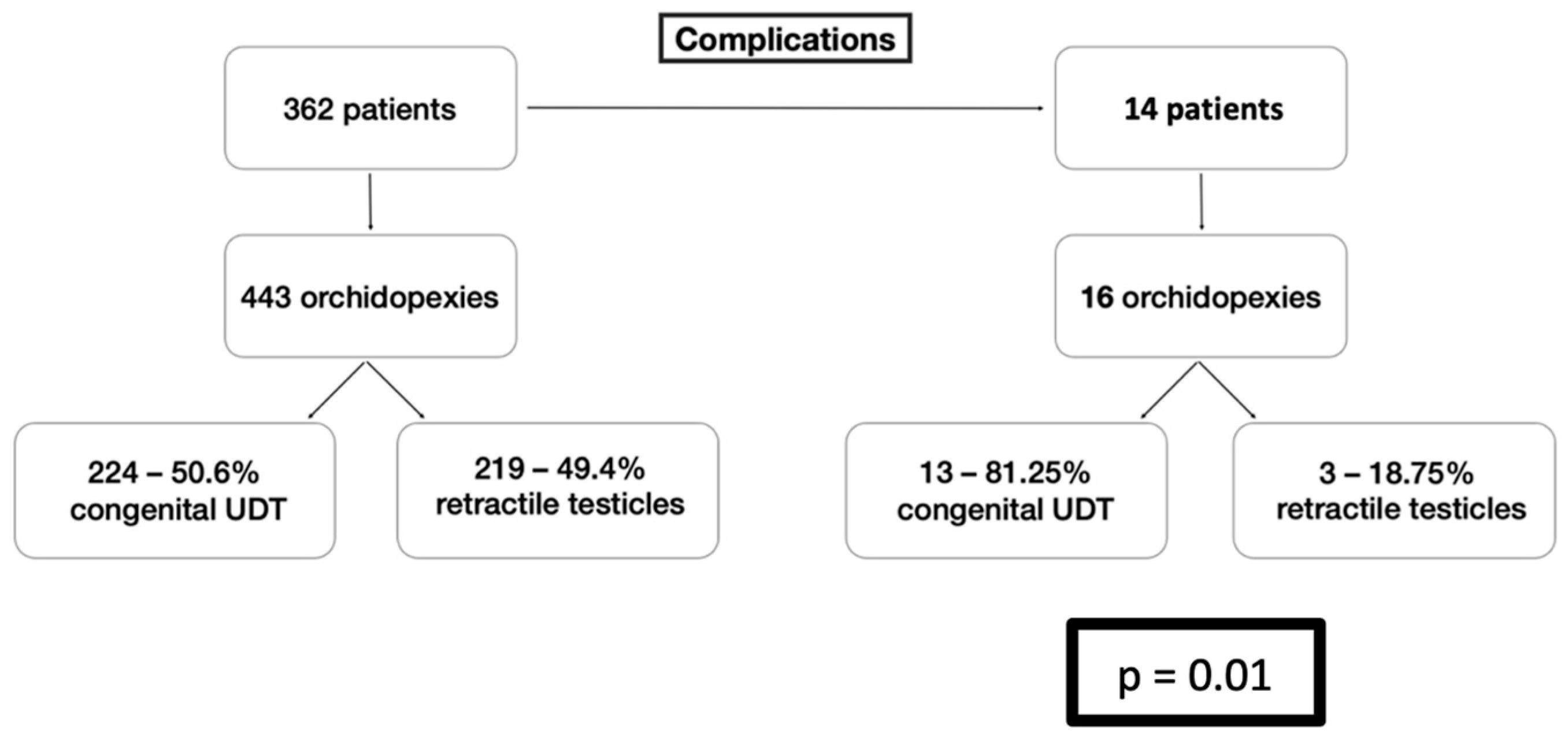
| Undescended testis | 13 |
| Retractile testis | 3 |
| Type of orchidopexy | |
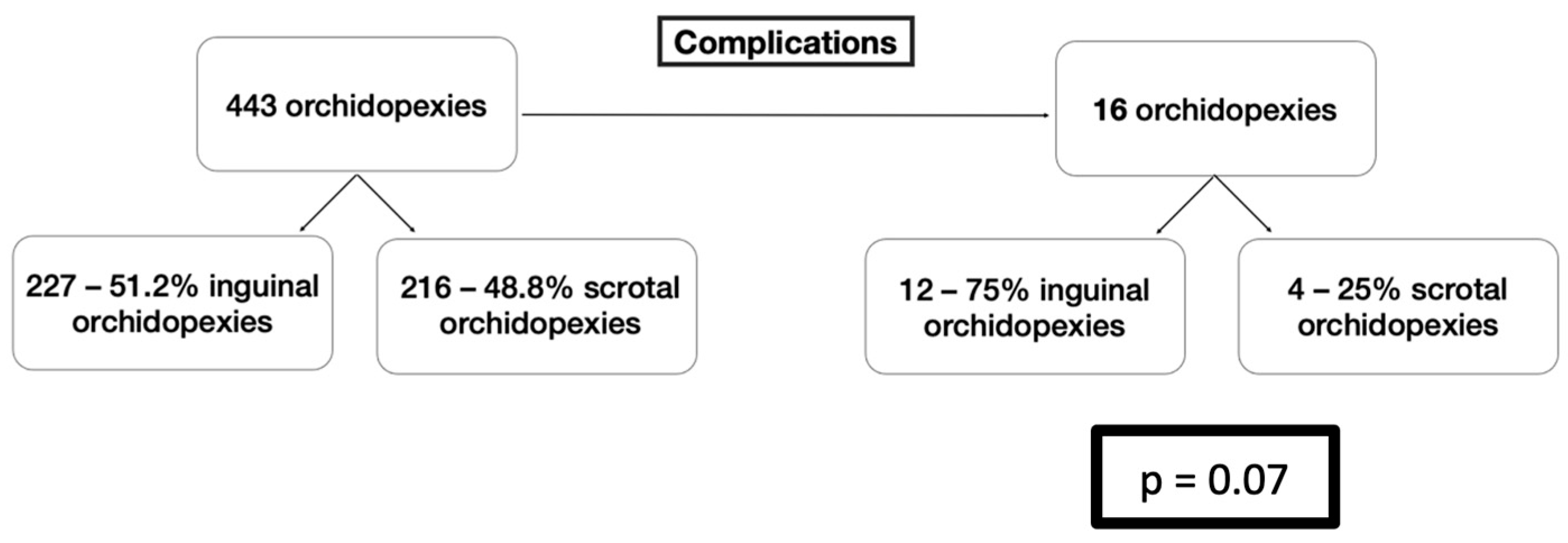
| Inguinal | 10 |
| Scrotal | 6 |
| Laparoscopic | 0 |
| Orchidopexy/ Diagnosis | True UDT | Retractile Testis | Total |
|---|---|---|---|
| Inguinal | 176 | 51 | 227 (51.2%) |
| Scrotal | 48 | 168 | 216 (48.8%) |
| Total | 224 | 219 | 443 |
Disclaimer/Publisher’s Note: The statements, opinions and data contained in all publications are solely those of the individual author(s) and contributor(s) and not of MDPI and/or the editor(s). MDPI and/or the editor(s) disclaim responsibility for any injury to people or property resulting from any ideas, methods, instructions or products referred to in the content. |
© 2026 by the authors. Licensee MDPI, Basel, Switzerland. This article is an open access article distributed under the terms and conditions of the Creative Commons Attribution (CC BY) license.
Share and Cite
Florou, M.; Koletsa, T.; Tsokkou, S.; Raptou, G.; Syrnioti, A.; Spyridakis, I.; Kaselas, C. Comparison of Scrotal Orchiopexy Versus Traditional Inguinal Orchiopexy for Palpable Undescended and Retractile Testis in Children: Insights from a Greek Surgical Center. Life 2026, 16, 360. https://doi.org/10.3390/life16020360
Florou M, Koletsa T, Tsokkou S, Raptou G, Syrnioti A, Spyridakis I, Kaselas C. Comparison of Scrotal Orchiopexy Versus Traditional Inguinal Orchiopexy for Palpable Undescended and Retractile Testis in Children: Insights from a Greek Surgical Center. Life. 2026; 16(2):360. https://doi.org/10.3390/life16020360
Chicago/Turabian StyleFlorou, Maria, Triantafyllia Koletsa, Sophia Tsokkou, Georgia Raptou, Antonia Syrnioti, Ioannis Spyridakis, and Christos Kaselas. 2026. "Comparison of Scrotal Orchiopexy Versus Traditional Inguinal Orchiopexy for Palpable Undescended and Retractile Testis in Children: Insights from a Greek Surgical Center" Life 16, no. 2: 360. https://doi.org/10.3390/life16020360
APA StyleFlorou, M., Koletsa, T., Tsokkou, S., Raptou, G., Syrnioti, A., Spyridakis, I., & Kaselas, C. (2026). Comparison of Scrotal Orchiopexy Versus Traditional Inguinal Orchiopexy for Palpable Undescended and Retractile Testis in Children: Insights from a Greek Surgical Center. Life, 16(2), 360. https://doi.org/10.3390/life16020360