Mirror Therapy Versus Motor Imagery in Stroke Neurorehabilitation: A Systematic Review with Comparative Narrative Synthesis
 , , , , and
Abstract
1. Introduction
2. Materials and Methods
2.1. Review Protocol and Registration
2.2. Study Eligibility and Inclusion Criteria
2.3. Search Strategy
2.4. Study Selection
2.5. Data Extraction
2.6. Narrative Data Synthesis and Analysis
2.7. Methodological Quality and Bias Assessment
3. Results
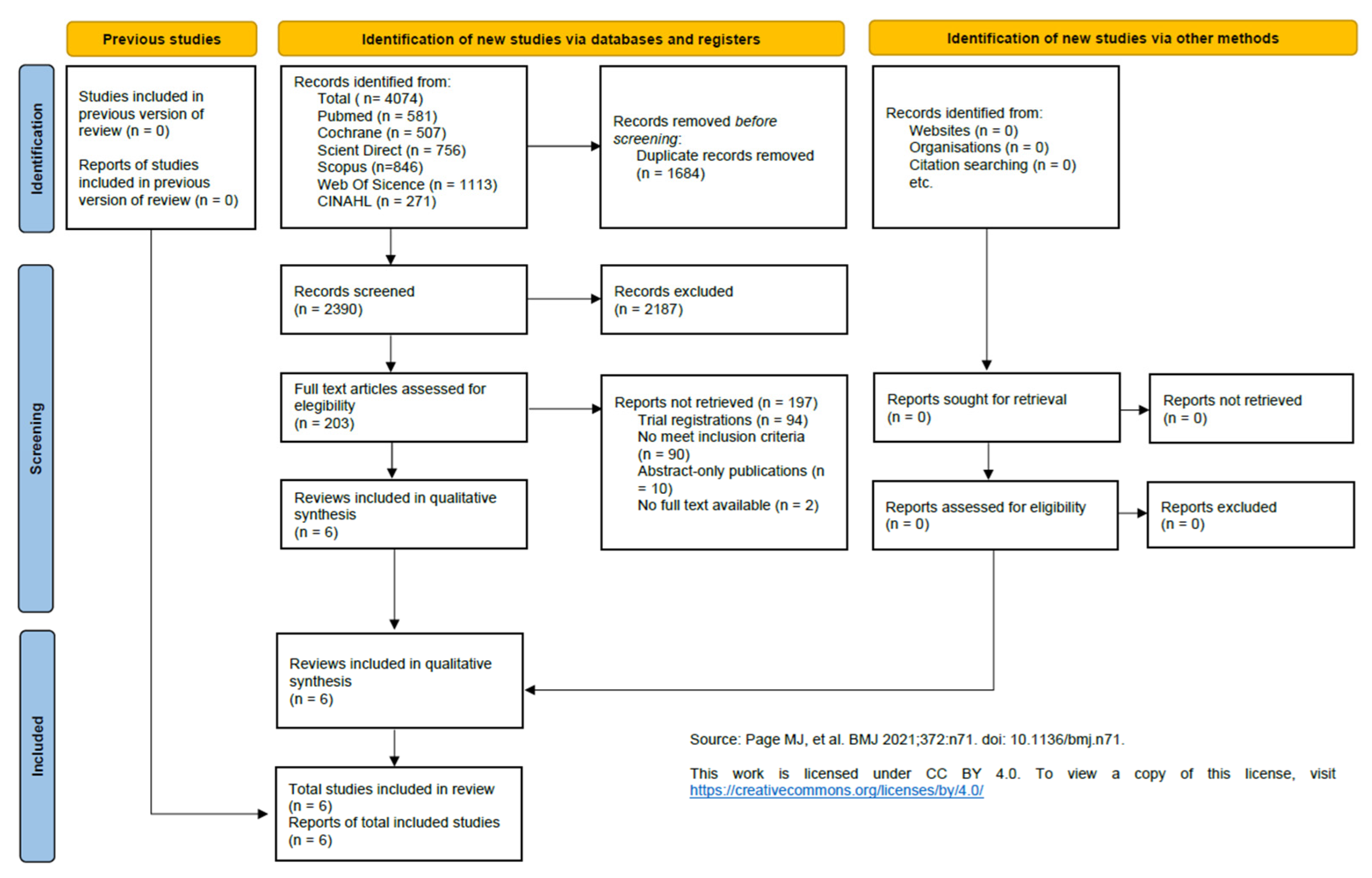
3.1. Overview of Study Identification and Eligibility Assessment
3.2. Characteristics of the Included Studies
3.2.1. Study Design and Sample Size
3.2.2. Participant Demographics

| Study | Study Design | Stroke Phase | Etiology | Sex | Groups (n) | Age (Years) | Intervention (MI/MT) | Intervention Volume | Outcomes | Results | ||
|---|---|---|---|---|---|---|---|---|---|---|---|---|
| Weeks | Frequency | Duration (Minutes) | ||||||||||
| De et al., 2017 [34] | RCT | Subacute | n.i. | n.i. | MI (15) | 50–65 years | Kinesthetic MI of ankle DF/EV + CRT | 4 | 5 | MI: 30 CRT:30 | FMA-LE MAS 10MWT | MI > MT: FMA-LE; No between-group differences: MAS, 10MWT |
| MT (15) | Mirror feedback of ankle DF/EV + CRT | 4 | 5 | MT: 30 CRT:30 | ||||||||
| Finney et al., 2024 [35] | RCT | Acute | Ischemic | F (36.7%) M (63.3%) | MI (15) | n.i. | Functional MI + physical practice | 7 | 3 | Total: 60 | ARAT (total and subscales) | MI > MT: ARAT total, gross movement; both groups improved |
| MT (15) | n.i. | Functional MT of same tasks | 7 | 3 | Total: 60 | |||||||
| Jain et al., 2024 [36] | RCT | Acute | Ischemic and hemorrhagic | F (43.3%) M (56.7%) | MI (15) | 56.1 | Internal visual MI of ankle DF/EV + CRT | 4 | 5 | MI: 30 CRT:30 | FMA-LE MAS 10MWT | MI > MT: FMA-LE; No between-group differences: MAS, 10MWT |
| MT (15) | 56.6 | Mirror feedback of ankle DF/EV + CRT | 4 | 5 | MT: 30 CRT:30 | |||||||
| Lee et al., 2019 [33] | Comparative experimental | Subacute | Ischemic and hemorrhagic | n.i. | MI-Mild (6) | 71.6 | Audio-guided MI (upper limb) | 4 | n.i. | MI: 20 Relax: 10 | BBT JTHFT MFT | Cognition-dependent effects: MI > MT (mild: JTHFT); MT > MI (severe: BBT, JTHFT, MFT) |
| MT-Mild (6) | 73.8 | Mirror feedback (upper limb) | 4 | n.i. | n.i. | |||||||
| MI-Severe (6) | 72.0 | Audio-guided MI (upper limb) | 4 | n.i. | MI: 20 Relax: 10 | |||||||
| MT-Severe (6) | 70.7 | Mirror feedback (upper limb) | 4 | n.i. | n.i. | |||||||
| Margrett et al., 2019 [38] | RCT | n.i. | n.i. | n.i. | MI (31) | age between 30 and 80 years | Visual and kinesthetic MI of gait-related tasks + CRT | 6 | 5 | MI: 15 CRT:30 | Step length Stride length Cadence 10MWT | Both MI and MT improved gait outcomes; no between-group differences |
| MT (31) | MT during gait-related functional tasks + CRT | 6 | 5 | MT: 15 CRT:30 | ||||||||
| Thara et al., 2015 [37] | RCT | Subacute | Ischemic | F (30.0%) M (70.0%) | MI (15) | 51.9 | Task-specific MI (upper limb) + home program | 10 | 3 | Total: 60 | ARAT (total score and subscales) | MI > MT: ARAT hand function |
| MT (15) | 52.7 | Task -specific MT (upper limb) + home program | 10 | 3 | Total: 60 | |||||||
3.2.3. Stroke Characteristics
3.2.4. Cognitive Status
3.2.5. Baseline Functional Status
3.2.6. MI and MT Interventions
3.3. Summary of Results
3.3.1. Motor Function
3.3.2. Functional Performance
3.3.3. Spasticity
3.3.4. Gait-Related Outcomes
3.4. Assessment of Methodological Quality
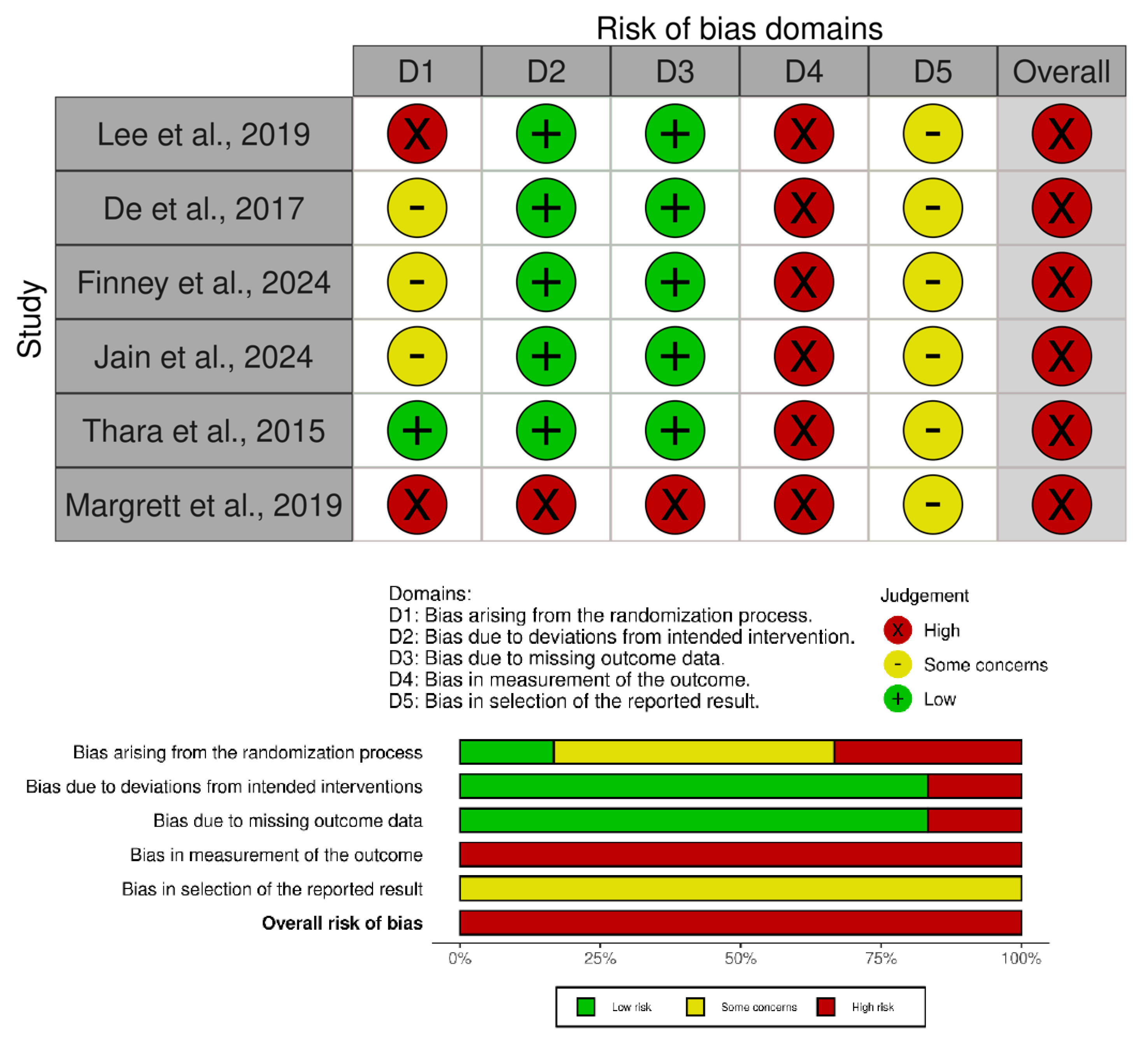
3.5. Risk of Bias of the Included Studies
4. Discussion
5. Conclusions
Supplementary Materials
Author Contributions
Funding
Institutional Review Board Statement
Informed Consent Statement
Data Availability Statement
Acknowledgments
Conflicts of Interest
Abbreviations
| ARAT | Action Research Arm Test |
| BBT | Box and Block Test |
| BCI | Brain–Computer Interface |
| CRT | Conventional Rehabilitation Therapy |
| EEG | Electroencephalography |
| ERD | Event-Related Desynchronization |
| FMA-LE | Fugl–Meyer Assessment – Lower Extremity |
| JTHFT | Jebsen–Taylor Hand Function Test |
| MAS | Modified Ashworth Scale |
| MI | Motor Imagery |
| MMSE | Mini-Mental State Examination |
| MMSE-K | Korean Version of the Mini-Mental State Examination |
| MT | Mirror Therapy |
| PEDro | Physiotherapy Evidence Database |
| PRISMA | Preferred Reporting Items for Systematic Reviews and Meta-Analyses |
| PROSPERO | International Prospective Register of Systematic Reviews |
| RCT | Randomized Controlled Trial |
| RoB 2 | Risk of Bias tool, version 2 |
| 10MWT | 10-Meter Walk Test |
References
- Feigin, V.L.; Brainin, M.; Norrving, B.; Martins, S.O.; Pandian, J.; Lindsay, P.; Grupper, M.F.; Rautalin, I. World Stroke Organization: Global Stroke Fact Sheet 2025. Int. J. Stroke 2025, 20, 132–144. [Google Scholar] [CrossRef]
- Feigin, V.L.; Abate, M.D.; Abate, Y.H.; ElHafeez, S.A.; Abd-Allah, F.; Abdelalim, A.; Abdelkader, A.; Abdelmasseh, M.; Abd-Elsalam, S.; Abdi, P.; et al. Global, regional, and national burden of stroke and its risk factors, 1990–2021: A systematic analysis for the Global Burden of Disease Study 2021. Lancet Neurol. 2024, 23, 973–1003. [Google Scholar] [CrossRef] [PubMed]
- Li, X.; He, Y.; Wang, D.; Rezaei, M.J. Stroke rehabilitation: From diagnosis to therapy. Front. Neurol. 2024, 15, 1402729. [Google Scholar] [CrossRef] [PubMed]
- Claflin, E.S.; Krishnan, C.; Khot, S.P. Emerging treatments for motor rehabilitation after stroke. Neurohospitalist 2015, 5, 77–88. [Google Scholar] [CrossRef] [PubMed]
- Nudo, R.J. Recovery after brain injury: Mechanisms and principles. Front. Hum. Neurosci. 2013, 7, 887. [Google Scholar] [CrossRef]
- Choy, C.S.; Fang, Q.; Neville, K.; Ding, B.; Kumar, A.; Mahmoud, S.S.; Gu, X.; Fu, J.; Jelfs, B. Virtual reality and motor imagery for early post-stroke rehabilitation. Biomed. Eng. Online 2023, 22, 66. [Google Scholar] [CrossRef]
- Ventoulis, I.; Gkouma, K.R.; Ventouli, S.; Polyzogopoulou, E. The role of mirror therapy in the rehabilitation of the upper limb’s motor deficits after stroke: A narrative review. J. Clin. Med. 2024, 13, 7808. [Google Scholar] [CrossRef]
- Gandhi, D.B.C.; Sterba, A.; Khatter, H.; Pandian, J.D. Mirror therapy in stroke rehabilitation: Current perspectives. Ther. Clin. Risk Manag. 2020, 16, 75. [Google Scholar] [CrossRef]
- Shen, S.; Chu, T.; Wang, J.; Zhao, H.; Tang, J.; Xu, L.; Ni, W.; Tan, L.; Chen, Y. Progress in the application of motor imagery therapy in upper limb motor function rehabilitation of stroke patients with hemiplegia. Front. Neurol. 2025, 16, 1454499. [Google Scholar] [CrossRef]
- Monteiro, K.B.; Cardoso, M.d.S.; Cabral, V.R.d.C.; Santos, A.O.B.d.; Silva, P.S.d.; Castro, J.B.P.d.; Vale, R.G.d.S. Effects of motor imagery as a complementary resource on the rehabilitation of stroke patients: A meta-analysis of randomized trials. J. Stroke Cerebrovasc. Dis. 2021, 30, 105876. [Google Scholar] [CrossRef]
- Tong, Y.; Pendy, J.T.; Li, W.A.; Du, H.; Zhang, T.; Geng, X.; Ding, Y. Motor imagery-based rehabilitation: Potential neural correlates and clinical application for functional recovery of motor deficits after stroke. Aging Dis. 2017, 8, 364–371. [Google Scholar] [CrossRef] [PubMed]
- Kho, A.Y.; Liu, K.P.Y.; Chung, R.C.K. Meta-analysis on the effect of mental imagery on motor recovery of the hemiplegic upper extremity function. Aust. Occup. Ther. J. 2014, 61, 38–48. [Google Scholar] [CrossRef] [PubMed]
- Villa-Berges, E.; Laborda-Soriano, A.A.; Lucha-López, O.; Tricas-Moreno, J.M.; Hernández-Secorún, M.; Gómez-Martínez, M.; Hidalgo-García, C. Motor imagery and mental practice in the subacute and chronic phases in upper limb rehabilitation after stroke: A systematic review. Occup. Ther. Int. 2023, 2023, 3752889. [Google Scholar] [CrossRef] [PubMed]
- Barclay, R.E.; Stevenson, T.J.; Poluha, W.; Semenko, B.; Schubert, J. Mental practice for treating upper extremity deficits in individuals with hemiparesis after stroke. Cochrane Database Syst. Rev. 2020, 2020, CD005950. [Google Scholar] [CrossRef]
- Guerra, Z.F.; Lucchetti, A.L.G.; Lucchetti, G. Motor imagery training after stroke: A systematic review and meta-analysis of randomized controlled trials. J. Neurol. Phys. Ther. 2017, 41, 205–214. [Google Scholar] [CrossRef]
- Polo-Ferrero, L.; Torres-Alonso, J.; Sánchez-González, J.L.; Hernández-Rubia, S.; Pérez-Elvira, R.; Oltra-Cucarella, J. Motor imagery for post-stroke upper limb recovery: A meta-analysis of RCTs on Fugl–Meyer upper extremity scores. J. Clin. Med. 2025, 14, 7891. [Google Scholar] [CrossRef]
- Polo-Ferrero, L.; Torres-Alonso, J.; Sánchez-González, J.L.; Hernández-Rubia, S.; Agudo Juan, M.; Pérez-Elvira, R.; Oltra-Cucarella, J. Stroke neurorehabilitation and the role of motor imagery training: Do ARAT and Barthel Index improvements support its clinical use? A systematic review and meta-analysis. Medicina 2026, 62, 174. [Google Scholar] [CrossRef]
- Deconinck, F.J.A.; Smorenburg, A.R.P.; Benham, A.; Ledebt, A.; Feltham, M.G.; Savelsbergh, G.J.P. Reflections on mirror therapy: A systematic review of the effect of mirror visual fe edback on the brain. Neurorehabil. Neural Repair 2015, 29, 349–361. [Google Scholar] [CrossRef]
- Saragih, I.D.; Priyanti, R.P.; Batubara, S.O.; Lee, B.O. Effects of mirror therapy on upper limb motor function of patients with stroke: A systematic review and meta-analysis of randomized controlled trials. Clin. Rehabil. 2025, 39, 23–34. [Google Scholar] [CrossRef]
- Hsieh, Y.-L.; Yang, T.-Y.; Peng, Z.-Y.; Wang, R.-Y.; Shih, H.-T.; Yang, Y.-R. Effects of mirror therapy on motor and functional recovery of the upper extremity in subacute stroke: Systematic review and meta-analysis. PM&R 2025, 17, 567–581. [Google Scholar] [CrossRef]
- Boening, A.; Ada, L.; Alvarenga, M.T.M.; Scianni, A.A.; Nascimento, L.R. Unilateral mirror therapy may improve upper limb motor recovery after stroke but bilateral mirror therapy provides little or no additional benefit: A systematic review. J. Physiother. 2025, 72, 33–41. [Google Scholar] [CrossRef]
- Okamura, R.; Nakashima, A.; Moriuchi, T.; Fujiwara, K.; Ohno, K.; Higashi, T.; Tomori, K. Effects of a virtual reality-based mirror therapy system on upper extremity rehabilitation after stroke: A systematic review and meta-analysis of randomized controlled trials. Front. Neurol. 2024, 14, 1298291. [Google Scholar] [CrossRef]
- Li, Y.; Wei, Q.; Gou, W.; He, C. Effects of mirror therapy on walking ability, balance and lower limb motor recovery after stroke: A systematic review and meta-analysis of randomized controlled trials. Clin. Rehabil. 2018, 32, 1007–1021. [Google Scholar] [CrossRef]
- Broderick, P.; Horgan, F.; Blake, C.; Ehrensberger, M.; Simpson, D.; Monaghan, K. Mirror therapy for improving lower limb motor function and mobility after stroke: A systematic review and meta-analysis. Gait Posture 2018, 63, 208–220. [Google Scholar] [CrossRef]
- Zhang, Y.; Xing, Y.; Li, C.; Hua, Y.; Hu, J.; Wang, Y.; Ya, R.; Meng, Q.; Bai, Y. Mirror therapy for unilateral neglect after stroke: A systematic review. Eur. J. Neurol. 2022, 29, 358–371. [Google Scholar] [CrossRef]
- Page, M.J.; McKenzie, J.E.; Bossuyt, P.M.; Boutron, I.; Hoffmann, T.C.; Mulrow, C.D.; Shamseer, L.; Tetzlaff, J.M.; Akl, E.A.; Brennan, S.E.; et al. The PRISMA 2020 statement: An updated guideline for reporting systematic reviews. BMJ 2021, 372, n71. [Google Scholar] [CrossRef]
- Stone, P.W. Popping the (PICO) question in research and evidence-based practice. Appl. Nurs. Res. 2002, 15, 197–198. [Google Scholar] [CrossRef] [PubMed]
- Sterne, J.A.C.; Savović, J.; Page, M.J.; Elbers, R.G.; Blencowe, N.S.; Boutron, I.; Cates, C.J.; Cheng, H.Y.; Corbett, M.S.; Eldridge, S.M.; et al. RoB 2: A revised tool for assessing risk of bias in randomised trials. BMJ 2019, 366, l4898. [Google Scholar] [CrossRef] [PubMed]
- Cicchetti, D.V.; Feinstein, A.R. High agreement but low kappa: II. Resolving the paradoxes. J. Clin. Epidemiol. 1990, 43, 551–558. [Google Scholar] [CrossRef] [PubMed]
- Landis, J.R.; Koch, G.G. The measurement of observer agreement for categorical data. Biometrics 1977, 33, 159–174. [Google Scholar] [CrossRef] [PubMed]
- Cashin, A.G.; McAuley, J.H. Clinimetrics: Physiotherapy Evidence Database (PEDro) scale. J. Physiother. 2020, 66, 59. [Google Scholar] [CrossRef] [PubMed]
- de Morton, N.A. The PEDro scale is a valid measure of the methodological quality of clinical trials: A demographic study. Aust. J. Physiother. 2009, 55, 129–133. [Google Scholar] [CrossRef] [PubMed]
- Lee, S.A.; Cha, H.G. The effect of motor imagery and mirror therapy on upper extremity function according to the level of cognition in stroke patients. Int. J. Rehabil. Res. 2019, 42, 330–336. [Google Scholar] [CrossRef] [PubMed]
- De, S.; Chopra, C.; Mehta, D.D.; Mehndiratta, M.M. Comparison between mirror therapy and mental imagery in improving ankle motor recovery in sub acute stroke patients. Indian J. Physiother. Occup. Ther. 2017, 11, 168–172. [Google Scholar] [CrossRef]
- Charles, F.M.; Gopal, K.R.; Parvathi, S.; Saravanan, V.S.; Jeyakumar, S. Comparative efficacy of mental practice and mirror therapy on upper limb motor function in acute stroke rehabilitation: A randomized controlled trial. Int. J. Health Sci. Res. 2024, 14, 179–187. [Google Scholar] [CrossRef]
- Jain, K.; Srivastava, N.; Chhonker, K.; Shukla, G. Comparison between mirror therapy and mental imagery in improving ankle motor recovery in acute stroke patients: Experimental study. Indian J. Physiother. Occup. Ther. 2024, 18, 45–50. [Google Scholar] [CrossRef]
- Thara, N.; Nandini, S.K.; Vinayak, K.B.; Akalwadi, A. Comparative study between task-specific motor imagery with mental practice versus task-specific mirror therapy on upper limb functions for subacute hemiplegia. Int. J. Physiother. 2015, 2, 824–833. [Google Scholar] [CrossRef]
- Margrett, C.M.; Thulasi, P.R.S.; Prakash, P.K.; Apparao, P.; Chintada, G.S.; Tanavarapu, B. A comparative study on mirror therapy and motor imagery on improving gait in post-stroke subjects. Indian J. Physiother. Occup. Ther. 2019, 13, 23. [Google Scholar] [CrossRef]
- Blankertz, B.; Sannelli, C.; Halder, S.; Hammer, E.M.; Kübler, A.; Müller, K.-R.; Curio, G.; Dickhaus, T. Neurophysiological predictor of SMR-based BCI performance. Neuroimage 2010, 51, 1303–1309. [Google Scholar] [CrossRef]
- Lee, M.; Yoon, J.G.; Lee, S.W. Predicting motor imagery performance from resting-state EEG using dynamic causal modeling. Front. Hum. Neurosci. 2020, 14, 321. [Google Scholar] [CrossRef]
- Pfurtscheller, G.; Neuper, C. Motor imagery activates primary sensorimotor area in humans. Neurosci. Lett. 1997, 239, 65–68. [Google Scholar] [CrossRef]
- Kaiser, V.; Daly, I.; Pichiorri, F.; Mattia, D.; Müller-Putz, G.R.; Neuper, C. Relationship between electrical brain responses to motor imagery and motor impairment in stroke. Stroke 2012, 43, 2735–2740. [Google Scholar] [CrossRef]
- Chaudhry, H.A.; Razzaq, N.; Kirpal, S.; Uzair, A.; Naeem, Z.; Abdulbasit; Ali, A.; Asim, H.A.B. Comparing the effects of motor imagery training and conventional physiotherapy on neuroplasticity and motor recovery in stroke patients. J. Health Wellness Community Res. 2025, e393. [Google Scholar]


| Study | 1 | 2 | 3 | 4 | 5 | 6 | 7 | 8 | 9 | 10 | 11 | Total |
|---|---|---|---|---|---|---|---|---|---|---|---|---|
| Lee et al., 2019 [33] | Y | N | N | Y | N | N | N | Y | Y | Y | Y | 6 |
| De et al., 2017 [34] | Y | Y | N | N | N | N | N | Y | Y | Y | N | 5 |
| Finney et al., 2024 [35] | Y | Y | N | Y | N | N | N | Y | Y | Y | Y | 7 |
| Jain et al., 2024 [36] | Y | Y | N | Y | N | N | N | Y | Y | Y | Y | 7 |
| Thara et al., 2015 [37] | Y | Y | Y | Y | N | N | N | Y | Y | Y | Y | 8 |
| Margrett et al., 2019 [38] | Y | N | N | N | N | N | N | N | N | Y | Y | 3 |
| Note: Y; Yes; N, No. | ||||||||||||
Disclaimer/Publisher’s Note: The statements, opinions and data contained in all publications are solely those of the individual author(s) and contributor(s) and not of MDPI and/or the editor(s). MDPI and/or the editor(s) disclaim responsibility for any injury to people or property resulting from any ideas, methods, instructions or products referred to in the content. |
© 2026 by the authors. Licensee MDPI, Basel, Switzerland. This article is an open access article distributed under the terms and conditions of the Creative Commons Attribution (CC BY) license.
Share and Cite
Polo-Ferrero, L.; Torres-Alonso, J.; Sánchez-González, J.L.; Hernández-Rubia, S.; Dávila-Marcos, A.; Agudo Juan, M.; Oltra-Cucarella, J.; Pérez-Elvira, R. Mirror Therapy Versus Motor Imagery in Stroke Neurorehabilitation: A Systematic Review with Comparative Narrative Synthesis. Life 2026, 16, 306. https://doi.org/10.3390/life16020306
Polo-Ferrero L, Torres-Alonso J, Sánchez-González JL, Hernández-Rubia S, Dávila-Marcos A, Agudo Juan M, Oltra-Cucarella J, Pérez-Elvira R. Mirror Therapy Versus Motor Imagery in Stroke Neurorehabilitation: A Systematic Review with Comparative Narrative Synthesis. Life. 2026; 16(2):306. https://doi.org/10.3390/life16020306
Chicago/Turabian StylePolo-Ferrero, Luis, Javier Torres-Alonso, Juan Luis Sánchez-González, Sara Hernández-Rubia, Arturo Dávila-Marcos, María Agudo Juan, Javier Oltra-Cucarella, and Rubén Pérez-Elvira. 2026. "Mirror Therapy Versus Motor Imagery in Stroke Neurorehabilitation: A Systematic Review with Comparative Narrative Synthesis" Life 16, no. 2: 306. https://doi.org/10.3390/life16020306
APA StylePolo-Ferrero, L., Torres-Alonso, J., Sánchez-González, J. L., Hernández-Rubia, S., Dávila-Marcos, A., Agudo Juan, M., Oltra-Cucarella, J., & Pérez-Elvira, R. (2026). Mirror Therapy Versus Motor Imagery in Stroke Neurorehabilitation: A Systematic Review with Comparative Narrative Synthesis. Life, 16(2), 306. https://doi.org/10.3390/life16020306