Dercum’s Disease: Bridging Present Understanding and Emerging Directions

 ,
,  , , , , , , , , , , and
Abstract
1. Dercum’s Disease: An Overview
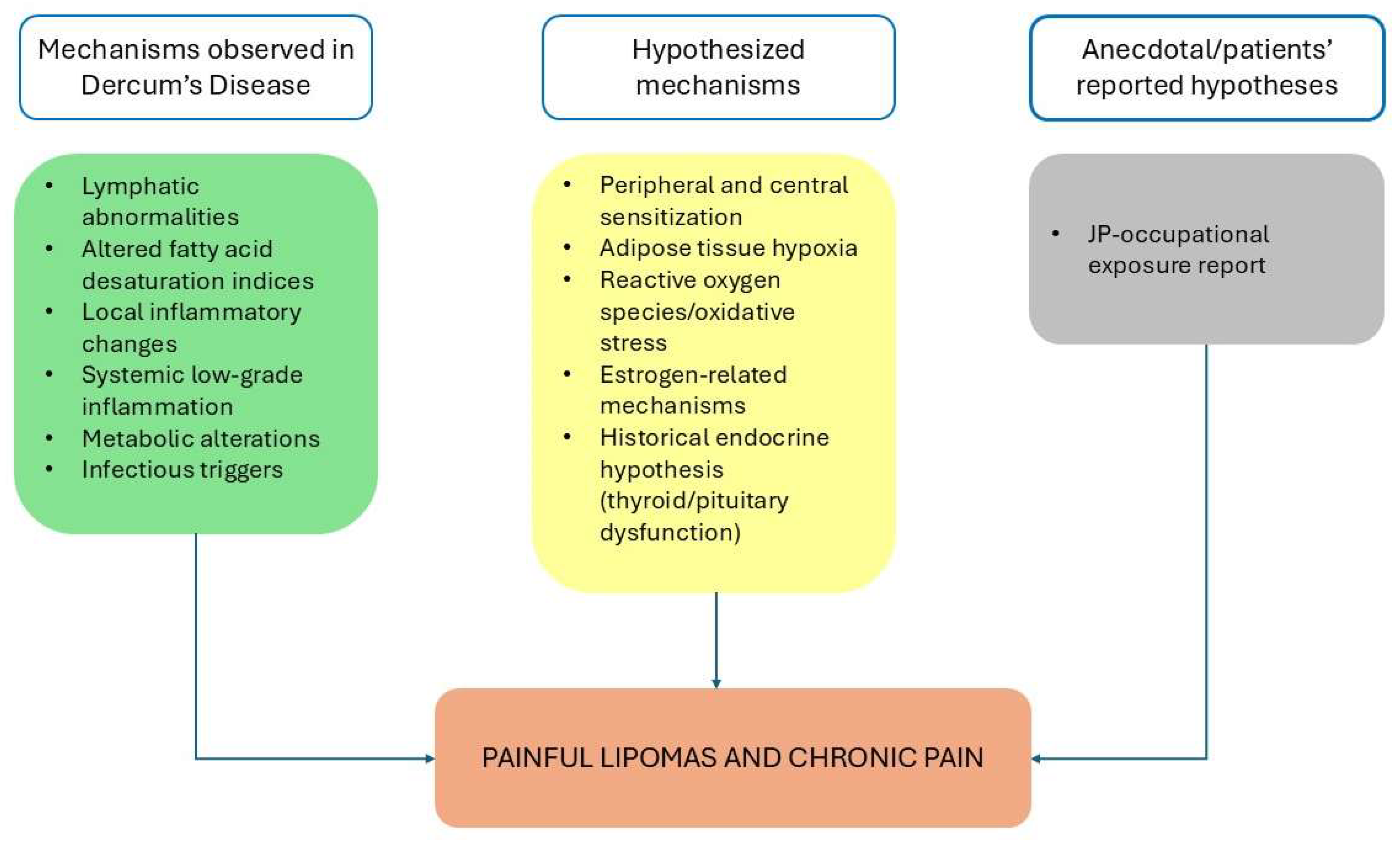
1.1. Pathophysiology
1.2. Classification and Clinical Symptoms
1.3. Other Parameters
1.4. Differential Diagnoses
- Although classified as a rare disease by some authors, lipedema has an estimated prevalence ranging from 11% to 39%, depending on the characteristics of the population studied [63]. Lipedema and DD are both severe, painful disorders of SAT, predominantly affecting women, and with a possible autosomal dominant inheritance with incomplete penetrance [46,64]. They are characterized by abnormal fat deposits that are typically resistant to reduction through starvation or excessive exercise [46]. Furthermore, lipedema is thought to be associated with dysregulated adipose estrogen, which may contribute to alterations to lipid accumulation, fatty acid uptake, and lipogenesis (see Section 1.1) [65]. Painful lipomas are absent in lipedema, and, unlike DD, lipedema is not closely associated with FM [3,46]. Although the distribution of SAT in lipedema and DD may appear similar, patients with lipedema exhibit a higher prevalence of nodules in the extracellular matrix and in the connective tissue surrounding the SAT areas in the lower body [46]. This pattern aligns with the characteristic gynoid distribution of lipedema, marked by a tendency to accumulate adipose tissue in the femoral-hip region [46,66]. In contrast to abdominal obesity, gynoid SAT seems to exert a protective role against T2D and cardiovascular disease, which could explain the lower prevalence of T2D observed in patients with lipedema compared to those with DD, despite the significantly higher BMI often reported in lipedema [46,67]. Lipedema can also be distinguished from DD through bioimpedance spectroscopy, which has revealed higher tissue water content in women with lipedema compared to those with DD [68]. Notably, lipedema and DD can also coexist, with some individuals exhibiting more affected SAT on the back, buttocks, and arms than typically seen in DD, and more pronounced involvement of the arms compared than in lipedema, suggesting that the two conditions may share pathophysiological features and, in some cases, progress toward one another [46].
- MSL, also known as Madelung disease or Launois–Bensaude lipomatosis, is a rare disorder of SAT, with an estimated prevalence of 1 in 25,000 (ORPHA:199276) [69,70]. It is characterized by the growth of symmetrical, painless, non-encapsulated masses of adipose tissue, predominantly around the face and neck [70]. This anatomical and symptomatic presentation distinguishes it from DD [47]. Additionally, contrary to DD, MSL primarily affects men, with a reported male-to-female ratio ranging from 15:1 to 30:1, typically manifesting between the third and the fifth decades of life [70,71]. Moreover, MSL is strongly associated with chronic alcohol consumption, predominantly in the form of red wine, with approximately 90% of patients reporting a history of moderate to heavy alcohol use [47,71,72]. Although the exact etiology and pathogenesis of MSL are still unclear, the condition is suspected to be linked to underlying metabolic disturbances, possibly involving functionally defective brown adipose tissue [72,73]. Classified into three phenotypes based on the distribution of adipose tissue, MSL typically occurs sporadically [71]. However, rare genetic forms have also been described [70]. Notably, mutations in mitochondrial tRNALys (a transfer RNA responsible for lysine incorporation during protein synthesis) such as the m8344A>G mutation; pathogenic variants in MFN2, a gene encoding a mitochondrial outer membrane protein involved in forming contact sites between mitochondria and the endoplasmic reticulum, which are important for calcium signaling and lipid metabolism; biallelic variants in the LIPE gene, which lead to the absence of hormone- sensitive lipase expression and consequently impairs adipocyte differentiation, have been associated with the MSL phenotype [5,62,73,74].
- FML is a rare adipose tissue disorder (ORPHA:199276, [75]) with a global incidence estimated at 0.002%, and no significant differences in prevalence between sexes [76,77]. Although FML typically manifests in the third decade of life, there are no strict age boundaries for onset, and it can also occur in children [77]. Encapsulated lipomas usually develop on the trunk and limbs, with involvement of the lumbar region, and, unlike DD, they are not associated with pain [77]. This condition follows an autosomal dominant pattern, although inheritance can vary considerably among affected individuals within the same family [76,77]. Certain genetic abnormalities have been identified as potentially contributing to the FML pathogenesis [76]. Among these, the high mobility group protein AT-hook 2 (HMGA2) encodes a non-histones chromatin protein that acts as a transcriptional factor, regulating the gene expression program during adipogenesis [77,78]. Overexpression of HMGA2 has been linked to obesity and its aberrant expression has also been documented in lipomas and in a variety of adipocytic tumors [70,79].
- FM is a complex chronic disorder characterized by widespread musculoskeletal pain (lasting at least 3 months, like in DD) and recurrent episodes of intense fatigue, often accompanied by cognitive difficulties, sleep disturbances, and psychiatric symptoms such as anxiety and depression, all occurring in the absence of a clearly identifiable pathological cause [2,3,80]. The most affected body regions include the back of the neck, shoulders, lower back, elbows, hips, and knees [2]. Furthermore, while pain in FM is initially localized, it tends to progress over time, affecting multiple muscle groups and often manifesting as a burning sensation and with eventually concomitance of hyperalgesia (increased pain in response to normally painful stimuli, such as pressure or heat) and allodynia (pain in response to normally non-painful stimuli, such as light touch, or temperature variations) [81]. For these reasons, FM greatly impairs QoL of affected individuals [82]. FM has a global prevalence estimated at approximately 5% with a marked female predominance, accounting for 75–90% of all cases, and peak incidence occurring between 20 and 50 years of age [81,83]. If on the one hand FM is a disorder of pain regulation, primarily driven by abnormal sensory processing within the CNS, on the other side genome-wide association studies also suggest a role of genetic predisposition in its pathogenesis [84]. Among the candidate genes implicated in FM is the serotonin transporter gene (SLC64A4), whose S allele variant has been associated with various conditions, including depression, schizophrenia, anxiety disorder, and chronic pain [85]. Notably, a recent systematic review and meta-analysis revealed that obesity is highly prevalent among patients with FM and exacerbates several aspects of the disease including pain, stiffness, fatigue, impaired physical functioning, sleep disturbances, and cognitive dysfunction [82].
- Panniculitis, a relatively uncommon inflammation of SAT, is associated with a wide spectrum of inflammatory diseases that are traditionally regarded among the most diagnostically challenging for both clinicians and pathologists [86,87]. Clinically, it usually presents with painful nodules or plaques, which may represent the initial manifestation of underlying dermatologic or rheumatologic diseases [86]. Accurate diagnosis often requires biopsies of adequate sampled lesions and histopathological evaluation allows classification of panniculitis into septal or lobular inflammatory patterns, with or without associated vasculitis [86,87]. Erythema nodosum (EN), the most prevalent type of panniculitis in the setting of immune-mediated and autoimmune diseases, is also caused by infectious agents, drugs, and vaccination [86,87]. Despite variations across ethnic groups and geographical regions, the global incidence of EN is estimated at approximately 5 per 100,000 individuals [87]. EN typically manifests between the second and the fourth decade of life, with peak incidence occurring between 20 and 30 years and a female-to-male ratio ranging from 3:1 to 6:1 [87]. In EN, there is an acute development of painful, tender, erythematous, and warm nodules from 1 to 10 cm in diameter, generally located on the lower limbs, which can be accompanied by systemic symptoms such as low-grade fever, cough, and abdominal pain [87].
- Atypical lipomatous tumors (ALT), also known as well-differentiated liposarcomas (WDLPSs), account for 40–45% cases of all liposarcomas, which collectively represent the most common type of soft tissue neoplasms [88,89]. ALT/WDLPS predominantly affect middle-aged adults, with peak incidence between the fourth and fifth decades of life [88]. These tumors most frequently present as slowly enlarging, painless masses in deep soft tissue of proximal extremities and retroperitoneum and, although tend to recur locally with a rate of approximately 30–50%, they lack metastatic potential [88,90]. Nonetheless, ALT/WDLPSs have the capacity for differentiation, occurring in approximately 10% of cases, with this risk increasing in deep-seated tumors, particularly those arising in the retroperitoneum, and following surgical resection [90,91]. Like their dedifferentiated counterparts, ALT/WDLPSs contain high-level amplifications of chromosome 12q13–15 [90]. This chromosomal region encompasses several genes including MDM2, whose overexpression is considered a key event in ALT/WDLPS pathogenesis [90]. Indeed, MDM2 binds to p53, inhibiting its function and thereby preventing apoptosis and promoting tumor proliferation [90]. As benign lipomas cannot always be reliably distinguished from ALT/WDLPS through solely histological examination, pathognomonic 12q13-15 amplifications resulting MDM2 overexpression is considered the diagnostic gold standard [92].
- Among endocrine disorders, Cushing syndrome (CS) is a rare condition (ORPHA:96253, [93]), most commonly caused by adrenocorticotropic hormone secreting pituitary tumors, which account for approximately 70–80% of cases [94,95,96]. CS is characterized by chronic hypercortisolemia and a heterogeneous clinical presentation, ranging from subtle to severe manifestation [97]. The estimated prevalence of CS is 57–79 cases per million individuals, with an incidence of 1.8–4.5 cases per million [96]. The condition predominantly affects women, with a female-to-male ratio of 4:1, and the mean age at diagnosis is approximately 44 years [96]. Weight gain is one of the hallmark features of CS, occurring in more than half of affected individuals [98]. In particular, chronic hypercortisolism is associated with preferential visceral—rather than subcutaneous—fat accumulation in the abdominal region, driven by abnormal adipokine production, a mechanism implicated in the development of metabolic syndrome [95,97]. Notably, visceral adipose tissue in patients with CS exhibits distinct characteristics, including enlarged abdominal adipocytes and enhanced lipogenic activity compared to obese individuals without CS [98].
- Multiple endocrine neoplasia type 1 (MEN1) is a rare hereditary syndrome (ORPHA:652) with an estimated global prevalence of approximately 1–20 per 100,000 individuals [99,100]. The condition affects males and females equally [99]. MEN1 occurs predominantly in familial form, with autosomal dominant inheritance in approximately 90% of cases [101]. It is caused by mutations in the MEN1 gene, which encodes menin, a key regulator of cell proliferation and differentiation [100]. Affected subjects may exhibit more 20 endocrine and non-endocrine manifestations, among which primary hyperparathyroidism is the most common, being detectable in nearly all patients by the fifth decade of life [101]. Tumors in MEN1 can develop at any age, with parathyroid tumors being the most common, occurring in approximately 95% of cases, followed by pancreatic tumors and anterior pituitary adenomas (with prevalences of around 30–70% and 30–40%, respectively) [101]. In addition, the presence of cutaneous lesions such as angiofibromas, collagenomas, and lipomas is included in the diagnostic criteria for MEN1 [102]. Specifically, the presence of two or more of these lesions is considered diagnostic, while a single lesion is considered sufficient in individuals with a positive family history of MEN1 [103]. Lipomas, in particular, are observed in approximately 34% of patients and are predominantly located on the trunk, extremities, and scalp [102].
- Psychiatric disorders are frequently accompanied by chronic pain manifestations [104]. The prevalence of pain in psychiatric conditions can vary widely depending on pain type and anatomical site, with musculoskeletal pain reported in up to 93% of patients with anxiety and/or depression [104,105]. Conversely, individuals affected by chronic musculoskeletal pain are predominant in women and exhibit a significantly higher risk of developing psychiatric disorders compared to healthy controls, particularly anxiety disorders with panic attacks (44% of cases), generalized anxiety (36%), and mixed anxiety and depression disorder (33%) [106]. Therefore, chronic pain and anxiety/depression disorders are linked by a bidirectional relationship, which may be partly explained by the progressive social isolation induced by pain, which leads to the worsening of depression symptoms, and by the amplification of pain perception in individuals affected by depression [105].

| Disease | Overlapping Aspects | References | Differences | References |
|---|---|---|---|---|
| Lipedema | Absence of lipomas (consistent with type 1 DD) Predominant in women Possible autosomal inheritance Possible co-existence with DD | [46,64] | Symmetrical disorder Not closely associated with FM Higher prevalence of nodular SAT areas in the lower body Higher tissue water content | [3,46,63] |
| MSL | SAT disorder | [70,71] | Symmetrical, painless non-encapsulated lipomatous deposits | [5,47,62,70,71,72] |
| Occurrence between the third and fifth decades of life | Lipomas primarily located around the neck and face | |||
| More prevalent in men | ||||
| Markedly linked to alcohol abuse | ||||
| Possibility of 8344A to G mitochondrial mutation | ||||
| FML | Possibility of occurrence in children | [77] | No significant differences in sex prevalence Encapsulated painless lipomas occurring in the trunk, lower back and limbs | [77,78] |
| Occurrence in the third decade of life | ||||
| Autosomal inheritance pattern | ||||
| FM | Pain persisting for at least 3 months Associated symptoms: sleep disturbances, anxiety, depression | [2,3,80] | Absence of lipomas Widespread musculoskeletal pain with progressive course | [81] |
| Panniculitis (EN) | Painful nodules or plaques Higher prevalence in women | [86,87] | Nodules generally located on the lower limbs | [87] |
| Possibility of concurrent systemic symptoms including low-grade fever, cough, and abdominal pain | ||||
| ALT/WDLPS | Peak incidence between the fourth and fifth decades of life | [88] | Painless masses of deep soft tissues of proximal extremities and retroperitoneum Pathogenesis linked to amplification and overexpression in genes mapped to chromosome 12q13–15 | [88,90,91,92] |
| Cushing syndrome | Predominance in women | [96] | Chronic hypercortisolemia Visceral fat accumulation in the abdominal region | [96] |
| MEN1 | Lipomas detected in 34% of cases predominantly located on the trunk and limbs | [102] | No differences in prevalence by sex Autosomal dominant inheritance | [98,99,101] |
| Presence of painless lipomas in one third of patients | ||||
| Psychiatric disorders | Predominance in women Chronic pain Co-existence with DD | [104,105,106] | Absence of objective disease | [3] |
2. Management of Dercum’s Disease
2.1. Surgical Interventions
2.2. Pharmacological Treatments
2.3. Other Treatments
3. Conclusions
Author Contributions
Funding
Institutional Review Board Statement
Informed Consent Statement
Data Availability Statement
Conflicts of Interest
Abbreviations
| ALT | Atypical lipomatous tumor |
| BMI | Body mass index |
| CCS | Corticosteroids |
| CNS | Central nervous system |
| CS | Cushing syndrome |
| DCA | Deoxycholic acid |
| DD | Dercum’s disease |
| DLQI | Dermatology Life Quality Index |
| ESR | Erythrocyte sedimentation rate |
| FM | Fibromyalgia |
| FML | Familial multiple lipomatosis |
| FREMS | Frequency rhythmic electrical modulation system |
| GIP | Glucose-dependent insulinotropic polypeptide |
| GLP-1 | Glucagon-like peptide-1 |
| IFX | Infliximab |
| IL | Interleukin |
| MEN1 | Multiple endocrine neoplasia type 1 |
| MIP | Macrophage inflammatory protein |
| MLS | Multiple symmetric lipomatosis |
| MTX | Methotrexate |
| NSAID | Non-steroidal anti-inflammatory drug |
| PNS | Peripheral nervous system |
| QoL | Quality of life |
| SAT | Subcutaneous adipose tissue |
| SCD1 | Stearoyl-CoA desaturase enzyme 1 |
| SEMA | Semaglutide |
| T2D | Type 2 diabetes |
| TNF-α | Tumor necrosis factor-alpha |
| TRZ | Tirzepatide |
| VAS | Visual Analogue Scale |
| WDLPS | Well-differentiated liposarcoma |
References
- ORPHA: 36397. Adiposis Dolorosa. Available online: https://www.orpha.net/en/disease/detail/36397 (accessed on 4 October 2025).
- NORD, National Organization of Rare Disorders. Dercum’s Disease. Available online: https://rarediseases.org/rare-diseases/dercums-disease/ (accessed on 4 October 2025).
- Lemaitre, M.; Aubert, S.; Chevalier, B.; Jannin, A.; Bourry, J.; Prévost, G.; Lefebvre, H.; Vantyghem, M.C. Rare Forms of Lipomatosis: Dercum’s Disease and Roch-Leri Mesosomatous Lipomatosis. J. Clin. Med. 2021, 10, 1292. [Google Scholar] [CrossRef]
- Molina, J.D.; Nai, G.A.; Andrade, T.C.P.C.; Abreu, M.A.M.M. Dercum’s disease: A rare and underdiagnosed disease. An. Bras. Dermatol. 2019, 94, 251–253. [Google Scholar] [CrossRef]
- Kucharz, E.J.; Kopeć-Mędrek, M.; Kramza, J.; Chrzanowska, M.; Kotyla, P. Dercum’s disease (adiposis dolorosa): A review of clinical presentation and management. Reumatologia 2019, 57, 281–287. [Google Scholar] [CrossRef] [PubMed]
- Moattari, C.; Giovane, R.A.; DiGiovanni Kinsely, S. Dercum’s Disease: A Case Report of a Patient Having Both Type 1 and Type 2 Dercum’s Disease. Case Rep. Dermatol. Med. 2020, 2020, 6129706. [Google Scholar]
- Hansson, E.; Svensson, H.; Brorson, H. Review of Dercum’s disease and proposal of diagnostic criteria, diagnostic methods, classification and management. Orphanet J. Rare Dis. 2012, 7, 23. [Google Scholar] [CrossRef]
- Mosbeh, A.; Almutairi, R.; Albazzali, A. Dercum’s Disease: A Rare Disease of Painful Fatty Lumps. Cureus 2023, 15, e48615. [Google Scholar]
- Herbst, K.L.; Asare-Bediako, S.B.S. Adiposis Dolorosa Is More Than Painful Fat. Endocrinologist 2007, 17, 326–334. [Google Scholar] [CrossRef]
- Izar, M.C.O.; Fonseca, H.A.R.D.; França, C.N.; Machado, V.A.; Ferreira, C.E.D.S.; Fonseca, F.A.H. Rare Presentation of Dercum’s Disease in a Child with Abnormalities in Lipoprotein Metabolism. Arq. Bras. Cardiol. 2018, 111, 755–757. [Google Scholar]
- Munguia, N.; Mozayeni, B.R.; Wright, T.F.; Herbst, K.I. Dercum’s Disease: Estimating the Prevalence of a Rare Painful Loose Connective Tissue. Future Rare Dis. 2021, 1, FRD4. [Google Scholar] [CrossRef]
- Fang, X.X.; Zhai, M.N.; Zhu, M.; He, C.; Wang, H.; Wang, J.; Zhang, Z.J. Inflammation in pathogenesis of chronic pain: Foe and friend. Mol. Pain 2023, 19, 17448069231178176. [Google Scholar] [CrossRef] [PubMed]
- Choi, S.I.; Hwang, S.W. Depolarizing Effectors of Bradykinin Signaling in Nociceptor Excitation in Pain Perception. Biomol. Ther. 2018, 26, 255–267. [Google Scholar] [CrossRef]
- Benfaremo, D.; Luchetti, M.M.; Gabrielli, A. Widespread painful nodules in a patient with rheumatoid arthritis. Eur. J. Intern. Med. 2017, 46, e1–e2. [Google Scholar] [CrossRef]
- Hao, D.; Olugbodi, A.; Udechukwu, N.; Donato, A.A. Trauma-induced adiposis dolorosa (Dercum’s disease). BMJ Case Rep. 2018, 2018, bcr2017223869. [Google Scholar] [CrossRef] [PubMed]
- VA Citation Nr: 22015869. In the Appeal of Dercum’s Disease, VA Decision. 2022. Available online: https://www.va.gov/vetapp22/Files3/22015869.txt (accessed on 26 October 2025).
- Harris, D.T.; Sakiestewa, D.; Titone, D.; Witten, M. JP-8 jet fuel exposure induces high levels of IL-10 and PGE2 secretion and is correlated with loss of immune function. Toxicol. Ind. Health 2007, 23, 223–230. [Google Scholar] [CrossRef] [PubMed]
- Harris, D.T.; Sakiestewa, D.; Titone, D.; He, X.; Hyde, J.; Witten, M. JP-8 jet fuel exposure potentiates tumor development in two experimental model systems. Toxicol. Ind. Health 2007, 23, 617–623. [Google Scholar] [CrossRef]
- Reytor-González, C.; Jiménez-Flores, E.; Toral-Noristz, M.; Campuzano-Donoso, M.; Román-Galeano, N.M.; Simancas-Racines, D. The Molecular Mechanisms Underlying Dercum’s Disease: Exploring the Intersection of Obesity, Pain, and Inflammation. Int. J. Mol. Sci. 2025, 26, 11130. [Google Scholar] [CrossRef]
- Mair, K.M.; Gaw, R.; MacLean, M.R. Obesity, estrogens and adipose tissue dysfunction—Implications for pulmonary arterial hypertension. Pulm. Circ. 2020, 10, 2045894020952019. [Google Scholar] [CrossRef] [PubMed]
- Chait, A.; den Hartigh, L.J. Adipose Tissue Distribution, Inflammation and Its Metabolic Consequences, Including Diabetes and Cardiovascular Disease. Front. Cardiovasc. Med. 2020, 7, 22. [Google Scholar] [CrossRef]
- Halberg, N.; Khan, T.; Trujillo, M.E.; Wernstedt-Asterholm, I.; Attie, A.D.; Sherwani, S.; Wang, Z.V.; Landskroner-Eiger, S.; Dineen, S.; Magalang, U.J.; et al. Hypoxia-inducible factor 1alpha induces fibrosis and insulin resistance in white adipose tissue. Mol. Cell Biol. 2009, 29, 4467–4483. [Google Scholar] [CrossRef]
- Engin, A. Adipose Tissue Hypoxia in Obesity: Clinical Reappraisal of Hypoxia Hypothesis. Adv. Exp. Med. Biol. 2024, 1460, 329–356. [Google Scholar]
- Houstis, N.; Rosen, E.D.; Lander, E.S. Reactive oxygen species have a causal role in multiple forms of insulin resistance. Nature 2006, 440, 944–948. [Google Scholar] [CrossRef] [PubMed]
- Kuryłowicz, A. Estrogens in Adipose Tissue Physiology and Obesity-Related Dysfunction. Biomedicines 2023, 11, 690. [Google Scholar] [CrossRef]
- Beltran, K.; Wadeea, R.; Herbst, K.L. Infections preceding the development of Dercum disease. IDCases 2019, 19, e00682. [Google Scholar] [CrossRef]
- Rasmussen, J.C.; Herbst, K.L.; Aldrich, M.B.; Darne, C.D.; Tan, I.C.; Zhu, B.; Guilliod, R.; Fife, C.E.; Maus, E.A.; Sevick-Muraca, E.M. An abnormal lymphatic phenotype is associated with subcutaneous adipose tissue deposits in Dercum’s disease. Obesity 2014, 22, 2186–2192. [Google Scholar] [CrossRef]
- Yee, J.K.; Phillips, S.A.; Allamehzadeh, K.; Herbst, K.L. Subcutaneous adipose tissue fatty acid desaturation in adults with and without rare adipose disorders. Lipids Health Dis. 2012, 11, 19. [Google Scholar] [CrossRef]
- Klawitter, J.; Bek, S.; Zakaria, M.; Zeng, C.; Hornberger, A.; Gilbert, R.; Shokati, T.; Klawitter, J.; Christians, U.; Boernsen, K.O. Fatty acid desaturation index in human plasma: Comparison of different analytical methodologies for the evaluation of diet effects. Anal. Bioanal. Chem. 2014, 406, 6399–6408. [Google Scholar] [CrossRef]
- ALJohani, A.M.; Syed, D.N.; Ntambi, J.M. Insights into Stearoyl-CoA Desaturase-1 Regulation of Systemic Metabolism. Trends Endocrinol. Metab. 2017, 28, 831–842. [Google Scholar] [CrossRef]
- Jeyakumar, S.M.; Lopamudra, P.; Padmini, S.; Balakrishna, N.; Giridharan, N.V.; Vajreswari, A. Fatty acid desaturation index correlates with body mass and adiposity indices of obesity in Wistar NIN obese mutant rat strains WNIN/Ob and WNIN/GR-Ob. Nutr. Metab. 2009, 6, 27. [Google Scholar] [CrossRef]
- Asdourian, M.S.; Shah, N.; Jacoby, T.V.; Tiao, J.; Fedeles, F. Dercum’s disease: A retrospective cohort study. J. Am. Acad. Dermatol. 2023, 88, 738–741. [Google Scholar] [CrossRef] [PubMed]
- Wollina, U.; Heinig, B.; Langner, D.; Nowak, A. Juxta-articular adiposis dolorosa (Dercum’s disease type IV): Report of four cases and treatment by dermolipectomy. Wien. Med. Wochenschr. 2015, 165, 374–377. [Google Scholar] [CrossRef] [PubMed]
- Kucharz, E.J.; Kramza, J.; Kotyla, P.; Kotulska, A. Mixed generalized/juxta-articular form of Dercum’s disease. Reumatologia 2016, 54, 212. [Google Scholar] [CrossRef]
- Arsal, S.A.; Kumar, A.; Soomro, M.; Shafiqu, M.A. Dercum’s disease: A rare adipose tissue disorder. J. Med. Surg. Public Health 2023, 1, 100025. [Google Scholar] [CrossRef]
- Al-Housni, O.; Boufeas, C.; Slane, V. Dercum’s Disease: The Clinical Presentation, Diagnosis, Radiological Findings, and Treatment of a Rare, Debilitating Inflammatory Disorder. HCA Healthc. J. Med. 2024, 5, 171–174. [Google Scholar] [CrossRef]
- Kawale, J.; Mahore, A.; Dange, N.; Bhoyar, K. Adiposis dolorosa of scalp presenting with severe headache: An unusual case. J. Headache Pain 2010, 11, 539–541. [Google Scholar] [CrossRef]
- Baig, M.A. An unusual presentation of Dercum’s disease to the emergency department. Oxf. Med. Case Rep. 2023, 2023, omad075. [Google Scholar] [CrossRef]
- Trentin, C.; Di Nubila, B.; Cassano, E.; Bellomi, M. A rare cause of mastalgia: Dercum’s disease (adiposis dolorosa). Tumori 2008, 94, 762–764. [Google Scholar] [CrossRef]
- Okifuji, A.; Donaldson, G.W.; Barck, L.; Fine, P.G. Relationship between fibromyalgia and obesity in pain, function, mood, and sleep. J. Pain 2010, 11, 1329–1337. [Google Scholar] [CrossRef]
- Mathkhor, A.J.; Ibraheem, N.M. Prevalence and Impact of obesity on fibromyalgia syndrome and its allied symptoms. J. Family Med. Prim. Care 2023, 12, 123–127. [Google Scholar] [CrossRef]
- Sattar, N.; Sattar, L.J.; McInnes, I.B.; Siebert, S.; Ferguson, L.D. Obesity substantially impacts rheumatic and musculoskeletal diseases: Time to act. Ann. Rheum. Dis. 2025, 84, 894–898. [Google Scholar] [CrossRef]
- Figorilli, M.; Velluzzi, F.; Redolfi, S. Obesity and sleep disorders: A bidirectional relationship. Nutr. Metab. Cardiovasc. Dis. 2025, 35, 104014. [Google Scholar] [CrossRef]
- Fulton, S.; Décarie-Spain, L.; Fioramonti, X.; Guiard, B.; Nakajima, S. The menace of obesity to depression and anxiety prevalence. Trends Endocrinol. Metab. 2022, 33, 18–35. [Google Scholar] [CrossRef]
- Johnston, K.J.A.; Huckins, L.M. Chronic Pain and Psychiatric Conditions. Complex Psychiatry 2022, 9, 24–43. [Google Scholar] [CrossRef]
- Beltran, K.; Herbst, K.L. Differentiating lipedema and Dercum’s disease. Int. J. Obes. 2017, 41, 240–245. [Google Scholar] [CrossRef]
- Li, L.Z.; Kan, C.F.K.; Webb-Detiege, T.A. Differential Diagnosis of a Case of Dercum’s Disease with Possible Familial Involvement and Review of Literature. Yale J. Biol. Med. 2021, 94, 603–608. [Google Scholar]
- Dastmalchi, L.N.; German, C.A.; Taub, P.R. High density lipoprotein: When to rethink too much of a good thing. Am. J. Prev. Cardiol. 2023, 15, 100511. [Google Scholar] [CrossRef]
- Klop, B.; Elte, J.W.; Cabezas, M.C. Dyslipidemia in obesity: Mechanisms and potential targets. Nutrients 2013, 5, 1218–1240. [Google Scholar] [CrossRef]
- Vekic, J.; Zeljkovic, A.; Cicero, A.F.G.; Janez, A.; Stoian, A.P.; Sonmez, A.; Rizzo, M. Atherosclerosis Development and Progression: The Role of Atherogenic Small, Dense LDL. Medicina 2022, 58, 299. [Google Scholar] [CrossRef]
- Oei, H.H.; van der Meer, I.M.; Hofman, A.; Koudstaal, P.J.; Stijnen, T.; Breteler, M.M.; Witteman, J.C. Lipoprotein-associated phospholipase A2 activity is associated with risk of coronary heart disease and ischemic stroke: The Rotterdam Study. Circulation 2005, 111, 570–575. [Google Scholar] [CrossRef]
- Allison, M.A.; Denenberg, J.O.; Nelson, J.J.; Natarajan, L.; Criqui, M.H. The association between lipoprotein-associated phospholipase A2 and cardiovascular disease and total mortality in vascular medicine patients. J. Vasc. Surg. 2007, 46, 500–506. [Google Scholar] [CrossRef][Green Version]
- Moi, L.; Canu, C.; Pirari, P.; Mura, M.N.; Piludu, G.; Del Giacco, G.S. Morbo di Dercum: Inquadramento nosologico e descrizione di un caso clinico [Dercum’s disease: A case report]. Ann. Ital. Med. Int. 2005, 20, 187–191. [Google Scholar]
- Szypula, I.; Kotulska, A.; Szopa, M.; Pieczyrak, R.; Kucharz, E.J. Adiposis dolorosa with hypercholesterolemia and premature severe generalized atherosclerosis. Wiad. Lek. 2009, 62, 64–65. [Google Scholar]
- Herbst, K.L.; Coviello, A.D.; Chang, A.; Boyle, D.L. Lipomatosis-associated inflammation and excess collagen may contribute to lower relative resting energy expenditure in women with adiposis dolorosa. Int. J. Obes. 2009, 33, 1031–1038. [Google Scholar] [CrossRef]
- Miron, R.J.; Bosshardt, D.D. Multinucleated Giant Cells: Good Guys or Bad Guys? Tissue Eng. Part B Rev. 2018, 24, 53–65. [Google Scholar]
- Truman, L.A.; Ford, C.A.; Pasikowska, M.; Pound, J.D.; Wilkinson, S.J.; Dumitriu, I.E.; Melville, L.; Melrose, L.A.; Ogden, C.A.; Nibbs, R.; et al. CX3CL1/fractalkine is released from apoptotic lymphocytes to stimulate macrophage chemotaxis. Blood 2008, 112, 5026–5036. [Google Scholar] [CrossRef]
- Maurer, M.; von Stebut, E. Macrophage inflammatory protein-1. Int. J. Biochem. Cell Biol. 2004, 36, 1882–1886. [Google Scholar] [CrossRef] [PubMed]
- Iwaszko, M.; Biały, S.; Bogunia-Kubik, K. Significance of Interleukin (IL)-4 and IL-13 in Inflammatory Arthritis. Cells 2021, 10, 3000. [Google Scholar] [CrossRef]
- Roeb, E. Interleukin-13 (IL-13)—A Pleiotropic Cytokine Involved in Wound Healing and Fibrosis. Int. J. Mol. Sci. 2023, 24, 12884. [Google Scholar] [CrossRef] [PubMed]
- Hansson, E.; Svensson, H.; Stenram, U.; Brorson, H. Histology of adipose tissue inflammation in Dercum’s disease, obesity and normal weight controls: A case control study. J. Inflamm. 2011, 8, 24. [Google Scholar] [CrossRef] [PubMed]
- Caretto, A.; Errichiello, E.; Patricelli, M.G.; Zuffardi, O.; Cristel, G.; Ravelli, S.; Sirtori, M.; Scavini, M.; Bosi, E.; Martinenghi, S. Transcutaneous electrical stimulation therapy and genetic analysis in Dercum’s disease: A pilot study. Medicine 2021, 100, e28360. [Google Scholar] [CrossRef] [PubMed]
- Carvalho, R. Lipedema: A common though often unrecognized condition. CJPRS 2024, 6, 149–153. [Google Scholar] [CrossRef]
- Szél, E.; Kemény, L.; Groma, G.; Szolnoky, G. Pathophysiological dilemmas of lipedema. Med. Hypotheses 2014, 83, 599–606. [Google Scholar]
- Katzer, K.; Hill, J.L.; McIver, K.B.; Foster, M.T. Lipedema and the Potential Role of Estrogen in Excessive Adipose Tissue Accumulation. Int. J. Mol. Sci. 2021, 22, 11720. [Google Scholar] [CrossRef]
- Ma, W.; Zhu, H.; Yu, X.; Zhai, X.; Li, S.; Huang, N.; Liu, K.; Shirai, K.; Sheerah, H.A.; Cao, J. Association between android fat mass, gynoid fat mass and cardiovascular and all-cause mortality in adults: NHANES 2003-2007. Front. Cardiovasc. Med. 2023, 10, 1055223. [Google Scholar]
- Karpe, F.; Pinnick, K.E. Biology of upper-body and lower-body adipose tissue—Link to whole-body phenotypes. Nat. Rev. Endocrinol. 2015, 11, 90–100. [Google Scholar]
- Crescenzi, R.; Donahue, P.M.C.; Weakley, S.; Garza, M.; Donahue, M.J.; Herbst, K.L. Lipedema and Dercum’s Disease: A New Application of Bioimpedance. Lymphat. Res. Biol. 2019, 17, 671–679. [Google Scholar] [CrossRef]
- Schiltz, D.; Anker, A.; Ortner, C.; Tschernitz, S.; Koller, M.; Klein, S.; Felthaus, O.; Schreml, J.; Schreml, S.; Prantl, L. Multiple Symmetric Lipomatosis: New Classification System Based on the Largest German Patient Cohort. Plast. Reconstr. Surg. Glob. Open 2018, 6, e1722. [Google Scholar] [CrossRef]
- ORPHA: 2398. Multiple Symmetric Lipomatosis. Available online: https://www.orpha.net/en/disease/detail/2398 (accessed on 14 October 2025).
- Maximiano, L.F.; Gaspar, M.T.; Nakahira, E.S. Madelung disease (multiple symmetric lipomatosis). Autops. Case Rep. 2018, 8, e2018030. [Google Scholar] [CrossRef]
- Enzi, G.; Busetto, L.; Sergi, G.; Coin, A.; Inelmen, E.M.; Vindigni, V.; Bassetto, F.; Cinti, S. Multiple symmetric lipomatosis: A rare disease and its possible links to brown adipose tissue. Nutr. Metab. Cardiovasc. Dis. 2015, 25, 347–353. [Google Scholar] [CrossRef]
- Hu, B.; Wang, Z.; Ma, T.; Fan, P.; Li, L. Research progress on the pathogenesis of multiple symmetrical lipomatosis. Adipocyte 2024, 13, 2416681. [Google Scholar] [CrossRef]
- Sollier, C.; Capel, E.; Aguilhon, C.; Smirnov, V.; Auclair, M.; Douillard, C.; Ladsous, M.; Defoort-Dhellemmes, S.; Gorwood, J.; Braud, L.; et al. LIPE-related lipodystrophic syndrome: Clinical features and disease modeling using adipose stem cells. Eur. J. Endocrinol. 2021, 184, 155–168. [Google Scholar] [CrossRef]
- ORPHA: 199276. Familial Multiple Lipomatosis. Available online: https://www.orpha.net/en/disease/sign/199276 (accessed on 15 October 2025).
- Raza, F.A.; Monawwer, S.A.; Husnain, M.; Golubeva, D.; Fatima, L.; Haque, M.A. A Comprehensive Case Report on Familial Multiple Lipomatosis. Clin. Case Rep. 2024, 12, e9664. [Google Scholar] [CrossRef]
- Lemaitre, M.; Chevalier, B.; Jannin, A.; Bourry, J.; Espiard, S.; Vantyghem, M.C. Multiple symmetric and multiple familial lipomatosis. Presse Med. 2021, 50, 104077. [Google Scholar] [CrossRef]
- Xi, Y.; Shen, W.; Ma, L.; Zhao, M.; Zheng, J.; Bu, S.; Hino, S.; Nakao, M. HMGA2 promotes adipogenesis by activating C/EBPβ-mediated expression of PPARγ. Biochem. Biophys. Res. Commun. 2016, 472, 617–623. [Google Scholar] [PubMed]
- Mandahl, N.; Bartuma, H.; Magnusson, L.; Isaksson, M.; Macchia, G.; Mertens, F. HMGA2 and MDM2 expression in lipomatous tumors with partial, low-level amplification of sequences from the long arm of chromosome 12. Cancer Genet. 2011, 204, 550–556. [Google Scholar] [CrossRef] [PubMed]
- Walitt, B.; Nahin, R.L.; Katz, R.S.; Bergman, M.J.; Wolfe, F. The Prevalence and Characteristics of Fibromyalgia in the 2012 National Health Interview Survey. PLoS ONE 2015, 10, e0138024. [Google Scholar] [CrossRef]
- Ruschak, I.; Montesó-Curto, P.; Rosselló, L.; Aguilar Martín, C.; Sánchez-Montesó, L.; Toussaint, L. Fibromyalgia Syndrome Pain in Men and Women: A Scoping Review. Healthcare 2023, 11, 223. [Google Scholar] [CrossRef] [PubMed]
- D’Onghia, M.; Ciaffi, J.; Lisi, L.; Mancarella, L.; Ricci, S.; Stefanelli, N.; Meliconi, R.; Ursini, F. Fibromyalgia and obesity: A comprehensive systematic review and meta-analysis. Semin. Arthritis Rheum. 2021, 51, 409–424. [Google Scholar] [CrossRef]
- NFA, National Fibromyalgia Association. Available online: https://www.fmaware.org/ (accessed on 16 October 2025).
- D’Agnelli, S.; Arendt-Nielsen, L.; Gerra, M.C.; Zatorri, K.; Boggiani, L.; Baciarello, M.; Bignami, E. Fibromyalgia: Genetics and epigenetics insights may provide the basis for the development of diagnostic biomarkers. Mol. Pain 2019, 15, 1744806918819944. [Google Scholar] [CrossRef]
- Kimura, A.; Yamasaki, H.; Ishii, H.; Yoshida, H.; Shimizu, M.; Mori, T. Effects of Polymorphisms in the Serotonin Transporter Promoter-Linked Polymorphic Region on Postthoracotomy Pain Severity. J. Pain Res. 2021, 14, 1389–1397. [Google Scholar] [CrossRef]
- Maniam, G.B.; Limmer, E.E.; Gibson, L.E.; Tolkachjov, S.N.; Alavi, A. Panniculitis: A narrative review. Arch. Dermatol. Res. 2025, 317, 373. [Google Scholar] [CrossRef]
- Caputo, V.; Rongioletti, F. Panniculitis in the setting of dermato/rheumatologic diseases. G. Ital. Dermatol. Venereol. 2018, 153, 194–207. [Google Scholar] [CrossRef]
- Burusapat, C.; Wongprakob, N.; Wanichjaroen, N.; Pruksapong, C.; Satayasoontorn, K. Atypical Lipomatous Tumor/Well-Differentiated Liposarcoma with Intramuscular Lipoma-Like Component of the Thigh. Case Rep. Surg. 2020, 2020, 8846932. [Google Scholar] [CrossRef]
- Sugiyama, K.; Washimi, K.; Sato, S.; Hiruma, T.; Sakai, M.; Okubo, Y.; Miyagi, Y.; Yokose, T. Differential diagnosis of lipoma and atypical lipomatous tumor/well-differentiated liposarcoma by cytological analysis. Diagn. Cytopathol. 2022, 50, 112–122. [Google Scholar] [CrossRef]
- Thway, K. Well-differentiated liposarcoma and dedifferentiated liposarcoma: An updated review. Semin. Diagn. Pathol. 2019, 36, 112–121. [Google Scholar] [CrossRef]
- Mashima, E.; Sawada, Y.; Saito-Sasaki, N.; Yamamoto, K.; Ohmori, S.; Omoto, D.; Yoshioka, H.; Yoshioka, M.; Okada, E.; Aoki, T.; et al. A Retrospective Study of Superficial Type Atypical Lipomatous Tumor. Front. Med. 2020, 7, 609515. [Google Scholar] [CrossRef] [PubMed]
- Wang, X.Q.; Wang, X.Q.; Hsu, A.T.Y.W.; Goytain, A.; Ng, T.L.T.; Nielsen, T.O. A Rapid and Cost-Effective Gene Expression Assay for the Diagnosis of Well-Differentiated and Dedifferentiated Liposarcomas. J. Mol. Diagn. 2021, 23, 274–284. [Google Scholar] [CrossRef]
- ORPHA: 96253. Cushing Disease. Available online: https://www.orpha.net/en/disease/detail/96253 (accessed on 24 October 2025).
- Albani, A.; Perez-Rivas, L.G.; Reincke, M.; Theodoropoulou, M. Pathogenesis of Cushing Disease: An Update on the Genetics of Corticotropinomas. Endocr. Pract. 2018, 24, 907–914. [Google Scholar] [CrossRef]
- Jurek, A.; Krzesiński, P.; Uziębło-Życzkowska, B.; Witek, P.; Zieliński, G.; Wierzbowski, R.; Kazimierczak, A.; Banak, M.; Gielerak, G. Obesity-Related Hemodynamic Alterations in Patients with Cushing’s Disease. J. Clin. Med. 2024, 13, 1658. [Google Scholar] [CrossRef] [PubMed]
- Gadelha, M.; Gatto, F.; Wildemberg, L.E.; Fleseriu, M. Cushing’s syndrome. Lancet 2023, 402, 2237–2252. [Google Scholar] [CrossRef] [PubMed]
- Ray, R.; Cruse, D.R. Should Hypercortisolism Be Part of Your Differential Diagnosis? J. Nurse Pract. 2026, 22, 105562. [Google Scholar] [CrossRef]
- Pivonello, R.; Isidori, A.M.; De Martino, M.C.; Newell-Price, J.; Biller, B.M.; Colao, A. Complications of Cushing’s syndrome: State of the art. Lancet Diabetes Endocrinol. 2016, 4, 611–629. [Google Scholar] [CrossRef]
- ORPHA: 652. Multiple Endocrine Neoplasia Type 1. Available online: https://www.orpha.net/en/disease/detail/652?name=MEN1&mode=name (accessed on 24 October 2025).
- Kim, K.J.; Yu, M.H.; Hwang, Y.A.; Moon, S.; Hong, N.; Rhee, Y. Epidemiology and clinical outcomes of clinically suspected multiple endocrine neoplasia type 1 in South Korea: A nationwide cohort study. Front. Endocrinol. 2025, 16, 1562282. [Google Scholar] [CrossRef]
- Pierotti, L.; Pardi, E.; Dinoi, E.; Piaggi, P.; Borsari, S.; Della Valentina, S.; Sardella, C.; Michelucci, A.; Caligo, M.A.; Bogazzi, F.; et al. Cutaneous lesions and other non-endocrine manifestations of Multiple Endocrine Neoplasia type 1 syndrome. Front. Endocrinol. 2023, 14, 1191040. [Google Scholar] [CrossRef]
- Raj, R.; Elshimy, G.; Mishra, R.; Jha, N.; Joseph, V.; Bratman, R.; Tella, S.H.; Correa, R. Dermatologic Manifestations of Endocrine Disorders. Cureus 2021, 1, e18327. [Google Scholar] [CrossRef]
- Asgharian, B.; Turner, M.L.; Gibril, F.; Entsuah, L.K.; Serrano, J.; Jensen, R.T. Cutaneous tumors in patients with multiple endocrine neoplasm type 1 (MEN1) and gastrinomas: Prospective study of frequency and development of criteria with high sensitivity and specificity for MEN1. J. Clin. Endocrinol. Metab. 2004, 89, 5328–5336. [Google Scholar] [CrossRef]
- Velly, A.N.; Mohit, S. Epidemiology of pain and relation to psychiatric disorder. Prog. Neuropsychopharmacol. Biol. Psychiatry 2018, 87, 159–167. [Google Scholar] [CrossRef]
- de Heer, E.W.; Gerrits, M.M.; Beekman, A.T.; Dekker, J.; van Marwijk, H.W.; de Waal, M.W.; Spinhoven, P.; Penninx, B.W.; van der Feltz-Cornelis, C.M. The association of depression and anxiety with pain: A study from NESDA. PLoS ONE 2014, 9, e106907. [Google Scholar] [CrossRef]
- Duque, R.H.; Andrade, C.V.C.; Campos, V.R.; Moulaz, I.R.; Albertino, L.F.; de Oliveira Gavi, M.B.R. Cross-sectional study of psychiatric disorders in patients with chronic musculoskeletal pain and individuals without pain. Adv. Rheumatol. 2024, 64, 40. [Google Scholar] [CrossRef] [PubMed]
- McKay, C.E.; Batish, I.; Arami, S. Infliximab-Induced Improvement in Dercum’s Disease. Cureus 2024, 16, e61499. [Google Scholar] [CrossRef]
- Schwartz, Z.; Brockmeyer, K.; Nikbakht, N. Deoxycholic acid injections as a nonsurgical treatment for lipomas in adiposis dolorosa (Dercum disease). Dermatol. Online J. 2024, 30, 16. [Google Scholar] [CrossRef]
- Comerci, A.J.; Arellano, J.A.; Alessandri-Bonetti, M.; Mocharnuk, J.W.; Marangi, G.F.; Persichetti, P.; Rubin, J.P.; Egro, F.M. Risks and Complications Rate in Liposuction: A Systematic Review and Meta-Analysis. Aesthet. Surg. J. 2024, 44, NP454–NP463. [Google Scholar] [CrossRef]
- Hansson, E.; Svensson, H.; Brorson, H. Liposuction may reduce pain in Dercum’s disease (adiposis dolorosa). Pain Med. 2011, 12, 942–952. [Google Scholar] [CrossRef]
- Abdallah, I.E.; Ayoub, R.; Sawaya, R.; Saba, S.C. Iatrogenic sciatic nerve injury during liposuction and fat tissue grafting: A preventable surgical complication with devastating patient outcomes. Patient Saf. Surg. 2020, 14, 40. [Google Scholar] [CrossRef]
- Young, T.W.; Zhang, G.; Haith, L.R. Dercum’s disease: A unique case of recrudescent lipomas necessitating surgery. J. Public. Health Med. 2025, 5, 100185. [Google Scholar] [CrossRef]
- Berntorp, E.; Berntorp, K.; Brorson, H. Liposuction in Dercum’s Disease. In Liposuction; Shiffman, M., Di Giuseppe, A., Eds.; Springer: Berlin/Heidelberg, Germany, 2016. [Google Scholar]
- Rice, S.; Dalla Costa, R.; Caravaglio, J.; Kourosh, A.S. Lesion reduction with intralesional deoxycholic acid in Dercum disease with radiographic evidence. JAAD Case Rep. 2021, 15, 73–75. [Google Scholar] [CrossRef]
- Hollands, M.; Wee, C.; Breidahl, W.; Xu, D. Presentation of multiple painful subcutaneous nodules: Dercum’s disease, a rare variant of lipoma. BMJ Case Rep. 2023, 16, e254263. [Google Scholar] [CrossRef]
- Eliason, A.H.; Seo, Y.I.; Murphy, D.; Beal, C. Adiposis Dolorosa Pain Management. Fed. Pract. 2019, 36, 529–533. [Google Scholar]
- Petersen, P.; Kastrup, J. Dercum’s disease (adiposis dolorosa). Treatment of the severe pain with intravenous lidocaine. Pain 1987, 28, 77–80. [Google Scholar] [CrossRef]
- Lange, U.; Oelzner, P.; Uhlemann, C. Dercum’s disease (Lipomatosis dolorosa): Successful therapy with pregabalin and manual lymphatic drainage and a current overview. Rheumatol. Int. 2008, 29, 17–22. [Google Scholar] [CrossRef]
- Desai, M.J.; Siriki, R.; Wang, D. Treatment of pain in Dercum’s disease with Lidoderm (lidocaine 5% patch): A case report. Pain Med. 2008, 9, 1224–1226. [Google Scholar] [CrossRef]
- Devillers, A.C.; Oranje, A.P. Treatment of pain in adiposis dolorosa (Dercum’s disease) with intravenous lidocaine: A case report with a 10-year follow-up. Clin. Exp. Dermatol. 1999, 24, 240–241. [Google Scholar] [CrossRef]
- Palmer, E.D. Dercum’s disease: Adiposis dolorosa. Am. Fam. Physician 1981, 24, 155–157. [Google Scholar]
- Brodovsky, S.; Westreich, M.; Leibowitz, A.; Schwartz, Y. Adiposis dolorosa (Dercum’s disease): 10-year follow-up. Ann. Plast. Surg. 1994, 33, 664–668. [Google Scholar]
- Weinberger, A.; Wysenbeec, A.J.; Pinkhas, J. Juxta-articular adiposis dolorosa associated with rheumatoid arthritis. Report of 2 cases with good response to local corticosteroid injection. Clin. Rheumatol. 1987, 6, 446–448. [Google Scholar] [CrossRef]
- Cross, S.A. Pathophysiology of pain. Mayo Clin. Proc. 1994, 69, 375–383. [Google Scholar] [CrossRef]
- Greenbaum, S.S.; Varga, J. Corticosteroid-induced juxta-articular adiposis dolorosa. Arch. Dermatol. 1991, 127, 231–233. [Google Scholar] [CrossRef]
- Hanoodi, M.; Mittal, M. Methotrexate. [Updated 11 December 2024]. In StatPearls [Internet]; StatPearls Publishing: Treasure Island, FL, USA, 2025. Available online: https://www.ncbi.nlm.nih.gov/books/NBK556114/ (accessed on 22 November 2025).
- Bedoui, Y.; Guillot, X.; Sélambarom, J.; Guiraud, P.; Giry, C.; Jaffar-Bandjee, M.C.; Ralandison, S.; Gasque, P. Methotrexate an Old Drug with New Tricks. Int. J. Mol. Sci. 2019, 20, 5023. [Google Scholar] [CrossRef]
- Friedman, B.; Cronstein, B. Methotrexate mechanism in treatment of rheumatoid arthritis. Jt. Bone Spine 2019, 86, 301–307. [Google Scholar] [CrossRef]
- Singal, A.; Janiga, J.J.; Bossenbroek, N.M.; Lim, H.W. Dercum’s disease (adiposis dolorosa): A report of improvement with infliximab and methotrexate. J. Eur. Acad. Dermatol. Venereol. 2007, 21, 717. [Google Scholar]
- Kirman, I.; Whelan, R.L.; Nielsen, O.H. Infliximab: Mechanism of action beyond TNF-alpha neutralization in inflammatory bowel disease. Eur. J. Gastroenterol. Hepatol. 2004, 16, 639–641. [Google Scholar]
- Rydén, M.; Arvidsson, E.; Blomqvist, L.; Perbeck, L.; Dicker, A.; Arner, P. Targets for TNF-alpha-induced lipolysis in human adipocytes. Biochem. Biophys. Res. Commun. 2004, 318, 168–175. [Google Scholar] [CrossRef]
- Magnatta, A.; Corti, V.; Sanna, L.; Magliulo, M.; Ruffo di Calabria, V.; Magnaterra, E.; Mariotti, E.B.; Landini, S.; Bonanni, I.; Gorini, F.; et al. Dercum disease: Clinical outcomes and a novel therapeutic approach with semaglutide and tirzepatide from a single-center case series. Life 2025. under review. [Google Scholar]
- Salvador, R.; Moutinho, C.G.; Sousa, C.; Vinha, A.F.; Carvalho, M.; Matos, C. Semaglutide as a GLP-1 Agonist: A Breakthrough in Obesity Treatment. Pharmaceuticals 2025, 18, 399. [Google Scholar] [CrossRef]
- Szekeres, Z.; Nagy, A.; Jahner, K.; Szabados, E. Impact of Selected Glucagon-like Peptide-1 Receptor Agonists on Serum Lipids, Adipose Tissue, and Muscle Metabolism-A Narrative Review. Int. J. Mol. Sci. 2024, 25, 8214. [Google Scholar] [CrossRef]
- Wong, C.K.; Drucker, D.J. Antiinflammatory actions of glucagon-like peptide-1-based therapies beyond metabolic benefits. J. Clin. Investig. 2025, 135, e194751. [Google Scholar] [CrossRef]
- Baron, R. Neuropathic pain: A clinical perspective. Handb. Exp. Pharmacol. 2009, 194, 3–30. [Google Scholar]
- Gonciarz, Z.; Mazur, W.; Hartleb, J.; Machniak, M.; Bednarek, I.; Mazurek, U.; Wilczok, T. Interferon alfa-2b induced long-term relief of pain in two patients with adiposis dolorosa and chronic hepatitis C. J. Hepatol. 1997, 27, 1141. [Google Scholar] [CrossRef]
- Łabuzek, K.; Liber, S.; Suchy, D.; Okopień, B. A successful case of pain management using metformin in a patient with adiposis dolorosa. Int. J. Clin. Pharmacol. Ther. 2013, 51, 517–524. [Google Scholar] [CrossRef]
- Ghazala, S.; Bilal, J.; Ross, E.; Riaz, I.B.; Kalb, B.; Herbst, K.L. Low-Dose d-Amphetamine Induced Regression of Liver Fat Deposits in Dercum Disease. Am. J. Med. 2018, 131, 705–708. [Google Scholar] [CrossRef]
- Deeks, E.D. Deoxycholic Acid: A Review in Submental Fat Contouring. Am. J. Clin. Dermatol. 2016, 17, 701–707. [Google Scholar] [CrossRef]
- Wipf, A.; Lofgreen, S.; Miller, D.D.; Farah, R.S. Novel Use of Deoxycholic Acid for Adiposis Dolorosa (Dercum Disease). Dermatol. Surg. 2019, 45, 1718–1720. [Google Scholar] [CrossRef]
- Martinenghi, S.; Caretto, A.; Losio, C.; Scavini, M.; Bosi, E. Successful Treatment of Dercum’s Disease by Transcutaneous Electrical Stimulation: A Case Report. Medicine 2015, 94, e950. [Google Scholar] [CrossRef]
- Azarboo, A.; Fallahtafti, P.; Javidan, A.; Zareshahi, N.; Souri Giglou, H.; Moayyed, S.; Ghaseminejad-Raeini, A.; Hemmatabadi, M. Efficacy of Frequency Rhythmic Electrical Modulated System (FREMS) in the treatment of diabetic neuropathy: A systematic review and meta-analysis of randomized controlled trials. Diabetes Metab. Syndr. 2025, 19, 103223. [Google Scholar] [CrossRef] [PubMed]
- Steen, J.P.; Jaiswal, K.S.; Kumbhare, D. Myofascial Pain Syndrome: An Update on Clinical Characteristics, Etiopathogenesis, Diagnosis, and Treatment. Muscle Nerve 2025, 71, 889–910. [Google Scholar] [CrossRef] [PubMed]
- Santamato, A.; Panza, F.; Fortunato, F.; Portincasa, A.; Frisardi, V.; Cassatella, G.; Valente, M.; Seripa, D.; Ranieri, M.; Fiore, P. Effectiveness of the frequency rhythmic electrical modulation system for the treatment of chronic and painful venous leg ulcers in older adults. Rejuvenation Res. 2012, 15, 281–287. [Google Scholar] [CrossRef] [PubMed]
- Gandolfi, A.; Pontara, A.; Di Terlizzi, G.; Rizzo, N.; Nicoletti, R.; Scavini, M.; Galimberti, G.; Bosi, E. Improvement in clinical symptoms of scleredema diabeticorum by frequency-modulated electromagnetic neural stimulation: A case report. Diabetes Care 2014, 37, e233–e234. [Google Scholar] [CrossRef]

| Medication | Mechanisms of Action | Main Effects | References |
|---|---|---|---|
| NSAIDs | Inhibition of inflammatory mediators | Pain relief | [7,9] |
| Lidocaine and/or mexiletine | Sodium channel blockade and consequent inhibition of peripheral nerve conduction | Sustained pain relief | [117,118,119,120] |
| CSS | Anti-inflammatory effects | Mixed outcomes: clinical improvement in some cases, risk of pain worsening. | [121,122,123,124,125] |
| MTX | Inhibition of AICAR transformylase; immunomodulation of T/B cells, and macrophages | Improvements in BMI, DLQI, VAS, and metabolic parameters; pain relief. | [107,128,129,130] |
| MTX + IFX | Inhibition of AICAR transformylase; immunomodulation of T/B cells, and macrophages; blockade of pro-inflammatory signaling. Overall, synergistic immunomodulation | Documented 15-month remission | [120,131,132] |
| MTX + IFX + SEMA | Inhibition of AICAR transformylase; immunomodulation of T/B cells, and macrophages; blockade of pro-inflammatory signaling; activation of GLP1-1 receptors, with consequent appetite decrease and attenuation of systemic inflammation | Reductions in DLQI, VAS, and BMI | [129,133,134,135] |
| MTX + TRZ | Inhibition of AICAR transformylase; immunomodulation of T/B cells, and macrophages; activation of GLP-1 and GIP receptors | Reductions in DLQI, VAS, and BMI variable and not consistent across patients | [129] |
| Pregabalin | Calcium-channel modulation in CNS with consequent reduction of excitatory neurotransmitter release | Pain relief | [118] |
| Interferon α-2b | Antiviral activity; stimulation of endorphin production; immunomodulation of cytokine release | Long-term pain relief | [137] |
| Metformin | Promotion of favorable profiles of adipokine, β-endorphin, and pro-inflammatory cytokine; modulation of synaptic plasticity; activation of microglia | Pain relief | [138] |
| d-amphetamine | Enhancement of lipolysis; activation of sympathetic nervous system | Clinical improvement with decrease in hepatic fat deposits | [139] |
| DCA | Adipocyte lysis | Reduction in lipoma size and pain; improved mobility | [108,114,140,141] |
Disclaimer/Publisher’s Note: The statements, opinions and data contained in all publications are solely those of the individual author(s) and contributor(s) and not of MDPI and/or the editor(s). MDPI and/or the editor(s) disclaim responsibility for any injury to people or property resulting from any ideas, methods, instructions or products referred to in the content. |
© 2026 by the authors. Licensee MDPI, Basel, Switzerland. This article is an open access article distributed under the terms and conditions of the Creative Commons Attribution (CC BY) license.
Share and Cite
Gorini, F.; Coi, A.; Verdelli, A.; Magnaterra, E.; Magliulo, M.; Sanna, L.; Corti, V.; Landini, S.; Donati, M.; Bonanni, I.; et al. Dercum’s Disease: Bridging Present Understanding and Emerging Directions. Life 2026, 16, 290. https://doi.org/10.3390/life16020290
Gorini F, Coi A, Verdelli A, Magnaterra E, Magliulo M, Sanna L, Corti V, Landini S, Donati M, Bonanni I, et al. Dercum’s Disease: Bridging Present Understanding and Emerging Directions. Life. 2026; 16(2):290. https://doi.org/10.3390/life16020290
Chicago/Turabian StyleGorini, Francesca, Alessio Coi, Alice Verdelli, Elisabetta Magnaterra, Manfredi Magliulo, Luca Sanna, Virginia Corti, Simone Landini, Marta Donati, Irene Bonanni, and et al. 2026. "Dercum’s Disease: Bridging Present Understanding and Emerging Directions" Life 16, no. 2: 290. https://doi.org/10.3390/life16020290
APA StyleGorini, F., Coi, A., Verdelli, A., Magnaterra, E., Magliulo, M., Sanna, L., Corti, V., Landini, S., Donati, M., Bonanni, I., Daher, R., Corrà, A., Pupilli, C., Mariotti, E. B., Ruffo di Calabria, V., Magnatta, A., & Caproni, M. (2026). Dercum’s Disease: Bridging Present Understanding and Emerging Directions. Life, 16(2), 290. https://doi.org/10.3390/life16020290