Scalp Microbiome Composition in Young Women: Associations with Scalp Type, Sensitivity, and Lifestyle Factors


Abstract
1. Introduction
2. Materials and Methods
2.1. Subject Recruitment and Sample Collection
2.2. Skin Parameter Measurement
2.3. DNA Extraction
2.4. MiSeq Sequencing Workflow
2.5. Skin Microbiome and Microbial Community Analysis
2.6. Microbial Network Analysis
3. Results
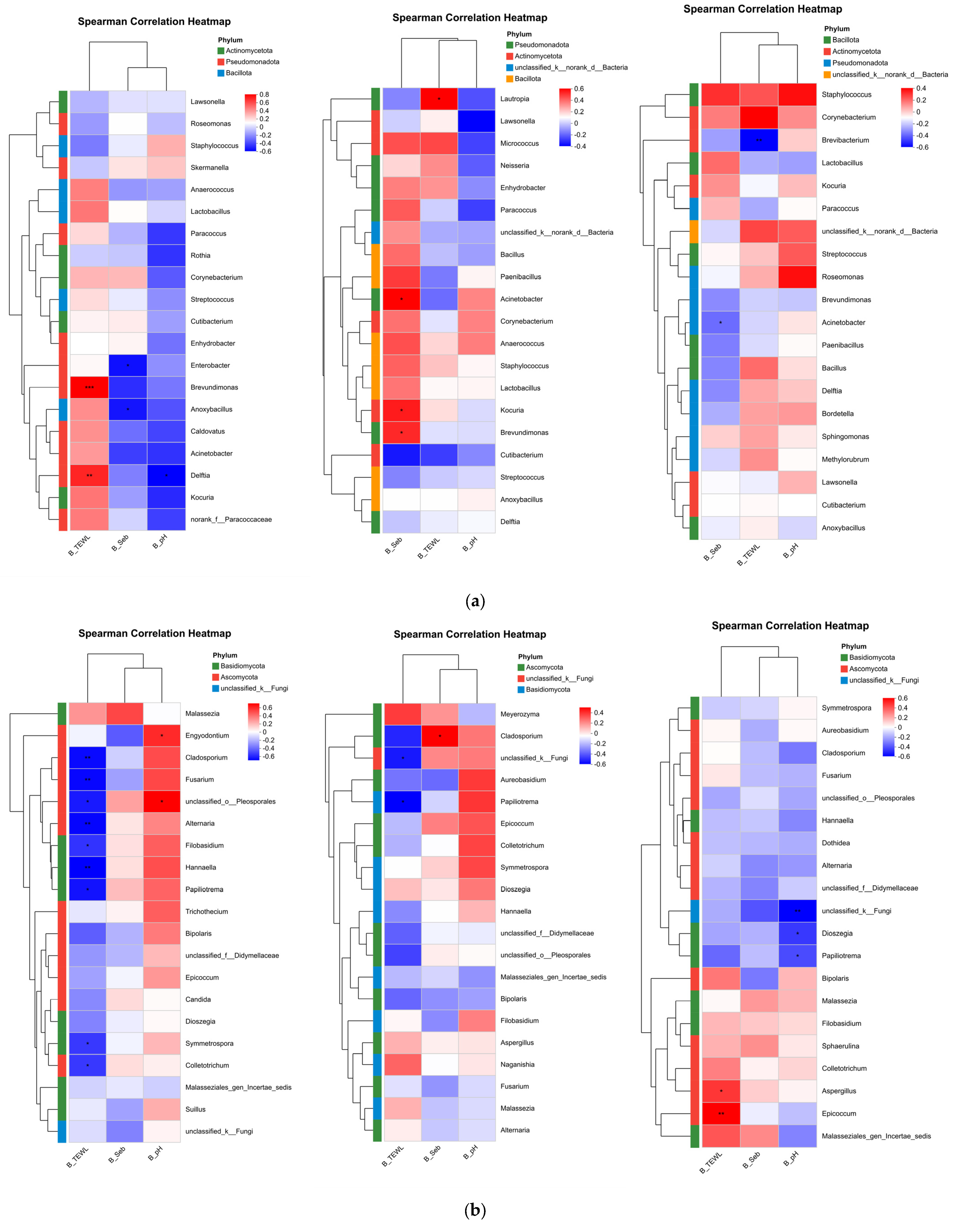
3.1. Scalp Characteristics of Participants
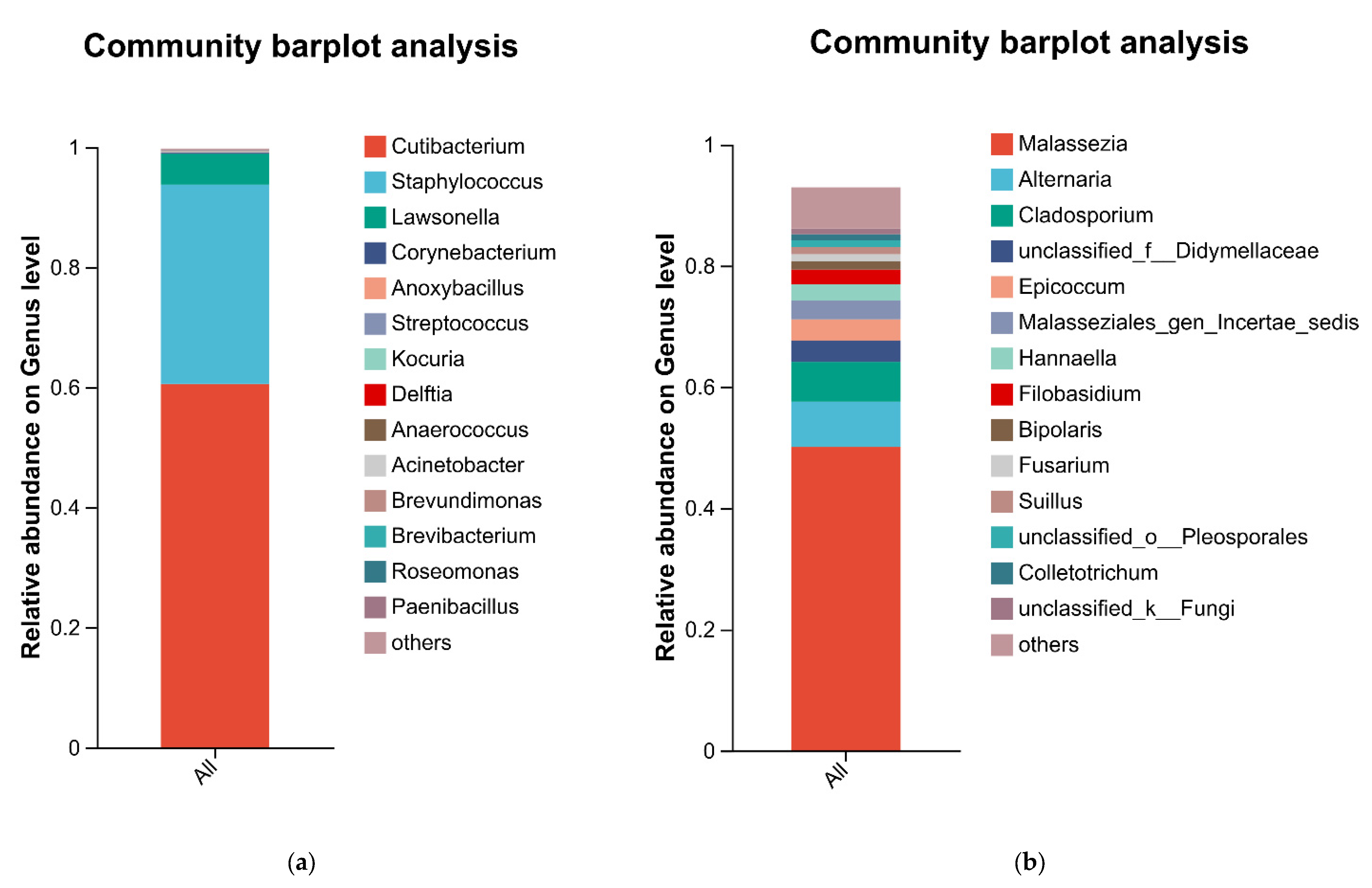
3.2. Results of the Scalp Microbiome in Young Women
3.3. Microbial Composition and Differences Among Young Female Participants with Different Scalp Types
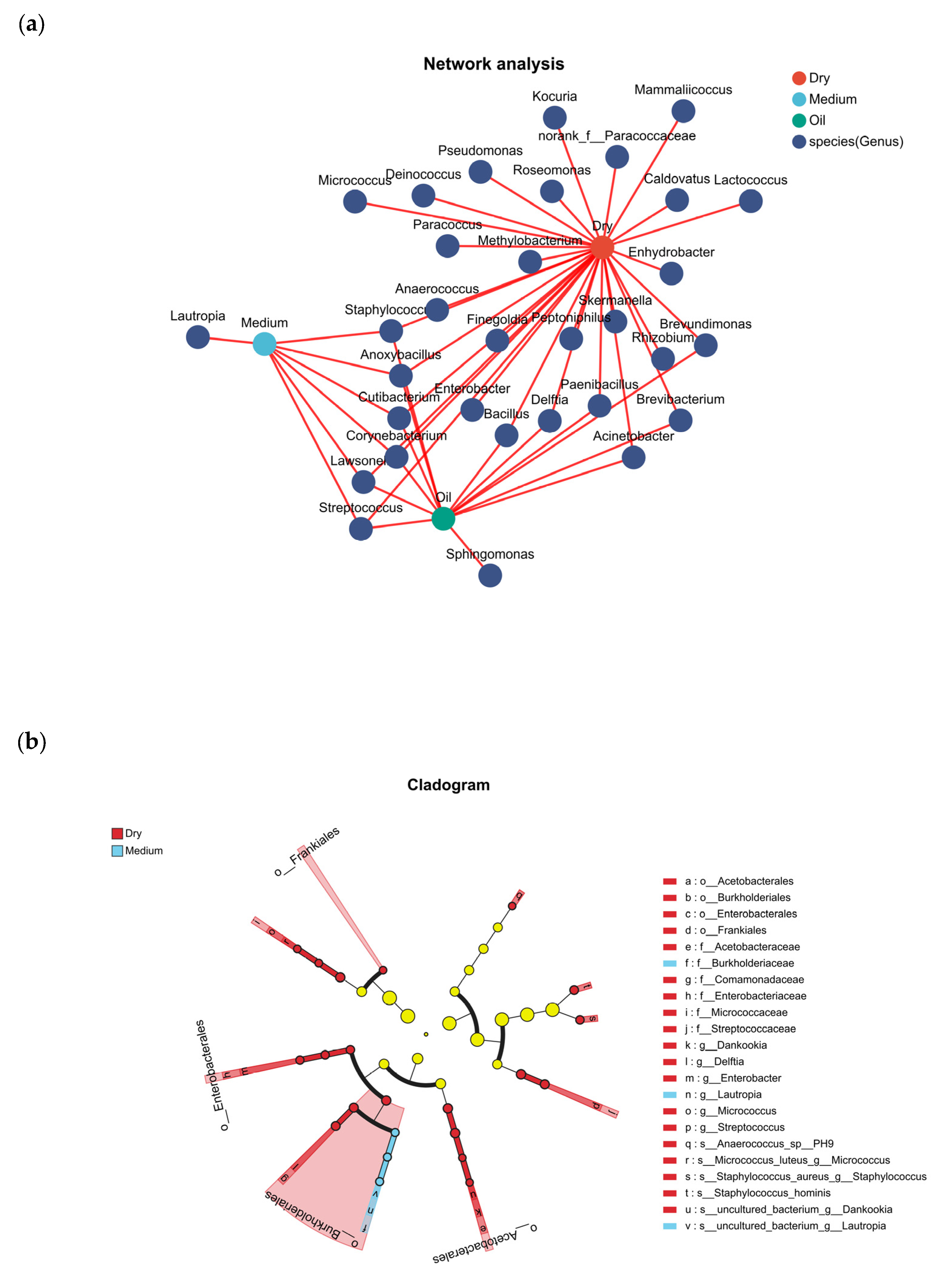
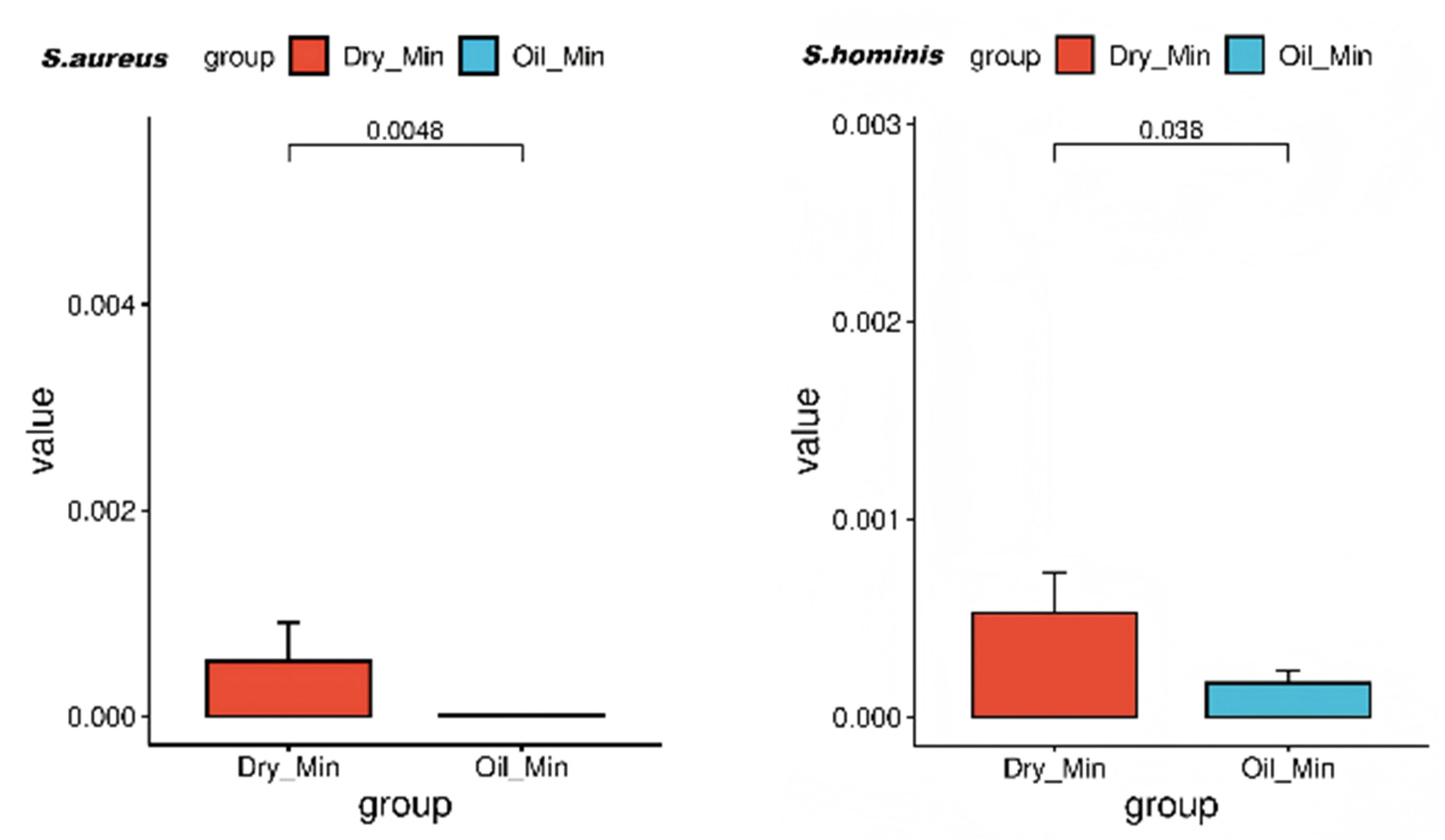
3.3.1. Microbial Composition and Differences Among Dry, Medium, and Oily Scalp Groups
3.3.2. Correlation Network Analysis Among Dry, Medium, and Oily Scalp Groups
3.3.3. Microbial Composition and Differences in Sensitive Populations
3.4. Effects of Different Living Conditions and Psychological Stress on Scalp Microbiome Composition
3.5. Sensitivity as a Prominent Dimension in Scalp Microbial Differences
4. Discussion
5. Conclusions
Author Contributions
Funding
Institutional Review Board Statement
Informed Consent Statement
Data Availability Statement
Conflicts of Interest
References
- Piérard-Franchimont, C.; Hermanns, J.F.; Degreef, H.; Piérard, G.E. From Axioms to New Insights into Dandruff. Dermatology 2000, 200, 93–98. [Google Scholar] [CrossRef]
- Saxena, R.; Mittal, P.; Clavaud, C.; Dhakan, D.B.; Hegde, P.; Veeranagaiah, M.M.; Saha, S.; Souverain, L.; Roy, N.; Breton, L.; et al. Comparison of Healthy and Dandruff Scalp Microbiome Reveals the Role of Commensals in Scalp Health. Front. Cell. Infect. Microbiol. 2018, 8, 346. [Google Scholar] [CrossRef] [PubMed]
- Yang, F.; Li, X.; Ma, Y.; Zhang, M.; Zhang, M.; Zhang, Y. Research progress in the human scalp microbiome and related scalp diseases. Chem. Life 2021, 41, 2563–2573. [Google Scholar] [CrossRef]
- Almoughrabie, S.; Cau, L.; Cavagnero, K.; O’Neill, A.M.; Li, F.W.; Roso-Mares, A.; Mainzer, C.; Closs, B.; Kolar, M.J.; Williams, K.J.; et al. Commensal Cutibacterium acnes induce epidermal lipid synthesis important for skin barrier function. Sci. Adv. 2023, 9, eadg6262. [Google Scholar] [CrossRef] [PubMed]
- Harris-Tryon, T.A.; Grice, E.A. Microbiota and maintenance of skin barrier function. Science 2022, 376, 940–945. [Google Scholar] [CrossRef]
- McArthur, S. Regulation of Physiological Barrier Function by the Commensal Microbiota. Life 2023, 13, 396. [Google Scholar] [CrossRef]
- Shah, R.R.; Larrondo, J.; Dawson, T.; McMichael, A. Scalp microbiome: A guide to better understanding scalp diseases and treatments. Arch. Dermatol. Res. 2024, 316, 9. [Google Scholar] [CrossRef]
- Jia, Q.; Hu, J.; Wang, X.; Deng, Y.; Zhang, J.; Li, H. Malassezia globosa Induces Differentiation of Pathogenic Th17 Cells by Inducing IL-23 Secretion by Keratinocytes. Mycopathologia 2024, 189, 85. [Google Scholar] [CrossRef]
- Uberoi, A.; Murga-Garrido, S.M.; Bhanap, P.; Campbell, A.E.; Knight, S.A.B.; Wei, M.; Chan, A.; Senay, T.; Tegegne, S.; White, E.K.; et al. Commensal-derived tryptophan metabolites fortify the skin barrier: Insights from a 50-species gnotobiotic model of human skin microbiome. Cell Chem. Biol. 2025, 32, 111–125.e6. [Google Scholar] [CrossRef]
- Yu, J.; Luo, Y.; Zhu, Z.; Zhou, Y.; Sun, L.; Gao, J.; Sun, J.; Wang, G.; Yao, X.; Li, W. A tryptophan metabolite of the skin microbiota attenuates inflammation in patients with atopic dermatitis through the aryl hydrocarbon receptor. J. Allergy Clin. Immunol. 2019, 143, 2108–2119.e12. [Google Scholar] [CrossRef]
- Qiao, P.; Zhang, C.; Yu, J.; Shao, S.; Zhang, J.; Fang, H.; Chen, J.; Luo, Y.; Zhi, D.; Li, Q.; et al. Quinolinic Acid, a Tryptophan Metabolite of the Skin Microbiota, Negatively Regulates NLRP3 Inflammasome through AhR in Psoriasis. J. Investig. Dermatol. 2022, 142, 2184–2193.e6. [Google Scholar] [CrossRef]
- Ma, L.; Guichard, A.; Cheng, Y.; Li, J.; Qin, O.; Wang, X.M.; Liu, W.; Tan, Y. Sensitive scalp is associated with excessive sebum and perturbed microbiome. J. Cosmet. Dermatol. 2019, 18, 922–928. [Google Scholar] [CrossRef]
- Brinkac, L.; Clarke, T.H.; Singh, H.; Greco, C.; Gomez, A.; Torralba, M.G.; Frank, B.; Nelson, K.E. Spatial and Environmental Variation of the Human Hair Microbiota. Sci. Rep. 2018, 8, 7. [Google Scholar] [CrossRef]
- Yong, A.; Deloche, C.; Martel, P.; Veriato, A.; Leclerc-Mercier, S.; Sant’Anna, B.; Barbosa, V. Impact of hormonal variations on women’s self-perception of scalp and hair problems: Results of a worldwide epidemiological study. J. Am. Acad. Dermatol. 2024, 91, AB233. [Google Scholar] [CrossRef]
- Hu, P.; Henry, J.; Tiesman, J.P.; Parlov, M.; Bacon, R.; Charbonneau, D.; Venkataraman, A.; Locker, K.C.S.; Krigbaum, H.; Schwartz, J. Scalp microbiome composition changes and pathway evaluations due to effective treatment with Piroctone Olamine shampoo. Int. J. Cosmet. Sci. 2024, 46, 333–347. [Google Scholar] [CrossRef] [PubMed]
- Ross, A.B.; Maes, E.; Lee, E.J.; Homewood, I.; Marsh, J.M.; Davis, S.L.; Willicut, R.J. UV and visible light exposure to hair leads to widespread changes in the hair lipidome. Int. J. Cosmet. Sci. 2022, 44, 672–684. [Google Scholar] [CrossRef] [PubMed]
- Chueachavalit, C.; Meephansan, J.; Payungporn, S.; Sawaswong, V.; Chanchaem, P.; Wongpiyabovorn, J.; Thio, H.B. Comparison of Malassezia spp. colonization between human skin exposed to high- and low-ambient air pollution. Exp. Dermatol. 2022, 31, 1454–1461. [Google Scholar] [CrossRef]
- Wang, L.; Zhou, Q.; Zhu, Y.; Lin, X.; Zhao, W.; Dong, Z. Insights into microbial diversity on scalp and antidandruff agents. Microbiol. China 2019, 46, 2772–2780. [Google Scholar] [CrossRef]
- Paik, K.; Na, J.-I.; Huh, C.-H.; Shin, J.-W. Particulate Matter and Its Molecular Effects on Skin: Implications for Various Skin Diseases. Int. J. Mol. Sci. 2024, 25, 9888. [Google Scholar] [CrossRef]
- Boonpethkaew, S.; Charoensuksira, S.; Meephansan, J.; Sirithanabadeekul, P.; Chueachavalit, C.; Ingkaninanda, P.; Visedthorn, S.; Chanchaem, P.; Sivapornnukul, P.; Payungporn, S. The influence of air pollution on skin microbiome: A link to skin barrier dysfunction. Arch. Dermatol. Res. 2024, 316, 710. [Google Scholar] [CrossRef]
- Patra, V.; Byrne, S.N.; Wolf, P. The Skin Microbiome: Is It Affected by UV-induced Immune Suppression? Front. Microbiol. 2016, 7, 1235. [Google Scholar] [CrossRef] [PubMed]
- Lousada, M.B.; Lachnit, T.; Edelkamp, J.; Rouillé, T.; Ajdic, D.; Uchida, Y.; Di Nardo, A.; Bosch, T.C.G.; Paus, R. Exploring the human hair follicle microbiome. Br. J. Dermatol. 2021, 184, 802–815. [Google Scholar] [CrossRef] [PubMed]
- Li, H.; Goh, B.N.; Teh, W.K.; Jiang, Z.; Goh, J.P.Z.; Goh, A.; Wu, G.; Hoon, S.S.; Raida, M.; Camattari, A.; et al. Skin Commensal Malassezia globosa Secreted Protease Attenuates Staphylococcus aureus Biofilm Formation. J. Investig. Dermatol. 2018, 138, 1137–1145. [Google Scholar] [CrossRef] [PubMed]
- Goh, J.P.Z.; Ruchti, F.; Poh, S.E.; Koh, W.L.C.; Tan, K.Y.; Lim, Y.T.; Thng, S.T.G.; Sobota, R.M.; Hoon, S.S.; Liu, C.; et al. The human pathobiont Malassezia furfur secreted protease Mfsap1 regulates cell dispersal and exacerbates skin inflammation. Proc. Natl. Acad. Sci. USA 2022, 119, e2212533119. [Google Scholar] [CrossRef]
- Jourdain, R.; Moga, A.; Magiatis, P.; Fontanié, M.; Velegraki, A.; Papadimou, C.; Rahoul, V.; Guéniche, A.; Chopra, T.; Gaitanis, G. Malassezia restricta-mediated Lipoperoxidation: A Novel Trigger in Dandruff. Acta Derm.-Venereol. 2023, 103, adv00868. [Google Scholar] [CrossRef]
- De Pessemier, B.; López, C.D.; Taelman, S.; Verdonck, M.; Chen, Y.; Stockman, A.; Lambert, J.; van de Wiele, T.; Callewaert, C. Comparative Whole Metagenome Analysis in Lesional and Nonlesional Scalp Areas of Patients with Psoriasis Capitis and Healthy Individuals. J. Investig. Dermatol. 2025, 145, 27. [Google Scholar] [CrossRef]
- Wojciechowska, K.; Dos Santos Szewczyk, K. The Skin Microbiome and Bioactive Compounds: Mechanisms of Modulation, Dysbiosis, and Dermatological Implications. Molecules 2025, 30, 4363. [Google Scholar] [CrossRef]
- Edgar, R.C. UPARSE: Highly accurate OTU sequences from microbial amplicon reads. Nat. Methods 2013, 10, 996–998. [Google Scholar] [CrossRef]
- Wang, Q.; Garrity, G.M.; Tiedje, J.M.; Cole, J.R. Naive Bayesian classifier for rapid assignment of rRNA sequences into the new bacterial taxonomy. Appl. Environ. Microbiol. 2007, 73, 5261–5267. [Google Scholar] [CrossRef]
- Schloss, P.D.; Westcott, S.L.; Ryabin, T.; Hall, J.R.; Hartmann, M.; Hollister, E.B.; Lesniewski, R.A.; Oakley, B.B.; Parks, D.H.; Robinson, C.J.; et al. Introducing mothur: Open-Source, Platform-Independent, Community-Supported Software for Describing and Comparing Microbial Communities. Appl. Environ. Microbiol. 2009, 75, 7537–7541. [Google Scholar] [CrossRef]
- Segata, N.; Izard, J.; Waldron, L.; Gevers, D.; Miropolsky, L.; Garrett, W.S.; Huttenhower, C. Metagenomic biomarker discovery and explanation. Genome Biol. 2011, 12, R60. [Google Scholar] [CrossRef] [PubMed]
- Guo, R.; Luo, X.; Xin, X.; Liu, L.; Wang, X.; Lu, H. Microbial Metabolomics: From Methods to Translational Applications. Adv. Exp. Med. Biol. 2021, 1280, 97–113. [Google Scholar] [CrossRef] [PubMed]
- Zheng, Y.; Wu, W.; Song, L.; He, C. Relationship Between Subjective Facial Skin Types and Skin Microbiota in 31 Healthy Female College Students Aged 20–25 in Beijing. Chin. J. Dermatol. 2019, 52, 467–474. [Google Scholar]
- Wang, C.; Yang, S.; Ma, L.; Li, Y.; Shi, Y.; Wang, M.; Shao, L.; Li, Z.; Wang, Y. Alterations of Chinese women’s skin microbiota associated with the aging process. Acta Biochim. Biophys. Sin. 2022, 54, 1201–1205. [Google Scholar] [CrossRef]
- Jo, H.; Kim, S.Y.; Kang, B.H.; Baek, C.; Kwon, J.E.; Jeang, J.W.; Heo, Y.M.; Kim, H.-B.; Heo, C.Y.; Kang, S.M.; et al. Staphylococcus epidermidis Cicaria, a Novel Strain Derived from the Human Microbiome, and Its Efficacy as a Treatment for Hair Loss. Molecules 2022, 27, 5136. [Google Scholar] [CrossRef]
- Li, Y.; Zhang, Y.; Qi, F.; Chen, Y. Advance in the scalp microbiota and scalp health. Cosmetics 2025, 48, 70–73+85. [Google Scholar]
- Flowers, L.; Grice, E.A. The Skin Microbiota: Balancing Risk and Reward. Cell Host Microbe 2020, 28, 190–200. [Google Scholar] [CrossRef]
- Scharschmidt, T.C.; Segre, J.A. Skin microbiome and dermatologic disorders. J. Clin. Investig. 2025, 135, 13. [Google Scholar] [CrossRef]
- Pagac, M.P.; Gempeler, M.; Campiche, R. A New Generation of Postbiotics for Skin and Scalp: In Situ Production of Lipid Metabolites by Malassezia. Microorganisms 2024, 12, 1711. [Google Scholar] [CrossRef]
- Byrd, A.L.; Belkaid, Y.; Segre, J.A. The human skin microbiome. Nat. Rev. Microbiol. 2018, 16, 143–155. [Google Scholar] [CrossRef]
- Farage, M.A.; Maibach, H.I. Sensitive skin: Closing in on a physiological cause. Contact Dermat. 2010, 62, 137–149. [Google Scholar] [CrossRef]
- Wollenberg, A.; Giménez-Arnau, A. Sensitive skin: A relevant syndrome, be aware. J. Eur. Acad. Dermatol. Venereol. 2022, 36, 3–5. [Google Scholar] [CrossRef]
- Hülpüsch, C.; Tremmel, K.; Hammel, G.; Bhattacharyya, M.; de Tomassi, A.; Nussbaumer, T.; Neumann, A.U.; Reiger, M.; Traidl-Hoffmann, C. Skin pH-dependentStaphylococcus aureusabundance as predictor for increasing atopic dermatitis severity. Allergy 2020, 75, 2888–2898. [Google Scholar] [CrossRef]
- Park, H.; Arellano, K.; Lee, Y.; Yeo, S.; Ji, Y.; Ko, J.; Holzapfel, W. Pilot Study on the Forehead Skin Microbiome and Short Chain Fatty Acids Depending on the SC Functional Index in Korean Cohorts. Microorganisms 2021, 9, 2216. [Google Scholar] [CrossRef] [PubMed]
- Hall, J.M.; Cruser, D.; Podawiltz, A.; Mummert, D.I.; Jones, H.; Mummert, M.E. Psychological Stress and the Cutaneous Immune Response: Roles of the HPA Axis and the Sympathetic Nervous System in Atopic Dermatitis and Psoriasis. Dermatol. Res. Pract. 2012, 2012, 403908. [Google Scholar] [CrossRef] [PubMed]
- Zhang, L.; Li, J.; Wang, T. Balance Between Glucocorticoids with the Th1/Th2. Clin. Immunol. 2009, 3, 58–62. [Google Scholar]
- Sadur, A.; Joerg, L.; Van Doren, A.S.; Lee, E.T.; Shah, D.; Asees, A.K.; Choudhary, S. The Sleep–Skin Axis: Clinical Insights and Therapeutic Approaches for Inflammatory Dermatologic Conditions. Dermato 2025, 5, 13. [Google Scholar] [CrossRef]
- Coimbra, C.O.; Matos, B.A.d.; Faria, M.C.d.M.; Menezes, E.A.G. Repercussions of sleep deprivation on the immune system: An integrative literature review. Res. Soc. Dev. 2022, 11, e11011729795. [Google Scholar] [CrossRef]
- Said, E.A.; Al-Abri, M.A.; Al-Saidi, I.; Al-Balushi, M.S.; Al-Busaidi, J.Z.; Al-Reesi, I.; Koh, C.Y.; Idris, M.A.; Al-Jabri, A.A.; Habbal, O. Sleep deprivation alters neutrophil functions and levels of Th1-related chemokines and CD4+ T cells in the blood. Sleep. Breath. 2019, 23, 1331–1339. [Google Scholar] [CrossRef]






| Bacterial Phyla | Relative Abundance | Fungi Phylum | Relative Abundance |
|---|---|---|---|
| Actinomycetota | 65.32% | Basidiomycota | 65.56% |
| Bacillota | 33.78% | Ascomycota | 35.35% |
| Factor | R2 | Pr (>F) |
|---|---|---|
| Sensitivity Level | 0.105 | 0.083 |
| TEWL | 0.031 | 0.151 |
| Seb | 0.001 | 0.837 |
| Diet | 0.005 | 0.637 |
| Sleep | 0.000692 | 0.91 |
Disclaimer/Publisher’s Note: The statements, opinions and data contained in all publications are solely those of the individual author(s) and contributor(s) and not of MDPI and/or the editor(s). MDPI and/or the editor(s) disclaim responsibility for any injury to people or property resulting from any ideas, methods, instructions or products referred to in the content. |
© 2026 by the authors. Licensee MDPI, Basel, Switzerland. This article is an open access article distributed under the terms and conditions of the Creative Commons Attribution (CC BY) license.
Share and Cite
Guo, Y.; Zhang, Y.; Hui, Q.; Zhu, S.; Wang, J.; Song, L. Scalp Microbiome Composition in Young Women: Associations with Scalp Type, Sensitivity, and Lifestyle Factors. Life 2026, 16, 91. https://doi.org/10.3390/life16010091
Guo Y, Zhang Y, Hui Q, Zhu S, Wang J, Song L. Scalp Microbiome Composition in Young Women: Associations with Scalp Type, Sensitivity, and Lifestyle Factors. Life. 2026; 16(1):91. https://doi.org/10.3390/life16010091
Chicago/Turabian StyleGuo, Ying, Yao Zhang, Qiaoni Hui, Shenshen Zhu, Jingtao Wang, and Liya Song. 2026. "Scalp Microbiome Composition in Young Women: Associations with Scalp Type, Sensitivity, and Lifestyle Factors" Life 16, no. 1: 91. https://doi.org/10.3390/life16010091
APA StyleGuo, Y., Zhang, Y., Hui, Q., Zhu, S., Wang, J., & Song, L. (2026). Scalp Microbiome Composition in Young Women: Associations with Scalp Type, Sensitivity, and Lifestyle Factors. Life, 16(1), 91. https://doi.org/10.3390/life16010091