Systematic Review: Exploring Inter-Species Variability in Diabetes Mellitus for Translational Medicine
 , ,
, ,  and
and
Abstract
1. Introduction
2. Materials and Methods
2.1. Literature Search Strategy
2.2. Eligibility Criteria
- (1)
- original experimental or observational studies investigating DM in animal models (rodents, dogs, cats, pigs, or non-human primates), with clearly described objectives and methodology;
- (2)
- studies evaluating pathophysiological, molecular, metabolic, microbiome-related, or therapeutic aspects relevant to translational medicine;
- (3)
- studies reporting quantitative or qualitative outcomes related to glucose homeostasis, insulin secretion, IR, β-cell function, or treatment response;
- (4)
- full-text peer-reviewed publications available in English.
2.3. Study Selection
2.4. Data Extraction and Synthesis
2.5. Quality Assessment and Risk of Bias
3. Results and Discussions
3.1. Translational Relevance of DM Across Species
3.2. Molecular and Cellular Mechanisms Underlying Interspecies Variability
3.3. Interspecies Differences in Insulin Response and Secretion
3.4. The Role of the Microbiome and Environmental Factors in the Development of DM
3.5. Comparative Effects of Diet and Exercise on DM Across Species
3.6. Autonomic Nervous System (ANS) and Species-Specific Neuroendocrine Regulation
3.7. Species-Specific Complications of DM
3.8. Translational Relevance of Animal Models in DM Research
3.9. Future Directions for Research and Standardization of Models
3.10. Limits and Challenges in the Study of Interspecies Variability
4. Conclusions
Supplementary Materials
Author Contributions
Funding
Institutional Review Board Statement
Informed Consent Statement
Data Availability Statement
Acknowledgments
Conflicts of Interest
References
- Alam, U.; Asghar, O.; Azmi, S.; Malik, R.A. General aspects of diabetes mellitus. In Handbook of Clinical Neurology; Elsevier: Amsterdam, The Netherlands, 2014; Volume 126, pp. 211–222. [Google Scholar] [CrossRef]
- Khan, M.A.B.; Hashim, M.J.; King, J.K.; Govender, R.D.; Mustafa, H.; Al Kaabi, J. Epidemiology of type 2 diabetes: Global burden of disease and forecasted trends. J. Epidemiol. Glob. Health 2020, 10, 107–111. [Google Scholar] [CrossRef]
- Heald, A.H.; Stedman, M.; Davies, M.; Livingston, M.; Alshames, R.; Lunt, M.; Rayman, G.; Gadsby, R. Estimating life years lost to diabetes: Outcomes from analysis of National Diabetes Audit and Office of National Statistics data. Cardiovasc. Endocrinol. Metab. 2020, 9, 183–185. [Google Scholar] [CrossRef] [PubMed]
- Laakso, M. Cardiovascular disease in type 2 diabetes: Challenge for treatment and prevention. J. Intern. Med. 2001, 249, 225–235. [Google Scholar] [CrossRef] [PubMed]
- Deshmukh, C.D.; Jain, A.; Nahata, B. Diabetes mellitus: A review. Int. J. Pure Appl. Biosci. 2015, 3, 224–230. [Google Scholar]
- Donath, M.Y.; Dinarello, C.A.; Mandrup-Poulsen, T. Targeting innate immunity mediators in type 1 and type 2 diabetes. Nat. Rev. Immunol. 2019, 19, 734–746. [Google Scholar] [CrossRef]
- Kolb, H.; Mandrup-Poulsen, T. An immune origin of type 2 diabetes? Diabetologia 2005, 48, 1038–1050. [Google Scholar] [CrossRef]
- Wang, D.; Chen, X.; Lin, J.; Zhang, T.; Huang, L.; Leng, D.; Zhang, X.D.; Li, G. Maximal speed of glucose change significantly distinguishes prediabetes from diabetes. arXiv 2025, arXiv:2506.12567. [Google Scholar] [CrossRef]
- Conget, I. Diagnóstico, clasificación y patogenia de la diabetes mellitus (Diagnosis, classification and pathogenesis of diabetes mellitus). Rev. Española Cardiol. 2002, 119, 367–375. [Google Scholar] [CrossRef]
- Cohrs, R.J.; Martin, T.; Ghahramani, P.; Bidaut, L.; Higgins, P.J.; Shahzad, A. Translational medicine definition by the European Society for Translational Medicine. New Horiz. Transl. Med. 2015, 2, 86–88. [Google Scholar] [CrossRef]
- Khan, R.M.M.; Chua, Z.J.Y.; Tan, J.C.; Yang, Y.; Liao, Z.; Zhao, Y. From prediabetes to diabetes: Diagnosis, treatments, and translational research. Medicina 2019, 55, 546. [Google Scholar] [CrossRef]
- Ioannidis, J.P. Realizing the promise of research: Opportunities, priorities, and conflicts in translational medicine. J. Transl. Med. 2004, 2, 5. [Google Scholar] [CrossRef] [PubMed][Green Version]
- Wehling, M. Translational medicine: Science or wishful thinking? J. Transl. Med. 2008, 6, 31. [Google Scholar] [CrossRef] [PubMed]
- Lee, M.B.; Kaeberlein, M. Translational medicine of aging. J. Transl. Med. 2018, 16, 15–29. [Google Scholar] [CrossRef]
- Brito-Casillas, Y.; Melián, C.; Wägner, A.M. Study of the pathogenesis and treatment of diabetes mellitus through animal models. Endocrinol. Diabetes 2016, 3, 123–135. [Google Scholar] [CrossRef][Green Version]
- Denayer, T.; Stöhr, T.; Van Roy, M. Animal models in translational medicine: Validation and prediction. New Horiz. Transl. Med. 2014, 2, 5–11. [Google Scholar] [CrossRef]
- Drucker, D.J. Never waste a good crisis: Confronting reproducibility in translational research. Cell Metab. 2016, 24, 348–353. [Google Scholar] [CrossRef]
- Ball, B.K.; Proctor, E.A.; Brubaker, D.K. Translational disease modeling of peripheral blood transcriptomics in type 2 diabetes. Npj Syst. Biol. Appl. 2025, 11, 58. [Google Scholar] [CrossRef]
- Ajmera, I.; Swat, M.; Laibe, C.; Le Novère, N.; Chelliah, V. Impact of mathematical modeling on the understanding of diabetes and its associated complications. CPT Pharmacomet. Syst. Pharmacol. 2013, 2, e54. [Google Scholar] [CrossRef]
- Ha, J.; Satin, L.S.; Sherman, A.S. A mathematical model of the pathogenesis, prevention, and reversal of type 2 diabetes. Endocrinology 2016, 157, 624–635. [Google Scholar] [CrossRef]
- Rusyn, I.; Chiu, W.A.; Wright, F.A. Model systems and organisms for addressing inter- and intra-species variability in risk assessment. Regul. Toxicol. Pharmacol. 2022, 133, 105197. [Google Scholar] [CrossRef]
- Alibrandi, L.; Veening-Griffioen, D. Interspecies differences in mitochondria: Implications for cardiac and vascular translational research. Mol. Metab. 2025, 45, 101345. [Google Scholar] [CrossRef]
- Farooqi, I.S.; Xu, Y. Translational potential of mouse models of human metabolic disease. Cell 2024, 187, 4129–4143. [Google Scholar] [CrossRef] [PubMed]
- Catchpole, B.; Ristic, J.M.; Fleeman, L.M.; Davison, L.J. Canine diabetes mellitus: Can old dogs teach us new tricks? Diabetologia 2005, 48, 1948–1956. [Google Scholar] [CrossRef] [PubMed]
- Adin, C.A.; Gilor, C. The diabetic dog as a translational model for human islet transplantation. Yale J. Biol. Med. 2017, 90, 509–515. [Google Scholar] [PubMed]
- Rand, J.S.; Fleeman, L.M.; Farrow, H.A.; Appleton, D.J.; Lederer, R. Canine and feline diabetes mellitus: Nature or nurture? J. Nutr. 2004, 134, 2072S–2080S. [Google Scholar] [CrossRef]
- Reusch, C.E. Diabetes mellitus in dogs and cats. In Canine and Feline Endocrinology, 4th ed.; Feldman, E.C., Nelson, R.W., Eds.; Elsevier: Amsterdam, The Netherlands, 2014. [Google Scholar]
- Oliveira, F.C.M.; Voorbij, A.W.Y.; Pereira, E.C.; Alves e Almeida, L.M.M.; Moraes, G.R.; De Oliveira, J.T.; Gouw, B.H.T.; Legatti, S.A.M.; Kooistra, H.S.; Spee, B.; et al. Type 1 diabetes treatment in dogs: The long road from twice-daily insulin injection to long-term cell therapy. Organoids 2024, 3, 67–82. [Google Scholar] [CrossRef]
- Kim, I.; Yun, J.-H. Comparative pharmacological and pharmaceutical perspectives on antidiabetic therapies in humans, dogs, and cats. Pharmaceutics 2025, 17, 1098. [Google Scholar] [CrossRef]
- Hrițcu, L.D.; Boghian, V.; Pavel, G.; Hrițcu, T.D.; Spătaru, A.; Burtan, L.C.; Spătaru, M.C. Application of the HOMA Index in Diabetic Dogs and Cats: A Systematic Review of Current Evidence. Appl. Sci. 2025, 15, 10342. [Google Scholar] [CrossRef]
- Veening-Griffioen, D.H.; Ferreira, G.S.; van Meer, P.J.K.; Boon, W.P.C.; Gispen-de Wied, C.C.; Moors, E.H.M.; Schellekens, H. Are some animal models more equal than others? A case study on the translational value of animal models of efficacy for Alzheimer’s disease. Eur. J. Pharmacol. 2019, 859, 172524. [Google Scholar] [CrossRef]
- del Bosque-Plata, L.; Hernández-Cortés, E.P.; Gragnoli, C. The broad pathogenic role of TCF7L2 in human diseases beyond type 2 diabetes. J. Cell. Physiol. 2021, 237, 301–312. [Google Scholar] [CrossRef]
- Page, M.J.; McKenzie, J.E.; Bossuyt, P.M.; Boutron, I.; Hoffmann, T.C.; Mulrow, C.D.; Shamseer, L.; Tetzlaff, J.M.; Akl, E.A.; Brennan, S.E.; et al. The PRISMA 2020 statement: An updated guideline for reporting systematic reviews. BMJ 2021, 372, n71. [Google Scholar] [CrossRef] [PubMed]
- Lewis, G.F.; Brubaker, P.L. The discovery of insulin revisited: Lessons for the modern era. J. Clin. Investig. 2021, 131, e142239. [Google Scholar] [CrossRef] [PubMed]
- Ryan, E.A.; Lakey, J.R.; Rajotte, R.V.; Korbutt, G.S.; Kin, T.; Imes, S.; Rabinovitch, A.; Elliott, J.F.; Bigam, D.; Kneteman, N.M.; et al. Clinical outcomes and insulin secretion after islet transplantation with the Edmonton protocol. Diabetes 2001, 50, 710–719. [Google Scholar] [CrossRef] [PubMed]
- Zamljen, T.; Jakopič, J.; Hudina, M.; Veberič, R.; Slatnar, A. Influence of intra- and interspecific variation in chili pepper (Capsicum spp.) on metabolite composition of three fruit segments. Sci. Rep. 2021, 11, 4932. [Google Scholar] [CrossRef]
- Wang, K.; Narayanan, M.; Zhong, H.; Tompa, M.; Schadt, E.E.; Zhu, J. Meta-analysis of inter-species liver co-expression networks elucidates traits associated with common human diseases. PLoS Comput. Biol. 2009, 5, e1000616. [Google Scholar] [CrossRef]
- Landersdorfer, C.B.; Jusko, W.J. Pharmacokinetic/pharmacodynamic modeling in diabetes mellitus. Clin. Pharmacokinet. 2008, 47, 417–448. [Google Scholar] [CrossRef]
- Kumar, P.; Metzger, V.T.; Malec, S.A. Unsupervised latent pattern analysis for estimating type 2 diabetes risk in undiagnosed populations. arXiv 2025, arXiv:2505.21824. [Google Scholar] [CrossRef]
- Mohsen, F.; Shah, Z. Improving early prediction of type 2 diabetes mellitus with ECG-DiaNet: A multimodal neural network leveraging electrocardiogram and clinical risk factors. arXiv 2025, arXiv:2504.05338. [Google Scholar] [CrossRef]
- Bogdan, M.; Meca, A.D.; Boldeanu, M.V.; Gheorghe, D.N.; Turcu-Stiolica, A.; Subtirelu, M.-S.; Boldeanu, L.; Blaj, M.; Botnariu, G.E.; Vlad, C.E.; et al. Possible Involvement of Vitamin C in Periodontal Disease–Diabetes Mellitus Association. Nutrients 2020, 12, 553. [Google Scholar] [CrossRef]
- Wei, W.; Li, M.; Pan, L.; Shao, M.; He, X.; Li, Y.; Li, H. Inter-species and individualized biotransformation of five saponins by human- and mouse-derived fecal microbiota. Chin. Med. 2025, 20, 132. [Google Scholar] [CrossRef]
- McDaniel, M.L.; Marshall, C.A.; Pappan, K.L.; Kwon, G. Metabolic and autocrine regulation of the mammalian target of rapamycin by pancreatic β-cells. Diabetes 2002, 51, 2877–2885. [Google Scholar] [CrossRef] [PubMed]
- Fadini, G.P.; Vigili de Kreutzenberg, S.; Rigato, M.; Marchesan, M.; Tiengo, A.; Avogaro, A. Characteristics and outcomes of the hyperosmolar hyperglycemic syndrome in a cohort of 51 consecutive cases at a single center. Diabetes Res. Clin. Pract. 2011, 94, 172–179. [Google Scholar] [CrossRef] [PubMed]
- Byndloss, M.; Devkota, S.; Duca, F.; Niess, J.H.; Nieuwdorp, M.; Orho-Melander, M.; Tremaroli, V.; Zhao, L. The gut microbiota and diabetes: Research, translation, and clinical implications—2023 Diabetes, Diabetes Care, and Diabetologia Expert Forum. Diabetologia 2024, 67, 1760–1782. [Google Scholar] [CrossRef] [PubMed]
- Covington, B.A.; Smith, R.D.; Johnson, T.M.; Lee, C.H. Animal models for understanding the mechanisms of beta cell death in type 2 diabetes. Cells 2024, 12, 473. [Google Scholar] [CrossRef]
- Shah, S.P.; Mamun, A.; Soumma, S.B.; Ghasemzadeh, H. Enhancing metabolic syndrome prediction with hybrid data balancing and counterfactuals. arXiv 2025, arXiv:2504.06987. [Google Scholar] [CrossRef]
- Lacatusu, C.M.; Botnariu, G.E.; Mihai, C.; Cijevschi-Prelipcean, C.; Stefan, R.; Mihai, B.M. Insulin resistance in patients with chronic hepatitis C is mainly correlated with adipose excess and not with type 2 diabetes mellitus. Ann. d’Endocrinol. 2016, 77, 520. [Google Scholar] [CrossRef]
- Adda, S.; Legendre, C.; Rangasamy, S. From mice to humans: Cross-species transcriptomics analysis to uncover distinct mechanisms of diabetic retinopathy (DR). bioRxiv 2023. [Google Scholar] [CrossRef]
- Ghemiș, L.; Goriuc, A.; Minea, B.; Botnariu, G.E.; Mârțu, M.A.; Ențuc, M.; Cioloca, D.; Foia, L.G. Myeloid-Derived Suppressor Cells (MDSCs) and Obesity-Induced Inflammation in Type 2 Diabetes. Diagnostics 2024, 14, 2453. [Google Scholar] [CrossRef]
- Hrițcu, L.D. Determination of insulin in cats with diabetes mellitus. In Progrese și Perspective în Medicina Veterinară; Lucrări Științifice—Medicină Veterinară; Universitatea de Științe Agricole și Medicină Veterinară „Ion Ionescu de la Brad”: Iași, Romania, 2010; Volume 53, pp. 708–711. Available online: http://www.univagro-iasi.ro/simpozion_med/Revista/ (accessed on 30 October 2025).
- Strage, E.M.; Björnsdottir, S.; Fall, T.; Hansson-Hamlin, H.; Lundgren, B.; Häggström, J.; Höglund, K. Evaluation of the homeostatic model assessment of insulin resistance (HOMA-IR) for predicting the development of diabetes mellitus in cats. J. Vet. Intern. Med. 2021, 35, 2720–2729. [Google Scholar] [CrossRef]
- Ordonez, A.A.; Sellmyer, M.A.; Gowrishankar, G.; Ruiz-Bedoya, C.A.; Tucker, E.W.; Palestro, C.J.; Hammoud, D.A.; Jain, S.K. Molecular imaging of bacterial infections: Overcoming barriers to clinical translation. Sci. Transl. Med. 2019, 11, eaax8251. [Google Scholar] [CrossRef]
- Hritcu, L.D.; Horhogea, C.; Ciobica, A.; Spataru, M.C.; Spataru, C.; Kis, A. Conceptual replication of canine serum oxytocin increase following a positive dog-human interaction. Rev. Chim. 2019, 70, 1579–1583. [Google Scholar] [CrossRef]
- Hrițcu, L.D.; Borcea, D.; Anton, E.; Morosan, S.; Pasca, S.; Trinca, C.; Spătaru, M.C.; Petrariu, F.D.; Burtan, L.C.; Ciobica, A.; et al. Experimental induction of type 2 diabetes mellitus and the efficiency of bariatric surgery in its reversal in rats. Acta Endocrinol. 2021, 17, 149–156. [Google Scholar] [CrossRef]
- Mei, Z.; Li, X.; Wang, Y.; Chen, H.; Zhang, L.; Zhao, J. Strain-specific gut microbial signatures in type 2 diabetes. Nat. Commun. 2024, 15, 1234. [Google Scholar] [CrossRef]
- Ortega, M.A.; Fraile-Martínez, O.; Naya, I.; García-Honduvilla, N.; Álvarez-Mon, M.; Buján, J.; Asúnsolo, Á.; de la Torre, B. Type 2 diabetes mellitus associated with obesity (diabesity): The central role of gut microbiota and its translational applications. Nutrients 2020, 12, 2749. [Google Scholar] [CrossRef]
- Ericsson, A.C.; Franklin, C.L. The gut microbiome of laboratory mice: Considerations and best practices for translational research. Mamm. Genome 2021, 32, 239–250. [Google Scholar] [CrossRef]
- Díez-Sainz, E.; Milagro, F.I.; Riezu-Boj, J.I.; Lorente-Cebrián, S. Effects of gut microbiota–derived extracellular vesicles on obesity and diabetes and their potential modulation through diet. J. Physiol. Biochem. 2022, 78, 485–499. [Google Scholar] [CrossRef]
- Wang, H.; Lu, Y.; Yan, Y.; Tian, S.; Zheng, D.; Leng, D.; Wang, C.; Jiao, J.; Wang, Z.; Bai, Y. Promising treatment for type 2 diabetes: Fecal microbiota transplantation reverses insulin resistance and impaired islets. Front. Cell. Infect. Microbiol. 2019, 9, 455. [Google Scholar] [CrossRef]
- CompDiabDB Consortium. Comparative Diabetes Database (CompDiabDB): A Cross-Species Repository for Metabolic and Transcriptomic Datasets in Diabetes Research. Comparative Diabetes Network, 2023. Available online: https://compdiabdb.org (accessed on 30 October 2025).
- OHMC Consortium. One Health Metabolic Consortium (OHMC): Integrating Veterinary and Human Metabolic Research Through Shared Data Platforms. One Health Initiative. 2024. Available online: https://onehealthmetabolic.org (accessed on 30 October 2025).
- Nagyova, E.; Scsukova, S.; Nemcova, L.; Mlynarcikova, A.; Yi, Y.J.; Sutovsky, M.; Sutovsky, P. Inhibition of proteasomal proteolysis affects expression of extracellular matrix components and steroidogenesis in porcine oocyte-cumulus complexes. Domest. Anim. Endocrinol. 2012, 42, 50–60. [Google Scholar] [CrossRef]
- Quinn, L.M.; Wong, F.S.; Narendran, P. Environmental determinants of type 1 diabetes: From association to proving causality. Front. Immunol. 2021, 12, 737964. [Google Scholar] [CrossRef]
- Fadini, G.P.; Rigato, M.; Tiengo, A.; Avogaro, A. Characteristics and mortality of type 2 diabetic patients hospitalized for severe iatrogenic hypoglycemia. Diabetes Res. Clin. Pract. 2009, 84, 267–272. [Google Scholar] [CrossRef]
- Kaeberlein, M.; Creevy, K.E.; Promislow, D.E.L. The dog aging project: Translational geroscience in companion animals. Mamm. Genome 2016, 27, 279–288. [Google Scholar] [CrossRef] [PubMed]
- Knowler, W.C.; Barrett-Connor, E.; Fowler, S.E.; Hamman, R.F.; Lachin, J.M.; Walker, E.A.; Nathan, D.M.; Diabetes Prevention Program Research Group. Reduction in the incidence of type 2 diabetes with lifestyle intervention or metformin. N. Engl. J. Med. 2002, 346, 393–403. [Google Scholar] [CrossRef]
- Wilkinson, C.P.; Ferris, F.L., III; Klein, R.E.; Lee, P.P.; Agardh, C.D.; Davis, M.; Dills, D.; Kampik, A.; Pararajasegaram, R.; Verdaguer, J.T.; et al. Proposed international clinical diabetic retinopathy and diabetic macular edema disease severity scales. Ophthalmology 2003, 110, 1677–1682. [Google Scholar] [CrossRef] [PubMed]
- Hu, G.; Liu, Y.; Wang, X.; Li, Y.; Zhang, H.; Hu, F. Modifiable risk factors and long term risk of type 2 diabetes among individuals with a history of gestational diabetes mellitus: Prospective cohort study. BMJ 2022, 378, e070312. [Google Scholar] [CrossRef] [PubMed]
- Ismail, L.; Materwala, H.; Al Kaabi, J. Association of risk factors with type 2 diabetes: A systematic review. Comput. Struct. Biotechnol. J. 2021, 19, 2416–2432. [Google Scholar] [CrossRef]
- Tang, S.S.; Zhao, X.F.; An, X.D.; Sun, W.J.; Kang, X.M.; Sun, Y.T.; Jiang, L.L.; Gao, Q.; Li, Z.H.; Ji, H.Y.; et al. Classification and identification of risk factors for type 2 diabetes. World J. Diabetes 2025, 16, 100371. [Google Scholar] [CrossRef]
- Anwardeen, N.R.; Sun, Y. Advancements in precision medicine: Multi-omics approach for tailored metformin treatment in type 2 diabetes. Front. Pharmacol. 2024, 15, 1506767. [Google Scholar] [CrossRef]
- Bai, M.; Li, Z.; Shi, T.; Li, X.; Li, J.; Ma, J.; Huang, L.; Fan, Z. Exogenous extracellular vesicles as emerging platforms in translational medicine. BIO Integr. 2025, 6, 973. [Google Scholar] [CrossRef]
- Guan, H.; Zhao, Y.; Li, Y.; Wang, Y.; Niu, Y.; Zhang, Y.; Zhang, L.; Fang, Y.; Miao, L.; Tian, J. Exploring the design of clinical research studies on type 2 diabetes mellitus. Front. Endocrinol. 2024, 15, 1363877. [Google Scholar] [CrossRef]
- Norazman, S.I.; Mohd Zaffarin, A.S.; Shuid, A.N.; Hassan, H.; Soleiman, I.N.; Kuan, W.S.; Alias, E. A review of animal models for studying bone health in diabetes and obesity. Int. J. Mol. Sci. 2024, 25, 9399. [Google Scholar] [CrossRef]
- Cosson, E.; Benchimol, M.; Carbillon, L.; Pharisien, I.; Pariès, J.; Valensi, P.; Lormeau, B.; Bolie, S.; Uzan, M.; Attali, J.R. Universal rather than selective screening for gestational diabetes mellitus may improve fetal outcomes. Diabetes Metab. 2006, 32, 140–146. [Google Scholar] [CrossRef] [PubMed]
- Spugnini, E.P.; Buglioni, S.; Carocci, F.; Menicagli, F.; Vincenzi, B.; Fanciulli, M.; Fais, S. High dose lansoprazole combined with metronomic chemotherapy: A phase I/II study in companion animals with spontaneously occurring tumors. J. Transl. Med. 2014, 12, 225. [Google Scholar] [CrossRef] [PubMed]
- Ye, W.; Luo, C.; Huang, J.; Li, C.; Liu, Z.; Liu, F. Gestational diabetes mellitus and adverse pregnancy outcomes: Systematic review and meta-analysis. BMJ 2022, 377, e067946. [Google Scholar] [CrossRef] [PubMed]
- Mahmoudi-Aznaveh, A.; Tavoosidana, G.; Najmabadi, H.; Azizi, Z.; Ardestani, A. The liver-derived exosomes stimulate insulin gene expression in pancreatic beta cells under condition of insulin resistance. Front. Endocrinol. 2023, 14, 1303930. [Google Scholar] [CrossRef]
- Hu, S.; Ji, W.; Zhang, Y.; Zhu, W.; Sun, H.; Sun, Y. Risk factors for progression to type 2 diabetes in prediabetes: A systematic review and meta-analysis. BMC Public Health 2025, 25, 1220. [Google Scholar] [CrossRef]
- Raoufinia, R.; Rahimi, H.R.; Saburi, E.; Moghbeli, M. Advances and challenges of cell-based therapies among diabetic patients. J. Transl. Med. 2024, 22, 435. [Google Scholar] [CrossRef]
- Almousawi, K.A. Diabetes mellitus in dogs and cats: Etiology, diagnosis and treatment approaches. Kerbala J. Vet. Med. Sci. 2025, 1, 23–29. [Google Scholar]
- Hrițcu, T.D.; Munteanu, A.; Mihalcea, Ș.; Hrițcu, L.D.; Spătaru, M.C. The impact of diabetes on dental health in companion animals. Rom. J. Vet. Sci. 2025, 58, 209–218. [Google Scholar] [CrossRef]
- Xu, G.; Kwon, G.; Cruz, W.S.; Marshall, C.A.; McDaniel, M.K. Metabolic regulation by leucine of translation initiation via the mTOR signaling pathway in pancreatic β cells. Diabetes 2001, 50, 353–360. [Google Scholar] [CrossRef]
- del Amo, E.M.; Urtti, A. Rabbit as an animal model for intravitreal pharmacokinetics: Clinical predictability and quality of the published data. Exp. Eye Res. 2015, 137, 111–124. [Google Scholar] [CrossRef]
- Hrițcu, T.D.; Cucoș, I.Ș.; Hrițcu, L.D.; Spătaru, M.; Solcan, G.; Anton, A. The impact of cortisol on diverse endocrine pathologies in companion animals. Lucr. Științifice Ser. Med. Vet. 2024, 67, 123–132. [Google Scholar] [CrossRef]
- Borovcanin, M.M.; Vesic, K.; Petrovic, I.; Jovanovic, I.P.; Mijailović, N.R. Diabetes mellitus type 2 as an underlying, comorbid or consequent state of mental disorders. World J. Diabetes 2023, 14, 481–493. [Google Scholar] [CrossRef]
- Schoeberl, B. Quantitative pharmacological modeling of systems as a key to translational medicine. Curr. Opin. Syst. Biol. 2020, 21, 1–8. [Google Scholar] [CrossRef]
- Hodbod, T.; Shafieikazerooni, P.; Nemet, L.; Hrabovska, A. Species Differences in Cholinesterase Expression and Their Translational Impact. Chem. Biol. Interact. 2025, 420, 111705. [Google Scholar] [CrossRef]



| Species/Model | Type of DM Modeled | Key Pathophysiological Features | Translational Relevance | Major Limitations |
|---|---|---|---|---|
| Rodent (mouse, rat) | T1DM/T2DM (induced, genetic) | Chemically induced β-cell loss; genetic obesity and insulin resistance; rapid disease onset | Mechanistic and molecular studies; pathway discovery | Limited chronicity; divergent islet architecture; reduced predictive value for long-term outcomes |
| Dog | T1DM (spontaneous, induced) | Immune-mediated β-cell destruction; complete insulin dependence; chronic hyperglycemia | High translational relevance for human T1DM; islet transplantation and immunotherapy models | Cost; genetic heterogeneity; limited availability |
| Cat | T2DM (spontaneous, diet-induced) | Obesity-associated insulin resistance; progressive β-cell dysfunction | High relevance for early human T2DM and metabolic syndrome | Late diagnosis; dietary variability; limited longitudinal data |
| Pig | T2DM (diet-induced) | Similar pancreatic anatomy and lipid metabolism to humans | Moderate translational value for metabolic and cardiovascular studies | High cost; housing and handling constraints |
| Non-human primate | T2DM (spontaneous or diet-induced) | β-cell structure, incretin response, immune regulation closely resemble humans | Very high translational relevance for advanced preclinical studies | Ethical concerns; high financial and regulatory burden |
| Human (reference) | T1DM/T2DM | Full clinical spectrum; chronic disease progression | Reference standard for translational validation | Heterogeneity; ethical and practical constraints |
| Species | Experimental Condition/Group | Dominant Gut Bacterial Phyla/Genera | Metabolic Features | Implications for Diabetes |
|---|---|---|---|---|
| Humans | Firmicutes, Bacteroidetes, Akkermansia muciniphila, Faecalibacterium prausnitzii. | Balanced carbohydrate fermentation, short-chain fatty acid (SCFA) production, anti-inflammatory effect. | Reduced abundance of A. muciniphila and F. prausnitzii linked to IR and low-grade inflammation. | |
| Dogs | Lactobacillus, Clostridium, Bacteroides, Prevotella. | Efficient carbohydrate metabolism. | Dysbiosis associated with IR. | |
| Cats | Bacteroides, Enterococcus, Clostridium, Fusobacterium. | Protein- and fat-adapted metabolism. | Reduced Lactobacillus populations and high Bacteroides levels contribute to lower insulin sensitivity. | |
| Rodent models | STZ-induced diabetes | Lactobacillus, Bifidobacterium, Desulfovibrio, Akkermansia. | Sensitive to dietary modulation; rapid microbiota turnover. | High-fat diets induce dysbiosis, leading to inflammation and impaired glucose tolerance. |
| Dogs | Post–fecal microbiota transplantation (FMT) | Increasing of Akkermansia and Bifidobacterium abundance. | Restoration of gut barrier integrity and improved insulin sensitivity. | Partial reversal of IR and β-cell dysfunction observed after FMT. |
| Species | Retinopathy (%) | Nephropathy (%) | Neuropathy (%) | Cardiovascular Complications (%) |
|---|---|---|---|---|
| Humans | 30–40 | 20–30 | 30–50 | 25–35 |
| Dogs | 5–10 | 10–15 | 15 | 10–15 |
| Cats | <5 | 3–7 | 10 | <5 |
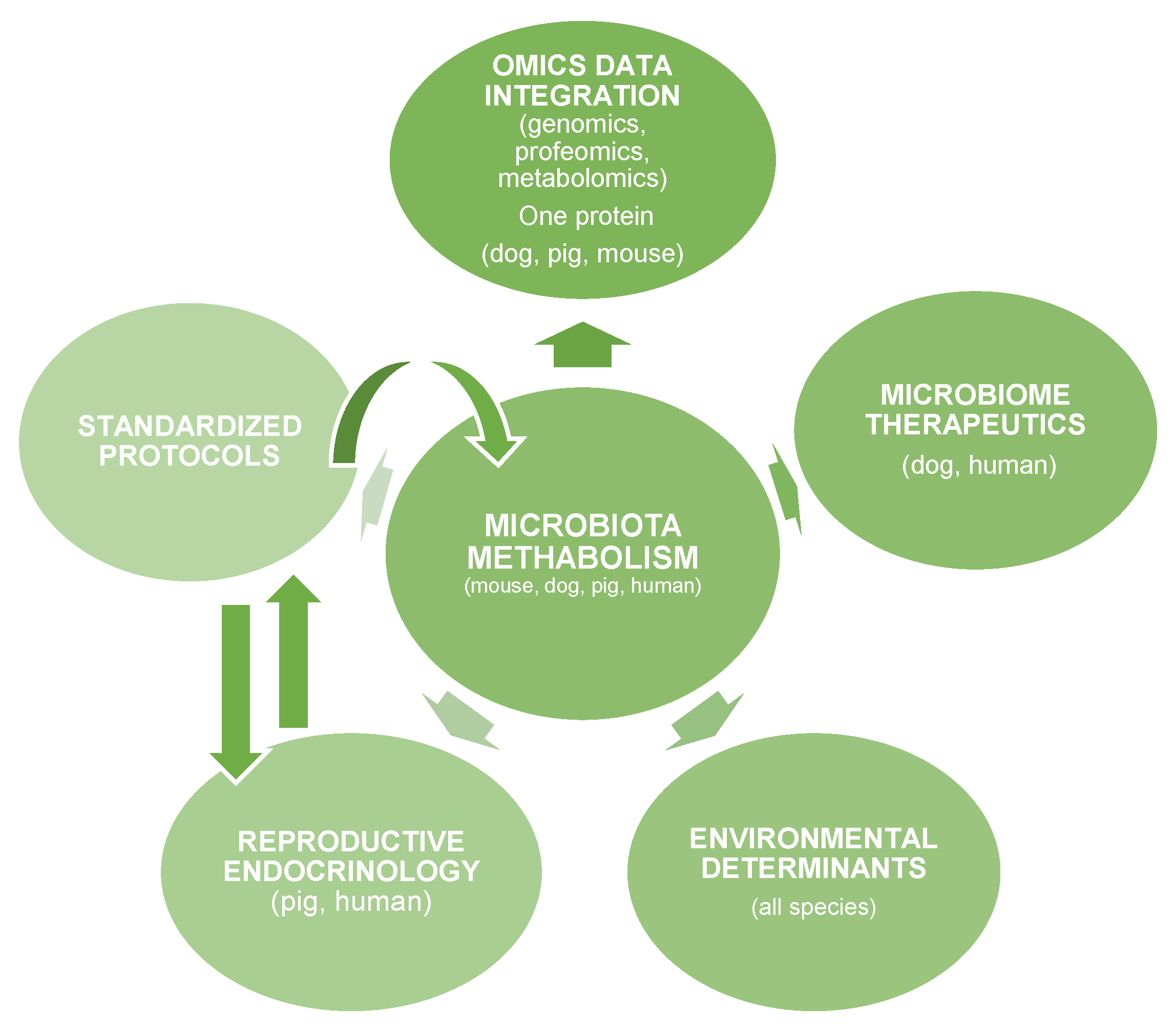
| Focus Area | Objective | Species Involved | Translational Relevance |
|---|---|---|---|
| Microbiota–metabolism axis | Define interspecies microbial signatures influencing glucose homeostasis | Mouse, dog, cat, human | High–identifies conserved microbial pathways |
| Omics data integration | Combine genomic, proteomic, and metabolomic datasets across species | Dog, pig, mouse | Very high–enhances predictive biomarkers |
| Standardized protocols | Harmonize diet, housing, and sampling protocols in translational studies | Mouse, cat, dog | High–improves reproducibility |
| Microbiome therapeutics | Evaluate FMT as a treatment model | Dog, human | High–demonstrates causal metabolic reversal |
| Environmental determinants | Identify and control external risk factors influencing DM development | All species | Moderate–reduces study bias |
| Reproductive endocrinology | Investigate gestational DM as a translational model | Pig, human | Moderate–relevant to metabolic adaptation |
| Category | Description | Impact on Translation |
|---|---|---|
| Heterogeneity of Methods | Induction of diabetes through different mechanisms (chemical, genetic, spontaneous) | Decreases comparability between studies |
| Pathophysiological Differences | Divergences in pancreatic islet structure and inflammatory response | Limits extrapolation to humans |
| Confounding Factors | Diet, sex, age, genetics, stress | Introduces uncontrolled variations |
| Underrepresented Subjects | Lack of comparative studies on companion animals | Reduces the generalization of conclusions |
| Low Standardization | Variable protocols for metabolic testing and complication assessment | Affects reproducibility |
| Methodological Bias | Lack of randomization and reporting of negative results | Increases the risk of erroneous conclusions |
Disclaimer/Publisher’s Note: The statements, opinions and data contained in all publications are solely those of the individual author(s) and contributor(s) and not of MDPI and/or the editor(s). MDPI and/or the editor(s) disclaim responsibility for any injury to people or property resulting from any ideas, methods, instructions or products referred to in the content. |
© 2025 by the authors. Licensee MDPI, Basel, Switzerland. This article is an open access article distributed under the terms and conditions of the Creative Commons Attribution (CC BY) license.
Share and Cite
Hrițcu, L.D.; Boghian, V.; Pavel, G.; Hrițcu, T.D.; Nechifor, F.; Spataru, A.; Cherșunaru, A.A.; Munteanu, A.; Ciocoiu, M.; Spataru, M.-C. Systematic Review: Exploring Inter-Species Variability in Diabetes Mellitus for Translational Medicine. Life 2026, 16, 64. https://doi.org/10.3390/life16010064
Hrițcu LD, Boghian V, Pavel G, Hrițcu TD, Nechifor F, Spataru A, Cherșunaru AA, Munteanu A, Ciocoiu M, Spataru M-C. Systematic Review: Exploring Inter-Species Variability in Diabetes Mellitus for Translational Medicine. Life. 2026; 16(1):64. https://doi.org/10.3390/life16010064
Chicago/Turabian StyleHrițcu, Luminița Diana, Vasile Boghian, Geta Pavel, Teodor Daniel Hrițcu, Florin Nechifor, Alexandru Spataru, Alexandra Andreea Cherșunaru, Alexandru Munteanu, Manuela Ciocoiu, and Mihaela-Claudia Spataru. 2026. "Systematic Review: Exploring Inter-Species Variability in Diabetes Mellitus for Translational Medicine" Life 16, no. 1: 64. https://doi.org/10.3390/life16010064
APA StyleHrițcu, L. D., Boghian, V., Pavel, G., Hrițcu, T. D., Nechifor, F., Spataru, A., Cherșunaru, A. A., Munteanu, A., Ciocoiu, M., & Spataru, M.-C. (2026). Systematic Review: Exploring Inter-Species Variability in Diabetes Mellitus for Translational Medicine. Life, 16(1), 64. https://doi.org/10.3390/life16010064