Paclitaxel- and Sirolimus-Coated Balloons Versus Drug-Eluting Stents in Coronary Artery Disease: A Comprehensive Narrative Review

 ,
,
Abstract
1. Introduction
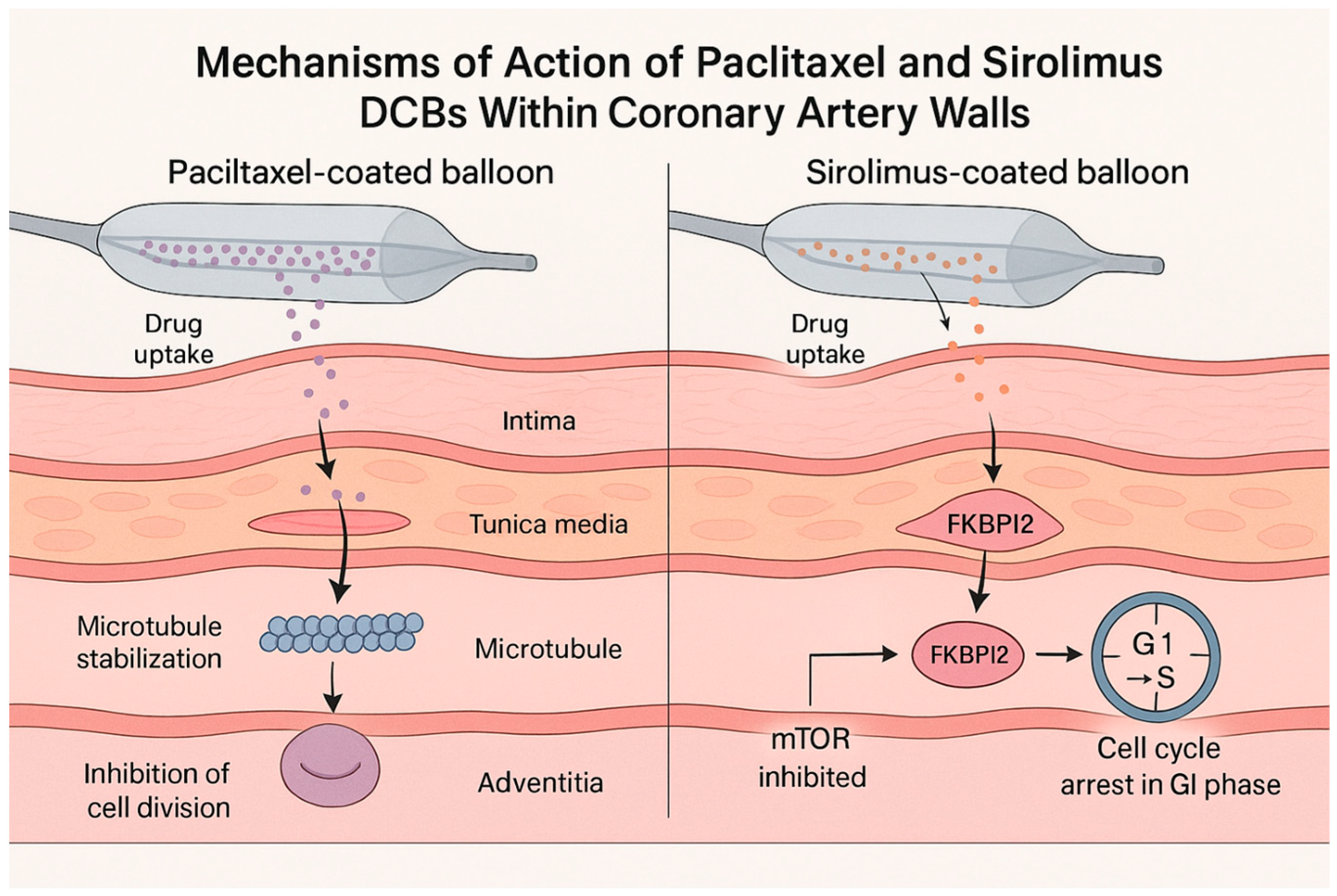
2. Pharmacologic Mechanisms of Paclitaxel vs. Sirolimus in DCBs
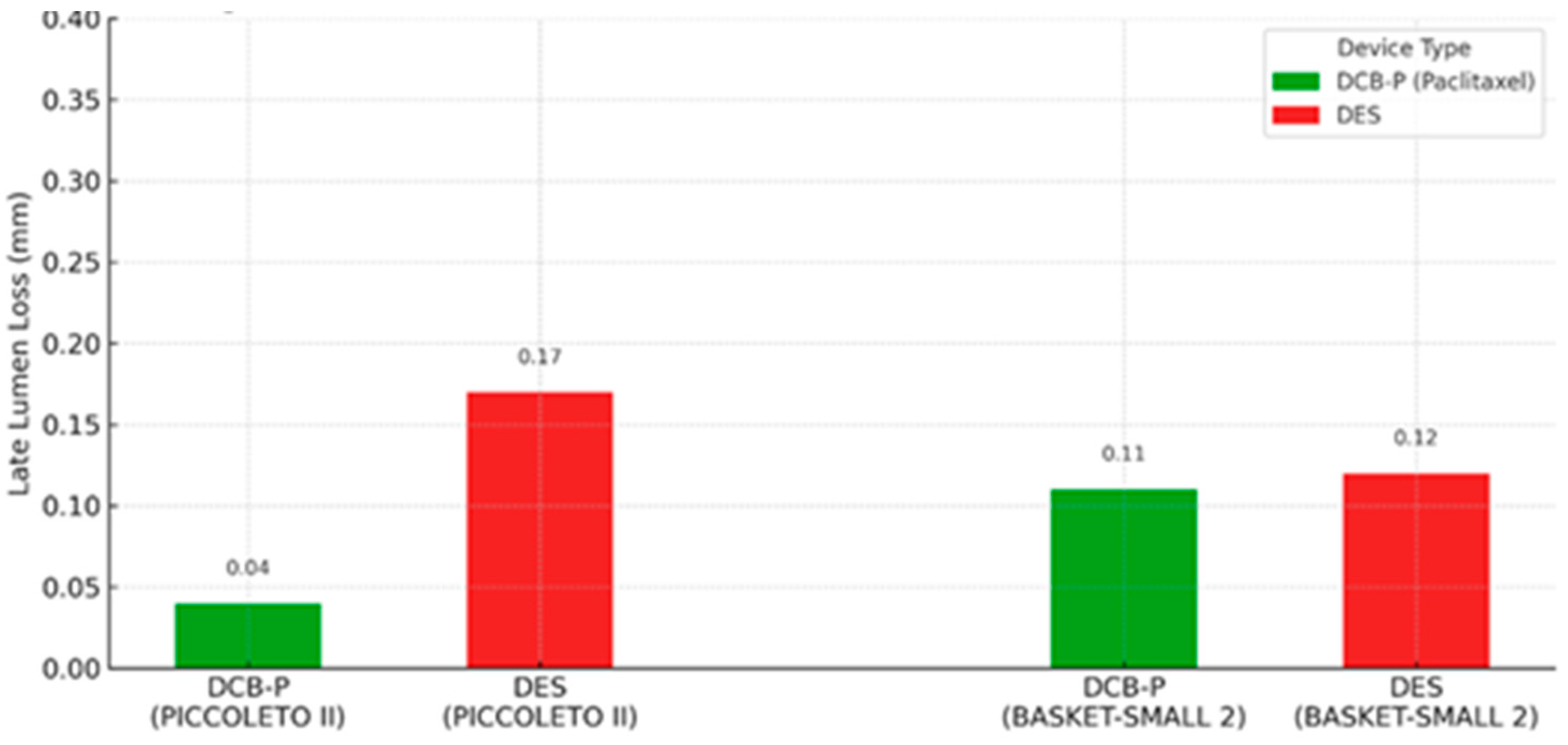
3. DCB vs. DES in De Novo Coronary Lesions (Chronic Coronary Syndrome)
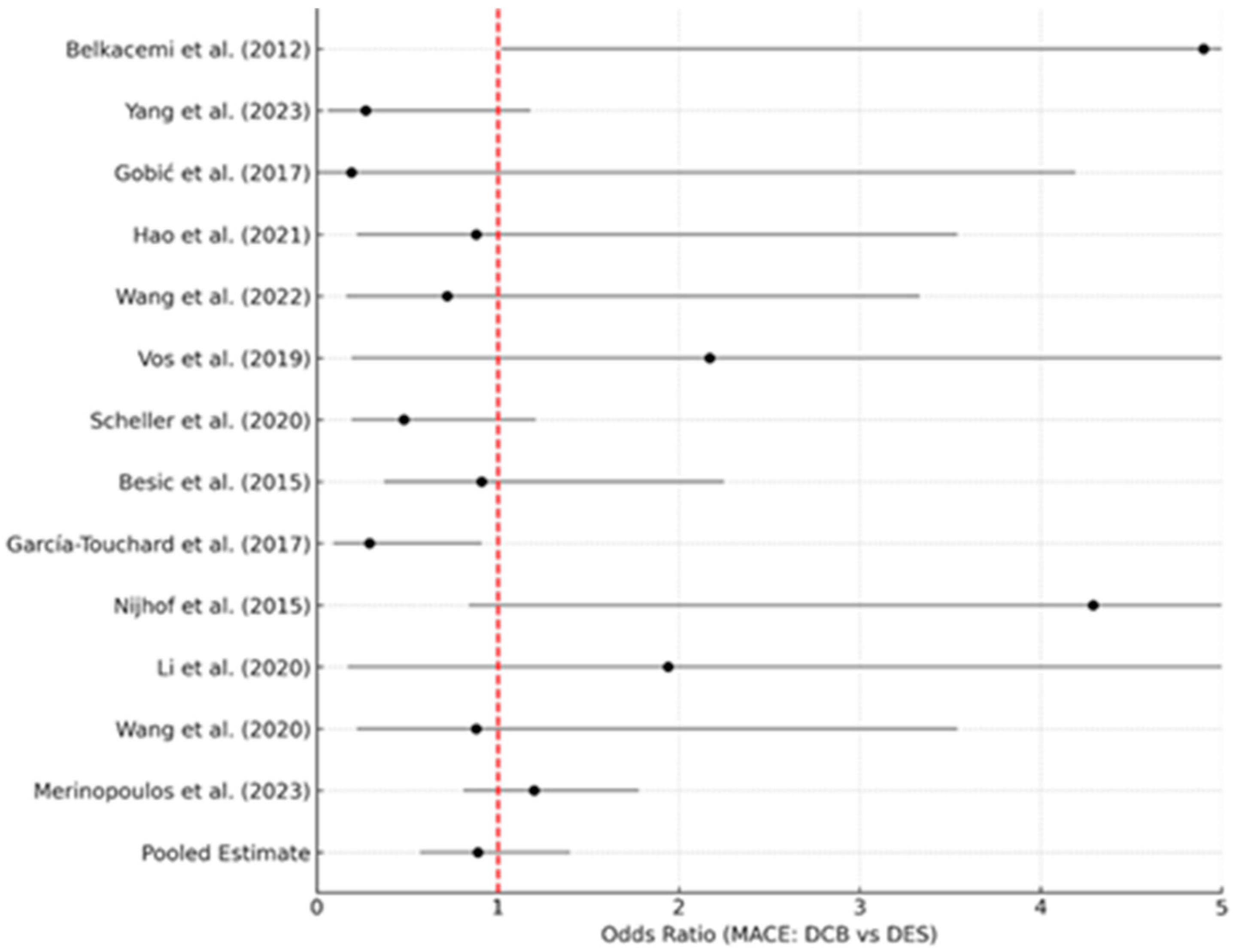
4. Drug-Coated Balloons in Acute Coronary Syndromes (ACSs)
4.1. ACS Clinical Outcomes and DAPT
4.2. Recent Expert Consensus and Position Statements
5. In-Stent Restenosis: DCB-S vs. DCB-P vs. DES for ISR
5.1. Paclitaxel DCB vs. DES in ISR
5.2. Sirolimus DCB in ISR
5.3. DES-in-DES vs. DCB
5.4. DCB for ISR—Practical Use
6. Guideline Indications and Emerging Use-Cases for DCBs
- ESC 2023–2024: The new ESC ACS guidelines (2023) and the 2024 chronic CAD guidelines reaffirm stenting for acute MI but do mention DCB use in niche cases. For instance, the ESC notes that treating ISR may use either DES or DCB (Class I), and it discusses DCB for small-vessel or bifurcation lesions in chronic CAD. Overall, ESC still highlights DES as preferred for STEMI/NSTEMI but acknowledges DCBs “leave nothing behind” PCI in select lesions [7,36].
- ACC/AHA: The latest American guidelines on PCI/ACS (no major update since 2020) continue to default to DES in ACS. There is currently no new ACC/AHA recommendation endorsing routine DCB in STEMI/NSTEMI; ACS patients who meet strict criteria (e.g., very small vessel, high bleeding risk) remain a niche group. In short, U.S. guidelines have not changed—DES are still the first-line treatment in ACS [37] (by implication, the benefits of DCB cited—no scaffold, lower late events—are still considered experimental in ACS.)
- Asia–Pacificic Consensus (2025): The Second Asia–Pacificic DCB Consensus (JACC: Asia 2025) explicitly promotes a “DCB-first” strategy in prepared lesions. It advocates a provisional approach (“all coronary lesions are treated using the provisional approach, where active lesion preparation is followed by DCB or DES treatment”), effectively making DCB the default device before starting intervention [38]. In this view, the operator begins with optimal vessel preparation and uses DCB if results are acceptable, reserving DES only for bailout. This consensus document (led by the Asia–Pacificic consensus group) provides practical guidelines on DCB-based PCI across various lesion types.
- Key takeaway: In 2024–2025, DES remains the cornerstone for ACS in guidelines, but DCB is increasingly recognized in “leave-nothing-behind” strategies. Updated ESC/ACC guidelines have not overruled DES-first for ACS, yet they do permit DCB in special situations (especially ISR) [7,37]. Newly issued consensus statements (Asia, Japan, etc.) explicitly endorse DCB as an alternative in select ACS/CAD cases [38]. Thus, the “niche role” of DCB in acute MI—avoiding a permanent implant in very specific scenarios—is now supported by multiple position papers, even if formal guideline classes remain conservative.
- ISR: DCB is suitable for both BMS and DES restenosis. Good candidates are those with first-time ISR, multiple stent layers (to avoid a third), ISR involving a side-branch (so it is not jailed with another stent), or HBR patients where avoiding long DAPT is crucial. If the ISR has a clear mechanical cause (like stent underexpansion), they advise correcting that before DCB.
- Large vessels: In vessels >3 mm, the consensus notes that randomized data are limited. Thus, in large vessels, DCB can be used (especially if the lesion is short or discrete), but robust evidence is still emerging.
- Bifurcation lesions: DCB can be utilized to avoid complex two-stent techniques. The consensus recommends the provisional stent strategy for the main branch and suggests that for the side branch, DCB angioplasty (instead of plain balloon) “may be preferable” to reduce ostial restenosis. Clinical data (from registries and small trials) have shown that in bifurcation PCI, using a DCB on the side branch after main vessel stenting yields better side branch patency than balloon alone and is far simpler than putting two stents. Ongoing trials like DEBUT-BIF are examining this formally [49].
- Diabetes mellitus: Guidelines note that diabetic patients have higher restenosis rates. While DESs are standard in diabetics, the consensus opines that DCBs “may be a favorable alternative” in certain diabetic subsets, but more data are needed. Notably, a subanalysis of BASKET-SMALL2 found no interaction of diabetes status—DCB was as effective as DES in diabetics for small vessels, though absolute event rates were higher than in non-diabetics [23].
- High bleeding risk: Both consensus and guidelines highlight HBR as a prime indication for DCB. If a patient cannot tolerate >1 month of DAPT, a DCB-only strategy is very attractive, since only 4 weeks of DAPT is recommended after DCB in de novo lesions. The DEBUT trial’s positive results in HBR support this [29]. Thus, for an HBR patient with a moderate lesion that can be ballooned-open nicely, one might use a DCB and give 1 month of DAPT, as opposed to using a DES with 3–6+ months DAPT and attendant bleeding risk.
7. Emerging Indications for Sirolimus DCBs
- Patients reluctant to accept any theoretical paclitaxel risks: While no mortality signal was ever seen in coronary trials (in contrast to a controversial signal in peripheral arterial disease), some patients/providers are more comfortable with limus drugs (given their long safety record in stents). SCBs offer an alternative in such cases. The consensus explicitly noted that no paclitaxel-related mortality concerns have emerged in coronaries, and 2-year data show no increase in death with DCB vs. DES, but it is reassuring that SCBs exist as an option [6].
- Very long lesions/diffuse disease: Tacking multiple long DES segments can lead to an excess of metal, overlapping polymers, etc. A “full metal jacket” can impair vessel compliance and complicate future grafting. DCBs could treat long diffuse disease by serially delivering the drug along the artery. This strategy is still investigational, but SCBs with sustained release might especially help in long lesions by providing a longer antiproliferative effect akin to overlapping DES.
- SCB for ISR in limus–DES failures: Conceptually, treating restenosis of a limus-eluting stent with another limus source (SCB) could be advantageous to maintain the same drug (avoiding potential cross-resistance issues). Paclitaxel DCBs are effective regardless of the stent type (limus or paclitaxel DES), but SCBs provide another tool. The ongoing TRANSFORM-1 and -2 trials are examining SCB in ISR and de novo lesions, respectively, to solidify its role [27].
- Combining with bioresorbable scaffolds: A novel concept is using a bioresorbable scaffold (BRS) in one part of a lesion and a DCB in the adjacent segment, to minimize permanent material. BRS can address a focal high-risk segment (providing early support), and DCB treats the rest diffusely. As next-generation BRSs improve, SCBs may complement them; both leave behind no permanent metal in the long term.
- Adjunct to atherectomy: After orbital, rotational, or laser atherectomy in a calcified lesion, one might consider DCB if the vessel is well prepared and perhaps avoid a stent, especially in moderate calcification. However, heavily calcified lesions often need stents to maintain expansion, so this is a very niche application currently.
8. Limitations of Current Data and Ongoing Research
9. Conclusions
Author Contributions
Funding
Informed Consent Statement
Data Availability Statement
Acknowledgments
Conflicts of Interest
Abbreviations
| ACS | Acute Coronary Syndrome |
| BA | Balloon Angioplasty (Plain Old Balloon Angioplasty, POBA) |
| BMS | Bare-Metal Stent |
| CAD | Coronary Artery Disease |
| DAPT | Dual Antiplatelet Therapy |
| DCB | Drug-Coated Balloon |
| DES | Drug-Eluting Stent |
| EES | Everolimus-Eluting Stent |
| HR | Hazard Ratio |
| ISR | In-Stent Restenosis |
| LLL | Late Lumen Loss |
| MACE | Major Adverse Cardiac Events |
| MI | Myocardial Infarction |
| MLD | Minimal Lumen Diameter |
| OR | Odds Ratio |
| PEB | Paclitaxel-Eluting Balloon (another term for paclitaxel-coated DCB) |
| PES | Paclitaxel-Eluting Stent |
| POBA | Plain Old Balloon Angioplasty (also referred to as BA) |
| RCT | Randomized Controlled Trial |
| SCB | Sirolimus-Coated Balloon |
| TLF | Target Lesion Failure |
| TLR | Target Lesion Revascularization |
| TVF | Target Vessel Failure |
| TVR | Target Vessel Revascularization |
References
- Jeger, R.V.; Farah, A.; Ohlow, M.-A.; Mangner, N.; Möbius-Winkler, S.; Leibundgut, G.; Weilenmann, D.; Wöhrle, J.; Richter, S.; Schreiber, M.; et al. Drug-Coated Balloons for Small Coronary Artery Disease (BASKET-SMALL 2): An Open-Label Randomised Non-Inferiority Trial. Lancet 2018, 392, 849–856. [Google Scholar] [CrossRef]
- Cortese, B.; Di Palma, G.; Guimaraes, M.G.; Piraino, D.; Orrego, P.S.; Buccheri, D.; Rivero, F.; Perotto, A.; Zambelli, G.; Alfonso, F. Drug-Coated Balloon Versus Drug-Eluting Stent for Small Coronary Vessel Disease. JACC Cardiovasc. Interv. 2020, 13, 2840–2849. [Google Scholar] [CrossRef] [PubMed]
- Sirolimus-Coated Balloon Meets Mark in De Novo Lesions and ISR: SELUTION. Available online: https://www.tctmd.com/news/sirolimus-coated-balloon-meets-mark-de-novo-lesions-and-isr-selution (accessed on 29 November 2025).
- Vos, N.S.; Fagel, N.D.; Amoroso, G.; Herrman, J.-P.R.; Patterson, M.S.; Piers, L.H.; van der Schaaf, R.J.; Slagboom, T.; Vink, M.A. Paclitaxel-Coated Balloon Angioplasty Versus Drug-Eluting Stent in Acute Myocardial Infarction. JACC Cardiovasc. Interv. 2019, 12, 1691–1699. [Google Scholar] [CrossRef]
- Cutlip, D.E.; Mehran, R.; Doros, G.; Kaplinskiy, V.; Lee, J.; Zheng, L.; Kausik, M.; Osborn, E.; Waksman, R. Prospective Randomized Single-Blind Multicenter Study to Assess the Safety and Effectiveness of the SELUTION SLR 014 Drug Eluting Balloon in the Treatment of Subjects with in-Stent Restenosis: Rationale and Design. Am. Heart J. 2025, 284, 11–19. [Google Scholar] [CrossRef]
- International Consensus Report on Drug-Coated Balloons. Available online: https://www.acc.org/Latest-in-Cardiology/ten-points-to-remember/2020/06/02/11/55/http%3a%2f%2fwww.acc.org%2fLatest-in-Cardiology%2ften-points-to-remember%2f2020%2f06%2f02%2f11%2f55%2fInternational-Consensus-Report-on-Drug-Coated-Balloons (accessed on 29 November 2025).
- Vrints, C.; Andreotti, F.; Koskinas, K.C.; Rossello, X.; Adamo, M.; Ainslie, J.; Banning, A.P.; Budaj, A.; Buechel, R.R.; Chiariello, G.A.; et al. 2024 ESC Guidelines for the Management of Chronic Coronary Syndromes: Developed by the Task Force for the Management of Chronic Coronary Syndromes of the European Society of Cardiology (ESC) Endorsed by the European Association for Cardio-Thoracic Surgery (EACTS). Eur. Heart J. 2024, 45, 3415–3537. [Google Scholar] [CrossRef]
- Gurgoglione, F.L.; De Gregorio, M.; Benatti, G.; Donelli, D.; Vignali, L.; Solinas, E.; Tadonio, I.; Denegri, A.; Covani, M.; Dallaglio, G.; et al. Paclitaxel-Coated Versus Sirolimus-Coated Eluting Balloons for Percutaneous Coronary Interventions: Pharmacodynamic Properties, Clinical Evidence, and Future Perspectives. Future Pharmacol. 2024, 4, 775–787. [Google Scholar] [CrossRef]
- Korjian, S.; McCarthy, K.J.; Larnard, E.A.; Cutlip, D.E.; McEntegart, M.B.; Kirtane, A.J.; Yeh, R.W. Drug-Coated Balloons in the Management of Coronary Artery Disease. Circ. Cardiovasc. Interv. 2024, 17, e013302. [Google Scholar] [CrossRef] [PubMed]
- Zhang, H.; Zhang, Y.; Tian, T.; Wang, T.; Chen, J.; Yuan, J.; Qian, J.; Hu, F.; Dou, K.; Qiao, S.; et al. Comparison of Recurrent With First-Time In-Stent Restenosis. Am. J. Cardiol. 2023, 206, 168–174. [Google Scholar] [CrossRef]
- Chioncel, V.; Gherasie, F.; Iancu, A.; Avram, A.-G. Coronary Angioplasty with Drug-Coated Balloons: Pharmacological Foundations, Clinical Efficacy, and Future Directions. Medicina 2025, 61, 1470. [Google Scholar] [CrossRef]
- Scheller, B.; Hehrlein, C.; Bocksch, W.; Rutsch, W.; Haghi, D.; Dietz, U.; Böhm, M.; Speck, U. Treatment of Coronary In-Stent Restenosis with a Paclitaxel-Coated Balloon Catheter. N. Engl. J. Med. 2006, 355, 2113–2124. [Google Scholar] [CrossRef] [PubMed]
- Rittger, H.; Brachmann, J.; Sinha, A.-M.; Waliszewski, M.; Ohlow, M.; Brugger, A.; Thiele, H.; Birkemeyer, R.; Kurowski, V.; Breithardt, O.-A.; et al. A Randomized, Multicenter, Single-Blinded Trial Comparing Paclitaxel-Coated Balloon Angioplasty With Plain Balloon Angioplasty in Drug-Eluting Stent Restenosis. JACC 2012, 59, 1377–1382. [Google Scholar] [CrossRef] [PubMed]
- Axel, D.I.; Kunert, W.; Göggelmann, C.; Oberhoff, M.; Herdeg, C.; Küttner, A.; Wild, D.H.; Brehm, B.R.; Riessen, R.; Köveker, G.; et al. Paclitaxel Inhibits Arterial Smooth Muscle Cell Proliferation and Migration In Vitro and In Vivo Using Local Drug Delivery. Circulation 1997, 96, 636–645. [Google Scholar] [CrossRef]
- Villar-Matamoros, E.; Stokes, L.; Lloret, A.; Todd, M.; Tillman, B.W.; Yazdani, S.K. Understanding the Mechanism of Drug Transfer and Retention of Drug-Coated Balloons. J. Cardiovasc. Pharmacol. Ther. 2022, 27, 10742484221119559. [Google Scholar] [CrossRef]
- Wańha, W.; Iwańczyk, S.; Januszek, R.; Wolny, R.; Tomasiewicz, B.; Kuliczkowski, W.; Reczuch, K.; Pawlus, P.; Pawłowski, T.Z.; Kuźma, Ł.; et al. Long-Term Outcomes Following Sirolimus-Coated Balloon or Drug-Eluting Stents for Treatment of In-Stent Restenosis. Circ. Cardiovasc. Interv. 2024, 17, e014064. [Google Scholar] [CrossRef] [PubMed]
- Abdelaziz, A.; Hafez, A.; Atta, K.; Elsayed, H.; Abdelaziz, M.; Elaraby, A.; Kadhim, H.; Mechi, A.; Ezzat, M.; Fadel, A.; et al. Drug-Coated Balloons versus Drug-Eluting Stents in Patients with Acute Myocardial Infarction Undergoing Percutaneous Coronary Intervention: An Updated Meta-Analysis with Trial Sequential Analysis. BMC Cardiovasc. Disord. 2023, 23, 605. [Google Scholar] [CrossRef]
- Cortese, B.; Caiazzo, G.; Di Palma, G.; De Rosa, S. Comparison Between Sirolimus-and Paclitaxel-Coated Balloon for Revascularization of Coronary Arteries: The SIRPAC (SIRolimus-PAClitaxel) Study. Cardiovasc. Revasc. Med. 2021, 28, 1–6. [Google Scholar] [CrossRef]
- Cremers, B.; Schmitmeier, S.; Clever, Y.P.; Gershony, G.; Speck, U.; Scheller, B. Inhibition of Neo-Intimal Hyperplasia in Porcine Coronary Arteries Utilizing a Novel Paclitaxel-Coated Scoring Balloon Catheter. Catheter. Cardiovasc. Interv. 2014, 84, 1089–1098. [Google Scholar] [CrossRef]
- Cortese, B.; Malakouti, S.; Khater, J.; Munjal, A. Magic Touch Sirolimus-Coated Balloon: Animal and Clinical Evidence of a Coronary Sirolimus Drug-Coated Balloon. Future Cardiol. 2024, 20, 521–535. [Google Scholar] [CrossRef] [PubMed]
- von Koch, S.; Zhou, M.; Rosén, H.C.; Zwackman, S.; Jurga, J.; Grimfjärd, P.; Götberg, M.; Mohammad, M.A.; Erlinge, D. Drug-Coated Balloons Versus Drug-Eluting Stents or Plain Old Balloon Angioplasty: A Long-Term in-Stent Restenosis Study. J. Am. Heart Assoc. 2024, 13, e036839. [Google Scholar] [CrossRef]
- Cortese, B.; Micheli, A.; Picchi, A.; Coppolaro, A.; Bandinelli, L.; Severi, S.; Limbruno, U. Paclitaxel-Coated Balloon versus Drug-Eluting Stent during PCI of Small Coronary Vessels, a Prospective Randomised Clinical Trial. The PICCOLETO Study. Heart 2010, 96, 1291–1296. [Google Scholar] [CrossRef]
- Jeger, R.V.; Farah, A.; Ohlow, M.-A.; Mangner, N.; Möbius-Winkler, S.; Weilenmann, D.; Wöhrle, J.; Stachel, G.; Markovic, S.; Leibundgut, G.; et al. Long-Term Efficacy and Safety of Drug-Coated Balloons versus Drug-Eluting Stents for Small Coronary Artery Disease (BASKET-SMALL 2): 3-Year Follow-up of a Randomised, Non-Inferiority Trial. Lancet 2020, 396, 1504–1510. [Google Scholar] [CrossRef]
- Cortese, B.; Testa, G.; Rivero, F.; Erriquez, A.; Alfonso, F. Long-Term Outcome of Drug-Coated Balloon vs Drug-Eluting Stent for Small Coronary Vessels: PICCOLETO-II 3-Year Follow-Up. JACC Cardiovasc. Interv. 2023, 16, 1054–1061. [Google Scholar] [CrossRef]
- Tang, Y.; Qiao, S.; Su, X.; Chen, Y.; Jin, Z.; Chen, H.; Xu, B.; Kong, X.; Pang, W.; Liu, Y.; et al. Drug-Coated Balloon Versus Drug-Eluting Stent for Small-Vessel Disease: The RESTORE SVD China Randomized Trial. JACC Cardiovasc. Interv. 2018, 11, 2381–2392. [Google Scholar] [CrossRef] [PubMed]
- Yamamoto, T.; Sawada, T.; Uzu, K.; Takaya, T.; Kawai, H.; Yasaka, Y. Possible Mechanism of Late Lumen Enlargement after Treatment for de Novo Coronary Lesions with Drug-Coated Balloon. Int. J. Cardiol. 2020, 321, 30–37. [Google Scholar] [CrossRef]
- Ninomiya, K.; Serruys, P.W.; Colombo, A.; Reimers, B.; Basavarajaiah, S.; Sharif, F.; Testa, L.; Di Mario, C.; Nerla, R.; Ding, D.; et al. A Prospective Randomized Trial Comparing Sirolimus-Coated Balloon With Paclitaxel-Coated Balloon in De Novo Small Vessels. JACC Cardiovasc. Interv. 2023, 16, 2884–2896. [Google Scholar] [CrossRef]
- Fezzi, S.; Scheller, B.; Cortese, B.; Alfonso, F.; Jeger, R.; Colombo, A.; Joner, M.; Shin, E.-S.; Kleber, F.; Latib, A.; et al. Definitions and Standardized Endpoints for the Use of Drug-Coated Balloon in Coronary Artery Disease: Consensus Document of the Drug Coated Balloon Academic Research Consortium. Available online: https://eurointervention.pcronline.com/article/definitions-and-standardized-endpoints-for-the-use-of-drug-coated-balloon-in-coronary-artery-disease-consensus-document-of-the-drug-coated-balloon-academic-research-consortium (accessed on 29 November 2025).
- Rissanen, T.T.; Uskela, S.; Eränen, J.; Mäntylä, P.; Olli, A.; Romppanen, H.; Siljander, A.; Pietilä, M.; Minkkinen, M.J.; Tervo, J.; et al. Drug-Coated Balloon for Treatment of de-Novo Coronary Artery Lesions in Patients with High Bleeding Risk (DEBUT): A Single-Blind, Randomised, Non-Inferiority Trial. Lancet 2019, 394, 230–239. [Google Scholar] [CrossRef]
- Belkacemi, A.; Agostoni, P.; Nathoe, H.M.; Voskuil, M.; Shao, C.; Van Belle, E.; Wildbergh, T.; Politi, L.; Doevendans, P.A.; Sangiorgi, G.M.; et al. First Results of the DEB-AMI (Drug Eluting Balloon in Acute ST-Segment Elevation Myocardial Infarction) Trial. JACC J. Am. Coll. Cardiol. 2012, 59, 2327–2337. [Google Scholar] [CrossRef] [PubMed]
- DCB in STEMI Match DES Through 5 Years: REVELATION. Available online: https://www.tctmd.com/news/dcb-stemi-match-des-through-5-years-revelation (accessed on 29 November 2025).
- Scheller, B.; Ohlow, M.-A.; Ewen, S.; Kische, S.; Rudolph, T.K.; Clever, Y.; Wagner, A.; Richter, S.; El-Garhy, M.; Böhm, M.; et al. Bare Metal or Drug-Eluting Stent Versus Drug-Coated Balloon in Non-ST-Elevation Myocardial Infarction: The Randomised PEPCAD NSTEMI Trial. 2020. Available online: https://eurointervention.pcronline.com/article/randomized-comparison-of-bare-metal-or-drug-eluting-stent-versus-drug-coated-balloon-in-non-st-elevation-myocardial-infarction-pepcad-nstemi (accessed on 29 November 2025).
- Gobić, D.; Tomulić, V.; Lulić, D.; Židan, D.; Brusich, S.; Jakljević, T.; Zaputović, L. Drug-Coated Balloon Versus Drug-Eluting Stent in Primary Percutaneous Coronary Intervention: A Feasibility Study. Am. J. Med. Sci. 2017, 354, 553–560. [Google Scholar] [CrossRef] [PubMed]
- Megaly, M.; Buda, K.; Saad, M.; Tawadros, M.; Elbadawi, A.; Basir, M.; Abbott, J.D.; Rinfret, S.; Alaswad, K.; Brilakis, E.S. Outcomes With Drug-Coated Balloons vs. Drug-Eluting Stents in Small-Vessel Coronary Artery Disease. Cardiovasc. Revasc. Med. 2022, 35, 76–82. [Google Scholar] [CrossRef]
- Merinopoulos, I.; Gunawardena, T.; Corballis, N.; Bhalraam, U.; Reinhold, J.; Wickramarachchi, U.; Maart, C.; Gilbert, T.; Richardson, P.; Sulfi, S.; et al. Assessment of Paclitaxel Drug-Coated Balloon Only Angioplasty in STEMI. JACC Cardiovasc. Interv. 2023, 16, 771–779. [Google Scholar] [CrossRef] [PubMed]
- Byrne, R.A.; Rossello, X.; Coughlan, J.J.; Barbato, E.; Berry, C.; Chieffo, A.; Claeys, M.J.; Dan, G.-A.; Dweck, M.R.; Galbraith, M.; et al. 2023 ESC Guidelines for the Management of Acute Coronary Syndromes: Developed by the Task Force on the Management of Acute Coronary Syndromes of the European Society of Cardiology (ESC). Eur. Heart J. 2023, 44, 3720–3826. [Google Scholar] [CrossRef] [PubMed]
- Rao, S.V.; O’Donoghue, M.L.; Ruel, M.; Rab, T.; Tamis-Holland, J.E.; Alexander, J.H.; Baber, U.; Baker, H.; Cohen, M.G.; Cruz-Ruiz, M.; et al. 2025 ACC/AHA/ACEP/NAEMSP/SCAI Guideline for the Management of Patients With Acute Coronary Syndromes. JACC J. Am. Coll. Cardiol. 2025, 85, 2135–2237. [Google Scholar] [CrossRef] [PubMed]
- Her, A.-Y.; Ahmad, W.A.W.; Bang, L.H.; Kiam, O.T.; Nuruddin, A.A.; Hsieh, I.-C.; Hwa, H.H.; Yahaya, S.A.; Tang, Q.; Hsu, J.-C.; et al. Drug-Coated Balloons-Based Intervention for Coronary Artery Disease. JACC Asia 2025, 5, 701–717. [Google Scholar] [CrossRef] [PubMed]
- Suwannasom, P.; Towashiraporn, K.; Roongsangmanoon, W.; Kanjanarutjawiwat, W.; Surunchupakorn, P.; Muenkaew, M.; Chichareon, P.; Hutayanon, P.; Kanoksilp, A.; Chandavimol, M. Consensus Statement on Drug-Coated Balloons in Coronary Artery Disease from the Cardiovascular Intervention Association of Thailand. J. Clin. Med. 2025, 14, 7505. [Google Scholar] [CrossRef]
- Her, A.-Y.; Shin, E.-S.; Bang, L.H.; Nuruddin, A.A.; Tang, Q.; Hsieh, I.-C.; Hsu, J.-C.; Kiam, O.T.; Qiu, C.; Qian, J.; et al. Drug-Coated Balloon Treatment in Coronary Artery Disease: Recommendations from an Asia-Pacific Consensus Group. Cardiol. J. 2021, 28, 136–149. [Google Scholar] [CrossRef]
- Giacoppo, D.; Alvarez-Covarrubias, H.A.; Koch, T.; Cassese, S.; Xhepa, E.; Kessler, T.; Wiebe, J.; Joner, M.; Hochholzer, W.; Laugwitz, K.-L.; et al. Coronary Artery Restenosis Treatment with Plain Balloon, Drug-Coated Balloon, or Drug-Eluting Stent: 10-Year Outcomes of the ISAR-DESIRE 3 Trial. Eur. Heart J. 2023, 44, 1343–1357. [Google Scholar] [CrossRef]
- Alfonso, F.; Pérez-Vizcayno, M.J.; Cuesta, J.; García del Blanco, B.; García-Touchard, A.; López-Mínguez, J.R.; Masotti, M.; Zueco, J.; Cequier, A.; Velázquez, M.; et al. 3-Year Clinical Follow-Up of the RIBS IV Clinical Trial. JACC Cardiovasc. Interv. 2018, 11, 981–991. [Google Scholar] [CrossRef]
- Alfonso, F.; Pérez-Vizcayno, M.J.; Cárdenas, A.; García del Blanco, B.; Seidelberger, B.; Iñiguez, A.; Gómez-Recio, M.; Masotti, M.; Velázquez, M.T.; Sanchís, J.; et al. A Randomized Comparison of Drug-Eluting Balloon Versus Everolimus-Eluting Stent in Patients With Bare-Metal Stent–In-Stent Restenosis. JACC J. Am. Coll. Cardiol. 2014, 63, 1378–1386. [Google Scholar] [CrossRef]
- Siontis, G.C.M.; Stefanini, G.G.; Mavridis, D.; Siontis, K.C.; Alfonso, F.; Pérez-Vizcayno, M.J.; Byrne, R.A.; Kastrati, A.; Meier, B.; Salanti, G.; et al. Percutaneous Coronary Interventional Strategies for Treatment of In-Stent Restenosis: A Network Meta-Analysis. Lancet 2015, 386, 655–664. [Google Scholar] [CrossRef]
- Giacoppo, D.; Alfonso, F.; Xu, B.; Claessen, B.E.P.M.; Adriaenssens, T.; Jensen, C.; Pérez-Vizcayno, M.J.; Kang, D.-Y.; Degenhardt, R.; Pleva, L.; et al. Paclitaxel-Coated Balloon Angioplasty vs. Drug-Eluting Stenting for the Treatment of Coronary in-Stent Restenosis: A Comprehensive, Collaborative, Individual Patient Data Meta-Analysis of 10 Randomized Clinical Trials (DAEDALUS Study). Eur. Heart J. 2020, 41, 3715–3728. [Google Scholar] [CrossRef]
- Yeh, R.W.; Shlofmitz, R.; Moses, J.; Bachinsky, W.; Dohad, S.; Rudick, S.; Stoler, R.; Jefferson, B.K.; Nicholson, W.; Altman, J.; et al. Paclitaxel-Coated Balloon vs Uncoated Balloon for Coronary In-Stent Restenosis: The AGENT IDE Randomized Clinical Trial. JAMA 2024, 331, 1015–1024. [Google Scholar] [CrossRef] [PubMed]
- Baan, J.; Claessen, B.E.; Dijk, K.B.; Vendrik, J.; van der Schaaf, R.J.; Meuwissen, M.; van Royen, N.; Gosselink, A.T.M.; van Wely, M.H.; Dirkali, A.; et al. A Randomized Comparison of Paclitaxel-Eluting Balloon Versus Everolimus-Eluting Stent for the Treatment of Any In-Stent Restenosis. JACC Cardiovasc. Interv. 2018, 11, 275–283. [Google Scholar] [CrossRef]
- DES Best for In-Stent Restenosis, but DCBs Also Viable. Available online: https://www.tctmd.com/news/des-best-stent-restenosis-dcbs-also-viable (accessed on 1 December 2025).
- Gao, X.-F.; Ge, Z.; Kan, J.; Kong, X.-Q.; Wang, Y.; Qiu, C.-G.; Tresukosol, D.; He, Y.-Q.; Wu, Q.; Li, J.-F.; et al. Rationale and Design for Comparison of Non-Compliant Balloon with Drug-Coating Balloon Angioplasty for Side Branch after Provisional Stenting for Patients with True Coronary Bifurcation Lesions: A Prospective, Multicentre and Randomised DCB-BIF Trial. BMJ Open 2022, 12, e052788. [Google Scholar] [CrossRef]
- Wen, Y.; Li, Y.; Yang, R.; Chen, Y.; Shen, Y.; Liu, Y.; Liu, X.; Zhang, B.; Li, H. Biofunctional Coatings and Drug-Coated Stents for Restenosis Therapy. Mater. Today Bio 2024, 29, 101259. [Google Scholar] [CrossRef] [PubMed]
- Todd, M.; Liu, L.B.; Saul, J.M.; Yazdani, S.K. Pre-Clinical Investigation of Liquid Sirolimus for Local Drug Delivery. Front. Cardiovasc. Med. 2023, 10, 1184816. [Google Scholar] [CrossRef] [PubMed]



| Property | Paclitaxel (DCB-P) | Sirolimus (DCB-S) |
|---|---|---|
| Mechanism of Action | Microtubule stabilizer; induces G2/M arrest (cytotoxic). | mTOR inhibitor; induces G1 arrest (cytostatic). |
| Lipophilicity (log p) | High (~3.9)—facilitates rapid tissue uptake and long retention. | Moderate (~2.5)—lower innate uptake; needs delivery enhancements. |
| Tissue Retention | Prolonged (weeks). The drug persists in the vessel wall after a single use. | Shorter without special excipients. Advanced coatings prolong release to ~60–90 days. |
| Endothelial Healing | Slower re-endothelialization; moderate chronic inflammation. | Faster endothelial recovery; lower inflammatory response in studies. |
| Clinical Usage (2025) | Decade-long track record; gold-standard DCB agent. | Emerging in trials, promising results with new delivery technologies. |
| Trial | Population (ISR Type, Prior Stents) | Intervention vs. Comparator | Follow-Up | Angiographic Findings | Clinical Outcomes (1 yr Unless Noted) |
|---|---|---|---|---|---|
| ISAR-DESIRE 3 (2013) [41] | DES–ISR (≥50% restenosis after “limus”-eluting stents); N = 402 | Paclitaxel DCB (PEB) vs. Paclitaxel DES (PES) vs. POBA | 6–8 mo angiography; 1 yr clinical | 6–8 mo % diameter stenosis: PEB 38.0% vs. PES 37.4% (Δ0.6%, one-sided p_non-inf = 0.007); both PEB and PES vs. BA (54.1%, p < 0.0001). | Death, MI, and target-lesion thrombosis were similar across arms; 1 yr TLR (“repeat revascularization”) was similar for PEB vs. PES but both lower than POBA. |
| RIBS IV (2015) [43] | DES–ISR; N = 309 (DEB 154 vs. EES 155) | Paclitaxel DCB (DEB) vs. Everolimus DES (EES) | 6–9 mo angiography; 1 yr | 6–9 mo minimal lumen diameter: EES 2.0 ± 0.7 mm vs. DEB 1.80 ± 0.6 mm (p < 0.01); %DS 23 ± 22% vs. 30 ± 22% (p < 0.01); binary restenosis 11% vs. 19% (p = 0.06). | 1 yr composite (cardiac death/MI/TVR): 10% (EES) vs. 18% (DEB), HR ≈ 0.58 (95% CI 0.35–0.98; p = 0.04); mainly driven by TVR (8% vs. 16%, p = 0.035). |
| RIBS V (2014) [42] | BMS–ISR; N = 189 (DEB 95 vs. EES 94) | Paclitaxel DCB (DEB) vs. Everolimus DES (EES) | 9 mo angiography; 1 yr | 9 mo MLD: EES 2.4 ± 0.6 mm vs. DEB 2.0 ± 0.6 mm (p < 0.001); %DS 13 ± 17% vs. 25 ± 20% (p < 0.001). Late loss low in both (0.04 vs. 0.14 mm, p = 0.14); restenosis ~4.7% vs. 9.5% (p = 0.22). | 1 yr MACE (cardiac death/MI/TVR): 6% (EES) vs. 8% (DEB), HR≈0.76 (p = 0.6); TVR: 2% vs. 6% (HR ≈ 0.32, p = 0.17). Both groups had very low restenosis and high patency. |
| DARE (2018) [47] | Any ISR (BMS or DES; 56% DES); N = 278 (PEB 141 vs. EES 137) | Paclitaxel DCB (SeQuent Please) vs. Everolimus DES (Xience) | 6 mo angiography; 12 mo | 6 mo in-segment MLD: DCB 1.7 ± 0.51 mm vs. DES 1.7 ± 0.61 mm; noninferior (p < 0.0001 for noninferiority). Post-procedure, DES had slightly larger MLD and lower %DS than DCB (p = 0.018 and p = 0.03). | 1 yr TVR: 8.8% (DCB) vs. 7.1% (DES) (p = 0.65); no significant differences in MACE (death/MI/TVR) between groups. |
| DAEDALUS (2020) [45] | Meta-analysis of 10 RCTs in ISR (BMS or DES); total N = 1976 (PCB n = 1033 vs. DES n = 943) | Paclitaxel-coated balloon angioplasty vs. repeat DES | Median 3 yr | – | 3 yr TLR: higher with DCB (PCB) vs. DES (HR 1.32; 95% CI 1.02–1.70; p = 0.035). The DCB–DES difference was greater for DES-ISR (treatment-by-ISR-type interaction p = 0.029). Safety composite (all-cause death/MI/stent thrombosis) was similar (HR 0.80; p = 0.152), as were mortality, MI, and thrombosis. |
| AGENT IDE (2024) [46] | Any coronary ISR (lesion ≤ 26 mm, RVD 2.0–4.0 mm); N = 600 (2:1 randomization) | Paclitaxel DCB (AGENT balloon) vs. uncoated balloon (POBA) | 1 yr | – | 1 yr TLF (ischemia-driven TLR, TV-MI, or cardiac death): 17.9% (DCB) vs. 28.6% (POBA), HR 0.59 (95% CI 0.42–0.84; p = 0.003). Ischemic TLR: 13.0% vs. 24.7%, HR 0.50 (p = 0.001). TV-MI: 5.8% vs. 11.1% (HR 0.51, p = 0.02). Stent thrombosis: 0.4% vs. 3.7% (HR 0.07, p = 0.001). Death: 4.1% vs. 3.7% (p = 0.85). |
Disclaimer/Publisher’s Note: The statements, opinions and data contained in all publications are solely those of the individual author(s) and contributor(s) and not of MDPI and/or the editor(s). MDPI and/or the editor(s) disclaim responsibility for any injury to people or property resulting from any ideas, methods, instructions or products referred to in the content. |
© 2025 by the authors. Licensee MDPI, Basel, Switzerland. This article is an open access article distributed under the terms and conditions of the Creative Commons Attribution (CC BY) license.
Share and Cite
Gherasie, F.-A.; Ali, A.H.; Corzanu, A.M.; Costescu, E.C.; Cornea, S.-G. Paclitaxel- and Sirolimus-Coated Balloons Versus Drug-Eluting Stents in Coronary Artery Disease: A Comprehensive Narrative Review. Life 2026, 16, 63. https://doi.org/10.3390/life16010063
Gherasie F-A, Ali AH, Corzanu AM, Costescu EC, Cornea S-G. Paclitaxel- and Sirolimus-Coated Balloons Versus Drug-Eluting Stents in Coronary Artery Disease: A Comprehensive Narrative Review. Life. 2026; 16(1):63. https://doi.org/10.3390/life16010063
Chicago/Turabian StyleGherasie, Flavius-Alexandru, Al Hassan Ali, Ana Maria Corzanu, Eva Catalina Costescu, and Sonia-Gabriela Cornea. 2026. "Paclitaxel- and Sirolimus-Coated Balloons Versus Drug-Eluting Stents in Coronary Artery Disease: A Comprehensive Narrative Review" Life 16, no. 1: 63. https://doi.org/10.3390/life16010063
APA StyleGherasie, F.-A., Ali, A. H., Corzanu, A. M., Costescu, E. C., & Cornea, S.-G. (2026). Paclitaxel- and Sirolimus-Coated Balloons Versus Drug-Eluting Stents in Coronary Artery Disease: A Comprehensive Narrative Review. Life, 16(1), 63. https://doi.org/10.3390/life16010063