


Exploring Life Detection on Mars: Understanding Challenges in DNA Amplification in Martian Regolith Analogue After Fe Ion Irradiation



Abstract
1. Introduction
- (i)
- it is present in all known forms of life and serves as a highly specific indicator of biological activity [13];
- (ii)
- it demonstrates remarkable stability when adsorbed onto mineral surfaces;
- (iii)
- the information it carries is resilient to degradation
- (iv)
2. Materials and Methods
2.1. Test Organism
2.2. DNA Extraction and Sample Preparation
2.3. Fe Ion Irradiation Exposure
2.4. Nucleic Acid Amplification and Estimation of DNA Lesions
2.5. Single-Gene PCR and Random Amplified Polymorphic DNA Analysis
2.6. Evaluation of PCR Bands Intensity
3. Results
3.1. DNA Damage Assessment
Genomic DNA
3.2. Nucleic Acid Amplification and Estimation of DNA Lesions
3.3. DNA Integrity Assay by PCR Amplification and Bands Intensity
4. Discussion
5. Conclusions
Supplementary Materials
Author Contributions
Funding
Institutional Review Board Statement
Informed Consent Statement
Data Availability Statement
Acknowledgments
Conflicts of Interest
References
- Sephton, M.A.; Freeman, K.; Hays, L.; Thiessen, F.; Benison, K.; Carrier, B.; Dworkin, J.P.; Glamoclija, M.; Gough, R.; Onofri, S.; et al. Thresholds of Temperature and Time for Mars Sample Return: Final Report of the Mars Sample Return Temperature-Time Tiger Team. Astrobiology 2024, 24, 443–488. [Google Scholar] [CrossRef] [PubMed]
- Des Marais, D.J.; Nuth, J.A., III; Allamandola, L.J.; Boss, A.P.; Farmer, J.D.; Hoehler, T.M.; Jakosky, B.M.; Meadows, V.S.; Pohorille, A.; Runnegar, B.; et al. The NASA astrobiology roadmap. Astrobiology 2008, 8, 715–730. [Google Scholar] [CrossRef] [PubMed]
- Cavalazzi, B.; Westall, F. (Eds.) Biosignatures for Astrobiology; Springer: Berlin/Heidelberg, Germany, 2019. [Google Scholar]
- Bernard, S.; Papineau, D. Graphitic carbons and biosignatures. Elements 2014, 10, 435–440. [Google Scholar] [CrossRef]
- Summons, R.E.; Albrecht, P.; McDonald, G.; Moldowan, J.M. Molecular biosignatures. In Strategies of Life Detection; Springer: Boston, MA, USA, 2008; pp. 133–159. [Google Scholar]
- Jolley, C.; Douglas, T. Topological biosignatures: Large-scale structure of chemical networks from biology and astrochemistry. Astrobiology 2012, 12, 29–39. [Google Scholar] [CrossRef]
- Schopf, J.W.; Kudryavtsev, A.B. Biogenicity of Earth’s earliest fossils. In Evolution of Archean Crust and Early Life; Springer: Dordrecht, The Netherlands, 2014; pp. 333–349. [Google Scholar]
- Papineau, D.; De Gregorio, B.; Fearn, S.; Kilcoyne, D.; McMahon, G.; Purohit, R.; Fogel, M. Nanoscale petrographic and geochemical insights on the origin of the Palaeoproterozoic stromatolitic phosphorites from Aravalli Supergroup, India. Geobiology 2016, 14, 3–32. [Google Scholar] [CrossRef]
- Berelson, W.M.; Corsetti, F.A.; Pepe-Ranney, C.; Hammond, D.E.; Beaumont, W.; Spear, J.R. Hot spring siliceous stromatolites from Yellowstone National Park: Assessing growth rate and laminae formation. Geobiology 2011, 9, 411–424. [Google Scholar] [CrossRef]
- Pepe-Ranney, C.; Berelson, W.M.; Corsetti, F.A.; Treants, M.; Spear, J.R. Cyanobacterial construction of hot spring siliceous stromatolites in Yellowstone National Park. Environ. Microbiol. 2012, 14, 1182–1197. [Google Scholar] [CrossRef]
- Noffke, N. Microbially induced sedimentary structures in clastic deposits: Implication for the prospection for fossil life on Mars. Astrobiology 2021, 21, 866–892. [Google Scholar] [CrossRef]
- Baqué, M.; Backhaus, T.; Meeßen, J.; Hanke, F.; Böttger, U.; Ramkissoon, N.; Olsson-Francis, K.; Baumgärtner, M.; Billi, D.; Cassaro, A.; et al. Biosignature stability in space enables their use for life detection on Mars. Sci. Adv. 2022, 8, eabn7412. [Google Scholar] [CrossRef]
- Lyon, D.Y.; Monier, J.-M.; Dupraz, S.; Freissinet, C.; Simonet, P.; Vogel, T.M. Integrity and biological activity of DNA after UV exposure. Astrobiology 2010, 10, 285–292. [Google Scholar] [CrossRef]
- Trevors, J.T. Genetic material in the early evolution of bacteria. Microbiol. Res. 2003, 158, 1–6. [Google Scholar] [CrossRef] [PubMed]
- Neveu, M.; Hays, L.E.; Voytek, M.A.; New, M.H.; Schulte, M.D. The ladder of life detection. Astrobiology 2018, 18, 1375–1402. [Google Scholar] [CrossRef] [PubMed]
- Perl, S.M.; Celestian, A.J.; Cockell, C.S.; Corsetti, F.A.; Barge, L.M.; Bottjer, D.; Filiberto, J.; Baxter, B.K.; Kanik, I.; Potter-McIntyre, S.; et al. A proposed geobiology-driven nomenclature for astrobiological in situ observations and sample analyses. Astrobiology 2021, 21, 954–967. [Google Scholar] [CrossRef] [PubMed]
- Dominik, M.; Zarnecki, J.C. The detection of extra-terrestrial life and the consequences for science and society. Philos. Trans. R. Soc. A Math. Phys. Eng. Sci. 2011, 369, 499–507. [Google Scholar] [CrossRef]
- Fried, S.D.; Fujishima, K.; Makarov, M.; Cherepashuk, I.; Hlouchova, K. Peptides before and during the nucleotide world: An origins story emphasizing cooperation between proteins and nucleic acids. J. R. Soc. Interface 2022, 19, 20210641. [Google Scholar] [CrossRef]
- Martins, Z.; Botta, O.; Fogel, M.L.; Sephton, M.A.; Glavin, D.P.; Watson, J.S.; Dworkin, J.P.; Schwartz, A.W.; Ehrenfreund, P. Extraterrestrial nucleobases in the Murchison meteorite. Earth Planet. Sci. Lett. 2008, 270, 130–136. [Google Scholar] [CrossRef]
- Callahan, M.P.; Smith, K.E.; Cleaves, H.J.; Ruzicka, J.; Stern, J.C.; Glavin, D.P.; House, C.H.; Dworkin, J.P. Carbonaceous meteorites contain a wide range of extraterrestrial nucleobases. Proc. Natl. Acad. Sci. USA 2011, 108, 13995–13998. [Google Scholar] [CrossRef]
- Cocinero, E.J.; Lesarri, A.; Écija, P.; Basterretxea, F.J.; Grabow, J.-U.; Fernández, J.A.; Castaño, F. Innentitelbild: Ribose Found in the Gas Phase (Angew. Chem. 13/2012). Angew. Chem. 2012, 124, 3084. [Google Scholar] [CrossRef]
- Thiel, C.S.; Ehrenfreund, P.; Foing, B.; Pletser, V.; Ullrich, O. PCR-based analysis of microbial communities during the EuroGeoMars campaign at Mars Desert Research Station, Utah. Int. J. Astrobiol. 2011, 10, 177–190. [Google Scholar] [CrossRef]
- Saffary, R.; Nandakumar, R.; Spencer, D.; Robb, F.T.; Davila, J.M.; Swartz, M.; Ofman, L.; Thomas, R.J.; DiRuggiero, J. Microbial survival of space vacuum and extreme ultraviolet irradiation: Strain isolation and analysis during a rocket flight. FEMS Microbiol. Lett. 2002, 215, 163–168. [Google Scholar] [CrossRef]
- Ehlmann, B.L.; Anderson, F.S.; Andrews-Hanna, J.; Catling, D.C.; Christensen, P.R.; Cohen, B.A.; Dressing, C.D.; Edwards, C.S.; Elkins-Tanton, L.T.; Farley, K.A.; et al. The sustainability of habitability on terrestrial planets: Insights, questions, and needed measurements from Mars for understanding the evolution of Earth-like worlds. J. Geophys. Res. Planets 2016, 121, 1927–1961. [Google Scholar] [CrossRef]
- Dundas, C.M.; Byrne, S.; McEwen, A.S.; Mellon, M.T.; Kennedy, M.R.; Daubar, I.J.; Saper, L. HiRISE observations of new impact craters exposing Martian ground ice. J. Geophys. Res. Planets 2014, 119, 109–127. [Google Scholar] [CrossRef]
- Mellon, M.T.; Sizemore, H.G.; Heldmann, J.L.; McKay, C.P.; Stoker, C.R. The habitability conditions of possible Mars landing sites for life exploration. Icarus 2024, 408, 115836. [Google Scholar] [CrossRef]
- Haberle, R.M.; Forget, F.; Colaprete, A.; Schaeffer, J.; Boynton, W.V.; Kelly, N.J.; Chamberlain, M.A. The effect of ground ice on the Martian seasonal CO2 cycle. Planet. Space Sci. 2008, 56, 251–255. [Google Scholar] [CrossRef]
- Hassler, D.M.; Zeitlin, C.; Wimmer-Schweingruber, R.F.; Ehresmann, B.; Rafkin, S.; Eigenbrode, J.L.; Brinza, D.E.; Weigle, G.; Böttcher, S.; Böhm, E.; et al. Mars’ surface radiation environment measured with the Mars Science Laboratory’s Curiosity Rover. Science 2014, 343, 1244797. [Google Scholar] [CrossRef]
- Mileikowsky, C.; Cucinotta, F.A.; Wilson, J.W.; Gladman, B.; Horneck, G.; Lindegren, L.; Melosh, J.; Rickman, H.; Valtonen, M.; Zheng, J.Q. Natural transfer of viable microbes in space: 1. From Mars to Earth and Earth to Mars. Icarus 2000, 145, 391–427. [Google Scholar] [CrossRef]
- Aerts, J.W.; Röling, W.F.; Elsaesser, A.; Ehrenfreund, P. Biota and biomolecules in extreme environments on Earth: Implications for life detection on Mars. Life 2014, 4, 535–565. [Google Scholar] [CrossRef]
- Mojarro, A.; Hachey, J.; Bailey, R.; Brown, M.; Doebler, R.; Ruvkun, G.; Zuber, M.T.; Carr, C.E. Nucleic acid extraction and sequencing from low-biomass synthetic Mars analog soils for in situ life detection. Astrobiology 2019, 19, 1139–1152. [Google Scholar] [CrossRef]
- Maggiori, C.; Stromberg, J.; Blanco, Y.; Goordial, J.; Cloutis, E.; García-Villadangos, M.; Parro, V.; Whyte, L. The limits, capabilities, and potential for life detection with MinION sequencing in a Paleochannel Mars analog. Astrobiology 2020, 20, 375–393. [Google Scholar] [CrossRef]
- Raghavendra, J.B.; Zorzano, M.-P.; Kumaresan, D.; Martin-Torres, J. DNA sequencing at the picogram level to investigate life on Mars and Earth. Sci. Rep. 2023, 13, 15277. [Google Scholar]
- Carr, C.E.; Mojarro, A.; Hachey, J.; Saboda, K.; Tani, J.; Bhattaru, S.A.; Smith, A.; Pontefract, A.; Zuber, M.T.; Doebler, R.; et al. Towards in situ sequencing for life detection. In Proceedings of the 2017 IEEE Aerospace Conference, Big Sky, MT, USA, 4–11 March 2017; IEEE: Piscataway, NJ, USA, 2017; pp. 1–18. [Google Scholar]
- Rezzonico, F. Nanopore-based instruments as biosensors for future planetary missions. Astrobiology 2014, 14, 344–351. [Google Scholar] [CrossRef] [PubMed]
- Sutton, M.A.; Burton, A.S.; Zaikova, E.; Sutton, R.E.; Brinckerhoff, W.B.; Bevilacqua, J.G.; Weng, M.M.; Mumma, M.J.; Johnson, S.S. Radiation tolerance of nanopore sequencing technology for life detection on Mars and Europa. Sci. Rep. 2019, 9, 5370. [Google Scholar] [CrossRef]
- Raymond-Bouchard, I.; Maggiori, C.; Brennan, L.; Altshuler, I.; Manchado, J.M.; Parro, V.; Whyte, L.G. Assessment of automated nucleic acid extraction systems in combination with MinION sequencing as potential tools for the detection of microbial biosignatures. Astrobiology 2022, 22, 87–103. [Google Scholar] [CrossRef] [PubMed]
- Willerslev, E.; Cooper, A. Ancient dna. Proc. R. Soc. B Biol. Sci. 2005, 272, 3–16. [Google Scholar] [CrossRef]
- Vreeland, R.H.; Rosenzweig, W.D.; Powers, D.W. Isolation of a 250 million-year-old halotolerant bacterium from a primary salt crystal. Nature 2000, 407, 897–900. [Google Scholar] [CrossRef]
- Lewis, K.; Epstein, S.; Godoy, V.G.; Hong, S.-H. Intact DNA in ancient permafrost. Trends Microbiol. 2008, 16, 92–94. [Google Scholar] [CrossRef]
- Wayne, R.K.; Leonard, J.A.; Cooper, A. Full of sound and fury: History of ancient DNA. Annu. Rev. Ecol. Syst. 1999, 30, 457–477. [Google Scholar] [CrossRef]
- Panieri, G.; Lugli, S.; Manzi, V.; Roveri, M.; Schreiber, B.C.; Palinska, K.A. Ribosomal RNA gene fragments from fossilized cyanobacteria identified in primary gypsum from the late Miocene, Italy. Geobiology 2010, 8, 101–111. [Google Scholar] [CrossRef]
- Johnson, S.S.; Hebsgaard, M.B.; Christensen, T.R.; Mastepanov, M.; Nielsen, R.; Munch, K.; Brand, T.; Gilbert, M.T.; Zuber, M.T.; Bunce, M.; et al. Ancient bacteria show evidence of DNA repair. Proc. Natl. Acad. Sci. USA 2007, 104, 14401–14405. [Google Scholar] [CrossRef]
- Röling, W.F.; Aerts, J.W.; Patty, C.L.; Ten Kate, I.L.; Ehrenfreund, P.; Direito, S.O. The significance of microbe-mineral-biomarker interactions in the detection of life on Mars and beyond. Astrobiology 2015, 15, 492–507. [Google Scholar] [CrossRef]
- Direito, S.O.; Marees, A.; Röling, W.F. Sensitive life detection strategies for low-biomass environments: Optimizing extraction of nucleic acids adsorbing to terrestrial and Mars analogue minerals. FEMS Microbiol. Ecol. 2012, 81, 111–123. [Google Scholar] [CrossRef] [PubMed]
- Mojarro, A.; Ruvkun, G.; Zuber, M.T.; Carr, C.E. Nucleic acid extraction from synthetic mars analog soils for in situ life detection. Astrobiology 2017, 17, 747–760. [Google Scholar] [CrossRef] [PubMed]
- Li, Y.; Liu, S.; Wang, Y.; Wang, Y.; Li, S.; He, N.; Deng, Y.; Chen, Z. Research on a Magnetic separation-based Rapid Nucleic acid extraction system and its detection applications. Biosensors 2023, 13, 903. [Google Scholar] [CrossRef]
- Kminek, G.; Meyer, M.A.; Beaty, D.W.; Carrier, B.L.; Haltigin, T.; Hays, L.E. Mars sample return (MSR): Planning for returned sample science. Astrobiology 2022, 22, S-1–S-4. [Google Scholar] [CrossRef]
- Melosh, H.J. The rocky road to panspermia. Nature 1988, 332, 687–688. [Google Scholar] [CrossRef]
- Onofri, S.; Pacelli, C.; Selbmann, L.; Zucconi, L. The amazing journey of Cryomyces antarcticus from Antarctica to space. In Extremophiles as Astrobiological Models; Wiley: Hoboken, NJ, USA, 2020; pp. 237–254. [Google Scholar]
- Selbmann, L.; De Hoog, G.S.; Mazzaglia, A.; Friedmann, E.I.; Onofri, S. Fungi at the edge of life: Cryptoendolithic black fungi from Antarctic desert. Stud. Mycol. 2005, 51, 1–32. [Google Scholar]
- Böttger, U.; de Vera, J.-P.; Fritz, J.; Weber, I.; Hübers, H.-W.; Schulze-Makuch, D. Optimizing the detection of carotene in cyanobacteria in a martian regolith analogue with a Raman spectrometer for the ExoMars mission. Planet. Space Sci. 2012, 60, 356–362. [Google Scholar] [CrossRef]
- Cubeta, M.A.; Echandi, E.; Abernethy, T.; Vilgalys, R. Characterization of anastomosis groups of binucleate Rhizoctonia species using restriction analysis of an amplified ribosomal RNA gene. Phytopathology 1991, 81, 1395–1400. [Google Scholar] [CrossRef]
- Vilgalys, R.; Hester, M. Rapid genetic identification and mapping of enzymatically amplified ribosomal DNA from several Cryptococcus species. J. Bacteriol. 1990, 172, 4238–4246. [Google Scholar] [CrossRef]
- Cassaro, A.; Pacelli, C.; Baqué, M.; Cavalazzi, B.; Gasparotto, G.; Saladino, R.; Botta, L.; Böttger, U.; Rabbow, E.; de Vera, J.; et al. Investigation of fungal biomolecules after Low Earth Orbit exposure: A testbed for the next Moon missions. Environ. Microbiol. 2022, 24, 2938–2950. [Google Scholar] [CrossRef]
- White, T.J.; Bruns, T.; Lee, S.J.W.T.; Taylor, J. Amplification and direct sequencing of fungal ribosomal RNA genes for phylogenetics. In PCR Protocols: A Guide to Methods and Applications; Academic Press: New York, NY, USA, 1990; Volume 18, pp. 315–322. [Google Scholar]
- Selbmann, L.; Isola, D.; Zucconi, L.; Onofri, S. Resistance to UV-B induced DNA damage in extreme-tolerant cryptoendolithic Antarctic fungi: Detection by PCR assays. Fungal Biol. 2011, 115, 937–944. [Google Scholar] [CrossRef] [PubMed]
- Kong, L.; Dong, J.; Hart, G.E. Characteristics, linkage-map positions, and allelic differentiation of Sorghum bicolor (L.) Moench DNA simple-sequence repeats (SSRs). Theoretical Appl. Genet. 2000, 101, 438–448. [Google Scholar] [CrossRef]
- Changela, H.G.; Chatzitheodoridis, E.; Antunes, A.; Beaty, D.; Bouw, K.; Bridges, J.C.; Capova, K.A.; Cockell, C.S.; Conley, C.A.; Dadachova, E.; et al. Mars: New insights and unresolved questions. Int. J. Astrobiol. 2021, 20, 394–426. [Google Scholar] [CrossRef]
- Glavin, D.P.; Schubert, M.; Botta, O.; Kminek, G.; Bada, J.L. Detecting pyrolysis products from bacteria on Mars. Earth Planet. Sci. Lett. 2001, 185, 1–5. [Google Scholar] [CrossRef]
- Navarro-González, R.; Navarro, K.F.; de la Rosa, J.; Iñiguez, E.; Molina, P.; Miranda, L.D.; Morales, P.; Cienfuegos, E.; Coll, P.; Raulin, F.; et al. The limitations on organic detection in Mars-like soils by thermal volatilization–gas chromatography–MS and their implications for the Viking results. Proc. Natl. Acad. Sci. USA 2006, 103, 16089–16094. [Google Scholar] [CrossRef]
- Eigenbrode, J.L.; Summons, R.E.; Steele, A.; Freissinet, C.; Millan, M.; Navarro-González, R.; Sutter, B.; McAdam, A.C.; Franz, H.B.; Glavin, D.P.; et al. Organic matter preserved in 3-billion-year-old mudstones at Gale crater, Mars. Science 2018, 360, 1096–1101. [Google Scholar] [CrossRef]
- Webster, C.R.; Mahaffy, P.R.; Atreya, S.K.; Moores, J.E.; Flesch, G.J.; Malespin, C.; McKay, C.P.; Martinez, G.; Smith, C.L.; Martin-Torres, J.; et al. Background levels of methane in Mars’ atmosphere show strong seasonal variations. Science 2018, 360, 1093–1096. [Google Scholar] [CrossRef]
- Ojha, L.; Wilhelm, M.B.; Murchie, S.L.; McEwen, A.S.; Wray, J.J.; Hanley, J.; Massé, M.; Chojnacki, M. Spectral evidence for hydrated salts in recurring slope lineae on Mars. Nat. Geosci. 2015, 8, 829–832. [Google Scholar] [CrossRef]
- Farley, K.A.; Williford, K.H.; Stack, K.M.; Bhartia, R.; Chen, A.; de la Torre, M.; Hand, K.; Goreva, Y.; Herd, C.D.K.; Hueso, R.; et al. Mars 2020 mission overview. Space Sci. Rev. 2020, 216, 142. [Google Scholar] [CrossRef]
- Pace, N.R.; Thomas, B.C.; Woese, C.R. Probing RNA structure, function, and history by comparative analysis. Cold Spring Harb. Monogr. Ser. 1999, 37, 113–142. [Google Scholar]
- Isenbarger, T.A.; Carr, C.E.; Johnson, S.S.; Finney, M.; Church, G.M.; Gilbert, W.; Zuber, M.T.; Ruvkun, G. The most conserved genome segments for life detection on Earth and other planets. Orig. Life Evol. Biosph. 2008, 38, 517–533. [Google Scholar] [CrossRef] [PubMed]
- Cassaro, A.; Pacelli, C.; Baqué, M.; de Vera, J.-P.P.; Böttger, U.; Botta, L.; Saladino, R.; Rabbow, E.; Onofri, S. Fungal biomarkers stability in Mars regolith analogues after simulated space and Mars-like conditions. J. Fungi 2021, 7, 859. [Google Scholar] [CrossRef] [PubMed]
- Cassaro, A.; Pacelli, C.; Onofri, S. Survival, metabolic activity, and ultrastructural damages of Antarctic black fungus in perchlorates media. Front. Microbiol. 2022, 13, 992077. [Google Scholar] [CrossRef] [PubMed]
- Cassaro, A.; Alò, F.D.; Pacelli, C.; Cavalazzi, B.; Zucconi, L.; Onofri, S. A preliminary survey of the cellular responses of the black fungus Cryomyces antarcticus to long and short-term dehydration. Environ. Microbiol. Rep. 2024, 16, e13309. [Google Scholar] [CrossRef]
- Aureli, L.; Pacelli, C.; Cassaro, A.; Fujimori, A.; Moeller, R.; Onofri, S. Iron ion particle radiation resistance of dried colonies of Cryomyces antarcticus embedded in Martian regolith analogues. Life 2020, 10, 306. [Google Scholar] [CrossRef]
- de Carvalho, C.C. Biofilms: Microbial strategies for surviving UV exposure. In Ultraviolet Light in Human Health, Diseases and Environment; Springer: Cham, Switzerland, 2017; pp. 233–239. [Google Scholar]
- Norwood, D.; Gilmour, A. The differential adherence capabilities of two Listeria monocytogenes strains in monoculture and multispecies biofilms as a function of temperature. Lett. Appl. Microbiol. 2001, 33, 320–324. [Google Scholar] [CrossRef]
- Hoštacká, A.; Čižnár, I.; Štefkovičová, M. Temperature and pH affect the production of bacterial biofilm. Folia Microbiol. 2010, 55, 75–78. [Google Scholar] [CrossRef]
- Kim, L.H.; Chong, T.H. Physiological responses of salinity-stressed Vibrio sp. and the effect on the biofilm formation on a nanofiltration membrane. Environ. Sci. Technol. 2017, 51, 1249–1258. [Google Scholar] [CrossRef]
- Hou, J.; Veeregowda, D.H.; van de Belt-Gritter, B.; Busscher, H.J.; van der Mei, H.C. Extracellular polymeric matrix production and relaxation under fluid shear and mechanical pressure in Staphylococcus aureus biofilms. Appl. Environ. Microbiol. 2018, 84, e01516-17. [Google Scholar] [CrossRef]
- Marsden, A.E.; Grudzinski, K.; Ondrey, J.M.; DeLoney-Marino, C.R.; Visick, K.L. Impact of salt and nutrient content on biofilm formation by Vibrio fischeri. PLoS ONE 2017, 12, e0169521. [Google Scholar] [CrossRef]
- Herrera, A.; Cockell, C.S. Exploring microbial diversity in volcanic environments: A review of methods in DNA extraction. J. Microbiol. Methods 2007, 70, 1–12. [Google Scholar] [CrossRef] [PubMed]
- Novinscak, A.; Filion, M. Effect of soil clay content on RNA isolation and on detection and quantification of bacterial gene transcripts in soil by quantitative reverse transcription-PCR. Appl. Environ. Microbiol. 2011, 77, 6249–6252. [Google Scholar] [CrossRef] [PubMed]
- Aardema, B.W.; Lorenz, M.G.; Krumbein, W.E. Protection of sediment-adsorbed transforming DNA against enzymatic inactivation. Appl. Environ. Microbiol. 1983, 46, 417–420. [Google Scholar] [CrossRef]
- Scappini, F.; Casadei, F.; Zamboni, R.; Franchi, M.; Gallori, E.; Monti, S. Protective effect of clay minerals on adsorbed nucleic acid against UV radiation: Possible role in the origin of life. Int. J. Astrobiol. 2004, 3, 17–19. [Google Scholar] [CrossRef]
- Ciaravella, A.; Scappini, F.; Franchi, M.; Cecchi-Pestellini, C.; Barbera, M.; Candia, R.; Gallori, E.; Micela, G. Role of clays in protecting adsorbed DNA against X-ray radiation. Int. J. Astrobiol. 2004, 3, 31–35. [Google Scholar] [CrossRef]
- Saeki, K.; Kunito, T. Adsorptions of DNA molecules by soils and variable-charged soil constituents. Curr. Res. Technol. Educ. Top. Appl. Microbiol. Microb. Biotechnol. 2010, 1, 188–195. [Google Scholar]
- Huff, J.L.; Poignant, F.; Rahmanian, S.; Khan, N.; Blakely, E.A.; Britten, R.A.; Chang, P.; Fornace, A.J.; Hada, M.; Kronenberg, A.; et al. Galactic cosmic ray simulation at the NASA space radiation laboratory–Progress, challenges and recommendations on mixed-field effects. Life Sci. Space Res. 2023, 36, 90–104. [Google Scholar] [CrossRef]
- Zaman, A.; Ashraf, F.; Khan, H.; Ahona, F.N.; Samir, O.; Rayhan, A.M.; Nazifa, S.N.; Chowdhury, H.M.; Rahman, M. A multiple biomolecules-based rapid life detection protocol embedded in a rover scientific subsystem for soil sample analysis. Sci. Rep. 2024, 14, 26645. [Google Scholar] [CrossRef]
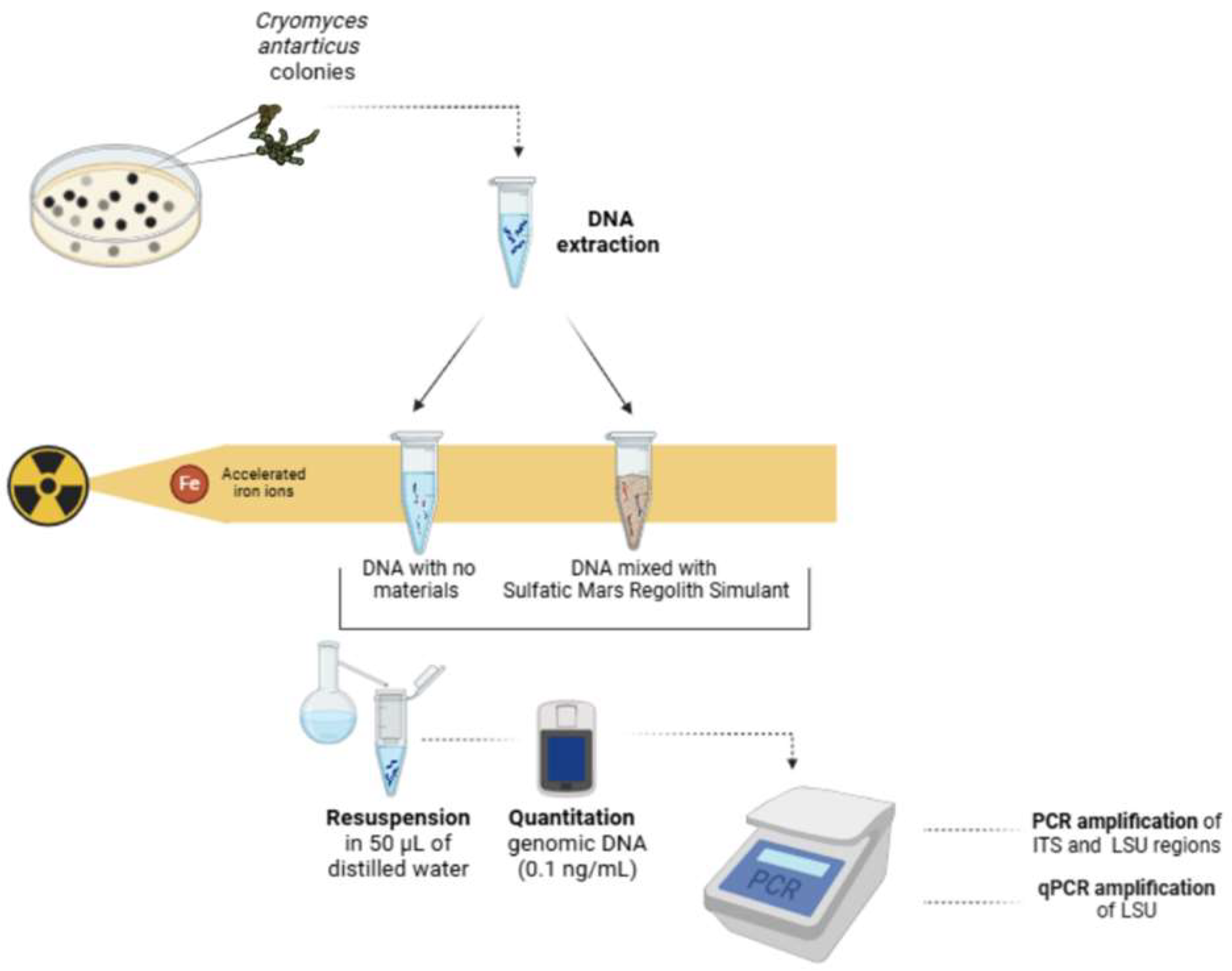
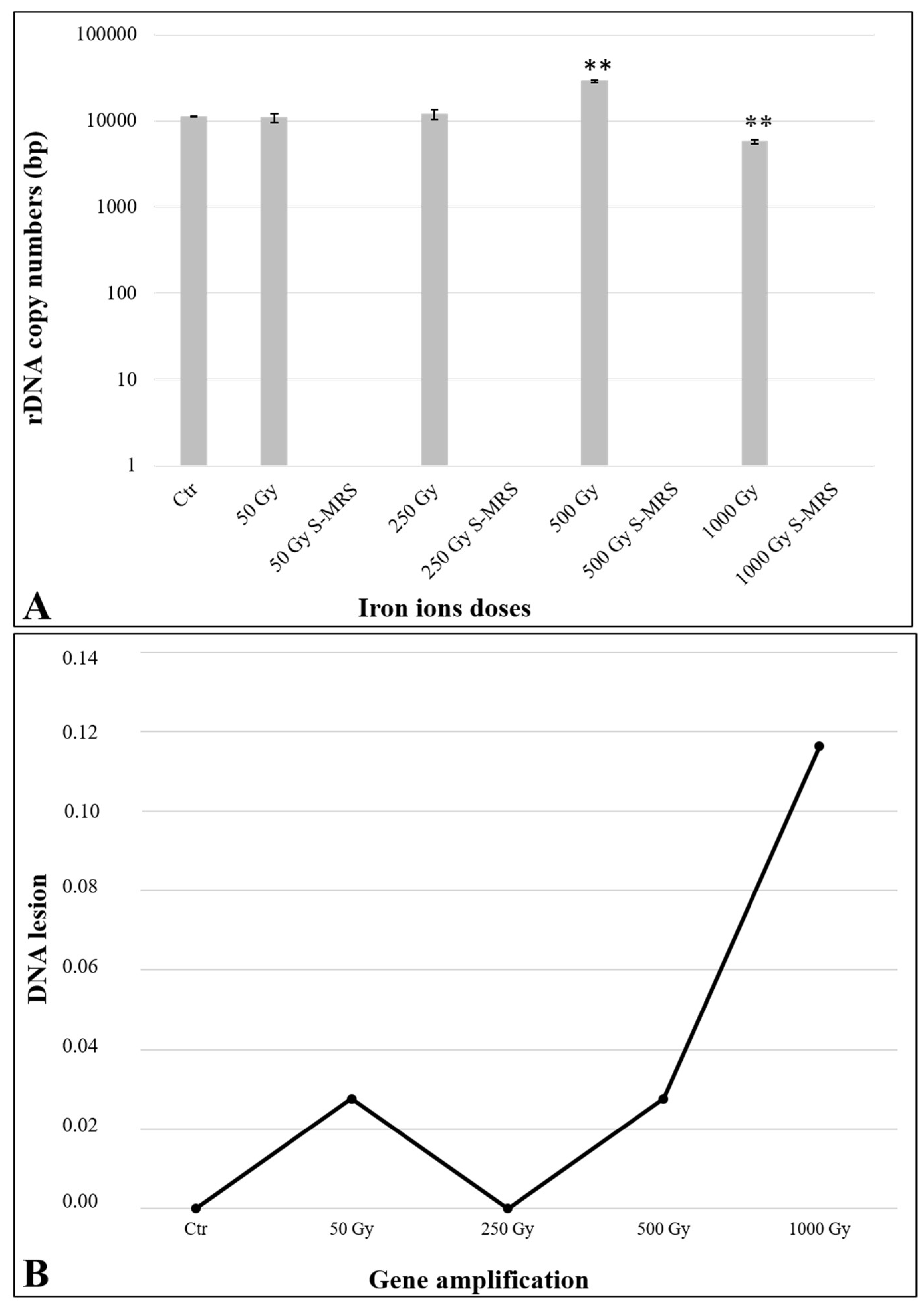

| Experimental Conditions | DNA Concentration (ng/μL) |
|---|---|
| Ctr | 7.2 |
| 50 Gy | 7.75 |
| 50 Gy S-MRS | 0.03 |
| 250 Gy | 6.82 |
| 250 Gy S-MRS | 0.01 |
| 500 Gy | 4.84 |
| 500 Gy S-MRS | 0.01 |
| 1000 Gy | 7.69 |
| 1000 Gy S-MRS | 0.03 |
| Samples | Mean | Final Read | Relative Amplification | Lesion Frequency | Lesion/0.9 kb |
|---|---|---|---|---|---|
| Ctr | 23.00 | −16.50 | 1 | 0 | 0 |
| 50 Gy | 23.50 | −16.00 | 0.97 | 0.03 | 0.03 |
| 250 Gy | 23.00 | −16.50 | 1 | 0 | 0 |
| 500 Gy | 23.50 | −16.00 | 0.97 | 0.03 | 0.03 |
| 1000 Gy | 25.00 | −14.50 | 0.88 | 0.13 | 0.12 |
Disclaimer/Publisher’s Note: The statements, opinions and data contained in all publications are solely those of the individual author(s) and contributor(s) and not of MDPI and/or the editor(s). MDPI and/or the editor(s) disclaim responsibility for any injury to people or property resulting from any ideas, methods, instructions or products referred to in the content. |
© 2025 by the authors. Licensee MDPI, Basel, Switzerland. This article is an open access article distributed under the terms and conditions of the Creative Commons Attribution (CC BY) license (https://creativecommons.org/licenses/by/4.0/).
Share and Cite
Cassaro, A.; Pacelli, C.; Onofri, S. Exploring Life Detection on Mars: Understanding Challenges in DNA Amplification in Martian Regolith Analogue After Fe Ion Irradiation. Life 2025, 15, 716. https://doi.org/10.3390/life15050716
Cassaro A, Pacelli C, Onofri S. Exploring Life Detection on Mars: Understanding Challenges in DNA Amplification in Martian Regolith Analogue After Fe Ion Irradiation. Life. 2025; 15(5):716. https://doi.org/10.3390/life15050716
Chicago/Turabian StyleCassaro, Alessia, Claudia Pacelli, and Silvano Onofri. 2025. "Exploring Life Detection on Mars: Understanding Challenges in DNA Amplification in Martian Regolith Analogue After Fe Ion Irradiation" Life 15, no. 5: 716. https://doi.org/10.3390/life15050716
APA StyleCassaro, A., Pacelli, C., & Onofri, S. (2025). Exploring Life Detection on Mars: Understanding Challenges in DNA Amplification in Martian Regolith Analogue After Fe Ion Irradiation. Life, 15(5), 716. https://doi.org/10.3390/life15050716

