Identification of miRNAs in Response to Cold Stress in ‘Chaling’ Common Wild Rice (Oryza rufipogon Griff.)
Abstract
1. Introduction
2. Materials and Methods
2.1. Rice Materials
2.2. Cold Tolerance Assessment and Sampling
2.3. Small RNA Sequencing and Quality Assessment
2.4. Small RNA Classification and miRNA Family Analysis
2.5. The Expression Analysis of miRNAs
2.6. Target Gene Prediction for All Differentially Expressed Known miRNAs
2.7. Expression Level Detections of miRNAs by qRT-PCR
3. Results
3.1. CLWR Exhibited a Strong Cold Tolerance
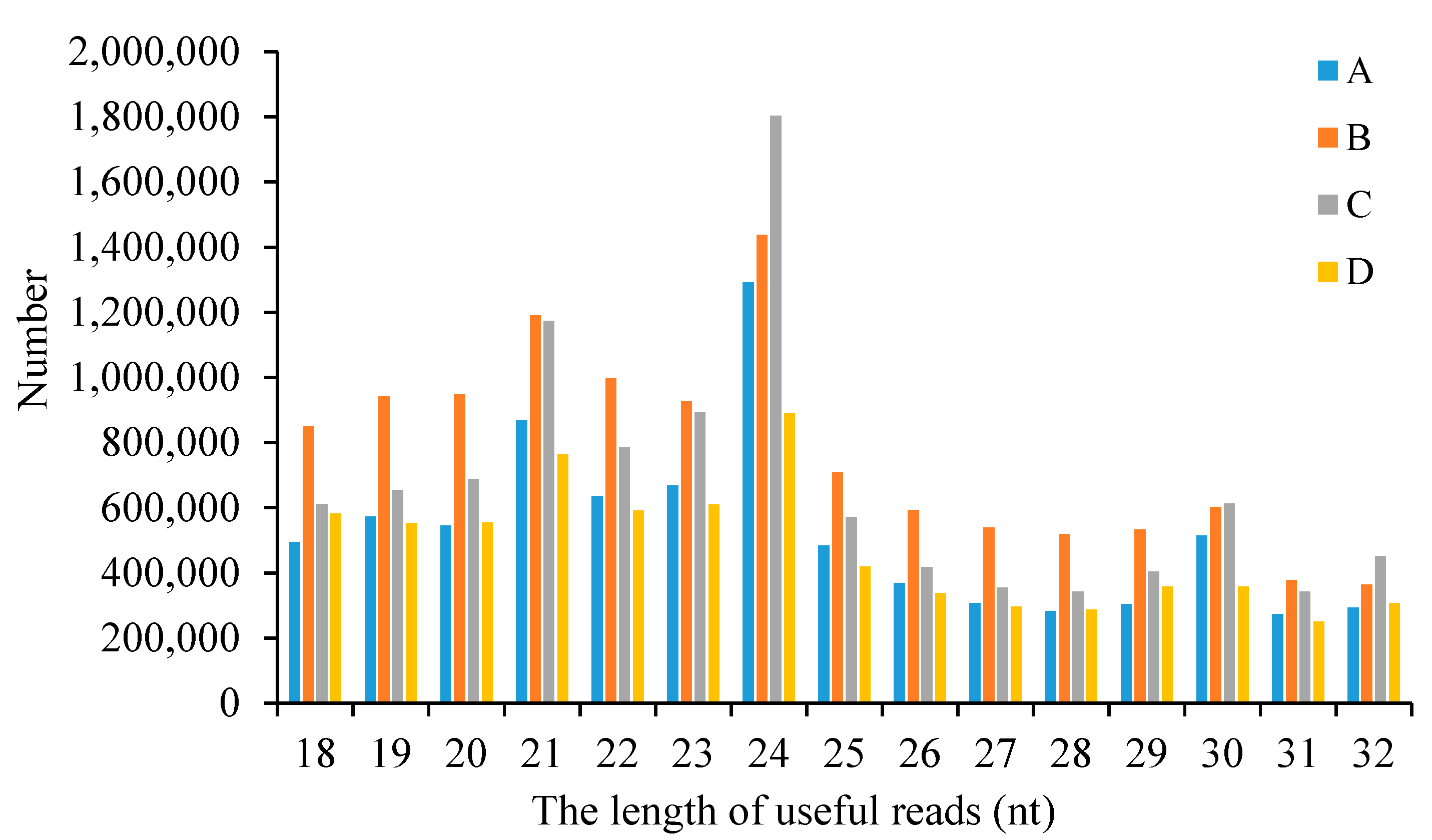
3.2. High-Throughput Sequencing of the Small RNA Transcriptomes of CLWR and 9311 Before and After Cold Treatment
3.3. Classification of Small RNAs
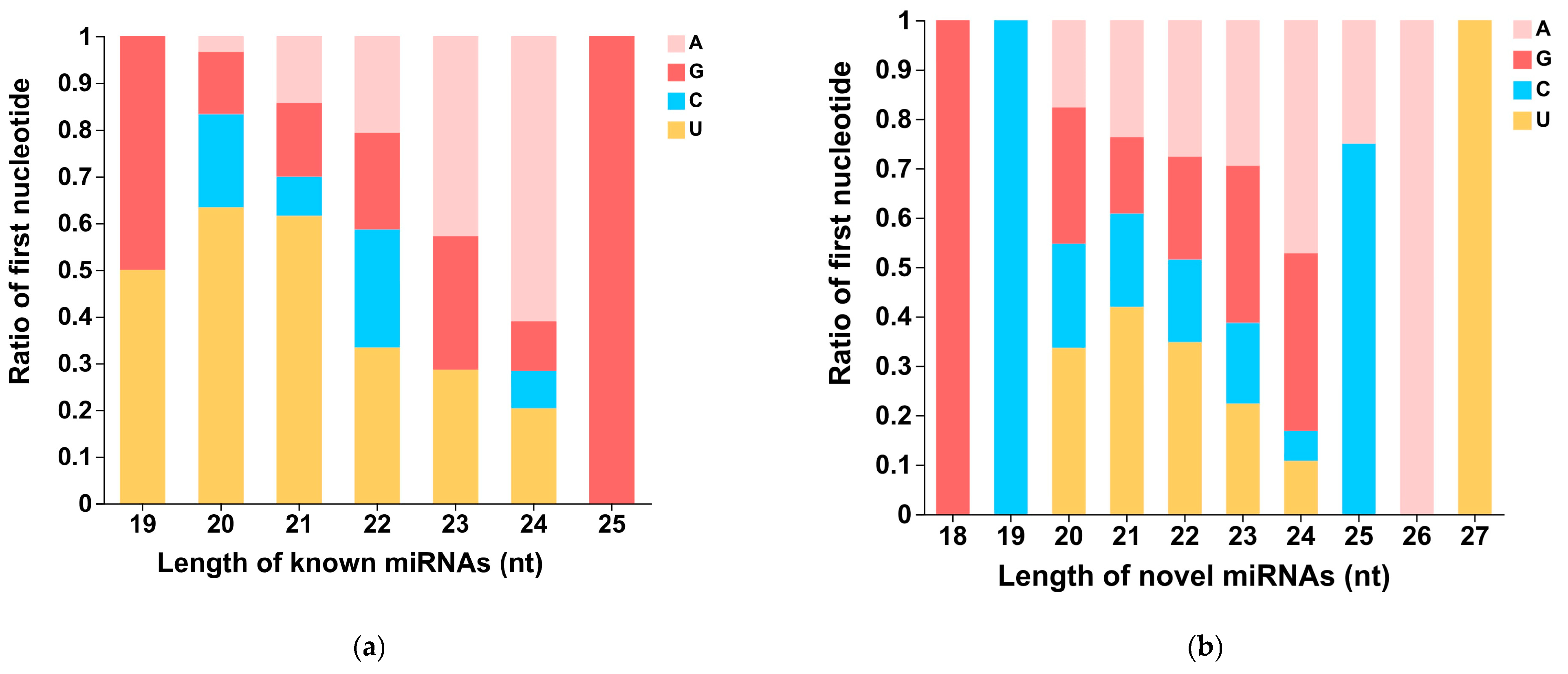
3.4. Length and Nucleotide Preference of Known miRNAs and Novel miRNAs
3.5. The Distribution of Known miRNA Families in Different Species
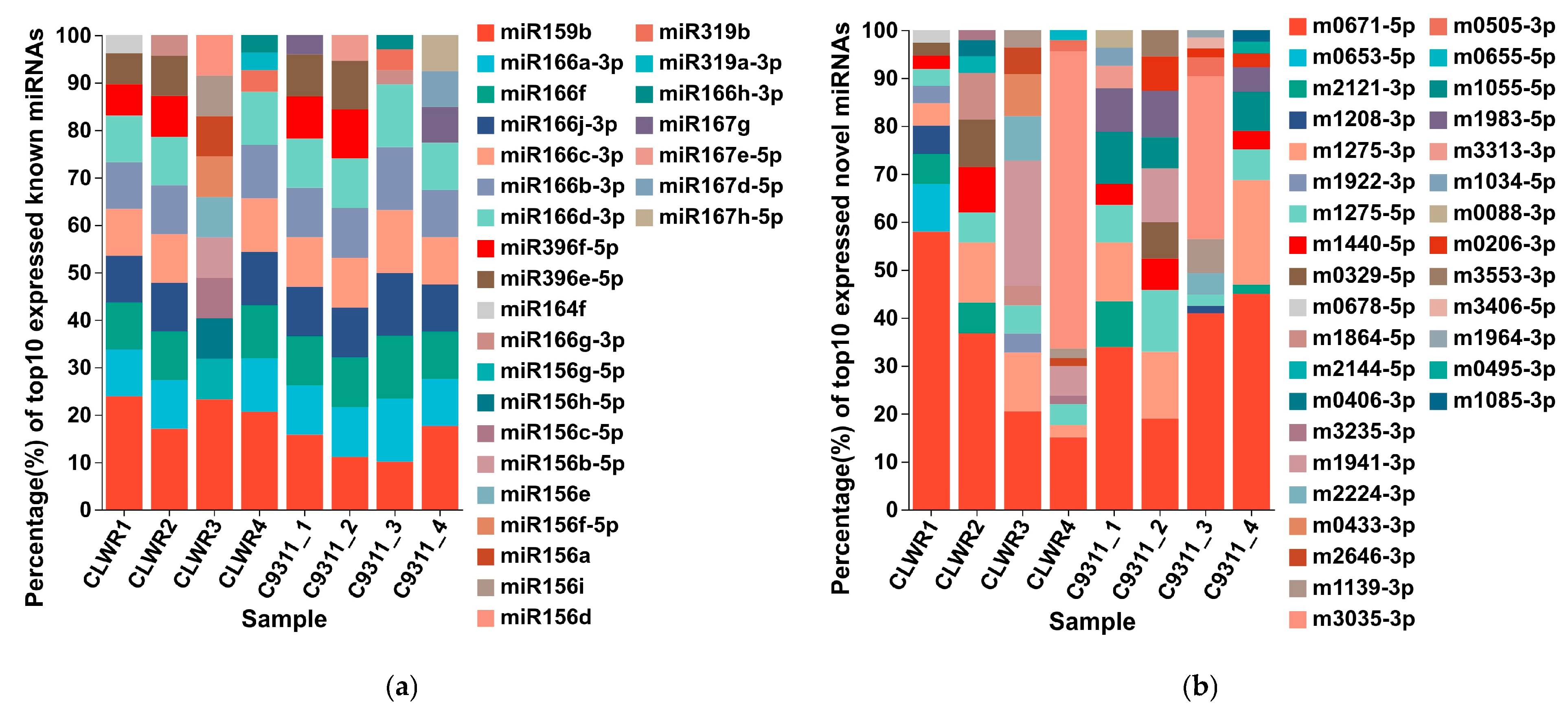
3.6. The Expression Level of miRNAs in Different Samples and Groups
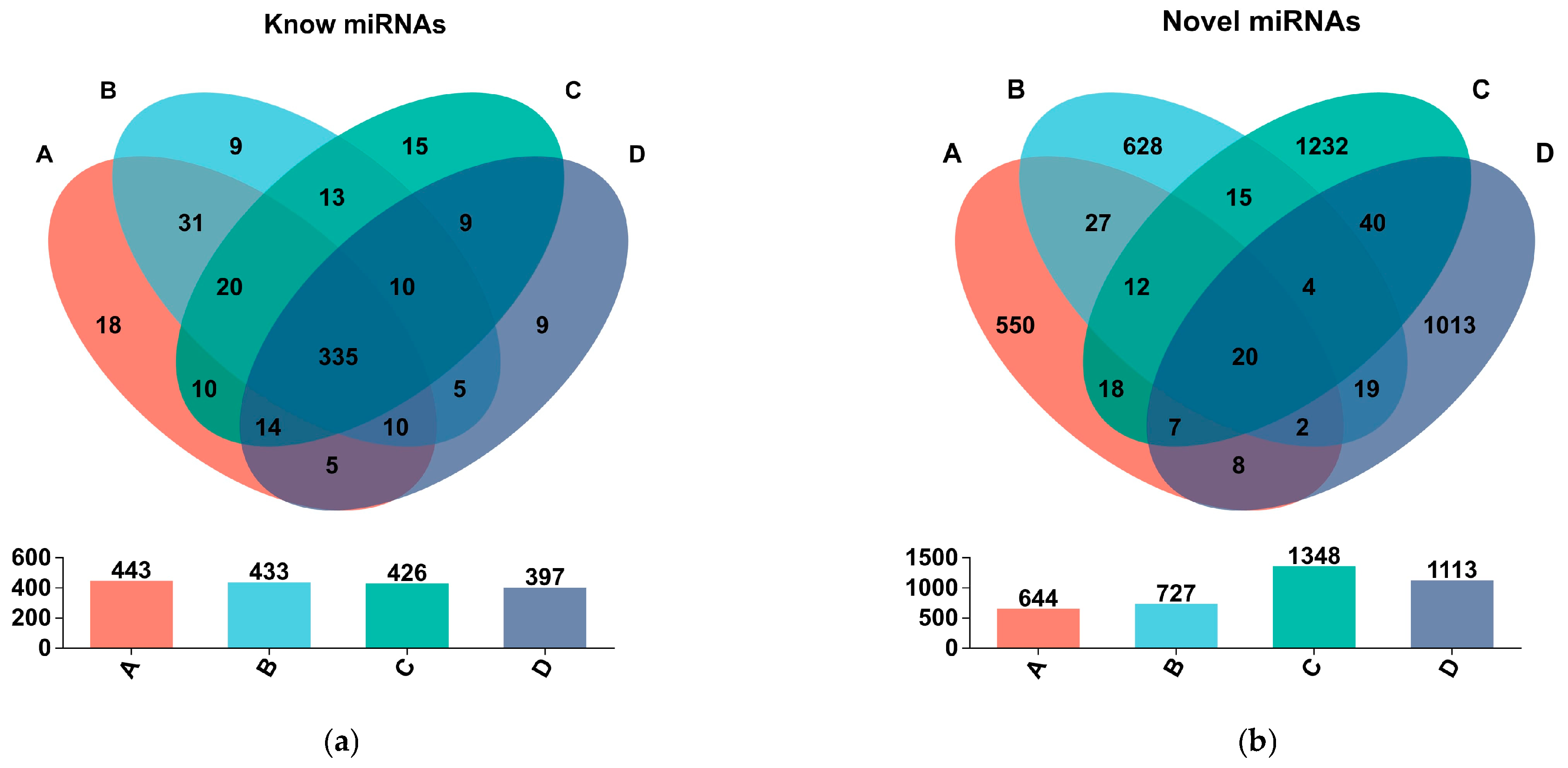
3.7. Differentially Expressed miRNAs Before and After Cold Stress in CLWR and 9311
3.8. Validation of the Expression Levels of the miRNAs by qRT-PCR
3.9. The Predicted Target Genes and Their Functions for the Differentially Expressed miRNAs
4. Discussion
4.1. Characteristics of miRNAs in CLWR and 9311
4.2. MiRNAs Involved in the Cold Stress Response and the Cold Tolerance Regulation of Rice
4.3. The Cold-Responsive miRNAs and Their Target Genes in CLWR
5. Conclusions
Supplementary Materials
Author Contributions
Funding
Institutional Review Board Statement
Informed Consent Statement
Data Availability Statement
Acknowledgments
Conflicts of Interest
References
- Ma, C.; Zheng, S.; Yang, S.; Wu, J.; Sun, X.; Chen, Y.; Zhang, P.; Li, Y.; Wu, L.; Liang, X.; et al. OsCYCBL1 and OsHTR702 positively regulate rice tolerance to cold stress. Int. J. Biol. Macromol. 2025, 287, 138642. [Google Scholar] [CrossRef]
- Niu, Y.; Fan, S.; Cheng, B.; Li, H.; Wu, J.; Zhao, H.; Huang, Z.; Yan, F.; Qi, B.; Zhang, L.; et al. Comparative transcriptomics and co-expression networks reveal cultivar-specific molecular signatures associated with reproductive-stage cold stress in rice. Plant Cell Rep. 2023, 42, 707–722. [Google Scholar] [CrossRef]
- Li, J.; Zhang, Z.; Chong, K.; Xu, Y. Chilling tolerance in rice: Past and present. J. Plant Physiol. 2022, 268, 153576. [Google Scholar] [CrossRef] [PubMed]
- Deng, H.; Cao, S.; Zhang, G.; Xiao, Y.; Liu, X.; Wang, F.; Tang, W.; Lu, X. OsVPE2, a member of vacuolar processing enzyme family, decreases chilling tolerance of rice. Rice 2024, 17, 5. [Google Scholar] [CrossRef] [PubMed]
- Zhang, Z.; Li, J.; Pan, Y.; Li, J.; Zhou, L.; Shi, H.; Zeng, Y.; Guo, H.; Yang, S.; Zheng, W.; et al. Natural variation in CTB4a enhances rice adaptation to cold habitats. Nat. Commun. 2017, 8, 14788. [Google Scholar] [CrossRef] [PubMed]
- Mao, D.; Xin, Y.; Tan, Y.; Hu, X.; Bai, J.; Liu, Z.Y.; Yu, Y.; Li, L.; Peng, C.; Fan, T.; et al. Natural variation in the HAN1 gene confers chilling tolerance in rice and allowed adaptation to a temperate climate. Proc. Natl. Acad. Sci. USA 2019, 116, 3494–3501. [Google Scholar] [CrossRef]
- Plieth, C.; Hansen, U.P.; Knight, H.; Knight, M.R. Temperature sensing by plants: The primary characteristics of signal perception and calcium response. Plant J. 1999, 18, 491–497. [Google Scholar] [CrossRef]
- Orvar, B.L.; Sangwan, V.; Omann, F.; Dhindsa, R.S. Early steps in cold sensing by plant cells: The role of actin cytoskeleton and membrane fluidity. Plant J. 2000, 23, 785–794. [Google Scholar] [CrossRef]
- Wei, X.; Liu, S.; Sun, C.; Xie, G.; Wang, L. Convergence and divergence: Signal perception and transduction mechanisms of cold stress in Arabidopsis and rice. Plants 2021, 10, 1864. [Google Scholar] [CrossRef]
- Guo, X.; Liu, D.; Chong, K. Cold signaling in plants: Insights into mechanisms and regulation. J. Integr. Plant Biol. 2018, 60, 745–756. [Google Scholar] [CrossRef]
- Vaucheret, H. MicroRNA-dependent trans-acting siRNA production. Sci. STKE 2005, 2005, pe43. [Google Scholar] [CrossRef] [PubMed]
- Song, X.; Li, Y.; Cao, X.; Qi, Y. MicroRNAs and their regulatory roles in plant-environment interactions. Annu. Rev. Plant Biol. 2019, 70, 489–525. [Google Scholar] [CrossRef] [PubMed]
- Huo, C.; Zhang, B.; Wang, R. Research progress on plant noncoding RNAs in response to low-temperature stress. Plant Signal Behav. 2022, 17, 2004035. [Google Scholar] [CrossRef]
- Lang, X.; Zhao, X.; Zhao, J.; Ren, T.; Nie, L.; Zhao, W. MicroRNA profiling revealed the mechanism of enhanced cold resistance by grafting in melon (Cucumis melo L.). Plants 2024, 13, 1016. [Google Scholar] [CrossRef] [PubMed]
- Abla, M.; Sun, H.; Li, Z.; Wei, C.; Gao, F.; Zhou, Y.; Feng, J. Identification of miRNAs and their response to cold stress in Astragalus membranaceus. Biomolecules 2019, 9, 182. [Google Scholar] [CrossRef]
- Dong, C.H.; Pei, H. Over-expression of miR397 improves plant tolerance to cold stress in Arabidopsis thaliana. J. Plant Biol. 2014, 57, 209–217. [Google Scholar] [CrossRef]
- Zhou, M.; Tang, W. MicroRNA156 amplifies transcription factor-associated cold stress tolerance in plant cells. Mol. Genet. Genom. 2019, 294, 379–393. [Google Scholar] [CrossRef]
- Tang, W.; Thompson, W.A. OsmiR528 enhances cold stress tolerance by repressing expression of stress response-related transcription factor genes in plant cells. Curr. Genom. 2019, 20, 100–114. [Google Scholar] [CrossRef]
- Dai, Y.; Feng, X.; Liu, Z.; Wang, M.; Zhou, Y.; Cui, L.; Wei, X.; Zhu, Z. miR1432 negatively regulates cold tolerance by targeting OsACAs. Plant Cell Environ. 2024, 47, 5443–5456. [Google Scholar] [CrossRef]
- Xu, M.; Li, X.; Mo, X.; Tu, S.; Cui, Y.; Yang, D. Studies on the cold tolerance of ratoon ‘Chaling’ common wild rice. Biol. Res. 2020, 53, 8. [Google Scholar] [CrossRef]
- Yang, S.; Zhou, J.; Li, Y.; Wu, J.; Ma, C.; Chen, Y.; Sun, X.; Wu, L.; Liang, X.; Fu, Q.; et al. AP2/EREBP pathway plays an important role in Chaling wild rice tolerance to cold stress. Int. J. Mol. Sci. 2023, 24, 14441. [Google Scholar] [CrossRef]
- Yates, A.D.; Allen, J.; Amode, R.M.; Azov, A.G.; Barba, M.; Becerra, A.; Bhai, J.; Campbell, L.I.; Carbajo Martinez, M.; Chakiachvili, M.; et al. Ensembl Genomes 2022: An expanding genome resource for non-vertebrates. Nucleic Acids Res. 2022, 50, D996–D1003. [Google Scholar] [CrossRef]
- Langmead, B.; Salzberg, S.L. Fast gapped-read alignment with Bowtie 2. Nat. Methods 2012, 9, 357–359. [Google Scholar] [CrossRef] [PubMed]
- Kozomara, A.; Birgaoanu, M.; Griffiths-Jones, S. miRBase: From microRNA sequences to function. Nucleic Acids Res. 2019, 47, D155–D162. [Google Scholar] [CrossRef] [PubMed]
- Nawrocki, E.P.; Burge, S.W.; Bateman, A.; Daub, J.; Eberhardt, R.Y.; Eddy, S.R.; Floden, E.W.; Gardner, P.P.; Jones, T.A.; Tate, J.; et al. Rfam 12.0: Updates to the RNA families database. Nucleic Acids Res. 2015, 43, D130–D137. [Google Scholar] [CrossRef] [PubMed]
- Tam, S.; Tsao, M.S.; McPherson, J.D. Optimization of miRNA-seq data preprocessing. Brief. Bioinform. 2015, 16, 950–963. [Google Scholar] [CrossRef]
- Friedländer, M.R.; Mackowiak, S.D.; Li, N.; Chen, W.; Rajewsky, N. miRDeep2 accurately identifies known and hundreds of novel microRNA genes in seven animal clades. Nucleic Acids Res. 2012, 40, 37–52. [Google Scholar] [CrossRef]
- Robinson, M.D.; McCarthy, D.J.; Smyth, G.K. edgeR: A Bioconductor package for differential expression analysis of digital gene expression data. Bioinformatics 2010, 26, 139–140. [Google Scholar] [CrossRef]
- Wu, H.J.; Ma, Y.K.; Chen, T.; Wang, M.; Wang, X.J. PsRobot: A web-based plant small RNA meta-analysis toolbox. Nucleic Acids Res. 2012, 40, W22–W28. [Google Scholar] [CrossRef]
- Camacho, C.; Boratyn, G.M.; Joukov, V.; Vera Alvarez, R.; Madden, T.L. ElasticBLAST: Accelerating sequence search via cloud computing. BMC Bioinform. 2023, 24, 117. [Google Scholar] [CrossRef]
- Bairoch, A.; Apweiler, R. The SWISS-PROT protein sequence data bank and its supplement TrEMBL in 1999. Nucleic Acids Res. 1999, 27, 49–54. [Google Scholar] [CrossRef]
- Hernández-Plaza, A.; Szklarczyk, D.; Botas, J.; Cantalapiedra, C.P.; Giner-Lamia, J.; Mende, D.R.; Kirsch, R.; Rattei, T.; Letunic, I.; Jensen, L.J.; et al. eggNOG 6.0: Enabling comparative genomics across 12 535 organisms. Nucleic Acids Res. 2023, 51, D389–D394. [Google Scholar] [CrossRef]
- Ashburner, M.; Ball, C.A.; Blake, J.A.; Botstein, D.; Butler, H.; Cherry, J.M.; Davis, A.P.; Dolinski, K.; Dwight, S.S.; Eppig, J.T.; et al. Gene ontology: Tool for the unification of biology. Nat. Genet. 2000, 25, 25–29. [Google Scholar] [CrossRef] [PubMed]
- The Gene Ontology Consortium; Aleksander, S.A.; Balhoff, J.; Carbon, S.; Cherry, J.M.; Drabkin, H.J.; Ebert, D.; Feuermann, M.; Gaudet, P.; Harris, N.L.; et al. The Gene Ontology knowledgebase in 2023. Genetics 2023, 224, iyad031. [Google Scholar] [CrossRef] [PubMed]
- Kanehisa, M.; Furumichi, M.; Sato, Y.; Matsuura, Y.; Ishiguro-Watanabe, M. KEGG: Biological systems database as a model of the real world. Nucleic Acids Res. 2025, 53, D672–D677. [Google Scholar] [CrossRef] [PubMed]
- Mistry, J.; Chuguransky, S.; Williams, L.; Qureshi, M.; Salazar, G.A.; Sonnhammer, E.L.L.; Tosatto, S.C.E.; Paladin, L.; Raj, S.; Richardson, L.J.; et al. Pfam: The protein families database in 2021. Nucleic Acids Res. 2021, 49, D412–D419. [Google Scholar] [CrossRef]
- Klopfenstein, D.V.; Zhang, L.; Pedersen, B.S.; Ramírez, F.; Warwick Vesztrocy, A.; Naldi, A.; Mungall, C.J.; Yunes, J.M.; Botvinnik, O.; Weigel, M.; et al. GOATOOLS: A Python library for Gene Ontology analyses. Sci. Rep. 2018, 8, 10872. [Google Scholar] [CrossRef]
- Chen, Q.; Lu, L.; Hua, H.; Zhou, F.; Lu, L.; Lin, Y. Characterization and comparative analysis of small RNAs in three small RNA libraries of the brown planthopper (Nilaparvata lugens). PLoS ONE 2012, 7, e32860. [Google Scholar] [CrossRef]
- Livak, K.J.; Schmittgen, T.D. Analysis of relative gene expression datausing real-time quantitative PCR and the 2−ΔΔCT Method. Methods 2001, 25, 402–408. [Google Scholar] [CrossRef]
- Tang, G. Plant microRNAs: An insight into their gene structures and evolution. Semin. Cell Dev. Biol. 2010, 21, 782–789. [Google Scholar] [CrossRef]
- Cuperus, J.T.; Fahlgren, N.; Carrington, J.C. Evolution and functional diversification of MIRNA genes. Plant Cell 2011, 23, 431–442. [Google Scholar] [CrossRef] [PubMed]
- Chen, X.; Jiang, L.; Zheng, J.; Chen, F.; Wang, T.; Wang, M.; Tao, Y.; Wang, H.; Hong, Z.; Huang, Y.; et al. A missense mutation in Large Grain Size 1 increases grain size and enhances cold tolerance in rice. J. Exp. Bot. 2019, 70, 3851–3866. [Google Scholar] [CrossRef] [PubMed]
- Zhang, S.; Wu, Y.; Huang, X.; Wu, W.; Lyu, L.; Li, W. Research progress about microRNAs involved in plant secondary metabolism. Int. J. Biol. Macromol. 2022, 216, 820–829. [Google Scholar] [CrossRef] [PubMed]
- Liu, Q.; Ding, C.; Lang, X.; Guo, G.; Chen, J.; Su, X. Small noncoding RNA discovery and profiling with sRNAtools based on high-throughput sequencing. Brief. Bioinform. 2021, 22, 463–473. [Google Scholar] [CrossRef]
- Saminathan, T.; Bodunrin, A.; Singh, N.V.; Devarajan, R.; Nimmakayala, P.; Jeff, M.; Aradhya, M.; Reddy, U.K. Genome-wide identification of microRNAs in pomegranate (Punica granatum L.) by high-throughput sequencing. BMC Plant Biol. 2016, 16, 122. [Google Scholar] [CrossRef]
- Gramzow, L.; Theißen, G. Plant miRNA conservation and evolution. Methods Mol. Biol. 2019, 1932, 41–50. [Google Scholar] [CrossRef]
- Barrera-Figueroa, B.E.; Gao, L.; Wu, Z.; Zhou, X.; Zhu, J.; Jin, H.; Liu, R.; Zhu, J.K. High throughput sequencing reveals novel and abiotic stress-regulated microRNAs in the inflorescences of rice. BMC Plant Biol. 2012, 12, 132. [Google Scholar] [CrossRef]
- Zhang, J.W.; Long, Y.; Xue, M.D.; Xiao, X.G.; Pei, X.W. Identification of microRNAs in response to drought in common wild rice (Oryza rufipogon Griff.) Shoots and Roots. PLoS ONE 2017, 12, e0170330. [Google Scholar] [CrossRef]
- Young, C.; Caffrey, M.; Janton, C.; Kobayashi, T. Reversing the miRNA -5p/-3p stoichiometry reveals physiological roles and targets of miR-140 miRNAs. RNA 2022, 28, 854–864. [Google Scholar] [CrossRef]
- Wang, H.; Zhang, Y.; Liang, D.; Zhang, X.; Fan, X.; Guo, Q.; Wang, L.; Wang, J.; Liu, Q. Genome-wide identification and characterization of miR396 family members and their target genes GRF in sorghum (Sorghum bicolor (L.) moench). PLoS ONE 2023, 18, e0285494. [Google Scholar] [CrossRef]
- Moran, Y.; Agron, M.; Praher, D.; Technau, U. The evolutionary origin of plant and animal microRNAs. Nat. Ecol. Evol. 2017, 1, 27. [Google Scholar] [CrossRef] [PubMed]
- Liu, Q.; Yan, S.; Yang, T.; Zhang, S.; Chen, Y.Q.; Liu, B. Small RNAs in regulating temperature stress response in plants. J. Integr. Plant Biol. 2017, 59, 774–791. [Google Scholar] [CrossRef]
- Yang, C.; Li, D.; Mao, D.; Liu, X.; Ji, C.; Li, X.; Zhao, X.; Cheng, Z.; Chen, C.; Zhu, L. Overexpression of microRNA319 impacts leaf morphogenesis and leads to enhanced cold tolerance in rice (Oryza sativa L.). Plant Cell Environ. 2013, 36, 2207–2218. [Google Scholar] [CrossRef] [PubMed]
- Shi, X.; Jiang, F.; Wen, J.; Wu, Z. Overexpression of Solanum habrochaites microRNA319d (sha-miR319d) confers chilling and heat stress tolerance in tomato (S. lycopersicum). BMC Plant Biol. 2019, 19, 214. [Google Scholar] [CrossRef] [PubMed]
- Bustamante, A.; Marques, M.C.; Sanz-Carbonell, A.; Mulet, J.M.; Gomez, G. Alternative processing of its precursor is related to miR319 decreasing in melon plants exposed to cold. Sci. Rep. 2018, 8, 15538. [Google Scholar] [CrossRef]
- Cui, N.; Sun, X.; Sun, M.; Jia, B.; Duanmu, H.; Lv, D.; Duan, X.; Zhu, Y. Overexpression of OsmiR156k leads to reduced tolerance to cold stress in rice (Oryza sativa). Mol. Breed. 2015, 35, 214. [Google Scholar] [CrossRef]
- Sun, M.; Shen, Y.; Chen, Y.; Wang, Y.; Cai, X.; Yang, J.; Jia, B.; Dong, W.; Chen, X.; Sun, X. Osa-miR1320 targets the ERF transcription factor OsERF096 to regulate cold tolerance via JA-mediated signaling. Plant Physiol. 2022, 189, 2500–2516. [Google Scholar] [CrossRef]
- Jiang, W.; Shi, W.; Ma, X.; Zhao, J.; Wang, S.; Tan, L.; Sun, C.; Liu, F. Identification of microRNAs responding to cold stress in Dongxiang common wild rice. Genome 2019, 62, 635–642. [Google Scholar] [CrossRef]
- Wu, S.; Tan, H.; Hao, X.; Xie, Z.; Wang, X.; Li, D.; Tian, L. Profiling miRNA expression in photo-thermo-sensitive male genic sterility line (PTGMS) PA64S under high and low temperature. Plant Signal Behav. 2019, 14, 1679015. [Google Scholar] [CrossRef]
- Dong, Y.; Tang, M.; Huang, Z.; Song, J.; Xu, J.; Ahammed, G.J.; Yu, J.; Zhou, Y. The miR164a-NAM3 module confers cold tolerance by inducing ethylene production in tomato. Plant J. 2022, 111, 440–456. [Google Scholar] [CrossRef]
- Shen, X.; Ping, Y.; Bao, C.; Liu, C.; Tahir, M.M.; Li, X.; Song, Y.; Xu, W.; Ma, F.; Guan, Q. Mdm-miR160-MdARF17-MdWRKY33 module mediates freezing tolerance in apple. Plant J. 2023, 114, 262–278. [Google Scholar] [CrossRef]
- Diao, P.; Chen, C.; Zhang, Y.; Meng, Q.; Lv, W.; Ma, N. The role of NAC transcription factor in plant cold response. Plant Signal Behav. 2020, 15, 1785668. [Google Scholar] [CrossRef]
- Hu, X.; Xie, F.; Liang, W.; Liang, Y.; Zhang, Z.; Zhao, J.; Hu, G.; Qin, Y. HuNAC20 and HuNAC25, two novel NAC genes from Pitaya, confer cold tolerance in transgenic Arabidopsis. Int. J. Mol. Sci. 2022, 23, 2189. [Google Scholar] [CrossRef]



| Sample Name | Sample Group Name | |
|---|---|---|
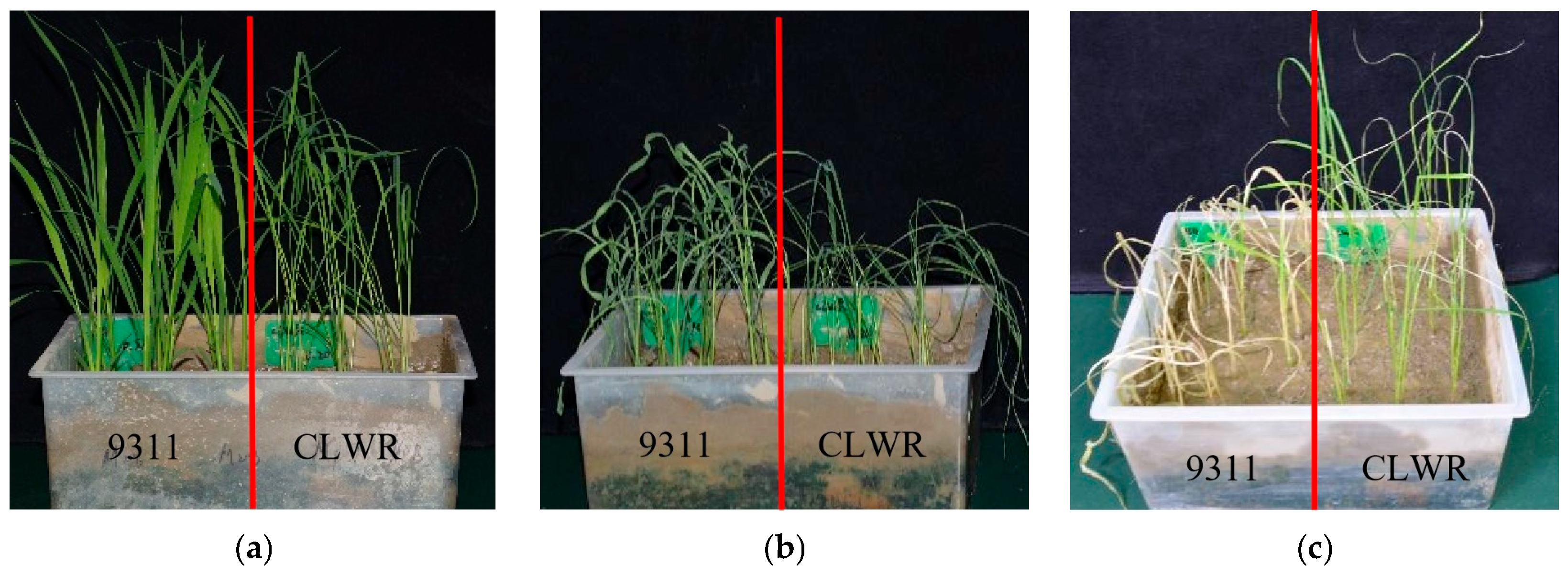
| CLWR1 | A | CLWR before cold stress treatment |
| CLWR2 | A | |
| CLWR3 | B | CLWR after cold stress treatment |
| CLWR4 | B | |
| C9311_1 | C | 9311 before cold stress treatment |
| C9311_2 | C | |
| C9311_3 | D | 9311 after cold stress treatment |
| C9311_4 | D | |
| sRNA Type | C9311_1 | C9311_2 | C9311_3 | C9311_4 | CLWR1 | CLWR2 | CLWR3 | CLWR4 |
|---|---|---|---|---|---|---|---|---|
| known miRNA | 228,285 (2.75%) | 732,676 (6.16%) | 155,152 (2.75%) | 303,054 (3.49%) | 236,699 (3.85%) | 315,141 (3.26%) | 206,688 (1.72%) | 278,686 (2.53%) |
| novel miRNA | 3967 (0.05%) | 18,880 (0.16%) | 2154 (0.04%) | 17,100 (0.2%) | 7439 (0.12%) | 5909 (0.06%) | 8953 (0.07%) | 10,665 (0.1%) |
| rRNA | 1,877,497 (22.6%) | 2,028,028 (17.05%) | 641,400 (11.36%) | 2,186,266 (25.17%) | 1,160,000 (18.85%) | 2,367,622 (24.5%) | 2,349,990 (19.51%) | 1,822,779 (16.53%) |
| tRNA | 204,779 (2.46%) | 179,233 (1.51%) | 153,322 (2.72%) | 167,800 (1.93%) | 59,386 (0.96%) | 60,392 (0.62%) | 371,338 (3.08%) | 298,550 (2.71%) |
| snoRNA | 0 (0.0%) | 0 (0.0%) | 0 (0.0%) | 0 (0.0%) | 0 (0.0%) | 0 (0.0%) | 0 (0.0%) | 0 (0.0%) |
| snRNA | 51,813 (0.62%) | 31,443 (0.26%) | 7527 (0.13%) | 33,830 (0.39%) | 27,647 (0.45%) | 38,775 (0.4%) | 21,052 (0.17%) | 17,736 (0.16%) |
| repbase | 74,547 (0.9%) | 55,047 (0.46%) | 19,989 (0.35%) | 64,544 (0.74%) | 50,173 (0.82%) | 39,659 (0.41%) | 38,147 (0.32%) | 105,509 (0.96%) |
| exon | 606,661 (7.3%) | 960,817 (8.08%) | 204,472 (3.62%) | 658,043 (7.58%) | 454,638 (7.39%) | 980,238 (10.14%) | 448,891 (3.73%) | 478,883 (4.34%) |
| intron | 352,405 (4.24%) | 784,565 (6.6%) | 190,350 (3.37%) | 342,383 (3.94%) | 364,626 (5.92%) | 581,191 (6.01%) | 350,975 (2.91%) | 378,482 (3.43%) |
| unknown | 4,909,172 (59.08%) | 7,104,356 (59.73%) | 4,272,048 (75.66%) | 4,911,645 (56.56%) | 3,794,403 (61.65%) | 5,276,771 (54.59%) | 8,247,072 (68.48%) | 7,633,435 (69.24%) |
| total | 8,309,126 | 11,895,045 | 5,646,414 | 8,684,665 | 6,155,011 | 9,665,698 | 12,043,106 | 11,024,725 |
| Sample | Known miRNAs | Novel miRNAs | Total |
|---|---|---|---|
| A | 443 | 644 | 1087 |
| B | 433 | 727 | 1160 |
| C | 426 | 1348 | 1774 |
| D | 397 | 1113 | 1510 |
| Length of Known miRNAs (nt) | Number | Length of Novel miRNA (nt) | Number |
|---|---|---|---|
| - | - | 18 | 1 |
| 19 | 2 | 19 | 1 |
| 20 | 126 | 20 | 232 |
| 21 | 827 | 21 | 396 |
| 22 | 178 | 22 | 322 |
| 23 | 8 | 23 | 488 |
| 24 | 225 | 24 | 2149 |
| 25 | 1 | 25 | 4 |
| - | - | 26 | 1 |
| - | - | 27 | 1 |
| Distribution Type | miRNA Family Name |
|---|---|
| Present in plants | MIR156; MIR159/319; MIR160; MIR162_2; MIR164; MIR166; MIR167_1; MIR168; MIR169_1; MIR169_2; MIR171_1; MIR171_2; MIR172; MIR390; MIR393; MIR394; MIR395; MIR396; MIR397; MIR398; MIR399; MIR408; MIR827; MIR529; MIR530; MIR535; MIR814; MIR2118; MIR818; MIR1440 |
| Present in Poaceae plants | MIR1878; MIR2275; MIR437; MIR444; MIR529; MIR531 |
| Present in rice | MIR1319; MIR1428; MIR1437; MIR1846; MIR1861; MIR1862; MIR1863; MIR1882; MIR1883; MIR2121; MIR2863; MIR2871; MIR2873; MIR396_2; MIR3980; MIR439; MIR5079; MIR5143; MIR5148; MIR5157; MIR5160; MIR5521; MIR5539; MIR810; MIR812; MIR815; MIR820 |
| Comparative Groups | Up-Regulated miRNAs | Down-Regulated miRNAs |
|---|---|---|
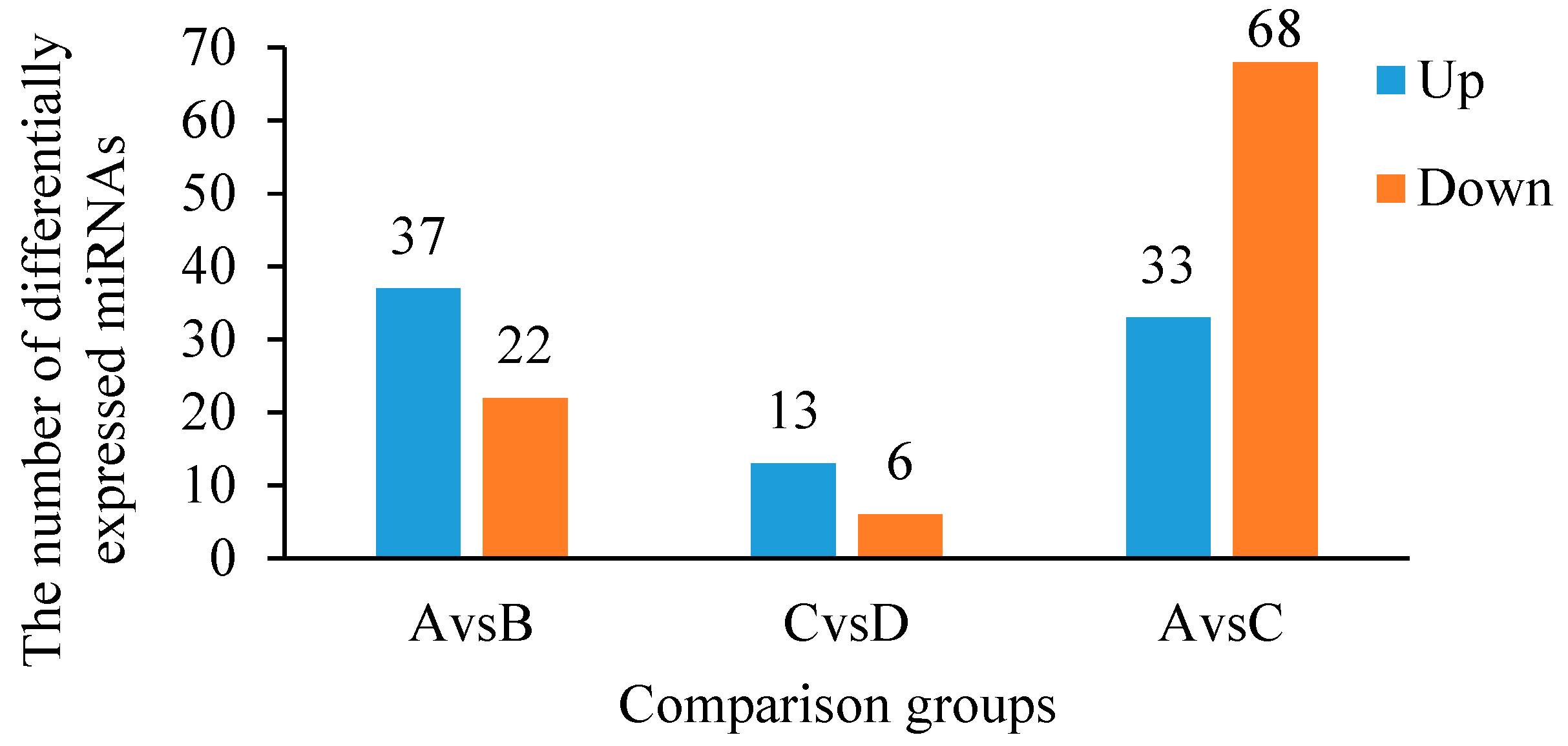
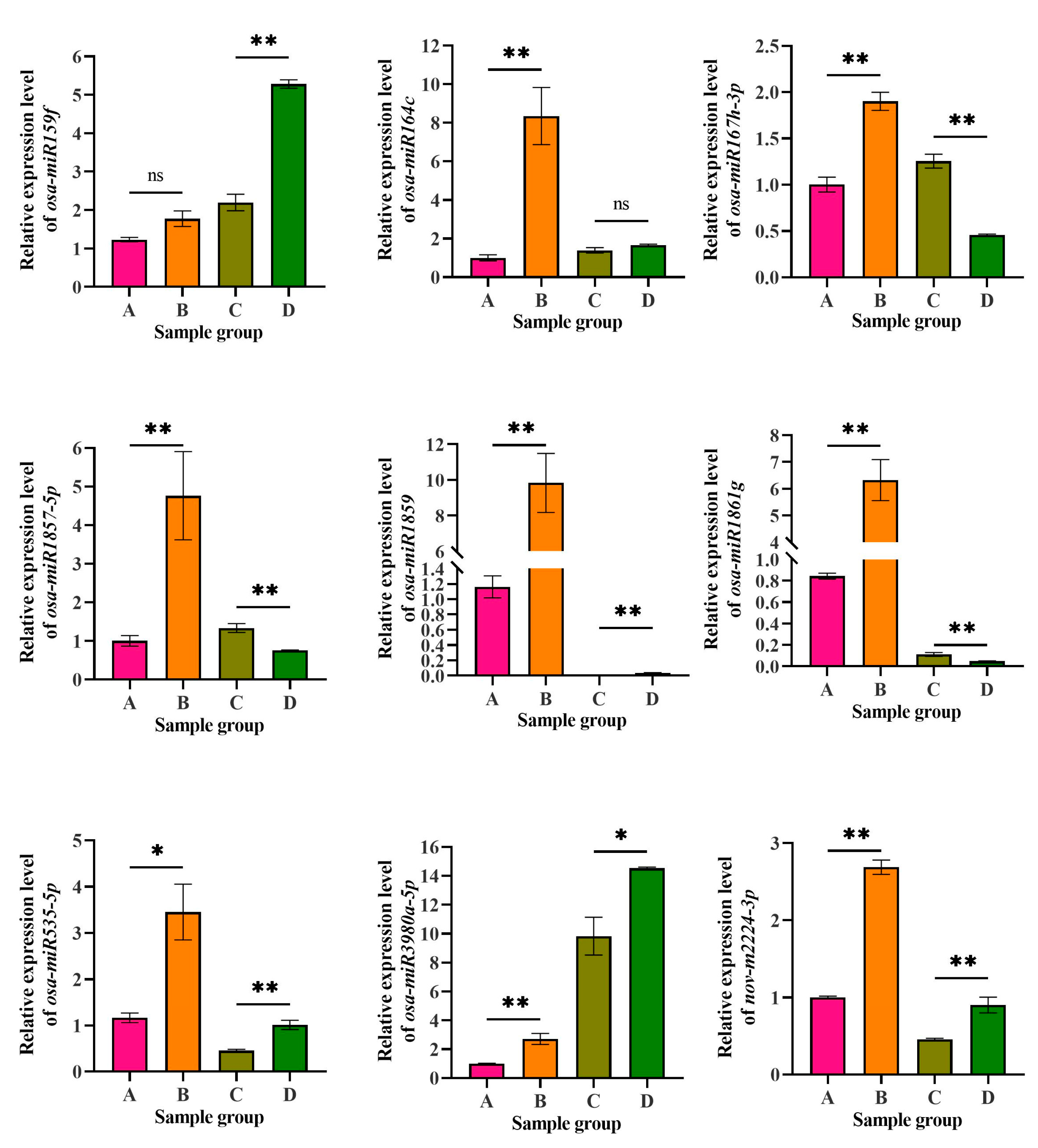
| AvsB (A serves as the control group; differentially expressed in group B) | osa-miR156h-5p; osa-miR3979-3p; miR3979-5p; osa-miR1861n; nov-m1707-5p; nov-m0433-3p; nov-m1813-5p; nov-m1941-3p**; nov-m0466-3p; nov-m2120-3p; osa-miR156c-5p; nov-m2755-5p; osa-miR156k; osa-miR156i; nov-m1324-3p; osa-miR156a; nov-m0505-3p**; osa-miR319b**; osa-miR156d; osa-miR319a-3p**; osa-miR156e; osa-miR164e; nov-m2224-3p**; osa-miR159f; nov-m1260-3p; osa-miR156f-5p; osa-miR156b-3p; osa-miR156g-5p; nov-m3035-3p**; nov-m1139-3p**; osa-miR156b-5p; osa-miR156l-5p; osa-miR156j-5p; nov-m2646-3p; osa-miR1859; nov-m2111-3p; nov-m2417-3p | nov-m1440-5p; nov-m0406-3p; osa-miR160f-5p; nov-m1153-3p; nov-m0088-3p; osa-miR396c-5p; osa-miR396f-5p; osa-miR164a; osa-miR5076; nov-m2954-3p; osa-miR172a; osa-miR164f; osa-miR164b; nov-m2121-3p; osa-miR172d-5p; nov-m0329-5p**; nov-m1983-5p; osa-miR396e-5p; osa-miR172d-3p; osa-miR1423-5p; nov-m2066-3p; nov-m2963-3p |
| CvsD (C serves as the control group; differentially expressed in group D) | nov-m1139-3p**; nov-m0505-3p**; osa-miR319b**; nov-m0671-5p; osa-miR1861h; osa-miR1861j; nov-m1964-3p; nov-m2224-3p**; nov-m3035-3p**; nov-m1699-5p; nov-m0653-3p; nov-m3552-5p; osa-miR319a-3p** | osa-miR167h-3p; nov-m3553-3p; nov-m0622-3p; nov-m1941-3p**; nov-m3108-3p; nov-m0329-5p** |
Disclaimer/Publisher’s Note: The statements, opinions and data contained in all publications are solely those of the individual author(s) and contributor(s) and not of MDPI and/or the editor(s). MDPI and/or the editor(s) disclaim responsibility for any injury to people or property resulting from any ideas, methods, instructions or products referred to in the content. |
© 2025 by the authors. Licensee MDPI, Basel, Switzerland. This article is an open access article distributed under the terms and conditions of the Creative Commons Attribution (CC BY) license (https://creativecommons.org/licenses/by/4.0/).
Share and Cite
Gao, F.; Li, J.; Feng, Y.; Xiao, X.; Han, L.; Ma, Y.; Chen, Q. Identification of miRNAs in Response to Cold Stress in ‘Chaling’ Common Wild Rice (Oryza rufipogon Griff.). Life 2025, 15, 1896. https://doi.org/10.3390/life15121896
Gao F, Li J, Feng Y, Xiao X, Han L, Ma Y, Chen Q. Identification of miRNAs in Response to Cold Stress in ‘Chaling’ Common Wild Rice (Oryza rufipogon Griff.). Life. 2025; 15(12):1896. https://doi.org/10.3390/life15121896
Chicago/Turabian StyleGao, Furong, Jincheng Li, Ye Feng, Xiuwen Xiao, Lingling Han, Yufen Ma, and Qiuhong Chen. 2025. "Identification of miRNAs in Response to Cold Stress in ‘Chaling’ Common Wild Rice (Oryza rufipogon Griff.)" Life 15, no. 12: 1896. https://doi.org/10.3390/life15121896
APA StyleGao, F., Li, J., Feng, Y., Xiao, X., Han, L., Ma, Y., & Chen, Q. (2025). Identification of miRNAs in Response to Cold Stress in ‘Chaling’ Common Wild Rice (Oryza rufipogon Griff.). Life, 15(12), 1896. https://doi.org/10.3390/life15121896