Systematic Review

Risk Factors, Diagnosis, and Treatment of Neonatal Fungal Liver Abscess: A Systematic Review of the Literature

by
Paschalia Kopanou Taliaka
1,†,
Andreas G. Tsantes
2,*,†,
Aikaterini Konstantinidi
1,
Dimitra Houhoula
3,
Konstantina A. Tsante
4,
Aristeidis G. Vaiopoulos
5,
Daniele Piovani
6,7,
Georgios K. Nikolopoulos
8,
Stefanos Bonovas
6,7,
Nicoletta Iacovidou
9,
Argirios E. Tsantes
5 and
Rozeta Sokou
1,9,*
1
Neonatal Intensive Care Unit, “Agios Panteleimon” General Hospital of Nikea, 18454 Piraeus, Greece
2
Microbiology Department, “Saint Savvas” Oncology Hospital, 11522 Athens, Greece
3
Department of Food Science and Technology, University of West Attica, 12244 Egaleo, Greece
4
Laboratory of Reliability and Quality Control in Laboratory Hematology, Department of Biomedical Science, School of Health and Caring Science, University of West Attica, Egaleo, 12244 Athens, Greece
5
Laboratory of Haematology and Blood Bank Unit, “Attiko” Hospital, School of Medicine, National and Kapodistrian University of Athens, 12462 Athens, Greece
6
IRCCS Humanitas Research Hospital, Via Manzoni 56, Rozzano, 20089 Milan, Italy
7
Department of Biomedical Sciences, Humanitas University, Pieve Emanuele, 20090 Milan, Italy
8
Medical School, University of Cyprus, Nicosia 2029, Cyprus
9
Neonatal Department, National and Kapodistrian University of Athens, Aretaieio Hospital, 11528 Athens, Greece
*
Authors to whom correspondence should be addressed.
These authors contributed equally to this work.
Life 2023, 13(1), 167; https://doi.org/10.3390/life13010167
Submission received: 6 December 2022 / Revised: 30 December 2022 / Accepted: 3 January 2023 / Published: 6 January 2023

Abstract

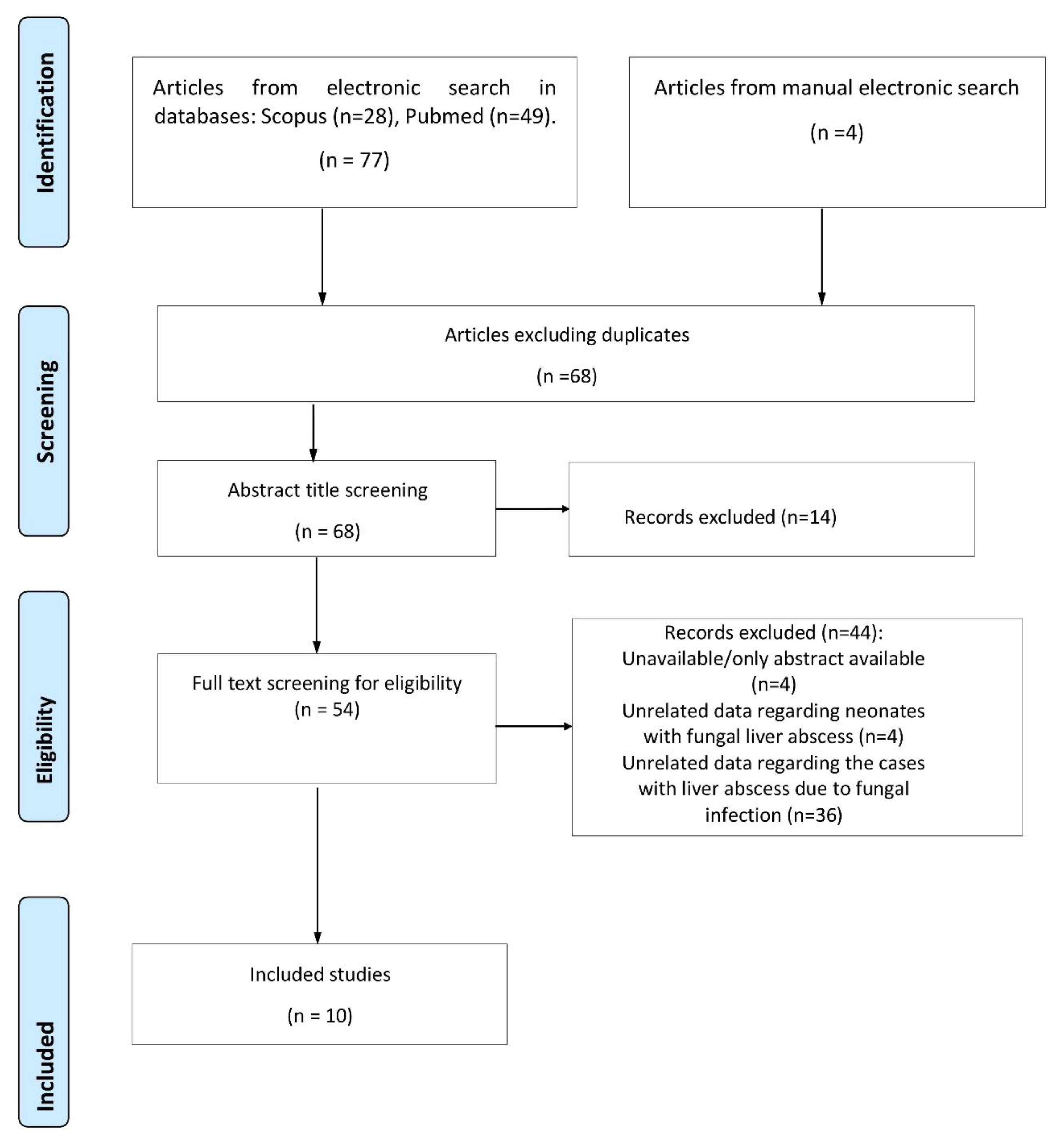
(1) Background: Although invasive fungal infections are a major cause of neonatal morbidity and mortality, data on the incidence and outcomes of localized abscesses in solid organs due to fungal infections are scarce. The aim of this study was to consolidate evidence and enhance our understanding on neonatal liver abscesses due to invasive fungal infections. (2) Methods: An electronic search of the PubMed and Scopus databases was conducted, considering studies that evaluated fungal liver abscesses in the neonatal population. Data on the epidemiology, clinical course, treatment, and outcome of these infections were integrated in our study. (3) Results: Overall, 10 studies were included presenting data on 19 cases of neonatal fungal liver abscesses. Candida spp. were the most common causative pathogens (94.7%). Premature neonates constituted the majority of cases (93%), while umbilical venous catheter placement, broad spectrum antibiotics, and prolonged parenteral nutrition administration were identified as other common predisposing factors. Diagnosis was established primarily by abdominal ultrasonography. Medical therapy with antifungal agents was the mainstay of treatment, with Amphotericin B being the most common agent (47%). Abscess drainage was required in four cases (21%). Eradication of the infection was achieved in the majority of cases (80%). (4) Conclusions: Even though fungal liver abscess is a rare entity in the neonatal population, clinicians should keep it in mind in small, premature infants who fail to respond to conventional treatment for sepsis, particularly if an indwelling catheter is in situ. A high index of suspicion is necessary in order to achieve a timely diagnosis and the initiation of the appropriate treatment.
Keywords: fungal infection; liver abscess; neonates; candidemia; preterm; antifungal therapy fungal infection; liver abscess; neonates; candidemia; preterm; antifungal therapy