Review

Xenorhabdus spp.: An Overview of the Useful Facets of Mutualistic Bacteria of Entomopathogenic Nematodes


by
Mahfouz M. M. Abd-Elgawad
Plant Pathology Department, Agricultural and Biological Research Division, National Research Centre, El-Behooth St., Dokki, Giza 12622, Egypt
Life 2022, 12(9), 1360; https://doi.org/10.3390/life12091360
Submission received: 27 July 2022 / Revised: 26 August 2022 / Accepted: 26 August 2022 / Published: 31 August 2022
(This article belongs to the Special Issue Plant–Nematode Interaction)

Abstract

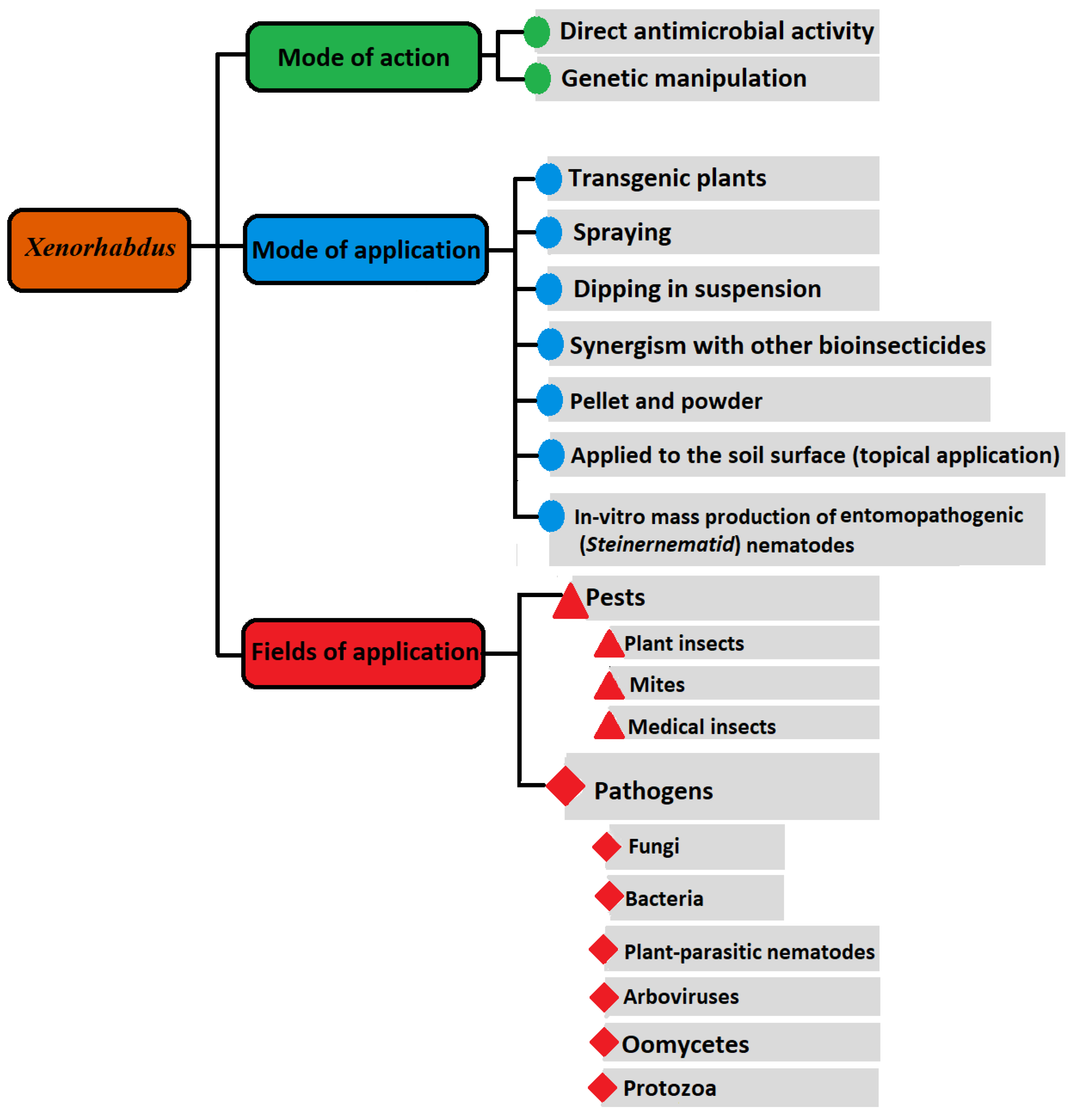
Mounting concern over the misuse of chemical pesticides has sparked broad interest for safe and effective alternatives to control plant pests and pathogens. Xenorhabdus bacteria, as pesticidal symbionts of the entomopathogenic nematodes Steinernema species, can contribute to this solution with a treasure trove of insecticidal compounds and an ability to suppress a variety of plant pathogens. As many challenges face sound exploitation of plant–phytonematode interactions, a full useful spectrum of such interactions should address nematicidal activity of Xenorhabdus. SteinernemaXenorhabdus complex or Xenorhabdus individually should be involved in mechanisms underlying the favorable side of plant–nematode interactions in emerging cropping systems. Using Xenorhabdus bacteria should earnestly be harnessed to control not only phytonematodes, but also other plant pests and pathogens within integrated pest management plans. This review highlights the significance of fitting Xenorhabdus-obtained insecticidal, nematicidal, fungicidal, acaricidal, pharmaceutical, antimicrobial, and toxic compounds into existing, or arising, holistic strategies, for controlling many pests/pathogens. The widespread utilization of Xenorhabdus bacteria, however, has been slow-going, due to costs and some issues with their commercial processing. Yet, advances have been ongoing via further mastering of genome sequencing, discovering more of the beneficial Xenorhabdus species/strains, and their successful experimentations for pest control. Their documented pathogenicity to a broad range of arthropods and pathogens and versatility bode well for useful industrial products. The numerous beneficial traits of Xenorhabdus bacteria can facilitate their integration with other tactics for better pest/disease management programs.
Keywords: biocontrol; Steinernema; pest and pathogen management; Xenorhabdus; marketing biocontrol; Steinernema; pest and pathogen management; Xenorhabdus; marketing