


Resumption of Cochlear Implant Surgery under COVID-19 Pandemic Conditions

 ,
,  ,
, 
Abstract
1. Introduction
2. Materials and Methods
2.1. Participants
- Auditory Brainstem Responses, ABR (for younger children)
- air-conduction hearing thresholds (for children older than 5 years and adults)
- a monosyllabic quiet word test (for patients with well-developed speech competencies who had indications that they were receiving insufficient benefits from conventional hearing aids—a result of 60% or less).
2.2. Safety and Quality of Hospitalization during COVID-19
2.2.1. Before Cochlear Implantation
2.2.2. CI Procedure
2.2.3. After the CI Operation
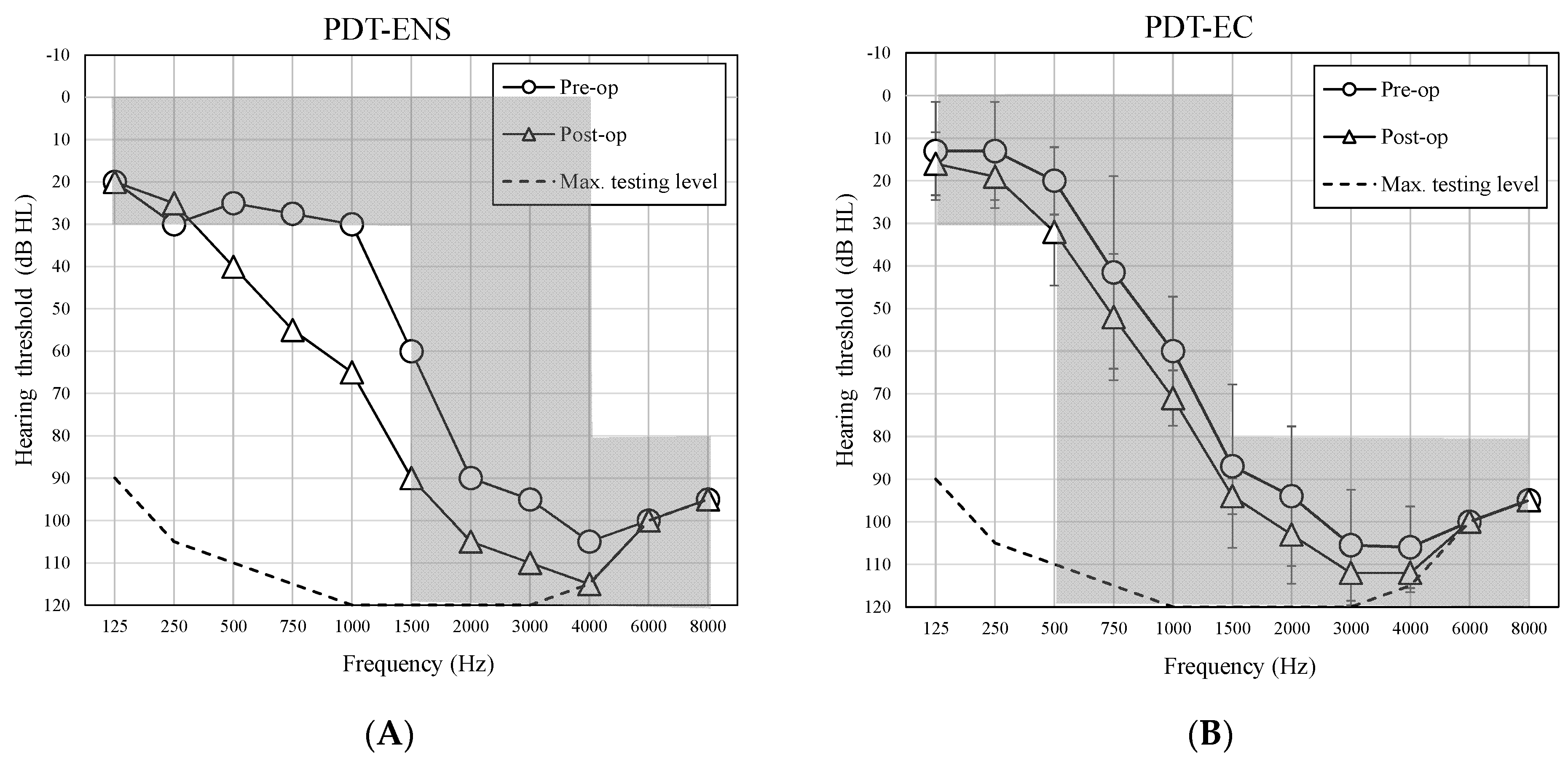
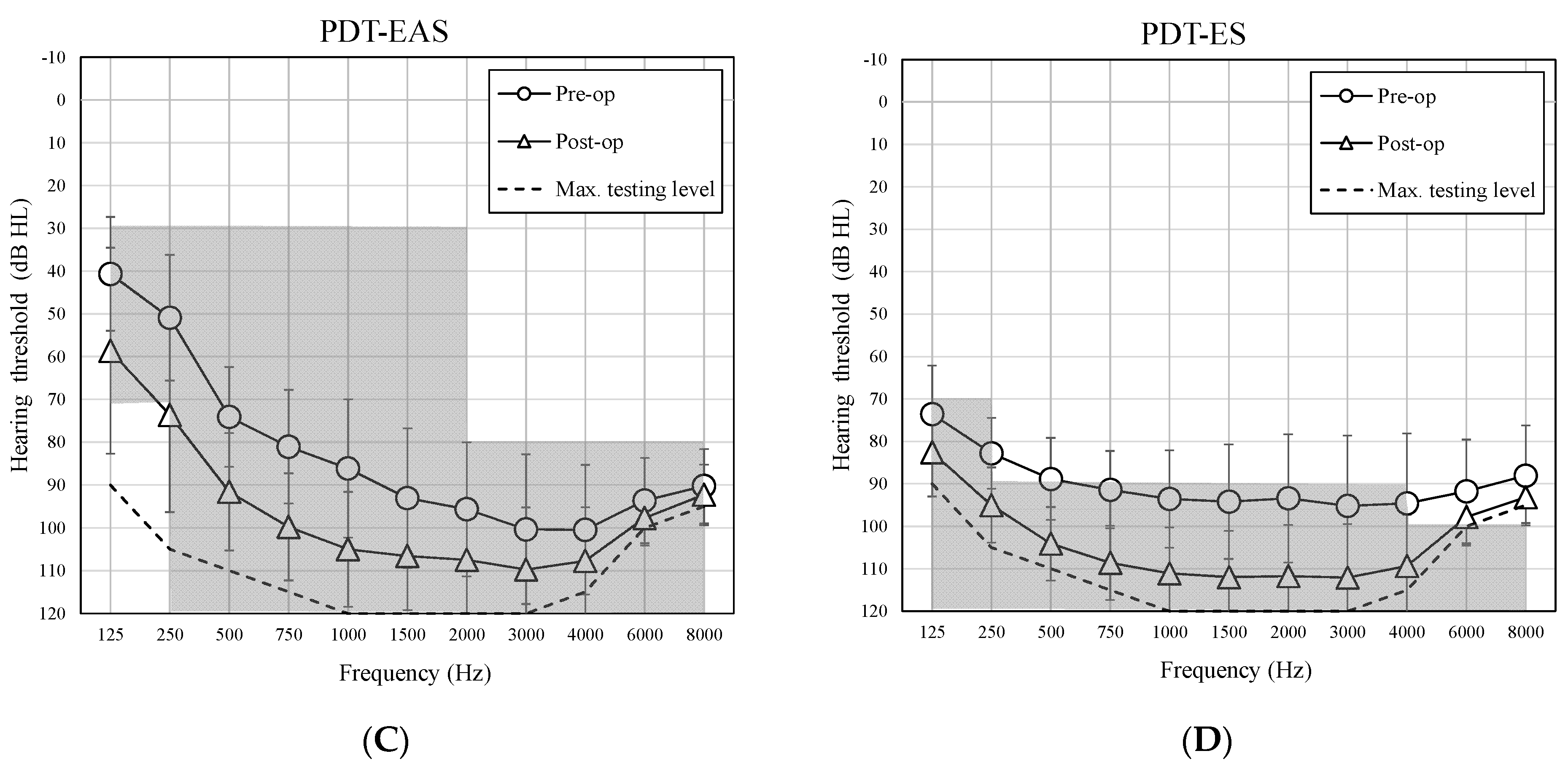
2.3. Audiometric Assessment and Hearing Preservation
- Electric Stimulation (ES) in patients with non-functional hearing at all frequencies
- Electric-Acoustic Stimulation (EAS) in patients with mild-to-severe hearing loss at low frequencies and profound hearing loss at high frequencies
- Electric Complementation (EC) in patients with normal or slightly elevated thresholds at low frequencies and almost total deafness at higher frequencies
- Electro-Natural Stimulation (ENS) in patients with normal or slightly elevated thresholds at low and middle frequencies and severe-to-profound hearing loss at high frequencies.
3. Results
3.1. Safety and Quality of Hospitalization during COVID-19
3.2. Participants
3.3. Audiometric Assessment and Hearing Preservation
4. Discussion
5. Conclusions
Supplementary Materials
Author Contributions
Funding
Institutional Review Board Statement
Informed Consent Statement
Data Availability Statement
Acknowledgments
Conflicts of Interest
References
- World Report on Hearing. Available online: https://www.who.int/publications-detail-redirect/world-report-on-hearing (accessed on 11 May 2021).
- WHA.70.13. World health assembly resolution on prevention of deafness and hearing loss. Resolutions and Decisions, Annexes. In Proceedings of the Seventieth World Health Assembly, Geneva, Switzerland, 31 May 2017.
- Dunn, C.C.; Stangl, E.; Oleson, J.; Smith, M.; Chipara, O.; Wu, Y.-H. The influence of forced social isolation on the auditory ecology and psychosocial functions of listeners with cochlear implants during COVID-19 mitigation efforts. Ear Hear. 2020, 42, 20–28. [Google Scholar] [CrossRef] [Scilit]
- Eurosurveillance editorial team Note from the Editors: World Health Organization Declares Novel Coronavirus (2019-NCoV) Sixth Public Health Emergency of International Concern. Eurosurveillance 2020, 25, 200131e. [CrossRef] [Scilit]
- Mohammed, H.; Kennedy, L.; Whitehead, D.; Ahmad, N.; Banerjee, A. A prospective study on the feasibility of cochlear implantation during the Coronavirus Disease 2019 crisis and trends of assessment: Experience in a UK centre. J. Laryngol. Otol. 2021, 135, 21–27. [Google Scholar] [CrossRef] [Scilit]
- Vaid, N.; Vaze, V.; Gokhale, N.; Kothadiya, A. Cochlear implant surgery during the Covid pandemic lockdown—The KEM hospital, pune experience. Indian J. Otolaryngol. Head Neck Surg. 2020, 1–4. [Google Scholar] [CrossRef] [Scilit]
- Skarzynski, H.; Matusiak, M.; Piotrowska, A.; Skarzynski, P.H. Surgical techniques in partial deafness treatment. J. Hear. Sci. 2012, 2, 9–13. [Google Scholar]
- Skarzynski, P.H.; Krumm, M.; Penar, K.; Hatzopoulos, S. Teleaudiology. In Advances in Audiology and Hearing Science; Apple Academic Press: New York, NY, USA, 2020; ISBN 978-0-429-29262-0. [Google Scholar]
- Skarżyński, P.H.; Świerniak, W.; Bruski, Ł.; Ludwikowski, M.; Skarżyński, H. Comprehensive approach to the national network of teleaudiology in world hearing center in Kajetany, Poland. Finn. J. EHealth EWelfare 2018, 10, 354–363. [Google Scholar] [CrossRef] [Scilit]
- Skarzynski, H.; Lorens, A.; Piotrowska, A.; Skarzynski, P.H. Hearing preservation in partial deafness treatment. Med. Sci. Monit. 2010, 16, CR555–CR562. [Google Scholar] [PubMed]
- Skarżyński, H.; Lorens, A.; Skarżyński, P.H. Electro-natural stimulation (ens) in partial deafness treatment: A case study. J. Hear. Sci. 2014, 4, 67–71. [Google Scholar]
- Skarzynski, H.; Lorens, A.; Dziendziel, B.; Skarzynski, P.H. Electro-natural stimulation (ENS) in partial deafness treatment: Pediatric case series. Otol. Neurotol. 2019, 40, 171–176. [Google Scholar] [CrossRef] [Scilit]
- Skarzynski, H.; van de Heyning, P.; Agrawal, S.; Arauz, S.L.; Atlas, M.; Baumgartner, W.; Caversaccio, M.; de Bodt, M.; Gavilan, J.; Godey, B.; et al. Towards a consensus on a hearing preservation classification system. Acta Otolaryngol. 2013, 133, 3–13. [Google Scholar] [CrossRef] [Scilit] [PubMed]
- Koumpa, F.S.; Forde, C.T.; Manjaly, J.G. Sudden irreversible hearing loss post COVID-19. BMJ Case Rep. 2020, 13, e238419. [Google Scholar] [CrossRef] [Scilit]
- Kilic, O.; Kalcioglu, M.T.; Cag, Y.; Tuysuz, O.; Pektas, E.; Caskurlu, H.; Cetın, F. Could sudden sensorineural hearing loss be the sole manifestation of COVID-19? An investigation into SARS-COV-2 in the etiology of sudden sensorineural hearing loss. Int. J. Infect. Dis. IJID 2020, 97, 208–211. [Google Scholar] [CrossRef] [Scilit]
- Lang, B.; Hintze, J.; Conlon, B. Coronavirus disease 2019 and sudden sensorineural hearing loss. J. Laryngol. Otol. 2020, 134, 1026–1028. [Google Scholar] [CrossRef] [Scilit]
- Degen, C.; Lenarz, T.; Willenborg, K. Acute profound sensorineural hearing loss after COVID-19 pneumonia. Mayo Clin. Proc. 2020, 95, 1801–1803. [Google Scholar] [CrossRef] [Scilit]
- Dham, R.; Arumugam, S.V.; Dharmarajan, S.; Mathews, S.; Paramasivan, V.K.; Kameswaran, M. Interrupted cochlear implant habilitation due to COVID-19 pandemic—Ways and means to overcome this. Int. J. Pediatr. Otorhinolaryngol. 2020, 138, 110327. [Google Scholar] [CrossRef] [Scilit]
- Guidance for ENT during the COVID-19 Pandemic. Available online: https://www.entuk.org/guidance-ent-during-covid-19-pandemic (accessed on 25 May 2021).
- Givi, B.; Schiff, B.A.; Chinn, S.B.; Clayburgh, D.; Iyer, N.G.; Jalisi, S.; Moore, M.G.; Nathan, C.-A.; Orloff, L.A.; O’Neill, J.P.; et al. Safety recommendations for evaluation and surgery of the head and neck during the COVID-19 pandemic. JAMA Otolaryngol.-Head Neck Surg. 2020, 146, 579–584. [Google Scholar] [CrossRef] [Scilit]
- Topsakal, V.; Van Rompaey, V.; Kuhweide, R.; Garin, P.; Barbara, M.; Li, Y. Prioritizing otological surgery during the COVID-19 pandemic. B-ENT 2020, 16, 55–58. [Google Scholar] [CrossRef] [Scilit]
- Bann, D.V.; Patel, V.A.; Saadi, R.; Goyal, N.; Gniady, J.P.; McGinn, J.D.; Goldenberg, D.; Isildak, H.; May, J.; Wilson, M.N. Best practice recommendations for pediatric otolaryngology during the COVID-19 pandemic. Otolaryngol.-Head Neck Surg. 2020, 162, 783–794. [Google Scholar] [CrossRef] [Scilit] [PubMed]
- Helbig, S.; Adel, Y.; Leinung, M.; Stöver, T.; Baumann, U.; Weissgerber, T. Hearing preservation outcomes after cochlear implantation depending on the angle of insertion: Indication for electric or electric-acoustic stimulation. Otol. Neurotol. 2018, 39, 834–841. [Google Scholar] [CrossRef] [Scilit] [PubMed]
- Skarzynski, H.; Lorens, A.; Piotrowska, A.; Anderson, I. Partial Deafness cochlear implantation provides benefit to a new population of individuals with hearing loss. Acta Otolaryngol. 2006, 126, 934–940. [Google Scholar] [CrossRef] [Scilit]
- de Sousa, A.F.; Couto, M.I.V.; Martinho-Carvalho, A.C. Quality of Life and Cochlear Implant: Results in adults with postlingual hearing loss. Braz. J. Otorhinolaryngol. 2018, 84, 494–499. [Google Scholar] [CrossRef] [Scilit] [PubMed]
- Mertens, G.; Andries, E.; Claes, A.J.; Topsakal, V.; de Heyning, P.V.; Rompaey, V.V.; Calvino, M.; Cuadrado, I.S.; Muñoz, E.; Gavilán, J.; et al. Cognitive improvement after cochlear implantation in older adults with severe or profound hearing impairment: A Prospective, Longitudinal, Controlled, Multicenter Study. Ear Hear. 2020, 42, 606–614. [Google Scholar] [CrossRef] [Scilit] [PubMed]
- Roland, J.T.; Gantz, B.J.; Waltzman, S.B.; Parkinson, A.J. Long-term outcomes of cochlear implantation in patients with high-frequency hearing loss. Laryngoscope 2018, 128, 1939–1945. [Google Scholar] [CrossRef] [Scilit]
- Mertens, G.; Punte, A.K.; Cochet, E.; De Bodt, M.; Van de Heyning, P. Long-term follow-up of hearing preservation in electric-acoustic stimulation patients. Otol. Neurotol. 2014, 35, 1765–1772. [Google Scholar] [CrossRef] [Scilit] [PubMed]
- Guimarães, A.C.; de Carvalho, G.M.; Duarte, A.S.M.; Bianchini, W.A.; Sarasty, A.B.; di Gregorio, M.F.; Zernotti, M.E.; Sartorato, E.L.; Castilho, A.M. Hearing preservation and cochlear implants according to inner ear approach: Multicentric evaluation. Braz. J. Otorhinolaryngol. 2015, 81, 190–196. [Google Scholar] [CrossRef] [Scilit]
- Rajeswaran, R.; Tavora-Vieira, D.; Mertens, G.; Dillon, M.; Narayan, S.; Kameswaran, M.; Kurz, A. Audiological Practice and COVID-19: Recommendations that audiological centers can use to maintain the safety and quality of service-expert opinion. Eur. Arch. Otorhinolaryngol. 2021, 1–6. [Google Scholar] [CrossRef] [Scilit]

| Patient Characteristics | Pediatric | Adult |
|---|---|---|
| Sex, No. (%) | ||
| Male | 90 (48.9) | 47 (36.7) |
| Female | 94 (51.1) | 81 (63.3) |
| Implantation site, No. (%) | ||
| Right | 73 (39.7) | 67 (52.3) |
| Left | 111 (60.3) | 61 (47.7) |
| Implantation procedure, No. (%) | ||
| Unilateral | 69 (37.5) | 119 (93.0) |
| Bilateral | 115 (62.5) | 9 (7.0) |
| Etiology of hearing loss, No. (%) | ||
| Acoustic trauma | 0 | 2 (1.6) |
| Chronic otitis media | 0 | 12 (9.4) |
| Congenital defect syndrome | 5 (2.7) | 0 |
| Cytomegaly | 10 (5.4) | 1 (0.8) |
| COVID-19 virus | 0 | 1 (0.8) |
| Genetic | 32 (17.4) | 1 (0.8) |
| Head trauma | 0 | 17 (13.3) |
| Idiopathic SNHL | 95 (51.6) | 64 (50.0) |
| Inner ear malformation | 6 (3.3) | 1 (0.8) |
| Meniere’s disease | 0 | 5 (3.9) |
| Meningitis | 0 | 5 (3.9) |
| Mumps | 0 | 4 (3.1) |
| Others | 2 (1.1) | 5 (3.9) |
| Otosclerosis | 0 | 6 (4.7) |
| Ototoxic drug | 7 (3.8) | 3 (2.3) |
| Perinatal problems (i.a. prematurity, hypoxia) | 27 (14.7) | 1 (0.8) |
| Age at implantation in years, M (SD) | 6.9 (4.0) | 53.6 (16.7) |
| Duration of hearing loss in years, M (SD) | 6.6 (3.9) | 16.1 (12.0) |
| Hearing Preservation Evaluation | ||||
|---|---|---|---|---|
| Complete HP n (%) | Partial HP n (%) | Minimal HP n (%) | Loss of Hearing n (%) | |
| PDT-ENS (n = 1) | 0 (0) | 1 (100) | 0 (0) | 0 (0) |
| PDT-EC (n = 5) | 4 (80.0) | 1 (20.0) | 0 (0) | 0 (0) |
| PDT-EAS (n = 25) | 7 (28.0) | 11 (44.0) | 5 (20.0) | 2 (8.0) |
| PDT-ES (n = 60) | 11 (18.3) | 18 (30.0) | 17 (28.3) | 14 (28.3) |
Publisher’s Note: MDPI stays neutral with regard to jurisdictional claims in published maps and institutional affiliations. |
© 2021 by the authors. Licensee MDPI, Basel, Switzerland. This article is an open access article distributed under the terms and conditions of the Creative Commons Attribution (CC BY) license (https://creativecommons.org/licenses/by/4.0/).
Share and Cite
Skarzynski, H.; Lorens, A.; Dziendziel, B.; Wlodarczyk, E.; Obrycka, A.; Walkowiak, A.; Skarzynski, P.H. Resumption of Cochlear Implant Surgery under COVID-19 Pandemic Conditions. Life 2021, 11, 929. https://doi.org/10.3390/life11090929
Skarzynski H, Lorens A, Dziendziel B, Wlodarczyk E, Obrycka A, Walkowiak A, Skarzynski PH. Resumption of Cochlear Implant Surgery under COVID-19 Pandemic Conditions. Life. 2021; 11(9):929. https://doi.org/10.3390/life11090929
Chicago/Turabian StyleSkarzynski, Henryk, Artur Lorens, Beata Dziendziel, Elzbieta Wlodarczyk, Anita Obrycka, Adam Walkowiak, and Piotr Henryk Skarzynski. 2021. "Resumption of Cochlear Implant Surgery under COVID-19 Pandemic Conditions" Life 11, no. 9: 929. https://doi.org/10.3390/life11090929
APA StyleSkarzynski, H., Lorens, A., Dziendziel, B., Wlodarczyk, E., Obrycka, A., Walkowiak, A., & Skarzynski, P. H. (2021). Resumption of Cochlear Implant Surgery under COVID-19 Pandemic Conditions. Life, 11(9), 929. https://doi.org/10.3390/life11090929


