Review

A Brief Narrative Review of Upper-Limb Stroke Rehabilitation Robotic Systems for Bimanual and Mirror Therapy


1
Department of Biomedical Engineering, Wayne State University, Detroit, MI 48201, USA
2
Psychiatry and Behavioral Neurosciences, Wayne State University, Detroit, MI 48201, USA
3
Department of Neurology, School of Medicine, Wayne State University, Detroit, MI 48201, USA
4
Physical Medicine & Rehabilitation, DMC Rehabilitation Institute of Michigan, Detroit, MI 48201, USA
5
Electrical and Computer Engineering, Wayne State University, Detroit, MI 48202, USA
*
Authors to whom correspondence should be addressed.
Machines 2026, 14(8), 868; https://doi.org/10.3390/machines14080868

Submission received: 29 May 2026 / Revised: 16 July 2026 / Accepted: 29 July 2026 / Published: 1 August 2026

Abstract

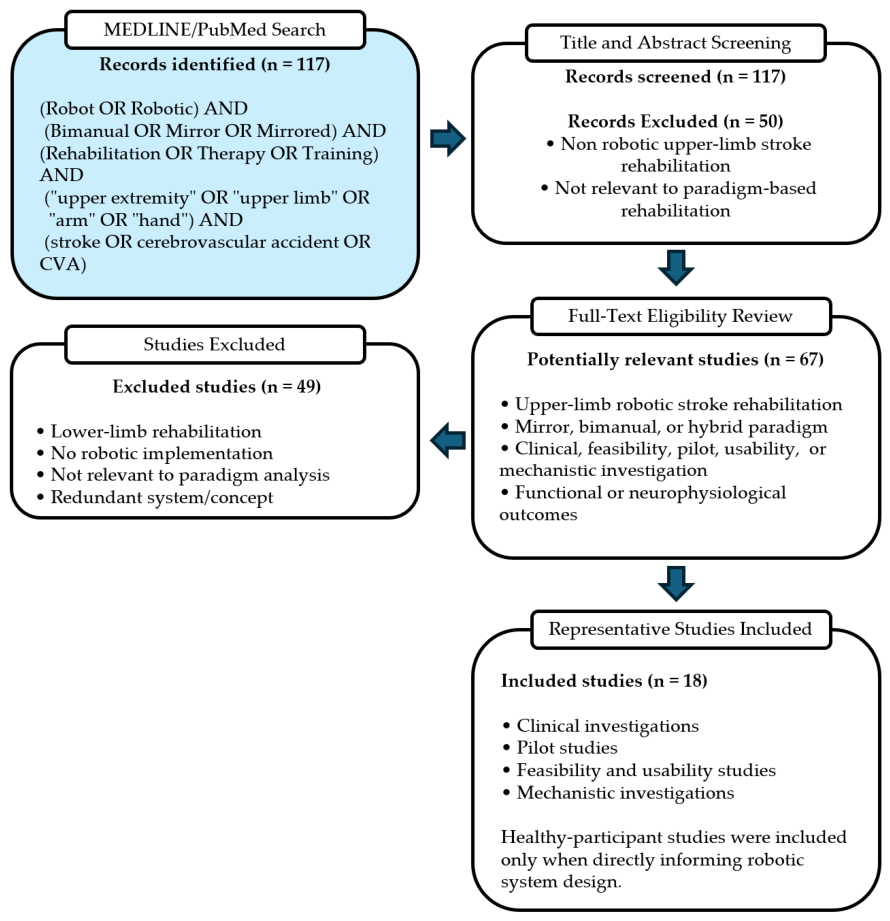
Background: Robotic rehabilitation systems for upper-limb stroke rehabilitation have been developed across diverse robotic platforms, yet cross-study comparisons remain challenging due to heterogeneous system designs and classification approaches. This brief narrative review proposes a paradigm-driven framework, categorizing robotic rehabilitation systems based on underlying therapeutic interaction principles (e.g., mirror, bimanual, mirror–bimanual hybrid) rather than implementation modality alone. Methods: A structured MEDLINE/PubMed literature search was performed to identify representative studies describing robotic system characteristics, rehabilitation task structures, clinical outcomes, and mechanistic insights within mirror, bimanual, and hybrid rehabilitation paradigms. Findings: Among the reviewed studies, mirror-based systems emphasize sensory representation and interhemispheric modulation, whereas bimanual systems target coordination and motor learning through bilateral interaction. Hybrid systems integrate these approaches by combining mirrored feedback with active bilateral engagement. Emerging neuroimaging evidence, particularly resting-state fMRI, may help relate clinical improvements to neural network changes, providing a mechanism-informed perspective on rehabilitation outcomes. Conclusions: This review highlights substantial progress in robotic upper-limb stroke rehabilitation, with current systems increasingly integrating multimodal feedback and task-oriented interaction within mirror, bimanual, and hybrid rehabilitation paradigms. Limitations include variability across studies due to differences in robotic system implementation, task design, duration, stroke chronicity, and patient engagement.
Keywords: stroke; upper-limb rehabilitation; robotics; mirror therapy; bimanual training; neurorehabilitation stroke; upper-limb rehabilitation; robotics; mirror therapy; bimanual training; neurorehabilitation