1. Introduction
Three-phase voltage source inverters (VSIs) are widely used in electric vehicles (EVs), renewable energy systems, and industrial motor drives, where their reliable operation is critical for overall system performance and safety [
1,
2,
3]. They play a crucial role in supplying regulated AC power for electric motors. These inverters rely on semiconductor switches, and due to continuous switching, thermal stress, aging effects and harsh operating environment, these devices are among the most failure-prone components in the drive system [
4]. It has been reported that power semiconductor failures account for a significant portion of drive-circuit faults, often exceeding one-third of total system failures [
5,
6].
Among the possible failure modes, open-circuit (OC) and short-circuit (SC) faults are the most common and critical [
7]. OC faults interrupt the intended current path due to mechanisms such as gate driver failure, bond-wire degradation, or connection faults. Although the system can continue operating under this fault, it results in current imbalance, increased thermal stress, and potential secondary damage. In contrast, SC faults force continuous conduction of the affected switch, leading to rapid current rise and destructive conditions if not detected promptly [
8,
9]. Both fault types introduce significant distortions in stator currents, increased torque ripple, and efficiency degradation, highlighting the need for fast and reliable fault detection and diagnosis (FDD) methods capable of identifying both the fault type and its location [
10].
FDD techniques are mainly categorized into model-based, signal-based, and data-driven methods [
11]. Model-based approaches utilize mathematical representations of the system and detect faults by monitoring residuals between measured and estimated signals [
12]. Techniques such as observer-based residual generation [
9,
13,
14], Kalman filtering [
15,
16], sliding mode observers [
17,
18] and model predictive controller (MPC) [
19,
20,
21] have demonstrated effectiveness in detecting OC faults. However, their performance strongly depends on an accurate system model and parameters, which may vary with operating conditions such as load, temperature, and aging and the efficiency degrades as the model complexity increases.
Signal-based approaches extract fault signatures and features directly from measured signals, often using current and voltage signals. Current signal-based methods are usually slow, and voltage-based methods require hardware, increasing the cost and complexity. Methods based on normalized current statistics [
22,
23,
24], current-/Park-vector analysis [
25,
26,
27], voltage signal-based [
28,
29] and time-frequency domain analysis [
30,
31,
32] have been introduced. Despite these advances, most signal-based methods often require carefully tuned thresholds or additional measurements and hardware.
Model-based and signal-based categories require prior expert knowledge, and their performance is challenged in more complex or transient conditions. They also cannot be generalized to more systems without extra effort and tuning.
Data-driven approaches have emerged as a powerful alternative by learning fault patterns directly from data without requiring explicit system models or tuned thresholds, showing greater robustness to system variations and are being used for inverter fault detection increasingly [
33]. Traditional machine learning techniques such as support vector machines and ensemble methods, as well as deep learning models including convolutional neural (CNN) networks, recurrent neural (RNN) networks and long short-term memory (LSTM) networks have been successfully applied to inverter fault detection.
Beyond data-driven FDD methods for inverter, recent studies have also focused on improving inverter stability and power quality through adaptive damping and intelligent control strategies of power electronics systems. Optimization-based adaptive damping techniques and LMS-based online tuning methods have been proposed to improve resonance suppression, harmonic reduction, and robustness against grid impedance variations. These studies highlight the increasing importance of intelligent and adaptive control approaches for improving inverter robustness and stability under varying operating conditions [
34].
Early data-driven FDD techniques were based on classical machine learning classifiers. A robust accuracy-weighted random forest model was proposed in [
35], which used normalized three-phase current signals for IGBT OC fault localization. However, it was limited to detecting OG faults and a specific motor rating. The authors in [
36] extended classical ML by combining fast Fourier transform (FFT) frequency features with a random vector functional-link network to simultaneously diagnose IGBT OC and current sensor faults in induction motor drives. Although this method handles two concurrent fault types, it relies on both current and voltage measurements to construct the feature set, adding sensor hardware beyond what is typically available in a standard drive controller.
With further developments in deep learning techniques, CNNs have received increased attention for inverter fault detection. In ref. [
37], a CNN was used to detect single and double OC faults with an accuracy of 99.14%. CNN and CNN-LSTM networks with phase-to-phase voltage as input were used for OC fault detection in a PMSM drive, achieving a very high accuracy of 99.8%. However, three separate networks were employed for each phase. A two-stage CNN-based method was introduced in [
38] for OC fault detection. First, the
-
current-vector trajectory was converted into a binary matrix and fed to the first CNN, which detects the presence of a fault, and the second CNN locates the faulty switch after one cycle of fault detection. While this method has 100% accuracy and is robust to phase-current imbalance, it is computationally heavy and relatively slow at locating the faulty switch. By transforming the current signal into a recurrence plot, a ResNet model was used for fault detection; however, period and amplitude variations degrade its performance [
39]. In [
40], an RVFL network was used to detect single and double OC faults under noisy data with an accuracy of 97.69%. Noisy data was first processed and then fed to the RVFL for fault detection. This method is limited to OC faults and requires heavy denoising preprocessing.
Many methods rely on both current and voltage measurements, which increases computational complexity and hardware requirements. Furthermore, models trained under specific operating conditions often show degraded performance when applied to different load levels or motor ratings. Even with transfer learning, minor retraining is required to adapt to the new systems. Moreover, most of the existing data-driven methods focus on a limited set of fault types, typically addressing only OC faults, while SC faults are often treated separately. A few works focus on detecting both OC and SC faults in a single method. In refs. [
41,
42], shallow LSTM networks were trained to detect OC and SC faults, but they were limited to identifying fault types rather than locating the exact faulty switch.
In the authors’ previous work [
43], a BiLSTM-based FDD technique was developed to detect open gate (OG), open switch (OS), and SC faults in an induction motor drive. That approach used 12 input features derived from current and voltage signals, achieving 98.45% accuracy across 19 fault classes with detection time below half a fundamental cycle. However, the need for voltage measurements increases hardware requirements and limits practical deployment in applications where voltage sensing is not available. In addition, the method was validated only on a single motor rating, leaving its generalizability unaddressed.
To overcome these limitations, this paper proposes an FDD method based on normalized statistical current features and a lightweight BiLSTM network. The proposed approach calculates the mean and root-mean-square (RMS) values of the three-phase currents and normalizes them with respect to the average RMS value. This normalization technique removes the dependency on the absolute current magnitude, which is directly affected by load and motor power ratings. It enables the model to perform reliably under different load conditions and generalize across the same inverter-fed induction motor drives with different motor power ratings without retraining and maintain consistent performance across the investigated motor ratings. A lighter BiLSTM network is then used to capture the temporal dependencies among these features and detect faults quickly. The proposed method achieves an overall classification accuracy of 99.65% while maintaining detection latency within less than half of the fundamental cycle. Furthermore, the method demonstrates robustness under varying speeds, different loads, and noisy environments, and the same trained network can be used for motors with different power ratings under the same V/F control system without retraining, unlike transfer learning methods. The main contributions of this work are summarized as follows:
A data-driven FDD framework for three-phase inverter switches based on current features.
A feature normalization approach based on current mean and RMS values, ensuring robustness to speed and load variations and enabling generalization across different motor ratings without retraining.
Using a lightweight BiLSTM-based classification model, capable of capturing transient fault dynamics while maintaining low computational and memory requirements.
Fast and accurate detection and localization of inverter switch faults, including OG, OS, and SC conditions, achieved within less than half of a fundamental cycle.
Comprehensive validation under varying operating conditions, including different speeds, loads, motor ratings, and noisy environments, confirming robustness and an overall classification accuracy of 99.65%.
The rest of this paper is organized as follows.
Section 2 describes the inverter fault types and their characteristics.
Section 3 presents the data generation process and the proposed methodology, including feature extraction and network design. The evaluation results are presented in
Section 4, and the findings are discussed in
Section 5. Finally,
Section 6 concludes the paper.
3. Methodology
This paper presents a data-driven fault detection method for three-phase inverter-fed induction motor drives based on current signals. The proposed approach is designed to accurately and rapidly detect and locate different inverter switch faults while maintaining low computational complexity, robustness under varying operating conditions, and adaptability across different motor power ratings with minimal hardware requirements. The proposed method adopts a simplified feature normalization different from approaches that require extensive feature engineering. The methodology consists of three main steps: extraction of time-domain features from the current signals, normalization of these features to remove operating condition dependency, and sequence-based classification using a BiLSTM network. This design enables the method to achieve high performance while maintaining practical feasibility and generalization for real-time implementation.
3.1. System Modeling and Data Generation
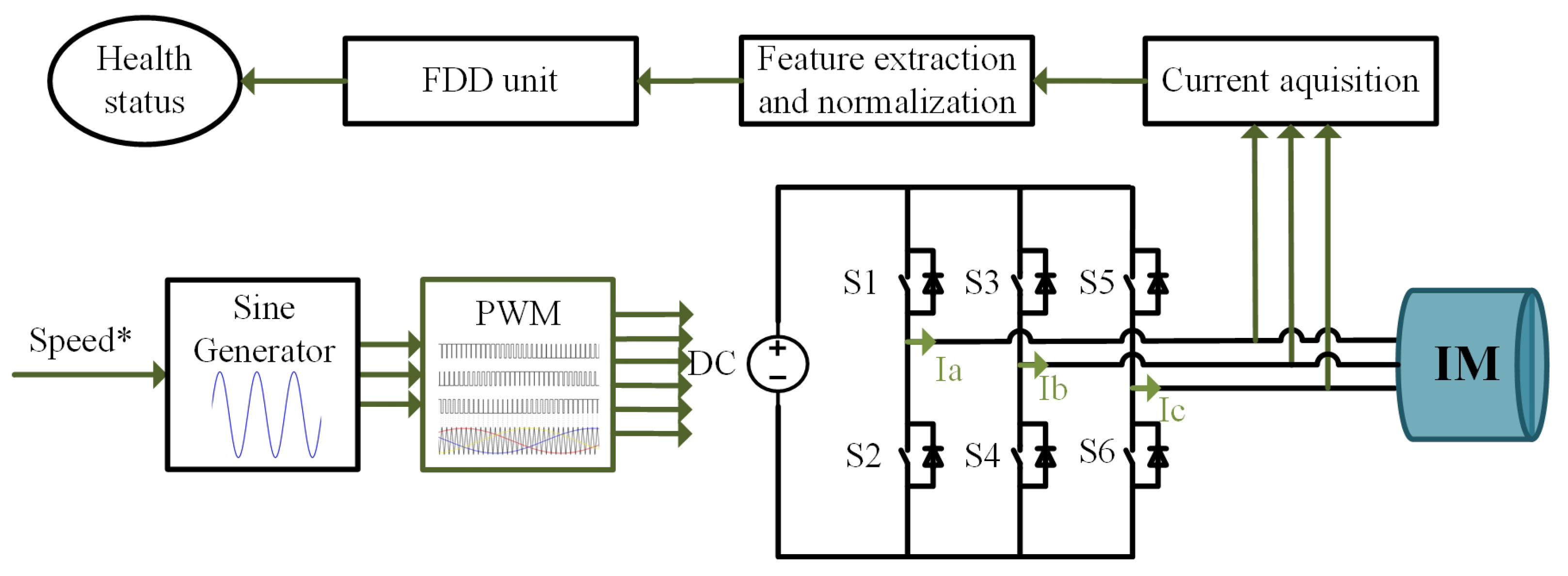
A detailed model of a 460 V, 5 HP induction motor drive was developed in MATLAB/Simulink (2024a) to generate the dataset used in this study and to evaluate the performance of the proposed method. The drive operates under V/F control, and the inverter is driven using a PWM strategy with a switching frequency of 10 kHz (
Figure 2).
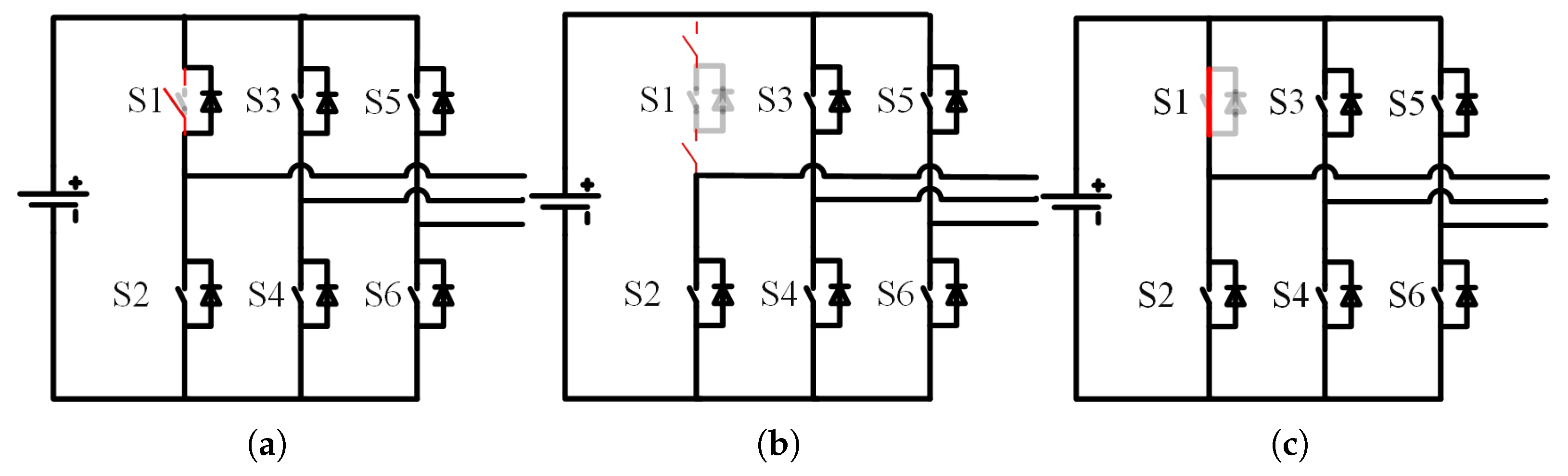
Each switch in the inverter was examined individually under three different fault conditions. First, in the OG condition, the IGBT was kept off while the diode remained functional. Second, in the OS fault, the IGBT and its antiparallel diode were disabled, blocking current flow in that leg. Finally, for the SC condition, the switch was assumed to be permanently on, resulting in continuous conduction through the corresponding leg.
Applying these fault scenarios to each of the six switches produced a total of 18 faulty cases, which, together with the healthy operating condition, formed a set of 19 distinct classes, which are labelled in the
Table 1.
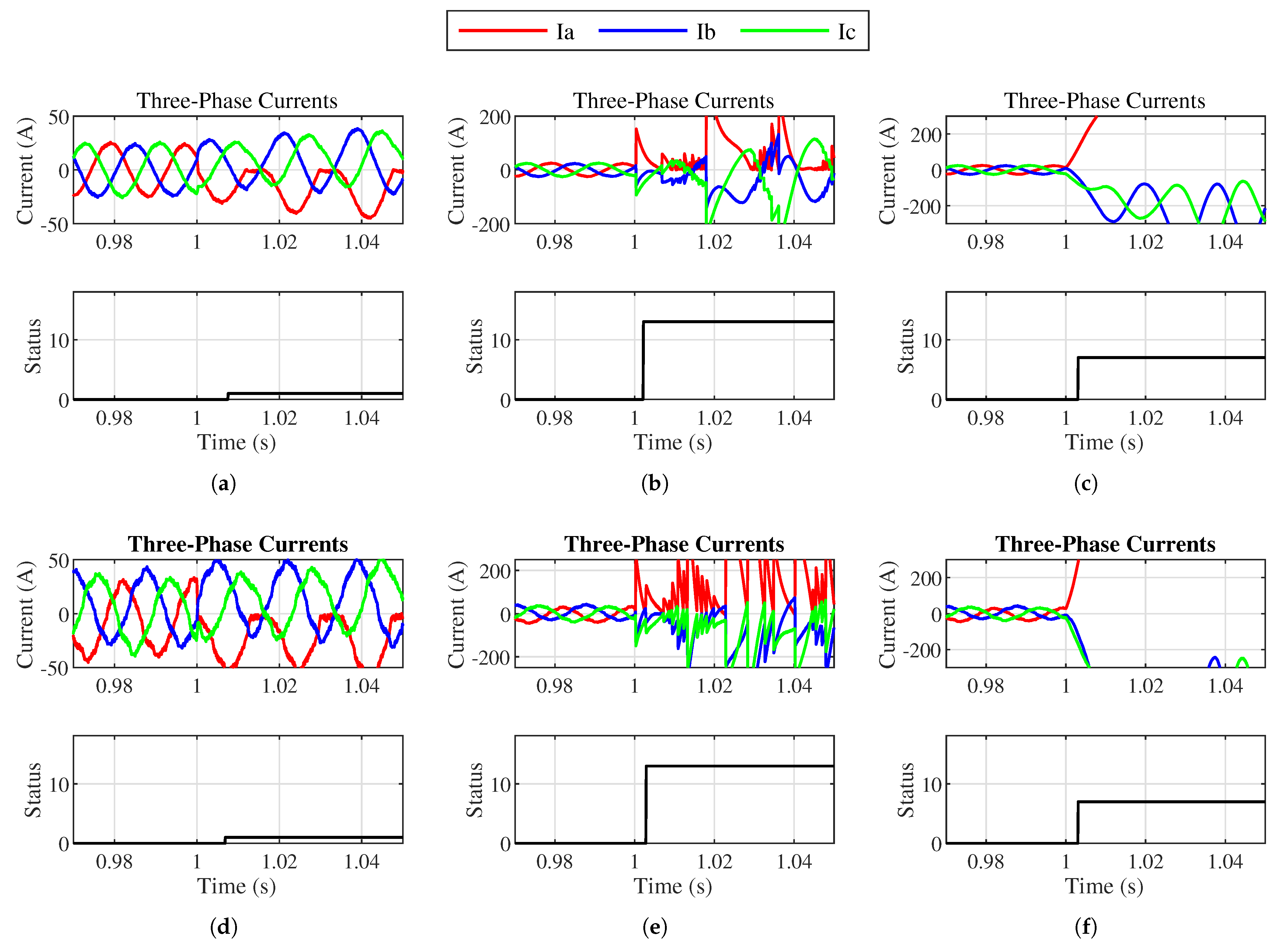
For dataset generation, the system was simulated for 2 s per fault type per switch under constant speed and load conditions for a 5 HP induction motor. The first 0.5 s were run under healthy conditions; after that, the fault was introduced for the remaining 1.5 s, and the three-phase currents were sampled at 10 kHz throughout the simulation. This approach allows the dataset to capture both the immediate transient following fault occurrence and the subsequent steady-state faulty behavior. A total of 20,000 time steps of three-phase current were sampled for each simulation case, in which the first 5000 samples were in the healthy condition, and the rest corresponded to the associated fault class. For each class, the first 20 ms after fault occurrence could be considered as the transient state, which is the time for the sliding window used for calculating the RMS and mean values (explained later in this section) to be fully occupied with faulty signals. This process was repeated 18 times to cover all the classes, giving a total number of 360,000 samples, with an equal number of samples for each type of fault. These signals were then processed to extract time-domain features used for fault classification, forming the basis of the dataset and input features used in this work.
3.2. Current Signal Characteristics and Feature Extraction
Under normal operating conditions, the three-phase currents are balanced sinusoidal waveforms with equal magnitudes. However, the presence of inverter faults such as OS or SC faults introduces distortions in the current signals. These distortions manifest as amplitude variations, phase imbalance, waveform asymmetry, and the appearance of DC offsets.
To capture these fault-induced characteristics, two time-domain features are extracted from each phase over a fundamental cycle. The first feature is the mean value of the current, defined as
which reflects the presence of asymmetry and DC components in the waveform. The second feature is the root mean square (RMS) value, given by
which represents the energy content and amplitude of the signal.
The RMS and mean values are computed over a sliding window equal to one fundamental cycle of the current waveform. These features can capture fault signatures while being robust against high-frequency noise and measurement disturbances due to their averaging nature. The RMS value provides an estimate of signal energy, helping to detect the existence and type of fault, and the mean value plays a crucial role in locating the faulty switch by capturing the asymmetry and DC offset signatures introduced by faults. Although the feature extraction is performed over one-cycle windows, a high temporal resolution is achieved by using a highly overlapped sliding window with a step time of 0.1 ms. As a result, consecutive feature vectors exhibit strong temporal correlation, enabling fast fault detection immediately after their occurrence.
The RMS and mean values for the three-phase currents are combined to form a compact input representation for the classification model, resulting in a total of six input features.
Compared to previous work that utilized a larger number of features, including voltage-based ones [
43], the proposed six-dimensional feature vector significantly reduces computational complexity and hardware requirements, while still preserving the essential information needed for accurate fault detection and localization.
3.3. Feature Normalization
The current magnitude depends on load conditions and motor ratings. This causes a major challenge for current-based fault diagnosis, where variations in load torque or changing the motor rating directly affect the FDD performance if the features are used raw. A normalization strategy is introduced based on the average RMS value of the three-phase currents to overcome this limitation:
Each extracted feature is normalized with respect to this quantity:
By applying this normalization, the influence of absolute current magnitude is reduced. Since the RMS and mean values vary with load and motor rating, normalizing them with respect to the average RMS value allows the classifier to focus on relative phase differences rather than absolute current levels. The normalized feature vector is therefore expressed as:
Under healthy balanced operation, the three-phase stator currents are:
where
is the angular frequency and
is the peak stator current magnitude. Under V/F control, the voltage-to-frequency ratio is maintained constant. Therefore, the current magnitude is affected by the load torque and motor rating rather than speed. This dependency of
on load and motor rating is the challenge this normalization strategy tries to address. Under healthy balanced conditions, the normalized RMS features are almost equal to:
and the normalized mean features is almost equal:
Therefore the normalized feature vector would be a fixed reference point under healthy conditions, independent of operating conditions:
If there is any type of fault in one of the switches, a relative imbalance is induced among the three-phase currents and the current RMS and mean are affected, which is proportional to the operating condition current magnitude
. So, the faulty current RMS and mean can be expressed as:
where
and
are fault coefficients, which applies to all OG, OS and SC faults determined by the fault type and switch location. The average RMS value under faulty conditions becomes:
where:
It is worth noting that differs from its healthy value under faulty conditions, meaning that itself changes during faults.
Applying the normalization defined in Equation (
5):
It can be seen that the operating current magnitude is cancelled in both expressions regardless of its value (which differs by changing the load and motor rating). As , , and depend only on fault type and switch location, the normalized feature vector remains identical regardless of the load torque and motor power rating, which determine the current magnitude. This confirms the independence of the load and motor power rating for the same V/F controlled induction motor drive that arose from the current normalization.
A critical concern is whether the normalization method suppresses or distorts the fault signature when
changes during severe faults. For any fault types, load levels and motor power ratings, the expression below is true:
It means that the normalization cannot suppress all the features simultaneously. If there is a change in the normalized feature in one phase due to a fault, the other must change as well to compensate for Equation (
16), producing a unique feature set. Therefore, the relative imbalance pattern across the three phases is preserved, and a distinctive and discriminative fault features set is produced even under severe faults.
This normalization mainly compensates for current magnitude scaling and does not eliminate all differences caused by motor dynamics, parameter variation, or controller behavior. Therefore, the generalization capability is demonstrated only across the investigated motor ratings under the same V/F controller and operating conditions.
3.4. Normalized Feature Set Visualization
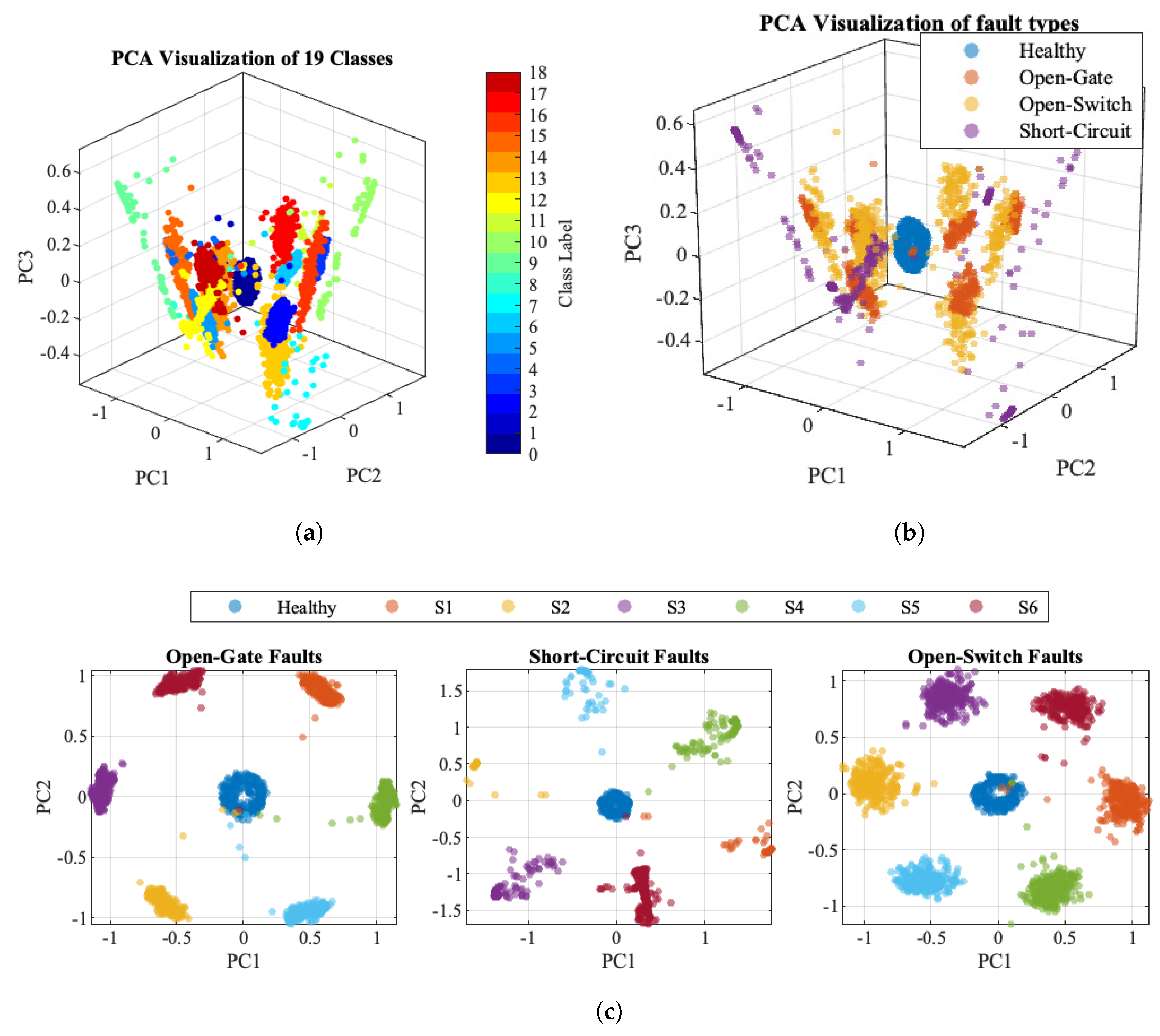
To further analyze the discriminative and separability capability of the proposed normalized features, principal component analysis (PCA) was performed for feature-space visualization of class clusters. It should be noted that PCA was used only for visualization purposes and was not used for dimensionality reduction for training.
Figure 3a illustrates clustering of all 19 classes, including the fault types and locations, showing that the proposed normalized feature set provides discriminative information to distinguish fault type and also the faulty switch location.
For better visualization, the clustering was also performed at two levels, with fault type distinction and faulty switch location clustering derived from the first 3 and 2 PCs, respectively.
Figure 3b presents fault types clustering, including healthy, OG, OS and SC fault conditions in the first three PCs. The clustering shows that the healthy state has a compact cluster in the middle of the feature space, and the other fault types are in distinguishable regions based on their characteristics. Switch location separability is shown in
Figure 3c separately for OG, SC, and OS fault categories. Distinguishable clustering among the different switch locations (S1–S6) confirms the capability of the proposed normalized feature set to support accurate fault localization.
3.5. BiLSTM-Based Classification Model
A bidirectional long short-term memory (BiLSTM) network, which effectively captures the temporal dependencies of the input signals, is used for the classification. By learning how the input features change over time, the model enables accurate and reliable fault detection. The overall architecture is the same structure as the model presented in the previous work [
43]; however, the number of hidden units has been significantly reduced. This reduction is made possible by the enhanced discriminative capability of the proposed feature set, which allows the network to achieve high performance with lower computational complexity.
The network consists of a sequence input layer where at each time instant
t, a sequence is constructed by stacking the normalized feature vectors over a sliding window of length
L:
where
L is set to 20 samples. Each sequence thus forms a matrix of size
, which is used as input to the classifier. The label assigned to each sequence corresponds to the fault condition at the last time step, ensuring consistency between the input data and the target output.
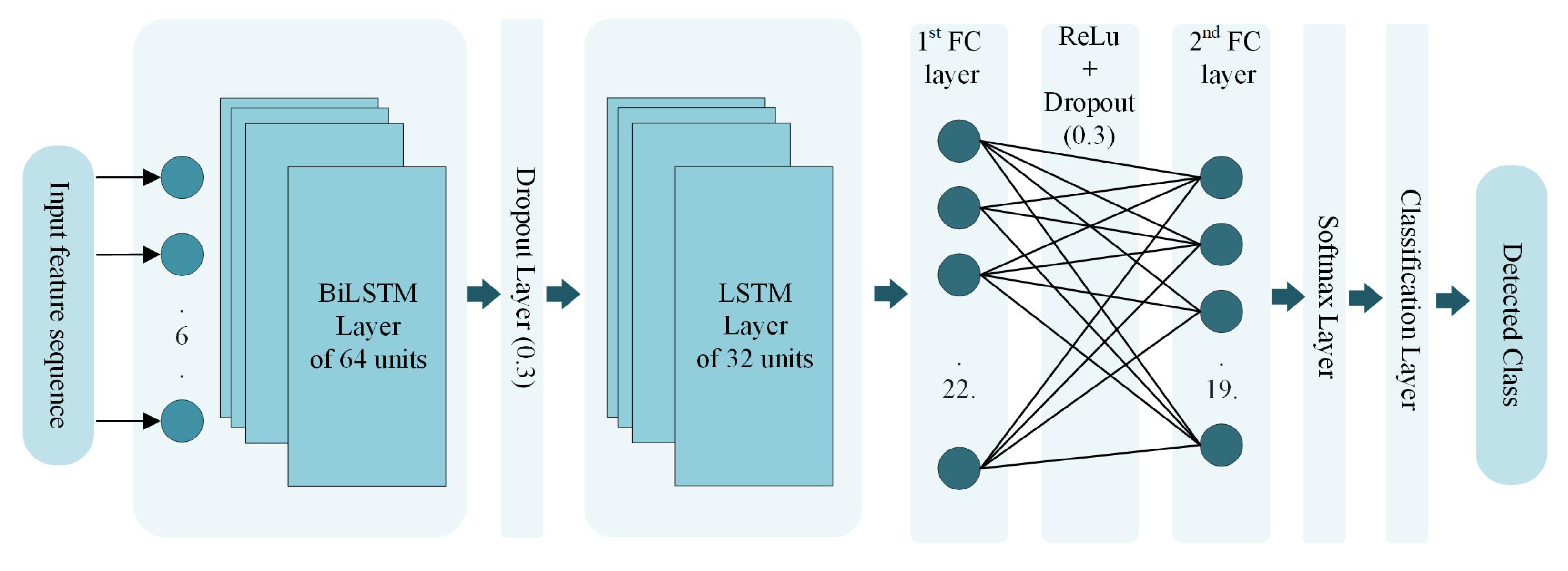
It is followed by a BiLSTM layer with 64 hidden units, which processes the input sequence in both forward and backward directions. A dropout layer with a rate of 0.3 is applied to mitigate overfitting. The output is then passed to a unidirectional LSTM layer with 32 hidden units. It is further processed by a fully connected layer with 22 neurons, followed by a rectified linear unit (ReLU) activation function and an additional dropout layer. Finally, a fully connected layer maps the features to the 19 output classes, followed by a softmax layer and a classification layer as the network structure shown in
Figure 4.
Compared to the previous model, the number of hidden units has been reduced significantly, resulting in a more lightweight network with fewer learnable parameters and memory requirements. Still, it can achieve higher accuracy thanks to the new feature set; making the proposed framework more suitable for real-time implementation in embedded motor drive systems.
The network is trained using the Adam optimization algorithm with a learning rate of and a mini-batch size of 128. The dataset is divided into 70% training and 30% testing data. To reduce the possibility of temporal leakage caused by highly overlapped sliding windows, the collected data for each operating condition was divided into continuous batches before splitting the training and test data. 30% of batches were randomly selected as test data, and the remaining 70% were used for training. This approach enables the network to capture temporal dependencies by keeping the continuity of data, while reducing the data leakage significantly that could happen due to the highly overlapping sliding window. Although a few sequences between adjacent batches might have a few shared samples, their impact is negligible due to the overall dataset size.
The hyperparameters were chosen empirically based on a trade-off between the detection performance, accuracy, and detection time while keeping it computationally efficient.
The proposed methodology achieves a balance between simplicity and performance. By relying only on normalized current features and a lightweight sequence-based model, the method eliminates the need for additional sensors and complex preprocessing steps. At the same time, the incorporation of temporal information enables accurate detection of faults even during transient conditions.
Compared to previous approaches, the proposed method offers improved robustness under varying operating conditions and different motor ratings while significantly reducing computational complexity, making it a practical solution for real-world motor drive applications.
5. Discussion
The results presented in
Section 4 demonstrate that the proposed fault detection method achieves high accuracy and fast detection under a wide range of operating conditions. In this section, the obtained results are analyzed in detail to highlight the improvements and contributions of the proposed approach.
Extensive research has been conducted on inverter fault detection. However, current methodologies have limitations. Model-based techniques have shown reliable fault detection, but their performance depends on precise system modeling and is sensitive to parameter variations. Signal-based methods depend on accurately tuned thresholds and are usually designed for specific fault types. Data-driven approaches have been proposed to overcome these challenges. As mentioned earlier, most of them target OC fault detection. Certain techniques can identify the presence of faults, but are unable to accurately locate the faulty switch. Some prior works face higher computational costs, slower fault detection and generalization limitations. Therefore, a more efficient and generalized fault detection approach is needed that can accurately identify multiple fault types and their locations under diverse operating conditions.
In the authors’ previous study [
43], a BiLSTM-based method was developed using a combination of current and voltage features, resulting in 12 input features derived from RMS values and phase angles. That approach achieved an overall classification accuracy of 98.45% across 19 fault classes and demonstrated detection within less than half of a fundamental cycle.
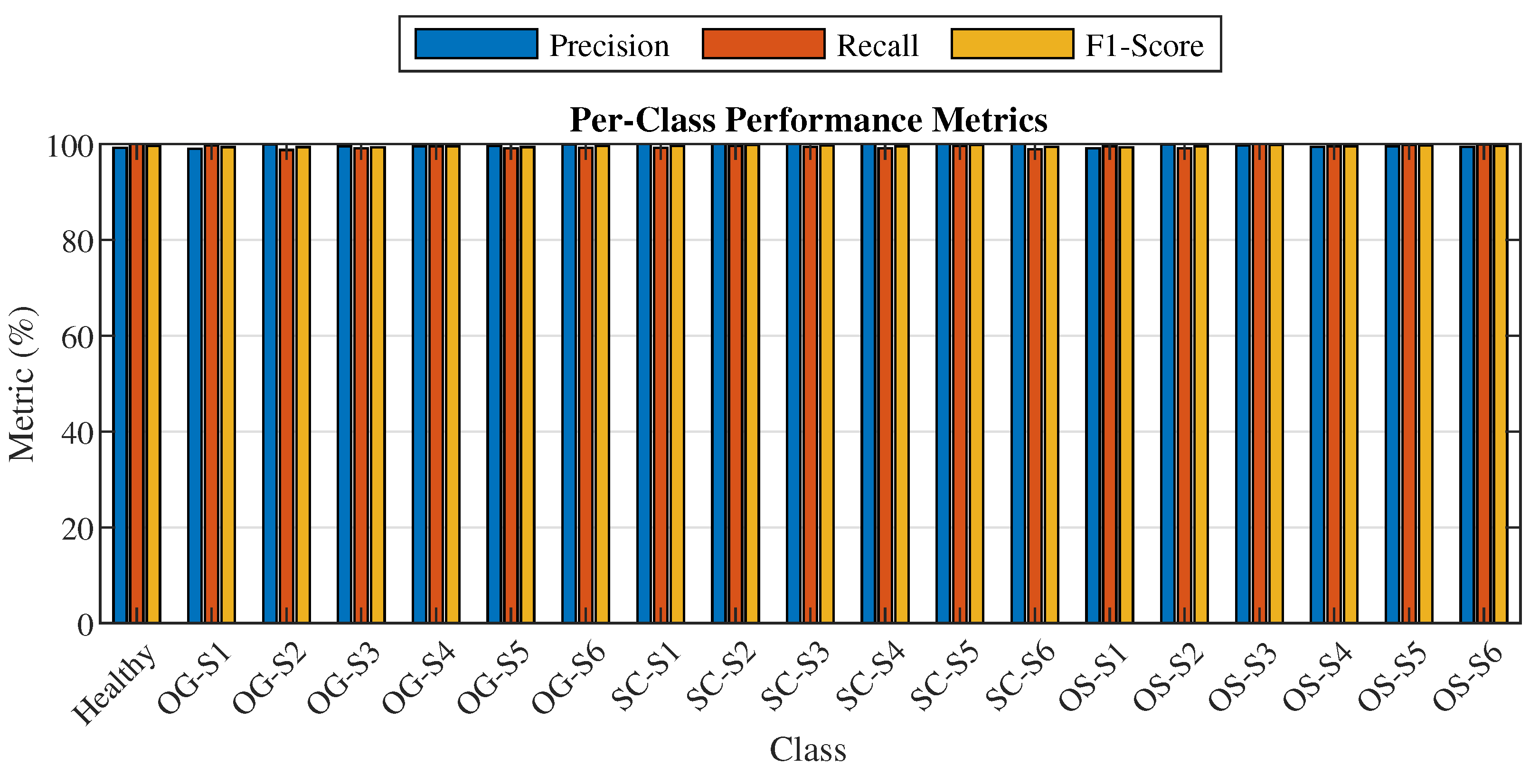
In contrast, the proposed method with the new current normalization method reduces the feature set by relying on current signals and extracting only six statistical features, the mean and RMS values of the three-phase currents, eliminating the need for voltage measurements and extra hardware. This enables the use of a lighter network architecture, where hidden units are reduced from 200, 150, 128 to 64, 32, and 22 in the BiLSTM, LSTM, and fully connected layers, respectively. This leads to a significant reduction in the number of learnable parameters, making the proposed method more suitable for real-time and embedded implementations. Despite this reduction in feature dimensionality and network complexity, the proposed approach achieves a higher classification accuracy of 99.65%, demonstrating that the selected features capture sufficient diagnostic information for fault detection and localization.
The network used in [
43] required approximately 693k trainable parameters, whereas the proposed model has only about 58k trainable parameters, reducing model complexity and computational cost by more than 90%. From a hardware perspective, the reduced parameter count translates to a much smaller memory requirement. Using a 32-bit floating-point representation, the model requires roughly 0.23 MB, which can be reduced to nearly half when lower-precision formats are used. This compact size makes the model well-suited for deployment on embedded platforms with limited resources. The computational cost was assessed by measuring the average inference time across 500 MATLAB runs, which was about 0.8 ms per prediction, and the computation time for feature extraction was negligible. The reported inference time corresponds to MATLAB-based CPU execution and is intended only as an estimate of computational complexity rather than a direct representation of embedded execution latency; however, these details are within the memory and computational capability of modern embedded processors and confirm the implementation feasibility of the proposed method on embedded platforms such as FPGAs, ARM Cortex-M and DSPs. Furthermore, by applying some model optimization techniques, it is possible to reduce the requirements further.
Overall, the new dataset, along with the lightweight architecture, achieves a notable reduction in computational and memory requirements while preserving high diagnostic performance, making it a practical candidate for real-time inverter fault detection. A detailed comparison of the two methods is provided in
Table 3.
Ablation Study Against Standard LSTM network: To justify the selected BiLSTM network, an ablation study was performed to compare the proposed network with a simpler standard unidirectional long short-term memory (LSTM) network under identical conditions, datasets, normalization and training configuration. The LSTM network under study was structured in the same way as the proposed BiLSTM network, where the first two layers were replaced with a single LSTM layer with 64 hidden units. The LSTM network was trained and tested with the same dataset as the BiLSTM network and the comparative results are summarized in
Table 4.
The results show that both architectures achieved high classification accuracy; however, the LSTM network exhibited oscillations and misclassifications, and required up to a fundamental cycle to provide a stable decision on the fault class, which can reduce the reliability of the fault detection framework. Despite the simpler structure of the standard LSTM network, the proposed BiLSTM network improves temporal feature dependency extraction by processing feature sequences in both forward and backward directions and further refining them with a second LSTM layer. The proposed BiLSTM network achieves higher accuracy, faster detection time, and more reliable, stable detection, while maintaining a lightweight implementation compatible with modern embedded platforms and suitable for deployment.
Impact of Feature Normalization: A key improvement in the proposed method is the normalization of current features with respect to the operating conditions. The normalization strategy used in this work removes the dependency of feature magnitude on load levels and motor ratings. This is clearly reflected in the results, where the same trained network maintains high accuracy across different motor ratings and varying load conditions without retraining. This demonstrates that the normalization process effectively captures invariant fault characteristics, allowing the model to focus on fault-related patterns rather than operating point variations.
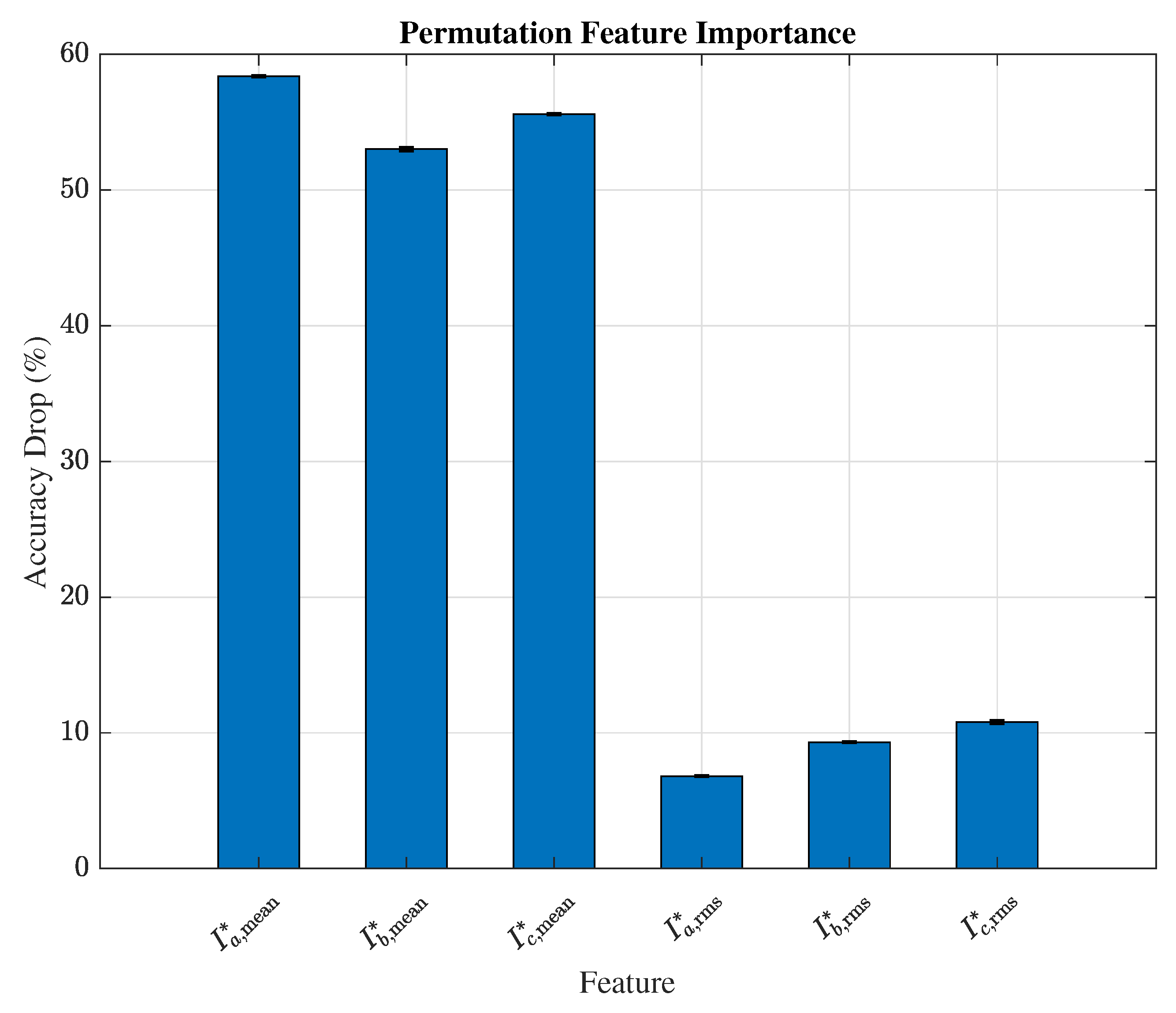
Feature-importance analysis: To further investigate the importance and contribution of each feature, a permutation-based feature importance analysis was performed. Each feature value was randomly permuted, and the decrease in classification accuracy was recorded.
Figure 13 shows that the normalized mean features are the most important inputs, compared to the normalized RMS features, confirming how they are affected by the fault effects.
Additionally, an ablation study was performed by training the same BiLSTM network on only three normalized current mean features as the inputs. As provided in
Table 5, the mean-only feature set achieved 91.2% accuracy, showing that the normalized mean values contain a significant fault signature. However, using the full feature set, including normalized mean and RMS value, can achieve the accuracy of 99.65%. It confirms that normalized RMS features provide essential complementary information.
SC fault detection vs. protection systems: In high-power inverter systems, protection mechanisms must act very quickly, often within T/6 or even less, to prevent damage and may stop powering the system. The proposed method is trained to use the pre-fault and early-fault data for SC fault detection. Therefore, even if the protection system is activated, the proposed FDD can detect the SC fault and locate the faulty switch based on the collected data before the protection system activation. It confirms that there is no conflict with protection systems, and the FDD method complements the protection systems. It enables system-level awareness for operators and controllers that can lead to timely support for post-fault recovery, maintenance or smart and fault-tolerant control decisions.
Detection Speed and Temporal Behavior: The proposed method is able to detect faults within less than half of a fundamental cycle. By using highly overlapped sliding windows updated every 0.1 ms, the method avoids waiting for a full cycle to compute new RMS and mean values. The fault-induced current signals influence the RMS and mean features immediately after fault occurrence, and the extracted features start deviating from their healthy state values. Once enough and discriminative fault signatures are developed in the input sequence, the BiLSTM model can detect the fault even before the sliding window is fully populated with faulty data. The BiLSTM network further enhances this capability by exploiting temporal dependencies in the feature sequences, resulting in accurate and fast classification.
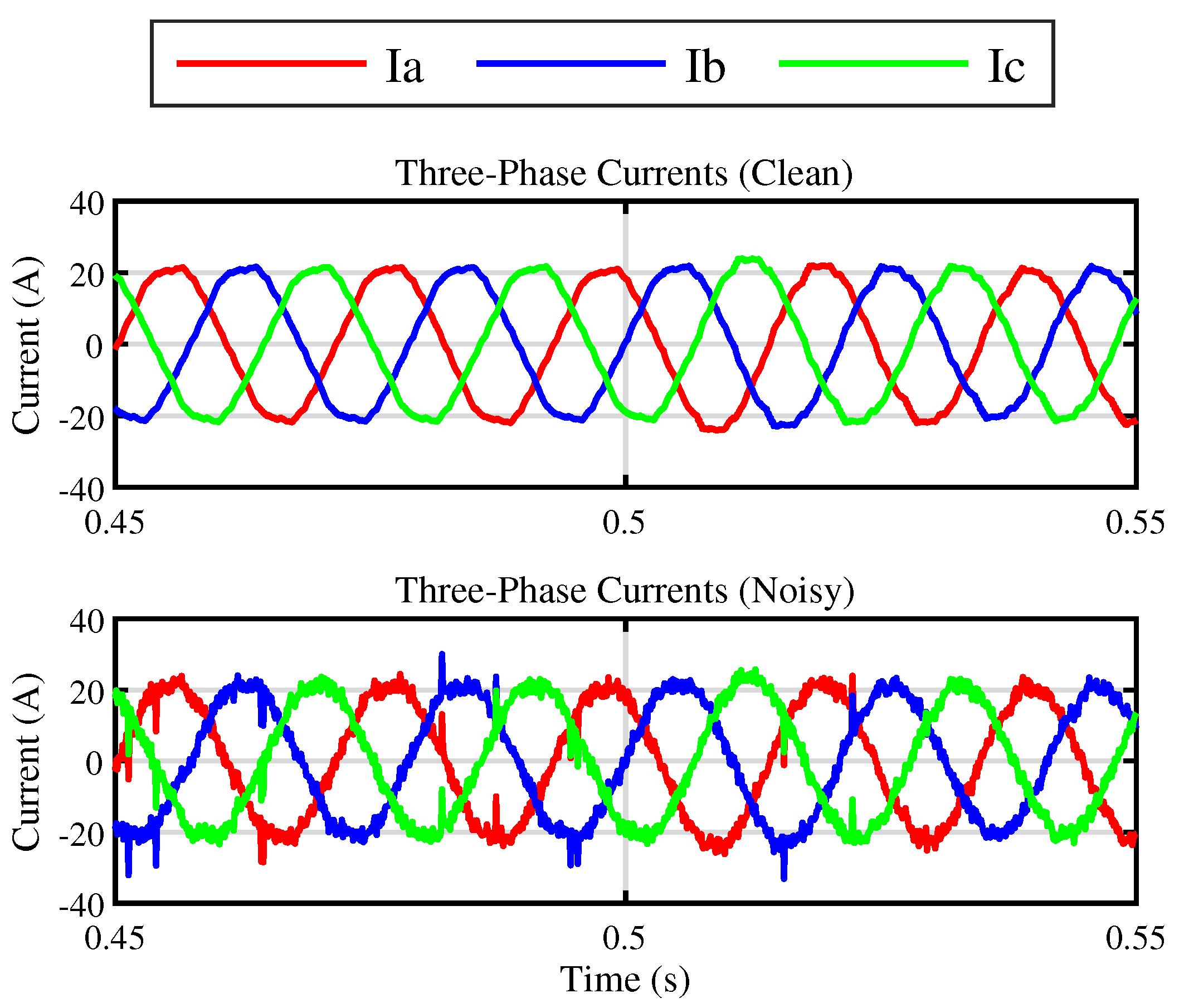
Robustness to Gaussian and Spike Noise: The proposed method demonstrates strong robustness under noisy conditions, including both white Gaussian noise and spike disturbances as a representative of some of the realistic noises. The use of RMS and mean features provides immunity to these kinds of noise due to their averaging nature over a fundamental cycle. Also, the normalization method can further remove the effects of noise. Moreover, the sequence-based learning capability of the BiLSTM network enables the model to distinguish between transient disturbances and persistent fault patterns.
Statistical Robustness Analysis: Statistical robustness was analyzed by training and testing the proposed BiLSTM network in three independent runs, during which the hyperparameters and dataset stayed the same. The mean ± standard deviation across runs is reported in
Table 6, confirming the stable performance of the proposed FDD method.
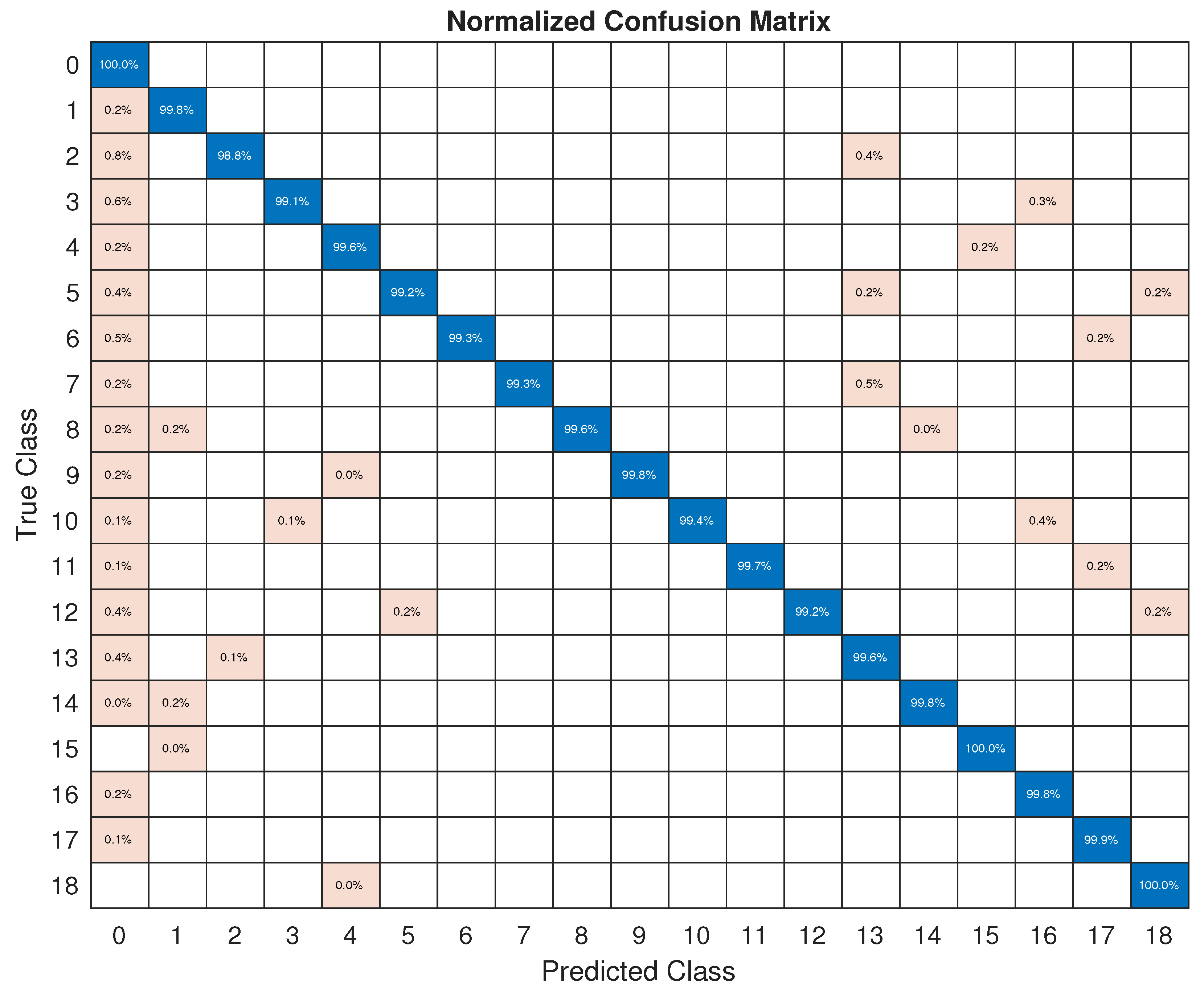
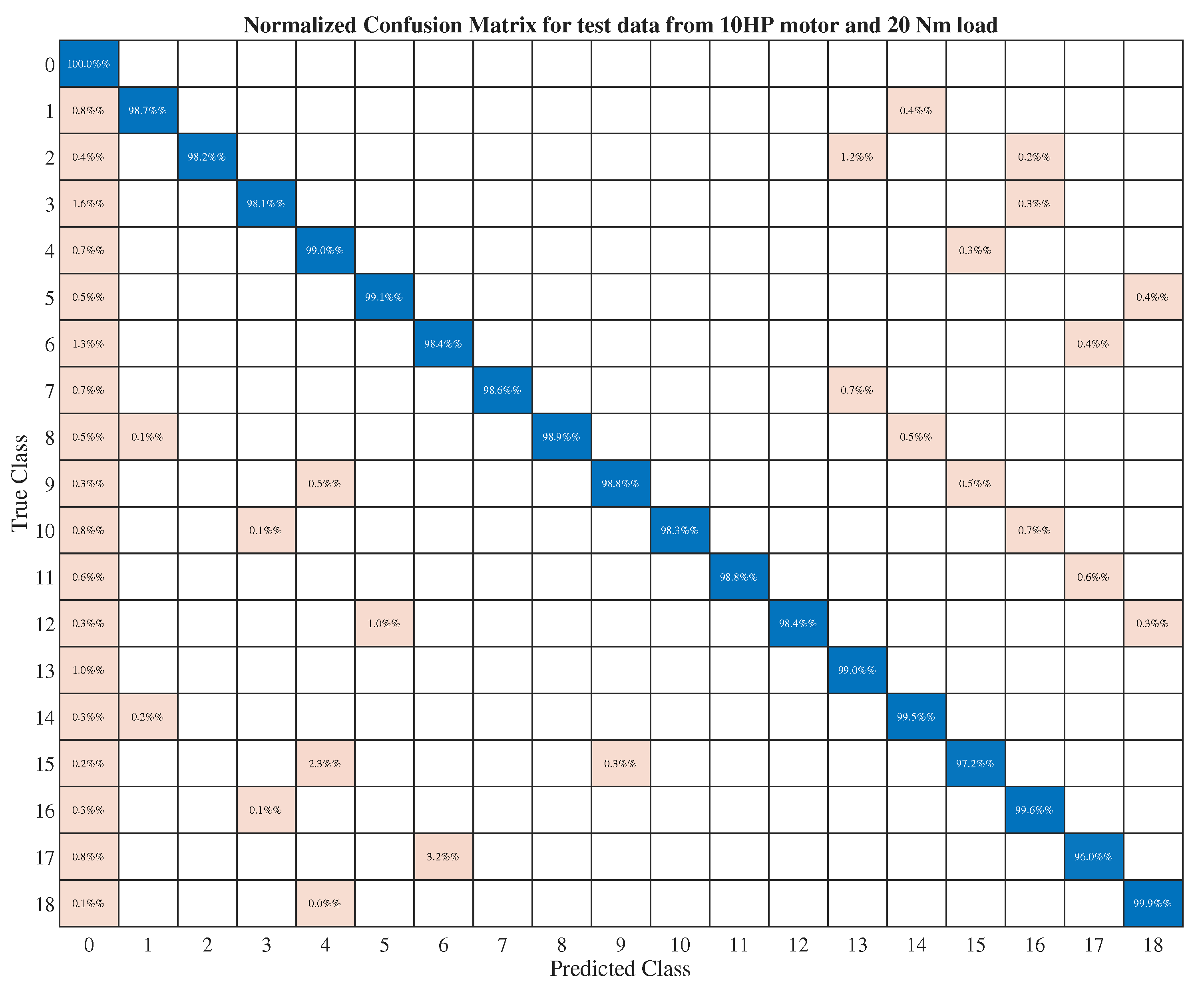
To further evaluate the performance of the proposed method, a dataset collected from a 10 HP motor drive was also used to assess overall accuracy. This dataset was generated using a 10 HP motor with different load levels from the dataset used for training, which was collected using a 5 HP induction motor. The overall accuracy for this unseen dataset reached 98.94% which not only confirms the generalization over a different motor power rating with the same V/F controller, but also confirms that the high accuracy is not due to data leakage, as it was a completely unseen dataset. The confusion matrix for this new dataset is shown in
Figure 14.
Multi-switch and intermittent fault conditions: The proposed FDD method is designed to detect and locate single-switch faults with a total of 19 classes. In practice, inverter systems may experience intermittent faults, evolving degradation, or simultaneous multiple-switch failures which fall outside the predefined single-switch fault classes.
In case of intermittent faults, if a faulty condition appears intermittently for durations longer than approximately half of the fundamental cycle, the classifier alternates between the corresponding fault class and the healthy class. This is the time that the features need to develop enough to make the classifier able to detect and locate the fault. Therefore, this repeated toggling behavior can be an indication of intermittent fault occurrence.
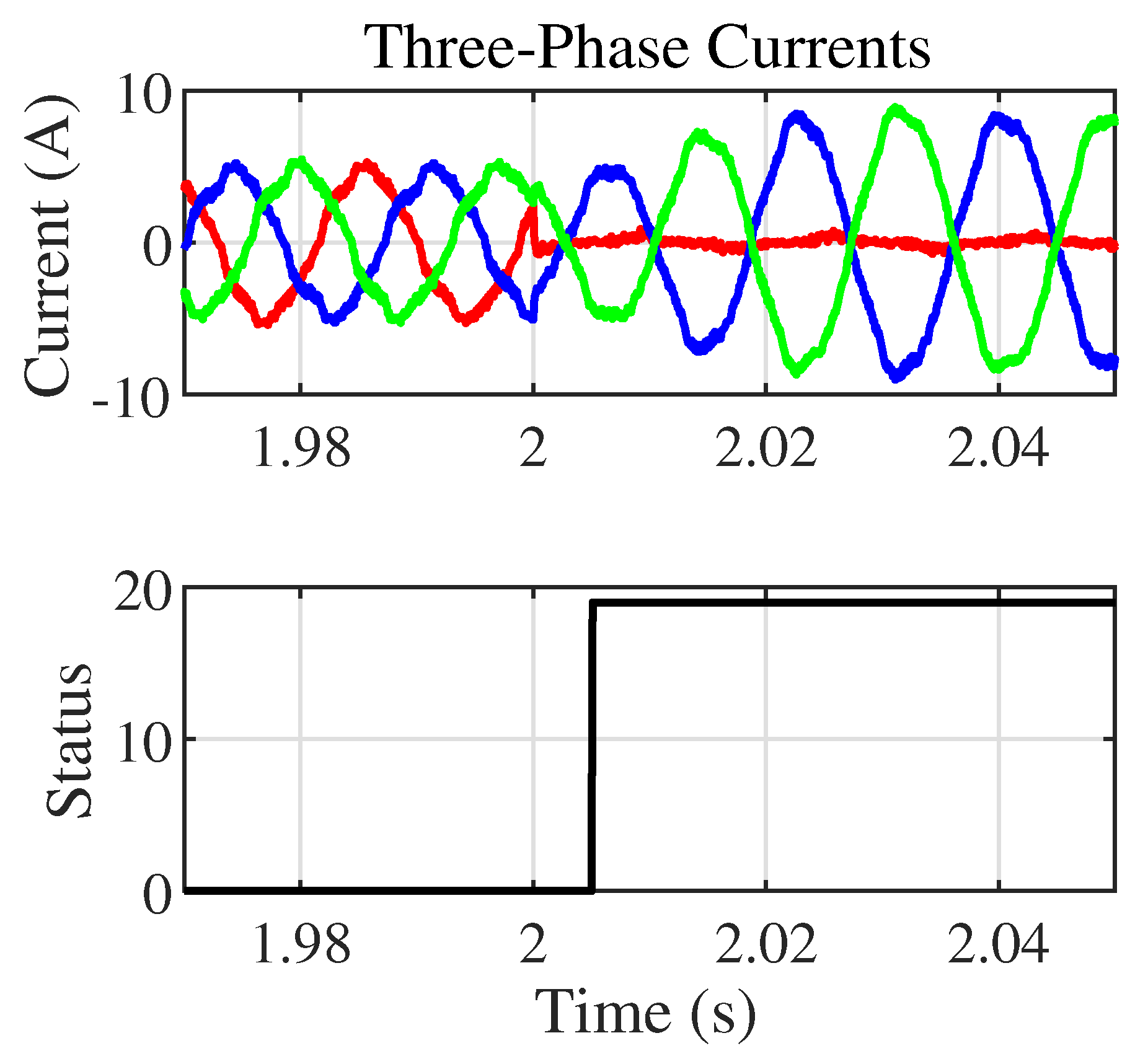
When there is a more complex and simultaneous multi-switch fault, the classifier may force the condition into a predefined class or show oscillatory output. To address this limitation and improve the practical robustness, an additional class, labeled as 19, can be added to the proposed FDD method to represent the unknown fault condition. The network was retrained with an extra dataset including features collected from various double-switch fault combinations.
Figure 15 shows an example where an OG fault occurs simultaneously in S1 and S2, and the classifier assigns the output to class 19, indicating an unknown multi-switch fault rather than misidentifying it as a single-switch fault. This extension prevents potentially dangerous misclassification of complex faults as wrong single-switch fault conditions, alerting the system operator to an abnormal state that requires further investigation.
The unknown fault class presented here serves as proof of the extension concept and the potential reliability of the proposed approach. A comprehensive multi-switch fault detection and localization will be investigated in future work.
Limitations: While the proposed method shows strong performance across various simulated operating conditions, it should be noted that it is obtained from a MATLAB/Simulink environment. Although the simulation model incorporates realistic system behavior, including varying speed conditions, multiple load levels, different motor power ratings, white Gaussian noise, and spike noise disturbances, real inverter systems are affected by sensor offsets, switching nonidealities, dead-time effects, parameter drift, quantization noise, and thermal dynamics, and they cannot be fully represented through simulation. Therefore, validation through experimental hardware implementation would provide further confirmation of the method’s applicability in real-world scenarios. Hardware-in-the-loop and experimental setup will be adopted when safe and protected conditions are available in future works. Furthermore, this study covers various types of inverter switch faults, including OG, OS and SC faults; however, it is limited to hard single-switch faults. In real-world applications, inverter systems may experience intermittent faults, progressive degradation or simultaneous multiple switch faults with weaker or overlapping fault signatures that need more complex and differentiable signatures and networks. While a concept is introduced to increase the reliability of the proposed method, future work may extend the method to detect, locate and classify more complex fault scenarios, such as incipient and multi-switch faults.
While the proposed method shows robustness to white Gaussian noise and spike disturbances, industrial inverter-based systems may be affected by a wide range of disturbances and noise, including the harmonic distortion, EMI coupling, synchronization mismatch, sensor quantization, offset drift, and colored noise. Further evaluation under such disturbances can strengthen the practical validation using an experimental setup in future works.
The investigated operating conditions were evaluated in forward motoring operation, the first quadrant, as it is the normal operating condition in many industrial induction motor applications. Regenerative mode, or highly intense dynamic operation, can be investigated in future studies.
Moreover, in future works, applying optimization techniques such as Bayesian optimization and grid search and studying state-of-the-art deep learning or hybrid diagnostic methods, such as CNN, GRU, and attention-based, can be considered to reach the optimal deep-learning architecture.
Overall, the proposed approach provides a computationally efficient and robust data-driven FDD approach with reduced model complexity and enhanced feature discriminability, making it highly suitable for inverter-fed motor drive systems in real-world applications.