
Study on a Fully Electrified Steering System and Its Control Strategies for Heavy-Duty Wheeled Platforms


Abstract
1. Introduction
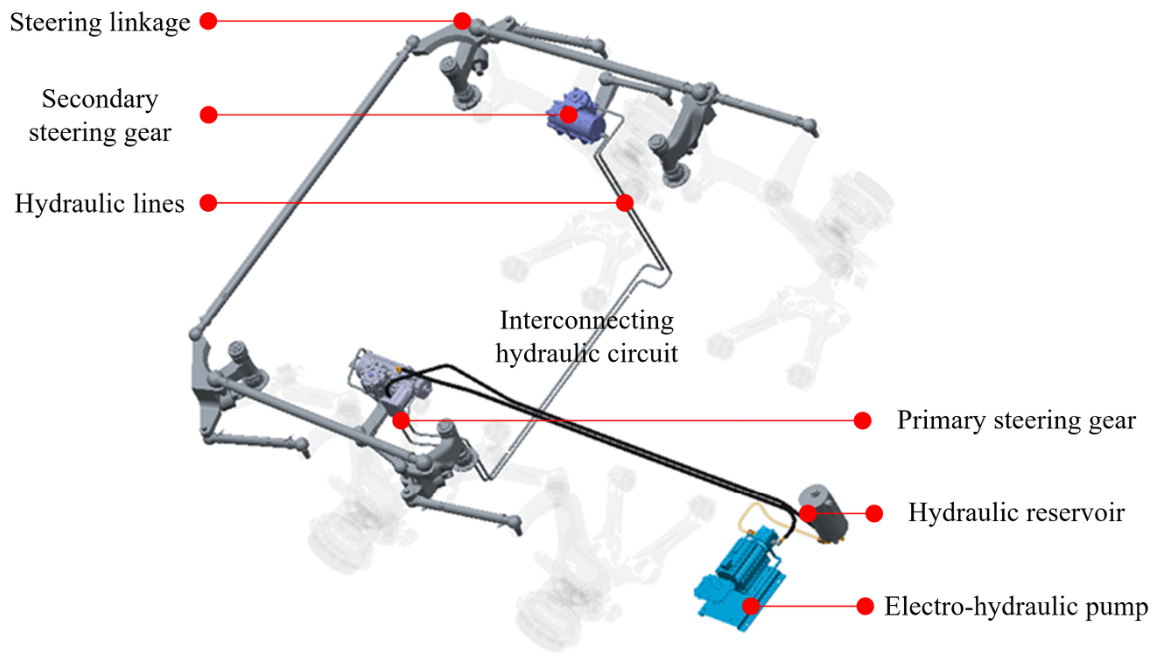
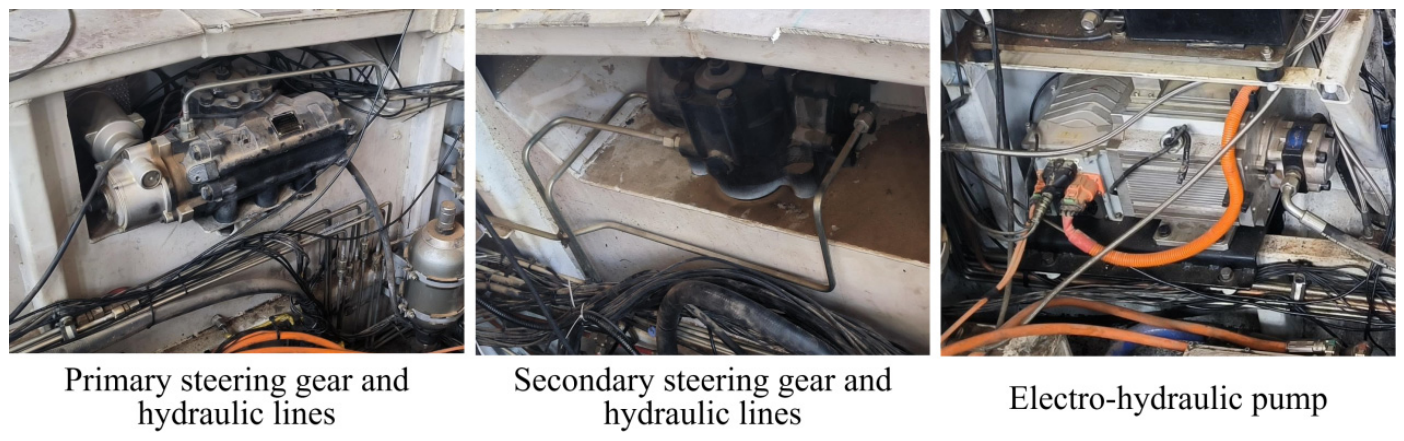
2. First-Generation Steering System Based on a Centralized Hydraulic Source
2.1. First-Generation Steering System Based on a Centralized Hydraulic Source
2.2. Existing Problems and Full Electrification Upgrade
- (1)
- The hydraulic pipelines are distributed throughout the vehicle, interspersed between various sections and structural spaces, which not only greatly increases the integration difficulty of the system but also imposes significant restrictions on the overall vehicle structure design.
- (2)
- The large hydraulic pipeline network, heavy valve groups and actuator components, and complex sealing requirements reduce system reliability and maintainability.
- (3)
- The centralized hydraulic system experiences significant energy transmission losses during operation, especially in long-distance, high-complexity piping scenarios.
- (4)
- The hydraulic system’s dynamic response is constrained by the capabilities of the hydraulic pump station, making it difficult to achieve high-frequency and precise control, thus limiting the adaptive capability of the suspension system in complex battlefield environments.
- (5)
- With the growing emphasis on lightweight, compactness, maintainability, and high mobility in modern special vehicles, the centralized hydraulic system gradually reveals many shortcomings.
- (a)
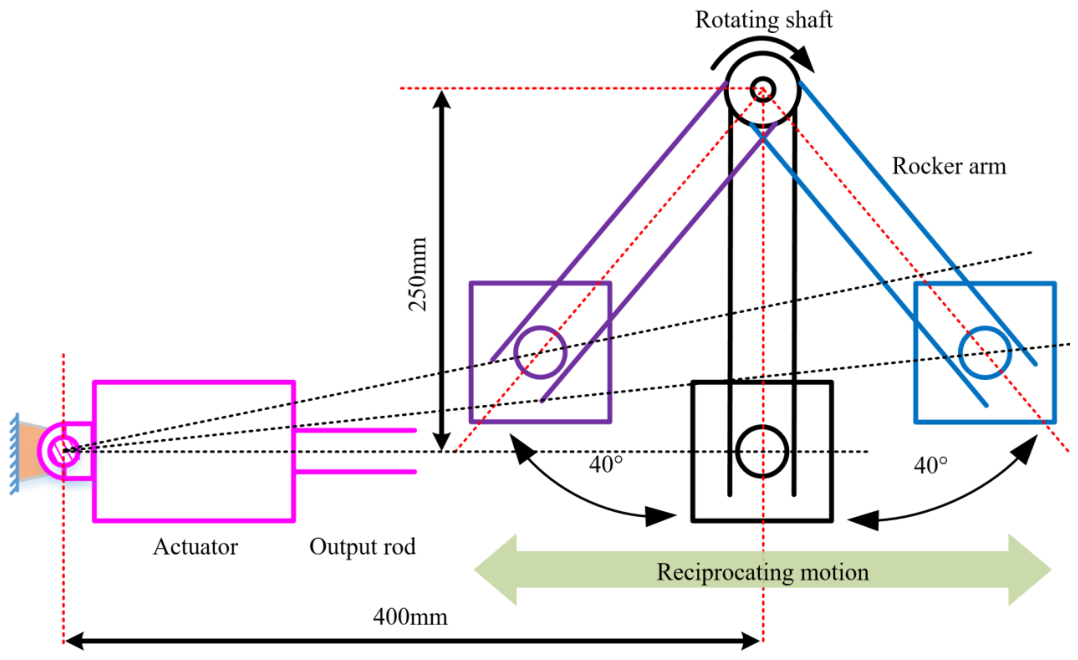
- To achieve an operating range of at least ±40°, the actuator is required to push or pull the rocker arm through the corresponding steering angle. Calculations indicate that, when the actuator output rod is at its minimum extension, the distance between the actuator tail shaft and the rotating shaft is 236 mm, with an equivalent lever arm of 147 mm; when the actuator output rod is at its maximum extension, this distance increases to 564 mm, with an equivalent lever arm of 207 mm.
- (b)
- The required maximum output torque of the steering system is 8000 Nm. When the equivalent lever arm is 147 mm, the actuator experiences the most demanding condition. Assuming an end-effector efficiency of 98%, the maximum total output force shall be no less than 56 kN.
- (c)
- The required maximum output speed of the steering system is at least 6.7 rpm. When the equivalent lever arm is 207 mm, the actuator experiences the most demanding condition. Accordingly, the actuator shall provide a maximum linear speed of no less than 146 mm/s. To satisfy the required steering angle, the effective stroke of the actuator shall be no less than 328 mm.
3. Steering System Based on a Single-Channel DEMA
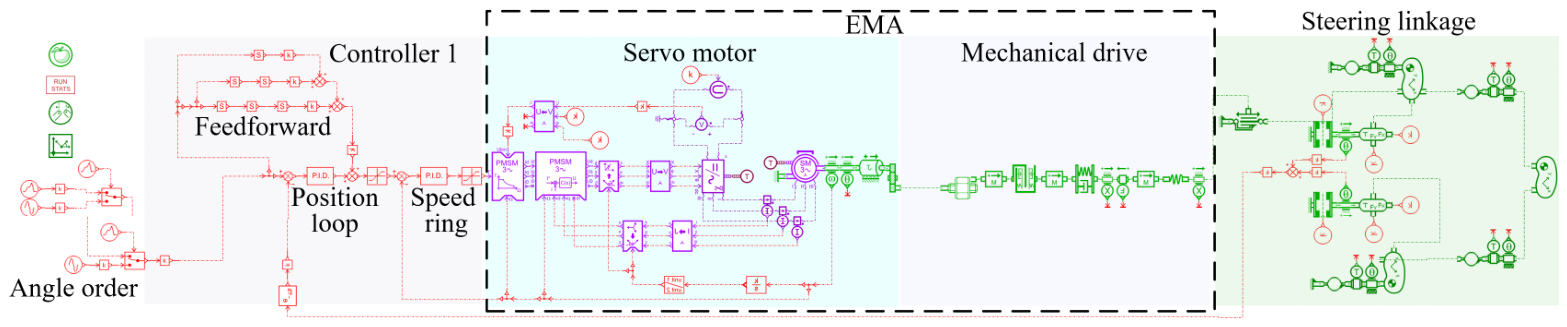
3.1. System Design
3.2. Performance Simulation Analysis
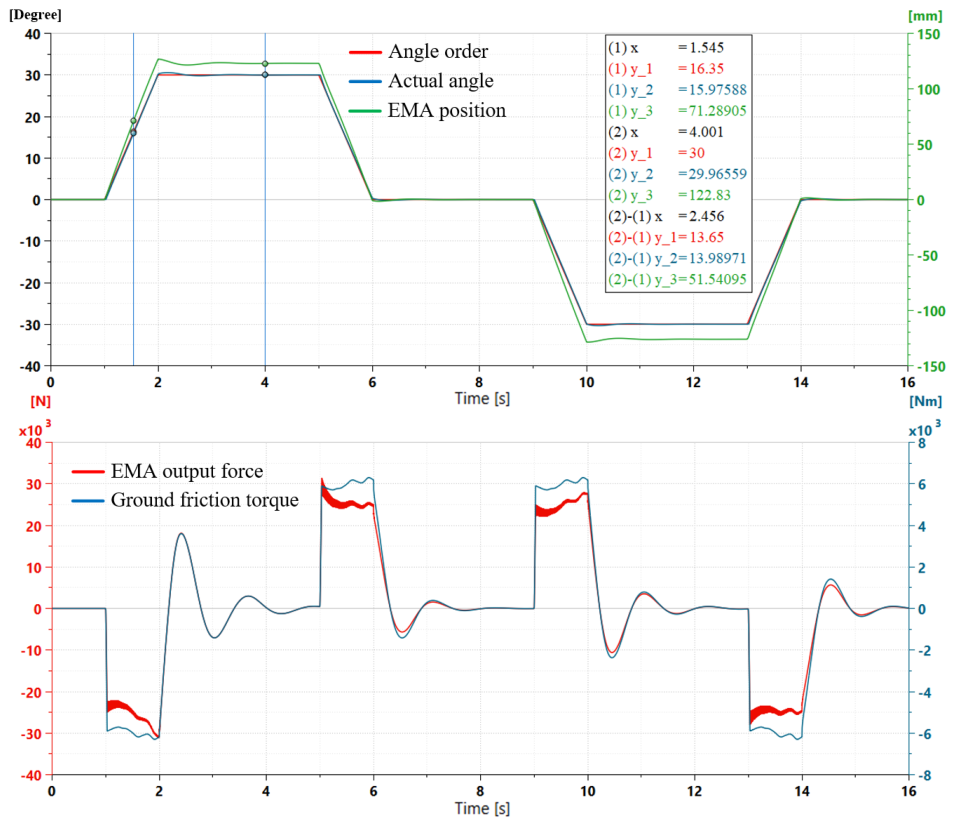
- (a)
- 0–1 s: The vehicle travels straight on a flat road.
- (b)
- 1–2 s: The steering angle changes from 0° to +30° within 1 s.
- (c)
- 2–5 s: The steering angle is maintained at +30°.
- (d)
- 5–6 s: The steering angle changes from +30° to 0° within 1 s.
- (e)
- 6–9 s: The steering angle is maintained at 0°.
- (f)
- 9–10 s: The steering angle changes from 0° to −30° within 1 s.
- (g)
- 10–13 s: The steering angle is maintained at −30°.
- (h)
- 13–14 s: The steering angle changes from −30° to 0° within 1 s, after which the vehicle resumes straight-line driving.
- (a)
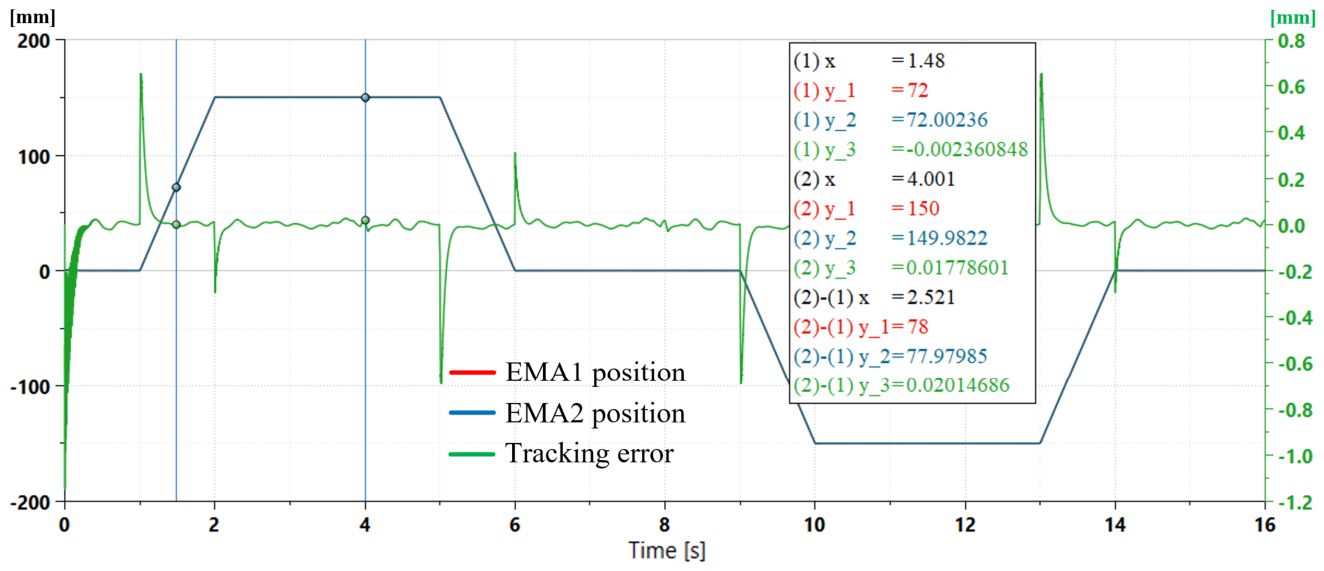
- With the introduction of the composite control strategy, the vehicle’s steering angle tracks the command signal with a fast response under a frictional resistance torque of 6000 ± 500 Nm. The system achieves high positioning and tracking accuracy, with an overshoot < 2%, a steady-state error < 0.1°, and a tracking error < 0.4°.
- (b)
- The actuator’s linear displacement corresponds well to the vehicle’s steering angle. Within the steering range of ±30°, the actuator delivers a linear output displacement of approximately ±125 mm.
- (c)
- The actuator’s linear output force remains well synchronized with the ground frictional resistance torque. Even under large steering maneuvers, the system maintains a strong dynamic response, effectively ensuring high control accuracy.
4. Steering System Based on a Dual-Channel DEMA
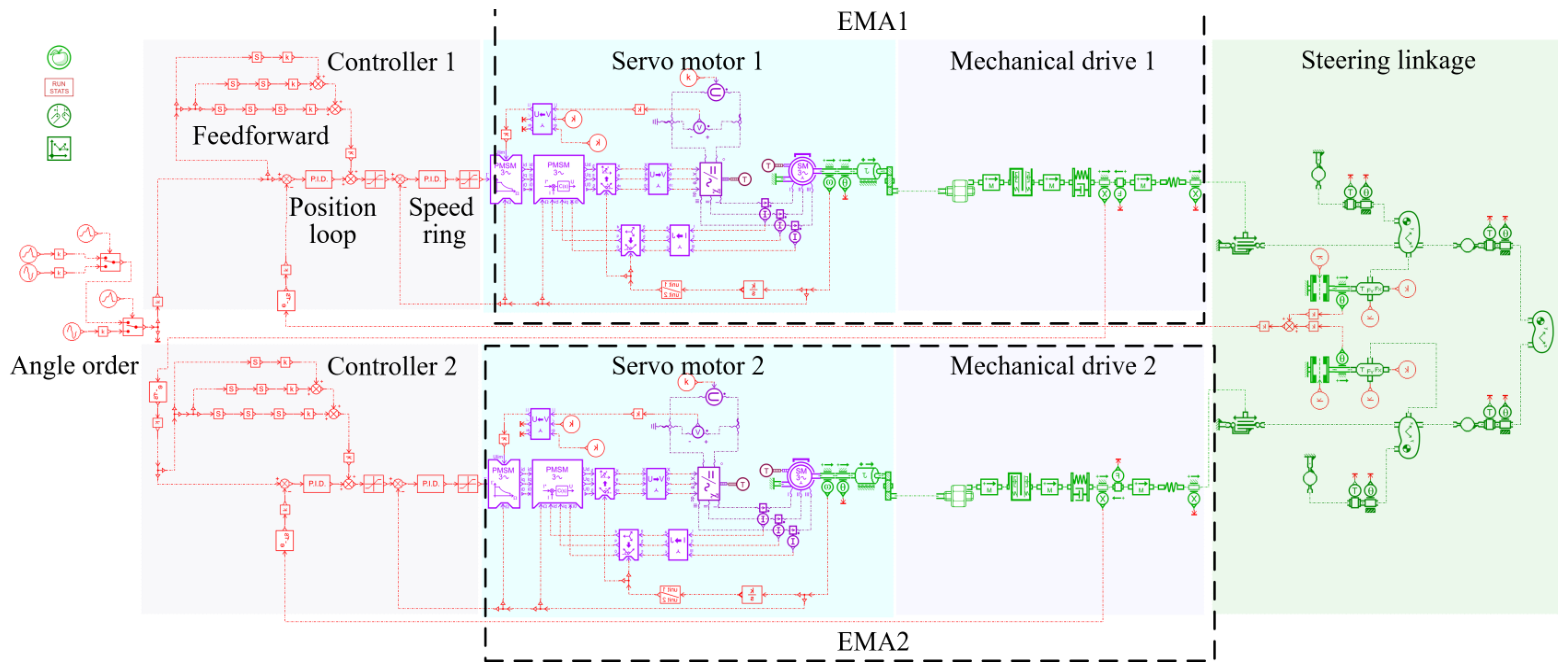
4.1. System Design
4.2. Performance Simulation Analysis
- (a)
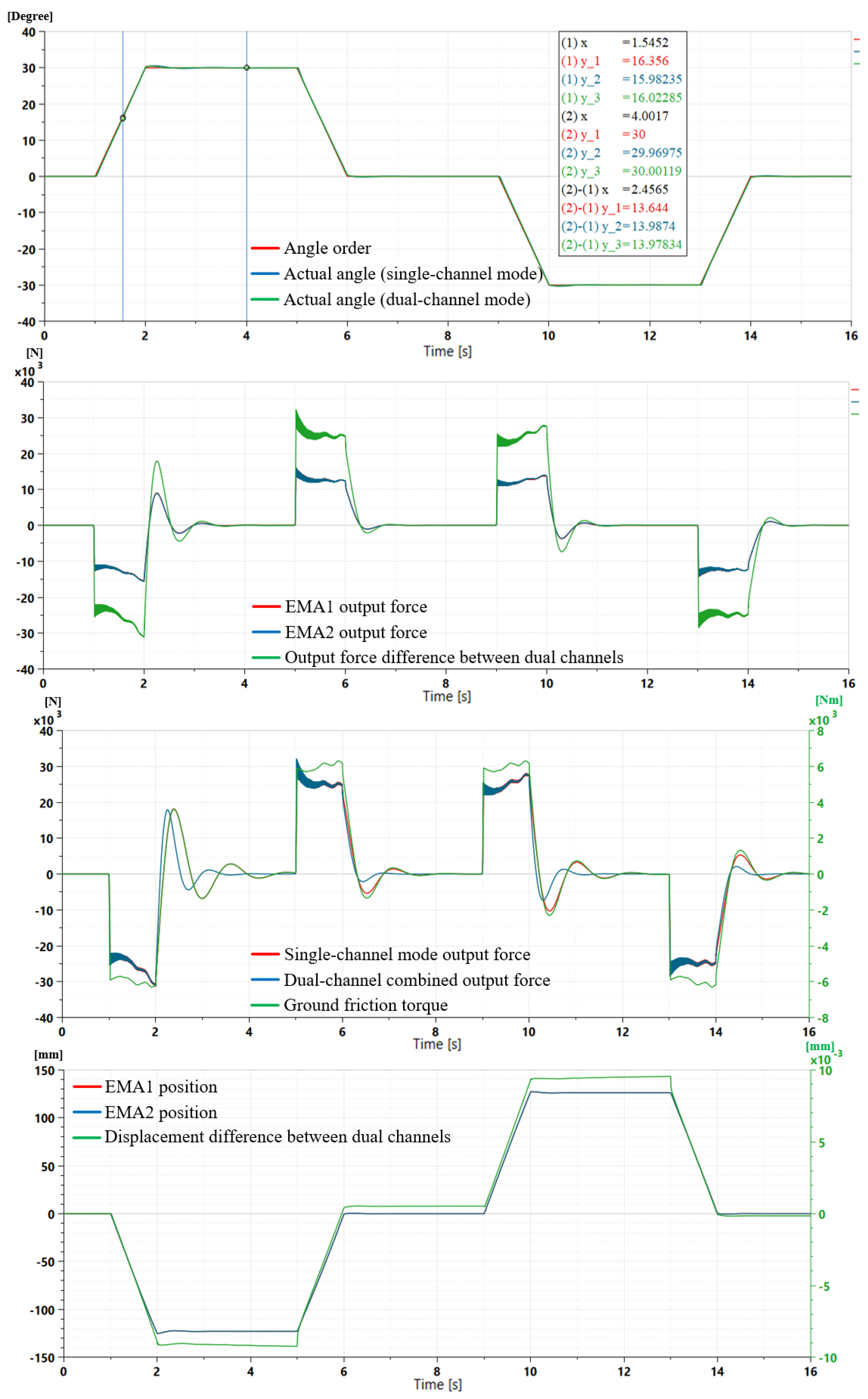
- For the steering system with two channels having identical parameters, the vehicle’s steering angle rapidly tracks the command signal, achieving both high positioning and tracking accuracy. Its dynamic performance is nearly the same as that of the steering system based on a single-channel DEMA, with an overshoot < 2%, a steady-state error < 0.1°, and a tracking error < 0.4°.
- (b)
- Throughout the steering process, the resultant force output by the two channels remains well synchronized with the variation of the ground frictional resistance torque, and the linear output forces of both channels remain identical.
- (c)
- The actuator’s linear displacement corresponds well to the vehicle’s steering angle, and the linear displacement difference between the two channels remains within 0.01 mm during the steering process, indicating excellent synchronization and no force-fighting behavior.
- (a)
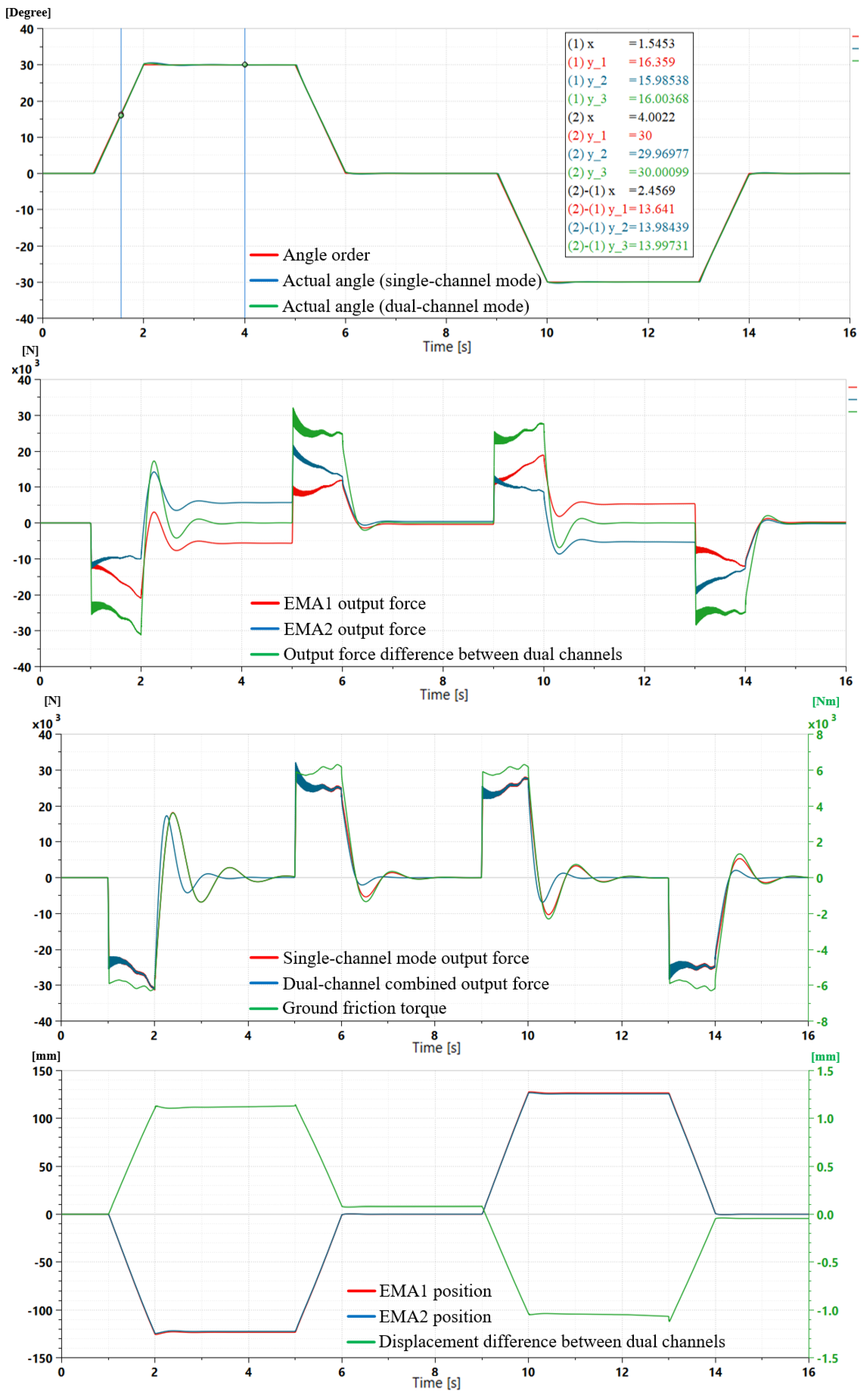
- The vehicle’s steering angle continues to rapidly track the command signal, and the positioning and tracking accuracy remain high, with an overshoot < 2%, a steady-state error < 0.1°, and a tracking error < 0.4°.
- (b)
- Throughout the steering process, the resultant force of the two channels remains well synchronized with the variation of the ground frictional resistance torque. However, due to inter-channel parameter differences, the two channels produce significantly different forces. During steering against the friction torque, one channel produces a noticeably larger force than the other, while during straight driving, the two channels produce equal and opposite forces, resulting in a force-fighting condition with a force magnitude of approximately 6 kN.
- (c)
- The actuator’s linear displacement corresponds well to the vehicle’s steering angle, but due to force fighting, the linear displacement difference between the two channels during steering increases to approximately 1.1 mm, indicating poor synchronization.
- (a)
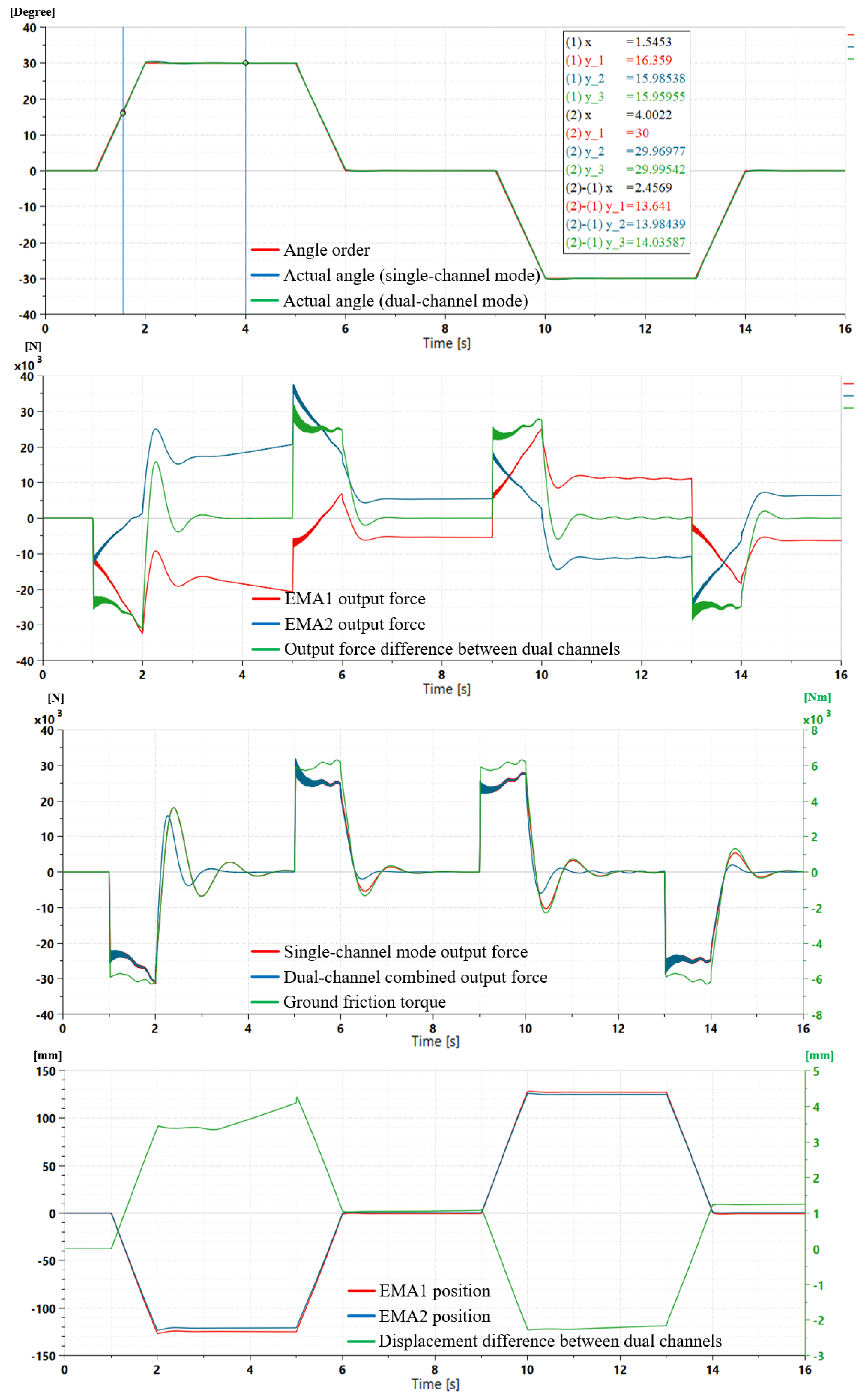
- The vehicle’s steering angle still rapidly tracks the command signal, and the positioning and tracking accuracy remain high, with an overshoot < 2%, a steady-state error < 0.1°, and a tracking error < 0.4°.
- (b)
- Throughout the steering process, the resultant force of the two channels remains well synchronized with the variation of the ground frictional resistance torque. However, larger parameter differences cause a severe imbalance between the forces produced by the two channels. During steering against the friction torque, one channel needs to overcome not only the ground friction torque but also the opposing interference force induced by the other channel, indicating mutual resistance between actuators and resulting in significantly intensified force-fighting behavior.
- (c)
- The actuator’s linear displacement still corresponds well to the vehicle’s steering angle, but the severe force fighting causes the linear displacement difference between the two channels to expand to 4.2 mm during steering, revealing very poor synchronization.
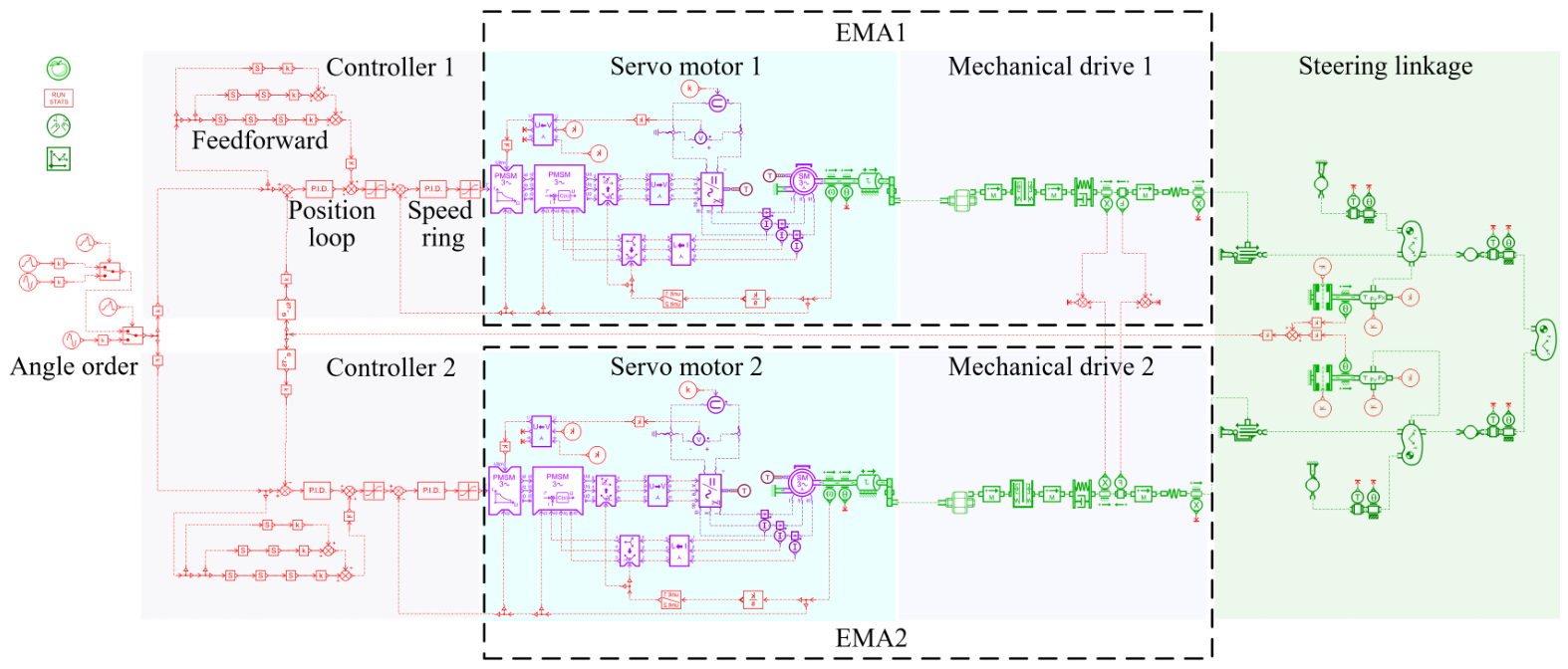
5. Synchronization Control Strategy for the Dual-Channel DEMA
- (a)
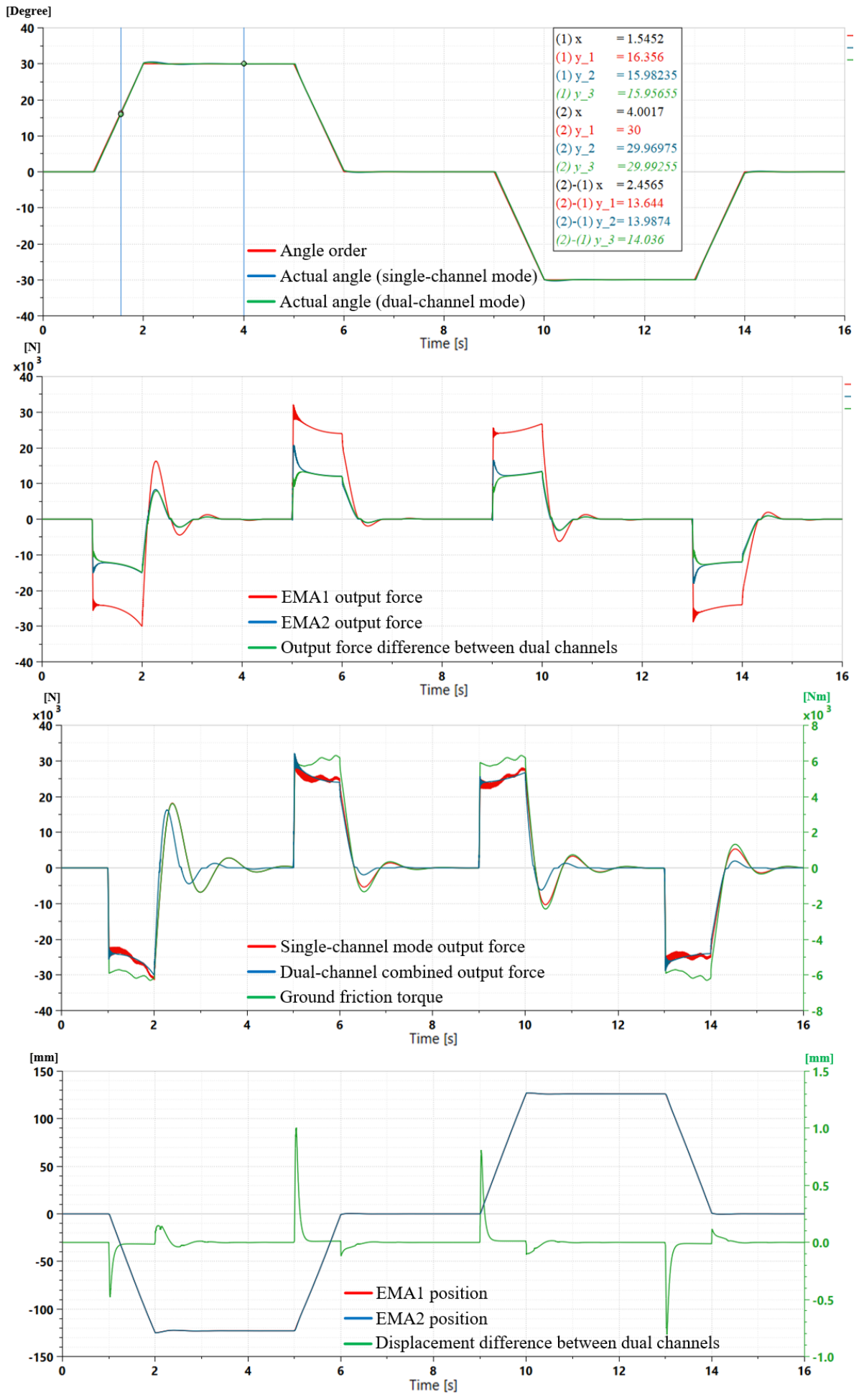
- The vehicle’s steering angle rapidly tracks the command signal, achieving positioning and tracking accuracy nearly identical to that of the steering system based on a single-channel DEMA, with an overshoot < 2%, a steady-state error < 0.1°, and a tracking error < 0.4°.
- (b)
- Throughout the steering process, the resultant force output in the dual-channel mode remains well synchronized with the variation of the ground frictional resistance torque. The transient force fluctuation occurring at the steering onset is significantly smaller than that observed in the single-channel mode. Except for a brief force-fighting behavior lasting approximately 0.2 s at the initial steering moment—caused by abrupt changes in steering velocity and acceleration—the output forces of Channel 1 and Channel 2 are identical, jointly counteracting the friction torque and exhibiting excellent force output consistency. If the steering angle and angular velocity transitions at the steering onset are further smoothed, force fighting can be almost completely eliminated.
- (c)
- The actuator’s linear displacement corresponds well to the vehicle’s steering angle. A displacement difference of approximately 1 mm appears between the two channels only at the initial steering moment, which is also the primary cause of the short-duration force-fighting behavior.
6. Conclusions
- (a)
- To address the limitations of the steering system based on a centralized hydraulic source, an integrated DEMA is adopted in this study to achieve a full electrification upgrade of both single-channel and dual-channel modes. This significantly improves system integration and maintainability, while reducing overall weight. As a result, the weight of the steering system after full electrification upgrade is reduced from 150 kg to 32 kg and 40 kg for single-channel and dual-channel modes, respectively.
- (b)
- While retaining the original steering linkage, a steering system solution based on a single-channel DEMA is proposed. This system features small weight and size, low energy consumption, and a high degree of modularity. By introducing a composite control strategy that combines three-loop PID control with feedforward control, the position-tracking accuracy and dynamic responsiveness of the system are significantly improved. However, the single-channel mode still imposes relatively high requirements on motor power and thermal management.
- (c)
- The proposed steering system based on a dual-channel DEMA effectively addresses the aforementioned issues. Furthermore, considering inter-channel parameter differences—such as measurement errors, joint stiffness, control parameters, and dynamic characteristics—which may lead to opposing outputs and position asynchrony, a primary–secondary position synchronization control strategy is proposed. This strategy ensures high positioning accuracy and excellent tracking performance of the vehicle during steering maneuvers, enabling highly consistent force output and precise position synchronization between the two channels.
Author Contributions
Funding
Institutional Review Board Statement
Informed Consent Statement
Data Availability Statement
Conflicts of Interest
Abbreviations
| DEMA | Direct-drive Electro-mechanical Actuator |
| EMA | Electro-mechanical Actuator |
References
- Chen, W.W.; Sun, X.W.; Wang, H.B. Extension coordinated control of automotive differential drive assisted steering system. Sci. Sin. Technol. 2017, 47, 324–335. [Google Scholar] [CrossRef]
- Kou, F.R.; Chang, H.T.; Wang, Q.L.; Fang, B. Research on vehicle yaw stability analysis method based on state estimation. J. Zhengzhou Univ. (Eng. Sci.) 2025, 46, 105–110, 127. [Google Scholar] [CrossRef]
- Li, Q.; Zhang, J.; Li, L.; Wang, X.; Zhang, B.; Ping, X. Coordination control of maneuverability and stability for four-wheel-independent-drive ev considering tire sideslip. IEEE Trans. Transp. Electrif. 2022, 8, 3111–3126. [Google Scholar] [CrossRef]
- Huang, J.; Zhang, B.; Wang, H.; Zhao, L.; Jiang, P. Coordinated control and torque distribution of differential steering and anti-skid driving of distributed drive electric vehicles considering stability. Proc. Inst. Mech. Eng. Part D J. Automob. Eng. 2023, 237, 2780–2796. [Google Scholar] [CrossRef]
- Choi, M.; Choi, S.B. Model predictive control for vehicle yaw stability with practical concerns. IEEE Trans. Veh. Technol. 2014, 63, 3539–3548. [Google Scholar] [CrossRef]
- Fu, Q. Stability Control System Design for Distributed Drive Electric Bus. Master’s Thesis, Zhejiang University, Hangzhou, China, 2021. [Google Scholar]
- Zhao, Y.; Deng, H.; Li, Y.; Xu, H. Coordinated control of stability and economy based on torque distribution of distributed drive electric vehicles. Proc. Inst. Mech. Eng. Part D J. Automob. Eng. 2020, 234, 1792–1806. [Google Scholar] [CrossRef]
- Hsu, Y.H.J.; Gerdes, J.C. Stabilization of a steer-by-wire vehicle at the limits of handling using feedback linearization. In Proceedings of the IMECE, Orlando, FL, USA, 5–11 November 2005. [Google Scholar] [CrossRef]
- Zheng, H.; Zong, C.; Tian, C.; Zhu, T.; Dong, Y.; Yuan, D. Control algorithm for steer-by-wire system with ideal steering ratio. J. Jilin Univ. (Eng. Technol. Ed.) 2007, 11, 1229–1235. [Google Scholar] [CrossRef]
- Wettergreen, D.; Tompkins, P.; Urmson, C.; Wagner, M.; Whittaker, W. Sun-synchronous robotic exploration: Technical description and field experimentation. Int. J. Robot. Res. 2005, 24, 3–30. [Google Scholar] [CrossRef]
- Do, A.L.; Fauvel, F. Constrained LPV control for collision avoidance using mixed steering and differential braking. Control Eng. Pract. 2025, 156, 106214. [Google Scholar] [CrossRef]
- von Vietinghoff, A.; Kiencke, U. Gain scheduling control for combined four-wheel steering and individual wheel braking. IFAC Proc. Vol. 2007, 40, 327–333. [Google Scholar] [CrossRef]
- Wang, J. Study on Differential Drive Assist Steering Technology for Electric Vehicle with Independent-Motorized-Wheel-Drive. Ph.D. Thesis, Jilin University, Changchun, China, 2009. [Google Scholar]
- Shen, Y.; Niu, T.; Liu, Z. Analysis of Energy Saving of Distributed-Drive Articulated Vehicle Based on Electro-HydraulicHybrid Steering System. J. South China Univ. Technol. (Nat. Sci. Ed.) 2022, 50, 84–92. [Google Scholar] [CrossRef]
- Jin, L.; Tian, D.; Liu, Y. Coordinated Control of DDAS and ESC Systems for Electric Vehicle Driven by In-wheel Motors. J. Mech. Eng. 2018, 54, 160–169. [Google Scholar] [CrossRef]
- Lu, S.; Xu, X.; Chen, L.; Wang, F.; Wang, W. Coordinated Control of Electronic Differential and Differential Assist Steering for Electric Vehicle Driven by In-wheel Motors. J. Mech. Eng. 2017, 53, 78–85. [Google Scholar] [CrossRef]
- Xu, X.; Lu, S.; Chen, L.; Cai, Y.; Li, Y. Trajectory Tracking of Distributed-drive Self-driving Vehicle Based on Coordination Between Autonomous Steering and Differential Steering. Automot. Eng. 2018, 40, 475–481. [Google Scholar] [CrossRef]
- Ren, F. The Discuss for Several Hydraulic Synchronization System. Sichuan Metall. 2007, 29, 44–47. [Google Scholar]
- Wu, B.; Zou, D. Research on Intelligent Control System of Several Hydraulic Cylinders’ Synchronous Operation. Mach. Tool. Hydraul. 2003, 4, 29–32+78. [Google Scholar]
- Wang, R. Study of Fuzzy-PID Controller for the Electric-hydraulic Servo System. Mech. Eng. 2009, 2, 65–66. [Google Scholar]
- Zhu, B.; Wu, R. Research for the fuzzy-immune-PID control of the electro-hydraulic servo system. China Meas. Technol. 2004, 1, 19–21. [Google Scholar]
- Qiu, S.; Hu, D.; Hu, J. Application and Comparison of Three Control Algorithm in Hydraulic Synchronization System. J. Chongqing Univ. Sci. Technol. 2007, 9, 134–139. [Google Scholar] [CrossRef]
- He, Q.; Zeng, Y. Hydraulic synchronization control based on fuzzy PID. Mach. Electron. 2001, 1, 13–16. [Google Scholar]
- Liu, J.; Xu, Z.; Guo, Y. Synchronous Control of Hydraulic Cylinders. Tech. Autom. Appl. 2002, 21, 13–14. [Google Scholar]
- Dang, K.; Zhou, R.; Lin, Y. Research on Robust Control Based on Model Reference Fuzzy Adaptive of an Electrohydraulic Position Servo System. Mach. Tool. Hydraul. 2003, 4, 208–209+71. [Google Scholar]
- Pan, Y.; Wang, Q.; Yan, X. A novel method of model reference adaptive fuzzy control in hydraulic servo system. Electr. Drive Autom. 2007, 29, 5–8. [Google Scholar]
- Sanada, K. A method of designing a robust force controller of a water-hydraulic servo system. Proc. Inst. Mech. Eng. Part I J. Syst. Control Eng. 2002, 216, 135–141. [Google Scholar] [CrossRef]
- Hsia, T.C. A new technique for robust control of servo systems. IEEE Trans. Ind. Electron. 2003, 36, 1–7. [Google Scholar] [CrossRef]
- Fang, Y.; Nie, Y.; Wang, Z. Adaptive Robust Variable Structure Control of Electro-hydraulic Servo Position System. Comput. Simul. 2006, 23, 149–154. [Google Scholar]
- Liu, Q.; Wu, X.; Shi, Y. The Research of Integral Sliding Mode Adaptive Control in Electro-hydraulic Position Control System. Mach. Tool. Hydraul. 2008, 36, 126–129. [Google Scholar]
- Yanada, H.; Shimahara, M. Sliding mode control of an electrohydraulic servo motor using a gain scheduling type observer and controller. Proc. Inst. Mech. Eng. Part I J. Syst. Control Eng. 1997, 211, 407–416. [Google Scholar] [CrossRef]
- Zhao, J.; Sokola, M.A.; Edge, K.A. Self-learning control algorithm for an injection molding machine. In Proceedings of the 17th International Conference Hydraulics and Pneumatics, Ostrava, Czech Republic, 5–7 June 2001. [Google Scholar]
- Shinada, M.; Kojima, E. Improvement of acceleration tracking accuracy of electro-hydraulic vibration testing machine. In Proceedings of the JFPS International Symposium on Fluid Power, Tokyo, Japan, 14–17 November 1999; pp. 631–636. [Google Scholar] [CrossRef]
- Tewes, Q.; Harms, H.H. Fuzzy control for an electro-hydraulic load-sensing system. In Proceedings of the Fluid Power Systems, Ninth Bath International Fluid Power Workshop, Bath, UK, 9–11 September 1996. [Google Scholar]
- Pai, K.R.; Shih, M.C. Multi-speed control of a hydraulic cylinder using self-tuning fuzzy control method. In Proceedings of the JFPS International Symposium on Fluid Power, Tokyo, Japan, 6–9 September 1999; pp. 99–104. [Google Scholar] [CrossRef][Green Version]
- Burton, R.T.; Ukrainetz, P.R.; Nikiforuk, E.H. Neural networks and hydraulic control: From simple to complex applications. Proc. Inst. Mech. Eng. Part I J. Syst. Control Eng. 1999, 213, 349–358. [Google Scholar] [CrossRef]
- Zhao, Z.; Fang, Y.; Liu, K. Internal model control of electro-hydraulic servo systems. Opto-Electron. Eng. 2008, 35, 1–5. [Google Scholar]
- Wang, J.; Wen, G.; Ji, J. Application of Robust Control in the Electro-hydraulic Loading System. Mach. Tool. Hydraul. 2008, 36, 100–103. [Google Scholar]
- Zhao, Y.; Fang, Y.; Liu, K. Design of Robust Control Based on Internal Model Control for Electro-hydraulic Position Servo System. Control Eng. 2007, 14, 50–53. [Google Scholar] [CrossRef]
- Yang, F.; Xu, J.; Guan, S.; Jiang, M. Research on Static Error Free Tracking Control of Electric-hydraulic Position Servo-system. Hydraul. Pneum. 2007, 1, 33–35. [Google Scholar]
- Zheng, S.; Fu, Y.; Wang, D.; Zhang, W.; Pan, J. Investigations on system integration method and dynamic performance of electromechanical actuator. Sci. Prog. 2020, 103, 1–35. [Google Scholar] [CrossRef] [PubMed]




Disclaimer/Publisher’s Note: The statements, opinions and data contained in all publications are solely those of the individual author(s) and contributor(s) and not of MDPI and/or the editor(s). MDPI and/or the editor(s) disclaim responsibility for any injury to people or property resulting from any ideas, methods, instructions or products referred to in the content. |
© 2026 by the authors. Licensee MDPI, Basel, Switzerland. This article is an open access article distributed under the terms and conditions of the Creative Commons Attribution (CC BY) license.
Share and Cite
Zheng, S.; Qin, T.; Wei, J.; Cheng, J.; Yuan, X.; Zhu, J. Study on a Fully Electrified Steering System and Its Control Strategies for Heavy-Duty Wheeled Platforms. Machines 2026, 14, 684. https://doi.org/10.3390/machines14060684
Zheng S, Qin T, Wei J, Cheng J, Yuan X, Zhu J. Study on a Fully Electrified Steering System and Its Control Strategies for Heavy-Duty Wheeled Platforms. Machines. 2026; 14(6):684. https://doi.org/10.3390/machines14060684
Chicago/Turabian StyleZheng, Shicheng, Tianxiang Qin, Jingkun Wei, Jiaming Cheng, Xiaming Yuan, and Jihong Zhu. 2026. "Study on a Fully Electrified Steering System and Its Control Strategies for Heavy-Duty Wheeled Platforms" Machines 14, no. 6: 684. https://doi.org/10.3390/machines14060684
APA StyleZheng, S., Qin, T., Wei, J., Cheng, J., Yuan, X., & Zhu, J. (2026). Study on a Fully Electrified Steering System and Its Control Strategies for Heavy-Duty Wheeled Platforms. Machines, 14(6), 684. https://doi.org/10.3390/machines14060684