1. Introduction
Spherical mobile robots have attracted continuous attention owing to the ability of a closed outer shell to protect internal mechanisms and to the fundamental differences between rolling locomotion and wheeled or legged motion. Conventional spherical robots typically achieve locomotion by shifting an internal mass or actuating internal mechanisms within a rigid shell. In contrast, the robot investigated in this study generates motion through the localized deformation of the outer shell. Selective extension of outer modules alters the local contact conditions with the ground, and the resulting change in body geometry induces rolling motion.
From a mechatronic perspective, this actuation principle is advantageous because locomotion is realized through geometric reconfiguration of the shell rather than through large internal mass displacement. The resulting motion is, however, highly dependent on the robot’s instantaneous posture and contact state. Identical extension commands do not necessarily yield identical responses, as the effective support geometry varies with body orientation. Accordingly, a physics-based simulation environment is essential for design-stage evaluation of the proposed mechanism.
This paper aims to present the mechanical design of the proposed robot, elucidate its deformation-induced rolling mechanism, develop a physics-based simulation environment for design-stage analysis, and report preliminary observations from a fabricated spherical robot. The principal contribution of this work is the introduction of a diameter-varying spherical robot concept, together with a simulation framework that preserves the essential geometric characteristics and temporally coordinated actuation required to analyze its contact-driven rolling behavior.
The paper is organized as follows. Followed by the introduction,
Section 2 reviews related work.
Section 3 describes the mechanical design and the locomotion principle of the robot, along with the development of a diameter-varying spherical robot.
Section 4 presents the physical simulation environment.
Section 5 reports the simulation results and preliminary observations with the fabricated robot.
Section 6 discusses the results, and
Section 7 concludes the paper.
2. Related Work
Previous studies on spherical mobile robots can be broadly categorized into robot design, actuation mechanisms, and motion control. Several review papers have summarized prior work on spherical robots from the perspectives of design, modeling, control, and applications [
1,
2]. In many conventional spherical robots, locomotion is generated by internal mechanisms while the outer shell remains rigid. Halme et al. discussed the fundamental motion control of a spherical mobile robot [
3]. Bhattacharya and Agrawal investigated the design and motion planning of a spherical rolling robot [
4]. Chase and Pandya reviewed the active mechanical driving principles of spherical robots, including pendulum-driven and mass-shifting mechanisms [
5]. Alves and Dias also reported the design and control of a spherical mobile robot [
6]. These studies establish the fundamental background of spherical robot research. However, in most cases, the external geometry of the robot remains unchanged during motion.
Another important research area is motion planning and control. Due to the nonholonomic constraints and nonlinear dynamics inherent in spherical locomotion, motion generation and control remain challenging problems. Mukherjee et al. addressed motion planning for a spherical mobile robot by revisiting the classical ball–plate problem [
7]. Zheng et al. investigated path-following control based on nonholonomic kinematics and dynamics [
8]. Hou et al. considered a spherical robot with multiple motion modes and proposed planning and control methods with mode switching [
9]. Svinin and Hosoe studied the motion planning of a rolling sphere with limited contact area [
10]. Ling et al. also proposed a predictive control method for a pendulum-driven spherical robot [
11]. These studies indicate that the control of spherical robots remains an active and important research topic.
The development of real robotic systems has also progressed. Michaud et al. presented an autonomous spherical mobile robot for child-development studies [
12]. Abe and Kanamori reported a spherical shell robot capable of both rolling and legged locomotion [
13]. Schröder et al. described the development and control of a physical spherical robot [
14]. Bujňák et al. recently introduced SpheriDrive, a spherical robot prototype designed for rescue operations in confined environments [
15]. These studies demonstrate that spherical robot research has expanded from fundamental mechanisms to practical robotic systems. Nevertheless, many of these robots still employ a fixed outer shell, with motion primarily generated by internal actuation mechanisms. A related example of external shape-changing locomotion is the bionic sea urchin robot proposed by Mateos et al. [
16], in which telescopic spine actuators are distributed over a spherical body, and the robot moves by extending the spines. In contrast, our proposed robot changes the local shell surface by extending selected outer modules, rather than using spine-like appendages.
The proposed robot described in the paper does not rely primarily on internal mass displacement within a rigid shell. Instead, rolling motion is achieved through the local extension of selected outer modules, which directly modifies the contact geometry between the robot and the ground. In our previous study, we developed a wheel-type robot, locally transforming the diameter for the locomotion [
17]. By installing the machine learning technique, the robot achieved robust rolling locomotion to overcome a step [
18]. In this study, we extend the idea of the transformation of the outer circumference into a spherical robot for omni-directional rolling locomotion. In the wheel-type mechanism, the effect of diameter change is mainly constrained to the rolling direction of the wheel. In contrast, the spherical body generates omni-directional rolling locomotion by extending the selected outer-shell modules to control the ground-contacting configuration. By considering the enhancement of the geometric variation in the deformable body, it is essential to analyze not only the actuation mechanism itself but also the relationships between shell deformation, robot posture, contact conditions, and the resulting motion. From this perspective, this paper presents a diameter-varying spherical robot and a physics-based simulation environment for investigating its rolling behavior. The proposed approach provides a foundation for the design and simulation of spherical robots with reconfigurable outer-shell geometries.
Table 1 compares previously introduced spherical robots from the viewpoints of geometric structures, actuating mechanisms and locomotion features.
3. Design and Prototyping of a Diameter-Varying Spherical Robot
3.1. Robot Design and the Geometric Analysis for Body Deformation
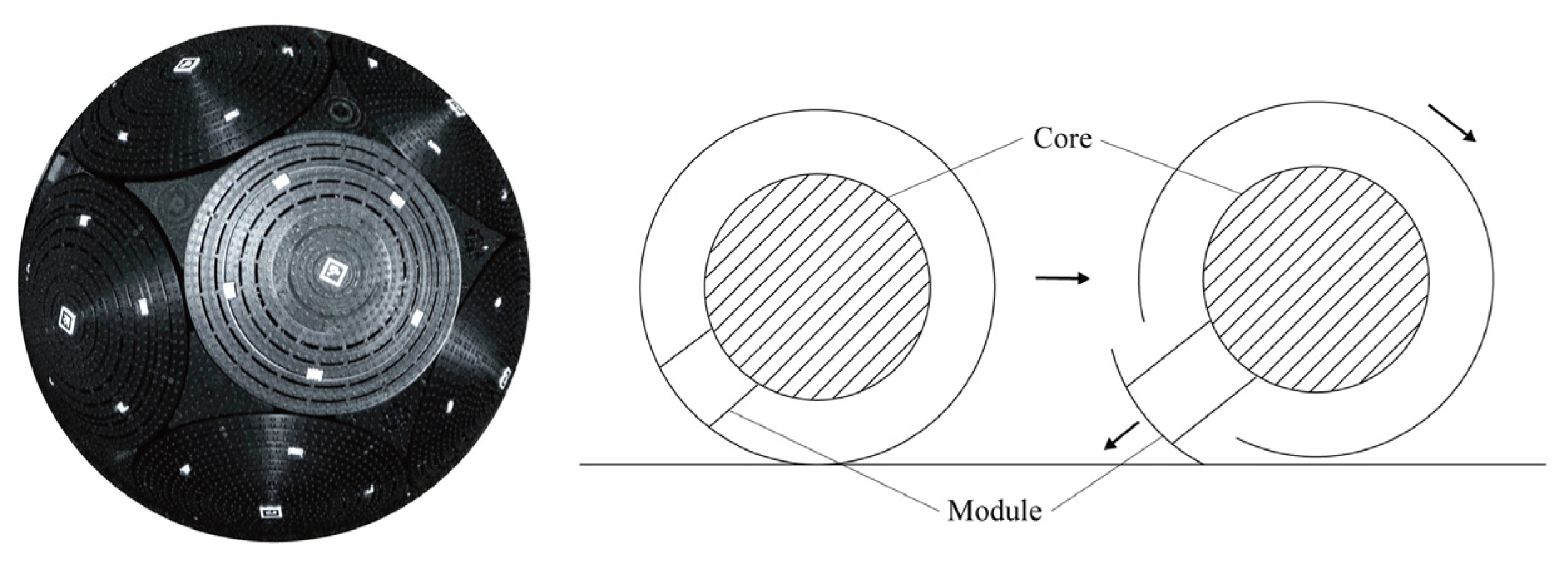
A novel diameter-varying spherical robot generates rolling locomotion by locally deforming its outer shell. The body consists of 12 movable outer modules arranged around a central core, and the overall shape is designed to remain spherical in the nominal state. As shown in
Figure 1, when selected modules are extended, they push the ground to induce rolling locomotion, and the geometry change modifies the geometric condition of the robot.
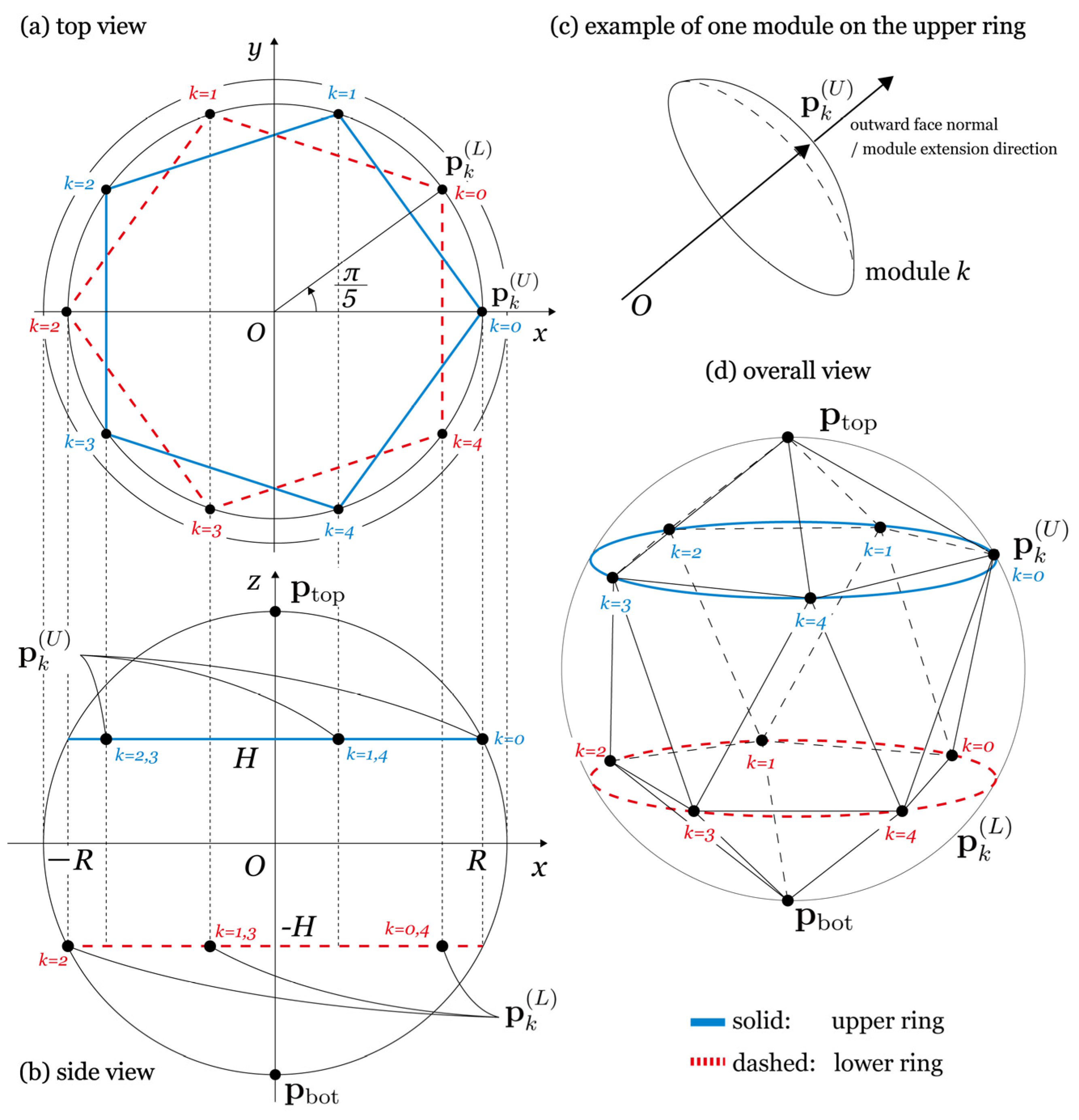
The shell geometry is designed based on the face arrangement of a dodecahedron. This geometric body is selected because the face normals are distributed nearly uniformly in the whole surface of the spherical body. Each movable outer module is assigned to one face, and its extension direction is aligned with the corresponding outward normal.
To define the face-center arrangement, the dodecahedron-based shell is placed so that one pair of opposite face centers lies on the
z-axis as shown in
Figure 2. With this orientation, the 12 face centers are decomposed into two polar points, and two pentagonal rings are located between them. The face-center positions are defined in a body-fixed coordinate system whose origin is placed at the center of the robot. Here,
denotes the radius of the upper and lower pentagonal rings in the
x-
y plane,
denotes the radius of the common circumscribed sphere of the face centers, and
denotes the ring height.
The two polar points are written as
Since all face centers lie on the common circumscribed sphere, the geometric relation
holds. Furthermore, from this relation together with the geometry of the regular dodecahedron,
and
are obtained as
Using these parameters, the five face centers on the upper ring are written as
where
. The five face centers on the lower ring are rotated by
with respect to the upper ring and are written as
As presented in
Figure 2, the upper and lower pentagonal rings correspond to
and
, respectively.
Figure 2a shows the top view of the two pentagonal rings,
Figure 2b shows the side view used to define the heights and ring radius,
Figure 2c illustrates one representative movable module, its face center, and the associated outward face normal, and
Figure 2d presents the overall arrangement of the two rings and the two polar points.
This coordinate model is employed as the geometric basis for module placement in CAD, and is also used consistently in the simulation environment. In the present robot, the coordinate set is scaled so that the circumscribed radius becomes R = 200 mm.
3.2. Deformation Mechanism and Actuation
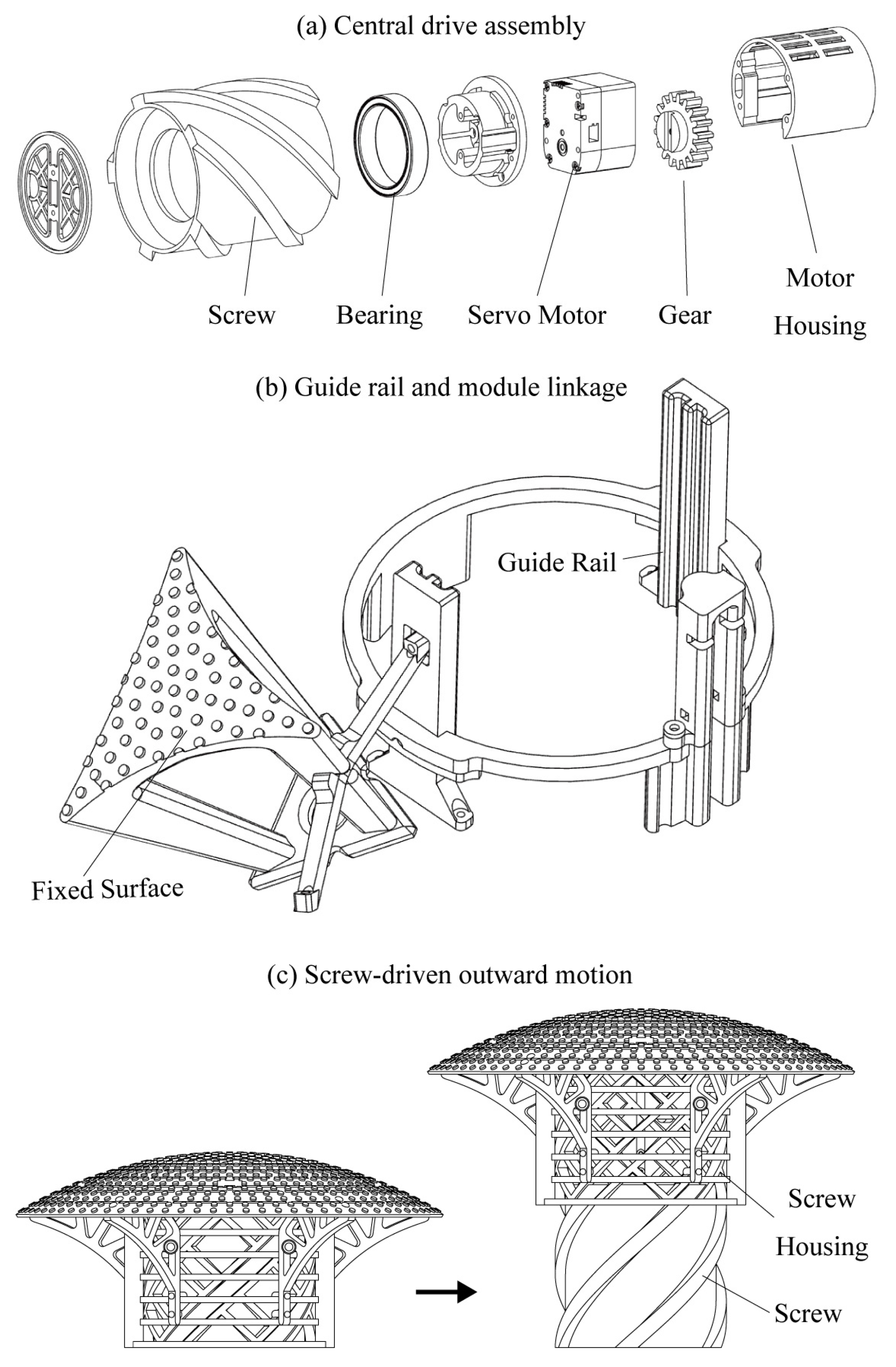
The module articulation is realized by a central screw-driven lifting mechanism. A cylindrical screw housing with helical grooves is placed at the center of the body, and each movable outer module is coupled with the screw housing through an engagement structure. When the screw rotates, the module is pushed outward along its assigned face-normal direction. In the spherical robot, the screw is driven by a KRS-5054HV ICS H.C command servo (Kondo Kagaku Co., Ltd., Arakawa-ku, Tokyo, Japan).
Figure 3 illustrates the central actuation mechanism and the translational guidance structure.
A guide rail structure is used to prevent the module from rotating together with the screw. The guide rail constrains the module so that it moves along the prescribed face-normal direction. This structure is essential because the robotic locomotion depends mainly on the repeatable local deformation of the outer shell while avoiding large internal mass displacement. The screw mechanism and the guide rail therefore work together to realize stable local deformation while keeping the shell geometry consistent.
3.3. Embedded System and Mechanical Configuration
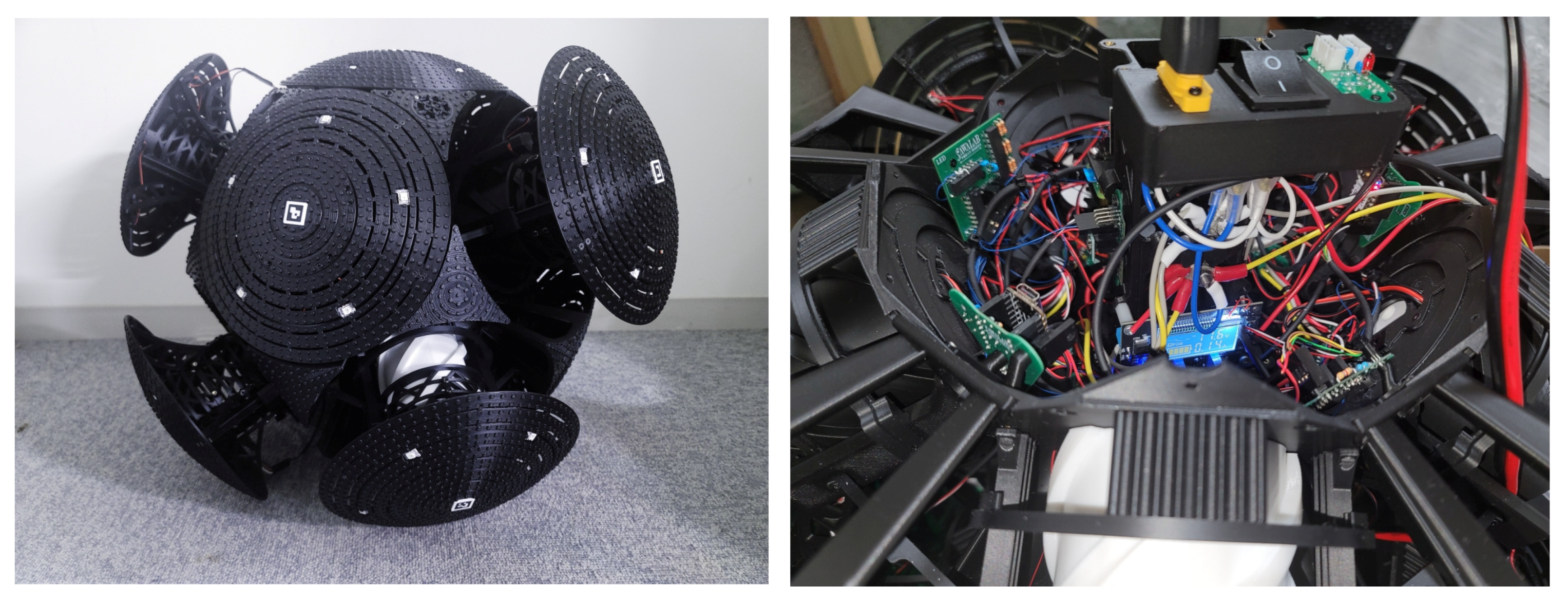
The designed mechanism was implemented as a spherical robotic system. The shell modules and main internal support components were fabricated by 3D printing using PLA. A Raspberry Pi Zero 2W (Raspberry Pi Ltd., Cambridge, UK) was employed and placed in the central core of the robot as the main control computer. Distributed XIAO RP2040 (Seeed Studio, Shenzhen, China) nodes were used for low-level tasks such as motor actuation, inertial sensing, and LED control. This configuration reduced the processing load of the central controller and simplified the handling of multiple sub-systems functioning in the limited internal space.
For rotational state observation, AE-BNO055-BO 9-axis sensor-fusion module using a BNO055 IMU (Akizuki Denshi Tsusho Co., Ltd., Tokyo, Japan) is employed. The IMU internally fuses acceleration, angular velocity, and geomagnetic measurements, and outputs the estimated orientation in quaternion form. In the present robotic system, this output is used directly for rotational state observation. This configuration is sufficient for the basic demonstration stage addressed in the latter chapter.
The shell surface also includes AR markers and RGB LEDs. These devices support external observation, debugging, and interpretation of the robot state during experiments. The AR markers are placed at the face centers, and the LEDs are arranged on the shell surface so that the orientation of the robot can be visually recognized from the outside.
Figure 4 shows the appearance of the constructed robot, where four modules are extended by applying module extension commands.
The robot is powered by Zeee 11.1 V 120C 1500 mAh 3S LiPo battery (ZEEE POWER Co., Limited, Hong Kong SAR, China), which is also placed in the central core, with a nominal voltage of 11.1 V. At the current development stage, the hardware experiment described in the paper should be regarded as an initial feasibility check rather than a fully functional locomotion demonstration. The principal specifications of the fabricated sphere robot are summarized in
Table 2.
The robot moves by locally changing its outer shape through module extension. When a selected outer module is extended, it pushes the contacting ground and the support configuration is modified. This change in support geometry gives rise to a rolling tendency. In this way, rolling locomotion is generated through local deformation of the outer shell.
4. Physical Simulation of Spherical Robot Locomotion
4.1. Simulation Platform Overview
A physics-based simulation environment was developed to investigate the rolling behavior induced by localized shell deformation. The environment functions as a unified platform, in which command timing, physical state updates, and data logging are managed in a consistent manner.
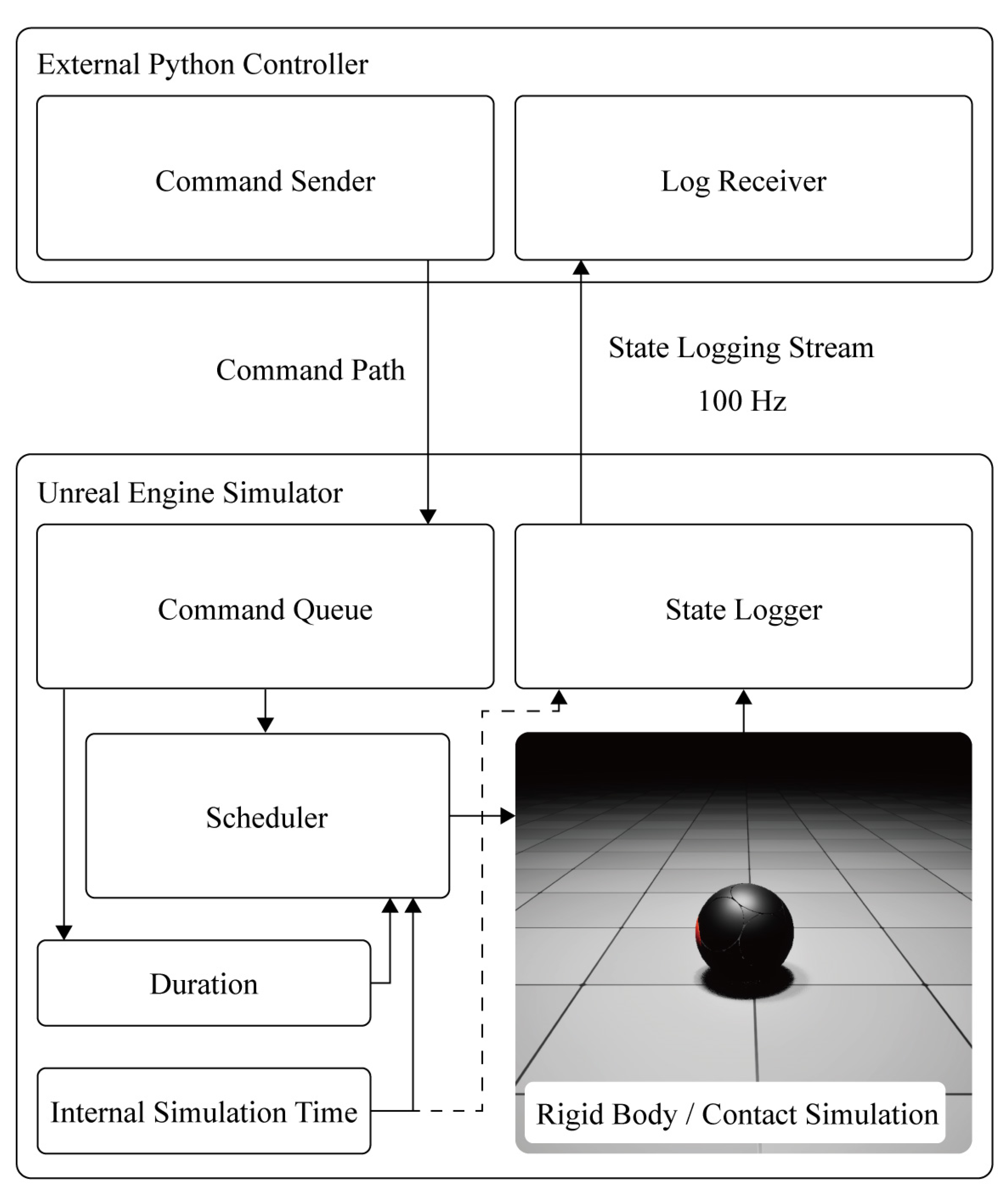
The physical simulation was implemented using Unreal Engine and coupled with an external Python-based controller via OSC communication. Unreal Engine was responsible for rigid-body dynamics, contact computation, module state updates, and state generation, whereas Python handled command generation, transmission, and data logging. This architecture enables the integration of physical simulation, external control, and state recording within a single framework.
The key feature of the proposed system is its time-managed architecture. External commands generated in Python are transmitted to Unreal Engine, interpreted with respect to the internal simulation time, and executed at the designated simulation step. Consequently, the robot can be operated interactively from an external process while maintaining temporal consistency within the simulation.
Figure 5 illustrates the overall system architecture, including the command interface, the internal simulation time base, and the data logging pipeline.
4.2. Coordinate Systems and Geometric Consistency
Internal processes for planning, logging, and data processing were defined in a right-handed coordinate system, whereas Unreal Engine employs a left-handed world-coordinate frame. Coordinate transformations were applied exclusively at the interface between Unreal Engine and the external modules. This approach ensures consistency in the definition of state variables during logging and subsequent post-processing.
The shell geometry used in the simulation was aligned with the design-stage geometric model described in the previous section. Specifically, the placement of shell modules in Unreal Engine is based on the same dodecahedron-derived face-center coordinates. This alignment preserves consistency in the interpretation of module orientations between the simulation and the design model. Such geometric consistency is critical in this study, as the rolling behavior is directly governed by local shell deformation and contact geometry. Accordingly, a unified geometric representation was maintained throughout the design, simulation, and data logging processes.
4.3. Time Management and Command Application
Time management constitutes a key feature of the present simulation environment. The simulator employs an internal fixed-step time base as the reference for module updates, command execution, and state logging. Rendering and external communication are processed independently of this internal time base. This design ensures reproducibility of the simulated behavior even when the rendering rate varies.
4.4. Collision Representation and Contact Settings
In Unreal Engine, the visual mesh and the collision model are treated as separate entities. The robot body is visually represented by a detailed shell model, while the physical simulation employs a dedicated collision representation. To improve the stability of contact computations, convex decomposition was applied, and the robot geometry was approximated by a set of convex collision primitives.
This collision representation was selected because rolling motion was sensitive to discontinuities in contact switching. When the collision model is overly coarse, abrupt changes in the contact point location can generate unstable reaction forces. In the present simulation, the collision model is configured to ensure stable contact behavior during repeated rolling trials and to maintain physically plausible motion.
The contact interaction between the robot and the ground was further tuned using Physical Material settings in Unreal Engine. The dynamic friction coefficient was set to 0.9, the static friction coefficient to 1.2, the friction combined rule to Max, and the restitution coefficient to 0.01. These values were used as nominal contact parameters required in the physical simulation, and the influence of friction variation was additionally examined by changing the friction coefficients in the sensitivity analysis. In addition, sleep thresholds for both translational and angular motion were introduced to suppress residual motion. The main simulation parameters are summarized in
Table 3.
Each outer module is treated as an independent component, whose position is updated in a body-relative coordinate frame. The initial module positions are defined based on face-center coordinates derived from a dodecahedral geometry. Extension and retraction of each module are modeled as continuous-time updates along the corresponding outward normal direction. Let
denote the initial position, and
denote the outward unit normal vector. The module position is then given by
where
represents the time-dependent extension ratio. This update is applied at each simulation step.
The actuation interface was designed to allow commands transmitted from Python to include explicit timing information. In the current implementation, a push command serves as the primary interface for module actuation. Commands can be queued together with their respective start times and durations, and are executed according to the internal simulation time. In the present study, these commands were predefined open-loop commands for demonstration, rather than closed-loop control inputs generated from online feedback. Consequently, commands received from the external controller prior to their scheduled execution time remain valid, and are applied when the simulation time reaches the specified start time, which makes the command timing reproducible across repeated trials.
This mechanism is essential for real-time external operation. An operator can issue commands while the simulation is running, and each command is executed at the intended time within the internal simulation time frame.
4.5. State Logging and Real-Time Operation
Communication between Unreal Engine and Python was implemented in an asymmetric manner. Low-frequency actuation commands were transmitted from Python to Unreal Engine, while state data were streamed in the reverse direction. This design reflects the system architecture, in which control inputs are issued externally as needed and the simulator continuously records the resulting physical state.
The state logging system recorded the simulation time, position, orientation, translational velocity, angular velocity, current module extensions, target extension references, and remaining actuation times at approximately 100 Hz. Inclusion of the simulation time in each record enabled direct synchronization between logged data and externally issued commands.
This capability is essential to the effectiveness of the proposed environment. The simulator functions as a time-managed experimental platform in which externally supplied commands, internal state evolution, and recorded outputs are unified through a common simulation time base. Consequently, the timing of command execution can be precisely analyzed, the resulting contact-driven motion can be systematically evaluated, and repeated trials can be compared under consistent conditions. In addition, real-time external manipulation of rolling behavior is supported during simulation.
5. Physical Simulation and Verification by the Real Spherical Robot
5.1. Physical Simulation Results
In simulation, the objective is to examine whether local shell deformation modifies the support geometry in a manner consistent with deformation-induced rolling. In hardware verification, the objective is to provide an initial prototype-level validation of the same actuation principle. Accordingly, this section presents a simulation-based quantitative and qualitative demonstration of feasibility rather than a detailed performance evaluation.
Demonstration trials were conducted in a physical simulation environment by transmitting module actuation commands from an external Python controller and observing the resulting robot motion. Because the simulator employs a fixed-step internal time base with scheduled command execution, the sequence of actuation, contact interaction, and state logging can be examined under consistent temporal conditions.
In representative trials, extension of selected outer modules altered the local support geometry and produced corresponding rolling motion. The resulting behavior depended on the instantaneous body orientation and contact state, consistent with the state-dependent characteristics of the proposed mechanism. The simulation environment remained stable over repeated observations of deformation-driven motion, indicating that the adopted collision representation and contact parameter settings are suitable for design-stage investigation of the proposed robot.
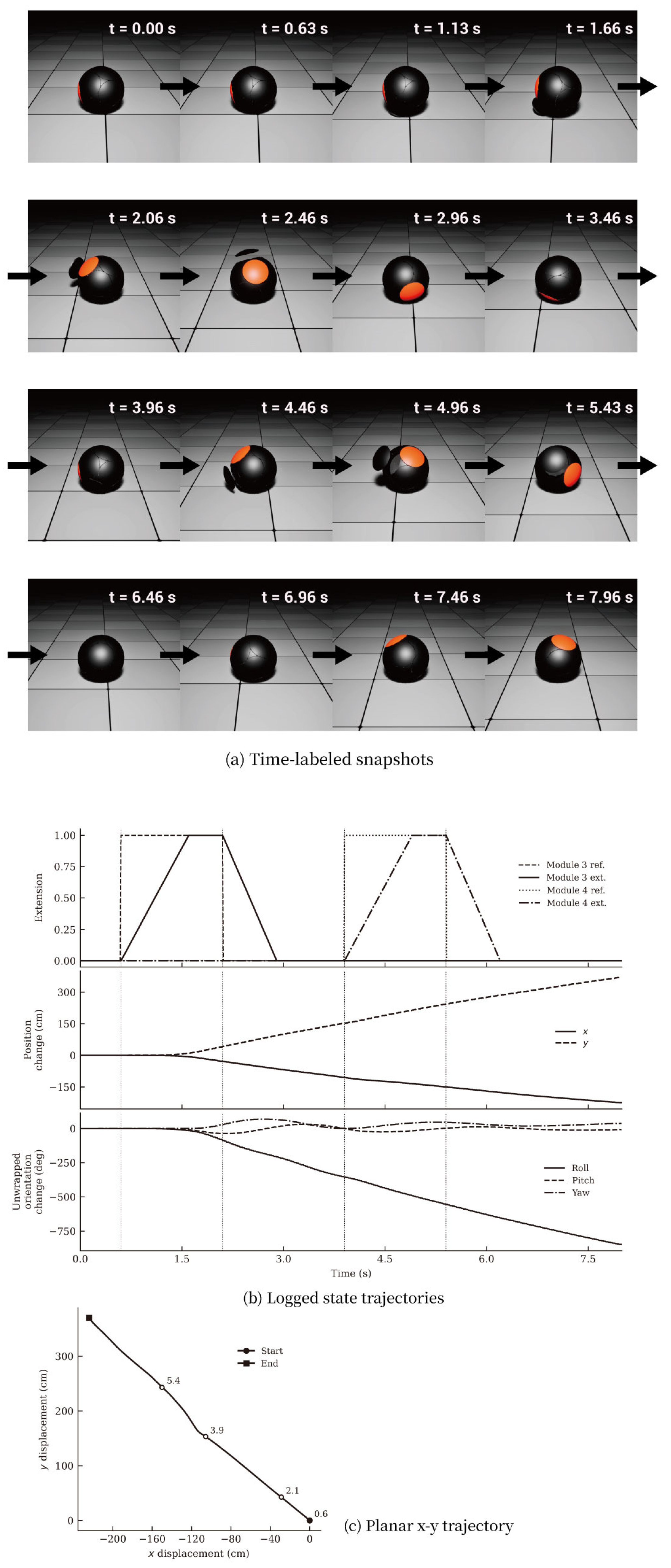
Figure 6 presents a representative simulation sequence and the corresponding logged state trajectory, highlighting the relationship between module extension and the resulting motion. The plotted trajectory was obtained from the state log recorded at 100 Hz, which included the module extension, body displacement, and body orientation during the representative trial. These results suggest that the simulation environment provides a practical platform for analyzing the influence of local shell deformation on rolling behavior.
A simple friction sensitivity check was also conducted using the same initial condition and the same open-loop command sequence. The static and dynamic friction coefficients were changed from the nominal setting to lower and higher settings. This check was conducted once for each friction condition to examine whether the deformation-induced rolling response was still observed under different contact parameters. As summarized in
Table 4, the horizontal displacement at 8.0 s was 432.72 cm, 428.03 cm, and 427.57 cm for the nominal, low-friction, and high-friction conditions, respectively. The accumulated rotation at 8.0 s was 848.76 deg, 838.88 deg, and 836.07 deg, respectively. These results suggested that the rolling response was observed in all tested friction settings, although this check was limited to a single representative trial for each condition and did not provide a statistical evaluation of friction robustness.
5.2. Preliminary Demonstration of a Fabricated Spherical Robot
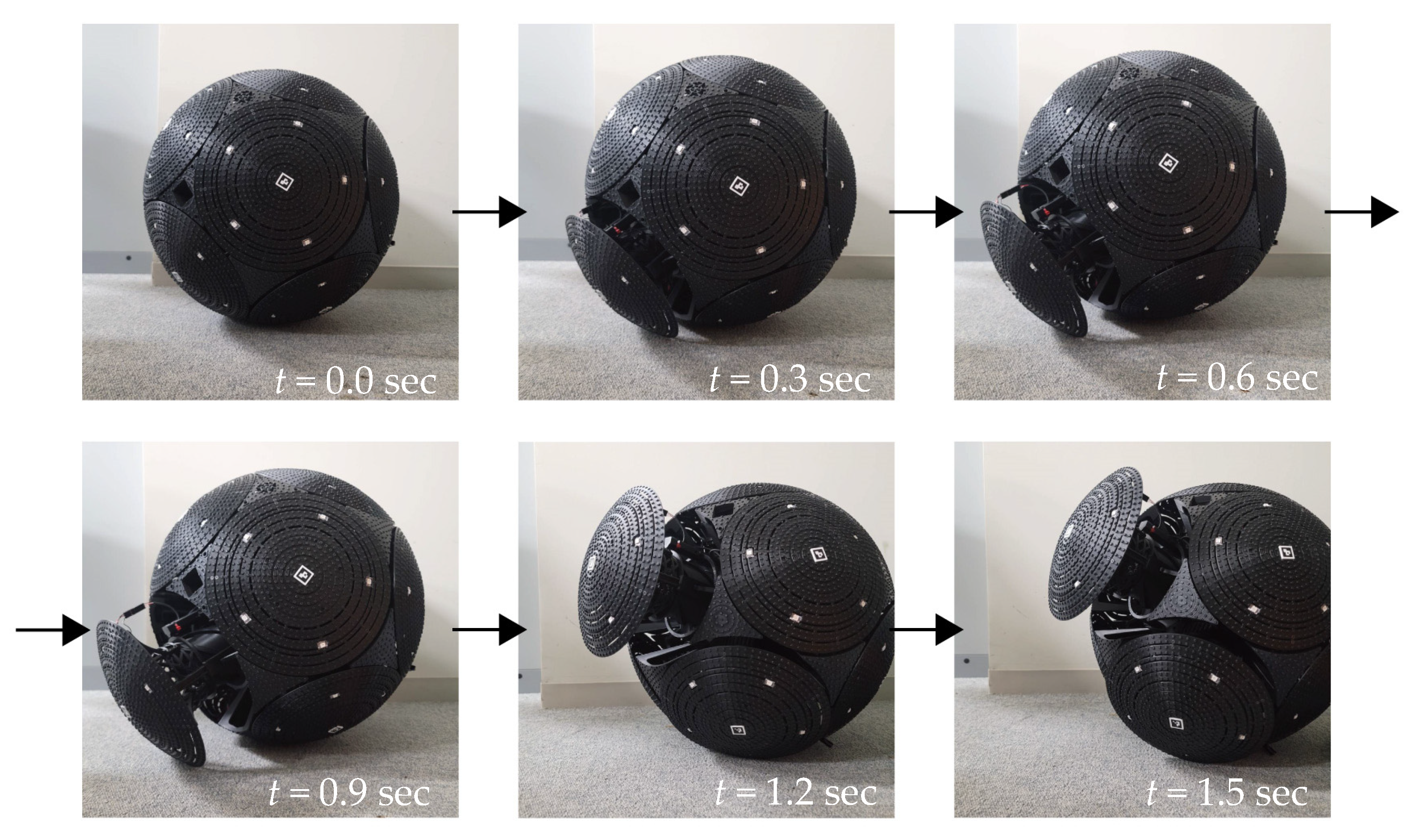
By using the constructed spherical robotic system, the proposed deformation-induced rolling principle was examined. In the experiments, selected outer modules were actuated, and the resulting body motion was visually observed. As shown in
Figure 7, in which representative snapshots from the experiments are presented, rolling behavior associated with module extension was observed in the fabricated robot, indicating that the proposed actuation principle can be physically implemented in robotic hardware. In the repetition of rolling demonstration, however, we found that the locomotion is influenced by physical factors such as imbalance of mass distribution, contact conditions with a floor, and the upper limit of the module extension speed, which cause unpredictable behavior of locomotion.
6. Discussion
The study demonstrated that rolling motion can be induced by local shell deformation in the diameter-varying spherical robot. In the proposed mechanism, motion is generated not by a large internal moving mass, but by local changes in shell geometry and the resulting variation in support configuration. This characteristic distinguishes the proposed system from conventional internally actuated spherical robots, and highlights the importance of geometry-consistent simulation during the design phase.
The developed physical simulation environment served as a useful tool for design-stage investigation, as it enabled the analysis of the relationships among module actuation, contact conditions, and rolling response within a unified internal time base. In particular, the time-managed architecture allowed consistent coordination of external commands, internal state evolution, and logged data. This capability was particularly advantageous for analyzing mechanisms whose behavior was strongly dependent on contact timing and body orientation.
The fabricated experiments provided an initial physical observation of the same deformation-induced rolling principle. The current spherical robot remains at a prototype stage, and the present study does not include a detailed quantitative evaluation of hardware locomotion performance, repeatability, or control capability. In addition, the present command sequence is given to the robot as an open-loop control, and does not use IMU feedback nor contact sensing for real-time correction. The unpredictable behavior observed in the fabricated robot suggests that asymmetric mass distribution, actuator speed limits, and friction variation should be incorporated into future simulation models. The current robot body is not waterproof yet, and waterproofing would require sealing of the movable module gaps and protection of the screw-driven sliding interfaces and internal electrical components. These aspects are left for future investigation. In the next stage, we will install a machine learning technique for associating the module articulation with the derived rolling response, and develop a data-driven locomotion control of the diameter-varying spherical robot.
Overall, this paper establishes a coherent link among robot design, physical simulation, and preliminary robotic hardware observation. This foundation is expected to facilitate further refinement of the mechanism and the AI-based control system, and to support more systematic studies on motion generation, control, and experimental evaluation.
7. Conclusions
This paper presented the design and physical simulation of a diameter-varying spherical robot that generates rolling motion through local shell deformation. The proposed robot consisted of a dodecahedron-inspired shell structure, twelve movable outer modules, a central screw mechanism, and guide rails for constrained module motion.
A physics-based simulation environment was also developed in Unreal Engine and coupled with an external Python controller via OSC-based communication. The environment preserved the essential geometry of the hardware design, and provided a time-managed framework for command execution, state update, and data logging. Representative simulation results illustrated how local shell deformation modified the support geometry and induced rolling motion.
Based on the proposed mechanical design of deformable spherical surface structure and the fundamental analysis of rolling locomotion using the physical simulation, the spherical robot was fabricated. Hardware experiments were conducted as the preliminary observation for validating the concept, and the deformation-induced rolling behavior was successfully executed by the actual robot, which indicated that the proposed mechanism was physically realized. Future work will focus on the refinement of the robotic body, systematic experimental evaluation, and the development of active motion planning and the control methods based on the proposed design and simulation framework, including data-driven prediction and feedback control.
Author Contributions
Conceptualization, H.S. and S.A.; methodology, H.S., S.A. and R.L.; software, S.A.; validation, S.A. and R.L.; formal analysis, S.A. and H.S.; investigation, S.A.; resources, H.S.; data curation, S.A.; writing—original draft preparation, S.A.; writing—review and editing, H.S., S.A. and R.L.; visualization, S.A.; supervision, H.S.; project administration, H.S. All authors have read and agreed to the published version of the manuscript.
Funding
This research received no external funding.
Data Availability Statement
The data presented in this study are available from the corresponding author upon reasonable request.
Acknowledgments
The authors would like to thank the members of the Sawada Laboratory for their useful discussions in the development and fabrication of the robotic system.
Conflicts of Interest
The authors declare no conflicts of interest.
References
- Bujňák, M.; Pirník, R.; Rástočný, K.; Janota, A.; Nemec, D.; Kuchár, P.; Tichý, T.; Łukasik, Z. Spherical Robots for Special Purposes: A Review on Current Possibilities. Sensors 2022, 22, 1413. [Google Scholar] [CrossRef] [PubMed]
- Diouf, A.; Belzile, B.; Saad, M.; St-Onge, D. Spherical rolling robots—Design, modeling, and control: A systematic literature review. Robot. Auton. Syst. 2024, 175, 104657. [Google Scholar] [CrossRef]
- Halme, A.; Schonberg, T.; Wang, Y. Motion control of a spherical mobile robot. In Proceedings of the 4th IEEE International Workshop on Advanced Motion Control, Mie, Japan, 18–21 March 1996; Volume 1, pp. 259–264. [Google Scholar]
- Bhattacharya, S.; Agrawal, S.K. Spherical rolling robot: A design and motion planning study. IEEE Trans. Robot. Autom. 2000, 16, 835–839. [Google Scholar] [CrossRef]
- Chase, R.; Pandya, A. A review of active mechanical driving principles of spherical robots. Robotics 2012, 1, 3–23. [Google Scholar] [CrossRef]
- Alves, J.; Dias, J. Design and control of a spherical mobile robot. Proc. Inst. Mech. Eng. Part I J. Syst. Control. Eng. 2003, 217, 457–467. [Google Scholar] [CrossRef]
- Mukherjee, R.; Minor, M.A.; Pukrushpan, J.T. Motion planning for a spherical mobile robot: Revisiting the classical ball-plate problem. J. Dyn. Syst. Meas. Control. 2002, 124, 502–511. [Google Scholar] [CrossRef]
- Zheng, M.; Zhan, Q.; Liu, J.; Cai, Y. Control of a spherical robot: Path following based on nonholonomic kinematics and dynamics. Chin. J. Aeronaut. 2011, 24, 337–345. [Google Scholar] [CrossRef]
- Hou, K.; Sun, H.; Jia, Q. Optimal design and experimental demonstration of a spherical-wheel composite robot with automatic transformation system. J. Vibroengineering 2012, 14, 1378–1389. [Google Scholar]
- Svinin, M.; Hosoe, S. Motion Planning Algorithms for a Rolling Sphere With Limited Contact Area. IEEE Trans. Robot. 2008, 24, 612–625. [Google Scholar] [CrossRef]
- Ling, Z.; Zhang, J.; Weng, R.; Cai, B.; Li, B.; Zhang, S.; Xiao, G. A Dynamic-Model-Based Predictive Controller for a Novel Pendulum-Driven Spherical Robot. In Proceedings of the 2022 7th International Conference on Robotics and Automation Engineering (ICRAE), Singapore, 18–20 November 2022; pp. 191–198. [Google Scholar]
- Michaud, F.; Laplante, J.-F.; Larouche, H.; Duquette, A.; Caron, S.; Létourneau, D.; Masson, P. Autonomous Spherical Mobile Robot for Child-Development Studies. IEEE Trans. Syst. Man Cybern.—Part A Syst. Hum. 2005, 35, 471–480. [Google Scholar] [CrossRef]
- Abe, R.; Kanamori, C. Development of a Spherical Shell Robot with Rolling and Legged Locomotion. J. Robot. Mechatron. 2023, 35, 483–491. [Google Scholar] [CrossRef]
- Schröder, K.; Garcia, G.; Chacón, R.; Montenegro, G.; Marroquín, A.; Farias, G.; Dormido-Canto, S.; Fabregas, E. Development and Control of a Real Spherical Robot. Sensors 2023, 23, 3895. [Google Scholar] [CrossRef] [PubMed]
- Bujňák, M.; Pirník, R.; Nemec, D.; Kafková, J.; Janota, A.; Kuchár, P. SpheriDrive: A spherical robot with an innovative 3-wheeled platform and omnidirectional wheels. Results Eng. 2025, 25, 104351. [Google Scholar] [CrossRef]
- Mateos, L.A. Bionic Sea Urchin Robot with Foldable Telescopic Actuator. In Proceedings of the 2020 IEEE/ASME International Conference on Advanced Intelligent Mechatronics (AIM), Boston, MA, USA, 6–9 July 2020; pp. 1063–1068. [Google Scholar]
- Moriya, N.; Shigemune, H.; Sawada, H. A Robotic Wheel Locally Transforming the Diameter for the Locomotion on Rough Terrain. In Proceedings of the IEEE International Conference on Mechatronics and Automation (IEEE ICMA2020), Beijing, China, 13–16 October 2020; pp. 1257–1262. [Google Scholar]
- Moriya, N.; Shigemune, H.; Sawada, H. A robotic wheel locally transforming its diameters and the reinforcement learning for robust locomotion. Int. J. Mechatron. Autom. 2022, 9, 22–31. [Google Scholar] [CrossRef]
| Disclaimer/Publisher’s Note: The statements, opinions and data contained in all publications are solely those of the individual author(s) and contributor(s) and not of MDPI and/or the editor(s). MDPI and/or the editor(s) disclaim responsibility for any injury to people or property resulting from any ideas, methods, instructions or products referred to in the content. |