Article

Dynamic Analysis of Thin-Web Helical Gears Systems Based on Various Types of Discretized-Analytical Modelling Methods †

1
College of Mechanical and Electrical Engineering, Central South University, Changsha 410083, China
2
Hunan Aviation Powerplant Research Institute, Aero Engine Corporation of China, Zhuzhou 412002, China
3
State Key Laboratory of High-Performance Complex Manufacturing, Central South University, Changsha 410083, China
4
State Key Laboratory of Mechanical System and Vibration, School of Mechanical Engineering, Shanghai Jiao Tong University, Shanghai 200240, China
*
Author to whom correspondence should be addressed.
This paper is an extended version of our paper published in the International Conference on Mechanical Transmission (ICMT 2025). Li, T.; Tang, J.; Hu, Z.; Chen, D. Dynamic Analysis of Thin-Webbed Helical Gears Using a Multi-theory Elastic Approach. In Advances in Mechanical Transmission: Innovations and Applications (Icmt-2 2025); Wang, S., Qin, D., Liu, F., Eds.; Lecture Notes in Mechanical Engineering; Springer: Singapore, 2026.
These authors contributed equally to this work.
Machines 2026, 14(5), 482; https://doi.org/10.3390/machines14050482
Submission received: 10 March 2026 / Revised: 16 April 2026 / Accepted: 17 April 2026 / Published: 24 April 2026
(This article belongs to the Section Machine Design and Theory)

Abstract

In the aerospace industry, thin-web gears are preferred for achieving high power-density transmission. However, thin-webbed structures always lead to out-of-plane resonance during the transmission process, which commonly happens in helical gears, manifesting as severe vibration at a specific rotational speed. To address this, a shaft–web–ring dynamic model is proposed. The shaft, gear web, and gear ring are modelled based on the Timoshenko straight beam, Mindlin plate, and Timoshenko bent beam theory. Simultaneously, the potential energy caused by the time-varying meshing stiffness is coupled to the gear ring. The kinetic and potential energies of each discretized finite element of the components are derived based on elastic deformation theory, and the governing equations of each element are obtained using Hamilton’s principle. The model is verified through a modal experiment. The comparison with traditional rotor-gear models has demonstrated the significance of gear body flexibility in helical gears with thin webs. The effects of the web thickness and helix angle on dynamic response are studied, revealing that gear web elasticity and an appropriately high helix angle can effectively reduce vibrations at the support bearing, prevent excessive vibrations, and contribute to vibration and noise reduction in the transmission system.

1. Introduction

Helical gear pairs are commonly appreciated in transmission systems for their smoothness and high load capacity. In the aerospace industry, to meet the demands of lightweight design, gears are typically manufactured to be quite light, and this is primarily achieved through the use of thin-webbed configurations. However, thin-webbed gears commonly face issues of resonance-induced instability due to their low stiffness, particularly in terms of out-of-plane vibrations. Since transmission systems typically comprise shafts, web, and gear rims, their vibrational characteristics are rather complex. Therefore, it is essential to explore the vibration characteristics of helical gear transmission systems.
To investigate the dynamic response of gear systems, a common approach in earlier studies was to consider the gears as rigid bodies. Consequently, many scholars have proposed lumped mass models wherein the gear is treated as a mass point with one [1], three [2], four [3], or six degrees of freedom [4]. Such models are frequently applied to spur gears [5], helical gears [6,7,8,9], bevel gears [10,11,12,13,14], and planetary gears [15,16,17,18,19], offering the advantage of wide applicability, especially in cases of extremely high structural stiffness. However, they exhibit limitations in terms of computational accuracy and the inability to calculate flexible modes.
However, for a gear transmission system that includes shafts, housings, and bearings, considering the dynamic characteristics of other components is essential for accurately analyzing the dynamic response of the whole system. Consequently, Nelson [20] established a finite rotating shaft element with a shape function based on the Timoshenko beam theory. Kahraman [21] then applied that technique to the gear pair system and the rotor-gear dynamic theory was proposed. According to that, Hu [22] conducted a rotor dynamic analysis of a double-helical gear-rotor system during which the influence of axial force was discovered and the mesh stiffness and gyroscopic effect-induced critical speed were investigated. Research about structural flexibility has become prevalent, including not only gear shafts but also bearings, gear houses and planetary gears [23,24]. These models figure out the importance of structural flexibility; however, the gear body elasticity is not within consideration.
To develop the elastic gear body model, the finite element model (FEM) was previously employed. Kahraman [25] presented a flexible planetary gear system derived from finite element theory, the thickness of the ring gear and number of planet gears were investigated, and the results revealed that gear body flexibility has a contribution to gear bending stress. Lin [26] introduced an approach for mesh generation and tooth mesh analysis. The elastic deformation of the gear body was taken into account and the three-dimensional contact and impact problem was analyzed. Nevertheless, little research on the dynamic response based on FEM was conducted due to the excessively large computational cost. Thus, some other methods have been used. Yifan Huangfu [27] proposed a helical-geared rotor dynamic system which consists of the Timoshenko beam element and Mindlin–Reissner shell element. An analysis of the impact of web thickness, rotational effects, and helical angle on dynamic performance was conducted, with results emphasizing the importance of flexible body modelling for gear systems. However, both the web and ring segment are modelled with shell elements which are not applicable for thick-rimmed gears. Tian [28] established a gear-rotor coupling system for geared turbofan, in which the flexibility of shaft, ring gear, disk and carrier are involved. In that model, the planet gears and the sun gear were still considered rigid bodies, with the flexibility taken into account only in the gear ring. Kong [29] introduced a method that could be used to establish the elastic gear body model with a shell element and the flexible hollow shaft model with a beam element. The elements of tooth structural modelling are the most significant contribution of this work. Further, the computational cost of the model was remarkably reduced, since the number of elements was only 1/100 of that in the finite element software. In the same year, Kong [30] also presented an elastic gear shaft-bearing model for both spur and helical gear based on the shell and beam element. This pointed out that the rigid body model tended to have higher resonance frequencies than those of the proposed model and also identified the phenomenon in which axial meshing force will excite out-of-plane nodal diameter vibrations. Tian [31] proposed a gear-rotor-bearing-SFD system in which the elastic bevel gear wheel body is modelled via component modal synthesis. The numerical simulation successfully predicted the experiment results and proved that the squeeze film damper could effectively improve the transmission of the bevel system. The abovementioned models are all established based on finite element theory, whether it be shell elements, beam elements, or hyper elements. To mitigate the massive computational cost of full finite element models, hybrid methods combining FEM and analytical or lumped-parameter models have gained traction. Guilbert et al. [32,33] proposed a mortar-based mesh interface and condensed substructures to couple mismatched discrete models, highlighting the influence of centrifugal effects on thin-webbed gears at high speeds. Similarly, Liu et al. [34] and Bruzzone et al. [35] employed condensed FEM combined with lumped-parameter methods or rigid joints to efficiently evaluate the dynamic response and tooth load distribution of thin-rimmed gears. Shweiki et al. [36] integrated a hybrid FE-analytical contact model within a multibody solver to analyze transmission errors and strain fields. Furthermore, component mode synthesis has been utilized to optimize computational efficiency in 3D solid element models, as demonstrated by Tian et al. [37] during the characterization of travelling wave resonances in thin-walled bevel gears. Experimental investigations, such as those by Wan Nordin et al. [38], have also corroborated the significant impact of rim and web thicknesses on root stresses. However, despite these advancements, the finite element method is still confronted with the drawbacks of intricate modelling procedures, extensive computational requirements, and difficulty in extracting physical insights from the results. This is particularly problematic for parametric studies and design optimization of thin-webbed gears, where numerous simulations are required.
Additionally, some scholars have developed meshless models using an energy method based on Hamilton’s principle. Cooley [39] derived the analytical equations of the elastic gear body deformations with Euler–Bernoulli beam theory and investigated the vibration mode of the single gear at various rotational speeds. Li [40] improved the equations by utilizing a more accurate theory: Timoshenko beam theory, in which the three-dimensional vibration modes are discussed. Their further work [41] extended the theoretical framework from modal investigation to comprehensive dynamic response analysis. By adopting a meshless approach, the proposed model can fully and efficiently evaluate the three-dimensional elastic deformations of flexible gears, thereby significantly simplifying the modelling process and enhancing computational convenience. Yang [42] obtained the dynamic responses of the sun–planet gear pair in a planetary gear system. Wang [43] developed a planetary gear model that includes a flexible ring gear. In this model, the ring gear is constructed using a meshless Timoshenko beam theory, while the other gears are represented by a lumped mass model. Previous studies based on the analytical models have rarely focused on dynamic response and have mostly been limited to vibration mode shape.
In the field of elastic gear system modelling, the existing analytical models hold an advantage in modelling due to their meshless property and computational efficiency; however, they encounter significant challenges in the multi-segment modelling of thin-webbed gears. Specifically, a single theory is not applicable to the ring, web, and shaft concurrently because: (1) the ring exhibits characteristics of a curved structure with bending effects, requiring beam theory; (2) the web, as a thin-walled connecting element, experiences complex stress states combining bending and shear; (3) the shaft, as the primary load-bearing component, requires beam theory to capture axial and torsional effects. Applying a unified theory to all three components inevitably leads to significant approximation errors and loss of physical accuracy. A preliminary multi-theory elastic approach was used by Li et al. [44] in an attempt to model the shaft, web, and ring of thin-webbed helical gears concurrently. However, this early model primarily focused on establishing the foundational equations for the structural components, with the detailed meshing process, comprehensive model validation, and parametric dynamics left largely unexplored. Recently, the structural flexibility of lightweight gears, particularly those with complex web structures, has received increasing attention. For instance, Ren et al. [45] proposed an innovative dynamic modelling method for lightweight spur gear systems with various web hole types using domain decomposition and coordinate mapping techniques, demonstrating the significant impact of web flexibility on dynamic transmission errors. However, this study focused on spur gears and did not involve the analysis of axial stiffness components, which are critical for helical gear systems.
To overcome these limitations, this paper proposes a hybrid analytical–discretization approach. Specifically, it employs analytical methods to, respectively, calculate the Lagrangian operators for the ring (Timoshenko bent beam theory), web (Mindlin plate theory), and shaft (Timoshenko straight beam theory). Meanwhile, it derives the governing equations for each element using element discretization, thus overcoming both the inapplicability issue of single-theory analytical models and the cumbersome modelling problem of finite element models. This approach combines the computational efficiency of analytical methods with the geometric flexibility of discretization techniques, enabling accurate and efficient dynamic analysis of thin-webbed helical gears while maintaining physical transparency and facilitating design optimization.

2. Analytical Model

The gear-rotor system is an elastic continuum. To establish an accurate dynamic model, it is essential to build up the partial derivative equations. In this section, the system will be simplified as the component consists of the shaft, web and ring segments, respectively. Based on the structural properties, the applicable theory is employed, and then derives the kinematic and potential energy or the governing equations. Further, the system will be discretized into several elements and the dynamic responses will be calculated.

2.1. Model Description

As a continuation of the foundational modelling framework established in Reference [46], this study utilizes a similar multi-theory approach to model the gear system. However, the current model significantly extends and improves upon the previous work in several critical dimensions to address the more complex dynamics of helical gears. First, while the model in Ref. [46] was limited to the in-plane dynamics of spur gear pairs and neglected axial meshing stiffness, the proposed model explicitly incorporates axial stiffness during gear meshing. This critical enhancement enables a comprehensive evaluation of the out-of-plane dynamic performance, which is a prominent and inevitable phenomenon in thin-webbed helical gears. Second, whereas the previous study relied solely on finite element analysis for verification, the current research introduces rigorous modal experiments to systematically validate the accuracy and practical applicability of the proposed analytical model. Building upon this extended theoretical foundation, the specific analytical formulations for the helical gear components are detailed below.
Figure 1 introduces the gear rotor system with three coordinate systems (CSs) called space-fixed CS O 0 x 0 y 0 , revolution CS O 1 x 1 y 1 and body-fixed CS O 2 x 2 y 2 . Both revolution CS and body-fixed CS are involved in space-fixed CS, while the body-fixed CS is also contained in revolution CS. Notably, for all three segments, the governing equations are calculated directly in body-fixed CS and then expanded into space-fixed CS. Since the original point O 2 located in the centroid of the shaft intersected with the gear’s natural line, the web and ring segments are naturally coupled with the shaft. The original point O 1 located in the endpoint of the shaft and the vector to the O 2 is defined as O 1 O 2 = R 1 , S / R 1 , S W / R 1 , S R indicating the shaft or coupling point’s elastic deformation in operation. Observing the revolution CS in space-fixed CS, the O 1 x 1 y 1 always rotates at constant speed Ω alone with axis O 1 x 1 and the vector to the O 1 is given: O 0 O 1 = R 0 .
In body-fixed CS, an arbitrary point P C can be expressed as U 2 , C . Therefore, in revolution CS and space-fixed CS, the expressions of the point P C are
U 2 , C = U m , C + U f , C U 1 , C = R 1 + U 2 , C T 2 U 0 , C = R 0 + U 1 , C T 1 = R 0 + [ R 1 + ( U m , C + U f , C ) T 2 ] T 1 T 1 = 1 0 0 0 cos ( Ω t ) sin ( Ω t ) 0 sin ( Ω t ) cos ( Ω t )
where the subscript 2, m , f and C = S , W , R indicate body-fixed CS, macro location ( x C , y C , z C , r C ), flexible deformations ( u C , v C , w C , φ C , x , φ C , y , φ C , z ) and the investigated objective (shaft, web and ring). Moreover, T 1 , T 2 are the coordinate transform matrices corresponding to the shaft revolution angle and the distortion of the shaft. The T 2 is determined by all the three rotational degree of freedom, and is shown as:
T 2 = 1 0 0 0 cos φ C , x sin φ C , x 0 sin φ C , x cos φ C , x cos φ C , y 0 sin φ C , y 0 1 0 sin φ C , y 0 cos φ C , y cos φ C , z sin φ C , z 0 sin φ C , z cos φ C , z 0 0 0 1
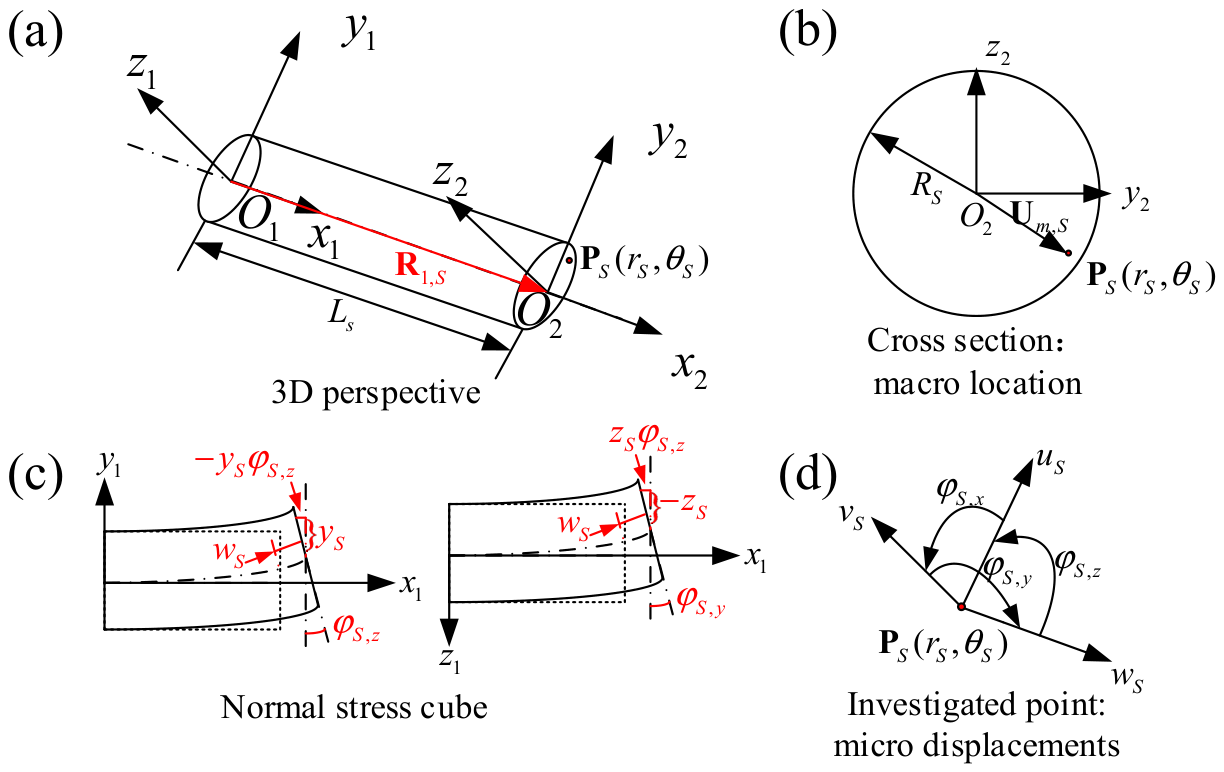
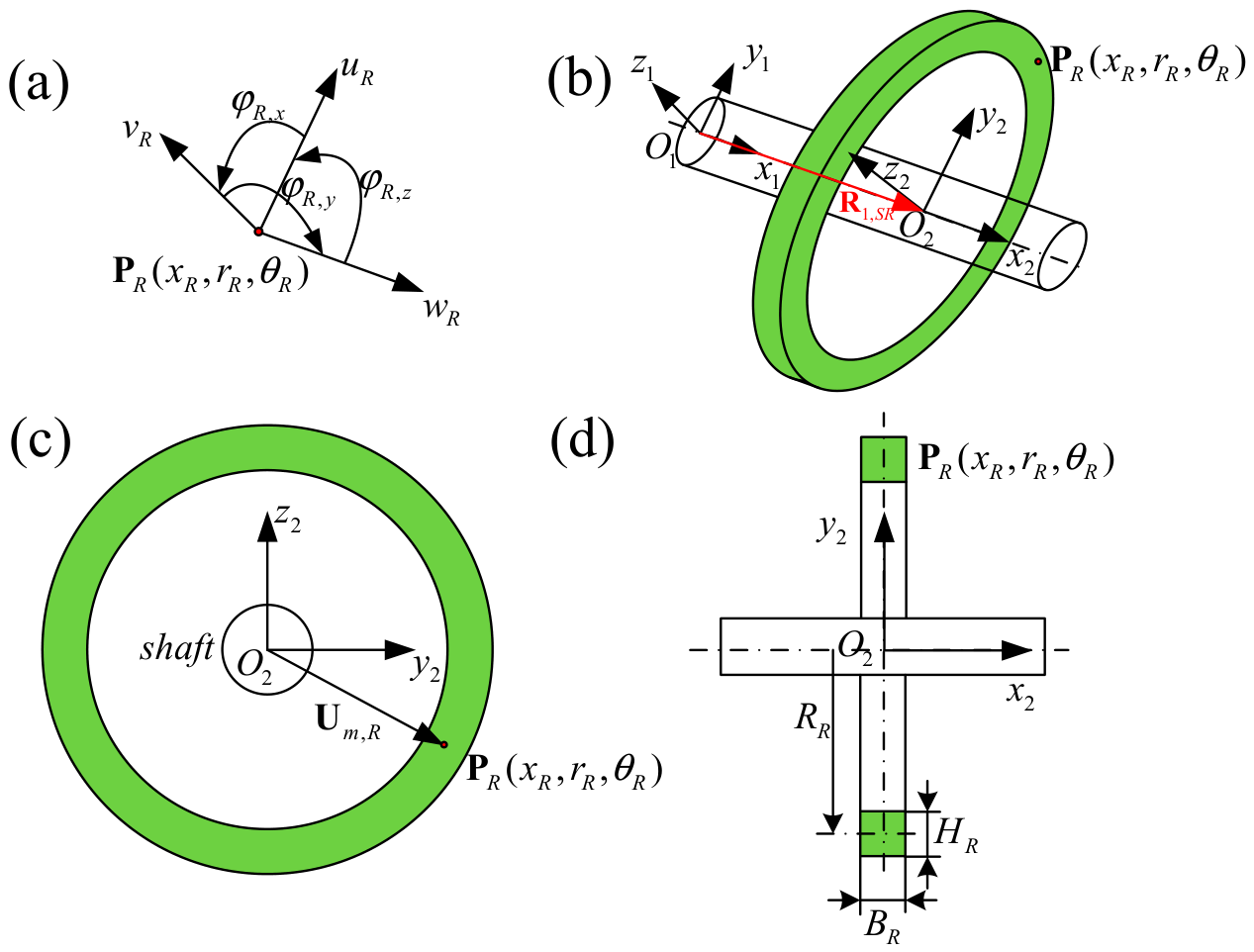
Details are illustrated in Figure 2, Figure 3 and Figure 4. Therefore, the velocity of the P C is:
U ˙ 0 , C = d U 0 , C d t = [ R ˙ 1 + ( U m , C + U f , C ) T ˙ 2 + U ˙ f , C T 2 ] T 1 + [ R 1 + ( U m , C + U f , C ) T 2 ] T ˙ 1
Based on the structural properties, some assumptions are made:
  • The Timoshenko beam theory is utilized to describe the displacements of the shaft.
  • The Mindlin plate theory is adopted for the gear web.
  • For the ring, the Timoshenko bend beam theory is employed.
  • For high-stiffness, linear elastic metallic materials, such as alloy steels and structural steels, linearization is performed for the small amount of rotational displacement in each element [47]; for instance, lim φ 0 cos φ = 1 φ 2 2 , lim φ 0 sin φ = φ .
  • Neglect third- and higher-order displacement in subsequent energy derivation, such as φ n 0   ( n 3 ) .

2.1.1. Shaft Model

Based on the Timoshenko beam model, shown in Figure 2, the micro-displacements at each point P S contain six degrees of freedom (DOF) with three translational and rotational displacements. In this theory, the cross-section of the beam remains unreformed U f , S = 0 .
In body-fixed CS, the point P S ( 0 , r S , θ S ) is given:
U 2 , S = U m , S + U f , S = [ 0       r S cos θ S       r S sin θ S ]
While the R 1 in revolution CS is:
R 1 = [ w S + x S       u S       v S ]
Integrating Equations (4) and (5) into (3), the velocity of the point U 0 , S can be derived:
U 0 , S = R 0 + [ R 1 + ( U m , S + U f , S ) T 2 ] T 1 = R 0 + w S + x S u S v S T + 0 r S cos θ S r S sin θ S T 1 0 0 0 cos θ S sin θ S 0 sin θ S cos θ S T 2 1 0 0 0 cos ( Ω t ) sin ( Ω t ) 0 sin ( Ω t ) cos ( Ω t )
Meanwhile, the strains of the shaft are given as:
ε S , x = w S x S y S φ S , z x S + z S φ S , y x S γ S , x y = u S x S + φ S , y + z S φ S , x x S γ S , x z = v S x S φ S , z y S φ S , x x S
The corresponding stress is:
σ S , x = E ε S , x τ S , x y = G κ 1 u S x S + φ S , y + z S φ S , x x S τ S , x z = G κ 1 v S x S φ S , z y S φ S , x x S
σ S , x shows the normal stress while τ S , xy and τ S , xz represent the shear stress in a different plane. The κ 1 = 6 ( 1 + μ ) 2 / ( 7 + 12 μ + 4 μ 2 ) indicates the shear coefficient for the shaft’s sectional area and μ is the Poisson’s ratio of the shaft material.

2.1.2. Web Model

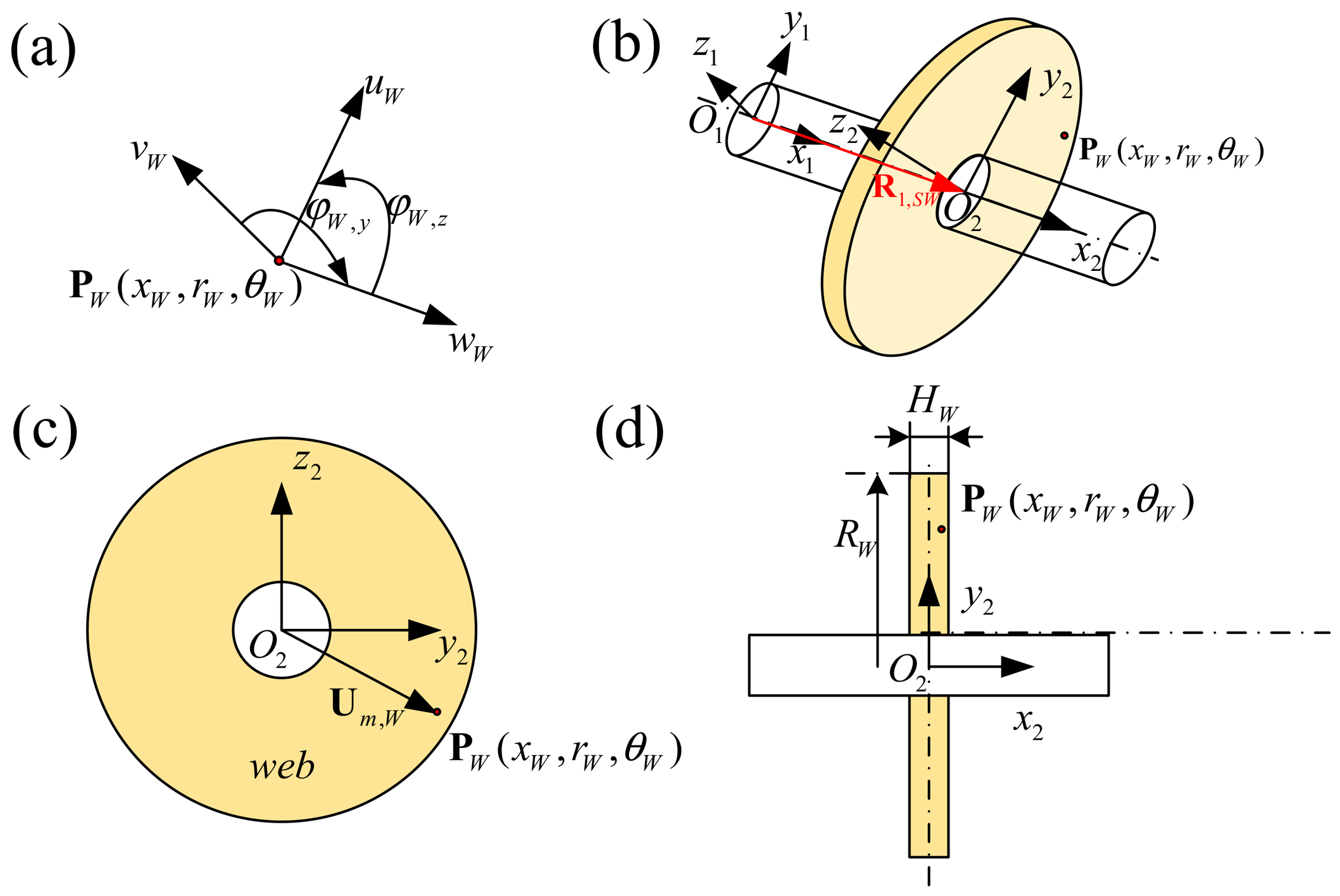
According to the Mindlin plate theory, the vibration of the plate is described by the motion of points on the neutral surface. Similarly to the Timoshenko beam model, the motions are composed of five DOF except for the in-plane rotational movement. The dimensional parameters such as thickness H W and outer radius R W are shown in Figure 3.
In revolution CS, the original point O 2 will be described as
R 1 , S W = [ w S W + x S W       u S W       v S W ]
The subscript S W indicates the coupling point of the shaft and web. In body-fixed CS, the arbitrary point P W ( x W , r W , θ W ) in the web can be expressed as:
U 2 , W = U m , W + U f , W = x W r W cos θ W r W sin θ W T + w W u W + x W φ W , z v W x W φ W , y T 1 0 0 0 cos θ W sin θ W 0 sin θ W cos θ W
For the normal and shear strain, it is defined as:
ε W , r r = ε W , r r 0 + x W k W , r r , ε W , θ θ = ε W , θ θ 0 + x W k W , θ θ γ W , r θ = γ W , r θ 0 + x W k W , r θ , γ W , θ x = γ W , θ x 0 , γ W , r x = γ W , r x 0
where the coefficients above are
ε W , r r 0 = u W r W , ε W , θ θ 0 = v W r W θ W + u W r W , γ W , r θ 0 = u W r W θ W + v W r W v W r W γ W , r x 0 = w W r W + φ W , z , γ W , θ x 0 = w W r W θ W φ W , y , k W , r r = φ W , z r W k W , θ θ = φ W , y r W θ W + φ W , z r W , k W , r θ = φ W , y r W + φ W , z r W θ W + φ W , y r W
Therefore, the stress is:
σ W , r r = E 1 μ 2 ε W , r r + μ E 1 μ 2 ε W , θ θ , σ W , θ θ = μ E 1 μ 2 ε W , r r + E 1 μ 2 ε W , θ θ τ W , r θ = E 2 ( 1 μ ) γ W , r θ , τ W , θ x = E 2 ( 1 μ ) γ W , θ x , τ W , r x = E 2 ( 1 μ ) γ W , r x

2.1.3. Ring Model

Both the shaft and ring model are established based on the Timoshenko theory. The motion of the ring is also described through the natural axis. The schematic of the ring model coupled with the shaft is illustrated in Figure 4.
Therefore, the displacement in revolution CS is:
R 1 , S R = [ w S R + x S R       u S R       v S R ]
also R 1 , S R is the coupling point of the shaft and web in the body-fixed CS, the arbitrary point P R ( x R , r R , θ R ) in the ring model can be expressed as:
U 2 , R = U m , R + U f , R = x R r R cos θ R r R sin θ R T + w R ( r R R R ) φ R , z u R + x R φ R , z v R + ( r R R R ) φ R , x x R φ R , y T 1 0 0 0 cos θ R sin θ R 0 sin θ R cos θ R
For the strain and stress of the ring model, it is defined as:
ε R , i = v R R R θ R + u R R R , χ R , i = φ R , x R R θ R , γ R , i = u R R R θ R φ R , x v R R R ε R , o = φ R , y R R θ R + φ R , z R R , χ R , o = w R R R θ R , γ R , o = φ R , x R R θ R + φ R , y R R
where the subscript i and o represent the strains belong to in-plane and out-of-plane vibrations, respectively, and the corresponding stress is given:
σ R , i = E ε R , i , v R , i = E χ R , i , τ R , i = κ 1 G γ R , i σ R , o = E ε R , o , v R , o = E χ R , o , τ R , o = T R G γ R , o
in Equation (15), T R is the torsional constant for the sectional area of the ring model [48].

2.2. Discretization and Boundary Conditions

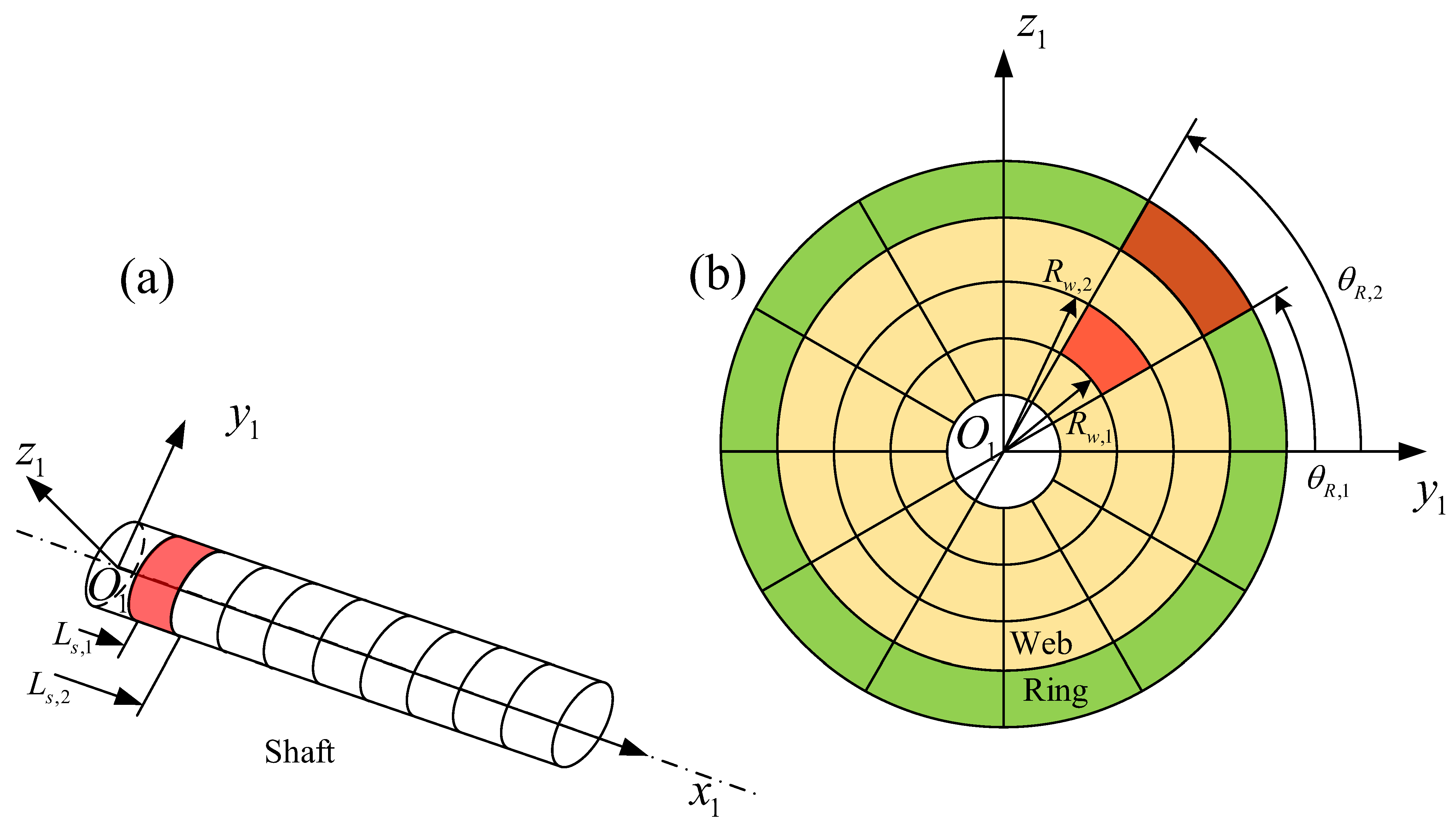
Similarly to the FEM, the elastic system is divided into several elements. In the shaft and ring model, elements are equally distributed into MS and MR elements alongside their length and angles. As for the web model, the two-dimensional discretization method is employed. NW elements in radial form and MW elements in circumferential form are generated. The mesh strategy is shown in Figure 5. Each model has selected an element as an instance, which is marked in red in Figure 5. It should also be noted that the geometric parameters of the ring and web, such as width and thickness, are independently adjustable variables in the proposed model, allowing for the analysis of realistic gear geometries where the rim is wider than the web.
To ensure an optimal balance between computational efficiency and numerical convergence, the recommended discretization parameters employed in the proposed model are specified as follows. The flexible shaft is divided into 30 nodes. For the gear body, the ring is discretized with 50 nodes along its circumferential direction, while the web is divided into a 10 × 30 grid (10 divisions in the radial direction and 30 divisions in the circumferential direction). Furthermore, it is worth noting that the proposed model does not require the ring and the web to maintain an identical number of nodes at their interface. The kinematic and dynamic coupling between these mismatched discrete nodes is seamlessly and accurately achieved through interpolation functions.

2.2.1. Shaft Elements

The element of the shaft is evenly divided, and the integral area, taking the second element as the example (shown in Figure 5), is given x s , 2 [ L s , 1 , L s , 2 ] . Therefore, the corresponding kinematic K S , 2 , p and potential energy P S , 2 , p of the pinion’s shaft are derived based on the rule of Equation (3):
K S , 2 , p = 1 2 ρ 0 2 π 0 R S L s , 1 L s , 2 U ˙ 0 , S , p U ˙ 0 , S , p T r S , p d x S , p d r S , p d θ S , p .
And the potential energy, including both normal and shear stress, is calculated:
P S , 2 , p = 1 2 0 2 π 0 R S , p L S , 1 L S , 2 ( σ S , x , p ε S , x , p + τ S , x y , p γ S , x y , p + τ S , x z , p γ S , x z , p ) r S , p d x S , p d r S , p d θ S , p
Substituting the subscript 2 in K S , 2 , p and P S , 2 , p into K S , j , k and P S , j , k ( j = 1 , n ; k = p , g ) , Equations (16) and (17) could express all the shaft elements in the energy aspect and the total kinematic and potential energy of the shaft is defined as K S , k = j = 1 N S , k K S , j , k and P S , k = j = 1 N S , k P S , j , k , respectively, where N S , k indicates the number of the shaft elements in the pinion or gear’s shaft.

2.2.2. Web Elements

The web segment differs from the shaft and ring models in that it is a two-dimensional model with distinct integral domains in both the radius and angles, whereas the other segments are one-dimensional models with variations only in either the shaft length or ring angle. Hence, the kinematic and potential energy highlighted red web element from the pinion in Figure 5 will be expressed as:
K W , 2 , 2 , p = 1 2 ρ θ R , 1 , p θ R , 2 , p R W , 1 , p R W , 2 , p H W 2 H W 2 U ˙ 0 , W , p U ˙ 0 , W , p T r W , p d x W , p d r W , p d θ W , p
where the subscript indicates the investigated web element located between angles θ W , 1 = θ R , 1 and θ W , 2 = θ R , 2 , and between the radius of R W , 1 and R W , 2 . Consequently, the potential energy of the web situated at the same location may be articulated as follows:
P W , 2 , 2 , p = 1 2 ρ θ W , 1 , p θ W , 2 , p R W , 1 , p R W , 2 , p H W 2 H W 2 σ W , r r , p ε W , r r , p + σ W , θ θ , p ε W , θ θ , p + τ W , r θ , p γ W , r θ , p + τ W , θ x , p γ W , θ x , p + τ W , r x , p γ W , r x , p r W , p d x W , p d r W , p d θ W , p
Without losing generality, the subscription of the kinematic and potential energy from Equations (18) and (19) could also be replaced into K W , i , j , k and P W , i , j , k ( k = p , g ) , which indicates the energy of the web element between the radius of R W , i , k and R W , i + 1 , k and the angle between θ R , j , k and θ R , j + 1 , k . Accordingly, the total energy of the web elements is K W , k = i = 1 M W , k j = 1 N W , k K W , i , j , k and P W , k = i = 1 M W , k j = 1 N W , k P W , i , j , k , where M W , k represent the number of the web circles and N W , k is the number of the elements within a circle.

2.2.3. Ring Elements

The ring elements, as a one-dimensional model, exhibit variation in their integral domain solely in their angle θ R , with the width H R and thickness B R remaining unchanged. For kinematic energy K R , 2 , k ( k = p , g ) , the highlighted red ring element can be expressed as:
K R , 2 , k = 1 2 ρ θ R , 1 , k θ R , 2 , k H R 2 H R 2 B R 2 B R 2 U ˙ 0 , R , k U ˙ 0 , R , k T ( R R , k + r R , k ) d x R , k d r R , k d θ R , k
Whereas the potential energy is:
P R , 2 , k = 1 2 ρ θ R , 1 θ R , 2 H R 2 H R 2 B R 2 B R 2 σ R , i ε R , i + v R , i χ R , i + τ R , i γ R , i + σ R , o ε R , o + v R , o χ R , o + τ R , o γ R , o ( R R , k + r R , k ) d x R , k d r R , k d θ R , k
Also, the subscription for the ring elements can be replaced into K R , j , k and P R , j , k ; therefore, the overall energy of the ring elements is K R , k = j = 1 N R , k K R , j , k and P R , k = j = 1 N R , k P R , j , k . N R , k is the number of the ring elements.

2.3. Boundary Condition

Previous work completed the definition of kinetic and potential energy for each unit under unconstrained conditions, and it is necessary to assign constraints—for instance, bearing constraints—to specific components.

2.3.1. Bearing Constraints

Bearings are usually mounted on rotating shafts, constraining degrees of freedom except for axial rotation. The support stiffness of the bearing for each degree of freedom is defined as k B w , k B u , k B v , k B y k B z respectively. In this model, we claim that the bearings are mounted at the end of the shaft ( x S = 0 , x S = L S ). The constraints from the bearings are expressed in potential energy form as:
P b e a r i n g = 1 2 k B w ( w S x S = 0 2 + w S x S = L S 2 ) + k B u ( u S x S = 0 2 + u S x S = L S 2 ) + k B v ( v S x S = 0 2 + v S x S = L S 2 ) + k B y ( φ S , y x S = 0 2 + φ S , y x S = L S 2 ) + k B z ( φ S , z x S = 0 2 + φ S , z x S = L S 2 )

2.3.2. Shaft Coupling Effect

The simplest gear rotor system usually consists of a shaft and a gear body, but in actual application, rotor shafts often take the form of stepped shafts with various radii. To establish a stepped rotor model, it is necessary to introduce the condition of a rigid connection between shafts. Under rigid connection, the corresponding displacements at the connection of the two shafts are strictly the same, which can be told as:
t S x S = L S = t S + 1 x S + 1 = 0 ,   r o t S x S = L S = r o t S + 1 x S + 1 = 0 ,   t S = u S , v S , w S ,   r o t S = φ S , x , φ S , y , φ S , z
In this way, the potential energy is:
P S S = 1 2 C ( t S x S = L S t S + 1 x S + 1 = 0 ) 2 + ( r o t S x S = L S r o t S + 1 x S + 1 = 0 ) 2
where C [ 10 13 , 10 20 ] refers to the “stiffness” of the rigid connection.

2.3.3. Shaft–Web Coupling Effect

Additionally, there is a rigid connection between the web and the shaft, as well as between the web and the ring elements. Since both the web and the ring are defined in the body-fixed coordinate system, the coupling relationship between the web and the shaft, and the ring and the shaft, is already included in the kinetic energy. On this basis, the inner ring of the web is rigidly connected to the shaft; thus, it is also necessary to apply a fixed support constraint on the inner ring of the web, restricting all displacement and rotational degrees of freedom; thus:
t W r W = R S , θ W [ 0 , 2 π ] = 0 ,   r o t W r W = R S , θ W [ 0 , 2 π ] = 0 ,   t W = u W , v W , w W ,   r o t W = φ W , x , φ W , y , φ W , z
Therefore, the additional potential energy is
P S W = 1 2 C ( t W r W = R S , θ W [ 0 , 2 π ] ) 2 + ( r o t W r W = R S , θ W [ 0 , 2 π ] ) 2
Since the model is defined in a body-fixed rotating coordinate system, the rigid body motions are already decoupled, meaning that the relative elastic displacements and rotations between the inner ring of the web and the shaft must be strictly zero. Instead of directly eliminating the degrees of freedom, Equation (24) employs the penalty method by introducing an artificial potential energy term. By assigning an extremely large value to C, this additional energy heavily penalizes any non-zero relative displacements or rotations at the interface. Consequently, when minimizing the total energy of the system, the boundary conditions of a rigid connection are effectively and smoothly enforced.

2.3.4. Web–Ring Coupling Effect

The web is also rigidly connected to the ring model, simplified as a rigid connection between the outer elements of the web ( r W = R W ) and the neutral line of the ring model (also r R = R W ). The constraint conditions are:
t W r W = R W , θ W = θ R = t R θ R ,   r o t W r W = R W , θ W = θ R = r o t R θ R ,   t R = u R , v R , w R ,   r o t R = φ R , x , φ R , y , φ R , z .
Thus, the energy is:
P W R = 1 2 C ( t W r W = R W , θ W = θ R t R θ R ) 2 + ( r o t W r W = R W , θ W = θ R r o t R θ R ) 2

2.4. Mesh Process

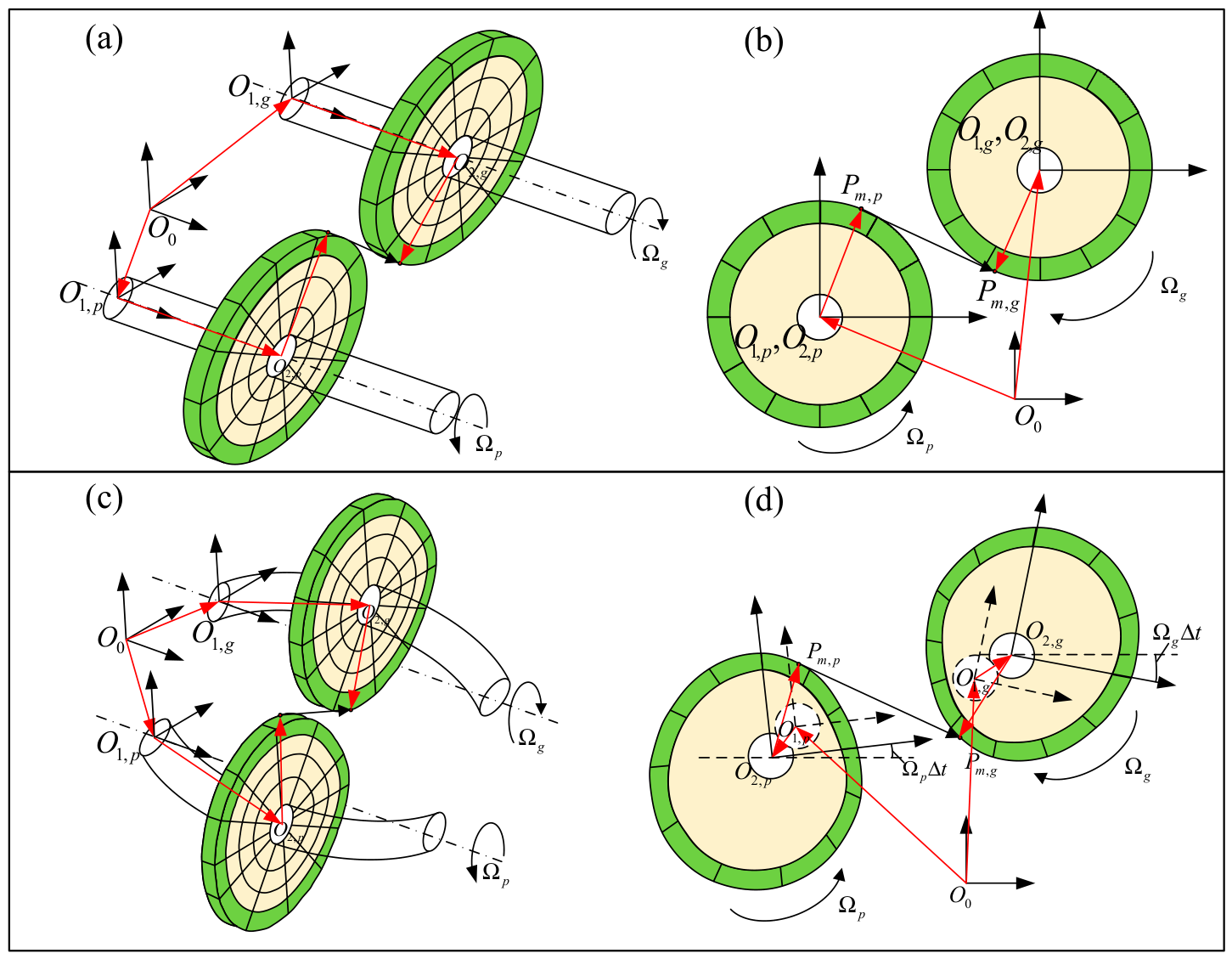
In contrast to the conventional rigid body model, the gear meshing process incorporates gear body deformation and the dynamic shifts in contact points. The mesh energy can be obtained once both the coordinates of the mesh point at the initial state and the next time step are expressed. Figure 6 illustrates the gear-rotor system at the initial state and the next time step. The graphs on the left side demonstrate the three-dimensional view of the system, and correspondingly, the right side are those from the side view. For better illustration, the lines of the web elements are hidden. O i , j are the different origin points in which the subscript i = 0 , 1 , 2 represents the point from space-fixed, revolution and body-fixed CS, and j = p , g represents the points belonging to pinion and gear individually.
Firstly, to obtain the coordinate of the mesh point at the initial state, the rotational speed of the pinion is defined as Ω p while the speed for the gear is Ω g = z p Ω p / z g , where z p , z g indicate the tooth numbers of the pinion and gear. The red arrows in Figure 6 show the vectors to the mesh points at pinion and gear, respectively. In space-fixed CS, the location of the mesh point in the pinion can be defined as:
U 0 , m , p = R 0 , p + ( R 1 , S R , p + U 2 , R , p T 2 , p ) T 1 , p
U 2 , R , p = U m , R , p + U f , R , p = x R , p r R , p cos θ R , p r R , p sin θ R , p T + w R , p H R , p φ R , z , p 2 u R , p + x R , p φ R , z , p v R , p + H R , p φ R , x 2 x R φ R , y , p T 1 0 0 0 cos θ R , p sin θ R , p 0 sin θ R , p cos θ R , p
T 2 , p = T R , x , p T R , y , p T R , z , p T R , x , p = 1 0 0 0 cos φ R , x , p sin φ R , x , p 0 sin φ R , x , p cos φ R , x , p , T R , y , p = cos φ R , y , p 0 sin φ R , y , p 0 1 0 sin φ R , y , p 0 cos φ R , y , p , T R , z , p = cos φ R , z , p sin φ R , z , p 0 sin φ R , z , p cos φ R , z , p 0 0 0 1 , T 1 , g = 1 0 0 0 cos ( Ω g t ) sin ( Ω g t ) 0 sin ( Ω g t ) cos ( Ω g t ) , T 1 , p = 1 0 0 0 cos ( Ω p t ) sin ( Ω p t ) 0 sin ( Ω p t ) cos ( Ω p t )
where R 0 , p , R 1 , S R , p and U 2 , R , p are the time-invariant parameters indicating the vector O 0 O 1 , p , O 1 , p O 2 , p and O 2 , p P m , p in Figure 6. For the differential with the arbitrary point in the ring segment, the mesh point is at the outer edge of the element. Therefore, according to Equation (13), r R R R = H R / 2 . The displacement components in T 2 , p are all the small amounts of the rotation, which may as well be linearized like those in Section 2. For the gear, the vector to the mesh point U 0 , m , g follows the same rules as Equations (26)–(28), with only the subscript p changed to g . In this way, the transmission error of the vector is δ 0 = P m , p P m , g = U 0 , m , p U 0 , m , g .
Secondly, when the system comes to the next time step Δ t , each component will undergo a certain deformation. Also, the pinion and the gear will rotate through the angle of Ω p Δ t and Ω g Δ t . The differences between the initial state and the next time step are shown in Figure 6. Consequently, the transmission error at the next time step is δ 1 = U 0 , m , p , 1 U 0 , m , g , 1 , and the difference in the transmission error is acquired by
Δ δ = δ 1 δ 0 = [ x m y m z m ]
where
  x m = r m 1 q m 1 , y m = r m 2 q m , z m = r m 3 q m r m 1 = [ r p , m 1 r g , m 1 ] , r m 2 = [ r p , m 2 r g , m 2 ] r m 3 = [ r p , m 3 r g , m 3 ] , q m = [ q p , m q g , m ] T q p , m = q p , i n q p , o u t , q g , m = q g , i n q g , o u t q p , i n = u S R , p v S R , p φ S R , x , p u R , p v R , p φ R , x , p T q p , o u t = w S R , p φ S R , y , p φ S R , z , p w S , p φ S , y , p φ S , z , p T q g , i n = [ u S R , g v S R , g φ S R , x , g u R , g v R , g φ R , x , g ] T q g , o u t = [ w S R , g φ S R , y , g φ S R , z , g w R , g φ R , y , g φ R , z , g ] T r p , m 1 = r p , m 1 , i n r p , m 1 , o u t , r p , m 2 = r p , m 2 , i n r p , m 2 , o u t , r p , m 3 = r p , m 3 , i n r p , m 3 , o u t r g , m 1 = r p , m 1 , i n r p , m 1 , o u t , r g , m 2 = r p , m 2 , i n r p , m 2 , o u t , r g , m 3 = r p , m 3 , i n r p , m 3 , o u t r p , m 1 , o u t = [ 0 0 0 1 0 H p / 2 ] T , r g , m 1 , o u t = [ 0 0 0 1 0 H g / 2 ] T r p , m 2 , i n = [ cos Ω p t sin Ω p t R p , b sin θ p cos θ p sin θ p H p sin θ p 2 ] T r g , m 2 , i n = [ cos Ω g t sin Ω g t R g , b sin θ p cos θ p sin θ p H g sin θ p 2 ] T r p , m 3 , i n = [ sin Ω p t cos Ω p t R p , b cos θ p sin θ p cos θ p H p cos θ p 2 ] T r g , m 3 , i n = [ sin Ω g t cos Ω g t R g , b cos θ p sin θ p cos θ p H g cos θ p 2 ] T r p , m 1 , i n = r g , m 1 , i n = r p , m 2 , o u t = r g , m 2 , o u t = r p , m 3 , o u t = r g , m 3 , o u t = [ 0 0 0 0 0 0 ] T
Subsequently, the mesh-induced potential energy is calculated:
P m ( t ) = 1 2 k m ( t ) ( Δ δ 1 δ 0 δ 0 ) 2
k m ( t ) is the mesh stiffness obtained via [49]. Transform Equation (31) into the matrix, then:
P m ( t ) = 1 2 k m ( t ) q p , m q g , m T K m q p , m q g , m

2.5. Governing Equations

Integrating the kinetic and potential energies of the abovementioned components, the total energy of the whole system is:
K = K S , p + K W , p + K R , p + K S , g + K W , g + K R , g
P = P S , p + P W , p + P R , p + P S , g + P W , g + P R , g + P b e a r i n g + P S S + P S W + P W R + P m ( t )
Substituting Equations (34) and (35) into the Lagrange equations yields the governing equations:
M q ¨ + ( C g + C d ) q ˙ + K ( t ) q = Q i n t e r n a l + Q e x t e r n a l C d = α M + β K s t r u c t u r e
where the M is the mass matrix, C g and C d is the gyroscopic and structural damping matrix. The gyroscopic matrix is systematically derived from the kinetic energy expressions of each component (i.e., the ring, web, and shaft) through the application of Hamilton’s principle, which analytically captures the Coriolis effects induced by the system’s rotation. On the other hand, the structural damping matrix is constructed based on the classical Rayleigh damping formulation. It is expressed as a linear combination of the mass and stiffness matrices, defined in Equation (35), where α and β represent the mass-proportional and stiffness-proportional damping coefficients, respectively. K ( t ) is the overall stiffness matrix, which composes both structural stiffness and time-varying mesh stiffness. K s t r u c t u r e is the overall structural stiffness matrix (overall stiffness matrix without time-varying mesh stiffness matrix). Q i n t e r n a l represents the force induced by the inherent property, such as the centrifugal effect. Q e x t e r n a l indicates the external torque applied to the shaft elements.

3. Result

This section mainly focuses on verifying the accuracy of the above model and analyzing the impact of related parameters on dynamic response. Section 3.1 proves the accuracy of the model and the parametric analysis of dynamic response is conducted in Section 3.2.

3.1. Model Verification

This section verifies the accuracy of the model based on two aspects: experimental verification, which analyses the mode shape and the accuracy of the natural frequencies; and model comparison, which provides verification from the perspective of dynamic response by comparing the degraded radial plate stiffness with the existing model.

3.1.1. Experimental Verification

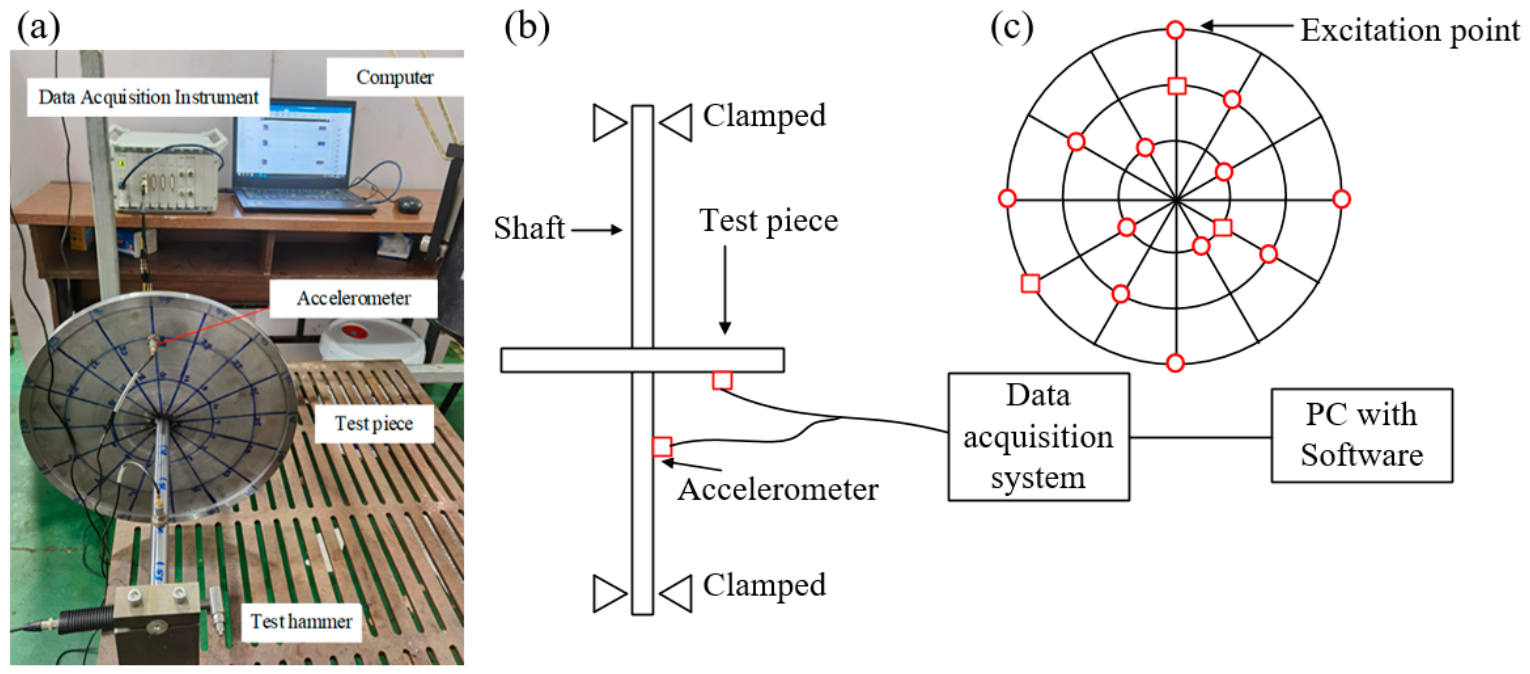
To prove that the proposed model is valid, the modal experiment is employed. In this section, only the natural frequencies and mode shape of the single component are investigated, since the mesh stiffness is not applicable in a gear system at a stationary state. The schematic of the test platform, comprising a computer with the DHMA mode analysis software, a data acquisition instrument (Donghua test Inc., Taizhou, China), two accelerometers (PCB Piezotronics Inc., Depew, NY, USA), a test piece, and a test hammer, is illustrated in Figure 7. To ensure the fidelity of the high-frequency dynamic measurements and to preclude any equipment-induced artifacts, high-precision sensors and data acquisition systems were utilized. The vibration signals were captured using a miniature piezoelectric accelerometer with a sensitivity of 10 mV/g and a broadband frequency response of up to 10,000 Hz. The extremely low mass of the accelerometer effectively mitigated any unwanted mass-loading effects on the tested gear. For the excitation, an impact hammer with a sensitivity of 2.25 mV/N was employed. A steel tip was specifically selected for the hammer to guarantee a sufficiently wide excitation frequency bandwidth covering the targeted 10,000 Hz range. All dynamic signals were recorded by a Siemens data acquisition system. The system was configured with a sampling rate of 51.2 kHz, which strictly satisfies the Nyquist criterion for 10 kHz signals and ensures high-resolution data collection without aliasing. Consequently, the sensitivity and precision of the measuring equipment are highly sufficient and will not compromise the experimental results. The shaft is fixed at both ends, and the accelerometers collect the vibration signal excited by the test hammer and then analyse the vibration modes via Fourier transform. The installation positions of the accelerometers are, respectively, located on the web and the shaft as shown in Figure 7. The detailed parameters of the shaft–web–ring are shown: LS1 = LS2 = 0.3 m, RS = 0.01 m, HW = 0.005 m, RW,o = 0.1875 m, HR = BR = 0.015 m. Moreover, for material properties, the Young’s modulus: E = 2.1 × 10¹¹ Pa, density: ρ   =   7800   kg / m 3 , Poisson’s ratio: μ = 0.3 .
Specifically, the natural frequencies of the system are determined by solving the characteristic equation of the quadratic eigenvalue problem, defined as
det ( λ 2 M + λ C + K ) = 0
The roots of this equation yield a set of complex eigenvalues λ. The imaginary parts of these complex eigenvalues mathematically represent the damped natural frequencies of the gear-shaft system, while their real parts relate to the modal damping.
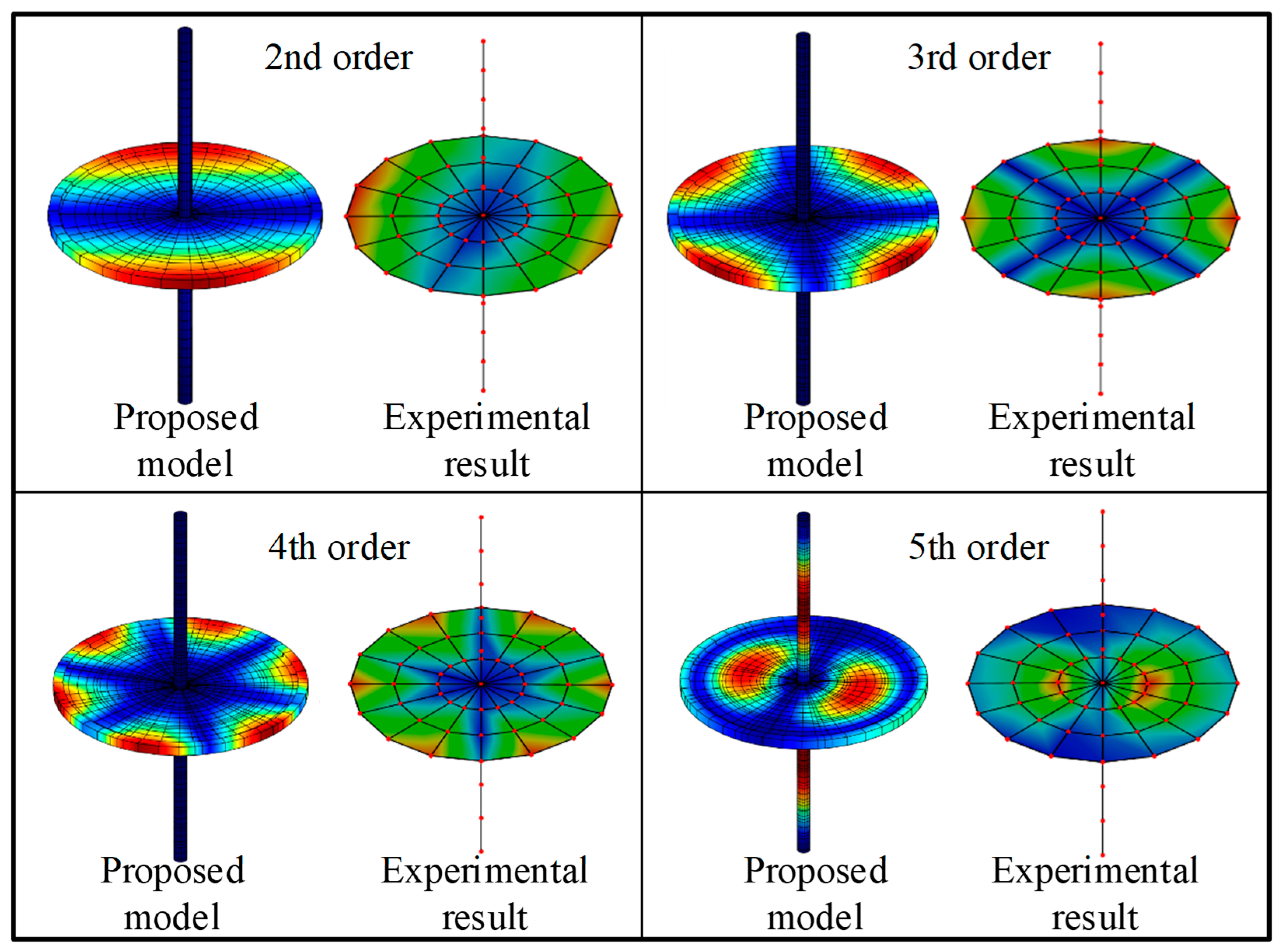
The test results with the second to fifth order of natural frequencies are shown in the figure below:
For the natural frequencies, the results obtained from the test and numerical model are shown in Table 1. It can be seen that the results from the proposed model exhibit good agreement with the experimental results, with only a comparatively high deviation in the first order. From the mode shape’s aspect, Figure 8 shows the nodal diameter of lateral vibrations from the second to fourth order. It can be found that the modal vibration shapes obtained by the numerical methods are consistent with those from the experiment.
It should be noted that the modal experiments conducted in this study were performed under static, non-rotating conditions. Obtaining high-fidelity modal data for thin-webbed gears under high-speed rotation is exceptionally challenging due to the severe contamination of structural mode signals by strong gear meshing noise and background harmonics, as well as the hardware limitations of high-frequency signal transmission via slip rings. Nevertheless, static modal testing is a widely accepted and standard validation procedure in gear dynamics [30].

3.1.2. Model Comparison

In Section 3.1.1, the single shaft-web-ring model is verified through a mode shape test experiment. However, because the mesh stiffness will not be activated in the stationary states, comparing the gear pair system which consists of coupled effects with the existing dynamic model guarantees the accuracy of the system.
Since few dynamic models are established based on the shaft–web–ring theory, the model is compared with the gear-rotor model [50]. In the gear-rotor model, the web and the ring are considered rigid parts, whereas the shaft is an elastic body. Therefore, to match the properties of the gear-rotor model, the proposed model needs to be “degenerated”; that is, the Young’s modulus E of the web and ring will be set to 2.1 × 10¹⁸ Pa in this section. The proposed model after degeneration is called the degenerated elastic model (DEM) and the gear-rotor model is referred to as RGM. The dimensional parameters of each component are listed RS = 0.02 m, LS1 = LS2 = 0.1 m, HW = 0.01 m, HR = BR = 0.015 m, zp = zg = 50, normal modulus: mn = 3 mm, pressure angle αn = 20 ° , helical angle β = 6–30°, average mesh stiffness k - m = 6.39 × 10⁸ N/m. The other parameters are identical to those in Section 3.1.1. For the boundary condition, both ends of the pinion and gear shafts are simply supported. The first seven-order natural frequencies of the DEM and RGM with different helical angles are demonstrated in Table 2.
The results show that the natural frequencies from the two models were highly consistent. Moreover, as the helix angle increases, the natural frequency begins to drop, which can be attributed to the decrease in stiffness caused by the rising helix angle.
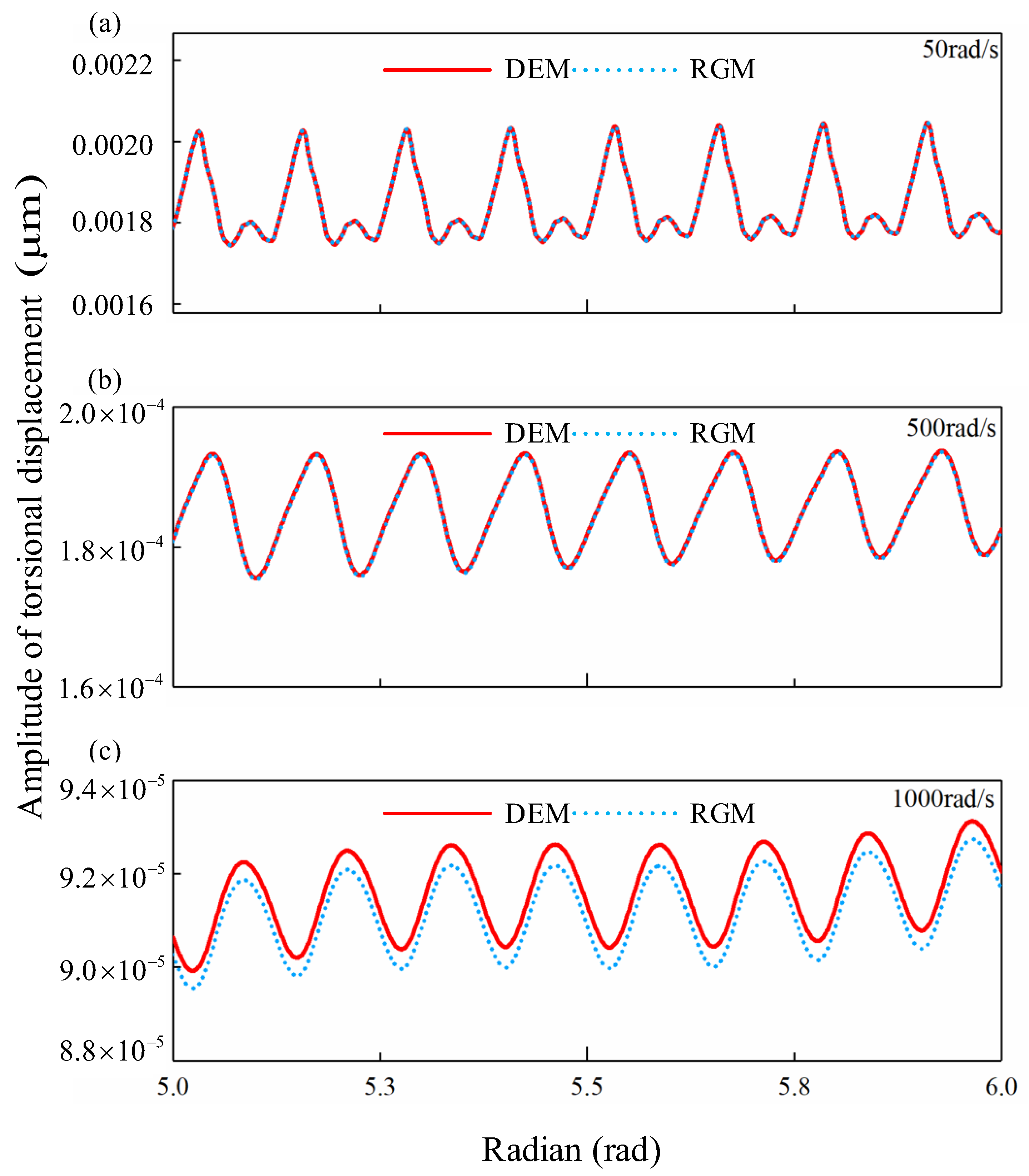
The dynamic responses of the DEM and RG models are further compared. Taking the torsional displacement φ S , x , p in the input shaft as the example, the time-varying displacements of the DEM and RGM under different rotational speeds are illustrated in Figure 9. In this scenario, the input power is 50 kW and the dimensional parameters are RS = 0.05 m, LS1 = LS2 = 0.05 m, HR = 0.015 m, BR = 0.03 m, zp = zg = 70, mn = 3 mm, αn = 20°, β = 12°; the bearing stiffnesses are kBw = 1 × 10⁸ N/m, kBu = 12 × 108 N/m, kBv = 12 × 108 N/m, kBy = 5 × 10⁷ N/m, and kBz = 5 × 10⁷ N/m.
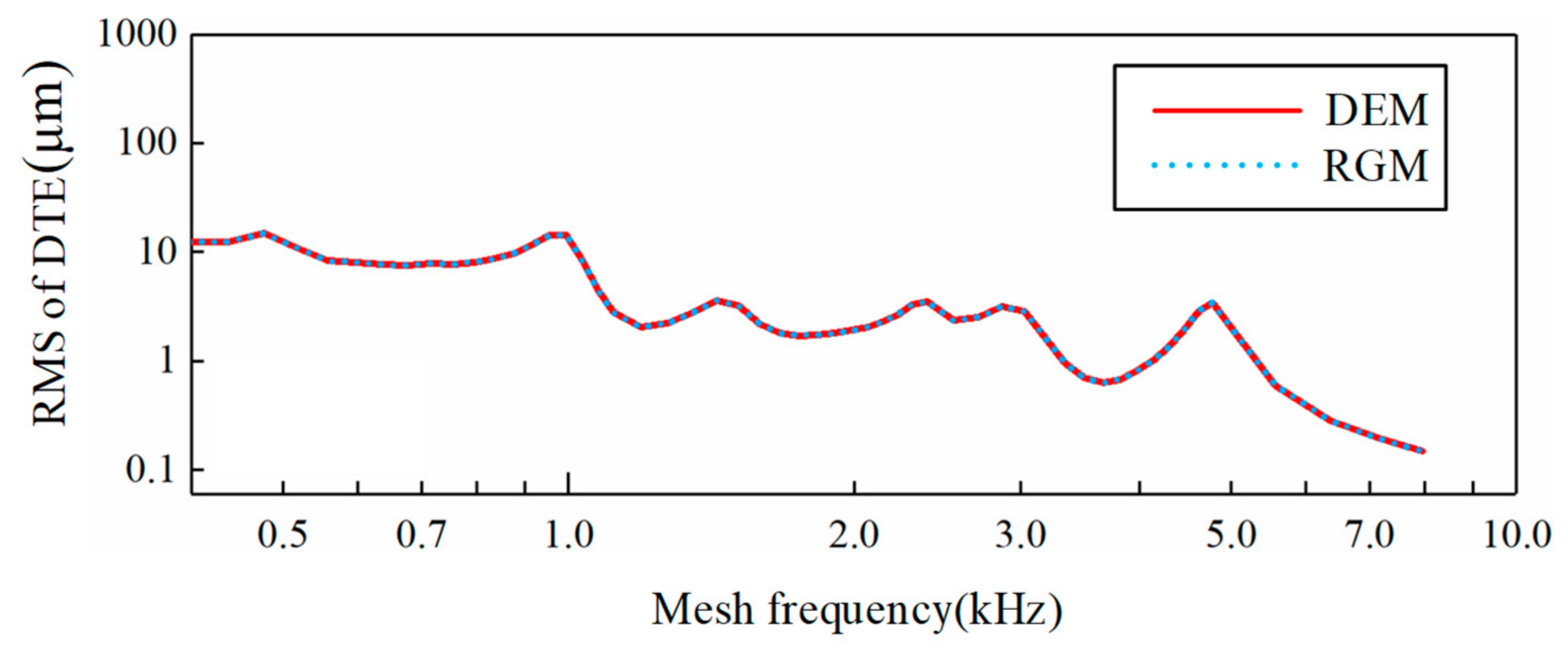
Figure 9 and Figure 10 show a comparison of the dynamic transmission error and the root mean square (RMS) value of torsional vibration response between the DEM and RGM at rotation speeds of 50 rad/s, 500 rad/s, and 1000 rad/s, respectively. The dynamic transmission error is expressed as x D T E = R b , p φ S , x , p R b , g φ S , x , g , φ S , x , p and φ S , x , g represents the torsional vibration of the shaft element coupling with the web of the pinion and gear. As shown in Figure 9, the two results deviate only slightly at high speeds; otherwise, the dynamic response curves are highly consistent. It is noteworthy that in the DEM, although Young’s modulus of the gear is of a large magnitude, it still retains weak elasticity, which causes deviations from the results of the RGM. Figure 10 demonstrates the comparison of the RMS in dynamic transmission error between the DEM and RGM with helical gear under different rotational speeds. It can be found that the two results match well, which could prove that the model is valid in obtaining the dynamic responses for the gear pair model.

3.2. Dynamic Responses

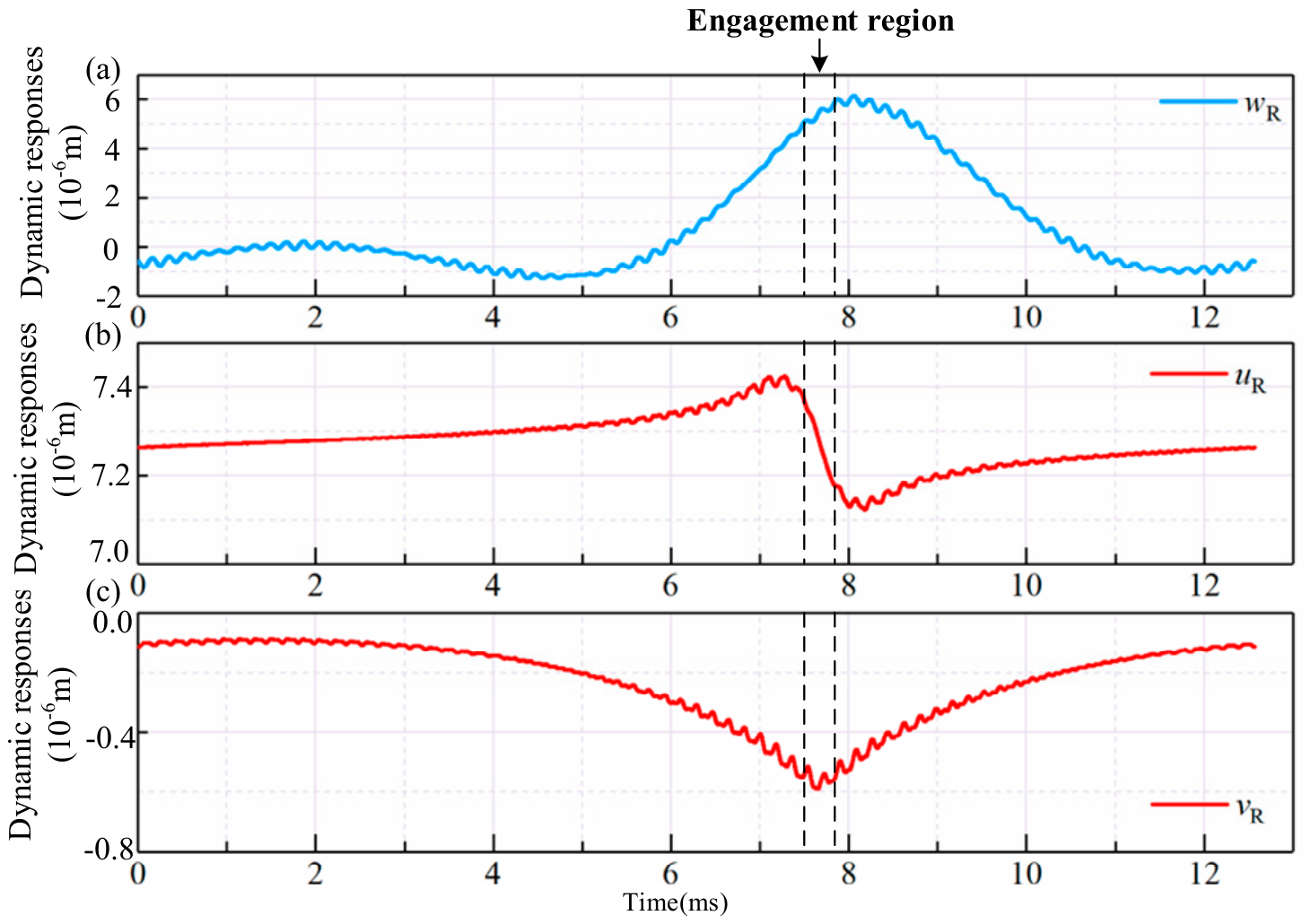
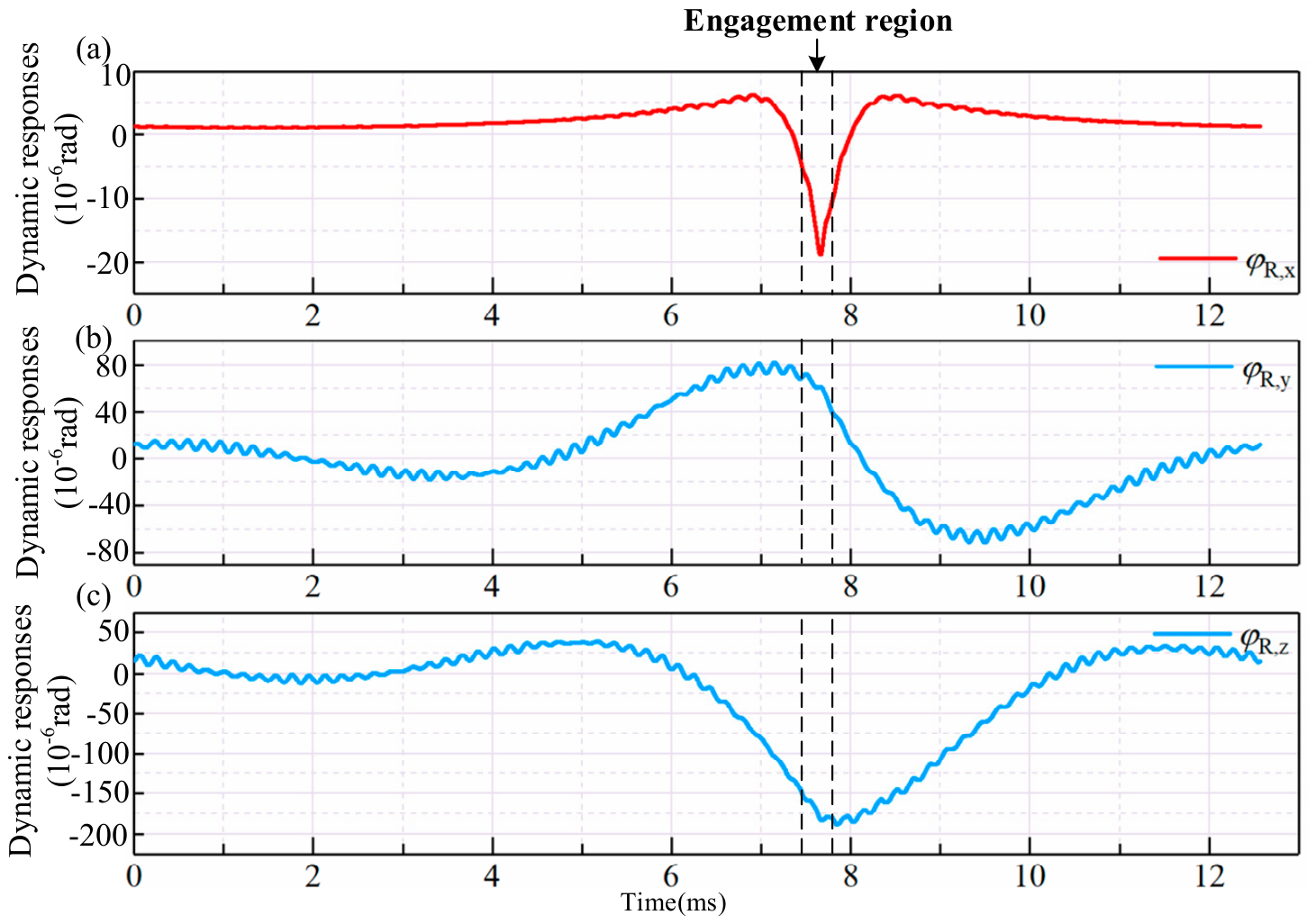
Distinct from the dynamic response of spur gears, helical gears always undergo severe axial force, which will cause significant out-of-plane vibration within the system. This section takes a shaft–web–ring gear pair system as the object, obtains the dynamic response at 500 rad/s, and analyses the displacement of the natural axis on the ring element. In this system, both the parameters of the pinion and gear are identical, and the details are listed as follows: RS = 50 mm, LS1 = LS2 = 50 mm, HR = 15 mm, BR = 30 mm, zp = zg = 70, mn = 3 mm, αn = 20°, β = 12°, HW = 10 mm, kBw = 1 × 10⁸ N/m, kBu = 12 × 108 N/m, kBv = 12 × 108 N/m, kBy = 5 × 10⁷ N/m, kBz = 5 × 10⁷ N/m, and input power P = 50 kW. Figure 11 illustrates the translational displacements of the arbitrary point on the ring element in a stable state within an entire rotation cycle in the body-fixed CS, and correspondingly, Figure 12 shows the displacements of the rotational degree of freedom. It can be observed that the in-plane vibrations ( w R , φ R , y , φ R , z , indicated in blue in Figure 11 and Figure 12) are of the same order of magnitude as the out-of-plane vibrational responses ( u R , v R , φ R , x , indicated in red in the figure), demonstrating that the point of the helical gear body exhibits significant transverse vibrational characteristics. During a specific time interval within a rotational cycle (the region between the dashed lines), a sudden shift in dynamic response occurs, which is attributed to the emergence of mesh stiffness as the ring element encounters the meshing point. This phenomenon proves that the dynamic response of the ring element presents obvious shaft frequency characteristics, and the displacement response reaches its maximum value at the mesh point.

3.3. Discussion About EM and RGM

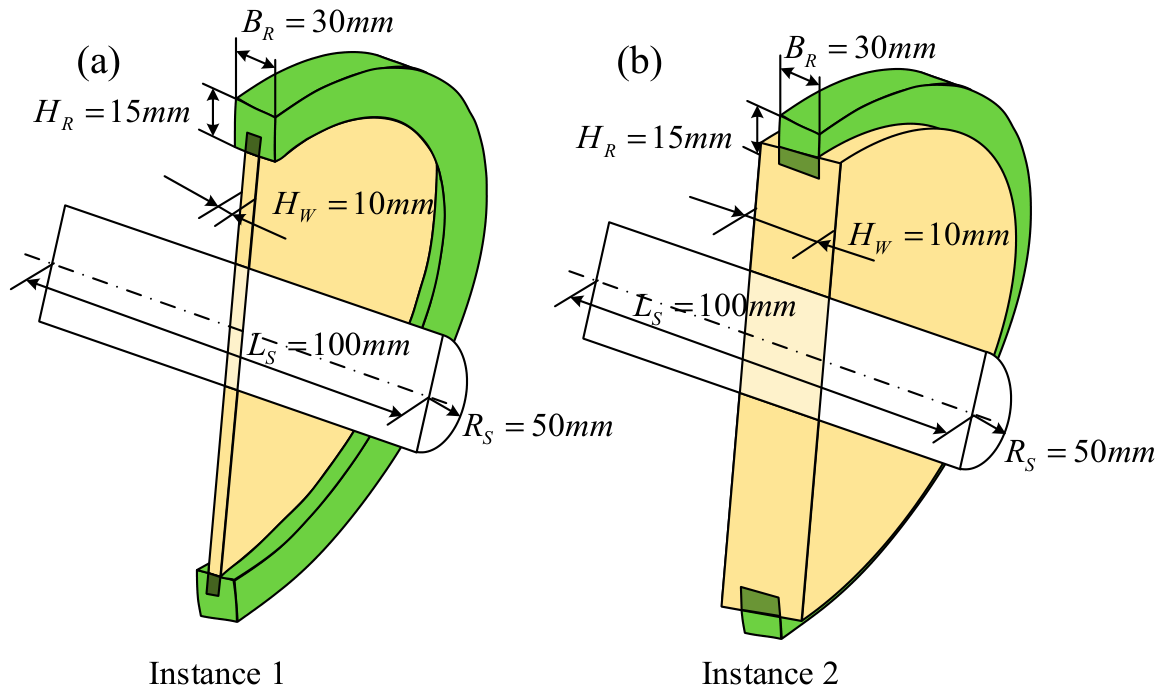
In Section 3.1, the validity of the dynamic response and modes shape was verified by comparing the “degenerated” proposed model with the RGM. This section discusses the distinctions between the proposed model and the RGM by comparing both the modal and dynamic response aspects, distinguishing between the two systems through their deviations in mode shapes and dynamic responses under identical parameters. Therefore, two instances are presented with all parameters the same except for the web thickness HW. The other parameters are consistent with those mentioned in Section 3.2, with the web thickness being HW = 10 mm (marked as instance 1) and HW = 40 mm (marked as instance 2), respectively. A schematic of two instances with these dimensional parameters is shown in Figure 13.
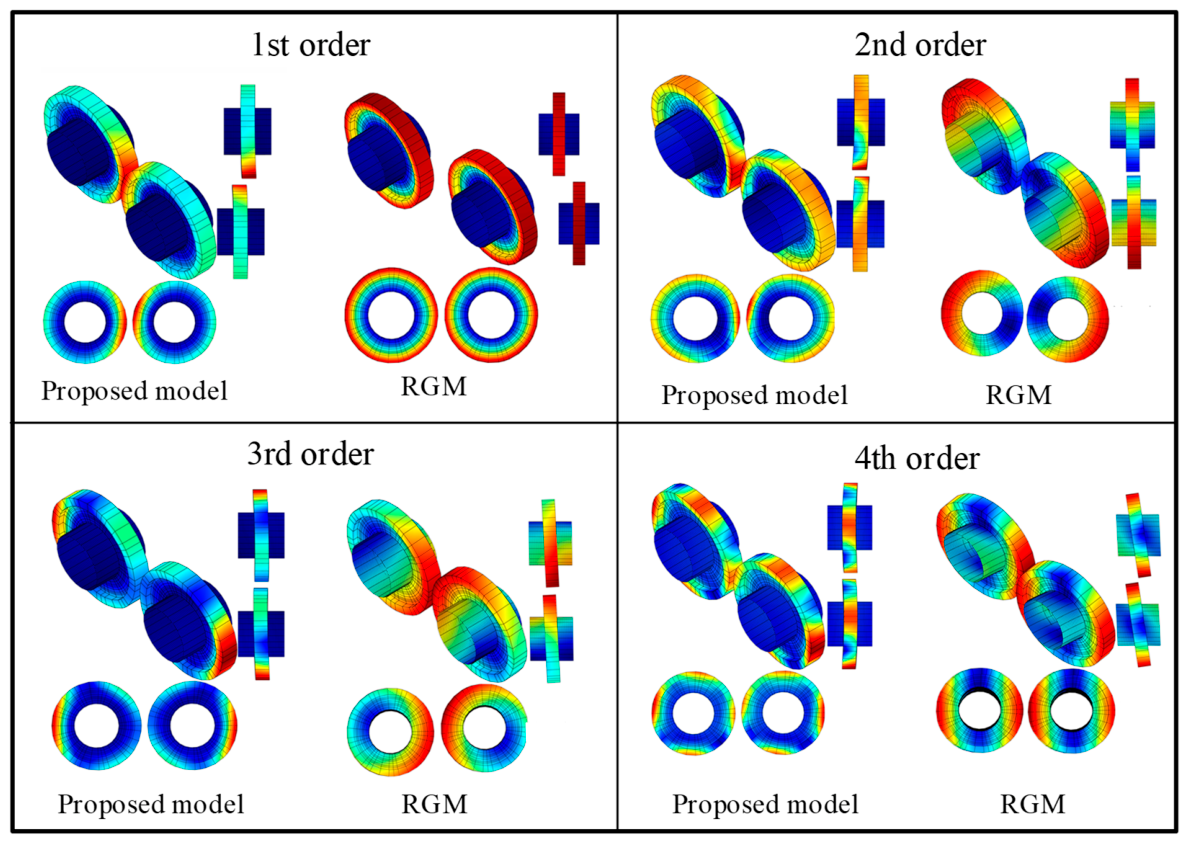
Table 3 lists the natural frequencies calculated based on the proposed model and RGM within the range of 0–10 kHz, revealing that eight modes for the proposed model and only four for the RGM within this range are discovered for instance 1. For instance 2, the number of natural frequencies of the proposed model has been reduced to 5, and the first three orders of frequencies derived from both models are relatively close. This indicates that when the gear web is thickened, the results of the proposed model and RGM become more similar.
When it refers to the mode shape, Figure 14 presents the first four modal shapes calculated utilizing both the proposed model and RGM, indicating that the proposed model proves the significant impact of web flexibility in the modes, and the elasticity of the web will lead to more frequency resonances. Due to the presence of the helix angle, modes arise that are dominated by the out-of-plane bending nodal diameters of the web in the axis direction, with the third-order mode being a three-node-diameter pattern and the fourth-order a four-node-diameter pattern, which does not exist in spur gears. By contrast, when the web flexibility is neglected—that is, when employing RGM—the out-of-plane nodal diameter vibration modes of the helical gears then become the rigid torsional modes of the helical gears, such as the third- and fourth-order coupled modes of the RGM in Figure 14.
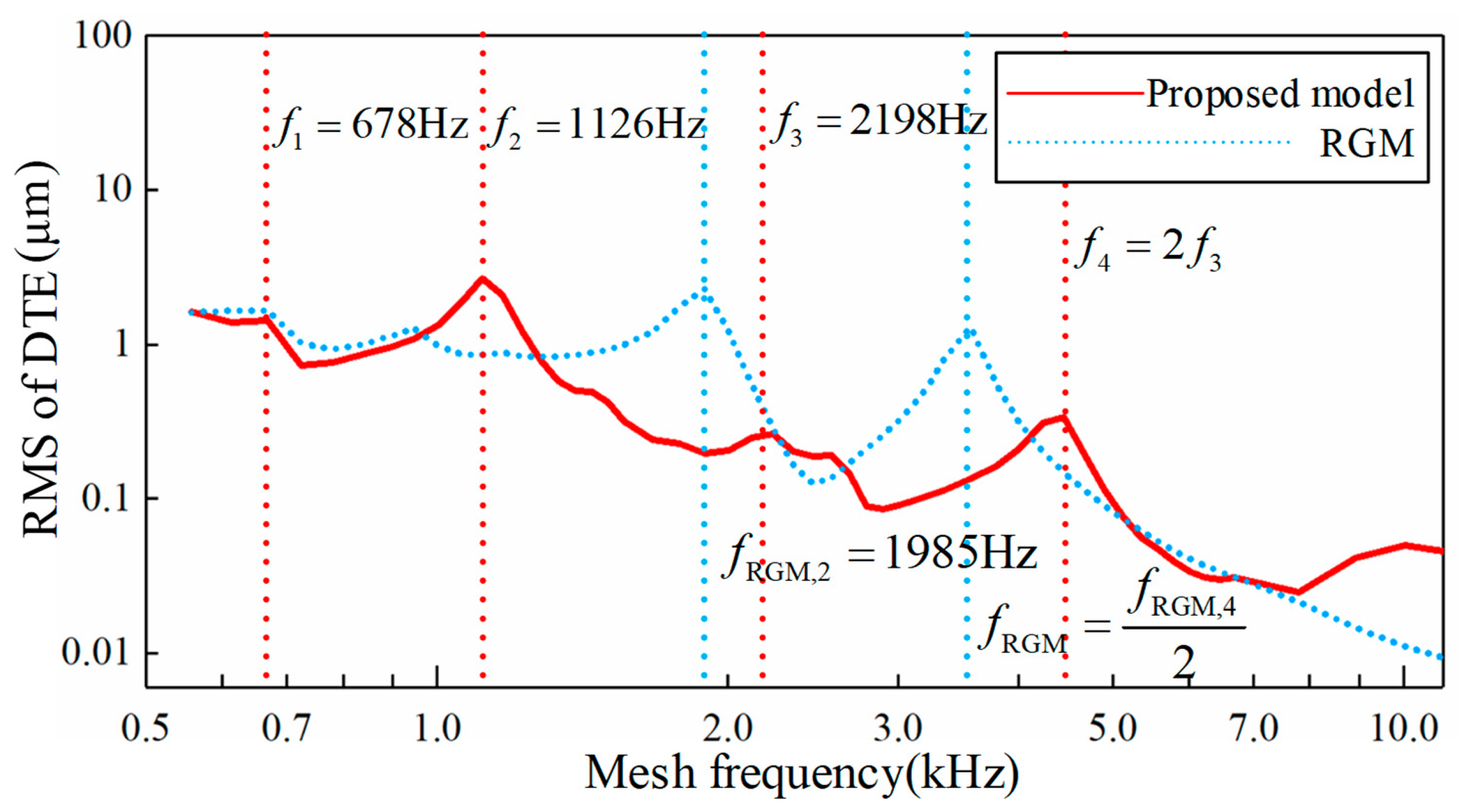
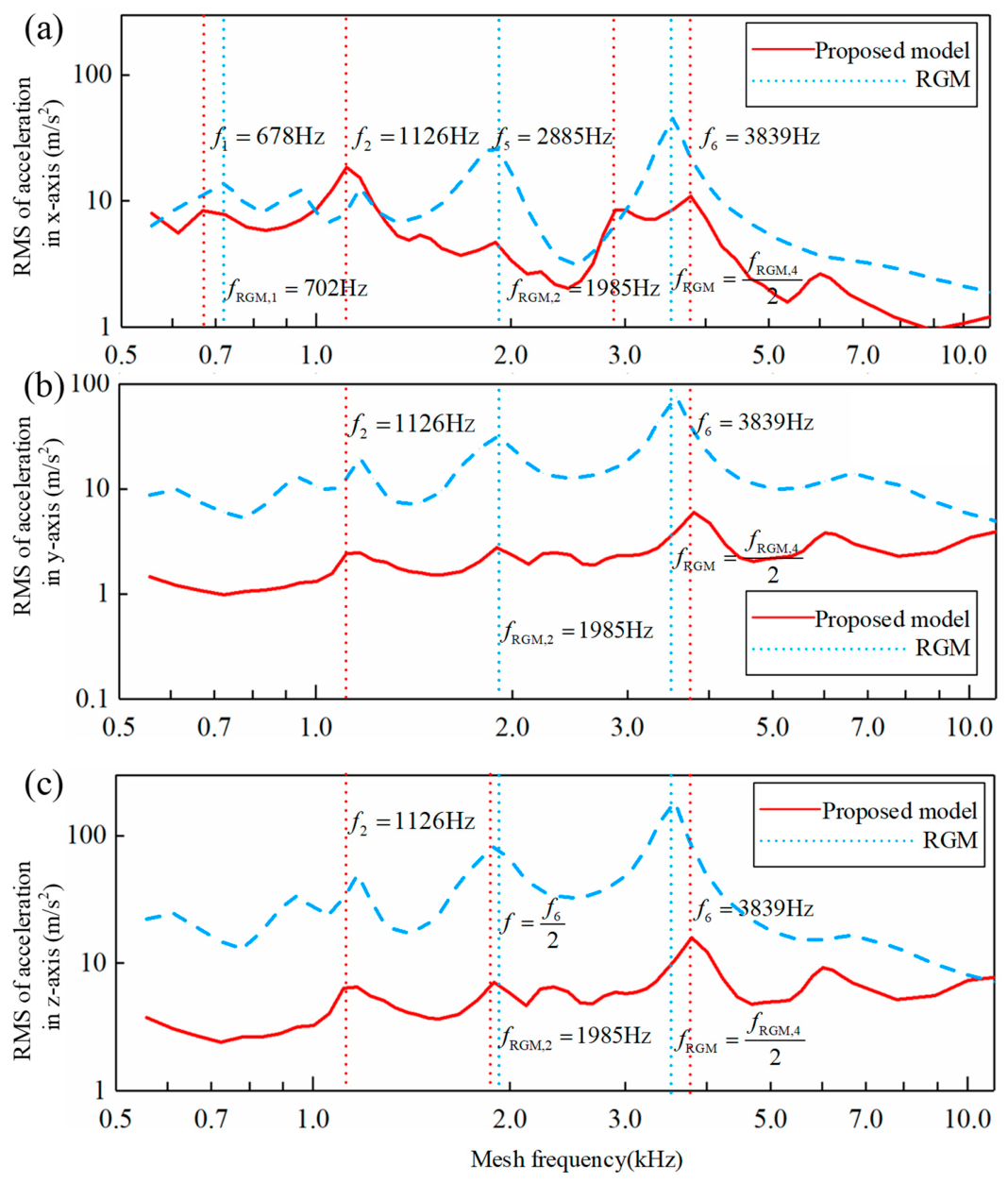
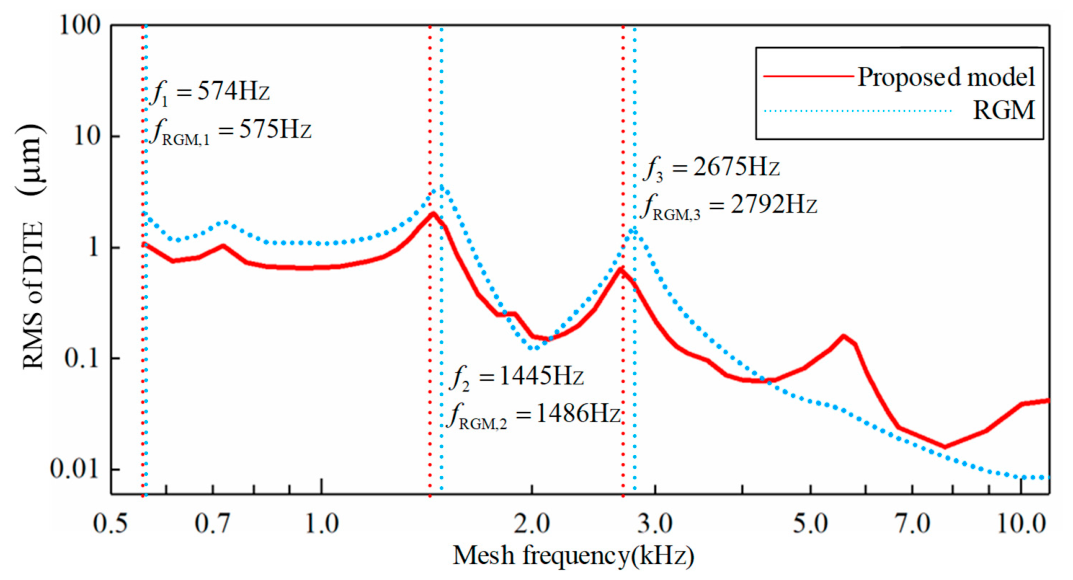
Subsequently, a dynamic responses comparison between the proposed model and RGM is conducted. Figure 15 illustrates the DTE curves for gear pair with instance 1 obtained from the two models, which shows a general decreasing trend but with distinct x-axis differences in peak values. As indicated in Table 3, this is due to the significant discrepancy in natural frequencies between the two models. Figure 16 displays the RMS of the vibration acceleration at the input end of the pinion, in sequential order of x-direction, y-direction, and z-direction vibration accelerations, where the acceleration along the x-direction is caused by the axial component of the meshing force of the helical gear pair. As can be seen from Figure 16, the dynamic responses obtained from RGM are generally greater than those derived from the proposed model. The vibration acceleration curves in the y- and z-directions are relatively similar but differ somewhat from the x-direction curve. Nevertheless, the peak values of the curves still correspond to the natural frequencies, which are the superharmonic and subharmonic frequencies.
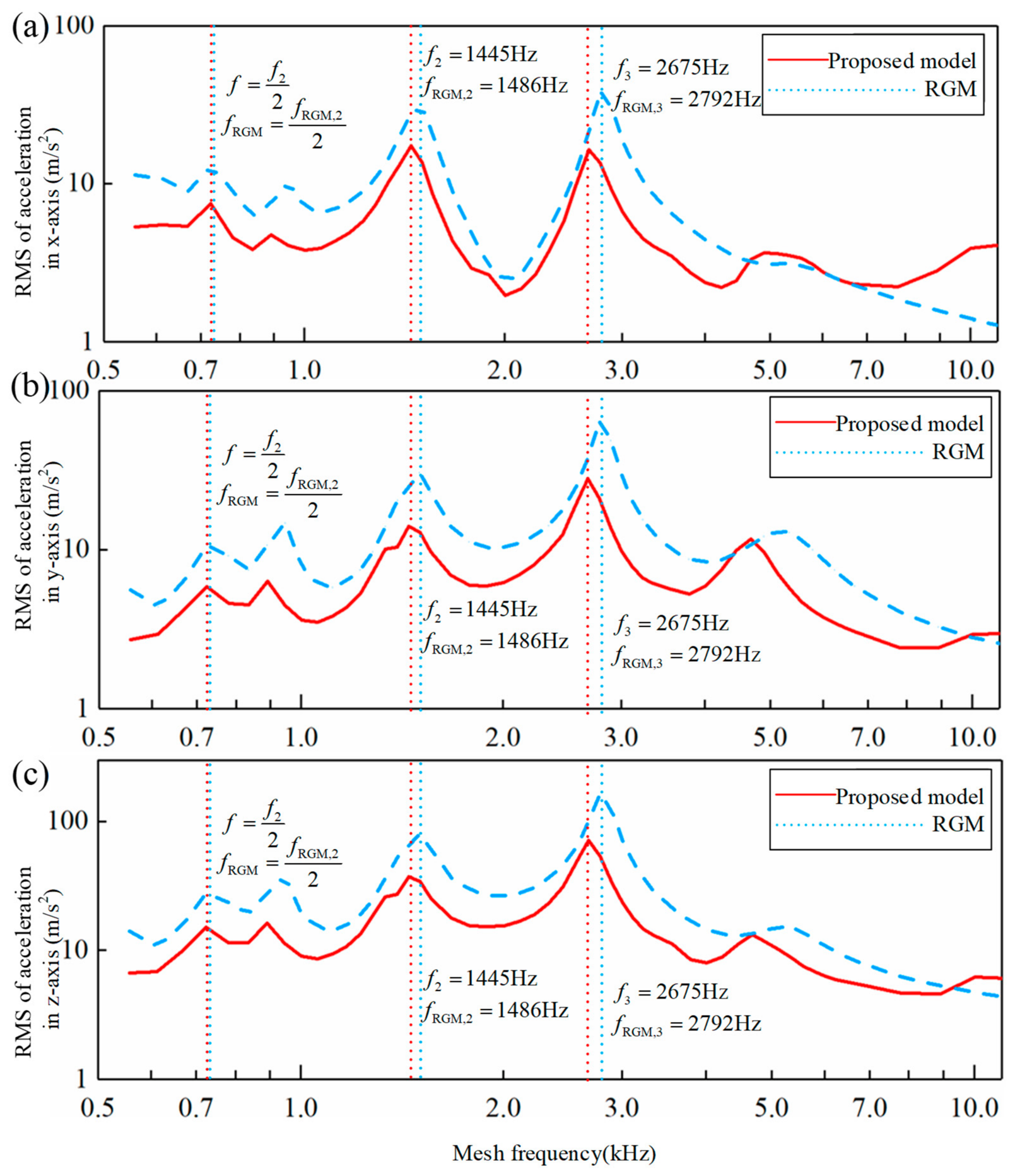
Similar illustration to instance 1, Figure 17 shows the DTE curves varying with the mesh frequency of the gear pair with instance 2 obtained by the two models, and Figure 18 shows the vibration acceleration of the gear pair in the x-direction, y-direction, and z-direction. Notably, the proposed model with a thick web performs a comparatively highly consistent pattern in both acceleration and DTE with those of the RGM, especially the resonance region of the first three orders. Referring to Table 3, the natural frequencies of the two models are very close, so the x-coordinate value of the peak of the DTE is also close. Additionally, the amplitudes of the proposed model are generally smaller than the results from the RGM, which results in the elasticity of the web element. Even though the thick gear web will strengthen the structural stiffness and lead to higher natural frequencies, the web elasticity still has an impact on the dynamic response of the system and alleviates the vibration intensity. The results are in agreement with the conclusion presented in Section 3.1.2.

3.4. Parametric Analysis

Web thickness and the helix angle are two important factors that influence the dynamic responses in helical gear pairs. In this section, a parametric analysis of these two factors based on the proposed model is conducted. In Section 3.2, it is known that out-of-plane vibrations are of the same order of magnitude as in-plane vibrations. Previous research [46] usually focuses on the in-plane vibrations with a spur gear pair. This section will not only discuss the impact of factors on in-plane vibration but will also take out-of-plane vibration into account.

3.4.1. Web Thickness Analysis

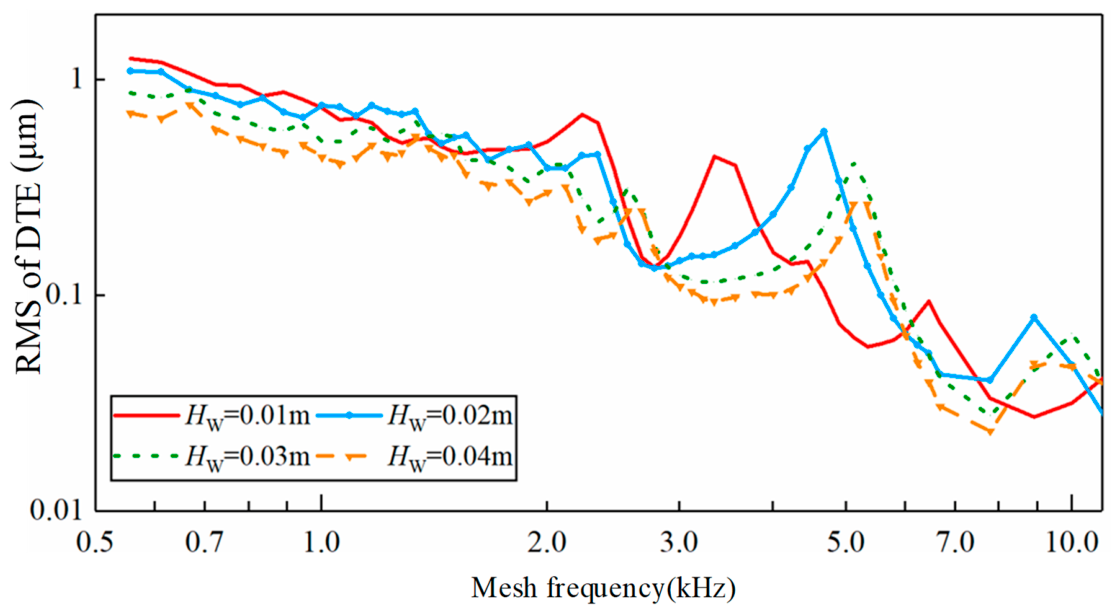
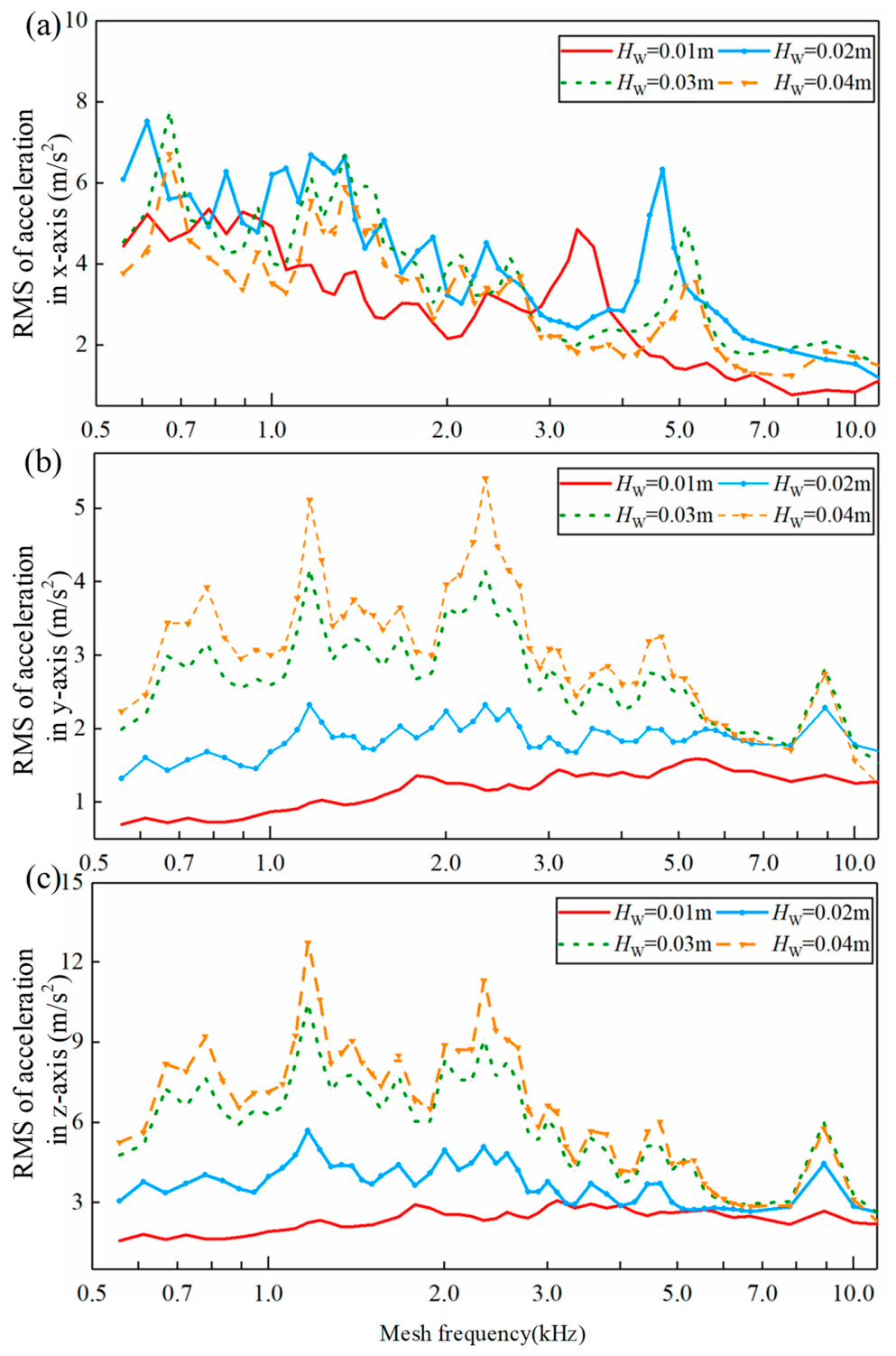
Based on the dimensional parameters from Section 3.2 and changing the helical angle to β = 18°, four instances with different web thicknesses (which are HW = 10 m, HW = 20 mm, HW = 30 mm and HW = 40 mm, respectively) are presented. The schematic of the system with different web thicknesses is identical to Figure 13. The RMS of DTE and the vibration acceleration for each axe are displayed in Figure 19 and Figure 20. The results in Figure 19 indicate that as the web becomes thicker, the RMS of DTE presents a complex change, making the location of the second peak move to the high-frequency area and decreasing the number of peaks caused by resonance. When the gear web is thinner, the gear pair is composed of a more out-of-plane mode shape under 10 kHz, and the modes are significantly affected by the web thickness. As the web thickness increases, the natural frequencies rise rapidly, eventually moving to the higher-frequency area. On the contrary, previous work on the vibration modes of spur gears was all focused on in-plane vibration, which is theoretically independent of the web thickness in structural stiffness. However, as the web becomes thicker, the mass of the system increases, causing the natural frequencies to drop. This is the opposite of the phenomenon shown by helical gears.
Figure 20 demonstrates the RMS of the acceleration of the input shaft in three axial directions with various web thicknesses. The first graph, known as the acceleration in the x-axis, reveals that many small peaks emerge in the low-frequency region of 0–3000 Hz consisting of natural frequencies and their superharmonic frequencies. When the mesh frequency comes to the middle-to-high frequency region, the number of peaks reduces significantly; as the thickness increases, the peak is located near 3400 Hz and gradually moves to 5000 Hz. In the entire speed range, the acceleration curve as a whole does not increase or decrease significantly, indicating that the thickness of the web has no obvious effect on the out-of-plane vibration intensity of the helical pinion shaft.
For the in-plane acceleration varying with mesh frequency in the y- and z-axis, they share a similar inclination: in the range of 0–3000 Hz, the increasing thickness of the web results in a drastic rise in the overall amplitude, and three or four main resonance peaks appear, while only one peak near 8000 Hz occurs in the rest region.
In conclusion, the thickness of the web has a more significant influence on the out-of-plane vibration, and the thin-webbed gear is beneficial to reducing the vibration intensity of the gear shaft under certain circumstances.

3.4.2. Helical Angle Analysis

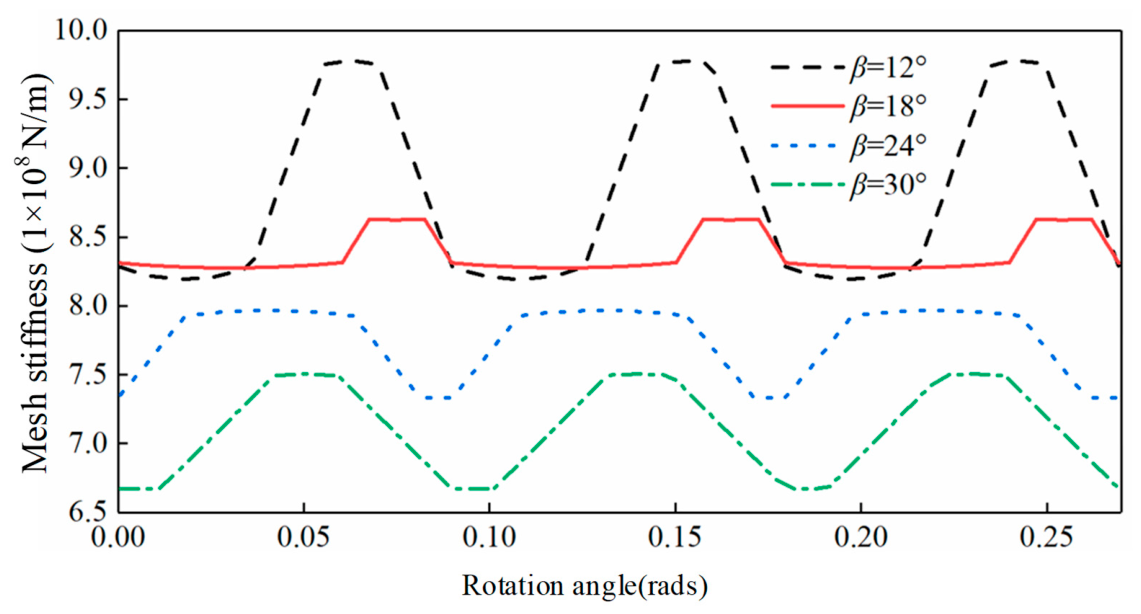
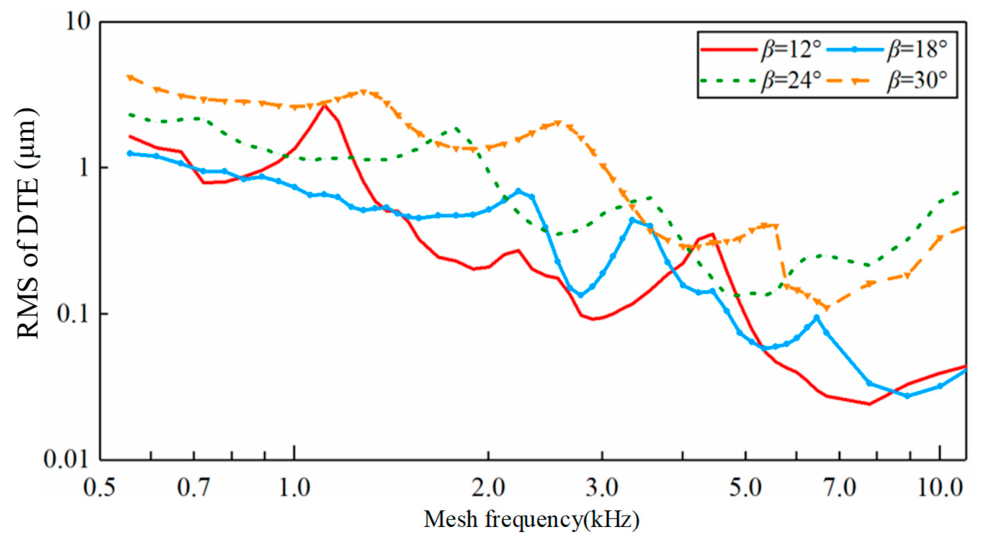
General parameters remain the same as those in Section 3.2, except that the web thickness is HW = 10 mm. Simultaneously, four different helical angles are given: β = 12°, β = 18°, β = 24° and β = 30°. The variation in the helical angle in the gear system leads to a change in mesh stiffness. Figure 21 shows the mesh stiffness of the helical gear pair with different angles. From the fluctuation range of the mesh stiffness and the rate of stiffness change with variation in the number of engaging teeth, it can be intuitively observed that the stiffness fluctuation range is the largest and changes the fastest at β = 12°, while a helix angle of 18° corresponds to the low fluctuation and slower change rate. Notably, with other dimensional parameters such as tooth width remaining constant, the mesh stiffness of the helical gears does not change linearly with the helix angle.
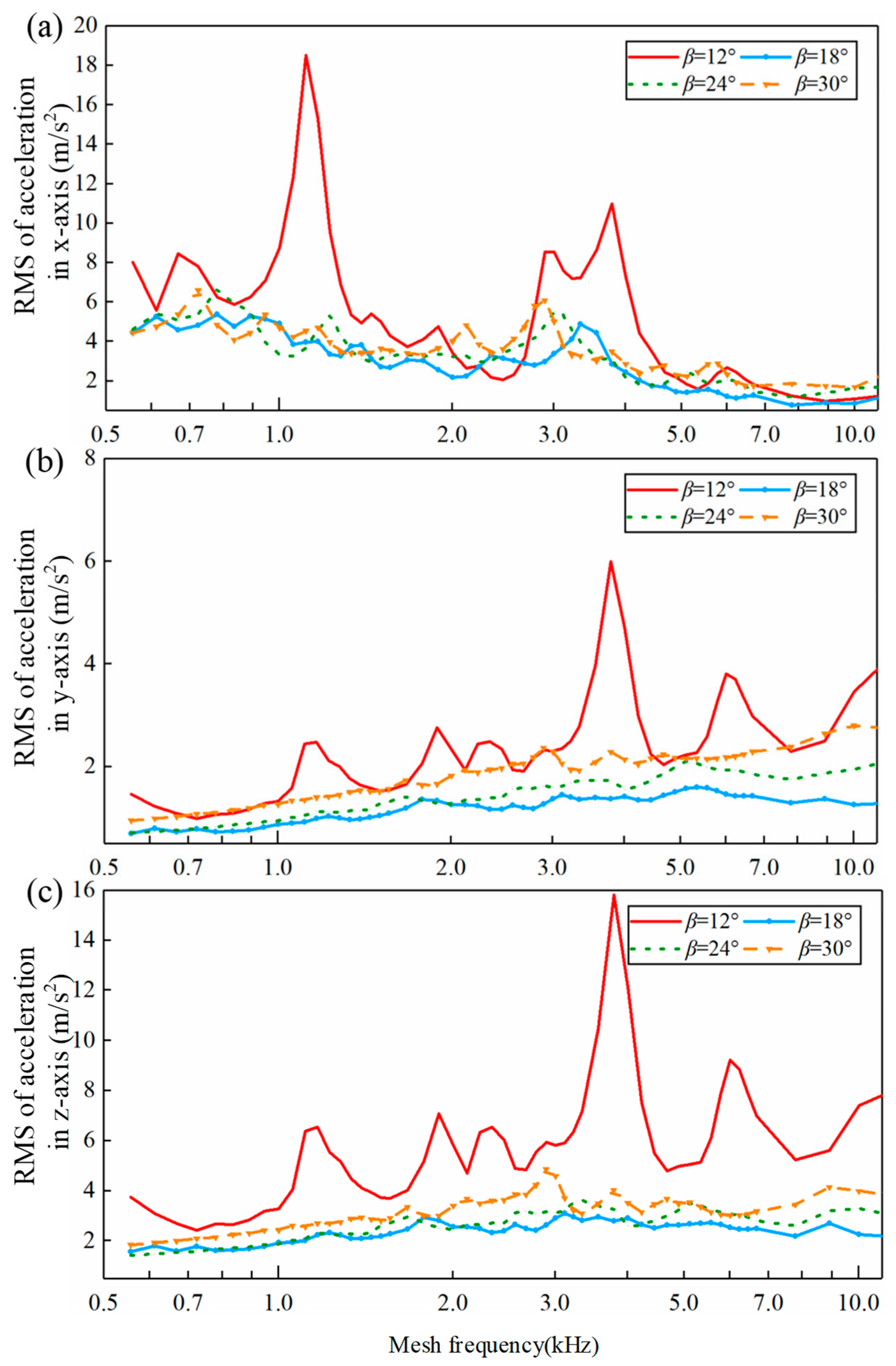
Figure 22 illustrates the change in DTE for helical gear pairs with different helix angles. It can be observed that as the helix angle increases, the overall dynamic transmission error values increase. This is due to the relatively thin web of the helical gear pairs undergoing considerable out-of-plane deformation during meshing, thereby causing larger DTE. This indicates that a thinner web is not conducive to the precision transmission of helical gears. Figure 23 displays the variations in vibration acceleration of helical gears with different helix angles. It is observed that at a helix angle of β = 12°, the acceleration in all three directions is the highest, while the vibration accelerations of the other three groups of helical gears with different helix angles are significantly lower, with the helical gears at β = 18° exhibiting the smallest vibration acceleration. This pattern is similar to the variation in meshing stiffness depicted in Figure 21. It is suggested that the effect of the helix angle on dynamic response primarily alters the meshing stiffness curve, thereby indirectly influencing the dynamic response characteristics. It also indicates that the fluctuation amplitude of the meshing stiffness curve is a key factor affecting the response characteristics of the system. The case study analysis presented in this section reveals that thin webs are beneficial for reducing the vibrational intensity of helical gear transmission systems, but will have reduced transmission accuracy at larger helix angles.

4. Conclusions

This study proposes an elastic gear modelling method that includes shaft–web–ring components and applies it to the mode shape and dynamic response analysis of helical gear dynamics. Modal experimental validation was carried out on a single gear system, and the accuracy of the dynamic response was verified by comparing the “degenerated” model of the gear pair system with existing models (RGM), thereby confirming the accuracy of the model.
A dynamic response analysis of helical gears was conducted, and a comparison of the in-plane and out-of-plane dynamic responses on the neutral line of the ring revealed that, on helical gears, the in-plane and out-of-plane dynamic responses are of the same order of magnitude, indicating that out-of-plane vibrations are equally important. Both mesh frequencies and shaft frequencies are present in the steady state.
Further, a comparison was made between the proposed model and the RGM model of helical gears in terms of modal and dynamic responses. It was found that for helical gears with thin webs, the elastic gear transmission model yields far more natural frequencies within 10 kHz than RGM, and the modes are primarily dominated by the out-of-plane nodal diameter. In contrast, RGM only yields modes dominated by the rigid torsional vibration. From the dynamic response results within the range of 0 to 10 kHz, there is a significant difference in the peak position of the DTE between the proposed model and RGM, with the former exhibiting a notably smaller overall vibration acceleration compared to the latter. For helical gear pairs with thick webs, the modal shape and dynamic responses of the two models are very close. This indicates that the RGM can still maintain high accuracy in the dynamic modelling of helical gears with thick webs, but is not suitable for the dynamic modelling of helical gear transmission with thin webs.
Lastly, the study of the impact of the web thickness on the dynamic responses reveals that web thickness will significantly affect the resonance peak in the frequency domain but has no obvious effects on the overall amplitude. The translational acceleration at the bearings of the thin-web helical gear transmission system is markedly lower than that of a system equipped with thick-web helical gears, suggesting that the thin-web configuration is advantageous in attenuating the translational vibrational intensity of the gear transmission shaft to a certain extent. The other study about the helical angle discovers that varying helical angles predominantly affect the fluctuation range and abrupt change rate of the time-varying mesh stiffness. This, in turn, influences the vibrational intensity of the gear transmission system in the form of internal excitation.
Furthermore, it should be objectively noted that the comparison between the experimental and modelled natural frequencies serves as a partial confirmation of the proposed model. While it effectively validates the theoretical mass and stiffness distributions, a more comprehensive verification, such as the experimental measurement of dynamic response amplitudes, operating mode shapes, and transient non-linear behaviours, will be pursued in future studies to fully substantiate the dynamic model. Additionally, because the proposed multi-theory analytical framework is fundamentally parameterized, future work will also focus on leveraging these mathematical formulations to develop predictive models. This will enable rapid dynamic evaluations and design optimizations for gears of varying size configurations without the need for repetitive and computationally expensive finite element re-meshing.

Author Contributions

Conceptualization, Q.W., T.L., J.T. and Z.S.; Methodology, T.L. and J.T.; Software, T.L. and Z.S.; Validation, T.L.; Formal analysis, T.L. and Z.S.; Investigation, T.L.; Resources, Q.W.; Data curation, T.L.; Writing—original draft, T.L.; Writing—review & editing, Q.W., T.L., J.T. and Z.S.; Visualization, Z.S.; Supervision, Q.W., J.T. and Z.S.; Project administration, Q.W. and J.T.; Funding acquisition, Q.W. and J.T. All authors have read and agreed to the published version of the manuscript.

Funding

This work is supported by the National Natural Science Foundation of China (NSFC) through Grant No. 52005515 and also supported by the Fundamental Research Funds for the Central Universities of Central South University through Grant No. 512340007.

Data Availability Statement

The raw data supporting the conclusions of this article will be made available by the authors on request.

Conflicts of Interest

Author Qibo Wang was employed by the company Aero Engine Corporation of China. The remaining authors declare that the research was conducted in the absence of any commercial or financial relationships that could be construed as a potential conflict of interest.

Nomenclature

Symbol MeaningUnit
CSCoordinate system-
O 0 x 0 y 0 Space-fixed CS-
O 1 x 1 y 1 Revolution CS-
O 2 x 2 y 2 Body-fixed CS-
C = S , W , R Shaft, web or ring model-
r C Macro Polar radius in body-fixed CSm
θ C Macro Polar angle in body-fixed CSrad
x C , y C , z C Macro coordinate in revolution CSm
t C = u C , v C , w C Micro-translational displacement m
r o t C = φ C , x , φ C , y , φ C , z Micro-rotational displacement rad
L S Length of the shaft segment m
R S Radius of the shaft segmentm
H W Thickness of the web segmentm
R W Outer radius of the web segmentm
R R Radius of the centre of the ring segmentm
B R Thickness of the ring segmentm
H R Width of the ring segmentm
P C An arbitrary point in any model-
U 2 , C Location vector in body-fixed CS-
U 1 , C Location vector in revolution CS-
U 0 , C Location vector in space-fixed CS-
U m , C Macro location in body-fixed CS-
U f , C Flexible deformations in body-fixed CS-
T 1 Transform matrices corresponding to the shaft revolution angle-
T 2 Transform matrices corresponding to the distortion of the shaft-
Ω Shaft rotational speedrad/s
R 1 Vector of the deformed cross section centre in revolution CS -
R 1 , S W / R 1 , S R Vector of the deformed shaft–web/shaft–ring coupling point in revolution CS-
R 0 Vector from Space-fixed to Revolution CS-
ε S , x Normal strain of the shaft model Dimensionless
γ S , x y , γ S , x z Shear strain of the shaft modelDimensionless
σ S , x Normal stress of the shaft modelPa
τ S , x y , τ S , x z Shear stress of the shaft modelPa
κ 1 Shear coefficient for the shaft’s sectional areaDimensionless
μ Poisson’s ratioDimensionless
ε W , r r , ε W , θ θ Normal strain of the web model Dimensionless
γ W , r θ , γ W , θ x , γ W , r x Shear strain of the web modelDimensionless
σ W , r r , σ W , θ θ Normal stress of the web modelPa
τ W , r θ , τ W , θ x , τ W , r x Shear stress of the web modelPa
ε R , i , ε R , o In-plane/out-of-plane normal strain of ring modelDimensionless
γ R , i , γ R , o In-plane/out-of-plane shear strain of ring model1/m
χ R , i , χ R , o In-plane/out-of-plane bending strain of ring modelDimensionless
σ R , i , σ R , o In-plane/out-of-plane normal stress of ring modelPa
τ R , i , τ R , o In-plane/out-of-plane shear stress of ring modelPa
v R , i , v R , o In-plane/out-of-plane bending stress of ring modelPa
T R Torsional constant for the sectional area of the ring modelm4
k = p , g Subscript to identify pinion and gear-
K S , j , k Kinematic energy of the j-th shaft elementsJ
P S , j , k Potential energy of the j-th shaft elementsJ
K S , k Kinematic energy of all the shaft elementsJ
P S , k Potential energy of all the shaft elementsJ
N S , k Number of the shaft elements-
K W , i , j , k Kinematic energy of the j-th web elements in the i-th circle J
P W , i , j , k Potential energy of the j-th web elements in the i-th circleJ
M W , k Number of the web circles-
N W , k Number of the elements within one circle-
K R , j , k Kinematic energy of the j-th ring elementsJ
P R , j , k Potential energy of the j-th ring elementsJ
K R , k Kinematic energy of all the ring elementsJ
P R , k Potential energy of all the ring elementsJ
P b e a r i n g Potential energy from bearing constraintsJ
k B w , k B u , k B v , k B y k B z Bearing stiffness for shaft elementsN/m
P S S Potential energy from shafts’ self-coupling effectJ
P S W Potential energy from shaft–web coupling effectJ
P W R Potential energy from web–ring coupling effectJ
z p , z g Tooth number of pinion and gear-
δ 0 Transmission error at the former time stepm
δ 1 Transmission error at the next time stepm
Δ δ Difference in the transmission errorm
k m ( t ) Time varying mesh stiffnessN/m
P m ( t ) Potential energy from gear mesh effectJ
M Mass matrix of the whole system-
C g Gyroscopic damping matrix of the whole system-
C d Structural damping matrix of the whole system-
K ( t ) Overall stiffness matrix of the whole system-
K s t r u c t u r e Structural stiffness matrix of the whole system-
Q i n t e r n a l Force matrix induced by the inherent property-
Q e x t e r n a l External torque matrix of the whole system-
λ Complex eigenvalues rad/s

References

  1. Sun, Z.; Chen, S.; Tao, X.; Hu, Z. Research on dynamic characteristics of gear system considering the influence of temperature on material performance. J. Vib. Control 2022, 28, 1792–1803. [Google Scholar] [CrossRef]
  2. Lin, J.; Parker, R.G. Analytical Characterization of the Unique Properties of Planetary Gear Free Vibration. J. Vib. Acoust. 1999, 121, 316–321. [Google Scholar] [CrossRef]
  3. Sheng, Z.; Tang, J.; Chen, S.; Hu, Z. Modal Analysis of Double-Helical Planetary Gears with Numerical and Analytical Approach. J. Dyn. Syst. Meas. Control. 2015, 137, 041012. [Google Scholar] [CrossRef]
  4. Hou, S.; Wei, J.; Zhang, A.; Lim, T.C.; Zhang, C. Study of Dynamic Model of Helical/Herringbone Planetary Gear System with Friction Excitation. J. Comput. Nonlinear Dyn. 2018, 13, 121007. [Google Scholar] [CrossRef]
  5. Kong, X.; Tang, J.; Siyu, C.; Hu, Z. Effects of gearbox housing flexibility on dynamic characteristics of gear transmission system. J. Vib. Control 2020, 27, 2097–2108. [Google Scholar] [CrossRef]
  6. Wei, J.; Gao, P.; Hu, X.; Sun, W.; Zeng, J. Effects of dynamic transmission errors and vibration stability in helical gears. J. Mech. Sci. Technol. 2014, 28, 2253–2262. [Google Scholar] [CrossRef]
  7. Wan, Z.; Cao, H.; Zi, Y.; He, W.; Chen, Y. Mesh stiffness calculation using an accumulated integral potential energy method and dynamic analysis of helical gears. Mech. Mach. Theory 2015, 92, 447–463. [Google Scholar] [CrossRef]
  8. Mo, S.; Zhang, Y.; Wu, Q.; Houjoh, H.; Matsumura, S. Research on natural characteristics of double-helical star gearing system for GTF aero-engine. Mech. Mach. Theory 2016, 106, 166–189. [Google Scholar] [CrossRef]
  9. Wang, C.; Wang, S.R.; Yang, B.; Wang, G.Q. Dynamic modeling of double helical gears. J. Vib. Control 2017, 24, 3989–3999. [Google Scholar] [CrossRef]
  10. Li, M.; Hu, H.Y. Dynamic Analysis of a Spiral Bevel-Geared Rotor-Bearing System. J. Sound Vib. 2003, 259, 605–624. [Google Scholar] [CrossRef]
  11. Hua, X.; Lim, T.C.; Peng, T.; Wali, W.E. Dynamic analysis of spiral bevel geared rotor systems applying finite elements and enhanced lumped parameters. Int. J. Automot. Technol. 2012, 13, 97–107. [Google Scholar] [CrossRef]
  12. Alves, J.T.; Wang, J.; Guingand, M.; de Vaujany, J.-P.; Velex, P. Static and dynamic models for spiral bevel gears. Mech. Ind. 2012, 13, 325–335. [Google Scholar] [CrossRef]
  13. Yassine, D.; Ahmed, H.; Lassaad, W.; Mohamed, H. Effects of gear mesh fluctuation and defaults on the dynamic behavior of two-stage straight bevel system. Mech. Mach. Theory 2014, 82, 71–86. [Google Scholar] [CrossRef]
  14. Lafi, W.; Djemal, F.; Tounsi, D.; Akrout, A.; Walha, L.; Haddar, M. Dynamic modelling of differential bevel gear system in the presence of a defect. Mech. Mach. Theory 2019, 139, 81–108. [Google Scholar] [CrossRef]
  15. Kahraman, A. Free torsional vibration characteristics of compound planetary gear sets. Mech. Mach. Theory 2001, 36, 953–971. [Google Scholar] [CrossRef]
  16. Kiracofe, D.R.; Parker, R.G. Structured Vibration Modes of General Compound Planetary Gear Systems. J. Vib. Acoust. 2006, 129, 953–971. [Google Scholar] [CrossRef]
  17. Guo, Y.; Parker, R.G. Purely rotational model and vibration modes of compound planetary gears. Mech. Mach. Theory 2010, 45, 365–377. [Google Scholar] [CrossRef]
  18. Inalpolat, M.; Kahraman, A. Dynamic Modelling of Planetary Gears of Automatic Transmissions. Proc. Inst. Mech. Eng. Part K J. Multi-Body Dyn. 2008, 222, 229–242. [Google Scholar] [CrossRef]
  19. Singh, A. Load sharing behavior in epicyclic gears: Physical explanation and generalized formulation. Mech. Mach. Theory 2010, 45, 511–530. [Google Scholar] [CrossRef]
  20. Nelson, H.D. A Finite Rotating Shaft Element Using Timoshenko Beam Theory. J. Mech. Des. 1980, 102, 793–803. [Google Scholar] [CrossRef]
  21. Kahraman, A.; Ozguven, H.N.; Houser, D.R.; Zakrajsek, J.J. Dynamic Analysis of Geared Rotors by Finite Elements. J. Mech. Des. 1992, 114, 507–514. [Google Scholar] [CrossRef]
  22. Chen, S.Y.; Tang, J.Y.; Li, Y.P.; Hu, Z.H. Rotordynamics analysis of a double-helical gear transmission system. Meccanica 2016, 51, 251–268. [Google Scholar] [CrossRef]
  23. Guo, Y.; Parker, R.G. Stiffness matrix calculation of rolling element bearings using a finite element/contact mechanics model. Mech. Mach. Theory 2012, 51, 32–45. [Google Scholar] [CrossRef]
  24. Guo, Y.; Eritenel, T.; Ericson, T.M.; Parker, R.G. Vibro-acoustic propagation of gear dynamics in a gear-bearing-housing system. J. Sound Vib. 2014, 333, 5762–5785. [Google Scholar] [CrossRef]
  25. Kahraman, A.; Kharazi, A.A.; Umrani, M. A deformable body dynamic analysis of planetary gears with thin rims. J. Sound Vib. 2003, 262, 752–768. [Google Scholar] [CrossRef]
  26. Lin, T.; Ou, H.; Li, R. A finite element method for 3D static and dynamic contact/impact analysis of gear drives. Comput. Methods Appl. Mech. Eng. 2007, 196, 1716–1728. [Google Scholar] [CrossRef]
  27. Huangfu, Y.; Zeng, J.; Ma, H.; Dong, X.; Han, H.; Zhao, Z. A flexible-helical-geared rotor dynamic model based on hybrid beam-shell elements. J. Sound Vib. 2021, 511, 116361. [Google Scholar] [CrossRef]
  28. Tian, H.; Wang, H.; Zhao, X.; Ma, H. Dynamic modeling of GTF star gear-rotor coupling system considering structural flexibility. J. Sound Vib. 2023, 560, 117813. [Google Scholar] [CrossRef]
  29. Kong, X.; Tang, J.; Hu, Z.; Ding, H.; Wang, Z.; Wang, Q. Dynamic modeling and vibration analysis of spur gear system considering thin-walled gear and hollow shaft. Mech. Mach. Theory 2023, 181, 105197. [Google Scholar] [CrossRef]
  30. Kong, X.; Hu, Z.; Tang, J.; Chen, S.; Wang, Z. Effects of gear flexibility on the dynamic characteristics of spur and helical gear system. Mech. Syst. Signal Process. 2023, 184, 109691. [Google Scholar] [CrossRef]
  31. Tian, Z.; Hu, Z.; Tang, J.; Chen, S.; Kong, X.; Wang, Z.; Zhang, J.; Ding, H. Dynamical modeling and experimental validation for squeeze film damper in bevel gears. Mech. Syst. Signal Process. 2023, 193, 110262. [Google Scholar] [CrossRef]
  32. Guilbert, B.; Velex, P.; Dureisseix, D.; Cutuli, P. A Mortar-Based Mesh Interface for Hybrid Finite-Element/Lumped-Parameter Gear Dynamic Models—Applications to Thin-Rimmed Geared Systems. J. Mech. Des. 2016, 138, 123301. [Google Scholar] [CrossRef]
  33. Guilbert, B.; Velex, P.; Cutuli, P. Quasi-static and dynamic analyses of thin-webbed high-speed gears: Centrifugal effect influence. Proc. Inst. Mech. Eng. Part C J. Mech. Eng. Sci. 2019, 233, 7282–7291. [Google Scholar] [CrossRef]
  34. Liu, C.; Zhao, Y.; Wang, Y.; Zhang, T.; Jia, H. Hybrid Dynamic Modeling and Analysis of High-Speed Thin-Rimmed Gears. J. Mech. Des. 2021, 143, 123401. [Google Scholar] [CrossRef]
  35. Bruzzone, F.; Rosso, C. Effect of Web Flexibility in Gear Engagement: A Proposal of Analysis Strategy. Vibration 2022, 5, 200–212. [Google Scholar] [CrossRef]
  36. Shweiki, S.; Rezayat, A.; Tamarozzi, T.; Mundo, D. Transmission Error and strain analysis of lightweight gears by using a hybrid FE-analytical gear contact model. Mech. Syst. Signal Process. 2019, 123, 573–590. [Google Scholar] [CrossRef]
  37. Tian, Z.; Tang, J.; Hu, Z.; Feng, L.; Bao, F.; Ma, X.; Yi, Z. Thin-walled bevel gear traveling wave resonance: Modal and dynamic characterization. Int. J. Mech. Sci. 2026, 312, 111245. [Google Scholar] [CrossRef]
  38. Wan Nordin, I.H.; Idris, D.M.N.D.; Hafis, M.B.S.; Che Abdullah, S.S.; Ando, K.; Miyachika, K.; Koide, T. Effects of Rim and Web Thicknesses on Root Stresses of Thin-Rimmed Helical Gear. Appl. Mech. Mater. 2012, 165, 300–304. [Google Scholar] [CrossRef]
  39. Cooley, C.G.; Parker, R.G. Vibration of high-speed rotating rings coupled to space-fixed stiffnesses. J. Sound Vib. 2014, 333, 2631–2648. [Google Scholar] [CrossRef]
  40. Li, T.; Tang, J.; Hu, Z.; Wang, Z.; Fu, Z. Three-dimensional vibration investigation of the thin web gear pair based on Timoshenko beam. Thin-Walled Struct. 2023, 184, 110507. [Google Scholar] [CrossRef]
  41. Li, T.; Tang, J.; Hu, Z.; Zhang, D. Development and validation of a semi-analytical timoshenko-based model for resonance analysis in lightweight gear systems. J. Sound Vib. 2025, 605, 119001. [Google Scholar] [CrossRef]
  42. Yang, F.; Wang, D. Vibration of Rotating and Revolving Planet Rings with Discrete and Partially Distributed Stiffnesses. Appl. Sci. 2021, 11, 127. [Google Scholar] [CrossRef]
  43. Wang, C.; Parker, R.G. Modal properties and parametrically excited vibrations of spinning epicyclic/planetary gears with a deformable ring. J. Sound Vib. 2021, 494, 115828. [Google Scholar] [CrossRef]
  44. Li, T.; Tang, J.; Hu, Z.; Chen, D. Dynamic Analysis of Thin-Webbed Helical Gears Using a Multi-theory Elastic Approach. In Advances in Mechanical Transmission: Innovations and Applications (Icmt-2 2025); Wang, S., Qin, D., Liu, F., Eds.; Lecture Notes in Mechanical Engineering; Springer: Singapore, 2026. [Google Scholar]
  45. Ren, Y.; Shen, M.; Wang, Q.; Zhong, R. Vibration analysis of lightweight spur gear system considering flexibility. Results Eng. 2026, 29, 109512. [Google Scholar] [CrossRef]
  46. Hu, Z.H.; Liu, W.T.; Chen, S.Y.; Guan, X.L.; Wang, Z.W.; Tian, Z.Y. Dynamic modeling and analysis of thin-webbed spur gear pair. Thin-Walled Struct. 2023, 183, 110386. [Google Scholar] [CrossRef]
  47. Timoshenko, S.P.; Goodier, J.N. Theory of Elasticity, 3rd ed.; McGraw-Hill: New York, NY, USA, 1970. [Google Scholar]
  48. Tufekci, E.; Dogruer, O.Y. Out-of-plane free vibration of a circular arch with uniform cross-section: Exact solution. J. Sound Vib. 2006, 291, 525–538. [Google Scholar] [CrossRef]
  49. Sun, Z.; Chen, S.; Hu, Z.; Tao, X. Improved mesh stiffness calculation model of comprehensive modification gears considering actual manufacturing. Mech. Mach. Theory 2022, 167, 104470. [Google Scholar] [CrossRef]
  50. Hu, Z.; Tang, J.; Zhong, J.; Chen, S.; Yan, H. Effects of tooth profile modification on dynamic responses of a high speed gear-rotor-bearing system. Mech. Syst. Signal Process. 2016, 76–77, 294–318. [Google Scholar] [CrossRef]
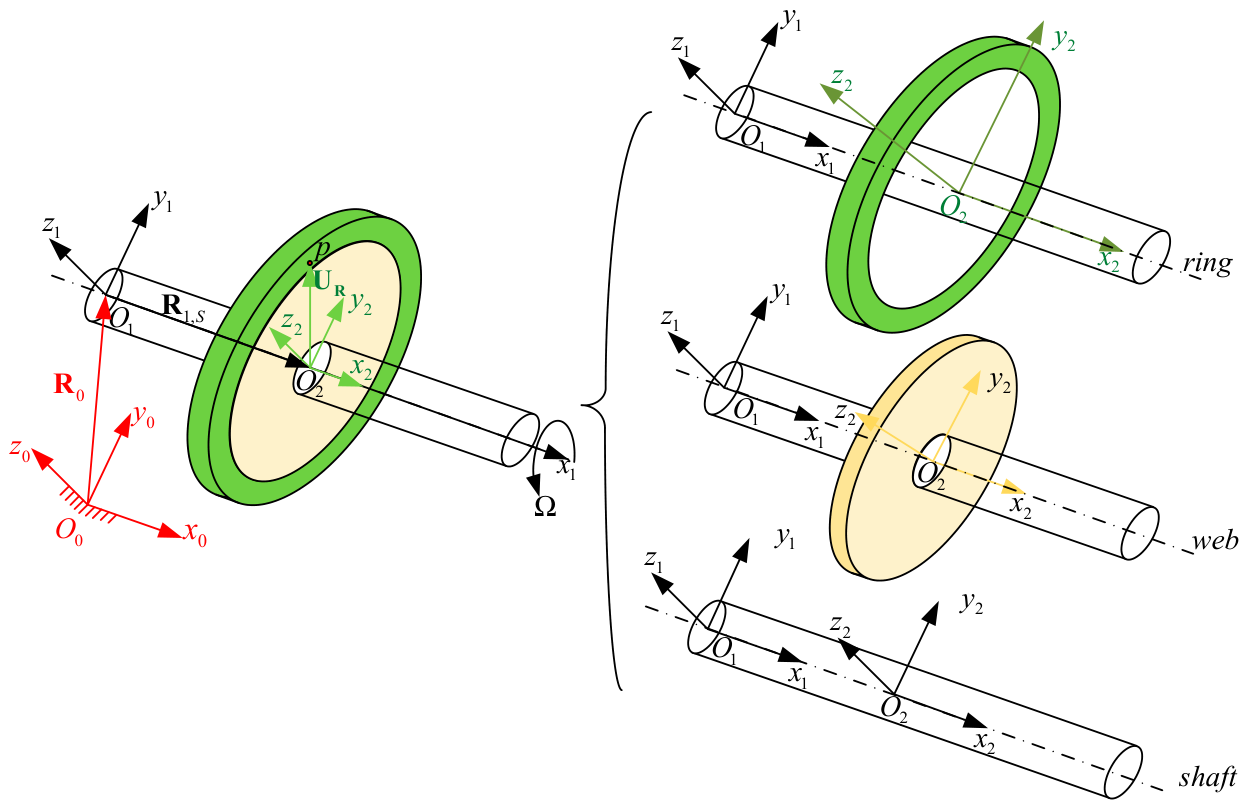
Figure 1. Schematic of the thin-web gear model in space-fixed coordinate system.
Machines 14 00482 g001
Figure 2. Schematic of shaft model in the revolution coordinate system and body-fixed coordinate system. (a) A 3D perspective of the shaft model in the revolution system; (b) a sectional view of the shaft model; (c) the deformation and normal stress cube of the shaft element; (d) micro-displacements and coordinate axis of the investigated point in the body-fixed system.
Machines 14 00482 g002
Figure 3. Schematic of web model in the revolution coordinate system and body-fixed coordinate system. (a) Micro-displacements and coordinate axis of the investigated point in the body-fixed system; (b) a 3D perspective of the web model in the revolution system; (c) the front view of the web model; (d) a sectional view of the web model.
Machines 14 00482 g003
Figure 4. Schematic of ring model in the revolution coordinate system and body-fixed coordinate system. (a) Micro-displacements and coordinate axis of the investigated point in the body-fixed system; (b) a 3D perspective of the ring model in the revolution system; (c) the front view of the ring model; (d) sectional view of the ring model.
Machines 14 00482 g004
Figure 5. Schematic of the discretized shaft, ring and web elements. (a) Discretized shaft elements with the corresponding integral domain; (b) discretized web and ring elements with the integral domain.
Machines 14 00482 g005
Figure 6. Schematic of the mesh process at initial state and next time step. (a) Overview of the gear pair system in the space-fixed coordinate system in the initial state; (b) schematic of the dynamic transmission error in the initial state; (c) overview of the gear pair system in the space-fixed coordinate system in the next time step; (d) schematic of the dynamic transmission error in the next time step.
Machines 14 00482 g006
Figure 7. Experimental setup for the modal testing of the thin-webbed gear: (a) photograph of the test platform; (b) schematic diagram of the testing configuration and signal flow; (c) topological grid illustrating the distribution of excitation points.
Machines 14 00482 g007
Figure 8. Comparison of model shape between the experiment and the proposed model.
Machines 14 00482 g008
Figure 9. Comparison of rotational displacement of input shaft between DEM and RGM under different rotational speeds. (a) Torsional displacement comparison at 50 rad/s; (b) torsional displacement comparison at 500 rad/s; (c) torsional displacement comparison at 1000 rad/s.
Machines 14 00482 g009
Figure 10. Comparison of dynamic transmission error between DEM and RGM under different rotational speeds.
Machines 14 00482 g010
Figure 11. Translational displacements of the ring element within a single rotation cycle. (a) Axial displacement in the ring segment in a single rotation cycle; (b) radial displacement in the ring segment in a single rotation cycle; (c) tangential displacement in the ring segment in a single rotation cycle.
Machines 14 00482 g011
Figure 12. Rotational displacements of the ring element within a single rotation cycle. (a) Axial rotation in the ring segment in a single rotation cycle; (b) radial displacement in the ring segment in a single rotation cycle; (c) tangential displacement in the ring segment in a single rotation cycle.
Machines 14 00482 g012
Figure 13. Schematic of two investigated gear pair instances. (a) Elastic gear body with a thin web; (b) elastic gear body with a thick web.
Machines 14 00482 g013
Figure 14. Schematic of the first four mode shapes of the proposed model and RGM.
Machines 14 00482 g014
Figure 15. RMS of DTE of the gear pair with instance 1 obtained by the proposed model and RGM under different mesh frequency.
Machines 14 00482 g015
Figure 16. RMS of acceleration of the gear pair with instance 1 obtained by the proposed model and RGM established under different mesh frequencies. (a) RMS of acceleration of the x-axis; (b) RMS of acceleration of the y-axis; (c) RMS of acceleration of the z-axis. The vertical lines indicate the resonance peaks’ frequencies for both model (red: proposed model; blue: RGM model).
Machines 14 00482 g016
Figure 17. RMS of DTE of the gear pair with instance 2 obtained by the proposed model and RGM established under different mesh frequencies. The vertical lines indicate the resonance peaks’ frequencies for both model (red: proposed model; blue: RGM model).
Machines 14 00482 g017
Figure 18. RMS of acceleration of the gear pair with instance 2 obtained by the proposed model and RGM established under different mesh frequencies. (a) RMS of acceleration of the x-axis; (b) RMS of acceleration of the y-axis; (c) RMS of acceleration of the z-axis. The vertical lines indicate the resonance peaks’ frequencies for both model (red: proposed model; blue: RGM model).
Machines 14 00482 g018
Figure 19. RMS of DTE based on the proposed model with different web thicknesses under different mesh frequencies.
Machines 14 00482 g019
Figure 20. RMS of acceleration based on the proposed model with different web thicknesses under different mesh frequency. (a) RMS of acceleration of the x-axis; (b) RMS of acceleration of the y-axis; (c) RMS of acceleration of the z-axis.
Machines 14 00482 g020
Figure 21. Mesh stiffness of the system with a different helical angle.
Machines 14 00482 g021
Figure 22. RMS of DTE based on the proposed model with different helix angles under different mesh frequencies.
Machines 14 00482 g022
Figure 23. RMS of acceleration based on the proposed model with different helix angles under different mesh frequency. (a) RMS of acceleration of the x-axis; (b) RMS of acceleration of the y-axis; (c) RMS of acceleration of the z-axis.
Machines 14 00482 g023
Table 1. The natural frequencies of the first five orders.
Order12345
Proposed model (Hz)37.6873.06233.25641.74866.12
Experimental
result (Hz)
41.8071.66237.53660.54863.68
Deviation (%)−9.861.95−1.80−2.850.28
Table 2. The natural frequencies of the gear pair comparison between DEM and RGM under different helical angles (Hz).
Helical AngleModelMode Shape Order
1234567
DEM992.452937.103819.087660.887669.208304.608334.49
RGM992.45 2937.10 3819.08 7660.90 7669.22 8304.60 8334.50
12°DEM991.18 2940.52 4866.12 7589.10 7662.79 8290.90 8356.17
RGM991.18 2940.52 4866.12 7589.12 7662.81 8290.91 8356.18
18°DEM967.33 2506.47 5227.62 7468.47 7646.82 8269.51 8334.90
RGM967.33 2506.47 5227.63 7468.49 7646.84 8269.46 8334.91
24°DEM930.74 2103.03 5503.28 7297.64 7647.47 8242.23 8307.48
RGM930.74 2103.03 5503.29 7297.66 7647.48 8242.12 8307.49
30°DEM840.60 1587.94 5674.79 6943.63 7714.73 8195.18 8259.63
RGM840.60 1587.94 5674.81 6943.65 7714.74 8195.17 8259.65
Table 3. The natural frequencies comparison between the proposed model and RGM (Hz).
Mode Shape OrderInstance 1Instance 2
Proposed ModelRGMDeviationsProposed ModelRGMDeviations
1678.25701.923.3722%574.11575.210.1912%
21126.58NANA1445.151486.782.8000%
32198.411985.0610.7478%2675.162792.404.1985%
42429.79NANA4674.365250.5110.9732%
52885.52NANA8979.32NANA
63839.594226.459.1533%
75893.03NANA
89261.337142.1529.6715%
NA: Not applicable.
Disclaimer/Publisher’s Note: The statements, opinions and data contained in all publications are solely those of the individual author(s) and contributor(s) and not of MDPI and/or the editor(s). MDPI and/or the editor(s) disclaim responsibility for any injury to people or property resulting from any ideas, methods, instructions or products referred to in the content.