Article

Design and Verification of a Comprehensive Multi-Module Integrated Intelligent Bathing Assistance System


1
Institute of Rehabilitation Engineering and Technology, University of Shanghai for Science and Technology, Shanghai 200093, China
2
Engineering Research Center of Traditional Chinese Medicine Intelligent Rehabilitation, Shanghai University of Traditional Chinese Medicine, Shanghai 200444, China
*
Author to whom correspondence should be addressed.
Machines 2026, 14(4), 431; https://doi.org/10.3390/machines14040431

Submission received: 19 March 2026 / Revised: 4 April 2026 / Accepted: 11 April 2026 / Published: 12 April 2026

Abstract

Assistive bathing for the elderly and disabled presents significant challenges regarding caregiver workload and safety. This paper presents the design and verification of a multi-module integrated intelligent bathing assistance system. The system automates the entire bathing sequence through four coordinated modules: a robotic scrubbing unit, a climate-controlled cabin, a passive multifunctional wheelchair, and a multi-degree-of-freedom transfer device. A key innovation is the wheelchair’s passive design with an automated docking mechanism, ensuring safety in wet environments. Unlike existing commercial solutions and the existing literature, which primarily focus on fragmented, singular functionalities (such as transfer-only devices or fixed-spray cabins), the core advantage of the developed system lies in its holistic integration of safe physical transfer, adaptive robotic scrubbing, and microenvironment control into a seamless, unified architecture. Employing a modular and ergonomic approach, the system executes a predefined 12-step automated workflow. Experimental validation demonstrates an average bathing time of 16.6 min and a quantifiable 69.8% reduction in caregiver workload, confirming the system’s high efficiency and practical utility in alleviating caregiver burden.

1. Introduction

Assistive bathing is an essential yet highly challenging daily activity for elderly and disabled populations, presenting significant difficulties in terms of caregiver burden, operational safety, and maintaining user dignity [1,2]. Traditional manual bathing is labor-intensive, time-consuming, and poses risks of falls or injuries for both caregivers and care recipients, highlighting the urgent need for technological intervention [3,4]. While robotic and automated solutions have been explored, many existing systems focus on singular functionalities. For instance, OG Wellness [5] developed seated and supine bathing devices that transfer users into a bathtub using specialized chairs or beds, employing high-velocity water jets from strategically placed nozzles for large-area skin cleansing. However, such approaches often lack a holistic, user-centered design capable of integrating safe transfer, comprehensive cleaning, and post-bath care into a seamless, automated workflow [6,7].
The development of a comprehensive bathing assistance system necessitates addressing several interrelated challenges: ergonomic spatial design adaptable to diverse anthropometrics, safe and reliable physical transfer and positioning mechanisms, effective and waterproof automation solutions, and the creation of a comfortable microenvironment [8,9]. Furthermore, realizing fully autonomous and safe robotic scrubbing requires overcoming significant technical hurdles in perception and motion planning. A critical barrier in current research is the robust preprocessing of 3D point clouds and the precise segmentation of human target areas within visually complex, wet bathing scenarios. Equally challenging is the derivation of advanced kinematic solutions and compliant trajectory generation for 6-DOF robotic arms, which must safely navigate and adapt to the highly complex, non-rigid curved surfaces of the human body. Addressing these challenges requires drawing upon recent advancements in robust control architectures, fault-tolerant system integration, and efficient automation optimization [10,11,12]. Existing modular approaches—such as the I-support bathing assistance system developed by A. Zlatintsi et al. [13] which utilizes a flexible robotic arm for skin scrubbing, or the multifunctional bathing care bed developed by Wang et al. [14] that integrates a movable flexible scrubbing frame with a supine shower bed to combine showering, scrubbing, drying, and disinfection—offer compartmentalized advantages but often fall short of achieving full integration. Furthermore, a critical gap in the relevant research field is the lack of objective quantification regarding how such systems alleviate caregiver workload, with most evaluations failing to establish a metrics-based assessment framework for automation level and efficiency gains [15,16,17].
To address these deficiencies, this paper presents the design and verification of a multi-module integrated intelligent bathing assistance system. The proposed system automates the entire bathing sequence—from pre-bath transfer and in-bath cleaning to post-bath drying and autonomous cabin disinfection—through the coordinated operation of four core modules: a robotic scrubbing unit, a climate-controlled bathing cabin, a passive multifunctional bathing wheelchair, and a multi-degree-of-freedom transfer assistance device. A key innovation is the passive wheelchair equipped with an automatic docking mechanism. This design ensures safety in wet environments by eliminating onboard electronics, while enabling powered functionalities once docked.
The main contributions of this work are as follows: (1) proposal of a holistic, modular system architecture based on a fully automated 12-step bathing workflow, which overcomes the fragmented functionalities of existing commercial transfer devices and fixed-spray cabins by seamlessly integrating safe physical transfer, adaptive robotic scrubbing, and microenvironment control; (2) detailed mechanical design of key subsystems, including an ergonomic bathing cabin, a proportional mixing shower system, and a novel parallel-linkage transfer mechanism designed specifically to address the safety and electrical hazards prevalent in traditional wet-environment assistive devices; and (3) experimental validation of the system’s operational efficacy, demonstrating an average bathing duration of 16.6 min and a measured reduction in caregiver workload of approximately 70% using a structured workload assessment methodology.
The remainder of this paper is organized as follows: Section 2 outlines the overall system design and the automated workflow. Section 3 details the structural and mechanical design of the core components. Section 4 presents the simulation and experimental verification results. Section 5 provides the experimental verification of the bathing assistance system’s functionalities. Section 6 concludes the paper.

2. Overall Design of the Bathing Assistance System

2.1. Configuration of the Seated Showering and Scrubbing Mode

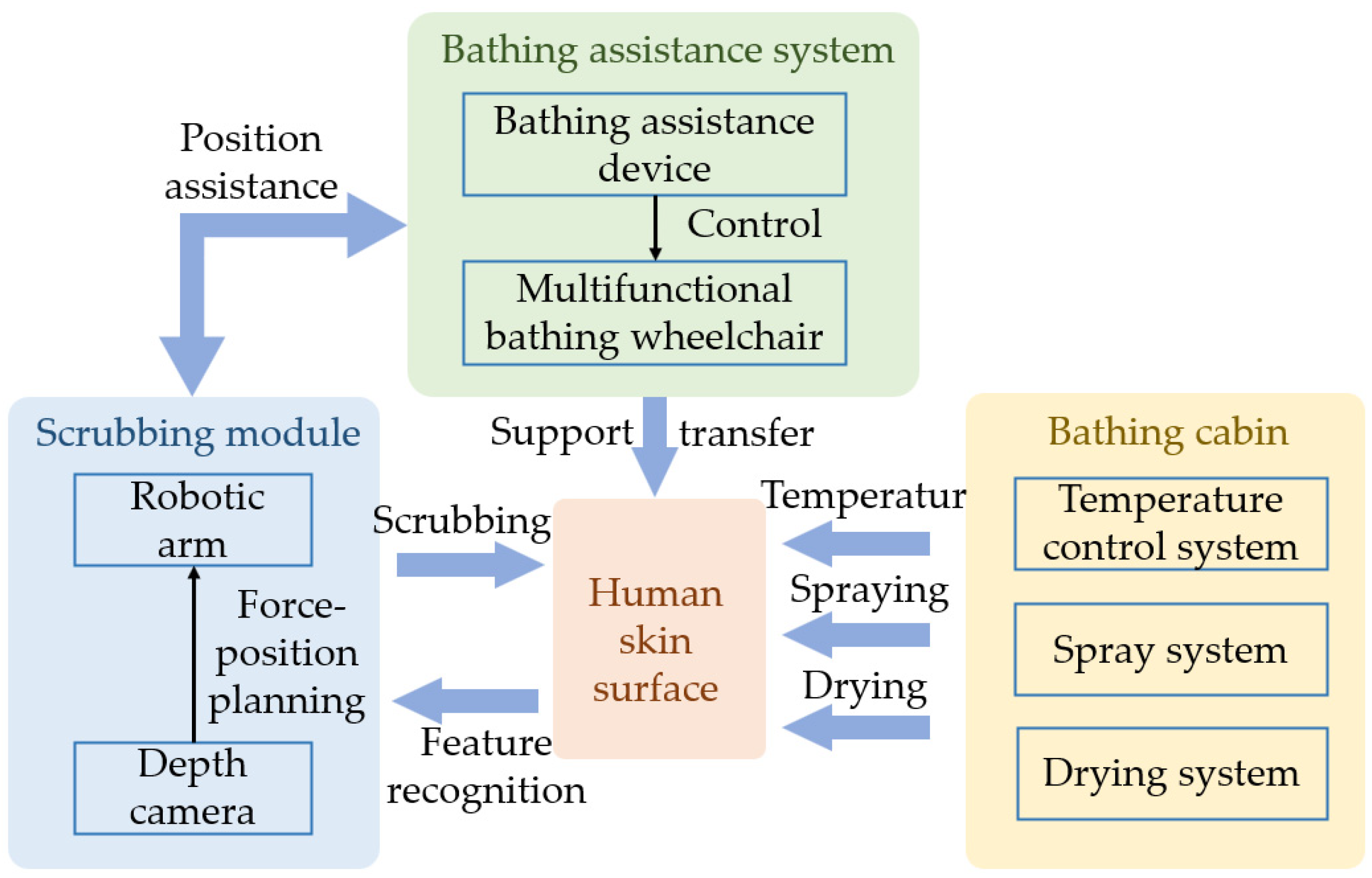
The scrubbing mode for seated showering mimics the actual washing methods used in nursing institutions. Based on seated showering, a robotic arm is employed to simulate arm movements for scrubbing the human body surface. The bather sits on a bathing chair, and a depth camera captures the bather’s body contour information. To handle the severe visual noise caused by water droplets and steam in the bathing scene, the visualization system executes rigorous 3D point cloud preprocessing and precise human target area segmentation algorithms. After processing this information, the upper computer generates the motion trajectory for the robotic arm. To ensure safety and comfort during physical interaction, the control system overcomes the limitations of classic admittance control in time-varying surface scrubbing environments. The 6-DOF robotic arm utilizes a GA-Fuzzy-PID and Adaptive Admittance Compliant Force Control Algorithm, which precisely regulates the multi-dimensional energy transfer and conversion mechanisms between the end-effector and the human skin during the scrubbing process. However, due to the limited working space of the robotic arm and the interference caused by the complex contours of the human body to its motion trajectory, the robotic arm cannot scrub the entire body [18]. Therefore, it is necessary to design a bathing assistance system. This system carries the bather and controls positional changes, coordinating with the scrubbing actions of the robotic arm to achieve scrubbing of all body surface areas. Furthermore, a comfortable bathing environment must be established, and various bathing assistive functions should be provided during the process. A schematic diagram of the specific functional modules is shown in Figure 1.

2.2. Overall System Design

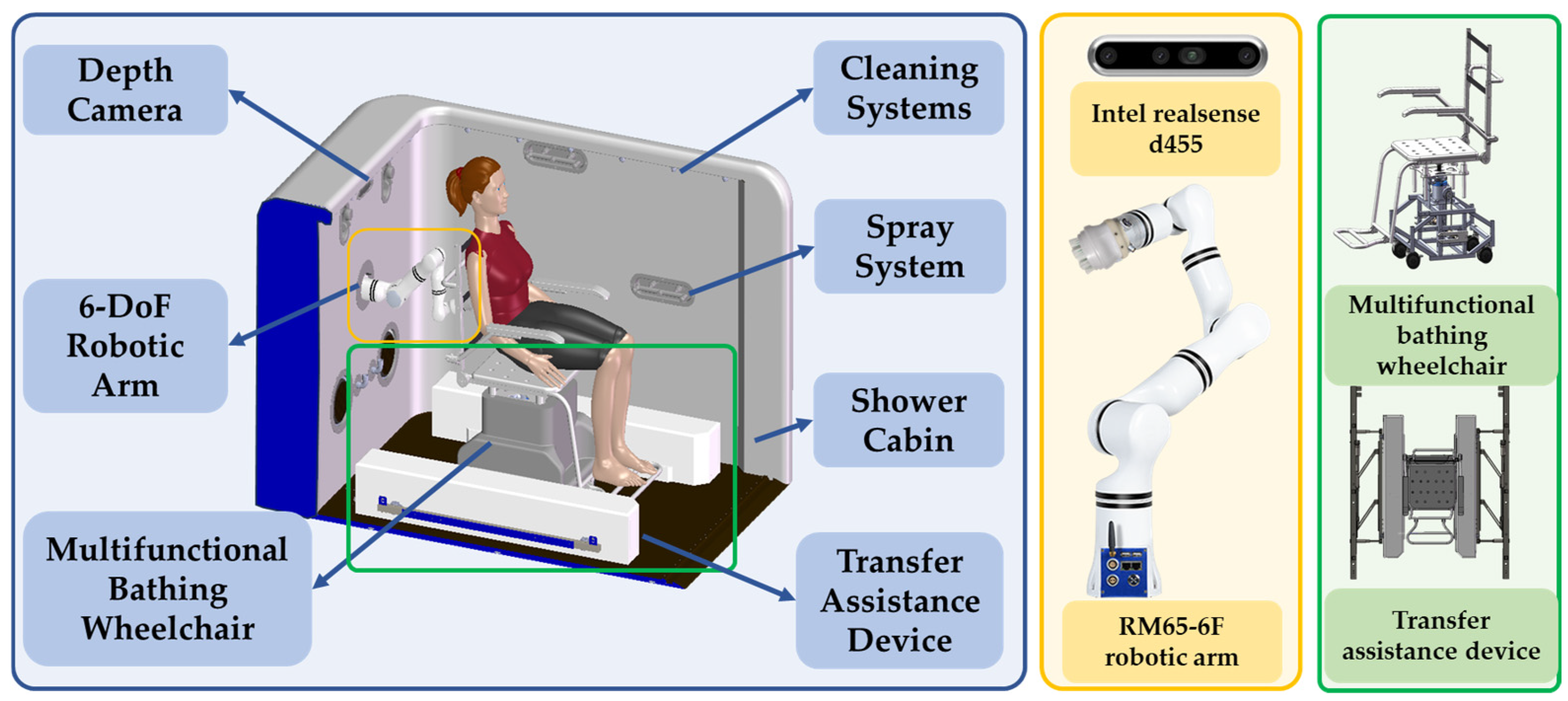
Based on the functional requirements of the bathing mode, the overall scheme of the bathing system was designed employing a modular design principle, as illustrated in Figure 2.
The bathing system is primarily divided into four components: the depth camera and robotic arm assembly, the bathing cabin, the multifunctional bathing chair, and the transfer assistance device. The depth camera and a six-degree-of-freedom robotic arm are fixedly mounted at the rear of the bathing cabin to identify the body surface characteristics of the bather inside the cabin and perform scrubbing. The bathing cabin is U-shaped overall, housing an automatic spray system and a temperature regulation system internally. The shower system’s fluid control module utilizes a dynamic Venturi-based proportional mixing circuit, tightly synchronized with the thermodynamic sensors to ensure instantaneous temperature stabilization and precise dilution ratios of the cleansing and disinfectant solutions. The automatic spray system can automatically dispense clean water or cleansing solution via shower heads arranged on the inner surface of the cabin. Simultaneously, cleaning nozzles installed on the top can spray disinfectant onto the inner walls of the cabin after bathing, enabling automatic cleaning and disinfection of the cabin interior for the convenience of the next user. The temperature regulation system includes temperature sensors and a warm air device. The temperature sensors, located on both side walls inside the cabin, monitor the ambient temperature. Based on the detected values, the upper computer controls the warm air device at the rear of the cabin to blow warm air at varying temperatures, thereby regulating the internal bathing environment. After bathing is completed, the warm air device activates a high-power airflow mode to quickly dry the bather, serving a drying function.
The transfer assistance device is positioned beneath the bathing cabin and controls the bathing chair to move left–right, forward–backward, up–down, and rotate within the cabin. This movement coordinates with the scrubbing actions of the robotic arm to achieve comprehensive scrubbing of the human body. It also facilitates rapid drying in coordination with the warm air device during the drying phase.
Since most nursing institutions prohibit the use of powered wheelchairs for safety reasons, and because circuits and electronic components in the high-temperature, high-humidity bathing environment are susceptible to water damage, corrosion, or leakage hazards endangering the bather, the multifunctional bathing chair adopts a passive design [19]. This means it contains no power source or electronic components, and its structure is similar to a conventional wheelchair, while functioning as both a bathing chair and a standard wheelchair. The bathing chair is also equipped with a docking mechanism and a drive mechanism. It serves as a regular wheelchair during normal use. During bathing, it automatically docks with the transfer assistance device via the docking mechanism. Once docking is complete, the bathing assistance system transmits power to the bathing chair through the docking mechanism, driving the chair’s internal drive mechanism to achieve lifting and rotational movements of the chair. The transfer assistance device controls the overall forward–backward and left–right movement of the bathing chair. This enables multi-directional displacement of the bather within the cabin, coordinating with the robotic arm’s scrubbing actions to achieve all-around scrubbing of the human body surface.

2.3. Automated Bathing Process

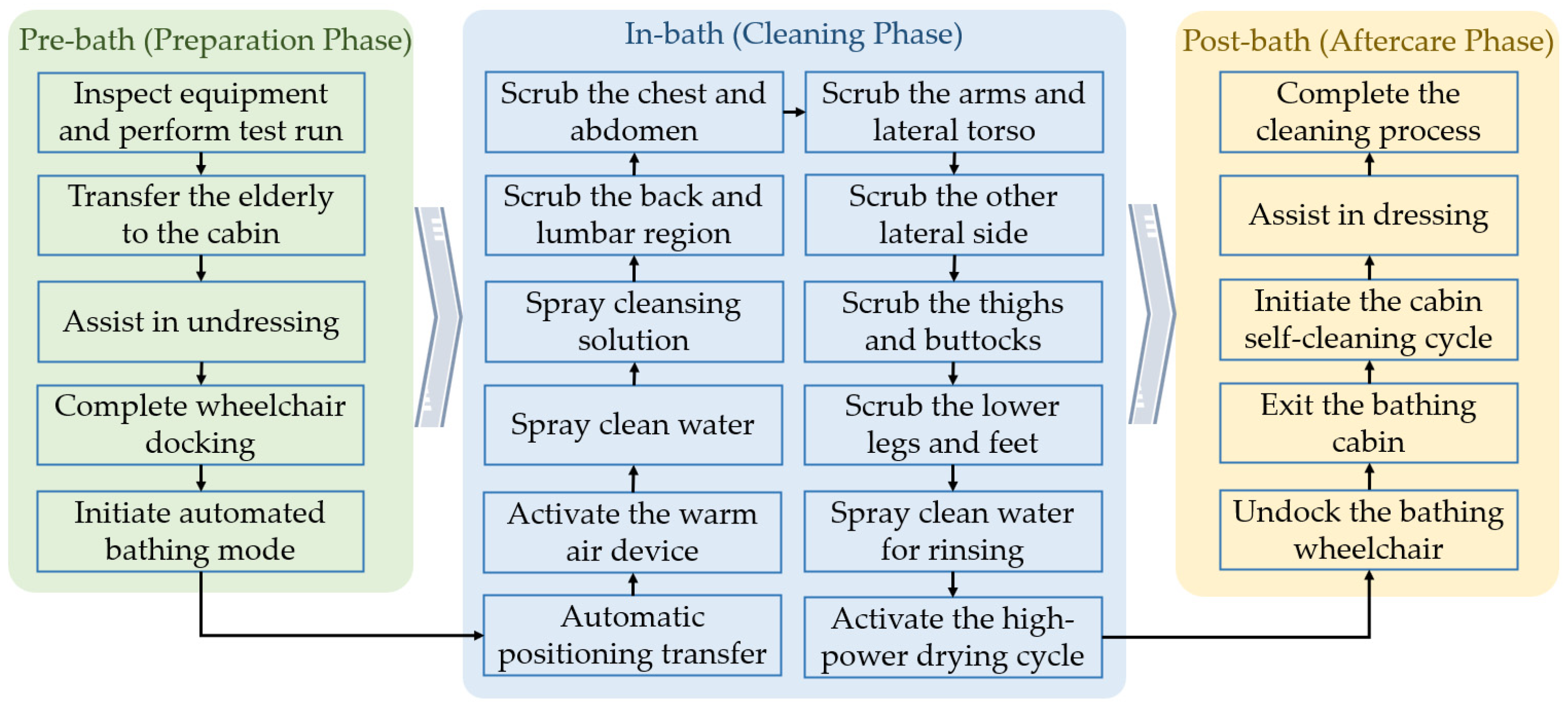
Based on investigations into the bathing care workflows within nursing homes, care hospitals, and other elderly care institutions, along with an analysis and synthesis of the bathing care standards formulated by civil affairs departments, the washing and care process has been systematically organized [20]. Furthermore, an automated bathing process has been developed according to the constructed bathing system. After the caregiver assists the bather into the bathing cabin and initiates the automated bathing mode, the control system within the bathing system coordinates all components to complete the entire bathing task. The caregiver only needs to observe the process from outside the cabin and handle any emergencies [21]. The automated bathing process can be broadly divided into three stages: pre-bath, bath-in-progress, and post-bath. The specific steps are illustrated in Figure 3.

3. Design of the Bathing Assistance System

3.1. Ergonomic Design of the Bathing Space

The bathing space of the bathing system must accommodate the seated bather for forward/backward movement and 360° rotation within it. Furthermore, the volume of the bathing cabin should be minimized to save space while ensuring functionality and comfort. Based on the anthropometric data from the reference [22], the 95th percentile data for males (aged 18–60) was selected. This data was then reduced by 2.8% to estimate anthropometric data for the elderly population, which was used for calculations.
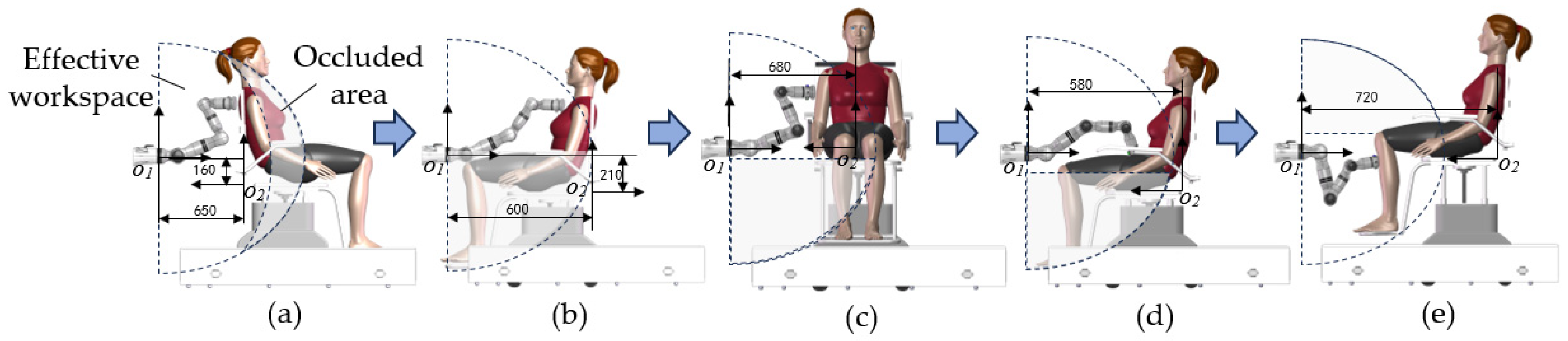
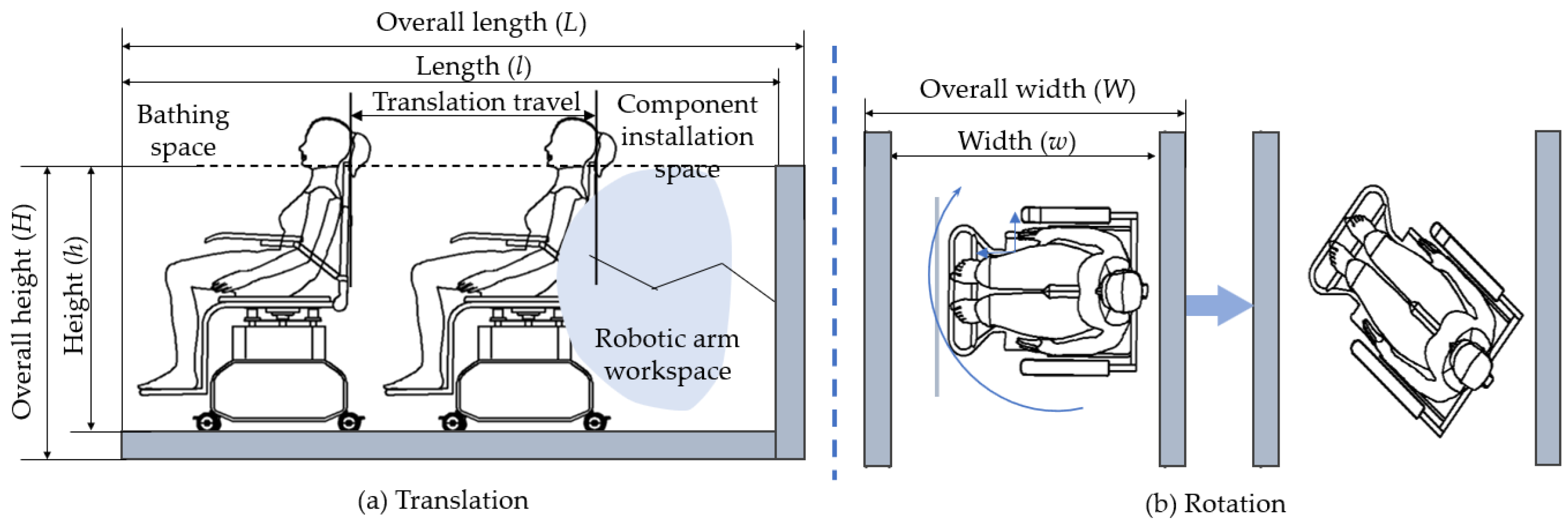
First, the width of the bathing space must allow for rotation of the human body in a seated posture. A translation–rotation method is employed, where the body is first translated to one side of the cabin before rotation. The width of the bathing space should therefore be greater than the rotational radius of the human body in a seated posture. As shown in Figure 4, the width dimension is set to 1000 mm. The required length must encompass the robotic arm’s working distance and the necessary forward/backward travel distance for the human body. The robotic arm’s working distance is 600 mm. Analysis of the robotic arm’s scrubbing actions indicates that a forward/backward travel distance of 700 mm is required to achieve full-body scrubbing. Adding the length for the cabin entrance, the total length of the bathing space is set to 1700 mm.
To ensure bathing safety, the bather’s head should remain outside the cabin during the process, allowing caregivers outside to easily observe the interior [23]. Therefore, the internal height of the bathing space is set lower than the chin height of a seated person and lower than the shoulder height of a standing person. The bathing space height is determined to be 1200 mm, and the total cabin height is 1250 mm.
An installation space for functional components is added around the periphery of the bathing space. A waterproof enclosure separates the bathing space from the peripheral component installation area to prevent erosion of parts by bathing water. After determining the installation dimensions of the components, the overall cabin dimensions can be finalized. The external shape of the cabin is roughly rectangular, with chamfers and rounded transitions designed at the head and tail sections for aesthetic appeal. The parameters of the bathing cabin’s external form are shown in Table 1.

3.2. Shower System Design

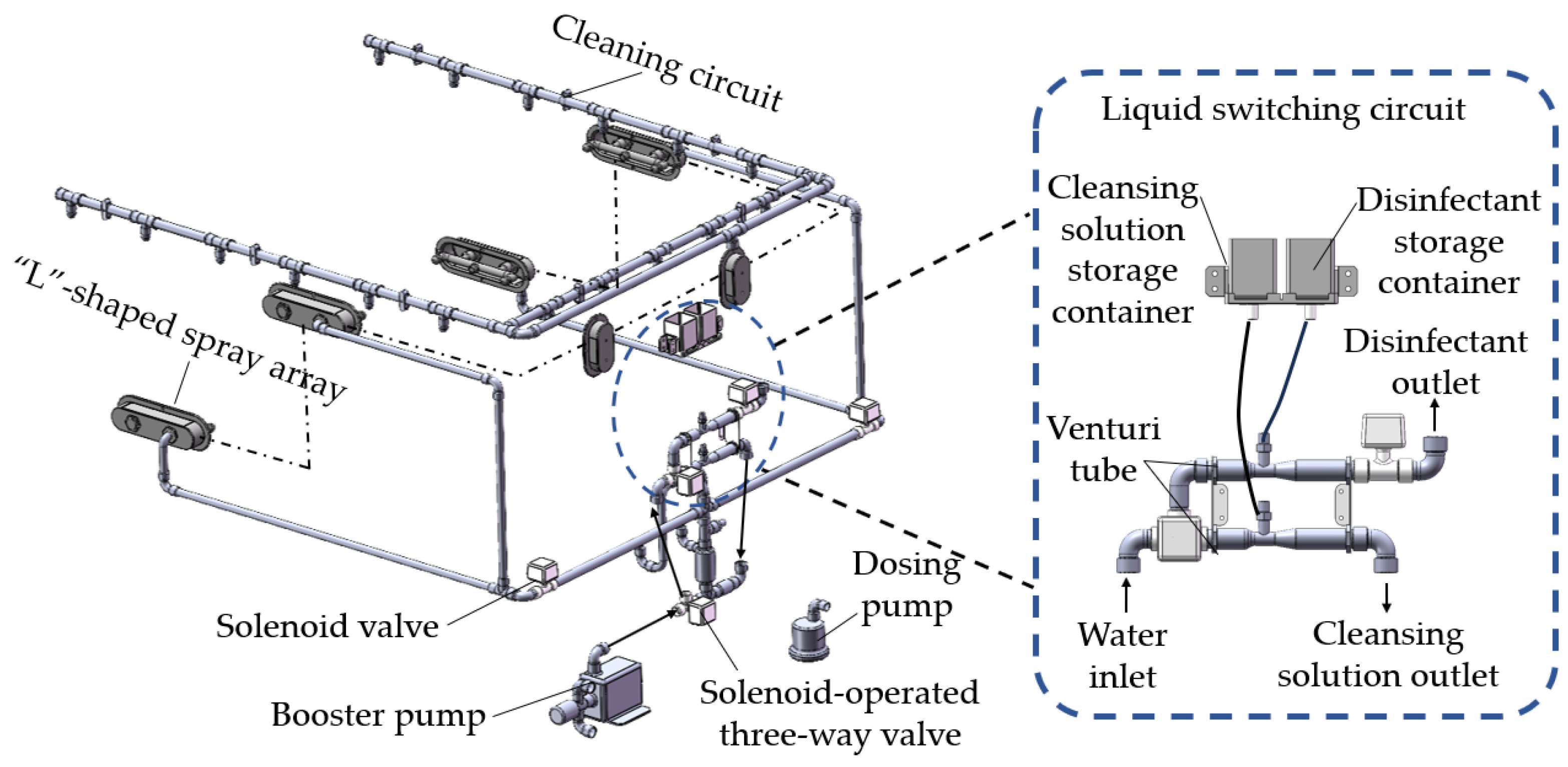
The shower system is illustrated in Figure 5. During the bathing process, it is essential to ensure the spray water flow can cover the entire surface of the human body in a seated posture. Based on the seated posture of the human body and the spray coverage area of the shower heads, two shower heads are installed on each of the two side walls and the rear wall inside the cabin to achieve spraying coverage for both the back and front of the body. Since the side profile of the human body in a seated posture approximates an “L” shape, the shower heads on the side walls are arranged in a stepped configuration to conform to the characteristics of the seated posture. Each directional pipeline inlet is equipped with a solenoid valve, enabling independent on/off control of the spray for each direction. During bathing, the spray in a specific direction can be activated or deactivated as needed. This design not only fulfills the showering function but also helps minimize water wastage.
The mixing circuit within the shower system enables the automatic switching function between three types of liquids: clean water, cleansing solution, and disinfectant. The mixing circuit comprises two solenoid-operated three-way valves, two Venturi tubes, a cleansing solution storage container, and a disinfectant storage container. A Venturi tube functions as a liquid dynamic mixer, capable of uniformly mixing two liquids in a flowing state. The cleansing solution and disinfectant storage containers are used to store concentrated cleansing solution and disinfectant, respectively. The solenoid-operated three-way valves control the opening and closing of the individual liquid flow paths. The first three-way valve, located at the inlet of the mixing circuit, controls whether clean water enters the mixing circuit. The second three-way valve is connected to the two Venturi tubes (Shanghai Guanghua Instrument Co., Ltd., Shanghai, China), directing the clean water to mix with either the concentrated cleansing solution or the concentrated disinfectant within the respective Venturi tube. When the first three-way valve opens, clean water enters the mixing circuit. When the second three-way valve opens, it directs the clean water into one of the Venturi tubes to mix with either the concentrated cleansing solution or the concentrated disinfectant. By adjusting the flow rate from the cleansing solution or disinfectant storage container, a solution of appropriate concentration can be produced. Thus, by controlling the on/off states of the two three-way valves, switching between clean water, cleansing solution, and disinfectant is achieved. For safety, to prevent accidental spraying of disinfectant from the shower heads, the mixed disinfectant is directed only into the cleaning circuit located at the top of the cabin and is activated solely during the internal cabin wall cleaning procedure.

3.3. Structural Design of Key Components

3.3.1. Design of the Transfer Assistance Mechanism

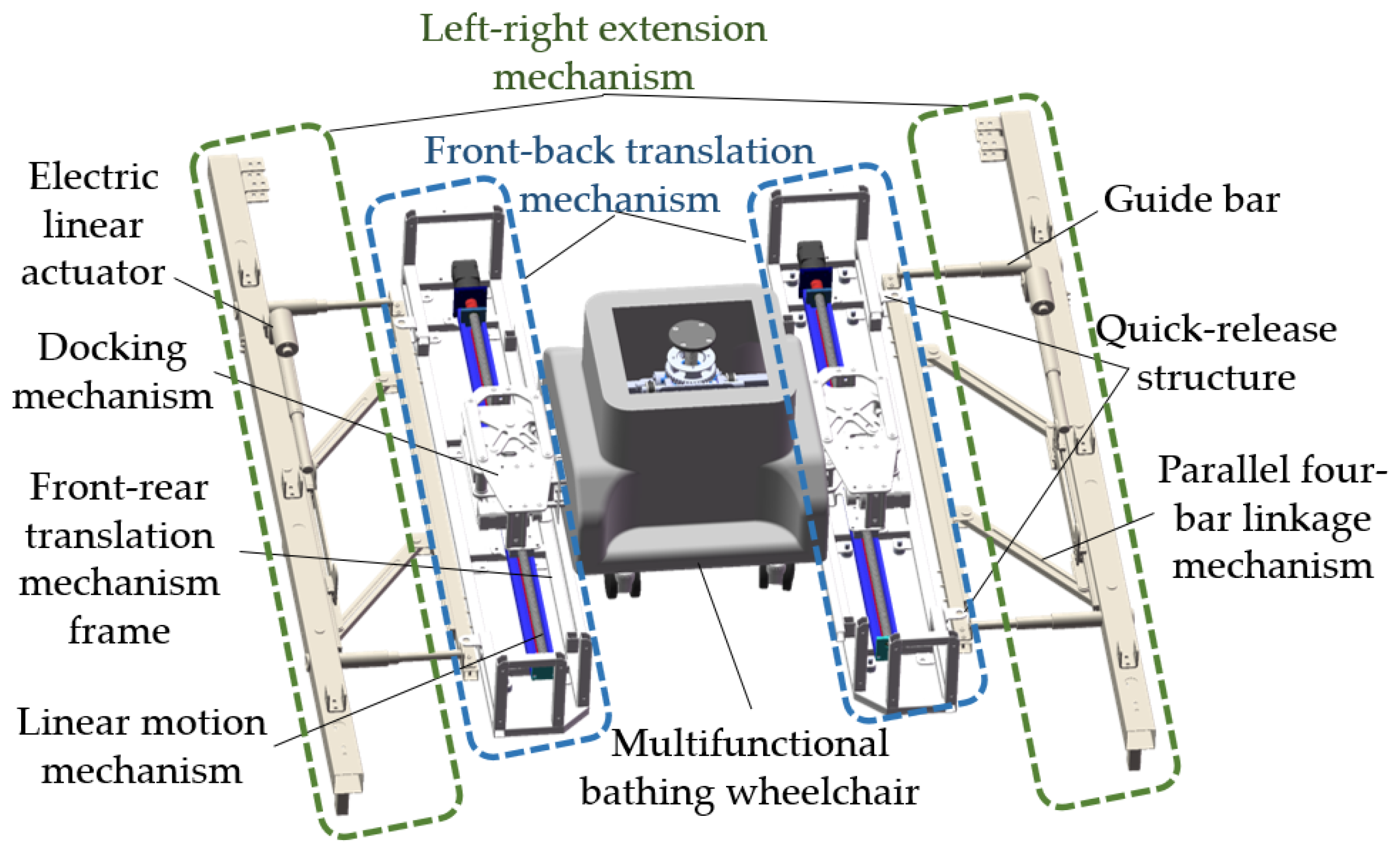
The transfer assistance device is divided into a left–right extension mechanism and a front–back translation mechanism. As there is no kinematic coupling between the two mechanisms, a modular design approach is adopted to design them separately. Linear motion is achieved by utilizing a linear motion mechanism. A docking mechanism is installed on the slider of the linear motion mechanism to connect with the multifunctional bathing wheelchair. The slider drives the docking mechanism, thereby driving the multifunctional bathing wheelchair to perform linear front–back movement. To avoid bending moments and ensure a more uniform force distribution during the wheelchair’s linear motion, two front–back translation mechanisms are arranged symmetrically on both sides of the multifunctional bathing wheelchair. They work in unison to drive the wheelchair’s front–back movement.
The overall structure of the translation device is shown in Figure 6. The left–right extension mechanism employs a parallel four-bar linkage mechanism, with an electric linear actuator selected as the driving component. To optimize the motion pattern and force characteristics of the electric linear actuator, a guide bar is incorporated into the mechanism. This ensures the actuator performs linear motion and remains positioned within the component installation space of the cabin, preventing its exposure to the bathing area. This design mitigates safety hazards associated with water immersion and potential electrical leakage. The left–right extension mechanisms are also arranged symmetrically on the left and right sides and are connected to the back of the front–back translation mechanism using a quick-release structure. During operation, the left–right extension mechanism pushes the front–back translation mechanism to translate laterally. The front-rear translation mechanism frame remains in close contact with the multifunctional bathing wheelchair, thereby pushing the wheelchair to achieve left–right translation. The quick-release structure simplifies the overall design complexity of the bathing assistance system and facilitates the installation and maintenance of the mechanisms.
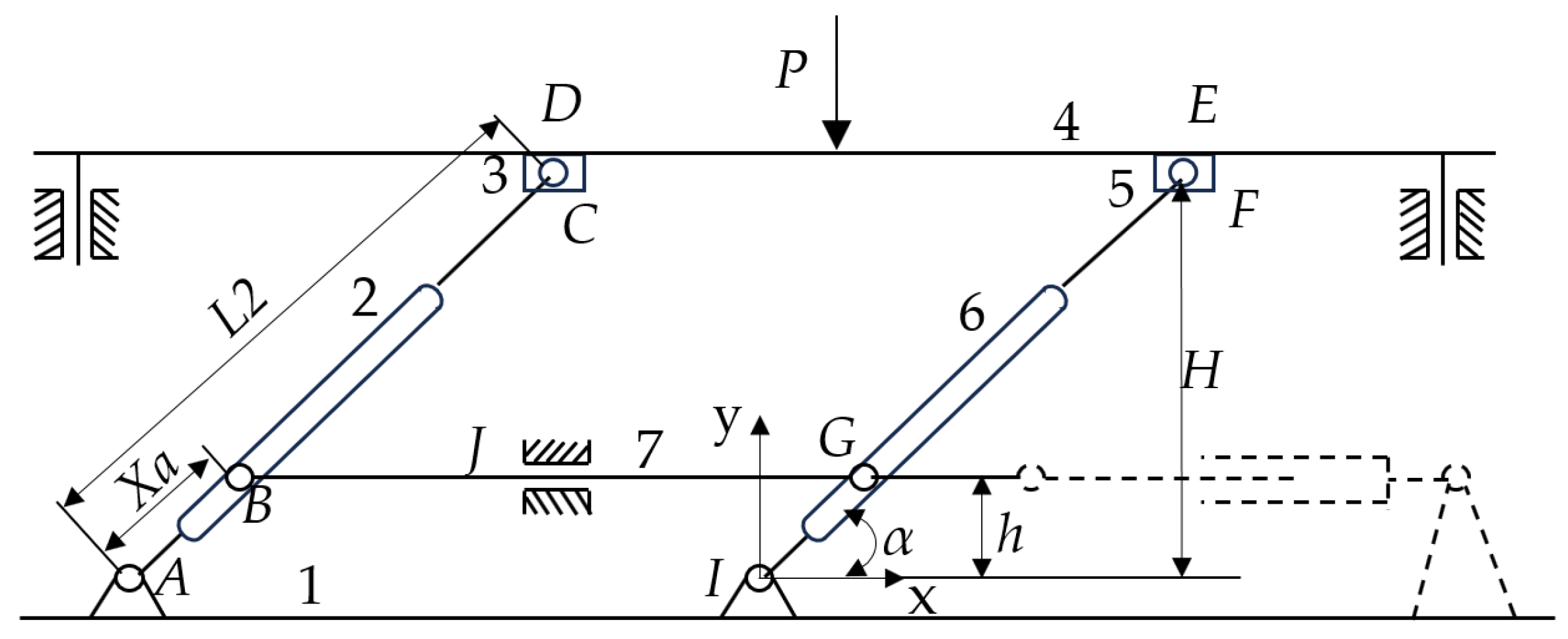
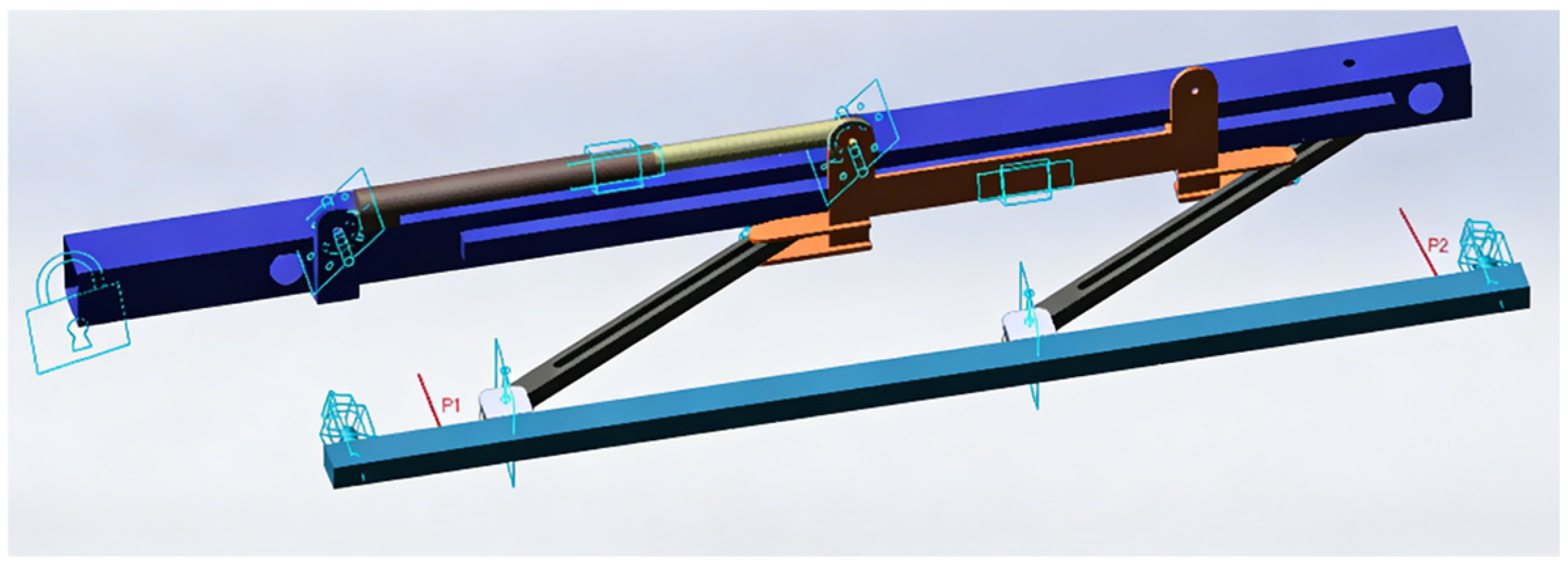
The structure of the front–back translation mechanism is relatively straightforward; therefore, a detailed account of its component selection and parameter calculation process is omitted here. To ensure that the motion output and thrust force of the left–right extension mechanism meet the design requirements, comprehensive kinematic and dynamic analyses are necessary. A simplified kinematic diagram of this mechanism is illustrated in Figure 7. In this schematic, the dashed line represents the electric linear actuator, which serves as the primary power source for the left–right extension mechanism. During operation, the electric linear actuator drives the electric push rod connector (part 7) horizontally. This linear movement actuates the parallel four-bar linkage mechanism (parts 2 and 6), which is pivotally anchored to the base frame (part 1). The linkage then transmits the driving force to the connector for the front–rear translation mechanism (part 4) via the quick-detachable connections (parts 3 and 5), thereby achieving the desired lateral extension. According to the formula for calculating the degrees of freedom of planar mechanisms,
P = 3 n ( 2 p l + p h p ) F
where n is the total number of moving links, pl is the number of lower pairs (which restrict two degrees of freedom, such as pin joints and sliding pairs), and ph is the number of higher pairs (which restrict one degree of freedom, such as cam or gear contacts). The term p′ represents the number of redundant constraints, and F′ is the number of local degrees of freedom. In mechanism kinematics, redundant constraints are structural restrictions that duplicate existing constraints without further reducing the system’s actual degrees of freedom. In the physical design of this bathing assistance system, these redundant constraints are deliberately introduced through the symmetrical, dual-sided arrangement of the parallel four-bar linkages and the multiple parallel guide bars. While they are subtracted in Equation (1) to accurately calculate the theoretical mobility, they play a critical physical role in the system by eliminating unbalanced bending moments, significantly increasing the structural rigidity of the transfer mechanism and preventing the linear modules from jamming under the heavy load of the bather. Based on the kinematic diagram of the mechanism, it can be determined that the mechanism contains six moving links, nine lower pairs, two higher pairs, and three redundant constraints. Substituting these values into the formula yields
P = 3 × 6 9 × 2 + 2 3 = 1
Therefore, the degree of freedom of the left–right extension mechanism is 1. An electric linear actuator is added on the right side as the driving element, giving the mechanism a determined motion.
First, kinematic analysis is performed. A mathematical model is established relating the translation distance of the extension mechanism to the extension/retraction displacement of the electric linear actuator. A coordinate system is established with hinge I as the origin. The translation distance of the extension mechanism is the movement distance H of link 4 in the Y direction, and the extension/retraction displacement of the electric linear actuator is the projection XG of the slot–pin pair G in the X direction. Based on the mechanism diagram, the geometric constraint equations are established as follows:
H h = L 2 X a
X a 2 = h 2 + X G 2
where XG represents the projection of the slot–pin pair G in the X direction (which corresponds to the extension/retraction displacement of the electric linear actuator), Xa represents the projection length of point G onto link 2, and h represents the projection length of point G in the Y direction. Since link 7 performs translational motion along the X axis, the value of h is determined by the installation dimensions of the components. Based on these dimensions, h = 35 mm. By combining Equations (3) and (4), the following is obtained:
H = L 2 × h X G 2 + h 2
based on the analysis and calculations of the bathing space and the component installation space, the travel range K of the extension mechanism is determined to be 260 mm. The initial position of link 4 corresponds to H = 60 mm; therefore, the displacement range of link 4 is from 60 mm to 320 mm. Furthermore, to ensure the stability of the four-bar linkage at its extreme positions, the angle α between link 2 and the X axis should be less than 90° when the extension mechanism reaches its farthest travel limit. Accordingly, the length of link 2, L2, is set to 350 mm. Substituting the known data into the equation yields
H = 12250 X G 2 + 1225
From the equation above, it can be seen that the motion range of the electric linear actuator is 15 mm to 201 mm, with a stroke of 186 mm. The translational motion of the extension mechanism and the extension/retraction motion of the electric linear actuator have a nonlinear relationship.
Since the constraints in the mechanism are ideal constraints, a dynamic analysis of the mechanism is performed. According to the principle of virtual work, the virtual work done by the active forces acting on a system of particles is zero for any virtual displacement:
F i δ r i = 0
Taking the thrust force F of the electric linear actuator and the thrust force P of component 3 as the active forces, based on Figure 7, the following is obtained:
P δ h + F δ x = 0
where δh is the virtual displacement of link 4, oriented in the same direction as the thrust force P, and δx is the virtual displacement of the electric linear actuator, oriented in the same direction as the thrust force F. Based on the geometric relationship of the mechanism shown in Figure 7, it can be derived that
H = L 2 sin α
X = h cot α
Substituting the differential forms of Equations (9) and (10) into Equation (8) yields
P L 2 cos α + F h sin α 2 = 0
based on the frictional force between the bathing chair wheels and the cabin floor plate, the required thrust force for pushing the bathing chair is taken as P = 200 N. Substituting this into Equation (11) yields the thrust force value for the electric linear actuator:
F = 200 × 350 × cos α × ( sin α ) 2 35 = 2000 cos α ( sin α ) 2 .
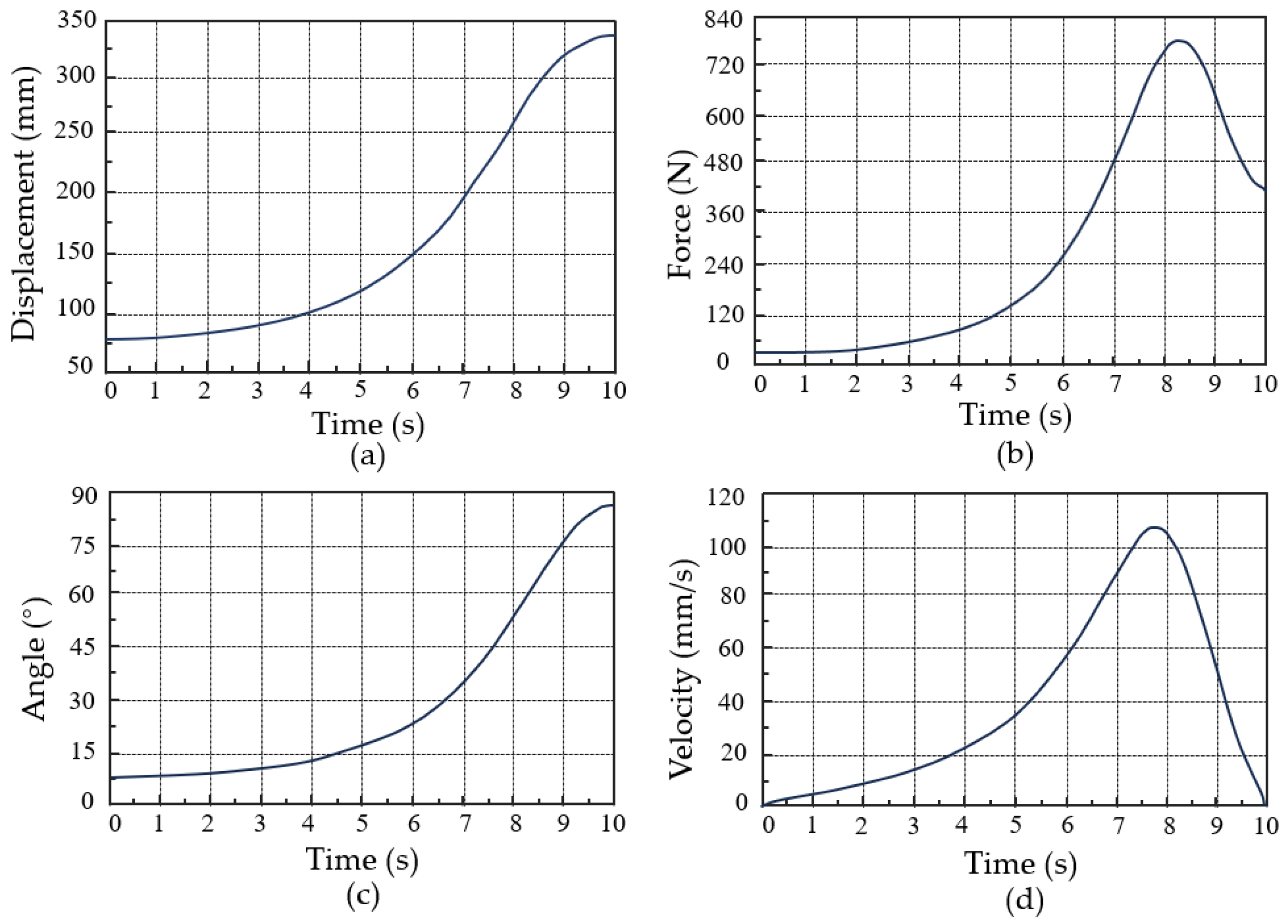
According to Equation (12), when α = 55°, the thrust force F reaches its maximum value, which is 770 N.

3.3.2. Docking Mechanism

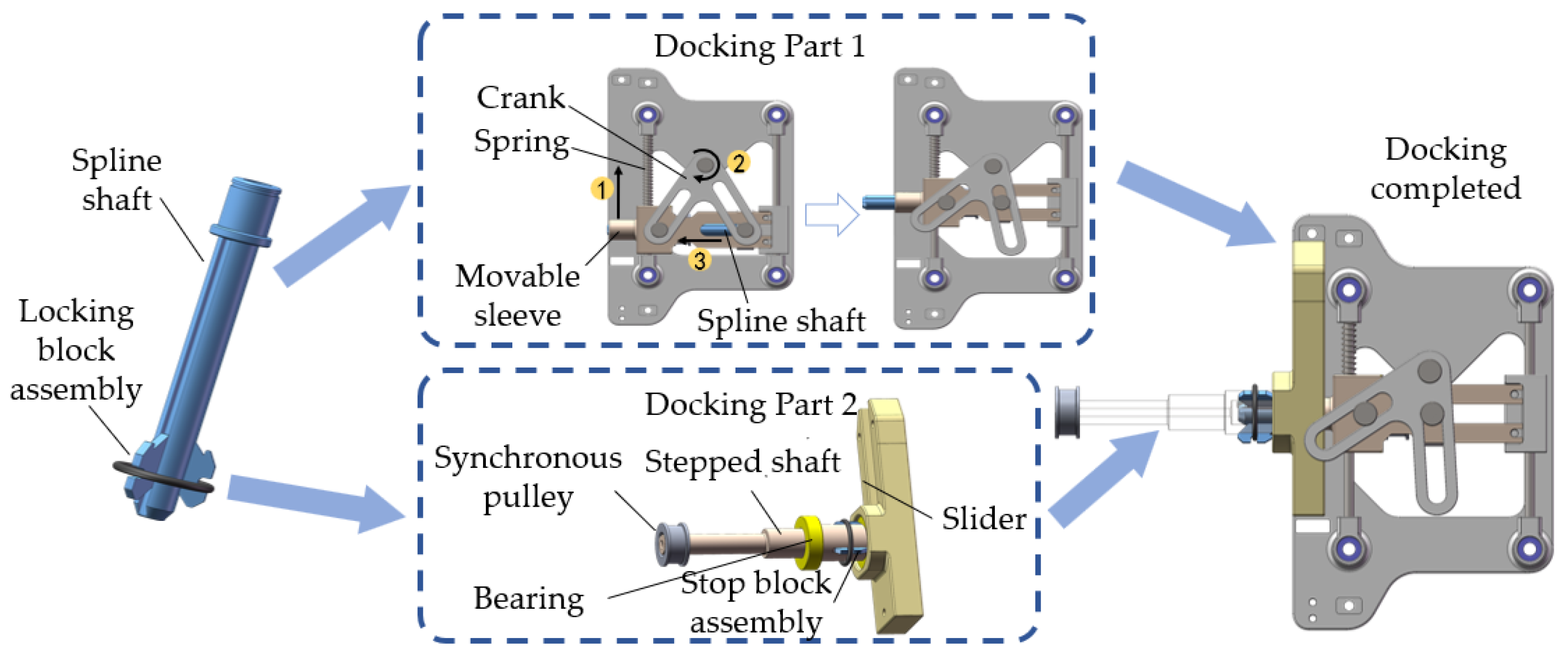
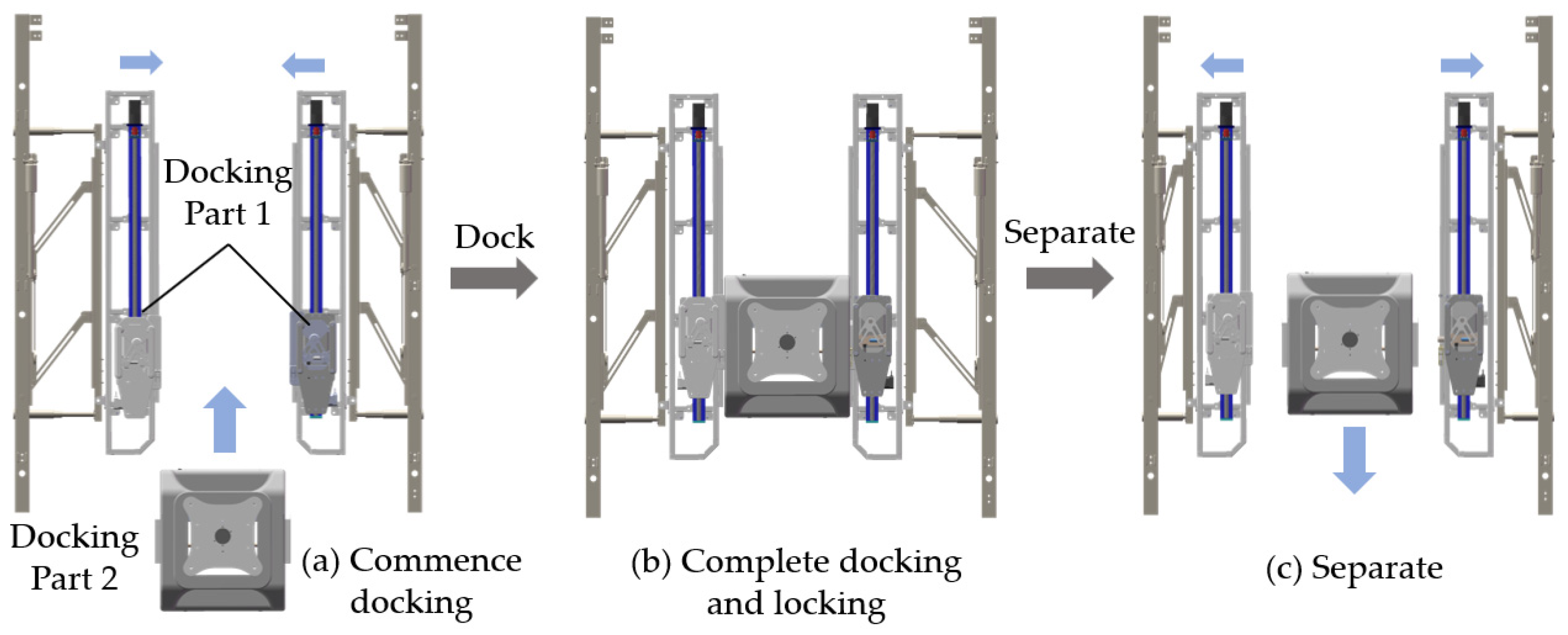
The docking mechanism is divided into two main components. Docking Part 1 is fixed to the slider of the front–back translation mechanism, moving back and forth with it. Docking Part 2 is fixed to both sides of the multifunctional bathing wheelchair, serving as a critical component of the wheelchair’s internal drive system. The full docking procedure is illustrated in Figure 8. To commence docking (Figure 8a), the left–right extension mechanisms on both sides adjust the front–back translation mechanisms inwardly, creating a precise gap that corresponds to the width of the wheelchair. This step structurally aligns Docking Part 1 and Docking Part 2 in the lateral (left–right) direction. As the wheelchair moves forward, Docking Part 2 makes physical contact with Docking Part 1. A relative sliding motion occurs between the two parts during the wheelchair’s continuous forward advancement, allowing the system to complete docking and locking (Figure 8b). Once locked, these components form a seamlessly integrated docking mechanism fully capable of power transmission.
To separate (Figure 8c), the left–right extension mechanisms on both sides retract outwardly, pulling the front–back translation mechanisms apart. Consequently, Docking Part 1 and Docking Part 2 automatically separate from one another and return to their original, disengaged states. This outward lateral movement successfully releases the mechanical lock and safely terminates the power connection.
The operating principle of the docking mechanism is illustrated in Figure 9. Power transmission is fundamentally achieved through the dynamic engagement between the Spline shaft and the Locking block assembly. The Locking block assembly consists of individual blocks that can slide radially within an elastic outer ring, facilitating seamless engagement and disengagement. Based on this structural design, the complete docking system is divided into two core functional modules: Docking Part 1 (integrated into the slider of the translation mechanism) and Docking Part 2 (mounted to the side of the multifunctional bathing wheelchair).
Triggered by the relative motion between the wheelchair and the translation mechanism, Docking Part 1 automatically extends the spline shaft to engage with Docking Part 2. As illustrated in the sequence in Figure 9, the mechanical actuation begins when the slider on Docking Part 2 contacts and pushes the movable sleeve forward. This linear displacement of the movable sleeve drives the crank to rotate, which subsequently propels the spline shaft outward. Conversely, upon separation, a spring forces the movable sleeve to return to its initial position, reversing the crank’s rotation and retracting the spline shaft. Within Docking Part 2, the slider is connected to a stepped shaft that is supported by a bearing. A stop block assembly is installed at the front end of the stepped shaft, housing the locking block assembly to form a receiving spline hole configuration. Once the extended spline shaft successfully engages with this assembly, rotational motion is transferred along the stepped shaft to the synchronous pulley located at its rear end. This sequence allows mechanical power to be seamlessly transmitted to the internal drive unit of the bathing wheelchair, achieving completion of the state of docking.
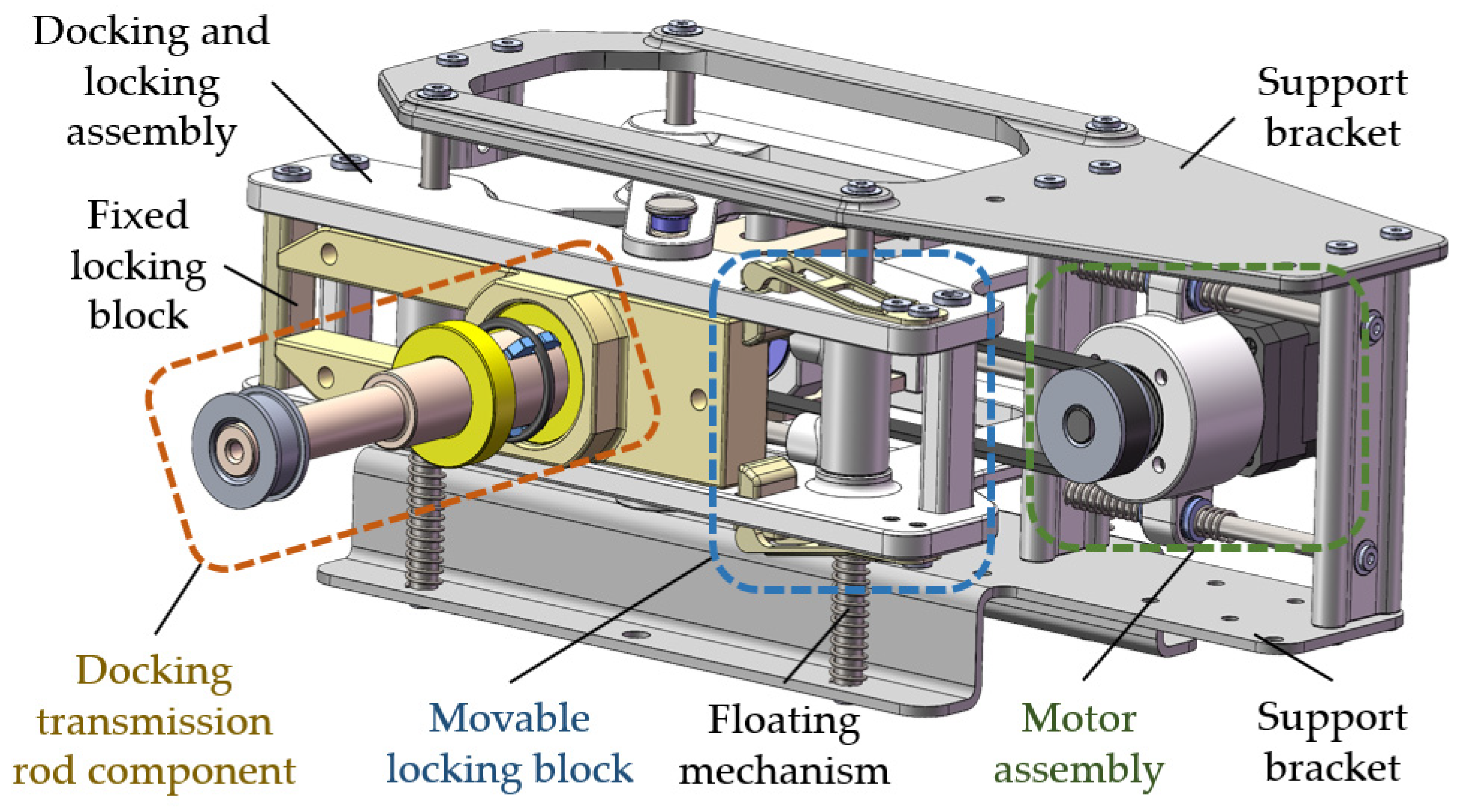
The overall structure of the docking mechanism is illustrated in Figure 10. Housed within the upper and lower support brackets, the mechanism primarily incorporates a floating mechanism and a motor assembly. The floating mechanism enables the entire docking and locking assembly, which contains the docking transmission rod component, to float vertically. This vertical compliance prevents potential height misalignments between the slider on the bathing wheelchair and the docking components, thereby ensuring smooth and reliable engagement. Furthermore, the movable locking block and the fixed locking block, positioned at opposite ends of the docking and locking assembly, provide precise front–back positional limits for the wheelchair’s slider. Consequently, when the external translation mechanism moves the entire docking unit forward or backward, it mechanically drives the wheelchair synchronously in the corresponding direction. Finally, the motor assembly serves as the rotational power source; it drives the docking transmission rod component via a synchronous belt transmission to seamlessly transfer mechanical power to the internal drive system of the wheelchair.

3.3.3. Design of the Bathing Seat Drive Mechanism

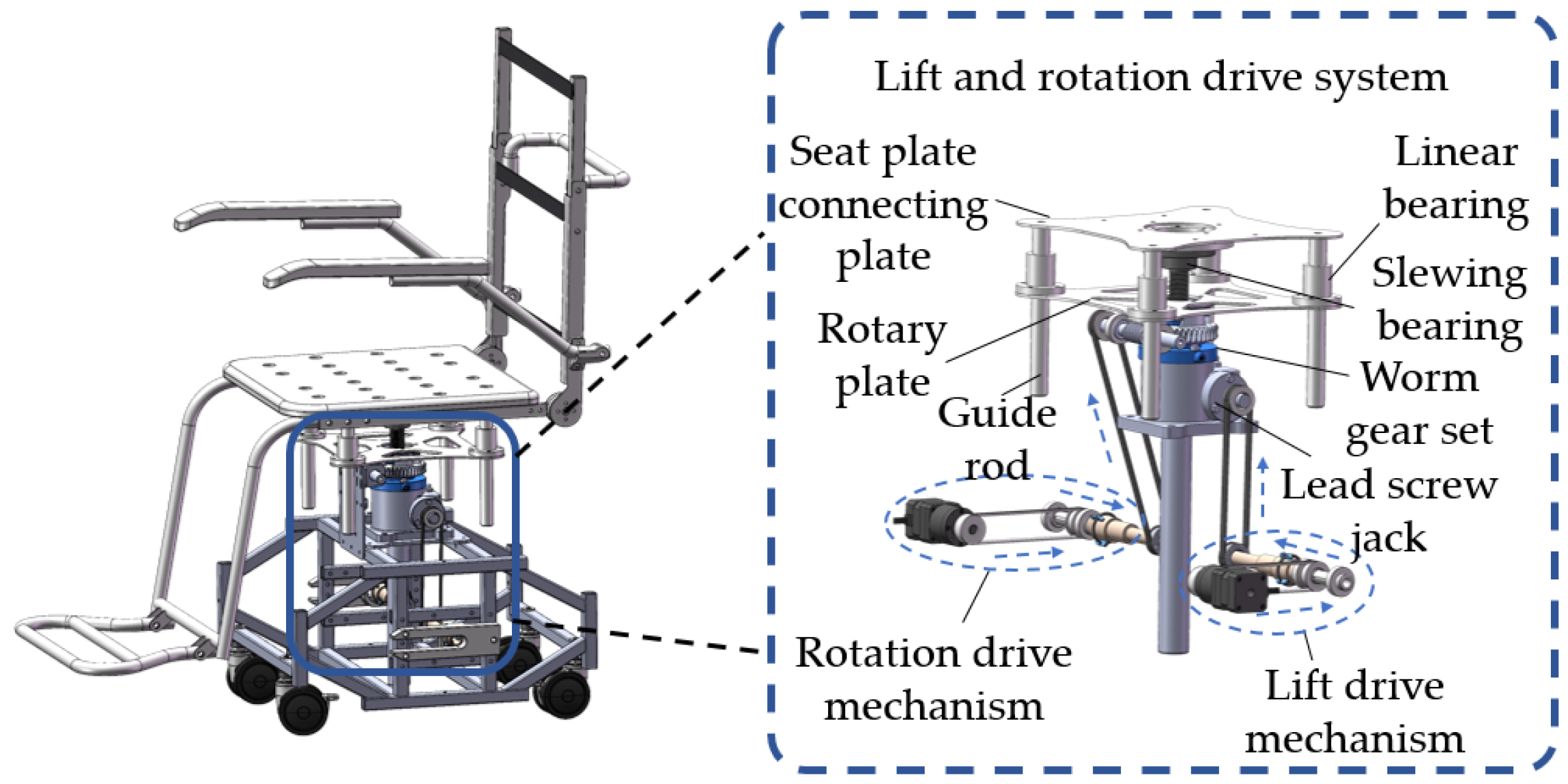
After the bathing chair docks with the translation device, the transmission unit within the bathing chair and the transmission unit within the docking mechanism combine to form a complete drive system. This system controls the lifting and rotating movements of the bathing chair. A schematic diagram of the transmission system is shown in Figure 11.
The overall drive system can be divided into left and right sections. The right section is the transmission mechanism for the lifting motion. A motor drives a lead screw jack via a spline shaft, a sleeve, and a synchronous belt. The end of the jack’s screw is connected to the seat-connecting plate through a slewing bearing. This drives the connecting plate in a lifting motion without interfering with its rotational movement. Four guide rods are fixed around the connecting plate. These rods can slide up and down along linear bearings mounted on the surrounding rotary plate, serving a guiding and stabilizing function during the seat plate’s lifting motion.
The left section is the transmission mechanism for the rotational motion. The motor’s power drives a worm gear set via the spline shaft, the sleeve, and a synchronous belt. The rotary plate is fixed to the worm gear and rotates with it, driving the connecting plate to rotate via the guide rods. The self-locking effect of the worm gear set also prevents unintended rotation of the bathing chair.
Based on the schematic diagram of the mechanism’s transmission, the required motor input power for the lifting motion on the right side is calculated according to the power calculation formula:
P r = P w η = F n v η
where η is the overall transmission efficiency of the mechanism, Pw is the motor output power, Pr is the output power of the lead screw jack, Fn is the calculated load, and v is the lifting speed.
Taking the synchronous belt transmission efficiency η1 = 0.98, the rolling bearing transmission efficiency η2 = 0.98, and the lead screw jack transmission efficiency η3 = 0.65, the overall transmission efficiency is
η = η 1 η 2 η 1 η 2 η 3 = 0.6
Based on human body parameter standards, taking the lifting load Fw = 700 N and the load factor K = 2, the calculated thrust value is
F n = F w K = 700 × 2 = 1400   N
Taking the lifting speed as v = 0.01 m/s and substituting Equations (14) and (15) into Equation (13) yields
P w = P r η = 1400 × 0.01 0.6 = 23.3   W
The load for the rotational motion on the left side is relatively small, and its power calculation is omitted. According to the transmission system diagram of the mechanism, the gear ratios for the left and right sides of the transmission system are calculated, followed by the calculation of the motor’s output speed. The gear ratio calculation formula is
i = i k
Here, ik represents the gear ratio of each stage in the transmission system. Specifically, the gear ratio for the synchronous belt transmission is i1 = 1, the gear ratio for the lead screw jack is i2 = 6, and the lead of the screw is L = 6 mm. The gear ratio for the worm gear set is i3 = 50. Therefore, the gear ratios for the transmission mechanisms on the left and right sides of the system are
i l = i 1 i 1 i 3 = 1 × 1 × 50 = 50
i r = i 1 i 1 i 2 = 1 × 1 × 6 = 6
Taking the bathing chair’s lifting speed as vu = 0.01 m and the sand rotational speed as vr = 8 rpm, the rotational speeds of the motors on both sides are, respectively,
v l e f t = v u L i l = 0.01 0.006 × 6 × 60 = 600 rpm
v r i g h t = v r i r = 8 × 50 = 400 rpm
Based on the calculation results, a stepper motor is selected as the drive motor to achieve precise control of the bathing chair’s motion. The chosen motor has a rated power of 30 W and a speed adjustment range of 350 rpm to 660 rpm. To verify the correctness and reliability of the theoretical equations derived throughout Section 3.3, a two-fold validation approach is employed in the subsequent sections. First, the geometric constraint and dynamic equations governing the transfer mechanism (Section 3.3.1) are cross-verified through the multi-body dynamic simulation detailed in Section 4.1; this simulation confirms that the theoretically calculated maximum thrust (F = 770 N) strongly aligns with the simulated peak force (790 N). Second, the power and gear ratio calculations for the drive system (Section 3.3.3) are empirically validated through the physical prototyping and experimental testing (Section 5), wherein the selected actuators successfully and smoothly execute the bathing chair’s multi-directional movements under full physical load without mechanical failure or stalling.

4. Simulation and Verification

4.1. Kinematics Analysis of the Translation Assistance Mechanism

The translation assistance device controls the translational movement of the bathing chair. The front–back translation employs a lead screw and nut transmission method, which offers a simple structure and high stability. The left–right extension mechanism utilizes a combination of a four-bar linkage and slider mechanism, resulting in relatively complex force and motion conditions. Therefore, kinematic and dynamic simulations are required to verify the smoothness of the mechanism’s movement and the variation in the thrust of the electric linear actuator. Adams software (2020) is used to model and simulate the left–right extension mechanism. A three-dimensional simulation model is constructed in Adams based on the mechanism schematic, and corresponding constraint relationships are established between the components, as shown in Figure 12.
To ensure the accuracy and reproducibility of the kinematic analysis, the global simulation environment was configured using the GSTIFF integrator (Hexagon|MSC Software, Irvine, CA, USA) with an integration step size of 0.01 s over a total simulation time of 10 s. Resistive forces of P = 100 N were applied at both ends of the output link to simulate the resistance encountered when pushing the seat. A translational drive was defined for the electric linear actuator, with the drive function set as step (time, 0, 0, 10, 190). This specific STEP function utilizes a quintic polynomial to smoothly drive the actuator from an initial displacement of 0 mm at 0 s to a final stroke of 190 mm at 10 s. This configuration was deliberately chosen to prevent infinite accelerations, thereby closely approximating the actual soft-start and smooth-stop motion characteristics of the physical electric linear actuator.
After the model was correctly simulated, the resistance force on the electric linear actuator, the extension speed of the output link, the relationship between the extension displacement of the actuator and the displacement of the output link, and the variation in angle α were measured. The measurement results are shown in Figure 13.
From the simulation results, it can be observed that the peak thrust force of the electric linear actuator is 790 N, which is close to the theoretically calculated value. The displacement change of the output link is relatively smooth, with no occurrence of sudden displacement changes or dead points. The variation range of angle α is 8° to 85°, which is less than 90°, ensuring the process avoids reverse displacement of link 4. The velocity trend shows an initial increase followed by a decrease, with a maximum velocity of 0.107 m/s, which is less than 0.3 m/s, meeting the requirements for human comfort.

4.2. Simulation Analysis of the Scrubbing Process

During the scrubbing of the human body surface by the robotic arm, the bathing assistance device controls the human body to perform left–right, up-down, forward-backward, and rotational movements. These movements change the position of the human body, sequentially positioning different body regions within the effective workspace of the robotic arm, allowing the robotic arm to scrub each body part in turn. The robotic arm selected for this study is the Realman RM65 (Realman Robotics, Beijing, China) series six-degree-of-freedom robotic arm. The projection of its workspace onto the central plane is elliptical, with a major semi-axis of 710 mm and a minor semi-axis of 660 mm. SolidWorks (2022) was used to construct a three-dimensional model of the bathing system. The robotic arm, the bathing system, and a human model were imported into Motion at actual scale. The scrubbing process was simulated and verified according to the bathing procedure. The simulation of key scrubbing steps is shown in Figure 14.
Due to obstruction by the bathing chair seat panel, the buttocks cannot be scrubbed. By adjusting the position of the human body, the effective workspace of the robotic arm can cover any skin area except the buttocks. The skin surface area of an adult’s buttocks accounts for approximately 5% of the total body skin surface area. Therefore, through the automated bathing process, this bathing system achieves an automated scrubbing coverage of approximately 95% of the human body surface, which is considered comprehensive.

5. Experiments

5.1. Bathing Process Experiment

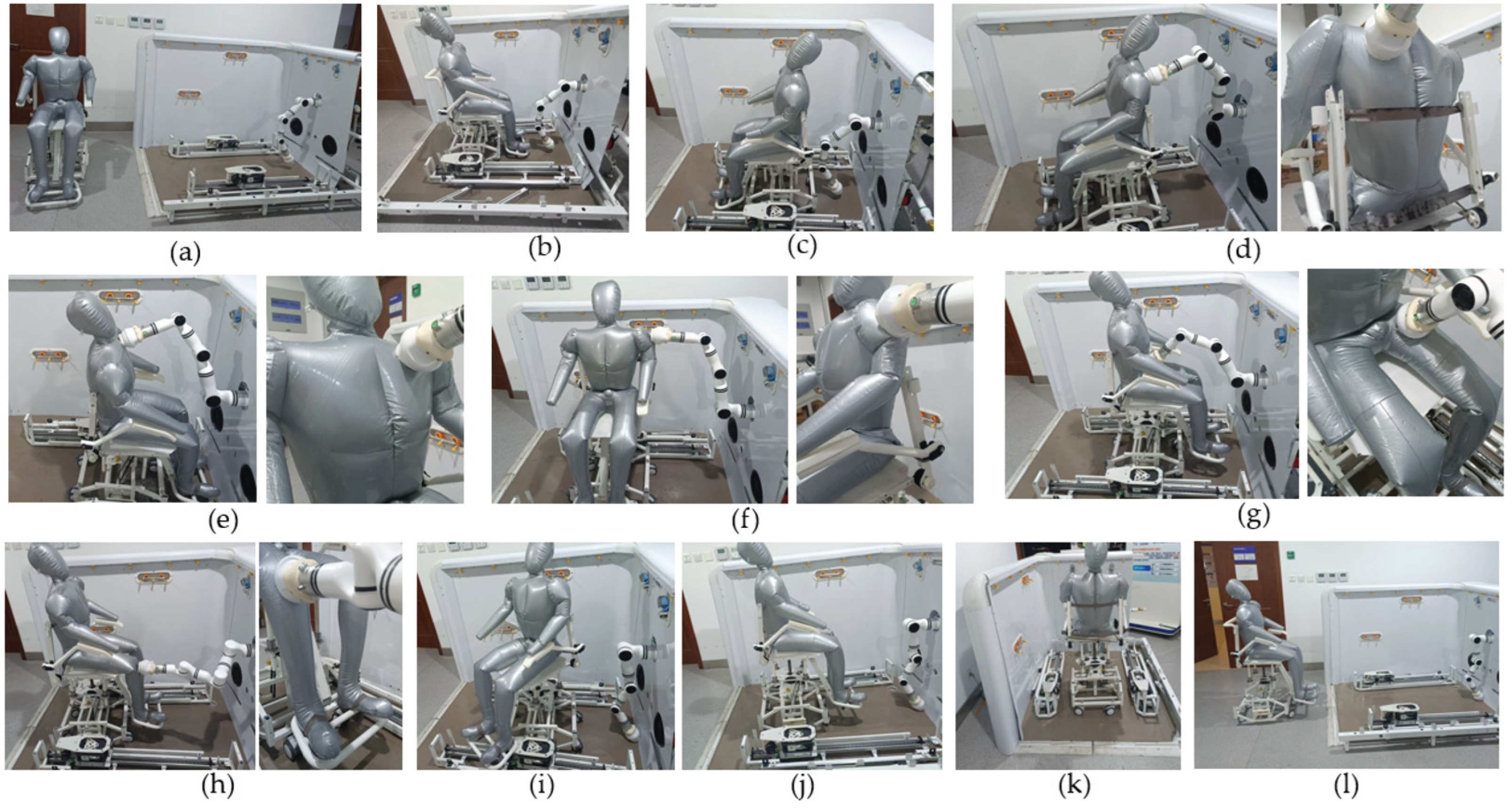
The system’s automated bathing procedure, executed using a mannequin secured to the passive bathing wheelchair, comprises 12 sequential stages. During all physical trials, the ambient cabin temperature was maintained at 26 ± 1 °C. For visual perception, the Intel RealSense D455 depth camera (Intel Corporation, Shanghai, China) was configured to a spatial resolution of 848 × 480 at 30 fps. The subsequent 3D point cloud preprocessing utilized a voxel grid filter (leaf size: 0.01 m) and statistical outlier removal to ensure precise human target area segmentation under wet conditions. Furthermore, to guarantee operational safety, the inverse kinematics solver restricted the maximum end-effector velocity of the 6-DOF robotic arm to 0.15 m/s throughout the scrubbing phases. The specific workflow stages are detailed as follows.
  • Equipment Check and Initialization: As shown in Figure 15a, the caregiver verifies utility connections and fluid levels then powers on the system. Components initialize to their home positions, and the cabin pre-heats.
  • Pre-bath Preparation and Docking: As shown in Figure 15b, the caregiver assists the mannequin into position and activates docking. The transfer assistance device aligns and engages with the wheelchair.
  • Process Initiation and Positioning: As shown in Figure 15c, automated bathing starts. The system positions the wheelchair, while the depth camera scans the body contour for the host computer to generate the robotic arm trajectory.
  • Initial Rinsing: As shown in Figure 15d, all shower heads spray water to wet the entire body.
  • Back Scrubbing: As shown in Figure 15e, the robotic arm scrubs the back. Mid-process, the rear shower heads spray cleansing solution briefly.
  • Front Scrubbing: As shown in Figure 15f, the chair rotates 180°. After targeted solution spray, the arm scrubs the chest and abdomen.
  • Lateral Scrubbing: As shown in Figure 15g, the chair rotates 90°. The arm scrubs one lateral side (arm, flank) following solution spray. The chair then rotates 180° to repeat on the opposite side.
  • Thigh Scrubbing: As shown in Figure 15h, the chair rotates 90° and elevates 50–80 mm. The thighs are scrubbed after solution spray.
  • Lower Leg and Foot Scrubbing: As shown in Figure 15i, the chair elevates 100–150 mm. The arm scrubs the lower legs and feet sequentially.
  • Final Rinse and Drying: As shown in Figure 15j, a full-body rinse precedes high-power warm air-drying, during which the chair moves intermittently to ensure thorough drying.
  • Process Completion: As shown in Figure 15k, the system returns the wheelchair to the entrance and disengages the docking mechanism, and the caregiver removes the mannequin.
  • Cabin Self-cleaning: As shown in Figure 15l, overhead nozzles spray disinfectant and then clean water to sanitize the cabin interior.

5.2. Bathing Duration Experiment

The bathing duration of the system was tested using mannequin models. A mannequin was secured to the bathing wheelchair, and steps 3 to 11 of the aforementioned bathing workflow were executed. The system automatically performed the sequence from initiating the bath to completion (start bathing→spraying→scrubbing→drying→end bathing). The total time elapsed from the mannequin entering the bathing cabin to exiting was measured. Ten experimental trials were conducted using five mannequin models in a crossover sequence, and the results were recorded.
The experimental results (shown in Table 2) indicate that the average bathing time for the system was 16.6 min, which is closely aligned with the actual bathing time of 15–20 min observed in care institutions. This demonstrates that the bathing system possesses high bathing efficiency.

5.3. Automation Level Experiment

One of the primary functions of the bathing system is to replace caregivers in performing strenuous bathing care tasks, thereby alleviating their workload. Consequently, it is necessary to measure the system’s degree of automation. This metric represents the extent to which the system can assume bathing tasks from caregivers, reflecting the potential reduction in caregiver workload through the use of automated bathing equipment. Quantifying the level of automation allows for an objective description of the extent to which the system reduces caregiver burden, demonstrating its practical utility.
First, the workload of actual bathing care tasks was quantified. Based on the key steps identified in the previously outlined bathing care workflow, a Bathing Care Workload Scale was developed (see Appendix A). This scale was randomly distributed to 25 care workers from different institutions. These caregivers scored the workload associated with 16 key bathing steps based on their practical experience. The scores reflect the perceived workload for each step. The average score for each item was calculated to determine the workload for the 16 key steps. Summing the scores of all steps yielded a quantifiable measure of the total workload for manual bathing care.
In the workload scale, “scrubbing the back” was used as the reference dimension, which was assigned a score of 5. Caregivers scored other steps relative to this reference. A total of 22 completed forms were received. After excluding one invalid form, data from 21 forms were processed and aggregated to calculate the average score for each bathing step. The results are shown in the Table 3 below.
Subsequently, six caregivers were invited to use the prototype bathing system following the automated bathing procedure. After use, they completed the same Bathing Care Workload Scale based on their experience, measuring the workload expended when using the system for assisted bathing. The six forms were aggregated, and the average score for each step was calculated to determine the workload when using the bathing system. The results are presented in the Table 4.
Finally, the workload when using the bathing system was compared to the workload of manual bathing care by calculating their ratio. This provides an objective evaluation of the workload reduction achieved by the bathing system.
R = 1 S a S r × 100
in the formula, R represents the system’s level of automation, where Sa is the workload when using the bathing system to assist the elderly with bathing, and Sr is the actual workload when not using any bathing assistance equipment. The ratio of these two indicates the automation level of the bathing system. Substituting the data from the workload summary table, Sa = 36.85 and Sr = 122, into the formula yields an automation level of 69.81% for the bathing system designed in this study. This means the system reduces the caregiver’s workload by 69.81% and significantly decreases their physical labor. Furthermore, a direct comparison with traditional manual bathing highlights the distinct advantages of the automated system across multiple dimensions. While manual bathing is labor-intensive, physically demanding for caregivers, and poses high risks of slips or falls during transfers, the automated system mitigates these hazards through its integrated multi-DOF transfer device and passive wheelchair docking. In terms of efficiency, the automated system maintains a highly practical average bathing time of 16.6 min, comparable to manual care, without the associated physical strain. Crucially, the system greatly enhances user privacy and dignity; because the entire 12-step sequence is automated, the caregiver is only required to handle pre-bath preparations and externally monitor the process, significantly reducing the discomfort often associated with manual assistive bathing.

5.4. Quantitative Evaluation of Perception and Kinematics

To further validate the system’s technical efficacy, quantitative evaluations of the core algorithms were conducted. In the visual perception module, the performance of 3D point cloud preprocessing and human target area segmentation in the bathing scenario was analyzed. Under high-humidity and visually noisy conditions, the proposed segmentation pipeline achieved a Mean Intersection over Union (mIoU) of 94.2%, outperforming standard baseline filtering methods by 11.5% while maintaining a processing speed of 22 fps. Furthermore, regarding the motion planning module, we evaluated the kinematics of the 6-DOF robotic arm for complex human body surfaces. Quantitative workspace analysis and trajectory generation tests demonstrated a mean trajectory tracking error of just 2.1 mm during dynamic surface contouring. This high precision, combined with real-time force feedback limits, quantitatively verifies the safety and reliability of the human–computer collaboration during the automated scrubbing process compared to traditional rigid trajectory planning.

6. Conclusions

This study presented the design and verification of a comprehensive multi-module integrated intelligent bathing assistance system. The system, comprising a robotic scrubbing unit, an ergonomic cabin, a passive multifunctional wheelchair, and a multi-DOF transfer device, successfully automates a complete 12-step bathing workflow. Experimental validation with mannequins confirmed its operational efficacy, yielding an average bathing duration of 16.6 min, which aligns with the standard care duration of 15–20 min. Crucially, a structured workload assessment demonstrated that the system reduces caregiver workload by approximately 70% (automation level of 69.8%). Furthermore, simulation analysis indicated that the coordinated control of the chair and robotic arm enables scrubbing coverage of roughly 95% of the body surface. These results substantiate the system’s potential to enhance bathing efficiency and significantly alleviate the physical burden on caregivers in institutional settings. Despite these promising results, the current system exhibits certain drawbacks. Primarily, the experimental validation was conducted using mannequin models, which cannot provide subjective feedback on physical comfort, perceived safety, or psychological acceptance. Furthermore, the high complexity of the multi-module integration currently presents a barrier to low-cost manufacturing. Therefore, potential improvements and future work will focus on conducting comprehensive clinical trials with real elderly and disabled participants to gather subjective user experience data and refine the human–robot interaction safety protocols. Additionally, we aim to develop AI-driven adaptive control algorithms to accommodate personalized bathing preferences and optimize the mechanical structure to reduce overall manufacturing costs, thereby accelerating the system’s practical deployment in diverse care settings.

Author Contributions

Conceptualization, P.X., H.Y. and L.Z.; Methodology, P.X., C.Z., Y.X. and L.Z.; Software, C.Z.; Validation, C.Z. and Y.X.; Formal analysis, Y.X.; Investigation, P.X. and C.Z.; Resources, H.Y. and L.Z.; Data curation, P.X. and Y.X.; Writing—original draft preparation, P.X.; Writing—review and editing, P.X., C.Z., Y.X., H.Y. and L.Z.; Visualization, Y.X.; Supervision, H.Y. and L.Z.; Project administration, H.Y.; Funding acquisition, H.Y. All authors have read and agreed to the published version of the manuscript.

Funding

The work reported in this paper is supported by National Key R&D Program Project (2022YFC3601400) and The Key Joint Research Projects of the Yangtze River Delta Science and Technology Innovation Community, grant number (2024CSJGG01603).

Institutional Review Board Statement

Written informed consent has been obtained from the patients to publish this paper.

Data Availability Statement

The original contributions presented in this study are included in the article material. Further inquiries can be directed to the corresponding author.

Acknowledgments

The authors would like to thank Shikai Feng, Chenyu Tan, Chaofan Chang and Yifei Ren for their assistance in the preparation of and participation in the experimental evaluation.

Conflicts of Interest

The authors declare no conflicts of interest.

Appendix A. Bathing Care Workload Survey Form

Dear Caregiver,
This document is a Bathing Care Workload Survey. Please complete the following table based on your practical daily experience assisting elderly individuals with bathing. The instructions are as follows.
This form outlines the procedural steps involved in assisting an elderly person with bathing. Please rate the effort required to complete each step on a scale from 0 to 10, where a higher score indicates a greater expenditure of effort on that particular step.
The step “Cleaning the upper body” serves as the reference task and is assigned a fixed score of 5.
Serial No.Task/StepRating (0–10)
1Inspect bathing equipment
2Assess bathing eligibility
3Prepare bathing supplies
4Transfer the bather
5Remove clothing and position for bathing
6Test water temperature and prepare for washing
7Wet the entire body
8Clean the head
9Clean the upper body5
10Clean the thighs, perineum, and buttocks
11Clean the lower legs and feet
12Rinse the entire body
13Dry the body
14Dress the bather and assist them to leave the bathroom
15Post-bath care (to be determined)
16Clean and disinfect bathing facilities
Total Score:
Remarks:
Thank you for your cooperation!Date:Signature:

References

  1. Li, J.; Mo, Y.; Jiang, S.; Ma, L.; Zhang, Y.; Wei, S. Bathing Assistive Devices and Robots for the Elderly. Biomim. Intell. Robot. 2025, 5, 100218. [Google Scholar] [CrossRef]
  2. Werner, C.; Dometios, A.C.; Tzafestas, C.S.; Maragos, P.; Bauer, J.M.; Hauer, K. Evaluating the Task Effectiveness and User Satisfaction with Different Operation Modes of an Assistive Bathing Robot in Older Adults. Assist. Technol. 2020, 34, 222–231. [Google Scholar] [CrossRef] [PubMed]
  3. Werner, C.; Kardaris, N.; Koutras, P.; Zlatintsi, A.; Maragos, P.; Bauer, J.M.; Hauer, K. Improving Gesture-Based Interaction between an Assistive Bathing Robot and Older Adults via User Training on the Gestural Commands. Arch. Gerontol. Geriatr. 2020, 10, 103996. [Google Scholar] [CrossRef] [PubMed]
  4. Zlatintsi, A.; Rodomagoulakis, I.; Pitsikalis, V.; Koutras, P.; Kardaris, N.; Papageorgiou, X.; Tzafestas, C.; Maragos, P. Social Human-Robot Interaction for the Elderly: Two Real-Life Use Cases. In Proceedings of Companion of the 2017 ACM/IEEE International Conference on Human-Robot Interaction; ACM: Vienna, Austria, 2017; pp. 335–336. [Google Scholar]
  5. Kato, K.; Aimoto, K.; Kawamura, K.; Yoshimi, T.; Itoh, N.; Kondo, I. Novel Bathing Assist Device Decreases the Physical Burden on Caregivers and Difficulty of Bathing Activity in Care Recipients: A Pilot Study. Appl. Sci. 2022, 12, 10131. [Google Scholar] [CrossRef]
  6. Dang, Q.-V.; Nielsen, I.; Steger-Jensen, K. Multi-Objective Genetic Algorithm for Real-World Mobile Robot Scheduling Problem. In Proceedings of the Advances in Production Management Systems; Springer Berlin Heidelberg: Berlin, Heidelberg, 2013. [Google Scholar]
  7. Zlatintsi, A.; Rodomagoulakis, I.; Koutras, P.; Dometios, A.C.; Pitsikalis, V.; Tzafestas, C.S.; Maragos, P. Multimodal Signal Processing and Learning Aspects of Human-Robot Interaction for an Assistive Bathing Robot. In Proceedings of the 2018 IEEE International Conference on Acoustics, Speech and Signal Processing (ICASSP); IEEE: Calgary, AB, USA, 2018; pp. 3171–3175. [Google Scholar]
  8. Bogue, R. Europe Leads the Way in Assistive Robots for the Elderly. Ind. Robot-Int. J. 2017, 44, 253–258. [Google Scholar] [CrossRef]
  9. Sonnenberg, L.-B. The Development of Assistive Robots for the Elderly. Future Business Opportunities in the European Market. Available online: http://www.theseus.fi/handle/10024/167943 (accessed on 8 November 2021).
  10. Hui, J.; Lee, Y.; Yuan, J. Fractional-order Sliding Mode Load Following Control via Disturbance Observer for Modular High-temperature Gas-cooled Reactor System with Disturbances. Asian J. Control 2023, 25, 3513–3523. [Google Scholar] [CrossRef]
  11. Hui, J. Fixed-Time Fractional-Order Sliding Mode Controller with Disturbance Observer for U-Tube Steam Generator. Renew. Sustain. Energy Rev. 2024, 205, 114829. [Google Scholar] [CrossRef]
  12. Hui, J.; Yuan, J. Adaptive Second-Order Nonsingular Terminal Sliding Mode Power-Level Control for Nuclear Power Plants. Nucl. Eng. Technol. 2022, 54, 1644–1651. [Google Scholar] [CrossRef]
  13. Zlatintsi, A.; Dometios, A.C.; Kardaris, N.; Rodomagoulakis, I.; Koutras, P.; Papageorgiou, X.; Maragos, P.; Tzafestas, C.S.; Vartholomeos, P.; Hauer, K.; et al. I-Support: A Robotic Platform of an Assistive Bathing Robot for the Elderly Population. Robot. Auton. Syst. 2020, 126, 103451. [Google Scholar] [CrossRef]
  14. Wang, W.; Chen, Y.; Zou, X.; Wang, S.; Ferreira, J.P.; Liu, T. Development of Bath Auxiliary Robot for the Disabled Elderly. In Proceedings of the 2021 IEEE International Conference on Intelligence and Safety for Robotics (ISR); IEEE: Tokoname, Japan, 2021; pp. 85–88. [Google Scholar]
  15. Xu, Y.; Guo, X.; Zhang, G.; Li, J.; Huo, X.; Xuan, B.; Gu, Z.; Sun, H. A Learning Control Strategy for Robot-Assisted Bathing via Impedance Sliding Mode Technique With Non-Repetitive Tasks. Int. J. Control Autom. Syst. 2024, 22, 946–962. [Google Scholar] [CrossRef]
  16. Bezerra, K.; Machado, J.; Carvalho, V.; Castro, M.; Costa, P.; Matos, D.; Soares, F. Bath-Ambience—A Mechatronic System for Assisting the Caregivers of Bedridden People. Sensors 2017, 17, 1156. [Google Scholar] [CrossRef] [PubMed]
  17. Papageorgiou, X.S.; Chalvatzaki, G.; Dometios, A.C.; Tzafestas, C.S. Human-Centered Service Robotic Systems for Assisted Living. In Advances in Service and Industrial Robotics; Aspragathos, N.A., Koustoumpardis, P.N., Moulianitis, V.C., Eds.; Mechanisms and Machine Science; Springer International Publishing: Cham, Switzerland, 2019; Volume 67, pp. 132–140. [Google Scholar]
  18. Gu, Y.; Demiris, Y. Learning Bimanual Manipulation Policies for Bathing Bed-Bound People. In Proceedings of the 2024 IEEE/RSJ International Conference on Intelligent Robots and Systems (IROS); IEEE: Abu Dhabi, United Arab Emirates, 2024; pp. 8936–8943. [Google Scholar]
  19. Fu, Y.; Zhimin, H.; Diansheng, C. Safety and Waterproof Design of Multi-Functional Assisted Bath Robot. In Intelligent Robotics and Applications; Yu, H., Liu, J., Liu, L., Ju, Z., Liu, Y., Zhou, D., Eds.; Lecture Notes in Computer Science; Springer International Publishing: Cham, Switzerland, 2019; Volume 11744, pp. 648–659. [Google Scholar]
  20. Klein, B.; Schlömer, I. A Robotic Shower System: Acceptance and Ethical Issues. Z. Für Gerontol. Und Geriatr. 2018, 51, 25–31. [Google Scholar] [CrossRef]
  21. Zhang, J.; Shen, Z.; Tong, X.; Sun, X.; Yao, N. Availability of Family Care Resources, Bathing Assistance and Toileting Assistance among Older Adults with Functional Limitations: An Evidence-Based Study from China. BMC Geriatr. 2024, 24, 419. [Google Scholar] [CrossRef] [PubMed]
  22. Huang, X.; Liu, Z. Prediction of Anthropometric Dimension Based on Frontal Human Image. J. Text. Inst. 2026, 117, 281–288. [Google Scholar] [CrossRef]
  23. Li, Y.; Feng, S.; Zhu, D.; Guo, S.; Song, Y.; Tian, Q. Safety Control of a Redundant Dual-arm Robot for Transfer-care Task. J. Mech. Eng. 2023, 59, 76. [Google Scholar] [CrossRef]
Figure 1. Schematic diagram of the seated showering and bathing mode.
Machines 14 00431 g001
Figure 2. Overall design scheme for the bathing system.
Machines 14 00431 g002
Figure 3. Schematic diagram of the bathing process.
Machines 14 00431 g003
Figure 4. Schematic diagram of human body translation and rotation, (a) translation, and (b) rotation.
Machines 14 00431 g004
Figure 5. Schematic diagram of shower system.
Machines 14 00431 g005
Figure 6. Schematic diagram of the translation assistance device.
Machines 14 00431 g006
Figure 7. Schematic diagram of the left–right extension mechanism (1: base frame; 2 and 6: parallel four-bar linkage mechanism; 3 and 5: quick-detachable connection; 4: connector for front-rear translation mechanism; 7: electric push rod connector; Revolute joints: A, C, F, I; Prismatic joints: B, D, E, G, J; H: Vertical distance between frames; h: Distance between the push rod and the frame; P: Docking direction of the bathing chair; Xa: Sliding displacement; L2: Length of the connecting rod; x & y: Coordinate system based on revolute joints; α: Included angle between the connecting rod and the frame).
Machines 14 00431 g007
Figure 8. Diagram of the docking method, (a) commencement of docking; (b) completion of docking and locking; and (c) separation.
Machines 14 00431 g008
Figure 9. Schematic diagram of the docking principle.
Machines 14 00431 g009
Figure 10. Overall diagram of the docking mechanism.
Machines 14 00431 g010
Figure 11. Schematic diagram of shower chair transmission system.
Machines 14 00431 g011
Figure 12. Adams simulation model.
Machines 14 00431 g012
Figure 13. Adams simulation results: (a) displacement; (b) force; (c) angle; (d) velocity.
Machines 14 00431 g013
Figure 14. Simulation of key steps in the scrubbing process: (a) scrubbing the back; (b) scrubbing the front; (c) scrubbing the lateral side; (d) scrubbing the thighs; and (e) scrubbing the lower legs and feet.
Machines 14 00431 g014
Figure 15. Verification of the bathing system workflow: (a) commencement of entry; (b) completion of docking; (c) reaching the bathing position; (d) scrubbing the back; (e) scrubbing the front; (f) scrubbing the lateral side; (g) scrubbing the thighs; (h) scrubbing the lower legs and feet; (i) activation of the high-power drying cycle; (j) preparation for separation; (k) completion of separation; (l) exiting the bathing cabin.
Machines 14 00431 g015
Table 1. Table of dimensions and parameters for bathing cabin body.
Bathing AreaParameter (mm)OverallParameter (mm)
Length (l)1700Length (L)2000
Width (w)1000Width (W)1200
Height (h)1200Height (H)1250
Table 2. Bathing time measurement results for repeated trials.
Trial No.12345678910Avg. (min)
Time (min)20.018.217.816.015.314.916.116.916.014.816.6
Table 3. Statistical Table of Average Scores for Actual Bathing Procedures.
Trial No.12345678910111213141516Total Score
Score3218524458554957122
Table 4. Evaluation scores for key steps in the bathing care workload.
Step No.12345678910111213141516Total Score
N1321351141111155237
N2311452131211164339
N3221351242111155238
N4321351141111155237
N5211251131111145232
N6321352141111155238
Avg.2.671.671351.331.173.671.171.1711154.852.1736.83
Disclaimer/Publisher’s Note: The statements, opinions and data contained in all publications are solely those of the individual author(s) and contributor(s) and not of MDPI and/or the editor(s). MDPI and/or the editor(s) disclaim responsibility for any injury to people or property resulting from any ideas, methods, instructions or products referred to in the content.