1. Introduction
Tubular permanent-magnet linear machines (TPMLMs) have been increasingly adopted for linear motion applications, including reciprocating compressors [
1,
2,
3], active vehicle suspensions [
4,
5], free-piston energy converters [
6] and wave energy conversion generators [
7,
8,
9] due to their high power density and efficiency. By producing linear thrust directly, TPMLMs eliminate the need for rotary-to-linear conversion mechanisms, thereby simplifying the overall system and improving energy conversion efficiency. In addition, the tubular topology minimizes end-winding length for a compact winding layout, improving power density, while the axisymmetric geometry reduces net radial force and supports stable operation [
10,
11,
12].
Meanwhile, tubular flux-switching permanent-magnet linear machines (TFSPMLMs) have been introduced to further enhance the performance and practicality of TPMLMs. In conventional TPMLM topologies, permanent magnets are mounted on the mover, which can compromise mechanical robustness and lead to issues with magnet eddy-current loss. Eddy-current heating in the magnet can increase the risk of irreversible demagnetization [
13,
14]. In contrast, TFSPMLMs place the permanent magnets on the stator, while the mover is composed solely of a salient magnetic core. This configuration not only enhances mechanical robustness and improves reliability but also reduces mover manufacturing complexity and cost [
12,
15]. Moreover, the armature field is perpendicular to the magnetization direction of the permanent magnets, reducing the risk of irreversible demagnetization.
However, in TFSPMLMs, the main flux is distributed in the radial and axial directions, which constrains the use of conventional laminated steel. When axial lamination is employed, the core can be exposed to enormous in-plane eddy currents, leading to a significant degradation in force production and efficiency. Meanwhile, radial lamination typically requires lamination with varying geometries across layers, which increases manufacturing complexity and cost. Circumferential lamination can effectively block eddy currents driven by the main flux, but the cylindrical topology inevitably reduces the core filling factor, which lowers the effective magnetic loading and reduces machine performance. As an alternative, soft magnetic composites (SMCs) are often adopted. SMCs are electrically and magnetically isotropic and readily formed into three-dimensional geometries. However, compared with laminated steel, SMCs generally exhibit lower permeability and higher hysteresis loss, which can limit thrust capability and efficiency [
16,
17].
In this context, various hybrid-material magnetic core configurations have been investigated, in which two or more magnetic materials are selectively combined within the core, such as in the teeth and back yoke. Hybrid-material cores have been introduced and investigated earlier in other electrical machines and devices. In transformers, hybrid cores combining amorphous alloys and grain-oriented (GO) electrical steel have been applied to reduce core loss [
18]. In radial-flux machines, non-grain-oriented (NGO) steel has been applied to the back yoke and GO steel to the teeth according to the main flux direction in the stator, and their performance has been comparatively evaluated [
19,
20]. In addition, hybrid-core structures have been actively adopted in machines with complex three-dimensional flux paths and geometries, such as transverse-flux permanent-magnet machines [
21,
22] and axial-flux permanent-magnet machines [
23], where manufacturability is also an important design consideration. A hybrid stator core for TFSPMLMs, in which tangentially laminated steel and SMC segments are alternately arranged along the circumferential direction, was reported in [
24] and showed superior performance to both all-SMC and all-laminated-steel designs.
In [
24], only a circumferential hybrid-core configuration was considered. However, due to the region-dependent flux paths in TFSPMLMs, radial and axial laminations can also be viable options depending on the location of the laminated steel. In addition, when a hybrid-core configuration is adopted, the influence of the interfaces between different core segments made of different materials should also be considered. These interfaces inevitably introduce micro-gaps, which increase the magnetic reluctance along the magnetic flux path and consequently degrade the machine’s performance [
25,
26].
Therefore, a comparison of different hybrid-core configurations is required to clarify their electromagnetic benefits and limitations in TFSPMLMs. In this paper, several hybrid-material magnetic core structures for TFSPMLMs are comparatively investigated by considering different lamination directions and locations. In particular, the proposed study not only extends the hybrid-core concept beyond the circumferential configuration reported in [
24], but also evaluates the performance degradation caused by interface-induced micro-gaps.
This paper provides design insights into the applicability, advantages, and limitations of each hybrid-core configuration for TFSPMLMs. In
Section 2, the magnetic flux density in the teeth and back yoke of a reference TFSPMLM is analyzed. Based on this analysis, feasible hybrid-core structures are derived. In
Section 3, three hybrid-core models, H1, H2, and H3, are developed, and their finite element analysis (FEA) results are compared to discuss the advantages and limitations of each structure. In
Section 4, the use of laminated steel segmentation is investigated to further improve the performance of each hybrid configuration, and its effectiveness is quantitatively assessed. Finally, the key findings are summarized and further discussed in
Section 5, including manufacturability considerations, the effectiveness of segmentation with respect to operating speed, and application-oriented design guidelines, and the conclusion are presented in
Section 6.
2. Analysis of Core Flux Density Direction for Hybrid-Core Design
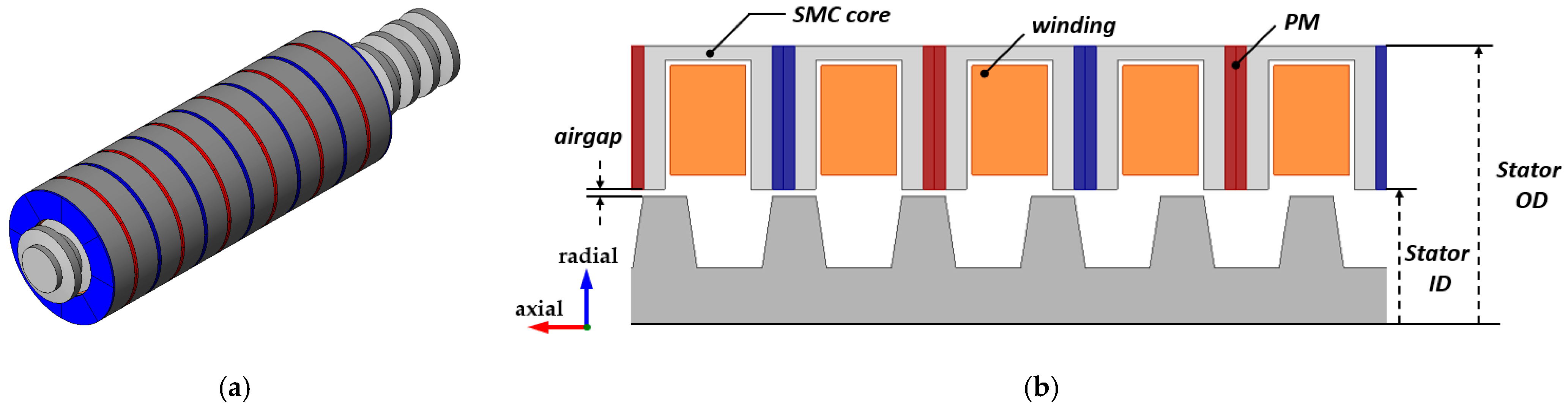
As a reference model for deriving hybrid-core designs and comparing their effectiveness, a conventional SMC-based TFSPMLM (Model R1) is illustrated in
Figure 1. Both the stator and mover cores are made of SMCs, and N40 permanent magnets (
Br = 1.28 T,
Hc = −982 kA/m) are used. A 12-slot/14-pole combination is adopted to achieve efficient thrust generation while reducing detent force. In addition, a ring-type winding suitable for the tubular topology is employed [
12]. The specifications and operating conditions of the developed model are summarized in
Table 1.
In this study, Höganäs Somaloy
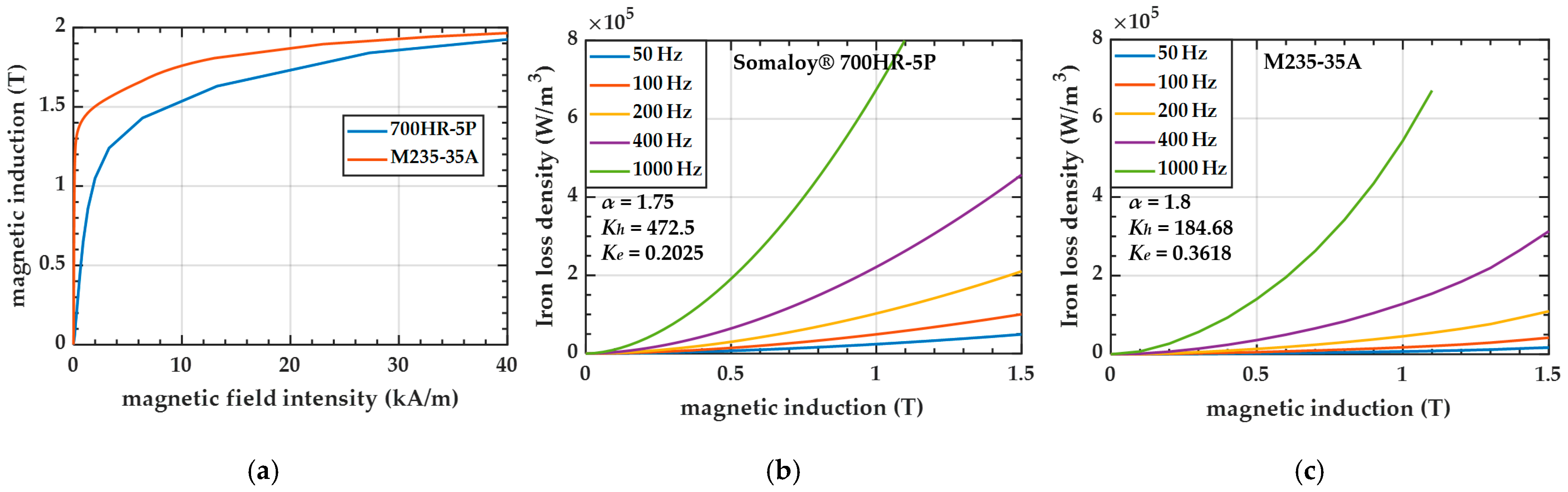
® 700HR-5P is used for the SMC core, and M235-35A is used as the laminated steel. The electric/magnetic properties and loss properties of each material are presented in
Figure 2. Because SMCs consist of iron powder particles coated with an insulating layer, they exhibit a very low effective bulk electrical conductivity; however, their hysteresis loss is relatively high due to microstructural gaps. In addition, both the magnetic properties and electrical conductivity of the SMC are essentially isotropic. In contrast, laminated steel generally exhibits a higher saturation flux density and permeability than SMCs. In electrical machines, the laminations are coated with an insulating layer and stacked with their lamination plane aligned parallel to the main flux path, which suppresses eddy currents induced by the main flux component. However, because the steel itself has high electrical conductivity, laminated cores are vulnerable to in-plane eddy currents driven by local flux components that are parallel to the lamination direction. In other words, although laminated steel provides superior magnetic properties compared with SMC, it is inherently anisotropic due to the stacking direction. The effective conductivity becomes high in the plane perpendicular to the stacking direction. When the laminated steel is stacked along the
z-axis, the
r-,
θ-, and
z-axes represent the radial, circumferential, and stacking directions, respectively. Accordingly, the effective electrical conductivity and permeability can be calculated from the bulk conductivity
σ and permeability
μ of the laminated steel as follows:
where
σr,
σθ, and
σz denote the effective conductivities in the radial, circumferential, and stacking directions, respectively, and
μr,
μθ, and
μz denote the corresponding effective permeabilities. Here,
μ0 is the permeability of free space,
F is the core stacking factor,
d is the thickness of the laminated steel, and
a represents the width. The losses of the SMC and laminated steel are modeled using measurement-based hysteresis and eddy-current loss coefficients, as expressed in
where the
α is typically taken as 1.5–1.8,
Kh and
Ke are the hysteresis and eddy-current loss coefficients, respectively, and
fi denotes the frequency of the
ith harmonics, with
f1 being the fundamental frequency. The loss data measured at each frequency are shown in
Figure 2b,c. As mentioned before, the SMC exhibits a higher hysteresis loss, whereas the laminated steel shows a higher eddy-current loss. Considering that linear motors typically operate at relatively low speeds and frequencies, this implies that the use of laminated steel can improve efficiency from the loss perspectives when it is placed in appropriate regions of the core.
To maximize the performance and efficiency of electrical machines, the saturation flux density and permeability of the core materials should be as high as possible, while eddy-current loss should be minimized. Accordingly, the placement of the SMC and laminated steel in the TFSPMLM core can be determined as follows:
Laminated steel is suitable for regions where the alternating flux is mainly parallel to the lamination plane. Otherwise, in-plane eddy currents can become significant, leading to a substantial reduction in thrust and efficiency.
SMC cores are suitable for regions where the magnetic flux rotates or alternates along multiple axes, as well as for geometrically complex parts. Because their properties are essentially isotropic, SMCs can provide consistent magnetic performance and overall lower eddy-current loss.
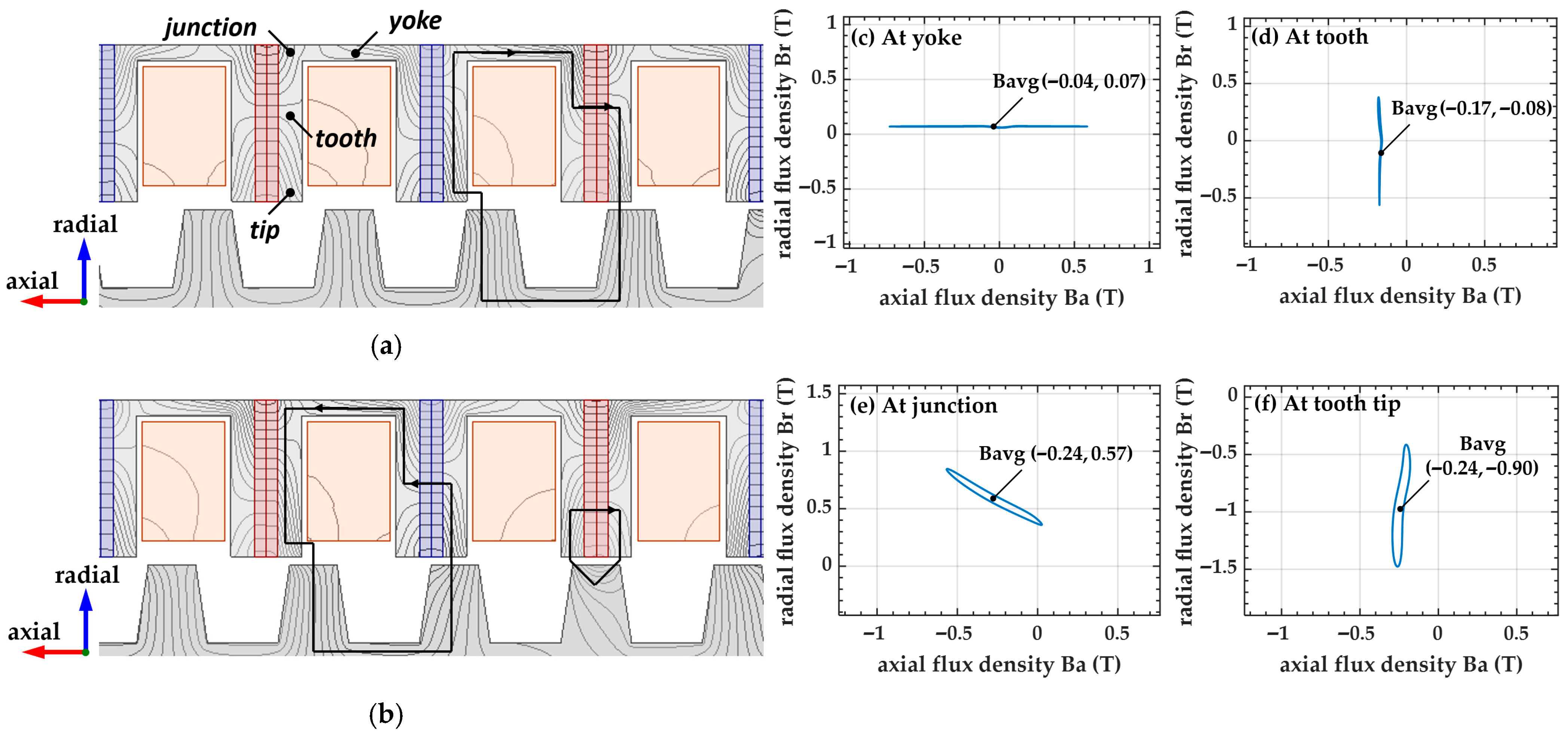
Figure 3 presents the 2D-FEA results of the reference model, where the magnetic flux lines over one electrical period and the radial–axial flux density locus at the representative points in the core. The flux density in the back yoke and stator teeth alternates or rotates during operation as the mover translates and the stator is excited by phase currents. The loci are shifted from the origin because the permanent magnets between stator segments impose a DC bias in the local flux density.
Figure 3a,b illustrate the main flux paths of the TFSPMLM. Based on the flux-switching principle, the flux lines are directed such that a net thrust is produced toward the left as the mover translates under phase current excitation. The back yoke predominantly carries an axial flux component, whereas the stator tooth region mainly conducts a radial flux component.
The flux density loci at representative points are shown in
Figure 3c–f. As shown in
Figure 3c,d, the loci at the yoke and the mid-tooth region are nearly linear, indicating that the local magnetic field is primarily alternating with no rotational components. Therefore, these regions are suitable for laminated electrical steel, where the lamination direction can be aligned with the dominant flux component to effectively suppress eddy-current loss. In contrast, the junction between the tooth and the yoke exhibits a tilted and elliptical locus, as shown in
Figure 3e. This behavior implies that the flux continuously turns between the axial and radial paths and that a non-negligible rotating-field component exists. Since the field is not aligned with either lamination axis, applying laminations becomes ineffective.
Figure 3f shows the locus at the tooth tip near the airgap. Although the radial alternating component is dominant, the locus forms a slender ellipse, suggesting the presence of a rotational component. Consequently, if laminated steel is placed in the tooth-tip region, unavoidable in-plane eddy currents may be induced, potentially increasing eddy-current loss.
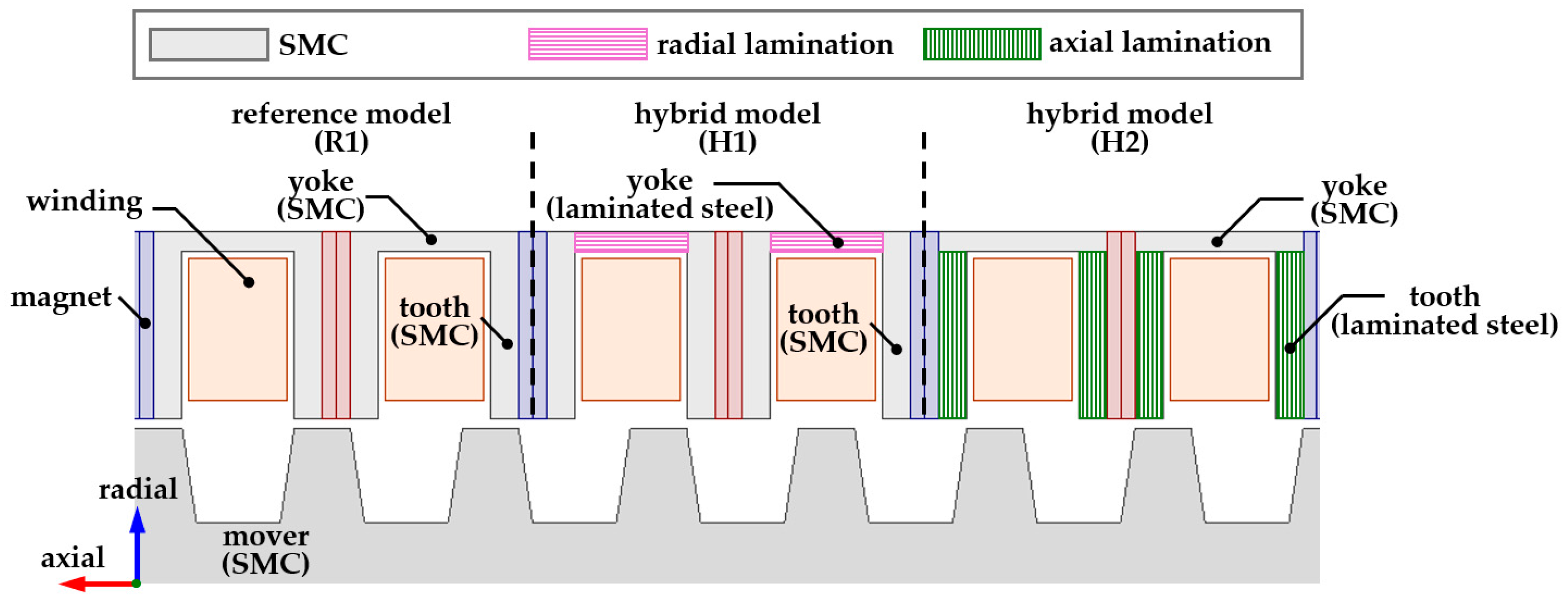
Based on the field analysis, hybrid-core models can be defined by assigning laminated steel to the regions where an alternating field component is dominant, and their schematics are presented in
Figure 4. H1 places radially laminated steel in the back yoke region, where the axial flux component is dominant. H2 places axially laminated steel in the tooth region, where the radial flux component is dominant. In addition, H3 is developed by alternating SMC segments and circumferentially laminated steel in the circumferential direction. In the next section, the finite element analysis results of the reference model (R1) and the proposed hybrid-core models (H1–H3) are examined to compare their respective advantages and disadvantages.
3. Performance and Loss Comparison of Hybrid-Core Configurations
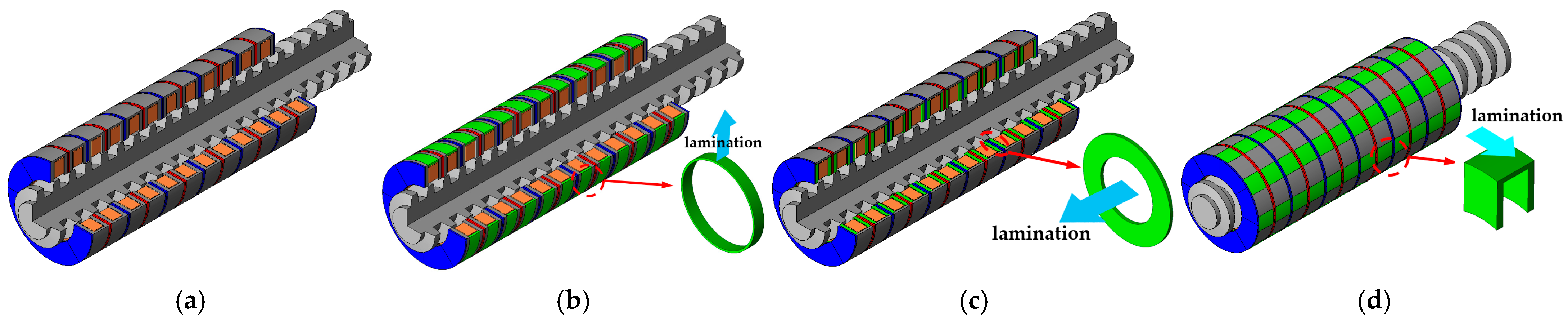
The R1, H1, H2, and H3 configurations defined in
Section 2 were developed as 3D-FEA models and are illustrated in
Figure 5. All analyses were conducted using 3D transient magnetic FEA in JMAG-Designer 23 under the same rated operating conditions of 5 A/mm
2 current density and an excitation frequency of 111.1 Hz (moving speed of 2 m/s). The electrical period was discretized into 120 time steps, corresponding to a time-step size of 7.5 × 10
−5 s.
To mitigate magnet eddy-current loss, the permanent magnets were circumferentially segmented into eight pieces in all models. In addition, a 0.1 mm micro-gap between the laminated steel and SMC was explicitly modeled as a representative interfacial gap to reflect practical assembly conditions, including bonding layers and assembly tolerances, in the hybrid-core structures [
27,
28,
29,
30]. For the laminated steel regions, the anisotropic permeability defined by (3) and (4) was applied with a stacking factor of 0.95. The lamination direction was assigned as radial in H1 and axial in H2. Meanwhile, for the electrical conductivity, (1) was applied to the in-plane direction, whereas the conductivity in the stacking direction was assumed to be negligibly small. This is because the eddy current component along the stacking direction has a negligible effect on the magnetic field distribution in the core, while the associated loss component is already included in the loss model of (5). In other words, this assumption was made to avoid redundant calculations of the eddy-current loss.
For each 3D FEA model, the mesh was constructed to ensure sufficient resolution of the electromagnetic field distribution. The total number of mesh elements was approximately 1.1 million for each model. In the airgap region, at least three mesh layers were used across the gap, and a sufficiently dense mesh was employed in the core regions.
As a result of the analysis, the material usage of SMCs and laminated steel and the performance of each model are summarized in
Table 2. And
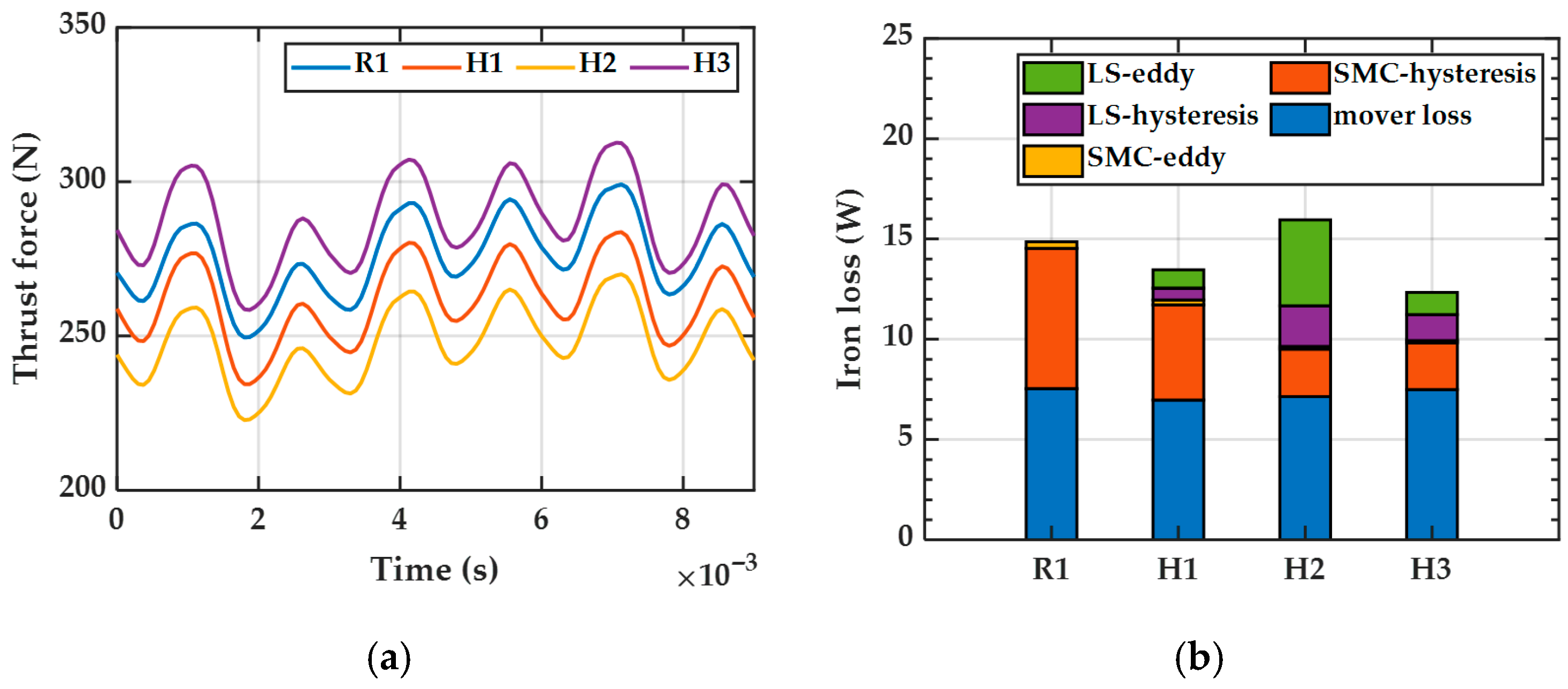
Figure 6a presents the thrust force and detent force of each model, while
Figure 6b summarizes the iron loss contributions by components. The results suggest that simply increasing the use of laminated steel does not necessarily lead to improved electromagnetic performance. Instead, the placement of the laminated steel regions and the associated lamination direction have a greater influence on performance. Except for the H3 model, H1 and H2 exhibit lower performance than R1 in terms of both thrust and efficiency. This degradation can be attributed to the increased magnetic reluctance caused by the micro-gap at material interfaces and to in-plane eddy currents in the regions where laminated steel is applied.
In H1 and H2, material interfaces lie on the main flux path, and the micro-gap across these interfaces increases magnetic reluctance, thereby reducing the magnetic flux.
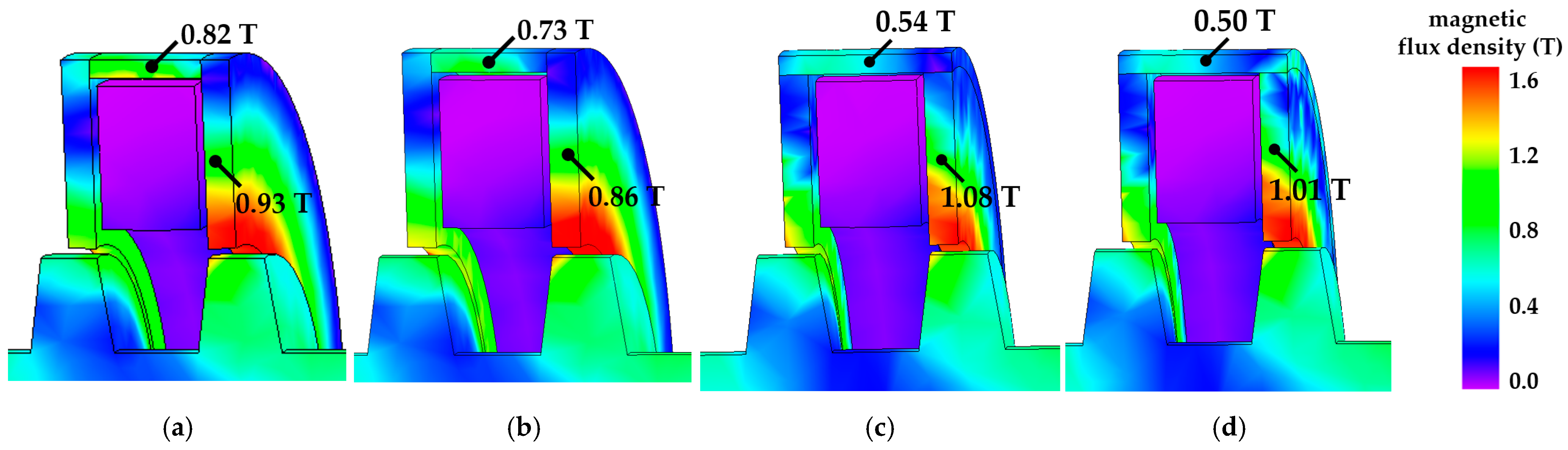
Figure 7 compares the core flux density distributions of H1 and H2 with and without the micro-gap.
Figure 7a,b show the magnetic flux density distributions of H1 at specific slot and time instant, corresponding to the cases with and without a micro-gap, respectively. Due to the micro-gap, a reduction in magnitude of flux density was observed throughout the magnetic flux path. In particular, the flux density at the tooth center was reduced from 0.93 T to 0.86 T, while that at the yoke was decreased from 0.82 T to 0.76 T, indicating pronounced degradation. Next,
Figure 7c,d present the magnetic flux density distributions of H2, where a slightly smaller reduction than that of H1 was observed. The flux density reduced by 0.07 T in the tooth and by 0.04 T in the yoke region.
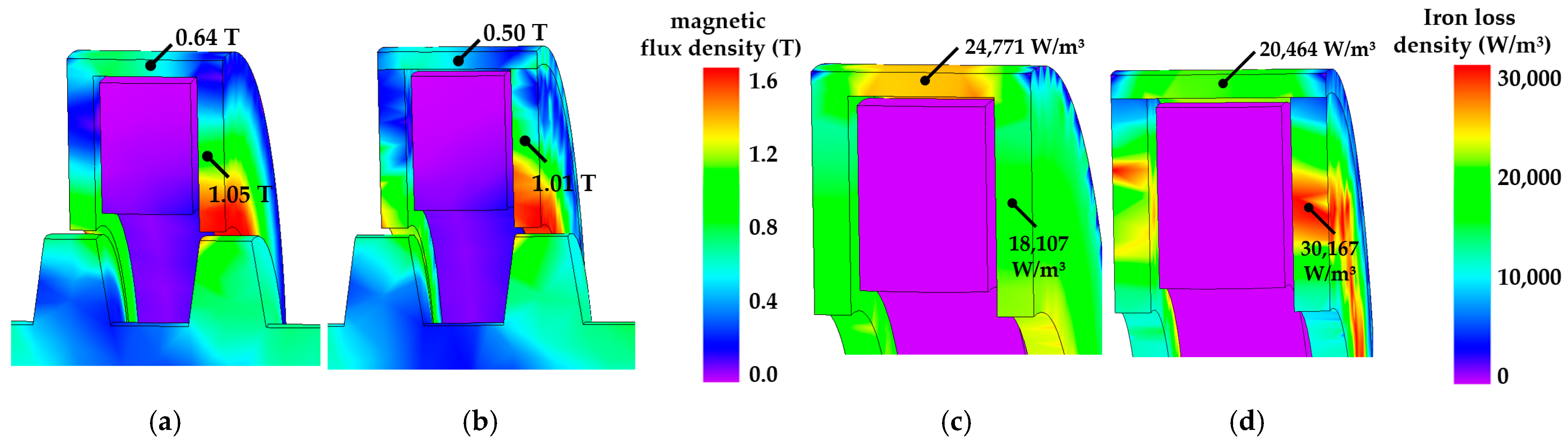
Meanwhile, H1 cannot effectively block in-plane eddy currents induced by the radial-flux component and H2 cannot sufficiently suppress losses caused by the axial-flux component, resulting in additional loss. In particular, in H2, eddy currents remain pronounced near the tooth, where the magnetic flux is highly concentrated and not aligned along a radial axis. The flux density distribution and joule loss density near the tooth tip for R1 and H2 are compared in
Figure 8.
Figure 8a,b illustrate the magnetic flux density distribution within the slot at a specific time instant for R1 and H2, respectively. In the H2 model, the flux density magnitude in the tooth region was observed to be lower than that in R1, and a distorted distribution was obtained, due to the eddy currents induced in the laminated steel. In addition,
Figure 8c,d show the iron loss density averaged over an electrical period within the slot for R1 and H2, respectively. For R1, a relatively uniform loss distribution was obtained, while a high loss density of approximately 24,000 W/m
3 was observed in the yoke due to its smaller area. In contrast, for H2, a highly non-uniform loss density distribution was produced as a result of eddy-current generation in the tooth region. The loss density in the yoke region was approximately 20,000 W/m
3, which was lower than that in R1 due to the reduced flux density magnitude. However, localized peaks exceeding 30,000 W/m
3 were observed near the center of the tooth.
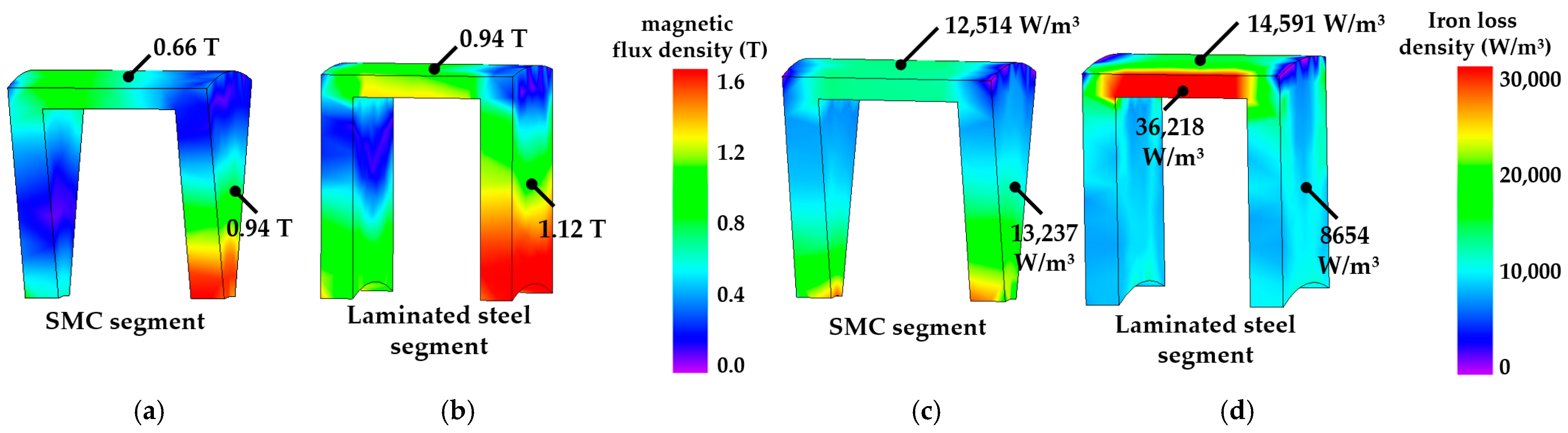
In contrast, H3 does not suffer from the two factors of performance degradation observed in H1 and H2. The material interfaces in H3 are arranged circumferentially, so no micro-gap exists along the main flux path.
Figure 9a,b show the magnetic flux density distributions in the SMC and laminated steel segments of H3, evaluated at the same locations as those in
Figure 7 and
Figure 8. In the SMC segment, the flux densities in the tooth and yoke are 0.66 T and 0.94 T, respectively, while the corresponding values in the laminated steel segment are 0.94 T and 1.12 T. All of these values are higher than those in the R1, H1, and H2 models. In addition, the circumferentially laminated steel in H3 can interrupt the eddy-current paths induced by both radial and axial main flux components. As a result, the laminated steel region in H3 exhibits a lower loss density than those in H1 and H2.
Figure 9c,d present the averaged iron loss density distributions over one electrical period in the SMC and laminated steel segments of the H3 model. In the SMC segment, the loss densities in the tooth and yoke are approximately 13,237 W/m
3 and 12,514 W/m
3, respectively. In the laminated steel segment, the corresponding values are approximately 8654 W/m
3 and 14,591 W/m
3, respectively. Although the local loss density near the edge of the laminated steel reaches approximately 36,000 W/m
3 at the material interface, mainly due to flux concentration at the boundary between materials, the overall loss density in the laminated steel region remains lower than those of H1 and H2. This result confirms that in-plane eddy currents are effectively suppressed in H3. Consequently, H3 exhibits superior electromagnetic performance, achieving higher output power with lower overall loss than the other models.
Compared with H3, H1 and H2 are adversely affected by both the material interfaces located along the main flux paths and the additional in-plane eddy-current loss in the laminated steel regions. In H1 and H2, these material interfaces intersect the radial or axial main flux paths, introducing micro-gaps that increase magnetic reluctance and weaken the effective flux linkage. At the same time, the laminated steel arrangement in each model cannot fully interrupt the in-plane eddy-current paths generated by the multi-directional main flux, leading to additional loss and further degradation in electromagnetic performance. Among these two issues, the in-plane eddy-current loss can be mitigated by further segmenting the laminated steel regions in H1 and H2 so that the in-plane current paths are interrupted. In the next section, the effectiveness of this additional segmentation is quantitatively assessed based on the FEA results in terms of both loss reduction and thrust recovery.
4. Improvement in Performance Through Laminated Steel Segmentation
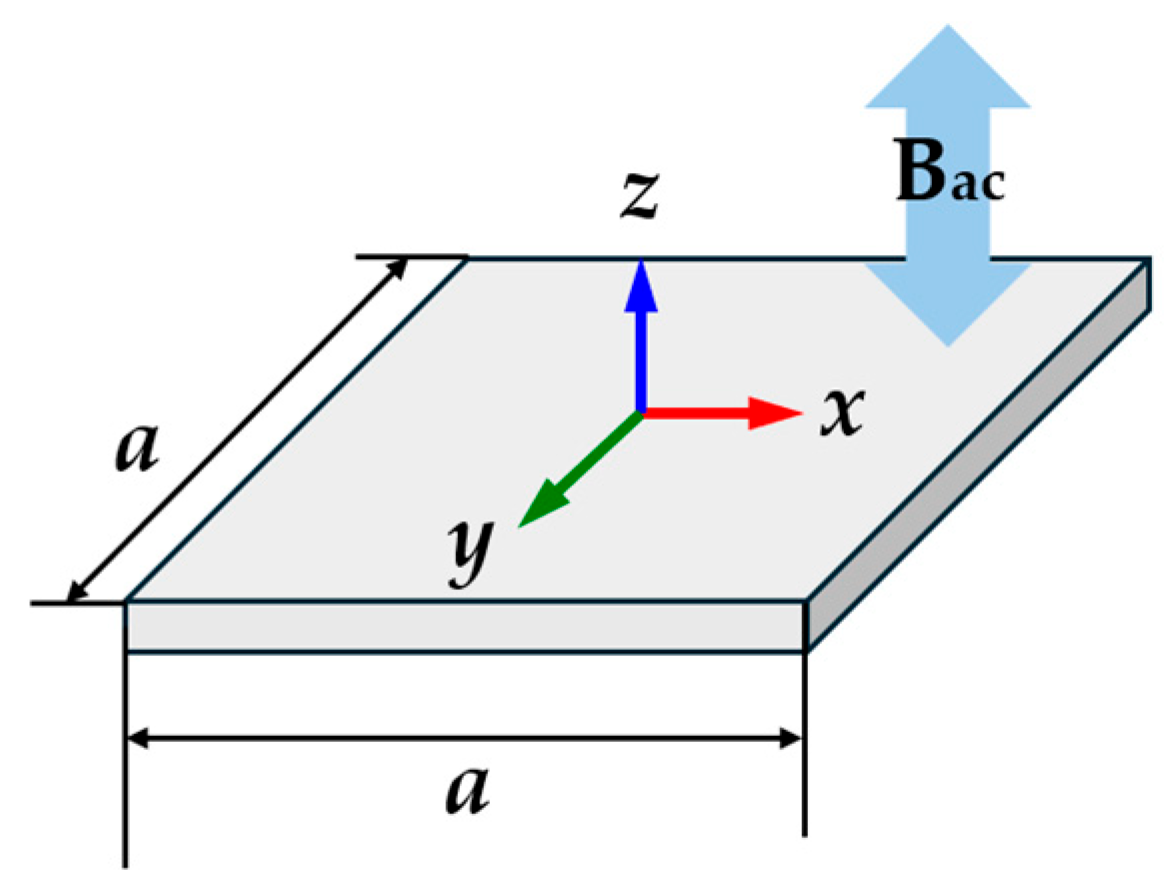
H1 and H2 exhibit lower performance than R1 due to the micro-gap along the main flux path and in-plane eddy currents. While the increase in magnetic reluctance caused by the micro-gap is unavoidable in the H1 and H2 structures, the in-plane eddy currents induced in the laminated steel can be mitigated. In this section, performance improvements achieved by additional segmentation of the laminated steel are investigated. Subdividing the conductive core in the circumferential direction increases the effective path resistance for eddy currents, thereby reducing eddy-current loss. The reduction in eddy-current loss achieved by segmentation can be qualitatively predicted using a simplified square-plate model. Assume that a square conductive plate is subjected to a uniform alternating magnetic field perpendicular to the plate, as shown in
Figure 10. Under this assumption, the eddy-current loss density can be derived as follows. The magnetic vector potential
A can be defined as follows:
where
B is the magnetic flux density and
r is the position vector. The electric field that is the source of the eddy current is then given by the following:
Accordingly, the local loss density
p at each position in the plate can be expressed as follows:
where
σ is the conductivity of the material,
x and
y are the in-plane coordinates of the plate, and,
J and
E denote the current density and electric field, respectively. The average loss density of the plate is obtained by the following:
where
a denotes the length of the square specimen and
N is the number of segmentations. According to (9), the eddy-current loss can ideally be reduced in proportion to the square of the number of segmentations. For specimens with unequal side lengths, a pronounced reduction can be achieved when segmentation is applied along the longer side.
Although this model is useful for explaining the trend of eddy-current reduction by segmentation, the actual perpendicular flux distribution in the yoke and tooth regions is spatially non-uniform. Therefore, the square-plate model is used only for qualitative interpretation, whereas the quantitative evaluation of the laminated steel segmentation effect is conducted using the 3D FEA results. The loss reduction achieved by applying additional segmentation to the ring-shaped lamination-steel parts in H1 and H2 is analyzed. Since the micro-gaps associated with circumferential segmentation do not intersect the main flux path, performance can be improved without increasing reluctance. If the resulting performance improvement outweighs the added manufacturing complexity, incorporating additional segmentation may be a practical and reasonable option for realizing TFSPMLMs.
In
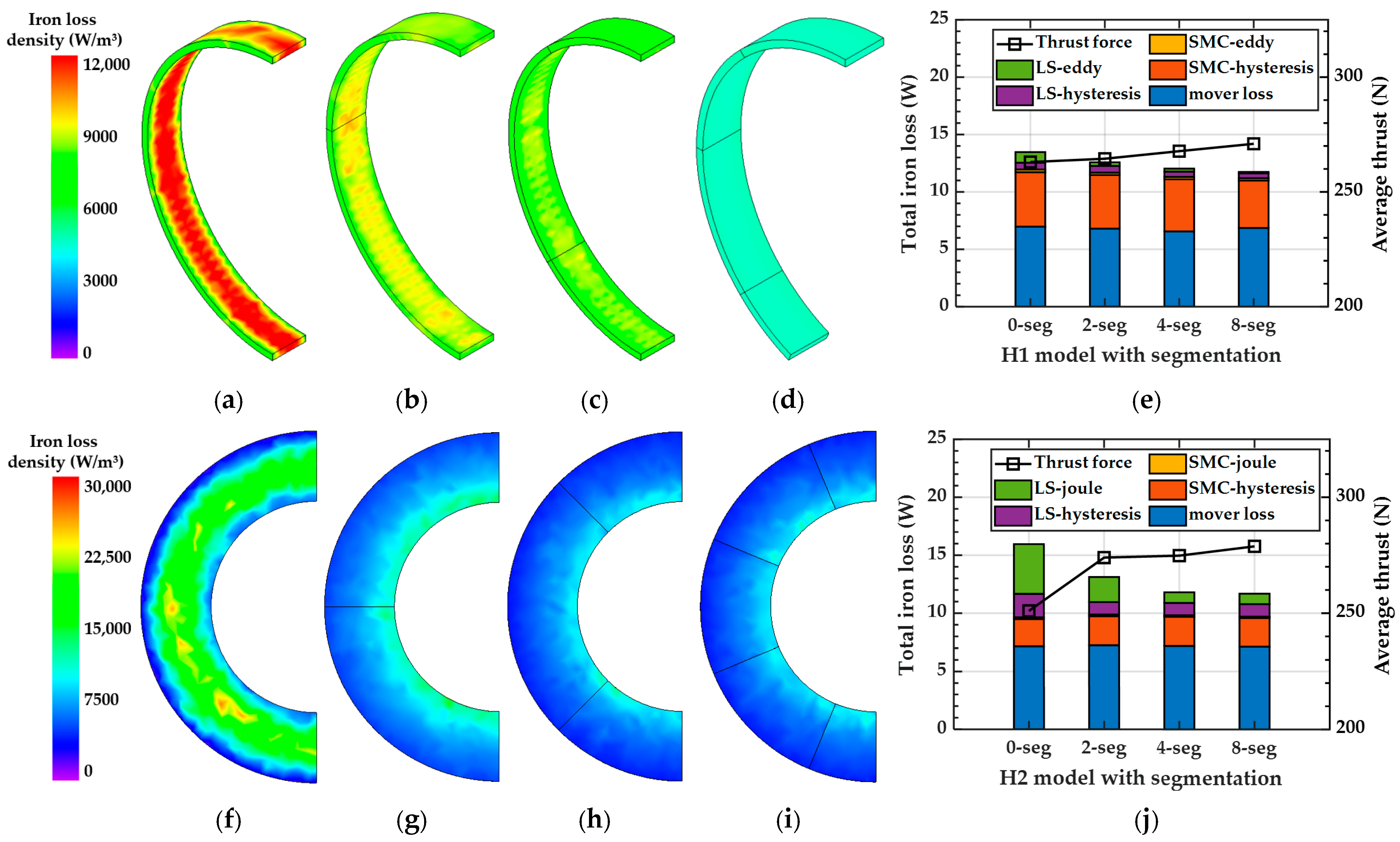
Figure 11, the iron loss density distribution in the laminated steel and performance improvement of H1 and H2 with additional circumferential segmentation are shown.
Figure 11a–d show the time-averaged iron loss density distributions over one electrical period as a function of the segmentation number applied to the laminated steel section located in the yoke region of H1, and
Figure 11e summarizes the corresponding thrust and loss-reduction trends. The eddy-current loss in the laminated steel was 0.918 W in the unsegmented case, whereas it was reduced to 0.12 W when eight segments were applied. Meanwhile, the flux linkage increased as the eddy currents were suppressed, and the thrust force increased from 263.02 N to 270.97 N. Next,
Figure 11f–i present the time-averaged iron loss density distributions over one electrical period for the H2 model, and (j) summarizes the corresponding performances. A more pronounced loss-reduction effect was observed under segmentation compared to H1. In the zero-segmentation case, a high eddy-current loss of 4.286 W was observed in the laminated steel; however, it was substantially reduced to 0.909 W with eight segments. In addition, the thrust force increased from 250.98 N to 278.83 N, corresponding to an improvement of approximately 11%. Notably, in the H2 model, the loss reduction and force enhancement exhibited a clearly nonlinear relationship with respect to the segmentation number. Specifically, the eddy-current loss of 4.286 W and thrust of 250.98 N in the unsegmented case were improved to 2.167 W and 273.6 N by introducing only two segments. Since circumferential segmentation of laminated steel inevitably increases manufacturing and assembly complexity, these results indicate that a small number of segments can provide a favorable trade-off, enabling substantial performance recovery with minimal additional fabrication burden for the H2 structure. Based on these results, the additionally segmented H1 and H2 models were included in the overall comparison in
Table 3.
The results in
Table 3 confirm that the additional segmentation applied to the laminated steel was effective in both suppressing eddy-current loss and recovering thrust force. In particular, the segmented H1 and H2 models show clear improvements compared with their unsegmented counterparts, indicating that the performance degradation caused by in-plane eddy currents in the laminated steel can be substantially alleviated through proper segmentation. In the H1 model, segmentation increased the thrust force from 263.8 N to 271.0 N, whereas the total iron loss decreased from 13.46 W to 11.84 W. Similarly, in the H2 model, the thrust force increased from 252.3 N to 278.8 N, and the total iron loss decreased from 15.95 W to 11.68 W. As a result, the updated hybrid-core models achieve lower total iron loss and improved thrust characteristics, while retaining the fundamental advantages of laminated steel. Among the investigated models, H3 exhibits the highest thrust force of 285.5 N, indicating that it is the most suitable option when thrust enhancement is the primary objective. By contrast, H2 shows the second highest thrust force of 278.8 N, together with the lowest iron loss of 11.68 W, which makes it an attractive option when lower loss is prioritized or when substantial improvement is desired with a minimal degree of segmentation.
5. Summary and Discussion
The results presented in
Section 3 and
Section 4 show that the electromagnetic performance of the proposed hybrid-core models is determined by the combined effects of material placement, the interfacial micro-gap, and laminated steel segmentation. While the additional segmentation applied to H1 and H2 was effective in reducing in-plane eddy-current loss and recovering thrust force, practical implementation also requires consideration of factors such as manufacturability and operating conditions. In this section, the investigated models are further discussed with respect to manufacturability, speed dependence, and application-oriented design considerations.
5.1. Manufacturability Considerations
In this subsection, the practical applicability of the hybrid-core models is qualitatively evaluated with respect to manufacturability. Since it is difficult to quantitatively estimate the cost increase caused by the added manufacturing complexity, the manufacturing procedures of each model are briefly described and summarized. By comparing the qualitatively assessed manufacturing complexity with the corresponding model performance, design guidelines are suggested for different application priorities.
Compared with R1, all hybrid-core models require additional fabrication and assembly steps due to the use of hybrid-core configurations. These include cutting, segmentation, alignment, bonding, and tolerance control, although the extent of these processes differs depending on the configuration.
R1 is the simplest structure with respect to manufacturing because it consists only of a SMC and does not require interfaces between different magnetic materials. Although some segmentation may still be needed for winding insertion and assembly, its overall process remains simpler than those of the hybrid-core models. H1 requires ring-shaped laminated parts to be segmented and then joined with the SMC region. After that, each component should be stacked, which further increases the manufacturing complexity due to the additional cutting, assembly, and interface management. H2 adopts a modular structure in which the laminated parts can be fabricated individually and assembled with the SMC core. Since each component can be directly stacked, H2 is considered more practical than H1 with respect to manufacturing. H3 shows the highest manufacturing complexity because laminated steel and SMC must be alternately arranged in the circumferential direction. This configuration requires more precise alignment and tighter tolerance control during assembly.
Overall, R1 is the most favorable option when manufacturing simplicity is the main priority. H2 can be regarded as a balanced option considering both performance and manufacturability. H1 may be acceptable when moderate performance improvement is required despite the increased process complexity. H3 is suitable when the highest performance is prioritized and a higher manufacturing burden can be accepted.
5.2. Effectiveness of Segmentation and Speed Dependence
The effectiveness of the hybrid-core concept is influenced by operating speed because the eddy-current loss in laminated steel increases as the excitation frequency rises. In the investigated models, the rated operating speed was 2 m/s, corresponding to an excitation current frequency of 111.11 Hz. At low speed, laminated steel can provide both lower iron loss and higher thrust than SMCs. However, this advantage becomes less pronounced as the operating speed increases.
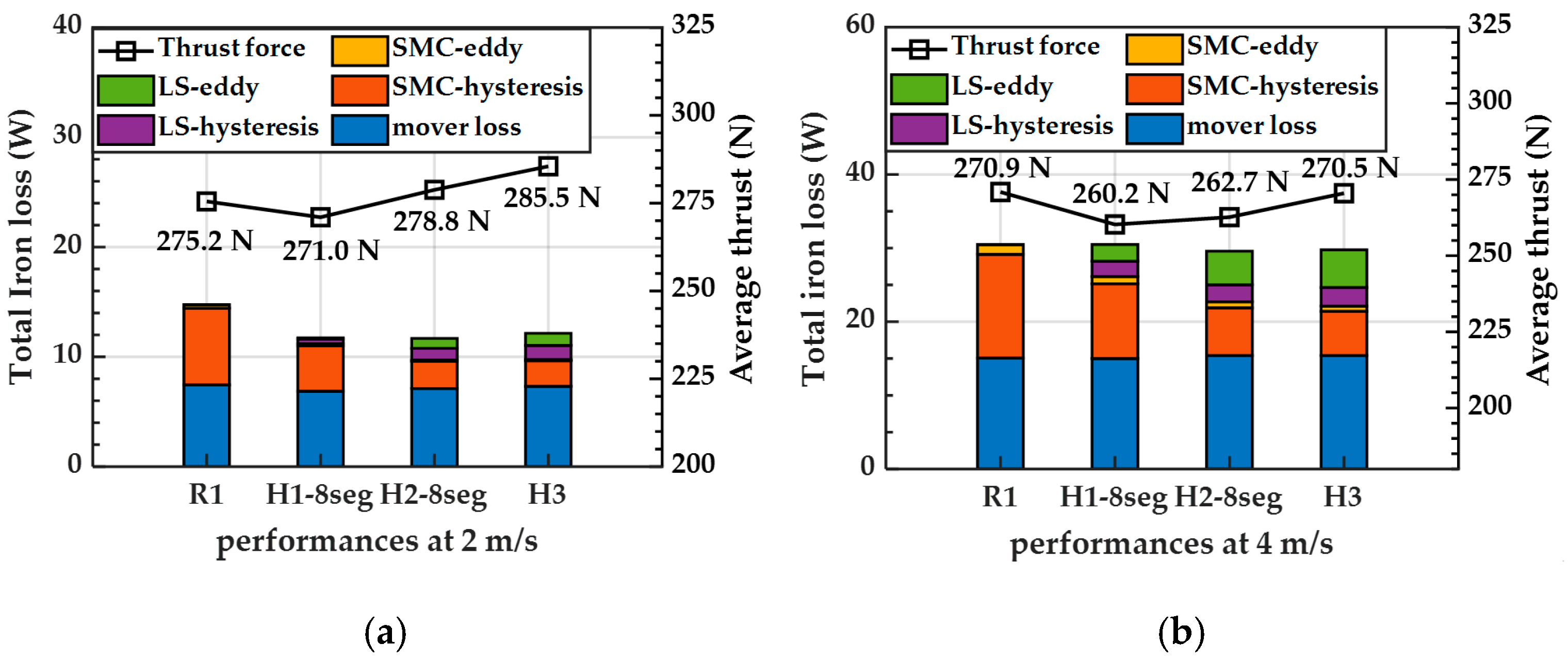
Figure 12 compares the thrust force and iron loss of R1, H1, H2, and H3 at the same current density for operating speeds of 2 m/s and 4 m/s. At 4 m/s, the eddy-current loss in the laminated steel regions increases significantly, which reduces both the thrust improvement and the loss-reduction benefit of the hybrid-core models. As a result, the iron losses of H1, H2, and H3 become comparable to the total iron loss of R1 (30.4 W), while the corresponding thrust forces decreased to 260.2 N, 262.7 N, and 270.5 N, respectively, compared with 270.9 N for R1. These results indicate that the performance advantage of the hybrid-core TFSPMLM becomes limited under higher-speed operation unless additional segmentation is introduced to suppress the increased eddy currents.
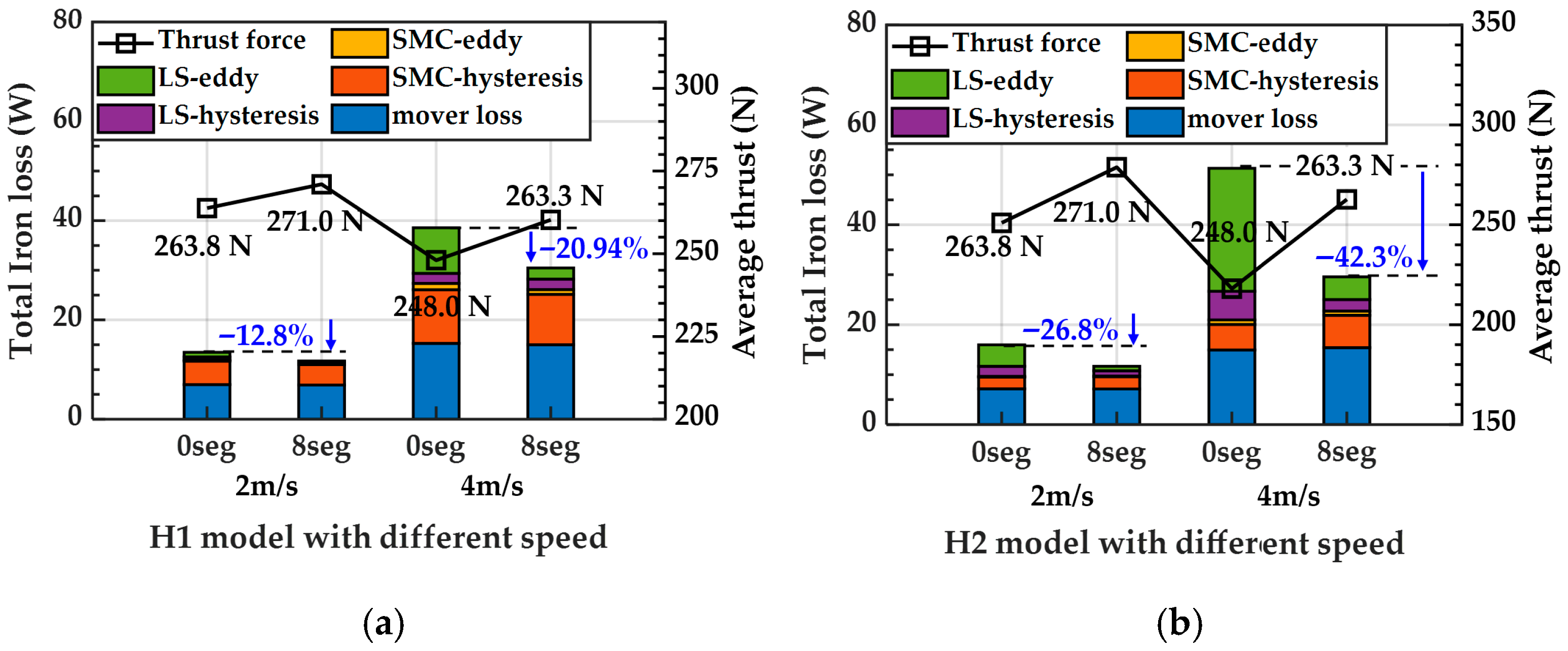
To further examine the role of segmentation, additional analyses were performed for the 0-segment and eight-segment cases of H1 and H2, and the corresponding thrust force and iron loss were compared, as shown in
Figure 13. In both models, the unsegmented cases exhibit a much steeper increase in iron loss as the speed increases from 2 m/s to 4 m/s, together with a more pronounced reduction in thrust force. By contrast, the segmented cases maintain lower iron loss and high thrust characteristics over the same speed range. More specifically, in the H1 model, the introduction of eight segments reduces the total iron loss by 12.8% at 2 m/s and by 20.94% at 4 m/s. In the H2 model, the corresponding reductions are 26.8% and 42.3%, respectively. These results show that the benefit of segmentation becomes more significant as the operating speed increases, since the eddy-current component in the laminated steel regions becomes dominant at a higher frequency.
Therefore, the effectiveness of segmentation is closely dependent on operating speed, and its importance increases in high-speed regions. At the same time, the results also suggest that segmentation should be determined by considering both the target operating condition and the associated manufacturing complexity. Within the speed range considered in this paper, segmentation remains effective in suppressing the eddy-current loss of the laminated steel regions, and a balance between performance improvement and manufacturing complexity can be achieved by selecting an appropriate segmentation level.
5.3. Effects of Micro-Gaps
As discussed before, a micro-gap is inherently introduced in the H1 and H2 models due to the material interfaces in the hybrid-core structure, and this micro-gap degrades the electromagnetic performance by increasing the magnetic reluctance along the main flux path. To investigate the effect of the micro-gap thickness, additional analyses were performed for the H1 and H2 models with eight-segment laminated steel for micro-gap thicknesses of 0.05 mm, 0.10 mm, and 0.15 mm. The corresponding thrust force and iron loss results are summarized in
Table 4. It is observed that both H1 and H2 are highly sensitive to the assumed micro-gap thickness. As the micro-gap increases, the magnetic reluctance increases and the magnetic flux density decreases, leading to a noticeable reduction in thrust force. The iron loss is also reduced by increasing micro-gap thickness because the weakened flux level lowers the local electromagnetic loading in the core. However, this reduction in loss does not indicate improved performance, but rather reflects degraded magnetic coupling and reduced output capability. In this respect, the interfacial micro-gap should be minimized as much as possible in hybrid-core structures.
From a scaling perspective, the micro-gap is nearly independent of the machine size. Since the thickness of the micro-gap layer remains nearly constant even as the machine size increases, its relative contribution to the overall magnetic reluctance becomes smaller. Therefore, the degradation caused by the micro-gap may be alleviated as the machine size and capacity increase. This implies that the H1 and H2 configurations in TFSPMLMs may be better suited to larger-scale machines.
5.4. Application Scenarios and Overall Design Guidelines
Based on the results discussed above, the recommended core configuration can be distinguished according to the target application scenario. Since the relative advantages of the proposed models vary with operating speed, manufacturability, and performance priority, no single configuration can be regarded as universally optimal. Instead, the most suitable model should be selected with respect to the required balance between thrust capability, iron loss reduction, and manufacturing burden.
Among the investigated models, H3 is the most suitable option when the primary objective is to maximize thrust force and overall electromagnetic performance. Its advantage is meaningful in low-speed operation, where the benefit of laminated steel can be more effectively utilized. However, this configuration also involves the highest manufacturing complexity, and therefore it is more appropriate for applications in which performance is prioritized over fabrication simplicity.
H2 with segmentation can be regarded as the most practical and versatile option when both low iron loss and acceptable manufacturability are required. Owing to its relatively modular structure, the manufacturing burden is lower than that of H1 and H3, while segmentation provides a clear reduction in eddy-current loss and a corresponding recovery of thrust force. In particular, the results in
Section 4 show that even a small segmentation number already yields substantial improvement in H2, indicating that a favorable trade-off can be achieved without excessive additional fabrication burden. However, the eddy-current loss in the laminated steel region increases rapidly with operating speed. Therefore, H2 is especially suitable for low-speed applications requiring a balanced compromise between performance enhancement and manufacturing feasibility, and it is also an attractive option when low loss is prioritized.
H1 with segmentation may be considered when the design objective is focused more on loss reduction than on thrust enhancement. Although H1 with segmentation provides a meaningful reduction in iron loss, its improvement in both loss reduction and thrust recovery is less pronounced than that of H2. Also, its manufacturing process is more complex than that of R1 and less practical than that of H2.
By contrast, R1 remains a reasonable baseline when manufacturing simplicity is the dominant concern or when the operating speed increases to the point that the advantage of the hybrid-core structures becomes reduced. In such cases, the simpler structure of R1 can be more attractive from a practical perspective, even if its electromagnetic performance is lower than that of the best hybrid configuration under low-speed operation.
Therefore, the selection of the core configuration should be made with respect to the intended operating conditions and design priority. In summary, H3 is recommended for high-thrust, low-speed applications, H2 with small or moderate segmentation is recommended for low-speed applications requiring balanced low-loss performance, H1 is recommended for loss-oriented designs with moderate performance targets, and R1 is recommended for simplicity-oriented or relatively higher-speed applications. A summary of these application-oriented design guidelines is presented in
Table 5.