
Abstract
Recently, the demand for electric motors that can achieve high performance while ensuring stable magnet supply has continued to increase across various industrial sectors. Although rare-earth permanent magnets, such as neodymium and samarium cobalt, enable superior electromagnetic performance, their high cost and supply instability have motivated growing interest in motors employing non-rare-earth permanent magnets, such as ferrite magnets. Due to the relatively low remanent flux density and coercivity of non-rare-earth magnets, spoke-type rotor structures are commonly adopted to enhance flux concentration. However, spoke-type configurations inherently suffer from axial leakage flux, in which a portion of the magnetic flux generated by the permanent magnets fails to link with the stator and instead leaks along the axial direction. This axial leakage flux reduces the effective air-gap flux density, leading to a degradation of back electromotive force (back-EMF) and overall motor performance. In this study, a double-spoke-type motor employing asymmetric permanent magnet geometry is investigated. Finite element analysis (FEA) is performed to identify an effective rotor structure that reduces axial leakage flux without increasing magnet usage, demonstrating the feasibility of performance improvement in non-rare-earth permanent magnet motors.
1. Introduction
With the rapid acceleration of electrification across various industrial sectors, the demand for electric motors with higher efficiency and performance continues to increase. To meet these requirements, extensive research and development efforts have been focused on permanent magnet synchronous motors (PMSMs), which are widely recognized for their high efficiency and power density. PMSMs typically employ rare-earth permanent magnets, such as neodymium (NdFeB) and samarium cobalt (SmCo), owing to their high coercivity and remanent flux density, which enable superior electromagnetic performance [1,2]. However, despite these advantages, rare-earth permanent magnets suffer from significant drawbacks, including high cost and unstable supply chains, which hinder their long-term and sustainable use in industrial applications. As an alternative to rare-earth magnet-based PMSMs, synchronous reluctance motors (SynRMs) have been proposed to eliminate dependence on rare-earth materials. SynRMs generate torque solely through reluctance torque arising from the magnetic reluctance difference between the stator and rotor, without the use of permanent magnets [3,4,5]. Although this structure offers the advantage of complete independence from rare-earth magnets, SynRMs generally exhibit lower torque and power density compared to PMSMs, limiting their competitiveness in high-performance applications. To overcome this limitation, motor topologies incorporating non-rare-earth permanent magnets, such as ferrite magnets, have been investigated. Ferrite permanent magnets offer significant advantages in terms of cost-effectiveness and supply stability compared to rare-earth magnets. However, their relatively low coercivity and remanent flux density make it challenging to achieve performance levels comparable to those of rare-earth magnet-based motors without structural enhancement [6,7,8]. Consequently, concentrated flux-type synchronous motors (CFSMs) employing spoke-type rotor configurations have attracted increasing attention. In spoke-type CFSMs, magnetic flux generated by the permanent magnets is concentrated toward the rotor core, enabling a higher air gap flux density. Recent studies have demonstrated that, by adopting spoke-type structures, efficiencies comparable to those of rare-earth magnet-based motors can be achieved, thereby reducing reliance on rare-earth materials [9,10,11]. Nevertheless, spoke-type CFSMs inherently suffer from axial leakage flux due to their structural characteristics. A portion of the magnetic flux generated by the permanent magnets does not effectively link with the stator through the air gap but instead leaks along the axial direction. This axial leakage flux reduces the effective air gap flux density, leading to degradation in back-EMF and torque performance.
In this study, a double-spoke type CFSM is investigated, and a novel rotor structure is proposed to effectively suppress axial leakage flux while maintaining the total amount of permanent magnet material. By introducing an asymmetric overhang configuration to the rotor magnets, the proposed design alters the axial flux paths and reduces leakage flux without increasing magnet volume. Electromagnetic analysis confirms that the proposed structure achieves approximately a 6% reduction in axial leakage flux, thereby improving back-EMF and torque characteristics. It should be noted that this study focuses primarily on steady-state electromagnetic behavior. Thermal coupling effects, manufacturing tolerances, and full experimental prototype validation are beyond the scope of the present study and will be addressed in future work. The remainder of this paper is organized as follows. Section 2 describes the characteristics of spoke-type CFSMs. Section 3 analyzes the mechanism of axial leakage flux in CFSM structures. Section 4 presents the application of various asymmetric permanent magnet rotor configurations. Section 5 evaluates the structural stiffness of the proposed design. Finally, the discussion and conclusions summarize the findings and outline future research directions
Related Work
Recent research on ferrite-based spoke-type concentrated flux synchronous motors (CFSMs) has primarily focused on enhancing flux concentration and improving torque density through rotor geometry optimization and magnet arrangement refinement. In parallel, axial magnetic phenomena and end effects have been investigated to explain discrepancies between two-dimensional finite element analysis (FEA) and experimental results, leading to the adoption of three-dimensional analysis methods [12,13,14,15]. Structural approaches to reduce axial leakage flux, including increased magnet stack length and overhang configurations, have also been reported; however, these methods typically require additional permanent magnet material. Systematic studies addressing axial flux redistribution mechanisms while maintaining constant magnet volume remain limited [16,17].
2. Characteristics of Spoke-Type CFSM
2.1. Torque Generation Characteristics of Spoke-Type CFSMs
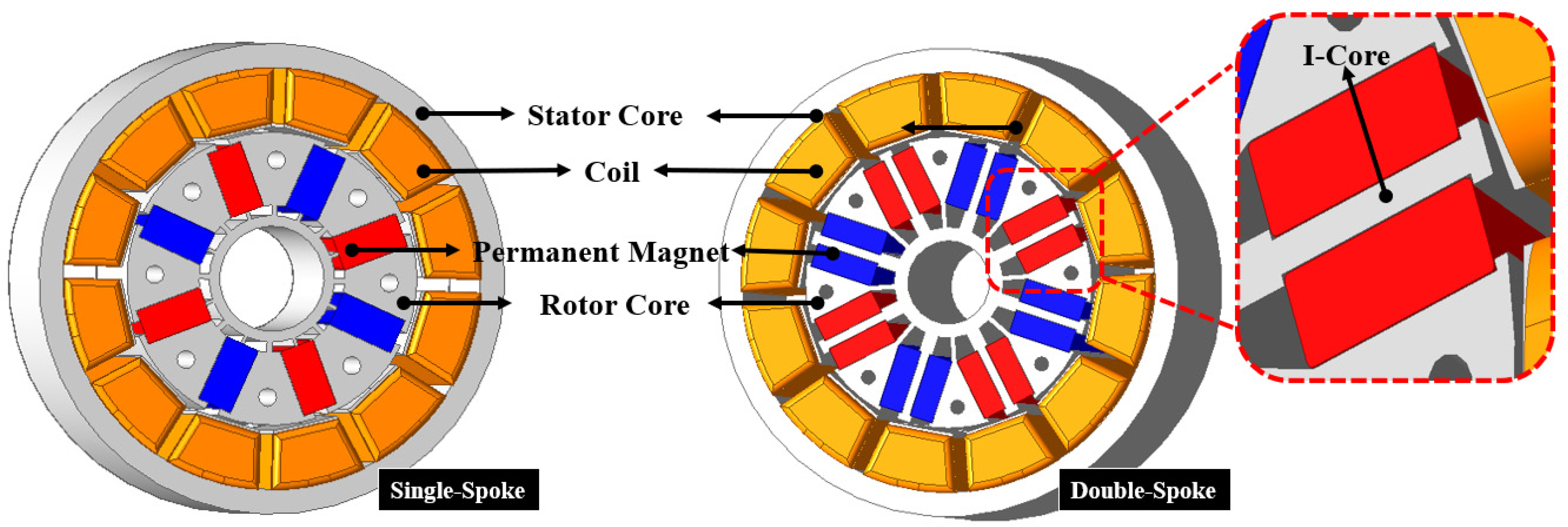
Figure 1 illustrates the structural differences between the single-spoke type and double-spoke type configurations among spoke-type CFSMs. Unlike the single-spoke type, the double-spoke type incorporates an I-core inserted between the permanent magnets within one pole. The two permanent magnets separated by the I-core have a total magnet volume identical to that of the single magnet used in one pole of the single-spoke type. The introduction of the I-core alters the magnetic flux paths, resulting in distinct torque production mechanisms and torque characteristics between the two motor types [18,19].
Figure 1.
Structure of single-spoke and double-spoke type PMSM.
In interior permanent magnet synchronous motors (IPMSMs), such as spoke-type machines, the electromagnetic torque can be expressed by Equation (1). In this equation, denotes the number of pole pairs of the motor, represents the flux linkage of the stator windings produced by the permanent magnets, is the q-axis current component orthogonal to the permanent magnet flux, and is the d-axis current component aligned with the main flux. In addition, and denote the d-axis and q-axis inductances, respectively. The total electromagnetic torque can be decomposed into the magnetic torque generated by the permanent magnet flux and the reluctance torque arising from the asymmetry between the d-axis and q-axis inductances.
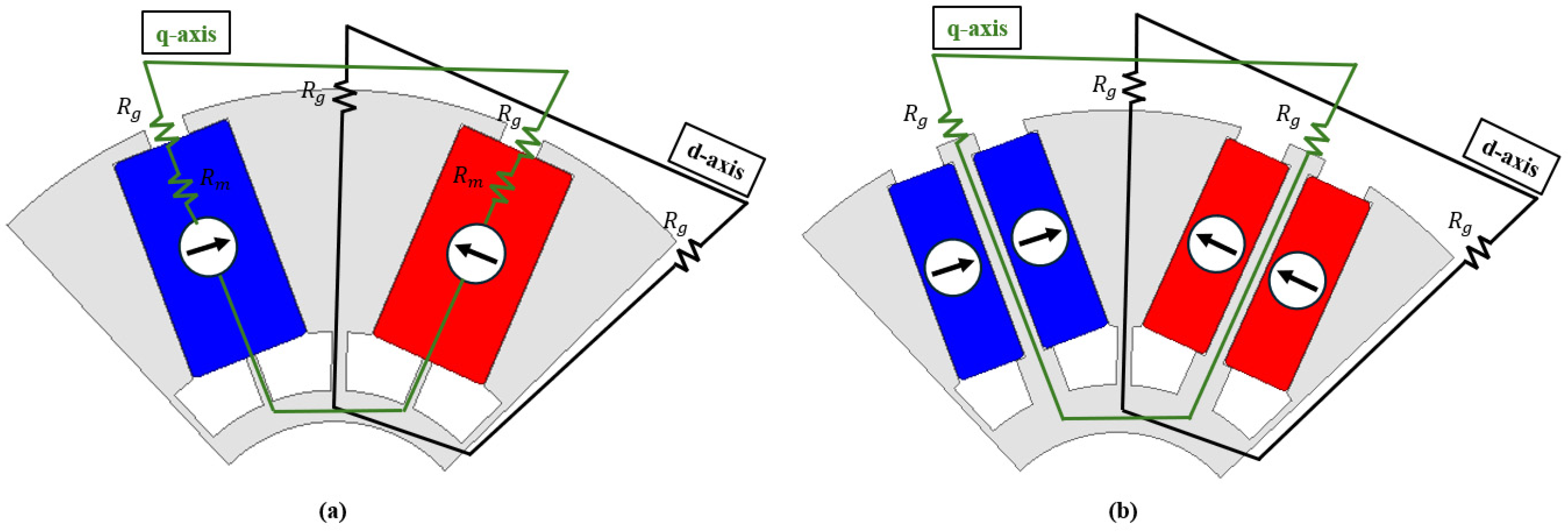
Figure 2 schematically illustrates the differences in magnetic circuits and torque production mechanisms arising from the rotor structures of single-spoke type and double-spoke type PMSMs. Although both topologies are based on flux-concentrating structures, distinct torque production mechanisms are observed due to differences in the magnet embedding configurations and the resulting d–q axis magnetic circuit characteristics.
Figure 2.
Flux paths of the d and q axis: (a) single-spoke; (b) double-spoke.
The d-axis and q-axis inductances are defined as the ratios of the corresponding flux linkages to the applied currents, as expressed in Equation (2). From a magnetic circuit perspective, the inductance can be approximated as , where is the number of turns and is the magnetic reluctance. Since inductance is inversely proportional to reluctance, the difference between and directly reflects the difference in magnetic reluctance along the respective magnetic circuits:
In both single- and double-spoke configurations, the d-axis flux primarily flows through the rotor core and air gap without directly passing through the permanent magnets. Consequently, the d-axis magnetic reluctance remains comparable in both structures, leading to similar d-axis inductance values, as shown in Equation (3):
In contrast, a clear difference appears in the q-axis magnetic circuit. In the single-spoke configuration, the q-axis flux is formed along a path that passes through the air gap and subsequently includes the permanent magnet. Since the permeability of the permanent magnet is comparable to that of the air gap, the magnetic reluctance of the q-axis flux path becomes relatively large. In the double-spoke configuration, however, the presence of an I-core formed between the permanent magnets allows the q-axis flux to flow along a continuous iron path. As a result, the magnetic reluctance of the q-axis magnetic circuit is significantly reduced compared to that of the single-spoke structure, leading to an increased q-axis inductance, as expressed in Equation (4):
As a result, the double-spoke configuration exhibits a larger inductance difference , enhancing rotor saliency and increasing the contribution of reluctance torque. This structural feature enables improved torque density even when low-remanence ferrite magnets are employed. Accordingly, due to its enhanced saliency and structural flexibility arising from the inserted I-core and separated magnet segments, the double-spoke configuration allows more diverse asymmetric permanent magnet arrangements compared with the single-spoke topology. Therefore, the double-spoke structure was selected as the baseline motor configuration in this study to effectively investigate the influence of asymmetric permanent magnet designs on axial leakage flux behavior.
2.2. Specifications of Conventional Motor
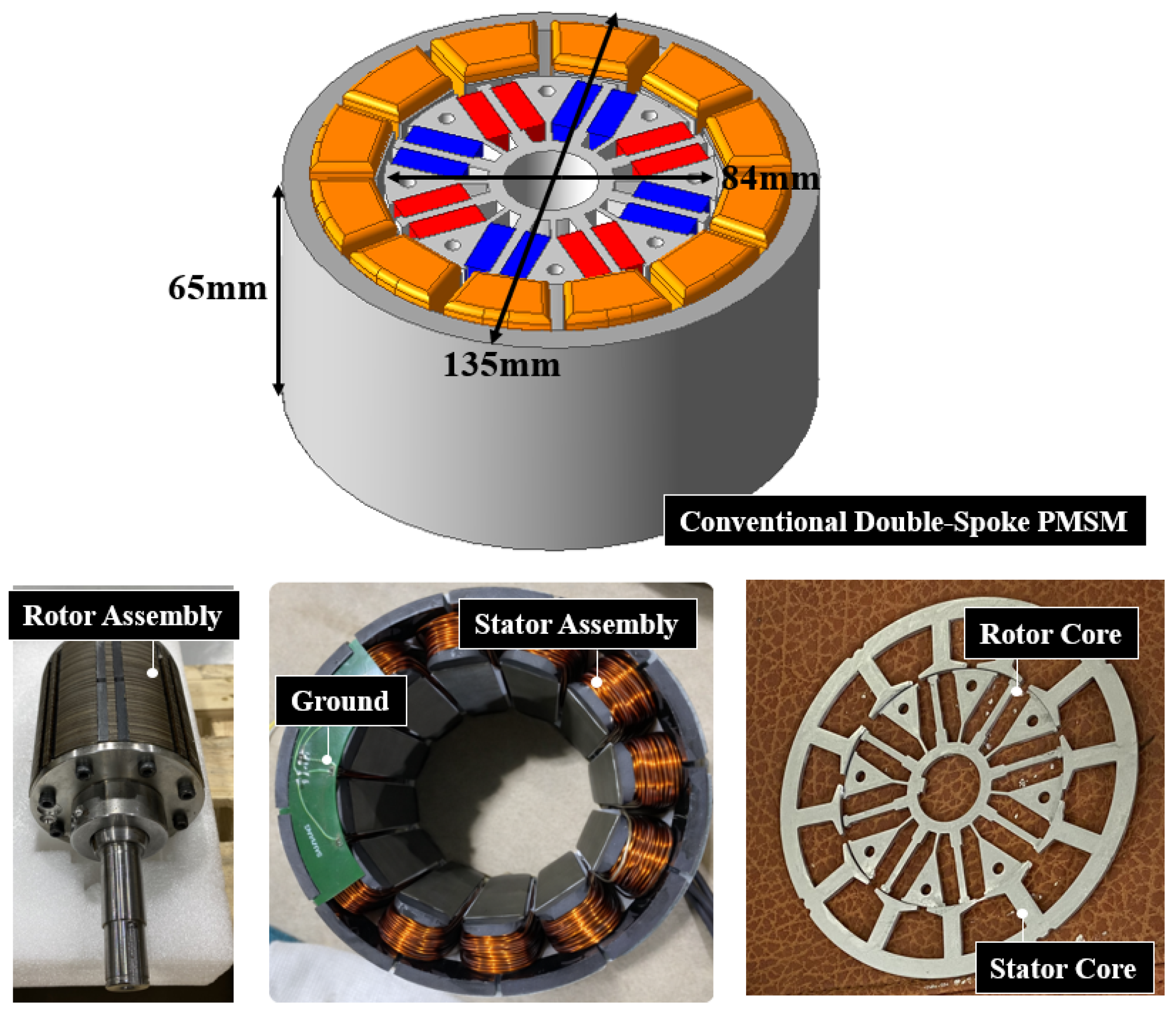
Figure 3 illustrates the rotor and stator assemblies of the double-spoke-type PMSM designed for a conveyor belt drive application, which serves as the conventional reference model in this study. As summarized in Table 1, the conventional model employs ferrite permanent magnets (NMF-9F), copper windings, and electrical steel sheets (50JN470) for both the stator and rotor cores. The detailed design specifications include an 8-pole/12-slot configuration, a stator outer diameter of 135 mm, a rotor outer diameter of 84 mm, and a magnet stack length of 65 mm.
Figure 3.
Conventional double-spoke type PMSM configuration for conveyor belt drive motors.
Table 1.
Design specifications for double-spoke type PMSM.
3. Axial Leakage Flux in CFSM
3.1. Back-EMF Reduction Caused by Axial Leakage Flux
CFSMs are designed to achieve a high air-gap flux density by guiding the magnetic flux generated by the permanent magnets embedded in the rotor toward the air gap through the iron core. During this process, the magnetic flux is constrained to flow along specific paths within the rotor core, which leads to flux concentration in localized regions of the rotor and contributes to enhanced electromagnetic performance. This flux-guiding characteristic is a key advantage of CFSMs, particularly in applications requiring high torque density.
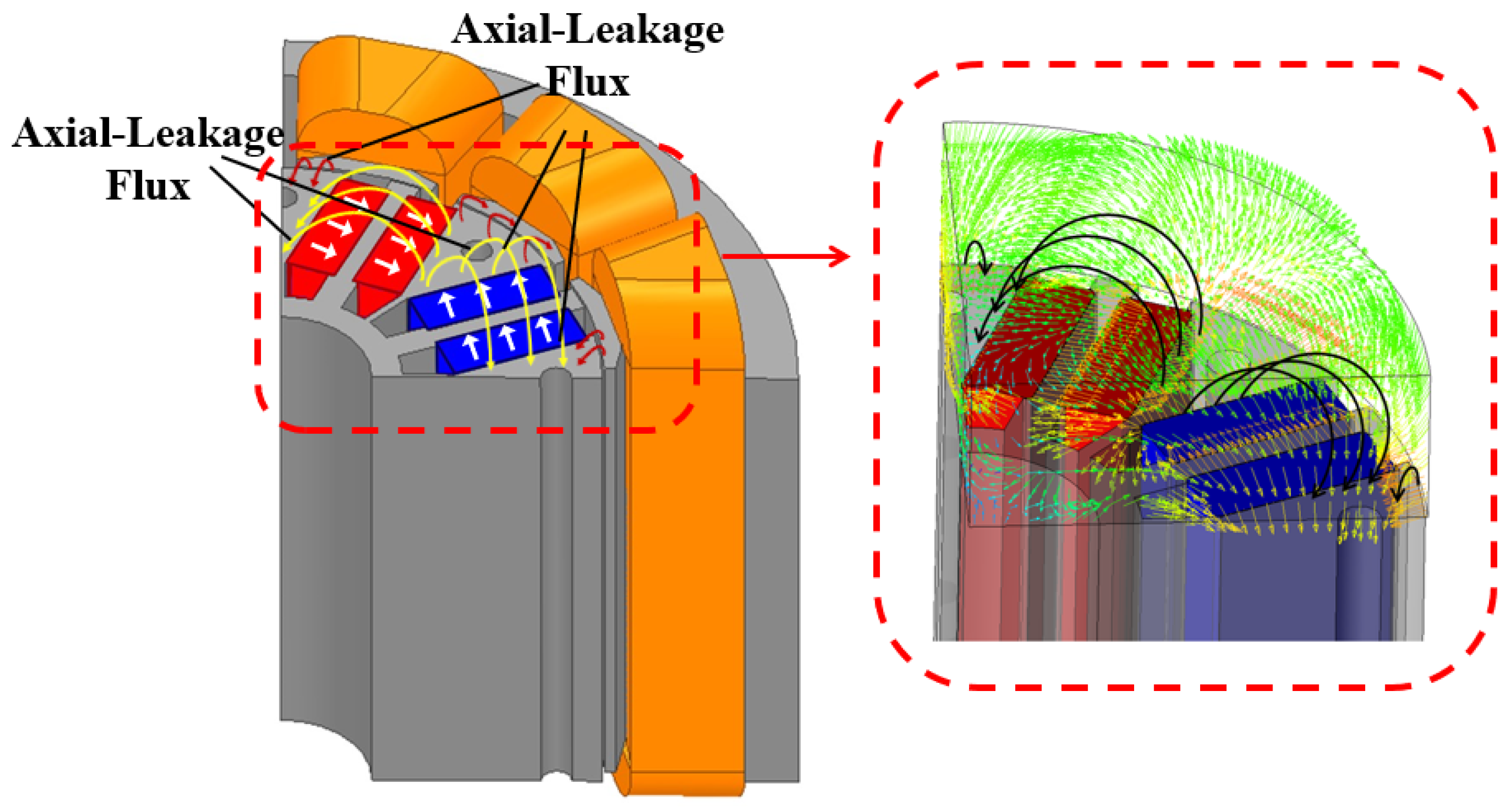
However, near the axial end regions of the rotor, the magnetic flux is no longer strictly confined to the intended radial paths. In these regions, the flux is allowed to spread not only in the radial direction but also in the axial direction due to the reduced magnetic constraint. As a result, the magnetic flux naturally tends to disperse spatially, and a portion of the flux fails to pass through the air gap to effectively link with the stator windings. Instead, as illustrated in Figure 4, the flux spreads in the axial direction and forms closed magnetic paths through surrounding structures, such as the motor housing or adjacent components. This axial dispersion of magnetic flux gives rise to axial leakage flux, which reduces the effective air-gap flux and adversely affects the electromagnetic performance of the motor.
Figure 4.
Axial leakage flux in double-spoke type PMSM.
Such axial leakage flux arises from the combined effects of non-uniform flux density distribution and the reorientation of flux paths during the flux concentration process. In other words, as the magnetic flux is more strongly guided toward the air gap, it becomes increasingly difficult for the flux to remain confined to a single direction within the rotor, resulting in a portion of the flux leaking in the axial direction.
The RMS value of the back-EMF generated in a PMSM can be expressed by Equation (5), which indicates that the back-EMF is proportional to the electrical frequency , the number of series turns , and the effective magnetic flux that actually links with the stator windings. This relationship implies that any reduction in the effective flux directly results in a corresponding decrease in the back-EMF. As described in Equation (6), the magnetic flux generated by the permanent magnets can be decomposed into the effective flux and the leakage flux component , which does not properly link with the stator windings. Under a constant permanent magnet flux condition, an increase in the leakage flux inevitably leads to a reduction in the effective flux available for torque production and voltage generation. Consequently, an increase in directly causes a proportional decrease in the back-EMF.
3.2. Simulation Verification
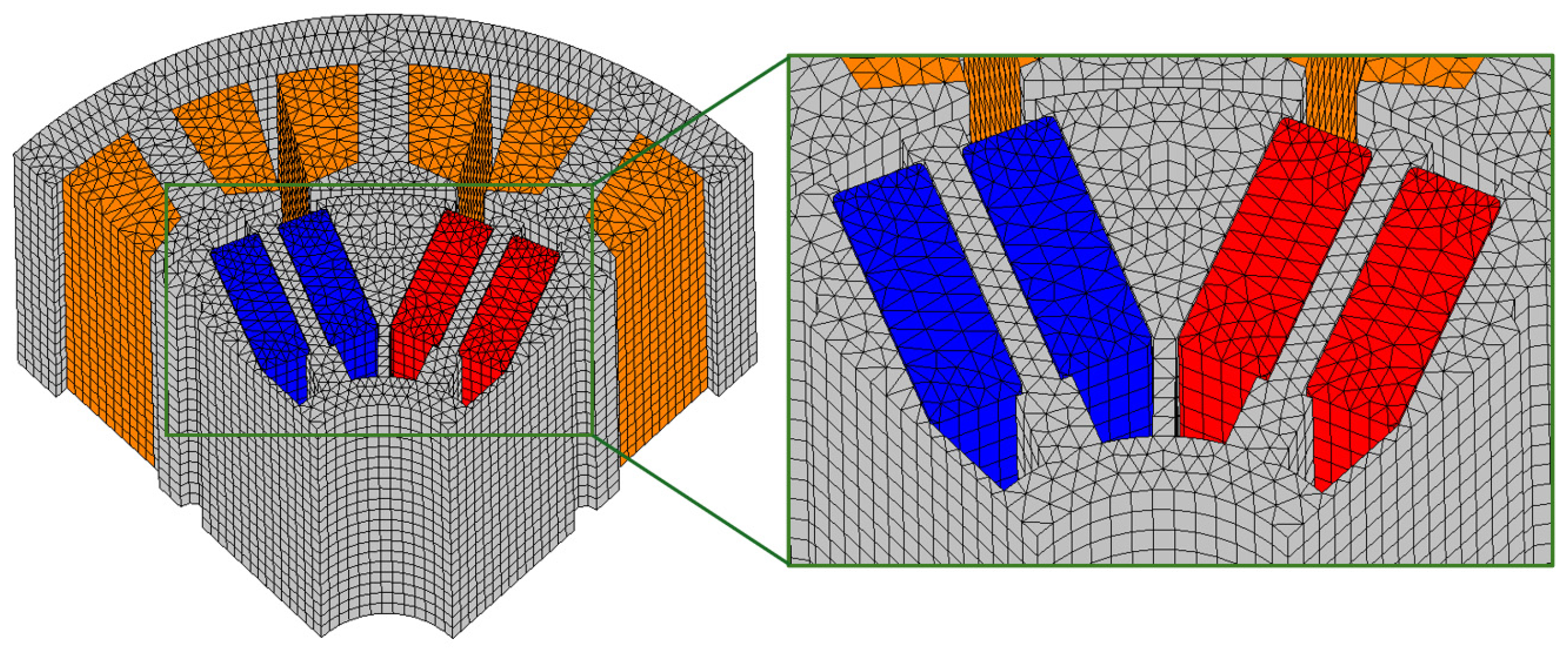
All electromagnetic analyses performed in this study were conducted using the nonlinear finite-element environment of Ansys Maxwell. The adopted FEA procedure was iteratively verified to ensure high numerical reliability of the derived results. To accurately capture the influence of permanent magnets on the air-gap flux density distribution, locally refined meshes were applied to both the permanent magnet and air-gap regions.
The mesh size was set to 1.45 mm for the air gap and 1.5 mm for the permanent magnets, while a mesh size of 3 mm was applied to the coil and core regions. Under the 3D quarter-period model of the conventional configuration, approximately 140,000 mesh elements were generated. By employing refined mesh strategies and validated boundary condition settings, sufficient numerical reliability was secured even in the absence of a physical prototype. The geometry and mesh distribution used in this study are presented in Figure 5.
Figure 5.
Mesh distribution of the 3D quarter period model of double-spoke type PMSM.
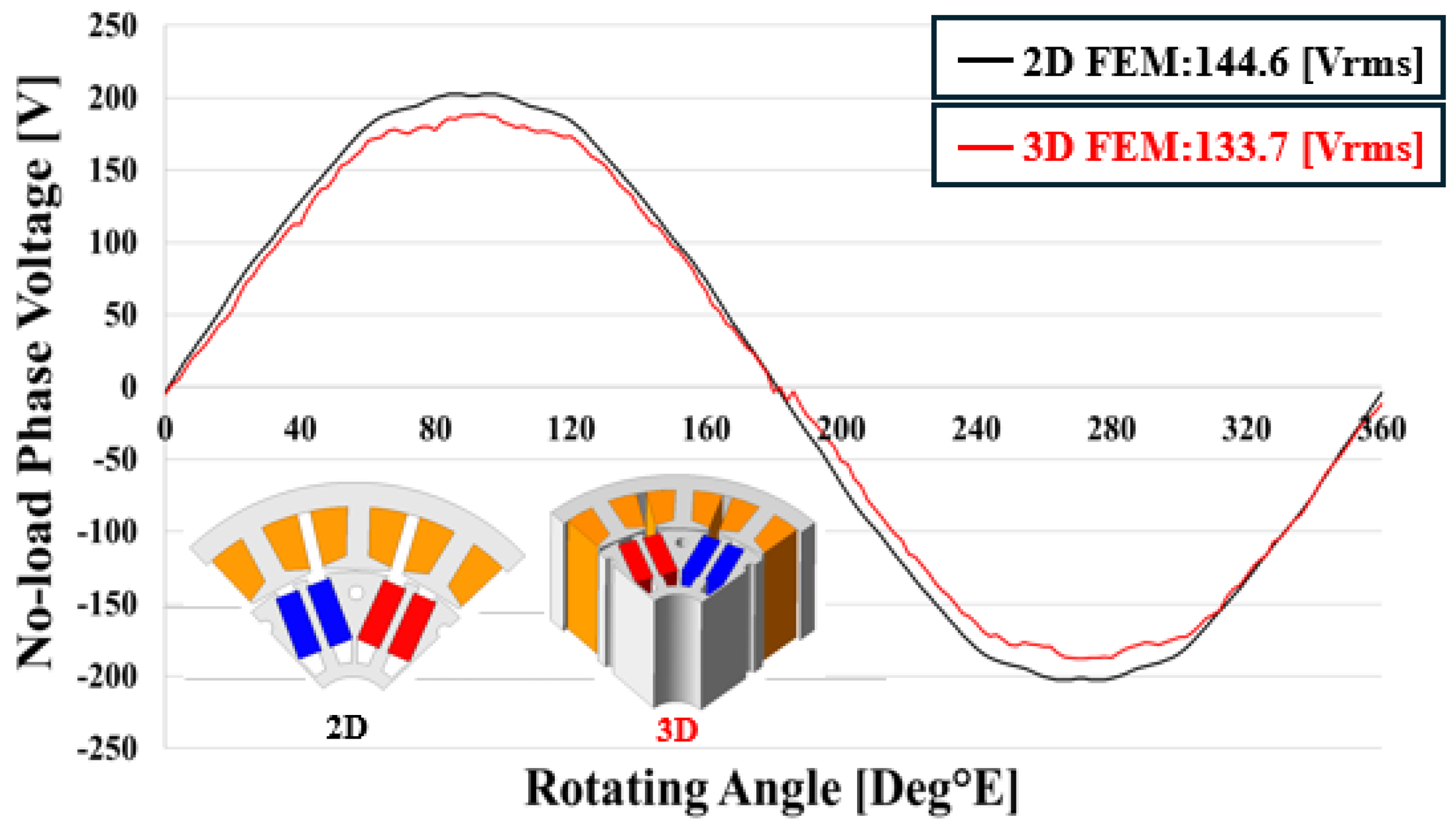
To quantitatively investigate the impact of axial leakage flux, FEA were carried out using 2D and 3D models of a conventional double-spoke type PMSM. The no-load phase voltage, which corresponds to the no-load back-EMF, obtained from these analyses, is presented in Figure 6. Under identical operating conditions, the no load back-EMF predicted by the 2D FEA is 144.6 Vrms, whereas the corresponding value obtained from the 3D FEA is 133.7 Vrms. This result indicates an approximate reduction of 7.5%, clearly demonstrating the significant influence of axial leakage flux that cannot be captured in 2D electromagnetic analysis.
Figure 6.
No-load phase voltage of 2D and 3D models for a conventional double-spoke type PMSM.
3.3. Comparison of Back-EMF Variations for Different Shape Ratios
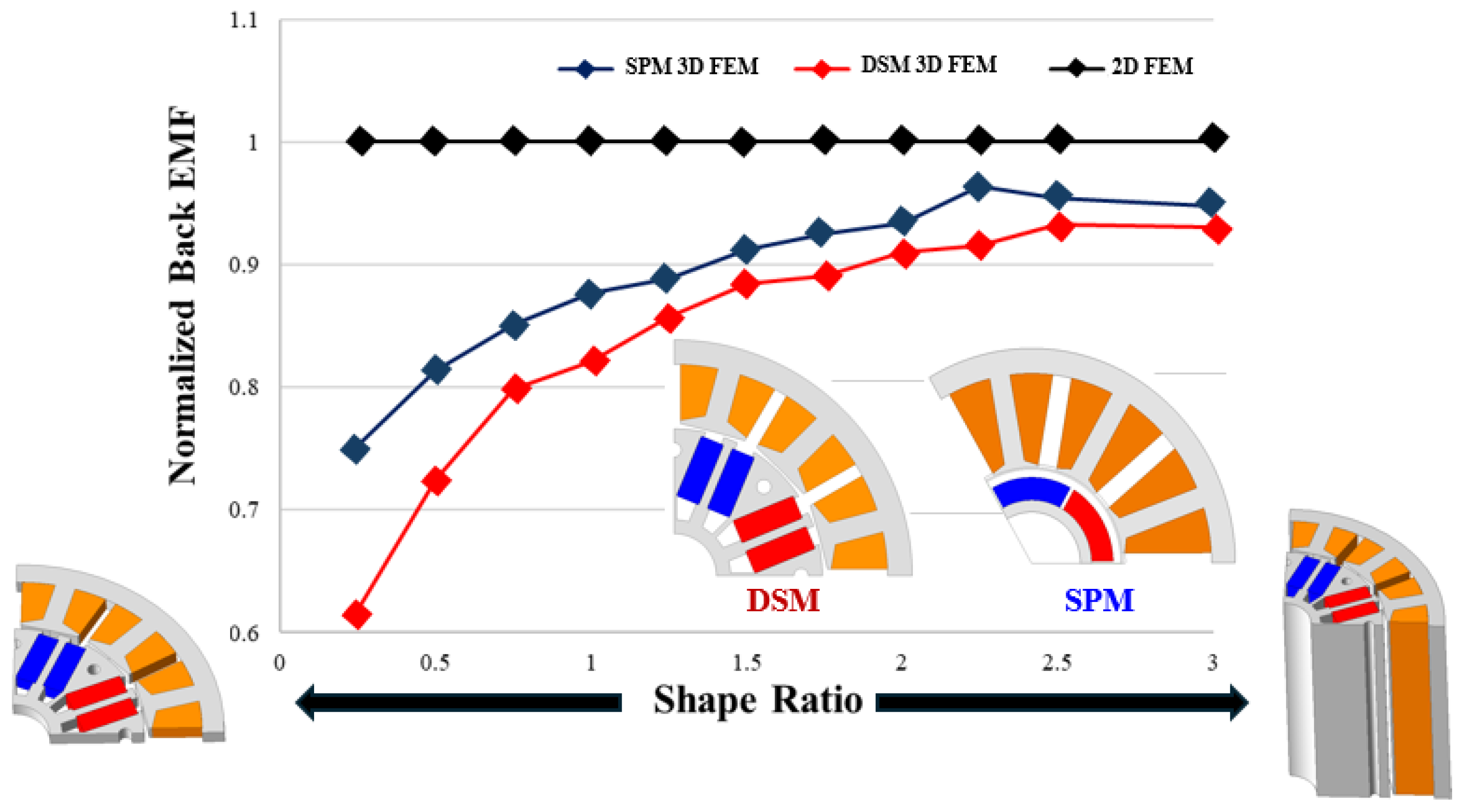
Axial leakage flux becomes more significant as the motor adopts a flux-concentrating structure and as the shape ratio defined in Equation (7), which is given by the ratio of the stack length to the rotor outer diameter, decreases. In the figure, the black solid lines represent the reference values obtained by normalizing the back-EMF of the double-spoke-type motor (DSM) and the surface permanent magnet motor (SPM) to unity. The variations in back-EMF with respect to the shape ratio are illustrated by the blue and red curves for the DSM and SPM, respectively.
According to Figure 7, when the shape ratio is 0.5, the back-EMF of the Surface Permanent magnet Motor (SPM) decreases to approximately 0.75 of the normalized value, whereas that of the Double-Spoke type Motor (DSM) decreases to approximately 0.6, as confirmed through three-dimensional FEA. This indicates that the flux-concentrating DSM is more sensitive to axial leakage flux than the SPM. Furthermore, for both motor types, the reduction in back-EMF gradually diminishes as the shape ratio increases. This trend can be attributed to the effective suppression of axial leakage flux resulting from the increased stack length. These results imply that, as the stack length becomes shorter, the relative contribution of the axial end regions of the rotor and stator to the overall magnetic circuit increases. Consequently, a larger portion of the magnetic flux that should pass through the air gap and link with the winding disperses in the axial direction, leading to a reduction in air-gap flux density. Therefore, it can be concluded that the shape ratio, or, equivalently, the adjustment of the motor stack length, is a key design parameter for mitigating axial leakage flux.
Figure 7.
Comparison of back-EMF variation with the shape ratio between SPM and DSM.
4. Application of Various Asymmetric Permanent Magnet Rotors
4.1. Examples of Various Asymmetric Permanent Magnet Rotors
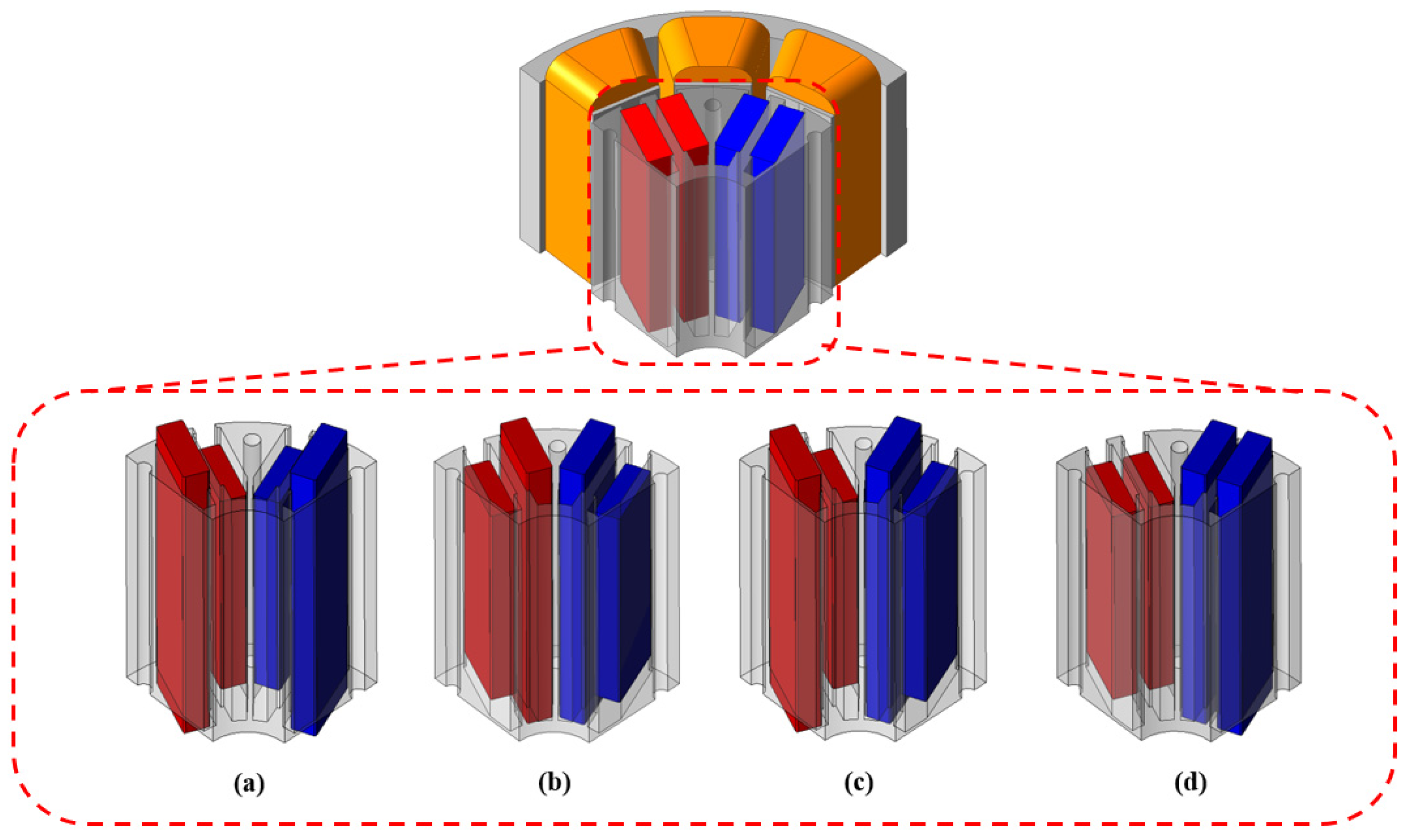
The double-spoke type configuration retains the permanent magnet volume per pole used in the single-spoke type while placing two permanent magnets per pole by inserting an I-core between them. Owing to this structural feature, the stack length of each permanent magnet can be independently adjusted, which increases the design freedom for implementing asymmetric permanent magnet configurations within a single pole compared to the single-spoke type. The following presents examples of four rotor models in which asymmetric stack structures are applied to the permanent magnets based on a conventional double-spoke-type PMSM. All models shown in Figure 8a–d are designed with reference to the baseline stack length of 65 mm, while maintaining the same total permanent magnet volume per pole and introducing asymmetric variations of ±10 mm in the stack length of each magnet. Specifically, the permanent magnets with increased stack length are designed to be 75 mm, whereas those with reduced stack length are set to 55 mm. This asymmetric stacking design alters the distribution of permanent magnet volume within a single pole while preserving the total magnet usage. As a result, the influence of changes in total magnet volume is excluded, allowing the investigation to focus solely on the effects of asymmetric permanent magnet configuration in the rotor. The proposed approach is therefore introduced to analyze how variations in the shape ratio caused by asymmetric stacking affect the axial flux distribution and, consequently, the back-EMF characteristics.
Figure 8.
(a–d) Examples of various asymmetric permanent magnet rotors.
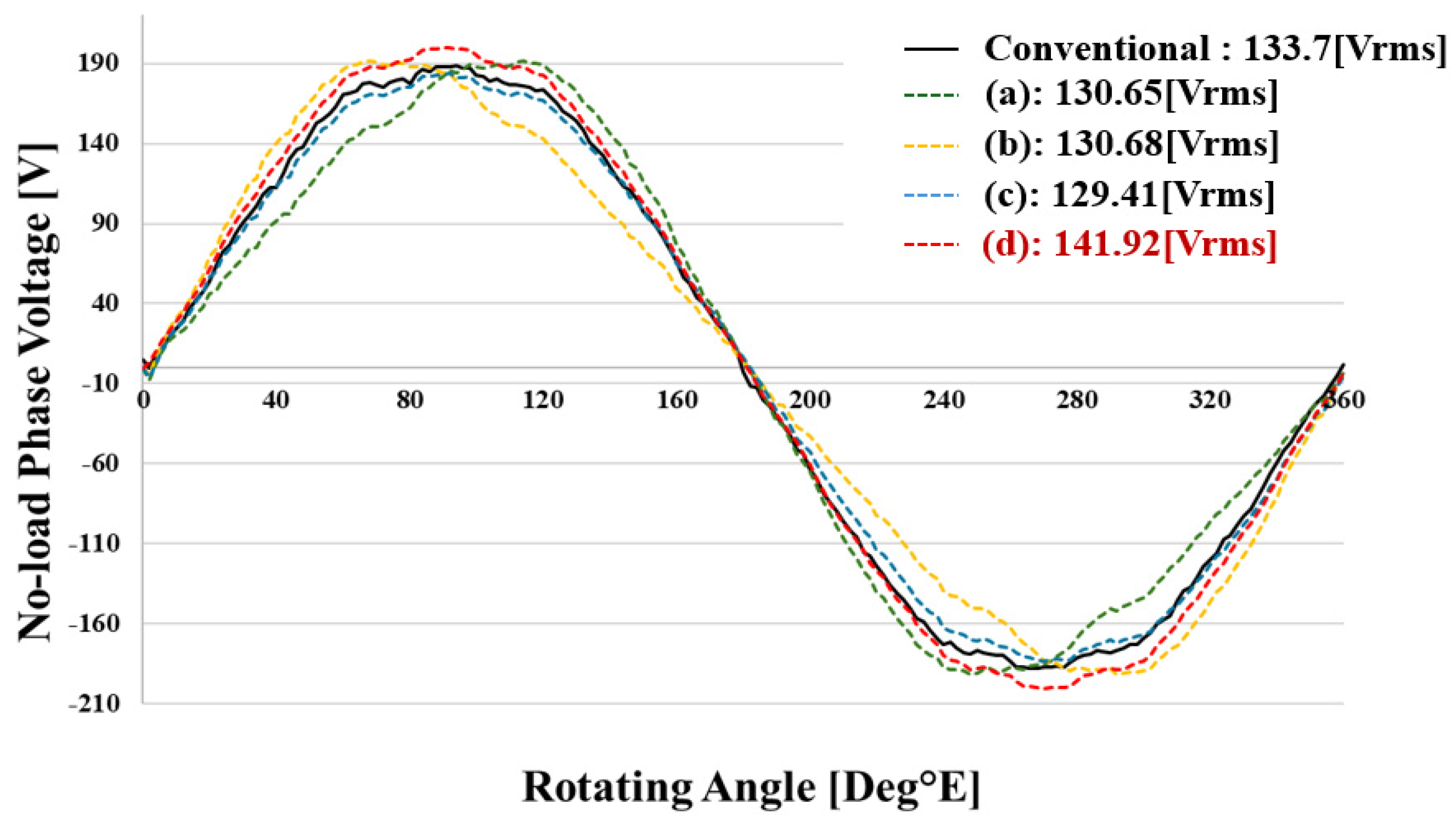
As shown in Figure 9, FEA were performed to evaluate the no-load back-EMF of each rotor model. Models (a) and (b) exhibit identical no-load back-EMF values of 130.65 Vrms, while model (c) shows a lower value of 129.41 Vrms. All three models yield reduced back-EMF compared to the baseline double-spoke PMSM, which exhibits a no-load back-EMF of 133.7 Vrms, indicating that the axial flux distribution and back-EMF characteristics vary depending on the asymmetric stacking configuration of the permanent magnets.
Figure 9.
No-load back-EMF FEA results for each model.
In contrast, model (d), in which an overhang structure is applied to the S-pole magnet while the stack length of the N-pole magnet is reduced, achieves a no-load back-EMF of 141.92 Vrms, corresponding to an increase of approximately 6.13% compared to the baseline model. This improvement can be attributed to the modified axial flux distribution induced by the asymmetric permanent magnet configuration, which enhances the effective flux linking the stator windings through the air gap. These results suggest that, even with an identical total magnet volume, appropriately designed asymmetric permanent magnet structures can mitigate axial leakage flux in flux-concentrating double-spoke PMSMs.
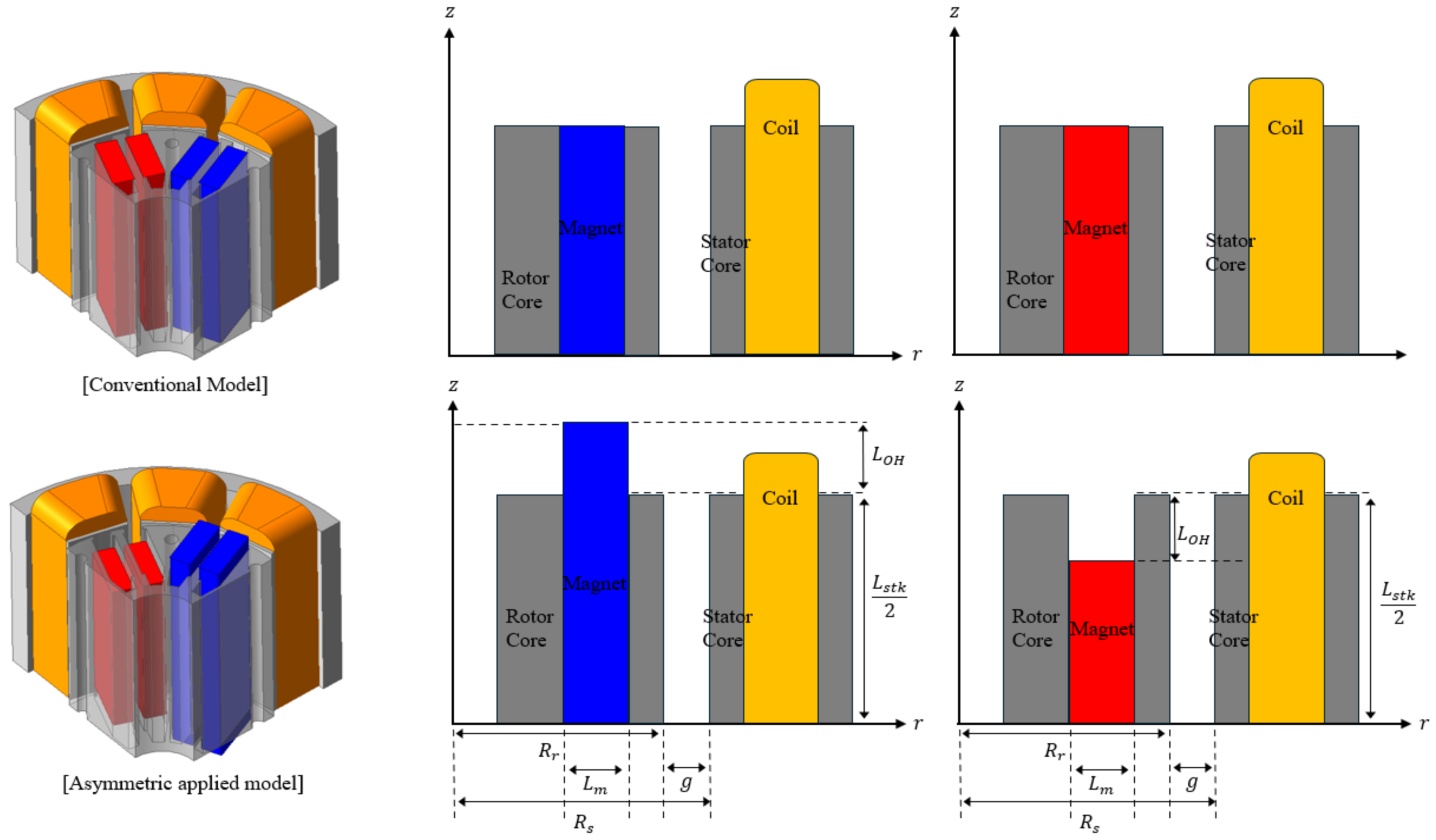
Subsequently, to investigate the variation in back-EMF performance with respect to the permanent magnet overhang length in the proposed Model (d), the following design variables were defined in Figure 10. As shown in Table 2, the rotor radius , air-gap length , rotor radius including the air gap , permanent magnet length , and the stack length excluding the coil end turns were all set to be identical to those of the baseline model. When an overhang is applied by increasing the stack length of the S-pole permanent magnet, the overhang length is defined as . The overhang of length is applied symmetrically to both the upper and lower sides of the motor. Correspondingly, an underhang with the same length is applied to the N-pole permanent magnet. The underhang is also applied symmetrically to both the upper and lower sides of the motor. Under these identical conditions, the increase in back-EMF as a function of the overhang length was evaluated through FEA, and the results are presented in Figure 11.
Figure 10.
Design variables of the asymmetric applied model.
Table 2.
Design parameter for asymmetric overhang application.
Figure 11.
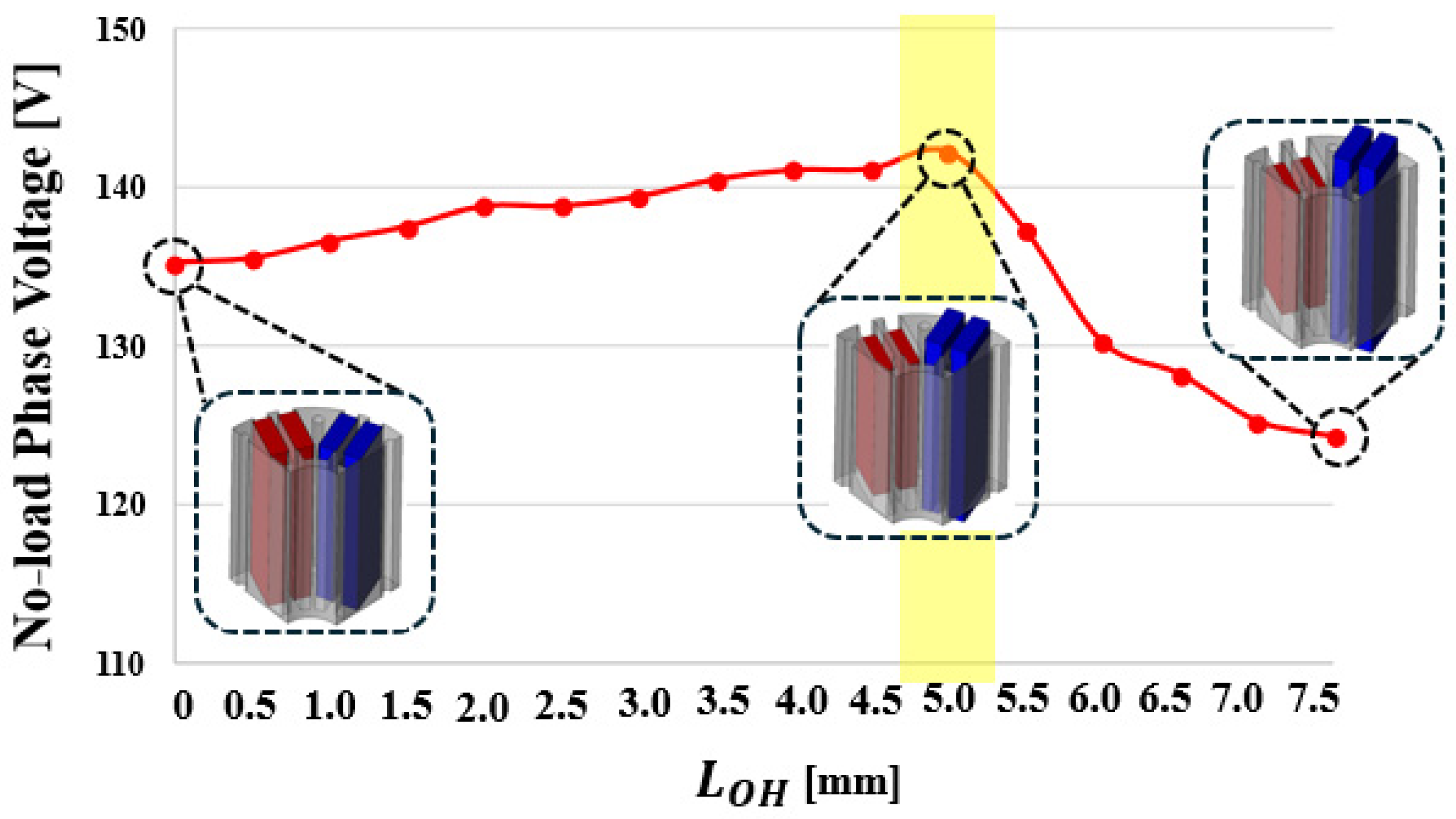
Effect of overhang length on no-load Back-EMF in model (d).
When is varied from 0 mm to 7.5 mm, the increase in no-load back-EMF exhibits an approximately linear trend in the initial range as increases. When is set to 5.0 mm, resulting in an asymmetric permanent magnet rotor configuration with a total stack length of 75 mm for the S-pole magnet and 55 mm for the N-pole magnet, the no-load back-EMF reaches its maximum value. This indicates that axial leakage flux is most effectively suppressed under this condition.
In contrast, when is increased beyond 5.0 mm, the no-load back-EMF no longer increases and instead shows a decreasing tendency. These results suggest that, for the proposed asymmetric permanent magnet structure, the optimal overhang length for mitigating axial leakage flux is approximately 5 mm applied symmetrically to both sides relative to the baseline stack length of 65 mm.
4.2. Theoretical Derivation and Finite Element Analysis of Axial Leakage Flux
As shown in Equation (6), the magnetic flux generated by the permanent magnet can be considered to divide into two parallel magnetic paths: the main air-gap path and the axial leakage path. Since the two paths share the same magnetomotive force, the flux distribution is determined by magnetic reluctance. Therefore, the leakage flux is governed by the reluctance of the main air-gap flux path, , and the reluctance of the axial leakage path, . The leakage flux can be expressed as shown in Equation (8):
When the increase in axial reluctance induced by the S-pole overhang exceeds the decrease in caused by the N-pole underhang, the net axial reluctance of the leakage path effectively increases. Under this condition, the leakage flux path becomes magnetically less favorable, and a larger portion of the magnet flux is redistributed toward the main air gap path. By comparing the above theoretical derivation with the 3D FEA results, it is confirmed that the proposed asymmetric structure effectively increases the axial reluctance and suppresses the leakage flux. Consequently, the reduction in axial leakage flux leads to an increase in the effective air-gap flux linkage and the no-load back-EMF.
4.3. Harmonic Analysis of Back-EMF and Detailed Performance Analysis
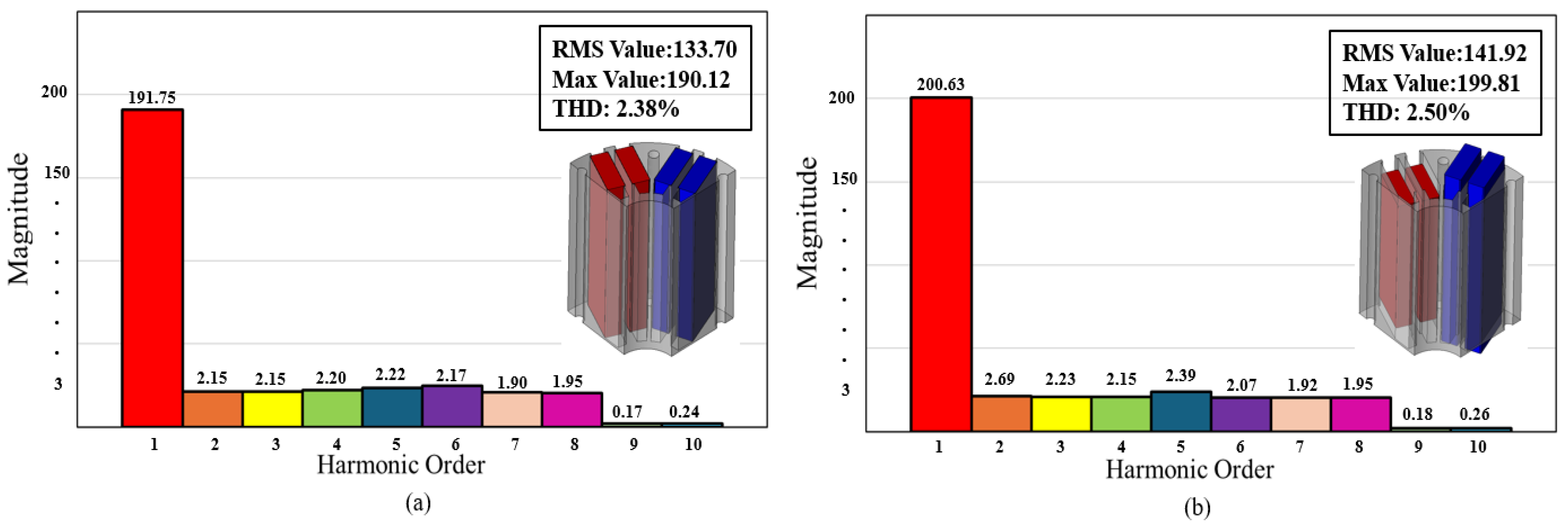
Figure 12 presents the comparison of the Total Harmonic Distortion (THD) back-EMF between the conventional model and the asymmetric applied model. THD represents the proportion of harmonic components contained in the back-EMF waveform, and a higher THD indicates a greater level of harmonic distortion relative to the fundamental component. Since harmonic components in the back-EMF can induce current harmonics and consequently introduce torque ripple in the electromagnetic torque, additional analysis was conducted. The results show that the THD of the conventional model is approximately 2.38%, while that of the asymmetric applied model is approximately 2.50%. The difference between the two models is marginal, indicating that the application of the asymmetric structure does not significantly affect the harmonic distortion of the back-EMF waveform.
Figure 12.
Harmonic analysis and total harmonic distortion of back-EMF. (a) Conventional model. (b) Asymmetric applied model.
Table 3 summarizes the detailed performance metrics of the two models. Under no-load conditions, the cogging torque increased slightly from 0.18 Nm to 0.19 Nm; however, the difference is negligible and does not represent a dominant variation between the two models. In addition, load FEA was conducted for both models under identical operating conditions of 1.8 Arms current and a current phase angle of 18°. The results indicate that, with the increase in Back-EMF in the asymmetric applied model, the electromagnetic torque also increased by approximately 3%. The output power improved from 740.5 W in the conventional model to 763.1 W in the asymmetric applied model, corresponding to an increase of approximately 3%. Consequently, efficiency increased by about 0.8 percentage points. These results demonstrate that the proposed asymmetric permanent magnet model enhances the Back-EMF and, accordingly, the electromagnetic torque. Meanwhile, the cogging torque and THD show no significant variation compared to the conventional model.
Table 3.
Design parameter for asymmetric overhang application.
4.4. Detailed Analysis of the Optimized Rotor Structure for Axial Leakage Flux Reduction
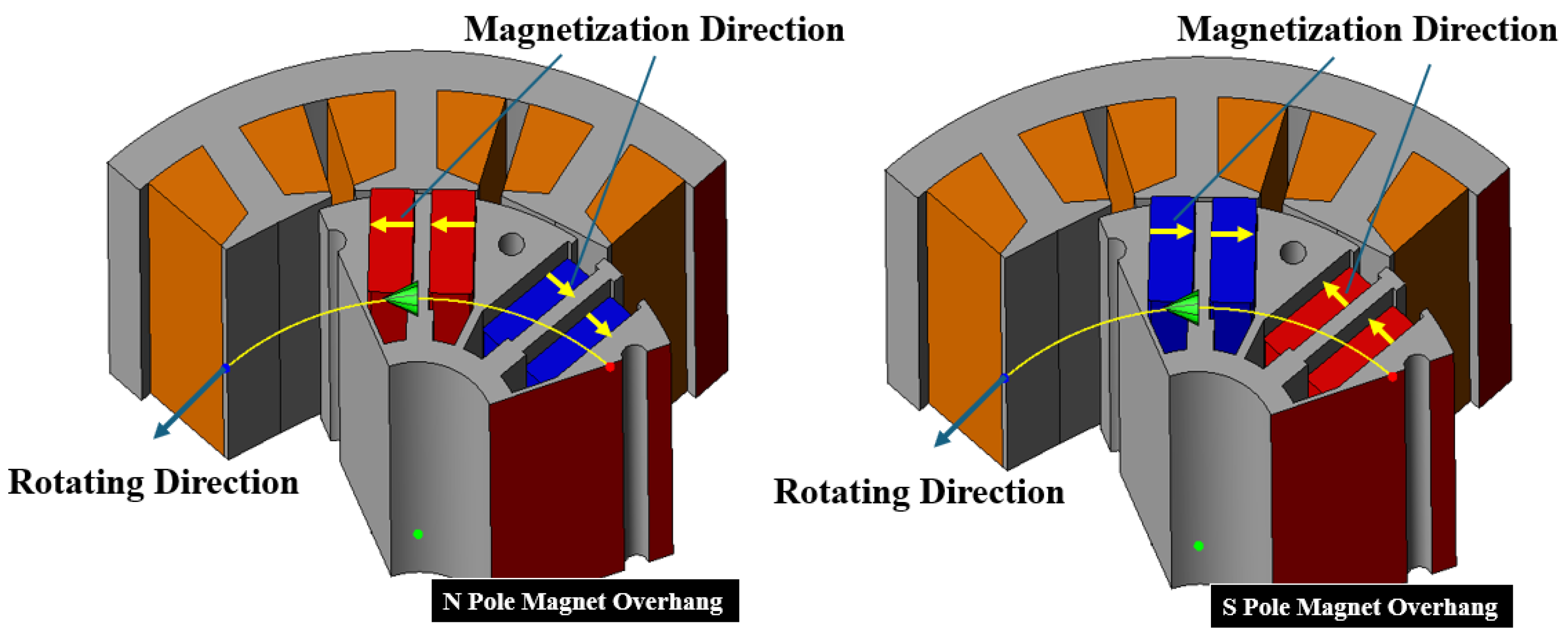
Based on the previous analysis results, it was confirmed that the axially asymmetric stacking structure, where an overhang is applied to the S-pole permanent magnet and an underhang is applied to the N-pole magnet, increases the effective flux linkage between the rotor and stator, thereby resulting in an increase in back electromotive force (back-EMF). Accordingly, to verify whether this effect is dependent on a specific magnetic polarity or rotational direction, or whether it originates solely from the asymmetric structure itself, an additional analysis was conducted by constructing an opposite asymmetric configuration. Specifically, while the previous model applied an overhang to the S-pole permanent magnet and an underhang to the N-pole magnet, the present analysis employed an asymmetric structure in which the overhang was applied to the N-pole permanent magnet and the underhang was applied to the S-pole magnet, in order to examine whether the same back-EMF enhancement could be reproduced. In this analysis, the definitions of the N-pole and S-pole were maintained identical to those used in the previous study. As illustrated in Figure 13, when the rotor is viewed from the top and rotates in the counterclockwise direction, a permanent magnet magnetized in parallel toward the left side of the rotor core is defined as the N-pole, whereas a magnet magnetized in parallel toward the right side is defined as the S-pole. This pole definition was consistently applied to all analytical models. The overhang length of the N-pole magnet and the underhang length of the S-pole magnet, denoted as , were determined based on the optimal value obtained in the previous stage and were set to 5 mm in both the upper and lower axial directions.
Figure 13.
Overhang polarity reversal, magnetization, and rotating direction.
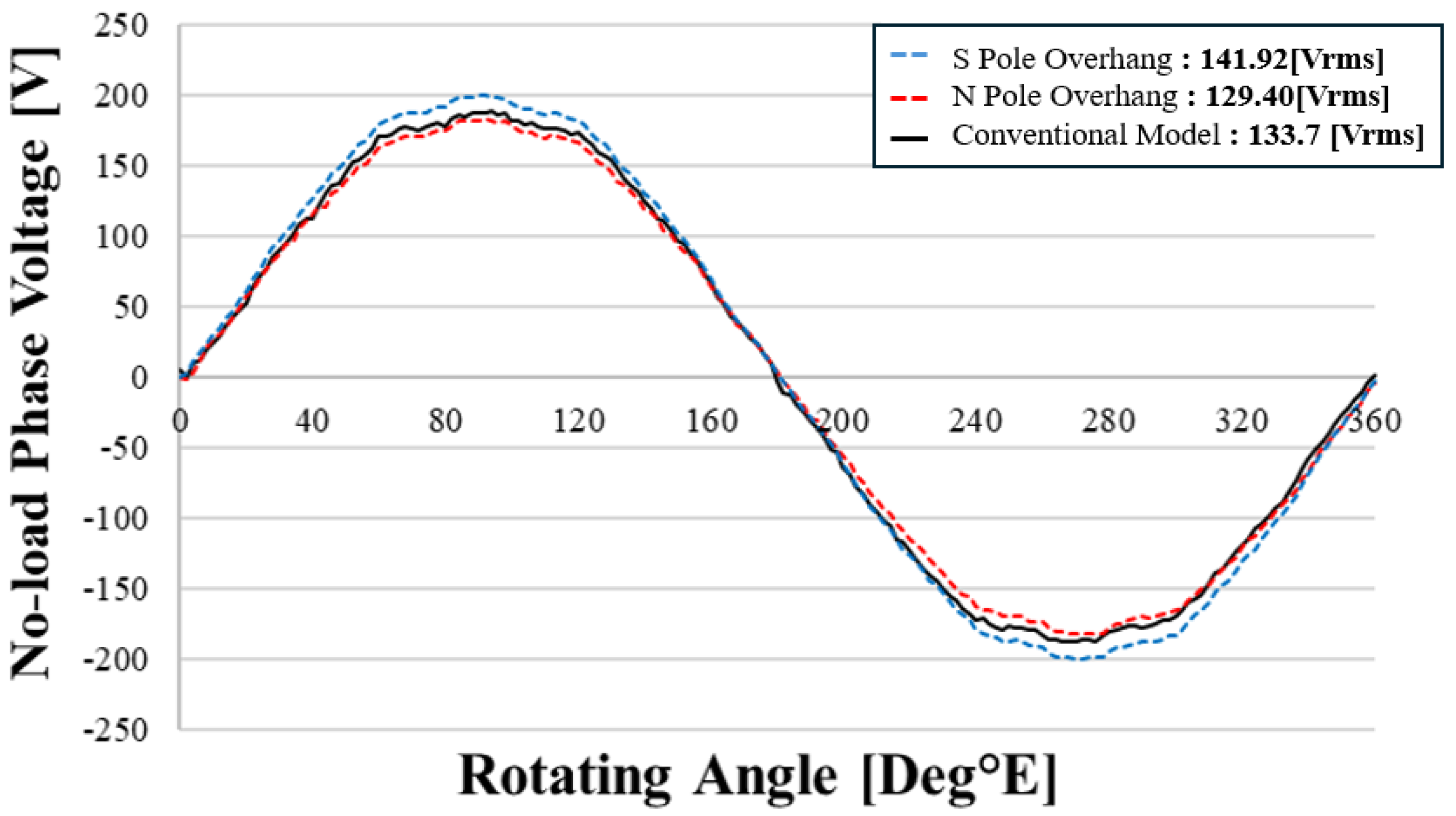
Figure 14 shows the comparison results of the no-load back-EMF waveforms according to polarity reversal in the asymmetric permanent magnet stacking structure. From the analysis results, the model with an overhang applied to the S-pole permanent magnet still exhibited the highest back-EMF magnitude, and the RMS value of the no-load phase voltage was confirmed to be 141.92 Vrms. In contrast, in the model where the overhang was applied to the N-pole permanent magnet, the back-EMF decreased to 129.40 Vrms, corresponding to an approximately 3.2% reduction compared to the conventional model.
Figure 14.
Comparison of no-load back-EMF according to overhang polarity reversal.
These results indicate that the proposed axial asymmetric structure does not always lead to an enhancement of back-EMF performance. Instead, they suggest that the back-EMF characteristics strongly depend on the relative relationship among the magnet polarity determined by the magnetization direction and the rotating direction. In other words, even when the same overhang length and identical magnet volume are applied, the magnetic flux distribution inside the rotor core and the main flux path are formed differently depending on the polarity and magnetization direction of the overhung permanent magnet. For the S-pole overhang model, the magnetic flux generated in the overhang region is effectively guided toward the stator along the rotor core, thereby increasing the main flux component passing through the air gap. On the other hand, in the N-pole overhang model, a portion of the magnetic flux formed in the overhang region tends to leak further in the axial direction, which limits the increase in magnetic flux transmitted to the stator through the air gap. To investigate the underlying mechanism of axial leakage flux reduction achieved by the proposed asymmetric permanent magnet structure, the magnetic flux line distributions of each motor model were analyzed.
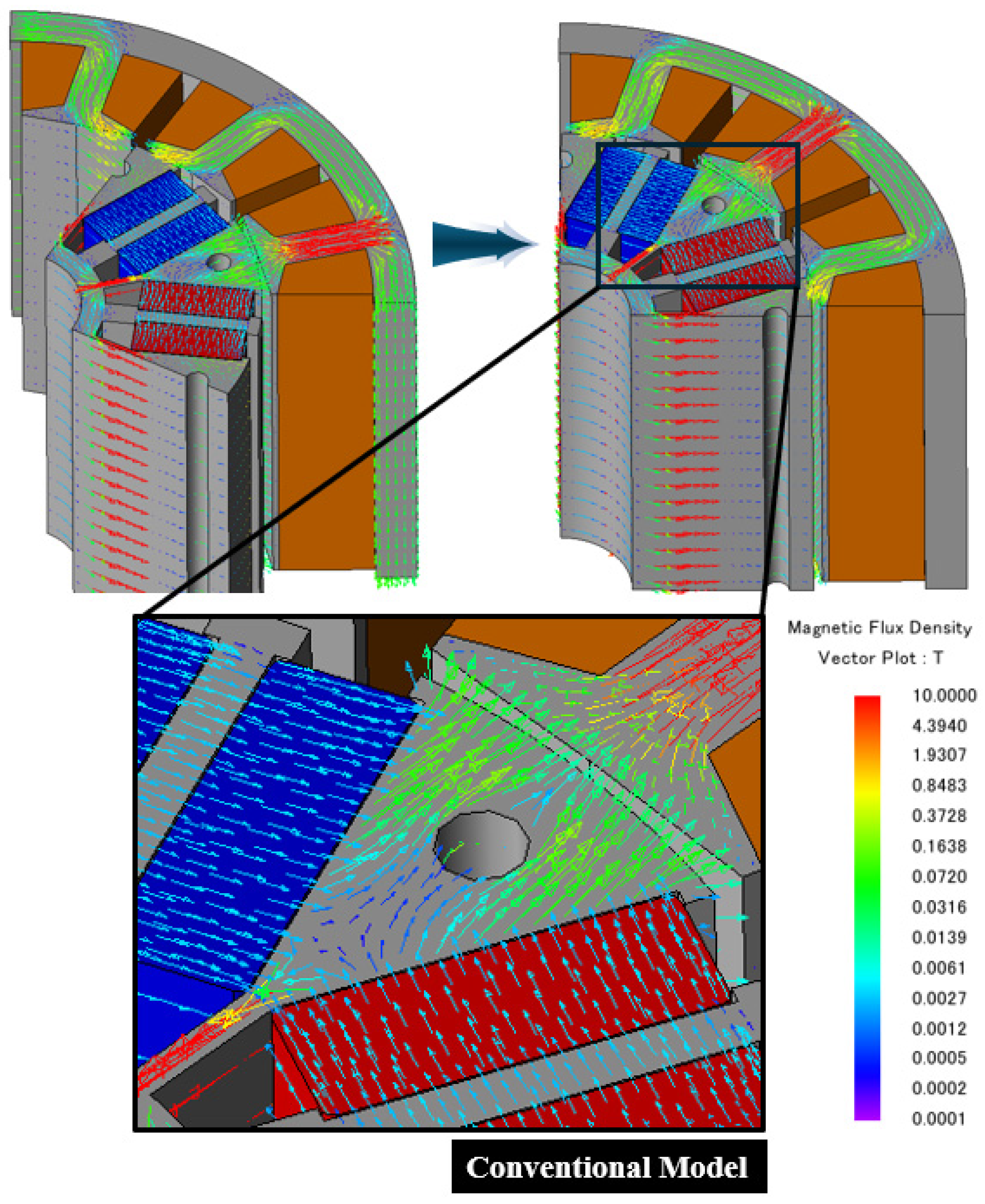
Figure 15 illustrates the magnetic flux line distribution of the double-spoke PMSM with a conventional symmetric permanent magnet structure. Since no overhang is applied to the permanent magnets, the effective magnetic flux is mainly generated by the magnets embedded inside the rotor core. As a result, the magnetic flux is uniformly distributed within the rotor core and effectively links with the stator through the air gap, forming a relatively stable main flux path.
Figure 15.
Magnetic flux line analysis of the conventional model.
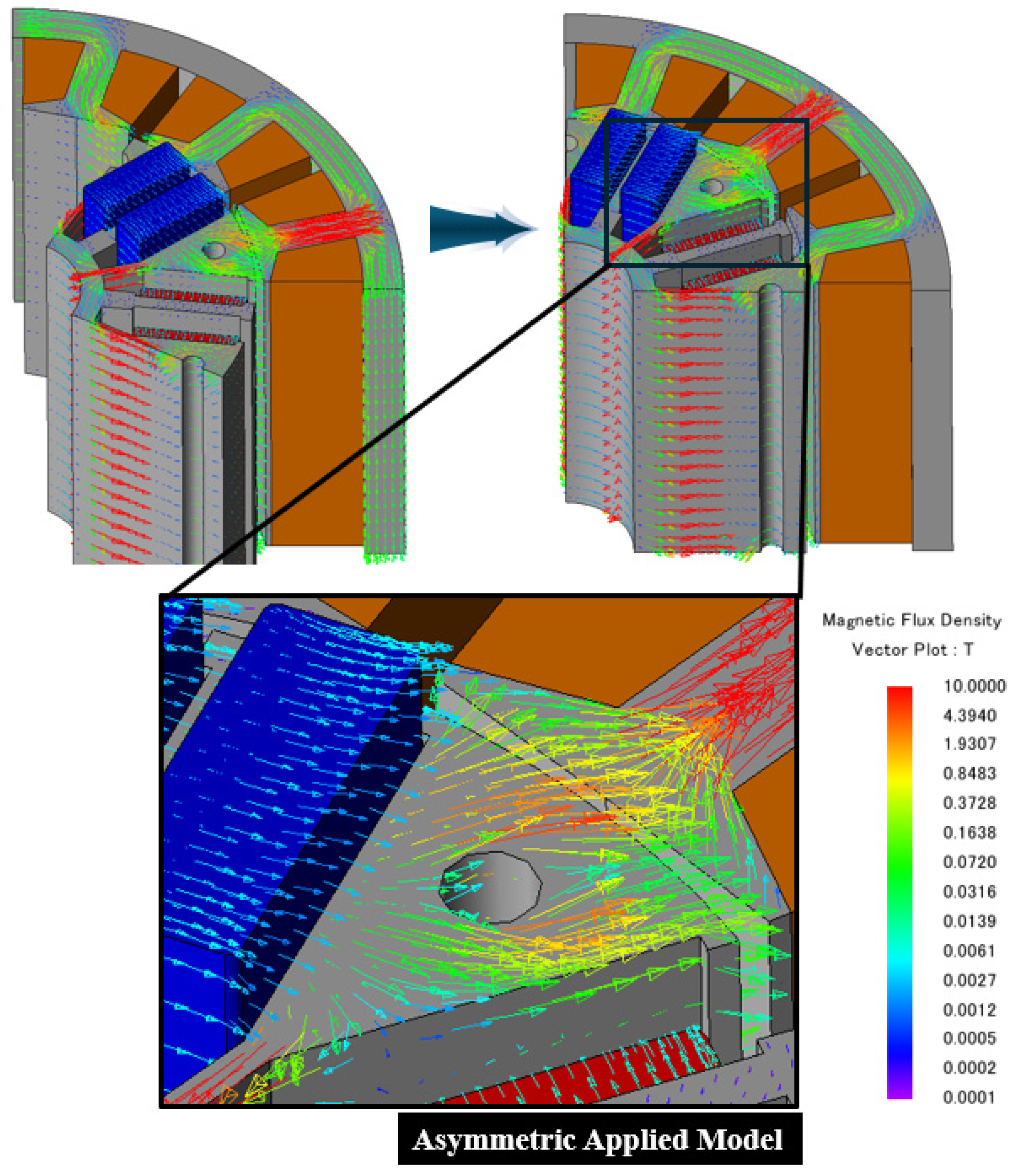
Figure 16 illustrates the magnetic flux line distribution of the model employing the proposed asymmetric permanent magnet structure. When an overhang is applied to the permanent magnet, the geometric boundary conditions at the magnet edge are altered, leading to a structural reformation of the magnetic flux distribution within the rotor. As the axial length of the magnet is locally extended, the magnetic field at the magnet end no longer terminates abruptly, and the overall continuity of the magnetic circuit is partially improved. Consequently, the spatial distribution of the fringing flux generated at the magnet edge is significantly expanded. When an overhang is applied to the permanent magnet, the geometric boundary conditions at the magnet edge are altered, leading to a structural reformation of the magnetic flux distribution within the rotor. As the axial length of the magnet is locally extended, the magnetic field at the magnet end no longer terminates abruptly, and the overall continuity of the magnetic circuit is partially improved. Consequently, the spatial distribution of the fringing flux generated at the magnet edge is significantly expanded.
Figure 16.
Magnetic flux line analysis of the asymmetric applied model.
5. Stiffness Analysis of the Proposed Structure
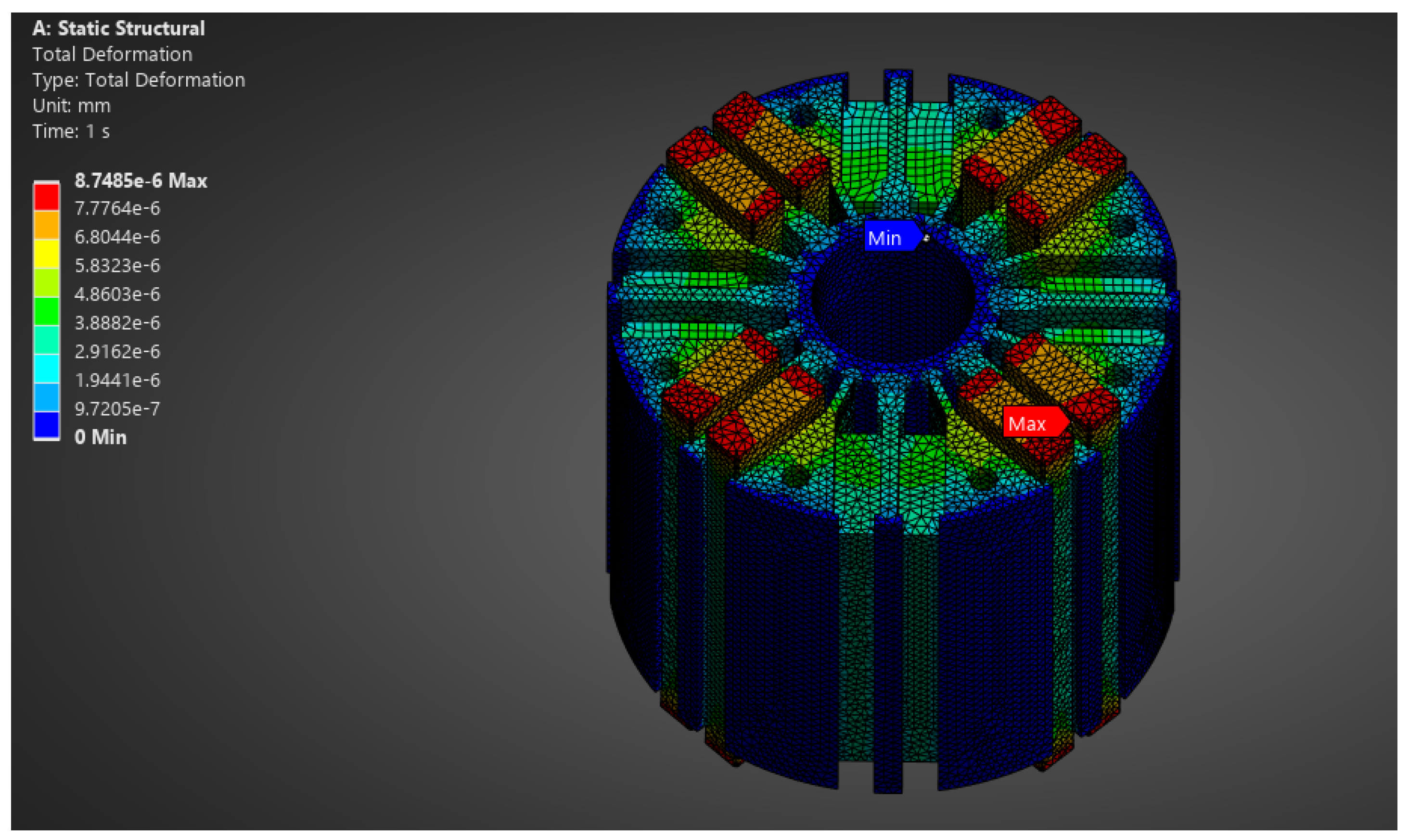
When an overhang structure is applied to the permanent magnets in IPMSMs, mechanical stiffness issues caused by centrifugal forces generated during rotation must be carefully considered. The centrifugal force increases in proportion to the square of the rotational speed, which can lead to increased stress in the rotor core, rib fracture, and permanent magnet displacement or deformation. These mechanical degradations may subsequently cause air gap nonuniformity, resulting in distorted magnetic flux density distributions and, consequently, deterioration of electromagnetic performance. Therefore, FEA were conducted to evaluate the deformation and stress of the model with asymmetric permanent magnets at the rated operating speed of 1800 rpm for conveyor drive applications. Figure 17 presents the results of the overall stiffness analysis based on the total deformation of the rotor. According to the analysis results, the maximum deformation observed throughout the rotor is approximately mm, and it is mainly concentrated near the outer region of the rotor, particularly around the embedded permanent magnet regions and the adjacent rib areas. This deformation behavior can be attributed to the concentration of tensile stress in the radial outward direction caused by centrifugal forces. However, the absolute magnitude of the maximum deformation is sufficiently small compared to the air-gap length. Therefore, under the operating conditions considered, no structural instability resulting from rotor deformation is observed.
Figure 17.
Deformation analysis of the asymmetric applied model.
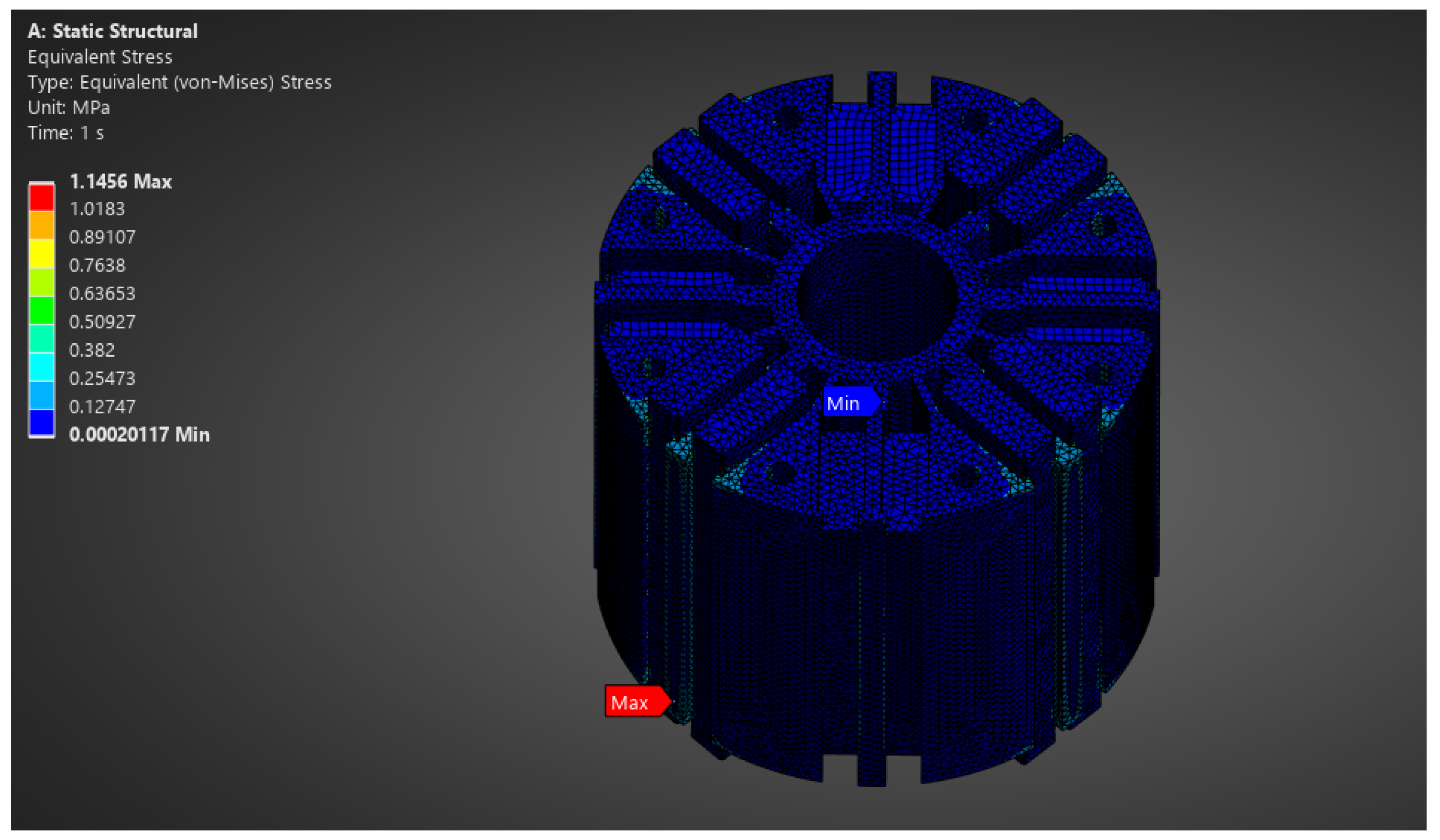
Figure 18 presents the results of the overall stiffness analysis based on the total stress distribution of the rotor. According to the analysis results, the maximum stress occurring throughout the rotor is approximately 1.15 MPa, and it is mainly concentrated near the lower regions of the ribs and along the outer periphery of the rotor. This stress concentration can be attributed to the tensile stress induced by the centrifugal force generated during rotation. In contrast, very low stress levels are observed in the central region of the rotor and the axially middle section, and no regions with excessive local stress concentration are identified across the rotor. Therefore, the proposed rotor structure is expected to exhibit sufficient structural reliability in terms of deformation and stress, even when considering practical industrial applications.
Figure 18.
Stress analysis of the asymmetric applied model.
6. Discussions
6.1. Analysis of the Axial Leakage Flux Reduction
Fringing flux refers to a non-uniform magnetic flux component formed in boundary regions where high-permeability media, such as the rotor core or permanent magnets, are geometrically discontinuous. In these regions, the magnetic flux deviates from its ideal straight path and bends through the surrounding air region due to the sudden increase in magnetic reluctance. This phenomenon is inherently associated with magnetic boundary conditions and is commonly observed near magnet edges and air-gap terminations. It should be noted that fringing flux is physically different from leakage flux. Leakage flux represents magnetic flux components that deviate from the main magnetic circuit and fail to link with the stator windings, thereby directly reducing the effective air-gap flux. In contrast, fringing flux characterizes the way magnetic flux spreads near discontinuities and does not necessarily constitute a loss component by itself. Depending on the magnetic circuit configuration, fringing flux may either develop into leakage flux or be redirected into the main flux path. Accordingly, fringing flux does not always degrade electromagnetic performance. Instead, its contribution is strongly influenced by the magnetization direction of the permanent magnet, the geometric configuration of the rotor core, and the rotating direction of the machine, which together determine the final magnetic flux path. In the proposed asymmetric structure, the fringing flux generated at the magnet edge does not simply diffuse into the surrounding air region. Instead, due to the modified boundary conditions created by the overhang, a portion of the fringing flux is guided toward the rotor core and subsequently redirected toward the air-gap region. This behavior effectively reshapes the magnetic flux path near the magnet end. As a result, magnetic flux components that would otherwise escape in the axial direction are partially recovered and redistributed into the main flux path. This redistribution mechanism directly contributes to a reduction in axial leakage flux and an increase in the effective magnetic flux crossing the air gap. As observed in Figure 15, when the rotor rotates in the counterclockwise direction, the S-pole permanent magnet magnetized in the parallel rightward direction is subjected to the overhang configuration. Under this condition, the magnetic flux distribution near the magnet edge is noticeably modified, and a pronounced fringing flux region is formed. The fringing flux generated in this region becomes locally concentrated within the rotor core, where the magnetic reluctance is relatively low.
Consequently, this concentrated flux component is efficiently guided toward the stator through the air gap, contributing to an increase in the effective flux linkage . Due to the enhanced effective flux, a higher air-gap flux density is established, which directly leads to an increase in the no-load back electromotive force. Although the flux concentration effect induced by the S-pole overhang is partially counteracted by the underhang applied to the N-pole permanent magnet, the dominant contribution of the S-pole overhang remains prevailing. As a result, the net magnetic flux linking the stator windings increases, and an overall enhancement of the back-EMF is achieved while maintaining the same total permanent magnet volume. These results demonstrate that even under identical overhang geometries, the electromagnetic behavior of fringing flux is highly sensitive to the relative relationship among magnet polarity, magnetization direction, and rotating direction. Under favorable combinations of these parameters, fringing flux can be effectively redirected into the main magnetic circuit rather than evolving into axial leakage flux. Therefore, the proposed asymmetric permanent magnet structure provides a viable means of suppressing axial leakage flux and enhancing back-EMF performance without increasing permanent magnet usage, provided that the magnet polarity and magnetization orientation are appropriately coordinated with the rotating direction.
6.2. Practical Feasibility and Industrial Applicability
From an industrial implementation perspective, the proposed asymmetric permanent magnet configuration is considered practically feasible. Double-spoke type PMSMs generally adopt a post-assembly magnetization process. Therefore, pre-machined magnets with asymmetric axial lengths can be assembled prior to magnetization without introducing significant manufacturing complexity. Since the total magnet volume remains unchanged, no additional magnet material is required, and the overall material cost is not increased. In this respect, the proposed structure offers potential performance improvement without additional material burden. However, practical limitations should also be considered. Double-spoke PMSMs are typically employed in low-speed, high-torque applications, where the proposed asymmetric configuration is expected to be suitable. In contrast, for high-speed operating conditions, mechanical integrity and safety factors related to asymmetric axial magnet distribution may require further investigation. In particular, the influence of centrifugal forces and rotor structural stability should be carefully evaluated. Additional structural and dynamic analyses are therefore necessary to fully assess high-speed industrial applicability.
7. Conclusions
This study investigated the axial leakage flux issue in ferrite-based double-spoke-type flux-concentrating PMSMs for conveyor belt drive applications and proposed an asymmetric permanent magnet rotor structure to mitigate its adverse effects. It was shown that axial leakage flux becomes increasingly significant in flux-concentrating structures with limited axial length, leading to reduced effective air-gap flux density and back-EMF. Comparative 2D and 3D FEA confirmed that this phenomenon causes a noticeable degradation in electromagnetic performance in conventional double-spoke PMSMs. To address this issue without increasing the total magnet volume, an asymmetric permanent magnet configuration was introduced by applying an overhang to the S-pole magnet and an underhang to the N-pole magnet. Parametric analysis demonstrated that the proposed structure effectively suppresses axial leakage flux and improves back-EMF, achieving a maximum increase of approximately 6.13% at an optimal overhang length of 5 mm. Flux distribution analysis clarified that the asymmetric structure redirects fringing flux into the main magnetic circuit, thereby enhancing effective flux linkage with the stator windings. Furthermore, mechanical analyses at the rated operating speed verified that the proposed rotor structure satisfies deformation and stress constraints required for practical industrial applications. Overall, the results demonstrate that performance degradation associated with reduced permanent magnet capability can be alleviated through structural optimization. The proposed approach enables performance enhancement of flux-concentrating PMSMs while reducing dependence on rare-earth permanent magnets, providing a practical design strategy for cost-effective, low-speed, high-torque industrial motors.
Author Contributions
Conceptualization, W.-H.K.; supervision, W.-H.K.; software, S.-K.L.; investigation, S.-K.L.; data curation, S.-K.L.; writing—original draft, S.-K.L.; writing—review and editing, S.-K.L., formal analysis, S.-K.L., validation, S.-H.L.; visualization, S.-B.J.; formal analysis. Y.-R.L. All authors have read and agreed to the published version of the manuscript.
Funding
This work was supported by the Korea Institute of Energy Technology Evaluation and Planning (KETEP) grant funded by the Korea government (MOTIE) (20214000000060, Department of Next Generation Energy System Convergence based on Techno-Economics—STEP) and was supported by the Technology Innovation Program funded by the Ministry of Trade, Industry & Energy (MOTIE, Korea) (No. RS-2024-00441774).
Data Availability Statement
Data are contained within the article.
Conflicts of Interest
The authors declare no conflict of interest.
References
- Kong, Y.; Lin, M.; Jia, L. A Novel High Power Density Permanent-Magnet Synchronous Machine with Wide Speed Range. IEEE Trans. Magn. 2020, 56, 7505206. [Google Scholar] [CrossRef]
- Podmiljšak, B.; Saje, B.; Jenuš, P.; Tomše, T.; Kobe, S.; Žužek, K.; Šturm, S. The Future of Permanent-Magnet-Based Electric Motors: How Will Rare Earths Affect Electrification. Materials 2024, 17, 848. [Google Scholar] [CrossRef] [PubMed]
- Huynh, T.A.; Hsieh, M.-F. Comparative Study of PM-Assisted SynRM and IPMSM on Constant Power Speed Range for EV Applications. IEEE Trans. Magn. 2017, 53, 8211006. [Google Scholar] [CrossRef]
- Kim, K.-C.; Ahn, J.S.; Won, S.H.; Hong, J.-P.; Lee, J. A Study on the Optimal Design of SynRM for the High Torque and Power Factor. IEEE Trans. Magn. 2007, 43, 2543–2545. [Google Scholar] [CrossRef]
- Du, Z.S.; Lipo, T.A. Design of an Improved Dual-Stator Ferrite Magnet Vernier Machine to Replace an Industrial Rare-Earth IPM Machine. IEEE Trans. Energy Convers. 2019, 34, 2062–2069. [Google Scholar] [CrossRef]
- Sone, K.; Takemoto, M.; Ogasawara, S.; Takezaki, K.; Akiyama, H. A Ferrite PM In-Wheel Motor Without Rare Earth Materials for Electric City Commuters. IEEE Trans. Magn. 2012, 48, 2961–2964. [Google Scholar] [CrossRef]
- Woo, J.-H.; Bang, T.-K.; Lee, H.-K.; Kim, K.-H.; Shin, S.-H.; Choi, J.-Y. Electromagnetic Characteristic Analysis of High-Speed Motors with Rare-Earth and Ferrite Permanent Magnets Considering Current Harmonics. IEEE Trans. Magn. 2021, 57, 8201805. [Google Scholar] [CrossRef]
- Zhu, X.; Wang, L.; Chen, Y.; Chen, L.; Quan, L. A Non-Rare-Earth Doubly Salient Flux Controllable Motor Capable of Fault-Tolerant Control. IEEE Trans. Magn. 2015, 51, 8111204. [Google Scholar] [CrossRef]
- Huynh, T.-A.; Che, V.-H.; Hsieh, M.-F. Maximization of High-Efficiency Operating Range of Spoke-Type PM E-Bike Motor by Optimization Through New Motor Constant. IEEE Trans. Ind. Appl. 2023, 59, 1328–1339. [Google Scholar] [CrossRef]
- Kim, H.-J.; Kim, D.-Y.; Hong, J.-P. Structure of Concentrated-Flux-Type Interior Permanent-Magnet Synchronous Motors Using Ferrite Permanent Magnets. IEEE Trans. Magn. 2014, 50, 8206704. [Google Scholar] [CrossRef]
- Kim, S.-I.; Cho, J.; Park, S.; Park, T.; Lim, S. Characteristics Comparison of a Conventional and Modified Spoke-Type Ferrite Magnet Motor for Traction Drives of Low-Speed Electric Vehicles. IEEE Trans. Ind. Appl. 2013, 49, 2516–2523. [Google Scholar] [CrossRef]
- Seo, J.-M.; Ro, A.-R.; Kim, R.-E.; Seo, J. Hybrid Analysis Method Considering the Axial Flux Leakage in Spoke-Type Permanent Magnet Machines. IEEE Trans. Magn. 2020, 56, 8200606. [Google Scholar] [CrossRef]
- Lee, S.G.; Bae, J.; Kim, W.-H. Study on the Axial Leakage Magnetic Flux in a Spoke-Type Permanent Magnet Synchronous Motor. IEEE Trans. Ind. Appl. 2019, 55, 5881–5887. [Google Scholar] [CrossRef]
- Seok, C.-H.; Yoon, S.-Y.; Choi, H.-S.; Lee, H.-Y.; Seo, J. Analysis and Modeling of Axial Leakage for Spoke-Type Hybrid Permanent Magnet Machines. IEEE Access 2022, 11, 6385–6393. [Google Scholar] [CrossRef]
- Ge, X.; Zhu, Z.Q.; Li, J.; Chen, J. A Spoke-Type IPM Machine with Novel Alternate Airspace Barriers and Reduction of Unipolar Leakage Flux by Step-Staggered Rotor. IEEE Trans. Ind. Appl. 2016, 52, 4789–4797. [Google Scholar] [CrossRef]
- Jung, J.-W.; Jung, D.-H.; Lee, J. A Study on the Design Method for Improving the Efficiency of Spoke-Type PMSM. IEEE Trans. Magn. 2023, 59, 8200205. [Google Scholar] [CrossRef]
- Song, J.-Y.; Lee, J.H.; Kim, Y.-J.; Jung, S.-Y. Computational Method of Effective Remanence Flux Density to Consider PM Overhang Effect for Spoke-Type PM Motor with 2-D Analysis Using Magnetic Energy. IEEE Trans. Magn. 2016, 52, 8200304. [Google Scholar] [CrossRef]
- Nam, D.-W.; Kim, D.-H.; Yang, I.-J.; Song, S.-W.; Kim, W.-H. A Study on Stator Shape to Reduce Cogging Torque and Torque Ripple of Double-Layer Spoke-Type PMSM. In Proceedings of the IEEE Energy Conversion Congress and Exposition (ECCE), Detroit, MI, USA, 9–13 October 2022. [Google Scholar] [CrossRef]
- Jeong, M.-J.; Jung, D.-H.; Lee, S.-H.; Nam, D.-W.; Kim, W.-H. A Study on the Design Method of Spoke-Type PMSMs for Reducing Cogging Torque and Axial Force. Energies 2025, 18, 6257. [Google Scholar] [CrossRef]
Disclaimer/Publisher’s Note: The statements, opinions and data contained in all publications are solely those of the individual author(s) and contributor(s) and not of MDPI and/or the editor(s). MDPI and/or the editor(s) disclaim responsibility for any injury to people or property resulting from any ideas, methods, instructions or products referred to in the content. |
© 2026 by the authors. Licensee MDPI, Basel, Switzerland. This article is an open access article distributed under the terms and conditions of the Creative Commons Attribution (CC BY) license.