
Multi-Objective Optimization of the Grinding Process in a Spring-Rotor Mill Using Regression-Based Modeling

 , , , and
Abstract
1. Introduction
1.1. Industrial Significance of Grinding Processes
1.2. Spring-Rotor Mills: Principles and Potential
1.3. Historical Development and State of the Art in Spring-Rotor Mill Research
1.3.1. Pioneering Work by Sivachenko and Colleagues
1.3.2. Mechanical Analysis and Dynamic Behavior
1.3.3. International Research on Spring Dynamics
1.3.4. Alternative Spring-Based Grinding Concepts
1.3.5. Limitations of Existing Research
- 1.
- 2.
- 3.
- 4.
- 5.
1.4. Classical and Modern Comminution Theories
1.4.1. Classical Theories: Rittinger, Kick, and Bond
1.4.2. Limitations of Classical Theories
1.4.3. Modern Theoretical Developments
1.5. Optimization Approaches in Grinding Processes
1.5.1. Statistical Design of Experiments (DOE) and Response Surface Methodology (RSM)
1.5.2. Multi-Objective Optimization Methods
1.5.3. Applications to Specific Mill Types
1.5.4. Research Gap Specific to Spring-Rotor Mills
1.6. Research Objectives and Scientific Novelty
1.6.1. Problem Statement
1.6.2. Research Objectives
- To develop a comprehensive experimental database for spring-rotor mill performance through a five-factor Hartley experimental design, systematically varying rotational speed, filling ratio, rotor overlap, chamber clearance, and grinding time.
- To construct adequate second-order polynomial regression models (R2 > 0.93) describing the influence of these factors on five key performance indicators: grinding fineness, throughput, power consumption, specific energy consumption, and specific metal intensity.
- To apply multi-objective optimization methods, including Pareto front analysis and weighted sum aggregation, to identify compromise optimal operating regimes that balance conflicting performance requirements.
- To experimentally verify the predicted optimal regimes through independent confirmatory experiments and assess solution robustness through Monte Carlo simulation.
- To develop practical recommendations for industrial implementation, including permissible parameter variation ranges and expected performance improvements.
1.6.3. Scientific Novelty
- First comprehensive RSM application to spring-rotor mills: for the first time, a complete second-order response surface methodology is applied to a spring-rotor mill, quantitatively describing the influence of five key factors on five performance indicators. This extends beyond qualitative assessments and single-factor studies prevalent in previous research [4,5,6,7,10,11,12,13].
- Novel multi-objective optimization framework incorporating equipment-specific parameters: a novel application of the NSGA-II evolutionary algorithm to visualize the Pareto-optimal front in the space of conflicting criteria (fineness, throughput, power) is presented, explicitly incorporating design-specific parameters unique to spring-rotor mills (rotor overlap and chamber clearance). This provides a clear tool for engineering decision-making that has not previously been available for this equipment class [30,32].
- First quantification of parameter interactions for spring-rotor mills: the study quantifies, for the first time, the interaction effects between key operating parameters, revealing previously unknown synergistic and antagonistic relationships that significantly impact process performance.
- Experimentally verified optimal regimes with robustness analysis: the study provides experimentally verified, robust optimal operating regimes that yield quantifiable improvements (15–20% higher throughput, 8–12% lower energy consumption) compared with traditional empirical tuning methods. The inclusion of Monte Carlo robustness analysis represents a methodological advance over studies that identify optimal points without assessing their stability [27,28,29].
- Integrated framework from design to implementation: the research presents an integrated framework spanning experimental design, mathematical modeling, multi-objective optimization, experimental verification, and practical implementation guidelines—a comprehensive approach not previously applied to spring-rotor mills.
1.6.4. Practical Significance
- –
- increase mill throughput by 15–20% without additional capital investment;
- –
- reduce specific energy consumption by 8–12%, contributing to sustainability goals;
- –
- decrease production costs by approximately 10% through combined efficiency improvements;
- –
- provide operators with clear, quantitative guidelines for process tuning;
- –
- enable informed decision-making based on production priorities (quality, throughput, or energy efficiency).
1.7. Paper Organization
2. Materials and Methods
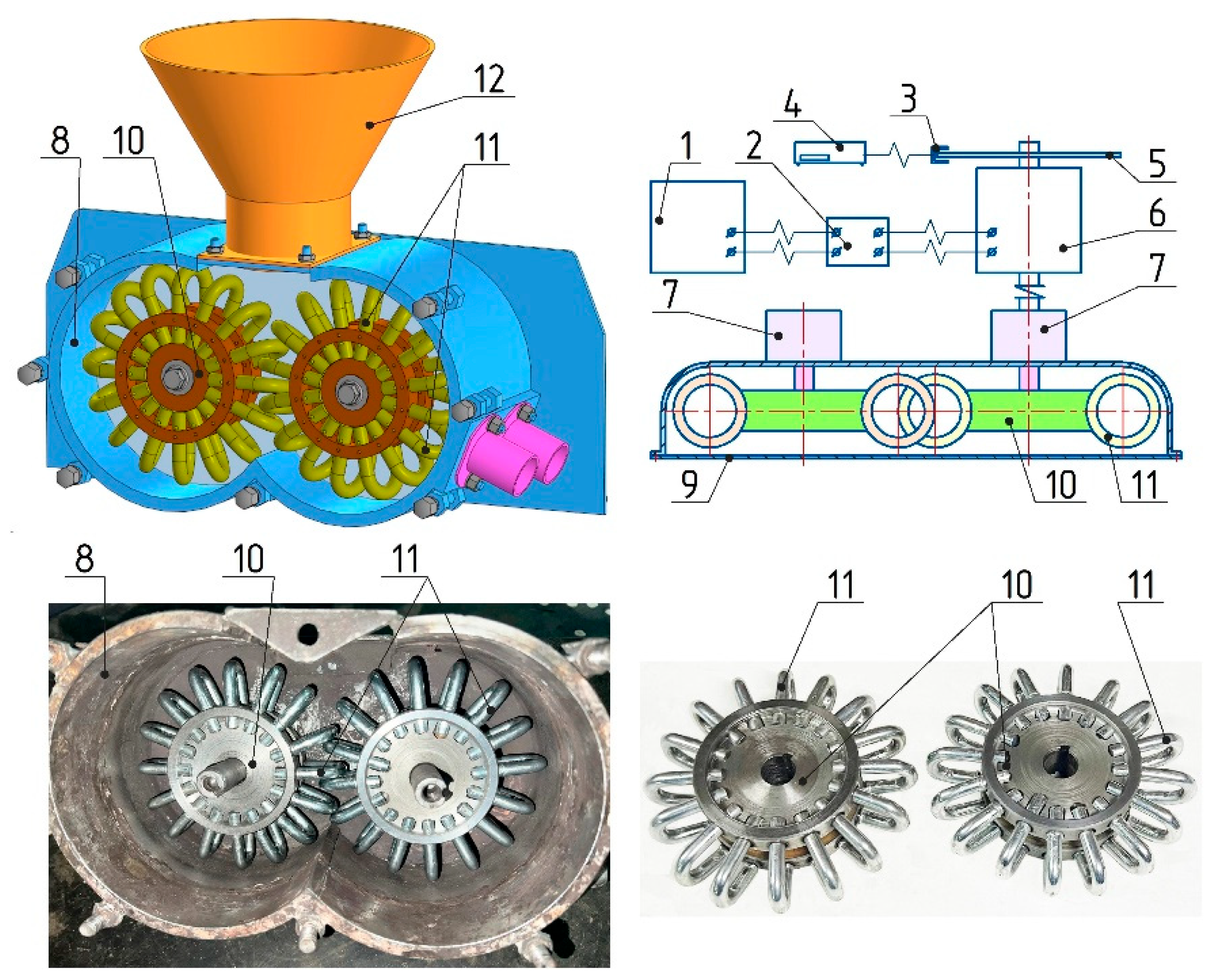
2.1. Study Object and Experimental Setup
- –
- the rotor overlap (X3) is adjusted by axial displacement of one rotor disk relative to the other using calibrated spacers. The adjustment range is from −15 mm (separation) to +15 mm (overlap);
- –
- the axial clearance (X4) is regulated by varying the distance between the spring ends and the side wall of the grinding chamber;
- –
- a replaceable diaphragm (mesh-type or slotted) can be installed in the inter-rotor space to enable quasi-continuous operation and preliminary in-process classification of the product during grinding.
- –
- grinding chamber volume: 5.0 L;
- –
- rated power of the drive induction motor: 15.0 kW;
- –
- control system: variable-frequency drive with precise speed setting and stabilization;
- –
- monitoring and measurement system: digital wattmeter (±0.5% accuracy) for power consumption measurement, optical tachometer sensor (±1 rpm accuracy), and electronic scales for dosing (±1 g accuracy) [25].
2.1.1. Feed Materials Characterization
2.1.2. Particle Size Analysis Method
- Regulatory compliance: According to relevant standards [26], the 71 μm sieve is designated as a “control sieve” for fine mineral powders. Material is considered compliant if the residue on this sieve does not exceed a specified percentage, making it a standard benchmark for fineness assessment.
- Industrial relevance: The 71 μm sieve is widely used in particle size analysis for various materials, including cement fineness determination, mineral powder classification, quality control of quartz sand, ore processing, food powders, and pharmaceutical applications where the absence of particles larger than 71 μm is critical for product quality [27,28,29].
- Material-specific application: For marble chips, the 71 μm sieve serves as a boundary for determining the content of dust-like and clay particles, providing a reliable indicator of product purity and grinding efficiency.
2.2. Design of Experiments and Response Variables
- X1—rotational speed of the working elements, n (rpm);
- X2—degree of filling of the grinding chamber with material, kₘ (dimensionless);
- X3—overlap (engagement) of the working zones of the driving and driven rotors, kᵣ (mm); negative values correspond to rotor separation;
- X4—clearance between the moving and stationary parts of the grinding chamber, kzaz (mm);
- X5—grinding cycle duration, T(s).
2.3. Mathematical Modeling and Statistical Analysis
2.4. Multi-Objective Optimization Methodology
2.5. Stability Analysis and Verification
3. Results and Discussion
3.1. Experimental Data and Preliminary Analysis
3.2. Regression Models and Adequacy Assessment
- for grinding fineness
- for throughput:
- for drive power:
- for specific energy consumption:
- for specific metal intensity:
3.3. Analysis of Factor Effects on Process Throughput
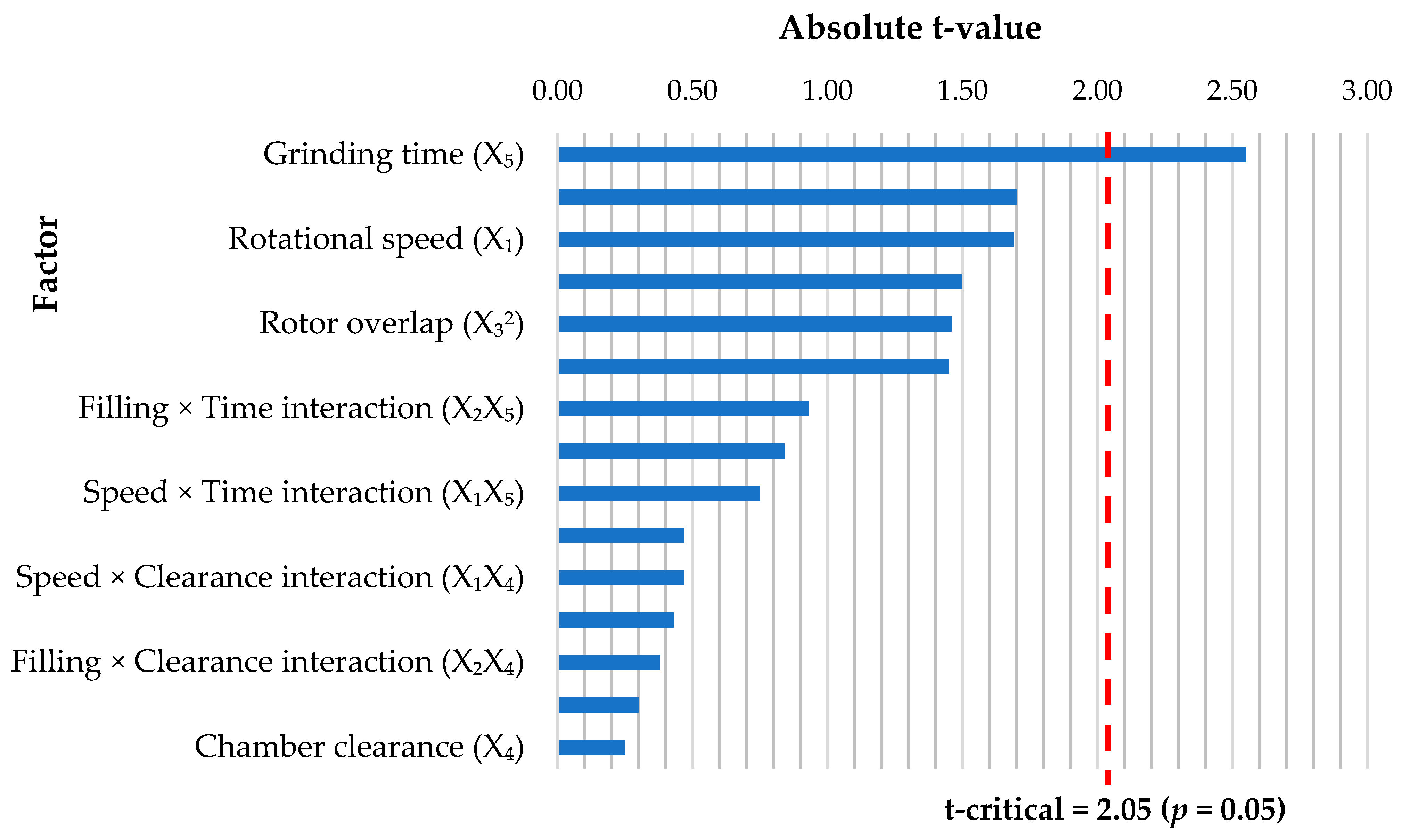
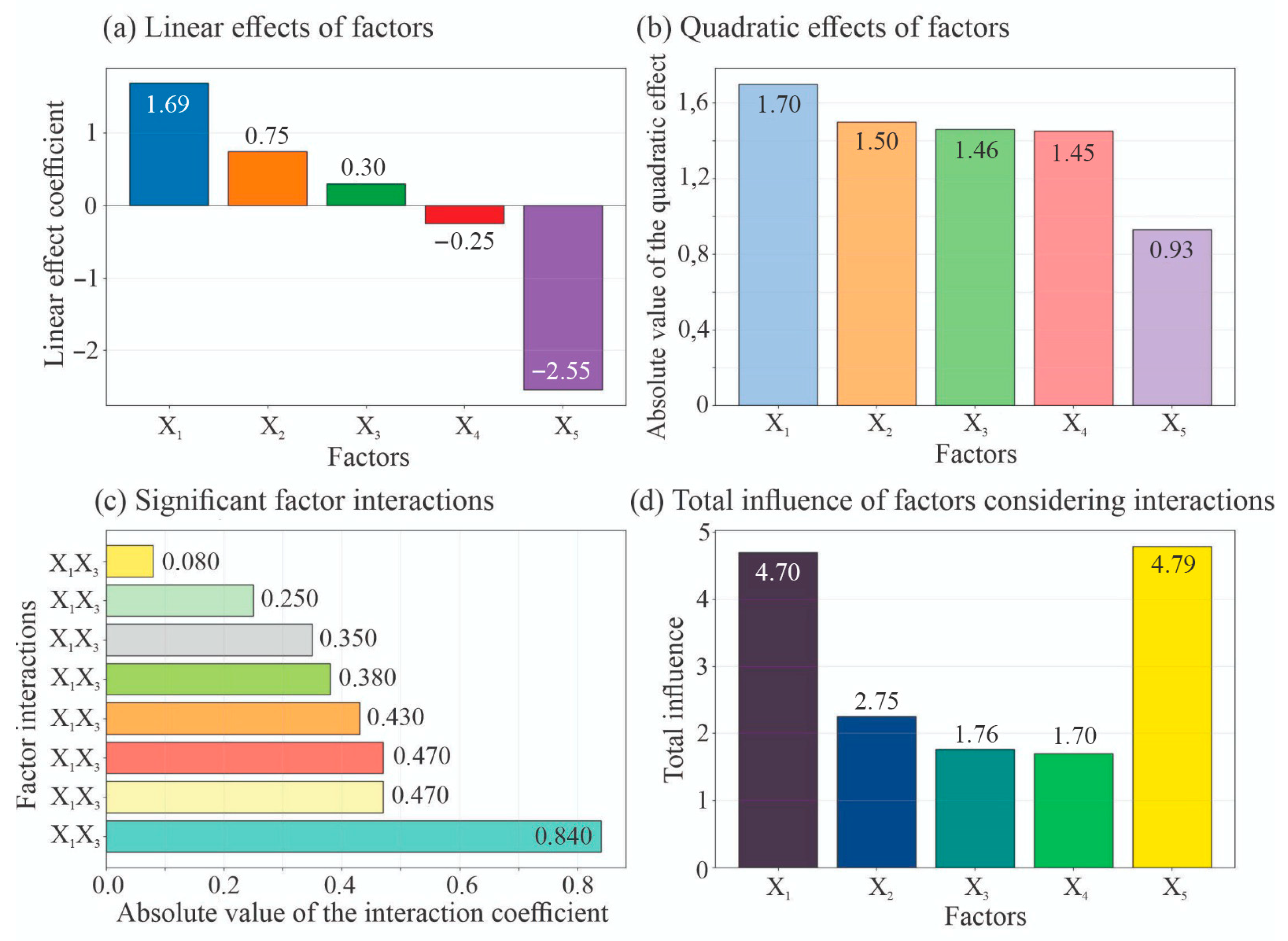
- X5 (grinding time): −2.55—the negative sign indicates a decrease in throughput with increasing time; this is the largest linear effect in absolute value. An increase in time by 30 s reduces throughput by 2.55 kg/h.
- X1 (rotational speed): +1.69—the positive sign indicates an increase in throughput with increasing speed. Each increase in speed by 500 rpm increases throughput by 1.69 kg/h.
- X2 (filling ratio): +0.75—the positive sign indicates that increasing the filling ratio promotes an increase in throughput. However, there exists an optimal value beyond which the effect decreases.
- X3 (overlap of working zones): +0.30—a weak positive effect indicating a slight improvement in throughput with increasing overlap.
- X4 (chamber clearance): −0.25—a negative but minimal effect. An increase in clearance slightly reduces throughput.
- X1 (rotational speed): −1.70—the highest nonlinearity, with a sharp change in P when deviating from the optimal value (~2074 rpm).
- X2 (filling ratio): −1.50—a substantial effect, especially when the chamber is overloaded beyond the optimal level.
- X3 (overlap of working zones): −1.46—moderate nonlinearity.
- X4 (chamber clearance): −1.45—an influence similar to that of the overlap.
- X5 (grinding time): +0.93—the only positive quadratic effect, indicating a convex dependence along this factor.
- X1X5 (Speed × Time): −0.84—the strongest negative interaction. An increase in grinding time at high rotational speed leads to a more pronounced decrease in throughput.
- X1X4 (Speed × Clearance): +0.47 and X4X5 (Clearance × Time): +0.47—positive interactions indicating the possibility of compensating negative effects.
- X2X4 (Filling ratio × Clearance): +0.43—a positive interaction improving throughput under the joint increase in filling ratio and clearance.
- X2X5 (Filling ratio × Time): −0.38—a negative interaction that amplifies the adverse effect of time at high filling ratios.
- the X1X5 interaction indicates the need for joint optimization of speed and time—both parameters should not be set to their maximum values simultaneously;
- the positive interactions X1X4 and X4X5 make it possible to partially compensate for the negative effects of other factors by adjusting the clearance;
- particular attention should be paid to interactions involving grinding time (X5) as the most influential factor.
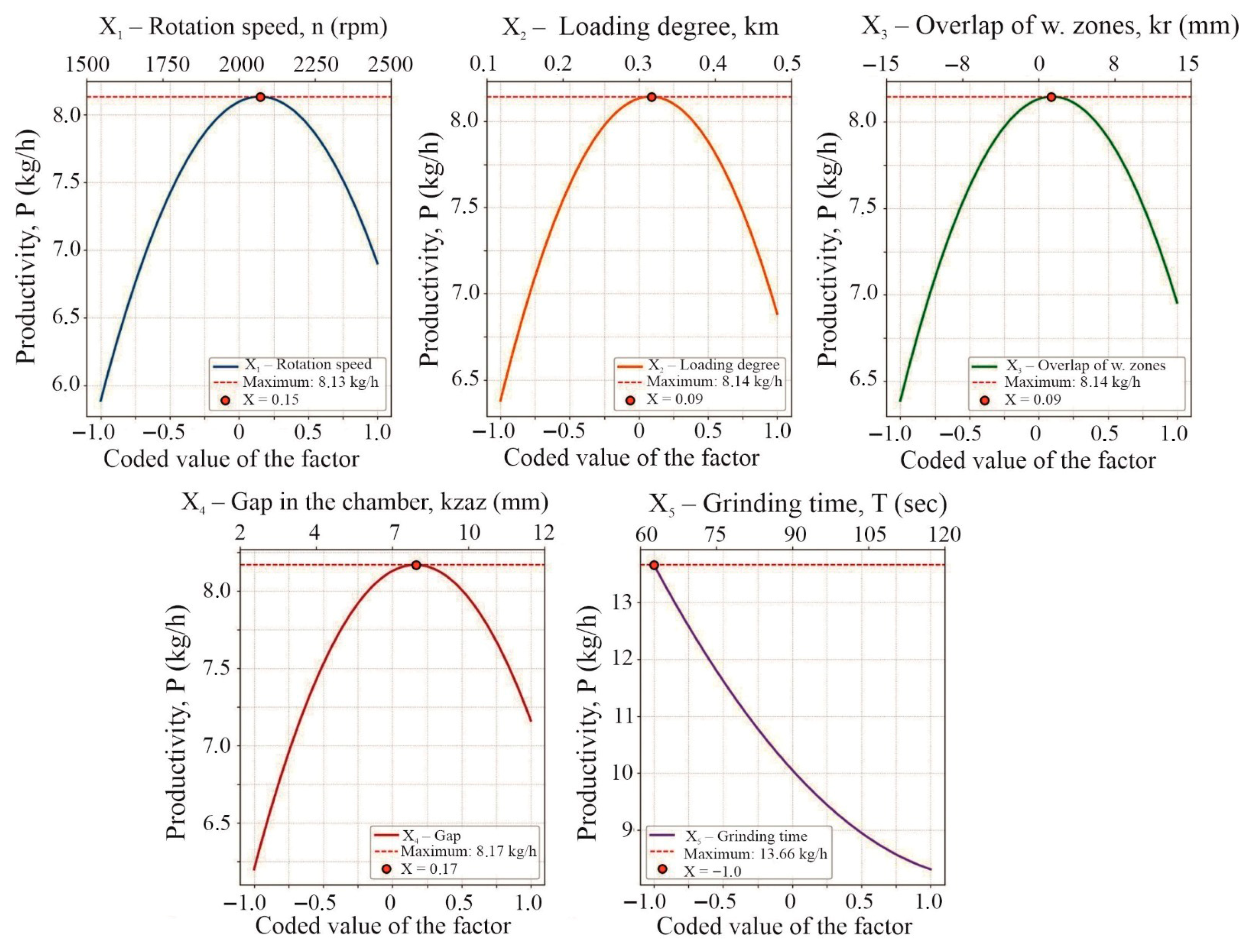
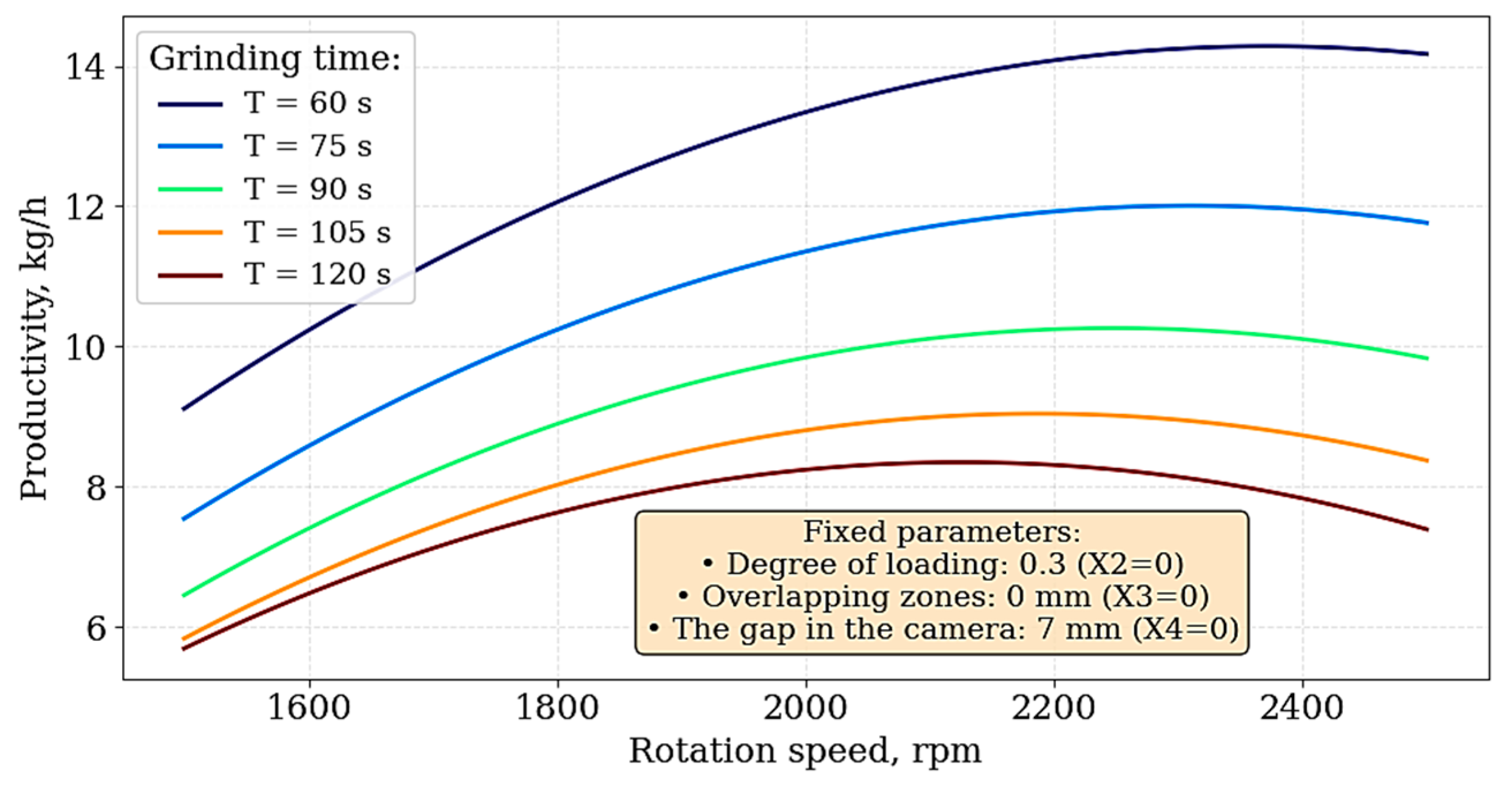
- The influence of grinding time (X5) exhibits a linear effect of −2.55, indicating that an increase in time beyond the optimal value (132 s) leads to a decrease in throughput. However, the positive quadratic effect (+0.93) indicates a complex dependence—beyond a certain threshold, throughput begins to increase. Physically, this can be explained by the fact that excessive grinding leads to particle aggregation and increased energy consumption without a substantial improvement in product yield.
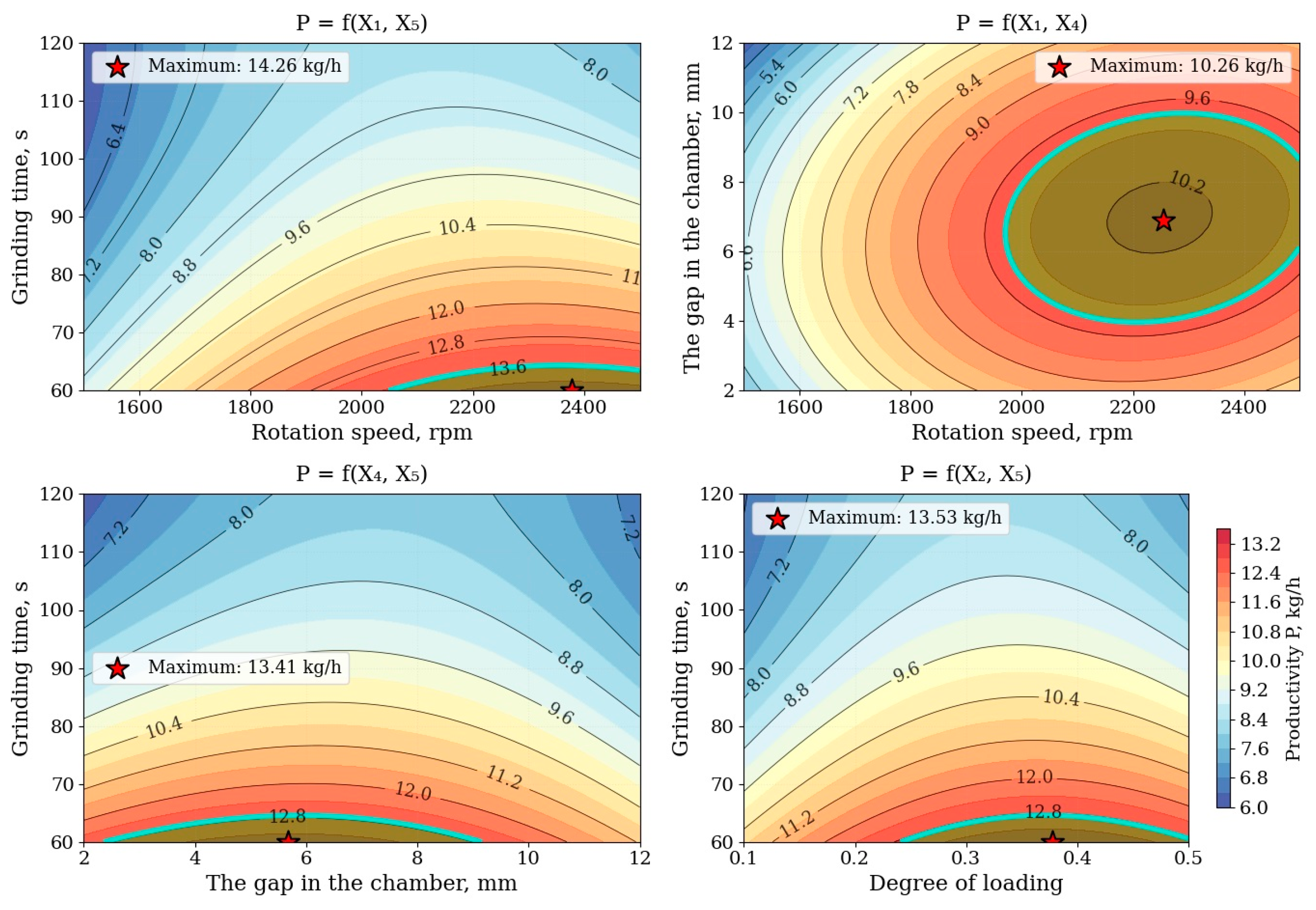
- The influence of rotational speed (X1) is characterized by a positive linear effect (+1.69) and a strong negative quadratic effect (−1.70), indicating the existence of a well-defined optimum (~2074 rpm). At low speeds, the impact energy is insufficient, whereas at high speeds parasitic effects (aeration, centrifugal forces) arise.
- The influence of the filling ratio (X2) exhibits a positive linear effect (+0.75), indicating an increase in throughput with increasing loading, while the quadratic effect (−1.50) limits this increase. The optimum is achieved at a filling ratio of 32.5%.
- The influence of the overlap of the working zones (X3) shows a weak positive effect (+0.30) with moderate nonlinearity (−1.46), indicating the presence of an optimal value near zero (0 mm). This corresponds to the neutral position of the rotors.
- The influence of the chamber clearance (X4) exhibits a slight negative linear effect (−0.25) with moderate nonlinearity (−1.45). The optimum is located in the center of the design space (7 mm). The clearance has a greater effect on energy consumption than on throughput.
- These physical interpretations are consistent with the fundamental mechanisms of comminution in spring-rotor mills. The combined impact-abrasive action means that particle breakage occurs through two primary modes: (1) high-velocity impacts between particles and the rotating spring elements, governed by kinetic energy (∝ n2), and (2) inter-particle abrasion in the compressed zone between rotors, governed by residence time and filling ratio. The identified quadratic effects and interactions quantitatively capture the transition between these modes. For instance, the negative interaction X1X5 (speed × time) indicates that beyond an optimal point, prolonged exposure to high-intensity impacts leads to diminishing returns, possibly due to particle agglomeration or the ejection of fine particles from the active zone before complete breakage. The positive interaction X2X4 (filling ratio × clearance) suggests that a larger clearance allows for better material circulation, accommodating higher fill levels without clogging the rotor–stator gap.
4. Multi-Objective Optimization of Throughput and Technological Performance Indicators
4.1. Formulation of the Multi-Objective Optimization Problem
- Y1 = R71(X) → min (maximization of grinding fineness);
- Y2 = P(X) → max (maximization of throughput);
- Y3 = N(X) → min (minimization of power consumption);
- Y4 = Eud (X) → min (minimization of specific energy consumption);
- Y5 = Mud (X) → min (minimization of specific metal intensity).
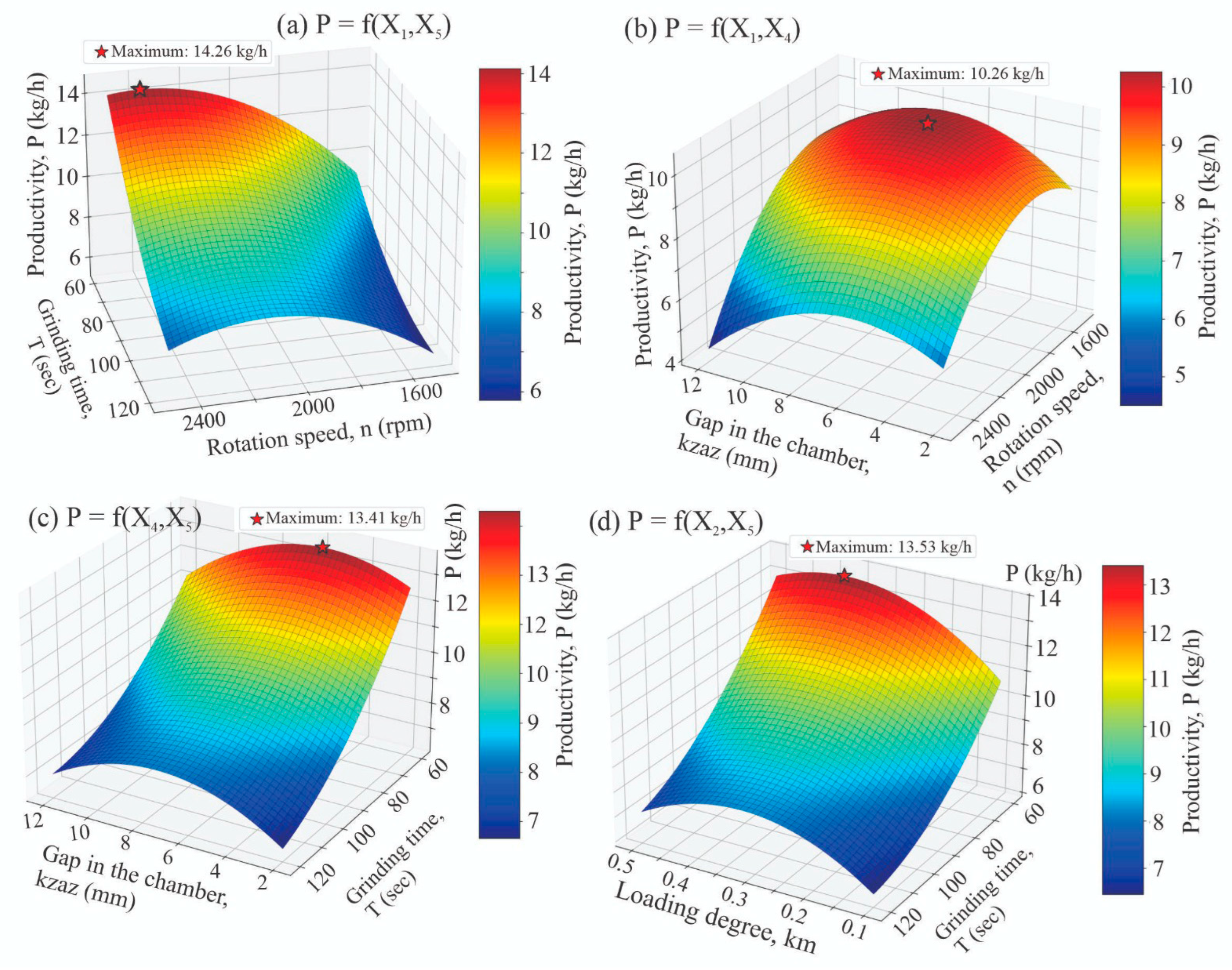
4.2. Visualization of Throughput Optimality Regions
4.3. Analysis of Pareto-Optimal Solutions and Technological Trade-Offs
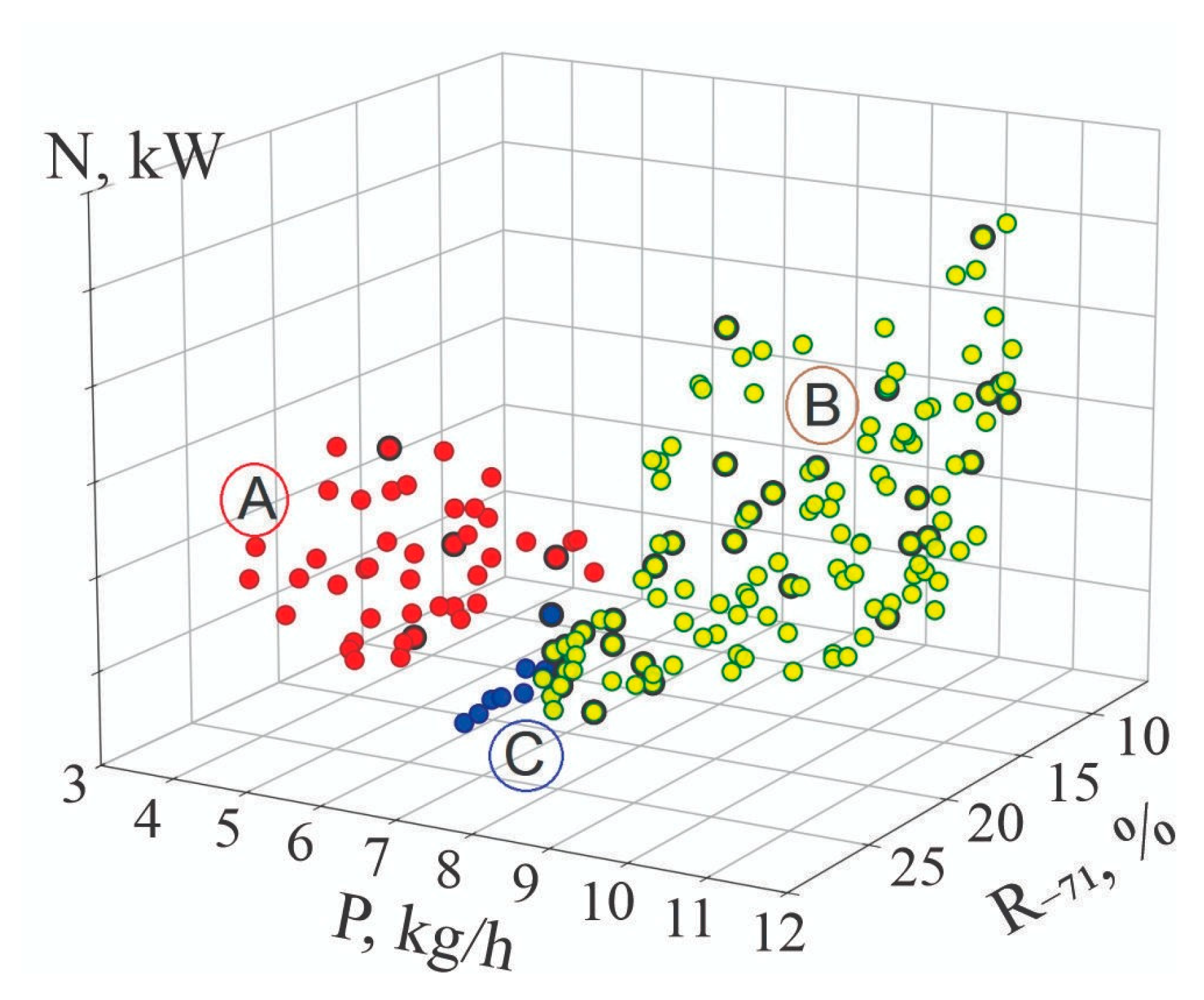
- The three-dimensional shape of the front shows that it is impossible to simultaneously achieve very low R−71 (high quality), very high P (throughput), and very low N (energy consumption).
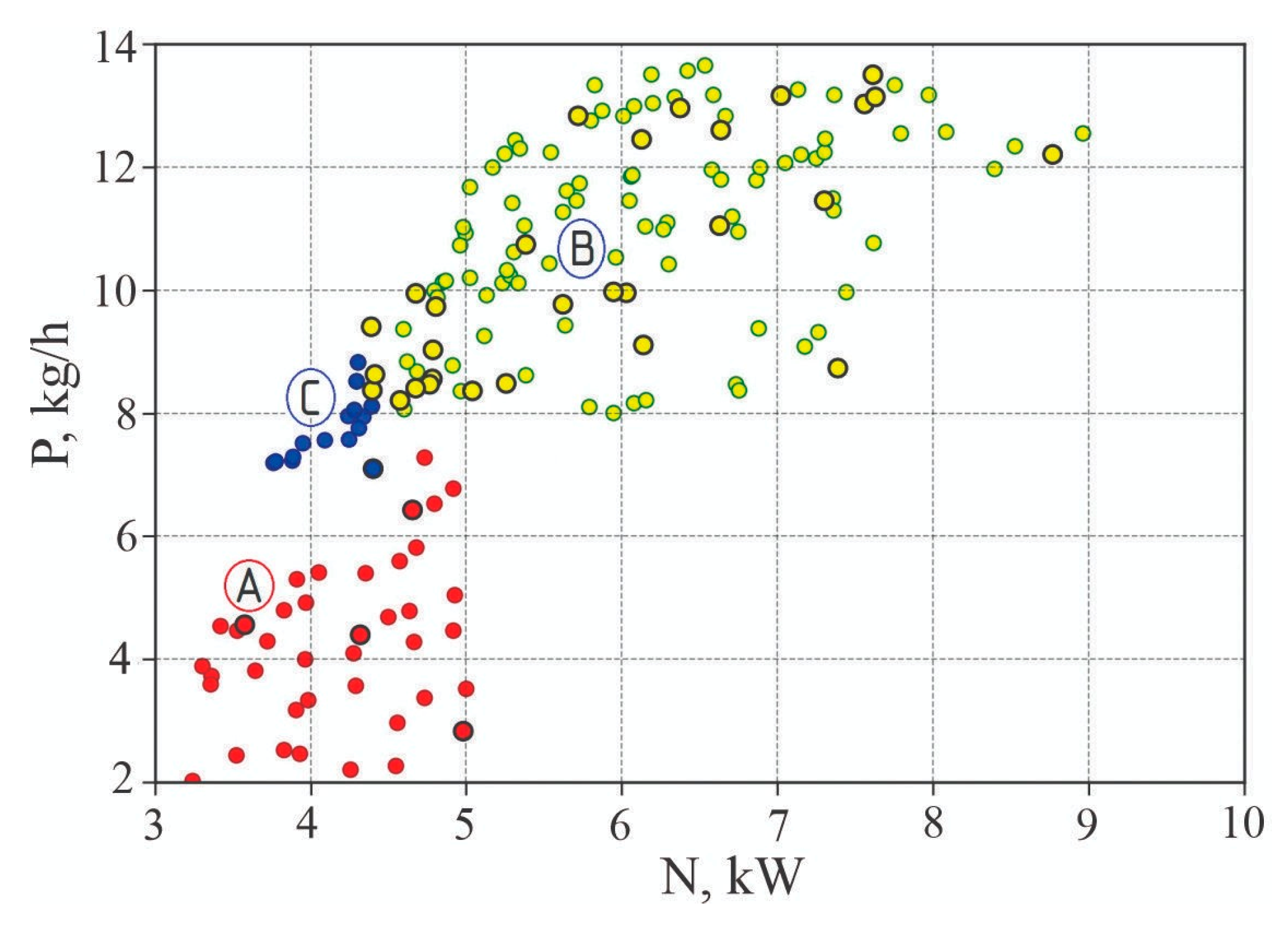
- The zones are distributed in a regular manner:
- red points (zone A) are grouped in the region of low R−71 (12–20%), but relatively low throughput (3–8 kg/h) and moderate power (4–6 kW);
- yellow points (zone B) are located in the region of high throughput (8–12 kg/h) with poorer quality (R−71 ≈ 20–28%) and increased power consumption (6–8 kW);
- blue points (zone C) (6.8%) exhibit the lowest power consumption (3–5 kW), while demonstrating moderate quality and throughput.
- Stable points (outlined in black) are particularly important for practical implementation, as they vary little under small parameter deviations.
- The largest number of solutions is concentrated in zone B (43.5%), which reflects the industrial priority of throughput.
- Zone C contains the smallest number of solutions (6.8%), indicating the difficulty of simultaneously achieving high energy efficiency and quality requirements.
- Zone A contains 16.0% of the solutions, which is sufficient to ensure operating regimes for premium-quality production.
4.4. Determination of a Compromise Solution Using the Weighted Sum Method (Weighted Sum Method)
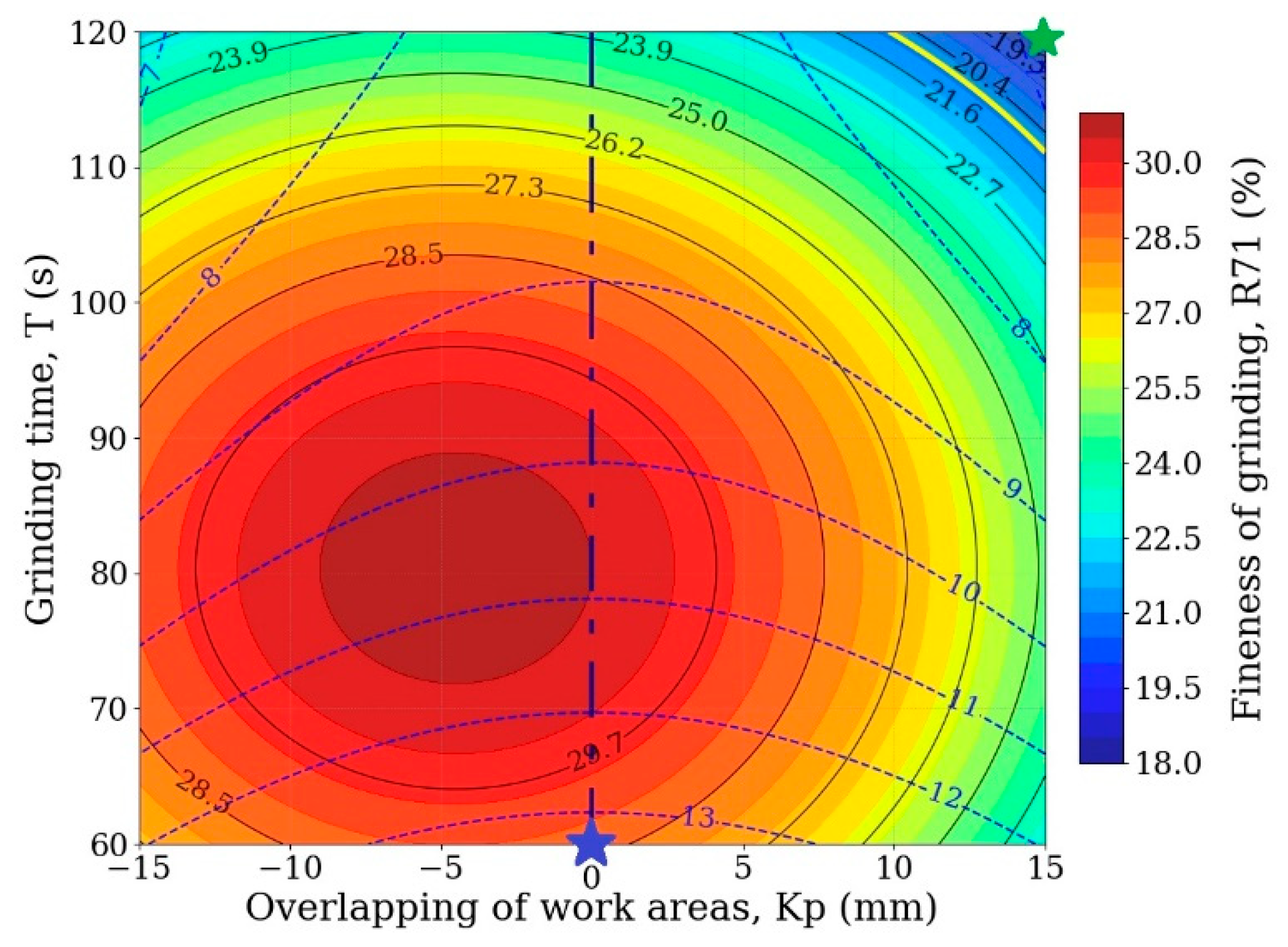
- the relationship between two key factors: working zone overlap and grinding time;
- the parameter region ensuring a balance between high throughput and acceptable grinding fineness (R71 ≤ 25%);
- the permissible ranges of parameter variation while maintaining the required efficiency and quality.
- working zone overlap: ≈−15 mm;
- grinding time: ≈120 s;
- grinding fineness: ≈18% R−71 (minimum achievable);
- throughput: ≈7 kg/h.
- working zone overlap: 0 mm;
- grinding time: ≈60 s;
- throughput: ≈14.3 kg/h (maximum achievable);
- grinding fineness: ≈29% R71 (coarse grinding).
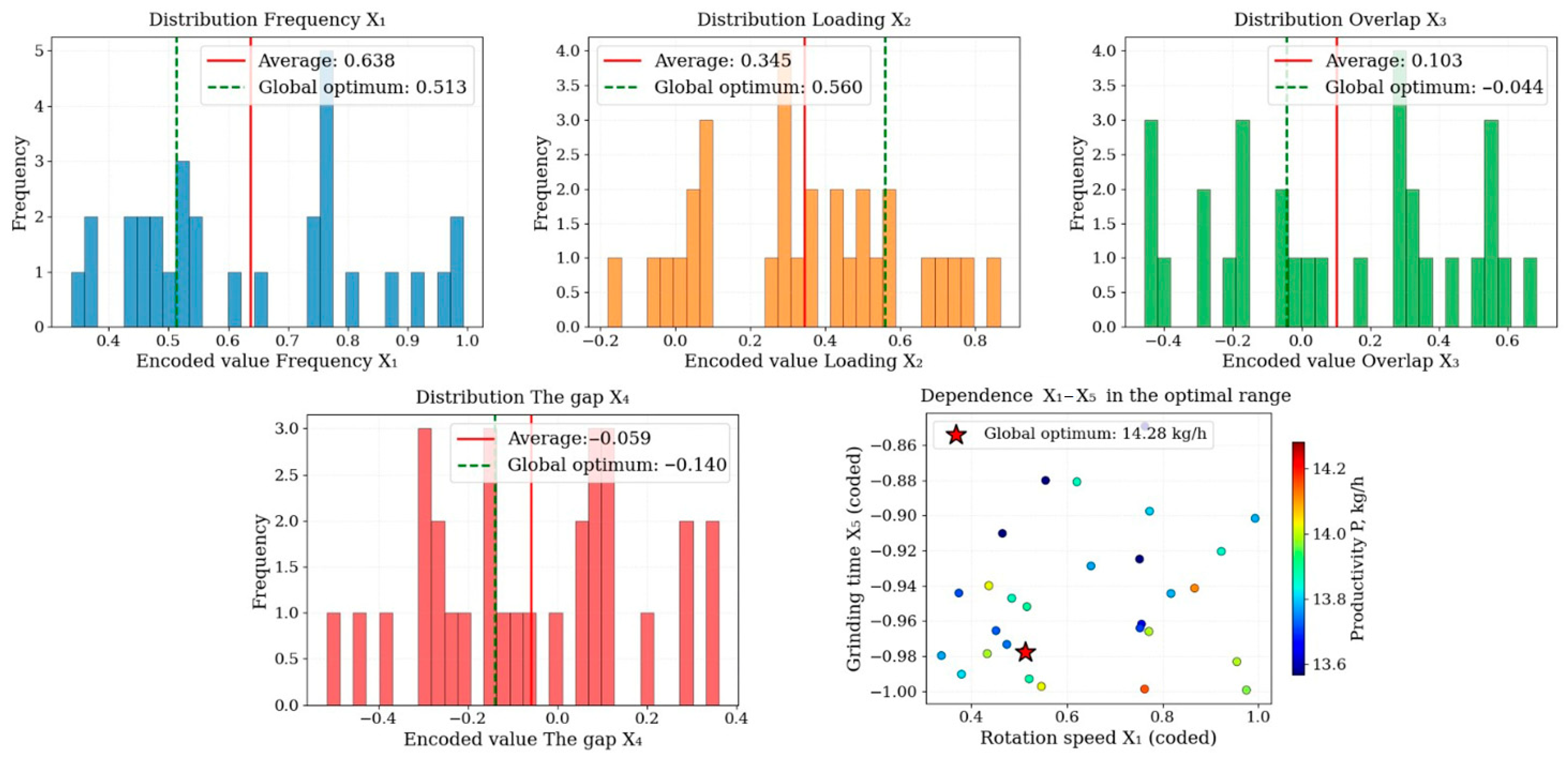
4.5. Visualization of the Optimal Solution in the Factor Space
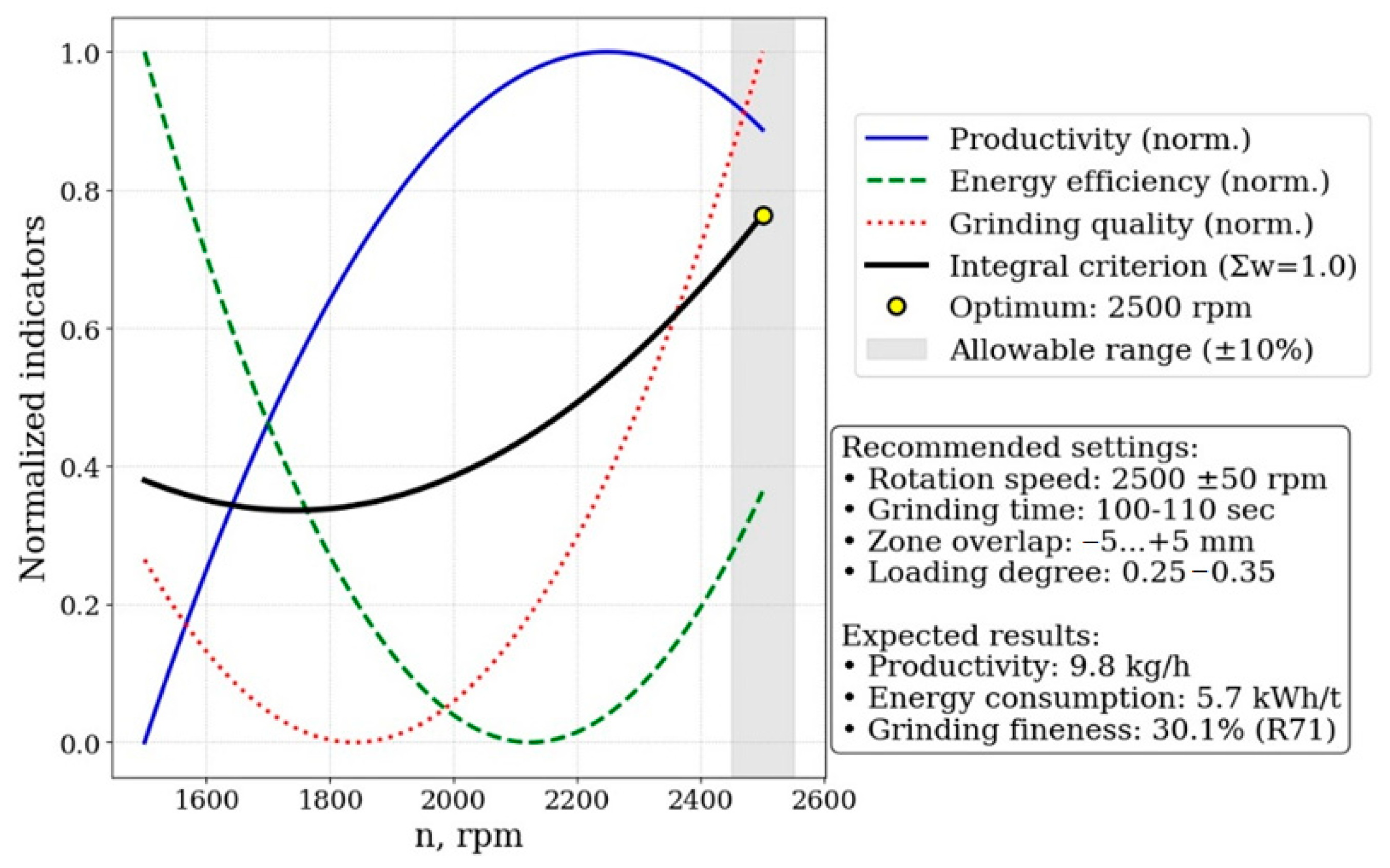
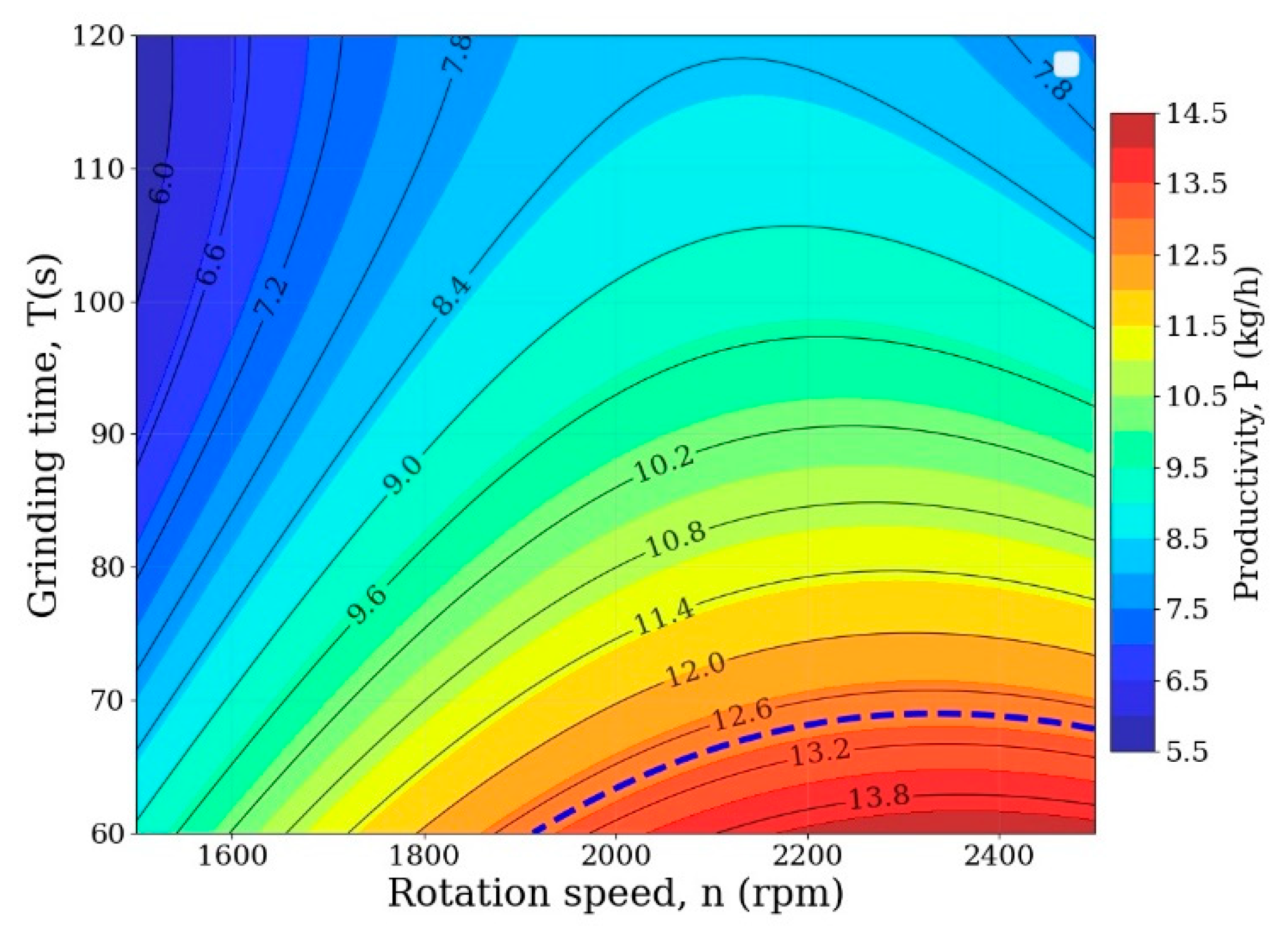
- optimal rotational speed: 2500 rpm (X1 = +1 in coded units);
- permissible operating range: ±50 rpm (gray zone), within which the decrease in the integral criterion does not exceed 10%.
- throughput increases by 15–20% compared with empirical settings;
- specific energy consumption decreases by 8–12%.
4.6. Verification and Robustness Analysis of the Solution
4.7. Industrial Implications and Sustainability Impact
5. Conclusions
- Methodological contribution: A systematic approach combining Hartley experimental design, second-order response surface modeling, and multi-objective optimization (NSGA-II + weighted sum method) was established specifically for spring-rotor mills. This methodology quantitatively captures the complex nonlinear interactions between five key parameters (rotational speed, filling ratio, rotor overlap, chamber clearance, and grinding time) and five performance indicators (grinding fineness, throughput, power consumption, specific energy consumption, and specific metal intensity), providing a robust foundation for process analysis, control, and intensification.
- Scientific insight into process mechanisms: For the first time, the relative influence and interaction effects of all key factors were quantified and visualized through adequate regression models (R2 > 0.93 for all responses, p < 0.001) and Pareto charts. Grinding time (X5) and rotational speed (X1) were identified as the dominant factors, with their linear effects exceeding those of other parameters by a factor of 3–5. Significant quadratic effects for speed (X12), filling ratio (X22), and clearance (X42) confirmed the existence of well-defined optima within the experimental domain, explaining the nonlinear nature of the throughput response. The negative interaction between speed and time (X1X5 = −0.84) revealed that simultaneous operation at maximum values is counterproductive—a finding with direct practical implications for process tuning. Positive interactions involving clearance (X1X4 and X4X5) demonstrated the potential for compensating negative effects through careful adjustment of geometric parameters.
- Decision-making tool for engineers: The construction of a three-dimensional Pareto-optimal front using the NSGA-II algorithm (Figure 10 and Figure 11) objectively delineated three distinct operational zones:
- -
- Zone A (“Quality”): 16.0% of solutions, characterized by high fineness (R−71 = 12–18%) at moderate throughput (8–10 kg/h) and power consumption (5–7 kW), suitable for premium product manufacturing.
- -
- Zone B (“Throughput”): 43.5% of solutions, dominated by high throughput (13–15 kg/h) with coarser product (R−71 = 28–32%) and increased power demand (6–8 kW), reflecting industrial priorities for maximum output.
- -
- Zone C (“Energy Efficiency”): 6.8% of solutions, achieving the lowest power consumption (3–5 kW) with moderate quality (R−71 = 20–25%) and throughput (10–12 kg/h), highlighting the challenge of simultaneously meeting stringent quality and energy-saving targets.
- 4.
- Experimentally verified optimal regime: Using the weighted sum method with expert-defined priorities (ω1 = 0.30 for fineness, ω2 = 0.25 for throughput, ω3 = 0.20 for power, ω4 = 0.15 for specific energy consumption, ω5 = 0.10 for metal intensity), a single compromise optimal regime (X*) was identified:
- -
- optimal parameters: n* = 2500 rpm, T* = 105 s, kₘ* = 0.30, kᵣ* ≈ 0 mm, kzaz* ≈ 6.1 mm;
- -
- predicted performance: R−71* ≈ 30.1%, P* ≈ 9.8 kg/h, Eud* ≈ 5.7 kWh/t, N* ≈ 4.8 kW.
- 5.
- Industrial and sustainability impact: Implementation of the optimized compromise regime yields substantial improvements over traditional empirical settings:
- -
- A 15–20% increase in throughput;
- -
- A 8–12% reduction in specific energy consumption;
- -
- Estimated 10% decrease in production cost of mineral powder.
Author Contributions
Funding
Data Availability Statement
Conflicts of Interest
References
- Sivachenko, L.A.; Dobrovolskiy, Y.K. Istoriya razvitiya i sovremennyy uroven’ tekhniki izmel’cheniya [History of development and the current state of grinding technology]. Vestn. Belorussko-Rossiiskogo Univ. 2012, 4, 69–76. [Google Scholar]
- Bond, F.C. The third theory of comminution. In Proceedings of the Annual Meeting of the AIME, New York, NY, USA, 18–21 February 1952; p. 33. [Google Scholar]
- Bond, F.C. Laboratory equipment and tests help predict metal consumption in crushing and grinding units. Eng. Min. J. 1964, 165, 169–176. [Google Scholar]
- Sivachenko, L.A.; Kurguzikov, A.M.; Moiseenko, V.V.; Bochkov, S.L.; Golban, E.G. Apparatus for Grinding. U.S. Patent 4,899,941, 13 February 1990. [Google Scholar]
- Sorokin, F.D.; Zhou, S. Konechnyy element v vide vitka dlya rascheta chastot i form sobstvennykh kolebaniy pruzhin s uchetom sdviga i inertsii vrashcheniya [A finite element in the form of a coil turn for calculating natural frequencies and mode shapes of springs accounting for shear and rotary inertia]. Izv. Vyssh. Uchebn. Zaved. Mashinostr. 2018, 1, 3–11. [Google Scholar] [CrossRef]
- Lee, J. Free vibration analysis of cylindrical helical springs by the pseudospectral method. J. Sound Vib. 2007, 302, 185–196. [Google Scholar] [CrossRef]
- Yildirim, V. On the linearized disturbance dynamic equations for buckling and free vibration of cylindrical helical coil springs under combined compression and torsion. Meccanica 2012, 47, 1015–1033. [Google Scholar] [CrossRef]
- Yu, A.M.; Hao, Y. Improved Riccati transfer matrix method for free vibration of non-cylindrical helical springs including warping. Shock Vib. 2012, 19, 1167–1180. [Google Scholar] [CrossRef]
- Yu, A.M.; Hao, Y. Effect of warping on natural frequencies of symmetrical cross-ply laminated composite non-cylindrical helical springs. Int. J. Mech. Sci. 2013, 74, 65–72. [Google Scholar] [CrossRef]
- Ganbat, D.; Gavryushin, S.S. Issledovanie staticheskikh i dinamicheskikh kharakteristik vintovykh pruzhinnykh mel’nits [Investigation of static and dynamic characteristics of helical spring mills]. Izv. Vyssh. Uchebn. Zaved. Mashinostr. 2007, 8, 10–16. [Google Scholar]
- Sevostyanov, V.S.; Sivachenko, T.L.; Sevostyanov, M.V.; Goryagin, P.Y.; Babukov, V.A. Nauchno-prakticheskie osnovy sozdaniya iglofrezernykh izmel’chitelei mnogotselevogo naznacheniya [Scientific and practical foundations for the development of needle-milling grinders for multipurpose applications]. Vestn. BGTU im. V.G. Shukhova 2018, 3, 107–116. [Google Scholar] [CrossRef]
- Ivannikov, V.V.; Sorokin, F.D.; Zhou, S. Chislennoe issledovanie dinamiki vrashchayushcheisya izognutoi pruzhiny s ispol’zovaniem konechnogo elementa v forme odnogo vitka [Numerical study of the dynamics of a rotating curved spring using a finite element in the form of a single coil]. Izv. Vyssh. Uchebn. Zaved. Mashinostr. 2018, 2, 11–21. [Google Scholar] [CrossRef]
- Badikov, R.N.; Sorokin, F.D. Sravnenie eksperimental’nogo i raschetnogo znachenii velichiny kriticheskogo krutyashchego momenta izognutoi v poluokruzhnost’ tsilindricheskoi pruzhiny [Comparison of experimental and calculated values of the critical torque of a cylindrical spring bent into a semicircle]. Izv. Vyssh. Uchebn. Zaved. Mashinostr. 2008, 1, 11–14. [Google Scholar]
- Doudkin, M.; Kim, A.; Sakimov, M. Mathematical and experimental study of deformations of a steel roll of a road roller with a variable geometry of a contact surface. Prod. Eng. Arch. 2019, 25, 1–7. [Google Scholar] [CrossRef]
- Doudkin, M.; Kim, A.; Moldakhanov, B. Determination of forces in the working unit of the milling-rotary snow cleaner. Int. Rev. Mech. Eng. 2021, 15, 96–105. [Google Scholar] [CrossRef]
- Doudkin, M.; Kim, A.; Młyńczak, M.; Kustarev, G.; Kim, V. Development and parameter justification of vibroscreen feed elements. In Mining Machines and Earth-Moving Equipment: Problems of Design, Research and Maintenance; Springer International Publishing: Cham, Switzerland, 2019; pp. 203–226. [Google Scholar] [CrossRef]
- Kombayev, K.; Kim, A.; Yelemanov, D.; Sypainova, G. Strengthening of low-carbon alloy steel by electrolytic-plasma hardening. Int. Rev. Mech. Eng. 2022, 16, 84–91. [Google Scholar] [CrossRef]
- Kim, A.; Guryanov, G.; Vavilov, A.; Bugayev, A.; Doudkina, Y. Development of mounted impact-rotor working equipment for destruction of snow–ice formations. Int. Rev. Mech. Eng. 2021, 15, 258–267. [Google Scholar] [CrossRef]
- Surashov, N.T.; Asmatulaev, R.B.; Tolymbek, D.N. Determination of optimal design parameters of a bulldozer blade. SibADI Bull. 2022, 19, 500–513. [Google Scholar]
- Surashov, N.T.; Asmatulaev, R.B.; Tolymbek, D.N. Determination of the rational shape of a bulldozer blade taking into account the soil background of the Republic of Kazakhstan. SibADI Bull. 2021, 18, 662–677. [Google Scholar]
- Aluko, O.B.; Seig, D.A. An experimental investigation of the characteristics of and conditions for brittle fracture in two-dimensional soil cutting. Soil Tillage Res. 2000, 57, 143–157. [Google Scholar] [CrossRef]
- Hu, M.; Gao, T.; Dong, X.; Tan, Q.; Yi, C.; Wu, F.; Bao, A. Simulation of soil–tool interaction using smoothed particle hydrodynamics (SPH). Soil Tillage Res. 2023, 229, 105671. [Google Scholar] [CrossRef]
- Haeria, A.; Tremblay, D.; Skonieczny, K.; Holz, D.; Teichmann, M. Efficient numerical methods for accurate modeling of soil cutting operations. In Proceedings of the 37th International Symposium on Automation and Robotics in Construction (ISARC 2020), Online, 27–29 October 2020; pp. 608–615. [Google Scholar] [CrossRef]
- Coetzee, C.J. Discrete and continuum modelling of soil cutting. Comput. Part. Mech. 2014, 1, 409–423. [Google Scholar] [CrossRef][Green Version]
- Guo, Z.; Zhang, S.; Ni, L. A comprehensive study on the mechanical properties of bulldozing plate soil engaging surface based on the entropy-weighted grey relational analysis method. IEEE Access 2023, 11, 78000–78016. [Google Scholar] [CrossRef]
- GOST 8267–93; Crushed Stone and Gravel from Dense Rocks for Construction Works. Specifications. Standardinform: Moscow, Russia, 1993. (In Russian)
- Trivan, J.; Kostić, S. Evaluation of excavator energy consumption and overburden cutting resistance using multiple linear regression. J. Min. Metall. Sect. A Min. 2022, 58, 39–47. [Google Scholar] [CrossRef]
- Qiang, H.; Li, H.; Kang, S.; Liu, K.; Yang, J.; Wang, L. Research into energy-saving control strategies of a bulldozer driven by a torque converter based on the minimum fuel consumption rate of the whole machine. Sustainability 2024, 16, 10111. [Google Scholar] [CrossRef]
- Klanfar, M.; Kujundžić, T.; Vrkljan, D. Calculation analysis of bulldozer’s productivity in gravitational transport on open pits. Teh. Vjesn. 2014, 21, 517–523. [Google Scholar]
- Li, R.; Wang, Z.; Yan, J. Multi-Objective Optimization of the Process Parameters of a Grinding Robot Using LSTM-MLP-NSGAII. Machines 2023, 11, 882. [Google Scholar] [CrossRef]
- Kumar, A.; Sahu, R.; Tripathy, S.K. Energy-Efficient Advanced Ultrafine Grinding of Particles Using Stirred Mills—A Review. Energies 2023, 16, 5277. [Google Scholar] [CrossRef]
- Wang, X.; Liu, L.; Duan, L.; Liao, Q. Multi-Objective Optimization for an Industrial Grinding and Classification Process Based on PBM and RSM. IEEE/CAA J. Autom. Sin. 2023, 10, 2124–2135. [Google Scholar] [CrossRef]
- Marijnissen, M.J.; Graczykowski, C.; Rojek, J. Simulation of the comminution process in a high-speed rotor mill based on the feed’s macroscopic material data. Miner. Eng. 2021, 163, 106746. [Google Scholar] [CrossRef]








| Parameter | Limestone | Marble Chips |
|---|---|---|
| Particle size fraction, mm | 5–7 | 5–7 |
| Uniaxial compressive strength σc, MPa | 80 | 110 |
| Young’s modulus E, MPa | 35 × 103 | 55 × 103 |
| Bulk density ρ, t/m3 | 2.4 | 2.6 |
| Hardness (Mohs scale) | 3 | 3–4 |
| Brittleness | High | Medium |
| No. | Investigated Factors | Designations | Levels of Variation | Variation Interval | ||
|---|---|---|---|---|---|---|
| −1 | 0 | +1 | ||||
| 1 | Rotational speed of the working elements, n | 1500 | 2000 | 2500 | 500 | |
| 2 | Material filling ratio, | 0.1 | 0.3 | 0.5 | 0.2 | |
| 3 | Overlap of the working zones of the driving and driven rotors, , mm | −15 | 0 | +15 | 15 | |
| 4 | Clearance between the moving and stationary parts of the grinding chamber, mm | 2 | 7 | 12 | 5 | |
| 5 | Grinding duration, T, s | 60 | 90 | 120 | 30 | |
| No. | Experimental Results | ||||||||||
|---|---|---|---|---|---|---|---|---|---|---|---|
| , % | , kW | P, kg/h | |||||||||
| 1 | 1 | 1 | 1 | 1 | 1 | 1 | 12.0 | 7.3 | 9.3 | 7.9 | 0.63 |
| 2 | 1 | −1 | −1 | 1 | 1 | 1 | 14.2 | 1.7 | 5.3 | 3.2 | 1.56 |
| 3 | 1 | −1 | 1 | −1 | −1 | −1 | 38.0 | 2.1 | 2.1 | 10.0 | 0.5 |
| 4 | 1 | 1 | −1 | −1 | −1 | −1 | 28.0 | 4.5 | 2.9 | 15.0 | 0.3 |
| 5 | 1 | −1 | 1 | −1 | 1 | 1 | 26.3 | 2.0 | 5.3 | 3.8 | 1.32 |
| 6 | 1 | 1 | −1 | −1 | 1 | 1 | 16.8 | 3.3 | 6.1 | 5.4 | 0.9 |
| 7 | 1 | 1 | 1 | 1 | −1 | −1 | 24.2 | 14.2 | 6.2 | 23.3 | 0.2 |
| 8 | 1 | −1 | −1 | 1 | −1 | −1 | 26.2 | 1.7 | 2.1 | 8.2 | 0.6 |
| 9 | 1 | −1 | 1 | 1 | 1 | −1 | 28.1 | 5.1 | 4.3 | 11.9 | 0.42 |
| 10 | 1 | 1 | −1 | 1 | 1 | −1 | 18.0 | 9.1 | 5.1 | 6.8 | 0.27 |
| 11 | 1 | 1 | 1 | −1 | −1 | 1 | 22.0 | 4.8 | 7.1 | 2.1 | 0.7 |
| 12 | 1 | −1 | −1 | −1 | −1 | 1 | 24.3 | 1.0 | 3.1 | 2.1 | 2.4 |
| 13 | 1 | −1 | 1 | 1 | −1 | 1 | 20.0 | 2.2 | 6.3 | 3.4 | 1.41 |
| 14 | 1 | 1 | −1 | 1 | −1 | 1 | 10.4 | 4.1 | 7.3 | 5.5 | 0.9 |
| 15 | 1 | 1 | 1 | −1 | 1 | −1 | 30.1 | 11.1 | 5.1 | 21.8 | 0.23 |
| 16 | 1 | −1 | −1 | −1 | −1 | −1 | 32.0 | 0.8 | 1.1 | 7.8 | 0.64 |
| 17 | 1 | 0 | 0 | 0 | 0 | 0 | 29.0 | 3.7 | 5.0 | 7.4 | 0.67 |
| 18 | 1 | 0 | 0 | 0 | 0 | 0 | 20.1 | 5.9 | 5.2 | 9.8 | 0.51 |
| 19 | 1 | 1 | 0 | 0 | 0 | 0 | 26.0 | 1.7 | 3.7 | 4.8 | 1.04 |
| 20 | 1 | −1 | 0 | 0 | 0 | 0 | 25.1 | 4.9 | 5.8 | 8.5 | 0.58 |
| 21 | 1 | 0 | 1 | 0 | 0 | 0 | 21.9 | 2.6 | 4.2 | 6.3 | 0.79 |
| 22 | 1 | 0 | −1 | 0 | 0 | 0 | 19.8 | 4.5 | 5.8 | 7.0 | 0.63 |
| 23 | 1 | 0 | 0 | 1 | 0 | 0 | 27.3 | 2.9 | 4.3 | 7.0 | 0.71 |
| 24 | 1 | 0 | 0 | −1 | 1 | 0 | 22.5 | 4.0 | 5.3 | 7.6 | 0.65 |
| 25 | 1 | 0 | 0 | 0 | −1 | 0 | 24.9 | 3.4 | 3.7 | 7.4 | 0.67 |
| 26 | 1 | 0 | 0 | 0 | 0 | 1 | 18.0 | 3.1 | 6.3 | 4.9 | 1.01 |
| 27 | 1 | 0 | 0 | 0 | 0 | −1 | 28.3 | 5.4 | 3.7 | 14.8 | 0.33 |
| Model | Coefficient of Determination R2 | Adjusted R2 | Standard Error | F-Test | p-Value |
|---|---|---|---|---|---|
| 0.954 | 0.942 | 0.87 | 79.3 | <0.001 | |
| P | 0.962 | 0.951 | 0.42 | 88.7 | <0.001 |
| N | 0.947 | 0.933 | 0.38 | 72.5 | <0.001 |
| 0.938 | 0.921 | 0.35 | 65.8 | <0.001 | |
| 0.931 | 0.912 | 0.09 | 59.4 | <0.001 |
| Goal of Optimization | Rotational Speed, n, rpm | Grinding Time, T, s | Expected Performance Indicators |
|---|---|---|---|
| Fine grinding (zone A) | 2250 | 120 | R71: 12–18%, P: 8–10 kg/h, N: 5–7 kW |
| High throughput (zone B) | 2500 | 60 | R71: 28–32%, P: 13–15 kg/h, N: 6–8 kW |
| Energy efficiency (zone C) | 2000 | 75 | R71: 20–25%, P: 10–12 kg/h, N: 3–5 kW |
| Run | R−71, % | P, kg/h | N, kW | Eud, kWh/t | Mud, t·h/t |
|---|---|---|---|---|---|
| Predicted | 30.1 | 9.8 | 4.8 | 5.7 | 0.67 |
| 1 | 31.2 | 9.4 | 5.0 | 6.0 | 0.71 |
| 2 | 29.0 | 10.2 | 4.6 | 5.4 | 0.63 |
| 3 | 30.8 | 9.5 | 5.1 | 6.1 | 0.72 |
| 4 | 28.5 | 10.3 | 4.5 | 5.3 | 0.62 |
| 5 | 31.5 | 9.3 | 5.2 | 6.2 | 0.73 |
| Average | 30.2 | 9.7 | 4.9 | 5.8 | 0.68 |
| Deviation | +4.7% | −5.1% | +8.3% | +8.8% | +9.0% |
Disclaimer/Publisher’s Note: The statements, opinions and data contained in all publications are solely those of the individual author(s) and contributor(s) and not of MDPI and/or the editor(s). MDPI and/or the editor(s) disclaim responsibility for any injury to people or property resulting from any ideas, methods, instructions or products referred to in the content. |
© 2026 by the authors. Licensee MDPI, Basel, Switzerland. This article is an open access article distributed under the terms and conditions of the Creative Commons Attribution (CC BY) license.
Share and Cite
Baigunusov, A.; Moldakhanov, B.; Kim, A.; Doudkin, M.; Yakovlev, V.; Stryczek, P.; Lesniewski, T. Multi-Objective Optimization of the Grinding Process in a Spring-Rotor Mill Using Regression-Based Modeling. Machines 2026, 14, 356. https://doi.org/10.3390/machines14030356
Baigunusov A, Moldakhanov B, Kim A, Doudkin M, Yakovlev V, Stryczek P, Lesniewski T. Multi-Objective Optimization of the Grinding Process in a Spring-Rotor Mill Using Regression-Based Modeling. Machines. 2026; 14(3):356. https://doi.org/10.3390/machines14030356
Chicago/Turabian StyleBaigunusov, Aidos, Bekbolat Moldakhanov, Alina Kim, Mikhail Doudkin, Vladimir Yakovlev, Piotr Stryczek, and Tadeusz Lesniewski. 2026. "Multi-Objective Optimization of the Grinding Process in a Spring-Rotor Mill Using Regression-Based Modeling" Machines 14, no. 3: 356. https://doi.org/10.3390/machines14030356
APA StyleBaigunusov, A., Moldakhanov, B., Kim, A., Doudkin, M., Yakovlev, V., Stryczek, P., & Lesniewski, T. (2026). Multi-Objective Optimization of the Grinding Process in a Spring-Rotor Mill Using Regression-Based Modeling. Machines, 14(3), 356. https://doi.org/10.3390/machines14030356