Article

Path Tracking Control for Differential Steering Autonomous Vehicles with Active Body Inward Tilt


College of Automobile and Traffic Engineering, Nanjing Forestry University, Nanjing 210037, China
*
Author to whom correspondence should be addressed.
Machines 2026, 14(3), 357; https://doi.org/10.3390/machines14030357

Submission received: 11 February 2026 / Revised: 16 March 2026 / Accepted: 20 March 2026 / Published: 23 March 2026
(This article belongs to the Special Issue Control Engineering and Artificial Intelligence)

Abstract

Considering the problems that the inner wheel load decreases due to centrifugal force during the steering of differential steering autonomous vehicles, which may result in differential steering failure or even vehicle rollover in severe cases, a path-tracking strategy for differential steering autonomous vehicles considering active body inward tilt is proposed. Aiming at the problems of fixed parameters and insufficient adaptability of model predictive control in the path-tracking process of autonomous vehicles, this paper proposes a collaborative adaptive model predictive controller (MPC) with preview time and weight matrix based on fuzzy inference as the upper control, so as to realize the tracking control of the reference path by conventionally steered autonomous vehicles. In the lower control, an H/H2 hybrid controller with particle swarm optimization (PSO)-based parameter self-tuning is employed to control the differential steering autonomous vehicle (DSAV) to track the reference model, achieving differential steering and active body inward tilt simultaneously. Co-simulation results of CarSim and Simulink show that the proposed method outperforms the fixed-preview-time MPC and the manually tuned H/H2 hybrid controller. Compared with the latter, the maximum absolute values of lateral deviation and yaw angle deviation are reduced by 17.9% and 14.5%, respectively; the maximum deviation in the reference yaw rate is decreased by 21.2%; the maximum absolute value of the inward tilt angle is reduced by 53.4%; and the maximum values of LTR and occupant-perceived lateral acceleration are lowered by 57.1% and 44.2%, respectively.

1. Introduction

The rapid development of autonomous driving and electric vehicle (EV) technologies highlights the key role of improving path-tracking safety, stability and accuracy under harsh driving conditions [1,2,3]. With unique advantages, electric vehicles have drawn extensive research attention, including energy management [4,5], path planning and tracking [6,7,8,9] and so on. The control of advanced vehicle dynamics is especially important in the case of EVs that have an independent wheel drive system since they have more freedom to control than conventional vehicles and at the same time introduce a higher level of complexity in the system [10,11,12]. Autonomous motion control of autonomous vehicles can be achieved through the independent control of wheel torque control, which allows differential steering and direct yaw moment generation without the need to depend on mechanical steering linkages, offering new paradigms [13,14,15].
Path tracking is one of the main functions of autonomous vehicles and has been widely studied with different control methods. The model-based autonomous vehicle control was preempted by early predictive steering control techniques [16]. In order to deal with modeling ambiguity and the actuator failures, robust and adaptive methods, such as sliding-mode-based path tracking and fault tolerant steering control, were later introduced [17,18]. In recent past, model predictive control (MPC) became one of the most successful path-tracking controllers because it can explicitly address system constraints and multi-objective optimization problems [19,20]. The MPC-based approach has also been improved through the addition of previewing information about road curvature and friction [21], delay adaptive compensation processes that are realized in practice [22], and learning-based features to enhance flexibility in high-level and uncertain driving conditions [23].
Nevertheless, even with these innovations, the differential steering cars in high-speed cornering or emergency situations are still susceptible to the excessive transfer of the lateral load caused by centrifugal forces that can lead to the inner-wheel lifting off or even rolling over in the worst-case scenario [24]. Therefore, more and more attention has been focused on lateral stability and rollover prevention research. Yaw stabilization through differential steering based on robust and sliding mode control methods has been demonstrated to be a capable method to stabilize the yaw and enhance the path-following behavior of independently driven EVs [25,26]. H control techniques have also been developed to control yaw stability and ensure that performance limits are guaranteed in the worst case disturbances, improving stability in vehicles along handling limits [27]. These strategies, however, are mainly concerned about the regulation of the yaw rate and sideslip and do not explicitly take into consideration the dynamics of the vehicle roll and the behavior of vertical load transfer.
Besides that, predictive traction control and anti-jerk strategies are also suggested to enhance longitudinal–lateral coordination and ride comfort in connected and automated EVs by predicting the future driving conditions and controlling the rate of torque variation [28]. Although such techniques can help minimize sudden changes in loads and make the whole process more stable, the effectiveness of these techniques in preventing rollovers is not direct because the behavior of the vehicle body roll and the redistribution of wheels loads are not directly controlled. Robust control methods triggered by event which take into account the stability of the roll have also been examined in order to overcome communication constraints, actuator constraints and external disturbances [29]. Although these strategies do impose lesser computational and communication overheads and can be maintained in their current performance, rollover mitigation is executed mostly through adherence to yaw or braking interventions, without direct management of the body roll movement.
The active suspension system (ASS) is a more direct and effective control of the roll dynamics of the vehicle and rollover risk prevention. Interestingly, Zhang et al. [30] had proven the ability to avoid obstacles and provided better stability to personal mobility vehicles with active inward tilting said mechanisms, noting that controlled body lean is an effective way to counter centrifugal forces and cornering. The fact that active inward body lean can theoretically replace lateral acceleration, as well as enhance ride comfort and vehicle stability in turning curves, has been further validated by classical methods of tilt control that have its roots in the high-speed railway systems [31]. Based on such ideas, active tilt and suspension control strategies have been proposed on the MPC approach in road vehicles, where the dynamic of roll, constraints in suspension actuators, and multi-objective performance indices are explicitly integrated in order to inhibit the dynamic of the vehicle lateral load transfer, minimize roll angle, and enhance the handling stability during the cornering process [32]. In addition, recent work on tilting vehicles and gyro-assisted vehicles has indicated that body lean can be effectively coordinated to dramatically improve cornering stability and decrease rollover tendency when performing aggressive tasks by reallocating both lateral and gravitational forces [33]. Nevertheless, the currently available methods are typically either aimed at conventionally steered cars or are based on a specialized mechanical tilting act, and the active combination of inward tilting caused by active suspension with the active control of the torque-based differential steering in one unified system of autonomous electric vehicles is not explored much.
As a means to deal with the informal complexity of multi-objective vehicle control problems, hierarchical control architectures have grown in popularity as a part of autonomous driving systems. Hierarchy MPC systems have been suggested to accomplish collision avoidance and path tracking, preserving lateral stability in extreme driving conditions [34,35], and model hierarchy predictive control has shown better computational efficiency and robustness to other complex dynamical systems [36]. More recent investigations have also made improvements to hierarchical path-tracking performance by explicitly modeling the effect of steering delay, energy consumption, and actuator constraints [37,38]. In addition, MPC-based trajectory tracking methods that use Extended Kalman Filter (EKF) methods have been created to increase the quality of state estimation in case of sensor noises and modeling uncertainty to achieve a high level of control reliability in a real-world application [39].
Nevertheless, most of the currently used hierarchical control techniques focus mostly on the accuracy of trajectory tracking and lateral yaw stability, with rollover prevention being either ignored or given secondary consideration. As mentioned in [40], path tracking and rollover prevention are commonly considered as decoupled issues that are managed at various control layers or subsystems, thereby restricting the possibility of coordinated behavior during aggressive maneuvers. The few anti-rollover control systems that have been suggested in specialized vehicles, including heavy duty or off-road platforms, are usually based on braking- or suspension-based control, and do not take full advantage of the control flexibility provided by independently driven wheel systems [41]. Also, more recent hierarchical path-tracking approaches which include steering delay compensation and actuator dynamics continue to indirectly lower rollover risk, without directly controlling vehicle body roll or integrating a differential steering torque with active suspension forces [42]. Consequently, the performance of the differential steering can be reduced in the vicinity of the rollover limit because of the undue lowering of the inner wheels.
In summary, differential steering has been confirmed to be feasible. At present, the academic community has begun to focus on the problem of differential steering failure caused by the sharp reduction in the load on the inner driving wheels when the vehicle is on the verge of rollover, and attempts have been made to achieve trajectory tracking of autonomous ground vehicles via differential steering. Based on the above research status, this paper takes the differential steering autonomous vehicle (DSAV) as the research object and proposes the following innovations: (1) Drawing on the active inward tilting technology of rail trains and narrow commuter vehicles (NCVs), the control of the active suspension system (ASS) is introduced into the DSAV. Specifically, while differential steering is adopted to realize path tracking of the autonomous vehicle, ASS is used to control the active body inward tilt angle, which not only ensures the effectiveness of differential steering but also improves the handling stability of the autonomous vehicle. (2) A collaborative adaptive MPC method based on fuzzy inference for preview time and weight matrix is designed. The adaptive adjustment of preview time is realized via the analytical expression of preview time and fuzzy control. Meanwhile, the expression of the dynamic weight matrix is formulated, and both are incorporated into the MPC, which effectively improves the path-tracking accuracy and driving stability of the vehicle. (3) An H/H2 hybrid controller based on particle swarm optimization (PSO) parameter self-tuning is developed as the lower controller to accurately track the reference model, while balancing robustness, as well as tracking accuracy and actuator energy consumption, so as to ultimately guarantee the driving stability and inward tilting control of the differential steering autonomous vehicle.
The structure of this paper is organized as follows: Section 2 elaborates on three vehicle models, including the mathematical model of the TSAV, the dynamic model of the DSAV, and the reference model. Section 3 presents the overall control architecture and evaluation indicators. Section 4 designs the upper controller, namely the MPC and the preview time adaptive controller (PTAC), and the state observer, offering a stability analysis. Section 5 designs the lower controller, which is the H/H2 hybrid controller based on PSO parameter self-tuning, and gives its robustness analysis. Section 6 provides a simulation analysis based on CarSim and MATLAB/Simulink. Section 7 provides the conclusions of this paper.

2. Vehicle System Dynamics Model

2.1. Mathematical Model of TSAV

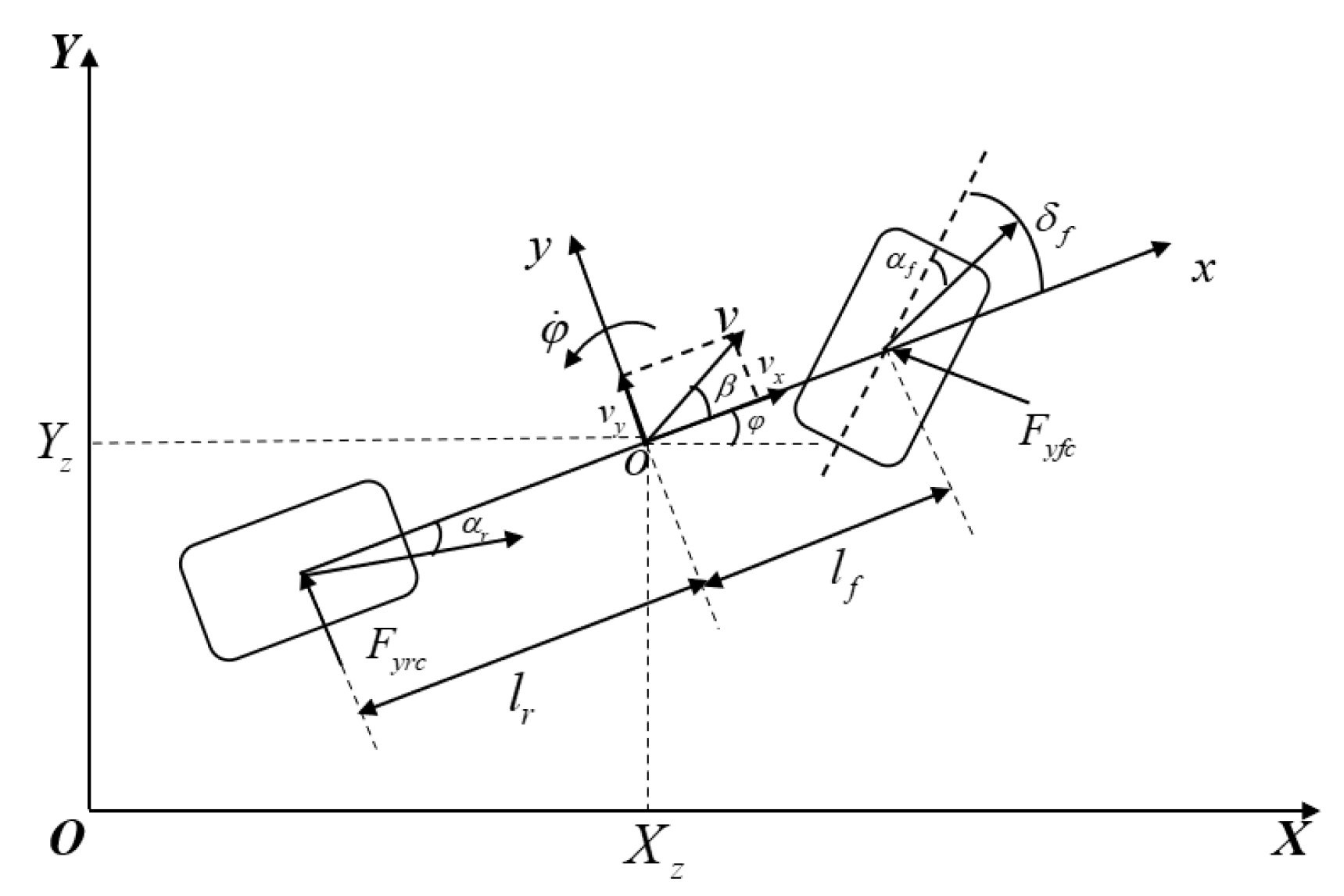
Here, the linear two-degree of freedom (2DOF) vehicle model (as shown in Figure 1) is used to describe a TSAV for the follow-up path-tracking control.
Analyze the force conditions of the linear 2DOF vehicle model shown in Figure 1 along the lateral and yaw motion directions, and the dynamic force equilibrium equations can be expressed as follows:
m ( v ˙ y + v x φ ˙ ) = 2 F y f c cos δ f + 2 F y r c I z φ ¨ = 2 l f F y f c cos δ f 2 l r F y r c ,
where m is the vehicle mass, I z is the vehicle yaw moment of inertia, v x and v y are the longitudinal and lateral velocities of the vehicle center of mass (CM), φ is the yaw angle of the vehicle CM, F y f c , F y r c are the front and rear wheel lateral forces, respectively, δ f is the front-wheel steering angle, and l f and l r are the distances from the vehicle CM to the front and rear axles.
When the front-wheel steering angle is small, an approximation can be considered, leading to cos δ f = 1 Then, Equation (1) can be simplified as follows:
m ( v ˙ y + v x φ ˙ ) = 2 F y f c + 2 F y r c I z φ ¨ = 2 l f F y f c 2 l r F y r c .
When the vehicle travels at a low lateral acceleration, the tire slip angle is typically small. Therefore, the lateral force acting on the tire and the slip angle can be analyzed based on a linear relationship, and the tire lateral force can be approximated as follows:
F y f c = k f α f F y r c = k r α r ,
where k f and k r are the equivalent cornering stiffness of the front and rear tires, respectively; α f and α r are the slip angles of the front and rear tires, respectively.
Under the small-angle assumption for α f and α r , the tire slip angles can be approximated as follows:
α f = v y + l f φ ˙ / v x δ f α r = v y l r φ ˙ / v x .
Substituting Equations (3) and (4) into Equation (2) and simplifying yields, we obtain the following:
v ˙ y = 2 k f + 2 k r m v x v y + 2 l f k f 2 l r k r m v x v x φ ˙ + 2 k f m δ f φ ¨ = 2 l f k f 2 l r k r I z v x v y + 2 l f 2 k f + 2 l r 2 k r I z v x φ ˙ + 2 l f k f I z δ f .
It can be seen from Figure 1 that the position of the vehicle CM is X z , Y z , and the velocity of the vehicle CM along the X-axis and Y-axis, i.e., X ˙ z and Y ˙ z , can be expressed as
Y ˙ z = v x sin φ + v y cos φ X ˙ z = v x cos φ v y sin φ ,
Taking the state variable ξ = [ v y , φ , φ ˙ , Y z , X z ] T and control variable u c = [ δ f ] from Equations (5) and (6), the time derivatives of the state variables can be expressed as follows under the small-angle assumption ( sin φ φ , cos φ 1 ):
ξ ˙ t = A c ξ t + B c u c t + E c ,
where A c = 2 k f + 2 k r m v x 0 2 l f k f 2 l r k r m v x v x 0 0 0 0 1 0 0 2 l f k f 2 l r k r I z v x 0 2 l f 2 k f + 2 l r 2 k r I z v x 0 0 1 v x 0 0 0 0 0 0 0 0 , B c = 2 k f m 0 2 l f k f I z 0 0 , E c = 0 0 0 0 v x .
In this work, v x is assumed to be constant during the control process. This assumption simplifies the system dynamics by rendering the continuous-time matrices A c , B c , and the constant vector E c as time-invariant.

2.2. Dynamics Model of DSAV

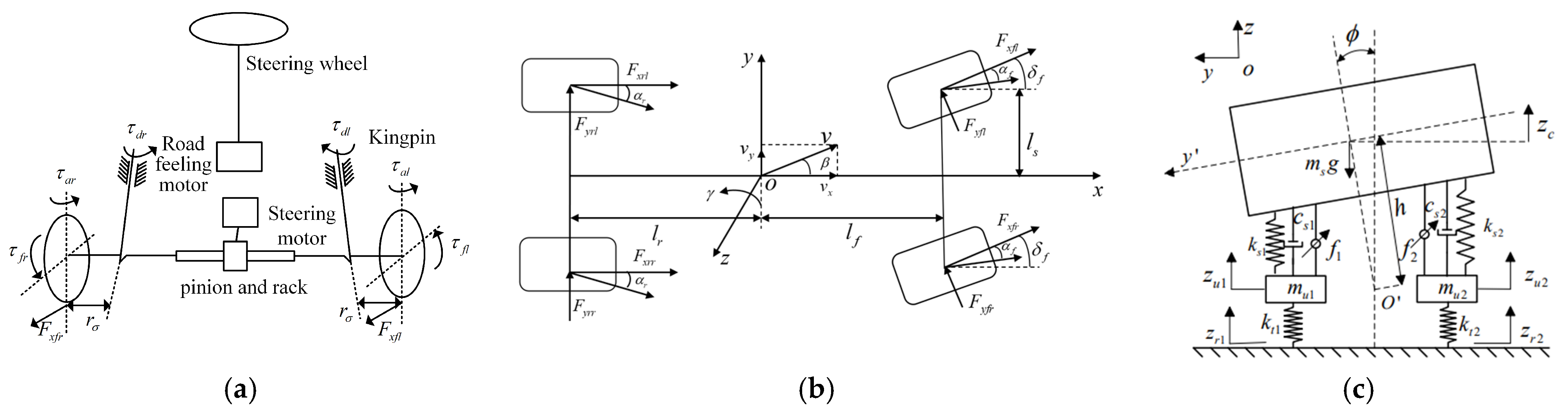
This paper focuses on a hub motor-driven autonomous vehicle equipped with a front-wheel differential steering system (FWDSS) and an active suspension system. Its dynamic model mainly consists of the FWDSS, as well as the planar, vertical and roll dynamic models of the DSAV, as shown in Figure 2.

2.2.1. Dynamic Model of FWDSS

It can be seen from Figure 2a that due to the existence of the steering trapezoid and the kingpin lateral offset, when the driving torque of the left front wheel is smaller than that of the right front wheel (i.e., τ d l < τ d r ), the steering system drives the wheels to turn left; when the driving torque of the right front wheel is smaller than that of the left front wheel (i.e., τ d l > τ d r ), the steering system drives the wheels to turn right; when the driving torques of the left and right front wheels are equal (i.e., τ d l = τ d r ), the vehicle travels straight without generating a steering angle. From the above analysis, it can be seen that differential drive steering realizes vehicle steering through the difference in driving torques of the left and right front wheels.
According to Figure 2a, the dynamic model of the differential steering system can be obtained as follows:
J e δ ¨ f + b e δ ˙ f = Δ M + τ a τ f ,
where J e is the equivalent moment of inertia of the steering system, b e is the damping coefficient, Δ M is the driving torque difference between the two front wheels around the kingpin, τ α is the total aligning torque of the front wheels, and τ f is the friction torque of the steering system.
Δ M can be expressed as follows:
Δ M = T f r T f l r σ / R c ,
where T f l and T f r are the driving torques of the left and right front wheels, r σ is the kingpin offset, and R c is the front-wheel rolling radius.
According to the tire brush model, the total aligning torque of the front wheel can be expressed as follows:
τ α = τ α l + τ α r = l 2 F y f l + F y f r / 3 ,
where τ α l and τ α r are the aligning torque generated by the left and right front wheels, l is the half width of tire contact patch, and F y f l and F y f r are the lateral forces acting on the front wheels.
The lateral forces of the left and right front wheels can be expressed as follows:
F y f r = F y f l = k f α f .
Substituting Equation (11) into Equation (10) yields the following:
τ α = τ α l + τ α r = l 2 F y f l + F y f r / 3 = 2 k f α f l 2 / 3 ,
where α f = β l f γ / v x + δ f , γ = φ ˙ is the yaw rate of vehicle CM.
Combining Equations (8)–(12) yields the FWDSS dynamic model:
δ ˙ f = 2 l 2 k f 3 b e δ f 2 l 2 k f 3 b e v x v y 2 l 2 k f 3 b e v x γ + r σ b e R c Δ M + d 1 ,
where d 1 represents the disturbance term, and d 1 = ( J e δ ¨ f + τ f ) / b e .

2.2.2. Planar Dynamic Model of DSAV

According to Figure 2b, the yaw and lateral dynamic models of the DSAV can be obtained as follows when δ f is very small:
m ( v ˙ y + v x γ ) + K ϕ y ϕ ˙ = F y f l + F y f r + F y r l + F y r r + d 2 I z γ ˙ = l f ( F y f l + F y f r ) l r ( F y r l + F y r r ) + l s R c Δ M + d 3 ,
where K ϕ y is the equivalent roll–lateral coupling coefficient, ϕ is the body roll angle, F y r l and F y r r are the lateral forces acting on the rear wheels, l s is half of the wheelbase, and d 2 and d 3 are the lateral disturbance force and yaw disturbance moment caused by external perturbations and unmodeled dynamics.

2.2.3. Vertical and Roll Dynamic Models of DSAV

As shown in Figure 2c, the vehicle incorporates both a differential steering system and an ASS. The latter controls active inward body tilt angle during steering. Derived from Figure 2c, its vertical and roll dynamic models are as follows:
m s z ¨ c = F s 1 + F s 2 + f 1 + f 2 I x ϕ ¨ = m s h ( v ˙ y + v x γ ) + m s g h ϕ + ( f 1 f 2 ) l s + ( F s 1 F s 2 ) l s m u 1 z ¨ u 1 = k t 1 ( z u 1 z r 1 ) F s 1 f 1 m u 2 z ¨ u 2 = k t 2 ( z u 2 z r 2 ) F s 2 f 2 ,
F s 1 = k s 1 ( z s 1 z u 1 ) c s 1 ( z ˙ s 1 z ˙ u 1 ) ,     F s 2 = k s 2 ( z s 2 z u 2 ) c s 2 ( z ˙ s 2 z ˙ u 2 ) ,
z s 1 = z c + l s ϕ ,   z s 2 = z c l s ϕ ,     z ˙ s 1 = z ˙ c + l s ϕ ˙ ,     z ˙ s 2 = z ˙ c l s ϕ ˙ ,   f 1 = f 2 ,
where m s is the sprung mass, I x is the roll moment of inertia, m u 1 and m u 2 are the left and right un-sprung masses, h is the distance from the centroid of the sprung mass to the roll axis, z c is the vertical displacement of the centroid of the sprung mass, z u 1 and z u 2 are the vertical displacements of the left and right un-sprung masses, f 1 and f 2 represent the acting forces of the left and right active suspensions, g is the gravitational acceleration, k s 1 and k s 2 are the stiffness coefficients of the left and right suspension springs, c s 1 and c s 2 are the damping coefficients of the left and right suspensions, k t 1 and k t 2 are the left and right tire stiffnesses, and z r 1 and z r 2 are the vertical excitations of the left and right tires.
Select the state vector x = δ f , v y , γ , ϕ , ϕ ˙ , z c , z ˙ c , z u 1 , z ˙ u 1 , z u 2 , z ˙ u 2 T , the disturbance input vector ω p = d 1 , d 2 , d 3 , z r 1 , z r 2 T , the control input vector u = Δ M , f 1 , f 2 T , and y = γ , ϕ T . Then, the differential equations of motion (Equations (13)–(15)) can be transformed into a state-space model:
x ˙ = A p x + B p 1 ω p + B p 2 u y = C p x ,
where A p = a i j is a 11 × 11 matrix, B p 1 = b p 1 , i j is a 11 × 5 matrix, B p 2 = b p 2 , i j is a 11 × 3 matrix, C p = c p , i j is a 11 × 11 matrix, a 11 = 2 l 2 k f 3 b f , a 12 = 2 l 2 k f 3 b f v x , a 13 = 2 l 2 k f 3 b f v x , a 22 = 2 l 2 k f 3 b f , a 22 = 2 k f + 2 k r m v x , a 23 = 2 k f l f + 2 k r l r m v x v x , a 25 = K ϕ y m , a 31 = 2 l f k f I z , a 32 = 2 l f k f + 2 l r k r I z v x , a 33 = 2 l f 2 k f + 2 l r 2 k r I z v x , a 45 = 1 , a 52 = m s h I x , a 53 = m s h v x I x , a 54 = m s g h + l s 2 k s 1 + k s 2 I x , a 55 = l s 2 c s 1 c s 2 I x , a 56 = l s k s 1 k s 2 I x , a 57 = l s c s 1 c s 2 I x , a 58 = l s k s 1 I x , a 59 = l s c s 1 I x , a 5 , 10 = l s k s 2 I x , a 5 , 11 = l s c s 2 I x , a 67 = 1 , a 74 = l s ( k s 1 k s 2 ) m s , a 75 = l s ( c s 1 c s 2 ) m s , a 76 = k s 1 + k s 2 m s , a 77 = c s 1 + c s 2 m s , a 78 = k s 1 m s , a 79 = c s 1 m s , a 7 , 10 = k s 2 m s , a 7 , 11 = c s 2 m s , a 89 = 1 , a 94 = l s k s 1 m u 1 , a 95 = l s c s 1 m u 1 , a 96 = k s 1 m u 1 , a 97 = c s 1 m u 1 , a 98 = k s 1 + k t 1 m u 1 , a 99 = c s 1 m u 1 , a 10 , 11 = 1 , a 11 , 4 = l s k s 2 m u 2 , a 11 , 5 = l s c s 2 m u 2 , a 11 , 6 = k s 2 m u 2 , a 11 , 7 = c s 2 m u 2 , a 11 , 10 = k s 2 + k t 2 m u 2 , a 11 , 11 = c s 2 m u 2 , b p 1 , 11 = 1 , b p 1 , 22 = 1 m , b p 1 , 33 = 1 I z , b p 1 , 94 = k t 1 m u 1 , b p 1 , 11 , 5 = k t 2 m u 2 , b p 2 , 11 = r σ b e R c , b p 2 , 31 = l s I z R c , b p 2 , 52 = l s I x , b p 2 , 53 = l s I x , b p 2 , 72 = 1 m s , b p 2 , 73 = 1 m s , b p 2 , 92 = 1 m u 1 , b p 2 , 11 , 3 = 1 m u 2 , c p , 13 = 1 , c p , 24 = 1 , and all other entries are zero.

2.2.4. Controllability and Observability Analysis of DSAV

The DSAV system is modeled as an 11-state linear time-invariant (LTI) system, and the controllability and observability are the necessary conditions for the design of the state-feedback H/H2 hybrid controller. This section analyzes the complete controllability and observability of the 11-state DSAV system (given in Equation (16)) based on the Kalman controllability and observability criteria.
  • Controllability Analysis
Definition 1 (Complete Controllability). 
The 11-state DSAV system is completely state controllable if the controllability matrix has full rank (rank equal to the system order n = 11):
C p = [ B p 2 , A p B p 2 , A p 2 B p 2 , , A p 10 B p 2 ] 11 × 33 ,   r a n k C p = 11
Proposition 1. 
The 11-state DSAV system is completely controllable.
Proof. 
The controllability matrix C p is verified to be full rank (rank = 11) through symbolic computation and numerical validation in MATLAB 2022b, confirming the system is completely state controllable.
This result ensures that all state variables can be steered from any initial condition to any desired target state within finite time using the control inputs Δ M , f 1 , f 2 , satisfying the prerequisite for state-feedback controller design. □
  • Observability Analysis
Definition 2 (Complete Observability). 
The 11-state DSAV system is completely state observable if the observability matrix has full rank (rank equal to the system order n = 11):
O p = C p T , C p A p T , C p A p 2 T , , C p A p 10 T T 22 × 11 , rank O p = 11 .
Proposition 2. 
The 11-state DSAV system is completely observable.
Proof. 
The 11-state DSAV system’s observability is assessed using the standard rank test on the observability matrix O p . Symbolic computation and numerical validation in MATLAB confirm the matrix is full rank (rank = 11), verifying the system is completely state observable.
This, combined with the proven complete controllability, establishes the theoretical foundation for designing an H/H2 hybrid state-feedback controller, enabling reliable path-tracking and rollover stability performance using only the measurable yaw rate and roll angles. □

2.3. Reference Model

The function of the reference model is to provide the reference yaw rate and body inward tilt angle. Therefore, a typical linear 2-DOF vehicle model with neutral steering characteristics is first selected to output the reference yaw rate γ d , and on this basis, the reference body inward tilt angle ϕ d is output too.
Let the state variables be x d ( t ) = [ v y , γ d ] T and the system input be u d ( t ) = [ δ f ] ; then, the corresponding state equation of the reference model is as follows [43]:
x ˙ d = A d x d + B d u d y d = C d x d + D d u d ,
where A d = 2 k f + 2 k r m v x 2 l f k f 2 l r k r m v x v x 2 l f k f 2 l r k r I z v x 2 l f 2 k f + 2 l r 2 k r I z v x , B d = 2 k f m 2 l f k f I z , C d = 0 0 0 1 , D d = 0 0 .
When the front-wheel steering angle is known, the reference yaw rate can be obtained according to Equation (19). If the ASS can be used to control the active body inward tilt angle during cornering, so as to realize the mutual cancelation of the roll moment M G generated by the gravity component acting on the vehicle body and the roll moment M C generated by the centrifugal force acting on the vehicle body, the reference body inward tilt angle ϕ d during steering can be obtained.
When the vehicle is steering, it actively tilts toward the inside of the curve. The aim is to make the moment generated by gravity on the vehicle body equal to the moment generated by centrifugal force, so that the lateral acceleration perceived by the occupants is equal to or close to zero. It can be derived from Figure 2c:
M G = m s g h sin ϕ d M C = m s v ˙ y + v x γ d h cos ϕ d .
When the vehicle is traveling in a steady state, the lateral acceleration keeps constant, thus v ˙ y = 0 , γ = γ d = δ f v x l f + l r , which is the yaw rate of the vehicle under the two-degree-of-freedom ideal steering model (neutral steering) without the influence of tire slip angles. From the condition M G = M C , the desired roll angle for the vehicle’s active inward tilting can be obtained as follows:
ϕ d = arctan ( v x γ d g ) .

3. Control Architecture and Evaluation Indicators

3.1. Controller Architecture

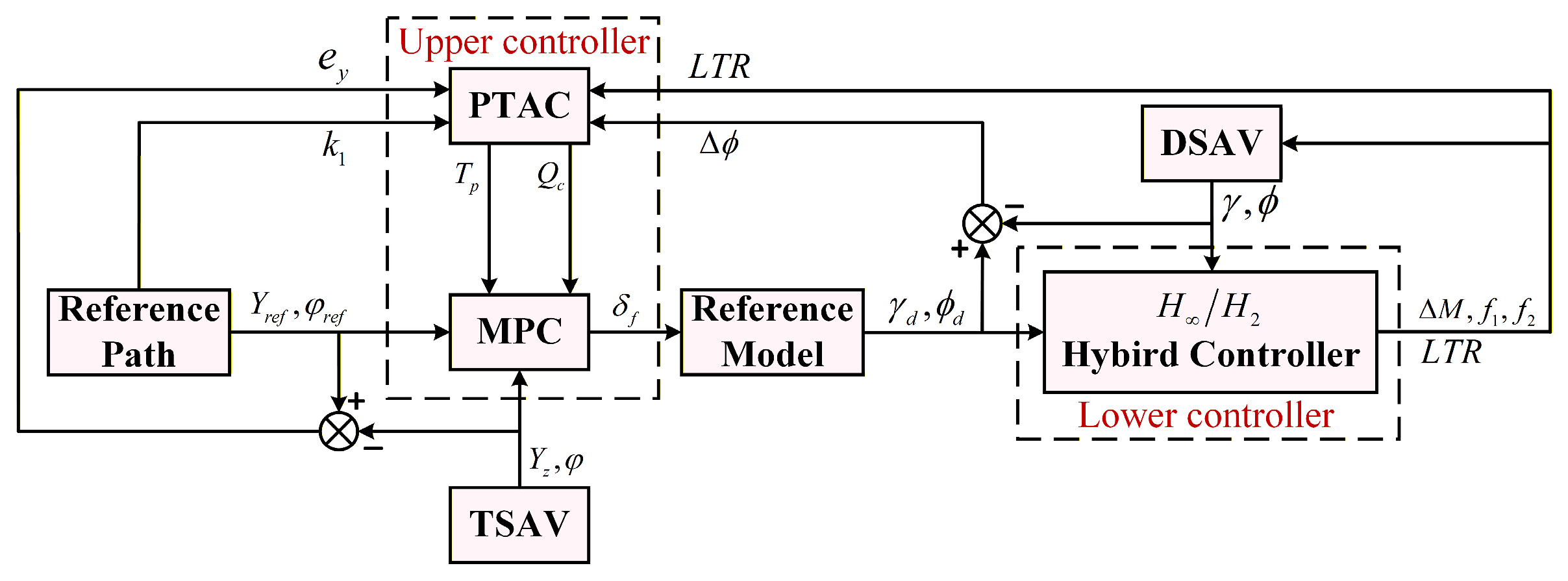
The control block diagram of path tracking for the DSAV is illustrated in Figure 3. As shown in the figure, the PTAC in the upper controller provides the MPC with preview time T p and weight matrices Q c based on the lateral deviation ey, current road curvature k1, load transfer rate (LTR) and roll angle deviation Δ ϕ . Combined with the reference path, the lateral position Y z and yaw angle φ of the TSAV, the MPC computes the reference front-wheel steering angle required for tracking the reference path, δ f . The reference model then outputs the reference yaw rate γ d and reference body inward tilt angle ϕ d accordingly. Based on the above reference values, the lower H/H2 hybrid controller calculates the front wheel differential torque Δ M and the control forces of the active suspension, f 1 and f 2 , that are needed to realize differential steering and active body inward tilting, and feeds the LTR back to the PTAC.

3.2. Evaluation Indicators

To intuitively illustrate the changes in anti-roll performance and ride comfort of the DSAV equipped with active inward body tilt control, the following evaluation indicators are introduced below [26].
  • Load Transfer Rate
The Load Transfer Rate (LTR), also known as the normalized load transfer or rollover index in the literature [32], is a common metric for evaluating a vehicle’s anti-roll capability. It determines rollover risk by checking if one side of the wheels lift off the ground, which is suitable for all vehicle types and highly practical. The expression for LTR is as follows:
L T R = i = 1 p ( F l i F r i ) i = 1 p ( F l i + F r i ) ,
where p represents the number of axles of the vehicle, with p = 2 in this paper; Fli and Fri are the normal loads on the left and right wheels of the i-th axle, respectively.
Since the normal load of each tire cannot be accurately obtained in real time, Equation (22) is rewritten after conversion and simplification as follows:
L T R = I x ϕ ¨ + m s ( v ˙ y + v x φ ˙ ) h m s g h ϕ m s g l s .
The LTR quantifies the vertical load distribution between the left and right wheels of the vehicle. When the LTR approaches one (or a predefined critical threshold, e.g., 0.8 in this work), it indicates that the vertical load on one side of the axles approaches zero, meaning the corresponding wheels are nearly lifting off the ground. This loss of tire–road contact directly leads to vehicle rollover, as the vehicle can no longer maintain lateral stability. Thus, LTR serves as a direct and practical indicator of impending rollover, which is why it is adopted as a key constraint in the proposed control framework to prevent rollover accidents.
  • Occupant-Perceived Lateral Acceleration (OPLA)
OPLA is a key factor influencing vehicle ride comfort. The formula for the OPLA a p e r is as follows:
a p e r = h ϕ ¨ + ( v ˙ y + v x φ ˙ ) cos ϕ g sin ϕ ,
where the first term is the tangential inertial acceleration generated by the roll angular acceleration; the second term is the component of the lateral acceleration in the vehicle roll direction; the third term is the component of gravity in the vehicle roll direction.

4. Upper Controller Design

It can be seen from Figure 3 that the PTAC in the upper controller provides preview time and weight matrices for the MPC. Therefore, this section will focus on the design of the MPC and PTAC.

4.1. Design of MPC

To make the lateral position Y z and yaw angle φ of the TSAV track the reference lateral position Y r e f and yaw angle φ r e f of the reference path, an MPC is designed (shown in Figure 3), which calculates the required front wheel steering angle δ f for the TSAV to complete the path-tracking control.
Under the zero-order hold (ZOH) assumption and using the forward Euler method with a small sampling time T, the discretized form of the TSAV shown in Equation (7) is as follows:
ξ k + 1 = A ζ ξ k + B ζ u c k + E d ,
where A ζ = I + T A c , B ζ = T B c , E d = T E c and I is the identity matrix of the appropriate dimension. Since v x is assumed constant, the matrices A ζ , B ζ , and E d are time-invariant. The ZOH implies that the control input u c k remains constant over the sampling interval [kT, (k + 1)T]. The forward Euler method provides a first-order approximation of the continuous-time dynamics, which is valid when the sampling time T is sufficiently small to ensure discretization errors are negligible.
Let ξ ˜ k = ξ k , u c k 1 T be the augmented state vector, where u c k 1 is the control input at the previous time step, and η = [ Y z , φ ] T . Define the control increment as Δ u c k = u c k u c k 1 . Then, Equation (25) can be rewritten in an augmented form:
ξ ˜ k + 1 = A ˜ ζ ξ ˜ k + B ˜ ζ Δ u c k + E ˜ d η k = C ˜ ζ ξ ˜ k ,
where A ˜ ζ = A ζ B ζ 0 I , B ˜ ζ = B ζ I , E ˜ d = E d 0 , C ˜ ζ = 0 0 0 1 0 0 0 1 0 0 0 0 , and Δ u c k denotes the control increment in the system at time-step k.
The objective function including path-tracking error, control variables, control increments, and slack variables is considered as follows:
J 1 = i = 1 N P η ( t + i t ) η r e f ( t + i t ) Q c 2 + i = 1 N C 1 Δ u c ( t + i t ) R c 2 + ρ c ε c 2 ,
where η r e f = [ Y r e f , φ r e f ] T , N p and N c are the prediction and control time horizons of the system, η k + i is the actual system output, and η r e f k + i is the reference system output. The weight matrices Q c = d i a g Q y , Q φ > 0 and R c > 0 are positive definite to ensure the convexity of the optimization problem; ε c is the relaxation factor; ρ c is the weight coefficient of the slack variables.
The objective function J 1 is strictly convex in the decision variables Δ u c t + i and ε c . This convexity is guaranteed by the positive definiteness of R c and Q c , which ensure that all quadratic terms in the objective function are convex, and the sum of convex functions is also convex.
Here, we assume all system states are measurable for simplicity and clarity of the theoretical derivation. In practical implementation, however, some key states (e.g., lateral velocity, roll angle) are not directly measurable. To address this issue, a reduced-order state observer will be designed in Section 4.3 to estimate these unmeasurable states, and the estimated states will be substituted into the MPC optimization problem to form the actual closed-loop control system. In order to ensure the safety and stability of the vehicle, constraints are set as follows:
u min k + i u c k + i u max k + i Δ u min k + i Δ u c k + i Δ u max k + i η min k + i η k + i η max k + i L T R k + i k L T R t h = 0.8 ϕ k + i k ϕ max ,
where L T R k + i k denotes the LTR at time-step k + i , L T R t h = 0.8 is the rollover prevention threshold, and ϕ k + i k is the predicted roll angle to avoid excessive roll motion; ϕ max is the predefined threshold of roll angle.
To solve this optimization problem, it is generally converted into a Quadratic Programming (QP) problem before solving, because the QP problem is a classic optimization problem in mathematics and has relatively mature solution methods.

4.2. Design of PTAC

Typically, the MPC sets the preview time to a fixed value between 0.6 and 2 s. However, when tracking a complex reference path at high speeds, MPC with a fixed preview time (FPT) will result in poor performance [27]. Thus, a PTAC for MPC is designed to provide adaptation preview time and weight matrices.
  • Adaptation preview time T p k
Considering both the effectiveness of path tracking and the guarantee of roll safety, the adaptation preview time formula designed in this paper is given as follows:
T p k = s a t T p 0 k exp λ 1 max 0 , L T R k L T R t h exp λ 2 ϕ d k ϕ k , T p , min , T p , max = max T p , min , min T p 0 k exp λ 1 max 0 , L T R k L T R t h exp λ 2 ϕ k ϕ d k , T p , max ,
where T p k is strictly bounded within the admissible MPC stability limits T p , min , T p , max , T p 0 k denotes the base preview time, exp λ 1 max 0 , L T R k L T R t h is the rollover risk correction term, exp λ 2 ϕ d k ϕ k is the active body inward-tilt angle tracking error correction term, λ 1 and λ 2 are the positive weight coefficients, L T R t h is the rollover prevention threshold, ϕ k and ϕ d k are the real and desired active body inward-tilt angle, L T R k is the rollover risk indicator (wheel-load transfer ratio) fed back by the hybrid controller at time k, T s k is the base sampling time,  N p is the prediction horizon with a value ranging from 8 to 12, and T p , min = 0.6   s and T p , max = 2.0   s are the lower and upper bounds of the preview time for admissible MPC stability.
This adaptive preview time strategy dynamically adjusts the preview horizon based on rollover risk and tracking error, ensuring both path-tracking performance and rollover safety while maintaining the stability of the MPC closed-loop system. From Equation (29), the following can be observed: (1) The base preview time T p 0 k is derived from T s k , and T s k will be output by the subsequent fuzzy control to address the preview response issues under different road curvatures and lateral deviations. (2) When L T R k > L T R t h (i.e., high rollover risk), the rollover risk correction term will be less than one, thereby shortening the preview time. This is because a shorter preview can reduce the delay of steering actions and prevent excessive steering from further aggravating the roll tendency. (3) When ϕ k ϕ d k 0 (i.e., there is a non-zero deviation between ϕ k and ϕ d k ), the inward-tilt angle tracking error correction term will be less than one, thereby shortening the preview time. This is because a larger deviation in the active body inward-tilt angle indicates lower control accuracy of the active suspension for inward tilting, requiring a shorter preview time to improve the steering response speed, correct the inward tilt angle deviation more quickly, and avoid the resulting roll instability.
  • Boundedness proof of adaptive preview time T p k
To ensure MPC stability, we prove T p k is bounded within T p , min , T p , max as follows:
  • Exponential correction terms:
The two exponential terms satisfy 0 < exp λ 1 max 0 , L T R k L T R t h 1 and 0 < exp λ 2 ϕ d k ϕ k 1 , so their product 0 < Γ k 1 ∈ (0, 1].
  • Base preview time:
T p 0 k = N p T s k is naturally bounded by hardware limits, satisfying T p 0 , min T p 0 k T p 0 , max with T p 0 , min T p , min and T p 0 , max T p , max .
  • Saturation guarantee:
Combining the above, the unsaturated preview time T p = T p 0 k Γ k satisfies T p , min T p k T p , max . The saturation function sat(·) further ensures T p k = s a t T p k T p , min , T p , max for all k.
Conclusion: T p k is strictly bounded within the admissible MPC stability range, ensuring closed-loop stability.
  • Weight matrices Q c k
To address the potential stability issues of adaptive weight matrices in MPC, we replace the fixed weight of the yaw angle error Q φ with a dynamically adjusted weight. The resulting weight matrix is as follows:
Q c k = d i a g Q y , Q φ k Q φ k = Q φ 0 exp λ 3 max 0 , L T R k L T R t h
where Q y is the fixed weight matrix for path-tracking accuracy, Q φ k is he yaw rate weight, Q φ 0 is the base weight matrix for yaw angle tracking accuracy, and λ 3 is the weight coefficient.
From Equation (30), it can be seen that when L T R k L T R t h (i.e., low rollover risk), the exponential term is zero, Q φ k = Q φ 0 , the weight remains at its initial value, and path-tracking accuracy is prioritized; when L T R k > L T R t h (i.e., high rollover risk), the exponential term becomes positive, and Q φ k increases exponentially. Yaw angle tracking accuracy is prioritized—even if some path-tracking accuracy is appropriately sacrificed to avoid roll instability.
  • Stability Consideration
To ensure the stability of the adaptive MPC scheme, we (1) bound the growth rate of Q φ k via λ 3 , (2) set a high L T R t h to limit activation frequency, and (3) verify closed-loop stability via extensive numerical simulations.
Theorem 1. 
The adaptive weight Q φ k is bounded as follows:
Q φ 0 Q φ k Q φ , max ,
where Q φ , max = Q φ 0 exp λ s L T R max L T R t h and L T R max < 1 is the maximum possible value of L T R k .
Proof. 
When L T R k L T R t h , Q φ k = Q φ 0 . When L T R k > L T R t h , Q φ k increases exponentially but is bounded by the physical limit L T R max , yielding a finite upper bound. This boundedness ensures the cost function remains strictly convex and the MPC optimization is well-posed. □
  • Base preview time T p 0 k based on fuzzy control
For the MPC preview time T p k of the MPC, this paper fixes the prediction horizon N P and implements adaptive control on the sampling period T s k . The road curvature k 1 and lateral deviation e y are discretely sampled to obtain their k-th time-step values k 1 , k and e y , k . The road curvature k 1 , k of the reference path is as follows:
k 1 , k = Y r e f , k 1 + Y r e f , k 2 3 / 2 ,
where Y r e f , k = Y r e f , k + 1 Y r e f , k v x T s and Y r e f , k = Y r e f , k + 1 Y r e f , k v x T s denote the first and second derivatives of the lateral coordinate Y k with respect to time.
After normalizing the road curvature k 1 , k and lateral deviation e y , k , the road curvature parameter K 1 , k and lateral deviation parameter E y , k can be obtained:
K 1 , k = k 1 , k ( k 1 , k , max + k 1 , k , min ) / 2 ( k 1 , k , max k 1 , k , min ) / 2 E y , k = e y , k ( e y , k , max + e y , k , min ) / 2 ( e y , k , max e y , k , min ) / 2 .
The K 1 , k and E y , k are selected as the inputs for the fuzzy controller, with the sampling period T s k as the output to establish the fuzzy controller. Considering the system’s complexity and computational performance, five fuzzy linguistic terms are used to assign values to the road curvature parameter K 1 , k   E y , k and T s k , i.e., Very Low (VL), Low (L), Medium (M), High (H), and Very High (VH).
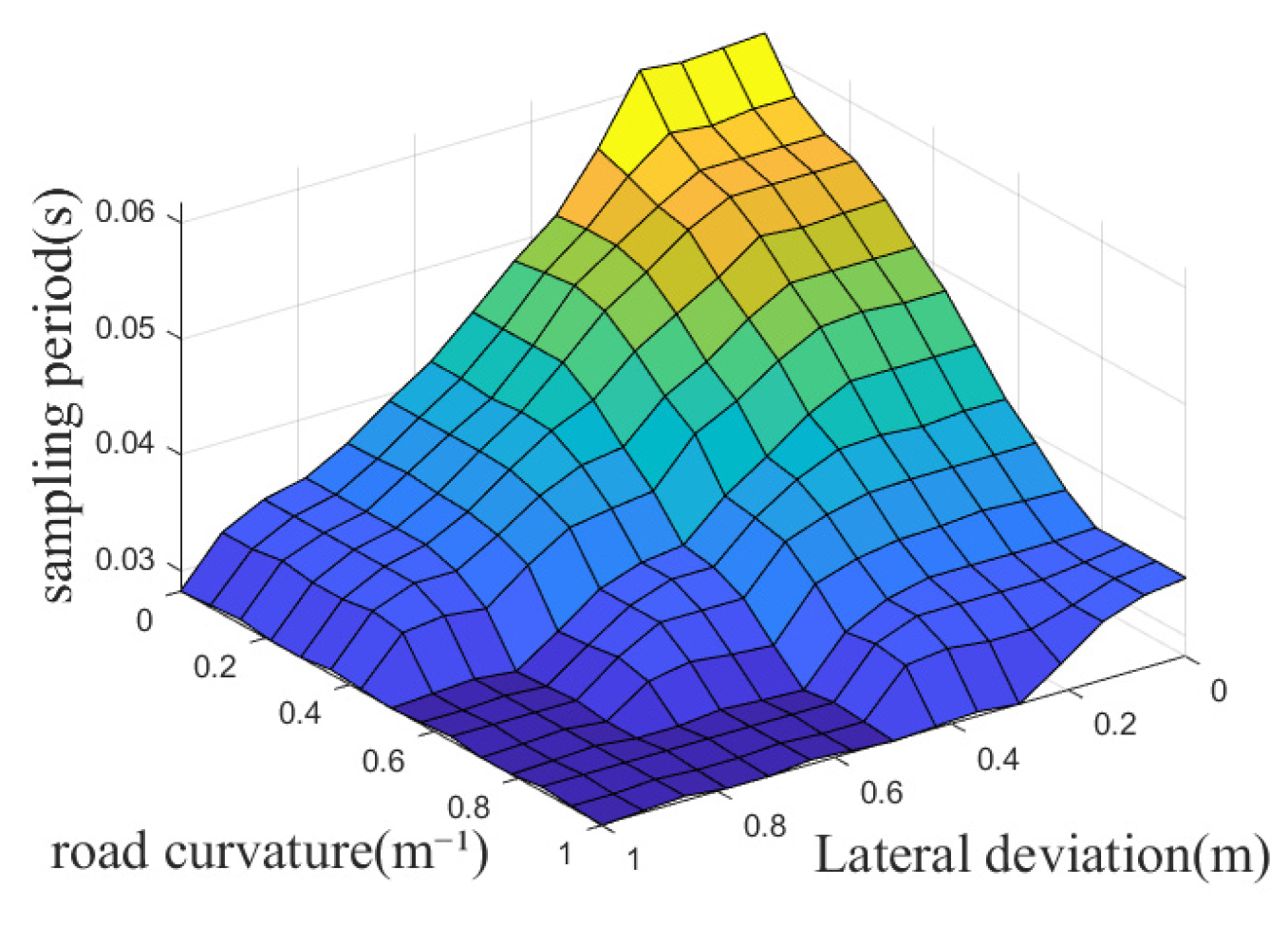
The fuzzy universe of discourse for input and output variables is set as follows: K 1 , k = 0 , 0.25 , 0.5 , 0.75 , 1 , E y , k = 0 , 0.25 , 0.5 , 0.75 , 1 , T s = 0.025 , 0.035 , 0.045 , 0.055 , 0.065 . The formulated fuzzy control rules are shown in Table 1, and the input–output curve for the fuzzy control is shown in Figure 4.
As seen from Figure 4, when the road curvature is large and the lateral deviation is significant, the sampling period should be appropriately shortened to reduce the preview time, thereby enhancing the vehicle’s responsiveness and path-tracking accuracy. Otherwise, the sampling period can be extended to increase the preview time, which in turn improves the vehicle’s driving stability.

4.3. Design of State Observer

4.3.1. Reduced-Order Observer for Lateral Velocity Estimation (Based on TSDV Model)

Since φ ˙ and δ f are measurable, we design a reduced-order observer to estimate the only unmeasurable state v y according to the first equation of Equation (5):
v ^ ˙ y = 2 k f + 2 k r m v x v ^ y + 2 l f k f 2 l r k r m v x v x φ ˙ + 2 k f m δ f + L v a y 2 k f + 2 k r m v ^ y + 2 l f k f 2 l r k r m φ ˙ + 2 k f m δ f ,
where v ^ y is the estimated lateral velocity; L v is the observer gain, tuned via pole placement (e.g., placing the pole at s = −30 rad/s) to ensure stable and fast convergence of the estimation error.
  • Integration with MPC
The estimated lateral velocity v ^ y together with the measurable yaw states φ , φ ˙ from gyroscope/inertial measurement unit (IMU) and position states Y z , X z from GPS/odometry) form the complete state vector for MPC: ξ ^ = v ^ y , φ , φ ˙ , Y z , X z T . This ensures all states required by the MPC are available using standard on-board sensors, eliminating the need for costly direct measurement of lateral velocity.
  • Validation
The lateral velocity observer is validated via CarSim–Simulink co-simulation, with the estimation error of v ^ y within ±0.2 m/s, confirming its accuracy and reliability for MPC implementation.

4.3.2. Reduced-Order Observer for Roll States (for LTR Calculation)

All variables are either pre-calibrated vehicle parameters ( I x , m s , h , g , l s ) or derived from measurable states: lateral acceleration derivative v ˙ y and longitudinal velocity v x from IMU, yaw rate φ ˙ (integrated to yaw angle φ ) and roll rate ϕ ˙ (differentiated to roll angular acceleration ϕ ¨ ) from gyroscope, and roll angle ϕ estimated via a linear state observer (tuned by pole placement for convergence) based on gyroscope/accelerometer data.
To address the issue that the roll angle ϕ in the LTR definition (Equation (23)) is not directly measurable, a reduced-order Luenberger observer is designed to estimate the roll states x r r = ϕ , ϕ ˙ T from the 11-state DSAV model. This observer only focuses on the roll dynamics, avoiding the complexity of a full-order observer while ensuring the accuracy of LTR calculation for constraint (Equation (28)).
  • Roll Subsystem Extraction
From the 11-state DSAV state-space model shown in Equation (16), the roll states are extracted as x r r = ϕ , ϕ ˙ T . The roll subsystem is linearized as follows:
x ˙ r r = A r r x r r + B r r u y r r = C r r x r r ,
where A r r = 0 1 a 54 a 55 , B r r = 0 0 0 0 b p , 52 b p , 53 , C r r = 0 1 , i.e., y r r = ϕ ˙ (directly measured by on-board gyroscope).
  • Reduced-Order Luenberger Observer
Recent works have addressed vehicle state estimation using interval observers and extended Kalman filters [44]. In this paper, a reduced-order Luenberger observer is designed to estimate the unmeasurable lateral velocity and roll angle, which complements the existing estimation strategies and is more suitable for real-time vehicle control applications. The observer is designed as [45] follows:
x ^ ˙ r r = A r r x ^ r r + B r r u + L 1 y r r C r r x ^ r r ,
where x ^ r r = ϕ ^ , ϕ ^ ˙ T is the estimated roll state vector; L 1 = l 1 , l 2 T is the observer gain, tuned via pole placement to ensure fast convergence.
  • Observer Gain Tuning
To achieve stable and fast estimation [46], the observer poles are placed at s 1 , 2 = 20 , 25   r a d / s . The gain L 1 is solved by the following:
det s I A r r L 1 C r r = s + 20 s + 25 .
Substituting A r r and C r r into Equation (37), the observer gain is obtained as follows:
L 1 = 45 a 55 500 + 45 a 55 a 54 .
Using the vehicle parameters in Table 2, the specific gain values are calculated as L 1 = 40.2 , 412.3 T , ensuring the estimation error converges exponentially to zero.
  • LTR Calculation Using Estimated States
The estimated roll angle ϕ ^ and roll angular velocity ϕ ^ ˙ are used to calculate the LTR:
L T ^ R = m s g h g ϕ ^ ¨ + m s a y h g k ϕ ϕ ^ + c ϕ ϕ ^ ˙ ,
where ϕ ^ ¨ is derived by differentiating ϕ ^ ˙ with a first-order low-pass filter to reduce noise. This ensures the accuracy of LTR estimation in Equation (23) and the physical implement ability of the rollover safety constraint in Equation (28).
  • Validation
The designed observer is validated via co-simulation of CarSim and Simulink. The estimation error of the roll angle ϕ ^ is within ± 0.5 , which confirms the effectiveness of the proposed reduced-order observer for LTR constraint implementation.

4.4. Stability Analysis

4.4.1. Stability Analysis of the Nominal MPC

Assumption 1. 
The TSAV model is linearized around the equilibrium point as ξ ˙ t = A c ξ t + B c u c t + E c , and under ZOH and forward Euler discretization, it is represented as ξ k + 1 = A ζ ξ k + B ζ u c k + E d .
Assumption 2. 
The pair A ζ , B ζ is stabilizable, and the pair A ζ , C ζ is detectable, where C ζ is the measurement matrix for TSAV outputs Y z , φ .
Theorem 2. 
Under Assumptions 1 and 2, the nominal MPC with fixed weight matrices Q c = d i a g Q y , Q φ > 0 and R c > 0 renders the TSAV closed-loop system asymptotically stable at the origin when E d = 0 .
Proof. 
Define the Lyapunov function candidate as follows:
V c ξ = ξ T P c ξ ,
where P c > 0 is the unique positive definite solution to the discrete-time algebraic Riccati equation (ARE):
A ξ T P c A ζ P c A ξ T P c B ζ R c + B ξ T P c B ζ 1 B ξ T P c A ζ + Q c = 0 .
The difference of V c ξ along the system trajectory is as follows:
Δ V c ξ = V c ξ k + 1 V c ξ k = ξ k + 1 T P c ξ k + 1 ξ k T P c ξ k .
Substituting the optimal control law u c k = K c ξ k , where K c = R c + B ξ T P c B ζ 1 B ξ T P c A ζ from the MPC solution, we can obtain
Δ V c ξ = ξ k T Q c + K c T R c K c ξ k .
Since Q c > 0 and R c > 0 , Δ V c ξ < 0 for all ξ k 0 . By Lyapunov’s direct method for discrete-time systems, the origin is asymptotically stable. □

4.4.2. MPC + PTAC Stability Analysis

Corollary 1. 
The MPC + PTAC closed-loop system for the TSAV is input-to-state stable (ISS).
Proof. 
The nominal MPC (with fixed T p and Q c ) is asymptotically stable, as proven via the discrete-time Lyapunov function and Riccati equation in Section 4.4.2. The adaptive preview time T p k and weight matrix Q c k are bounded perturbations to the nominal MPC design.
According to the ISS theory [47], a bounded perturbation to a stabilizing control law preserves the ISS property of the closed-loop system. Thus, the MPC + PTAC framework ensures both path-tracking performance and rollover safety, while maintaining the stability of the TSAV closed-loop system. □

5. Lower Controller Design

As shown in Figure 3, after the upper controller obtains the front-wheel steering angle required for TSAV by tracking the reference path, the lower controller is still needed to control the differential steering and active suspension to achieve the front wheel steering angle and active body inward tilt angle required for the DSAV.

5.1. Control Framework

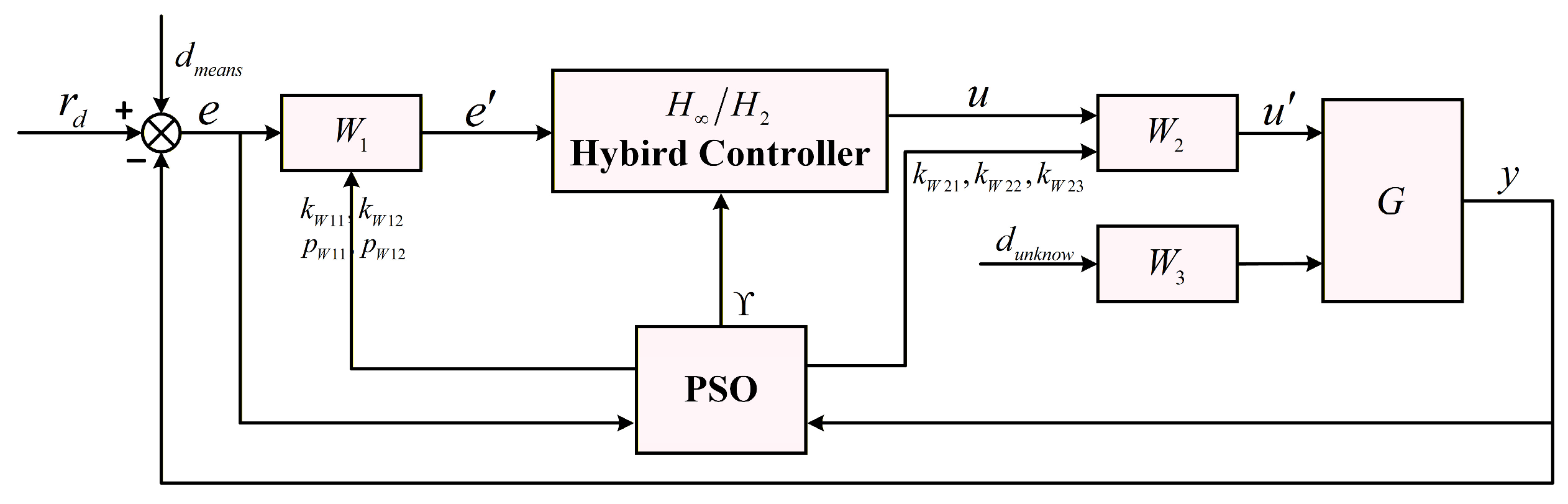
The control block diagram of the lower-level controller designed in this paper is shown in Figure 5. A closed-loop cooperative scheme based on PSO parameter self-tuning H/H2 hybrid control is adopted as the overall control strategy. Among them, the PSO module acts as the adaptive core. By acquiring system feedback information (tracking error e and plant output y), it computes the fitness function, and optimizes the weighting functions W 1 , W 2 and the robustness threshold ϒ of the H/H2 hybrid controller in real time, so as to achieve the multi-objective collaborative optimum of tracking accuracy, actuator energy consumption and robustness.
It can be seen from Figure 5 that the weighting module W 1 optimized in real time by PSO calculates the weighted error e , according to the error e between the reference input r d and the actual output y , so as to quantify the performance requirement of tracking accuracy. The weighted error e is fed into the H/H2 hybrid controller to obtain the control command u. This command is then processed by the actuator input weighting module W 2 , which limits the magnitude and energy consumption of the actuator output to avoid saturation and reduce mechanical wear, yielding u′. Finally, driven by u′ and the weighted road disturbance W 3 d u n k o w n , the controlled plant G outputs y, which is fed back to the tracking error calculation unit, forming a complete closed-loop control system.

5.2. H/H2 Hybrid Control Problem

5.2.1. Weighting Functions

The weighting function is the core foundation of the H/H2 hybrid controller design, and its performance directly determines the frequency band adaptability and control effect of the controller. To balance tracking accuracy, actuator energy consumption, and system robustness, the weighting functions are defined as follows:
W 1 s = d i a g k w 11 s + p w 11 , k w 12 s + p w 12 W 2 s = d i a g k w 21 , k w 22 , k w 23 W 3 s = s + 10 10 s + 1 ,
where k w 11 , k w 12 , k w 21 , k w 22 , k w 23 > 0 are gains, and p w 11 , p w 12 , p w 3 > 0 are pole locations.
By integrating the above three weighting functions through a diagonal matrix and combining them with the original controlled plant G s , the generalized controlled plant G a u g s = d i a g W 1 s , W 2 s , W 3 s × G s can be constructed.

5.2.2. Optimization Objectives and Constraints

To balance robustness and control energy consumption, an H 2 energy consumption optimization objective is introduced:
J 2 = T r d u s 2 2 = 1 2 π t r T r d u j ω H T r d u j ω d ω ,
where     2 denotes the 2-norm, T r d u s is the transfer function from the reference input r d s to the control input u s , T r d u j ω H is the conjugate transpose of the transfer function matrix, j ω represents the complex frequency, and t r denotes the trace of a matrix (sum of its diagonal elements). The integral term characterizes the total energy consumption of the control input.
To guarantee tracking accuracy and control input stability under external disturbances (such as road adhesion variation and crosswind interference), an H robustness constraint is introduced:
T d z s < ϒ ,
where T d z s is the transfer function from the disturbance input d s to the performance output z s ,     denotes the H norm, and ϒ is the robustness threshold optimized by PSO.
Finally, the constructed H/H2 hybrid optimization model can be formulated as follows:
min K J 2   s t : T d z s < ϒ .

5.2.3. Controller Solution

  • Unified modeling of the generalized controlled plant
The state variables are chosen as x , the disturbance input as d = [ r d , d m e a n s , d u n k n o w n , ω p ] T , and the control input as u. By integrating the dynamic model of the differential steering autonomous vehicle and the weighting functions W 1 s , W 2 s , W 3 s , a generalized controlled plant with multi-performance outputs is constructed as follows:
x ˙ = A x + B 1 d + B 2 u z 1 = C 1 x + D 11 d + D 12 u z 2 = C 2 x + D 22 u y = C y x + D y 1 d ,
where z 1 is the tracking error performance output weighted by W 1 , z 2 is the actuator energy consumption performance output weighted by W 2 , and y is the measurable output. The matrices A , B 1 , B 2 , C 1 , C 2 , C y , D 11 , D 12 , D 22 , D y 1 are derived from the DSAV state-space model and the state-space realization of weighting functions.
  • LMI Transformation for H 2 -Norm Minimization
For the actuator energy consumption performance output z 2 , the H 2 -norm minimization objective is min K T d z 2 2 , which is equivalent to minimizing the total energy consumption of the actuator. Based on the H 2 control theory, this objective is transformed into the following LMI constraints by introducing an auxiliary positive definite matrix Q:
A X + X A T B 2 Y Y T B 2 T + B 1 B 1 T < 0 t r Q C 2 X D 22 Y Q > 0 X > 0 , Q > 0 ,
where X = P 1 ( P > 0 is the Lyapunov matrix), Y = K h y b r i d X ( K h y b r i d is the to-be-solved state-feedback gain), and the diagonal weights of W 2 are embedded into the matrix C 2 during the generalized plant modeling. Minimizing t r Q is equivalent to minimizing the H 2 -norm of T d z 2 .
  • LMI Transformation for H -Norm Constraint
For the tracking error performance output z 1 , the transfer function from the disturbance d to z 1 is required to satisfy the H -norm constraint as shown in Equation (46). By introducing the Lyapunov matrix P > 0 and performing the variable substitution X = P 1 , Y = K h y b r i d X , combined with the Schur complement lemma, the constraint is transformed into an LMI as follows:
A r X + X A r T B 2 Y Y T B 2 T X C 1 T B 1 C 1 X ϒ I D 11 B 11 T D 11 T ϒ I < 0 ,
where A r = A B 2 K h y b r i d is the closed-loop state matrix. This LMI has directly embedded the tracking error weighting W 1 (via matrix C 1 ) into the constraint, which ensures the trade-off between tracking accuracy and robustness.
Note: This LMI is the closed-loop counterpart of LMI (29), which was derived for the open-loop system (with A r replaced by the open-loop matrix A ) in the disturbance rejection analysis section [48]. Mathematically, LMI (29) and Equation (50) share an identical structure and physical meaning, both enforcing the H -norm constraint to balance tracking accuracy and robustness.
  • Formulation of the Unified LMI Optimization Problem
By integrating the H -norm constraint (Equation (50)) and the H 2 -norm minimization objective (Equation (49)), a unified LMI optimization problem is formulated as follows:
min X , Y , Q t r Q ,   s . t .   E q u a t i o n s   ( 49 )   a n d   ( 50 )
By numerically solving this LMI problem using the interior-point method, the auxiliary matrix Y and Lyapunov matrix X are obtained. The optimal state-feedback gain of the H/H2 hybrid controller is then calculated as follows: K h y b r i d = Y X 1 . This gain simultaneously satisfies the requirements of tracking accuracy, actuator energy consumption minimization, and disturbance rejection robustness.

5.2.4. PSO-Based Parameter Self-Tuning Strategy for H/H2 Hybrid Control

Since the performance of the H/H2 hybrid controller highly depends on the gain and pole parameters of the weighting functions and the robustness threshold ϒ , the traditional manual tuning method relies heavily on experience and can hardly achieve a balanced multi-objective performance. Therefore, the PSO algorithm [49] is introduced to realize automatic optimization of key parameters, so as to improve the comprehensive performance of the controller.
The particle vector is constructed as follows: X P S O = k w 11 , p w 11 , k w 12 , p w 12 , k w 21 , k w 22 , k w 23 , ϒ . To balance tracking accuracy, control energy consumption and system robustness, a multi-objective weighted fitness function is designed as follows:
J X P S O = ρ 1 0 T r d y 2 2 d t + ρ 2 T r d u 2 + ρ 3 max 0 , T d z ϒ ,
where ρ 1 , ρ 2 , ρ 3 > 0 are weighting coefficients used to adjust the weights among tracking error, control energy consumption, and robustness constraint smoothly, and max 0 , T d z ϒ is the penalty term for the H -norm constraint; it increases the fitness value if the constraint is violated, forcing the algorithm to satisfy the robustness requirement.
The entire optimization procedure is as follows:
  • Initialize the particle swarm: Randomly generate N particles, where each particle corresponds to a set of optimized variables X P S O , i i = 1 , 2 , , N . Initialize the velocity v i , personal best position p b e s t , i , and global best position p g , b e s t the particles.
  • Fitness calculation: For each particle, substitute its parameters into the H/H2 hybrid controller model, simulate the system response over the horizon T, calculate the tracking error, control energy consumption and H -norm of the system, and then obtain the fitness value J X P S O , i .
  • Optimal position update: If the fitness of the current particle is better than the personal best p b e s t , i , update p b e s t , i = X P S O , i ; if the personal best among all particles is better than the global best p g , b e s t , update p g , b e s t = p b e s t , i .
  • Particle velocity and position update: Adjust the velocity and position of each particle according to the PSO velocity–position update formula:
    v i k + 1 = ω v i k + c 1 r 1 p b e s t , i X P S O , i k + c 2 r 2 p g , b e s t X P S O , i k X P S O , i k + 1 = X P S O , i k + v i k + 1 ,
    where ω is the inertia weight, c 1 and c 2 are learning factors, and r 1 , r 2 are random numbers in the range [0, 1].
  • Parameter update and controller validation: Substitute the optimal parameters obtained by PSO into the weighting functions and the H robustness constraint to reconstruct the generalized plant G a u g s and the H/H2 hybrid controller. The tracking accuracy, disturbance rejection robustness, and energy consumption performance of the optimized controller are verified through simulation to ensure that it meets the multi-objective control requirements of the autonomous vehicle.

5.2.5. Robustness Analysis of the H/H2 Hybrid Controller

The robustness of the designed H/H2 hybrid controller is analyzed for the DSAV system considering model parameter uncertainties (e.g., tire stiffness, vehicle mass, moment of inertia) and external disturbances (e.g., road roughness, crosswind, road adhesion variation), based on the Bounded Real Lemma and robust stability theory for linear systems.
Definition 3 (Admissible Uncertainty). 
The model parameter uncertainty of the DSAV is described as the norm-bounded perturbation form, Δ A = H Δ F ˜ E , Δ B 2 = H Δ F ˜ E b , where H , E , E b are known constant matrices with appropriate dimensions, and Δ F is the unknown perturbation matrix satisfying Δ F ˜ T Δ F ˜ I .
Theorem 3 (Robust Stability Criterion). 
For the DSAV system with norm-bounded uncertainties and external disturbances, the closed-loop system stabilized by the H/H2 hybrid controller K h y b r i d (with control law u = K h y b r i d x ) is robustly stable and satisfies the H disturbance attenuation performance T d z s < ϒ if there exists a positive definite matrix X and a scalar μ > 0 such that Equation (51) and the following inequality hold:
A X + X A T + B 1 B 1 T + μ H H T X C 1 T B 1 X E T C 1 X ϒ I D 11 0 B 1 T D 11 T ϒ I 0 E X 0 0 μ I < 0
Proof. 
Based on the Bounded Real Lemma, the H performance constraint for the uncertain system is equivalent to the existence of a Lyapunov function V x = x T P x such that V ˙ x < 0 for all x 0 and d 0 . Substituting the uncertain state matrix Δ A and input matrix Δ B 2 into the closed-loop system, and using the S-procedure to eliminate the unknown perturbation matrix Δ F ˜ , the above LMI is derived by Schur complement transformation. The term μ H H T and μ I are introduced to handle the norm-bounded uncertainty, ensuring the inequality holds for all admissible Δ F ˜ .
For the external disturbance d , the LMI (29) guarantees that the L 2 - gain from disturbance d to performance output z is bounded by ϒ , which means the system can attenuate any finite-energy external disturbance to the performance output by a factor of ϒ . For the nominal system without uncertainty and disturbance Δ F ˜ = 0 , d = 0 , the first expression of Equation (50) ensures V ˙ x < 0 , proving the asymptotic stability of the closed-loop system.
The designed H/H2 hybrid controller ensures nominal asymptotic stability and robust stability for the DSAV system under admissible parameter uncertainties and external disturbances, achieving the preset H disturbance attenuation performance, which fully meets the robustness requirement of the lower controller. □

5.2.6. Convergence Proof of PSO Parameter Tuning

To ensure the effectiveness of the PSO-based parameter self-tuning strategy, the convergence of the PSO algorithm for optimizing the weighting function parameters and robustness threshold ϒ is strictly proven based on the stochastic process convergence theory and Lipschitz continuity of the fitness function.
Assumption 3. 
The fitness function J X P S O is Lipschitz continuous on the compact feasible set Θ 8 (the feasible domain of particle vector X P S O ), i.e., there exists a positive constant L > 0 such that
J X P S O , 1 J X P S O , 2 L X P S O , 1 X P S O , 2 ,   X P S O , 1 , X P S O , 2 Θ .
This assumption holds because the tracking error 0 T r d y 2 2 d t , control energy T r d u 2 and H-norm are all continuous functions of the parameters X P S O , and the continuous function on a compact set is uniformly continuous and thus Lipschitz continuous.
Assumption 4. 
The PSO algorithm parameters satisfy the following: inertia weight 0 < ω < 1 , learning factors c 1 , c 2 > 0 , and c 1 + c 2 < 4 1 + ω / 1 ω . The particle velocity and position are constrained within the compact feasible set Θ to avoid particle divergence.
Theorem 4 (PSO Convergence). 
Under Assumptions 3 and 4, the PSO algorithm for optimizing the particle vector X P S O converges almost surely to the global optimal solution X P S O = a r g m i n X P S O Θ J X P S O of the fitness function J X P S O .
Proof. 
The PSO velocity updated by Equation (54) can be rewritten as a linear stochastic difference equation:
v i ( k + 1 ) = ( ω I + c 1 r 1 I + c 2 r 2 I ) v i ( k ) + c 1 r 1 p b e s t , i X P S O , i k + c 2 r 2 p g , b e s t X P S O , i k .
Under Assumption 4, the coefficient matrix of v i k satisfies the contraction mapping condition (i.e., the spectral radius of the coefficient matrix is less than one), which means the expected value of the particle velocity E v i k converges to zero as the number of iterations k . Thus, the particle position X P S O , i k converges to the global optimal solution set.
Combined with Assumption 3 (Lipschitz continuity of J X P S O ), small perturbations of the particle position lead to only bounded changes in the fitness value, which prevents the algorithm from being trapped in local optima. The global best position p g , b e s t is updated iteratively to the position with the minimum fitness value, and the penalty term max 0 , T d z ϒ in the fitness function ensures that the converged solution satisfies the H robustness constraint T d z s < ϒ .
According to the stochastic convergence theorem, the particle swarm converges almost surely to the global optimal solution X P S O of the fitness function J X P S O on the compact set Θ. The PSO algorithm with the designed parameter settings converges to the global optimal solution of the multi-objective fitness function, which ensures that the optimized weighting functions and robustness threshold can achieve the balanced multi-objective performance of tracking accuracy, actuator energy consumption and system robustness for the H/H2 hybrid controller. □

6. Simulation and Result Analysis

In this section, simulation tests are conducted based on the CarSim (R2020) and Matlab/Simulink (R2022b) co-simulation platforms with a fixed step size of 0.01 s. The road adhesion coefficient is set to 0.8, and a standard double lane-change (DLC) maneuver is adopted as the reference path. The proposed control and observer algorithms are implemented in Simulink (R2022b)and co-simulated with CarSim (R2020). The vehicle parameters adopted are listed in Table 2.

6.1. Simulation and Result Analysis of Upper Controller

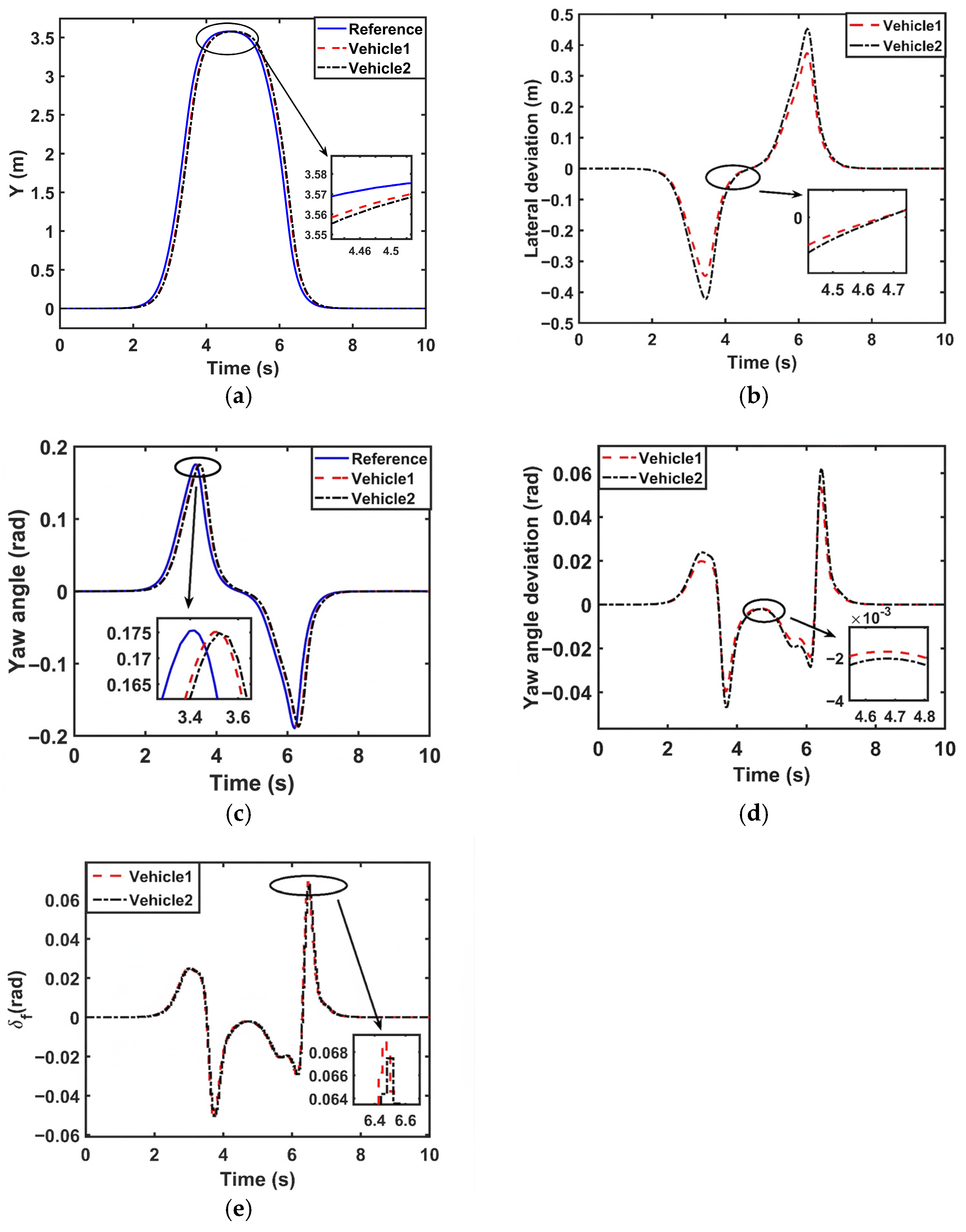
To verify the control performance of the upper-level controller proposed in this paper, two autonomous vehicles equipped with preview-time adaptive MPC and fixed-preview-time MPC (abbreviated as Vehicle 1 and Vehicle 2, respectively) are adopted for comparison. The simulation results including path-tracking curve and lateral deviation, yaw angle and corresponding deviation, as well as the generated front-wheel steering angle, are shown in Figure 6.
As seen from Figure 6a,c, both Vehicle 1 and Vehicle 2 can track the reference path and yaw angle satisfactorily. As shown in Figure 6b, the maximum absolute values of the lateral deviation for Vehicle 1 and Vehicle 2 are 0.372 m and 0.4526 m, respectively, with the former being 17.9% lower than the latter. It can be observed from Figure 6d that the maximum absolute values of the yaw angle deviation for Vehicle 1 and Vehicle 2 are 0.053 rad and 0.0624 rad, respectively, and the former is reduced by 14.5% compared with the latter. Figure 6e presents the front wheel steering angle required for reference path tracking, whose maximum value does not exceed 0.07 rad for both vehicles.
In summary, the autonomous vehicle with conventional steering equipped with preview-time adaptive MPC achieves more effective reference path tracking.

6.2. Simulation and Result Analysis of Hierarchical Controller

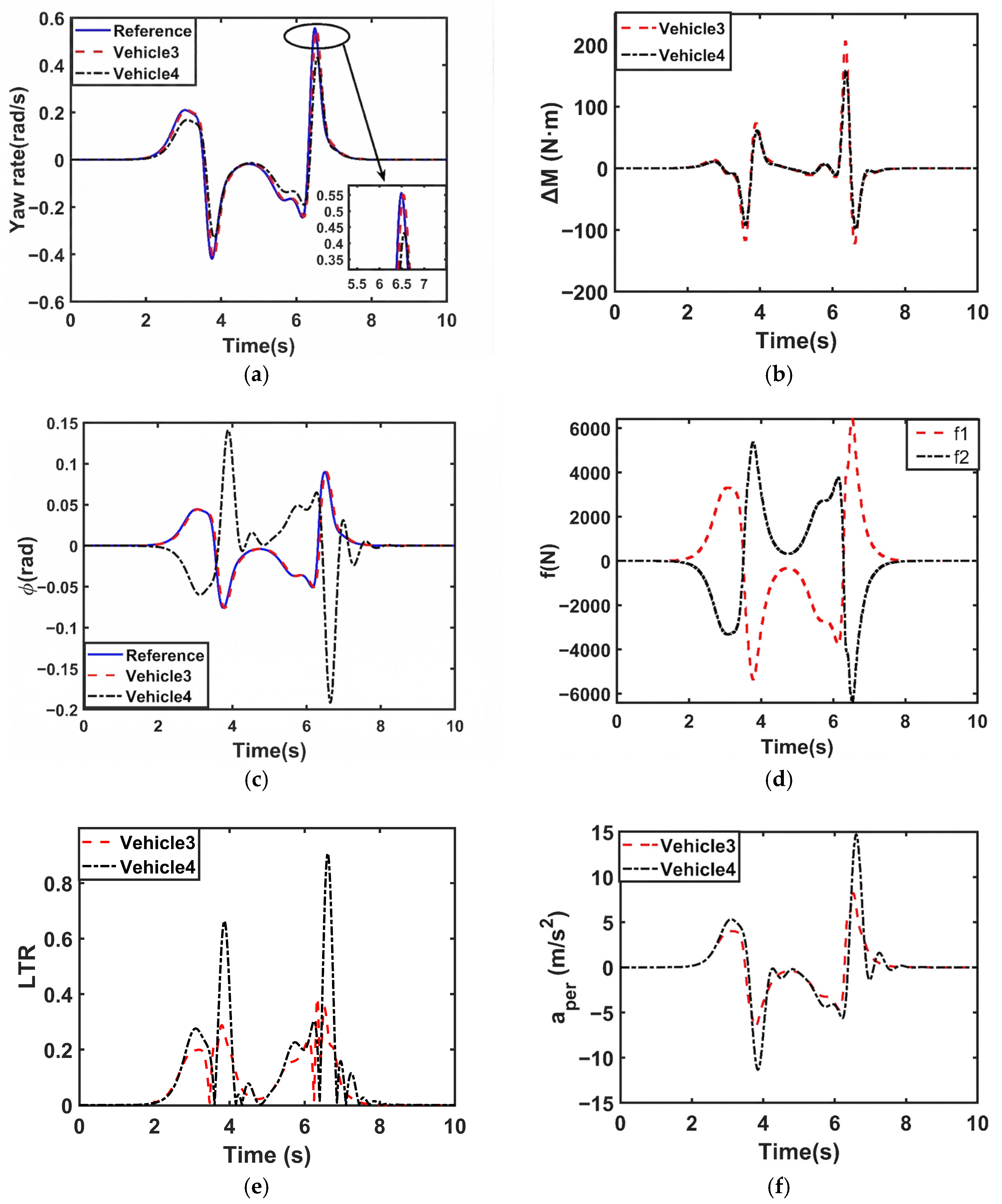
Section 6.1 has verified the effectiveness of the upper-level controller proposed in this paper. In this section, a comparative analysis is conducted between Vehicle 3 and Vehicle 4. Both adopt preview-time adaptive MPC as the upper-level controller, while their lower-level controllers are the manually tuned H/H2 hybrid controller and the PSO-based parameter self-tuned H/H2 hybrid H2 controller, respectively. The former only realizes differential steering, whereas the latter achieves both differential steering and active inward tilt. The simulation curves of yaw rate, differential torque, roll angle, active suspension control force, LTR, and occupant-perceived lateral acceleration are presented in Figure 7.
Figure 7a shows the yaw rate curves of different vehicles. It can be seen from Figure 7a that both vehicles can track the reference yaw rate satisfactorily. The peak values of the reference yaw rate and those of Vehicle 3 and Vehicle 4 are 0.556 rad/s, 0.550 rad/s, and 0.432 rad/s, respectively. Compared with Vehicle 4, the peak deviation between Vehicle 3 and the reference yaw rate is reduced by 21.2%. Figure 7b presents the front-wheel differential torque curves required for different vehicles to track the reference yaw rate. As seen from Figure 7b, the front-wheel differential torque profiles of Vehicle 3 and Vehicle 4 are basically consistent, with peak values of 205 Nm and 158 Nm, respectively.
Figure 7c illustrates the roll angle curves of different vehicles. It can be observed from Figure 7c that Vehicle 3 tracks the reference roll angle well, while the roll angle of Vehicle 4 is completely opposite to that of the former two. This is because the lower-level controller adopted by Vehicle 4 only realizes differential steering without active body inward tilt. When the maximum absolute roll angle of Vehicle 4 is 0.191 rad, the corresponding value of Vehicle 3 is 0.089 rad. Compared with Vehicle 4, the maximum absolute roll angle of Vehicle 3 is decreased by 53.4%. Figure 7d shows the active suspension control force curves by Vehicle 3 to realize active inward tilt. It can be seen from Figure 7d that the control forces of the left and right suspensions are equal in magnitude and opposite in direction, with a maximum absolute value of 6415 N.
Figure 7e depicts the variation in LTR. As shown in Figure 7e, the LTR of Vehicle 4 is significantly larger than that of Vehicle 3, and the maximum value of Vehicle 4 reaches 0.91, exceeding the safety threshold of 0.8, indicating that Vehicle 4 is in a high rollover risk state. In contrast, the maximum LTR of Vehicle 3 is only 0.39, which is reduced by 57.1%. Figure 7f gives the comparison results of occupant-perceived lateral acceleration. It can be seen from Figure 7f that the occupant-perceived lateral acceleration of Vehicle 4 is significantly higher than that of Vehicle 3, with the maximum values of 14.72 m/s2 and 8.21 m/s2, respectively. Compared with Vehicle 4, the maximum value of Vehicle 3 is reduced by 44.2%.
It can be concluded that, under the action of the lower controller designed in this paper, the differential steering autonomous vehicle can not only track the reference path via the differential steering system, but also realize active body inward tilt through the active suspension system, so as to ensure a stable driving state and eliminate the rollover risk.

7. Conclusions

To improve the path-tracking accuracy and driving safety of differential steering autonomous vehicles, this paper proposes a path-tracking control method for such vehicles, considering active body inward tilt. First, an MPC with fixed preview time and an adaptive preview-time MPC are designed as the upper-level controllers. By adjusting the adaptive preview time and time-varying weight matrix of the MPC, the path tracking of the conventional steering autonomous vehicle is realized. Second, an H/H2 hybrid controller is designed to enable the differential steering autonomous vehicle to track the reference-model yaw rate and body inward tilt angle, and PSO is adopted to realize the parameter self-tuning of this controller.
The co-simulation results of CarSim and Simulink show the following: When tracking the reference path, the maximum absolute values of the lateral deviation and yaw angle deviation in the vehicle with the proposed upper-level controller are reduced by 17.9% and 14.5%, respectively, compared with the vehicle using the fixed-preview-time MPC. Compared with the vehicle equipped with a manually tuned H/H2 hybrid controller that only realizes differential steering, the vehicle with the PSO-based self-tuned H∞/H2 hybrid controller reduces the peak deviations in yaw rate and roll angle by 21.2% and 53.4%, respectively, when tracking the reference model. Meanwhile, the maximum values of LTR and occupant-perceived lateral acceleration are decreased by 57.1% and 44.2%, respectively. It indicates that the proposed method not only reduces the tracking error but also realizes active body inward tilt. A hierarchical control method based on MPC is proposed in this paper to improve the path-tracking accuracy and driving safety of differential steering autonomous vehicles.
Although the method shows good performance in both theoretical and simulation analyses, there are still several directions worthy of further exploration. First, this paper only designs the lateral control system for differential steering autonomous vehicles without considering the variation in longitudinal control. In future work, the longitudinal control will be integrated to construct a more complete control system for intelligent driving and body attitude tracking. In addition, the verification in this paper is mainly carried out via simulation in a computer environment, and further real-vehicle experiments are needed in the future.

Author Contributions

Conceptualization, validation, and methodology, R.A.; methodology and writing—original draft preparation, T.W.; writing—original draft preparation, T.W.; writing—review and editing, J.T., T.W., R.A. and C.H.; funding acquisition, J.T. All authors have read and agreed to the published version of the manuscript.

Funding

This work was financed by the National Natural Science Foundation of China (51975299). This research was also funded by the Jiangsu Province key project of industry forward-looking key core technology (BE2022053-2).

Data Availability Statement

The data used in this analysis are publicly available, and access is provided in the text.

Acknowledgments

This study was sponsored by the National Natural Science Foundation of China (51975299) and the Jiangsu Province key project of industry forward-looking key core technology (BE2022053-2).

Conflicts of Interest

The authors declare no conflicts of interest.

References

  1. Guo, N.; Zhang, X.; Zou, Y. Real-time predictive control of path following to stabilize autonomous electric vehicles under extreme drive conditions. Automot. Innov. 2022, 5, 453–470. [Google Scholar] [CrossRef]
  2. Guvenc, L.; Aksun-Guvenc, B.; Zhu, S.; Gelbal, S.Y. Autonomous Road Vehicle Path Planning and Tracking Control; John Wiley & Sons: New York, NY, USA, 2022. [Google Scholar]
  3. Haque, T.S.; Rahman, M.H.; Islam, M.R.; Razzak, M.A.; Badal, F.R.; Ahamed, M.H.; Moyeen, S.I.; Das, S.K.; Ali, F.; Tasneem, Z.; et al. A review on driving control issues for smart electric vehicles. IEEE Access 2021, 9, 135440–135472. [Google Scholar] [CrossRef]
  4. Duan, F.D.; Wan, M.S.; Xu, X.M. A new sizing framework for a hybrid energy system with fuel cell incorporating data forecasting, enhanced optimizer, and seasonal variations: A case study for China. Renew. Energy 2026, 256, 124464. [Google Scholar] [CrossRef]
  5. Gao, S.C.; Ju, F.; Zhuang, W.C.; Wang, Q.; Zong, Y.; Wang, L. Cooperative energy management and fuel cell thermal management of fuel cell hybrid electric buses via multi-agent reinforcement learning. Energy 2025, 337, 138534. [Google Scholar] [CrossRef]
  6. Luo, Z.; Zheng, Y. Analyzing the impact of wind on trajectory tracking for unmanned vehicles based on road adhesion coefficient estimation. Processes 2025, 13, 52. [Google Scholar] [CrossRef]
  7. Yao, J.; Ge, Z. Path-tracking control strategy of unmanned vehicle based on DDPG algorithm. Sensors 2022, 22, 7881. [Google Scholar] [CrossRef] [PubMed]
  8. Li, P.; Wei, L.; Wu, D. An intelligently enhanced ant colony optimization algorithm for global path planning of mobile robots in engineering applications. Sensors 2025, 25, 1326. [Google Scholar] [CrossRef] [PubMed]
  9. Wang, H.; Liu, B.; Ping, X.Y.; An, Q. Path tracking control for autonomous vehicles based on an improved MPC. IEEE Access 2019, 7, 161064–161073. [Google Scholar] [CrossRef]
  10. Hang, P.; Chen, X. Towards autonomous driving: Review and perspectives on configuration and control of four-wheel independent drive/steering electric vehicles. Actuators 2021, 10, 184. [Google Scholar] [CrossRef]
  11. Wang, J.; Wang, Q.; Jin, L.; Song, C.X. Independent wheel torque control of 4WD electric vehicle for differential drive assisted steering. Mechatronics 2011, 21, 63–76. [Google Scholar] [CrossRef]
  12. Tian, J.; Tong, J.; Luo, S. Differential steering control of four-wheel independent-drive electric vehicles. Energies 2018, 11, 2892. [Google Scholar] [CrossRef]
  13. Tian, Y.; Cao, X.; Wang, X.; Zhao, Y. Four wheel independent drive electric vehicle lateral stability control strategy. IEEE/CAA J. Autom. Sin. 2020, 7, 1542–1554. [Google Scholar] [CrossRef]
  14. Wang, Z.; Ding, X.; Zhang, L. Chassis coordinated control for full X-by-wire four-wheel-independent-drive electric vehicles. IEEE Trans. Veh. Technol. 2022, 72, 4394–4410. [Google Scholar] [CrossRef]
  15. Jing, H.; Wang, R.; Li, C.; Wang, J. Differential steering-based electric vehicle lateral dynamics control with rollover consideration. Proc. Inst. Mech. Eng. Part I 2020, 234, 338–348. [Google Scholar] [CrossRef]
  16. Falcone, P.; Borrelli, F.; Asgari, J.; Tseng, H.E.; Hrovat, D. Predictive active steering control for autonomous vehicle systems. IEEE Trans. Control Syst. Technol. 2007, 15, 566–580. [Google Scholar] [CrossRef]
  17. Ijaz, S.; Galea, M.; Hamayun, M.T.; Ijaz, H.; Javaid, U. A new output integral sliding mode fault-tolerant control and fault estimation scheme for uncertain systems. IEEE Trans. Autom. Sci. Eng. 2023, 21, 4214–4225. [Google Scholar] [CrossRef]
  18. Qiao, Y.; Chen, X.; Liu, Z. Trajectory Tracking Coordinated Control of 4WID-4WIS Electric Vehicle Considering Energy Consumption Economy Based on Pose Sensors. Sensors 2023, 23, 5496. [Google Scholar] [CrossRef]
  19. Zhang, H.; Jiang, W.; Zhao, W.; Li, Y. Tracking and Fault-Tolerant Controller Design for Uncertain Steer-by-Wire Systems Using Model Predictive Control. Chin. J. Mech. Eng. 2024, 37, 141. [Google Scholar] [CrossRef]
  20. Xu, S.; Peng, H. Design, analysis, and experiments of preview path tracking control for autonomous vehicles. IEEE Trans. Intell. Transp. Syst. 2019, 21, 48–58. [Google Scholar] [CrossRef]
  21. Xu, S.; Peng, H.; Tang, Y. Preview path tracking control with delay compensation for autonomous vehicles. IEEE Trans. Intell. Transp. Syst. 2020, 22, 2979–2989. [Google Scholar] [CrossRef]
  22. Gao, L.; Beal, C.; Mitrovich, J.; Brennan, S. Vehicle model predictive trajectory tracking control with curvature and friction preview. IFAC-PapersOnLine 2022, 55, 221–226. [Google Scholar] [CrossRef]
  23. Xia, Q.; Chen, P.; Xu, G.; Sun, H.; Li, L.; Yu, G. Adaptive Path-Tracking Controller Embedded with Reinforcement Learning and Preview Model for Autonomous Driving. IEEE Trans. Veh. Technol. 2024, 74, 3736–3750. [Google Scholar] [CrossRef]
  24. Hu, C.; Wang, R.; Yan, F.; Huang, Y.; Wang, H.; Wei, C. Differential steering based yaw stabilization using ISMC for independently actuated electric vehicles. IEEE Trans. Intell. Transp. Syst. 2017, 19, 627–638. [Google Scholar] [CrossRef]
  25. Wang, R.; Jing, H.; Hu, C.; Chadli, M.; Yan, F. Robust H∞ output-feedback yaw control for in-wheel motor driven electric vehicles with differential steering. Neurocomputing 2016, 173, 676–684. [Google Scholar] [CrossRef]
  26. Scamarcio, A.; Caponio, C.; Mihalkov, M.; Georgiev, P.; Ahmadi, J.; So, K.M.; Tavernini, D.; Sorniotti, A. Predictive anti-jerk and traction control for V2X connected electric vehicles with central motor and open differential. IEEE Trans. Veh. Technol. 2022, 72, 7221–7239. [Google Scholar] [CrossRef]
  27. Jin, Z.; Zhang, L.; Zhang, J.; Khajepour, A. Stability and optimised H control of tripped and untripped vehicle rollover. Veh. Syst. Dyn. 2016, 54, 1405–1427. [Google Scholar] [CrossRef]
  28. Viadero-Monasterio, F.; Nguyen, A.T.; Lauber, J.; Boada, M.J.L.; Boada, B.L. Event-triggered robust path tracking control considering roll stability under network-induced delays for autonomous vehicles. IEEE Trans. Intell. Transp. Syst. 2023, 24, 14743–14756. [Google Scholar] [CrossRef]
  29. Zhao, W.; Ji, L.; Wang, C. H control of integrated rollover prevention system based on improved lateral load transfer rate. Trans. Inst. Meas. Control 2019, 41, 859–874. [Google Scholar] [CrossRef]
  30. Zhang, L.; Li, L.; Qi, B. Rollover prevention control for a four in-wheel motors drive electric vehicle on an uneven road. Sci. China Technol. Sci. 2018, 61, 934–948. [Google Scholar] [CrossRef]
  31. Haraguchi, T.; Kaneko, T.; Kageyama, I. Superior Obstacle Avoidance Capabilities of Personal Mobility Vehicles (PMVs) Equipped with an Active Inward Tilting Mechanism. Engineering 2025, 8, 29. [Google Scholar] [CrossRef]
  32. Zolotas, A.C.; Goodall, R.M.; Halikias, G.D. Recent results in tilt control design and assessment of high-speed railway vehicles. Proc. Inst. Mech. Eng. Part F 2007, 221, 291–312. [Google Scholar] [CrossRef]
  33. Sun, J.; Yao, J.; Jia, Y.; Yao, F.; Shi, W. Nonlinear model predictive control for trajectory-planning and tracking based on tilting technology to achieve vehicle obstacle avoidance. Veh. Syst. Dyn. 2024, 62, 3276–3296. [Google Scholar] [CrossRef]
  34. Tan, J.T.C.; Huang, Y.; Suda, Y.; Mizuno, A.; Horiguchi, M. Cornering stability improvement by gyro moment for narrow tilting vehicle. J. Mech. Sci. Technol. 2015, 29, 2705–2711. [Google Scholar] [CrossRef]
  35. Vu, V.T.; Sename, O.; Dugard, L.; Gaspar, P. H active anti-roll bar control to prevent rollover of heavy vehicles: A robustness analysis. IFAC-PapersOnLine 2016, 49, 99–104. [Google Scholar] [CrossRef]
  36. Li, P.; Wang, Y.; Li, P.; Zhao, J. Adaptive Event-Triggered Active Suspension Control with Rollover Prevention. In International Conference on Electric Vehicle and Vehicle Engineering; Springer: Singapore, 2024. [Google Scholar]
  37. Pang, L.; Yue, M.; Qi, G.; Liu, Y.; Qian, K. Preview-based MPC for active suspension control of tank vehicle with lateral liquid sloshing suppression. Proc. Inst. Mech. Eng. Part D 2025, 240, 1459–1473. [Google Scholar] [CrossRef]
  38. Wang, B.; Lin, C.; Liang, S.; Gong, X.; Tao, Z. Hierarchical model predictive control for autonomous collision avoidance of distributed electric drive vehicle with lateral stability analysis in extreme scenarios. World Electr. Veh. J. 2021, 12, 192. [Google Scholar] [CrossRef]
  39. Liang, J.; Wang, F.; Feng, J.; Zhao, M.; Fang, R.; Pi, D.; Yin, G. A hierarchical control of independently driven electric vehicles considering handling stability and energy conservation. IEEE Trans. Intell. Veh. 2023, 9, 738–751. [Google Scholar] [CrossRef]
  40. Li, H.; Frei, R.J.; Wensing, P.M. Model hierarchy predictive control of robotic systems. IEEE Robot. Autom. Lett. 2021, 6, 3373–3380. [Google Scholar] [CrossRef]
  41. Xia, G.; Jiang, T.; Tang, X.; Zhang, Y.; Wang, S. Research on Hierarchical Control of Intelligent Industrial Vehicle Path Tracking Based on Fully Hydraulic Steering Time Delay. Int. J. Automot. Technol. 2025, 26, 163–190. [Google Scholar] [CrossRef]
  42. Zhang, Y.; Cai, Y.; Sun, X.; Wang, H.; Chen, L.; Chen, T.; Yuan, C. A Review of Coordinated Control Technology for Chassis of Distributed Drive Electric Vehicles. Appl. Sci. 2025, 15, 7175. [Google Scholar] [CrossRef]
  43. Rajamani, R. Vehicle Dynamics and Control, 2nd ed.; Springer: New York, NY, USA, 2011. [Google Scholar]
  44. Viadero-Monasterio, F.; Meléndez-Useros, M.; Lenzo, B.; López Boada, B. Interval observer for vehicle sideslip angle estimation using extended Kalman filters. Machines 2025, 13, 707. [Google Scholar] [CrossRef]
  45. Ogata, K. Modern Control Engineering, 5th ed.; Prentice Hall: Hoboken, NJ, USA, 2010. [Google Scholar]
  46. Bekhiti, B.; Hariche, K.; Kouzou, A.; Younis, J.A.; Sharkawy, A.-N. On matrix linear Diophantine equation-based digital-adaptive block pole placement control for multivariable large-scale linear process. Appl. Math. 2025, 5, 139. [Google Scholar] [CrossRef]
  47. Sontag, E.D. Mathematical Control Theory: Deterministic Finite Dimensional Systems, 2nd ed.; Springer: New York, NY, USA, 1998. [Google Scholar]
  48. Boyd, S.; El Ghaoui, L.; Feron, E.; Balakrishnan, V. Linear Matrix Inequalities in System and Control Theory; SIAM: Philadelphia, PA, USA, 1994. [Google Scholar]
  49. Cheng, Z.; Lu, Z. Regression-based correction and I-PSO-based optimization of HMCVT’s speed regulating characteristics for agricultural machinery. Agriculture 2022, 12, 580. [Google Scholar] [CrossRef]
Figure 1. Dynamic model of TSAV.
Machines 14 00357 g001
Figure 2. Dynamics model of DSAV: (a) schematic of FWDSS; (b) planar dynamic model of DSAV; (c) vertical and roll dynamic models of DSAV (viewed from the vehicle rear).
Machines 14 00357 g002
Figure 3. Control block diagram of DSAV.
Machines 14 00357 g003
Figure 4. The input–output curve of the fuzzy control.
Machines 14 00357 g004
Figure 5. Control block diagram of the lower-level controller.
Machines 14 00357 g005
Figure 6. Simulation results of upper controllers: (a) path-tracking curve; (b) lateral deviation; (c) yaw angle; (d) yaw angle deviation; (e) front-wheel steering angle.
Machines 14 00357 g006
Figure 7. Simulation results of hierarchical controllers. (a) Yaw rate; (b) front-wheel differential torque; (c) body roll angle; (d) active suspension control forces; (e) load transfer rate; (f) occupant-perceived lateral acceleration.
Machines 14 00357 g007
Table 1. Fuzzy rule.
K 1 , k / E y , k VLLMHVH
VLVHHMLVL
LHHLLVL
MMMLVLVL
HMLLVLVL
VHLVLVLVLVL
Table 2. Vehicle parameters.
SymbolValueUnitSymbolValueUnit
m 1340kg R c 0.304m
m s 1100kg b e 100N
m u 1 120kg τ a 0.0754N m
m u 2 120kg l b 0.0601m
h 0.45m l s 0.75m
l f 1.04m I x 440.6kg m2
l r 1.56m I z 1343.1kg m2
r σ 0.0754m k s 1 ,   k s 2 28,000N/m
k f −157,850N/rad c s 1 ,   c s 1 1895.5N/(m/s)
k r −107,850N/rad k t 1 ,   k t 2 240,000N/m
Disclaimer/Publisher’s Note: The statements, opinions and data contained in all publications are solely those of the individual author(s) and contributor(s) and not of MDPI and/or the editor(s). MDPI and/or the editor(s) disclaim responsibility for any injury to people or property resulting from any ideas, methods, instructions or products referred to in the content.