Article

Unsteady Internal Flow and Cavitation Characteristics of a Hydraulic Dynamometer for Measuring High-Power Gas Turbines

School of Energy and Power, Jiangsu University of Science and Technology, Zhenjiang 212100, China
*
Author to whom correspondence should be addressed.
Machines 2026, 14(3), 342; https://doi.org/10.3390/machines14030342

Submission received: 14 February 2026 / Revised: 7 March 2026 / Accepted: 17 March 2026 / Published: 18 March 2026

Abstract

Hydraulic dynamometer is the key equipment to measure the dynamic performance of high-power gas turbines and steam, with its internal flow characteristics directly influencing measurement accuracy and service life. This paper focuses on the power absorption performance and internal flow characteristics of a hydraulic dynamometer with perforated-disk rotor. A hydraulic test platform is established to measure the power absorption performance of megawatt-level hydraulic dynamometers. When the rotor speed reaches a certain value under the full-water condition, the power absorption of the hydraulic dynamometer reaches its limit. Numerical simulations are applied to study the internal flow characteristics and cavitation evolution features of the perforated-disk-type hydraulic dynamometer. The flow within the outermost rotor pores is the primary factor influencing unsteady flow behaviour, with dynamic–static interference playing a key role in inducing flow excitation. Moreover, cavitation mainly occurs in the flow passages of the end rotor and the outermost flow pores of the middle rotor, where the development and collapse of cavitation bubbles lead to flow instability. As the rotation speed decreases, the power absorption performance significantly decreases under cavitation conditions. These findings provide a theoretical basis for the structural optimization and engineering application of high-power hydraulic dynamometers.

1. Introduction

The high-power gas turbine is the driving force for ship navigation, the most important equipment on board and the heart of the ship. Due to its large size and high power, calibration testing for it is a major challenge. The hydraulic dynamometer is a device that utilizes the relative motion between the stator and rotor to generate frictional torque and circulating torque in the water inside the cavity for power absorption. The dynamometer is the main equipment for measuring high-power gas turbines, and its measurement power range can reach the megawatt level.
Traditional hydraulic dynamometer adopts the blade-type rotor, which increases the water power by the blades to implement testing of gas turbine output power [1]. Hodgson and Raine [2,3] studied the entire process of power measurement in a hydraulic dynamometer, analyzed the main geometric parameters that affect the power absorption of hydraulic dynamometer, established mathematical relationship theoretical formulas, and preliminarily determined the relationship between the absorbed power of hydraulic dynamometer and the angles of stator and rotor blades, rotor radius, and water filling rate. The performance response of hydraulic dynamometer absorption power with variations in speed and flow rate under different filling ratios as well as the influence of different blade clamping angles on the performance of hydraulic dynamometer were studied by conducting experiments. Du and King [4,5] explored the influence of hydraulic dynamometer water volume on torque through a combination of empirical formulas and mathematical analysis. Regarding parameter optimization and dynamic characteristics, the effects of blade angle and water temperature on torque were analyzed by numerical simulations, confirming the significant regulatory effect of flow parameters on performance. Lytviak et al. and Li et al. [6,7] analyzed the comprehensive effects of interference fit between the rotor and the rotating shaft, inertia force, pressure generated by the liquid flowing in the internal cavity of the rotor and stator, and temperature of the water flow. The effects of stator vibration on power absorption performance were studied. The rotor is the core component that absorbs power and is an axial flow rotor. The blade angle, outlet placement angle, and impeller diameter are the main parameters that affect the rotor structure. Reducing the inlet angle, increasing the outlet placement angle, and rotor diameter can increase the rotor absorbed power performance [8,9,10].
The hydraulic dynamometer absorbs the output power of the power machinery through the turbulence generated by the interaction between the stator and rotor. The manifestation of the interaction between its overcurrent components is the temperature and pressure changes in water. According to the research results of cavitation mechanism [11,12,13], the increase in water temperature and the decrease in local pressure can promote the occurrence of cavitation phenomenon. When the bubbles generated in the medium develop into voids, they will collapse as they move to the high-pressure zone. The energy generated by the collapse of the voids will be transmitted to the overcurrent surface along with the thermal process, causing material damage and forming cavitation erosion [14,15,16]. Cavitation is one of the most common faults in hydraulic dynamometers. Many testing techniques, including PIV, are used to study cavitation phenomena inside hydraulic machinery [17,18]. For high-power hydraulic dynamometers, the rotor and stator need to be checked every 500 h during the application of a hydraulic dynamometer. Cavitation mainly occurs at the junction of the variable cross-section U-shaped groove and the end plane, causing circumferential block shedding at this junction with a maximum depth of 10 mm. The cavitation of the guide ring components mainly occurs at the maximum radial protrusion of the guide ring and the inner wall, causing a certain degree of block shedding in this area with a maximum depth of 6 mm at the protrusion and 4 mm at the inner wall. The cavitation of the rotor components mainly occurs at the bottom and top of the variable cross-section U-shaped groove of the rotor, and the maximum size of the block shedding caused by cavitation is about 10 mm × 6 mm × 80 mm [19,20].
The rotor is a critical area for changing the temperature and hydrodynamic performance of internal fluid. The geometric dimensions of the rotor not only affect the power absorption performance of a hydraulic dynamometer but are also key parameters determining cavitation performance. Particularly, for the blade inlet angle, there exists an optimal solution that can improve cavitation performance [21,22]. The dynamic and static interference between the rotor and stationary components is another major factor causing cavitation erosion. Increasing the gap size appropriately can effectively alleviate the negative effects of cavitation [23,24,25]. However, cavitation is currently the most difficult problem to deal with in blade-type rotor hydraulic dynamometers.
In recent years, hydraulic dynamometers with perforated-disk-type rotor and stator have been applied to measure high-power gas turbines. Compared to the blade-type flow channels, perforated-disk-type flow channels can significantly improve the cavitation performance of hydraulic dynamometers. Nevertheless, there is limited research on the performance and internal flow characteristics of this type of hydraulic dynamometer. Therefore, this paper focuses on the study of the power absorption performance and cavitation characteristics of a perforated-disk hydraulic dynamometer under different rotation speed conditions. A hydraulic test platform has been established to measure the power absorption performance of megawatt-level hydraulic dynamometers. Numerical simulations are applied to study the internal flow characteristics and cavitation evolution features of the perforated-disk-type hydraulic dynamometer. This work provides some evidence for optimizing the design of hydraulic dynamometers, improving the operational performance, and enhancing the cavitation characteristics.

2. Materials and Methods

2.1. Hydraulic Dynamometer Model

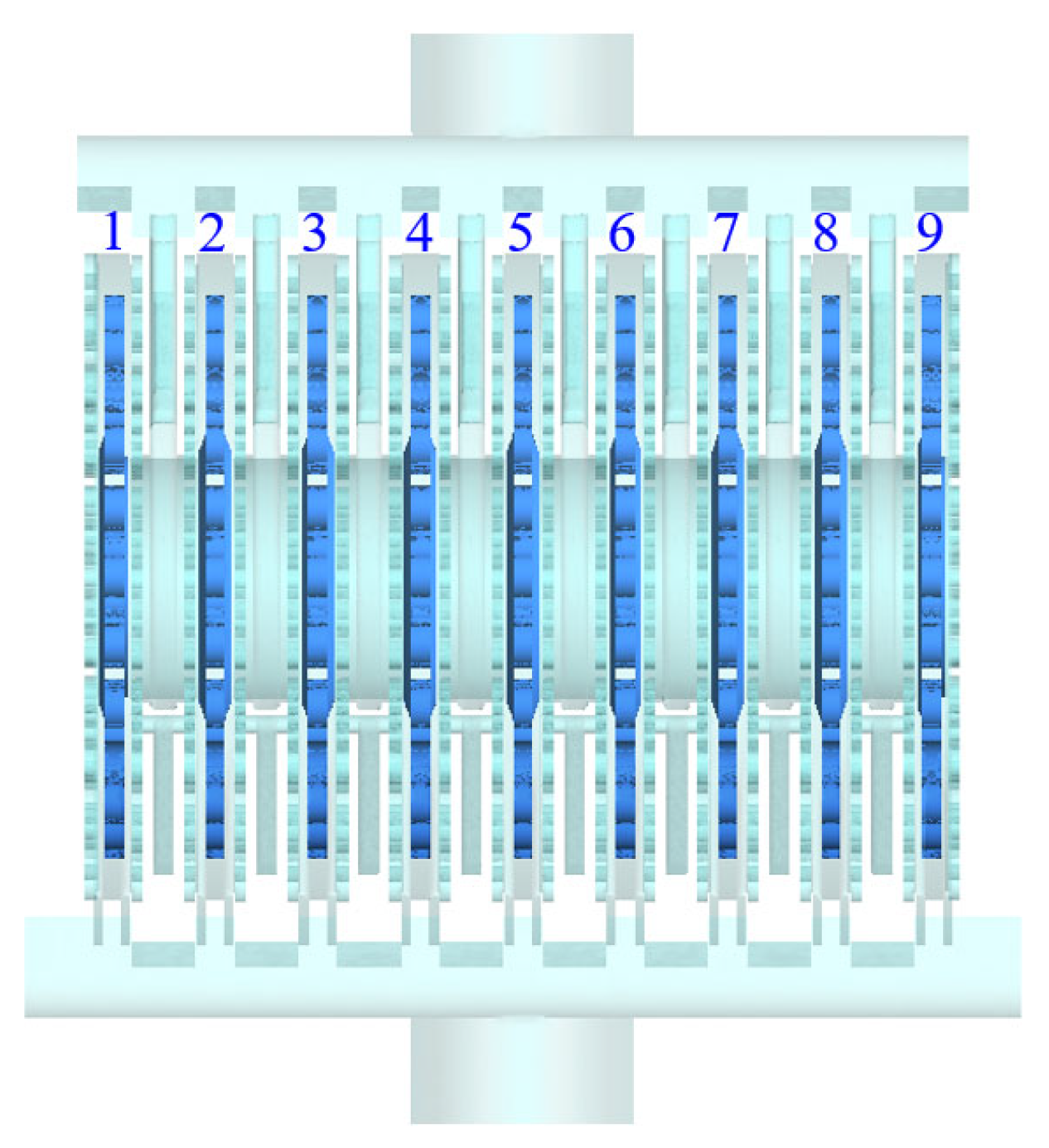
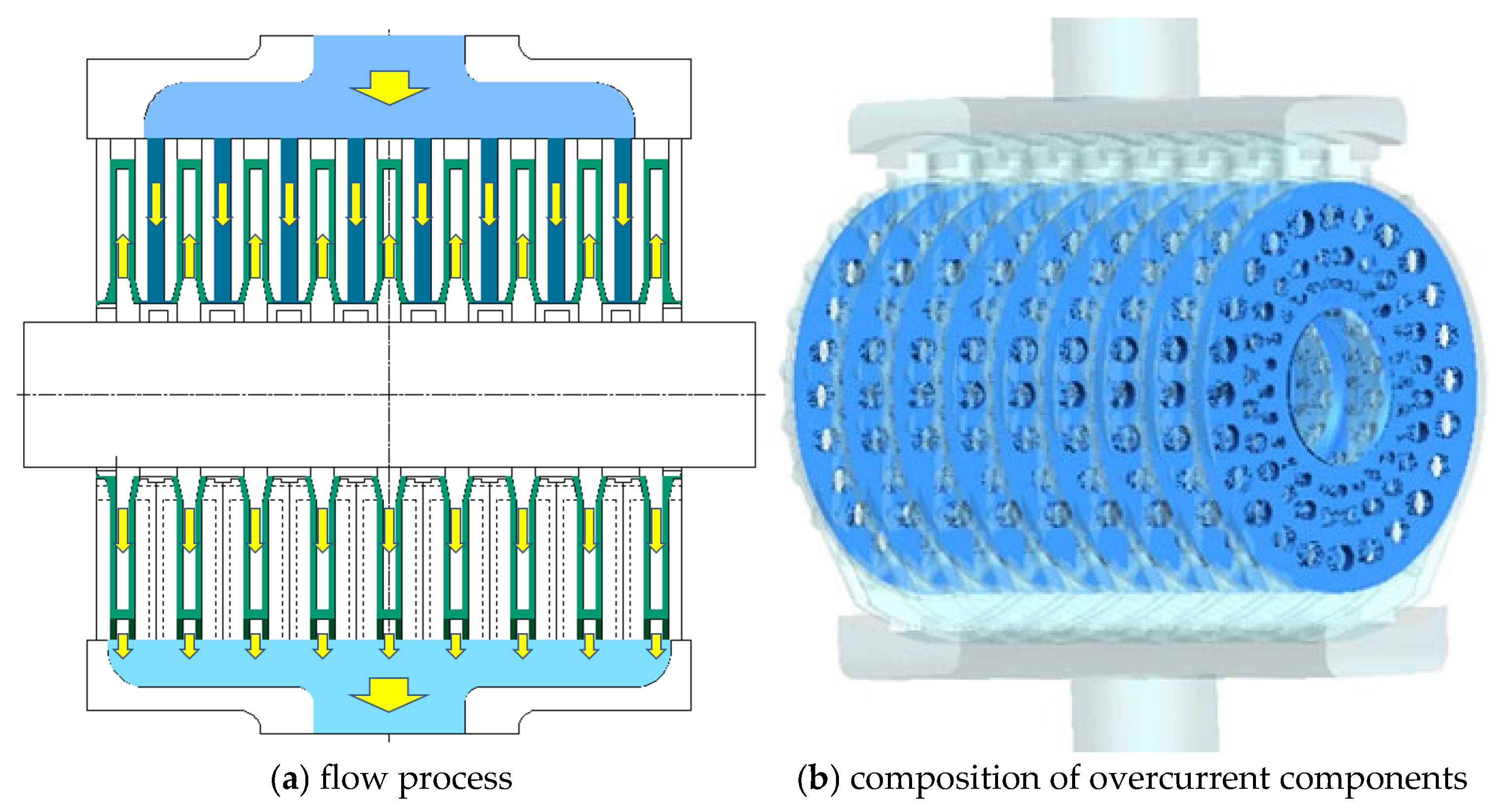
A hydraulic dynamometer with perforated-disk-type rotor is selected as the research object in the paper. Its maximum absorption power is 30 MW, and the maximum speed is 6500 r/min. The working fluid enters the suction chamber of the upper part of the dynamometer through an inlet pipe and enters 9 rotors through 8 intermediate stators. The interference effect between 9 rotors and 10 stators (8 intermediate stators and 2 end stators) is used to convert the load power into water power. Then, the fluid enters the outlet chamber of the lower part of the dynamometer through 9 drainage rings and flows out of the dynamometer, forming the overcurrent structure of the hydraulic dynamometer, as seen in Figure 1. The flow field inside the hydraulic dynamometer consists of an inlet chamber, 10 stators, 9 rotors, 9 drainage rings, and an outlet chamber, with geometric parameters, as shown in Table 1.

2.2. Experimental Devices and Methods

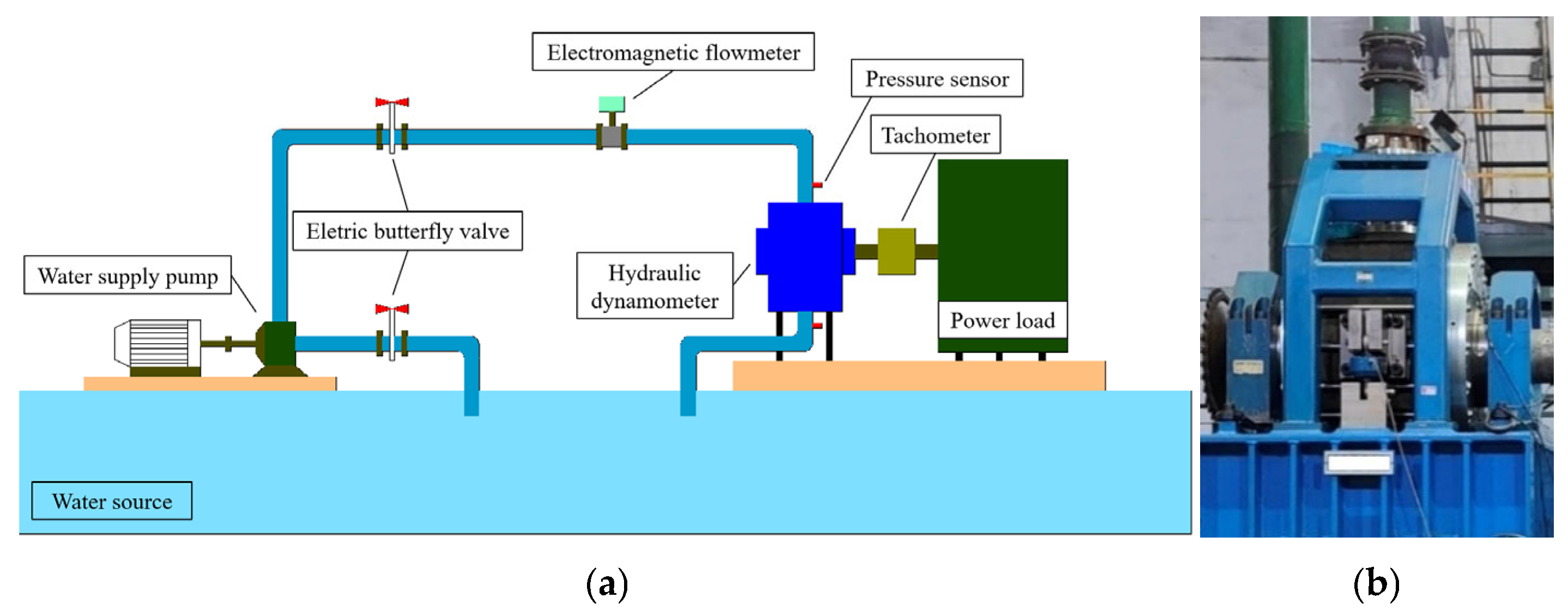
The hydraulic dynamometer performance test platform is set up to investigate the hydraulic absorption power performance and cavitation characteristics of a hydraulic dynamometer at different rotation speeds. The test platform is made up of tested hydraulic dynamometer, power load, electric butterfly valve, water supply pump, pipelines and water reservoir, as illustrated in Figure 2. The hydraulic dynamometer performance test system with electromagnetic flowmeter, tachometer, and pressure sensor is used to capture and gather test data. The circulating water is supplied by water reservoir, and its flow rate and pressure are increased by a water supply pump. The pipeline water enters the hydraulic dynamometer for energy conversion, achieving power measurement of the power load. The electric butterfly valve is set at the water supply pipe to control the flow rate of the hydraulic test system. The electromagnetic flowmeter is used to measure and collect the flow data in the pipeline. The upstream and downstream pipeline lengths of the flowmeter are longer than ten times of the pipe diameter. Pressure sensors are installed in the pipelines connecting the tested hydraulic dynamometer, spaced two pipe diameters apart from the dynamometer inlet or outlet. The absorbed power of a hydraulic dynamometer is the core indicator for evaluating the performance, and the absorbed power T is defined as Equation (1):
T   =   ρ l Q ( u 2 v u 2 u 1 v u 1 )
where ρl, Q, u2, vu2, u1 and vu1 are the water density, flow rate in the hydraulic dynamometer, tip velocity at the rotor outlet, circumferential velocity at the rotor outlet, tip velocity at the rotor inlet, and circumferential velocity at the rotor inlet, respectively.

2.3. Numerical Simulation Method

Numerical simulations are used to analyze the internal flow characteristics and cavitation evolution characteristics of a hydraulic dynamometer using the commercial CFD software, ANSYS CFX. The internal flow field of the hydraulic dynamometer consists of 30 computational domains, including an inlet chamber, 10 stators, 9 rotors, 9 drainage rings, and an outlet chamber. Considering the complex internal flow and multiple computational domains of hydraulic dynamometer, the SST k-ω turbulence model is used to solve the momentum equation, as shown in Equations (2)–(9). The finite volume method is applied to discrete control equations and 25 °C water is used as the working fluid. The numerical simulation adopts transient simulation, with a rotation of 1 degree as the duration and a total rotation time of 8 revolutions. The dynamic and static interfaces between stator and rotor, as well as between the rotor and the drainage ring, are set to “transient rotor–stator”. In the numerical simulation method, the inlet boundary is set to “total pressure” with the experimented pressure of dynamometer inlet, while the outlet boundary condition is set to “velocity” with the accurate velocity component of the dynamometer operation condition.
t ρ k + x i ρ u i k = P ˜ k β * ρ k ω + x i μ + σ k μ t k x i
t ρ ω + x i ρ u i ω = α 1 v t P ˜ k β ρ ω 2 + x i μ + σ ω μ t ω x i + 2 1 F 1 ρ σ ω 2 1 ω k x i ω x i
v t = a 1 k max a 1 ω , S F 2
S = 2 S i j S i j
P k = μ t u i x j ( u i x j + u j x i ) P ˜ k = min ( P k , 10 β * ρ k ω )
F 1 = tanh min max k β * ω y , 500 v y 2 ω , 4 ρ σ ω 2 k C D k ω y 2 4
F 2 = tanh max 2 k β * ω y , 500 v y 2 ω 2
C D k ω = max 2 ρ σ ω 2 1 ω k x i ω x i , 10 10
where β* = 0.09, α1 = 5/9, β1 = 0.075, σk1 = 0.85, σω1 = 0.5, α2 = 0.44, β2 = 0.0828, σk2 = 1.0, σω2 = 0.856.
The simulation for the cavitation evolution in hydraulic dynamometer is based on the homogeneous flow model of gas–liquid two-phase coupling, and the Schnerr–Sauer model is used to simulate phase transition between gas–liquid two phases, incorporating mass transfer from liquid to gas phase:
α d ρ v d t + ρ v d ρ v d t + ( α ρ v V ¯ ) = ρ v ρ l D α ρ D t
where ρv is the gas phase density, kg/m3; ρl is the density of liquid phase, kg/m3; ρ is the density of mixed phase, kg/m3; α is the gas phase volume fraction.
The net mass source phase is
R = ρ v ρ l ρ d α d t
The relationship between gas volume fraction and quantity is as follows:
α = n b 4 3 π R b 3 1 + n b 4 3 π R b 3
Combine Equation (11) and Equation (12) to obtain
R = ρ v ρ l ρ α ( 1 α ) 3 R b 2 ( P v P ) 3 ρ l
where R is the gas–liquid two-phase mass transfer rate; Rb is the bubble radius, m. The expression of bubble radius Rb is
R b = ( α 1 α 3 4 π 1 n b ) 1 3
where nb is the number of bubbles per unit volume, nb = 1013/m3.
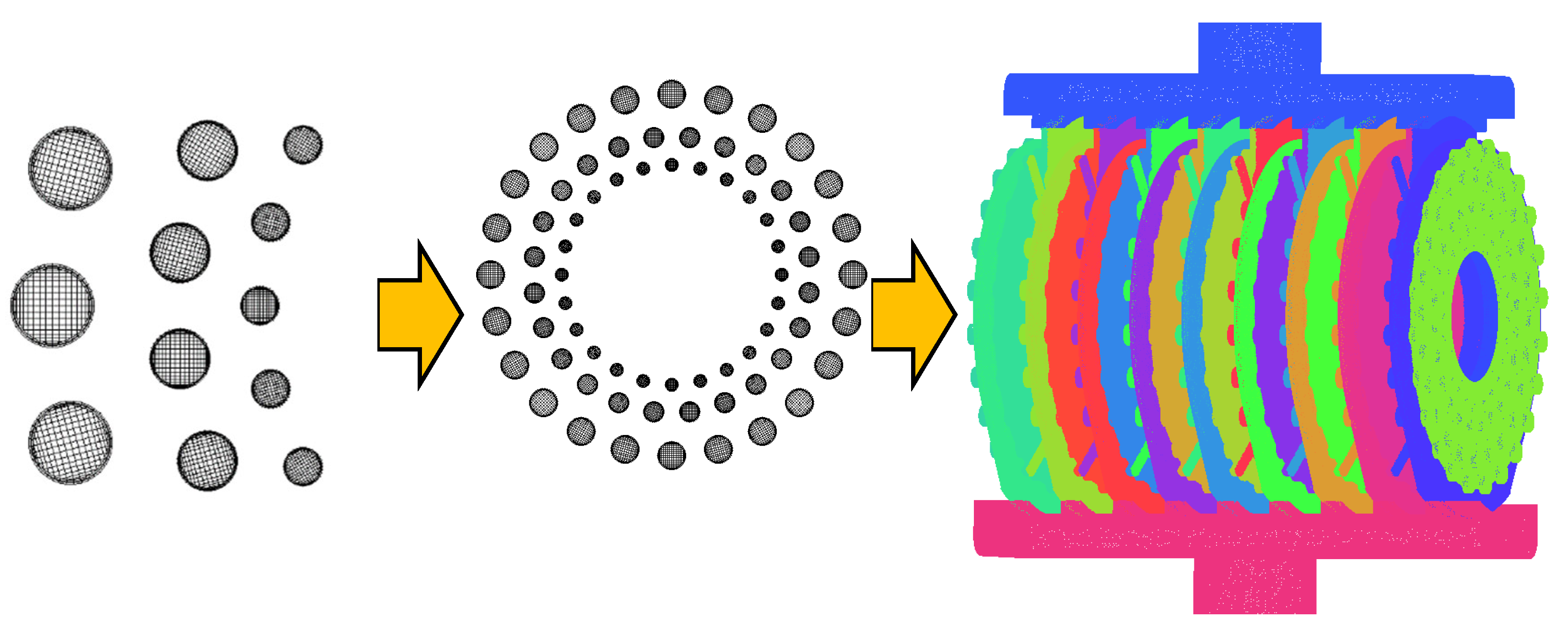
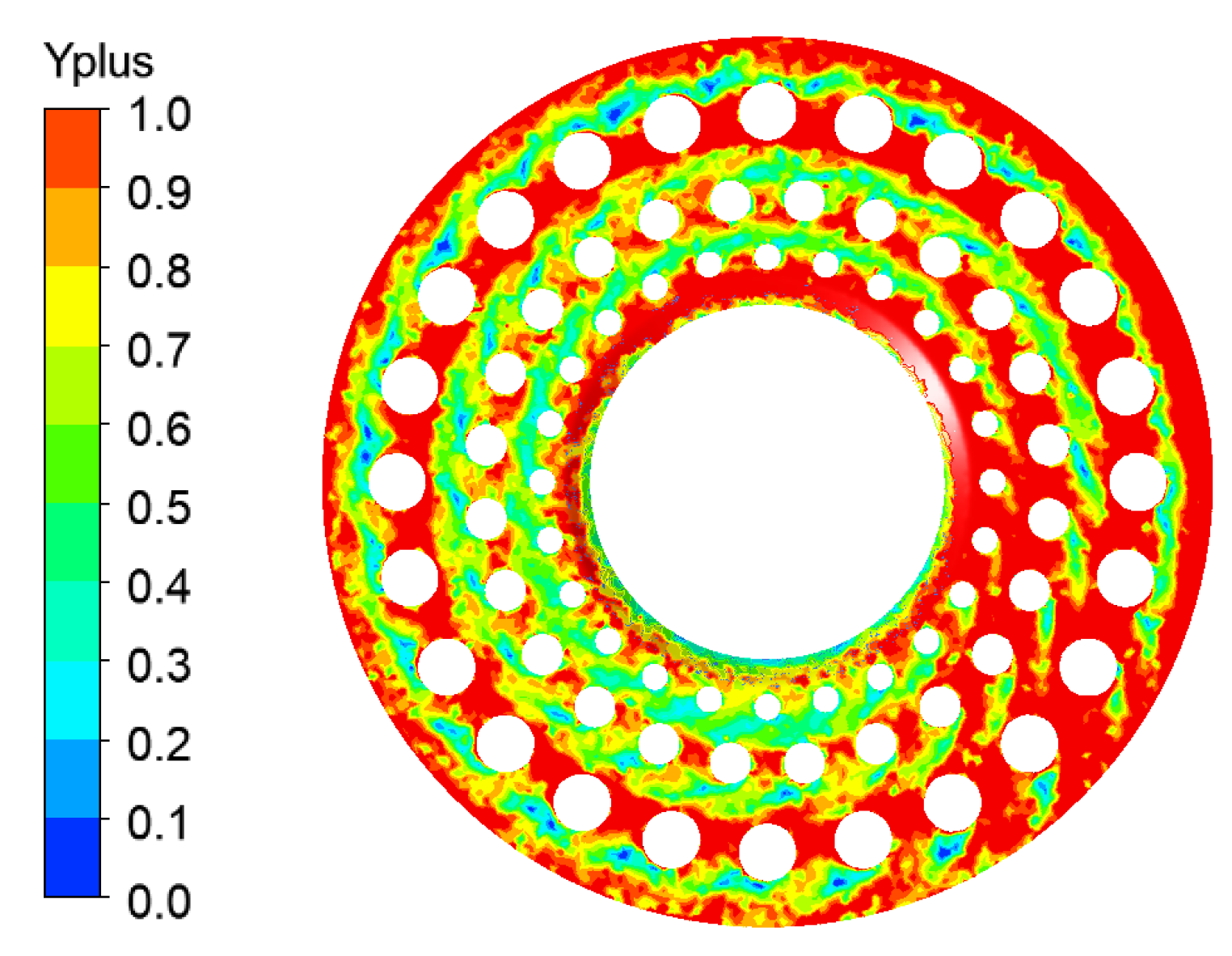
The hexahedral meshes are applied to 30 independent computational domains of the hydraulic dynamometer in Figure 3. The maximum nondimensional wall distance y+ value is less than 1 in Figure 4. The finer grids are devoted to the computational domain after the grid independence test using the grid convergence index (GCI). The GCI is defined in Equation (15), and this grid GCI test on account of the absorbed power p values at the dynamometer speed condition of 6000 r/min is displayed in Table 2. The mesh with 3.22 × 10⁷ grid points is selected in this work, considering the computing capacity and grid error.
G C I k = ε s r k , k + 1 i φ r ( k , k + 1 ) r k , k + 1 i 1
where ε s is the safety factor, and from 1.25 to 3.00, r k , k + 1 i is the mesh refinement ratio, φ r ( k , k + 1 ) is the relative error between grids.

3. Result and Discussion

3.1. Power Absorption Performance of 30 MW Hydraulic Dynamometer

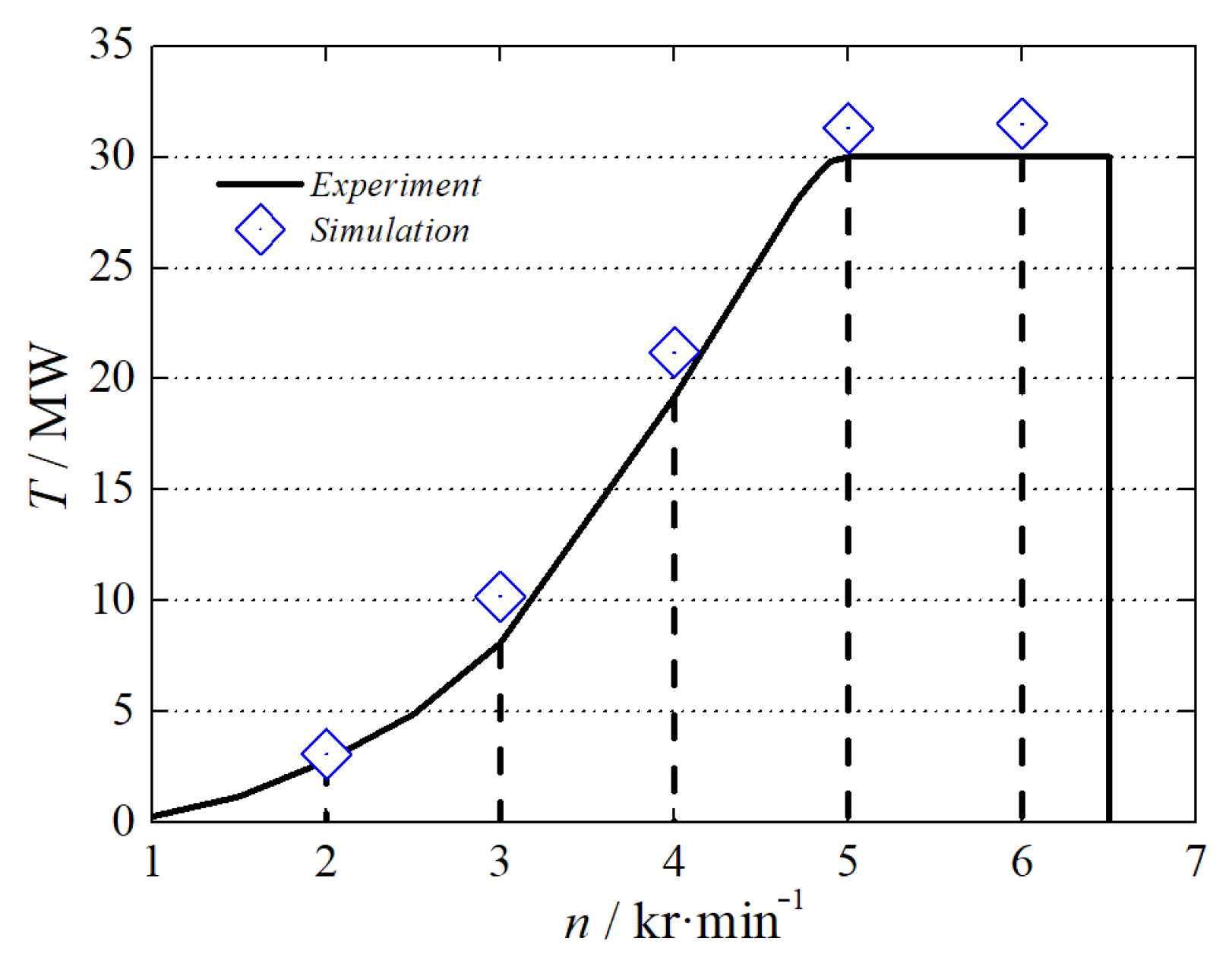
The power absorption performance characteristics of a 30 MW hydraulic dynamometer are measured on the hydraulic dynamometer performance test platform. The dynamometer is operating under rated rotation speed conditions, and its power absorption performance develops along the black tested curve in Figure 5 when the dynamometer tank is full of water. This operating condition is considered as the full-water operating condition. The tested power of the dynamometer gradually increases as the rotation speed increases. When the speed reaches 4700 r/min, the tested power reaches its peak (30 MW). The rotation speed continues to increase after it exceeds 4700 r/min, and the tested power remains constant. When the dynamometer tank is not filled with water, the absorbed power value is less than that under the full-water operating condition and this condition is called the water shortage condition. The dynamometer operates at a certain rotation speed under water shortage condition, and its power absorption performance follows the blue dashed line.
The experimental tests for dynamometer power absorption performance have verified the applicability of the numerical simulation method applied in the paper. The full-water operating conditions of the hydraulic dynamometer are simulated at critical rotation speeds including 2000 r/min, 3000 r/min, 4000 r/min, 5000 r/min, and 6000 r/min. With the increase in dynamometer rotation speed, the variation patterns of tested power and simulated power are similar. However, the simulated value is slightly higher than the tested one, which is due to inevitable manufacturing errors and fitting errors in the actual device. The maximum simulation error is 4.3% in working conditions with a high-frequency dynamometer, and the numerical simulation results are reliable.

3.2. Porous Flow and Hydrodynamic Characteristics

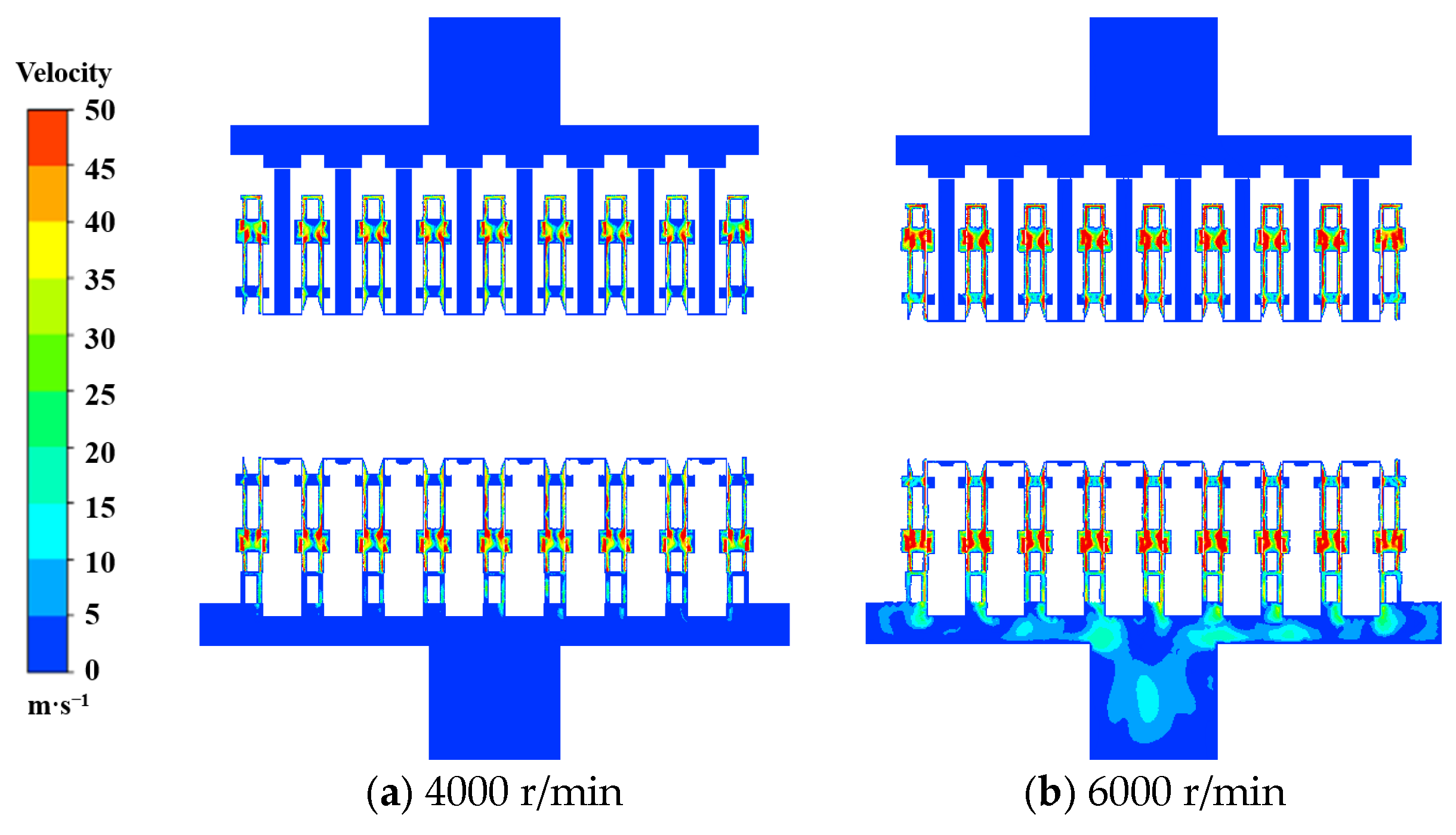
The working fluid enters the stator channel from the inlet chamber, then flows into the rotor channel, and flows out of the hydraulic dynamometer through the drainage circulation to the outlet chamber. Figure 6 shows the entire process of the fluid flowing from the upper inlet chamber into the stator channel and from the lower outlet chamber out of the dynamometer. Considering the impact of a performance inflexion point of 4700 r/min, hydraulic dynamometer operation conditions of 4000 r/min and 6000 r/min are selected to study the inner flow characteristics. The flow velocity of the fluid in the inlet pipe and stator is low; the flow velocity increases sharply when it enters the rotor flow channel. The rotor is the core flow channel for fluid energy exchange inside the dynamometer, and it is also a key overcurrent component for absorbing power. The fluid velocity in the porous flow channel of the rotor is significantly high, and the flow is particularly intense. Compared to the speed condition of 4000 r/min, the flow velocity in the rotor channel is higher at the speed condition of 6000 r/min, indicating greater fluid energy. The high-speed rotor can absorb greater measured power. The fluid enters the drainage ring from the rotor outlet, rectified by the drainage ring and enters the casing outlet chamber. The significant change in flow velocity occurs at the junction of the drainage ring and the casing outlet chamber. The fluid flowing out of the nine drainage rings is concentrated at the casing outlet chamber, forming a mixed flow field and causing non-uniform flow distribution. As the rotor speed increases, this non-uniform flow becomes more intense and prone to shock vibration, which has a negative impact on the torque measurement of the casing and the operational stability of the device.
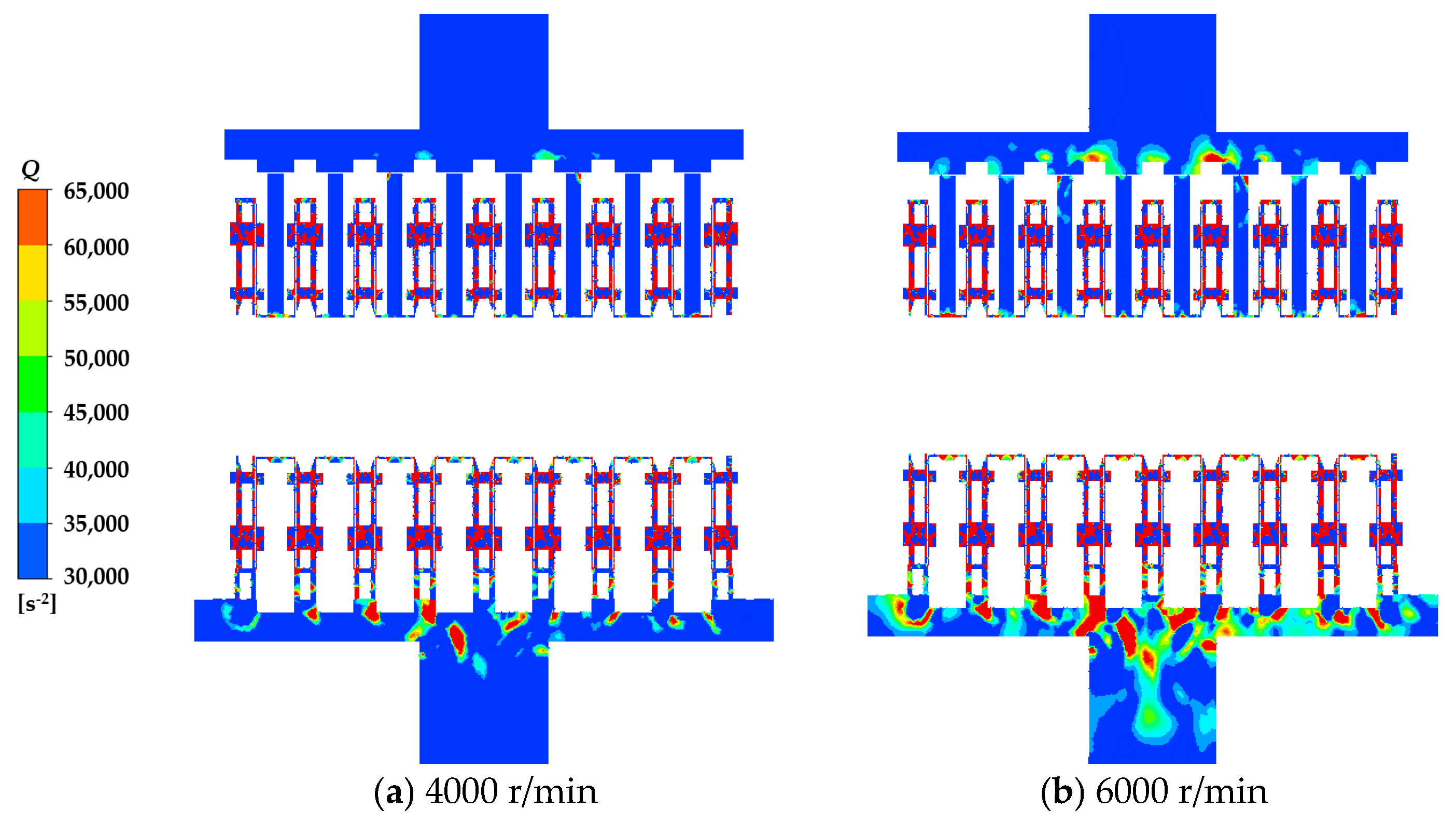
Obvious vortex structures appear in the internal flow channel of the hydraulic dynamometer, as shown in Figure 7. The Q criterion is used to capture and identify vortex structures in the flow field inside hydraulic dynamometers, explore vortex structures of various scales and intensities in the flow, and analyze the generation, shedding, and development of vortices:
Q = 1 2 ( B F 2 A F 2 )
A F 2 = ( u x ) 2 + 1 2 ( u y + v x ) 2 + ( v y ) 2 + 1 2 ( u z + w x ) 2 + ( w z ) 2 + 1 2 ( v z + w y ) 2
B F 2 = 1 2 ( ( u y v x ) 2 + ( u z w x ) 2 + ( v z w y ) 2 )
Q = 1 2 ( ( u x ) 2 + ( v y ) 2 + ( w z ) 2 ) u y v x u z w x v z w y
The vortex structure inside the hydraulic dynamometer intensively exists in the rotor flow channel, stator–rotor interface, rotor–drainage ring interface, and drainage ring outlet. High intensity vortex motion mainly occurs in the rotor flow channel, especially in the porous structure of the rotor. The high-speed rotation of the rotor induces unsteady fluid flow. The flow velocity gradient in the rotor channel is large, which easily leads to separated flow and induces large vortex structures, resulting in vortex-induced phenomena. Compared to the middle rotor, the vortex intensity in the end rotors at both ends is higher. There is no flow on one side of the end rotor, resulting in additional flow impact and more obvious flow separation, leading to higher vortex intensity. There are obvious vortex structures in the outflow of nine drainage rings, which is due to the interference between high-speed outflow and low-speed fluid inside the casing, inducing vortex excitation phenomenon. Compared to the speed of 4000 r/min, the vortex excitation inside the rotor at 6000 r/min is more pronounced, indicating that high-speed rotors can induce greater flow excitation when absorbing more power, resulting in measurement errors and unit vibrations.
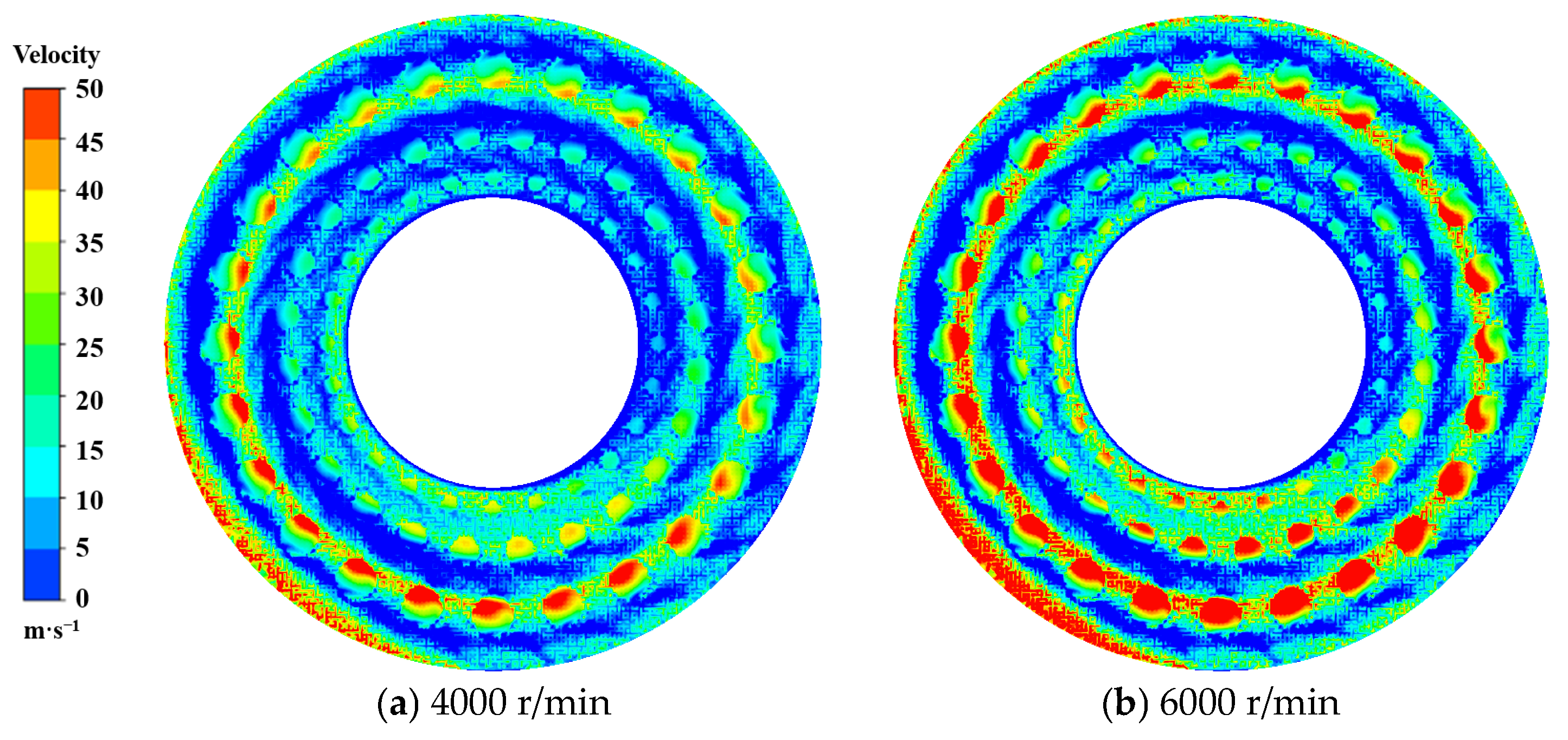
It is obvious that the rotor is a key component for water flow energy exchange and power measurement in the hydraulic dynamometer. The porous structure of the rotor increases the kinetic and pressure energy of the fluid. Considering the symmetry of the rotor–stator structure, nine rotors have been numbered in Figure 8, and the flow distribution on the center plane between rotor 1 and its right stator is shown in Figure 9. The obvious characteristics of orifice outflow appear in the center plane, where the fluid velocity flowing out from the rotor orifice structure is significantly higher, especially the outermost orifice flow. Moreover, the fluid in some of the orifices below, namely the orifices near the outlet of the hydraulic dynamometer, has a higher flow velocity in the same circle of orifice flow. The outlet of the drainage ring is located below the dynamometer, and the fluid in the rotor flows toward the drainage ring. The increase in flow rate in the limited space causes an increase in flow velocity. Specifically, there are some fluids with higher velocities in the outermost layer to the left below the rotor. The rotation of the rotor is clockwise, and the high-speed flow area here indicates that there is still some high-speed fluid in the rotor flow channel that has not flowed to the drainage ring. As the rotation speed increases (from 4000 r/min to 6000 r/min), this phenomenon becomes more pronounced. This part of the flow belongs to ineffective flow, and the flow area inside the drainage ring should be increased to alleviate this flow distribution.
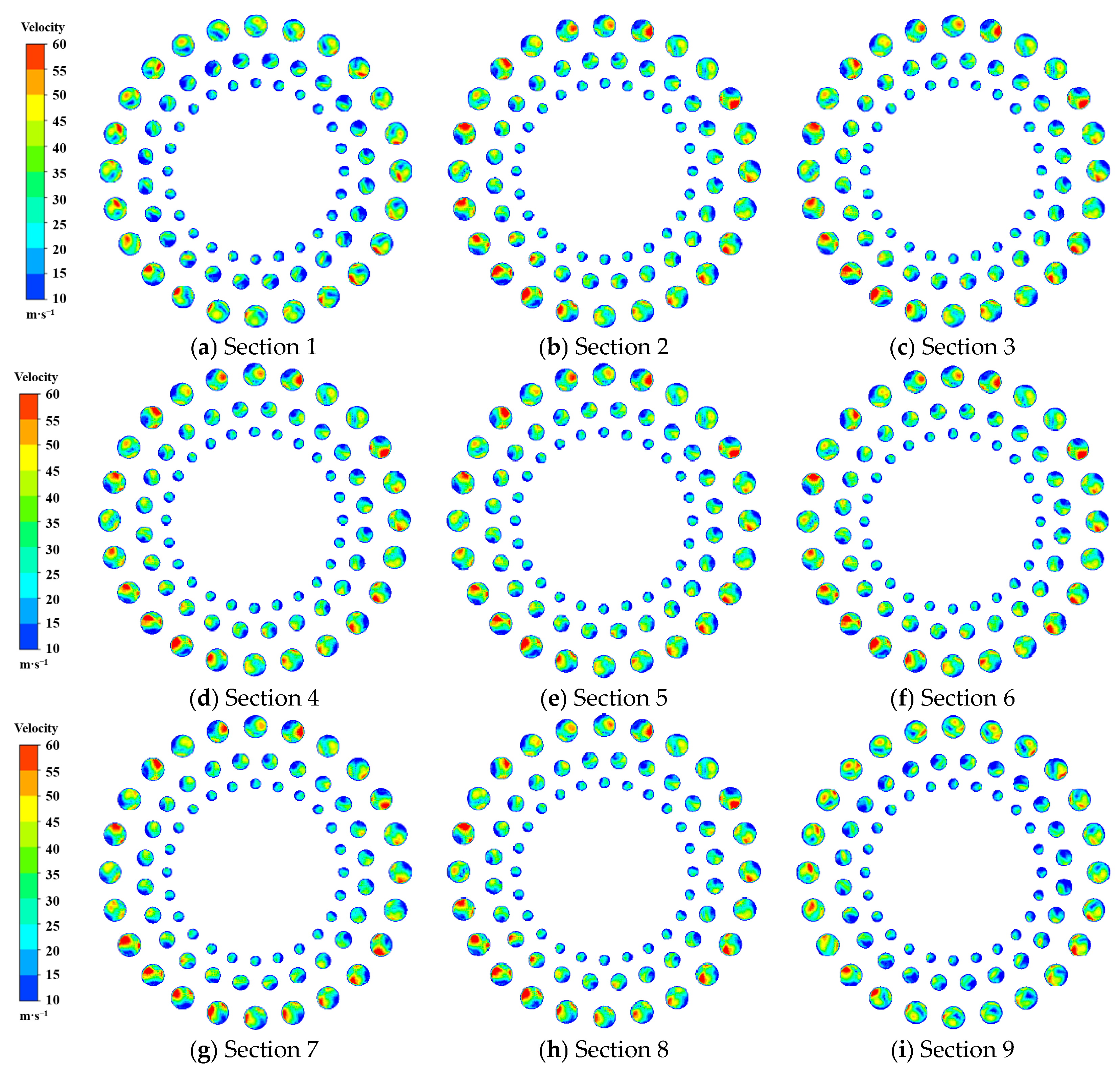
The flow on the center cross-section of nine rotors was extracted to analyze the power absorption performance and internal flow characteristics of rotors at different positions, as shown in Figure 10. There are obvious high-speed and low-speed zones in the flow inside the outermost orifice. The size of the orifice in the porous structure of the rotor is relatively small, and the obvious high and low speed flow will generate a large rotation speed, causing intense vortex motion and inducing significant vortex excitation. This indicates that the flow inside the outermost pore is significantly unstable, which affects the measurement accuracy and operational stability of the hydraulic dynamometer. The flow–velocity differences in the inner two layers of orifices are relatively small, and the flow inside the orifice is relatively steady. Compared to the middle rotor of Sections 2 to 8, the flow velocity variations at Section 1 and Section 9 in the end rotor are smaller. The end rotor only has one side of the stator receiving water, resulting in a small flow rate and low flow excitation.
High-speed flow mainly appears in the outermost orifice of the rotor, accompanied by significant secondary vortices. These fluids flow out of the rotor and into the drainage ring for rectification. Obvious fluid-induced excitation occurs at the dynamic static junction of the rotor and the drainage ring. The dimensionless pressure coefficient C is introduced to evaluate the flow-induced excitation phenomenon inside the hydraulic dynamometer, as shown in Equation (20):
C   = Δ P   0.5 ρ v u 2 2
where Δ P = P P ¯ , P is static pressure at the node and P ¯ is average pressure.
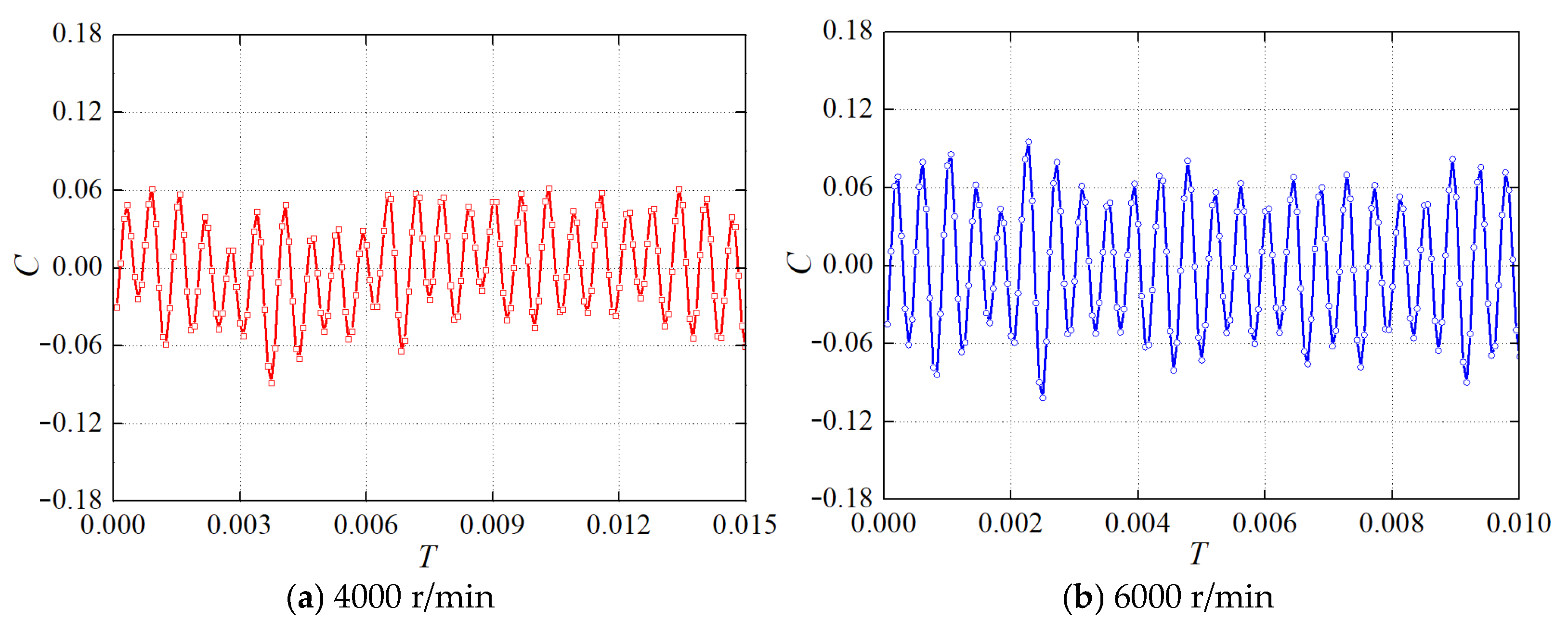
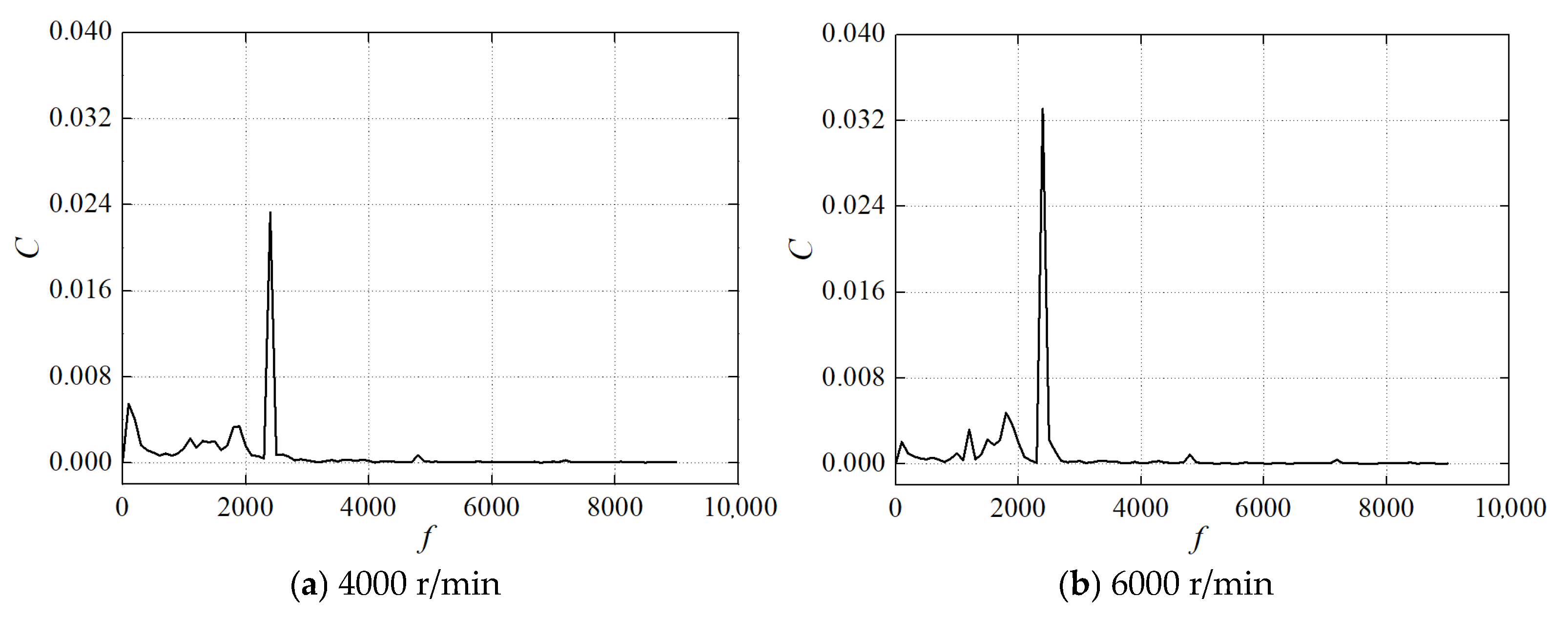
Compared to the end rotor, the internal flow excitation in the middle rotor is more pronounced. Based on the junction between the 5# intermediate rotor and the drainage ring as a monitoring point, the pressure time-domain characteristics of the 4000 r/min and 6000 r/min operating conditions are recorded, as shown in Figure 11. The obvious pressure pulsation changes occur at the junction of the rotor and the drainage ring, with a total of 24 peaks and 20 valleys, consistent with the number of orifices on the outermost layer of the rotor, indicating that the dynamic and static interference between the rotor and the drainage ring is mainly influenced by the porous structure on the outermost side of the rotor. The pressure variation amplitude is greater under the condition of 6000 r/min, illustrating that an increase in the power of the tested load will exacerbate the instability of the flow inside the hydraulic dynamometer. Compared to the speed condition of 4000 r/min, the flow velocity in the rotor channel is higher at the speed condition of 6000 r/min, indicating greater flow excitation. Figure 12 shows the frequency-domain distribution of pulsating pressure at the junction of the rotor and the drainage ring. The pressure pulsation characteristics are similar at different speeds, and the frequency of the maximum amplitude is related to the shaft frequency. Compared to the 4000 r/min operating condition, the pressure pulsation amplitude of the 6000 r/min operating condition is larger, indicating that the water excitation degree of the hydraulic dynamometer is more severe at high speeds, resulting in larger unit vibrations and unstable torque measurement values.

3.3. Effects of Cavitation on Power Characteristics

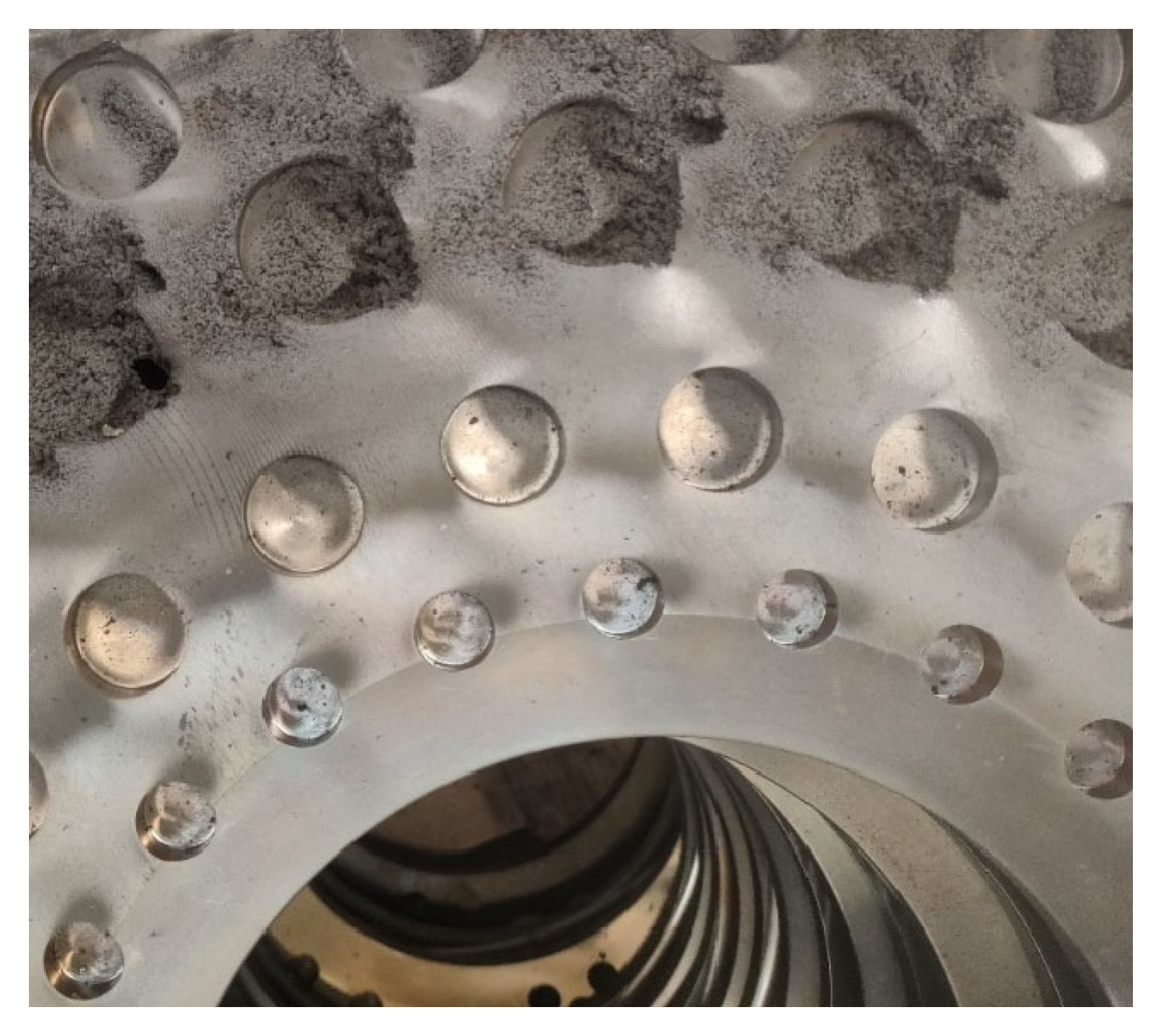
Cavitation is the main physical phenomenon that affects the stable operation of the hydraulic dynamometer, increases measurement errors, and is also the most frequent fault. Figure 13 shows the actual cavitation situation of the stator matched with the middlemost 5# rotor. Obvious cavitation pits and imprints are displayed on the actual stator orifice structure, especially on the outer side of the outermost layer orifices of the stator where cavitation is evident. The cavitation coefficient σ is introduced to investigate the cavitation flow characteristics in the flow channel of the hydraulic dynamometer:
σ   = P     P v   0.5 ρ v u 1 2
where Pv is the saturated vapor pressure and vu1 is the rotor inlet circular velocity.
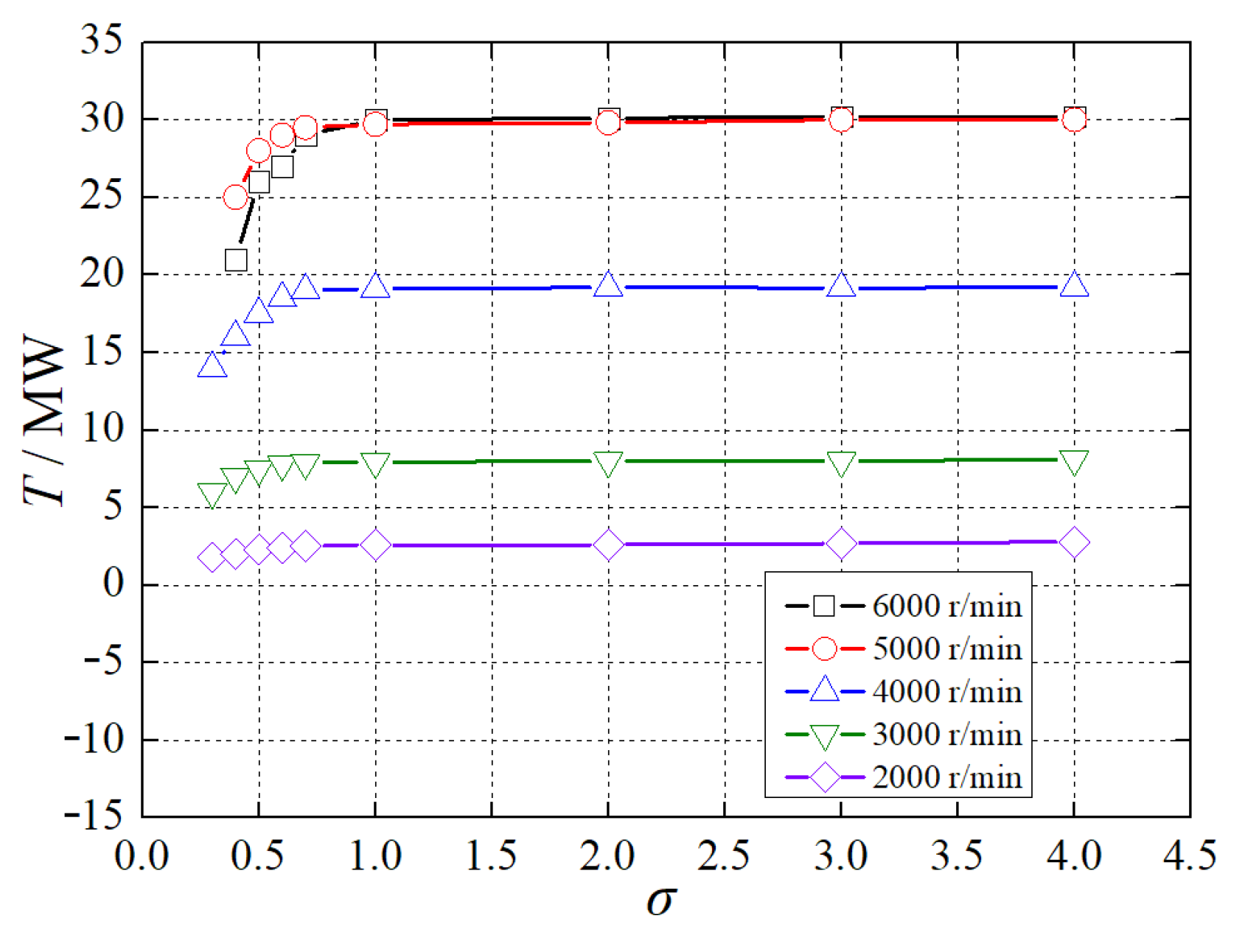
During the power testing process of a hydraulic dynamometer, excessive flow in the external pipeline system can easily cause an increase in the internal fluid flow velocity of the dynamometer. When the flow velocity exceeds the rated flow velocity, it will cause an abnormal decrease in pressure and induce cavitation at the maximum flow velocity point, which is inside the outermost layer orifice of the rotor. The increase in flow velocity causes a decrease in pressure. When the cavitation coefficient σ drops below 0.8, the absorbed power of the hydraulic dynamometer begins to decrease in Figure 14. As the rotation speed decreases, the slope of the power cavitation performance curve gradually increases, and the power attenuation becomes slower. When the cavitation coefficient decreases σ to 0.5, the amplitude of the decrease in the absorbed power of the hydraulic dynamometer significantly increases. Especially under high-speed operating conditions (5000 r/min and 6000 r/min), the decrease in power absorption values is significant. This is due to the high fluid velocity inside the high-speed rotor, which makes it easier to cause a sharp drop in flow field pressure. Figure 14 shows the cavitation performance of a hydraulic dynamometer when the water tank is filled with water. When the dynamometer tank is not filled with water, the fluid is more likely to separate from the rotor wall, leading to more pronounced cavitation phenomena.
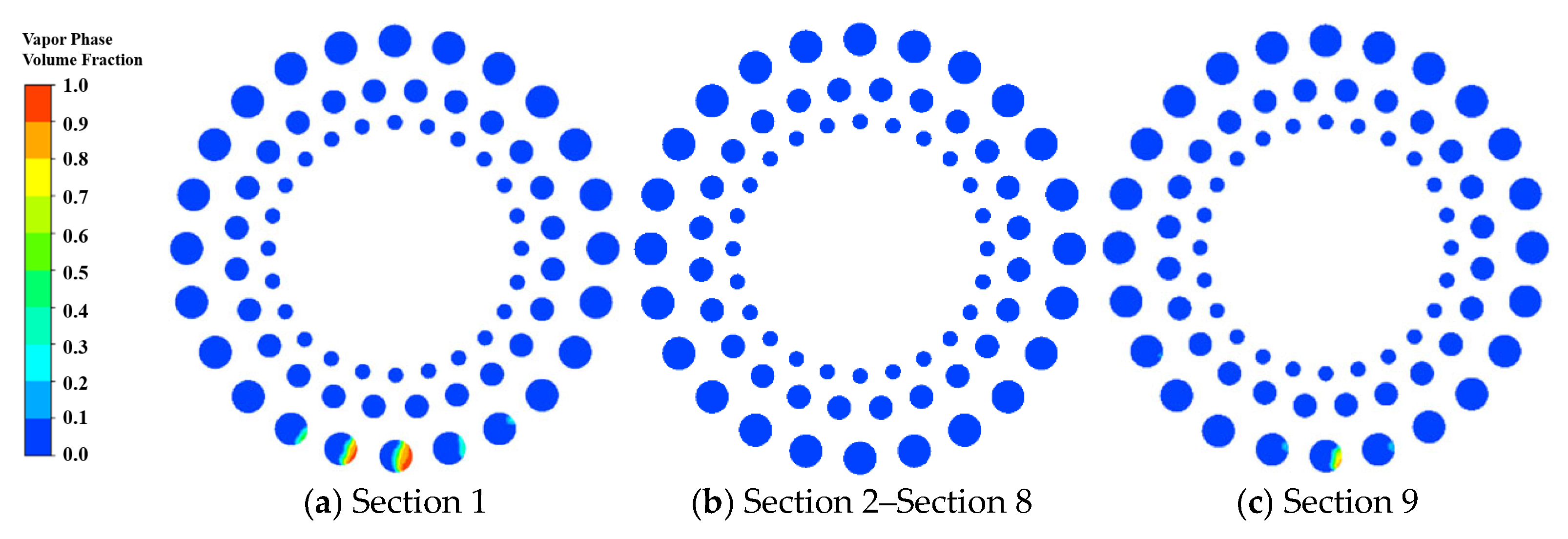
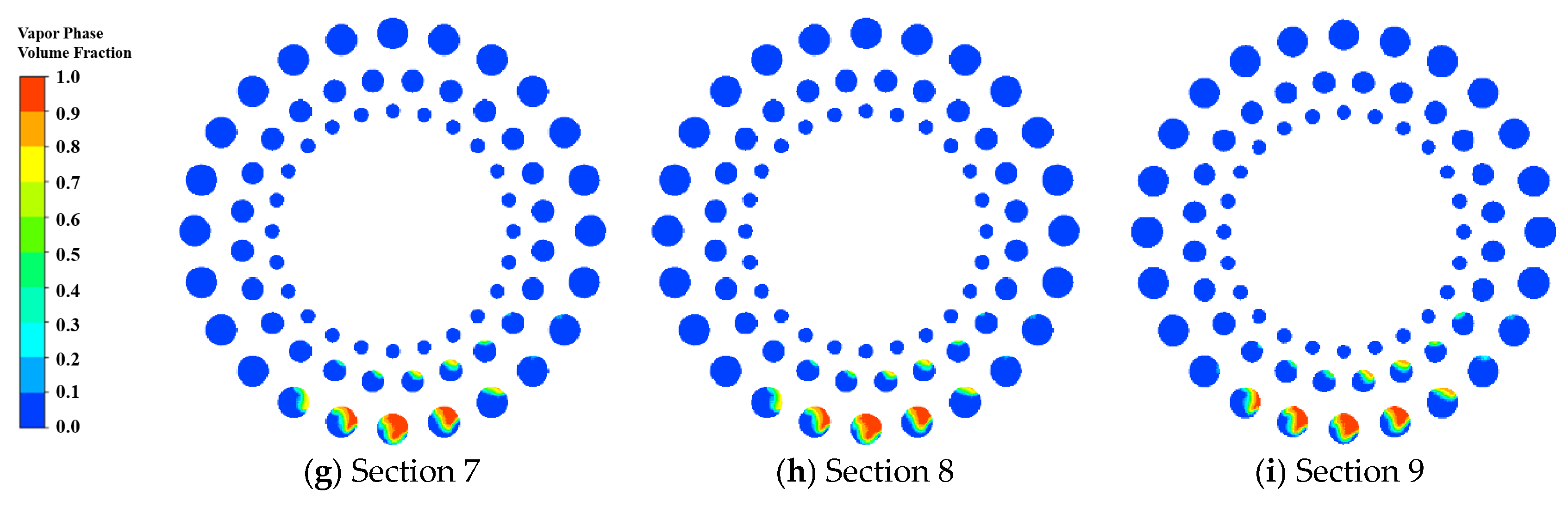
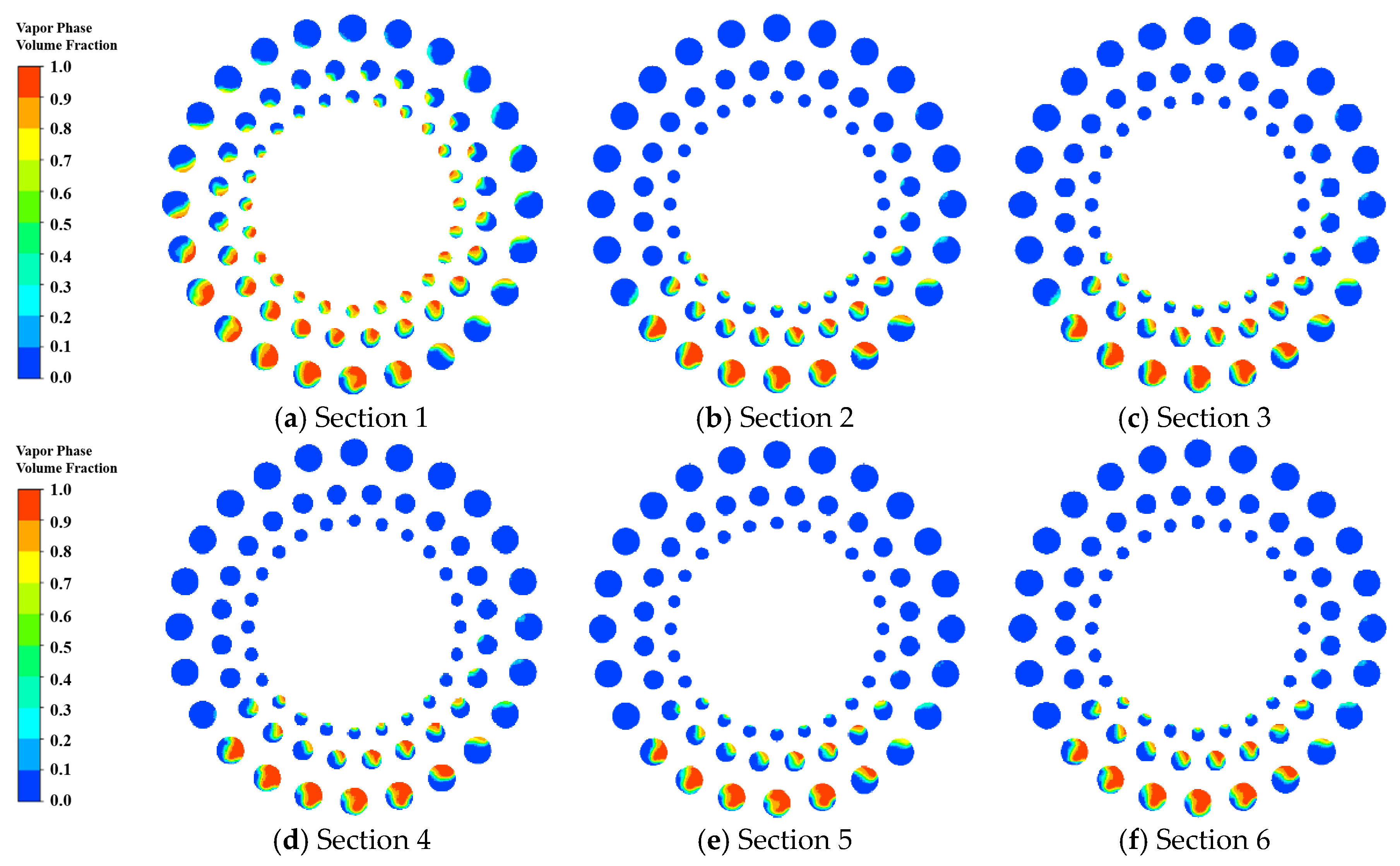
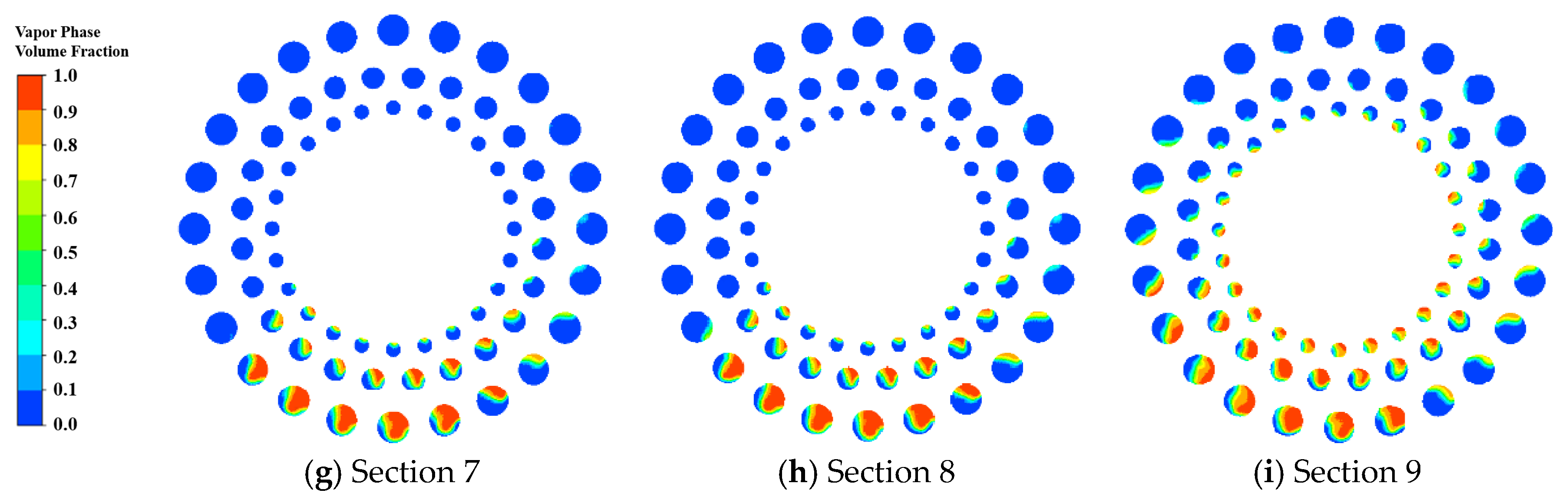
The generation of air bubbles in the rotor pore not only blocks the flow channel but also causes damage to the mating stator wall surface due to bubble rupture. As the rotor rotations and the pressure inside the pore decreases, bubbles begin to form, develop, and burst. When σ is at 0.9 in Figure 15, air bubbles appear in the outermost orifice at the outlet of the end rotor (Section 1 and Section 9), and no air bubbles are found in the middle rotor (Section 2–Section 8). The size of the end rotor flow channel is relatively small, and the flow velocity is relatively high, causing the pressure to drop first to the vaporization pressure, that is, the cavitation phenomenon first occurs in the end rotor flow channel.
The significant cavitation occurs in the outermost orifice of the middle rotor flow channel when the cavitation coefficient decreases to 0.7, as seen in Figure 16. Bubbles mainly appear in the outermost orifices near the rotor and drainage ring. When cavitation occurs in the rotor flow orifice, the cavitation blocks the flow orifice, and the surrounding fluid pressure gradually increases. When the cavitation breaks, the surrounding high-pressure liquid rushes into the cavitation space, eroding the stator in contact with the rotor. Combined with the stator damage diagram in Figure 13, the location of stator cavitation corresponds to the outermost orifice of the rotor, indicating that the numerical simulation results are consistent with the actual cavitation situation. When the fluid flows out of the rotor channel, its flow velocity is the highest, and the water pressure is the lowest at this time, so cavitation is prone to occur.
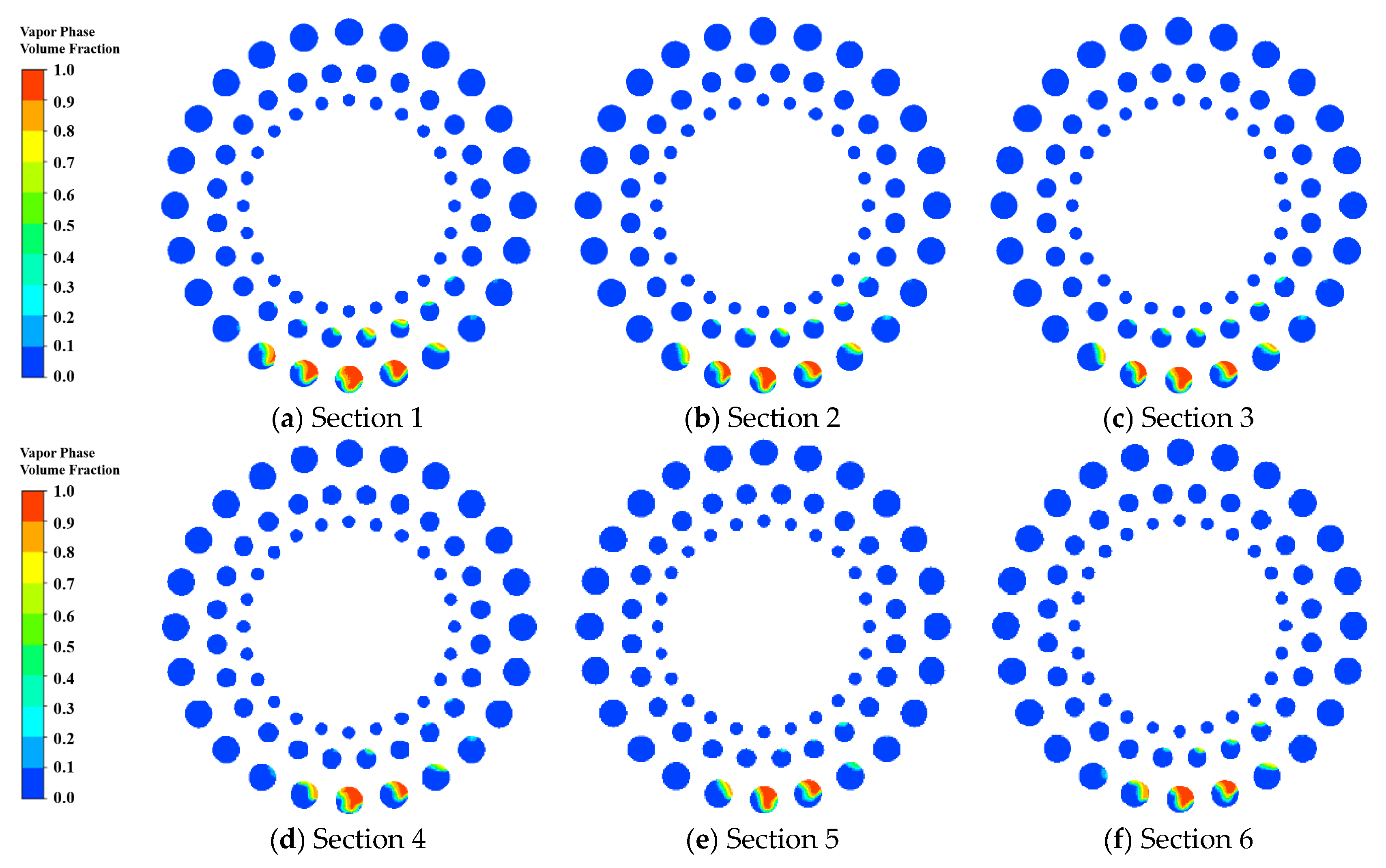
When the cavitation coefficient further decreases (σ = 0.5), the cavitation phenomenon gradually develops from the outermost pore flow to the inner pore flow and first occurs in the orifices near the rotor outlet in Figure 17. The diffusion of the cavitation phenomenon is particularly evident in the end rotor flow channel. Due to the influence of air bubbles, the cross-sectional area of the liquid flow decreases. Compared with the non-cavitation condition, the flow inside the orifice is more unsteady, the high-speed zone is significantly increased, and the flow excitation effect is more obvious.

4. Conclusions

This work investigates the power absorption performance and internal flow characteristics of a hydraulic dynamometer with perforated-disk rotor. A hydraulic test platform is established to measure the power absorption performance of megawatt-level hydraulic dynamometers. Numerical simulations are applied to study the internal flow characteristics and cavitation evolution features of the hydraulic dynamometer. The research results are as follows:
(1) The power absorption performance of a hydraulic dynamometer gradually increases, as the rotor rotation speed increases. When the speed reaches 4700 r/min, the tested power reaches its maximum value (30 MW), and increasing the speed will not cause an increase in the absorption power. The dynamometer operates at a certain rotation speed under water shortage condition, and its power absorption value is less than that in the full-water condition.
(2) The unsteady flow characteristics of perforated-disk rotors mainly depend on the flow inside the outermost pores. There are obvious high-speed and low-speed zones in the flow inside the outer pores of the rotor, causing intense vortex motion and inducing significant vortex excitation. As the rotation speed increases, the amplitude of flow-induced pressure pulsation significantly increases, with the maximum amplitude of pressure pulsation at 6000 r/min increasing by 1.4 times compared to 4000 r/min. Dynamic and static interference is a key factor in inducing the flow excitation characteristics of high-speed hydraulic loads.
(3) After cavitation occurs, the power absorption performance of a hydraulic dynamometer significantly decreases. As the rotor rotation speed increases, the decrease in power absorption value obviously increases. The cavitation phenomenon occurs in the outermost flow pores of the end rotor and the middle rotor. The development and collapse of bubbles can cause instability in the pore flow, and the fluid-induced excitation effect is more pronounced.

Author Contributions

Data curation, Y.Y. and Z.L.; funding acquisition, Y.Y.; investigation, Y.Y. and Q.C.; methodology, Y.Y.; project administration, Y.Y.; writing—original draft, Y.Y. and Z.L. All authors have read and agreed to the published version of the manuscript.

Funding

This research was funded by the Jiangsu Provincial Industry–University–Research Collaboration Project (Grant No. BY20240057).

Data Availability Statement

The original contributions presented in this study are included in the article. Further inquiries can be directed to the corresponding author.

Conflicts of Interest

The authors declare no conflicts of interest.

Nomenclature

Tabsorbed power, MW
Qflow rate, m3/h
ρlwater density, kg/m3
u1rotor inlet tip velocity, m/s
vu1rotor inlet circumferential velocity, m/s
u2rotor outlet tip velocity, m/s
vu2rotor outlet circumferential velocity, m/s
Pstatic pressure, Pa
Pvvapor pressure, Pa
ρmixed phase density, kg/m3
ρvgas phase density, kg/m3
αgas phase volume fraction
Rgas–liquid two-phase mass transfer rate
GCIgrid convergence index
nrotation speed, r/min
uflow velocity component at the x axis, m/s
vflow velocity component at the y axis, m/s
wflow velocity component at the z axis, m/s
QQ criterion number
Cpressure coefficient
σcavitation coefficient

References

  1. Meng, M.; Yang, S.; Wu, D.; Zheng, F.; Pan, Y. Research on the transient characteristics of hydraulic dynamometer. Fluid Mach. 2022, 50, 71–77. [Google Scholar]
  2. Hodgson, P.G.; Raine, J.K. Computer simulation of a variable fill hydraulic dynamometer; part 1: Torque absorption theory and the influence of working compartment geometry on performance. Proc. Inst. Mech. Eng. Part C J. Mech. Eng. Sci. 1991, 205, 155–163. [Google Scholar]
  3. Hodgson, P.G.; Raine, J.K. Computer simulation of a variable fill hydraulic dynamometer: Part 2: Steady state and dynamic open-loop performance. Proc. Inst. Mech. Eng. Part C J. Mech. Eng. Sci. 1992, 206, 49–56. [Google Scholar] [CrossRef]
  4. Du, D.; Ma, Y. Influencing factor of hydrodynamometer brake torque. J. Beihua Univ. 2010, 11, 186–188. [Google Scholar]
  5. King, T.I. Interinstrument reliability of the jamar electronic dynamometer and pinch gauge compared with the jamar hydraulic dynamometer and B&L engineering mechanical pinch gauge. Am. J. Occup. Ther. 2013, 67, 480–483. [Google Scholar] [CrossRef]
  6. Lytviak, O.; Loginov, V.; Komar, S.; Martseniuk, Y. Self-Oscillations of The Free Turbine Speed in Testing Turboshaft Engine with Hydraulic Dynamometer. Aerospace 2021, 8, 114. [Google Scholar] [CrossRef]
  7. Li, M.; Gu, B.; Wang, X. Stress analyzing of working rotor. J. Wuhan Univ. Technol. 2003, 25, 54–56. [Google Scholar]
  8. Nguyen, D.A.; Shahzer, M.A.; Kim, J.H. Comparative analysis of flow physics in axial-flow pump predicted through the advanced unsteady numerical techniques. Phys. Fluids 2025, 37, 095135. [Google Scholar] [CrossRef]
  9. Al-Obaidi, A.R.; Alwatban, A. Investigation of hydraulic transient flow and dynamic response performance of axial pump based on novel vibration signals characteristics and numerical analyses. Alex. Eng. J. 2025, 125, 104–126. [Google Scholar] [CrossRef]
  10. Lim, J.; Li, M.; Song, S.J. Impeller wake transport along the diffuser midspan passage of an axial flow pump. J. Mech. Sci. Technol. 2025, 39, 275–285. [Google Scholar] [CrossRef]
  11. Szymanski, L.; Szala, M.; Peddeti, K.; Olejnik, E.; Biegun, K.; Tecza, G.; Bigos, A.; Sobczak, J.; Sobczak, N.; Zak, K.; et al. Slurry and cavitation-erosion resistance of steel-ceramic composites manufactured using in-situ and ex-situ techniques. Mater. Lett. 2025, 403, 139461. [Google Scholar] [CrossRef]
  12. Stephen, C.; Basu, B.; McNabola, A. Evaluation of supervised machine learning techniques for cavitation detection and diagnosis in a pump-as-turbine system. Expert Syst. Appl. 2025, 296, 129167. [Google Scholar] [CrossRef]
  13. Ebada, Y.; Elshennawy, A.; Elbrashy, A.; Rashad, M. Performance optimization of centrifugal pumps: Experimental analysis of flow enhancement and cavitation mitigation under variable operating conditions. Flow Meas. Instrum. 2025, 106, 103043. [Google Scholar] [CrossRef]
  14. Özgünoglu, M.; Persson, M.; Saber, A.; Bensow, R.E. Numerical prediction of cavitation erosion in a water-jet propulsion system. Ocean. Eng. 2025, 340, 122316. [Google Scholar] [CrossRef]
  15. Itadani, M.; Makishima, S.; Tokunaga, Y.; Sugimura, J. Analysis of cavitation pressure on textured surface in mechanical seals. Tribol. Int. 2025, 212, 110914. [Google Scholar] [CrossRef]
  16. Agrez, V.; Zevnik, J.; Lokar, Z.; Dular, M.; Petkovsek, R. Flow dynamics in cavitation induced micro pumping. Exp. Therm. Fluid Sci. 2025, 169, 111540. [Google Scholar] [CrossRef]
  17. Ge, M.; Sun, C.; Zhang, G.; Coutier-Delgosha, O.; Fan, D. Combined suppression effects on hydrodynamic cavitation performance in Venturi-type reactor for process intensification. Ultrason. Sonochem. 2022, 86, 106035. [Google Scholar] [CrossRef] [PubMed]
  18. Ge, M.; Sun, C.; Zhang, X.; Coutier-Delgosha, O.; Zhang, G. Synchrotron X-ray based particle image velocimetry to measure multiphase streamflow and densitometry. Radiat. Phys. Chem. 2022, 200, 110395. [Google Scholar] [CrossRef]
  19. Hu, L.; Wang, P.; Cai, Q. Research on cavitation erosion resistance technology of flow passage component in high-speed hydraulic dynamometer. Mech. Eng. 2019, 11, 68–71. [Google Scholar]
  20. Gentis, V.; Pereira, M.; Ravelet, F.; Bakir, F.; Tomov, P.; Pora, L.; Brun, G. Experimental comparison of hydrodynamic behavior under partial flowrates and cavitation in three configurations of a centrifugal pump with inducer and impeller. J. Fluids Eng.-Transctions ASME 2025, 147, 091204. [Google Scholar] [CrossRef]
  21. Kaya, M.; Ayder, E. Prediction of cavitation performance of radial flow pumps. J. Appl. Fluid Mech. 2017, 10, 1397–1408. [Google Scholar] [CrossRef]
  22. Dehnavi, E.; Danlos, A.; Solis, M.; Kebdani, M.; Bakir, F. Cavitation performance of a pump with independently rotating inducer and impeller in co-rotation and counter-rotation modes by varying rotor speeds. J. Fluids Eng.-Transctions ASME 2025, 147, 061203. [Google Scholar] [CrossRef]
  23. Murovec, J.; Curovic, L.; Novakovic, T.; Prezelj, J. Psychoacoustic approach for cavitation detection in centrifugal pumps. Appl. Acoust. 2020, 165, 107323. [Google Scholar] [CrossRef]
  24. Kamino, Y.; Kanemaru, M.; Shinozuka, R.; Iwawaki, T.; Hirakida, K.; Irikiin, K.; Miyauchi, T. Cavitation detection method for pumps based on motor current signature analysis. Electr. Eng. Jpn. 2025, 145, 46–52. [Google Scholar]
  25. Zharkovskii, A.; Svoboda, D.; Borshchev, I.; Klyuyev, A.; Ivanov, E.; Shutsky, S. Axial-flow pump with enhanced cavitation erosion resistance. Energies 2023, 16, 1344. [Google Scholar] [CrossRef]
Figure 1. Hydraulic dynamometer structure.
Machines 14 00342 g001
Figure 2. Hydraulic dynamometer performance test platform: (a) hydraulic dynamometer performance test system, (b) the on-site installation diagram of the tested hydraulic dynamometer.
Machines 14 00342 g002
Figure 3. Computation domain and grid.
Machines 14 00342 g003
Figure 4. Y+ value distribution on rotor wall surface.
Machines 14 00342 g004
Figure 5. Experimental and numerical performances of hydraulic dynamometer.
Machines 14 00342 g005
Figure 6. Flow velocity evolution in hydraulic dynamometer.
Machines 14 00342 g006
Figure 7. Vortex intensity distribution inside hydraulic dynamometer.
Machines 14 00342 g007
Figure 8. Rotor numbering diagram.
Machines 14 00342 g008
Figure 9. Flow velocity evolution in the center plane between rotor and stator.
Machines 14 00342 g009
Figure 10. Flow development in the rotor channel under 6000 r/min operating condition.
Machines 14 00342 g010
Figure 11. Time-domain diagram of pulsating pressure at the rotor outlet.
Machines 14 00342 g011
Figure 12. Frequency-domain diagram of pulsating pressure at the rotor outlet.
Machines 14 00342 g012
Figure 13. Cavitation corrosion of model hydraulic dynamometer.
Machines 14 00342 g013
Figure 14. The power absorption performance of hydraulic dynamometer, with cavitation state at different rotation speeds.
Machines 14 00342 g014
Figure 15. Distribution of air bubbles inside the rotor at σ = 0.9.
Machines 14 00342 g015
Figure 16. Distribution of air bubbles inside the rotor at σ = 0.7.
Machines 14 00342 g016aMachines 14 00342 g016b
Figure 17. Distribution of air bubbles inside the rotor at σ = 0.5.
Machines 14 00342 g017aMachines 14 00342 g017b
Table 1. Design requirements of hydraulic dynamometer.
Design ParametersValue
inlet pipe diameter/m0.2
stator diameter/m0.658
stator hub diameter/m0.222
stator number10
rotor diameter/m0.544
rotor hub diameter/m0.178
rotor number9
outlet pipe diameter/m0.2
Table 2. Grid independence analysis.
Parameters Values
Number of elementsN1/N2/N32.14 × 107/3.22 × 107/4.12 × 107
Computed absorbed power T corresponding to N1, N2, and N3, MWT1/T2/T331.85/31.24/31.16
Apparent orderp1.32
Grid convergence index corresponding to N1, N2, and N3GCI1/GCI2/GCI33.26%/2.24%/1.89%
Disclaimer/Publisher’s Note: The statements, opinions and data contained in all publications are solely those of the individual author(s) and contributor(s) and not of MDPI and/or the editor(s). MDPI and/or the editor(s) disclaim responsibility for any injury to people or property resulting from any ideas, methods, instructions or products referred to in the content.