


Abstract
Flexible and safe object handling in modern industrial environments increasingly relies on mobile robotic systems capable of both dexterous manipulation and adaptive motion. However, when wheeled mobile manipulators (WMMs) operate under heavy or dynamically varying loads, challenges arise in maintaining sufficient force exertion capability and achieving stable coordination, particularly during cooperative transportation. In this paper, we present a unified framework to address these challenges with three main contributions. A quadratic-programming-based redundancy resolution scheme incorporating a load-capacity maximization metric is developed to explicitly enhance the force exertion capability of the system under heavy loads. A variable-admittance cooperative control strategy for dual-WMM transport is proposed to ensure synchronized motion and adaptive force regulation during collaborative manipulation. In addition, a unified framework that integrates configuration optimization with compliant cooperative control is established, enabling strict constraint enforcement, improved load capacity, and robust coordination between the two WMMs. Extensive simulations demonstrate the effectiveness of the proposed methods in improving load-handling performance and ensuring coordinated, compliant cooperative manipulation.
1. Introduction
With the rapid advancement of intelligent manufacturing, flexible and efficient object handling has become essential in modern industrial environments [1,2,3]. Wheeled mobile manipulators (WMMs), which combine mobility with dexterous manipulation, offer clear advantages over fixed-base robots in tasks that require workspace adaptability and cooperative object transportation [4]. However, handling heavy or large payloads poses challenges for both individual WMMs—whose load capacity depends on their kinematic configuration and control strategy—and dual-WMM systems, which must coordinate motion and regulate interaction forces to ensure stable and safe manipulation. These issues highlight the need for methods that can optimize the load-handling capability of single WMMs and enable compliant, synchronized control for dual WMMs engaged in cooperative transport.
WMMs have already been applied in industrial and warehouse environments for tasks such as object retrieval [5], object transportation [6,7], and material handling [8], demonstrating their flexibility compared with fixed-base robots. For example, many researchers have developed multifunctional WMM systems that integrate perception, navigation, grasping, and hybrid grasp planning and successfully executed indoor operations in realistic environments [9,10,11,12]. When the payload size or weight exceeds the capability of a single robot, cooperative schemes using multiple mobile manipulators become necessary. Experiments and simulations have shown that dual-WMM systems can stably transport large or heavy objects with force/torque (F/T) sensors, using coordinated motion control [13,14] or leader–follower approaches [3,15]. These results underline that both single WMMs and multi-WMM cooperative systems already possess sufficient mobility, dexterity, and control capability to handle real-world payload transport tasks—thereby motivating optimized load-capacity control and compliant dual-WMM coordination.
Redundancy exploitation has long been an effective strategy for improving the manipulation performance of mobile manipulators, particularly in tasks involving heavy loads or direction-specific force requirements. Classical null-space control enables the execution of secondary optimization objectives—such as improving force transmission [4,16], enhancing manipulability [17,18], and avoiding joint limits [19,20]—without interfering with the primary task. Early studies demonstrate that appropriate redundancy resolution can reshape the force exertion characteristics of a manipulator, allowing it to sustain larger end-effector forces despite nonuniform joint torque limits. Tools such as the force manipulability ellipsoid provide insight into configuration-dependent force capability, a concept originally introduced by Yoshikawa to characterize how effectively joint torques can generate EE forces in different directions [17]. Subsequent extensions to mobile manipulators further highlighted the importance of posture optimization during load handling, demonstrating that appropriate configuration control can significantly improve the dynamic and force performance in redundant systems [21]. Task-related measures, including direction-specific compatibility indices, were later proposed to focus optimization on forces or velocities along a desired task axis [22,23], and weighted variants were introduced to account for nonuniform joint actuation capabilities under unequal torque limits [4,24].
Recent studies have further expanded manipulator analysis and optimization by considering reliability, stiffness, and task-oriented redundancy exploitation. For example, Yang et al. [25] introduced time-dependent reliability analysis for mechanical systems; Shen et al. [26] proposed Bayesian inference-assisted frameworks for robust motion planning; and Wang et al. [27] designed a cable-driven continuum robot with stiffness-enhanced joints for task-specific load handling. While these studies provide broader insights into manipulator performance, they do not explicitly address inequality-constrained optimization for force-capacity enhancement under heavy payloads.
Despite their usefulness, null-space methods remain fundamentally limited by their differential nature. They do not directly incorporate inequality constraints, such as joint limits, velocity bounds, actuator saturation, and other kinematic restrictions. Consequently, they cannot robustly address constraint infeasibility, which is essential for ensuring safe and feasible motion in mobile manipulation [28]. These limitations motivate the adoption of constrained optimization techniques.
Quadratic programming (QP) has therefore become a compelling alternative for redundancy resolution, as it enables explicit enforcement of joint, velocity, and actuator constraints within a unified optimization framework [29,30]. Early work by Cheng et al. [31] introduced a compact QP formulation that efficiently handled joint and task constraints while reducing computational burden through matrix-size reduction. Building on this idea, Zhang et al. [32] developed a unified QP framework that integrated velocity- and acceleration-level redundancy resolution schemes, enabling coordinated torque optimization under joint limits through a dynamical-system perspective. This framework was later extended to wheeled mobile redundant manipulators, where the mobile base and manipulator were treated as a single integrated system and physical constraints were explicitly incorporated into the QP structure [33]. More recently, Li et al. [34] demonstrated that QP-based inverse kinematics could provide reliable real-time performance for redundant manipulators under strict joint-limit and operational constraints, further validating the suitability of QP for constrained robotic motion generation in dynamic environments. Such developments highlight the maturity and robustness of QP-based redundancy resolution methods for mobile manipulation systems operating under complex physical and kinematic limitations.
While QP-based redundancy resolution effectively enforces joint and kinematic constraints, achieving safe and efficient load handling also requires compliant interaction with the environment. Compliance control, rooted in hybrid position/force control [35] and classical impedance control [36], is typically implemented via impedance or admittance controllers depending on the causality of the system [37]. Compared with impedance control, admittance control is better suited to collaborative manipulators operating in position/velocity mode, although its bandwidth is limited by inner-loop controllers.
Recent studies have applied compliance control to mobile manipulators and cooperative systems. Xing et al. [16] proposed a velocity-level admittance controller for WMMs, while Zhuang et al. [38] used torque-sensing-based admittance for human–robot synchronization, highlighting challenges in stability and dynamic consideration. Beyond single-arm systems, dual- and multi-manipulator setups have explored coordinated compliant strategies to stabilize large or deformable load transport [15,39,40,41], requiring synchronized motion and force distribution, which motivates further research on advanced cooperative admittance control.
A fundamental limitation of current research on mobile manipulation for load transportation is that most studies either focus on single-WMM capabilities without fully exploiting redundancy for enhancing load handling [4,16] or investigate dual-WMM cooperation without systematically addressing configuration-dependent force capacity, constraint feasibility, and compliant interaction during cooperative transport [3,15]. Although null-space methods have been widely used to improve manipulability and force exertion, they inherently lack the ability to enforce critical inequality constraints—joint limits, velocity bounds, or actuator saturation—that are essential for safe manipulation under heavy payloads [28]. QP-based approaches address these constraints but typically overlook the integration of compliant control and load-oriented configuration optimization in a unified framework.
Although QP-based redundancy resolution and admittance control have been widely studied, existing approaches typically address constraint handling, tracking accuracy, or compliant interaction separately. Most QP-based inverse kinematics frameworks aim to minimize joint velocities or tracking errors without explicitly optimizing configuration-dependent force exertion capability. Similarly, admittance-based cooperative control often focuses on compliance and synchronization without integrating load-oriented configuration optimization.
The novelty of this work lies in two aspects. First, at the methodological level, a task-oriented load-capacity maximization (LCM) metric is embedded into a constrained QP formulation, enhancing force exertion capability while enforcing physical and kinematic constraints. Second, at the system level, redundancy-based configuration optimization and variable-admittance cooperative control are unified for dual-WMM transportation, exploiting redundancy at both the individual and cooperative levels.
The main contributions of this paper are summarized as follows: (1) Methodological contribution: A QP-based redundancy resolution scheme incorporating the LCM metric, explicitly improving force exertion capability under heavy loads. (2) Control-strategy contribution: A variable-admittance cooperative control strategy for dual-WMM transport, ensuring synchronized motion and adaptive force regulation. (3) System-level integration contribution: Unified framework combining configuration optimization and compliant cooperative control, enabling constraint enforcement, load capacity improvement, and robust dual-WMM coordination.
The remainder of this paper is organized as follows. Section 2 introduces the kinematic modeling of WMMs. Section 3 presents the QP-based load-capacity maximization (LCM) and the associated metric. Section 4 develops the compliance control framework for dual WMMs, including admittance control and variable-admittance cooperative manipulation. Section 5 describes the simulation setup and validates the proposed methods. Section 6 concludes the paper.
2. Kinematic Modeling of Wheeled Mobile Manipulators
This section introduces the kinematic modeling of the WMM studied in this paper. The WMM consists of a differential-drive mobile base subject to nonholonomic constraints and a multi-DoF serial manipulator mounted on the base. Section 2.1 describes the system components and overall configuration. The kinematics of the wheeled mobile base and the manipulator are formulated in Section 2.2 and Section 2.3, respectively.
2.1. Description of Wheeled Mobile Manipulators
The WMM considered in this paper consists of a differential-drive mobile base and a multi-DoF manipulator rigidly mounted on the base. The mobile base provides planar locomotion subject to nonholonomic constraints, while the manipulator enables dexterous interaction with the environment, forming an integrated mobile manipulation system.
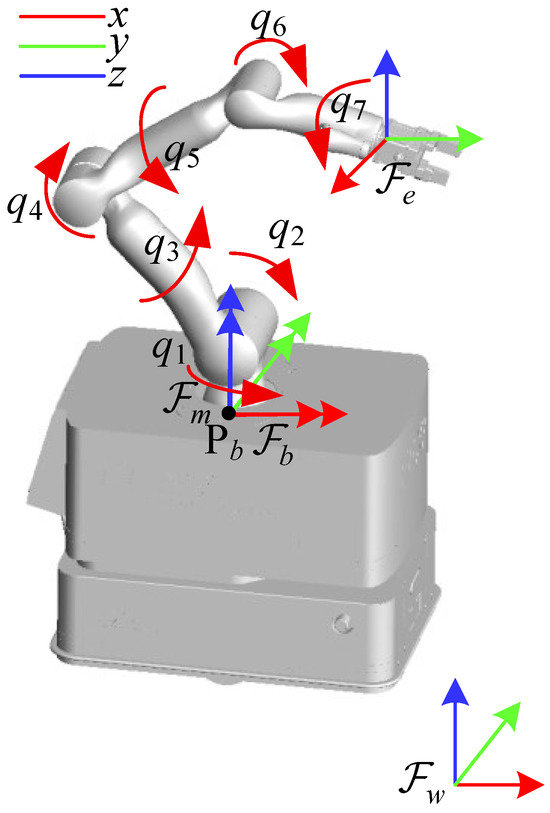
As illustrated in Figure 1, a global world frame is defined on the workspace, and a body-fixed frame is attached to point of the mobile base. The configuration of the mobile base is described by the planar pose , where denotes the position of the base and the heading angle. A manipulator base frame is rigidly connected to through a fixed transformation. The joint configuration of the manipulator is denoted by , where m is the number of joints.
Figure 1.
Description of the WMM.
As shown in Figure 1, we fix the manipulator base frame with point to set up a WMM and make sure that the x-axis of frame coincides with the mobile base’s heading direction.
This section defines the system structure, configuration variables, and coordinate frames of a single WMM, which serve as the foundation for the kinematic modeling of the wheeled mobile base and the manipulator presented in Section 2.2 and Section 2.3.
2.2. Kinematics of Wheeled Mobile Bases
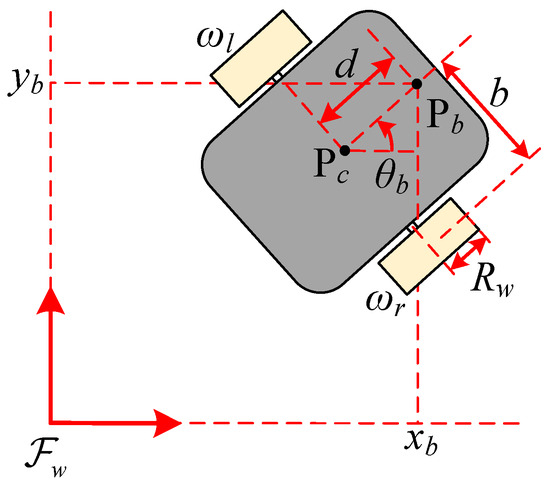
In this study, the manipulator and the mobile base are modeled independently. The kinematics of the mobile base is shown in Figure 2.
Figure 2.
Kinematics of the mobile base.
A pure rolling contact between the wheels and the ground is assumed, and wheel slippage is neglected. Under this assumption, the motion of the mobile base can be expressed by the following kinematic relation [42]:
where denotes the generalized velocity vector of the mobile base with denoting its dimension, collects the wheel velocities with b denoting its dimension, and represents the kinematic transformation matrix relating wheel velocities to the base motion.
As depicted in Figure 1 and Figure 2, the world coordinate frame is denoted by . The parameter indicates the wheel radius, b denotes half of the distance between the two wheels, and d represents the offset between points and . The configuration of the mobile base is described by , where specifies the planar position and the orientation of the base. The wheel angular velocities are defined as .
According to the geometric structure of the mobile base and the kinematic relation in Equation (1), the transformation matrix can be explicitly formulated as:
which maps the wheel velocity inputs to the generalized velocity of the mobile base.
2.3. Kinematics of Multi-DoF Manipulators
This section presents the kinematic description of an m-DoF serial manipulator. A schematic of the manipulator and its coordinate frames is shown in Figure 1.
A coordinate frame is attached to the base of the manipulator. The joint configuration is defined by:
where denotes the angular position of the i-th revolute joint. The end-effector frame is denoted by .
Using standard serial-link kinematics, the forward kinematics of the manipulator can be expressed as [29]:
where represents the pose of the end-effector, including its position and orientation with respect to the manipulator base frame.
By differentiating the forward kinematic mapping, the differential kinematics of the manipulator is obtained as [10]:
where denotes the joint velocity vector and is the manipulator Jacobian matrix.
This kinematic model establishes the relationship between the manipulator’s joint motions and end-effector velocities, and will be used in subsequent sections for force exertion analysis and compliance control design of the manipulator.
3. Load Capacity Maximization with QP
When a manipulator has seven or more DoFs, it remains kinematically redundant even if the end-effector pose is fully constrained. For such redundant manipulators, the extra DoFs can be exploited to achieve additional objectives beyond the primary end-effector task. Unlike conventional QP-based inverse kinematics approaches that typically minimize joint velocities, tracking errors, or energy consumption, the formulation proposed in this section explicitly optimizes a load-capacity-related metric derived from torque-limit-aware force transmission characteristics. This enables configuration-dependent enhancement of force exertion capability while maintaining strict constraint feasibility.
In this section, a QP-based framework is adopted to address the motion planning and control of redundant manipulators. The fundamental formulation of the QP framework is introduced in Section 3.1, while Section 3.2 details the development of the LCM metric using a gradient-descent strategy and its integration into the QP framework.
3.1. Scheme Formulation of QP
The null-space-based scheme is among the earliest methods developed for solving the inverse kinematics of redundant manipulators [4,29]. By premultiplying the differential kinematic equation with the Moore–Penrose pseudoinverse of the Jacobian in Equation (5), a general solution can be obtained as (For brevity, the dependence of the variables upon the joint variables is omitted):
where the second term spans the null space of the Jacobian and allows secondary objectives to be incorporated through the free vector . Although this approach yields minimum-norm solutions in a least-squares sense, it requires repeated computation of the pseudoinverse and suffers from severe numerical issues near singular configurations, where joint velocities may become unbounded.
To overcome these limitations, QP has been widely adopted for redundancy resolution. The inverse kinematics problem can be reformulated as a constrained optimization problem, in which the joint velocity norm is minimized subject to the desired end-effector velocity constraint [31]:
However, this basic formulation in Equation (7) does not explicitly account for trajectory tracking errors or joint motion limits, which may lead to poor end-effector tracking performance and undesirable joint behavior. To improve tracking accuracy, a proportional feedback term can be introduced at the velocity level, yielding the modified equality constraint:
where and denote the desired end-effector position and velocity, respectively, and is a positive-definite gain matrix.
Since the problem is formulated in the velocity domain, joint position limits are transformed into equivalent joint velocity bounds using a scaling factor [43]:
where the superscripts + and − represent the upper and lower physical limits of a joint variable vector, respectively. By combining these bounds with the physical joint velocity limits, unified upper and lower bounds and are obtained. The i-th elements of these bounds, and , are given by and .
The resulting QP formulation that simultaneously accounts for end-effector tracking and joint motion constraints is given by:
This formulation enables stable end-effector trajectory tracking while explicitly respecting joint motion constraints, thereby providing a flexible and numerically robust framework for redundancy resolution.
3.2. Definition and Application of Load Capacity Maximization Metric
As shown in Equation (10), the QP-based inverse kinematics framework allows equality and inequality constraints, such as end-effector tracking accuracy and joint velocity bounds, to be explicitly incorporated when solving redundancy. However, when the objective function only minimizes joint velocities, task-oriented performance—especially LCM in contact scenarios—is not explicitly considered. To improve the load-handling and interaction performance of redundant manipulators, the optimization objective in the QP formulation is redesigned to enhance load capacity in a task-specified direction. Therefore, Equation (10) can be revised as:
where represents the gradient of the LCM metric with respect to the joint variables, which will be provided later.
Manipulability analysis provides a configuration-dependent measure of manipulator performance. Yoshikawa first introduced the velocity manipulability metric [17]:
which characterizes how efficiently joint velocities generate end-effector motion [17]. Maximizing simultaneously increases the distance from kinematic singularities and reduces the joint velocity effort required for a given end-effector velocity. However, in contact-rich tasks, force transmission capability is of greater importance than velocity efficiency.
It is well known that the force manipulability ellipsoid is the dual of the velocity manipulability ellipsoid. Therefore, directions that require smaller joint velocities correspond to directions with higher force generation capability. Instead of maximizing force manipulability uniformly in all directions, it is more effective to enhance force capability along task-relevant directions. Moreover, classical manipulability measures do not account for nonuniform joint torque limits, which significantly affect the achievable end-effector forces.
To address these issues, a directional manipulability (DM) metric that explicitly incorporates joint torque limits is adopted [4]. For a given task direction expressed in the world frame, the DM is defined as:
where
is a weighting matrix that normalizes joint torques according to their respective limits .
In this work, the DM H is directly optimized within the QP-based inverse kinematics framework, rather than being treated as a secondary objective in the null space. This enables explicit maximization of load capability along the desired direction while respecting joint motion constraints.
Assuming that the task direction is independent of the joint variables, the partial derivative of H with respect to the i-th joint coordinate can be derived as:
The gradient vector of the DM metric in Equation (11) is therefore given by:
By incorporating this gradient into the objective function of the QP formulation, the inverse kinematics solution not only satisfies the primary end-effector motion task and joint constraints but also actively drives the manipulator towards configurations with maximum load capability along the specified direction.
4. Compliance Control Approach for Dual Mobile Manipulators
This section focuses on the design of an effective compliance controller to achieve cooperative manipulation of dual WMMs for heavy-object transportation. We begin by introducing the admittance control scheme, which circumvents the need for detailed dynamic modeling of the WMM—a task that is typically required by impedance-based approaches [36]. Building upon this framework, a variable-admittance master–slave control strategy is proposed, in which one manipulator actively handles one end of the payload while the other manipulator passively follows the motion of the payload under the influence of sensed interaction forces. This approach enables synchronized, compliant cooperation between the two WMMs, ensuring stable transport of heavy or bulky objects without excessive dynamic complexity.
4.1. Admittance Control of WMMs
Admittance control enables the end-effector to adjust its position in response to external forces, thereby providing compliant interactions between the robotic system and its environment. This property has been widely exploited in applications such as load transportation. In the present study, we focus exclusively on position compliance induced by external forces, while the end-effector orientation is maintained constant via a simple PID controller. The admittance controller, which maps an applied force to a desired velocity, can be expressed in the Laplace domain as (Here, the explanation is given in a one-dimensional case, since the components are decoupled during the position compliance process):
where represents the external force, and , , and are constants specifying the desired Cartesian inertia, damping, and stiffness in this direction, respectively. When an end-effector force is applied, the admittance controller generates a reference Cartesian velocity to adjust the end-effector position accordingly.
To reduce the mismatch between the commanded trajectory and the actual end-effector trajectory, the admittance behavior Equation (17) can be applied directly. Consequently, the desired end-effector velocity is defined as:
where denotes the velocity commanded by the motion planner, and is obtained from the measured end-effector force.
In the considered transportation scenario, unmodeled dynamic interactions may arise from payload inertia variation, slight motion mismatch between the two WMMs, or external disturbances from the environment. Since the mobile manipulators operate primarily in position/velocity mode, direct torque-level impedance regulation is not available.
Admittance control is therefore advantageous, as it modifies the reference motion based on measured interaction forces without requiring explicit modeling of the environment dynamics. When unexpected contact forces occur, the admittance dynamics generate compensatory velocity adjustments, allowing the end-effector to yield compliantly and dissipate interaction energy through virtual damping.
Moreover, by allowing the admittance gains to vary, the compliance behavior can be adaptively tuned according to different transportation phases, improving stability and coordination in the presence of uncertain dynamic contacts.
4.2. Cooperative Manipulation of Dual WMMs Under Variable-Admittance Control
In cooperative transportation using dual WMMs, the admittance controller defined in Equation (17) provides compliant behavior in arbitrary Cartesian directions, which is particularly advantageous for dual-WMM manipulation tasks. By appropriately tuning the admittance parameters, unnecessary internal contact forces between the end-effectors and the transported payload can be effectively suppressed, thereby improving manipulation stability and safety.
In this work, compliant motions along different directions are realized through a deliberate division of responsibilities between the mobile bases and the manipulators. Specifically, horizontal compliant motions of the end-effectors are mainly achieved by the mobile bases, which possess a relatively large planar workspace, whereas vertical compliant motions are realized by the manipulators, since the mobile bases cannot generate vertical displacement. This strategy effectively decouples horizontal and vertical compliance behaviors, simplifying controller design while enhancing cooperative performance.
A master–slave (leader–follower) architecture is adopted for dual-WMM cooperative manipulation. The right WMM acts as the leader and directly tracks the motion trajectory commanded by the human operator or motion planner to accomplish the transportation task. The left WMM serves as the follower, whose desired motion is not explicitly prescribed but instead emerges from its interaction with the payload. As shown in Equation (18), the desired end-effector velocity of the follower WMM is composed of two parts:
- (1)
- A nominal reference velocity derived from the leader’s motion and the kinematic constraints imposed by the rigid payload;
- (2)
- An induced compliant velocity generated by the admittance controller in response to the measured interaction force between the follower end-effector and the payload.
This control structure enables synchronized motion of the two WMMs in free space and coordinated, compliant behavior during physical interaction with the payload.
However, during cooperative transportation, the desired compliance characteristics may vary significantly across Cartesian directions, and fixed admittance parameters are often insufficient to cope with changing interaction conditions. Moreover, the appropriate level of compliance should be adjusted online according to the magnitude of the interaction force in order to suppress internal forces while maintaining stable motion. To this end, a variable-admittance control strategy is introduced in this study.
Specifically, the desired inertia , damping , and stiffness in Equation (17) are generalized to direction-dependent, force-adaptive parameters. To enhance compliance under large interaction forces while preserving stability and tracking accuracy under small disturbances, the stiffness and damping along each Cartesian direction are modulated as explicit functions of the measured interaction force.
For the i-th Cartesian direction (), the adaptive stiffness and damping laws are defined as:
where and (respectively and ) denote the upper and lower bounds of stiffness (damping) along the i-th Cartesian direction, and is a force-scaling parameter that determines the sensitivity of the admittance adaptation with respect to the interaction force.
In this work, the desired inertia is kept constant to avoid excessive variations in the apparent system dynamics, i.e.,
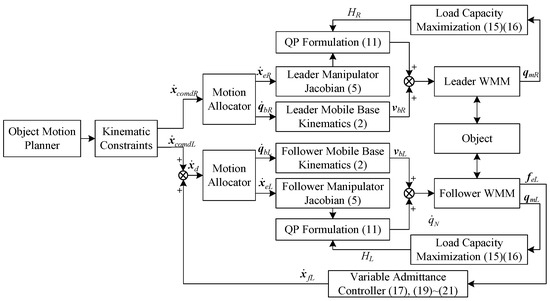
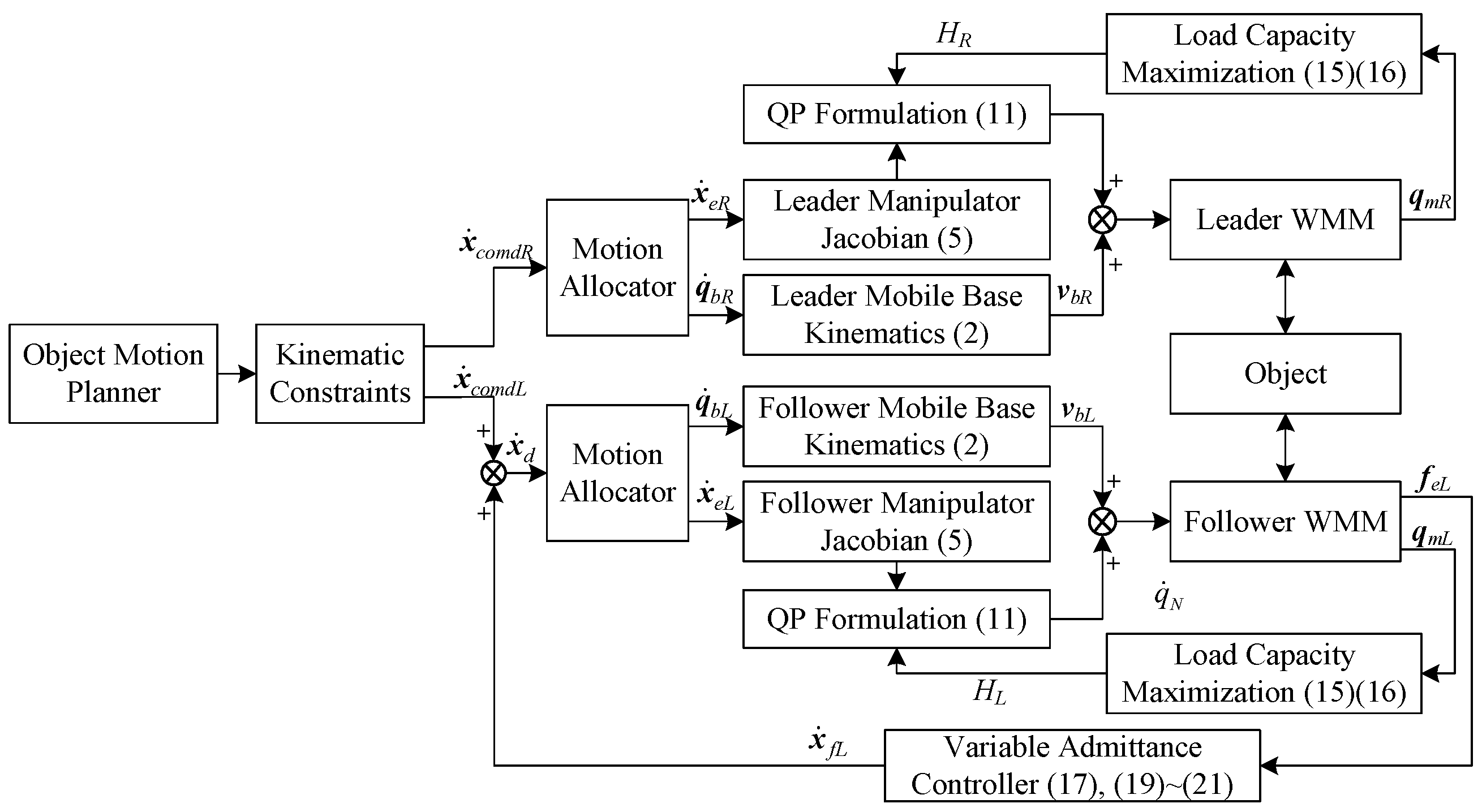
With the proposed variable-admittance strategy, the stiffness and damping along each Cartesian direction are smoothly reduced as the corresponding interaction force increases, yielding a more compliant response that effectively mitigates internal forces between the dual WMMs and the payload. Conversely, when the interaction forces remain small, higher stiffness and damping are maintained to ensure motion synchronization, accurate trajectory tracking, and overall system robustness. By jointly exploiting direction-dependent compliance allocation and force-adaptive admittance parameters, the proposed control strategy enables efficient, stable, and flexible cooperative manipulation of heavy or bulky objects using dual mobile manipulators. The block diagram of the proposed control system is shown in Figure 3. In this diagram, the subscripts L and R are used to denote variables and control modules associated with the left and right WMMs, respectively. The right WMM (R) operates as the leader and tracks the motion command specified by the motion planner, while the left WMM (L) acts as the follower and generates its motion based on the payload interaction and the leader’s motion. This notation is consistently adopted throughout the control architecture to distinguish the two WMMs in the cooperative manipulation task.
Figure 3.
Block diagram of the proposed control system.
From an object-level perspective, the rigid payload is simultaneously supported by the two end-effectors. Let and denote the Cartesian contact forces exerted by the left and right WMMs on the payload, respectively. Under quasi-static transportation conditions, the object-level force equilibrium can be expressed as
where represents the gravitational force acting on the payload.
In this work, no explicit force-distribution optimization or internal force decomposition is imposed at the object level. Instead, load sharing between the two WMMs emerges implicitly from the master–slave control structure. The leader WMM tracks the commanded motion trajectory via position control, while the follower WMM adjusts its motion according to the measured interaction force through the variable-admittance controller.
Any internal force component caused by geometric inconsistency or tracking mismatch is reflected in the interaction force measured at the follower side and is subsequently regulated by the adaptive compliance mechanism. As the admittance parameters vary with the interaction force magnitude, excessive internal forces are reduced, leading to a passive redistribution of load between the two manipulators.
Therefore, the proposed framework does not rely on explicit object-level wrench decomposition; instead, cooperative load sharing is achieved through motion coordination and force-regulated compliance within the master–slave architecture.
To provide a theoretical guarantee of the proposed variable-admittance strategy, a Lyapunov-based stability analysis is briefly outlined for the translational admittance dynamics. The rotational case follows analogously.
Let denote the Cartesian pose of the end-effector, where represents the translational position component and denotes the orientation component. In the following analysis, we focus on the translational dynamics. Define the position tracking error as:
where and denote the desired and actual position components of the end-effector pose, respectively. The variable-admittance model can be written as:
where , , and are bounded, symmetric, and uniformly positive definite within predefined limits.
Assume that the interaction force is bounded and that the parameter variations are sufficiently smooth, i.e., and are bounded.
Define the candidate Lyapunov function:
Differentiating along the system trajectories yields:
Since and the parameter derivatives are bounded, the energy injection caused by parameter adaptation can be dominated by the intrinsic damping if the adaptation rate is properly limited. Under this condition, is negative semi-definite up to bounded disturbance terms, implying boundedness of and . In the absence of persistent disturbances, as , ensuring closed-loop stability of the variable-admittance system.
In practice, stability can be guaranteed by constraining and within predefined ranges and filtering the force-adaptation law to ensure sufficiently slow parameter variations.
5. Simulation Setup and Results
This section presents simulation studies to validate the effectiveness of the proposed methods for cooperative manipulation using dual WMMs. The simulations are organized into three parts. First, the simulation setup and main parameters are introduced. Second, the effectiveness of the proposed QP-based LCM method is verified. Finally, cooperative manipulation simulations of dual WMMs are conducted to evaluate the proposed variable-admittance-based master–slave control strategy in terms of synchronization and compliant behavior during payload transportation.
5.1. Simulation Scenario and Implementation
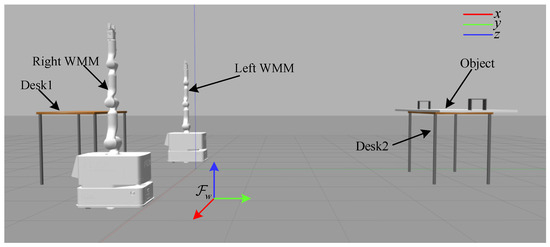
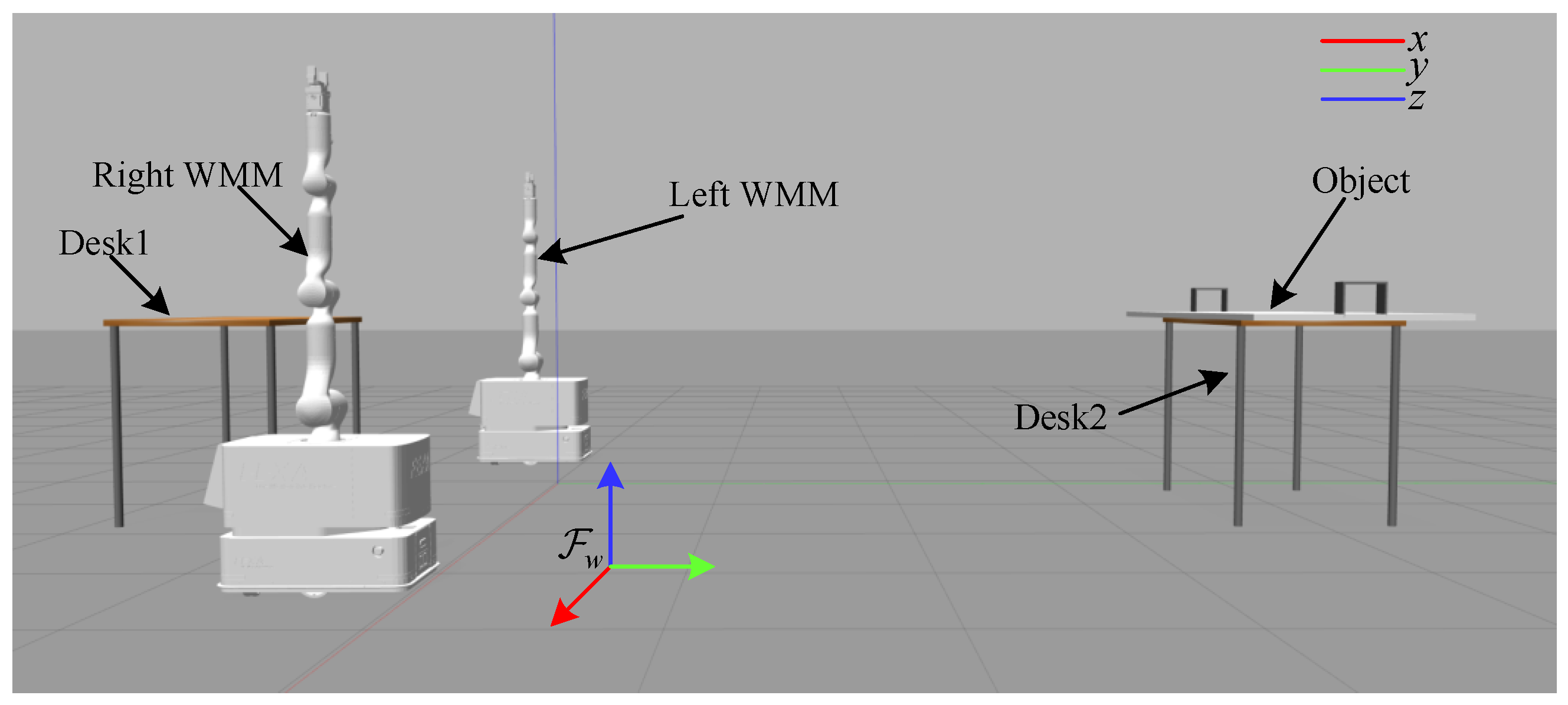
Simulation studies are conducted using the Robot Operating System (ROS Noetic) and the Gazebo simulator under Ubuntu 20.04 to validate the proposed cooperative manipulation framework. A representative transportation scenario is designed in which two WMMs cooperatively move a rigid wooden board (the object) from one desk (Desk 2) to the other (Desk 1), as illustrated in Figure 4.
Figure 4.
Simulation setup.
Each WMM consists of a nonholonomic mobile base and a multi-DoF manipulator. The mobile base is mainly responsible for planar motion, while the manipulator provides vertical motion and fine positioning of the end-effector. Rigid grasping constraints are assumed between the end-effectors and the payload, and interaction forces are measured and fed back to the admittance controller in real time.
A leader–follower architecture is adopted during cooperative transportation. The desired end-effector velocities are generated according to the strategy described in Section 4 and are subsequently distributed to the mobile base and the manipulator through the motion allocator, with horizontal motion assigned to the mobile base and vertical motion executed by the manipulator. All control modules are implemented within the ROS framework and operate at a control frequency of 1000 Hz. Relevant states, including end-effector trajectories and interaction forces, are recorded for performance evaluation.
The Cartesian space dimension of the manipulator is defined as , accounting for both the position and orientation of the end-effector. In this work, however, only position compliance is considered, while the end-effector orientation is regulated using a simple PD controller to maintain a fixed orientation. The joint torque limit of the tested manipulators is set as 100 Nm in all simulations. It is worth noting that the positions of the mobile base and the end-effector are measured in the world coordinate frame .
It should be noted that the present simulation model focuses on kinematic redundancy resolution and interaction force regulation and therefore does not explicitly incorporate detailed physical effects such as joint friction, mechanical backlash, structural flexibility, or parametric model uncertainties. In addition, the payload is rigidly supported and lifted by the two end-effectors rather than grasped via compliant grippers; thus, grasp compliance is not modeled in the current setup.
While these simplifications allow a clear evaluation of the proposed LCM optimization and variable-admittance coordination framework at the kinematic and control-allocation level, unmodeled effects may influence force tracking accuracy and interaction stability in real-world implementations. Incorporating detailed dynamic phenomena and hardware-related uncertainties should be considered in extensions of this work.
5.2. Simulation Validation of Load Capacity Maximization via QP
Based on the proposed cooperative manipulation framework, the desired compliant behavior of the end-effector can be achieved through the admittance controller described in Section 4. However, during heavy-load transportation, the achievable Cartesian performance may be constrained by the limited joint torque capacity of the manipulator. In particular, under large payloads or unfavorable configurations, the end-effector may fail to generate sufficient interaction force or motion despite the desired admittance behavior. To address this issue, the proposed QP-based LCM method is introduced to optimally exploit the actuation redundancy of the WMM.
In this simulation study, the effectiveness of the proposed QP formulation in enhancing the load capacity of a single WMM is evaluated. To solve the resulting QP problem, the QuadProg++ library [44] is employed, which implements the efficient Goldfarb–Idnani dual active-set algorithm for strictly convex QP problems. This solver is widely adopted in robotics applications due to its numerical efficiency and reliable convergence properties. During the simulation, no external disturbance or cooperative interaction from the other WMM is considered, such that the influence of the QP-based optimization on the manipulator configuration can be clearly observed. It should be emphasized that the desired Cartesian trajectory of the end-effector remains unchanged throughout the simulation, and the optimization exclusively influences the internal configuration of the manipulator. Taking the left WMM as an example (the left and right arms are symmetrical), we focus on the left arm hereafter, and only the simulation results of the left arm are presented. The initial joint position of it in this scenario is set as .
The parameters used in the simulation are summarized in Table 1. The optimization direction is selected as the vertical axis of the world frame, i.e., , which corresponds to the dominant load-bearing direction during the transportation task. This choice reflects typical cooperative manipulation scenarios in which the manipulators are required to provide sufficient vertical support for the payload. Unless otherwise specified, all direction-related quantities are expressed in the world coordinate frame.
Table 1.
Control parameters for load-capacity maximization simulation.
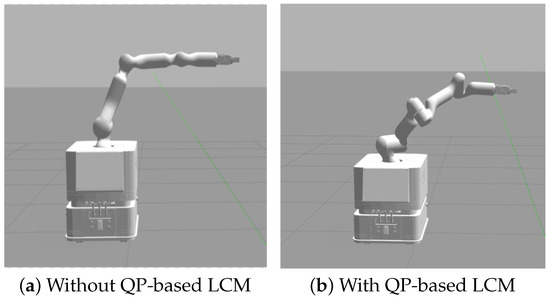
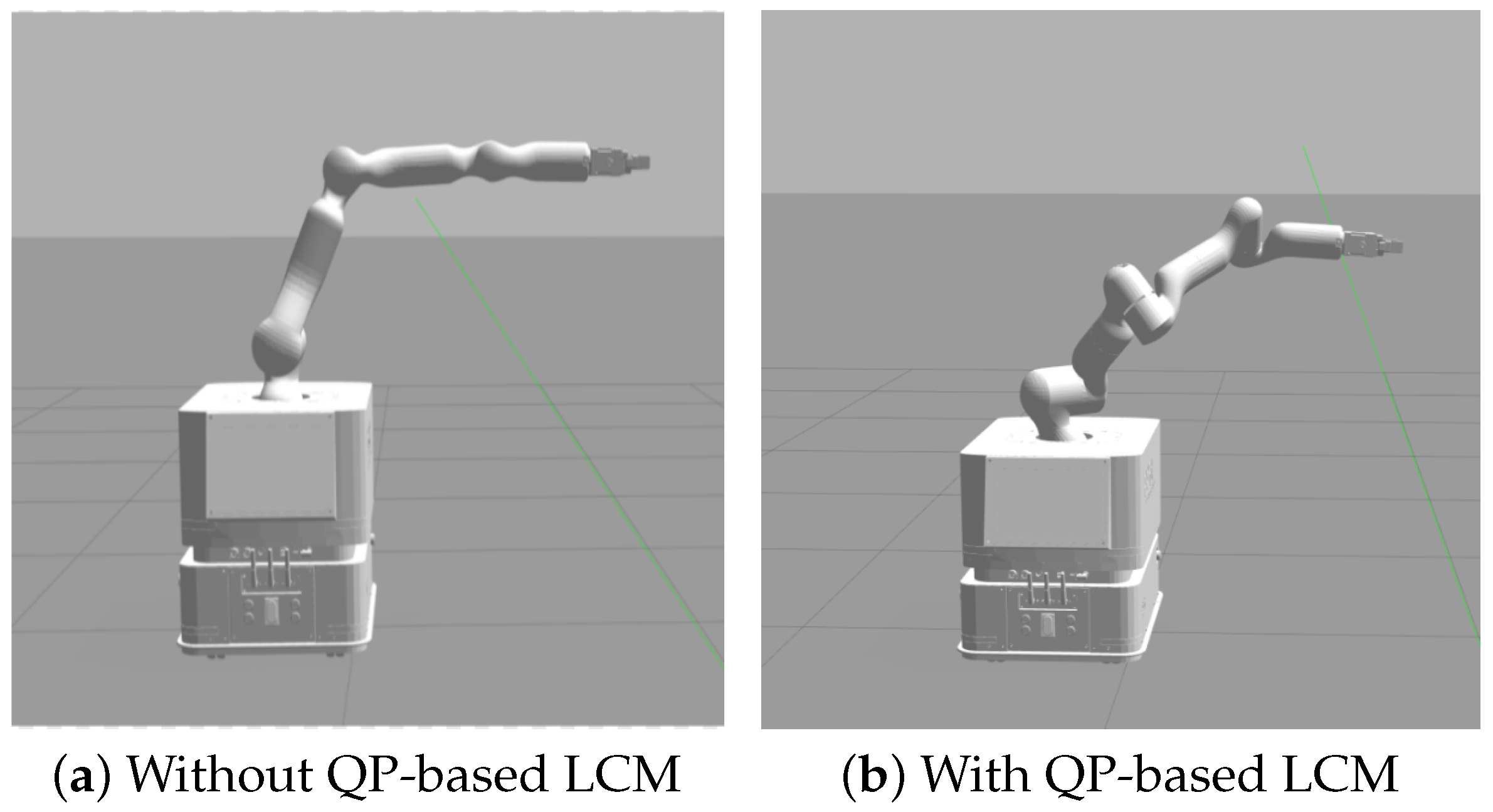
Figure 5 illustrates the final configurations of the right WMM without and with the proposed QP-based LCM. Without optimization, the manipulator remains close to its initial configuration, resulting in a limited ability to generate vertical force. In contrast, with the proposed method, the manipulator automatically evolves toward a configuration that is more favorable for load bearing, effectively increasing the end-effector force capability along the vertical direction. This behavior is analogous to how humans adjust their posture to better support heavy objects.
Figure 5.
Final configurations of the WMM during the simulation.
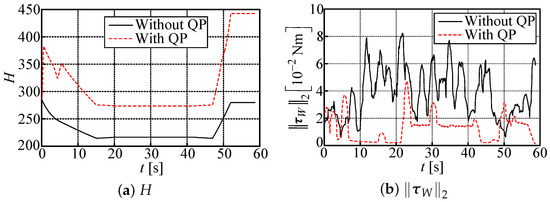
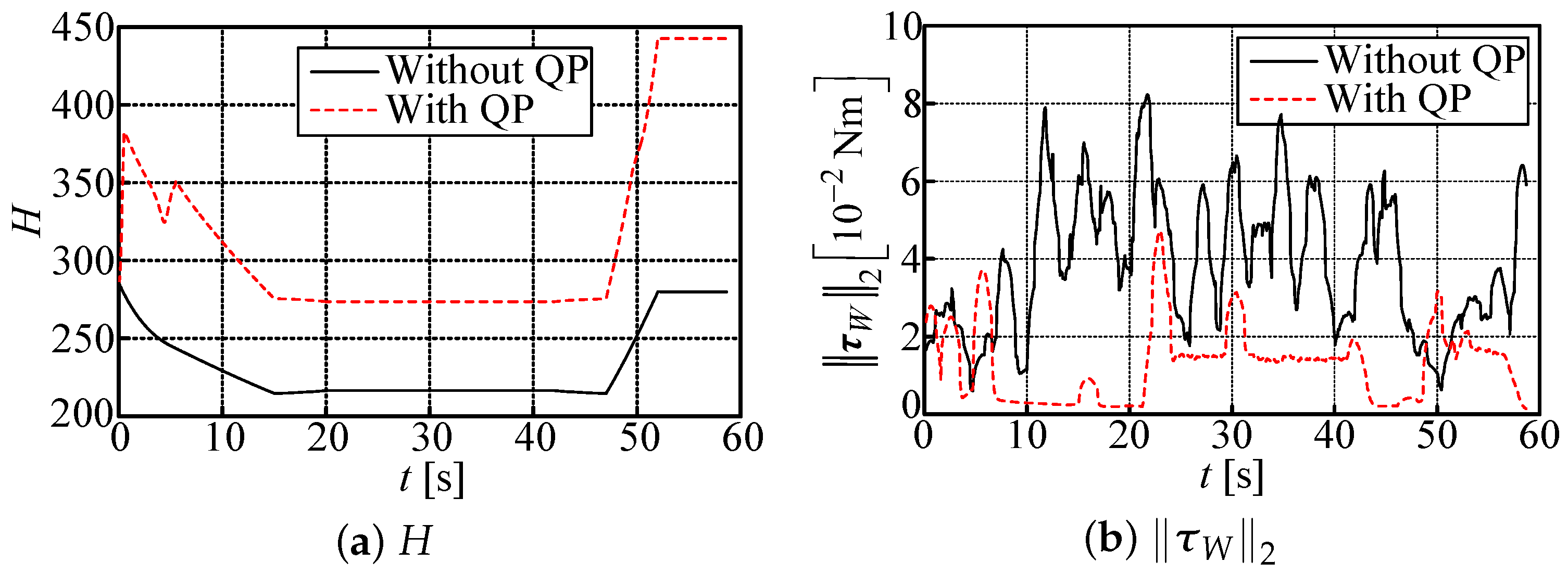
To further quantify the improvement, Figure 6 presents the evolution of the right WMM’s load capacity index H and the norm of joint torque W during the simulation. As shown in Figure 6a, with the proposed QP-based LCM strategy, the metric representing the load capacity of the right WMM exhibits an increasing trend across all stages of the transportation process. The average value rises from 232.0 before optimization to 312.8 after optimization, indicating a 34.8% improvement in load capacity along the optimized direction. This result demonstrates that, without altering the desired Cartesian task, the WMM gradually adjusts its configuration toward a state more favorable for load bearing.
Figure 6.
Load capacity index and norm of joint torque during the simulation.
Meanwhile, Figure 6b demonstrates that for the same desired end-effector trajectory, the optimized configuration requires significantly lower joint torque compared to the non-optimized case. Notably, the average norm of the weighted joint torque decreases from 0.0388 before optimization to 0.0130 after optimization, a reduction of 66.5%. This fully demonstrates that the proposed method effectively reduces the torque burden on each joint while maintaining the same Cartesian task performance, thereby further proving its effectiveness in enhancing the load-bearing capability of the WMM.
5.3. Simulation Validation of Cooperative Manipulation by Dual WMMs
In this subsection, the effectiveness of the proposed cooperative manipulation framework for dual WMMs is validated through simulation. The considered task involves two WMMs collaboratively transporting a rigid board with a mass of approximately 8 kg from one desk to another within a shared workspace. This mass is selected for two main reasons. First, in academic studies on manipulator load capacity, 8 kg is commonly regarded as a benchmark representing the upper limit of light-load manipulation. Evaluating the optimization effectiveness and robustness of the proposed control algorithm under this load therefore provides strong validation credibility. Second, in the current industrial robotics field, 8 kg is widely recognized as a representative specification for light-load robots and often serves as a threshold between entry-level and medium payload capacities. Conducting research at or above this load level thus offers meaningful practical value for industrial applications. Here, the right WMM is designated as the leader (active side), responsible for generating the primary Cartesian motion command, while the left WMM acts as the follower (passive side), adapting its motion to maintain coordinated manipulation and internal force consistency.
It should be noted that the motion planning and control of the left and right WMMs before reaching the board can be performed independently. In this study, the focus is placed on the phase where the manipulators are about to establish contact with the board and the subsequent compliant cooperative transportation process involving both arms.
The cooperative control strategy is implemented under the proposed QP-based motion allocation framework, where the Cartesian task tracking and load distribution objectives are explicitly considered, and redundancy is exploited to regulate joint torques and interaction forces. During the simulation, no predefined relative trajectory between the two end-effectors is imposed. Instead, coordination is achieved implicitly through the object-level constraints and adaptive parameter adjustment, allowing the dual-arm system to accommodate modeling uncertainties and load variations.
To evaluate the cooperative behavior, a constant payload corresponding to the board mass is applied, and the dual WMMs are commanded to execute a translational motion while maintaining a fixed board orientation. The control parameters of these simulations are summarized in Table 2. It should be noted that the mass parameter in the fixed admittance controller, denoted by , is identical to the mass parameter used in the variable admittance controller, and both remain constant throughout the transportation process. The subscript i in Table 2 represents the Cartesian directions of the end-effector along the x, y, and z axes. Since no directional differences are highlighted in the table, the parameter values are the same for all three axes. The admittance parameters were selected based on stability and cooperative performance considerations. The apparent inertia was chosen to ensure smooth Cartesian motion without excessive acceleration, while the nominal stiffness and damping were tuned to achieve stable transportation with satisfactory tracking accuracy under the nominal payload. For the variable-admittance controller, the upper bounds were set equal to the nominal fixed-admittance values to preserve tracking performance under small interaction forces, whereas the lower bounds were chosen to provide sufficient compliance for internal force suppression. The final values were determined through iterative simulations to ensure a stable response and bounded interaction forces.
Table 2.
Control parameters for simulation of cooperative manipulation.
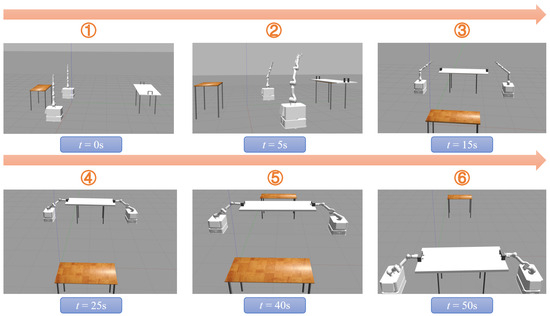
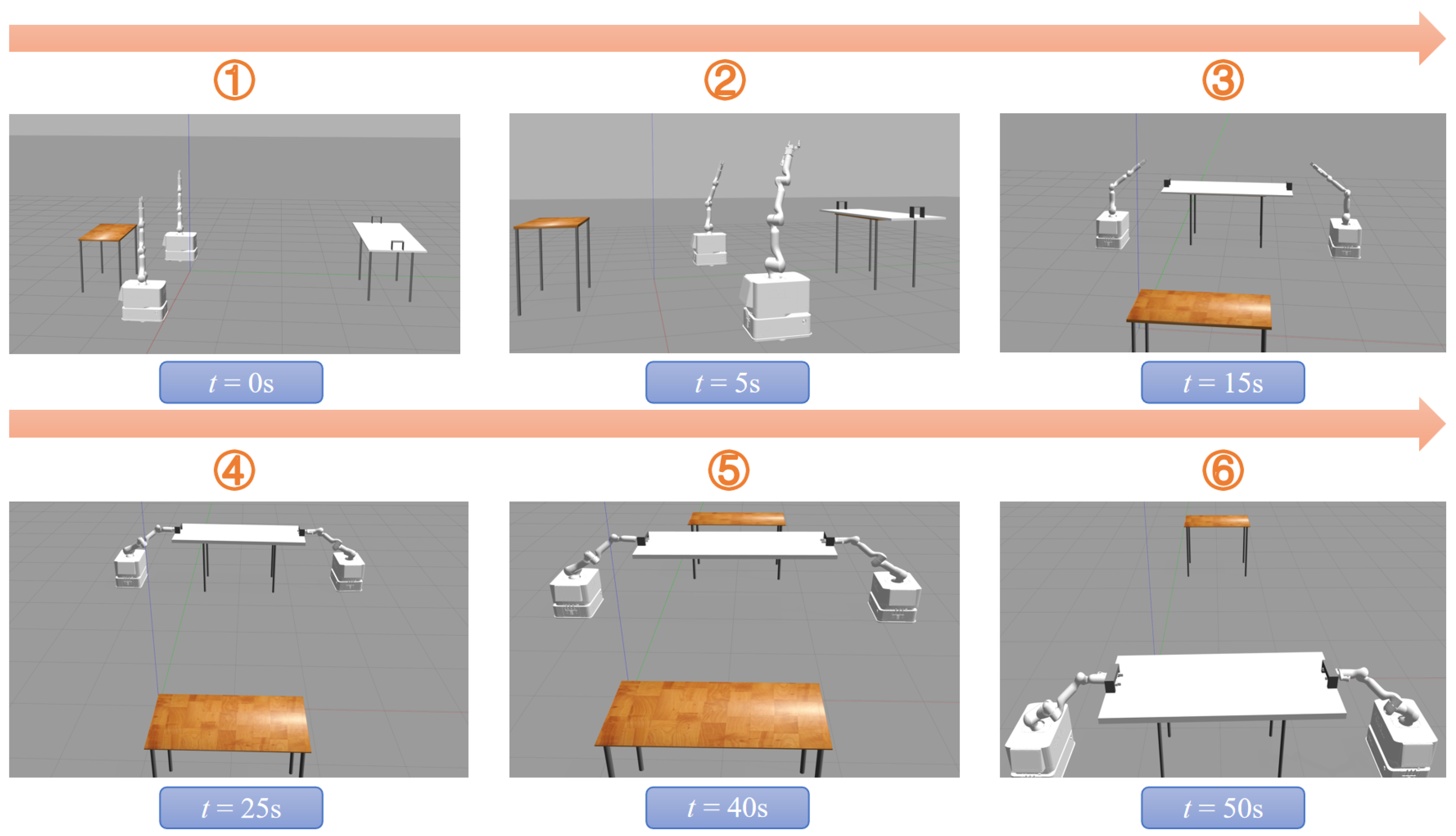
Figure 7 illustrates representative snapshots of the cooperative transportation process. The entire process lasts 58 s. Throughout task execution, both end-effectors exhibit consistent Cartesian motions, indicating that the object constraint is properly enforced and that no noticeable slippage or relative displacement occurs between the manipulators and the payload.
Figure 7.
Sequence diagram of cooperative transportation process (The colored lines are introduced to enhance the visualization of the execution order).
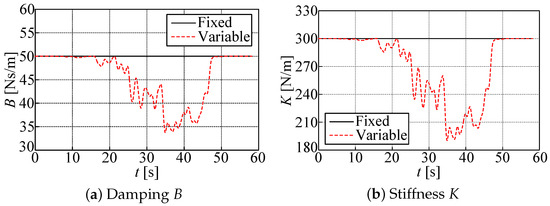
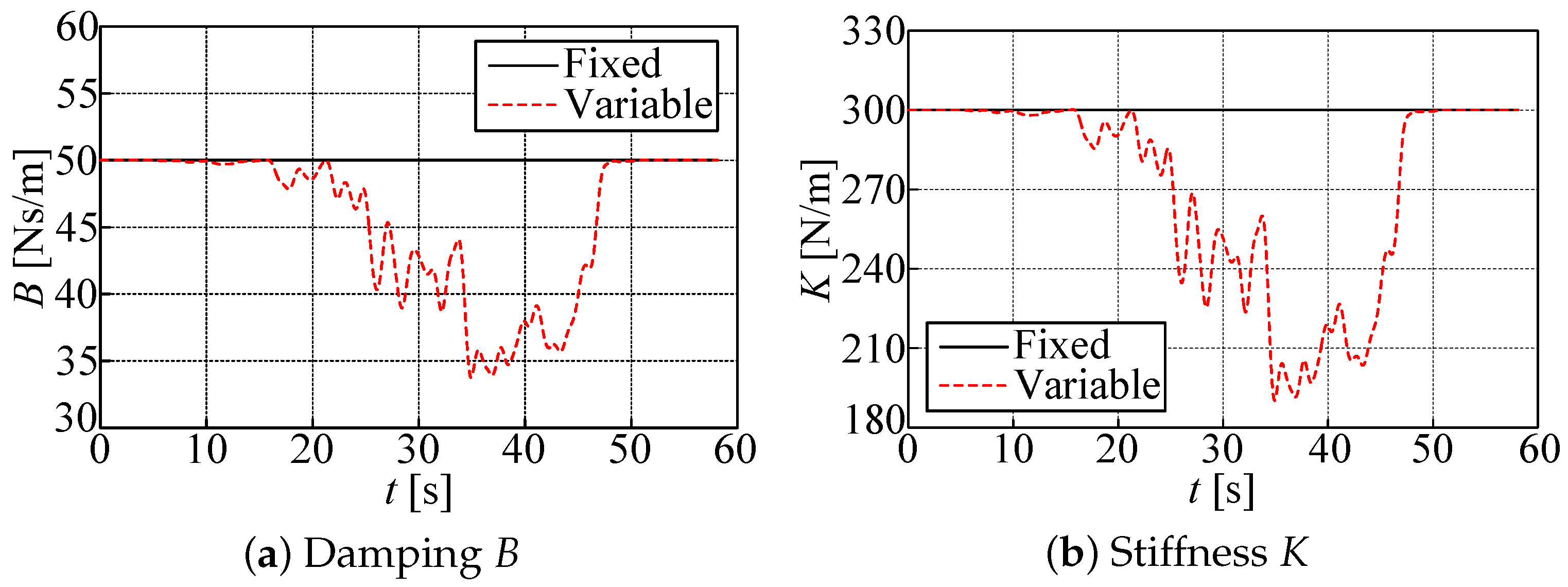
To fully demonstrate the advantages of the proposed variable admittance control strategy, comparative simulations were conducted between fixed admittance control and variable admittance control. The evolution of the adaptive admittance parameters under the proposed variable admittance control method is illustrated in Figure 8. Since the dominant interaction force acts along the z-direction, only the variations in the admittance parameters B and K along the end-effector’s z-axis are presented. Compared with the fixed admittance case, the variable admittance strategy enables the admittance parameters to be adjusted online in response to contact forces during cooperative operations. Particularly in the load-contact handling phase, the adaptive admittance parameters change accordingly to accommodate the varying contact forces between the robot end-effector and the transported object. This adaptive behavior allows the system to automatically regulate compliance without relying on predefined force distribution ratios or manual parameter tuning, which is difficult to achieve with fixed-parameter admittance control.
Figure 8.
Damping and stiffness during the simulation.
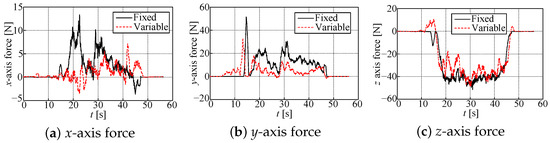
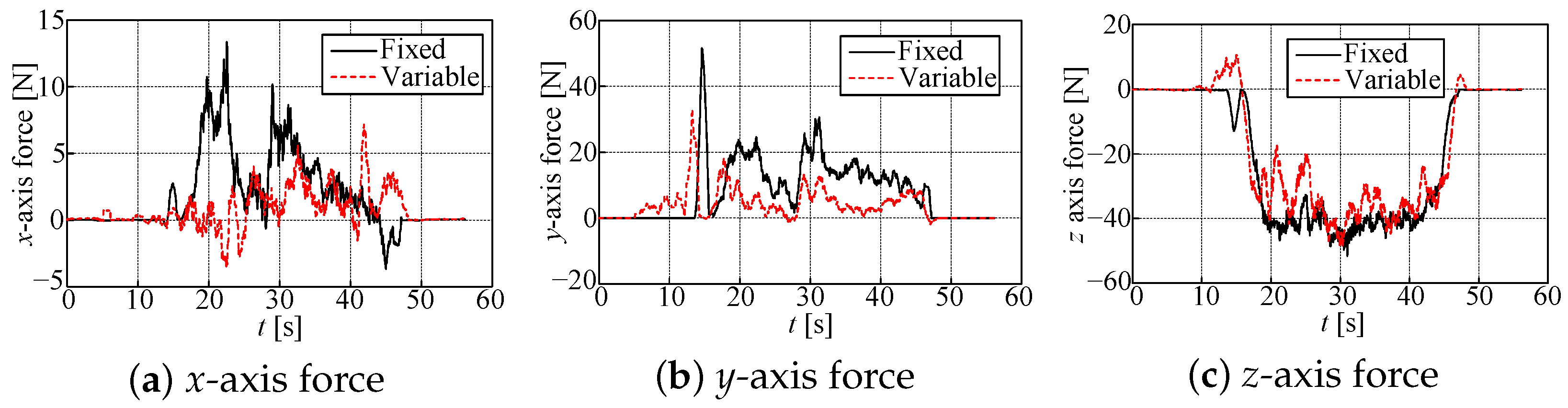
To further demonstrate the advantage of the proposed variable-admittance strategy over the fixed-admittance approach in compliance control, Figure 9 compares the end-effector contact forces along the x-, y-, and z-directions of the end-effector frame during the transportation task under both strategies. It can be observed that the variable-admittance controller consistently produces lower contact forces than the fixed-admittance controller in all Cartesian directions. In terms of the root mean square (RMS) values, the contact force along the x-direction is reduced from 3.38 N to 1.65 N, corresponding to a reduction of 51.18%, while in the y-direction it decreases from 12.30 N to 6.16 N, yielding a reduction of 49.92%. Similarly, in the z-direction, the RMS contact force declines from 28.31 N to 25.13 N, representing a reduction of 11.23%. Overall, an average reduction of approximately 37.44% in the end-effector contact force is achieved. These results indicate that the proposed variable-admittance strategy effectively improves compliance by adaptively adjusting the admittance behavior in each Cartesian direction, thereby enabling smoother and more stable interaction during dual-arm cooperative transportation.
Figure 9.
Interaction forces of fixed admittance and variable admittance for 8 kg payload.
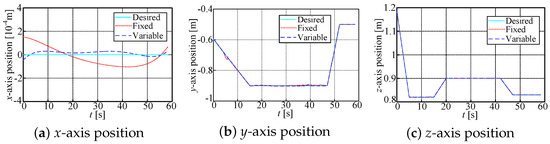
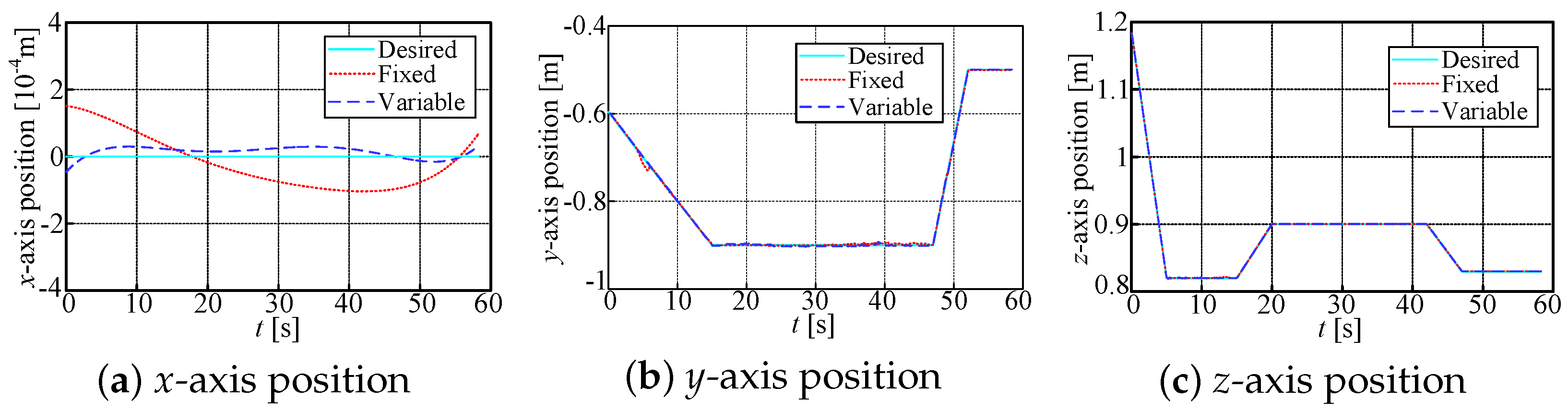
Furthermore, Figure 10 illustrates the end-effector trajectory tracking results of the manipulator along the x-, y-, and z-directions of the end-effector frame during the transportation task under both control strategies. As shown, accurate trajectory tracking is achieved in all Cartesian directions under both strategies, indicating that the proposed variable admittance control improves compliance without compromising tracking performance.
Figure 10.
End-effector’s positions of fixed admittance and variable admittance for 8 kg payload.
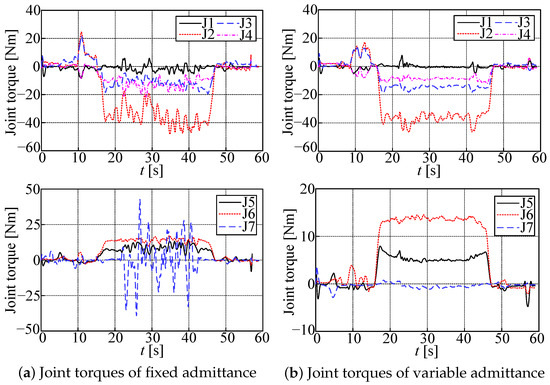
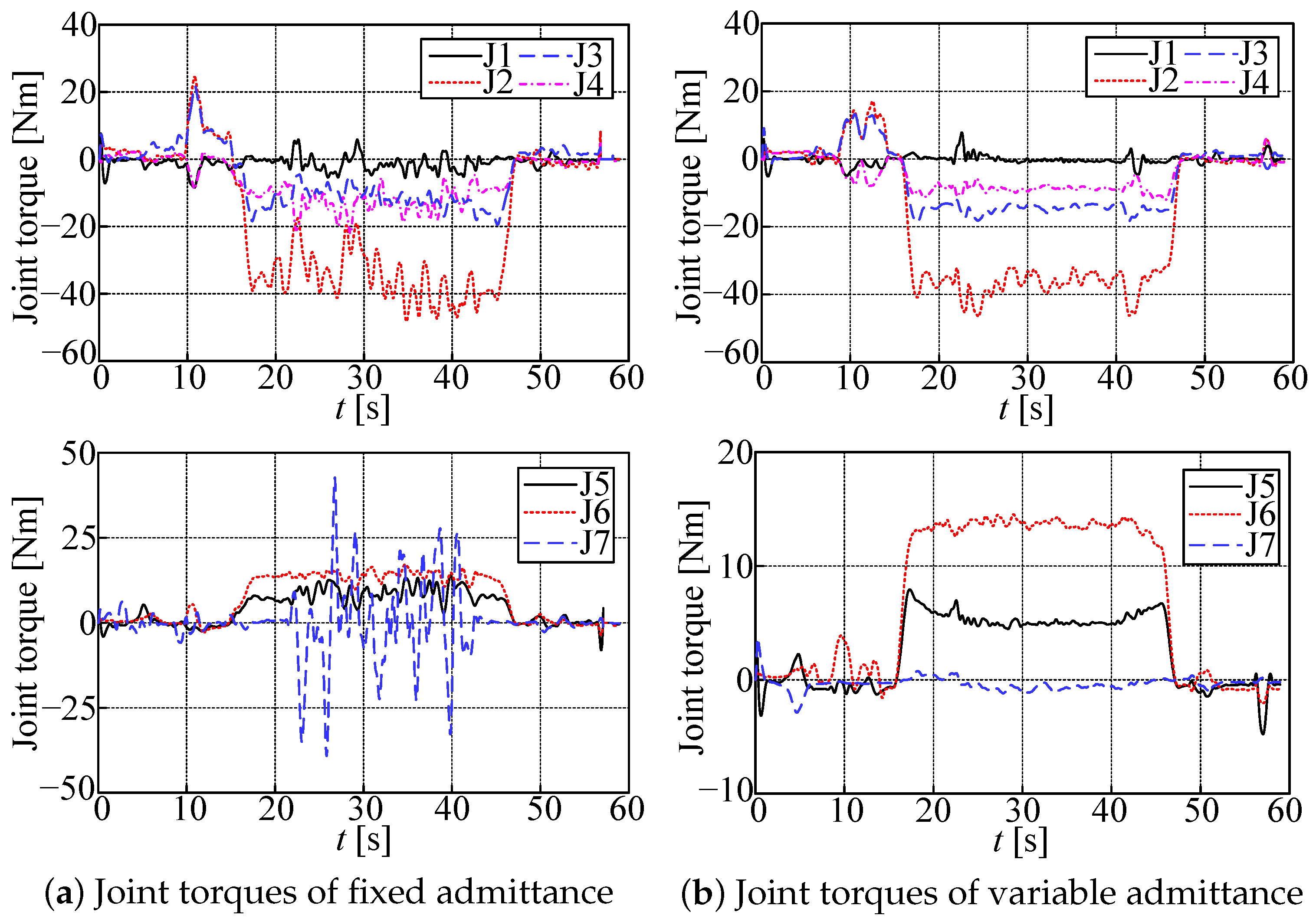
In addition to the comparison of end-effector contact forces under the two control strategies, the joint torque responses of the manipulator were further analyzed, as shown in Figure 11. The results indicate that, under the variable-admittance control strategy, the torque levels of most of the seven joints are lower than those obtained with the fixed-admittance strategy. Due to the large number of joints, a joint-by-joint temporal analysis is omitted for brevity. Instead, the reduction in joint torques, quantified by the RMS metric when switching from fixed admittance to variable admittance, is summarized as follows: joint 1—91.8%, joint 2—46.4%, joint 3—6.4%, joint 4—74.3%, joint 5—86.6%, joint 6—35.2%, and joint 7—93.3%, resulting in an average reduction of 62.0%. These results demonstrate that the proposed variable-admittance control strategy can effectively reduce joint torque demands compared with the fixed-admittance strategy. Furthermore, the torque variation ranges of most joints are smaller and more concentrated under variable-admittance control, indicating suppressed torque fluctuations and improved system stability.
Figure 11.
Joint torques of fixed admittance and variable admittance for 8 kg payload.
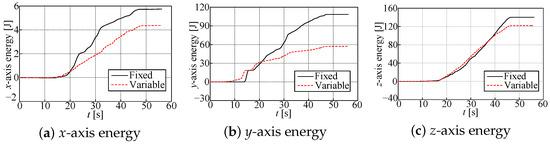
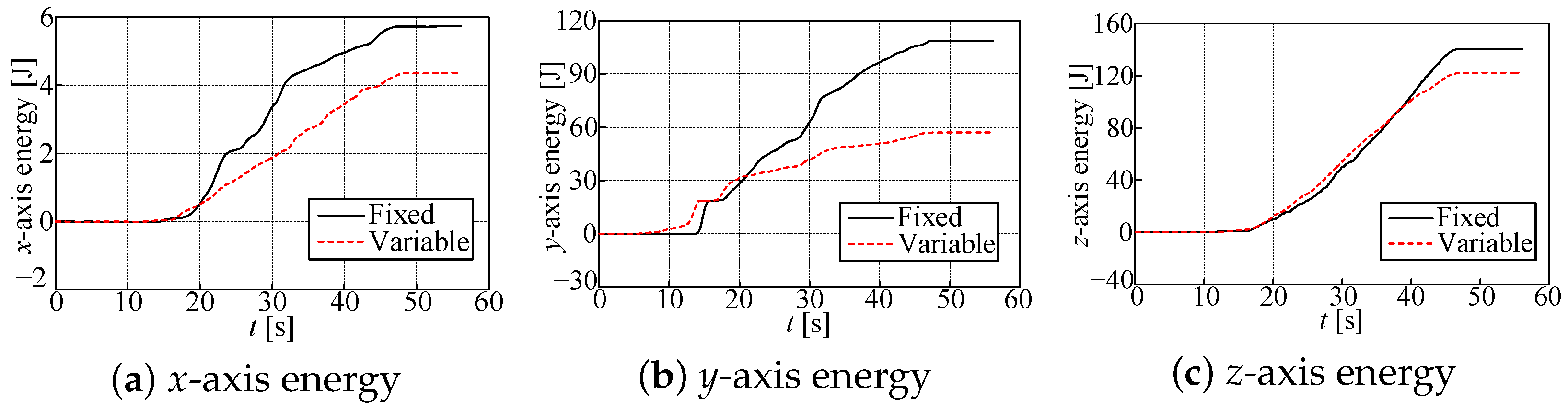
Energy consumption is an important performance indicator reflecting the amount of energy expended by the robotic arm during transportation, and an effective control strategy is expected to reduce the energy required to accomplish the same task. In this work, the energy along each Cartesian direction is calculated as the integral of the instantaneous power applied at the end-effector, , where and denote the interaction force and end-effector velocity along the i-th Cartesian direction at time t, respectively, and T is the total duration of the cooperative transportation task. Accordingly, a comparison of the transportation energy consumption along the x-, y-, and z-directions of the world frame under both control strategies was conducted, as shown in Figure 12. The results show that the variable-admittance control strategy achieves lower energy consumption in all three Cartesian directions. Specifically, over the entire transportation process, the energy consumption under the fixed-admittance strategy is 5.75 J, 108.37 J, and 140.29 J along the x-, y-, and z-directions, respectively, resulting in a total energy consumption of 254.41 J. In contrast, under the variable-admittance strategy, these values are reduced to 4.37 J, 56.99 J, and 122.06 J, with a total energy consumption of 183.42 J, corresponding to reductions of 24.00%, 47.41%, 12.99%, and 27.90%, respectively. These results demonstrate that the proposed variable-admittance control strategy can significantly reduce the energy consumption of the robotic arm during transportation compared with the fixed-admittance strategy, thereby exhibiting a clear advantage in improving energy efficiency.
Figure 12.
Energy consumption of fixed admittance and variable admittance for 8 kg payload.
Based on the comparative analyses of the above results, it can be concluded that, compared with the fixed-admittance control strategy, the variable-admittance control strategy effectively alleviates conflicting contact forces between the end-effector and the object by adaptively regulating the admittance parameters, thereby enhancing coordination and compliance during cooperative transportation. Furthermore, the analyses of joint torques and energy consumption demonstrate that the proposed variable-admittance control strategy also offers advantages in significantly reducing the energy required for the transportation task and, to a certain extent, lowering the joint torque demands.
To further examine the robustness of the proposed control framework with respect to modeling uncertainties, we conducted an additional simulation scenario involving a heavier payload and a shifted center of mass (CoM) position.
In this scenario, the payload mass is increased from 8 kg to 14 kg, and the CoM is shifted from the midpoint between the two manipulators to a location closer to the follower arm, specifically at one-quarter of the distance. The controller parameters, however, are still designed based on the nominal mass model and remain consistent with those used in the 8 kg payload simulation. By comparing this scenario with the previous 8 kg payload case, practical situations in which load properties vary or are imperfectly known can be effectively emulated.
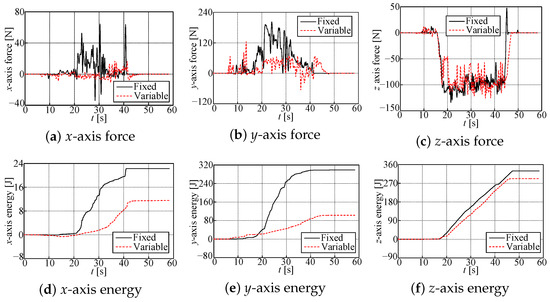
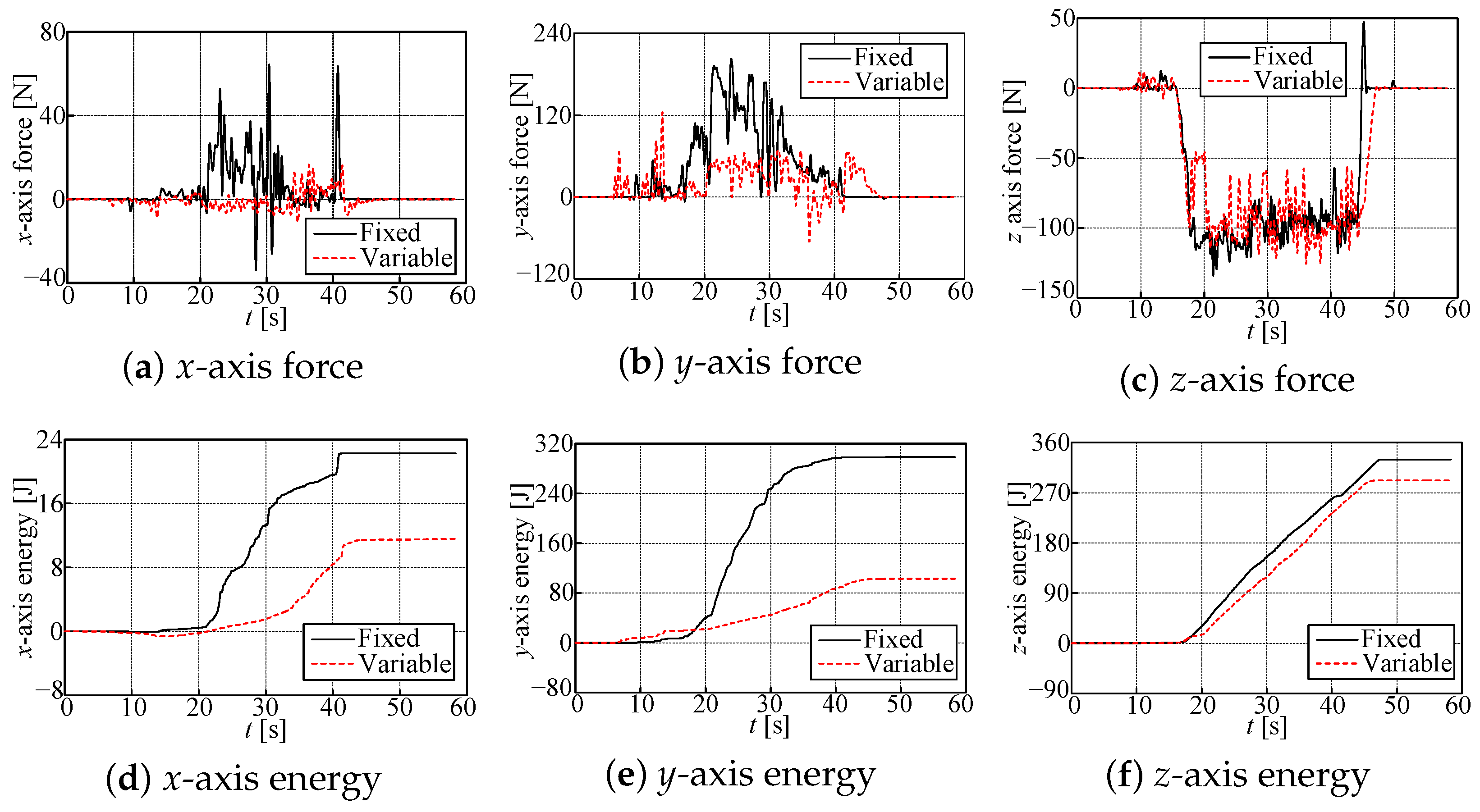
Figure 13 illustrates the interaction forces and energy consumption when the payload mass is increased to 14 kg. Although both controllers operate under the same payload condition, the proposed variable admittance control method produces significantly smaller interaction forces in all directions compared with the fixed admittance control. The corresponding RMS values are approximately 31.73%, 44.10%, and 94.38% of those obtained with the fixed admittance controller.
Figure 13.
Interaction forces and energy consumption of fixed admittance and variable admittance for 14 kg payload.
From the perspective of energy consumption during payload transportation, the energy losses under the fixed admittance control are 22.30 J, 298.12 J, and 329.42 J along the x-, y-, and z-directions, respectively. In contrast, the energy losses under the variable admittance control are 11.57 J, 102.70 J, and 292.07 J along the x-, y-, and z-directions, respectively, corresponding to approximately 51.88%, 34.45%, and 88.66% of those under the fixed admittance control.
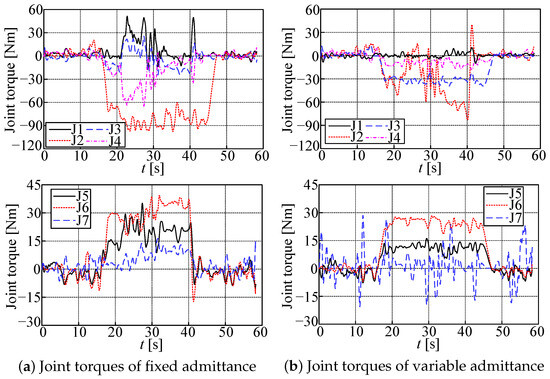
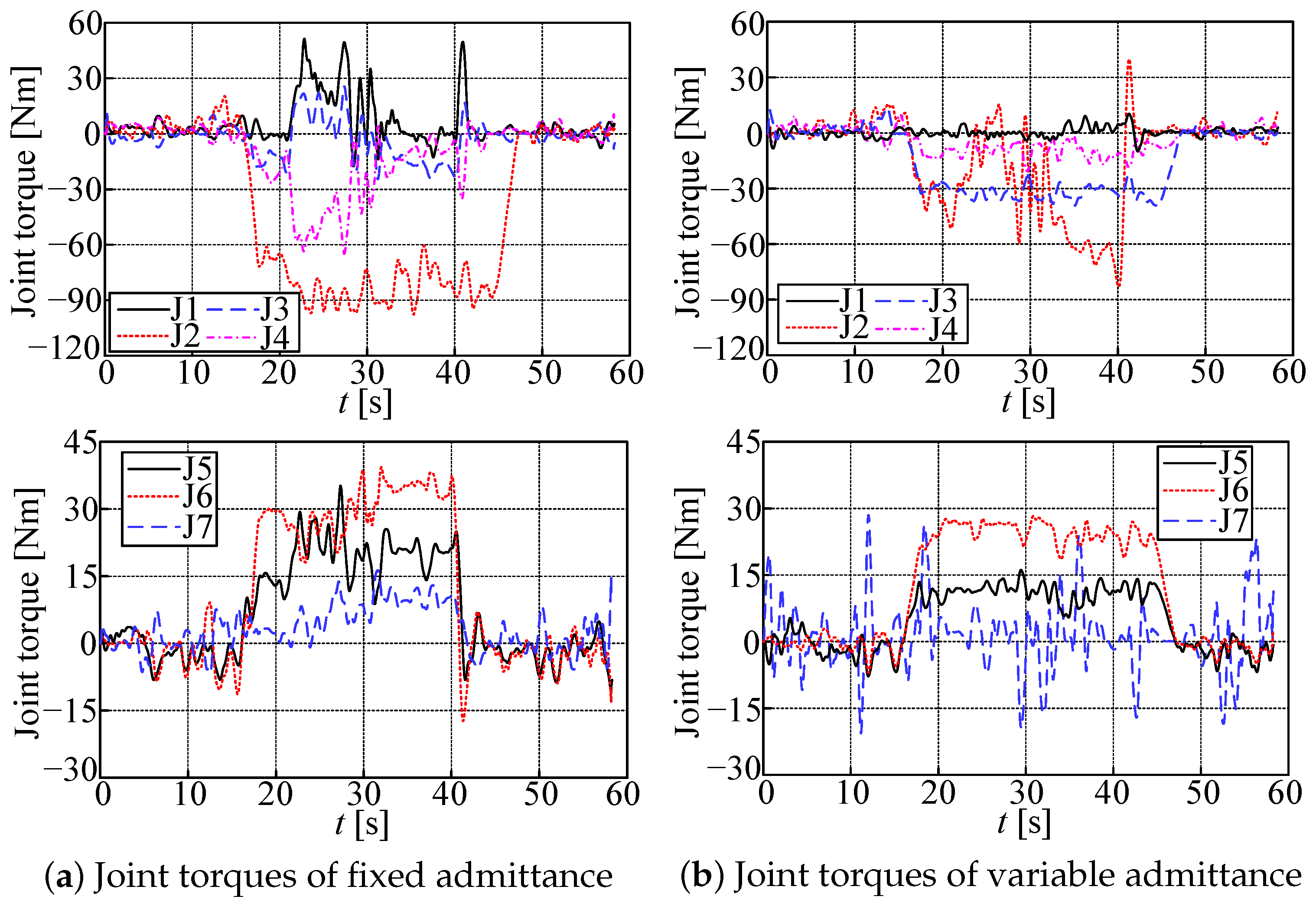
Figure 14 presents the joint torque profiles under this operating condition. With the 14 kg payload, the maximum torque of the second joint under the fixed admittance control reaches approximately 98 Nm, which is close to the preset joint torque limit of 100 Nm. Nevertheless, the manipulator is still able to operate stably.
Figure 14.
Joint torques of fixed admittance and variable admittance for 14 kg payload.
The simulation results demonstrate that, despite the significant variations in payload mass and CoM position compared with the 8 kg payload scenario, the dual-WMM system maintains stable cooperative transportation. All system signals remain bounded, and synchronized motion between the manipulators is preserved, indicating a certain degree of robustness of the proposed control framework.
These results indicate that the proposed LCM-based redundancy resolution and variable-admittance coordination strategy exhibit robustness against payload parameter uncertainty within practical operating ranges. And during the two simulations, the average computation time of a single control cycle is approximately 0.4 ms, including kinematic updates, interaction force computation, and QP-based redundancy optimization. This computational cost is significantly lower than typical control sampling periods used in mobile manipulator systems, thereby demonstrating the real-time feasibility of the proposed framework.
To ensure a fair and technically meaningful evaluation, the comparative study in this section adopts a structurally consistent baseline, namely the fixed-admittance control strategy implemented within the same motion-allocation framework and system architecture. This allows the performance differences to be directly attributed to the proposed variable-admittance mechanism and the LCM-based redundancy optimization, rather than to architectural discrepancies between fundamentally different control schemes.
Although alternative control approaches, such as impedance-based methods or conventional QP tracking strategies, could also be considered, these methods differ substantially in control structure and objective formulation. Therefore, this study focuses on comparisons within a unified cooperative manipulation framework to clearly isolate and highlight the specific performance improvements introduced by the proposed strategy. The additional variable-mass simulation further strengthens the evaluation by demonstrating robustness advantages under non-nominal operating conditions.
It should be noted that the validation presented in this study is currently based on simulation results. Although the simulation framework incorporates detailed kinematic modeling, interaction force computation, and actuator constraints to approximate realistic operating conditions, it cannot fully capture real-world uncertainties such as sensor noise, communication delays, hardware nonlinearities, or unpredictable external disturbances.
Nonetheless, the proposed control framework is designed using standard position/velocity control interfaces and real-time force feedback, which are commonly available in practical mobile manipulator systems. The redundancy resolution and variable-admittance adaptation are implemented at the kinematic and Cartesian compliance levels, without relying on idealized torque-level control assumptions. Therefore, the method is directly implementable on an actual dual-WMM platform.
Regarding scalability, the proposed framework adopts a stacked Jacobian representation and a standard QP formulation with linear constraints. Consequently, it can be naturally extended to systems with higher DoFs or to cooperative scenarios involving multiple WMMs by enlarging the optimization variables and constraint matrices. For typical cooperative manipulation tasks, the resulting QP problems remain moderate in size and can be efficiently solved by modern QP solvers without significant impact on real-time performance.
Experimental validation on a real system is identified as a critical direction for future work to further assess practical robustness and hardware-level performance. Moreover, the framework could be extended to real-world dynamic environments by integrating adaptive parameter tuning, online force-sensing calibration, and mechanisms to handle variable payloads or uneven terrain, thereby maintaining stability, compliance, and cooperative performance under realistic operating conditions.
6. Conclusions
This paper investigates the cooperative transportation of heavy objects using dual-wheeled mobile manipulators and proposes a unified quadratic programming (QP)-based control framework integrating load-capacity maximization (LCM) and variable-admittance coordination. The leader–follower architecture enables synchronized motion and compliant interaction while satisfying load distribution constraints.
Simulation results demonstrate that the proposed QP-based LCM strategy significantly enhances the load-bearing capability of the manipulator by optimizing its internal configuration without altering the desired Cartesian task. Specifically, the load-capacity index increases by 34.8%, while the norm of the weighted joint torque is reduced by 66.5%. Furthermore, the incorporation of the variable-admittance control strategy improves cooperative compliance during dual-WMM transportation, reducing the RMS interaction forces by an average of 37.44% and lowering the overall energy consumption by 27.90% compared with the fixed-admittance controller. These results indicate that the proposed framework effectively enhances load distribution, cooperative compliance, and energy efficiency without compromising load-bearing performance.
Nevertheless, the current validation is limited to simulation, and real-world uncertainties such as sensing noise, communication delays, and actuator nonlinearities are not fully considered. In addition, the variable-admittance parameters are tuned empirically, which may limit adaptability in highly dynamic environments.
Future work will focus on experimental validation on a physical dual-WMM platform and the development of adaptive or learning-based parameter tuning strategies to enhance robustness and practical applicability.
Author Contributions
Conceptualization and methodology, H.X.; simulation, Y.F.; validation, H.X. and Y.F.; supervision, J.C.; writing—original draft preparation, H.X. and Y.F.; writing—review and editing, Y.F., Y.L. and Y.Y.; project administration, J.C. All authors have read and agreed to the published version of the manuscript.
Funding
This work was supported by the National Natural Science Foundation of China (Grant No. 52405025) and the Natural Science Foundation of Jiangsu Province (Grant No. BK20230889).
Data Availability Statement
The raw data supporting the conclusions of this article will be made available by the authors on request.
Conflicts of Interest
The authors declare no conflicts of interest.
References
- Xing, H.; Torabi, A.; Ding, L.; Gao, H.; Li, W.; Mushahwar, V.K.; Tavakoli, M. Human-robot collaboration for heavy object manipulation: Kinesthetic teaching of the role of wheeled mobile manipulator. In 2021 IEEE/RSJ International Conference on Intelligent Robots and Systems (IROS); IEEE: New York, NY, USA, 2021; pp. 2962–2969. [Google Scholar]
- Qin, Y.; Escande, A.; Kanehiro, F.; Yoshida, E. Dual-arm mobile manipulation planning of a long deformable object in industrial installation. IEEE Robot. Autom. Lett. 2023, 8, 3039–3046. [Google Scholar] [CrossRef] [Scilit]
- Zhang, Y. A Coordinated Planning and Control Framework for Mobile Dual-arm Robots with Manipulability Optimization and Force Tracking. J. Intell. Robot. Syst. 2025, 111, 51. [Google Scholar] [CrossRef] [Scilit]
- Xing, H.; Torabi, A.; Ding, L.; Gao, H.; Deng, Z.; Tavakoli, M. Enhancement of Force Exertion Capability of a Mobile Manipulator by Kinematic Reconfiguration. IEEE Robot. Autom. Lett. 2020, 5, 5842–5849. [Google Scholar] [CrossRef] [Scilit]
- Cao, Y.; Tam, I.W.; Wang, X.; Wu, Z.; Xu, Q. Mobile Robotic Manipulation for Search-and-Fetch Tasks by Integrating Human-Robot Interaction. In 2025 IEEE International Conference on Mechatronics and Automation (ICMA); IEEE: New York, NY, USA, 2025; pp. 598–603. [Google Scholar]
- Ebel, H.; Rosenfelder, M.; Eberhard, P. Cooperative object transportation with differential-drive mobile robots: Control and experimentation. Robot. Auton. Syst. 2024, 173, 104612. [Google Scholar] [CrossRef] [Scilit]
- Ibarguren, A.; Daelman, P. Path driven dual arm mobile co-manipulation architecture for large part manipulation in industrial environments. Sensors 2021, 21, 6620. [Google Scholar] [CrossRef] [Scilit] [PubMed]
- Cheng, H.; Chen, H.; Liu, Y. Object handling using autonomous industrial mobile manipulator. In 2013 IEEE International Conference on Cyber Technology in Automation, Control and Intelligent Systems; IEEE: New York, NY, USA, 2013; pp. 36–41. [Google Scholar]
- Xing, H.; Xia, K.; Ding, L.; Gao, H.; Liu, G.; Deng, Z. Unknown geometrical constraints estimation and trajectory planning for robotic door-opening task with visual teleoperation assists. Assem. Autom. 2019, 39, 479–488. [Google Scholar] [CrossRef] [Scilit]
- Xing, H.; Liu, Y.; Chen, J.; Li, W.; Ding, L.; Tavakoli, M. Variable admittance control for door opening with a wheeled mobile manipulator considering ground obstacles. Intell. Serv. Robot. 2026, 19, 41. [Google Scholar] [CrossRef] [Scilit]
- Thakar, S.; Srinivasan, S.; Al-Hussaini, S.; Bhatt, P.M.; Rajendran, P.; Jung Yoon, Y.; Dhanaraj, N.; Malhan, R.K.; Schmid, M.; Krovi, V.N.; et al. A survey of wheeled mobile manipulation: A decision-making perspective. J. Mech. Robot. 2023, 15, 020801. [Google Scholar] [CrossRef] [Scilit]
- Chen, W.; Chi, W.; Ji, S.; Ye, H.; Liu, J.; Jia, Y.; Yu, J.; Cheng, J. A survey of autonomous robots and multi-robot navigation: Perception, planning and collaboration. Biomim. Intell. Robot. 2025, 5, 100203. [Google Scholar] [CrossRef] [Scilit]
- Tong, Y.; Liu, J.; Zhang, X.; Ju, Z. Four-criterion-optimization-based coordination motion control of dual-arm robots. IEEE Trans. Cogn. Dev. Syst. 2022, 15, 794–807. [Google Scholar] [CrossRef] [Scilit]
- Sun, F.; Chen, Y.; Wu, Y.; Li, L.; Ren, X. Motion planning and cooperative manipulation for mobile robots with dual arms. IEEE Trans. Emerg. Top. Comput. Intell. 2022, 6, 1345–1356. [Google Scholar] [CrossRef] [Scilit]
- Huang, D.; Li, B.; Li, Y.; Yang, C. Cooperative manipulation of deformable objects by single-leader–dual-follower teleoperation. IEEE Trans. Ind. Electron. 2022, 69, 13162–13170. [Google Scholar] [CrossRef] [Scilit]
- Xing, H.; Torabi, A.; Ding, L.; Gao, H.; Deng, Z.; Mushahwar, V.K.; Tavakoli, M. An admittance-controlled wheeled mobile manipulator for mobility assistance: Human–robot interaction estimation and redundancy resolution for enhanced force exertion ability. Mechatronics 2021, 74, 102497. [Google Scholar] [CrossRef] [Scilit]
- Yoshikawa, T. Manipulability of Robotic Mechanisms. Int. J. Robot. Res. 1985, 4, 3–9. [Google Scholar] [CrossRef] [Scilit]
- Zhu, J.; Su, M.; Li, L.; Xiang, Y.; Wang, J.; Xiao, X. Snake-inspired trajectory planning and control for confined pipeline inspection with hyper-redundant manipulators. Biomim. Intell. Robot. 2025, 5, 100245. [Google Scholar] [CrossRef] [Scilit]
- Wan, J.; Wu, H.; Ma, R.; Zhang, L. A study on avoiding joint limits for inverse kinematics of redundant manipulators using improved clamping weighted least-norm method. J. Mech. Sci. Technol. 2018, 32, 1367–1378. [Google Scholar] [CrossRef] [Scilit]
- Ren, Z.; Wang, Z.; Liu, X.; Lin, R. Parameterization-based trajectory planning for an 8-DOF manipulator with multiple constraints. Biomim. Intell. Robot. 2025, 5, 100193. [Google Scholar] [CrossRef] [Scilit]
- Khatib, O. A unified approach for motion and force control of robot manipulators: The operational space formulation. IEEE J. Robot. Autom. 2003, 3, 43–53. [Google Scholar] [CrossRef] [Scilit]
- Chiu, S.L. Task Compatibility of Manipulator Postures. Int. J. Robot. Res. 1988, 7, 13–21. [Google Scholar] [CrossRef] [Scilit]
- Xing, H.; Gong, Z.; Ding, L.; Torabi, A.; Chen, J.; Gao, H.; Tavakoli, M. An adaptive multi-objective motion distribution framework for wheeled mobile manipulators via null-space exploration. Mechatronics 2023, 90, 102949. [Google Scholar] [CrossRef] [Scilit]
- Jia, Y.; Xi, N.; Cheng, Y.; Liang, S. Coordinated motion control of a nonholonomic mobile manipulator for accurate motion tracking. In 2014 IEEE/RSJ International Conference on Intelligent Robots and Systems; IEEE: New York, NY, USA, 2014; pp. 1635–1640. [Google Scholar]
- Yang, P.; Zhuang, X.; Li, Y.; Yu, T. A time-dependent reliability analysis method for landing gear retraction mechanism based on truncated β-sphere sampling and improved APCK. Probabilistic Eng. Mech. 2026, 83, 103901. [Google Scholar] [CrossRef] [Scilit]
- Shen, S.; Cheng, J.; Liu, Z.; Tan, J.; Zhang, D. Bayesian inference-assisted reliability analysis framework for robotic motion systems in future factories. Reliab. Eng. Syst. Saf. 2025, 258, 110894. [Google Scholar] [CrossRef] [Scilit]
- Wang, J.; Li, Y.; Feng, K.; Zi, B. Design and Implementation of a Cable-Driven Continuum Spraying Robot with a Stiffness-Enhanced Flexible Joint. J. Mech. Des. 2026, 148, 063308. [Google Scholar] [CrossRef] [Scilit]
- Xing, H.; Wang, Z.; Lei, B.; Xie, Y.; Ding, L.; Chen, J. HQP-Based Obstacle Avoidance Motion Planning and Control of On-Orbit Redundant Manipulators. Int. J. Aeronaut. Space Sci. 2025, 26, 2842–2857. [Google Scholar] [CrossRef] [Scilit]
- Siciliano, B. Kinematic control of redundant robot manipulators: A tutorial. J. Intell. Robot. Syst. 1990, 3, 201–212. [Google Scholar] [CrossRef] [Scilit]
- Hassan, A.A.; El-Habrouk, M.; Deghedie, S. Inverse kinematics of redundant manipulators formulated as quadratic programming optimization problem solved using recurrent neural networks: A review. Robotica 2020, 38, 1495–1512. [Google Scholar] [CrossRef] [Scilit]
- Cheng, F.T.; Sheu, R.J.; Chen, T.H. The improved compact QP method for resolving manipulator redundancy. IEEE Trans. Syst. Man Cybern. 1995, 25, 1521–1530. [Google Scholar] [CrossRef] [Scilit]
- Zhang, Y.; Ge, S.S.; Lee, T.H. A unified quadratic-programming-based dynamical system approach to joint torque optimization of physically constrained redundant manipulators. IEEE Trans. Syst. Man Cybern. Part B 2004, 34, 2126–2132. [Google Scholar] [CrossRef] [Scilit]
- Zhang, Y.; Yan, X.; Chen, D.; Guo, D.; Li, W. QP-based refined manipulability-maximizing scheme for coordinated motion planning and control of physically constrained wheeled mobile redundant manipulators. Nonlinear Dyn. 2016, 85, 245–261. [Google Scholar] [CrossRef] [Scilit]
- Li, Z.; Wang, P.; Zhao, W.; Wu, T.; Li, Q. An Efficient Quadratic Programming Method for Kinematic Control of Redundant Manipulators under Joint Velocity Constraints. Actuators 2024, 13, 273. [Google Scholar] [CrossRef] [Scilit]
- Raibert, M.H.; Craig, J.J. Hybrid Position/Force Control of Manipulators. J. Dyn. Syst. Meas. Control 1981, 103, 126–133. [Google Scholar] [CrossRef] [Scilit]
- Hogan, N. Impedance Control: An Approach to Manipulation: Parts I–III. J. Dyn. Syst. Meas. Control 1985, 107, 1–24. [Google Scholar] [CrossRef] [Scilit]
- Ott, C.; Mukherjee, R.; Nakamura, Y. Unified Impedance and Admittance Control. In 2010 IEEE International Conference on Robotics and Automation; IEEE: New York, NY, USA, 2010; pp. 554–561. [Google Scholar]
- Zhuang, Y.; Yao, S.; Ma, C.; Song, R. Admittance Control Based on EMG-Driven Musculoskeletal Model Improves the Human–Robot Synchronization. IEEE Trans. Ind. Inform. 2019, 15, 1211–1218. [Google Scholar] [CrossRef] [Scilit]
- Teng, T.; Wu, X.; Li, Z.; Caldwell, D.; Chen, F. Robust shared control with stable contact servoing for enhanced object transportation by telerobotic bimanual mobile manipulators. J. Field Robot. 2025, 42, 1491–1507. [Google Scholar] [CrossRef] [Scilit]
- An, X.; Wu, C.; Lin, Y.; Lin, M.; Yoshinaga, T.; Ji, Y. Multi-robot systems and cooperative object transport: Communications, platforms, and challenges. IEEE Open J. Comput. Soc. 2023, 4, 23–36. [Google Scholar] [CrossRef] [Scilit]
- Tuci, E.; Alkilabi, M.H.; Akanyeti, O. Cooperative object transport in multi-robot systems: A review of the state-of-the-art. Front. Robot. 2018, 5, 59. [Google Scholar] [CrossRef] [Scilit]
- Xing, H.; Ding, L.; Gao, H.; Li, W.; Tavakoli, M. Dual-user haptic teleoperation of complementary motions of a redundant wheeled mobile manipulator considering task priority. IEEE Trans. Syst. Man Cybern. Syst. 2022, 52, 6283–6295. [Google Scholar] [CrossRef] [Scilit]
- Zhang, Z.; Zheng, L.; Yu, J.; Li, Y.; Yu, Z. Three recurrent neural networks and three numerical methods for solving a repetitive motion planning scheme of redundant robot manipulators. IEEE/ASME Trans. Mechatron. 2017, 22, 1423–1434. [Google Scholar] [CrossRef] [Scilit]
- Goldfarb, D.; Idnani, A. A numerically stable dual method for solving strictly convex quadratic programs. Math. Program. 1983, 27, 1–33. [Google Scholar] [CrossRef] [Scilit]

Disclaimer/Publisher’s Note: The statements, opinions and data contained in all publications are solely those of the individual author(s) and contributor(s) and not of MDPI and/or the editor(s). MDPI and/or the editor(s) disclaim responsibility for any injury to people or property resulting from any ideas, methods, instructions or products referred to in the content. |
© 2026 by the authors. Licensee MDPI, Basel, Switzerland. This article is an open access article distributed under the terms and conditions of the Creative Commons Attribution (CC BY) license.