
Review

Challenges and Research Progress in the Flow Distribution Mechanism of Piston Pumps: A Review
1
College of Mechanical and Automotive Engineering, Ningbo University of Technology, Ningbo 315211, China
2
College of Mechanical Engineering, Zhejiang University of Technology, Hangzhou 310023, China
*
Author to whom correspondence should be addressed.
Machines 2026, 14(3), 296; https://doi.org/10.3390/machines14030296
Submission received: 1 February 2026 / Revised: 25 February 2026 / Accepted: 2 March 2026 / Published: 5 March 2026
(This article belongs to the Section Machine Design and Theory)

Abstract

Piston pumps are core components in hydraulic systems, and their performance, efficiency, and stability significantly impact the operation of the entire system. The flow distribution method is a key factor determining the overall performance of the piston pump, directly affecting the pump’s output flow rate, pressure, and efficiency, and significantly influencing its working stability and reliability under different operating conditions. This paper reviews the structural principles, advantages, and disadvantages of current mainstream valve distribution, disc distribution, and shaft distribution methods, and discusses the main challenges they face in various applications. It focuses on analyzing how to improve piston pump performance by optimizing structural parameters, control strategies, and flow channel design. Furthermore, this paper introduces new flow distribution structures such as piston distribution and cylinder block distribution. The above provides a theoretical basis for the selection and innovation of flow distribution structures for piston pumps under different operating conditions in the future.

1. Introduction

Hydraulic transmission surpasses mechanical and electrical transmission in terms of power density, dynamic characteristics, and transmission distance, and is also easy to automate. These advantages have driven its widespread application in fields such as aerospace, marine vessels, mobile machinery, and robotics. As a core power component in hydraulic systems, piston pumps are widely used in various industrial fields, directly impacting the performance, efficiency, and application range of hydraulic systems [1,2,3]. Especially in modern hydraulic technology, the piston pump, with its characteristics of high pressure, high speed, and large flow, meets the hydraulic system’s demand for high power density. With continuous technological advancements, the performance of piston pumps in areas such as high pressure, large flow, and precise control has been significantly improved, making them key equipment to meet the demands of industrial modernization and complex working conditions [4,5].
The flow distribution method is a core element affecting the overall performance of the piston pump. It not only directly relates to the pump’s output flow rate, pressure, and efficiency, but also significantly determines the pump’s operational stability and reliability under different working conditions. Therefore, optimizing and improving the flow distribution method is essentially driving the cutting-edge development of piston pump technology. With the continuous advancement of hydraulic technology and to meet the needs of diverse application scenarios, various piston pump flow distribution solutions have emerged, which can be mainly categorized into three types: valve flow distribution, plate flow distribution, and axial flow distribution. Valve flow distribution is mainly used in variable displacement piston pumps, where the flow is controlled by adjusting the valve. It is widely applied in mobile construction machinery and the maritime industry. Plate flow distribution is commonly found in axial piston pumps, offering high flow control precision, making it suitable for heavy machinery and high-pressure hydraulic systems. Axial flow distribution is primarily used in high-pressure radial piston pumps, playing a particularly important role in the aerospace industry. These three flow distribution methods each have their own characteristics, exhibiting significant differences in various performance dimensions. Therefore, the selection and development for specific application requirements are often accompanied by their respective technical challenges and market opportunities.
The valve distribution method is favored for its simple structure and low cost, but it is difficult to achieve stepless variable control, and there are significant issues with valve lag and high failure rates during high-speed operation [6,7]. The plate distribution method is currently the most widely used distribution method in axial piston pumps and radial piston motors. Its advantages lie in the automatic compensation of sealing gaps, but its structure is relatively complex, resulting in higher manufacturing costs [8,9,10]. The axial flow distribution method is currently the most common flow distribution method in radial piston pumps, offering advantages such as simple structure, fewer components, impact resistance, long service life, and high control accuracy. However, it also faces drawbacks such as high radial hydraulic pressure on the shaft, long sealing length, relative movement between sealing surfaces, and the inability to compensate for sealing gaps [11]. The selection and improvement of different flow distribution methods directly affect the performance and application range of piston pumps.
Therefore, the study of flow distribution methods in piston pumps is not only an important direction for the development of hydraulic technology, but also of significant importance for improving the overall performance of hydraulic systems, extending equipment service life, and reducing energy consumption. This paper will systematically review and analyze the current research status of flow distribution methods in piston pumps, discuss the advantages and disadvantages of the three aforementioned flow distribution methods and their applications in different fields, and introduce new flow distribution methods. It aims to provide a theoretical basis for the selection and innovation of flow distribution structures in piston pumps under various operating conditions.

2. Valve Flow Distribution

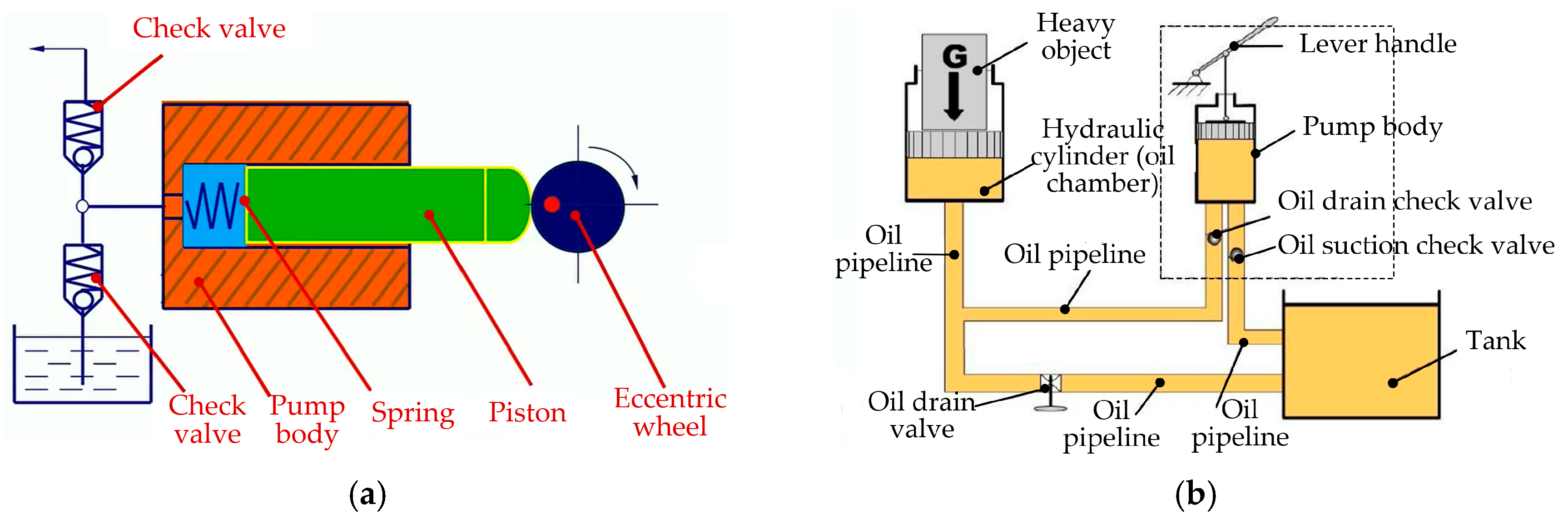
A valve distribution piston pump is a volumetric hydraulic pump that creates periodic volume changes by the reciprocating motion of the piston within the cylinder bore. It utilizes hydraulic valves (commonly suction and discharge check valves, or sometimes sliding valves or rotary valves) to alternately connect the working chamber with the suction and discharge ports, thereby completing the oil suction and discharge process [12]. The valve distribution piston pump replaces the mechanical flow distribution plate (or flow distribution shaft) with a distribution valve. By actively controlling the opening and closing of the valve, it completes the suction and discharge flow distribution of the piston chamber, thus offering greater expandability in terms of variable control and flexibility. The engineering exploration can be traced back to the 1970s with Dynex’s valve distribution quantitative and hydraulic variable ultra-high-pressure piston pump. In the early 1990s, Artemis Intelligent Power applied electromagnetic high-speed switching valves to radial piston pumps and adopted computer active control, marking the evolution of valve distribution from structural substitution to controllable flow distribution/digital control. In this development context, the primary research question is: how to construct a reliable flow distribution valve mechanism and establish a flow distribution method that can be engineered. The structural principle of valve distribution is shown in Figure 1. In a valve distribution piston pump, the flow distribution valve (check valve or high-speed switching valve) replaces the traditional mechanical flow distribution plate. The opening and closing of the valve control the suction and discharge flow distribution of the piston chamber. During the suction stroke, the piston returns, increasing the pump chamber volume and generating a vacuum. The suction check valve opens, and the discharge check valve closes, allowing the oil to enter the pump chamber from the oil tank. During the discharge stroke, the piston moves forward, reducing the pump chamber volume and increasing pressure. The discharge check valve opens, and the suction check valve closes, allowing high-pressure oil to flow through the pipeline to the actuating element (hydraulic cylinder) to do work. Thus, the piston’s reciprocating motion and valve switching jointly determine the pump’s instantaneous flow rate and pressure fluctuation characteristics. The dynamic response of the valve and the valve port transition process have a significant impact on flow pulsation, pressure shock, and efficiency.
The main advantages of the valve distribution piston pump include: First, the flow distribution function is performed by the valve components, avoiding the large-area contact surfaces found in the flow distribution plate structure, thus reducing end face wear and making it suitable for operating conditions with poor oil cleanliness. Second, the valve components (especially the check valves) automatically open and close based on pressure differential, allowing for clear switching between suction and discharge even at low speeds or intermittent operation, ensuring good working reliability. Third, the valve seat sealing and flow passage layout create a clear anti-backflow path, enhancing the system’s impact resistance and stability under high pressure, load pulsations, or frequent start-stop conditions. Finally, the flexible structure can be combined with radial or axial pistons and achieve continuous oil supply through multi-piston phase differences, making it suitable for high-pressure applications. However, this type of pump also has obvious drawbacks: Frequent opening and closing of the valve components may cause dynamic issues, such as opening delay, closing shock, and chatter, leading to pressure fluctuations, flow pulsations, and noise. The overall noise level is higher than that of flow distribution plate pumps. At high speeds, the shorter valve opening and closing times may result in insufficient filling and flow distribution phase deviation, which can affect volumetric efficiency and increase the risk of cavitation. Valve components are prone to wear, and issues such as valve seat wear and spring fatigue can lead to increased internal leakage, reduced efficiency, and higher temperature rise. Additionally, the pump’s internal structure is complex, which may cause pressure drops and energy losses, affecting efficiency and temperature rise.
In summary, the advantages of valve-controlled flow piston pumps primarily lie in high-pressure reliability, low-speed adaptability, and the avoidance of end-face flow pairs. However, their drawbacks are mainly concentrated in noise and pulsation caused by the dynamic characteristics of the valve components, insufficient high-speed performance, and the sensitivity of efficiency and temperature rise to valve wear. In engineering practice, it is usually necessary to reduce impacts and pulsations by optimizing the valve port transition design, adding damping buffers, and improving the flow path layout. At the same time, enhancing oil cleanliness, selecting high-performance materials, and improving manufacturing processes are important to extend the lifespan of valve components and maintain the stability of system efficiency [13].
First, regarding the motion characteristics and distribution schemes of the distribution valve: Zhan analyzed the motion lag problem of the distribution valve based on control theory, pointing out that reducing the mass of the suction valve and increasing the cone valve angle θ helps to improve the valve’s response and working stability [14]. Li proposed an axial piston pump/motor variable valve flow distribution mechanism, where each piston is equipped with suction and discharge liquid-controlled check valves, and signals are provided by a control slide valve to achieve stepless variation. However, its flow/torque pulsation is higher than that of the traditional flow distribution plate structure [15]. In terms of adapting to specific media and operating conditions, He conducted an analysis, design, and matching test on the flow distribution valve structure, materials, and parameters for water-based medium conditions. He pointed out that cavitation limitations prevent the valve flow piston pump speed from being too high, and the valve structure type and materials have a significant impact on volumetric efficiency [16]. Li proposed a balanced valve flow distribution dual-row axial piston pump and carried out research on structural design, finite element analysis, flow characteristics, and control strategy optimization to improve flow stability [17].
As the flow distribution schemes of valves become progressively clearer, research has shifted from the question of whether flow distribution is possible to whether flow distribution can be achieved efficiently and durably under high-pressure conditions. Therefore, high-pressure efficiency and lifespan have become important research topics for the next stage. Many studies have focused on how to achieve efficient, low-pulsation, and high-reliability flow distribution for valve-controlled piston pumps under high-speed and high-pressure conditions. In the field of high-pressure fracturing pumps, low flow distribution efficiency and short valve lifespan are typical pain points. Chen optimized the structural parameters of the flow distribution valve based on flow field characteristic simulations. He systematically analyzed the effects of valve plate lift and cone angle on valve internal pressure, valve port flow velocity, and flow coefficient, and obtained an optimal parameter combination [18]. To improve valve core response characteristics, Wang proposed a cam combination equation curve design method for high-response axial piston pumps. Simulations showed that, compared to cosine curves, the combination equation curve could increase the response of the flow distribution valve core by at least 30% [19]. Cao et al. [20] and Wu et al. [21] studied the effects of spring stiffness, opening pressure, and valve core structural angle on backflow and volumetric efficiency in micro high-pressure piston pumps and liquid hydrogen piston pumps, respectively, and achieved parameter optimization. These studies demonstrate that, through the design of motion laws and collaborative optimization of structural parameters, flow distribution efficiency and valve response can be improved simultaneously under high-pressure conditions.
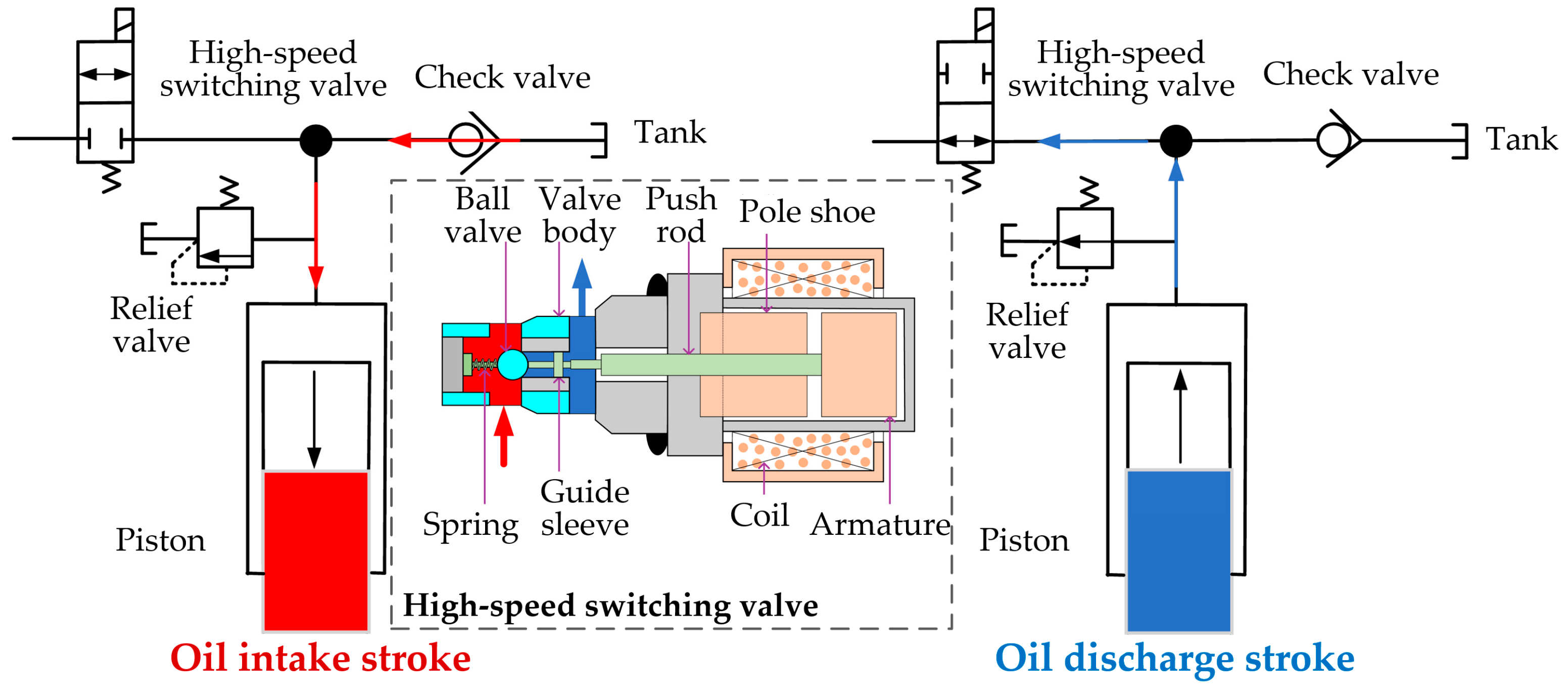
As valve-controlled flow distribution progressively moves toward digital control, digital valve flow distribution refers to using electronically controlled high-speed switching valves (digital valves) to control the on/off or switching of the piston working chamber and the suction and discharge oil passages according to discrete timing sequences. This allows for programmable flow distribution and discrete flow or displacement regulation, while considering that the performance limits of the valve-controlled flow piston pump are largely dependent on the dynamic response of the flow distribution valve and the control strategy. To address this, Wang et al. proposed a digital flow control unit encoding transformation method and designed encoding switch control, PWM, and their combined controllers. Based on high-speed switching valve static tests, they established a flow-duty cycle-pressure model and studied the impact of different modulation methods on flow output characteristics, providing a modeling and strategy foundation for digital control [22]. Huang et al. analyzed the dynamic performance of the hydraulic piston pump flow distribution valve through theoretical analysis and studied the flow distribution characteristics and influencing factors of the pump through simulation [23]. Yan et al. established a simulation model for the high-speed valve flow distribution system and pointed out that the differences in system flow characteristics between the cone valve and the ball valve are primarily reflected in the dynamic processes such as the valve core closing stroke [24]. Li et al. studied the flow characteristics of a high-frequency reciprocating pump with a check valve for flow distribution and pointed out that even if the frequency response of the check valve meets the requirements, the pump’s output flow may still be limited by system bottlenecks [25]. Qian et al. proposed a dual-swashplate axial piston pump and analyzed the effects of the flow distribution valve, pressure, and speed on the flow distribution characteristics, verifying the feasibility of its working principle [26,27]. He et al. established a mathematical model for the balanced valve flow distribution dual-row axial piston pump, analyzed the effects of structural parameters on flow pulsation and flow non-uniformity coefficient, and optimized the high-speed switching valve control strategy. The results showed that having five pistons for both the internal and external discharge, with a staggered angle of 18° and the discharge valve actively delayed in opening and pre-closed, could significantly suppress flow spikes and pulsations while improving volumetric efficiency [28]. Ye investigated a valve-controlled piston pump with a high-speed switching valve based on PWM control (Figure 2), exploring its structural design, theoretical instantaneous flow rate, and pulsation characteristics. The dynamic characteristics of the high-speed switching valve were analyzed, and a flow control strategy was proposed and optimized for adjustment accuracy. He also studied the internal flow field characteristics of the high-speed switching valve, revealing the variation patterns of flow velocity, pressure distribution, and hydraulic force under different parameters, and proposed strategies for improving accuracy [29]. Overall, research in this area has shifted from whether the valve can distribute flow to how the valve can achieve controllable, efficient, and low-pulsation flow distribution under high-frequency dynamics. PWM/modulation control and dynamic modeling have become the key methodological frameworks.
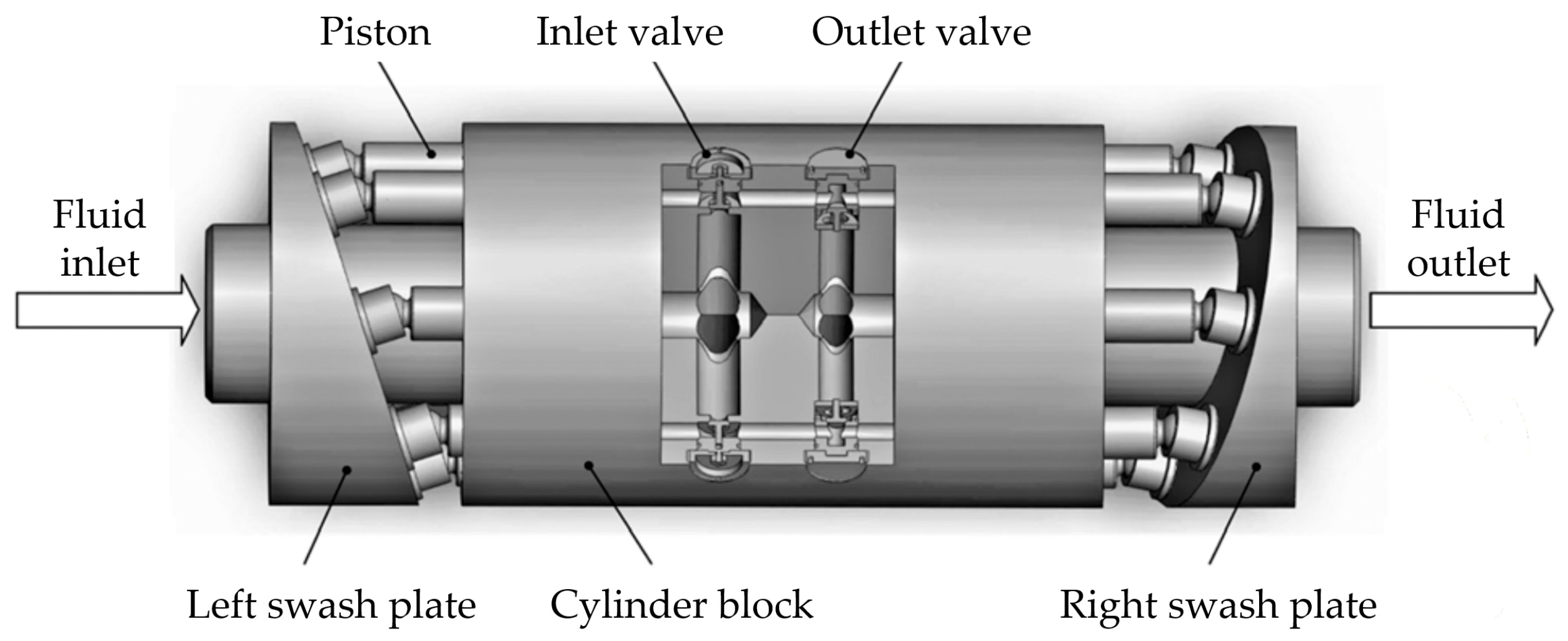
Flow pulsation is one of the core indicators for achieving high-quality output in valve-controlled piston pumps. Existing studies generally agree that pulsation is closely related to the piston motion speed pattern, valve port switching transition process, and the matching of structural parameters. Wang et al. established a comparative analysis of cosine, higher-order polynomial, and combined curve models, pointing out that the piston motion speed is a key factor affecting pulsation, and that flow pulsation is smaller under the cosine curve [19]. Ma et al., combining theoretical analysis with CFD, studied a five-cylinder double-acting reciprocating pump and pointed out that the amplitude of discharge flow pulsation increases with the speed [30]. Li et al. proposed a novel reciprocating pump based on a mechanical iris variable orifice and significantly reduced pulsation and minimized slider inertia force oscillations by optimizing the crank-connecting rod parameters [31]. Guo et al. extended and softened the overflow chamfer to alleviate the sliding valve opening process, thereby reducing pressure surges and flow fluctuations, and explained the mechanism through dynamic CFD and experiments [32]. In addition, issues such as flow instability, backflow, impact, and cavitation inside the valve directly affect efficiency, lifespan, and noise vibration. A large number of studies have used CFD or motion-flow field coupling methods to reveal the mechanisms and guide structural improvements. Wang et al. proposed a three-port valve core structure to improve the low-pressure zone and backflow, enhancing the flow field stability of the small-flow high-speed switching valve [33]. Xia et al., through transient start-up research, pointed out that quasi-steady-state patterns are insufficient to describe the evolution of transient flow fields [34]. Zhang et al. analyzed the mechanisms of hysteresis, impact, and backflow through coupling analysis of valve core motion and valve gap flow fields, and optimized the limiting parameters to reduce the impact [35]. Ye et al. focused on the peak velocity regions of valve port flow paths in high-pressure applications such as fracturing pumps, optimized the valve plate lift and cone angle to improve the flow field and enhance flow distribution efficiency [18]. Chen et al. further studied the flow-induced vibration patterns during the opening process of check valves, providing a basis for the durability design of valve structures [36]. Zhu et al. conducted extensive research on rotary valve flow distribution dual-swashplate hydraulic motor pumps. They also proposed a dual-swashplate axial flow distribution axial piston hydraulic motor pump, as shown in Figure 3 [37,38]. This design fully utilizes the advantages of multiple force balances in the dual-swashplate structure, avoids the lag issues of valve flow distribution, effectively improves the operating speed of the hydraulic motor pump, and further increases the power density [27,39]. The above work not only deepens the understanding of the transient flow processes in reciprocating pumps and valves but also provides important theoretical foundations and methodological support for the design and engineering applications of fluid machinery with high performance, low pulsation, and high reliability.
The above valve flow distribution schemes are all aimed at axial piston pumps. In addition, new valve flow distribution schemes have also emerged for radial piston pumps. Guo et al. proposed a sliding valve-type oil distribution radial piston pump (SVDRPP), which uses a sliding valve to distribute oil to the piston chambers. This design aims to eliminate the disadvantages of poor force distribution in traditional oil distribution shafts and the energy loss caused by the opening of check valves [40]. Li et al. proposed a valve distribution hydraulic radial piston pump (RPP), which achieves reciprocating motion through a star-wheel-driven connecting rod–crosshead–piston assembly, with suction and discharge performed by the pump’s check valve. They established MATLAB and AMESim models and combined 3D CFD analysis to investigate the flow field of the suction and discharge passages and the discharge valve opening flow characteristics [41]. These studies show that valve flow distribution is not just a single technological point of replacing the flow distribution plate, but also has continuous evolution potential in terms of pump type expansion and system integration.
Besides the aforementioned structural features, the distribution valve, as the key functional component enabling the pump’s periodic suction and discharge, plays a decisive role in the reliability and service life of the entire pump through its damage-management mechanism. Under high-pressure and high-frequency operating conditions, the distribution valve is prone to several typical failure modes, including wear between the valve spool and valve seat, impact-induced damage, and fatigue fracture of the spring. To address these issues, an effective damage-management strategy should integrate both design optimization and operation-and-maintenance monitoring. At the design stage, durability can be improved at the source by selecting highly wear-resistant materials and introducing buffering structures. At the operation stage, real-time monitoring of the pump outlet pressure and flow pulsation signals can be used to indirectly assess the sealing performance of the valve port and the opening/closing response characteristics, thereby enabling predictive maintenance and avoiding unplanned pump shutdowns caused by sudden distribution-valve failure.
In summary, the key design and improvement points of valve-distribution piston pumps can be summarized in Table 1, mainly focusing on valve dynamic response, digital and programmable control, pulsation suppression, flow channel and flow field optimization, and reliability improvement. From a research perspective, its development path has roughly gone through three stages: the early principle verification stage centered on valves to achieve flow distribution; subsequently, shifting towards performance enhancement to improve valve response and flow distribution efficiency for high-pressure and high-speed operating conditions; and in recent years, further evolving into a stage of programmable digital flow distribution and fine flow control represented by high-speed on/off valves. Nevertheless, its key performance bottlenecks still lie in the high-frequency dynamic behavior of valves (such as opening hysteresis, closing impact, backflow, and cavitation induction) and the resulting pulsation, noise, and lifespan degradation. Therefore, subsequent research urgently needs to focus on collaborative design around structural parameter optimization, valve control strategy design, and flow channel layout improvement to achieve a comprehensive improvement in efficiency, noise, and reliability.

3. Plate Flow Distribution

In 1905, Harvey William and Reynold Janny from the United States designed the end-face flow distribution swashplate pump/motor [42], thus giving rise to the axial piston element in its modern form. End-face flow distribution, also known as plate flow distribution pumps, occupies the largest market share in the piston pump industry due to advantages such as easy stepless variation, compact size, lightweight, ease of maintenance, and reliable performance [43].
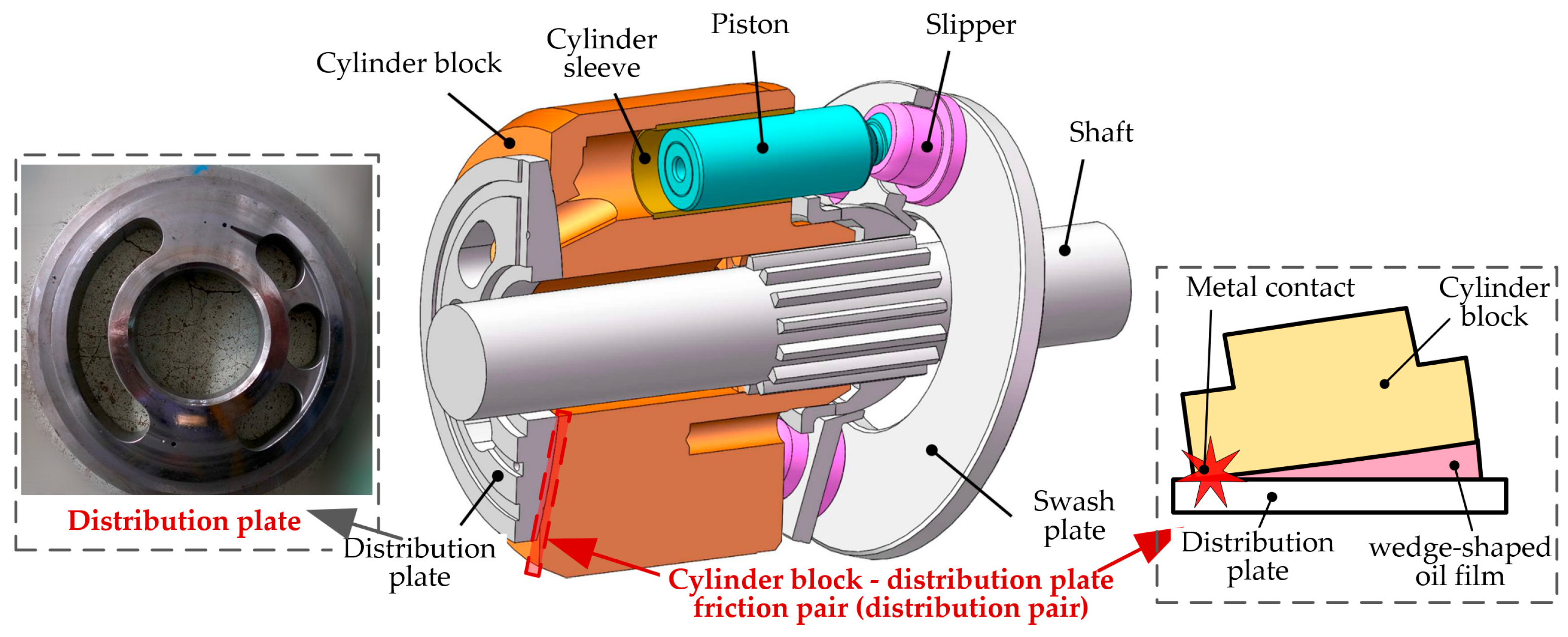
End-face flow distribution pumps are mainly divided into two types: swashplate pumps and slanted shaft pumps. Among them, the swashplate pump has a simpler structure and outstanding overall performance, thus giving rise to the axial piston element in its modern form [44]. Figure 4 shows the typical structure of a swashplate axial piston pump, which adopts the plate flow distribution (end-face flow distribution) method: suction and discharge windows are machined on the end face of the fixed flow distribution plate, and the rotating cylinder periodically connects the cylinder holes with the windows during its rotation. Under the combined action of the rotating cylinder and the fixed swashplate, the piston rotates around the axis along with the cylinder and also moves reciprocally within the piston chamber. This causes the volume of the piston chamber to change periodically. When the volume increases, it communicates with the suction window to complete the suction; when the volume decreases, it communicates with the discharge window to achieve oil compression and output [45,46,47].
The performance of an axial piston pump is constrained by the lubrication reliability and service life of three sliding friction pairs: the piston–cylinder block pair, the valve plate–cylinder block pair, and the slipper–swashplate pair. During normal operation, the valve plate interface is subjected to high pressure and relative sliding velocity. Therefore, a stable lubricating film must be established between the cylinder block and the valve plate to prevent direct metal-to-metal contact. Due to the imbalance of forces and moments acting on the cylinder block, the lubricating film between the valve plate and the cylinder block is not ideally parallel; instead, a wedge-shaped film with a small tilt angle exists (as shown in Figure 4) [48]. Sometimes, the lubricating oil film is damaged, resulting in direct contact in localized areas. This leads to metal-to-metal friction, generating excessive heat, which causes the phenomenon of burning of the valve plate [49]. However, the wedge-shaped oil film cannot be too large, as it would increase leakage and lead to a decrease in volumetric efficiency. At the same time, the sealing boundary of the flow distribution pair is the most important among the three major friction pairs, and the leakage caused by wear is much greater than that of the piston pair and slipper pair [50]. As early as 1986, Yamaguchi pointed out that the study of the flow distribution pair is a key aspect of the fundamental research on axial piston components [51].
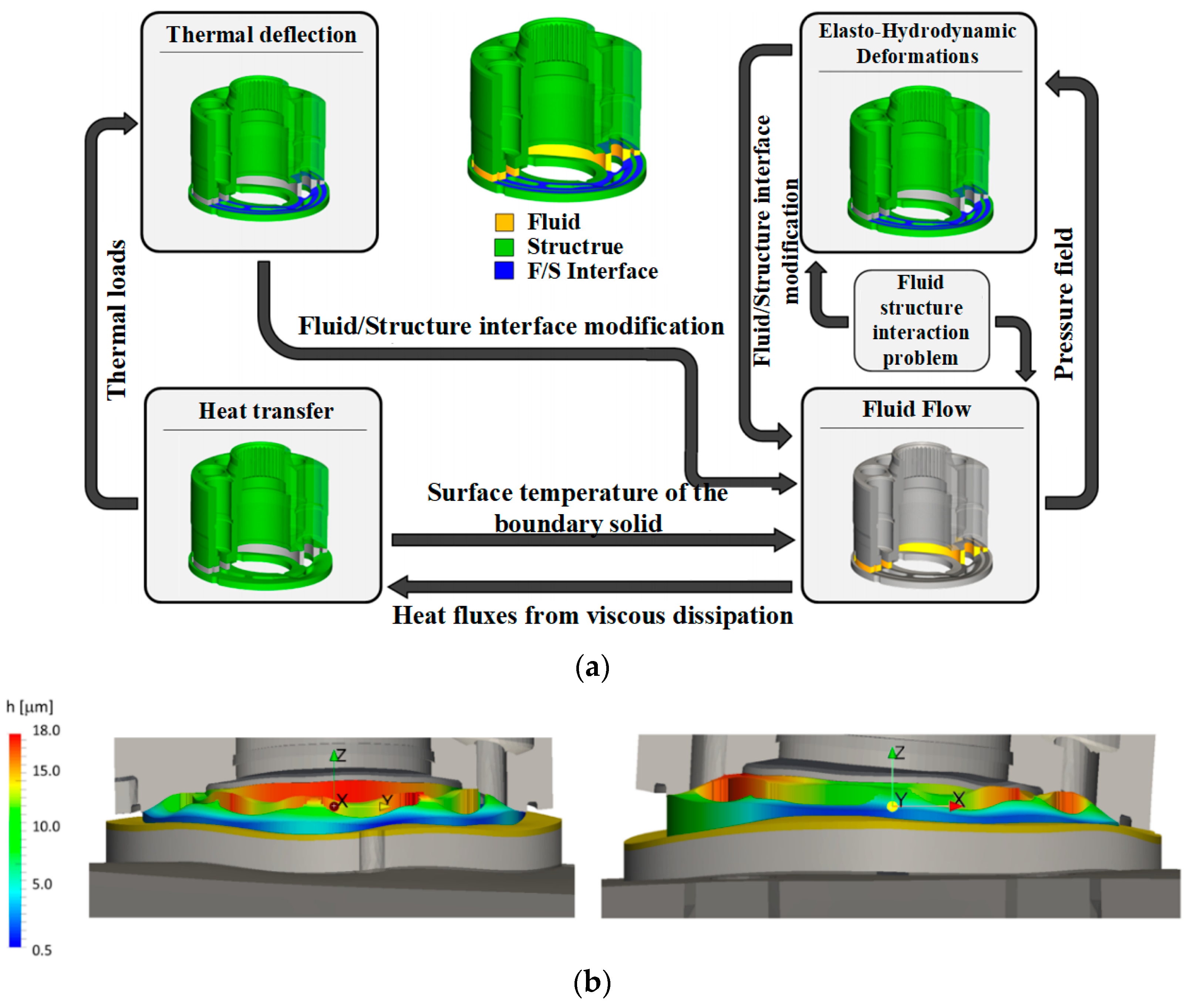
The research on the oil film of the flow distribution pair can be divided into two main parts: simulation studies and experimental studies. In the numerical calculation part, the Maha Fluid Power Research Center at Purdue University has been conducting in-depth research on the lubrication characteristics of the flow distribution pair’s oil film since 2002 by establishing a fluid–structure–thermal coupled calculation model. They have also validated the temperature distribution predictions of the flow distribution pair through experimental setups (Figure 5) [52,53,54,55,56]. Since 2004, Xu and Zhang have been researching the lubrication performance of the distribution plate. They established various mathematical models and simulation platforms, discovering that at higher relative speeds, the cylinder block is more prone to tilting away from the distribution plate, leading to the formation of a wedge-shaped oil film between the cylinder block and the distribution plate, thus increasing leakage flow. Through vector analysis, an analytical expression for the cylinder block’s overturning moment of inertia was given. Furthermore, a high-speed test bench was built, and high-speed experiments at up to 10,000 r/min were conducted on the pump prototype. These results provide a reference for the structural optimization of high-speed, small-displacement piston pumps and wear prediction [57,58]. Jung and Kim et al. compared the oil film, leakage, and torque characteristics of three types of distribution disk structures—a planar distribution disk without a load-bearing support strip, a planar distribution disk with a load-bearing support strip, and a spherical distribution disk—by building a test bench. They found that the minimum oil film thickness was located on the oil discharge side and increased with increasing rotational speed but decreased with increasing pressure. They also pointed out that a spherical distribution plate without auxiliary support can achieve better lubrication performance and overall efficiency [59,60]. Bergadà et al. established and experimentally validated a pressure distribution model for the lubricating film of the distribution pair considering the buffer tank. Their work systematically revealed the influence of the wedge angle, average clearance, rotational speed, and temperature/pressure on the dynamic characteristics of the cylinder block. They also pointed out that the clearance is largest on the oil discharge side, the clearance fluctuation is greatest on the oil suction side, and contact between the distribution pair significantly alters the dynamic response of the cylinder block [61,62]. Sadeghi et al. developed an integrated axial piston pump experimental setup (APPA) comprising a hydraulic circuit including a series of control valves, pressure sensors, a replenishing pump, a flow meter, a temperature sensor, a heat exchanger, and an eddy current displacement sensor. Through this circuit, they measured the start-up and steady-state orientation of a floating distribution plate and established a dynamic-lubrication model incorporating cavitation effects. They verified that this model can accurately predict the oil film thickness within the range of ≤9 MPa and ≤1200 r/min (the minimum oil film thickness is located on the suction side and corresponds to the highest temperature) [63,64,65].
In summary, the advantages of the plate flow distribution system include its compact structure, clear flow distribution pattern, short leakage path of the end face oil film seal, and high volumetric efficiency. Furthermore, the end face gap exhibits a certain degree of self-adaptation and automatic compensation under the combined action of clamping force and oil film pressure. Its disadvantages include uneven pressure distribution on the end face, which can easily generate a large overturning moment, leading to uneven wear and tear on the cylinder block and distribution plate. It is also highly sensitive to machining and assembly accuracy, oil cleanliness, and lubrication conditions. Under adverse operating conditions, problems such as scratching, scuffing, localized burning, and increased noise and vibration may occur [66,67]. The reciprocating motion of the piston causes the oil suction and discharge process to be significantly periodic. At the moment of switching between suction and discharge, due to the large pressure difference between the inlet and outlet, the compressibility of the oil and the transient flow distribution process induce dynamic flow pulsations. These pulsations propagate along the pipeline and couple to form pressure pulsations. The flow and pressure pulsations further interact with the system load, exciting vibrations in the pipelines, hydraulic valves, and surrounding air, ultimately generating noise [68,69]. Therefore, the structural design of the transition zone around the swash plate mechanism and pulsation suppression have become important research directions for reducing noise in axial piston pumps.
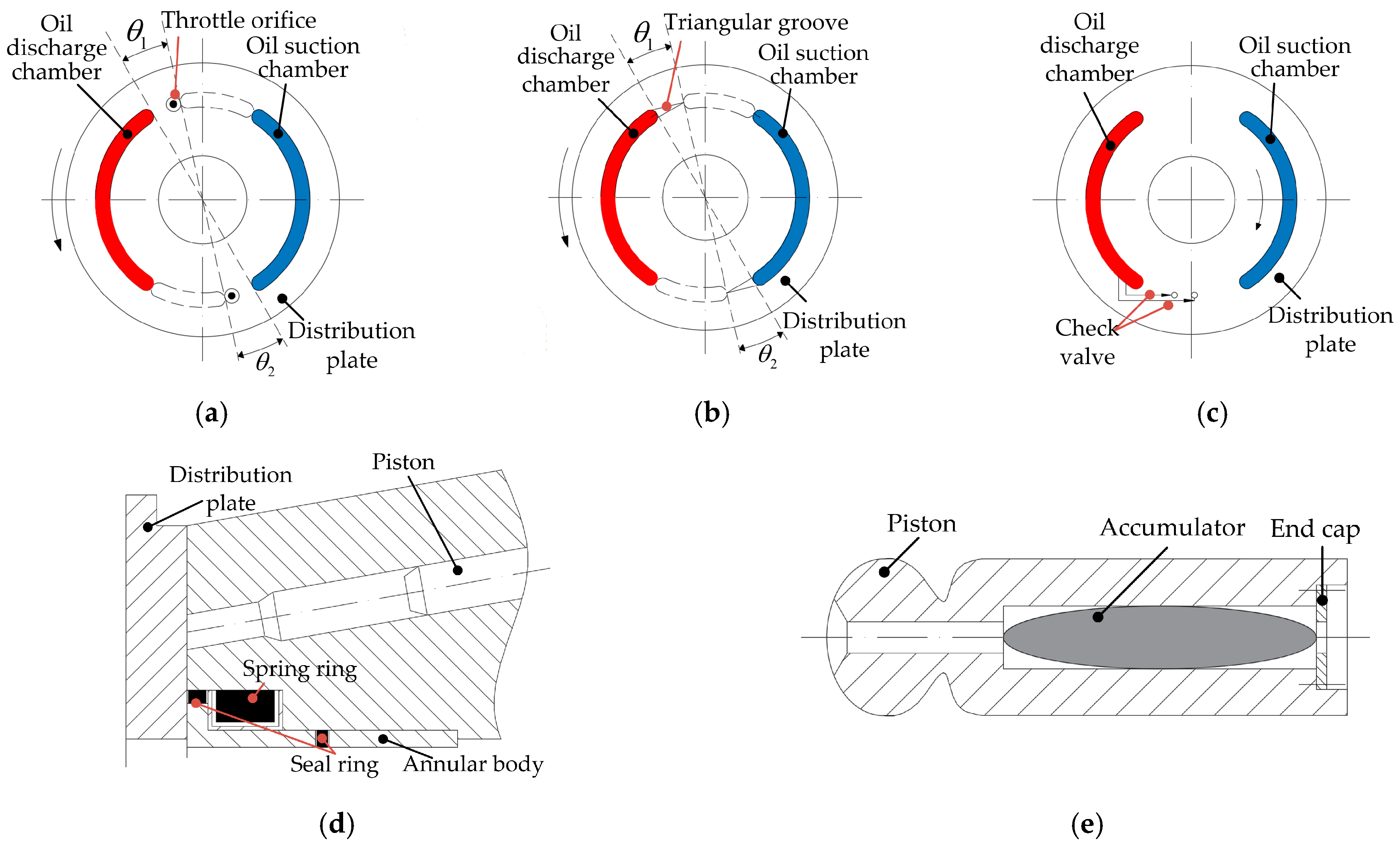
To suppress flow and pressure pulsations caused by the distribution plate, the research first focused on the design of pre-compression/pre-decompression and throttling damping structures in the transition zone. Yang et al. analyzed and summarized various structural forms, including pure pre-compression and decompression distribution plates, distribution plates with throttling holes, distribution plates with triangular grooves, distribution plates with one-way valves, and cylinder block elastic rings and hollow piston built-in accumulators (Figure 6), from the perspectives of working principle, structural characteristics, and noise reduction effect. The research results show that the triangular groove structure can reduce noise by about 4 dB, the one-way valve structure can reduce it by about 1–6 dB, and after adopting the cylinder elastic ring, the pressure pulsation amplitude can be reduced to about 5–60% of that before the improvement [45]. This classification provides a clear framework for the subsequent evolution of flow distribution plate structures. Subsequently, research on flow distribution characteristics further progressed towards parameterization and modeling. Firstly, a model for the triangular groove opening area was established and an analytical expression was derived. Secondly, a damping hole-triangular groove composite structure was proposed to reduce the pressure gradient and suppress backflow. Thirdly, an asymmetrical flow distribution plate with a larger oil suction angle than the oil discharge angle was designed, and the optimal oil flow ratio was determined to reduce pressure loss and flow pulsation [70]. Studies by Pettersson et al. have shown that introducing damping grooves in the transition zone of the flow distribution plate can significantly reduce outlet flow pulsations [71]. Zhang et al. proposed a flow distribution plate design method for low-flow pulsation, establishing mathematical models for key geometric parameters such as the transition zone damping groove, damping hole, and waist-shaped groove. They analyzed the optimal parameter selection and its noise reduction mechanism, and verified the feasibility and effectiveness of the method through flow pulsation comparison experiments [72]. Guo et al. optimized the radius, length, and deflection angle of a cylindrical damping groove in the transition zone using a combination of CFD and a multi-objective genetic algorithm, resulting in a 43.59% reduction in outlet flow pulsation rate and a 0.16% reduction in pressure pulsation rate [46]. Xu et al. proposed a transition zone design method based on flow area matching and transient backflow suppression, and verified through flow characteristic simulations that this method can reduce oil discharge flow pulsation and eliminate pressure overshoot/undershoot in the piston chamber, thus achieving a low-noise design for open-loop axial piston pumps [73]. Bergada et al. compared the pressure transient performance of three types of grooves—constant area, linearly varying, and quadratically varying—at low flow rates. They concluded that constant-area grooves minimize the required discharge area, linearly varying grooves achieve the shortest groove length, and quadratically varying grooves offer no significant performance advantages [61].
Furthermore, focusing on pre-compression angle and transition zone timing optimization, Edge et al. developed an improved digital computer model; they introduced fluid momentum effects into the model, discussed parameters such as the shape and depth of the damping groove and pointed out that a triangular cross-section is beneficial for reducing positive and negative pressure overshoot in the piston chamber. Their pre-decompression design alleviates inlet flow pulsation by diverting high-pressure oil [74]. To investigate the impact of the pre-compression structure and V-notch in the distributor plate (valve plate) on pressure fluctuations, Kim et al. conducted comparative experiments using three different types of distributor plates. The results showed that the pressure fluctuation characteristics of the axial hydraulic piston pump are closely related to the pre-compression and V-notch design in the distributor plate. Therefore, by selecting an appropriate pre-compression angle and optimizing the design of the notch (groove) structure between the suction and discharge ports, pump noise can be effectively reduced [75]. Mandal et al. determined the optimal combination by jointly optimizing the pre-compression angle and the wrap angle of the cylinder body’s waist-shaped groove [76]. The pre-pressurization chamber design proposed by Pettersson et al. has been validated through simulations and experiments, demonstrating its effectiveness in improving transient pressure transitions and reducing outlet flow pulsations [77]. Wang et al. installed an embedded sequential valve (ESV) between the pre-compression chamber and the oil discharge port. This structure demonstrated excellent pulsation suppression capabilities at different displacement volumes [78]. Furthermore, addressing the potential efficiency drawbacks of traditional noise reduction structures, Xu et al. proposed a pressure equalization mechanism composed of a check valve and a pressure recovery chamber. They verified that this mechanism can reduce flow pulsation while improving volumetric efficiency, reducing swashplate torque, thereby lowering variable control power and improving control accuracy. They also provided the key optimal parameters [79]. In summary, this type of research has gradually formed a technical route encompassing theoretical modeling, parameter sensitivity analysis, multi-objective optimization, and experimental verification, enabling the design of transition zone structures to evolve from empirical design to computable and optimizable quantitative design.
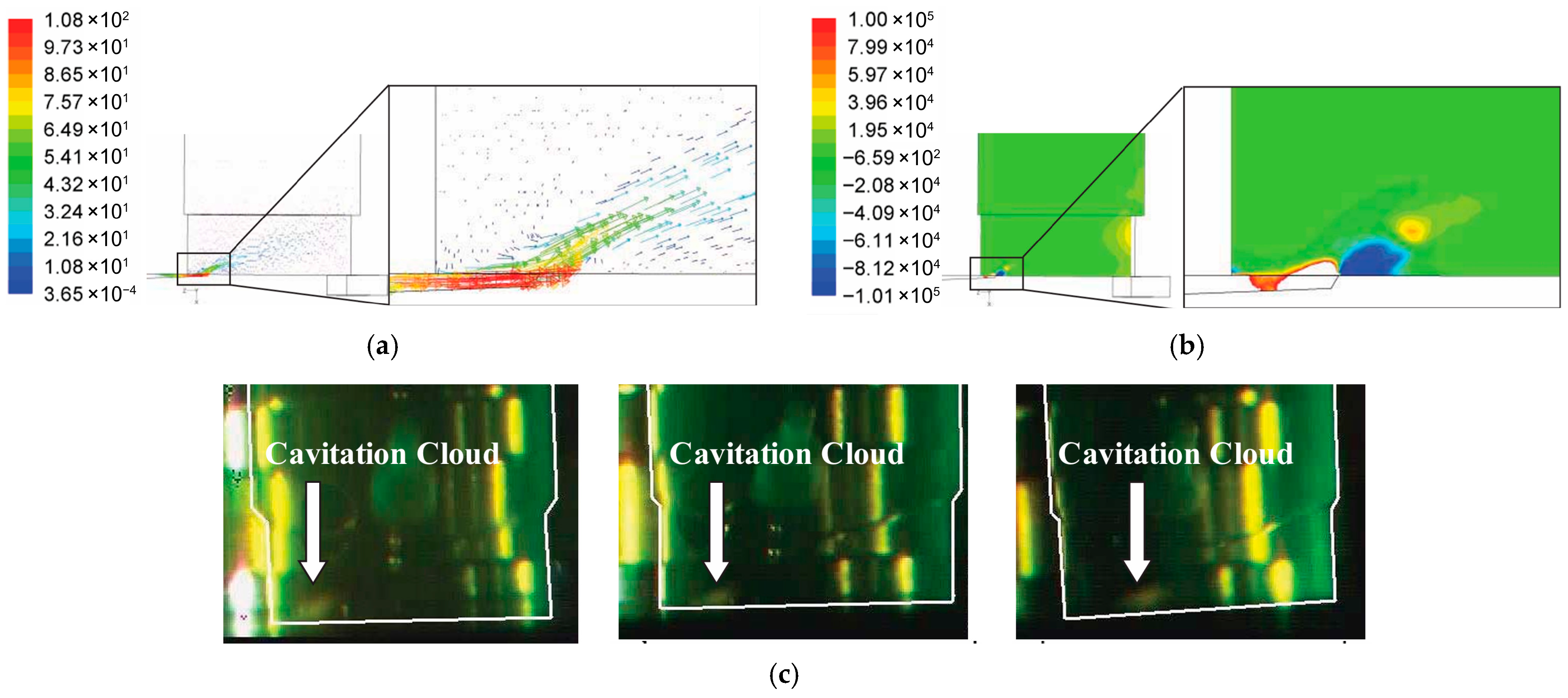
It should be noted that while the damping structure in the transition zone suppresses pulsations, it may also introduce new flow risks: backflow at the damping grooves can easily form high-speed jets and induce cavitation [80,81,82]. Tsukiji et al. observed high-speed jets near the damping groove using high-speed cameras and detected cavitation under 10 MPa (As shown in Figure 7), confirming a correlation between high-speed jets and cavitation [83]. Zhang et al. pointed out that the surface of the distribution plate is one of the important sources of cavitation in piston pumps [84]. To address the problem of cavitation that easily occurs in traditional damping grooves during high-speed oil suction and discharge switching, Johansson et al. proposed adding damping holes leading to the housing in the pre-pressure reduction zone, which can effectively reduce cavitation in this area [85]. Ji et al. used genetic algorithms to optimize the structural parameters of the distribution plate and cylinder block waist-shaped groove, effectively reducing pressure loss while suppressing cavitation [86]. To address the problem of gas release/cavitation in pressure-relief groove type distribution plates, Ye et al. proposed a new type of distribution plate with damping holes. They then optimized the parameters using a dynamic model incorporating cavitation and a multi-objective genetic algorithm, resulting in reduced noise sources under high-pressure conditions and a 1.6 dB reduction in measured noise under rated operating conditions [87]. Guan et al. developed single-piston and multi-piston models for the distribution plate of an aviation axial piston pump with a damping hole-buffer chamber-throttling orifice pre-pressurization channel, considering compressibility, throttling/resistance, and leakage. These models were implemented in Simulink and validated through CFD comparisons. They then analyzed the influence of the pre-pressurization channel on flow pulsation and transient pressure in the piston chamber and provided optimization suggestions [88].
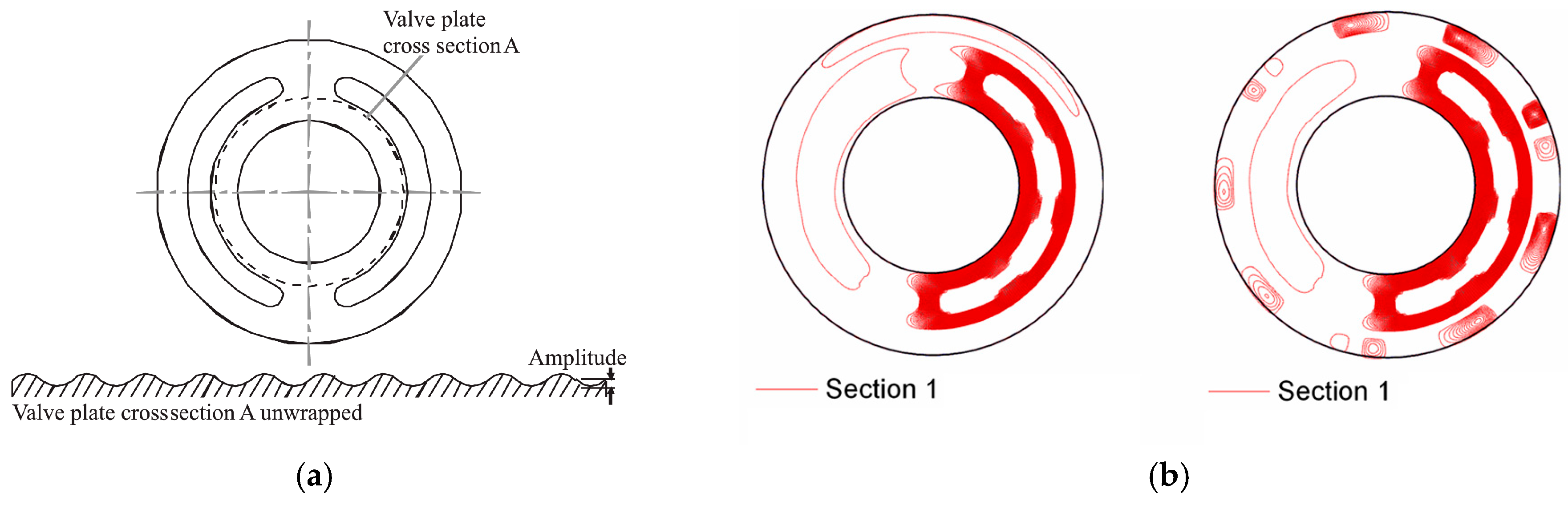
In addition to noise and cavitation, the plate flow distribution pair is prone to uneven loading and wear under the influence of overturning torque, making lubrication and wear control key factors affecting both lifespan and efficiency. A study conducted by the IFAS Institute at RWTH Aachen University in 2000 found that micro-texturing the surface of the distribution plate can reduce frictional power consumption under low-pressure conditions and improve load-bearing capacity under high-pressure and high-speed conditions, but it may also induce cylinder vibration under certain operating conditions [89,90]. Deng et al. established and numerically solved a coupled TEHD model for flow distribution, revealing that oil film thickness and cylinder tilt angle vary periodically with rotation. Increased rotational speed thickens the oil film, reduces fluctuations, and decreases tilt angle variations, while increased pressure thins the oil film, intensifies fluctuations, and increases the tilt angle. Simultaneously, increased rotational speed/pressure increases viscous dissipation, temperature rise, and leakage, and narrows the sealing zone, all of which can reduce friction torque and leakage [91]. Based on this, surface texturing has become an important way to improve the load-carrying capacity and reduce friction in fluid power components. Ivantysynova et al. proposed a simulation model that includes fluid–structure interaction and micro-deformation of the cylinder block caused by piston chamber pressure, and used a wavy texture to improve the performance of the sealing band, as shown in Figure 8a [55,92]. Shin and Kim, through their research on different distribution plate surfaces, pointed out that this type of texture has a significant effect on improving the stability and performance of the cylinder block’s auxiliary support band (Figure 8b) [93]. Murrenhoff et al. improved the surface design of the distribution plate using ellipsoidal textures [94]. Li et al. demonstrated through simulations and experiments that surface texture can reduce friction and improve mechanical efficiency [95,96,97]. Zhang et al. utilized surface-textured distribution plates to reduce wear on the distribution pair of EHA axial piston pumps and improve mechanical efficiency [98,99]. Wang et al. conducted a numerical analysis of the oil film and friction characteristics of micro-textured distribution plates based on the THD-Reynolds coupling model, pointing out that micro-textures can significantly improve friction performance, with square textures being the most effective and achieving optimal overall performance at a texture depth of 20–50 μm [100,101]. It is important to emphasize that while surface texturing is beneficial for oil film formation and friction reduction, the introduced micro-dimple structures may also alter leakage characteristics and affect volumetric efficiency. Therefore, a systematic trade-off between load-carrying capacity, friction, leakage, and efficiency is necessary in engineering applications.
In summary, the research on plate flow distribution mainly focuses on four aspects: lubrication and load bearing, pulsation suppression, cavitation suppression, and wear and energy reduction. The specific improvement principles are shown in Table 2. However, most solutions are sensitive to changes in operating conditions, and trade-offs still exist between noise, cavitation, wear, and efficiency. Future research should focus on coupled modeling and optimization design across a wider range of operating conditions to achieve a balance between low noise, high efficiency, and long service life.

4. Axial Flow Distribution

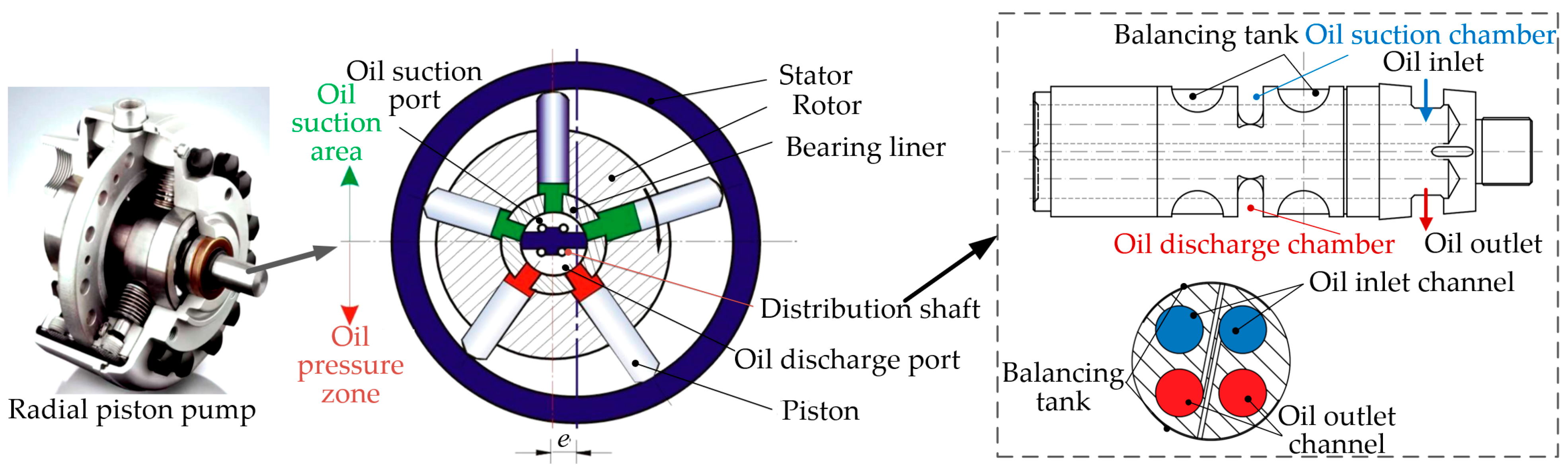
Axial flow distribution (also known as axial porting) is primarily used in the flow distribution mechanisms of radial piston pumps (especially fixed or variable displacement radial piston pumps). In these types of pumps, the flow distribution function is performed by a distribution shaft, which can structurally replace axial distribution plates and other similar designs. Therefore, it is often used in applications where compactness, shock resistance, and control accuracy are critical [11].
The working principle of axial flow distribution is as follows: low-pressure grooves (oil suction grooves) and high-pressure grooves (oil pressure grooves) are machined onto the distribution shaft. Through the relative rotation between the shaft and the rotor (cylinder block), each piston chamber is sequentially connected to the low-pressure and high-pressure zones during one rotation, thereby achieving a periodic oil suction and oil pressure process. As shown in Figure 9, when a piston chamber rotates with the rotor and enters the suction zone corresponding to the low-pressure port, the piston moves radially outward, increasing the chamber volume. The pressure inside the chamber decreases and connects with the suction port, completing the fluid filling process. When this piston chamber continues to rotate and enters the discharge zone corresponding to the high-pressure port, the piston moves inward under the action of the eccentricity (or eccentric mechanism), reducing the chamber volume, increasing the pressure, and connecting with the discharge port to output the fluid. Therefore, the high and low pressure grooves on the distribution shaft act as time-space commutation elements, determining the sequence and position of the connection between the piston chamber and the suction and discharge ports.
The main advantages of this flow distribution method are: a relatively simple structure, a small number of parts, and good system rigidity. Due to the strong impact resistance of the flow distribution pair, it features durability and a long service life; at the same time, the flow distribution phase is determined by the geometry and assembly position of the grooves on the shaft, making it easy to achieve high control and flow distribution accuracy. Its main disadvantages are: the flow distribution shaft is subjected to large radial hydraulic forces, which place higher demands on the shaft system’s stress and support rigidity. The flow distribution pair usually requires a longer sealing length to suppress internal leakage, but relative motion exists between the sealing surfaces, which can easily lead to wear and heat generation. Furthermore, the flow distribution gap is mostly a fixed geometric gap, making automatic compensation difficult. The risk of increased leakage and decreased volumetric efficiency after wear or thermal deformation is therefore more pronounced.
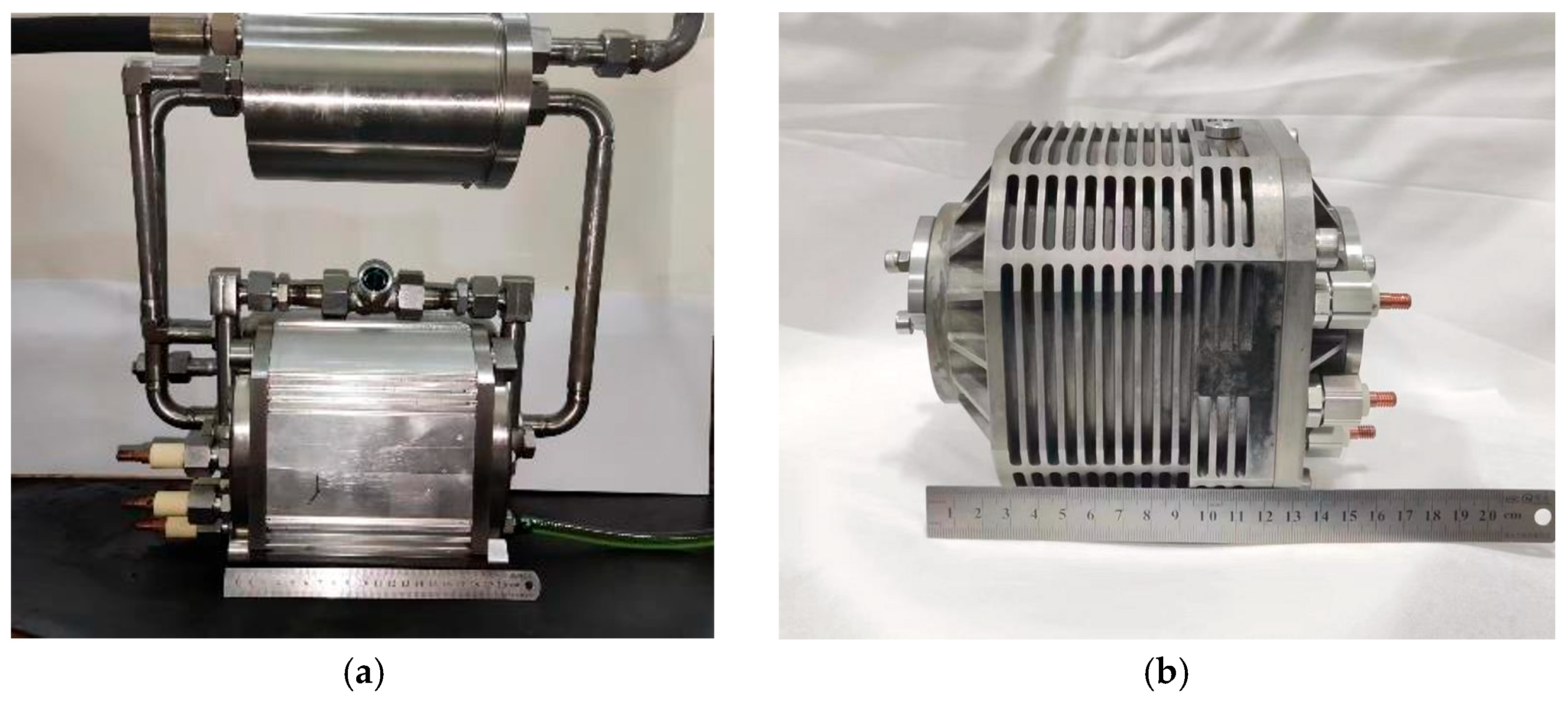
Yi et al. used the CFD method to model and mesh the unsteady flow field in a 40 mL/r radial piston pump. They then conducted transient simulations using dynamic/sliding mesh techniques to systematically reveal the patterns of pressure shock and flow pulsation. Based on this, they optimized the parameters of the triangular groove and negative overlap structure of the distribution shaft, clarifying their coupling relationship with load pressure and rotational speed, thus providing a basis for the optimized design of the internal flow channel and distribution structure [102]. Zhu et al. conducted experimental studies on the discharge coefficient of rotating radial small holes under high-speed shaft flow conditions. The results showed that the discharge coefficient is controlled by both centrifugal and Coriolis forces and exhibits directional differences. In the forward direction, it increases with increasing rotational speed and decreases with increasing Reynolds number, while the opposite is true in the reverse direction. Furthermore, it tends to stabilize at high Reynolds numbers (approximately 0.65–0.80 in the forward direction) [103]. To overcome the limitations of domestically produced radial piston pumps with a rated pressure of 28 MPa, Bai increased the rated pressure to 35 MPa. Based on the analysis of the radial forces on the distribution shaft, Pro/E and ANSYS Workbench were used to verify the strength and stiffness of the distribution shaft. The results showed that it met the design requirements [104]. To address the issue of shaft seizure in the distribution shaft’s friction pair, Wei et al. improved the structure based on the principle of hydrostatic balance and performed dynamic pressure verification. This resulted in pure liquid lubrication of the friction pair and a tendency towards radial force balance, thereby improving its lifespan and reliability [105]. Shen et al. showed that introducing dynamic pressure feedback and adding pressure compensation elements to a hydrostatic bearing system can also effectively suppress shaft seizure [106]. Regarding leakage and efficiency, the quantitative and experimental studies by Chen et al. show that increased internal leakage (especially between the piston and rotor, and between the distribution shaft and rotor) leads to a decrease in volumetric efficiency [107]. Jia et al. determined a reasonable clearance range based on the leak-free gap formula and combined it with experimental measurements (0.029 mm resulted in excessive leakage, and 0.019 mm showed slight wear), concluding that 0.0225 mm is the optimal clearance [108]. Fang et al., through modeling, simulation, and seawater experiments, pointed out that the hydrodynamic torque of the axial flow distribution pair exhibits significant fluctuations at low speeds and is more stable at high speeds. In a fully balanced structure, the hydrodynamic torque is independent of the rotation angle and is mainly determined by the rotational speed and the pressure difference across the flow distribution window [109]. Regarding structural improvements, Jia et al. proposed a double triangular groove design and optimized the transition connection to mitigate cavitation and hydraulic shock caused by increased displacement, which is feasible and has potential for wider application [110]. Meng et al. conducted a balanced characteristic and damping pressure drop analysis and experimental verification of two high- and low-pressure communication schemes, finding that neither scheme caused shaft seizure, and the internal communication scheme performed better [111]. An et al. emphasized that the parameters of the triangular groove need to be matched to the operating conditions, and the advance angle should be reasonably selected to balance vibration reduction, noise reduction, and volumetric efficiency [112]. Furthermore, Cheng et al. proposed a prototype of a double-swashplate axial piston pump with axial porting (Figure 10). Under conditions of 7 mL/r, 6000 r/min, and 20 MPa (30 MPa achievable at 5000 r/min), the volumetric efficiency exceeded 91%, and the overall efficiency reached a maximum of 0.61. Moreover, the efficiency remained stable between 0.56 and 0.61 within the range of 2000–4500 r/min and 10–30 MPa, indicating the potential application of the axial porting concept in the field of axial piston pumps [113,114]. Ouyang et al. also proposed a series-connected rotary swashplate axial piston motor pump to increase its operating speed, and adopted a multiphase permanent magnet synchronous motor to fully utilize the power density advantages of the motor pump [115,116,117].
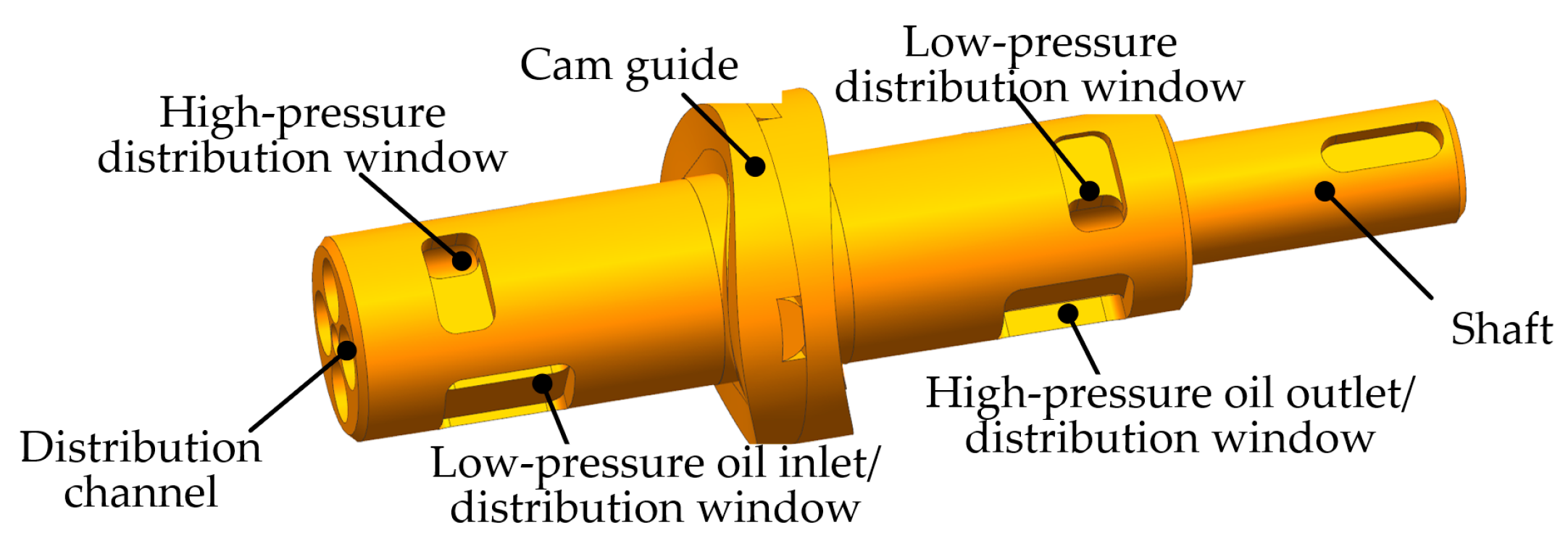
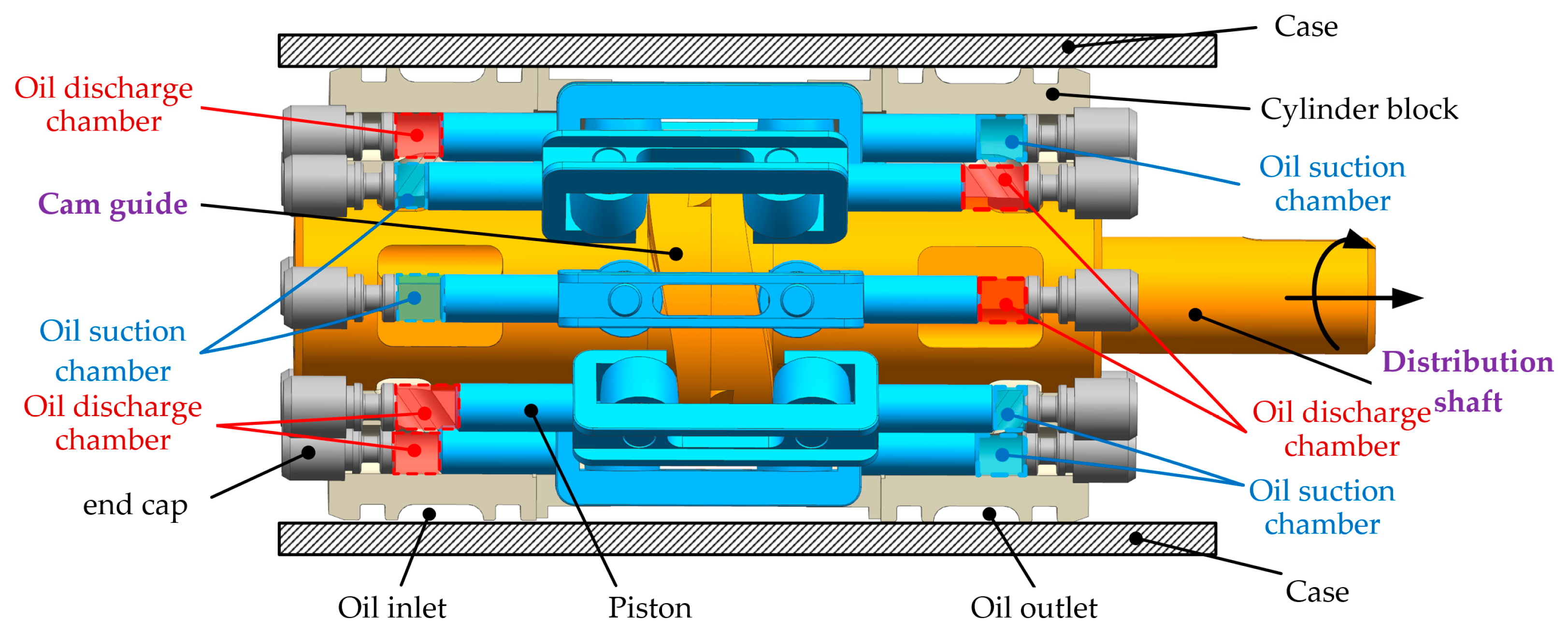
Furthermore, in the area of axial flow distribution research, Ruan et al. proposed an axially distributed roller piston pump (Figure 11) [118]. This pump utilizes a double-ended piston-roller structure. The motor drives the distribution shaft to rotate, and a cam guide fixed to the distribution shaft forces the circumferentially distributed pistons to move axially in a reciprocating motion. The volume of the working chambers on both sides of the pistons changes periodically with the motion, and these chambers are alternately connected to the high and low-pressure windows of the distribution shaft through oil passages, thus achieving the axial distribution process of low-pressure oil suction and high-pressure oil discharge. The structure of the distribution shaft is shown in Figure 12: the shaft is cylindrical, with four circumferentially distributed distribution channels arranged axially inside. Eight rectangular distribution windows are opened on the outer wall and connected to the internal channels. The two larger windows on the left are the oil inlet windows, each connected to one of the two smaller windows on the right. The two smaller windows on the left are the high-pressure windows, each connected to one of the two larger windows on the right. This design highly integrates the piston, flow distribution mechanism, and drive shaft, allowing the drive shaft to perform the flow distribution function while rotating. This significantly simplifies the pump’s structure and layout, meeting the miniaturization and integration requirements for hydraulic pumps used in aerospace EHA (Electro-Hydrostatic Actuator) systems [119,120,121].
Although axial flow distribution technology offers numerous advantages, it still faces challenges such as excessive radial hydraulic pressure, seal wear and thermal deformation, and increased leakage due to fixed flow distribution gaps. Based on the above analysis, Table 3 summarizes the core design principles and improvement principles of the axial flow piston pump. In the future, the development of axial flow distribution technology will focus on further improving performance under high pressure, reducing friction and wear, optimizing seal structures, and adapting to higher rotational speeds and complex operating conditions.

5. New Flow Distribution Method

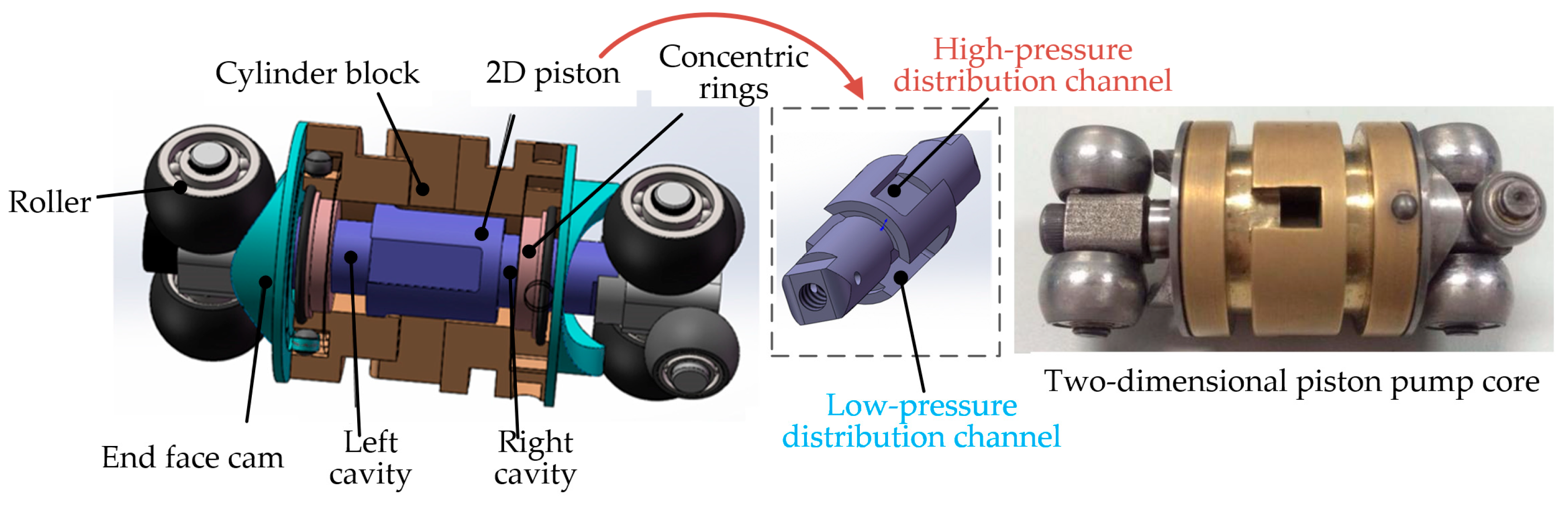
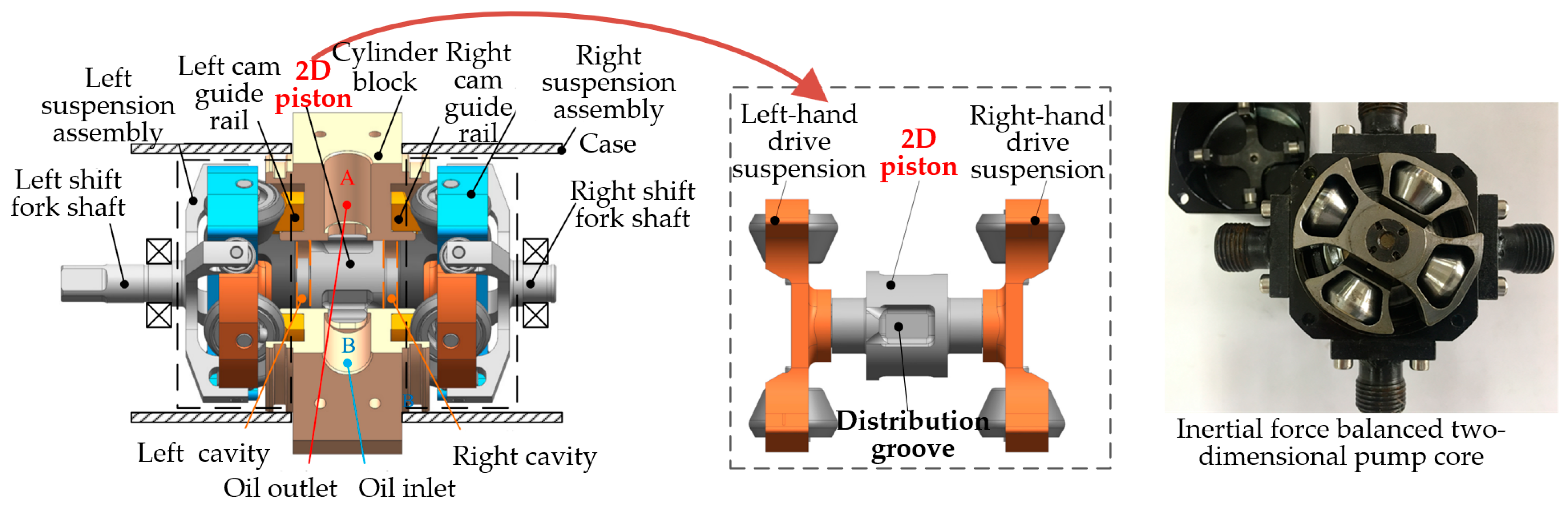
Currently, the main flow distribution methods are the three types mentioned above. In addition, researchers have proposed piston pumps using other flow distribution methods. The two-dimensional piston pump proposed by Ruan Jian’s team is a notable example, which utilizes a piston-based flow distribution design concept [122]. The single-unit two-dimensional piston pump is shown in Figure 13. The single-unit two-dimensional piston pump adopts a double-rod structure, with a pair of rollers installed at the end of each piston rod. These rollers slide on saddle-shaped cams at both ends of the cylinder body. When a motor or other power source drives the piston to rotate via a fork-and-roller coupling, the roller rolls on the saddle-shaped cam, causing the piston to reciprocate. This reciprocating motion causes the working volume on both sides of the piston to change periodically, resulting in a change in volume between the piston and the concentric rings. Regarding the flow distribution method, specifically, a piston is installed inside the cylinder. The protrusion in the middle of the piston is called the shoulder, and four rectangular grooves are machined uniformly and symmetrically on the shoulder. These grooves serve as high and low-pressure distribution channels, with the openings of the grooves facing in alternating directions, forming pairs of grooves facing the same direction. The cylinder block also features two sets of evenly and symmetrically arranged windows corresponding to the two sets of grooves. These two sets of windows work in conjunction with the grooves during pump operation to perform the flow distribution function. Depending on the working volume, the distribution grooves on the piston are correspondingly matched with the high and low-pressure distribution windows on the cylinder block. Under different operating conditions, the distribution groove, by adjusting its connection with the high and low-pressure windows, completes the suction and discharge of hydraulic fluid, achieving effective flow distribution. The two-dimensional piston pump utilizes rolling bearings, overcoming the limitations of traditional piston pumps that rely on sliding friction pairs. The reciprocating motion of the piston directly achieves oil suction and discharge, eliminating complex structures such as distribution plates, significantly simplifying the design and increasing power density [123,124,125,126,127,128,129]. This type of two-dimensional piston pump has also found applications in mobile machinery and aerospace industries.
In subsequent iterations, Huang et al. proposed a force-balanced two-dimensional piston pump (Figure 14), which eliminates inertial forces through a balanced suspension system, thereby reducing vibration and noise. In subsequent iterations, Huang et al. proposed a force-balanced two-dimensional piston pump (Figure 14), which eliminates inertial forces through a balanced suspension system, thereby reducing vibration and noise [130]. Compared to traditional pumps, this pump offers a higher power-to-weight ratio, achieving the same flow rate with only half the stroke at the same displacement. One of the core innovations of this pump is the design of the distribution grooves on the piston. During rotation, the piston uses these grooves to alternately connect the left and right working chambers, thereby achieving the fluid distribution function. The design described above not only optimizes the pump’s dynamic characteristics but also improves the system’s reliability and operational stability [131,132,133].
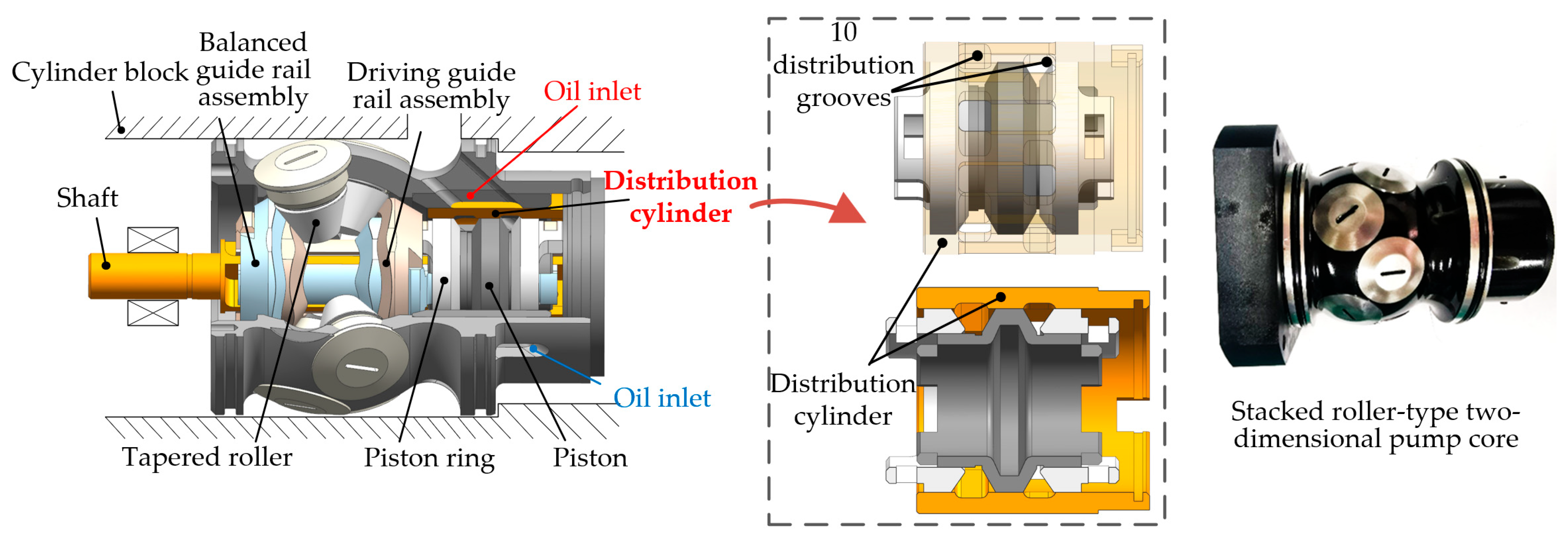
In addition to achieving flow distribution through flow channels within the piston, the stacked-roller two-dimensional piston pump proposed by Zhu et al. innovates upon traditional flow distribution designs by employing a cylinder block flow distribution structure, as shown in Figure 15 [134]. This pump operates by fitting a distribution cylinder around the piston, with rectangular distribution windows cut into the distribution cylinder. Driven by the input shaft, these windows alternately connect with the suction and discharge ports on the pump casing. The piston, piston ring, and distribution cylinder body together form two independent chambers. When the piston and piston ring move in opposite directions axially, coupled with the distribution windows on the distribution cylinder body, continuous oil suction and discharge functions are achieved [135,136].
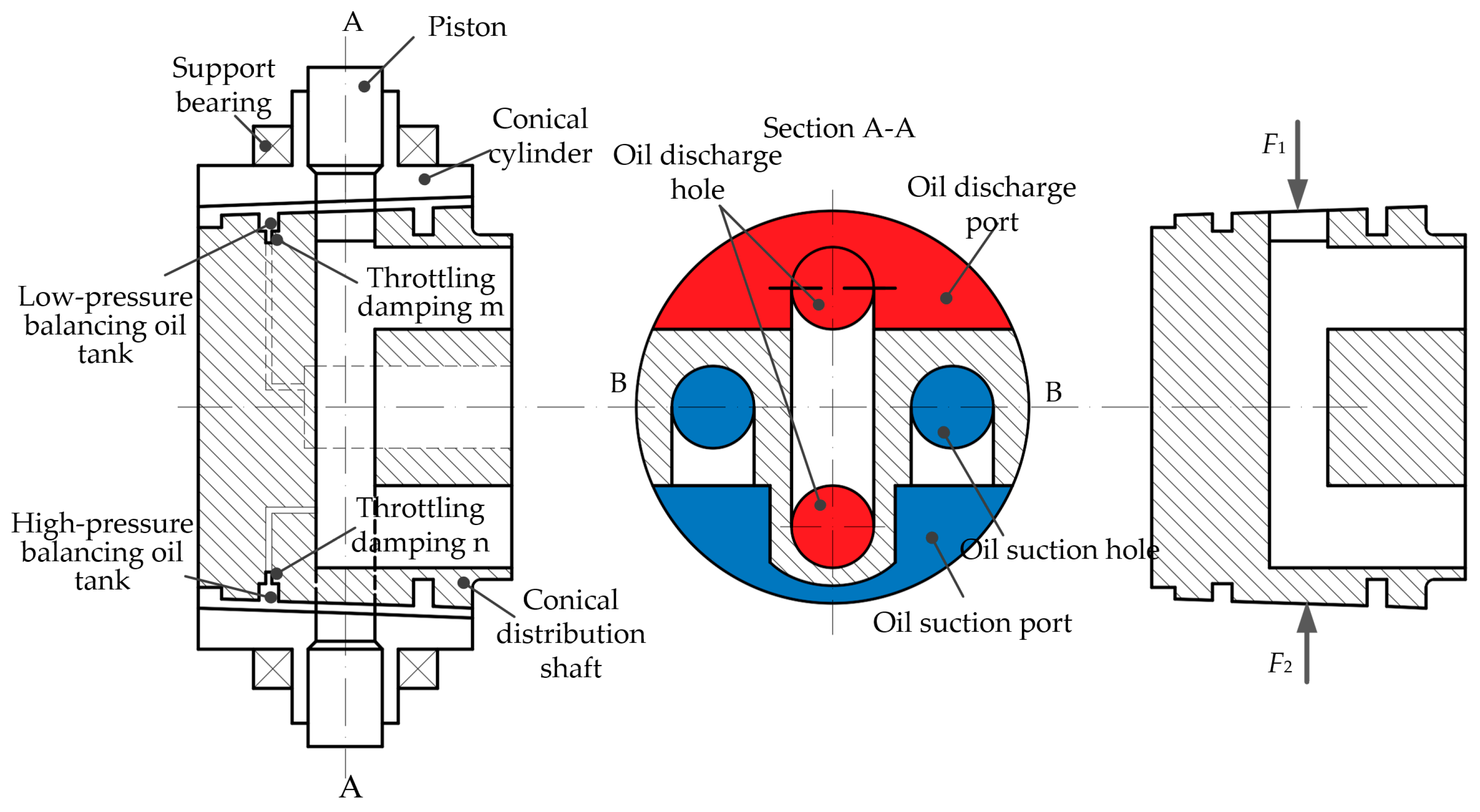
Furthermore, combining the advantages of plate-type and axial-type flow distribution, a conical axial flow distribution method has been developed (Figure 16). The conical flow distribution pair consists of a conical cylinder supported by bearings and a completely floating conical distribution shaft, with the flow distribution surfaces between them machined into parallel conical surfaces. It can be applied to both axial and radial hydraulic pumps, combining the advantages of both plate and shaft distribution. Its low circumferential speed of the friction pair, automatic centering of the distribution shaft, and self-compensation of the sealing gap improve the service life of the distribution mechanism [11].
In summary, innovations in the flow distribution method of two-dimensional piston pumps have continuously advanced, from piston-type flow distribution to cylinder-type flow distribution designs, all effectively improving the pump’s efficiency, stability, and reliability. Among them, a novel electric pump consisting of an axial flow roller piston pump, a gear reducer, and a servo motor has been practically applied in mobile machinery. This pump has higher power density and can start under load in high-speed, high-pressure conditions, and has been successfully applied in airborne high-pressure hydraulic systems. Another type is a two-dimensional piston pump that uses the cylinder block flow distribution principle, integrated with a micro motor to form a micro electric two-dimensional piston pump. Due to its small size, it can be used by slipping it onto a finger, hence it is also called “finger pump.” This pump has a displacement of only 0.003 mL/r, a maximum working pressure of 70 MPa, and a rated speed of 10,000 r/min, and has been successfully applied in devices such as four-claw robots and exoskeleton robots. The conical shaft flow distribution method combines various advantages, further extending the service life of the flow distribution components.

6. Conclusions

This paper focuses on the structural principles, advantages, disadvantages, and key challenges of the currently mainstream valve, plate, and axial flow distribution methods. Valve flow distribution primarily faces dynamic problems caused by frequent valve opening and closing, such as opening lag, closing impact, and vibration. The formation of the oil film in plate flow distribution is a critical factor determining its friction, wear, and efficiency. Axial flow distribution is limited by the radial hydraulic force on the distribution shaft, placing higher demands on the force and bearing stiffness of the shaft system. Furthermore, these flow distribution methods commonly suffer from cavitation, flow and pressure pulsation, and leakage. To address these challenges, the industry has proposed various solutions, focusing on how to effectively improve the overall performance of piston pumps by optimizing structural parameters, improving control strategies, and rationally designing flow channels. Some solutions have already been applied in actual products, and based on this, the design principles of three major flow distribution methods for piston pumps have been summarized, resulting in a corresponding selection comparison table (see Table 4: Introduction). For detailed principles, technical challenges, and applicable operating conditions of each flow distribution method, please refer to Table A1 in Appendix A.
In addition, piston/cylinder flow distribution in two-dimensional piston pumps, as a representative of novel flow distribution structures, has been put into practical application. The above research also provides a theoretical basis for the selection and innovation of flow distribution structures in piston pumps under various operating.

Author Contributions

Methodology, C.Z. and M.L.; conceptualization, C.Z.; investigation, C.Z. and M.L.; resources, C.Z., S.L. and J.R.; software, C.Z. and L.S.; validation, C.Z.; data curation, C.Z. and M.L.; writing—original draft preparation, M.L.; writing—review and editing, C.Z. and L.S.; supervision, C.Z.; project administration, S.L. and J.R.; funding acquisition, C.Z. All authors have read and agreed to the published version of the manuscript.

Funding

This research was supported by Zhejiang Provincial Natural Science Foundation of China under Grant No. LQN26E050027 and Scientific Research Start-up Foundation of Ningbo University of Technology (Grant No. 24KQ058). The APC was funded by Scientific Research Start-up Foundation of Ningbo University of Technology (Grant No. 24KQ058).

Data Availability Statement

No new data were created or analyzed in this study.

Acknowledgments

During the preparation of this manuscript, the authors used ChatGPT-4o for the purposes of translation and polishing. The authors have reviewed and edited the output and take full responsibility for the content of this publication.

Conflicts of Interest

The authors declare no conflicts of interest.

Appendix A

Table A1. Comparison of the advantages and disadvantages of the three major flow distribution methods and their applicable operating scenarios/conditions.
Distribution MethodValve DistributionPlate DistributionAxial Distribution
Working principleOil suction and discharge are accomplished by using a suction/pressure check valve (or slide valve, rotary valve, etc.) to alternately connect the working chamber with the oil suction port/pressure port.Rotating the cylinder block periodically connects the cylinder bore and the window. The piston rotates and reciprocates with the cylinder block, increasing the volume of the working chamber to draw in oil and decreasing the volume to discharge oil.Mostly used in radial piston pumps. High- and low-pressure slots are machined on the distribution shaft. The shaft rotates relative to the rotor, causing each piston chamber to sequentially connect to the low-pressure zone for oil suction and to the high-pressure zone for oil discharge according to phase.
Advantage
No end-face distribution pair, reducing the risk of abrasion;
One-way valve differential pressure opening and closing, reliable switching between low-speed/intermittent operation;
Clear anti-backflow structure, strong impact resistance, adaptable to frequent start-stop;
Multi-piston phase difference oil supply, easy to achieve high pressure.
Compact structure, clear flow distribution pattern, and high technological maturity
Short end-face oil film sealing path and high volumetric efficiency
Self-adaptive compensation capability for clearance, resulting in good operational stability
Easy to integrate with variable displacement mechanisms, with wide applicability.
Simple structure, few parts, and good system rigidity
Shock-resistant and long-lasting distribution pair
Distribution phase is determined by geometric position, resulting in high control precision
Enables high integration of piston, distribution, and transmission, facilitating miniaturization.
Shortcoming
Dynamic valve opening and closing (hysteresis/impact/chatter) easily leads to pulsation and noise
High-speed response is limited, easily resulting in insufficient liquid filling/phase deviation, reduced efficiency, and increased cavitation
Valve seat wear/spring fatigue leads to internal leakage and increased temperature rise
More complex flow channels increase pressure drop and energy loss
Uneven pressure on the end face leads to overturning moment, easily causing uneven load and wear.
Sensitive to machining, assembly, cleanliness, and lubrication; deterioration can easily cause scratches/burns and increased vibration and noise
Transient commutation can cause flow/pressure pulsations and cavitation noise
Service life and efficiency are strongly limited by end face lubrication/wear.
High radial hydraulic pressure, requiring high shaft load-bearing capacity and support stiffness.
Large sealing length and relative movement, prone to wear and heat generation.
Most clearances are fixed and difficult to compensate for; increased leakage and decreased efficiency after wear/thermal deformation.
Relatively insufficient publicly available data on engineering operation and reliability, making benchmarking difficult.
Applicable Scenarios
Systems requiring high-pressure reliability, frequent start-stop cycles, and significant load pulsation.
Applications with poor fluid cleanliness or limited maintenance conditions.
Solutions requiring higher control freedom/variable scalability (active valve distribution).
Mainstream high-power-density systems such as engineering machinery, industrial hydraulics, and aviation hydraulics.
Scenarios requiring high efficiency, compact structure, and mature reliability of general-purpose hydraulic pumps.
Systems requiring low noise (requiring vibration and noise reduction design).
Typical flow distribution schemes for fixed/variable displacement radial piston pumps.
Systems requiring compact structure, shock resistance, and accurate flow distribution.
Miniaturized and integrated pump sources such as electro-hydraulic actuators (EHA).
Applicable working conditionsMedium to high pressure; Low to medium speed; Suitable for frequent start-stop/impact loads; Extremely high speed requires evaluation of valve response and lifespan.Medium to high/high pressure; medium to high speed; suitable for continuous and stable operating conditions; more sensitive to cleanliness, lubrication, and assembly.Medium to high/high pressure (depending on seals and shaft system); primarily medium speed (high speed is limited by frictional heat generation and stiffness); advantages lie in impact resistance and high flow distribution accuracy.

References

  1. Yin, F.L.; Nie, S.L.; Zhang, Z.H.; Zhang, X.J. Research on the sliding bearing pair of water hydraulic axial piston pump. Proc. Inst. Mech. Eng. Part C J. Mech. Eng. Sci. 2013, 227, 2049–2063. [Google Scholar] [CrossRef]
  2. Wang, Q. Research on Oil Film Characteristics of Slipper Pair in Axial Piston Pump. Ph.D. Thesis, Zhejiang University, Hangzhou, China, 2018. [Google Scholar]
  3. Wang, S. Improving the volumetric efficiency of the axial piston pump. J. Mech. Des. 2012, 134, 111001. [Google Scholar] [CrossRef]
  4. Ouyang, X.P.; Wang, T.Z.; Fang, X. Research Status of the High Speed Aircraft Piston Pump. Chin. Hydraul. Pneum. 2018, 1–8. [Google Scholar]
  5. Wang, Y.Q.; Zhang, W. Summary of Fluid Power Transmission and Contral Technology. J. Mech. Eng. 2003, 39, 95–99. [Google Scholar] [CrossRef]
  6. Wang, C.L.; Ye, F.; He, T.; Gao, Y.H. Analysis of the Dynamic Characteristics of the Distribution Valve of the Valve Distribution Double-Row Axial Piston Pump. Mach. Tool Hydraul. 2025, 53, 132–139. [Google Scholar]
  7. Ji, H.; Zhao, H.K.; Liu, Y.Z.; Liu, Y.S. Backflushing Jet and Flow Loss in Distribution Valve of Water Piston Pump. Chin. Hydraul. Pneum. 2022, 46, 1–8. [Google Scholar]
  8. Zhang, J.; Gong, X.Z.; Hu, J.J. CFD Analysis of the turbulence model adopted in distribution process in axial piston pump. J. Mech. Eng. 2018, 54, 204–211. [Google Scholar] [CrossRef]
  9. Wang, Z.Q.; Hu, S.; Zhang, H.Y.; Ji, H.; Yang, J.; Liang, W. Effect of surface texturing parameters on the lubrication characteristics of an axial piston pump valve plate. Lubricants 2018, 6, 49. [Google Scholar] [CrossRef]
  10. Dong, P.; Zhao, S.; Wang, Y.; Zhang, P.; Han, X.; Liu, C.; Dong, Y. Design and experimental study of radial piston pump with valve plate distribution. In Proceedings of the ASME International Mechanical Engineering Congress and Exposition, Salt Lake City, UT, USA, 11–14 November 2019. [Google Scholar]
  11. Zou, Y.F.; Liu, J.C. Research Development on Flow Divider Pintle of Radial Piston Pump. Hydraul. Pneum. Seals 2011, 31, 1–4+7. [Google Scholar]
  12. Luo, T.; Gao, T.; Lin, T.L.; Chen, Q.H.; Ren, H. Throttling Characteristics Analysis and Flow Field Simulation of Valve Port of High Pressure Motor Distribute by Pilot Operated Check Valve. Chin. Hydraul. Pneum. 2023, 47, 99–106. [Google Scholar]
  13. Brazhenko, V.N.; Mochalin, E.V.; Jian, C.C. Mechanical admixture influence in the working fluid on wear and jamming of spool pairs from aircraft hydraulic drives. J. Frict. Wear 2020, 41, 526–530. [Google Scholar] [CrossRef]
  14. Zhang, J.S. Discussion on the issue of motion lag in the distribution valve of valve-controlled plunger pumps. J. Fuzhou Univ. Nat. Sci. Ed. 1989, 17, 45–50. [Google Scholar]
  15. Li, L.; Chen, J.W.; Gu, L.Y.; Wang, F. Variable displacement distributor with valve control for axial piston pump/motor. J. Zhejiang Univ. Eng. Sci. 2014, 48, 29–34. [Google Scholar]
  16. He, X.F.; Yang, M.N.; Li, Z.Y. Design and Experimental Research on the Check Valves of Water Hydraulic Piston Pump. China Mech. Eng. 2004, 15, 18–20. [Google Scholar]
  17. Li, Z.P. Structure design and Flow Characteristic analysis of double Row Axial Piston Pump with Balanced Valve Distribution. Ph.D. Thesis, Anhui University of Science and Technology, Huainan, China, 2021. [Google Scholar]
  18. Ye, W.J.; Chen, K.S.; Zhan, C.C.; Chen, B. Analysis of flow field characteristics and optimization of structural parameters for distributing valve in high-pressure fracturing pump. J. Wuhan Univ. Sci. Technol. 2021, 44, 207–212. [Google Scholar]
  19. Wang, H.Y.; Li, Y.K.; Lian, Z.S.; Li, R. Analysis of output characteristics of valve-distribution piston pump based on cam curve. J. Huazhong Univ. Sci. Technol. Nat. Sci. Ed. 2022, 50, 32–37. [Google Scholar]
  20. Cao, W.B.; Miao, R.L.; Lin, Y.S.; Wu, D.F.; Chen, X.F. Effects of distribution valve spring stiffness and opening pressure on the volumetric efficiency of micro high-pressure plunger pump. Adv. Mech. Eng. 2024, 16, 16878132241288404. [Google Scholar] [CrossRef]
  21. Wu, W.; Yang, S.Q.; Xie, X.J.; He, M.; Gong, L.H. Study of backflow volume due to check valve’s lag motion in liquid hydrogen piston pump. IOP Conf. Ser. Mater. Sci. Eng. 2024, 1301, 012032. [Google Scholar]
  22. Wang, P.; Cheng, Y.W.; Li, X.H.; Yao, J.; Wu, L.J. Configuration Transformation and Flow Control of Equal-coded Digital Flow Control Unit. J. Mech. Eng. 2024, 60, 287–301. [Google Scholar]
  23. Huang, G.Q.; Yu, J.; Zhu, Y.Q. Dynamic Simulation Flat Valve of Water Hydraulic Piston Pump. China Mech. Eng. 2011, 22, 443–446. [Google Scholar]
  24. Yan, L.; Lian, Z.; Li, Y. Dynamic characteristics and structure optimization of distribution valve for high-speed radial piston pump. J. Mech. Electr. Eng. 2020, 37, 906–910. [Google Scholar]
  25. Li, Y.; Jiao, Z.X.; Wu, S. Flow Characteristics Analysis and Optimization Design of High Frequency Reciprocation Pump Applying Check Valve to Rectification. J. Mech. Eng. 2013, 49, 154–163. [Google Scholar] [CrossRef]
  26. Qian, P.C.; Ji, Z.Q.; Zhu, B.H. Research on the dynamics and variable characteristics of a double-swash-plate hydraulic axial piston pump with port valves. J. Dyn. Syst. Meas. Control 2019, 141, 011006. [Google Scholar] [CrossRef]
  27. Zhu, B.H.; Qian, P.C.; Ji, Z.Q. Research on the Flow Distribution Characteristics and Variable Principle of the Double-swashplate Hydraulic Axial Piston Electric Motor. J. Mech. Eng. 2018, 54, 220–234. [Google Scholar]
  28. He, T.; Li, Z.P.; Deng, H.S.; Chen, Q.M.; Wang, C.L.; Zhao, K.P. Flow characteristics analysis of a balanced valve distribution double-row axial piston pump. Mech. Sci. 2022, 13, 207–223. [Google Scholar] [CrossRef]
  29. Ye, F. Study on Dynamic Characteristics Flow Control of Valve-Distributed Plunger Pump Using High-Speed on/off Valves. Ph.D. Thesis, Anhui University of Science and Technology, Huainan, China, 2025. [Google Scholar]
  30. Ma, Y.; Chen, Y.; Zhang, H. Instability Prediction of Valve Motion and Internal Flow in Novel Large-scale Reciprocating Pump. Int. J. Fluid Mach. Syst. 2019, 12, 1–11. [Google Scholar] [CrossRef]
  31. Li, Q.; Meng, L.M.; Zhou, Q. Influence of Crank Rod Ratio on the Flow Pulsation and Slider Inertial Force of the New Reciprocating Pump. Int. J. Fluid Mach. Syst. 2024, 17, 1–14. [Google Scholar] [CrossRef]
  32. Guo, T.; Lin, T.; Ren, H.; Miao, C.; Zhao, S. Modeling and theoretical study of relief chamfer method for reducing the flow ripple of a spool valves distribution radial piston pump. Proc. Inst. Mech. Eng. Part C J. Mech. Eng. Sci. 2021, 235, 3819–3832. [Google Scholar] [CrossRef]
  33. Wang, X.J.; Li, W.J.; Li, C.H.; Peng, Y.W. Structure optimization and flow field simulation of plate type high speed on-off valve. J. Cent. South Univ. 2020, 27, 1557–1571. [Google Scholar] [CrossRef]
  34. Xia, Y.L.; Mao, J.Y.; Li, G.D.; Zhao, D.H.; Zhang, J.F.; Wang, P. Analysis of internal flow characteristics of a multistage pump during start-up. J. Phys. Conf. Ser. 2024, 2707, 012025. [Google Scholar] [CrossRef]
  35. Zhang, H.R.; Sun, P.C.; Fu, Y.H. Dynamic coupling characteristics of valve flow field and valve coremovement in reciprocating pump. J. Drain. Irrig. Mach. 2021, 39, 217–223. [Google Scholar]
  36. Chen, H.C.; Ma, J.; Wang, X.D.; Hu, K. Fluid-structure Interaction Modeling and Vibration Characteristics of Check Valve in High-pressure Diaphragm Pump. Mech. Sci. Technol. Aerosp. Eng. 2024, 43, 1199–1206. [Google Scholar]
  37. Zhu, B.H.; Wu, X.Y.; Niu, Z.; He, X.F.; Liu, Y.S. Experimental research on the water hydraulic axial piston canned motor pump with double swash plate. J. Mech. Eng. 2013, 49, 146–150. [Google Scholar] [CrossRef]
  38. Zhu, B.H.; He, X.F.; Liu, Y.S.; Zhu, Y.Q.; Wu, X.Y. Double Swashplate Hydraulic Motor Piston Pump. China Patent CN102135082B, 4 July 2012. [Google Scholar]
  39. Lou, Z.K.; Zhu, B.H.; Ji, Z.Q.; He, G.Y. Variable Axial Piston Hydraulic Electric Motor Pump with Port Valves. Chin. Hydraul. Pneum. 2018, 58–62. [Google Scholar]
  40. Guo, T.; Zhao, S.D.; Yu, Y.H.W.; Shang, P. Design and theoretical analysis of a sliding valve distribution radial piston pump. J. Mech. Sci. Technol. 2016, 30, 327–335. [Google Scholar] [CrossRef]
  41. Li, R.; Wei, W.S.; Liu, H. Design and experimental validation of a valve-distributed water radial piston pump. Proc. Inst. Mech. Eng. Part C J. Mech. Eng. Sci. 2024, 238, 5488–5497. [Google Scholar] [CrossRef]
  42. Yang, H.Y.; Zhang, B.; Xu, B. Development of Axial Piston Pump/motor Technology. J. Mech. Eng. 2008, 44, 1–8. [Google Scholar] [CrossRef]
  43. Xu, S.W. Plunger-Type Hydraulic Pump; Machinery Industry Press: Beijing, China, 1985. [Google Scholar]
  44. Zhai, P.X. Swashplate Axial Piston Pump Design; Coal Industry Press: Beijing, China, 1978. [Google Scholar]
  45. Yang, J.; Xu, B.; Yang, H.Y. Review of Reduction of Noise for Hydraulic Axial Piston Pump. China Mech. Eng. 2003, 14, 623–625. [Google Scholar]
  46. Guo, Z.M.; Zhai, J.; Wu, D.W.; Hong, H.C. Multi—Parameter optimization of damping groove on axial piston pump based on multi—Objective genetic algorithm. J. Mech. Electr. Eng. 2023, 40, 773–780. [Google Scholar]
  47. Hu, X.; Wang, S.P.; Han, L. Modeling and Simulation on Pressure Distribution of Plane Port Pair in Axial Piston Pump. Hydraul. Pneum. Seals 2012, 32, 68–71. [Google Scholar]
  48. Ivantysyn, J.; Ivantysynova, M. Hydrostatic Pumps and Motors: Principles, Design, Performance, Modelling, Analysis, Control and Testing; Academia Books International: New Delhi, India, 2001. [Google Scholar]
  49. Tang, L.L.; Lv, L.L. Discussion on Wear and Improvement of Friction Pairs in Axial Piston Pumps. Gen. Mach. 2003, 6, 39–42. [Google Scholar]
  50. Zhang, W.C.; Wang, S.P.; Zhao, S.J. Analysis of the influence of three friction pairs on the return oil flow rate in a plunger pump. In Proceedings of the 5th National Conference on Fluid Power Transmission and Control and the 2008 Chinese Society of Aeronautics and Astronautics Conference on Hydraulics and Pneumatics, Beijing, China, 15–18 October 2008. [Google Scholar]
  51. Yamaguchi, A.; Shimizu, S. Design method for fluid lubrication on valve plate of axial piston pumps and motors. In Proceedings of the 7th International Fluid Power Symposium, Bath, UK, 16–18 September 1986; pp. 19–27. [Google Scholar]
  52. Shang, L.; Ivantysynova, M. Port and case flow temperature prediction for axial piston machines. Int. J. Fluid Power 2015, 16, 35–51. [Google Scholar]
  53. Shang, L.; Ivantysynova, M. Scaling criteria for axial piston machines based on thermo-elastohydrodynamic effects in the tribological interfaces. Energies 2018, 11, 3210. [Google Scholar] [CrossRef]
  54. Chacon, R.; Ivantysynova, M. Virtual prototyping of axial piston machines: Numerical method and experimental validation. Energies 2019, 12, 1674. [Google Scholar] [CrossRef]
  55. Chacon, R.; Ivantysynova, M. An investigation of the impact of micro surface on the cylinder block/valve plate interface performance Fluid Power Systems Technology. Am. Soc. Mech. Eng. 2014, 45820, V001T02A006. [Google Scholar]
  56. Zecchi, M. A Novel Fluid Structure Interaction and Thermal Model to Predict the Cylinder Block/Valve Plate Interface Performance in Swash Plate Type Axial Piston Machines. Ph.D. Thesis, Purdue University, Purdue, IN, USA, 2013. [Google Scholar]
  57. Xu, B.; Chao, Q.; Zhang, J.H.; Chen, Y. Effects of the dimensional and geometrical errors on the cylinder block tilt of a high-speed EHA pump. Meccanica 2017, 52, 2449–2469. [Google Scholar]
  58. Zhang, J.H.; Chao, Q.; Xu, B. Analysis of the cylinder block tilting inertia moment and its effect on the performance of high-speed electro-hydrostatic actuator pumps of aircraft. Chin. J. Aeronaut. 2018, 31, 169–717. [Google Scholar] [CrossRef]
  59. Ki, K.J.; Jung, J.Y. Measurement of fluid film thickness on the valve plate in oil hydraulic axial piston pumps (I)-bearing pad effects. KSME Int. J. 2003, 17, 246–253. [Google Scholar] [CrossRef]
  60. Ki, K.J.; Kim, H.E.; Lee, Y.B.; Jung, J.Y.; Oh, S.H. Measurment of fluid film thickness on the valve plate in oil hydraulic axial piston pumps (Part II: Spherical design effects). J. Mech. Sci. Technol. 2005, 19, 655–663. [Google Scholar] [CrossRef]
  61. Bergada, J.M.; Watton, J.; Kumar, S. Pressure, flow, force, and torque between the barrel and port plate in an axial piston pump. J. Dyn. Syst. Meas. Control 2008, 130, 011011. [Google Scholar]
  62. Bergada, J.M.; Davies, D.L.; Kumar, S. The effect of oil pressure and temperature on barrel film thickness and barrel dynamics of an axial piston pump. Meccanica 2012, 47, 639–654. [Google Scholar] [CrossRef]
  63. Richardson, D.; Sadeghi, F.; Rateick, R.G., Jr.; Rowan, S. Experimental and analytical investigation of floating valve plate motion in an axial piston pump. Tribol. Trans. 2017, 60, 537–547. [Google Scholar] [CrossRef]
  64. Richardson, D.; Sadeghi, F.; Rateick, R.G., Jr.; Rowan, S. Dynamic modeling of floating valve plate motion in an axial piston pump. Tribol. Trans. 2018, 61, 683–693. [Google Scholar] [CrossRef]
  65. Richardson, D.; Sadeghi, F.; Rateick, R.G., Jr.; Rowan, S. Surface modification effects on lubricant temperature and floating valve plate motion in an axial piston pump. Proc. Inst. Mech. Eng. Part J J. Eng. Tribol. 2020, 234, 3–17. [Google Scholar] [CrossRef]
  66. Wang, H.; Lin, N.; Yuan, S. Structural improvement, material selection and surface treatment for improved tribological performance of friction pairs in axial piston pumps: A review. Tribol. Int. 2024, 198, 109838. [Google Scholar] [CrossRef]
  67. Chao, Q.; Xu, Z.; Tao, J. Capped piston: A promising design to reduce compressibility effects, pressure ripple and cavitation for high-speed and high-pressure axial piston pumps. Alex. Eng. J. 2023, 62, 509–521. [Google Scholar] [CrossRef]
  68. Pan, Y.; Li, Y.; Huang, M. Noise source identification and transmission path optimization for noise reduction of an axial piston pump. Appl. Acoust. 2018, 130, 283–292. [Google Scholar] [CrossRef]
  69. Xu, B.; Ye, S.G.; Zhang, J.H. Numerical and experimental studies on housing optimization for noise reduction of an axial piston pump. Appl. Acoust. 2016, 110, 43–52. [Google Scholar] [CrossRef]
  70. Ye, M.; Na, C.L. The effect of distributor design in axial piston pump on the pulse characteristics of flow. Constr. Mach. Equip. 1988, 11, 25–31. [Google Scholar]
  71. Pettersson, M. Design of Fluid Power Piston Pumps: With Special Reference to Noise Reduction; Linköping University: Linköping, Sweden, 1995. [Google Scholar]
  72. Zhang, J.H. Study on Valve Plate and Flow-Distribution Method for Noise Reduction of Axial Piston Pump. Ph.D. Thesis, Zhejiang University, Hangzhou, China, 2016. [Google Scholar]
  73. Xu, B.; Sun, Y.H.; Zhang, J.H. A new design method for the transition region of the valve plate for an axial piston pump. J. Zhejiang Univ. Sci. A 2015, 16, 229–240. [Google Scholar] [CrossRef]
  74. Edge, K.A.; Darling, J. Cylinder pressure transients in oil hydraulic pumps with sliding plate valves. Proc. Inst. Mech. Eng. Part B Manag. Eng. Manuf. 1986, 200, 45–54. [Google Scholar]
  75. Kim, J.K.; Kim, H.E.; Jung, J.Y. Relation between pressure variations and noise in axial type oil piston pumps. KSME Int. J. 2004, 18, 1019–1025. [Google Scholar] [CrossRef]
  76. Mandal, N.P.; Saha, R.; Sanyal, D. Effects of flow inertia modelling and valve-plate geometry on swash-plate axial-piston pump performance. Proc. Inst. Mech. Eng. Part I J. Syst. Control Eng. 2012, 226, 451–465. [Google Scholar] [CrossRef]
  77. Pettersson, M.E.; Weddfelt, K.G.; Palmberg, J.O.S. Methods of reducing flow ripple from fluid power piston pumps–a theoretical approach. SAE Trans. 1991, 158–167. [Google Scholar] [CrossRef]
  78. Wang, R.; Xu, Y.; Jiao, Z.; Cao, A.; Wan, X.; Yu, T. Flow Ripple Reduction of Axial Piston Pump with Pre-Compression Volume and Embedded Sequence Valve. Fluid Power Systems Technology. Am. Soc. Mech. Eng. 2024, 88193, V001T01A034. [Google Scholar]
  79. Xu, B.; Zhang, J.h.; Yang, H. Simulation research on distribution method of axial piston pump utilizing pressure equalization mechanism. Proc. Inst. Mech. Eng. Part C J. Mech. Eng. Sci. 2013, 227, 459–469. [Google Scholar] [CrossRef]
  80. Kosodo, H.; Nara, M.; Kakehida, S.; Imanari, Y. Experimental research about pressure-flow characteristics of V-notch; Proceedings of the JFPS International Symposium on Fluid Power. Jpn. Fluid Power Syst. Soc. 1996, 1996, 73–78. [Google Scholar] [CrossRef][Green Version]
  81. Li, R.; Li, D.; Li, Z. Research on the Effect of Damping Grooves on the Pressure and Cavitation Characteristics of Axial Piston Pumps. Processes 2025, 13, 1274. [Google Scholar] [CrossRef]
  82. Zhang, C.C.; Zhu, C.H.; Meng, B. Challenges and solutions for high-speed aviation piston pumps: A review. Aerospace 2021, 8, 392. [Google Scholar] [CrossRef]
  83. Tsukiji, T.; Nakayama, K.; Saito, K.; Yakabe, S. Study on the cavitating flow in an oil hydraulic pump. In Proceedings of 2011 International Conference on Fluid Power and Mechatronics; IEEE: New York, NY, USA, 2011; pp. 253–258. [Google Scholar]
  84. Zhang, J.; Zhang, S.H.; Zhu, P.C.; Hu, Z.Q. Research on Cavitation of Axial Piston Pump. Hydraul. Pneum. Seals 2021, 41, 56–62. [Google Scholar]
  85. Johansson, A.; Palmberg, J.O. The importance of suction port timing in axial piston pumps. In Proceedings of the 9th International Conference on Fluid Powers, SICFP’05, Linköping, Sweden, 1–3 July 2005. [Google Scholar]
  86. Ji, H.; Wang, Y. Numerical analysis of oil-suction cavitation in cylinder chamber of axial piston pump. J. Lanzhou Univ. Technol. 2013, 39, 34–47. [Google Scholar]
  87. Ye, S.G.; Zhang, J.H.; Xu, B. Noise reduction of an axial piston pump by valve plate optimization. Chin. J. Mech. Eng. 2018, 31, 57. [Google Scholar] [CrossRef]
  88. Guan, C.; Jiao, Z.; He, S. Theoretical study of flow ripple for an aviation axial-piston pump with damping holes in the valve plate. Chin. J. Aeronaut. 2014, 27, 169–181. [Google Scholar] [CrossRef]
  89. Gels, S.; Murrenhoff, H. Simulation of the Lubricating Film between Contoured Piston and Cylinder. Int. J. Fluid Power 2010, 11, 15–24. [Google Scholar] [CrossRef]
  90. Hoppermann, A.; Kordt, M. Tribological optimisation using laser-structured contact surfaces. Oelhydraulik Pneum. 2002, 46, 560–564. [Google Scholar]
  91. Deng, H.; Guo, B.; Huang, Z. Thermal–elastohydrodynamic lubrication characteristics of the flow distribution pair of balanced double-row axial piston pumps. Lubricants 2024, 12, 342. [Google Scholar] [CrossRef]
  92. Ivantysynova, M.; Baker, J. Power loss in the lubricating gap between cylinder block and valve plate of swash plate type axial piston machines. Int. J. Fluid Power 2009, 10, 29–43. [Google Scholar] [CrossRef]
  93. Shin, J.H.; Kim, K.W. Effect of surface non-flatness on the lubrication characteristics in the valve part of a swash-plate type axial piston pump. Meccanica 2014, 49, 1275–1295. [Google Scholar] [CrossRef]
  94. Murrenhoff, H.; Eneke, C.; Gels, S.; Heipl, O.; Leonhard, L.; Schumacher, J.; Wohlers, A. Efficiency improvement of fluid power components focusing on tribological systems. In Proceedings of the Seventh International Fluid Power Conference, Aachen, Germany, 22–24 March 2010. [Google Scholar]
  95. Deng, H.S.; Yu, H.W.; Wang, X.L. Study on tribological performance of textured port plates of axial piston pumps. J. Huazhong Univ. Sci. Technol. Nat. Sci. Ed. 2012, 40, 16–29. [Google Scholar]
  96. Qi, S.; Deng, H.S.; Zhang, E.Y.; Wang, X.L. Experiential research on friction characteristics of textured axial piston pump port plate. Chin. Hydraul. Pneum. 2011, 35, 105–107. [Google Scholar]
  97. Li, Y.; Deng, H.S.; Wang, X.L. Experiment on friction and wear performance of textured port plate pair. J. Aerosp. Power 2014, 29, 1591–1597. [Google Scholar]
  98. Chen, Y.; Zhang, J.H.; Xu, B. Investigation of Laser Surface Texturing for Integrated PV (Pressure × Velocity)-Value-Decreased Retainer in an EHA Pump; Universitätsbibliothek der RWTH Aachen Press: Aachen, Germany, 2018. [Google Scholar]
  99. Zhang, J.H.; Chen, Y.; Xu, B. Effect of surface texture on wear reduction of the tilting cylinder and the valve plate for a high-speed electro-hydrostatic actuator pump. Wear 2018, 414, 68–78. [Google Scholar] [CrossRef]
  100. Wang, Z.; Sun, L.; Han, B. Study on the thermohydrodynamic friction characteristics of surface-textured valve plate of axial piston pumps. Micromachines 2022, 13, 1891. [Google Scholar] [CrossRef]
  101. Wang, Z.Q.; Yang, J.; Zhang, H.Y.; Wang, Z.; Wu, M.E. The Lubrication Characteristics of Different Micro Textured Piston Pump Valve Plate Friction Pairs. Chin. Hydraul. Pneum. 2016, 8, 32–36. [Google Scholar]
  102. Yi, J.L. Flow Field Analysis of the Internal Flow Passages of a Radial Piston Pump and Optimization of the distribution Shaft Structure. Ph.D. Thesis, Taiyuan University of Science and Technology, Taiyuan, China, 2012. [Google Scholar]
  103. Zhu, B.H.; Dong, B. Experimental Study on Flow Coefficient of the Rotating Radial Small Orifice Used in High Speed Shaft-type Commutation. Chin. Hydraul. Pneum. 2024, 48, 44–55. [Google Scholar]
  104. Bai, C.Y.; Jia, Y.H.; Cheng, X.H.; Ding, X.N.; Liu, W. Mechanical Properties Analysis of the Flow Divider Pintler High Pressure Radial Piston Pump. Hydraul. Pneum. Seals 2014, 34, 4–6. [Google Scholar]
  105. Wei, C.M.; An, G.C.; Wang, M.Z.; Guo, W.; Liu, Z.M. Static pressure balancing design of the distribution shaft in radial piston pumps. In Proceedings of the 2001 Annual Meeting of the Chinese Society of Mechanical Engineering and the 9th National Symposium on Special Machining Technology, Suzhou, China, 20–24 November 2001. [Google Scholar]
  106. Shen, Y.J.; Shi, W.X.; Luo, K. A Design Method of the Flow Divider Pintle with Pressure Control Feedback Loop. Hydraul. Pneum. Seals 2001, 22–24. [Google Scholar]
  107. Chen, S.Q.; Jiang, X.W. Volumetric efficiency and structure design to certain radial piston pump with axial flow distribution. J. Nav. Univ. Eng. 2009, 21, 102–106. [Google Scholar]
  108. Jia, Y.H.; Wang, M.Z. Research for Clearance between Oil Distribution Axle and Rotor of JBP-40 Radial Piston Pump. J. Taiyuan Univ. Sci. Technol. 1999, 20, 318–321. [Google Scholar]
  109. Fang, J.G.; Wu, J.J.; Wang, X.F.; Zhang, T.L.; Yang, Y.S.; Lv, J. Research on Hydraulic Torque Characteristics of Flow-distribution Pairs for Radial Piston Pump. Chin. Hydraul. Pneum. 2018, 23–29. [Google Scholar]
  110. Jia, Y.H.; Meng, Z.H.; Wang, D.Z. An Structural Analysis of the Double Triangular Groove of Radial Piston Pump Oil Distribution Axle. J. Taiyuan Univ. Sci. Technol. 2005, 26, 92–94+98. [Google Scholar]
  111. Meng, Z.H.; Gao, H.F. Analysis of communication schemes between high-pressure and low-pressure zones of the distribution shaft. Mech. Eng. Autom. 2003, 34–36. [Google Scholar]
  112. An, G.C.; Wang, M.L.; Wang, P.; Wang, M.Z. Analysis and Design for Piston Pump Distribution Element Triangular Groove. J. Taiyuan Univ. Sci. Technol. 2004, 25, 246–249. [Google Scholar]
  113. Cheng, J.C. Research on the Output Characteristics and Suction Performance of Double-swash-plate Hydraulic Motor Pump with Shaft Type Commutation. Ph.D. Thesis, Huazhong University of Science and Technology, Wuhan, China, 2023. [Google Scholar]
  114. Cheng, J.C.; Zhu, B.H. Research on the Double-swash-plate Axial Piston Hydraulic Electric Motor Pump with Shaft Type Commutation. Chin. Hydraul. Pneum. 2023, 47, 90–99. [Google Scholar]
  115. Ouyang, X.P.; Li, L.; Wang, T.Z.; Yang, H.Y. Integrated High-Speed Swashplate Rotary Motor Pump. China Patent CN106032794B, 1 May 2018. [Google Scholar]
  116. Li, L.; Lee, K.M.; Bai, K. Inverse Models and Harmonics Compensation for Suppressing Torque Ripples of Multiphase Permanent Magnet Motor. IEEE Trans. Ind. Electron. 2018, 65, 8730–8739. [Google Scholar] [CrossRef]
  117. Lee, K.M.; Li, L.; Bai, K. Harmonic Model and Remedy Strategy of Multiphase PM Motor Under Open-Circuit Fault. IEEE/ASME Trans. Mechatron. 2019, 24, 1407–1419. [Google Scholar] [CrossRef]
  118. Ruan, J.; Zhang, C.C.; Tong, C.W.; Meng, B.; Zhu, K. A Shaft-Controlled, Double-Acting Axial Piston Pump. China Patent CN114278526B, 20 August 2024. [Google Scholar]
  119. Zhang, C.C.; Zang, Y.R.; Wang, H.Y. Theoretical and experimental investigation on the efficiency of a novel roller piston pump. J. Zhejiang Univ. Sci. A 2023, 24, 762–781. [Google Scholar] [CrossRef]
  120. Zhang, C.C.; Chen, Y.; Li, S.; Ruan, J. Research on Oil Stirring Loss Torque for Cam Guide Rail of Roller Piston Pump. J. Mech. Eng. 2025, 61, 306–320. [Google Scholar]
  121. Zhang, C.C.; Zhang, D.X.; Lu, Y.Z.; Li, S.; Ruan, J. Research on flow and pressure pulsation optimization of roller piston pump with triangular damping groove. Flow Meas. Instrum. 2025, 106, 103000. [Google Scholar] [CrossRef]
  122. Xing, T.; Xu, Y.Z.; Ruan, J. Two-dimensional piston pump: Principle, design, and testing for aviation fuel pumps. Chin. J. Aeronaut. 2020, 33, 1349–1360. [Google Scholar] [CrossRef]
  123. Chen, Y.; Zang, Y.R.; Lu, L.Z. Mechanical efficiency of cartridge two-dimensional (2D) piston pump for electro-hydrostatic actuators. Meccanica 2023, 58, 1849–1868. [Google Scholar] [CrossRef]
  124. Jin, D.C.; Ruan, J. Design and research of two-dimensional fuel pump. Acta Aeronaut. Astronaut. Sin. 2019, 40, 318–327. [Google Scholar]
  125. Qian, J.Y.; Shentu, S.N.; Ruan, J. Volumetric efficiency analysis of two-dimensional piston aviation fuel pump. Acta Aeronaut. Astronaut. Sin. 2020, 41, 271–283. [Google Scholar]
  126. Jin, D.C.; Ruan, J.; Li, S. Modelling and validation of a roller-cam rail mechanism used in a 2D piston pump. J. Zhejiang Univ. Sci. A 2019, 20, 201–217. [Google Scholar] [CrossRef]
  127. Shentu, S.N.; Ruan, J.; Qian, J.Y. Study of flow ripple characteristics in an innovative two-dimensional fuel piston pump. J. Braz. Soc. Mech. Sci. Eng. 2019, 41, 464. [Google Scholar] [CrossRef]
  128. Feng, Z.J.; Chen, Y.; Ruan, J. Modeling and Experiment of Spatial Cams for Two-dimensional Piston Pumps. Chin. Hydraul. Pneum. 2022, 46, 99–105. [Google Scholar]
  129. Shentu, S.N.; Ruan, J.; Qian, J.Y.; Meng, B. Optimization Analysis of Flow Characteristic and Distribution Window of 2D Piston pump. Trans. Chin. Soc. Agric. Mach. 2019, 50, 403–410. [Google Scholar]
  130. Ruan, J.; Huang, Y.; Wu, S. Force-Balanced Two-Dimensional Piston Pump. China Patent CN111396279B, 2 February 2024. [Google Scholar]
  131. Huang, Y.; Ruan, J.; Zhang, C.C. Research on the Mechanical Efficiency of High-Speed 2D Piston Pumps. Processes 2020, 8, 853. [Google Scholar] [CrossRef]
  132. Huang, Y.; Ruan, J.; Chen, Y. Research on the Volumetric Efficiency of 2D Piston Pumps with a Balanced Force. Energies 2020, 13, 4796. [Google Scholar] [CrossRef]
  133. Wang, H.Y.; Li, S.; Ruan, J. Design and research of two-dimensional fuel pump with balanced inertia force. Acta Aeronaut. Astronaut. Sin. 2022, 43, 550–561. [Google Scholar]
  134. Ruan, C.; Zhu, K.; Li, S. Stacked-Roller Type Heavy-Duty Two-Dimensional Piston Pump. China Patent CN112032010B, 22 November 2024. [Google Scholar]
  135. Zhu, K.; Ruan, C.; Wang, H.Y.; Li, S.; Ruan, J. Analysis of the Torque Loss of High-Speed Transmission Mechanism with a Stacked Roller Set. Machines 2021, 9, 140. [Google Scholar] [CrossRef]
  136. Wang, H.Y.; Ding, C.; Huang, Y. Design and research of 2D piston pumps with a stacked cone roller set. Proc. Inst. Mech. Eng. Part C J. Mech. Eng. Sci. 2022, 236, 2128–2146. [Google Scholar] [CrossRef]
  137. Zhang, C.C.; Ruan, J.; Xing, T. Research on the volumetric efficiency of a novel stacked roller 2D piston pump. Machines 2021, 9, 128. [Google Scholar] [CrossRef]
Figure 1. Schematic diagram of valve distribution: (a) single piston valve distribution structure; (b) valve distribution pump driving hydraulic cylinder circuit.
Machines 14 00296 g001
Figure 2. Flow distribution principle of valve-controlled piston pump with high-speed switching valve controlled by PWM [29].
Machines 14 00296 g002
Figure 3. Dual-swashplate rotary valve flow distribution piston pump [27].
Machines 14 00296 g003
Figure 4. Schematic diagram of swashplate axial piston pump and distribution mechanism.
Machines 14 00296 g004
Figure 5. Schematic diagram of the flow distribution sub-model establishment and simulation results: (a) Fluid-solid thermal coupling model; (b) Simulation cloud map of oil film thickness [56].
Machines 14 00296 g005
Figure 6. Optimized design of the flow distribution plate structure [45]: (a) throttling orifice type distribution plate; (b) triangular groove distribution plate; (c) flow distribution plate with check valve; (d) piston pump with elastic ring; (e) Piston with accumulator.
Machines 14 00296 g006
Figure 7. Cavitation in the flow distribution plate [83]: (a) Velocity contour map; (b) Pressure contour map; (c) Cavitation experiment.
Machines 14 00296 g007
Figure 8. Optimization of the flow distribution plate surface: (a) Wavy line texture with flow pattern [91]; (b) Pressure distribution in flow distribution plates with different textures [93].
Machines 14 00296 g008
Figure 9. Principle of axial distribution in a radial piston pump.
Machines 14 00296 g009
Figure 10. Axial piston double swashplate hydraulic motor pump [113]: (a) Asynchronous type; (b) Brushless DC type.
Machines 14 00296 g010
Figure 11. Schematic diagram of the roller piston pump [119].
Machines 14 00296 g011
Figure 12. Schematic diagram of the flow distribution shaft [119].
Machines 14 00296 g012
Figure 13. Schematic diagram of two-dimensional piston pump [126].
Machines 14 00296 g013
Figure 14. Schematic diagram of an inertia force-balanced two-dimensional pump [131].
Machines 14 00296 g014
Figure 15. Schematic diagram of stacked-roller two-dimensional piston pump [137].
Machines 14 00296 g015
Figure 16. Structure of the conical distribution pair in a radial piston pump [11].
Machines 14 00296 g016
Table 1. Summary of Design and Improvement Principles for Valve Distribution Piston Pumps.
DimensionCore PrinciplesSpecific Technical Approaches
Dynamic responseQuick start and quick stop, reducing lagReduce valve core mass (reduce inertia); increase cone angle; use cam combination curve instead of cosine curve.
Digital controlActive flow distribution, discrete regulationIntroduce high-speed switching valves (digital valves); employ PWM modulation or encoding control; implement a delayed start-up and early shutdown DE strategy.
Pulsation inhibitionPhase compensation, smooth transitionOptimize the multi-plunger stagger angle (e.g., 18°), design a valve port overflow chamfer to mitigate impact, and add a damping buffer mechanism.
Flow field optimizationReduce drag and losses, and prevent cavitation.Collaborative optimization of lift and cone angle, improved suction and discharge flow channel layout, and introduction of a three-hole valve core to reduce backflow in the low-pressure area.
ReliabilityDamage management, extending service lifeHigh wear-resistant materials and high fatigue strength springs are selected, limit parameters are optimized to reduce impact, and real-time monitoring of pressure pulsation is implemented.
Table 2. Summary of Design and Improvement Principles for Plate Distribution Piston Pumps.
DimensionCore PrinciplesSpecific Technical Approaches
Lubrication loadDynamic pressure self-balancing to prevent eccentric loadingTo maintain a controlled wedge-shaped oil film, an auxiliary support band or spherical distribution is introduced to compensate for the cylinder block overturning torque.
Pulsation inhibitionPressure gradient smoothing, preload matchingOptimize the pre-compression/decompression angle, design a composite structure of triangular groove and damping orifice, and adopt an asymmetrical wrap angle layout.
Cavitation suppressionGuide backflow and suppress jetThe addition of a casing leading to a damping orifice, evolving from a pressure relief groove to a damping orifice array, matches the flow area and reduces backflow.
Reduce friction and reduce consumptionSurface modification, hydrodynamic pressureBy introducing microtextures (square/wavy) and controlling the texture depth (20–50 μm), a fluid-solid-thermal coupling model is established to predict and compensate for oil film.
Table 3. Summary of Design and Improvement Principles for Axial Distribution Piston Pumps.
DimensionCore PrinciplesSpecific Technical Approaches
Force balanceEliminate radial forces and prevent seizure.A static pressure balance structure is adopted, dynamic pressure feedback compensation is added, and the stiffness check of the shaft support is strengthened.
Pulsation inhibitionSmooth oil intake and exhaust transition, phase adaptive.Machining axial triangular grooves, optimizing commutation negative cover, and rationally selecting distribution advance angle.
Gap controlMicrometer-level control, reducing losses and increasing efficiencyDetermine the optimal fit clearance (on the order of 0.02 mm), optimize the internal flow channel, and reduce the influence of centrifugal force.
Integrated EvolutionCompact layout, high-speed adaptationEmploying an integrated axial channel design, new flow distribution schemes such as dual swashplates or roller pistons are being developed.
Table 4. Comparison of Design Principles and Selection of Three Major Flow Distribution Methods for Piston Pumps.
Distribution MethodCore Design PrinciplesKey Technology ApproachesPreferred Application Conditions
Valve distributionRapid response, proactive controlReduce valve core mass; optimize cam combination curve; adopt digital valve PWM strategy.Applications requiring high/ultra-high pressure, low speed, low oil cleanliness, and digital displacement adjustment.
Plate distributionStable lubrication and suppression of pulsationMaintain a controlled wedge-shaped oil film; design damping orifices/triangular grooves in the transition zone; introduce surface microtextures.Traditional axial pumps that are high-speed/high-power-density, require extremely high volumetric efficiency, and operate under relatively stable conditions
Axial distributionForce balance, high integrationImplement static pressure balance to prevent shaft seizure; optimize micron-level fit clearance; integrate the flow channel and drive shaft.Medium and high pressure, radial pumps, miniaturized integrated systems (such as EHA), and integrated design of hydraulic motor pumps.
Disclaimer/Publisher’s Note: The statements, opinions and data contained in all publications are solely those of the individual author(s) and contributor(s) and not of MDPI and/or the editor(s). MDPI and/or the editor(s) disclaim responsibility for any injury to people or property resulting from any ideas, methods, instructions or products referred to in the content.