Article

Inverse Kinematics of China Space Station Experimental Module Manipulator

by
Yang Liu
1,
Haibo Gao
1,
Yuxiang Zhao
1,
Shuo Zhang
1,
Yuteng Xie
2,
Yifan Yang
1,
Yonglong Zhang
1,
Mengfei Li
1,
Zhiduo Jiang
1 and
Zongwu Xie
1,*
1
School of Mechatronics Engineering, Harbin Institute of Technology, Harbin 150000, China
2
School of Electrical Engineering, The University of Sydney, Sydney, NSW 2006, Australia
*
Author to whom correspondence should be addressed.
Machines 2026, 14(3), 284; https://doi.org/10.3390/machines14030284
Submission received: 13 January 2026 / Revised: 18 February 2026 / Accepted: 19 February 2026 / Published: 3 March 2026

Abstract

SSRMS refers to a Space Station Remote Manipulator System. The robotic arm of the Wentian module can complete tasks such as supporting astronauts’ extravehicular activities, installing and maintaining payloads, and inspecting the space station. The seven-joint SSRMS manipulator is critical for space missions. This study aims to build its kinematic model via screw theory. It simplifies SSRMS to right-angle rods, defines joint screw axes, twist coordinates, and initial pose matrix. Using the PoE (Product of Exponentials) formula, the 7-DOF forward kinematics equation is derived. In addition, it derives fixed joint angle for inverse kinematics, including analytical solutions and numerical solutions. It elaborates analytical solutions for fixing joints 1/7 and 2/6 and numerical solutions for fixing joints 3/4/5, solves all joint angles via kinematic decoupling, and addresses special cases. Experiments with China’s space station small arm parameters show the probability of meeting the accuracy threshold 10 4 is 99.79%, verifying model effectiveness, while noting singularity-related weak solving areas. This provides a reliable basis for subsequent inverse kinematics optimization.

1. Introduction

The development of the 7-degree-of-freedom SSRMS configuration robotic arm of the Wentian laboratory module is a core and essential need for the extravehicular operation capabilities of China’s space station during the “application and development stage”. Its necessity is reflected in five dimensions: mission adaptation, precision requirements, redundant safety, system coordination, and technological autonomy. It is not only a functional complementarity to the large robotic arm of the core module; it is also the key to supporting the long-term stable operation of the space station and the technical reserves for deep space exploration.
The space station’s robotic arm system adopts a “dual-arm coordination” architecture, consisting of the core module and the robotic arm of the Wentian module [1]. The core module’s robotic arm focuses on heavy-load tasks, while the Wentian module’s robotic arm has a higher end positioning accuracy. It is responsible for assisting astronauts during extravehicular activities, conducting meticulous maintenance of payloads, and inspecting equipment. Its performance directly affects the operational efficiency of the space station [1,2].
Inverse kinematics is the foundation of path planning and reachability analysis for robotic arms [3]. The mechanical arm of the Wentian module is a 7-degree-of-freedom redundant mechanical arm in the SSRMS configuration (with three rotating joints each for the shoulder and wrist and one for the elbow) [1]. The redundant degrees of freedom enhance operational flexibility, but the shoulder and wrist offset and redundancy characteristics lead to multiple solutions in inverse kinematics, increasing the difficulty of solving [4,5,6]. Scholars have pointed out that the offset pose of the SSRMS configuration would intensify the instability of the solutions provided by traditional methods [5].
Scholars at home and abroad have conducted research on the inverse solution of SSRMS: Pieper proposed a 6-degree-of-freedom closed inverse solution criterion [7]; Siciliano classified the methods into geometric analytical methods and numerical iterative methods. Zhao Zhiyuan et al. in China proposed the DH (Denavit–Hartenberg) parameter method model [8], and then proposed the CCDJAP-IK (Cyclic Coordinate Descent and Joint Angle Parameterization Inverse Kinematics) method to improve the accuracy of the solution [9]. International Faria et al. proposed the position-based method [10], Ma Boyu et al. proposed the optimization idea of minimizing speed–acceleration for obstacle avoidance [11], and Luo Shuangbao et al. proposed the differential evolution algorithm [12].
The existing methods have shortcomings: the DH parameter method is difficult to characterize the shoulder and wrist offset [8]; the convergence of near-singularities in numerical methods is unstable [1]; the analytical method has poor universality [7]; and the offset pose problem has not been fully solved [5]. The traditional inverse kinematics control strategy of the kinematic model of redundant robotic arms has shortcomings such as the lack of intuitive workspace modeling [13], non-unique inverse solutions [14], high computational overhead [15], limited adaptability to special configurations and complex working scenarios [16], and is prone to insufficient solution stability in singular regions. For this purpose, improved inverse kinematics analysis involves substituting the joint angles obtained based on the spiral theory and inverse kinematics solution into the forward kinematics model of the robotic arm to determine the pose of the end effector at the current moment [17]. It can achieve smooth [18] and stable [19] control of the mechanical arm. Based on the spiral theory modeling, combined with the parameter optimization idea of the CCDJAP-IK method and the optimization strategy [5,9,11], through the fixed joint angle method and decoupling solution, the accuracy and stability of the inverse solution are improved [20,21], and the experimental verification accuracy rate reaches 99.79%. This method makes up for the defects of traditional solving methods in adapting to the SSRMS configuration of the Wentian module, and provides a feasible technical scheme for the on-orbit precise control of the space robotic arm.

2. Forward Kinematics

2.1. Introduction to Kinematic Modeling Using the Spinor Method

The screw theory is a classic mathematical tool that can uniformly describe the translational and rotational motion in the space of a rigid body. It equivalently regards the arbitrary spatial motion of a rigid body as a composite motion of rotation around a certain axis and translational motion along that axis. This composite motion is defined as screw motion and is a common method for kinematic modeling of robots [22]. Compared with the traditional DH parameter method, the screw method does not need to establish an independent linkage coordinate system for each joint. It can directly define the motion screw of each joint with the base coordinate system as the reference, effectively avoiding the modeling errors caused by linkage bias and improper coordinate system selection in the DH parameter method. It is more suitable to describe the motion relationship of redundant mechanical arms with shoulder–wrist offset, such as the SSRMS configuration mechanical arm of the Wentian module [23]. For the open-chain series rigid body system of the 7-degree-of-freedom redundant robotic arm of the Wentian module, the core idea of the spinor method modeling is: The robotic arm is simplified as a series of right-angle rigid connecting rods connected in sequence. With the robotic arm base as the fixed end and the end effector as the free end, the rotational motion of each joint is abstracted as the joint spinor axis. By defining the spatial attitude and position of each joint spinor axis, spinor coordinates, and the initial zero-position pose matrix of the robotic arm, combined with the PoE formula, the scalar motions of each joint are cascaded, and finally the overall motion transformation relationship of the robotic arm from the base coordinate system to the end effector coordinate system is derived, that is, the forward kinematic equation [24,25].
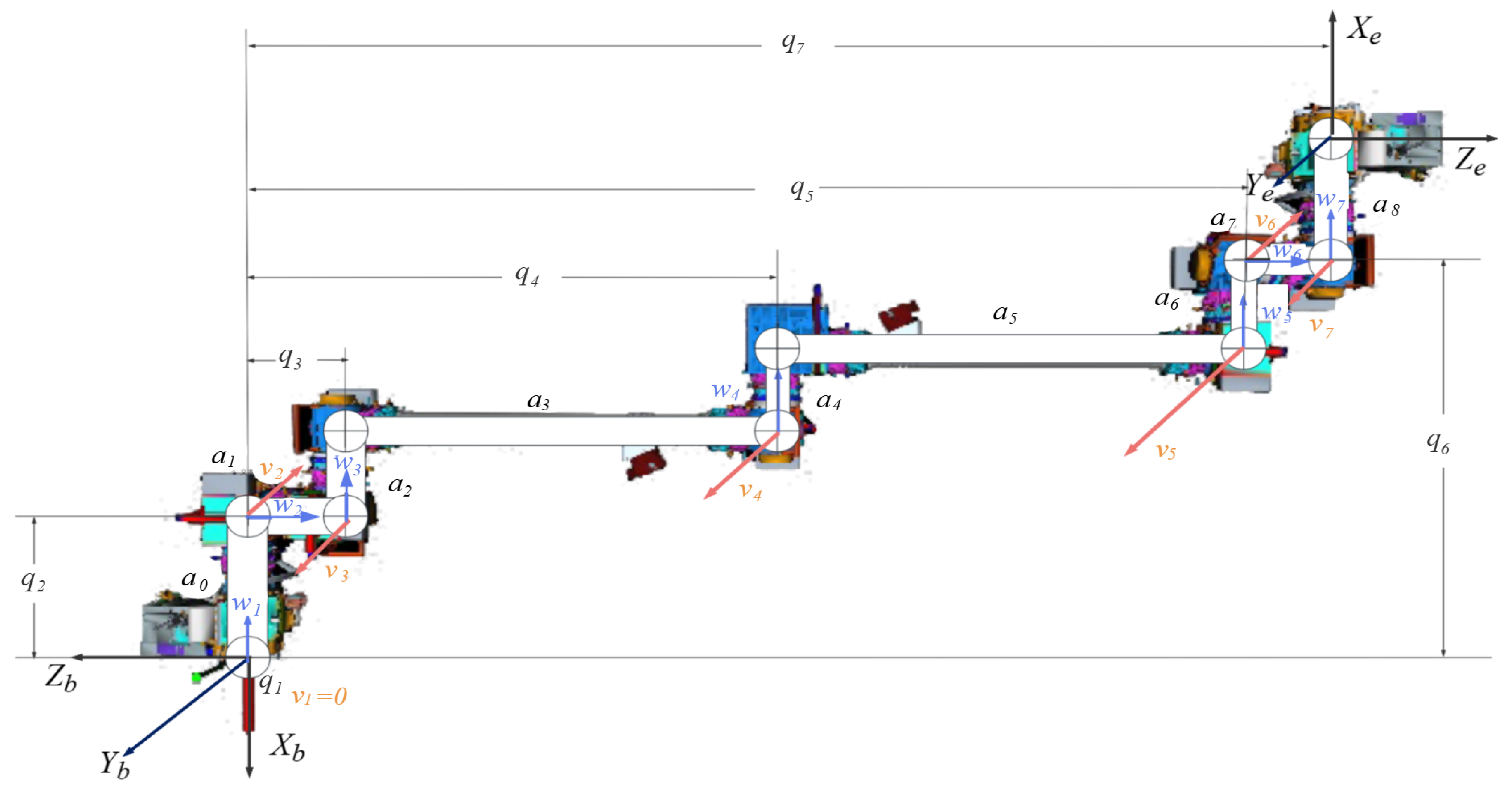
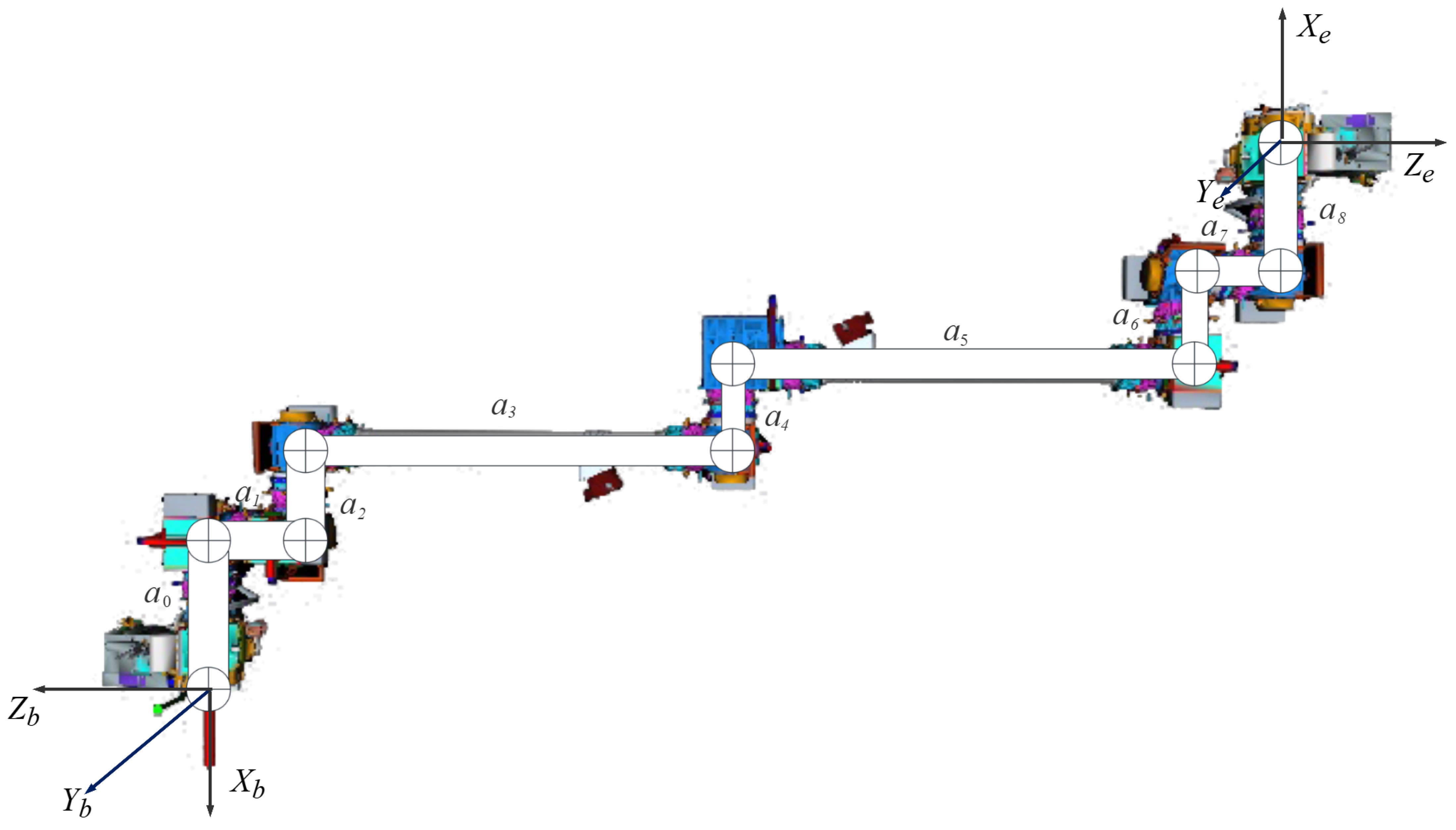
In this study, the kinematic model of the Wentian module’s robotic arm using the spinor method is shown in Figure 1. The model strictly adheres to the modeling specifications of the spinor method, clearly defining the spatial distribution relationships of the base coordinate system, the spinor axes of each joint, and the coordinate system of the end effector.

2.2. Mechanical Arm Model

The forward kinematics model of the robotic arm, as shown in the following Figure 1, was established by using the spinor method. The relationship between the two coordinate systems in Figure 1 is: X e X b , Y e Y b , Z e Z b . The corresponding member parameter information is shown in Table 1:
The M matrix is a 4 × 4 homogeneous transformation matrix, corresponding to the spatial pose transformation relationship of the end effector coordinate system relative to the base coordinate system of the robotic arm when all joint angles of the robotic arm are 0. In the initial state, the pose matrix of the terminal system relative to the base coordinate system is as follows:
M = 1 0 0 a 0 a 2 a 4 a 6 a 8 0 1 0 0 0 0 1 a 1 a 3 a 5 a 7 0 0 0 1

2.3. Definition of the Spiral Shaft

Taking the base coordinate system as the reference coordinate system, the helical axes of each joint are described as follows, where ω i represents the representation of the unit vector along the positive direction of the joint axis in the reference coordinate system; q i represents the measurement of the coordinate values of any point on the joint axis in the reference coordinate.
The spinor coordinates corresponding to the helical axis are shown in the following table. Note that ω i represents the angular velocity of the object coordinate system relative to the reference coordinate system; v i represents the instantaneous linear velocity at the point where the rigid body coincides with the origin of the reference coordinate system, rather than the absolute linear velocity at the origin of the object’s coordinate system.
The directions of w i and v i as well as the magnitude of q are shown in Figure 2.

2.4. Forward Kinematics Equations

The corresponding Lie algebraic form of each spiral axis motion screw is given below:
S i = [ ω i ] v i 0 0
Note: [ ω i ] is the cross-product matrix corresponding to ω i .
The calculation of the matrix exponential of e [ S i ] θ i is as follows:
e [ S i ] θ i = e [ ω i ] θ i G ( θ i ) v i 0 1
e [ ω i ] θ i = I + sin θ i [ ω i ] + ( 1 cos θ i ) [ ω i ] 2
G ( θ i ) = I θ i + ( 1 cos θ i ) [ ω i ] + ( θ i sin θ i ) [ ω i ] 2
According to the PoE formula, the forward kinematics expression for the SSRMS configuration 7-DOF robotic arm is derived as follows:
T e b = e S 1 θ 1 e S 2 θ 2 e S 3 θ 3 e S 4 θ 4 e S 5 θ 5 e S 6 θ 6 e S 7 θ 7 M

3. Inverse Kinematics

3.1. Pieper Criteria

When one of the following conditions is met, a 6-degree-of-freedom kinematic structure has a closed kinematic inverse solution:
  • The axes of three consecutive rotating joints intersect at the same point.
  • Three consecutive joints are parallel to the axis of rotation [10].
Meanwhile, during the process of solving inverse kinematics, the following three fundamental principles need to be followed:
  • Position invariance: For pure rotational motion spirals, the position of any point P on the axis remains unchanged.
  • Constant distance: For the scalar of pure rotational motion, the distance from any point P not on the rotating shaft to the fixed point R on the rotating shaft remains constant.
  • Invariant attitude: For pure moving motion spirals, the attitude of any point P in space remains unchanged before and after the transformation [21].
For the SSRMS configuration robotic arm, the axes of the three consecutive joints, namely joint 3, joint 4, and joint 5, are parallel. Assuming that one of the joints, namely joint 1, joint 2, joint 6, and joint 7, has a fixed angle, there exists an analytical solution for the remaining six joints. Considering the symmetrical characteristics of the robotic arm configuration design, it is only necessary to study the analytical solution methods under the conditions of fixed joint 1 or fixed joint 2, as well as the numerical solution methods under the conditions of fixed joint 3 or fixed joint 4.

3.2. Analytical Solution of the Fixed Joint Angle Method

3.2.1. Fix the Joint 1/7

Considering the symmetry of the SSMRS configuration manipulator, the solution methods for fixing angle 1 and fixing angle 7 are consistent. Here, only the position-level inverse solution algorithm for fixing joint 1 is discussed.
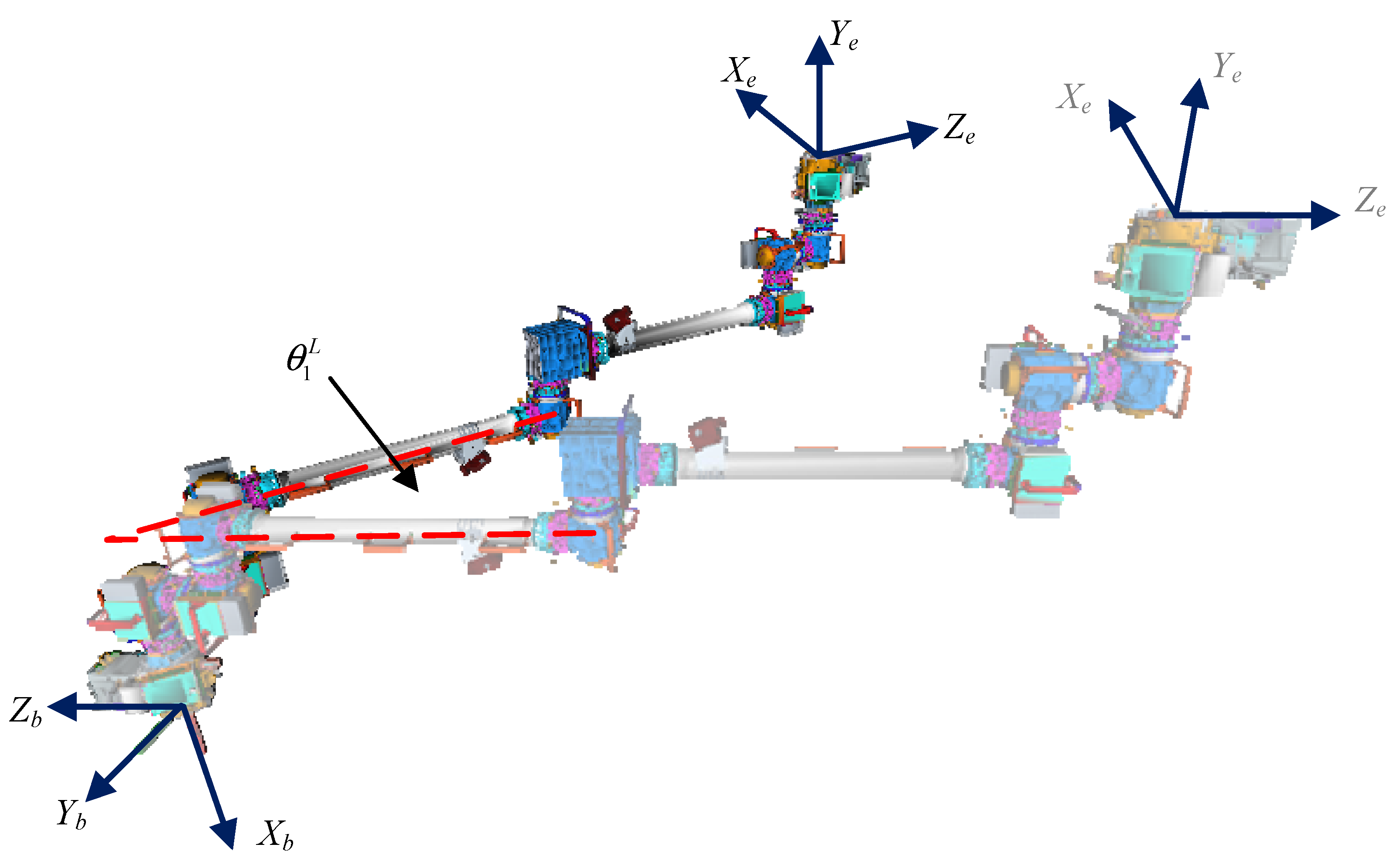
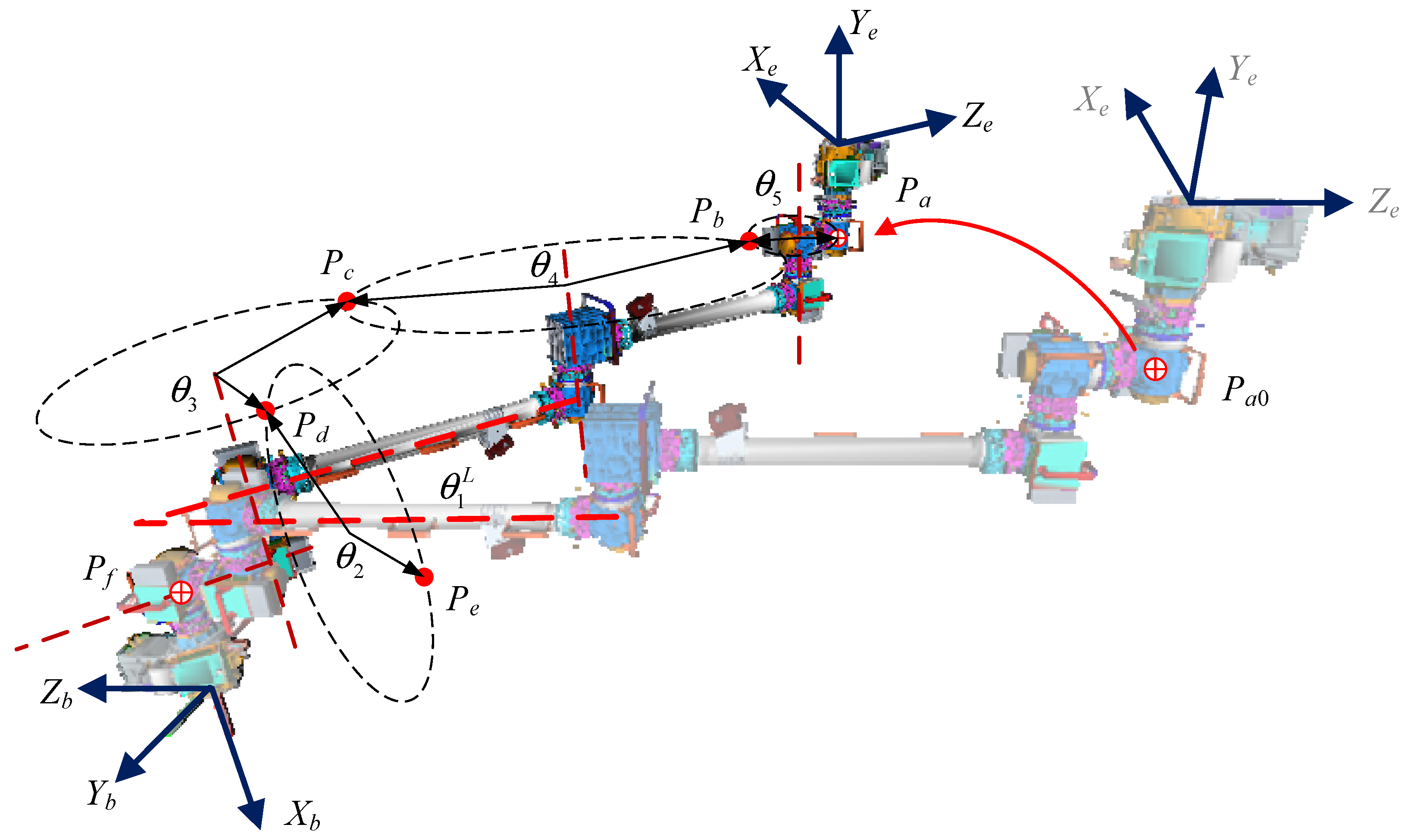
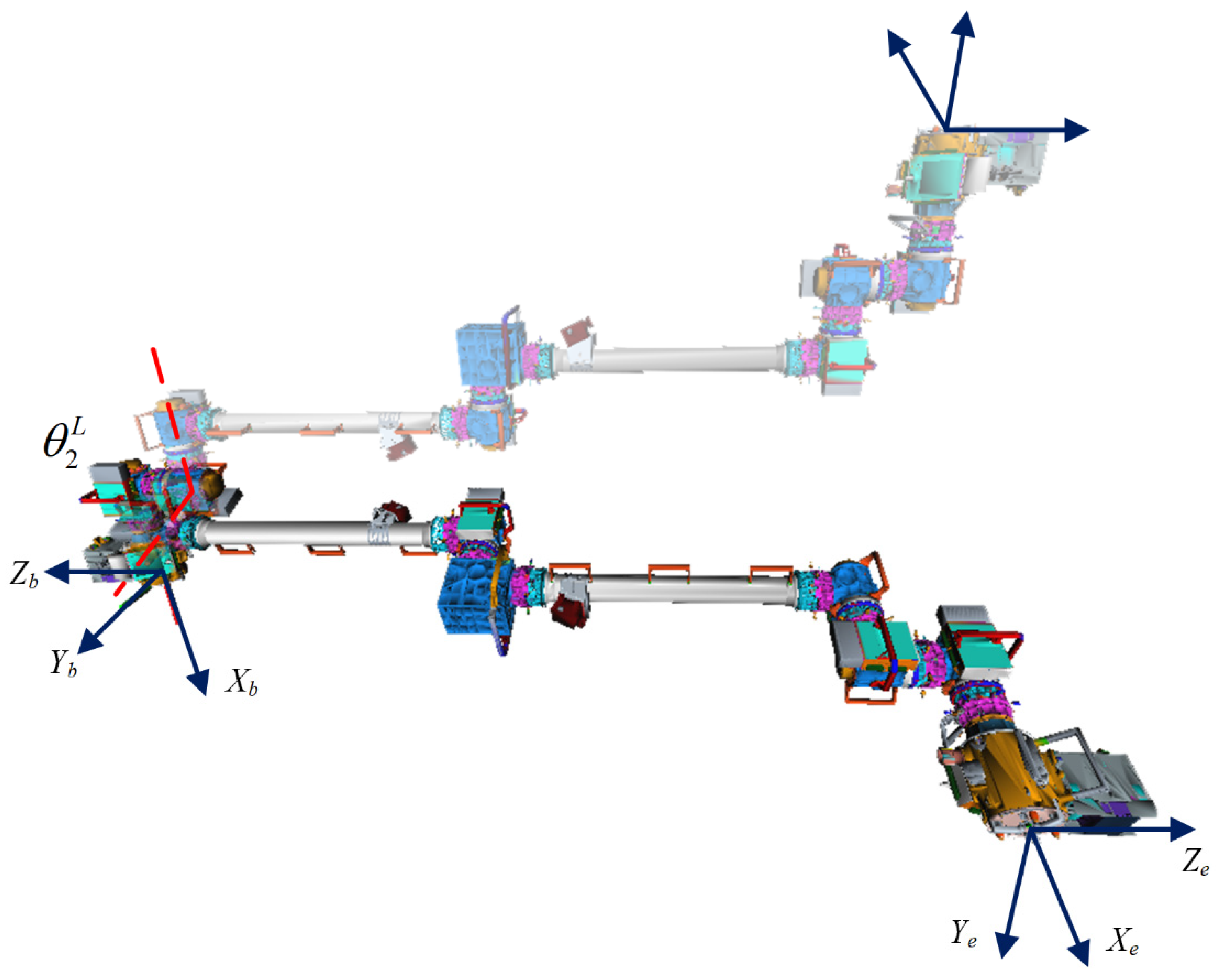
Assuming the angle of joint 1 is θ 1 L , the transformation processss is shown in Figure 3.
With the base coordinate system as the reference coordinate system, the initial pose matrix of the equivalent 6-DOF manipulator can be expressed as:
M L 1 = e S 1 θ 1 L M
Based on the principle of coordinate transformation for motion screws, the motion screw corresponding to the new screw axis is as follows:
ν i L 1 = Ad e S 1 θ 1 L ν i i = 2 , 3 7
We further derive the forward kinematics equations for the equivalent 6-DOF manipulator:
T e L 1 b = e S 2 L 1 θ 2 e S 3 L 1 θ 3 e S 4 L 1 θ 4 e S 5 L 1 θ 5 e S 6 L 1 θ 6 e S 7 L 1 θ 7 M L 1     = e S 2 L 1 θ 2 e S 3 L 1 θ 3 e S 4 L 1 θ 4 e S 5 L 1 θ 5 e S 6 L 1 θ 6 e S 7 L 1 θ 7 e S 1 θ 1 L M
Reorganizing the known terms, we have:
e S 2 L 1 θ 2 e S 3 L 1 θ 3 e S 4 L 1 θ 4 e S 5 L 1 θ 5 e S 6 L 1 θ 6 e S 7 L 1 θ 7 = T e L 1 b M 1 e S 1 θ 1 L
Assuming the intersection point of joint 6 and joint 7 is represented as Pa in the base coordinate system, according to the principle of position invariance, we have:
e S 6 L 1 θ 6 e S 7 L 1 θ 7 P a = P a
Based on the definition of the zero-position coordinate system, it can be concluded that:
P a = e S 1 θ 1 L P a 0 = e S 1 θ 1 L a 0 a 2 a 4 a 6 0 a 1 a 3 a 5 a 7 1
Substituting into Equation (10), we can obtain:
e S 2 L 1 θ 2 e S 3 L 1 θ 3 e S 4 L 1 θ 4 e S 5 L 1 θ 5 e S 6 L 1 θ 6 e S 7 L 1 θ 7 P a = e S 2 L 1 θ 2 e S 3 L 1 θ 3 e S 4 L 1 θ 4 e S 5 L 1 θ 5 P a = T e L 1 b M 1 e S 1 θ 1 L P a
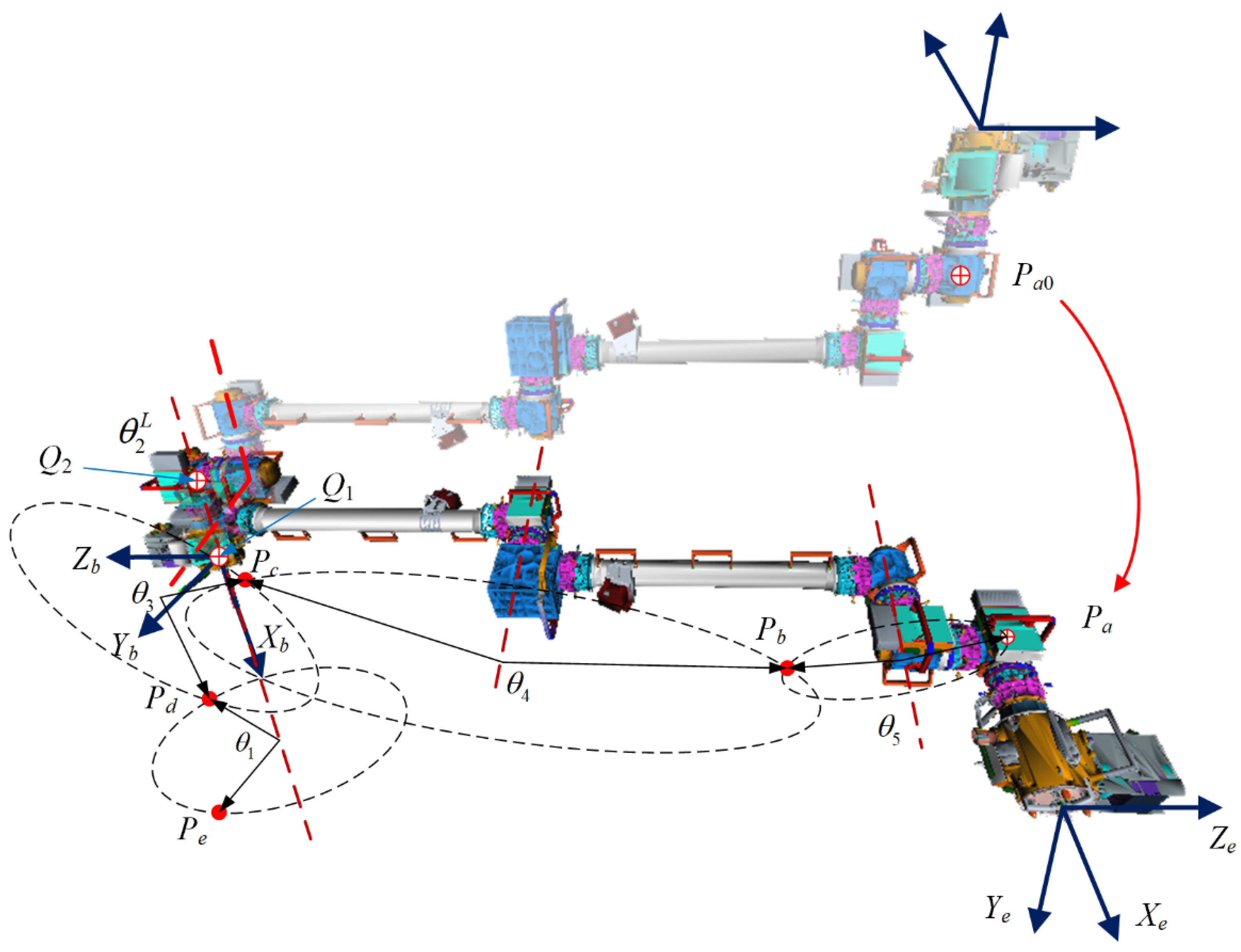
The above equation can be interpreted as the spatial point P a first rotating around S 5 L 1 by θ 5 to point P b , then rotating around S 4 L 1 by θ 4 to point P c , next rotating around S 3 L 1 by θ 3 to point P d , and finally rotating around S 2 L 1 by θ 2 to point P e , as shown in Figure 4.
Let the transformed coordinates of P e be [ p x , p y , p z ] T , then we have:
e S 2 L 1 θ 2 e S 3 L 1 θ 3 e S 4 L 1 θ 4 e S 5 L 1 θ 5 P a = T e L 1 b M 1 e S 1 θ 1 L P a = P e = p x p y p z 1 T
It can be observed that both P a before transformation and P e   after transformation are known quantities.
Based on the geometric relationships in the figure and the principle of distance invariance, it can be concluded that:
P d P a ω 3 L 1 = 0 P d P e ω 2 L 1 = 0 P d P f = P e P f
where P f is the intersection point of the axes of joint 1 and joint 2.
P f = e S 1 θ 1 L P f 0 = e S 1 θ 1 L a 0 0 0 1 = a 0 0 0 1
According to Equation (8), we can obtain:
ω 3 L 1 = 1 0 0 ω 2 L 1 = 0 s 1 c 1
Assuming P d = [ P dx , P dy , P dz ] T , based on the first formula of Equation (15), we can obtain:
P d x = P a x = a 0 a 2 a 4 a 6
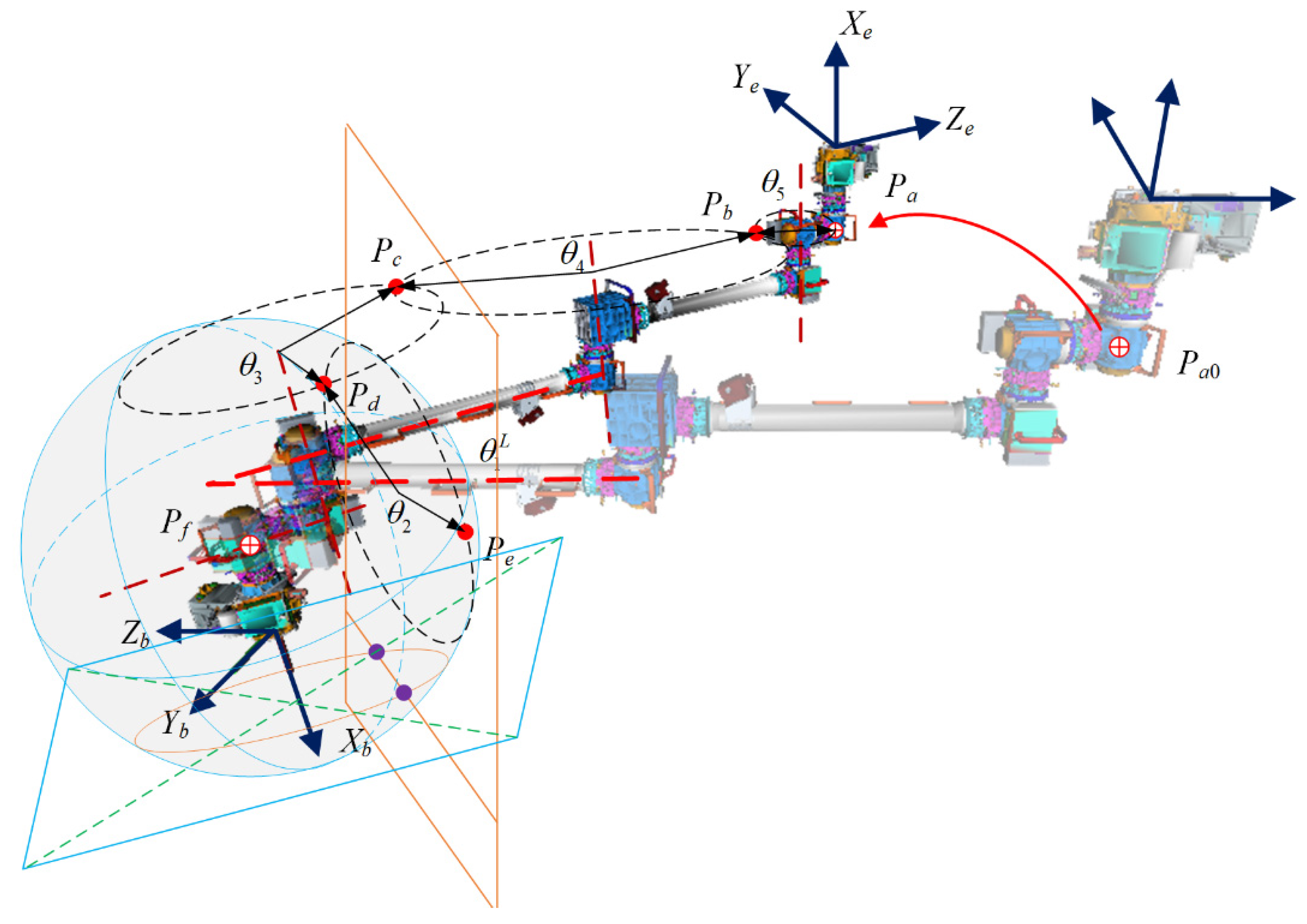
The specific physical meaning is shown in Figure 5. Point P d lies on a sphere with center at P f and on the plane X = a 0 a 2 a 4 a 6 , with their intersection forming a spatial circle. Additionally, point P d lies within a sectional plane related to P e , represented in point-normal form as a plane passing through P e with a normal vector ω 2 L 2 .
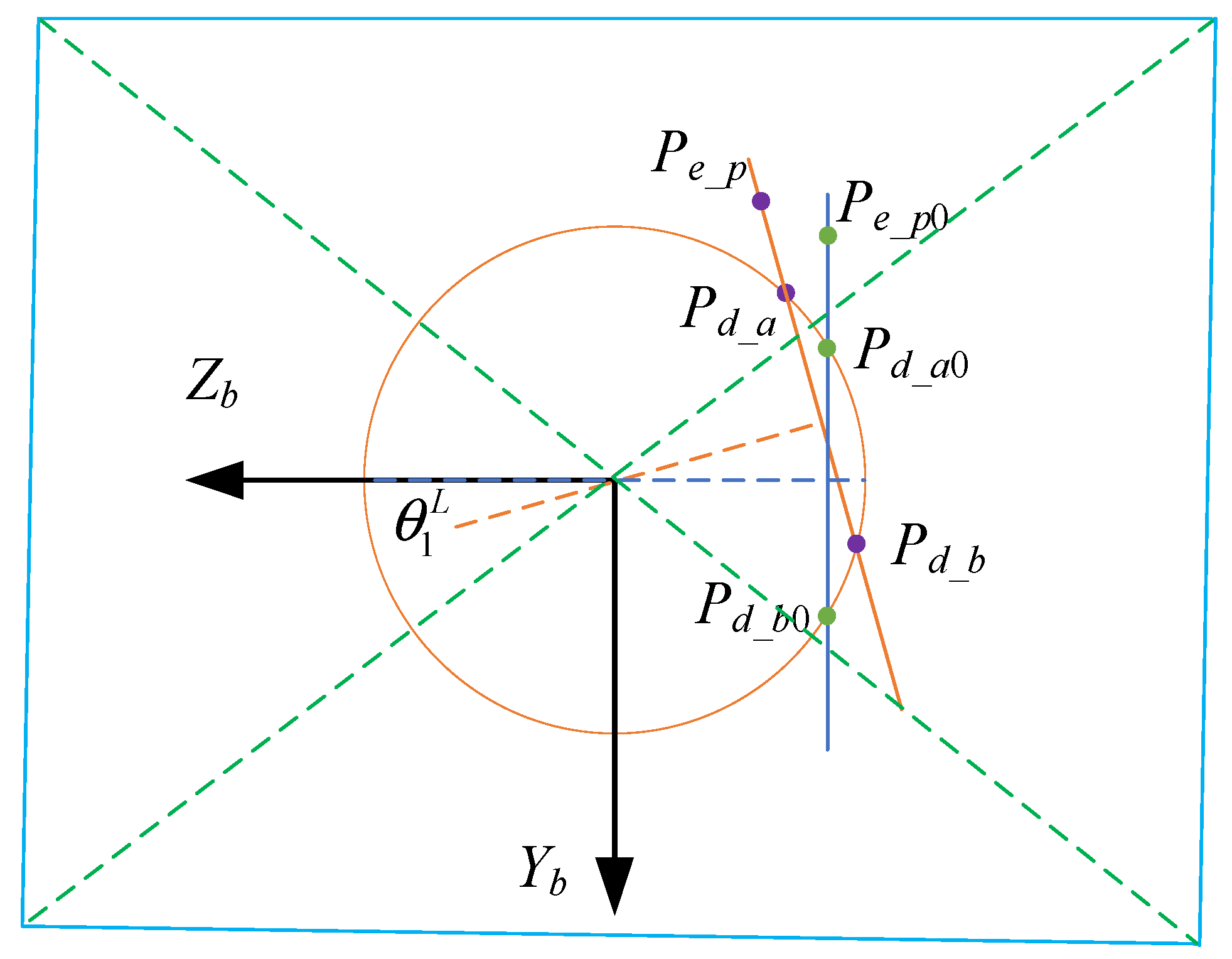
Further analyzing the cutting plane X = a 0 a 2 a 4 a 6 , it can be concluded that point P d has two solutions, P d _ a and P d _ b , corresponding to the results of rotating P d _ a 0 and P d _ a 1 around the spiral axis θ 1 L of joint 1, as shown in Figure 6.
P e _ p 0 = a 0 a 2 a 4 a 6 P y 0 P z 0 = 1 0 0 0 c θ 1 L s θ 1 L 0 s θ 1 L c θ 1 L P e _ p = e S 1 θ 1 L a 0 a 2 a 4 a 6 P y P z
Let:
r d _ 1 = p x + a 0 2 + p y 2 + p z 2 a 2 + a 4 + a 6 2 P y s θ 1 L + P z c θ 1 L 2       = p x + a 0 2 + p y 2 c θ 1 L 2 + p z 2 s θ 1 L 2 a 2 + a 4 + a 6 2 2 P y P z s θ 1 L c θ 1 L
The conditions for the existence of solutions are:
r d _ 1 0
Then the solution P d _ 0 is as follows:
P d _ 0 = a 0 a 2 a 4 a 6 ± r d _ 1 P y s θ 1 L + P z c θ 1 L
Further derived solutions for P d are as follows:
P d = 1 0 0 0 c θ 1 L s θ 1 L 0 s θ 1 L c θ 1 L P d _ 0 = 1 0 0 0 c θ 1 L s θ 1 L 0 s θ 1 L c θ 1 L a 0 a 2 a 4 a 6 ± r d _ 1 P y s θ 1 L + P z c θ 1 L = e S 1 θ 1 L a 0 a 2 a 4 a 6 ± r d _ 1 P y s θ 1 L + P z c θ 1 L
On this basis, consider the following constraint relationships:
P e = e S 2 L 1 θ 2 P d
Based on Paden–Kahan Subproblem 1, the angle of joint 2 can be determined. The forward kinematics equations can be further simplified into:
e S 3 L 1 θ 3 e S 4 L 1 θ 4 e S 5 L 1 θ 5 e S 6 L 1 θ 6 e S 7 L 1 θ 7 = e S 2 L 1 θ 2 T e L 1 b M 1 e S 1 θ 1 L
Regarding the above equation, a further solution will be provided in Section 3.2.3.

3.2.2. Fix the Joint 2/6

Considering the symmetry of the SSMRS configuration manipulator, the solution methods for fixing angle 2 and fixing angle 6 are consistent. Here, only the position-level inverse solution algorithm for fixing joint 2 is discussed.
Assuming the angle of joint 2 is θ 2 L , the transformation process is shown in Figure 7.
e S 3 L 1 θ 3 e S 4 L 1 θ 4 e S 5 L 1 θ 5 e S 6 L 1 θ 6 e S 7 L 1 θ 7 = e S 2 L 1 θ 2 T e L 1 b M 1 e S 1 θ 1 L
With the base coordinate system as the reference, the initial pose matrix of the equivalent 6-DOF manipulator can be expressed as:
M L 2 = e S 2 θ 2 L M
Based on the principle of coordinate transformation for motion screws, the motion screw corresponding to the new screw axis is as follows:
ν i L 2 = Ad e S 2 θ 2 L ν i i = 3 , 4 7
We further derive the forward kinematics equations for the equivalent 6-DOF manipulator:
T e L 2 b = e S 1 θ 1 e S 3 L 2 θ 3 e S 4 L 2 θ 4 e S 5 L 2 θ 5 e S 6 L 2 θ 6 e S 7 L 2 θ 7 M L 2     = e S 1 θ 1 e S 3 L 2 θ 3 e S 4 L 2 θ 4 e S 5 L 2 θ 5 e S 6 L 2 θ 6 e S 7 L 2 θ 7 e S 2 θ 2 L M
Reorganizing the known terms, we have:
T e L 2 b M 1 e S 2 θ 2 L = e S 1 θ 1 e S 3 L 2 θ 3 e S 4 L 2 θ 4 e S 5 L 2 θ 5 e S 6 L 2 θ 6 e S 7 L 2 θ 7
Assuming the intersection point of joint 6 and joint 7 is represented as Pa in the base coordinate system, according to the principle of position invariance, we have:
e S 6 L 2 θ 6 e S 7 L 2 θ 7 P a = P a
Based on the definition of the zero-position coordinate system, it can be concluded that:
P a = e S 2 θ 2 L P a 0 = e S 2 θ 2 L a 0 a 2 a 4 a 6 0 a 1 a 3 a 5 a 7 1
Substituting into Equation (30), we can obtain:
e S 1 θ 1 e S 3 L 2 θ 3 e S 4 L 2 θ 4 e S 5 L 2 θ 5 e S 6 L 2 θ 6 e S 7 L 2 θ 7 P a = e S 1 θ 1 e S 3 L 2 θ 3 e S 4 L 2 θ 4 e S 5 L 2 θ 5 P a = T e L 2 b M 1 e S 2 θ 2 L P a
The above equation can be interpreted as the spatial point P a first rotating around S 5 L 2 by θ 5 to point P b , then rotating around S 4 L 2 by θ 4 to point P c , next rotating around S 3 L 2 by θ 3 to point P d , and finally rotating around S 1 by θ 1 to point P e , as shown in Figure 8.
Let the transformed coordinates of P e be [ p x , p y , p z ] T , then we have:
e S 1 θ 1 e S 3 L 2 θ 3 e S 4 L 2 θ 4 e S 5 L 2 θ 5 P a = T e L 2 b M 1 e S 2 θ 2 L P a = P e = p x p y p z 1 T
It can be observed that both P a before transformation and P e after transformation are known quantities.
Based on the geometric relationships in the figure and the principle of distance invariance, it can be concluded that:
P d Q 1 = P e Q 1 P d Q 2 = P e Q 2 P d P a ω 3 L 2 = 0
where Q 1 is the origin of the base coordinate system, and Q 2 is the intersection point of the axes of joint 1 and joint 2.
Q 1 = 0 0 0 T Q 2 = a 0 0 0 T
According to Equation (28):
ω 3 L 2 = c 2 s 2 0
Assuming P d = [ P dx , P dy , P dz ] T , based on the first and second formulas of Equation (35), we can derive:
P d x = p x
Substituting Equation (36) into the third formula of Equation (35), we can obtain:
cos θ 2 L P d x P a x + sin θ 2 L P d y P a y = 0 P d y = p x p a x / tan θ 2 L + p a y
Let:
r d _ 2 = p x 2 + p y 2 + p z 2 p d x 2 p d y 2
Conditions for the existence of solutions:
r d _ 2 0
Then the solution P d is as follows:
P d = p x p x p a x / tan θ 2 L + p a y ± r d _ 2
Further derived solutions for P d are as follows:
P d = 1 0 0 0 c θ 1 L s θ 1 L 0 s θ 1 L c θ 1 L P d _ 0 = 1 0 0 0 c θ 1 L s θ 1 L 0 s θ 1 L c θ 1 L a 0 a 2 a 4 a 6 ± r d _ 1 P y s θ 1 L + P z c θ 1 L = e S 1 θ 1 L a 0 a 2 a 4 a 6 ± r d _ 1 P y s θ 1 L + P z c θ 1 L
On this basis, consider the following constraint relationships:
P e = e S 1 θ 1 P d
Based on Paden–Kahan Subproblem 1, the angle of joint 1 can be determined. The forward kinematics equations can be further simplified into:
e S 3 L 2 θ 3 e S 4 L 2 θ 4 e S 5 L 2 θ 5 e S 6 L 2 θ 6 e S 7 L 2 θ 7 = e S 1 θ 1 T e L 2 b M 1 e S 2 θ 2 L
Regarding the above equation, a further solution will be provided in Section 3.2.3.

3.2.3. Kinematic Decoupling

Considering the following transformation relationships:
e S j L i θ j = e S i θ i e S j θ j e S i θ i
Constraints in the form of the following equation can be rewritten as follows:
      e S 3 L i θ 3 e S 4 L i θ 4 e S 5 L i θ 5 e S 6 L i θ 6 e S 7 L i θ 7 = e S i θ i e S 3 θ 3 e S i θ i e S i θ i e S 4 θ 4 e S i θ i e S i θ i e S 5 θ 5 e S i θ i e S i θ i e S 6 θ 6 e S i θ i e S i θ i e S 7 θ 7 e S i θ i = e S i θ i e S 3 θ 3 e S 4 θ 4 e S 5 θ 5 e S 6 θ 6 e S 7 θ 7 e S i θ i
Substituting into the equation to be solved, we can obtain:
e S 3 θ 3 e S 4 θ 4 e S 5 θ 5 e S 6 θ 6 e S 7 θ 7 = e S 1 θ 1 L e S 2 L 1 θ 2 T e L 2 b M 1 o r e S 3 θ 3 e S 4 θ 4 e S 5 θ 5 e S 6 θ 6 e S 7 θ 7 = e S 2 θ 2 L e S 1 θ 1 T e L 2 b M 1
Further, let:
e S 3 θ 3 e S 4 θ 4 e S 5 θ 5 e S 6 θ 6 e S 7 θ 7 = M p = P 11 P 12 P 13 P 14 P 21 P 22 P 23 P 24 P 31 P 32 P 33 P 34 0 0 0 1
Considering that joints 3, 4, and 5 are all rotations around the X-axis, the following constraints are analyzed:
P 11 = c 6 P 12 = s 6 c 7 P 13 = s 6 s 7 P 21 = c 3 + 4 + 5 s 6 P 31 = s 3 + 4 + 5 s 6
Then, we can obtain:
θ 6 = cos 1 P 11 θ 7 = atan 2 P 13 / s 6 P 12 / s 6 θ 345 = θ 3 + θ 4 + θ 5 = atan 2 P 31 / s 6 P 21 / s 6
Note that in the solution formulas for θ 7 and θ 345 , s 6 cannot be casually canceled out because its sign affects the quadrant position of the corresponding angle. Instead of dividing by s 6 , it can be changed to multiplying by s 6 . Additionally, the impact of a zero denominator should be considered. When s 6 is zero, depending on the value of c 6 , we have:
P 22 = cos ( θ 345 + θ 7 ) P 32 = sin ( θ 345 + θ 7 ) P 22 = cos ( θ 345 θ 7 ) P 32 = sin ( θ 345 θ 7 )
For simplicity, we can let θ 7 = 0.
Once the values of θ 6 and θ 7 are obtained, substituting them into Equation (49) and simplifying yields:
e S 3 θ 3 e S 4 θ 4 e S 5 θ 5 = M q = Q 11 Q 12 Q 13 Q 14 Q 21 Q 22 Q 23 Q 24 Q 31 Q 32 Q 33 Q 34 0 0 0 1
Analyze the following constraints:
Q 24 = a 1 + a 3 + a 5 s 3 + 4 + 5 a 3 s 3 a 5 s 3 + 4 Q 34 = a 1 + a 3 + a 5 c 3 + 4 + 5 a 3 c 3 a 5 c 3 + 4 a 1
Simplifying, we obtain:
a 3 s 3 + a 5 s 3 + 4 = a 1 + a 3 + a 5 s 3 + 4 + 5 Q 24 = q 24 a 3 c 3 + a 5 c 3 + 4 = a 1 + a 3 + a 5 c 3 + 4 + 5 Q 34 a 1 = q 34
Squaring and summing, we obtain:
2 a 3 a 5 cos θ 4 = q 24 2 + q 34 2 a 3 2 a 5 2
With θ4 determined, Equation (55) can be further simplified into:
a 3 + a 5 c 4 s 3 + a 5 s 4 c 3 = q 24 a 5 s 4 s 3 + a 3 + a 5 c 4 c 3 = q 34
Solving Equation (57) yields:
s 3 = a 3 + a 5 c 4 q 24 a 5 s 4 q 34 ( a 3 + a 5 c 4 ) 2 + a 5 2 s 4 2 c 3 = a 3 + a 5 c 4 q 34 + a 5 s 4 q 24 a 3 + a 5 c 4 2 + a 5 2 s 4 2
Further, we obtain:
θ 3 = atan 2 a 3 + a 5 c 4 q 24 a 5 s 4 q 34 a 3 + a 5 c 4 q 34 + a 5 s 4 q 24
Accordingly, all joint angle parameters can be determined. However, it is important to consider the joint limits when calculating the complete set of solutions for all joints. Avoid joint over-limit, and at the same time, all inverse solutions can be solved through ± 2 p i .

3.3. Numerical Solution Method for Inverse Kinematics

3.3.1. Newton’s Iterative Method

Newton’s method, also known as the Newton–Raphson method, is a technique proposed by Newton in the 17th century for approximately solving equations in both the real number field and the complex number field. Most equations do not have a root formula, making it extremely difficult or even impossible to calculate an exact solution. Therefore, finding the approximate roots of an equation is particularly important. This method uses the first few terms of the Taylor series of the function to find the roots of the equation, and it is one of the most important methods for finding the roots of equations. Its greatest advantage is that it has square convergence near the single root of the equation [26].

3.3.2. Jacobian Matrix

For any joint configuration θ, the terminal velocity vector v t i p and the joint velocity vector θ ˙ are linearly correlated. The mapping relationship between the two can be established through the Jacobian matrix, that is:
v t i p = J s θ θ ˙
The end velocity is closely related to the generalized coordinates of the end, and conversely, it also affects the form of the Jacobian matrix. In most cases, v t i p is a six-dimensional motion spinor. The i-th column of the Jacobian matrix represents the rotational vector when θ ˙ = 1 and the velocities of all other joints are zero [27].
Consider an N-bar open-chain robot. The formula for the exponential product of its forward kinematics is:
T θ = e S 1 θ 1 e S 2 θ 2 e S n θ n M
The spatial velocity ν s can be written as ν s = T ˙ T 1 , where
T ˙ = d d t e S 1 θ 1 e S n θ n M + e S 1 θ 1 d d t e S 2 θ 2 e S n θ n M +   = S 1 θ ˙ 1 e S 1 θ 1 e S n θ n M + e S 1 θ 1 S 2 θ ˙ 2 e S 2 θ 2 e S n θ n M +
Furthermore:
T 1 = M 1 e S n θ n e S 1 θ 1
From this, we can obtain:
ν s = S 1 θ ˙ 1 + e S 1 θ 1 S 2 e S 1 θ 1 θ ˙ 2 + e S 1 θ 1 e S 2 θ 2 S 3 e S 2 θ 2 e S 1 θ 1 θ ˙ 3 +
It is rewritten in vector form through adjoint mapping as follows:
ν s = S 1 J s 1 θ ˙ 1 + Ad e S 1 θ 1 S 2 J s 2 θ ˙ 2 + Ad e S 1 θ 1 e S 2 θ 2 S 3 J s 3 θ ˙ 3 +
We can rewrite it as the vector sum of n spatial velocities:
ν s = J s 1 θ ˙ + J s 2 θ ˙ 2 + + J s n θ ˙ n
It is written in matrix form as follows:
ν s = J s 1 J s n θ ˙ θ ˙ n = J s θ θ ˙
A matrix J s θ is a Jacobian matrix in the form of fixed spatial coordinates, abbreviated as spatial Jacobian. Observe the structural form of the i-th column as follows: J s i θ = Ad T i 1 S i where S i represents the spinor coordinates of the i-th joint relative to the fixed coordinate system when the robot is at zero position. Therefore, Ad T i 1 S i represents the spinor coordinates of the i-th joint relative to the fixed coordinate system after the robot undergoes rigid body displacement T i 1 , that is, the spinor coordinates of the previous i − 1 joints from zero position to the current value θ 1 , , θ i 1 . When all joint angles are 0, they are the spinor coordinates of each coordinate axis in the zero position state.

3.3.3. Solution Process

For the given expected pose T ed b and the adjacent reference configuration θ i , according to the forward kinematic equation, the actual pose at the end of the robotic arm under the current configuration can be obtained:
T ei b = F K i n θ i
Under the current terminal system, the expected pose transformation matrix is as follows:
T ed e i = T b e i T ed b = T ei 1 b T ed b
If the unit time is followed, the corresponding motion spinor is determined by using the logarithm of the matrix:
ν ed e i = log T ed e i = log T ei 1 b T ed b
Transforming it to the base coordinate system, we have:
ν ed b e i = Ad T ei b ν ed e i = Ad T ei b log T ed ei = Ad T ei b log T ei 1 b T ed b
The joint angle is corrected by the following formula to obtain a new reference configuration θ i + 1 until the error meets the requirements or reaches the upper limit of the number of iterations.
θ i + 1 = θ i + J + θ i ν ed b ei

3.3.4. Fixing Joints 3/4/5

From the above analysis, it can be known that when joints 1/2/6/7 are all movable joints, the SSRMS configuration robotic arm does not meet the Pieper criterion. At this time, there is no analytical solution, and the joint configuration under the expected end pose state can be obtained through numerical solution methods [12].
Fix any one of the joints 3/4/5, and the remaining joints form a 6-degree-of-freedom robotic arm. The above method can still be used for kinematic solution. The difference lies in that during the joint angle update process, the fixed joint angle does not change until the error meets the requirements or reaches the upper limit of the number of iterations. Due to the limitation of the fixed joint angle, it is recommended to increase the upper limit of the number of iterations appropriately to avoid the algorithm exiting prematurely.

4. Experiment

4.1. Solution Success Rate Test

All experimental tests were conducted using the geometric parameter configuration of the small robotic arm on China’s Space Station, with key link dimensions set to 716.1, 430, 430, 2080, 387, 2080, 430, 430, 716.1 (unit: mm)—these values correspond to the physical lengths of the shoulder, elbow, wrist, and end-effector components of the 7-DOF SSRMS configuration. The direction vectors and spatial coordinates of each joint’s screw axis (a core element of the kinematic model) were strictly defined in accordance with the specifications detailed in Table 2 and Table 3 of the reference documentation, ensuring full consistency with the actual mechanical structure of the space robotic arm.
We randomly selected 10,000 sets of joint angles. Using their corresponding pose matrices and arm angles as inputs to the inverse kinematics algorithm, we set a precision threshold of 10 4 . The accuracy rate was calculated as the ratio of successfully solved cases to the total number of cases.
Inverse kinematics solutions are carried out by strategy: For fixing joints 1/2/6/7, the pure analytical method is adopted. Taking joint 1 as an example, θ 1 is fixed first. By using the pose matrix and the angle of joint 1, the inverse kinematics is calculated to obtain eight sets of solutions. For the fixed joint 3/4/5, a numerical iterative method is adopted. The iterative exit threshold for the numerical method is set at 10 4 radians. The upper limit of iterations is 20 times. Taking the fixed joint 3 as an example, after fixing θ 3 , the configuration is initialized. The current pose, error motion spiral, and Jacobian matrix pseudo-inverse are iteratively calculated and the joint angle is updated. The solution is terminated when the exit threshold or the upper limit of the iteration is met to verify the deviation of the final solution. Finally, we count the number of successful simulation experiments and calculate the success rate. The results show in Table 4.
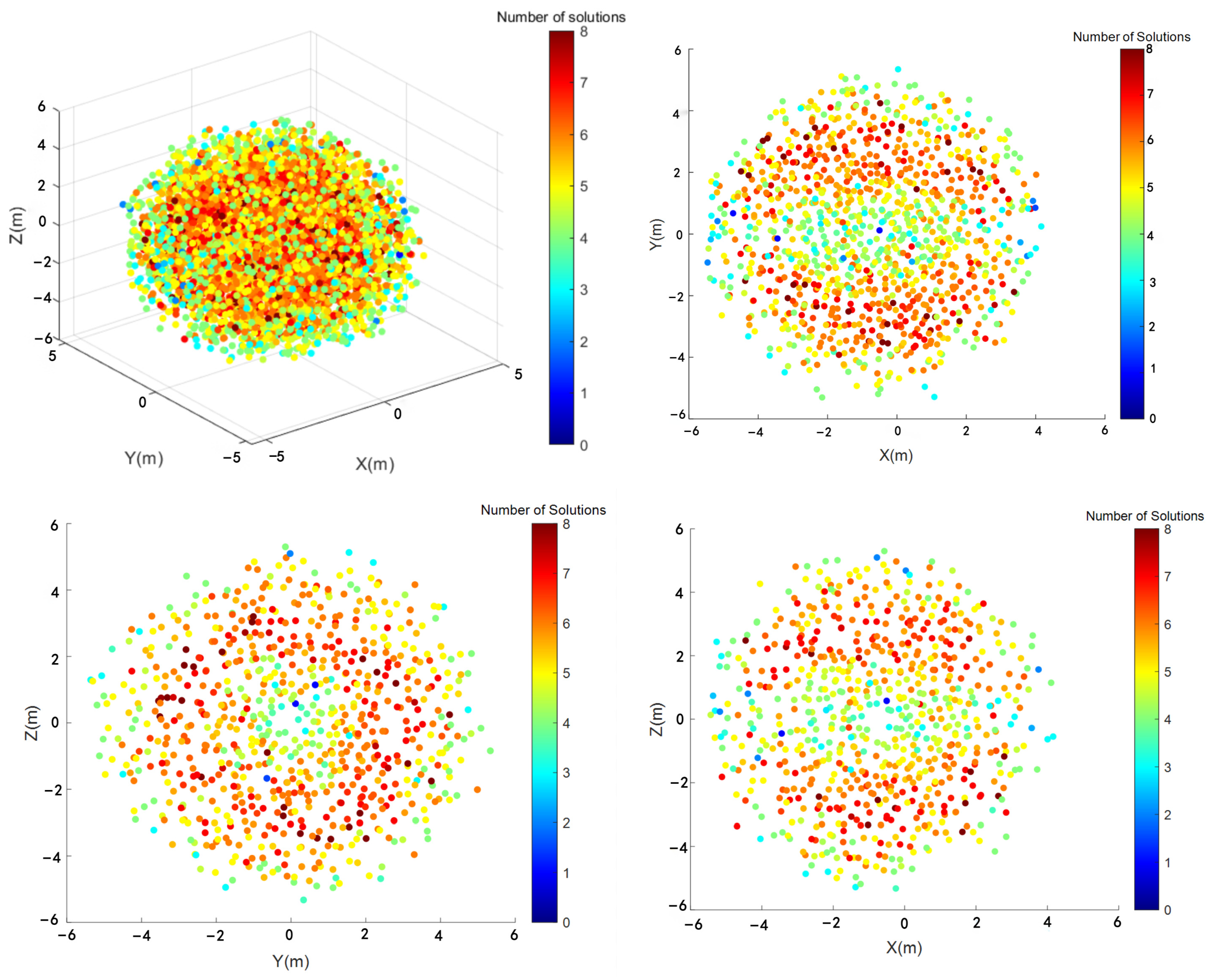
The second experiment results in Table 4 show that the accuracy rate has reached 99.79%. The solving capability varies at different positions within the workspace. The average number of inverse solutions per point in the workspace is shown in Figure 9. Observations show that solving capabilities are weaker in the cylindrical region near the Y-axis with a radius of approximately 1 m and at the edge points of the workspace. In contrast, other positions exhibit good multi-solution capabilities.

4.2. Contrast Experiment

4.2.1. Experimental Condition

Randomly generate 10,000 groups of joint angles, with the joint angle range limited to 18 0 , 18 0 and with the joint angle accuracy being set to three decimal places, for example, 18.354 .
Based on forward kinematics, calculate the terminal pose matrix and further represent the pose in Euler angles, with the position unit being mm and three decimal places retained. The unit of posture is °, with three decimal places retained.
Computer configuration: Ultra9 275HX, 64G memory, GeForce RTX 5070 Laptop GPU.

4.2.2. Experimental Process

Given the joint angle, the inverse solution is calculated using the algorithm in this paper. The solution with the smallest difference from the true value in the solution set is taken as the output result to compare the accuracy of solving the joint angle. The output results are used to calculate the actual pose using forward kinematics and compared with the given input to obtain the pose error. In addition, their time is used as a reference, which differs from the traditional Jacobi IK results of the algorithm.

4.2.3. Experimental Result

It can be known from the terminal pose error data in the Table 5 that in terms of position deviation, the deviation in the T z direction is the largest. The maximum position deviation of the algorithm in this paper in this direction is 0.086 mm, and the maximum position deviation of the Jacobi algorithm in the comparison is 0.667 mm. The algorithm in this paper reduces the position deviation in this direction by approximately 87.1%. In terms of attitude deviation, the deviation in the R x direction is the largest. The maximum attitude deviation of the algorithm in this paper in this direction is   0.020 , and the maximum attitude deviation of the Jacobi algorithm in contrast is 0.361 . The algorithm in this paper reduces the attitude deviation in this direction by approximately 94.5%. Overall, the algorithm proposed in this paper has a significant improvement in terminal pose accuracy compared to the Jacobi algorithm.
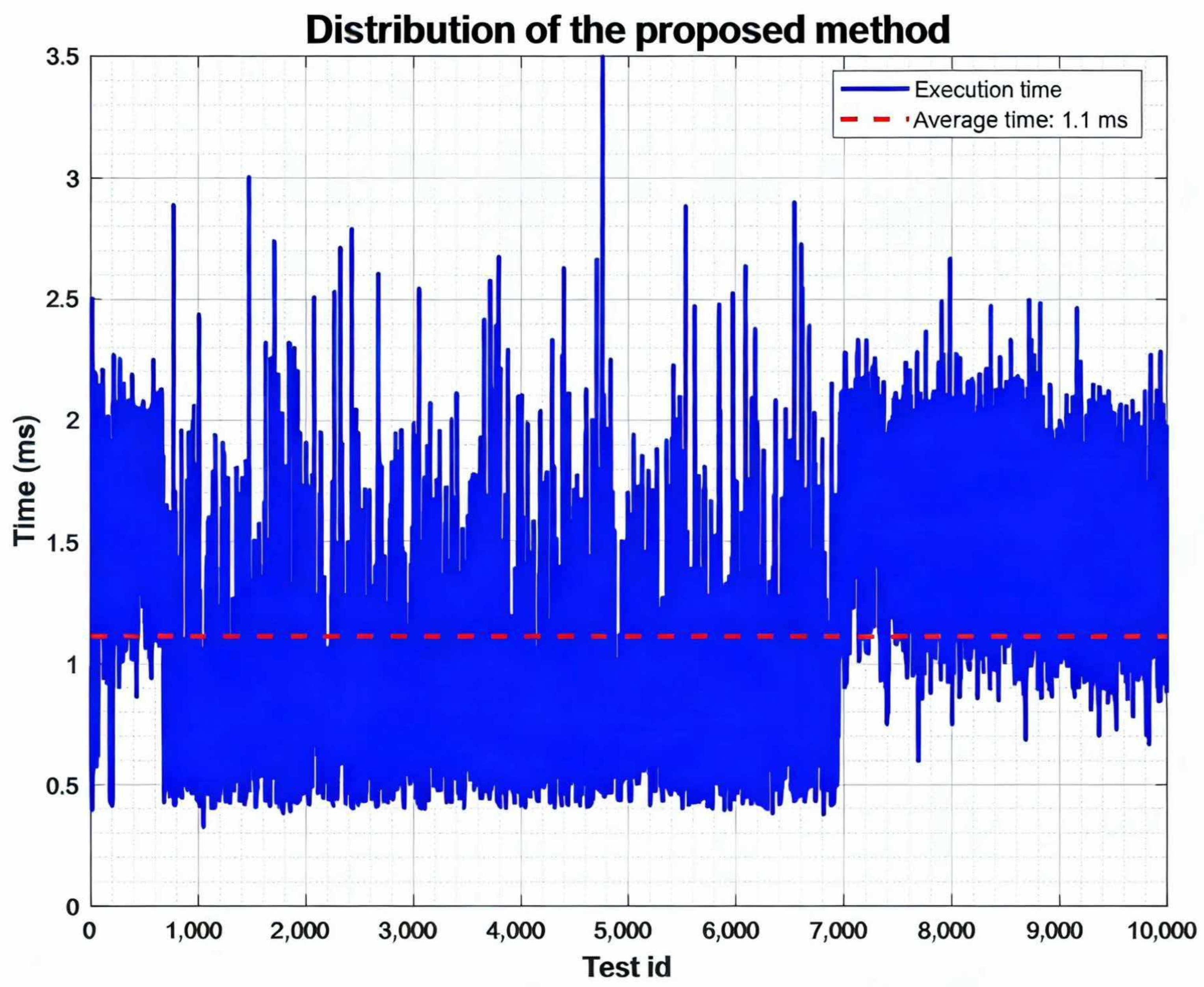
The running time curve of the algorithm in this paper is shown in Figure 10, with an average running time of 1.1 ms.
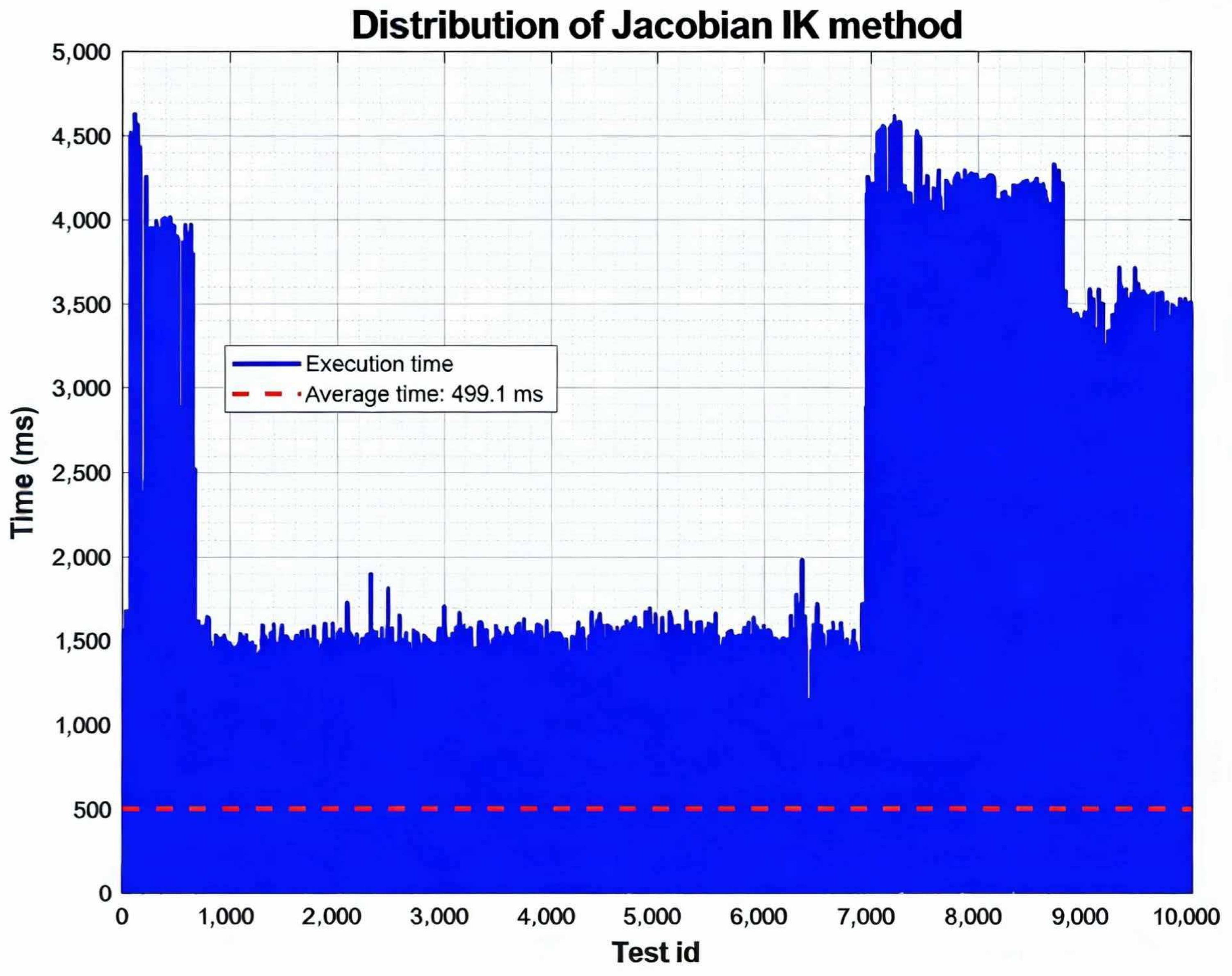
The running time curve of the Jacobi algorithm is shown in Figure 11, with an average running time of 499.1 ms.
By comparing Figure 10 and Figure 11, it can be seen that the operation time using the Jacobi algorithm is 499.1 ms, while the operation time using the algorithm proposed in this paper is 1.1 ms. The computing efficiency has increased by approximately 99.78%.
The exit threshold of the Jacobi algorithm is set to 0.05° and 0.1 mm; the upper limit of the number of iterations was set at 10,000 times. The test results showed that for 1456 sets of data, no feasible solution was found even after reaching the upper limit of the number of iterations, meaning the success rate of the solution was 85.44%.
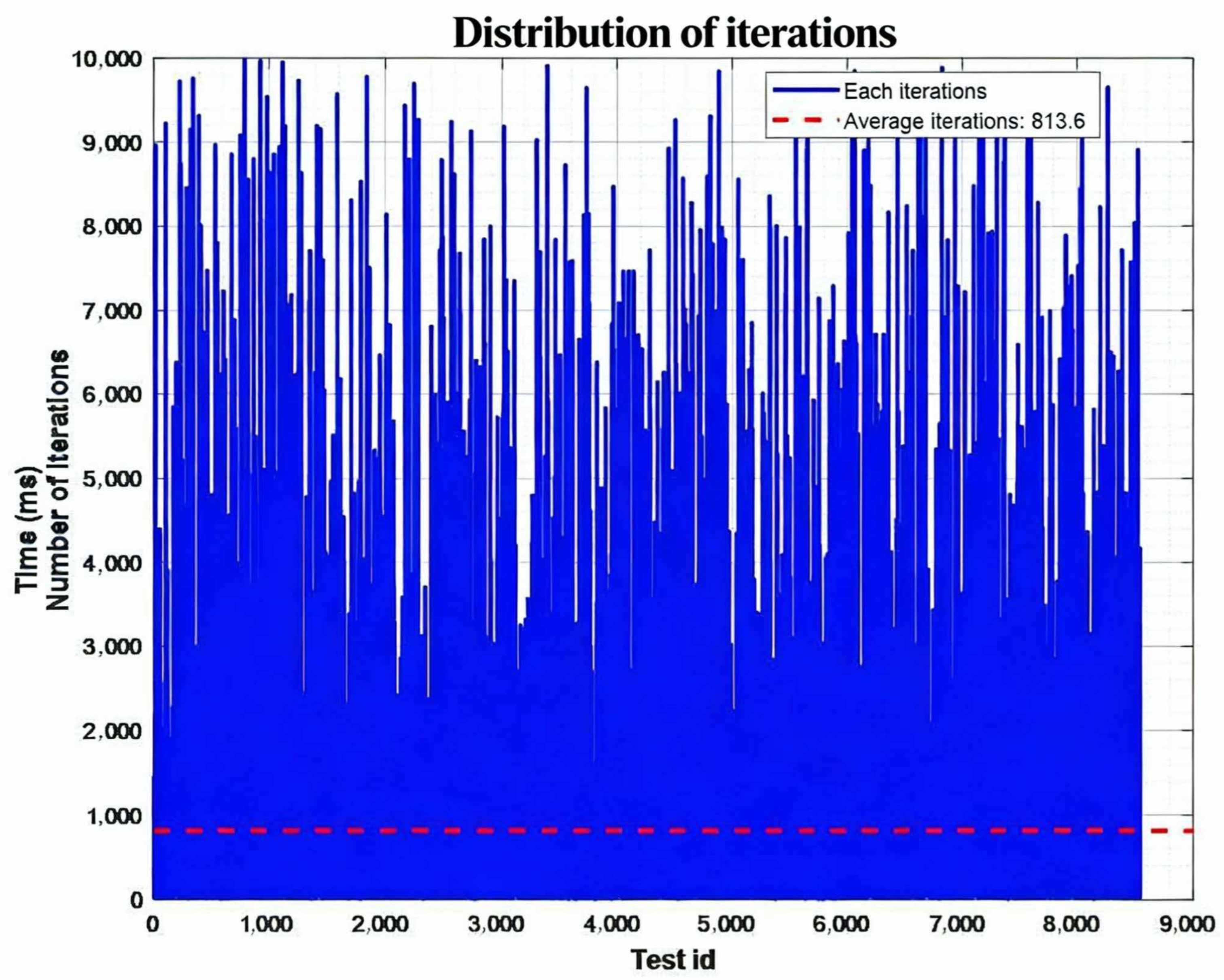
For the successful solution results, the number of iterations of the Jacobi algorithm is shown in Figure 12, with an average of 814 iterations required to find a feasible solution.
Amplifying the exit threshold will help reduce the number of iterations, but it will further lose accuracy.

5. Conclusions

This study constructed a model of the Wentian module’s robotic arm based on the spinor theory. The 7-degree-of-freedom forward kinematic equation was derived through the exponential product formula. By taking advantage of the symmetry of the robotic arm configuration, the inverse solution analysis method for the fixed joints 1/2/6/7 was derived. Through equivalent 6-degree-of-freedom modeling and geometric constraint solution for joint angles, for the scenario of the fixed joints 3/4/5, a numerical solution scheme was established by using the Newton iterative method combined with the Jacobian matrix to obtain the joint configuration. A total of 10,000 sets of experiments based on the parameters of the space station’s small arm show that at the accuracy threshold of 10 4 , the success rate of this method reaches 99.79%. Only the 1 m radius area near the Y-axis and the edge of the workspace are affected by singularity, and the solution ability is relatively weak. The analytical solution is conditional and needs to be improved to be a general closed-form solution for the full 7-DOF system. The traditional Jacobi inverse solution algorithm relies on the selection of initial values. If the initial values are not properly selected, it will lead to an increase in the number of iterations. On the one hand, it will lead to an exit due to an increase in the number of iterations; on the other hand, it also increases the running time of the algorithm. The algorithm in this paper is not sensitive to the initial values. Meanwhile, the analytical expressions of each joint angle are derived. Compared with the iterative algorithm, the computational efficiency is improved.

Author Contributions

Conceptualization, H.G.; Methodology, Y.L. and Y.Z. (Yuxiang Zhao); Software, S.Z.; Validation, Y.X.; Formal analysis, Z.J.; Investigation, Y.Y.; Resources, Z.X.; Data curation, Y.Z. (Yonglong Zhang); Writing—original draft, M.L.; Visualization, Y.L.; Supervision, Y.L.; Project administration, Y.L.; Funding acquisition, Y.L. All authors have read and agreed to the published version of the manuscript.

Funding

This research was funded by the Natural Science Foundation of Heilongjiang Province for Excellent Young Scholars (Grant No. YQ2024E018).

Data Availability Statement

Due to the project background, the data of this study can be provided upon request, please contact the first author of the paper. Email: liuyanghit@hit.edu.cn.

Conflicts of Interest

The authors declare no conflict of interest.

References

  1. Hu, C.W.; Gao, S.; Xiong, M.H.; Tang, Z.X.; Wang, Y.Y.; Liang, C.C.; Li, D.L.; Zhang, W.M.; Chen, L.; Zeng, L.; et al. Key Technologies of the China Space Station Core Module Manipulator. Scientia Sin. Technol. 2022, 52, 1299–1331. [Google Scholar] [CrossRef]
  2. Tan, Y.; Ren, L.; Zhang, H. Review on the Research Progress of Large End Effectors for Space Stations. China Mech. Eng. 2014, 25, 1838–1845. [Google Scholar]
  3. Zhou, M.; Liu, Q. Research status and future prospects of winter jujube picking machine. China Fruit Ind. Inf. 2025, 42, 27–29. [Google Scholar]
  4. Siciliano, B.; Oussama, K. Springer Handbook of Robotics; Springer: Berlin/Heidelberg, Germany, 2016. [Google Scholar]
  5. Ma, B.; Xie, Z.; Jiang, Z.; Liu, Y.; Ji, Y.; Cao, B.; Wang, Z.; Liu, H. Robotic Redundancy via Arm Angle Self-Adaptation through Nullspace Resolution: Offset Poses a Challenge. Int. J. Robot. Res. 2025, 02783649251371735. [Google Scholar] [CrossRef]
  6. Ba, H.; Cheng, W.; Zhang, H.; Ye, C. Research on inverse kinematic solutions of deep sea redundant manipulator based on improved SHADE. J. Huazhong Univ. Sci. Technol. (Nat. Sci. Ed.) 2026, 1–8. [Google Scholar] [CrossRef]
  7. Pieper, D.L. The Kinematics of Manipulators Under Computer Control. Ph.D. Thesis, Stanford University, Stanford, CA, USA, 1968. [Google Scholar]
  8. Zhao, Z.; Zhao, J.; Zhao, L.; Yang, X.; Liu, H. Method for Solving the Inverse kinematics of SSRMS configuration Space Robotic Arm. J. Mech. Eng. 2022, 58, 21–35. [Google Scholar] [CrossRef]
  9. Zhao, J.; Zhao, Z.; Zhao, L.; Yang, X.; Yang, G.; Liu, H. Inverse kinematics and workspace analysis of a novel SSRMS-type recon-figurable space manipulator with two lockable passive telescopic links. Mech. Mach. Theory 2023, 180, 105152. [Google Scholar] [CrossRef]
  10. Faria, C.; Ferreira, F.; Erlhagen, W.; Monteiro, S.; Bicho, E. Position-Based Kinematics for 7-DoF Serial Manipulators with Global Configuration Control, Joint Limit and Singularity Avoidance. Mech. Mach. Theory 2018, 121, 317–334. [Google Scholar] [CrossRef]
  11. Ma, B.; Xie, Z.; Zhan, B.; Jiang, Z.; Liu, Y.; Liu, H. Actual shape-based obstacle avoidance synthesized by velocity–acceleration minimization for redundant manipulators: An optimization perspective. IEEE Trans. Syst. Man Cybern. Syst. 2023, 53, 6460–6474. [Google Scholar] [CrossRef]
  12. Luo, S.; Qin, G.; Qiang, H.; Wang, X. For redundant manipulator inverse kinematics solution of the differential evolutionary algorithm. Mech. Des. Manuf. 2025, 1–8. [Google Scholar] [CrossRef]
  13. Pan, Z. Kinematic analysis of fruit and vegetable handling robot based on MATLAB. Agric. Mach. Use Maint. 2025, 35–39. [Google Scholar] [CrossRef]
  14. Wang, T. Water and Fire Bending Plate Robot Arm Automation Processing Path Planning Research; Dalian University of Technology: Dalian, China, 2024. [Google Scholar] [CrossRef]
  15. Yang, C.; Li, Z.; Zhao, Z.; Zhang, S.; Xie, Y.; Yang, Y.; Zhang, Y.; Li, M.; Jiang, Z.; Xie, Z. Inverse kinematics solution method of robotic arm based on DT-PPO algorithm. Process Control Professional Committee of Chinese Society of Automation, Chinese Society of Automation. In Proceedings of the 36th China Conference on Process Control, Yibin, China, 25–27 July 2025; School of Information and Control Engineering, China University of Mining and Technology: Xuzhou, China, 2025; pp. 685–692. [Google Scholar] [CrossRef]
  16. Hu, J.; Ma, J.; Li, Z.; Huang, D. RNN meta-heuristic RRT redundant arm path planning. Mod. Manuf. Eng. 2025, 41–52. [Google Scholar] [CrossRef]
  17. Fei, L.; Zheng, Z.; Zhang, G.; Hu, Y.; Wang, Z.; Zheng, Z. Motion Control of Autonomous Winding Mobile Robots for Bent Tubular Busbar. Mech. Transm. 2026, 50, 146–153. Available online: https://link.cnki.net/urlid/41.1129.TH.20251215.0906.002 (accessed on 16 February 2026).
  18. Hao, J.; Yue, Y.; Zhao, Z.; Zhao, H.; Li, T. Dexterous Obstacle Avoidance Method for Rigid and Flexible Obstacles of Apple Picking Robots. Smart Agric. 2026, 1–13. Available online: https://link.cnki.net/urlid/10.1681.S.20260108.1117.006 (accessed on 16 February 2026).
  19. Zhang, R.; Gao, X.; Zhong, G.; Tao, X. Design and Test of Tracked Tennis Autonomous Ball Pick-up System Based on OpenMV. J. Chengdu Aviat. Vocat. Tech. Coll. 2025, 41, 75–79. [Google Scholar]
  20. Guo, S. Spiral Theory and Its General Block Diagram. J. Tianjin Univ. Technol. 1990, 1–7. Available online: https://tear.cbpt.cnki.net/WKE/WebPublication/paperDigest.aspx?paperID=86a72c66-ad01-4ad0-b759-1e0a7b4e87fc# (accessed on 16 February 2026).
  21. Zhang, Z. Research on Collaborative Motion Planning and Sliding Mode Position/Force Control for Industrial Robots. Shandong Univ. Sci. Technol. 2023. [Google Scholar] [CrossRef]
  22. Jia, Q.; Zuo, Z.; Chen, G.; Sun, H. Research on Kinematics Modeling of a Branched Modular Robot Based on Screw Theory. Mach. Manuf. 2015, 53, 14–16. [Google Scholar] [CrossRef]
  23. Yu, L.; Liu, X. Kinematics Modeling of Bow-shaped Five-link Robot Based on Screw Theory. J. Wuhan Text. Univ. 2024, 37, 71–80. [Google Scholar] [CrossRef]
  24. Li, G.; Wu, J.; Li, R. Kinematics Modeling and Analysis of Seven-degree-freedom Robotic Arm Based on Spinor Theory. J. Mech. Manuf. Autom. 2022, 51, 105–107. [Google Scholar] [CrossRef]
  25. Lv, L.; Li, X.; Fei, S.; Shi, X.; Liu, Z. Kinematics Modeling and Analysis of 6R Manipulator Based on Screw Theory. J. Chifeng Univ. (Nat. Sci. Ed.) 2019, 35, 53–55. [Google Scholar] [CrossRef]
  26. Tong, J.; Zhou, W. Discussion on the Application of Newton’s Iterative Method in a Class of Basic Elementary Functions. Res. Middle Sch. Math. (South China Norm. Univ. Ed.) 2025, 4–6. [Google Scholar]
  27. Deng, J.; Liu, Y.; Zhao, M.; Quan, H.; He, S. Design of Automatic Material Picking Device for LCD TV Backplane Manipulator Based on Deep Learning. Mech. Electr. Eng. Technol. 2025, 54, 148–153. [Google Scholar]
Figure 1. Spinometric model.
Machines 14 00284 g001
Figure 2. Schematic diagram of direction.
Machines 14 00284 g002
Figure 3. The transformation of joint 1 angle.
Machines 14 00284 g003
Figure 4. Transformation of reference points with joint 1 fixed. (Semi-transparency represents the original state, while the solid represents the transformed state).
Machines 14 00284 g004
Figure 5. The constraint relationship of Pd. (Semi-transparency represents the original state, while the solid represents the transformed state).
Machines 14 00284 g005
Figure 6. Sectional view of the cutting plane.
Machines 14 00284 g006
Figure 7. Transformation of joint 2 angle.
Machines 14 00284 g007
Figure 8. Transformation of reference points with joint2 fixed.
Machines 14 00284 g008
Figure 9. Solving capability at different positions.
Machines 14 00284 g009
Figure 10. The running time curve of the algorithm in this paper.
Machines 14 00284 g010
Figure 11. The running time curve of the Jacobi algorithm.
Machines 14 00284 g011
Figure 12. The result of setting the exit threshold of the Jacobi algorithm to 0.05°.
Machines 14 00284 g012
Table 1. Key connecting rod dimensions of the robotic arm (mm).
a 0 a 1 a 2 a 3 a 4 a 5 a 6 a 7 a 8
716.143043020803872080430430716.1
Table 2. Definition of the helical axes of each joint of the robotic arm.
i ω i q i
1−1, 0, 00, 0, 0
20, 0, −1 a 0 , 0, 0
3−1, 0, 0 0 ,   0 ,   a 1
4−1, 0, 0 0 ,   0 ,   a 1 a 3
5−1, 0, 0 0 ,   0 , a 1 a 3 a 5
60, 0, −1 a 0 a 2 a 4 a 6 , 0, 0
7−1, 0, 0 0 ,   0 , a 1 a 3 a 5 a 7
Table 3. Coordinate of the helical axis of the joint.
i ω i v i
1−1, 0, 00, 0, 0
20, 0, −1 0 ,   a 0 , 0
3−1, 0, 0 0 ,   a 1 , 0
4−1, 0, 0 0 ,   a 1 + a 3 , 0
5−1, 0, 0 0 ,   a 1 + a 3 + a 5 , 0
60, 0, −1 0 ,     a 0 a 2 a 4 a 6 , 0
7−1, 0, 0 0 ,   a 1 + a 3 + a 5 + a 7 , 0
Note: v i = w i × q i .
Table 4. Statistics on the number of successful experiments and success rates.
Joint Fixation StrategyNumber of SuccessesSuccess Rate (%)
Fixed Joint 1997799.77
Fixed Joint 2997499.74
Fixed Joint 6997699.76
Fixed Joint 7997999.79
Fixed Joint 3996899.68
Fixed Joint 4996599.65
Fixed Joint 5996999.69
Table 5. Terminal pose error ( mm / ).
T x T y T z R z R y R x
The algorithm in this article0.0410.0760.0860.0110.0010.009
−0.400−0.510−0.079−0.009−0.020−0.005
Jacobi algorithm0.0650.0260.0250.0030.0010.001
−0.676−0.619−0.667−0.157−0.008−0.361
Disclaimer/Publisher’s Note: The statements, opinions and data contained in all publications are solely those of the individual author(s) and contributor(s) and not of MDPI and/or the editor(s). MDPI and/or the editor(s) disclaim responsibility for any injury to people or property resulting from any ideas, methods, instructions or products referred to in the content.