


Abstract
To investigate the factors affecting the impact performance of hydraulic impact hammers, a numerical calculation model and an experimental system were developed in this study. The consistency between the simulation and experimental results confirmed the accuracy of the numerical model. The results indicated that both the reversing valve stroke and the length of the piston middle-front section are positively correlated with impact energy, impact frequency, and impact power. The accumulator precharge pressure also shows a positive correlation with impact energy, but a negative correlation with impact frequency and impact power. Among these factors, the accumulator precharge pressure exhibits the greatest influence on impact energy, accounting for 26.7% of the variance. The piston middle-front section length has the most significant effect on impact frequency and impact power, contributing 52.3% and 50.2%, respectively. Based on these findings, a set of design criteria is proposed to maximize the impact power of hydraulic impact hammers. An optimization example for a specific model demonstrates an 8.26% increase in impact power after optimization. Overall, this study provides a reliable theoretical and experimental foundation for impact performance research and offers practical guidance for the design and optimization of hydraulic impact hammers.
1. Introduction
The hydraulic impact hammer is a high-frequency reciprocating impact device that converts the pressure energy of hydraulic oil into the impact energy of the piston. It has been widely employed in mining, infrastructure construction, and demolition engineering. With increasing demands for high energy efficiency and reliability, hydraulic impact hammers have attracted considerable attention because they can simultaneously utilize hydraulic energy and gas elastic energy. However, such systems exhibit pronounced nonlinear characteristics and complex fluid–solid coupling effects, making their motion mechanism, dynamic response, and energy transfer mechanism ongoing research focuses.
Giuffrida and Laforgia [1] developed a system model of a hydraulic impact hammer and pointed out that the supply pressure and the precharge pressure of the accumulator have significant effects on impact energy and frequency. Shin and Kwon [2] enhanced the impact frequency and energy through parameter optimization. Oh et al. [3] established a mathematical model of a hydraulic impact system for performance analysis. Yang et al. [4] investigated the dynamic characteristics of the reversing valve and revealed the influence of valve opening and pressure difference on impact performance. Ye et al. [5] proposed a hydraulic circuit design method to increase impact frequency and power. Li et al. [6] analyzed the interaction between the piston and the hydraulic circuit based on a multibody dynamics–hydraulic coupling model. Hu et al. [7] established and validated a hydraulic model using quasi-steady-state theory and the finite-difference method. Xu et al. [8,9] examined the dynamic characteristics of hydraulic impact hammers and optimized piston dimensions to improve impact energy. Guo et al. [10] developed a hydraulic–mechanical coupling model using bond graph theory to study the effects of inlet flow, accumulator precharge pressure, and system set pressure on impact performance. Noh et al. [11] analyzed the influence of reversing valve parameters on pressure pulsation and energy output. Franco and Ferraresi [12] proposed a model-based rapid design method for determining key structural parameters according to target performance. Redelin et al. [13] reported that appropriate accumulator configuration can reduce pressure fluctuations and enhance energy output. Yang et al. [14] investigated the effects of system flow rate, accumulator pressure, and relief-valve setting on impact energy and efficiency, providing a reference for multi-parameter coupling optimization. Yin and Cai [15] studied the influence of piston inclination angle on impact energy and frequency. Andersson et al. [16] employed co-simulation methods to significantly improve model accuracy, offering an effective approach for the virtual verification of complex hydraulic impact systems. Galdin et al. [17] quantitatively analyzed the relationships among piston mass, stroke, and accumulator pressure, revealing their combined effects on impact velocity and energy. Yu et al. [18] investigated pressure pulsation characteristics using the AMESim platform and found that an appropriately designed accumulator can greatly improve system stability. Li [19] examined the relationship between the collision coefficient and stress waveform, clarifying the link between impact dynamics and energy-transfer efficiency. Kim et al. [20,21] combined simulation and machine-learning methods to predict impact energy, finding that working pressure, flow rate, chisel diameter, nitrogen pressure, and frequency all exert significant effects on performance. Yang et al. [22] studied the synergistic influence of piston mass and working pressure on impact energy and frequency. Li et al. [23] pointed out that the drill rod diameter is positively correlated with working efficiency. Lee et al. [24] revealed that internal leakage weakens impact force, providing an optimization direction for improving energy utilization. Zheng et al. [25] constructed a three-dimensional piston–tool–rock coupling model to analyze how tool geometry, rock strength, and repeated impacts affect energy-transfer efficiency and rock-breaking performance.
Overall, these studies have established a solid foundation for the dynamic modeling and analysis of hydraulic impact systems. Nevertheless, several issues remain. First, the existing models do not consider the effect of stress-wave reflection caused by the drill rod’s impact on rock, nor do they describe the processes of stress propagation and velocity variation of the piston and drill rod. Previous models were unable to investigate the dynamic performance of hydraulic impact hammers, nor could they calculate the dynamic chamber pressures and dynamic piston positions. Moreover, the storage and utilization of rebound energy have not been sufficiently addressed, and the influence of rebound energy storage on impact performance has not been quantitatively analyzed. In addition, most studies lack experimental support and fail to quantify the error between numerical and experimental results. More importantly, no design criteria for hydraulic impact hammers have been proposed.
The objective of this study is to establish an accurate numerical calculation model of a hydraulic impact hammer and to identify the key factors influencing its impact performance, thereby improving its impact performance. An experimental system for evaluating the impact performance of hydraulic impact hammers was developed. By analyzing the discrepancies between simulated and experimental results of key-chamber pressures, piston motion, and stress waves, the accuracy of the numerical model was verified. Furthermore, the response contributions of key parameters to impact performance were investigated, and a design criterion for maximizing impact power was proposed. A case study of an optimized model demonstrated an 8.26% increase in impact power after optimization. Overall, this work provides a reliable theoretical and experimental foundation for the analysis and optimization of hydraulic impact hammer performance.
2. Numerical Calculation Model of the Hydraulic Impact Hammer
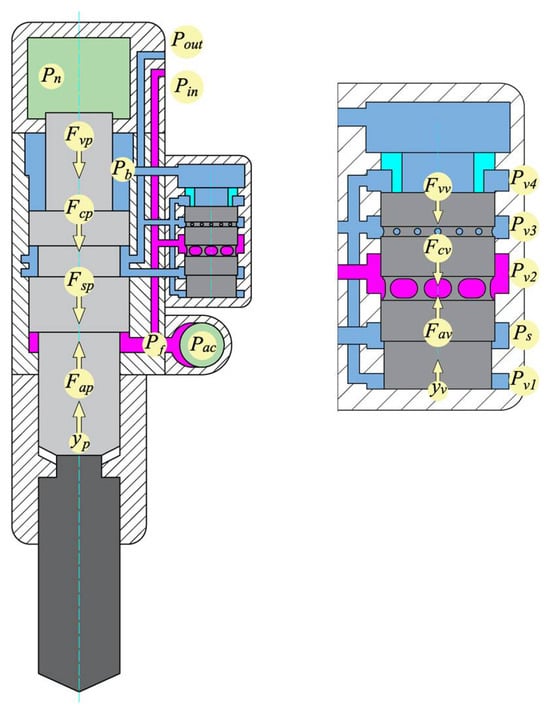
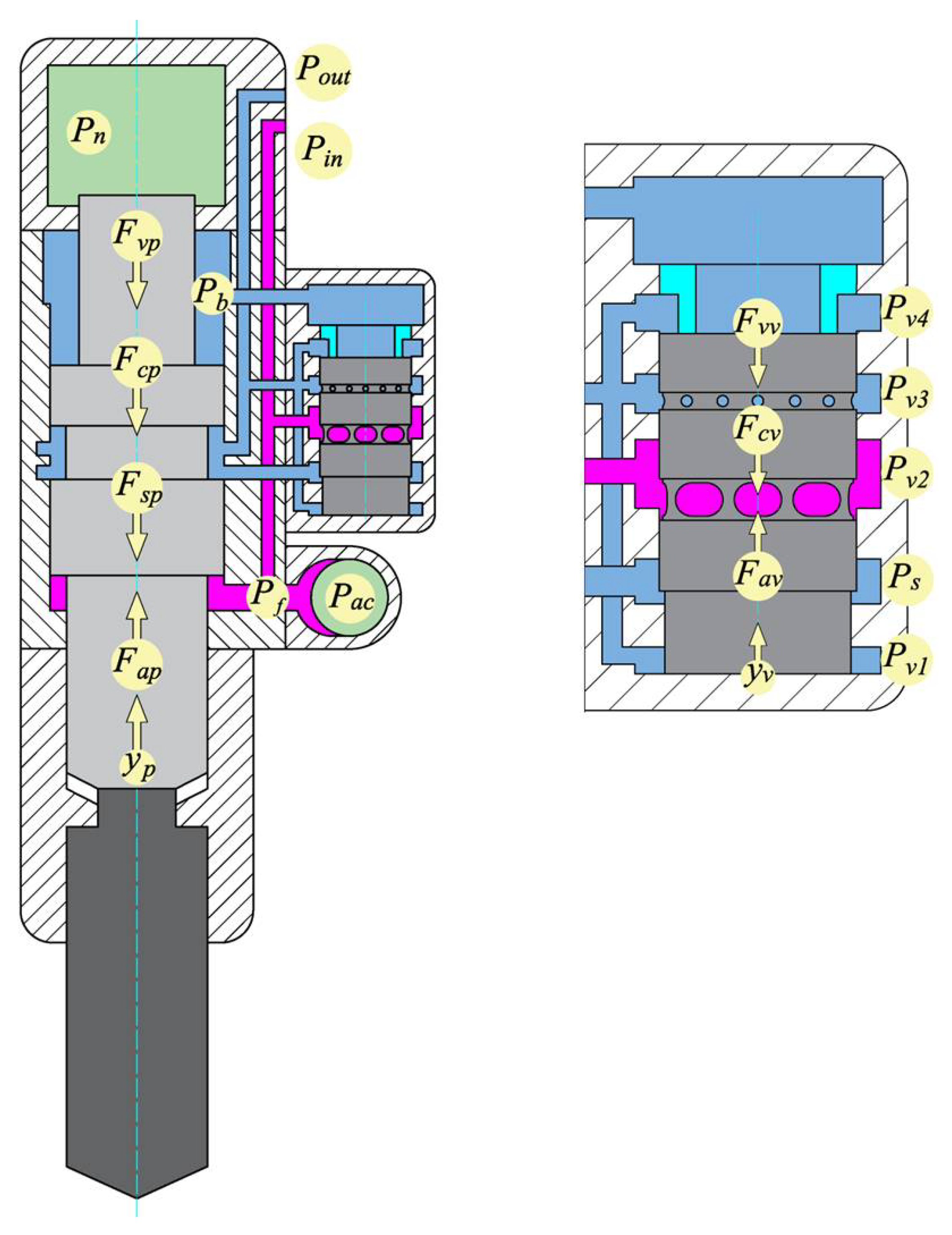
A schematic representation of the hydraulic impact hammer (Yantai EDDIE Precision Machinery Co., Ltd., Yantai, China) together with its structural parameters is illustrated in Figure 1.
Figure 1.
Structural schematic and parameter diagram.
(1) Dynamic equations of the piston and the reversing valve [26]
(2) Gas state equations for the accumulator chamber and the nitrogen chamber
(3) Flow continuity equations
It is evident that the numerical calculation model of the hydraulic impact hammer consists of a system of high-order nonlinear differential equations. The resolution of the system in question provides insight into the motion states of the piston and reversing valve, as well as the dynamic pressures of the key chambers.
(4) Impact stress at the boundary surfaces of the piston and the drill rod
When the reflection coefficient between the piston and drill rod is zero, and the reflection coefficient between the drill rod and rock is , the stress variation process at each cross-section of the piston is shown in Table 1. The stress variation process at each cross-section of the drill rod is shown in Table 2. Furthermore, the performance indices of the hydraulic impact hammer are shown in Table 3.
Table 1.
Stress variation process at each cross-section of the piston.
Table 2.
Stress variation process at each cross-section of the drill rod.
Table 3.
Performance indices of the hydraulic impact hammer.
3. Simulation and Experimental Study on Impact Performance
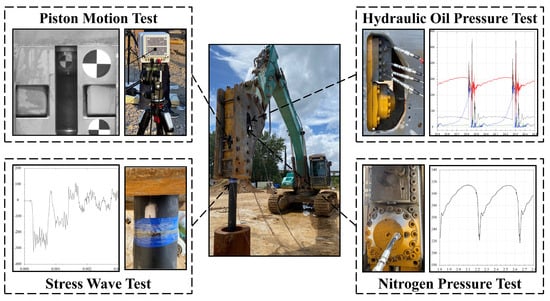
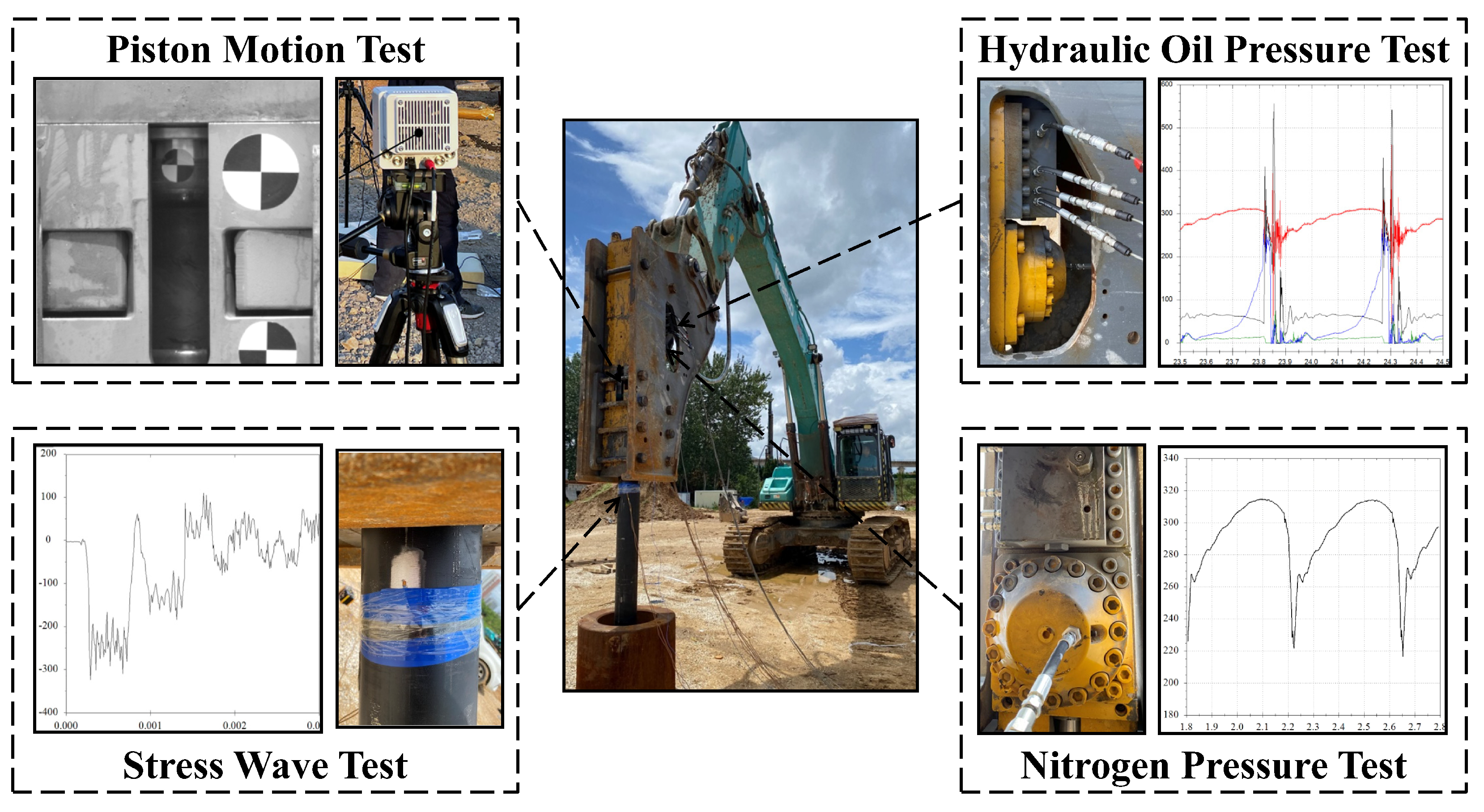
To investigate the actual operating characteristics of the hydraulic impact hammer and verify the accuracy of the numerical calculation model, a hydraulic impact hammer performance test system was designed and built. The experimental system mainly consists of an excavator, a hydraulic impact hammer, pressure sensors, a high-speed camera, strain gauges, and a data acquisition and analysis device, as shown in Figure 2.
Figure 2.
Experimental system of the hydraulic impact hammer.
The piston of the hydraulic impact hammer used in the experiment has a diameter of 215 mm, a length of 1380 mm, and a mass of 404 kg, while the drill rod has a diameter of 215 mm and a length of 2070 mm. The nitrogen chamber precharge pressure is 35 bar, the accumulator precharge pressure is 75 bar, and the initial volume of the accumulator gas chamber is 5 liters. The piston stroke is 210 mm, the reversing valve stroke is 28 mm, and the piston middle-front section length is 160 mm. To avoid the uncertainty caused by variations in rock properties, a steel column was used instead of rock in the experiment. Both the experiment and the simulation were configured with , which represents the working condition of the hydraulic impact hammer striking hard rock. No. 46 hydraulic oil was used, with the oil temperature maintained at 313.15 K and the system relief pressure set to 340 bar. Pressure sensors with a measuring range of 600 bar were installed in the front and back chambers, and a 400 bar sensor was used for the signal chamber. A 600 bar sensor was mounted on the gas chamber of the accumulator to monitor real-time pressure variations of the system. High-contrast tracking points were marked on the surfaces of the piston and cylinder block, and the high-speed camera was positioned approximately 5 m away from the hydraulic impact hammer, aligned horizontally with the piston axis. Several strain gauges were bonded to the drill rod at positions approximately 450 mm from the impact interface, with their sensitive axes aligned with the axial direction of the drill rod. The data acquisition and analysis system was configured with a sampling frequency of 100 kHz to synchronously collect pressure and strain signals; the high-speed camera was set to a sampling frequency of 10,000 fps, and its resolution and exposure parameters were adjusted according to experimental needs to ensure adequate image clarity and temporal resolution for dynamic analysis. Furthermore, it is imperative to note that both the data acquisition instrument and the high-speed camera were activated prior to the commencement of the test. During the subsequent data analysis phase, locate the piston displacement data and chamber pressure data corresponding to the piston’s first impact on the drill rod to achieve synchronization of relevant data. High-speed camera jitter and inadequate pixel resolution may result in deviations in the measurement of tracking point displacement. Consequently, six repeated experiments are conducted in this study under the same configuration. Additionally, the numerical calculation model of the hydraulic impact hammer consists of a system of high-order nonlinear differential equations, making the solution process complex. In this study, the MATLAB (v2020a) software is utilized for the simulation calculation of the hydraulic impact hammer’s impact performance. The simulation duration is set to 10 s, and the time step is set to 0.1 ms.
3.1. Oil Pressure Simulation and Experiment
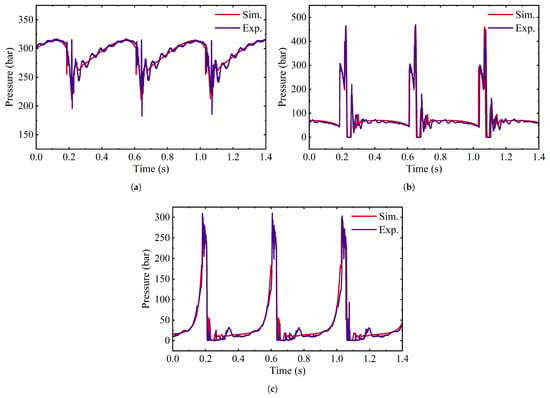
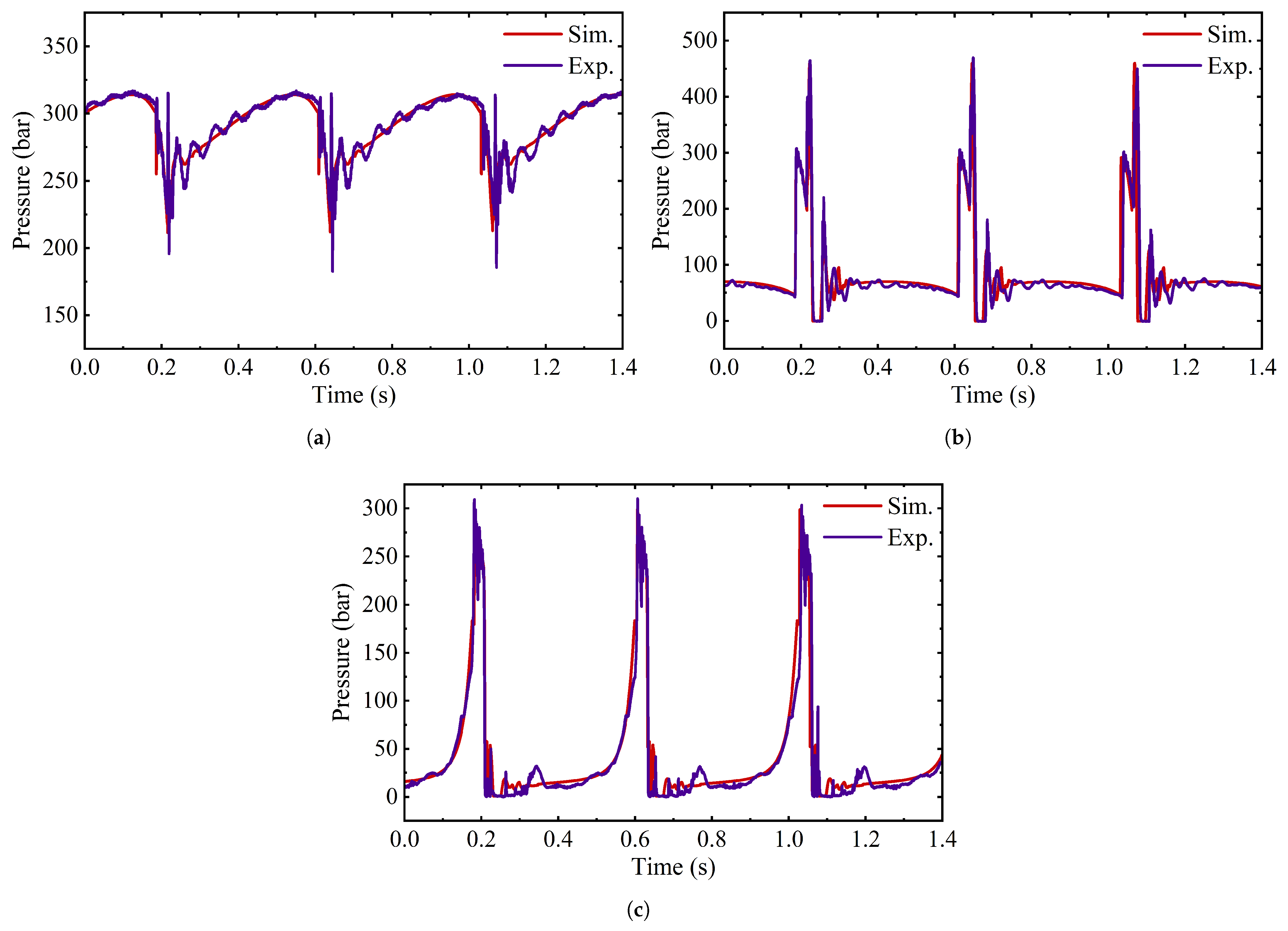
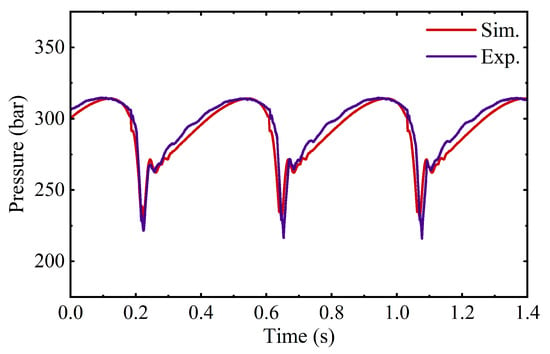
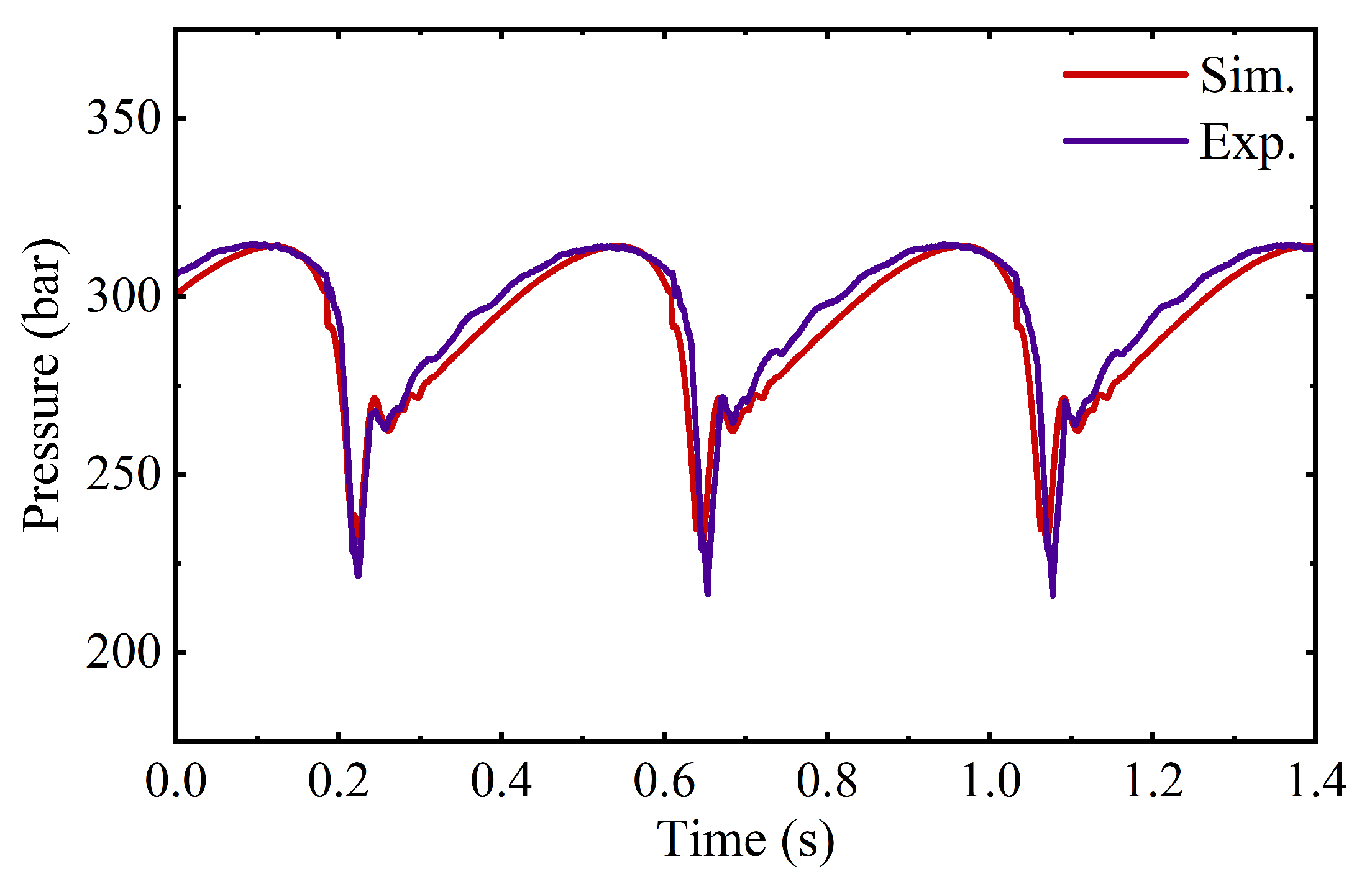
The simulated and experimental pressure curves of the front chamber, back chamber, and signal chamber for the specific hydraulic impact hammer model are shown in Figure 3.
Figure 3.
Oil pressure simulation and experimental curves. (a) Front chamber pressure. (b) Back chamber pressure. (c) Signal chamber pressure.
As calculated from the data of 0–1.4 s in Figure 3, the root mean square error (RMSE) between the simulated and experimental results for the front chamber pressure is 8.084 bar, with a coefficient of determination () of 0.866. Similarly, the RMSE between the simulated and experimental results for the back chamber pressure is 17.306 bar, with an of 0.940. The RMSE between the simulated and experimental results for the signal chamber pressure is 13.136 bar, with an of 0.961. These results confirm that the numerical calculation model possesses high accuracy.
As derived from Figure 3, the impact frequency of the specific hydraulic impact hammer model is approximately 2.35 blows/s. Upon connection of the signal chamber to the inlet pipe, the high-pressure port of the reversing valve opens, thereby establishing a connection between the back chamber and the front chamber. Upon connection of the signal chamber to the outlet pipe, the high-pressure port of the reversing valve closes, thereby establishing a connection between the back chamber and the outlet pipe. During the piston stroke phase, the pressures in the front chamber, back chamber, and signal chamber all gradually decrease. During the piston return phase, the front chamber pressure generally increases, while the back chamber pressure and signal chamber pressure remain largely stable. Specifically, when the high-pressure port of the reversing valve is closed and the piston rapidly compresses the back chamber volume, the back chamber pressure will reach a peak.
3.2. Simulation and Experiment on Piston Motion State
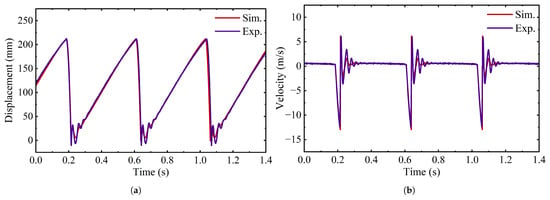
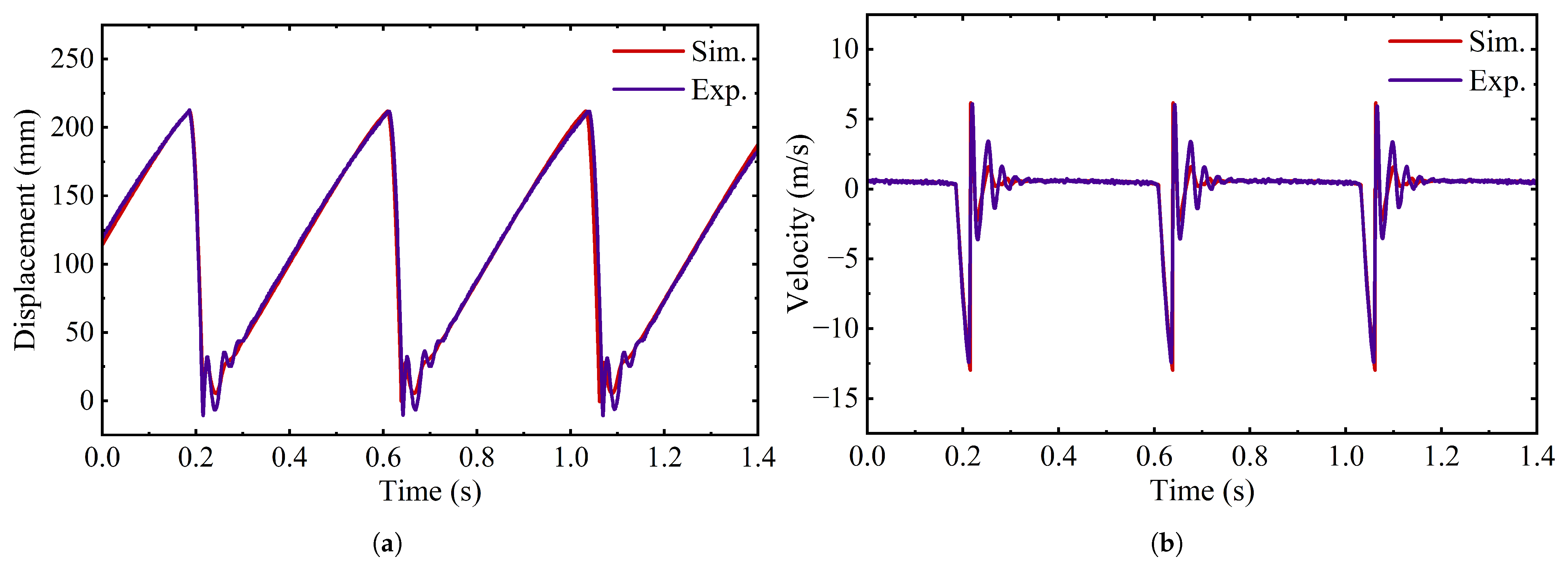
The contact position between the piston and drill rod is defined as 0, with upward indicating positive direction. Export the coordinate data of the piston and cylinder tracking points, and calculate the positional change of the piston relative to the cylinder. The simulated and experimental curves of piston displacement and piston velocity of the hydraulic impact hammer are shown in Figure 4.
Figure 4.
Simulation and experimental curves of piston displacement and velocity. (a) Piston displacement. (b) Piston velocity.
As calculated from the data of 0–1.4 s in Figure 4, the RMSE between the simulated and experimental results for piston displacement is 6.501 mm, with an of 0.987. The RMSE between the simulated and experimental results for piston velocity is 0.622 m/s, with an of 0.925. These results confirm that the numerical calculation model exhibits high accuracy. Furthermore, during a complete impact cycle, the piston stroke takes a very short time, while the piston return stroke takes a relatively long time.
The piston of the hydraulic impact hammer has a mass of 404 kg. As derived from the simulation curves in Figure 4, the impact velocity is approximately 12.83 m/s, the rebound velocity is about 6.18 m/s, and the impact frequency is around 2.35 blows/s. The calculated results are as follows: the impact energy is approximately 33,255 J, the rebound energy is 7715 J, the impact force is 9714 kN, the impact power is 77.99 kW, and the rebound power is 18 kW. According to the experimental curves in Figure 4, the impact velocity is approximately 12.33 m/s, the rebound velocity is about 6.02 m/s, and the impact frequency is around 2.35 blows/s. The corresponding calculated results are: the impact energy is approximately 30,710 J, the rebound energy is 7321 J, the impact force is 9335 kN, the impact power is 72.17 kW, and the rebound power is 17.20 kW. The errors between the simulated and experimental results are acceptable, which may be caused by high-speed camera vibration or insufficient image resolution.
3.3. Stress Wave Simulation and Experiment
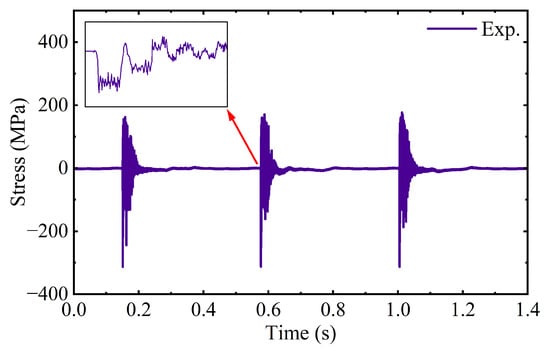
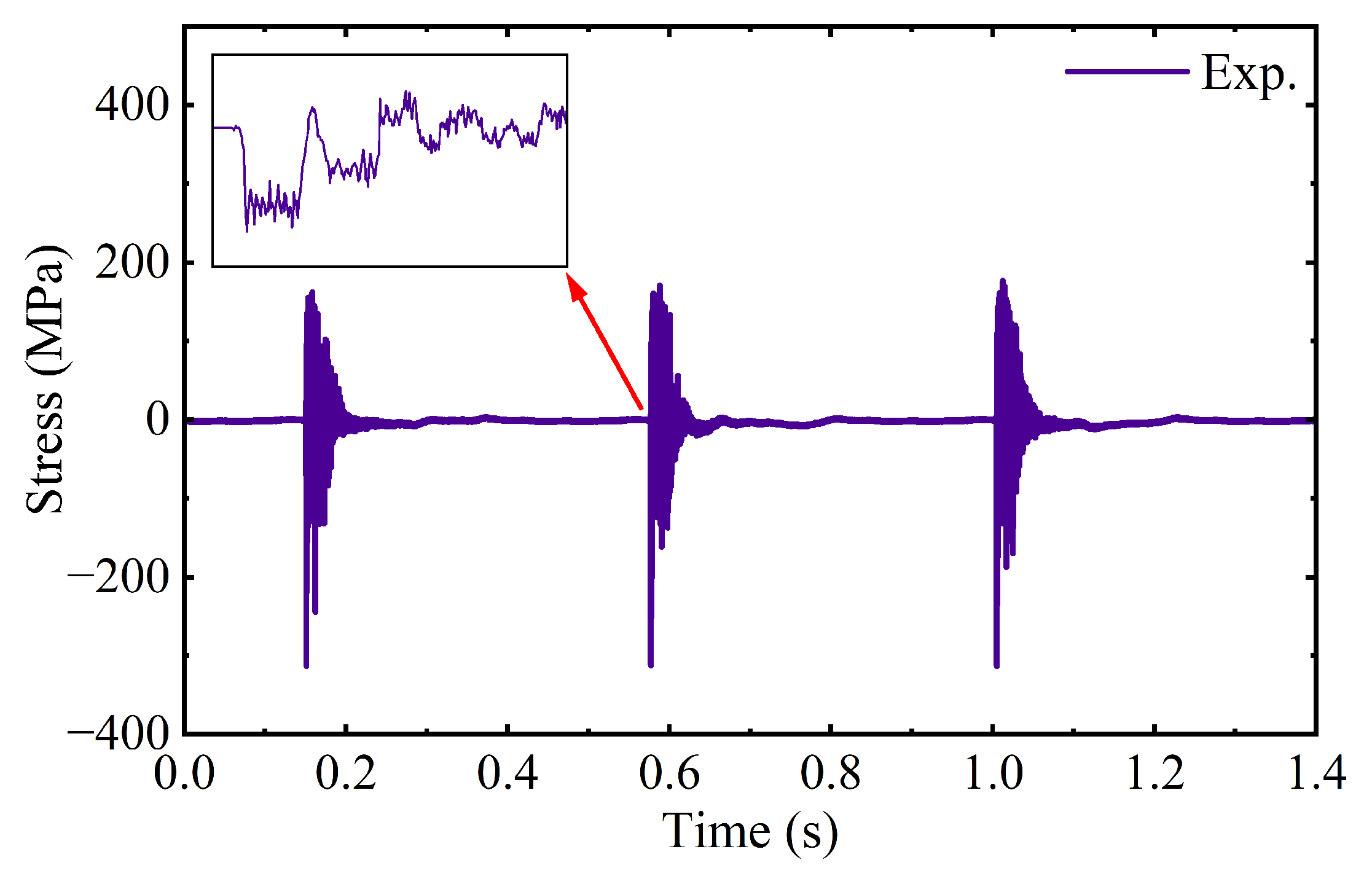
The stress curve obtained experimentally at a distance of 450 mm from the drill rod impact boundary surface is shown in Figure 5.
Figure 5.
Stress curve at a distance of 450 mm from the drill rod impact boundary surface.
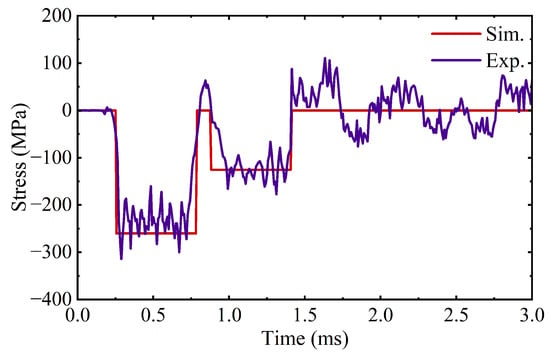
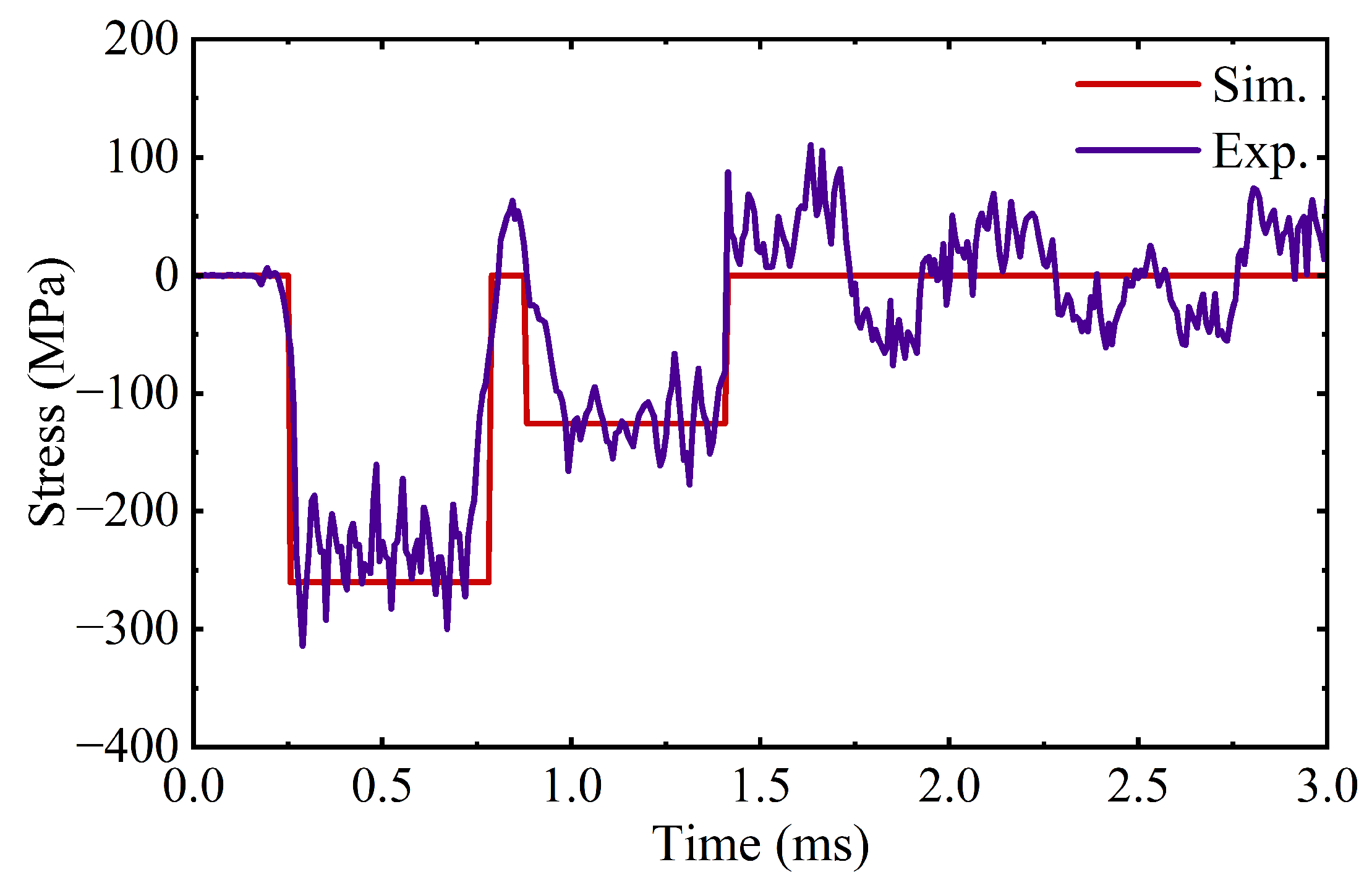
As illustrated in Figure 5, the impact frequency of the hydraulic impact hammer obtained from the experiment is approximately 2.35 blows/s. To facilitate observation of the stress variation during the impact process, the waveform of a single impact cycle was selected for analysis. The simulated and experimental stress curves at a distance of 450 mm from the rill rod impact boundary surface are shown in Figure 6.
Figure 6.
Simulation and experimental stress curves at a distance of 450 mm from the drill rod impact boundary surface.
As illustrated in Figure 6, the simulated and experimental stress curves at a distance of 450 mm from the drill rod impact boundary surface exhibit consistent magnitude and variation patterns. As calculated from the data of 0–3 ms in Figure 6, the RMSE between the simulated and experimental results is 44.757 MPa, with an of 0.789. Due to the strong transient characteristics of the hydraulic impact process, the experimental stress signal is susceptible to impact noise, sensor dynamic response, and test system stiffness, resulting in local waveform fluctuations. However, the overall trend and peak variation remain consistent, indicating that the numerical model can accurately reflect the stress propagation and reflection behavior during the impact process of the hydraulic impact hammer, demonstrating good reliability and engineering reference value.
Furthermore, as illustrated in Figure 6, during a complete impact cycle, the piston and drill rod undergo two contact events, with both contact durations being essentially equal. The first contact occurs when the piston impacts the drill rod, while the second contact arises from the drill rod rebounding and impacting the piston in the opposite direction. The impact contact time between the piston and the drill rod is , which is contingent on the piston’s length and material properties. When the piston impacts the drill rod, the stress at this position is approximately 260.46 MPa; when the drill rod rebounds and impacts the piston in the opposite direction, the stress at the same position is approximately 125.18 MPa. Therefore, MPa. Based on these results, combined with Table 1 and Table 2, the stress wave variations at each cross-section of the piston and drill rod can be calculated. Furthermore, the difference in wave resistance between the drill rod and the rock generates a reflected wave upon the impact of the drill rod on the rock. This reflected wave exerts an effect on the pressure in the back chamber and the piston rebound velocity.
3.4. Simulation and Experiment on Accumulator Gas-Chamber Pressure
The accumulator is of the diaphragm type, with a precharge pressure of 75 bar. The initial volume of the accumulator gas chamber is 5 liters, and the accumulator oil chamber is connected to the front chamber. The simulated and experimental curves of the accumulator gas-chamber pressure are shown in Figure 7.
Figure 7.
Simulation and experimental curves of accumulator gas-chamber pressure.
As calculated from the data of 0–1.4 s in Figure 7, the RMSE between the simulated and experimental results is 7.241 bar, with an of 0.878. These results confirm that the numerical calculation model exhibits high accuracy. During the piston stroke phase, the accumulator gas-chamber pressure undergoes a gradual decrease, indicating that the accumulator is progressively releasing high-pressure fluid. During the piston return phase, the accumulator gas-chamber pressure undergoes a gradual increase, indicating that the accumulator is progressively accumulating high-pressure fluid. Specifically, when the high-pressure port of the reversing valve opens and the piston compresses the back chamber volume, the accumulator gas-chamber pressure also increases. In addition, the variation trend of the accumulator gas-chamber pressure is similar to that of the front chamber pressure, while the accumulator pressure curve appears smoother than the front chamber one.
4. Key Factors Influencing Impact Performance
4.1. Pressure Fluctuation in the Front and Back Chambers
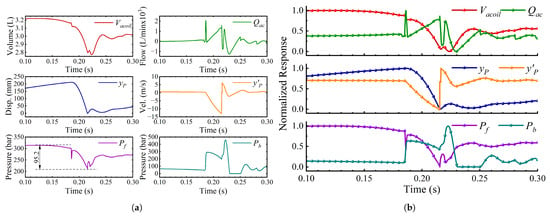
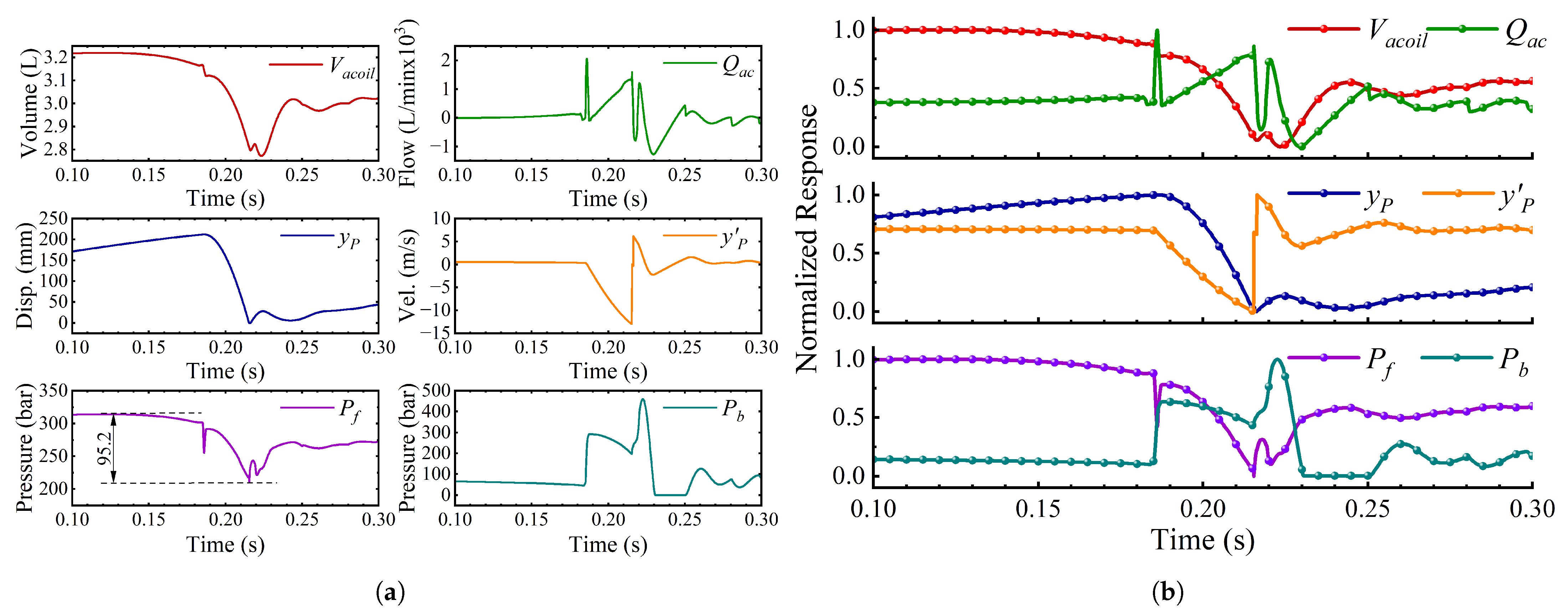
During the piston impact process, the pressures in the front and back chambers exhibit periodic fluctuations, which cause variations in the piston acceleration and consequently affect the impact energy. As the piston moves, the volume of the front chamber is gradually compressed, while that of the back chamber continuously expands. Because the back diameter of the piston is smaller than the front diameter, the volume change in the back chamber is significantly larger than that in the front chamber. The high-pressure oil in the back chamber mainly comes from three sources: the compressed high-pressure oil discharged from the front chamber, the high-pressure oil supplied by the inlet pipeline, and the high-pressure oil released from the accumulator. Among these, the accumulator’s energy release process plays a crucial role in system energy transmission and impact stability. The time-varying curves of the accumulator oil-chamber volume, accumulator flow rate, piston displacement, piston velocity, front chamber pressure, and back chamber pressure during one impact cycle are shown in Figure 8a, and the corresponding normalized response results are shown in Figure 8b.
Figure 8.
Time-varying curves of accumulator oil-chamber volume (), accumulator flow rate (), piston displacement (), piston velocity (), front chamber pressure (), and back chamber pressure (). (a) Original responses. (b) Normalized responses.
As illustrated in Figure 8a, the pressure fluctuation amplitude of the front chamber is approximately 95.2 bar. During the piston stroke phase, the impact velocity gradually increases, and both the front and back chamber pressures decrease to varying degrees. Meanwhile, the accumulator oil-chamber volume continuously decreases, and the accumulator flow rate increases, indicating that the accumulator is releasing high-pressure oil to compensate for the energy output. Since the piston structure parameters and the supply system remain unchanged, the discharge volume of the front chamber and the oil supply from the inlet pipeline are almost constant. Therefore, increasing the accumulator’s oil supply volume during the piston stroke phase is an effective approach to reduce front and back chamber pressure fluctuations and enhance the impact energy.
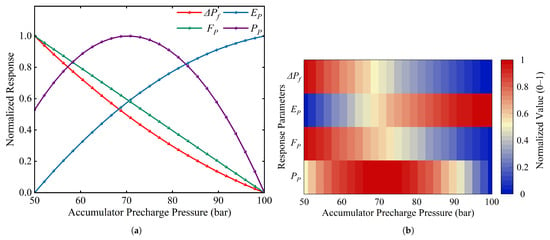
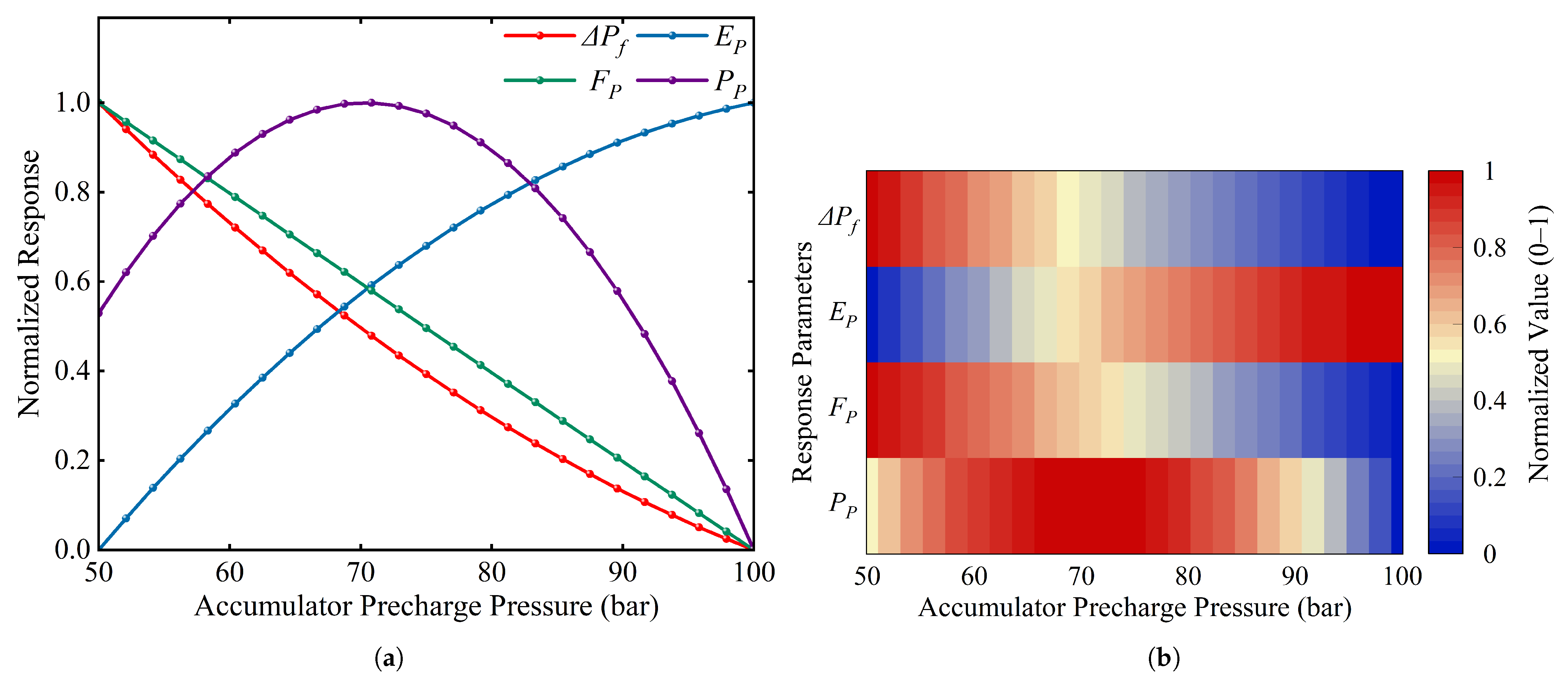
The precharge pressure of the accumulator is a key parameter that affects its energy release and dynamic response characteristics. Figure 9a illustrates the normalized variation relationships of front chamber pressure fluctuation amplitude, impact energy, impact frequency, and impact power under different accumulator precharge pressures. All response parameters were normalized to facilitate quantitative comparison on a unified scale. It can be seen that as the accumulator precharge pressure increases, the amplitude of the front chamber pressure fluctuation significantly decreases, while the impact energy gradually increases. In contrast, the impact frequency shows a decreasing trend. This indicates that increasing the precharge pressure enhances the stability of system energy output; however, an excessively high precharge pressure prolongs the energy release and compensation period, thereby reducing the operating frequency of the system. Because the overall system power is jointly affected by both energy and frequency, it shows a nonlinear variation trend of first increasing and then slowing down. To further reveal the combined influence of the accumulator precharge pressure on multiple response parameters, a normalized heat map was used for visualization, as shown in Figure 9b.
Figure 9.
Influence of accumulator precharge pressure on front chamber pressure fluctuation (), impact energy (), impact frequency (), and impact power (). (a) Normalized variation curves. (b) Normalized heatmap distribution.
In the heat map, colors from blue to red correspond to normalized values ranging from 0 to 1, where red regions represent higher response intensities. It can be observed that when the accumulator precharge pressure is within the range of 70–80 bar, both impact energy and impact power reach relatively high levels, while the front chamber pressure fluctuation is significantly reduced. This indicates that the system exhibits higher energy utilization efficiency and better stability within this pressure range.
In summary, the reasonable setting of accumulator precharge pressure has a significant impact on the performance of the hydraulic impact system. Moderately increasing the precharge pressure can effectively suppress front chamber pressure fluctuations and enhance impact energy, whereas excessively high precharge pressure reduces impact frequency. Therefore, it is necessary to achieve an optimal balance between energy output and frequency response to obtain the best impact performance.
4.2. Pressure Difference Between the Front and Back Chambers
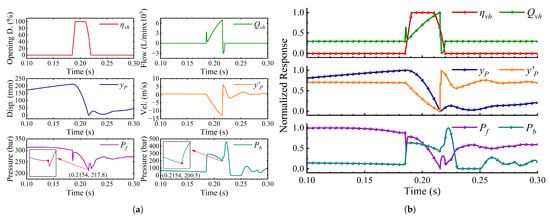
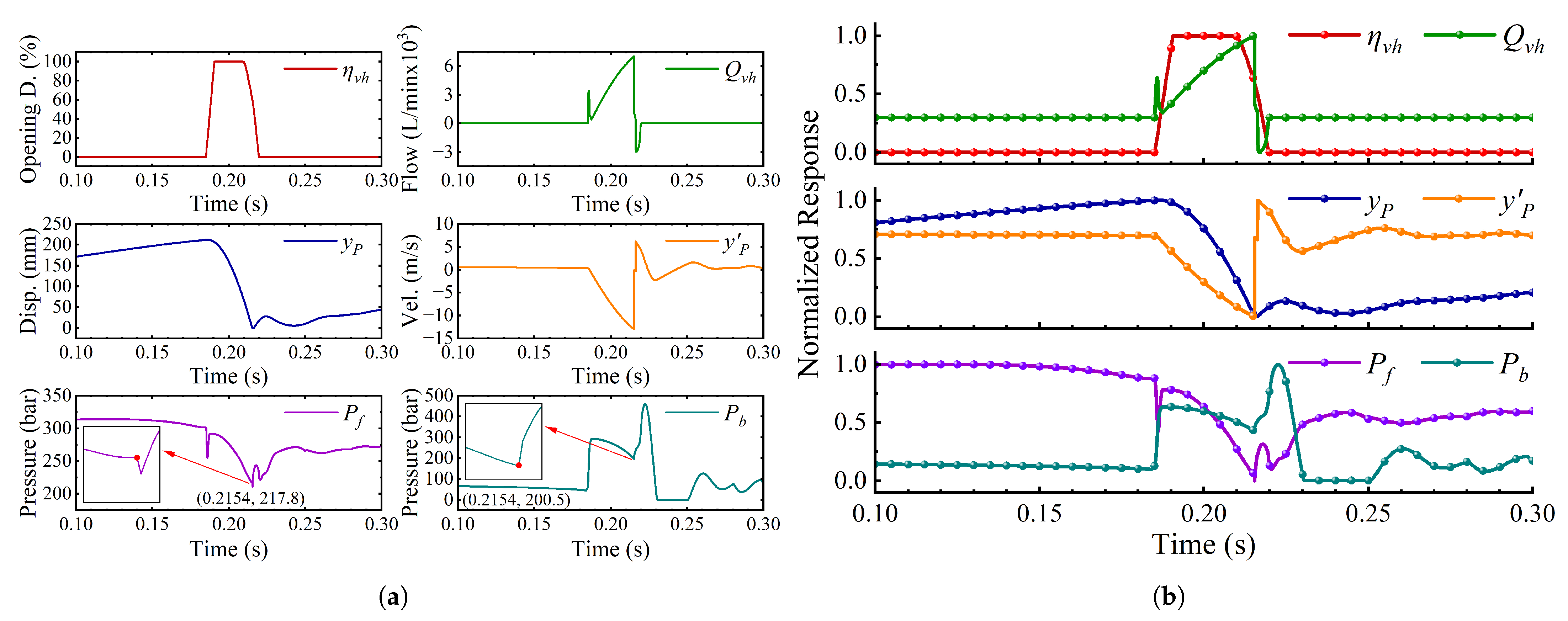
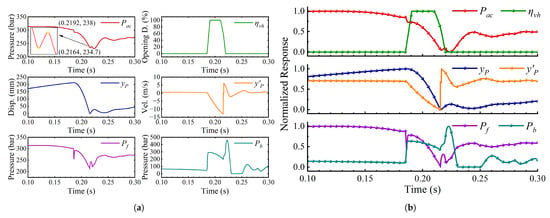
During the hydraulic impact process, the pressure in the back chamber remains lower than that in the front chamber. The pressure difference between the front and back chambers gradually increases as the piston moves, thereby reducing the piston impact acceleration and affecting the impact energy. In the impact process, the high-pressure oil in the front chamber is compressed and, together with the high-pressure oil supplied by the inlet pipeline and released from the accumulator, flows into the back chamber through the high-pressure port of the reversing valve. It is thus evident that the high-pressure valve port of the reversing valve serves as the only passage connecting the front and back chambers. All high-pressure oil must pass through this port to achieve energy transmission, and its opening degree and flow characteristics directly determine the system pressure distribution and impact performance. The variation curves of the valve-port opening, valve-port flow rate, piston displacement, piston velocity, front chamber pressure, and back chamber pressure are shown in Figure 10a, and the corresponding normalized responses are shown in Figure 10b.
Figure 10.
Time-varying curves of high-pressure valve port opening (), high-pressure valve port flow rate (), piston displacement (), piston velocity (), front chamber pressure (), and back chamber pressure (). (a) Original responses. (b) Normalized responses.
As illustrated in Figure 10, the opening of the high-pressure valve port increases at the end of the piston return phase, maintains this value for a short time, and then decreases during the mid-to-late piston stroke phase. When the high-pressure valve port just opens, the flow rate surges instantaneously due to the large pressure difference between the front and back chambers. As the valve-port opening further increases, the pressure difference quickly decreases. During the period when the valve port remains fully open, the piston velocity continues to rise, the front chamber volume is gradually compressed, and the back chamber volume continuously expands; the high-pressure oil flows from the front chamber to the back chamber through the valve port. Meanwhile, the pressure difference between the front and back chambers gradually increases, and the valve-port flow rate also increases. When the piston moves to the position where the signal chamber is connected to the low-pressure chamber, the high-pressure valve port opening begins to decrease. Subsequently, as the piston velocity continues to increase, the pressure difference between the front and back chambers rapidly rises and reaches its maximum at the instant when the piston impacts the drill rod. As illustrated in Figure 10a, upon the impact of the piston on the drill rod, the pressure in the front chamber is measured at 217.8 bar, while the pressure in the back chamber is measured at 200.5 bar. The maximum pressure difference between the front and back chambers during the stroke phase is approximately 17.3 bar.
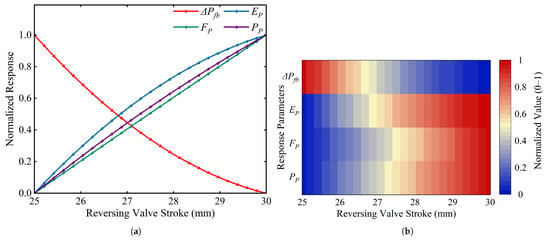
Comprehensive analysis indicates that the pressure difference between the front and back chambers gradually increases with time during the piston stroke phase and reaches its maximum when the piston velocity peaks. The pressure difference is a key factor affecting the impact energy, while the effective opening of the high-pressure valve port determines the efficiency of pressure transmission. The reversing valve stroke is the key structural parameter influencing the valve-port opening characteristics and flow-regulation capability.
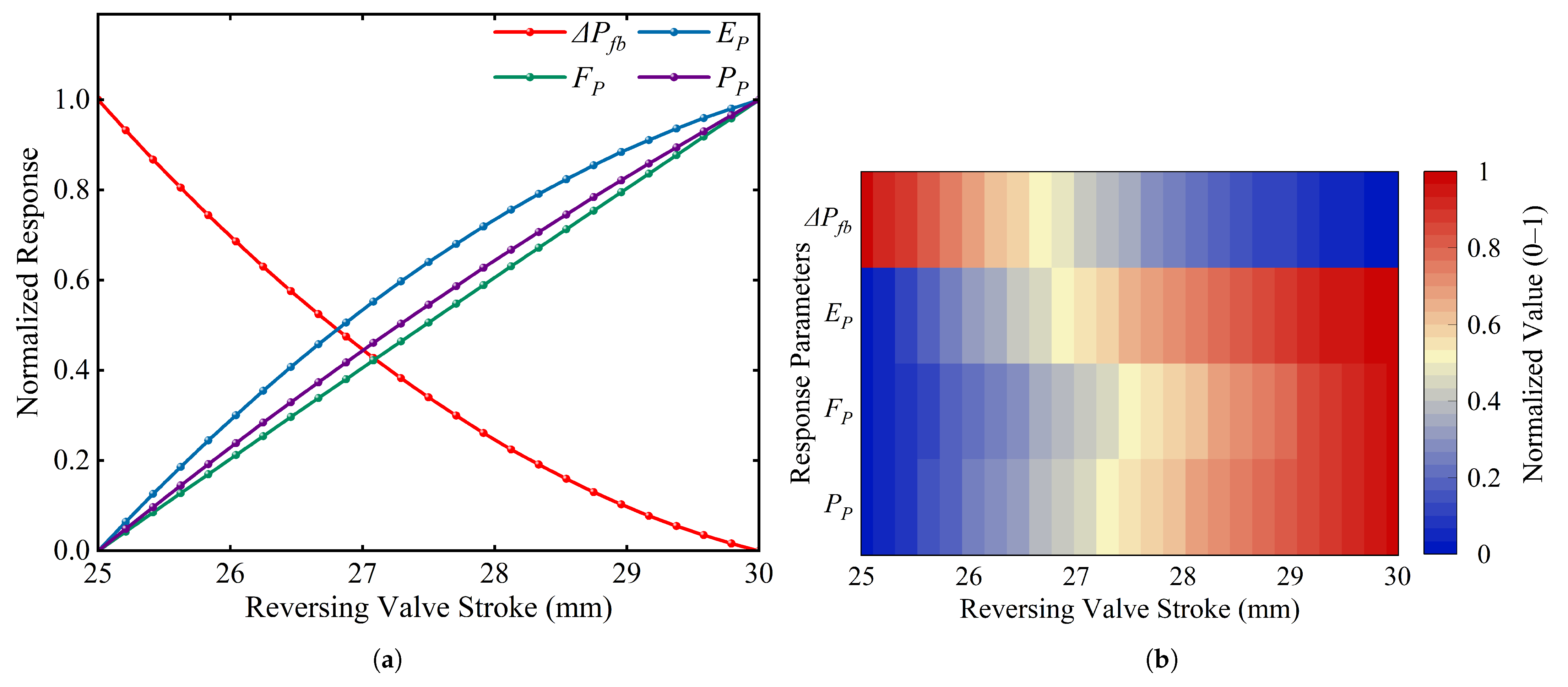
To further investigate the influence of structural parameters on impact performance, Figure 11a shows the normalized variation relationships between the reversing valve stroke and the maximum pressure difference between the front and back chambers, impact energy, impact frequency, and impact power, while Figure 11b presents the corresponding heat-map distribution.
Figure 11.
Influence of reversing valve stroke on the maximum pressure difference between the front and back chambers (), impact energy (), impact frequency (), and impact power (). (a) Normalized variation curves. (b) Normalized heatmap distribution.
As illustrated in Figure 11, with an increase in the valve stroke, the maximum pressure difference between the front and back chambers gradually decreases, whereas the impact energy, impact frequency, and impact power all increase accordingly. An increased valve stroke enlarges the effective flow area of the high-pressure port, improving oil-flow conditions and reducing throttling losses, thereby enhancing energy-transfer efficiency and system stability. In summary, a reasonable design of the reversing valve stroke plays an important role in improving the performance of the hydraulic impact system. Moderately increasing the valve stroke can effectively reduce the maximum pressure difference between the front and back chambers and improve both impact energy and power output. However, an excessively large stroke may lead to commutation delay and structural complexity; therefore, it is necessary to comprehensively consider response speed and flow characteristics to achieve the optimal matching of valve structural parameters.
4.3. Rebound Energy Storage
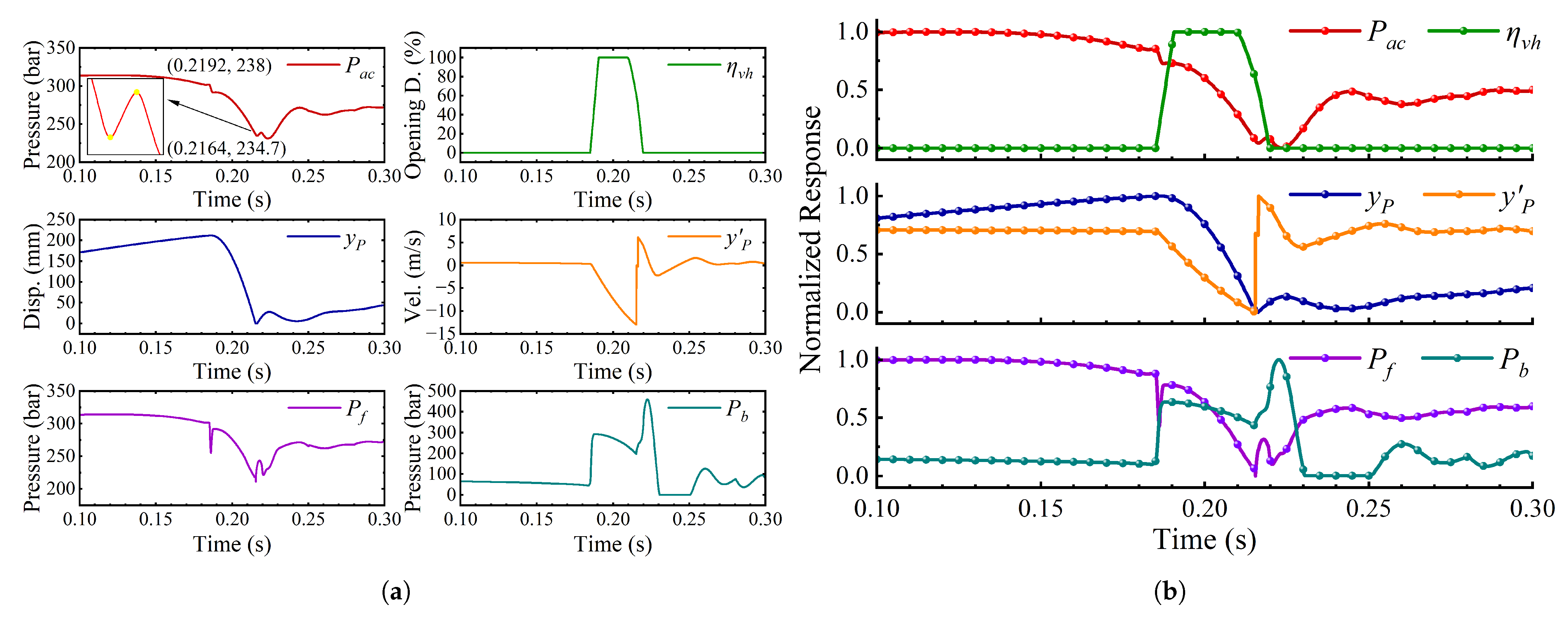
During the impact cycle of a hydraulic impact hammer, the piston possesses considerable kinetic energy during the rebound phase. If the high-pressure valve port of the reversing valve remains open during this stage—thereby keeping the front and back chambers connected—the high-pressure oil in the back chamber is compressed into the front chamber and the accumulator through the reversing valve. This process converts the piston’s kinetic energy into hydraulic pressure energy, nitrogen pressure energy, and piston gravitational potential energy. The oil compressed into the accumulator represents the specific manifestation of rebound energy storage and will participate in doing work in the next piston stroke. This is the principle of rebound energy storage. It is evident that rebound energy storage not only improves energy-recovery efficiency but also enhances the impact frequency and operational continuity of the system. The time-varying curves of the accumulator gas-chamber pressure, reversing valve high-pressure port opening, piston displacement, piston velocity, front chamber pressure, and back chamber pressure are shown in Figure 12a, and the corresponding normalized response curves are shown in Figure 12b.
Figure 12.
Time-varying curves of accumulator gas-chamber pressure (), high-pressure valve port opening (), piston displacement (), piston velocity (), front chamber pressure (), and back chamber pressure (). (a) Original responses. (b) Normalized responses.
As illustrated in Figure 12, at the beginning of the piston re-bound motion, the high-pressure valve port remains open, maintaining the connection between the front and back chambers. The high-pressure oil in the back chamber is compressed into the front chamber and the accumulator through the reversing valve, causing the accumulator gas-chamber pressure to rise. As the rebound phase progresses, the high-pressure valve port opening gradually decreases and eventually closes. During this process, the accumulator gas-chamber pressure gradually increases, and the rebound energy storage continuously grows. The calculation results indicate that the accumulator gas-chamber pressures and are 234.7 bar and 238 bar, respectively. The initial accumulator gas-chamber volume is 5 L, and the precharge pressure is 75 bar. The calculated rebound energy storage is approximately 520 J, and the corresponding rebound energy storage power is 1.22 kW.
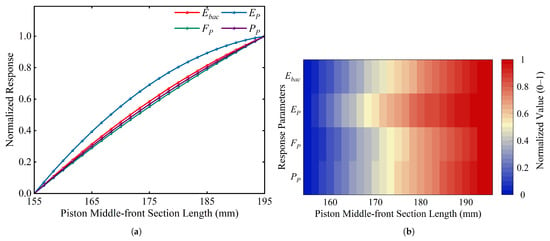
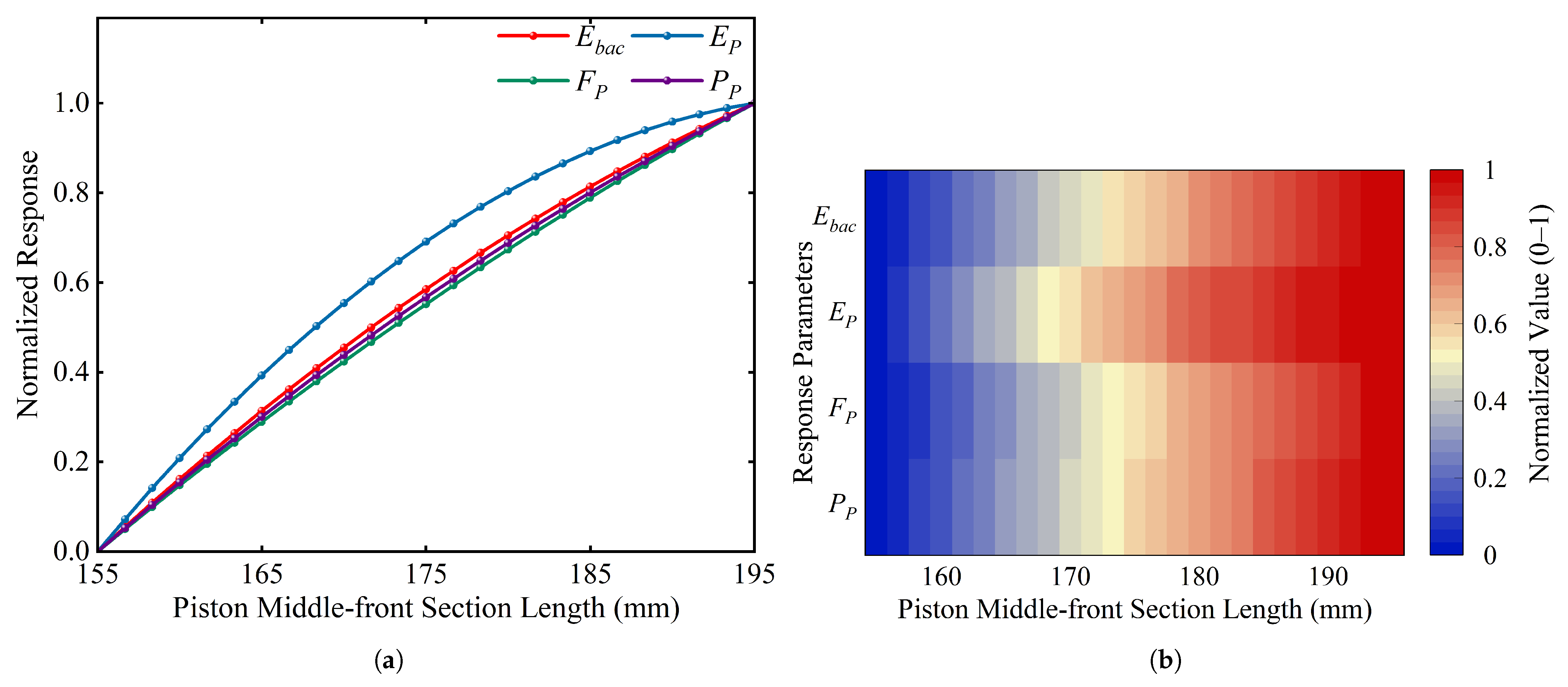
Rebound energy storage is a key factor influencing the impact frequency of hydraulic impact hammers. The closing timing of the reversing valve directly determines the duration of energy conversion during the rebound phase. The length of the piston middle-front section affects the timing of the connection between the signal chamber and the outlet pipe, thereby influencing the closing timing of the reversing valve. It is thus an important geometric parameter controlling the re-bound energy-storage behavior. The variation laws of rebound energy storage, impact energy, impact frequency, and impact power under different lengths of the piston middle-front section are shown in Figure 13a, and the corresponding normalized heat-map distributions are shown in Figure 13b.
Figure 13.
Influence of the length of the piston middle-front section on rebound energy storage (), impact energy (), impact frequency (), and impact power (). (a) Normalized variation curves. (b) Normalized heatmap distribution.
As illustrated in Figure 13a, with the increase in the length of the piston middle-front section, the rebound energy storage increases significantly, and the impact energy, impact frequency, and impact power all exhibit monotonic growth trends. This demonstrates that appropriately increasing the length of the piston middle-front section can delay the closing timing of the high-pressure valve port, thereby extending the rebound-phase duration and enabling more kinetic energy to be converted into accumulator pressure energy. As a result, the overall energy-utilization efficiency of the system is improved. The heat map in Figure 13b intuitively characterizes the coordinated variation among multiple response parameters through color gradients, where deeper colors correspond to higher normalized response values. It can be clearly observed that increasing the length of the piston middle-front section enhances rebound energy storage and improves the impact energy, impact frequency, and impact power of the system.
5. Optimization of Impact Performance
5.1. Response Contribution Analysis
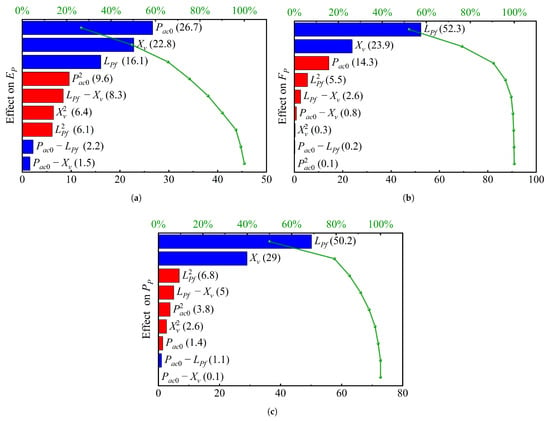
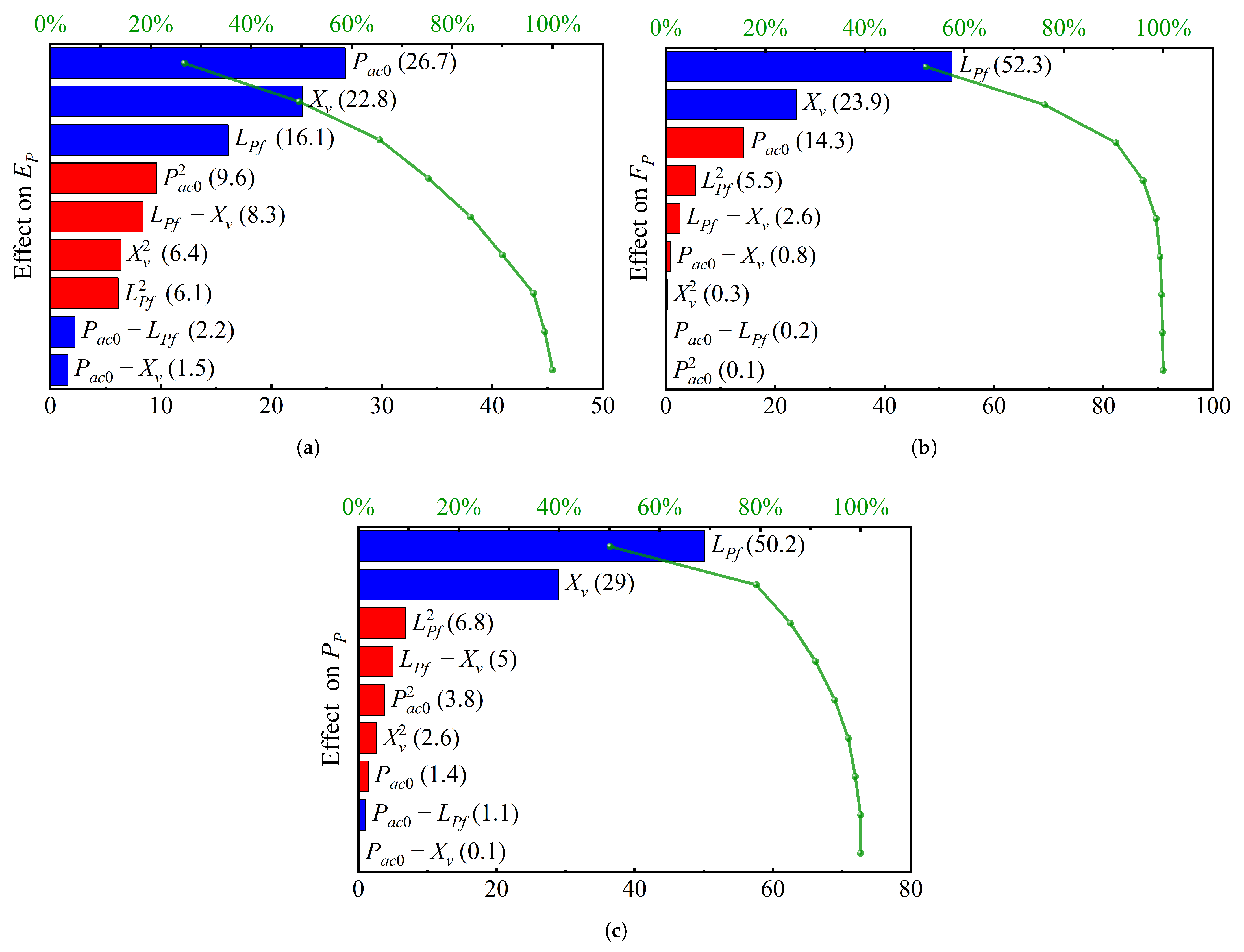
The accumulator precharge pressure, reversing valve stroke, and piston middle-front section length are all critical parameters that influence impact energy, impact frequency, and impact power. The Optimized Latin Hypercube (OLH) sampling method was employed for Design of Experiments (DOE) analysis to evaluate the response contributions of accumulator precharge pressure, reversing valve stroke, and piston middle-front section length to impact performance. Furthermore, the sampling number is set to 100. The lower limit for accumulator precharge pressure () is 50 bar, and the upper limit is 100 bar. The lower limit for reversing valve stroke () is 25 mm, and the upper limit is 30 mm. The lower limit for piston middle-front section length () is 155 mm, and the upper limit is 195 mm. The Pareto charts illustrating the influence of these three factors on impact energy, impact frequency, and impact power are shown in Figure 14. In addition, the Analysis of Variance (ANOVA) tables for impact energy, impact frequency, and impact power are presented in Table 4.
Figure 14.
Pareto charts of , , and . (a) Impact energy. (b) Impact frequency. (c) Impact power.
Table 4.
ANOVA tables.
As illustrated in Figure 14, the accumulator precharge pressure, reversing valve stroke, and the length of the piston middle-front section are all positively correlated with impact energy. Among them, the accumulator precharge pressure exhibits the largest response contribution of 26.7%, whereas the piston middle-front section length shows the smallest contribution of 16.1%. The reversing valve stroke and piston middle-front section length are both positively correlated with FP, while the accumulator precharge pressure is negatively correlated; the contribution of the piston middle-front section length reaches a maximum of 52.3%. Similarly, the reversing valve stroke and piston middle-front section length are positively correlated with PP, whereas the accumulator precharge pressure shows a negative correlation; the piston middle-front section length again exhibits the greatest response contribution of 50.2%. There are certain interaction effects between the accumulator precharge pressure, reversing valve stroke, and piston middle-front section length on , , and , indicating the coupled relationships among these parameters in determining the overall performance of the hydraulic impact hammer.
5.2. Optimization Calculation Example
Impact power is the most critical indicator reflecting the hydraulic impact performance, as it integrates both impact energy and impact frequency. During the product design stage of a hydraulic impact hammer, maximizing impact power should be established as the primary design criterion, with focus on three key influencing factors: front chamber pressure fluctuation, maximum pressure difference between the front and back chambers during the piston stroke, and rebound energy storage. An optimization calculation example for a hydraulic impact hammer is presented as follows.
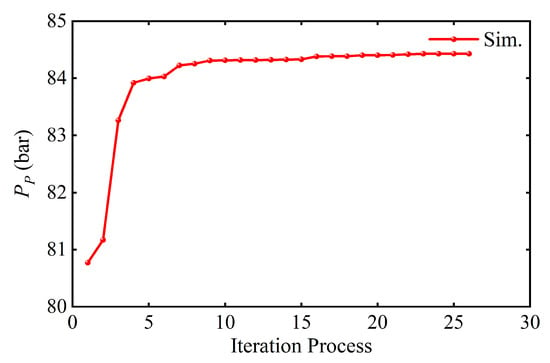
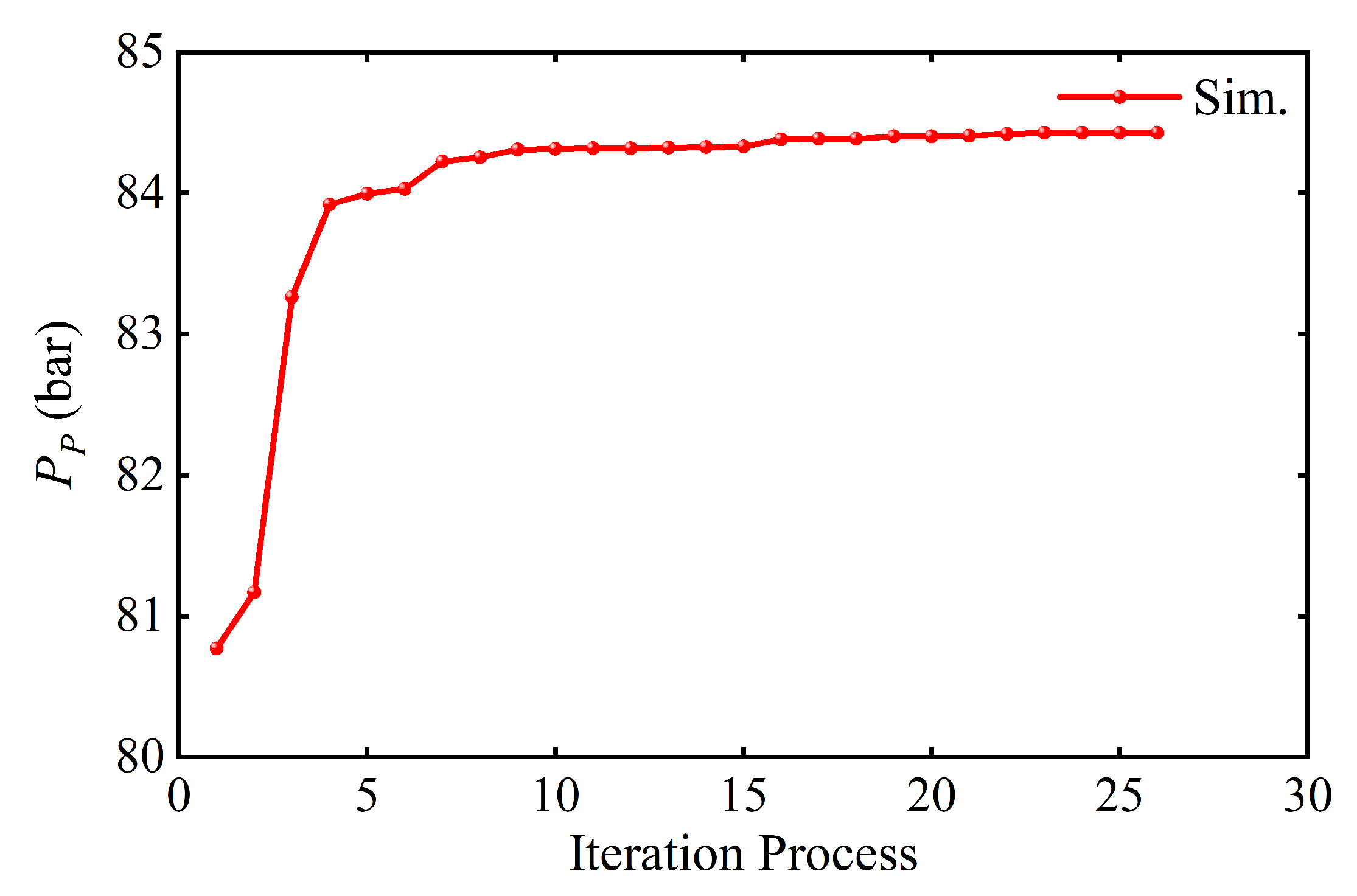
Taking the accumulator precharge pressure, reversing valve stroke, and length of the piston middle-front section as design variables, the optimization objective is to maximize the impact power. Meanwhile, the front chamber pressure fluctuation, pressure difference between the front and back chambers, and rebound energy storage are required to be superior to those of the original scheme. Based on engineering practice, the design-variable ranges are defined as follows, and the corresponding constraint conditions are summarized in Table 5. These defined variables and constraints were then applied in the optimization process using the multi-island genetic algorithm (MIGA). The algorithm parameters were configured as follows: Sub-population Size = 15; Number of Islands = 15; Number of Generations = 40; Rate of Crossover = 1.0; Rate of Mutation = 0.01; Rate of Migration = 0.01; Interval of Migration = 5; Elite Size = 1. The iterative curve of impact power optimization is shown in Figure 15. The parameters and impact performance indicators before and after optimization are listed in Table 6.
Table 5.
Design-variable ranges and constraint conditions.
Figure 15.
Impact power optimization iteration curve.
Table 6.
Comparison of parameters and impact performance before and after optimization.
After optimization: front chamber pressure fluctuation decreased by 0.53%; maximum pressure difference during the piston stroke decreased by 60.69%; rebound energy storage increased by 228.65%; impact energy increased by 1.37%; impact frequency increased by 6.38%; and impact power increased by 8.26%.
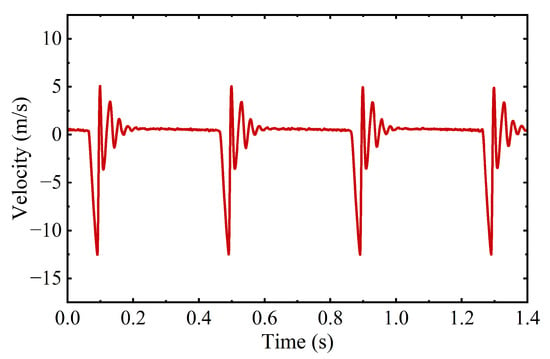
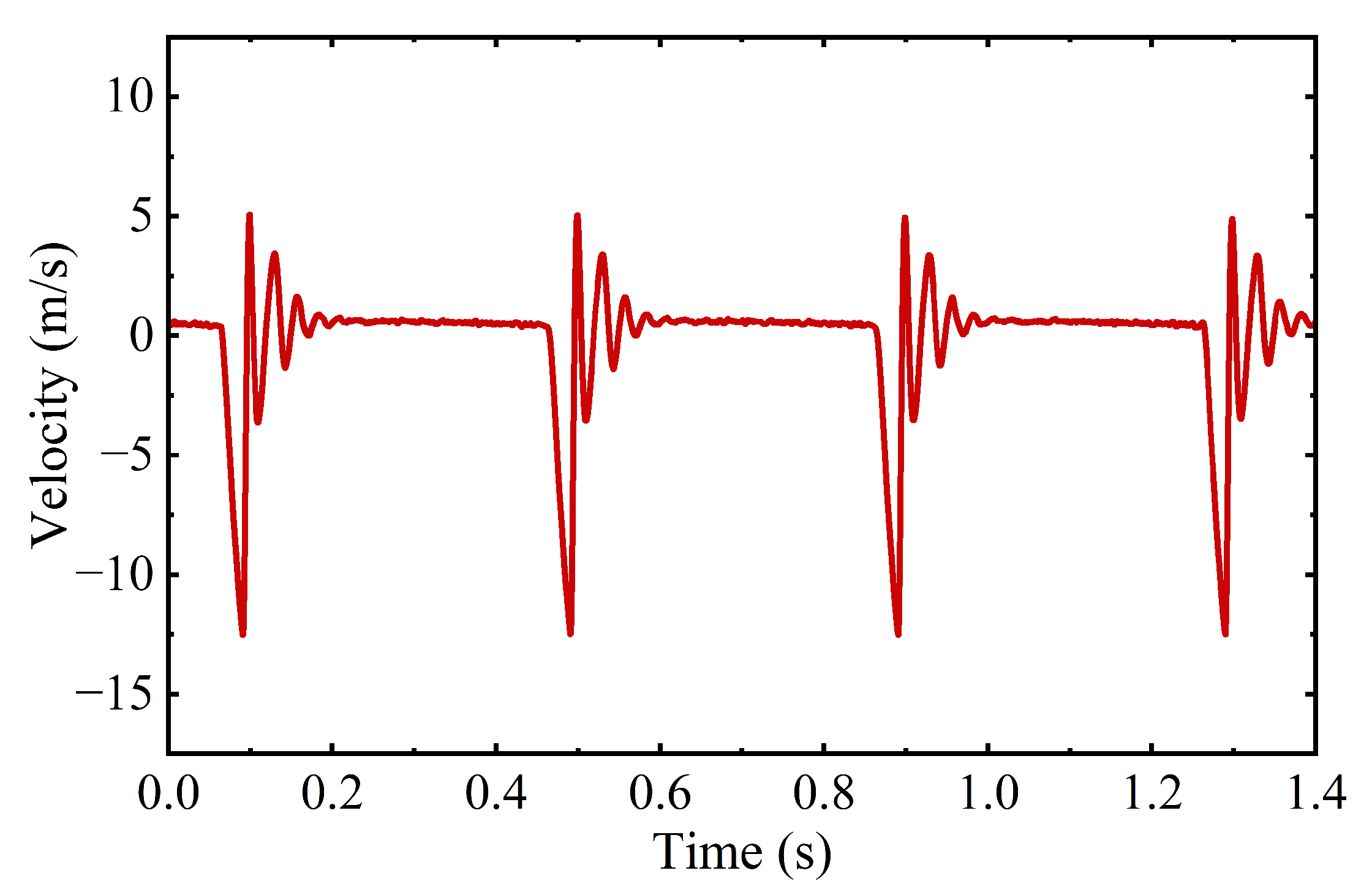
The experimental curve of the piston velocity subsequent to optimization is presented in Figure 16. As illustrated in Figure 16, the impact velocity is approximately 12.40 m/s, and the impact frequency is approximately 2.50 blows/s. Through calculation, the impact energy is determined to be approximately 31,113 J, and the impact power is calculated to be approximately 77.78 kW. Compared with the experimental results of the original scheme, the impact energy increased by 1.31%, the impact frequency increased by 6.38%, and the impact power increased by 7.78%.
Figure 16.
Experimental curve of piston velocity for the optimized scheme.
Therefore, by taking maximum impact power as the design criterion and constraining the front chamber pressure fluctuation, maximum pressure difference, and rebound energy storage, the hydraulic impact hammer can achieve better impact performance through a rational design of the accumulator precharge pressure, reversing valve stroke, and piston middle-front section length. This paper provides a clear example of the optimal design for the maximum impact power of a hydraulic impact hammer. In order to enhance the impact performance, hydraulic impact hammers of varying dimensions can be designed according to the maximum impact power design criterion. Consequently, within the domain of engineering practice, ensuring that hydraulic impact hammers deliver superior impact performance necessitates the adherence to the design principle of maximizing impact power during the product design phase.
6. Conclusions
In this study, a numerical calculation model of the impact performance of a hydraulic impact hammer was established. The calculated results for the hydraulic impact hammer show an impact velocity of approximately 12.83 m/s, impact energy of 33,255 J, impact frequency of 2.35 blows/s, impact power of 78 kW, impact force of 9714 kN, rebound velocity of 6.18 m/s, rebound energy of 7715 J, rebound power of 18 kW, rebound energy storage of 520 J, and rebound energy storage power of 1.22 kW. An experimental system for the hydraulic impact hammer was also constructed, including oil-pressure tests, piston motion experiments, stress-wave measurements, and accumulator gas-chamber pressure tests. The comparison between simulation and experimental results for front chamber pressure, back chamber pressure, signal-chamber pressure, piston displacement, piston velocity, stress wave, and accumulator gas-chamber pressure demonstrated good agreement, confirming the high accuracy of the proposed numerical model.
Three key factors influencing impact performance were analyzed: pressure fluctuation between the front and back chambers, pressure difference, and rebound energy storage. The effects of working and structural parameters on these three factors were investigated. Further, the response contributions of the accumulator precharge pressure, reversing valve stroke, and piston middle-front section length to impact energy, impact frequency, and impact power were evaluated. The results show that all three parameters are positively correlated with impact energy, with the accumulator precharge pressure contributing the most (26.7%) and the piston middle-front section length contributing the least (16.1%). The reversing valve stroke and piston middle-front section length are positively correlated with impact frequency, while the accumulator precharge pressure is negatively correlated; the contribution of the piston middle-front section length is the highest (52.3%). For impact power, the reversing valve stroke and piston middle-front section length are positively correlated, whereas the accumulator precharge pressure shows a negative correlation, and the length of the piston middle-front section contributes the most (50.2%). There exist certain interaction effects among these parameters on impact energy, frequency, and power.
This paper proposes a design criterion of maximum impact power for hydraulic impact hammers. During product design, taking impact power maximization as the design objective and optimizing the accumulator precharge pressure, reversing valve stroke, and piston middle-front section length can significantly improve performance. For the analyzed hydraulic impact hammer, optimization resulted in an 8.26% increase in impact power, leading to better overall impact performance. In summary, this study provides a reliable theoretical foundation and experimental validation for the study of hydraulic impact performance, offering a clear example for the design and optimization of hydraulic impact hammers. Nevertheless, certain limitations remain. Due to the complexity of the numerical model, the optimization-solving efficiency is relatively low. Future work will focus on developing an accurate and efficient surrogate model for hydraulic impact hammers to improve solution efficiency and provide a more effective tool for assisted optimization design.
Author Contributions
Conceptualization, H.C.; Methodology, H.C. and Z.L.; Validation, H.C. and H.G.; Formal analysis, H.C. and D.H.; Investigation, H.C., B.S. and J.P.; Writing—original draft preparation, H.C.; Writing—review and editing, B.S.; Supervision, B.S.; Project administration, B.S. All authors have read and agreed to the published version of the manuscript.
Funding
This research was funded by the National Key Research and Development Program of China (Grant No. 2021YFB3401502) and the National Natural Science Foundation of China (Grant No. 52275108).
Institutional Review Board Statement
Not applicable.
Informed Consent Statement
Not applicable.
Data Availability Statement
Data are contained within the article.
Conflicts of Interest
The authors declare no conflicts of interest.
Abbreviations
The following abbreviations are used in this manuscript:
| c | Wave velocity, m/s |
| E | Piston Young’s modulus, MPa |
| Rebound energy storage, J | |
| Impact energy, J | |
| Rebound energy, J | |
| Impact force, N | |
| Impact frequency, blows/s | |
| k | Nitrogen isentropic index, adiabatic process k = 1.4 |
| Piston length, mm | |
| Length of piston middle-front section, mm | |
| Distance from a piston section to piston impact interface, mm | |
| Drill rod length, mm | |
| Distance from a drill rod section to impact inteface, mm | |
| Accumulator gas-chamber pressure, bar | |
| Accumulator precharge pressure, bar | |
| Rebound energy storage power, bar | |
| Impact power, W | |
| Rebound power, W | |
| Stress-wave reflection coefficient of drill rod impacting rock | |
| Accumulator flow rate, L/min | |
| High-pressure valve port flow rate, L/min | |
| Time for the stress wave to propagate to the free boundary of the piston, s | |
| Time for the stress wave to propagate to the penetration boundary of the drill rod, s | |
| Impact velocity, m/s | |
| Accumulator oil-chamber volume, L | |
| Rebound velocity, m/s | |
| Reversing valve stroke, mm | |
| Piston displacement, mm | |
| Reversing valve displacement, mm | |
| Front chamber pressure fluctuation, bar | |
| Maximum pressure difference between the front and back chambers, bar | |
| High-pressure valve port opening, % | |
| Piston Impact Stress, MPa | |
| Drill rod impact stress, MPa |
References
- Giuffrida, A.; Laforgia, D. Modelling and simulation of a hydraulic breaker. Int. J. Fluid Power 2005, 6, 47–56. [Google Scholar] [CrossRef] [Scilit]
- Shin, D.Y.; Kwon, K.B. A study on performance optimization of a hydraulic breaker. Trans. Korean Soc. Mech.-Eng.-A 2011, 35, 677–682. [Google Scholar] [CrossRef] [Scilit]
- Oh, J.Y.; Lee, G.H.; Kang, H.S.; Song, C.S. Modeling and performance analysis of rock drill drifters for rock stiffness. Int. J. Precis. Eng. Manuf. 2012, 13, 2187–2193. [Google Scholar] [CrossRef] [Scilit]
- Yang, G.; Chen, Y.; Chen, B. Dynamic performance research on reversing valve of hydraulic breaker. World J. Mech. 2012, 2, 288–296. [Google Scholar] [CrossRef]
- Ye, X.H.; Miao, X.L.; Cen, Y.W. Modeling and simulation for hydraulic breaker based on screw-in cartridge valves. Appl. Mech. Mater. 2012, 229, 1697–1701. [Google Scholar] [CrossRef] [Scilit]
- Li, L.S.; Meng, X.D.; Li, H.X.; Tian, S.J. Simulation for dynamic characteristics of hydraulic breaker. Adv. Mater. Res. 2013, 663, 537–544. [Google Scholar] [CrossRef] [Scilit]
- Hu, Q.; Yang, C.; Zheng, H.; Chen, M. Dynamic simulation and test research of impact performance of hydraulic rock drill with no constant-pressurized chamber. Autom. Constr. 2014, 37, 211–216. [Google Scholar] [CrossRef] [Scilit]
- Xu, Z.; Yang, G.; Wei, H.; Ni, S. Dynamic performance analysis of gas-liquid united hydraulic hammer. Engineering 2015, 7, 499–505. [Google Scholar] [CrossRef]
- Xu, Z.; Yang, G. Modeling and simulation of hydraulic hammer for sleeve valve. Engineering 2016, 8, 657–668. [Google Scholar] [CrossRef]
- Guo, Y.; Liu, D.; Yang, S.; Li, X.; Chen, J. Hydraulic–mechanical coupling modeling by bond graph for impact system of a high frequency rock drill drifter with sleeve distributor. Autom. Constr. 2016, 63, 88–99. [Google Scholar] [CrossRef] [Scilit]
- Noh, D.K.; Kang, Y.K.; Cho, J.S.; Jang, J.S. Case study on impact performance optimization of hydraulic breakers. SpringerPlus 2016, 5, 1102. [Google Scholar] [CrossRef] [Scilit] [PubMed]
- Franco, W.; Ferraresi, C. A model-based methodology for rapid designing of hydraulic breakers. Int. J. Fluid Power 2017, 18, 102–110. [Google Scholar] [CrossRef] [Scilit]
- Redelin, R.A.; Kravchenko, V.A.; Kamanin, Y.N.; Panichkin, A.V.; Bozhanov, A.A. Study of effect of in-line hydropneumatic accumulators on output characteristics of hydraulic hammer. In Proceedings of the IOP Conference Series: Earth and Environmental Science, Saint-Petersburg, Russian, 23–24 March 2017. [Google Scholar]
- Yang, S.; Ou, Y.; Guo, Y.; Wu, X. Analysis and optimization of the working parameters of the impact mechanism of hydraulic rock drill based on a numerical simulation. Int. J. Precis. Eng. Manuf. 2017, 18, 971–977. [Google Scholar] [CrossRef] [Scilit]
- Yin, Y.; Cai, W. Analysis of hydraulic hammer capacity under different inclination. In Proceedings of the 2019 2nd World Conference on Mechanical Engineering and Intelligent Manufacturing (WCMEIM), Shanghai, China, 22–24 November 2019. [Google Scholar]
- Andersson, H.; Simonsson, K.; Hilding, D.; Schill, M.; Sigfridsson, E.; Leidermark, D. Validation of a co-simulation approach for hydraulic percussion units applied to a hydraulic hammer. Adv. Eng. Softw. 2019, 131, 102–115. [Google Scholar] [CrossRef] [Scilit]
- Galdin, N.; Semenova, I.; Galdin, V. Analysis of the striker stroke impact on the hydropneumatic impact devices energy performance. In Proceedings of the Journal of Physics: Conference Series, Omsk, Russian, 23–24 April 2019. [Google Scholar]
- Yu, J.; Wang, Z.; Zhang, H. Research on pressure pulsation of piling hammer hydraulic system based on AMESim. In Proceedings of the IOP Conference Series: Earth and Environmental Science, Ordos, China, 24–25 April 2021. [Google Scholar]
- Li, Y. Research on the matching of impact performance and collision coefficient of hydraulic rock drill. Shock Vib. 2021, 2021, 6651860. [Google Scholar]
- Kim, S.H.; Chung, J.; Baek, D.C.; Park, J.W. Modeling and Simulation for Predicting the Impact of Hydraulic Breaker. J. Korea-Acad.-Ind. Coop. Soc. 2019, 20, 741–749. [Google Scholar]
- Kim, S.H.; Park, J.W.; Kim, J.H. Comparative analysis of machine learning approaches to predict impact energy of hydraulic breakers. Processes 2023, 11, 772. [Google Scholar] [CrossRef] [Scilit]
- Yang, Z.; Li, J.; Yu, G. Influence of piston mass and working pressure on the impact performance of a hydraulic rock drill using the stress wave method. Machines 2023, 11, 987. [Google Scholar] [CrossRef] [Scilit]
- Li, J.; Dai, L.; Wang, S.; Liu, Y.; Sun, Y.; Wang, J.; Zhang, A. Theoretical and numerical analysis of the rock breaking process by impact hammer. Powder Technol. 2024, 448, 120254. [Google Scholar] [CrossRef] [Scilit]
- Lee, W.J.; Jang, J.S.; Kang, Y.K. Correlation Between Gap Leakage and Blow Force of Hydraulic Breakers. J. Drive Control 2024, 21, 145–151. [Google Scholar]
- Zheng, Y.; Su, Z.; Li, J.; Wang, Z.; Xu, Y.; Li, X.; Che, P. Energy transfer efficiency and rock damage characteristics of a hydraulic impact hammer with different tool shapes. Int. J. Impact Eng. 2024, 188, 104933. [Google Scholar] [CrossRef] [Scilit]
- Chen, H.; Shi, B.; Guo, H. Numerical Simulation and Experimental Study of Piston Rebound Energy Storage Characteristics for Nitrogen-Hydraulic Combined Impact Hammer. Machines 2025, 13, 97. [Google Scholar] [CrossRef] [Scilit]

Disclaimer/Publisher’s Note: The statements, opinions and data contained in all publications are solely those of the individual author(s) and contributor(s) and not of MDPI and/or the editor(s). MDPI and/or the editor(s) disclaim responsibility for any injury to people or property resulting from any ideas, methods, instructions or products referred to in the content. |
© 2026 by the authors. Licensee MDPI, Basel, Switzerland. This article is an open access article distributed under the terms and conditions of the Creative Commons Attribution (CC BY) license.