1. Introduction
With the continuous improvement in the application proportion of clean energy in the power system, such as wind power and photovoltaic energy, the inherent randomness and intermittence of clean energy pose a serious challenge to the frequency regulation and voltage support ability of power grids [
1,
2,
3]. As a key technology to balance the dynamic imbalance between power supply and demand, the energy storage system realizes energy storage and release through “peak shaving and valley filling” and has become a core solution to improve the capacity of new energy consumption. Among the many energy storage technologies, gravity energy storage is especially suitable for large-scale-power-grid peak-shaving applications due to its high intrinsic safety, strong site selection flexibility, and zero self-discharge rate. Compared with pumped storage, limited by geographical conditions, as well as the life cycle and environmental protection problems of electrochemical energy storage, gravity energy storage achieves the efficient conversion of electric energy and potential energy through weight lifting, showing significant technical and economic potential [
4,
5,
6,
7,
8].
Gravity energy storage systems can be divided into energy storage tower energy storage systems, shaft energy storage systems, and slope energy storage systems [
9]. The mechanical transmission structure of the energy storage tower is complex, and the energy storage capacity is limited by the height of the tower. The slope energy storage system has a simple structure and is the most widely used gravity energy storage system. However, there are also the problems of the large friction and low overall efficiency of the system. At present, it is often difficult to balance factors such as the power generation efficiency and complex system structure of gravity energy storage systems, which has become the main problem restricting their development [
10,
11,
12]. The shaft energy storage system needs underground space, which creates the problems of high environmental maintenance and difficult mechanical design. However, the shaft-type energy storage system can be transformed by using fully exploited mines. Such mines are usually fully reinforced at the production stage, and the depths are often less than 500 m. During the transformation, the underground space can be used to arrange the automatic energy storage block warehouse, so it can be put to use only by simple equipment transformation.
In addition, traditional gravity energy storage systems generally rely on wire rope traction or gear transmission mechanisms, and their inherent contact friction loss not only greatly reduces their energy conversion efficiency but also leads to the continuous mechanical wear of contact parts [
13]. In contrast, the gravity energy storage system, directly driven by linear motors, does not require a transmission link and has high transmission efficiency. At the same time, multiple linear motors can be arranged inside the shaft to reduce the power of the single machine [
14,
15]. The traditional linear motor, whether the permanent magnet synchronous linear motor or asynchronous linear motor, has a high cost, which is not conducive to the commercialization of direct-drive gravity energy storage by linear motors. The cost of asynchronous linear motors is lower than that of permanent magnet linear synchronous motors, but the stator also needs to be equipped with conductors and is difficult to control. As a new type of linear motor, the flux-switching permanent magnet linear motor (SFPMLSM) places permanent magnets and windings on the mover, and the stator only needs a track made of magnetic conductive material, which greatly reduces the overall cost of the system [
16,
17,
18,
19].
The frequent switching of heavy lifting/lowering conditions allows the mechanical transmission mechanism to withstand periodic impact loads, which cause the severe oscillation of the generator’s output torque. This instantaneous power fluctuation is transmitted to the generator end through the transmission chain, resulting in the amplitude pulsation and frequency flicker of the grid-connected current [
20]. In gravity energy storage systems, the most important things are to improve the power quality when connected to the grid and reduce the harmonics of the voltage and current. From the perspective of governance, measures to reduce harmonics can be divided into “source suppression” [
21,
22,
23,
24,
25], “path blocking” [
25,
26], and “grid side governance” [
27,
28]. In the harmonic suppression strategy, the source suppression effect is the best, and no additional hardware equipment is required. A three-level inverter is an effective measure to suppress harmonics, with a larger number of synthesized voltage vectors and lower complexity in the control strategy [
21,
22]. In Ref. [
24], a three-level inverter harmonic compensation strategy is proposed, which can effectively suppress the grid-connected power harmonics. A three-level neutral-point-clamped converter system is proposed in [
25] to ensure voltage balance between DC poles under all operating conditions.
In order to solve the above problems, this paper proposes a linear-motor direct-drive gravity energy storage system and constructs a systematic energy transfer path promotion scheme of “linear-motor machine-side control network-side coordination”. By using the SFPMLSM to replace the traditional mechanical transmission mechanism, the system significantly improves the overall efficiency and reliability of the system while eliminating mechanical losses and maintenance requirements, and it is more suitable for the application characteristics of the long-term cyclic operation of gravity energy storage. At the control-side level, a double-closed-loop-coordinated control strategy based on the accurate observation of electromagnetic thrust is proposed to form an adaptive control mechanism under the dual operation conditions of power generation and energy storage, which ensures the operation stability and energy conversion efficiency during the smooth lifting and lowering of the gravity block. At the grid-side control level, a multi-level energy regulation architecture for grid compatibility is constructed, and a harmonic collaborative suppression strategy based on three-level topology is proposed to effectively enhance the response ability of the system to grid dispatching instructions and the grid-connected power quality so as to support the flexible regulation function of gravity energy storage in the grid.
The rest of this paper is organized as follows:
Section 2 systematically elaborates on the topology architecture of the LMDD-GESS and constructs a mathematical model for bidirectional energy conversion.
Section 3 discusses the optimization of the electromagnetic performance of the SFPMLSM and the utilization of the end magnetic block structure to suppress thrust fluctuations.
Section 4 presents a collaborative control framework between the motor side and grid side, with the dual-closed-loop vector control system established on the machine side to ensure a dynamic response performance. Moreover, on the grid side, a harmonic suppression strategy based on three-level inverters is developed, combined with the phase carrier modulation technology to achieve high-quality grid connection. The proposed power-smoothing control scheme through multi-unit system simulation is verified in
Section 5, and the designs of the speed trajectory optimization and a unit cooperative switching mechanism to ensure continuous and stable power output are presented.
2. Topology and Modeling of Linear-Motor Direct-Drive Gravity Energy Storage System
2.1. Topology Design of LMDD-GESS
Gravity energy storage systems can use the electrical energy of the system during periods of low grid loading to drive motor equipment and lift heavy objects, converting electrical energy into potential energy for storage. When the grid requires power, the heavy objects are lowered to release potential energy, which is then reconverted into electrical energy by the motor equipment and fed back to the grid. The entire process enables the bidirectional conversion between electrical energy and mechanical energy, effectively balancing the supply–demand relationship. This paper proposes a gravity energy storage system directly driven by a SFPMLSM, which can effectively solve the problems of the complex structure and low system efficiency in traditional gravity energy storage systems.
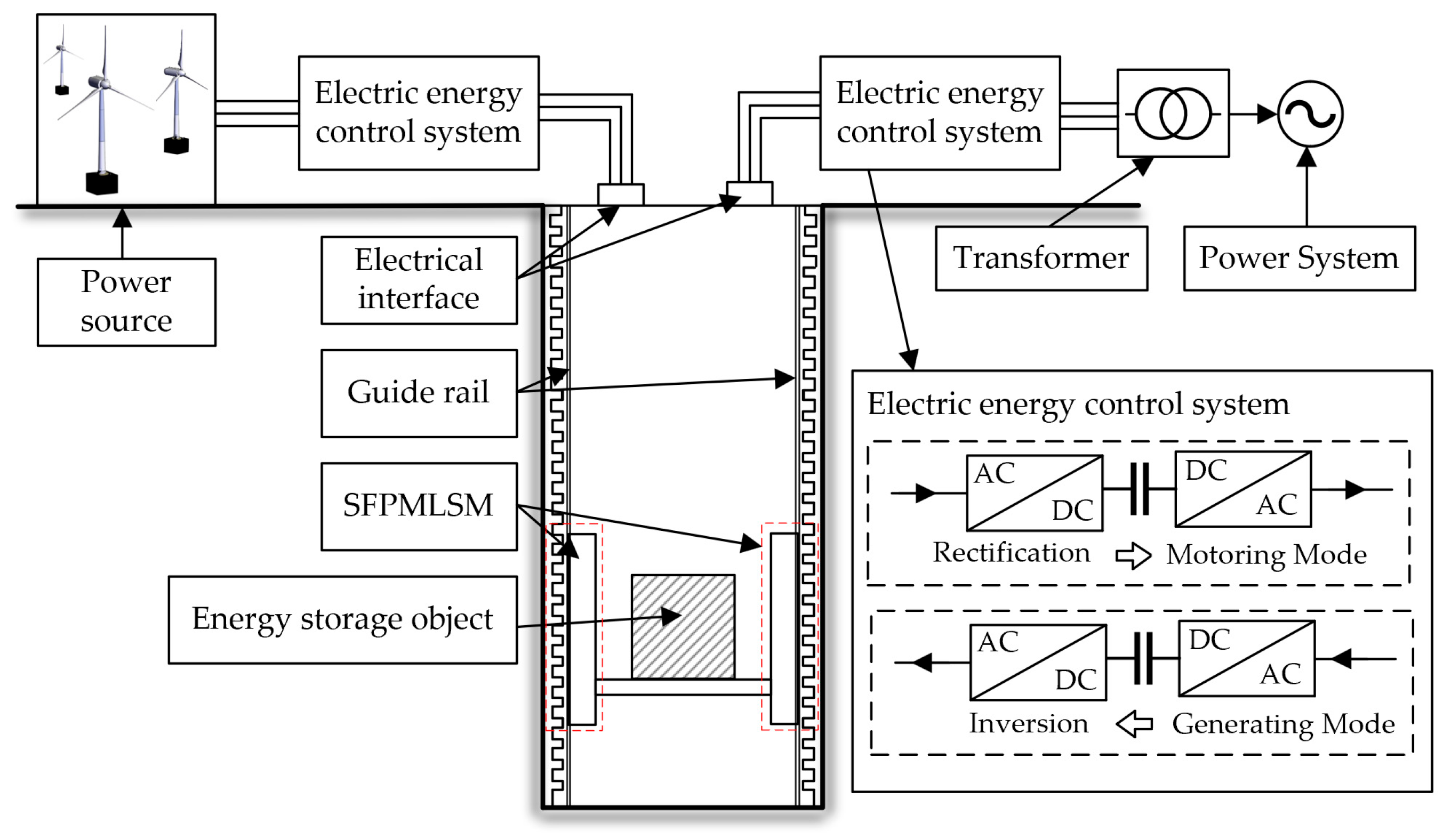
A critical aspect of the LMDD-GESS topology is the method of power transfer to the moving unit. The system employs a segmented rail power supply system with enforced sliding contacts. The stator is divided into multiple electrically isolated segments along the vertical shaft, forming a “traveling power window” where only the segments adjacent to the mover are energized at any given time. The mover is equipped with robust, spring-enforced collector shoes that maintain continuous electrical connection with the energized stator segments. This approach, scaling up technology proven in high-power industrial cranes and mining hoists, is particularly suitable for the linear, predictable, and relatively slow-moving path of the gravity storage mover. It effectively replaces high-maintenance mechanical transmissions with a more manageable electrical interface, enabling efficient megawatt-scale power transfer while minimizing the length of the energized conductor to reduce losses and enhance safety. The topological structure of the system is shown in
Figure 1.
The LMDD-GESS proposed in this paper includes a power source, an electric energy control system, an SFPMLSM, an energy storage object, a transformer, and the power grid. Among them, the power source is a renewable energy power generation device, and the power system refers to the large-scale power grid after grid connection. The electric energy control system includes two pieces of electric energy conversion equipment: one between the power source and the SFPMLSM, and the other between the SFPMLSM and the power system. When the system operates in the energy storage electric mode, the electric energy from the power source drives the SFPMLSM through rectification and inversion, converting the electric energy into the gravitational potential energy of the energy storage object; when the system is in the power generation mode, the potential energy of the energy storage object serves as an energy source to drive the SFPMLSM to operate in the power generation state, and then the power is connected to the grid through inversion and rectification.
Traditional gravity energy storage systems use rotating motors to drive steel cable transmission systems to convert electrical energy into gravitational potential energy. This not only affects the energy conversion efficiency of the system but also requires frequent maintenance. In this paper, a flux-switching permanent magnet linear-motor direct-drive energy storage system is adopted to eliminate the need for cables. By using a salient pole design on the stator side of the linear motor, the cost is effectively reduced, and the system efficiency is improved.
2.2. Dynamic Modeling of LMDD-GESS
The LMDD-GESS establishes a bidirectional energy conversion mechanism between gravitational potential energy and electrical energy. This system leverages the direct-drive characteristics of the SFPMLSM, eliminating intermediate transmission mechanisms to significantly reduce frictional losses. The core dynamic model integrates electromagnetic, mechanical, and energy conversion relationships to form a unified mathematical framework. This paper integrates the electromagnetic, mechanical, and energy conversion relationships under various working states, forming a unified mathematical framework.
The fundamental motion of the system is governed by Newtonian mechanics, where the electromagnetic thrust (
Fem) generated by the SFPMLSM interacts with gravitational forces and mechanical resistance. The motion equation expresses the net acceleration of the mass block along the vertical axis:
where
m is the total mass of the energy storage object, SFPMLSM mover, and load-bearing platform;
z is the displacement of the system in the vertical direction;
Gm is the total gravity of the energy storage object, SFPMLSM mover, and load-bearing platform;
Ff is the frictional force related to the operating speed;
c is the damping coefficient; and Δ
Fem is the vertical thrust disturbance during operation.
The electromagnetic thrust of the SFPMLSM originates from the interaction between the permanent magnet flux linkage and q-axis current, as follows:
where
τ is the magnetic pole width of the SFPMLSM;
Ψf is the permanent magnet magnetic flux;
Ld and
Lq are the d-axis and q-axis inductances, respectively;
id and
iq are the d-axis and q-axis currents, respectively.
When the LMDD-GESS is in an electric state, the SFPMLSM overcomes frictional forces (
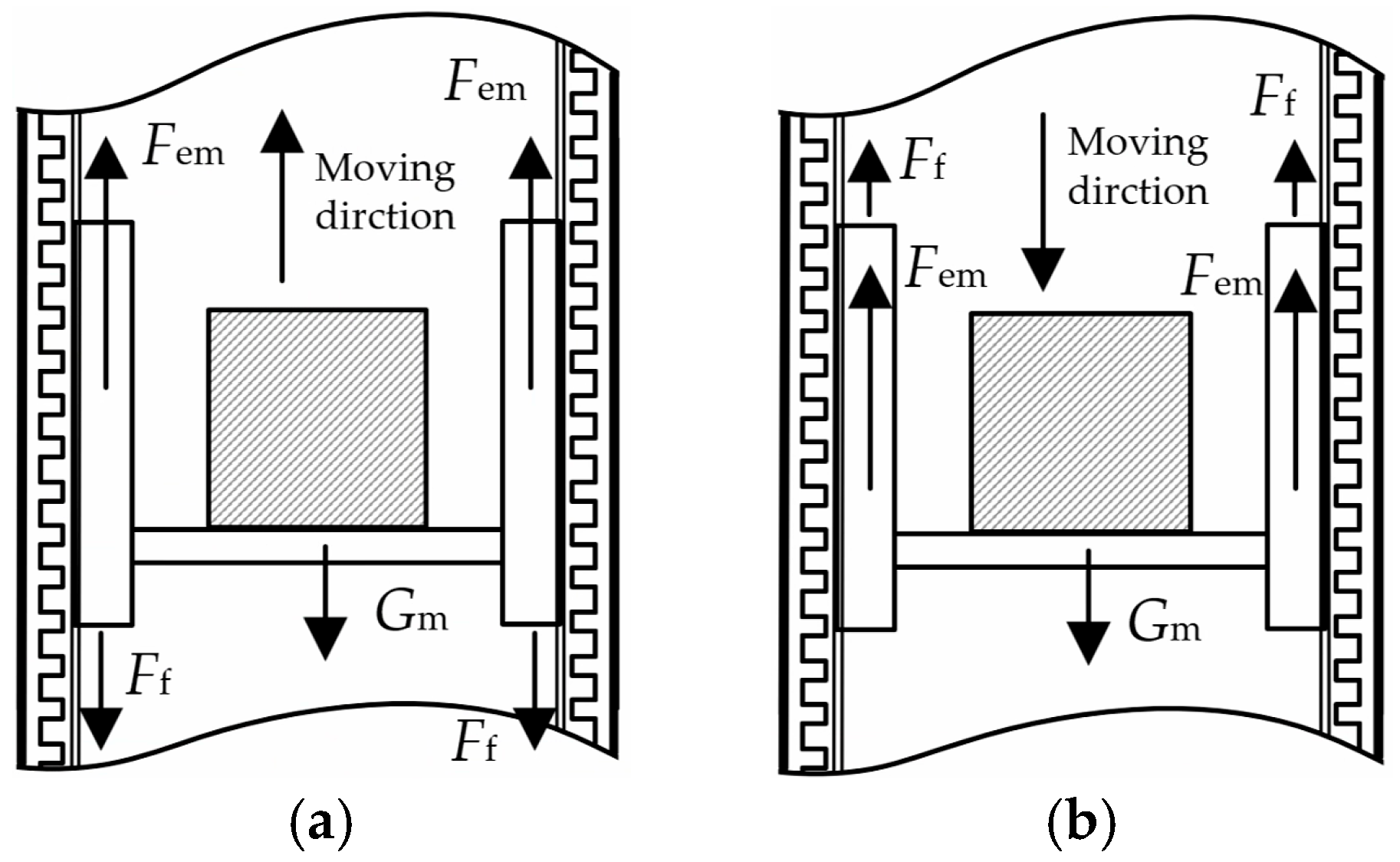
Ff) and damping forces to push the energy storage object upward. When operating in a power generation state, the gravitational potential energy of the energy storage object is converted into electrical energy output through the SFPMLSM. The working status of the system is shown in
Figure 2.
From (1) and
Figure 2, it can be seen that the stable output of
md
z2/d
t2 by the system according to design requirements depends on the fast and accurate output of electromagnetic thrust by the SFPMLSM under the designed control strategy, effectively compensating for various thrust disturbances. Thrust disturbances include frictional resistance and other vertical disturbances. The energy conversion efficiency of the system depends on the loss of various disturbance forces and the operational efficiency of the SFPMLSM. Therefore, this requires both an efficient and reliable SFPMLSM design, as well as effective control strategies for the real-time observation and compensation of disturbances.
For the LMDD-GESS proposed in this paper, the energy conversion efficiency can be expressed as follows:
The left side of the equal sign in (3) represents the change in potential energy;
Pgrid is the power provided by the power source or output to the power system;
Ploss is the power loss caused by disturbance force; and γ(
v) is the efficiency function, which can be expressed as follows:
During the energy storage process, the input power of the power grid needs to be amplified to overcome conversion losses; during the power generation process, the potential energy output decreases before being injected into the grid.
3. Performance Optimization of SFPMLSM
As analyzed in the previous section, the energy conversion efficiency of the LMDD-GESS is mainly determined by the SFPMLSM. Therefore, improving the efficiency of the SFPMLSM and reducing its thrust fluctuations are crucial for enhancing the system performance. This section presents the optimization of the design of the SFPMLSM based on the performance requirements of gravity energy storage systems in order to improve the energy conversion efficiency of the LMDD-GESS. The requirements for gravity energy storage systems are shown in
Table 1.
A SFPMLSM was designed based on the requirements of gravity energy storage systems, and its efficiency and thrust fluctuation were optimized using the finite element method [
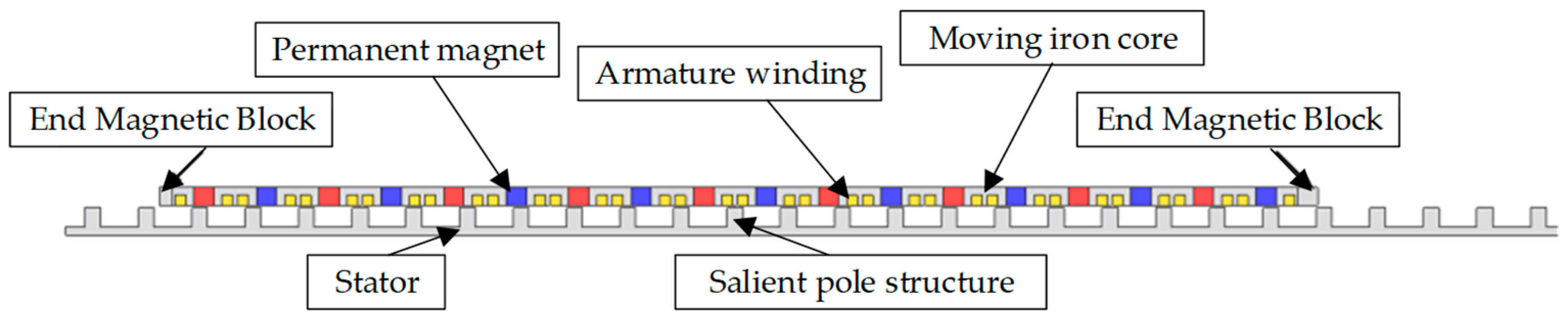
29]. The basic structure of the SFPMLSM is shown in
Figure 3, and the optimized SFPMSTM parameters are shown in
Table 2. The schematic diagram of the winding arrangement is shown in
Figure 4. The positive and negative signs in
Figure 4 indicate the direction of current flow, with the inflow plane being positive and the outflow plane being negative.
Due to the unique phenomenon of end disconnection, linear motors may experience additional end forces at the end, which can affect electromagnetic thrust fluctuations. In this study, we added two magnetic blocks at the end of the moving iron core to improve the problems of magnetic leakage and air gap imbalance at the double ends of the linear motor.
The end force of the SFPMLSM can be expressed as follows [
30]:
where
Aen is the amplitude of the nth harmonic of the end force;
Lt and
Lb are the magnetic block widths of the left ends;
Rt and
Rb are the magnetic block widths of the left ends;
θen is the phase of the nth harmonic.
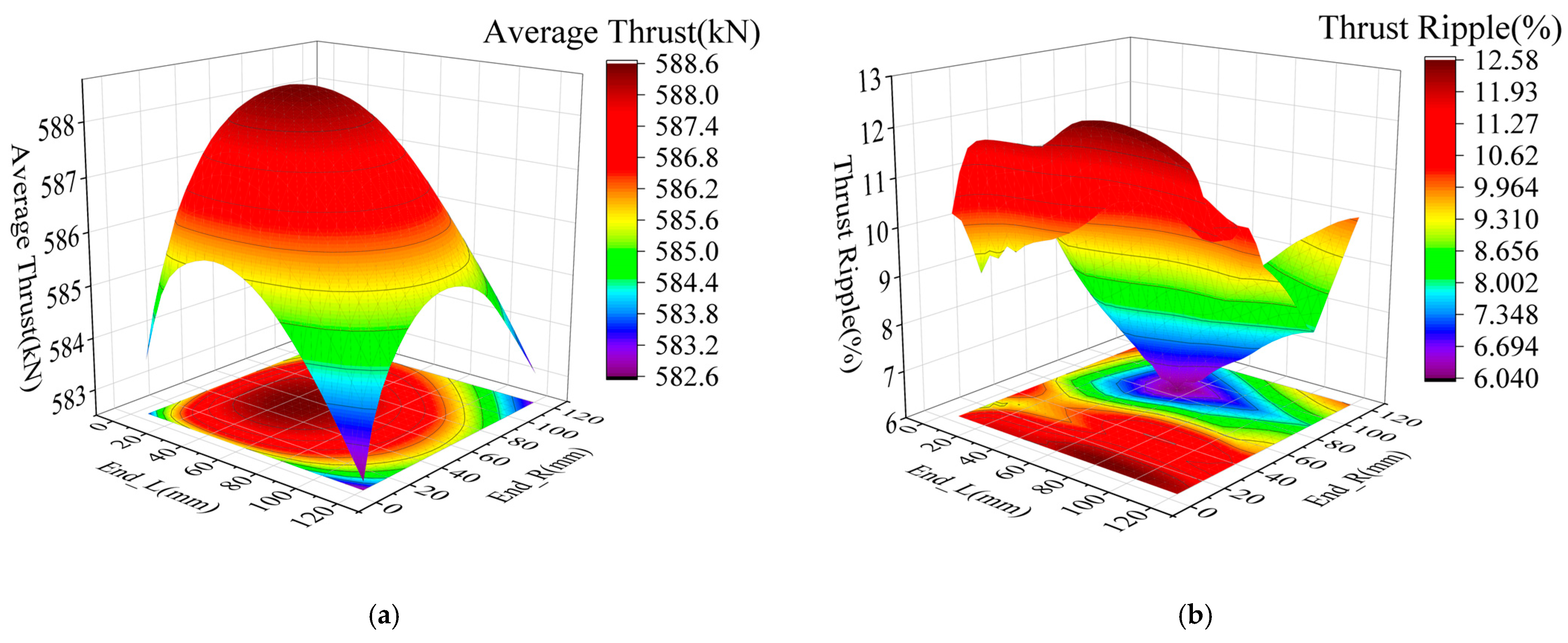
It can be seen that changing the width of the end magnetic block can suppress the end force and thus suppress thrust fluctuations. In this study, we optimize the width of the double-sided magnetic blocks, as shown in
Figure 5.
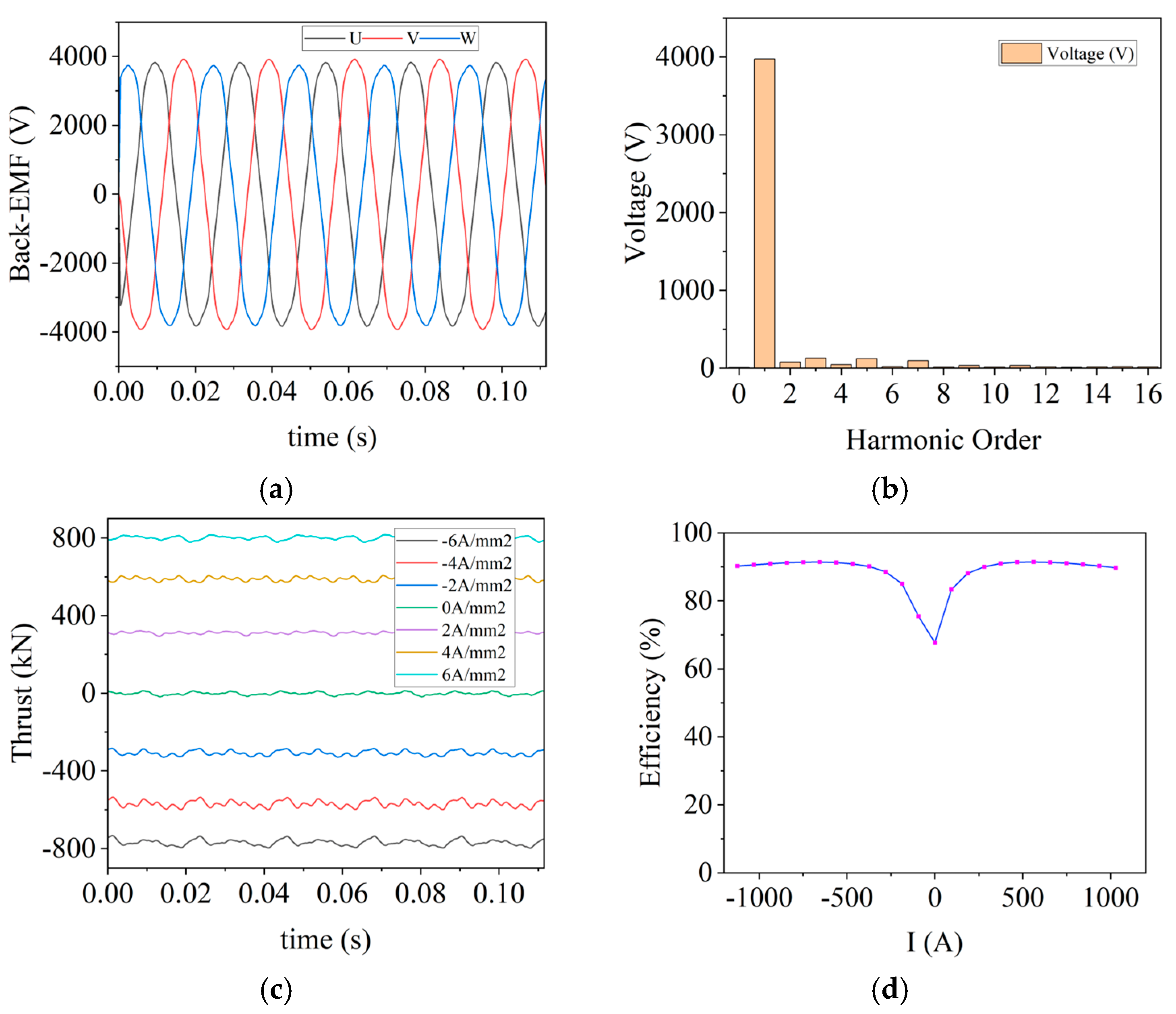
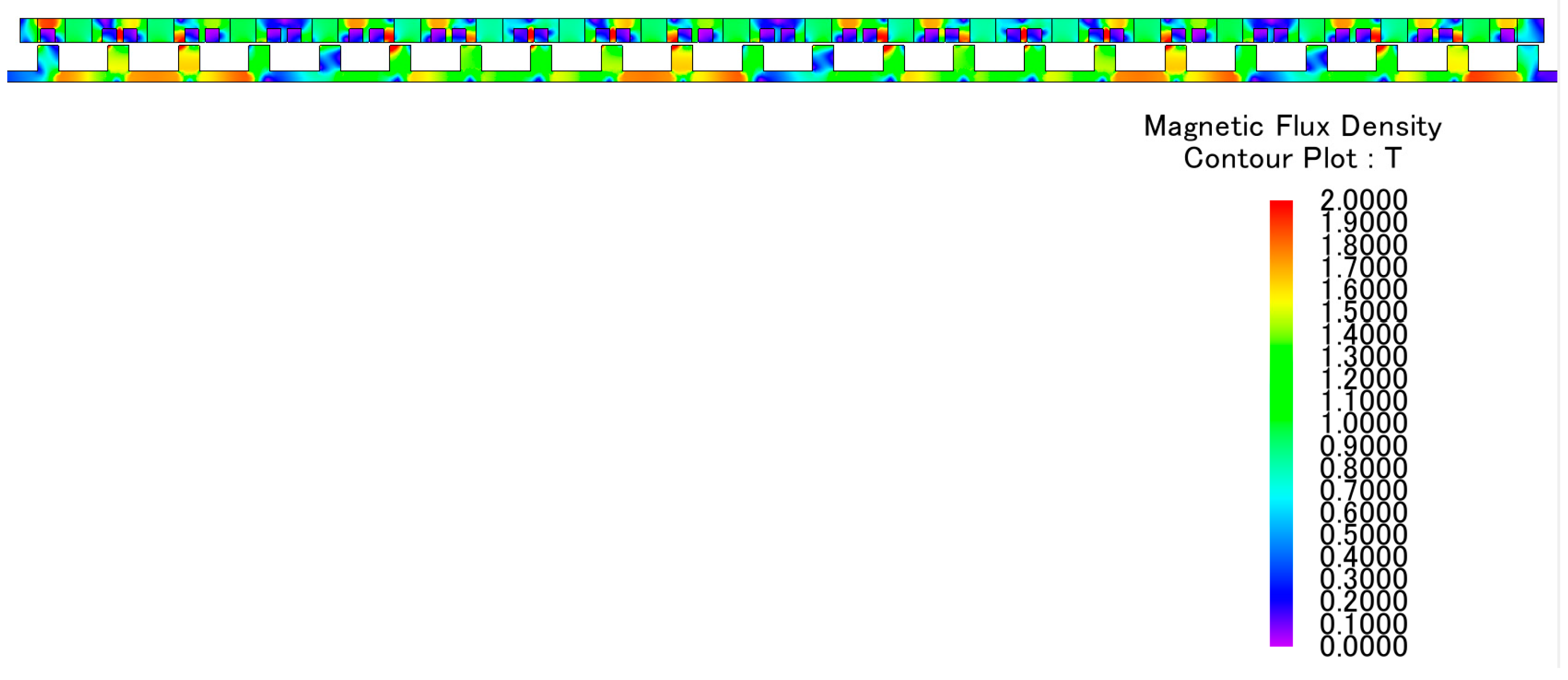
The influence of the end magnetic block on the average thrust of the motor is relatively low, with an overall impact of less than 1%. The influence of the end magnetic block on the thrust fluctuation of the motor is significant. When the width of the left magnetic block is 55 mm and the width of the right magnetic block is 85 mm, the thrust fluctuation is the smallest, at 6.04%. The back electromotive force of the SFPMLSM and the electromagnetic thrust at different currents are shown in
Figure 6. The flux density distribution under the current density of 4 A/mm
2 is shown in
Figure 7. The maximum flux density is approximately 1.9 T, primarily concentrated in the teeth of the mover.
After optimization, the harmonic content of the back electromotive force of the SFPMLSM is very low, and the electromagnetic thrust fluctuation is also low. Under both power generation and energy storage conditions, the SFPMLSM can ensure an efficiency of around 93%. High efficiency also ensures the overall high efficiency of the LMDD-GESS.
4. SFPMLSM and Grid-Connected Collaborative Control Strategy
The efficiency of the SFPMLSM in energy conversion is determined by the efficiency of the motor, on the one hand, and the harmonic suppression strategy and thrust ripple suppression strategy of the control system, on the other. Therefore, we designed the SFPMLSM control system and grid-connected strategy for the requirements of the LMDD-GESS. When the SFPMLSM works in the energy storage condition, the motor needs to convert the electric energy of the power source in
Figure 2a into the potential energy of the energy storage object, which is the electric energy storage condition. Corresponding to it is the power generation condition of
Figure 2b.
4.1. Vector Control Model of LMDD-GESS
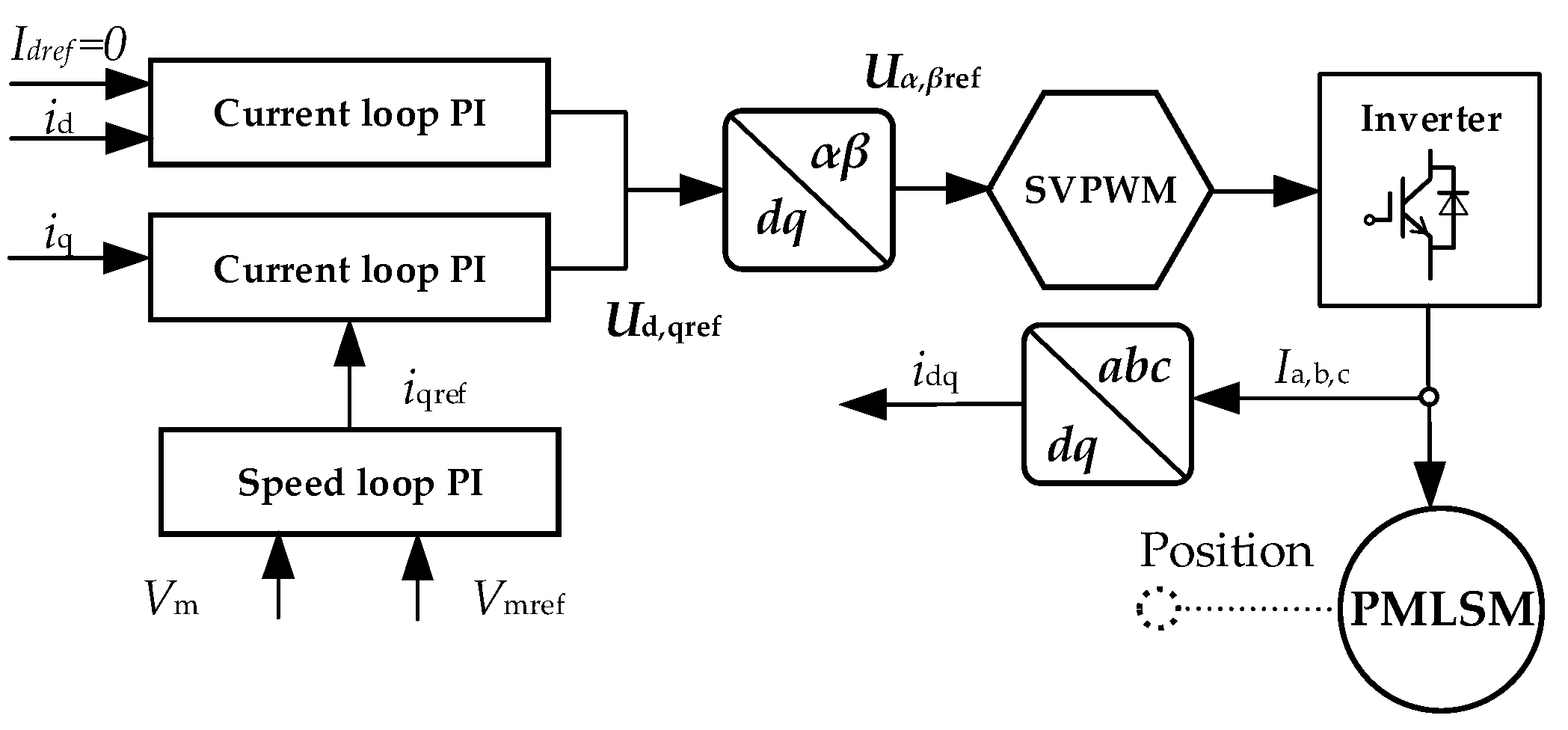
For the two working conditions of power generation and energy storage, the corresponding control algorithms are designed to ensure the response speed and stability, respectively, under different working conditions. The closed-loop vector control model built in this study is shown in
Figure 8.
In this paper, the control strategy of
id = 0 is adopted. The speed outer loop calculates the q-axis current reference value according to the deviation between the target speed and measured speed. The PI regulator of the current inner loop calculates the voltage reference value according to the deviation between the d-axis and q-axis current reference values and actual values. Then, the SVPWM algorithm is used to control the motor. Through the design of the double-closed-loop PI control strategy, the system can maintain stability and efficiency in the dynamic changes of speed and current. The parameters of the SFPMLSM prototype in this paper are shown in
Table 3.
The performance of the SFPMLSM in electric energy storage conditions was simulated according to the built control system. In the simulation, the weight of the energy storage object was 30 tons, the target speed was 10 m/s, and the target thrust was 300 kN·m. In the simulation, the SFPMLSM ran in the power generation condition, the process of the SFPMLSM wherein the energy storage object converts potential energy into electric energy.
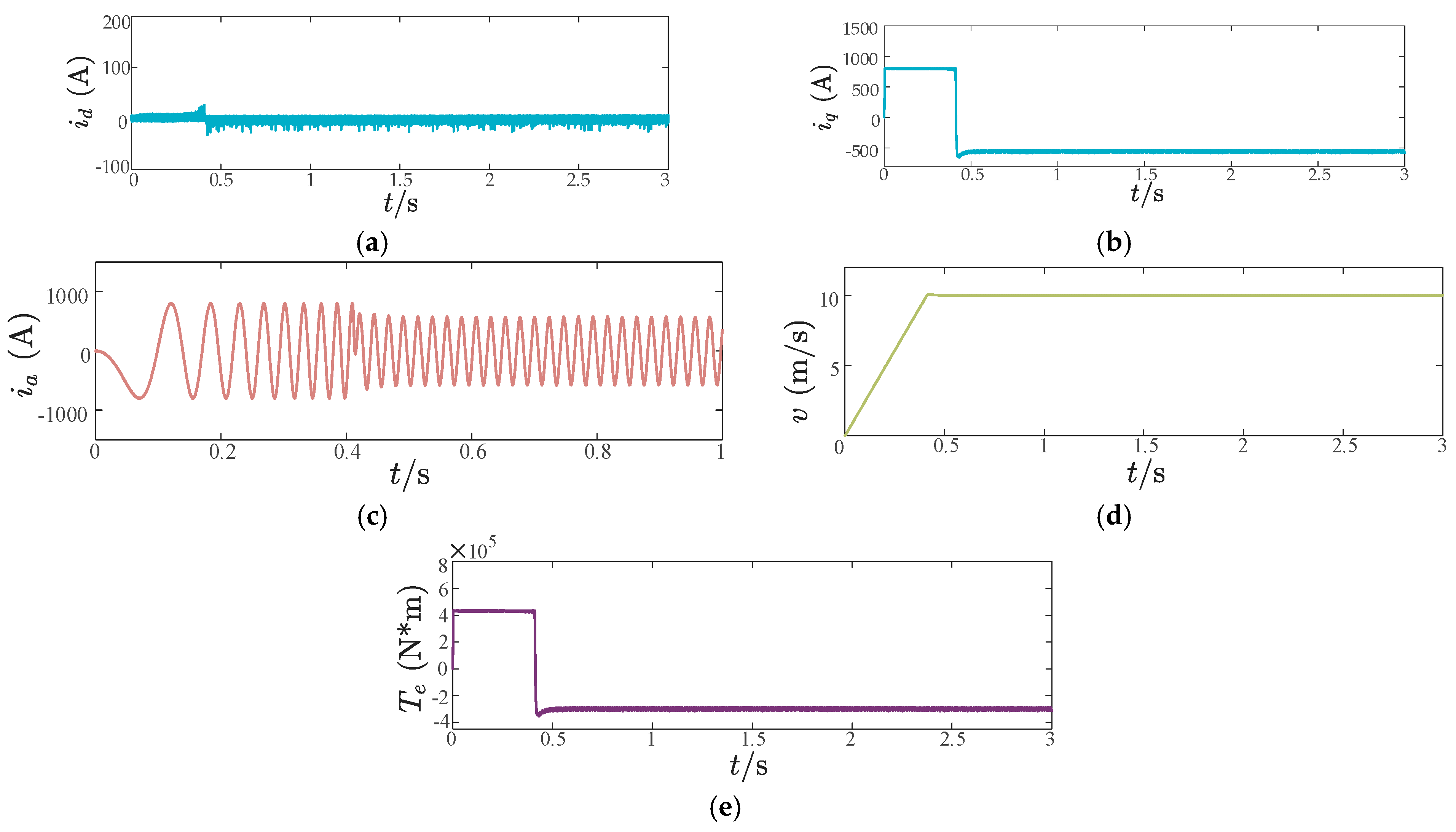
As shown in
Figure 9, the d-axis current under the
id = 0 control strategy is stable near 0 A, and the fluctuation range is −8.37~5.92 A. During the accelerating descent phase, the SFPMLSM generates a downward electromagnetic thrust, which accelerates the heavy block to the target speed. After reaching the target speed, the q-axis current suddenly changes to −576.9 A, and the SFPMLSM operates in the power generation state. In the mutation stage, the q-axis current has only a small overshoot and quickly returns to stability, reflecting the high anti-interference performance of the control algorithm. In the power generation condition, the output three-phase current amplitude is 564.27 A, and the THD is 2.98%.
Figure 9d,e present the motor speed and torque waveforms under the descending condition, respectively. In the start-up acceleration stage, the motor outputs a torque of 420 kN·m, which, together with the gravity of the heavy block, drives the motor to accelerate to a rated speed of 10 m/s at 0.415 s. At this time, the motor quickly switches from the electric condition to the power generation condition and generates electricity under the torque drag of −300 kN·m. Under the condition of power generation, the torque fluctuation is 2.76 kN·m.
4.2. Grid-Connected Control Strategy
The LMDD-GESS needs to ensure controllable power and high-quality grid-connected power quality when generating grid-connected power. In this paper, based on the voltage-oriented vector control, through the three-level inverter grid technology, with the midpoint potential balance control algorithm, the grid-side feedforward harmonic compensation technology reduces the grid THD, ensuring the grid quality of the gravity energy storage power generation system. Assuming that the output of the inverter is connected to the filter inductor (
L) and load resistance (
R), the output voltage equation in the dq coordinate system is as follows:
where
R and
L are the resistance and inductance of the reactor, respectively;
ud and
uq are the control voltage components of the d and q axes of the grid-side converter;
id and
iq are the d- and q-axis components of the grid-side current;
ugd and
ugq are the d- and q-axis components of the grid voltage, and
ugq = 0.
Based on the dq-axis current expression obtained by the above formula, the independent control of active power (
P) and reactive power (
Q) can be realized by controlling the dq-axis components (
id and
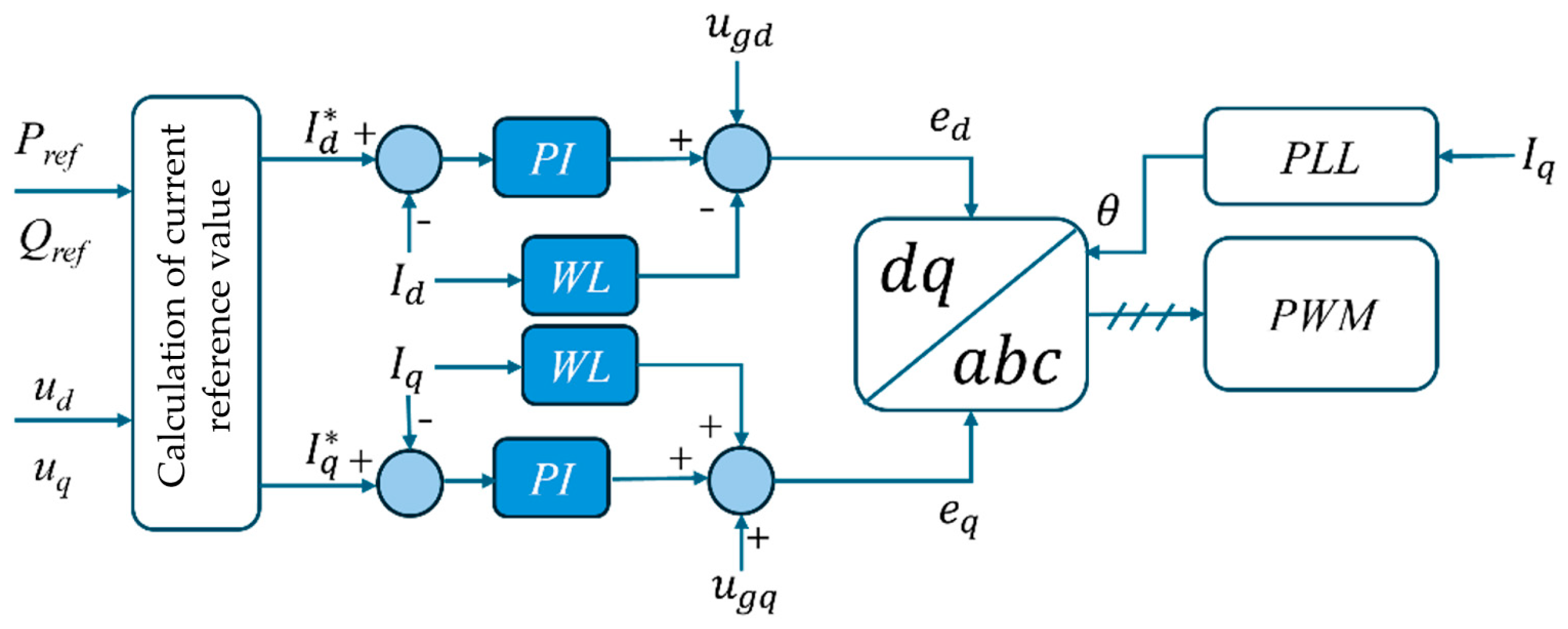
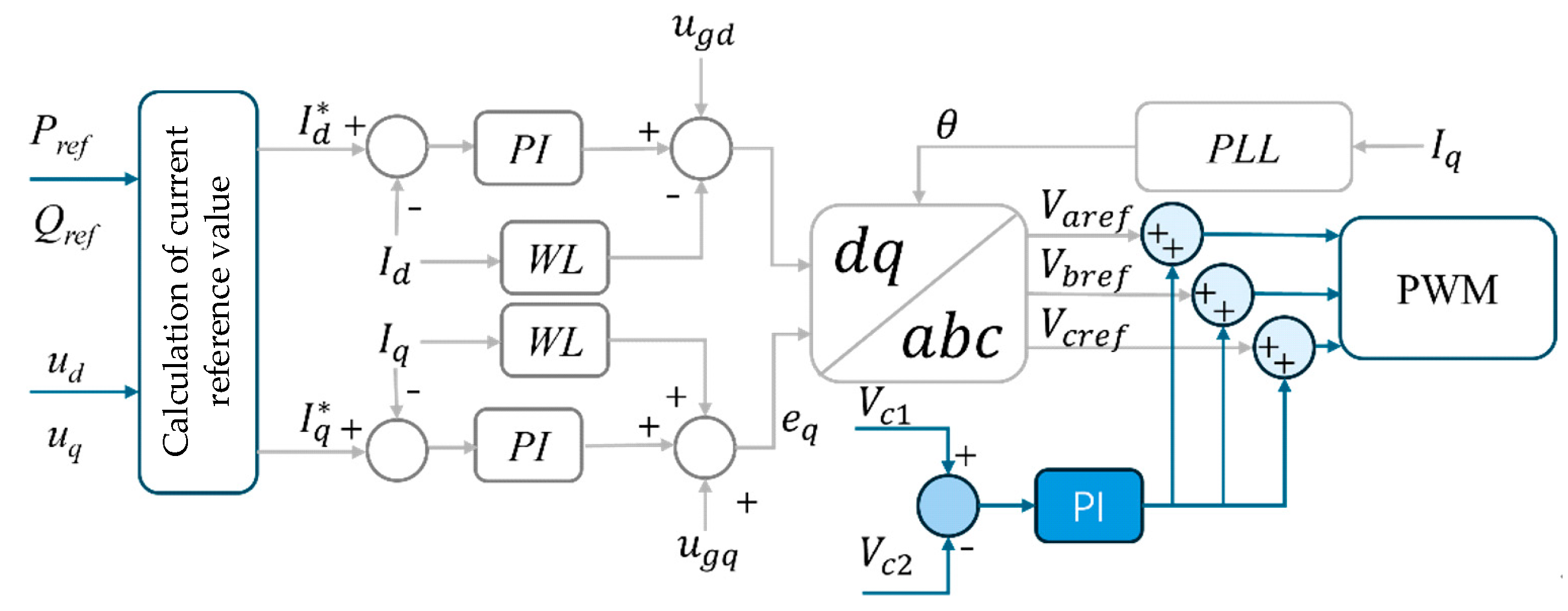
iq) of the grid current. The dq current control principle diagram of the grid-side converter is shown in
Figure 10.
Through the decoupling control of the current inner loop, the d- and q-axis modulation voltages (ud and uq) can be obtained, and then the reference voltages (uα* and uβ*) in the two-phase stationary coordinate system can be obtained by Clarck inverse transformation.
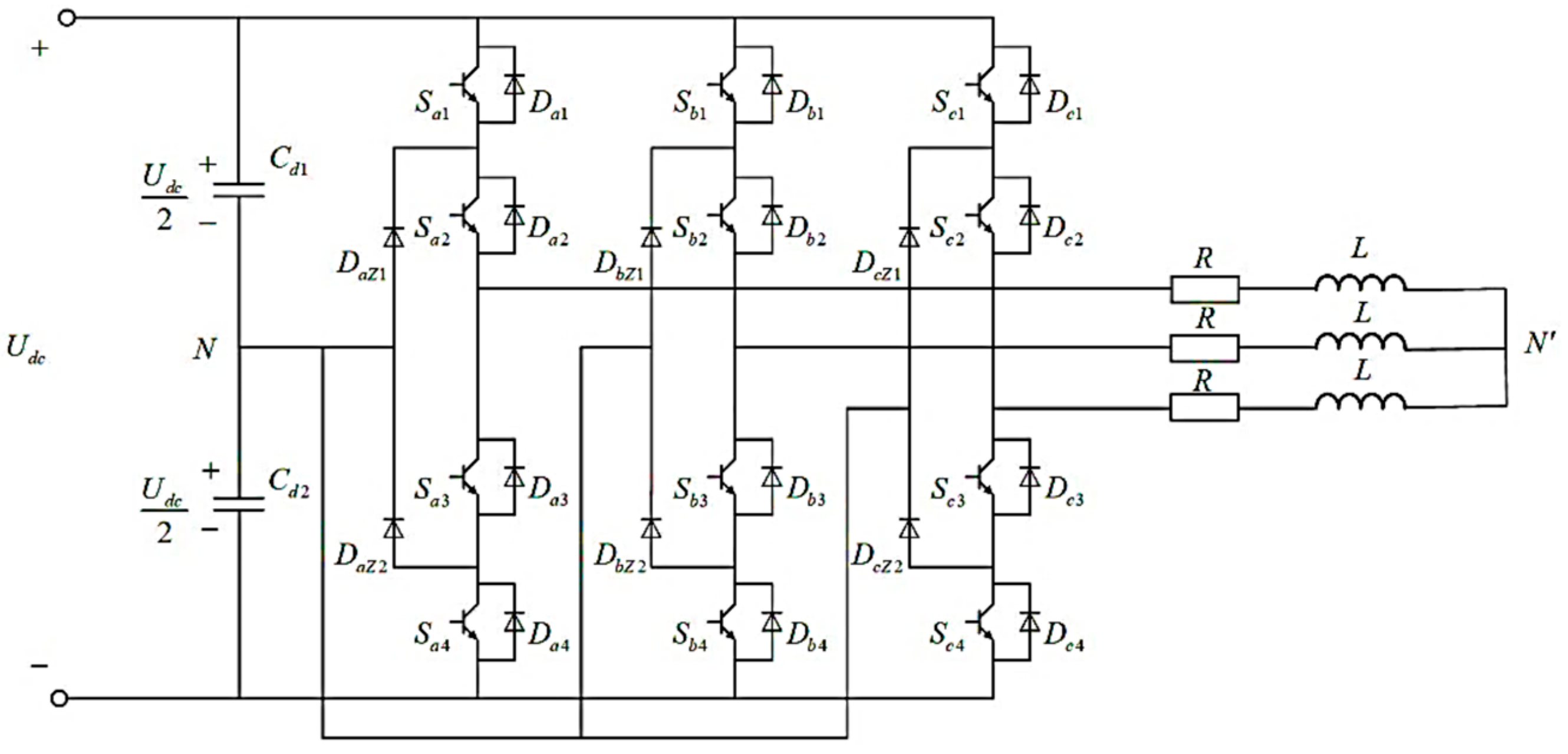
When the reference signal controls the connection of the inverter to the grid, it is necessary to make the output waveform sinusoidal. Non-sinusoidal harmonics will bring power loss, electromagnetic interference, and voltage ripple. In order to reduce the output harmonics, the traditional inverter can only increase the switching frequency, but a too-high switching frequency will increase the switching loss. In this paper, a three-level inverter is used to eliminate the harmonic component at the same switching frequency. The working principle is shown in
Figure 11.
Each leg of a three-level inverter has four switching devices connected in series. From the structure of the one-phase bridge arm of the main circuit of the three-level inverter, three states of single-phase output are obtained: the “1” state corresponds to +
Udc/2 (
Si1,
Si2 conduction); the “0” state corresponds to 0 (
Si2,
Si3 conduction); the “−1” state corresponds to—
Udc/2 (
Si3,
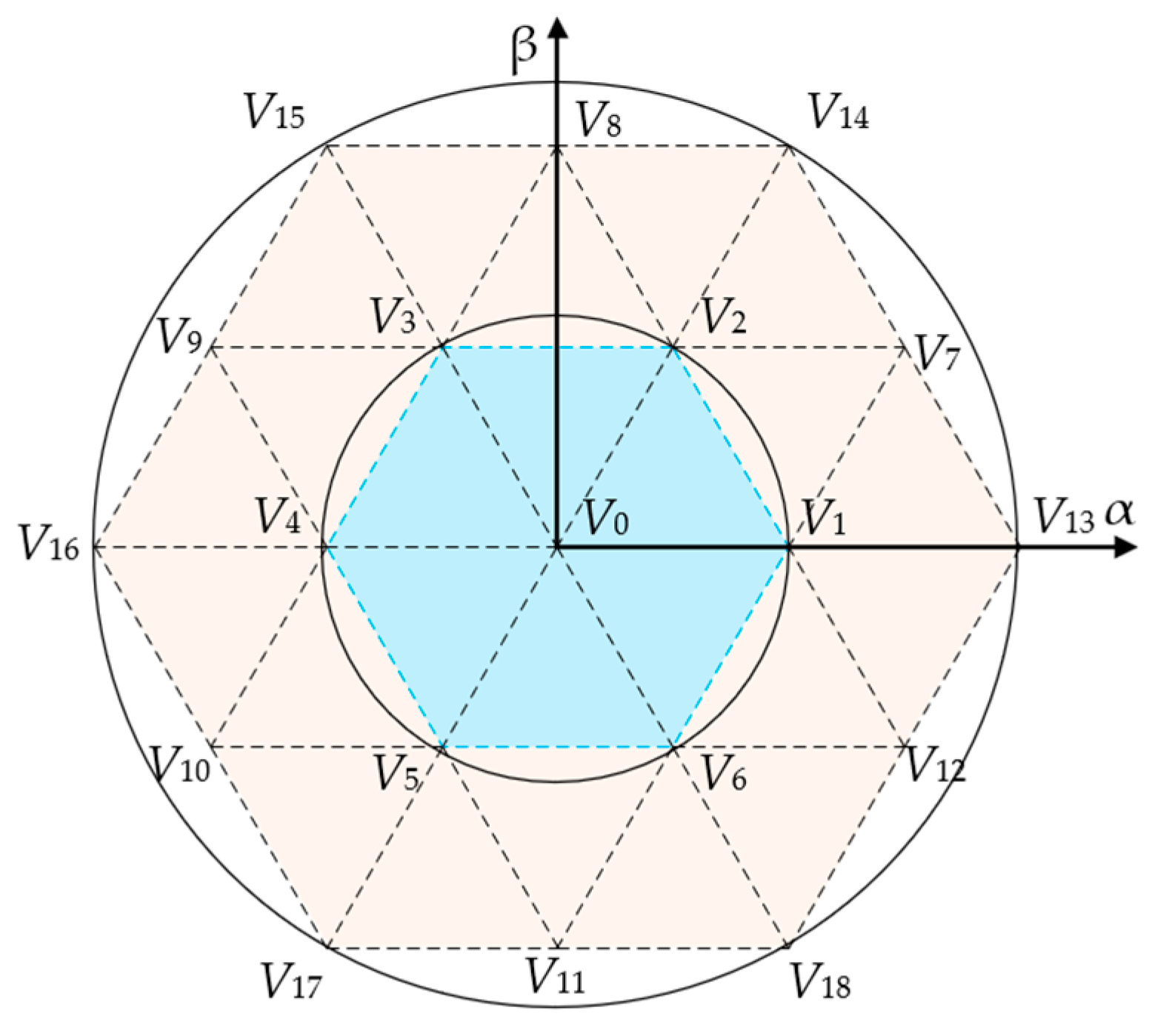
Si4 conduction). Therefore, each phase of the three-phase, three-level inverter circuit can output three states, and a total of 27 states can be output, of which the effective vector is 19 states. The space vector of the three-level inverter is shown in
Figure 12.
It can be seen from
Figure 11 that the stability of the DC voltage of the power generation needs to depend on the stability of the neutral point potential (N). The imbalance of the neutral point potential leads to an increase in the harmonic distortion rate of the output voltage and current and reduces the service life of the DC side capacitor. In this paper, based on the traditional zero-sequence voltage injection method, a zero-sequence voltage injection based on feedforward and feedback compensation is studied to control the balance of the midpoint potential and suppress the pulsation of the low-frequency voltage.
The reference currents
idref and
iqref are obtained by the power control of the grid-connected inverter. The feedback compensation calculates the voltage difference between the upper and lower capacitors (
C1 and
C2) and then passes through the PI controller to obtain the reference voltage compensation amount (Δ
V). The compensation amount is fed back to the reference modulation wave to achieve the purpose of maintaining the midpoint voltage balance. The simulation is shown in
Figure 13 and its results are shown in
Figure 14.
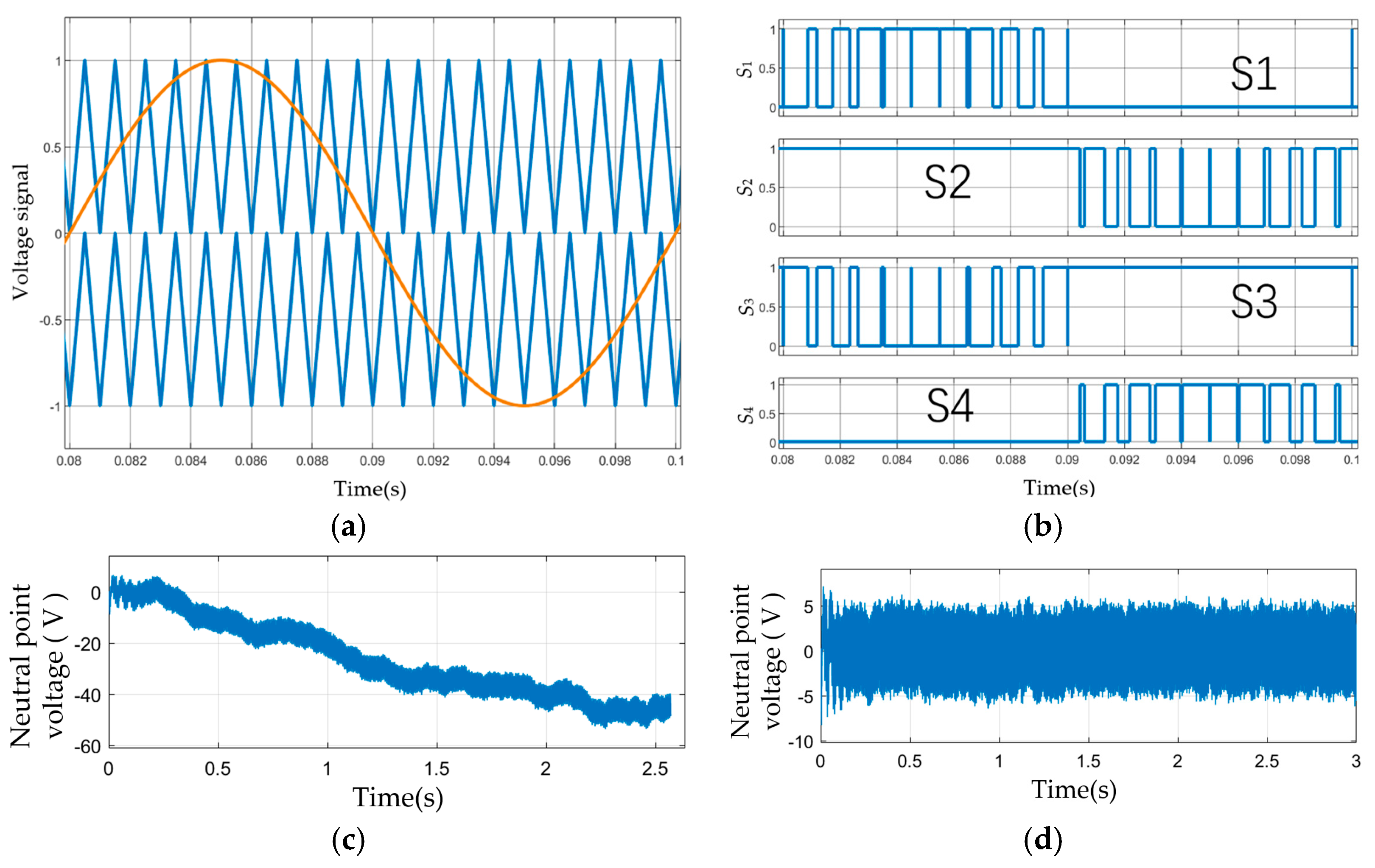
As can be seen in
Figure 14, after the introduction of neutral-point-potential balance control, the neutral-point voltage deviation fluctuates by ±10 V. The unbalanced neutral-point voltage is effectively suppressed.
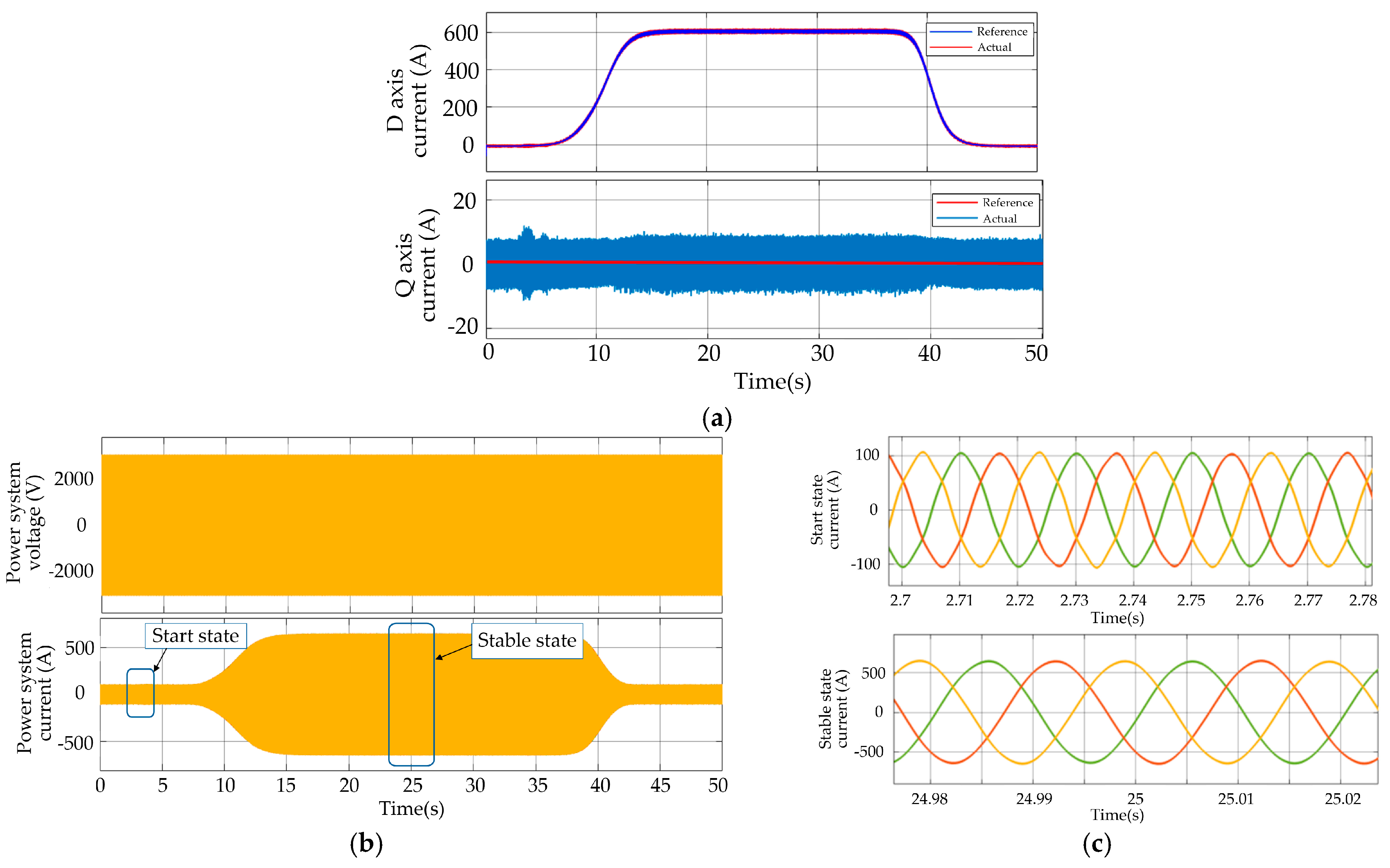
Based on the previous machine-side and grid-side control algorithms, a simulation model of the gravity energy storage power generation energy storage system was established using simulation software. In the experimental verification of the system, the start and stop of the SFPMLSM adopt an S-shaped acceleration and deceleration method to ensure the continuous and controllable acceleration of the system at different stages. The dq-axis current of the SFPMLSM and grid-connected power generation current during the start-up and stability of the LMDD-GESS are shown in
Figure 15.
In
Figure 15a, the reference value and actual value of the dq-axis current follow well, and the dynamic performance of the surface system is good.
Figure 15b shows the voltage and current during the start-up and steady state of the LMDD-GESS. By zooming in on the local area, it can be seen that the system has a good sinusoidal current during the start-up and steady state, indicating that the THD of the current incorporated into the power system is relatively low.
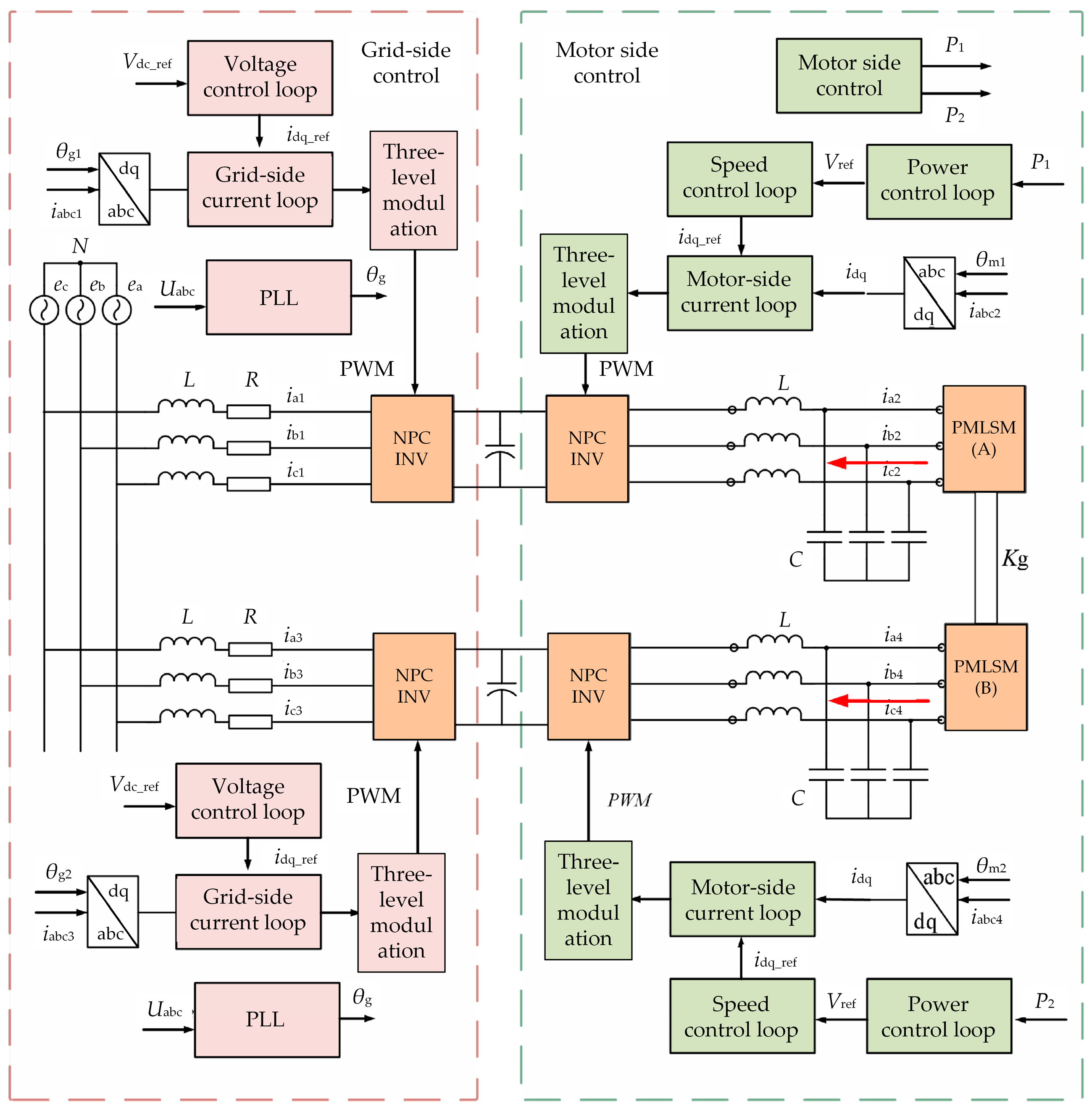
Corresponding to the LMDD-GESS of the double-sided SFPMLSM in
Figure 1, the dual-motor cooperative operation strategy is shown in
Figure 16. In this working state, the two SFPMLSMs are connected by a mechanical structure to ensure that the positions in the vertical direction are always consistent. The electric command or power generation command of the control system is evenly distributed to the two PMLSMs.
5. System-Level Experimental Verification of LMDD-GESS
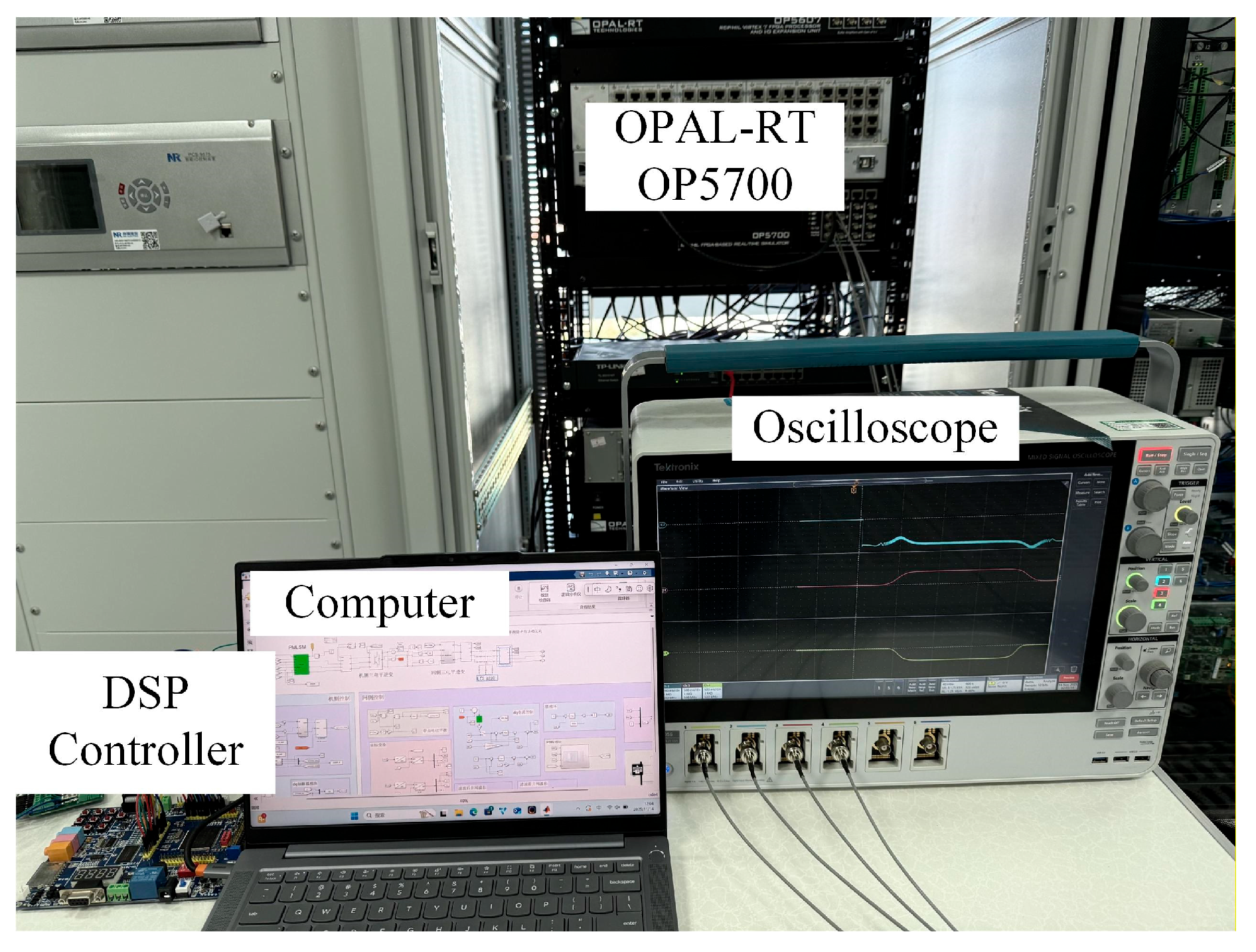
To verify the effectiveness of the proposed LMDD-GESS and its corresponding control strategy, a hardware-in-the-loop (HIL) simulation platform based on RT-LAB was established. The purpose of establishing this semi-physical simulation platform was to verify the effectiveness of the control strategy design mentioned earlier. In this platform, the detailed motor model and grid system are executed on a real-time simulator (OPAL-RT OP5700), while the actual control hardware (DSP controller) is incorporated into the simulation loop. This setup allows the control algorithms to run on physical hardware under realistic timing and interface constraints, effectively validating their real-time performance and stability. This configuration can faithfully reproduce the dynamic response of the system under actual operating conditions in a laboratory environment and can also analyze the effectiveness of pre-set parameters in advance. The HIL platform thereby serves as a critical intermediate step between pure software simulation and full-scale prototype deployment, providing a high-fidelity validation environment for the electromagnetic and control performance of the proposed MW-scale system. HIL simulation combines the flexibility of purely numerical simulation with the reliability of physical experimentation, making it an essential approach for validating the electromagnetic and control performances of complex energy storage systems.
In addition, it should be pointed out that this part of the experimental verification was only conducted for the electrical subsystem of the energy storage system and did not involve the mechanical subsystem. For the consideration of mechanical subsystems, further prototype production and experiments will be carried out.
As shown in
Figure 17, the experimental platform primarily consists of an OPAL-RT OP5700, an oscilloscope, a computer, and a DSP controller. The OPAL-RT OP5700 acts as the core computational unit responsible for executing the motor and grid models. The DSP controller implements the control algorithms proposed in this paper and exchanges high-speed signals with the OP5700 through I/O interface boards, enabling the real-time transmission of control commands and feedback signals. The output waveforms are displayed on the oscilloscope for observation and analysis.
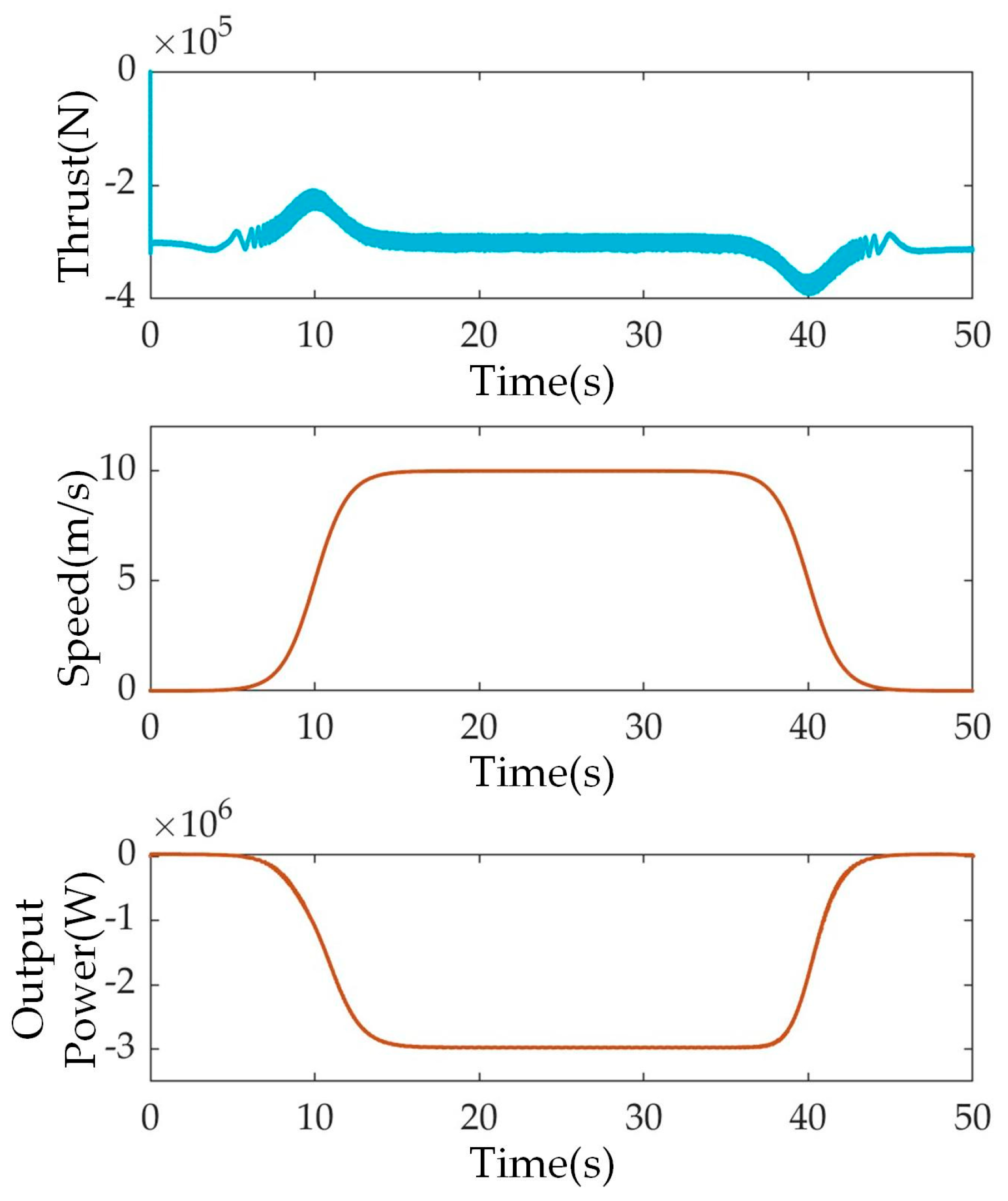
The electromagnetic performance and power generation performance of the LMDD-GESS during start-up and steady-state operation are shown in
Figure 18. It can be seen that under the S-shaped acceleration and deceleration strategy, the output thrust of the SFPMLSM is relatively stable during the starting acceleration, stable operation, and deceleration stop stages. In a stable state, the system can output a power of 3 MW.
When the gravity energy storage system is running in the variable speed operation conditions of start-up and stop, the output power changes continuously because the weight of the heavy block remains unchanged, which is contradictory to the demand of the stable operation of the power grid. When there are multiple units running, if the unit-switching time is not planned, the output power will change frequently and greatly. Specifically, when an SFPMLSM runs to the bottom of the system, its output power decreases to zero. In order for the system to generate electricity continuously and stably, other units should be switched in when the output power of a single unit decreases, keeping the total output power basically unchanged.
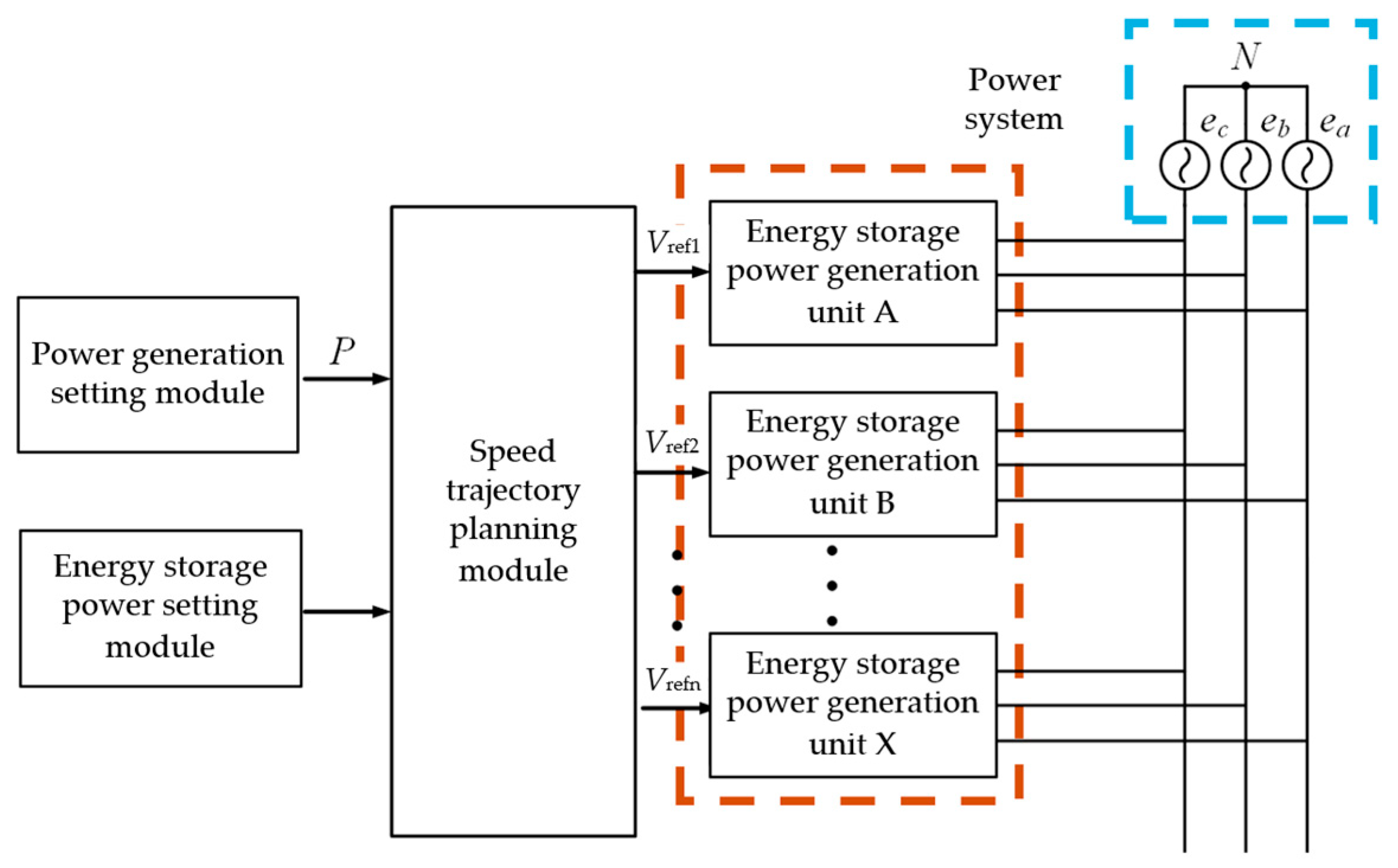
At the system level of multi-unit drive, the control logic includes a power generation-setting module, an energy storage power-setting module, a speed trajectory-planning module, and an energy storage power generation unit (structure shown in
Figure 1). When multiple energy storage and power generation units need to work together, they gradually enter operation, and each unit can operate independently in either the energy storage or power generation condition. The control strategy diagram of the system is shown in
Figure 19.
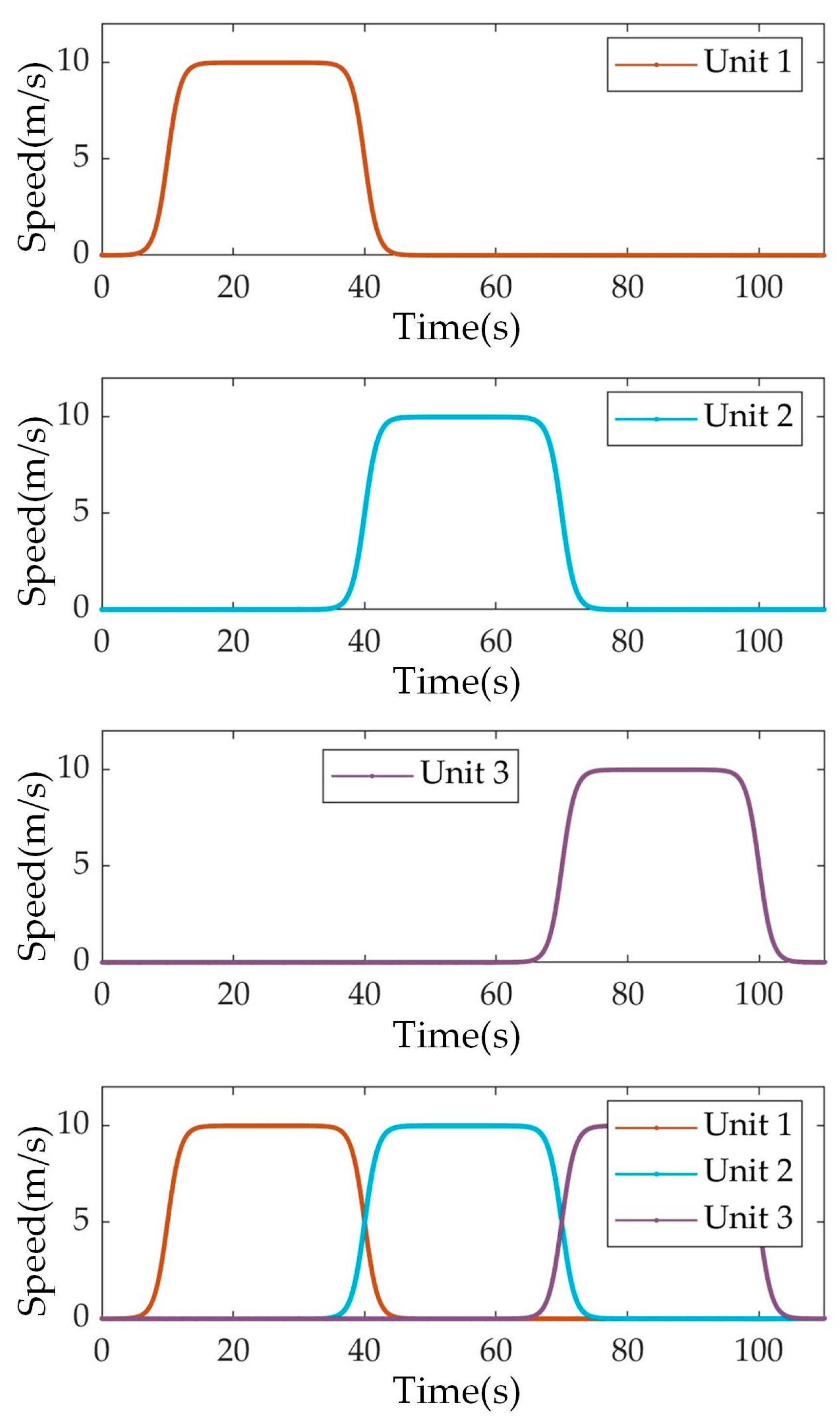
Based on the S-shaped acceleration and deceleration control algorithm, we designed a multi-machine-operation-switching scheme, and its speed-planning curve is shown in
Figure 20.
As shown in
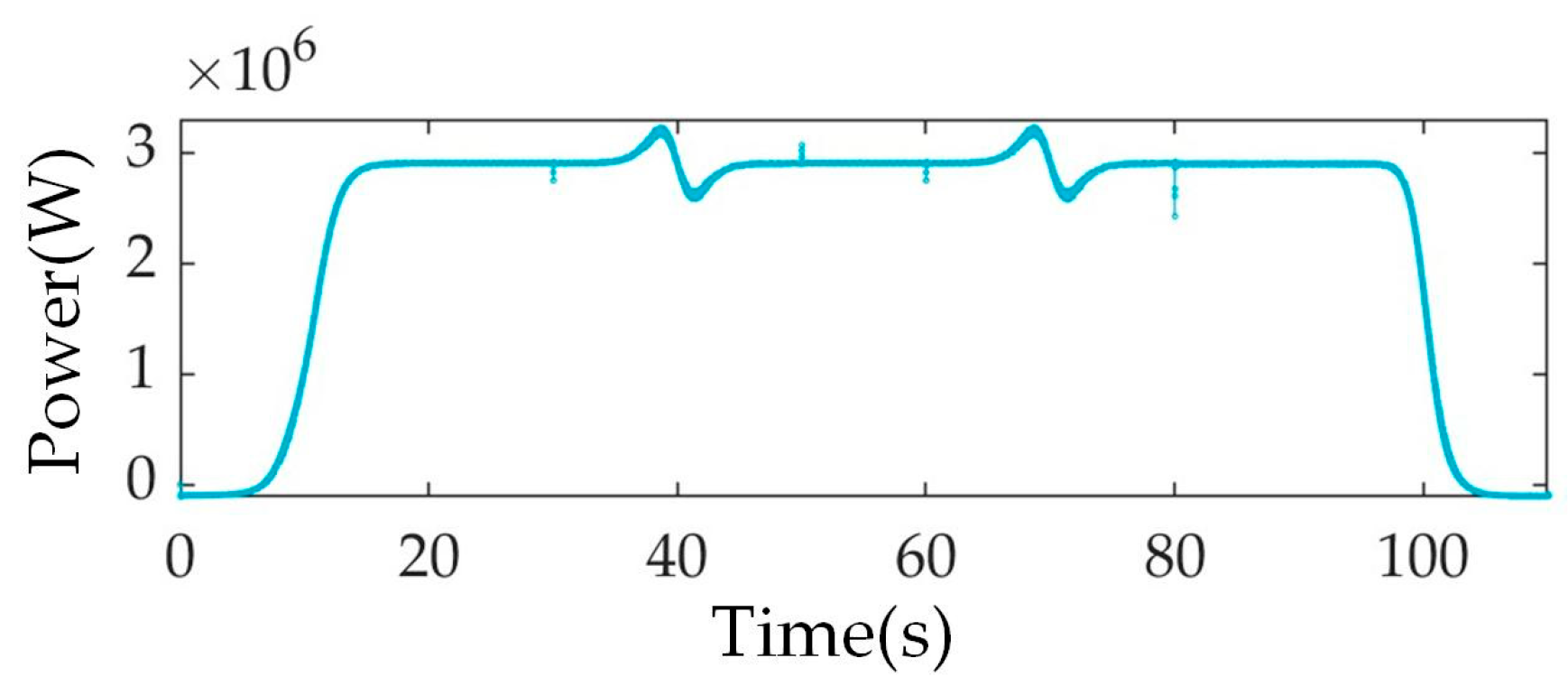
Figure 20, when one SFPMSLM unit runs to the bottom of the system, another SFPMSLM unit intervenes to maintain the constant output power of the system. Meanwhile, by designing an S-shaped acceleration and deceleration curve, sudden changes in the output power can be avoided. The power generation of multiple units when using this strategy is shown in
Figure 21.
It can be seen that under the cooperative control strategy, the output power of the LMDD-GESS can be smoother. When the three units are switched in turn, the overall output power is stable at 3 MW, and the power fluctuation caused by the unit switching during operation is 15%.
Therefore, based on HIL verification experiments, it can be demonstrated that the proposed SFPMLSM-driven gravity energy storage system in this paper is feasible, and the efficiency and performance of the system are also excellent. However, it is difficult to accurately consider the control errors caused by idealization during modeling in actual systems in validation experiments based on HIL. Therefore, in future research, a comprehensive system model considering the mechanical subsystem will be further constructed, and a prototype will be produced for experimental verification.
6. Conclusions
In this paper, a direct-drive gravity energy storage system based on a flux-switching permanent magnet linear motor is proposed, which aims to solve the problems of the low efficiency, frequent maintenance, and large power fluctuation of the traditional mechanical-drive gravity energy storage system.
At the motor design level, through the optimization of the stator-side salient pole structure and end magnet block, while ensuring the average thrust, the thrust fluctuation is suppressed at 6.04%, and the motor efficiency is stabilized at about 93%, which lays the foundation for the efficient energy conversion of the system. In terms of the control strategy, the double-closed-loop vector control based on electromagnetic thrust observation is adopted at the turbine side, which realizes smooth switching and stable operation under the dual conditions of power generation and energy storage. The speed and thrust responses are rapid, and the grid-connected current THD is 2.98%. The grid side adopts a three-level inverter and its neutral-point-potential balance and harmonic suppression strategy to effectively control the neutral-point voltage deviation within ±10 V, which improves the grid-connected power quality.
At the system level, through the S-shaped speed curve planning and the coordinated switching mechanism of multiple units, the stable power transition in the process of unit start-up, shutdown, and switching is realized, and the total output power fluctuation during the coordinated operation of multiple units is controlled within 15%, ensuring the continuous and stable output of 3 MW rated power. The hardware-in-the-loop (HIL) experiment results show that the proposed system architecture and control strategy can meet the core requirements of gravity energy storage systems for high efficiency, high reliability, and smooth power output.
Author Contributions
Conceptualization, C.L. and W.F.; methodology, L.Y., Z.D. and W.F.; software, X.L. and C.L.; validation, F.H., Y.X. and Y.M.; formal analysis, F.H.; investigation, Y.X.; resources, Y.M. All authors have read and agreed to the published version of the manuscript.
Funding
This research received no external funding.
Data Availability Statement
The original contributions presented in this study are included in the article. Further inquiries can be directed to the corresponding author.
Conflicts of Interest
Authors C.L., Z.D. and X.L. were employed by Three Gorges Jinsha River Yunchuan Hydropower Development Co., Ltd. Author F.H., Y.S. and Y.M. were employed by CSG PGC Energy Storage Research Institute, China Southern Power Grid Energy Storage Co., Ltd. The remaining authors declare that the research was conducted in the absence of any commercial or financial relationships that could be construed as a potential conflict of interest.
References
- Calero, F.; Cañizares, C.A.; Bhattacharya, K.; Anierobi, C.; Calero, I.; de Souza, M.F.Z.; Farrokhabadi, M.; Guzman, N.S.; Mendieta, W.; Peralta, D.; et al. A Review of Modeling and Applications of Energy Storage Systems in Power Grids. Proc. IEEE 2022, 111, 806–831. [Google Scholar] [CrossRef]
- Sun, L.; Ma, Y.; Wang, J.; Kang, H.; Li, Z.; Zhou, L.; Wu, H. An Accurate Nonlinear Model for Design of DFIGMs Considering Saturation Effects Based on Subdomain Method and Morphology. IEEE Trans. Transp. Electrif. 2025, 11, 7773–7785. [Google Scholar] [CrossRef]
- Sun, L.; Kang, H.; Wang, J.; Li, Z.; Liu, J.; Ma, Y.; Zhou, L. Analytical Model and Topology Optimization of Doubly-Fed Induction Generator. CES Trans. Electr. Mach. Syst. 2024, 8, 162–169. [Google Scholar] [CrossRef]
- Shi, Z.; Wang, W.; Huang, Y.; Li, P.; Dong, L. Simultaneous optimization of renewable energy and energy storage capacity with hierarchical control. CSEE J. Power Energy Syst. 2020, 8, 95–104. [Google Scholar] [CrossRef]
- Zhu, H.; Li, H.; Liu, G.; Ge, Y.; Shi, J.; Li, H.; Zhang, N. Energy Storage in High Variable Renewable Energy Penetration Power Systems: Technologies and Applications. CSEE J. Power Energy Syst. 2020, 9, 2099–2108. [Google Scholar] [CrossRef]
- Song, Y.; Yang, J.; Zhao, Q.; Bai, Y.; Ruan, L. Utilization of Energy Storage and Hydrogen in Power and Energy Systems: Viewpoints from Five Aspects. CSEE J. Power Energy Syst. 2023, 9, 1–7. [Google Scholar] [CrossRef]
- Chen, Y.; Xu, W.; Liu, Y.; Bao, Z.; Mao, Z.; Rashad, E.M. Modeling and Transient Response Analysis of Doubly-Fed Variable Speed Pumped Storage Unit in Pumping Mode. IEEE Trans. Ind. Electron. 2022, 70, 9935–9947. [Google Scholar] [CrossRef]
- Wu, D.; Wei, W.; Bai, J.; Mei, S. Energy and Exergy Efficiency Analysis of Advanced Adiabatic Compressed Air Energy Storage Based Trigeneration Energy Hub. CSEE J. Power Energy Syst. 2023, 9, 2409–2422. [Google Scholar] [CrossRef]
- Ye, C.; Yu, D.; Liu, K.; Dai, Y.; Deng, C.; Yang, J.; Zhang, J. Research of a Stator PM Excitation Solid Rotor Machine for Flywheel Energy Storage System. IEEE Trans. Ind. Electron. 2021, 69, 12140–12151. [Google Scholar] [CrossRef]
- Mugyema, M.; Kamper, M.J.; Wang, R.-J.; Sebitosi, B.A. Performance and Cost Comparison of Drive Technologies for a Linear Electric Machine Gravity Energy Storage System. IEEE Access 2024, 12, 46953–46966. [Google Scholar] [CrossRef]
- Yao, L.; Yang, B.; Cui, H.; Zhuang, J.; Ye, J.; Xue, J. Challenges and progresses of energy storage technology and its application in power systems. J. Mod. Power Syst. Clean Energy 2016, 4, 519–528. [Google Scholar] [CrossRef]
- Wu, X.; Li, N.; Wang, X.; Kuang, Y.; Zhao, W.; Qian, T.; Zhao, H.; Hu, J. Day-Ahead Scheduling of a Gravity Energy Storage System Considering the Uncertainty. IEEE Trans. Sustain. Energy 2020, 12, 1020–1031. [Google Scholar] [CrossRef]
- Vlahopoulos, D.; Bouhouras, A.S. Performance Evaluation of Electrical Energy Storage Systems Focused on Gravity Storage Technology. In Proceedings of the 2022 2nd International Conference on Energy Transition in the Mediterranean Area (SyNERGY MED), Thessaloniki, Greece, 17–19 October 2022; pp. 1–6. [Google Scholar] [CrossRef]
- Dong, T.; Fu, R.; Zhang, B.; Peng, B.; Wei, X. Analysis of Permanent Magnet Linear Synchronous Motor Made by Oriented Silicon Steel Sheet. IEEE Trans. Ind. Appl. 2023, 59, 3332–3340. [Google Scholar] [CrossRef]
- Fu, R.; Zhang, B.; Dong, T.; Feng, W.; Meng, F. Vibration Analysis of Grain-Oriented Silicon Steel Sheet PMLSMs Considering Material Anisotropy. IEEE Trans. Appl. Supercond. 2024, 34, 5204405. [Google Scholar] [CrossRef]
- Chen, H.; El-Refaie, A.M.; Demerdash, N.A.O. Flux-Switching Permanent Magnet Machines: A Review of Opportunities and Challenges—Part I: Fundamentals and Topologies. IEEE Trans. Energy Convers. 2019, 35, 684–698. [Google Scholar] [CrossRef]
- Ullah, W.; Khan, F.; Hussain, S.; Yousuf, M.; Akbar, S. Analytical Modeling of Novel High Thrust Force Density Segmented PM Consequent Pole Linear Flux Switching Machine. IEEE Access 2022, 10, 105887–105897. [Google Scholar] [CrossRef]
- Eguren, I.; Almandoz, G.; Egea, A.; Zarate, S.; Urdangarin, A. Thrust Ripple Reduction in Linear Switched-Flux Machines via Additional Pole Optimisation. IEEE Trans. Energy Convers. 2022, 37, 1655–1665. [Google Scholar] [CrossRef]
- Ullah, N.; Basit, A.; Khan, F.; Shah, Y.A.; Khan, A.; Waheed, O.; Usman, A. Design and Optimization of Complementary Field Excited Linear Flux Switching Machine With Unequal Primary Tooth Width and Segmented Secondary. IEEE Access 2019, 7, 106359–106371. [Google Scholar] [CrossRef]
- Maganti, S.; Padhy, N.P. A Feedback-Based Flexible Compensation Strategy for a Weak-Grid-Tied Current-Controlled Converter Under Unbalanced and Harmonic Conditions. IEEE Trans. Ind. Appl. 2022, 58, 7739–7753. [Google Scholar] [CrossRef]
- Yan, Q.; Zhou, Z.; Wu, M.; Yuan, X.; Zhao, R.; Xu, H. A Simplified Analytical Algorithm in abc Coordinate for the Three-Level SVPWM. IEEE Trans. Power Electron. 2020, 36, 3622–3627. [Google Scholar] [CrossRef]
- Du, H.; He, Y.; Qiu, J.; Liu, J. Research on SVPWM Method for Leakage Current Suppression and Switching Loss Reduction in Nonisolated Three-Level Inverters. IEEE J. Emerg. Sel. Top. Power Electron. 2024, 12, 2960–2971. [Google Scholar] [CrossRef]
- Wang, S.; Ma, J.; Liu, B.; Jiao, N.; Liu, T.; Wang, Y. Unified SVPWM Algorithm and Optimization for Single-Phase Three-Level NPC Converters. IEEE Trans. Power Electron. 2019, 35, 7702–7712. [Google Scholar] [CrossRef]
- Kim, H.-S.; Kwon, Y.-C.; Chee, S.-J.; Sul, S.-K. Analysis and Compensation of Inverter Nonlinearity for Three-Level T-Type Inverters. IEEE Trans. Power Electron. 2016, 32, 4970–4980. [Google Scholar] [CrossRef]
- Li, B.; Tian, H.; Ding, L.; Wu, X.; Kish, G.J.; Li, Y.R. An Improved Three-Level Neutral Point Clamped Converter System With Full-Voltage Balancing Capability for Bipolar Low-Voltage DC Grid. IEEE Trans. Power Electron. 2023, 38, 15792–15803. [Google Scholar] [CrossRef]
- Li, Y.; Yi, H.; Zhuo, F.; Jiang, X. Harmonic Oscillation and Stabilization Strategy of Source-Current-Detected Shunt APF Considering Interaction With Nonlinear Load and Grid Impedance. IEEE J. Emerg. Sel. Top. Power Electron. 2023, 12, 420–430. [Google Scholar] [CrossRef]
- Jiang, X.; Yi, H.; Zhuo, F.; Li, Y. A Stabilization Strategy Based on Grid Current Feedforward for the Harmonic Oscillation of APF System. IEEE J. Emerg. Sel. Top. Power Electron. 2024, 12, 2116–2129. [Google Scholar] [CrossRef]
- Han, J.; Li, W.; Zhou, L. Asymmetric Regular Sampling VSFPWM for Circulating Current Control in Paralleled Interleaved Multilevel Inverters. IEEE Trans. Ind. Electron. 2024, 72, 6443–6453. [Google Scholar] [CrossRef]
- Liu, L.; Li, Z.; Kang, H.; Xiao, Y.; Sun, L.; Zhao, H.; Zhu, Z.; Ma, Y. Review of Surrogate Model Assisted Multi-objective Design Optimization of Electrical Machines: New Opportunities and Challenges. Renew. Sustain. Energy Rev. 2025, 215, 115609. [Google Scholar] [CrossRef]
- Zhang, C.; Chen, F.; Qiu, S.; Pei, T.; Gao, W.; Chen, J.; Zhang, J.; Yang, G. A Low Detent Force DS-PMSLM Based on the Modulation of Cogging and End Forces. IEEE Trans. Ind. Electron. 2022, 70, 721–730. [Google Scholar] [CrossRef]
Figure 1.
System topology diagram of LMDD-GESS.
Figure 1.
System topology diagram of LMDD-GESS.
Figure 2.
The stress state of the LMDD-GESS. (a) Electric energy storage operating conditions; (b) power generation and grid connection conditions.
Figure 2.
The stress state of the LMDD-GESS. (a) Electric energy storage operating conditions; (b) power generation and grid connection conditions.
Figure 3.
Electromagnetic structure of SFPMLSM.
Figure 3.
Electromagnetic structure of SFPMLSM.
Figure 4.
The schematic diagram of the SFPMLSM winding arrangement.
Figure 4.
The schematic diagram of the SFPMLSM winding arrangement.
Figure 5.
Average thrust and thrust fluctuation under different magnetic block widths: (a) average thrust; (b) thrust ripple.
Figure 5.
Average thrust and thrust fluctuation under different magnetic block widths: (a) average thrust; (b) thrust ripple.
Figure 6.
The electromagnetic performance of the SFPMLSM: (a) back EMF; (b) harmonic amplitude; (c) thrust under different currents; (d) efficiency under different operating conditions.
Figure 6.
The electromagnetic performance of the SFPMLSM: (a) back EMF; (b) harmonic amplitude; (c) thrust under different currents; (d) efficiency under different operating conditions.
Figure 7.
The flux density distribution under a current density of 4 A/mm2.
Figure 7.
The flux density distribution under a current density of 4 A/mm2.
Figure 8.
Closed-loop vector control algorithm block diagram.
Figure 8.
Closed-loop vector control algorithm block diagram.
Figure 9.
Simulation results of control system performance: (a) d-axis current (id); (b) q-axis current (iq); (c) A-phase current (ia); (d) speed (v); (e) electromagnetic thrust (Te).
Figure 9.
Simulation results of control system performance: (a) d-axis current (id); (b) q-axis current (iq); (c) A-phase current (ia); (d) speed (v); (e) electromagnetic thrust (Te).
Figure 10.
Power current double-closed-loop PI control block diagram.
Figure 10.
Power current double-closed-loop PI control block diagram.
Figure 11.
Three-level inverter schematic diagram, where Si1, Si2, Si3, Si4 (i = a, b, c) is the IGBT of the inverter; Di1, Di2, Di3, Di4 (i = a, b, c) is the freewheeling diode of the inverter; DiZ1, DiZ2 (i = a, b, c) is the clamping diode of the inverter; Udc is the direct current voltage.
Figure 11.
Three-level inverter schematic diagram, where Si1, Si2, Si3, Si4 (i = a, b, c) is the IGBT of the inverter; Di1, Di2, Di3, Di4 (i = a, b, c) is the freewheeling diode of the inverter; DiZ1, DiZ2 (i = a, b, c) is the clamping diode of the inverter; Udc is the direct current voltage.
Figure 12.
Space vector of three-level inverter.
Figure 12.
Space vector of three-level inverter.
Figure 13.
Three-level modulation inverter system schematic diagram.
Figure 13.
Three-level modulation inverter system schematic diagram.
Figure 14.
Neutral-point-potential balance strategy: (a) modulation strategy of three-level inverter; (b) bridge arm conduction state; (c) neutral-point voltage without neutral-point-balancing strategy; (d) neutral-point voltage in neutral-point-balancing strategy.
Figure 14.
Neutral-point-potential balance strategy: (a) modulation strategy of three-level inverter; (b) bridge arm conduction state; (c) neutral-point voltage without neutral-point-balancing strategy; (d) neutral-point voltage in neutral-point-balancing strategy.
Figure 15.
The dq-axis current of the SFPMLSM and grid-connection performance of the LMDD-GESS. (a) dq-axis current of SFPMLSM; (b) voltage and current of power system under LMDD-GESS start and steady state; (c) local amplification of power system current during start-up and steady state.
Figure 15.
The dq-axis current of the SFPMLSM and grid-connection performance of the LMDD-GESS. (a) dq-axis current of SFPMLSM; (b) voltage and current of power system under LMDD-GESS start and steady state; (c) local amplification of power system current during start-up and steady state.
Figure 16.
Power generation performance and grid connection performance of LMDD-GESS.
Figure 16.
Power generation performance and grid connection performance of LMDD-GESS.
Figure 17.
The hardware-in-the-loop (HIL) simulation platform.
Figure 17.
The hardware-in-the-loop (HIL) simulation platform.
Figure 18.
The thrust, speed, and output power of the SFPMLSM under power generation conditions.
Figure 18.
The thrust, speed, and output power of the SFPMLSM under power generation conditions.
Figure 19.
Control block diagram of multi-unit energy storage power generation unit of LMDD-GESS.
Figure 19.
Control block diagram of multi-unit energy storage power generation unit of LMDD-GESS.
Figure 20.
Multi-machine-switching control speed curve.
Figure 20.
Multi-machine-switching control speed curve.
Figure 21.
Multi-machine-switching active power curve.
Figure 21.
Multi-machine-switching active power curve.
Table 1.
Gravity energy storage demand parameters.
Table 1.
Gravity energy storage demand parameters.
| Parameter | Value |
|---|
| Mass of energy storage object | 30 t |
| Reciprocating distance | 500 m |
| Operating speed | 10 m/s |
| Single-machine rated power | 5.8 MW |
Table 2.
Electromagnetic parameters of SFPMLSM.
Table 2.
Electromagnetic parameters of SFPMLSM.
| Parameter | Value | Parameter | Value |
|---|
| Poles/slots | 18/36 | Effective convex poles | 21 |
| Mover length | 4.68 m | Air gap length | 10 mm |
| Mover width | 4 m | Permanent magnet width | 83 mm |
| Mover height | 74 mm | Permanent magnet height | 74 mm |
| Convex pole width | 66 mm | Convex poles height | 82 mm |
| Coil turns | 10 | Current density | 4 A/mm2 |
| Mover yoke height | 32 mm | Stator yoke height | 33 mm |
Table 3.
SFPMLSM parameters.
Table 3.
SFPMLSM parameters.
| Parameter | Value | Parameter | Value |
|---|
| Poles/slots | 18/36 | Stator resistance | 0.0033 Ω |
| d-axis inductance | 12.6 mH | q-axis inductance | 13 mH |
| Permanent magnet flux linkage | 13.34 Wb | Rated line speed | 10 m/s |
| Rated thrust | 580 kN·m | | |
| Disclaimer/Publisher’s Note: The statements, opinions and data contained in all publications are solely those of the individual author(s) and contributor(s) and not of MDPI and/or the editor(s). MDPI and/or the editor(s) disclaim responsibility for any injury to people or property resulting from any ideas, methods, instructions or products referred to in the content. |



 ,
,