1. Introduction
In recent decades, the growing interest in immersive human-in-the-loop simulators has led to the rapid development of technologies used to recreate virtual reality simulated environments that can be perceived by humans with the highest possible degree of realism. These technologies are widely used in military applications [
1], as well as for training in industrial [
2,
3] and agricultural fields [
4], sports [
5,
6], and rehabilitation [
7,
8]. Although used for different applications, immersive simulators have in common the purpose of comprehensively stimulating the human senses, combining visual, auditory, haptic, thermal, and inertial stimuli [
9].
The ability to generate acceleration fields experienced by the user is enabled by the use of parallel kinematic machines (PKMs), in which all actuators are simultaneously involved in realizing the motion of the platform they support. PKMs have the ability to impart accelerations to large loads—but at the expense of a more limited workspace [
10]. For this reason, when using PKMs in immersive simulators, the actual movements returned as output by the numerical model simulating the specific activity cannot be reproduced on a 1:1 scale, generating the need for exploitation of motion cuing algorithms. The latter are designed to overcome this limitation in the workspace [
11] by transforming large-scale movements of a simulated activity into feasible motions for the motion platform, allowing the sensation of motion to be transferred to the user but keeping the motion platform within its physical limits.
The state of the art of human-in-the-loop simulators shows widespread use of PKMs with six or more degrees of freedom (DoFs) [
12,
13,
14], offering considerable flexibility at the expense of very relevant cost and size. To contain both costs and dimensions, there is a growing interest in compact machines with a reduced number of degrees of freedom [
15], seeking a compromise between a small size and the ability to recreate comprehensive motion sensations for the user.
Due to the reduced number of DoFs in compact PKMs, only a subset of the six-dimensional space can be specified independently [
16], which implies a limitation in the motion of the platform. This kinematic structure often results in the inability of the system to perform pure rotations around axes passing through the Tool Center Point (TCP), with the platform subjected to a rototranslation and its instant axis of rotation located outside the TCP. As a consequence, unintentional TCP motion components, called kinematic crosstalk or parasitic motions [
17], arise along coupled axes, whether translational or rotational. Kinematic crosstalk motions are intrinsically associated with the primary degrees of freedom of the machine [
18] and are induced as a direct consequence of actuation along those degrees of freedom. In certain applications, they are intentionally exploited as a beneficial design feature [
19]; in other cases, they represent a disadvantage.
Kinematic crosstalk is often neglected in machine programming, in the assessment of its effects on user motion sickness, and in the development of motion cue algorithms. However, PKMs with fewer than six DoFs would require the effects that kinematic crosstalk motion components have on the user’s balance and perception of motion to be taken into account for a number of potential reasons:
To exploit kinematic crosstalk as a positive factor, enhancing the capability of a compact machine to reproduce motion sensations along DoFs that are not independently actuated;
To avoid or at least to contain unwanted movements along coupled degrees of freedom, which could generate false cues [
20]—one of the major causes of motion sickness;
In applications exploiting a VR headset to remove platform-induced motion from the headset tracking system signal in order to isolate the user’s head motion relative to the platform.
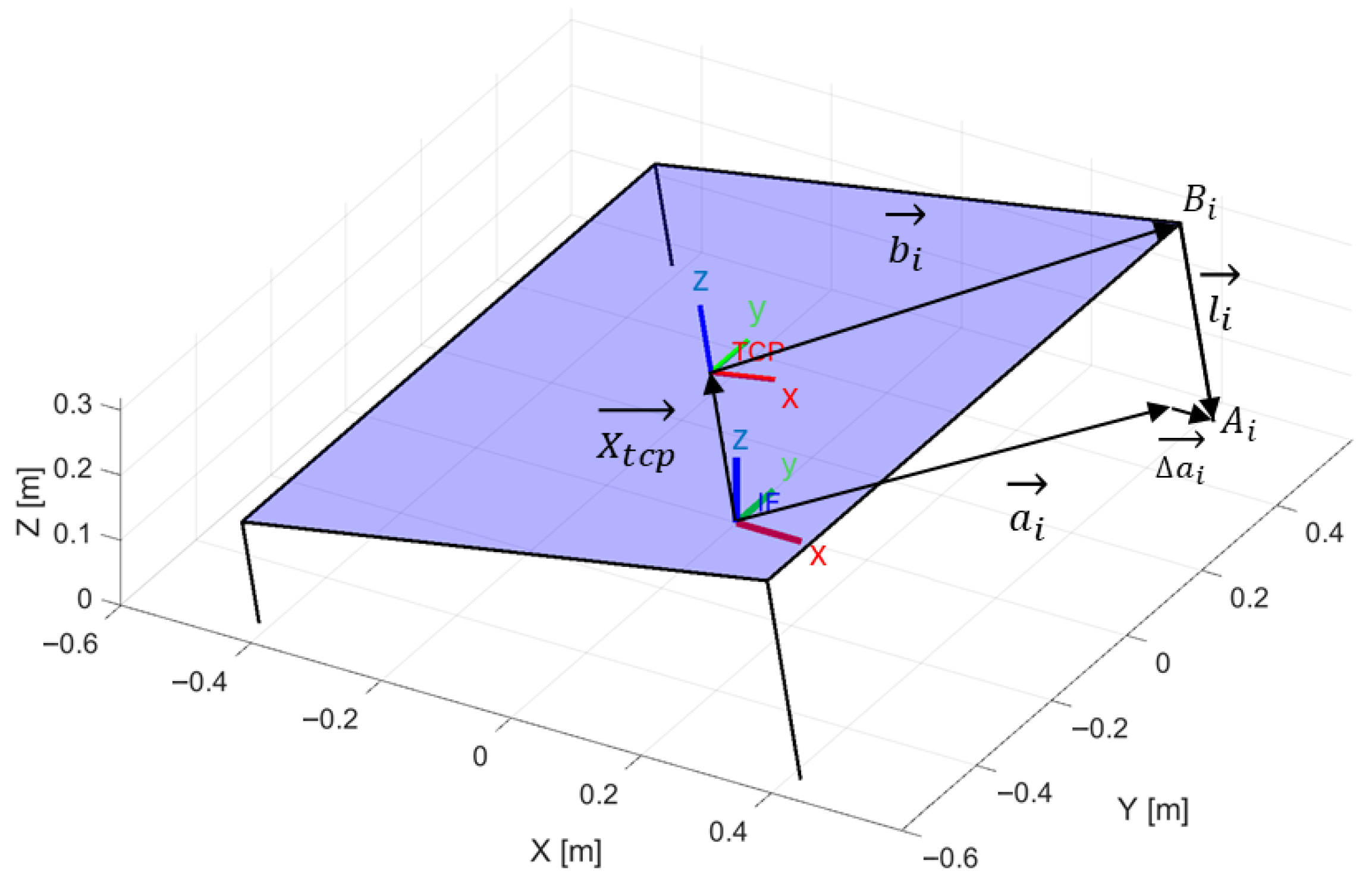
A class of PKMs widely used in compact simulators, including sports simulators and simulators for physical and neurocognitive rehabilitation, is the three-DoF, four-legged overactuated PKM, enabling roll, pitch, and heave motion. Its widespread use in real-world practice is due to its structural simplicity and ease in integrating commercial actuators into a suitably dimensioned frame. Despite their widespread use in engineering applications, to the best of the authors’ knowledge, the kinematics of these machines has never been analyzed in the scientific literature. Thus, this paper aims to provide the first systematic study to fill this gap. This statement is in line with the observations reported in ref. [
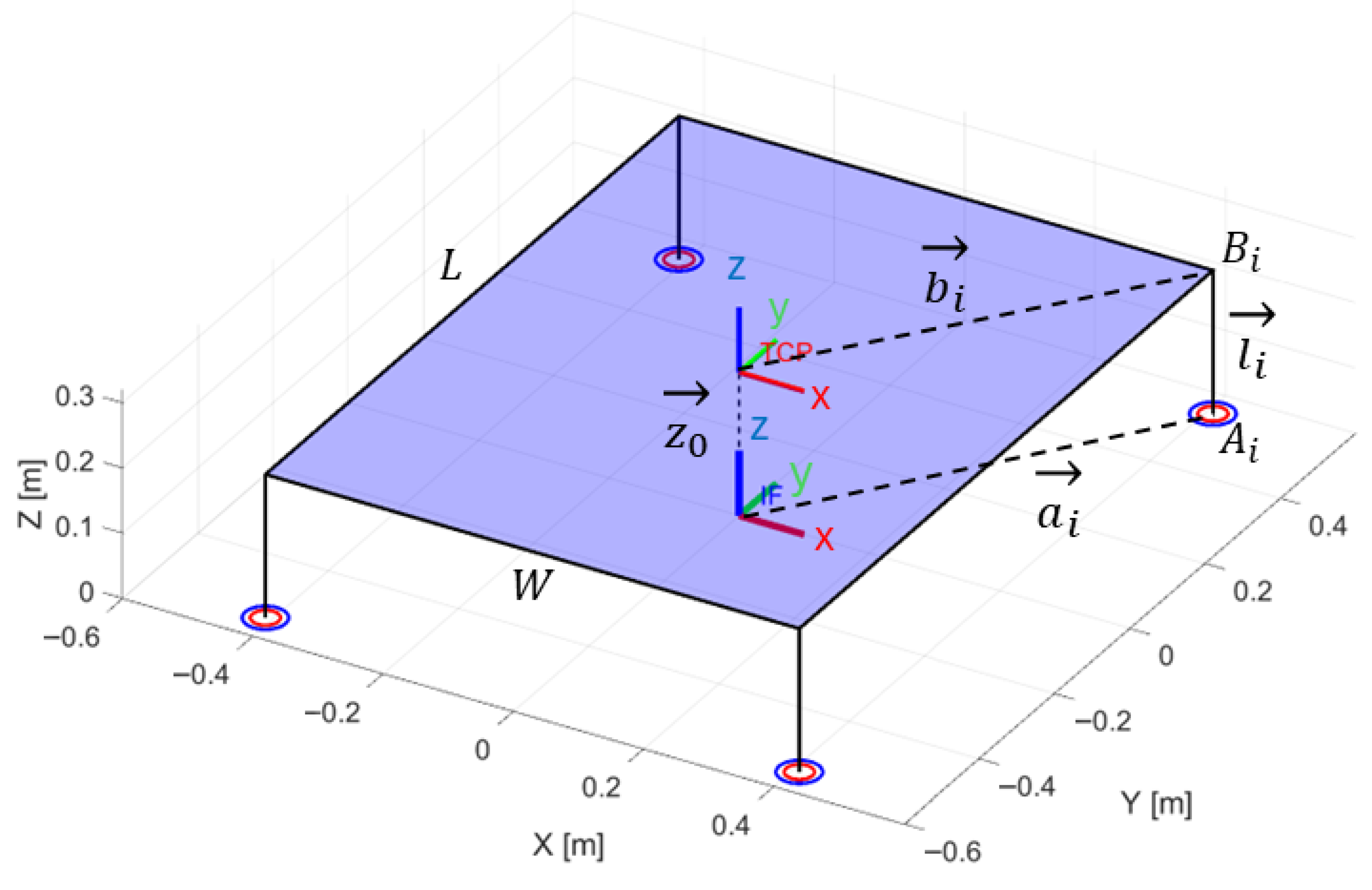
17], which highlighted the limited number of studies addressing the effects of kinematic crosstalk (parasitic motion), especially for overactuated machines, and stressed that research on this topic is still relatively limited, warranting further investigation. A kinematic sketch of this kind of platform is reported in
Figure 1.
The kinematic structure of the three-DoF, four-legged, over-actuated PKM exhibits a peculiarity compared to other three-DoF PKMs like tripods: the machine cannot be fully constrained to the ground, since the actuator feet must be allowed to slide relative to the ground and, to some extent, relative to one another. Under these circumstances, dynamic effects (such as friction between actuator feet and the ground) also become relevant to the definition of TCP absolute motion, and the problem of knowing the actual crosstalk values becomes more tricky, no longer depending only on the actuator motion but also on the overall dynamic state of the machine. Frictional effects induced by dynamic loads can, indeed, affect the coupling links between the intentionally controlled degrees of freedom and the kinematic crosstalk components, as will be discussed in the present paper.
When performing roll or pitch rotations, this platform can generate non-negligible linear accelerations in the crosstalk directions (xy plane), together with yaw rotation. The aims of this work are to establish a first feasible approach to address the kinematics of this kind of machine, to quantify the extent of its crosstalk accelerations in order to assess their relevance, and to provide a suitable tool that is exploitable for the design of this specific type of platform. Since estimating machine friction conditions in real time is not straightforward in practical applications and accounting for all the possible dynamic conditions under which the machine operates would not be of practical relevance for its design, a dynamics-based approach cannot be reasonably adopted when developing a modeling strategy. Therefore, this paper investigates a simplified method to determine the range within which crosstalk motion actually occurs, neglecting dynamic effects and relying solely on kinematic relationships.
In order to achieve this target, in
Section 2, the inverse kinematic equations of the machine are derived, and the platform workspace in the roll–pitch–heave space is outlined as a first step. In
Section 3, a kinematic model is proposed, neglecting dynamic effects, to define the kinematic relationship between the intentionally controlled degrees of freedom and the induced crosstalk components. Lateral and longitudinal accelerations related to kinematic crosstalk are then quantified to assess their significance with respect to the human perception threshold, also taking into account limitations in the dynamic performance of the actuators.
Section 4 describes the experimental tests on a full-scale four-legged PKM, in which the actual crosstalk is measured using an IMU sensor and a non-contact optoelectronic system. The experimental data are then compared with the numerical results of the proposed model, and the applicability of the model to a real-world driving simulator is assessed. Finally, conclusions are drawn in
Section 5.
2. Kinematic Analysis of the Four-Legged, Three-DoF Parallel Kinematic Machine
2.1. PKM Description
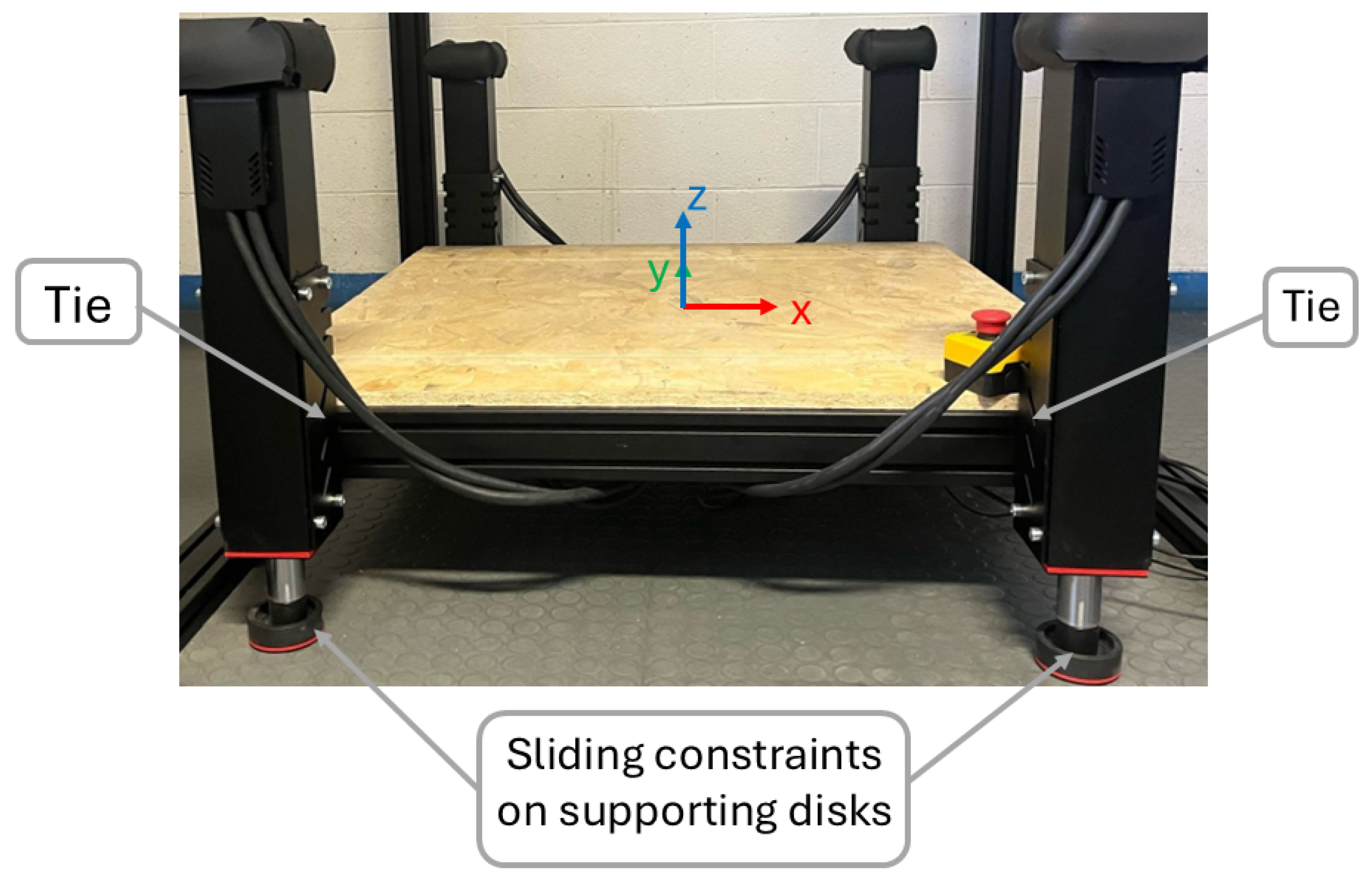
The PKM under analysis consists of a rectangular frame actuated by four linear actuators (
Figure 2). As indicated in the figure, the latter are rigidly tied perpendicularly to the platform frame at their upper ends and free to slide on support discs at their lower ends. This overactuated configuration equipsthe system with three degrees of freedom, that is, roll rotation around the x-axis, pitch rotation around the y-axis, and heave linear displacement along the z-axis.
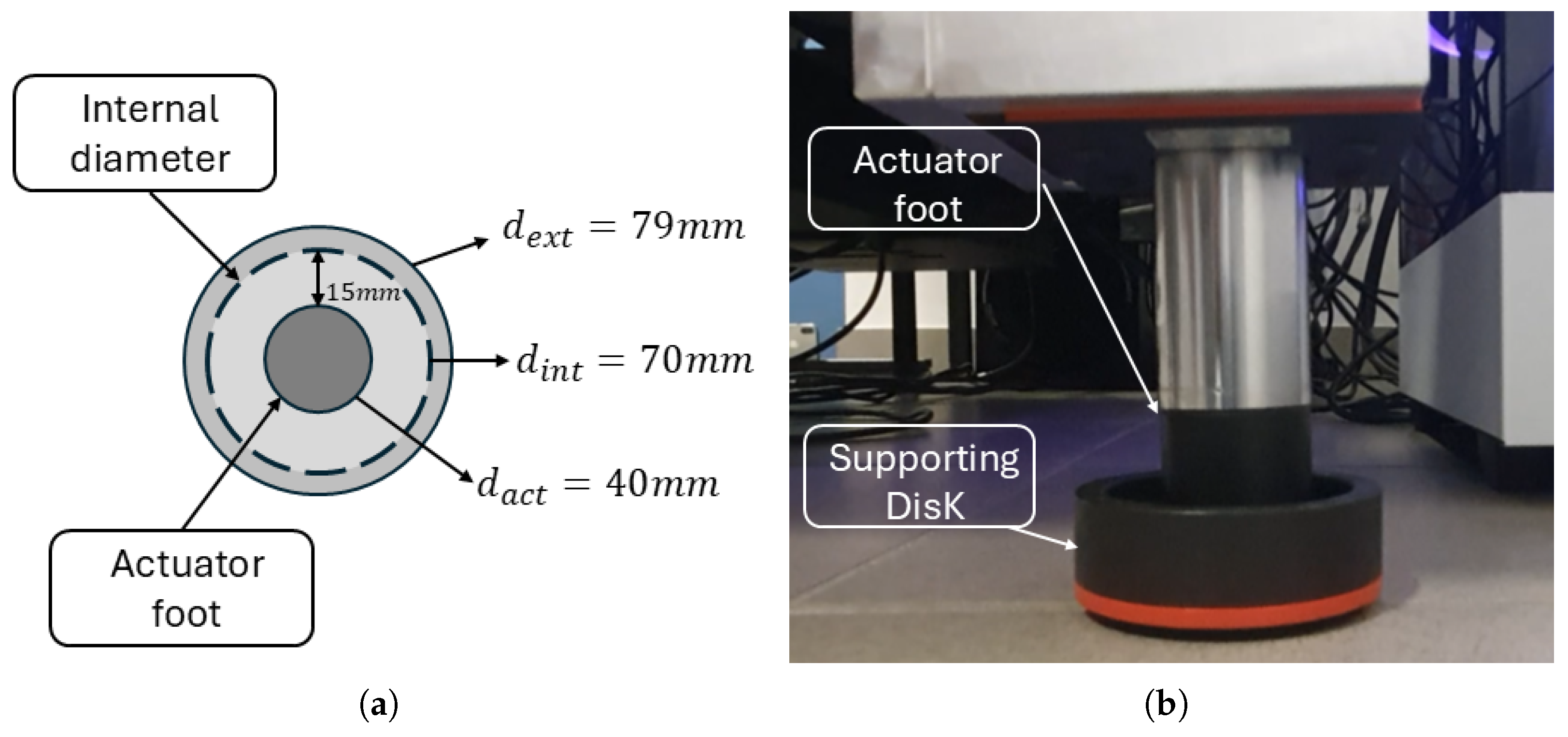
The lower end of each actuator (hereafter referred to as the actuator foot) is supported by discs within which it can slide.
Figure 3 presents a sketch, and
Figure 3b shows a picture of the discs, which have an internal diameter of 70 mm. Since the actuator foot sliding on the internal surface of the disc has a diameter of 40 mm, the maximum displacement allowed for each actuator foot is 15 mm relative to the center of the disc.
The constraint configuration described above is necessary, since, during platform motion with roll and pitch rotations, the relative distances between the actuator feet have to change. Therefore, a rigid connection with the ground is not allowed. As a consequence, the platform is not fully constrained to the ground in the lateral directions (x- and y-axes), leaving free surge, sway, and yaw movements.
As shown in
Figure 3b, it is common practice that the supporting discs are not rigidly attached to the floor; therefore, in addition to the possible sliding between the actuator feet and the inner supporting disc, relative movements may possibly occur between the external base of the disc and the floor.
The PKM motion is obtained through the synchronized actuation of each linear axis, which is controlled by a real-time motion controller that commands each motor with a reference position computed through inverse kinematic equations. The platform is not capable of performing pure rotations around axes passing through the TCP, but its axis of rotation is variable and always outside the TCP. Thus, it is subject to a rototranslation, which is affected by the presence of unknown movements along the machine’s x, y, and yaw directions, which are coupled to the directly controlled DoFs. The latter are referred to as kinematic crosstalk. Unlike what happens on a tripod [
19], the described kinematic structure does not allow the actual values of crosstalk to be determined using mere kinematic equations, since the machine is not completely constrained in the
XY plane. For a given TCP pose, the positioning of the instantaneous axis of rotation also depends on the contact conditions in the constraints, with friction between the discs and the actuator playing a pivoting role.
The friction conditions at the contacts are also influenced by loads on the actuator feet and, therefore, on the payload and the imposed motion law. For these reasons, from a theoretical point of view, the dynamics of the machine also becomes a relevant element for the computation of the actual movements in the crosstalk directions. However, since estimation of machine friction and exhaustive modeling of all operating dynamics is not straightforwardly achievable under operational conditions, a fully dynamics-based approach is not suitable. Therefore, the following sections of the paper investigate the applicability of a simplified method to estimate the range of crosstalk motion by neglecting dynamic effects and relying solely on kinematic relationships.
2.2. Inverse Kinematic Equations
The parallel kinematics machine under analysis is overactuated, having three independent DoFs in the working space (i.e., roll, pitch, and heave) and four coordinates in the joint space (i.e., the four translations of the actuator prismatic joints). In terms of actuator strokes, the machine configuration is fully determined once the values of roll, pitch, and heave degrees of freedom are set. The inverse kinematic equations that define the correspondence between the DoFs and the actuator strokes can be directly derived, independently of crosstalk effects.
Figure 1 presents a sketch of the platform in the home position, corresponding to the actuator position at half of its stroke (i.e., 50 mm of a total stroke of 100 mm), allowing for symmetrical extension or compression in both directions. In this home position, the total length of each actuator is equal to 0.22 m.
To derive the kinematic equations, two reference frames are defined, as depicted in
Figure 1 and described in
Table 1:
With reference to the symbols of
Figure 1, the geometric quantities of the platform under analysis are reported in
Table 2.
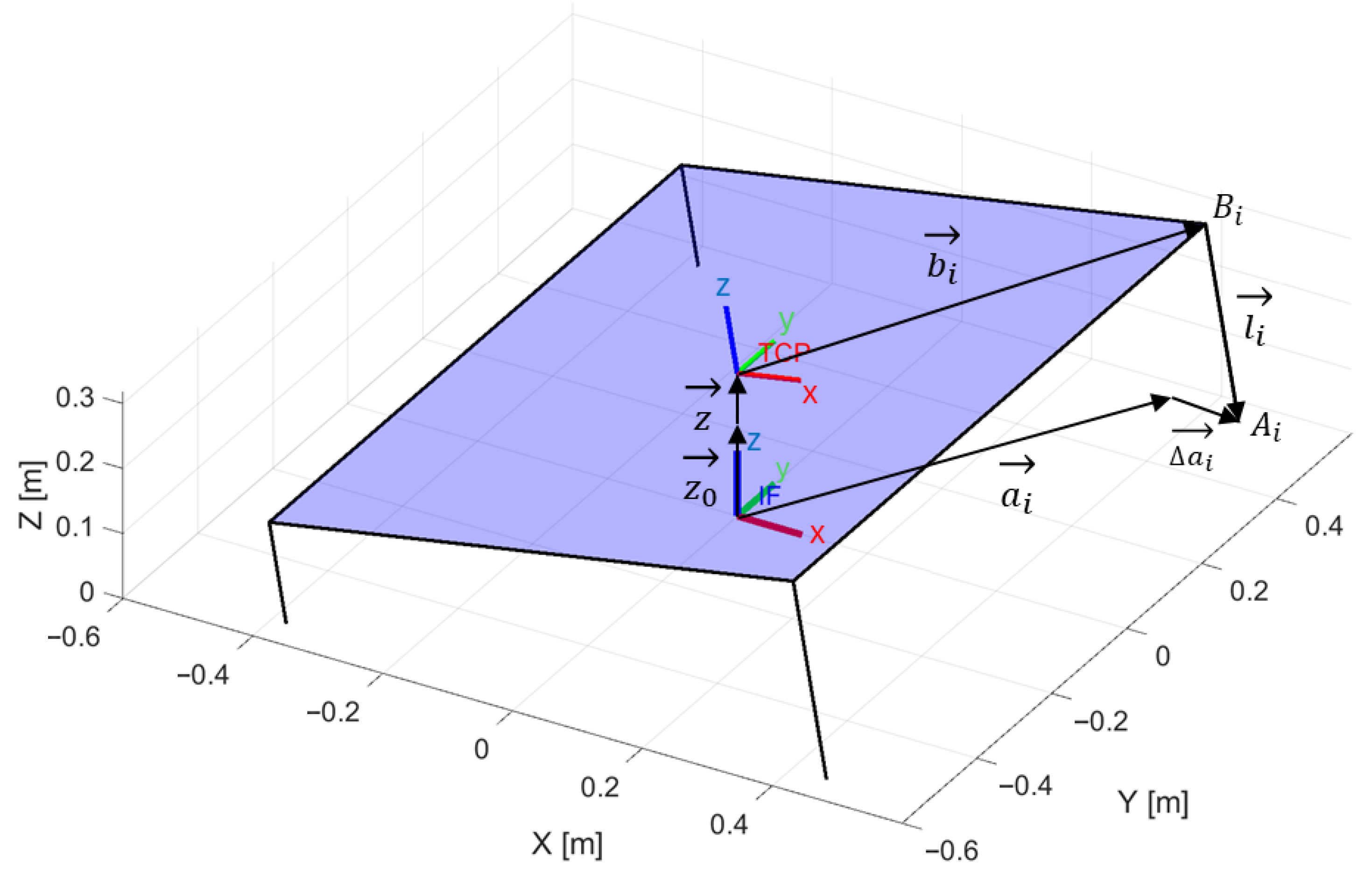
The inverse kinematics equations are derived from the kinematic closure reported in
Figure 4, which is obtained by imposing null TCP displacements along the X and Y axes and no yaw rotation.
The vectors in the kinematic closure are defined as follows:
: TCP initial height (at home position) with respect to the IF frame;
: TCP displacement with respect to the home position; this vector has null x and y components in the IF reference frame.
: Vector linking the TCP with the ith corner of the platform, representing the semi-diagonal of the rectangle of the frame, from the origin of the TCP to . It has a zero-vertical z component in the TCP reference frame.
: Position vector of the center of the ith disc in the IF frame; this is a constant vector lying in the plane at ground level (i.e., z = 0 in the IF frame);
: Vector representing the displacement of the lower end of the ith actuator with respect to the original position in the home configuration (center of the ith disc). The vectors () only have x and y components in the IF reference frame.
: Vector representing each actuator, from to , defining each actuator length and angular position in the IF reference frame. This vector only varies along the z component in the TCP reference frame, since each actuator is tied perpendicularly to the TCP platform.
The constraints acting on the vector quantities are outlined as follows:
, ensuring is always perpendicular to ;
lies on the IF plane, since each actuator foot () is constrained to move on the floor (specifically on the internal surface of the corresponding disc).
, , and have variable lengths, while all the other vectors have a constant module.
has only a vertical component, since TCP displacements in the X and Y crosstalk directions are imposed to be null in the inverse kinematic analysis.
The orientation of the TCP frame is just defined by the roll and pitch angles, with yaw being constantly set to zero.
According to the Tait–Bryan angles, the rotation matrix that describes the orientation of the TCP with respect to the IF is
The following closure equation, expressed in the IF reference frame, holds:
By applying the rotation matrix describing the orientation of the TCP reference frame, vectors expressed in the TCP coordinates are rotated according to the IF coordinates:
The previous equation becomes
The relationship defined by the kinematic closure equations cannot be used to determine the absolute translations of the TCP in the X and Y directions (and not even yaw), since the system is not fully constrained in the XY directions. Equation (
4), defined for each of the four actuators, gives rise to 12 equations in 12 unknowns, with the latter including the 4 actuator lengths (
) and the 8 components of
. By introducing into the equation the data on the dimensions of the frame, given
,
,
, and
components, as well as the known initial length of the actuators (
), the unknowns (
and
) can be determined.
The equation along the
z direction, computed for each
ith actuator, leads to the expression of the joint space coordinates, which are used to calculate the four actuator lengths (
), as a function of the working space variables, i.e., roll (
), pitch (
), and heave (
z):
Vectors () do not correspond to the absolute displacement of the actuator foot in the IF, since the x and y displacements of the TCP, which are assumed to be zero in the inverse kinematic analysis problem, actually differ from zero during machine operation. can be used instead to compute the relative change in distance between the actuator feet.
2.3. Roll–Pitch–Heave Workspace
The workspace of the parallel kinematic machine under analysis is primarily affected by the total stroke of the actuator and the dimensions of the frame. An increase in actuator strokes results in a larger workspace for roll, pitch, and heave DoFs, and a decrease in the frame size results in a larger workspace just for roll and pitch.
Based on the geometric parameters of
Table 2 and with a maximum actuator stroke equal to 100 mm, the highest achievable values for the DoFs of heave (
z), roll (
), and pitch (
) can be determined. They are shown in
Table 3.
It is essential to note that these values correspond to extreme limits that are only reachable when each degree of freedom is actuated individually. Simultaneous movement along multiple degrees of freedom imposes stricter limitations, as is the case for all parallel kinematic machines.
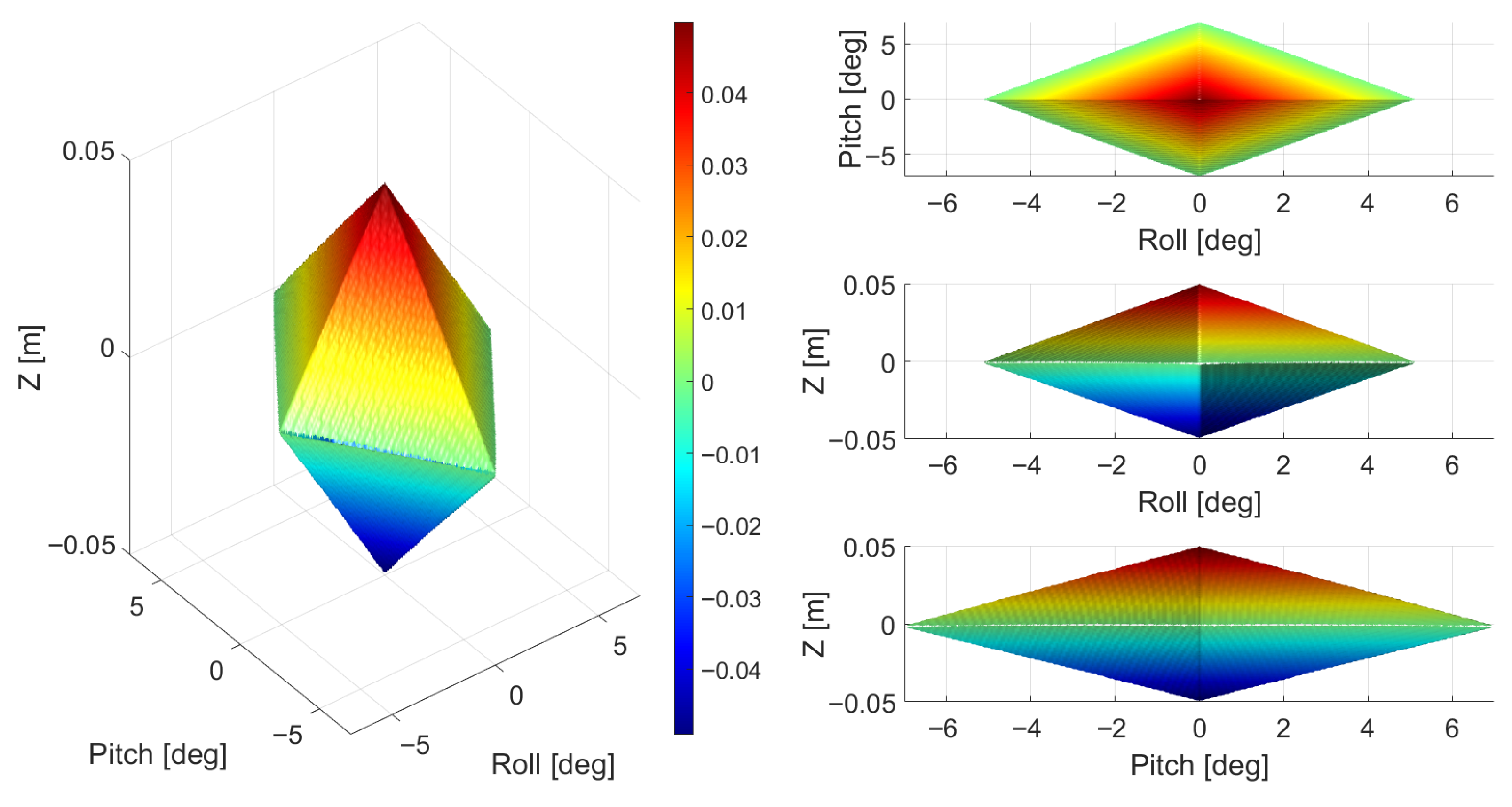
To define the overall workspace, a numerical procedure is carried out to generate a 3D solid representation in the roll–pitch–heave space (
–
–
z, respectively). This procedure involves computing the actuator lengths corresponding to different combinations of the values of
,
, and
z. The tentative workspace, defined according to the maximum limits reported in
Table 3, is discretized using a uniform grid with an angular spacing of
for the roll and pitch angles and 1 mm for heave. For each pose combination, the actuator lengths are calculated by solving the inverse kinematics problem to assess whether the corresponding actuator lengths are compatible with the stroke limits of the selected actuators. The outcome of the presented analysis is the 3D solid illustrated in
Figure 5. The vertices of the solid represent the maximum reachable value of each degree of freedom (as reported in
Table 3). As expected, due to the coupling between the degrees of freedom, the resulting workspace shows a reduction in the achievable values when multiple DoFs are excited. The workspace takes the shape of a squared bipyramid with symmetric geometry and reflects the mutual constraints among the roll, pitch, and heave DoFs.
3. Kinematic Crosstalk: Model and Analysis
As previously described in
Section 2.1, the movements in the crosstalk directions (i.e., surge, sway, and yaw) cannot be formally determined by kinematic considerations alone and also require the solution of the dynamic problem [
21]. The latter is non-trivial, as it depends on the payload; inertial loads; and friction conditions between actuators and discs, which are the most challenging to evaluate. During motion, all the actuator feet move in the plane subjected to dynamic friction; alternatively, as the dynamic conditions vary, it might happen that one of the four feet becomes blocked under conditions of adhesion due to static friction. Three main cases in the contacts between actuator feet and the support discs can be outlined to address this problem:
Adhesion: One of the actuators adheres to the surface of the supporting disc. The maximum number of actuator feet under the condition of adhesion is two when a single rotational DoF is excited (either pitch or roll).
Distributed Sliding: The sliding on the discs is shared between the pairs of actuators, moving in opposite directions.
Macro-Slipping: Under rigid body translation, all actuator feet slide in the same direction, without a point with zero velocity.
In all the circumstances mentioned above, the relative motion between the individual feet can still be defined by the kinematic conditions described in
Section 2.2, but their absolute motion is not known a priori, and the dynamic problem would need to be solved for a complete solution.
Due to the difficulty in estimating the dynamic conditions during the real-time operation of the machine, this paper explores the possibility of defining a simplified method to estimate the range within which actual crosstalk movements occur based on simple kinematic equations. The method is based on the simplifying hypothesis that a point of the structure is constrained in the X and Y directions and that yaw can be neglected. The related equations and the quantification of crosstalk levels are described in the following sections.
3.1. Kinematic Crosstalk Model
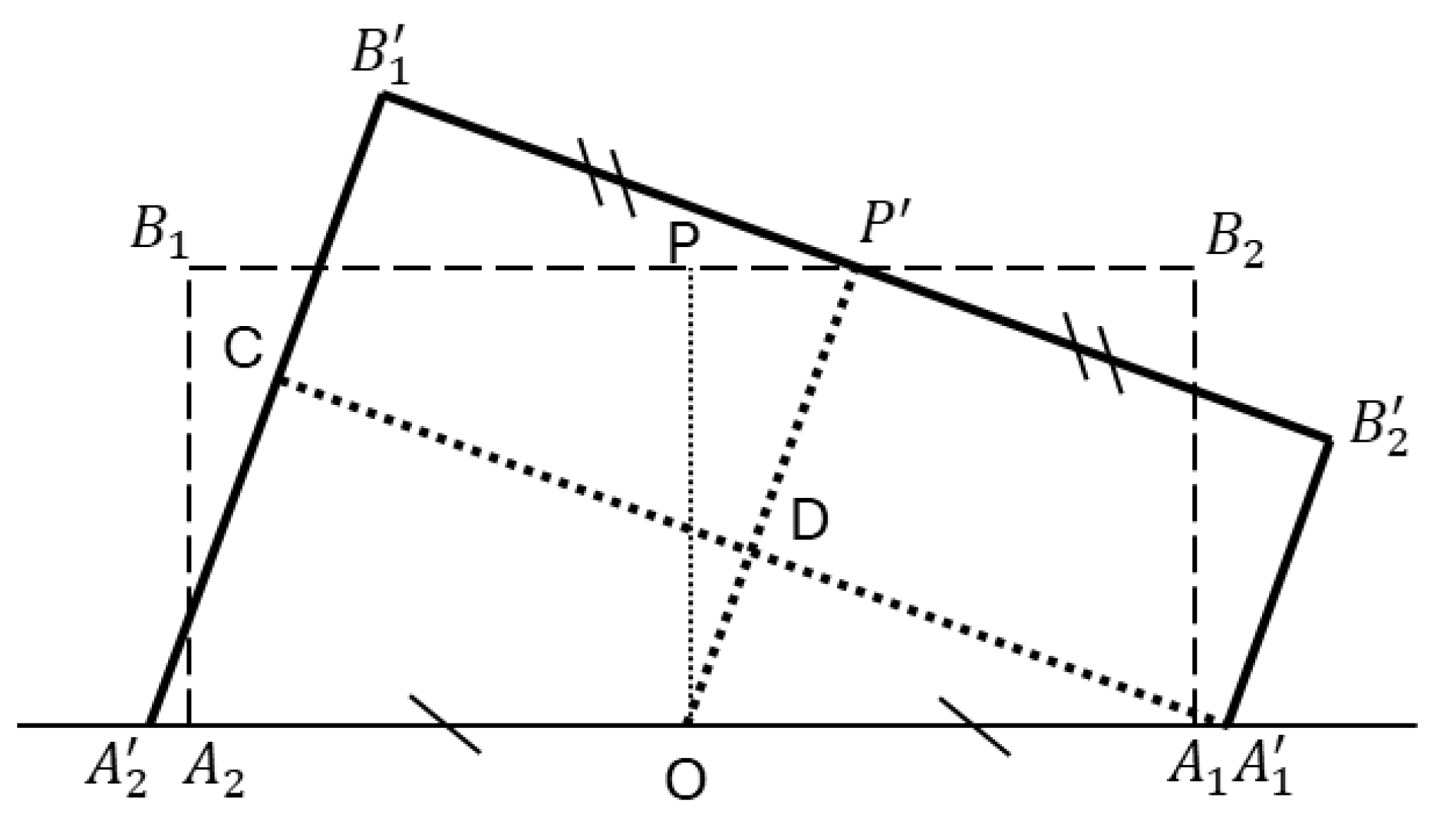
Figure 6 shows the front-view scheme of the platform in the home position (thin dashed line) and in a generic nonzero roll configuration (thick solid line). In the transition from the first (thin dashed line) to the second (thick solid line) schematized configuration, point
O, lying on the floor at the level of the support discs (i.e., 0.22 m below the platform’s TCP in the case under analysis), is assumed to be constrained in the
x–
y plane. This is the main assumption made to quantify crosstalk, in addition to neglecting the platform yaw.
Considering the rolled configuration (thick solid line), let us draw a perpendicular to segment passing through point (midpoint of ) and assume constraint of point O. Through geometrical considerations, we can see that two similar triangles ( and ) are formed. Notice that point D is the midpoint of segment , since the latter is parallel to segment . Therefore, the triangles being similar, the and segments are also equal. Consequently, the choice to block point O ensures that the distance variation between the actuator feet (segment in the home configuration) is evenly distributed between the two segments ( and ). In other words, during the motion of the platform, the displacements of feet located on opposite sides of the actual axis of rotation are assumed to be equal in magnitude. This assumption allows for a kinematic solution to estimate the x and y components of the TCP motion.
For this purpose, a closure equation similar to the one developed in
Section 2.2 can be employed, this time also allowing for absolute displacements of the TCP along the
x and
y directions. Thus, the kinematic closure becomes that reported in
Figure 7.
All quantities represented in
Figure 7 are already defined in
Section 2.2, except for
, which represents the absolute position of the TCP with respect to the inertial frame (IF), having non-null X, Y, and Z components. Assuming point
O to be grounded, this vector is always perpendicular to the chassis plane. Therefore, it has only a non-null Z coordinate if expressed with respect to the TCP reference frame. Thus, it is possible to write the following:
where
is the rotation matrix reported in Equation (
1) and yaw is restricted to be equal to zero. Rearranging Equation (
6), the expression for kinematic crosstalk as a function of the directly controlled degrees of freedom
,
, and
z) is
3.2. Kinematic Crosstalk Workspace
Equation (
7) links the directly controlled DoFs to the kinematic crosstalk. Consequently, starting from the workspace defined in
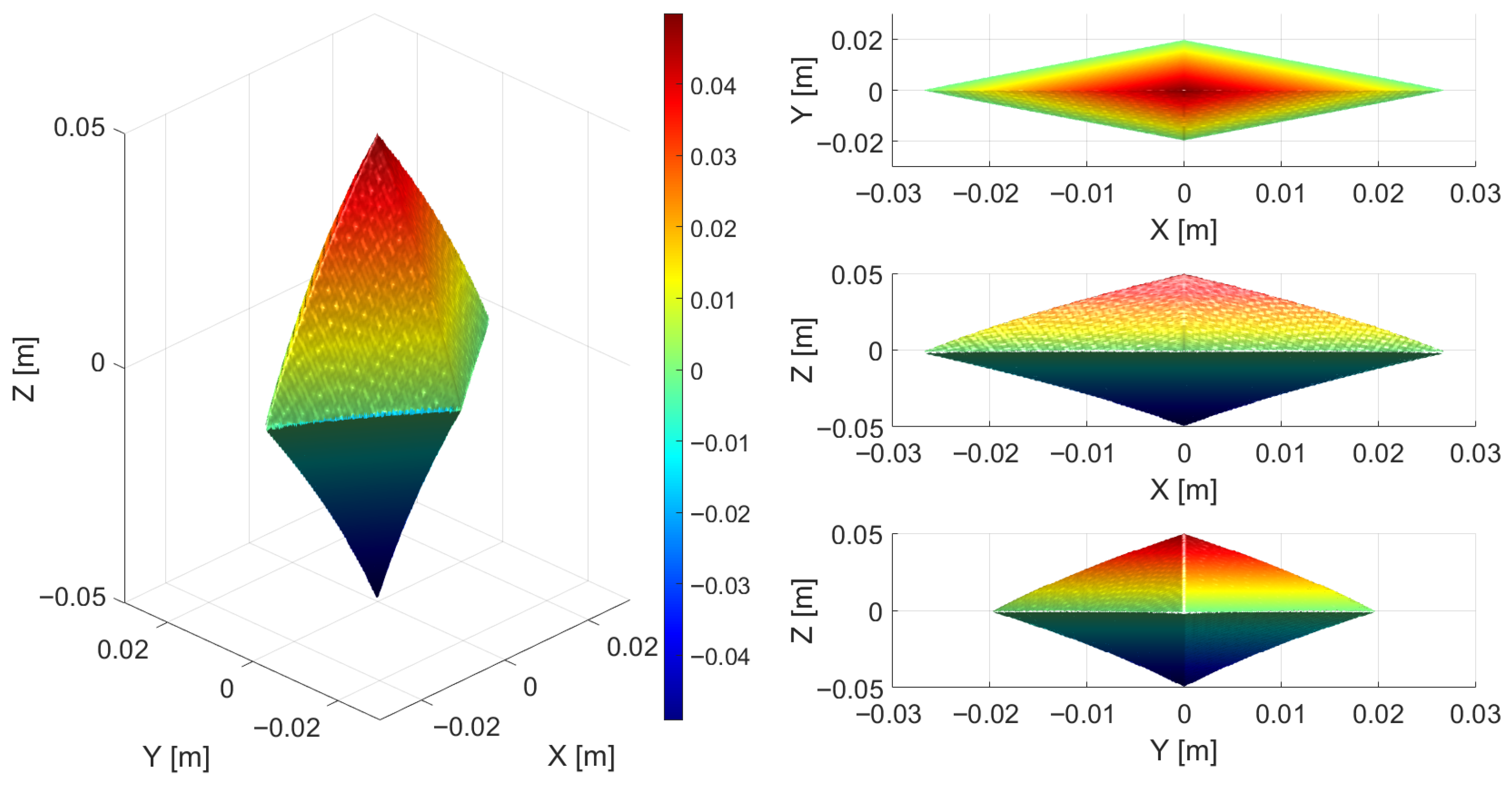
Section 2.3 for the roll–pitch–heave DoFs, it is possible to derive the corresponding workspace for kinematic crosstalk, which is shown in
Figure 8. Although the shape of the workspace is similar to the bipyramid corresponding to the workspace of the roll–pitch–heave DoFs (
Figure 5), we observe that its shape is slightly distorted, owing to the inherent non-linearity in the coupling between the main degrees of freedom and the kinematic crosstalk terms.
The maximum kinematic crosstalk values, achieved when a single degree of freedom is excited at once, are reported in
Table 4.
The kinematic crosstalk displacements reported in
Table 4 are equal to approximately 50% of the maximum value achievable for the heave DoF (i.e., ±50 mm; see
Table 3). Thus, it can be concluded that the displacements in the kinematic crosstalk directions are not negligible.
The presence of these displacements implies that, when a roll or pitch rotation is performed, the actual instantaneous axis of rotation does not lie on the TCP itself but always below it.
Under the assumption of grounded point
O being considered, the instantaneous axis of rotation in the home position lies at floor level, 0.22 m below the TCP. However, as can be inferred from the Jacobian analysis in
Section 3.4, the instantaneous axis of rotation may lie above or below floor level, depending on the motion conditions.
Considering the impact of the rotation axis on perceived motion, due to the different resulting linear accelerations conveyed to the vestibular system [
22], this factor should be considered when evaluating the effects of the machine on motion sickness or in the development of motion cuing algorithms.
3.3. Maximum Crosstalk Accelerations Due to Actuator Dynamic Limits
The workspace represented in the previous subsections refers to quasi-static conditions of machine use. Within the available workspace, it is useful to determine the dynamic performance of the platform in terms of velocity and acceleration, both for the controlled DoFs and for motion components related to kinematic crosstalk.
The maximum velocities and accelerations achievable at the TCP are constrained by the actuators’ speed and force/torque characteristics. Consequently, the extent of these limitations is also influenced by the loads applied to the system.
In the case under analysis, the manufacturer specifies the performance of the platform (that is, stroke, maximum velocity, and acceleration), as reported in
Table 5, under payload conditions below the maximum allowable limit (200 kg). The electromechanical actuators used in this configuration, belonging to the QS-220-PL Qubic System, feature an integrated transmission system. They are supplied with an integrated real-time motion controller, which handles low-level control and allows for actuation at frequencies of up to 1000 Hz [
23].
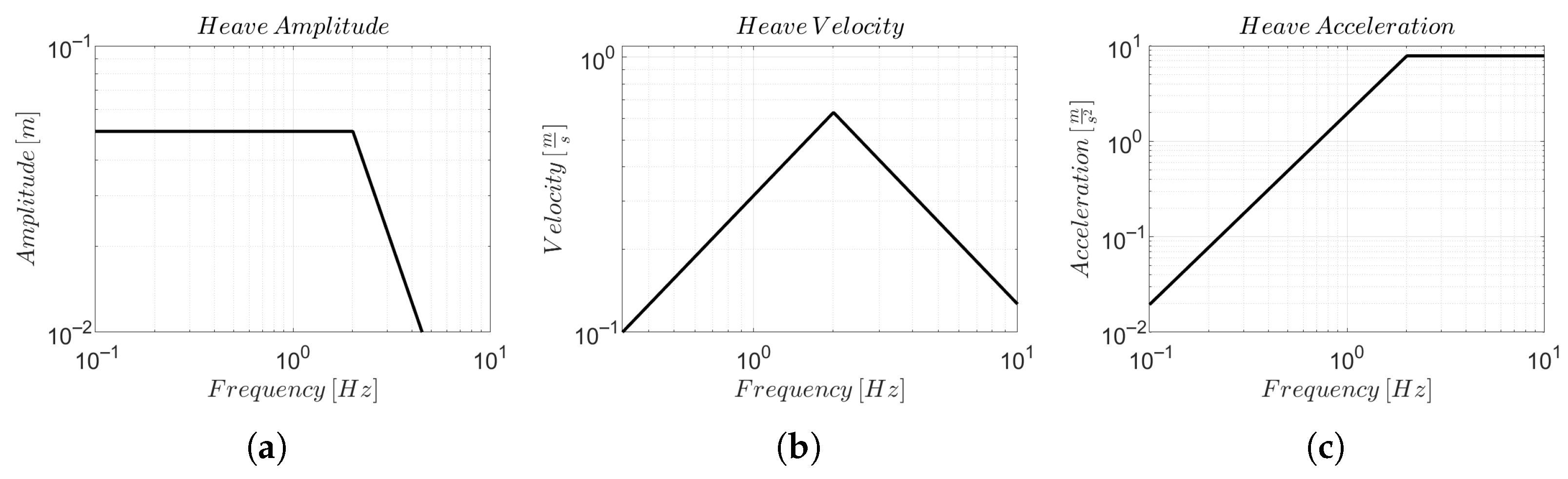
Theoretical dynamic performance for roll–pitch–heave DoFs is first quantified by imposing the actuator limits of
Table 5 in a single DoF performance characterization, as illustrated by the use of logarithmic graphs in
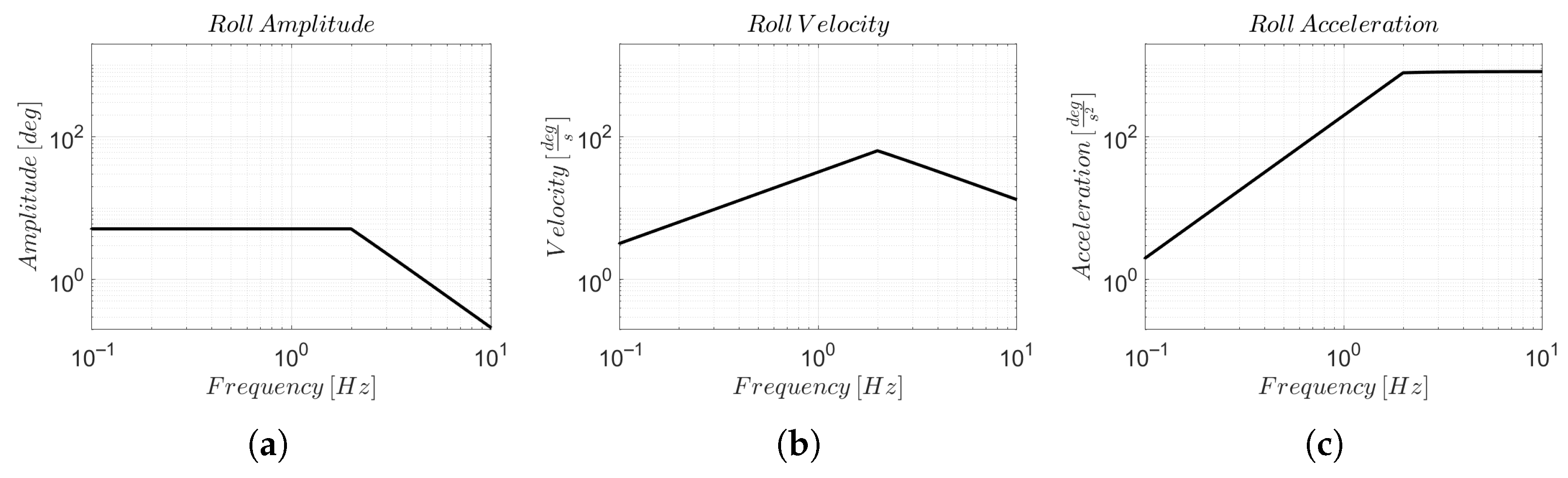
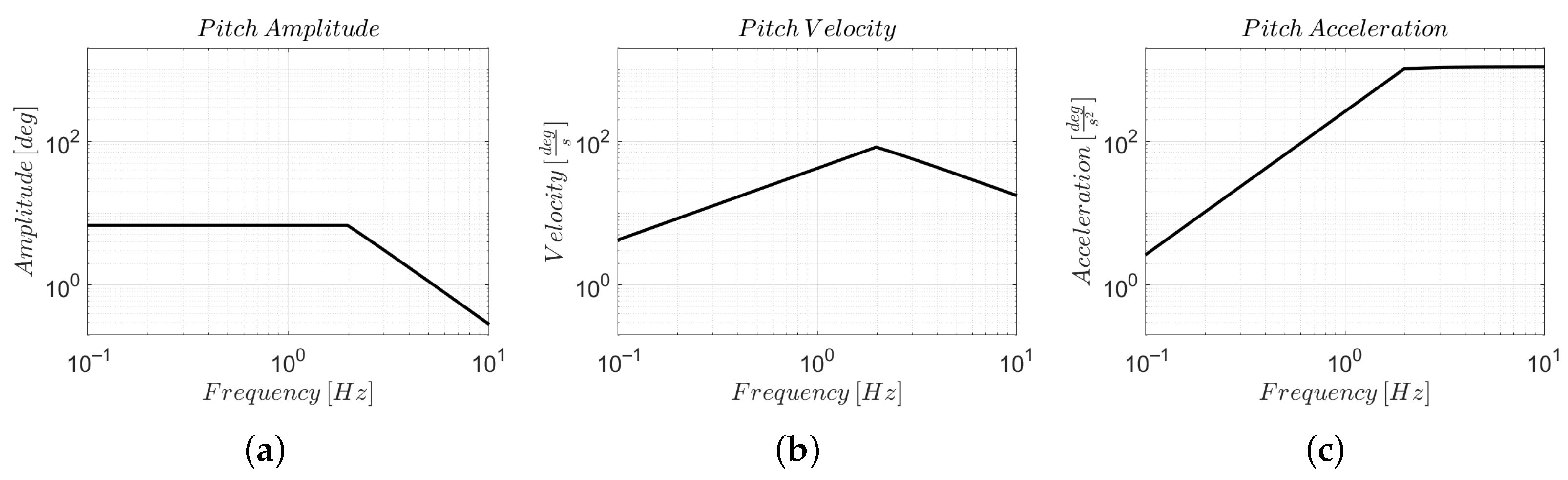
Figure 9,
Figure 10 and
Figure 11. This allows for the summary of information related to the amplitude, velocity, and acceleration limits of the machine for each degree of freedom in a single graph. The graphs are obtained numerically by imposing a sinusoidal reference signal on the TCP along each DoF, starting from the home position. Then, for each frequency, the amplitude of the wave is increased until one of the actuator kinematic constraints reported in
Table 5 is violated. The limit-amplitude value is then saved, and the procedure is repeated for each frequency of the range of interest (i.e., 0.1–10 Hz). The application of this procedure to the platform under analysis results in
Figure 9,
Figure 10 and
Figure 11, which present the amplitude, velocity, and acceleration limits for roll, pitch, and heave, respectively. Three different zones can be identified:
Constant amplitude (
): In this region, the limiting factor is the available stroke of the actuator. Consequently, the reachable velocity is represented by a line with a positive angular coefficient until the velocity limit is reached. In this quasistatic zone, the limits of
Figure 9,
Figure 10 and
Figure 11 correspond to those identified in the previous section and reported in
Table 3. The detected frequency values for
are equal to 1.98 Hz for roll, 1.97 Hz for pitch, and 2.01 Hz for heave.
Constant velocity (): In this second phase, the limiting factor is the maximum velocity of the actuator; therefore, in this range, the maximum speed is constant for each frequency of the interval. For the platform under analysis, the velocity limits are never reached, as the system enters the acceleration-limited region before reaching the velocity-limited range. This behavior is clearly visible in the velocity plots, where the intermediate constant-velocity zone is not present, and frequencies and assume the same value.
Constant acceleration (): For frequencies higher than a certain threshold (depending on the actuator force and control-imposed limits), the limiting factor is the maximum acceleration of each actuator; the maximum velocity linearly decreases with frequency.
Figure 9.
Maximum theoretical single-DoF roll performance. (a) Roll amplitude. (b) Roll velocity. (c) Roll acceleration.
Figure 9.
Maximum theoretical single-DoF roll performance. (a) Roll amplitude. (b) Roll velocity. (c) Roll acceleration.
Figure 10.
Maximum theoretical single-DoF pitch performance. (a) Pitch amplitude. (b) Pitch velocity. (c) Pitch acceleration.
Figure 10.
Maximum theoretical single-DoF pitch performance. (a) Pitch amplitude. (b) Pitch velocity. (c) Pitch acceleration.
Figure 11.
Maximum theoretical single-DoF heave performance. (a) Heave amplitude. (b) Heave velocity. (c) Heave acceleration.
Figure 11.
Maximum theoretical single-DoF heave performance. (a) Heave amplitude. (b) Heave velocity. (c) Heave acceleration.
In the presented graphs, starting from the frequency of (i.e., 1.98 Hz for roll, 1.97 Hz for pitch, and 2.01 Hz for heave), the maximum amplitude achievable for each degree of freedom is significantly reduced compared to the values achievable at quasistatic frequencies. When multiple DoFs are combined, the performance of the platform is expected to fall below the presented curves.
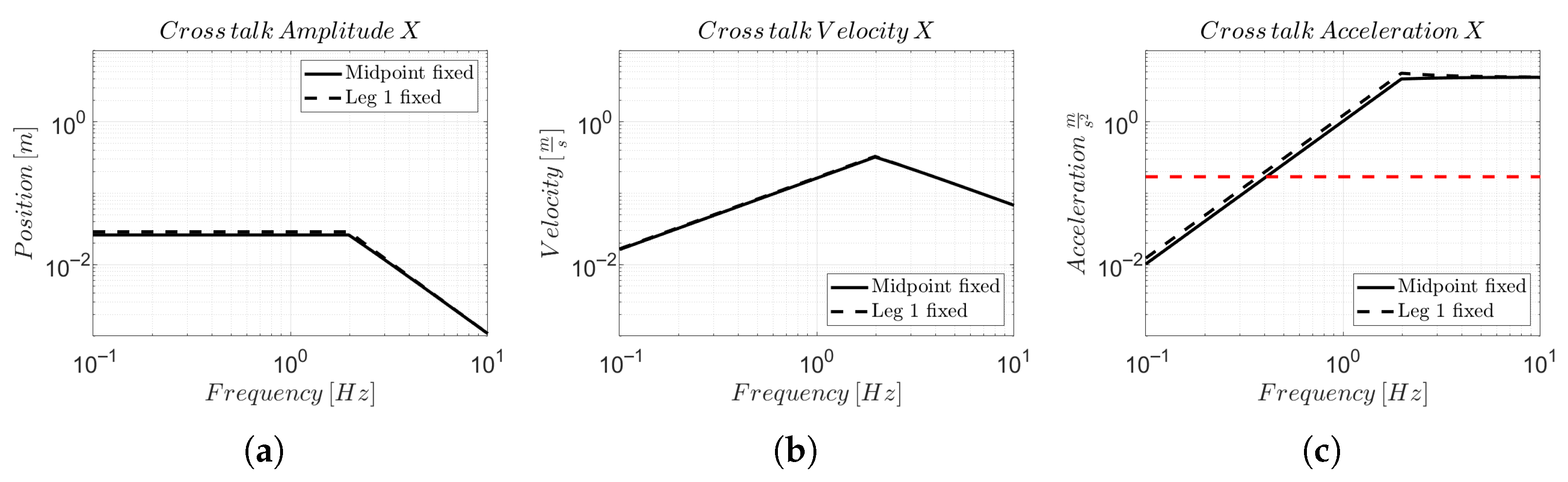
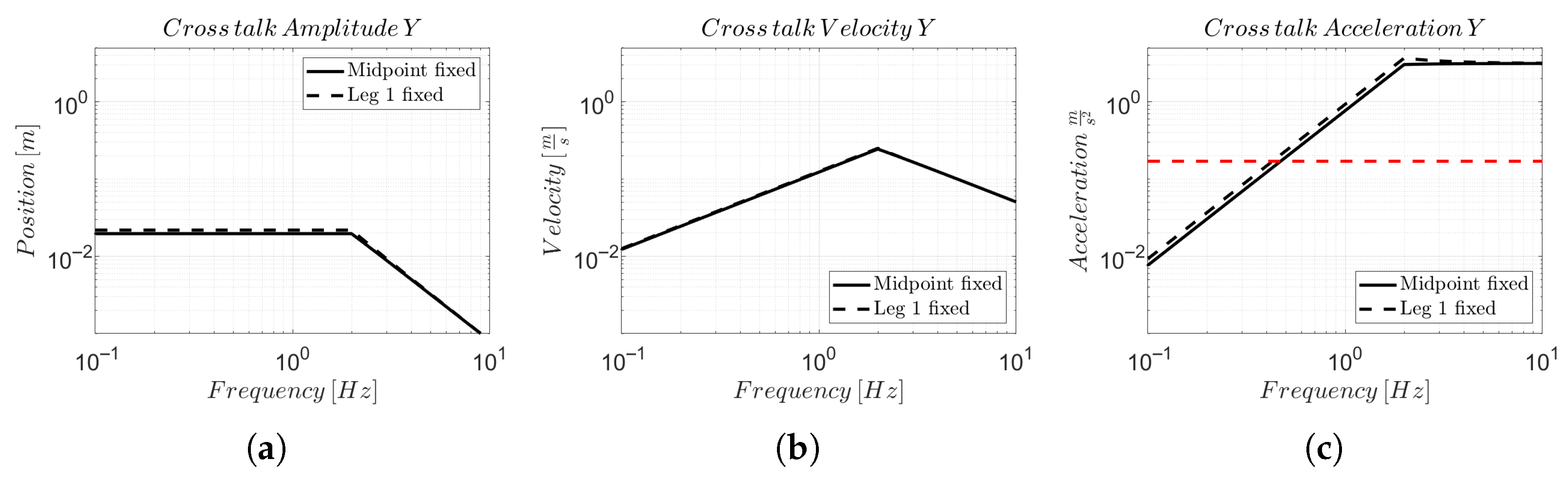
Similarly to what has been presented for the main DoFs, it is possible to derive logarithmic maps that define the maximum acceleration values caused by kinematic crosstalk, resulting from limitations in the dynamic performance of the actuators.
Figure 12 and
Figure 13 report the dynamic limits achievable on crosstalk components x and y, respectively, with solid black lines, as derived by applying Equation (
7) to the limits of the roll and pitch DoFs presented in
Figure 9 and
Figure 10.
Since, as discussed at the beginning of this
Section 3, the actual crosstalk values depend on the contact conditions between the actuators’ feet and the discs, a second case is also considered and modeled by assuming the zero-slip condition for one actuator foot. The corresponding equations, which are always derived from a closure equation, are not reported for the sake of conciseness. The levels of x and y crosstalk corresponding to this second modeling assumption are reported with dashed lines in
Figure 12 and
Figure 13. The analysis enables us to establish a range within which the crosstalk levels are expected to fall, as their exact values cannot be determined due to uncertainties in the foot–contact behavior.
Position (
Figure 12a and
Figure 13a), velocity (
Figure 12b and
Figure 13b), and acceleration limits (
Figure 12c and
Figure 13c) are reported for the x and y crosstalk directions. Even in the case of crosstalk effects, as also observed for the performance of the main degrees of freedom, the velocity limit is never reached in the specific platform under analysis.
The red dashed lines in the acceleration graphs in
Figure 12c and
Figure 13c report the perception threshold values defined by Reid and Nahon [
22], which are equal to
for both longitudinal and lateral accelerations. These thresholds represent the limit value that can be perceived by the vestibular system located in the user’s head to be taken into account when assessing the occurrence of motion sickness.
Table 6 reports the maximum acceleration values achievable in the X and Y crosstalk directions.
It is possible to observe how the accelerations along the X and Y crosstalk directions exceed the
threshold defined by Reid and Nahon [
22] in a considerable portion of the graphs. This represents an important finding of the present study: when this kind of platform is used in simulation systems to recreate inertial feedback, motion cuing algorithms need to take into account x and y motions, either to positively exploit them to enhance the machine’s performance or to avoid the introduction of false cues. In fact, if only roll–pitch–heave degrees of freedom were considered, the estimated acceleration in the user’s head would lack the components arising from kinematic crosstalk, which would lead to potentially inaccurate cuing algorithms or mispredictions regarding the onset of motion sickness symptoms.
3.4. Analysis of Jacobian Terms: Influences of Dynamic Effects
The modeling hypothesis introduced in
Section 3.1, considering the evenly distributed sliding of the feet of actuators on opposite sides, does not adequately describe all the operational conditions of the machine. As said, the actual
crosstalk values are also influenced by dynamic phenomena that affect friction conditions between the actuator feet and the supporting discs, such as the combined effects of machine configuration and inertia. As friction conditions vary, the Jacobian matrix of the machine changes.
In general, the Jacobian matrix of a PKM is the relation between the velocity in the joint space (
q) and the velocity in the working space (
S), which is defined as follows:
where
S = [
,
,
z] is the vector of independent DoFs and
q represents the joint space coordinates.
In a perfectly constrained parallel kinematic machine, such as a tripod, the constraint conditions allow for the derivation of a Jacobian matrix that unambiguously links the independent degrees of freedom to the kinematic crosstalk:
where
S = [
,
,
z] is the vector of independent DoFs, while
=
x,
y,
] is the vector of kinematic crosstalk components. In the machine under analysis, on the contrary, the relationship between kinematic crosstalk and the independent degrees of freedom depends on the dynamic contact conditions at the actuators’ feet.
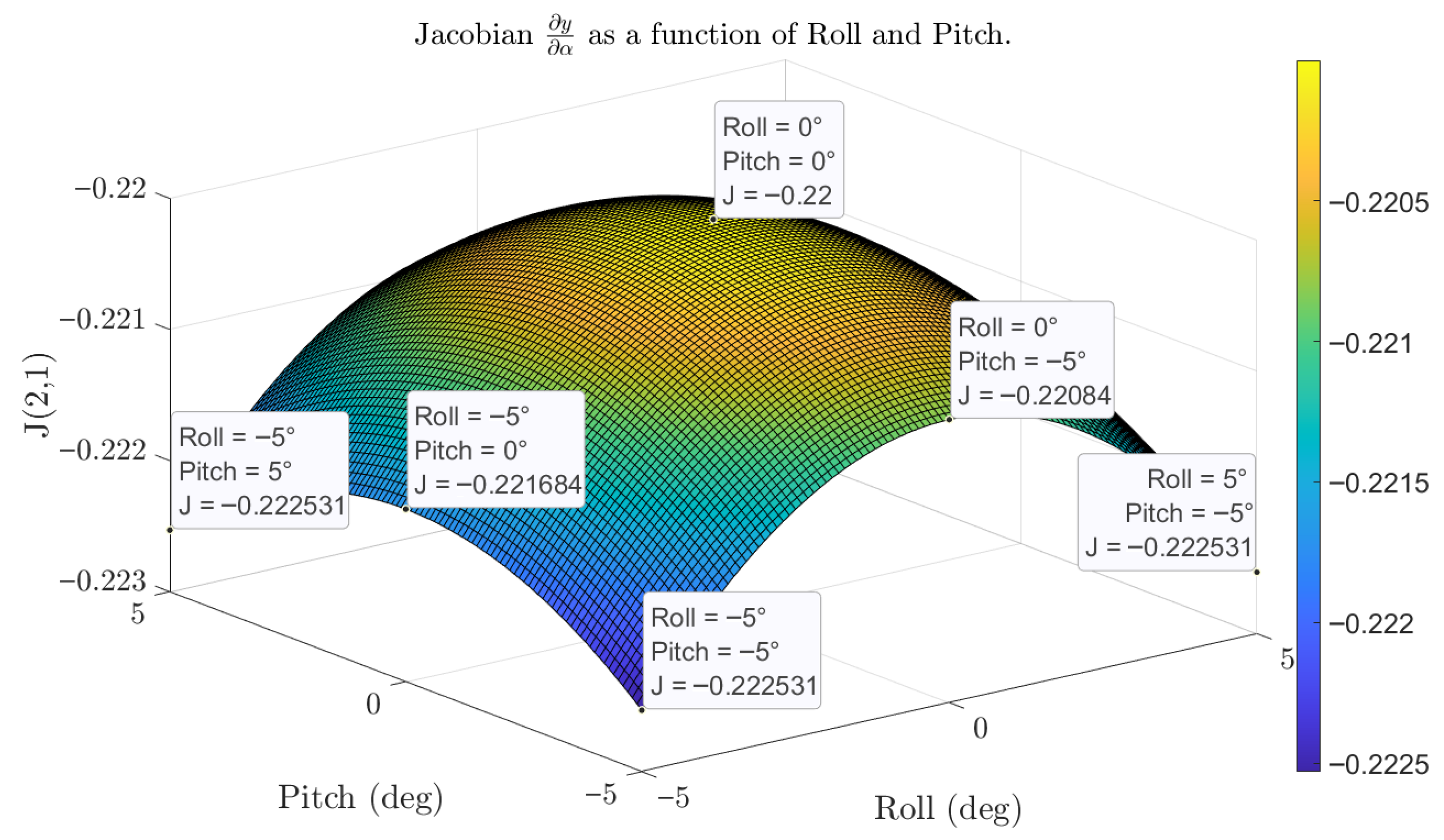
Figure 14 shows, as a starting point, the dependence of the
term on the roll and pitch DoFs, which are obtained with the distributed sliding model described in
Section 3.1. The Jacobian values are negative according to the reference system in
Figure 1. Some specific values are highlighted in the figure for particular combinations of roll and pitch.
To investigate how the machine Jacobian depends on the constraint conditions on actuator feet, the following analysis focuses, for the sake of conciseness, solely on the Y crosstalk direction generated by the roll DoF. To this end, the pitch angle is set to zero, which also allows for full exploration of the available roll workspace, avoiding stroke limitations caused by the coupling between degrees of freedom. The same analysis can, of course, be extended for the pitch DoF and the corresponding X crosstalk direction.
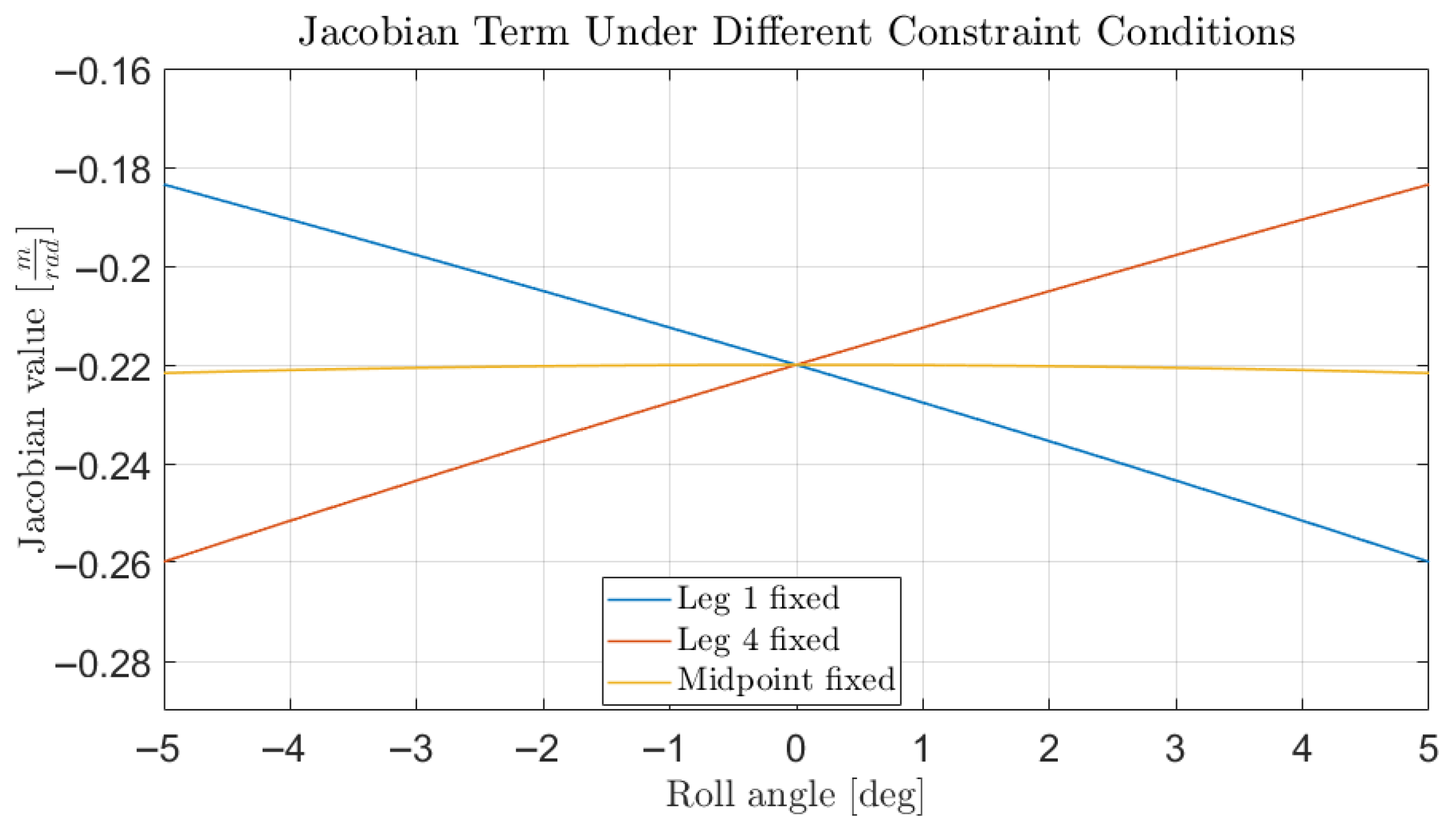
Figure 15 shows the Jacobian
terms as a function of the roll angle, corresponding to three different contact cases in the interaction between actuator feet and supporting discs: a first one that assumes equally distributed sliding for actuator feet on opposite sides, as modeled in
Section 3.1 (labeled
Midpoint fixed in the figure), a second one that assumes sticking contact between actuator feet and supporting discs on the left side of the platform (labeled
Leg 1 fixed), and a last one that assumes sticking contact between actuator feet and supporting discs on the right side of the platform (labeled
Leg 4 fixed). It is possible to observe how the Jacobian values change with varying contact conditions.
The Jacobian term reaches extreme values, in correspondence with the maximum inclination of the platform, for the cases in which adhesion is assumed on a pair of actuators. The Leg 1 fixed and Leg 4 fixed curves, which are obtained by assuming zero slip on the actuators on one side, should be interpreted as limit cases. The case represented in yellow in the figure (labeled Midpoint fixed) represents an intermediate condition under which the sliding is equally distributed between actuator feet on opposite sides. Since frictional conditions, which influence the instantaneous value of the Jacobian, are neither easily captured through numerical modeling nor readily assessed experimentally during machine operation, this intermediate curve is proposed as a reference model for estimating the kinematic crosstalk values. Thus, the proposed procedure consists of exploiting the Midpoint fixed model for all conditions of motion while quantifying the potential error introduced by the simplifying assumption.
In
Figure 15, it is possible to observe that, for a roll of ±5 degrees, the maximum percentage difference between the limit curves (
Leg 1 fixed and
Leg 4 fixed) and the curve corresponding to the selected modeling option (
Midpoint fixed) is equal to ±21.8%. The difference decreases almost linearly for smaller roll angles, for which the difference between the predictions of different models becomes less relevant.
The identified curves are valid only in the absence of significant gross sliding (macroscopic sliding) or foot lift-off induced by strong dynamic effects, in which case it is reasonable to assume that the machine’s behavior must be limited by the Leg 1 fixed and Leg 4 fixed curves. The soundness of this hypothesis will be verified in the next section through experimental tests. In the case of macroscopic sliding, as all actuator feet slip in the same direction, the Jacobian value is not constrained between the previously considered curves, and the proposed model could no longer be valid. For this reason, the magnitude and relevance of macroscopic sliding under normal dynamic operating conditions will be assessed through experimental tests in the following sections of the paper.
4. Experimental Test
4.1. Aim of the Tests and Experimental Setup
The analysis carried out in the previous sections defines the behavior of the platform from a theoretical point of view, also evaluating its performance as contact conditions on actuator feet vary. To quantify the accuracy of the estimates provided by the proposed kinematic model and evaluate the influence of dynamic phenomena, an experimental campaign is conducted to compare theoretical data with measurements carried out on the physical device.
The experimental investigation is carried out by testing the platform under two different load conditions: without any payload and with a 66 kg person standing on the platform. Although the presence of a standing person may introduce uncertainties into the system dynamics (such as an unconstrained load and potential body movements), this setup is deliberately chosen to study the system in the most general case and in view of possible human-in-the-loop simulator applications. During the tests, the TCP accelerations are measured using a 3DM-GX5-AHRS MicroStrain IMU sensor (HBK, London, UK) fixed in correspondence with the geometric center of the frame. Furthermore, the position and orientation of the TCP are tracked using an Optitrack Prime 13W (Optitrack, Corvallis, OR, USA), a marker-based optoelectronic motion capture system.
The main objectives of the experiment are described as follows:
The resulting crosstalk estimates are directly compared with the crosstalk measurements acquired on the physical device.
To evaluate the potential application of the model to the real-time estimation of X and Y movements, the model is input with the roll-feedback signal provided by the real-time controller of the platform. To do so, a preliminary evaluation of the reliability of the roll-feedback signal is carried out by comparison with direct measurements acquired from the Optitrack system, which confirms their consistency with discrepancies below .
The experimental setup is represented in
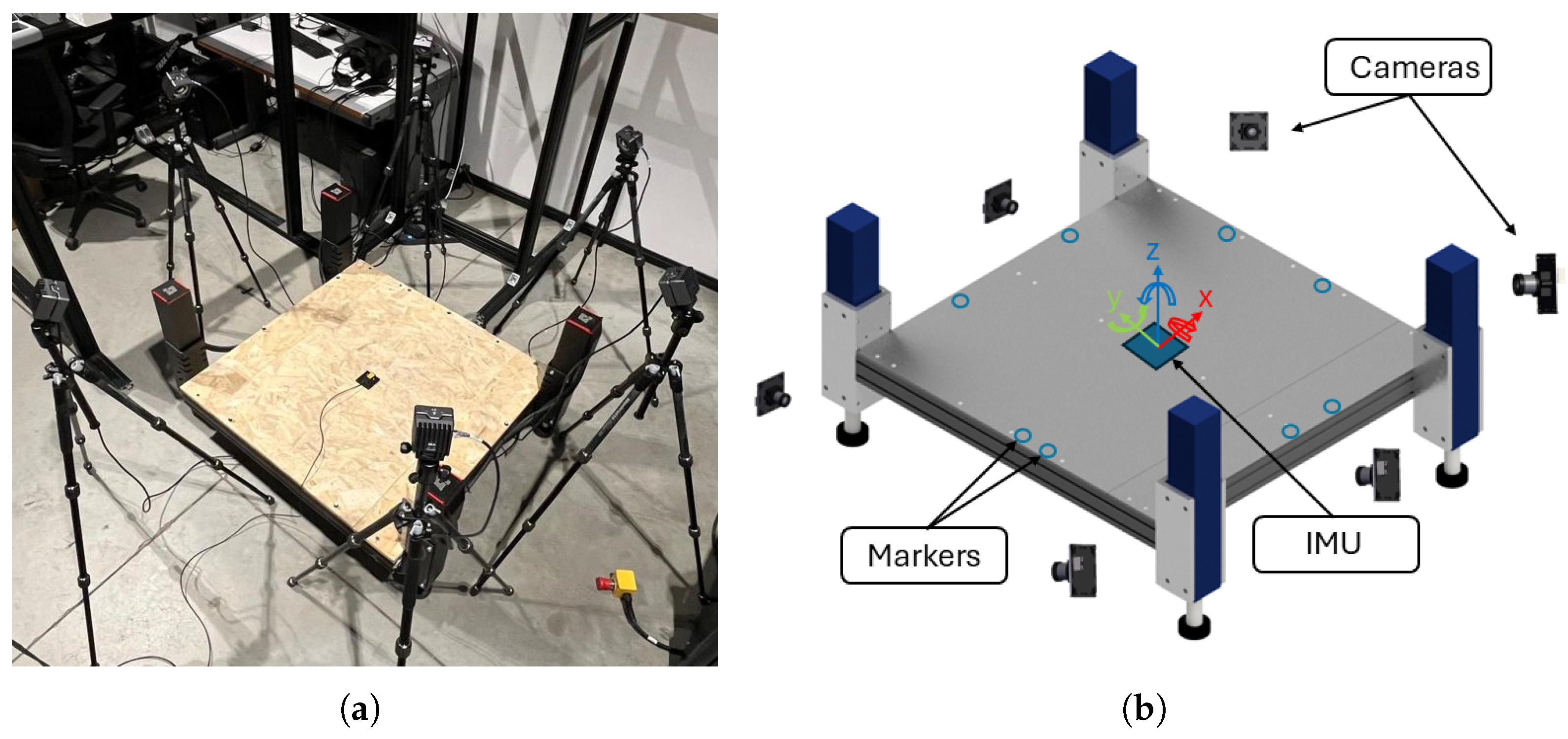
Figure 16. The four-legged motion platform used for the tests (
Figure 16a) has the same dimensions and characteristics exploited in the numerical model in
Section 2 and
Section 3.
In the adopted device, the supporting discs are not rigidly linked to the floor; therefore, in addition to possible sliding between the actuator feet and the inner supporting disc, relative movements may possibly occur between the external base of the disc and the floor. This potentially amplifies the effect of rigid macro-slipping induced by high inertial loads and can therefore be considered a conservative factor for the purposes of comparison of experimental and numerical results.
Accelerations along the X and Y directions are measured at a frequency of 100 Hz through the IMU sensor. The Optitrack motion capture system, consisting of six high-speed cameras, is used to track the position of the TCP at a sampling frequency of 120 Hz. It allows for the acquisition of the position and orientation of rigid bodies through a set of passive markers (see
Figure 16b), which must maintain a constant distance during acquisition and must be positioned asymmetrically to guarantee a unique reference for orientation. Eight markers are placed: two on each side of the frame and six high-speed infrared cameras placed around the platform.
4.2. Assessment of Model Accuracy Through Acceleration-Based Numerical–Experimental Comparison
To analyze the effects of different loading conditions and motion laws on friction conditions and, consequently, on the dynamic behavior of the platform, several tests are performed. The platform is subjected to sinusoidal motion with amplitudes ranging between and and frequencies that vary between Hz and Hz. Each motion law is tested on both the unloaded and loaded platforms.
As a first step of the analysis, the machine is commanded with a single roll DoF to test the workspace limits.
Table 7 and
Table 8 illustrate the amplitudes, frequencies, and corresponding accelerations of the input of the reference roll for each performed test. The motion-law parameters are chosen to explore different areas of the workspace (amplitudes of
and
for tests 1 to 10; see
Table 7) and to analyze the effects of different levels of angular acceleration to assess the influence of inertia (
and
for tests 11 to 18; see
Table 8).
All acquired data are subsequently imported into MATLAB (version r2024b) for post-processing and analysis. For a direct comparison with the numerical results of the kinematic model, the accelerations should be measured along the X and Y directions in the global reference system. Since the IMU measurements are provided in the TCP reference frame, linear accelerations need to be processed with a rotation matrix based on the actual pose measurements. The Fourier transform of the two signals (i.e., IMU measurement and model estimation exploiting the real-time roll feedback from the controller as an input) is calculated, and the amplitudes of the harmonic corresponding to the excitation frequency are compared.
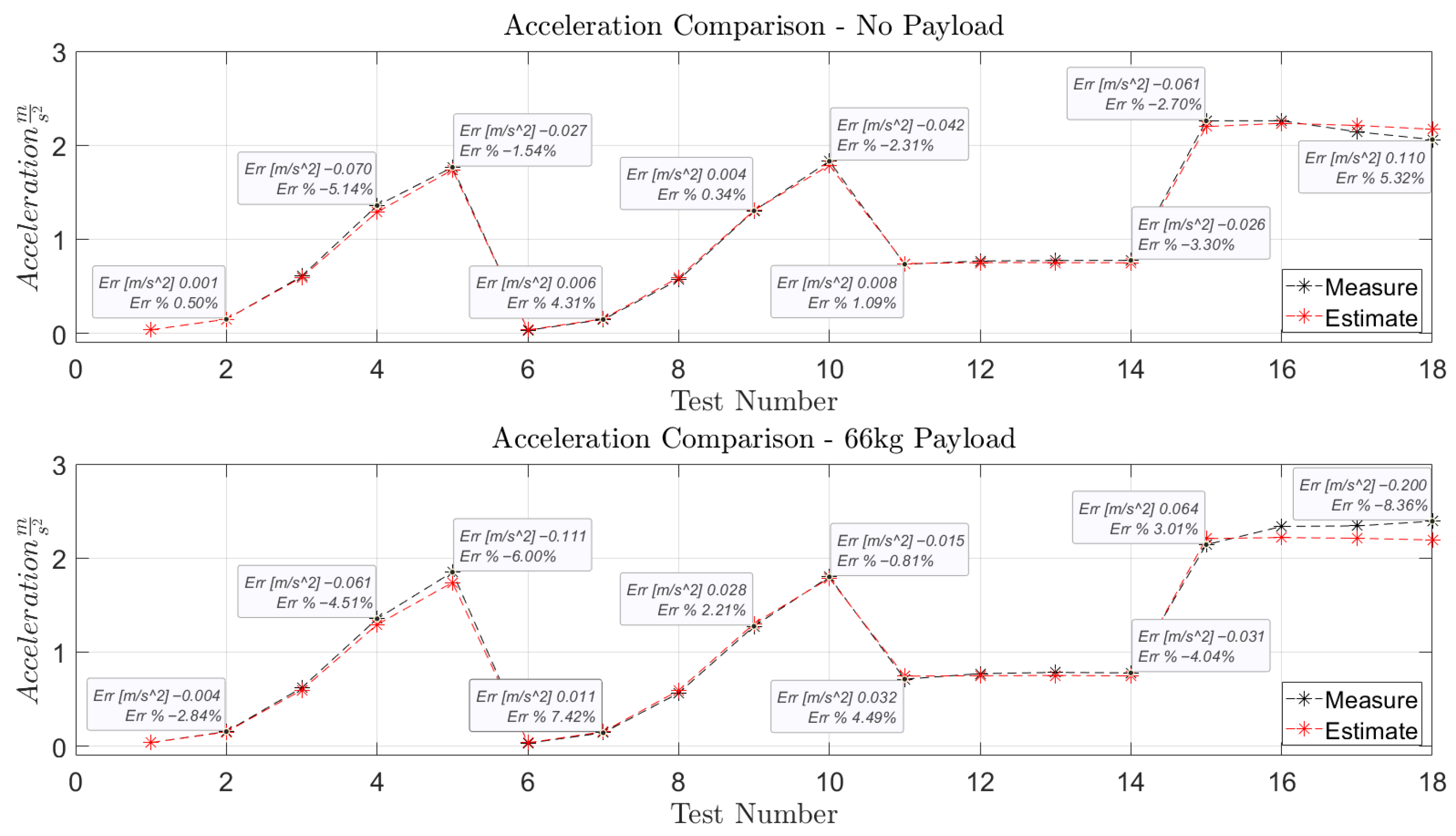
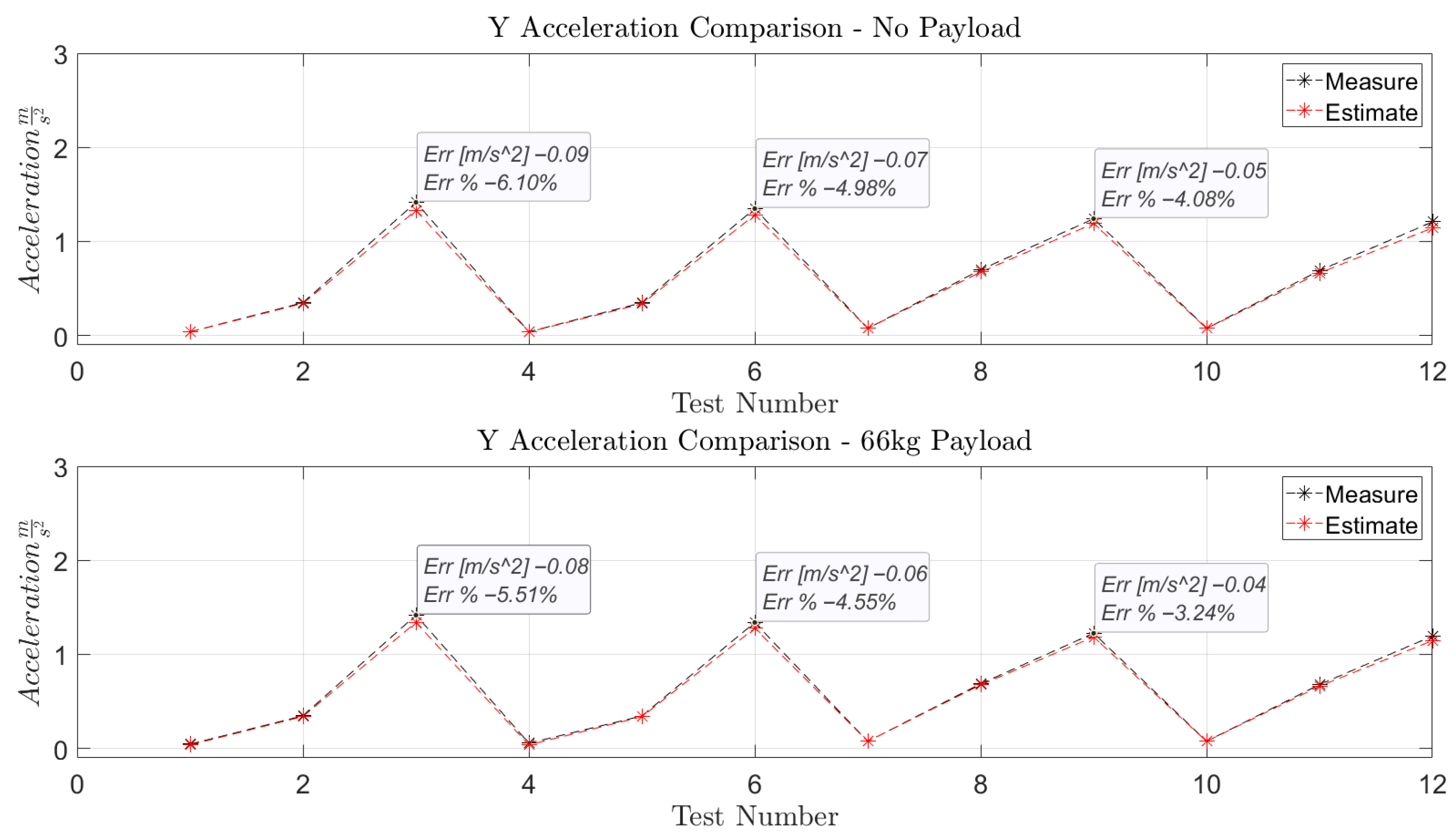
Figure 17 shows the results corresponding to the cases without and with payload. For example, selected points are annotated with labels indicating the estimated acceleration value and the percentage error with respect to the measurement.
Under both conditions, the theoretical acceleration trend closely follows the measured trend. The estimation error generally remains below 10%, with larger deviations observed in the tests with payload at higher accelerations. In contrast, the effects of different levels of amplitude do not appear to have a systematic impact on the accuracy of the estimation. In all the considered cases, the estimation error seems to be acceptable for the numerical estimation of crosstalk and potentially exploitable for a future investigation of the effects that crosstalk components may have on user perception and motion sickness.
As a second step of the analysis, the combined effect of roll and pitch is tested. Motion laws with different combinations of amplitude and frequency are tested for both roll and pitch. In this case, the range of amplitudes and frequencies has to be limited due to performance constraints.
Table 9 summarizes the test conditions: in tests numbers 1 to 6, an amplitude of 1 degree is used for both roll and pitch, whereas in tests 7 to 12, the amplitude is increased to 2 degrees. Regarding excitation frequencies, in tests 1 through 3 and 7 to 9, the same frequency is imposed on both roll and pitch. In contrast, tests 4 to 6 and 10 to 12 are conducted with different frequencies for roll and pitch, keeping the same roll frequencies as in the previous cases while reducing the pitch frequencies.
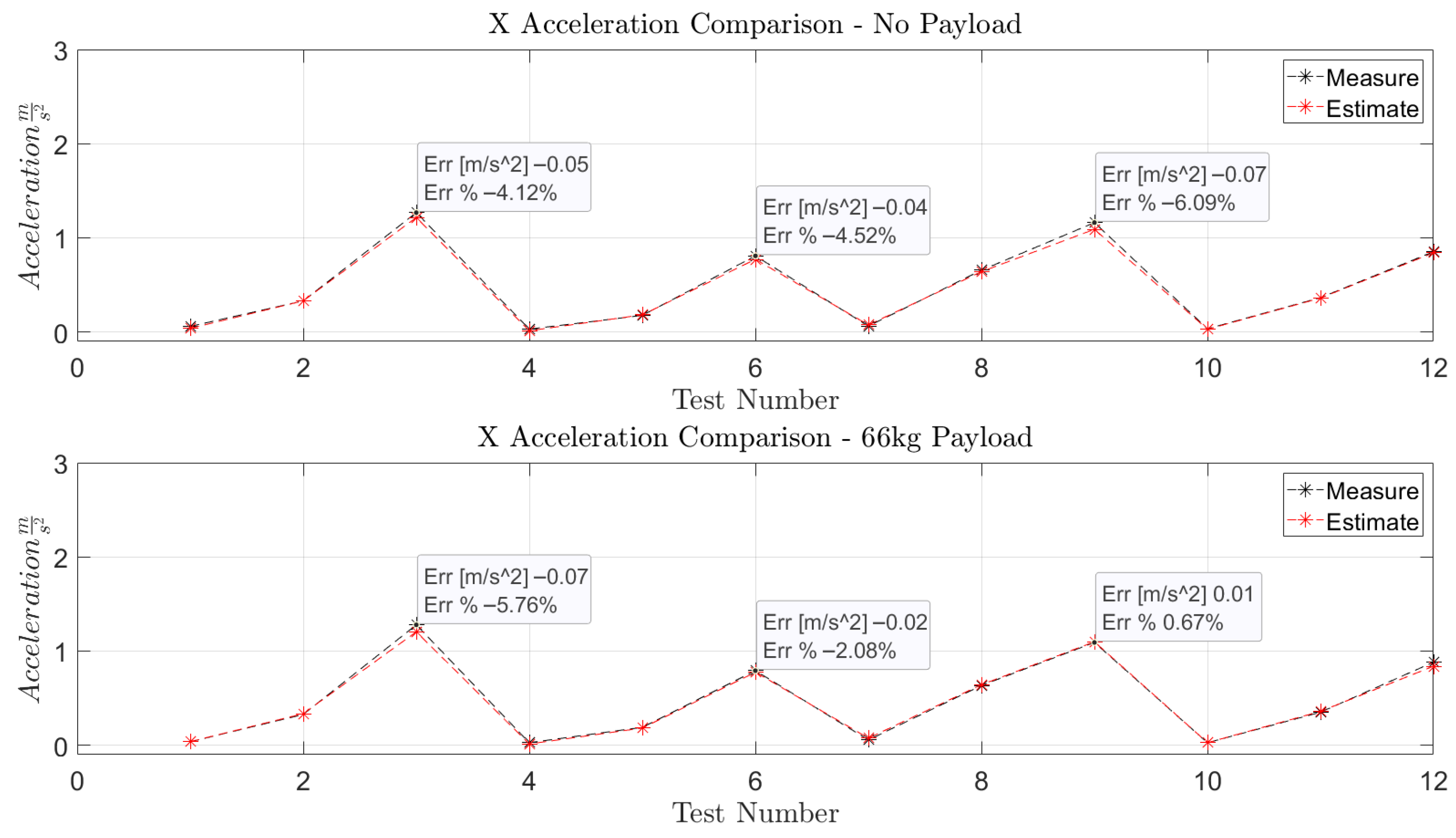
Figure 18 and
Figure 19 illustrate the results of the combined motion simultaneously involving the roll and pitch degrees of freedom.
Figure 18 refers to the X direction, and
Figure 19 refers to the Y direction.
Also in this case, there is consistent agreement between the measured harmonic amplitude and that predicted by the proposed model. Most acceleration amplitudes exceed the threshold value defined by Reid and Nahon [
22], which is equal to
, and are therefore relevant for consideration in applications involving the combined use of roll and pitch motions.
It should be noted that in all the aforementioned tests, the maximum measured yaw angle remains below degrees, which supports the validity of the simplifying assumption of neglecting yaw in the model.
4.3. Jacobian-Based Comparison Between Model and Experimental Data
The time derivative of the absolute linear and angular positions acquired by the optoelectronic system at 120 Hz allows for experimental determination of the Jacobian terms ( and ) at each moment in time. This provides more accurate results compared to the integration of acceleration signals provided by the IMU sensors.
The experimental Jacobians are compared with the results obtained from the numerical models presented in
Section 3.4, corresponding to different adhesion conditions. Through comparison between numerical and experimental results, it is possible to assess the consistency of the behavior of the system with the two identified modeling scenarios: adhesion and distributed sliding. In case of macro-sliding, the experimental results are expected to deviate from the model-predicted range.
The analysis is focused on tests with single-degree-of-freedom roll excitation, as these conditions enable the highest acceleration and inertial load levels to be reached. These testing conditions also show the largest deviations between the predictions of the numerical model and the experimental data, as presented in the previous
Figure 17.
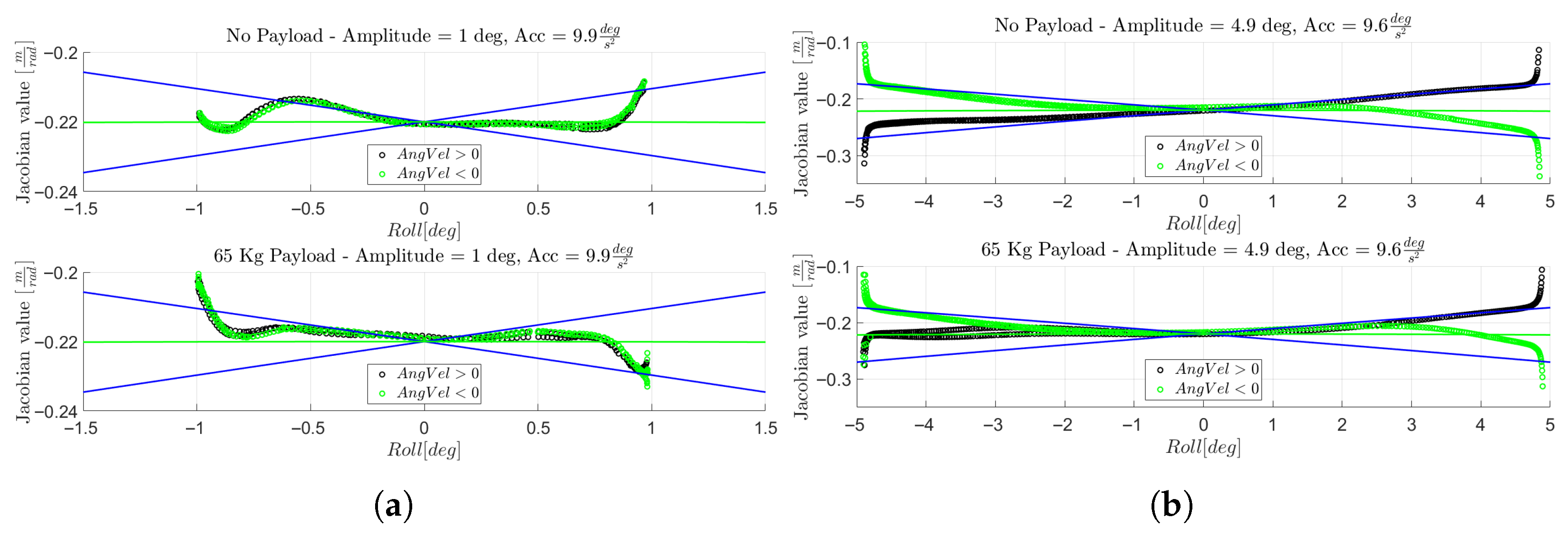
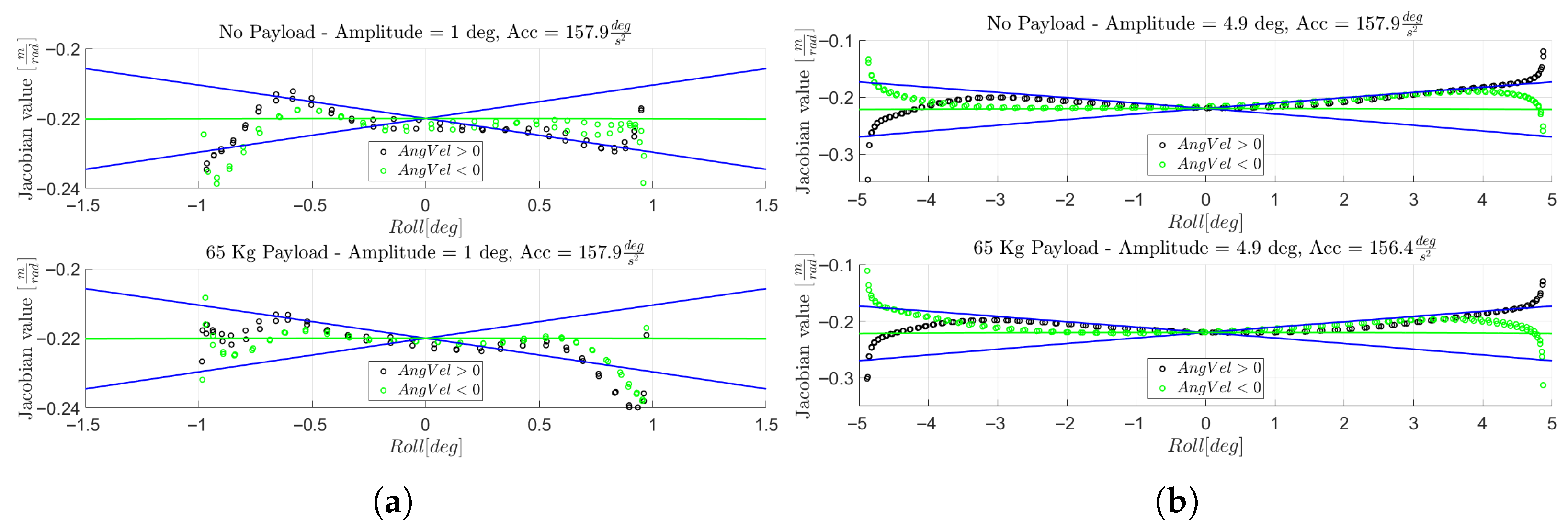
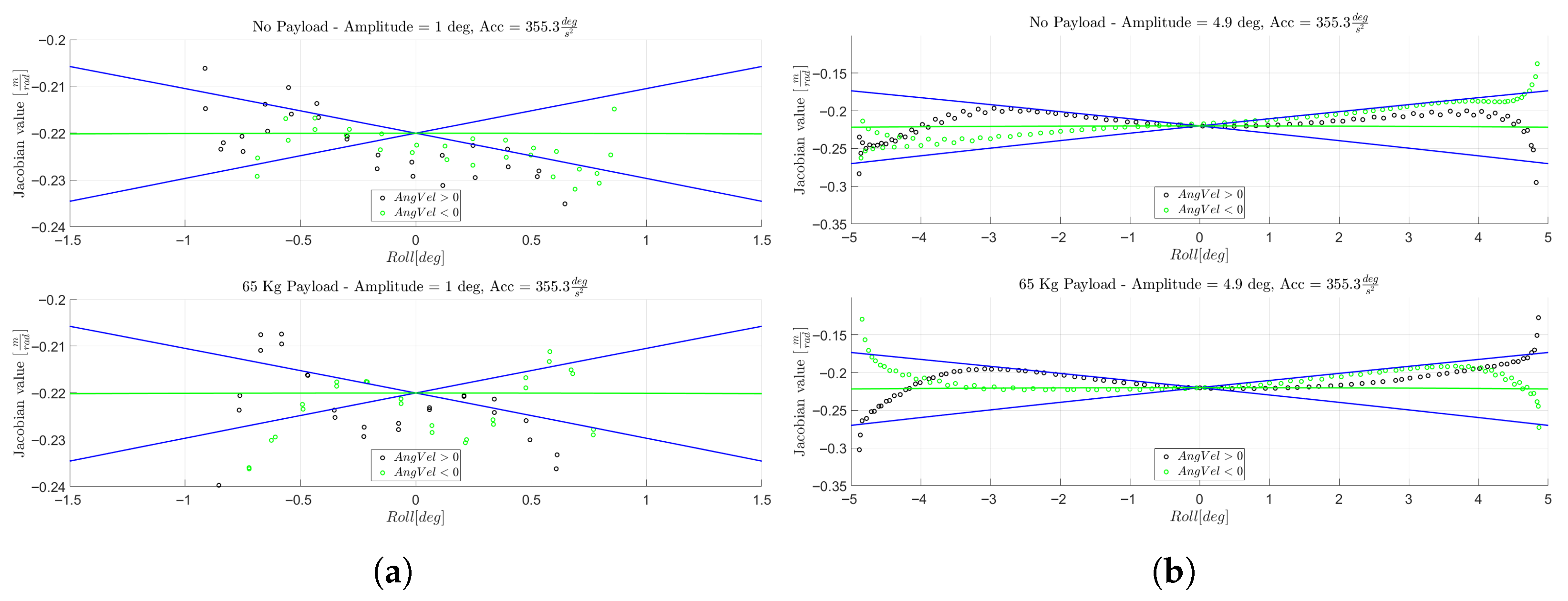
Figure 20,
Figure 21 and
Figure 22 show the dependence of the experimental Jacobian term (
) on the roll position for three different acceleration levels and two different roll amplitudes with and without payload. The solid green line in the figures represents the theoretical Jacobian predicted by the model considering 50% distributed sliding on actuator feet. The two blue lines in each figure correspond to the representation of the theoretical Jacobian in extreme cases where a sticking contact occurs on a pair of actuators, as already discussed in
Figure 15. The experimental Jacobian values are represented by circular green and black markers. To differentiate the motion phases of the sinusoidal motion, the markers are colored black for the positive angular velocity and green for the negative angular velocity. Reference is always made to the direction of the x axis of
Figure 1.
Both linear and angular velocity signals are filtered with a second-order Butterworth low-pass filter, with a cut-off frequency equal to five times the frequency of the reference sine wave imposed on the roll DoF. This aims to maintain the first three fundamental harmonics and reconstruct the signal into its main components. Since experimental data are calculated as the ratio of the TCP linear velocity to the TCP angular velocity, the calculation is not performed when the angular velocity assumes values very close to zero and below a predefined threshold, to avoid spikes due to divisions for near-zero values. This threshold is individually defined for each test as 5% of its maximum angular velocity.
For low acceleration levels (
Figure 20), the experimental Jacobian terms almost always remain within the limits defined by the kinematic models described in
Section 3.4, corresponding to the sticking conditions in one pair of actuators. Exceptions may be observed at the motion reversal points, corresponding to the points of maximum acceleration, where some tails exceed the limits of the model, consistent with a rigid slipping of the platform along the Y direction. In the case with ab amplitude of
(
Figure 20a), for an extended portion, the experimental Jacobian follows the solid green line corresponding to the model with a uniform slipping distribution on the feet. In contrast, with higher oscillation amplitudes under the same acceleration level (i.e.,
,
Figure 20b), experimental trends closely match the theoretical curves corresponding to sticking contact in one actuator pair, consistent with a more marked difference in load distribution on actuator feet. The slight asymmetry observed in the experimental curves for positive and negative roll angles can be attributed to a lack of perfect flatness of the laboratory support plane, which influences the load distribution under sliding support constraints.
As accelerations and, thus, inertial loads increase (
Figure 21), the experimental data begin to exhibit Jacobian values that exceed theoretical limits more markedly, with slipping events occurring at roll angles lower than those observed in
Figure 20. This difference, although present, is less pronounced for a motion amplitude of 5 degrees. It must be remarked that in the cases with a payload consisting of a person standing on the platform, an additional uncertainty in the platform behavior is introduced due to the individual’s response to the motion imposed by the platform.
Finally, with an angular acceleration of
(
Figure 22), in the tests with 1 degree amplitude, the Jacobian clearly deviates from the theoretical region due to the appearance of macro-slip. These deviationsare observed not only near the motion reversal points but also during other phases of the motion law. The influence of the payload, although generally non-systematic due to the inherently unpredictable reactions of the person standing on the platform, is particularly evident in
Figure 22a, producing marked oscillations in the measured Jacobian, which can be attributed to inertial and gravity effects induced by the relative motion of the person with respect to the platform. For the 5-degree amplitude, as in the previous cases, macro-slip appears in a more contained manner, occurring primarily in the vicinity of the motion-reversal phase. Finally, it is worth noting that, even in the presence of very relevant inertial effects, the maximum error associated with using the kinematic model alone for Jacobian estimation remains close to the ±21.8% range pointed out in
Figure 15, although for high accelerations, this percentage error is also detectable at lower roll amplitudes.
In conclusion, the simplifying assumption can be reliably adopted to estimate crosstalk values, regardless of the dynamic loading conditions of the platform. However, under dynamic loads approaching the operational limits of the platform, special attention must be paid to the occurrence of macro-slipping phenomena.
4.4. Test-Case Scenario: Driving Simulation
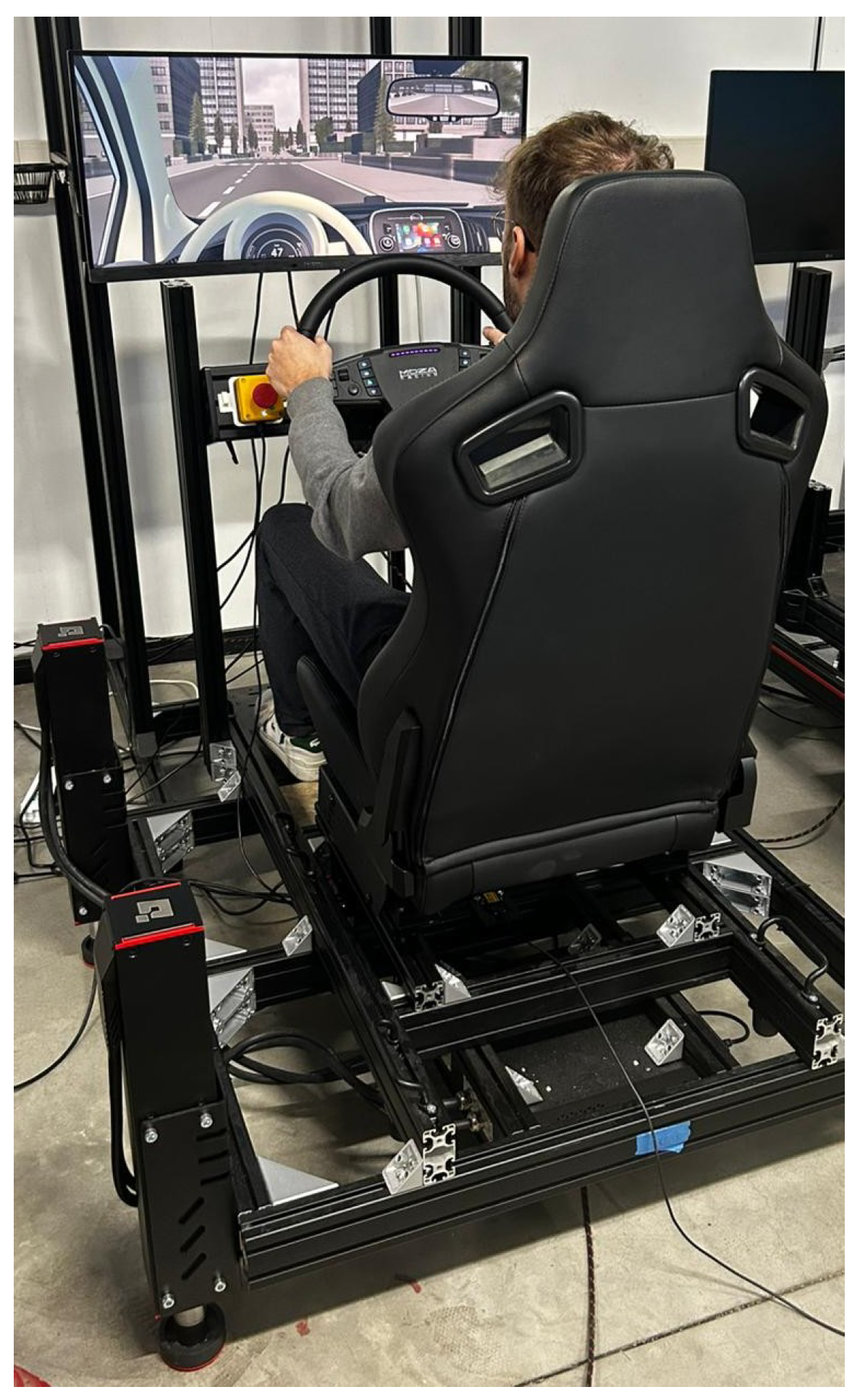
The experimental tests described in the previous sections are conducted with sinusoidal excitations to explore the effects of different motion amplitudes and accelerations in the frequency domain. However, in actual operating scenarios in human-in-the-loop applications, a variety of dynamic and transient conditions are involved. In order to assess the usability of the model under realistic simulator motions, the model is applied to evaluate crosstalk in an actual driving simulator, in which the four-legged platform is actuated by multi-DOF trajectories that mimic actual driving motion. The experimental setup is represented in
Figure 23.
An urban environment driving simulation is performed using a self-developed software framework built on top of Project Chrono [
24], a C++ multibody library that implements real-time vehicle dynamics models. Unity is used for graphics rendering. The simulated vehicle, representative of a segment B passenger car, is driven through typical city maneuvers, reaching a maximum speed of 90 km/h and peak longitudinal decelerations of up to 1.5 g during braking events. All tests are performed with a 70 kg person sitting in the driver’s seat on the platform, thereby reproducing typical HIL loading conditions. During the experiment, the human driver generates sharp steering and acceleration inputs, producing numerous peaks in angular acceleration to simulate demanding conditions.
The simulated vehicle dynamics are then used to generate the TCP reference trajectories of the platform through a classical motion cuing algorithm [
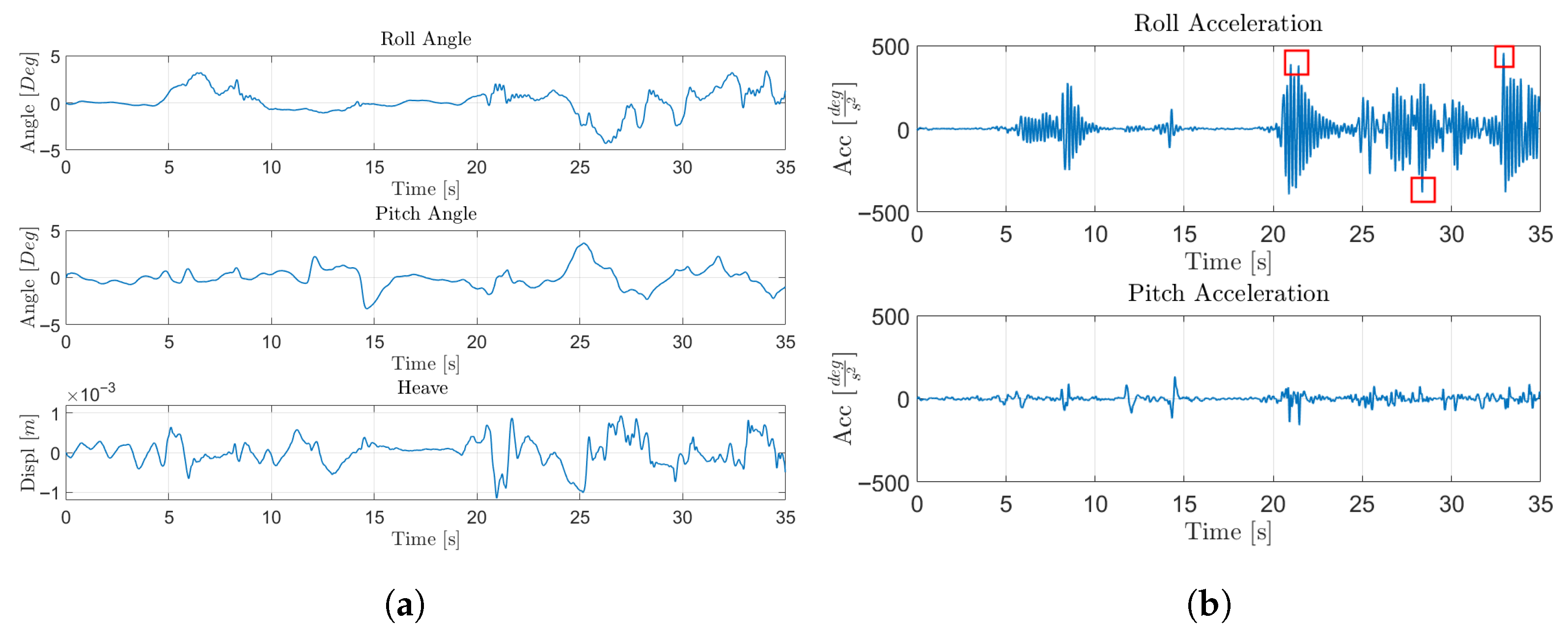
25]. The resulting roll, pitch, and heave motion laws are reported in
Figure 24a.
As visible, the reference rotations remain within ±5°, which is consistent with the platform workspace. Roll and pitch exhibit a combination of smooth variations and localized transients associated with steering and acceleration inputs, while the heave trajectory presents higher-frequency oscillations due to road irregularities and suspension dynamics. The corresponding angular accelerations of roll and pitch are reported in
Figure 24b. The roll acceleration only occasionally exceeds 355
, a value for which the data in
Figure 22 indicate the appearance of macro-slipping. This happens, in particular, at 21.42 s in the time history (380.4
, with a roll angle of 0.043 deg), 28.36 s (−382.6
, with a roll angle of 1.33 deg), and 32.9 s (455.6
, with a roll angle of −0.33 deg).
The controller feedback trajectories are then used as input to the kinematic model of Equation (
7) to compute the X and Y crosstalk accelerations. As in the experimental tests of the previous
Section 4.2, the IMU sensor is positioned in the center of the platform to measure the crosstalk accelerations for direct comparison with the model output. Both signals are filtered using a fourth-order Butterworth low-pass filter with a 7 Hz cutoff frequency.
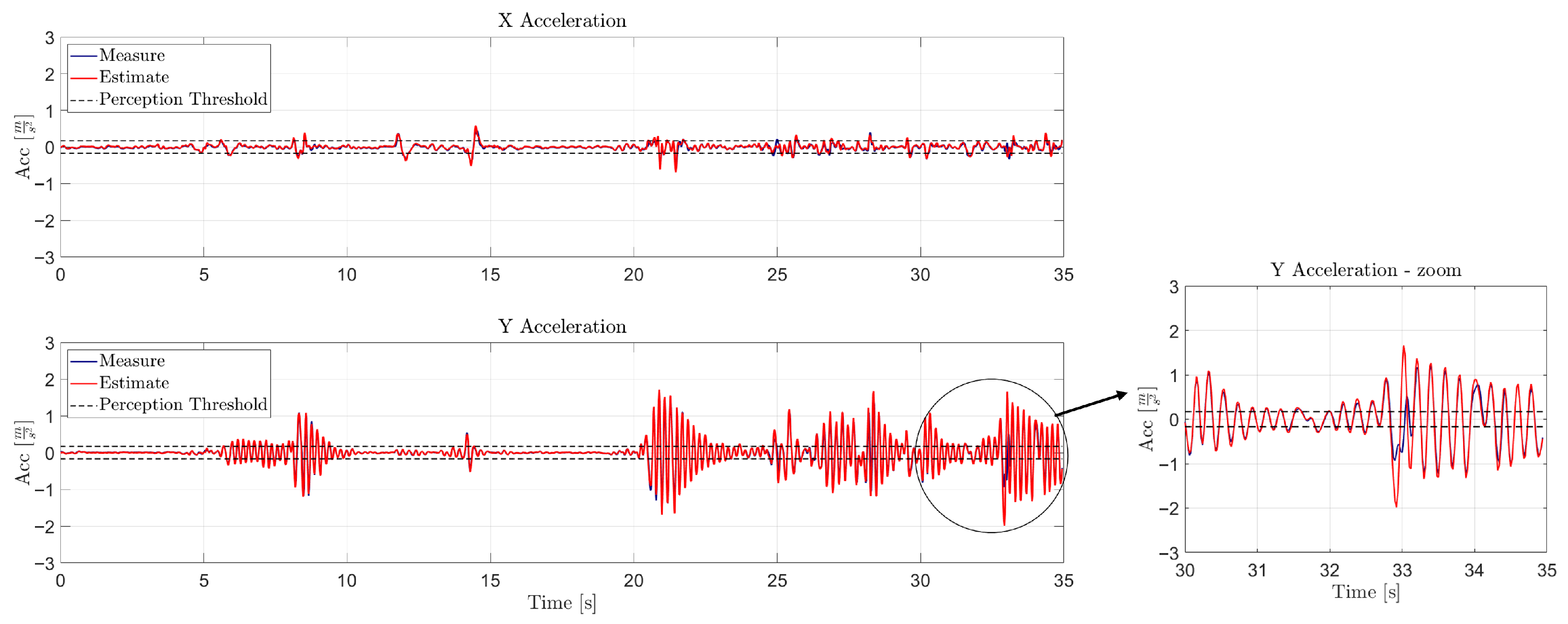
The comparison between the measured and estimated crosstalk accelerations is shown in
Figure 25 for both X and Y directions. The measured signal is colored blue, and the model output is colored red. The dashed lines in the figure correspond to the Reid and Nahon perception threshold of
. It should be noted that, even under urban driving conditions, the measured TCP accelerations exceed the perception thresholds defined by Reid and Nahon, especially for lateral Y acceleration, confirming the relevance of kinematic crosstalk. The acceleration results show very good correlation in both directions, with coefficients of determination of
for Y and
for X. The zoomed-in portion on the right side of
Figure 25 shows the largest discrepancy between the measured and estimated accelerations, occurring at 32.9 s, in correspondence with the maximum roll acceleration of 455.6
highlighted in
Figure 24b. At that value of angular acceleration, slipping occurs, consistent with the limit identified in the results shown in
Figure 22.
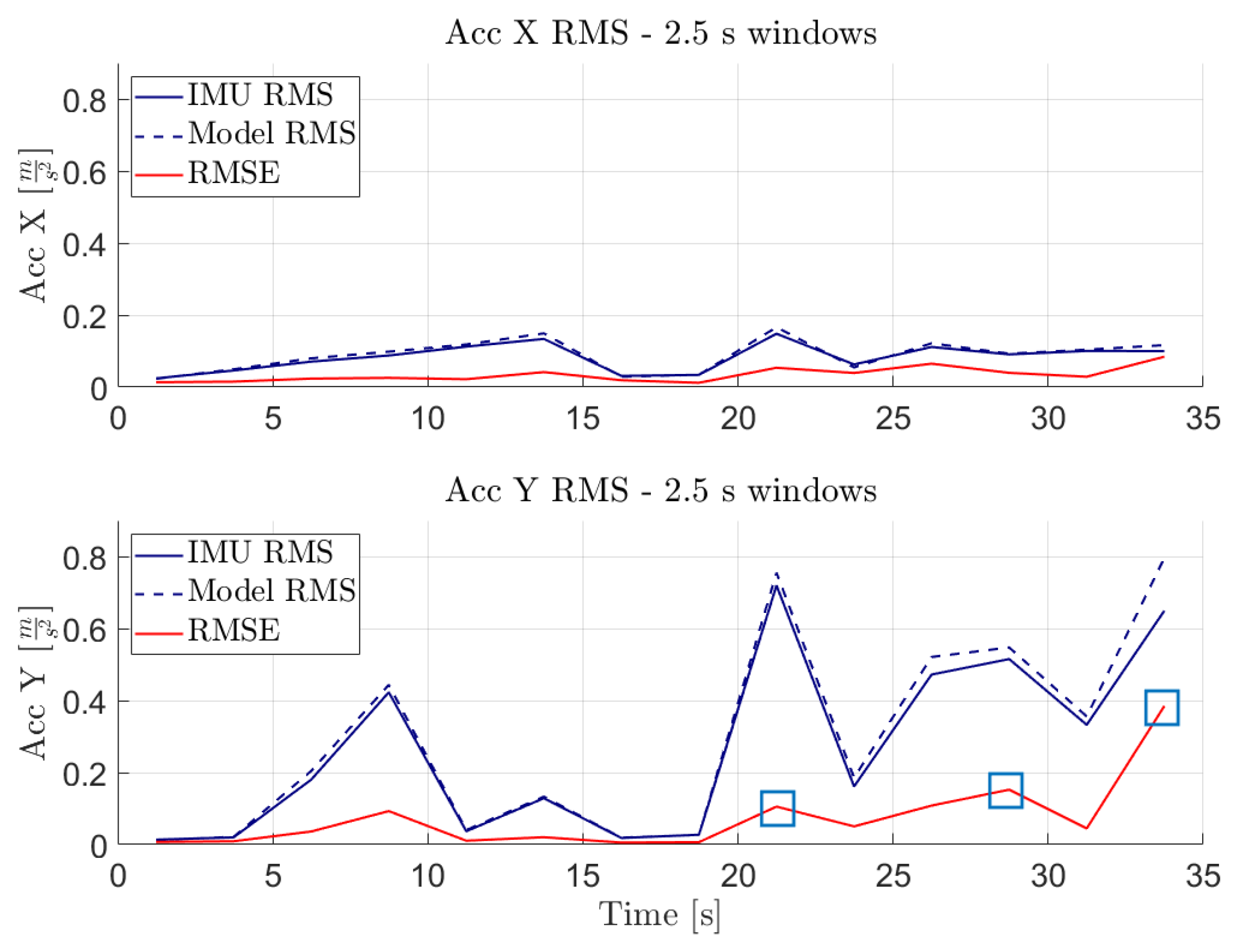
To further quantify the performance of the model, an RMS analysis is conducted using sliding windows of 2.5 s, which is a duration compatible with the slowest maneuvers in the simulation.
Figure 26 shows the RMS of the measured signal (solid blue line), the RMS of the model estimate (dashed blue line), and the RMS of the error (RMSE, red line). For both directions of crosstalk, the RMS values are rather consistent. When considering Y acceleration, the maximum RMSE is detected in the windows centered at 21.25, 28.75, and 32.5 s, including the effects of the singular points highlighted in
Figure 24b, where the angular acceleration exceeds 355
. At these points, a more significant error is observed. The maximum RMSE corresponds to the maximum imposed roll acceleration, as highlighted in the zoomed-in views in
Figure 25.
Therefore, the results obtained in the real case of a driving simulator are consistent with what emerged from the sinusoidal tests—in particular, with the acceleration limit for which macro-slip occurs, as identified in
Figure 22. This limit depends on the specific platform geometry, contact surface, and finish and operating loads. Accordingly, while the proposed kinematic formulation and analysis can be straightforwardly adopted with platforms of different dimensions, the definition of the limit value at which macro-slip occurs cannot be directly transferred to different platform layouts. For cases in which the platform dimensions, loads, and contact conditions do substantially deviate from those analyzed in this work, this study outlines a procedure to estimate, through preliminary sinusoidal experimental tests, a representative value of the applicability limit of the model. At the same time, this work outlines a consistent procedure for kinematic modeling that enables a comprehensive estimation of the acceleration field to which the user is exposed, including kinematic crosstalk in the design stage.
During machine operation, since macro-slip is identified as a key factor limiting model accuracy, event detection algorithms could be employed for the real-time identification and labeling of macro-slip (e.g., by exploiting IMU sensors or through online analysis of the Jacobian). However, this would require a dedicated sensor setup on the machine, which may be costly and undesirable in most cases, except for applications involving repeated extreme acceleration levels. Indeed, it should be emphasized that local discrepancies between the estimated and measured values under local slipping conditions can be considered acceptable, as the added value of the proposed approach lies in the assessment of the acceleration levels experienced during motion.
5. Conclusions
This paper presents the kinematic analysis of a four-legged, overactuated parallel kinematic machine with three degrees of freedom. The architecture, commonly adopted in immersive simulation systems, exhibits kinematic crosstalk motions along longitudinal, lateral, and yaw directions. Due to under-constrained contact conditions at the actuator feet, the actual coupling between the kinematic crosstalk components and the independent degrees of freedom is influenced by dynamic phenomena affecting friction conditions. This represents a significant difference compared to other parallel kinematic machines already studied in the literature, such as the tripod.
Since the actual adhesion conditions are complex to model and would, in any case, require real-time knowledge of all dynamic loads acting on the machine, a simplified analytical model is developed to estimate the kinematic crosstalk, only considering kinematic relations and neglecting dynamic effects and yaw rotation. By assuming a fixed constraint point on the ground, the model allows for a closed-form solution of X and Y motion components as functions of roll, pitch, and heave degrees of freedom.
A general methodology for the evaluation of accelerations related to kinematic crosstalk is proposed, and model applicability limits are discussed.
The analysis of the specific PKM considered in this work indicates that accelerations related to kinematic crosstalk can reach in the x direction and in the y direction, corresponding to approximately 50% of the maximum acceleration of the heave DoF. For this reason, the ability to estimate kinematic crosstalk accelerations is relevant when exploiting this type of machine.
Experimental measurements carried out on a full-scale prototype confirm the ability of the kinematic model to estimate the actual kinematic crosstalk acceleration values. The uncertainty introduced by model simplifications is low for acceleration values compatible with those experienced in an actual driving simulator and increases under significant dynamic conditions. Although slip-free operating limits depend on the characteristics of the specific platform, for cases in which the platform dimensions, loads, and contact conditions substantially deviate from those analyzed in this work, this study outlines a procedure to estimate, through preliminary sinusoidal experimental tests, a representative value of the applicability limit of the model.
Thus, this work establishes a coherent procedure for kinematic modeling, enabling the estimation of the acceleration field experienced by the user during motion, including kinematic crosstalk components. This represents a significant advancement over the commonly adopted simplification of neglecting these terms in current modeling approaches.