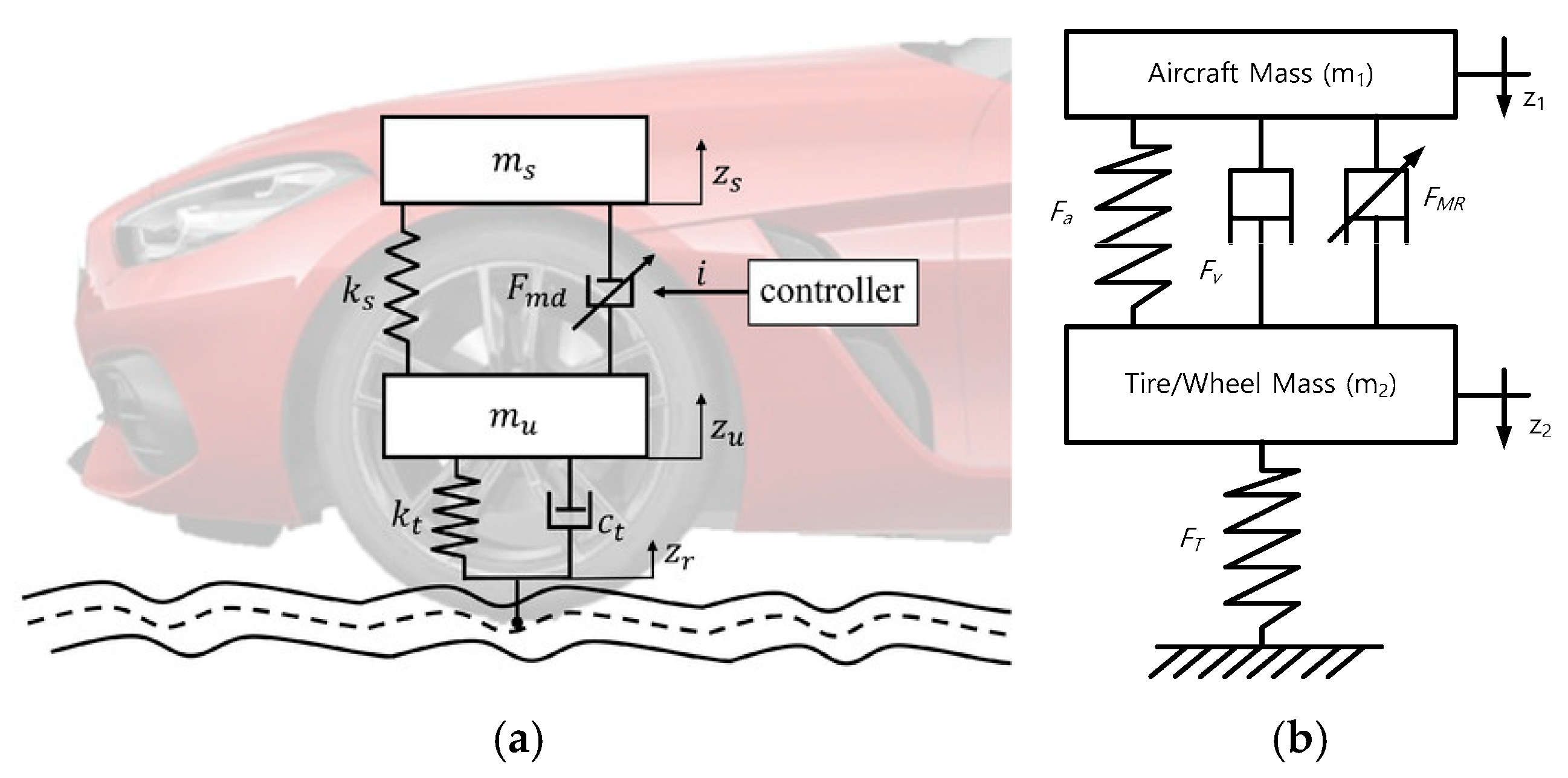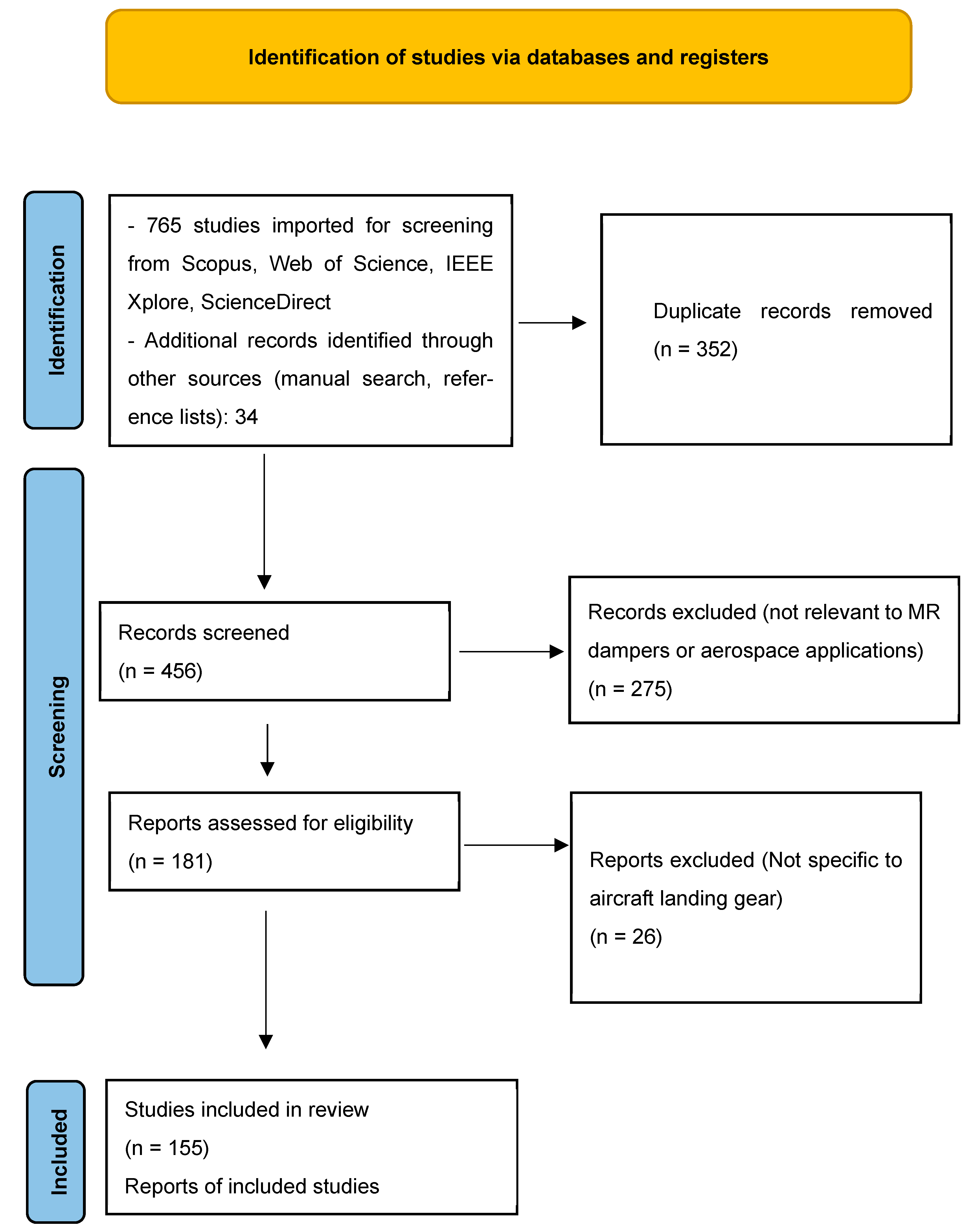

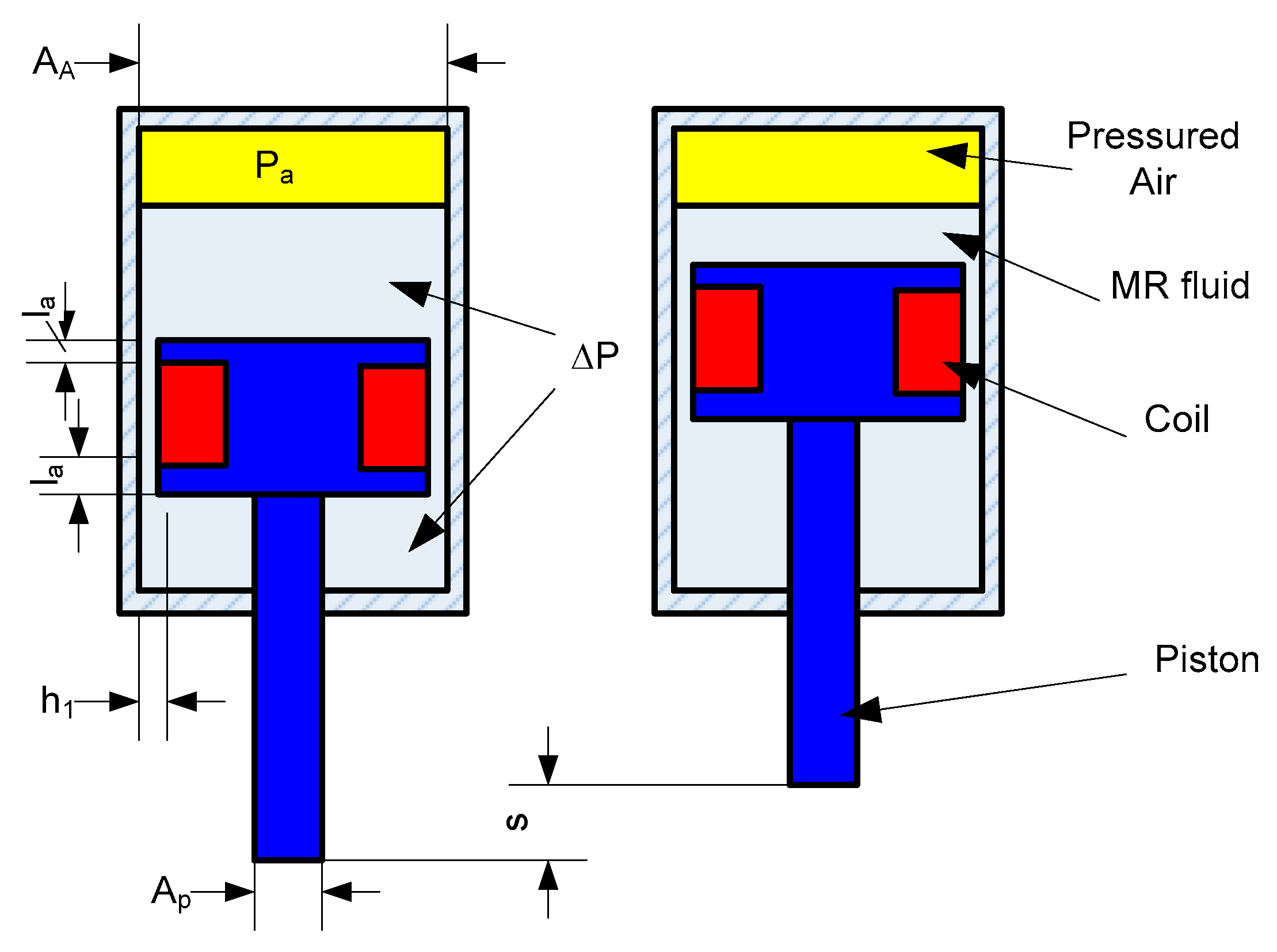
Application of Magnetorheological Damper in Aircraft Landing Gear: A Systematic Review


Abstract
1. Introduction
2. Magnetorheological (MR) Damper
3. Application of MR Technology in Aircraft Landing Gear
4. Mathematical Model of MR for Landing Gear
4.1. Pseudo-Static Models
4.2. Parameter Model
4.3. Unparameterized Model
5. Aircraft MR Landing Gear Mathematical Model
5.1. One DOF
5.2. Two DOF
5.3. Full Aircraft Model
6. Control Algorithms of the MR Landing Gear
6.1. Taxiing Phase

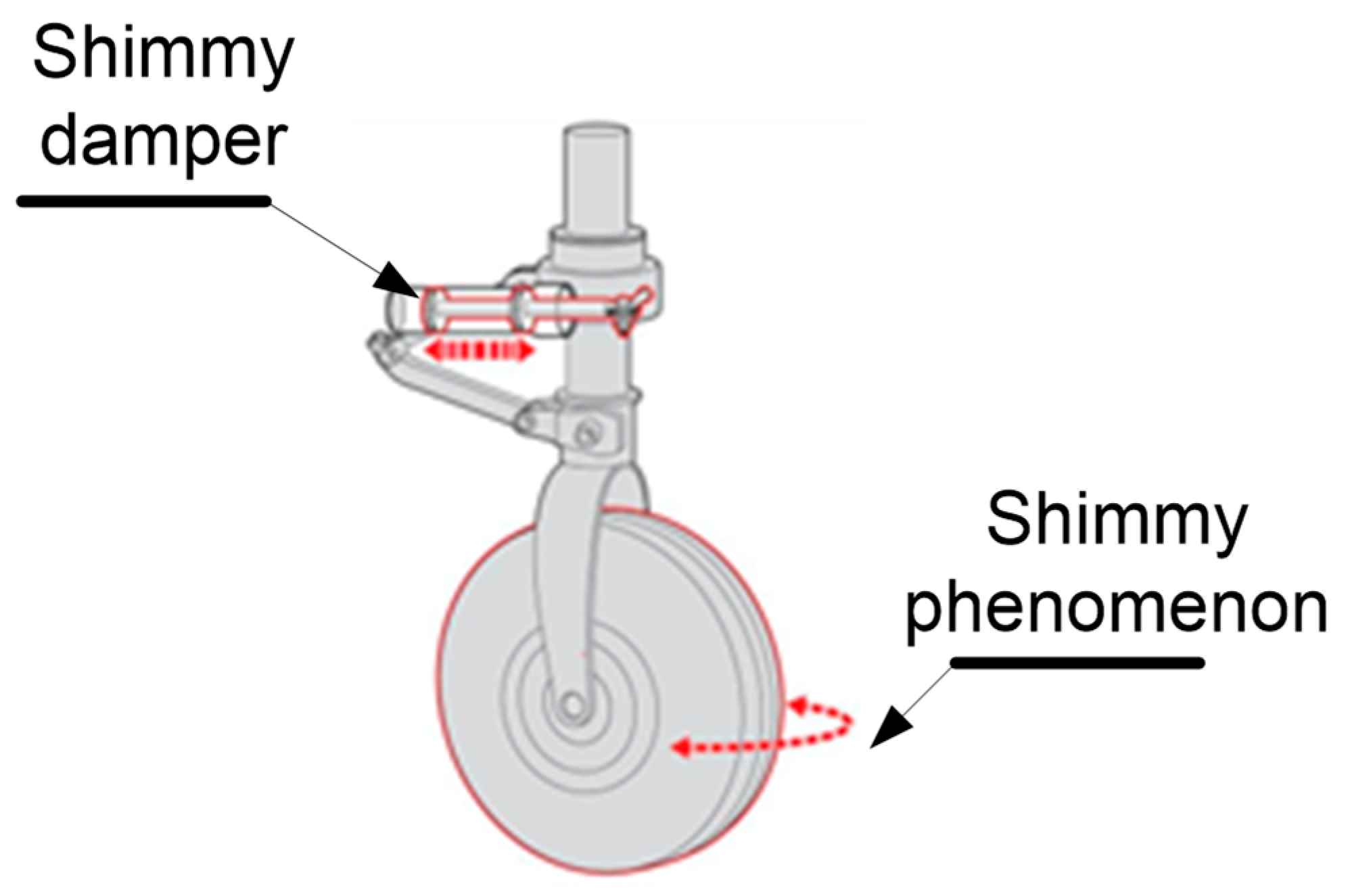
6.2. Touchdown Phase
7. Challenges and Future Directions
8. Conclusions
Funding
Data Availability Statement
Acknowledgments
Conflicts of Interest
Abbreviations
| Different hydraulic pressure between the upper chamber and the lower chamber | |
| α1, A | Functions of the applied magnetic field |
| Boundary thickness | |
| Shock absorber efficiency | |
| Yield stress | |
| The magnetic-field-dependent yield stress | |
| The shear rate | |
| γh, nh, βh | Constants related to the hysteresis loop, which is related to the MR fluid |
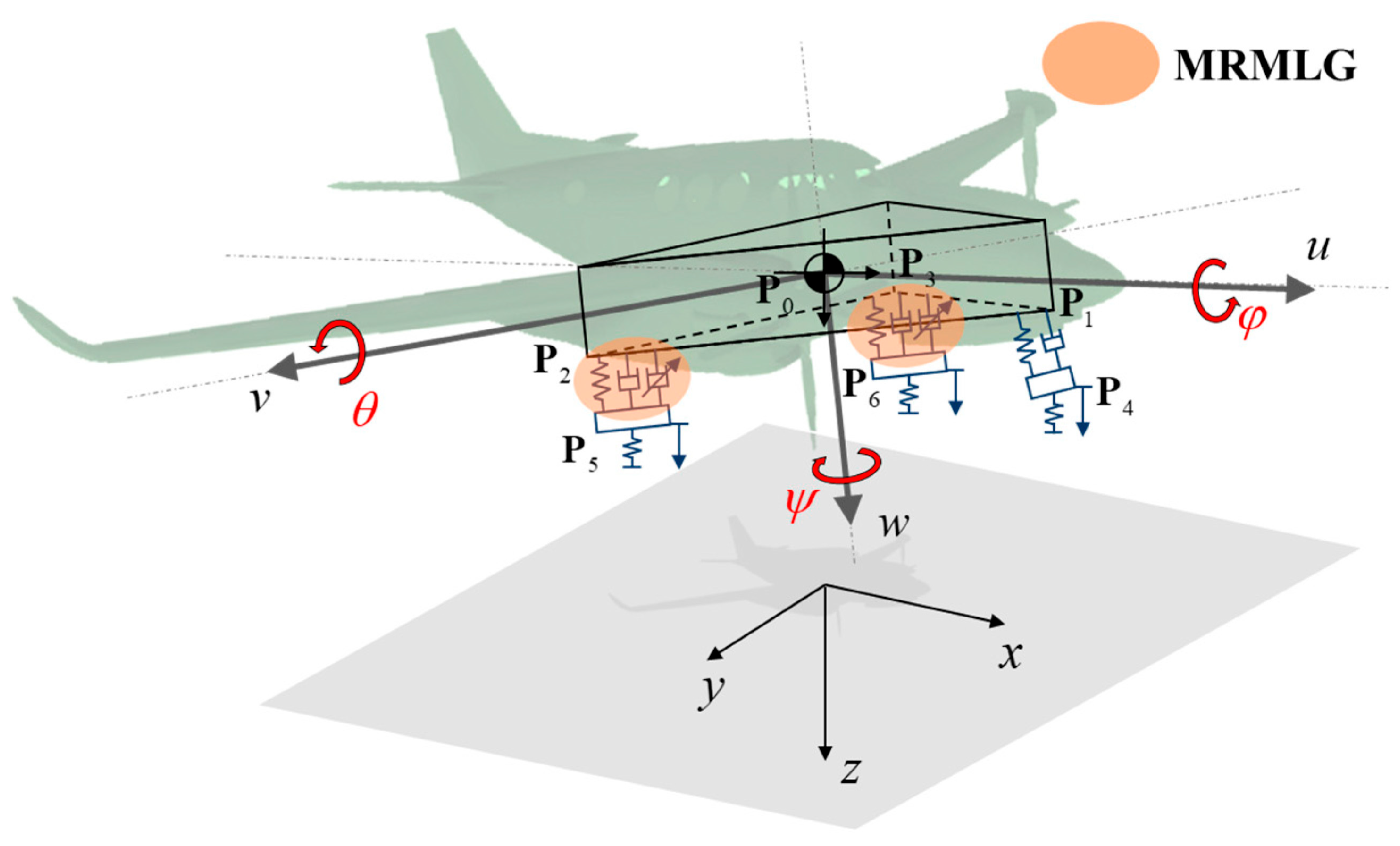
| φ, θ, ψ | Roll, pitch, and yaw |
| Dynamic viscosity of the MR fluid | |
| Ah | Functions of the applied hysteresis loop |
| Aa | Cross-section of an air chamber |
| Ap | Cross-section of a piston |
| b | Bias vector |
| c0 | Viscous damping is observed at larger velocities |
| c1 | A dashpot |
| c | The nonlinear coefficient is determined by the flow rate and the yield stress |
| Csky | Skyhook gain |
| Cground | Ground-hook gain |
| Er | Error |
| fL | The solution to the Euler–Lagrange equation |
| Fa | Pneumatic force |
| Fgiven | Given value of the damping force |
| Fest | Estimate the value of the damping force. |
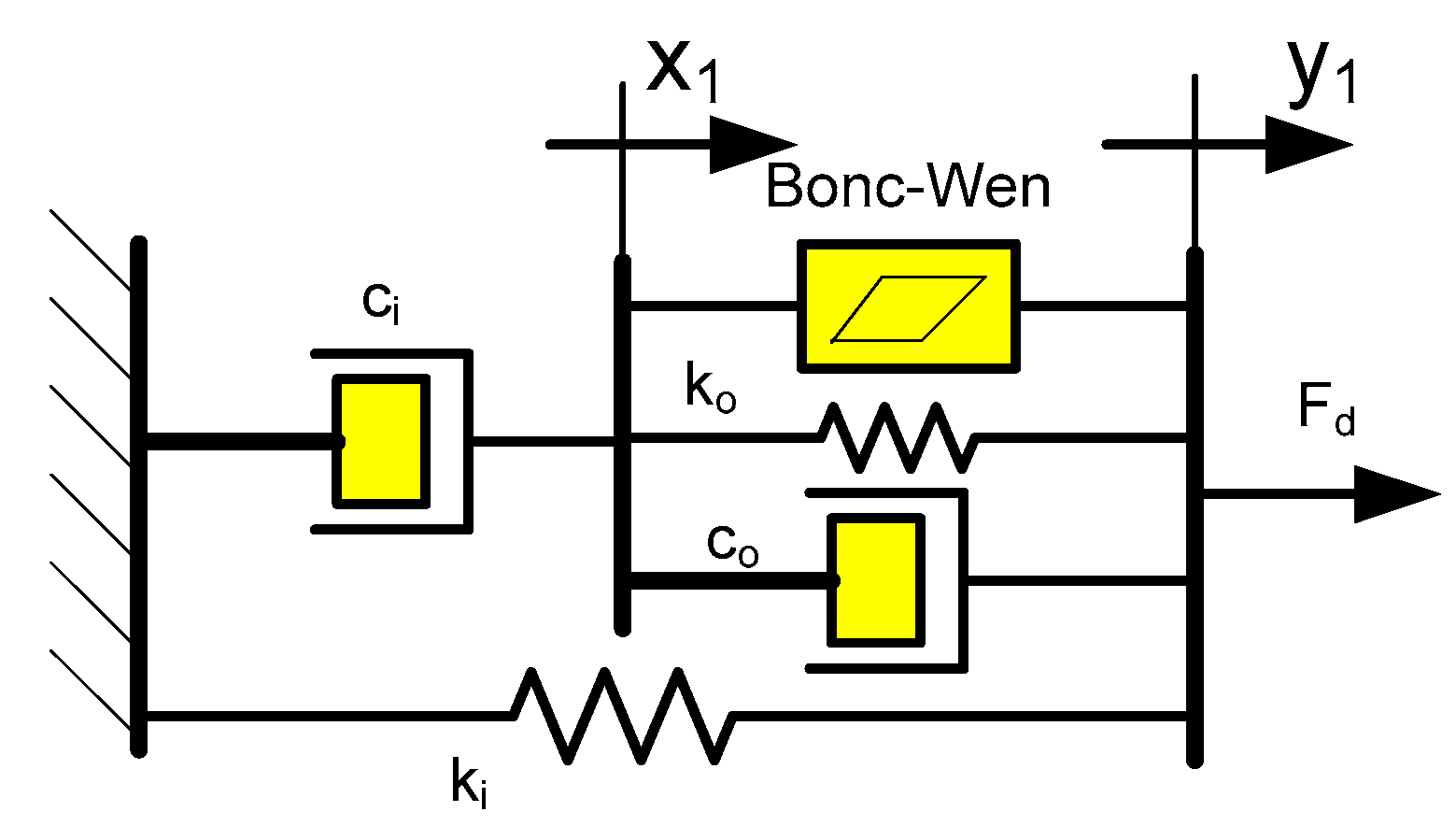
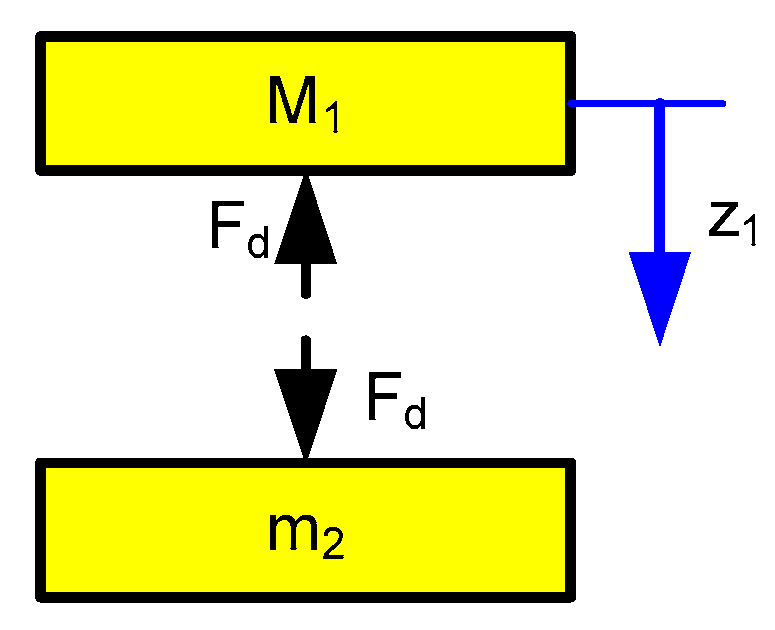
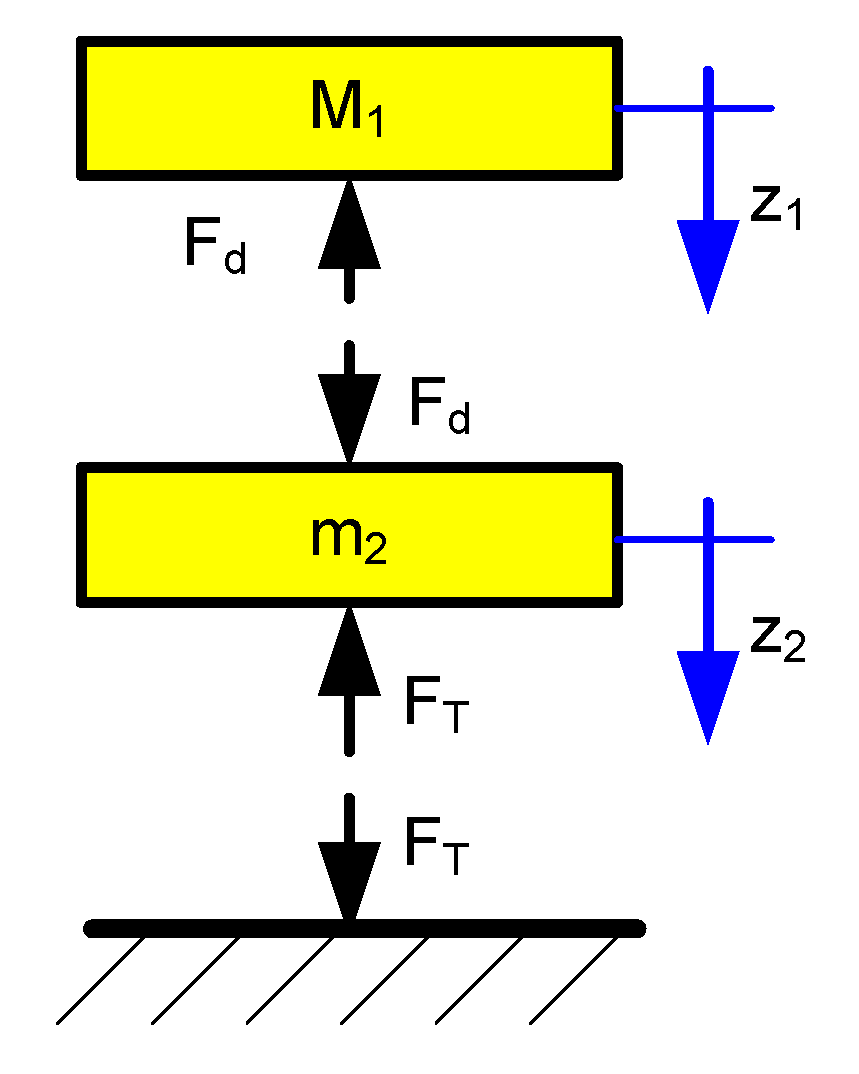
| Fd | Damping force |
| FH | Hydraulic force |
| Fsen | The real-time damping force is measured using the load cell sensor |
| FT | Tire force |
| H | Magnetic field strength |
| h1 | The gap size of the annular passage |
| K | kth sample |
| k0 | The stiffness at large velocities |
| k1 | The accumulator stiffness |
| Control gain | |
| The consistency index | |
| L | Length of piston head |
| lp | Total length of the electromagnet |
| maxFd | Maximum damping force |
| max s | Maximum damping stroke |
| MR | Magnetorheological |
| M1 | Aircraft mass |
| m2 | Landing gear mass |
| MG | The generalized mass matrix |
| n | Number of samples |
| N | Number of steps in the future |
| Flow behavior index | |
| , | Air pressured |
| po | Polytropic process index |
| Q | Mass flow rate |
| QF | Generalized force vector |
| q | Generalized coordinates |
| t | Time |
| R1 | Center radius of the annular passages |
| RMS | Root mean square |
| s | Stroke |
| Stroke velocity | |
| Sliding surface | |
| u(t) | Control input |
| Estimation value of the control input | |
| v | Sink speed |
| V0 | Initial volume of the air chamber |
| W | Weight matrix |
| x | Sensor signal |
| x, y | Displacement of particle in the Bouc–Wen model |
| x0 | The initial displacement of spring (k1) |
| zB | Bouc–wen parameter |
| Fuselage velocity |
Appendix A

| Section and Topic | Item # | Checklist Item | Location Where Item Is Reported |
|---|---|---|---|
| TITLE | |||
| Title | 1 | Identify the report as a systematic review. | 1 |
| ABSTRACT | |||
| Abstract | 2 | See the PRISMA 2020 for Abstracts checklist. | 1 |
| INTRODUCTION | |||
| Rationale | 3 | Describe the rationale for the review in the context of existing knowledge. | 4 |
| Objectives | 4 | Provide an explicit statement of the objective(s) or question(s) the review addresses. | 4 |
| METHODS | |||
| Eligibility criteria | 5 | Specify the inclusion and exclusion criteria for the review and how studies were grouped for the syntheses. | 4 |
| Information sources | 6 | Specify all databases, registers, websites, organizations, reference lists, and other sources searched or consulted to identify studies. Specify the date when each source was last searched or consulted. | 4 |
| Search strategy | 7 | Present the full search strategies for all databases, registers, and websites, including any filters and limits used. | 4 |
| Selection process | 8 | Specify the methods used to decide whether a study met the inclusion criteria of the review, including how many reviewers screened each record and each report retrieved, whether they worked independently, and, if applicable, details of automation tools used in the process. | 4 |
| Data collection process | 9 | Specify the methods used to collect data from reports, including how many reviewers collected data from each report, whether they worked independently, any processes for obtaining or confirming data from study investigators, and, if applicable, details of automation tools used in the process. | 4 |
| Data items | 10a | List and define all outcomes for which data were sought. Specify whether all results that were compatible with each outcome domain in each study were sought (e.g., for all measures, time points, analyses), and if not, the methods used to decide which results to collect. | Table 1 and Table 3 |
| 10b | List and define all other variables for which data were sought (e.g., participant and intervention characteristics, funding sources). Describe any assumptions made about any missing or unclear information. | Table 1 and Table 3 | |
| Study risk of bias assessment | 11 | Specify the methods used to assess risk of bias in the included studies, including details of the tool(s) used, how many reviewers assessed each study, and whether they worked independently, and if applicable, details of automation tools used in the process. | Table 1 and Table 3 |
| Effect measures | 12 | Specify for each outcome the effect measure(s) (e.g., risk ratio, mean difference) used in the synthesis or presentation of results. | Table 1 and Table 3 |
| Synthesis methods | 13a | Describe the processes used to decide which studies were eligible for each synthesis (e.g., tabulating the study intervention characteristics and comparing against the planned groups for each synthesis (item #5)). | No meta-analysis performed (N/A) |
| 13b | Describe any methods required to prepare the data for presentation or synthesis, such as handling of missing summary statistics or data conversions. | N/A | |
| 13c | Describe any methods used to tabulate or visually display the results of individual studies and syntheses. | Table 2 and Table 3 | |
| 13d | Describe any methods used to synthesize results and provide a rationale for the choice(s). If meta-analysis was performed, describe the model(s), method(s) to identify the presence and extent of statistical heterogeneity, and software package(s) used. | N/A | |
| 13e | Describe any methods used to explore possible causes of heterogeneity among study results (e.g., subgroup analysis, meta-regression). | N/A | |
| 13f | Describe any sensitivity analyses conducted to assess the robustness of the synthesized results. | Table 1 and Table 3 | |
| Reporting bias assessment | 14 | Describe any methods used to assess the risk of bias due to missing results in a synthesis (arising from reporting biases). | N/A |
| Certainty assessment | 15 | Describe any methods used to assess certainty (or confidence) in the body of evidence for an outcome. | N/A |
| RESULTS | |||
| Study selection | 16a | Describe the results of the search and selection process, from the number of records identified in the search to the number of studies included in the review, ideally using a flow diagram. | 32 |
| 16b | Cite studies that might appear to meet the inclusion criteria, but which were excluded, and explain why they were excluded. | 20 | |
| Study characteristics | 17 | Cite each included study and present its characteristics. | 19 |
| Risk of bias in studies | 18 | Present assessments of risk of bias for each included study. | N/A |
| Results of individual studies | 19 | For all outcomes, present, for each study: (a) summary statistics for each group (where appropriate) and (b) an effect estimate and its precision (e.g., confidence/credible interval), ideally using structured tables or plots. | Table 2 and Table 3 |
| Results of syntheses | 20a | For each synthesis, briefly summarize the characteristics and risk of bias among contributing studies. | N/A |
| 20b | Present the results of all statistical syntheses conducted. If meta-analysis was performed, present for each the summary estimate and its precision (e.g., confidence/credible interval) and measures of statistical heterogeneity. If comparing groups, describe the direction of the effect. | Table 1, Table 2 and Table 3 | |
| 20c | Present the results of all investigations of possible causes of heterogeneity among study results. | Table 1, Table 2 and Table 3 | |
| 20d | Present the results of all sensitivity analyses conducted to assess the robustness of the synthesized results. | Table 1, Table 2 and Table 3 | |
| Reporting biases | 21 | Present assessments of risk of bias due to missing results (arising from reporting biases) for each synthesis assessed. | N/A |
| Certainty of evidence | 22 | Present assessments of certainty (or confidence) in the body of evidence for each outcome assessed. | N/A |
| DISCUSSION | |||
| Discussion | 23a | Provide a general interpretation of the results in the context of other evidence. | 16 |
| 23b | Discuss any limitations of the evidence included in the review. | 16 | |
| 23c | Discuss any limitations of the review processes used. | 16 | |
| 23d | Discuss implications of the results for practice, policy, and future research. | 16 | |
| OTHER INFORMATION | |||
| Registration and protocol | 24a | Provide registration information for the review, including register name and registration number, or state that the review was not registered. | N/A |
| 24b | Indicate where the review protocol can be accessed, or state that a protocol was not prepared. | N/A | |
| 24c | Describe and explain any amendments to information provided at registration or in the protocol. | N/A | |
| Support | 25 | Describe sources of financial or non-financial support for the review, and the role of the funders or sponsors in the review. | 18 |
| Competing interests | 26 | Declare any competing interests of review authors. | 18 |
| Availability of data, code, and other materials | 27 | Report which of the following are publicly available and where they can be found: template data collection forms; data extracted from included studies; data used for all analyses; analytic code; any other materials used in the review. | 18 |

References
- Currey, N.S. Aircraft Landing Gear Design: Principles and Practices; AIAA Education Series; American Institute of Aeronautics & Astronautics: Reston, VA, USA, 1988; ISBN 978-1-60086-018-8. [Google Scholar]
- Tunca, E.; Kafali, H.; Keskin, G.; Kuşhan, M.C. Landing Gear Systems in Aircraft. In Materials, Structures and Manufacturing for Aircraft; Kuşhan, M.C., Gürgen, S., Sofuoğlu, M.A., Eds.; Sustainable Aviation; Springer: Cham, Switzerland, 2022; pp. 153–179. ISBN 978-3-030-91872-9. [Google Scholar]
- Boniol, F.; Wiels, V.; Aït-Ameur, Y.; Schewe, K.-D. The Landing Gear Case Study: Challenges and Experiments. Int. J. Softw. Tools Technol. Transf. 2017, 19, 133–140. [Google Scholar] [CrossRef]
- Federal Aviation Administration. Airplane Flying Handbook: FAA-H-8083-3C; ASA FAA Handbook Series; Aviation Supplies & Academics, Inc.: Ashland, OR, USA, 2021; ISBN 978-1-64425-068-6. [Google Scholar]
- Srivathsa, A.; Adarsha, S.S.; Narayana, M.V.B.; Sridhar, K.S.; Chandrashekara, C.V. The Dynamic Characteristics of a Non-Linear Main Landing Gear System of an Aircraft during Landing. Vib. Proced. 2020, 30, 97–102. [Google Scholar] [CrossRef]
- Patel, J.; Shetty, D.; Menghani, R.; Barve, S. Optimization of an Oleo-Pneumatic Shock Absorber for Main Landing Gear of a Commercial Aircraft. SSRN J. 2017, 2017, 1–7. [Google Scholar] [CrossRef]
- Lukic, M.; Hebala, A.; Giangrande, P.; Klumpner, C.; Nuzzo, S.; Chen, G.; Gerada, C.; Eastwick, C.; Galea, M. State of the Art of Electric Taxiing Systems. In Proceedings of the 2018 IEEE International Conference on Electrical Systems for Aircraft, Railway, Ship Propulsion and Road Vehicles & International Transportation Electrification Conference (ESARS-ITEC), Nottingham, UK, 7–9 November 2018; IEEE: Nottingham, UK, 2018; pp. 1–6. [Google Scholar]
- Feng, F.; Nie, H.; Zhang, M.; Peng, Y. Effect of Torsional Damping on Aircraft Nose Landing-Gear Shimmy. J. Aircr. 2015, 52, 561–568. [Google Scholar] [CrossRef]
- Ruan, S.; Zhang, M.; Hong, Y.; Nie, H. Influence of Clearance and Structural Coupling Parameters on Shimmy Stability of Landing Gear. Aeronaut. J. 2023, 127, 1591–1622. [Google Scholar] [CrossRef]
- Zhuravlev, V.P.; Klimov, D.M. Theory of the Shimmy Phenomenon. Mech. Solids 2010, 45, 324–330. [Google Scholar] [CrossRef]
- Rahmani, M.; Behdinan, K. Investigation on the Effect of Coulomb Friction on Nose Landing Gear Shimmy. J. Vib. Control 2019, 25, 255–272. [Google Scholar] [CrossRef]
- Wang, Y.; Jin, X.; Yin, Y. Using Nonlinear Feedback Control to Improve Aircraft Nose Landing Gear Shimmy Performance. Meccanica 2022, 57, 2395–2411. [Google Scholar] [CrossRef]
- Rahmani, M.; Behdinan, K. Parametric Study of a Novel Nose Landing Gear Shimmy Damper Concept. J. Sound Vib. 2019, 457, 299–313. [Google Scholar] [CrossRef]
- Li, D.; Fan, Z.; Zhang, Y.; Zang, J.; Yang, F. Optimum Design and Experiment of Composite Leaf Spring Landing Gear for Electric Aircraft. Chin. J. Aeronaut. 2020, 33, 2649–2659. [Google Scholar] [CrossRef]
- Xue, Z.-P.; Li, M.; Li, Y.-H.; Jia, H.-G. A Simplified Flexible Multibody Dynamics for a Main Landing Gear with Flexible Leaf Spring. Shock Vib. 2014, 2014, 595964. [Google Scholar] [CrossRef]
- Pecora, R. A Rational Numerical Method for Simulation of Drop-Impact Dynamics of Oleo-Pneumatic Landing Gear. Appl. Sci. 2021, 11, 4136. [Google Scholar] [CrossRef]
- Schmidt, R.K. The Design of Aircraft Landing Gear; SAE International: Warrendale, PA, USA, 2020; ISBN 978-1-5231-4041-1. [Google Scholar]
- Delprete, C.; Dagna, A.; Brusa, E. Model-Based Design of Aircraft Landing Gear System. Appl. Sci. 2023, 13, 11465. [Google Scholar] [CrossRef]
- Richards, P.W.; Erickson, A. Dynamic Ground Loads Analysis Using Detailed Modeling of Landing Gear and Aircraft Aeroservoelastics. In Proceedings of the AIAA Scitech 2019 Forum, San Diego, CA, USA, 7–11 January 2019; American Institute of Aeronautics and Astronautics: San Diego, CA, USA, 2019. [Google Scholar]
- Arık, A.E.; Bilgiç, B. Fuzzy Control of a Landing Gear System with Oleo-Pneumatic Shock Absorber to Reduce Aircraft Vibrations by Landing Impacts. Aircr. Eng. Aerosp. Technol. 2023, 95, 284–291. [Google Scholar] [CrossRef]
- Mcgehee, J.R. A Mathematical Model of an Active Control Landing Gear for Load Control During Impact and Roll-Out; National Aeronautics And Space Administration: Washington, DC, USA, 1976. [Google Scholar]
- Zarchi, M.; Attaran, B. Improved Design of an Active Landing Gear for a Passenger Aircraft Using Multi-Objective Optimization Technique. Struct. Multidiscip. Optim. 2019, 59, 1813–1833. [Google Scholar] [CrossRef]
- Sivakumar, S.; Haran, A.P. Aircraft Random Vibration Analysis Using Active Landing Gears. J. Low Freq. Noise Vib. Act. Control 2015, 34, 307–322. [Google Scholar] [CrossRef]
- Yazici, H.; Sever, M. Observer Based Optimal Vibration Control of a Full Aircraft System Having Active Landing Gears and Biodynamic Pilot Model. Shock. Vib. 2016, 2016, 2150493. [Google Scholar] [CrossRef]
- Yazici, H.; Sever, M. Active Control of a Non-Linear Landing Gear System Having Oleo Pneumatic Shock Absorber Using Robust Linear Quadratic Regulator Approach. Proc. Inst. Mech. Eng. Part. G J. Aerosp. Eng. 2018, 232, 2397–2411. [Google Scholar] [CrossRef]
- Pirooz, M.; Fateh, M.M. Impedance Fuzzy Control of an Active Aircraft Landing Gear System. Int. J. Dynam. Control 2019, 7, 1392–1403. [Google Scholar] [CrossRef]
- Pirooz, M.; Mirmahdi, S.H.; Khoogar, A.R. Robust Force and Displacement Control of an Active Landing Gear for Vibration Reduction at Touchdown and during Taxiing. SN Appl. Sci. 2021, 3, 410. [Google Scholar] [CrossRef]
- Karnopp, D. Active and Semi-Active Vibration Isolation. J. Vib. Acoust. 1995, 117, 177–185. [Google Scholar] [CrossRef]
- Savaresi, S.M.; Poussot-Vassal, C.; Spelta, C.; Sename, O.; Dugard, L. Semi-Active Suspension Control Design for Vehicles; Butterworth-Heinemann: Oxford, UK, 2010; ISBN 978-0-08-096679-3. [Google Scholar]
- Preumont, A. Semi-Active Control. In Vibration Control of Active Structures; Solid Mechanics and Its Applications; Springer: Dordrecht, The Netherlands, 2011; Volume 179, pp. 403–416. ISBN 978-94-007-2032-9. [Google Scholar]
- Yang, Y.; Liu, C.; Chen, L.; Zhang, X. Phase Deviation of Semi-Active Suspension Control and Its Compensation with Inertial Suspension. Acta Mech. Sin. 2024, 40, 523367. [Google Scholar] [CrossRef]
- Yıldız, A.S.; Eker, S.B. Semi-Active Control Implementation in Aircraft Landing Gear Systems Using Hardware-in-the-Loop Test Bench. Eng. Res. Express 2024, 6, 035529. [Google Scholar] [CrossRef]
- Dong, L.; Chen, Z.; Sun, M.; Sun, Q.; Yu, Z. Study on Magneto-Rheological Damper Control of Aircraft Landing Gear Based on LADRC. In Proceedings of the 2021 Chinese Intelligent Systems Conference, Fuzhou, China, 16–27 October 2021; Jia, Y., Zhang, W., Fu, Y., Yu, Z., Zheng, S., Eds.; Lecture Notes in Electrical Engineering. Springer: Singapore, 2022; Volume 803, pp. 830–840, ISBN 978-981-16-6327-7. [Google Scholar]
- Abdul, M.A.; Mohtasim, S.M.; Ahammed, R. State-of-the-Art Recent Developments of Large Magnetorheological (MR) Dampers: A Review. Korea Aust. Rheol. J. 2022, 34, 105–136. [Google Scholar] [CrossRef]
- Yıldırım, Ş.; Durmuşoğlu, A. Vibration Analysis and Control of Aircraft Landing Systems Using Proposed Neural Controllers. Neural Comput. Appl. 2024, 36, 13255–13268. [Google Scholar] [CrossRef]
- Chopra, I.; Sirohi, J. Smart Structures Theory, 1st ed.; Cambridge University Press: Cambridge, UK, 2013; ISBN 978-0-521-86657-6. [Google Scholar]
- Li, H.; Gao, T.; Wang, M.; Zhang, W. Approach on the Vibration Damping and Energy Absorption through Electrorheological/Magnetorheological Effects. Sustain. Mater. Technol. 2025, 44, e01401. [Google Scholar] [CrossRef]
- Lou, Z.; Ervin, R.D.; Winkler, C.B.; Filisko, F.E. An Electrorheologically Controlled Semi-Active Landing Gear; NTRS—NASA Technical Reports Server: Dayton, OH, USA, 1993. [Google Scholar]
- Pham, T.; Sename, O.; Dugard, L. A Nonlinear Parameter Varying Observer for Real-time Damper Force Estimation of an Automotive Electro-rheological Suspension System. Int. J. Robust Nonlinear Control 2021, 31, 8183–8205. [Google Scholar] [CrossRef]
- Ferhath, A.A.; Kasi, K. The Evolution of Damper Technology for Enhanced Ride Comfort and Vehicle Handling in Vehicle Suspension System. Int. J. Dynam. Control 2024, 12, 3908–3946. [Google Scholar] [CrossRef]
- Bai, X.F.; Zhang, X.; Choi, Y.T.; Shou, M.; Zhu, G.; Wereley, N.M. Adaptive Magnetorheological Fluid Energy Absorption Systems: A Review. Smart Mater. Struct. 2024, 33, 033002. [Google Scholar] [CrossRef]
- Zhang, Y.; Guo, J.; Yang, J.; Li, X. Recent Structural Developments and Applications of Magnetorheological Dampers (MRD): A Review. Magnetochemistry 2023, 9, 90. [Google Scholar] [CrossRef]
- Saufi, M.S.R.M.; Talib, M.H.A.; Zain, M.Z.M. The Application of Machine Learning and Optimisation Algorithm for Magnetorheological Damper Dynamics Behaviour: A Review. J. Vib. Eng. Technol. 2025, 13, 231. [Google Scholar] [CrossRef]
- Wang, M.; Chen, Z.; Wereley, N.M. Magnetorheological Damper Design to Improve Vibration Mitigation under a Volume Constraint. Smart Mater. Struct. 2019, 28, 114003. [Google Scholar] [CrossRef]
- Masa’id, A.; Lenggana, B.W.; Ubaidillah, U.; Susilo, D.D.; Choi, S.-B. A Review on Vibration Control Strategies Using Magnetorheological Materials Actuators: Application Perspective. Actuators 2023, 12, 113. [Google Scholar] [CrossRef]
- Yang, Y.; Xu, Z.-D.; Huang, X.-H.; Dong, Y.-R.; Dai, J.; Li, Y.-J. Ant Colony-Inspired Cooperative Control of Multi- Magnetorheological Dampers System for Coupled Vibration Mitigation of Spatial Irregular Structures. Eng. Struct. 2025, 334, 120241. [Google Scholar] [CrossRef]
- Vishwakarma, P.N.; Mishra, P.; Sharma, S.K. Characterization of a Magnetorheological Fluid Damper a Review. Mater. Today Proc. 2022, 56, 2988–2994. [Google Scholar] [CrossRef]
- Choi, Y.-T.; Wereley, N.M. Vibration Control of a Landing Gear System Featuring Electrorheological/Magnetorheological Fluids. J. Aircr. 2003, 40, 432–439. [Google Scholar] [CrossRef]
- Rabinow, J. The Magnetic Fluid Clutch. Electr. Eng. 1948, 67, 1167. [Google Scholar] [CrossRef]
- Lenggana, B.W.; Ubaidillah, U.; Imaduddin, F.; Choi, S.-B.; Purwana, Y.M.; Harjana, H. Review of Magnetorheological Damping Systems on a Seismic Building. Appl. Sci. 2021, 11, 9339. [Google Scholar] [CrossRef]
- Stalin, S.S.; Uthayakumar, M.; Balamurugan, P.; Pethuraj, M.; Sładek, J.A.; Niemczewska-Wójcik, M. Synthesis of Silicone Oil Based Magnetorhelogical Fluid and Performance Analysis in a Landing Gear Using Bat-Based Gradient Boost Mechanism. Adv. Sci. Technol. Res. J. 2025, 19, 375–389. [Google Scholar] [CrossRef] [PubMed]
- Sharif, U.; Sun, B.; Hussain, S.; Ibrahim, D.S.; Adewale, O.O.; Ashraf, S.; Bashir, F. Dynamic Behavior of Sandwich Structures with Magnetorheological Elastomer: A Review. Materials 2021, 14, 7025. [Google Scholar] [CrossRef]
- Khodaverdi, H.; Sedaghati, R. Advancements in Magnetorheological Foams: Composition, Fabrication, AI-Driven Enhancements and Emerging Applications. Polymers 2025, 17, 1898. [Google Scholar] [CrossRef] [PubMed]
- Kasprzak, J.M.; Mumtaz, M.; Ngaha, P.; Hodkiewicz, J.; Glucksman-Glaser, M.; Sofocleous, N. Controllable Oleo—Pneumatic Damper Using Magnetorheological Fluid. U.S. Patent 10,711,861 B1, 14 July 2020. [Google Scholar]
- Marathe, A.P.; Khot, S.M.; Nagler, J. Development of Low-Cost Optimal Magneto-Rheological Damper for Automotive Application. J. Vib. Eng. Technol. 2022, 10, 1831–1850. [Google Scholar] [CrossRef]
- Wen, M.; Du, Y.; Liu, R.; Li, Z.; Rao, L.; Xiao, H.; Ouyang, Y.; Niu, X. Characterization of Magnetorheological Fluids Based on Capillary Magneto-Rheometer. Front. Mater. 2022, 9, 1034127. [Google Scholar] [CrossRef]
- Kumar, S.; Sehgal, R.; Wani, M.F.; Sharma, M.D. Stabilization and Tribological Properties of Magnetorheological (MR) Fluids: A Review. J. Magn. Magn. Mater. 2021, 538, 168295. [Google Scholar] [CrossRef]
- Park, B.J.; Fang, F.F.; Choi, H.J. Magnetorheology: Materials and Application. Soft Matter 2010, 6, 5246. [Google Scholar] [CrossRef]
- Lord-MAR. Available online: https://www.shoplordmr.com/mr-products/mrf-140cg-magneto-rheological-fluid-250ml (accessed on 17 December 2024).
- Khajehsaeid, H.; Alaghehband, N.; Bavil, P.K. On the Yield Stress of Magnetorheological Fluids. Chem. Eng. Sci. 2022, 256, 117699. [Google Scholar] [CrossRef]
- Gudmundsson, K.H.; Jonsdottir, F.; Thorsteinsson, F.; Gutfleisch, O. An Experimental Investigation into the Off-State Viscosity of MR Fluids. J. Intell. Mater. Syst. Struct. 2011, 22, 1763–1767. [Google Scholar] [CrossRef]
- Khoddami Maraghi, Z.; Amir, S.; Arshid, E. On the Natural Frequencies of Smart Circular Plates with Magnetorheological Fluid Core Embedded between Magnetostrictive Patches on Kerr Elastic Substance. Mech. Based Des. Struct. Mach. 2024, 52, 1651–1668. [Google Scholar] [CrossRef]
- Kumar, M.; Kumar, A.; Bharti, R.K.; Yadav, H.N.S.; Das, M. A Review on Rheological Properties of Magnetorheological Fluid for Engineering Components Polishing. Mater. Today Proc. 2022, 56, A6–A12. [Google Scholar] [CrossRef]
- Ji, J.; Wu, X.; Tian, Z.; Xie, F.; Chen, F.; Li, H. A Novel Magnetorheological Fluid with High-Temperature Resistance. Materials 2023, 16, 4207. [Google Scholar] [CrossRef] [PubMed]
- Rajput, A.S.; Das, M.; Kapil, S. A Comprehensive Review of Magnetorheological Fluid Assisted Finishing Processes. Mach. Sci. Technol. 2022, 26, 339–376. [Google Scholar] [CrossRef]
- Delijani, Y.M.; Cheng, S.; Gherib, F. Operational Temperature Effect on the Behavior of Magnetorheological Dampers. Eng. Struct. 2025, 330, 119940. [Google Scholar] [CrossRef]
- Li, D.D.; Yeoh, G.H.; Timchenko, V.; Lam, H.-F. Numerical Modelling of Magnetic Nanoparticle and Carrier Fluid Interactions. In Proceedings of the 2016 IEEE Nanotechnology Materials and Devices Conference (NMDC), Toulouse, France, 9–12 October 2016; IEEE: Toulouse, France, 2016; pp. 1–3. [Google Scholar]
- Rabbani, Y.; Ashtiani, M.; Hashemabadi, S.H. An Experimental Study on the Effects of Temperature and Magnetic Field Strength on the Magnetorheological Fluid Stability and MR Effect. Soft Matter 2015, 11, 4453–4460. [Google Scholar] [CrossRef]
- Kumar Kariganaur, A.; Kumar, H.; Arun, M. Effect of Temperature on Sedimentation Stability and Flow Characteristics of Magnetorheological Fluids with Damper as the Performance Analyser. J. Magn. Magn. Mater. 2022, 555, 169342. [Google Scholar] [CrossRef]
- Osial, M.; Pregowska, A.; Warczak, M.; Giersig, M. Magnetorheological Fluids: A Concise Review of Composition, Physicochemical Properties, and Models. J. Intell. Mater. Syst. Struct. 2023, 34, 1864–1884. [Google Scholar] [CrossRef]
- Choi, S.-B. Sedimentation Stability of Magnetorheological Fluids: The State of the Art and Challenging Issues. Micromachines 2022, 13, 1904. [Google Scholar] [CrossRef] [PubMed]
- Powell, L.A.; Choi, Y.-T.; Hu, W.; Wereley, N.M.; Birchette, T.S.; Bolukbasi, A.O.; Woodhouse, J. Adaptive Magnetorheological Landing Gear Dampers Employing Passive Valves to Maximize Applicable Sink Rate Range. In Proceedings of the American Helicopter Society 69th Annual Forum Technology Display, Phoenix, AZ, USA, 21–23 May 2013; pp. 21–23. [Google Scholar]
- Choi, Y.-T.; Robinson, R.; Hu, W.; Wereley, N.M.; Birchette, T.S.; Bolukbasi, A.O.; Woodhouse, J. Analysis and Control of a Magnetorheological Landing Gear System for a Helicopter. J. Am. Helicopter Soc. 2016, 61, 1–8. [Google Scholar] [CrossRef]
- Mikułowski, G.M.; Holnicki-Szulc, J. Adaptive Landing Gear Concept—Feedback Control Validation. Smart Mater. Struct. 2007, 16, 2146–2158. [Google Scholar] [CrossRef]
- Batterbee, D.C.; Sims, N.D.; Stanway, R.; Rennison, M. Magnetorheological Landing Gear: 2. Validation Using Experimental Data. Smart Mater. Struct. 2007, 16, 2441–2452. [Google Scholar] [CrossRef]
- Batterbee, D.C.; Sims, N.D.; Stanway, R.; Wolejsza, Z. Magnetorheological Landing Gear: 1. A Design Methodology. Smart Mater. Struct. 2007, 16, 2429–2440. [Google Scholar] [CrossRef][Green Version]
- Batterbee, D.C. Magnetorheological Shock Absorbers: Modelling, Design, and Control; The University of Sheffield: Sheffield, UK, 2006. [Google Scholar]
- Saleh, M.; Sedaghati, R.; Bhat, R. Design Optimization of a Bi-Fold MR Energy Absorber Subjected to Impact Loading for Skid Landing Gear Applications. Smart Mater. Struct. 2019, 28, 035031. [Google Scholar] [CrossRef]
- Saleh, M.; Sedaghati, R.; Bhat, R. Dynamic Analysis of an SDOF Helicopter Model Featuring Skid Landing Gear and an MR Damper by Considering the Rotor Lift Factor and a Bingham Number. Smart Mater. Struct. 2018, 27, 065013. [Google Scholar] [CrossRef]
- Saleh, M.; Sedaghati, R.; Bhat, R. Crashworthiness Study of Helicopter Skid Landing Gear System Equipped with a Magnetorheological Energy Absorber. In Volume 2: Modeling, Simulation and Control of Adaptive Systems; Integrated System Design and Implementation; Structural Health Monitoring, Proceedings of the ASME 2017 Conference on Smart Materials, Adaptive Structures and Intelligent Systems, Snowbird, UT, USA, 18–20 September 2017; American Society of Mechanical Engineers: Snowbird, UT, USA, 2017; p. V002T03A009. [Google Scholar]
- Liu, X.C.; Zhu, S.X.; Yang, Y.G. Design and Drop Test of Aircraft Landing Gear’s Shock Absorber Based on Magnetorheological Damper. Appl. Mech. Mater. 2014, 665, 601–606. [Google Scholar] [CrossRef]
- Khani, M. Magneto-Rheological (MR) Damper for Landing Gear System. Master’s Thesis, Concordia University, Montreal, QC, Canada, 2010. [Google Scholar]
- Han, C.; Kim, B.-G.; Choi, S.-B. Design of a New Magnetorheological Damper Based on Passive Oleo-Pneumatic Landing Gear. J. Aircr. 2018, 55, 2510–2520. [Google Scholar] [CrossRef]
- Han, C.; Kang, B.-H.; Choi, S.-B.; Tak, J.M.; Hwang, J.-H. Control of Landing Efficiency of an Aircraft Landing Gear System With Magnetorheological Dampers. J. Aircr. 2019, 56, 1980–1986. [Google Scholar] [CrossRef]
- Kang, B.-H.; Kim, B.-G.; Choi, S.-B. Aircraft Landing Gear System with Magnetorheological Shock Strut: Performance Evaluation via Drop Test. J. Intell. Mater. Syst. Struct. 2023, 34, 1471–1485. [Google Scholar] [CrossRef]
- Kang, B.-H.; Choi, S.-B. Design, Structure Analysis and Shock Control of Aircraft Landing Gear System with MR Damper. Smart Mater. Struct. 2024, 33, 055049. [Google Scholar] [CrossRef]
- Jo, B.-H.; Jang, D.-S.; Hwang, J.-H.; Choi, Y.-H. Experimental Validation for the Performance of MR Damper Aircraft Landing Gear. Aerospace 2021, 8, 272. [Google Scholar] [CrossRef]
- FAA AC 25.723-1—Shock Absorption Tests. Available online: https://www.faa.gov/regulations_policies/advisory_circulars/index.cfm/go/document.information/documentid/22663 (accessed on 19 December 2024).
- Song, J.; Zhu, A.; Tu, Y.; Zheng, C.; Cao, G. Magnetorheological Damper With Variable Displacement Permanent Magnet for Assisting the Transfer of Load in Lower Limb Exoskeleton. IEEE Trans. Neural Syst. Rehabil. Eng. 2024, 32, 43–52. [Google Scholar] [CrossRef]
- Saleh, M. Analysis, Design Optimization, and Semi-Active Control of Skid Landing Gear Featuring Bi-Fold Magnetorheological Dampers; Concordia University: Montreal, QC, Canada, 2017. [Google Scholar]
- Kang, B.-H.; Hwang, J.-H.; Choi, S.-B. A New Design Model of an MR Shock Absorber for Aircraft Landing Gear Systems Considering Major and Minor Pressure Losses: Experimental Validation. Appl. Sci. 2021, 11, 7895. [Google Scholar] [CrossRef]
- Luong, Q.-V.; Le, Q.-N.; Hwang, J.-H.; Ho, T.-M.-N. 6DOF Aircraft Landing Gear System with Magnetorheological Damper in Various Taxing and Touchdown Scenarios. Micromachines 2025, 16, 355. [Google Scholar] [CrossRef]
- Le, Q.-N.; Park, H.-M.; Kim, Y.; Pham, H.-H.; Hwang, J.-H.; Luong, Q.-V. An Intelligent Control and a Model Predictive Control for a Single Landing Gear Equipped with a Magnetorheological Damper. Aerospace 2023, 10, 951. [Google Scholar] [CrossRef]
- Yang, Y.; Xu, Z.-D.; Huang, X.-H.; Liu, P.-P.; Dai, J.; Xu, Y.S.; Dong, Y.-R.; Zhang, Y. Cross-Scale Integrated Optimization of Control System with Multiple MR Dampers for Spatial Torsional Vibration Mitigation. Mech. Syst. Signal Process. 2025, 229, 112514. [Google Scholar] [CrossRef]
- Hu, G.; Ying, S.; Qi, H.; Yu, L.; Li, G. Design, Analysis and Optimization of a Hybrid Fluid Flow Magnetorheological Damper Based on Multiphysics Coupling Model. Mech. Syst. Signal Process. 2023, 205, 110877. [Google Scholar] [CrossRef]
- Luong, Q.V.; Jang, D.-S.; Hwang, J.-H. Robust Adaptive Control for an Aircraft Landing Gear Equipped with a Magnetorheological Damper. Appl. Sci. 2020, 10, 1459. [Google Scholar] [CrossRef]
- Wong, J.; Ryan, L.; Kim, I.Y. Design Optimization of Aircraft Landing Gear Assembly under Dynamic Loading. Struct. Multidiscip. Optim. 2018, 57, 1357–1375. [Google Scholar] [CrossRef]
- Jiang, Y.; Sun, J.; Zhong, S.; Jiang, B. Nose Landing Gear Shimmy Analysis with Variable System Stiffness Under Time-Varying Load. Aerospace 2025, 12, 926. [Google Scholar] [CrossRef]
- Sateesh, B.; Maiti, D.K. The Analysis of Shimmy Instability of a Typical Nose Landing Gear Using Active Tor-Sional Magneto-Rheological Damper. Proc. Inst. Mech. Eng. Part. G J. Aerosp. Eng. 2009, 223, 201–216. [Google Scholar] [CrossRef]
- Tian, J.; Zhang, J.; Li, B. Parameter Identification of Bouc–Wen Dynamic Model for Magnetorheological Shimmy Damper Based on Improved Simulated Annealing Algorithm. J. Eng. 2020, 2020, 970–975. [Google Scholar] [CrossRef]
- Luong, Q.-V.; Jo, B.-H.; Hwang, J.-H.; Jang, D.-S. A Supervised Neural Network Control for Magnetorheological Damper in an Aircraft Landing Gear. Appl. Sci. 2021, 12, 400. [Google Scholar] [CrossRef]
- Powell, L.A.A.; Choi, Y.T.; Hu, W.; Wereley, N.M. Nonlinear Modeling of Adaptive Magnetorheological Landing Gear Dampers under Impact Conditions. Smart Mater. Struct. 2016, 25, 115011. [Google Scholar] [CrossRef]
- Bhatnagar, R.M. An Overview of Modelling and Design of Electro/Magneto-Rheological (ER/MR) Fluid Based Devices. Curr. Smart Mater. 2016, 1, 3–34. [Google Scholar] [CrossRef]
- Lv, H.; Zhang, S.; Sun, Q.; Chen, R.; Zhang, W.J. The Dynamic Models, Control Strategies and Applications for Magnetorheological Damping Systems: A Systematic Review. J. Vib. Eng. Technol. 2021, 9, 131–147. [Google Scholar] [CrossRef]
- Rossi, A.; Orsini, F.; Scorza, A.; Botta, F.; Belfiore, N.P.; Sciuto, S.A. A Review on Parametric Dynamic Models of Magnetorheological Dampers and Their Characterization Methods. Actuators 2018, 7, 16. [Google Scholar] [CrossRef]
- Wang, D.H.; Liao, W.H. Magnetorheological Fluid Dampers: A Review of Parametric Modelling. Smart Mater. Struct. 2011, 20, 023001. [Google Scholar] [CrossRef]
- Yatim, S.N.J.M.; Saufi, M.S.R.M.; Ab Talib, M.H.; Isham, M.F.; Abu Hasan, M.D.; Abd Saad, W.A. Nonparametric Approach of Magnetorheological Damper Modelling: A Review. In Proceedings of the 6th International Conference on Advances in Manufacturing and Materials Engineering, Kuala Lumpur, Malaysia, 13–14 August 2024; Maleque, M.A., Samat, N., Ahmad Azhar, A.Z., Mokhtar, S., Nordin, N.H., Rozhan, A.N., Eds.; Lecture Notes in Mechanical Engineering. Springer Nature: Singapore, 2025; pp. 181–188, ISBN 978-981-96-3813-0. [Google Scholar]
- Hu, G.; Wu, L.; Deng, Y.; Yu, L.; Li, G. Optimal Design and Performance Analysis of Magnetorheological Damper Based on Multiphysics Coupling Model. J. Magn. Magn. Mater. 2022, 558, 169527. [Google Scholar] [CrossRef]
- Olivier, M.; Sohn, J.W. Design Optimization and Performance Evaluation of Hybrid Type Magnetorheological Damper. J. Mech. Sci. Technol. 2021, 35, 3549–3558. [Google Scholar] [CrossRef]
- De Abreu, F.L.; Filipus, M.C.; Bueno, D.D.; Santos, R.B. Magnetorheological Dampers in Landing Gears: Dynamic Analysis Focused on Shock Absorption and Vibration Comfort. In Advances in Structural Vibration; Kurka, P., Pereira, M., Eds.; Lecture Notes in Mechanical Engineering; Springer Nature: Cham, Switzerland, 2025; pp. 235–247. ISBN 978-3-031-71539-6. [Google Scholar]
- Wereley, N.M.; Cho, J.U.; Choi, Y.T.; Choi, S.B. Magnetorheological Dampers in Shear Mode. Smart Mater. Struct. 2008, 17, 015022. [Google Scholar] [CrossRef]
- Wereley, N.M. Nondimensional Herschel—Bulkley Analysis of Magnetorheological and Electrorheological Dampers. J. Intell. Mater. Syst. Struct. 2008, 19, 257–268. [Google Scholar] [CrossRef]
- Atabay, E.; Ozkol, I. Application of a Magnetorheological Damper Modeled Using the Current–Dependent Bouc–Wen Model for Shimmy Suppression in a Torsional Nose Landing Gear with and without Freeplay. J. Vib. Control 2014, 20, 1622–1644. [Google Scholar] [CrossRef]
- Liu, W.; Shi, W.; Ya, H. Semi-Active Vibration Control of Landing Gear Using Magneto-Rhelological Dampers. SAE Int. J. Aerosp. 2011, 4, 958–964. [Google Scholar] [CrossRef]
- Duchanoy, C.A.; Moreno-Armendáriz, M.A.; Moreno-Torres, J.C.; Cruz-Villar, C.A. A Deep Neural Network Based Model for a Kind of Magnetorheological Dampers. Sensors 2019, 19, 1333. [Google Scholar] [CrossRef] [PubMed]
- Khalid, M.; Yusof, R.; Joshani, M.; Selamat, H.; Joshani, M. Nonlinear Identification of a Magneto-Rheological Damper Based on Dynamic Neural Networks. Comput. Aided Civ. Eng. 2014, 29, 221–233. [Google Scholar] [CrossRef]
- Chang, C.-C.; Roschke, P. Neural Network Modeling of a Magnetorheological Damper. J. Intell. Mater. Syst. Struct. 1998, 9, 755–764. [Google Scholar] [CrossRef]
- Du, H.; Zhang, N. Model-Based Fuzzy Control for Buildings Installed with Magneto-Rheological Dampers. J. Intell. Mater. Syst. Struct. 2009, 20, 1091–1105. [Google Scholar] [CrossRef]
- Pritchard, J. Overview of Landing Gear Dynamics. J. Aircr. 2001, 38, 130–137. [Google Scholar] [CrossRef]
- Nam, Y.J.; Park, M.K.; Choi, J.W.; Yamane, R. Semi-Active Control of a Landing Gear System Using Magnetrorheological Damper. In Proceedings of the International Conference on Mechatronics, MEMS, and Smart Materials, Gifu, Japan, 5–6 December 2007; Sasaki, M., Choi Sang, G., Li, Z., Ikeura, R., Kim, H., Xue, F., Eds.; SPIE Digital Library: Bellingham, WA, USA, 2007; p. 679433. [Google Scholar]
- Dong, X.M.; Xiong, G.W. Vibration Attenuation of Magnetorheological Landing Gear System with Human Simulated Intelligent Control. Math. Probl. Eng. 2013, 2013, 242476. [Google Scholar] [CrossRef]
- Lee, H.-S.; Jang, D.-S.; Hwang, J.-H. Monte Carlo Simulation of MR Damper Landing Gear Taxiing Mode under Nonstationary Random Excitation. J. Aerosp. Syst. Eng. 2020, 14, 10–17. [Google Scholar]
- Lee, H.; Hwang, J. Study on the Taxing Mode Control of MR Damper Landing Gear. J. Aerosp. Syst. Eng. 2019, 13, 43–51. [Google Scholar] [CrossRef]
- Zapateiro, M.; Pozo, F.; Rossell, J.M.; Karimi, H.R.; Luo, N. Landing Gear Suspension Control through Adaptive Backstepping Techniques with H∞ Performance. IFAC Proc. Vol. 2011, 44, 4809–4814. [Google Scholar] [CrossRef]
- Zapateiro, M.; Pozo, F.; Karimi, H.R.; Luo, N. Semiactive Control Methodologies for Suspension Control With Magnetorheological Dampers. IEEE/ASME Trans. Mechatron. 2012, 17, 370–380. [Google Scholar] [CrossRef]
- Huang, R.; Jin, Y.; Liu, D. The Subsea Micro-Drilling Vehicle’s Dynamic Analysis during Landing. Appl. Sci. 2023, 13, 9178. [Google Scholar] [CrossRef]
- Dinca, L.; Corcau, J.I.; Vaden, C.V. Drive Systems for Landing Gears Numerically Simulated in AMESim Software. Model. Simul. Eng. 2023, 2023, 9922827. [Google Scholar] [CrossRef]
- Yao, A.; Ma, C.; Qian, Z.; Zhao, Z.; Lu, Y. Simulation Design and Performance Analysis of Aircraft Landing Gear Hydraulic Extension/Retraction System. In Proceedings of the 2022 4th International Academic Exchange Conference on Science and Technology Innovation (IAECST), Chongqing, China, 9–11 December 2022; IEEE: Guangzhou, China, 2022; pp. 322–327. [Google Scholar]
- Zhou, H.; Zhang, Y.; Luo, L.; Sun, J.; Ren, L. Research Progress on Aircraft Landing Gear Dynamics Modeling and Simulation Methods. In Proceedings of the 2024 2nd Asian Aerospace and Astronautics Conference (AAAC), Nanjing, China, 27–29 September 2024; IEEE: Nanjing, China, 2024; pp. 244–249. [Google Scholar]
- Chi, H.; Xiaopeng, W.; Meiying, Z. Development of Auto-Modeling Program Based on ADAMS Marcos for Aircraft Landing Gear Dynamic Loads Simulaiton Analysis. In Proceedings of the 2009 Second International Conference on Intelligent Computation Technology and Automation, Zhangjiajie, China, 10–11 October 2009; IEEE: Hunan, China, 2009; pp. 23–26. [Google Scholar]
- Liu, W.; Wang, Y. Improved Multi-Body Dynamic Simulation of Landing Gear Drop Test Incorporating Structural Flexibility and Bearing Contact. Aerospace 2024, 11, 543. [Google Scholar] [CrossRef]
- Kang, B.-H.; Jo, B.-H.; Kim, B.-G.; Hwang, J.-H.; Choi, S.-B. Linear and Nonlinear Models for Drop Simulation of an Aircraft Landing Gear System with MR Dampers. Actuators 2023, 12, 287. [Google Scholar] [CrossRef]
- Nkemdirim, C.M.; Alzayed, M.; Chaoui, H. Linear Quadratic Gaussian Control of a 6-DOF Aircraft Landing Gear. Energies 2023, 16, 6902. [Google Scholar] [CrossRef]
- Kang, B.-H.; Yoon, J.-Y.; Kim, G.-W.; Choi, S.-B. Landing Efficiency Control of a Six Degrees of Freedom Aircraft Model with Magneto-Rheological Dampers: Part 2—Control Simulation. J. Intell. Mater. Syst. Struct. 2021, 32, 1303–1315. [Google Scholar] [CrossRef]
- Gharapurkar, A.A.; Jahromi, A.F.; Bhat, R.B.; Xie, W.-F. Semi-Active Control of Aircraft Landing Gear System Using H-Infinity Control Approach. In Proceedings of the 2013 International Conference on Connected Vehicles and Expo (ICCVE), Las Vegas, NV, USA, 2–6 December 2013; IEEE: Las Vegas, NV, USA, 2013; pp. 679–686. [Google Scholar]
- Wang, M.; Lu, D.; Xu, Y.; Guo, Y.; Li, B.; Wereley, N.M. Theoretical and Experimental Research on an Optimal Control for a Magnetorheological Shock Mitigation System. Appl. Sci. 2024, 14, 7317. [Google Scholar] [CrossRef]
- Khani, M.; Stiharu, I.; Sedaghati, R. Magneto-Rheological (MR) Damper for Landing Gear System. In Proceedings of the AIAA Modeling and Simulation Technologies Conference, Chicaho, IL, USA, 10–13 August 2009; American Institute of Aeronautics and Astronautics: Chicago, IL, USA, 2009. [Google Scholar]
- Kang, B.-H.; Han, C.; Choi, S.-B. A Sky-Ground Hook Controller for Efficiency Enhancement of Aircraft Landing Gear with MR Damper. In Proceedings of the Active and Passive Smart Structures and Integrated Systems XIII, Denver, CO, USA, 4–7 March 2019; Erturk, A., Ed.; SPIE: Denver, CO, USA, 2019; p. 3. [Google Scholar]
- Lee, D.Y.; Nam, Y.J.; Yamane, R.; Park, M.K. Performance Evaluation on Vibration Control of MR Landing Gear. J. Phys. Conf. Ser. 2009, 149, 012068. [Google Scholar] [CrossRef]
- Yoon, J.-Y.; Kang, B.-H.; Kim, J.-H.; Choi, S.-B. New Control Logic Based on Mechanical Energy Conservation for Aircraft Landing Gear System with Magnetorheological Dampers. Smart Mater. Struct. 2020, 29, 084003. [Google Scholar] [CrossRef]
- Wang, B.; Wang, W.; Li, Z. Sliding Mode Active Disturbance Rejection Control for Magnetorheological Impact Buffer System. Front. Mater. 2021, 8, 682215. [Google Scholar] [CrossRef]
- Dutta, S.; Choi, S.-B. Control of a Shimmy Vibration in Vehicle Steering System Using a Magneto-Rheological Damper. J. Vib. Control 2018, 24, 797–807. [Google Scholar] [CrossRef]
- Sun, J.; Jia, T.; Xiong, F.; Qin, Z.; Wu, W.; Ding, Q. Aircraft Landing Gear Control with Multi-Objective Optimization Using Generalized Cell Mapping. Trans. Tianjin Univ. 2015, 21, 140–146. [Google Scholar] [CrossRef]
- Yan, Z.; Yu, H.; Xia, J.; Tian, B.; Gao, H. LQR-Based Ground Resonance Suppression of Helicopter with Adaptive Landing Gear. In Proceedings of the 2022 IEEE International Conference on Robotics and Biomimetics (ROBIO), Xishuangbanna, China, 5–9 December 2022; IEEE: Jinghong, China, 2022; pp. 692–698. [Google Scholar]
- Fu, L.; Chen, S.; Bai, X.; Wang, J. Optimal Control of Aircraft Landing Gear State Feedback Based on Magneto Rheological Damper. In Proceedings of the 2018 Chinese Control And Decision Conference (CCDC), Shenyang, China, 9–11 June 2018; IEEE: Shenyang, China, 2018; pp. 6673–6676. [Google Scholar]
- Oh, J.-S.; Sohn, J.W.; Choi, S.-B. Applications of Magnetorheological Fluid Actuator to Multi-DOF Systems: State-of-the-Art from 2015 to 2021. Actuators 2022, 11, 44. [Google Scholar] [CrossRef]
- Li, F.; Wei, G.; Qi, W.; Xinhe, X. Modeling and Adaptive Control of Magneto-Rheological Buffer System for Aircraft Landing Gear. Appl. Math. Model. 2015, 39, 2509–2517. [Google Scholar] [CrossRef]
- Wu, D.; Gu, H.; Liu, H. Nonlinear Predictive Control of Semi-Active Landing Gear System. In Model Predictive Control; Zheng, T., Ed.; IntechOpen: London, UK, 2010; ISBN 978-953-307-102-2. [Google Scholar]
- Pawale, S.S.; Wang, H.J. Semi-Active Landing Gear with MR Fluid Damper Based on ADAMS & MATLAB Co-Simulation. Adv. Mater. Res. 2011, 228, 363–367. [Google Scholar] [CrossRef]
- Wang, X.; Carl, U. Fuzzy Control of Aircraft Semi-Active Landing Gear System. In Proceedings of the 37th Aerospace Sciences Meeting and Exhibit, Reno, NV, USA, 11–14 January 1999; American Institute of Aeronautics and Astronautics: Reno, NV, USA, 1999. [Google Scholar]
- Zhu, S.X.; Li, J.; Wang, B. Research on Fuzzy Control of MR (Magneto-Rheological) Damper for Landing Gear Based on FuzzyTECH. Appl. Mech. Mater. 2015, 779, 212–219. [Google Scholar] [CrossRef]
- Dagal, I.; Mbasso, W.F.; Ambe, H.; Erol, B.; Jangir, P. Adaptive Fuzzy Logic Control Framework for Aircraft Landing Gear Automation: Optimized Design, Real-Time Response, and Enhanced Safety. Int. J. Aeronaut. Space Sci. 2025, 26, 2135–2163. [Google Scholar] [CrossRef]
- Zhang, Z.; Yang, Z.; Zhou, G.; Liu, S.; Zhou, D.; Chen, S.; Zhang, X. Adaptive Fuzzy Active-Disturbance Rejection Control-Based Reconfiguration Controller Design for Aircraft Anti-Skid Braking System. Actuators 2021, 10, 201. [Google Scholar] [CrossRef]
- Saghafi, F.; Pouya, S.; Khansari Zadeh, S.M. Intelligent Landing of Autonomous Aerial Vehicles Using Fuzzy Logic Control. In Proceedings of the 2009 IEEE Aerospace Conference, Big Sky, MT, USA, 7–14 March 2009; IEEE: Big Sky, MT, USA, 2009; pp. 1–9. [Google Scholar]
- Durmuşoğlu, A.; Yıldırım, Ş. Vibration Control of Passenger Aircraft Active Landing Gear Using Neural Network-Based Fuzzy Inference System. Appl. Sci. 2025, 15, 10855. [Google Scholar] [CrossRef]
- Zhu, S.X.; Han, Y.; Wang, B. Application of BP Neural Network PID Controller in Landing Gear Based on MRF Damper. Appl. Mech. Mater. 2015, 779, 226–232. [Google Scholar] [CrossRef]
- Juang, J.-G.; Chiou, H.-K.; Chien, L.-H. Analysis and Comparison of Aircraft Landing Control Using Recurrent Neural Networks and Genetic Algorithms Approaches. Neurocomputing 2008, 71, 3224–3238. [Google Scholar] [CrossRef]
- Richards, P.W.; Tate, B.M.; Kuwayama, I.; Kurino, M.; Isshiki, H. Aircraft Taxi Simulations with Detailed Aircraft and Landing Gear Modeling. In Proceedings of the AIAA SCITECH 2023 Forum, 23-27 January 2023, National Harbor, MD, USA; American Institute of Aeronautics and Astronautics: Reston, Va, USA, 2023. [Google Scholar]
- Distefano, N.; Leonardi, S. Aircraft Runway Excursion Features: A Multiple Correspondence Analysis. Aircr. Eng. Aerosp. Technol. 2018, 91, 197–203. [Google Scholar] [CrossRef]
- Tseng, H.E.; Hrovat, D. State of the Art Survey: Active and Semi-Active Suspension Control. Veh. Syst. Dyn. 2015, 53, 1034–1062. [Google Scholar] [CrossRef]
- Cao, D.; Song, X.; Ahmadian, M. Editors’ Perspectives: Road Vehicle Suspension Design, Dynamics, and Control. Veh. Syst. Dyn. 2011, 49, 3–28. [Google Scholar] [CrossRef]
- Wang, Z.; Liu, C.; Zheng, X.; Zhao, L.; Qiu, Y. Advancements in Semi-Active Automotive Suspension Systems with Magnetorheological Dampers: A Review. Appl. Sci. 2024, 14, 7866. [Google Scholar] [CrossRef]
- Li, H.L.; Chen, Y.; Huang, Q.; Li, J. Fuzzy PID Control for Landing Gear Based on Magneto-Rheological (MR) Damper. In Proceedings of the 2009 International Conference on Apperceiving Computing and Intelligence Analysis; IEEE: Chengdu, China, 2009; pp. 22–25. [Google Scholar]
- Dixon, J.C. The Shock Absorber Handbook, 1st ed.; Wiley: Hoboken, NJ, USA, 2007; ISBN 978-0-470-51020-9. [Google Scholar]
- Wang, J.; Huang, Z.; Hong, H.; Yu, S.; Shi, W.; Zhang, X. Skyhook-Based Techniques for Vehicle Suspension Control: A Review of the State of the Art. Machines 2025, 13, 727. [Google Scholar] [CrossRef]
- Orlando, C.; Alaimo, A. A Robust Active Control System for Shimmy Damping in the Presence of Free Play and Uncertainties. Mech. Syst. Signal Process. 2017, 84, 551–569. [Google Scholar] [CrossRef]
- Dong, L.; Chen, Z.; Sun, M.; Sun, Q. Phase Compensation Active Disturbance Rejection Control for Shimmy Vibration with Magnetorheological Damper of Aircraft. Expert. Syst. Appl. 2023, 213, 119126. [Google Scholar] [CrossRef]
- Viadero-Monasterio, F.; Meléndez-Useros, M.; Jiménez-Salas, M.; Boada, B.L. Robust Static Output Feedback Control of a Semi-Active Vehicle Suspension Based on Magnetorheological Dampers. Appl. Sci. 2024, 14, 10336. [Google Scholar] [CrossRef]
- Marsh, A.K. How It Works: Shimmy Damper. Available online: https://www.aopa.org/news-and-media/all-news/2016/september/flight-training-magazine/how-it-works (accessed on 2 January 2026).




| Powell et al. [72,73] | Mikułowski and Holnicki-Szulc [74] | D C Batterbee et al. [75,76,77] | Saleh et al. [78,79,80] | Liu et al. [81] | Khani [82] | Han et al. [83,84] | Kang et al. [85,86,87] | ||
|---|---|---|---|---|---|---|---|---|---|
| Aircraft weight | 582 kg | 60 kg | 473 kg | 2260 kg | 300 kg | 27,397 kg | 200– 250 kg | 640– 720 kg | |
| Maximum Stroke | 55 mm | 37 mm | 120 mm | 35 mm | 45 mm | 250 mm | 200 mm | 250 mm | |
| Damping force | 18.1 kN | 1 kN | 12–18 kN | 7–11 kN | 13–16 kN | 60–80 kN | 8–10 kN | 20–25 kN | |
| Maximum Sink speed | 7.9 m/s | - | 3 m/s | 5 m/s | 1.5 m/s | 3.2 m/s | 3.01 m/s | 3 m/s | |
| Manufacturing special | Gap size | 0.79 mm | - | 0.59 mm | 0.8 mm | 0.56 mm | 0.85 mm | 1 mm | 1.3 mm |
| Number of coils | 3 | 1 | 1 | 2 | 1 | 1 | 2 | 3 | |
| Active length | 33 mm | - | 28.9 mm | 16 mm | - | 24 mm | 48 mm | 49.4 mm | |
| Application | Skids helicopter of Iron Bird | Scale Prototype Aircraft landing gear | Institute of Aviation’s I-23 aircraft | Skids helicopter | Scale Prototype aircraft landing gear | Navy A6-Intruder Aircraft landing gear | Scale Prototype of Beechcraft Baron Aircraft landing gear | Beechcraft Baron Aircraft landing gear | |
| Electrical current | 0–4 A | 0–1 A | 0–2.6 A | 0–0.8 A | 0–0.5 A | 0–2 A | 0–1 A | 0–3 A | |
| Goal | Maintain a constant damping force of 4000 lbf within a sink speed range of 6–26 ft/s | Reduce the impact forces by 30% | Achieve 90% shock absorber efficiency | Generate the desired damping force without violating established design constraints. | Improve the shock absorber efficiency | Improve damping efficiency by 12.3% for a sink speed of 3.2 m/s | Improve landing efficiency by 15% | Improve by 17.9% over the efficiency achieved with existing passive damping. | |
| Type | Characteristics | Yield Stress | Hysteresis | Computational Cost | Suitability for the MR Landing Gear |
|---|---|---|---|---|---|
| Pseudo-static models | Post-yield behavior with field-dependent yield stress | Yes | No | Low | Suitable for preliminary analysis, simulation, and real-time control design. |
| Parametric models | Internal hysteretic variable with a nonlinear evolution law | No | Yes | High | High-fidelity dynamic modeling and control performance assessment |
| Unparameterized model | Black-box mapping of inputs to force output | Yes (Implicit) | Yes (Implicit) | Very High | Suitable for adaptive control; limited physical interpretability |
| Principle | Application | Advantages | Disadvantages | |
|---|---|---|---|---|
| Bang Bang Control | Drive the damping force to a certain given value under various sink speeds | Touchdown phase [73,136] | - Simple to apply - Model-free control | - Limitation in efficiency - Requires an expensive load cell sensor - Lack of adaptiveness and robustness - High energy consumption |
| Control input: | ||||
| PID control | Drive the system to a reference acceleration. | Touchdown phase [137] | - Simple and easy to apply for both touchdown and taxiing | -Use a linear model, - Lack of adaptiveness and robustness |
| Control input: | ||||
| Skyhook control | Use dissipative devices to connect the aircraft body to an ideal fixed point in space | - Touchdown phase [75,83,84,138] - Taxiing phase [120,139] | - Simple and easy to apply for both touchdown and taxiing - Low energy consumption - Model-free control - Can be used in the taxiing phase | - Limitation in efficiency - Lack of adaptiveness and robustness |
| Control input: | ||||
| Hybrid control | A combination of skyhook control and bang-bang control | - Touchdown phase [85,86,132,140] | - High efficiency under a certain condition - Low energy consumption | - Low adaptiveness and robustness - Required an accurate model |
| Control input: | ||||
| Sliding Mode Control | Drive the system according to the reference model | - Touchdown phase [48,96,141] - Taxiing phase [142,143] | - High robustness and adaptiveness - High shock absorber efficiency - Low energy consumption | - Required an accurate model - Complex to build an electrical board - High energy consumption |
| Control input: | ||||
| H-infinity and LQR | Changes the system dynamics in order to obtain the gain required for the desired system response | - Touchdown phase [135,144,145] - Taxiing phase [124,133,146] | - Reduce the bounce of an aircraft to increase stability after landing - Can be applied in the taxiing phase | - Required an accurate model - Complex to build an electrical board |
| Mode Predictive Control | Use a model to predict the future behavior of the system | - Touchdown phase [147,148] | - High shock absorber efficiency - Low energy consumption - Can be used in the taxiing phase | - Required an accurate model - Complex to build an electrical board - Low robustness and adaptiveness |
| Control input: | ||||
| Fuzzy Control | Used to adaptively adjust the base controller’s parameters, such as PID, bang-bang, skyhook, to directly generate the control output based on error and change in error signals | - Touchdown phase [121,149,150,151,152,153] - Taxiing phase [154] | - High adaptiveness - Low energy consumption - Average shock absorber efficiency - Model-free control - Can be used in the taxiing phase | - Complex to build an electrical board - Low robustness - Required a modest amount of experimental data |
| Neural network control | Train the neural network with experimental drop-test data under many conditions. | - Touchdown phase [93,101,155] - Taxiing phase [51,99,156,157] | - High adaptiveness - High shock absorber efficiency - Low energy consumption - Model-free control | - Required a huge experimental drop-test data - Low robustness - Cannot be used in the taxiing phase |
| Control input: |
Disclaimer/Publisher’s Note: The statements, opinions and data contained in all publications are solely those of the individual author(s) and contributor(s) and not of MDPI and/or the editor(s). MDPI and/or the editor(s) disclaim responsibility for any injury to people or property resulting from any ideas, methods, instructions or products referred to in the content. |
© 2026 by the author. Licensee MDPI, Basel, Switzerland. This article is an open access article distributed under the terms and conditions of the Creative Commons Attribution (CC BY) license.
Share and Cite
Luong, Q.-V. Application of Magnetorheological Damper in Aircraft Landing Gear: A Systematic Review. Machines 2026, 14, 106. https://doi.org/10.3390/machines14010106
Luong Q-V. Application of Magnetorheological Damper in Aircraft Landing Gear: A Systematic Review. Machines. 2026; 14(1):106. https://doi.org/10.3390/machines14010106
Chicago/Turabian StyleLuong, Quoc-Viet. 2026. "Application of Magnetorheological Damper in Aircraft Landing Gear: A Systematic Review" Machines 14, no. 1: 106. https://doi.org/10.3390/machines14010106
APA StyleLuong, Q.-V. (2026). Application of Magnetorheological Damper in Aircraft Landing Gear: A Systematic Review. Machines, 14(1), 106. https://doi.org/10.3390/machines14010106