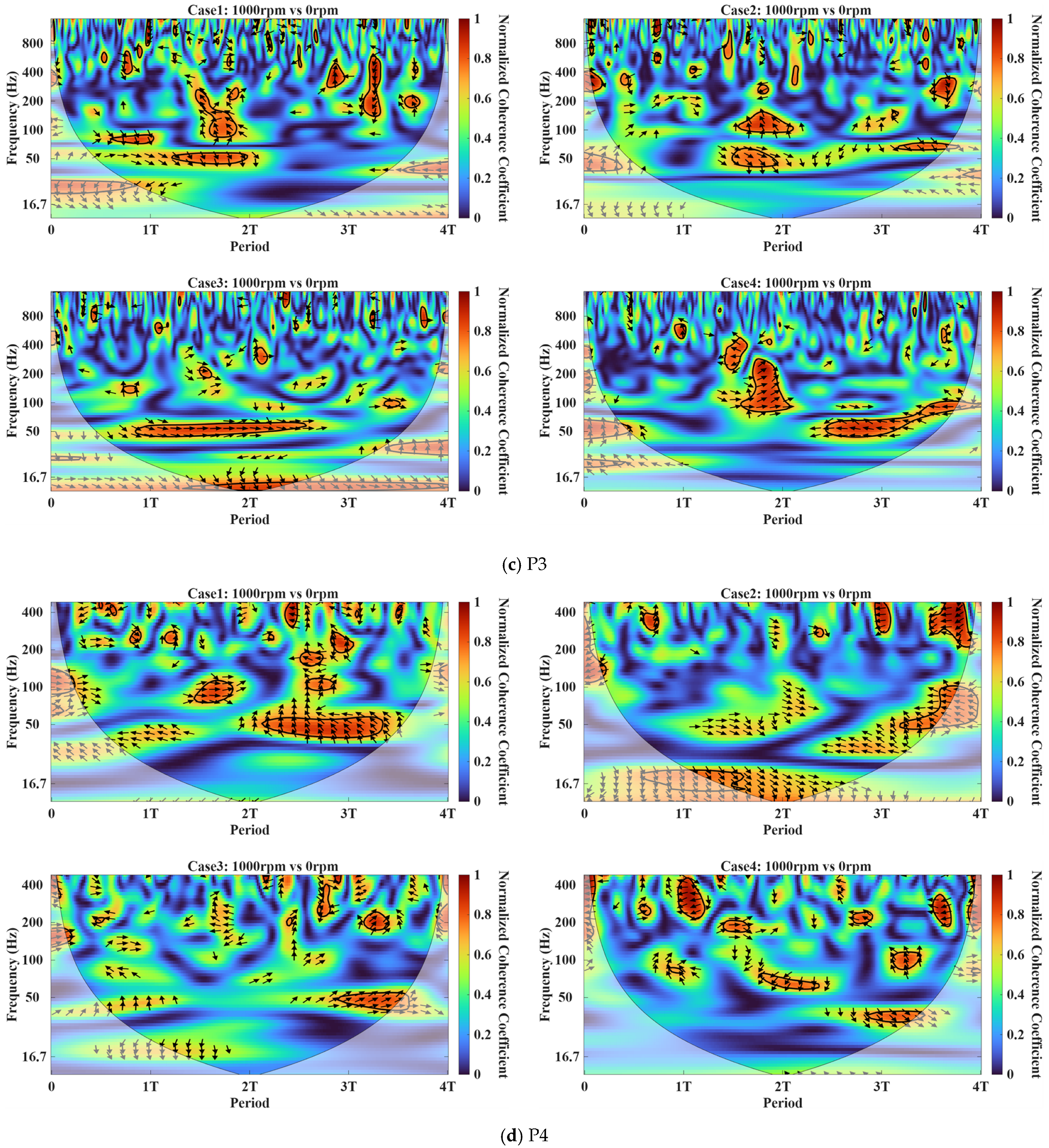
The pressure pulsations signal in the tubular pump exhibit pronounced non-stationarity and multi-scale characteristics, especially under off-design and locked-impeller conditions. Compared with time–frequency techniques such as the short-time Fourier transform (STFT) and discrete wavelet transform (DWT), the continuous wavelet transform (CWT) provides scale-adaptive time–frequency resolution, enabling simultaneous identification of low-frequency rotational pulsations and intermittent high-frequency components. Furthermore, the wavelet coherence transform (WTC) allows direct assessment of time–frequency-dependent coherence and phase relationships between pressure signals obtained under rotating and stationary impeller conditions, which is essential for isolating rotation-induced pulsations from system-scale background pressure dynamics.
3.2. CWT-Based Time–Frequency Analysis of Pressure Pulsations
Signal processing in this investigation was performed using the CWT [
32], a pivotal time-frequency analysis technique. Its fundamental principle involves the multi-scale analysis of a signal
x(
t) through convolution with a prototype mother wavelet function
ψ, subject to scaling and translation. The complete transform is defined by the integral:
Here, the scaling factor
a dictates the analysis frequency band, with smaller values offering higher temporal resolution, while the shifting factor
b localizes the wavelet window at a specific time instant. We employed the Complex Morlet wavelet for the basis function
ψ, capitalizing on its optimal time-frequency concentration. The resultant CWT coefficients, obtained by systematically varying
a and
b, provide a comprehensive map of the signal’s localized spectral content and energy distribution over time. Time-averaged marginal spectrum (Mean Amplitude) was derived by integrating the modulus of the wavelet coefficients over the time domain. This metric provides a robust assessment of the global energy distribution and is expressed as:
where
T represents the duration of the analyzed window (8 rotational periods), and
denotes the magnitude of the wavelet coefficients converted to the frequency domain. Additionally, a high-pass filter (
f > 3 Hz) was applied to the marginal spectrum to eliminate the DC component and ultra-low frequency trends, ensuring a clearer visualization of the rotor–stator interaction frequencies compared to the background noise.
3.2.1. Detailing Pressure Fluctuation Behaviors at the Impeller Inlet
As the core energy-input component of the pump unit, the impeller’s kinematic parameters directly influence the internal unsteady flow characteristics.
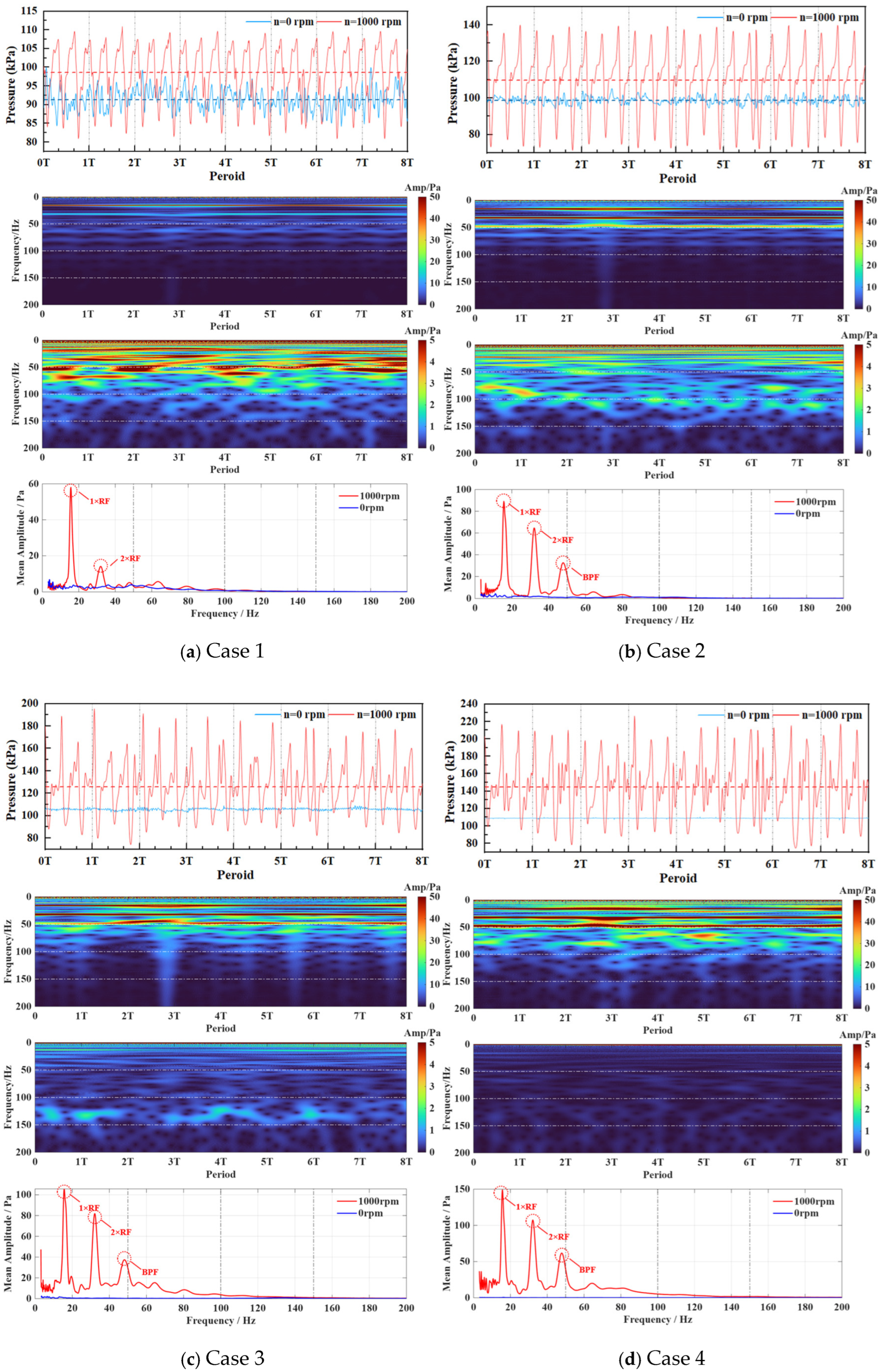
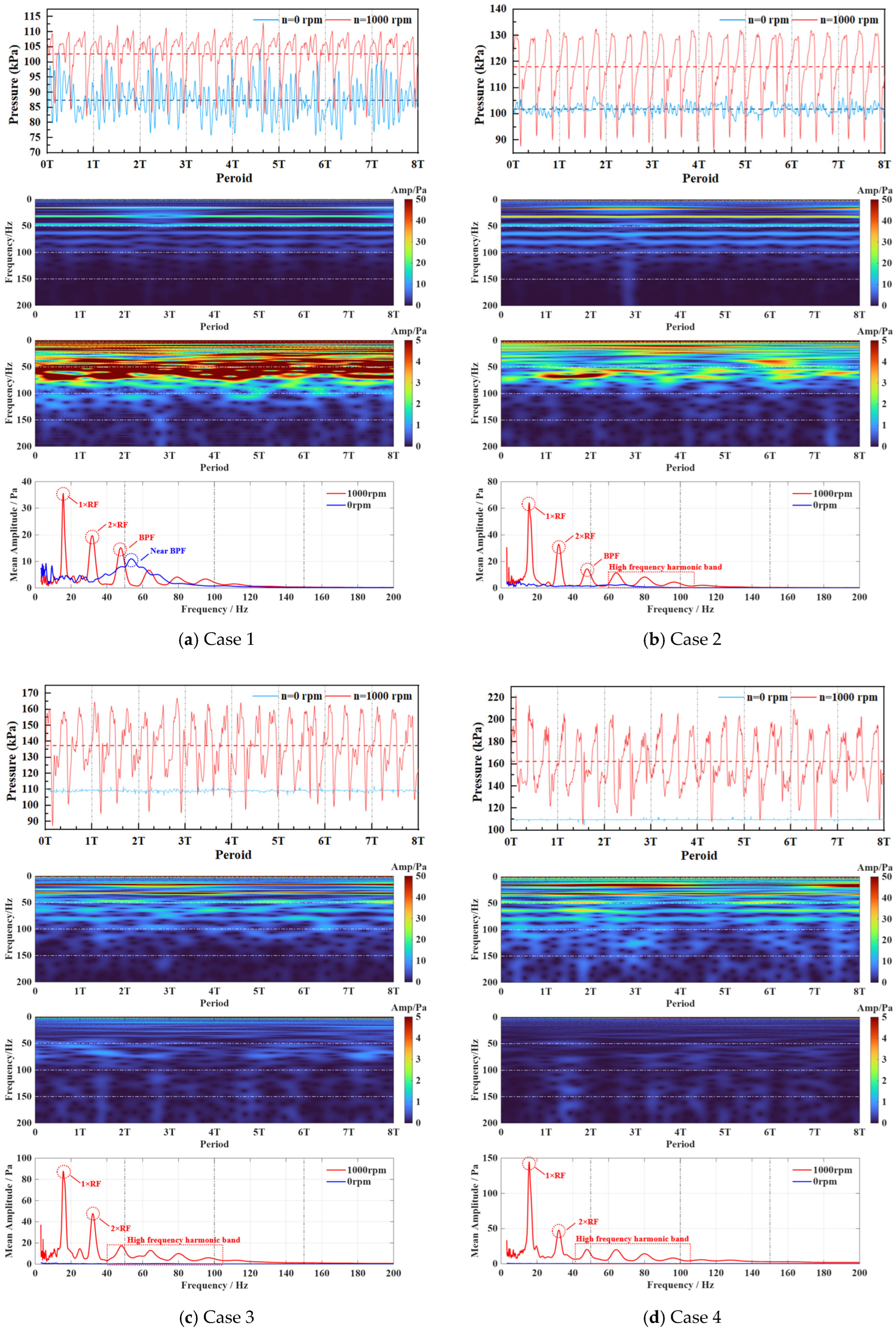
Figure 4 shows the original pressure fluctuation signals and the corresponding wavelet time–frequency spectra at the impeller inlet (P1) under various flow conditions.
Under Case 1 (high flow condition), the average pressure at 1000 rpm was higher than that at 0 rpm; both were below atmospheric pressure (101.325 kPa). At 1000 rpm, three distinct peaks and troughs were clearly identifiable within one rotational period, indicating that the pressure fluctuation at the impeller inlet was still strongly influenced by the sequential passage of the three blades past the measuring point. In contrast, the pressure fluctuation at 0 rpm was highly disordered and exhibited no clear periodicity. The wavelet time–frequency spectrum at 1000 rpm revealed a sharp, high-energy concentration at the rotational frequency (1× RF, 16.7 Hz), identifying it as the dominant frequency component. A secondary, lower-energy band was also observed at 2× RF (33.3 Hz), indicating weaker pressure pulsations at this frequency. At 0 rpm, the spectrum appeared chaotic without clear time-varying regularity in the high-frequency range; however, dense, temporally continuous energy bands were present in the low-frequency range, suggesting that the pressure pulsations comprised both periodic low-frequency pulsations and transient high-frequency components. It should be noted that the upper limit of the wavelet energy scale for the three impeller measuring points (P1–P3) was set to 50 for the 1000 rpm condition and 5 for the 0 rpm condition—a tenfold difference. The marginal spectrum further quantifies this contrast: at 1000 rpm, distinct peaks at 1× RF and 2× RF dominate the energy distribution, whereas the 0 rpm spectrum shows a flat, broadband profile with negligible amplitude, confirming the rotation-dependent nature of these fluctuations.
Under Case 2 (design condition), the peaks and troughs at 1000 rpm became more pronounced. The average pressure rose above atmospheric pressure, showing an increase compared to the high flow condition. At 0 rpm, the fluctuation remained disordered, though the amplitude decreased and the average pressure level increased relative to Case 1, yet still remained below atmospheric pressure. The wavelet spectrum at 1000 rpm displayed continuous, broad energy bands at the rotational frequency and its harmonics, each with different energy levels, reflecting stable periodic pressure pulsations. The spectrum at 0 rpm remained chaotic; however, compared to Case 1, the peak energy decreased, and the irregular high-energy regions extended toward higher frequencies, indicating reduced fluctuation amplitude, an overall shift to higher frequencies, and a lower probability of extremely high-energy transients. As shown in the bottom spectral plot, the periodic stability at 1000 rpm is evidenced by sharp, narrow-band harmonics. In contrast, the 0 rpm baseline exhibits a low-amplitude chaotic distribution without any discrete frequency components, verifying the suppression of deterministic pulsations.
Under Case 3 (high-head condition), the primary and secondary pressure peaks at 1000 rpm became less stable in their extreme values compared to Case 2, and the temporal periodicity weakened. In some rotational cycles, three distinct waveforms were no longer detectable. The average pressure continued to rise. At 0 rpm, the fluctuation region smoothed out, and the average pressure increased above atmospheric level. The wavelet spectrum at 1000 rpm showed high-energy broadband regions only at 1× RF, 2× RF, and the blade-passing frequency (BPF), with low energy and temporal discontinuity at BPF. This indicates that the pressure pulsations were still dominated by 16.7 Hz and 33.3 Hz, while the rotor–stator interaction induced by individual blade passage no longer exerted a continuous influence over time. At 0 rpm, a narrow energy band was observed at 1× RF. Additionally, high-energy regions were concentrated between 2× BPF and 3× BPF but were temporally discontinuous, indicating that the pressure pulsations included both a stable 16.7 Hz component and sporadic high-frequency pulsations in the 100–150 Hz range. The mean amplitude comparison corroborates this: the 1000 rpm spectrum features prominent peaks strictly at 16.7 Hz and 33.3 Hz, while the 0 rpm case shows only a faint, broad elevation around the fundamental frequency, lacking the high-order harmonics observed under rotation.
Under Case 4 (deep stall condition), the secondary peaks at 1000 rpm became sharper, and the primary peak consistently appeared as the final peak in the cycle, with an extremely large pressure variation range. The average pressure increased further. Fluctuation at 0 rpm nearly diminished, stabilizing at a value slightly above atmospheric pressure. At this point, the flow could not dissipate all the energy supplied by the power unit, and the unused energy intensified turbulent agitation. The wavelet spectrum at 1000 rpm showed very-high-energy broadband regions at 1× RF, 2× RF, and BPF, with additional high-energy areas appearing at 4× RF. Compared to Case 3, energy appeared at higher harmonics of the rotational frequency, suggesting more pronounced periodic fluctuations with shorter minimal periods. At 0 rpm, most high-energy regions had disappeared, indicating stabilized pressure with very weak fluctuations, aside from a faint pulsation at 16.7 Hz.
As the flow rate decreased, the pressure pulsations at the rotational frequency and its harmonics intensified under the 1000 rpm condition, while under the 0 rpm condition, the pressure pulsations weakened and gradually shifted toward higher frequencies—a trend consistent with the variation in head. Quantitatively, the marginal spectrum for Case 4 at 1000 rpm displays a richer harmonic structure (up to 4× RF) due to stall-induced instabilities. Conversely, the 0 rpm spectrum is effectively suppressed to near-zero levels across the entire frequency band, indicating that flow separation alone without rotation generates minimal pressure fluctuation energy.
3.2.2. Detailing Pressure Fluctuation Behaviors at the Impeller Mid-Section
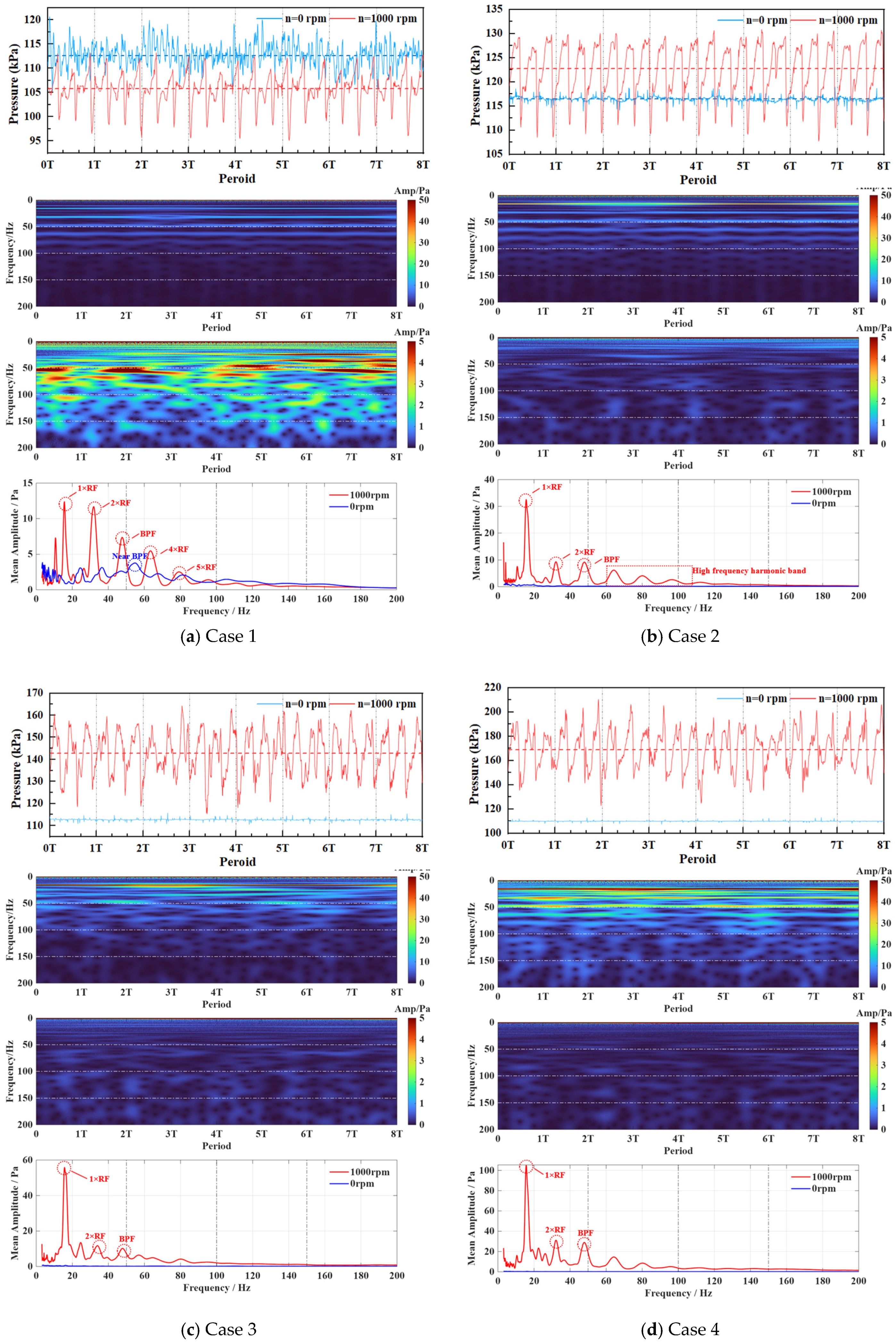
The mid-impeller region, being most directly influenced by the rotating component, exhibits hydrodynamic characteristics that are closely linked to its mechanical kinematic parameters. The time-domain pressure signals and the corresponding wavelet time-frequency spectra at the mid-impeller position (P2) are presented in
Figure 5.
Under Case 1 (high flow condition), a sharp primary trough was observed at 1000 rpm, preceded by a relatively flat secondary peak and followed by a sharper primary peak, with a minor trough between them. The average pressure in this case was slightly above atmospheric pressure. In contrast, the 0 rpm condition exhibited significantly greater fluctuation amplitude compared to other cases, with each pressure surge featuring a single sharp peak; the average pressure was approximately 15 kPa below atmospheric pressure. The wavelet time–frequency spectrum at 1000 rpm revealed distinct energy bands at the rotational frequency and its harmonics, with energy levels gradually decreasing as the frequency doubled. The spectrum for the 0 rpm condition was highly chaotic with extremely high amplitude, and the high-energy fluctuations were largely confined below 83.3 Hz. This indicates that mechanical motion plays a crucial role in regulating the fluid pressure under this condition. The marginal spectra reveal a magnitude reversal: the 0 rpm condition exhibits a significantly higher broadband amplitude below 53.3 Hz compared to the tonal peaks at 1000 rpm, highlighting the dominance of flow-induced turbulence over rotor–stator interaction at this specific location and flow rate.
Under Case 2 (design condition), the double-peak phenomenon at 1000 rpm essentially disappeared, and the pressure rise rate slowed, suggesting a smooth pressure increase from the blade-free region until the next blade passes the measuring point—indicating uniform pressure distribution on the blade working face. The average pressure exceeded atmospheric pressure. For the 0 rpm condition, the fluctuation amplitude was significantly reduced compared to Case 1, and the average pressure was around atmospheric level. The time–frequency characteristics at 1000 rpm were generally consistent with Case 1, except that the energy at each harmonic was slightly higher, exhibiting near-perfect periodicity and harmonic concentration. For the 0 rpm condition, both the extent and intensity of high-energy regions were substantially reduced compared to Case 1; however, sporadic very high-energy pressure pulsations, primarily around 66.7 Hz, were still observable, indicating that the flow pressure changes remained unstable. This is visually confirmed by the mean amplitude plot, where the 1000 rpm signal is characterized by discrete peaks at the blade passing frequency and its harmonics. The 0 rpm spectrum, however, remains flat and low-energy, confirming that the sporadic high-frequency pulses are insufficient to form a coherent spectral signature.
Under Case 3 (high-head condition), the pressure rise at 1000 rpm was no longer smooth, exhibiting irregular secondary peaks before reaching the maximum. Although three peaks and troughs per revolution were still present, their shapes were not similar. The average pressure increased compared to Case 2. The 0 rpm condition showed a further reduction in fluctuation intensity, with the average pressure rising and stabilizing around 110 kPa. The wavelet spectrum at 1000 rpm showed that the harmonics were no longer as prominent as in Cases 1 and 2, with the overall spectrum tending toward chaos. Although broad energy bands were still observable at 1–5 times the rotational frequency, their amplitudes were no longer stable over time—e.g., the energy bands at 3–5× RF exhibited discontinuities. For the 0 rpm condition, high-energy regions tended to diminish, showing only widespread, low-amplitude pressure pulsations across the entire time–frequency range, indicating that while the pressure was macroscopically stable, minor irregular fluctuations still occurred. The spectral analysis highlights the instability: while 1000 rpm retains identifiable harmonic peaks, they are broadened compared to Case 2. The 0 rpm spectrum shows a diffuse energy distribution with no distinct features, verifying that the irregular fluctuations observed in the time domain do not correspond to any specific structural resonance or periodic shedding.
Under Case 4 (deep stall condition), the waveform similarity at 1000 rpm further decreased, though the fluctuation count was still governed by mechanical rotation, and the average pressure increased again. The 0 rpm condition had largely stabilized at approximately 110 kPa with very weak fluctuations. The wavelet spectrum at 1000 rpm was generally consistent with Case 3, with spectral characteristics further tending toward a chaotic state. No significant high-energy regions were observable for the 0 rpm condition, indicating stable flow at this location. Comparing the marginal spectra, the 1000 rpm case exhibits a chaotic but high-amplitude broadband elevation typical of deep stall. In sharp contrast, the 0 rpm line is nearly essentially flat, demonstrating that the stall cells and associated pressure surges are fundamentally driven by the rotating blade dynamics.
3.2.3. Detailing Pressure Fluctuation Behaviors at the Impeller Outlet
The impeller outlet, being the interface between the rotating impeller and the stationary guide vanes, experiences the most pronounced rotor–stator interaction effects.
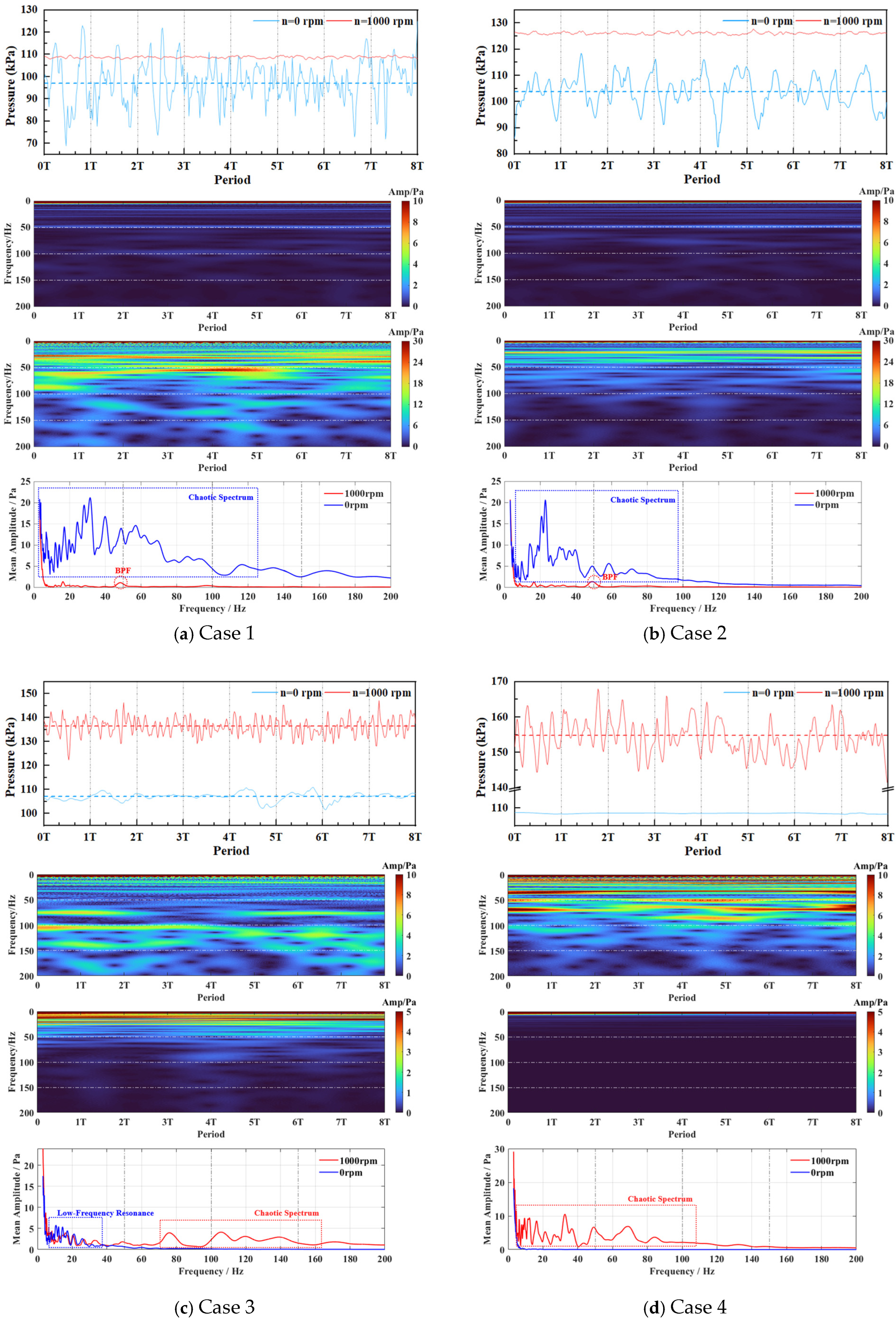
Figure 6 displays the original pressure fluctuation signals and the wavelet spectra obtained at the impeller outlet (P3) for all tested cases.
Under Case 1 (high flow condition), the average pressure at 1000 rpm was lower than that at 0 rpm, with both exceeding atmospheric pressure—a finding contrary to observations at other locations. This indicates that under Case 1, the rotation of the mechanical components not only pressurizes the flow but also stabilizes the pressure, maintaining it within a reasonable range. Notably, the pressure from the mid-impeller to the impeller outlet increased by approximately 25 kPa in the 0 rpm condition, whereas this increase was reduced to about 3 kPa under rotationally controlled flow. Furthermore, the rotationally managed flow exhibited significantly enhanced pressure periodicity, departing from the uncontrolled state characterized by high-level, high-frequency, strong fluctuations. The wavelet time–frequency spectrum at 1000 rpm revealed low-amplitude, broad energy bands at the rotational frequency and its harmonics, extending up to roughly 5× RF, with nearly uniform spacing, indicating relatively pure fluctuation components concentrated at specific frequencies. In contrast, the 0 rpm condition showed energy distributed randomly across the entire time–frequency domain, with higher energy levels in the 50–100 Hz range and localized extreme energy regions just above 50 Hz. The marginal spectrum clarifies this distinction: the 1000 rpm case shows a series of regularly spaced harmonic peaks, whereas the 0 rpm case presents a broad “hump” of energy concentrated between 20 and 100 Hz, reflecting the localized turbulent structures unique to the stationary obstruction.
Under Case 2 (design condition), the waveform at 1000 rpm exhibited both primary and secondary peaks in some cycles, with the primary peak occurring later, along with oscillatory peaks lacking distinct maxima. The pressure rise was relatively gradual, featuring a pressure dip within the rising interval. The average pressure increased compared to Case 1. The 0 rpm condition showed a substantial reduction in fluctuation intensity, though transient peaks without clear temporal regularity emerged, and the average pressure rose slightly. The wavelet spectrum at 1000 rpm was largely consistent with Case 1, except for a slight increase in energy at each harmonic and more pronounced high-frequency harmonic bands (e.g., at 83.3 Hz and 100 Hz). For the 0 rpm condition, high-energy regions largely disappeared, indicating a trend toward flow stabilization. Quantitative spectral analysis shows that at 1000 rpm, the BPF and harmonic peaks are sharp and well-defined. Conversely, the 0 rpm spectrum is effectively silenced, with amplitudes dropping to negligible levels, indicating optimal flow guidance by the stationary vanes under design conditions.
Under Case 3 (high-head condition), the waveform similarity at 1000 rpm was very low, with peaks, troughs, and their magnitudes showing little regularity. The average pressure increased further. The 0 rpm condition remained largely stable, with minimal change in average pressure. The wavelet spectrum at 1000 rpm showed an extremely concentrated, high-energy, and temporally continuous band exclusively at 16.7 Hz, indicating a dominant periodic fluctuation component persisting throughout the entire duration. The spectrum for the 0 rpm condition appeared further purified, reflecting increased pressure stability. The dominance of the 16.7 Hz component at 1000 rpm is captured as a singular, high-magnitude peak in the marginal spectrum. The 0 rpm spectrum remains devoid of significant features, confirming that the concentrated periodic energy is strictly a result of the rotor–stator interaction at this off-design point.
Under Case 4 (deep stall condition), distinct primary peaks and troughs emerged at 1000 rpm, with the pressure rise interval exhibiting non-smooth, oscillatory characteristics. The average pressure increased again. The 0 rpm condition stabilized further, with a mean pressure of approximately 110 kPa. Compared to Case 3, the wavelet spectrum at 1000 rpm exhibited increased chaos, with generally elevated energy amplitudes across the time–frequency range. Broadband energy reemerged at the rotational frequency and its harmonics; however, unlike in Cases 1 and 2, some energy leakage was observed at non-characteristic frequencies. Although the fluctuation period generally corresponded to the impeller’s rotational parameters, the distinctiveness of individual waveforms became apparent, reflecting the influence of stall vortices and incipient cavitation on the pressure composition under deep stall conditions. The spectral signatures diverge significantly here: the 1000 rpm spectrum displays a jagged, multi-peak profile indicative of stall vortices interacting with the rotor. Meanwhile, the 0 rpm spectrum remains effectively flat near zero, confirming that the stall cells and associated pressure surges are fundamentally driven by the rotating blade dynamics.
3.2.4. Detailing Pressure Fluctuation Behaviors at the Guide Vane Outlet
The guide vanes, as the first stationary rectifying component following the impeller’s energy addition, encompass an extremely complex internal flow field and are subjected to the most intense interactions between the rotating wakes and the stationary walls. The experimental data and wavelet analysis results for the guide vane outlet (P4) are shown in
Figure 7.
Under Case 1 (high flow condition), the pressure fluctuation characteristics exhibited behavior distinct from other components. The 1000 rpm condition showed gentle fluctuations, with an average pressure slightly above atmospheric pressure. In contrast, the 0 rpm condition displayed highly complex fluctuations where the pressure extremes lacked clear temporal regularity. Its mean pressure was below atmospheric pressure, indicating that the guide vanes can almost perfectly control the flow exiting the rotating impeller, significantly reducing its irregular pressure pulsations. If the impeller were to lock, this excessively large flow rate would instead induce intense disturbances due to flow obstruction by the components. This suggests that severe pressure pulsations caused by a locked impeller only occur under high flow conditions and are located downstream of the guide vane section. According to the wavelet time-frequency spectrum: under the 1000 rpm condition, energy bands at the BPF and RF were observable, indicating that the pressure pulsations of the pumped fluid, rectified by the guide vanes, possessed distinct periodic temporal characteristics. Conversely, under the 0 rpm condition, the high-energy regions were irregular, concentrated in the 20–60 Hz frequency range, and lacked continuous, full-duration high-energy bands, indicating the sporadic nature of the pressure pulsations under this condition. It is particularly noteworthy that for the 0 rpm condition, the upper limit of the energy scale in the time-frequency spectrum was set to 30, six times greater than that used for the impeller domain previously. This indicates that the fluid, after passing through the locked impeller, acquires a velocity vector distribution different from the inlet flow. Subsequent interaction with the guide vanes forcibly degrades flow stability once more, leading to a sharp increase in the degree of flow instability. Therefore, the interaction process between the guide vanes and the fluid is the primary factor exacerbating the level of flow instability. The marginal spectra reveal a striking inversion of pulsation intensity: the 0 rpm condition exhibits a higher broadband amplitude across the 0–100 Hz range compared to the rotating case. The 1000 rpm spectrum shows only a suppressed peak at the RF, indicating that impeller rotation effectively rectifies the high-flow structure, whereas the stationary blockage induces stronger chaotic downstream shedding.
Under Case 2 (design condition), the average pressure for the 1000 rpm condition increased to approximately 125 kPa. For the 0 rpm condition, the waveform sharpness diminished, the fluctuation intensity slowed compared to Case 1, and the average pressure rose above 1 atm. The wavelet time-frequency spectrum revealed that the energy band at the BPF for the 1000 rpm condition became more pronounced compared to Case 1. For the 0 rpm condition, the high-energy regions largely disappeared, leaving only secondary energy regions (15–40 Hz) that persisted throughout the entire duration. This suggests the occurrence of continuous pressure fluctuation events within the 15–40 Hz range, likely induced by vortex structures with stable shedding frequencies. This trend persists at the design point, where the mean amplitude of the 0 rpm spectrum exceeds that of the 1000 rpm condition within the low-frequency band (<100 Hz). While the 1000 rpm signal is characterized by a minor rise at the RF, the locked impeller generates a wider spectrum of turbulent fluctuations, suggesting that the stationary blade wakes create more intense downstream instability than the rotor–stator interaction under these conditions.
Under Case 3 (high-head condition), the fluctuation patterns between the 1000 rpm and 0 rpm conditions were reversed, with strong fluctuations returning to the 1000 rpm condition. The average pressure for the 1000 rpm condition increased further, but a distinct three-peak curve within one rotational cycle was no longer observable. Although the pressure pulsations were induced by impeller rotation, their frequency characteristics could no longer be strongly correlated with the rotational parameters. The average pressure for the 0 rpm condition increased slightly, while the fluctuation intensity decreased significantly, with only very low-frequency isolated waves being observed. The wavelet time-frequency spectrum showed that for the 1000 rpm condition, the spectrum tended toward chaos. No distinct high-energy bands were observable at characteristic frequencies; instead, sporadic high-energy pulsation regions were observed in the high-frequency range (>100 Hz), indicating that the pressure pulsations had lost their clear periodic temporal regularity. For the 0 rpm condition, three very narrow, full-duration high-energy bands were observed in the low-frequency range (≤16.67 Hz), indicating the persistence of low-frequency pressure pulsations composed of three superimposed low-frequency pulsation components. Here, the spectral hierarchy reverts, with the 1000 rpm amplitude exceeding the 0 rpm baseline. Crucially, below 20 Hz, the spectral profiles of both conditions overlap with nearly identical trends. This synchronization serves as definitive proof of a rotation-independent system resonance or hydraulic instability that dictates the low-frequency dynamics regardless of impeller motion.
Under Case 4 (deep stall condition), the fluctuation intensity for the 1000 rpm condition increased further, with temporal periodicity becoming less distinct and the fluctuations appearing more disordered. Its average pressure rose again to 155 kPa. In contrast, the 0 rpm condition had largely stabilized, with no significant fluctuations occurring. The wavelet time-frequency spectrum indicated increased chaos for the 1000 rpm condition, with fluctuation energy distributed across frequencies below 100 Hz in a disordered and irregular manner. For the 0 rpm condition, energy regions were scarcely observable, and the flow disturbance level dropped to a very low value, indicating smooth outflow. Under deep stall conditions, the 1000 rpm spectrum evolves into a high-amplitude chaotic profile, reflecting severe flow separation and rotating stall cells. In contrast, the 0 rpm spectrum drops significantly below the rotating case, confirming that the intense broadband turbulence observed in this regime is actively driven by the unstable interaction between the stalling rotating blades and the fluid.
3.3. WTC-Based Analysis of Pressure Pulsations Under Two Conditions
The Wavelet Coherence Transform (WTC) is employed to examine the coherence of pressure pulsations at the same monitoring point under different rotational speeds (1000 rpm and 0 rpm) while maintaining a constant flow rate. The wavelet coherence spectrum [
33]
and the phase difference
are, respectively, defined as:
where
and
represent the Continuous Wavelet Transform coefficients of signals
x(
t) and
y(
t), respectively;
denotes their cross-wavelet transform spectrum; and
S is the time-frequency smoothing operator. To ensure the statistical reliability of the results, the significance level of the wavelet coherence is estimated using Monte Carlo simulations. A red noise (first-order autoregressive, AR1) background spectrum is adopted as the null hypothesis. In the resulting coherence maps, regions enclosed by thick black contours indicate correlations that are significant at the 95% confidence level. Furthermore, the ‘Cone of Influence’ (COI) is distinguished to mark the domain where edge effects may distort the spectrum; interpretation is thus strictly limited to the valid data within the significant regions outside the COI. This method allows for a detailed analysis of the time-frequency coherence between pressure signals at the same location under operational and non-operational impeller conditions. By assessing both the frequency and phase coherence, WTC reveals how the pressure pulsations evolve over time and how they are related between the two different operating states. Specifically, the WTC analysis captures the frequency components of pressure pulsations that are influenced by the impeller’s rotation at 1000 rpm and compares them with the behavior when the impeller is stationary at 0 rpm. This approach provides insights into the impact of impeller motion on pressure waveforms and helps identify shared low-frequency and high-frequency characteristics in the pressure pulsations, which are essential for understanding the underlying flow dynamics and their stability under varying operational conditions.
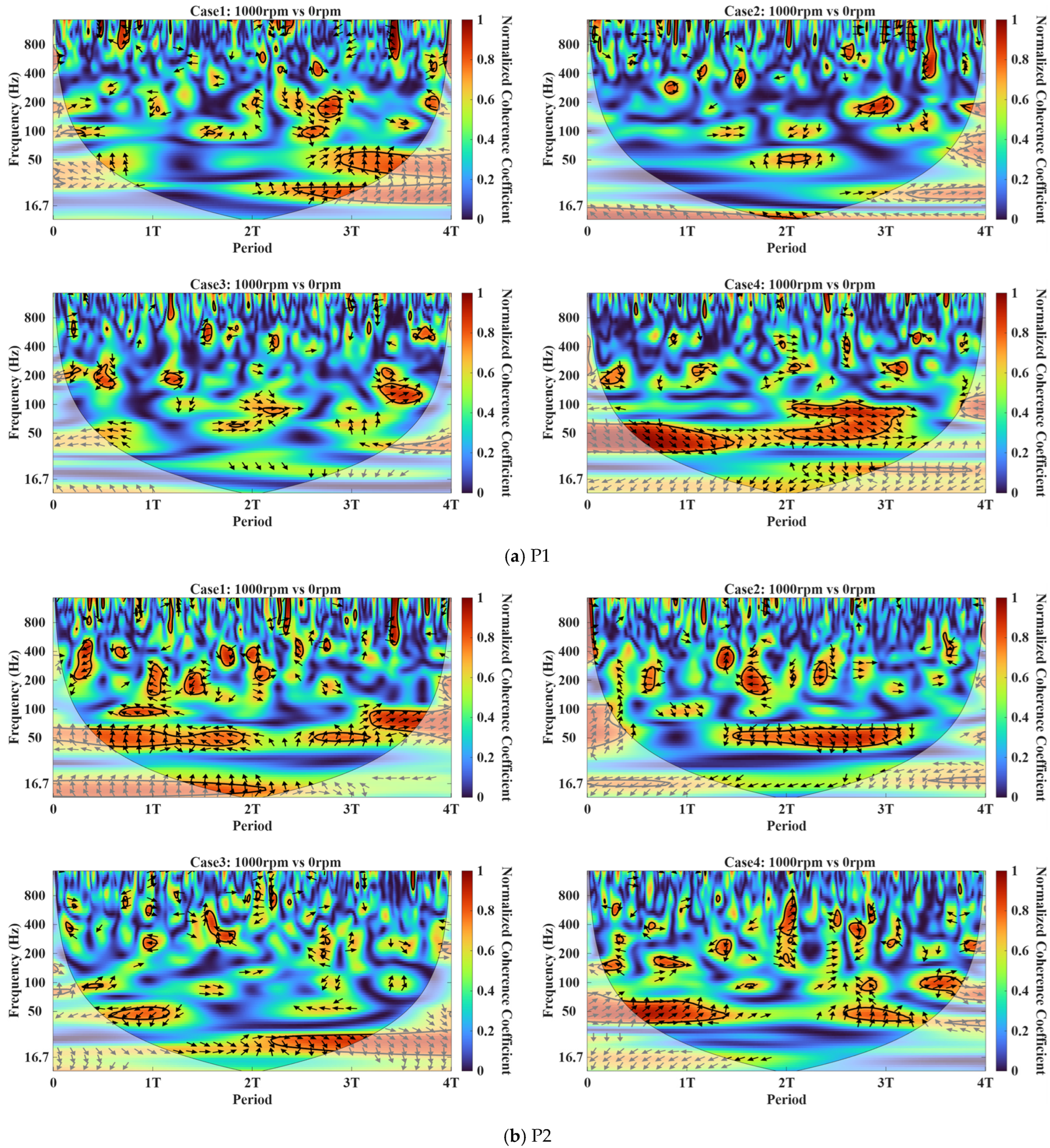
The compilation of wavelet coherence spectra for all measurement points under the two operating conditions is provided in
Figure 8. At P1, the WTC maps show the clearest shared low-frequency content between 1000 rpm (X) and 0 rpm (Y), indicating that a sizeable portion of inlet pressure dynamics is governed by system-/inlet-scale hydrodynamics rather than purely rotor-induced tones. In Case1–Case2, coherence concentrates mainly in the sub-BPF band (≈16.7–50 Hz) and appears as intermittent lobes spanning portions of 1–4 T. The phase arrows inside these lobes are predominantly rightward (near 0°), implying in-phase coupling of slow pressure modulations under rotating and locked-rotor states—consistent with common drivers such as inlet non-uniformity, large-scale shear-layer breathing, or global discharge fluctuations. In Case3, coherent patches become more fragmented and the arrows scatter, suggesting weakened phase locking as inlet flow becomes more sensitive to local separation and recirculation. Case4 (deep stall) is distinctive: a broad, persistent coherent region develops across much of the record in the low-frequency band, with largely consistent arrow orientation (near in-phase with mild lead/lag). This pattern points to a dominant low-order unsteady mode (e.g., rotating-stall/surge-type inlet oscillation) that remains active whether the impeller rotates or not, but is amplified and temporally organized under rotation.
Moving to P2, the coherence level generally drops and the maps become more patchy, indicating that the mid-impeller pressure is more strongly shaped by rotation-dependent blade loading and local turbulence, which a locked impeller cannot reproduce. Across Case1–Case2, coherence in the 16.7–50 Hz band appears only in short-lived islands, often around mid-record, while higher-frequency coherence is sparse and intermittent. Phase arrows in these islands are still mostly rightward, implying that when low-frequency coupling exists, it is again dominated by common, slow fluctuations rather than by blade-passing physics. In Case3, the low-frequency coherence tends to weaken further and the phase becomes less organized, consistent with a flow that transitions toward incipient separation and more irregular impeller-channel interactions. In Case4, low-frequency coherence re-emerges but remains less continuous than at P1, suggesting that deep stall creates large-scale unsteadiness that can penetrate into the impeller passages, yet the mid-span signal is still strongly modulated by rotation-specific mechanisms (secondary flows, passage blockage, intermittent reattachment). Overall, P2 behaves as a filter: it transmits some global low-frequency content, but progressively decorrelates the two operating states as local blade–flow dynamics dominate.
At P3, the outlet environment adds strong sensitivity to wake development, mixing, and downstream interaction, so coherence patterns depend more on operating point. In Case1–Case2, coherence in the 16.7–50 Hz band is present but typically confined to localized lobes, indicating that only part of the slow pressure variation is shared between rotating and stationary conditions. Where coherence is high, arrows are largely rightward, showing near in-phase coupling; outside these windows, arrows scatter, signalling loss of phase consistency as rotor-generated structures (wakes, periodic loading) have no stationary analog. A notable feature appears in Case3, where a more continuous coherent band emerges in the low-frequency range, with comparatively aligned arrows—suggesting that high-head conditions promote a strong, repeatable low-frequency mode at the impeller exit (e.g., outlet recirculation/rotating-stall cell convection) that manifests in both rpm states. In Case4, coherence becomes again fragmented: deep stall drives broadband unsteadiness, but the outlet pressure field is dominated by intermittent blockage and large-scale eddy shedding, yielding only sporadic alignment between X and Y. Thus, P3 marks a transition from “system-driven” coherence (low-frequency) toward “rotor-/separation-driven” decorrelation, with Case3 providing the clearest evidence of a shared outlet low-order mode.
At P4, the frequency axis is limited (Nyquist constraint), but the key comparison remains the low-frequency band. Coherence hotspots are generally fewer than at P1 and often shift in time, reflecting the diffuser/guide-vane system’s role in mixing and dissipating rotor-originated structures. In Case1, a pronounced coherent lobe develops around the sub-BPF band over a relatively long interval, with arrows mainly rightward—indicating that slow pressure pulsations survive through the vane passage and remain similar in both rpm states, plausibly linked to downstream hydraulic compliance and large-scale swirl/recirculation adjustment. In Case2, coherence is weaker and more intermittent, consistent with more stable diffusion and reduced large-scale unsteadiness. In Case3, coherence reappears near the low-frequency band but is confined to late-time windows, with some arrow tilt suggesting modest lead/lag between rotating and stationary cases (phase-shifted convection of low-order structures through the vane row). In Case4, coherence becomes scattered: deep stall promotes irregular separation and vortex shedding downstream, so the phase relationship is not stable. Overall, P4 confirms that only the largest-scale, slowest modes remain comparable between 1000 rpm and 0 rpm after the guide vanes.
Across P1–P4, the shared dynamics between 1000 rpm and 0 rpm are concentrated in the low-frequency range (≈16.7–50 Hz), while higher-frequency coherence is sparse and intermittent—consistent with rotor-specific pulsations being absent when the impeller is locked. Spatially, coherence is strongest at P1, then generally weakens through P2 and P3, and becomes more selective at P4 due to mixing and diffusion effects. Operating condition governs how far low-order unsteadiness propagates: deep stall (Case4) produces the most persistent inlet coherence and the most complex downstream decorrelation; high head (Case3) uniquely strengthens a shared low-frequency mode at the impeller exit; design and high-flow cases show more intermittent, in-phase low-frequency coupling. Phase arrows are predominantly rightward in coherent zones, implying that when coupling exists it is mainly in-phase, supporting the interpretation that these signals originate from system-/flow-structure-scale modulation rather than from blade-passing physics.
3.4. Probability Density Statistics of Windowed Pressure Fluctuation Intensity
To quantitatively evaluate the variation in pressure fluctuation amplitude under different operating conditions, data from the middle 50 rotational periods of the acquisition were selected. Each rotation (0.06 s) was subdivided into three windows, with each window encompassing the pressure variation data corresponding to the passage of a single blade past the measurement point. The data length per window was 60 points for positions P1–P3 and 20 points for P4. The dimensionless pressure fluctuation intensity,
, for each window
m, was defined as the ratio of the standard deviation to the mean pressure:
where
m is the window index,
n is the number of data points in a window,
Pi is the instantaneous pressure, and
is the mean pressure within the window. This metric
directly reflects the relative intensity of pressure pulsations over a short time interval. The data acquisition frequency and window length jointly determine the precision of the fluctuation peaks. A higher sampling frequency improves temporal resolution at the cost of increased data volume. The window length must be carefully chosen: an excessively long window reduces sensitivity to transient fluctuations and may distort peak identification, while an excessively short window can bias the mean estimation, compromising accuracy. In this study, the window length was theoretically set to the blade passing period. This approach allows for the isolation of fluctuations induced by individual blade passages, and the windowed mean pressure,
, correspondingly represents the average pressure during the passage of a single blade.
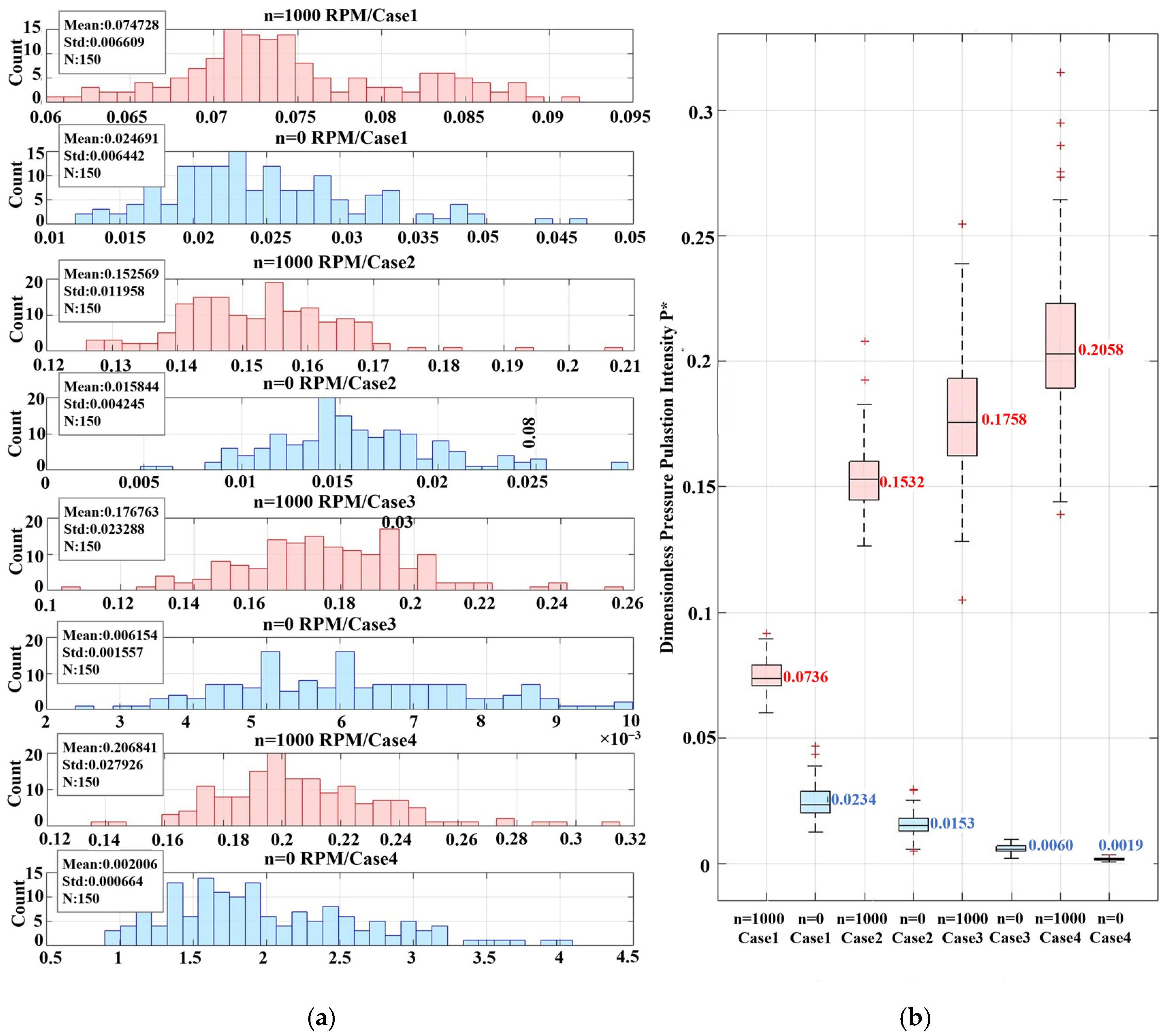
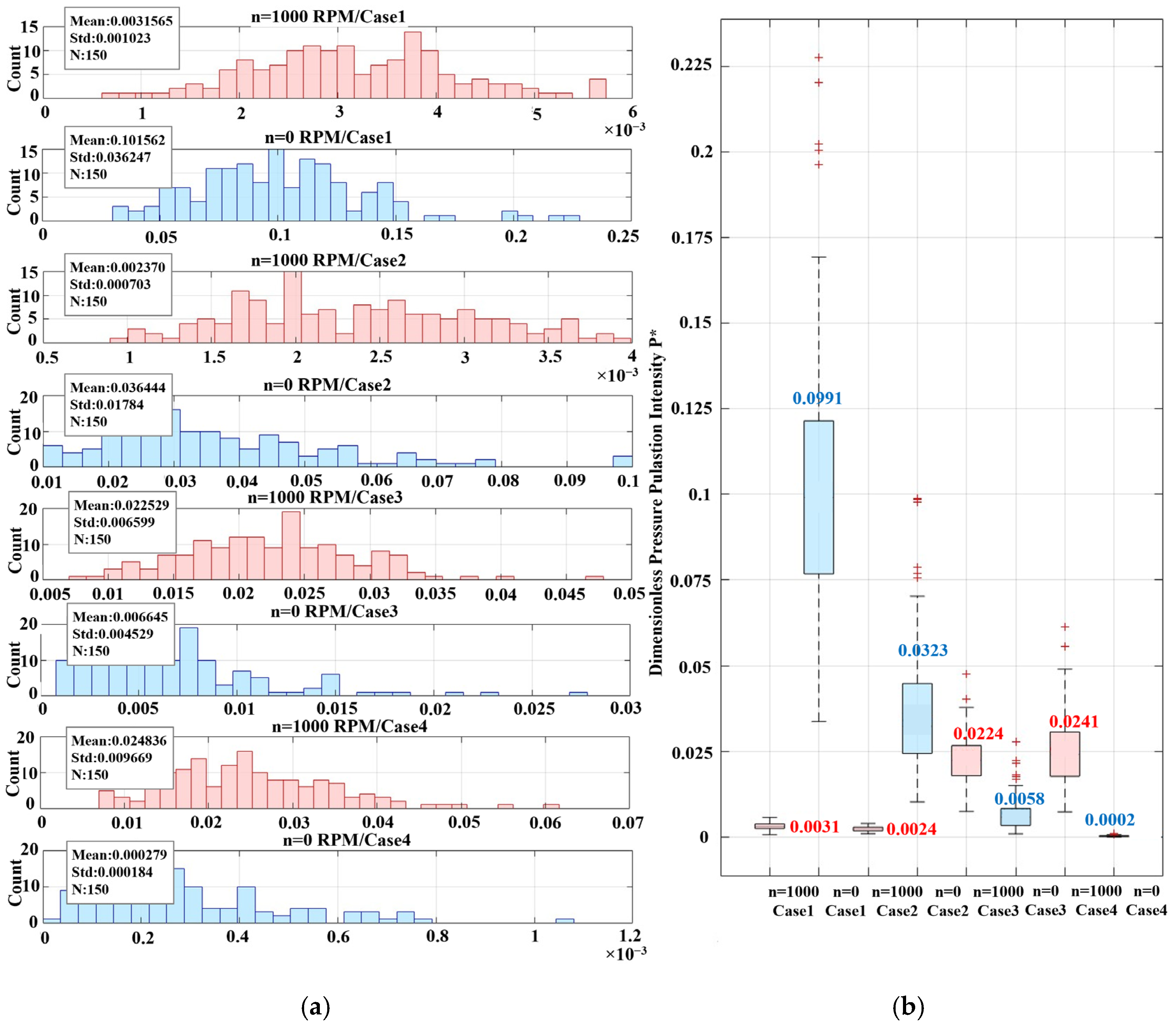
The probability density statistics of the windowed pressure fluctuation intensity at the impeller inlet (P1) are presented in
Figure 9. The left panel shows the frequency distribution histograms of the non-dimensional pressure fluctuation intensity
comprising a total of eight subplots for two conditions (n = 1000 rpm and n = 0 rpm) combined with four flow rate cases. The right panel displays box plots of the effective interval of the non-dimensional pressure fluctuation intensity. The red boxes correspond to the four cases at n = 1000 rpm, while the blue boxes represent those at n = 0 rpm. The elements of the box plots include:
Median line (horizontal line inside the box): The middle value of the dataset, where 50% of the data points lie above and 50% below this line.
IQR (Interquartile Range): IQR = Q3 − Q1, where Q1 (the first quartile) is the value below which 25% of the data can be found, and Q3 (the third quartile) is the value below which 75% of the data can be found.
Box range: Extends from the first quartile (Q1, 25%) to the third quartile (Q3, 75%), containing the middle 50% of the data.
Box edges: The lower edge (Q1) and the upper edge (Q3).
Whiskers: The lines extending from the box, typically indicating the normal data range (from Q1 − 1.5 × IQR to Q3 + 1.5 × IQR).
Outliers: Data points that fall outside the whiskers, denoted by “+” symbols.
Under the n = 1000 rpm condition, as the flow rate decreases, the mean value of induced by the blade passing the measurement point increases from 0.074728 to 0.206841. The dispersion of the frequency distribution continuously increases (standard deviation rises from 0.006609 to 0.027926), indicating that the blade-flow field interaction becomes more intense at low flow rates, and both the amplitude and fluctuation of the single-blade pressure pulsations is significantly enhanced. In contrast, when the impeller is locked at n = 0 rpm, the mean values across all flow cases are extremely small (0.024691 for Case1, 0.015844 for Case2, and nearly 0 for Case3 and Case4), with frequencies highly concentrated near zero. This demonstrates that when the impeller is stationary, the single-blade pressure pulsations is greatly suppressed, leaving only very weak static pressure pulsations.
From the statistical characteristics of the box plots, under the n = 1000 rpm condition, the median shows a step-like increase as the flow rate decreases, and the IQR continuously expands (the box lengthens gradually from Case1 to Case4). Furthermore, numerous outliers beyond the range of Q1 − 1.5 × IQR to Q3 + 1.5 × IQR are observed, further reflecting the instability of the blade-level pressure pulsations under low flow conditions. Conversely, for the n = 0 rpm condition, the boxes are almost compressed to zero, the median is close to zero, the IQR is extremely small, and no outliers are present, indicating that the statistical fluctuation of single-blade pressure pulsations is negligible when the impeller is locked.
This difference stems from the periodic disturbance of the fluid by the rotating blades when the impeller is operating, whereas this disturbance source disappears when the impeller is locked. Therefore, the power input state (whether the impeller is rotating or not) is the core controlling factor for blade-level pressure pulsations. Moreover, under rotating conditions, lower flow rates lead to stronger unsteady interactions between the blades and the flow field, resulting in more significant amplitude and fluctuation of the pressure pulsations.
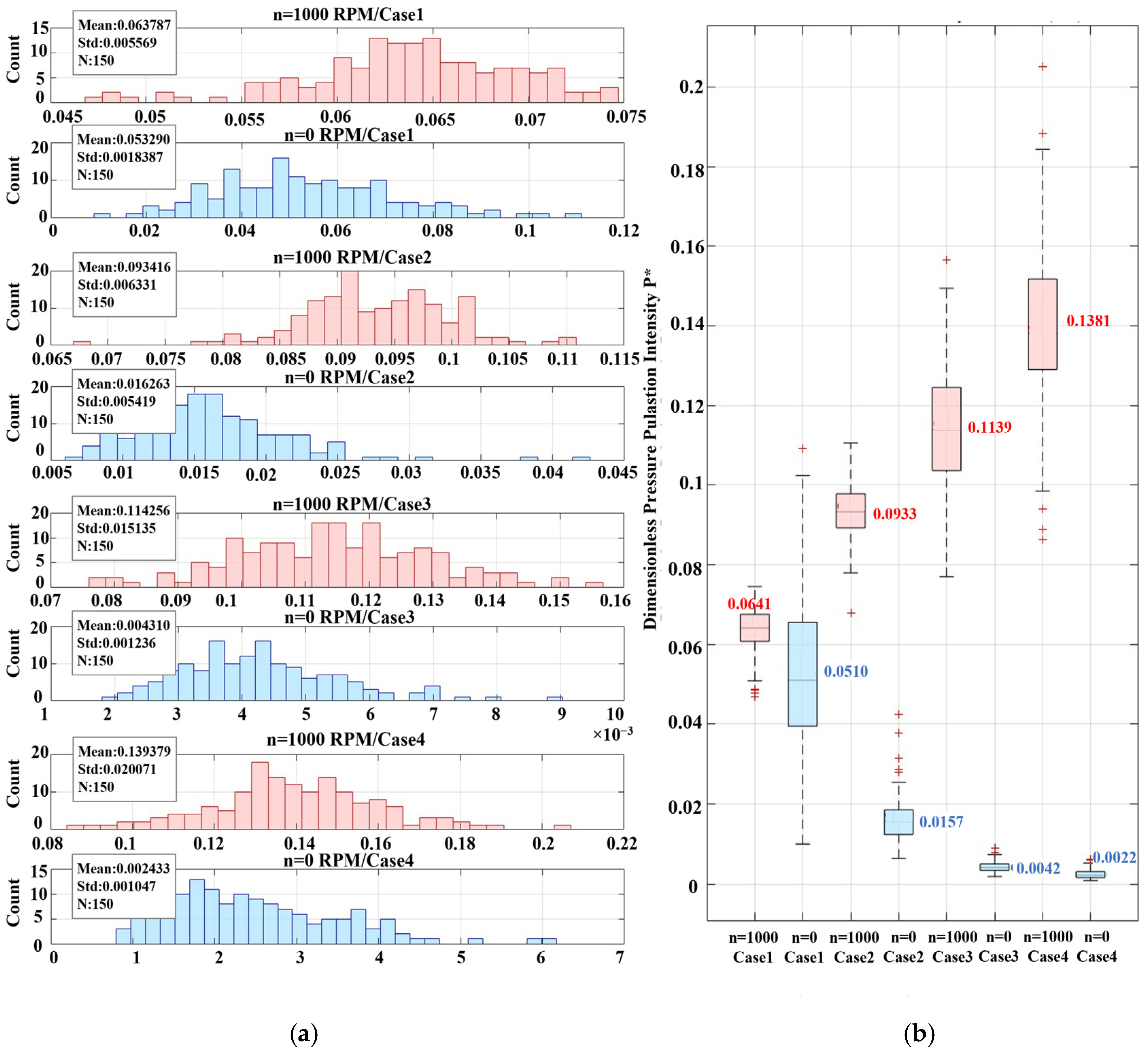
Figure 10 presents the probability density statistics of the windowed pressure fluctuation intensity at the mid-impeller position (P2). Analysis indicates that under the n = 1000 rpm condition, as the flow rate decreases, the mean
generated by the blade passage rises from 0.063787 to 0.139379, with its standard deviation increasing from 0.005569 to 0.020071. The frequency distribution shows a continuous growth in data dispersion with reduced flow rate, reflecting more intense unsteady blade-flow interactions under low-flow conditions in the mid-impeller region, resulting from the coupling effects of “blade rotation, fluid centrifugal force, and flow passage confinement”.
Compared to measurement point P1, the increase in at point P2 under the n = 1000 rpm condition is more gradual. However, the distribution shape exhibits lower kurtosis (i.e., the data is more dispersed), indicating a more uniform energy distribution of the pressure pulsations.
Under the n = 0 rpm condition, the mean values at P2 for all flow cases remain extremely low, with frequencies highly concentrated in the low-value range. Compared to P1, P2 demonstrates slightly higher mean but weaker fluctuations under the stationary condition. This is attributed to flow stagnation induced by the blade geometry in the static flow field at the mid-impeller region. Although no rotational disturbance exists, the flow passage structure still imposes a weak constraint on the static pressure distribution. In contrast, P1 is located at the impeller inlet, where the static pressure is more directly influenced by boundary conditions.
Regarding the statistical characteristics of the box plots, the median of the n = 1000 rpm group shows a step-like increase with decreasing flow rate, the IQR continuously expands, and multiple outliers are present, demonstrating the instability of blade-level pressure pulsations in the mid-impeller region under low-flow conditions. For the n = 0 rpm group, the boxes are nearly compressed to zero, the median approaches zero, the IQR is extremely small, and no outliers are observed, indicating that the statistical fluctuations of single-blade pressure pulsations are negligible when the impeller is locked.
This spatial difference originates from the fact that the mid-impeller region is the “core action zone of blade-induced rotational disturbance”. During rotation, the periodic fluid shearing and centrifugal casting effects of the blades are significant. When locked, this disturbance source disappears, leaving only static pressure non-uniformity caused by the flow passage geometry. In comparison, the P1 measurement point is likely situated in a “boundary zone of disturbance propagation”, where the pressure fluctuation is more prominently influenced by inlet and outlet conditions.
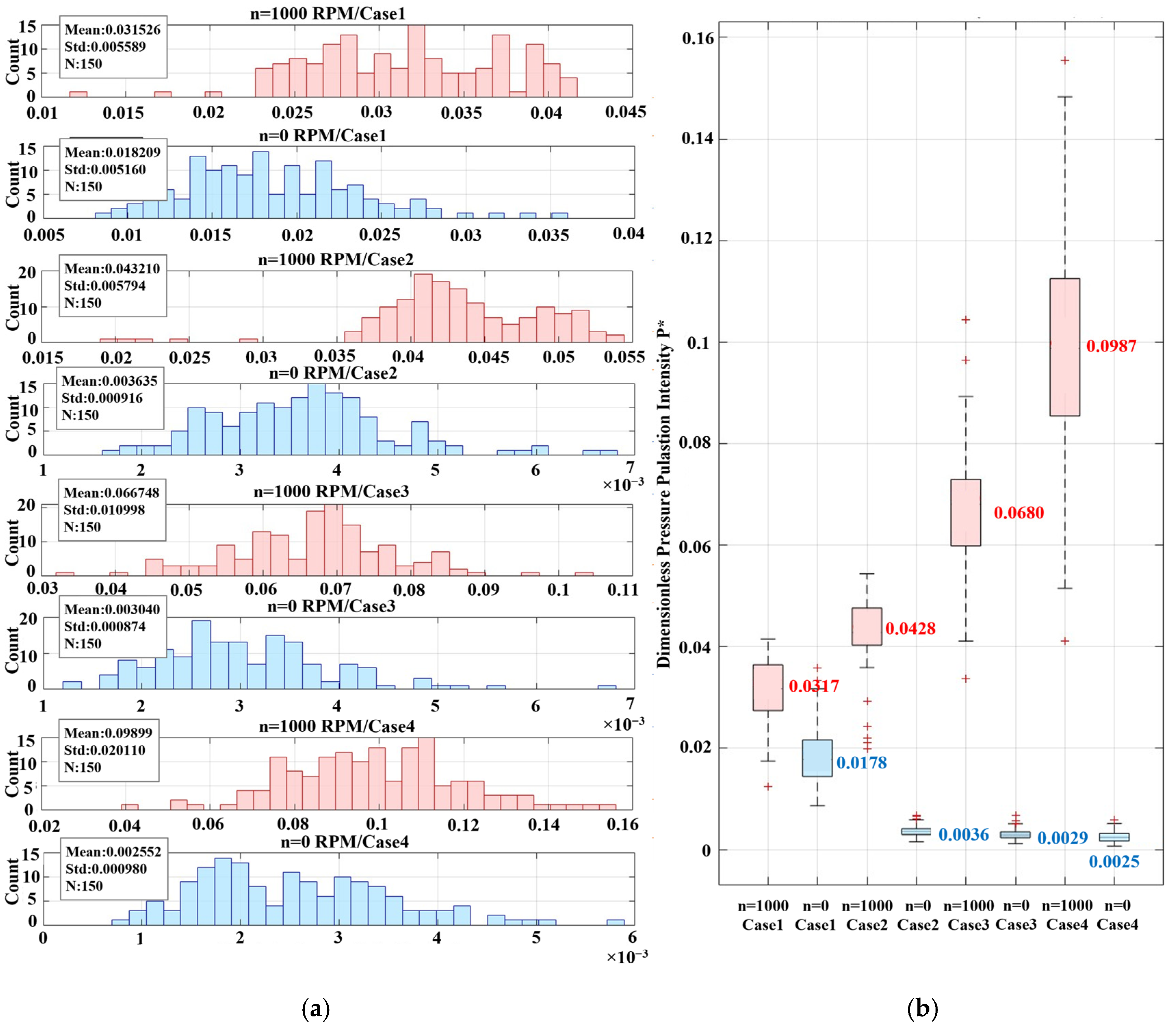
Figure 11 presents the probability density statistics of the windowed pressure fluctuation intensity at the impeller outlet (P3). Under the n = 1000 rpm condition, the mean
increases from 0.031526 to 0.098899 as the flow rate decreases, accompanied by a significant expansion in the dispersion of the frequency distribution. As the location where the rotor–stator interaction is most pronounced, the impeller outlet experiences intensified fluctuations under low-flow conditions due to the coupling between the blade wake and the guide vane boundary. In contrast, under the n = 0 rpm condition, the mean
is nearly zero with a highly concentrated frequency distribution, as the outlet flow field tends towards a static state in the absence of rotational driving.
In the box plots for the n = 1000 rpm condition, both the median and IQR exhibit a marked increase with decreasing flow rate, alongside the presence of numerous outliers. Conversely, the boxes for the n = 0 rpm condition are compressed nearly to zero. Compared to P1 (inlet) and P2 (mid-impeller), the fluctuation amplitude at the rotating P3 (outlet), while lower than that at the mid-impeller, characterizes a critical interface for flow state transition. Under low-flow conditions, the separating vortices at the blade outlet can readily trigger fluctuations. When the impeller is locked, the fluctuations nearly vanish at the outlet due to the absence of rotational drive. This behaviour demonstrates a distinct spatial heterogeneity compared to the inlet’s suction constraint and the mid-impeller’s centrifugal constraint mechanism, highlighting the differential influence of the axial position within the pump on the regulation of pressure pulsations.
Figure 12 presents the probability density statistics of the windowed pressure fluctuation intensity at the guide vane outlet (P4). Under the n = 1000 rpm condition, the mean
increases progressively with decreasing flow rate, accompanied by a significant expansion in the dispersion of the frequency distribution. As a critical interface governing the “impeller outflow–guide vane flow rectification—system discharge” process, the guide vane outlet experiences intensified fluctuations under low-flow conditions due to unsteady interactions between the impeller wake and the guide vanes, including vortex shedding and flow separation within the passages. In contrast, under the n = 0 rpm condition, the mean
remains nearly zero with a highly concentrated frequency distribution. In the absence of impeller-induced disturbances, the flow field at the guide vane outlet tends toward a static state, retaining only minor pressure non-uniformity resulting from the passage geometry itself.
In the corresponding box plots for the n = 1000 rpm condition, both the median and IQR exhibit a pronounced increase as the flow rate decreases, alongside frequent occurrences of outliers. This reflects the growing instability of pressure pulsations at the guide vane outlet under low-flow conditions. For the n = 0 rpm condition, the boxes are compressed nearly to zero, indicating no significant statistical fluctuations.
Compared to the preceding measurement locations, the pressure fluctuation at the guide vane outlet under rotating conditions is jointly governed by the coupled effects of “guide vane flow rectification” and “impeller wake”. The amplification of fluctuations at low flow rates is attributed to the breakdown of effective flow rectification. When the impeller is locked, the absence of the primary rotational disturbance source, combined with the inherently stable nature of the static guide vane passages, causes the pressure pulsations to virtually disappear.



 ,
,