You are currently viewing a new version of our website. To view the old version click .
Machines
  • Review
  • Open Access

8 December 2025

Recent Developments in Electroadhesion Grippers for Automated Fruit Grasping

,
,
,
,
,
and
1
Robotics and Intelligent Machines, University of Genova, Via Balbi, 5, 16126 Genova, Italy
2
Department of Industrial Engineering, University of Bologna, Viale del Risorgimento, 40136 Bologna, Italy
3
Department of Mechanical, Energy, Management and Transportation Engineering (DIME), University of Genova, Via Balbi, 5, 16126 Genoa, Italy
4
Department of Computer Science, Bioengineering, Robotics and Systems Engineering—DIBRIS, University of Genova, Via Balbi, 5, 16126 Genova, Italy
This article belongs to the Special Issue Recent Developments in Machine Design, Automation and Robotics, Second Edition

Abstract

As global food demand rises and agricultural labor shortages intensify, robotic automation has become essential for sustainable fruit grasping. Among emerging technologies, ElectroAdhesion (EA) grippers offer a promising alternative to traditional mechanical end-effectors, enabling gentle, low-pressure handling through electrostatically induced adhesion. This paper presents a methodical review of EA grippers applied to fruit grasping, focusing on their advantages, limitations, and key design considerations. A targeted literature search identified ten EA-based and hybrid EA gripping systems tested on fruit manipulation, though none has yet been tested in real-world environments such as fields or greenhouses. Despite a significant variability in experimental setups, materials, and grasp types, qualitative insights are drawn from our analysis demonstrating the potentialities of EA technologies. The EA grippers found in the targeted review are effective on diverse fruits, shapes, and surface textures; they can hold load capacities ranging from 10 g (~0.1 N) to 600 g (~6 N) and provide minimal compressive stress at high electrostatic shear forces. Along with custom EA grippers designed accordingly to specific use cases, field and greenhouse testing will be crucial for advancing the technology readiness level of EA grippers and unlocking their full potential in automated crop harvesting.

1. Introduction

The accelerating rate of global population growth, coupled with profound socio-economic challenges, underscores the urgent need for sustainable food production in the coming decades. According to the United Nations, the world population is projected to reach 9.8 billion by 2050 [1]. Meanwhile, long-run assessments by the Food and Agriculture Organization (FAO) indicate that feeding the mid-century population will require raising global food production by roughly 70% relative to 2005/07 levels [2]. However, agriculture continues to rely heavily on labor-intensive practices, particularly in the handling and harvesting of fruits and vegetables. These operations are time-consuming and costly, and they are increasingly undermined by labor shortages and climate-driven shifts in ripening patterns, which together contribute to postharvest losses and reduced efficiency [3].
In this context, research has focused on developing robotic manipulators capable of performing automated harvesting missions with the aim of substituting or complementing human labor, offering advantages such as increased throughput, reduced waste, and more consistent quality. Unlike human operators, robotic systems are fatigue-free, can function continuously, and are less prone to error [4]. Harvesting robots can be classified into two groups: fully integrated systems and subsystems used in harvesting missions, such as vision systems, control systems, and grippers.
Nevertheless, automated harvesting faces key challenges. Fruits and vegetables are delicate, and effective harvesting requires gentle interaction to avoid bruising, scarring, or other surface damage that reduces market value. Field conditions add complexity: unstructured environments, occlusions by foliage/branches, highly variable lighting, and a wide diversity of plant morphologies all complicate perception, planning, and manipulation [5,6,7]. With advances in perception and control, modern systems are increasingly capable of adapting to the variability in the size, shape, pose, and seasonal availability of agricultural products [5,6,8].
Early work in the 1980s–1990s established the vision of robotic fruit picking but was constrained by perception and actuation limits [9]. Over the past decade, rapid advances in computer vision and deep learning—combined with progress in soft and compliant manipulation—have revitalized the field and significantly improved detection, pose estimation, and grasp success rates [3,10], leading to more effective and innovative robotic system designs [11,12,13,14,15].
A critical aspect of harvesting robots involves the design and development of end-effectors that must grasp the fruit firmly and gently to avoid damage, thereby preserving quality [16]. Grippers directly interact with crops and thereby determining both the feasibility and efficiency of harvesting systems. Given the delicate nature of fruit, grippers must strike a fine balance between secure grasping and low surface stress. This has given rise to a spectrum of designs that can be usefully grouped into three broad categories: rigid [17,18], soft [19,20], and hybrid [21,22]. Rigid grippers offer precision and structural robustness, but risk damaging delicate tissues [23,24]. Soft grippers, typically using elastomeric and compliant bodies driven by different actuation technology, conform to fruit geometry and reduce contact pressure, though they may sacrifice precision or grasp stability [10,25]. Crucially, the adaptability and low-pressure nature of compliant grippers, a sub-category of soft grippers, offer a compliant design that makes them particularly suitable for grasping small or irregularly shaped produce, such as berries and clustered fruits, where traditional rigid systems might struggle [26,27,28,29].
Hybrid designs combine rigid structures with compliant interfaces or multi-modal actuation to trade off these advantages and limitations [10].
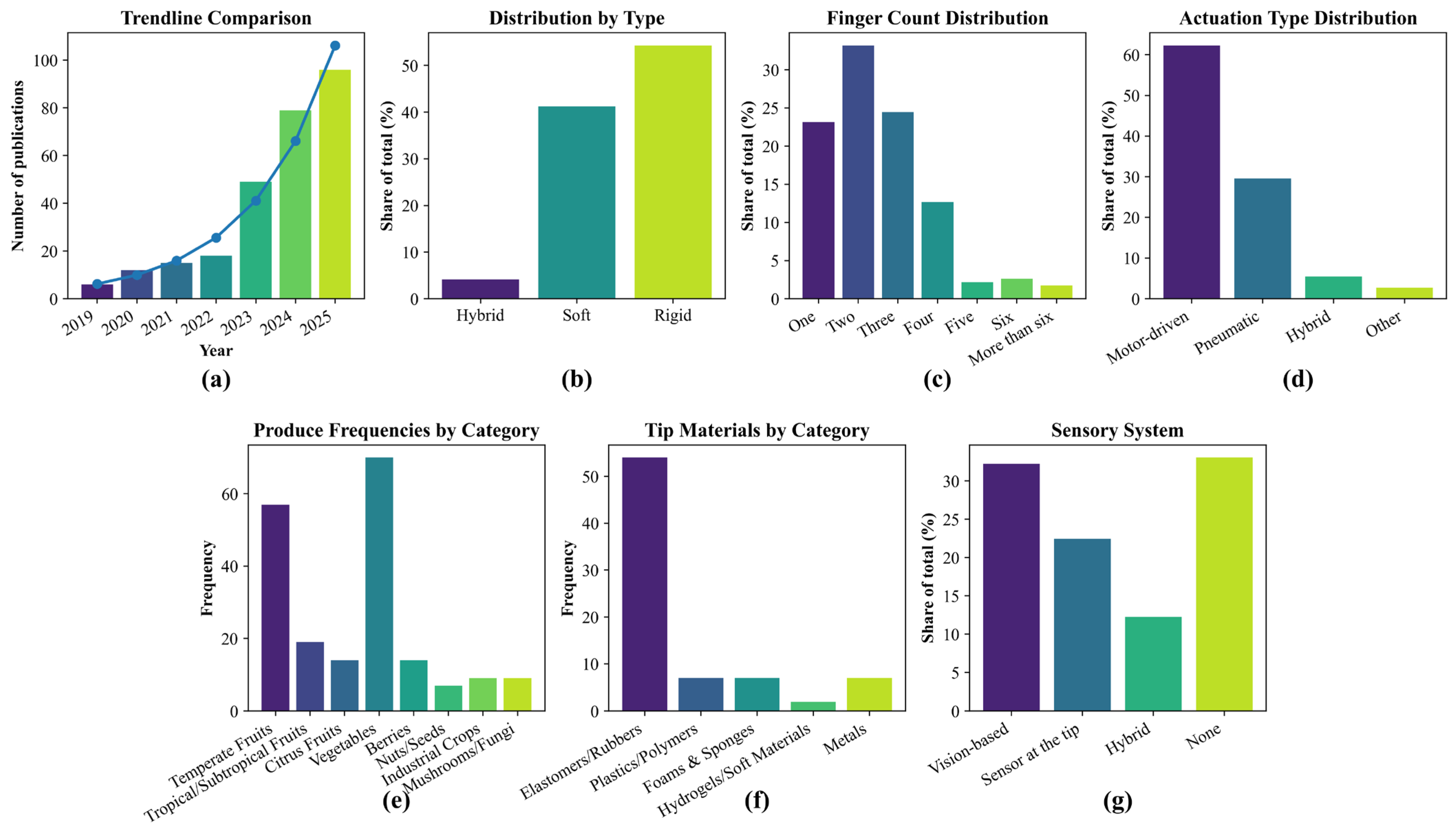
The bibliometric analysis (Figure 1) illustrates the research trend patterns in the field of agricultural robotic grippers and end-effectors (additional details of the bibliometric analysis are provided in Appendix A). In particular, the study examines the extent of attention devoted to different design features. Publication activity on agricultural grippers and harvesting robots has risen sharply since 2019 (Figure 1a). Designs utilizing soft and hybrid solutions are increasing rapidly, largely due to their safety in grasping delicate objects (Figure 1b). Designs span from single-finger (monolateral grippers such as suction devices) to multi-finger grippers; two- and three-finger grippers dominate, balancing adaptability with control complexity (Figure 1c). With respect to actuation, while motor-driven systems account for the majority of designs, pneumatic actuators are also widely employed (Figure 1d). Moreover, most studies are tailored to specific crops—such as tomatoes, strawberries, cucumbers, apples, and grapes (Figure 1e). Even when the overall structures are rigid, soft materials are commonly integrated at the tips to minimize damage, highlighting the practical importance of hybrid designs (Figure 1f). Regarding sensory systems for protecting delicate agricultural produce, some studies employed vision-based systems (e.g., RGB cameras), others used tactile sensors at the tips (e.g., force or pressure sensors), and several adopted hybrid configurations combining both approaches, while a few have no sensory components altogether (Figure 1g).
Figure 1. Bibliometric analysis of agricultural grippers and end-effectors: (a) trend of publications from 2019 to 2025; (b) distribution of designs by gripper type (rigid, soft, and hybrid); (c) distribution of designs by finger count; (d) distribution of designs by actuation/transmission mechanisms; (e) frequency of target fruits and agricultural produce; (f) types of materials used for the tips of grippers/end-effectors; and (g) sensory system.
Among the different types of soft grippers, those with controlled adhesion offer unique and interesting features for gripping fragile objects such as fruit [30]. Adhesion refers to the attraction at the interface between two surfaces, generating shear stresses that are proportional to the normal pressure. At the same time, the normal force on the object’s surface is much lower than that of conventionally actuated grippers, allowing for the manipulation of highly fragile objects. Adhesion is very effective for soft and deformable objects because the interface attraction automatically follows the object’s deformations when the gripper structure is appropriately designed to be compliant. Among the controlled adhesion category, electroadhesion (EA) grippers represent a relatively underexplored yet promising direction for agriculture. EA grippers generate controllable adhesion by applying an electric field across patterned electrodes, inducing polarization in the target surface and producing attractive forces at low normal loads without any restriction on the target material nature. This enables gentle grasping with minimal mechanical squeezing and offers three salient advantages for delicate produce: (i) gentle handling with low contact pressure; (ii) low power operation relative to pneumatic/vacuum systems; and (iii) design versatility for integration with both soft and rigid structures [31,32,33]. Despite these benefits, EA has seen a broader development in electronics/semiconductor handling (electrostatic chucks), textile manipulation, and micro-/meso-scale manipulation than in agriculture [34,35,36].
From the state-of-the-art analysis illustrated in Appendix A, no evidence was found for grippers that fully or partially integrate electroadhesion. This result demonstrates that the practical application of EA grippers in robotic systems for fruit harvesting is immature, and, to the authors’ knowledge, no EA gripper has been tested on an autonomous robotic system for fruit picking in a real orchard.
However, some scientific works have shown how EA grippers can also be used for gripping fruits and vegetables, showing their ability to grasp fruits and vegetables in laboratory environmental conditions. In Section 3, the method used to identify such contributions will be presented, and the performance and the characteristic aspects of the proposed designs will be discussed together, along with the conditions and the target fruits considered for their testing.
The purpose of this paper is to demonstrate the current level of application of EA grippers in fruit and vegetable harvesting and to provide an overview of the advantages and disadvantages of using this technology and the key design aspects of such systems.
The remainder of this paper is organized as follows: Section 2 introduces EA grippers and explains their working principles. Section 3, as anticipated, shows the application of EA grippers for fruit grasping in detail. Section 4 provides a detailed discussion of the insights presented in the paper.

2. Electroadhesion Grippers

According to the classification proposed by G.K. Monkman [37], electroadhesive devices (EADs) are a type of astrictive grippers increasingly used for prehension tasks in research and industrial environments. They operate by exploiting an electrostatic field to adhere to both conducting and insulating materials. Historically, the term electroadhesion was coined in 1917 by A. Johnsen and K. Rahbek [38] to target the astrictive force that they experimentally observed at the contact interface between polished lithographic stone and metal surfaces when applying a potential difference between them. This phenomenon has been subsequently documented among different materials and was first investigated in an application study for aerospace purposes in 1968 by R.P. Krape [39]. Over the last two decades, EA technologies have gained renewed interest for their versatility and potential in robotics applications for a wide variety of industrial settings, ranging from logistics and automation [40,41] to the space environment [42,43].

2.1. Working Principle

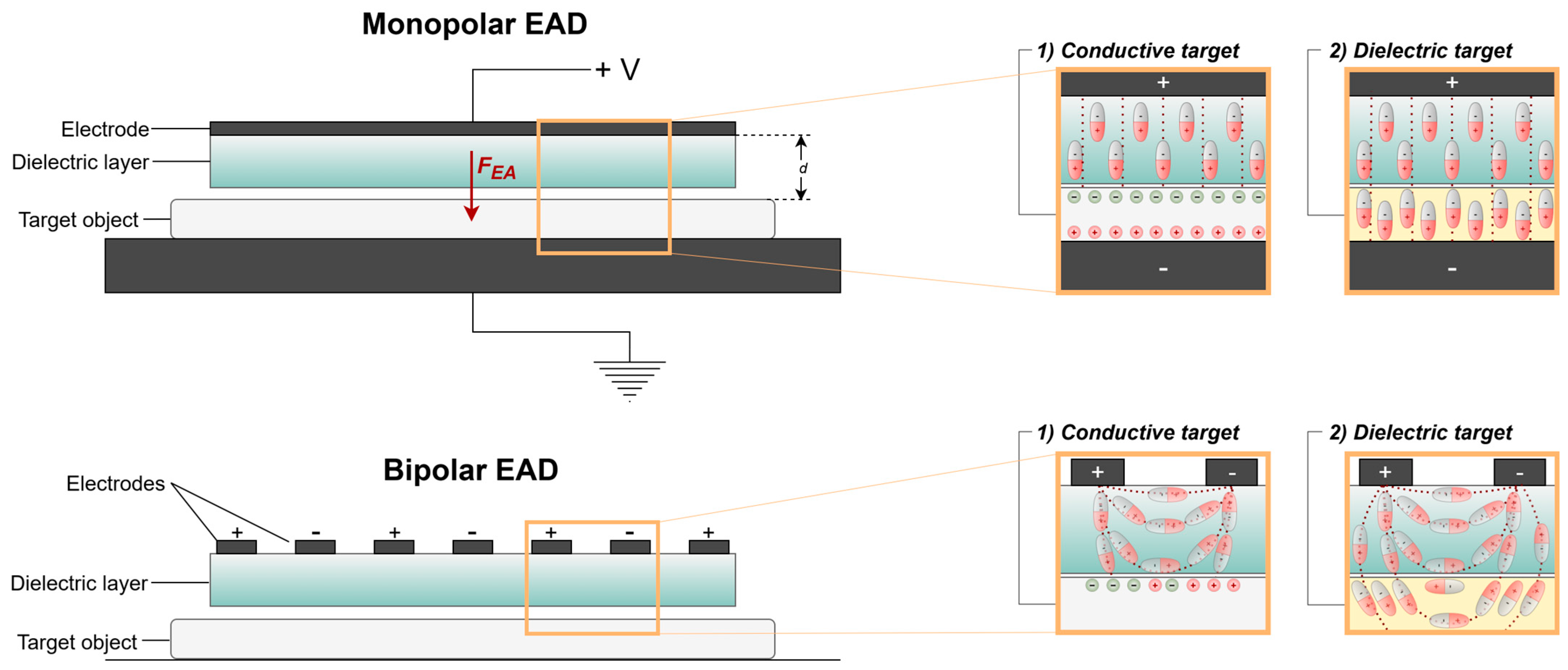
The astrictive action of EA technologies relies on electrostatic binding forces generated by the electrostatic charge displacement field building up inside a dielectric medium, constituting the electro-active gripping layer of the EAD, upon electrical activation. Featuring capacitive architecture, electrostatic grippers exhibit either a monopolar or a bipolar configuration. Monopolar systems consist of a conductive plate, functioning as a single-pole electrode, and a dielectric layer, which separates the electrode from the object to be handled [44]. In this configuration, depicted in Figure 2(1), the target object is placed on another conductive, electrically grounded surface. When a potential difference in the kV range is supplied between the electrode plate and the conductive bench, opposing electrical charges accumulate on the dielectric layer of the gripper and the target object, which is thus electrostatically attached. Relevant examples of EA technologies integrating monopolar grippers can be found in electrostatic chucks for silicon wafer handling [45] and the electrostatic gripping of fabric plies for automated garment assembly [44].
Figure 2. Sketch of the transversal section of a monopolar and an interdigitated bipolar gripper architecture, respectively, illustrating the working principle of electroadhesion grippers when grasping objects of different nature: (1) for conductive targets, opposing image charges appear at the dielectric–object interface; (2) for dielectric objects, dipole charges align with the applied electric field.
In the simplest configuration for a single-pole EA gripper, i.e., when the grasped object is an electrical conductor, the system can be approximated to a parallel-plate capacitor. A theoretical model is presented for this configuration for simplicity. Under the abovementioned assumptions, the electrostatic retention pressure σ can be computed from the balance of energy stored in a parallel-plate capacitor, and expressed by the following:
σ = F A = 1 2 ε 0 ε r 2 V d 2
where A is the interface area between the gripper surface and the object, F is the electrostatic force in the normal direction, V is the potential difference supplied to the single-pole electrode with respect to the electrical ground, d is the distance between the gripper electrode and the surface of the target object, and ε 0 and ε r are the vacuum permittivity and the relative permittivity of the dielectric layer, respectively.
Bipolar electrostatic grippers, instead, present either a pair or a set of both positive and negative electrodes on the gripper’s body. When a high voltage is applied between the alternating poles, the dielectric layer of the gripper is exposed to an electric field and polarized. In response to the dielectrics’ polarization field, an induced charge distribution appears in the object to be grasped, and an attractive electrostatic force is generated between the two surfaces. For EA grippers exploiting Coulomb interactions, the charge distribution induced inside the contacting object differs according to the electrical nature of the target material: when the EAD is in contact with a conducting target, image charges are gathered at the conductor’s surface, with opposing signs with respect to the polarization charges inside the gripper’s dielectric layer. If a dielectric object is grasped, electric dipoles inside the material reorient themselves, with this process depending on the electrical, microstructural, and polarization properties of the material, and align with the electric field lines: macroscopically, regions with bond charges of opposing signs are displayed at the dielectrics’ interface, resulting in the buildup of the EA force. The electro-active layer thickness is typically in the range of a few tens of microns, and its electrical and mechanical properties have a significant influence on the magnitude of the electric field that the EAD can withstand, as well as the maximal adhesive force delivered. In general, it also acts as mechanical support for electrode manufacturing.
While monopolar EADs are associated with simpler design requirements and a reduced risk of dielectric breakdown and are useful for lifting conductive or semiconductive materials, they have proven to be inefficient or ineffective in gripping dielectric materials [33]. In bipolar devices, different arrangements of the alternating positive and negative electrodes have been reported as more effective in grasping selected objects, and, depending on the use case, geometric optimization has been demonstrated to be a valid strategy for achieving enhanced EA forces [46,47]. Some of the most popular bipolar EAD geometries feature concentric [48], spiral [49], and interdigitated or comb-shaped electrodes [50,51].

2.2. Advantages and Potential Applications

EA grippers are establishing themselves as fascinating alternatives to more traditional mechanical impactive techniques thanks to their capability of exerting continuous, controllable, and high shear forces on the target object without applying mechanical compressive stress. Recent research has demonstrated that electroadhesion can be easily integrated with other grasping technologies based on different physical mechanisms, such as gecko-inspired surfaces exploiting van der Waals interactions [43,52] and suction cups [53], for the realization of technologically advanced adhesive interfaces. As reported by J. Guo et al. [33], the main key benefits that make electrostatically enhanced grippers competitive grasping methods for a broad range of industrial settings are the following:
  • Versatility and adaptability to both conducting and insulating materials, and porous and rough surfaces;
  • Capability of operating in harsh conditions, such as dusty environments, at low pressures, and in space;
  • High shear forces without applying mechanical compressive stresses;
  • Lightweight, thin-film, and compliant functional layers;
  • Low-cost constitutive materials, easy process via additive manufacturing and printed electronics methods, and simple electrical control components;
  • Low energy consumption (<30 mW) despite a relatively high voltage, with typical currents in the µA range measured for EADs;
  • Safe handling of fragile, delicate, and soft objects, without exerting any mechanical compressive pressure.
Due to their operational advantages, EA grippers fabricated with a soft functional layer (i.e., polymer-based materials such as polydimethylsiloxane (PDMS), silicone epoxy, acrylic) appear highly promising in the context of fruit and crop harvesting, alongside more traditional robotic end-effectors. End-effectors integrating soft EADs enable the harvesting and pick-and-place operations of delicate crops while lowering the risk of damage. Based on gripper mechanics, multiple strategies have been successfully adopted aimed at the optimization of the grasping action and the effectiveness of the release tasks [54,55]. The most relevant EA gripper solutions identified through a systematic literature review in the field of robotic fruit harvesting are discussed throughout the following section.

3. EA Grippers’ Grasping Capability on Fruit

This section presents the results of the state-of-the-art research on EA grippers applied to fruits and their grasping capability. To identify relevant studies, the following keywords were used: (electroadhes OR electro-adhes OR electro adhes OR EAD) AND (grip*). The search was conducted in the Scopus database, restricted to publications from 2019 to 2025 and limited to English-language articles. After applying the keywords, 53 papers were found. Each instance was manually inspected to verify whether the presented gripper successfully grasped the fruits, and only those that did were included in this study.

3.1. EA Gripper 1: A Variable Stiffness Electroadhesive Gripper Based on Low-Melting-Point Alloys

Researchers in [56] present an EA soft gripper with a variable stiffness. It features a three-fingered design, and its actuation is a combination of a pneumatic drive and electrical resistance for heating the material. There are two steps: first, pneumatic pressure is used to bend the fingers to have the same shape as the object. Second, a high voltage is applied to the low-melting-point alloys (LMPAs) to generate electrostatic adhesion to ensure a secure grasp. The gripper is bilateral, which means that it uses three fingers to grasp an object from opposing sides. The main structure of the gripper is composed of silicone (Ecoflex™ 00-30, Smooth-On Inc. Macungie, PA, USA) and LMPAs. The EA patch is made of LMPAs as electrodes, a silicone dielectric layer, and electric resistance wires. The effective electrode area is 111   mm by 20   mm , and electrode spacings are tested for 2   mm , 3   mm , and 4   mm . The dielectric layer thickness is tested with the dimensions of 0.4   mm , 0.6   mm , 0.8   mm , and 1   mm , with 0.6   mm being chosen for the final design for safety and performance. The EA patch is powered by a 3.2   k V , 3.8   k V , and 4.4   k V DC voltage for 2   mm , 3   mm , and 4   mm spacings, respectively. The results, tested on paper substrate, demonstrate that the maximum tangential EA force that the gripper can generate is 0.512   N and the maximum normal force is 0.10   N at an activation voltage of 4.4 k V . For the three-fingered gripper, 20   k P a to 60   k P a with 10   k P a increments of pressure is applied. The maximum grasping force is 10.74   N for envelope grasping and 6.78   N for fingertip grasping. The total weight of the gripper is 340.2   g . The tests were conducted under conditions with a temperature of 22.6   ° C for the repeatability test and 27.7   ° C for the grasping force test. Additionally, the humidity levels were 55 % for repeatability and 60 % for the grasping tests. For the tests, the researchers demonstrate the grasping capability of the gripper on target fruits such as apples (202.2 g weight and 60 kPa pressure) and oranges (129.67 g weight and 30 kPa pressure), with the three-fingered gripper mounted on a frame. They display images of tests with various objects where the gripper is in a closed position, providing grasping. This study has a technology readiness level (TRL) of 4, since it has experimental validation.

3.2. EA Gripper 2: Additive Manufacturing of Flexible 3D Surface Electrodes for Electrostatic Adhesion Control and Smart Robotic Gripping

This study [57] demonstrates a soft gripper that combines mechanical shear and EA forces. It features two flexible fingers on a bi-stable support that enables them to fold and grasp objects. The fingers are covered with a multitude of flexible composite electrodes arranged in a hair-like manner that conforms to the object and generates electroadhesion. The working principle is as follows: first, the flexible surface and the hair-like electrodes deform to increase the contact area, which generates the shear force; then, voltage is applied to the electrodes, creating an electrical field that increases the adhesive force. The main structure of the gripper is made of an elastomeric resin (Elastic Resin, Formlab Inc. Somerville, MA, USA). The paper considered the grasping of several objects but specifically mentioned fresh fruits and conducted trials using a tangerine. The flexible hair-like electrodes are made of a soft elastomer with conductive metal nanowires obtained from copper and silver.
The results provided in the paper demonstrated that the flexible hair-like electrodes provide up to 72 % better gripping force when the voltage is applied (tested on PP 40 mm diameter cylinder object). Tests with the electrodes slanted at different angles showed that the biggest increase in lateral adhesion with 3   k V voltage was 162 % for the smallest angle of 15°, and the lowest was 20 % , with the largest angle of 75°. The gripper with electrodes slanted by 30 ° recorded a grasp with a force up to 1   N when the voltage was on and 0.6   N when the voltage was off. Tangerine grasping was successfully accomplished with electrodes having a width of 1.5   mm , a length of 8   mm , a slanted angle of 30 ° , and an activation at 3 k V . This study has a technology readiness level (TRL) of 4, since it has experimental validation.

3.3. EA Gripper 3: Delicate Yet Strong: Characterizing the Electroadhesion Lifting Force with a Soft Gripper

The soft gripper in this research [58] uses dielectric elastomer actuators (DEAs) and electroadhesion, featuring two fingers. The actuation is based on the DEA’s ability to bend in reaction to an applied voltage, and so the gripper is driven electrically. The gripper is designed to generate both bending motions as produced by the DEA fingers and electroadhesion at the fingertips. Both are controlled by a single monolithic structure using the same electrodes. The DEAs bend fingers to the object and conform the shape. A high voltage creates an electric field, and it leads to EA forces that grasp the object. The gripper’s structure is a 280   μ m thick silicone-based membrane, including two passive layers and a central dielectric membrane fabricated by blade casting Sylgard 184 and 186 polydimethylsiloxane (PDMS) by Dow Corning Inc. Freeland, MI, USA, respectively. The gripper has been presented with cherry tomato holding and a heavy test load. The EA patch is composed of compliant electrodes which consist of a PDMS + carbon mixture, and it is integrated into a multilayered structure. The area of electroadhesion is 1   c m 2 . This study considered two electrode designs with a width of 0.5   mm and electrode spacings, respectively, of 2.1   mm and 0.5   mm . a 3.5 kV DC voltage. The gripper is powered by a 3.5 kV DC voltage. The results showed that the lifting force was 16   N , shown on a cylinder covered with paper-based tape, but was strongly dependent on the object’s shape, and it can lift a 10   g cherry tomato. The total weight of the gripper is 1.5   g ; thus, it can lift loads over 1000 times its own weight. Furthermore, it shows a high durability, surviving over 100 cycles at high loads. This gripper has a technology readiness level (TRL) of 4, since it has experimental validation.

3.4. EA Gripper 4: Design and Development of a Variable Structure Gripper with Electroadhesion

This study [55] proposes a soft gripper having three fingers and a combined pneumatic–electrical actuation. The fingers are made of a silicone rubber (HY-E630, Shenzhen Hongye Silicone, Shenzhen, China) and can conform to the object’s shape once pneumatically activated. An adjustment to objects of different sizes and curvatures is made by the electric motor, which regulates the opening angle of the fingers. EA films with coplanar interdigitated copper electrodes embedded in an insulating material are placed at the bottom of the fingers to enhance grip and allow the gripper to hold flat objects upon high-voltage activation. The paper mentions that the gripper has potential for fruit picking in the agricultural industry and shows its grasping ability on tomatoes (80 mm diameter and 297 g). The soft finger has dimensions of 144   mm × 40   mm × 25   mm . Each air chamber is 4   mm wide and 6   mm thick. The maximum finger bending angle is 130.2 ° at a pressure of 60 kPa. The EA film thickness is 0.05   mm , and its effective area is 3410   m m 2 . Shear force testing of the EA patch was performed with an activation voltage ranging from 0 to 4   k V , which provided a maximum of 2.58 N at 4 k V on an adsorption substrate without specifying the material base. By varying the opening angle of the fingers from 0 ° to 90 ° , the gripper enables them to grasp spherical objects with a diameter in the range 0 482   mm . The maximum load that the gripper can reach is 10.91   N . All the tests have been conducted with a relative humidity of 63%, a temperature of 25.3   ° C , and an ambient pressure of 1020.5   h P a . The technology has reached a TRL of 4, which means it has a working lab prototype. However, it requires further more development before it can be used for industrial trials.

3.5. EA Gripper 5: EA-SoGripper: Electroadhesion-Stiffening Self-Adaptive Soft Robotic Gripper

This paper [59] introduces a soft gripper with two compliant fingers that uses electroadhesion to achieve a variable stiffness and self-adaptability. Finger opening/closing is regulated by an electrical actuator that drives a ball screw transmission. Each compliant finger consists of a band that is tensioned by a spring, allowing it to conform to the object to be grasped with a given compliance. To regulate the compliance, each finger also comprises an EA clutch, which acts on the band to exclude the spring once the desired level of tension is achieved. Unlike the previous designs, in this gripper, electroadhesion is not used to directly retain the object. Nonetheless, this concept allows us to securely clamp objects of various sizes and shapes. It can support loads up to 400   g while adapting its stiffness by controlling the EA clutch voltage. The EA clutch consists of two electrodes separated by a dielectric layer. The dielectric layer is a polyimide (PI) film with a thickness of 0.025   mm and a relative permittivity of 3.4; the high-voltage electrode is made of a copper tape with dimensions 80   mm × 30   mm ; the low-voltage electrode is made of an aluminized polyethylene terephthalate (PET) film with dimensions 250   mm × 30   mm and a thickness of 0.075   mm . The weight of the gripper is 376   g and the maximum weight that can be lifted is 400   g . The tunable grasping stiffness ranges from 0.06 to 1.25   N / mm . Finger closing/opening requires 1 s. EA clutch activation is achieved with an AC square wave with a fixed frequency of 20   H z ; an amplitude of 400 V was sufficient to consistently grasp various objects including grapes. This study has a technology readiness level (TRL) of 4, since it has experimental validation.

3.6. EA Gripper 6: Electroadhesion Suction Cups

The study in [53] investigated a monolateral gripper exploiting the combined effect of electroadhesion and vacuum suction. The gripper consists of a circular EA membrane made of silicone elastomers having an Elastosil 2030 (Wacker Chemie AG, Munich, Germany) PDMS bottom layer and a Sylgard 184 (Dow Corning Inc. Freeland, MI, USA) PDMS upper layer. It features embedded interdigitated electrodes that are screen-printed on the PDMS bottom layer using a silicone-based electrically conductive silver ink, with a central pillar for external force application. Upon electrical activation with a high voltage, the EA membrane zips onto the object surface, forming an airtight seal that generates a vacuum suction effect once the object is lifted by pulling the central pillar. In this way, the strengths of both vacuum suction and electroadhesion are used, providing a very compact solution. The EA membranes had a diameter in the range of 3.3–5.3 c m and electrodes with a spacing of 0.5 mm . The gripper was operated at 1–3 k V DC for normal operations and at 3 k V AC with a 5 Hz frequency occasionally for charge neutralization. This gripper successfully handled objects of around 5–20 cm in size and 1 kg in weight, including grapefruits, oranges (230 g ), jars and plastics. It enabled reliable grasping even on the rough and slippery surfaces of fruits, where conventional EA pads struggle. The addition of suction increases the holding force significantly (up to 18 N on PMMA substrate of roughness Sq = 1.9 at a vertical speed of s = 0.2 mm s−1 and an applied DC voltage V = 3 kV, with a membrane of 5.3 cm diameter) compared to EA alone (~0.4 N), especially for rough and moist surfaces with near-atmospheric-vacuum pressures (≈−101 k P a ). This gripper exhibited a high reliability, with more than 11,000 pick-and-place cycles, rapid release (<0.15 s with valve), and energy-efficient operation. Its development corresponds to a technology readiness level (TRL) of 4, demonstrating a validated laboratory prototype on a robotic arm, although it is not yet mature enough for industrial trials.

3.7. EA Gripper 7: Peeling in Electroadhesion Soft Grippers

A peeling-controlled EA gripper is introduced in [54]. It features a bilateral design with two EA films with a trapezoidal shape, which are mounted on lightweight PLA and PMMA structures that can be brought together or separated by an electric motor. Each EA film is made of Sylgard 184 silicone elastomer with embedded interdigitated electrodes realized in carbon-black and PDMS. It has a length of 45 mm and a thickness of 90 μ m , features an active area of 20 × 30 mm , and is energized through a high-voltage bipolar AC signal with a frequency of 1 Hz and an amplitude in the range of 1–4 k V . The gripper can switch between maximum adhesion for secure grasping and rapid detachment for proper release by adjusting the peeling angle through the electric motor. Demonstrations on cherry tomatoes, limes, and mangoes show that this design combines a high holding force with a reliable release. For smaller angles (θ = 0 ° ), adhesion forces reached over 1 N on a substrate without specifying the material base, corresponding to shear stresses of about 2–3 kPa. This enables the grasping of fruits ranging from a 10 g cherry tomato to a 600 g mango. At higher angles (θ > 30°), the effective adhesion dropped sharply, resulting in a rapid release (i.e., within 300 ms ). The power consumption of EA films was less than 1 W. This technology can be positioned at an intermediate TRL (4), presenting a promising outcome for fruit harvesting and other soft robotic applications.

3.8. EA Gripper 8: Hybrid Soft Electrostatic Metamaterial Gripper for Multi-Surface, Multi-Object Adaptation

In [60], the authors propose a hybrid soft electrostatic metamaterial (SEM) gripper offering a localized compliance that enables the gripper to conform to surface irregularities and achieve a high directional adhesion (up to 65 times larger with respect to when in the off state). Thanks to this feature, the gripper can grasp objects of various sizes and shapes without active adjustments. In addition to increasing adhesion, this design also mitigates residual peeling force, thereby enabling a faster release. The SEM gripper is soft and is demonstrated primarily in a two-finger configuration. It consists of an EA film made of a urethane elastomer (Vytaflex 20, Smooth-on Inc., Macungie, PA, USA), having embedded interdigitated electrodes realized in carbon-black adhesive sheet (ARclad 8006, Adhesive Research, Glen Rock, PA, USA), with a PET backing (L480.385, Rausch Packing, Meisterschwanden, Switzerland) for structural support and with properly engineered cuts to create the localized compliance. The testing of SEM grippers featuring grids of 10 mm × 15 mm , interdigitated electrodes in either 4 × 4 or 2 × 4 arrays, and activated to generate an electric field in the range of 0–6 k V / mm resulted in adhesion stresses up to 55.6 k P a and pulling forces of up to 33 N on a 77 mm diameter pipe, enabling the lifting of payloads up to 17 times its own weight. Successful gripping was demonstrated for apples (191 g weight), coffee bags, tape rolls, pamphlets, and PVC pipes of various diameters. The SEM gripper is driven at a low speed and exhibits a high efficiency. Overall, the SEM gripper showed laboratory validation, but it is still not industrially deployed, placing it at a TRL in the range of 4–5.

3.9. EA Gripper 9: Electroadhesion Zipping with Soft Grippers on Curved Objects

The study in [50] uses the zipping effect of EA grippers to address the challenge of curved object grasping with simple devices, showing the capability of successfully catching a range of fruits (grapefruit, mango, lemon). The zipping EA gripper comprises two fingers, each coinciding with an EA film made of Sylgard 184 PDMS, with embedded interdigitated electrodes realized in carbon-black (Ketjenblack EC-300J by Nouryon Functional Chemicals B.V., Radnor, PA, USA) and PDMS mixture. Thanks to the zipping effect, the same electrical activation that generates adhesion also makes the fingers autonomously wrap around curved objects, thereby increasing the contact area without requiring any additional means of actuation. The interdigitated electrodes feature a width of 0.5 mm, a pitch of 0.7 mm and an active area of 432 m m 2 . The silicone elastomer dielectric layer has a thickness of 45 μm. Electrical activation is achieved with AC or DC voltages with an amplitude of up to 4 k V . Experimental testing has been performed on different cylindrical objects with radii in the range of 30–45 mm and with different coatings (e.g., paper, copper, PVDF-TrFE-CTFE, PLA), demonstrating a high adhesion force (larger than 1 kg per gram of gripper mass), fast response time (about 0.4 s for zipping and 0.3 s for unzipping), and high efficiency (a power consumption less than 1 W). A smooth performance over AC/DC cycles was shown in the reliability test. Also, this gripper stands at TRL 4, as it has not been tested in the field.

3.10. EA Gripper 10: Enhancing Compliant Gripper Performance: Exploiting Electroadhesion to Increase Lifting Force over Grasping Force

This work [61] demonstrates a soft gripper that uses highly compliant FinRay fingers with custom EA pads to improve lifting force and minimize object squeezing. The gripper features a bilateral configuration with two fingers moved by an electrical actuator inside the end-effector of a robot arm. FinRay fingers are made of a very soft urethane rubber, which enables them to conform to the object shape, with minimal contact pressures that are unable to provide retention. The holding force is indeed obtained upon EA pad activation. The EA pad comprises a PIT1N/210 polyimide (PI) film (Caplinq, Assendelft, The Netherland) with 25   μ m thickness as the main dielectric layer, silver interdigitated electrodes (Anapro DGP 40LT-15C, Cheongwon-gun, Republic of Korea) deposited by ink-jet printing, and a blade-casted backing encapsulation made of a silicone elastomer (Silpuran 6000/05, Wacker Chemie AG, Munich, Germany) 100   μ m . A double-coated polyester silicone tape with a 94   μ m thickness is used for bonding the EA pad to the FinRay finger. The EA pad electrodes have a width of 400   μ m , a gap of 400   μ m , an active area of 10   mm × 70   mm , and are powered by a DC voltage up to 4   k V . The experimental and simulation results prove that the gripper can reduce squeezing forces by 77% compared to a commercial FESTO FinRay with the same lifting capacity. The gripper also demonstrated a great capability in the grasping of lemons, mandarins, apples, and tomatoes. This study has a technology readiness level (TRL) of 4, as the gripper has not been tested in a real environment, such as a crop or an industrial field.
The comparison of the given grippers can be found in Table 1. They are investigated under 9 categories.
Table 1. Comparison of the grippers mentioned in Section 3.
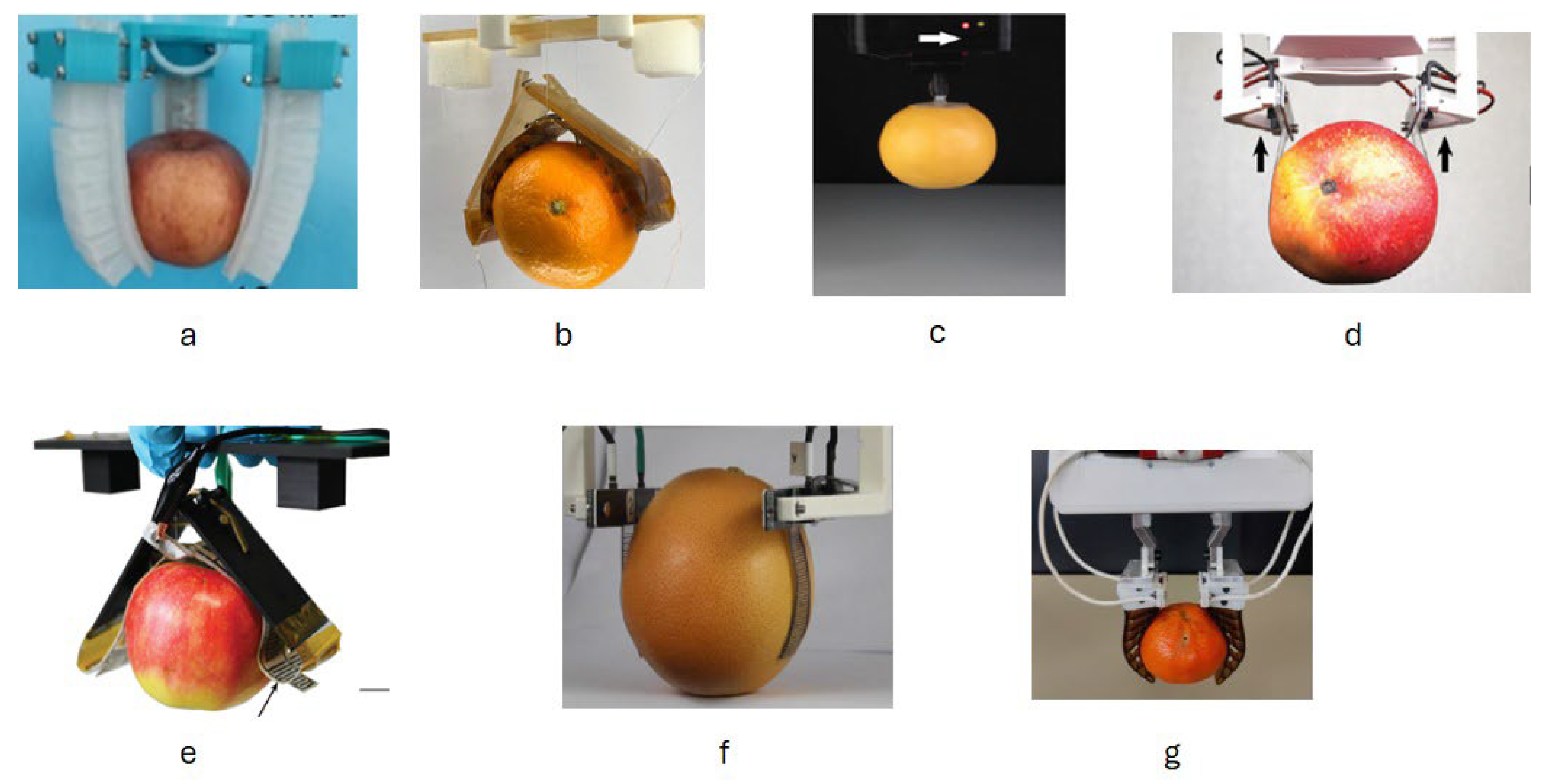
Due to copyright restrictions, the images corresponding to grippers 3, 4, and 5 could not be included in Figure 3.
Figure 3. Grippers from the reviewed works: (a) EA gripper 1, (b) EA gripper 2, (c) EA gripper 6, (d) EA gripper 7, (e) EA gripper 8, (f) EA gripper 9, (g) EA gripper 10.

4. Discussion

This review aims to assess the current state and potential of EA grippers for fruit and vegetable harvesting, focusing on their advantages, limitations, and key design considerations within the context of agricultural robotics. Although no evidence of testing EA grippers in real environments, such as fields or greenhouses, has been documented to date, a systematic review of the current state of the art has revealed several promising cases of robotic grippers based on the EA working principle. Ten potential gripping systems are analyzed in this work that successfully integrate electroadhesion and address fruit handling applications.
By comparing the gripping technologies considered in Section 3, it becomes apparent that there is a great dissimilarity between the experimental conditions occurring in the evaluation of the effectiveness of the different EA grippers in fruit grasping operations, since different setups, functional materials, dimensions, and surface textures of the targeted crops are involved. It is thus impossible to establish a quantitative and equal comparison between them and to identify optimal candidates in the context of fruit harvesting and picking. Yet some qualitative performance considerations can be drawn from the data and the design details reported for the considered gripping systems. This analysis provides a solid starting point for the development of EA grippers specifically designed for crop handling in all of its aspects, from picking operations to harvesting in greenhouses and in real orchards. The main design features and applicability conditions emerging from this methodical review are listed below:
  • Fruit selection: apples, tangerines, oranges, limes, lemons, tomatoes, cherry tomatoes, mangoes, and grapefruits are considered and compared in this analysis.
  • Load capacity range: from 10 g (~0.1 N) for cherry tomatoes to 600 g (~6 N) for mangoes.
  • Demonstrated adaptability to a variety of target shapes: thanks to their modular structure, the hybrid EA grippers reviewed display an improved gripping capability of flat surfaces, convex and concave objects, and targets having more complex shapes.
  • Demonstrated grasping ability for a variety of contact interfaces: EADs prove to be effective on rough surfaces too.
  • Application of minimal compressive stress and high EA shear force on the fruits to be grasped.
The limited number of real-world evaluations of electroadhesive (EA) grippers in agricultural environments can be attributed to several practical constraints. First and foremost, the development of controlled adhesion gripping systems remains relatively limited compared to other grasping technologies. Consequently, the application of such systems to the specific context of fruit and vegetable harvesting further narrows the number of relevant use cases.
Additionally, the lack of detailed information on the shear and normal stress performance of electroadhesive devices (EADs) for individual fruit types, as well as the absence of studies focused on optimizing the EAD performance for specific target fruits, hinders further progress in this field. Essential design parameters for these gripping systems are therefore still missing. Moreover, several factors known to limit EAD performance, such as moisture and dust, have not been quantitatively assessed in the context of fruit and vegetable applications, restricting the development of grippers specifically engineered to mitigate these environmental limitations.
Another aspect insufficiently addressed in the literature, and consequently limiting EA gripper development, concerns the influence of soft or rigid backing structures supporting the EAD. These structures inherently affect the finger stiffness and, consequently, its ability to conform closely to the target object, a crucial condition for maximizing the electroadhesive effectiveness. In the context of fruit and vegetable handling, this aspect is fundamental not only for designing efficient gripper systems but also in relation to robot dynamics, as the chosen backing structure must ensure a secure grasp during harvesting and picking operations at high dynamics. Furthermore, some EA gripper designs entirely omit a backing structure, which severely limits their applicability in cultivated environments due to the inadequate grip stability of robots’ dynamics, which has to be competitive with human harvesting productivity.
Finally, many existing EA grippers remain at an early research stage, primarily validated under controlled laboratory conditions to demonstrate feasibility before integration into fully operational robotic systems. Collectively, these factors have contributed to the lack of real-world testing reported in the literature to date.
A more general review [62] on robotic end-effectors for fruit and vegetable picking highlighted the key role that automated crop harvesting solutions will continue to have in the development of agricultural robots to be used in greenhouse and field applications. According to them, the current and future tendencies constituting fundamental advancement steps of the next-generation robotic end-effectors for fruit harvesting are the following: (1) light weight and adaptability; (2) development of bionic manipulators; (3) integration with multi-sensing technologies; (4) intelligent control systems; (5) flexibility; and (6) modular and reconfigurable design. From this perspective, testing and introducing custom-designed EA and hybrid EA grippers in greenhouses and field environments would certainly address these topics and lead to competitive advantages apart from intelligent control system. In fact, by limiting the discussion to the sole EA-based end-effectors, the reviewed grippers that integrate EA technologies effectively enable the following:
(1)
Lightweight, adaptive end-effectors: EA interfaces can lift up to 33 N, with payloads up to 17 times their own weight [60]. The structural optimization of hybrid EA grippers leads to an improved conformability to the fruit and introduces mechanical stiffness, contributing to prehension force enhancement. Their electrical power source can be located externally or miniaturized, with a minimal contribution to the weight of the end-effector. Adaptability to a wide variety of shapes and surface textures allows for a reduced damage risk, higher rates of success for picking operations, and improved efficiency.
(2)
In the context of bionic manipulators, the soft FinRay gripper reviewed in Section 3.10 represents a promising solution capable of conforming to delicate objects, including crops, without damaging them, by integrating a soft urethane backing structure and a stable grip through electroadhesion.
(3)
Due to their capacitive architecture, EADs will soon integrate proprioceptive capabilities, which hold the potential for proximity, contact, and slipping detection, with no need for bulky hardware for additional sensors and vision systems [63].
(4)
The combination of flexible materials for grippers is the new frontier in robotic handling and can compensate for the occurrence of excessive stress, which is frequently observed in traditional mechanical systems instead. This would further reduce the risk of crop damage by compression. All the systems considered in this analysis feature a soft element, either using a thin-film EAD system connected to a mechanical actuator promoting contact and release, or a hybrid design with a soft backing structure.
(5)
Compared to traditional end-effectors that achieve grasping by exploiting fixed components such as mechanical or pneumatic-driven fingers, EAD’s integration on any pre-existing structure does not represent a problem, and an enhanced performance is often achievable by simply adding a conformable backing layer. This drastically favors system modularity and reconfigurability and aligns well with the market demand.
As a final remark, future developments of EA grippers would greatly benefit from the definition of optimal characteristics tailored to specific prehension tasks, such as the EAD active area, driving signal, functional material, electrode design, and, for hybrid EA grippers, the backing structure. This can be achieved through an experimental campaign by measuring the electroadhesive shear stress that EADs can exert upon contact with different crop varieties. Another topic deserving further exploration is the investigation of the mechanical coupling between the EAD layer and the backing structure of the gripper, aimed at conforming to and maximizing the contact area with the fruit to be grasped, which is expected to lead to improved electroadhesion performances. Finally, testing EA gripper prototypes both in real fields and in greenhouse environments would provide additional insights that can dramatically advance the development and TRL of the current technologies addressing automated fruit harvesting operations.

Author Contributions

Conceptualization, E.M., R.V., and G.B.; methodology, E.M., R.V. and G.B.; formal analysis, T.I.O., E.M., S.M.K., C.S., A.F., R.V. and G.B.; writing—original draft preparation, T.I.O., E.M., S.M.K., C.S. and A.F.; writing—review and editing, T.I.O., E.M., C.S., R.V. and G.B.; supervision, R.V. and G.B.; project administration, E.M., R.V. and G.B. All authors have read and agreed to the published version of the manuscript.

Funding

This research was funded under the National Recovery and Resilience Plan (NRRP), Mission 04 Component 2 Investment 1.5—NextGenerationEU, Call for tender n. 3277 dated 30 December 2021 Award Number: 0001052 dated 23 June 2022.

Data Availability Statement

No new data were created or analyzed in this study.

Conflicts of Interest

The authors declare no conflicts of interest.

Abbreviations

The following abbreviations are used in this manuscript:
EADElectroadhesion Device
TRLTechnology Readiness Level
EAElectroadhesion

Appendix A

Appendix A.1

Search string of the initial search: (harvesting robot* OR harvesting robots*) AND (gripping* OR End effector* OR gripper* OR grippers*) AND (harvesting* OR picking* OR grasping* OR harvest* OR fruit harvesting* OR crop* OR grip* OR grasp*) AND (fruit* OR fruits* OR agricult* OR strawberries* OR apple* OR oranges* OR cucumbers* OR peppers* OR peaches* OR nectarines* OR tangerines* OR mandarins* OR clementines* OR plums* OR sloes* OR tomatoes* OR lychee* OR watermelon* OR blueberries* OR berries* OR kiwi*) AND (review*).

Appendix A.2

The objective of this trend analysis is to identify and evaluate research patterns in the field of agricultural robotic grippers and end-effectors. In particular, the study examines the extent of attention devoted to different design features and technological advancements of robotic grippers within agricultural applications, based on peer-reviewed academic sources. To guide the analysis, the following research questions were formulated:
(1)
Is the end-effector/gripper rigid, soft, or hybrid?
(2)
How many fingers does the gripper employ?
(3)
What is the actuation method (e.g., pneumatic, motor-driven, tendon-driven, etc.)?
(4)
What materials are used at the gripper tips?
(5)
Which fruits or agricultural products have been targeted for grasping or harvesting?
(6)
Which sensory systems are used to protect delicate agricultural produce?
These questions shaped both the development of the search string and the selection criteria for relevant studies. The dataset was refined using the PRISMA methodology, which involves the sequential stages of identification, screening, eligibility, and inclusion. This rigorous approach ensured that only relevant and high-quality studies were retained. To qualify for inclusion, each publication had to present the design of at least one gripper or end-effector explicitly tested on fruits or other agricultural produce.
The classification of grippers proceeded in three stages. First, the structural type of the gripper was identified as rigid, soft, or hybrid. Second, the number of fingers and the type of actuation/transmission mechanism were recorded. Third, the tip material was categorized. Since the material data were highly diverse, they were consolidated into five major groups to enable effective visualization:
(1)
Elastomers/Rubbers: silicone rubber, thermoplastic polyurethane (TPU), polyurethane elastomer (PUE), thermoplastic elastomer (TPE), generic thermoplastic polymers (TP), and polydimethylsiloxane (PDMS);
(2)
Plastics/Polymers: acrylonitrile butadiene styrene (ABS), polylactic acid (PLA), polylactic polymer (PL), polyethylene terephthalate (PET), polyvinyl chloride (PVC), and generic polymers;
(3)
Foams and Sponges;
(4)
Hydrogels/Soft Materials: hydrogels and polymeric membranes;
(5)
Metals.
A similar categorization approach was applied to agricultural produce, grouping crops into eight broad commodity-based classes:
(1)
Temperate fruits: apple, pear, grape, peach, and kiwi.
(2)
Tropical/subtropical fruits: banana, mango, papaya, pineapple, avocado, litchi, and dragon fruit.
(3)
Citrus fruits: orange, lemon, tangerine, and citrus.
(4)
Vegetables: tomato, cherry tomato, tomato bunches, cucumber, eggplant, pepper, chili pepper, sweet pepper, radish, potato, paprika, asparagus, and broccoli.
(5)
Berries: strawberry, blueberry, blackberry, and raspberry.
(6)
Nuts/Seeds: chestnut burr, nut, seeds, safflower, sunflower, and hemp plant.
(7)
Industrial crops: cotton, cotton plant, cotton ball, and tobacco leaves.
(8)
Mushrooms/Fungi: mushroom, morel, and Agaricus bisporus.
The same rationale of categorization was applied to define the sensory system used to protect agricultural produce, grouping them into four broad categories:
(1)
Vision-Based: Designs that utilize vision systems such as RGB cameras.
(2)
Sensor at the tip: Designs that employ various types of sensors at the contact interface of the gripper or end-effector to protect the produce. These include photoelectric/photonic, pressure/force, triboelectric, piezoelectric, PVDF, magnetic/electromagnetic, capacitive, ultrasonic sensors, etc.
(3)
Hybrid: Designs that incorporate both vision-based systems and sensors at the tip.
(4)
None: Designs that do not employ any of the aforementioned sensory solutions for protection.
The initial search yielded 1033 publications, from which only 275 studies met the inclusion criteria after refinement. These studies formed the final dataset used for bibliometric and trend analysis.

References

  1. United Nations Department of Economic and Social Affairs (UN DESA). World Population Projected to Reach 9.8 Billion in 2050, and 11.2 Billion in 2100. Available online: https://www.un.org/development/desa/en/news/population/world-population-prospects-2017.html (accessed on 19 September 2025).
  2. Food and Agriculture Organization of the United Nations (FAO). Global Agriculture Towards 2050. 2009. Available online: https://www.fao.org/fileadmin/templates/wsfs/docs/Issues_papers/HLEF2050_Global_Agriculture.pdf (accessed on 19 September 2025).
  3. Elfferich, J.F.; Dodou, D.; Della Santina, C. Soft Robotic Grippers for Crop Handling or Harvesting: A Review. IEEE Access 2022, 10, 75428–75443. [Google Scholar] [CrossRef]
  4. Liu, Y.; Hou, J.; Li, C.; Wang, X. Intelligent Soft Robotic Grippers for Agricultural and Food Product Handling: A Brief Review with a Focus on Design and Control. Adv. Intell. Syst. 2023, 5, 2300233. [Google Scholar] [CrossRef]
  5. Zeeshan, S.; Aized, T.; Riaz, F. In-Depth Evaluation of Automated Fruit Harvesting in Unstructured Environment for Improved Robot Design. Machines 2024, 12, 151. [Google Scholar] [CrossRef]
  6. Huang, Y.; Xu, S.; Chen, H.; Li, G.; Dong, H.; Yu, J.; Zhang, X.; Chen, R. A review of visual perception technology for intelligent fruit harvesting robots. Front. Plant Sci. 2025, 16, 1646871. [Google Scholar] [CrossRef]
  7. He, Z.; Liu, Z.; Zhou, Z.; Karkee, M.; Zhang, Q. Improving picking efficiency under occlusion: Design, development, and field evaluation of an innovative robotic strawberry harvester. Comput. Electron. Agric. 2025, 237, 110684. [Google Scholar] [CrossRef]
  8. Wang, W.; Li, C.; Xi, Y.; Gu, J.; Zhang, X.; Zhou, M.; Peng, Y. Research Progress and Development Trend of Visual Detection Methods for Selective Fruit Harvesting Robots. Agronomy 2025, 15, 1926. [Google Scholar] [CrossRef]
  9. Sarig, Y. Robotics of Fruit Harvesting: A State-of-art Review. J. Agric. Eng. Res. 1993, 54, 265–280. Available online: https://www.sciencedirect.com/science/article/abs/pii/S0021863483710206 (accessed on 19 September 2025). [CrossRef]
  10. Navas, E.; Fernández, R.; Sepúlveda, D.; Armada, M.; Gonzalez-De-santos, P. Soft grippers for automatic crop harvesting: A review. Sensors 2021, 21, 2689. [Google Scholar] [CrossRef]
  11. Han, W.; Luo, J.; Wang, J.; Gu, Q.; Lin, L.; Gao, Y.; Chen, H.; Luo, K.; Zeng, Z.; He, J. Design of a Chili Pepper Harvesting Device for Hilly Chili Fields. Agronomy 2025, 15, 1118. [Google Scholar] [CrossRef]
  12. Yu, Y.; Xie, H.; Zhang, K.; Wang, Y.; Li, Y.; Zhou, J.; Xu, L. Design, Development, Integration, and Field Evaluation of a Ridge-Planting Strawberry Harvesting Robot. Agriculture 2024, 14, 2126. [Google Scholar] [CrossRef]
  13. Sytsma, M.; van Marrewijk, B.M.; Tielen, T.; Vroegop, A.; Ruizendaal, J. Design and evaluation of a robotic prototype for gerbera harvesting, performing actions at never-seen locations. Comput. Electron. Agric. 2025, 228, 109671. [Google Scholar] [CrossRef]
  14. Xie, H.; Zhang, D.; Yang, L.; Cui, T.; He, X.; Zhang, K.; Zhang, Z. Development, Integration, and Field Evaluation of a Dual-Arm Ridge Cultivation Strawberry Autonomous Harvesting Robot. J. Field Robot. 2025, 42, 1783–1798. [Google Scholar] [CrossRef]
  15. Choi, D.W.; Park, J.H.; Yoo, J.H.; Ko, K.E. AI-driven adaptive grasping and precise detaching robot for efficient citrus harvesting. Comput. Electron. Agric. 2025, 232, 110131. [Google Scholar] [CrossRef]
  16. Zhang, B.; Xie, Y.; Zhou, J.; Wang, K.; Zhang, Z. State-of-the-art robotic grippers, grasping and control strategies, as well as their applications in agricultural robots: A review. Comput. Electron. Agric. 2020, 177, 105694. [Google Scholar] [CrossRef]
  17. Liu, W.; Tan, Z.; Xie, W. A hand-like gripper embedded with flexible gel sensor for tomato harvesting: Soft contact and intelligent ripeness sensing. J. Food Meas. Charact. 2025, 19, 3150–3161. [Google Scholar] [CrossRef]
  18. Qiu, Y.; Ye, Z.; Tan, X.; Dai, M.; Ge, S.; Zhao, X.; Kong, D.; Ruan, Y. Fruit grasping evaluation based on a humanoid underactuated manipulator and an adaptive grasping algorithm. Smart Agric. Technol. 2025, 11, 101007. [Google Scholar] [CrossRef]
  19. Wang, Q.; Bai, K.; Zhang, L.; Sun, Z.; Jia, T.; Hu, D.; Li, Q.; Zhang, J.; Knoll, A.; Jiang, H.; et al. Towards reliable and damage-less robotic fragile fruit grasping: An enveloping gripper with multimodal strategy inspired by Asian elephant trunk. Comput. Electron. Agric. 2025, 234, 110198. [Google Scholar] [CrossRef]
  20. Sun, J.; Sun, L.; Zhao, G.; Liu, J.; Chen, Z.; Jing, L.; Cao, X.; Zhang, H.; Tang, W.; Wang, J. Triboelectric force feedback-based fully actuated adaptive apple-picking gripper for optimized stability and non-destructive harvesting. Comput. Electron. Agric. 2025, 237, 110725. [Google Scholar] [CrossRef]
  21. Ansari, S.; Gohil, M.K.; Maeda, Y.; Bhattacharya, B. Design and development of a new hybrid auxetic gripper system for adaptive precision tomato harvesting. Int. J. Intell. Robot. Appl. 2025, 1–24. [Google Scholar] [CrossRef]
  22. Zhu, H.; Qin, H.; Qiu, Z.; Chen, X.; Xue, J.; Gu, X.; Lu, M. A Compliant Active Roller Gripper with High Positional Offset Tolerance for Delicate Spherical Fruit Handling. Agriculture 2025, 15, 220. [Google Scholar] [CrossRef]
  23. Ward-Cherrier, B.; Rojas, N.; Lepora, N.F. Model-Free Precise in-Hand Manipulation with a 3D-Printed Tactile Gripper. IEEE Robot. Autom. Lett. 2017, 2, 2056–2063. [Google Scholar] [CrossRef]
  24. He, L.; Lu, Q.; Abad, S.A.; Rojas, N.; Nanayakkara, T. Soft Fingertips with Tactile Sensing and Active Deformation for Robust Grasping of Delicate Objects. IEEE Robot. Autom. Lett. 2020, 5, 2714–2721. [Google Scholar] [CrossRef]
  25. Wang, Z.; Chathuranga, D.S.; Hirai, S. 3D printed soft gripper for automatic lunch box packing. In Proceedings of the 2016 IEEE International Conference on Robotics and Biomimetics (ROBIO), Qingdao, China, 3–7 December 2016; IEEE: Piscataway, NJ, USA, 2016; pp. 503–508. [Google Scholar] [CrossRef]
  26. Shan, Y.; Ding, B.; Zhong, J.; Li, Y. Design and optimization of a decoupled serial constant force microgripper for force sensitive objects manipulation. Robotica 2023, 41, 2064–2078. [Google Scholar] [CrossRef]
  27. Wu, Z.; Wang, Y.; Chen, M.; Ding, B. Design, analysis, and experimental investigations of an asymmetrical under-actuated micro-gripper. J. Intell. Mater. Syst. Struct. 2024, 35, 960–970. [Google Scholar] [CrossRef]
  28. Ding, B.; Li, X.; Li, C.; Li, Y.; Chen, S.C. A survey on the mechanical design for piezo-actuated compliant micro-positioning stages. Rev. Sci. Instrum. 2023, 94, 101502. [Google Scholar] [CrossRef]
  29. Kargar, S.M.; Berselli, G. TriCoM Gripper–Part I: Mechanical Design and Synthesis of a 3-Finger Compliant Monolithic Gripper. In Proceedings of the MESA 2024—20th International Conference on Mechatronic, Embedded Systems and Applications (MESA), Genova, Italy, 2–4 September 2024; Institute of Electrical and Electronics Engineers Inc.: Piscataway, NJ, USA, 2024. [Google Scholar] [CrossRef]
  30. Shintake, J.; Cacucciolo, V.; Floreano, D.; Shea, H. Soft Robotic Grippers. Adv. Mater. 2018, 30, 1707035. [Google Scholar] [CrossRef]
  31. Huang, P.; Xin, Y.; Lee, P.S. Soft electroadhesion systems for soft robotics. npj Robot. 2025, 3, 29. [Google Scholar] [CrossRef]
  32. Rajagopalan, P.; Muthu, M.; Liu, Y.; Luo, J.; Wang, X.; Wan, C. Advancement of Electroadhesion Technology for Intelligent and Self-Reliant Robotic Applications. Adv. Intell. Syst. 2022, 4, 2200064. [Google Scholar] [CrossRef]
  33. Guo, J.; Leng, J.; Rossiter, J. Electroadhesion Technologies for Robotics: A Comprehensive Review. IEEE Trans. Robot. 2020, 36, 313–327. [Google Scholar] [CrossRef]
  34. Choi, K.; Kim, Y.C.; Sun, H.; Kim, S.-H.; Yoo, J.W.; Park, I.-K.; Lee, P.-C.; Choi, H.J.; Choi, H.R.; Kim, T.; et al. Quantitative Electrode Design Modeling of an Electroadhesive Lifting Device Based on the Localized Charge Distribution and Interfacial Polarization of Different Objects. ACS Omega 2019, 4, 7994–8000. [Google Scholar] [CrossRef]
  35. Digumarti, K.M.; Cacucciolo, V.; Shea, H. Dexterous textile manipulation using electroadhesive fingers. In Proceedings of the IEEE International Conference on Intelligent Robots and Systems, Prague, Czech Republic, 27 September–1 October 2021; Institute of Electrical and Electronics Engineers Inc.: Piscataway, NJ, USA, 2021; pp. 6104–6109. [Google Scholar] [CrossRef]
  36. An, Y.; He, B.; Ma, Z.; Guo, Y.; Yang, G.Z. Microassembly: A Review on Fundamentals, Applications and Recent Developments. Engineering 2025, 48, 323–346. [Google Scholar] [CrossRef]
  37. Monkman, G.J. An analysis of astrictive prehension. Int. J. Robot. Res. 1997, 16, 1–10. [Google Scholar] [CrossRef]
  38. Johnsen, A.; Rahbek, K. A physical phenomenon and its applications to telegraphy, telephony, etc. Eng. Comput. Sci. Phys. 1923, 61, 713–725. [Google Scholar] [CrossRef]
  39. Krape, R.P. Applications Study of Electroadhesive Devices; NASA Contractor Report CR-1211; Chrysler Corp. Space Division: New Orleans, LA, USA, 1968. Available online: https://ntrs.nasa.gov/citations/19680027258 (accessed on 25 April 2025).
  40. Hwang, G.; Park, J.; Cortes, D.S.D.; Hyeon, K.; Kyung, K.U. Electroadhesion-Based High-Payload Soft Gripper with Mechanically Strengthened Structure. IEEE Trans. Ind. Electron. 2022, 69, 642–651. [Google Scholar] [CrossRef]
  41. Guo, J.; Bamber, T.; Zhao, Y.; Chamberlain, M.; Justham, L.; Jackson, M. Toward Adaptive and Intelligent Electroadhesives for Robotic Material Handling. IEEE Robot. Autom. Lett. 2017, 2, 538–545. [Google Scholar] [CrossRef]
  42. Mikela, R.; David, B. Geometry characterization of electroadhesion samples for spacecraft docking application. In Proceedings of the 2017 IEEE Aerospace Conference: Yellowstone Conference Center, Big Sky, MT, USA, 4–11 March 2017; IEEE: Piscataway, NJ, USA, 2017. [Google Scholar] [CrossRef]
  43. Narayanan, S.; Barnhart, D.; Rogers, R.; Ruffatto, D.; Schaler, E.; Van Crey, N.; Dean, G.; Bhanji, A.; Bernstein, S.; Singh, A.; et al. REACCH-Reactive Electro-Adhesive Capture ClotH Mechanism to Enable Safe Grapple of Cooperative/Non-Cooperative Space Debris. In Proceedings of the AIAA Scitech 2020 Forum, Orlando, FL, USA, 6–10 January 2020. [Google Scholar]
  44. Zhang, Z.; Chestney, J.A.; Sarhadi, M. Characterizing an electrostatic gripping device for the automated handling of non-rigid materials. Proc. Inst. Mech. Eng. Part B J. Eng. Manuf. 2001, 215, 21–36. [Google Scholar] [CrossRef]
  45. Qin, S.; McTeer, A. Wafer dependence of Johnsen-Rahbek type electrostatic chuck for semiconductor processes. J. Appl. Phys. 2007, 102, 064901. [Google Scholar] [CrossRef]
  46. Ruffatto, D.; Shah, J.; Spenko, M. Optimization and Experimental Validation of Electrostatic Adhesive Geometry. In Proceedings of the 2013 IEEE Aerospace Conference, Big Sky, MT, USA, 2–9 March 2013; IEEE: Piscataway, NJ, USA, 2013. [Google Scholar] [CrossRef]
  47. Guo, J.; Bamber, T.; Chamberlain, M.; Justham, L.; Jackson, M. Optimization and experimental verification of coplanar interdigital electroadhesives. J. Phys. D Appl. Phys. 2016, 49, 415304. [Google Scholar] [CrossRef]
  48. Yuan, K.L.; Chen, X.; Peng, J. Optimization of Electrostatic Adhesion Using Concentric Ring Electrodes. In Intelligent Robotics and Applications, Proceedings of the 17th International Conference, ICIRA 2024, Xi’an, China, 31 July–2 August 2024; Lecture Notes in Computer Science (including subseries Lecture Notes in Artificial Intelligence and Lecture Notes in Bioinformatics); Springer Science and Business Media Deutschland GmbH: Berlin/Heidelberg, Germany, 2025; pp. 360–371. [Google Scholar] [CrossRef]
  49. Guo, J.; Xiang, C.; Zanini, P.; Rossiter, J. Magnetic Augmented Self-sensing Flexible Electroadhesive Grippers. IEEE Robot. Autom. Lett. 2019, 4, 2364–2369. [Google Scholar] [CrossRef]
  50. Mastrangelo, M.; Caruso, F.; Carbone, G.; Cacucciolo, V. Electroadhesion zipping with soft grippers on curved objects. Extrem. Mech. Lett. 2023, 61, 101999. [Google Scholar] [CrossRef]
  51. Shintake, J.; Rosset, S.; Schubert, B.; Floreano, D.; Shea, H. Versatile Soft Grippers with Intrinsic Electroadhesion Based on Multifunctional Polymer Actuators. Adv. Mater. 2016, 28, 231–238. [Google Scholar] [CrossRef]
  52. Alizadehyazdi, V.; Bonthron, M.; Spenko, M. An Electrostatic/Gecko-Inspired Adhesives Soft Robotic Gripper. IEEE Robot. Autom. Lett. 2020, 5, 4679–4686. [Google Scholar] [CrossRef]
  53. Caruso, F.; Shea, H.; Cacucciolo, V. Electroadhesion Suction Cups. Adv. Mater. 2025, 37, 2420231. [Google Scholar] [CrossRef]
  54. Cacucciolo, V.; Shea, H.; Carbone, G. Peeling in electroadhesion soft grippers. Extrem. Mech. Lett. 2022, 50, 101529. [Google Scholar] [CrossRef]
  55. An, S.; Xiang, C.; Ji, C.; Liu, S.; He, L.; Li, L.; Wang, Y. Design and development of a variable structure gripper with electroadhesion. Smart Mater. Struct. 2024, 33, ad3bf8. [Google Scholar] [CrossRef]
  56. Xiang, C.; Li, W.; Guan, Y. A Variable Stiffness Electroadhesive Gripper Based on Low Melting Point Alloys. Polymers 2022, 14, 4469. [Google Scholar] [CrossRef]
  57. Kim, D.G.; Je, H.; Hart, A.J.; Kim, S. Additive manufacturing of flexible 3D surface electrodes for electrostatic adhesion control and smart robotic gripping. Friction 2023, 11, 1974–1986. [Google Scholar] [CrossRef]
  58. Cacucciolo, V.; Shintake, J.; Shea, H. Delicate yet Strong: Characterizing the electro-adhesion lifting force with a soft gripper. In Proceedings of the 2019 2nd IEEE International Conference on Soft Robotics (RoboSoft), Seoul, Republic of Korea, 14–18 April 2019; IEEE: Piscataway, NJ, USA, 2019. [Google Scholar]
  59. Xiong, Q.; Li, D.; Li, X.; Liu, L.; Zhou, X.; Ju, H.; Zhu, Y.; Yeow, R.C.-H. EA-SoGripper: Electroadhesion-Stiffening Self-Adaptive Soft Robotic Gripper. IEEE/ASME Trans. Mechatron. 2025, 1–11. [Google Scholar] [CrossRef]
  60. Kanno, R.; Nguyen, P.H.; Pinskier, J.; Howard, D.; Song, S.; Kovac, M. Hybrid Soft Electrostatic Metamaterial Gripper for Multi-surface, Multi-object Adaptation. In Proceedings of the 2024 IEEE 7th International Conference on Soft Robotics, RoboSoft 2024, San Diego, CA, USA, 14–17 April 2024; Institute of Electrical and Electronics Engineers Inc.: Piscataway, NJ, USA, 2024; pp. 851–857. [Google Scholar] [CrossRef]
  61. Carloni, A.; Valori, M.; Bertolucci, F.; Agostini, L.; Berselli, G.; Fassi, I.; Tosatti, L.M.; Vertechy, R. Enhancing compliant gripper performance: Exploiting electro-adhesion to increase lifting force over grasping force. Robot. Comput. Integr. Manuf. 2025, 91, 102843. [Google Scholar] [CrossRef]
  62. Han, C.; Lv, J.; Dong, C.; Li, J.; Luo, Y.; Wu, W.; Abdeen, M.A. Classification, Advanced Technologies, and Typical Applications of End-Effector for Fruit and Vegetable Picking Robots. Agriculture 2024, 14, 1310. [Google Scholar] [CrossRef]
  63. Rizzello, G.; Naso, D.; York, A.; Seelecke, S. A Self-Sensing Approach for Dielectric Elastomer Actuators Based on Online Estimation Algorithms. IEEE/ASME Trans. Mechatron. 2017, 22, 728–738. [Google Scholar] [CrossRef]
Disclaimer/Publisher’s Note: The statements, opinions and data contained in all publications are solely those of the individual author(s) and contributor(s) and not of MDPI and/or the editor(s). MDPI and/or the editor(s) disclaim responsibility for any injury to people or property resulting from any ideas, methods, instructions or products referred to in the content.

Article Metrics

Citations

Article Access Statistics

Multiple requests from the same IP address are counted as one view.