Article

Fingerprinting-Based Indoor Positioning Using Data Fusion of Different Radiocommunication-Based Technologies


1
Department of Mechatronics and Automation, Faculty of Engineering, University of Szeged, Moszkvai krt. 9, 6725 Szeged, Hungary
2
Doctoral School of Applied Informatics and Applied Mathematics, Óbuda University, Bécsi str. 96/b, 1034 Budapest, Hungary
*
Author to whom correspondence should be addressed.
Machines 2023, 11(2), 302; https://doi.org/10.3390/machines11020302

Submission received: 23 January 2023 / Revised: 12 February 2023 / Accepted: 16 February 2023 / Published: 17 February 2023
(This article belongs to the Special Issue Modeling, Sensor Fusion and Control Techniques in Applied Robotics)

Abstract

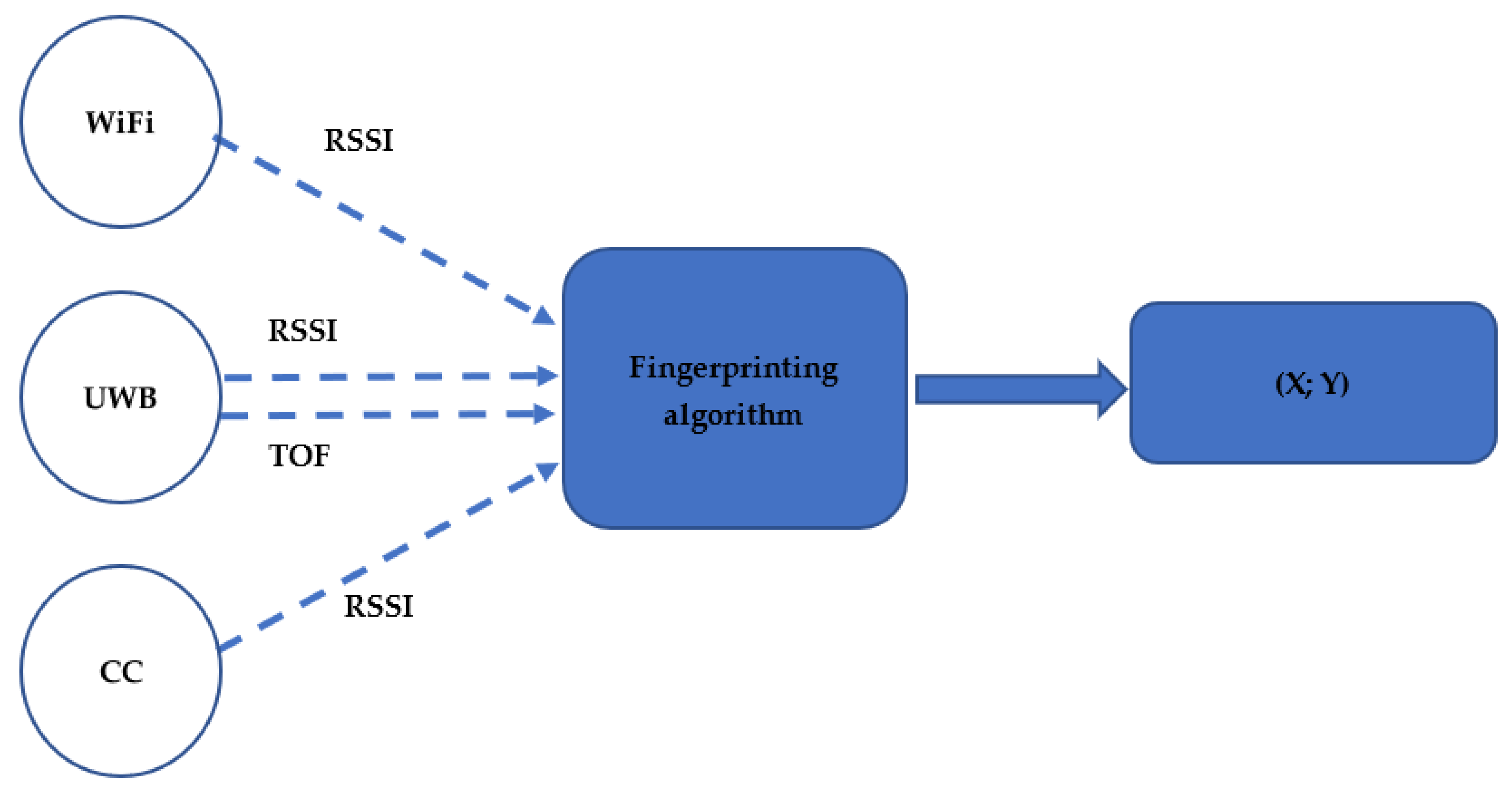
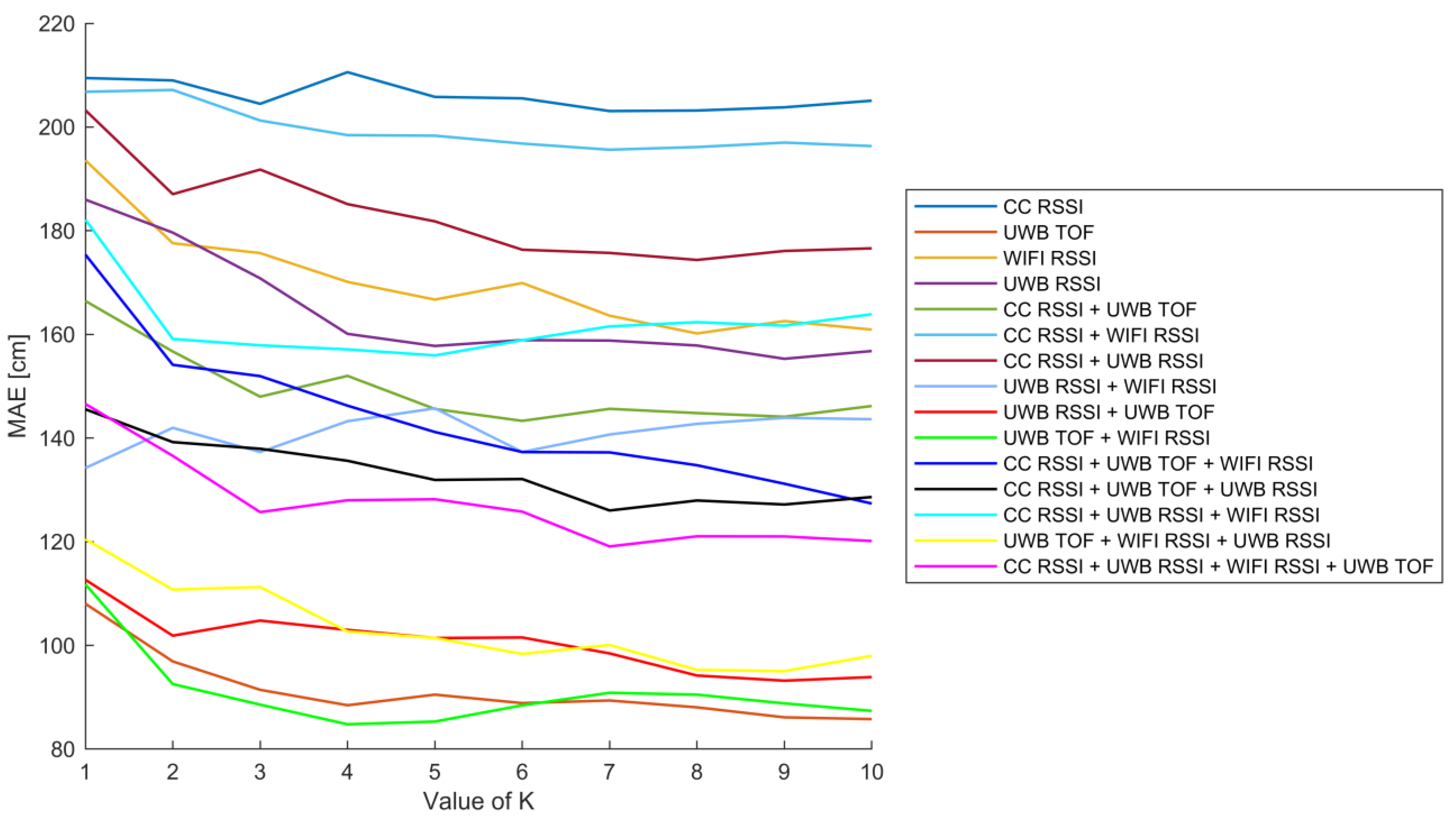
Wireless-radio-communication-based devices are used in more and more places with the spread of Industry 4.0. Localization plays a crucial part in many of these applications. In this paper, a novel radiocommunication-based indoor positioning method is proposed, which applies the fusion of fingerprints extracted with various technologies to improve the overall efficiency. The aim of the research is to apply the differences, which occur due to that different technologies behave differently in an indoor space. The proposed method was validated using training and test data collected in a laboratory. Four different technologies, namely WiFi received signal strength indication (RSSI), ultra-wideband (UWB) RSSI, UWB time of flight (TOF) and RSSI in 433 MHz frequency band and all of their possible combinations, were tested to examine the performance of the proposed method. Three widely used fingerprinting algorithms, the weighted k-nearest neighbor, the random forest, and the artificial neural network were implemented to evaluate their efficiency with the proposed method. The achieved results show that the accuracy of the localization can be improved by combining different technologies. The combination of the two low-cost technologies, i.e., the WiFi and the 433 MHz technology, resulted in an 11% improvement compared to the more accurate technology, i.e., the 433 MHz technology. Combining the UWB module with other technologies results in a less significant improvement since this sensor provides lower error rates, when used alone.
Keywords: indoor positioning; fingerprinting; RSSI measurement; sensor fusion; artificial neural network; weighted k-nearest neighbor; random forest indoor positioning; fingerprinting; RSSI measurement; sensor fusion; artificial neural network; weighted k-nearest neighbor; random forest