Article

Conversion of a Small-Size Passenger Car to Hydrogen Fueling: Simulation of CCV and Evaluation of Cylinder Imbalance


by
Adrian Irimescu
1,*,
Bianca Maria Vaglieco
1,
Simona Silvia Merola
1,
Vasco Zollo
2 and
Raffaele De Marinis
2
1
Science and Technology Institute for Sustainable Energy and Mobility STEMS—CNR, Via G. Marconi 4, 80125 Napoli, Italy
2
Demax SRL, Strada Statale 7 Appia Km 251, 82014 Ceppaloni, Italy
*
Author to whom correspondence should be addressed.
Machines 2023, 11(2), 135; https://doi.org/10.3390/machines11020135

Submission received: 27 December 2022 / Revised: 13 January 2023 / Accepted: 16 January 2023 / Published: 19 January 2023
(This article belongs to the Section Vehicle Engineering)

Abstract

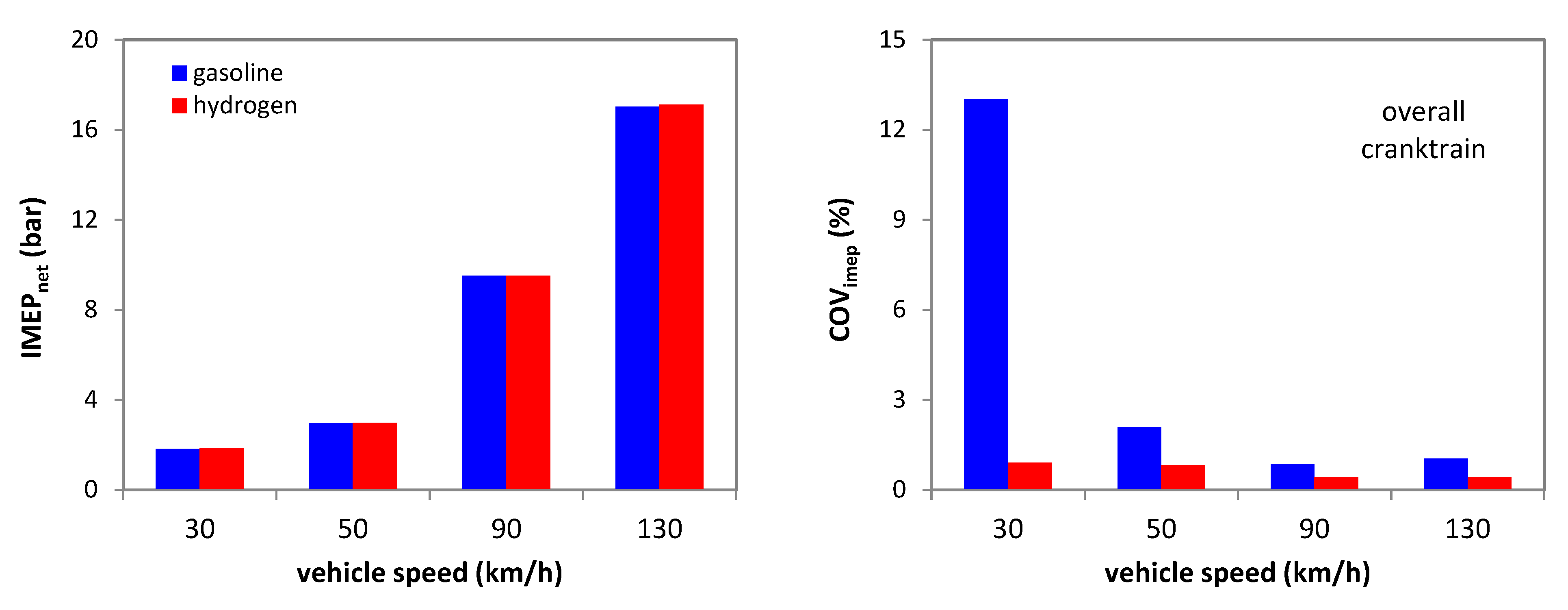
In the efforts to achieve zero-emission transportation, hydrogen offers a valid choice as a complete replacement of gasoline. Adapting spark ignition (SI) engines to this alternative fuel can be implemented with relatively minor changes and limited investment in added components. The conversion of a small-size passenger car to hydrogen fueling was evaluated initially from the perspective of achievable range and peak power. Overall, the concept was found to be feasible and comparable to the fully electric version of the vehicle. Cylinder imbalance was found to be one of the possible issues compared to gasoline operation. This study looks in more detail at cycle-to-cycle variability (CCV) and how this could influence vehicle dynamics as well as noise–harshness–vibration (NHV). CCV was simulated with a 0D/1D approach in vehicle-relevant engine speed–load conditions. A dedicated laminar flame speed sub-model was implemented so as to include fuel chemistry effects, while CCV was simulated by inducing perturbations in the initial combustion stages and fuel system characteristics as well as variation of air–fuel ratio throughout flame propagation. Significant improvement of stability was predicted with hydrogen, while cylinder imbalance was found to be one of the main sources of variability. Applying algorithms that compensate for the imbalance through individual injection valve regulation may not be enough to mitigate the identified issue, and more extensive changes of control strategies could be required. The start of injection settings may need to be adapted for each operating condition to maximize the effect of H2 combustion stabilization.
Keywords: vehicle propulsion; spark ignition engine; hydrogen fueling; cycle-to-cycle variability; 0D/1D modeling vehicle propulsion; spark ignition engine; hydrogen fueling; cycle-to-cycle variability; 0D/1D modeling