
Elastostatic Stiffness Modeling and Performance Evaluation of a 2UPR–2PRU Redundantly Actuated Parallel Manipulator



Abstract
1. Introduction
2. Structural Description and Inverse Displacement Analysis of the Redundantly Actuated 2UPR–2PRU PM
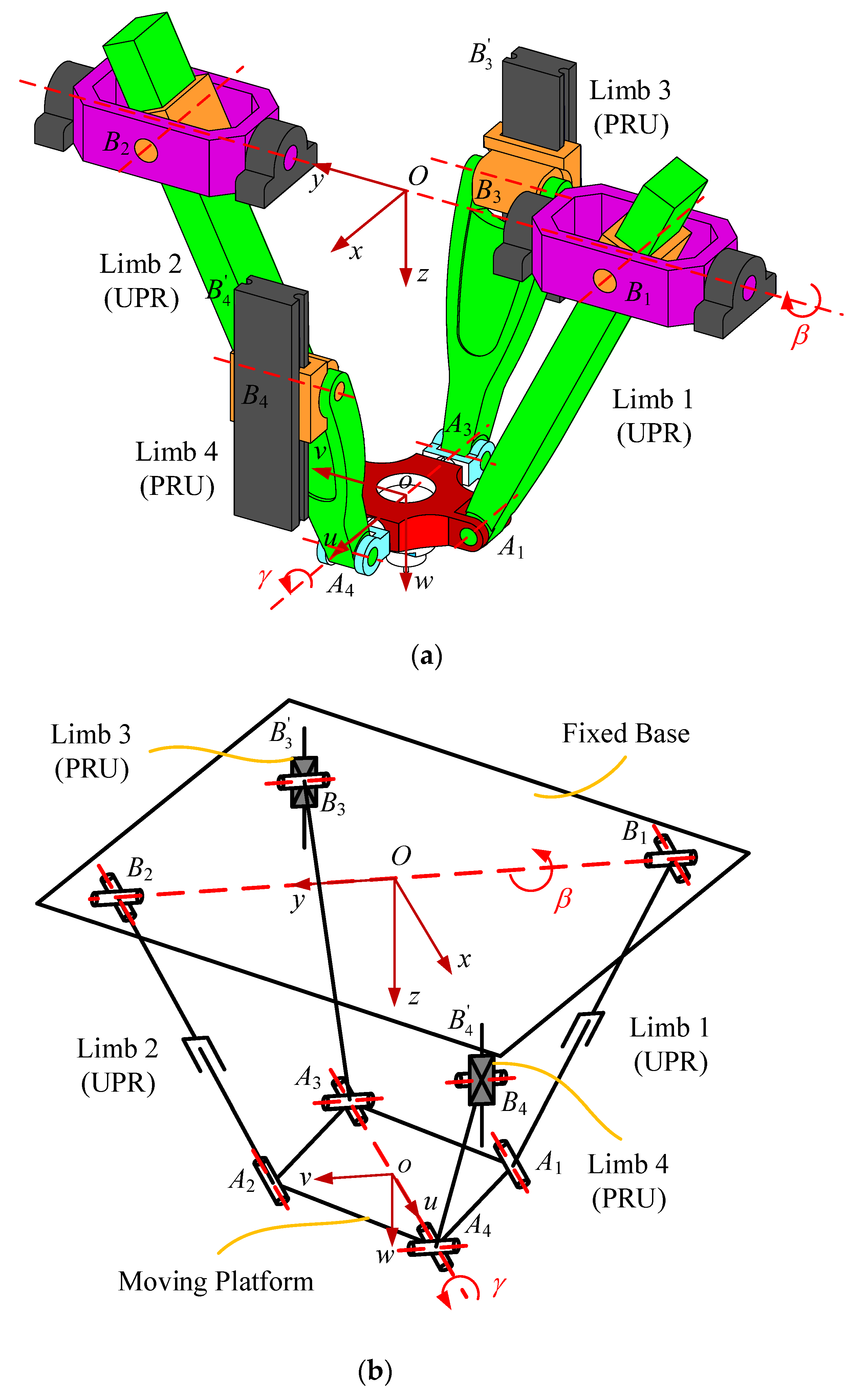
2.1. Structural Description
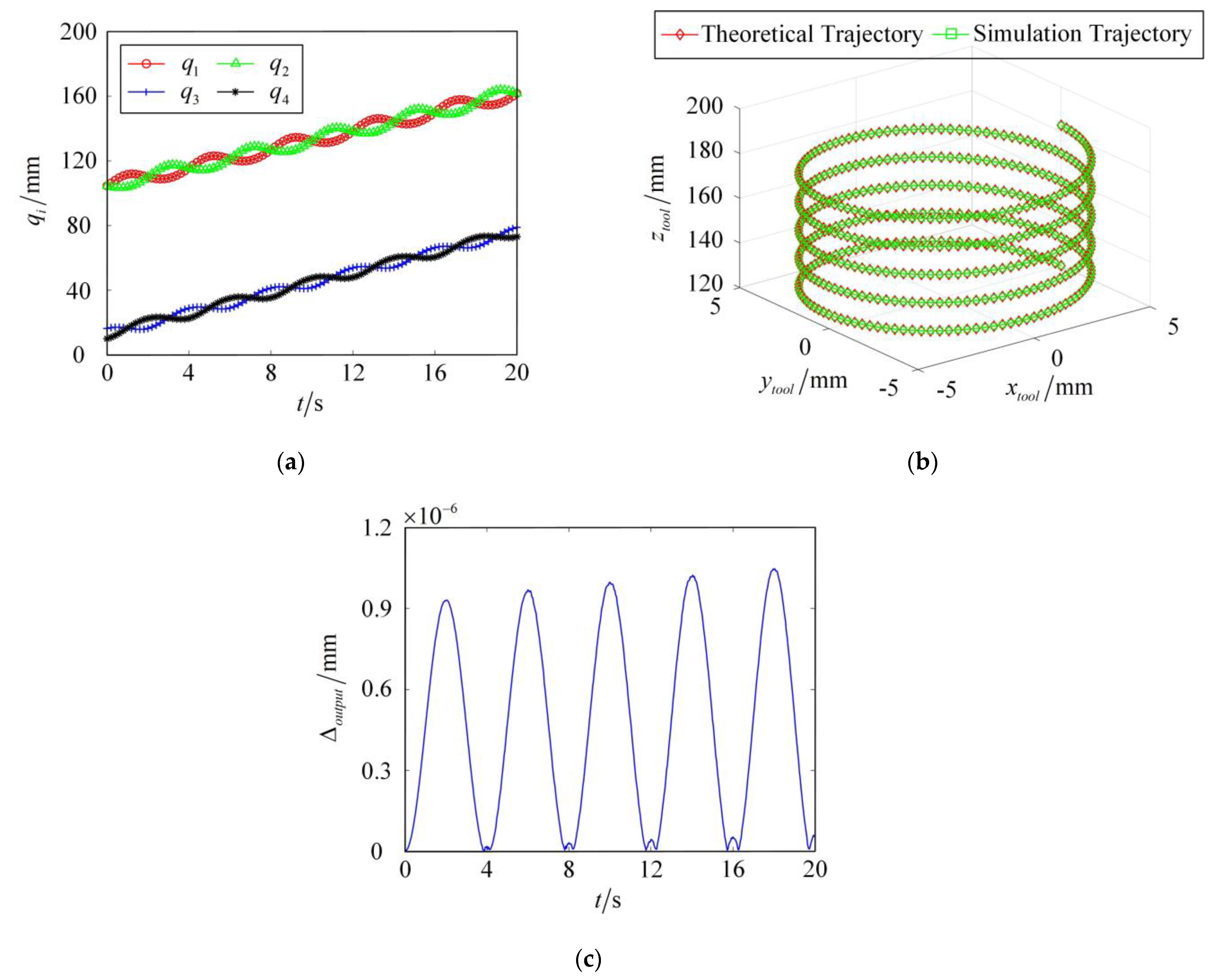
2.2. Inverse Displacement Analysis
3. Elastostatic Stiffness Modeling of the Redundantly Actuated 2UPR–2PRU PM
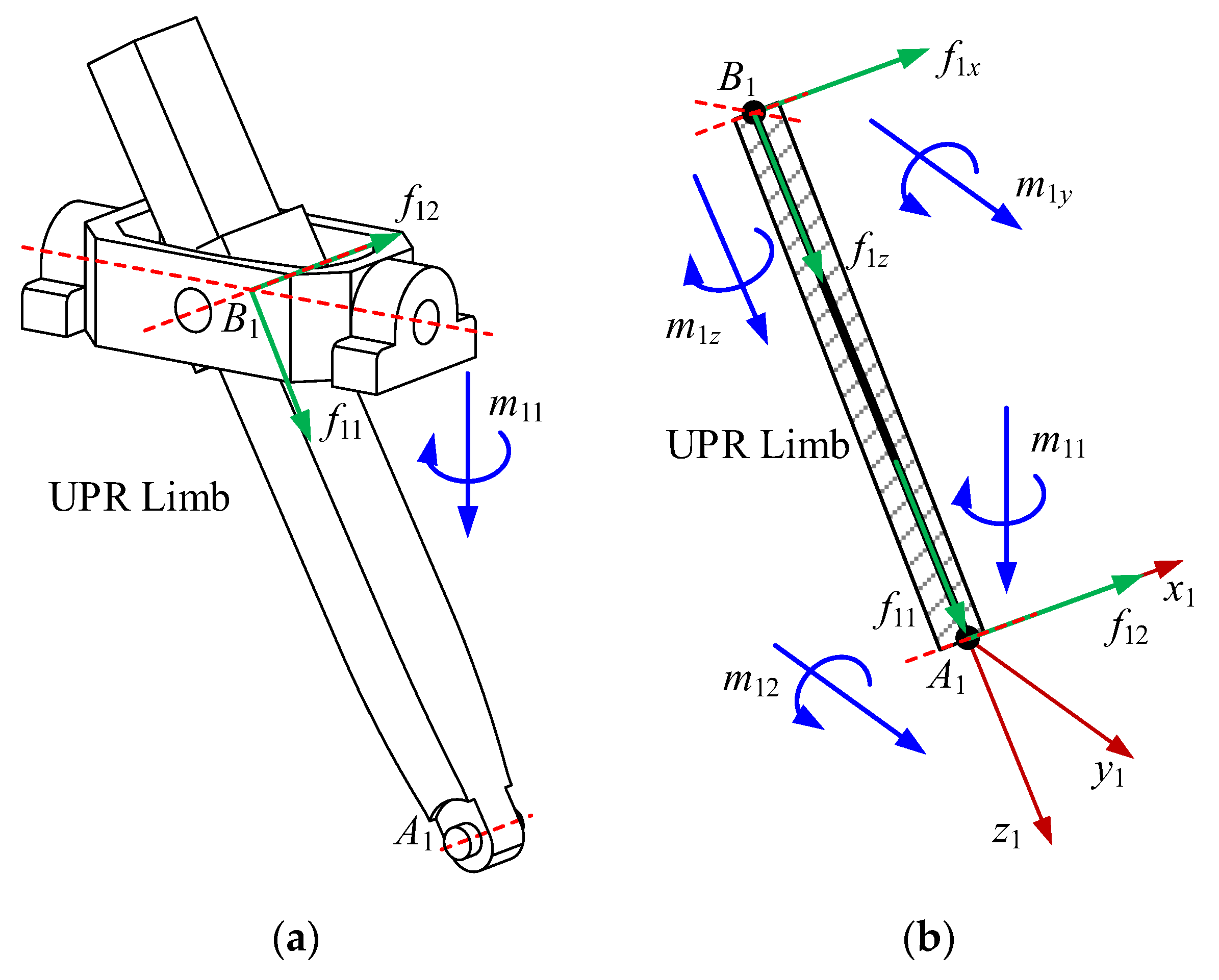
3.1. Stiffness Matrices of UPR Limbs
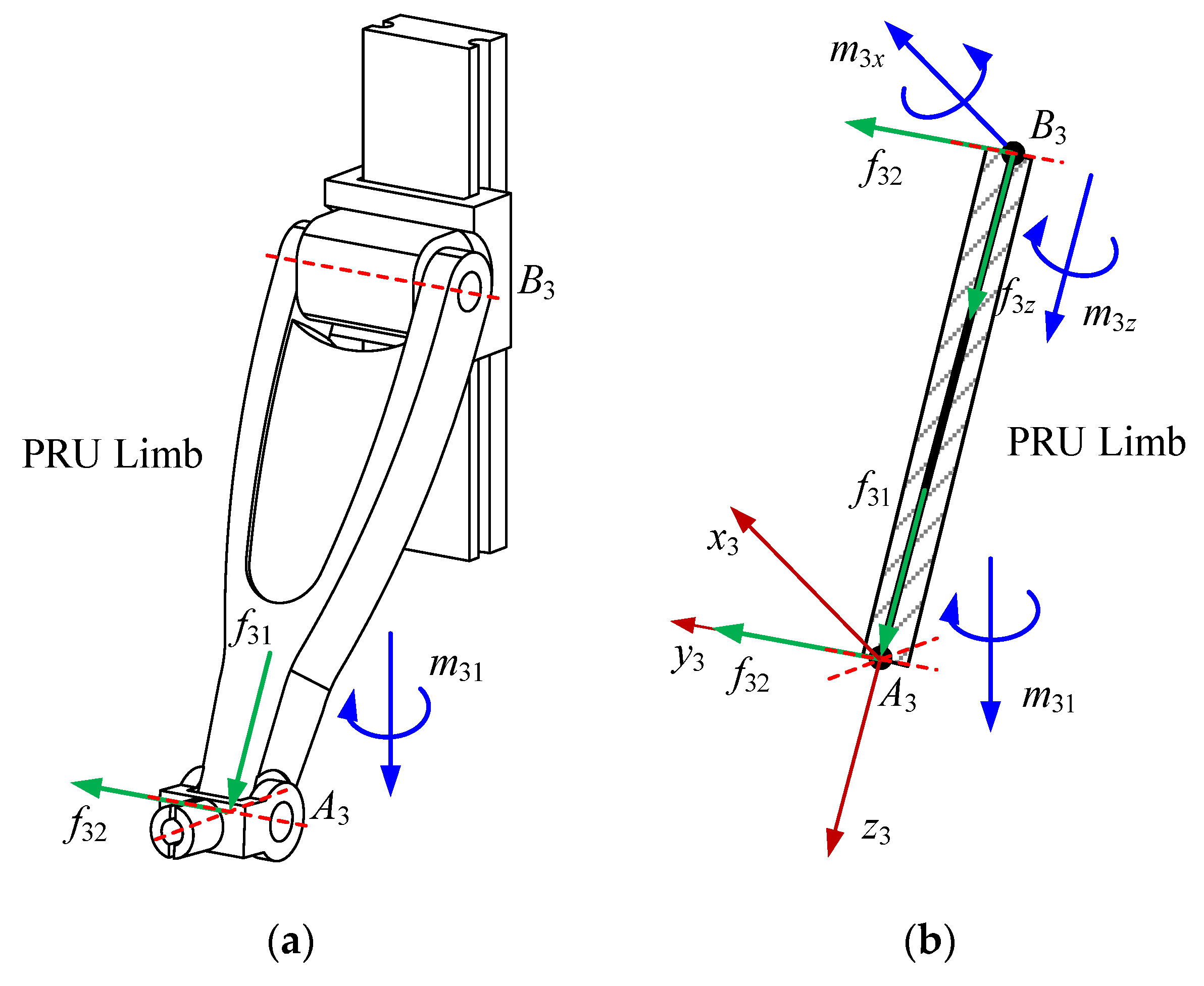
3.2. Stiffness Matrices of PRU Limbs
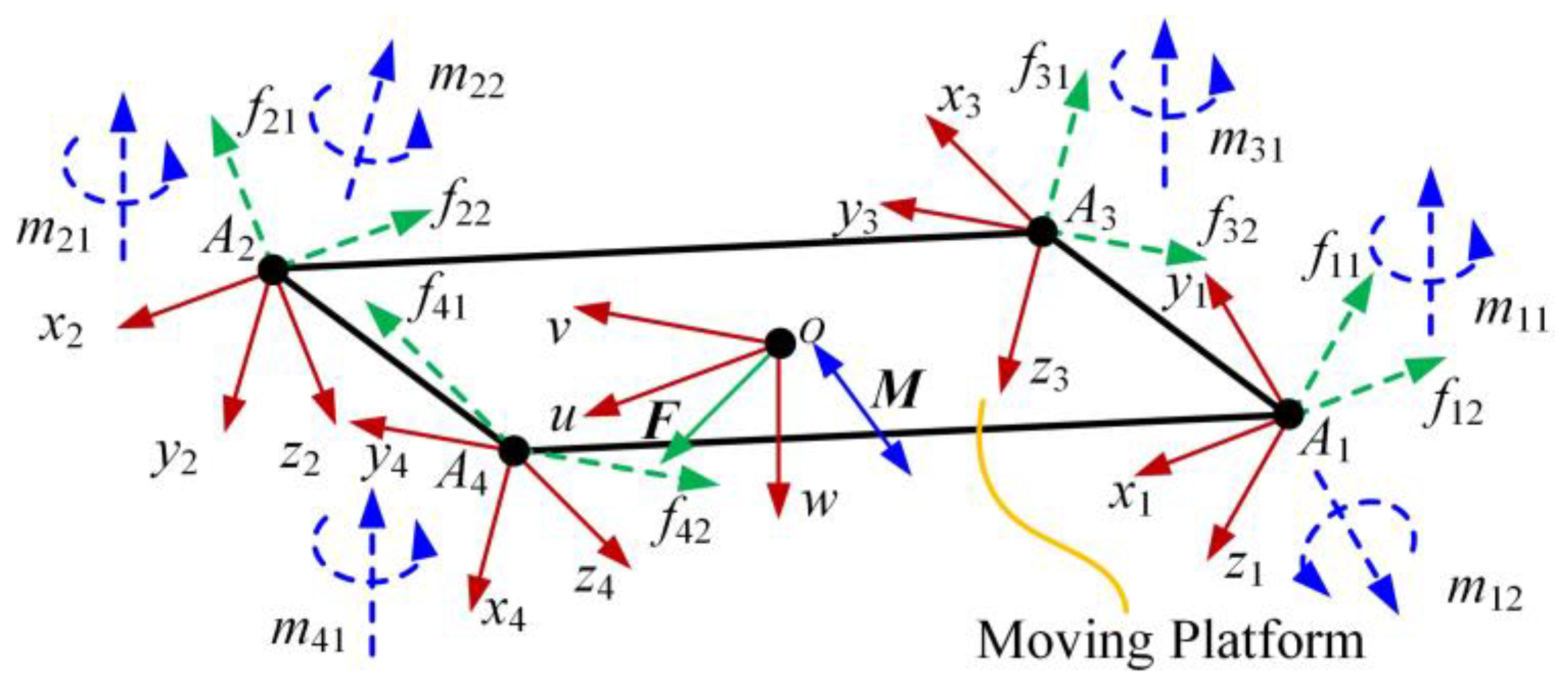
3.3. Overall Stiffness Matrix of the 2UPR–2PRU PM
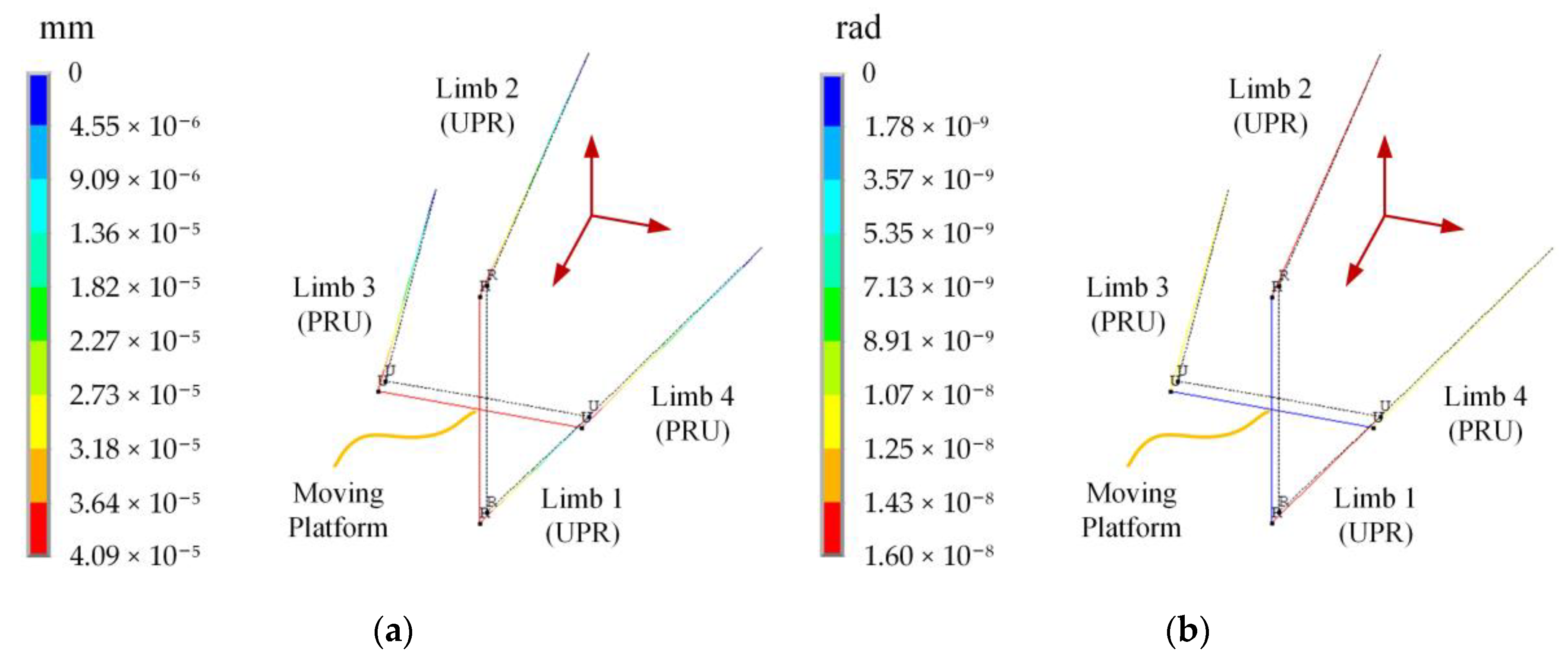
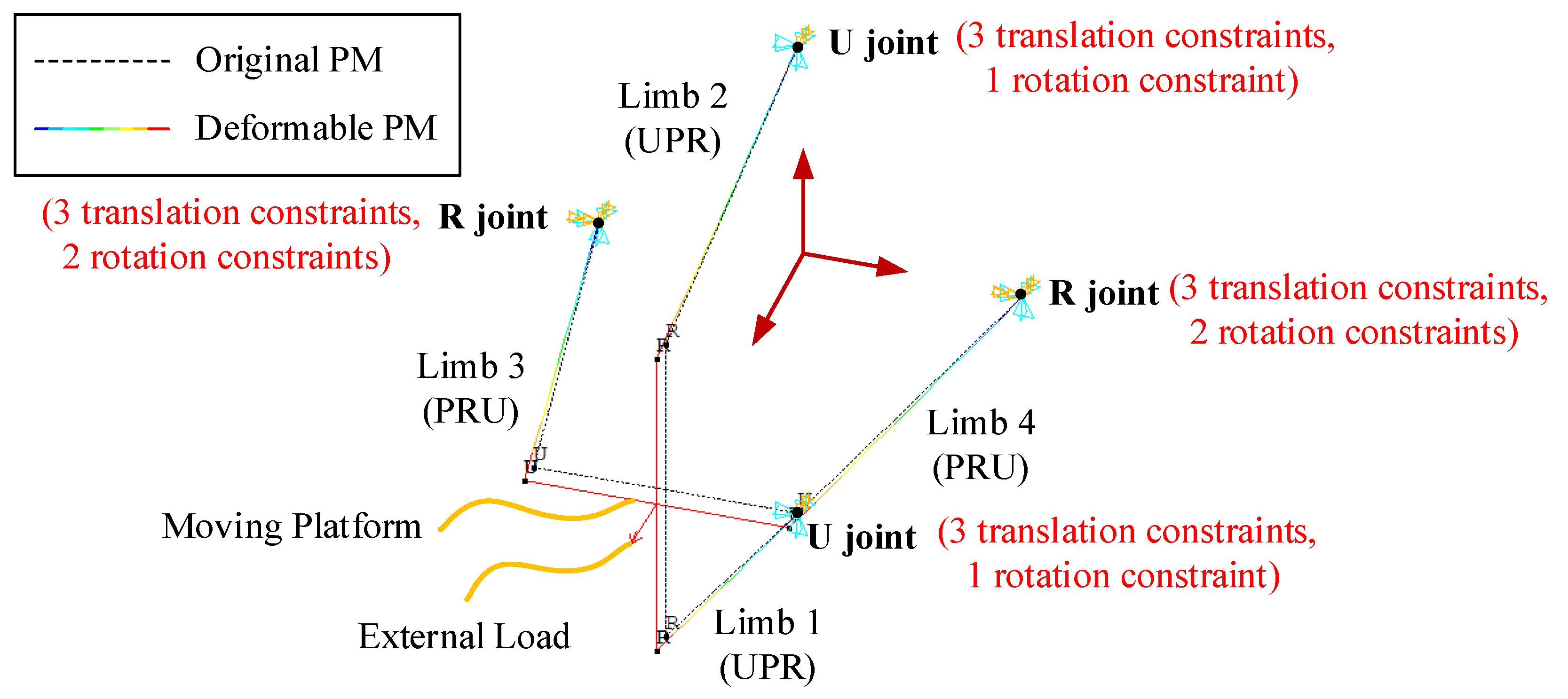
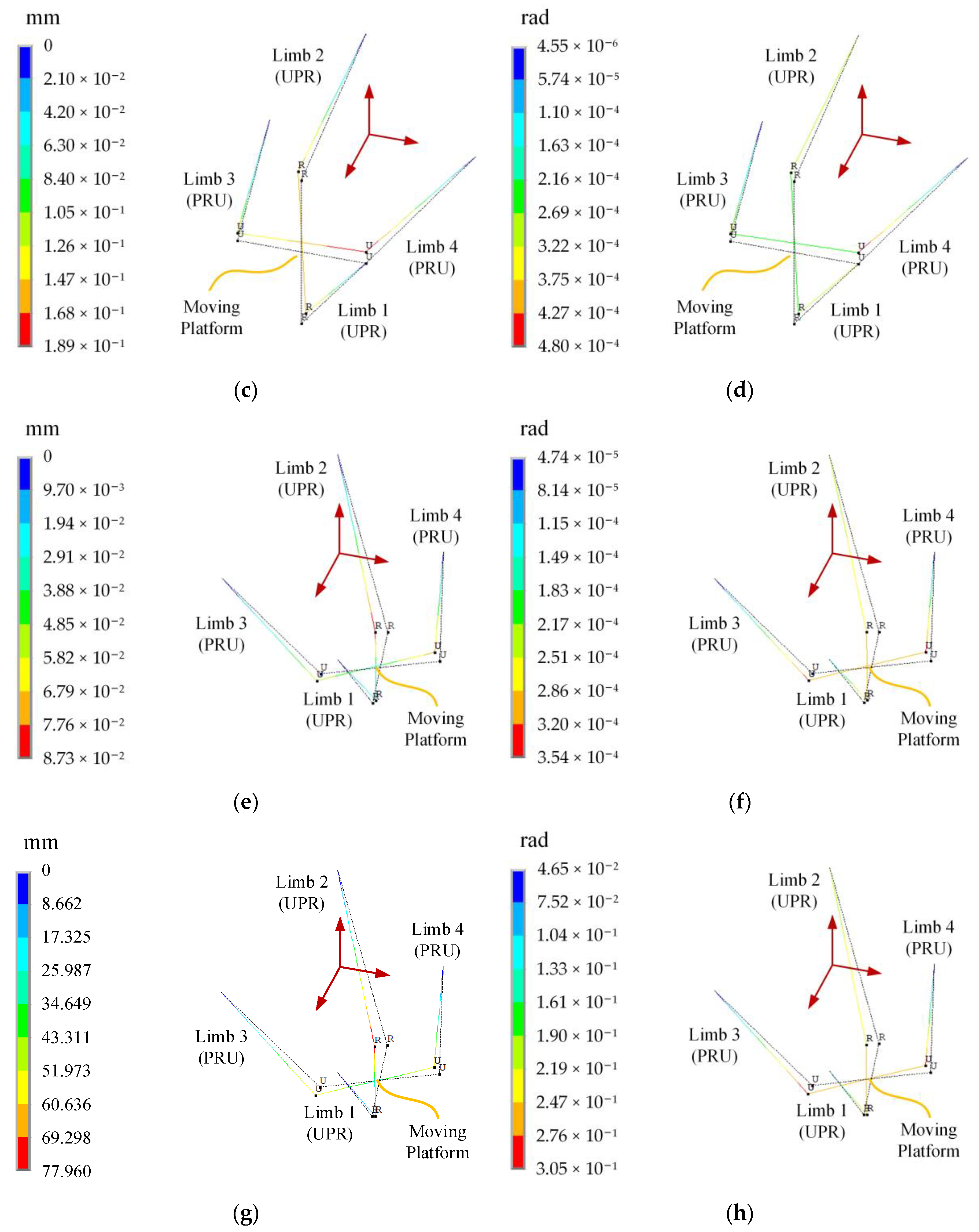
3.4. Comparisons of Theoretical Results with the FEA Method
4. Stiffness Performance Evaluation of the Redundantly Actuated 2UPR–2PRU PM
5. Conclusions
Author Contributions
Funding
Data Availability Statement
Conflicts of Interest
References
- Kim, J.; Park, F.C.; Ryu, S.J.; Kim, J.; Hwang, J.C.; Park, C.; Iurascu, C.C. Design and analysis of a redundantly actuated parallel mechanism for rapid machining. IEEE Trans. Robot. Autom. 2001, 17, 423–434. [Google Scholar] [CrossRef] [Scilit]
- Wang, L.P.; Wu, J.; Wang, J.S.; You, Z. An experimental study of a redundantly actuated parallel manipulator for a 5-DOF hybrid machine tool. IEEE/ASME Trans. Mechatron. 2009, 14, 72–81. [Google Scholar] [CrossRef] [Scilit]
- Xu, L.M.; Chai, X.X.; Li, Q.C.; Zhang, L.A.; Ye, W. Design and experimental investigation of a new 2R1T overconstrained parallel kinematic machine with actuation redundancy. J. Mech. Robot. 2019, 11, 031016. [Google Scholar] [CrossRef] [Scilit]
- Gosselin, C.; Schreiber, L.T. Redundancy in parallel mechanisms: A review. Appl. Mech. Rev. 2018, 70, 010802. [Google Scholar] [CrossRef] [Scilit]
- Lee, M.; Jeong, H.; Lee, D. Design optimization of 3-DOF redundant planar parallel kinematic mechanism based finishing cut stage for improving surface roughness of FDM 3D printed sculptures. Mathematics 2021, 9, 961. [Google Scholar] [CrossRef] [Scilit]
- Shen, X.D.; Xu, L.M.; Li, Q.C. Motion/force constraint indices of redundantly actuated parallel manipulators with over constraints. Mech. Mach. Theor. 2021, 165, 104427. [Google Scholar] [CrossRef] [Scilit]
- Siciliano, B.; Khatib, O. Handbook of Robotics; Springer: Berlin/Heidelberg, Germany, 2008. [Google Scholar]
- EI-Khasawneh, B.S.; Ferreira, P.M. Computation of stiffness and stiffness bounds for parallel link manipulators. Int. J. Mach. Tools Manuf. 1999, 39, 321–342. [Google Scholar] [CrossRef] [Scilit]
- Corradini, C.; Fauroux, J.; Krut, S.; Company, O. Evaluation of a 4-degree of freedom parallel manipulator stiffness. In Proceedings of the 11th World Congress in Mechanisms and Machine Science, Tianjin, China, 18–21 August 2003; pp. 1857–1861. [Google Scholar]
- Bouzgarrou, B.; Fauroux, J.; Gogu, G.; Heerah, Y. Rigidity analysis of T3R1 parallel robot with uncoupled kinematics. In Proceedings of the 35th International Symposium on Robotics, Paris, France, 23–26 March 2004; pp. 1–6. [Google Scholar]
- Rizk, R.; Fauroux, J.C.; Munteanu, M.; Gogu, G. A comparative stiffness analysis of a reconfigurable parallel machine with three or four degrees of mobility. J. Mach. Eng. 2006, 6, 45–55. [Google Scholar]
- Klimchik, A.; Pashkevich, A.; Chablat, D. CAD-based approach for identification of elasto-static parameters of robotic manipulators. Finite Elem. Anal. Des. 2013, 75, 19–30. [Google Scholar] [CrossRef] [Scilit]
- Pashkevich, A.; Chablat, D.; Wenger, P. Stiffness analysis of overconstrained parallel manipulators. Mech. Mach. Theor. 2009, 44, 966–982. [Google Scholar] [CrossRef] [Scilit]
- Klimchik, A.; Chablat, D.; Pashkevich, A. Stiffness modeling for perfect and non-perfect parallel manipulators under internal and external loadings. Mech. Mach. Theor. 2014, 79, 1–28. [Google Scholar] [CrossRef] [Scilit]
- Lončarič, J. Normal forms of stiffness and compliance matrices. IEEE J. Robot. Autom. 1987, 3, 567–572. [Google Scholar] [CrossRef] [Scilit]
- Gosselin, C. Stiffness mapping for parallel manipulators. IEEE Trans. Robot. Autom. 1990, 6, 377–382. [Google Scholar] [CrossRef] [Scilit]
- Gosselin, C.; Zhang, D. Stiffness analysis of parallel mechanisms using a lumped model. Int. J. Robot. Autom. 2002, 17, 17–27. [Google Scholar]
- Zhang, D.; Xi, F.F.; Mechefske, C.M.; Lang, S.Y. Analysis of parallel kinematic machine with kinetostatic modelling method. Robot. Comput.-Integr. Manuf. 2004, 20, 151–165. [Google Scholar] [CrossRef] [Scilit]
- Xi, F.F.; Zhang, D.; Mechefske, C.M.; Lang, S.Y. Global kinetostatic modelling of tripod-based parallel kinematic machine. Mech. Mach. Theor. 2004, 39, 357–377. [Google Scholar] [CrossRef] [Scilit]
- Ciblak, N.; Lipkin, H. Asymmetric Cartesian stiffness for the modelling of compliant robotic systems. In Proceedings of the ASME 1994 Design Technical Conferences collocated with the ASME 1994 International Computers in Engineering Conference and Exhibition and the ASME 1994 8th Annual Database Symposium, Minneapolis, MN, USA, 11–14 September 1994; pp. 197–204. [Google Scholar]
- Žefran, M.; Kumar, V. Affine connections for the Cartesian stiffness matrix. In Proceedings of the 1997 IEEE International Conference on Robotics and Automation, Albuquerque, NM, USA, 20–25 April 1997; pp. 1376–1381. [Google Scholar]
- Howard, S.; Žefran, M.; Kumar, V. On the 6 × 6 Cartesian stiffness matrix for three-dimensional motions. Mech. Mach. Theor. 1998, 33, 389–408. [Google Scholar] [CrossRef] [Scilit]
- Žefran, M.; Kumar, V. Coordinate-free formulation of the cartesian stiffness matrix. In Recent Advances in Robot Kinematics; Springer: Dordrecht, The Netherlands, 1996; pp. 119–128. [Google Scholar]
- Alici, G.; Shirinzadeh, B. Enhanced stiffness modeling, identification and characterization for robot manipulators. IEEE Trans. Robot. 2005, 21, 554–564. [Google Scholar] [CrossRef] [Scilit]
- Kövecses, J.; Angeles, J. The stiffness matrix in elastically articulated rigid-body systems. Multibody Syst. Dyn. 2007, 18, 169–184. [Google Scholar] [CrossRef] [Scilit]
- Portman, V.T. Stiffness evaluation of machines and robots: Minimum collinear stiffness value approach. J. Mech. Robot. 2011, 3, 011015. [Google Scholar] [CrossRef] [Scilit]
- Portman, V.T. Robot stiffness evaluability problem: Solution by Schur complements and collinear stiffness values. Mech. Mach. Theor. 2021, 161, 104297. [Google Scholar] [CrossRef] [Scilit]
- Taghvaeipour, A.; Angeles, J.; Lessard, L. On the elastostatic analysis of mechanical systems. Mech. Mach. Theor. 2012, 58, 202–216. [Google Scholar] [CrossRef] [Scilit]
- Ding, J.Z.; Wang, C.J.; Wu, H.Y. Accuracy analysis of redundantly actuated and overconstrained parallel mechanisms with actuation errors. J. Mech. Robot. 2018, 10, 061010. [Google Scholar] [CrossRef] [Scilit]
- Cao, W.A.; Ding, H.F.; Yang, D.H. A method for compliance modeling of five degree-of-freedom overconstrained parallel robotic mechanisms with 3T2R output motion. J. Mech. Robot. 2017, 9, 011011. [Google Scholar] [CrossRef] [Scilit]
- Yu, G.; Wang, L.P.; Wu, J.; Wang, D.; Hu, C.J. Stiffness modeling approach for a 3-DOF parallel manipulator with consideration of nonlinear joint stiffness. Mech. Mach. Theor. 2018, 123, 137–152. [Google Scholar] [CrossRef] [Scilit]
- Xu, L.M.; Li, Q.C.; Zhang, N.B.; Chen, Q.H. Mobility, kinematic analysis, and dimensional optimization of new three-degrees-of-freedom parallel manipulator with actuation redundancy. J. Mech. Robot. 2017, 9, 041008. [Google Scholar] [CrossRef] [Scilit]
- Yang, C.; Li, Q.C.; Chen, Q.H.; Xu, L.M. Elastostatic stiffness modeling of overconstrained parallel manipulators. Mech. Mach. Theor. 2018, 122, 58–74. [Google Scholar] [CrossRef] [Scilit]
- Yan, S.J.; Ong, S.K.; Nee, A.Y.C. Stiffness analysis of parallelogram-type parallel manipulators using a strain energy method. Robot. Comput.-Integr. Manuf. 2016, 37, 13–22. [Google Scholar] [CrossRef] [Scilit]
- Enferadi, J.; Tootoonchi, A.A. Accuracy and stiffness analysis of a 3-RRP spherical parallel manipulator. Robotica 2011, 29, 193–209. [Google Scholar] [CrossRef] [Scilit]
- Rezaei, A.; Akbarzadeh, A.; Akbarzadeh, T.M. An investigation on stiffness of a 3-PSP spatial parallel mechanism with flexible moving platform using invariant form. Mech. Mach. Theor. 2012, 51, 195–216. [Google Scholar] [CrossRef] [Scilit]
- Rezaei, A.; Akbarzadeh, A. Position and stiffness analysis of a new asymmetric 2PRR–PPR parallel CNC machine. Adv. Robot. 2013, 27, 133–145. [Google Scholar] [CrossRef] [Scilit]
- Xu, Y.D.; Yao, J.T.; Jin, L.R.; Zhao, Y.S. Method for force analysis of the overconstrained parallel mechanism considering the link’s spatial composite elastic deformations. J. Mech. Eng. 2015, 51, 53–60. [Google Scholar] [CrossRef] [Scilit]
- Courteille, E.; Deblaise, D.; Maurine, P. Design optimization of a Delta-like parallel robot through global stiffness performance evaluation. In Proceedings of the 2009 IEEE/RSJ International Conference on Intelligent Robots and Systems, Saint Louis, MO, USA, 10–15 October 2009; pp. 5159–5166. [Google Scholar]
- Carbone, G.; Ceccarelli, M. Comparison of indices for stiffness performance evaluation. Front. Mech. Eng. China 2010, 5, 270–278. [Google Scholar] [CrossRef] [Scilit]
- Angeles, J. On the nature of the Cartesian stiffness matrix. Ing. Mec. 2010, 3, 163–170. [Google Scholar]
- Wu, G.; Zou, P. Stiffness analysis and comparison of a Biglide parallel grinder with alternative spatial modular parallelograms. Robotica 2017, 35, 1310–1326. [Google Scholar] [CrossRef] [Scilit]

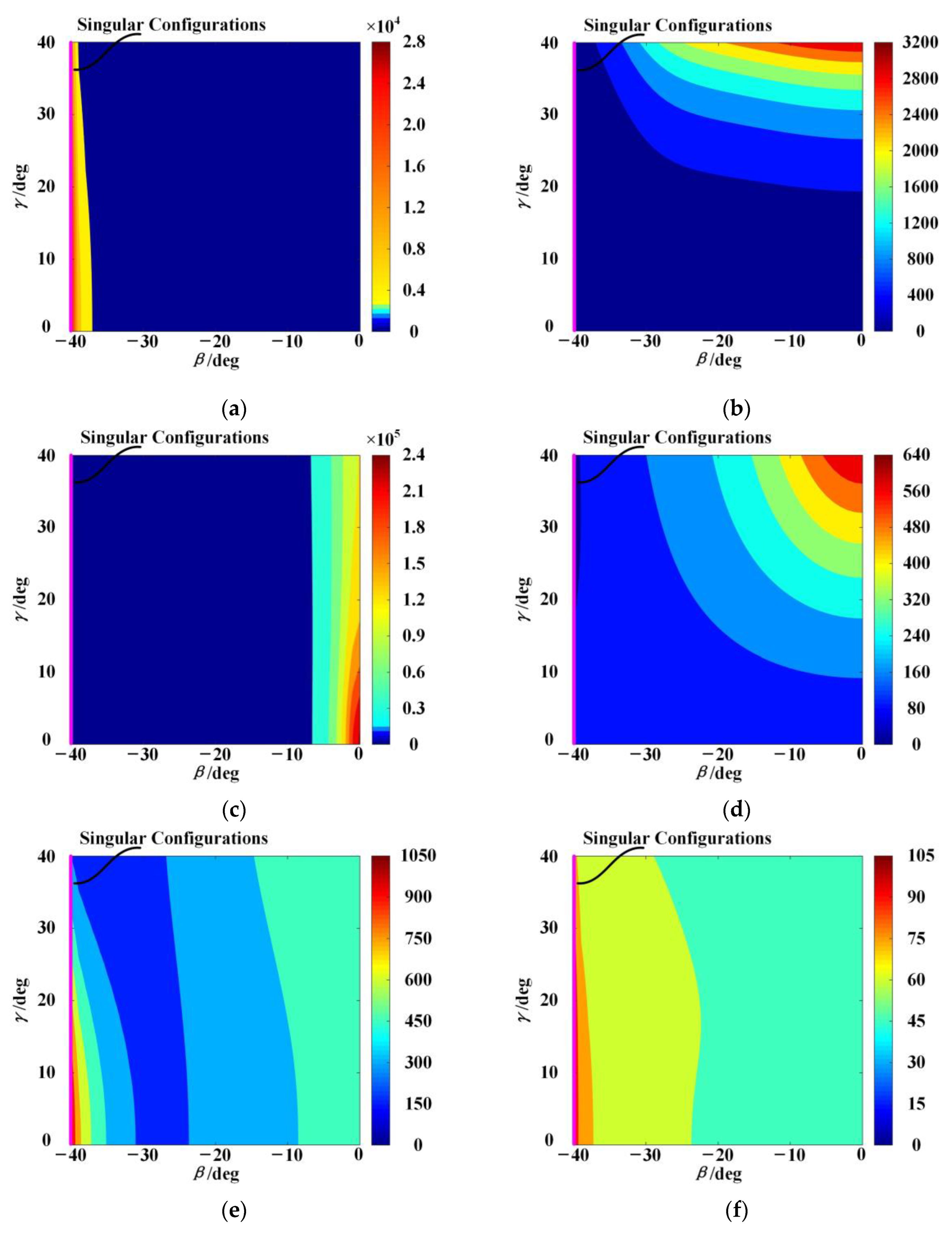
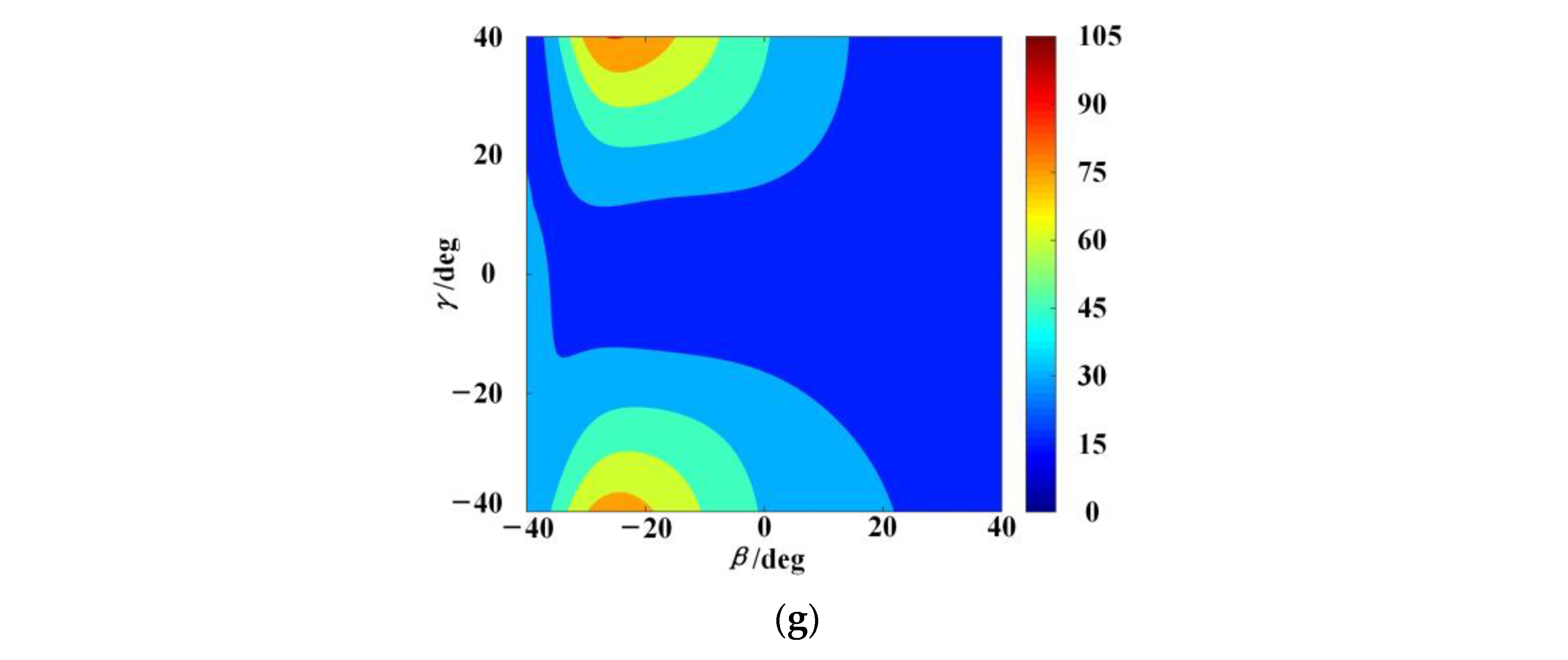
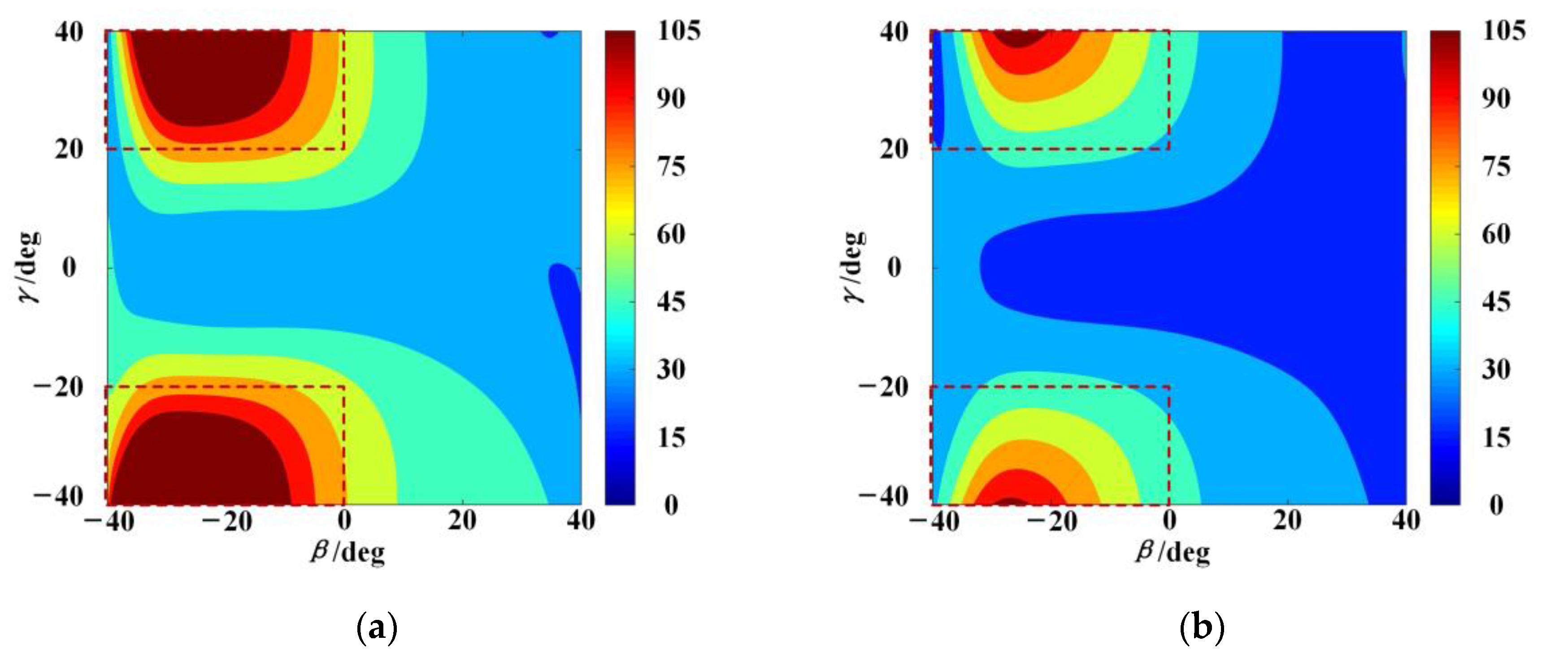
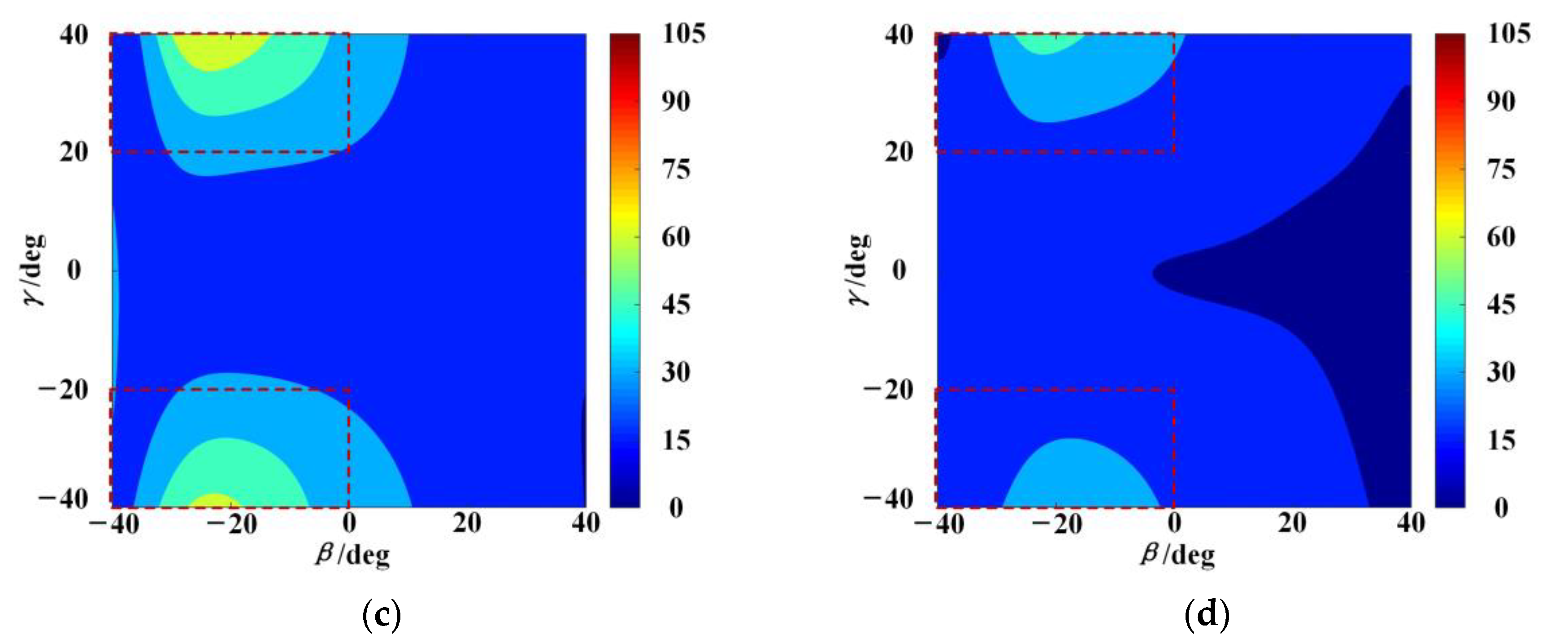

| Parameters | Units | Values |
|---|---|---|
| mm | 250 | |
| mm | 400 | |
| mm | 200 | |
| mm | 320 | |
| l | mm | 670 |
| d | mm | 50 |
| A | mm2 | 1963.50 |
| G | GPa | 80 |
| E | GPa | 210 |
| / | 0.33 | |
| rad | ±2π/9 | |
| rad | ±2π/9 |
| Parameters | Units | Case 1 | Case 2 | Case 3 | Case 4 |
|---|---|---|---|---|---|
| mm | 600 | 600 | 600 | 600 | |
| rad | 0 | 0 | pi/6 | pi/6 | |
| rad | 0 | 0 | pi/6 | pi/6 | |
| N | 0 | 100 | 100 | 60,000 | |
| N | 0 | 100 | 100 | 60,000 | |
| N | 100 | 100 | 100 | 100,000 | |
| Nm | 0 | 100 | 100 | 60,000 | |
| Nm | 0 | 100 | 100 | 60,000 | |
| Nm | 0 | 100 | 100 | 100,000 |
| Case | Method | (mm) | (mm) | (mm) | (rad) | (rad) | (rad) |
|---|---|---|---|---|---|---|---|
| Theory value | 0 | 0 | 4.0884 × 10⁻⁵ | 0 | 0 | 0 | |
| 1 | FEA value | −7.1557 × 10⁻¹⁷ | −5.7395 × 10⁻¹⁷ | 4.0916 × 10⁻⁵ | 1.3553 × 10⁻¹⁹ | −1.3553 × 10⁻¹⁹ | 1.9588 × 10⁻²⁰ |
| Relative error (%) | / | / | 0.08 | / | / | / | |
| Theory value | 3.0794 × 10⁻³ | 1.5333 × 10⁻¹ | 4.0884 × 10⁻⁵ | 1.5461 × 10⁻⁴ | −6.2931 × 10⁻⁷ | 1.7099 × 10⁻⁴ | |
| 2 | FEA value | 3.0859 × 10⁻³ | 1.5372 × 10⁻¹ | 4.0916 × 10⁻⁵ | 1.5500 × 10⁻⁴ | −6.3355 × 10⁻⁷ | 1.7138 × 10⁻⁴ |
| Relative error (%) | 0.21 | 0.25 | 0.08 | 0.25 | 0.67 | 0.23 | |
| Theory value | −2.6554 × 10⁻² | 1.1924 × 10⁻² | 1.5574 × 10⁻² | 1.5477 × 10⁻⁴ | 4.3138 × 10⁻⁵ | 2.3573 × 10⁻⁴ | |
| 3 | FEA value | −2.6459 × 10⁻² | 1.1991 × 10⁻² | 1.5513 × 10⁻² | 1.5565 × 10⁻⁴ | 4.2987 × 10⁻⁵ | 2.3709 × 10⁻⁴ |
| Relative error (%) | 0.36 | 0.56 | 0.39 | 0.57 | 0.35 | 0.57 | |
| Theory value | −25.9132 | −1.4088 | 15.8888 | 1.1980 × 10⁻¹ | 4.1705 × 10⁻¹ | 2.1121 × 10⁻¹ | |
| 4 | FEA value | −25.8250 | −1.3609 | 15.8330 | 1.2054 × 10⁻¹ | 4.1564 × 10⁻¹ | 2.1236 × 10⁻¹ |
| Relative error (%) | 0.34 | 3.52 | 0.35 | 0.61 | 0.34 | 0.54 |
| Operational Height (mm) | Orientation Ranges | Minimum Value (J−1) | Maximum Value (J−1) | Average Value (J−1) |
|---|---|---|---|---|
| Selected ranges | 32.3846 | 206.2666 | 106.9120 | |
| 450 | Other ranges | 28.8323 | 79.9983 | 43.6147 |
| Relative proportion | 112.32% | 257.84% | 245.13% | |
| Selected ranges | 21.2057 | 114.0750 | 63.0326 | |
| 550 | Other ranges | 19.9371 | 51.4777 | 30.5014 |
| Relative proportion | 106.36% | 221.60% | 206.65% | |
| Selected ranges | 16.1296 | 73.4454 | 40.4478 | |
| 650 | Other ranges | 14.5746 | 39.3239 | 22.6852 |
| Relative proportion | 110.67% | 186.77% | 178.30% | |
| Selected ranges | 13.2386 | 50.0849 | 27.8131 | |
| 750 | Other ranges | 11.1325 | 30.6698 | 17.5839 |
| Relative proportion | 118.92% | 163.30% | 158.17% |
Publisher’s Note: MDPI stays neutral with regard to jurisdictional claims in published maps and institutional affiliations. |
© 2022 by the authors. Licensee MDPI, Basel, Switzerland. This article is an open access article distributed under the terms and conditions of the Creative Commons Attribution (CC BY) license (https://creativecommons.org/licenses/by/4.0/).
Share and Cite
Chai, X.; Ye, W.; Li, Q.; Xu, L. Elastostatic Stiffness Modeling and Performance Evaluation of a 2UPR–2PRU Redundantly Actuated Parallel Manipulator. Machines 2022, 10, 1219. https://doi.org/10.3390/machines10121219
Chai X, Ye W, Li Q, Xu L. Elastostatic Stiffness Modeling and Performance Evaluation of a 2UPR–2PRU Redundantly Actuated Parallel Manipulator. Machines. 2022; 10(12):1219. https://doi.org/10.3390/machines10121219
Chicago/Turabian StyleChai, Xinxue, Wei Ye, Qinchuan Li, and Lingmin Xu. 2022. "Elastostatic Stiffness Modeling and Performance Evaluation of a 2UPR–2PRU Redundantly Actuated Parallel Manipulator" Machines 10, no. 12: 1219. https://doi.org/10.3390/machines10121219
APA StyleChai, X., Ye, W., Li, Q., & Xu, L. (2022). Elastostatic Stiffness Modeling and Performance Evaluation of a 2UPR–2PRU Redundantly Actuated Parallel Manipulator. Machines, 10(12), 1219. https://doi.org/10.3390/machines10121219