All articles published by MDPI are made immediately available worldwide under an open access license. No special
permission is required to reuse all or part of the article published by MDPI, including figures and tables. For
articles published under an open access Creative Common CC BY license, any part of the article may be reused without
permission provided that the original article is clearly cited. For more information, please refer to
https://www.mdpi.com/openaccess.
Feature papers represent the most advanced research with significant potential for high impact in the field. A Feature
Paper should be a substantial original Article that involves several techniques or approaches, provides an outlook for
future research directions and describes possible research applications.
Feature papers are submitted upon individual invitation or recommendation by the scientific editors and must receive
positive feedback from the reviewers.
Editor’s Choice articles are based on recommendations by the scientific editors of MDPI journals from around the world.
Editors select a small number of articles recently published in the journal that they believe will be particularly
interesting to readers, or important in the respective research area. The aim is to provide a snapshot of some of the
most exciting work published in the various research areas of the journal.
In this paper, we investigate the spectrum distribution and asymptotic behavior of an M//1 bulk service queueing system. In this system, the server processes customers in batches of a fixed maximum capacity B, and the time required to serve a batch is governed by a general distribution with a service rate function , which determines the instantaneous probability of service completion. The system dynamics are described by an infinite set of partial integro-differential equations. First, by introducing the probability generating function and employing Greiner’s boundary perturbation method, we establish that the time-dependent solution (TDS) of the system converges strongly to its steady-state solution (SSS) in the natural Banach state space. To this end, when the service rate is a bounded function, we prove that zero is an eigenvalue of both the system operator and its adjoint operator, with geometric multiplicity one. Moreover, we show that every point on the imaginary axis except zero belongs to the resolvent set of the system operator. Second, we analyze the spectrum of the system operator on the left real axis. When the service rate is constant and the fixed maximum capacity B equals 2, we apply Jury’s stability criterion for cubic equations to demonstrate that the system operator possesses an uncountably infinite number of eigenvalues located on the negative real axis. Additionally, we prove that an open interval near zero on the left real axis is not part of the point spectrum of the system operator. Consequently, these results imply that the semigroup generated by the system operator is not compact, eventually compact, quasi-compact, or essentially compact.
In this paper, we investigate the spectrum distribution and asymptotic behavior of an M//1 bulk service queueing system. The M//1 queue is a classical bulk-service (or batch-service) queueing model. Here, M denotes a Poisson arrival process, signifies a general bulk-service time distribution, and 1 indicates a single server. In this system, customers arrive singly according to a Poisson process with rate . The server processes customers in batches. A defining feature is the service rule governed by a fixed bulk capacity, denoted by B (a positive integer). This capacity is the maximum number of customers the server can process simultaneously in a single service batch. The service rule operates as follows: If, upon the server becoming free, the queue length is less than a preset threshold minimum m (where ), the server remains idle, waiting for more arrivals until at least m customers are present. This minimum service threshold m prevents the inefficient servicing of very small batches. If the queue length n is at least m but does not exceed the maximum capacity B (i.e., ), the server takes all n waiting customers to form a single batch and begins service. If the queue length n exceeds B, the server takes exactly B customers to form a full batch, leaving customers waiting in the queue. The service time for a batch is a random variable following a general distribution, independent of batch size, provided the batch size is between m and B.
The mathematical model of this system can be described by the following system of integro-differential equations (see, e.g., [1,2])
where ; represents the probability that the system is empty and the server is idle at time t; represents the probability at time t that the n customers are in the queue, the server is up, and the elapsed service time lies in ; is the arrival rate of customers; is the service completion rate at time x and satisfies
Bulk service queuing systems, where customers are served in groups rather than individually, are fundamental to modeling and optimizing efficiency in numerous real-world operational processes. Their applications span industrial, transportation, and service sectors, providing critical insights into system design and capacity management. For example, in the transportation systems, bulk service models are indispensable. A primary application is elevator and lift operations. Passengers arriving at a lobby floor form a queue; the elevator cabin, with a finite capacity, serves them as a group. The system’s performance, measured by average passenger waiting time and elevator throughput, is governed by batching rules (e.g., filling to capacity or time-based dispatch) and the stochastic arrival of passengers. Similarly, aircraft boarding is a complex bulk service process where passengers are boarded in groups (e.g., by zone or row). Optimizing the boarding group sequence is directly analogous to managing a bulk service queue to minimize the total boarding time, which is the service time for the entire aircraft batch. In packet-switched networks, data packets arrive at a router and are transmitted in batches constrained by the Maximum Transmission Unit size. The router’s buffer management and packet aggregation strategies are effectively bulk service policies. In big data analytics, computing clusters often process jobs in batches to optimize resource allocation, where a job may consist of multiple parallel tasks served simultaneously by a group of servers. The theory of bulk queues has been extensively studied and is well established. A key reference in this field is the monograph by Chaudhry and Templeton [3]; for recent developments, refer to works such as [4,5,6,7].
The M//1 bulk service queueing system was investigated in [1,8]. Using the supplementary variable technique, the authors derived system (1) and obtained expressions for the expected queue size and its relationship with the expected customer waiting time under steady-state conditions, based on the following assumptions:
;
.
These naturally lead to the following two hypotheses within the framework of partial differential equations (see [9,10]):
Hypothesis (1): There exists a nonnegative TDS to the system (1).
Hypothesis (2): The TDS of system (1) approaches a non-zero steady state as .
In the work of [2], it was shown under certain conditions that system (1) possesses a unique positive TDS by employing -semigroup theory. This result confirms the validity of Hypothesis (1). When the service rate reduces to a constant , the M//1 bulk service queueing system is referred to as the M//1 bulk service queueing system. Hypothesis (2) was examined in [11,12]. There, it was established that zero is an eigenvalue of the underlying operator associated with system (1), while all other points on the imaginary axis are not in its spectrum, provided that the service rate is constant and . These findings imply that the solution of system (1) converges to a non-zero SSS. Hence, Hypothesis (2) holds when is constant and . If , system (1) reduces to the classical M/G/1 queueing model [13], which has been studied in detail in [14,15,16].
In this paper, our aim is to study the spectrum distribution and asymptotic behavior of the TDS of system (1) under the condition that is a bounded function. To this end, we first reformulate system (1) as an abstract Cauchy problem in a suitable Banach space. Next, by introducing the probability generating function, we prove that zero is an eigenvalue of geometric multiplicity one for the system operator associated with the Cauchy problem. Then, using Greiner’s boundary perturbation approach [17], we show that when is bounded, all points on the imaginary axis except zero belong to the resolvent set of the system operator. We also demonstrate that zero is an eigenvalue of geometric multiplicity one for the adjoint operator of the system operator. These results imply that the TDS of system (1) converges strongly to its SSS when is bounded. Consequently, our findings generalize the main results of [11,12]. Moreover, in the special case where the service completion rate is constant and , by using Jury’s stability conditions for cubic equations [18,19], we prove that the system operator of (1) possesses uncountably many eigenvalues in interval and all points in the interval are not eigenvalues of this operator when . Consequently, these results imply that the semigroup generated by the system operator of system (1) is neither compact, eventually compact, quasi-compact, nor essentially compact.
The paper is structured as follows. Section 2 reformulates system (1) as a Cauchy problem in a Banach space and summarizes the relevant known results. Section 3 analyzes the asymptotic behavior of the TDS when the service rate is a bounded function. In Section 4, we examine the point spectrum along the left real axis. Section 5 investigates the compactness of the semigroup associated with the system. In Section 6, a numerical analysis is conducted based on the spectral analysis results presented in Section 4. The final section summarizes the findings and proposes several directions for further research.
2. The Abstract Cauchy Problem and a Review of Existing Results
Motivated by the system’s inherent structure, the natural underlying state space is chosen as follows:
It can readily be verified that X is a Banach space and also a Banach lattice. For convenience, we introduce
We further select the boundary space and introduce the boundary operators associated with system (1)
To analyze the asymptotic behavior of the system, we now introduce the system operator of system (1) by
Then, system (1) can be reformulated as an abstract Cauchy problem in the space X:
Let be the spectrum of , and let , , and denote its point, continuous, and residual spectra, respectively. Further, is the spectral bound, the growth bound, the spectral radius, and the resolvent set.
According to the work of Gupur et al. [2,11], the following outcomes were observed.
Theorem1.
If , then the operator defined by (2) generates a positive -semigroup of contractions on X. Thus, the system (3) admits a unique nonnegative TDS satisfying
if the initial value .
Theorem2.
Let be a constant and . Then, the following assertions hold true:
(i)
Zero is an eigenvalue of , and its geometric multiplicity is one.
(ii)
Specifically, all points on the imaginary axis except zero belong to the resolvent set of , where is the adjoint operator of .
By using the boundary perturbation method of Greiner [17], Haji and Radl [12] obtained the following result.
Theorem3.
Under the conditions of Theorem 2, the TDS of system (1) converges strongly to its SSS.
3. Strong Convergence of the TDS
In this section, we discuss the strong convergence of the TDS of system (1) when is a bounded function. In order to obtain the strong convergence of the TDS of system (1), we need to know the spectrum of on the imaginary axis [15]. The difficulty of investigating system (1) lies in the infinite number of equations and the boundary conditions. Fortunately, Greiner [17] proposed studying the spectrum of through perturbation of the boundary conditions in a different context; this has been used to study the Dirichlet operator in [12]. In this section, we use the method of Greiner [17] to show the spectrum of on the imaginary axis. In the following, first, we prove that zero is an eigenvalue of by introducing the probability generating function.
Lemma1.
If and , then zero is an eigenvalue of with geometric multiplicity one.
Proof.
We consider the equation , that is,
By solving the second and third equation of system (4), we have
It is difficult to determine the explicit expressions of all and to verify that . In what follows, we adopt an alternative approach, introduced in [1]. Specifically, we define the probability generating function as
for all complex variables . Therefore, employing system (4) together with the fundamental properties of power series, we obtain
That is,
For , the fourth and fifth equations of systems (4) and (6) yield
From Equation (9), the formula and the l’Hospital rule, it follows that
Therefore, from Equations (6) and (10) and the condition , we derive
Finally, for both sides of Equation (11), taking the integral from 0 to infinity, we obtain
Inequality (12) implies that . Moreover, it can be deduced from system (4) and Equation (5) that the geometric multiplicity of zero is one. □
Next, we employ Greiner’s boundary perturbation method [17] to determine the remaining spectrum of on the imaginary axis. For this purpose, we introduce the operator with zero boundary conditions, as follows:
and then investigate the invertibility of .
For any given , we consider the equation , that is,
Then, system (13) corresponds to Equations (4.9)–(4.12) in [15], where . From [15], we know that
where
for all .
According to Lemmas 4.2 and 4.3 of [15], we have the following result:
Lemma2.
Let and be measurable and
Then, . Furthermore, if , then if and only if
In addition, using this definition it is not difficult to see that is surjective. Moreover,
is invertible for . For , we define the Dirichlet operators as
Then, Lemma 2 provides the closed form of for and ,
where
From Equation (16) and definition of , a simple calculation shows that for ,
The following Lemma 3, which will be used to characterize the resolvent set of on the imaginary axis, is taken from [12].
Lemma3.
Assume that belongs to the resolvent set . Further assume that there exists a such that . Then, is an element of the spectrum if and only if .
Lemma4.
Under the conditions of Lemma 2, every point on the imaginary axis, with the exception of zero, lies in the resolvent set of .
Proof.
Let and . The Riemann–Lebesgue lemma
implies that there exists constants and such that
Through Equations (17) and (18), the inequality and , we have
That is,
Inequality (19) shows that when , the spectral radius of satisfies
where . This implies that for . Therefore, using Lemma 3 we deduce that for , that is,
On the other hand, since Theorem 1 guarantees that the semigroup is positive and uniformly bounded, it follows from Corollary 2.3 of [20] (p. 297) that is imaginary additively cyclic. That is, if , then for every integer k. Combining this property with (20) and Lemma 1 yields . □
Similar to [11], we obtain the following expression of , the adjoint operator of :
where
with domain
where is a nonzero constant which is irrelevant to n in , and
Lemma5.
If and , then zero is an eigenvalue of with geometric multiplicity one.
Proof.
We consider the equation , that is,
It is easy to see that is a nonzero solution of system (21), where . In addition, system (21) is equivalent to
(22) means that the geometric multiplicity of zero is one. □
Consequently, by applying Theorem 1, Lemmas 1, 4, 5, and Theorem 14 from [14], we arrive at the main result of this section.
Theorem4.
Let and be measurable function and satisfies
If , then the TDS of system (1) converges strongly to its SSS, that is,
where and are eigenvectors in Lemmas 1 and 5, respectively.
Theorem 4 implies that, under the conditions stated in the Theorem, Hypothesis (2) holds in the sense of strong convergence.
Remark1.
Theorem 4 means that our result includes the main results of Theorems 2 and 3.
4. Spectrum of the System Operator on the Left Complex Plane
In this section, we consider the spectral distribution of the system operator of system (1) on the left half complex plane when the service rate function is a constant.
Multiplying the two sides of Equation (31) by and subtracting Equation (32) yields
If and are constant, then system (1) becomes the classical M/M/1 queueing model [13]. In [16,21,22,23] teh authors obtained the following results:
Theorem5.
Let and be constant in system (1). Then, we have the following results:
(i)
If , then
and the geometric multiplicity of each point in this set is one. Specifically,
(I)
.
(II)
If , then .
(III)
, where and b satisfies and
(ii)
If and , then .
Hence, if , then the semigroup is not compact, eventually compact, or even quasi-compact. Consequently, it is impossible that the TDS of system (1) (or the M//1 bulk service queueing system) exponentially converges to its SSS.
In the following, we consider the case in Equations (23)–(27). When , we have the following results.
Theorem6.
Assume that .
(i)
If , then all points in the interval are the eigenvalues of with a geometric multiplicity of one.
(ii)
If , then we have .
Proof.
We consider equation . When , Equation (33) becomes
In the following, we first determine by analyzing the characteristic equation of U, and then compute . The characteristic equation of U is given by , which implies that
Then, using the root-finding formula of a cubic equation, the three roots , and of Equation (36) can be written as
where .
According to a fundamental result in linear algebra, there exists an invertible matrix
(1) According to the results presented in [18,19], the necessary and sufficient conditions for all roots of the cubic equation
to have a modulus that is strictly less than one are given by the so-called Jury conditions (see [18,19]):
If we take and , then and c satisfy the inequalities in Equation (39). In fact, when and , we calculate that
Therefore, Equation (40a–c) mean that Equation (36) has three roots— and —with an absolute value (modulus) less than one when and .
Hence, when and , by using Equations (26), (31), (40a–c) and (38), we have
Therefore, using Equations (30) and (41), we obtain
Consequently, Equations (42), (23) and (28) mean that if , then all points in are eigenvalues of . Moreover, from Equations (26), (30) and (31), we deduce that the geometric multiplicity of each is one.
(2) We set
Case I. Let and . If , then, using Equation (43), we have
This means that is a root of Equation (36). Hence, can be written as
Case II. When and . From (39), it is easy to show that the Jury’s necessary and sufficient condition (2) fails for . In this case, it is easy to see that
and
Hence, through the continuity of , from (45) and (46), we deduce that there exists a real root of that satisfies . Thus,
for . Then, we can write as
Clearly, the above cubic Equation (48) has real coefficients, and the two roots and , other than , are either both real or complex conjugates. In addition, the product of the three roots . Hence,
Since , we have . Also, from the Vieta formula, , that is, . It is easy to see that and are the roots of , and . Therefore, if and are real roots, then they are either both strictly greater than 0 or both strictly less than zero. On the other hand, , we deduce that and . Since , we have
Then, becomes . Therefore, the two roots and of this equation satisfy
If , then by using , , , and Equation (49), we estimate
Thus, for and , from Equations (38), (47) and (49)–(51), we deduce that
Therefore, . □
The results of Theorem 6 are significantly different from the result of Theorem 5.
Remark2.
From the proof of Theorem 6 (2) it is easy to show that, if and in Equations (23)–(27), then .
5. Compactness of the Semigroup
In this section, we consider the compactness of the semigroup generated by the system operator of system (1). A strongly continuous semigroup is called eventually compact if there exists such that is compact for all . A strongly continuous semigroup on a Banach space X is called quasi-compact if
A semigroup is said to be essentially compact if its essential growth bound is strictly smaller than its growth bound (see [24], Definition 2.4).
Theorem7.
If and , the semigroup is not compact, eventually compact, quasi-compact or even essentially compact.
Proof.
Theorem 6 means that has an uncountable infinite number of eigenvalues on the left real axis, and Theorem IV. 3.7 of [25] (p. 277) leads to
Hence, we can obtain that has an uncountable infinite number of eigenvalues and therefore is not a compact semigroup. In addition, through corollary V.3.2 of [25] (p. 330), we know that if is an eventually compact semigroup, then the spectrum is countable (or finite or empty). Thus, using Theorem 6 we deduce that is not an eventually compact semigroup. By using the similar method of Theorem 4.2 of [26], we obtain that the spectrum-determined growth condition holds for and , where is the spectral bound of and is the growth bound of . In addition, through corollary IV.2.11 of [25] (p. 258), and using a similar discussion to Theorem 4.3 of [26] we deduce that , where is the essential growth bound of . From Proposition 3.5 of [25] (p. 332), we know that is quasi-compact semigroup if and only if . Hence, the semigroup is not quasi-compact. Finally, from the above discussions, we can deduce that . Therefore, using the definition of 2.4 of [24], we obtain that is not an essentially compact semigroup. □
These results of Theorem 7 differ markedly from the compactness of the semigroup for systems described by a finite number of partial differential equations, as seen in [24,27,28,29].
6. Numerical Analysis Report on Root Moduli of Cubic Equation
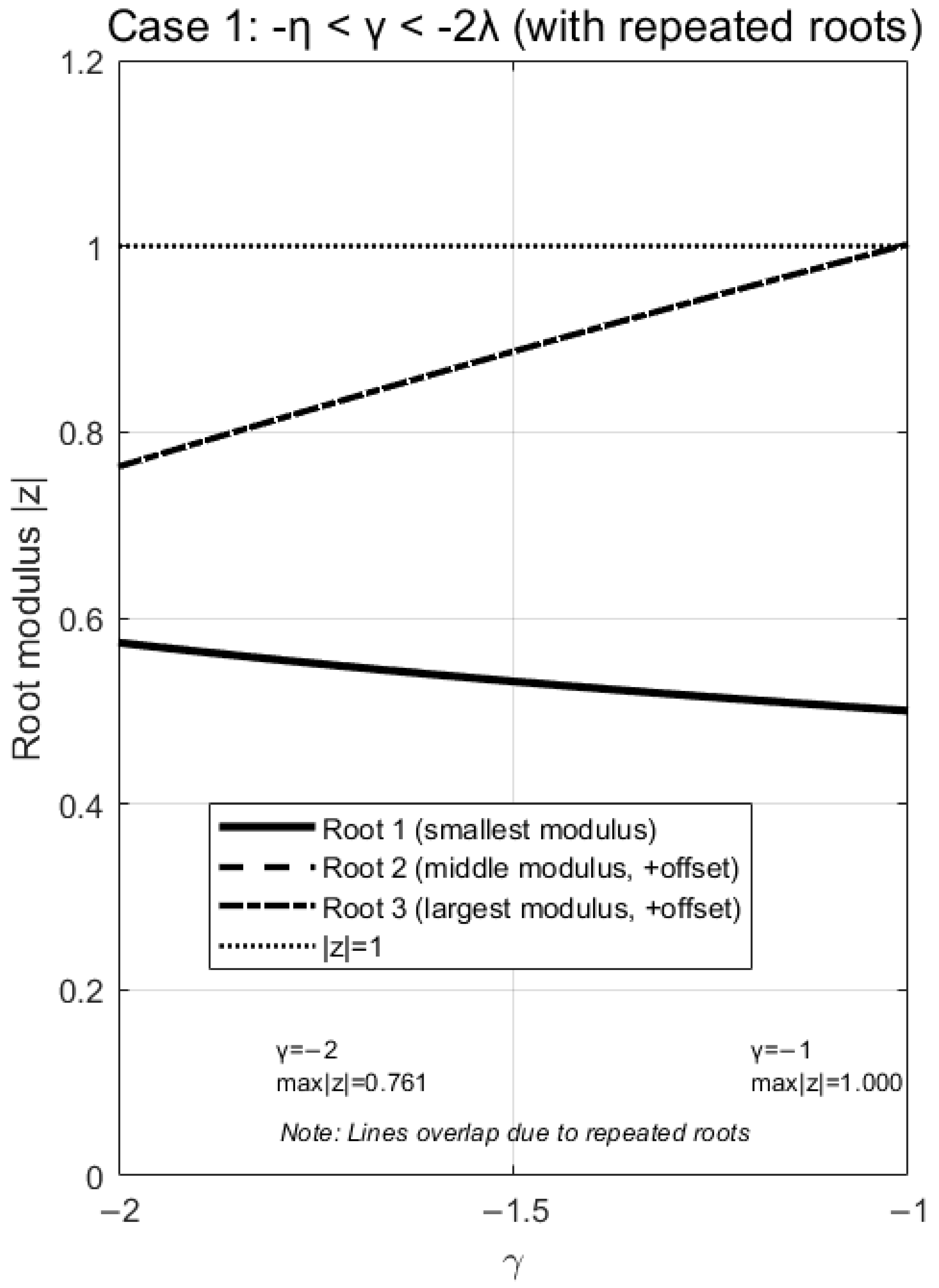
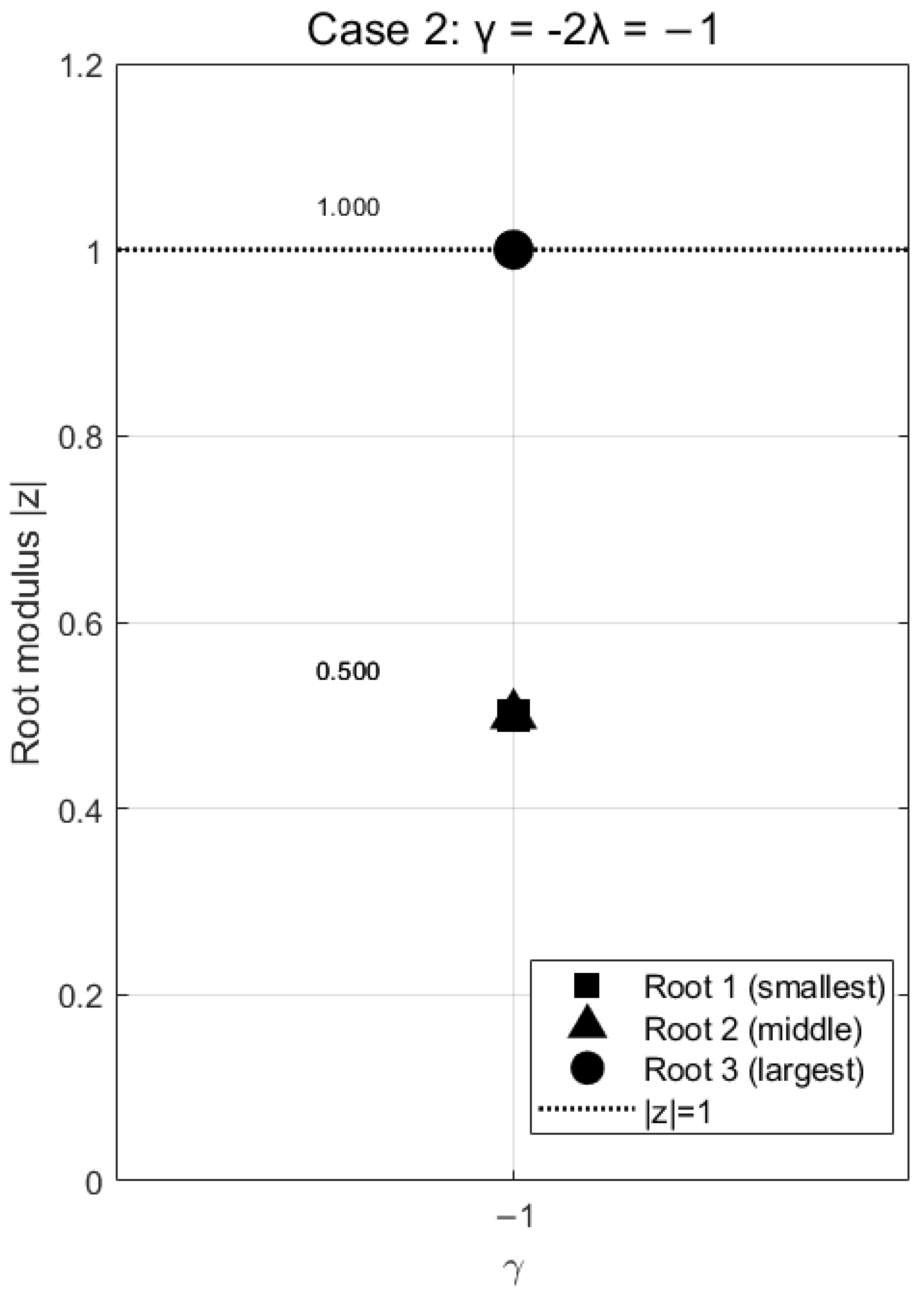
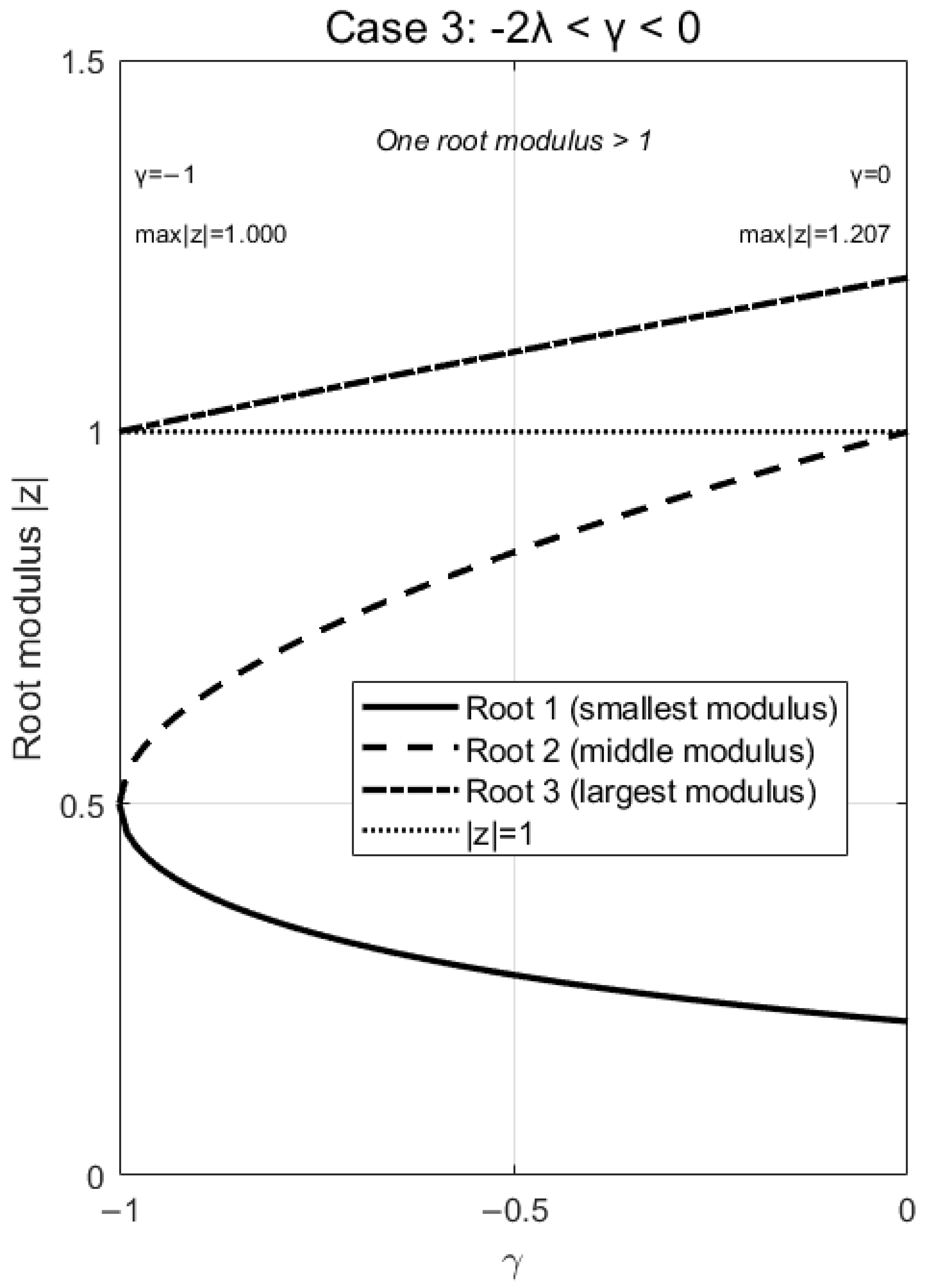
In this section, we use Matlab (https://www.mathworks.com) to conduct a numerical analysis of the spectral results established in Theorem 6. Specifically, for the parameter values and , we examine three distinct cases: , , and .
In Figure 1, . The figure displays two curves: the green line represents the moduli of a pair of complex conjugate roots, while the red line represents the modulus of the real root. As increases from to , the modulus of the complex conjugate roots decreases monotonically from to , and the modulus of the real root increases monotonically from to . All root moduli are less than 1 (the real root equals 1 at ), indicating that the system satisfies the Jury stability conditions. The monotonic changes suggest a linear relationship between the parameter and root moduli, and the existence of complex conjugate pairs verifies the algebraic properties of real-coefficient polynomials. It is worth noting that, in Figure 1, two roots of the cubic equation are always equal, so the moduli of the three roots only have two distinct values, resulting in only two curves shown in the figure.
In Figure 2, . The three roots are represented by different markers: blue circles () and green squares () denote the complex conjugate roots, while the red triangle () denotes the real root. This point represents the critical state of the system, where the real root lies exactly on the unit circle. The numerical results verify the theoretically predicted critical value , at which the Jury conditions are at their boundary. This figure intuitively demonstrates the dividing point between stable and unstable regions.
In Figure 3, . The green line (modulus of complex conjugate roots) remains constant at , while the red line (modulus of the real root) increases monotonically from to . The complex conjugate roots are fixed at , invariant with respect to ; the real root continuously moves leftward along the negative real axis, with its modulus continuously increasing. The system loses stability as one root modulus exceeds 1. This pattern of “locked complex roots and divergent real root” reveals the dynamical mechanism of system instability.
The results in the three figures above indicate that the conclusion of Theorem 6 holds.
7. Conclusions
This paper further explores the asymptotic behavior of the M//1 bulk service queueing system. Utilizing probability generating functions and Greiner’s boundary perturbation approach [17], we demonstrate that under the condition that the service completion rate is bounded, the TDS converges strongly to the SSS within the natural Banach state space. This finding extends and generalizes the results established in [11,12].
Furthermore, in the special case where the service rate is constant and , we apply Jury’s stability conditions for cubic equations [18,19] to demonstrate that the system operator of the M//1 bulk service queueing system possesses an uncountably infinite number of eigenvalues in interval and all points in the interval are not eigenvalue of this operator when . The result of the case (see Theorem 6) is significantly different from the result of the case (see Theorem 5). In addition, through the above spectral analysis, we discussed the compactness of the corresponding semigroup in this queuing system. However, two key issues regarding the spectrum of system operator remain unresolved. First, it is unclear to which operator spectrum the points in the interval belong. Second, whether the points in belong to the spectrum of system operator in the batch service queuing system is still unknown. If we can solve the first issue, then we can answer whether the TDS converges exponentially to its SSS. Moreover, for the general case , the spectral distribution of the system operator of the M//1 bulk service queueing system in the left half of the complex plane has yet to be studied. These issues will be addressed in our future work.
Funding
This work was supported by the Talent Project of Tianchi Doctoral Program in Xinjiang Uygur Autonomous Region (Grant No. 51052501847), Natural Science Foundation of Xinjiang Uygur Autonomous Region (No: 2024D01C229), and National Natural Science Foundation of China (No: 12301150).
Data Availability Statement
Data are contained within the article.
Conflicts of Interest
The author declares no conflicts of interest.
References
Chaudhry, M.L.; Templeton, J.G.C. The queuing system M/GB/1 and its ramifications. Eur. J. Oper. Res.1981, 6, 56–60. [Google Scholar] [CrossRef] [Scilit]
Gupur, G.; Li, X.Z.; Zhu, G.T. Existence and uniqueness of nonnegative solution of M/GB/1 queueing model. Comput. Math. Appl.2000, 39, 199–209. [Google Scholar] [CrossRef] [Scilit]
Chaudhry, M.L.; Templeton, J.G.C. A First Course in Bulk Queues; Wiley: New York, NY, USA, 1983. [Google Scholar]
Banerjee, A.; Gupta, U.C.; Chakravarthy, S.R. Analysis of a finite-buffer bulk-service queue under Markovian arrival process with batch-size-dependent service. Comput. Oper. Res.2015, 60, 138–149. [Google Scholar] [CrossRef] [Scilit]
Chen, A.; Wu, X.; Zhang, J. Markovian bulk-arrival and bulk-service queues with general state-dependent control. Queueing Syst.2020, 95, 331–378. [Google Scholar] [CrossRef] [Scilit]
Wu, X.; Chen, A. Further results of Markovian bulk-arrival and bulk-service queues with general-state-dependent control. Queueing Syst.2023, 104, 19–52. [Google Scholar] [CrossRef] [Scilit]
Chaudhry, M.; Banik, A.D.; Dev, S.; Barik, S. A simple derivation of the waiting-time distribution (in the queue) for the bulk-service queueing system. Ann. Oper. Res.2025, 352, 1–24. [Google Scholar] [CrossRef] [Scilit]
Holman, D.F.; Chaudhry, M.L.; Ghosal, A. Some results for the general bulk service queueing system. Bull. Austral. Math. Soc.1981, 23, 161–179. [Google Scholar] [CrossRef] [Scilit]
Gnanasekaran, S.; Nithyadevi, N.; Udhayashankar, C. Global existence and asymptotic behavior of a predator-prey chemotaxis system with inter-species interaction coefficients. J. Differ. Equ.2024, 378, 264–302. [Google Scholar] [CrossRef] [Scilit]
Feng, B. Existence and asymptotic behavior for a Lamé system with time-dependent delay and analytic nonlinearity. SIAM J. Math. Anal.2025, 57, 1753–1780. [Google Scholar] [CrossRef] [Scilit]
Gupur, G. Resolvent set of the M/MB/1 operator. Comput. Math. Appl.2002, 44, 67–82. [Google Scholar] [CrossRef] [Scilit]
Haji, A.; Radl, A. Asymptotic stability of the solution of the M/MB/1 queueing model. Comput. Math. Appl.2007, 53, 1411–1420. [Google Scholar] [CrossRef] [Scilit]
Cox, D.R. The analysis of non-Markovian stochastic processes by the inclusion of supplementary variables. Math. Proc. Camb.1955, 51, 433–441. [Google Scholar] [CrossRef] [Scilit]
Gupur, G.; Li, X.Z.; Zhu, G.T. Functional Analysis Method in Queueing Theory; Research Information Ltd.: Herdfortshire, UK, 2001. [Google Scholar]
Gupur, G. Advances in queueing models’ research. Acta Anal. Funct. Appl.2011, 13, 225–245. [Google Scholar]
Gupur, G. On eigenvalues of the generator of a C0-semigroup appearing in queueing theory. Abstr. Appl. Anal.2014, 2014, 896342. [Google Scholar] [CrossRef] [Scilit]
Greiner, G. Perturbing the boundary-conditions of a generator. Houst. J. Math.1987, 13, 213–229. [Google Scholar]
Jury, E.I. On the roots of a real polynomial inside the unit circle and a stability criterion for linear discrete systems. IFAC Proc. Vol.1963, 1, 142–153. [Google Scholar] [CrossRef] [Scilit]
Luis, R.; Sandra, M. Local stability conditions for a n-dimensional periodic map. Math. Comput. Simul.2024, 218, 15–30. [Google Scholar]
Nagel, R. One-Parameter Semigroups of Positive Operators; Lecture Notes in Mathematics; Springer: Berlin, Germany, 1986; Volume 1184. [Google Scholar]
Setniyaz, G.; Gupur, G. On the spectrum of the operator corresponding to the M/M/1 queueing model which is described by infinitely many partial differential equations. Math. Pract. Theory2017, 47, 293–301. [Google Scholar]
Zhu, C.; Gupur, G. Spectral analysis of the operator corresponding to the M/M/1 queueing model which is described by infinitely many partial differential equations. Math. Pract. Theory2022, 52, 187–206. [Google Scholar]
Song, S.; Huang, J.; Gupur, G. Complex spectra of the M/M/1 operator. Math. Pract. Theory2023, 53, 178–187. [Google Scholar]
Kang, H.; Ruan, S. Principal spectral theory and asynchronous exponential growth for age-structured models with nonlocal diffusion of Neumann type. Math. Ann.2022, 384, 1–49. [Google Scholar] [CrossRef] [Scilit]
Engel, K.J.; Nagel, R. One-Parameter Semigroups for Linear Evolution Equations; Springer: New York, NY, USA, 2000. [Google Scholar]
Yiming, N. Spectral distribution and semigroup properties of a queueing model with exceptional service time. Netw. Heterog. Media2024, 19, 800–821. [Google Scholar] [CrossRef] [Scilit]
Kang, H.; Ruan, S. Nonlinear age-structured population models with nonlocal diffusion and nonlocal boundary conditions. J. Differ. Equ.2021, 278, 430–462. [Google Scholar] [CrossRef] [Scilit]
Walker, C. Properties of the semigroup in L1 associated with age-structured diffusive populations. Indiana Univ. Math. J.2023, 72, 1821–1848. [Google Scholar] [CrossRef] [Scilit]
Wu, H.; Kasim, E.; Nurmamat, B.; Li, C. Dynamic analysis of one-unit repairable systems with imperfect repairs. Netw. Heterog. Media2025, 20, 500–531. [Google Scholar] [CrossRef] [Scilit]
Figure 1.
All root moduli are strictly less than 1.
Figure 1.
All root moduli are strictly less than 1.
Figure 2.
Two of the root moduli are strictly less than 1 and one root modulus is equal to 1.
Figure 2.
Two of the root moduli are strictly less than 1 and one root modulus is equal to 1.
Figure 3.
Two of the root moduli are strictly less than 1, and one is strictly greater than 1.
Figure 3.
Two of the root moduli are strictly less than 1, and one is strictly greater than 1.
Disclaimer/Publisher’s Note: The statements, opinions and data contained in all publications are solely those of the individual author(s) and contributor(s) and not of MDPI and/or the editor(s). MDPI and/or the editor(s) disclaim responsibility for any injury to people or property resulting from any ideas, methods, instructions or products referred to in the content.
Yiming, N.
Spectral Analysis and Asymptotic Behavior of an M/GB/1 Bulk Service Queueing System. Axioms2026, 15, 243.
https://doi.org/10.3390/axioms15040243
AMA Style
Yiming N.
Spectral Analysis and Asymptotic Behavior of an M/GB/1 Bulk Service Queueing System. Axioms. 2026; 15(4):243.
https://doi.org/10.3390/axioms15040243
Chicago/Turabian Style
Yiming, Nurehemaiti.
2026. "Spectral Analysis and Asymptotic Behavior of an M/GB/1 Bulk Service Queueing System" Axioms 15, no. 4: 243.
https://doi.org/10.3390/axioms15040243
APA Style
Yiming, N.
(2026). Spectral Analysis and Asymptotic Behavior of an M/GB/1 Bulk Service Queueing System. Axioms, 15(4), 243.
https://doi.org/10.3390/axioms15040243
Note that from the first issue of 2016, this journal uses article numbers instead of page numbers. See further details here.
Article Metrics
No
No
Article Access Statistics
For more information on the journal statistics, click here.
Multiple requests from the same IP address are counted as one view.
Yiming, N.
Spectral Analysis and Asymptotic Behavior of an M/GB/1 Bulk Service Queueing System. Axioms2026, 15, 243.
https://doi.org/10.3390/axioms15040243
AMA Style
Yiming N.
Spectral Analysis and Asymptotic Behavior of an M/GB/1 Bulk Service Queueing System. Axioms. 2026; 15(4):243.
https://doi.org/10.3390/axioms15040243
Chicago/Turabian Style
Yiming, Nurehemaiti.
2026. "Spectral Analysis and Asymptotic Behavior of an M/GB/1 Bulk Service Queueing System" Axioms 15, no. 4: 243.
https://doi.org/10.3390/axioms15040243
APA Style
Yiming, N.
(2026). Spectral Analysis and Asymptotic Behavior of an M/GB/1 Bulk Service Queueing System. Axioms, 15(4), 243.
https://doi.org/10.3390/axioms15040243
Note that from the first issue of 2016, this journal uses article numbers instead of page numbers. See further details here.