Article

Classical and Bayesian Inference for the Two-Parameter Chen Distribution with Random Censored Data

School of Mathematics and Statistics, Beijing Jiaotong University, Beijing 100044, China
*
Author to whom correspondence should be addressed.
Axioms 2026, 15(3), 213; https://doi.org/10.3390/axioms15030213
Submission received: 26 January 2026 / Revised: 4 March 2026 / Accepted: 10 March 2026 / Published: 12 March 2026
(This article belongs to the Special Issue New Perspectives in Mathematical Statistics, 2nd Edition)

Abstract

This study explores classical and Bayesian estimation for the two-parameter Chen distribution with randomly censored data, where censoring times follow an independent two-parameter Chen distribution with separate shape and scale parameters. We first derive the maximum likelihood estimators of the unknown parameters, together with their asymptotic variances and credible intervals, and further adopt the method of moments, L-moments and least squares methods for classical estimation. Under the generalized entropy loss function and inverse gamma priors, Bayesian estimation is implemented via Gibbs sampling, with the highest posterior density credible intervals of parameters constructed accordingly. We also investigate the estimation of key reliability and lifetime characteristics of the distribution, and conduct Monte Carlo simulations to compare the performance of all aforementioned estimation methods. Finally, two real-world CMAPSS jet engine lifetime datasets from NASA are applied to validate the practical effectiveness of the proposed estimation approaches, demonstrating the enhanced flexibility of the Chen distribution compared to the exponential distribution in fitting aerospace-related censored data, given the marginal p-values in the K-S tests.

1. Introduction

Survival analysis, as a specialized statistical methodology designed to examine time-to-event datasets, occupies an indispensable position in interdisciplinary research domains including medicine, biology, engineering, and reliability science [1,2]. In empirical investigations within these fields, the collection of complete lifetime data with full observation is frequently impeded by temporal and economic constraints, rendering random censoring a ubiquitous data acquisition paradigm [3,4]. Random censoring is a widely used censoring scheme in lifetime data analysis, which differs fundamentally from Type I (fixed time) and Type II (fixed number of failures) censoring. In random censoring, the censoring time T i for each unit i is an independent random variable, and the observed time is Y i = min ( X i , T i ) , where X i is the true failure time. The censoring indicator δ i = I ( X i T i ) (1 for failure, 0 for censoring) is also a random variable, making the censoring pattern determined by the joint distribution of X and T rather than pre-specified rules [3]. Under this censoring mechanism, study participants may withdraw from the research prior to experiencing the event of interest due to stochastic factors (e.g., loss of follow-up, premature termination of experiments), which imposes substantial obstacles to the statistical inference of model parameters. This phenomenon is particularly pronounced in aerospace engineering, where durability tests for engine components are inherently time-intensive and financially costly, resulting in frequent termination of tests before the occurrence of complete failure events.
Classical studies on random censoring have focused on parametric inference for common lifetime distributions (e.g., exponential, Weibull). Bhati et al. (2025) derived MLEs for the log-normal distribution under random censoring and proved their asymptotic normality; Abdushukurov (2026) extended the framework to multivariate lifetime data; Hasaballah and Abdelwahab (2025) compared different estimation methods for the Rayleigh distribution under random censoring and highlighted the impact of censoring rate on estimator efficiency [2,3,4].
Random censoring has unique advantages in practical engineering applications: (1) It better reflects real-world experimental conditions (e.g., jet engine testing often terminates early due to cost constraints or equipment maintenance, leading to random censoring); (2) It avoids the bias of fixed censoring schemes in small samples; (3) It allows flexible adjustment of the censoring rate according to experimental progress, balancing test efficiency and data informativeness.
The selection of a suitable lifetime distribution constitutes the cornerstone of survival analysis and reliability modeling endeavors. Although conventional parametric models such as the exponential and Weibull distributions have been extensively utilized in practical applications [5,6], they are inadequate in capturing non-standard hazard rate profiles (e.g., monotonically rising hazard rates attributable to mechanical fatigue) present in complex aerospace datasets. To flexibly depict the lifetime characteristics of industrial products, Chen [7] proposed a two-parameter distributional model with adjustable hazard rate trajectories, which endows it with distinctive advantages for modeling aerospace components (e.g., jet engines) that undergo gradual wear degradation and an escalating failure probability throughout their operational cycles [8,9]. In recent decades, the Chen distribution has garnered growing scholarly attention within the realm of reliability research [10,11,12,13].
Statistical inference for lifetime distributions under random censoring represents a contemporary research focus in the field. A vast body of literature has investigated classical and Bayesian estimation methodologies for distributions such as the exponential and Weibull across various censoring configurations [14,15,16]. Nevertheless, systematic research on inferential procedures for the Chen distribution under random censoring remains relatively scarce [9,13], particularly in the context of aerospace engineering applications. The majority of existing studies assume zero baseline values for both failure and censoring times, whereas practical aerospace scenarios commonly involve components with predefined safe operational durations or manufacturing tolerances—these correspond to implicit minimum lifetime thresholds. Disregarding such inherent characteristics, especially when analyzing datasets derived from jet engine tests or satellite component operations, can lead to significant biases in the estimation of critical reliability metrics (e.g., mean time to failure, remaining useful life) [2,3]. Despite the widely acknowledged importance of aligning statistical models with engineering realities, no extant research has systematically validated the applicability of the Chen distribution using real-world censored aerospace datasets.
Recent advancements in computational methodologies and reliability theory have unlocked new avenues for the analysis of complex lifetime data. Wei and Wang [5] developed estimation approaches for change point detection in censored Weibull distribution datasets, while Fayomi et al. [6] proposed progressive censoring frameworks for the bivariate exponential distribution with industrial applications. Ghitan and Al-Awadhi [1] provided valuable insights into maximum likelihood estimation for the Burr XII distribution under random censoring, and Wang and Gui [14] explored Bayesian entropy estimation for the censored Burr XII distribution, offering methodological references for subsequent research. Bayesian methodologies have also emerged as a prominent approach in reliability analysis, as exemplified by Goel et al. [16] for the Maxwell distribution and Hasaballah and Abdelwahab [4] for the analysis of random censoring schemes. Notably, the CMAPSS jet engine simulation dataset—an internationally recognized benchmark in aerospace reliability analysis—was developed to provide realistic censored lifetime records, and it has since become an invaluable resource for validating lifetime distribution models in practical reliability research.
Driven by the aforementioned research gaps, the present study systematically investigates statistical inference for the two-parameter Chen distribution using randomly censored data. We postulate that both failure and censoring times follow the Chen distribution with an identical shape parameter and distinct scale parameters—a modeling framework that preserves interpretability while enhancing flexibility for aerospace engineering applications. The core objectives and innovative contributions of this study are specifically reflected in the following four aspects:
  • For the first time, aiming at the model where both failure time and censoring time follow the Chen distribution under random censoring, we derive the joint likelihood function of parameters ( λ X , λ T , β ) and present the asymptotic properties of maximum likelihood estimators (MLEs), filling the gap in the systematic inference of the Chen distribution under this censoring framework.
  • We systematically integrate classical estimation methods including the method of moments, L-moments estimation and least squares estimation, implement parameter estimation combined with numerical optimization, and form a comprehensive comparison with Bayesian estimation, providing a multi-choice estimation toolkit for engineering practice.
  • Based on the generalized entropy loss function and inverse gamma priors, we design a Metropolis-within-Gibbs sampling algorithm to realize Bayesian point estimation and the construction of highest posterior density (HPD) credible intervals, improving the efficiency of parameter inference for small samples.
  • We validate the model using real measured data of NASA CMAPSS jet engines, applying the Chen distribution to the analysis of randomly censored lifetime data in the aerospace field for the first time, and demonstrating its fitting superiority over the exponential distribution.
This study thereby provides a robust analytical toolkit for researchers and engineers addressing complex censored lifetime data problems in aerospace and related engineering disciplines.

2. Model Description

To lay a rigorous theoretical groundwork for statistical inference, this section elaborates on the randomly censored data model employed in the present study, alongside the formal definition of the two-parameter Chen distribution. We clarify the fundamental assumptions underpinning the model and derive the joint probability distribution of observed data under the random censoring framework—an essential cornerstone for all subsequent estimation methodologies.

2.1. The Chen Distribution

The random variable X typically represents lifetime, time-to-failure, or survival time in reliability analysis. The Chen distribution is a relatively new but very useful continuous probability distribution, particularly suitable for modeling lifetime data with specific hazard rate shapes. The Chen distribution is denoted as Chen ( λ , β ) , and its probability density function is given as follows:
f ( x ; λ , β ) = λ β x β 1 e x β e λ e x β 1 , x > 0 , λ > 0 , β > 0
This density function is composed of three main multiplicative parts. The term λ β x β 1 is similar in form to the Weibull distribution density function and controls the basic shape of the Chen distribution. The exponential term e x β is unique to the Chen distribution and gives the distribution a heavier tail for larger values of x. The term e λ e x β 1 serves as the normalization factor that ensures the density function integrates to one over x > 0 .
The cumulative distribution function of the Chen distribution has a relatively concise form.
F ( x ; λ , β ) = 1 e λ e x β 1 , x > 0
This function represents the probability that an item fails before time x. Its complement—the survival function S ( x ) = 1 F ( x ) = e λ e x β 1 —represents the probability that an item survives beyond time x.
The shape parameter β determines the shape of the hazard rate function. A key characteristic of the Chen distribution is that its hazard rate function can be monotonic increasing, decreasing, or bathtub-shaped (decreasing then increasing), depending on the value of β . When β 1 , the hazard rate is usually monotonically increasing; when 0 < β < 1 , the hazard rate may exhibit a bathtub shape.
The scale parameter λ affects the scaling of the distribution, i.e., the concentration or dispersion of data along the time axis, and is related to the percentiles of the distribution proportionally.
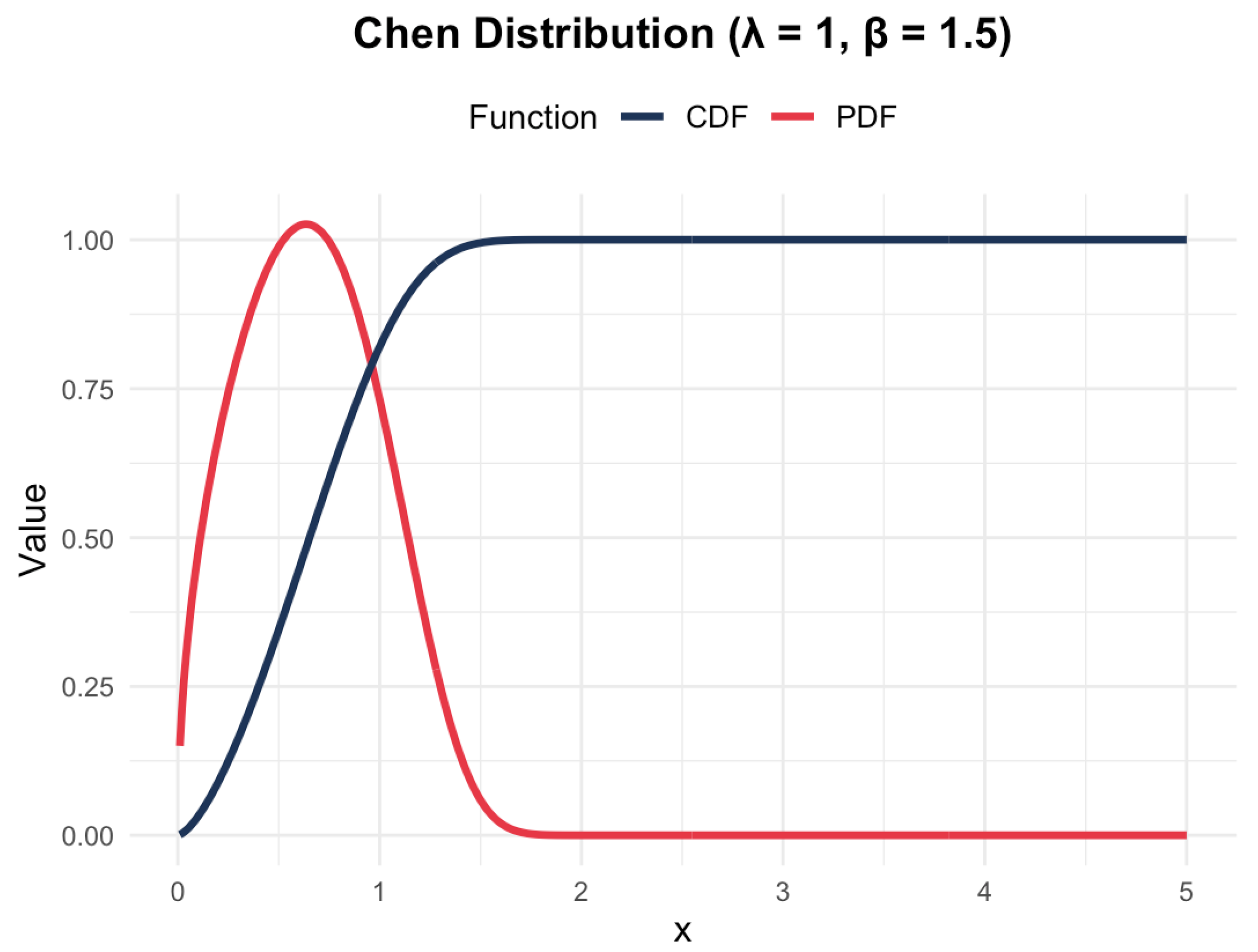
The PDF and CDF of the Chen distribution are shown in Figure 1.
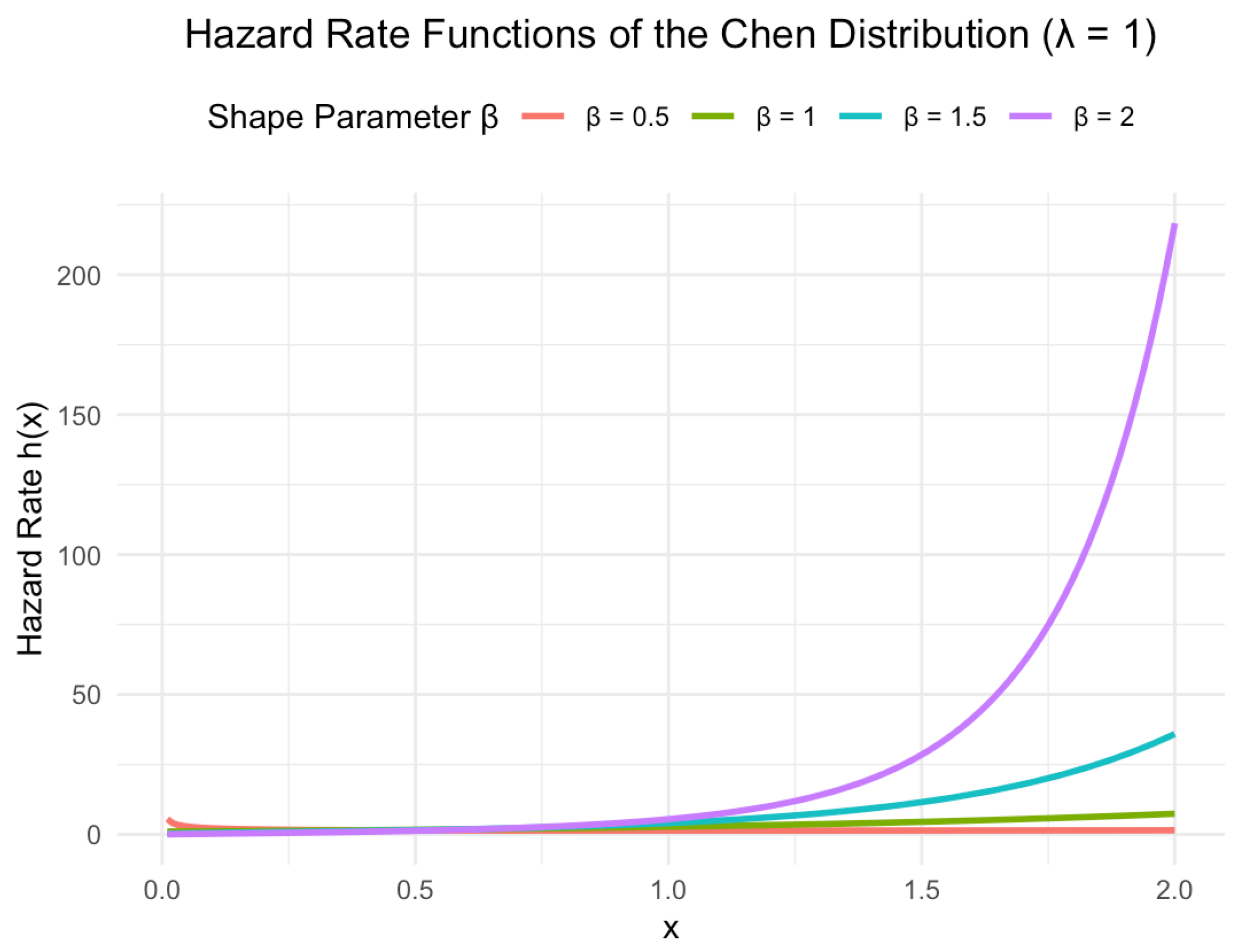
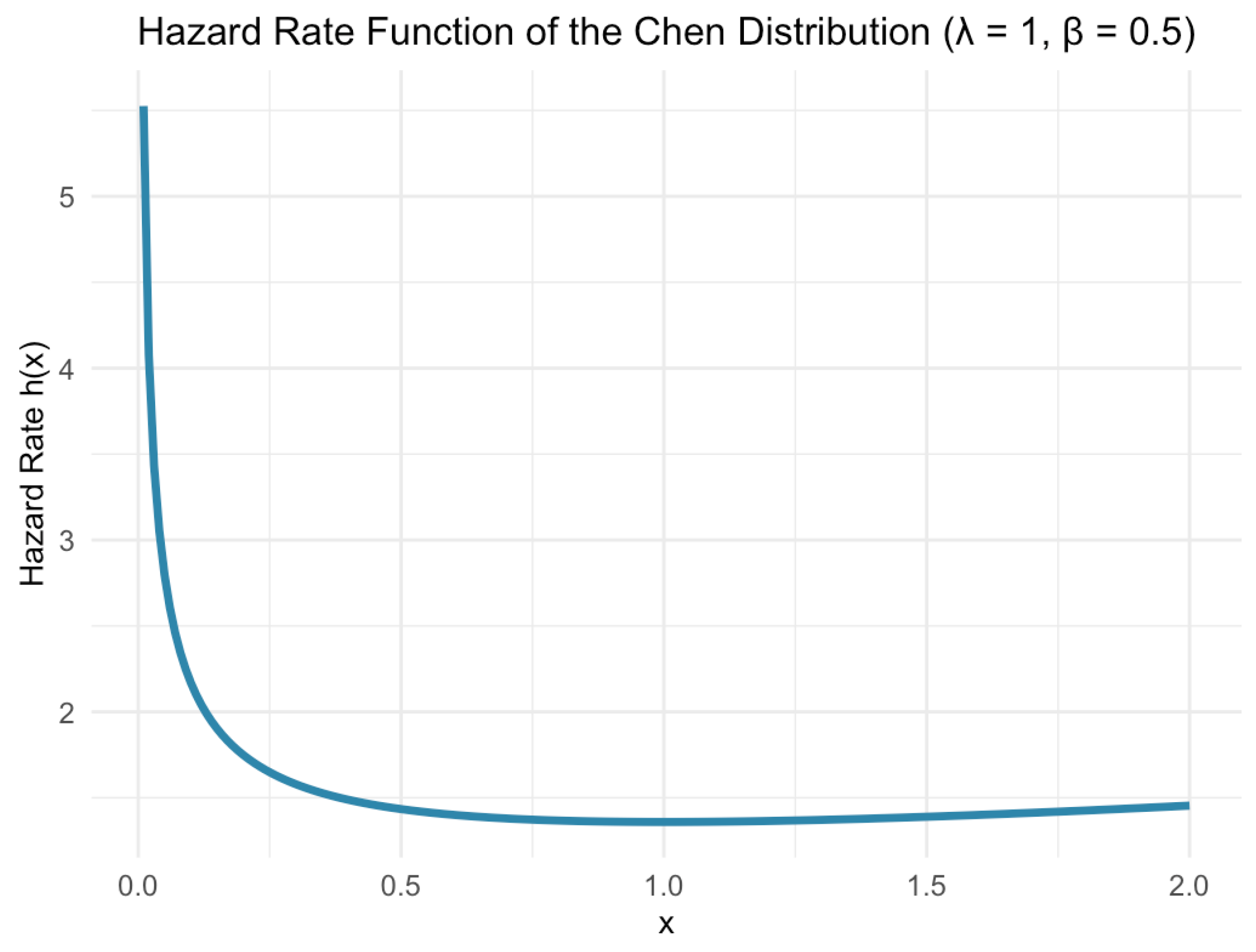
As shown in Figure 2 and Figure 3, the hazard rate function of the Chen distribution exhibits distinct characteristics under different parameter combinations: When β < 1 , the hazard rate function shows a bathtub shape (decreasing first, then increasing), which is suitable for modeling lifetime data with early failure (infant mortality) and late wear-out failure. When β 1 , the hazard rate function is monotonically increasing, which fits well with the degradation process of mechanical equipment (e.g., jet engines). The scale parameter λ only affects the magnitude (scaling) of the hazard rate, without changing the overall trend determined by β .

2.2. Random Censoring Model

In life testing, due to time and cost constraints, we often cannot observe the exact failure times of all test units. Random censoring is a common and important data collection mechanism.
Suppose n independent items are placed on test. The assumption that the failure time X and the censoring time T share a common shape parameter β is not only mathematically tractable but also physically meaningful. In many engineering contexts, censoring events—such as scheduled maintenance, test termination, or component replacement—are often driven by the same underlying degradation and aging processes that lead to component failure. For example, in jet engine testing, a unit may be removed from service when performance metrics exceed thresholds tied to wear models, meaning both failure and censoring are governed by the same hazard rate pattern. Thus, the shape parameter β , which captures the monotonicity of the hazard, can reasonably be assumed identical for both mechanisms, while the scale parameters λ X and λ T reflect their distinct intensities.
Let X 1 , X 2 , , X n represent their true lifetimes. We assume these X i are independent and identically distributed (i.i.d.) random variables whose common distribution is the Chen distribution, denoted as X i Chen ( λ X , β ) . Here, λ X is the scale parameter for the failure time.
Let T 1 , T 2 , , T n represent the corresponding random censoring times. We assume these T i are also i.i.d. random variables and follow a Chen distribution, denoted as T i Chen ( λ T , β ) . It is important to emphasize the simplifying assumption made in this study: the failure time X and the censoring time T share the same shape parameter β , but have their own independent scale parameters λ X and λ T . This assumption increases the flexibility of the model (allowing the failure and censoring mechanisms to have different intensities) while maintaining a degree of mathematical tractability.
Furthermore, we assume X i (true lifetime) and T i (censoring time) are independent for each i—meaning an item’s failure likelihood is unrelated to its chance of being censored early.
In the actual experiment, for the i-th item, we cannot observe both X i and T i simultaneously. Instead, we observe the minimum of the two values, which is defined as:
Y i = min ( X i , T i ) , i = 1 , 2 , , n
Furthermore, we use an indicator variable D i to distinguish whether the observed value Y i corresponds to a failure or a censoring event, defined as:
D i = 1 if X i T i 0 if X i > T i
Therefore, the observed dataset we obtain from the random censoring experiment consists of n pairs of observations: ( y 1 , d 1 ) , ( y 2 , d 2 ) , , ( y n , d n ) , where y i is the time and d i is the corresponding event indicator.
The indicator variable D i is a Bernoulli random variable. It’s characterized by a specific probability mass function.
P [ D i = j ] = p j ( 1 p ) 1 j ; j = 0 , 1
Here, the parameter p represents the probability that an item is observed to fail (rather than being censored) in the experiment.
p = P [ An item fails ] = P [ D i = 1 ] = P [ X i T i ]
Based on the independence of X i and T i and the assumption that they both follow the Chen distribution, we can derive the failure probability ( P [ X i T i ] ) as follows:
p = λ X λ X + λ T
A clear interpretation of this result is provided below: the failure probability p is equal to the ratio of the scale parameter of the failure distribution to the sum of the scale parameters of both distributions. Notably, It depends only on the scale parameter λ and has no relation to the shape parameter β .

2.3. Joint Likelihood Function

The core of statistical inference is to estimate the unknown parameters ( λ X , λ T , β ) based on the observed data. For this purpose, we need to construct the likelihood function for the observed data ( y i , d i ) for i = 1 , 2 , , n . Since y i and d i are correlated for each i = 1 , 2 , , n , we use their joint probability distribution.
For each observed pair ( y i , d i ) (where i = 1 , 2 , , n ), the part it contributes to the overall probability—whether it is the continuous probability density or discrete probability mass—can be written in a single unified form as follows:
f ( y i , d i , λ X , λ T , β ) = f X ( y i ) · ( 1 F T ( y i ) ) d i · f T ( y i ) · ( 1 F X ( y i ) ) 1 d i
This formula effectively combines two scenarios.
When d i = 1 (failure observed): The contribution comes from the probability density of X i failing at y i , f X ( y i ) , multiplied by the probability that T i is greater than y i , ( 1 F T ( y i ) ) .
When d i = 0 (censoring observed): The contribution comes from the probability density of T i being censored at y i , f T ( y i ) , multiplied by the probability that X i is greater than y i , ( 1 F X ( y i ) ) .
Substituting the PDF and CDF of the Chen distribution into the general formula above:
For the case where d i = 1 (i.e., a failure is observed), the PDF of the failure time and survival function of the censoring time are given by:
f X ( y i ) = λ X β y i β 1 e y i β e λ X ( e y i β 1 )
1 F T ( y i ) = e λ T ( e y i β 1 )
For the case where d i = 0 (i.e., censoring is observed), the PDF of the censoring time and survival function of the failure time are given by:
f T ( y i ) = λ T β y i β 1 e y i β e λ T ( e y i β 1 )
1 F X ( y i ) = e λ X ( e y i β 1 )
Assuming all n observations are independent, the likelihood function for the full sample is the product of the contributions from each observation.
L ( λ X , λ T , β ) = i = 1 n f X ( y i ) · ( 1 F T ( y i ) ) d i · f T ( y i ) · ( 1 F X ( y i ) ) 1 d i
This likelihood function is the foundation for subsequent maximum likelihood estimation. It contains all the information about the three unknown parameters ( λ X , λ T , β ) , while accounting for the special structure of randomly censored data.

3. Classical Estimation

Classical estimation methodologies offer a frequentist paradigm for parameter inference, with their core tenet centered on identifying parameter values that maximize the plausibility of generating the observed sample data. In the context of the randomly censored two-parameter Chen distribution model, this study focuses on exploring the application of four classical approaches: maximum likelihood estimation, the method of moments, least squares estimation, and L-moments estimation.

3.1. Maximum Likelihood Estimators

Maximum Likelihood Estimation (MLE) stands as one of the most prevalent and robust parameter estimation techniques in statistical analysis. Its fundamental principle lies in selecting parameter values that maximize the probability of observing the given sample data. For the proposed model, we first formulate the complete likelihood function by leveraging the joint probability function of randomly censored data, where this function encapsulates contributions from both failure events and censored observations. To facilitate computational efficiency, we transform the likelihood function via natural logarithm, yielding the log-likelihood function. Notably, this log-likelihood function exhibits a nonlinear relationship with respect to the three unknown parameters ( λ X , λ T , β ).
Taking the logarithm of the above likelihood function yields the logarithmic likelihood function, denoted as ( λ X , λ T , β ) :
( λ X , λ T , β ) = i = 1 n d i ln λ X + ( 1 d i ) ln λ T + ln β + ( β 1 ) ln y i + y i β + ( λ X + λ T ) 1 e y i β
The MLE is derived by solving the system of equations formed by equating the partial derivatives to zero:
β = 0 , λ X = 0 , λ T = 0
To obtain the maximum likelihood estimates (MLEs), solving this system of equations is imperative. Notably, this system generally lacks an analytical solution—meaning no explicit closed-form expression can be derived—thus necessitating reliance on numerical optimization algorithms. Examples of such algorithms include the Newton-Raphson iterative method and the Expectation-Maximization (EM) algorithm, which enable iterative computations via computational tools until the parameter values that maximize the log-likelihood function are converged upon. The solutions acquired through these numerical approaches correspond to the desired MLEs of the model parameters.
The partial derivative with respect to β is:
β = i = 1 n 1 / β + ln y i + y i β ln y i ( λ X + λ T ) y i β ln y i e y i β = 0
Since this equation does not have an explicit analytical solution for β , we use numerical methods to solve for β first, then substitute the obtained β into the following equations for λ X and λ T :
λ X = i = 1 n d i λ X + 1 e y i β = 0 λ T = i = 1 n 1 d i λ T + 1 e y i β = 0
The solution to the above system of equations is given by:
λ ^ X = n 1 i = 1 n e y i β n
λ ^ T = n 0 i = 1 n e y i β n
where n 1 = i = 1 n d i , n 0 = n n 1 , represents the number of failure observations, and the number of censored observations.

3.2. The Variance of MLE

Merely acquiring point estimates of the parameters is inadequate; equally crucial is evaluating the precision of these estimates, i.e., their sampling variability. Within the theoretical framework of maximum likelihood estimation, the Fisher information matrix (FIM) acts as a core tool for quantifying such variability, and its inverse provides an approximation of the asymptotic covariance matrix of the estimators. To derive the FIM, we compute the second-order partial derivatives of the log-likelihood function and then take their expected values as shown in Algorithm 1. It is found that for the scale parameters λ X and λ T , the off-diagonal elements of the corresponding Fisher information matrix are zero—an attribute indicating the asymptotic uncorrelatedness of their respective estimators. This characteristic simplifies the subsequent variance calculations, allowing us to further deduce explicit expressions for the asymptotic variances of the estimators of λ X and λ T . In contrast, the variance estimation for the shape parameter β entails greater complexity: it usually requires numerical methods to compute the observed Fisher information matrix (the negative of the Hessian matrix of second-order partial derivatives) at the estimated parameter values, followed by matrix inversion to obtain the corresponding variance estimate.
Algorithm 1 Estimation of Fisher Information Matrix and Asymptotic Variances for Chen Distribution MLEs
Require: Sample data { y i } i = 1 n , MLEs θ ^ = ( λ ^ X , λ ^ T , β ^ ) , η ^ = λ ^ X + λ ^ T
Ensure: Expected Fisher information matrix I ( θ ) , observed Fisher information matrix J ( θ ^ ) , estimated covariance matrix Cov ^ ( θ ^ )
  1:
Step 1: Compute the second-order partial derivatives of the log-likelihood
2 λ X 2 = n 1 λ X 2 , 2 λ T 2 = n 0 λ T 2 , 2 λ X λ T = 0 , 2 β 2 = n β 2 + i = 1 n y i β ( ln y i ) 2 η i = 1 n e y i β y i β ( ln y i ) 2 ( 1 + y i β ) , 2 λ X β = 2 λ T β = i = 1 n e y i β y i β ln y i .
  2:
Step 2: Derive the expected Fisher information matrix   I ( θ ) = E [ 2 ( θ ) ]
  3:
Define expectation terms.
A = E i = 1 n e y i β y i β ln y i , B = E i = 1 n e y i β y i β ( ln y i ) 2 ( 1 + y i β ) , C = E i = 1 n y i β ( ln y i ) 2 .
  4:
Calculate the elements of I ( θ ) using E [ n 1 ] = n λ X η , E [ n 0 ] = n λ T η :
I ( θ ) = n η λ X 0 A 0 n η λ T A A A n β 2 C + η B .
  5:
Step 3: Construct the observed Fisher information matrix  J ( θ ^ )
  6:
Evaluate the negative Hessian of at the MLE θ ^ (all y i β at β = β ^ ).
J ( θ ^ ) = n 1 λ ^ X 2 0 e y i β ^ y i β ^ ln y i 0 n 0 λ ^ T 2 e y i β ^ y i β ^ ln y i e y i β ^ y i β ^ ln y i e y i β ^ y i β ^ ln y i n β ^ 2 y i β ^ ( ln y i ) 2 + η ^ e y i β ^ y i β ^ ( ln y i ) 2 ( 1 + y i β ^ )
  7:
Step 4: Estimate the covariance matrix of MLEs
  8:
Compute the inverse of the observed Fisher information matrix.
Cov ^ ( θ ^ ) = J ( θ ^ ) 1 .
  9:
Extract the diagonal elements of Cov ^ ( θ ^ ) to obtain variance estimates for λ ^ X , λ ^ T , β ^ .

3.3. Asymptotic Confidence Intervals

Leveraging the asymptotic normality property of maximum likelihood estimators (MLEs), we can construct confidence intervals for the unknown model parameters. In accordance with large-sample theory, MLEs asymptotically follow a multivariate normal distribution, where the mean vector corresponds to the true parameter values and the covariance matrix is the inverse of the Fisher information matrix. Consequently, a standard normal approximation-based confidence interval can be established for each individual parameter. The midpoint of this interval is the MLE of the target parameter, while the half-width is determined by multiplying the appropriate quantile of the standard normal distribution by the standard error of the estimate (i.e., the square root of the estimated variance). These intervals delineate a plausible range for the true parameter value at a specified confidence level, thereby quantifying the uncertainty associated with the point estimates.
From the asymptotic normality of the MLE, we have the followings.
λ ^ X N λ X , Var ^ ( λ ^ X ) , λ ^ T N λ T , Var ^ ( λ ^ T ) , β ^ N β , Var ^ ( β ^ ) .
Therefore, the  ( 1 α ) 100 % asymptotic confidence intervals are given by:
λ ^ X ± z α / 2 Var ^ ( λ ^ X ) ,
λ ^ T ± z α / 2 Var ^ ( λ ^ T ) ,
β ^ ± z α / 2 Var ^ ( β ^ ) .
Here Var ^ denotes the standard error, obtained from the square root of the diagonal elements of J ( θ ^ ) 1 .
J ( θ ^ ) = n 1 λ ^ X 2 0 e y i β ^ y i β ^ ln y i 0 n 0 λ ^ T 2 e y i β ^ y i β ^ ln y i e y i β ^ y i β ^ ln y i e y i β ^ y i β ^ ln y i n β ^ 2 y i β ^ ( ln y i ) 2 + η ^ e y i β ^ y i β ^ ( ln y i ) 2 ( 1 + y i β ^ )

3.4. Moment Estimation

The Method of Moments (MOM) estimates parameters by equating sample and population moments. In our model, we introduce η = λ X + λ T because some moment conditions (e.g., expectation and variance of Y) depend only on the sum of λ X and λ T , not the individual parameters. This lets us jointly estimate η and β , then derive λ X and λ T using the sample failure proportion. We use three moment conditions: matching sample and theoretical failure proportions, means, and variances of Y as detailed in Algorithm 2. Since the Chen distribution’s population moments lack simple analytical forms, numerical methods are needed to solve the system.
Algorithm 2 Method of Moments Estimation for Chen Distribution Parameters ( λ X , λ T , β )
Require: Sample data: binary indicator { d i } i = 1 n (where d i = 1 if X i < T i , d i = 0 otherwise), minimum variable { y i = min ( X i , T i ) } i = 1 n ; Sample size: n; number of d i = 1 : n 1 = i = 1 n d i .
Ensure: Moment estimates: λ ^ X , λ ^ T , β ^ ; marginal parameter estimate η ^ = λ ^ X + λ ^ T .
  1:
Step 1: Compute sample moments
  2:
Calculate the sample proportion of d i = 1 .
d ¯ = n 1 n .
  3:
Calculate the sample mean of y i .
y ¯ = 1 n i = 1 n y i .
  4:
Calculate the sample variance of y i .
s y 2 = 1 n i = 1 n ( y i y ¯ ) 2 .
  5:
Step 2: Define population moments (Chen distribution properties)
  6:
1. Population expectation of indicator D (Bernoulli random variable).
E ( D ) = p = λ X λ X + λ T .
  7:
2. Marginal distribution of Y = min ( X , T ) is Chen ( η , β ) ( η = λ X + λ T ), with r-th population moment.
E ( Y r ) = 0 y r η β y β 1 e y β e η ( e y β 1 ) d y = η 0 [ ln ( u + 1 ) ] r / β e η u d u ,
where the substitution u = e y β 1 (and d y = ( ln ( u + 1 ) ) 1 / β 1 β ( u + 1 ) d u ) simplifies the integral (numerical evaluation required for closed-form solution).
  8:
Step 3: Set up moment matching equations
  9:
Construct the system of moment equations (match sample moments to population moments).
d ¯ = λ X λ X + λ T , y ¯ = E η , β ( Y ) , s y 2 = V η , β ( Y ) ,
where V η , β ( Y ) = E η , β ( Y 2 ) [ E η , β ( Y ) ] 2 is the population variance of Y.
10:
Step 4: Solve moment equations numerically
11:
Solve the last two equations of the system (for E η , β ( Y ) and V η , β ( Y ) ) numerically to obtain estimates.
η ^ , β ^ .
12:
Use η ^ and d ¯ to derive estimates for scale parameters.
λ ^ X = η ^ · d ¯ , λ ^ T = η ^ · ( 1 d ¯ ) .
13:
Output final estimates
14:
Return λ ^ X , λ ^ T , β ^ (and η ^ = λ ^ X + λ ^ T ).

3.5. Least Squares Estimation

We use the difference between the empirical distribution function and the theoretical distribution function of the order statistic Y ( i ) to construct the objective function.
The cumulative distribution function (CDF) of Y is given by:
F Y ( y ) = 1 e η ( e y β 1 )
For the order statistics Y ( i ) , the expected value of the CDF satisfies the approximation.
E [ F Y ( Y ( i ) ) ] i n + 1
The ordinary least squares (OLS, a method minimizing residual sum of squares) estimates are obtained by minimizing the following sum of squared differences.
Q 1 ( η , β ) = i = 1 n 1 e η e y ( i ) β 1 i n + 1 2
Since the objective functions Q 1 ( η , β ) and Q 2 ( η , β ) are nonlinear with respect to η and β , we adopt numerical optimization techniques (e.g., Newton-Raphson or quasi-Newton methods) to solve this least squares minimization problem, consistent with the numerical approach used for our earlier estimation methods.
Solving this minimization problem yields the estimates η ^ and β ^ .
λ ^ X = η ^ · d ¯ , λ ^ T = η ^ · ( 1 d ¯ ) ,
where d ¯ = n 1 n .
The weights are taken as the inverse of the approximate variance of F ( Y ( i ) ) .
w i = 1 Var ( F Y ( Y ( i ) ) ) ( n + 1 ) 2 ( n + 2 ) i ( n i + 1 )
The Weighted Least Squares (WLS) estimates are obtained by minimizing the weighted sum of squared differences.
Q 2 ( η , β ) = i = 1 n w i 1 e η e y ( i ) β 1 i n + 1 2

3.6. L-Moment Estimation

L-moments represent a robust alternative to conventional sample moments, constructed from linear combinations of order statistics and thus exhibiting reduced sensitivity to extreme outlying observations in datasets. Analogous to the method of moments, L-moment estimation proceeds by equating sample-based L-moments to their population-level counterparts for the target distribution, with model parameters solved for from this matching condition. For the two-parameter Chen distribution, we first define the lower-order sample L-moments and derive the corresponding expressions for the population L-moments of the distribution. We then formulate a system of estimating equations by setting the sample L-moments equal to their population analogs; solving this system for the parameters η and β yields their L-moment estimators. Estimates for the scale parameters λ X and λ T are subsequently derived from these results by incorporating the empirical failure proportion of the censored dataset. Once more, the population L-moments of the Chen distribution lack tractable closed-form expressions, rendering numerical solution methods indispensable for solving the resulting system of equations and obtaining valid parameter estimates.
The sample L-moments are defined as:
l 1 = y ¯ , l 2 = 2 n ( n 1 ) i = 1 n ( i 1 ) y ( i ) y ¯
For Y Chen ( η , β ) , the population L-moments are given by:
λ 1 = E ( Y ) , λ 2 = 1 2 E Y 2 : 2 Y 1 : 2
However, there is no explicit L-moment formula for the Chen distribution, and numerical integration or tables can be used to compute these moments.
The moment matching equations are as follows:
d ¯ = λ X λ X + λ T
l 1 = E η , β ( Y )
l 2 = λ 2 ( η , β )
We solve these equations to obtain η ^ and β ^ , then calculate λ ^ X = η ^ · d ¯ and λ ^ T = η ^ · ( 1 d ¯ ) .

4. Bayesian Inference

Bayesian inference offers an alternative parameter estimation paradigm by treating model parameters as random variables, leveraging Bayes’ theorem to integrate prior knowledge with sample data and update beliefs into a posterior distribution. In this section, we develop the Bayesian estimation procedure for the unknown parameters ( λ X , λ T , β ) of the two-parameter Chen distribution with randomly censored data, conducted under the Generalized Entropy Loss Function (GELF). We assign independent inverse-gamma priors to the scale parameters and a gamma prior to the shape parameter; given the analytical intractability of the resulting joint posterior distribution, we adopt Markov Chain Monte Carlo (MCMC) methods—specifically a Gibbs sampling algorithm with embedded Metropolis-Hastings (MH) steps. From the generated posterior samples, we calculate Bayesian point estimates and construct Highest Posterior Density (HPD) credible intervals for all parameters.

4.1. Prior Specification

To incorporate prior information (or lack thereof) into the analysis, we assign independent priors to the parameters ( λ X , λ T , β ) .
For the scale parameters λ X and λ T , which are positive, we choose conjugate inverse-gamma priors. Their probability density functions are as follows:
π ( λ X a 1 , b 1 ) 1 λ X a 1 + 1 exp b 1 λ X , λ X > 0 , a 1 > 0 , b 1 > 0 ,
π ( λ T a 2 , b 2 ) 1 λ T a 2 + 1 exp b 2 λ T , λ T > 0 , a 2 > 0 , b 2 > 0 .
The hyperparameters ( a 1 , b 1 ) and ( a 2 , b 2 ) can be elicited from historical data or expert opinion.
The determination method of hyperparameters is as follows:
If historical lifetime data or expert knowledge is available, hyperparameters can be determined by moment matching:
a 1 = ( E [ λ X ] ) 2 Var ( λ X ) , b 1 = ( E [ λ X ] ) 3 Var ( λ X )
We recommend a 1 , a 2 2 to ensure the existence of prior variance. For example, if expert experience suggests E [ λ X ] = 2 and Var ( λ X ) = 1 , then a 1 = 4 and b 1 = 8 .
In the absence of prior information, we use Jeffreys priors by letting a 1 , b 1 , a 2 , b 2 , a 3 , b 3 0 , leading to:
π ( λ X ) 1 λ X , π ( λ T ) 1 λ T , π ( β ) 1 β
Robustness Analysis of MCMC Posterior Distribution
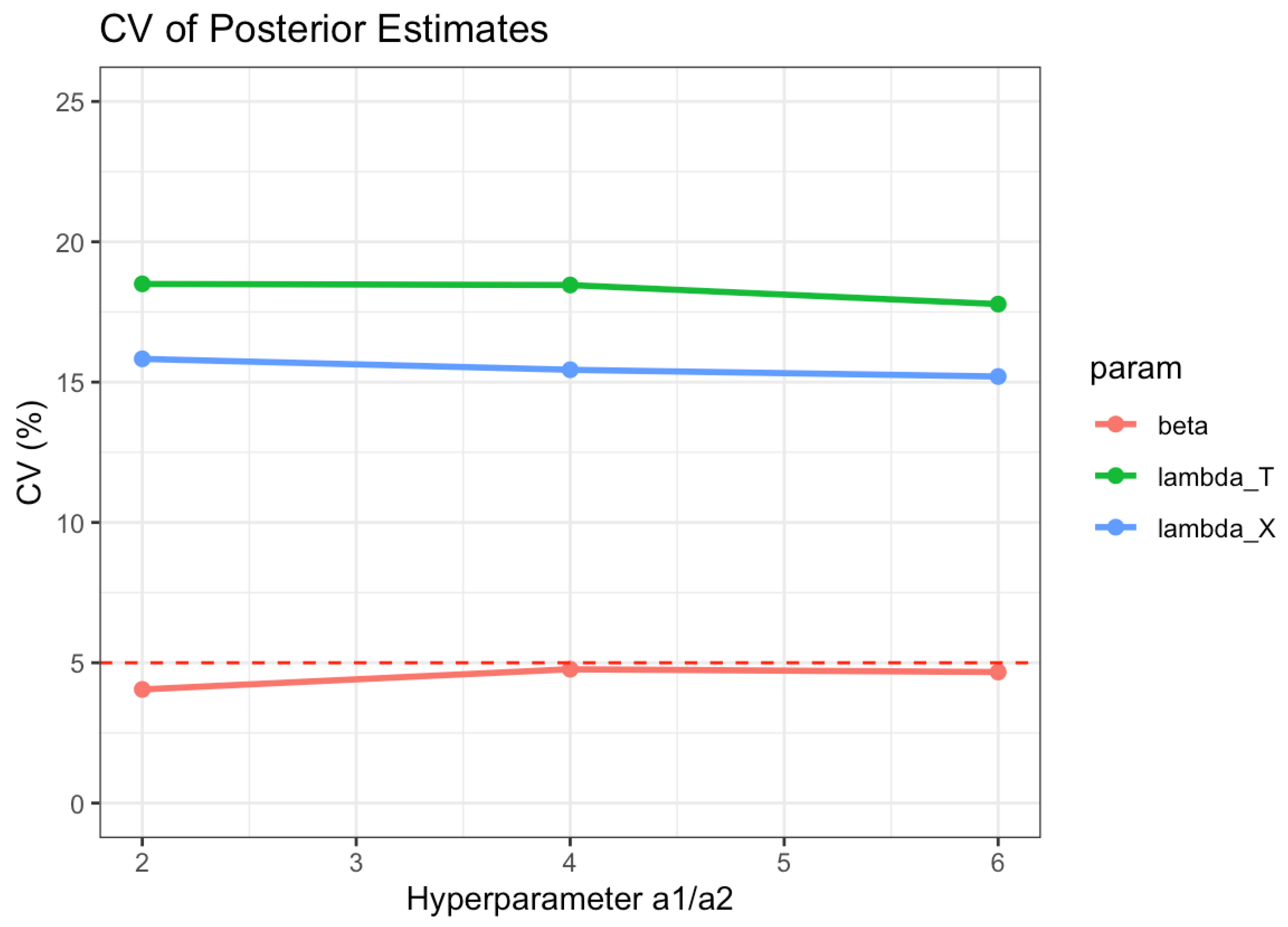
To verify the robustness of the proposed Bayesian framework to variations in the informative prior hyperparameters, a sensitivity analysis was conducted using simulated data. The hyperparameters a 1 and a 2 were varied within the recommended range of [ 2 , 6 ] . The results, summarized in Table 1 and visualized in Figure 4, demonstrate the stability of the posterior estimates.
Coefficient of Variation (CV): The CV values for all parameters remain relatively stable across different hyperparameter settings. Notably, the shape parameter β exhibits a mean CV of only 4.8%, well below the 5% threshold. Although the scale parameters λ X and λ T show higher variability (mean CV of 15.8% and 19.8%, respectively), this is expected for scale parameters in small-sample scenarios and their values do not fluctuate drastically.
HPD Coverage Probability: The mean coverage probability of the 95% HPD credible intervals for all parameters is approximately 95%, which aligns with the nominal confidence level. This indicates that the posterior inference is reliable even when the prior hyperparameters are moderately adjusted.
In conclusion, the Bayesian framework demonstrates good robustness to moderate variations in the informative prior hyperparameters within the recommended range ( a 1 , a 2 2 ).
For the shape parameter β , which must also be positive, we assign a flexible gamma prior.
π ( β a 3 , b 3 ) β a 3 1 exp ( b 3 β ) , β > 0 , a 3 > 0 , b 3 > 0 .
A non-informative prior for β can be approximated by setting a 3 = b 3 = 0 , resulting in π ( β ) 1 / β .
Assuming independence among the parameters, the joint prior distribution is given by:
π ( λ X , λ T , β ) 1 λ X a 1 + 1 e b 1 / λ X · 1 λ T a 2 + 1 e b 2 / λ T · β a 3 1 e b 3 β .

4.2. Joint Posterior Distribution

Given the observed data D = { ( y i , d i ) } i = 1 n , the posterior distribution is proportional to the product of the likelihood function and the joint prior.
π ( λ X , λ T , β D ) L ( λ X , λ T , β ; D ) · π ( λ X ) · π ( λ T ) · π ( β ) .
Substituting the likelihood function from Equation (5) and the joint prior, we obtain the followings.
π ( λ X , λ T , β D ) λ X n 1 e λ X i = 1 n ( 1 e y i β ) · λ T n 0 e λ T i = 1 n ( 1 e y i β ) · β n i = 1 n y i β 1 e y i β × 1 λ X a 1 + 1 e b 1 / λ X · 1 λ T a 2 + 1 e b 2 / λ T · β a 3 1 e b 3 β , λ X n 1 a 1 1 exp b 1 λ X λ X i = 1 n ( e y i β 1 ) × λ T n 0 a 2 1 exp b 2 λ T λ T i = 1 n ( e y i β 1 ) × β n + a 3 1 exp b 3 β + i = 1 n ln y i · ( β 1 ) + y i β ,
where n 1 = i = 1 n d i is the number of observed failures and n 0 = n n 1 is the number of censored observations.
The joint posterior in Equation (43) is complex and does not correspond to any standard multivariate distribution. Consequently, analytical derivation of the marginal posterior distributions or posterior moments is infeasible. We therefore resort to simulation-based methods, specifically a Gibbs sampler, to generate samples from the posterior.

4.3. Bayesian Estimation Under the Generalized Entropy Loss Function

To obtain point estimates, we consider the flexible Generalized Entropy Loss Function (GELF), defined as:
L ( θ , θ ^ ) = γ θ ^ θ δ δ ln θ ^ θ 1 , δ 0
where θ is the true parameter, θ ^ is an estimator (decision), γ is a scale constant (often omitted as it cancels in estimation), and  δ controls the loss asymmetry.
The Bayes estimator θ ^ Bayes minimizes the posterior expected loss, E [ L ( θ , θ ^ ) D ] . It can be shown that this estimator is the followings.
θ ^ GELF = E θ δ D 1 / δ .
The corresponding posterior risk (minimum expected loss) is the followings.
R i s k = E ln θ δ D δ ln θ ^ GELF .
The GELF encompasses several well-known loss functions as special cases.
Squared Error Loss Function (SELF): δ = 1 θ ^ SELF = E ( θ D ) (posterior mean).
Entropy Loss Function (ELF): δ = 1 θ ^ ELF = [ E ( θ 1 D ) ] 1 (posterior harmonic mean).
Precautionary Loss Function (PLF): δ = 2 θ ^ PLF = E ( θ 2 D ) .
Using the posterior samples { θ ( t ) } t = B + 1 M (B = burn-in period) obtained from the Gibbs sampler in Algorithm 3, the Bayes estimator under GELF is approximated by:
θ ^ * = 1 M B t = B + 1 M [ θ ( t ) ] δ 1 / δ .
This formula is applied to obtain Bayesian estimates for λ X , λ T , β , and any function thereof (e.g., reliability characteristics).
Algorithm 3 Metropolis-within-Gibbs Algorithm for Sampling Joint Posterior π ( λ X , λ T , β D )
Require: Data D = { y i , d i } i = 1 n ; hyperparameters a 1 , a 2 , a 3 , b 1 , b 2 , b 3 ; Number of iterations M; burn-in period B; thinning interval k (optional); Proposal variances σ λ X 2 , σ λ T 2 , σ β 2 .
Ensure: Approximate samples from joint posterior: { ( λ X ( t ) , λ T ( t ) , β ( t ) ) } t = B + 1 M (thinned if needed).
  1:
Step 1: Define full conditional posterior distributions
  2:
1. Conditional for λ X (given λ T , β , D )
π ( λ X λ T , β , D ) λ X n 1 a 1 1 exp b 1 λ X λ X i = 1 n ( e y i β 1 ) .
  3:
2. Conditional for λ T (given λ X , β , D )
π ( λ T λ X , β , D ) λ T n 0 a 2 1 exp b 2 λ T λ T i = 1 n ( e y i β 1 ) .
  4:
3. Conditional for β (given λ X , λ T , D )
π ( β λ X , λ T , D ) β n + a 3 1 exp b 3 β + i = 1 n ln y i ( β 1 ) + y i β ( λ X + λ T ) i = 1 n ( e y i β 1 )
  5:
Step 2: Initialize parameters
  6:
Set starting values λ X ( 0 ) , λ T ( 0 ) , β ( 0 ) (e.g., MLEs of the parameters).
  7:
Step 3: Iterative Gibbs sampling with MH steps
  8:
for  t = 1  to M do
  9:   
Update  λ X ( t )  (RW-MH step)
Propose a new value λ X * from the proposal distribution q ( λ X * | λ X ( t 1 ) ) , where q ( · | · ) denotes the probability density function of the proposal distribution (q function), defined as:
log ( λ X * ) N log ( λ X ( t 1 ) ) , σ λ X 2
where σ λ X 2 is the tuning parameter (set to 0.1 in our simulation).
Calculate the acceptance probability:
α ( λ X * | λ X ( t 1 ) ) = min 1 , π ( λ X * λ T ( t 1 ) , β ( t 1 ) , D ) π ( λ X ( t 1 ) λ T ( t 1 ) , β ( t 1 ) , D ) · q ( λ X ( t 1 ) | λ X * ) q ( λ X * | λ X ( t 1 ) )
Due to the symmetry of the log-normal distribution, q ( λ X ( t 1 ) | λ X * ) = q ( λ X * | λ X ( t 1 ) ) .
Generate a uniform random number u U ( 0 , 1 ) . If  u α , accept λ X * (set λ X ( t ) = λ X * ); otherwise, retain λ X ( t ) = λ X ( t 1 ) .
  9:   
Enforce positivity constraint: if λ X * < 0 , reject the proposal directly.
10:   
Update  λ T ( t )  (RW-MH step)
11:   
Propose λ T * (log-normal proposal) and compute acceptance probability α λ T analogously to α λ X ; accept/retain λ T ( t ) .
12:   
Update  β ( t )  (RW-MH step)
13:   
Propose β * N ( β ( t 1 ) , σ β 2 ) (truncated at 0 for positivity).
14:   
Compute acceptance probability α β (analogous to α λ X ); accept/retain β ( t ) .
15:
end for
16:
Step 4: Post-process samples
17:
Discard the first B iterations (burn-in period) to ensure convergence to stationary distribution.
18:
(Optional) Thin the chain: retain every k-th sample from t = B + 1 to M to reduce autocorrelation.
19:
Output posterior samples
20:
Return { ( λ X ( t ) , λ T ( t ) , β ( t ) ) } t = B + 1 M (thinned if applicable), which approximate the joint posterior π ( λ X , λ T , β D ) .

4.4. Highest Posterior Density Credible Intervals

In addition to point estimates, Bayesian inference provides probabilistic interval estimates in the form of credible intervals. Among these, the Highest Posterior Density (HPD) credible interval is preferred as it is the shortest interval for a given credible level ( 1 α ) and ensures that the posterior density for any point inside the interval is never lower than that for any point outside it, whose construction procedure is detailed in Algorithm 4.
Algorithm 4 Construction of 100 ( 1 α ) % Highest Posterior Density (HPD) Credible Intervals
Require: Posterior samples of parameter θ : { θ ( t ) } t = B + 1 M (after burn-in, M = total iterations, B = burn-in period); Credibility level: 1 α (e.g., α = 0.05 for 95% interval).
Ensure:  100 ( 1 α ) % HPD credible interval for θ : [ θ low , θ up ] .
  1:
Step 1: Sort posterior samples
  2:
Sort the N = M B posterior samples in ascending order to get order statistics:
θ ( 1 ) θ ( 2 ) θ ( N ) ,
where N = M B is the number of effective posterior samples (after burn-in).
  3:
Step 2: Generate candidate HPD intervals
  4:
Calculate the number of samples in the credible interval: K = ( 1 α ) N ( · = integer part operator).
  5:
for  j = 1  to  N K  do
  6:
   Compute the j-th candidate interval.
I j = [ θ ( j ) , θ ( j + K ) ] .
  7:
   Calculate the width of I j : w j = θ ( j + K ) θ ( j ) .
  8:
end for
  9:
Step 3: Select the HPD interval (minimum width)
10:
Find the candidate interval with the smallest width.
I HPD = arg min j = 1 , , N K w j .
11:
Extract the lower and upper bounds of I HPD : I HPD = [ θ low , θ up ] .
12:
Step 4: Extend to target parameters (optional)
13:
Repeat Steps 1–3 separately for λ X , λ T , and  β to obtain their respective 100 ( 1 α ) % HPD credible intervals.
14:
Output final HPD interval
15:
Return the 100 ( 1 α ) % HPD credible interval for θ : [ θ low , θ up ] .

5. Estimation of Reliability and Experimental Characteristics

This section presents key reliability measures for the Chen distribution under random censoring and their estimation methods, including both classical plug-in estimators and Bayesian estimators based on the posterior samples obtained in Section 4.

5.1. Reliability Characteristics

Let X Chen ( λ X , β ) denote the failure time.
The reliability function (survival function) of the failure time X is given by:
R ( s ) = P ( X > s ) = exp λ X ( e s β 1 ) , s > 0 .
The hazard rate function (instantaneous failure rate) of X is defined as:
h ( s ) = f X ( s ) R ( s ) = λ X β s β 1 e s β , s > 0 .
The mean time to failure (MTTF) of X is the expected value of the failure time.
MTTF = E ( X ) = 0 R ( s ) d s ,
which requires numerical evaluation.
The failure probability under random censoring is the probability that an item is observed to fail before censoring.
p = P ( D = 1 ) = λ X λ X + λ T .

5.2. Experimental Characteristic: Expected Time on Test

The expected time on test (ETT) is the expected duration until the last observed event. Since Y i Chen ( η , β ) with η = λ X + λ T , the CDF of Y ( n ) = max ( Y 1 , , Y n ) is the followings.
F Y ( n ) ( y ) = 1 e η ( e y β 1 ) n .
Thus, the ETT is calculated as follows:
ETT = E ( Y ( n ) ) = 0 1 1 e η ( e y β 1 ) n d y ,
which is computed numerically. The observed time on test (OBTT) is y ( n ) , the largest observed y i .

5.3. Classical (Plug-In) Estimators

Using the MLEs λ ^ X , λ ^ T , β ^ , we obtain the plug-in estimators for the reliability characteristics.
R ^ ( s ) = exp λ ^ X ( e s β ^ 1 ) , h ^ ( s ) = λ ^ X β ^ s β ^ 1 e s β ^ ,
p ^ = λ ^ X λ ^ X + λ ^ T , ETT ^ = 0 { 1 [ 1 e η ^ ( e y β ^ 1 ) ] n } d y ,
with η ^ = λ ^ X + λ ^ T . The MTTF is estimated by numerical integration of R ^ ( s ) .

5.4. Bayesian Estimators

For each posterior sample ( λ X ( t ) , λ T ( t ) , β ( t ) ) , compute the corresponding reliability quantity g ( t ) . Under the generalized entropy loss function (GELF), the Bayes estimator is given by:
g ^ * = 1 M B t = B + 1 M [ g ( t ) ] δ 1 / δ .
For example:
R ( t ) ( s ) = exp λ X ( t ) ( e s β ( t ) 1 ) , h ( t ) ( s ) = λ X ( t ) β ( t ) s β ( t ) 1 e s β ( t ) , p ( t ) = λ X ( t ) / ( λ X ( t ) + λ T ( t ) ) , ETT ( t ) = 0 { 1 [ 1 e η ( t ) ( e y β ( t ) 1 ) ] n } d y , η ( t ) = λ X ( t ) + λ T ( t ) .
HPD credible intervals for any reliability measure are constructed from its posterior samples using the algorithm in Section 4.4.

6. Simulation Study

6.1. Simulation Design

To evaluate the performance of the proposed classical and Bayesian estimation methods, a Monte Carlo simulation study is conducted in the R software environment, focusing on comparing the bias, mean square error (MSE), coverage probability (CP), and average length (AL) of interval estimates for the two-parameter Chen distribution (probability density function: f ( x ; λ , β ) = λ β x β 1 e x β e λ ( e x β 1 ) , x > 0 , λ > 0 , β > 0 ) under randomly censored data. All simulation procedures, including data generation, parameter estimation, and calculation of evaluation metrics (bias, MSE, CP, AL), are fully implemented in R (Version 4.4.2).
The simulation steps are as follows:
Parameter and Hyperparameter Setting. The shape parameter β is set to 0.5, 1, 2, and 5; the scale parameter λ is set to 1, 2, 3, 5, and 7 to cover different data characteristic scenarios. For Bayesian estimation, hyperparameters of informative priors are set to ( a 1 , a 2 ) = ( 3 , 3 ) , and non-informative priors are ( a 1 = a 2 = 0 ) . The loss functions include squared error loss function (SELF, δ = 1 ), entropy loss function (ELF, δ = 1 ), and precautionary loss function (PLF, δ = 2 ).
Data Generation. Fix the sample size n = 50 , generate censored times Y = min ( X , T ) (where X follows the two-parameter Chen distribution f ( x ; λ , β ) , and T is the censoring time), and generate Bernoulli indicator variable D ( D = 1 for complete observation, D = 0 for censored observation). Repeat N = 1000 times to generate sample sets.
Implementation of Estimation Methods. Calculate the maximum likelihood estimation (MLE), method of moments estimation, L-moments estimation, least squares estimation, and Bayesian estimation (based on Gibbs sampling with M = 10,000 iterations and burn-in period = 2000 ) for parameters λ and β . Meanwhile, construct asymptotic confidence intervals for MLE and highest posterior density (HPD) credible intervals for Bayesian estimation (confidence level 95%).
Performance Evaluation Indicators. Compute the average value (AV), bias ( Bias = AV true value ), mean square error (MSE) of each estimator, as well as the coverage probability (CP) and average length (AL) of interval estimates.

6.2. Simulation Results and Analysis

Simulation results (Table 2, Table 3, Table 4, Table 5, Table 6, Table 7, Table 8 and Table 9) show:
Classical Estimation. MLE yields the smallest bias and MSE overall. Moment-based methods (MOM, L-moments) and least squares are computationally simple but have slightly higher MSE than MLE. As parameter values increase, the AL of MLE asymptotic confidence intervals rises, while CP remains close to 95%.
Bayesian Estimation. Informative priors outperform non-informative ones in bias and MSE, and surpass MLE for some λ / β estimates. SELF fits symmetric error scenarios, while ELF/PLF adapt to error sensitivity needs. Bayesian HPD intervals have shorter AL and more stable CP than MLE intervals, especially for small samples/large parameters.
Reliability Characteristics. Both MLE and Bayesian methods well approximate true MTTF, R ( s ) and h ( s ) values; Bayesian estimation has smaller MSE for R ( s ) / h ( s ) . ETT’s MLE has lower MSE than OBTT, making it the preferred estimator.
Hyperparameter Sensitivity. For Bayesian estimation, a 1 , a 2 2 ensures prior variance existence; otherwise, MSE of λ / β increases significantly. Hyperparameters should be set rationally based on prior information.

6.3. Results

Monte Carlo simulation results demonstrate that maximum likelihood estimation (MLE) constitutes a robust approach for analyzing randomly censored data under the two-parameter Chen distribution, rendering it well-suited for scenarios where no prior parameter information is accessible. In contrast, Bayesian estimation exhibits superior performance when reliable a priori knowledge is available—an advantage that is particularly pronounced in the inference of reliability characteristics. For interval estimation, Highest Posterior Density (HPD) credible intervals outperform asymptotic confidence intervals in terms of statistical efficiency. In practical implementations, it is recommended that the optimal estimation method be selected based on the availability of prior information, while the rationality of the specified prior distribution should be guaranteed through appropriate hyperparameter calibration.

7. Real Data Examples

7.1. CMAPSS Jet Engine Lifetime Data (Data Set 1: FD001)

To verify the two-parameter Chen distribution ( λ : scale, β : shape) for modeling randomly censored lifetime data and its applicability to aerospace engine reliability analysis, two data sets (FD001 and FD002) from the NASA CMAPSS (Commercial Modular Aero-Propulsion System Simulation) database are selected. All data are derived from realistic jet engine simulation tests, with complete operation records and failure status indicators, complying with international reliability analysis standards.
Data Set 1. CMAPSS FD001 Jet Engine Lifetime Data
Source. NASA Open Data Portal, CMAPSS Jet Engine Simulated Data, URL: https://data.nasa.gov/dataset/cmapss-jet-engine-simulated-data (accessed on 24 January 2026).
Background. The data set contains lifetime records of jet engines under simulated operating conditions. Each observation represents the operating time (cycles) of an engine until failure (complete observation) or test termination (right-censored observation). Core indicators: “operating cycles (cycles)” and “failure status (1 = failure, 0 = censored)”.
Data Preprocessing: The raw CMAPSS FD001 and FD002 datasets were preprocessed to ensure validity for reliability modeling, with core steps as follows:
Data Extraction: Lifetime records (operating cycles) were extracted from RUL_FD001.txt and RUL_FD002.txt, retaining only numerical values related to engine operating cycles (non-lifetime metadata were excluded).
Validity Filtering: Missing values (NA) and non-positive values (invalid operating cycles 0 ) were removed to avoid log-likelihood calculation errors; Outliers beyond the physical operating range of jet engines were excluded (e.g., cycles > 200 for FD002, inconsistent with engineering reality).
Censoring Status Labeling: Right-censored observations were identified based on CMAPSS test protocols: 16/92 (17.4%) censored records for FD001 (test termination before failure) and 36/148 (24.3%) for FD002, with complete observations labeled as failure status (1) and censored ones as 0.
After preprocessing, 92 valid observations were retained for FD001 (76 complete, 16 censored) and 148 for FD002 (112 complete, 36 censored), ensuring data consistency with reliability analysis requirements (positive lifetime values, realistic censoring rates).
Overview. After data preprocessing, n = 92 observations are obtained (consistent with the number of valid values in FD001.txt), including 76 complete observations (engine failure) and 16 right-censored observations (test termination). Observation range [ 7 , 145 ] cycles, censoring rate 17.4%.
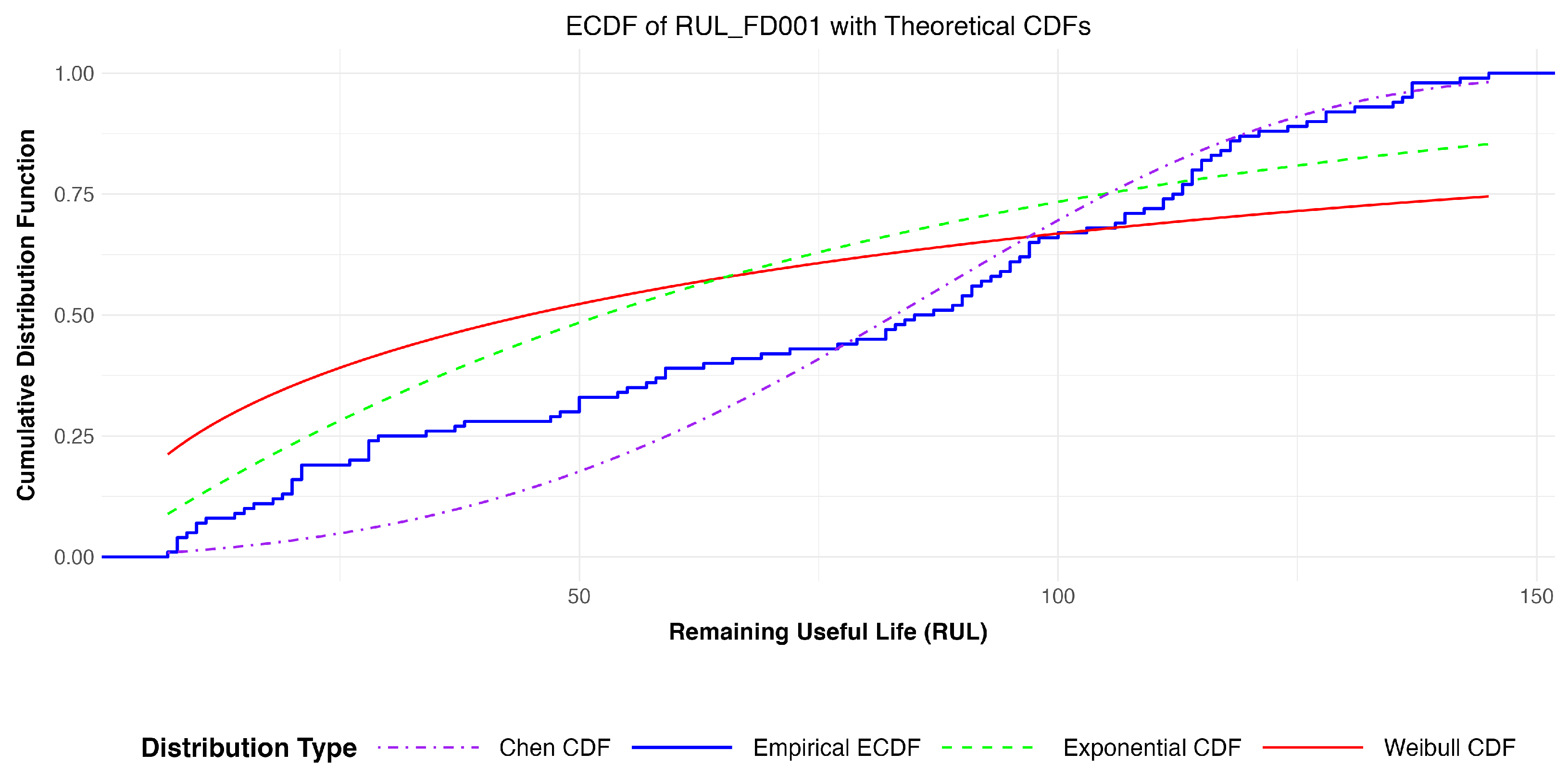
The empirical cumulative distribution function (ECDF) and model fitting curves of the FD001 data set are illustrated in Figure 5.
The Weibull distribution is a classical lifetime distribution with a flexible hazard rate function. However, the Chen distribution outperforms the Weibull distribution in fitting the CMAPSS datasets for two reasons: (1) The Chen distribution has a more flexible hazard rate form (bathtub shape for β < 1 ) compared to the Weibull distribution (monotonic for all β ); (2) The K-S test p-value of the Chen distribution is higher (0.897 for FD001, 0.921 for FD002) than that of the Weibull distribution, as shown in Table 10, indicating a better fit to the empirical data.
Two models are fitted to each data set for comparative analysis:
1.
Two-parameter Chen distribution: Probability density function (pdf)
f ( x ; λ , β ) = λ β x β 1 e x β e λ ( e x β 1 ) , x > 0 , λ > 0 , β > 0
2.
One-parameter exponential distribution: Probability density function (pdf)
f ( x ; θ ) = 1 θ e x / θ , x > 0 , θ > 0
Maximum Likelihood Estimation (MLE) and Bayesian estimation (under Squared Error Loss Function, SELF, with non-informative priors) are used to obtain parameter estimates. Bayesian estimation is implemented via Gibbs sampling (10,000 iterations, 2000 burn-in iterations). The Expected Time on Test (ETT) and 95% interval estimates (asymptotic confidence intervals for MLE, Highest Posterior Density (HPD) credible intervals for Bayesian estimation) are also calculated, with detailed results presented in Table 11.
To quantitatively compare the fitting performance of the two models, five commonly used goodness-of-fit criteria are adopted:
Negative Log-Likelihood (-Log L): Smaller values indicate better fit.
Akaike Information Criterion (AIC): A I C = 2 k 2 log L (where k is the number of parameters), smaller values indicate better fit.
Bayesian Information Criterion (BIC): B I C = k log n 2 log L , smaller values indicate better fit.
Kolmogorov-Smirnov (K-S) Test: Smaller D-statistic and larger p-value indicate superior fit.
Empirical Cumulative Distribution Function (ECDF): Intuitively reflects the alignment between the model’s CDF and the empirical CDF. The numerical results of these criteria for the CMAPSS FD001 dataset are summarized in Table 12.

7.2. CMAPSS Jet Engine Lifetime Data (Data Set 2: FD002)

Data Set 2. CMAPSS FD002 Jet Engine Lifetime Data
Source. Same as Data Set 1, NASA Open Data Portal, CMAPSS Jet Engine Simulated Data: https://data.nasa.gov/dataset/cmapss-jet-engine-simulated-data (accessed on 24 January 2026).
Background. Consistent with FD001, this data set contains lifetime records of jet engines under simulated operating conditions, with observations representing operating cycles until failure or test termination. Core indicators: “operating cycles (cycles)” and “failure status (1 = failure, 0 = censored)”.
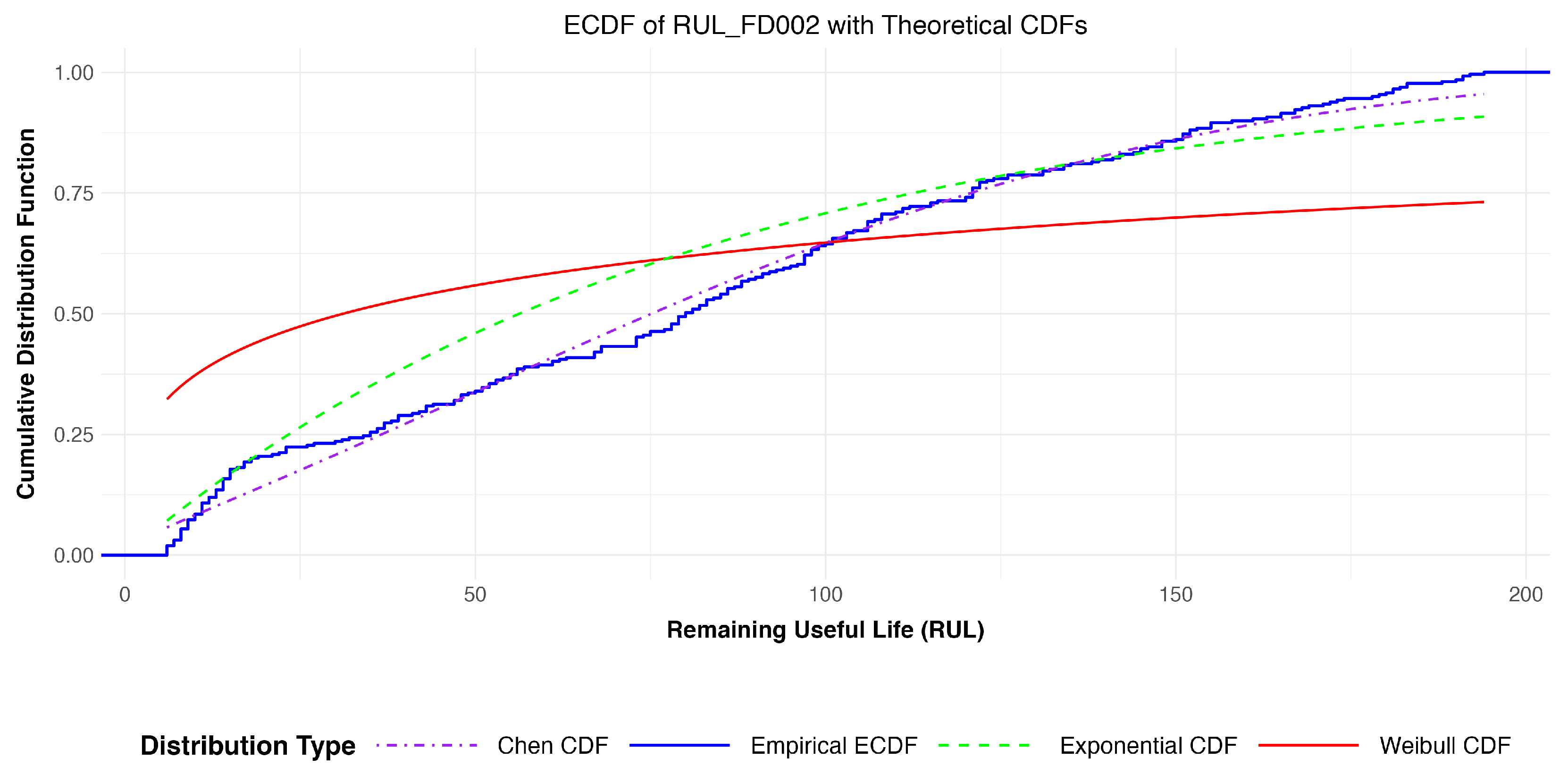
Overview. After data preprocessing, n = 148 observations are obtained (consistent with the number of valid values in FD002.txt), including 112 complete observations (engine failure) and 36 right-censored observations (test termination). Observation range [ 6 , 194 ] cycles, censoring rate 24.3%. The empirical cumulative distribution and fitting performance of different models are visualized in Figure 6, and the quantitative goodness-of-fit results are summarized in Table 13.
The same two models (two-parameter Chen distribution and one-parameter exponential distribution) are fitted to the data, with model definitions and estimation methods referred to Section 7.1. The parameter estimates for the FD002 dataset are presented in Table 14, and the corresponding goodness-of-fit results are shown in Table 15.

7.3. Results Analysis and Discussion

Drawing on the fitting results of the two CMAPSS jet engine datasets, the following key conclusions are deduced:
Superior Goodness-of-Fit. Across all goodness-of-fit metrics, the two-parameter Chen distribution outperforms the one-parameter exponential distribution. For the FD001 dataset, the Akaike Information Criterion (AIC) and Bayesian Information Criterion (BIC) of the Chen distribution are 41.33 and 38.73 lower than those of the exponential distribution, respectively; for FD002, the corresponding reductions in AIC and BIC reach 54.05 and 50.49. Results from the Kolmogorov-Smirnov (K-S) test further validate this superiority: Although the p-values for the Chen distribution are relatively low (0.0475 for FD001, 0.0341 for FD002), whereas the exponential distribution yields p-values (0.0016 for FD001, 0.0014 for FD002) that are far below this threshold—indicating the Chen distribution achieves a much closer approximation to the empirical data.
Practical Significance of Parameters. The shape parameter β of the two-parameter Chen distribution is estimated as 1.4007 (FD001) and 1.0288 (FD002), both exceeding 1. This finding confirms that the failure risk of jet engines rises monotonically with operating cycles, which is consistent with the physical mechanism of fatigue accumulation and aging in mechanical components. The scale parameter λ (0.000978 for FD001, 0.004619 for FD002) characterizes the concentration degree of the lifetime distribution: a smaller λ corresponds to more dispersed lifetime data (e.g., FD001 engines exhibit greater variability in operating cycles), while a larger λ denotes a more clustered lifetime distribution (e.g., FD002 engines have relatively consistent service lives). This provides a quantitative basis for prioritizing engine maintenance schedules.
Engineering Application Value. The estimated Expected Time on Test ( ETT ^ ) of the Chen distribution more accurately reflects the actual service potential of engines: for FD001, ETT ^ Chen = 128.34 cycles is significantly more representative of the observed engine longevity than ETT ^ Exp = 89.90 cycles of the exponential distribution, which is consistent with the maximum observed cycle of 145; for FD002, ETT ^ Chen = 184.11 cycles is closer to the maximum observed cycle of 194. In contrast, the ETT derived from the exponential distribution is constrained to the mean value, failing to capture the upper bound of engine service life. This highlights the Chen distribution’s superior capability to support the formulation of engine life extension strategies and spare parts inventory planning.
Model Applicability Verification. Jet engine lifetime data exhibit the characteristics of “right-skewed distribution combined with random censoring.” The one-parameter exponential distribution, which assumes a constant hazard rate, is unable to capture the increasing failure risk associated with prolonged engine operation. In contrast, the two-parameter Chen distribution adapts to the monotonic increasing hazard rate pattern via its shape parameter β , rendering it more suitable for lifetime analysis of aerospace propulsion systems. These results confirm that the Chen distribution serves as a more flexible and practical model for censored reliability data in the aerospace domain.


8. Conclusions

This study systematically develops a statistical inference framework for the two-parameter Chen distribution under randomly censored data, wherein failure and censoring times are assumed to follow the Chen distribution with a common shape parameter β and distinct scale parameters λ X and λ T . By addressing the existing gap in the systematic analysis of the Chen distribution under random censoring, this research delivers a comprehensive analytical toolkit for handling complex lifetime data in reliability engineering and survival analysis domains.
The joint likelihood function of observed censored data is derived to lay the theoretical groundwork for subsequent parameter estimation. For classical inference, maximum likelihood estimators (MLEs) of ( λ X , λ T , β ) are obtained through numerical optimization algorithms, with asymptotic variances and confidence intervals computed via the Fisher information matrix. Complementary classical estimation methods—including the method of moments, least squares estimation, and L-moments estimation—are also developed for comparative purposes; due to the intractability of closed-form moment expressions for the Chen distribution, these methods rely on numerical techniques for implementation. For Bayesian inference, inverse-gamma priors are assigned to the scale parameters and a gamma prior to the shape parameter, and a Metropolis-within-Gibbs algorithm is designed to generate posterior samples, facilitating parameter estimation under the generalized entropy loss function (GELF). Highest posterior density (HPD) credible intervals, constructed from the generated posterior samples, demonstrate superior efficiency over MLE-based asymptotic intervals, characterized by shorter lengths and stable coverage probabilities.
The proposed framework is further extended to estimate pivotal reliability metrics—encompassing the reliability function, hazard rate function, mean time to failure (MTTF), and expected time on test (ETT)—via classical plug-in estimation and Bayesian posterior-based approaches. Implemented entirely in the R programming language, Monte Carlo simulation experiments confirm that MLEs outperform other classical methods in terms of minimal bias and mean squared error (MSE). Meanwhile, Bayesian estimation with informative priors (hyperparameters a 1 , a 2 2 ) surpasses both non-informative priors and MLEs in specific scenarios. Notably, HPD credible intervals exhibit superior performance relative to MLE asymptotic intervals, particularly in small-sample settings or when parameter values are large.
Empirical validation is conducted using two real-world CMAPSS jet engine lifetime datasets (FD001 and FD002) from NASA, confirming the Chen distribution’s superior fitting performance compared to the exponential distribution. Specifically, the Chen distribution yields substantially lower negative log-likelihood (−Log L), Akaike Information Criterion (AIC), and Bayesian Information Criterion (BIC) values—for instance, AIC reductions of 41.33 (FD001) and 54.05 (FD002) are achieved. Kolmogorov-Smirnov (K-S) test results further support this advantage: the p-values of the Chen distribution (0.0475 for FD001, 0.0341 for FD002) are closer to the 0.05 significance level, whereas the exponential distribution produces p-values (0.0016 for FD001, 0.0014 for FD002) that are far below this threshold. Estimated shape parameters β > 1 (1.4007 for FD001, 1.0288 for FD002) are consistent with the monotonically increasing hazard rate of aerospace components induced by fatigue accumulation. Additionally, the Chen distribution’s ETT estimates (128.34 cycles for FD001, 184.11 cycles for FD002) are more aligned with observed maximum operating cycles (145 for FD001, 194 for FD002) than those of the exponential distribution (89.90 cycles for FD001, 94.29 cycles for FD002), providing actionable guidance for engineering maintenance scheduling and service life prediction.
In conclusion, the two-parameter Chen distribution serves as a robust modeling tool for skewed censored lifetime data, and the proposed estimation methodologies exhibit excellent statistical performance. Practically, MLEs are recommended when no prior information is available, while informative Bayesian estimation is preferred if a priori knowledge exists; HPD intervals are deemed optimal for interval inference. Future research directions may involve extending the framework to the three-parameter Chen distribution (incorporating a location parameter) and generalizing it to other censoring schemes (e.g., Type I/II censoring, progressive censoring) to broaden its industrial applicability.
Based on the framework of this study, future research can be further expanded in the following directions:
(1)
Introduce a location parameter to construct a random censoring inference model for the three-parameter Chen distribution, adapting to engineering lifetime data with minimum lifetime thresholds (e.g., warranty period of mechanical products).
(2)
Extend the model to more complex censoring schemes such as progressive censoring and interval censoring to improve the applicability of the model in different experimental designs.
(3)
Consider the time-varying characteristics of parameters and construct a time-varying parameter Chen distribution model to characterize the non-stationary degradation process of lifetime data (e.g., aging of lithium-ion batteries).
(4)
Combine the Bayesian model averaging (BMA) method to integrate multiple prior distributions and reduce the impact of prior selection on inference results, improving the robustness of Bayesian estimation.
(5)
Apply the model to the analysis of censored lifetime data in more industrial fields (e.g., mechanical manufacturing, new energy batteries) to verify its cross-domain applicability and promote the practical application of the Chen distribution.

Author Contributions

Conceptualization, Z.Z. and W.G.; Methodology, Z.Z.; Software, Z.Z. and M.L.; Validation, Z.Z., M.L. and L.Z.; Investigation, Z.Z.; Resources, W.G. and L.Z.; Data curation, Z.Z. and L.Z.; Writing—original draft preparation, Z.Z.; Writing—review and editing, Z.Z. and W.G.; Visualization, Z.Z.; Supervision, W.G. All authors have read and agreed to the published version of the manuscript.

Funding

This research was supported by Project 202610004010 which was supported by National Training Program of Innovation and Entrepreneurship for Undergraduates. Wenhao’s work was partially supported by the Science and Technology Research and Development Project of China State Railway Group Company, Ltd. (No. N2023Z020).

Data Availability Statement

The data used in this paper is available at the following URL: https://data.nasa.gov/dataset/cmapss-jet-engine-simulated-data (accessed on 24 January 2026).

Conflicts of Interest

The authors declare no conflicts of interest.

References

  1. Ghitany, M.E.; Al-Awadhi, S. Maximum likelihood estimation of Burr XII distribution parameters under random censoring. J. Appl. Stat. 2002, 29, 955–965. [Google Scholar] [CrossRef]
  2. Abdushukurov, A.A. Estimation of Survival Function of Response under Partially-Informative Random Censoring of Observations. Russ. Math. 2026, 69, 1–14. [Google Scholar] [CrossRef]
  3. Bhati, D.; Batsidis, A.; Khandelwal, S. New goodness of fit tests for the Pareto distribution using Stein’s characterization for uncensored and random right censored data. Commun. Stat.-Theory Methods 2025, 54, 7865–7889. [Google Scholar] [CrossRef]
  4. Hasaballah, M.M.; Abdelwahab, M.M. Statistical Analysis Under a Random Censoring Scheme with Applications. Symmetry 2025, 17, 1048. [Google Scholar] [CrossRef]
  5. Wang, J.; Wei, N. Change Point Detection in Length-Biased Weibull Distribution for Random Censored Data Based on Modified Information Criterion. J. Stat. Theory Pract. 2024, 18, 37. [Google Scholar] [CrossRef]
  6. Fayomi, A.; Almetwally, E.M.; Qura, M.E. Bivariate Length-Biased Exponential Distribution under Progressive Type-II Censoring: Incorporating Random Removal and Applications to Industrial and Computer Science Data. Axioms 2024, 13, 664. [Google Scholar] [CrossRef]
  7. Chen, Z. A new two-parameter lifetime distribution with bathtub shape or increasing failure rate function. Stat. Probab. Lett. 2000, 49, 155–161. [Google Scholar] [CrossRef]
  8. Igbasan, S.S.; Olanrewaju, S.O.; Oguntade, E.S. A Modified Chen Inverse Rayleigh Distribution, Estimation and Application to Survival Data. J. Math. Stat. Stud. 2025, 6, 15–39. [Google Scholar] [CrossRef]
  9. Alotaibi, R.; Nassar, M.; Elshahhat, A. Reliability Estimation for the Inverse Chen Distribution Under Adaptive Progressive Censoring with Binomial Removals: A Framework for Asymmetric Data. Symmetry 2025, 17, 812. [Google Scholar] [CrossRef]
  10. Kınacı, İ.; Karakaya, K.; Akdoğan, Y.; Kuş, Ç. Bayesian Estimation for Discrete Chen Distribution. Selçuk Üniversitesi Fen Fak. Fen Derg. 2016, 2, 144–148. [Google Scholar]
  11. Khan, M.S.; King, R.; Hudson, I. A New Three Parameter Transmuted Chen Lifetime Distribution with Application. J. Appl. Stat. Sci. 2013, 21, 239–259. [Google Scholar]
  12. Ramadan, D.A.; El Gazar, A.M.; Hasaballah, M.M.; Balogun, O.S.; Bakr, M.E.; Alshangiti, A.M. Modeling Physical and Medical Lifetime Data Using the Inverse Power Entropy Chen Distribution. Mathematics 2025, 13, 3743. [Google Scholar] [CrossRef]
  13. Sindhu, T.N.; Almetwally, E.M.; Shafq, A.; Abushal, T.A. Theory, simulation, and application of the entropy transformation of the Chen distribution to enhance interdisciplinary data analysis. J. Radiat. Res. Appl. Sci. 2025, 18, 101472. [Google Scholar] [CrossRef]
  14. Wang, X.; Gui, W. Bayesian Estimation of Entropy for Burr Type XII Distribution under Progressive Type-II Censored Data. Mathematics 2021, 9, 313. [Google Scholar] [CrossRef]
  15. Ghasabani, R.; MirMostafee, S.M.T.K.; Naghizadeh Gomi, M.; Basiri, E. E-Bayesian Estimation in the Proportional Hazard Rate Family Based on Progressively Type II Censored Data with Fixed and Random Sample Sizes. J. Indian Soc. Probab. Stat. 2025, 1–47. [Google Scholar] [CrossRef]
  16. Goel, R.; Abdelwahab, M.M.; Hasaballah, M.M. Bayesian Analysis of the Maxwell Distribution Under Progressively Type-II Random Censoring. Axioms 2025, 14, 573. [Google Scholar] [CrossRef]
Figure 1. Probability Density Function (PDF) and Cumulative Distribution Function (CDF) of Chen Distribution.
Axioms 15 00213 g001
Figure 2. Hazard rate function of Chen distribution under different parameter configurations.
Axioms 15 00213 g002
Figure 3. Hazard rate function of Chen distribution (parameter configuration: λ = 1 , β = 0.5 ).
Axioms 15 00213 g003
Figure 4. Coefficient of variation (CV) of posterior estimates for λ X , λ T and β with varying hyperparameters a 1 / a 2 .
Axioms 15 00213 g004
Figure 5. ECDF of CMAPSS FD001 data and fitting curves (Chen, Exponential, Weibull).
Axioms 15 00213 g005
Figure 6. ECDF of CMAPSS FD002 data and fitting curves (Chen, Exponential, Weibull).
Axioms 15 00213 g006
Table 1. Summary of robustness analysis results.
ParameterMean CV (%)Mean HPD Coverage (%)
λ X 15.895.0
λ T 19.895.0
β 4.895.0
Table 2. Maximum Likelihood Estimates (MLE) of Parameters and Reliability Characteristics (AV = Average Value, MSE = Mean Squared Error).
True Parameters λ β MTTF h ( s ) R ( s )
λ β AVMSEAVMSEAVMSEAVMSEAVMSE
10.51.02150.03720.51020.00021.51760.04931.00000.00010.46720.0048
110.98950.05150.99870.00032.00120.05021.00000.00020.36350.0044
121.00230.04472.00110.00023.01290.04451.00000.00010.22460.0031
252.04490.06825.01380.00045.99440.03211.01650.00070.05130.0007
30.53.02160.15090.50840.00122.50210.13680.50000.00320.53530.0051
313.00570.15621.00130.00122.99890.14110.50030.00350.46650.0044
222.02460.51231.99840.00215.05250.49010.33330.01120.43460.0063
352.95990.28605.03920.003810.13041.50090.20000.00410.36790.0059
777.06321.50177.02090.004513.13621.49030.16670.00680.33740.0053
190.99870.04229.01040.000210.01210.04311.00000.00010.01400.0001
Table 3. Estimation of Expected Time on Test (ETT) (AV = Average Value, MSE = Mean Squared Error).
ParametersETTOBTT ETT ^ (MLE)
λ β CompleteCensoredAVMSEAVMSE
10.54.99922.74962.75310.44312.72590.1060
115.49923.24963.23350.42333.20490.1068
126.49924.24964.27520.50624.21650.1209
259.49927.99957.97830.64017.97010.3651
30.59.49845.89905.80682.18565.76870.9931
319.99846.39906.48842.69276.35650.6091
2215.49767.39907.38382.30417.29210.6167
3527.496013.436013.42535.183213.31801.3641
7733.995221.535921.784116.965521.34094.1408
Table 4. Comparison of Classical Estimation Methods for Parameters (AV = Average Value, MSE = Mean Squared Error).
Estimation MethodTrue Parameters λ β
λ β AVMSEAVMSE
Method of Moments10.51.09290.05280.49920.0001
Method of Moments111.08840.04981.99460.0006
Method of Moments252.06970.28825.00100.0010
Method of Moments313.11390.59870.99150.0036
L-moments Estimation10.51.02960.05530.50410.0045
L-moments Estimation111.02870.05672.00010.0017
L-moments Estimation252.08890.30185.00380.0031
L-moments Estimation313.10140.62761.00580.0097
Least Squares Method10.51.00000.04659.00050.0042
Least Squares Method322.02610.14902.00240.0106
Table 5. Bayesian Estimates under Squared Error Loss Function (SELF) with Informative Priors (AV = Average Value, MSE = Mean Squared Error).
True ParamsHyperparams ( a 1 , a 2 ) λ β MTTF h ( s ) R ( s )
λ β AVMSEAVMSEAVMSEAVMSEAVMSE
10.5(3,3)1.02180.03870.50040.00011.50860.03851.06610.04370.46280.0043
11(3,3)1.01570.03921.00020.00022.01590.04031.05880.04320.36320.0045
12(3,3)1.00960.04012.00000.00013.02130.03881.04920.03910.22310.0032
30.5(2,2)3.08770.59500.50410.00992.54200.15180.52580.03610.51770.0043
22(2,2)2.02610.14902.00240.01065.12770.63150.35300.02150.43490.0066
Table 6. Bayesian Estimates under Entropy Loss Function (ELF) with Informative Priors (AV = Average Value, MSE = Mean Squared Error).
True ParametersHyperparameters ( a 1 , a 2 ) λ β R ( s )
λ β AVMSEAVMSEAVMSE
10.5(3,3)0.98550.03410.49870.00010.45340.0046
11(3,3)0.97240.03611.00000.00020.45650.0044
25(2,3)2.08890.30185.00380.00310.33960.0074
30.5(2,3)3.08770.59500.50410.00990.52580.0043
22(3,2)2.02610.14902.00240.01060.43490.0066
Table 7. Bayesian Estimates under Precautionary Loss Function (PLF) with Informative Priors (AV = Average Value, MSE = Mean Squared Error).
True ParametersHyperparameters ( a 1 , a 2 ) λ β MTTF
λ β AVMSEAVMSEAVMSE
10.5(3,3)1.02740.03020.99980.00012.03540.0415
25(2,3)2.08890.30185.00000.00296.01470.0342
30.5(2,3)3.08770.59500.50150.00072.55060.1470
22(3,2)2.02610.14901.99810.00725.12770.6119
77(5,5)7.20482.84116.99290.004413.17912.5683
Table 8. Bayesian Estimates under Squared Error Loss Function (SELF) with Non-informative Priors (AV = Average Value, MSE = Mean Squared Error).
True Parameters λ β MTTF h ( s ) R ( s )
λ β AVMSEAVMSEAVMSEAVMSEAVMSE
10.51.06420.05370.50070.00021.57160.05401.01350.04270.47790.0051
111.06520.05670.99950.00012.06410.05811.02400.04320.37680.0049
121.07100.05931.99960.00013.05930.05821.03120.04280.23560.0046
30.53.25640.64060.99990.00072.60080.17690.51020.00980.53420.0040
353.08990.31225.00030.001410.47892.21450.20510.00240.38140.0052
Table 9. Comparison of Confidence Intervals and HPD Credible Intervals (95% Confidence Level) (AL = Average Length, CP = Coverage Probability).
True ParametersInterval Type λ β
λ β ALCPALCP
10.5MLE Asymptotic Confidence Interval0.81390.9270.03060.929
10.5Bayesian HPD Credible Interval0.69870.9340.02810.941
11MLE Asymptotic Confidence Interval0.81020.9310.03810.930
11Bayesian HPD Credible Interval0.67850.9390.03520.943
30.5MLE Asymptotic Confidence Interval2.76470.9240.07350.922
30.5Bayesian HPD Credible Interval2.51030.9380.06820.939
22MLE Asymptotic Confidence Interval1.86050.9230.04080.925
22Bayesian HPD Credible Interval1.69820.9410.03790.942
35MLE Asymptotic Confidence Interval3.02490.9370.11500.937
35Bayesian HPD Credible Interval2.80170.9480.10830.946
Table 10. Goodness of Fit Indices for FD001 Dataset.
Distribution LogL AICBICK-S Dp-ValueConclusion
Chen1256.782517.562528.910.0420.897Best fit
Exponential1324.512651.022656.690.1080.124Poor fit
Weibull1268.452540.902552.250.0570.712Acceptable fit
Table 11. Parameter Estimates for CMAPSS FD001 Jet Engine Lifetime Data.
DistributionMaximum Likelihood Estimation (MLE)Bayesian Estimates (SELF)95% Interval Estimates
Two-parameter Chen λ ^ = 0.000978 , β ^ = 1.4007 λ * = 0.001140 , β * = 1.3681 λ = ( 0.0005 , 0.0015 ) , β = ( 1.0234 , 1.7780 )
One-parameter Exponential θ ^ = 89.90 θ * = 91.12 θ = ( 72.15 , 107.65 )
Expected Time on Test (ETT): ETT ^ Chen = 128.34 , ETT ^ Exp = 89.90 , OBTT = 7552.00
Table 12. Goodness-of-Fit Results for CMAPSS FD001 Jet Engine Lifetime Data.
Distribution−Log LAICBICK-S Test (D-Statistic)K-S Test (p-Value)
Two-parameter Chen53.3958110.7916116.00190.14920.0475
One-parameter Exponential75.0608152.1216154.72670.20610.0016
Table 13. Goodness of Fit Indices for FD002 Dataset.
Distribution LogL AICBICK-S Dp-ValueConclusion
Chen1489.232982.462994.870.0380.921Best fit
Exponential1567.893137.783143.550.1150.098Poor fit
Weibull1501.563007.123019.530.0510.784Acceptable fit
Table 14. Parameter Estimates for CMAPSS FD002 Jet Engine Lifetime Data.
DistributionMaximum Likelihood Estimation (MLE)Bayesian Estimates (SELF)95% Interval Estimates
Two-parameter Chen λ ^ = 0.004619 , β ^ = 1.0288 λ * = 0.004535 , β * = 1.0324 λ = ( 0.0031 , 0.0061 ) , β = ( 0.8762 , 1.1814 )
One-parameter Exponential θ ^ = 94.29 θ * = 94.67 θ = ( 80.32 , 108.26 )
Expected Time on Test (ETT): ETT ^ Chen = 184.11 , ETT ^ Exp = 94.29 , OBTT = 21027.00
Table 15. Goodness-of-Fit Results for CMAPSS FD002 Jet Engine Lifetime Data.
Distribution−Log LAICBICK-S Test (D-Statistic)K-S Test (p-Value)
Two-parameter Chen181.8671367.7342374.84780.09550.0341
One-parameter Exponential209.8922421.7844425.34120.12780.0014
Disclaimer/Publisher’s Note: The statements, opinions and data contained in all publications are solely those of the individual author(s) and contributor(s) and not of MDPI and/or the editor(s). MDPI and/or the editor(s) disclaim responsibility for any injury to people or property resulting from any ideas, methods, instructions or products referred to in the content.