The Extended Second APG Method for Constrained DC Problems

Abstract
1. Introduction
- This corresponds to setting (for all i), , while retaining the original assumptions on f, , and .
2. Notation and Preliminaries
- and denote the sets of real numbers and nonnegative real numbers, respectively.
- and denote the n-dimensional Euclidean space and its nonnegative orthant, respectively.
- denotes the set of positive integers.
- For , .
- For , denotes the -norm on ; in particular, is used exclusively to represent the -norm ().
- For , denotes their inner product.
- Given a nonempty set , the distance from to D is defined as .
- 1.
- A function f is proper if its domain is nonempty.
- 2.
- A proper function f is closed if it is lower semicontinuous at every , i.e., .
- 3.
- A proper closed function f is level bounded if all its lower level sets are bounded for every .
- 4.
- For a sequence , (as ) means (in ) and .
- (i)
- ,
- (ii)
- ,
- (iii)
- .
- (i)
- For , if there exist a neighborhood of , and function such that for all , it holds thatthen h is said to have the Kurdyka-Lojasiewicz (KL) property at .
- (ii)
- If h satisfies the KL property at each point of , then h is called a KL function.
3. Algorithmic Framework
- (i)
- f is a differentiable (possibly nonconvex) function and its gradient is Lipschitz continuous with Lipschitz constant , and is such that is convex.
- (ii)
- All are differentiable functions with Lipschitz continuous gradients. We use to denote the common Lipschitz continuity modulus of , and let be such that be convex for all .
- (iii)
- At least one of and is positive.
- (iv)
- The function is proper, convex and lower semicontinuous; the function is continuous and convex.
- (v)
- Either (a) C is compact, or (b) all and F is level bounded.
| Algorithm 1 for solving Problem (1) |
| Initialization: Choose , , , . For, take , and compute End for |
- (i)
- Constant Acceleration Parameters: Set for some constant satisfying . Choose the constant .
- (ii)
- Variable Acceleration Parameters: For a preselected positive integer K, let for all , and for all . Here, represents the classical parameter sequence introduced by Nesterov (see [21,44]), whereThe integer K is chosen such that . Let . Noticing that the sequence is decreasing (as shown in [21]), it follows that is also decreasing. Additionally, we have:
- (i)
- (ii)
4. Convergence Properties
- (i)
- For , it holds thatwhere
- (ii)
- , , and .
- (iii)
- The sequence and is bounded.
- (i)
- Since is a strongly convex function with parameter and denotes its minimizer over the set C, the 3-Point Property ([46] Lemma 3.2) yieldswhich is equivalent to:By virtue of (16) and convexity of , it follows thatCombining this result with two key inequalities:which holds due to the convexity of and the fact that ;which is derived from Lemma 4 by substituting with , respectively, we arrive atThus,where the first inequality follows from the setting of in Algorithm 1 (which ensures ), and the second inequality is a consequence of (40).Next, leveraging the convexity of , we haveAdditionally, by Lemma 3 (with replaced by , respectively),Combining these two inequalities and (41) gives
- (ii)
- From (45), we deduce
- (iii)
- According to (15) and (16), and the convexity of C, for each k. If C is compact, as part (a) of Assumption 1(iv) holds, the sequence is obviously bounded. Otherwise, we have all and F is level bounded. Thus all in our algorithm. From (48), we observe that . So is bounded by the level boundedness of F.
5. with the Restart Technique
| Algorithm 2 for solving (1) with the restart technique (Theoretical version). |
| Initialization: , , , . for do carry out Algorithm 1 with initial values , , and preselected parameters satisfying Assumption 4 to generate the sequence until Set: , . end for |
- (i)
- Λ is a nonempty compact set.
- (ii)
- is also nonempty and compact.
- (iii)
- The limit exists.
- (iv)
- If is continuous on Ω , we have on Ω , and .
- (i)
- The nonemptiness and compactness of follows directly from the boundedness of , as stated in Theorem 1(iii).
- (ii)
- The representation is a consequence of Theorem 1(ii). Consequently, the properties of nonemptiness and compactness are inherited from to .
- (iii)
- By Theorem 1(i), the sequence is nonincreasing. Furthermore, it follows from the definition of in (33) that is always non-negative. Then exists.
- (iv)
- Finally, we assume that is continuous on , which implies the continuity of H on . For any , let be a subsequence converging to . By Theorem 1(ii), both and also converge to . Thus,Now, suppose for contradiction that does not converge to . By (65) and (66), there exist a subsequence and a positive number such thatBy passing to a subsequence if necessary, we may assume that converges to some . Consequently, both and also converge to . By the continuity of H, we havewhich contradicts (67). Therefore, .
- (i)
- If , then converges finite time.
- (ii)
- If , there exists and such that for all , .
- (iii)
- If , there exists such that for all , .
- (i)
- If , then Algorithm 2 terminates after finitely many iterations.
- (ii)
- If , there exists constants and such that .
- (iii)
- If , there exists constants and such that .
| Algorithm 3 () with Restart Technique (Practical Version) |
| Initialization: Given , , , a positive integer , and as defined in Remark A1(ii). Determining the restart interval: Execute Algorithm 1 with initial values and parameters for N steps, where N denotes the first step k satisfying and . Set and . for do Execute Algorithm 1 with initial values and parameters until either or . Set and . end for |
6. Numerical Experiments
- 1.
- In Section 6.1 and Section 6.2, we verify the computational efficiency of Algorithm 3 against the IPOPT solver [50,51] and three state-of-the-art methods—namely [28], (a basic variant of ESQM derived by fixing in ), and [19]—when solving the optimization problem formulated in (3).
- 2.
- In Section 6.3, we evaluate three key metrics: the effectiveness of Algorithm 3’s -criterion for optimal restart interval identification, Algorithm 3’s efficiency versus Algorithms 1 and 2, and its overall performance relative to multiple modified variants.
- 3.
- In Section 6.4, we validate the efficacy of Algorithm 3 on the unconstrained DC problem specified in (2), with comparisons drawn to the IPOPT solver and three established algorithms for unconstrained DC problems: GIST [52], pDCAe [53], and [26] (the foundational prototype of Algorithm 3).
- –
- ;
- –
- has full row rank;
- –
- ;
- –
- ;
- –
- is an analytic function with Lipschitz-continuous gradient (modulus ), , and .
6.1. Compressed Sensing with
- Details of the Five Algorithms
- (i)
- Initialization and Stopping Criteria: For , , and , we adopt the same initial points as specified in [19]: specifically, for , and for both and . For , the initial point is set to . For IPOPT, we introduce slack variables u and v to reformulate Problem (103) as follows:where denotes the all-ones vector (i.e., a vector with each component equal to 1). The corresponding initial points are set to and .All algorithms except IPOPT terminate when either the relative iterate difference satisfies (with to be specified in subsequent sections) or the maximum number of iterations (3000) is reached. For IPOPT, the convergence tolerance is configured to the same value of and the maximum number of iterations is set to 1000.
- (ii)
- Parameter Settings: The parameters for follow [28], while those for and follow [19]. For , we set and (consistent with [19]) and . Since is convex (implying ), any positive integer K is valid for the acceleration parameters defined in Remark 1(ii); here, we set . Notably, in practice, the restart period N observed in experiments was consistently less than 100. Thus, the experimental performance would remain unchanged if we select any .The subproblems of these algorithms are solved following the procedures outlined in the appendices of [28,45]. In each subproblem, the computational complexity of evaluating and is and , respectively. Additionally, solving the optimization problem (15) incurs a complexity of . Consequently, the overall computational complexity of each subproblem is .All settings of IPOPT are set to their default values except for the tolerance parameter and maximum number of iterations.
- Experimental Setup for Random Instances
- 1.
- Generate with independent and identically distributed (i.i.d.) standard Gaussian entries, then normalize A such that each column has unit norm.
- 2.
- Randomly select a subset of size p, and generate a p-sparse vector with i.i.d. standard Gaussian entries on T.
- 3.
- Set , where is a random vector with i.i.d. standard Gaussian entries; set , where .
- Experimental Parameters and Result Metrics
- –
- We set in Problem (105).
- –
- We considered parameter triples for .
- –
- For each i, 20 random instances were generated (as above), and results were averaged over these 20 instances.
- –
- : Time to compute the QR decomposition of .
- –
- : Time to compute .
- –
- : Time to compute using the QR factorization of .
- –
- CPU time of each algorithm.
- –
- Iter: Number of iterations.
- –
- RecErr : Recovery error (where is the approximate solution from the algorithm).
- –
- Residual : Residual of the constraint violation.
- Key Observations from Results
- 1.
- achieves the fastest computation speed among the five algorithms.
- 2.
- The recovery errors (RecErr) and residuals of all five methods are comparable.
6.2. Compressed Sensing with Lorentzian Norm
- Details of the Five Algorithms
- (i)
- Initialization and Stopping Criteria: All algorithms use the same initialization and stopping criteria as in Section 6.1.
- (ii)
- Parameter Settings:
- –
- For , parameters follow the settings in [28].
- –
- For the other three algorithms, we set , , , —consistent with [19].
- –
- For the acceleration parameters of , since , it is straightforward to verify that . However, in practice, because all iterates lie within a bounded local region, the theoretical results may remain valid for larger values of K. As the next subsection will demonstrate, we can consistently use a large K and adaptively determine the restart period N (where ) to enhance the performance of Algorithm 3. In fact, the restart period N observed in experiments was consistently less than 100. Thus, selecting any would ensure both consistent and improved experimental performance. For the lower bound of N, we also set , consistent with the setting in Section 6.1.
The subproblems of these algorithms are solved following the procedures outlined in the appendices of [28,45]. Consistent with the experimental results presented in Section 6.1, the overall computational complexity of each subproblem is also .
- Experimental Setup for Random Instances
- 1.
- 2.
- Set , where . Specifically, is generated as , with being a random vector with i.i.d. entries uniformly sampled from (note: corrected the ambiguous “with being” to “with being” to avoid variable confusion).
- 3.
- Set with .
- Experimental Parameters and Result Metrics
- –
- We set in Problem (110).
- –
- We considered parameter triples for .
- –
- For each i, 20 random instances were generated, and results were averaged over these instances (consistent with Section 6.1).
- –
- : Time to compute the QR decomposition of .
- –
- : Time to compute .
- –
- : Time to compute using the QR factorization of .
- –
- CPU time of each algorithm.
- –
- Iter: Number of iterations.
- –
- RecErr : Recovery error (where is the approximate solution from the algorithm).
- –
- Residual : Residual of the Lorentzian norm constraint violation.
- Key Observations from Results
- 1.
- frequently demonstrates the fastest convergence speed among the five.
- 2.
- The recovery errors (RecErr) and residuals of all five methods are comparable.
6.3. Analysis on the Settings of Algorithm 3
- (i)
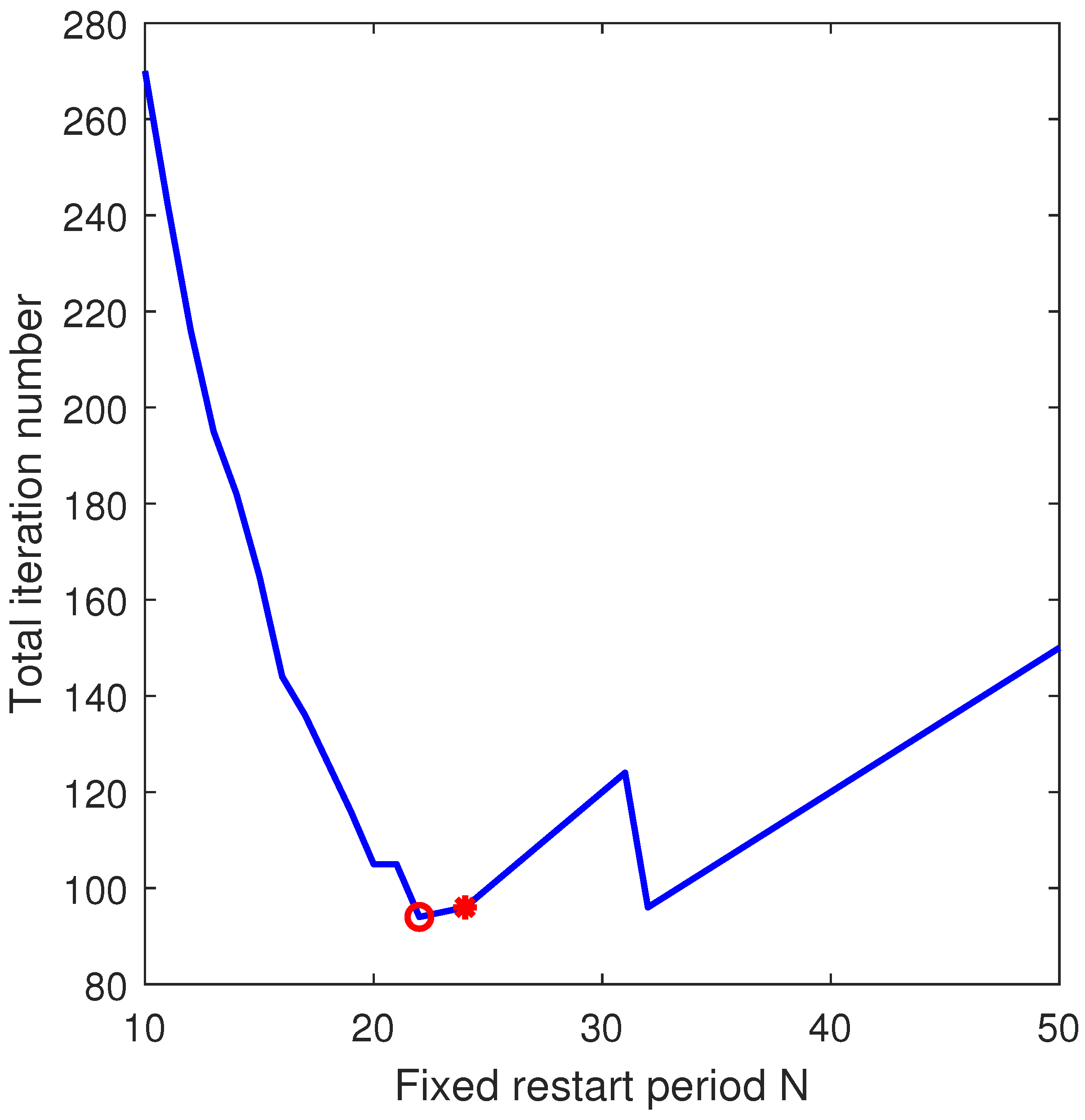
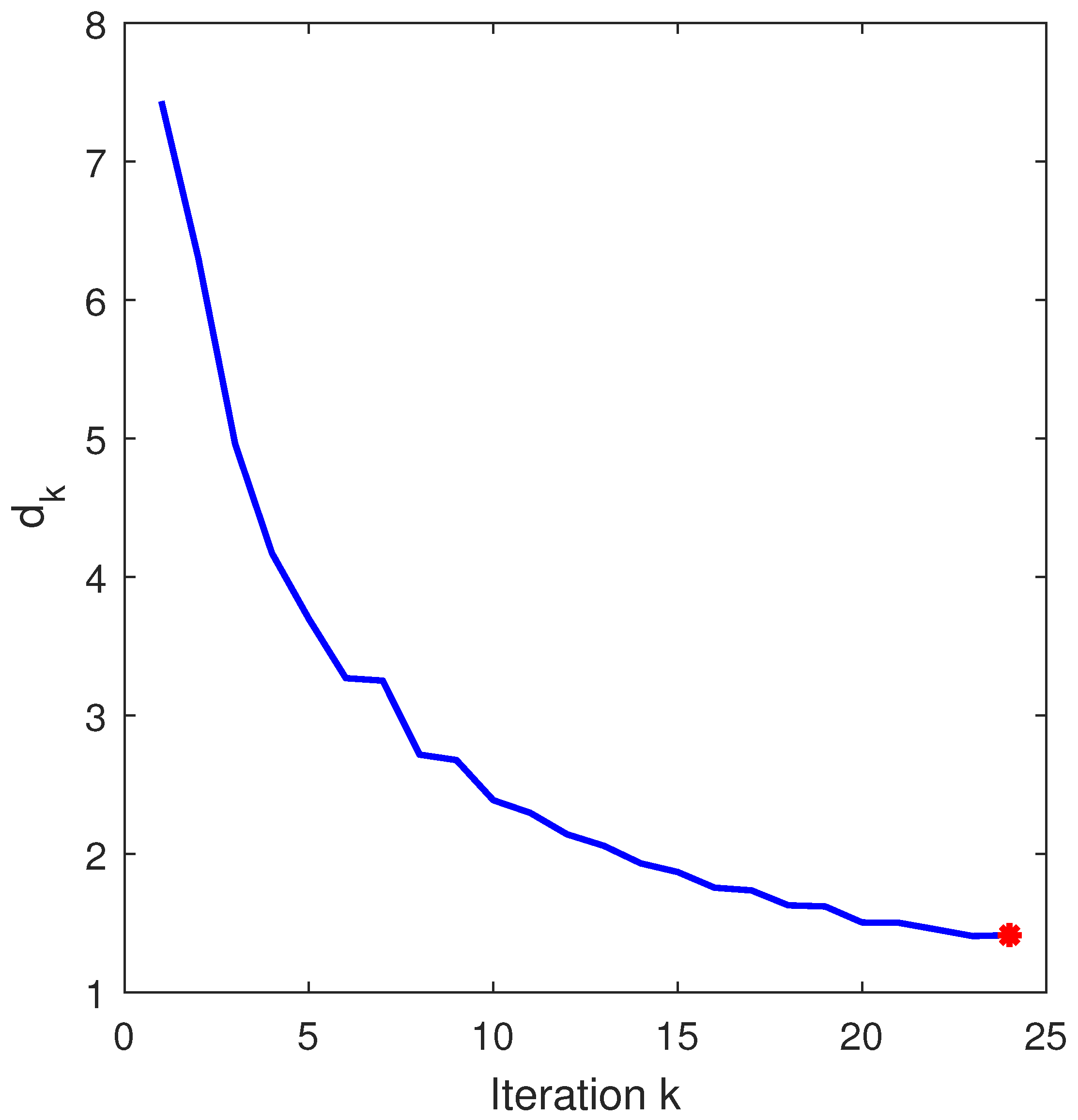
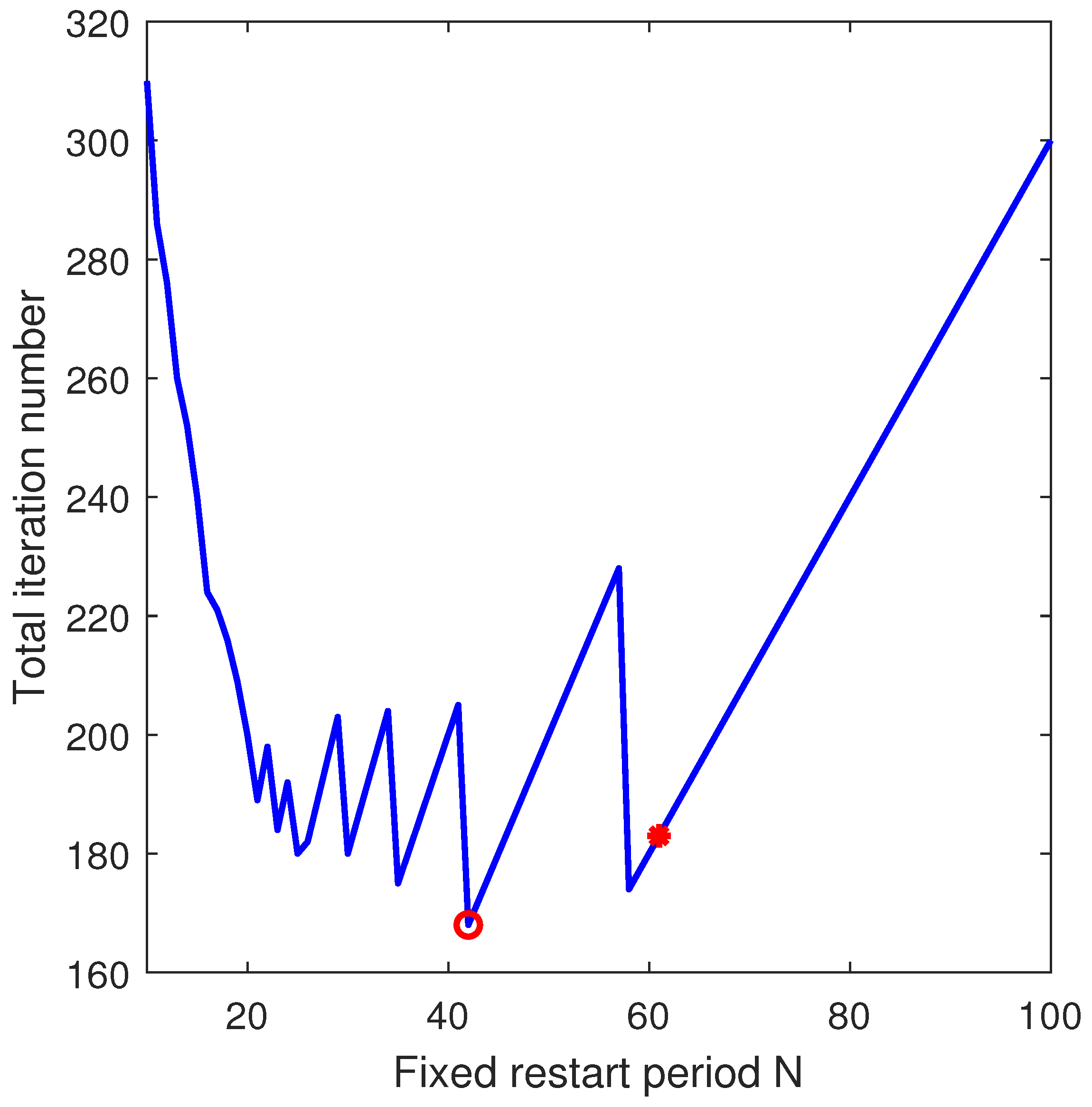
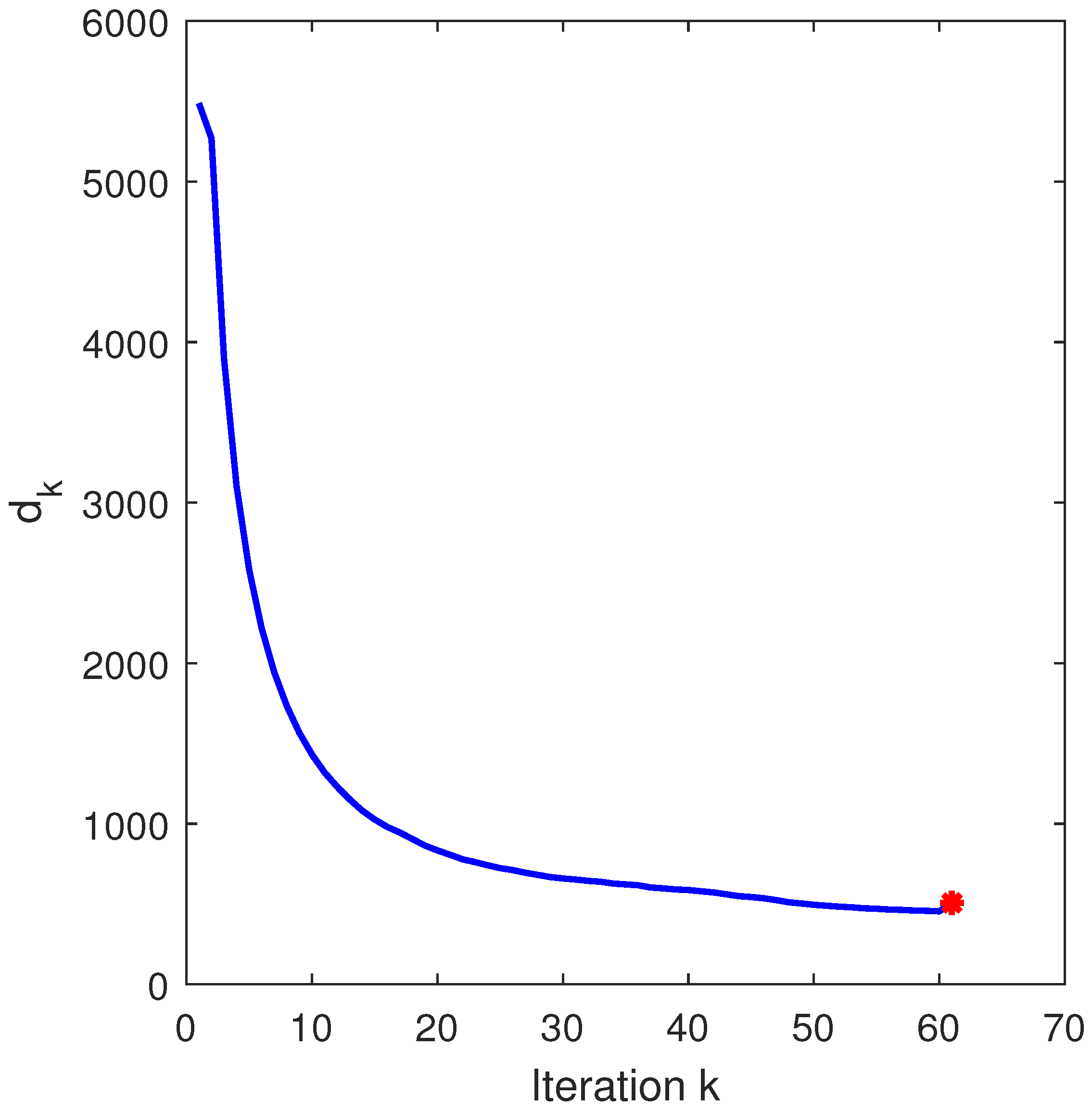
- The restart period N determined by Algorithm 3 is a good approximation of the optimal fixed restart period for Algorithm 4.
- (ii)
- The restart scheme of Algorithm 3 outperforms the following alternative schemes:
- Algorithm 1 and Algorithm 2, both with defined in Remark 1(ii) and with K set to 30 and 100, respectively.
- Variant (a) of Algorithm 3: Restarts only based on the -criterion (without determining N or using the inner product criterion).
- Variant (b) of Algorithm 3: Algorithm 3 with the inner product criterion removed.
- Variant (c) of Algorithm 3: Determines the restart interval using both the -criterion and the inner product criterion (consistent with Algorithm 3).
- Variant (d) of Algorithm 3: Algorithm 3 with the -criterion replaced by the inner product criterion.
- Variant (e) of Algorithm 3: (Algorithm 3 Incorporating the Armijo Step Size Rule): Replace Equation (16) with the step size selection strategy outlined below:Let . If or , set directly. Otherwise, computewhere p denotes the smallest non-negative integer satisfying the inequalityIn the above criterion, the parameters are fixed as and .
| Algorithm 4 Fixed restarting with period N |
| Initialization: Given , , , a positive integer N, and as defined in Remark A1(ii). for do Execute Algorithm 1 for N steps, with initial values and parameters . Set and . end for |
6.4. Experiments on Unconstrained DC Problems
- (i)
- Objective Function Formulation:
- For GIST, the objective is cast as , where ;
- For pDCAe, F is decomposed into , with and ;
- For and , the decomposition takes the form , where and ;
- For IPOPT, to accommodate its requirement for differentiable objectives, we introduce non-negative slack variables such that , thereby reformulating into a differentiable form.
- (ii)
- Initialization and Termination Criteria: For each dataset, a total of 21 initial points are used uniformly across all algorithms except IPOPT: one zero vector, plus 5 independently sampled vectors from the normal distribution for each . All algorithms terminate if either the relative iterate difference satisfiesor the iteration count reaches the upper limit of 3000.For IPOPT, corresponding to each of the aforementioned initial points , we initialize the slack variables as and . The convergence tolerance is set to , with the maximum number of iterations configured to 1000.
- (iii)
- Parameter Configurations: The parameters for GIST, pDCAe, and are set in accordance with their respective original studies [26,52,53]. For , we fix the restart parameter . All IPOPT settings are retained at their default values, with the only exception being the convergence tolerance (adjusted as specified above) and the maximum number of iterations.
- Experimental Parameters and Evaluation Metrics
- –
- The regularization parameter in Problem (107) is set to ;
- –
- –
- Iter: Number of iterations required to reach convergence;
- –
- Fval: Final value of the objective function at termination;
- –
- Time: Total CPU time (in seconds) consumed during the optimization process.
- 1.
- It attains the second-lowest iteration count in most test cases.
- 2.
- It achieves optimal objective function values across most datasets.
- 3.
- It incurs the shortest computational time among all competing methods.
7. Conclusions
- (1)
- Extending the method to the setting of constrained DC problems, filling the gap between unconstrained DC optimization and constrained DC problem solving.
- (2)
- Deriving a global convergence result for the restart-augmented framework.
- (3)
- Weakening the original regularity requirements on the function that underpin the convergence of the baseline method.
- (a)
- Providing a competitive new approach for solving constrained DC problems, with performance comparable to or exceeding state-of-the-art methods.
- (b)
- Delivering significant performance gains (attributed to the embedded restart technique) over the baseline method when applied to unconstrained DC problems.
- (i)
- Identifying the conditions under which Inequality (65) holds for Algorithm 1.
- (ii)
- Conducting a theoretical analysis of the restart criteria for Algorithm 3.
- (iii)
- Developing efficient solvers for subproblems involving more generalized forms of and cases with .
- (iv)
- Exploring techniques (e.g., adaptive line search rules) to identify optimal acceleration parameters, further enhancing the algorithm’s computational efficiency.
Author Contributions
Funding
Data Availability Statement
Acknowledgments
Conflicts of Interest
References
- Le Thi, H.A.; Pham Dinh, T. DC programming and DCA: Thirty years of developments. Math. Program. 2018, 169, 5–68. [Google Scholar] [CrossRef]
- Hong, L.J.; Yang, Y.; Zhang, L.W. Sequential Convex Approximations to Joint Chance Constrained Programs: A Monte Carlo Approach. Oper. Res. 2011, 59, 617–630. [Google Scholar] [CrossRef]
- Geremew, W.; Nam, N.M.; Semenov, A.; Boginski, V.; Pasiliao, E. A DC programming approach for solving multicast network design problems via the Nesterov smoothing technique. J. Glob. Optim. 2018, 72, 705–729. [Google Scholar] [CrossRef]
- Shen, C.G.; Liu, X. Solving nonnegative sparsity-constrained optimization via DC quadratic-piecewise-linear approximations. J. Glob. Optim. 2021, 81, 1019–1055. [Google Scholar] [CrossRef]
- van Ackooij, W.; de Oliveira, W. Non-smooth DC-constrained optimization: Constraint qualification and minimizing methodologies. Optim. Methods Softw. 2019, 34, 890–920. [Google Scholar] [CrossRef]
- Lu, Z.S.; Sun, Z.; Zhou, Z.R. Penalty and Augmented Lagrangian Methods for Constrained DC Programming. Math. Oper. Res. 2022, 47, 1707–2545. [Google Scholar] [CrossRef]
- Pang, J.-S.; Razaviyayn, M.; Alvarado, A. Computing B-Stationary Points of Nonsmooth DC Programs. Math. Oper. Res. 2017, 42, 95–118. [Google Scholar] [CrossRef]
- Alvarado, A.; Scutari, G.; Pang, J.-S. A new decomposition method for multiuser DC programming and its applications. IEEE Trans. Signal. Process. 2014, 62, 2984–2998. [Google Scholar] [CrossRef]
- Zhang, S.; Xin, J. Minimization of transformed L1 penalty: Theory, difference of convex function algorithm, and robust application in compressed sensing. Math. Program. 2018, 169, 307–336. [Google Scholar] [CrossRef]
- Sanjabi, M.; Razaviyayn, M.; Luo, Z.-Q. Optimal joint base station assignment and beamforming for heterogeneous networks. IEEE Trans. Signal. Process. 2014, 62, 1950–1961. [Google Scholar] [CrossRef]
- Candès, E.; Recht, B. Exact matrix completion via convex optimization. Commun. ACM 2012, 55, 111–119. [Google Scholar] [CrossRef]
- Nakayama, S.; Gotoh, J.Y. On the superiority of pgms to pdcas in nonsmooth nonconvex sparse regression. Optim. Lett. 2021, 15, 2831–2860. [Google Scholar] [CrossRef]
- Van Luong Le, F.L.; Bloch, G. Selective l1 minimization for sparse recovery. IEEE Trans. Autom. Control 2014, 59, 3008–3013. [Google Scholar]
- Wang, W.; Chen, Y. An accelerated smoothing gradient method for nonconvex nonsmooth minimization in image processing. J. Sci. Comput 2022, 90, 31. [Google Scholar] [CrossRef]
- Pham Dinh, T.; Souad, E.B. Algorithms for solving a class of nonconvex optimization Problems. Methods of subgradients. In Fermat Days 85: Mathematics for Optimization; Hiriart-Urruty, J.-B., Ed.; North-Holland: Amsterdam, The Netherlands, 1986; pp. 249–271. [Google Scholar]
- Gill, P.E.; Wong, E. Sequential quadratic programming methods. In Mixed Integer Nonlinear Programming; Lee, J., Leyffer, S., Eds.; Springer: New York, NY, USA, 2012; pp. 147–224. [Google Scholar]
- Yin, P.; Lou, Y.; He, Q.; Xin, J. Minimization of ℓ1–2 for compressed sensing. SIAM J. Sci. Comput. 2015, 37, A536–A563. [Google Scholar] [CrossRef]
- Auslender, A. An extended sequential quadratically constrained quadratic programming algorithm for nonlinear, semidefinite, and second-order cone programming. J. Optim. Theory Appl. 2013, 156, 183–212. [Google Scholar] [CrossRef]
- Zhang, Y.; Pong, T.K.; Xu, S. An extended sequential quadratic method with extrapolation. Comput. Optim. Appl. 2025, 91, 1185–1225. [Google Scholar] [CrossRef]
- Gaudioso, M.; Taheri, S.; Bagirov, A.M.; Karmitsa, N. Bundle Enrichment Method for Nonsmooth Difference of Convex Programming Problems. Algorithms 2023, 16, 394. [Google Scholar] [CrossRef]
- Tseng, P. Approximation accuracy, gradient methods, and error bound for structured convex optimization. Math. Program. 2010, 125, 263–295. [Google Scholar] [CrossRef]
- Beck, A.; Teboulle, M. A Fast Iterative Shrinkage-Thresholding Algorithm for Linear Inverse Problems. SIAM J. Imaging Sci. 2009, 2, 183–202. [Google Scholar] [CrossRef]
- Auslender, A.; Teboulle, M. Interior gradient and proximal methods for convex and conic optimization. SIAM J. Optim. 2006, 16, 697–725. [Google Scholar] [CrossRef]
- Wen, B.; Chen, X.; Pong, T.K. Linear convergence of proximal gradient algorithm with extrapolation for a class of nonconvex nonsmooth minimization problems. SIAM J. Optim. 2017, 27, 124–145. [Google Scholar] [CrossRef]
- Lin, D.; Liu, C. The modified second apg method for dc optimization problems. Optim. Lett. 2019, 13, 805–824. [Google Scholar] [CrossRef]
- Ren, K.; Liu, C.; Wang, L. The modified second APG method for a class of nonconvex nonsmooth problems. Optim. Lett. 2025, 19, 747–770. [Google Scholar] [CrossRef]
- Lu, Z. Sequential convex programming methods for a class of structured nonlinear programming. arXiv 2012, arXiv:1210.3039. [Google Scholar]
- Yu, P.; Pong, T.K.; Lu, Z. Convergence rate analysis of a sequential convex programming method with line search for a class of constrained difference-of-convex optimization problems. SIAM J. Optim. 2021, 31, 2024–2054. [Google Scholar] [CrossRef]
- Wilson, R.B. A Simplicial Method for Convex Programming. Ph.D. Thesis, Harvard University, Cambridge, MA, USA, 1963. [Google Scholar]
- Solodov, M.V. On the sequential quadratically constrained quadratic programming methods. Math. Oper. Res. 2004, 29, 64–79. [Google Scholar] [CrossRef][Green Version]
- Fukushima, M.; Luo, Z.-Q.; Tseng, P. A sequential quadratically constrained quadratic programming method for differentiable convex minimization. SIAM J. Optim. 2003, 13, 1098–1119. [Google Scholar] [CrossRef]
- Solodov, M.V. Global convergence of an SQP method without boundedness assumptions on any of the iterative sequences. Math. Program. 2009, 118, 1–12. [Google Scholar] [CrossRef][Green Version]
- O’Donoghue, B.; Candès, E. Adaptive Restart for Accelerated Gradient Schemes. Found. Comput. Math. 2015, 15, 715–732. [Google Scholar] [CrossRef]
- Rockafellar, R.T.; Wets, R.J.B. Variational Analysis, 3rd ed.; Springer Science & Business Media: Berlin, Germany, 2009; pp. 298–472. [Google Scholar]
- Bolte, J.; Daniilidis, A.; Lewis, A.; Shiota, M. Clarke subgradients of stratifiable functions. SIAM J. Optim. 2007, 18, 556–572. [Google Scholar] [CrossRef]
- Wang, L.; Liu, Z.; Liu, C. The Bregman Modified Second APG Method for DC Optimization Problems. IEEE Access 2025, 13, 126070–126083. [Google Scholar] [CrossRef]
- Attouch, H.; Bolte, J.; Redont, P.; Soubeyran, A. Proximal alternating minimization and projection methods for nonconvex problems: An approach based on the Kurdyka-Łojasiewicz inequality. Math. Oper. Res. 2010, 35, 438–457. [Google Scholar] [CrossRef]
- Attouch, H.; Bolte, J.; Svaiter, B.F. Convergence of descent methods for semi-algebraic and tame problems: Proximal algorithms, forward-backward splitting, and regularized Gauss-Seidel methods. Math. Program. 2013, 137, 91–129. [Google Scholar] [CrossRef]
- Bolte, J.; Sabach, S.; Teboulle, M. Proximal alternating linearized minimization for nonconvex and nonsmooth problems. Math. Program. 2014, 146, 459–494. [Google Scholar] [CrossRef]
- Li, G.; Pong, T.K. Calculus of the exponent of Kurdyka-Łojasiewicz inequality and its applications to linear convergence of first-order methods. Found. Comput. Math. 2018, 18, 1199–1232. [Google Scholar] [CrossRef]
- Qian, Y.; Pan, S. Convergence of a class of nonmonotone descent methods for Kurdyka-Łojasiewicz optimization problems. SIAM J. Optim. 2023, 33, 638–651. [Google Scholar] [CrossRef]
- Wen, B.; Chen, X.; Pong, T.K. A proximal difference-of-convex algorithm with extrapolation. Comput. Optim. Appl. 2018, 69, 297–324. [Google Scholar] [CrossRef]
- Bot, R.I.; Dao, M.N.; Li, G. Extrapolated proximal subgradient algorithms for nonconvex and nonsmooth fractional programs. Math. Oper. Res. 2022, 47, 2415–2443. [Google Scholar] [CrossRef]
- Nesterov, Y. Introductory Lectures on Convex Optimization: A Basic Course; Kluwer Academic Publishers: Boston, MA, USA, 2004; pp. 20–105. [Google Scholar]
- Zhang, Y.; Li, G.; Pong, T.K.; Xu, S. Retraction-based first-order feasible methods for difference-of-convex programs with smooth inequality and simple geometric constraints. Adv. Comput. Math. 2023, 49, 1–40. [Google Scholar] [CrossRef]
- Chen, G.; Teboulle, M. Convergence analysis of a proximal-like minimization algorithm using Bregman functions. SIAM J. Optim. 1993, 3, 538–543. [Google Scholar] [CrossRef]
- Rockafellar, R.T. Convex Analysis; Princeton University Press: Princeton, NJ, USA, 1970; pp. 227–240. [Google Scholar]
- Bot, R.I.; Nguyen, D.K. The proximal alternating direction method of multipliers in the nonconvex setting: Convergence analysis and rates. Math. Oper. Res. 2020, 45, 682–712. [Google Scholar] [CrossRef]
- Rockafellar, R.T.; Wets, R.J.-B. Variational Analysis; Springer: Berlin, Germany, 1998; pp. 298–472. [Google Scholar]
- Wächter, A.; Biegler, L.T. On the implementation of a primal-dual interior point filter line search algorithm for large-scale nonlinear programming. Math. Program. 2006, 106, 25–57. [Google Scholar] [CrossRef]
- COIN-OR. Ipopt (Interior Point Optimizer). Computer Software. 2006. Available online: https://projects.coin-or.org/Ipopt (accessed on 28 October 2025).
- Chen, X.; Lu, Z.; Pong, T.K. Penalty methods for a class of non-Lipschitz optimization problems. SIAM J. Optim. 2016, 26, 1465–1492. [Google Scholar] [CrossRef]
- Liu, T.; Pong, T.K.; Takeda, A. A refined convergence analysis of pDCAe with applications to simultaneous sparse recovery and outlier detection. Comput. Optim. Appl. 2019, 73, 69–100. [Google Scholar] [CrossRef]
- Esser, E.; Lou, Y.; Xin, J. A method for finding structured sparse solutions to non-negative least squares problems with applications. SIAM J. Imag. Sci. 2013, 6, 2010–2046. [Google Scholar] [CrossRef]
- Lou, Y.; Yin, P.; He, Q.; Xin, J. Computing sparse representation in a highly coherent dictionary based on difference of L1 and L2. J. Sci. Comput. 2015, 64, 178–196. [Google Scholar] [CrossRef]
- Carrillo, R.E.; Barner, K.E.; Aysal, T.C. Robust sampling and reconstruction methods for sparse signals in the presence of impulsive noise. IEEE J. Sel. Top. Sign. Process. 2010, 4, 392–408. [Google Scholar] [CrossRef]
- Lin, Y.Z.; Li, S.; Zhang, Y.Z. Convergence Rate Analysis of Accelerated Forward-Backward Algorithm with Generalized Nesterov Momentum Scheme. Int. J. Numer. Anal. Model. 2023, 20, 518–537. [Google Scholar] [CrossRef]
- Zhu, W.; Song, Y.; Xiao, Y. Robust support vector machine classifier with truncated loss function by gradient algorithm. Comput. Ind. Eng. 2022, 172, 108630. [Google Scholar] [CrossRef]
- Dua, D.; Graff, C. UCI Machine Learning Repository. 2017. Available online: http://archive.ics.uci.edu/ml (accessed on 28 October 2025).



| Method | i = 2 | i = 4 | i = 6 | i = 8 | i = 10 | |
|---|---|---|---|---|---|---|
| Time | 0.818 | 5.449 | 18.567 | 43.191 | 91.172 | |
| (sec) | 0.008 | 0.034 | 0.081 | 0.149 | 0.264 | |
| 1.321 | 2.062 | 6.486 | 13.789 | 27.855 | ||
| IPOPT | 4.141 | 12.439 | 30.015 | 43.383 | 88.684 | |
| 3.804 | 15.112 | 31.714 | 56.368 | 92.386 | ||
| 15.321 | 65.436 | 143.914 | 262.850 | 427.229 | ||
| 0.976 | 4.133 | 9.150 | 16.533 | 26.966 | ||
| 0.986 | 3.963 | 8.812 | 16.132 | 25.874 | ||
| Iter | IPOPT | 108 | 134 | 146 | 162 | 180 |
| 212 | 222 | 217 | 218 | 225 | ||
| 1705 | 1777 | 1786 | 1793 | 1816 | ||
| 108 | 112 | 113 | 112 | 113 | ||
| 101 | 102 | 104 | 103 | 104 | ||
| RecErr | IPOPT | 0.048687 | 0.051378 | 0.050837 | 0.051987 | 0.052050 |
| 0.049113 | 0.051792 | 0.051330 | 0.052505 | 0.052568 | ||
| 0.066395 | 0.071510 | 0.071093 | 0.072476 | 0.072915 | ||
| 0.048744 | 0.051471 | 0.050940 | 0.052131 | 0.052169 | ||
| 0.049920 | 0.053142 | 0.052955 | 0.053912 | 0.053758 | ||
| Residual | IPOPT | |||||
| Method | i = 2 | i = 4 | i = 6 | i = 8 | i = 10 | |
|---|---|---|---|---|---|---|
| Time | 0.883 | 5.840 | 18.999 | 43.567 | 90.874 | |
| (sec) | 0.009 | 0.035 | 0.078 | 0.149 | 0.264 | |
| 1.365 | 2.199 | 6.517 | 13.888 | 27.822 | ||
| IPOPT | 4.781 | 13.733 | 29.939 | 52.517 | 100.201 | |
| 4.388 | 17.595 | 36.548 | 65.808 | 107.272 | ||
| 23.894 | 103.784 | 232.600 | 423.241 | 690.270 | ||
| 1.679 | 7.989 | 18.182 | 34.184 | 57.380 | ||
| 1.584 | 7.392 | 14.545 | 27.413 | 46.253 | ||
| Iter | IPOPT | 127 | 152 | 165 | 181 | 200 |
| 242 | 256 | 251 | 254 | 260 | ||
| 2683 | 2792 | 2867 | 2866 | 2902 | ||
| 187 | 214 | 223 | 231 | 240 | ||
| 161 | 168 | 168 | 171 | 169 | ||
| RecErr | IPOPT | 0.048687 | 0.051378 | 0.050836 | 0.051986 | 0.052049 |
| 0.048695 | 0.051389 | 0.050848 | 0.051997 | 0.052060 | ||
| 0.048820 | 0.051618 | 0.050987 | 0.052167 | 0.052220 | ||
| 0.048689 | 0.051379 | 0.050840 | 0.051985 | 0.052049 | ||
| 0.048708 | 0.051406 | 0.050868 | 0.052010 | 0.052074 | ||
| Residual | IPOPT | |||||
| Method | i = 2 | i = 4 | i = 6 | i = 8 | i = 10 | |
|---|---|---|---|---|---|---|
| Time (sec) | 0.763 | 5.485 | 18.964 | 46.317 | 90.568 | |
| 0.008 | 0.038 | 0.092 | 0.167 | 0.269 | ||
| 1.280 | 2.201 | 6.614 | 14.669 | 27.917 | ||
| IPOPT | 13.380 | 25.354 | 31.578 | 50.119 | 122.681 | |
| 2.861 | 11.071 | 15.250 | 51.427 | 67.749 | ||
| 9.879 | 41.459 | 89.737 | 180.831 | 279.228 | ||
| 1.803 | 7.540 | 16.394 | 32.972 | 50.844 | ||
| 1.541 | 6.269 | 13.451 | 26.205 | 42.090 | ||
| Iter | IPOPT | 334 | 268 | 162 | 151 | 191 |
| 183 | 181 | 117 | 207 | 180 | ||
| 1136 | 1149 | 1146 | 1195 | 1163 | ||
| 204 | 207 | 208 | 217 | 209 | ||
| 170 | 169 | 165 | 167 | 170 | ||
| RecErr | IPOPT | 0.762756 | 3051.699141 | 0.084689 | 0.084819 | 15.288138 |
| 0.081013 | 0.081612 | 0.084733 | 0.083314 | 0.086727 | ||
| 0.086207 | 0.087180 | 0.090687 | 0.089185 | 0.092889 | ||
| 0.080836 | 0.081385 | 0.084550 | 0.083104 | 0.086500 | ||
| 0.081517 | 0.081882 | 0.085460 | 0.083959 | 0.087379 | ||
| Residual | IPOPT | |||||
| Method | i = 2 | i = 4 | i = 6 | i = 8 | i = 10 | |
|---|---|---|---|---|---|---|
| Time (sec) | 0.910 | 5.989 | 19.148 | 44.312 | 91.606 | |
| 0.009 | 0.034 | 0.081 | 0.146 | 0.263 | ||
| 1.440 | 2.323 | 6.580 | 14.279 | 28.077 | ||
| IPOPT | 16.414 | 27.392 | 35.748 | 56.783 | 135.875 | |
| 3.357 | 12.381 | 18.140 | 52.182 | 72.401 | ||
| 14.465 | 59.228 | 130.443 | 243.864 | 385.851 | ||
| 2.457 | 9.712 | 21.284 | 40.449 | 65.420 | ||
| 2.503 | 9.822 | 20.052 | 37.168 | 59.899 | ||
| Iter | IPOPT | 343 | 277 | 172 | 161 | 201 |
| 198 | 196 | 134 | 225 | 196 | ||
| 1555 | 1580 | 1604 | 1650 | 1632 | ||
| 259 | 258 | 260 | 272 | 276 | ||
| 261 | 259 | 243 | 249 | 250 | ||
| RecErr | IPOPT | 0.762755 | 3051.699141 | 0.084688 | 0.084818 | 15.288138 |
| 0.080891 | 0.081482 | 0.084545 | 0.083153 | 0.086576 | ||
| 0.080938 | 0.081531 | 0.084597 | 0.083204 | 0.086629 | ||
| 0.080887 | 0.081479 | 0.084540 | 0.083149 | 0.086571 | ||
| 0.080896 | 0.081489 | 0.084538 | 0.083148 | 0.086569 | ||
| Residual | IPOPT | |||||
| Time | Iter | RecErr | Residual | |
|---|---|---|---|---|
| Algorithm 1 (K = 30) | 3.901 | 302 | 0.048687 | |
| Algorithm 2 (K = 30) | 2.179 | 184 | 0.048684 | |
| Algorithm 1 (K = 100) | 10.828 | 825 | 0.048687 | |
| Algorithm 2 (K = 100) | 4.339 | 360 | 0.048689 | |
| Algorithm 3 | 1.029 | 101 | 0.049920 | |
| Variant (a) | 1.827 | 173 | 0.048779 | |
| Variant (b) | 1.009 | 101 | 0.049920 | |
| Variant (c) | 1.010 | 101 | 0.049920 | |
| Variant (d) | 1.376 | 135 | 0.049629 | |
| Variant (e) | 1.298 | 129 | 0.049143 |
| Time | Iter | RecErr | Residual | |
|---|---|---|---|---|
| Algorithm 1 (K = 30) | 3.983 | 349 | 0.080888 | |
| Algorithm 2 (K = 30) | 1.998 | 205 | 0.080925 | |
| Algorithm 1 (K = 100) | 12.048 | 935 | 0.080888 | |
| Algorithm 2 (K = 100) | 3.821 | 361 | 0.080886 | |
| Algorithm 3 | 1.697 | 170 | 0.081517 | |
| Variant (a) | 7.611 | 762 | 0.081102 | |
| Variant (b) | 2.280 | 204 | 0.080623 | |
| Variant (c) | 2.261 | 204 | 0.080623 | |
| Variant (d) | 2.124 | 201 | 0.080910 | |
| Variant (e) | 1.791 | 187 | 0.080645 |
| Iter | |||||
|---|---|---|---|---|---|
| Dataset | IPOPT | GIST | pDCAe | ||
| Australian | 138 | 678 | 343 | 179 | 148 |
| Banknote | 46 | 2859 | 3000 | 78 | 76 |
| Blood | 45 | 290 | 157 | 79 | 74 |
| German | 110 | 2636 | 215 | 356 | 288 |
| Glass | 101 | 1401 | 206 | 174 | 126 |
| Hepatitis | 116 | 1269 | 230 | 227 | 187 |
| Landmines | 37 | 490 | 3000 | 69 | 70 |
| Tic | 66 | 67 | 147 | 120 | 107 |
| Fval | |||||
| Dataset | IPOPT | GIST | pDCAe | ||
| Australian | 0.417258 | 4.222325 | 0.753193 | 0.417256 | 0.417256 |
| Banknote | 0.524224 | 0.524248 | 0.749316 | 0.524223 | 0.524223 |
| Blood | 0.559554 | 0.559553 | 0.565832 | 0.559553 | 0.559553 |
| German | 0.590471 | 8.832912 | 0.618164 | 0.590463 | 0.590463 |
| Glass | 0.373864 | 0.373862 | 0.566074 | 0.374673 | 0.374403 |
| Hepatitis | 0.415421 | 0.415417 | 0.518707 | 0.415417 | 0.415417 |
| Landmines | 0.521345 | 0.521344 | 0.774479 | 0.521344 | 0.521344 |
| Tic | 0.653866 | 0.653864 | 0.656695 | 0.653864 | 0.653864 |
| Time (s) | |||||
| Dataset | IPOPT | GIST | pDCAe | ||
| Australian | 0.345 | 0.973 | 0.155 | 0.064 | 0.053 |
| Banknote | 0.132 | 5.630 | 2.422 | 0.053 | 0.051 |
| Blood | 0.100 | 0.210 | 0.067 | 0.027 | 0.026 |
| German | 0.331 | 3.020 | 0.167 | 0.207 | 0.160 |
| Glass | 0.169 | 1.487 | 0.064 | 0.057 | 0.046 |
| Hepatitis | 0.194 | 1.011 | 0.048 | 0.050 | 0.044 |
| Landmines | 0.068 | 0.271 | 0.695 | 0.032 | 0.027 |
| Tic | 0.142 | 0.084 | 0.159 | 0.084 | 0.076 |
Disclaimer/Publisher’s Note: The statements, opinions and data contained in all publications are solely those of the individual author(s) and contributor(s) and not of MDPI and/or the editor(s). MDPI and/or the editor(s) disclaim responsibility for any injury to people or property resulting from any ideas, methods, instructions or products referred to in the content. |
© 2025 by the authors. Licensee MDPI, Basel, Switzerland. This article is an open access article distributed under the terms and conditions of the Creative Commons Attribution (CC BY) license.
Share and Cite
Liu, Z.; Ke, H.; Liu, C. The Extended Second APG Method for Constrained DC Problems. Axioms 2026, 15, 7. https://doi.org/10.3390/axioms15010007
Liu Z, Ke H, Liu C. The Extended Second APG Method for Constrained DC Problems. Axioms. 2026; 15(1):7. https://doi.org/10.3390/axioms15010007
Chicago/Turabian StyleLiu, Ziye, Huitao Ke, and Chunguang Liu. 2026. "The Extended Second APG Method for Constrained DC Problems" Axioms 15, no. 1: 7. https://doi.org/10.3390/axioms15010007
APA StyleLiu, Z., Ke, H., & Liu, C. (2026). The Extended Second APG Method for Constrained DC Problems. Axioms, 15(1), 7. https://doi.org/10.3390/axioms15010007