Article

An Energy-Stable S-SAV Finite Element Method for the Generalized Poisson-Nernst-Planck Equation
1
School of Science and Arts, China University of Petroleum-Beijing at Karamay, Karamay 834000, China
2
Changchun Institute of Optics, Fine Mechanics and Physics, Chinese Academy of Sciences, Changchun 130033, China
3
University of Chinese Academy of Sciences, Beijing 100049, China
4
State Key Laboratory of Advanced Manufacturing for Optical Systems, Changchun 130033, China
*
Author to whom correspondence should be addressed.
Axioms 2026, 15(2), 126; https://doi.org/10.3390/axioms15020126
Submission received: 13 January 2026 / Revised: 1 February 2026 / Accepted: 4 February 2026 / Published: 7 February 2026
(This article belongs to the Special Issue The Numerical Analysis and Its Application, 2nd Edition)

Abstract

Designing structure-preserving numerical schemes for the generalized Poisson-Nernst-Planck (PNP) system is challenging due to its inherent strong nonlinearity and coupling. In this paper, we propose a class of efficient, unconditional energy-stable schemes based on the Stabilized Scalar Auxiliary Variable (S-SAV) framework combined with the finite element method. We construct both first-order (BE-S-SAV) and second-order (BDF2-S-SAV) fully discrete schemes. A distinguishing feature of our approach is the use of a linear decomposition strategy, which decouples the complex nonlinear system into a sequence of linear, constant-coefficient elliptic equations at each time step. This significantly reduces computational complexity by avoiding expensive nonlinear iterations. We provide rigorous theoretical proofs demonstrating that the proposed schemes are unconditionally energy stable and strictly preserve mass conservation. Numerical experiments satisfy the theoretical analysis, confirming optimal convergence rates and demonstrating robust preservation of mass conservation and modified energy stability in the tested regimes.

1. Introduction

The Poisson-Nernst-Planck (PNP) system serves as a fundamental model for describing the transport of charged particles in electrolytes. Comprising two convection-diffusion equations coupled with a Poisson equation, this model finds extensive applications in diverse fields, including the study of cell membrane ion channels and physiological regulation in biology [1,2], the optimization of energy devices in electrochemistry, carrier transport in semiconductors and materials science [3], as well as the research and development of functional materials [4].
Despite its broad applicability, developing robust numerical methods for the PNP system remains a challenging task due to the highly nonlinear nature of the convection-diffusion equations and their strong coupling with the electrostatic potential. Physically, a valid PNP system is characterized by several intrinsic structural properties, specifically: (i) mass conservation for each ionic species; (ii) free energy dissipation; and (iii) the positivity of ion concentrations. Designing numerical schemes that simultaneously preserve these physical structures while maintaining computational efficiency presents a significant difficulty.
In response to these challenges, the development of structure-preserving numerical methods has become an active research area [5,6,7]. Many existing works prioritize the preservation of the free energy dissipation law and positivity. For instance, schemes based on entropy variable formulations (e.g., u i = log ( c i ) ) or modified Crank-Nicolson methods with nonlinear regularization [8] can achieve unconditional energy stability and positivity. However, these approaches typically yield highly nonlinear systems at each time step [8,9,10,11], necessitating the use of computationally expensive iterative solvers such as Newton’s method [8,12] or Gummel iteration [13]. Other approaches focus on positivity and mass conservation through different techniques, such as projection methods [14] (which correct the solution via post-processing), positivity-preserving limiters [15,16], or recent hybridizable discontinuous Galerkin (HDG) schemes designed to enforce positivity constraints [17].
The substantial computational cost associated with nonlinear solvers has motivated the pursuit of more efficient algorithms, leading to a class of linear, structure-preserving schemes. Notable examples include methods based on the Slotboom transformation with semi-implicit discretization [18,19,20] or energy factorization techniques [21]. These methods are advantageous as they only require solving linear systems at each time step [21,22,23].
To address the dual challenges of energy stability and computational efficiency, this article leverages the Scalar Auxiliary Variable (SAV) approach, originally introduced by Shen et al. [24]. Specifically, we adopt the Stabilized Scalar Auxiliary Variable (S-SAV) method [25,26], a powerful framework for constructing linear and unconditionally energy-stable schemes for gradient flow systems [27,28,29,30,31,32,33,34,35,36].
The versatility of the SAV-based approaches has been demonstrated in various complex settings beyond classical gradient flows. Recently, these structure-preserving techniques have been successfully extended to “fractional-order systems” and non-local models, effectively handling the energy dissipation in fractional Schrödinger equations and wave equations [37]. Additionally, improved variants of the SAV approach (e.g., iSAV) have been developed to enhance accuracy and efficiency for complex anisotropic systems [38]. In the specific context of Poisson–Nernst–Planck ion-transport modeling, complementary finite element-type discretizations based on entropy/log-density variables have also been developed to explicitly enforce positivity while preserving energy stability and mass conservation, such as high-order space–time finite element methods and positivity-preserving HDG formulations [17,39]. Furthermore, the underlying variational structures, which are central to the SAV philosophy, share deep connections with the advanced calculus of variations and optimal control theories developed in the context of fractional operators [40,41]. These developments underscore the robustness of auxiliary variable methods in maintaining physical laws across diverse mathematical models.
In this work, we propose a novel finite element method based on the S-SAV framework to efficiently solve the generalized PNP system. Compared with existing SAV, iSAV, and S-SAV schemes developed primarily for other gradient-flow models, our formulation is tailored to the generalized PNP free energy with logarithmic entropy terms and strong Poisson coupling, while retaining a fully linear and structure-preserving discretization. The main contributions of this article are threefold:
  • We construct both first-order (BE-S-SAV) and second-order (BDF2-S-SAV) time-accurate schemes. Crucially, both schemes are completely linear, despite the strong nonlinearity induced by the logarithmic entropy and electrostatic coupling in the generalized PNP system.
  • By adopting a linear decomposition strategy, the fully coupled system is decoupled into a sequence of linear elliptic equations at each time step. This avoids expensive nonlinear iterations and significantly improves computational efficiency, leading to a practical solver that can reuse standard elliptic subproblem routines.
  • We provide rigorous theoretical analysis proving that both schemes are unconditionally energy stable with respect to a modified discrete energy and strictly conserve mass.
Numerical experiments are presented to verify the theoretical convergence orders and demonstrate the practical robustness of the proposed methods in preserving mass and dissipating the modified energy; the behavior of positivity (e.g., potential negative undershoots) is also examined numerically.
The remainder of this paper is organized as follows: Section 2 introduces the governing equations, physical properties, weak formulation, and the S-SAV framework. Section 3 details the first-order BE-S-SAV scheme, including proofs of stability and conservation. Section 4 presents the second-order BDF2-S-SAV scheme. Section 5 provides numerical validation, and Section 6 concludes the paper.

2. Preliminaries

2.1. The Generalized PNP Model and Its Properties

In this article, we consider the generalized Poisson-Nernst-Planck system for positive and negative ions p ( x , t ) , n ( x , t ) , and electric potential ϕ ( x , t ) [4,9,14,22]. The system is given by:
p t = · ( D p ( p + p ϕ ) ) , x Ω , t [ 0 , T ] , n t = · ( D n ( n n ϕ ) ) , x Ω , t [ 0 , T ] , ϵ 2 Δ ϕ = p n + ρ f , x Ω , t [ 0 , T ] ,
where D p and D n are the diffusion coefficients for positive and negative ions, respectively, ϵ is the dimensionless dielectric constant, and  ρ f ( x ) represents the fixed charge density.
The initial conditions are as follows:
p ( x , 0 ) = p 0 ( x ) 0 , n ( x , 0 ) = n 0 ( x ) 0 , x Ω ,
where Ω is a bounded domain and t [ 0 , T ] represents the time. If the initial particle concentrations are non-negative ( p 0 ( x ) 0 , n 0 ( x ) 0 ), this non-negativity is preserved throughout the evolution.
PNP systems have many important physical properties. For simplicity, we only consider periodic or flux free boundary conditions, where the total mass of each ion follows the law of conservation of mass, i.e.,
Ω p ( x , t ) d x = Ω p ( x , 0 ) d x = M p , t > 0 , Ω n ( x , t ) d x = Ω n ( x , 0 ) d x = M n , t > 0 .
To satisfy the periodic boundary conditions, we must require that the system satisfies global electroneutrality:
Ω ( p 0 ( x ) n 0 ( x ) + ρ f ( x ) ) d x = 0 .
In addition, to ensure the uniqueness of the electric potential ϕ ( x , t ) in the PNP system, we set:
Ω ϕ ( x , t ) d x = 0 .
The PNP system can be viewed as a Wasserstein gradient flow driven by the free energy. The total free energy E ( t ) is defined as:
E ( t ) = Ω p ( x , t ) ln p ( x , t ) + n ( x , t ) ln n ( x , t ) d x + E ϕ ( t ) ,
where the electric potential energy E ϕ ( t ) is given by:
E ϕ ( t ) = ϵ 2 2 Ω | ϕ | 2 d x .
It satisfies the energy dissipation law, i.e.,
d d t E ( t ) 0 , d d t E ϕ ( t ) 0 .
This enables the system to spontaneously evolve towards lower energy states.
In order to facilitate the construction of energy stabilization schemes based on energy functional (2), we introduce the variational derivatives μ p and μ n of the total free energy E relative to p and n:
μ p : = δ E δ p = 1 + ϕ + ln p , μ n : = δ E δ n = 1 ϕ + ln n .
By substituting these into the original system (1), the equations can be rewritten in the equivalent gradient flow form:
p t = · ( D p p μ p ) , n t = · ( D n n μ n ) , ϵ 2 Δ ϕ = p n + ρ f ,
our numerical schemes will be based on this formulation.

2.2. Variational Formulation

To develop a finite element discretization, we first establish the weak formulation of the PNP system. We denote the standard L 2 ( Ω ) inner product by ( · , · ) .
We first define the appropriate function spaces. Let H 1 ( Ω ) be the standard Sobolev space of functions with square-integrable first derivatives. As discussed, to ensure a unique solution for the electric potential under periodic or zero-flux boundary conditions, we enforce a zero-mean constraint. We thus define the function space for the potential as:
S ϕ = v H 1 ( Ω ) Ω v d x = 0 .
For notational convenience, we define the total solution space X as:
X = H 1 ( Ω ) × H 1 ( Ω ) × S ϕ × H 1 ( Ω ) × H 1 ( Ω ) .
The S-SAV schemes we will construct are based on the equivalent formulation (4). The complete weak formulation is to find ( p , n , ϕ , μ p , μ n ) with appropriate regularity, such that for all test functions ( v p , v n , v ϕ , ξ p , ξ n ) X , the following equations hold:
p t , v p + ( D p p μ p , v p ) = 0 , n t , v n + ( D n n μ n , v n ) = 0 , ( ϵ 2 ϕ , v ϕ ) ( p n + ρ f , v ϕ ) = 0 , ( μ p , ξ p ) ( 1 + ϕ + ln p , ξ p ) = 0 , ( μ n , ξ n ) ( 1 ϕ + ln n , ξ n ) = 0 .
To efficiently construct linear, unconditionally energy-stable schemes, we apply the Stabilized Scalar Auxiliary Variable (S-SAV) approach [24,25]. Firstly, based on the core idea of the SAV approach, we introduce a scalar auxiliary variable r ( t ) defined as:
r ( t ) = E ( t ) + C 0 ,
where C 0 is a sufficiently large positive constant to ensure r ( t ) > 0 . Next, differentiating r ( t ) with respect to time yields the relationship between the auxiliary variable and the energy dissipation rate. For the chemical potentials, we replace the nonlinear energy functional with r ( t ) to derive the S-SAV formulation, which will be combined with the stabilization terms in the following sections.

3. First-Order BE-S-SAV Scheme

3.1. First-Order Semi-Discrete Scheme

First, we give a first-order scheme using the Backward Euler (BE) method with the S-SAV approach. Let τ be the time step size, t k = k τ . Given ( p k , n k , ϕ k , r k ) , we find ( p k + 1 , n k + 1 , ϕ k + 1 , μ p k + 1 , μ n k + 1 ) X and r k + 1 R such that:
{ p k + 1 p k τ = · ( D p p k μ p k + 1 ) , ( 7 ) n k + 1 n k τ = · ( D n n k μ n k + 1 ) , ( 8 ) ϵ 2 Δ ϕ k + 1 = p k + 1 n k + 1 + ρ f , ( 9 )
The chemical potentials μ p k + 1 and μ n k + 1 incorporate the SAV and stabilization terms:
μ p k + 1 = r k + 1 E ( t k ) + C 0 ( 1 + ϕ k + ln p k ) S p Δ ( p k + 1 p k ) ,
μ n k + 1 = r k + 1 E ( t k ) + C 0 ( 1 ϕ k + ln n k ) S n Δ ( n k + 1 n k ) ,
where S p , S n > 0 are stabilization parameters. The auxiliary variable r k + 1 is updated via:
r k + 1 r k τ = 1 2 E ( t k ) + C 0 ( H p k , p k + 1 p k τ ) + ( H n k , n k + 1 n k τ ) ,
where H p k = 1 + ϕ k + ln p k and H n k = 1 ϕ k + ln n k . To ensure the linearity of the format, the terms p and n are explicitly treated, while the chemical potentials implicitly depend on the unknowns at time step k + 1 .
Next, we provide the theoretical analysis for the proposed scheme, demonstrating its unique solvability, unconditional energy stability, and mass conservation.
Theorem 1. 
For any τ > 0 , S p > 0 , S n > 0 , and given p k , n k 0 , the BE-S-SAV scheme (7)–(12) has a unique solution.
Proof. 
Assume the scheme (7)–(12) has two distinct solutions at the time step k + 1 , denoted by ( p 1 k + 1 , n 1 k + 1 , ϕ 1 k + 1 , r 1 k + 1 ) and ( p 2 k + 1 , n 2 k + 1 , ϕ 2 k + 1 , r 2 k + 1 ) .
Let us define the difference functions as p ˜ = p 1 k + 1 p 2 k + 1 , n ˜ = n 1 k + 1 n 2 k + 1 , ϕ ˜ = ϕ 1 k + 1 ϕ 2 k + 1 , and  r ˜ = r 1 k + 1 r 2 k + 1 . Similarly, μ ˜ p = μ p , 1 k + 1 μ p , 2 k + 1 and μ ˜ n = μ n , 1 k + 1 μ n , 2 k + 1 . By subtracting the equations for the two solutions, we obtain the following error equations:
p ˜ τ = · ( D p p k μ ˜ p ) ,
n ˜ τ = · ( D n n k μ ˜ n ) ,
ϵ 2 Δ ϕ ˜ = p ˜ n ˜ ,
μ ˜ p = r ˜ E ( t k ) + C 0 H p k S p Δ p ˜ ,
μ ˜ n = r ˜ E ( t k ) + C 0 H n k S n Δ n ˜ ,
r ˜ τ = 1 2 E ( t k ) + C 0 ( H p k , p ˜ τ ) + ( H n k , n ˜ τ ) .
Take the L 2 inner product of (13) with 2 τ μ ˜ p and (16) with 2 p ˜ . Equating the results (after integration by parts) yields:
2 r ˜ E ( t k ) + C 0 ( H p k , p ˜ ) = 2 τ | | D p p k μ ˜ p | | 2 2 S p | | p ˜ | | 2 .
Similarly, we can obtain the relation for the n component:
2 r ˜ E ( t k ) + C 0 ( H n k , n ˜ ) = 2 τ | | D n n k μ ˜ n | | 2 2 S n | | n ˜ | | 2 .
Multiply the difference equation for (18) by 4 τ r ˜ :
4 ( r ˜ ) 2 = 2 r ˜ E ( t k ) + C 0 ( H p k , p ˜ ) + ( H n k , n ˜ ) .
Substitute (19) and (20) into the above:
4 ( r ˜ ) 2 = 2 τ | | D p p k μ ˜ p | | 2 2 S p | | p ˜ | | 2 + 2 τ | | D n n k μ ˜ n | | 2 2 S n | | n ˜ | | 2 .
Rearranging gives a sum of non-negative terms equaling zero:
4 ( r ˜ ) 2 + 2 S p | | p ˜ | | 2 + 2 S n | | n ˜ | | 2 + 2 τ | | D p p k μ ˜ p | | 2 + 2 τ | | D n n k μ ˜ n | | 2 = 0 .
Since τ , S p , S n > 0 , this implies r ˜ = 0 , p ˜ = 0 (so p ˜ = C 1 ), and  n ˜ = 0 (so n ˜ = C 2 ). The difference equation for (7) becomes p ˜ τ = · ( D p p k μ ˜ p ) . Since p ˜ = C 1 , we have C 1 τ = 0 , thus p ˜ = 0 . Similarly, n ˜ = 0 . The difference equation for (9) becomes ϵ 2 Δ ϕ ˜ = 0 . Since ϕ ˜ S ϕ (zero mean), the only solution is ϕ ˜ = 0 . Thus, the difference between the solutions is zero, proving uniqueness.    □
With the unique solvability established, we now turn our attention to the thermodynamic consistency of the scheme. The following theorem demonstrates that the BE-S-SAV scheme satisfies a discrete energy dissipation law with respect to a modified energy.
Theorem 2. 
The BE-S-SAV scheme (7)–(12) is unconditionally energy stable. The modified energy F 1 ( r k ) = ( r k ) 2 satisfies the discrete energy dissipation law: F 1 ( r k + 1 ) F 1 ( r k ) for all k 0 .
Proof. 
Multiply (12) by 2 τ r k + 1 :
2 ( r k + 1 r k ) r k + 1 = r k + 1 E ( t k ) + C 0 ( H p k , p k + 1 p k ) + ( H n k , n k + 1 n k ) .
Take the L 2 inner product of (10) with ( p k + 1 p k ) and (11) with ( n k + 1 n k ) , sum them, apply integration by parts for the stabilization terms, and substitute the expression (21):
( μ p k + 1 , p k + 1 p k ) + ( μ n k + 1 , n k + 1 n k ) = r k + 1 E ( t k ) + C 0 ( H p k , p k + 1 p k ) + S p | | ( p k + 1 p k ) | | 2 + r k + 1 E ( t k ) + C 0 ( H n k , n k + 1 n k ) + S n | | ( n k + 1 n k ) | | 2 = 2 ( r k + 1 ) 2 2 r k + 1 r k + S p | | ( p k + 1 p k ) | | 2 + S n | | ( n k + 1 n k ) | | 2 .
Next, take the L 2 inner product of (7) with τ μ p k + 1 and (8) with τ μ n k + 1 , sum them, and apply integration by parts:
( p k + 1 p k , μ p k + 1 ) + ( n k + 1 n k , μ n k + 1 ) = τ ( · ( D p p k μ p k + 1 ) , μ p k + 1 ) + τ ( · ( D n n k μ n k + 1 ) , μ n k + 1 ) = τ ( D p p k μ p k + 1 , μ p k + 1 ) τ ( D n n k μ n k + 1 , μ n k + 1 ) = τ | | D p p k μ p k + 1 | | 2 τ | | D n n k μ n k + 1 | | 2 0 .
Combining (22) and (23), and using the algebraic inequality ( r k + 1 ) 2 ( r k ) 2 2 ( r k + 1 ) 2 2 r k + 1 r k , we get:
( r k + 1 ) 2 ( r k ) 2 τ | | D p p k μ p k + 1 | | 2 τ | | D n n k μ n k + 1 | | 2 S p | | ( p k + 1 p k ) | | 2 S n | | ( n k + 1 n k ) | | 2 0 .
   □
Beyond energy stability, preserving the total mass of ions is essential for the physical fidelity of the simulation. The proposed scheme inherently maintains this conservation property regardless of the time step size.
Theorem 3. 
The BE-S-SAV scheme (7)–(12), is mass conservative under periodic or zero-flux boundary conditions. That is, Ω p k + 1 d x = Ω p k d x and Ω n k + 1 d x = Ω n k d x for all k 0 .
Proof. 
Integrate Equation (7) over the domain Ω :
Ω p k + 1 p k τ d x = Ω · ( D p p k μ p k + 1 ) d x .
Applying the divergence theorem to the right-hand side:
1 τ Ω p k + 1 d x Ω p k d x = Ω ( D p p k μ p k + 1 ) · n d S .
Under periodic or zero-flux boundary conditions, the boundary integral is zero. Therefore, Ω p k + 1 d x = Ω p k d x . The proof for n using (8) is identical.    □

3.2. First-Order Fully Discrete Scheme and Implementation

We employ the finite element method for spatial discretization, based on the formulation established in Section 2. Let T h be a quasi-uniform triangulation of the domain Ω with mesh size h. We define the continuous piecewise linear finite element space S h ( P 1 elements) as:
S h = v h C ( Ω ¯ ) H 1 ( Ω ) : v h | K P 1 ( K ) , K T h .
To enforce the zero-mean constraint for the potential, we also define the discrete subspace S h , 0 = S h S ϕ = { v h S h Ω v h d x = 0 } .
The fully discrete BE-S-SAV scheme seeks ( p h k + 1 , n h k + 1 ) S h × S h , ϕ h k + 1 S h , 0 , and  r k + 1 R such that for all test functions ( v h , w h ) S h × S h , q h S h , 0 , and  ( ξ h , ζ h ) S h × S h , the following holds:
( p h k + 1 p h k τ , v h ) + ( D p p h k μ p , h k + 1 , v h ) = 0 ,
( n h k + 1 n h k τ , w h ) + ( D n n h k μ n , h k + 1 , w h ) = 0 ,
( ϵ 2 ϕ h k + 1 , q h ) = ( p h k + 1 n h k + 1 + ρ f , q h ) ,
( μ p , h k + 1 , ξ h ) S p ( ( p h k + 1 p h k ) , ξ h ) = ( r k + 1 E h ( t k ) + C 0 H p , h k , ξ h ) ,
( μ n , h k + 1 , ζ h ) S n ( ( n h k + 1 n h k ) , ζ h ) = ( r k + 1 E h ( t k ) + C 0 H n , h k , ζ h ) ,
and r k + 1 satisfies:
r k + 1 r k τ = 1 2 E h ( t k ) + C 0 ( H p , h k , p h k + 1 p h k τ ) + ( H n , h k , n h k + 1 n h k τ ) .
Here E h ( t k ) = E ( p h k , n h k , ϕ h k ) , H p , h k = 1 + ϕ h k + P h ( ln p h k ) , H n , h k = 1 ϕ h k + P h ( ln n h k ) , where P h is a suitable projection onto S h for the logarithmic terms.
This coupled system (24)–(29) is nonlinear due to the coupling between the scalar r k + 1 and the other variables. We solve it efficiently using a linear decomposition strategy. Define the scalar S 1 k + 1 : = r k + 1 E h ( t k ) + C 0 and express all unknowns as a linear function of this scalar:
p h k + 1 = p 1 , h k + 1 + S 1 k + 1 p 2 , h k + 1 , n h k + 1 = n 1 , h k + 1 + S 1 k + 1 n 2 , h k + 1 , ϕ h k + 1 = ϕ 1 , h k + 1 + S 1 k + 1 ϕ 2 , h k + 1 , μ p , h k + 1 = μ p , 1 , h k + 1 + S 1 k + 1 μ p , 2 , h k + 1 , μ n , h k + 1 = μ n , 1 , h k + 1 + S 1 k + 1 μ n , 2 , h k + 1 .
Substituting these into (24)–(29) allows decoupling the system into the following linear steps:
  • Step One: find ( p 1 , h k + 1 , n 1 , h k + 1 , ϕ 1 , h k + 1 ) S h × S h × S h , 0 . Given ( p h k , n h k ) S h × S h , find ( p 1 , h k + 1 , n 1 , h k + 1 , ϕ 1 , h k + 1 ) S h × S h × S h , 0 and ( μ p , 1 , h k + 1 , μ n , 1 , h k + 1 ) S h × S h such that:
    ( p 1 , h k + 1 p h k τ , v h ) + ( D p p h k μ p , 1 , h k + 1 , v h ) = 0 , ( μ p , 1 , h k + 1 , ξ h ) S p ( ( p 1 , h k + 1 p h k ) , ξ h ) = 0 , ( n 1 , h k + 1 n h k τ , w h ) + ( D n n h k μ n , 1 , h k + 1 , w h ) = 0 , ( μ n , 1 , h k + 1 , ζ h ) S n ( ( n 1 , h k + 1 n h k ) , ζ h ) = 0 , ( ϵ 2 ϕ 1 , h k + 1 , q h ) ( p 1 , h k + 1 n 1 , h k + 1 + ρ f , q h ) = 0 .
  • Step Two: find ( p 2 , h k + 1 , n 2 , h k + 1 , ϕ 2 , h k + 1 ) S h × S h × S h , 0 . Given ( p h k , n h k ) S h × S h , find ( p 2 , h k + 1 , n 2 , h k + 1 , ϕ 2 , h k + 1 ) S h × S h × S h , 0 and ( μ p , 2 , h k + 1 , μ n , 2 , h k + 1 ) S h × S h such that:
    { ( p 2 , h k + 1 τ , v h ) + ( D p p h k μ p , 2 , h k + 1 , v h ) = 0 , ( 30 ) ( μ p , 2 , h k + 1 , ξ h ) S p ( p 2 , h k + 1 , ξ h ) = ( H p , h k , ξ h ) , ( 31 ) ( n 2 , h k + 1 τ , w h ) + ( D n n h k μ n , 2 , h k + 1 , w h ) = 0 , ( 32 ) ( μ n , 2 , h k + 1 , ζ h ) S n ( n 2 , h k + 1 , ζ h ) = ( H n , h k , ζ h ) , ( 33 ) ( ϵ 2 ϕ 2 , h k + 1 , q h ) ( p 2 , h k + 1 n 2 , h k + 1 , q h ) = 0 . ( 34 )
  • Step Three: solve S 1 k + 1 . By substituting r k + 1 = S 1 k + 1 E h ( t k ) + C 0 into the discrete SAV update Equation (29), we can obtain:
    S 1 k + 1 E h ( t k ) + C 0 = r k + 1 2 E h ( t k ) + C 0 [ ( H p , h k , p 1 , h k + 1 p h k ) + ( H n , h k , n 1 , h k + 1 n h k ) + S 1 k + 1 ( H p , h k , p 2 , h k + 1 ) + ( H n , h k , n 2 , h k + 1 ) ] .
    Move to the left with S 1 k + 1 term,
    S 1 k + 1 a 1 = b 1 ,
    where
    a 1 : = E h ( t k ) + C 0 1 2 E h ( t k ) + C 0 ( H p , h k , p 2 , h k + 1 ) + ( H n , h k , n 2 , h k + 1 ) , b 1 : = r k + 1 2 E h ( t k ) + C 0 ( H p , h k , p 1 , h k + 1 p h k ) + ( H n , h k , n 1 , h k + 1 n h k ) .
    The inequality ( H p , h k , p 2 , h k + 1 ) + ( H n , h k , n 2 , h k + 1 ) 0 is the key of the establishment of S 1 k + 1 = b 1 / a 1 . By taking v h = τ μ p , 2 , h k + 1 in (30) and ξ h = p 2 , h k + 1 in (31) (similarly for n), we deduce:
    ( H p , h k , p 2 , h k + 1 ) = ( μ p , 2 , h k + 1 , p 2 , h k + 1 ) S p | | p 2 , h k + 1 | | 2 = τ | | D p p h k μ p , 2 , h k + 1 | | 2 S p | | p 2 , h k + 1 | | 2 0 .
    The same estimate holds for the n component. Thus a 1 E h ( t k ) + C 0 > 0 , so we easily get S 1 k + 1 = b 1 / a 1 .
  • Step Four: calculate ( p h k + 1 , n h k + 1 ) and r k + 1 .
    p h k + 1 = p 1 , h k + 1 + S 1 k + 1 p 2 , h k + 1 , n h k + 1 = n 1 , h k + 1 + S 1 k + 1 n 2 , h k + 1 , ϕ h k + 1 = ϕ 1 , h k + 1 + S 1 k + 1 ϕ 2 , h k + 1 , r k + 1 = S 1 k + 1 E h ( t k ) + C 0 .
It is worth noting that each step involves solving standard, linear, elliptic-type boundary value problems. Thus, the proposed scheme is computationally efficient compared to nonlinear iterations.

4. Second-Order BDF2-S-SAV Scheme

4.1. Second-Order Semi Discrete Scheme

To achieve second-order accuracy in time, we combine the BDF2 formula with the S-SAV approach. We use extrapolation for the nonlinear coefficients and SAV terms. Let D 2 τ u k + 1 = 3 u k + 1 4 u k + u k 1 2 τ denote the BDF2 operator, and  δ t 2 u k + 1 = u k + 1 2 u k + u k 1 the second-order difference. We define the second-order extrapolations p ¯ k + 1 = 2 p k p k 1 , n ¯ k + 1 = 2 n k n k 1 , and  ϕ ¯ k + 1 = 2 ϕ k ϕ k 1 .
The BDF2-S-SAV scheme is: Given ( p k , n k , ϕ k , r k ) and ( p k 1 , n k 1 , ϕ k 1 , r k 1 ) , find ( p k + 1 , n k + 1 , ϕ k + 1 ) H 1 ( Ω ) × H 1 ( Ω ) × S ϕ and r k + 1 R such that:
{ D 2 τ p k + 1 = · ( D p p ¯ k + 1 μ p k + 1 ) , ( 35 ) D 2 τ n k + 1 = · ( D n n ¯ k + 1 μ n k + 1 ) , ( 36 ) ϵ 2 Δ ϕ k + 1 = p k + 1 n k + 1 + ρ f . ( 37 )
It is noteworthy that the chemical potentials use extrapolated values and second-order stabilization terms:
μ p k + 1 = r k + 1 E ( p ¯ k + 1 , n ¯ k + 1 , ϕ ¯ k + 1 ) + C 0 ( 1 + ϕ ¯ k + 1 + ln p ¯ k + 1 ) S p Δ ( δ t 2 p k + 1 ) ,
μ n k + 1 = r k + 1 E ( p ¯ k + 1 , n ¯ k + 1 , ϕ ¯ k + 1 ) + C 0 ( 1 ϕ ¯ k + 1 + ln n ¯ k + 1 ) S n Δ ( δ t 2 n k + 1 ) .
The auxiliary variable r k + 1 is updated by:
D 2 τ r k + 1 = 1 2 E ( p ¯ k + 1 , n ¯ k + 1 , ϕ ¯ k + 1 ) + C 0 ( H ¯ p k + 1 , D 2 τ p k + 1 ) + ( H ¯ n k + 1 , D 2 τ n k + 1 ) ,
where H ¯ p k + 1 = 1 + ϕ ¯ k + 1 + ln p ¯ k + 1 and H ¯ n k + 1 = 1 ϕ ¯ k + 1 + ln n ¯ k + 1 . To start the scheme (at k = 0 ), we set p 1 = p 0 , n 1 = n 0 , ϕ 1 = ϕ 0 , and  r 1 = r 0 .
Theorem 4. 
For any τ > 0 , S p > 0 , S n > 0 , and given previous states (at k , k 1 ), the BDF2-S-SAV scheme (35)–(40) has a unique solution.
Proof. 
The proof that the scheme (35)–(40) has a unique solution is similar to the proof of Theorem 1 (the BE case), which uses an energy argument on the difference of two potential solutions. Therefore, the details are omitted.    □
The BDF2-S-SAV scheme is unconditionally energy stable with respect to a modified energy.
Theorem 5. 
The BDF2-S-SAV scheme (35)–(40) is unconditionally energy stable. The modified energy
F 2 ( r k , r k 1 , p k , n k ) = ( r k ) 2 + ( 2 r k r k 1 ) 2 2 + S p 2 | | ( p k p k 1 ) | | 2 + S n 2 | | ( n k n k 1 ) | | 2
satisfies the discrete energy dissipation law: F 2 ( r k + 1 , r k , p k + 1 , n k + 1 ) F 2 ( r k , r k 1 , p k , n k ) for all k 1 .
Proof. 
First, take the L 2 inner product of (35) with 2 τ μ p k + 1 and (36) with 2 τ μ n k + 1 , sum them, and apply integration by parts:
( 3 p k + 1 4 p k + p k 1 , μ p k + 1 ) + ( 3 n k + 1 4 n k + n k 1 , μ n k + 1 ) = ( 2 τ · ( D p p ¯ k + 1 μ p k + 1 ) , μ p k + 1 ) + ( 2 τ · ( D n n ¯ k + 1 μ n k + 1 ) , μ n k + 1 ) = 2 τ ( D p p ¯ k + 1 μ p k + 1 , μ p k + 1 ) 2 τ ( D n n ¯ k + 1 μ n k + 1 , μ n k + 1 ) = 2 τ D p p ¯ k + 1 μ p k + 1 2 2 τ D n n ¯ k + 1 μ n k + 1 2 0 .
Next, we combine the equations for the chemical potentials and the auxiliary variable. Take the L 2 inner product of (38) with 2 τ D 2 τ p k + 1 (i.e., 3 p k + 1 4 p k + p k 1 ) and (39) with 2 τ D 2 τ n k + 1 (i.e., 3 n k + 1 4 n k + n k 1 ), then sum them up:
( μ p k + 1 , 3 p k + 1 4 p k + p k 1 ) + ( μ n k + 1 , 3 n k + 1 4 n k + n k 1 ) = r k + 1 H ¯ p k + 1 E ( p ¯ k + 1 , n ¯ k + 1 , ϕ ¯ k + 1 ) + C 0 , 3 p k + 1 4 p k + p k 1 ( S p Δ ( δ t 2 p k + 1 ) , 3 p k + 1 4 p k + p k 1 ) + r k + 1 H ¯ n k + 1 E ( p ¯ k + 1 , n ¯ k + 1 , ϕ ¯ k + 1 ) + C 0 , 3 n k + 1 4 n k + n k 1 ( S n Δ ( δ t 2 n k + 1 ) , 3 n k + 1 4 n k + n k 1 ) .
Now, multiply the r update Equation (40) by 2 τ × ( 2 r k + 1 ) , which gives:
2 r k + 1 ( 3 r k + 1 4 r k + r k 1 ) = r k + 1 E ( p ¯ k + 1 , n ¯ k + 1 , ϕ ¯ k + 1 ) + C 0 × ( H ¯ p k + 1 , 3 p k + 1 4 p k + p k 1 ) + ( H ¯ n k + 1 , 3 n k + 1 4 n k + n k 1 ) .
Substitute (43) into (42) and apply integration by parts to the stabilization terms:
( μ p k + 1 , 3 p k + 1 4 p k + p k 1 ) + ( μ n k + 1 , 3 n k + 1 4 n k + n k 1 ) = 2 r k + 1 ( 3 r k + 1 4 r k + r k 1 ) + S p ( ( δ t 2 p k + 1 ) , ( 3 p k + 1 4 p k + p k 1 ) ) + S n ( ( δ t 2 n k + 1 ) , ( 3 n k + 1 4 n k + n k 1 ) ) .
Now, equating (41) and (44):
2 τ D p p ¯ k + 1 μ p k + 1 2 2 τ D n n ¯ k + 1 μ n k + 1 2 = 2 r k + 1 ( 3 r k + 1 4 r k + r k 1 ) + S p ( ( δ t 2 p k + 1 ) , ( 3 p k + 1 4 p k + p k 1 ) ) + S n ( ( δ t 2 n k + 1 ) , ( 3 n k + 1 4 n k + n k 1 ) ) ,
we get:
2 τ | | D p p ¯ k + 1 μ p k + 1 | | 2 2 τ | | D n n ¯ k + 1 μ n k + 1 | | 2 [ ( r k + 1 ) 2 + ( 2 r k + 1 r k ) 2 ] [ ( r k ) 2 + ( 2 r k r k 1 ) 2 ] + S p [ | | ( p k + 1 p k ) | | 2 | | ( p k p k 1 ) | | 2 + 2 | | ( δ t 2 p k + 1 ) | | 2 ] + S n [ | | ( n k + 1 n k ) | | 2 | | ( n k n k 1 ) | | 2 + 2 | | ( δ t 2 n k + 1 ) | | 2 ] .
By rearranging the terms and multiplying by 1 / 2 , we obtain:
F 2 ( r k + 1 , r k , p k + 1 , n k + 1 ) F 2 ( r k , r k 1 , p k , n k ) τ | | D p p ¯ k + 1 μ p k + 1 | | 2 τ | | D n n ¯ k + 1 μ n k + 1 | | 2 S p | | ( δ t 2 p k + 1 ) | | 2 S n | | ( δ t 2 n k + 1 ) | | 2 0 .
All terms on the right-hand side are non-positive. Thus, F 2 ( r k + 1 , r k , p k + 1 , n k + 1 ) F 2 ( r k , r k 1 ,   p k , n k ) , which completes the proof.    □
The BDF2-S-SAV scheme also preserves mass.
Theorem 6. 
The BDF2-S-SAV scheme (35)–(40) is mass conservative under periodic or zero-flux boundary conditions.
Proof. 
Integrate Equation (35) over Ω :
Ω D 2 τ p k + 1 d x = Ω · ( D p p ¯ k + 1 μ p k + 1 ) d x .
The left side is 3 M p k + 1 4 M p k + M p k 1 2 τ , where M p k = Ω p k d x . The right side is zero by the divergence theorem and boundary conditions. Thus, 3 M p k + 1 4 M p k + M p k 1 = 0 . Assuming M p k = M p k 1 = = M p 0 by induction, we get 3 M p k + 1 4 M p 0 + M p 0 = 0 , which implies M p k + 1 = M p 0 . Mass conservation holds. The proof for n is identical.    □

4.2. Second-Order Fully Discrete Scheme and Implementation

We use the same finite element spaces as in Section 3.2, based on the formulation from Section 2. Let S h H 1 ( Ω ) be the continuous piecewise linear finite element space, and  S h , 0 = S h S ϕ = { v h S h ( v h , 1 ) = 0 } be the discrete subspace for the potential.
The fully discrete BDF2-S-SAV scheme seeks ( p h k + 1 , n h k + 1 ) S h × S h , ϕ h k + 1 S h , 0 , and  r k + 1 R such that for all test functions ( v h , w h ) S h × S h , q h S h , 0 , and  ( ξ h , ζ h ) S h × S h , the following holds:
( D 2 τ p h k + 1 , v h ) + ( D p p ¯ h k + 1 μ p , h k + 1 , v h ) = 0 ,
( D 2 τ n h k + 1 , w h ) + ( D n n ¯ h k + 1 μ n , h k + 1 , w h ) = 0 ,
( ϵ 2 ϕ h k + 1 , q h ) = ( p h k + 1 n h k + 1 + ρ f , q h ) ,
( μ p , h k + 1 , ξ h ) S p ( ( δ t 2 p h k + 1 ) , ξ h ) = ( r k + 1 H ¯ p , h k + 1 E ( p ¯ h k + 1 , n ¯ h k + 1 , ϕ ¯ h k + 1 ) + C 0 , ξ h ) ,
( μ n , h k + 1 , ζ h ) S n ( ( δ t 2 n h k + 1 ) , ζ h ) = ( r k + 1 H ¯ n , h k + 1 E ( p ¯ h k + 1 , n ¯ h k + 1 , ϕ ¯ h k + 1 ) + C 0 , ζ h ) ,
and r k + 1 satisfies:
( D 2 τ r k + 1 , 1 ) = 1 2 E ( p ¯ h k + 1 , n ¯ h k + 1 , ϕ ¯ h k + 1 ) + C 0 ( H ¯ p , h k + 1 , D 2 τ p h k + 1 ) + ( H ¯ n , h k + 1 , D 2 τ n h k + 1 ) .
Similar to the BE-S-SAV case, this system is solved using linear decomposition. Define S 1 k + 1 : = r k + 1 E ( p ¯ h k + 1 , n ¯ h k + 1 , ϕ ¯ h k + 1 ) + C 0 and decompose the unknowns:
p h k + 1 = p 1 , h k + 1 + S 1 k + 1 p 2 , h k + 1 , n h k + 1 = n 1 , h k + 1 + S 1 k + 1 n 2 , h k + 1 , ϕ h k + 1 = ϕ 1 , h k + 1 + S 1 k + 1 ϕ 2 , h k + 1 , μ p , h k + 1 = μ p , 1 , h k + 1 + S 1 k + 1 μ p , 2 , h k + 1 , μ n , h k + 1 = μ n , 1 , h k + 1 + S 1 k + 1 μ n , 2 , h k + 1 .
Substituting these into (48)–(53) allows decoupling into the following linear steps:
  • Step 1: Solve for the S 1 k + 1 = 0 components. The BDF2 terms for the previous time steps ( 4 u k u k 1 ) are moved to the right-hand side.
    • Find ( p 1 , h k + 1 , μ p , 1 , h k + 1 ) S h × S h such that ( v h , ξ h ) S h × S h :
      ( 3 p 1 , h k + 1 2 τ , v h ) + ( D p p ¯ h k + 1 μ p , 1 , h k + 1 , v h ) = ( 4 p h k p h k 1 2 τ , v h ) , ( μ p , 1 , h k + 1 , ξ h ) S p ( p 1 , h k + 1 , ξ h ) = S p ( ( 4 p h k p h k 1 ) , ξ h ) .
    • Find ( n 1 , h k + 1 , μ n , 1 , h k + 1 ) S h × S h such that ( w h , ζ h ) S h × S h :
      ( 3 n 1 , h k + 1 2 τ , w h ) + ( D n n ¯ h k + 1 μ n , 1 , h k + 1 , w h ) = ( 4 n h k n h k 1 2 τ , w h ) , ( μ n , 1 , h k + 1 , ζ h ) S n ( n 1 , h k + 1 , ζ h ) = S n ( ( 4 n h k n h k 1 ) , ζ h ) .
    • Find ϕ 1 , h k + 1 S h , 0 such that q h S h , 0 :
      ( ϵ 2 ϕ 1 , h k + 1 , q h ) = ( p 1 , h k + 1 n 1 , h k + 1 + ρ f , q h ) .
  • Step 2: Solve for the coefficients of S 1 k + 1 .
    • Find ( p 2 , h k + 1 , μ p , 2 , h k + 1 ) S h × S h such that ( v h , ξ h ) S h × S h :
      ( 3 p 2 , h k + 1 2 τ , v h ) + ( D p p ¯ h k + 1 μ p , 2 , h k + 1 , v h ) = 0 , ( μ p , 2 , h k + 1 , ξ h ) S p ( p 2 , h k + 1 , ξ h ) = ( H ¯ p , h k + 1 , ξ h ) .
    • Find ( n 2 , h k + 1 , μ n , 2 , h k + 1 ) S h × S h such that ( w h , ζ h ) S h × S h :
      ( 3 n 2 , h k + 1 2 τ , w h ) + ( D n n ¯ h k + 1 μ n , 2 , h k + 1 , w h ) = 0 , ( μ n , 2 , h k + 1 , ζ h ) S n ( n 2 , h k + 1 , ζ h ) = ( H ¯ n , h k + 1 , ζ h ) .
    • Find ϕ 2 , h k + 1 S h , 0 such that q h S h , 0 :
      ( ϵ 2 ϕ 2 , h k + 1 , q h ) = ( p 2 , h k + 1 n 2 , h k + 1 , q h ) .
  • Step 3: Solve for S 1 k + 1 . By substituting r k + 1 = S 1 k + 1 E ( p ¯ h k + 1 , n ¯ h k + 1 , ϕ ¯ h k + 1 ) + C 0 into the discrete SAV update equation, and multiplying by 2 τ , we obtain the linear algebraic equation for S 1 k + 1 :
    a 1 S 1 k + 1 = b 1 ,
    where the coefficients a 1 and b 1 are defined as:
    a 1 : = 3 E ( p ¯ h k + 1 , n ¯ h k + 1 , ϕ ¯ h k + 1 ) + C 0 3 2 E ( p ¯ h k + 1 , n ¯ h k + 1 , ϕ ¯ h k + 1 ) + C 0 ( H ¯ p , h k + 1 , p 2 , h k + 1 ) + ( H ¯ n , h k + 1 , n 2 , h k + 1 ) , b 1 : = 4 r k r k 1 + 1 2 E ( p ¯ h k + 1 , n ¯ h k + 1 , ϕ ¯ h k + 1 ) + C 0 × ( H ¯ p , h k + 1 , 3 p 1 , h k + 1 4 p h k + p h k 1 ) + ( H ¯ n , h k + 1 , 3 n 1 , h k + 1 4 n h k + n h k 1 ) .
    Then we solve for S 1 n + 1 = b 1 / a 1 .
  • Step 4: Reconstruct. Reconstruct the final solutions using the computed S 1 k + 1 :
    p h k + 1 = p 1 , h k + 1 + S 1 k + 1 p 2 , h k + 1 , n h k + 1 = n 1 , h k + 1 + S 1 k + 1 n 2 , h k + 1 , ϕ h k + 1 = ϕ 1 , h k + 1 + S 1 k + 1 ϕ 2 , h k + 1 , r k + 1 = S 1 k + 1 E ( p ¯ h k + 1 , n ¯ h k + 1 , ϕ ¯ h k + 1 ) + C 0 .
Each step requires solving only linear systems. To visually summarize this computational procedure, we present a flowchart of the fully discrete BDF2-S-SAV scheme in Algorithm 1. The diagram illustrates the sequential execution of the decoupled linear subsystems and the explicit update of the scalar auxiliary variable, highlighting the algorithmic efficiency and implementation simplicity.
Algorithm 1 Fully Discrete Linear BDF2-S-SAV Scheme
Require: Initial conditions ( p h 0 , n h 0 , ϕ h 0 , r 0 ) and first step ( p h 1 , n h 1 , ϕ h 1 , r 1 ) .
Require: Time step τ , stabilization parameters S p , S n , and tolerance C 0 .
1:
for  k = 1 , 2 , , N T 1  do
2:
      Step 0: Extrapolation
3:
      Compute p ¯ h k + 1 = 2 p h k p h k 1 , n ¯ h k + 1 = 2 n h k n h k 1 , ϕ ¯ h k + 1 = 2 ϕ h k ϕ h k 1 .
4:
      Compute H ¯ p , h k + 1 and H ¯ n , h k + 1 using extrapolated values.
5:
      Step 1: Solve decoupled subsystems (Part 1—Source terms)
6:
      Find ( p 1 , h k + 1 , μ p , 1 , h k + 1 ) by solving Equation (28) with RHS dependent on ( 4 p h k p h k 1 ) .
7:
      Find ( n 1 , h k + 1 , μ n , 1 , h k + 1 ) by solving Equation (29) with RHS dependent on ( 4 n h k n h k 1 ) .
8:
      Solve Poisson Equation (30) for ϕ 1 , h k + 1 using ( p 1 , h k + 1 , n 1 , h k + 1 ) .
9:
      Step 2: Solve decoupled subsystems (Part 2—SAV coefficients)
10:
      Find ( p 2 , h k + 1 , μ p , 2 , h k + 1 ) by solving Equation (31) with RHS ( H ¯ p , h k + 1 ) .
11:
      Find ( n 2 , h k + 1 , μ n , 2 , h k + 1 ) by solving Equation (32) with RHS ( H ¯ n , h k + 1 ) .
12:
      Solve Poisson Equation (33) for ϕ 2 , h k + 1 using ( p 2 , h k + 1 , n 2 , h k + 1 ) .
13:
      Step 3: Update Scalar Auxiliary Variable
14:
      Calculate coefficients a 1 and b 1 via Equations (35) and (36).
15:
      Compute the scaling factor: S 1 k + 1 = b 1 / a 1 .
16:
      Step 4: Linear Combination and Update
17:
      Update concentrations and potential:
p h k + 1 = p 1 , h k + 1 + S 1 k + 1 p 2 , h k + 1 , n h k + 1 = n 1 , h k + 1 + S 1 k + 1 n 2 , h k + 1 , ϕ h k + 1 = ϕ 1 , h k + 1 + S 1 k + 1 ϕ 2 , h k + 1 .
18:
      Update SAV: r k + 1 = S 1 k + 1 E ( p ¯ h k + 1 , n ¯ h k + 1 , ϕ ¯ h k + 1 ) + C 0 .
19:
end for

5. Numerical Results

In this section, we present a series of numerical experiments to rigorously validate the accuracy, stability, and physical properties of the proposed BE-S-SAV and BDF2-S-SAV schemes. All spatial discretizations are performed using the finite element method with continuous piecewise linear basis functions ( P 1 ) on quasi-uniform meshes, as detailed in Section 3.2 and Section 4.2.

5.1. Accuracy Tests

To verify the theoretical convergence rates, we conduct convergence tests in both temporal and spatial dimensions. Since the exact analytical solution to the generalized PNP system is unavailable, we compute the numerical errors by comparing solutions obtained on successively refined time steps or spatial meshes. Specifically, the error is quantified using the L 2 -norm of the difference between solutions at adjacent refinement levels at the final time T.
We consider a computational domain Ω = [ 0 , 1 ] × [ 0 , 1 ] equipped with periodic boundary conditions. To ensure a generic test case, the initial ion concentrations are initialized with perturbed distributions:
p ( x , y , 0 ) = 0.5 + 0.1 cos ( π x ) cos ( π y ) , n ( x , y , 0 ) = 0.5 0.1 cos ( π x ) cos ( π y ) .
For this accuracy benchmark, we assume zero fixed charge density ( ρ f = 0 ). The stabilization parameters are chosen as S p = S n = 5.0 , and the regularization constant is set to C 0 = 1.0 . The simulation is evolved until the final time T = 0.1 .

5.1.1. Temporal Convergence Test

To isolate the temporal discretization error, we fix a sufficiently fine spatial mesh with h = 1 / 128 ( N x = N y = 128 ) so that spatial errors are negligible. We then progressively refine the time step τ . The L 2 errors and the corresponding convergence orders (computed using the ratio of errors between τ and τ / 2 ) are summarized in Table 1 for the BE-S-SAV scheme and Table 2 for the BDF2-S-SAV scheme.
As demonstrated in Table 1, the BE-S-SAV scheme exhibits expected first-order accuracy. Table 2 confirms that the BDF2-S-SAV scheme achieves a clean second-order convergence rate, consistent with the theoretical derivation of the Backward Differentiation Formula.

5.1.2. Spatial Convergence Test

For spatial accuracy verification, we employ a sufficiently small time step τ = 1.0 × 10 5 to ensure that the temporal error does not dominate the total error. We perform computations on a sequence of refined meshes with sizes h , h / 2 , , and calculate the error difference between consecutive meshes. The results are reported in Table 3 and Table 4.
Both Table 3 and Table 4 indicate optimal second-order spatial convergence ( O ( h 2 ) ) for the ion concentrations p and n, which is the standard convergence rate for P 1 elements in the L 2 norm. The convergence order for the electric potential ϕ , while approaching 2, is observed to be slightly lower (around 1.7–1.8). This suboptimal convergence is a known phenomenon in coupled systems involving Poisson equations, typically attributed to the lower regularity of the source term ( p n ) or mixed boundary effects in the error accumulation. Nevertheless, as the mesh is refined, the order steadily increases, suggesting asymptotic optimality.

5.2. Physical Properties Verification

In this subsection, we simulate a benchmark saline solution system to rigorously verify the structure-preserving properties of the proposed schemes, including mass conservation, energy dissipation, and positivity preservation of ion concentrations.

5.2.1. Problem Setup

The computational domain is set to a square region Ω = [ 0 , 6 ] × [ 0 , 6 ] . The system is driven by a fixed background charge distribution ρ f , which consists of two vertical charged stripes:
ρ f ( x , y ) = 1.5 if | x 1.5 | 0.25 , 1.5 if | x 4.5 | 0.25 , 0 otherwise .
This setup creates a strong electric field that drives ion migration. The initial ion concentrations are initialized as random perturbations around a uniform equilibrium state:
p 0 ( x ) = 0.5 + 0.2 ( γ 1 0.5 ) , n 0 ( x ) = 0.5 + 0.2 ( γ 2 0.5 ) ,
where γ 1 , γ 2 are independent random variables uniformly distributed in [ 0 , 1 ] .
For the model parameters, we specify the dimensionless diffusion coefficients as D p = D n = 0.34 and the dielectric constant as ϵ = 1 . The stabilization parameters for the S-SAV schemes are chosen as S p = S n = 0.5 , with a regularization constant C 0 = 10 . The simulation is evolved up to a final time T = 3.0 using a time step size of τ = 0.01 .

5.2.2. Results for the BE-S-SAV Scheme

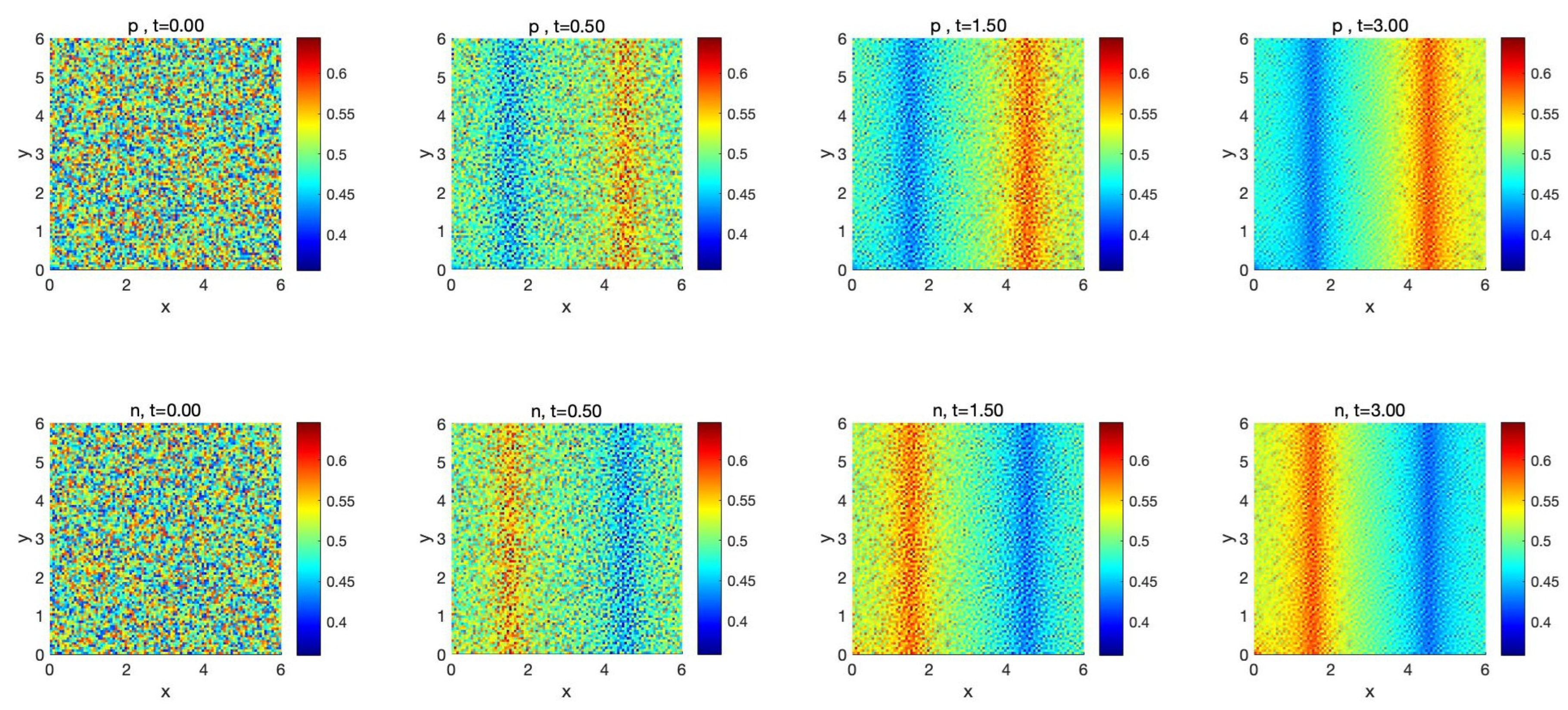
We first examine the performance of the first-order BE-S-SAV scheme. The spatio-temporal evolution of the ion concentrations is visualized in Figure 1.
As depicted in Figure 1, the system starts from a chaotic random state. Driven by the electrostatic potential generated by ρ f , the cations (p) rapidly migrate towards and accumulate around the negatively charged stripe at x = 4.5 . Conversely, the anions (n) segregate towards the positive stripe at x = 1.5 . By t = 3.0 , distinct electric double layers are formed, demonstrating that the numerical scheme correctly captures the physics of electromigration and diffusion-drift equilibrium.
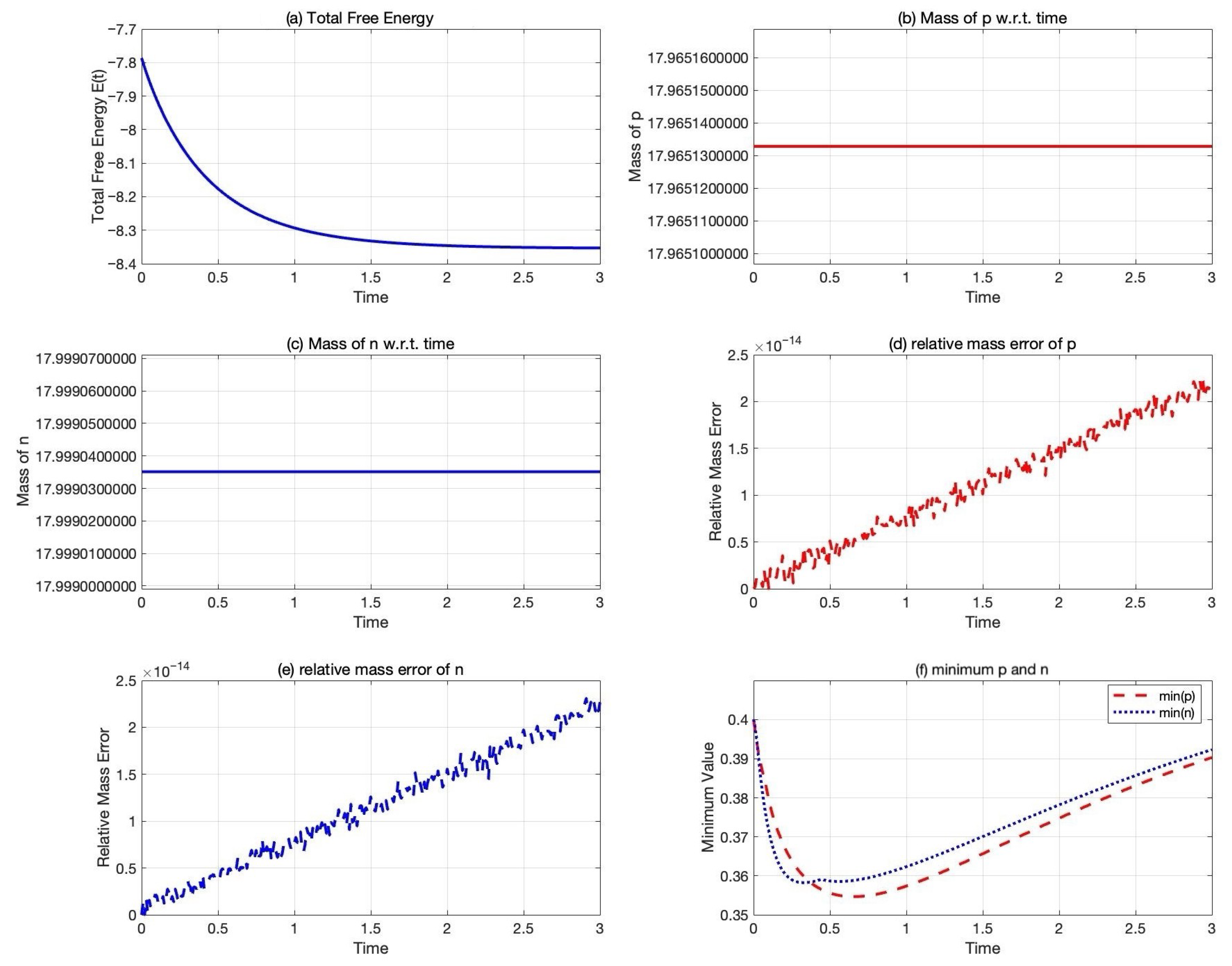
A quantitative assessment of the conservation laws is presented in Figure 2. Figure 2a confirms the unconditional energy stability, showing a strictly monotonic decay of the total free energy E ( t ) throughout the simulation. Figure 2b,c verify the mass conservation property, with the total mass curves for both species remaining visually flat. This is rigorously supported by the relative error plots in Figure 2d,e, where the mass fluctuation is bounded at the level of machine precision (∼10−14), validating Theorem 3. Furthermore, Figure 2f track the minimum values of p and n. Despite the large initial random perturbations, the concentrations remain strictly positive ( min ( p , n ) 0.355 > 0 ) for all time steps, numerically indicating the positivity-preserving capability of the proposed method in this regime.

5.2.3. Comparison with the BDF2-S-SAV Scheme

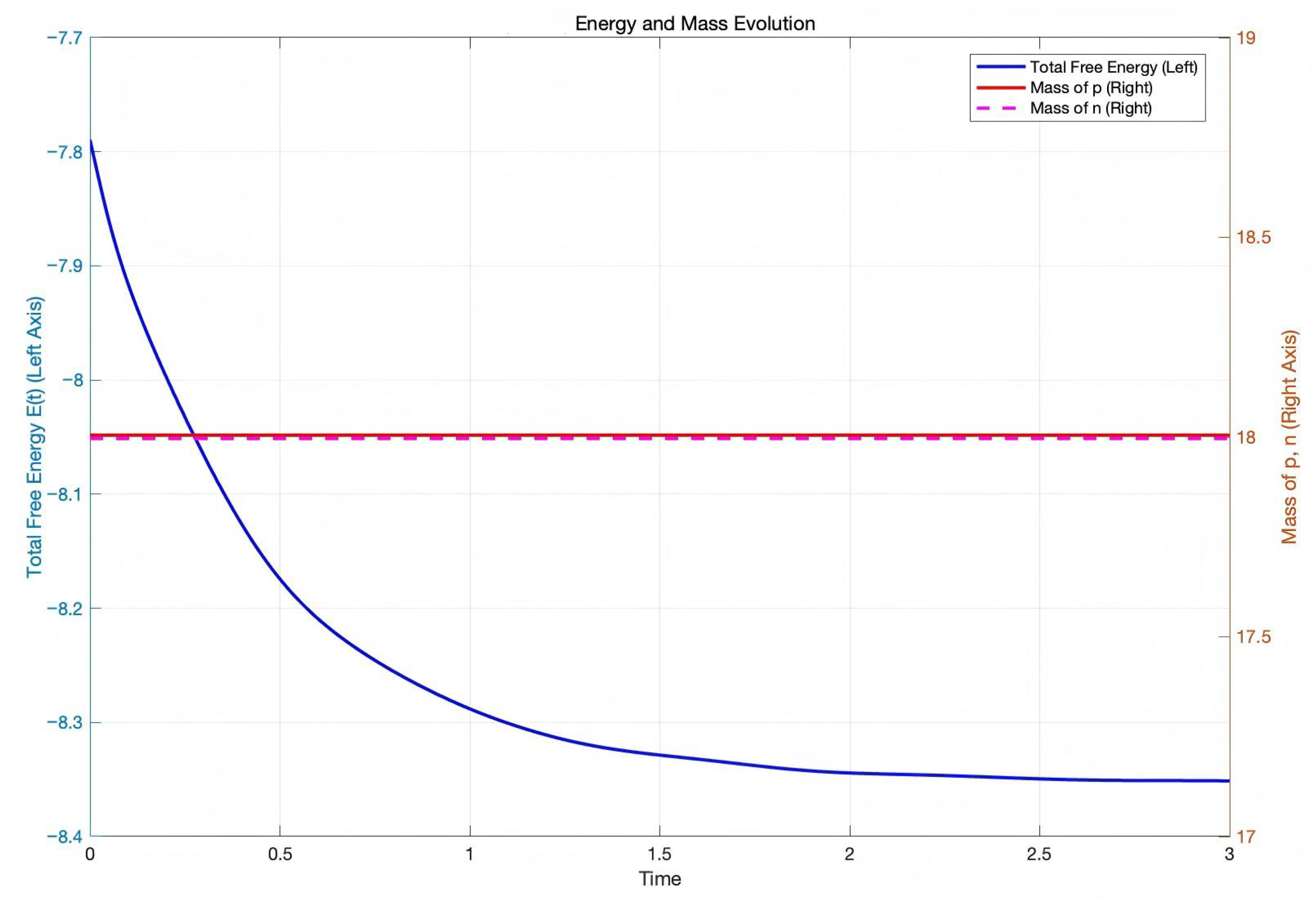
To demonstrate the robustness of higher-order temporal discretizations, we also apply the second-order BDF2-S-SAV scheme to the same test case. The evolution of total energy and mass is plotted in Figure 3.
Consistent with the first-order results, the BDF2 scheme exhibits excellent structure-preserving properties. As shown in Figure 3, the total free energy dissipates monotonically (blue curve), while the total mass for both ionic species is conserved exactly (red and magenta dashed lines overlapping the initial mass values). This confirms that the proposed linear decomposition strategy effectively maintains the intrinsic physical laws of the PNP system even with second-order temporal accuracy.

6. Conclusions

In this work, we have developed and analyzed two classes of efficient, structure-preserving numerical schemes for the generalized Poisson-Nernst-Planck (PNP) system: the first-order BE-S-SAV and the second-order BDF2-S-SAV methods. By integrating the Stabilized Scalar Auxiliary Variable (S-SAV) framework with the finite element method, we successfully overcame the computational challenges associated with the system’s strong nonlinearity and coupling.
The proposed schemes possess several distinct advantages. First, they are unconditionally energy stable with respect to a modified discrete energy and strictly preserve the mass conservation of ionic species, as demonstrated by our rigorous theoretical analysis. Second, the adoption of a linear decomposition strategy allows the complex coupled system to be solved as a sequence of decoupled, linear elliptic equations at each time step. This feature significantly enhances computational efficiency compared to traditional nonlinear iterative solvers.
Numerical experiments have been conducted to validate the theoretical properties. The results confirm that the schemes achieve the optimal convergence orders in both time and space. Furthermore, simulations of saline solution dynamics demonstrate the robustness of the methods in capturing physical phenomena, such as the formation of electric double layers, while maintaining the positivity of ion concentrations.
Future work will focus on extending this framework to three-dimensional simulations with adaptive mesh refinement and investigating PNP systems with steric effects or more complex boundary conditions [42].

Author Contributions

Conceptualization, M.Y.; methodology, M.Y.; software, J.L.; validation, J.L. and M.Y.; formal analysis, M.Y.; investigation, J.L.; resources, M.L.; data curation, J.L.; writing—original draft preparation, M.Y. and J.L.; writing—review and editing, M.Y., M.L. and P.M.; visualization, J.L.; supervision, M.Y.; project administration, M.L.; funding acquisition, M.L. All authors have read and agreed to the published version of the manuscript.

Funding

This research was partially supported by the Natural Science Foundation of Xinjiang Uygur Autonomous Region (Grant No. 2025D01B197) and the Research Foundation of China University of Petroleum–Beijing at Karamay (Grant No. XQZX20230030). In addition, this work was supported by the Xinjiang University Doctoral Science and Technology Innovation Program (Grant No. XJU2023BS026) and the Tianyuan Fund for Mathematics of the National Natural Science Foundation of China (Grant No. 12326102). 2025 National Undergraduate Innovation and Entrepreneurship Training Program of China (Project No. 202519414009).

Institutional Review Board Statement

Not applicable.

Informed Consent Statement

Not applicable.

Data Availability Statement

The data presented in this study are available on request from the corresponding author.

Conflicts of Interest

The authors declare no conflict of interest.

References

  1. Brumleve, T.R.; Buck, R.P. Numerical solution of the Nernst–Planck and Poisson equation system with applications to membrane electrochemistry and solid state physics. J. Electroanal. Chem. Interfacial Electrochem. 1978, 90, 1–31. [Google Scholar] [CrossRef]
  2. Horng, T.L.; Lin, T.C.; Liu, C.; Eisenberg, B. PNP equations with steric effects: A model of ion flow through channels. J. Phys. Chem. B 2012, 116, 11422–11441. [Google Scholar] [CrossRef]
  3. Gajewski, H.; Gröger, K. On the basic equations for carrier transport in semiconductors. J. Math. Anal. Appl. 1986, 113, 12–35. [Google Scholar] [CrossRef]
  4. Lu, B.; Holst, M.J.; McCammon, J.A.; Zhou, Y. Poisson–Nernst–Planck equations for simulating biomolecular diffusion–reaction processes I: Finite element solutions. J. Comput. Phys. 2010, 229, 6979–6994. [Google Scholar] [CrossRef] [PubMed]
  5. Li, J.; Ying, J. A stabilized finite volume element method for solving Poisson–Nernst–Planck equations. Int. J. Numer. Methods Biomed. Eng. 2022, 38, e3543. [Google Scholar] [CrossRef] [PubMed]
  6. Gaudeul, B.; Fuhrmann, J. Entropy and convergence analysis for two finite volume schemes for a Nernst–Planck–Poisson system with ion volume constraints. Numer. Math. 2022, 151, 99–149. [Google Scholar] [CrossRef]
  7. Monteiro, H.B.N.; Tartakovsky, D.M. A meshless stochastic method for Poisson–Nernst–Planck equations. J. Chem. Phys. 2024, 161, 054106. [Google Scholar] [CrossRef]
  8. Liu, C.; Wang, C.; Wise, S.M.; Yue, X.; Zhou, S. A second order accurate, positivity preserving numerical method for the Poisson–Nernst–Planck system and its convergence analysis. J. Sci. Comput. 2023, 97, 23. [Google Scholar] [CrossRef]
  9. Prohl, A.; Schmuck, M. Convergent discretizations for the Nernst–Planck–Poisson system. Numer. Math. 2009, 111, 591–630. [Google Scholar] [CrossRef]
  10. Liu, H.; Wang, Z. A free energy satisfying finite difference method for Poisson–Nernst–Planck equations. J. Comput. Phys. 2014, 268, 363–376. [Google Scholar] [CrossRef]
  11. Flavell, A.; Machen, M.; Eisenberg, B.; Kabre, J.; Liu, C.; Li, X. A conservative finite difference scheme for Poisson–Nernst–Planck equations. J. Comput. Electron. 2014, 13, 235–249. [Google Scholar] [CrossRef]
  12. Shen, J.; Xu, J. Unconditionally positivity preserving and energy dissipative schemes for Poisson–Nernst–Planck equations. Numer. Math. 2021, 148, 671–697. [Google Scholar] [CrossRef]
  13. Zheng, Q.; Chen, D.; Wei, G. Second-order Poisson Nernst-Planck solver for ion channel transport. J. Comput. Phys. 2011, 230, 5239–5262. [Google Scholar] [CrossRef]
  14. Tong, F.; Cai, Y. Positivity preserving and mass conservative projection method for the Poisson–Nernst–Planck equation. SIAM J. Numer. Anal. 2024, 62, 2004–2024. [Google Scholar] [CrossRef]
  15. Liu, H.; Wang, Z.; Yin, P.; Yu, H. Positivity-preserving third order DG schemes for Poisson–Nernst–Planck equations. J. Comput. Phys. 2022, 452, 110777. [Google Scholar] [CrossRef]
  16. Ding, J.; Wang, Z.; Zhou, S. Positivity preserving finite difference methods for Poisson–Nernst–Planck equations with steric interactions: Application to slit-shaped nanopore conductance. J. Comput. Phys. 2019, 397, 108864. [Google Scholar] [CrossRef]
  17. Morales, D.; Xu, Z. Positivity-Preserving Hybridizable Discontinuous Galerkin Scheme for Solving PNP Model. Entropy 2025, 27, 1175. [Google Scholar] [CrossRef]
  18. Ding, J.; Wang, C.; Zhou, S. Convergence analysis of structure-preserving numerical methods based on Slotboom transformation for the Poisson–Nernst–Planck equations. Commun. Math. Sci. 2023, 21, 459–484. [Google Scholar] [CrossRef]
  19. Li, J.; Li, J. Positive-preserving, mass conservative linear schemes for the Poisson–Nernst–Planck equations. arXiv 2025, arXiv:2506.13054. [Google Scholar] [CrossRef]
  20. Ji, G.; Zhu, W. A weak Galerkin finite element method for time-dependent Poisson–Nernst–Planck equations. J. Comput. Appl. Math. 2022, 416, 114563. [Google Scholar] [CrossRef]
  21. Qiao, T.; Qiao, Z.; Sun, S.; Zhou, S. An unconditionally energy stable linear scheme for Poisson–Nernst–Planck equations. J. Comput. Appl. Math. 2024, 443, 115759. [Google Scholar] [CrossRef]
  22. He, D.; Pan, K. An energy preserving finite difference scheme for the Poisson–Nernst–Planck system. Appl. Math. Comput. 2016, 287, 214–223. [Google Scholar] [CrossRef]
  23. Li, M.; Shi, D.; Li, Z. Convergence and superconvergence analysis for a mass conservative, energy stable and linearized BDF2 scheme of the Poisson–Nernst–Planck equations. Commun. Nonlinear Sci. Numer. Simul. 2025, 140, 108351. [Google Scholar] [CrossRef]
  24. Shen, J.; Xu, J.; Yang, J. The scalar auxiliary variable (SAV) approach for gradient flows. J. Comput. Phys. 2018, 353, 407–416. [Google Scholar] [CrossRef]
  25. Shen, J.; Xu, J.; Yang, J. A new class of efficient and robust energy stable schemes for gradient flows. SIAM Rev. 2019, 61, 474–506. [Google Scholar] [CrossRef]
  26. Li, X.; Shen, J.; Rui, H. Energy stability and convergence of SAV block-centered finite difference method for gradient flows. Math. Comput. 2019, 88, 2047–2068. [Google Scholar] [CrossRef]
  27. Huang, F.; Shen, J. Bound/positivity preserving and energy stable scalar auxiliary variable schemes for dissipative systems: Applications to Keller–Segel and Poisson–Nernst–Planck equations. SIAM J. Sci. Comput. 2021, 43, A1832–A1857. [Google Scholar] [CrossRef]
  28. Cheng, Q.; Liu, C.; Shen, J. A new Lagrange multiplier approach for gradient flows. Comput. Methods Appl. Mech. Eng. 2020, 367, 113070. [Google Scholar] [CrossRef]
  29. Cheng, Q.; Shen, J. Global constraints preserving scalar auxiliary variable schemes for gradient flows. SIAM J. Sci. Comput. 2020, 42, A2489–A2513. [Google Scholar] [CrossRef]
  30. Wang, M.; Huang, Q.; Wang, C. A second order accurate scalar auxiliary variable (SAV) numerical method for the square phase field crystal equation. J. Sci. Comput. 2021, 88, 33. [Google Scholar] [CrossRef]
  31. Cheng, Q. Error estimate of a second order accurate scalar auxiliary variable (SAV) scheme for the thin film epitaxial equation. Adv. Appl. Math. Mech. 2021, 13, 199–226. [Google Scholar] [CrossRef]
  32. Li, X.; Gong, Y.; Zhang, L. Linear high-order energy-preserving schemes for the nonlinear Schrödinger equation with wave operator using the scalar auxiliary variable approach. J. Sci. Comput. 2021, 88, 20. [Google Scholar] [CrossRef]
  33. Qiao, Z.; Sun, S.; Zhang, T.; Zhang, Y. A new multi-component diffuse interface model with Peng-Robinson equation of state and its scalar auxiliary variable (SAV) approach. Commun. Comput. Phys. 2019, 26, 1597–1616. [Google Scholar] [CrossRef]
  34. Liu, Z.; Li, X. The exponential scalar auxiliary variable (E-SAV) approach for phase field models and its explicit computing. SIAM J. Sci. Comput. 2020, 42, B630–B655. [Google Scholar] [CrossRef]
  35. Cheng, Q.; Shen, J. Multiple scalar auxiliary variable (MSAV) approach and its application to the phase-field vesicle membrane model. SIAM J. Sci. Comput. 2018, 40, A3982–A4006. [Google Scholar] [CrossRef]
  36. Yang, J.; Kim, J. A variant of stabilized-scalar auxiliary variable (S-SAV) approach for a modified phase-field surfactant model. Comput. Phys. Commun. 2021, 261, 107825. [Google Scholar] [CrossRef]
  37. Zhao, Y.; Li, Y.; Zhu, J.; Cao, Y. Energy-Conserving Explicit Relaxed Runge–Kutta Methods for the Fractional Nonlinear Schrödinger Equation Based on Scalar Auxiliary Variable Approach. Axioms 2024, 13, 591. [Google Scholar] [CrossRef]
  38. Wang, X.; Liu, Z. Highly efficient and accurate numerical schemes for the anisotropic phase field crystal models by using the improved scalar auxiliary variable (iSAV) approach. Commun. Nonlinear Sci. Numer. Simul. 2025, 148, 108875. [Google Scholar] [CrossRef]
  39. Fu, G.; Xu, Z. High-order space–time finite element methods for the Poisson–Nernst–Planck equations: Positivity and unconditional energy stability. Comput. Methods Appl. Mech. Eng. 2022, 395, 115031. [Google Scholar] [CrossRef]
  40. Malinowska, A.B.; Torres, D.F. Introduction to the Fractional Calculus of Variations; Imperial College Press: London, UK, 2012. [Google Scholar]
  41. Baleanu, D.; Diethelm, K.; Scalas, E.; Trujillo, J.J. Fractional Calculus: Models and Numerical Methods; World Scientific: Singapore, 2012; Volume 3. [Google Scholar]
  42. Liu, J.; Liu, W. Studies on Poisson–Nernst–Planck Systems with Large Permanent Charges Under Relaxed Neutral Boundary Conditions. Mathematics 2025, 13, 2847. [Google Scholar] [CrossRef]
Figure 1. Snapshots of ion concentration evolution for the BE-S-SAV scheme. (top row) Cation concentration p; (bottom row) Anion concentration n. From (left) to (right): t = 0.00 , 0.50 , 1.50 , 3.00 .
Axioms 15 00126 g001
Figure 2. Quantitative analysis of the BE-S-SAV scheme: (a) Monotonic decay of the total free energy E ( t ) ; (b,c) Time history of total mass for p and n; (d,e) Relative mass errors; (f) Time evolution of minimum concentration values.
Axioms 15 00126 g002
Figure 3. Energy dissipation and mass conservation verification for the BDF2-S-SAV scheme. The dual-axis plot shows the total free energy (blue solid line, left axis) and the total mass of ions (red/magenta dashed lines, right axis).
Axioms 15 00126 g003
Table 1. Temporal Convergence Test for BE-S-SAV ( h = 1 / 128 , T = 0.01 , S p = S n = 5.0 ).
τ L 2 Error (p)Order L 2 Error (n)Order L 2 Error ( ϕ )Order
8.00 × 10 4 4.31 × 10 3 4.31 × 10 3 9.75 × 10 4
4.00 × 10 4 2.40 × 10 3 0.84 2.40 × 10 3 0.84 5.44 × 10 4 0.84
2.00 × 10 4 1.25 × 10 3 0.95 1.25 × 10 3 0.95 2.82 × 10 4 0.95
1.00 × 10 4 6.28 × 10 4 0.99 6.28 × 10 4 0.99 1.42 × 10 4 0.99
Table 2. Temporal Convergence Test for BDF2-S-SAV ( h = 1 / 128 , T = 0.01 , S p = S n = 5.0 ).
τ L 2 Error (p)Order L 2 Error (n)Order L 2 Error ( ϕ )Order
1.00 × 10 3 1.96 × 10 4 1.96 × 10 4 4.43 × 10 5
5.00 × 10 4 4.93 × 10 5 1.99 4.93 × 10 5 1.99 1.12 × 10 5 1.99
2.50 × 10 4 1.24 × 10 5 1.99 1.24 × 10 5 1.99 2.81 × 10 6 1.99
1.25 × 10 4 3.13 × 10 6 1.99 3.13 × 10 6 1.99 7.07 × 10 7 1.99
Table 3. Spatial Convergence Test for BE-S-SAV ( τ = 1.0 × 10 5 , T = 0.01 , S p = S n = 5.0 ).
Nh L 2 Error (p)Order L 2 Error (n)Order L 2 Error ( ϕ )Order
81/8 1.23 × 10 3 1.22 × 10 3 1.05 × 10 3
161/16 3.13 × 10 4 1.97 3.11 × 10 4 1.97 3.26 × 10 4 1.69
321/32 7.86 × 10 5 1.99 7.80 × 10 5 1.99 9.79 × 10 5 1.73
641/64 1.97 × 10 5 2.00 1.95 × 10 5 2.00 2.87 × 10 5 1.77
Table 4. Spatial Convergence Test for BDF2-S-SAV ( τ = 1.0 × 10 5 , T = 0.01 , S p = S n = 5.0 ).
Nh L 2 Error (p)Order L 2 Error (n)Order L 2 Error ( ϕ )Order
81/8 1.24 × 10 3 1.24 × 10 3 1.05 × 10 3
161/16 3.17 × 10 4 1.97 3.15 × 10 4 1.97 3.24 × 10 4 1.69
321/32 7.98 × 10 5 1.99 7.91 × 10 5 1.99 9.76 × 10 5 1.73
641/64 2.00 × 10 5 2.00 1.98 × 10 5 2.00 2.86 × 10 5 1.77
Disclaimer/Publisher’s Note: The statements, opinions and data contained in all publications are solely those of the individual author(s) and contributor(s) and not of MDPI and/or the editor(s). MDPI and/or the editor(s) disclaim responsibility for any injury to people or property resulting from any ideas, methods, instructions or products referred to in the content.