Article

Common Fixed Point Approximation for Asymptotically Nonexpansive Mapping in Hyperbolic Space with Application

1
Department of Mathematical Sciences, Fatima Jinnah Women University, Rawalpindi 46000, Pakistan
2
Department of Mathematics, King Abdulaziz University, Jeddah, Saudi Arabia
*
Author to whom correspondence should be addressed.
Axioms 2025, 14(12), 889; https://doi.org/10.3390/axioms14120889
Submission received: 14 October 2025 / Revised: 23 November 2025 / Accepted: 26 November 2025 / Published: 30 November 2025
(This article belongs to the Special Issue Recent Advances in Special Functions and Applications, 2nd Edition)

Abstract

This study presents a common fixed-point iteration process that includes two asymptotically nonexpansive self-mappings in a hyperbolic space and their delta convergence. To support our results, we provide an example with a comparison table and sufficient conditions for a modified iteration scheme to have strong convergence to approximate the fixed point.

1. Introduction

Nonlinear functional analysis is closely linked to fixed-point theory, which provides a robust framework for the examination of numerous nonlinear problems that are challenging to address through conventional analytical methods. Fixed-point approximation techniques are particularly valuable in this domain, especially when determining exact solutions is unattainable.
In many areas of applied science, a common and effective strategy is to convert a nonlinear problem into an equivalent fixed-point problem defined by an appropriate operator. This approach is valuable because solving the operator equation directly provides a solution to the original problem. A well-known example of this idea is the Banach Contraction Principle (BCP) [1], which ensures the convergence of the basic iterative process known as Picard iteration. This method is the cornerstone of many iterative techniques. Iterative methods play a central role in approximating the fixed points of nonlinear mappings within Hilbert and Banach spaces [2]. Kirk [3] also introduced the concept of asymptotically nonexpansive mappings. An important extension of this framework arises in hyperbolic spaces, a class of metric spaces characterized by the presence of convex structures. The notion of hyperbolic space has been developed in several ways due to the variety of convex structures that can be defined in such spaces. Kohlenbach [4] showed that Banach spaces can, in fact, be viewed as special instances of hyperbolic spaces. The authors in [5] established existence and uniqueness results for relevant operator equations, demonstrating the effectiveness of the fixed-point approach in generalized metric contexts. Some work [6,7,8] highlights the structural advantages of W-hyperbolic spaces in studying iterative schemes and provides new insights into the stability and behaviour of three-step algorithms. Recently, Agarwal et al. [9] explored fixed-point theorems and established convergence results for monotone, nearly asymptotically nonexpansive mappings in partially ordered hyperbolic metric spaces (2019). Khan, Fukhar-Ud-Din, and Ahmad Khan [10] proposed an implicit iterative algorithm for two finite families of nonexpansive mappings in hyperbolic spaces, establishing strong and weak convergence results under suitable conditions. Questions related to hyperbolic groups, one of the primary subjects of study in geometric group theory, have motivated and dominated the study of hyperbolic spaces. The nonlinear class of hyperbolic spaces provides a rich geometrical structure and a comprehensive abstract theoretical framework for metric fixed-point theory. Fixed-point theory and approximation methods have been extended to include hyperbolic spaces [2].
Let T be a nonempty subset of a Banach space B , and let X : T T be a mapping. A sequence { t a } in T is said to be an approximating fixed-point sequence if
lim a t a X t a = 0 .
The mapping X is said to be Lipschitzian if, for each a N , there exists a positive number k a such that
X a p X a q k a p q for all p , q T .
A Lipschitzian mapping X is called uniformly k-Lipschitzian if k a = k for all a N , and asymptotically non-expansive if k a 1 for all a with lim a k a = 1 . Clearly, every non-expansive mapping X (i.e., X p X q p q for all p , q T ) is asymptotically non-expansive.
Goebel and Kirk [3] introduced the class of asymptotically non-expansive mappings as an important generalization of non-expansive mappings. Schu [11] initiated the study of convergence of the iteration process to a fixed point of an asymptotically nonexpansive mapping using an improved version of the Mann scheme:
p a + 1 = ( 1 γ a ) p a + γ a X a p a .
Many authors have studied iterative methods for determining fixed points in asymptotically nonexpansive mappings. Şahin and Başarır established strong convergence results for a modified S-iteration process applied to asymptotically quasi-nonexpansive mappings in CAT(0) spaces. Khan analyzed the convergence of iterative sequences with errors for asymptotically quasi-nonexpansive mappings and demonstrated their applicability to various operator equations. Qihou investigated iterative sequences for asymptotically quasi-nonexpansive mappings, providing foundational convergence results in nonlinear analysis. Kaczor proved weak convergence properties for almost orbits of asymptotically nonexpansive commutative semigroups in metric settings. They developed fixed-point iteration processes for non-Lipschitzian asymptotically quasi-nonexpansive mappings, establishing new convergence criteria [4]. Their results provided a foundation for analyzing the stability and convergence behavior of iterative schemes in both linear and nonlinear settings.
Building on these developments, several researchers have extended such methods to hyperbolic and uniformly convex spaces for a wider class of nonlinear mappings. In this context, our proposed scheme contributes to the ongoing effort by demonstrating strong convergence under generalized contractive conditions in hyperbolic spaces. Tan and Xu [12] examined the convergence of the modified Ishikawa iterative algorithm:
p 1 T , p a + 1 = ( 1 γ a ) p a + γ a X a q a , q a = ( 1 σ a ) p a + σ a X a p a .
where γ a and σ a [ 0 , 1 ] . Recently, Agarwal et al. [9], in an attempt to achieve a faster convergence rate, proposed a modified iteration called the S-iteration technique:
p 1 T , p a + 1 = ( 1 γ a ) X a p a + γ a X a q a , q a = ( 1 σ a ) p a + σ a X a p a .
Research on iterative approximation in hyperbolic metric spaces has grown significantly over the last ten years. The literature defines many types of hyperbolic spaces, with Kohlenbach’s concept being the most frequently used definition [13].
Suppose that a hyperbolic space ( B , d , Ω ) is a triplet where ( B , d ) is a metric space and a mapping Ω : B × B × [ 0 , 1 ] B fulfills the following:
  • d ( g , Ω ( p , q , γ ) ) ( 1 γ ) d ( g , p ) + γ d ( g , q ) ,
  • d ( Ω ( p , q , γ ) , Ω ( p , q , σ ) ) = | γ σ | d ( p , q ) ,
  • Ω ( p , q , γ ) = Ω ( q , p , 1 γ ) ,
  • d ( Ω ( p , s , γ ) , Ω ( q , u , γ ) ) ( 1 γ ) d ( p , q ) + γ d ( s , u ) .
Where γ a , σ a [ 0 , 1 ] and all p , q , s , u , g B .
Example
Define X : T T by
X ( z ) = e i θ t ( θ R ) .
  • | e i θ t | = | t | < 1 .
  • X preserves the Poincaré distance:
    | X ( p ) X ( q ) | | 1 X ( p ) X ( q ) ¯ | = | e i θ p e i θ q | | 1 p q ¯ | = | p q | | 1 p q ¯ | .
  • Fixed point: solve X ( t ) = t ( e i θ 1 ) t = 0 . So t = 0 is a fixed point (if e i θ = 1 , then X is the identity and every point is fixed).
Therefore, X is a simple non-expansive map on a hyperbolic space that clearly has a fixed point. Saluja [14] modified Equations (1) and (2) introduced by Khan et al. [15] to approximate a common fixed point in hyperbolic space as follows:
p 1 T , p a + 1 = Ω ( X a p a , X a q a , γ a ) , q a = Ω ( p a , X a p a , σ a ) .
where Ω is a hyperbolic space, X is a self-mapping, γ a , σ a [ 0 , 1 ] , and all p , q Ω .
Researchers studied iterative schemes to improve convergence to common fixed points. Dass and Debaita [16] initiated the study of two iterative mapping procedures. The iterative processes of Saluja [14] and Khan et al. [15] in hyperbolic spaces have also been updated.
The modified scheme defined by JA in hyperbolic space is as follows:
p 1 T , q a = Ω ( p a , Y a ( X a p a ) , σ a ) , p a + 1 = Ω ( Y a q a , X a q a , γ a ) .
Based on the above motivation, we define a new modified TI scheme to approximate the common fixed point of two mappings that converge faster:
p 1 T , q a = Ω ( X a p a , Y a p a , γ a ) , r a = Ω ( Y a q a , Y a ( X a q a ) , σ a ) , p a + 1 = X a r a .
where X , Y : T T are asymptotically quasi-nonexpansive mappings, Ω is a hyperbolic space, γ a , σ a [ 0 , 1 ] , and all p , q Ω .

2. Preliminaries

This section requires recalling some previously acquired knowledge, and it is necessary to understand the underlying concepts and ideas to fully comprehend our main findings.
Definition 1
([5]). A subset T of a hyperbolic space ( B , d , Ω ) is called convex if Ω ( p , q , γ ) T for all p , q T and γ [ 0 , 1 ] .
Definition 2
([17]). A hyperbolic space ( B , d , Ω ) is called uniformly convex if, for every p , q , r B , n > 0 , and ϵ ( 0 , 2 ] , there exists Γ ( 0 , 1 ] such that
d Ω p , q , 1 2 , r ( 1 Γ ) n ,
whenever d ( p , r ) n , d ( q , r ) n , and d ( p , q ) ϵ n .
Definition 3
([16,18]). In a hyperbolic space, consider a bounded sequence { p a } . Its asymptotic radius with respect to a point p is
r ( p , { p a } ) = lim n sup d ( p a , p ) .
(i) 
The asymptotic radius of { p a } with respect to a subset T is
r ( T , { p a } ) = inf { r ( p , { p a } ) : p T } .
(ii) 
The asymptotic center of { p a } in T is
A ( { p a } ) = { p T : r ( p , { p a } ) r ( q , { p a } ) for all q T } .
An asymptotic map has unique fixed points and asymptotic centers.
Definition 4
([19]). Let { p a } be a bounded sequence in T, where T is a nonempty closed convex subset of a uniformly convex hyperbolic space ( B , d , Ω ) . Suppose A ( { p a } ) = { n } and r ( { p a } ) = k . If { n b } is a sequence in T such that
lim b r ( n b , { p a } ) = k ,
then
lim b n b = n .
Definition 5
([19]). A sequence { p k } is said to be Δ-convergent to a point p T if every subsequence of { p k } has a unique asymptotic center in T. We write
Δ - lim k p k = p .
Lemma 1
([10]). Let ( B , d , Ω ) be a uniformly convex hyperbolic space. Let { r a } ( 0 , 1 ) and let sequences { u a } and { v a } exist in B . Suppose
lim sup a d ( p a , p ) i , lim sup a d ( q a , p ) i , and lim sup a d ( Ω ( p a , q a , r a ) , p ) = i
for some i 0 . Then
lim a d ( p a , q a ) = 0 .
Lemma 2
([20]). Let { p a } , { q a } , and { r a } be non-negative sequences such that
Γ a + 1 p a Γ a + q a , a N .
If p a 1 , a = 1 ( p a 1 ) < , and q a < , then
lim a Γ a exists .
Lemma 3
([10]). Let ( B , d , Ω ) be a uniformly convex hyperbolic space. Suppose s B and { v a } [ ϵ , 1 ϵ ] for any ϵ ( 0 , 1 ) . Let { q a } and { r a } be sequences in B such that for a N
lim sup a d ( q a , s ) i , lim sup a d ( r a , s ) i , and lim sup a d ( Ω ( q a , r a , v a ) , s ) = i , i = 1
for any i > 0 . Then
lim a d ( q a , r a ) = 0 .
Lemma 4.
Let ( B , d , Ω ) be a complete uniformly convex hyperbolic space. Then every bounded sequence { p a } T has a unique asymptotic center.
Definition 6.
A sequence { p a } in a hyperbolic space ( B , d , Ω ) is said to  Δ -converge to a point q T if q is the unique asymptotic center for every subsequence { p a } of { p n } . In this case, q is called the  Δ -limit of { p a } .

3. Main Results

This section presents and examines a modified iterative TI-approach for approximating the common fixed points of two mappings in a hyperbolic space that are asymptotically nonexpansive.
Lemma 5.
Let T be a nonempty uniform convex subset of a uniformly convex hyperbolic space ( B , d , Ω ) . A mapping of X , Y : T T has a sequence t a fulfills the conditions
(i) 
a = 1 ( t a 1 ) <
(ii) 
F = F ( X ) F ( Y ) .
If a sequence is defined by (5), then limits d ( p a , s ) and d ( q a , s ) exist.
Proof. 
From the definition, we observe
d ( q a , r ) = d ( Ω ( X a p a , Y a p a , γ a ) , s ) ( 1 γ a ) d ( X a p a , s ) + γ a d ( Y a p a , s ) ( 1 γ a ) t a d ( p a , s ) + γ a t a d ( p a , s ) = t a d ( p a , s ) ,
and
d ( r a , s ) = d ( Ω ( Y a q a , Y a ( X a q a ) , σ a ) , s ) ( 1 σ a ) d ( Y a q a , s ) + σ a d ( Y a ( X a q a ) , Y a ( X a s ) ) ( 1 σ a ) t a d ( q a , s ) + σ a t a d ( X a q a , X a s ) ( 1 σ a ) t a d ( q a , s ) + σ a t a 2 d ( q a , s ) = ( t a σ a t a + σ a t a 2 ) d ( q a , s ) = ( 1 + ( t a 1 ) + σ a t a ( t a 1 ) ) d ( q a , s ) ,
and
d ( p a + 1 , s ) = d ( r a , s ) t a d ( r a , s ) .
Therefore
d ( d ( r a , s ) ( 1 + j a ) d ( q a , s ) .
where j a = ( t a 1 ) + σ a t a ( t a 1 ) . Using the hypothesis that a = 1 ( t a 1 ) < , we conclude from Lemma 1 lim a d ( p a , s ) at this point. Let lim a d ( p a , s ) = i where i 0 . Using this inequality, we have
d ( p a + 1 , s ) ( 1 γ + a ) t a d ( p a , s ) + γ + a t a d ( q a , s ) = d ( p a , s ) + γ + a t a ( d ( q a , s ) d ( p a , s ) ) .
Now we take the lim sup on both sides, we get
i = i + l i m s u p γ a ( d ( q a , s ) i ) i .
Therefore lim sup γ a d ( q a , s ) i . So,
l i m s u p γ a ( d ( q a , s ) i ) = 0 .
Thus γ a [ ϵ , 1 ϵ ] , it proves that a limit exists. □
Theorem 1.
Let T be a nonempty uniform convex subset of a uniformly convex hyperbolic space ( B , d , Ω ) . A mapping X , Y : T T has a sequence t a fulfills the conditions
(i) 
a = 1 ( t a 1 ) <
(ii) 
F = F ( X ) F ( Y ) .
Then a sequence p a defined by (5) has strong convergence.
Proof. 
Assume that a sequence p a converges to a common fixed point of X and Y, then d ( p a , h ) 0 . Let lim a i n f d ( p a , H ) = 0 . Now using the above Lemma 5,
d ( d ( r a , s ) ( 1 + j a ) d ( p a , s )
applying inf over s H , so
d ( d ( r a , H ) ( 1 + j a ) d ( p a , H ) .
Thus we know that lim a d ( p a , H ) converges, so it is clear d ( p a , H ) 0 . Therefore, there exists a positive integer N; therefore,
d ( p a , H ) < ϵ 4 , a N .
Here it is i n f d ( p a , s ) : s H < ϵ 4 also we here easily find s H , so that using Equation (6), we observe
d ( p a + b , p a ) d ( p a + b , p ) + d ( p , p a ) ( 1 + j a + b 1 ) ( 1 + j a + b 2 ) ( 1 + s N ) ( p a , s ) + ( 1 + j a 1 ) ( 1 + j a 2 ) ( 1 + s N ) ( p a , s ) .
Thus, it is stated that a = 1 j a < , the infinite product ( 1 + s a ) converges to a positive real number l.
Therefore
d ( p a + b , p a ) 2 l d ( p a , s ) < l ϵ .
This proves that it is a Cauchy sequence and converges. □
Theorem 2.
Let T be a nonempty closed convex subset of a uniformly convex hyperbolic space ( B , d , Ω ) . A mapping X , Y : T T has a sequence t a fulfill the conditions
(i) 
a = 1 ( t a 1 ) <
(ii) 
F = F ( X ) F ( Y ) .
There exists 0 < ϵ 1 2 , such that for every a  γ a , σ a [ ϵ , 1 ϵ ] .
Using (5), thus,
lim a d ( q a , X q a ) = lim a d ( q a , Y q a ) = lim a d ( r a , X r a ) = lim a d ( r a , Y r a ) = 0 .
If there is any limit, then the sequences converge strongly.
Proof. 
From the Lemma 5
lim a d ( q a , s ) = lim a d ( r a , s ) = i .
Hence lim a d ( q a , s ) = c by the Lemma 5 we have,
lim a d ( Ω ( X a p a , Y a p a , γ a ) , s ) = i .
Now, by applying the limit sup to the above inequality, we get
d ( X a p a ) t a d ( p a , s )
and
d ( Y a p a ) t a d ( p a , s ) ,
so we get, lim sup a d ( X a p a ) i and lim sup a s u p d ( Y a p a ) i .
Through the Equation (7) and Lemma 4, it becomes d ( X a p a , Y a p a ) 0 .
Now also from
lim a d ( r a , s ) = lim a d ( Ω ( Y a q a , Y a ( X a q a ) , σ a ) , s ) = i
and
lim sup a d ( Y a q a ) i lim sup a d ( Y a ( X a q a ) i
Now again using Lemma 4, we have
lim a d ( ( Y a q a ) , Y a ( δ a q a ) ) = 0 .
Now
d ( q a , Y a q a ) = lim a d ( Ω ( X a p a , Y a p a , γ a ) , Y a q a ) ( 1 γ a ) d ( X a p a , Y a q a ) + γ a d ( Y a p a , Y a q a ) = γ a d ( X a p a , Y a q a ) .
Hence lim a d ( X a p a , Y a q a ) 0 .
lim a d ( q a , Y a q a ) = 0 ,
and through
d ( q a , X a r a ) = lim a d ( Ω ( X a p a , Y a p a , γ a ) , X a r a ) ( 1 γ a ) d ( Y a p a , X a r a )
So we get
lim a d ( q a , X a r a ) = 0 .
Now assume
d ( r a , Y a q a ) = d ( Ω ( Y a q a , Y a ( X a q a ) , σ a ) , Y a q a ) ( 1 σ a ) d ( Y a q a , Y a q a ) + σ a d ( Y a ( X a q a ) , Y a q a )
so,
d ( r a , Y a q a ) = 0 .
In the same case, we can also prove that
d ( r a , X a q a ) = 0 .
Furthermore,
d ( q a , X a p a ) d ( q a , Y a q a ) + d ( Y a q a , X a q a ) .
Now using Equations (8) and (9), we obtain d ( q a , X a q a ) 0 . Therefore, by the Equation (12)
d ( q a , r a ) 0 .
From the aforementioned claims, the facts that follow can be written as
lim a d ( X a q a , X a r a ) = lim a d ( q a + 1 , X a r a ) = 0 .
Hence lim a d ( q a , q a + 1 ) = 0 , so
d ( q a , X a p a ) d ( q a , q a + 1 ) + d ( q a + 1 , X a q a ) ,
Thus, it entails that lim a d ( q a , X a p a ) = 0 , additionally
d ( q a , r a ) d ( q a , q a + 1 ) + d ( q a + 1 , r a ) 0
d ( q a , Y a q a ) d ( q a , r a ) + d ( r a , Y a q a ) 0
although
d ( r a , X a r a ) d ( r a , Y a r a ) + d ( Y a r a , X a r a ) 0 .
So, we conclude
d ( r a , r a + 1 ) d ( r a , q a + 1 ) + d ( q a + 1 , r a + 1 ) .
Now using (13) and (14), we deduce
d ( q a , X q a ) d ( q a , q a + 1 ) + d ( q a + 1 , X a + 1 q a + 1 ) + d ( X a + 1 q a + 1 , X a + 1 q a ) + d ( X a + 1 q a , X q a ) d ( q a , q a + 1 ) + d ( q a + 1 , X a + 1 q a + 1 ) + t a + 1 d ( q a , q a + 1 ) + t 1 d ( X a q a , q a ) .
After applying the limit a , the sequence converges and tends towards 0. Now in similar manner a d ( r a , X r a ) 0 . We also observed that d ( q a , Y q a ) 0 , and d ( Y q a , Y r a ) 0 .
Now we assume that it is demi-convex. Hence
d ( q a i , q ) d ( q a i , X d ( q a i ) + d ( d ( q a i , q ) ) ,
Equation (17) 0 as i . This implies that q F ( Ω ) , q a q and d ( q a , r a ) 0 . r a q . It is proved that it converges strongly and q lies in F ( X ) F ( Y ) . This completes this proof. □
Theorem 3.
Let T be a non-empty closed convex subset of a uniformly convex hyperbolic space ( B , d , Ω ) . A mapping of X , Y : T T be asymptotically nonexpansive with F ( X ) and F ( Y ) , and let { t a } be a sequence with t a 1 satisfying n = 1 ( t a 2 1 ) < . For an arbitrary initial point p 1 T , define the sequence { p a } by the iterative process (1.5) then { p a } Δ-converges to a point in F ( X ) F ( Y ) .
Proof. 
From Lemma 5, we have d ( p a , X p a ) 0 and d ( p a , Y p a ) 0 as a . Since { p a } is bounded, Lemma 4 guarantees that every bounded sequence has a unique asymptotic center.
Let { r a } be an arbitrary subsequence of { p a } . Since { p a } is bounded, therefore { r a } is also bounded. Denote the asymptotic centers of the sequence and the subsequence as A ( { p a } ) p and A ( { r a } ) = r , respectively. Our purpose is to prove that r p and that r is a common fixed point of X and Y.
First, we show r F ( X ) . From the asymptotic nonexpansive property of X, it follows that lim a d ( X k r a , X k + 1 r a ) = 0 for any k N . For any positive integers u and v, we derive the following inequality:
d ( X u r , r a ) d ( X u r , X u r a ) + k = 0 u 1 d ( X k + 1 z a , X k r a ) k u d ( r , r a ) + k = 0 u 1 d ( X k + 1 r a , X k r a ) .
Taking the limit as a for a fixed u, we obtain
γ ( X u r , { r a } ) = lim sup a d ( X a r , r a ) k u γ ( r , { r a } ) .
Now, taking the limit as u and k u 1 , we find
lim sup u γ ( X u r , { r a } ) γ ( r , { r a } ) .
However, since r is the unique asymptotic center of { r a } , we have γ ( r , { r a } ) γ ( X u r , { r a } ) for every u. This implies
lim m γ ( X u r , { r a } ) = γ ( r , { r a } ) .
Using Definition 4, this states X u r r , and hence r F ( X ) . An identical argument shows that r F ( Y ) , so r F ( Y ) F ( X ) .
It remains to show that, p . Suppose, for contradiction, that r p . Since r F ( X ) F ( Y ) , Lemma 5 implies that lim a d ( p a , r ) exists. Using the uniqueness of asymptotic centers, we deduce the following chain of inequalities:
lim sup a d ( r a , r ) < lim sup a d ( r a , p ) lim sup a d ( p a , p ) < lim sup a d ( p a , p ) = lim sup a d ( r a , r ) .
This is a contradiction, as the first and last terms are identical. Therefore, r = p . Since the subsequence { r a } was arbitrary and A ( { r a } ) = { p } for all such subsequences, we conclude that { p a }   Δ -converges to p, which is a common fixed point of X and Y. □

4. Numerical Example

To thoroughly evaluate the applicability of the iterative scheme (1.3) in approximating fixed points of generalized nonexpansive mappings. The following example demonstrates the effectiveness of the proposed method.
We presently give a specific instance and show how convergence to a certain point occurs mathematically and graphically using our defined iterative scheme.
Example 1.
Consider T = B(0;1), this T is a ball with center 0 and radius 1 in R 2 . Let us define self-maps X and Y as X ( p 1 , p 2 ) = ( s i n p 1 , s i n p 2 ) and Y ( p 1 , p 2 ) = ( p 1 2 , p 2 2 ) , as it is clear p , q T and take p = ( p 1 , p 2 ) and q = ( q 1 , q 2 )
Let be q 1 < p 1 and q 2 < p 2 , therefore, we have
d ( Y a p , Y a q ) = | | Y a p Y a q | | = | | ( p 1 2 a , p 2 2 a ) ( q 1 2 a , q 1 2 a ) | | = [ ( p 1 2 a q 1 2 a ) 2 + ( p 2 2 a q 2 2 a ) 2 ] 1 2 = [ | p 1 q 1 | 2 { p 1 2 a 1 + q 1 p 1 2 a 2 + + q 1 2 a 1 } 2 + | p 2 q 2 | 2 { p 2 2 a 1 + q 2 p 2 2 a 2 + + q 2 2 a 1 } 2 ] 1 2 [ | p 1 q 1 | 2 { 2 a p 1 2 a 1 } 2 + [ | p 2 q 2 | 2 { 2 a p 2 2 a 1 } 2 ] 1 2
Assume y a = m a x { 1 , 2 a p 1 2 a 1 } and h a = m a x { 1 , 2 a p 2 2 a 1 } . Let take I a = m a x { y a , h a } . Then it is obvious I a 1 as a . Thus
d ( Y a p , Y a q ) = I a [ | p 1 q 1 | 2 + | p 2 q 2 | 2 ] 1 2 = I a | p q | .
As it is clear that Y is an asymptotically nonexpansive mapping and X also has the same property, (0,0) is a common fixed point of both maps.
Example 2.
Consider T = B(0;1), this T is taken as a ball with center 0 and radius 1 in R 2 . Let us define self-map X and Y as X ( p 1 , p 2 ) = ( p 1 2 , 0 ) and Y ( p 1 , p 2 ) = ( 0 , p 2 2 ) . It can be observed that neither mapping is nonexpansive. Let p = ( p 1 , p 2 ) and q = ( q 1 , q 2 ) T . Then
X ( p 1 , p 2 ) = ( p 1 2 a , 0 ) a n d Y ( p 1 , p 2 ) = ( 0 , p 2 2 a ) .
If q 1 p 1 , then
X a p X a q 2 = ( p 1 2 a , 0 ) ( 0 , p 2 2 a ) = | p 1 2 a p 2 2 a | = [ | p 1 q 1 | 2 { p 1 2 a 1 + q 1 p 1 2 a 2 + + q 1 2 a 1 } p q 2 { 2 a p 1 2 a 1 } .
Suppose that y a = m a x { 1 , 2 a p 1 2 a 1 } m a x { 1 , 2 a ( 1 ) 2 a 1 } . Hence X is asymptotically nonexpansive mapping; then, for any p 1 T defined a sequence { p 1 } is defined by
p a + 1 = Ω ( X a p a , Y a q a , σ a ) a n d q a = Ω ( X a p a , Y a p a , γ a ) .
Let p a = ( p a 1 , p a 2 ) , p a + 1 = ( p ( a + 1 ) 1 , p ( a + 1 ) 2 ) and q a = ( q a 1 , q a 2 ) , and σ a = γ a = 1 2 . Then
( p ( a + 1 ) 1 , p ( a + 1 ) 2 ) = 1 2 ( 0 , p a 2 a ) + 1 2 ( 0 , q a 2 a ) = 1 2 ( p a 2 a , q a 2 a )
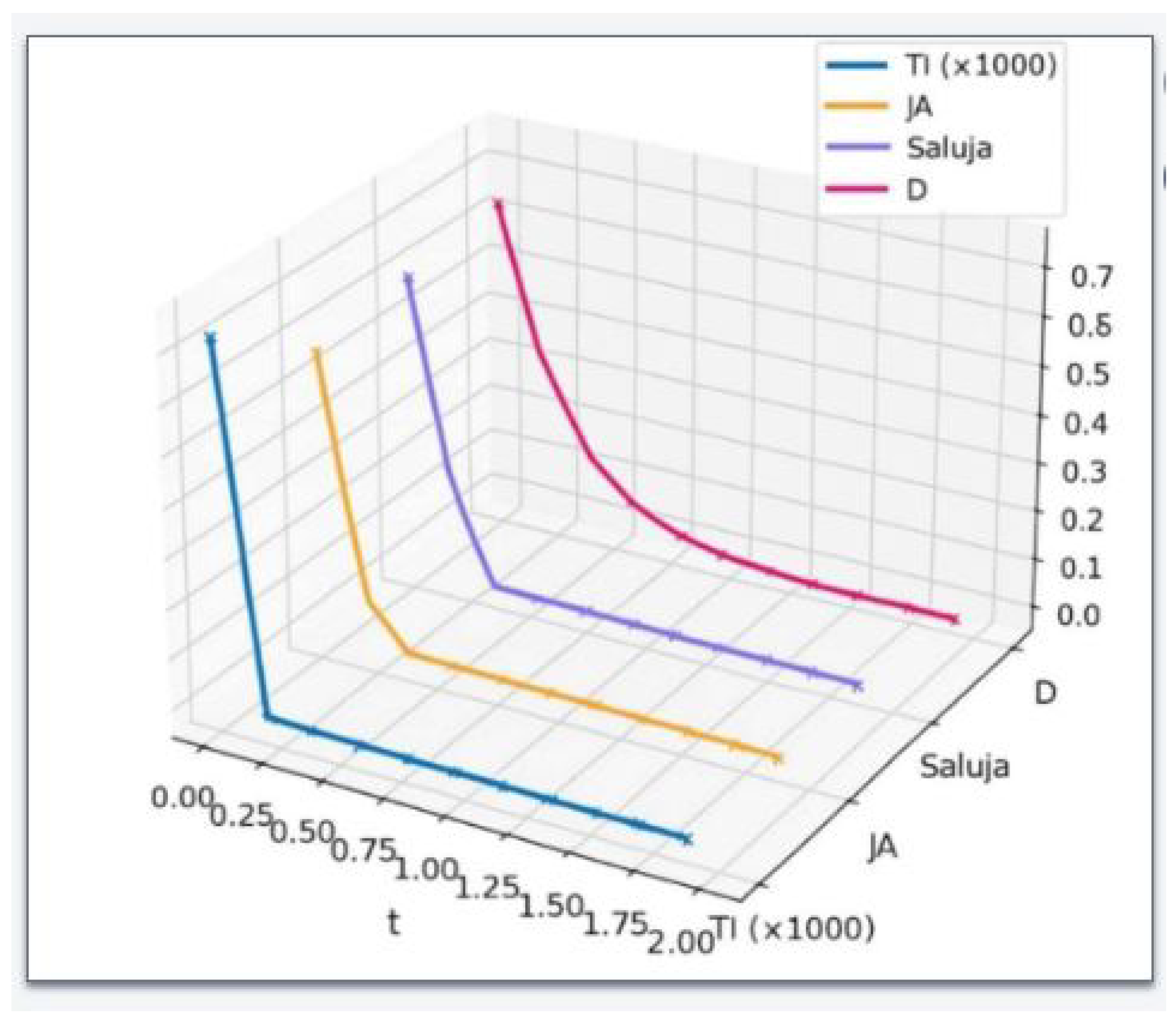
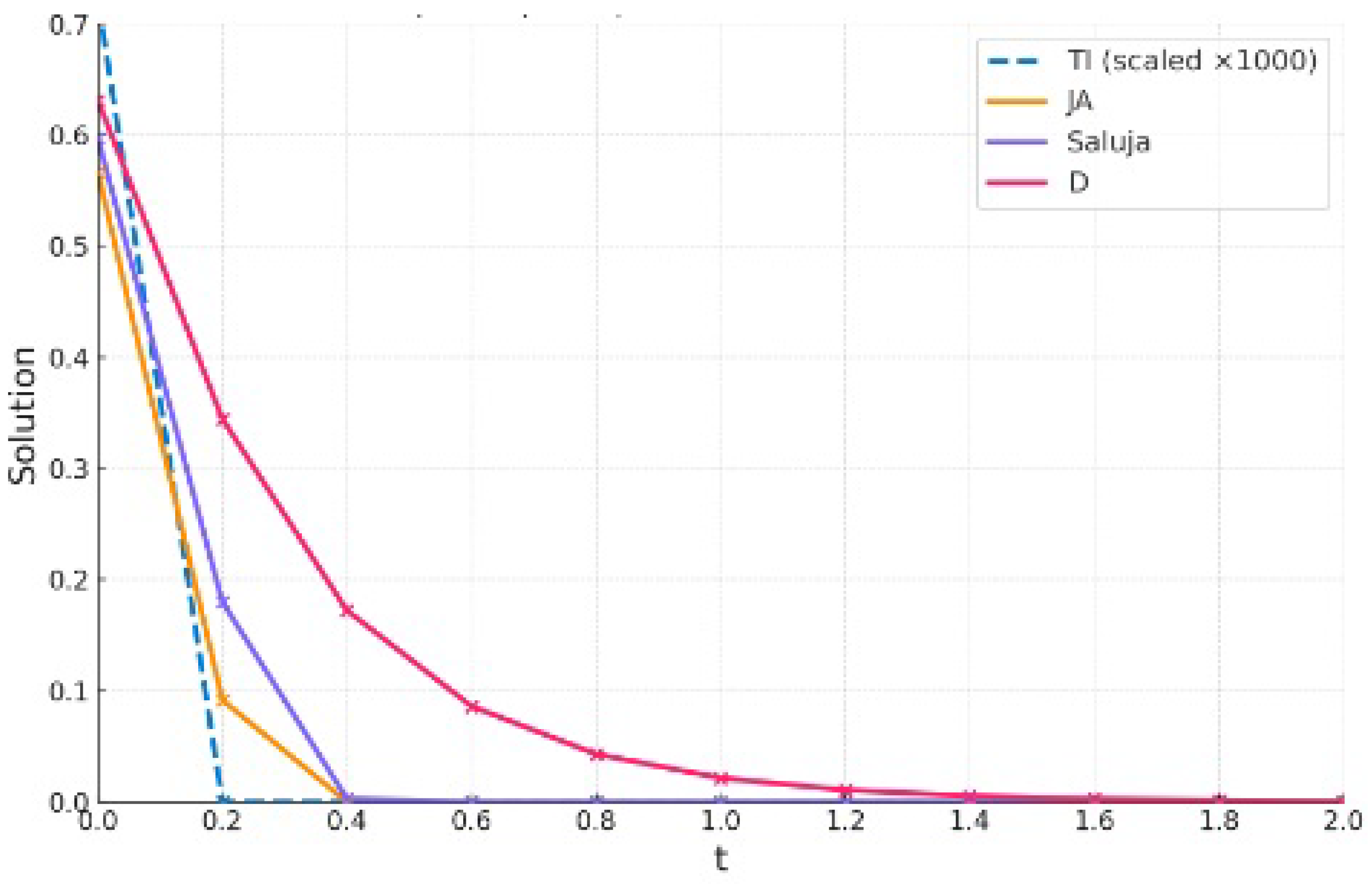
and ( q a 1 , q a 2 ) = 1 2 ( p a 2 a , p a 2 a ) . Thus q a 1 = 1 2 p a 2 a and ( p a + 1 1 , p a + 1 2 ) = 1 2 1 2 2 a ( p a 2 a , q a 2 a ) , it is clear that p a converges to a common fixed point (0,0). A table comparison shows that our modified TI-algorithm has a faster rate of convergence, and also graphical representation is also provided. We take p 1 = ( 3 4 , 3 4 ) and γ , σ = 1 2 . A convergence of the iterative scheme is obtained in the given Table 1, and Figure 1 and Figure 2 illustrates the variation in values for different algorithms.
The proposed iterative method exhibits fast convergence as compared to the existing schemes, primarily due to its faster convergence behavior and reduced iteration count. Specifically, the proposed approach attains convergence at the second iteration, whereas the competing methods require the 4th, 5th, and even the 22nd iteration to achieve similar results. This substantial reduction in computational effort highlights the effectiveness of the method in terms of accuracy and speed.
Example 3.
Let T = B ( 0 , 1 ) R 2 be the closed unit ball centered at the origin and let ( a n ) n 1 be a sequence with a n 1 for all n. For each index n define maps X a n , Y a n : T T by
X a n ( p 1 , p 2 ) = ( p 1 2 a n , p 2 ) , Y a n ( p 1 , p 2 ) = ( p 1 , p 2 2 a n ) .
(These maps preserve T because | p i | 1 | p i 2 a n | 1 .)
Let p = ( p 1 , p 2 ) , q = ( q 1 , q 2 ) T . For r 1 and | u | , | v | 1 the mean value inequality gives
| u r v r | = r | ξ | r 1 | u v | r | u v | ( for some ξ [ u , v ] , | ξ | 1 ) .
Applying this with r = 2 a n yields the uniform bound (independent of p , q ):
| p 1 2 a n q 1 2 a n | 2 a n | p 1 q 1 | , | p 2 2 a n q 2 2 a n | 2 a n | p 2 q 2 | .
Hence
X a n ( p ) X a n ( q ) = | p 1 2 a n q 1 2 a n | 2 a n p q ,
and similarly
Y a n ( p ) Y a n ( q ) 2 a n p q .
Thus the Lipschitz constants for X a n and Y a n on the whole domain T are
L n : = 2 a n .
which is uniform (depends only on n, not on the points p , q ).
Example 4.
Still let T = B ( 0 , 1 ) and let ( a n ) n 1 satisfy a n 1 . Define maps X a n , Y a n : T T by
X a n ( p 1 , p 2 ) = ( p 1 2 a n , 0 ) , Y a n ( p 1 , p 2 ) = ( 0 , p 2 2 a n ) .
As in Example 3, for any p , q T we get the uniform estimates
X a n ( p ) X a n ( q ) = | p 1 2 a n q 1 2 a n | 2 a n p q ,
and
Y a n ( p ) Y a n ( q ) = | p 2 2 a n q 2 2 a n | 2 a n p q .
Thus, the same uniform Lipschitz constants L n = 2 a n .

5. Application to the Integral Equation

Let
T : = C ( [ a , b ] , R )
be the Banach space of continuous real-valued functions on [ a , b ] , equipped with the supremum norm
u : = sup t [ a , b ] | u ( t ) | .
We consider the nonlinear integral equation
u ( t ) = f ( t ) + ν a b p ( t , μ ) L 1 ( μ , u ( μ ) ) d μ a b p ( t , μ ) L 2 ( μ , u ( μ ) ) d μ , t [ a , b ] ,
where
  • ν R is a constant;
  • f C ( [ a , b ] , R ) ;
  • p : [ a , b ] × [ a , b ] R is continuous;
  • L i : [ a , b ] × R R ( i = 1 , 2 ) are continuous in both variables.
Define the operator f : T T by
( f u ) ( t ) : = f ( t ) + ν I 1 ( t , u ) I 2 ( t , u ) ,
where for i = 1 , 2 ,
I i ( t , u ) : = a b p ( t , μ ) L i ( μ , u ( μ ) ) d μ .
We impose the following hypotheses:
(i)
p ( t , μ ) is continuous on [ a , b ] × [ a , b ] and there exists a constant P > 0 such that
sup t [ a , b ] a b | p ( t , μ ) | d μ P .
(ii)
For i = 1 , 2 , L i ( μ , y ) is continuous and satisfies a Lipschitz condition in y: there exist measurable i ( μ ) 0 with
| L i ( μ , y ) L i ( μ , z ) | i ( μ ) | y z | , μ [ a , b ] , y , z R ,
and
L ˜ i : = sup t [ a , b ] a b | p ( t , μ ) | i ( μ ) d μ < .
(iii)
f C ( [ a , b ] , R ) .
Lemma 6.
Under (i)–(iii), the operator f : T T is well-defined and maps continuous functions into continuous functions.
Proof. 
Since p and L i are continuous and u is continuous, the integrand
( t , μ ) p ( t , μ ) L i ( μ , u ( μ ) )
It is continuous on a compact set. Convergence therefore gives that I i ( t , u ) is continuous in t. Thus ( f u ) ( t ) , being a sum and product of continuous functions, is continuous on [ a , b ] . Hence f u T . □
Lemma 7.
For any u , v T , the operator f satisfies
f u f v | ν | A ( u ) L ˜ 2 + B ( v ) L ˜ 1 u v ,
where
A ( u ) : = sup t [ a , b ] | I 1 ( t , u ) | , B ( v ) : = sup t [ a , b ] | I 2 ( t , v ) | .
Proof. 
For t [ a , b ] ,
| ( f ( u ) ( t ) f ( v ) ( t ) | = | ν | | I 1 ( t , u ) I 2 ( t , u ) I 1 ( t , v ) I 2 ( t , v ) | | ν | | I 1 ( t , u ) | | I 2 ( t , u ) I 2 ( t , v ) | + | I 2 ( t , v ) | | I 1 ( t , u ) I 1 ( t , v ) | .
Using the Lipschitz condition in (ii):
| I i ( t , u ) I i ( t , v ) | a b | p ( t , μ ) | i ( μ ) d μ u v L ˜ i u v .
Taking the supremum over t [ a , b ] gives the stated inequality. □
Theorem 4.
If
| ν | A ( u ) L ˜ 2 + B ( u ) L ˜ 1 < 1 for all u T ,
then f is a contraction on T and the integral Equation (18) has a unique solution in T. If the above constant cannot be made strictly less than 1, but
f n u f n v k n u v , k n 1 .
Then f is an asymptotically nonexpansive mapping.
The space T = C ( [ a , b ] , R ) is a convex metric space with the standard convex combination
W ( u , v , λ ) ( t ) = ( 1 λ ) u ( t ) + λ v ( t ) , λ [ 0 , 1 ] ,
which satisfies the hyperbolic metric axioms. This structure is used to define iterative schemes for asymptotically nonexpansive operators.

6. Conclusions

In this study, we approximate a fixed point associated with nonexpansive mappings using an iterative scheme suggested by TI (1.5). Some convergence results are shown using the iterative technique. According to a mathematical example, the TI-iterative scheme for solving generalized mappings has a faster rate of convergence than other currently known approaches. We show extended nonexpansiveness and give convergence results in closed convex hyperbolic spaces. The main conclusions of the research have been supported by a few experimental studies. This new strategy shows a faster rate of convergence. This method can be explored further in hyperbolic spaces and other metric spaces, and for asymptotically non-expansive mappings to test its stability and efficiency in broader settings. Future work may also involve applying the scheme to real-world problems to confirm its practical effectiveness.

Author Contributions

T.I.: Conceptualization, T.I., A.B.: Methodology, A.H., A.B.: Investigation, H.A.: Data curation, T.I.: Writing—review and editing, T.I., H.A.: Review paper, A.H.: Supervision and Project administration. All authors have read and agreed to the published version of the manuscript.

Funding

This research received no external funding.

Data Availability Statement

Data related to those findings should be made available upon request from the corresponding author.

Conflicts of Interest

The authors declare no conflicts of interest.

References

  1. Caccioppoli, R. Un teorema generale sull’esistenza di elementi uniti in una trasformazione funzionale. Rend. Accad. Naz. Lincei 1930, 11, 794–799. [Google Scholar]
  2. Paimsang, P.; Thianwan, T. Mixed-type SP-iteration for asymptotically nonexpansive mappings in hyperbolic spaces. Demonstr. Math. 2023, 56, 20230113. [Google Scholar] [CrossRef]
  3. Goebel, K.; Kirk, W.A. A fixed point theorem for asymptotically nonexpansive mappings. Proc. Am. Math. Soc. 1972, 35, 171–174. [Google Scholar] [CrossRef]
  4. Şahin, A.; Başarır, M. On the Fixed Point Outcomes of a Modified Iteration procedure on the Kohlenbach hyperbolic space with an Application. In Advances in Functional Analysis and Fixed-Point Theory: An Interdisciplinary Approach; Springer Nature: Singapore, 2024; pp. 25–49. [Google Scholar]
  5. Shimizu, T.; Takahashi, W. Fixed Points of Multivalued Mappings in Certain Convex Metric Spaces. 1996, pp. 197–203. Available online: https://www.scilit.com/publications/ab74babc1339749060ca8ab2da13974c (accessed on 25 November 2025).
  6. Bejenaru, A.; Calineata, C.; Ciobanescu, C.; Postolache, M. Qualitative study of a three-step iteration procedure in W-hyperbolic spaces. J. Appl. Math. Comput. 2025, 71, 6095–6118. [Google Scholar] [CrossRef]
  7. Kaczor, W. Weak convergence of almost orbits of asymptotically nonexpansive commutative semigroups. J. Math. Anal. Appl. 2002, 272, 565–574. [Google Scholar] [CrossRef]
  8. Todd, M.J. The Computation of Fixed Points and Applications; Springer Science and Business Media: Berlin/Heidelberg, Germany, 2013; Volume 124. [Google Scholar]
  9. Agarwal, R.P.; ORegan, D.; Sahu, D. Iterative construction of fixed points of nearly asymptotically nonexpansive mappings. J. Nonlinear Convex Anal. 2007, 8, 61. [Google Scholar]
  10. Khan, A.R.; Fukhar-Ud-Din, H.; Ahmad Khan, M.A. An implicit algorithm for two finite families of nonexpansive maps in hyperbolic spaces. Fixed Point Theory Appl. 2012, 2012, 54. [Google Scholar] [CrossRef]
  11. Schu, J. Weak and strong convergence to fixed points of asymptotically nonexpansive mappings. Bull. Aust. Math. Soc. 1991, 43, 153–159. [Google Scholar] [CrossRef]
  12. Tan, K.K.; Xu, H.K. Fixed point iteration processes for asymptotically nonexpansive mappings. Proc. Am. Math. Soc. 1994, 122, 733–739. [Google Scholar] [CrossRef]
  13. Kohlenbach, U. Some logical metatheorems with applications in functional analysis. Trans. Am. Math. Soc. 2005, 357, 89–128. [Google Scholar] [CrossRef]
  14. Saluja, G.S. Convergence of modified S-iteration process for two asymptotically quasi-nonexpansive type mappings in CAT (0) spaces. Demonstr. Math. 2016, 49, 107–118. [Google Scholar] [CrossRef]
  15. Khan, S.H.; Abbas, M. Strong and δ-convergence of some iterative schemes in CAT (0) spaces. Comput. Math. Appl. 2011, 61, 109–116. [Google Scholar] [CrossRef]
  16. Das, G. Fixed points of quasinonexpansive mappings. Indian J. Pure Appl. Math. 1986, 17, 1263–1269. [Google Scholar]
  17. Edelstein, M. The Construction of an Asymptotic Center with a Fixed-Point Property. 1972, pp. 206–208. Available online: https://www.semanticscholar.org/paper/The-construction-of-an-asymptotic-center-with-a-Edelstein/1c4b96e6b8b05a2c9de4c7ddaa5609d5e0264a8c (accessed on 25 November 2025).
  18. Dhiliban, J.R.; Eldred, A.A. Strong and Δ-Convergence of a New Iteration for Common Fixed Points of Two Asymptotically Nonexpansive Mappings. Int. J. Anal. Appl. 2023, 21, 62. [Google Scholar] [CrossRef]
  19. Lim, T.C. Remarks on some fixed point theorems. Proc. Am. Math. Soc. 1976, 60, 179–182. [Google Scholar] [CrossRef]
  20. Tan, K.K.; Xu, H.K. Approximating fixed points of nonexpansive mappings by the Ishikawa iteration process. J. Math. Anal. Appl. 1993, 178, 301–308. [Google Scholar] [CrossRef]
Figure 1. 3D graphical analysis of our scheme (5) corresponding to the data in Table 1.
Axioms 14 00889 g001
Figure 2. Graphical analysis for our scheme (5) and for Table 1.
Axioms 14 00889 g002
Table 1. Convergence analysis and comparison of our algorithm (5) in Example 1.
kTI-Scheme (5)JA (4)SalujaD
1(0.000722, 0.000722)(0.566583, 0.566583)(0.597018, 0.597018)(0.631199, 0.631199)
2(0.000004, 0.000004)(0.091520, 0.091520)(0.179742, 0.179742)(0.344357, 0.344357)
3(0.000000, 0.000000)(0.000048, 0.000048)(0.002857, 0.002857)(0.172179, 0.172179)
4(0.000000, 0.000000)(0.000000, 0.000000)(0.000008, 0.000008)(0.086090, 0.086090)
5(0.000000, 0.000000)(0.000000, 0.000000)(0.000000, 0.000000)(0.043045, 0.043045)
6(0.000000, 0.000000)(0.000000, 0.000000)(0.000000, 0.000000)(0.021522, 0.021522)
7---(0.010761, 0.010761)
8---(0.005381, 0.005381)
9---(0.002690, 0.002690)
10---(0.001345, 0.001345)
11---(0.000673, 0.000673)
12---(0.000336, 0.000336)
13---(0.000168, 0.000168)
14---(0.000084, 0.000084)
15---(0.000042, 0.000042)
16---(0.000021, 0.000021)
17---(0.000011, 0.000011)
18---(0.000005, 0.000005)
19---(0.000003, 0.000003)
20---(0.000001, 0.000001)
21---(0.000001, 0.000001)
22---(0.000000, 0.000000)
Disclaimer/Publisher’s Note: The statements, opinions and data contained in all publications are solely those of the individual author(s) and contributor(s) and not of MDPI and/or the editor(s). MDPI and/or the editor(s) disclaim responsibility for any injury to people or property resulting from any ideas, methods, instructions or products referred to in the content.