Article

Existence and Uniqueness of Solutions for Singular Fractional Integro-Differential Equations with p-Laplacian and Two Kinds of Fractional Derivatives


1
School of Mathematical Sciences, Qufu Normal University, Qufu 273165, China
2
School of Mathematical Sciences, Xinjiang Normal University, Urumqi 830017, China
3
Department of Mathematics and Statistics, Curtin University, Perth, WA 6845, Australia
*
Author to whom correspondence should be addressed.
Axioms 2025, 14(12), 890; https://doi.org/10.3390/axioms14120890

Submission received: 22 October 2025 / Revised: 23 November 2025 / Accepted: 27 November 2025 / Published: 30 November 2025
(This article belongs to the Topic Fractional Calculus: Theory and Applications, 2nd Edition)

Abstract

The paper is devoted to the study of a class of singular high-order fractional integro-differential equations with p-Laplacian operator, involving both the Riemann–Liouville fractional derivative and the Caputo fractional derivative. First, we investigate the problem by the method of reducing the order of fractional derivative. Then, by using the Schauder fixed point theorem, the existence of solutions is proved. The upper and lower bounds for the unique solution of the problem are established under various conditions by employing the Banach contraction mapping principle. Furthermore, four numerical examples are presented to illustrate the applications of our main results.

1. Introduction

In recent years, fractional boundary value problems have appeared widely in many fields of science, such as the characterization of the behavior for viscoelastic materials [1], the development of algorithms for signal and image processing [2], and so on. To cite a specific instance, by introducing fractional derivatives to describe the relationship between strain and strain force, in [3], the author introduced fractional models to describe the creep, stress relaxation, and hysteresis of viscoelastic materials by incorporating fractional derivatives into the relationship between strain and stress. The theoretical results obtained are closer to the actual situation, which provides an important theoretical basis for the study of the properties of actual viscoelastic materials. Many scholars have conducted in-depth and extensive research in this field [4,5,6,7,8], and they have obtained significant results for the heat equation [9], the impulsive problem [10], and the system [11].
In addition, as a crucial tool for modeling fluid mechanics, the p-Laplacian equations have been studied by many researchers [12,13,14,15,16]. For example, Turbulence is a state of fluid flow in physics, and the study of turbulent characteristics in porous media has always been a hot topic in the field. Since this process is influenced by many parameters, research on turbulent flow fields in porous media is extremely complex. Therefore, modeling this process has remained a key issue both domestically and internationally. In [12], the author introduced the following differential equation with a p-Laplacian operator to describe the mechanical phenomenon of turbulence in porous media:
( ϕ p ( u ( t ) ) ) = f ( t , u ( t ) , u ( t ) ) .
This work represented a significant step forward in the study of p-Laplacian differential equations. Specifically, the introduction of the p-Laplacian operator into fractional differential equations has been a key development, which has increasingly become a hot topic in research.
In the case of problems containing a type of fractional derivative, the existence and uniqueness of solutions have been extensively studied. In particular, the Riemann–Liouville fractional differential equations have been received considerable attention. For example, in [17] the author considered the following problem:
D 0 + β ϕ p ( D 0 + α u ( t ) ) = f ( t , u ( t ) ) , 0 < t < 1 , u ( 0 ) = 0 , D 0 + γ u ( 1 ) = i = 1 m 2 ξ i D 0 + γ u ( η i ) , D 0 + α u ( 0 ) = 0 , ϕ p ( D 0 + α u ) ( 1 ) = i = 1 m 2 ρ i ϕ p ( D 0 + α u ) ( η i ) ,
where 1 < α , β 2 , 3 < α + β 4 , 0 < γ 1 , α γ > 1 , 0 < ξ i , ρ i , η i 1 , i = 1 m 2 ξ i η i α γ 1 < 1 , i = 1 m 2 ρ i η i α γ 1 < 1 , f : [ 0 , 1 ] × R + R + is continuous.
By using the Banach contraction mapping principle, the author established the uniqueness result for this problem. Further, by using the fixed point theorem of mixed monotone operators, in [18], the authors obtained the existence of positive solutions to the same problem. Building on this foundation, the study in [19] extended the analysis to a class of fractional differential equations with a generalized Laplacian operator. Following a methodology similar to [19], the work in [20] further incorporated a fractional integral operator into the nonlinear term. In contrast, in [21], the authors introduced a fractional derivative in the nonlinear term, which necessitated an analysis within a function space framework distinct from that employed in the preceding works.
On the other hand, fractional differential equations involving the Caputo derivative have also been investigated. For instance, in [22], the authors investigated a class of integro-differential equations by applying the generalized contraction principle. Subsequently, the studies presented in [23,24] extended the research to the existence of positive solutions. Furthermore, the works in [25,26] made significant strides by establishing both the existence and uniqueness of solutions. While the authors of [27] investigated the generalized system of fractional differential equations, the study in [28] focused on a class of generalized Caputo fractional boundary value problems. It is worth noting that the analyses in [23,24,25] were particularly complex due to the inclusion of derivatives of functions in their nonlinear terms. Moreover, the impulsive problem addressed in [25] contributed to the analytical complexity of the study.
In contrast to the aforementioned studies, in [29], the author studied the following initial value problem:
D 0 + β c ( ϕ p ( c D 0 + α x ( t ) ) ) = t γ f ( t , x ( t ) ) 0 < t < 1 , x ( 0 ) = x 0 , ( c D 0 + α x ) ( 0 ) = x α , x 0 , x α R ,
where 0 γ < α , β 1 , f : [ 0 , 1 ] × R R is continuous. By means of the Schaefer’s fixed point theorem, the authors established existence results for this problem.
Specifically, the various types of multi-point boundary value problems are an active area of research [25,26,30,31,32]. For instance, in [26], the authors studied the existence and uniqueness of solutions to the following problems:
r D 0 + σ 1 c + ( 1 r ) I 0 + σ 2 z ( t ) = f ( t , z ( t ) ) + D 0 + σ 3 c g ( t , z ( t ) ) , 0 t T , z ( 0 ) = 0 , r ( D 0 + ν 1 c z ) ( T ) + ( 1 r ) ( D 0 + ν 2 c z ) ( T ) = a 0 ,
where σ 1 , σ 3 ( 1 , 2 ] ( σ 1 > σ 3 ) , σ 2 ( 0 , 1 ] , 0 < ν 1 , ν 2 < σ 1 σ 3 , r [ 0 , 1 ] , f , g : [ 0 , T ] × R R are continuous. The authors provided examples and presented numerical data in tables and figures to demonstrate the theoretical results.
It is worth mentioning that in [33], the authors investigated fixed point theorems in a class of generalized metric spaces and applied them to a type of nonlinear fractional differential equation problem, which represented a highly novel field of research. Recently, in [34], the authors investigated the following problem with generalized Caputo fractional derivative:
D 0 + σ c ϱ x ( t ) = f ( t , x ( t ) ) , θ t ϑ , x ( θ ) = λ 1 , x ( ϑ ) = λ 2 .
where 1 < σ 2 , f : [ θ , ϑ ] × R R is continuous. The authors proved the uniqueness of the solution by applying the Banach contraction mapping principle under the condition that the nonlinear term satisfies the Lipschitz condition. It is worth noting that the authors verified the theoretical results through an approximate approach to the parameter.
Furthermore, the problems, which contain two types of fractional derivatives, have been studied recently. For instance, building upon the work of [35], in [36], the authors investigated the following problem:
D 0 + α ϕ p ( D 0 + β c u ( t ) ) = f ( t , u ( t ) , D 0 + β c u ( t ) ) , 0 < t < 1 , ( D 0 + β c u ) ( 0 ) = u ( 0 ) = 0 , u ( 1 ) = r 1 u ( η ) , ( D 0 + β c u ) ( 1 ) = r 2 ( D 0 + β c u ) ( ξ ) ,
where α , β ( 1 , 2 ] , r 1 , r 2 > 2 , f : [ 0 , 1 ] × [ 0 , + ) × ( , 0 ] [ 0 , + ) is continuous. By the method of lower and upper solutions, the authors obtained the existence of positive solutions. In [37], the authors applied the same method to a class of integral boundary value problems. Building upon [36], the work in [38] modified the boundary conditions and successfully established the existence of at least three positive solutions using the Leggett–Williams fixed point theorem. Subsequently, in [39], the authors extended the research scope significantly by generalizing the mixed derivative problem to a system of fractional differential equations. Further, in [40], the authors combined the quantum fractional derivative with the Riemann–Liouville derivative, applying the same method as in [38] to investigate multiple positive solutions.
Inspired by the above-mentioned work, we study the following fractional boundary value problem involving the p-Laplacian operator:
D 0 + δ c ϕ p ( D 0 + α u ( t ) ) + f ( t , u ( t ) , ( H u ) ( t ) , D 0 + β u ( t ) ) = 0 , 0 < t < 1 , u ( 0 ) = D 0 + γ 1 u ( 0 ) = = D 0 + γ n 2 u ( 0 ) = 0 , D 0 + α u ( 0 ) = 0 , ( ϕ p ( D 0 + α u ) ) ( 0 ) = 0 , ϕ p ( D 0 + α u ( 1 ) ) = k 0 0 1 b 0 ( s ) ϕ p ( D 0 + α u ( s ) ) d s , D 0 + z 0 u ( 1 ) = k 1 0 1 b 1 ( s ) D 0 + z 1 u ( s ) d A 1 ( s ) + k 2 0 ζ b 2 ( s ) D 0 + z 2 u ( s ) d A 2 ( s ) + k 3 i = 1 a i D 0 + z 3 u ( ξ i ) ,
where 2 < δ 3 , n 1 < α n ( n 3 ) , n 3 < β n 2 , 1 < α β 2 , j 1 < γ j j ( j = 1 , 2 , , n 2 ) , β γ j n 2 j ( j = 1 , 2 , , n 2 ) , β z l z 0 α 1 ( l = 1 , 2 , 3 ) ; k l 0 ( l = 0 , 1 , 2 , 3 ) , 0 < ζ 1 , a i 0 , 0 < ξ i < 1 ( i = 1 , 2 , ) ; b ı L 1 ( 0 , 1 ) , b ı : ( 0 , 1 ) R +   ( ı = 0 , 1 , 2 ) is continuous, ( H u ) ( t ) = 0 t h ( t , s ) u ( s ) d s with the bounded function h L 1 ( 0 , 1 ) , h : ( 0 , 1 ) R + is continuous, and 0 1 · d A i ( s ) represent the standard Riemann–Stieltjes integral, in which A i : [ 0 , 1 ] R ( i = 1 , 2 ) is function of bounded variation and f : ( 0 , 1 ) × R 3 R is continuous.
Remark 1.
In this paper, we always use the following notation: D 0 + α c denotes the Caputo fractional derivative of order α, D 0 + β denotes the Riemann–Liouville fractional derivative of order β, ϕ p denotes the p-Laplacian operator as ϕ p ( s ) = | s | p 2 s with p > 1 , and the inverse function of ϕ p is ϕ q ( x ) = | x | q 2 x with 1 / p + 1 / q = 1 .
Let x ( t ) = D 0 + β u ( t ) , t [ 0 , 1 ] . Then, the problem (1) changes to the following problem:
D 0 + δ c ϕ p ( D 0 + α β x ( t ) ) + f ( t , I 0 + β x ( t ) , ( H x ) ( t ) , x ( t ) ) = 0 , 0 < t < 1 , D 0 + γ n 2 β x ( 0 ) = 0 , D 0 + α β x ( 0 ) = 0 , ( ϕ p ( D 0 + α β x ) ) ( 0 ) = 0 , ϕ p ( D 0 + α β x ( 1 ) ) = k 0 0 1 b 0 ( s ) ϕ p ( D 0 + α β x ( s ) ) d s , D 0 + z 0 β x ( 1 ) = k 1 0 1 b 1 ( s ) D 0 + z 1 β x ( s ) d A 1 ( s ) + k 2 0 ζ b 2 ( s ) D 0 + z 2 β x ( s ) d A 2 ( s ) + k 3 i = 1 a i D 0 + z 3 β x ( ξ i ) ,
where 1 < α β 2 , ( H x ) ( t ) = 0 t h ( t , s ) I 0 + β x ( s ) d s .
The innovation of our paper includes the following four points. First of all, as far as we know, there has been no research focusing on the problem (1) with more complex boundary conditions. The key characteristic of the problem (1) is that it involves two kinds of fractional derivatives, and the nonlinear term contains both integral operator and fractional derivatives. In the process of reducing the order of problem (1) in Lemma 5, since two types of fractional derivatives need to be considered, and the boundary conditions simultaneously involve integral and infinite-point conditions, the difficulty of the order reduction analysis is increased. On the other hand, the complexity of the boundary conditions leads to a rather cumbersome form of the Green’s function, which also complicates the proof process of Lemma 9 and Lemma 10. It is necessary to carefully consider the relationship of the relevant parameters to ensure the acquisition of good properties of the solution.
Secondly, by the method of reduction of order, we transform the problem (1) into a new equivalent lower-order problem (2), in which the nonlinear term has no fractional derivative. Accordingly, we denote the Banach space C [ 0 , 1 ] with the norm
x = sup 0 t 1 | x ( t ) | .
As a result, we discuss the problem (2) in the space C [ 0 , 1 ] , whereas the problem (1) requires consideration in a complex functional space endowed with fractional derivatives. For details of the method of reduction of order, we refer the readers to [41,42,43,44,45] and so on. If the reduced-order method is not employed, all arguments must be developed within the more complex space Y = { x | x C [ 0 , 1 ] , D 0 + β x C [ 0 , 1 ] } with the norm
x = sup 0 t 1 | x ( t ) | + sup 0 t 1 | D 0 + β x ( t ) | .
This necessitates the prior establishment of several key properties of the operator ( D 0 + β T ) , whether by applying the Schauder fixed point theorem in Theorem 1 or the Banach contraction mapping principle in Theorems 2–5. Consequently, the process entails considerably heavier computations and greater theoretical difficulty.
Thirdly, as far as we know, many studies have established uniqueness results for p-Laplacian boundary value problems by using the Banach contraction mapping principle. In this case, the nonlinear term is required to satisfy the Lipschitz condition, cf. [17,35,46]. In fact, a function g : [ 0 , 1 ] × I R is said to satisfy the Lipschitz condition on the interval I if there exists a constant L > 0 such that
| g ( t , x 1 ) g ( t , x 2 ) | L | x 1 x 2 | , x 1 , x 2 I , t [ 0 , 1 ] .
This condition implies that g is uniformly continuous on I. This is a very strong condition, so its applications are limited in many studies. However, we obtain the uniqueness results for the problem (1) under more general conditions, which allow the nonlinear term to be singular at time variables t = 0 and t = 1 . In the proofs of Theorems 2–5, we relax the classical Lipschitz condition by allowing the constant to be a function, thereby accommodating certain singularities in the nonlinear term. Using the integrability of the Lipschitz function, we have proved the conclusion.
Finally, it is worth pointing out that the estimation of solutions for the problem (1) has not been considered before. Especially, the validity of the results is proved by numerical examples.
Due to the complexity of the problem (1), the examples constructed in Section 5 must incorporate numerous parameters, resulting in a sophisticated case study. We hope that these examples can offer practical guidance for real-world problems.
The rest of the paper is organized as follows. In Section 2, we present some relevant definitions and lemmas, transform the problem (1) into an equivalent low-order problem (2), and obtain some significant properties of the relevant Green’s function. In Section 3, we give the main proof for the existence results of the problem (1). In Section 4, we establish the uniqueness result of the problem (1). In Section 5, we give four numerical examples to illustrate our theoretical results.

2. Preliminaries and Lemmas

Definition 1.
The Riemann–Liouville fractional integral of order υ > 0 of a function u : ( 0 , ) R is given by
I 0 + υ u ( t ) = 1 Γ ( υ ) 0 t ( t η ) υ 1 u ( η ) d η ,
where the right-hand side exists a.e. on ( 0 , ) .
Definition 2.
The Riemann–Liouville fractional derivative of order υ > 0 of a continuous function u : ( 0 , ) R is given by
D 0 + υ u ( t ) = d d t n I 0 + n υ u ( t ) ,
where the right-hand side exists a.e. on ( 0 , ) , where n 1 < υ < n (n is a positive integer). In particular, if υ = n , then D 0 + υ u ( t ) = u ( n ) ( t ) .
Definition 3.
The Caputo fractional derivative of order υ > 0 of a continuous function u : ( 0 , ) R is given by
D 0 + υ c u ( t ) = I 0 + n υ u ( n ) ( t ) ,
with the right-hand side pointwise defined on ( 0 , ) , n 1 < υ < n (n is a positive integer). In particular, if υ = n , then D 0 + υ c u ( t ) = u ( n ) ( t ) .
Lemma 1
([47]). Let u C ( 0 , 1 ) L 1 ( 0 , 1 ) . Then, the equation
D 0 + υ u ( t ) = 0
has
u ( t ) = i = 1 n b i t υ i ,
as the unique solution, where n 1 < υ n (n is a positive integer), b 1 , , b n R .
Lemma 2
([47]). Let u , D 0 + υ u C ( 0 , 1 ) L 1 ( 0 , 1 ) . Then,
I 0 + υ D 0 + υ u ( t ) = u ( t ) + i = 1 n b i t υ i ,
where n 1 < υ n (n is a positive integer), b 1 , , b n R .
Lemma 3
([4]). Let u A C n [ 0 , 1 ] . Then,
I 0 + υ D 0 + υ c u ( t ) = u ( t ) + i = 0 n 1 b i t i ,
where n 1 < υ n (n is a positive integer), b 0 , , b n 1 R .
Lemma 4
([4]). If u L 1 ( 0 , 1 ) , υ 1 υ 2 > 0 , then
D 0 + υ 1 I 0 + υ 1 u ( t ) = u ( t ) , D 0 + υ 2 I 0 + υ 1 u ( t ) = I 0 + υ 1 υ 2 u ( t ) .
Lemma 5.
Suppose that u C [ 0 , 1 ] is a solution of the problem (1), then x = D 0 + β u is a solution of the problem (2). Conversely, if x C [ 0 , 1 ] is a solution of the problem (2), then u = I 0 + β x is a solution of the problem (1).
Proof. 
Let x = D 0 + β u , where u C [ 0 , 1 ] is a solution of the problem (1). By Lemma 2, we have
u ( t ) = I 0 + β x ( t ) c 1 t β 1 c n 2 t β ( n 2 ) , c i R , i = 1 , 2 , , n 2 .
Since u ( 0 ) = D 0 + γ 1 u ( 0 ) = = D 0 + γ n 3 u ( 0 ) = 0 , we obtain c n 2 = = c 1 = 0 . It follows that
u ( t ) = I 0 + β x ( t ) , t [ 0 , 1 ] .
Consequently, it follows that
( H u ) ( t ) = 0 t h ( t , s ) u ( s ) d s = 0 t h ( t , s ) I 0 + β x ( s ) d s = ( H x ) ( t ) ,
D 0 + α u ( t ) = d n d t n I 0 + n α u ( t ) = d n d t n I 0 + n α ( I 0 + β x ( t ) ) = d n d t n I 0 + n ( α β ) x ( t ) = d 2 d t 2 d n 2 d t n 2 I 0 + n 2 I 0 + 2 ( α β ) x ( t ) = d 2 d t 2 I 0 + 2 ( α β ) x ( t ) = D 0 + α β x ( t )
and
D 0 + γ n 2 u ( t ) = D 0 + γ n 2 β x ( t ) , D 0 + z i u ( t ) = D 0 + z i β x ( t ) , i = 0 , 1 , 2 , 3 .
From (3), (4) and (5), we have
D 0 + δ c ϕ p ( D 0 + α β x ( t ) ) f ( t , I 0 + β x ( t ) , ( H x ) ( t ) , x ( t ) ) = D 0 + δ c ϕ p ( D 0 + α u ( t ) ) f ( t , u ( t ) , ( H x ) ( t ) , D 0 + β u ( t ) ) = 0 ,
D 0 + α β x ( 0 ) = D 0 + α u ( 0 ) = 0 , ( ϕ p ( D 0 + α β x ) ) ( 0 ) = ( ϕ p ( D 0 + α u ) ) ( 0 ) = 0
and
ϕ p ( D 0 + α β x ( 1 ) ) = ϕ p ( D 0 + α u ( 1 ) ) = k 0 0 1 b 0 ( s ) ϕ p ( D 0 + α u ( s ) ) d s , = k 0 0 1 b 0 ( s ) ϕ p ( D 0 + α β x ( s ) ) d s .
By using (6), we obtain
D 0 + γ n 2 β x ( 0 ) = D 0 + γ n 2 u ( 0 ) = 0
and
D 0 + z 0 β x ( 1 ) = k 1 0 1 b 1 ( s ) D 0 + z 1 β x ( s ) d A 1 ( s ) + k 2 0 η b 2 ( s ) D 0 + z 2 β x ( s ) d A 2 ( s ) + k 3 i = 1 a i D 0 + z 3 β x ( ξ i ) .
Combining (7)–(11), we conclude that x = D 0 + β u is a solution of the problem (2).
Conversely, let x C [ 0 , 1 ] be a solution of the problem (2). Then, u = I 0 + β x is a solution of the problem (1). Since the proof is similar to that of Lemma 3 in [44], we omit it here. □
Remark 2.
According to Lemma 5, we deduce that, under the assumption that 1 < α β 2 , the problem (1) is equivalent to the problem (2). Consequently, we focus on establishing the results for the problem (2) in the following.
Lemma 6.
Let W C ( 0 , 1 ) L 1 ( 0 , 1 ) . Then, the problem
D 0 + α β x ( t ) + W ( t ) = 0 , 0 < t < 1 , 1 < α β 2 , D 0 + γ n 2 β x ( 0 ) = 0 , D 0 + z 0 β x ( 1 ) = k 1 0 1 b 1 ( s ) D 0 + z 1 β x ( s ) d A 1 ( s ) + k 2 0 ζ b 2 ( s ) D 0 + z 2 β x ( s ) d A 2 ( s ) + k 3 i = 1 a i D 0 + z 3 β x ( ξ i ) ,
has a unique solution
x ( t ) = 0 1 G ( t , s ) W ( s ) d s ,
where
G ( t , s ) = P 0 ( t , s ) + t α β 1 0 1 P 1 ( τ , s ) b 1 ( τ ) d A 1 ( τ ) + t α β 1 0 ζ P 2 ( τ , s ) b 2 ( τ ) d A 2 ( τ ) + t α β 1 i = 1 a i P 3 ( ξ i , s ) ,
in which
P 0 ( t , s ) = 1 Γ ( α β ) t α β 1 ( 1 s ) α z 0 1 ( t s ) α β 1 , s t , t α β 1 ( 1 s ) α z 0 1 , t s ,
P i ( t , s ) = k i σ 1 Γ ( α β ) Γ ( α z i ) t α z i 1 ( 1 s ) α z 0 1 ( t s ) α z i 1 , s t , t α z i 1 ( 1 s ) α z 0 1 , t s ,
(i = 1, 2, 3)
ϱ 1 = k 1 Γ ( α z 1 ) 0 1 s α z 1 1 b 1 ( s ) d A 1 ( s ) ,
ϱ 2 = k 2 Γ ( α z 2 ) 0 ζ s α z 2 1 b 2 ( s ) d A 2 ( s ) ,
ϱ 3 = k 3 Γ ( α z 3 ) i = 1 a i ξ i α z 3 1 ,
σ 1 = 1 Γ ( α z 0 ) ϱ 1 ϱ 2 ϱ 3 0 .
Obviously, G : [ 0 , 1 ] × [ 0 , 1 ] R is continuous.
Proof. 
By Lemma 2, Equation (12) can be written as
x ( t ) = c 1 t α β 1 + c 2 t α β 2 I 0 + α β W ( t ) , c 1 , c 2 R .
Since D 0 + γ n 2 β x ( 0 ) = 0 , we obtain c 2 = 0 . Thus,
x ( t ) = c 1 t α β 1 I 0 + α β W ( t ) .
Applying D 0 + z i β ( i = 0 , 1 , 2 , 3 ) on both sides of (20), we have
D 0 + z i β x ( t ) = c 1 Γ ( α β ) Γ ( α z i ) t α z i 1 I 0 + α z i W ( t ) , i = 0 , 1 , 2 , 3 .
Substituting (21) into the second boundary condition of (12), we derive
c 1 = 1 Γ ( α z 0 ) 0 1 ( 1 s ) α z 0 1 W ( s ) d s k 1 Γ ( α z 1 ) 0 1 0 s ( s τ ) α z 1 1 W ( τ ) d τ b 1 ( s ) d A 1 ( s ) k 2 Γ ( α z 2 ) 0 ζ 0 s ( s τ ) α z 2 1 W ( τ ) d τ b 2 ( s ) d A 2 ( s ) k 3 Γ ( α z 3 ) i = 1 a i 0 ξ i ( ξ i s ) α z 3 1 W ( s ) d s 1 σ 1 Γ ( α β ) ,
Substituting c 1 into (20) and simplifying, we deduce that
x ( t ) = 1 Γ ( α β ) 0 t ( t s ) α β 1 W ( s ) d s + 1 Γ ( α z 0 ) 0 1 ( 1 s ) α z 0 1 W ( s ) d s k 1 Γ ( α z 1 ) 0 1 0 s ( s τ ) α z 1 1 W ( τ ) d τ b 1 ( s ) d A 1 ( s ) k 2 Γ ( α z 2 ) 0 ζ 0 s ( s τ ) α z 2 1 W ( τ ) d τ b 2 ( s ) d A 2 ( s ) k 3 Γ ( α z 3 ) i = 1 a i 0 ξ i ( ξ i s ) α z 3 1 W ( s ) d s t α β 1 σ 1 Γ ( α β ) = 0 1 P 0 ( t , s ) W ( s ) d s + 0 1 t α β 1 0 1 P 1 ( τ , s ) b 1 ( τ ) d A 1 ( τ ) W ( s ) d s + 0 1 t α β 1 0 ζ P 2 ( τ , s ) b 2 ( τ ) d A 2 ( τ ) W ( s ) d s + 0 1 t α β 1 j = 1 a i P 3 ( ξ i , s ) W ( s ) d s = 0 1 G ( t , s ) W ( s ) d s .
The proof is complete. □
Lemma 7.
Let W C ( 0 , 1 ) L 1 ( 0 , 1 ) . Then, the following problem
D 0 + δ c x ( θ ) + W ( θ ) = 0 , 0 < θ < 1 , ϕ q ( x ( 0 ) ) = x ( 0 ) = 0 , x ( 1 ) = k 0 0 1 b 0 ( s ) x ( s ) d s ,
has a unique solution
x ( θ ) = 0 1 V ( θ , s ) W ( s ) d s ,
where ϕ q = ϕ p 1 ,
V ( θ , s ) = V 1 ( θ , s ) + V 2 ( θ , s ) ,
in which
V 1 ( θ , s ) = 1 Γ ( δ ) θ ( 1 s ) δ 1 ( θ s ) δ 1 , s θ , θ ( 1 s ) δ 1 , θ s ,
V 2 ( θ , s ) = k 0 θ σ 2 0 1 V 1 ( τ , s ) b 0 ( τ ) d τ ,
σ 2 = 1 k 0 0 1 θ b 0 ( θ ) d θ 0 .
Proof. 
Obviously, the problem (24) can be written as
x ( θ ) = b 0 + b 1 θ + b 2 θ 2 I 0 + δ W ( θ ) .
The boundary condition ϕ q ( x ( 0 ) ) = 0 implies that x ( 0 ) = 0 . Substituting this result and the condition x ( 0 ) = 0 into the above equation yields that b 0 = b 2 = 0 . Thus,
x ( θ ) = b 1 θ I 0 + δ W ( θ ) .
Note that the boundary condition x ( 1 ) = k 0 0 1 b 0 ( s ) x ( s ) d s . We infer that
b 1 = 1 Γ ( δ ) 0 1 ( 1 s ) δ 1 W ( s ) d s + k 0 0 1 b 0 ( s ) x ( s ) d s .
It follows that
x ( θ ) = 1 Γ ( δ ) 0 1 θ ( 1 s ) δ 1 W ( s ) d s + k 0 0 1 θ b 0 ( s ) x ( s ) d s 1 Γ ( δ ) 0 θ ( θ s ) δ 1 W ( s ) d s = 0 1 V 1 ( θ , s ) W ( s ) d s + k 0 θ 0 1 b 0 ( s ) x ( s ) d s .
Multiplying Equation (31) on both sides by b 0 ( θ ) and integrating on ( 0 , 1 ) , we have
0 1 b 0 ( θ ) x ( θ ) d θ = 0 1 b 0 ( θ ) 0 1 V 1 ( θ , s ) W ( s ) d s d θ + k 0 0 1 θ b 0 ( θ ) 0 1 b 0 ( s ) x ( s ) d s d θ = 0 1 0 1 V 1 ( τ , s ) b 0 ( τ ) d τ W ( s ) d s + k 0 0 1 θ b 0 ( θ ) d θ 0 1 b 0 ( s ) x ( s ) d s .
Then, we obtain
0 1 b 0 ( θ ) x ( θ ) d θ = 1 σ 2 0 1 0 1 V 1 ( τ , s ) b 0 ( τ ) d τ W ( s ) d s .
Substituting (33) into (31), we have
x ( θ ) = 0 1 V 1 ( θ , s ) W ( s ) d s + k 0 θ σ 2 0 1 0 1 V 1 ( τ , s ) b 0 ( τ ) d τ W ( s ) d s = 0 1 V 1 ( θ , s ) W ( s ) d s + 0 1 V 2 ( θ , s ) W ( s ) d s = 0 1 V ( θ , s ) W ( s ) d s .
Lemma 8.
Let W C ( 0 , 1 ) L 1 ( 0 , 1 ) . Then, the following problem
D 0 + δ c ϕ p ( D 0 + α β x ( t ) ) + W ( t ) = 0 , 0 < t < 1 , D 0 + γ n 2 β x ( 0 ) = D 0 + α β x ( 0 ) = ( ϕ p ( D 0 + α β x ) ) ( 0 ) = 0 , ϕ p ( D 0 + α β x ( 1 ) ) = k 0 0 1 b 0 ( s ) ϕ p ( D 0 + α β x ( s ) ) d s , D 0 + z 0 β x ( 1 ) = k 1 0 1 b 1 ( s ) D 0 + z 1 β x ( s ) d A 1 ( s ) + k 2 0 ζ b 2 ( s ) D 0 + z 2 β x ( s ) d A 2 ( s ) + k 3 i = 1 a i D 0 + z 3 β x ( ξ i ) ,
has a unique solution
x ( t ) = 0 1 G ( t , s ) ϕ q 0 1 V ( s , τ ) W ( τ ) d τ d s ,
where G ( t , s ) and V ( t , s ) are defined in Lemmas 6 and 7, respectively.
Proof. 
Let h ( t ) = ϕ p ( D 0 + α β x ( t ) ) . Then, we can resolve the problem (35) into the following two problems:
D 0 + δ c h ( t ) + W ( t ) = 0 , 0 < t < 1 , ϕ q ( h ( 0 ) ) = h ( 0 ) = 0 , h ( 1 ) = k 0 0 1 b 0 ( s ) h ( s ) d s
and
D 0 + α β x ( t ) + ϕ q ( h ( t ) ) = 0 , 0 < t < 1 , D 0 + γ n 2 β x ( 0 ) = 0 , D 0 + z 0 β x ( 1 ) = k 1 0 1 b 1 ( s ) D 0 + z 1 β x ( s ) d A 1 ( s ) + k 2 0 ζ b 2 ( s ) D 0 + z 2 β x ( s ) d A 2 ( s ) + k 3 i = 1 a i D 0 + z 3 β x ( ξ i ) .
From Lemma 7, the problem (36) has a unique solution:
h ( t ) = 0 1 V ( t , s ) W ( s ) d s .
From Lemma 6, the problem (37) has a unique solution:
x ( t ) = 0 1 G ( t , s ) ϕ q h ( s ) d s .
Therefore, the problem (35) has a unique solution:
x ( t ) = 0 1 G ( t , s ) ϕ q 0 1 V ( s , τ ) W ( τ ) d τ d s .
Lemma 9.
Let 0 1 s α z 1 1 b 1 ( s ) d A 1 ( s ) 0 ,   0 ζ s α z 2 1 b 2 ( s ) d A 2 ( s ) 0 , i = 1 a i ξ i α z 3 1 < + , k i 0 ( i = 1 , 2 , 3 ) , σ 1 > 0 (defined in Lemma 6). Then, G ( t , s ) has the following properties:
(1) t α β 1 J ( s ) G ( t , s ) Υ t α β 1 ( 1 s ) α z 0 1 , where
J ( s ) = Υ 0 J 0 ( s ) + Υ 1 J 1 ( s ) + Υ 2 J 2 ( s ) + Υ 3 J 3 ( s ) , Υ = Υ 0 + Υ 1 + Υ 2 + Υ 3 ,
in which
Υ 0 = 1 Γ ( α β ) , Υ 1 = k 1 σ 1 Γ ( α β ) Γ ( α z 1 ) 0 1 τ α z 1 1 b 1 ( τ ) d A 1 ( τ ) ,
Υ 2 = k 2 σ 1 Γ ( α β ) Γ ( α z 2 ) 0 ζ τ α z 2 1 b 2 ( τ ) d A 2 ( τ ) ,
Υ 3 = k 3 σ 1 Γ ( α β ) Γ ( α z 3 ) i = 1 a i ξ i α z 3 1 ,
J 0 ( s ) = ( 1 s ) α z 0 1 1 ( 1 s ) z 0 β ,
J i ( s ) = ( 1 s ) α z 0 1 1 ( 1 s ) z 0 z i , i = 1 , 2 , 3 .
(2) G ( t , s ) 0 , t, s [ 0 , 1 ] × [ 0 , 1 ] .
Proof. 
(1) For s t ,
P 0 ( t , s ) = 1 Γ ( α β ) t α β 1 ( 1 s ) α z 0 1 ( t s ) α β 1 t α β 1 Γ ( α β ) ( 1 s ) α z 0 1 1 ( 1 s ) z 0 β = Υ 0 t α β 1 J 0 ( s ) ,
P 0 ( t , s ) 1 Γ ( α β ) t α β 1 ( 1 s ) α z 0 1 = Υ 0 t α β 1 ( 1 s ) α z 0 1 .
For t s ,
P 0 ( t , s ) = 1 Γ ( α β ) t α β 1 ( 1 s ) α z 0 1 1 Γ ( α β ) t α β 1 ( 1 s ) α z 0 1 1 ( 1 s ) z 0 β = Υ 0 t α β 1 J 0 ( s ) ,
P 0 ( t , s ) = Υ 0 t α β 1 ( 1 s ) α z 0 1 .
Similarly, we obtain
P i ( t , s ) k i t α z i 1 J i ( s ) σ 1 Γ ( α β ) Γ ( α z i ) , i = 1 , 2 , 3 ,
P i ( t , s ) k i t α z i 1 ( 1 s ) α z 0 1 σ 1 Γ ( α β ) Γ ( α z i ) , i = 1 , 2 , 3 .
Thus, we have
G ( t , s ) = P 0 ( t , s ) + t α β 1 0 1 P 1 ( τ , s ) b 1 ( τ ) d A 1 ( τ ) + t α β 1 0 ζ P 2 ( τ , s ) b 2 ( τ ) d A 2 ( τ ) + t α β 1 i = 1 a i P 3 ( ξ i , s ) t α β 1 Υ 0 J 0 ( s ) + t α β 1 Υ 1 J 1 ( s ) + t α β 1 Υ 2 J 2 ( s ) + t α β 1 Υ 3 J 3 ( s ) = t α β 1 J ( s ) ,
G ( t , s ) Υ 0 t α β 1 ( 1 s ) α z 0 1 + Υ 1 t α β 1 ( 1 s ) α z 0 1 + Υ 2 t α β 1 ( 1 s ) α z 0 1 + Υ 3 t α β 1 ( 1 s ) α z 0 1 = Υ t α β 1 ( 1 s ) α z 0 1 .
Moreover, from the above proof, (2) is true, clearly. □
Lemma 10.
Let σ 2 > 0 (defined in Lemma 7). Then, the following properties hold:
(1) 1 Γ ( δ ) t ( 1 t δ 2 ) ( 1 s ) δ 1 V 1 ( t , s ) 1 Γ ( δ ) t ( 1 s ) δ 1 .
(2) Ξ 1 Γ ( δ ) t ( 1 s ) δ 1 V 2 ( t , s ) Ξ 2 Γ ( δ ) t ( 1 s ) δ 1 , where
Ξ 1 = k 0 σ 2 0 1 τ ( 1 τ δ 2 ) b 0 ( τ ) d τ , Ξ 2 = k 0 σ 2 0 1 τ b 0 ( τ ) d τ .
(3) Λ 1 t ( 1 t δ 2 ) ( 1 s ) δ 1 V ( t , s ) Λ 2 t ( 1 s ) δ 1 , where
Λ 1 = 1 Γ ( δ ) ( 1 + Ξ 1 ) , Λ 2 = 1 Γ ( δ ) ( 1 + Ξ 2 ) .
(4) for ι > 0 ,
0 1 V ( t , s ) s ι d s = B ( ι + 1 , δ ) Γ ( δ ) ( t t δ + ι + ϖ t ) ,
where ϖ = k 0 σ 2 0 1 ( τ τ δ + ι ) b 0 ( τ ) d τ .
(5) V ( t , s ) 0 , t , s [ 0 , 1 ] × [ 0 , 1 ] .
Proof. 
(1) For s t ,
V 1 ( t , s ) 1 Γ ( δ ) t ( 1 s ) δ 1 t δ 1 ( 1 s ) δ 1 = 1 Γ ( δ ) t ( 1 t δ 2 ) ( 1 s ) δ 1 ,
V 1 ( t , s ) 1 Γ ( δ ) t ( 1 s ) δ 1 .
For t s ,
V 1 ( t , s ) 1 Γ ( δ ) t ( 1 t δ 2 ) ( 1 s ) δ 1 ,
V 1 ( t , s ) = 1 Γ ( δ ) t ( 1 s ) δ 1 .
(2) It follows from (1) that
V 2 ( t , s ) = k 0 t σ 2 0 1 V 1 ( τ , s ) b 0 ( τ ) d τ k 0 σ 2 Γ ( δ ) 0 1 τ ( 1 τ δ 2 ) b 0 ( τ ) d τ t ( 1 s ) δ 1 = Ξ 1 Γ ( δ ) t ( 1 s ) δ 1 ,
V 2 ( t , s ) = k 0 t σ 2 0 1 V 1 ( τ , s ) b 0 ( τ ) d τ k 0 σ 2 Γ ( δ ) 0 1 τ b 0 ( τ ) d τ t ( 1 s ) δ 1 = Ξ 2 Γ ( δ ) t ( 1 s ) δ 1 .
(3) On the basis of (1) and (2), we obtain
V ( t , s ) 1 Γ ( δ ) t ( 1 t δ 2 ) ( 1 s ) δ 1 + Ξ 1 Γ ( δ ) t ( 1 s ) δ 1 1 Γ ( δ ) + Ξ 1 Γ ( δ ) t ( 1 t δ 2 ) ( 1 s ) δ 1 = Λ 1 t ( 1 t δ 2 ) ( 1 s ) δ 1 .
V ( t , s ) 1 Γ ( δ ) t ( 1 s ) δ 1 + Ξ 2 Γ ( δ ) t ( 1 s ) δ 1 = Λ 2 t ( 1 s ) δ 1 .
(4) For ι > 0 ,
0 1 V 1 ( t , s ) s ι d s = 1 Γ ( δ ) 0 1 t ( 1 s ) δ 1 s ι d s 0 t ( t s ) δ 1 s ι d s = B ( ι + 1 , δ ) Γ ( δ ) ( t t δ + ι ) ,
0 1 V 2 ( t , s ) s ι d s = 0 1 k 0 t σ 2 0 1 V 1 ( τ , s ) b 0 ( τ ) d τ s ι d s = k 0 t σ 2 0 1 0 1 V 1 ( τ , s ) s ι d s b 0 ( τ ) d τ = k 0 B ( ι + 1 , δ ) t σ 2 Γ ( δ ) 0 1 ( τ τ δ + ι ) b 0 ( τ ) d τ , = B ( ι + 1 , δ ) Γ ( δ ) ϖ t ,
where ϖ = k 0 σ 2 0 1 ( τ τ δ + ι ) b 0 ( τ ) d τ . It follows that
0 1 V ( t , s ) s ι d s = B ( ι + 1 , δ ) Γ ( δ ) ( t t δ + ι + ϖ t ) .
From the above proof, (5) is true. The proof is complete. □
Lemma 11
([35]). (1) If 1 < p 2 , | x 1 | , | x 2 | x 0 > 0 , and x 1 x 2 > 0 , then
| ϕ p ( x 1 ) ϕ p ( x 2 ) | ( p 1 ) x 0 p 2 | x 1 x 2 | .
(2) If p > 2 , | x 1 | , | x 2 | X 0 , then
| ϕ p ( x 1 ) ϕ p ( x 2 ) | ( p 1 ) X 0 p 2 | x 1 x 2 | .
(3) If 1 < p 2 , then for x 1 , x 2 0 ,
2 p 2 ( ϕ p ( x 1 ) + ϕ p ( x 2 ) ) ϕ p ( x 1 + x 2 ) ϕ p ( x 1 ) + ϕ p ( x 2 ) .
(4) If p > 2 , then for x 1 , x 2 0 ,
ϕ p ( x 1 ) + ϕ p ( x 2 ) ϕ p ( x 1 + x 2 ) 2 p 2 ( ϕ p ( x 1 ) + ϕ p ( x 2 ) ) .
Remark 3.
In this paper, Γ ( t ) represents the Gamma function
Γ ( t ) = 0 + s t 1 e s d s , t > 0 ,
and B ( t , s ) represents the Beta function
B ( t , s ) = 0 1 l t 1 ( 1 l ) s 1 d l , t > 0 , s > 0 .
In the following, we define two operators T 1 , T : C [ 0 , 1 ] C [ 0 , 1 ] by
( T 1 x ) ( t ) = 0 1 V ( t , s ) f ( s , I 0 + β x ( s ) , H x ( s ) , x ( s ) ) d s , t [ 0 , 1 ] ,
( T x ) ( t ) = 0 1 G ( t , s ) ϕ q ( T 1 x ) ( s ) d s , t [ 0 , 1 ] .
It is easy to verify that if T has a fixed point x in C [ 0 , 1 ] , then x is a solution of the problem (2) on [ 0 , 1 ] .

3. Existence of Solutions

In this section, we give the following hypothesis:
For ( A 0 ) , there exist non-negative functions a i L 2 ( 0 , 1 ) ( i = 0 , 1 , 2 , 3 ) such that for a.e. t ( 0 , 1 ) , and for any ( x 1 , x 2 , x 3 ) R 3 ,
| f ( t , x 1 , x 2 , x 3 ) | a 0 ( t ) + i = 1 3 a i ( t ) | x i | θ i ,
where θ i ( 0 , p 1 ) ( i = 1 , 2 , 3 ) .
In the following, for any r > 0 , we denote
K r = Λ 2 B 1 2 ( 1 , 2 δ 1 ) a 0 L 2 + B 1 2 ( 2 β θ 1 + 1 , 2 δ 1 ) ( Γ ( β + 1 ) ) θ 1 a 1 L 2 r θ 1 + B 1 2 ( 1 , 2 δ 1 ) ( Γ ( β + 1 ) ) θ 2 M h θ 2 a 2 L 2 r θ 2 + B 1 2 ( 1 , 2 δ 1 ) a 3 L 2 r θ 3 ,
where a i L 2 = 0 1 a i 2 ( t ) d t 1 2 ( i = 0 , 1 , 2 , 3 ) , M h = sup t [ 0 , 1 ] 0 t h ( t , s ) s β d s , and Λ 2 is defined in Lemma 10.
Lemma 12.
Let C i 0 ( i = 1 , 2 , 3 , 4 ) and considering the function
C ( t ) = t p 1 C 1 t θ 1 C 2 t θ 2 C 3 t θ 3 C 4 , t [ 0 , + ) .
Since θ i ( 0 , p 1 ) ( i = 1 , 2 , 3 ) , we derive that C ( t ) + ( t + ) . Thus, there exists t 0 > 0 such that
C ( t ) 0 , t t 0 .
Lemma 13.
Suppose that ( A 0 ) holds. Then, for any r > 0 , T : S r C [ 0 , 1 ] is well defined, where S r = { x C [ 0 , 1 ] : x r } .
Proof. 
For any x S r , we have
I 0 + β x ( t ) I 0 + β | x ( t ) | x Γ ( β ) 0 t ( t s ) β 1 d s r t β Γ ( β + 1 ) , t [ 0 , 1 ] ,
( H x ) ( t ) 0 t h ( t , s ) I 0 + β | x ( s ) | d s r Γ ( β + 1 ) 0 t h ( t , s ) s β d s M h r Γ ( β + 1 ) , t [ 0 , 1 ] .
Based on ( A 0 ) , Lemma 10(3) and the above analysis, we derive that for any x S r ,
| T 1 x ( t ) | = 0 1 V ( t , s ) f ( s , I 0 + β x ( s ) , H x ( s ) , x ( s ) ) d s 0 1 V ( t , s ) a 0 ( s ) + a 1 ( s ) | I 0 + β x ( s ) | θ 1 + a 2 ( s ) | H x ( s ) | θ 2 + a 3 ( s ) | x ( s ) | θ 3 d s 0 1 V ( t , s ) a 0 ( s ) + a 1 ( s ) s β θ 1 r θ 1 ( Γ ( β + 1 ) ) θ 1 + a 2 ( s ) M h θ 2 r θ 2 ( Γ ( β + 1 ) ) θ 2 + a 3 ( s ) r θ 3 d s Λ 2 t 0 1 ( 1 s ) δ 1 a 0 ( s ) d s + r θ 1 ( Γ ( β + 1 ) ) θ 1 0 1 ( 1 s ) δ 1 a 1 ( s ) s β θ 1 d s + M h θ 2 r θ 2 ( Γ ( β + 1 ) ) θ 2 0 1 ( 1 s ) δ 1 a 2 ( s ) d s + r θ 3 0 1 ( 1 s ) δ 1 a 3 ( s ) d s Λ 2 t 0 1 ( 1 s ) 2 δ 2 d s 1 2 0 1 a 0 2 ( s ) d s 1 2 + r θ 1 ( Γ ( β + 1 ) ) θ 1 0 1 s 2 β θ 1 ( 1 s ) 2 δ 2 d s 1 2 0 1 a 1 2 ( s ) d s 1 2 + M h θ 2 r θ 2 ( Γ ( β + 1 ) ) θ 2 0 1 ( 1 s ) 2 δ 2 d s 1 2 0 1 a 2 2 ( s ) d s 1 2 + r θ 3 0 1 ( 1 s ) 2 δ 2 d s 1 2 0 1 a 3 2 ( s ) d s 1 2 = Λ 2 t B 1 2 ( 1 , 2 δ 1 ) a 0 L 2 + B 1 2 ( 2 β θ 1 + 1 , 2 δ 1 ) ( Γ ( β + 1 ) ) θ 1 a 1 L 2 r θ 1 + B 1 2 ( 1 , 2 δ 1 ) ( Γ ( β + 1 ) ) θ 2 M h θ 2 a 2 L 2 r θ 2 + B 1 2 ( 1 , 2 δ 1 ) a 3 L 2 r θ 3 = K r t , t [ 0 , 1 ] ,
which, together with Lemma 9(1), implies
| T x ( t ) | = 0 1 G ( t , s ) ϕ q ( T 1 x ( s ) ) d s 0 1 G ( t , s ) ϕ q ( K r s ) d s = K r q 1 0 1 G ( t , s ) s q 1 d s K r q 1 0 1 Υ t α β 1 ( 1 s ) α z 0 1 s q 1 d s = Υ B ( q , α z 0 ) K r q 1 t α β 1 < + , t [ 0 , 1 ] .
Therefore, we deduce that T : S r C [ 0 , 1 ] is well defined. □
Theorem 1.
Suppose that ( A 0 ) holds. Then, the problem (1) has a solution u 1 , and there exists r 1 > 0 such that
| u 1 ( t ) | r 1 Γ ( β + 1 ) t β , t [ 0 , 1 ] .
Proof. 
Considering the function C ( t ) (in Lemma 12) with
C 1 = ( Υ B ( q , α z 0 ) ) p 1 Λ 2 B 1 2 ( 2 β θ 1 + 1 , 2 δ 1 ) ( Γ ( β + 1 ) ) θ 1 a 1 L 2 ,
C 2 = ( Υ B ( q , α z 0 ) ) p 1 Λ 2 B 1 2 ( 1 , 2 δ 1 ) ( Γ ( β + 1 ) ) θ 2 M h θ 2 a 2 L 2 ,
C 3 = ( Υ B ( q , α z 0 ) ) p 1 Λ 2 B 1 2 ( 1 , 2 δ 1 ) a 3 L 2 ,
C 4 = ( Υ B ( q , α z 0 ) ) p 1 Λ 2 B 1 2 ( 1 , 2 δ 1 ) a 0 L 2 ,
we can infer that there exists an r 1 that is sufficiently large such that C ( r 1 ) > 0 , i.e.,
Υ B ( q , α z 0 ) K r 1 q 1 r 1 .
Let S r 1 = { x C [ 0 , 1 ] : x r 1 } , and we prove T : S r 1 S r 1 , firstly. Taking account of (44) and (45), we infer that for any x S r 1 ,
| T x ( t ) | Υ B ( q , α z 0 ) K r 1 q 1 r 1 , t [ 0 , 1 ] ,
which means T : S r 1 S r 1 . In the following, we give the proof that T : S r 1 S r 1 is completely continuous.
Let { x n } C [ 0 , 1 ] be a sequence satisfying x n x 0 , as n + . Since f C ( ( 0 , 1 ) × R 3 , R ) , for fixed τ ( 0 , 1 ) , f ( τ , x , y , z ) is uniformly continuous in regard to x, y and z on [ r 1 , r 1 ] 3 . Thus, for any ε > 0 , there exists δ = δ ( τ , ε ) > 0 such that, for any x i , y i , z i [ r 1 , r 1 ] ( i = 1 , 2 ) , which satisfy | x 1 x 2 | < δ , | y 1 y 2 | < δ and | z 1 z 2 | < δ ,
| f ( τ , x 1 , y 1 , z 1 ) f ( τ , x 2 , y 2 , z 2 ) | < ε .
As x n x 0 ( n + ) , for δ ˜ = min { δ , Γ ( β + 1 ) δ , Γ ( β + 1 ) M h 1 δ } , there exists N 0 > 0 , such that for any n N 0 ,
x n x 0   < δ ˜ δ .
Evidently, we have
| x n ( τ ) x 0 ( τ ) | < δ ˜ δ ,
| I 0 + β x n ( τ ) I 0 + β x 0 ( τ ) | < δ ˜ Γ ( β + 1 ) δ ,
| H x n ( τ ) H x 0 ( τ ) | < M h δ ˜ Γ ( β + 1 ) δ .
Hence, by (47)–(50), we infer that for any n N 0 ,
| f ( τ , I 0 + β x n ( τ ) , H x n ( τ ) , x n ( τ ) ) f ( τ , I 0 + β x 0 ( τ ) , H x 0 ( τ ) , x 0 ( τ ) ) | < ε .
That is, for any τ ( 0 , 1 ) ,
| f ( τ , I 0 + β x n ( τ ) , H x n ( τ ) , x n ( τ ) ) f ( τ , I 0 + β x 0 ( τ ) , H x 0 ( τ ) , x 0 ( τ ) ) | 0 , n + .
Further, by ( A 0 ) , we know
| f ( τ , I 0 + β x n ( τ ) , H x n ( τ ) , x n ( τ ) ) f ( τ , I 0 + β x 0 ( τ ) , H x 0 ( τ ) , x 0 ( τ ) ) | 2 a 0 ( τ ) + 2 a 1 ( τ ) r 1 θ 1 + 2 a 2 ( τ ) r 1 θ 2 + 2 a 3 ( τ ) r 1 θ 3 , τ ( 0 , 1 ) .
It is clear that 2 a 0 + 2 r 1 θ 1 a 1 + 2 r 1 θ 2 a 2 + 2 r 1 θ 3 a 3 L 1 ( 0 , 1 ) , by using ( A 0 ) . Accordingly, by means of the Lebesgue dominated convergence theorem, we obtain
| T 1 x n ( s ) T 1 x 0 ( s ) | = 0 1 V ( s , τ ) f ( τ , I 0 + β x n ( τ ) , H x n ( τ ) , x n ( τ ) ) f ( τ , I 0 + β x 0 ( τ ) , H x 0 ( τ ) , x 0 ( τ ) ) d τ Λ 2 0 1 f ( τ , I 0 + β x n ( τ ) , H x n ( τ ) , x n ( τ ) ) f ( τ , I 0 + β x 0 ( τ ) , H x 0 ( τ ) , x 0 ( τ ) ) d τ 0 , s [ 0 , 1 ] .
Based on the continuity of ϕ q , we have
| ϕ q ( T 1 x n ( s ) ) ϕ q ( T 1 x 0 ( s ) ) | 0 , s [ 0 , 1 ] .
By (43), we know
| ϕ q ( T 1 x n ( s ) ) ϕ q ( T 1 x 0 ( s ) ) | 2 K r 1 q 1 , s [ 0 , 1 ] .
Thus, based on Lemma 9(1) and the Lebesgue control convergence theorem, we obtain
| ( T x n ) ( t ) ( T x 0 ) ( t ) | = 0 1 G ( t , s ) ( ϕ q ( T 1 x n ( s ) ) ϕ q ( T 1 x 0 ( s ) ) ) d s Υ 0 1 ϕ q ( T 1 x n ( s ) ) ϕ q ( T 1 x 0 ( s ) ) d s 0 , t [ 0 , 1 ] .
Therefore, we conclude that T : S r 1 S r 1 is continuous. □
Next, we prove T S r 1 is equicontinuous. With the help of the uniformly continuity of G ( t , s ) on [ 0 , 1 ] × [ 0 , 1 ] , we infer that, for any ε ˜ > 0 , there exists δ = δ ( ε ˜ ) > 0 such that, for any t 1 , t 2 [ 0 , 1 ] that satisfy | t 1 t 2 | < δ ,
G ( t 1 , s ) G ( t 2 , s ) < K r 1 1 q ε ˜ , s [ 0 , 1 ] .
Hence, for any x S r 1 ,
| T x ( t 1 ) T x ( t 2 ) | = 0 1 G ( t 1 , s ) ϕ q T 1 x ( s ) d s 0 1 G ( t 2 , s ) ϕ q T 1 x ( s ) d s 0 1 G ( t 1 , s ) G ( t 2 , s ) ϕ q ( T 1 x ( s ) ) d s K r 1 q 1 0 1 G ( t 1 , s ) G ( t 2 , s ) d s < ε ˜ ,
which implies that T S r 1 is equicontinuous. In addition, based on (46), we observe that T S r 1 is uniformly bounded. Hence, we deduce that T : S r 1 S r 1 is completely continuous. It follows from the Schauder fixed point theorem that T has a fixed point x 1 S r 1 . That is, the problem (2) has a solution x 1 , which satisfies x 1 r 1 . Moreover, from Lemma 5, we derive that theproblem (1) has a solution u 1 = I 0 + β x 1 , which satisfies
| u 1 ( t ) | r 1 Γ ( β + 1 ) t β , t [ 0 , 1 ] .

4. Uniqueness of Solutions

In this section, we prove the uniqueness of solutions for the cases 1 < q 2 and q > 2 separately. We give the following hypotheses:
( A 1 ) There exist κ > 0 and ι > 0 such that
f ( t , x , y , z ) κ t ι , ( t , x , y , z ) ( 0 , 1 ) × R 3 .
( A 2 ) There exist κ > 0 and ι > 0 such that
f ( t , x , y , z ) κ t ι , ( t , x , y , z ) ( 0 , 1 ) × R 3 .
( A 3 ) There exists non-negative function F C ( 0 , 1 ) , which satisfies ( 1 t ) δ 1 F   L 1 ( 0 , 1 ) , such that
| f ( t , x , y , z ) | F ( t ) , ( t , x , y , z ) ( 0 , 1 ) × R 3 .
( A 4 ) There exist non-negative functions l i L 2 ( 0 , 1 ) ( i = 1 , 2 , 3 ) such that for a.e. t ( 0 , 1 ) , and for any ( x j , y j , z j ) R 3 ( j = 1 , 2 ) ,
| f ( t , x 1 , y 1 , z 1 ) f ( t , x 2 , y 2 , z 2 ) | l 1 ( t ) | x 1 x 2 | + l 2 ( t ) | y 1 y 2 | + l 3 ( t ) | z 1 z 2 | .
( A 5 ) For any r > 0 , there exist non-negative functions l i , r L 2 ( 0 , 1 ) ( i = 1 , 2 , 3 ) such that for a.e. t ( 0 , 1 ) , and for any ( x j , y j , z j ) [ r , r ] 3 ( j = 1 , 2 ) ,
| f ( t , x 1 , y 1 , z 1 ) f ( t , x 2 , y 2 , z 2 ) | l 1 , r ( t ) | x 1 x 2 | + l 2 , r ( t ) | y 1 y 2 | + l 3 , r ( t ) | z 1 z 2 | .
For convenience, we denote
M h = sup t [ 0 , 1 ] 0 t h ( t , s ) s β d s ,
M f = 0 1 ( 1 τ ) δ 1 f ( τ , 0 , 0 , 0 ) d τ ,
M F = 0 1 ( 1 τ ) δ 1 F ( τ ) d τ ,
L = Λ 2 B 1 2 ( 2 β + 1 , 2 δ 1 ) ( Γ ( β + 1 ) ) 1 l 1 L 2 + M h B 1 2 ( 1 , 2 δ 1 ) ( Γ ( β + 1 ) ) 1 l 2 L 2 + B 1 2 ( 1 , 2 δ 1 ) l 3 L 2 ,
L r = Λ 2 B 1 2 ( 2 β + 1 , 2 δ 1 ) ( Γ ( β + 1 ) ) 1 l 1 , r L 2 + M h B 1 2 ( 1 , 2 δ 1 ) ( Γ ( β + 1 ) ) 1 l 2 , r L 2 + B 1 2 ( 1 , 2 δ 1 ) l 3 , r L 2 ( r > 0 ) ,
M 1 = ( q 1 ) κ B ( ι + 1 , δ ) Γ ( δ ) ϖ q 2 L Υ B ( q , α z 0 ) ,
M 2 = ( q 1 ) Λ 2 M F q 2 L Υ B ( q , α z 0 ) ,
where x L 2 = 0 1 x 2 ( t ) d t 1 2 .
Lemma 14.
Suppose that ( A 4 ) holds. Then, for any x, y C [ 0 , 1 ] ,
| ( T 1 x ) ( t ) ( T 1 y ) ( t ) | L t x y , t [ 0 , 1 ] .
Proof. 
For any x, y C [ 0 , 1 ] , we have
I 0 + β x ( t ) I 0 + β y ( t ) t β Γ ( β + 1 ) x y , t [ 0 , 1 ] ,
( H x ) ( t ) ( H y ) ( t ) M h Γ ( β + 1 ) x y , t [ 0 , 1 ] ,
which, together with ( A 4 ) and Lemma 10(3), yields
| ( T 1 x ) ( t ) ( T 1 y ) ( t ) | 0 1 V ( t , s ) f ( s , I 0 + β x ( s ) , ( H x ) ( s ) , x ( s ) ) d s f ( s , I 0 + β y ( s ) , ( H y ) ( s ) , y ( s ) ) d s 0 1 V ( t , s ) l 1 ( s ) | I 0 + β x ( s ) I 0 + β y ( s ) | + l 2 ( s ) | ( H x ) ( s ) ( H y ) ( s ) | + l 3 ( s ) | x ( s ) y ( s ) | ) d s Λ 2 0 1 t ( 1 s ) δ 1 s β l 1 ( s ) Γ ( β + 1 ) + M h l 2 ( s ) Γ ( β + 1 ) + l 3 ( s ) d s x y 1 Γ ( β + 1 ) 0 1 ( 1 s ) 2 δ 2 s 2 β d s 1 2 0 1 l 1 2 ( s ) d s 1 2 + M h Γ ( β + 1 ) 0 1 ( 1 s ) 2 δ 2 d s 1 2 0 1 l 2 2 ( s ) d s 1 2 + 0 1 ( 1 s ) 2 δ 2 d s 1 2 0 1 l 3 2 ( s ) d s 1 2 Λ 2 t x y = B 1 2 ( 2 β + 1 , 2 δ 1 ) l 1 L 2 Γ ( β + 1 ) + M h B 1 2 ( 1 , 2 δ 1 ) l 2 L 2 Γ ( β + 1 ) + B 1 2 ( 1 , 2 δ 1 ) l 3 L 2 ) Λ 2 t x y = L t x y , t [ 0 , 1 ] .

4.1. Uniqueness of Solutions for 1 < q 2

Lemma 15.
Suppose that ( A 1 ) and ( A 4 ) hold. Then, T : C [ 0 , 1 ] C [ 0 , 1 ] is well defined.
Proof. 
By means of ( A 1 ) and Lemma 10(4), we know, for any x C [ 0 , 1 ] ,
( T 1 x ) ( t ) = 0 1 V ( t , s ) f ( s , I 0 + β x ( s ) , ( H x ) ( s ) , x ( s ) ) d s κ 0 1 V ( t , s ) s ι d s = κ B ( ι + 1 , δ ) Γ ( δ ) ( t t δ + ι + ϖ t ) , t [ 0 , 1 ] ,
which, together with (66) and Lemma 11(1), implies that for any x, y C [ 0 , 1 ] ,
ϕ q ( ( T 1 x ) ( t ) ) ϕ q ( ( T 1 y ) ( t ) ) ( q 1 ) κ B ( ι + 1 , δ ) Γ ( δ ) ( t t δ + ι + ϖ t ) q 2 | ( T 1 x ) ( t ) ( T 1 y ) ( t ) | ( q 1 ) κ B ( ι + 1 , δ ) Γ ( δ ) ϖ t q 2 L t x y = ( q 1 ) κ B ( ι + 1 , δ ) Γ ( δ ) ϖ q 2 L t q 1 x y , t ( 0 , 1 ] .
Meanwhile,
ϕ q ( ( T 1 x ) ( 0 ) ) ϕ q ( ( T 1 y ) ( 0 ) ) = ϕ q 0 1 V ( 0 , s ) f ( s , I 0 + β x ( s ) , ( H x ) ( s ) , x ( s ) ) d s ϕ q 0 1 V ( 0 , s ) f ( s , I 0 + β y ( s ) , ( H y ) ( s ) , y ( s ) ) d s = 0
follows from V ( 0 , s ) = 0 , for s [ 0 , 1 ] . Thus, combining with (66), we obtain
T x ( t ) = 0 1 G ( t , s ) ϕ q ( ( T 1 x ) ( s ) ) d s 0 1 G ( t , s ) ϕ q 0 1 V ( s , τ ) f ( τ , I 0 + β x ( τ ) , ( H x ) ( τ ) , x ( τ ) ) d τ ϕ q 0 1 V ( s , τ ) f ( τ , 0 , 0 , 0 ) d τ d s + 0 1 G ( t , s ) ϕ q 0 1 V ( s , τ ) f ( τ , 0 , 0 , 0 ) d τ d s ( q 1 ) κ B ( ι + 1 , δ ) Γ ( δ ) ϖ q 2 L x 0 1 G ( t , s ) s q 1 d s + 0 1 G ( t , s ) ϕ q 0 1 Λ 2 s ( 1 τ ) δ 1 f ( τ , 0 , 0 , 0 ) d τ d s ( q 1 ) κ B ( ι + 1 , δ ) Γ ( δ ) ϖ q 2 L x 0 1 Υ t α β 1 ( 1 s ) α z 0 1 s q 1 d s + 0 1 Υ t α β 1 ( 1 s ) α z 0 1 ( Λ 2 M f ) q 1 s q 1 d s ( q 1 ) κ B ( ι + 1 , δ ) Γ ( δ ) ϖ q 2 L Υ B ( q , α z 0 ) x + Υ ( Λ 2 M f ) q 1 B ( q , α z 0 ) < + , t [ 0 , 1 ] .
Thus, we deduce that T : C [ 0 , 1 ] C [ 0 , 1 ] is well defined. □
Theorem 2.
Suppose that ( A 1 ) and ( A 4 ) hold. Then, the problem (1) has a unique solution u 2 provided that M 1 < 1 . Moreover, the solution u 2 satisfies
u 2 ( t ) Θ ( t ) , t [ 0 , 1 ] ,
where Θ ( t ) defined in (75).
Proof. 
Based on Lemma 15, we know, for any x, y C [ 0 , 1 ] ,
T x ( t ) T y ( t ) = 0 1 G ( t , s ) ϕ q ( ( T 1 x ) ( s ) ) d s 0 1 G ( t , s ) ϕ q ( ( T 1 y ) ( s ) ) d s 0 1 G ( t , s ) ϕ q ( ( T 1 x ) ( s ) ) ϕ q ( ( T 1 y ) ( s ) ) d s ( q 1 ) κ B ( ι + 1 , δ ) Γ ( δ ) ϖ q 2 L x y 0 1 G ( t , s ) s q 1 d s ( q 1 ) κ B ( ι + 1 , δ ) Γ ( δ ) ϖ q 2 L x y × 0 1 Υ t α β 1 ( 1 s ) α z 0 1 s q 1 d s ( q 1 ) κ B ( ι + 1 , δ ) Γ ( δ ) ϖ q 2 L Υ B ( q , α z 0 ) x y = M 1 x y , t [ 0 , 1 ] .
That is,
T x T y M 1 x y .
Since M 1 < 1 , we can infer that T : C [ 0 , 1 ] C [ 0 , 1 ] is a contraction mapping. It follows from the Banach contraction mapping principle that T has a unique fixed point x 2 in C [ 0 , 1 ] , i.e., the problem (2) has a unique solution x 2 . Furthermore, by means of Lemma 5, we deduce that the problem (1) has a unique solution u 2 = I 0 + β x 2 .
In the following, we prove that the solution u 2 has a lower bound given by (74). Based on (67) and Lemma 11(3), we have
x 2 ( t ) = ( T x 2 ) ( t ) = 0 1 G ( t , s ) ϕ q ( ( T 1 x 2 ) ( s ) ) d s κ B ( ι + 1 , δ ) Γ ( δ ) q 1 0 1 G ( t , s ) ϕ q s s δ + ι + ϖ s d s 2 q 2 κ B ( ι + 1 , δ ) Γ ( δ ) q 1 0 1 G ( t , s ) ϕ q ( s s δ + ι ) + ϕ q ( ϖ s ) d s 2 q 2 κ B ( ι + 1 , δ ) Γ ( δ ) q 1 0 1 G ( t , s ) s q 1 s ( δ + ι ) ( q 1 ) + ( ϖ s ) q 1 d s = μ ( t ) , t [ 0 , 1 ] ,
where
μ ( t ) = 2 q 2 κ B ( ι + 1 , δ ) Γ ( δ ) q 1 M Υ t α β 1 Υ 0 B ( q , α β ) t q + α β 1 B ( ( δ + ι ) ( q 1 ) + 1 , α β ) t ( δ + ι ) ( q 1 ) + α β + ϖ q 1 B ( q , α β ) t q + α β 1 ,
with
M Υ = B ( q , α z 0 ) B ( ( δ + ι ) ( q 1 ) + 1 , α z 0 ) + ϖ q 1 B ( q , α z 0 ) Υ ( 1 + ϖ q 1 ) B ( q , α z 1 ) Υ 1 , 1 + B ( ( δ + ι ) ( q 1 ) + 1 , α z 1 ) Υ 1 , 2 ( 1 + ϖ q 1 ) B ( q , α z 2 ) Υ 2 , 1 + B ( ( δ + ι ) ( q 1 ) + 1 , α z 2 ) Υ 2 , 2 ( 1 + ϖ q 1 ) B ( q , α z 3 ) Υ 3 , 1 + B ( ( δ + ι ) ( q 1 ) + 1 , α z 3 ) Υ 3 , 2 ,
Υ 1 , 1 = k 1 σ 1 Γ ( α β ) Γ ( α z 1 ) 0 1 τ q + α z 1 1 b 1 ( τ ) d A 1 ( τ ) ,
Υ 1 , 2 = k 1 σ 1 Γ ( α β ) Γ ( α z 1 ) 0 1 τ ( δ + ι ) ( q 1 ) + α z 1 b 1 ( τ ) d A 1 ( τ ) ,
Υ 2 , 1 = k 2 σ 1 Γ ( α β ) Γ ( α z 2 ) 0 ζ τ q + α z 2 1 b 2 ( τ ) d A 2 ( τ ) ,
Υ 2 , 2 = k 2 σ 1 Γ ( α β ) Γ ( α z 2 ) 0 ζ τ ( δ + ι ) ( q 1 ) + α z 2 b 2 ( τ ) d A 2 ( τ ) ,
Υ 3 , 1 = k 3 σ 1 Γ ( α β ) Γ ( α z 3 ) i = 1 a i ξ i q + α z 3 1 ,
Υ 3 , 2 = k 3 σ 1 Γ ( α β ) Γ ( α z 3 ) i = 1 a i ξ i ( δ + ι ) ( q 1 ) + α z 3 .
Consequently, we obtain
u 2 ( t ) = I 0 + β x 2 ( t ) 1 Γ ( β ) 0 t ( t s ) β 1 μ ( s ) d s = 2 q 2 Γ ( β ) κ B ( ι + 1 , δ ) Γ ( δ ) q 1 M Υ 0 t ( t s ) β 1 s α β 1 d s Υ 0 B ( q , α β ) 0 t ( t s ) β 1 s q + α β 1 d s + Υ 0 B ( ( δ + ι ) ( q 1 ) + 1 , α β ) 0 t ( t s ) β 1 s ( δ + ι ) ( q 1 ) + α β d s Υ 0 ϖ q 1 B ( q , α β ) 0 t ( t s ) β 1 s q + α β 1 d s = Θ ( t ) , t [ 0 , 1 ] ,
where
Θ ( t ) = 2 q 2 κ B ( ι + 1 , δ ) Γ ( δ ) q 1 M Υ Γ ( α β ) Γ ( α ) t α 1 Υ 0 Γ ( q + α β ) B ( q , α β ) Γ ( q + α ) t q + α 1 + Υ 0 Γ ( ( δ + ι ) ( q 1 ) + α β + 1 ) B ( ( δ + ι ) ( q 1 ) + 1 , α β ) Γ ( ( δ + ι ) ( q 1 ) + α + 1 ) t ( δ + ι ) ( q 1 ) + α Υ 0 ϖ q 1 Γ ( q + α β ) B ( q , α β ) Γ ( q + α ) B ( q , α β ) t q + α 1 .
Remark 4.
Given that the lengthy expression of G ( t , s ) and the resulting elaborate computation for
0 1 G ( t , s ) s q 1 s ( δ + ι ) ( q 1 ) + ( ϖ s ) q 1 d s ,
we provide the detailed calculation below for completeness. By calculation, we obtain
0 1 P 0 ( t , s ) s q 1 s ( δ + ι ) ( q 1 ) + ( ϖ s ) q 1 d s = 1 Γ ( α β ) 0 1 t α β 1 ( 1 s ) α z 0 1 s q 1 s ( δ + ι ) ( q 1 ) + ( ϖ s ) q 1 d s 1 Γ ( α β ) 0 t ( t s ) α β 1 s q 1 s ( δ + ι ) ( q 1 ) + ( ϖ s ) q 1 d s = t α β 1 Γ ( α β ) B ( q , α z 0 ) B ( ( δ + ι ) ( q 1 ) + 1 , α z 0 ) + ϖ q 1 B ( q , α z 0 ) 1 Γ ( α β ) t q + α β 1 B ( q , α β ) t ( δ + ι ) ( q 1 ) + α β B ( ( δ + ι ) ( q 1 ) + 1 , α β ) + ϖ q 1 t q + α β 1 B ( q , α β ) ,
0 1 0 1 P 1 ( τ , s ) b 1 ( τ ) d A 1 ( τ ) s q 1 s ( δ + ι ) ( q 1 ) + ( ϖ s ) q 1 d s = 0 1 0 1 P 1 ( τ , s ) s q 1 s ( δ + ι ) ( q 1 ) + ( ϖ s ) q 1 d s b 1 ( τ ) d A 1 ( τ ) = k 1 σ 1 Γ ( α β ) Γ ( α z 1 ) 0 1 τ α z 1 1 b 1 ( τ ) d A 1 ( τ ) × B ( q , α z 0 ) B ( ( δ + ι ) ( q 1 ) + 1 , α z 0 ) + ϖ q 1 B ( q , α z 0 ) k 1 σ 1 Γ ( α β ) Γ ( α z 1 ) ( B ( q , α z 1 ) 0 1 τ q + α z 1 1 b 1 ( τ ) d A 1 ( τ ) B ( ( δ + ι ) ( q 1 ) + 1 , α z 1 ) 0 1 τ ( δ + ι ) ( q 1 ) + α z 1 b 1 ( τ ) d A 1 ( τ ) + ϖ q 1 B ( q , α z 1 ) 0 1 τ q + α z 1 1 b 1 ( τ ) d A 1 ( τ ) ) ,
0 1 0 ζ P 2 ( τ , s ) b 2 ( τ ) d A 2 ( τ ) s q 1 s ( δ + ι ) ( q 1 ) + ( ϖ s ) q 1 d s = 0 ζ 0 1 P 2 ( τ , s ) s q 1 s ( δ + ι ) ( q 1 ) + ( ϖ s ) q 1 d s b 2 ( τ ) d A 2 ( τ ) = k 2 σ 1 Γ ( α β ) Γ ( α z 2 ) 0 ζ τ α z 2 1 b 2 ( τ ) d A 2 ( τ ) × B ( q , α z 0 ) B ( ( δ + ι ) ( q 1 ) + 1 , α z 0 ) + ϖ q 1 B ( q , α z 0 ) k 2 σ 1 Γ ( α β ) Γ ( α z 2 ) ( B ( q , α z 2 ) 0 ζ τ q + α z 2 1 b 2 ( τ ) d A 2 ( τ ) B ( ( δ + ι ) ( q 1 ) + 1 , α z 2 ) 0 ζ τ ( δ + ι ) ( q 1 ) + α z 2 b 2 ( τ ) d A 2 ( τ ) + ϖ q 1 B ( q , α z 2 ) 0 ζ τ q + α z 2 1 b 2 ( τ ) d A 2 ( τ ) ) ,
and
0 1 i = 1 a i P 3 ( ξ i , s ) s q 1 s ( δ + ι ) ( q 1 ) + ( ϖ s ) q 1 d s = k 3 σ 1 Γ ( α β ) Γ ( α z 3 ) ( B ( q , α z 0 ) B ( ( δ + ι ) ( q 1 ) + 1 , α z 0 ) + ϖ q 1 B ( q , α z 0 ) ) i = 1 a i ξ i α z 3 1 k 3 σ 1 Γ ( α β ) Γ ( α z 3 ) ( B ( q , α z 3 ) i = 1 a i ξ i q + α z 3 1 B ( ( δ + ι ) ( q 1 ) + 1 , α z 3 ) i = 1 a i ξ i ( δ + ι ) ( q 1 ) + α z 3 + ϖ q 1 B ( q , α z 3 ) i = 1 a i ξ i q + α z 3 1 ) .
From (76)–(79), we deduce that
0 1 G ( t , s ) ϕ q ( s ) ϕ q ( s δ + ι ) + ϕ q ( ϖ s ) d s = M Υ t α β 1 Υ 0 B ( q , α β ) t q + α β 1 B ( ( δ + ι ) ( q 1 ) + 1 , α β ) t ( δ + ι ) ( q 1 ) + α β + ϖ q 1 B ( q , α β ) t q + α β 1 .
Theorem 3.
Suppose that ( A 2 ) and ( A 4 ) hold. Then, the problem (1) has a unique solution u 3 provided that M 1 < 1 . Moreover, the solution u 3 satisfies
u 3 ( t ) Θ ( t ) , t [ 0 , 1 ] .
Proof. 
Let g ( t , x , y , z ) = f ( t , x , y , z ) . Then the proof is similar to Theorem 2. So, we omit the details here. □

4.2. Uniqueness of Solutions for q > 2

Theorem 4.
Suppose that ( A 3 ) and ( A 4 ) hold. Then the problem (1) has a unique solution u 4 provided that M 2 < 1 . Moreover, the solution u 4 satisfies
| u 4 ( t ) | ( Λ 2 M F ) q 1 Υ B ( q , α z 0 ) Γ ( α β ) Γ ( α ) t α 1 , t [ 0 , 1 ] .
Proof. 
By using ( A 3 ) and Lemma 10(3), we infer that for any x C [ 0 , 1 ] ,
| ( T 1 x ) ( t ) | 0 1 V ( t , s ) | f ( s , I 0 + β x ( s ) , ( H x ) ( s ) , x ( s ) ) | d s 0 1 V ( t , s ) F ( s ) d s Λ 2 t 0 1 ( 1 s ) δ 1 F ( s ) d s = Λ 2 M F t , t [ 0 , 1 ] ,
which, together with Lemma 11(2) and Lemma 14, implies that for any x, y C [ 0 , 1 ] ,
ϕ q ( ( T 1 x ) ( t ) ) ϕ q ( ( T 1 y ) ( t ) ) ( q 1 ) Λ 2 M F t q 2 ( T 1 x ) ( t ) ( T 1 y ) ( t ) ( q 1 ) Λ 2 M F q 2 L t q 1 x y , t [ 0 , 1 ] .
Hence, for any x, y C [ 0 , 1 ] ,
T x ( t ) T y ( t ) 0 1 G ( t , s ) ϕ q ( ( T 1 x ) ( s ) ) ϕ q ( ( T 1 y ) ( s ) ) d s ( q 1 ) Λ 2 M F q 2 L x y 0 1 G ( t , s ) s q 1 d s ( q 1 ) Λ 2 M F q 2 L x y 0 1 Υ t α β 1 ( 1 s ) α z 0 1 s q 1 d s ( q 1 ) Λ 2 M F q 2 L Υ B ( q , α z 0 ) x y = M 2 x y , t [ 0 , 1 ] .
That is,
T x T y M 2 x y .
Since M 2 < 1 , we deduce that T : C [ 0 , 1 ] C [ 0 , 1 ] is a contraction mapping. Thus, by the Banach contraction mapping principle, we know that T has a unique fixed point x 4 in C [ 0 , 1 ] , i.e., the problem (2) has a unique solution x 4 . Moreover, by using (81) and Lemma 9, we find an upper bound of x 4 on [ 0 , 1 ] :
| x 4 ( t ) | = T x 4 ( t ) 0 1 G ( t , s ) ϕ q ( | ( T 1 x 4 ) ( s ) | ) d s ( Λ 2 M F ) q 1 0 1 G ( t , s ) ϕ q ( s ) d s ( Λ 2 M F ) q 1 0 1 Υ t α β 1 ( 1 s ) α z 0 1 s q 1 d s = ( Λ 2 M F ) q 1 Υ B ( q , α z 0 ) t α β 1 , t [ 0 , 1 ] .
Finally, by using Lemma 5, we deduce that the problem (1) has a unique solution u 4 = I 0 + β x 4 , which satisfies
| u 4 ( t ) | ( Λ 2 M F ) q 1 Υ B ( q , α z 0 ) Γ ( α β ) Γ ( α ) t α 1 , t [ 0 , 1 ] .
Lemma 16.
Suppose that 1 M h Γ ( β + 1 ) and ( A 5 ) hold. Then, for any x, y S r ,
| T 1 x ( t ) T 1 y ( t ) | L r t x y , t [ 0 , 1 ] .
Proof. 
Obviously, for any x S r ,
I 0 + β x ( t ) r t β Γ ( β + 1 ) r , t [ 0 , 1 ] ,
( H x ) ( t ) r Γ ( β + 1 ) 0 t h ( t , s ) s β d s M h r Γ ( β + 1 ) r , t [ 0 , 1 ] .
Then, similar to the proof of Lemma 14, we can prove that
| ( T 1 x ) ( t ) ( T 1 y ) ( t ) | L r t x y , t [ 0 , 1 ] .
Lemma 17.
Suppose that ( A 5 ) and the following conditions hold:
( i )   1 M h Γ ( β + 1 ) ;
( i i ) There exists r > 0 such that the function
U ( r ) = r Z ( r ) ( q 1 ) 1 L r 1 ( L r r + Λ 2 M f ) 0 ,
where
Z ( r ) = ( q 1 ) ( L r r + Λ 2 M f ) q 2 L r Υ B ( q , α z 0 ) .
Then, T : S r S r is well defined.
Proof. 
From (87) and (88), we know, for any x S r ,
I 0 + β x ( t ) r , ( H x ) ( t ) r , t [ 0 , 1 ] .
Thus, based on Lemma 16 and Lemma 10(3), we deduce that for any x S r ,
| T 1 x ( t ) | = 0 1 V ( t , s ) f ( s , I 0 + β x ( s ) , ( H x ) ( s ) , x ( s ) ) d s 0 1 V ( t , s ) f ( s , I 0 + β x ( s ) , ( H x ) ( s ) , x ( s ) ) f ( s , 0 , 0 , 0 ) d s + 0 1 V ( t , s ) f ( s , 0 , 0 , 0 ) d s L r r t + Λ 2 M f t , t [ 0 , 1 ] .
Hence, we have
| T x ( t ) | = 0 1 G ( t , s ) ϕ q T 1 x ( s ) d s 0 1 G ( t , s ) ϕ q L r r s + Λ 2 M f s d s ( L r r + Λ 2 M f ) q 1 0 1 Υ t α β 1 ( 1 s ) α z 0 1 s q 1 d s ( L r r + Λ 2 M f ) q 1 Υ B ( q , α z 0 ) r ,
which means T : S r S r is well defined. □
Theorem 5.
Suppose that ( A 5 ) and the following conditions hold:
( i )   1 M h Γ ( β + 1 ) ;
( i i ) There exists r > 0 such that Z ( r ) < 1 and U ( r ) 0 .
Then, the problem (1) has a unique solution u 5 , which satisfies
| u 5 ( t ) | r Γ ( β + 1 ) t β , t [ 0 , 1 ] .
Proof. 
By Lemma 17, we know T : S r S r is well defined. In the following, we prove that T is a contraction mapping. Indeed, based on (92), Lemma 16 and Lemma 11(2), we know, for any x, y S r ,
ϕ q ( T 1 x ( t ) ) ϕ q ( T 1 y ( t ) ) ( q 1 ) ( L r r t + Λ 2 M f t ) q 2 | T 1 x ( t ) T 1 y ( t ) | ( q 1 ) ( L r r t + Λ 2 M f t ) q 2 L r t x y = ( q 1 ) ( L r r + Λ 2 M f ) q 2 L r t q 1 x y , t [ 0 , 1 ] .
Thus, for any x, y S r ,
T x ( t ) T y ( t ) 0 1 G ( t , s ) ϕ q ( T 1 x ( s ) ) d s ϕ q ( T 1 y ( s ) ) d s ( q 1 ) ( L r r + Λ 2 M f ) q 2 L r x y 0 1 G ( t , s ) s q 1 d s ( q 1 ) ( L r r + Λ 2 M f ) q 2 L r Υ B ( q , α z 0 ) x y = Z ( r ) x y , t [ 0 , 1 ] .
Since Z ( r ) < 1 , T : S r S r is a contraction mapping. In view of the Banach contraction mapping principle, we deduce that T has a unique fixed point x 5 in S r , i.e., the problem (2) has a unique solution x 5 satisfying x 5 r . Moreover, by using Lemma 5, we deduce that the problem (1) has a unique solution u 5 = I 0 + β x 5 , which satisfies
| u 5 ( t ) | r Γ ( β + 1 ) t β , t [ 0 , 1 ] .

5. Examples

Example 1.
We consider the following problem:
D 0 + 5 2 c ϕ 5 u ( t ) + 4.1472 × 10 8 π t 3 2 8 t 5 2 + 144 7 t 7 2 64 3 t 9 2 + 256 33 t 11 2 = 0 , 0 < t < 1 , u ( 0 ) = u ( 0 ) = u ( 0 ) = ϕ 5 u ( 0 ) = ϕ 5 u ( 1 ) = 0 , u ( 1 ) = 3 ( 2 7 4 1 ) 3 × 2 17 5 2 99 20 + 2 16 5 i = 1 2 i u ( 2 16 5 i 20 ) .
Proof. 
Let p = 5 , δ = 5 2 , α = 3 ( n = 3 ) , β = 1 , γ 1 = 1 , z i = 1 ( i = 0 , 1 , 2 , 3 ) , ζ = 1 7 , k 0 = 0 , k 1 = 0 , k 2 = 1 3 , k 3 = 3 ( 2 7 4 1 ) ( 3 × 2 17 5 2 99 20 + 2 16 5 ) 1 , b 0 ( s ) = s 1 2 , b 1 ( s ) = s 1 2 , b 2 ( s ) 0 , a i = 2 i , ξ i = 2 16 5 i 20 ( i = 1 , 2 , ) , ( H u ) ( t ) = 0 t u ( s ) d s ,
A 1 ( t ) = Γ ( 6 5 ) , t 0 , 10 11 , Γ ( 11 5 ) , t 10 11 , 1 , A 2 ( t ) = Γ ( 8 7 ) , t 0 , 2 7 , 3 , t 2 7 , 1 .
f ( t , u , v , w ) = 4.1472 × 10 8 π t 3 2 8 t 5 2 + 3856 3465 t 13 2 464 105 t 1 2 u + 7712 1155 t 1 2 v + 72 35 t 1 2 w .
Then, we can regard the problem (97) as a specific case of the problem (1). Let θ 1 = θ 2 = θ 3 = 1 , and
a 0 ( t ) = 4.1472 × 10 8 π t 3 2 8 t 5 2 + 3856 3465 t 13 2 , a 1 ( t ) = 1282.8672 × 10 7 7 π t 1 2 ,
a 2 ( t ) = 21322.1376 × 10 7 77 π t 1 2 , a 3 ( t ) = 597.1968 × 10 7 7 π t 1 2 .
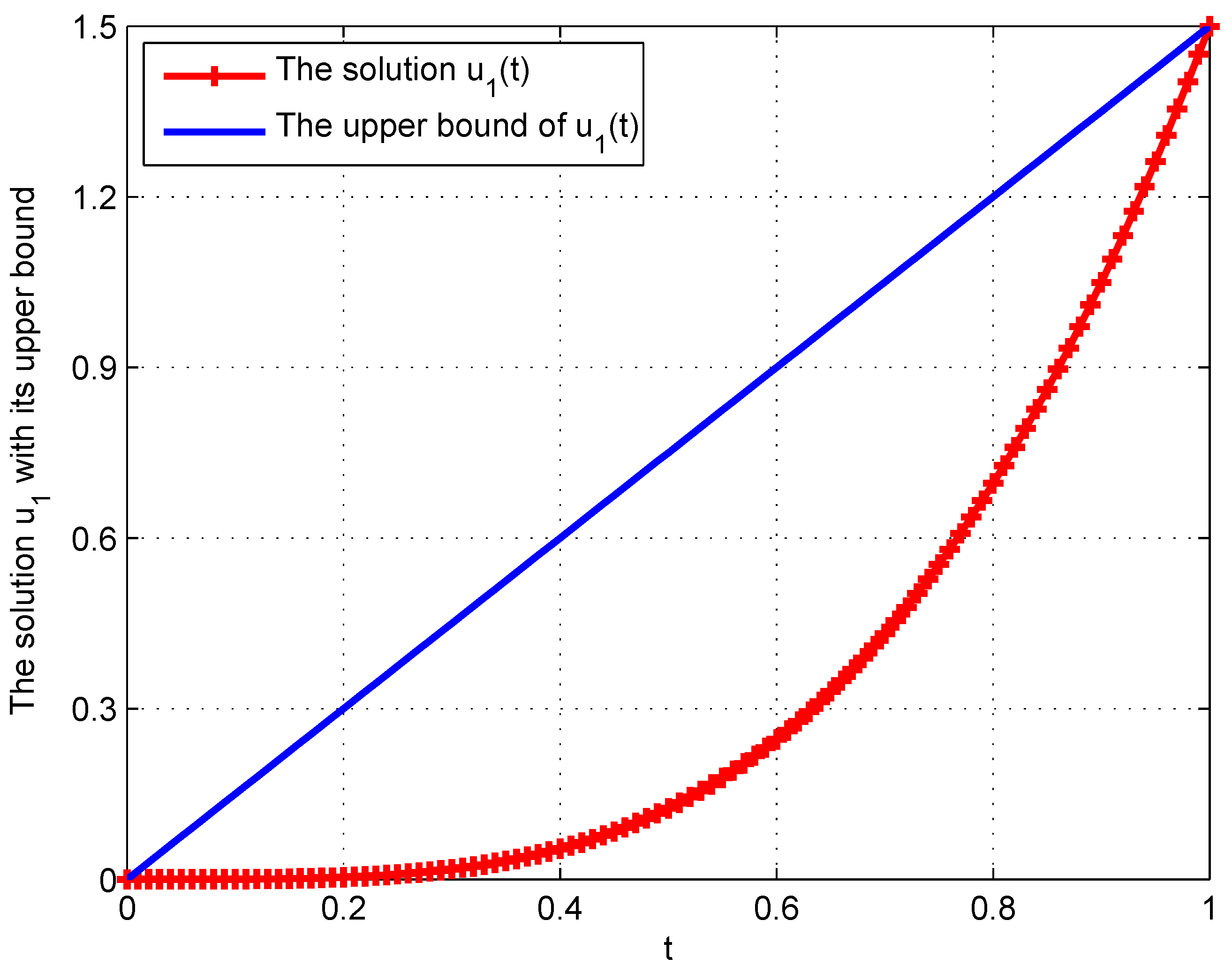
Obviously, a i L 2 ( 0 , 1 ) ( i = 0 , 1 , 2 , 3 ) and f satisfies the condition ( A 0 ) . Let r 1 = 3 2 . Then, all the assumptions of Theorem 1 are fulfilled. With these data, we obtain a solution u 1 to the problem (97) and establish an upper bound for u 1 . Figure 1 and Table 1 show that the solution u 1 has an upper bound. This thereby verifies the validity and effectiveness of Theorem 1. □
Example 2.
We consider the following problem:
D 0 + 3 c ϕ 2 D 0 + 5 2 u ( t ) + 315 π 8 = 0 , 0 < t < 1 , u ( 0 ) = u ( 0 ) = D 0 + 5 2 u ( 0 ) = ϕ 2 D 0 + 5 2 u ( 0 ) = 0 , ϕ 2 D 0 + 5 2 u ( 1 ) = 0 , u ( 1 ) = 0 .
Proof. 
Let p = 2 , δ = 3 , α = 5 2 ( n = 3 ) , β = 3 4 , γ 1 = 1 , z 0 = 1 , z 1 = 4 5 , z 2 = 5 6 , z 3 = 6 7 , ζ = 13 14 , k 0 = k 1 = 0 , k 2 = 2 , k 3 = 1 , a i 0 , ξ i = 2 i ( i = 1 , 2 , ) , b 0 ( s ) = s 1 3 , b 1 ( s ) = s 1 2 , b 2 ( s ) 0 , ( H u ) ( t ) = 0 t u ( s ) d s ,
A 1 ( t ) = 5 7 , t 0 , 1 7 , 6 7 , t 1 7 , 1 , A 2 ( t ) = 5 8 , t 0 , 1 3 , 8 9 , t 1 3 , 1 .
f ( t , u , v , w ) = | u | + | v | + | w | + 315 π 8 13 9 t 3 2 + t 7 2 8 33 t 11 2 26 45 t 5 2 + 2 9 t 9 2 16 429 t 13 2 π Γ ( 3 / 4 ) 13 9 t 3 4 20 11 t 11 4 + 128 209 t 19 4 .
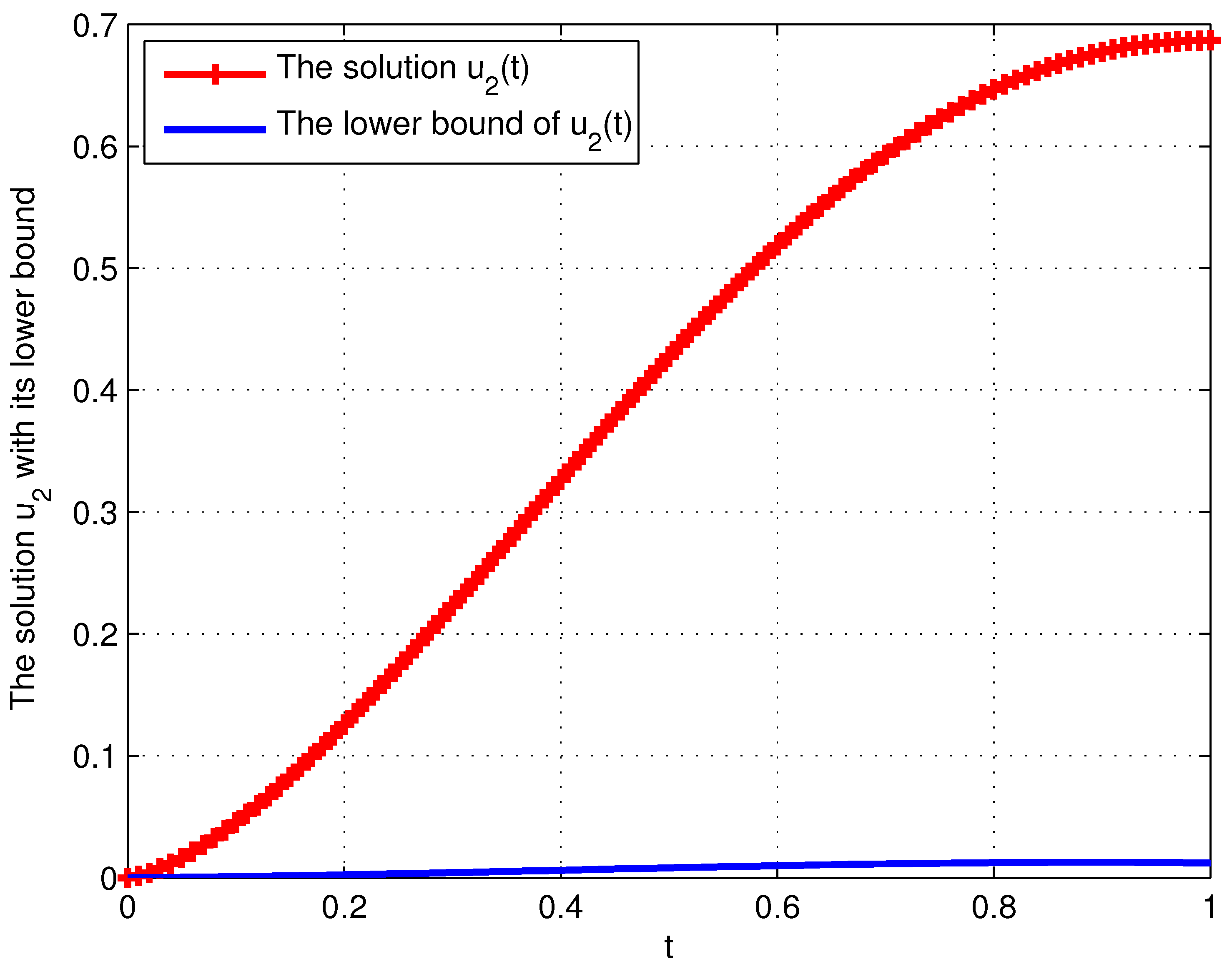
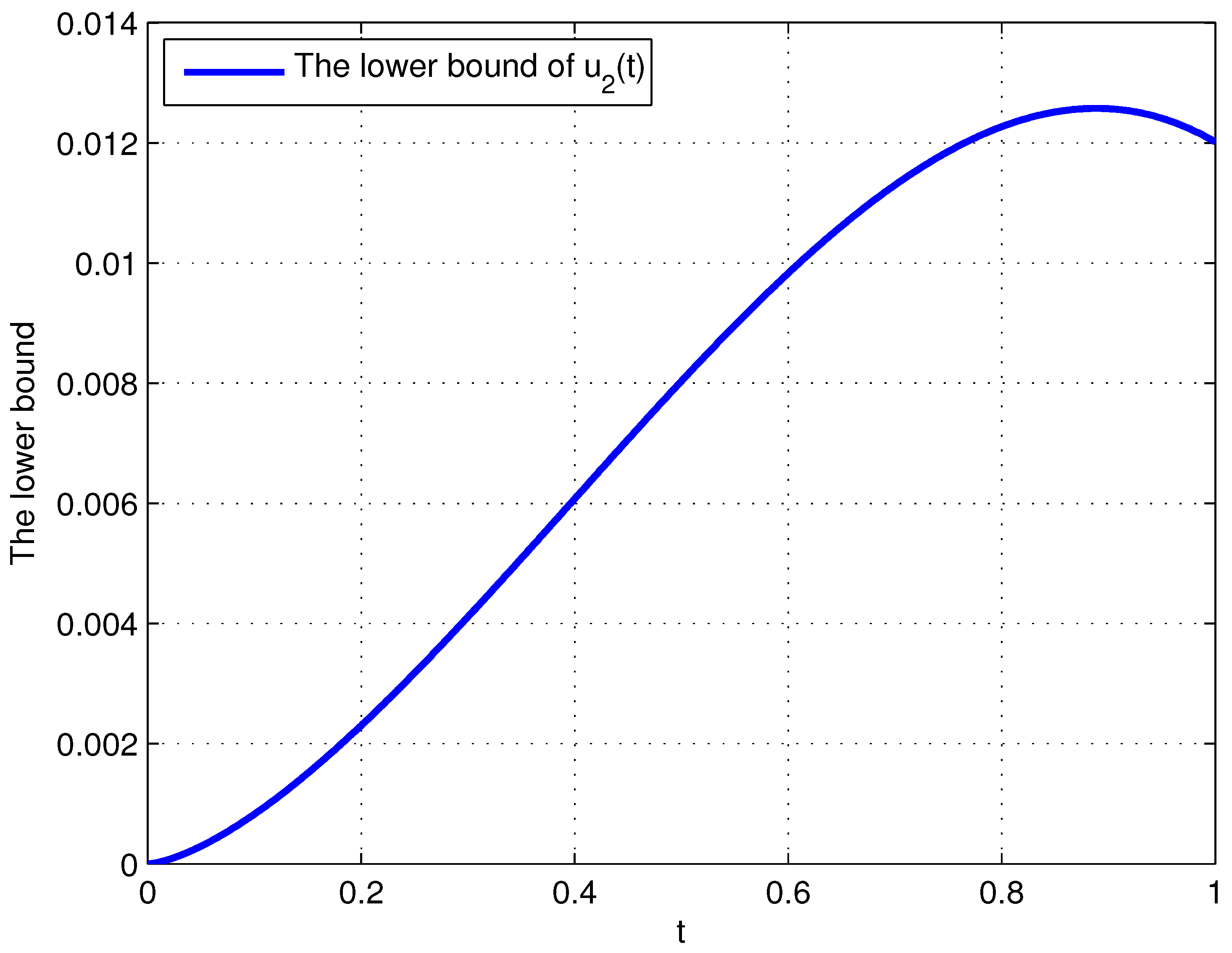
Then, we can regard the problem (98) as the problem (1). It is easy to check that f satisfies ( A 1 ) and ( A 4 ) with κ = 10 , ι = 2 , l 1 ( t ) = l 2 ( t ) = l 3 ( t ) = 1 . And, M 1 = 0.1258 < 1 . Thus, all the assumptions of Theorem 2 are fulfilled. With these data, the numerical results in Figure 2 and Figure 3 and Table 2 show that the solution u 2 has a lower bound. Among them, Figure 2 illustrates the relationship between the solution u 2 and its lower bound. For a clearer visualization of the lower bound’s trajectory, we provide Figure 3. Thus, this numerical example confirms Theorem 2. □
Example 3.
We consider the following equation:
D 0 + 21 10 c ϕ 3 2 D 0 + 11 5 u ( t ) + 792 Γ ( 1 5 ) 125000 Γ ( 1 10 ) 897 Γ ( 3 5 ) 17 Γ ( 2 5 ) 1 2 t 1 10 = 0 , 0 < t < 1 , u ( 0 ) = u ( 0 ) = D 0 + 11 5 u ( 0 ) = ϕ 3 2 D 0 + 11 5 u ( 0 ) = 0 , ϕ 3 2 D 0 + 11 5 u ( 1 ) = 3 0 1 s 1 5 ϕ 3 2 ( D 0 + 11 5 u ( s ) ) d s , D 0 + 6 5 u ( 1 ) = 8 Γ ( 32 5 ) 0 1 s 1 2 D 0 + 11 10 u ( s ) d A 1 ( s ) + 8 Γ ( 32 5 ) 0 10 11 s 4 5 D 0 + 4 5 u ( s ) d A 2 ( s ) + 1 2 Γ ( 32 5 ) i = 1 Γ ( 67 10 ) 2 1 2 i D 0 + 9 10 u ( 2 5 57 i ) ,
where
A 1 ( t ) = 1 , t 0 , 1 2 , 1 + Γ 13 2 , t 1 2 , 1 , A 2 ( t ) = 1 , t 0 , 1 2 , 1 + Γ 34 5 , t 1 2 , 1 .
Proof. 
Let p = 3 2 , δ = 21 10 , α = 11 5 ( n = 3 ) , β = 1 , γ 1 = 1 , z 0 = 6 5 , z 1 = 11 10 , z 2 = 4 5 , z 3 = 9 10 , k 0 = 3 , k 1 = 8 Γ ( 32 5 ) , k 2 = 8 Γ ( 32 5 ) , k 3 = 1 2 Γ ( 32 5 ) , ζ = 10 11 , b 0 ( s ) = s 1 5 , b 1 ( s ) = s 1 2 , b 2 ( s ) = s 4 5 , ( H u ) ( t ) = 0 t u ( s ) d s ,
f ( t , u , v , w ) = 792 Γ ( 1 5 ) 125000 Γ ( 1 10 ) 897 Γ ( 3 5 ) 17 Γ ( 2 5 ) 1 2 t 1 10 ( t 33 5 10 6 + 1 ) ( 5 t 38 5 38 × 10 6 + 1 ) ( 33 t 28 5 5 × 10 6 + 1 ) ( | u | + 1 ) ( | v | + 1 ) ( | w | + 1 ) .
Then, we can regard the problem (99) as the problem (1). Let
F ( t ) = 792 Γ ( 1 5 ) 125000 Γ ( 1 10 ) 897 Γ ( 3 5 ) 17 Γ ( 2 5 ) 1 2 t 1 10 ( t 33 5 10 6 + 1 ) ( 5 t 38 5 38 × 10 6 + 1 ) ( 33 t 28 5 5 × 10 6 + 1 )
and
l i ( t ) = 792 Γ ( 1 5 ) 125000 Γ ( 1 10 ) 897 Γ ( 3 5 ) 17 Γ ( 2 5 ) 1 2 t 1 10 ( t 33 5 10 6 + 1 ) ( 5 t 38 5 38 × 10 6 + 1 ) ( 33 t 28 5 5 × 10 6 + 1 ) ( i = 1 , 2 , 3 ) .
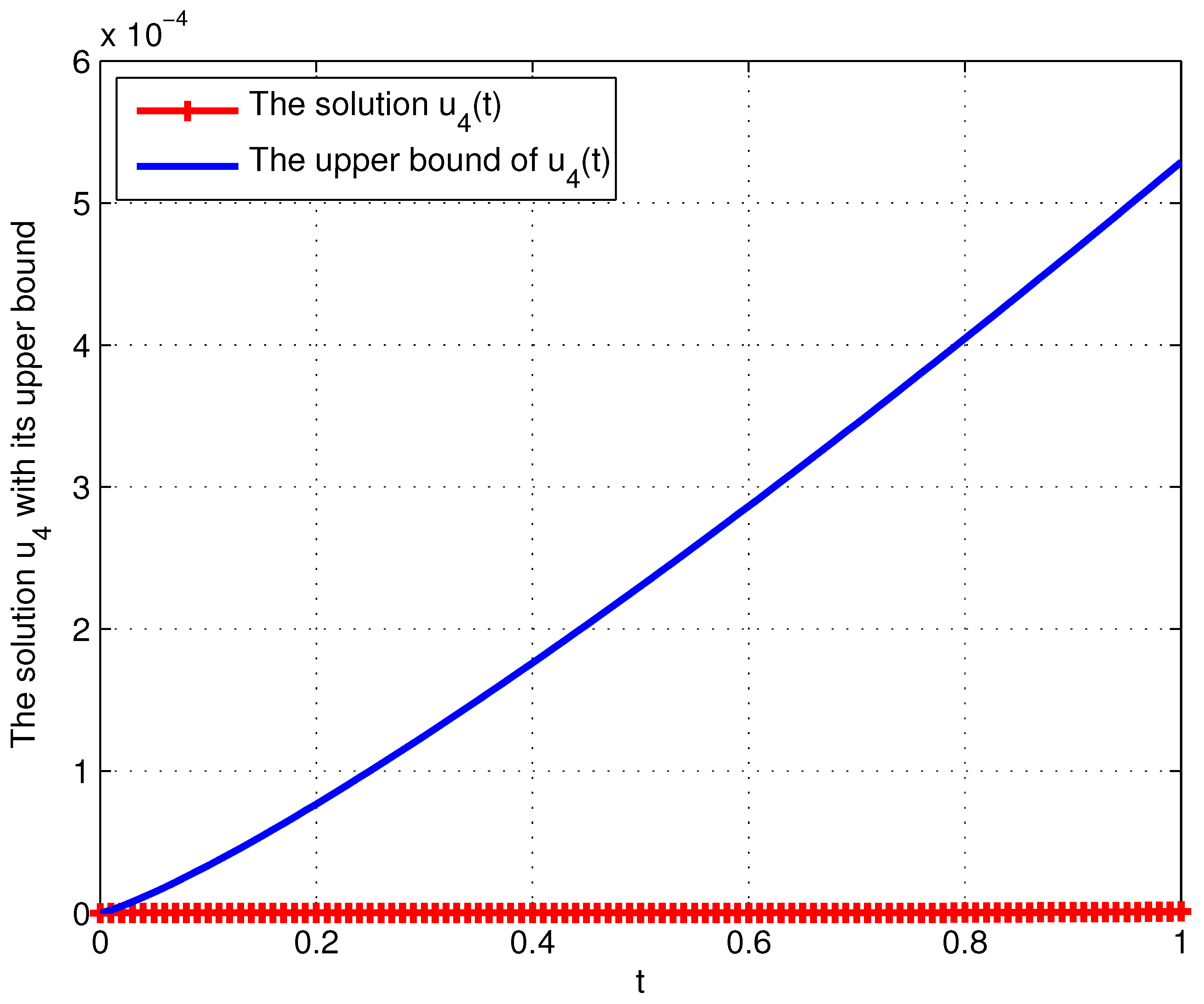
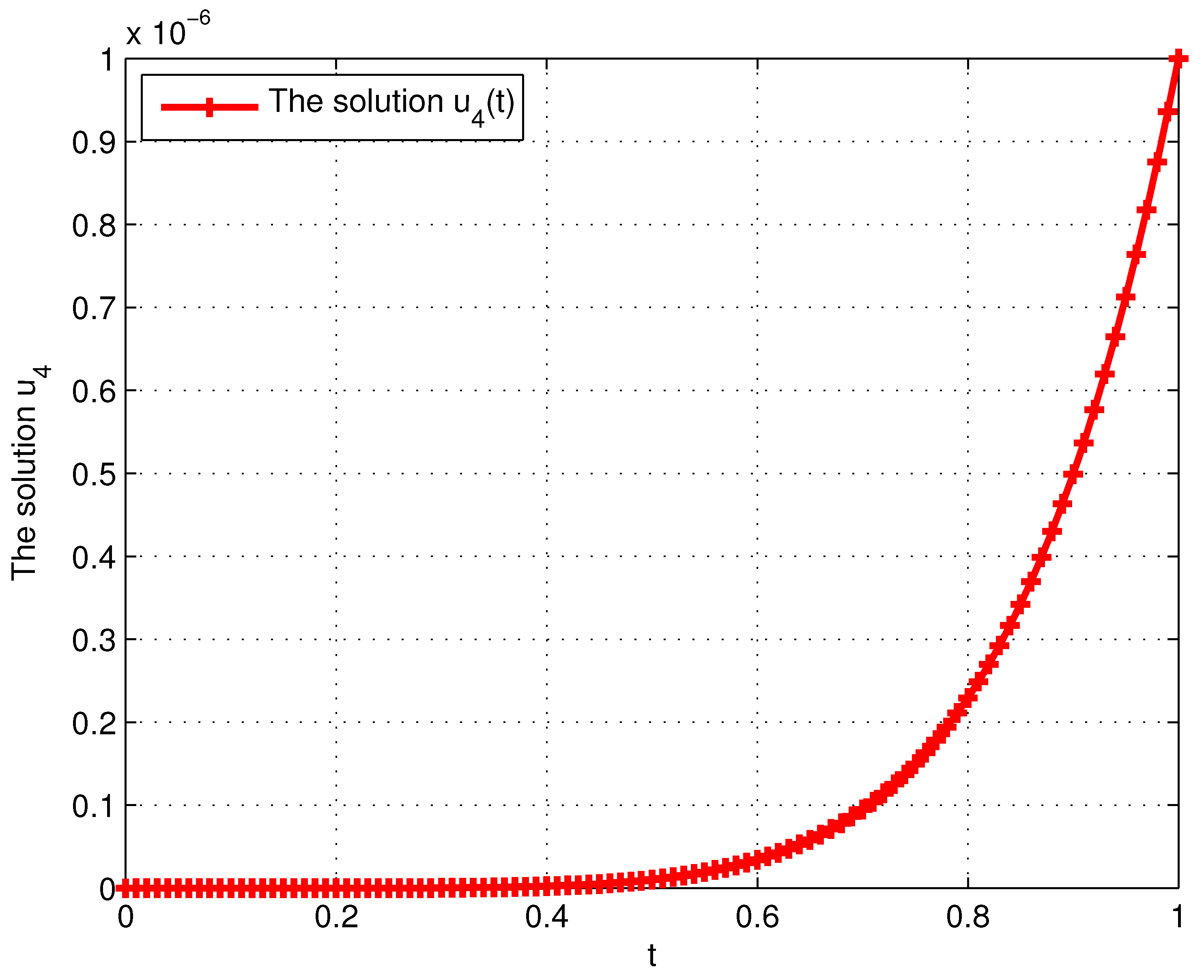
It is easy to check that f satisfies conditions ( A 3 ) and ( A 4 ) . Moreover, by using the above data, we obtain M 2 0.0029 < 1 . Therefore, all the assumptions of Theorem 4 are fulfilled. With these data, the numerical results in Figure 4 and Figure 5 as well as Table 3 show that the solution u 4 has an upper bound. Among them, Figure 4 illustrates the relationship between the solution u 4 and its upper bound. For a clearer visualization of the trajectory of solution u 4 , we provide Figure 5. Therefore, this numerical example demonstrates the validity of Theorem 4. □
Example 4.
We consider the following problem:
D 0 + 3 c ϕ 3 2 D 0 + 7 2 u ( t ) + 3 5 = 0 , 0 < t < 1 , u ( 0 ) = D 0 + 6 7 u ( 0 ) = D 0 + 13 7 u ( 0 ) = 0 , D 0 + 7 2 u ( 0 ) = 0 , ( ϕ 3 2 ( D 0 + 7 2 u ( 0 ) ) ) = 0 , ϕ 3 2 ( D 0 + 7 2 u ( 1 ) ) = 7 2 0 1 s 1 2 ϕ 3 2 ( D 0 + 7 2 u ( s ) ) d s , D 0 + 5 2 u ( 1 ) = 1152 0 1 D 0 + 1 2 u ( s ) d A 1 ( s ) + 64 0 10 11 D 0 + 3 2 u ( s ) d A 2 ( s ) + 4 i = 1 2 1 2 i D 0 + 3 2 u ( 2 1 16 i ) ,
where
A 1 ( t ) = 1 , t 0 , 1 2 , 9 , t 1 2 , 1 , A 2 ( t ) = 3 , t 0 , 1 2 , 11 , t 1 2 , 1 .
Proof. 
Let p = 3 2 , δ = 3 , α = 7 2 ( n = 4 ) , β = 3 2 , γ 1 = 6 7 , γ 2 = 13 7 , z 0 = 5 2 , z 1 = 1 2 , z 2 = z 3 = 3 2 , k 0 = 72 9 , k 1 = 1152 , k 2 = 64 , k 3 = 4 , ζ = 10 11 , a i = 2 1 2 i , ξ i = 2 1 16 i ( i = 1 , 2 , ) , b 0 ( s ) = s 1 2 , b 1 ( s ) 1 , b 2 ( s ) 1 , ( H u ) ( t ) = Γ ( 7 2 ) 0 t u ( s ) d s ,
f ( t , u , v , w ) = 3 2 12 363738375 π t 19 2 + 1 2 10 509233725 t 21 2 + 1 1 5600 t 8 + 1 5 ( | u | + 1 ) ( | v | + 1 ) ( | w | + 1 ) .
Then, we can regard the problem (100) as the problem (1). By using the above data, it is easy to check that f satisfies the condition ( A 5 ) with
l i , r ( t ) = 3 5 2 12 t 19 2 363738375 π + 1 2 10 t 21 2 509233725 + 1 t 8 5600 + 1 ( i = 1 , 2 , 3 ) .
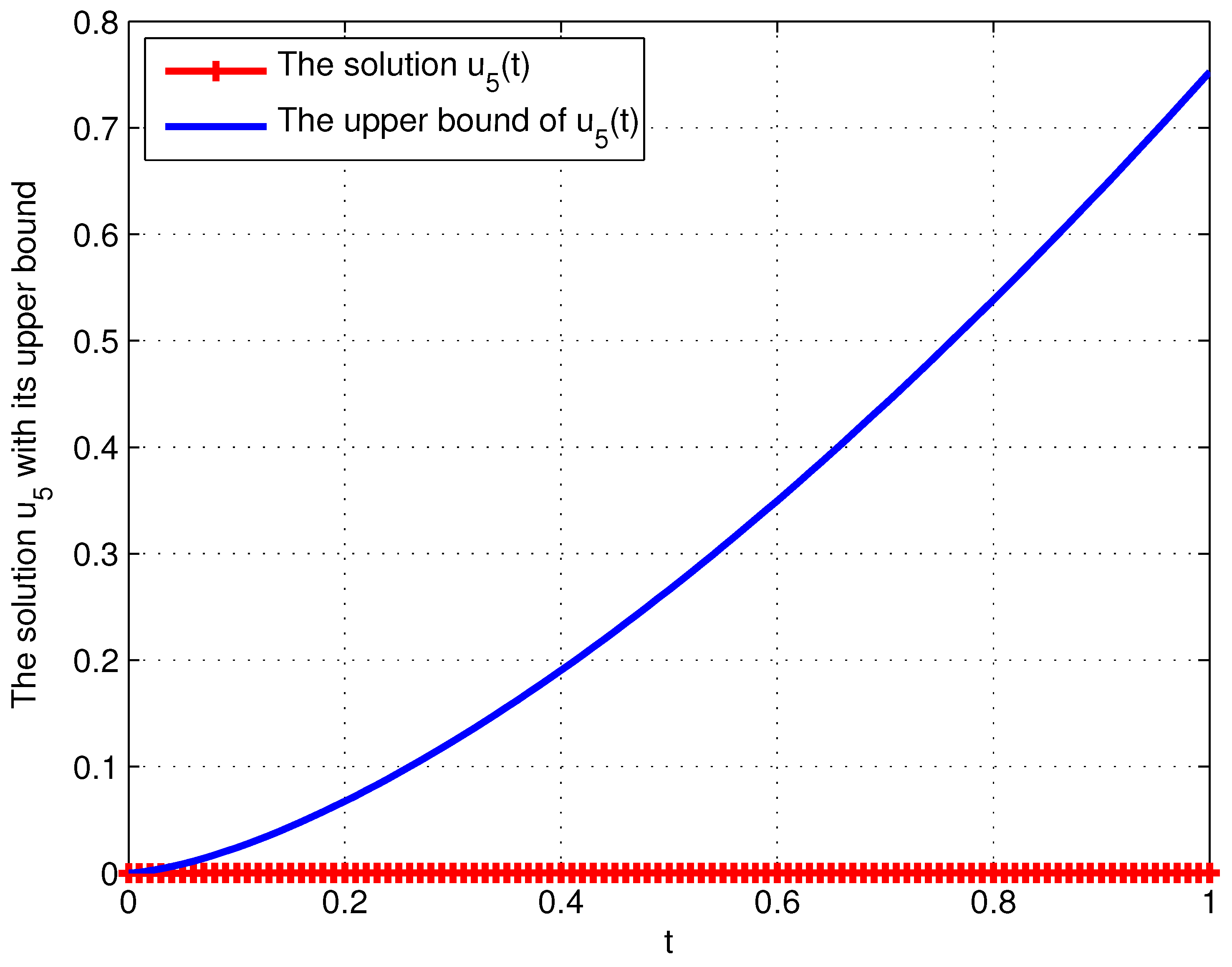
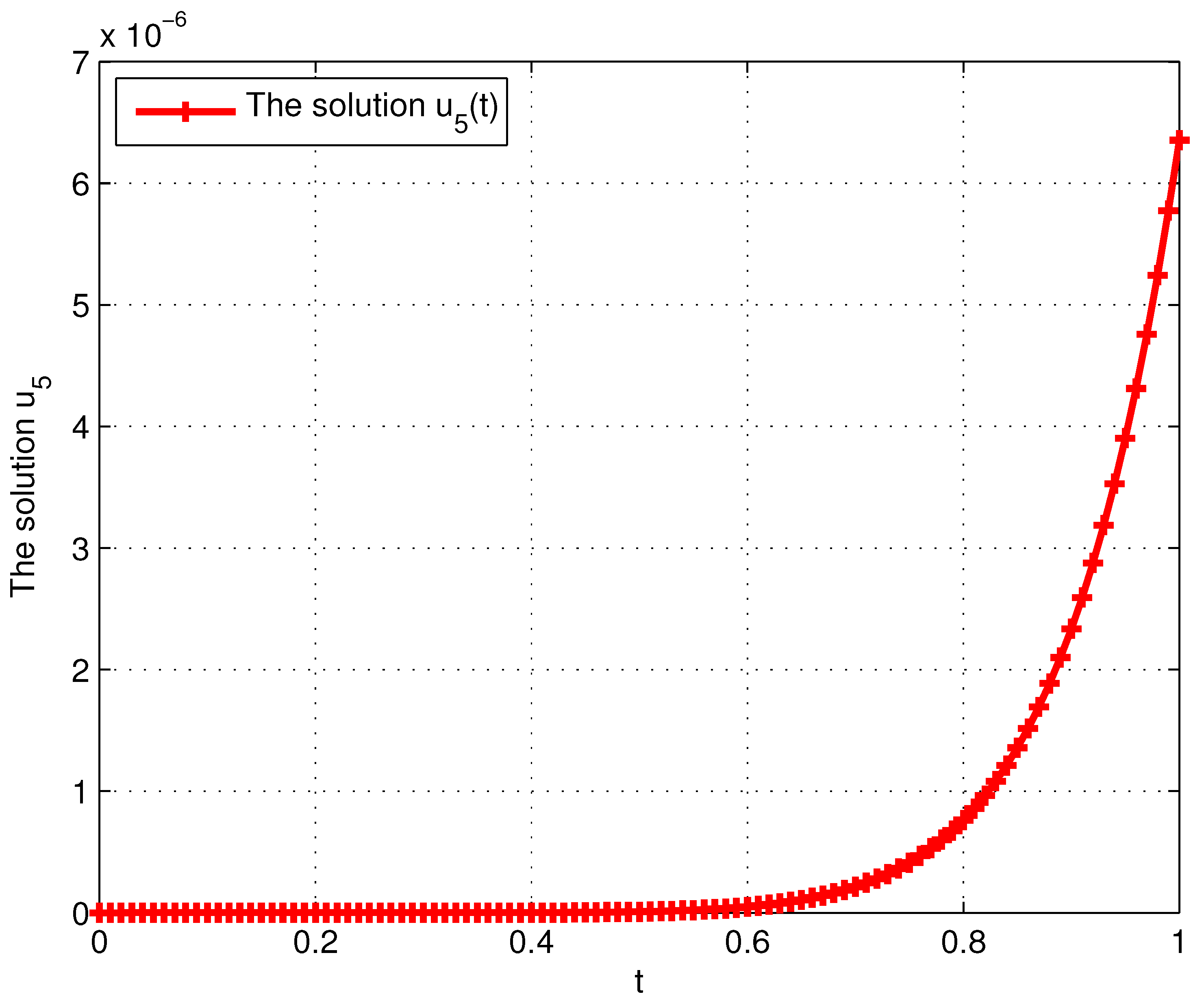
Let r = 1 . Then, by calculation, we have U ( r ) > 0 , Z ( r ) 0.0245 < 1 , and 1 < M h = Γ ( β + 1 ) = Γ ( 2.5 ) . Thus, all the assumptions of Theorem 5 are fulfilled. With these data, the numerical results in Figure 6 and Figure 7 and Table 4 show that the solution u 5 has an upper bound. Among them, Figure 6 illustrates the relationship between the solution u 5 and its upper bound. For a clearer visualization of the trajectory of solution u 5 , we provide Figure 7. Therefore, these numerical results validate the validity of Theorem 5. □

6. Conclusions

In this paper, we have addressed the problem of fractional differential equations with the p-Laplacian operator. By the method of reducing the order of fractional derivative, even when the nonlinear term involves fractional derivatives, we can still study the problem in the function space C [ 0 , 1 ] , which significantly simplifies our analysis. By employing the Schauder fixed point theorem and the Banach contraction principle, we established the existence and uniqueness of solutions. We have systematically validated our theoretical results through numerical examples, tabulated data, and graphical analyses. Furthermore, through analysis of the properties of Green’s function, we developed and applied a novel approach to approximate solutions. This approach demonstrated effectiveness and practicality in estimating solutions. Notably, the generalized boundary conditions adopted in this work provided a powerful modeling tool for physics phenomena.

Author Contributions

Conceptualization, F.W. and L.L.; methodology, F.W. and L.L.; resources, F.W. and L.L.; funding acquisition, L.L.; writing—original draft preparation, F.W.; writing—review and editing, L.L., H.G., L.M. and Y.W.; supervision, L.L.; project administration, F.W., L.L., H.G. and Y.W. All authors have read and agreed to the published version of the manuscript.

Funding

This research was supported by the National Natural Science Foundation of China (11871302), the ARC Discovery Project Grant (DP230102079) and the Natural Science Foundation of Shandong Province (ZR2022MA009).

Data Availability Statement

No new data were created or analyzed in this study.

Conflicts of Interest

The authors declare no conflicts of interest.

References

  1. Mainardi, F. Fractional Calculus and Waves in Linear Viscoelasticity: An Introduction to Mathematical Models; Imperial College Press: London, UK, 2010. [Google Scholar]
  2. Valvano, S.; Alaimo, A.; Orlando, C. Analytical analysis of sound transmission in passive damped multilayered shells. Compos. Struct. 2020, 253, 112742. [Google Scholar] [CrossRef]
  3. Bagley, R.L.; Torvik, P.J. A theoretical basis for the application of fractional calculus to viscoelasticity. J. Rheol. 1983, 27, 201–210. [Google Scholar] [CrossRef]
  4. Kilbas, A.A.; Srivastava, H.M.; Trujillo, J.J. Theory and Applications of Fractional Differential Equations. In North-Holland Mathematics Studies; Elsevier Science B.V.: Amsterdam, The Netherlands, 2006; Volume 204. [Google Scholar]
  5. Henderson, J.; Luca, R. Boundary Value Problems for Systems of Differential, Difference and Fractional Equations: Positive Solutions; Elsevier: Amsterdam, The Netherlands, 2016. [Google Scholar]
  6. Podlubny, I. Fractional Differential Equations; Academic Press: San Diego, CA, USA, 1999. [Google Scholar]
  7. Samko, S.G.; Kilbas, A.A.; Marichev, O.I. Fractional Integrals and Derivatives: Theory and Applications; Gordon and Breach Science Publishers: Philadelphia, PA, USA, 1993. [Google Scholar]
  8. Kukushkin, M. On solvability of the Sonin–Abel equation in the Weighted Lebesgue space. Fractal Fract. 2021, 5, 77. [Google Scholar] [CrossRef]
  9. Derbissaly, B.; Kirane, M.; Sadybekov, M. Inverse source problem for two-term time-fractional diffusion equation with nonlocal boundary conditions. Fractal Fract. 2024, 183, 114897. [Google Scholar] [CrossRef]
  10. Zhang, L.; Liu, X.; Jia, M.; Yu, Z. Piecewise conformable fractional impulsive differential system with delay: Existence, uniqueness and Ulam stability. J. Appl. Math. Comput. 2024, 70, 1543–1570. [Google Scholar] [CrossRef]
  11. Rahul, R.; Halder, S.; Kazemi, M.; Samei, M.E. A study on solvability and an iterative method for infinite systems of fractional integro-differential equations. Bol. Soc. Mat. Mex. 2025, 31, 73. [Google Scholar] [CrossRef]
  12. Leibenson, L.S. General problem of the movement of a compressible fluid in a porous medium. Izv. Akad. Nauk Kirgiz. SSSR 1983, 9, 7–10. [Google Scholar]
  13. Li, K.; Liu, B. Grow-up of weak solutions in a p-Laplacian pseudo-parabolic problem. Nonlinear Anal. Real World Appl. 2022, 68, 103657. [Google Scholar] [CrossRef]
  14. Amoroso, E.; Bonanno, G.; Perera, K. Nonlinear elliptic p-Laplacian equations in the whole space. Nonlinear Anal. 2023, 236, 113364. [Google Scholar] [CrossRef]
  15. Gallo, M.; Squassina, M. Concavity and perturbed concavity for p-Laplace equations. J. Differ. Equ. 2025, 440, 113452. [Google Scholar] [CrossRef]
  16. Zhang, L.; Hou, W.; Nieto, J.J.; Wang, G. An anisotropic tempered fractional p-Laplacian model involving logarithmic nonlinearity. Evol. Equ. Control Theory 2024, 13, 1–11. [Google Scholar] [CrossRef]
  17. Jong, K. Existence and uniqueness of positive solutions of a kind of multi-point boundary value problems for nonlinear fractional differential equations with p-Laplacian operator. Mediterr. J. Math. 2018, 15, 129. [Google Scholar] [CrossRef]
  18. Jong, K.; Choi, H.; Ri, Y. Existence of positive solutions of a class of multi-point boundary value problems for p-Laplacian fractional differential equations with singular source terms. Commun. Nonlinear Sci. Numer. Simulat. 2019, 72, 272–281. [Google Scholar] [CrossRef]
  19. Cheng, T.; Xu, X. Existence results for multi-point boundary value problem to singular fractional differential equations with a positive parameter. J. Appl. Math. Comput. 2022, 68, 3721–3746. [Google Scholar] [CrossRef]
  20. Henderson, J.; Luca, R.; Tudorache, A. On a fractional differential equation with r-Laplacian operator and nonlocal boundary conditions. Mathematics 2022, 10, 3139. [Google Scholar] [CrossRef]
  21. Feng, X.; Li, Y. Solvability of a fractional boundary value problem with problem with p-Laplacian operator on an infinite interval. J. Appl. Anal. Comput. 2023, 13, 3087–3106. [Google Scholar] [CrossRef]
  22. Samei, M.E.; Karimi, L.; Kaabar, M.K.A. To investigate a class of multi-singular pointwise defined fractional q–integro-differential equation with applications. AIMS Math. 2022, 7, 7781–7816. [Google Scholar] [CrossRef]
  23. Zhang, L.; Zhang, W.; Liu, X.; Jia, M. Positive solutions of fractional p-Laplacian equations with integral boundary value and two parameters. J. Inequal. Appl. 2020, 2020, 2. [Google Scholar] [CrossRef]
  24. Guo, L.; Zhao, J.; Dong, S.; Hou, X. Existence of multiple positive solutions for Caputo fractional differential equation with infinite-point boundary value conditions. J. Appl. Anal. Comput. 2022, 12, 1786–1800. [Google Scholar] [CrossRef]
  25. Chu, L.; Hu, W.; Su, Y.; Yun, Y. Existence and uniqueness of solutions to four-point impulsive fractional differential equations with p-Laplacian operator. Mathematics 2022, 10, 1852. [Google Scholar] [CrossRef]
  26. Rezapour, S.; Boulfoul, A.; Tellab, B.; Samei, M.E.; Etemad, S.; George, R. Fixed point theory and the Liouville-Caputo integro-differential FBVP with multiple nonlinear terms. J. Funct. Spaces 2022, 2022, 6713533. [Google Scholar] [CrossRef]
  27. Nazari, S.; Samei, M.E. An existence of the solution for generalized system of fractional q-differential inclusions involving p-Laplacian operator and sequential derivatives. Bound. Value Probl. 2024, 2024, 117. [Google Scholar] [CrossRef]
  28. Baitiche, Z.; Derbazi, C.; Wang, G. Monotone iterative method for nonlinear fractional p-Laplacian differential equation in terms of Ψ-Caputo fractional derivative equipped with a new class of nonlinear boundary conditions. Math. Methods Appl. Sci. 2022, 45, 967–976. [Google Scholar] [CrossRef]
  29. Hasanov, M. Initial value problems for fractional p-Laplacian equations with singularity. AIMS Math. 2024, 9, 12800–12813. [Google Scholar] [CrossRef]
  30. Wang, G.; Yuan, H.; Baleanu, D. Stability analysis, existence and uniqueness of solutions for a fractional conformable p-Laplacian coupled boundary value problem on the disilane graph. Qual. Theory Dyn. Syst. 2024, 23, 218. [Google Scholar] [CrossRef]
  31. Etemad, S.; Iqbal, I.; Samei, M.E.; Rezapour, S.; Alzabut, J.; Sudsutad, W.; Goksel, I. Some inequalities on multi-functions for applying in the fractional Caputo–Hadamard jerk inclusion system. J. Inequal. Appl. 2022, 2022, 84. [Google Scholar] [CrossRef]
  32. Mursaleen, M.; Savaş, E. Solvability of an infinite system of fractional differential equations with p-Laplacian operator in a new tempered sequence space. J. Pseudo-Differ. Oper. Appl. 2023, 14, 57. [Google Scholar] [CrossRef]
  33. Guran, L.; Mitrović, Z.; Reddy, G.; Belhenniche, A.; Radenović, S. Applications of a fixed point result for solving nonlinear fractional and integral differential equations. Fractal Frac. 2021, 5, 211. [Google Scholar] [CrossRef]
  34. Bekri, Z.; Aljohani, S.; Samei, M.; Akgül, A.; Belhenniche, A.; Aloqaily, A.; Mlaiki, N. Unique solution analysis for generalized Caputo-type fractional BVP via Banach contraction. Eur. J. Pure Appl. Math. 2025, 18, 5979. [Google Scholar] [CrossRef]
  35. Liu, X.; Jia, M.; Xiang, X. On the solvability of a fractional differential equation model involving the p-Laplacian operator. Comput. Math. Appl. 2012, 64, 3267–3275. [Google Scholar] [CrossRef]
  36. Liu, X.; Jia, M.; Ge, W. The method of lower and upper solutions for mixed fractional four-point boundary value problem with p-Laplacian operator. Appl. Math. Lett. 2017, 65, 56–62. [Google Scholar] [CrossRef]
  37. Wei, C.; Liu, X.; Jia, M.; Zhang, L. The monotone iterative method for the integral boundary value problems of fractional p-Laplacian equations with delay. Int. J. Nonlinear Sci. Numer. Simul. 2021, 22, 23–32. [Google Scholar] [CrossRef]
  38. Liu, X.; Jia, M. The positive solutions for integral boundary value problem of fractional p-Laplacian equation with mixed derivatives. Mediterr. J. Math. 2017, 14, 94. [Google Scholar] [CrossRef]
  39. Ahmad, B.; Agarwal, R.P.; Broom, A.; Alsaedi, A. On a coupled integro-differential system involving mixed fractional derivatives and integrals of different orders. Acta Math. Sci. 2021, 41, 1366–1384. [Google Scholar] [CrossRef]
  40. Nyamoradi, N.; Ntouyas, S.K.; Tariboon, J. Existence of positive solutions to boundary value problems with mixed Riemann–Liouville and Quantum fractional derivatives. Fractal Fract. 2023, 7, 685. [Google Scholar] [CrossRef]
  41. Wang, Y.; Liu, L.; Zhang, X.; Wu, Y. Positive solutions of an abstract fractional semipositone differential system model for bioprocesses HIV infection. Appl. Math. Comput. 2015, 258, 312–324. [Google Scholar] [CrossRef]
  42. Zhang, X.; Liu, L.; Wu, Y.; Wiwatanapataphee, B. The spectral analysis for a singular fractional differential equation with a signed measure. Appl. Math. Comput. 2015, 257, 252–263. [Google Scholar] [CrossRef]
  43. Wang, F.; Liu, L.; Wu, Y. Existence and uniqueness of solutions for a class of higher-order fractional boundary value problems with the nonlinear term satisfying some inequalities. J. Inequal. Appl. 2020, 2020, 196. [Google Scholar] [CrossRef]
  44. Wang, F.; Liu, L.; Kong, D.; Wu, Y. Existence and uniqueness of positive solutions for a class of nonlinear fractional differential equations with mixed-type boundary value conditions. Nonlinear Anal. Model. Control 2019, 24, 73–94. [Google Scholar] [CrossRef]
  45. Guo, L.; Liu, L.; Wu, Y. Iterative unique positive solutions for singular p-Laplacian fractional differential equation system with several parameters. Nonlinear Anal. Model. Control 2018, 23, 182–203. [Google Scholar] [CrossRef]
  46. Ahmad, B.; Ntouyas, S.K.; Alsaedi, A.; Alalwi, K.A. Sequential fractional differential equations with parametric type anti-periodic boundary conditions. J. Appl. Anal. Comput. 2025, 15, 2921–2934. [Google Scholar] [CrossRef] [PubMed]
  47. Bai, Z.; Lv, H. Positive solutions for boundary value problem of nonlinear fractional differential equation. J. Math. Anal. Appl. 2005, 311, 495–505. [Google Scholar] [CrossRef]
Figure 1. Trajectory of the model (97) solution.
Axioms 14 00890 g001
Figure 2. Trajectory 1 of the model (98).
Axioms 14 00890 g002
Figure 3. Trajectory 2 of the model (98).
Axioms 14 00890 g003
Figure 4. Trajectory 1 of the model (99) solution.
Axioms 14 00890 g004
Figure 5. Trajectory 2 of the model (99) solution.
Axioms 14 00890 g005
Figure 6. Trajectory 1 of the model (100) solution.
Axioms 14 00890 g006
Figure 7. Trajectory 2 of the model (100) solution.
Axioms 14 00890 g007
Table 1. The solution u 1 with its upper bound.
t00.20.40.60.81
u 1 ( t ) 00.00370.05380.24620.69631.5000
The upper bound of u 1 ( t ) 00.30000.60000.90001.20001.5000
Table 2. The solution u 2 with its lower bound.
t00.20.40.60.81
u 2 ( t ) 00.12570.32650.51860.64670.6869
The lower bound of u 2 ( t ) 00.00230.00610.00980.01230.0120
Table 3. The solution u 4 with its upper bound.
t00.20.40.60.81
u 4 ( t ) ( × 10 6 ) 00.00000.00240.03430.22931.0000
The upper bound of u 4 ( t )   ( × 10 4 ) 00.76651.76102.86464.04575.2879
Table 4. The solution u 5 with its upper bound.
t00.20.40.60.81
u 5 ( t ) ( × 10 5 ) 00.00000.00010.00500.07630.6353
The upper bound of u 5 ( t ) 00.06730.19030.34960.53830.7523
Disclaimer/Publisher’s Note: The statements, opinions and data contained in all publications are solely those of the individual author(s) and contributor(s) and not of MDPI and/or the editor(s). MDPI and/or the editor(s) disclaim responsibility for any injury to people or property resulting from any ideas, methods, instructions or products referred to in the content.