Investigating the Semi-Permeable Membrane Behavior of Geosynthetic Clay Liners by Means of a Novel Apparatus


Abstract
1. Introduction
2. Literature Review on Chemico-Osmotic Testing Apparatuses and P
3. Chemico-Osmotic Diffusion Testing Apparatus and Procedure
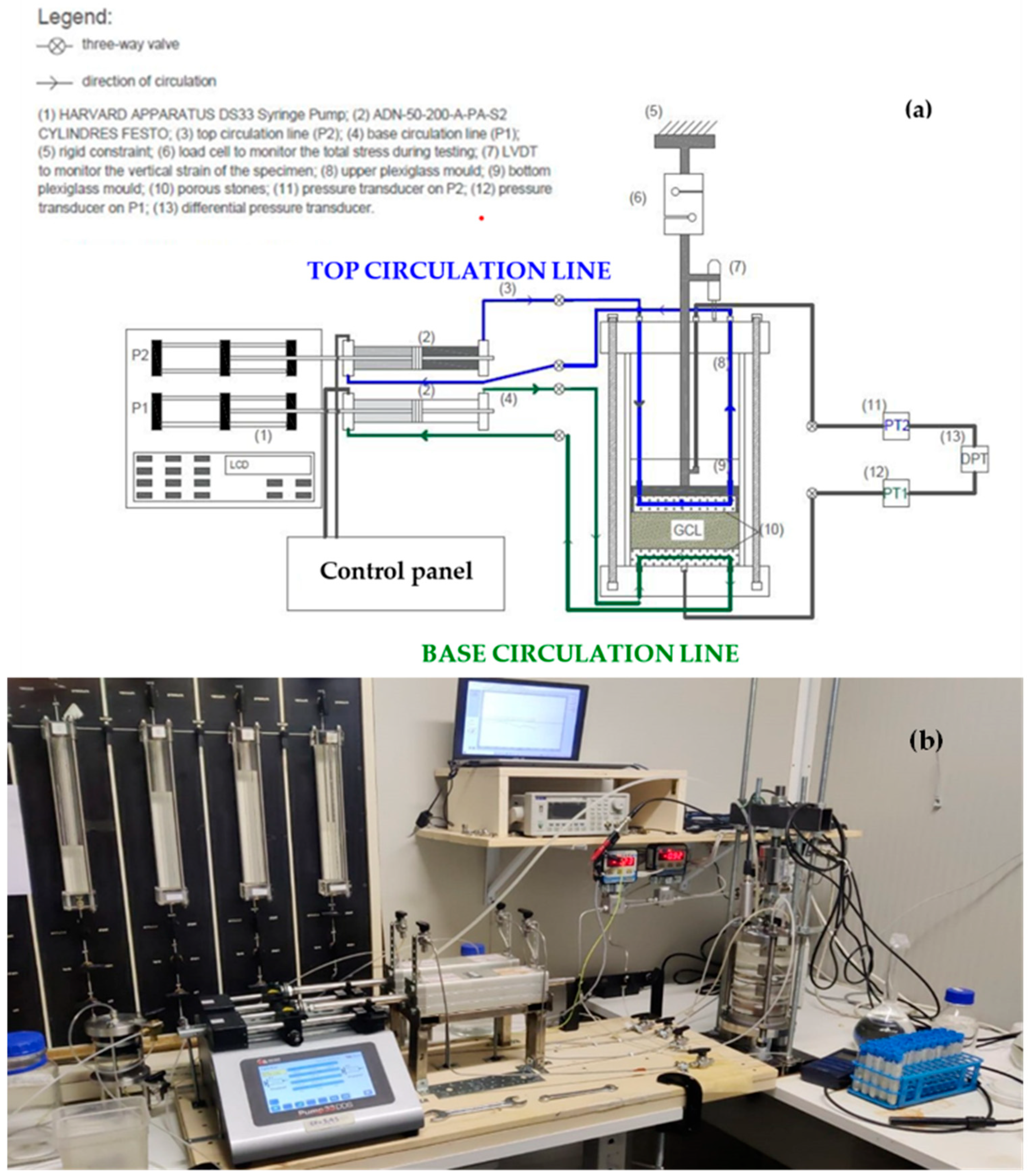
3.1. Testing Apparatus
3.2. Chemico-Osmotic Diffusion Test
4. Materials and Methods
4.1. Materials
4.2. Testing Procedure
4.3. Theoretical Interpretation of Experimental Data
5. Results and Discussion
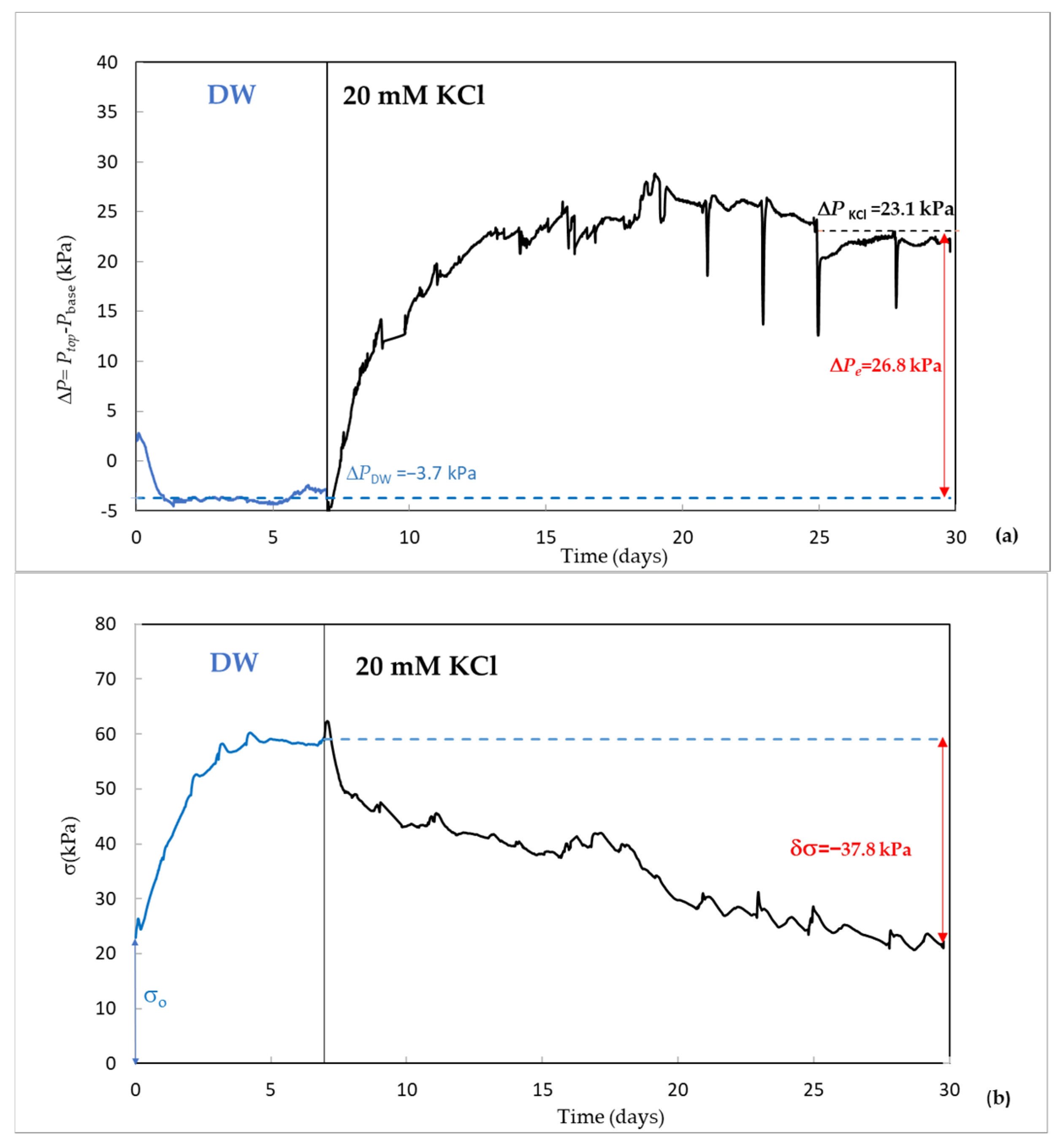
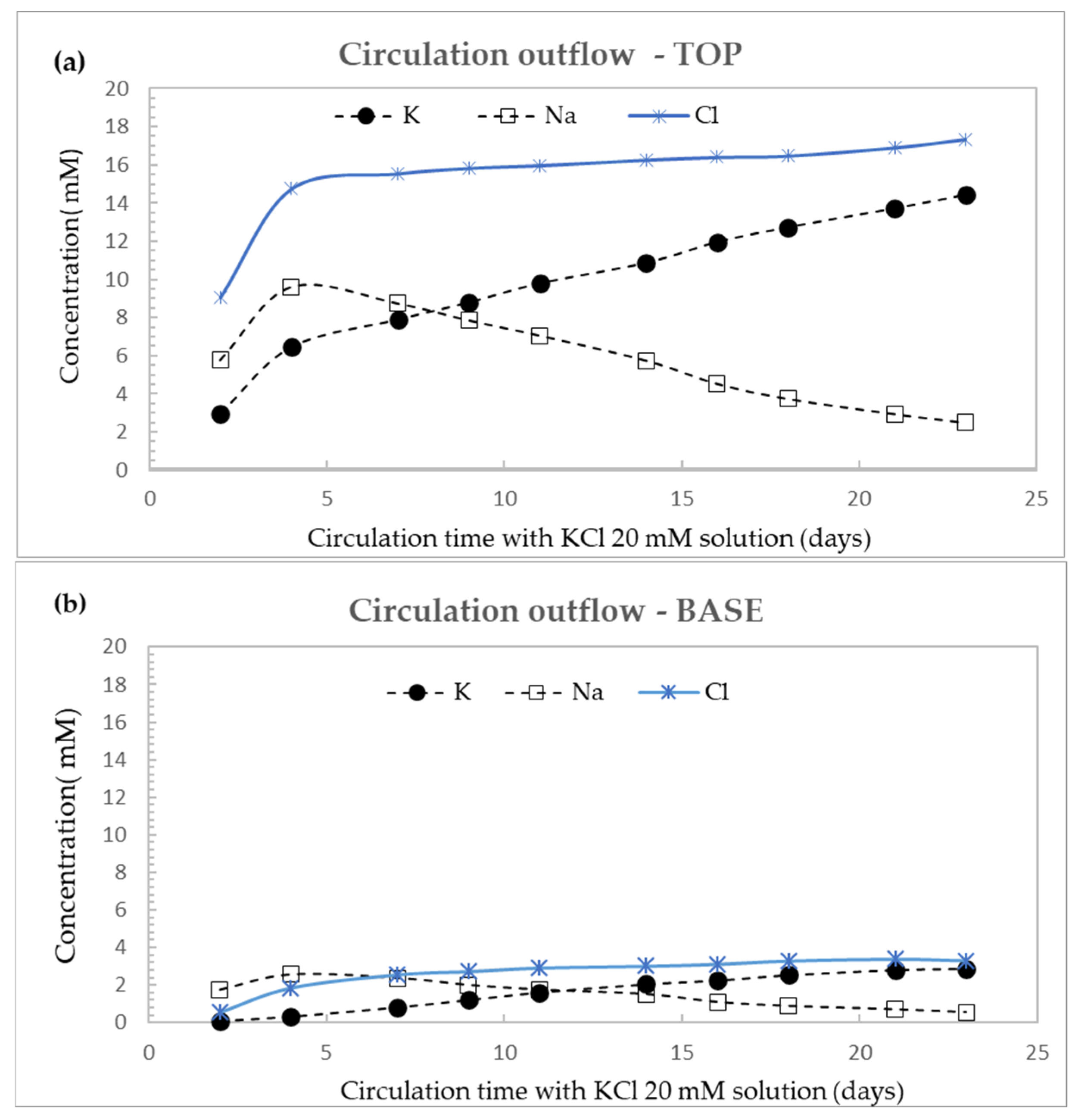
5.1. Typical Result of a Chemico-Osmotic Test
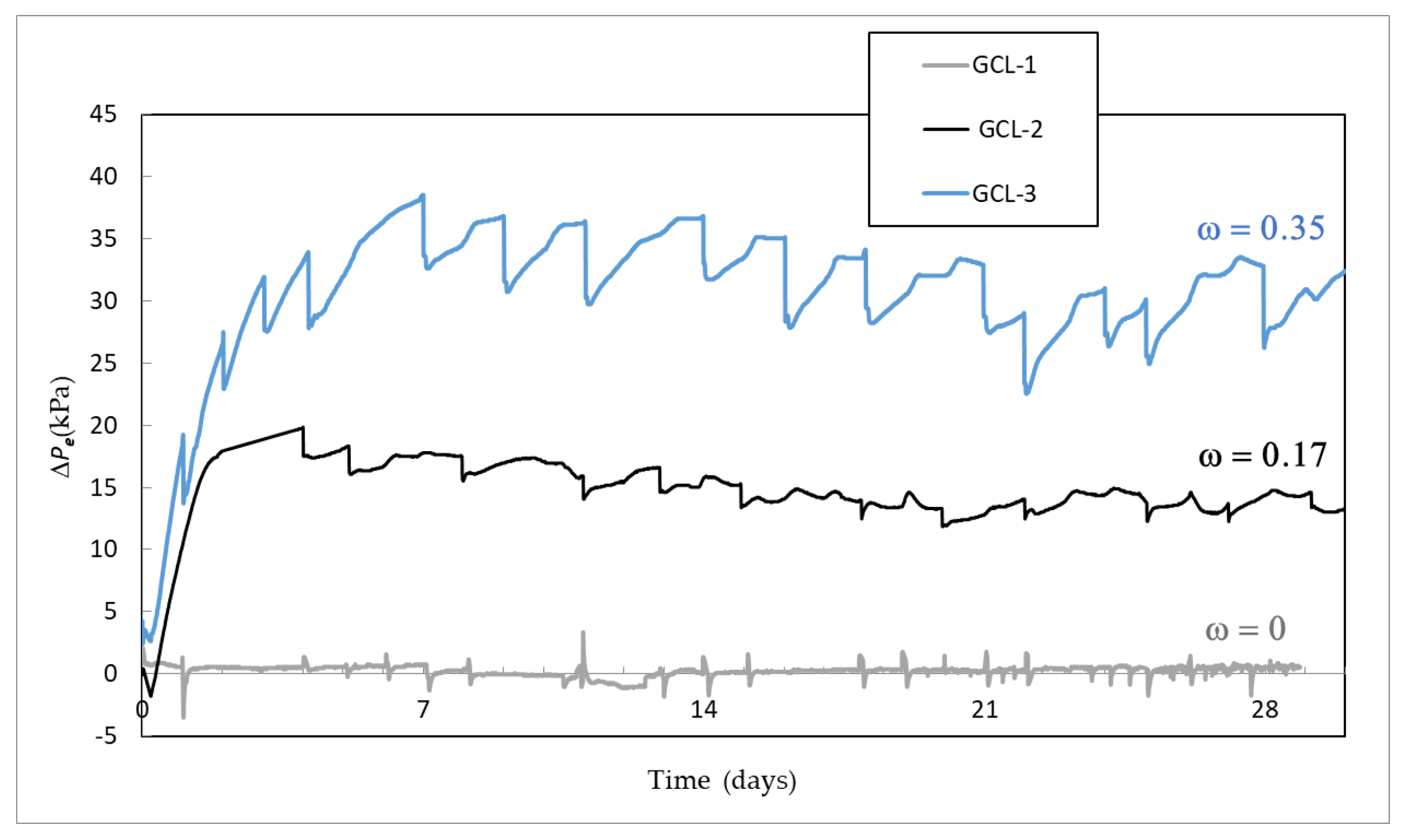
5.2. Effect of GCL Type
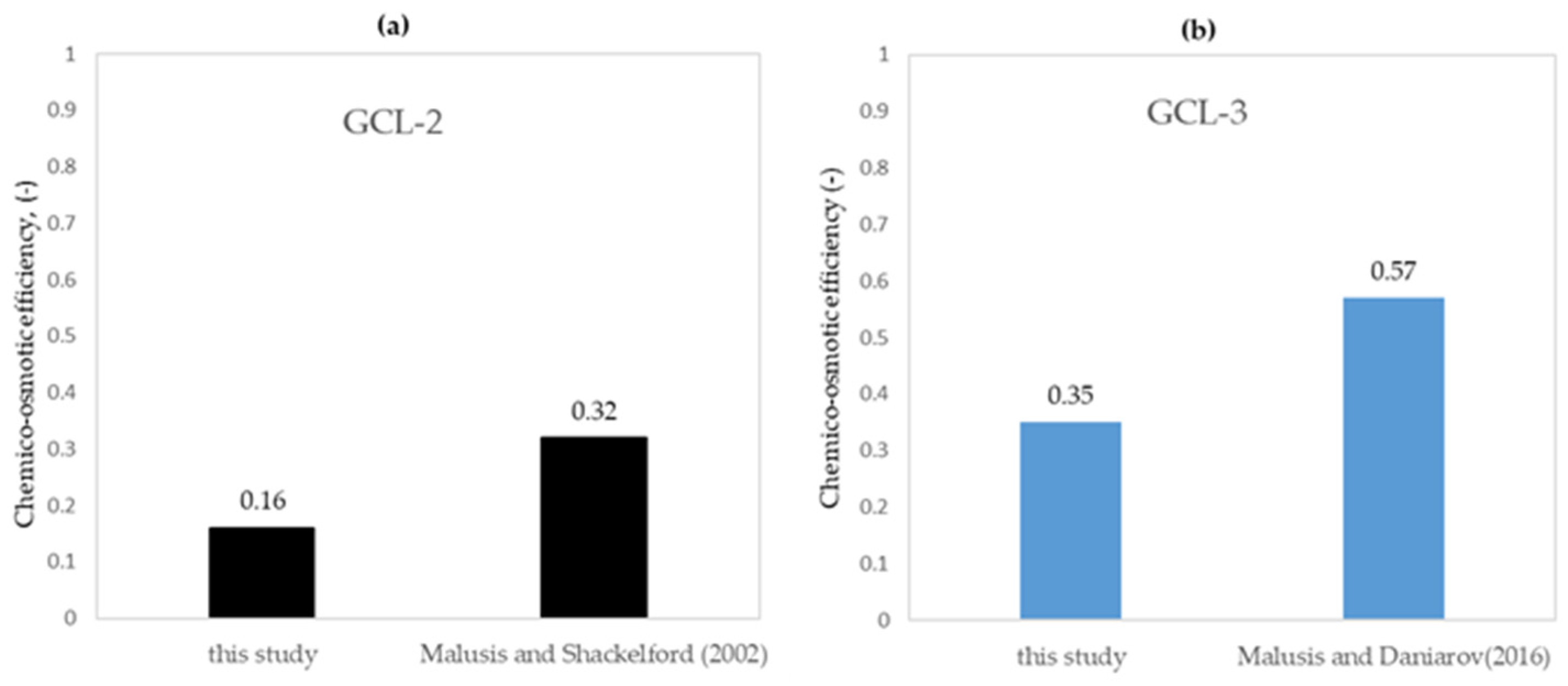
5.3. Comparison with Previous Studies
- inherent product variability among different manufacturing lots (e.g., bentonite quality and content, polymers dosages for GCL-3) as noted in [35].
- differences in the testing procedure prior to chemo-osmotic diffusion stage, as in our case the specimens underwent unloading and reconsolidation after the flushing stage, unlike the studies [31] and [33], in which the flushing stage and the subsequent chemico-osmotic diffusion stage were conducted without unloading. The difference in the specimen preparation and in total porosity could explain the difference observed for GCL-3, since it is recognized that osmotic efficiency decreases with the increase in total porosity [36]. However, the same explanation cannot be invoked in the case of GCL-2, as the total porosity estimated in this study was slightly lower than those reported in [31]. It is possible that the unloading and reconsolidation procedure induced some disturbance or altered the hydrated bentonite fabric with respect to a procedure whereby no unloading takes place, which eventually leads to a lower measured osmotic efficiency coefficient. Additional procedural differences, such as sample size, temperature, frequency of sampling, and characteristics of the apparatus (deformability of the testing cell and drainage lines) may also have contributed.
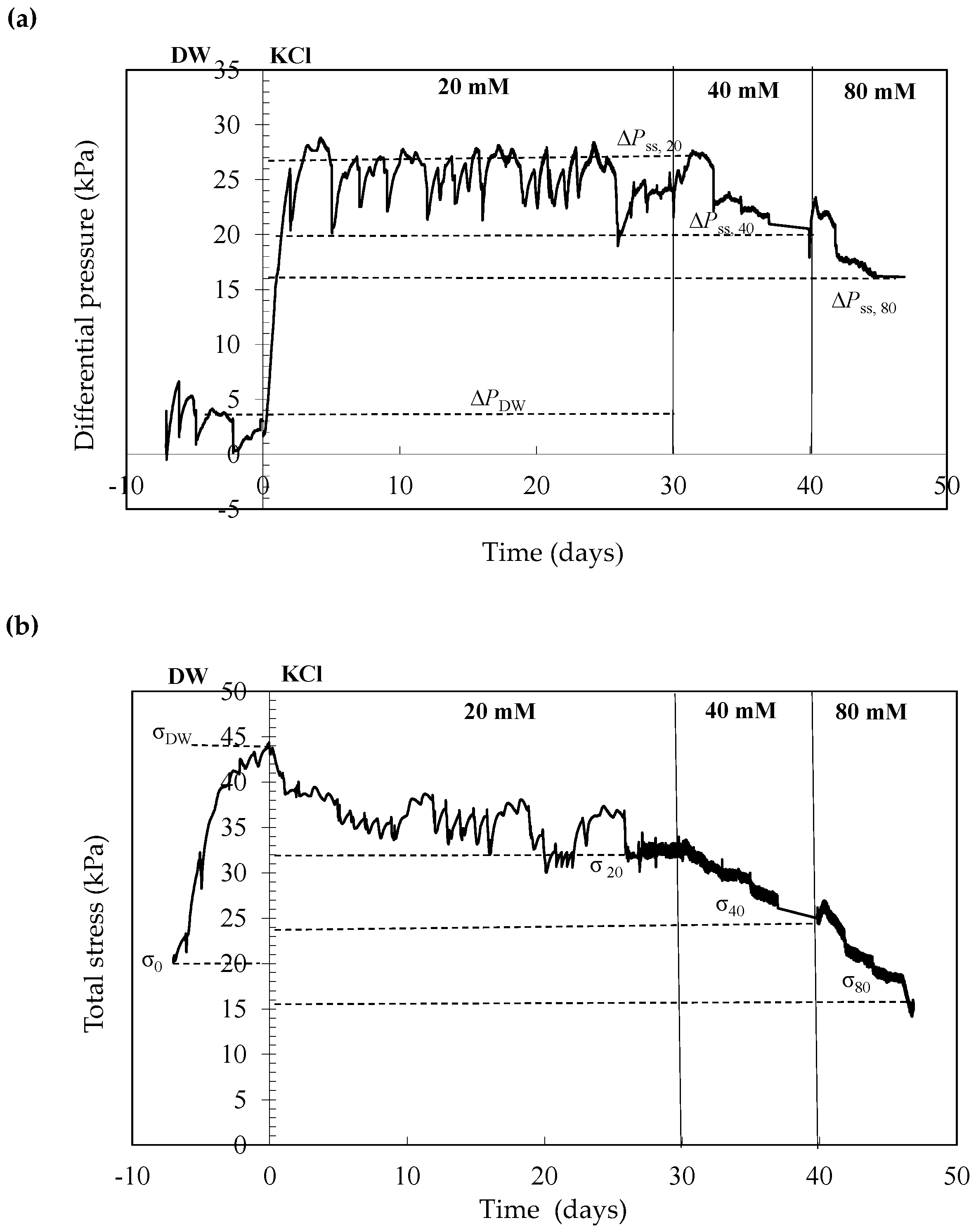
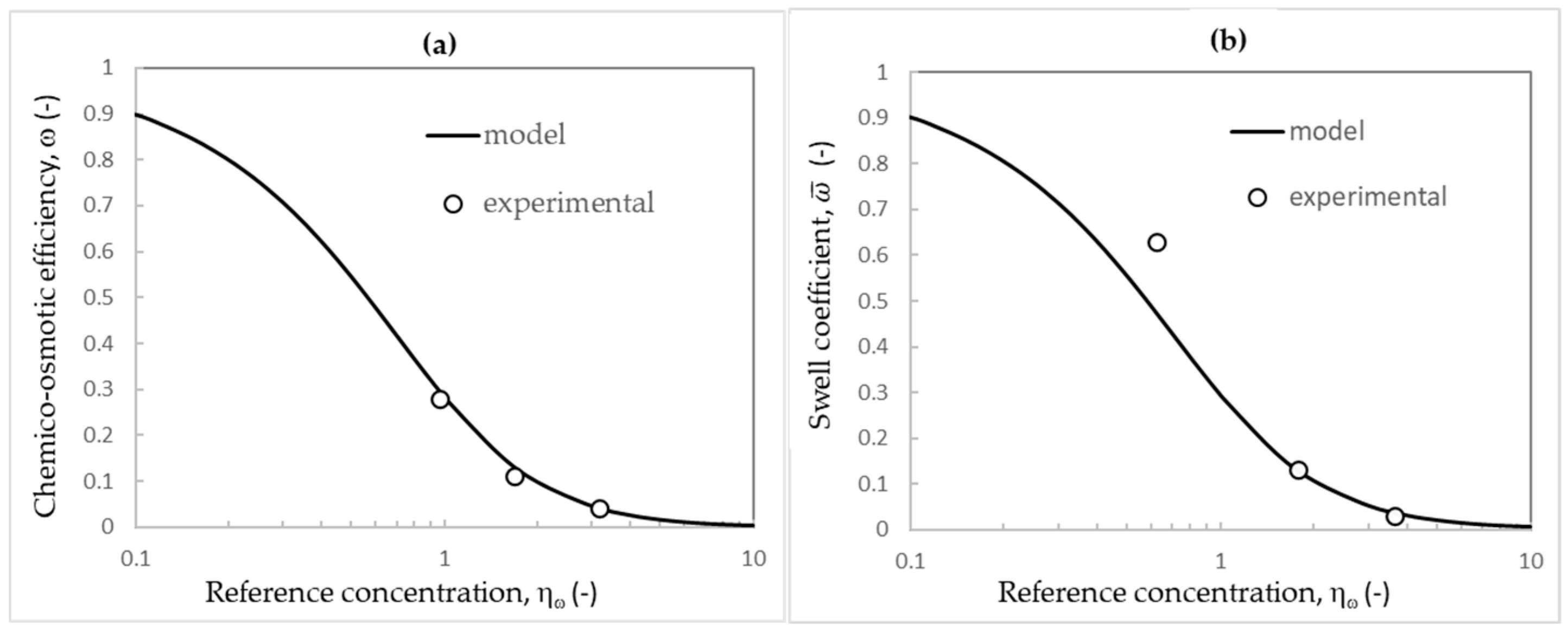
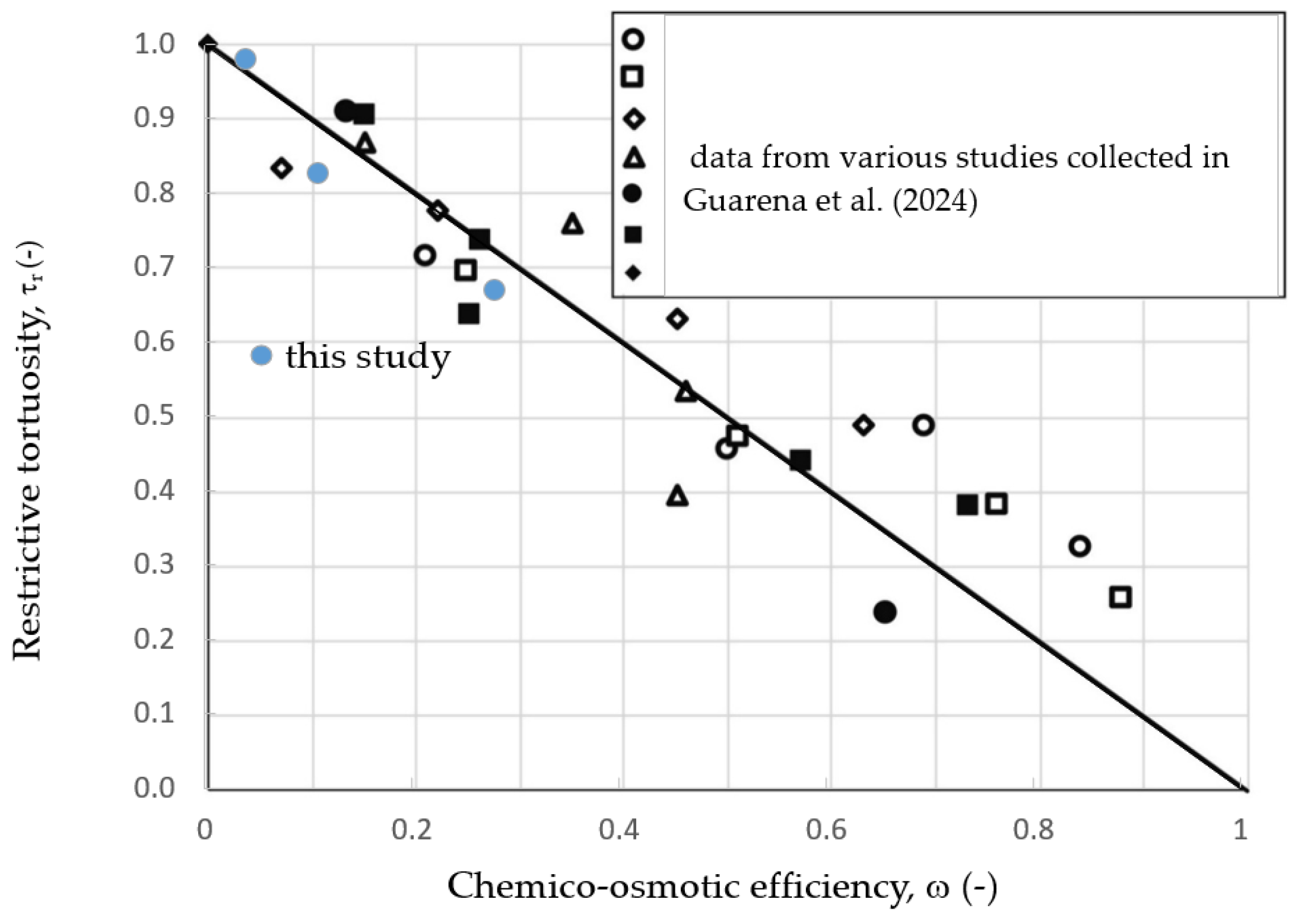
5.4. Multistage Tests and Theoretical Interpretation
6. Conclusions
Author Contributions
Funding
Data Availability Statement
Conflicts of Interest
References
- Bouazza, A. Geosynthetic Clay Liners. Geotex. Geomem. 2002, 20, 3–17. [Google Scholar] [CrossRef] [Scilit]
- Von Maubege, K.P. Investigation of bentonite requirements for geosynthetic clay barriers. In Clay Geosynthetic Barriers; Gartung, E., Zanzinger, H., Koerner, R.M., Eds.; CRC Press: Boca Raton, FL, USA, 2002; ISBN 9058093808. [Google Scholar] [CrossRef] [Scilit]
- Rowe, K.R.; Quigley, R.M.; Brachman, R.W.I.; Booker, J.R. Barrier Systems for Waste Disposal Facilities, 2nd ed.; Spon Press: London, UK, 2004; 587p. [Google Scholar]
- Kolstad, D.C.; Benson, C.H.; Edil, T.B.; Jo, H.Y. Hydraulic conductivity of a dense prehydrated GCL permeated with aggressive inorganic solutions. Geosynth. Int. 2004, 11, 233–241. [Google Scholar] [CrossRef] [Scilit]
- Katsumi, T.; Ishimori, H.; Onikata, M.; Fukagawa, R. Long-term barrier performance of modified bentonite materials against sodium and calcium permeant solutions. Geotex. Geomem. 2008, 26, 14–30. [Google Scholar] [CrossRef] [Scilit]
- Malusis, M.A.; Shackelford, C.D.; Olsen, H.W. A laboratory apparatus to measure the chemico-osmotic efficiency for clay soils. Geotech. Test. J. 2001, 24, 229–242. [Google Scholar] [CrossRef] [Scilit]
- Kang, J.-B.; Shackelford, C.D. Clay membrane testing using a flexible-wall cell under closed-system boundary conditions. Appl. Clay Sci. 2009, 44, 43–58. [Google Scholar] [CrossRef] [Scilit]
- Mazzieri, F.; Di Emidio, G.; Van Impe, P.O. Diffusion of calcium chloride in modified bentonite: Impact on osmotic efficiency and hydraulic conductivity. Clays Clay Min. 2010, 58, 351–363. [Google Scholar] [CrossRef] [Scilit]
- Mazzieri, F.; Van Impe, P.O.; Di Emidio, G. Chemico-osmotic behaviour of modified “Multiswellable” bentonite. In Proceedings of the 16th International Conference on Soil Mechanics and Geotechnical Engineering, Osaka, Japan, 11 September 2005. [Google Scholar] [CrossRef] [Scilit]
- Yeo, S.S.; Shackelford, C.D.; Evans, J.C. Membrane behavior of model soil–bentonite backfills. J. Geotech. Geoenviron. Eng. 2005, 131, 418–429. [Google Scholar] [CrossRef] [Scilit]
- Tang, Q.; Katsumi, T.; Inui, T.; Li, Z. Membrane behaviour of bentonite-amended compacted clay. Soils Found. 2014, 54, 329–344. [Google Scholar] [CrossRef] [Scilit]
- Fu, X.L.; Zhang, R.; Reddy, K.; Li, Y.C.; Yang, Y.L.; Du, Y.J. Membrane behavior and diffusion properties of sand/SHMP-amended bentonite vertical cutoff wall backfill exposed to lead contamination. Eng. Geol. 2021, 284, 106037. [Google Scholar] [CrossRef] [Scilit]
- Bonhoff, G.; Shackelford, C.D. Improving membrane performance via bentonite polymer nano-composite. Appl. Clay Sci. 2013, 86, 83–98. [Google Scholar] [CrossRef] [Scilit]
- Dominijanni, A.; Guarena, N.; Manassero, M. Laboratory assessment of semipermeable properties of a natural sodium bentonite. Can. Geotech. J. 2018, 55, 1611–1631. [Google Scholar] [CrossRef] [Scilit]
- Sample-Lord, K.M.; Shackelford, C. Membrane behavior for unsaturated bentonite barriers. In Proceedings of the Geo-Congress 2014, Atlanta, Georgia, 23–26 February 2014. [Google Scholar] [CrossRef] [Scilit]
- Rahman, S.A.B.; Sample-Lord, K.M.; Bohnhoff, G.L. Advancing the State-of-the-Art in Bentonite Barrier Research: Measuring Membrane Behavior and Diffusion at Elevated Temperatures. In Geo-Congress 2022; ASCE: Reston, VA, USA, 2022; pp. 100–110. [Google Scholar] [CrossRef] [Scilit]
- Di Emidio, G. Hydraulic and Chemico-Osmotic Performance of Polymer-Treated Clays. Ph.D. Dissertation, Ghent University, Ghent, Belgium, 2010; 249p. [Google Scholar]
- Dominijanni, A.; Guarena, N.; Manassero, M. Strain-controlled oedometer test for the measurement of the chemico-osmotic properties of bentonites. In Proceedings of the 17th ECSMGE 2019, Reykjavik, Iceland, 1–6 September 2019. [Google Scholar] [CrossRef] [Scilit]
- Mazzieri, F.; Bernardo, D. Chemico-osmotic coefficients of geosynthetic clay liners under different confinement conditions. In Proceedings of the Geo-Congress 2023: Soil Improvement, Geoenvironmental, and Sustainability, Los Angeles, CA, USA, 26–29 March 2023; Rathje, E., Montoya, B., Wayne, M., Eds.; ASCE: Reston, VA, USA, 2023. [Google Scholar]
- Bernardo, D.; Domizi, J.; Fratalocchi, E.; Mazzieri, F. Semi-permeable membrane behaviour of conventional and enhanced Geosynthetic Clay Liners. In Proceedings of the Eurogeo 2025 E3S Web of Conferences, Lille, France, 15–18 September 2025; Volume 644. [Google Scholar] [CrossRef] [Scilit]
- Kemper, W.D.; Rollins, J.B. Osmotic efficiency coefficients across compacted clays. Soil. Sci. Soc. Am. J. 1966, 30, 529–534. [Google Scholar] [CrossRef] [Scilit]
- Guarena, N. Relevance of Chemical and Electrical Phenomena to the Semipermeable Properties of Natural and Modified Bentonites. Ph.D. Dissertation, Politecnico di Torino, Torino, Italy, 2022. [Google Scholar]
- Manassero, M.; Dominijanni, A. Modelling the osmosis effect on solute migration through porous media. Géotechnique 2003, 53, 481–492. [Google Scholar] [CrossRef]
- Dominijanni, A.; Manassero, M. Modelling the swelling and osmotic properties of clay soils. Part II: The physical approach. Int. J. Eng. Sci. 2012, 51, 51–73. [Google Scholar] [CrossRef] [Scilit]
- ASTM D2216; Standard Test Methods for Laboratory Determination of Water (Moisture) Content of Soil and Rock by Mass. ASTM International: West Conshohocken, PA, USA, 2019; (last revision).
- ASTM D5993; Standard Test Method for Measuring Mass per Unit Area of Geosynthetic Clay Liners. ASTM International: West Conshohocken, PA, USA, 2022; (last revision).
- ASTM D5890; Standard Test Method for Swell Index of Clay Mineral Component of Geosynthetic Clay Liners. ASTM International: West Conshohocken, PA, USA, 2019; (last revision).
- ASTM D854; Standard Test Methods for Specific Gravity of Soil Solids by the Water Displacement Method. ASTM International: West Conshohocken, PA, USA, 2023; (last revision).
- EUBA. Methodology for the Determination of the Methylene Blue Value of Bentonite; European Bentonite Association: Brussels, Belgium, 2002. [Google Scholar]
- Rhoades, J.D. Salinity: Electrical Conductivity and Total Dissolved Solids. In Method of Soil Analysis Part 3; Sparks, D.L., Ed.; Soil Science Society of America: Madison, WI, USA, 1996; pp. 417–435. [Google Scholar]
- Malusis, M.; Shackelford, C.D. Chemico-osmotic efficiency of a geosynthetic clay liner. J. Geotech. Geoenv. Eng. 2002, 128, 97–106. [Google Scholar] [CrossRef] [Scilit]
- ASTM D5887; Standard Test Method for Measurement of Index Flux Through Saturated Geosynthetic Clay Liner Specimens Using a Flexible Wall Permeameter. West Conshohocken, PA, USA, 2022; (last revision).
- Malusis, M.A.; Daniyarov, A.S. Membrane efficiency and diffusive tortuosity of a dense prehydrated geosynthetic clay liner. Geotex. Geomem. 2016, 44, 719–730. [Google Scholar] [CrossRef] [Scilit]
- Mazzieri, F.; Bernardo, D. Permeability and solute sorption of unamended and polymer-enhanced geosynthetic clay liners. Env. Geotech. 2024, 11, 77–89. [Google Scholar] [CrossRef] [Scilit]
- Polat, F.; Rahman, S.; Sample-Lord, K.; Yesiller, N.; Hanson, J.L.; Malusis, M.A. Variability in Membrane Behavior of Geosynthetic Clay Liners. In Proceedings of the GeoCongress 2024, Vancouver, BC, Canada, 25–28 February 2024. [Google Scholar] [CrossRef] [Scilit]
- Shackelford, C.D. Membrane behaviour in engineered bentonite-based containment barriers: State of the art. In Proceedings of the International Symposium on Coupled Phenomena in Environmental Geotechnics, Torino, Italy, 1–3 July 2013; CRC Press/Balkema, Taylor & Francis Group: London, UK; pp. 45–60. [Google Scholar] [CrossRef] [Scilit]
- Petrov, R.J.; Rowe, R.K.; Quigley, R.M. Selected Factors Influencing GCL Hydraulic Conductivity. J. Geotech. Geoenviron. Eng. 1997, 123, 683–695. [Google Scholar] [CrossRef] [Scilit]
- Bernardo, D. Migrazione di Soluti e Fenomeni Chimico-Osmotici Nelle Barriere Bentonitiche Per il Contenimento di Inquinanti. Ph.D. Thesis, Università Politecnica delle Marche, Ancona, Italy, 2024. [Google Scholar]
- Guarena, N.; Dominijanni, A.; Manassero, M. Pores scale mechanisms underlying the behaviour of enhanced bentonites exposed to aggressive inorganic solutions. Appl. Clay Sci. 2024, 251, 107318. [Google Scholar] [CrossRef] [Scilit]
- Malusis, M.A.; Kang, J.B.; Shackelford, C.D. Restricted salt diffusion in a geosynthetic clay liner. Environ. Geotech. 2015, 2, 68–77. [Google Scholar] [CrossRef] [Scilit]
- Dominijanni, A.; Manassero, M.; Puma, S. Coupled chemical-hydraulic mechanical behaviour of bentonites. Géotechnique 2013, 63, 191–205. [Google Scholar] [CrossRef] [Scilit]
- Mazzieri, F.; Di Emidio, G. Hydraulic conductivity of a dense prehydrated geosynthetic clay liner. Geosynth. Int. 2015, 22, 138–148. [Google Scholar] [CrossRef] [Scilit]






| Property | GCL-1 | GCL-2 d | GCL-3 | Note |
|---|---|---|---|---|
| Nominal Unit Mass (g/m2) | 5500 | 8500% ± 10% | Product data | |
| Bentonite content (g/m2) | 5000 | 4200 | 5000% ± 10% | Product data |
| Avg. thickness (mm) | 7.0 | 7.0 | 4.3 | Product data |
| Water content, w (%) | 10 | 44.8 | [25] | |
| Bentonite mass per unit area (g/m2) | 4500 | 5430 | [26] | |
| Principal mineral | Mont. (89%) | Mont. (71%) | Mont. (97%) | XRD diffr. |
| Accessory minerals | Quartz, Feldspar, Calcite | Quartz (15%) | Quartz Calcite | XRD diffr. |
| Swell index (mL/2 g) | 36 | 32 | 16 | [27] |
| Spec. grav., Gs (-) | 2.65 | 2.69 | 2.56 | [28] |
| pH (-) c | 10.1 | 9.2 | 8.9 | |
| EC (mS/cm) c | 1.20 | 1.2 | 1.22 | |
| CEC (meq/100 g) | 94.5 ± 3.3 a | 47.7 | 67.3 a | |
| Extracted cations (meq/100 g) b: | ||||
| Na+ | 86.7 ± 10.6 | 31 | 76.8 ± 7.5 | |
| Ca2+ | 19.2 ± 0.5 | 20.8 | 11.0 ± 1.4 | - |
| Mg2+ | 8.8 ± 1.2 | 6.4 | 12.2 ± 0.9 | - |
| K+ | 3.2 ± 2.7 | 0.8 | 3.7 ± 1.6 | - |
| Soluble ions (mg/kg) | ||||
| Na+ | 5200 | not measured | 4986 | |
| SO42− | 5517 | - | 3623 | |
| Cl− | 957 | 975 | ||
| PO43− | - | 458 |
| Stage | Co | ω | τr | δσ | δπ | ||||
|---|---|---|---|---|---|---|---|---|---|
| [mM] | [kPa] | [kPa] | [-] | [10−10 m2/s] | [-] | [kPa] | [kPa] | [-] | |
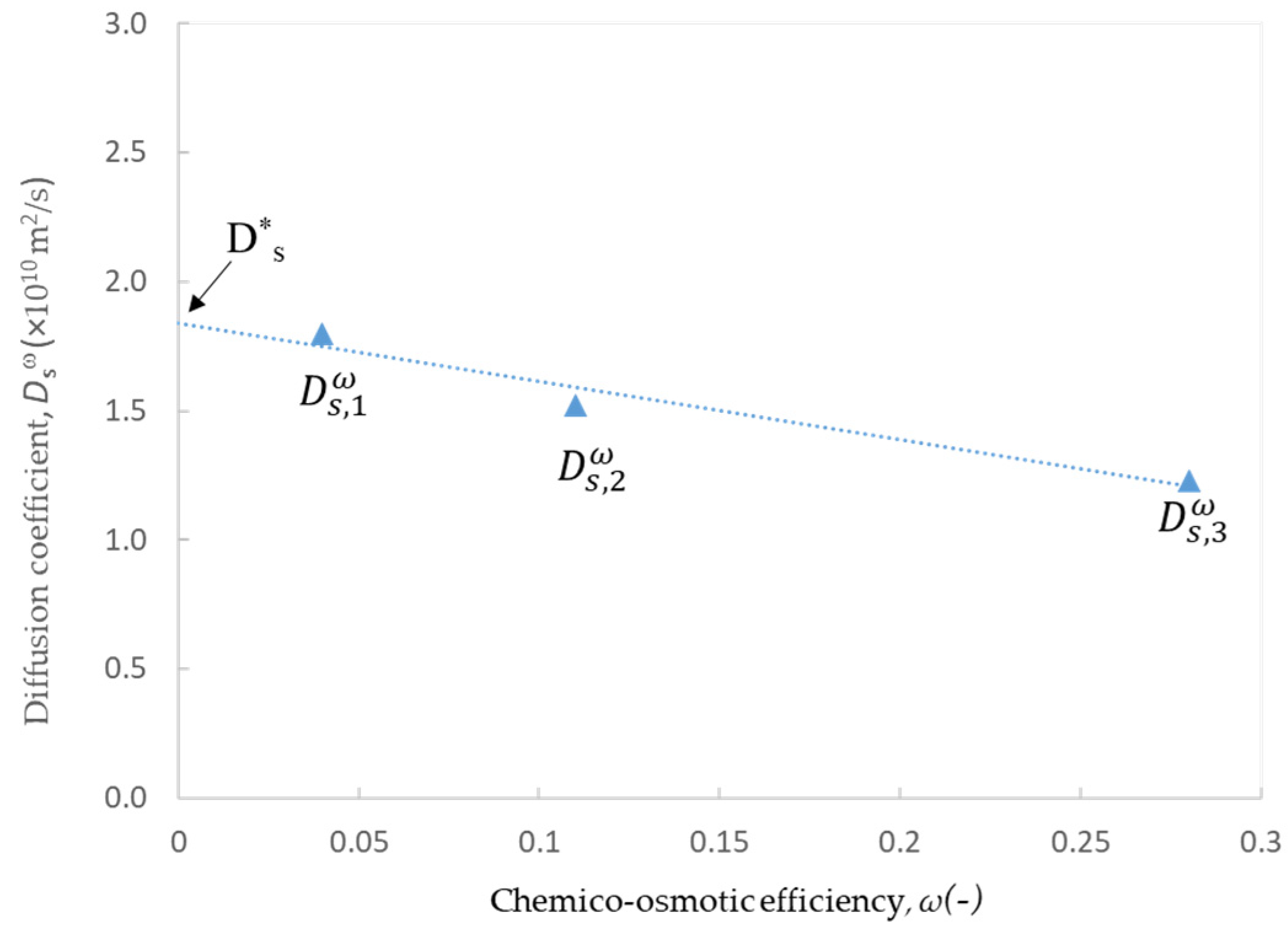
| 1 | 20 | 26.0 | 82.7 | 0.28 | 1.23 | 0.67 | −13.0 | 42.3 | 0.63 |
| 2 | 40 | 20.5 | 164.7 | 0.11 | 1.52 | 0.83 | −7.5 | 50.6 | 0.13 |
| 3 | 80 | 15.5 | 327.1 | 0.04 | 1.80 | 0.98 | −8.5 | 105.5 | 0.03 |
Disclaimer/Publisher’s Note: The statements, opinions and data contained in all publications are solely those of the individual author(s) and contributor(s) and not of MDPI and/or the editor(s). MDPI and/or the editor(s) disclaim responsibility for any injury to people or property resulting from any ideas, methods, instructions or products referred to in the content. |
© 2025 by the authors. Licensee MDPI, Basel, Switzerland. This article is an open access article distributed under the terms and conditions of the Creative Commons Attribution (CC BY) license.
Share and Cite
Bernardo, D.; Mazzieri, F.; Di Sante, M.; Fratalocchi, E. Investigating the Semi-Permeable Membrane Behavior of Geosynthetic Clay Liners by Means of a Novel Apparatus. Minerals 2026, 16, 11. https://doi.org/10.3390/min16010011
Bernardo D, Mazzieri F, Di Sante M, Fratalocchi E. Investigating the Semi-Permeable Membrane Behavior of Geosynthetic Clay Liners by Means of a Novel Apparatus. Minerals. 2026; 16(1):11. https://doi.org/10.3390/min16010011
Chicago/Turabian StyleBernardo, Davide, Francesco Mazzieri, Marta Di Sante, and Evelina Fratalocchi. 2026. "Investigating the Semi-Permeable Membrane Behavior of Geosynthetic Clay Liners by Means of a Novel Apparatus" Minerals 16, no. 1: 11. https://doi.org/10.3390/min16010011
APA StyleBernardo, D., Mazzieri, F., Di Sante, M., & Fratalocchi, E. (2026). Investigating the Semi-Permeable Membrane Behavior of Geosynthetic Clay Liners by Means of a Novel Apparatus. Minerals, 16(1), 11. https://doi.org/10.3390/min16010011