Article

Characteristics of Pore–Throat Structures and Impact on Sealing Capacity in the Roof of Chang 73 Shale Oil Reservoir, Ordos Basin

1
School of Earth Sciences and Engineering, Xi’an Shiyou University, Xi’an 710065, China
2
Shaanxi Key Laboratory of Petroleum Accumulation Geology, Xi’an Shiyou University, Xi’an 710065, China
3
PetroChina Research Institute of Petroleum Exploration and Development, Haidian District, Beijing 100083, China
*
Author to whom correspondence should be addressed.
Minerals 2026, 16(1), 12; https://doi.org/10.3390/min16010012
Submission received: 18 October 2025 / Revised: 17 November 2025 / Accepted: 10 December 2025 / Published: 23 December 2025

Abstract

In shale oil accumulation, the sealing capacity of roof strata is a key factor controlling hydrocarbon retention, primarily governed by pore–throat structures. This study examines the Chang 73 sub-member roof in the Ordos Basin using core and drilling samples, combined with SEM, mercury intrusion porosimetry, nitrogen adsorption, and breakthrough pressure tests. The roof rocks are dense and mainly composed of mudstone, silty mudstone, and argillaceous siltstone, which can be further classified into clay-rich and felsic-rich types. The pore system includes organic matter pores, dissolution pores, intergranular pores, clay interlayer pores, intercrystalline pores, and microfractures. Pores are dominated by mesopores (4–10 nm), with few macropores, and display slit-like, plate-, and wedge-shaped morphologies. Breakthrough pressure averages above 20 MPa, reflecting strong sealing capacity. Although dissolution of felsic minerals generates secondary porosity that may weaken sealing, the overall complex pore–throat system, reinforced by compaction and cementation of clay minerals, forms a dense fabric and favorable sealing conditions. These features restrict hydrocarbon migration and enhance the sealing performance of the Chang 73 shale oil roof.

1. Introduction

Shale oil, as a strategic substitute resource in China’s petroleum industry, possesses substantial exploration potential. As of 2019, the proven reserves of continental shale oil in China were estimated at approximately 283 × 108 t [1,2,3]. The Ordos Basin is particularly significant in this regard. Since 2010, PetroChina’s Changqing Oilfield has discovered and confirmed the Qingcheng shale oil field in the seventh member of the Yanchang Formation (Chang 7 Member), with reserves exceeding one billion metric tons [4].
According to the source-reservoir configuration, the Chang 7 Member can be classified into two types of shale oil: interbedded shale oil in submembers Chang 71-2, and laminated shale oil in submember Chang 73 [3,5,6]. The interbedded-type shale oil in submembers Chang 71-2 has already achieved large-scale production, and current efforts aim to further expand development. In 2021, PetroChina’s Changqing Oilfield made notable progress through pilot risk exploration and production testing of shale oil in submember Chang 73 [7,8,9,10,11].
At present, the laminated-type shale oil in submember Chang 73 remains in the exploratory stage, with limited development success. One of the primary reasons is the insufficient understanding of the microscopic enrichment patterns and mechanisms of shale oil [11,12,13]. Previous studies have extensively investigated various aspects of shale oil in submember Chang 73, including its source rock characteristics and reservoir properties [4,10,14,15]. However, enrichment is not solely controlled by source–reservoir conditions; the sealing capacity of the overlying strata also exerts a critical influence on shale oil accumulation [16,17,18,19,20,21].
The “overlying strata” refer to the beds directly overlying hydrocarbon-bearing shale. For the laminated-type shale oil in submember Chang 73, the overlying strata consist of the thick, laterally continuous mudstone developed at the base of submember Chang 72. The overlying strata exhibit three primary sealing mechanisms: physical sealing, overpressure sealing, and hydrocarbon concentration sealing. Among these, physical sealing is the most fundamental and critical, as the physical properties of the rock significantly influence the effectiveness and integrity of the seal [22,23,24,25,26]. Compared with reservoir sandstones, the pore throat radius of the overlying strata is smaller. During hydrocarbon migration through the pore–throat network, the displacement pressure difference between the overlying strata and the reservoir inevitably impedes fluid flow [27,28,29]. When the driving force of hydrocarbon migration is lower than this displacement pressure difference, hydrocarbons become trapped beneath the overlying strata. Therefore, the pore–throat structure plays a crucial role in controlling the sealing capacity of the overlying strata [30,31].
Currently, studies on the microscopic characteristics and sealing capacity of the overlying strata of laminated-type shale oil in submember Chang 73 remain limited. This study focuses on the pore–throat structure and sealing capacity of the overlying strata of Chang 73 shale oil, based on core observation, high-pressure mercury intrusion, breakthrough pressure testing, nitrogen adsorption, and petrophysical measurements. The results aim to provide theoretical support for elucidating the accumulation mechanisms of shale oil reservoirs in submember Chang 73 within the study area.

2. Basic Geological Characteristics

The Ordos Basin is the second largest petroliferous inland basin in China, extending across the provinces of Shaanxi, Gansu, Ningxia, Inner Mongolia, and Shanxi, and is therefore also referred to as the Shaanxi–Gansu–Ningxia Basin. It is bounded to the north by the Yinshan and Daqingshan mountains, to the south by the Longshan, Huanglongshan, and Qiaoshan mountains, to the west by the Helanshan and Liupanshan mountains, and to the east by the Lüliangshan and Taihangshan mountains, covering a total area of approximately 370,000 km2. The Ordos Basin is a typical cratonic basin and can be subdivided into six first-order tectonic units: the Yimeng Uplift, the Yishan Slope, the Tianhuan Depression, the Weibei Uplift, the Western Shanxi Fold Belt, and the Western Margin Thrust Belt [32,33,34]. Basin development commenced in the Zhifang period of the Middle Triassic, with a large lacustrine basin forming during the Middle to Late Triassic Yanchang period. The basin ceased to exist by the end of the Cretaceous, after which it entered a phase of post-depositional modification [35].
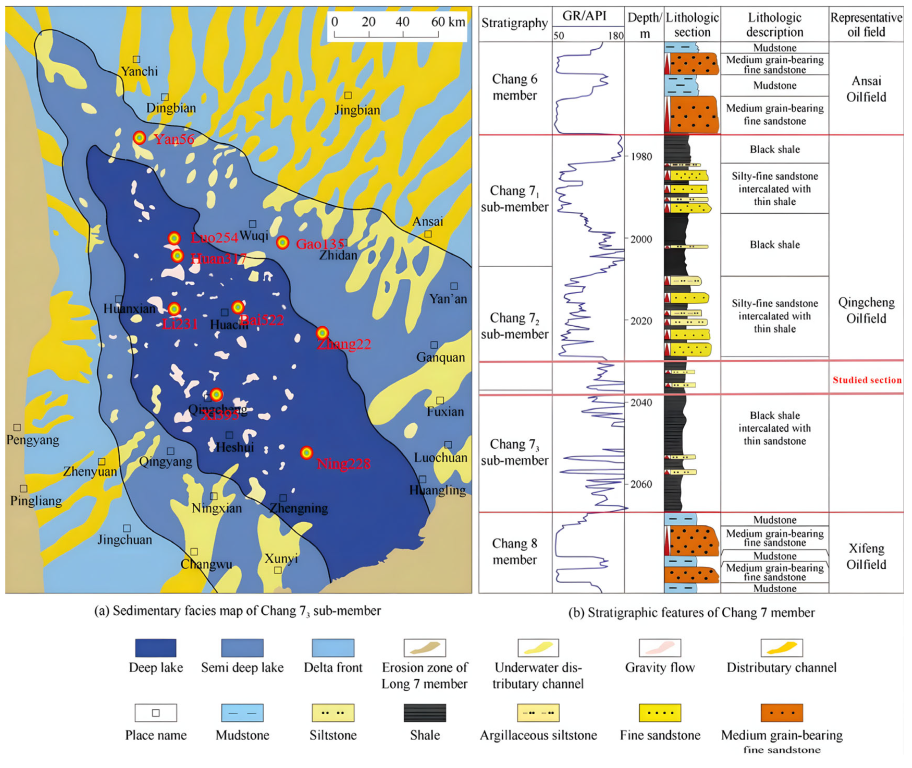
The Upper Triassic Yanchang Formation is subdivided from bottom to top into ten oil-bearing members (Chang 10 to Chang 1). During the deposition of the Chang 7 Member, the Ordos lacustrine basin experienced its maximum transgression, with the largest extent of deep to semi-deep lacustrine facies, resulting in the development of a sedimentary system composed of fine sandstone, siltstone, and mudstone (Figure 1). Submembers Chang 71-2 are mainly characterized by turbidite- and delta front-derived fine sandstones, siltstones, and deep to semi-deep lacustrine mud shales. In contrast, submember Chang 73 is dominated by thick intervals of deep to semi-deep lacustrine black mud shales interbedded with thin turbidite-derived fine siltstone layers. The “Zhangjiatan Shale” at the base of submember Chang 73 serves as a prominent marker bed within the Chang 7 succession [36,37,38].
Although the Chang 73 shale was deposited in a deep to semi-deep lacustrine environment and generally exhibits finer grain size, higher compaction, and greater density than the overlying strata, its sealing capacity may vary due to heterogeneities in mineral composition, porosity, and the development of microfractures. Hydrocarbons within the Chang 73 Member are typically accumulated in thin interbeds of siltstone, very fine sandstone, and sandy laminated mudstone influenced by turbiditic activity or distributed along the marginal zones of the lacustrine basin [39]. Hydrocarbon preservation in this interval is generally governed by a multilayered sealing system, in which the overlying sandy mudstones act as secondary cap rocks that effectively inhibit hydrocarbon leakage. Therefore, research on the pore–throat structure of overlying strata and its influence on sealing capacity remains of significant importance.

3. Samples and Methods

A total of fifteen caprock samples were collected from nine shale-oil wells distributed across the central and northern Ordos Basin. All samples were taken from the basal horizon of the Chang 72 submember (Figure 1). Comprehensive laboratory analyses—including petrographic thin-section observation, scanning electron microscopy (SEM), X-ray diffraction (XRD), N2 adsorption, high-pressure mercury intrusion (HPMI), and breakthrough pressure tests—were performed on each sample.
Sampling information for each well is summarized as follows: two samples were collected from Well Luo 254 at depths of 2532 m and 2540 m; two from Well Yan 56 at 3019 m and 3027 m; two from Well Gao 135 at 1795 m and 1800 m; two from Well Xi 395 at 1990 m and 1992 m; two from Well Bai 522 at 1924 m and 1930 m; and two from Well Ning 228 at 1737 m. Additionally, one sample was obtained from Well Huan 317 at 2462 m, one from Well Li 231 at 2072 m, and one from Well Zhang 22 at 1619 m.
This sampling strategy, which spans multiple wells and encompasses a broad depth range while maintaining stratigraphic equivalence, provides a representative foundation for investigating the pore–throat architecture of the Chang 73 caprock.

3.1. XRD

The X-ray diffraction (XRD) analyses were conducted on 12 caprock samples from seven shale oil wells at the Geological Test and Analysis Center of Xi’an Shiyou University using an Ultima IV diffractometer (Rigaku Corporation, Tokyo, Japan). The measurements followed the Chinese industry standard SY/T 5163–2018: Analytical Method for Clay Minerals and Common Non-Clay Minerals in Sedimentary Rocks [40]. For clarity to international readers, this standard mandates glycol saturation and heating treatments for clay minerals to enable accurate identification of species such as smectite and illite/smectite mixed-layer minerals. Bulk rock powders were scanned over a 3–65° (2θ) range, and quantitative mineral compositions were determined using the reference intensity ratio (RIR) method.

3.2. SEM

The scanning electron microscopy (SEM) analyses were conducted at the Geological Test and Analysis Center of Xi’an Shiyou University using a TESCAN MAIA3 field-emission SEM (TESCAN, Brno, Czech Republic), in accordance with the Chinese national standard GB/T 16594-2008: General Rules for Measurement Methods of Scanning Electron Microscopy at the Micrometer Scale, to investigate pore types, pore structures, and diagenetic features [41]. Rock sample preparation followed the procedures described below: selection and cleaning of samples, section mounting, dust-free drying, and vacuum coating. During section mounting, the exposed surfaces were required to be fresh, flat, and perpendicular to the bedding planes. Coating was applied as needed to ensure sample conductivity.

3.3. HPMI and N2 Adsorption

A total of 15 overlying caprock samples from nine shale oil wells were analyzed by high-pressure mercury intrusion porosimetry (HPMI). Each sample was prepared into a cylindrical plug with a diameter of 25 mm and a length of 20 mm.
The HPMI experiments were conducted using an AutoPore IV-9500 (Alconox Company, White Plains, NY, USA) fully automated mercury porosimeter, following the Chinese national standard GB/T 29171–2012 [42]. Samples were dried at 105 °C to a constant weight prior to testing. Both pressurization (mercury intrusion) and depressurization (mercury extrusion) processes were carried out, with a maximum pressure of 200 MPa. Corrections for the compressibility of the syringe and the rock samples were applied, and the compressibility of mercury at high pressures was also accounted for, following the AutoPore IV-9500 manual. Based on the measured intrusion and extrusion curves, total porosity was calculated as the ratio of the cumulative mercury-intruded volume to the bulk sample volume, while permeability was estimated using the Purcell model, which relates pore–throat size distribution and connectivity to fluid flow capacity. It should be noted that, unless otherwise specified, the term “pore size” in this study refers to the pore–throat diameter measured by HPMI. Pore sizes obtained from nitrogen adsorption are explicitly indicated when discussed. When interpreting pore–throat size distributions, the “ink-bottle” effect was considered by comparing intrusion and extrusion curves, to correct for possible overestimation of small pore contributions.
In addition, 11 overlying caprock samples from eight shale oil wells were analyzed by nitrogen adsorption (N2 adsorption). For these experiments, each sample was ground into fine powder to ensure sufficient surface exposure and adsorption equilibrium. The N2 Adsorption were conducted using an ASAP 2460 automatic gas adsorption analyzer (Micromeritics Instrument Corporation, Norcross, GA, USA), following the Chinese national standard GB/T 19587-2017, and GB/T 21650.2-2008 [43,44].
The mercury intrusion method is based on the capillary bundle model, which assumes that the porous medium consists of numerous capillary tubes with different diameters. Mercury, being non-wetting to most rock surfaces, acts as the non-wetting phase, while the air or mercury vapor within the pore system represents the wetting phase. During the intrusion process, mercury is injected into the pore system to displace the wetting phase. When the applied pressure exceeds the capillary pressure corresponding to a specific pore throat, mercury begins to penetrate the pore space. At this point, the applied pressure (P) is equivalent to the capillary pressure, and the corresponding capillary radius (r) represents the pore–throat radius. The relationship between the capillary pressure and the pore–throat radius is described by the equation:
P = 2 σ cos θ r
where
  • r—pore–throat radius (μm),
  • σ—surface tension of mercury (0.485 N/m),
  • θ—contact angle between mercury and the rock surface (140°),
  • P—applied pressure (MPa).

3.4. Gas Breakthrough Pressure

In this study, gas breakthrough pressure measurements were conducted using the YRD-Q gas permeation experimental system (Xi’an Shiyou University, Xi’an, China), following the Chinese petroleum and natural gas industry standard SY/T 5748–2013 [45], “Determination of Gas Breakthrough Pressure of Rocks”. A total of 15 overlying caprock samples collected from nine shale oil wells were analyzed. Each sample was prepared as a cylindrical core with a diameter of 25 mm and a length of 50 mm. Prior to testing, all samples were vacuum-saturated with formation brine to ensure complete wetting of the pore space. The wetting phase was formation water (brine), while nitrogen gas (N2) was used as the non-wetting phase. The experiments were performed at room temperature (approximately 25 °C).
The tests were performed under a confining pressure to simulate in-situ stress conditions, using a triaxial loading configuration. Gas was injected in a stepwise pressurization mode. At each pressure step, the applied pressure was maintained for more than 60 min to ensure stability, while the downstream outlet was continuously monitored for gas breakthrough. Only when no gas flow was detected during the holding period was the inlet pressure increased to the next predetermined level. The pressure increment at each step was 1 MPa, allowing for controlled and gradual displacement of the wetting phase.
Gas breakthrough was identified when gas first appeared at the outlet, indicating displacement of the brine within the pore system. The corresponding inlet pressure was recorded as the breakthrough pressure (Pb). In cases where gas entry was unstable or exhibited hysteresis, the measurements were repeated multiple times, and the average Pb value was used for analysis.

4. Results

4.1. Mineralogical Characteristics of the Overlying Strata

In this study, samples from nine representative wells targeting the Chang 73 shale oil in the Ordos Basin were selected. Based on core observations, a systematic analysis of the mineralogical characteristics of the overlying strata of Chang 73 was conducted through a combination of thin-section petrographic identification and X-ray diffraction (XRD) experiments.

4.1.1. Lithological Composition and Structural Characteristics

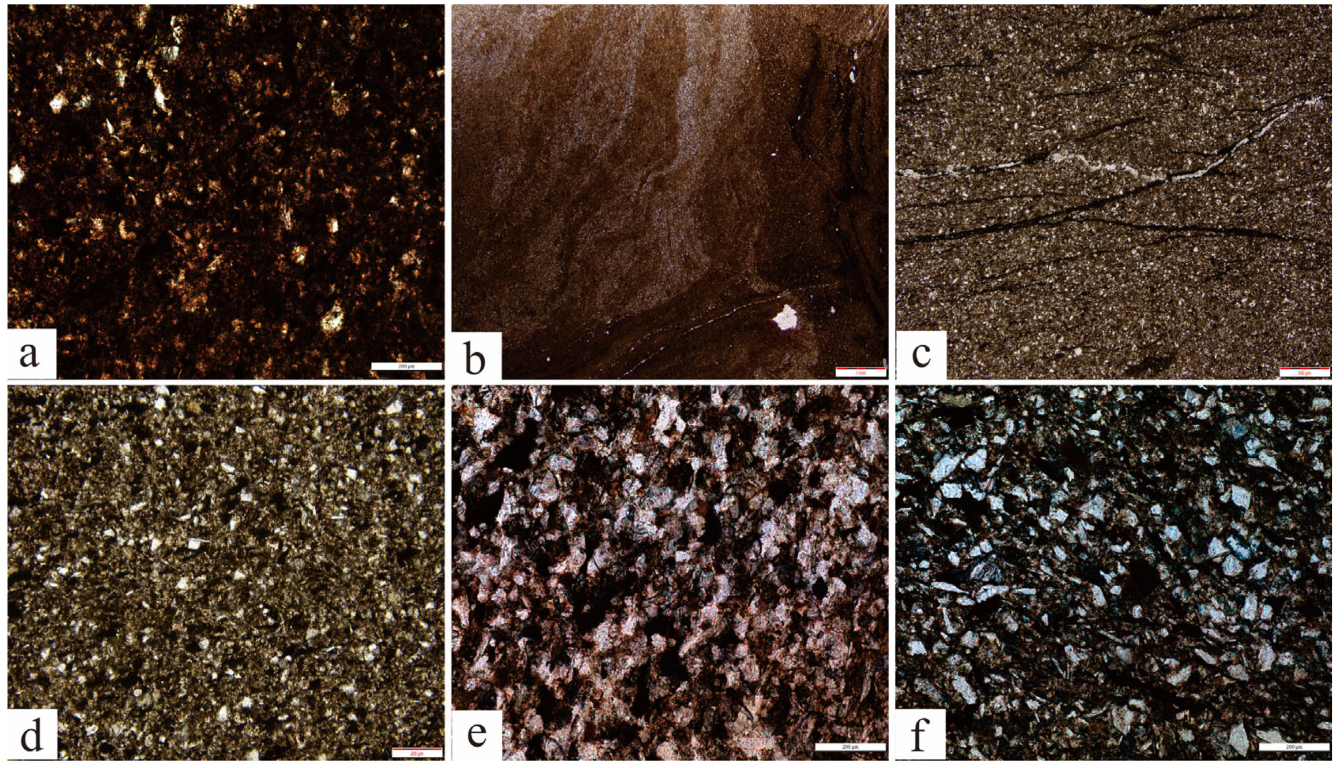
Based on core observations and thin-section petrographic analysis, the overlying strata of the Chang 73 submember can be classified into three main lithologies according to their relative clay and silt contents [46]: dark gray to grayish-black mudstone, dark gray silty mudstone, and argillaceous siltstone (Table 1). The clastic components are predominantly felsic, while the matrix mainly consists of clay minerals and black organic matter (Figure 2).
The mudstone exhibits a blocky macroscopic structure, with well-developed horizontal bedding and seasonal laminations. Clay minerals are interspersed with microcrystalline ferroan dolomite, and minor pyrite is observed. The silty mudstone and argillaceous siltstone are dark gray, displaying silty or argillaceous fabrics, with clastic grains mostly oriented in subangular arrangements and showing blocky bedding. The clay-rich matrix and minor organic matter are primarily disseminated, while small amounts of clay and organic matter also occur as scattered spots or irregular laminae.

4.1.2. Mineralogical Characteristics of the Rock

X-ray diffraction (XRD) analysis of the overlying strata from key wells targeting Chang 73 shale oil in the Ordos Basin indicates that the mineral composition of the rocks primarily comprises clay minerals, quartz, feldspars (such as plagioclase and K-feldspar), carbonates (including calcite, ferroan dolomite, dolomite, and siderite), pyrite, and minor amounts of other minerals.
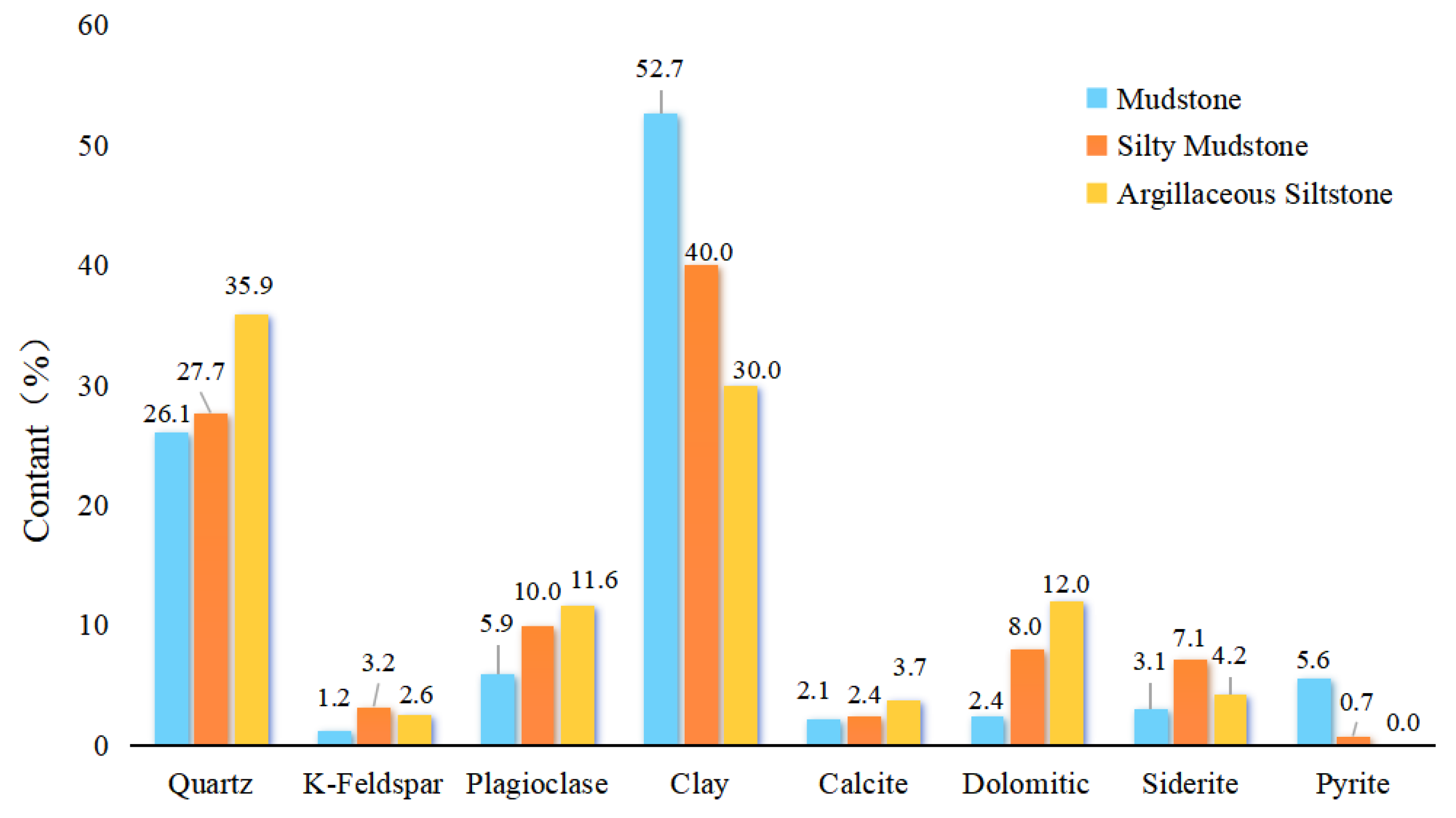
In the mudstone samples, quartz content ranges from 25.0% to 27.1%, with an average of 26.1%; plagioclase ranges from 5.0% to 6.9%, averaging 5.9%; and K-feldspar ranges from 0% to 2.3%, with an average of 1.2%. Clay minerals account for 49.3%–59%, averaging 52.7%. Among the carbonate minerals, calcite content ranges from 0% to 6.4%, with an average of 2.1%. Dolomite occurs as microcrystalline fillings between grains and is intermingled with clay, with content ranging from 0% to 4.5%, averaging 2.4%. Siderite content ranges from 0% to 6.9%, with an average of 3.0%. Pyrite occurs as rounded grains or aggregates of rounded grains, ranging from 0.9% to 13.7%, with an average of 5.6% (Figure 3).
In the silty mudstone samples, quartz content ranges from 23.9% to 35%, with an average of 27.7%; plagioclase ranges from 4.6% to 16.4%, averaging 10.0%; and K-feldspar ranges from 0% to 7.5%, with an average of 3.2%. Clay minerals account for 28.4%–48.4%, averaging 40.0%. Among the carbonate minerals, calcite content ranges from 0% to 10.1%, with an average of 2.4%, and dolomite ranges from 1.7% to 17%, averaging 7.95%. Siderite content ranges from 1.1% to 11.7%, with an average of 7.1%. Pyrite content ranges from 0% to 2.9%, averaging 0.73% (Figure 3).
In the argillaceous siltstone samples, quartz content ranges from 27.1% to 37.9%, with an average of 35.9%; plagioclase ranges from 5.0% to 13.6%, averaging 11.6%; and K-feldspar ranges from 1.2% to 3.6%, with an average of 2.6%. Clay minerals account for 27.0%–49.8%, averaging 30.0%. Among the carbonate minerals, calcite content ranges from 2.3% to 6.4%, with an average of 3.7%, and dolomite ranges from 2.7% to 16%, averaging 12.0%. Siderite content ranges from 3.2% to 5.9%, with an average of 4.2%.
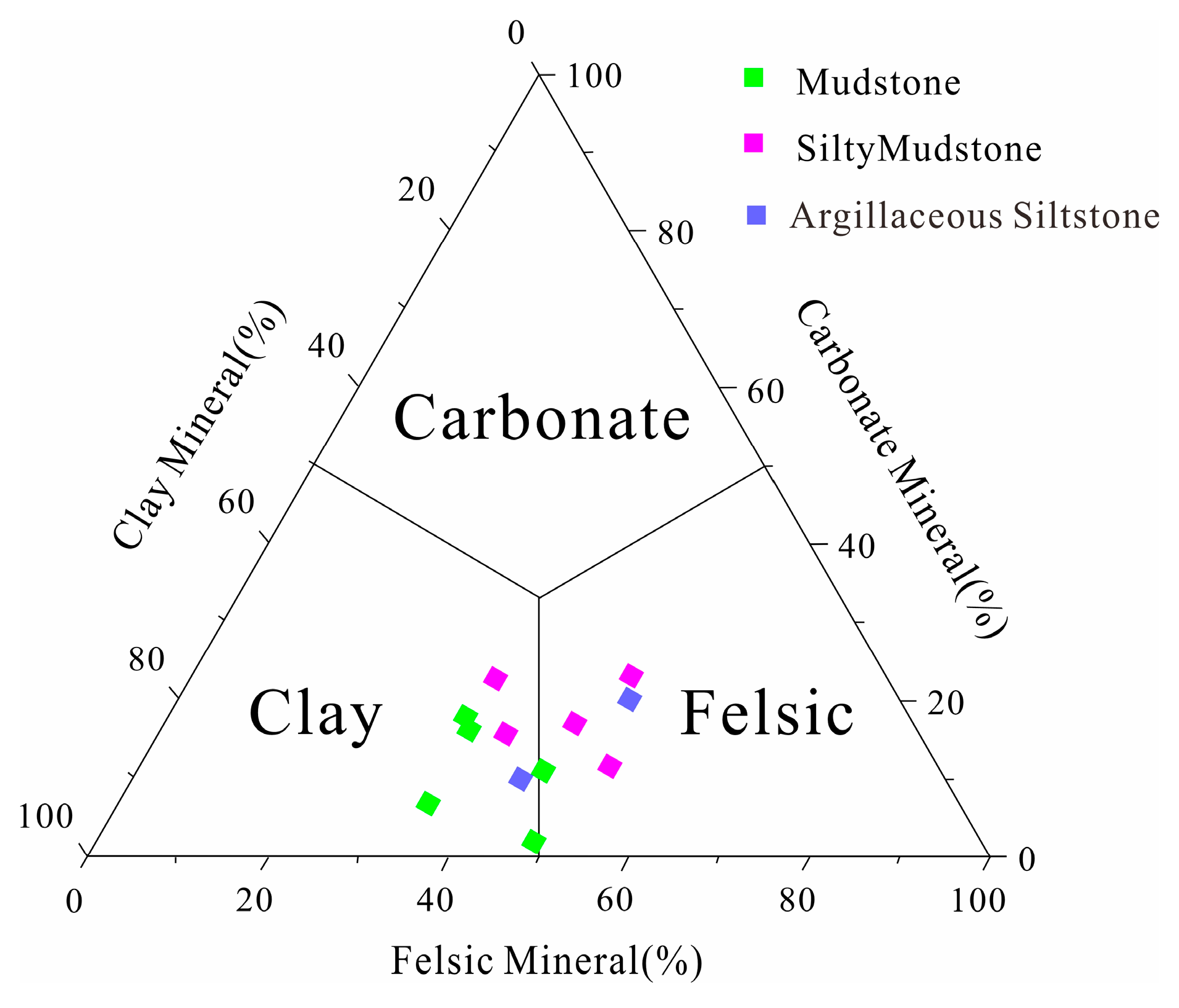
Based on the above analyses, the contents of felsic minerals, clay minerals, and carbonate minerals were plotted on a ternary diagram to illustrate the mineral composition of the overlying strata of Chang 73 shale oil. The results indicate that the overlying strata are primarily composed of clay-rich and felsic-rich rocks. Mudstones are classified as clay-rich rocks, whereas silty mudstones and argillaceous siltstones are distributed between clay-rich and felsic-rich compositions (Figure 3 and Figure 4).

4.2. Pore–Throat Structural Characteristics of the Overlying Strata

The pore size, throat morphology, and connectivity of the overlying strata, as microscopic features, play a critical role in controlling the sealing capacity of the overlying strata. In this study, the IUPAC classification standard was adopted [47]: micropores (<2 nm), mesopores (2–50 nm), and macropores (>50 nm). Based on polished sections and scanning electron microscopy (SEM) analyses, the overlying strata of Chang 73 shale oil are dominated by both organic and inorganic pores. The inorganic pores are classified into five types: dissolution pores, intergranular pores, intercrystalline pores within clay minerals, intercrystalline pores within pyrite, and microfractures.
High-pressure mercury intrusion (HPMI) is generally more suitable for identifying macropores and characterizing pore structures, whereas nitrogen adsorption experiments provide better resolution for mesopores and micropores [17,48]. In this study, a combination of HPMI and nitrogen adsorption experiments was employed to characterize the micro-pore structure of the overlying strata. The results indicate that the pore size distribution of the samples is dominated by nanometer-scale mesopores.

4.2.1. Laminated Mudstone

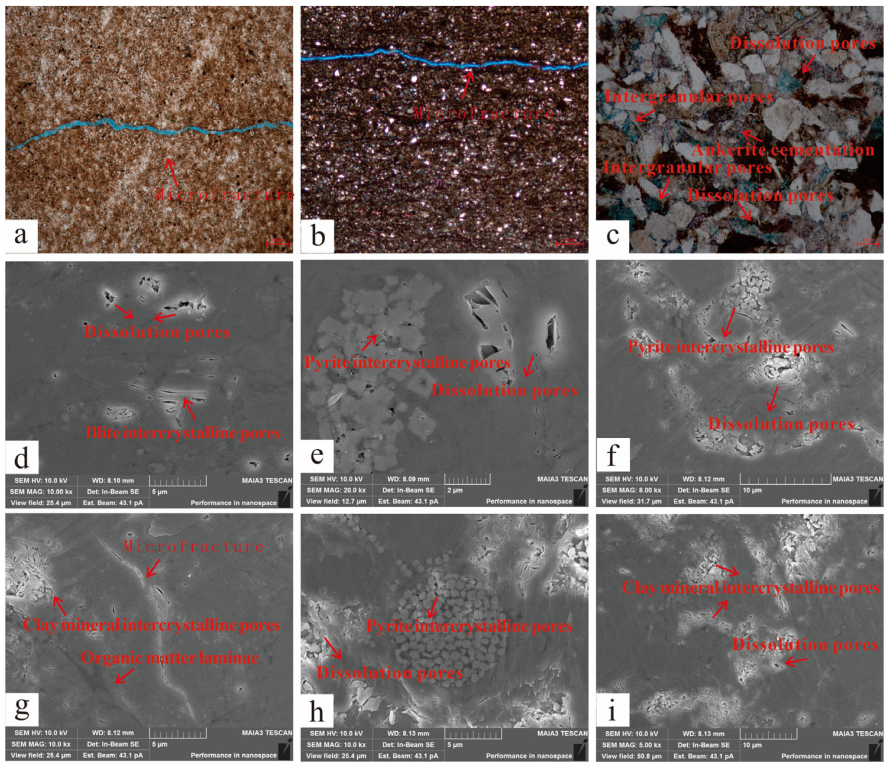
Thin-section petrographic observations indicate that the laminated mudstone is primarily composed of detrital grains such as quartz and feldspar, clay matrix, authigenic carbonate cement, and minor siliceous material. Macroscopically, the rock is generally dense with poorly developed porosity. Scanning electron microscopy (SEM) observations show that the pore space in the mudstone samples mainly consists of intercrystalline clay pores, organic pores, dissolution pores, pyrite intercrystalline pores, and minor microfractures. Dissolution pores are formed by the dissolution of feldspar during diagenesis, typically exhibiting bay-like, honeycomb, or irregular shapes, with pore sizes mainly between 5 and 100 nm, averaging 30 nm. Intercrystalline clay pores are formed by deformation of illite, commonly showing platy or curved platy morphologies with variable sizes. Pyrite intercrystalline pores are nanometer-scale pores within pyrite crystals, often spherical or “strawberry-like” small and poorly connected, with pore sizes ranging from 4 to 30 nm, averaging approximately 10 nm. Microfractures, formed due to differential compaction, are locally developed in the mudstone, with widths ranging from 50 to 200 nm (Figure 5a,d,e).
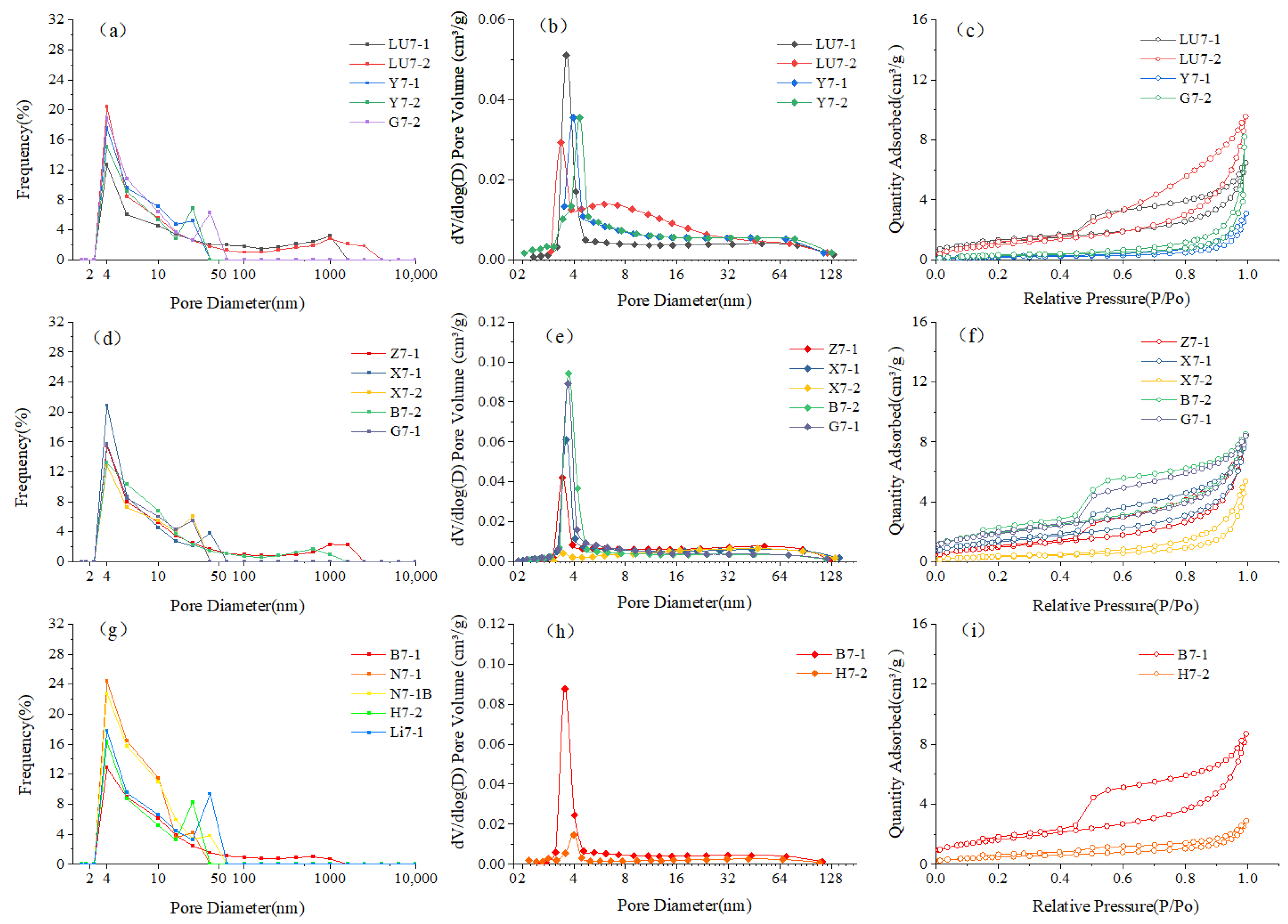
High-pressure mercury intrusion (HPMI) results indicate that the pore size distribution of the laminated mudstone exhibits a unimodal pattern, dominated by mesopores, which account for approximately 85.1% of the total, with a peak at 4 nm. A small proportion of macropores is also present in some samples, accounting for about 14.9% (Figure 6a). Nitrogen adsorption experiments show that the total BJH pore volume ranges from 0.0048 to 0.0190 cm3/g, with an average of 0.0123 cm3/g. Of this, micropores contribute approximately 2.6%, mesopores about 77.8%, and macropores around 19.6% (Figure 6b). The nitrogen adsorption–desorption isotherms exhibit distinct hysteresis loops of types H3 and H4, indicating that the pore size distribution is relatively narrow, corresponding to plate-like and wedge-shaped slit pores with poor connectivity (Figure 6c).

4.2.2. Laminated Silty Mudstone

Petrographic observations of laminated silty mudstone indicate that its features under polished sections are similar to those of mudstone, with a generally dense structure and poorly developed macroporosity. Scanning electron microscopy (SEM) reveals that the pore space is dominated by intercrystalline clay pores, dissolution pores, intercrystalline pores, and organic pores, with minor development of microfractures (Figure 5b,f,g). Dissolution pores, formed by feldspar dissolution during diagenesis, exhibit bay-like, honeycomb, or irregular shapes, with pore sizes ranging from 10 to 100 nm and an average of 30 nm. Intercrystalline clay pores, generated by deformation of illite, display platy, curved platy, or flake-like, with variable sizes ranging from 4 to 30 nm and an average of 12 nm. Pyrite intercrystalline pores are nanometer-scale pores within pyrite, commonly spherical or “strawberry-like” with pore sizes from 4 to 20 nm and an average of approximately 12 nm. Microfractures, formed by differential compaction, are locally developed in the silty mudstone, with widths of 50–200 nm (Figure 5a,d,e). Organic pores, influenced by abundance and type of organic matter, are generated by volume contraction during hydrocarbon generation, exhibiting laminar or disseminated morphologies, with pore sizes ranging from 4 to 100 nm and an average of 50 nm.
High-pressure mercury intrusion (HPMI) results indicate that the pore size distribution of the laminated silty mudstone is dominated by mesopores, with a peak at 4 nm accounting for approximately 86.8% of the total. A small proportion of macropores is also present, accounting for about 13.2% (Figure 6d). Nitrogen adsorption experiments show that the total BJH pore volume ranges from 0.0083 to 0.0136 cm3/g, with an average of 0.0123 cm3/g. Of this, micropores contribute approximately 4.6%, mesopores about 87.4%, and macropores around 8%, with mesopores contributing the most to the total pore volume (Figure 6e). The nitrogen adsorption–desorption isotherms exhibit distinct hysteresis loops, predominantly of type H3 with minor H4, indicating the development of numerous parallel plate-like and wedge-shaped slit pores with poor connectivity (Figure 6f).

4.2.3. Argillaceous Siltstone

Petrographic observations of argillaceous siltstone indicate that it is primarily composed of silt-sized detrital grains such as quartz and feldspar, clay matrix, authigenic carbonate cement, and minor siliceous material. Macroscopically, the rock is generally dense with poorly developed porosity, showing only minor intergranular and dissolution pores. SEM observations reveal dissolution pores, intercrystalline clay pores, and pyrite intercrystalline pores (Figure 5c,h,i). Intergranular pores develop between terrigenous detrital grains under depositional and diagenetic processes, typically triangular, polygonal, or irregular in shape, with pore sizes ranging from 100 to 500 nm and averaging 240 nm. Dissolution pores, formed by feldspar dissolution during diagenesis, exhibit bay-like, honeycomb, or irregular morphologies, with pore sizes ranging from 15 to 110 nm and averaging 50 nm. Intercrystalline clay pores, formed by deformation of illite, commonly display platy, curved platy, or flake-like, with variable sizes ranging from 4 to 35 nm and averaging 15 nm. Pyrite intercrystalline pores are nanometer-scale, spherical or “strawberry-like” small and poorly connected, with pore sizes ranging from 4 to 25 nm (Figure 5c,h,i).
High-pressure mercury intrusion (HPMI) results indicate that the pore size distribution of argillaceous siltstone samples exhibits considerable variability. Compared with mudstone and silty mudstone, the pores develop over a wider range of scales. The pore space is dominated by mesopores, accounting for approximately 85%, with a peak around 4–10 nm; some samples show high-frequency pores at 30–40 nm. A minor proportion of macropores is also present, accounting for about 15% (Figure 6g). Nitrogen adsorption experiments show that the total BJH pore volume ranges from 0.0046 to 0.0137 cm3/g, with an average of 0.0092 cm3/g. Of this, micropores contribute approximately 4.5%, mesopores about 83.1%, and macropores around 12.4% (Figure 6h). The nitrogen adsorption–desorption isotherms exhibit distinct hysteresis loops of types H3 and H4, indicating the development of plate-like and wedge-shaped slit pores (Figure 6i).

4.3. Integration of HPMI and N2 Adsorption for Full-Range Pore-Size Distribution

To obtain a full pore-size distribution (PSD) spanning micropores to macropores, the results of high-pressure mercury intrusion (HPMI) and nitrogen adsorption (N2 adsorption) were integrated. Given the distinct pore-size sensitivities of the two techniques, a domain-partitioning strategy was adopted for PSD construction. The N2 adsorption data were used exclusively to characterize micropores and mesopores <50 nm, whereas HPMI data were solely employed to describe macropores and pore throats >50 nm. Prior to integration, all pore-volume increments from both techniques were normalized to a per–unit mass basis and expressed as dV/d(logD) (cm3/g), ensuring quantitative comparability between the two datasets.
Although the two techniques theoretically overlap in the range of approximately 40–80 nm, pore-size estimates within this interval often involve substantial uncertainty due to the intrinsic limitations of both experimental methods near the edges of their respective measurement ranges. Therefore, a fixed cutoff of 50 nm was applied as the merging boundary, ensuring that each technique was used only within its most reliable pore-size domain. The resulting combined PSDs were further validated against independently measured total porosity to verify the consistency and reliability of the integrated pore-volume distribution.
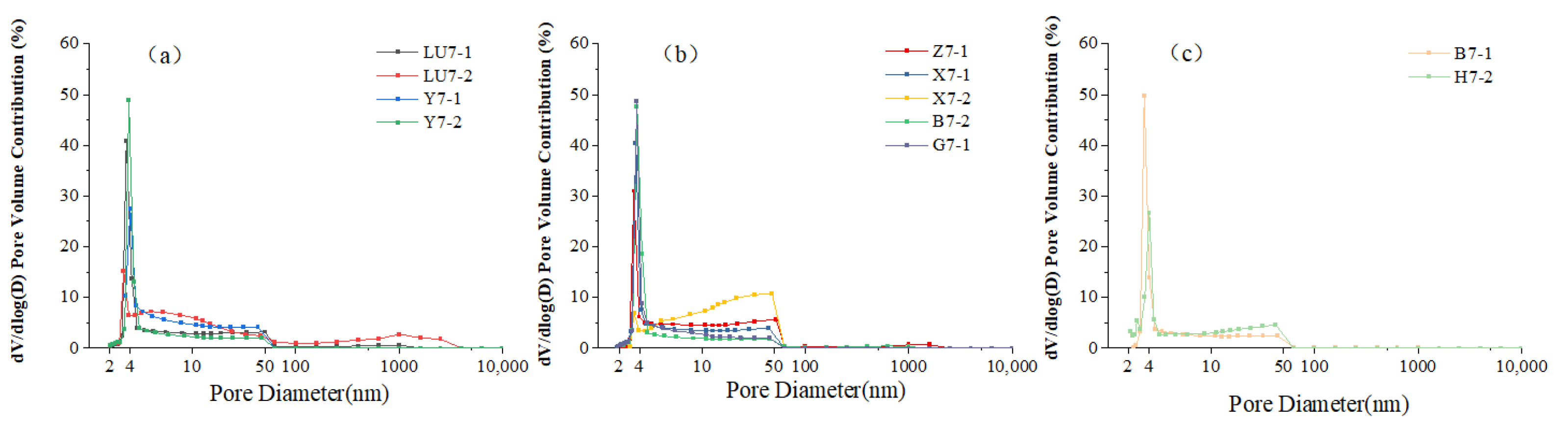
The combined pore-size distributions obtained from N2 adsorption and high-pressure mercury intrusion (HPMI) experiments indicate that the caprock of the Chang 73 shale-oil is predominantly mesoporous, with only a minor development of macropores. Specifically, mudstone exhibits a unimodal pore-size distribution, with the majority of pores concentrated around 4–10 nm and only a few macropores present (Figure 7a). Silty mudstone also shows a generally unimodal distribution; some samples display pore-size peaks around 4–10 nm, while others exhibit peaks near 40–50 nm, and a limited number of macropores are developed (Figure 7b). In argillaceous siltstone, the pore-size distribution is similarly unimodal with a primary peak at approximately 4 nm, although significant porosity is also observed around 40–50 nm (Figure 7c).
These results suggest that while all three lithologies are dominated by mesopores, variations in the secondary peak positions and the development of macropores reflect lithology-dependent differences in pore–throat structure, which may have important implications for the sealing capacity of the caprock.

4.4. Breakthrough Pressure

Breakthrough pressure is defined as the minimum pressure required to displace a wetting-phase fluid by a non-wetting-phase fluid within the connected pore network of a rock, serving as a fundamental and direct indicator of a cap rock’s sealing capacity [49,50,51,52]. A cap rock can effectively prevent hydrocarbon migration when its breakthrough pressure exceeds the combined vertical forces exerted by the residual reservoir pressure and the buoyancy of the hydrocarbon column [53,54,55]. This parameter thus provides a quantitative measure of the effectiveness of the cap rock in maintaining hydrocarbon accumulation [56].
The breakthrough pressures of laminated mudstone ranged from 12.04 to 45 MPa, with an average of 32.0 MPa; those of laminated silty mudstone ranged from 15.08 to 45 MPa, averaging 28.3 MPa; and those of argillaceous siltstone ranged from 3.05 to 45 MPa, with an average of 22.6 MPa (Table 2). Some samples exhibited breakthrough pressures exceeding 45 MPa; this is attributed to the maximum measurable limit of the testing device, which is 45 MPa. Overall, breakthrough pressures vary among different lithologies of the Chang 73 overlying strata. Laminated mudstone and laminated silty mudstone exhibit relatively stronger sealing capacity, whereas argillaceous siltstone is comparatively weaker. The average breakthrough pressure of most samples exceeds 20 MPa, though a few samples show values below 5 MPa.
It should also be noted that some low-porosity samples exhibit unexpectedly low breakthrough pressures. For example, sample LU7-1 exhibits a moderate porosity of 0.817% but a relatively low breakthrough pressure of 20.02 MPA. This may reflect a pore–throat network dominated by a small number of large or poorly connected pores. In such cases, even though the total porosity is low, the lack of well-connected small pore throats reduces the cap rock’s resistance to fluid displacement, resulting in low breakthrough pressures. Furthermore, the development of microfractures can compromise the sealing capacity of these samples [28,57]. Therefore, breakthrough pressure is controlled not only by bulk porosity but also by the size distribution and connectivity of pore throats, highlighting the importance of detailed pore-structure characterization for assessing sealing capacity.

5. Discussion

5.1. Influence of Pore–Throat Structure on Sealing Capacity

The pore–throat characteristics of the overlying strata are critical in determining its sealing capacity [50]. In general, lower porosity, smaller pore sizes, and poor pore–throat connectivity result in higher displacement and breakthrough pressures, thereby enhancing the sealing efficiency of the overlying strata.

5.1.1. Displacement Pressure

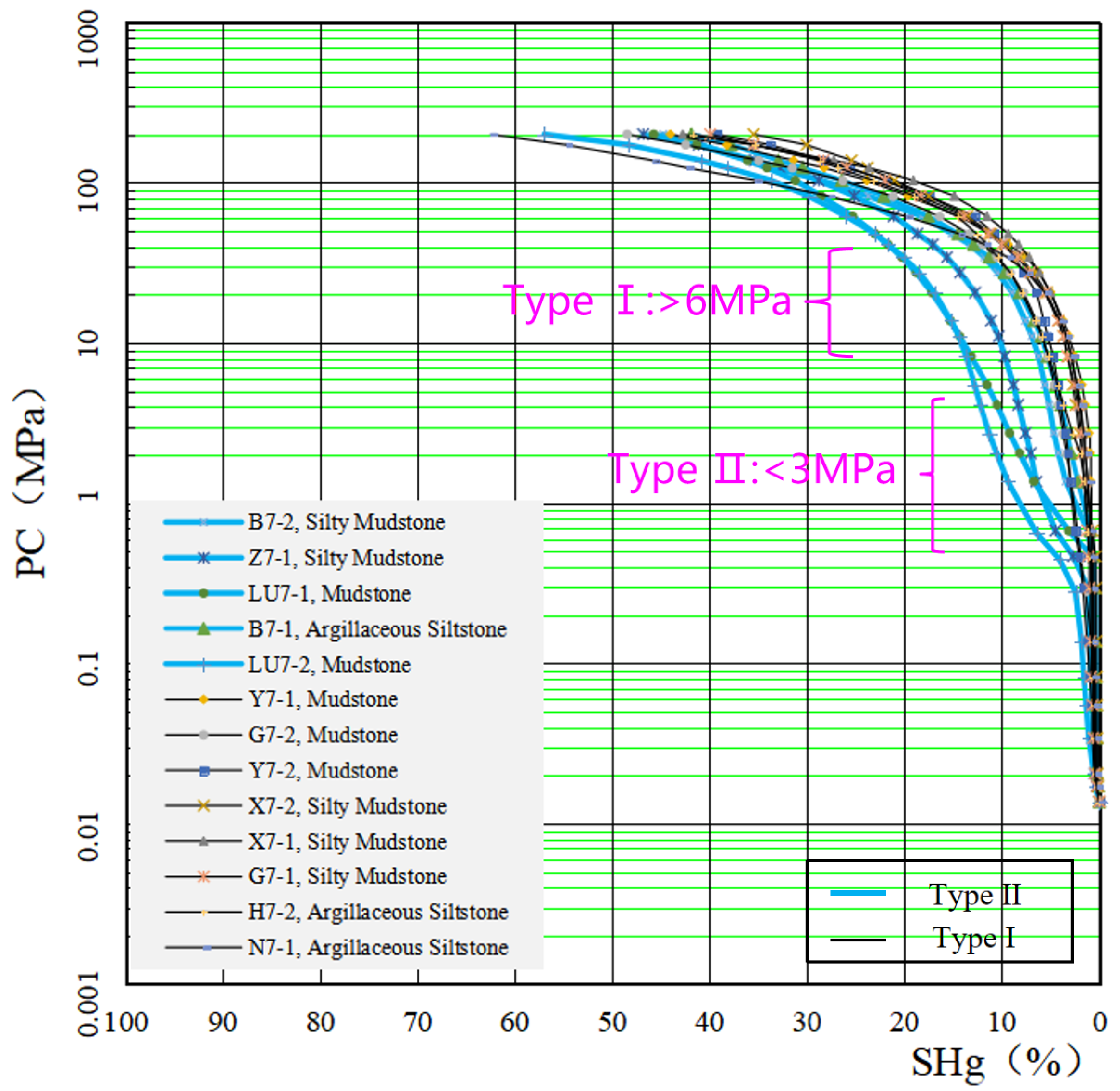
The shape of the maximum mercury saturation versus displacement pressure curves reflects the development and connectivity of pores and throats within the rock. Lower maximum mercury saturation indicates poorer pore–throat connectivity and, consequently, stronger fluid-sealing capacity [58,59,60]. For the Chang 73 overlying strata in the Ordos Basin, the mercury intrusion curves generally exhibit maximum saturation values below 50% and are skewed toward the upper-right region. Based on their overall shapes, the curves can be roughly classified into two types, designated as Type I and Type II.
Type I samples, mainly mudstone and silty mudstone, exhibit displacement pressures above 6 MPa (Figure 8). Their pore systems are dominated by dissolution pores, clay interlayer pores, and intercrystalline pores, with pore diameters between 4 and 50 nm and no macropores (Figure 6a,d,g). Pore morphology corresponds to H4-type wedge-shaped slit pores (Figure 6c,f,i). Breakthrough pressures range from 21.06 to 45 MPa, with an average of 36.9 MPa. These samples are the most compact and demonstrate the strongest hydrocarbon-sealing capacity.
Type II samples, including mudstone, silty mudstone, and argillaceous siltstone, show displacement pressures below 3 MPa (Figure 8). Their pore systems comprise microfractures, dissolution pores, intergranular pores, clay interlayer pores, and intercrystalline pores, with most pore diameters between 4 and 50 nm, but a few macropores up to 1000 nm are present. The pore morphology of Type II samples corresponds to H3-type plate-like pores (Figure 6c,f,i). Breakthrough pressures range from 12.04 to 28.06 MPa, averaging 20.4 MPa. The presence of macropores and plate-like pore structures results in lower rock compactness, reduced displacement and breakthrough pressures, and comparatively weaker hydrocarbon-sealing capacity relative to Type I samples.
Overall, these results demonstrate that pore–throat characteristics, including pore size distribution, connectivity, and morphology, exert a fundamental control on the sealing efficiency of the Chang 73 overlying strata. Smaller, poorly connected pores and wedge-shaped slit morphologies favor higher displacement and breakthrough pressures, thereby enhancing the ability of the overlying strata to trap hydrocarbons.

5.1.2. Correlation

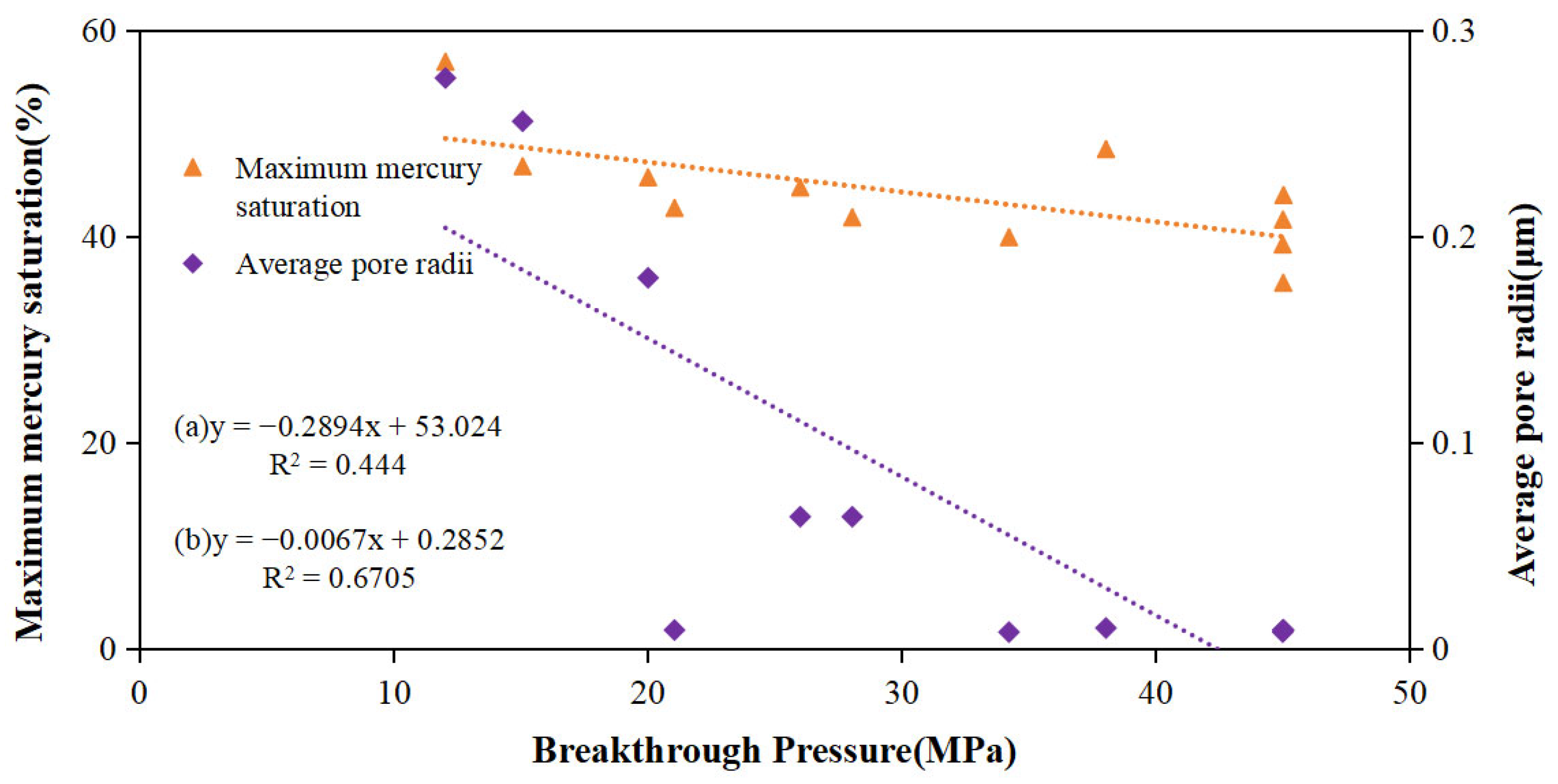
In the overlying strata of the Chang 73 shale oil interval, the pore size distributions of laminar mudstone, silty mudstone, and argillaceous siltstone exhibit considerable variation, with average pore radii ranging from 0.008 μm to 0.277 μm. To investigate the correlation between pore–throat structure and sealing capacity, linear regression models were established among average pore radius, maximum mercury saturation, and breakthrough pressure, providing a quantitative characterization of the influence of pore–throat architecture on sealing performance. The results indicate that both pore size and maximum mercury saturation are negatively correlated with the sealing capacity of the overlying strata, with correlation coefficients (R2) of 0.6705 and 0.444, respectively (Figure 9).
Based on the above results, overlying strata samples with superior sealing capacity generally lack the development of microfractures or intergranular pores. The more complex the pore–throat structure, the smaller the pore sizes, and the poorer the pore connectivity, the stronger the hydrocarbon-sealing efficiency of the overlying strata.

5.2. Influence of Mineral Composition on Sealing Capacity

The above studies indicate that the sealing capacity of argillaceous overlying strata is primarily controlled by pore–throat structure, which in turn is influenced by mineral composition and diagenetic processes such as compaction, cementation, and dissolution [61,62]. X-ray diffraction (XRD) analyses of key well samples from the Chang 73 overlying strata reveal that the mineral composition is dominated by clay minerals (28.4%–59%, average 42.3%) and siliceous minerals (32.5%–51.6%, average 41.6%), with minor carbonate cement (1.9%–24.2%, average 15.4%). Combined petrographic thin-section observations, XRD, and breakthrough pressure measurements indicate that high clay mineral contents, along with intense compaction and cementation, promote rock densification and formation of effective overlying strata. Conversely, high siliceous mineral content and dissolution processes increase secondary porosity, thereby compromising the sealing capacity of the overlying strata.
(1)
Clay Mineral Composition
The clay minerals in the overlying strata are predominantly illite and illite–smectite mixed layers, with minor amounts of chlorite and kaolinite. The composition and proportion of different clay mineral types exert distinct influences on the sealing capacity of the overlying strata. Generally, higher contents of illite and illite–smectite mixed layers correspond to improved sealing efficiency [62,63].
On one hand, the water-absorbing properties of clay minerals affect sealing capacity, as the adsorption of interlayer water by clay particles increases the volume occupied within pore spaces [64].
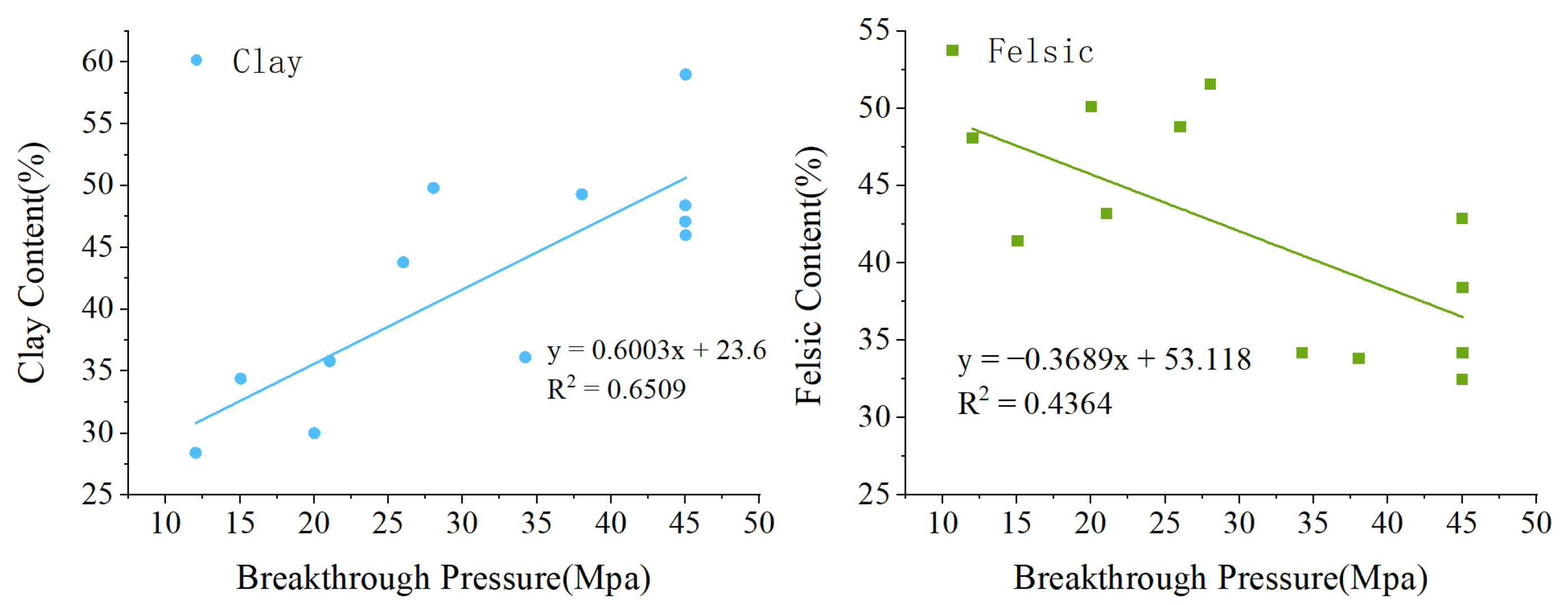
On the other hand, the plasticity of clay minerals also plays a role: the extremely fine clay particles are rapidly compacted and cemented during early diagenesis, filling pore spaces and reducing overall porosity, thereby densifying the rock and inhibiting fluid migration. In mudstone, silty mudstone, and argillaceous siltstone samples, strong compaction is observed, with the clay-rich matrix filling pore spaces and blocking throats, further densifying the rock and enhancing fluid sealing (Figure 5a,b). A strong positive correlation is observed between clay mineral content and sealing capacity, with a correlation coefficient (R2) of up to 0.65 (Figure 10).
(2)
Felsic Mineral Components
The felsic minerals in the studied samples are predominantly quartz and plagioclase, with minor amounts of K-feldspar. Owing to their relatively large grain size, as well as high brittleness and rigidity, felsic minerals are prone to developing microfractures under tectonic stress and differential compaction, thereby providing potential leakage pathways. In addition, felsic minerals (particularly feldspars) are highly susceptible to acidic fluid dissolution, which promotes the formation of secondary pores and seepage channels, further compromising the sealing capacity of the caprock [50].
In the analyzed lithologies, microfractures are commonly observed in mudstone, silty mudstone, and muddy siltstone, whereas intergranular pores are mainly developed in muddy siltstone samples. Moreover, dissolution features are widely distributed across mudstone, silty mudstone, and muddy siltstone, leading to the formation of dissolution pores (Figure 5a,c,d).
Overall, the content of felsic minerals shows a negative correlation with sealing capacity, with a coefficient of determination (R2 = 0.45). Specifically, higher felsic mineral contents are associated with a reduction in the sealing performance of the caprock (Figure 10).

5.3. Influence of Petrophysical Properties on Overlying Strata Sealing Capacity

The above analysis indicates that the sealing capacity of the Chang 73 overlying strata is primarily controlled by pore–throat structure, mineralogical composition, and diagenetic processes. Petrophysical properties represent a comprehensive manifestation of these factors and therefore serve as the most direct indicators of seal integrity.
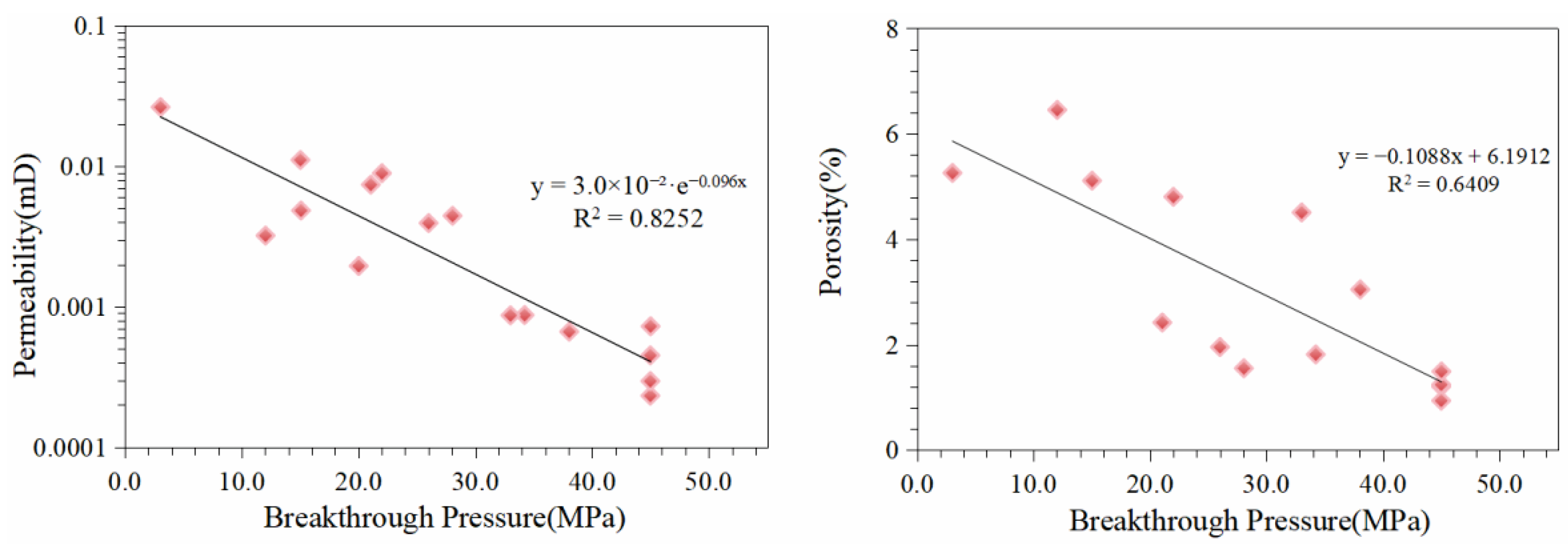
In the Chang 73 samples, porosity ranges from 0.82% to 6.45%, with an average of 2.75%; approximately 57% of the samples exhibit porosity below 2%. Permeability varies from 0.000233 mD to 0.02634 mD, with a mean value of 0.00476 mD, and roughly 90% of samples have permeability below 0.01 mD (Figure 10).
Previous studies on natural gas reservoirs in China with reserves exceeding 100 × 108 m3 have established that overlying strata with breakthrough pressures greater than 6 MPa, after accounting for gas and hydrocarbon saturation, can be classified as effective seals [65]. For shale oil overlying strata, research on the Gulong shale oil accumulation suggests that a mean breakthrough pressure exceeding 15 MPa corresponds to a well-sealing cap [17,66]. Based on these benchmarks, overlying strata with breakthrough pressures below 6 MPa are considered ineffective, whereas those exceeding 15 MPa are classified as high-quality seals.
Breakthrough pressure measurements from the Chang 73 overlying strata show that all values exceed 6 MPa, indicating effective sealing. Specifically, mudstone, silty mudstone, and muddy siltstone samples exhibit mean breakthrough pressures above 15 MPa, sufficient to prevent shale oil escape. Correlation analysis between petrophysical parameters and breakthrough pressure reveals strong negative relationships with both permeability and porosity, with correlation coefficients (R2) of 0.8252 and 0.6409, respectively. Overall, lower permeability and porosity correspond to higher breakthrough pressures; when permeability is below 0.02 mD and porosity is under 5.5%, breakthrough pressures consistently exceed 6 MPa (Figure 11).

5.4. Uncertainty and Limitations

Despite the comprehensive analytical workflow employed in this study, several uncertainties and limitations should be acknowledged. The study is based on 15 caprock samples collected from nine wells in the central and northern Ordos Basin. Although the samples provide reasonable spatial coverage and maintain consistent stratigraphic positions, the current dataset may not fully capture the pore–throat characteristics and their influence on the sealing capacity of the Chang73 overlying caprock. Additional sampling from a wider range of wells and lithofacies would further improve the representativeness of the results.
Procedures such as grinding for N2 adsorption, polishing for SEM imaging, and plug cutting for HPMI may modify pore–throat structures to a certain extent. For example, fine grinding can generate artificial micro-pores, whereas mechanical trimming may alter the connectivity of larger throats. Although standard protocols were strictly followed, these preparation-related artifacts cannot be fully eliminated. Each pore-structure characterization method has inherent detection limits. N2 adsorption mainly resolves pores <100 nm, while HPMI is more sensitive to meso- to macro-scale pores (>50 nm). Consequently, the combined pore-size distributions may still overlook ultra-micropores or extremely large features. Breakthrough pressure tests also involve uncertainties related to sealing conditions, pressurization stability, and the instrument’s maximum testing limit of 45 MPa.

6. Conclusions

(1)
The lithofacies of the overlying strata in the Chang 73 shale oil interval of the Ordos Basin can be classified into three types: mudstone, silty mudstone, and muddy siltstone. Based on mineral composition, these strata are primarily composed of clay-rich rocks and quartz–feldspar-rich rocks.
(2)
The pore types observed in the study area samples are classified into organic and inorganic pores. Inorganic pores include five subtypes: dissolution pores, intergranular pores, clay mineral interlayer pores, intragranular pores, and microfractures. The pore size distribution is relatively narrow, dominated by mesopores (2–50 nm) with a minor presence of macropores. Pore morphologies are primarily plate-like and wedge-shaped slit pores, exhibiting poor connectivity, which hinders hydrocarbon migration.
(3)
The average breakthrough pressures of the three lithologies in the Chang 73 shale oil overlying strata exceed 15 MPa, indicating strong sealing capacity. Correlation analyses between breakthrough pressure and pore–throat structure, mineral composition, diagenetic processes, and petrophysical properties reveal that the porosity-enhancing effect caused by the dissolution of siliceous–feldspathic minerals compromises the sealing ability. In contrast, complex pore–throat structures, compaction and cementation of clay minerals, and poor petrophysical properties lead to densification of the overlying strata, providing effective hydrocarbon sealing.

Author Contributions

W.J.: Writing—review & editing, Writing—original draft, Formal analysis. G.D. and W.D.: Supervision, Methodology, Funding acquisition. C.B. and J.D.: Methodology, Data Collection. H.W. and L.Z.: Data Curation, Investigation. Y.W. and B.P.: Investigation. All authors have read and agreed to the published version of the manuscript.

Funding

This research and the APC was funded by the National Natural Science Foundation of China, grant number: 42202175, and Exploration and Development Research Institute, PetroChina Project: Analysis of the Preservation Conditions of Shale Roof and Floor in the Chang 73 Interval, Ordos Basin, grant number: RIEPD-2024-CL-660.

Data Availability Statement

Further inquiries about the data in this study can be directed to the corresponding author.

Conflicts of Interest

Authors Congsheng Bian and Jin Dong were employed by the company PetroChina Research Institute of Petroleum Exploration and Development. The remaining authors declare that the research was conducted in the absence of any commercial or financial relationships that could be construed as a potential conflict of interest.

References

  1. Jin, Z.; Wang, G.; Liu, G.; Gao, B.; Liu, Q.; Wang, H.; Liang, X.; Wang, R. Research progress and key scientific issues of continental shale oil in China. Acta Pet. Sin. 2021, 42, 821–835. [Google Scholar] [CrossRef]
  2. Zhao, W.; Hu, S.; Hou, L.; Yang, T.; Li, X.; Guo, B.; Yang, Z. Types and resource potential of continental shale oil in China and its boundary with tight oil. Pet. Explor. Dev. 2020, 47, 1–10. [Google Scholar] [CrossRef]
  3. Niu, X.; Lyu, C.; Feng, S.; Zhou, Q.; Xin, H.; Xiao, Y.; Li, C.; Dan, W. Lamina combination characteristics and differential shale oil enrichment mechanisms of continental organic-rich shale: A case study of Triassic Yanchang Formation Chang 73 sub-member, Ordos Basin, NW China. Pet. Explor. Dev. 2025, 52, 279–291. [Google Scholar] [CrossRef]
  4. Guo, Q.; Li, S.; Jin, Z.; Zhou, X.; Liu, C. Characteristics and exploration targets of Chang 7 shale oil in Triassic Yanchang Formation, Ordos Basin, NW China. Pet. Explor. Dev. 2023, 50, 767–781. [Google Scholar] [CrossRef]
  5. Jiao, F.; Zou, C.; Yang, Z. Geological theory and exploration & development practice of hydrocarbon accumulation inside continental source kitchens. Pet. Explor. Dev. 2020, 47, 1067–1078. [Google Scholar] [CrossRef]
  6. Fu, J.; Niu, X.; Dan, W.; Feng, S.; Liang, X.; Xin, H.; You, Y. The geological characteristics and the progress on exploration and development of shale oil in Chang7 Member of Mesozoic Yanchang Formation, Ordos Basin. China Pet. Explor. 2019, 24, 601–614. [Google Scholar] [CrossRef]
  7. Fu, J.; Li, S.; Hou, Y.; Zhou, X.; Liu, J.; Li, S. Breakthrough of risk exploration for Class II shale oil in Chang 7 member of the Yanchang Formation and its significance in the Ordos Basin. China Pet. Explor. 2020, 25, 78–92. [Google Scholar] [CrossRef]
  8. Fu, J.; Liu, X.; Li, S.; Guo, Q.; Zhou, X.; Yang, W. Discovery and resource potential of shale oil of Chang 7 member, Triassic Yanchang Formation, Ordos Basin. China Pet. Explor. 2021, 26, 1–11. [Google Scholar] [CrossRef]
  9. Fu, J.; Niu, X.; Li, M.; Liu, X.; Li, S.; Guo, Q.; Zhou, X.; Liu, J. Breakthrough and significance of risk exploration in the 3rd Sub-member, 7th Member of Yanchang Formation in Ordos Basin. Acta Pet. Sin. 2022, 43, 760–769, 787. [Google Scholar]
  10. Sun, J.; Shi, B.; Guo, C.; Chao, G.; Fenfei, B.; Gang, L.; Jintao, Y.; Jie, X. Characteristics of shale oil reservoir and exploration prospects in the third sub-member of the seventh member of the Triassic Yanchang Formation in Fuxian area, Ordos Basin. China Pet. Explor. 2023, 28, 79–91. [Google Scholar] [CrossRef]
  11. Li, S.; Guo, Q.; Pan, S.; Zhou, X.; Guo, R. Influence of intrasource micro-migration of hydrocarbons on the differential enrichment of laminated type shale oil: A case study of the third sub-member of the seventh member of the Triassic Yanchang Formation in Ordos Basin. China Pet. Explor. 2023, 28, 46–54. [Google Scholar] [CrossRef]
  12. Hou, Y.; Yang, Z.; Zhang, Z.; Cheng, D.; Li, J.; Liu, J.; Zhang, Y. Geological understanding and exploration potential of shale oil in the third submember of the seventh member of Yanchang Formation in Ordos Basin. China Pet. Explor. 2024, 29, 17–29. [Google Scholar] [CrossRef]
  13. Zhao, W.; Liu, W.; Bian, C.; Liu, X.; Pu, X.; Lu, J.; Li, Y.; Li, J.; Liu, S. Role of preservation conditions on enrichment and fluidity maintenance of medium to high maturity lacustrine shale oil. Pet. Explor. Dev. 2025, 52, 1–14. [Google Scholar] [CrossRef]
  14. Zhao, W.; Bian, C.; Li, Y.; Liu, W.; Dong, J.; Wang, K.; Zeng, X. Organic matter transformation ratio, hydrocarbon expulsion efficiency and shale oil enrichment type in Chang 73 shale of Upper Triassic Yanchang Formation in Ordos Basin, NW China. Pet. Explor. Dev. 2023, 50, 12–23. [Google Scholar] [CrossRef]
  15. Jin, Z.; Zhu, R.; Liang, X.; Shen, Y. Several issues worthy of attention in current lacustrine shale oil exploration and development. Pet. Explor. Dev. 2021, 48, 1471–1484. [Google Scholar] [CrossRef]
  16. Cui, Z.; Yang, W.; Wang, Q.; Zuo, R.S.; Cai, J.F.; Cui, Z.J.; Xu, L.; Li, L.; Gu, X.M. Sealing property of roof and floor of Wufeng Formation-Longmaxi Formation and its influence on shale gas differential enrichment in Sichuan Basin and its surrounding areas. Mar. Orig. Pet. Geol. 2020, 25, 243–252. [Google Scholar]
  17. Li, J.; Liu, W.; Su, Y.; Zeng, X.; Fu, X.; Guan, M.; Li, S. Sealing capacity evaluation of the roof and floor for the Qingshankou Formation in the Qijia-Gulong Sag, Songliao Basin and its preservation of shale oil. Nat. Gas Geosci. 2025, 36, 209–220. [Google Scholar] [CrossRef]
  18. Guo, X.; Hu, D.; Yu, L.; Lu, L.; He, C.; Liu, W.; Lu, X. Study on the micro mechanism of shale self-sealing and shale gas preservation. Pet. Geol. Exp. 2023, 45, 821–831. [Google Scholar] [CrossRef]
  19. Wu, J.; Fan, T.; Gao, Z.; Gu, Y.; Wang, J.; Du, Y.; Li, C.; Wang, S.; Zhang, C.; Meng, M.; et al. Identification and characteristic analysis of carbonate cap rock: A case study from the Lower-Middle Ordovician Yingshan Formation in Tahe oilfield, Tarim Basin, China. J. Pet. Sci. Eng. 2018, 164, 362–381. [Google Scholar] [CrossRef]
  20. Nie, H.; Jin, Z.; Bian, R. The “source-cap hydrocarbon-controlling” enrichment of shale gas in Upper Ordovician Wufeng Formation-Lower Silurian Longmaxi Formation of Sichuan Basin and its periphery. Acta Pet. Sin. 2016, 37, 557. [Google Scholar] [CrossRef]
  21. Zhao, W.; Zhu, R.; Hu, S.; Hou, L.; Wu, S. Accumulation contribution differences between lacustrine organic-rich shales and mudstones and their significance in shale oil evaluation. Pet. Explor. Dev. 2020, 47, 1160–1171. [Google Scholar] [CrossRef]
  22. Fu, X.; Wu, T.; Lyu, Y.; Liu, S.; Tian, H.; Lu, M. Research status and development trend of the reservoir caprock sealing properties. Oil Gas Geol. 2018, 39, 454–471. [Google Scholar] [CrossRef]
  23. Heath, J.E.; Dewers, T.A.; McPherson, B.J.; Petrusak, R.; Chidsey, T.C., Jr.; Rinehart, A.J.; Mozley, P.S. Pore networks in continental and marine mudstones: Characteristics and controls on sealing behavior. Geosphere 2011, 7, 429–454. [Google Scholar] [CrossRef]
  24. Song, J.; Zhang, D. Comprehensive review of caprock-sealing mechanisms for geologic carbon sequestration. Environ. Sci. Technol. 2013, 47, 9–22. [Google Scholar] [CrossRef]
  25. Wang, J.; Wang, H.; Wang, X.; Yang, S.; Wu, H.; Leung, C.; Tian, J. A multiphysical-geochemical coupling model for caprock sealing efficiency in CO2 geosequestration. Deep. Undergr. Sci. Eng. 2023, 2, 188–203. [Google Scholar] [CrossRef]
  26. Hosseini, M.; Fahimpour, J.; Ali, M.; Keshavarz, A.; Iglauer, S. Capillary sealing efficiency analysis of caprocks: Implication for hydrogen geological storage. Energy Fuels 2022, 36, 4065–4075. [Google Scholar] [CrossRef]
  27. Armitage, P.J.; Faulkner, D.R.; Worden, R.H.; Aplin, A.C.; Butcher, A.R.; Iliffe, J. Experimental measurement of, and controls on, permeability and permeability anisotropy of caprocks from the CO2 storage project at the Krechba Field, Algeria. J. Geophys. Res. Solid Earth 2011, 116. [Google Scholar] [CrossRef]
  28. Ma, C.; Lin, C.; Dong, C.; Elsworth, D.; Wu, S.; Wang, X.; Sun, X. Determination of the critical flow pore diameter of shale caprock. Mar. Pet. Geol. 2020, 112, 104042. [Google Scholar] [CrossRef]
  29. Espinoza, D.N.; Santamarina, J.C. CO2 breakthrough—Caprock sealing efficiency and integrity for carbon geological storage. Int. J. Greenh. Gas Control. 2017, 66, 218–229. [Google Scholar] [CrossRef]
  30. Daniel, R.F.; Kaldi, J.G. Evaluating Seal Capacity of Cap Rocks and Intraformational Barriers for CO2 Containment; American Association of Petroleum Geologists: Tulsa, OK, USA, 2009. [Google Scholar]
  31. Kim, H.; Vilarrasa, V.; Makhnenko, R.Y. Laboratory-scale assessment of CO2 sealing potential of heterogeneous caprock. Water Resour. Res. 2025, 61, e2025WR040339. [Google Scholar] [CrossRef]
  32. Liu, C.; Zhao, H.; Sun, Y. Tectonic background of Ordos Basin and its controlling role for basin evolution and energy mineral deposits. Energy Explor. Exploit. 2009, 27, 15–27. [Google Scholar] [CrossRef]
  33. Liu, S.; Yang, S. Upper Triassic–Jurassic sequence stratigraphy and its structural controls in the western Ordos Basin, China. Basin Res. 2000, 12, 1–18. [Google Scholar] [CrossRef]
  34. Yang, R.; Jin, Z.; Van Loon, A.J.; Han, Z.; Fan, A. Climatic and tectonic controls of lacustrine hyperpycnite origination in the Late Triassic Ordos Basin, central China: Implications for unconventional petroleum development. Aapg Bull. 2017, 101, 95–117. [Google Scholar] [CrossRef]
  35. Liu, C.; Zhao, H.; Zhao, J.; Wang, J.; Zhang, D.; Yang, M. Temporo-spatial coordinates of evolution of the Ordos Basin and its mineralization responses. Acta Geol. Sin.-Engl. Ed. 2008, 82, 1229–1243. [Google Scholar] [CrossRef]
  36. Fu, J.; Wang, L.; Chen, X.; Liu, J.; Hui, X.; Cheng, D. Progress and prospects of shale oil exploration and development in the seventh member of Yanchang Formation in Ordos Basin. China Pet. Explor. 2023, 28, 1–14. [Google Scholar] [CrossRef]
  37. Bai, Y.; Ma, Y. Geology of the Chang 7 Member oil shale of the Yanchang Formation of the Ordos Basin in central north China. Pet. Geosci. 2020, 26, 355–371. [Google Scholar] [CrossRef]
  38. Cui, J.; Zhu, R.; Mao, Z.; Li, S. Accumulation of unconventional petroleum resources and their coexistence characteristics in Chang7 shale formations of Ordos Basin in central China. Front. Earth Sci. 2019, 13, 575–587. [Google Scholar] [CrossRef]
  39. Xi, K.; Li, K.; Cao, Y.; Lin, M.; Niu, X.; Zhu, R.; Wei, X.; You, Y.; Liang, X.; Feng, S. Laminae combination and shale oil enrichment patterns of Chang 73 sub-member organic-rich shales in the Triassic Yanchang Formation, Ordos Basin, NW China. Pet. Explor. Dev. 2020, 47, 1342–1353. [Google Scholar] [CrossRef]
  40. SY/T 5163–2018; Analytical Method for Clay Minerals and Common Non-Clay Minerals in Sedimentary Rocks. National Energy Administration: Beijing, China, 2018.
  41. GB/T 16594–2008; General Rules for Measurement of Length in Micron Scale by SEM. Standardization Administration of China/State Administration for Market Regulation: Beijing, China, 2008.
  42. GB/T 29171–2012; Rock capillary pressure measurement. General Administration of Quality Supervision, Inspection and Quarantine of the People’s Republic of China & Standardization Administration of the People’s Republic of China: Beijing, China, 2012.
  43. GB/T 19587–2017; Determination of the Specific Surface Area of Solids by Gas Adsorption Using the BET Method. Standardization Administration of the People’s Republic of China: Beijing, China, 2017.
  44. GB/T 21650.2-2008; Pore Size Distribution and Porosity of Solid Materials by Mercury Porosimetry and Gas Adsorption—Part 2: Analysis of Mesopores and Macropores by Gas Adsorption. Standardization Administration of the People’s Republic of China: Beijing, China, 2008.
  45. SY/T 5748–2013; Specification for Division of Diagenetic Stages of Clastic Rocks. National Energy Administration: Beijing, China, 2013.
  46. Picard, M.D. Classification of fine-grained sedimentary rocks. J. Sediment. Res. 1971, 41, 179–195. [Google Scholar] [CrossRef]
  47. Thommes, M.; Kaneko, K.; Neimark, A.V.; Olivier, J.P.; Rodriguez-Reinoso, F.; Rouquerol, J.; Sing, K.S.W. Physisorption of gases, with special reference to the evaluation of surface area and pore size distribution (IUPAC Technical Report). Pure Appl. Chem. 2015, 87, 1051–1069. [Google Scholar] [CrossRef]
  48. Guan, M.; Liu, X.; Jin, Z.; Lai, J. The heterogeneity of pore structure in lacustrine shales: Insights from multifractal analysis using N2 adsorption and mercury intrusion. Mar. Pet. Geol. 2020, 114, 104150. [Google Scholar] [CrossRef]
  49. Fan, M.; Chen, H.; Yu, L.; Zhang, W.; Liu, W.; Bao, Y. Evaluation standard of mudstone caprock combining specific surface area and breakthrough pressure. Pet. Geol. Exp. 2011, 33, 87–90. [Google Scholar] [CrossRef]
  50. Guiltinan, E.J.; Espinoza, D.N.; Cockrell, L.P.; Cardenas, M.B. Textural and compositional controls on mudrock breakthrough pressure and permeability. Adv. Water Resour. 2018, 121, 162–172. [Google Scholar] [CrossRef]
  51. Boulin, P.F.; Bretonnier, P.; Vassil, V.; Samouillet, A.; Fleury, M.; Lombard, J.M. Sealing efficiency of caprocks: Experimental investigation of entry pressure measurement methods. Mar. Pet. Geol. 2013, 48, 20–30. [Google Scholar] [CrossRef]
  52. Zhou, X.; Lü, X.; Quan, H.; Qian, W.; Mu, X.; Chen, K.; Wang, Z.; Bai, Z. Influence factors and an evaluation method about breakthrough pressure of carbonate rocks: An experimental study on the Ordovician of carbonate rock from the Kalpin area, Tarim Basin, China. Mar. Pet. Geol. 2019, 104, 313–330. [Google Scholar] [CrossRef]
  53. Wu, T.; Pan, Z.; Connell, L.D.; Liu, B.; Fu, X.; Xue, Z. Gas breakthrough pressure of tight rocks: A review of experimental methods and data. J. Nat. Gas Sci. Eng. 2020, 81, 103408. [Google Scholar] [CrossRef]
  54. Chen, B.; Li, Q.; Tan, Y.; Yu, T.; Li, X.; Li, X. Experimental measurements and characterization models of caprock breakthrough pressure for CO2 geological storage. Earth-Sci. Rev. 2024, 252, 104732. [Google Scholar] [CrossRef]
  55. Cui, J.; Zhang, Z.; Liu, G.; Zhang, Y.; Qi, Y. Breakthrough pressure anisotropy and intra-source migration model of crude oil in shale. Mar. Pet. Geol. 2022, 135, 105433. [Google Scholar] [CrossRef]
  56. Zhao, Y.; Yu, Q. CO2 breakthrough pressure and permeability for unsaturated low-permeability sandstone of the Ordos Basin. J. Hydrol. 2017, 550, 331–342. [Google Scholar] [CrossRef]
  57. Zhang, C.; Wang, M. A critical review of breakthrough pressure for tight rocks and relevant factors. J. Nat. Gas Sci. Eng. 2022, 100, 104456. [Google Scholar] [CrossRef]
  58. Yang, F.; Ning, Z.; Kong, D.; Liu, H. Pore Structure of Shales from High Pressure Mercury Injection and Nitrogen Adsorption Method. Nat. Gas Geosci. 2013, 24, 450–455. [Google Scholar]
  59. Fu, S.; Fang, Q.; Li, A.; Li, Z.; Han, J.; Dang, X.; Han, W. Accurate characterization of full pore size distribution of tight sandstones by low-temperature nitrogen gas adsorption and high-pressure mercury intrusion combination method. Energy Sci. Eng. 2021, 9, 80–100. [Google Scholar] [CrossRef]
  60. Qu, Y.; Sun, W.; Tao, R.; Luo, B.; Chen, L.; Ren, D. Pore–throat structure and fractal characteristics of tight sandstones in Yanchang Formation, Ordos Basin. Mar. Pet. Geol. 2020, 120, 104573. [Google Scholar] [CrossRef]
  61. Dong, X.; Meng, X.; Pu, R. Impacts of mineralogy and pore throat structure on the movable fluid of tight sandstone gas reservoirs in coal measure strata: A case study of the Shanxi formation along the southeastern margin of the Ordos Basin. J. Pet. Sci. Eng. 2023, 220, 111257. [Google Scholar] [CrossRef]
  62. Wu, J.; Fan, T.; Gomez-Rivas, E.; Travé, A.; Cao, Q.; Gao, Z.; Wang, S.; Kang, Z. Impact of diagenesis on the pore evolution and sealing capacity of carbonate cap rocks in the Tarim Basin, China. AAPG Bull. 2022, 106, 2471–2511. [Google Scholar] [CrossRef]
  63. Wang, R.; Shi, W.; Xie, X.; Zhang, W.; Qin, S.; Liu, K.; Busbey, A.B. Clay mineral content, type, and their effects on pore throat structure and reservoir properties: Insight from the Permian tight sandstones in the Hangjinqi area, north Ordos Basin, China. Mar. Pet. Geol. 2020, 115, 104281. [Google Scholar] [CrossRef]
  64. Jiu, B.; Huang, W.; Li, Y.; He, M. Influence of clay minerals and cementation on pore throat of tight sandstone gas reservoir in the eastern Ordos Basin, China. J. Nat. Gas Sci. Eng. 2021, 87, 103762. [Google Scholar] [CrossRef]
  65. Deng, Z.; Wang, S.; Jiang, Z.; Chen, Z. Breaking pressure of gas cap rocks. Oil Gas Geol. 2000, 21, 136–138. [Google Scholar] [CrossRef]
  66. Zhao, W.; Bian, C.; Li, Y.; Zhang, J.; He, K.; Liu, W.; Zhang, B.; Lei, Z.; Liu, C.; Zhang, J. Enrichment factors of movable hydrocarbons in lacustrine shale oil and exploration potential of shale oil in Gulong Sag, Songliao Basin, NE China. Pet. Explor. Dev. 2023, 50, 455–467. [Google Scholar] [CrossRef]
Figure 1. Sedimentary facies map of submember Chang 73 in the Ordos Basin (Modified after Fu Jinhua [36]). The wells marked in red are the sampling wells.
Minerals 16 00012 g001
Figure 2. Photomicrographs of thin sections from the overlying strata of Chang 73 shale oil. (a) Laminated mudstone, Well Yan 56, 3027.9 m, Chang 72; (b) Laminated mudstone, Well Luo 254, 2540.9 m, Chang 72; (c) Organic-matter laminae in silty mudstone, Well Xi 395, 1992.2 m, Chang 72; (d) Silty mudstone, Well Zhang 22, 1619.55 m, Chang 72; (e) Argillaceous siltstone, Well Li 231, 2072.46 m, Chang 72; (f) Argillaceous siltstone, Well Luo 254, 2532.5 m, Chang 72.
Minerals 16 00012 g002
Figure 3. Ternary diagram of mineral composition for the overlying strata of Chang 73 shale oil.
Minerals 16 00012 g003
Figure 4. Mineral composition characteristics of different lithologies in the overlying strata of Chang 73 shale oil.
Minerals 16 00012 g004
Figure 5. Pore types of cap rock observed under thin section and SEM. (a) Microfracture, laminated mudstone, Well Luo 254, 2540.9 m, Chang 72; (b) Microfracture, silty mudstone, Well Bai 522, 1930.9 m, Chang 72; (c) Minor intergranular pores and dissolution pores, argillaceous siltstone, Well Ning 228, 1737.5 m, Chang 72; (d) Dissolution pores and intercrystalline pores of illite, laminated mudstone, Well Yan 56, 3019.6 m, Chang 72; (e) Dissolution pores and pyrite intercrystalline pores, laminated mudstone, Well Luo 254, 2540.9 m, Chang 72; (f) Pyrite intercrystalline pores and dissolution pores, silty mudstone, Well Xi 395, 1992.2 m, Chang 72; (g) Clay intercrystalline pores, microfractures and organic matter bands, silty mudstone, Well Xi 395, 1992.2 m, Chang 72; (h) Pyrite intercrystalline pores and clay intercrystalline pores, argillaceous siltstone, Well Huan 317, 2462.5 m, Chang 72; (i) Clay intercrystalline pores and dissolution pores, argillaceous siltstone, Well Huan 317, 2462.5 m, Chang 72.
Minerals 16 00012 g005
Figure 6. Results of mercury intrusion porosimetry (MIP) and N2 adsorption experiments of Overlying Strata. (a) Frequency distribution of laminated mudstone by HPMI; (b) incremental pore volume of laminated mudstone by N2 adsorption; (c) N2 adsorption–desorption isotherms of laminated mudstone; (d) Frequency distribution of laminated silty mudstone by HPMI; (e) incremental pore volume of laminated silty mudstone by N2 adsorption; (f) N2 adsorption–desorption isotherms of laminated silty mudstone; (g) frequency distribution of argillaceous siltstone by HPMI; (h) Incremental pore volume of argillaceous siltstone by N2 adsorption; (i) N2 adsorption–desorption isotherms of argillaceous siltstone.
Minerals 16 00012 g006
Figure 7. Pore-Size Distribution Characterization of Overlying Strata by Integrating High-Pressure Mercury Intrusion and N2 Adsorption. (a) laminated mudstone; (b) laminated silty mudstone; (c) argillaceous siltstone.
Minerals 16 00012 g007
Figure 8. Maximum Mercury Saturation–Displacement Pressure Curves of the Chang 73 Overlying Strata.
Minerals 16 00012 g008
Figure 9. Correlation between Pore–throat Characteristics and Breakthrough Pressure of the Chang 73 Overlying Strata. The orange dashed line represents the linear correlation between maximum mercury saturation and breakthrough pressure, while the purple dashed line represents the linear correlation between average pore radius and breakthrough pressure.
Minerals 16 00012 g009
Figure 10. Correlation between the contents of different mineral components and breakthrough pressure in the Chang 73 Overlying Strata. The blue dashed line represents the linear correlation between clay mineral content and breakthrough pressure, while the green dashed line represents the linear correlation between felsic mineral content and breakthrough pressure.
Minerals 16 00012 g010
Figure 11. Relationship between Porosity, Permeability, and Breakthrough Pressure of the Chang 73 Overlying Strata.
Minerals 16 00012 g011
Table 1. Lithology Classification of the Overlying Strata of Chang 73 Submember.
LithologyDescriptionClay Content (%)Silt Content (%)
MudstoneDark gray to grayish-black mudstone>65<35
Silty MudstoneDark gray silty mudstone50–6535–50
Argillaceous SiltstoneDrgillaceous siltstone35–5050–65
Table 2. Breakthrough pressure characteristics of the Chang 73 Overlying Strata. Abbreviations: Φ, porosity; K, permeability (mD); Pb, breakthrough pressure (MPa).
SampleΦ (%)K (×10−3 μm2)Pb (Mpa)
MudstoneLU7-10.8170.0019520.02
LU7-26.4530.0032112.04
Y7-11.2040.000451>45
Y7-21.2400.000233>45
G7-23.0460.00066538.05
Silty MudstoneX7-12.4190.00739421.06
X7-20.9360.000296>45
G7-11.8130.00087334.23
B7-21.9530.0039426.01
Z7-11.3420.0048415.08
Argillaceous SiltstoneH7-21.4900.00072645.02
Li7-15.1100.0110815.03
N7-15.2570.026343.05
N7-1B4.8040.0089222.01
B7-11.5510.0044428.06
Disclaimer/Publisher’s Note: The statements, opinions and data contained in all publications are solely those of the individual author(s) and contributor(s) and not of MDPI and/or the editor(s). MDPI and/or the editor(s) disclaim responsibility for any injury to people or property resulting from any ideas, methods, instructions or products referred to in the content.