
Review

Reinterpreting Early Earth Tectonic Styles Through Planetary Heat Dissipation

College of Resources and Environmental Engineering, Wuhan University of Science and Technology, Wuhan 430081, China
Minerals 2026, 16(9), 956; https://doi.org/10.3390/min16090956
Submission received: 11 August 2026 / Revised: 14 September 2026 / Accepted: 16 September 2026 / Published: 19 September 2026

Abstract

The tectonic evolution of the early Earth remains one of the most debated questions in Earth science. Geological observations and geodynamic modeling have greatly expanded the range of plausible tectonic regimes, including subduction-like processes, vertical tectonics, plume-related deformation, and transitional states. However, most previous studies have primarily focused on whether individual tectonic regimes are compatible with geological observations or dynamically feasible, whereas the physical mechanisms governing tectonic regime evolution remain incompletely understood. Here, I review recent advances in geological and geodynamic studies of early Earth tectonics and propose a complementary qualitative perspective based on planetary heat transport. Within this framework, secular changes in mantle temperature, radiogenic heat production, rheology, and lithospheric properties progressively modified the mechanisms responsible for planetary heat transport. Different tectonic regimes can therefore be viewed as distinct organizations of heat transport operating under different thermal states. This perspective provides a common physical basis for organizing diverse tectonic regimes in terms of heat transport and offers new insights into the links between planetary cooling, heat transport, and tectonic regime evolution. Finally, I outline future directions for translating this conceptual perspective into quantitative thermodynamic metrics and integrating numerical modeling with geological constraints to better understand Earth’s early tectonic evolution.

1. Introduction

The tectonic styles of the early Earth remain one of the most enduring and controversial questions in Earth science. Deciphering how the earliest lithosphere deformed is fundamental for reconstructing Earth’s early evolution, understanding the emergence of plate tectonics, and revealing how terrestrial planets evolve through geological time [1,2]. Unlike the modern Earth, where plate tectonics provides a clear framework for global lithospheric deformation, the Hadean and Archean Earth operated under substantially different thermal and compositional conditions, including higher mantle temperatures, greater radiogenic heat production, and potentially distinct lithospheric properties [3,4]. However, direct geological evidence for these early tectonic processes is extremely limited because ancient rocks have been extensively recycled, metamorphosed, deformed, or chemically modified during billions of years of evolution [5]. This limited geological archive has made the reconstruction of early Earth tectonic behaviors inherently challenging and has led to diverse interpretations of how the early lithosphere evolved. Existing geological observations have been used to support several contrasting tectonic scenarios, including stagnant-lid [6], plume-related tectonics [7], subduction-like processes [8], and tectonic modification associated with impacts [9]. Meanwhile, geodynamic studies have proposed a broader range of possible dynamical regimes by exploring how mantle convection and lithospheric deformation respond to different planetary conditions [10,11]. Despite decades of geological investigations and geodynamic modeling, however, no consensus has been reached regarding the dominant tectonic styles of the early Earth or the mechanisms responsible for their temporal evolution. This persistent debate reflects the challenge of linking fragmentary geological evidence with the complex dynamics of a continuously evolving Earth system.
Over the past two decades, remarkable advances in geological observations and geodynamic modeling have substantially reshaped the understanding of early Earth tectonics. Geological investigations, including structural analyses [12], petrological studies [13], geochemical and isotopic constraints [14,15], zircon records [16], metamorphic constrains [17], and crustal growth histories [18,19], have greatly expanded the observational basis for evaluating competing tectonic interpretations. Meanwhile, advances in numerical geodynamic modeling have enabled increasingly physically realistic simulations of mantle convection and lithosphere dynamics under early Earth conditions [20,21,22]. By systematically exploring the effects of mantle temperature, rheology, lithospheric strength, radiogenic heat production, hydration, grain damage, melting, and other controlling factors [23,24,25], these models have shown that multiple tectonic behaviors can emerge under physically plausible conditions. Together, these complementary approaches have transformed the understanding of the diversity and dynamic feasibility of early Earth tectonic regimes.
These advances, however, have also highlighted an important conceptual limitation. Despite their methodological differences, geological observations and geodynamic models have often been used to address a shared question: whether specific tectonic regimes are compatible with geological evidence or dynamically achievable under plausible planetary conditions [26]. Consequently, previous studies have primarily focused on establishing the feasibility of individual tectonic styles. This framework has been highly successful in demonstrating that many proposed tectonic regimes are both geologically plausible and dynamically attainable [27,28,29]. However, the recognition that multiple and fundamentally different tectonic regimes may satisfy geological constraints and emerge under physically realistic conditions raises a deeper question: if several tectonic regimes are feasible, why does one regime become favored over others during a particular stage of Earth’s evolution? More importantly, what governs the long-term transitions between tectonic states as the planet evolves? Addressing these questions requires moving beyond tectonic feasibility toward understanding the evolution of tectonic regimes through geological time.
The distinction between tectonic feasibility and tectonic regime evolution represents more than a change in terminology; it reflects a fundamental shift in how early Earth tectonics is interpreted. While previous studies have primarily focused on identifying the physical conditions under which individual tectonic regimes can operate, growing efforts are now aimed at understanding how and why these regimes evolve and transition through time. This perspective views tectonic regimes not as isolated dynamical states, but as evolving expressions of the coupled mantle–lithosphere system under changing planetary conditions. Throughout Earth’s history, the changing balance between internal heat production and planetary heat loss resulted in an early phase of mantle warming followed by sustained cooling after approximately 3 Ga. These changes, together with the evolution of mantle viscosity and lithospheric properties, have continuously modified the dynamics of the planet [1,30,31,32,33,34]. Therefore, the emergence and transformation of tectonic regimes need to be considered within the broader framework of planetary evolution, where tectonic behaviors reflect the long-term response of the mantle–lithosphere system to secular changes in planetary conditions.
Building upon these developments, this review approaches the evolution of early Earth tectonic regimes from the perspective of planetary heat transport. This emphasis distinguishes it from the recent review by Kuang, Kusky and Morra [26], which focused primarily on the construction and interpretation of numerical geodynamic models, including their physical formulations, parameter choices, methodological limitations, and comparisons with geological observations. Rather than seeking to identify a single tectonic regime that best represents the early Earth, I examine how geological observations and geodynamic modeling have advanced the understanding of early Earth tectonics while highlighting the conceptual challenges that remain. I suggest that future progress will benefit from moving beyond evaluating the feasibility of individual tectonic regimes toward understanding the physical principles governing tectonic regime evolution. Within this qualitative perspective, planetary heat transport provides a common physical basis for linking tectonic regimes with Earth’s long-term thermal evolution. Finally, I discuss future directions for developing quantitative thermodynamic metrics of planetary heat transport and for integrating numerical modeling with geological constraints to establish a more quantitative framework for understanding Earth’s early tectonic evolution.

2. What Have Previous Studies Revealed About Early Earth Tectonic Regimes?

Over the past several decades, the understanding of early Earth tectonics has been progressively shaped by two complementary lines of inquiry: geological reconstruction and geodynamic modeling [26,35]. Geological investigations have sought to decipher the signatures of ancient tectonic processes preserved within the geological archive, thereby establishing observational constraints on the range of tectonic scenarios compatible with Earth’s early evolution. In parallel, geodynamic studies have explored the physical conditions under which different tectonic behaviors can emerge and evolve, revealing the diversity of dynamical regimes accessible to a thermally evolving planet. Although these approaches address early Earth tectonics from fundamentally different perspectives, together they have transformed the understanding of the possible pathways of tectonic evolution. In this section, I examine how geological evidence and numerical models have shaped current interpretations of early Earth tectonic regimes and identify the remaining conceptual transition from demonstrating tectonic feasibility to understanding tectonic regime evolution.

2.1. Geological Records and Interpretations of Early Earth Tectonic Styles

Geological observations provide the primary empirical foundation for reconstructing the tectonic evolution of the early Earth. However, unlike modern tectonic systems, where plate boundaries, deformation processes, and associated magmatic activities can be directly observed, early Earth tectonics can generally be inferred from a fragmented and extensively modified geological archive [3]. The oldest preserved rocks and minerals have commonly experienced multiple stages of deformation, metamorphism, melting, alteration, and recycling, resulting in substantial uncertainties regarding their original tectonic settings [36,37,38]. Consequently, geological investigations typically do not directly preserve ancient tectonic regimes themselves; instead, they record the physical and chemical consequences of tectonic processes, including crustal growth, mantle–crust interaction, metamorphic evolution, and lithospheric reorganization. Reconstructing early Earth tectonic styles therefore requires integrating multiple geological indicators and evaluating whether specific tectonic scenarios can plausibly explain the preserved observations.
A fundamental challenge in interpreting early Earth geology arises from the distinct planetary conditions under which these processes operated. The early Earth was characterized by higher mantle potential temperatures, greater internal heat production, and a hotter, mechanically weaker lithosphere compared with the present-day planet [33,39]. These differences imply that tectonic processes operating during the Archean and Hadean may not have direct modern analogs [40]. As a result, the identification of early Earth tectonic styles cannot simply rely on searching for geological equivalents of present-day plate boundaries. Instead, geological studies have focused on determining whether specific observations are consistent with particular tectonic mechanisms and whether multiple processes could generate similar geological signatures under different planetary conditions [12,41]. This inherent ambiguity has been a central reason why early Earth tectonics remains one of the most debated topics in Earth science.
One of the most persistent debates concerns whether plate-like tectonic processes, particularly subduction, were already operating during the Archean and possibly the Hadean [35]. A major motivation for this interpretation comes from geological evidence indicating early crustal differentiation and recycling. For example, the widespread occurrence of TTG (tonalite–trondhjemite–granodiorite) suites in Archean continental crust has often been interpreted as evidence for the melting of hydrated basaltic crust, a process commonly associated with subduction setting [42]. Experimental and geochemical studies have demonstrated that water-fluxed melting of basaltic materials can generate TTG-like melts under pressures corresponding to deep crustal or subduction-related settings [43,44]. Similarly, arc-like trace element signatures [45], isotopic heterogeneity in mantle-derived rocks [46], and evidence for repeated crustal growth and reworking [18] have been considered consistent with early crust–mantle recycling. Another example is the discussions surrounding zircon records. Hadean zircons from the Jack Hills region, for example, preserve information about ancient crustal conditions, including evidence for interaction between evolved crust and surface-derived fluids [47]. These observations have been interpreted by some studies as indicating the existence of relatively mature crustal systems and possibly early recycling processes [48]. Together, such geological and geochemical observations have provided important support for the possibility that mobile-lid behavior or subduction-like processes may have emerged relatively early in Earth’s history. Regional studies of the southern North China Craton provide further evidence for late Neoarchean seafloor spreading, subduction, accretion, and collision [49,50]. The subsequent evolution from late Neoarchean collision between arcs and microcontinents to Paleoproterozoic continent–continent collision also records a change in orogenic style through time [51]. Paleomagnetic observations provide more direct constraints on horizontal lithospheric mobility during the Paleoarchean. Brenner et al. [52] inferred a minimum latitudinal motion rate of approximately 2.5 cm yr−1 for the East Pilbara Craton between approximately 3.35 and 3.18 Ga, comparable to the velocities of modern plates. More recent paleomagnetic data indicate differential motion between the East Pilbara Craton and the Barberton Greenstone Belt at approximately 3.48 Ga, consistent with either rapid active-lid tectonics or an episodically mobile lithosphere [53]. These observations extend evidence for lithospheric mobility into the Paleoarchean, although they do not by themselves demonstrate continuous, globally organized modern-style plate tectonics.
However, whether these observations require plate tectonics remains highly controversial. Many geological signatures traditionally associated with convergent plate boundaries can potentially arise through alternative mechanisms, particularly under the hotter thermal conditions of the early Earth. For example, TTG magmatism may result not only from subduction-related melting but also from the melting of thickened lower crust, crustal foundering, or internally driven vertical recycling [54,55]. Similarly, isotopic evidence for crustal recycling demonstrates interaction between the crust and mantle but does not uniquely distinguish between horizontal plate recycling and vertical tectonic processes [56]. Therefore, geological evidence has increasingly shifted the debate away from a simple question of whether plate tectonics existed toward a broader question of which tectonic mechanisms could generate the observed geological record. In parallel with horizontal tectonic interpretations, a substantial body of geological research has emphasized the importance of vertical tectonic processes in the Archean era. The characteristic architecture of Archean continental crust, including dome-and-keel structures, greenstone terrains, and extensive TTG domains, has motivated models involving gravitational instability and vertical redistribution of crustal materials [57]. In these scenarios, dense mafic or ultramafic volcanic materials may have sunk into the mantle through processes such as sagduction, diapiric overturn, or crustal dripping, while buoyant felsic materials migrated upward to form continental crust [29]. Such mechanisms are particularly plausible under early Earth conditions, where higher mantle temperatures and weaker lithospheric strength would have promoted vigorous deformation and gravitational overturn. The concept of vertical tectonics has significantly influenced interpretations of early Earth evolution because it provides an alternative explanation for crustal growth and differentiation without requiring fully developed plate boundaries. Geological observations from Archean terrains have been interpreted to reflect repeated cycles of crustal thickening, gravitational instability, and internal reorganization rather than large-scale horizontal plate convergence [58]. Moreover, some studies have suggested that vertical tectonic processes may have dominated during the early stages of Earth evolution before the establishment of more efficient horizontal recycling mechanisms [7]. These interpretations highlight that early Earth tectonics may have involved fundamentally different modes of mantle–lithosphere interaction compared with the modern plate tectonic regime.
Beyond plate-like and vertical tectonic models, geological studies have also considered the roles of mantle plumes, mantle overturn, and impact-related processes in shaping early crustal evolution [9,59]. The formation of large igneous provinces, episodic crustal growth events, and extensive volcanic activity have often been linked to deep mantle thermal anomalies and plume-related processes. In addition, large impacts during the Hadean and early Archean may have contributed to localized crustal modification, mantle disturbance, and transient changes in surface conditions. Although these processes are not necessarily mutually exclusive with other tectonic mechanisms, they further demonstrate the complexity and diversity of possible pathways for early Earth evolution.
Collectively, geological investigations have fundamentally transformed the understanding of early Earth tectonics (Figure 1). Rather than supporting a single evolutionary pathway, geological records increasingly indicate that a broad spectrum of tectonic styles, including subduction-like processes, vertical tectonics, plume-related deformation, and episodic tectonic activity, can be reconciled with available observations. The major contribution of geological studies has therefore been to expand the range of plausible tectonic scenarios and establish observational constraints on early Earth dynamics. Because these records are fragmentary and indirect, however, they rarely constrain the duration, relative dominance, or temporal succession of different tectonic regimes.

2.2. Geodynamic Modeling of Early Earth Tectonics

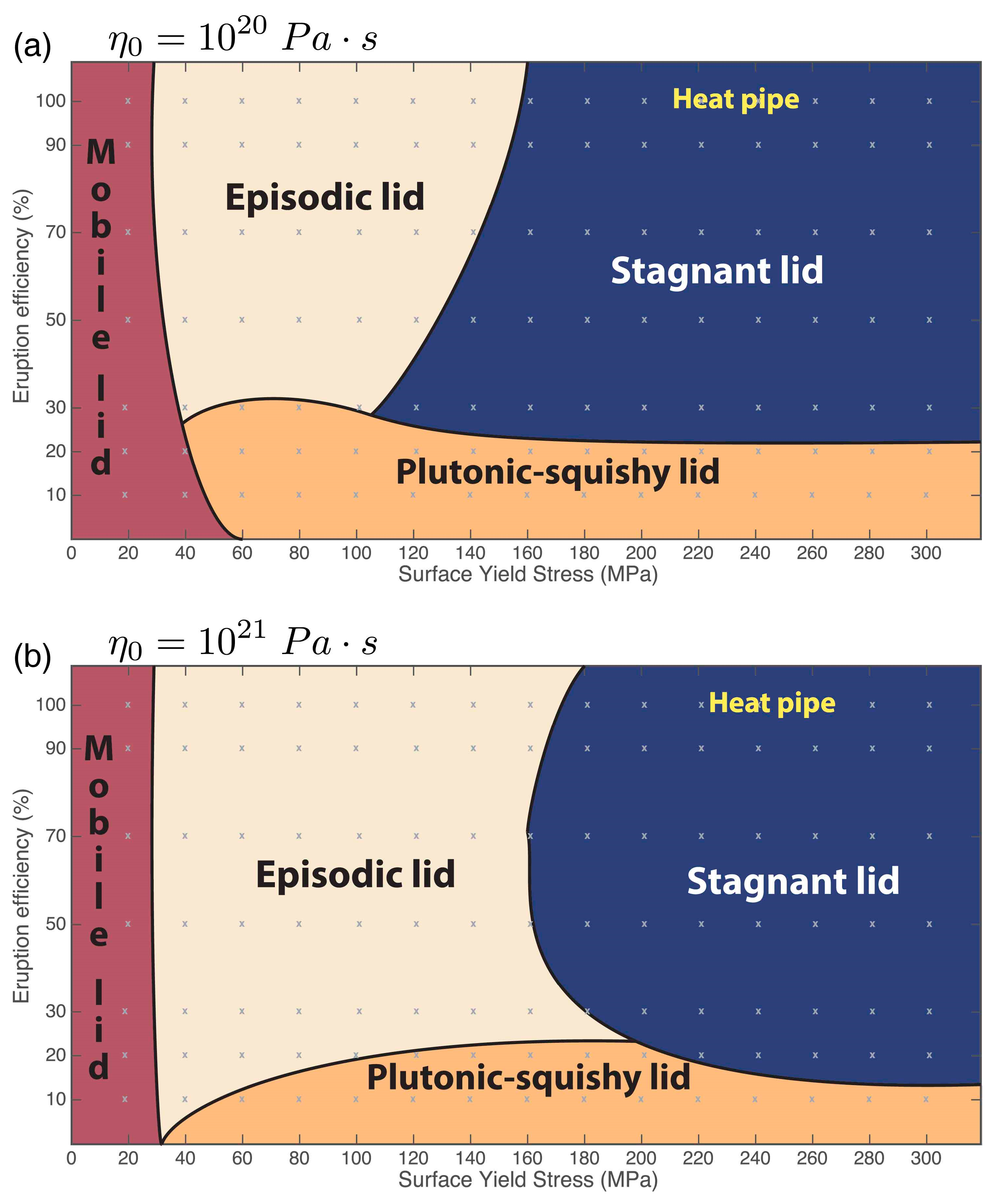
Geodynamic modeling provides a physical framework for evaluating whether proposed tectonic behaviors can emerge under plausible early Earth conditions (Figure 2). By solving the coupled processes of mantle convection, lithospheric deformation, heat transport, melting, and material recycling, numerical geodynamic models have become an essential tool for exploring the dynamical regimes accessible to a thermally evolving planet. Unlike geological observations, which primarily constrain the consequences of ancient tectonic processes, geodynamic models directly investigate the physical mechanisms responsible for generating different tectonic states. Their major contribution has therefore been to establish the dynamical feasibility of proposed tectonic regimes and to identify the physical conditions under which they may occur [26].
One of the earliest motivations for applying geodynamic models to early Earth evolution was to assess whether plate tectonics could operate under Archean conditions [62,63,64]. Because the early Earth possessed a hotter mantle and higher internal heat production, these studies focused on how elevated mantle temperatures influenced mantle viscosity, lithospheric strength, melting behavior, and the mechanical stability of oceanic lithosphere. In particular, the initiation and sustainability of subduction represented a major challenge because hotter oceanic plates were expected to be more buoyant and mechanically weaker than their modern counterparts. Numerical investigations therefore examined whether dense lithosphere could become gravitationally unstable, whether self-sustaining subduction could develop, and under what conditions mobile-lid behavior could emerge [20,65,66]. These studies demonstrated that plate-like deformation is physically possible under certain combinations of mantle temperature, lithospheric thickness, rheological properties, and surface boundary conditions, although the resulting tectonic behavior may differ substantially from modern plate tectonics.
As numerical approaches advanced, the focus of modeling gradually expanded beyond the feasibility of plate tectonics toward exploring the full spectrum of tectonic regimes accessible to the early Earth. Mantle convection simulations demonstrated that different combinations of thermal state and lithospheric strength can generate a broad spectrum of mantle–lithosphere interaction modes, ranging from stagnant-lid convection to episodic overturn, mobile-lid behavior, and transitional regimes with partial lithospheric mobility [61,62,67]. These results challenged earlier assumptions that early Earth evolution followed a simple linear transition from stagnant-lid state toward plate tectonics. Instead, numerical models revealed that multiple tectonic states can exist within realistic parameter spaces and that the dominant tectonic behavior depends strongly on the coupled evolution of mantle convection, lithospheric rheology, and surface processes.
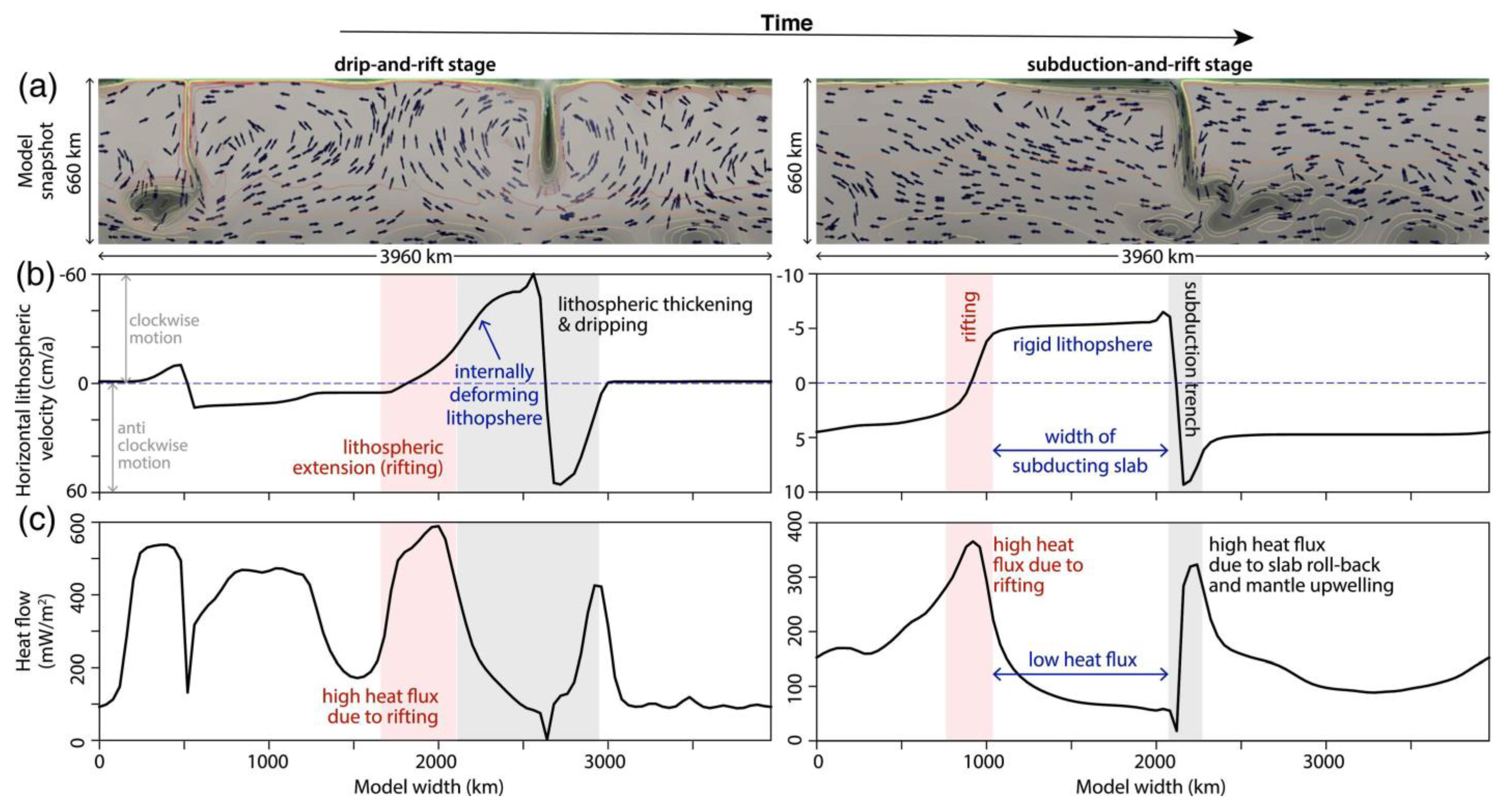
A major contribution of geodynamic modeling has been the identification of the physical parameters that regulate tectonic regime changes. Early models primarily emphasized the role of mantle potential temperature and lithospheric strength, whereas more recent thermomechanical models have incorporated increasingly complex processes, including temperature-dependent viscosity, plastic yielding, strain weakening, hydration, partial melting, grain-size evolution, and compositional buoyancy [26]. These developments have demonstrated that tectonic behavior is not controlled by a single parameter but emerges from interactions among thermal, mechanical, and compositional factors. For example, increasing mantle temperature may promote vigorous convection and enhanced melting, while simultaneously reducing lithospheric strength and affecting the ability of coherent plates to develop [40]. Similarly, variations in yield stress or hydration state can determine whether deformation remains localized or becomes distributed throughout the lithosphere [23,68]. Parameter exploration has further revealed that early Earth tectonics likely occupied a broad dynamical parameter space rather than representing a unique physical state. Numerical experiments have shown that relatively small variations in key parameters, such as mantle temperature, lithospheric thickness, yield strength, and radiogenic heat production, can lead to different tectonic outcomes [69,70,71]. This sensitivity has important implications for interpreting early Earth evolution because geological observations may correspond to multiple dynamically viable solutions. In other words, models have demonstrated that a wide range of tectonic scenarios are physically possible, but the existence of these solutions does not necessarily indicate which regime was preferentially realized during Earth’s evolution. Recent developments in thermomechanical modeling have further shifted attention from individual tectonic states toward tectonic evolution through time. For example, time-dependent simulations have illustrated a transition from a drip-and-rift stage to a subduction-and-rift stage, accompanied by corresponding changes in lithospheric horizontal velocity and surface heat-flow patterns (Figure 3). Rather than treating stagnant-lid, mobile-lid, or transitional regimes as isolated end-member configurations, time-dependent models increasingly investigate how tectonic behavior changes as planetary conditions evolve [10,31,32]. Secular cooling, declining radiogenic heat production, evolving mantle viscosity, and changing lithospheric properties can modify the balance between internal heat generation, mantle convection, and surface heat loss. Such models provide important insights into possible pathways of tectonic transition and highlight the importance of considering tectonic regimes within the broader context of planetary thermal evolution.
Although time-dependent models can reveal possible pathways of tectonic change, their outcomes remain sensitive to assumptions concerning rheology, initial and boundary conditions, and parameter choices. They therefore constrain plausible, rather than unique, histories of early Earth tectonic evolution.

2.3. Beyond Feasibility: Towards a Framework for Tectonic Regime Evolution

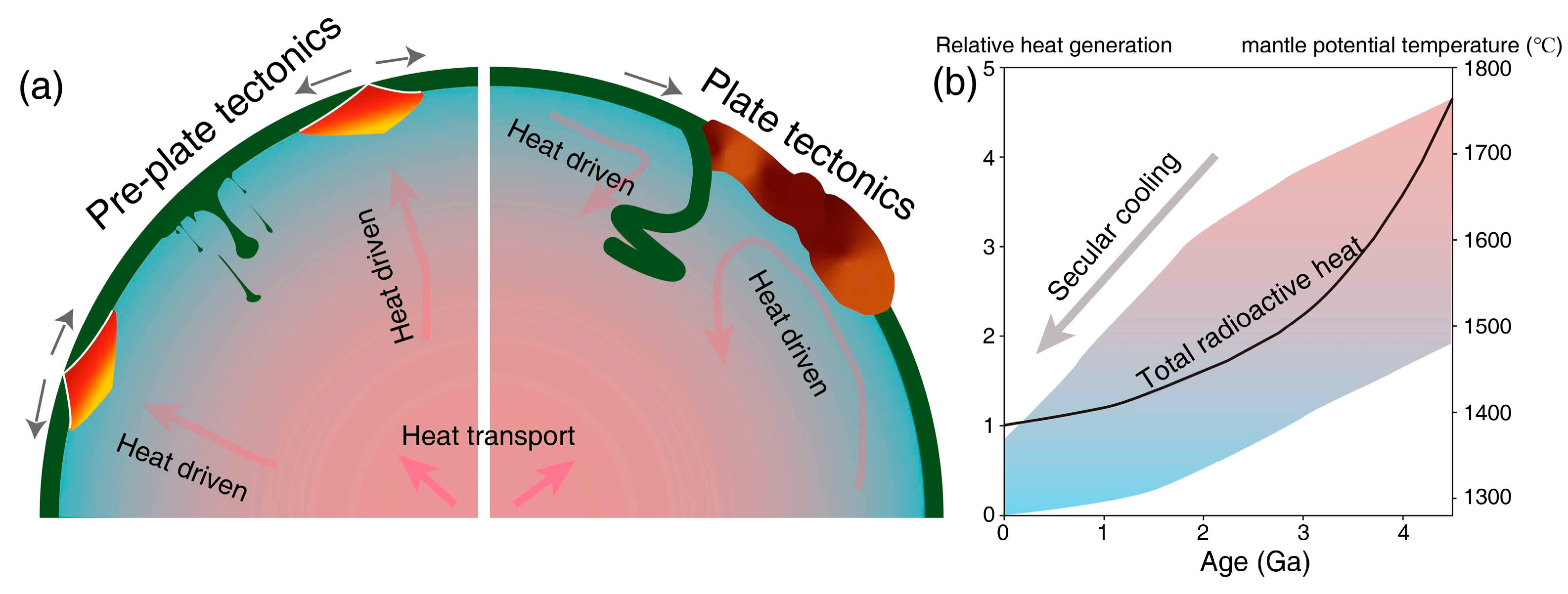
Moving from individual tectonic states to their long-term evolution requires early Earth tectonics to be considered within the context of a continuously evolving planetary system [1]. The Earth has undergone profound secular changes since its formation, including progressive mantle cooling, declining radiogenic heat production, increasing mantle viscosity, evolving lithospheric properties, and changing interactions between the interior and surface systems. These long-term changes have continuously modified the balance between internal heat generation, mantle convection, lithospheric deformation, and surface heat transport. Consequently, tectonic regimes should not be viewed simply as isolated dynamical end-members, but as evolving expressions of the coupled mantle–lithosphere system responding to changing planetary conditions. A framework for understanding tectonic regime evolution therefore requires linking tectonic behavior with the long-term thermal and energetic evolution of the Earth (Figure 4). Because tectonic processes represent a major pathway for transporting and dissipating internal heat, variations in heat transport efficiency may provide an important perspective for interpreting the emergence and transformation of tectonic regimes through time [72,73,74]. Viewing tectonic regimes as evolving modes of planetary heat dissipation offers a potential framework for integrating geological observations, geodynamic modeling, and planetary thermal evolution.

3. Tectonic Regime Evolution from the Perspective of Planetary Heat Dissipation

3.1. The Evolving Thermal State of Earth

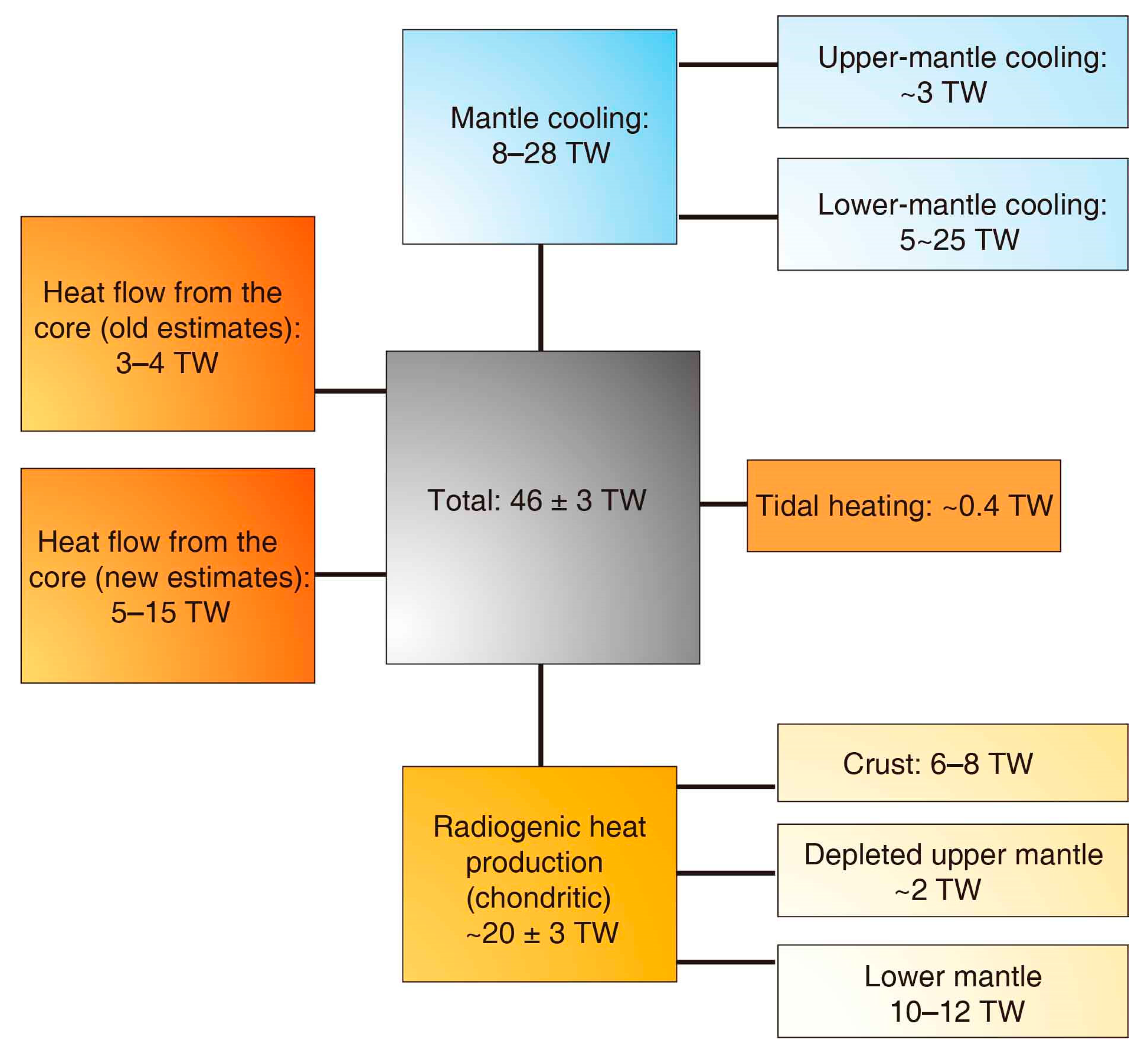
The long-term evolution of Earth is fundamentally governed by the continuous redistribution of internal energy. Heat produced by radioactive decay, together with thermal energy retained from planetary accretion and core formation, and the gradual release of primordial thermal energy cannot remain stored indefinitely within the planetary interior [77,78,79]. Instead, it is continuously transported toward the surface and ultimately dissipated into space (Figure 5). The balance between internal heat generation and planetary heat loss determines the thermal state of the Earth. Rather than being represented by a single parameter, Earth’s thermal state reflects the combined evolution of mantle temperature, radiogenic heat production, secular cooling, surface heat flux, mantle viscosity, melting intensity, and lithospheric strength [80,81]. These quantities are dynamically linked through mantle convection and collectively define the physical environment in which tectonic processes operate [82]. Earth’s mantle thermal evolution should not, however, be viewed as a simple monotonic cooling process. A useful measure of the planetary energy balance is the Urey ratio, defined here as the ratio of total radiogenic heat production to total heat loss [83]. An Urey ratio greater than one favors net warming, whereas a value below one favors net cooling. Petrological estimates suggest that the mantle warmed during the Hadean and much of the Archean and began sustained cooling at approximately 3.0–2.5 Ga [33]. This transition indicates that heat loss became greater relative to internal heat production and may reflect increasingly efficient convective cooling associated with greater lithospheric mobility. Accordingly, mantle temperature estimates should be interpreted together with changes in internal heat production, heat transport efficiency, and lithospheric dynamics when reconstructing the evolution of early Earth tectonic regimes.
The modern Earth represents one stage in this long-term thermal evolution. Present-day surface heat loss is estimated to be approximately 46 ± 3 TW, reflecting contributions from radiogenic heat production, secular cooling of the mantle, and heat released from the core (Figure 5). A substantial fraction of Earth’s primordial thermal energy has already been dissipated, while the decay of long-lived radioactive isotopes has progressively reduced internal heat production through geological time [80]. Over geological time, mantle potential temperature has generally declined, mantle viscosity has increased, melt production has become less extensive, and the lithosphere has evolved into a mechanically stronger outer shell. Under these relatively cool thermal conditions, global plate tectonics efficiently couples mantle convection with lithospheric recycling through seafloor spreading and subduction, allowing heat stored in the deep interior to be transported continuously toward the surface [84]. The present-day tectonic system therefore reflects the thermal state of a mature and continuously cooling planet rather than a universal expression of planetary evolution [85].
Figure 5. Present-day global heat budget of the Earth (redraw from Figure 1 of Lay, et al. [86]). All heat-budget components and numerical estimates shown in the figure follow that source.
Minerals 16 00956 g005
Geological, geochemical, and petrological studies consistently indicate that the early Earth operated under a thermal state markedly different from that of the present-day planet [33,87,88,89,90]. Multiple components of Earth’s thermal budget evolved simultaneously through geological time. Estimates of mantle potential temperature suggest that the Hadean and early Archean mantle was approximately 100–250 °C hotter than today [33], although the absolute values remain debated [34]. Internal heat production was also substantially greater owing to the larger abundances of long-lived heat-producing isotopes; the radiogenic heat production values shown in Figure 4b were back-calculated from present-day values following Artemieva et al. [76]. In addition, a much larger fraction of primordial heat inherited from planetary accretion remained stored within the mantle, while secular cooling contributed more strongly to Earth’s total heat budget than at present [80]. Collectively, these factors produced a planetary interior characterized by higher temperatures, larger thermal gradients, greater internal heat fluxes, and a substantially larger amount of energy requiring transport from the deep interior toward the surface. Although uncertainties remain in the absolute magnitude of each parameter, there is broad agreement that the early Earth represented a thermally more energetic planetary system than the present-day Earth. The significance of these secular changes extends beyond the evolution of individual thermal parameters. The cooling of Earth represents a fundamental reorganization of the planetary heat transport system, in which variations in mantle temperature, internal heat production, viscosity, and lithospheric strength collectively influence both the amount of energy requiring removal and the mechanisms available for transporting that energy. As thermal conditions evolved, the efficiency of mantle heat transport, the relative contributions of different cooling processes, and the mechanical coupling between the mantle and lithosphere were progressively modified. Therefore, secular cooling should not be viewed simply as a monotonic decrease in mantle temperature, but rather as a coupled evolution of Earth’s internal energy budget, heat transport efficiency, and tectonic behavior.
From the perspective of planetary heat transfer, the Earth possesses only a limited number of mechanisms capable of transporting heat from the deep interior toward the surface [91]. Thermal conduction transfers energy through temperature gradients without requiring material motion and represents the most fundamental, but also the least efficient, mode of heat transport over planetary length scales. Solid-state mantle convection greatly enhances heat transfer by continuously circulating mantle material and transporting thermal energy through mass motion. Partial melting and magma migration provide an additional mechanism by rapidly extracting heat from depth and releasing it into the shallow lithosphere through magmatic emplacement and volcanic activity. Although these processes have operated simultaneously throughout Earth’s history, their relative contributions are neither constant nor independent. Instead, they vary systematically with mantle temperature, internal heat production, rheological structure, melting intensity, and lithospheric properties, all of which evolve as the planet cools.
An important consequence follows from this physical framework. Planetary cooling depends on the balance between internal heat production and the efficiency of heat transport to the surface. For a given internal heat budget, inefficient heat transport allows thermal energy to accumulate within the mantle, whereas more efficient transport promotes rapid planetary cooling [80,82]. Consequently, Earth’s thermal evolution is governed by the combined effects of heat production and heat transport rather than by either process alone. Because internal heat production declines progressively through radioactive decay while the efficiency of heat transport may vary through time, the thermal evolution of Earth reflects the continuous interaction between heat sources and heat removal [79]. This distinction is important for the early Earth. Elevated mantle temperatures and enhanced radiogenic heating [33,76] resulted in a larger internal heat reservoir and a greater requirement for efficient heat transport from the mantle to the surface. Whether the Earth could maintain thermal equilibrium therefore depended on the capacity of its internal heat transport system to dissipate this energy. Understanding the evolution of the early Earth therefore requires consideration of both the planetary heat budget and the efficiency of heat transport from the mantle to the surface. This perspective shifts attention from Earth’s thermal state itself to the physical mechanisms governing how internal heat is transported and ultimately dissipated.

3.2. Heat Transport Architectures of Tectonic Regimes

Although tectonic regimes are commonly distinguished according to their geological characteristics, deformation styles, or lithospheric structures, they can equally be interpreted according to the fundamental mechanisms through which planetary heat is transported. From this perspective, each tectonic regime represents a distinct organization of conductive, convective, magmatic, and lithospheric heat transport. Their differences therefore extend beyond styles of lithospheric deformation and instead reflect contrasting architectures for redistributing and dissipating Earth’s internal heat [92]. Planetary heat ultimately escapes to space through thermal radiation. Before reaching the surface, however, heat must first be transferred from the deep interior through only a limited number of physical mechanisms. Thermal conduction transports heat across temperature gradients without material motion and dominates where a mechanically coherent lithosphere forms the principal thermal boundary layer. Solid-state mantle convection redistributes heat through the circulation of mantle material and greatly enhances heat transfer relative to conduction alone. Magmatic transport provides an additional pathway by rapidly transferring thermal energy through melt extraction, intrusion, and volcanism. Lithospheric recycling further contributes to planetary cooling by returning cold surface material into the mantle while establishing efficient pathways for upward heat transport. Although these mechanisms have coexisted throughout much of Earth’s history, their relative contributions differ substantially among tectonic regimes and evolve continuously as Earth’s thermal state changes. The relative contributions of these heat transport mechanisms are also influenced by lithospheric rheology. Grain size reduction and damage promote strain localization and the persistence of inherited weak zones, whereas grain growth and healing tend to restore lithospheric strength [24]. The balance between these processes may therefore regulate changes among coherent, partially mobile, and fully mobile lithospheric regimes.
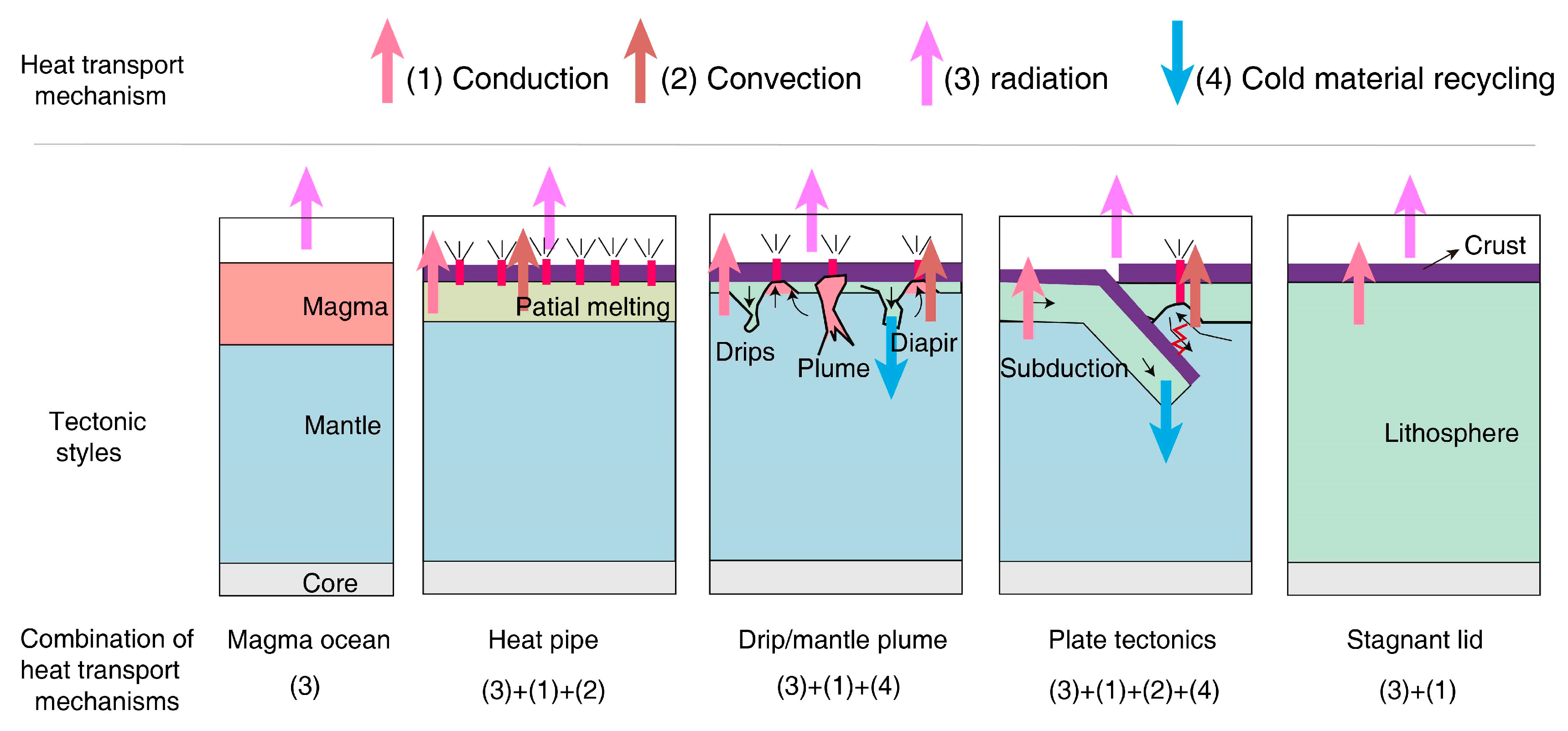
From this heat transfer perspective, tectonic regimes can be compared within a multidimensional continuum defined by the relative contributions of these transport mechanisms (Figure 6). As planetary conditions evolve, regimes may shift within this continuum through different pathways rather than across sharply defined boundaries.
The magma ocean stage represents the radiative end-member of planetary evolution, during which extremely high surface temperatures allowed thermal radiation to dominate planetary heat loss [93]. Following the solidification of the primordial crust, the establishment of a rigid lithosphere fundamentally altered the mode of planetary cooling. Heat could no longer be released directly from a molten surface and instead became increasingly limited by conductive transfer through the outer thermal boundary layer [94]. This transition marked the emergence of the lithosphere-controlled heat transport system on Earth, laying the foundation for stagnant-lid behavior. Within a stagnant-lid regime, conductive heat transfer across a thick and mechanically strong lithosphere provides the principal pathway for removing internal heat [95]. Mantle convection remains active beneath the lithosphere, but the absence of efficient lithospheric recycling restricts direct communication between the deep mantle and the surface. As a consequence, the lithosphere acts as an effective thermal blanket, reducing surface heat flux and slowing planetary cooling [96]. Localized volcanism and plume activity may provide additional pathways for heat release, but the overall efficiency of planetary heat dissipation remains largely constrained by conductive transfer across the stagnant lid [97].
Where conduction through a rigid lithosphere cannot efficiently accommodate the planetary heat budget, magmatic heat transport may become increasingly important. Heat-pipe tectonics represents the extreme end-member of this process, in which continuous volcanic emplacement and crustal resurfacing efficiently transfer thermal energy from the mantle to the surface through ascending melts [11,98]. Because ascending magmas efficiently advect thermal energy from the mantle to the surface and additionally transfer heat during melting and crystallization, such systems can substantially enhance planetary cooling compared with conduction alone.
Plutonic squishy lid regimes represent a mixed thermal architecture in which repeated magma intrusion transfers heat into and mechanically weakens the lithosphere without requiring continuous volcanic resurfacing [61]. These regimes therefore combine conductive and magmatic heat transport in varying proportions, reflecting a gradual shift from lithosphere-limited to melt-assisted cooling.
Other proposed early Earth tectonic styles, including plume-dominated deformation, vertical tectonics, crustal dripping, sagduction, and related transitional regimes [99,100,101], may occupy intermediate positions within this heat transport continuum. Despite their diverse geological expressions, these regimes share a common physical characteristic: heat redistribution is achieved through the coupled effects of mantle convection, localized magmatism, and gravitationally driven lithospheric recycling, rather than through globally organized lateral plate motion. Rising mantle plumes facilitate upward heat transfer from the deep mantle, whereas gravitational foundering and lithospheric dripping transport relatively cold and dense crustal materials downward, promoting internal thermal redistribution. Thus, both vertical mass exchange and localized melt transport contribute to planetary cooling before the establishment of efficient plate tectonic recycling. From a heat transfer perspective, these transitional tectonic regimes represent mixed thermal architectures in which conductive, convective, and magmatic processes coexist with different relative contributions.
Modern plate tectonics occupies the convective–recycling end-member of the continuum. Unlike stagnant-lid or plume-dominated systems, mobile lithospheric plates establish a globally connected network of mantle convection, seafloor spreading, and subduction. Heat is transported upward by mantle upwelling beneath spreading centers, while cold oceanic lithosphere returns thermal boundary layers to the mantle through subduction [102]. This coupling between mantle convection and lithospheric recycling enhances communication between Earth’s deep interior and surface, enabling sustained and efficient planetary cooling over geological time. Rather than relying primarily on conduction or episodic magmatism, plate tectonics integrates conductive, convective, magmatic, and recycling processes into a highly connected heat transport system [3].
Viewed collectively, these tectonic regimes should not be regarded simply as alternative styles of lithospheric deformation. Instead, they represent distinct organizations of planetary heat transport that operate under different thermal conditions. Their principal differences lie in the relative roles of conductive heat transfer, solid-state convection, magmatic transport, and lithospheric recycling in redistributing Earth’s internal energy. This thermodynamic perspective provides a common physical framework for comparing tectonic regimes that have traditionally been discussed independently. It also suggests that understanding long-term tectonic regime evolution ultimately requires evaluating how the organization of planetary heat transport changes as Earth’s thermal state evolves through geological time.

4. Future Perspectives

4.1. Toward a Quantitative Understanding of Planetary Heat Transport

The perspective developed in this review suggests that early Earth tectonic regimes can be interpreted as different organizations of planetary heat transport operating under evolving thermal conditions. This conceptual shift naturally changes the focus of future research. Geological observations have established the diversity of tectonic processes recorded in the early Earth, while geodynamic models have demonstrated that many of these tectonic regimes can arise under physically plausible conditions. The next challenge is to determine how these fundamentally different tectonic regimes can be evaluated within a common physical framework that directly links tectonic behavior with Earth’s long-term thermal evolution.
Progress toward this goal requires a transition from qualitative descriptions of tectonic regimes to quantitative characterization of planetary heat transport. Existing classifications distinguish tectonic regimes according to their deformation styles, lithospheric structures, or underlying dynamical mechanisms [103]. These criteria have been highly successful in documenting the diversity of early Earth tectonics and identifying the physical conditions under which different tectonic behaviors may develop [26,30]. Nevertheless, comparisons among tectonic regimes remain largely descriptive because no common physical metric exists for evaluating their capacity to transport and dissipate internal heat. Consequently, tectonic regimes that differ substantially in geological expression and dynamical behavior cannot yet be compared directly in terms of their contributions to planetary cooling.
A quantitative framework should therefore focus on the efficiency and organization of planetary heat transport. Such a framework would evaluate how thermal energy generated within the deep interior is transferred toward the surface through different combinations of conductive heat transfer, solid-state mantle convection, magmatic transport, and lithospheric recycling. The relative importance of these transport mechanisms varies continuously with mantle temperature, internal heat production, rheological structure, melting intensity, and lithospheric properties [92,104]. Quantifying their combined contribution under evolving thermal conditions would establish a common basis for comparing tectonic regimes that have traditionally been treated as independent dynamical solutions.
Establishing such a framework would extend the role of numerical modeling beyond reproducing individual tectonic behaviors. Quantitative evaluation of planetary heat transport would allow different tectonic regimes to be assessed according to their thermal consequences for planetary evolution, providing direct insight into how efficiently each regime removes internal heat under a given thermal state. This perspective also creates opportunities to investigate how the relative performance of different tectonic regimes changes as Earth cools through time, thereby connecting tectonic evolution with the broader evolution of the planetary thermal system [32]. Ultimately, a unified thermodynamic framework has the potential to transform early Earth tectonics from a discipline centered on identifying tectonic regimes into one that quantitatively evaluates their role in Earth’s long-term thermal evolution.

4.2. Geological Constraints on Planetary Heat Transport

A quantitative description of planetary heat transport ultimately requires validation against the geological record. Numerical models provide a physically consistent framework for investigating heat transport under controlled thermal conditions, but the resulting thermal evolution must ultimately be evaluated against observations preserved within rocks. Geological records therefore represent more than evidence for the occurrence of particular tectonic regimes; they constitute the direct archive from which the thermal evolution of the early Earth can be reconstructed. Establishing a direct connection between model predictions and geological observations is therefore essential for evaluating whether a thermodynamic interpretation provides a realistic description of Earth’s tectonic evolution [105].
Among the various geological observables, temperature provides the most direct link between planetary heat transport and the geological record. The efficiency and organization of heat transport determine the thermal structure of the lithosphere and mantle, influencing lithospheric geotherms, mantle melting conditions, crustal thermal gradients, metamorphic evolution, and the stability of mineral assemblages [92,104]. These thermal characteristics are preserved in a variety of geological archives, particularly through mineral assemblages, mineral equilibria, metamorphic reactions, and magmatic records that record the thermal evolution of Earth’s lithosphere and mantle. Metamorphic pressure–temperature–time (P–T–t) paths, together with mineral assemblages and phase-equilibrium constraints, provide quantitative estimates of lithospheric thermal states during tectonic evolution [38,42,106,107], while magmatic systems record mantle melting conditions and crustal thermal histories [108]. At larger spatial and temporal scales, secular variations in geothermal gradients reconstructed from metamorphic and igneous records, together with mineral thermobarometric constraints, provide independent evidence for the long-term evolution of Earth’s thermal state [106,109]. Collectively, these petrological, mineralogical, and geochemical observations preserve complementary records of how Earth’s thermal structure evolved through geological time. At present, however, no individual geological or petrological observation can uniquely distinguish an intermediate heat transport architecture from an end-member regime. Similar thermal, metamorphic, magmatic, and crustal recycling signatures may be generated by different tectonic processes, and their interpretation is further complicated by the incomplete preservation and later modification of the Archean geological record. Distinguishing among these architectures will therefore require multiple observational constraints to be evaluated together with quantitative predictions from geodynamic models.
This perspective also changes the way numerical models can be evaluated. Comparisons have traditionally emphasized whether simulations reproduce characteristic tectonic geometries, deformation styles, or lithospheric structures [110]. A thermodynamic framework places greater emphasis on the thermal consequences generated by different modes of planetary heat transport [83,111]. Numerical models capable of predicting lithospheric temperatures, geothermal gradients, melting conditions, and the evolution of mineral stability fields can therefore be compared directly with mineralogical and petrological reconstructions of ancient thermal structure. Such comparisons provide an opportunity to evaluate whether different heat transport architectures generate thermal states that are consistent with independent geological observations, thereby establishing a stronger physical basis for assessing competing models of early Earth tectonic evolution.
Viewed from this perspective, geological observations and numerical modeling become complementary approaches for reconstructing the same long-term planetary process. Numerical models predict how internal heat is redistributed through time, whereas geological records preserve the thermal consequences of that redistribution. Integrating these two approaches establishes a direct pathway for testing thermodynamic interpretations of tectonic evolution and progressively refining quantitative models of planetary heat transport [26]. As increasingly robust reconstructions of ancient thermal structure become available from metamorphic mineral assemblages, mineral chemistry, phase equilibria, and igneous records, this integrated framework offers new opportunities to evaluate how Earth’s changing thermal state influenced the emergence, persistence, and transformation of tectonic regimes throughout geological history.

5. Concluding Remarks

From the perspective developed in this review, tectonic regimes can be viewed as different organizations of planetary heat transport. Conduction, mantle convection, magmatic transport, and lithospheric recycling contribute to planetary heat redistribution through different physical pathways, and their relative importance changes with mantle temperature, internal heat production, rheological structure, and lithospheric properties. Tectonic evolution can therefore be understood in terms of the changing organization of Earth’s heat transport system through geological time.
A major challenge for future studies is to determine whether differences in planetary heat transport can be quantified sufficiently to explain these changes in tectonic behavior. Numerical modeling provides a means to compare the thermal consequences of different tectonic regimes under controlled planetary conditions, while geological records provide independent constraints on the thermal structures produced through time. Establishing quantitative links between heat transport, thermal evolution, and geological observations may therefore provide a new route toward testing competing models of early Earth tectonics.

Funding

This research received no external funding.

Data Availability Statement

No new data were created or analyzed in this study. Data sharing is not applicable to this article.

Acknowledgments

I am grateful to the Guest Editors for the invitation and encouragement to prepare this review. The idea for this work was inspired by discussions during the “Archean Tectonic Styles: Constraints and Inferences” symposium, organized by the Center for Global Tectonics, China University of Geosciences (Wuhan), in May 2025. The author also thanks the academic editor and three anonymous reviewers for their constructive comments.

Conflicts of Interest

The author declares no conflicts of interest.

References

  1. Cawood, P.A.; Chowdhury, P.; Mulder, J.A.; Hawkesworth, C.J.; Capitanio, F.A.; Gunawardana, P.M.; Nebel, O. Secular evolution of continents and the Earth system. Rev. Geophys. 2022, 60, e2022RG000789. [Google Scholar] [CrossRef] [Scilit]
  2. Kirkland, C.L.; Johnson, T.E.; Brown, M.; Smithies, H.; Drabon, N.; O’Neill, C. The evolution of Earth’s early continental crust. Nat. Rev. Earth Environ. 2025, 6, 612–625. [Google Scholar] [CrossRef] [Scilit]
  3. Zheng, Y. Plate tectonics in the Archean: Observations versus interpretations. Sci. China Earth Sci. 2024, 67, 1–30. [Google Scholar] [CrossRef] [Scilit]
  4. Zheng, Y.-F. Plate tectonics in the twenty-first century. Sci. China Earth Sci. 2023, 66, 1–40. [Google Scholar] [CrossRef] [Scilit]
  5. Brown, M.; Johnson, T.; Gardiner, N.J. Plate Tectonics and the Archean Earth. Annu. Rev. Earth Planet. Sci. 2020, 48, 291–320. [Google Scholar] [CrossRef] [Scilit]
  6. Debaille, V.; O’Neill, C.; Brandon, A.D.; Haenecour, P.; Yin, Q.-Z.; Mattielli, N.; Treiman, A.H. Stagnant-lid tectonics in early Earth revealed by 142Nd variations in late Archean rocks. Earth Planet. Sci. Lett. 2013, 373, 83–92. [Google Scholar] [CrossRef] [Scilit]
  7. Zhao, D.; Cawood, P.A.; Teng, F.-Z.; Zhao, G.; Xia, X.-P.; Sun, M.; Wang, X. A two-stage mantle plume-sagduction origin of Archean continental crust revealed by water and oxygen isotopes of TTGs. Sci. Adv. 2025, 11, eadr9513. [Google Scholar] [CrossRef] [Scilit] [PubMed]
  8. Ge, R.; Wilde, S.A.; Zhu, W.; Wang, X. Earth’s early continental crust formed from wet and oxidizing arc magmas. Nature 2023, 623, 334–339. [Google Scholar] [CrossRef] [Scilit] [PubMed]
  9. Johnson, T.E.; Kirkland, C.L.; Lu, Y.; Smithies, R.H.; Brown, M.; Hartnady, M.I.H. Giant impacts and the origin and evolution of continents. Nature 2022, 608, 330–335. [Google Scholar] [CrossRef] [Scilit] [PubMed]
  10. Lyu, T.; Ballmer, M.D.; Li, Z.-H.; Lee, M.H.; Yan, J.; Wu, B.; Zhao, G. Dissecting the puzzle of tectonic lid regimes in terrestrial planets. Nat. Commun. 2025, 16, 10037. [Google Scholar] [CrossRef] [Scilit] [PubMed]
  11. Moore, W.B.; Webb, A.A.G. Heat-pipe Earth. Nature 2013, 501, 501–505. [Google Scholar] [CrossRef] [Scilit] [PubMed]
  12. Windley, B.F.; Kusky, T.; Polat, A. Onset of plate tectonics by the Eoarchean. Precambrian Res. 2021, 352, 105980. [Google Scholar] [CrossRef] [Scilit]
  13. Brown, M.; Pearce, J.A.; Johnson, T.E. Is plate tectonics a post-Archean phenomenon? A petrological perspective. J. Geol. Soc. 2024, 181, jgs2024-091. [Google Scholar] [CrossRef] [Scilit]
  14. Chen, G.; Kusky, T.; Luo, L.; Li, Q.; Cheng, Q. Hadean tectonics: Insights from machine learning. Geology 2023, 51, 718–722. [Google Scholar] [CrossRef] [Scilit]
  15. Deng, H.; Polat, A.; Kusky, T.; Sotiriou, P.; Chen, C.; Wang, S. An oceanic arc origin for Archean anorthosites revealed by calcium and oxygen isotopes. Earth Planet. Sci. Lett. 2026, 685, 120036. [Google Scholar] [CrossRef] [Scilit]
  16. Houchin, S.K.; Tissot, F.L.H.; Ibañez-Mejia, M.; Bell, E.A.; Harrison, T.M.; Newville, M.; Lanzirotti, A. Oxidized Hadean magmas and Archean mobile-lid tectonics revealed by Jack Hills zircon. Proc. Natl. Acad. Sci. USA 2026, 123, e2525466123. [Google Scholar] [CrossRef] [Scilit] [PubMed]
  17. Huang, M.; Jiao, S.; Johnson, T.E.; Clark, C.; Yu, J.; Huang, G.; Guo, J. Eclogite-facies metamorphism of continental crust at the Mesoarchean-to-Neoarchean transition. Geology 2026, 54, 269–374. [Google Scholar] [CrossRef] [Scilit]
  18. Korenaga, J.; Spencer, C.J. An evaluation of continental growth and early Earth tectonics: Observations and models. In Treatise on Geochemistry, 3rd ed.; Anbar, A., Weis, D., Eds.; Elsevier: Amsterdam, The Netherlands, 2025; Volume 2, pp. 699–727. [Google Scholar]
  19. Vezinet, A.; Chugunov, A.V.; Sobolev, A.V.; Jain, C.; Sobolev, S.V.; Batanova, V.G.; Asafov, E.V.; Koshlyakova, A.N.; Arndt, N.T.; Danyushevsky, L.V.; et al. Growth of continental crust and lithosphere subduction in the Hadean revealed by geochemistry and geodynamics. Nat. Commun. 2025, 16, 3850. [Google Scholar] [CrossRef] [Scilit] [PubMed]
  20. Gerya, T.V.; Stern, R.J.; Baes, M.; Sobolev, S.V.; Whattam, S.A. Plate tectonics on the Earth triggered by plume-induced subduction initiation. Nature 2015, 527, 221–225. [Google Scholar] [CrossRef] [Scilit] [PubMed]
  21. Capitanio, F.A.; Nebel, O.; Cawood, P.A. Thermochemical lithosphere differentiation and the origin of cratonic mantle. Nature 2020, 588, 89–94. [Google Scholar] [CrossRef] [Scilit] [PubMed]
  22. Johnson, T.E.; O’Neill, C.; Turner, S.; Kirkland, C.L. Impact heating and the hidden Hadean. Science 2026, 392, 1408–1412. [Google Scholar] [CrossRef] [Scilit] [PubMed]
  23. Regenauer-Lieb, K.; Yuen, D.A.; Branlund, J. The Initiation of Subduction: Criticality by Addition of Water? Science 2001, 294, 578–580. [Google Scholar] [CrossRef] [Scilit] [PubMed]
  24. Bercovici, D.; Ricard, Y. Plate tectonics, damage and inheritance. Nature 2014, 508, 513–516. [Google Scholar] [CrossRef] [Scilit] [PubMed]
  25. Capitanio, F.A.; Nebel, O.; Moyen, J.-F.; Cawood, P.A. Craton Formation in Early Earth Mantle Convection Regimes. J. Geophys. Res. Solid Earth 2022, 127, e2021JB023911. [Google Scholar] [CrossRef] [Scilit]
  26. Kuang, J.; Kusky, T.; Morra, G. Numerical geodynamic models of the early Earth tectonics: Framework, limitations, and perspectives on future directions. Precambrian Res. 2026, 445, 108229. [Google Scholar] [CrossRef] [Scilit]
  27. Guo, M.; Korenaga, J. The combined Hf and Nd isotope evolution of the depleted mantle requires Hadean continental formation. Sci. Adv. 2023, 9, eade2711. [Google Scholar] [CrossRef] [Scilit] [PubMed]
  28. Zhang, Z.-J.; Kusky, T.; Chen, G.-X.; Cheng, Q.-M. Earth’s Deep-Time Geodynamic Evolution Recorded by Hafnium Isotope Perturbations. J. Geophys. Res. Solid Earth 2025, 130, e2025JB031150. [Google Scholar] [CrossRef] [Scilit]
  29. Li, Y.; Yang, T.; Yu, C.; Wu, Q.; Yin, C.; Qian, J.; Wang, X.; Huang, C.; Zhang, J. Thermal mechanisms driving Neoarchean ultrahigh-temperature metamorphism in a sagduction regime: Numerical constraints from the North China Craton. Precambrian Res. 2026, 444, 108187. [Google Scholar] [CrossRef] [Scilit]
  30. Stern, R.J. The evolution of plate tectonics. Philos. Trans. R. Soc. A Math. Phys. Eng. Sci. 2018, 376, 20170406. [Google Scholar] [CrossRef] [Scilit] [PubMed]
  31. Asad, M.A.; Lau, H.C.P. Coupled fates of Earth’s mantle and core: Early sluggish-lid tectonics and a long-lived geodynamo. Sci. Adv. 2024, 10, eadp1991. [Google Scholar] [CrossRef] [Scilit] [PubMed]
  32. Gunawardana, P.M.; Chowdhury, P.; Morra, G.; Cawood, P.A. Correlating mantle cooling with tectonic transitions on early Earth. Geology 2024, 52, 230–234. [Google Scholar] [CrossRef] [Scilit]
  33. Herzberg, C.; Condie, K.; Korenaga, J. Thermal history of the Earth and its petrological expression. Earth Planet. Sci. Lett. 2010, 292, 79–88. [Google Scholar] [CrossRef] [Scilit]
  34. Korenaga, J.; Herzberg, C. Thermal history of Earth’s mantle: Implications for Earth system evolution and lessons from recent studies. Earth Planet. Sci. Lett. 2026, 683, 119958. [Google Scholar] [CrossRef] [Scilit]
  35. Palin, R.M.; Santosh, M.; Cao, W.; Li, S.-S.; Hernández-Uribe, D.; Parsons, A. Secular change and the onset of plate tectonics on Earth. Earth-Sci. Rev. 2020, 207, 103172. [Google Scholar] [CrossRef] [Scilit]
  36. Valley, J.W.; Blum, T.B.; Kitajima, K.; Shimizu, K.; Spicuzza, M.J.; Gonzalez, J.P.; Kita, N.T.; Bauer, A.M.; Sobolev, S.V.; Jain, C.; et al. Contemporaneous mobile- and stagnant-lid tectonics on the Hadean Earth. Nature 2026, 650, 636–641. [Google Scholar] [CrossRef] [Scilit] [PubMed]
  37. Bell, E.A.; Boehnke, P.; Barboni, M.; Harrison, T.M. Tracking chemical alteration in magmatic zircon using rare earth element abundances. Chem. Geol. 2019, 510, 56–71. [Google Scholar] [CrossRef] [Scilit]
  38. Droubi, O.K.; Bauer, A.M.; Bonamici, C.; Nachlas, W.O.; Garber, J.M.; Tappa, M.J.; Reimink, J.R. Eoarchean–Paleoproterozoic Tectonothermal History of the Acasta Gneiss Complex Constrained by Titanite and Apatite Petrochronology. Geochem. Geophys. Geosystems 2025, 26, e2025GC012294. [Google Scholar] [CrossRef] [Scilit]
  39. Korenaga, J. Initiation and Evolution of Plate Tectonics on Earth: Theories and Observations. Annu. Rev. Earth Planet. Sci. 2013, 41, 117–151. [Google Scholar] [CrossRef] [Scilit]
  40. van Hunen, J.; Moyen, J.-F. Archean Subduction: Fact or Fiction? Annu. Rev. Earth Planet. Sci. 2012, 40, 195–219. [Google Scholar] [CrossRef] [Scilit]
  41. Kusky, T.M.; Wang, L. Growth of continental crust in intra-oceanic and continental margin arc systems: Analogs for Archean systems. Sci. China Earth Sci. 2022, 65, 1615–1645. [Google Scholar] [CrossRef] [Scilit]
  42. Wang, W.; Cawood, P.A.; Liu, S.; Lu, D.; Liang, X.; Yang, W.; Yao, J.; Gao, L.; Sun, G. First-order control of basaltic sources on the diversity of Archean TTG magmatism. Chem. Geol. 2026, 709, 123376. [Google Scholar] [CrossRef] [Scilit]
  43. Tamblyn, R.; Hermann, J.; Hasterok, D.; Sossi, P.; Pettke, T.; Chatterjee, S. Hydrated komatiites as a source of water for TTG formation in the Archean. Earth Planet. Sci. Lett. 2023, 603, 117982. [Google Scholar] [CrossRef] [Scilit]
  44. Huang, G.; Palin, R.; Wang, D.; Guo, J. Open-system fractional melting of Archean basalts: Implications for tonalite–trondhjemite–granodiorite (TTG) magma genesis. Contrib. Mineral. Petrol. 2020, 175, 102. [Google Scholar] [CrossRef] [Scilit]
  45. Turner, S.; Wilde, S.; Wörner, G.; Schaefer, B.; Lai, Y.-J. An andesitic source for Jack Hills zircon supports onset of plate tectonics in the Hadean. Nat. Commun. 2020, 11, 1241. [Google Scholar] [CrossRef] [Scilit] [PubMed]
  46. Mei, Q.-F.; Yang, J.-H.; Wang, Y.-F.; Wang, H.; Peng, P. Tungsten isotopic constraints on homogenization of the Archean silicate Earth: Implications for the transition of tectonic regimes. Geochim. Cosmochim. Acta 2020, 278, 51–64. [Google Scholar] [CrossRef] [Scilit]
  47. Gamaleldien, H.; Wu, L.-G.; Olierook, H.K.H.; Kirkland, C.L.; Kirscher, U.; Li, Z.-X.; Johnson, T.E.; Makin, S.; Li, Q.-L.; Jiang, Q.; et al. Onset of the Earth’s hydrological cycle four billion years ago or earlier. Nat. Geosci. 2024, 17, 560–565. [Google Scholar] [CrossRef] [Scilit]
  48. Harrison, T.M. Hadean Earth; Springer International Publishing: Cham, Switzerland, 2020. [Google Scholar]
  49. Huang, B.; Johnson, T.E.; Wilde, S.A.; Polat, A.; Fu, D.; Kusky, T. Coexisting divergent and convergent plate boundary assemblages indicate plate tectonics in the Neoarchean. Nat. Commun. 2022, 13, 6450. [Google Scholar] [CrossRef] [Scilit] [PubMed]
  50. Huang, B.; Kusky, T.; Fu, D. Neoarchean accretionary and collisional tectonics in the southern North China Craton: Implications for crustal growth and plate tectonic styles. Precambrian Res. 2025, 420, 107730. [Google Scholar] [CrossRef] [Scilit]
  51. Huang, B.; Liu, M.; Kusky, T.M.; Johnson, T.E.; Wilde, S.A.; Fu, D.; Deng, H.; Qian, Q. Changes in orogenic style and surface environment recorded in Paleoproterozoic foreland successions. Nat. Commun. 2023, 14, 7997. [Google Scholar] [CrossRef] [Scilit] [PubMed]
  52. Brenner, A.R.; Fu, R.R.; Evans, D.A.D.; Smirnov, A.V.; Trubko, R.; Rose, I.R. Paleomagnetic evidence for modern-like plate motion velocities at 3.2 Ga. Sci. Adv. 2020, 6, eaaz8670. [Google Scholar] [CrossRef] [Scilit] [PubMed]
  53. Brenner, A.R.; Fu, R.R.; Foley, B.J.; Lourenço, D.L.; Palma-Gomez, J.; Gong, Z.; Steele, S.C.; Li, J.; Flannery, D.T.; Brown, A.J.; et al. Paleomagnetic detection of relative plate motions and an infrequently reversing core dynamo at 3.5 Ga. Science 2026, 391, 1278–1282. [Google Scholar] [CrossRef] [Scilit] [PubMed]
  54. Smithies, R.H.; Lu, Y.; Kirkland, C.L.; Johnson, T.E.; Mole, D.R.; Champion, D.C.; Martin, L.; Jeon, H.; Wingate, M.T.D.; Johnson, S.P. Oxygen isotopes trace the origins of Earth’s earliest continental crust. Nature 2021, 592, 70–75. [Google Scholar] [CrossRef] [Scilit] [PubMed]
  55. Smit, M.A.; Musiyachenko, K.A.; Goumans, J. Archaean continental crust formed from mafic cumulates. Nat. Commun. 2024, 15, 692. [Google Scholar] [CrossRef] [Scilit] [PubMed]
  56. Lewis, J.A.; Schwarzenbach, E.M.; Liesegang, M.; Schwarz, A.; Strauss, H.; Münker, C.; Rosing, M.T.; Whitehouse, M.J.; Jeon, H.; Hoffmann, J.E. Evidence for Eoarchean crustal recycling from in-situ sulfur and lead isotope analyses of peridotite enclaves (southern West Greenland). Geosci. Front. 2026, 102352. [Google Scholar] [CrossRef] [Scilit]
  57. Zhao, G.; Zhang, G. Origin of continents. Acta Geol. Sin. 2021, 95, 1–19. [Google Scholar] [CrossRef]
  58. Liu, T.; Wei, C.; Duan, Z. Neoarchean metamorphic evolution of the Luanxian supracrustal sequence from East Hebei, North China Craton: Implications for a sagduction process. GSA Bull. 2025, 137, 5213–5232. [Google Scholar] [CrossRef] [Scilit]
  59. Bédard, J.H. Stagnant lids and mantle overturns: Implications for Archaean tectonics, magmagenesis, crustal growth, mantle evolution, and the start of plate tectonics. Geosci. Front. 2018, 9, 19–49. [Google Scholar] [CrossRef] [Scilit]
  60. Kuang, J.; Morra, G.; Yuen, D.A.; Kusky, T.; Jiang, S.; Yao, H.; Qi, S. Metamorphic constraints on Archean tectonics. Precambrian Res. 2023, 397, 107195. [Google Scholar] [CrossRef] [Scilit]
  61. Lourenço, D.L.; Rozel, A.B.; Ballmer, M.D.; Tackley, P.J. Plutonic-Squishy Lid: A New Global Tectonic Regime Generated by Intrusive Magmatism on Earth-Like Planets. Geochem. Geophys. Geosystems 2020, 21, e2019GC008756. [Google Scholar] [CrossRef] [Scilit]
  62. O’Neill, C.; Lenardic, A.; Moresi, L.; Torsvik, T.H.; Lee, C.-T.A. Episodic Precambrian subduction. Earth Planet. Sci. Lett. 2007, 262, 552–562. [Google Scholar] [CrossRef] [Scilit]
  63. van Hunen, J.; van den Berg, A.P. Plate tectonics on the early Earth: Limitations imposed by strength and buoyancy of subducted lithosphere. Lithos 2008, 103, 217–235. [Google Scholar] [CrossRef] [Scilit]
  64. Davies, G.F. On the emergence of plate tectonics. Geology 1992, 20, 963–966. [Google Scholar] [CrossRef]
  65. Stern, R.J.; Gerya, T. Subduction initiation in nature and models: A review. Tectonophysics 2018, 746, 173–198. [Google Scholar] [CrossRef] [Scilit]
  66. Zhang, S.; Li, Y.; Leng, W.; Gurnis, M. Photoferrotrophic Bacteria Initiated Plate Tectonics in the Neoarchean. Geophys. Res. Lett. 2023, 50, e2023GL103553. [Google Scholar] [CrossRef] [Scilit]
  67. Foley, B.J.; Bercovici, D.; Elkins-Tanton, L.T. Initiation of plate tectonics from post-magma ocean thermochemical convection. J. Geophys. Res. Solid Earth 2014, 119, 8538–8561. [Google Scholar] [CrossRef] [Scilit]
  68. Moresi, L.; Solomatov, V. Mantle convection with a brittle lithosphere: Thoughts on the global tectonic styles of the Earth and Venus. Geophys. J. Int. 1998, 133, 669–682. [Google Scholar] [CrossRef] [Scilit]
  69. Noack, L.; Breuer, D. Plate tectonics on rocky exoplanets: Influence of initial conditions and mantle rheology. Planet. Space Sci. 2014, 98, 41–49. [Google Scholar] [CrossRef] [Scilit]
  70. Korenaga, J. Pitfalls in modeling mantle convection with internal heat production. J. Geophys. Res. Solid Earth 2017, 122, 4064–4085. [Google Scholar] [CrossRef] [Scilit]
  71. Weller, O.M.; Copley, A.; Miller, W.G.R.; Palin, R.M.; Dyck, B. The relationship between mantle potential temperature and oceanic lithosphere buoyancy. Earth Planet. Sci. Lett. 2019, 518, 86–99. [Google Scholar] [CrossRef] [Scilit]
  72. Korenaga, J. Archean Geodynamics and the Thermal Evolution of Earth. In Archean Geodynamics and Environments; American Geophysical Union (AGU): Washington, DC, USA, 2006; pp. 7–32. [Google Scholar]
  73. Furlong, K.P.; Chapman, D.S. Heat Flow, Heat Generation, and the Thermal State of the Lithosphere. Annu. Rev. Earth Planet. Sci. 2013, 41, 385–410. [Google Scholar] [CrossRef] [Scilit]
  74. Sleep, N.H. Evolution of the mode of convection within terrestrial planets. J. Geophys. Res. Planets 2000, 105, 17563–17578. [Google Scholar] [CrossRef] [Scilit]
  75. Cawood, P.A.; Stüeken, E.E.; Chowdhury, P.; Hawkesworth, C.J.; Mulder, J.A. Evolution of Terrestrial Planetary Bodies and Implications for Habitability. Rev. Geophys. 2025, 63, e2025RG000902. [Google Scholar] [CrossRef] [Scilit]
  76. Artemieva, I.M.; Thybo, H.; Jakobsen, K.; Sørensen, N.K.; Nielsen, L.S.K. Heat production in granitic rocks: Global analysis based on a new data compilation GRANITE2017. Earth-Sci. Rev. 2017, 172, 1–26. [Google Scholar] [CrossRef] [Scilit]
  77. Hanks, T.C.; Anderson, D.L. The early thermal history of the earth. Phys. Earth Planet. Inter. 1969, 2, 19–29. [Google Scholar] [CrossRef] [Scilit]
  78. Gubbins, D.; Masters, T.G.; Jacobs, J.A. Thermal evolution of the Earth’s core. Geophys. J. Int. 1979, 59, 57–99. [Google Scholar] [CrossRef] [Scilit]
  79. Vacquier, V. A theory of the origin of the Earth’s internal heat. Tectonophysics 1998, 291, 1–7. [Google Scholar] [CrossRef] [Scilit]
  80. Jaupart, C.; Labrosse, S.; Lucazeau, F.; Mareschal, J.-C. Temperatures, Heat, and Energy in the Mantle of the Earth. In Treatise on Geophysics, 2nd ed.; Elsevier: Amsterdam, The Netherlands, 2015; pp. 223–270. [Google Scholar]
  81. Christensen, U.R. Thermal evolution models for the Earth. J. Geophys. Res. Solid Earth 1985, 90, 2995–3007. [Google Scholar] [CrossRef] [Scilit]
  82. Turcotte, D.; Schubert, G. Geodynamics, 3rd ed.; Cambridge University Press: Cambridge, UK, 2014; p. 636. [Google Scholar]
  83. Korenaga, J. Urey ratio and the structure and evolution of Earth’s mantle. Rev. Geophys. 2008, 46, RG2007. [Google Scholar] [CrossRef] [Scilit]
  84. Bercovici, D. The generation of plate tectonics from mantle convection. Earth Planet. Sci. Lett. 2003, 205, 107–121. [Google Scholar] [CrossRef] [Scilit]
  85. O’Neill, C.; Lenardic, A.; Weller, M.; Moresi, L.; Quenette, S.; Zhang, S. A window for plate tectonics in terrestrial planet evolution? Phys. Earth Planet. Inter. 2016, 255, 80–92. [Google Scholar] [CrossRef] [Scilit]
  86. Lay, T.; Hernlund, J.; Buffett, B.A. Core–mantle boundary heat flow. Nat. Geosci. 2008, 1, 25–32. [Google Scholar] [CrossRef] [Scilit]
  87. Condie, K.C.; Aster, R.C.; van Hunen, J. A great thermal divergence in the mantle beginning 2.5 Ga: Geochemical constraints from greenstone basalts and komatiites. Geosci. Front. 2016, 7, 543–553. [Google Scholar] [CrossRef] [Scilit]
  88. Ganne, J.; Feng, X. Primary magmas and mantle temperatures through time. Geochem. Geophys. Geosyst. 2017, 18, 872–888. [Google Scholar] [CrossRef] [Scilit]
  89. Keller, B.; Schoene, B. Plate tectonics and continental basaltic geochemistry throughout Earth history. Earth Planet. Sci. Lett. 2018, 481, 290–304. [Google Scholar] [CrossRef] [Scilit]
  90. Aulbach, S.; Arndt, N.T. Eclogites as palaeodynamic archives: Evidence for warm (not hot) and depleted (but heterogeneous) Archaean ambient mantle. Earth Planet. Sci. Lett. 2019, 505, 162–172. [Google Scholar] [CrossRef] [Scilit]
  91. He, T.; Zhang, Q.; Liu, Y. The cooling models of Earth’s early mantle. Acta Geochim. 2023, 42, 803–816. [Google Scholar] [CrossRef] [Scilit]
  92. Weller, M.B.; Lenardic, A. On the evolution of terrestrial planets: Bi-stability, stochastic effects, and the non-uniqueness of tectonic states. Geosci. Front. 2018, 9, 91–102. [Google Scholar] [CrossRef] [Scilit]
  93. Abe, Y. Thermal and chemical evolution of the terrestrial magma ocean. Phys. Earth Planet. Inter. 1997, 100, 27–39. [Google Scholar] [CrossRef] [Scilit]
  94. Solomatov, V.S.; Moresi, L.-N. Stagnant lid convection on Venus. J. Geophys. Res. Planets 1996, 101, 4737–4753. [Google Scholar] [CrossRef] [Scilit]
  95. Dumoulin, C.; Doin, M.-P.; Fleitout, L. Heat transport in stagnant lid convection with temperature- and pressure-dependent Newtonian or non-Newtonian rheology. J. Geophys. Res. Solid Earth 1999, 104, 12759–12777. [Google Scholar] [CrossRef] [Scilit]
  96. Michaut, C.; Davaille, A.; Labrosse, S. Formation and Evolution of Planetary Stagnant Lids and Crusts. Annu. Rev. Fluid Mech. 2026, 58, 1–28. [Google Scholar] [CrossRef] [Scilit]
  97. Grigné, C. Stagnant-lid convection: Comparison of viscosity laws and uniform scaling approach for temperature and heat flux prediction. Geophys. J. Int. 2023, 235, 2410–2429. [Google Scholar] [CrossRef] [Scilit]
  98. Kankanamge, D.G.J.; Moore, W.B. Heat transport in the Hadean mantle: From heat pipes to plates. Geophys. Res. Lett. 2016, 43, 3208–3214. [Google Scholar] [CrossRef] [Scilit]
  99. van Kranendonk, M.J.; Smithies, R.H.; Hickman, A.H.; Champion, D.C. Review: Secular tectonic evolution of Archean continental crust: Interplay between horizontal and vertical processes in the formation of the Pilbara Craton, Australia. Terra Nova 2007, 19, 1–38. [Google Scholar] [CrossRef] [Scilit]
  100. Nebel, O.; Capitanio, F.A.; Moyen, J.-F.; Weinberg, R.F.; Clos, F.; Nebel-Jacobsen, Y.J.; Cawood, P.A. When crust comes of age: On the chemical evolution of Archaean, felsic continental crust by crustal drip tectonics. Philos. Trans. R. Soc. A Math. Phys. Eng. Sci. 2018, 376, 20180103. [Google Scholar] [CrossRef] [Scilit] [PubMed]
  101. Roman, A.; Arndt, N. Differentiated Archean oceanic crust: Its thermal structure, mechanical stability and a test of the sagduction hypothesis. Geochim. Cosmochim. Acta 2020, 278, 65–77. [Google Scholar] [CrossRef] [Scilit]
  102. Coltice, N.; Husson, L.; Faccenna, C.; Arnould, M. What drives tectonic plates? Sci. Adv. 2019, 5, eaax4295. [Google Scholar] [CrossRef] [Scilit] [PubMed]
  103. Wang, L.; Wang, R.; Ning, W.; Kusky, T. North China Archean dome-and-basin structures: Arc plutons, superimposed folds, or sagduction? Geology 2025, 53, 503–508. [Google Scholar] [CrossRef] [Scilit]
  104. Foley, B.J. The dependence of planetary tectonics on mantle thermal state: Applications to early Earth evolution. Philos. Trans. R. Soc. A Math. Phys. Eng. Sci. 2018, 376, 20170409. [Google Scholar] [CrossRef] [Scilit] [PubMed]
  105. Dasgupta, A.; Bhowmik, S.K.; Das, A.; Bhandari, A.; Ravindra Kumar, G.R. Paired metamorphism in peel back tectonics at the Archaean-Proterozoic boundary: New insights into Early Earth Plate tectonics from the Western Dharwar Craton, South India. Earth Planet. Sci. Lett. 2023, 622, 118414. [Google Scholar] [CrossRef] [Scilit]
  106. Brown, M.; Johnson, T. Secular change in metamorphism and the onset of global plate tectonics. Am. Mineral. 2018, 103, 181–196. [Google Scholar] [CrossRef] [Scilit]
  107. Holder, R.M.; Viete, D.R.; Brown, M.; Johnson, T.E. Metamorphism and the evolution of plate tectonics. Nature 2019, 572, 378–381. [Google Scholar] [CrossRef] [Scilit] [PubMed]
  108. Korhonen, F.J.; Kelsey, D.E.; Ivanic, T.J.; Blereau, E.R.; Smithies, R.H.; De Paoli, M.C.; Fielding, I.O.H. Radiogenic heat production provides a thermal threshold for Archean cratonization process. Geology 2024, 53, 222–226. [Google Scholar] [CrossRef] [Scilit]
  109. Sun, G.; Liu, S.; Cawood, P.A.; Tang, M.; van Hunen, J.; Gao, L.; Hu, Y.; Hu, F. Thermal state and evolving geodynamic regimes of the Meso- to Neoarchean North China Craton. Nat. Commun. 2021, 12, 3888. [Google Scholar] [CrossRef] [Scilit] [PubMed]
  110. Fischer, R.; Gerya, T. Early Earth plume-lid tectonics: A high-resolution 3D numerical modelling approach. J. Geodyn. 2016, 100, 198–214. [Google Scholar] [CrossRef] [Scilit]
  111. Labrosse, S.; Jaupart, C. Thermal evolution of the Earth: Secular changes and fluctuations of plate characteristics. Earth Planet. Sci. Lett. 2007, 260, 465–481. [Google Scholar] [CrossRef] [Scilit]
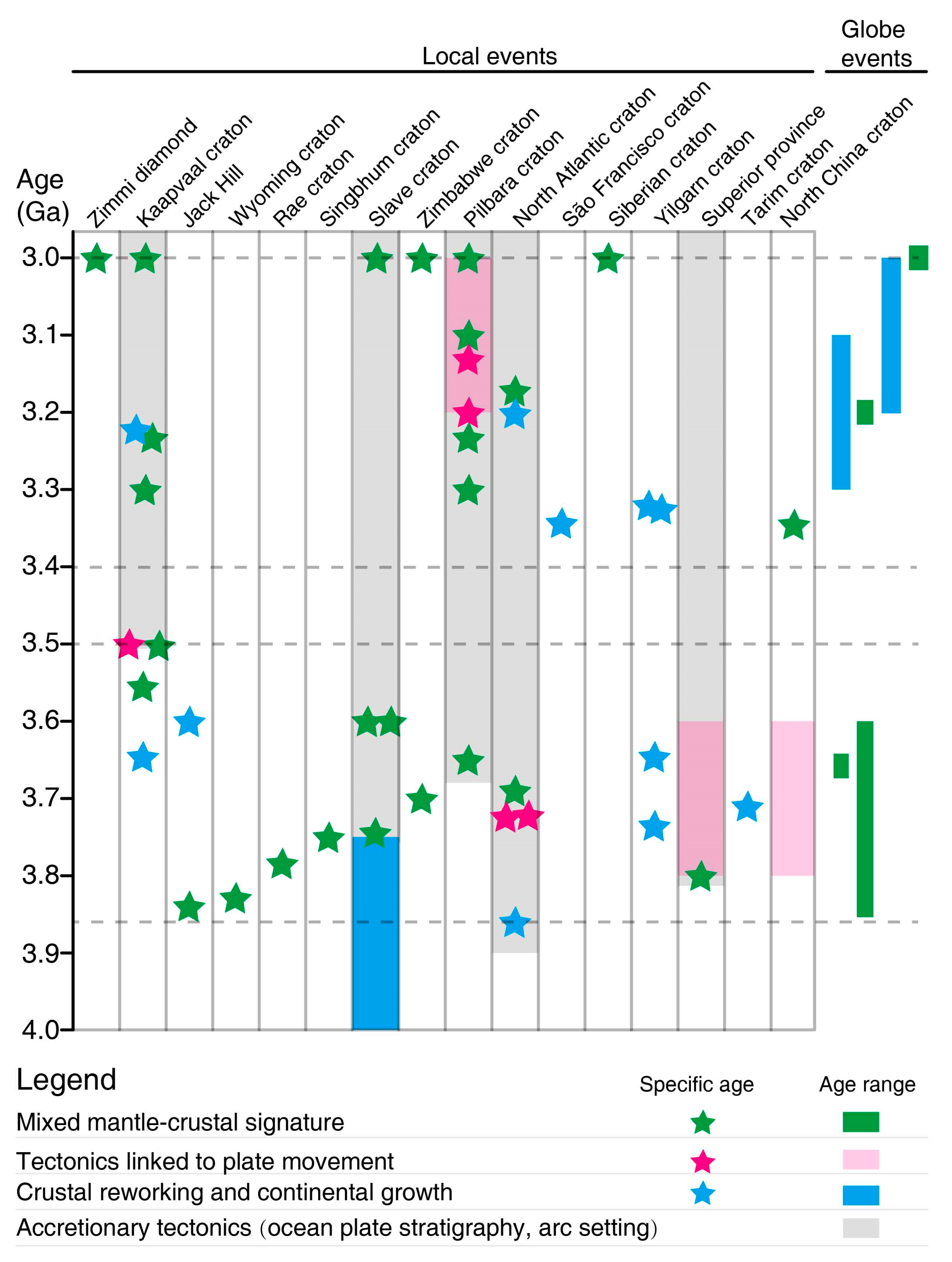
Figure 1. Representative geological records used to infer early Earth tectonic styles. Geological observations spanning approximately 4.0–3.0 Ga are organized into two intervals (3.8–3.5 Ga and 3.4–3.0 Ga). Regional geological records from individual cratons are presented on the left, whereas globally recognized geological observations are summarized on the right (from Kuang, et al. [60]).
Minerals 16 00956 g001
Figure 2. Representative tectonic regime diagram showing the occurrence of different tectonic regimes within geodynamically explored parameter space. Numerical simulations demonstrate that variations in key physical parameters can produce stagnant-lid, episodic, mobile-lid, plutonic-squichy lid, and heat pipe, indicating that multiple tectonic regimes are dynamically feasible under plausible early Earth conditions. (a) Tectonic regimes obtained for a reference viscosity of 1020 Pa·s. (b) Tectonic regimes obtained for a reference viscosity of 1021 Pa·s. (from Lourenço, et al. [61]).
Minerals 16 00956 g002
Figure 3. Contrasting lithospheric dynamics and surface heat-flow patterns during the modeled drip-and-rift and subduction-and-rift stages. (a) Model snapshots illustrating the lithospheric and mantle structures of the two tectonic stages. (b,c) Profiles of lithospheric horizontal lithospheric velocity and surface heat flow across the model domain. Adapted from Gunawardana, Chowdhury, Morra and Cawood [32].
Minerals 16 00956 g003
Figure 4. Secular evolution of Earth’s thermal state. (a) Conceptual comparison of the thermodynamic characteristics of pre-plate tectonic and plate-tectonic regimes, illustrating their contrasting modes of heat transport and heat dissipation (modified from Cawood, et al. [75]). The arrows indicate the direction of motion. (b) Long-term evolution of mantle potential temperature and radiogenic heat production through geological time. The shaded envelope represents the range of mantle potential temperature estimates compiled by Palin, Santosh, Cao, Li, Hernández-Uribe and Parsons [35], whereas radiogenic heat production is calculated following Artemieva, et al. [76].
Minerals 16 00956 g004
Figure 6. Planetary heat transport under representative tectonic regimes. The figure illustrates how different tectonic regimes redistribute internal heat through varying contributions of thermal conduction, mantle convection, magmatic transport, and lithospheric recycling. Their arrangement represents a comparative heat-transport continuum rather than a prescribed evolutionary sequence or fixed regime boundaries. The tectonic styles are modified from Stern [30].
Minerals 16 00956 g006
Disclaimer/Publisher’s Note: The statements, opinions and data contained in all publications are solely those of the individual author(s) and contributor(s) and not of MDPI and/or the editor(s). MDPI and/or the editor(s) disclaim responsibility for any injury to people or property resulting from any ideas, methods, instructions or products referred to in the content.