
Article

A Dual-Energy X-Ray Differential Response Fusion Method for Three-Class Copper Ore Classification
1
School of Artificial Intelligence and Information Engineering, East China University of Technology, Nanchang 330013, China
2
Jiangxi Engineering Technology Research Center of Nuclear Geoscience Data Science and System, East China University of Technology, Nanchang 330013, China
3
Jiangxi Engineering Laboratory on Radioactive Geoscience and Big Data Technology, East China University of Technology, Nanchang 330013, China
*
Author to whom correspondence should be addressed.
Minerals 2026, 16(9), 869; https://doi.org/10.3390/min16090869
Submission received: 7 July 2026 / Revised: 6 August 2026 / Accepted: 10 August 2026 / Published: 25 August 2026

Abstract

Preconcentration before grinding is important for reducing unnecessary downstream processing and improving ore utilization. Dual-energy X-ray transmission imaging provides paired responses of ore particles under different energy levels, which can be used for particle-level classification. However, adjacent categories, such as waste rock and low-grade copper ore, may exhibit similar transmission appearances, and discriminative cues may be distributed across both local attenuation details and global transmission patterns. In this study, we propose a dual-energy X-ray image classification method, named the Difference-Guided Cross-Level Feature Fusion Network (DGCF-Net), for three-class copper ore classification. Waste rock and copper ore samples from the Dexing Copper Mine were used to construct a three-class dual-energy X-ray image dataset. DGCF-Net incorporates response-difference cues from paired low- and high-energy images and combines local and global feature representations for ore-particle classification. Experimental results on the constructed dataset show that the proposed method achieved an Overall Accuracy of 0.9570, a Macro-F1 of 0.9664, and an AUC of 0.9953, with 3.6424 M parameters. These results indicate that the proposed method provides effective classification performance on the current dataset, particularly for categories with relatively similar image responses, while its broader practical applicability requires further validation under more realistic operating conditions.

1. Introduction

Copper is an important base metal widely used in electric power, electronics, equipment manufacturing, and new energy industries [1]. With the gradual depletion of high-grade and easily beneficiated copper ore resources, copper resource development has increasingly shifted toward low-grade and compositionally complex ores [2]. If such ores enter crushing, grinding, and flotation circuits without prior separation, a large amount of low-value or barren material will be processed in subsequent stages, thereby increasing energy consumption, operating costs, and equipment load [3]. Therefore, preconcentration and early rejection of waste rock before grinding are important for reducing ineffective downstream processing, improving feed quality, and enhancing resource utilization efficiency in ore processing.
X-ray transmission (XRT) technology has the advantages of strong penetration capability, non-destructive detection, and convenient online deployment, and has become one of the important sensing approaches for ore preconcentration and ore sorting [4]. Compared with single-energy XRT, dual-energy XRT exploits the differences in attenuation responses under high- and low-energy channels and may provide richer discriminative information, showing potential in ore sorting and material recognition tasks [5]. Previous studies have shown that XRT and related imaging techniques provide a useful basis for the preconcentration of copper ores and other nonferrous ores, and can offer complementary information for identifying internal compositional differences in ore particles [6]. However, it should be noted that the transmission responses observed in dual-energy X-ray images are not determined solely by ore grade, but may also be jointly affected by particle thickness, density distribution, internal structure, and mineral occurrence state [7]. Therefore, for the three-class task involving waste rock, low-grade copper ore, and high-grade copper ore, dual-energy XRT images may provide potential discriminative cues, though their effectiveness for grade-related classification still requires further validation under controlled conditions [8].
In recent years, ore image recognition methods have gradually evolved from shallow modeling based on handcrafted features to deep learning-driven automatic feature learning. Early studies mainly relied on extracting image features such as grayscale, texture, and shape, combined with shallow classifiers to recognize and separate materials such as coal and gangue [9,10]. With the development of ore sorting technologies, XRT and related imaging methods have been increasingly explored in ore preconcentration, especially showing promising application prospects in nonferrous metal mines [11,12]. Meanwhile, review studies have indicated that intelligent ore sorting technologies and equipment systems are continuously advancing, providing an important foundation for sensor-based ore recognition and grading [13]. For copper ores and related minerals, Jin et al. evaluated the feasibility of preconcentration of crushed copper sulfide ore using X-ray computed tomography, indicating that X-ray-based analysis of the internal structure of ore particles can support ore preconcentration research [14]. Furthermore, recent studies have begun to combine dual-energy X-ray imaging with deep learning methods for copper ore recognition tasks. Yu et al. proposed a dual-energy X-ray-based multi-channel image fusion method to improve copper ore separation performance [15]; Guo et al. constructed an efficient multimodal learning framework for low-grade copper ore classification, enhancing the joint representation capability of dual-energy images [16]; and Huang et al. employed a SwinV2-EfficientNetV2 model to improve the accuracy of copper ore grade classification [17]. Overall, existing studies suggest that ore X-ray image recognition, especially research oriented to copper ore preconcentration and classification, has established a certain foundation. However, further efforts are still needed in the explicit modeling of dual-energy difference information and the collaborative representation of local attenuation details and global transmission patterns.
However, for the dual-energy XRT-based three-class recognition task involving waste rock, low-grade copper ore, and high-grade copper ore, existing methods still leave room for improvement in discriminative representation. On the one hand, the dual-energy response differences between high- and low-energy images that may be useful for category discrimination are often not explicitly emphasized. Most existing studies adopt multi-channel fusion or multimodal joint modeling strategies, which may limit their ability to specifically capture discriminative differences in high- and low-energy responses. On the other hand, the discriminative cues of easily confused categories are usually distributed across both local attenuation details and global transmission structures, while single-level feature modeling or fixed fusion strategies may not sufficiently exploit cross-level complementary information. To address these issues, a Difference-Guided Cross-Level Feature Fusion Network (DGCF-Net) is proposed in this study. By explicitly enhancing dual-energy response differences and adaptively integrating cross-level discriminative features, the proposed network aims to more effectively characterize the key cues involved in this three-class recognition task. The main contributions are summarized as follows.
  • A task-oriented dataset and experimental benchmark for dual-energy XRT-based three-class recognition of copper ore were established. For the present three-class recognition setting based on dual-energy XRT images, the samples were divided into three categories, namely waste rock, low-grade copper ore, and high-grade copper ore, providing a data foundation and task support for grade-related recognition research based on dual-energy XRT images.
  • A Difference-Guided Cross-Level Feature Fusion Network (DGCF-Net) was proposed for dual-energy XRT-based three-class recognition of copper ore. To address the insufficient explicit modeling of high- and low-energy response differences and the inadequate fusion of cross-level discriminative cues, a difference-guided representation and cross-level feature fusion strategy was designed to enhance the expression of key discriminative information.
  • Comprehensive experiments were conducted to validate the effectiveness of the proposed method. Comparative experiments, ablation studies, and visualization analyses on the self-constructed dataset dual-energy XRT copper ore image dataset show that the proposed method can improve the recognition performance of the three-class task while maintaining relatively low model complexity.

2. Dataset and Methods

2.1. Dual-Energy X-Ray Image Dataset for Copper Ore

The Dexing Copper Mine is a well-known porphyry copper deposit in eastern China, characterized by large ore reserves and relatively low average ore grade [18]. To improve the representativeness of the collected samples with respect to the actual ore characteristics of the mining area, samples were collected from 30 sampling points with different geological features within the Dexing Copper Mine. These sampling points covered different mineralization degrees, lithological characteristics, and copper-grade ranges. This sampling strategy was intended to improve dataset-level representativeness under the current study setting. The collected samples were then crushed into ore particles, and their original particulate morphology was preserved during image acquisition.
The ore samples used in this study were grouped into three categories according to coarse grade levels, namely waste rock, low-grade copper ore, and high-grade copper ore. This grouping was established through a combined consideration of X-ray fluorescence (XRF) results and the field-based grade judgment of experienced mine personnel, and was used to construct a three-class image dataset. It should be noted that this grouping served only as a coarse sample-level labeling scheme and did not correspond to precise particle-level quantitative chemical analysis or quantitative grade measurement.
The image samples used in this study were acquired by dual-energy X-ray transmission imaging of ore particles, and each sample consisted of spatially corresponding low-energy and high-energy images of the same particle. The image acquisition voltage was 160 kV, and the tube current was 550 μA. Since multiple ore particles were present in the initially acquired image pairs, a threshold-based object extraction method was adopted and combined with morphological processing and connected-component analysis to achieve the segmentation and pairing of individual ore-particle samples from the initial dual-energy images [19,20,21].
Figure 1 shows the low-energy X-ray images, high-energy X-ray images, and response difference maps of the three sample categories. It can be observed that different categories exhibit certain differences in transmitted grayscale distributions and response difference patterns, while adjacent categories, such as waste rock and low-grade copper ore, may still present relatively similar attenuation responses in single-energy images.
The dataset was split into training, validation, and test sets at a ratio of 7:2:1. The training set was used for model parameter learning, the validation set was used for hyperparameter tuning and model selection, and the test set was used for final performance evaluation. Because each sample consisted of one low-energy image and one high-energy image, each entry in the table represents a paired dual-energy image sample. The dataset partitioning is presented in Table 1.
Owing to differences in particle size and morphology among waste rock and copper ore samples, the acquired raw dual-energy X-ray images had different spatial resolutions. To satisfy the network input requirements, the low- and high-energy images were uniformly resized to 224 × 224 pixels before being input into the model, followed by tensor conversion and normalization [22]. After size normalization, data augmentation was performed during training, including random cropping, horizontal and vertical flipping, random rotation, Gaussian blurring, and brightness/contrast perturbation [23].
For paired low- and high-energy images of the same ore particle, the same random parameters were applied to both images for all geometric transformations and intensity perturbations. Through this procedure, the one-to-one spatial correspondence between dual-energy images was preserved, thereby avoiding misalignment of corresponding particle regions caused by inconsistent cropping, rotation, or flipping. Dual-energy difference information was therefore regarded as an important cue for grade identification [24].

2.2. Difference-Guided Cross-Level Feature Fusion Network

2.2.1. Overall Network Architecture

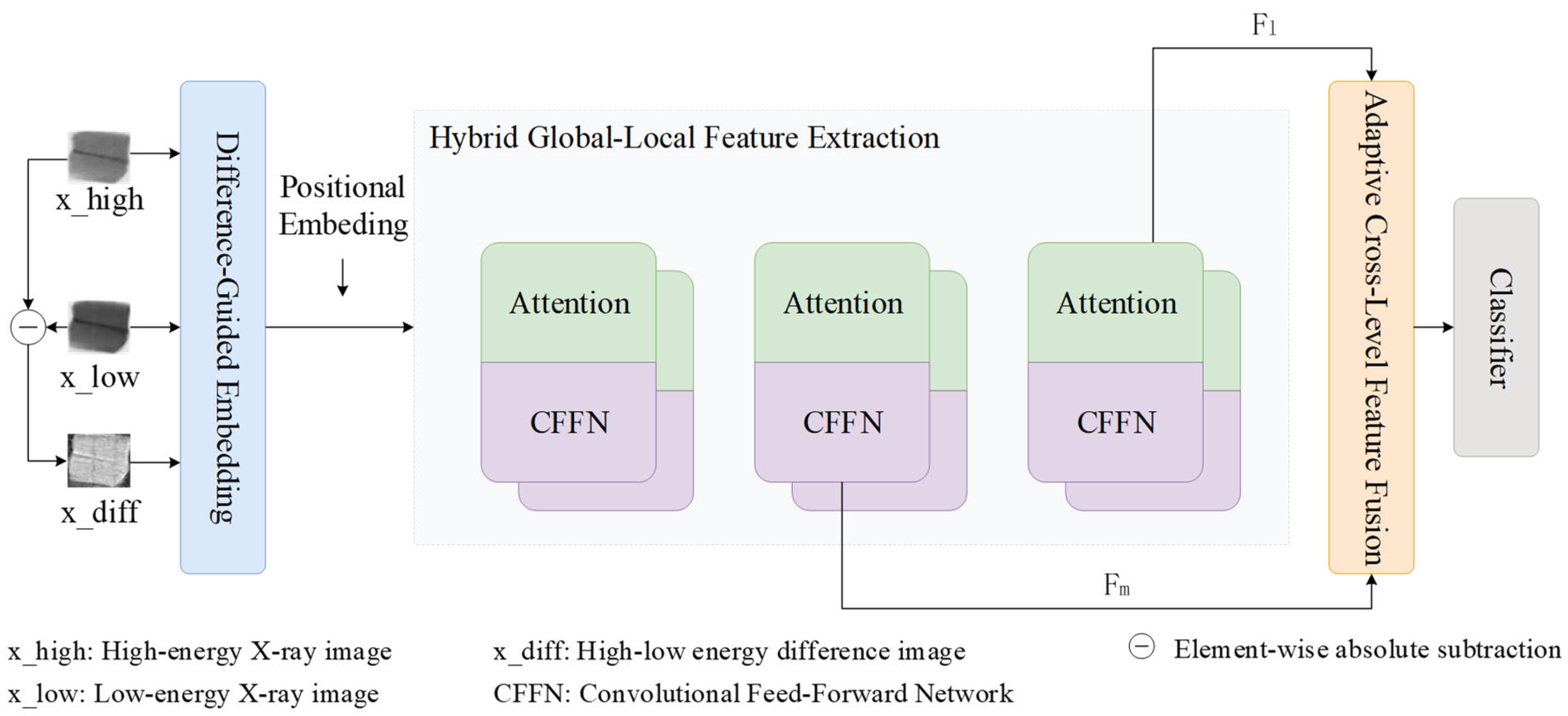
DGCF-Net was developed for the three-class copper ore classification task based on dual-energy X-ray images. Its overall architecture is shown in Figure 2. Paired low- and high-energy X-ray images of the same ore particle are used as network inputs, and the network predicts three categories: waste rock, low-grade copper ore, and high-grade copper ore. The overall workflow consists of five components: dual-energy image input, difference-guided embedding, hybrid global-local feature extraction, adaptive cross-level feature fusion, and classification prediction.
DGCF-Net was motivated by two characteristics of the current dual-energy X-ray classification task: overlapping attenuation responses between adjacent categories and the spatially dispersed distribution of discriminative cues within heterogeneous ore particles. Accordingly, dual-energy difference information is incorporated through the Difference-Guided Embedding (DGE) module, while the primary response information from the low- and high-energy images is retained. This design provides an initial representation that combines basic dual-energy responses with difference-related cues.
Subsequently, the Hybrid Global-Local Feature Extraction (HFE) module is used to jointly model global transmission patterns and local attenuation details. In addition, the Adaptive Cross-Level Feature Fusion (ACF) module combines intermediate-level local information with deep-level global information to form the final fused representation. The fused features are then fed into the classification head to produce the three-class prediction results.

2.2.2. Difference-Guided Embedding for Dual-Energy Representation

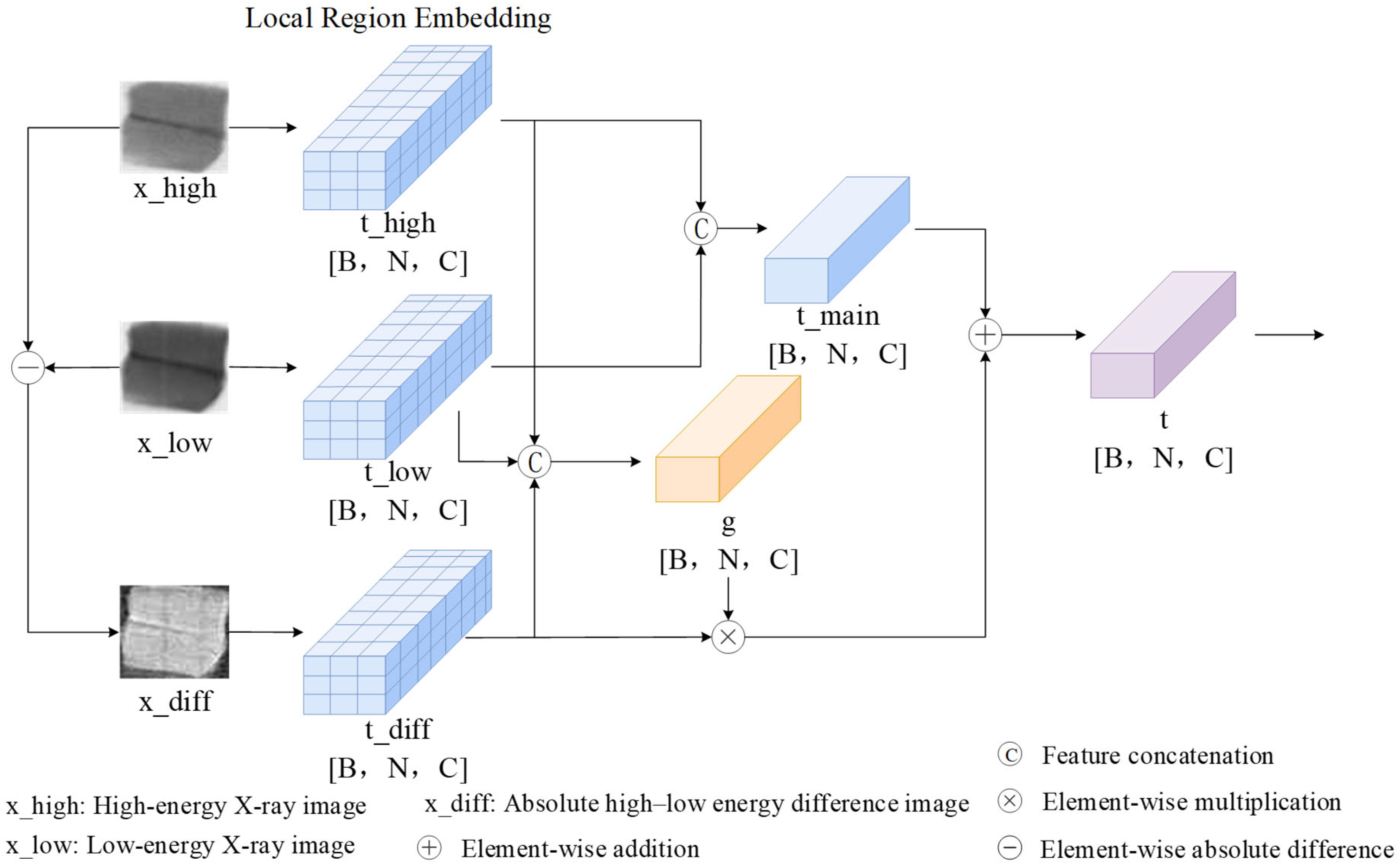
In dual-energy X-ray images of copper ore, attenuation responses under different spectral conditions are represented by low- and high-energy images. For the three-class classification task, inter-class differences are reflected not only in the grayscale distributions of individual spectral images but also in the response variations between the two energy levels. For adjacent categories, direct concatenation of dual-energy images may not sufficiently highlight subtle response differences. Therefore, the DGE module is introduced to incorporate dual-energy difference information while preserving the primary transmission information from the low- and high-energy images. The overall structure of the DGE module is shown in Figure 3.
In DGE module, the low-energy image x l o w and the high-energy image x h i g h corresponding to the same ore particle are used as inputs, and local region embedding is performed separately on the low-energy image, the high-energy image, and their difference map. The difference map is computed as the pixel-wise absolute difference between the high- and low-energy images. Specifically, the difference map is computed as follows: (1).
x d i f f = | x h i g h x l o w |
Subsequently, the embedding features from the low- and high-energy branches are used to construct the primary representation, by which the basic transmission structure and overall response information of ore particles are preserved; meanwhile, the difference branch is used to characterize variations in attenuation responses under different spectral conditions. After local region embedding, the resulting spatial feature maps of shape B , H , W , C are flattened into one-dimensional token sequences of shape B , N , C , where B is the batch size, H and W are the height and width of the feature map, C is the channel or embedding dimension, and N = H × W is the number of tokens. The three embedded features are denoted as t l o w , t h i g h and t d i f f , respectively, and the primary representation is formulated as (2).
t m a i n = W m [ t l o w ; t h i g h ]
[ ] denotes feature concatenation, while W m represents a linear mapping. To avoid interference introduced by the indiscriminate injection of difference information, adaptive gating weights are generated from the joint representation of the low-energy, high-energy, and difference features, as shown in Equation (3):
g = σ ( W 2 δ ( W 1 [ t l o w ; t h i g h ; t d i f f ] ) )
δ represents the Gaussian Error Linear Unit (GELU) activation function, while σ represents the Sigmoid function. Finally, the difference feature is modulated by the gating weights and then injected into the primary representation, and the initial dual-energy embedding representation is obtained, as formulated in Equation (4):
t = t m a i n + g t d i f f
represents element-wise multiplication. The DGE module incorporates dual-energy difference information while retaining the primary transmission information of the low- and high-energy images. By introducing the difference branch at the local-region level, the input representation can preserve subtle attenuation variations together with the basic dual-energy response patterns, which is beneficial for subsequent feature extraction and cross-level fusion.

2.2.3. Hybrid Global-Local Feature Extraction Module

Dual-energy X-ray images of ore particles contain both global transmission patterns and local attenuation variations. To jointly model these two aspects, the embedding representation is further processed by the Hybrid Global-Local Feature Extraction (HFE) module [25,26].
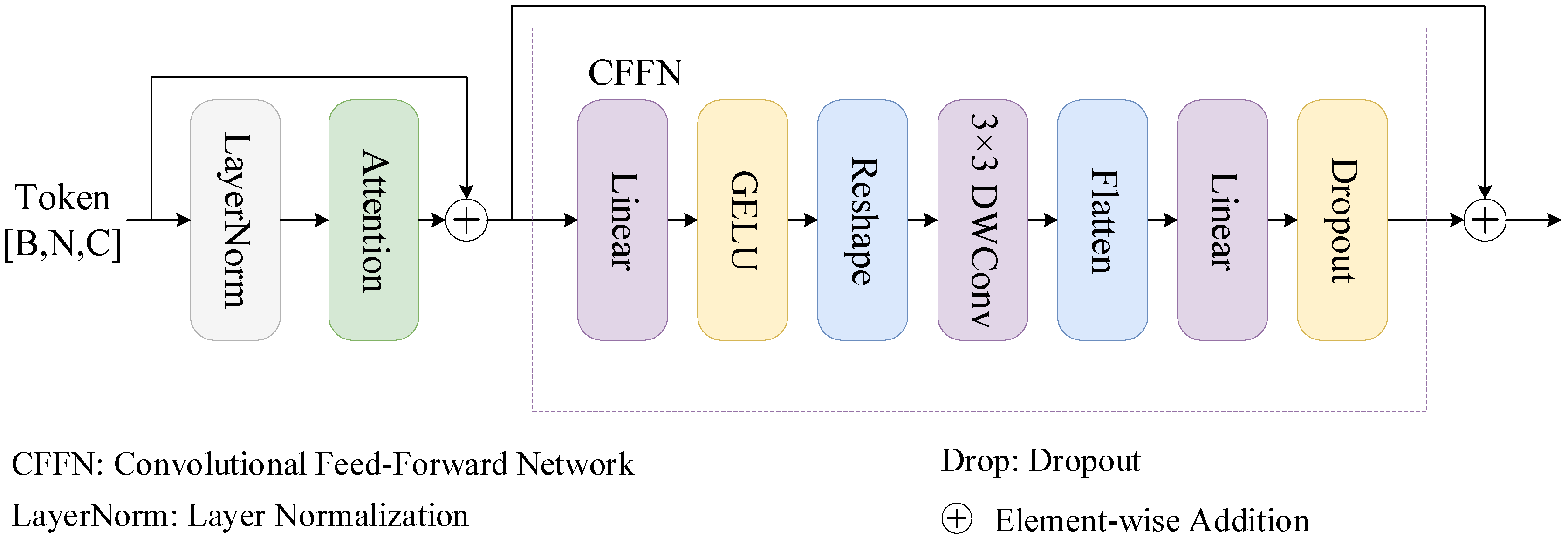
The dual-energy token representation produced by the DGE module is fed into the HFE module, and positional encoding is added to preserve spatial relationships among local regions. The features are then sequentially processed by six encoding blocks, whose structure is shown in Figure 4. Each block combines attention-based global interaction modeling with a convolution-enhanced feed-forward network (CFFN). Specifically, the feature dimension is first expanded, after which the sequence representation is reshaped into a two-dimensional feature map. Local spatial responses are extracted through depth-wise convolution, and the features are then converted back into a sequence representation and projected to the original dimension. In this way, global transmission patterns and local attenuation details can be modeled jointly.

2.2.4. Adaptive Cross-Level Feature Fusion Module

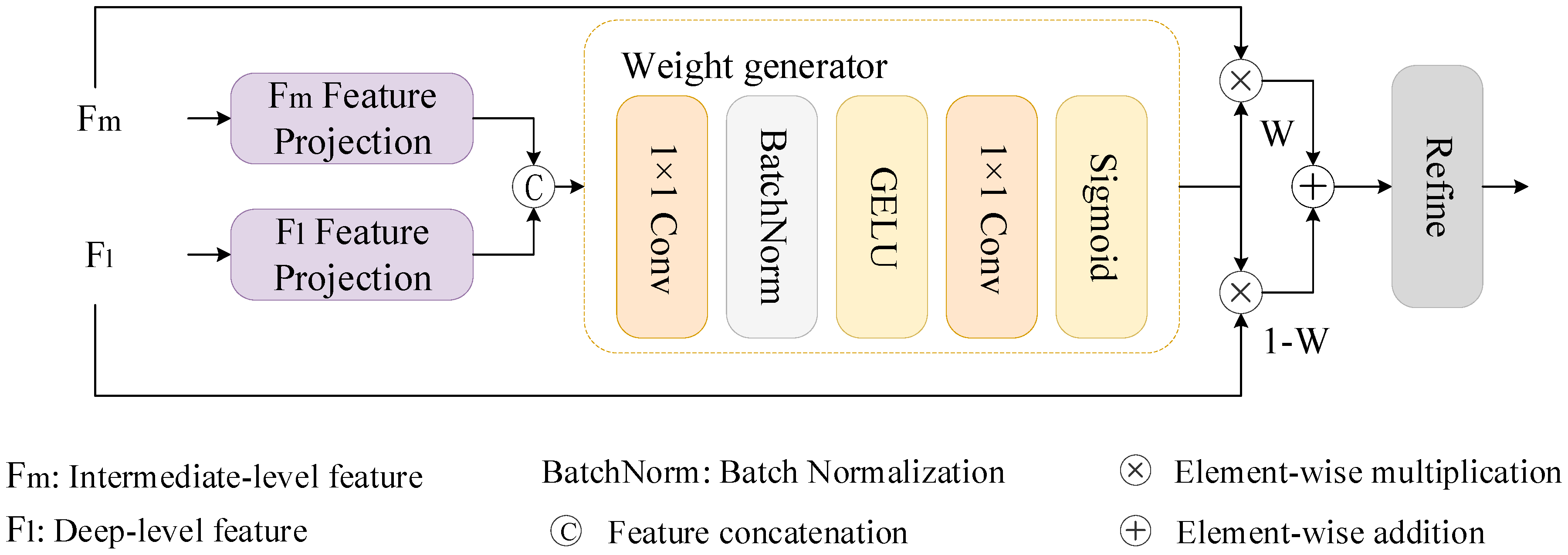
In dual-energy X-ray images, discriminative cues may appear at different feature levels. Intermediate-level features contain relatively rich local attenuation details, whereas deep-level features provide more abstract global transmission patterns. To combine these complementary representations, the Adaptive Cross-Level Feature Fusion (ACF) module is introduced. Its overall structure is shown in Figure 5.
In the ACF module, the intermediate- and deep-level features are separately projected output by HFE to reduce differences in representation scale and distribution across feature levels. The aligned intermediate-level feature F m and deep-level feature F l are then obtained. Subsequently, a joint representation of the two features is constructed, from which a spatial weight map A is generated. The spatial weight map is used to characterize the dependence of different spatial locations on intermediate-level details and deep-level semantics, thereby enabling spatially adaptive fusion. The fusion process is formulated as (5).
F = A F m + ( 1 A ) F l
denotes element-wise multiplication, and F represents the preliminary fused feature. Finally, the fused feature is further refined locally to enhance neighborhood-response consistency and feature-representation stability, and is then used as the input for subsequent classification prediction.
Through this procedure, ACF adaptively balances the contributions of intermediate-level local details and deep-level global patterns according to region-specific responses. This design enables cross-level information to be integrated in a spatially adaptive manner while preserving both local and global characteristics of ore-particle representations.

2.3. Experimental Setup

All experiments were conducted using the same hardware and software environment. The training hyperparameters are listed in Table 2. The experimental platform was equipped with an NVIDIA GeForce RTX 4070 GPU, an Intel Core i7-12700KF CPU, and 32 GB RAM, running Windows 10. The model was implemented in PyTorch 2.8.0 with CUDA 12.6 acceleration, and the Python version was 3.9.23.
For reproducibility, the random seed was fixed at 42. Cross-entropy loss was used as the classification loss function [27]. The number of training epochs was set to 200, and a cosine annealing scheduler was adopted for learning-rate adjustment [28].

2.4. Evaluation Metrics

To evaluate model performance in the three-class copper ore classification task based on dual-energy X-ray imaging, several metrics were adopted from the perspectives of overall accuracy, class-wise recognition performance, class-balanced evaluation, discrimination capability, and computational cost.
Overall accuracy (OA) was used to measure the proportion of correctly classified samples among all test samples. Let the confusion matrix be denoted as M = [ M i j ] K × K , where M i j represents the number of samples whose true class is i and predicted category is j , and K denotes the number of categories. Then, OA is defined as shown in (6).
O A = i = 1 K M i i i = 1 K j = 1 K M i j
For each class, Precision, Recall, and F1-score were computed to evaluate class-specific recognition performance. For the i t h class, T P i , F P i , and F N i denote the number of true positives, false positives, and false negatives, respectively. The corresponding precision, recall, and F1-score are defined as shown in (7)–(9).
P i = T P i T P i + F P i
R i = T P i T P i + F N i
F 1 i = 2 × P i × R i P i + R i
To account for class imbalance, macro-precision (Macro-P), macro-recall (Macro-R), and macro-F1 (Macro-F1) were obtained by averaging the corresponding class-wise metrics across the three categories:
M a c r o P = 1 K i = 1 K P i
M a c r o R = 1 K i = 1 K R i
M a c r o F 1 = 1 K i = 1 K F 1 i
In addition, multi-class AUC (Macro-AUC) was computed using a one-vs-rest strategy to assess discrimination capability under different decision thresholds. The confusion matrix was further used to visualize class-wise misclassification patterns. Model complexity was quantified by the number of parameters and Floating-point operations (FLOPs), while inference efficiency was evaluated using single-sample inference time and Frames per second (FPS) as auxiliary computational indicators.

3. Results

3.1. Comparison with Representative Deep Learning Models

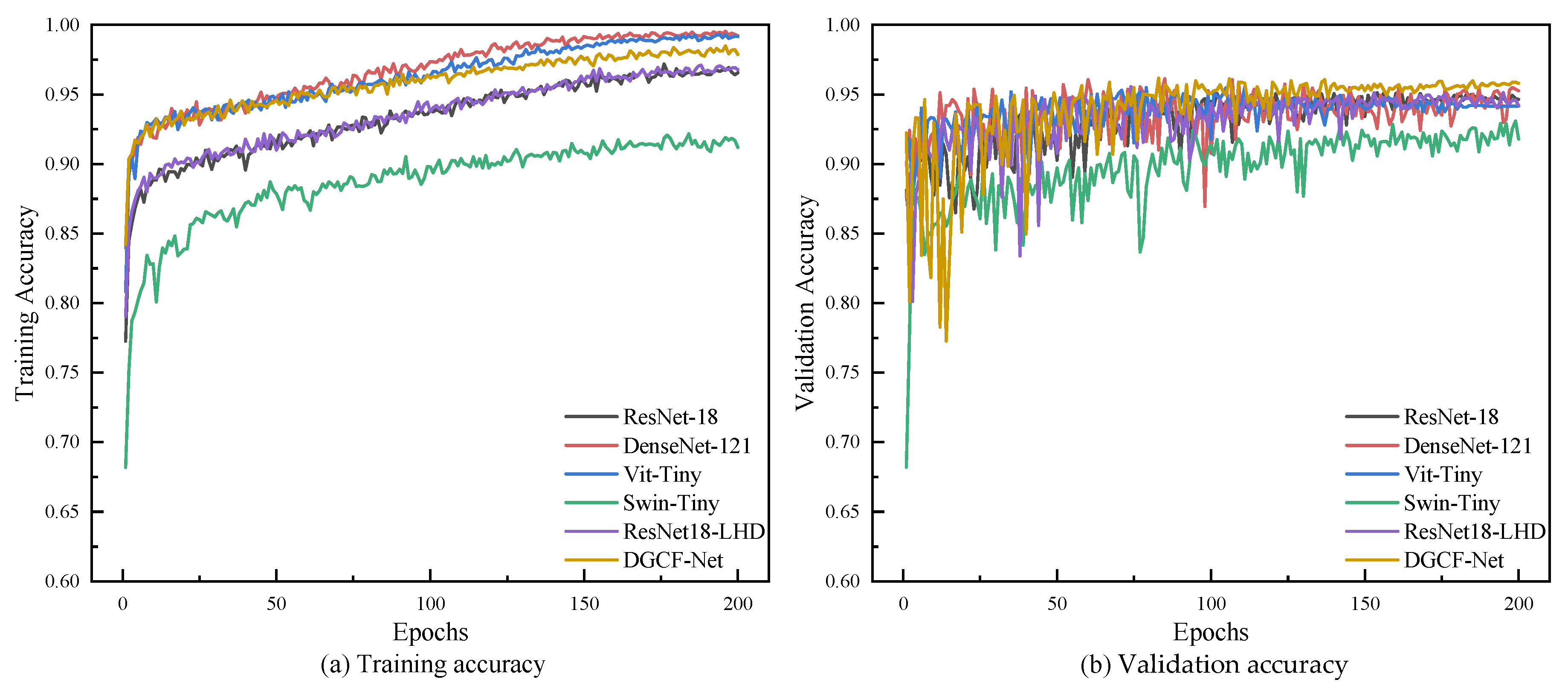
To evaluate the overall performance of the proposed DGCF-Net on the dual-energy XRT-based three-class recognition task for copper ore, ResNet-18 [29], DenseNet-121 [30], ViT-Tiny [31], and Swin-Tiny [32], and ResNet18-LHD were selected as comparative models. ResNet18-LHD is a ResNet-18-based baseline, where L, H, and D denote the low-energy image, high-energy image, and absolute difference image, respectively. In this baseline, the three images were concatenated as input channels. These models represent different feature representation paradigms, allowing the recognition capability for waste rock, low-grade copper ore, and high-grade copper ore to be examined from standard convolutional, transformer-based, and direct dual-energy-input perspectives. To ensure a fair comparison, all models were trained using the same data partitioning and training settings. The variations in training and validation accuracy are shown in Figure 6, and the quantitative test-set results are summarized in Table 3.
As shown in Figure 6, the training and validation accuracy of all models generally increased with the number of training epochs and tended to stabilize in the later stage, indicating that the compared models achieved effective convergence under the same training settings. The validation curves fluctuated during the early epochs and became relatively stable as training proceeded. DGCF-Net maintained a high accuracy level in the later training stage and showed validation performance comparable to or slightly better than the representative baseline models, which is generally consistent with the quantitative test-set results summarized in Table 3. These observations suggest competitive performance on the present dataset, while the magnitude of improvement over strong baselines remains limited.
Table 3 presents the comparison of recognition performance and computational complexity on the test set. Overall, all compared models achieved relatively high classification performance on the present dataset. Among the baseline models, DenseNet-121 achieved the highest Macro-F1 and OA, with values of 0.9609 and 0.9509, respectively, while ResNet18-LHD achieved a Macro-F1 of 0.9529, an OA of 0.9398, and an AUC of 0.9925. DGCF-Net achieved the highest Macro-F1 and OA among all compared models, with values of 0.9664 and 0.9570, respectively, and its AUC reached 0.9953, tying with DenseNet-121. Compared with ResNet18-LHD, DGCF-Net improved Macro-F1 and OA by 1.35 and 1.72 percentage points, respectively. Compared with DenseNet-121, DGCF-Net further improved Macro-F1 and OA by 0.55 and 0.61 percentage points, respectively. These results show that DGCF-Net obtained the highest overall classification metrics in this comparison; however, the improvement over the strongest baselines was moderate. In terms of computational complexity, DGCF-Net had the smallest number of parameters, with 3.6424 M, and 1.4176 G FLOPs. These results suggest that DGCF-Net provides a favorable trade-off between classification performance and model complexity under the present experimental setting. At the same time, given that the ResNet18-LHD baseline already achieves strong performance using a simple three-channel input, the gain of DGCF-Net is more appropriately interpreted as a moderate improvement brought by additional feature-processing modules, rather than a decisive performance leap.

3.2. Ablation Study

To verify the actual contributions of the proposed key modules to recognition performance, ablation experiments were conducted under a unified experimental setting. A dual-energy baseline network was constructed as the baseline, in which the dual-energy input structure, the basic feature-encoding backbone, and the classification head were retained. On this basis, DGE, HFE, and ACF were progressively introduced to analyze the effects of different module configurations on overall recognition performance and class discrimination capability. The corresponding test-set results are summarized in Table 4.
With the progressive introduction of the modules, the overall model performance showed a consistent improvement trend. After the DGE module was introduced, although Macro-F1 remained nearly unchanged, OA increased from 0.9287 to 0.9349 and AUC increased from 0.9883 to 0.9916. This suggests that DGE may help enhance dual-energy difference representations by explicitly strengthening the image-level differences between high- and low-energy responses, thereby contributing to improved sample discrimination on the present dataset. After HFE was introduced, the performance improvement became more pronounced, with OA further increasing to 0.9496 and Macro-F1 improving to 0.9602. This suggests that based on enhanced dual-energy differences, HFE can further improve the quality of feature extraction and enable more sufficient and stable discrimination of ore categories.
After ACF was added, the model achieved the best results on all major metrics, with OA, Macro-F1, and Macro-AUC reaching 0.9570, 0.9664, and 0.9953, respectively. This suggests that ACF adaptively integrates local attenuation details and global transmission patterns, thereby further combining complementary discriminative information and improving the recognition capability for complex samples, especially easily confused categories. Overall, the results in Table 4 suggest complementary roles of DGE, HFE, and ACF in dual-energy difference modeling, feature extraction enhancement, and cross-level discriminative information fusion.

3.3. Analysis of Easily Confused Categories

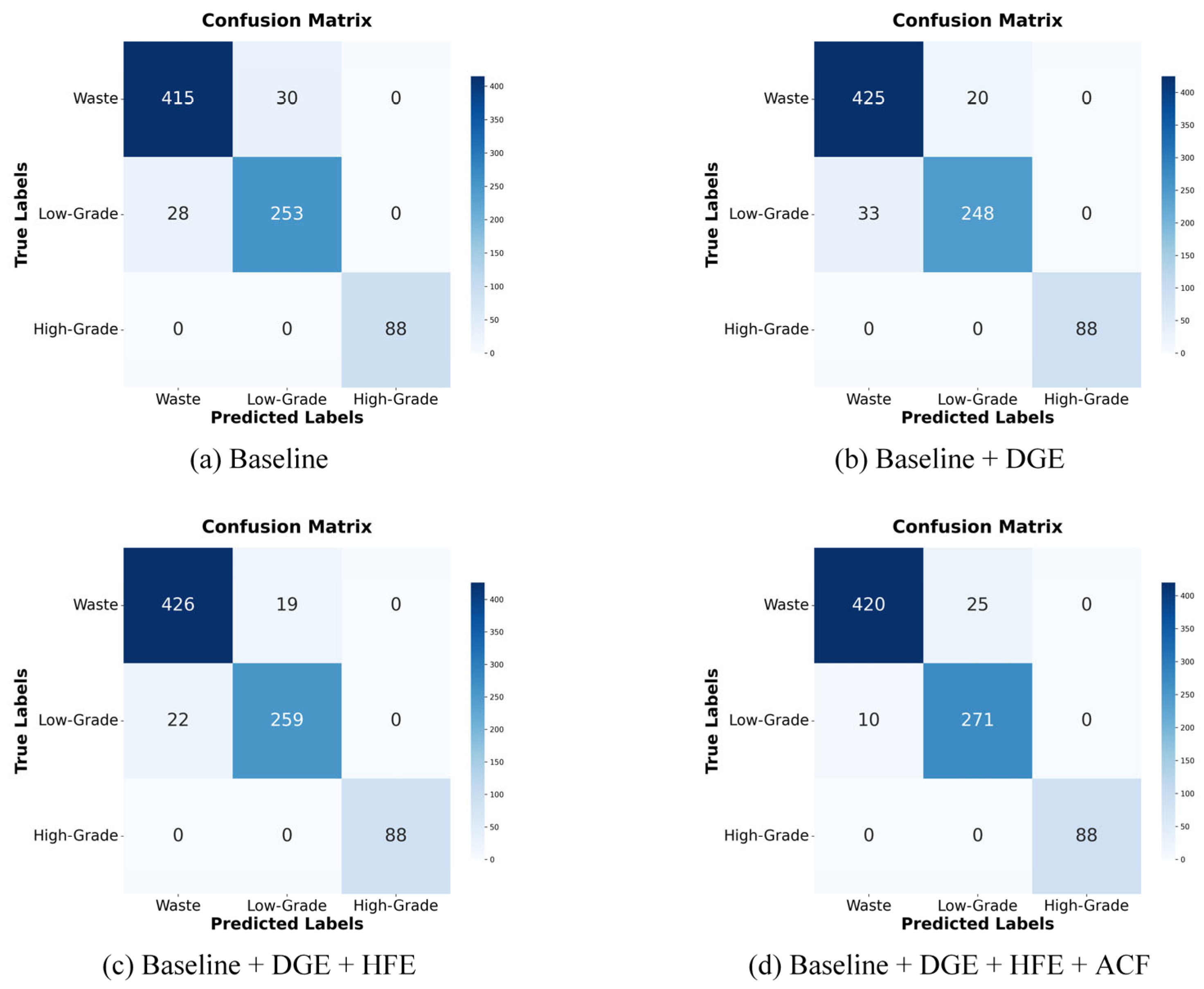
Since the overall evaluation metrics cannot fully reflect the confusion relationships among different categories, a further analysis was conducted on the classification results of waste rock, low-grade copper ore, and high-grade copper ore based on the confusion matrices of the four ablation configurations from the test set. Figure 7 presents the confusion matrices under different ablation configurations. Because the present labels correspond to coarse sample-level grouping, the following confusion patterns should be interpreted as class-level tendencies under the current labeling procedure.
As shown in Figure 7a, under the baseline configuration, all high-grade samples were correctly classified, whereas the misclassifications were mainly concentrated between waste rock and low-grade copper ore, with a clear bidirectional confusion pattern. The waste-rock recognition rate of the baseline was 0.9326, indicating that, although the model could learn certain class-specific features without targeted structural designs, its sensitivity to the subtle differences between waste rock and low-grade copper ore remained limited. This result further illustrates, at the class level, the practical difficulty of this task, namely that the visually and statistically similar dual-energy image responses of the two categories can easily lead to overlapping decision boundaries and mutual misclassification under conventional feature-learning strategies.
After DGE was introduced on the basis of the baseline, the waste-rock recognition rate increased to 0.9551, suggesting that DGE may help enhance the representation of discriminative cues related to waste rock and reduce the misclassification of waste rock as low-grade copper ore in the present dataset. After HFE was introduced, the waste-rock recognition rate further increased to 0.9573, suggesting that HFE may further improve the stability of category discrimination on the basis of enhanced dual-energy image differences. After ACF was added, the waste-rock recognition rate slightly decreased to 0.9438; however, the number of correctly recognized low-grade copper ore samples increased from 259 to 271, while the number of low-grade samples misclassified as waste rock decreased from 22 to 10. This pattern suggests that ACF may help establish a more balanced class boundary between waste rock and low-grade copper ore by combining local image details with broader contextual information, rather than simply improving the recognition rate of a single category.
Overall, the three modules show complementary effects in the discrimination of easily confused categories, thereby improving the discrimination of these easily confused categories in the present dataset. These confusion patterns should also be interpreted with caution, given the coarse sample-level labeling procedure.

4. Discussion

The above results indicate that DGCF-Net showed competitive image-classification capability on the current three-class copper ore dataset based on dual-energy X-ray imaging. In the following, the related findings are further analyzed from the perspectives of task characteristics and methodological mechanisms.

4.1. Analysis of the Roles of Dual-Energy Differences and Multi-Scale Fusion Mechanisms

The main difficulty in the three-class copper ore recognition task based on dual-energy X-ray imaging lies in the easily confused distinction between waste rock and low-grade copper ore. In the present dataset, these two categories show partially overlapping image patterns, which may be related to mixed effects of particle thickness, density, morphology, internal heterogeneity, and X-ray attenuation. In this study, the dual-energy difference image is used as an image-derived feature for classification. Based on the current experimental observations, improving the model’s ability to use such difference information and multi-scale image features may contribute to improved classification performance on this dataset. However, the present study does not quantify how much of the observed dual-energy difference is attributable to composition-related attenuation contrast as opposed to coupled effects such as thickness, density, morphology, and internal heterogeneity. Therefore, the physical contribution of the dual-energy difference to grade discrimination remains unquantified in this work.
The DGE module is designed to enhance the differential representation between high- and low-energy images so that the network can use image-level differences between the two energy channels. According to the confusion matrix results, after DGE was introduced, the number of true waste-rock samples correctly identified as waste rock increased from 415 to 425, whereas the number misclassified as low-grade copper ore decreased from 30 to 20. Correspondingly, the waste-rock recognition rate increased from 0.9326 to 0.9551. These results suggest that DGE may help reduce confusion between waste rock and low-grade copper ore in the present dataset by improving the representation of dual-energy image differences.
In addition to differences between paired dual-energy images, useful image-level cues may also appear at different spatial scales, including local intensity or texture details and more global particle-level patterns. The ACF module adaptively fuses features at different scales, thereby facilitating the coordination of local and global feature representations for the image-classification task. As indicated by the confusion matrix, after ACF was added, the number of waste rock and copper ore samples misclassified as waste rock decreased from 22 to 10, while the number correctly identified increased from 259 to 271. This result suggests that ACF may improve the use of multi-scale image features and reduce certain misclassifications in the present dataset.
Overall, the results suggest that DGE and ACF play distinct but complementary roles in the present dataset: DGE emphasizes differences between paired dual-energy images, whereas ACF integrates image features across multiple spatial scales. Their combination may explain the improved classification results observed on the present dataset. Although the confusion between waste rock and low-grade copper ore was reduced in the present dataset, the remaining misclassification may still be operationally significant in a real preconcentration circuit where even a limited proportion of classification errors could influence downstream processing efficiency and economic performance.

4.2. Limitations and Future Work

DGCF-Net achieved competitive image-classification performance in the three-class copper ore image-classification task based on dual-energy X-ray images while maintaining a relatively small parameter size and moderate computational cost. These results indicate that the proposed model provides a reasonable balance between classification performance and model complexity on the present dataset. However, this study was conducted using samples collected from one mine under offline laboratory imaging conditions. Therefore, the present results should be considered a preliminary image-classification evaluation under a specific data setting, and broader validation under industrially relevant conditions remains to be conducted.
Several limitations remain to be addressed in future work. First, the current dataset is limited in terms of ore source, sample diversity, grade distribution, and particle-size characterization. Data collected from additional mines, broader grade intervals, and more complex compositional conditions are needed to further evaluate the generalization capability of the model. In addition, particle-size information was not explicitly recorded or analyzed in the present dataset. Since particle size may influence X-ray transmission path length, projected morphology, and image appearance, its potential effect on classification performance cannot be excluded in the current study. Future work should incorporate particle-size characterization and controlled evaluation across different size intervals to better assess the robustness of the method and reduce possible size-related confounding effects.
Second, the present experiments were based on offline image acquisition. Future studies should include online testing under more realistic operating conditions, such as conveyor transportation, continuous feeding, particle overlap, motion blur, and imaging disturbances, to assess the robustness of the method in practical acquisition environments.
Third, the present model was developed and evaluated for copper ore particles in the current dataset. Its applicability to other valuable-metal ores should not be assumed without metal-specific datasets, parameter optimization, model retraining, and independent validation.
Fourth, although dual-energy differences were useful as image-derived features in the present classification task, their more specific physical interpretation was not separately evaluated in this study. Further work combining mineralogical characterization and controlled experiments is needed to better clarify how composition-related attenuation contrast and other coupled factors contribute to the observed image differences.
Fifth, the category labels in the present dataset were obtained through coarse grouping based on XRF results and skilled miner sorting, rather than particle-level chemical assays. Therefore, some uncertainty may remain near adjacent category boundaries, which should be considered when interpreting classification errors and confusion matrices.
Finally, the present evaluation mainly relies on image-classification metrics, such as accuracy, Macro-F1, and AUC. Although these metrics are useful for model comparison, they are not sufficient to evaluate ore-sorting performance. In particular, although the confusion between waste rock and low-grade copper ore was reduced in the present dataset, the remaining misclassification may still be operationally significant in a real preconcentration circuit, where different error types may lead to different process-level costs. Future studies should combine model predictions with process-level indicators, such as waste rejection rate, metal loss rate, concentrate grade, and feed-grade improvement, to provide a more comprehensive assessment of practical value.
Although the proposed method achieved promising image-level classification performance, the present study does not directly quantify process-level outcomes such as mass rejection, copper recovery, or feed-grade improvement. Therefore, the results should be interpreted as preliminary evidence of image-classification feasibility.
Overall, the current work demonstrates the preliminary feasibility of dual-energy X-ray image-based classification for the studied copper ore samples, while broader applicability still requires systematic validation with richer datasets and more realistic operating conditions. Future work should also combine mineralogical characterization, such as SEM-EDS, with process-level validation to better clarify the basis of the observed image-level separability and to further assess the practical relevance of the method for ore preconcentration.

5. Conclusions

This study proposed DGCF-Net for three-class copper ore classification based on dual-energy X-ray images, using laboratory-acquired dual-energy XRT images from a single mine source. The results show that the proposed method achieved competitive image-classification performance on the current dataset and improved the discrimination of easily confused categories, such as waste rock and low-grade copper ore, with relatively low model complexity. The ablation study supported the contributions of the DGE, HFE, and ACF modules. In addition, the results indicate that the fusion of high-energy, low-energy, and difference images provides complementary image information for classification in the present dataset, suggesting that dual-energy XRT images contain useful image features associated with the current coarse category labels. However, these findings should be regarded as preliminary evidence for the feasibility of image-based classification under the present experimental conditions, and their relevance to industrial preconcentration performance still requires further validation.

Author Contributions

Conceptualization, S.L., J.H. and J.Q.; methodology, S.L. and J.H.; software, S.L.; validation, S.L., W.L. and X.W.; formal analysis, S.L.; investigation, S.L. and G.Z.; resources, W.L., X.W. and J.Q.; data curation, S.L. and G.Z.; writing—original draft preparation, S.L. and J.H.; writing—review and editing, J.H., W.L., X.W. and J.Q.; visualization, S.L.; supervision, J.H. and J.Q.; project administration, W.L. and J.Q.; funding acquisition, J.H., W.L. and J.Q. All authors have read and agreed to the published version of the manuscript.

Funding

This research was funded by the National Natural Science Foundation of China (No. 11865002), and the Academic and Technical Leaders Project of Major Disciplines in Jiangxi Province (No. 20225BCJ22004).

Data Availability Statement

Data are contained within the article, further data are available from the corresponding author on reasonable request.

Acknowledgments

The authors sincerely thank the members of the research team and the laboratory staff for their valuable support in sample preparation, data collection, experimental implementation, and technical assistance. The authors are also grateful to the anonymous reviewers and editors for their constructive comments and suggestions, which contributed to improving the quality of this manuscript.

Conflicts of Interest

The authors declare no conflicts of interest.

Abbreviations

The following abbreviations are used in this manuscript:
XRTX-ray transmission
DGCF-NetDifference-Guided Cross-Level Feature Fusion Network
DGEDifference-Guided Embedding for Dual-Energy Representation
HFEHybrid Global-Local Feature Extraction Module
ACFAdaptive Cross-Level Feature Fusion Module
GELUGaussian Error Linear Unit
OAOverall Accuracy
AUCArea Under the Curve
FLOPsFloating-point operations
FPSFrames per second
SVMSupport Vector Machine
ViTVision Transformer

References

  1. Su, X.; Wang, H. Analysis of the Current Situation and Potential of Copper Resources in China. World Nonferrous Met. 2023, 4, 89. [Google Scholar]
  2. Jena, S.S.; Tripathy, S.K.; Mandre, N.R.; Venugopal, R.; Farrokhpay, S. Sustainable Use of Copper Resources: Beneficiation of Low-Grade Copper Ores. Minerals 2022, 12, 545. [Google Scholar] [CrossRef] [Scilit]
  3. Lyu, G.; Ding, J.; Xue, H.; Guo, Y.; Wang, Q.; Yang, B. Analysis of Influence of Pre-Grading on Selection of Ball Mill in Closed-Circuit Process of Single-Stage Ball Milling. Min. Process. Equip. 2024, 52, 89–93. [Google Scholar] [CrossRef]
  4. Peukert, D.; Xu, C.; Dowd, P. A Review of Sensor-Based Sorting in Mineral Processing: The Potential Benefits of Sensor Fusion. Minerals 2022, 12, 1364. [Google Scholar] [CrossRef] [Scilit]
  5. Robben, C.; Wotruba, H. Sensor-Based Ore Sorting Technology in Mining—Past, Present and Future. Minerals 2019, 9, 523. [Google Scholar] [CrossRef] [Scilit]
  6. Kern, M.; Akushika, J.N.P.; Godinho, J.R.A.; Schmiedel, T.; Gutzmer, J. Integration of X-Ray Radiography and Automated Mineralogy Data for the Optimization of Ore Sorting Routines. Miner. Eng. 2022, 186, 107739. [Google Scholar] [CrossRef] [Scilit]
  7. Rebuffel, V.; Dinten, J.-M. Dual-Energy X-ray Imaging: Benefits and Limits. Insight—Non-Destr. Test. Cond. Monit. 2007, 49, 589–594. [Google Scholar] [CrossRef] [Scilit]
  8. Zhang, Y.; Yoon, N.; Holuszko, M.E. Assessment of Sortability Using a Dual-Energy X-Ray Transmission System for Studied Sulphide Ore. Minerals 2021, 11, 490. [Google Scholar] [CrossRef] [Scilit]
  9. Jiang, J.; Han, Y.; Zhao, H.; Suo, J.; Cao, Q. Recognition and Sorting of Coal and Gangue Based on Image Process and Multilayer Perceptron. Int. J. Coal Prep. Util. 2023, 43, 54–72. [Google Scholar] [CrossRef] [Scilit]
  10. Liu, Y.; Zhang, Z.; Liu, X.; Wang, L.; Xia, X. Deep Learning-Based Image Classification for Online Multi-Coal and Multi-Class Sorting. Comput. Geosci. 2021, 157, 104922. [Google Scholar] [CrossRef] [Scilit]
  11. Geng, Z.; Wu, Q.; Jiang, G.; Xie, W.; Zhong, W.; Cheng, S. Application Progress of XRT Intelligent Preseparation Technology in Non-Ferrous Metal Mines. Copp. Eng. 2023, 5, 119–125. [Google Scholar]
  12. Luo, Z.; Liu, J.; Sun, Y.; Yang, T.; Yang, L.; Yang, J.; Zhang, W.; Zhou, C. Application Research and Practice of XRT Intelligent Preselection and Waste Disposal Technology in China. Met. Mine 2024, 8, 79–92. [Google Scholar] [CrossRef]
  13. Luo, X.; He, K.; Zhang, Y.; He, P.; Zhang, Y. A Review of Intelligent Ore Sorting Technology and Equipment Development. Int. J. Min. Met. Mater. 2022, 29, 1647–1655. [Google Scholar] [CrossRef] [Scilit]
  14. Jin, J.; Lin, C.-L.; Miller, J.D.; Zhao, C.; Li, T. X-Ray Computed Tomography Evaluation of Crushed Copper Sulfide Ore for Pre-Concentration by Ore Sorting. Min. Metall. Explor. 2022, 39, 13–21. [Google Scholar] [CrossRef] [Scilit]
  15. Yu, J.; He, J.; Li, W.; Nie, F.; Xia, F.; Wang, X.; Yuan, Z.; Qu, J.; Zhong, G. A Multi-channel Image Fusion Method for Copper Ore Separation Based on Dual-energy X-ray. Nonferrous Met. 2025, 15, 275–280. [Google Scholar] [CrossRef]
  16. Guo, X.; Min, X.; Liang, Y.; Tang, X.; Gao, Z. Efficient Multi-Modal Learning for Dual-Energy X-Ray Image-Based Low-Grade Copper Ore Classification. Minerals 2025, 15, 1150. [Google Scholar] [CrossRef] [Scilit]
  17. Huang, Y.; He, J.; Zhang, F.; Li, W.; Nie, F.; Wang, X.; Qu, J. Research on Copper Ore Grade Classification Method Based on Swin V2-EfficientNetV2. Min. Res. Dev. 2025, 45, 220–228. (In Chinese) [Google Scholar] [CrossRef]
  18. Xu, H.; Yin, Z.; Wang, J. Evolution and Metallogenic Specificity of Ore-Forming Porphyry in Dexing Copper Deposit. Energy Res. Manag. 2024, 16, 76–81. [Google Scholar] [CrossRef]
  19. Zhao, Y.; Wu, C.; Wang, X.; Zhang, S.; Shi, X. Bearing image threshold segmentation method based on improved Otsu algorithm. J. Mech. Electr. Eng. 2026, 43, 34–44. [Google Scholar] [CrossRef]
  20. Jardim, S.; António, J.; Mora, C. Image Thresholding Approaches for Medical Image Segmentation-Short Literature Review. Procedia Comput. Sci. 2023, 219, 1485–1492. [Google Scholar] [CrossRef] [Scilit]
  21. Al-Rahlawee, A.T.H.; Rahebi, J. Multilevel Thresholding of Images with Improved Otsu Thresholding by Black Widow Optimization Algorithm. Multimed. Tools Appl. 2021, 80, 28217–28243. [Google Scholar] [CrossRef] [Scilit]
  22. Dehbozorgi, P.; Ryabchykov, O.; Bocklitz, T. A Systematic Investigation of Image Pre-Processing on Image Classification. IEEE Access 2024, 12, 64913–64926. [Google Scholar] [CrossRef] [Scilit]
  23. Chlap, P.; Min, H.; Vandenberg, N.; Dowling, J.; Holloway, L.; Haworth, A. A review of medical image data augmentation techniques for deep learning applications. J. Med. Imaging Radiat. Oncol. 2021, 65, 545–563. [Google Scholar] [CrossRef] [Scilit] [PubMed]
  24. Fahad, M.; Zhang, T.; Khan, S.U.; Albanyan, A.; Siddiqui, F.; Iqbal, Y.; Zhao, X.; Geng, Y. Optimizing Dual Energy X-Ray Image Enhancement Using a Novel Hybrid Fusion Method. J. X-Ray Sci. Technol. 2024, 32, 1553–1570. [Google Scholar] [CrossRef] [Scilit] [PubMed]
  25. Khan, A.; Rauf, Z.; Sohail, A.; Khan, A.R.; Asif, H.; Asif, A.; Farooq, U. A Survey of the Vision Transformers and Their CNN-Transformer Based Variants. Artif. Intell. Rev. 2023, 56, 2917–2970. [Google Scholar] [CrossRef] [Scilit]
  26. Long, H. Hybrid Design of CNN and Vision Transformer: A Review. In Proceedings of the 2024 7th International Conference on Computer Information Science and Artificial Intelligence; Association for Computing Machinery: New York, NY, USA, 2024; pp. 121–127. [Google Scholar]
  27. Krizhevsky, A.; Sutskever, I.; Hinton, G.E. ImageNet Classification with Deep Convolutional Neural Networks. Commun. ACM 2017, 60, 84–90. [Google Scholar] [CrossRef] [Scilit]
  28. Loshchilov, I.; Hutter, F. SGDR: Stochastic Gradient Descent with Warm Restarts. arXiv 2016, arXiv:1608.03983. [Google Scholar]
  29. He, K.; Zhang, X.; Ren, S.; Sun, J. Deep Residual Learning for Image Recognition. In Proceedings of the IEEE Conference on Computer Vision and Pattern Recognition; IEEE: Las Vegas, NV, USA, 2016; pp. 770–778. [Google Scholar]
  30. Huang, G.; Liu, Z.; van der Maaten, L.; Weinberger, K.Q. Densely Connected Convolutional Networks. In 2017 IEEE Conference on Computer Vision and Pattern Recognition (CVPR); IEEE: Honolulu, HI, USA, 2017; pp. 2261–2269. [Google Scholar]
  31. Dosovitskiy, A.; Beyer, L.; Kolesnikov, A.; Weissenborn, D.; Zhai, X.; Unterthiner, T.; Dehghani, M.; Minderer, M.; Heigold, G.; Gelly, S.; et al. An Image Is Worth 16x16 Words: Transformers for Image Recognition at Scale. arXiv 2010, arXiv:2010.11929. [Google Scholar]
  32. Liu, Z.; Lin, Y.; Cao, Y.; Hu, H.; Wei, Y.; Zhang, Z.; Lin, S.; Guo, B. Swin Transformer: Hierarchical Vision Transformer Using Shifted Windows. In Proceedings of the 2021 IEEE/CVF International Conference on Computer Vision (ICCV); IEEE: Montreal, BC, Canada, 2021; pp. 9992–10002. [Google Scholar]
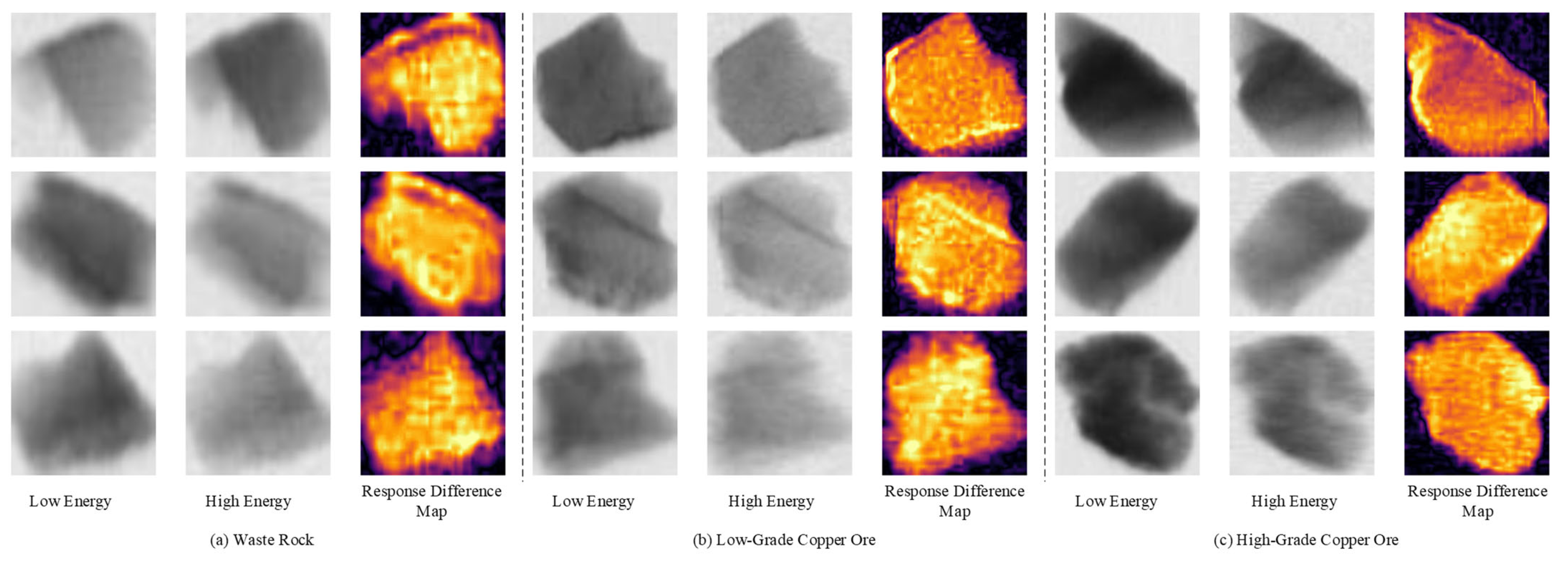
Figure 1. Representative dual-energy X-ray images of individual ore particles after threshold-based segmentation, including low-energy images, high-energy images, and the corresponding response difference maps.
Minerals 16 00869 g001
Figure 2. Overall architecture of DGCF-Net for three-class copper ore classification based on dual-energy X-ray images. Paired high- and low-energy X-ray images and their absolute difference image are first embedded by the Difference-Guided Embedding module and then processed by the Hybrid Global-Local Feature Extraction module. Intermediate- and deep-level features are subsequently combined by the Adaptive Cross-Level Feature Fusion module for final classification, where Fm denotes the aligned intermediate-level feature and Fl denotes the deep-level feature.
Minerals 16 00869 g002
Figure 3. Structure of the Difference-Guided Embedding module. The high-energy X-ray image, low-energy X-ray image, and their absolute difference image are separately embedded into local-region token features. The high- and low-energy features are used to construct the primary representation, while the concatenated dual-energy and difference features are used to generate adaptive gating weights. The gated difference feature is then injected into the primary representation to obtain the initial dual-energy embedding. B denotes the batch size, N denotes the number of tokens, and C denotes the channel or embedding dimension.
Minerals 16 00869 g003
Figure 4. Structure of the encoding block in the Hybrid Global-Local Feature Extraction module. The input token sequence is first updated through an attention layer with a residual connection to model global interactions. In the CFFN, the token features are projected and reshaped into a two-dimensional feature map, where a 3 × 3 depth-wise convolution is used to capture local spatial responses. The features are then flattened back into token form and combined through residual addition.
Minerals 16 00869 g004
Figure 5. Structure of the Adaptive Cross-Level Feature Fusion module. The intermediate-level and deep-level features are first projected to a unified feature space and then concatenated to generate a spatial weight map. The spatial weight map and its complementary map are used to adaptively balance the contributions of intermediate-level details and deep-level representations. The fused feature is further refined locally to obtain the final representation for classification.
Minerals 16 00869 g005
Figure 6. Training and validation accuracy curves of DGCF-Net and the baseline models over 200 epochs: (a) training accuracy; (b) validation accuracy.
Minerals 16 00869 g006
Figure 7. Confusion matrices under different ablation configurations from the test set for waste rock, low-grade copper ore, and high-grade copper ore classification: (a) Baseline; (b) Baseline + DGE; (c) Baseline + DGE + HFE; (d) Baseline + DGE + HFE + ACF.
Minerals 16 00869 g007
Table 1. Distribution of waste rock, low-grade copper ore, and high-grade copper ore samples in the training, validation, and test subsets.
Dataset SubsetWaste RockLow-Grade Copper OreHigh-Grade Copper OreTotal
Training Set317019646165750
Validation Set8875611761624
Test Set44528188814
Total450228068808188
Table 2. Training hyperparameter settings for the proposed DGCF-Net.
ParameterValue
Input size 224 × 224
Batch size32
Initial learning rate 3 × 10 4
Weight decay 3 × 10 6
Learning-rate scheduling strategyCosineAnnealingLR
Loss functionCrossEntropyLoss
Number of training epochs200
Table 3. Comparison of recognition performance and computational complexity between DGCF-Net and baseline models on the test set.
ModelMacro-F1OAAUCParams (M)FLOPs (G)
ResNet18-LHD0.95290.93980.992511.19692.0596
ResNet-180.95250.93980.991311.118751.9415
DenseNet-1210.96090.95090.99536.96633.0140
ViT-Tiny0.95760.94590.99345.67251.1073
Swin-Tiny0.96050.94960.993927.52634.3856
DGCF-Net0.96640.95700.99533.64241.4176
Table 4. Ablation results of different module configurations on the test set.
ConfigurationOAMacro-PMacro-RMacro-F1Macro-AUC
Baseline0.92870.94360.94430.94390.9883
Baseline + DGE0.93490.95110.94590.94380.9916
Baseline + DGE + HFE0.94960.96080.95970.96020.9932
Baseline + DGE + HFE + ACF0.95700.96410.96940.96640.9953
Disclaimer/Publisher’s Note: The statements, opinions and data contained in all publications are solely those of the individual author(s) and contributor(s) and not of MDPI and/or the editor(s). MDPI and/or the editor(s) disclaim responsibility for any injury to people or property resulting from any ideas, methods, instructions or products referred to in the content.