Article

Characteristics of Lower Cretaceous Calcite Veins and Their Relationship with Hydrocarbon Dissipation and Uranium Mineralization in the Qianjiadian Uranium Mining Area, Songliao Basin

1
State Key Laboratory of Continental Evolution and Early Life, Department of Geology, Northwest University, Xi’an 710069, China
2
Research Institute of Exploration and Development, PetroChina Liaohe Oilfield Company, Panjin 124010, China
3
CNNC Geological Exploration Group Co., Ltd., Beijing 100822, China
4
The Nuclear Industry 243 Battalion, Chifeng 024000, China
*
Author to whom correspondence should be addressed.
Minerals 2026, 16(6), 631; https://doi.org/10.3390/min16060631 (registering DOI)
Submission received: 11 March 2026 / Revised: 24 May 2026 / Accepted: 5 June 2026 / Published: 12 June 2026
(This article belongs to the Section Mineral Geochemistry and Geochronology)

Abstract

Current research suggests that the uranium enrichment in the Qianjiadian deposit, southwestern Songliao Basin (China), is closely related to hydrocarbon dissipation and deep thermal fluids. However, previous investigations have not carried out systematic in-depth research on the abundant calcite veins hosted in diabase within the ore district, especially regarding their types, genetic mechanisms, formation ages, and genetic links to uranium enrichment. In particular, whether their genesis is associated with the two critical ore-controlling factors (hydrocarbon dissipation and thermal fluid activities) remains poorly constrained and to be elucidated. Through analyses of major and trace element geochemistry, scanning electron microscopy, and fluid inclusion microthermometry on calcite veins within fractures of Lower Cretaceous diabase, this study confirms that the veins are products of epigenetic fluid infill with a medium-to-low temperature hydrothermal nature (115–215 °C). The direction of fluid migration was from north to south, consistent with the trend of hydrocarbon dissipation. In situ U-Pb dating yields Eocene (~42.9 Ma) and Pleistocene (1.57–2.82 Ma) ages for the calcite veins, which are highly consistent with the timing of diabase intrusion (early Eocene) and the main episodes of uranium mineralization (Eocene–Oligocene and Pleistocene). Carbon and oxygen isotope compositions and inclusion components indicate that the carbon source was mainly derived from dissipated hydrocarbons, rather than from sedimentary diagenesis or direct source rock generation. The C-O isotopic signatures reflect further carbon isotope fractionation following the interaction between dissipated hydrocarbons and groundwater, and the inclusion fluids, composed mainly of hydrocarbon gases and water, suggest that the carbon source for calcite vein formation was provided by dissipated hydrocarbons. The temporal coupling of hydrocarbon dissipation, calcite vein formation, uranium mineralization, and thermal input from diabase intrusion reflects the dynamic processes of basin evolution and tectonic reworking. The key dynamic backgrounds for this series of diagenetic and metallogenic events include Late Cretaceous tectonic inversion, Eocene–Oligocene tectonic uplift and erosion, and Pleistocene differential uplift and subsidence. The thermal effects from hydrocarbon dissipation and diabase intrusion were the primary factors driving the anomalous uranium enrichment that formed this super-large deposit. The formation of the calcite veins, along with their characteristics indicative of medium-to-low temperature hydrothermal activity and hydrocarbon dissipation, provides a critical window for understanding these processes and offers robust scientific evidence for this genetic model. This study, for the first time, systematically reveals that the calcite veins within the diabase of the Qianjiadian uranium mining area are of medium-to-low temperature hydrocarbon-bearing hydrothermal origin, and constrains their formation ages to the Eocene (~42.9 Ma) and Pleistocene (1.57–2.82 Ma), which are highly coupled with diabase intrusion and two episodes of uranium mineralization events. C-O isotopic and fluid inclusion evidence indicates that the formation of calcite veins directly records the process of hydrocarbon dissipation–groundwater mixing, providing a new mineralogical and geochronological evidence chain for thermal–hydrocarbon–uranium-coupled mineralization.

1. Introduction

Sandstone-hosted uranium deposits are currently the dominant type for uranium exploration and mining in China, accounting for 43% of the country’s total uranium resources [1,2,3]. Major exploration breakthroughs of 10,000-tonnage super-large sandstone-hosted uranium deposits have been achieved in multiple Mesozoic-Cenozoic basins in China, including the Songliao, Erlian, Ordos, Turpan-Hami and Yili basins [2,3,4]. The Qianjiadian uranium deposit, located in the southwestern Songliao Basin (Northeastern China), is a typical super-large sandstone-hosted uranium deposits in northern China and a landmark achievement of integrated oil-uranium exploration in the basin, which holds critical reference value for both metallogenic theory research and exploration practice of sandstone-hosted uranium deposits in China [5]. Previous systematic studies on this deposit have proposed that its mineralization is closely related to deep hydrothermal fluid activity, reduction induced by hydrocarbon dissipation, and meteoric water leaching processes, and is simultaneously constrained by multiple factors including the sedimentary environment of ore-hosting sand bodies in the Yaojia Formation and regional denudation window structures [6,7,8,9,10,11]. These studies further suggested that uranium mineralization was most likely affected by the thermal effect of magmatism, and high temperatures exerted a positive influence on uranium ore formation [12,13,14,15].
With the deepening of exploration and research, widespread mafic magmatic activities have been identified in the study area since the Late Cretaceous. Drill holes in the ore district have intersected multiple suites of diabase bodies intruding into the Yaojia Formation ore-hosting horizon and the Nenjiang Formation, with abundant white calcite veins developed in the fractures of these diabase bodies. However, no systematic in-depth studies have been conducted on the genetic type, formation timing, and intrinsic link of these calcite veins to uranium mineralization [16,17,18,19]. In particular, whether their genesis is related to the two key ore-controlling factors, namely hydrocarbon dissipation and deep hydrothermal fluids, remains poorly constrained, which has hindered a comprehensive understanding of the regional metallogenic geodynamic processes.
Carbonate veins are direct records of the activity and evolution of geological fluids. They are widely developed in various types of ore deposits and structural fractures, and serve as critical proxies for reconstructing fluid properties, sources, and the timing of diagenesis and mineralization. Carbonate mineral dating has been widely applied in the metallogenic geochronology of hydrothermal deposits, diagenetic evolution of oil and gas reservoirs, and constraining the timing of tectonic activities [20,21,22,23,24]. However, systematic studies on calcite veins in sandstone-hosted uranium deposits remain relatively limited. There are only relevant reports on calcite veins in the wall rocks of uranium deposits in the northern Sichuan Basin, China, which are regarded as an important indicator of superimposed hydrothermal modification of uranium mineralization [25]. Rong et al. (2016) [26] proposed that carbonatization alteration in the Qianjiadian uranium deposit can be roughly divided into calcitization, ankeritization and sideritization, with the latter two mostly being diagenetic alteration.
Precise constraint of the formation timing of carbonate veins is the core to deciphering their coupling relationship with mineralization. Restricted by the geochemical characteristics of low U and high Pb contents in carbonate minerals, traditional dating methods were dominated by Rb-Sr and Sm-Nd isotopic systems. In recent years, with the development of laser ablation inductively coupled plasma mass spectrometry (LA-ICP-MS) in situ microanalysis technology, in situ U-Pb dating of carbonates has been widely applied due to its advantages of low cost, high efficiency, and high spatial resolution [27,28,29]. Highly accurate and reliable analytical results can be obtained by combining in situ laser ablation with pre-ablation to define optimal analytical spots.
Calcite veins are rarely developed in the ore-hosting sandstones of the Yaojia Formation in the study area, but are widely distributed in diabase fractures, which previous studies attributed to the differences in ductile-brittle properties between the two rock types [14,15,16]. Although previous investigations have established that uranium enrichment in the Qianjiadian deposit of the Songliao Basin is closely related to hydrocarbon dissipation and deep-seated thermal fluid activity, the genetic type, formation age, and intrinsic link of the extensively developed calcite veins in the diabase to uranium mineralization have not been systematically studied. In particular, whether the formation of calcite veins was controlled by hydrocarbon dissipation and thermal fluid activity, and whether they can serve as direct indicators of these two ore-controlling processes, remain poorly constrained. Therefore, this study aims to: (1) determine the material composition, occurrence, geochemical characteristics, and fluid inclusion properties of the calcite veins to define their genetic type; (2) precisely constrain the formation ages of the calcite veins using in situ U–Pb dating; and (3) explore their spatiotemporal coupling with hydrocarbon dissipation, diabase intrusion, and uranium mineralization through C-O isotope tracing and fluid inclusion pressure modeling. This research provides new mineralogical and geochronological evidence for the metallodynamic mechanisms of super-large sandstone-type uranium deposits.
This study presents the first systematic investigation of calcite veins hosted in diabase in the Qianjiadian uranium mining area. It clarifies the genesis of the calcite veins, revealing that they are not direct magmatic products but epigenetic veins formed by the infill of medium-to-low temperature hydrocarbon-bearing hydrothermal fluids along fractures. It overcomes the limitations of previous studies that focused solely on sandstone cements or single mineralization events, and establishes a direct spatiotemporal coupling between calcite vein formation, multi-stage hydrocarbon dissipation (Eocene and Pleistocene), diabase intrusion-related thermal events, and uranium mineralization. Furthermore, it proposes for the first time that the C-O isotopic fractionation evolution sequence of calcite veins can serve as a tracer of hydrocarbon dissipation–groundwater mixing. These innovations provide key evidence for understanding thermal–hydrocarbon–uranium-coupled mineralization.

2. Geological Background

2.1. Basin Tectonic Setting and Evolution

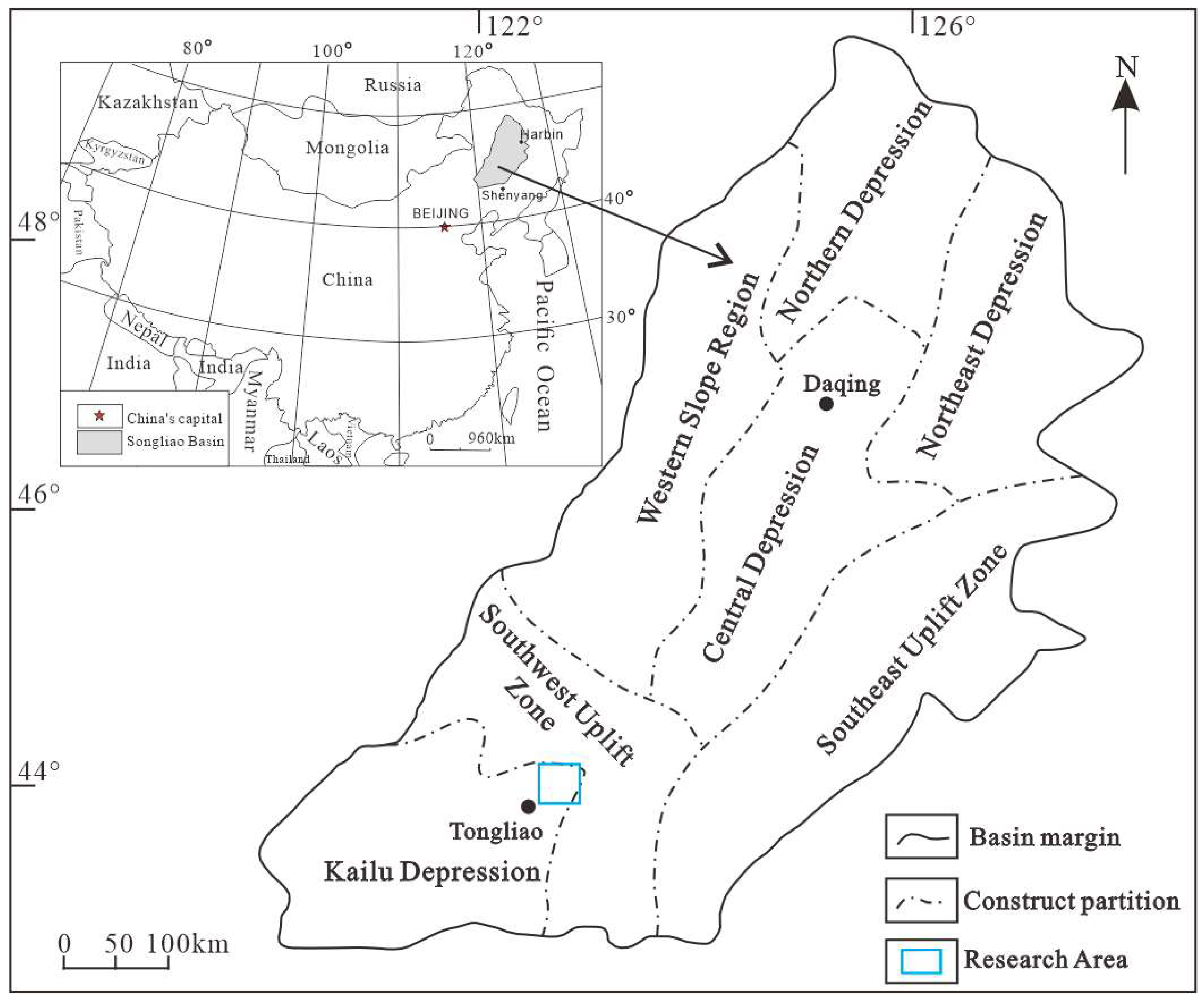
The Qianjiadian super-large uranium deposit in the Songliao Basin is located approximately 50 km northeast of Tongliao City, Inner Mongolia. The Tongliao area is rich in mineral resources, hosting over forty types of mineral deposits, including petroleum, natural gas, coal, and uranium, making it an important multi-energy coexisting basin in China. It is particularly notable for its substantial coal reserves and vast petroleum prospects, accompanied by numerous metallic mineral occurrences. The Qianjiadian deposit is currently the largest discovered sandstone-type uranium deposit in eastern China.
The Songliao Basin is a Mesozoic–Cenozoic continental sedimentary basin formed by the amalgamation of multiple microcontinental blocks during the pre-Mesozoic. The basin exhibits a predominantly NE-trending distribution (Figure 1). Based on its geological and structural characteristics, the basin can be divided into seven first-order tectonic units and forty-nine second-order tectonic units. The first-order units are the Western Slope Zone, Northern Plunge Zone, Central Depression Zone, Northeastern Uplift Zone, Southeastern Uplift Zone, Southwestern Uplift Zone, and Kailu Depression Zone. These units are not only key areas for petroleum exploration but also critical zones for uranium prospecting. Fault systems control the NE-striking, zonally distributed, and N–S segmented framework of the major units. The study area is located in the Qianjiadian Sag, on the northeastern margin of the Kailu Depression Zone in the southwestern part of the basin, situated in the transitional zone between the Kailu Depression and the Southwestern Uplift Zone (Figure 1). The region is predominantly characterized by gentle topography of grassland, with convenient transportation, facilitating geological exploration.
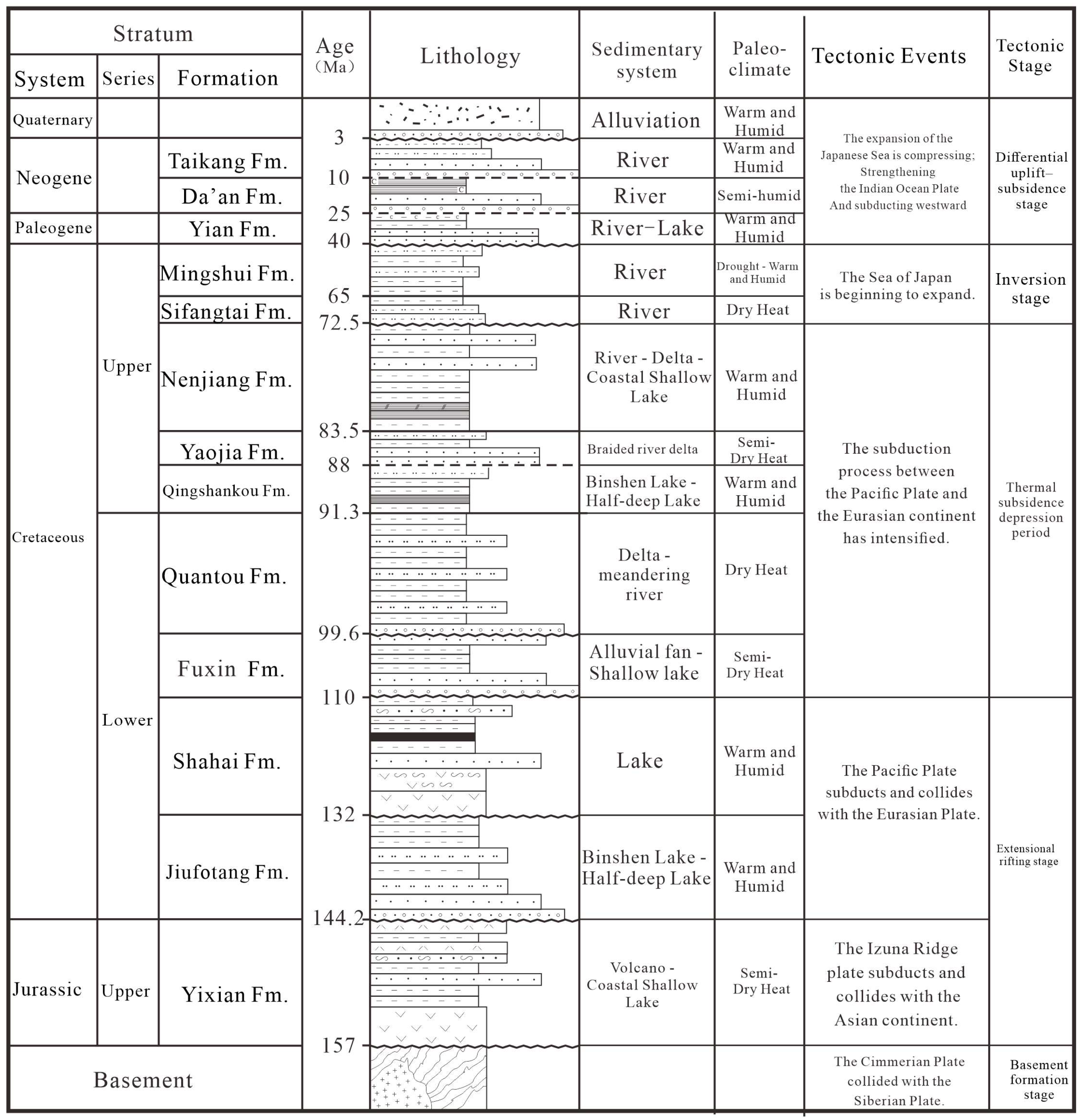
The formation and evolution of the Songliao Basin are related to continental crustal rifting. Its geological evolution since the Mesozoic can be divided into six stages (Figure 2): thermal uplift and rifting (T–J2), extensional faulting and depression (J3–K1), thermal subsidence and downwarping (K2q–K2n), tectonic inversion (K2s–K2m), and uplift and denudation (E–Q). During the early Late Cretaceous, the climate was tropical to subtropical and arid. The Qingshankou and Nenjiang Formations were deposited during periods of extensive lacustrine transgression, whereas the Yaojia Formation is dominated by red fluvial clastic rocks and serves as the main ore-host horizon in the area. The tectonic inversion stage corresponds to the deposition of the Sifangtai and Mingshui Formations, leading to the formation of tectonic windows that controlled the migration of uranium- and oxygen-bearing fluids and initiated the formation of interlayer oxidation zone-type uranium mineralization. The Himalayan movement caused overall uplift of the basin, intensifying volcanic activity and thermal fluid circulation and enhancing interlayer oxidation, making this the main period of uranium mineralization.

2.2. Major Mesozoic-Cenozoic Basin Stratigraphy

The sedimentary cover in the southwestern Songliao Basin is mainly composed of Mesozoic-Cenozoic strata (Figure 2). The Yaojia Formation of the Upper Cretaceous in the key area is currently the primary uranium-bearing rock series in the Qianjiadian uranium deposit. The following focuses on the stratigraphic evolution characteristics of the depression-stage Qingshankou, Yaojia and Nenjiang Formations.
The top of the Upper Member of the Qingshankou Formation (K2qn) is dominated by light gray fine-grained sandstone and light red argillaceous siltstone, intercalated with gray and purplish red mudstone. Horizontal bedding is well developed, with rare scour surfaces. Purplish mud is observed below this interval in boreholes across the ore district.
Yaojia Formation (K2y), which disconformably overlies the Qingshankou Formation, serves as the primary uranium-hosting horizon. It can be subdivided into upper and lower members. The upper member is dominated by reddish-yellow oxidized sandstones with good permeability. The lower member consists mainly of grayish-green sandstones containing abundant carbonaceous debris, which provides reductants for uranium enrichment, resulting in more favorable mineralization within this lower member.
The top of the Nenjiang Formation (K2n) is not encountered in most boreholes within the study area. The sedimentary strata of this formation are in conformable contact with the underlying Yaojia Formation, and show a bottom-to-top lithological transition from gray fine-grained sandstone to dark gray mudstone. Special lithologies, including white mudstone and diabase, are also observed in the drill cores, which are genetically associated with deep-seated magmatic intrusion events; the white mudstone is formed by contact baking under high-temperature conditions. Horizontal bedding is well developed in the Nenjiang Formation, whose sedimentary environment was more stable than that of the Yaojia Formation. It is classified as argillaceous deposits of shallow lacustrine to semi-deep lacustrine facies.

2.3. Overview of Uranium Mineralization

2.3.1. Stratigraphic Distribution and Uranium Mineralization

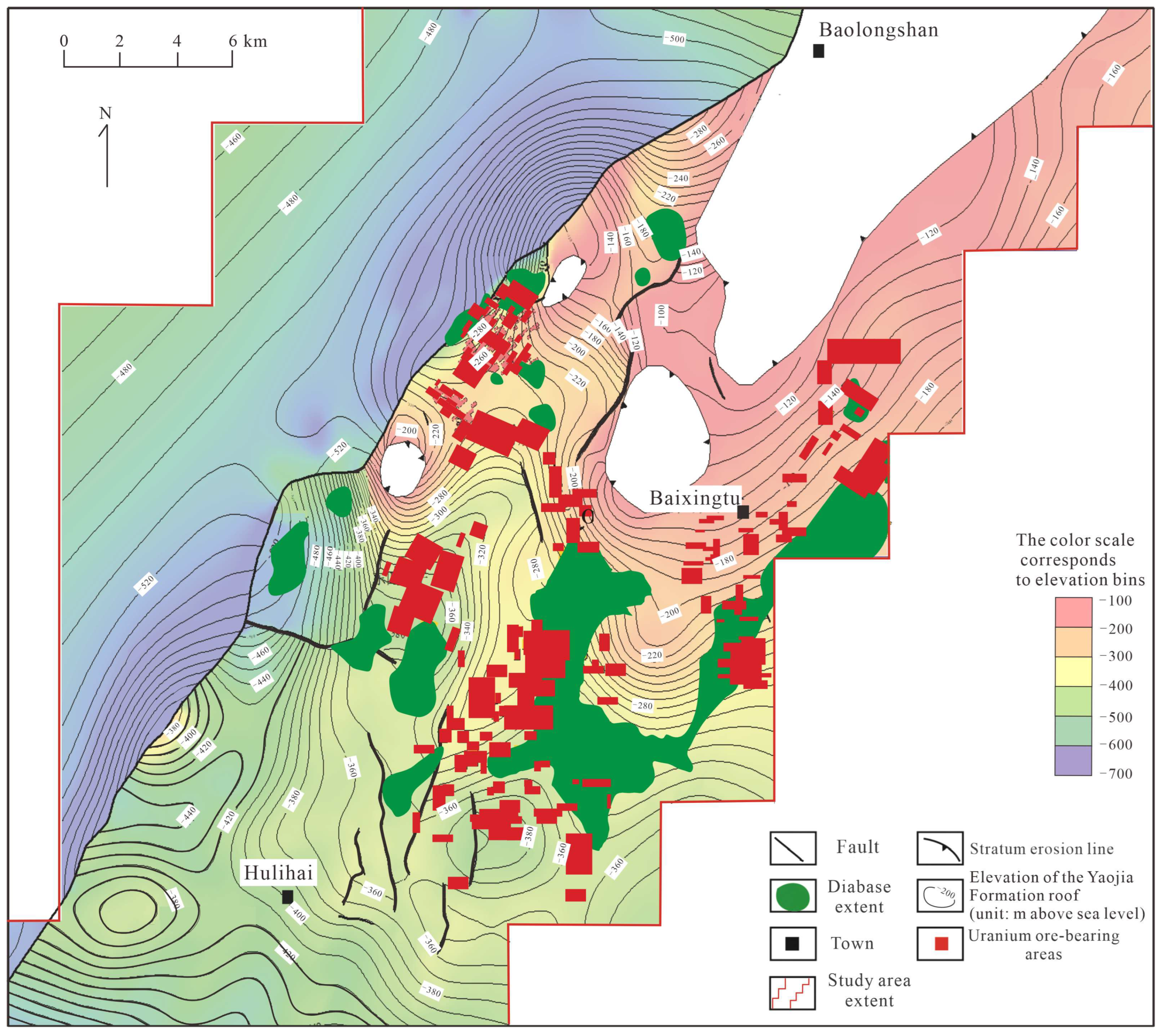
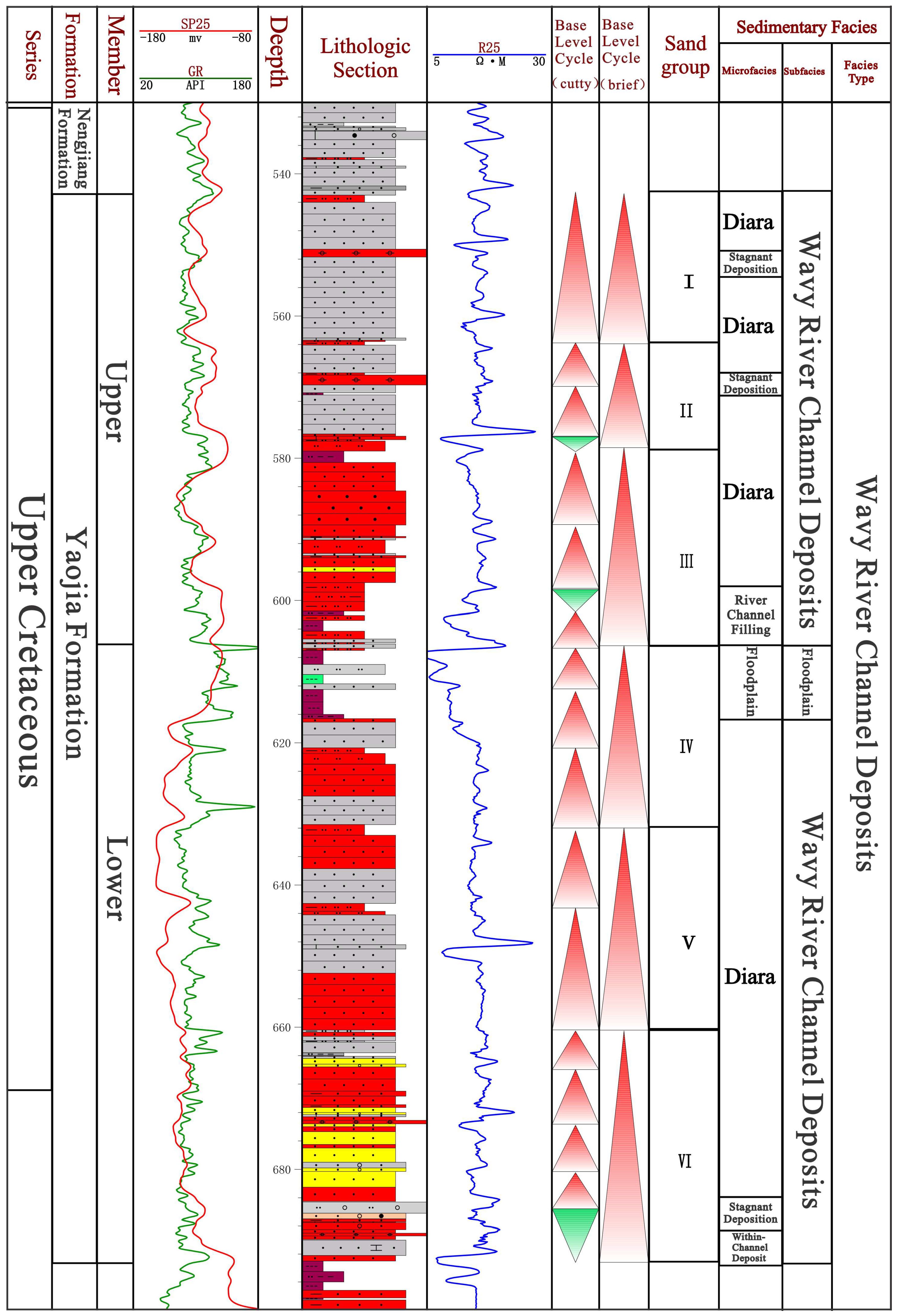
The study area is located in the Qianjiadian Depression of the Songliao Basin. The principal strata developed in the mining district include the Upper Cretaceous Yaojia Formation (K2y) and the Upper Cretaceous Nenjiang Formation (K2n) (Figure 3). The uranium-hosting horizons are mainly developed within the Upper Cretaceous Yaojia Formation, which can be subdivided into upper and lower members. Uranium orebodies in the upper member are limited in distribution and relatively low in grade, whereas those in the lower member exhibit significantly larger lateral extent and higher grades, locally reaching up to 350 ppm. The ore-bearing lithologies are predominantly fine-grained and medium-grained sandstones, whereas mineralization is rarely observed in mudstone.
Sandstones of the Yaojia Formation in the study area include red, yellow, gray-green, and gray-white alteration types. Red sandstones represent the primary depositional environment and are interpreted to have undergone limonitization during synsedimentary hydrothermal leaching. Under the influence of reducing media such as hydrocarbons, bleaching phenomena commonly occur where gray-white sandstones are interbedded within red sandstones. Yellow sandstone is the result of later-stage fluids oxidizing the underlying strata through structural skylights. Hydrocarbon-related alteration induced kaolinization of clay minerals, resulting in gray-white coloration. Uranium orebodies commonly occur near the transition zone between gray-white and gray sandstones and are mainly hosted within gray sandstones. Locally developed gray-green sandstones are also interpreted as products of hydrocarbon alteration, with minor contributions from depositional processes. Mudstones containing carbonaceous laminae locally show elevated uranium concentrations, and sandstones enriched in organic matter are commonly mineralized.

2.3.2. Sedimentary Environment of the Ore-Bearing Strata

The target strata exhibit pronounced sedimentary rhythmicity, characterized overall by upward-fining successions. This reflects the transition from fluvial deposition in the Yaojia Formation to lacustrine deposition in the Nenjiang Formation, corresponding to a gradual decrease in hydrodynamic energy. Multiple upward-fining cycles occur in the Yaojia Formation, typically bounded by erosional surfaces. Above the erosional surfaces, grain size decreases upward, whereas below them mudstone or fine sandstone is developed. Red and gray-green mudstone intraclasts occur locally within sandstones. The mud clasts vary in size, reaching up to 2 cm, and are well rounded, indicating strong hydrodynamic conditions during transport and deposition. Some mud clasts were elongated and flattened during deposition. Trough cross-bedding is locally observed in the lower member of the Yaojia Formation, indicating moderate flow energy, while horizontal bedding is common in siltstone and mudstone, formed under relatively stable hydrodynamic conditions and often containing organic laminae.
Fault structures are more developed than folds, with NE-trending faults being dominant. After four stages of tectonic evolution, the Songliao Basin was influenced by the Nenjiang Movement, resulting in significant uplift in the eastern and southern parts of the basin. Consequently, strata generally dip from southeast to northwest [27], with shallower burial depths in the south and deeper burial depths in the north. The lower member of the Yaojia Formation consists mainly of braided fluvial facies, with an average sand-body proportion of about 50%. Sand bodies in the lower member are significantly thicker than those in the upper member, and sand bodies in the northern depression are thicker than those in the south. Uranium mineralization is more extensively distributed in the northern part and in the lower member, indicating that thicker sand bodies are more favorable for uranium mineralization.
The Yaojia Formation widely developed braided channel deposits (Figure 4). Mid-channel bars represent the principal microfacies for sand-body enrichment. Lithologies are dominated by light gray to light red fine-grained sandstones. Internally, multiple positive cycles form a typical dual-structure braided fluvial sedimentary architecture. Locally, braided delta facies are developed, creating favorable conditions for uranium mineralization. During deposition of the lower Yaojia Member, the paleoclimate was predominantly arid to semi-arid, with intermittent relatively humid intervals, forming a primary geochemical environment characterized mainly by red beds with localized gray units. Mudstones at the base of the lower Yaojia Member and mudstones of the Qingshankou Formation act as effective aquitards, exerting a positive influence on uranium mineralization.

2.3.3. Characteristics of Uranium Mineralization

The principal ore-bearing horizon of the Qianjiadian uranium deposit is the Upper Cretaceous Yaojia Formation, with orebodies mainly hosted in sandstones of the lower member. In plan view, uranium orebodies are distributed around erosional windows (Figure 3). The morphology of the orebodies is broadly concordant with the host strata, trending NE and dipping NW. Burial depths range from approximately 200 to 350 m. Orebodies are predominantly stratabound, occurring in tabular or lenticular forms.
Mineralization is mainly developed in the transitional zone from white sandstone to gray sandstone. Distinct yellow oxidation zones are developed at the upper and lower ore boundaries. Vertically, each mineralized layer comprises one or more orebodies. Both upper and lower members contain three mineralized intervals, but the lower member exhibits wider distribution, higher grades, and greater thickness, making it the most important ore-hosting horizon. The orebodies are controlled by adjacent white and gray sandstones, with gray (white) ore-bearing sand bodies appearing to be “suspended” within yellow sandstones. The ore-bearing sandstones are mainly fine to medium-grained feldspathic lithic sandstones with grain sizes concentrated between 0.2 and 0.5 mm. Ore structures are predominantly massive. The ore is generally poorly consolidated with argillaceous cement, while local carbonate cementation increases compaction and cementation degree. Carbonaceous bands are locally observed in ore-bearing mudstones.

2.3.4. Characteristics of Calcite Vein Development

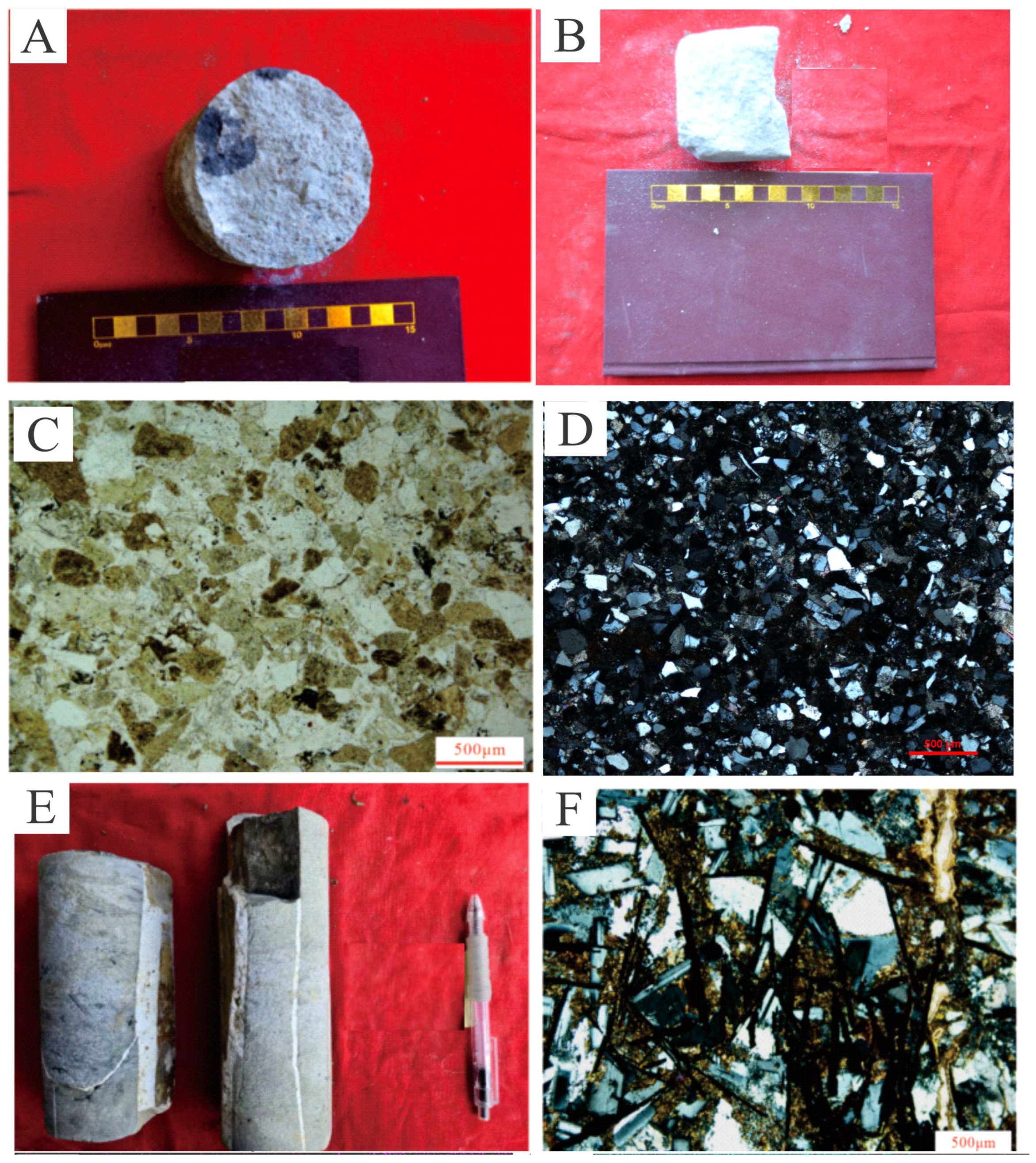
Calcite veins are widely developed within fractures of diabase in the Qianjiadian uranium mining area (Figure 5). Diabase is extensively distributed, mainly along NE-trending structural windows in plan view, consistent with the spatial distribution of uranium mineralization. Vertically, diabase intrudes the Yaojia and Nenjiang formations, extending dendritically and locally reaching the Paleogene strata. Core observations indicate that diabase is hard and compact, commonly containing calcite veins. Due to the relatively ductile physical properties of sandstone, fractures are less likely to be preserved; thus, calcite veins are mainly preserved within brittle diabase fractures.
The timing of diabase intrusion is coupled with the early uranium mineralization age, suggesting that magmatic activity may have provided a heat source for early mineralization [14]. Petrographically, diabase is dark gray with typical diabasic texture and massive structure. Major minerals include plagioclase (40%–52%) and pyroxene (33%–40%), with minor magnetite and ilmenite. Plagioclase commonly occurs as euhedral tabular crystals with well-developed polysynthetic twinning, locally enclosing pyroxene, reflecting a differential crystallization sequence. The widespread development of calcite veins in diabase fractures indicates significant hydrothermal activity.

3. Sample Collection and Research Methods

3.1. Sample Collection and Research Rationale

All calcite vein samples in this study were collected from drill cores of the Qianjiadian uranium deposit, sourced from the Yaojia Formation and the Nenjiang Formation, at burial depths generally between 150 and 400 m. Detailed sample information for the diabase and the carbonate veins within it is provided in Table 1. The primary objective of this research is to investigate the geological and geochemical characteristics as well as the genesis of the calcite veins. The methodology involves, firstly, analyzing the material composition and types of carbonate veins using electron probe microanalysis (EPMA) and scanning electron microscopy (SEM). Subsequently, the major and trace elements, C-O isotopes, and the properties of fluid inclusions in the samples are observed and tested. U-Pb isotopic dating of the calcite veins is also conducted. Finally, the genesis of the calcite veins is comprehensively analyzed by integrating the geological context with other relevant isotopic data.

3.2. Analytical Methods

3.2.1. Composition and Types of Carbonate Veins in Diabase

Composition and texture of carbonate veins: The composition and types (e.g., calcite, dolomite, or mixed) of the carbonate veins were determined through high-magnification optical microscopy and electron probe microanalysis (EPMA) of thin and polished sections of the ores and carbonate minerals. These analyses were conducted at the National Key Laboratory of Continental Evolution and Early Life, Northwest University, Xi‘an, China, using a Quanta 450 FEG scanning electron microscope (SEM) (FEI Company, Brno, Czech Republic) and a JEOL JXA-8230 electron probe microanalyzer (JEOL Ltd., Tokyo, Japan).
Major element analyses were conducted using a ZSX Primus II X-ray Fluorescence (XRF) Spectrometer (CRF) (Rigaku Corporation, Tokyo, Japan). For major element determination, samples were prepared via the alkali fusion method. The standard curve was calibrated using the Chinese national standard reference material GBW07105 and the United States Geological Survey (USGS) standard reference material BCR-2, with an instrument limit of detection (LOD) of 10−6.
Trace and rare earth element (REE) analyses were performed using an Elan 6100 DCR quadrupole inductively coupled plasma mass spectrometer (ICP-MS) from Perkin Elmer (Waltham, MA, USA, DCR). For trace and REE determination, samples were prepared using a closed high-temperature and high-pressure acid digestion method. Analytical quality control was monitored using international standard reference materials, including BHVO-1 (basalt), AGV-1 (andesite) and GSR (granite). The LOD for the analyzed elements was approximately 0.1 µg/g. All tests were performed in compliance with the Chinese industry standard JY/T 0567-2020.

3.2.2. C-O Isotopic Analysis of Calcite Veins

Carbon and oxygen isotopic compositions of the calcite veins were analyzed in the novel ultra-clean laboratory of Guizhou Tongwei Testing Co., Ltd., Guiyang, China. The primary instrument used was a GasBench II system (Thermo Fisher Scientific, Bremen, Germany). The analytical procedure was as follows: (1) Sample Preparation: An appropriate amount of carbonate sample was weighed and sealed in a 12 mL Labco vial(Labco Limited, Lampeter, UK). (2) Vial Pre-treatment: High-purity He gas was used to purge the vial, eliminating interference from residual air. (3) Phosphoric Acid Digestion: Anhydrous phosphoric acid (Sinopharm Chemical Reagent Co., Ltd., Shanghai, China) was introduced into the vial, which was then heated at 70 ± 0.5 °C for 45 min to fully decompose the carbonate and release CO2 gas. (4) Isotopic Measurement: The evolved CO2 gas was analyzed using a GasBench II-Delta V Advantage stable isotope ratio mass spectrometry (IRMS) system(Thermo Fisher Scientific, Bremen, Germany). The obtained data were processed using standard equations to calculate the isotopic ratios.

3.2.3. U-Pb Isotopic Dating of Calcite Veins

In situ LA-ICP-MS U-Pb dating of the carbonate veins was performed at the Guizhou Tongwei Testing Co., Ltd., Chinese Academy of Sciences. The system comprised a RESOlution SE-S155 laser ablation unit(Resonetics, LLC, Nashua, NH, USA) and a Thermo Fisher ICAP RQ inductively coupled plasma mass spectrometer(Thermo Fisher Scientific, Bremen, Germany). To ensure data accuracy, three reference materials were used: the laboratory standard PTKD-2 (recommended age of 153.7 ± 1.7 Ma), the international standard AHX-1d (recommended age of 238.2 ± 2.4 Ma), and LD-5-2 (recommended age of 73.2 ± 2.0 Ma). The actual measurement results are as follows: the U-Pb age of PTKD-2 is 153.2 ± 2.3 Ma (MSWD = 3.2, n = 67); the measured age of AHX-1d is 238.2 ± 1.5 Ma (MSWD = 4.6, n = 67); and the measured age of LD-5-2 is 73.61 ± 0.36 Ma (MSWD = 1.17, n = 67). These results indicate stable instrument performance and reliable data quality during the experiment. The relative deviations between the measured and recommended values of the standards are all less than 2%, meeting the precision requirements for carbonate mineral U-Pb dating. Prior to analysis, the sample (as a thick probe section) was pre-ablated to select suitable spots. The ablated material was transported to the mass spectrometer using a He and Ar gas mixture. Raw data were processed using NIST 614 as an internal standard. Offline data reduction was performed using the Iolite4 software package, and age calculations and plotting were conducted using Isoplot3.0, with further corrections applied to the final age data.

3.2.4. Study on the Nature and Genesis of Fluid Inclusions

Fluid inclusion analysis is critical for constraining the nature and evolution of uranium-forming fluids. Analyses were performed at the State Key Laboratory of Continental Dynamics and Early Life, Northwest University, Xi‘an, China, using standardized methods and quality control:
(1) Microthermometry: LINKAM THMS600 heating-cooling stage (Linkam Scientific Instruments, Tadworth, UK); (2) Temperature range: −190.0 to 600.0 °C; (3) Test conditions: 20 ± 0.5 °C, 40 ± 5% humidity. Homogenization temperatures (Th) and ice-melting temperatures (Tm) were measured. Salinity was calculated using:
S (wt%) = 0.00 + 1.78T − 0.0442T2 + 0.000557T3
Ore-forming pressure was estimated using P (MPa) = 0.196T (°C) − 17.32 [32].
Physicochemical parameters (Eh, pH) were further estimated using empirical formulas (Table 2).
The Raman spectroscopic analysis in this study was carried out at the Xi’an Geological Survey Center (Xi’an, China). The instrument used was an inVia laser Raman microprobe (Renishaw plc, Wotton-under-Edge, UK) equipped with a CCD detection system and an Ar+ laser (excitation wavelength up to 514.5 nm, output power up to 30 mW). Data acquisition and processing were performed using WiRE software (version not specified; Renishaw plc).
(2) Calculation of fluid inclusion trapping pressure: Traditional methods rely on the intersection of isochores of oil and brine inclusions or homogenization temperature simulation to obtain entrapment pressure, which requires determining parameters such as freezing point temperature, homogenization temperature, and gas–liquid ratio, followed by calculation using charts or empirical formulas. However, these methods have inherent limitations. With the development of PVTsim software, Mi et al. (2002) [36] proposed a new approach: leveraging the constant total volume of fluid inclusions, the gas–liquid ratio is calculated and input into the “multi-flash” module of PVTsim to directly simulate the entrapment pressure. Based on the theory proposed by Aplin et al. (2000) [37], this method has been widely applied in relevant studies.
The trapping pressure of fluid inclusions was estimated using the method proposed by Wang et al. (2018) [38]. The “PT–aqueous” and “V–T” modules of PVTsim20 were employed to simulate the trapping pressure and the vapor-to-liquid ratio at room temperature under two different compositional conditions for the target inclusions. A relationship equation between the vapor-to-liquid ratio and the trapping pressure was thereby established. Subsequently, by calculating the volume ratio of the vapor bubble to the total inclusion volume and substituting it into the aforementioned equation, the trapping pressure of the selected inclusion was determined.

4. Results and Discussion

4.1. Types and Occurrence of Carbonate Veins

Carbonate veins are well developed in the diabase cores, but generally only one carbonate vein occurs in a single core. Macroscopic observation conditions are poor, making it impossible to distinguish different stages and episodes of carbonate veins based on cross-cutting relationships. Instead, different episodes of carbonate veins can only be identified through laboratory testing of fluid properties after sample preparation and analysis.
Carbonate veins mostly occur as thin, single veins, with minor stockwork veins and occasional film-like veins. Vein widths are generally 1–10 mm, and some veins reach several centimeters in thickness (Figure 6). Veins are widespread in the mining area and are hosted exclusively in diabase; no carbonate veins were found in sandstone or mudstone. After ore-forming fluids infiltrated and filled the fractures within the diabase, the hard and brittle nature of the diabase enabled calcite to preserve the original morphology of the host fractures, thus forming vein bodies. In contrast, the sandstone is characterized by relatively high ductility: fractures are difficult to develop within it, and even when fractures are generated, they are rapidly filled and closed. Therefore, despite the presence of hydrocarbon-bearing fluids, no vein-type calcite was formed in the sandstone.
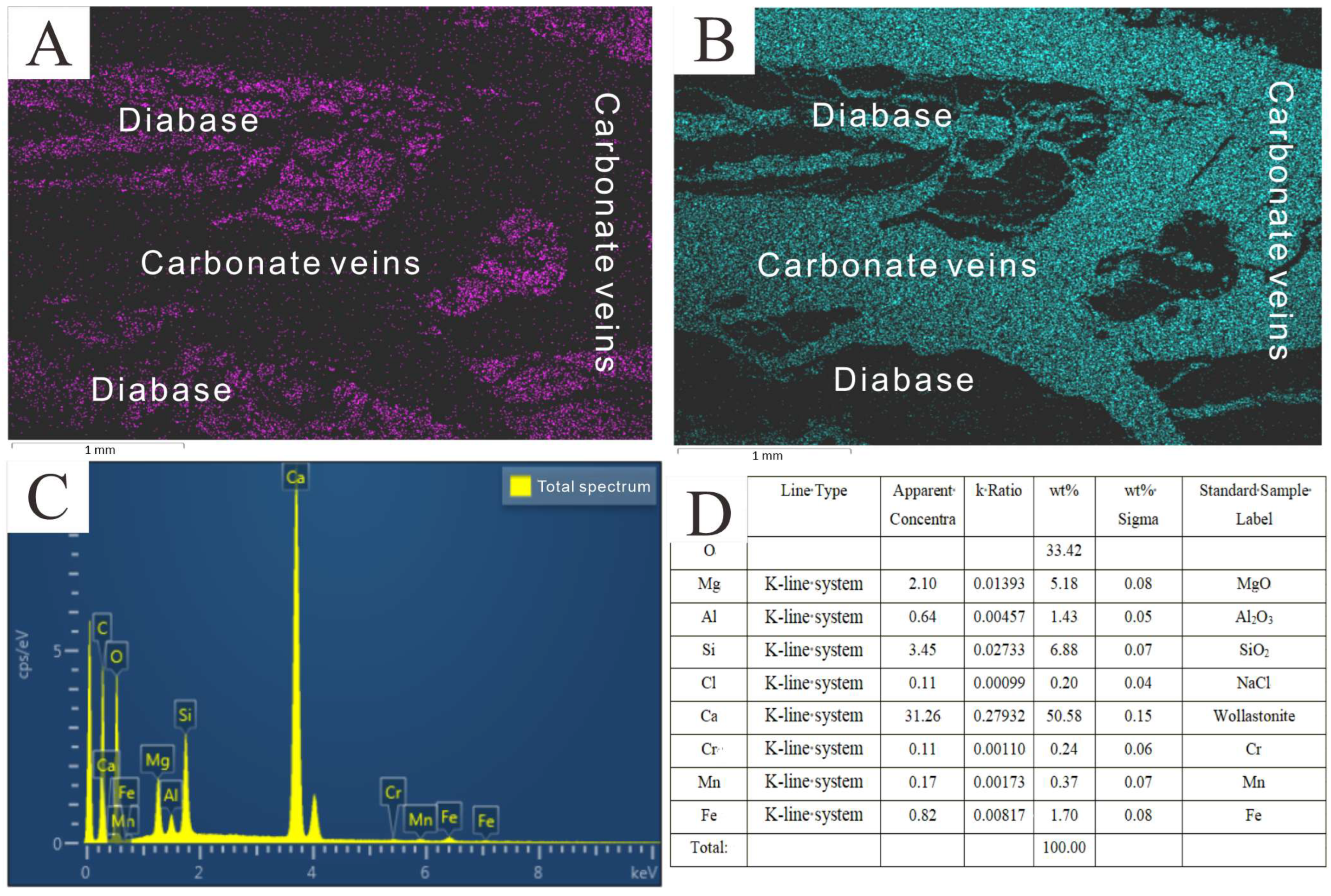
Carbonate veins are white and dominated by calcite, which accounts for more than 90% of the mineral composition. Analyses by electron microprobe and scanning electron microscopy with energy dispersive spectroscopy (SEM-EDS) show that the Ca/Mg ratio in the samples is as high as 10:1 (Figure 6). Minor barite was identified by electron microprobe. Element mapping under SEM shows that carbonate veins correspond to areas without Si distribution. Mg is nearly absent within carbonate veins and is only distributed in the diabase, whereas Ca is concentrated in carbonate veins and absent in the diabase. Calcite occurs as crystalline granular and fibrous crystals, colorless and transparent, with grain sizes ranging from 0.01 to 1 cm.
Veins exhibit banded and comb structures. The margins of wider banded veins are locally reddened, interpreted to be caused by fine-grained, flaky hematite at grain edges. Geochemically, carbonate veins have lower TFe2O3 contents than the host diabase, so Fe3+ at vein margins is inferred to originate from oxidation of ferrous iron in the diabase. Trace element analyses show that Sr and U contents in calcite veins are significantly higher than those in the host diabase.
Therefore, the carbonate veins in the study area are dominantly calcite veins. It is preliminarily concluded that carbonate veins formed later than the diabase and are not directly related to magmatism. Combined with subsequent studies, they are interpreted to have formed by late-stage hydrocarbon-bearing groundwater-mixed hydrothermal fluids filling fractures in the diabase.

4.2. Geochemical Characteristics of Carbonate Veins

4.2.1. Major Elements

Major and trace element analyses of carbonate veins in diabase from the Qianjiadian uranium deposit were completed at Northwest University, with data listed in Table 2. Overall, CaO is the dominant major oxide, and loss on ignition (LOI) is approximately 40%. Combined with SEM EDS showing abundant carbon, the LOI is interpreted to be mostly CO2. Other elements such as Si and Fe show relatively high contents, likely due to minor diabase contamination during sample preparation. The near absence of Mg and S indicates that dolomite and barite are not major components, confirming that the veins are calcite veins.

4.2.2. Trace Elements and Rare Earth Elements

Trace element analyses (Table 3) show that calcite veins are significantly enriched in Sr, Ba, and Y and depleted in other elements, especially strongly depleted in Zr, Hf, and Nb. This indicates that the carbon source for calcite veins is unrelated to deep magmatic processes and instead reflects shallow groundwater hydrothermal activity.
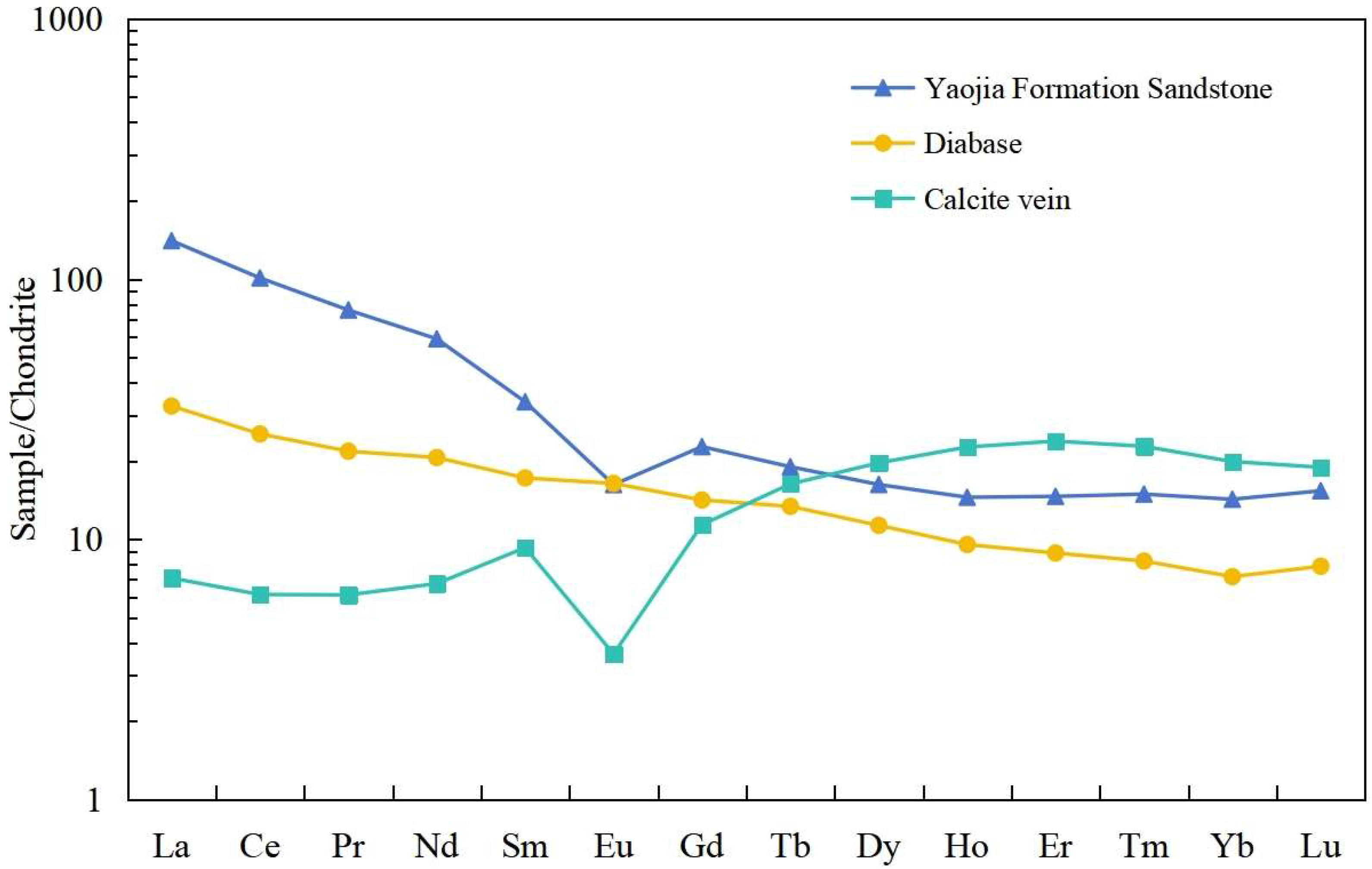
Total rare earth element contents (∑REE) range from 27.53 to 29.15 ppm, relatively low. The LREE/HREE ratio is 0.63, and (La/Yb)n < 1. Chondrite-normalized REE patterns (Figure 7) show left-sloping, and heavy rare earth element (HREE)-enriched signatures with distinct negative Eu anomalies.
In contrast, diabase and sandstone display Light rare earth element (LREE)-enriched, right-sloping patterns with weak negative Eu anomalies. These differences demonstrate that calcite veins are genetically unrelated to diabase emplacement and are not magmatic products. Although organic decarboxylation in shallow sedimentary environments can provide carbon for carbonate precipitation, the REE patterns of sandstone differ greatly from those of calcite veins (Figure 7), indicating no direct genetic link to shallow sedimentary carbon sources.

4.2.3. C-O Isotope Tracing

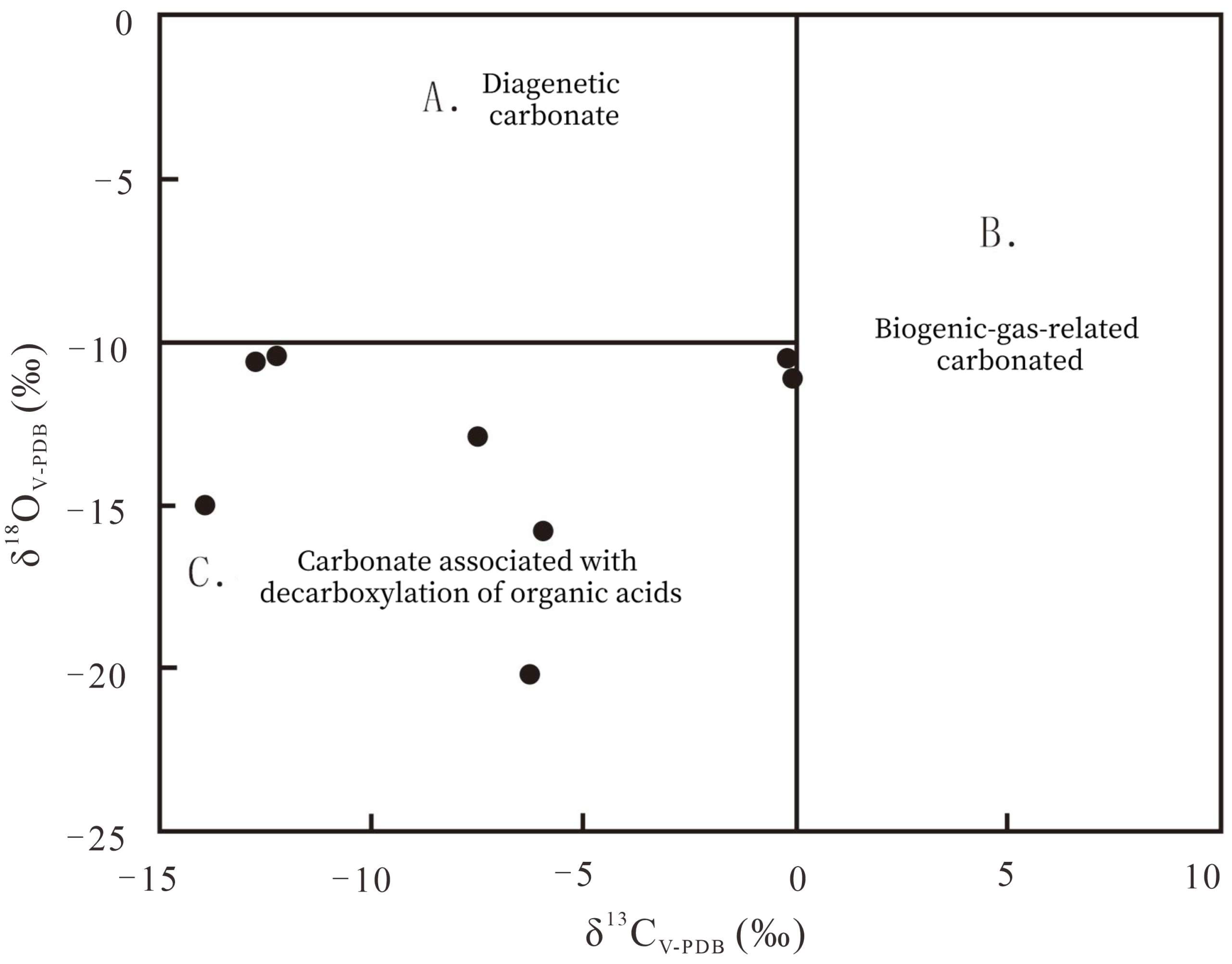
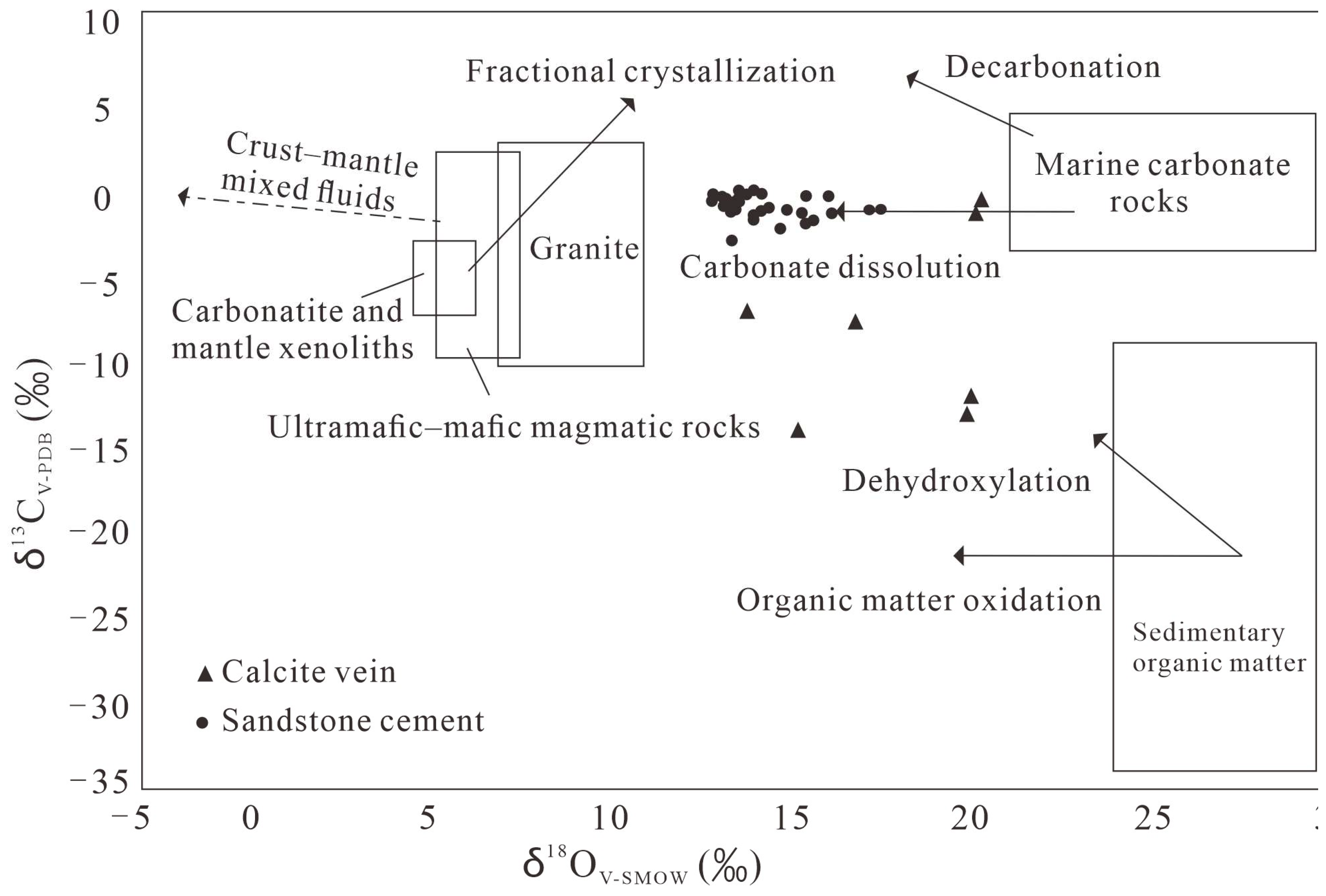
Carbon-oxygen isotopes of calcite veins effectively trace fluid sources and provide constraints on vein genesis. C-O isotope data were obtained for 7 calcite vein samples (Table 4). δ13CV-PDB ranges from −0.06‰ to −14.08‰, averaging −7.51‰.δ18OV-SMOW ranges from 13.64‰ to 19.7‰, averaging 16.67‰, converted from δ18OV-PDB using δ18OV-SMOW = 1.03091 × δ18OV-PDB + 30.91 [40]. In natural systems, δ13C values reflect carbon sources: −6‰ suggests magmatic sources [41,42]; 0–1‰ suggests marine carbonate sources; −6 to −7‰ suggests meteoric water; values < −10‰ suggest organic carbon.
On the δ18O-δ13C diagram (Figure 8), most samples plot between −5‰ and −15‰, indicating a dominantly organic/hydrocarbon carbon source. Compared with sandstone carbonate cements (Figure 9), calcite veins show more dispersed C-O isotopes, partially related to organic decarboxylation. Most data plot between granite, marine carbonate, and sedimentary organic matter fields. As the Songliao Basin is continental, marine carbonate sources are excluded. The carbon source is interpreted as a mixed hydrocarbon-meteoric water source, consistent with low-temperature hydrocarbon-bearing hydrothermal fluids filling fractures, representing products of hydrocarbon dissipation. Sandstone carbonate cements show tightly clustered isotopic compositions in the marine carbonate dissolution field, indicating a sedimentary carbon source, revealing significant isotopic fractionation between the two carbonate phases.
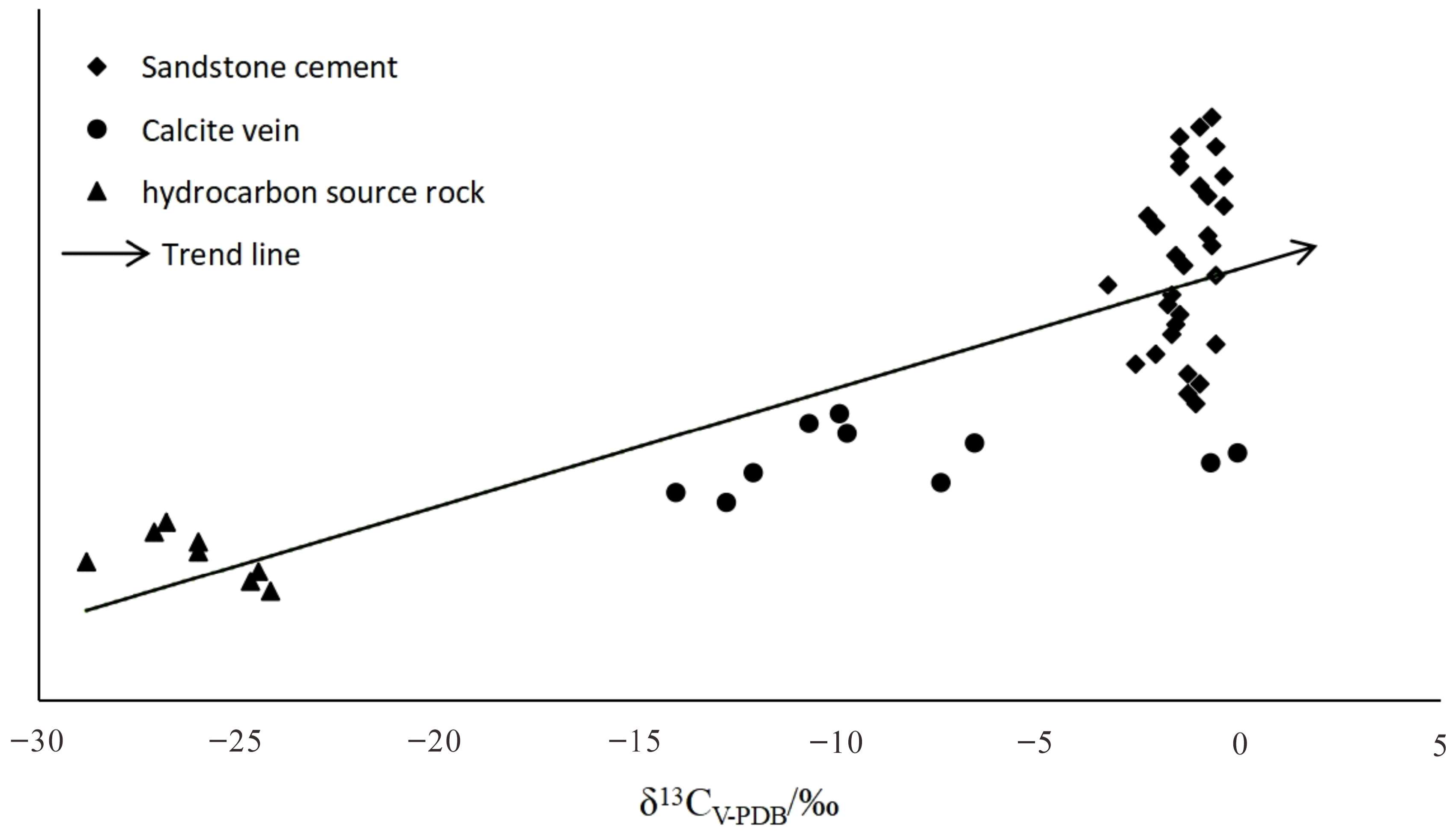
The C-O isotopic data obtained in this study were compared with the carbon isotopic data of source rocks from the Jiufotang Formation, which underlies the ore-hosting Yaojia Formation. The carbon isotopes of the source rocks show significantly the most strongly negative values, mainly concentrated around −25‰. It can be observed that the δ13C values of the source rocks exhibit the strongest negative excursions, generally below −20‰; whereas the δ13C values of sandstone cements show weak negative excursions, mainly ranging from −1‰ to 0‰, indicating an overprint of shallow meteoric water. The δ13C values of the calcite veins lie between these two endmembers, with most values clustering around −10‰.
Some of the data points plot close to the endmember of crust-mantle mixed fluid or ultramafic-mafic magmatic rocks, which is likely related to the thermal input and minor mantle material contribution from diabase intrusion. The overall trend points to a mixed origin dominated by an organic carbon source, with contributions from meteoric water and magmatic thermal driving. As shown in Figure 9, from source rocks to carbonate veins and then to carbonate cements, the δ13C values display a gradual transition from strongly negative excursions to weakly negative excursions, and finally to values within the range around 0‰. This indicates that the process from the escape of subsurface organic hydrocarbon-bearing fluids from source rock horizons to the formation of carbonate veins and carbonate cements in sandstones is characterized by progressive isotopic fractionation, accompanied by a gradual weakening of the influence of organic hydrocarbon components.
During the continuous consumption of organic matter as a reducing medium to promote uranium mineralization and ore preservation, the proportion of carbon source derived from sedimentary organic matter gradually decreased, while the contribution of carbon fractionation induced by meteoric water interaction increased progressively. The final result recorded by the carbon isotope tracer is a gradual reduction in the negative excursion of δ13C values, i.e., δ13C values evolved from strongly negative values (organic matter or source rocks) to weakly negative values via isotopic fractionation. The progressive intensification of hydrocarbon migration and its interaction with groundwater is manifested by the further isotopic fractionation of δ13C values from carbonate veins to values around 0 or slightly positive values. This geochemical signature is preserved in the carbon of epigenetic carbonate cements, indicating that shallow groundwater processes were the dominant control during this stage. This also reflects that the role of hydrocarbon dissipation in uranium mineralization is recorded by the progressive isotopic fractionation and evolution of δ13C values in the genetically associated products (Figure 10).

4.3. Fluid Properties of Calcite Vein Formation

4.3.1. Characteristics of Fluid Inclusions

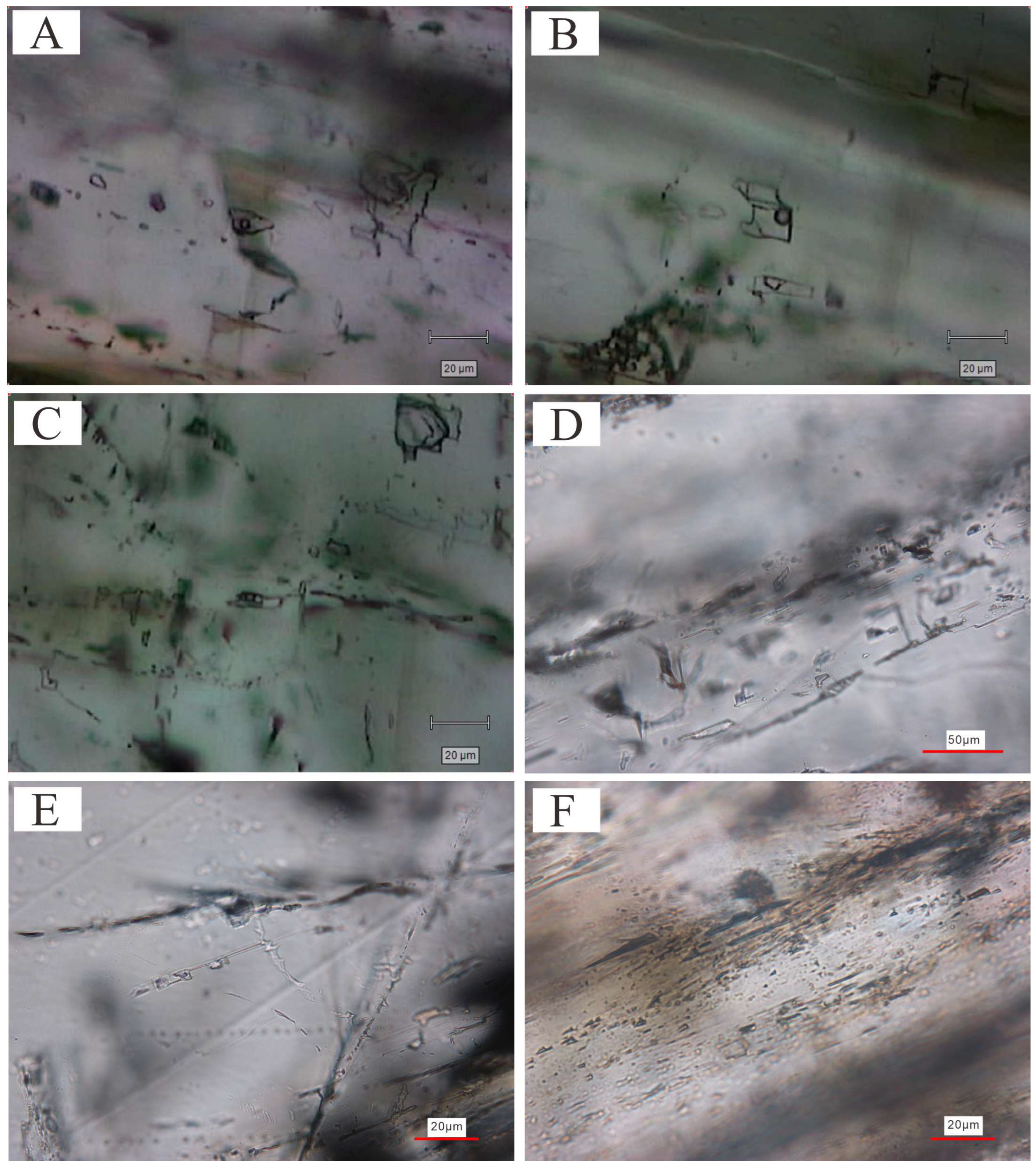
Fluid inclusions were first observed under a microscope and confirmed to be secondary inclusions. Overall, the number of fluid inclusions within the calcite is relatively sparse, making the identification of aqueous inclusions challenging. Among the inclusions identified, most have an average size of approximately 2 µm, and even the larger inclusions rarely exceed 10 µm in diameter. The aqueous inclusions are predominantly elliptical in shape, with some being elongated, colorless and transparent, and display a vapor-liquid two-phase composition. The average vapor-to-liquid ratio is relatively low, generally ranging from 3% to 7% (Figure 11). However, abundant vein-like or banded inclusions can be observed within the fractures of the calcite, which facilitated subsequent analyses.

4.3.2. Physicochemical Properties of Inclusion Fluids

  • Homogenization Temperature and Salinity
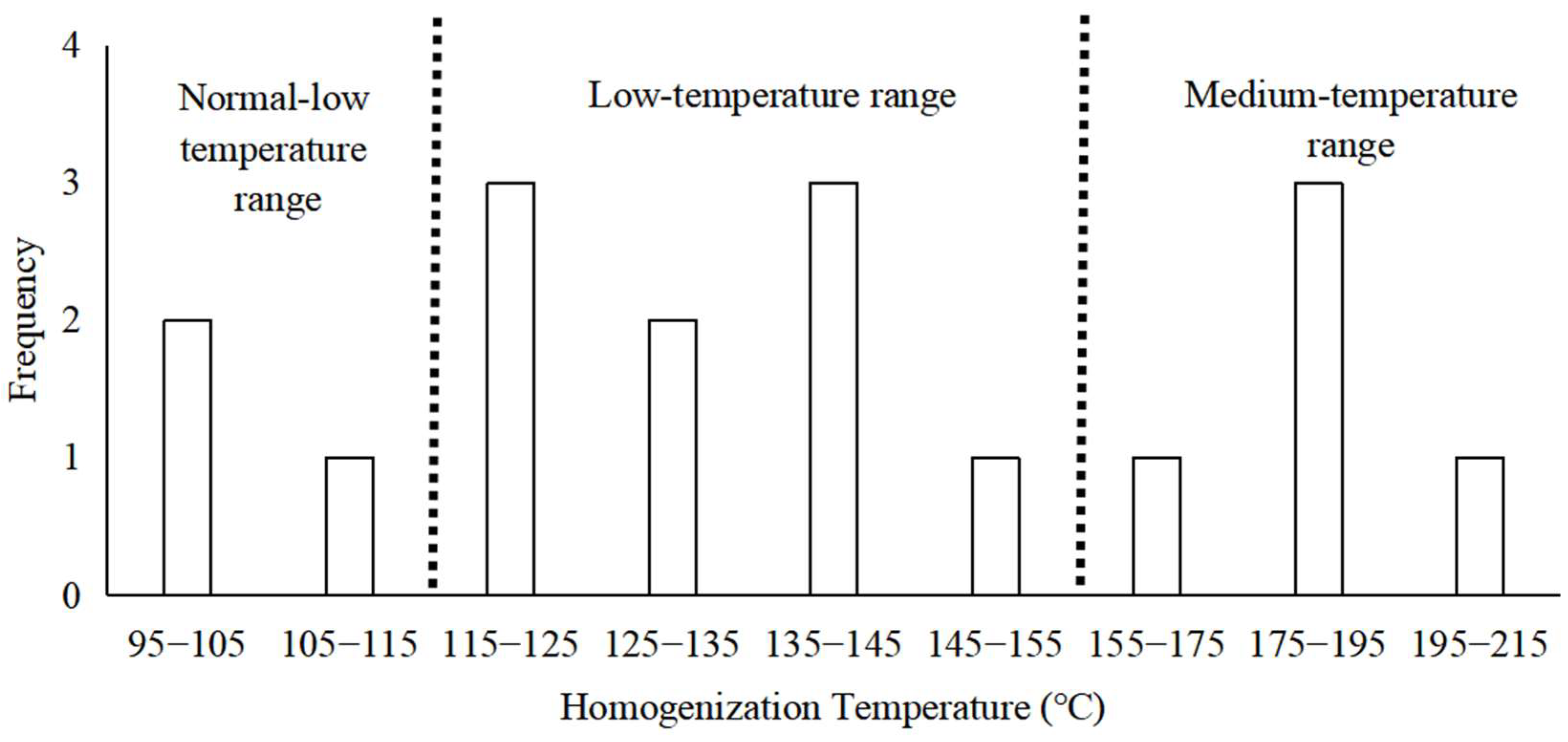
Fluid inclusions enable the direct measurement of key physicochemical parameters of ore-forming fluids, including temperature, salinity, and chemical composition. The temperature data obtained from microthermometric experiments represent the homogenization temperature (Th) and freezing point temperature (Tf) of the fluids at the time of entrapment. The inclusions analyzed in this study are predominantly zoned inclusions hosted within calcite grains, and the host calcite generally has no developed secondary overgrowth rims. The statistical results are summarized in Table 5. The homogenization temperatures of fluid inclusions within calcite range from 97.8 °C to 204.3 °C, with two dominant temperature peaks at 135–145 °C and 175–195 °C (Figure 12). The salinity of the brine inclusions ranges from 3.88 to 15.94 wt% NaCl equiv., and the density of the ore-forming fluids varies between 0.89 and 1.06 g/cm3, with an average value of 0.996 g/cm3.
Statistical analysis of the homogenization temperatures and salinities of fluid inclusions in the calcite veins is presented in Figure 12. The homogenization temperatures can be divided into three intervals: 95–115 °C, 115–155 °C, and 155–215 °C. Overall, the fluid inclusions in all analyzed samples exhibit three stages of fluid activity characteristics. Based on the criteria that ≤150 °C indicates low temperature, 150–250 °C indicates medium-low or medium temperature, and ≥350 °C indicates high temperature for ore-forming hydrothermal fluids, the fluids are classified as normal- to low-temperature fluids (<100 °C), low-temperature fluids (100–150 °C), and medium- to low-temperature hydrothermal fluids (150–250 °C). Normal- to low-temperature fluids represent processes involving meteoric water, predominantly characterized by the infiltration of surface oxygenated water. The characteristics of medium- to low-temperature hydrothermal fluids suggest that the intrusion of mafic rocks provided a heat source, resulting in medium- to low-temperature fluid features. In contrast, reduced hydrocarbon fluids dissipated from deep underground often mix with low-temperature to normal-temperature, low-salinity interlayer water, exhibiting characteristics of low-temperature fluids. The study area contains diverse types of ore-forming fluids, characterized by the superimposition of multiple fluid processes. In summary, the temperature measurement results indicate that the hydrocarbon-bearing groundwater fluids responsible for calcite vein formation exhibit three types of fluid activity: (i) normal- to low-temperature fluids, (ii) low-temperature fluids, and (iii) medium- to low-temperature hydrothermal fluids.
2.
Fluid Inclusion Composition
Laser Raman spectroscopy was performed on gas-bearing aqueous inclusions. Strong fluorescence and low inclusion abundance resulted in weak gas signals. Besides the calcite peak at ~1080 cm−1, strong characteristic peaks at 2909–2915 cm−1 correspond to CH4 [43,44,45]. The liquid phase is dominated by H2O (Table 6). No CO2 was detected in the gaseous composition of the fluid inclusions, coupled with the low-to-moderate homogenization temperatures of the inclusions, which precludes the possibility of mantle-derived CH4. This indicates that the formation of the carbonate veins is closely genetically associated with the activity of hydrocarbon-water mixed fluids [46,47,48].

4.3.3. Fluid Migration Direction

Previous studies have demonstrated that dissipated hydrocarbons can serve as reducing agents for uranium mineralization and provide ore preservation for already formed uranium orebodies [39]. Meanwhile, uranium can be expelled from hydrocarbon source rocks during hydrocarbon generation and transported to shallow strata along fractures via hydrocarbon-water mixed fluids, thereby supplying uranium for shallow sandstone-hosted uranium deposits. The fundamental metallogenic principle of sandstone-hosted uranium deposits involves uranium dissolution and migration as hexavalent uranium (U6+) under the action of oxygenated groundwater, followed by precipitation and enrichment as tetravalent uranium (U4+) upon encountering reducing environments. Among the most important and effective reducing agents in such reducing environments are reducing gases, such as CH4, CO, and H2S. During uranium mineralization, when uranium-bearing hydrothermal fluids encounter reducing environments during migration, uraninite or pitchblende is formed.
The formation of carbonate veins is also closely genetically associated with uranium mineralization. Concurrently with mineralization, reducing gases react to form ions such as H+, HCO3, and SO42−, which can combine with calcium ions in the strata to precipitate carbonate minerals such as calcite. This is the key mechanism underlying the formation of carbonate cements or some calcite veins, indicating that carbonate vein formation is related to natural gas dissipation.
The aforementioned homogenization temperature and compositional characteristics of fluid inclusions confirm that the ore-forming fluids of some carbonate veins are associated with dissipated hydrocarbons. The direction of hydrocarbon migration can be inferred by calculating the entrapment pressure of fluid inclusions.
In this study, carbonate vein samples from six drill holes were selected for the trapping pressure simulation, yielding a total of eight data points. The results are presented in Table 7.
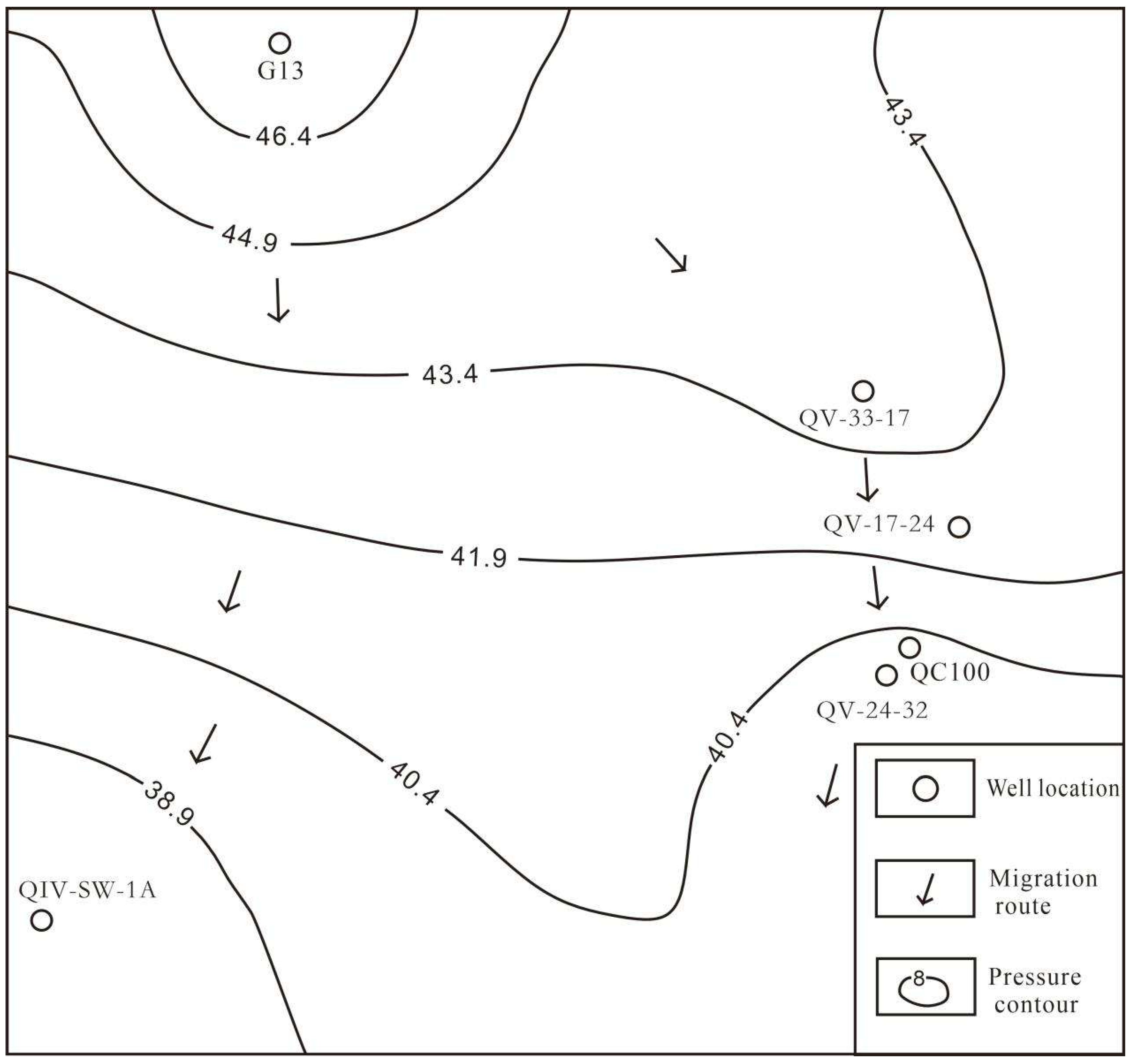
Homogenization temperatures range from 97.8 to 204.3 °C, and trapping pressures range from 36.2 to 48.4 MPa (average 41.28 MPa). Pressure contour mapping (Figure 13) shows higher pressures in the north and lower pressures in the south, indicating that hydrocarbon-bearing fluids migrated toward the SWW and SSW.
Our research team [39] reported similar southwestward migration of dissipated hydrocarbons from the Jiufotang Formation source rocks, supporting that carbonate veins record a major hydrocarbon dissipation event. The study area dips southward, so oxidized meteoric groundwater flows northward, opposite to hydrocarbon migration. Their mixing at the redox interface was favorable for uranium mineralization.

4.4. U-Pb Geochronology of Calcite Veins

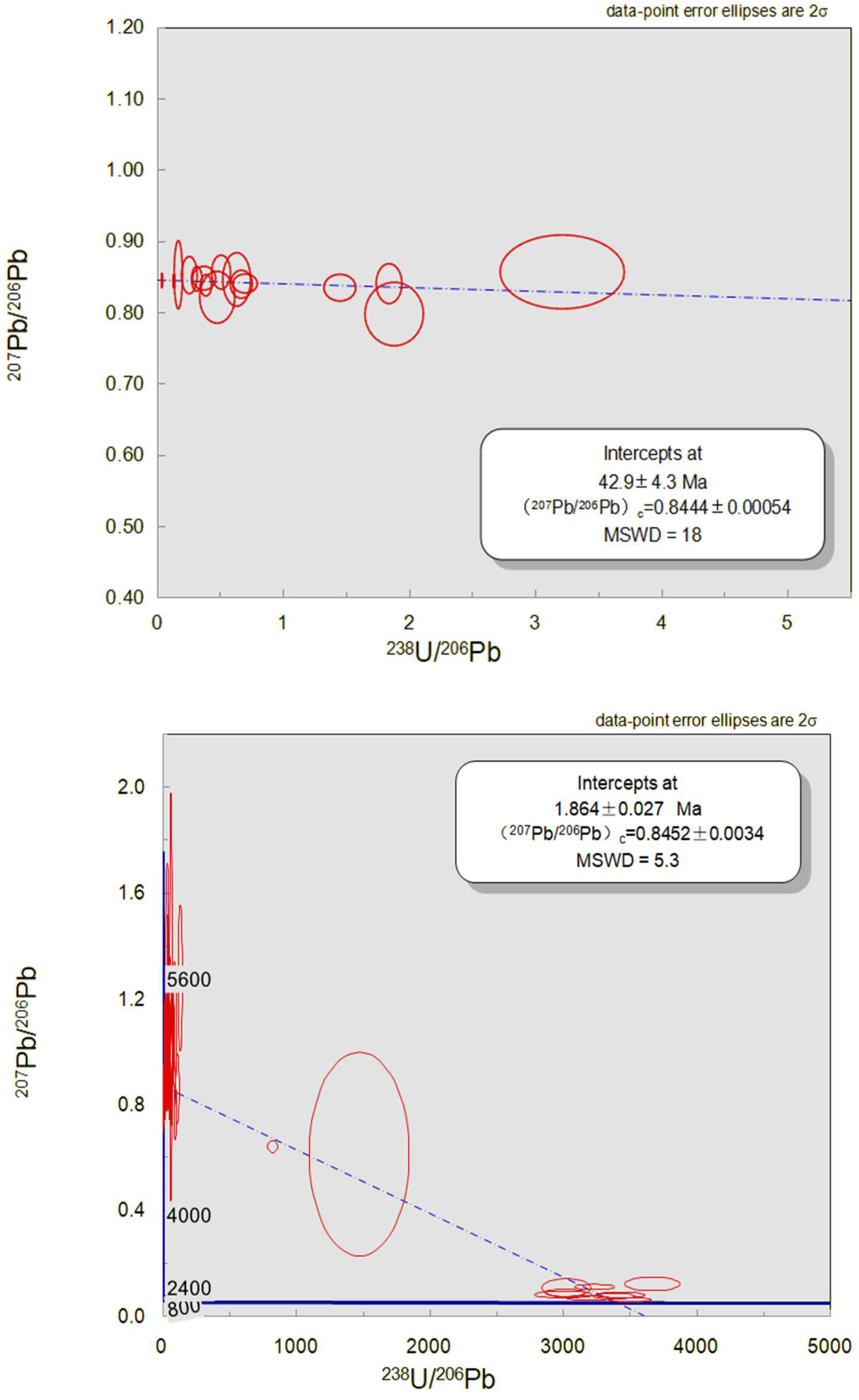
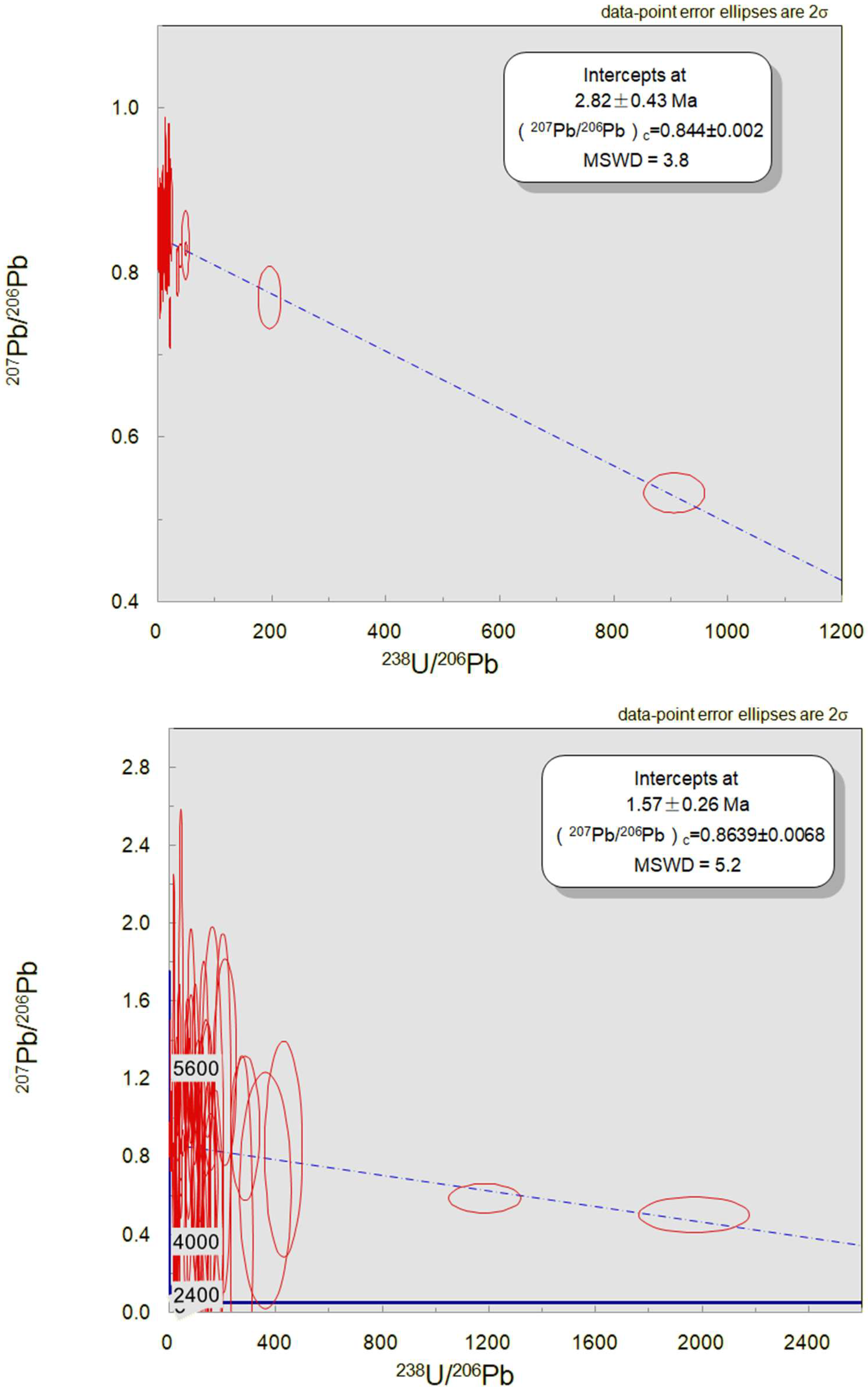
This experiment ultimately yielded a total of 126 test data points (See Table S1 at the end of the article), with some sampling locations shown in Figure 13. The U-Pb concordia diagrams are shown in Figure 14 and Figure 15. The carbonate vein ages obtained in this experiment are four in number, specifically (1.864 ± 0.027), (1.57 ± 0.26), (2.82 ± 0.43), and (42.9 ± 4.3) Ma. The ages can be broadly divided into two stages: (1.57–2.82) Ma and 42.9 Ma, corresponding to the Pleistocene and Eocene epochs, respectively. Integrating previous studies on the metallogenic age of the Qianjiadian uranium deposit, micro-area in situ LA-ICP-MS U-Pb dating data such as (0.179 ± 0.025) Ma, (1.408 ± 0.060) Ma, and (50.4 ± 8.2) Ma [29,49] exhibit coupling characteristics with the calcite U-Pb ages obtained in this study, reflecting a connection between carbonate vein formation and uranium mineralization.
As mentioned above, the fluids forming the calcite veins contain abundant hydrocarbon gases such as CH4. Furthermore, the direction of fluid action aligns with that of hydrocarbon dissipation—namely, from north to south. This indicates that the calcite veins are formed by the interaction of mixed hydrocarbon–groundwater fluids. Therefore, the ages determined for the two calcite vein stages actually reflect two late-stage hydrocarbon dissipation events in this area: the Eocene (42.9 ± 4.3) Ma and the Pleistocene ((1.57 ± 0.26) to (2.82 ± 0.43)) Ma. According to the study by our research team [39], the oil and gas charging event in the Yaojia Formation was dated using the illite K-Ar method, yielding an age of 73–80.4 Ma. This corresponds to the late Late Cretaceous period, coinciding with the formation of the “erosional window” due to tectonic reversal in this region. This represents the earliest phase of oil and gas activity.
Therefore, since the formation of the Yaojia Formation (approximately 88.5–84 Ma), this area has undergone three phases of hydrocarbon dissipation: the latest Late Cretaceous, the Eocene, and the Pleistocene (Table 8). Calcite veins formed during the latter two phases, whereas none formed during the first phase. The reason is that diabase had not yet formed at this stage, and thus no extensive, stable fractures were present. Sandstone itself is difficult to preserve large quantities of stable fracture zones.

5. Genetic Relationship Among Calcite Vein Formation, Uranium Mineralization, and Diabase Intrusion Thermal Effects

5.1. Key Factors of Uranium Super-Enrichment in the Qianjiadian Uranium Deposit

Relevant studies suggest that the scale of uranium mineralization is associated with the following factors [14,50]:
Q = Co × ε × V × t
Q denotes the uranium deposition per unit cross-sectional area, directly representing the total uranium enrichment; Co represents the uranium concentration in interlayer water within the oxidation zone rock strata, indirectly indicating the uranium source; ε denotes the uranium unloading coefficient of interlayer water, representing the amount of reducing agent; V represents the flow velocity of interlayer water; t indicates the reaction time for uranium reduction.
Therefore, the scale of uranium mineralization is controlled by multiple factors: (1) Uranium concentration (Co) is primarily related to uranium source supply, directly influencing the value of ε; (2) The unloading coefficient (ε) is positively correlated with reducing agent content, controlling uranium precipitation efficiency; (3) Fluid flow velocity (V) affects uranium migration and precipitation extent; (4) The longer the reaction time (t), the greater the enrichment potential. Temperature indirectly regulates mineralization by altering uranium solubility, the reactivity of reducing agents, and fluid viscosity. Overall, the scale of uranium mineralization primarily depends on the synergistic effects of factors such as the duration of oxidation, source strength (Co), reduction potential (ε), and seepage velocity (V).
In summary, the scale of uranium mineralization in sandstone deposits is jointly controlled by the uranium concentration in oxidized water, the rate of permeation, the duration of mineralization, and the degree of contrast in the reducing geochemical barrier. Among these, ε and t are key parameters determining the scale of mineralization, while temperature further regulates the uranium enrichment process by influencing uranium solubility and the effectiveness of reducing agents. Enhanced thermal activity can significantly increase the precipitation rate and enrichment scale of uranium, providing essential conditions for the formation of large-scale uranium deposits.
However, the Qianjiadian area features complex geological structures, lacks long-term reaction conditions (t), and exhibits low local organic matter content, necessitating the supply of external reducing agents. The oil and gas dissipation event in the lower Jiufotang Formation is crucial for uranium enrichment in this area, with dissipation reaching 40% [42]. During the Late Cretaceous, massive amounts of oil and gas migrated upward in a short period, providing ample reducing agents for uranium mineralization in the Yaojia Formation. The mineralization era coincides with the oil and gas dissipation time, reflecting the contribution of deep hydrocarbon source rock fluids to mineralization. Therefore, the transport of reducing agents to shallower zones following the destruction of the Jiufotang Formation oil and gas reservoirs constitutes a significant factor influencing uranium mineralization in this region.
In summary, although the duration of mineralization (t) and uranium concentration (Co) are not dominant in this area, the thermal effect provided by magmatic intrusions has enhanced the permeability (V), and hydrocarbon dissipation has increased the uranium unloading coefficient (ε). Therefore, the thermal effects provided by mafic magmatic intrusions in this region (low-to-medium-temperature deep hydrothermal fluids), together with hydrocarbon dissipation, constitute the two key factors for the formation of exceptionally enriched uranium deposits—namely, supergiant uranium deposits—in this area.
The diabase intrusion provided a heat source for mineralizing fluids, compensating for the deficiencies in v (flow velocity) and ε (reaction efficiency) during uranium migration, and may have also supplied part of the uranium source, facilitating large-scale uranium mineralization [15]. On the other hand, oil and gas dissipation provided abundant reducing agents for uranium mineralization and enrichment, promoting the exceptional accumulation of uranium and ultimately forming the large-scale Qianjiadian sandstone uranium mineralization cluster. Therefore, the intrusion of diabase provided the low-to-medium-temperature deep hydrothermal conditions necessary for uranium mineralization. These intrusions, coupled with multiple episodes of hydrocarbon dissipation, represent the two key factors driving the exceptional uranium enrichment in this region. The formation of calcite veins in this area reflects both the hydrocarbon dissipation events and the thermal influence of diabase intrusion, providing evidence for the presence of low-to-medium-temperature thermal activity and multiple episodes of hydrocarbon dissipation.

5.2. Formation of Calcite Veins and the Exceptional Enrichment of Uranium

The formation of calcite veins confirms the presence of thermal activity driven by diabase intrusion and hydrocarbon dissipation events in the study area. As described in the previous section, although the mineralization in the Qianjiadian area has no advantages in terms of duration (t) and initial uranium concentration (Co), it possesses the key conditions for the formation of a super-large uranium deposit by virtue of abundant reducing media (ε) provided by hydrocarbon dissipation and enhanced seepage velocity (V) induced by thermal activity. The research results of the calcite veins in this study provide critical supporting evidence for the above understanding.
The calcite veins in the study area were mainly formed during the Paleogene (Paleocene–Oligocene). Affected by the southeastward movement of the Eurasian Plate and its collision with the Pacific Plate, deep-seated mafic magma intruded into the Qianjiadian area and solidified to form diabase bodies. Magmatic activity provided a heat source, which heated hydrocarbon-bearing groundwater to form moderate-temperature deep hydrothermal fluids. These fluids filled fractures within the diabase and its wall rocks, forming calcite veins and a small amount of sparry calcite cements. The specific supporting evidence is as follows:
First, geochronological evidence for thermal activity. Microthermometric results of fluid inclusions in the calcite veins indicate that the ore-forming fluids are of low-to-moderate temperature. The Late Eocene formation age (42.9 ± 4.3 Ma) of one vein phase is generally coupled with or slightly postdates the diabase intrusion age (ca. 44–54 Ma) (Table 9), which logically verifies that the thermal input was derived from diabase intrusion.
Second, C-O isotopic tracing of the calcite veins confirms that the veins were formed by deep low-to-moderate temperature aqueous hydrothermal fluids, with carbon sourced from the dissipation of hydrocarbons generated in the Jiufotang Formation.
Third, from the perspective of the geochronological framework of calcite veins, diabase intrusion, hydrocarbon dissipation, and uranium mineralization (Table 9), in situ microscale U-Pb dating of the calcite veins yields two phases of ages: the Pleistocene and the Eocene. The Eocene phase is consistent with the diabase intrusion age, corroborating the thermal driving effect; meanwhile, it is well coupled with the Eocene uranium mineralization age, indicating that hydrocarbon dissipation provided a favorable geological environment for both uranium mineralization and calcite vein formation.
Integrating the formation ages of calcite veins and the earliest hydrocarbon dissipation event, the hydrocarbon dissipation events in the study area can be divided into three phases: the latest Late Cretaceous, Late Eocene, and Pleistocene. The metallogenic ages of the Qianjiadian uranium deposit also correspond to three phases: the Late Cretaceous (100–75 Ma), Eocene–Oligocene (75–28 Ma), and Pleistocene (2.5–0.1 Ma). The ages of the two sets of geological events are generally consistent, which further corroborates the spatiotemporal coupling relationship between hydrocarbon dissipation and uranium mineralization.

5.3. Dynamic Coupling of Calcite Veins–Diabase Intrusion–Hydrocarbon Depletion–Uranium Mineralization with Basin Evolution and Reformation

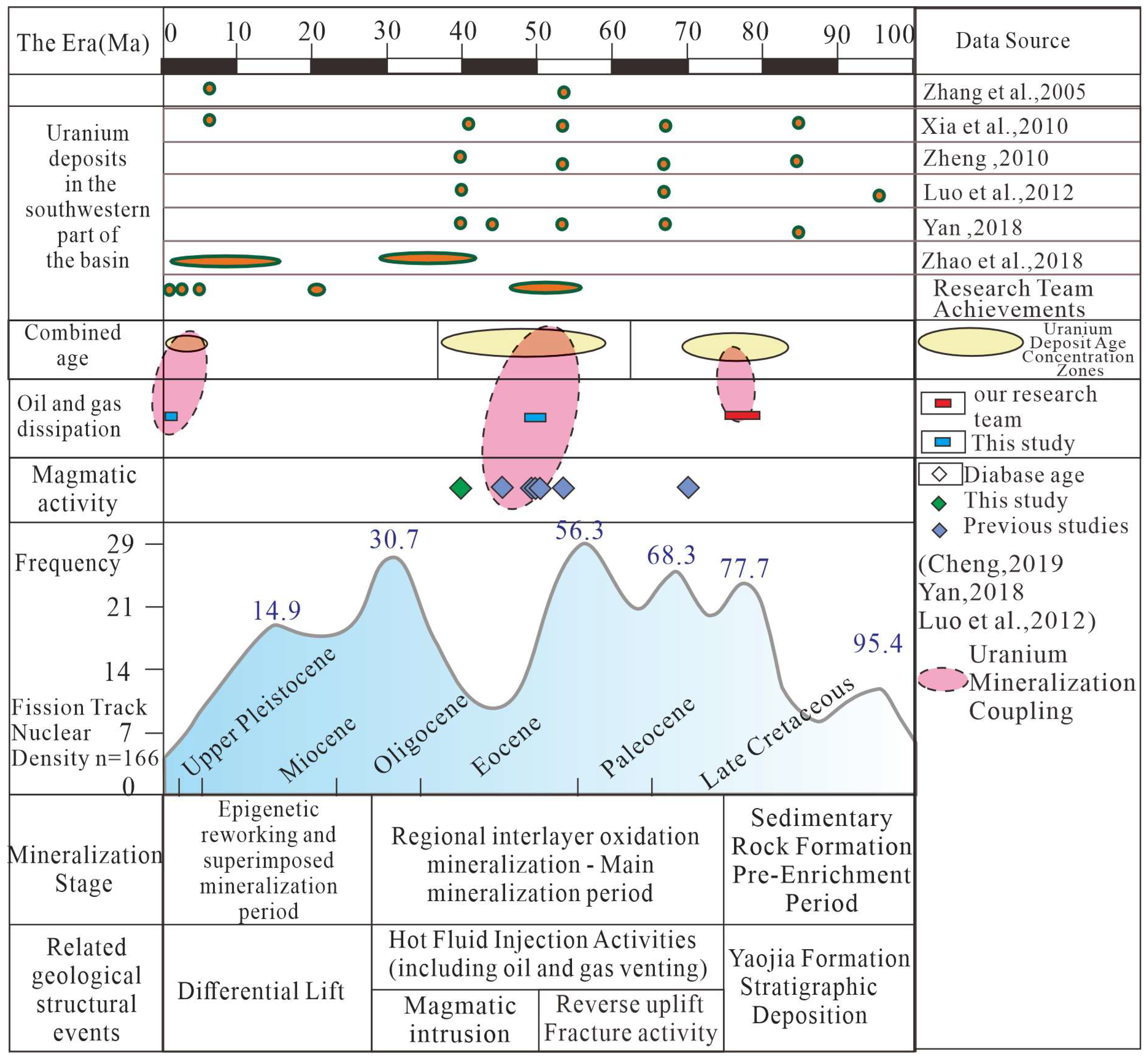
The three phases of mineralization and hydrocarbon depletion in the study area correspond to three tectonic events—tectonic inversion, uplift and denudation, and differential uplift—while also aligning with the intrusion age of basic rocks (Eocene) (Table 9, Figure 16). These characteristics can be elucidated through the three stages of the uranium mineralization process:
  • Late Cretaceous–Paleocene: Tectonic Inversion Period
During this period, the Pacific Plate subducted beneath the Eurasian Plate in a NNW direction, causing tectonic inversion in the Songliao Basin. This resulted in stratigraphic uplift and denudation, the formation of a southern uplift in the basin, the initial development of “denudation windows,” and the gradual westward shift in the depositional center. Surface water fluids leached uranium from the peripheral denudation areas and infiltrated toward the basin center, providing an ample uranium source for the first phase of uranium mineralization. Under sustained extensional tectonic conditions, the Jiufotang Formation source rocks generated substantial hydrocarbons, which migrated and infiltrated the Yaojia Formation along faults. This phase primarily involved uranium pre-enrichment, with minor uranium mineralization.
2.
Eocene–Oligocene: Tectonic Uplift, Denudation, and Diabase Intrusion Period
During this period, the subduction direction of the Pacific Plate shifted to NWW, and the subduction rate slowed, leading to changes in the tectonic stress field in eastern China. This caused further tectonic inversion in the Songliao Basin, resulting in the formation of folds and faults. Two tectonic uplift events occurred during this phase, providing pathways for the infiltration of uranium-bearing and oxygen-bearing water. Deep-seated fluid activity was intense. Magmatic hydrothermal fluids supplied heat and a portion of uranium sources, accelerating mineralization reaction rates through thermal effects while also transporting reducing agents that facilitated uranium enrichment in the strata, leading to the formation of various uranium mineral types. The intrusion age of diabase during this phase is approximately 40–51 Ma. Additionally, thermal effects further promoted hydrocarbon depletion, marking the second phase of hydrocarbon loss. The combined action of hydrocarbons and thermal processes resulted in large-scale uranium enrichment, which coincided with the Eocene formation of calcite. Uranium mineralization ages from this period include 50.4 Ma, 53 Ma, 41 Ma, 40 Ma, and 44 Ma. This phase represents the primary mineralization event. During this time, the ore-forming fluids exhibited thermal effects while also benefiting from the substantial reducing agents supplied by hydrocarbon depletion, leading to extraordinary uranium enrichment and the formation of abundant gray-white sandstone with ore-controlling characteristics.
3.
Pleistocene: Tectonic Differential Uplift Period
Under the combined influence of the Indian Plate’s intense compression of the Eurasian Plate and the expansion of the Sea of Japan, the Songliao Basin experienced its final phase of uplift. The southwestern margin of the basin underwent intense denudation, and the depositional center shifted toward the western depression. Tectonic inversion led to the rupture of pre-existing oil reservoirs, promoting the degradation of hydrocarbons (CH4, H2S, etc.) and organic matter, releasing substantial reducing agents. Simultaneously, stratigraphic uplift exposed deep uranium-bearing layers to the surface water circulation system, allowing oxygen-rich groundwater to leach uranium (U6+) from surrounding rocks, forming soluble uranyl complexes that provided material for secondary uranium enrichment. The release of large quantities of reducing agents created localized reducing geochemical barriers in the strata, ensuring the continued progression of uranium mineralization. Although new ore bodies formed through interlayer oxidation in the “denudation window” environment during this period, hydrocarbon reducing agents prevented oxygen-rich surface fluids from destroying shallow uranium deposits, playing a crucial role in ore preservation. This phase corresponds to the third hydrocarbon depletion event, occurring between 1.57 and 2.82 Ma. Mineralization ages from this stage include 1.408 ± 0.060 Ma and 0.179 ± 0.025 Ma. This phase represents a secondary mineralization period, with hydrocarbon-mediated ore preservation. It is coupled with the Eocene calcite formation event.
Previously discussed fluid inclusion temperature data indicate that magmatic intrusion provided thermal effects for calcite vein formation, and the genesis of calcite veins is closely related to hydrocarbon depletion. The intrusion of diabase supplied thermal support for uranium mineralization, and the extraordinary uranium enrichment in the study area required substantial reducing agents from hydrocarbon depletion. The chronology of calcite veins, diabase intrusion, hydrocarbon depletion, and uranium mineralization exhibits coupling characteristics, indicating that calcite vein formation, uranium mineralization, thermal effects, and hydrocarbon depletion form an evidence chain for uranium hyper-enrichment.
In summary, uranium mineralization in the Songliao Basin is closely linked to multi-phase tectonic activities. Each stage of tectonic movement, hydrothermal fluid activity, and hydrocarbon processes collectively controlled uranium migration, enrichment, and preservation, ultimately forming a large-scale sandstone-type uranium ore concentration area [51,52,53,54,55]. Therefore, thermal effects (medium-to-low temperature deep-seated hydrothermal fluids) and hydrocarbon depletion are two key factors contributing to the extraordinary uranium enrichment and the formation of super-large uranium deposits in this region. The formation of calcite veins and their recorded medium-to-low temperature properties provide strong scientific evidence for these findings and the multi-phase hydrocarbon depletion events in the study area (Figure 16).
Figure 16. Coupling relationship among uranium mineralization, thermal fluid activity, hydrocarbon dissipation, and basin evolution and reworking [39,55,56,57,58,59,60,61].
Minerals 16 00631 g016

6. Conclusions

  • For the first time, this study systematically reveals that the calcite veins hosted in diabase in the Qianjiadian uranium mining area are not direct magmatic products, but rather epigenetic veins formed by the infill of medium-to-low temperature hydrocarbon-bearing hydrothermal fluids along fractures. The main vein-forming temperature peaks are 115–155 °C and 155–215 °C, and the thermal source is closely related to the diabase intrusion event.
  • In situ U-Pb dating of the calcite veins yields two episodes of vein formation: the Eocene (42.9 ± 4.3 Ma) and the Pleistocene (1.57 ± 0.26 to 2.82 ± 0.43 Ma). A spatiotemporal coupling is established among calcite vein formation, diabase intrusion, hydrocarbon dissipation, and uranium mineralization, indicating that the formation of calcite veins is closely related to the thermal effect provided by diabase intrusion and to uranium mineralization. These ages provide independent chronological constraints on the multi-stage mineralization events.
  • The calcite veins are products of multi-stage hydrocarbon dissipation in the study area. Fluid inclusion studies show that both the vein-forming fluids and the hydrocarbon-bearing fluids migrated from north to south, and the inclusions are dominated by hydrocarbon gases and water. Major and trace element characteristics preclude a direct genetic link to magmatic or sedimentary diagenetic processes. The markedly negative C-O isotope values indicate that the carbon source was derived from dissipated hydrocarbons that underwent isotopic fractionation during interaction with groundwater. A C-O isotopic fractionation sequence of calcite veins is proposed as a tracer for hydrocarbon dissipation–groundwater mixing.
  • Calcite vein formation, uranium mineralization, and the diabase-related thermal event share a unified geodynamic origin controlled by multi-phase tectonic evolution of the basin. Diabase thermally driven hydrocarbon dissipation is the dominant controlling factor for extraordinary uranium enrichment in the Qianjiadian super-large sandstone-hosted uranium deposit, and the calcite veins provide critical evidence for this metallogenic model.

Supplementary Materials

The following supporting information can be downloaded at: https://www.mdpi.com/article/10.3390/min16060631/s1, Table S1. In-situ U-Pb dating data of carbonate veins.

Author Contributions

Conceptualization, B.W.; methodology, B.W. and M.Y.; software, M.Y. and X.Z.; validation, B.W.; formal analysis, M.Y. and X.Z.; investigation, Y.H., S.W. and Q.L.; resources, Y.M., G.S. and Y.D.; data curation, M.Y. and X.Z.; writing—original draft preparation, M.Y. and B.W.; writing—review and editing, M.Y. and B.W.; visualization, L.Z.; supervision, B.W.; project administration, B.W.; funding acquisition, S.Y.,L.Z. and Y.S. All authors have read and agreed to the published version of the manuscript.

Funding

This research was funded by National Key Research and Development Program of China (Grant No.2023YFC2906702), Technology Research Project of China National Uranium Co., Ltd.: Grant No. 202302 and Undergraduate Innovation Fundation of the Department of Geology, Northwest University (Grant No.20220026).

Data Availability Statement

The original contributions presented in this study are included in the article. Further inquiries can be directed to the corresponding author.

Acknowledgments

The authors would like to express their sincere gratitude to China National Key Research and Development Program, Technology Research Project of China National Uranium Co., Ltd. and Undergraduate Innovation Fundation of the Department of Geology, Northwest University for their financial and technical support. Special thanks are extended to colleagues who contributed to data collection and provided valuable suggestions during the research process.

Conflicts of Interest

Songlin Yang is an employee of PetroChina Liaohe Oilfield Company. Yu Sun is an employee of CNNC Geological Exploration Group Co., Ltd. The paper reflects the views of the scientists and not the companies.

Abbreviations

The following abbreviations are used in this manuscript:
LA-ICP-MSLaser ablation inductively coupled plasma mass spectrometry
EPMAElectron probe microanalysis
SEMScanning electron microscopy
XRFX-ray fluorescence
ICP-MSInductively coupled plasma mass spectrometry
REEsRare earth elements
SEM-EDSelectron microprobe and scanning electron microscopy with energy dispersive spectroscopy
IRMSIsotope ratio mass spectrometry
LOILoss on ignition
∑REETotal rare earth element contents
HREEHeavy rare earth element
LREELight rare earth element

References

  1. Wang, F.F. Global Characteristics of Co-Existence of Oil, Gas, Coal and Uranium in the Same Basin and Analysis of Typical Basins in China. Master’s Thesis, Northwest University, Xi’an, China, 2018. [Google Scholar]
  2. Qin, M.K.; Li, Z.Y.; Cai, Y.Q.; Guo, Q.; Song, J.Y.; Liu, Z.Y.; Huang, S.H. Strategic Thinking on Strengthening Three New Breakthroughs for the Uranium Exploration in China. World Nucl. Geosci. 2022, 39, 383–398. [Google Scholar]
  3. Li, Z.Y.; Qin, M.K.; Fan, H.H.; Cai, Q.; Cheng, J.; Guo, D.; Ye, F.; Fan, G.; Liu, X. Main Progresses of Uranium Geology and Exploration Techniques for the Past Decade in China. Bull. Miner. Petrol. Geochem. 2021, 40, 845–857. [Google Scholar]
  4. Cai, Y.Q.; Zhang, J.D.; Li, Z.Y.; Guo, Q.Y.; Song, J.Y.; Fan, H.H.; Liu, W.S.; Qi, F.C.; Zhang, M.L. Outline of Uranium Resources Characteristics and Metallogenetic Regularity in China. Acta Geol. Sin. (Engl. Ed.) 2015, 89, 918–937. [Google Scholar]
  5. Yan, D.; Zhu, R.; Liu, W.; Liu, R.; Shou, H.; Cheng, X.; Cai, Y.; Lei, Z.; Deng, P.; Peng, Y. Metallogenic characteristics and models of sandstone-type uranium deposits in China. Ore Geol. Rev. 2024, 166, 105937. [Google Scholar] [CrossRef]
  6. Zhang, J.D. Progress and Prospects of Uranium Exploration in Mesozoic-Cenozoic Sedimentary Basins in Northern China. Uranium Geol. 2012, 28, 193–198. [Google Scholar]
  7. Ning, J.; Li, J.M.; Lu, T.J.; Tang, C.; Huang, S.H.; Li, Z.Y.; Cai, Y.Q. Characteristics of Clay Minerals in the Lower Member of YaojiaFormation and Its Significance for Hailijin Uranium Deposit in the South of Songliao Basin. Uranium Geol. 2023, 39, 188–201. [Google Scholar]
  8. Hu, F.; Li, J.; Liu, Z.; Zhao, D.M.; Wan, T.; Xu, C. Sequence and sedimentary characteristics of upper Cretaceous Sifangtai Formation in northern Songliao Basin, northeast China: Implications for sandstone-type uranium mineralization. Ore Geol. Rev. 2019, 111, 102927. [Google Scholar] [CrossRef]
  9. Lin, X.B.; Qin, M.K.; Jia, L.C.; Cai, Y.Q.; Song, J.Y.; Guo, Q.; Li, Z.Y.; Liu, W.S. Oreforming Times of Sandstone Type Uranium Deposits in Southwestern Songliao Basin and its Geological Significance. Geol. Rev. 2026, 72, 510–526. [Google Scholar]
  10. Cheng, Y.; Wang, S.; Zhang, T.; Chen, Z.; Jiang, X. Regional sandstone-type uranium mineralization rooted in Oligo-Miocene tectonic inversion in the Songliao Basin, NE China. Gondwana Res. 2020, 88, 88–105. [Google Scholar] [CrossRef]
  11. Cheng, Y.H.; Jin, R.S.; Miao, P.S.; Wang, S.Y.; Teng, X.M. Two Metallogenic Models of Sandstone-Type Uranium Deposits: Jingchuan Type and Tale Type. Earth Sci. 2025, 50, 46–57. [Google Scholar]
  12. Nie, F.J.; Yan, Z.B.; Xia, F.; Li, M.G.; Rong, H.; Chen, Y.L. Hot Fluid Flow in the Sandstone-Type Uranium Deposit in the Kailu Basin, Inner Mongolia. Geol. Bull. China 2017, 36, 1850–1866. [Google Scholar]
  13. Yang, D.G.; Wu, J.H.; Nie, F.J.; Bonnetti, C.; Xia, F.; Yan, Z.B.; Cai, J.F.; Wang, C.D.; Wang, H.T. Petrogenetic Constraints of Early Cenozoic Mafic Rocks in Southwest Songliao Basin, NE China: Implications for the Genesis of Sandstone-Hosted Qianjiadian Uranium Deposits. Minerals 2020, 10, 1014. [Google Scholar] [CrossRef]
  14. Wang, M.; Wu, B.L.; Liu, C.Y.; Nie, F.J.; Qin, M.K.; Cai, Y.Q.; Song, J.Y. Thermal Effect of Diabase Intrusion and Anomalous Uranium Enrichment in Sandstone-Type Uranium Deposits in Southern Songliao Basin. Acta Geol. Sin. 2024, 98, 3788–3814. [Google Scholar]
  15. Yan, Z.B.; Zhang, W.W.; Zhang, C.Y.; Xia, F.; Nie, F.J.; Wu, X.Y. The influence of fluid activity from deep basin on the metallogenic process of sandstone type uranium deposits. Acta Geol. Sin. 2023, 97, 4131–4149. [Google Scholar]
  16. Li, Q.; Rong, H.; Cao, M.; Zhao, J.; Wang, F.; Li, S. Ore-finding criteria of a hydrothermal-overprint sandstone-hosted uranium deposit: A case study from the southern Songliao Basin, China. Ore Geol. Rev. 2026, 188, 107069. [Google Scholar] [CrossRef]
  17. Huang, S.; Liu, Z.; Qin, M.; Zhang, L.; Zhong, F.; Ning, J.; Liu, N.; He, Z.; Jiang, W. Magmatic-hydrothermal events and their implications for sandstone uranium mineralization in the Qianjiadian area, southwestern Songliao Basin. Ore Geol. Rev. 2025, 184, 106756. [Google Scholar] [CrossRef]
  18. Feng, Z.; Nie, F.; Jiang, L.; Xia, F.; Cai, J.; Zhang, B.; Lu, Y.; Zhang, L. Roles of multisourced fluids in the formation of sandstone-hosted uranium deposits in the SW Songliao Basin, NE China. Earth Sci. 2023, 34, 54–69. [Google Scholar] [CrossRef]
  19. Huang, S.; Qin, M.; Liu, Z.; Xiao, J.; Liu, N. Spatiotemporal relationship between hydrocarbon fluid and sandstone-hosted uranium deposits in the Qianjiadian area, Songliao Basin. Geol. J. 2023, 59, 1148–1170. [Google Scholar] [CrossRef]
  20. Woodhead, J.; Hand, S.J.; Archer, M.; Graham, I.; Sniderman, K.; Arena, D.A.; Price, E. Developing a Radiometrically-Dated Chronologic Sequence for Neogene Biotic Change in Australia, from the Riversleigh World Heritage Area of Queensland. Gondwana Res. 2016, 29, 153–167. [Google Scholar] [CrossRef]
  21. Parrish, R.R.; Parrish, C.M.; Lasalle, S. Vein Calcite Dating Reveals Pyrenean Orogen as Cause of Paleogene Deformation in Southern England. J. Geol. Soc. 2018, 175, 425–442. [Google Scholar] [CrossRef]
  22. Pickering, R.; Herries, A.I.; Woodhead, J.D.; Hellstrom, J.C.; Green, H.E.; Paul, B.; Ritzman, T.; Strait, D.S.; Schoville, B.J.; Hancox, P.J. U–Pb-Dated Flowstones Restrict South African Early Hominin Record to Dry Climate Phases. Nature 2019, 565, 226–229. [Google Scholar] [CrossRef]
  23. Rong, H.; Jiao, Y.; Wu, L.; Zhao, X.; Cao, M.; Liu, W. Effects of Igneous Intrusions on Diagenesis and Reservoir Quality of Sandstone in the Songliao Basin, China. Mar. Pet. Geol. 2021, 127, 104980. [Google Scholar] [CrossRef]
  24. Zhu, X.Y. Relationship Between Calcite Veins and Uranium Mineralization in Sandstone-Type Uranium Deposits in Northern Sichuan. Uranium Geol. 1993, 1, 35–42. [Google Scholar]
  25. Hu, X.; Yang, X.; Ling, M.; Xu, J.; Du, G.; Li, Q.; Cao, M.; Wu, Z. Mineralogical and geochemical studies on the Qianjiadian deposit, Songliao Basin, NE China: Insights into multiple metallogenic processes in the sandstone-type uranium deposit. Ore Geol. Rev. 2024, 168, 106050. [Google Scholar] [CrossRef]
  26. Rong, H.; Jiao, Y.Q.; Wu, L.Q.; Xu, W.C.; Liu, Z. Epigenetic Alteration and Its Constraints on Uranium Mineralization in the Qianjiadian Uranium Deposit, Southern Songliao Basin. Earth Sci. 2016, 41, 153–166. [Google Scholar]
  27. Roberts, N.M.; Walker, R.J. U-Pb Geochronology of Calcite-Mineralized Faults: Absolute Timing of Rift-Related Fault Events on the Northeast Atlantic Margin. Geology 2016, 44, 531–534. [Google Scholar] [CrossRef]
  28. Luo, K.; Zhou, J.X.; Feng, Y.X.; Uysal, I.T.; Nguyen, A.; Zhao, J.X.; Zhang, J. In Situ U-Pb Dating of Calcite from the South China Antimony Metallogenic Belt. iScience 2020, 23, 101575. [Google Scholar] [CrossRef]
  29. Yang, D.; Nie, F.; Xia, F.; Jiang, L.; Feng, Z.; Zhang, B.; Zhang, L. In situ U–Pb dating of dolomite: Reliable ages for sandstone-hosted uranium deposits in the southern Songliao Basin, NE China. Ore Geol. Rev. 2024, 174, 106331. [Google Scholar] [CrossRef]
  30. Yang, W.L.; Gao, R.Q.; Guo, Q.F.; Liu, Y.G. Generation, Migration and Accumulation of Continental Oil and Gas in Songliao Basin; Heilongjiang Science and Technology Press: Harbin, China, 1985.
  31. Xia, F.Y. Provenance Analysis and Tectonic Setting of the Yaojia Formation Sandstone in the Qianjiadian Area, Southern Songliao Basin. Master’s Thesis, China University of Geosciences, Beijing, China, 2019. [Google Scholar]
  32. Shao, J.L.; Mei, J.M. Typomorphic Characteristics of Mineral Inclusions in Gold Deposits from Volcanic Rock Areas in Zhejiang Province and Their Genetic and Prospecting Significance. Miner. Petrol. 1986, 3, 103–111. [Google Scholar]
  33. Hall, D.L.; Sterner, S.M.; Bodnar, R.J. Freezing Point Depression of Sodium Chloride-Potassium Chloride-Water Solutions. Econ. Geol. 1988, 83, 197–202. [Google Scholar] [CrossRef]
  34. Liu, B.; Shen, K. Thermodynamics of Fluid Inclusions; Geological Publishing House: Beijing, China, 1999. [Google Scholar]
  35. Zhang, Y.S.; Mao, S.D. Program Calculation of pH Values in Common Aqueous Fluid Inclusion Systems. Geol. J. China Univ. 2015, 21, 43–49. [Google Scholar]
  36. Mi, J.K.; Yang, M.D.; Liu, X.H. Calculation of Trapping Pressure of Inclusions in Upper Paleozoic Sandstone Reservoirs in the Ordos Basin Using PVTsim. J. Xiangtan Min. Inst. 2002, 3, 22–26. [Google Scholar]
  37. Aplin, A.C.; Larter, S.R.; Bigge, M.A.; Macleod, G.; Swarbrick, R.E.; Grunberger, D. PVTX History of the North Sea’s Judy Oil Field. J. Geochem. Explor. 2000, 69–70, 641–644. [Google Scholar] [CrossRef]
  38. Wang, Y.H.; Yuan, Y.S. A Simplified PVTsim Modeling Method for Hydrocarbon-Bearing Brine Inclusions and Its Application. Pet. Geol. Eng. 2018, 32, 40–43. [Google Scholar]
  39. Wu, B. Project Report on Uranium-Hydrocarbon Coupled Mineralization in the Qianjiadian Area, Songliao Basin Bycommissioned Liaohe Oilfield Company, PetroChina (Completed). Department of Geology, Northwest University (Taibai Campus), Xi’an, China. 2024; unpublished work.
  40. Coplen, T.B.; Kendall, C.; Hopple, J. Comparison of Stable Isotope Reference Samples. Nature 1983, 302, 236–238. [Google Scholar] [CrossRef]
  41. Seal, R.R. Sulfur Isotope Geochemistry of Sulfide Minerals. Rev. Miner. Geochem. 2006, 61, 633–677. [Google Scholar] [CrossRef]
  42. Sharp, Z. Principles of Stable Isotope Geochemistry; Pearson Education: London, UK, 2007. [Google Scholar]
  43. Ma, X.L.; Wang, K.Y.; Jin, R.S.; Li, J.G.; Zhou, H.Y.; Yang, H. Characteristics of fluid inclusions in the sandstone-hosted Qianjiadian uranium deposit, southwest Songliao Basin, northeastern China: Implications for the nature and evolution of ore-forming fluids. Resour. Geol. 2021, 72, e12281. [Google Scholar] [CrossRef]
  44. Zhang, N.; Tian, Z.J.; Leng, Y.Y.; Wang, H.T.; Song, F.Q.; Meng, J.H. Raman Characteristics of Hydrocarbons and Hydrocarbon Inclusions. Sci. China Ser. D 2007, 37, 900–907. [Google Scholar] [CrossRef]
  45. Du, G.P.; Fan, J.L. Raman Spectral Characteristics of Calcite Group Minerals. Mineral. Petrol. 2010, 30, 32–35. [Google Scholar]
  46. Roedder, E. Fluid Inclusions. Rev. Miner. 1984, 12, 644. [Google Scholar]
  47. Goldstein, R.H.; Reynolds, T.J. Systematics of Fluid Inclusions in Diagenetic Minerals; SEPM Short Course 31; Society for Sedimentary Geology: Tulsa, OK, USA, 1994. [Google Scholar]
  48. Andersen, T.; Neumann, E.R. Fluid inclusions in mantle xenoliths. Lithos 2001, 55, 301–320. [Google Scholar] [CrossRef]
  49. Li, Q. Geochronology and Genetic Significance of the Qianjiadian U-Re Deposit in the Songliao Basin. Master’s Thesis, Northwest University, Xi’an, China, 2023. [Google Scholar]
  50. Wu, B.L.; Liu, C.Y.; Wei, A.J.; Hu, L.; Zhang, B.H.; Song, Z.S.; Cun, X.N.; Sun, L.; Luo, J.J.; Zhang, W.Y.; et al. Natural Gas Migration-Dissipation and Its Geological Effects and Identification Markers in Northern Ordos Basin. In Co-Existence and Enrichment Mechanisms of Oil, Gas, Coal and Uranium in the Same Basin; Liu, C.Y., Wu, B.L., Eds.; Science Press: Beijing, China, 2016; Volume I, pp. 500–544. [Google Scholar]
  51. Wu, B.L.; Liu, C.Y.; Yang, S.L.; Zhao, H.G.; Wang, J.Q.; Qiu, X.W. Mechanistic and Progress of Uranium Mineralization by Organic Minerals (Oil, Gas and Coal) in Sedimentary Basins. J. Northwest Univ. (Nat. Sci. Ed.) 2022, 52, 891–912. [Google Scholar]
  52. Yang, D.G.; Nie, F.J.; Xia, F.; Feng, Z.B.; Jiang, L.; Zhang, B.C.; Lu, Y.Y. Age and Petrogenesis of Early Cenozoic Dolerites in the Qianjiadian Sag, Southwest Songliao Basin, NE China: Implications for the Genesis of Sandstone-hosted Uranium Deposits. Geotecton. Metallog. 2022, 46, 334–355. [Google Scholar]
  53. Xia, Y.L.; Zheng, J.W.; Li, Z.Y.; Qin, M.K.; Zhang, K. Metallogenic Characteristics and Model of the Qianjiadian Uranium Deposit in the Songliao Basin. Miner. Depos. 2010, 29, 154–155. [Google Scholar]
  54. Cheng, Y.H.; Jin, R.S.; Cuney, M.; Petrov, V.A.; Miao, P.S. Large-Scale Uranium Mineralization in Basins of Northern China: Stratigraphic Constraints. Acta Geol. Sin. 2024, 98, 1953–1976. [Google Scholar]
  55. Cheng, Y.H.; Petrov, V.A.; Jin, R.S.; Miao, P.S. Neotectonic Controls on Large-Scale Uranium Mineralization in the Meso-Cenozoic Basins, Northern China. Ore Geol. Rev. 2025, 176, 106393. [Google Scholar] [CrossRef]
  56. Zhang, M.Y.; Zheng, J.W.; Tian, S.F.; Zhao, Y.Q.; Li, J. Occurrence State of Uranium and Mineralization Age of the Qianjiadian Uranium Deposit in the Kailu Depression. Uranium Geol. 2005, 21, 23–28. [Google Scholar]
  57. Zheng, J.W. Metallogenic Geological Conditions and Exploration Potential of the Qianjiadian Uranium Deposit in the Kailu Basin. Uranium Geol. 2010, 26, 3–10. [Google Scholar]
  58. Luo, Y.; He, Z.B.; Ma, H.F.; Sun, X. Metallogenic Geological Characteristics of the Qianjiadian Sandstone-Type Uranium Deposit in the Songliao Basin. Miner. Depos. 2012, 31, 391–400. [Google Scholar]
  59. Yan, X.L. Characteristics and uranium mineralization of Upper Cretaceous diabase in Qianjiadian area, Songliao basin. J. Northeast Pet. Univ. 2018, 42, 40–48. [Google Scholar]
  60. Zhao, L.; Cai, C.F.; Jin, R.S.; Liu, C.Y.; Zhang, L.; Li, Z.Y. Mineralogical and Geochemical Evidence for Biogenic and Petroleum-Related Uranium Mineralization in the Qianjiadian Deposit, NE China. Ore Geol. Rev. 2018, 101, 273–292. [Google Scholar] [CrossRef]
  61. Cheng, Y.H.; Wang, S.Y.; Jin, R.S.; Li, J.G.; Ao, C.; Teng, X.M. Global Miocene Tectonics and Regional Sandstone-Style Uranium Mineralization. Ore Geol. Rev. 2019, 106, 238–250. [Google Scholar] [CrossRef]
Figure 1. Location and tectonic division map of the study area [30].
Minerals 16 00631 g001
Figure 2. Comprehensive stratigraphic column of the southern Songliao Basin [31].
Minerals 16 00631 g002
Figure 3. Structural–basic intrusive rock–uranium mineralization geological map of the Qianjiadian uranium deposit.
Minerals 16 00631 g003
Figure 4. Comprehensive columnar section of the Yaojia Formation from Borehole QC-120.
Minerals 16 00631 g004
Figure 5. Characteristics of ore-related sandstones, diabase, and Calcite Veins. (A) Light gray carbonaceous sandstone ore; (B) gray-white calcareous sandstone; (C) light gray ore-bearing sandstone under crossed polars; (D) gray-white calcareous sandstone under crossed polars; (E) diabase with white calcite veinlets; (F) weakly altered diabase under crossed polars.
Minerals 16 00631 g005
Figure 6. (A,B) SEM-EDS elemental distribution maps of calcite veins (Mg and Ca); (C,D) elemental proportions.
Minerals 16 00631 g006
Figure 7. Standardized REE distribution pattern of calcite vein chondrites (The data for sandstone and diabase are from Wu et al., 2024 [39]).
Minerals 16 00631 g007
Figure 8. Carbonate vein δ18OPDB−δ13CPDB diagram.
Minerals 16 00631 g008
Figure 9. Graphical illustration of sandstone carbonate cement in the southwestern Songliao Basin (δ18OV-SMOW−δ13CV-PDB). Data source: Wu et al., 2024 [39].
Minerals 16 00631 g009
Figure 10. Schematic diagram of C-O isotope evolution in hydrocarbon source rock, calcite veins, and sandstone carbonate cement (data from Wu et al., 2024 [39]).
Minerals 16 00631 g010
Figure 11. Photomicrographs of fluid inclusions in carbonate veins. (A) Elliptical inclusion; (B) elongated inclusion; (C) elongated inclusion; (D) banded inclusions; (E) banded inclusions; (F) vein-like inclusions.
Minerals 16 00631 g011
Figure 12. Histogram of homogenization temperature of fluid inclusions in calcite veins.
Minerals 16 00631 g012
Figure 13. Pressure distribution of fluid inclusions and inferred ore-forming fluid migration paths.
Minerals 16 00631 g013
Figure 14. In situ U-Pb age correlation chart for carbonate veins in micro-areas (top, Q2024-1; bottom, Q2024-8).
Minerals 16 00631 g014
Figure 15. In situ U-Pb age correlation chart for carbonate veins in micro-areas (top, Q2024-43; bottom, Q2024-34).
Minerals 16 00631 g015
Table 1. Sampling list of diabase and carbonate veins therein.
WellNumberDepthHorizon
QC100Q2024-1162.5 mLower Cretaceous Nenjiang Formation
Q2024-2165 m
Q2024-4165 m
G13Q2024-6123 m
Q2024-8123.3 m
Q2024-9122.8 m
LK24Q2024-13223 m
Q2024-15177 m
Qian IV-SW-1AQ2024-20156 m
Q2024-21158 m
L12Q2024-33156 m
QC100Q2024-3170 mLower Cretaceous Yaojia Formation
Q2024-5166.3 m
ZKY2-1Q2024-18403 m
ZKY2-3Q2024-25422 m
Q2024-26441 m
Q2024-30439 m
Qian V-17-24Q2024-34143 m
Q2024-35143.5 m
Qian V-33-17Q2024-41250.2 m
Qian V-24-32Q2024-43197 m
Qian V-25-08Q2024-44148 m
Qian V-41-17Q2024-38123.3 m
Q2024-39120.5 m
Table 2. Calculation steps and formulas for fluid parameters.
ParameterFormulaOriginate
ω-salinity∧ = 0.000557 × Tm3 + 1.78 × Tm − 0.0442 × Tm2Hall D.L., 1988 [33]
ρ-salinity (g/cm3)ρ = A+B·t + C·t2Liu, 1999 [34]
P1-metallogenic pressure(1) P0 = 26.20 × N + 219 (×105 Pa)
(2) T0 = 9.20 × N + 374 (°C)
(3) P1 = P × T1/T0 (×105 Pa)
Shao et al., 1986 [32]
pH-Zhang Yuesha et al. m H + 2 = K w 1 + m N a C l     K N a C l K N a C l
p H = 1 2 l g K w 1 + m N a C l     K N a C l K N a C l
Zhang et al., 2015 [35]
Table 3. Major and trace element compositions of calcite veins.
Analysis No.Q2024-18Q2024-38Analysis No.Q2024-18Q2024-38Analysis No.Q2024-6Q2024-18Q2024-38
La1.671.69Y48.952.6SiO211.474.50.72
Ce3.703.80Yb3.233.52TiO20.250.020.02
Pr0.560.59Lu0.460.49Al2O32.80.150.15
Nd3.063.23Rb1.141.17TFe2O33.030.850.67
Sm1.381.46Ba41.523.7MnO0.520.270.27
Eu0.200.22Th0.250.24MgO4.341.710.34
Gd2.282.38U2.012.20CaO42.4351.8954.22
Tb0.590.62Ta0.0660.018Na2O0.50.090.08
Dy4.815.17Nb0.210.13K2O0.110.020.03
Ho1.231.32Sr956949P2O50.060.010.01
Er3.804.06Hf0.0430.039
Tm0.550.60Zr1.601.22
Table 4. C-O isotope compositions of calcite veins.
Serial NumberSample Nameδ13CV-PDBδ18OV-PDBδ18OV-SMOW
1Q2024-6−12.82−10.7119.33
2Q2024-8−14.08−15.0014.91
3Q2024-13−7.47−13.3116.64
4Q2024-15−12.15−10.5919.45
5Q2024-26−0.73−10.4119.6
6Q2024-30−0.06−10.3519.70
7Q2024-38−6.63−16.2313.64
Table 5. Homogenization temperatures and salinities of fluid inclusions in calcite veins.
Sample NumberMineral OccurrenceInclusion TypeHomogeneous StateHomogenization Temperature
(°C)
Freezing Point Temperature (°C)Salinity
(wt% NaCl)
Density
(g/cm3)
Q2024-2Calcite veinLiquid-rich saline water inclusionLiquid phase129−1215.941.05
139−1115.001.03
Q2024-8149−1013.921.02
Q2024-13126−1014.571.04
122−57.911.00
110−34.350.98
Q2024-15165−69.150.97
Q2024-18180−912.660.98
185−35.130.92
Q2024-21122−46.480.99
Q2024-26150−912.781.01
Q2024-33139−710.841.00
102−1014.571.06
Q2024-3598−811.701.04
Q2024-41138−1115.421.04
Q2024-43204−23.880.89
186−811.700.97
Table 6. Laser Raman analyses of fluid inclusions.
Serial NumberSample NumberLithologyGaseous Phase ComponentsLiquid Phase Components
1Q2024-13-1Carbonate VeinCH4H2O
2Q2024-13-2Carbonate VeinCH4H2O
3Q2024-13-3Carbonate VeinCH4H2O
4Q2024-13-4Carbonate VeinCH4H2O
5Q2024-13-5Carbonate VeinCH4H2O
Table 7. Parameters of fluid inclusions in carbonate veins, such as homogenization temperature and trapping pressure.
Well NumberSample NumberHomogenization Temperature
(°C)
Freezing Point Temperature
(°C)
Salinity
(wt% NaCl)
Density
(g/cm3)
Trapping Pressure
Calculation Equation
Gas-Liquid Ratio
(%)
Trapping Pressure (Pa)
QC100Q2024-2129−1215.941.05y = −389.4x + 4019.810.241
139−1115.001.03y = −481x + 3975.78.239.7
G13Q2024-8149−1013.921.02y = −423.6x + 3478.18.148.4
Qian IV-SW-1AQ2024-21122−46.480.99y = −325.8x + 4102.812.536.2
QianV-17-24Q2024-3598−811.701.04y = −257.1x + 4218.516.242.7
QianV-33-17Q2024-41138−1115.421.04y = −376.8x + 3468.99.144.2
QianV-24-32Q2024-43204−23.880.89y = −313x + 3785.111.939.1
186−811.700.97y = −298.3x + 3975.313.238.9
Table 8. Oil and gas dissipation age data table.
Experimental MethodsEraAgeData Source
Calcite U-Pb datingPleistocene(1.57–2.82) MaThis study
Eocene(42.9 ± 4.3) Ma
Illite K-Ar Dating MethodLate Cretaceous Period(73–80.4) MaWu et al., 2024 [39]
Table 9. Chronological table of uranium mineralization, hydrocarbon dispersal, calcite vein formation, and dacite intrusion at Qianjiadian deposit.
TypeTest MethodsEraAge (Ma)Data Source
Micro-area In Situ U Deposit Mineralization AgeMicro-area In Situ LA-ICP-MS U-Pb DatingMiddle Pleistocene1.408 ± 0.060Wu et al., 2022 [51]
Miocene22.2 ± 2.2
Eocene50.4 ± 8.2
Late Pleistocene0.179 ± 0.025
SIMS U-Pb DatingMiocene15.31 ± 0.53
Tholeiitic Series Diabase Formation AgeDiabase Zircon U-Pb DatingEocene41.64 ± 0.78Wu et al., 2022 [51]
Eocene42~40Yang et al., 2022 [52]
Calcium-alkaline Series Diabase Formation AgeDiabase Zircon U-Pb DatingEocene51~47
Eocene49.4 ± 5Xia et al., 2010 [53]
Diabase Rb-Sr DatingEocene54 ± 3.8This study
Oil and Gas
Dissipation Age
Illite K-Ar AgeUpper Cretaceous73~80.4Wu et al., 2024 [39]
Calcite Veins AgeCalcite U-PbAgePleistocene1.57~2.82This study
Disclaimer/Publisher’s Note: The statements, opinions and data contained in all publications are solely those of the individual author(s) and contributor(s) and not of MDPI and/or the editor(s). MDPI and/or the editor(s) disclaim responsibility for any injury to people or property resulting from any ideas, methods, instructions or products referred to in the content.