Article

Chemical Changes in Quartz and Micas During Greisenization: Examples from European Variscan Plutons


Institute of Geology, Czech Academy of Sciences, Rozvojová 269, CZ-16500 Praha, Czech Republic
Minerals 2026, 16(6), 626; https://doi.org/10.3390/min16060626
Submission received: 23 April 2026 / Revised: 29 May 2026 / Accepted: 4 June 2026 / Published: 11 June 2026

Abstract

Metals like Li, Sn, W, Nb and Ta accumulate mostly during the magmatic–hydrothermal transition and subsequent hydrothermal alteration of highly fractionated granites, especially greisenization. Evaluation of about 450 bulk-rock analyses, 1500 LA-ICP-MS analyses of quartz and 1600 EPMA and LA-ICP-MS analyses of mica from parental granites and related greisens and quartz–mica veins from four typical areas of European Variscan granite plutons with greisen mineralization (Beauvoir, France; Panasqueira, Portugal; and Cínovec and Nejdek, Erzgebirge, Czech Republic) illustrate diversity in initial magma composition (S- vs. A-types), in style of greisenization (pervasive greisenization in granite cupolas vs. vein-like greisen strings along joints), and in chemical evolution of quartz and micas during magmatic–hydrothermal transition. The contents of all monitored elements in quartz and mica from greisen and veins are of very high variability, with principal differences among studied localities. Generally, very low contents of Al (<100 ppm), Ti (<1 ppm) and Li (<10 ppm) or, on the contrary, extremely high contents of Al (>1000 ppm) or Li (>100 ppm) in quartz may indicate its hydrothermal origin. Contents of Sn, W, Nb, and Ta in micas tend to become depleted during greisenization, this trend is more pronounced in Nb and Ta than in Sn and W. Transition from magmatic to hydrothermal crystallization leads to an increase in the Ta/Nb values in mica: from 0.20 to 0.24 in S-type magmatic systems, and from 0.13 to 0.34 at Cínovec as a representative of A-type granites. Whether granite belongs to the S- or A-type is not essential for the development of greisenization.

1. Introduction

Strongly fractionated granites (rare metal granites, RMGs) are, together with complex pegmatites, a crucial source of a number of technologically important metals like Li, Rb, Cs, Sn, W, Nb and Ta. From the chemical point of view, these elements belong to two groups with very different chemical properties: rare alkali metals (Li, Rb, Cs), and high field strength elements (HFSE: Sn, W, Nb, Ta, U, Th). While the elements of the first group are mainly found as minor constituents of rock-forming silicates, the elements of the second group mainly form simple or complex oxides. However, both groups have a similar ability to concentrate during the fractionation of granitic magma, especially if this magma is enriched in water and fluorine, and possibly also P and B [1,2,3]. The named elements accumulate during the fractionation of F-rich magma with only small deviations caused by high peraluminosity (favoring the concentration of Cs, Ta and U) or peralkalinity (favoring the concentration of Nb and Th). Although the ability of magma to concentrate these elements during fractional crystallization is high, the achievement of economically interesting concentrations during this process is rather rare. This usually occurs only during the magmatic–hydrothermal transition and especially during subsequent hydrothermal alteration. The most common type of high-temperature alteration of peraluminous and subaluminous RMG is greisenization [4,5,6], i.e., replacement of magmatic feldspars by hydrothermal quartz and mica (+ minor topaz, fluorite, etc.). The term “greisen” has long been used by Erzgebirge miners [4] for a hard rock ore composed predominantly of quartz and mica and containing cassiterite. From the terminological point of view, it is important that the greisen bodies occurred within the granite pluton; i.e., greisenizing fluids reacted with the parent rock during the crystallization of which they were formed. The movement of fluids and the changes they caused were limited to the interior of the magmatic body. This process is sometimes referred to as autometasomatism [7,8]. This term has also entered the scientific literature in the Erzgebirge in connection with the transformation of granites by their own unmixed solutions [9].
Tin ores formed by granite intrusion-related hydrothermal alteration of exocontact rock types (rhyolite, gneiss, mica schist, phyllite) were traditionally called “zwitter”. Today’s understanding of the term greisen is broader and is often used for acid, quartz-rich metasomatites in a variety of primary rocks. In this study, we use the term greisen in its original meaning defined in the Erzgebirge, referring to dominantly quartz–mica metasomatite.
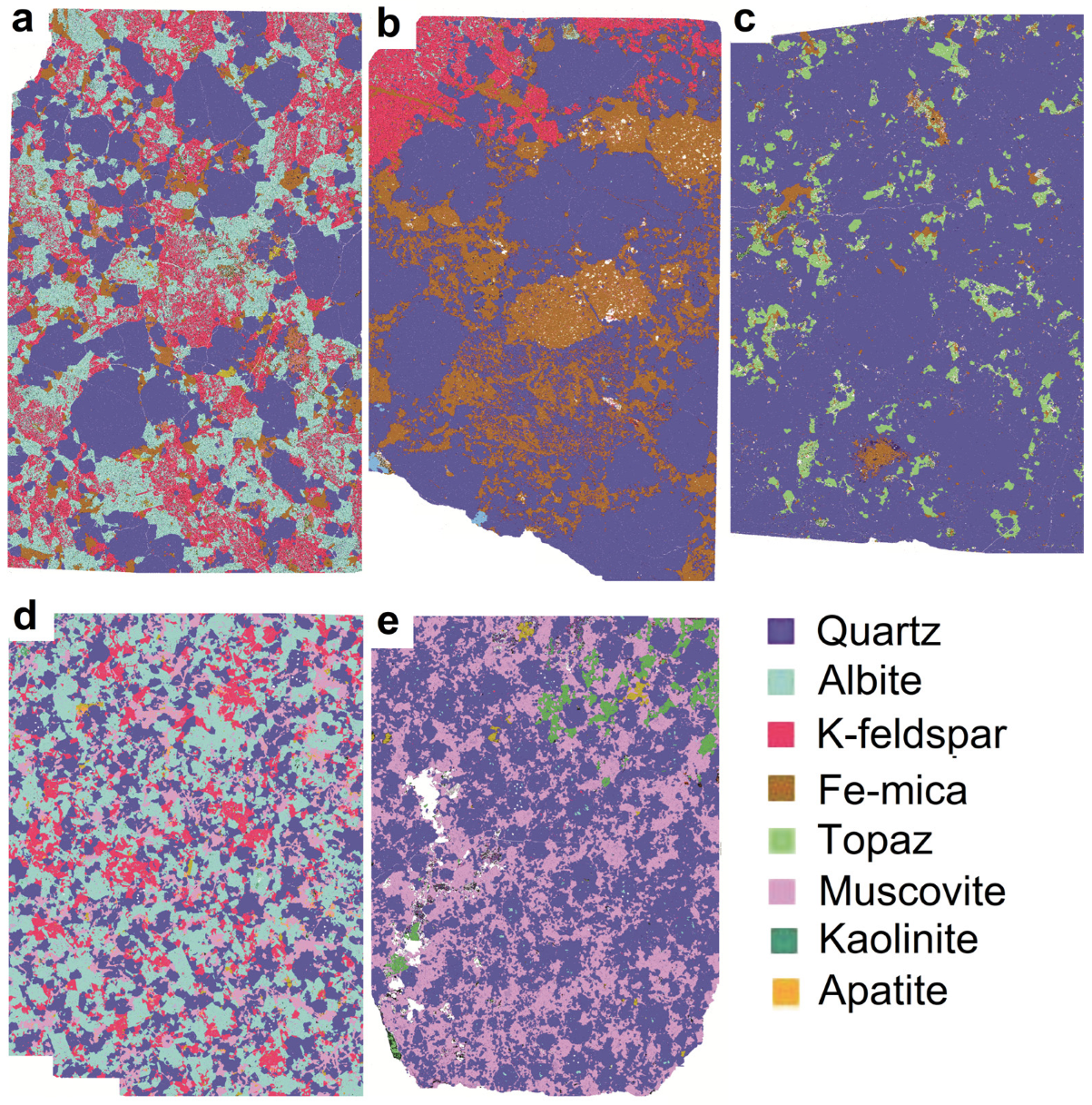
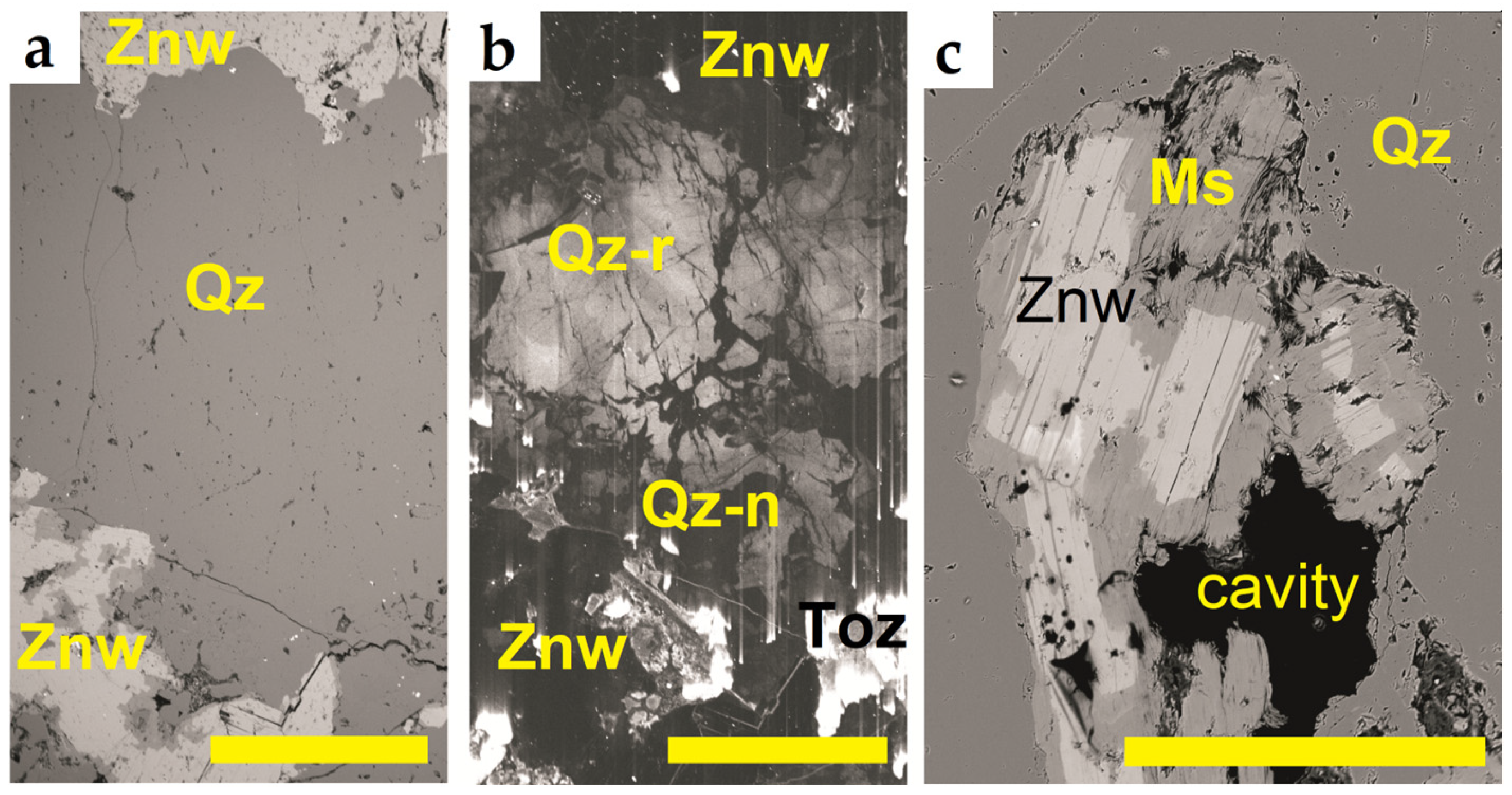
The main greisen minerals are quartz and micas, both in a combination of relics of primary magmatic domains (crystal cores), mantled with metasomatized domains, and new hydrothermally grown mineral grains (Figure 1 and Figure 2). Typical greisen may also contain relics of both feldspars (albite and orthoclase), and relict and/or newly formed topaz, apatite, tourmaline, rutile, monazite, xenotime and zircon. And, of course, predominantly newly formed ore minerals cassiterite, wolframite, rarely also columbite or microlite, common sulfides and native Bi.
According to their shape, greisens can be divided into two basic groups that differ mainly structurally and morphologically, but also mineralogically and chemically: (i) pervasive greisens and (ii) vein greisens. Pervasive greisens form relatively large plates, lenticular or irregular, mostly flat and essentially homogeneous bodies tens of m thick and up to hundreds of m across. They are developed exclusively in the upper parts of granite cupolas, which they partially or completely fill (Figures S1–S3 in Supplement S1). Typical examples have been described and have been mined on a large scale in the Erzgebirge. They are associated with both cupolas of A-type granites (Cínovec, Sadisdorf, [10,11,12]) and cupolas of strongly peraluminous granites of S-type (Ehrenfriedersdorf [13], Krásno [14]). All examples in the Erzgebirge are linked to explosive degassing and hydrofracturing in shallow intrusions; the fluids penetrated through a dense system of irregular, omnidirectional fractures, practically homogeneously throughout the entire volume of the rock (Figures S5 and S6 in Supplement S1). Major constituents of pervasive greisens are quartz and mica (+ topaz > fluorite) in very variable ratios (compare Figure S12 in the Supplement S1). Contents of Li and F, and thus the type of mica, depend on the degree of fractionation of the parent granite: from zinnwaldite at Cínovec, Krásno and similar deposits in the Erzgebirge, to muscovite at Panasqueira, Portugal. However, the extent of Sn or W mineralization does not generally correlate with the composition of micas and the content of Li and F in greisen (see further text). The concentration of Sn in greisen usually does not exceed 0.5 wt%, but locally, in Li-rich greisens, there was an enormous enrichment of cassiterite in the form of bonanzas (Figure S10 in Supplement S1).
Figure 1. Mineral maps of granites and greisen constructed with TIMA technology [15]. (ac) granite and vein greisen, Horní Blatná, Nejdek pluton, Czech Republic: (a) biotite granite; (b) mica-rich greisen; (c) topaz-rich greisen; (d,e) Panasqueira deposit, Portugal: (d) muscovite granite from deeper part of the cupola; (e) pervasive muscovite greisen forming the upper part of the cupola. Size of all images is ca. 35 × 23 mm.
Minerals 16 00626 g001
Vein greisens form thin sheet-like metasomatic (!) bodies along parallel steep fractures. Individual cm sized strips can combine into bands (sheeted-vein complex) in tectonic zones up to several meters thick (Figure S4 in Supplement S1). Swarms of greisen veins up to a kilometer long and 50 m thick are typical of the inner parts of more deeply eroded plutons like the central part of the Nejdek-Eibenstock pluton in the Western Erzgebirge [16,17] and in Land’s End and Cligga Head granites, Cornwall (Figures S7–S9 in Supplement S1) [18]. Vein greisens are composed of quartz and Li-poor mica (+ some tourmaline, apatite or topaz) and are mostly mineralized only with cassiterite; wolframite is sparse and Nb + Ta are completely absent (Figure S13 in Supplement S1).
Besides greisens, another granite-related form of mineralization is represented by hydrothermal veins showing different temporal and spatial relationships to the greisens. Early intragranitic quartz–zinnwaldite lodes with greisen rims at Cínovec [19] (Figure S5 in Supplement S1), and late distal quartz–muscovite veins at Suchot in the Beauvoir granite, France [20], represent extreme types.
Figure 2. Mineral composition of greisen: (a) back-scattered electron (BSE) image of quartz–zinnwaldite greisen, Cínovec, Czech Republic; (b) the same area in cathodoluminescence. Remnants of primary magmatic quartz (relatively light Qz-r) are easily distinguishable from newly formed hydrothermal quartz (dark Qz-n); (c) relics of magmatic zinnwaldite surrounded by hydrothermal muscovite (Cínovec, Czech Republic). Znw—zinnwaldite, Ms—muscovite, Toz—topaz. Scale bars 0.5 mm in all images.
Minerals 16 00626 g002
Due to the growing interest in the greisen type of rare metal deposits, a number of greisen bodies have been subjected to detailed mineralogical research in the last decade. Most often, fluid inclusions have been investigated and p-T conditions of greisen genesis have been modeled [21,22,23]. A number of studies have investigated the evolution of minerals in RMG during the fractionation and transition to hydrothermal processes. Descriptions of minerals from greisen alone are sparser, and studies involving both granites and their hydrothermal transformation products are rather rare [24].
During typical greisenization, the contents of Li and metals (Sn, W) increase, but sometimes these metals are carried away and dispersed into the exocontact. In greisen, besides ore minerals, micas are potentially the most important metal carriers. Evolutionary models have been proposed with mica as a temporary concentrator of metals during magmatic fractionation, and, subsequently, as their donor to ore minerals [25]. However, opposite processes of enrichment of micas during greisenization are presented in this paper, especially in the case of muscovite. Both models are certainly possible, depending on the composition of fluids and the surrounding environment [6,26].
Quartz, as the main mineral component of both greisen and postgranitic veins, is not able to accommodate significant amounts of rare metals into its structure [27,28]. However, trace amounts of some elements offer relevant information about the environment from which magmatic and hydrothermal quartz crystallized [24,29].
The aim of this work is to show the diversity of chemical changes during greisenization and their record in the composition of quartz and micas. This is why I selected 4 typical areas of European Variscan RMG with greisen mineralization that demonstrate different initial magma types (S- vs. A-types), different styles of greisenization (pervasive greisenization in cupolas vs. vein-like metasomatized zones along joints), different styles of chemical evolution during greisenization, and different relationships between greisen and quartz veins.

2. Brief Geology of the Studied Granite/Greisen Systems and the Studied Samples

The Beauvoir and Colette granites together with the La Bosse quartz–wolframite stockwork and several distal quartz veins form the late Variscan Echassieres granite system in the northern part of the Variscan Massif Central, France (Figure S1 in Supplement S1). The geologically relatively older porphyritic two-mica Colette granite forms a roughly round outcrop, ca. 2 km in diameter, while the Beauvoir leucogranite (313 Ma, [30]) forms a small steep stock (outcrop < 0.2 km2) at its southern contact. The Beauvoir granite is strongly peraluminous and enriched in P, F, Li, Rb, Nb, Ta, Sn and W. Borehole GPF1, 900 m deep, revealed a strong vertical zoning from the least evolved biotite granite at the bottom (unit B3) to extremely fractionated lepidolite granite at the top of the stock (unit B1) [31,32,33]. Quartz–muscovite–apatite greisen zones with indistinct contacts and rare quartz veins are widespread, especially in the uppermost part of the intrusion [29,34]. The La Bosse quartz–wolframite stockwork found at the base of borehole GPF1 is newly considered early Variscan, pre-metamorphic [20]. The studied samples comprise granites from the whole vertical profile of borehole GPF1 (author’s data) and the Colette granite, the La Bosse stockwork and the Suchot distal quartz vein [29,34].
The Panasqueira granites form a completely hidden pluton emplaced in the Lower Paleozoic Beira schist, west of the city of Fundao, central Portugal (Figure S2 in the Supplement S1). The pluton comprises peraluminous porphyritic biotite granite at its periphery and geochemically more evolved muscovite leucogranite with partly greisenized cupola in its center [6,35,36]. Pervasive quartz–muscovite greisen in the cupola is generally poor in ore elements, while coeval flat quartz lodes with muscovite rims, up to 50 cm thick, cutting the surrounding schists, are mineralized with wolframite [37,38,39]. Presented are mineral compositions from hidden granites, greisen cupola, and quartz–wolframite lode [36].
The Nejdek-Eibenstock pluton is the most typical example of strongly peraluminous Variscan magmatism in the Western Krušné Hory/Erzgebirge area (Czech Republic/Germany, [40,41]). This pluton is composed of an older intrusive complex (OIC) represented by biotite granites followed by a younger ore-productive intrusive complex (YIC) of Li, F-enriched albite–biotite granites with topaz (328.6 ± 2 Ma and 320 ± 1 Ma, respectively, [42]). The most fractionated, extremely F- and P-rich batches of residual magma crystallized in the form of layered rock with comb quartz layers at Podlesí [43]. Small pervasive greisen bodies are located at cupola-like elevations of the YIC granites near Jáchymov and Vykmanov [44], while numerous steep metasomatized greisen zones, traditionally termed “vein greisens”, are widespread especially in the central parts of the YIC granite intrusions [5,16,45,46] (Figure S3 in Supplement S1). The most fractionated Podlesí intrusion with extremely high primary contents of rare elements is free of post-magmatic alteration and ore-bearing processes. Presented data comprise minerals from the main types of OIC and YIC granites, and from cupola and vein greisens (authorʼs data). Quartz data from the Podlesí granite stock have already been published by Breiter and Müller [47].
The Altenberg-Teplice Caldera, located in the Eastern Krušné Hory/Erzgebirge (Czech Republic/Germany), represents the largest complex of A-type rhyolites and granites in Variscan Europe, covering an area of about 500 km2 [48,49]. After the caldera collapse, several small plutons of A-type biotite granites and albite–zinnwaldite–topaz granites intruded its volcanic fill. The subvolcanic character of these intrusions is demonstrated by the existence of pipes of explosive breccia [50]. Among several intrusions of fractionated granites, the Cínovec cupola is the most voluminous (Figure S4 in Supplement S1). Its upper part down to a depth of 735 m is formed by partly greisenized, dominantly medium-grained zinnwaldite granite with Li-Sn-W mineralization of greisen and vein type [11,51]. The deeper part is composed of barren porphyritic coarse-grained biotite granite. Arched quartz–zinnwaldite (+ topaz, wolframite, cassiterite) veins, roughly parallel to the upper granite contact, up to 50 cm thick (Figure S5 in Supplement S1), were historically mined in the upper-central part of the cupola, while less mineralized but huge pervasive quartz–zinnwaldite greisen bodies with cassiterite are widespread especially in the southern part of the cupola. Presented data represent minerals from all granite types down to the depth of 1600 m [46,52] and from pervasive greisen and vein-type mineralization (unpublished authorʼs data, Müller et al. [24] and Hreus et al. [53]).

3. Methods

Bulk-rock compositions of granites vs. greisen are evaluated based on published analytical data [5,11,31,32,33]. Most of the mineral data used in this work were acquired by the author in the Institute of Geology of the Czech Academy of Sciences in Praha. A larger part has already been published in works devoted to individual localities; some data, especially from the Beauvoir granite and Nejdek pluton, were acquired specifically for this study.

3.1. Quartz

The contents of trace elements Al, B, Be, Fe, Ge, Li, Mn, P, Rb, Sn, Sr and Ti in quartz from the author’s samples from Cínovec, Nejdek pluton, Panasqueira and the Beauvoir granite were determined at the Institute of Geology of the CAS using LA-ICP-MS system composed of Thermo-Finnigan Element 2 sector field mass spectrometer coupled with an Analyte Excite 193 nm excimer Laser (Photon Machines, Belgrade, MT, USA). The laser was fired at a repetition rate of 10 Hz, a laser fluency of 4–5 J/cm2 and a beam size of 100 μm. The ablated material was transported by high-purity He gas. Time-resolved signal data were processed using the Glitter4.4.2. software (http://www.glitter-gemoc.com/). Data were calibrated against the external standard of synthetic silicate glass NIST SRM 612. Isotope 29Si was used as the internal standard based on the assumption that the analyzed quartz contains 99.95 wt% SiO2. For details, see [54]. Data taken from the literature were obtained in a similar manner; for details, see [47] (Podlesí granite) and [29] (Beauvoir greisen and mineralized veins and stockwork).

3.2. Mica

The contents of major elements Si, Ti, Al, Fe, Mn, Mg, Rb, Cs, Na, K and F in mica were analyzed using the Jeol JXA—8230 electron microprobe (JEOL Ltd., Akishima, Tokyo, Japan) housed at the Institute of Geology of the CAS, Praha, operated in the wavelength-dispersive mode. The contents of minor and trace elements Li, Sc, Ti, Mn, Fe, Ga, Ge, Rb, Nb, In, Sn, Cs, Ta, W, and Tl in mica were determined at Faculty of Chemistry, Brno University of Technology using ArF* excimer laser ablation system Analyte Excite+ (Teledyne CETAC Technologies, Omaha, NE, USA) emitting the laser beam at the wavelength of 193 nm, connected to quadrupole ICP mass spectrometer Agilent 7900 (Agilent Technologies, Inc., Santa Clara, CA, USA). Individual spots were ablated by a 50 μm laser beam with a fluence of 3 J/cm2 and a repetition rate of 10 Hz. The ablated material was carried using helium carrier gas (0.5 + 0.3 L/min) and mixed with argon (~1 L/min) prior to the torch. The detection limits were calculated as 3 × SD/b, where SD means standard deviation of the He-Ar gas blank and b is the sensitivity. The spectrometer was tuned using SRM NIST 612 with respect to the maximum sensitivity and minimum doubly charged ions oxide formations. Accuracy control was performed by repeated measurements of the mica in-house test sample measured together with all the samples included in this paper. For additional details, see [55].
Abbreviations of mineral names follow the IMA rules [56].

4. Results

4.1. Bulk-Rock Chemical Changes During Greisenization

Even though greisen deposits are a frequent subject of research, surprisingly few whole-rock analyses of greisens have been published. For scientists, greisens are probably too inhomogeneous to be subject to bulk analyses, and exploration companies tend to determine only the contents of elements of interest. A statistically significant dataset is available from Cínovec [11], smaller datasets come from Beauvoir [31,32,33] and Nejdek [5]. No Li data are available from Panasqueira [36]. The whole dataset of bulk-rock analyses is available in Supplement S2.
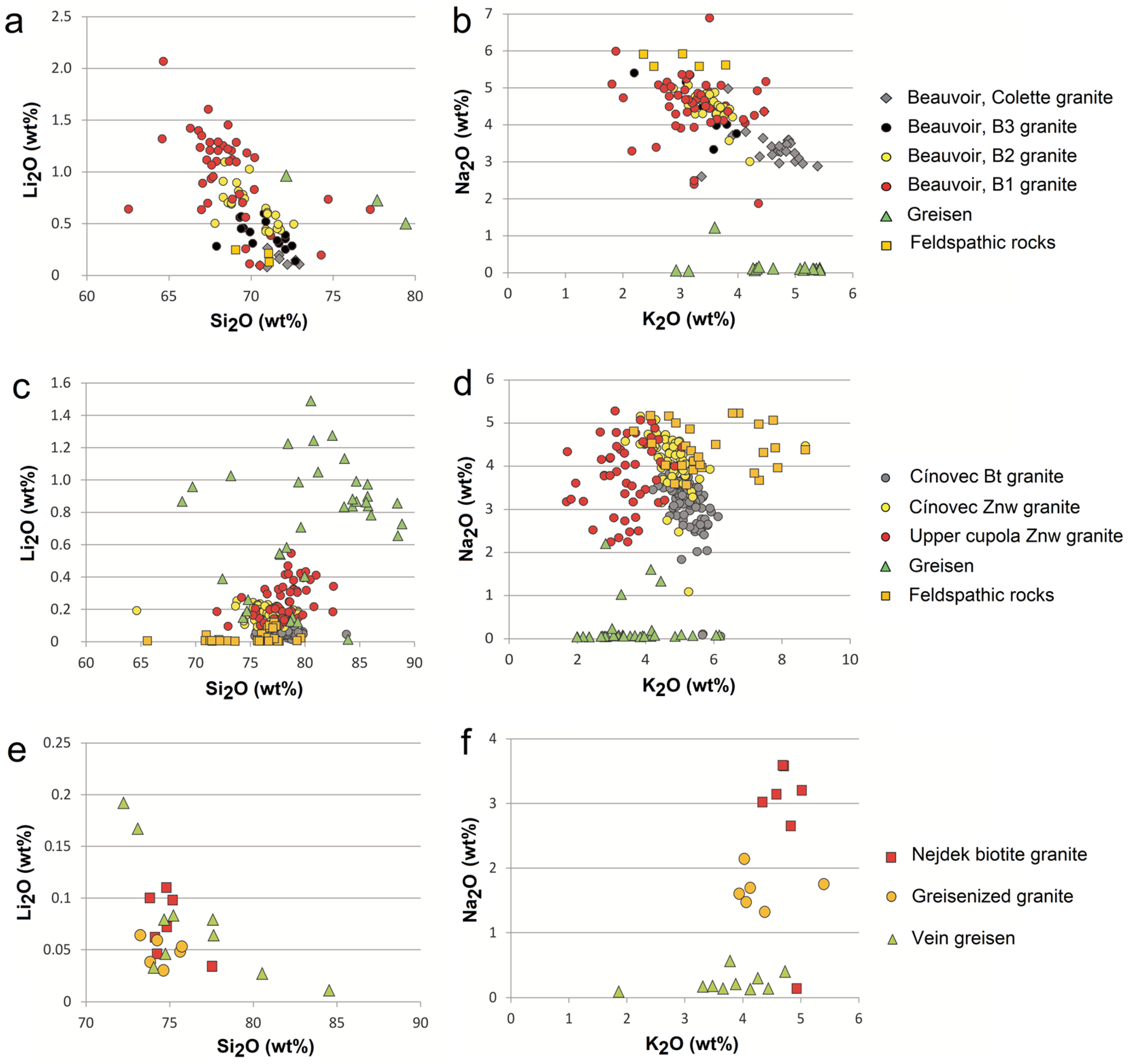
Since the ratio of the main mineral components of greisen, quartz and mica varies widely, the results of the analyses pose a very inhomogeneous set (Table 1, Figure 3, Figure 4 and Figure 5).
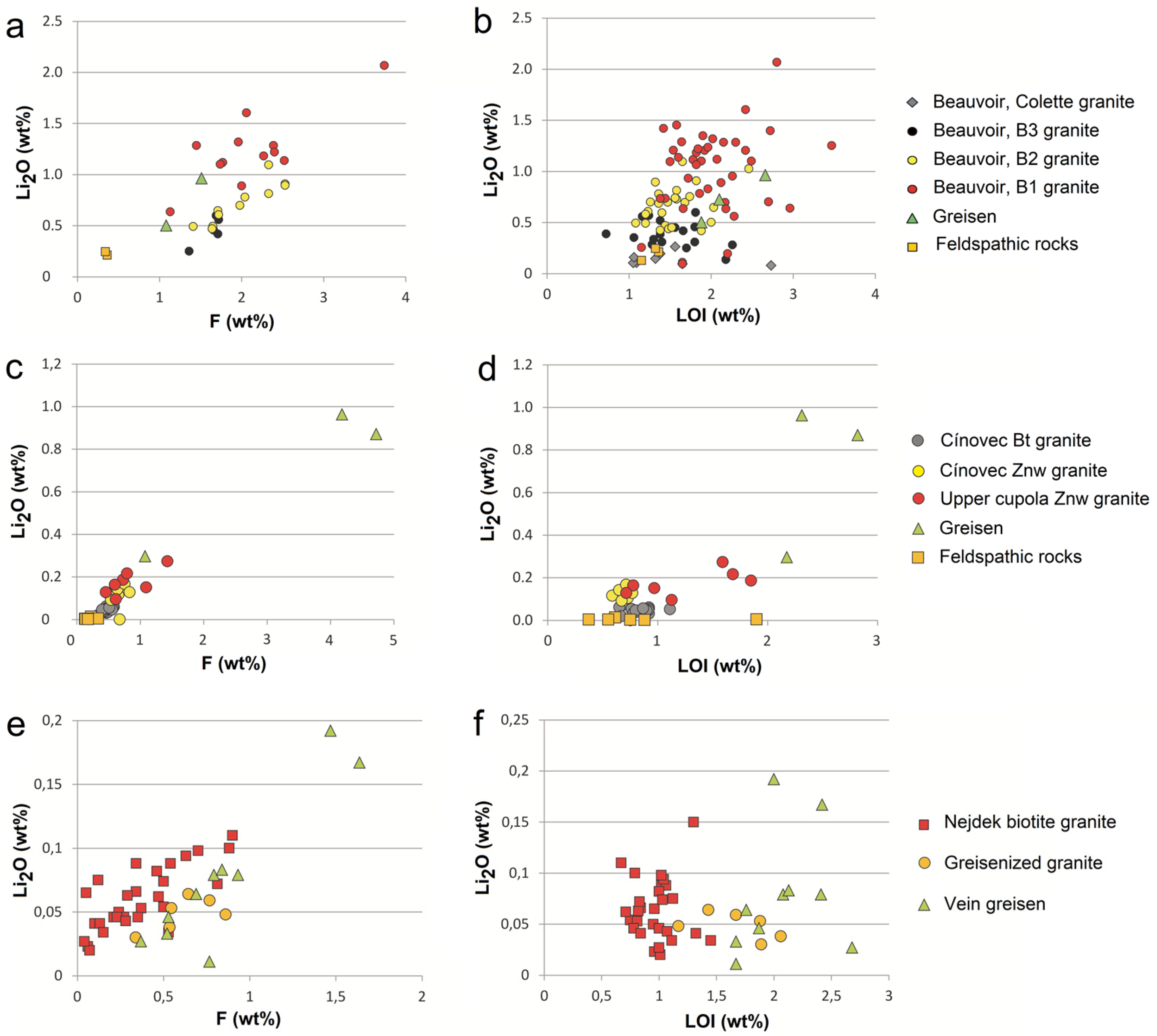
In general, however, greisenization is accompanied by an increase in Si (often up to 85, locally 90 wt% SiO2, Figure 3a,c,e) and a decrease in Na contents, i.e., a destruction of albite, often to less than 0.1 wt% Na2O (Figure 3b,d,f). The contents of Al2O3 and K2O may not change much since both of these elements are simply transferred from magmatic K-feldspar to newly formed mica. Lithium and the usually positively correlated F (Figure 4a,c,e) have two behavior scenarios during greisenization. In typical pervasive greisens in the Erzgebirge, like Cínovec, Li and F contents increase significantly: up to 1.5 wt% Li2O (Figure 3c) and 2.5 wt% F; both elements are hosted in newly formed zinnwaldite mica. At other places, however, newly formed mica is of muscovite composition, being associated with a decrease in Li and F contents. This is typical for vein greisens in the Nejdek pluton (Figure 3e and Figure 4e) and also for cupola-hosted greisens at Beauvoir and Panasqueira, and the late stage of Cínovec greisen (Figure 2c). Although lepidolite granite B1 from Beauvoir contains more Li than zinnwaldite granite from Cínovec (1.0–1.5 vs. 0.2–0.4 wt% Li2O), this ratio becomes reversed during greisenization; this is mineralogically expressed by the contrast between zinnwaldite at Cínovec and muscovite at Beauvoir.
The amount of water bound in the form of OH and/or crystal water in minerals, approximately expressed as loss on ignition (LOI), can indicate the extent of hydrothermal alteration during greisenization (Figure 4b,d,f). This water content increases significantly in Cínovec and Nejdek systems, being usually <1 wt% in fresh granites and reaching 1.5–2.5 wt% in greisen (Figure 4d,f). In contrast, at Beauvoir, LOI is high already in granites, and no further enrichment was encountered during greisenization (Figure 4a).
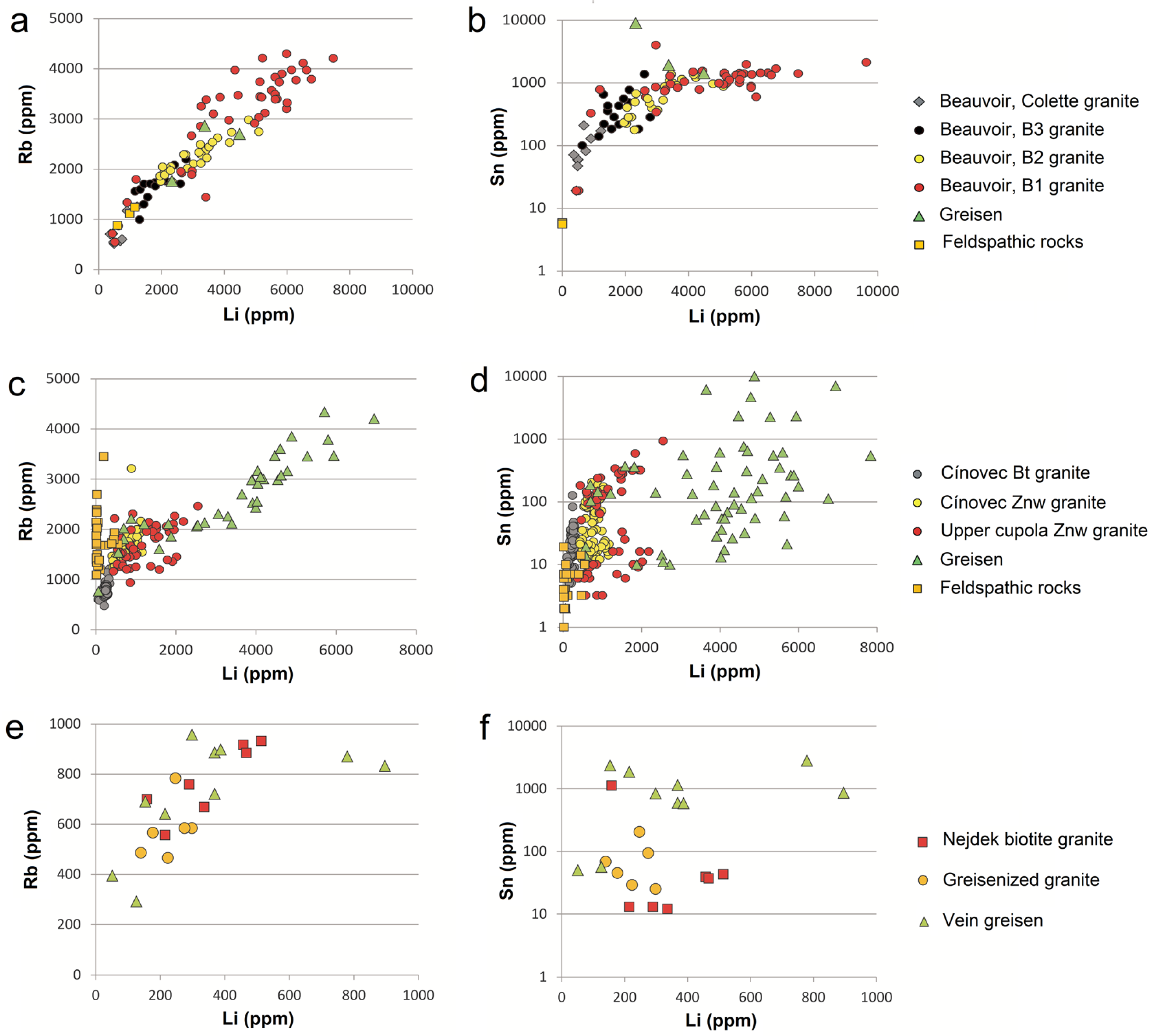
Rubidium is bound, besides mica, also to K-feldspar. During simple pervasive or vein-type greisenization, the ratio of Rb and Li remains roughly the same as at Beauvoir and Nejdek. In contrast, the initial melt at Cínovec with the Rb/Li value of ca 1 became separated into a residual quartz–feldspathic melt enriched in Rb, and mica-rich greisens enriched in Li (Figure 5a,c,e) [11].
Tin enrichment does not depend on the increase/decrease in Li and F contents, and occurs in both of the above-mentioned scenarios, i.e., in greisens with Li-mica (Cínovec) and in greisens with muscovite or muscovitized biotite (Nejdek) (Figure 5d,f). Of course, the existence of greisens with very low contents of Sn and other metals (Beauvoir, Figure 5b) confirms the assumption that greisenization itself and the enrichment in Sn are two largely independent processes or stages of post-magmatic granite evolution.

4.2. Quartz

The contents of trace elements in quartz are shown in Figure 6 and Figure 7 (all analyses) and in Table 2 (medians). The whole dataset of analyses is available in Supplement S3.
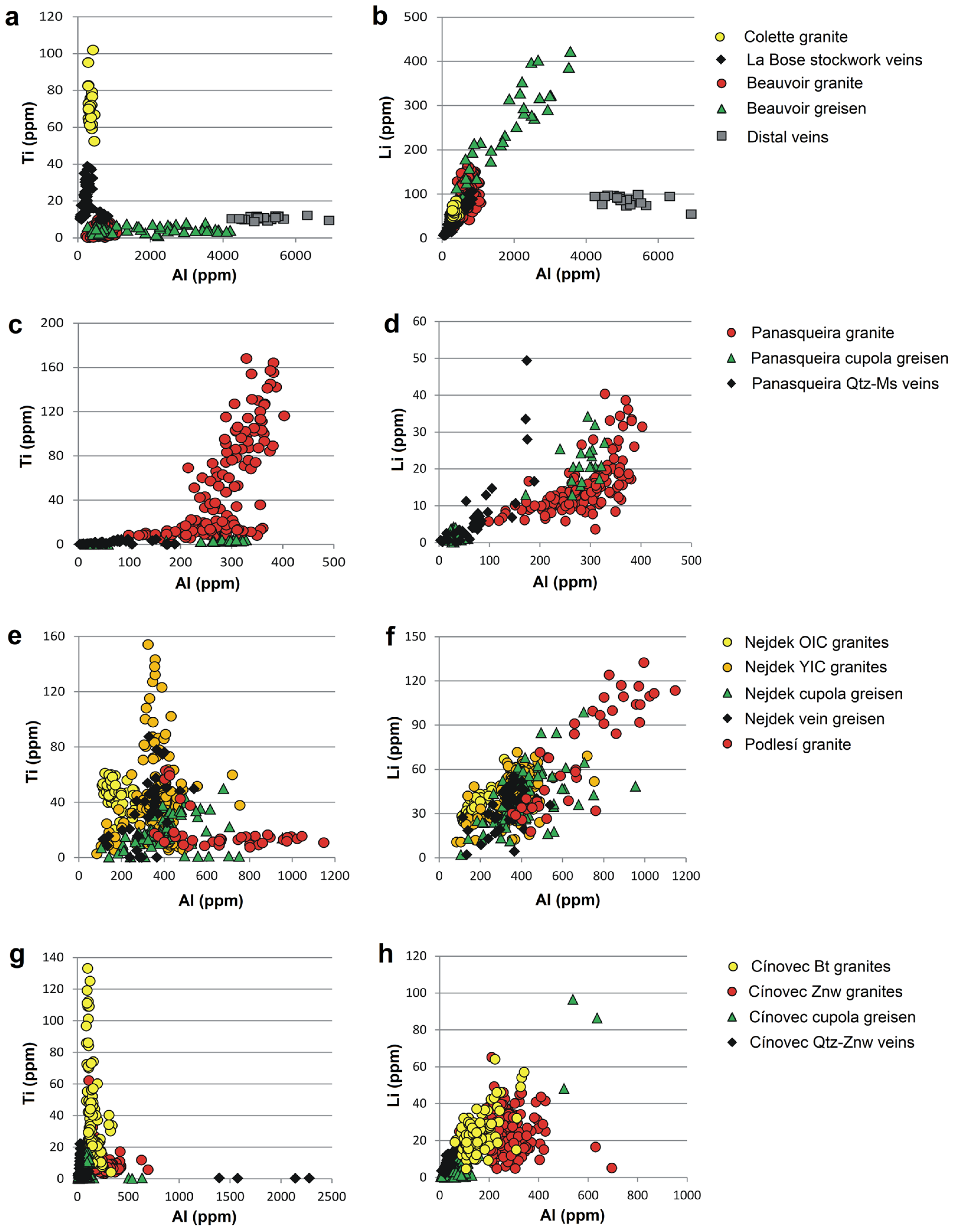
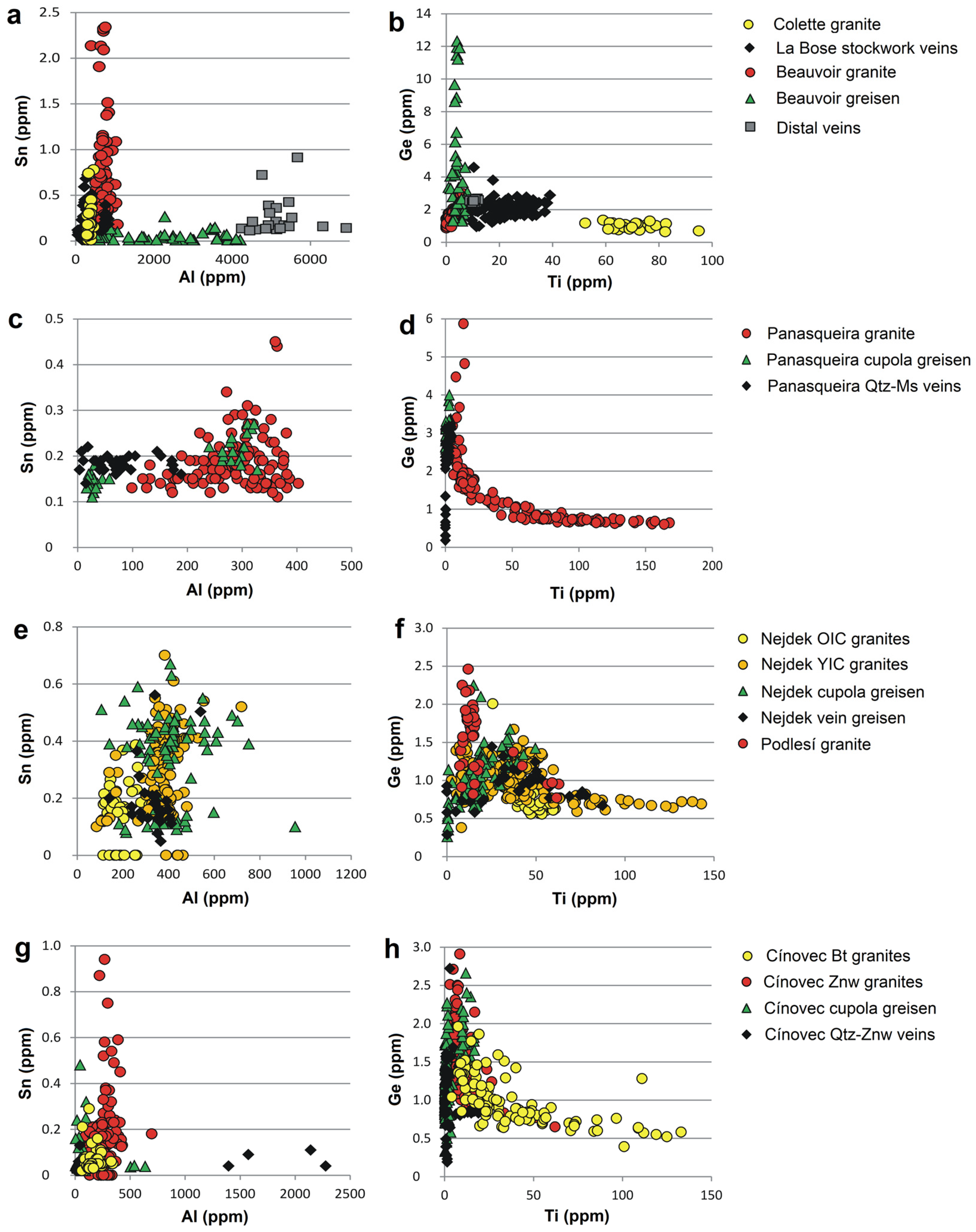
Al, Ti and Li are generally the most common trace elements in quartz of magmatic origin, and a decrease in the Ti/Al value is a reliable indicator of magmatic fractionation [27,28,29,47,54]. As opposed to the decreasing Ti contents during greisenization in all studied cases (to <40 ppm at the Nejdek pluton, <20 ppm at Cínovec and <10 ppm at Beauvoir and Panasqueira, Figure 6a–d), the behavior of Al and Li is ambivalent. The contents of both elements strongly increase up to 3500 ppm Al and 400 ppm Li at Beauvoir but clearly decrease at Cínovec (<150 ppm Al, <15 ppm Li). At Panasqueira and Nejdek, the changes are insignificant (Figure 6e–h). As for other monitored elements, greisen quartz from Beauvoir is relatively depleted in Sn (Figure 7a) but enriched in Ge (Figure 7b), B and Be (Table 2). No clear changes are seen at other localities.
Quartz from associated hydrothermal veins is mostly characterized by high Al contents (up to 6000 ppm Al in the Suchot vein at Beauvoir) but low Ti, Li, Ge and Sn contents.

4.3. Mica

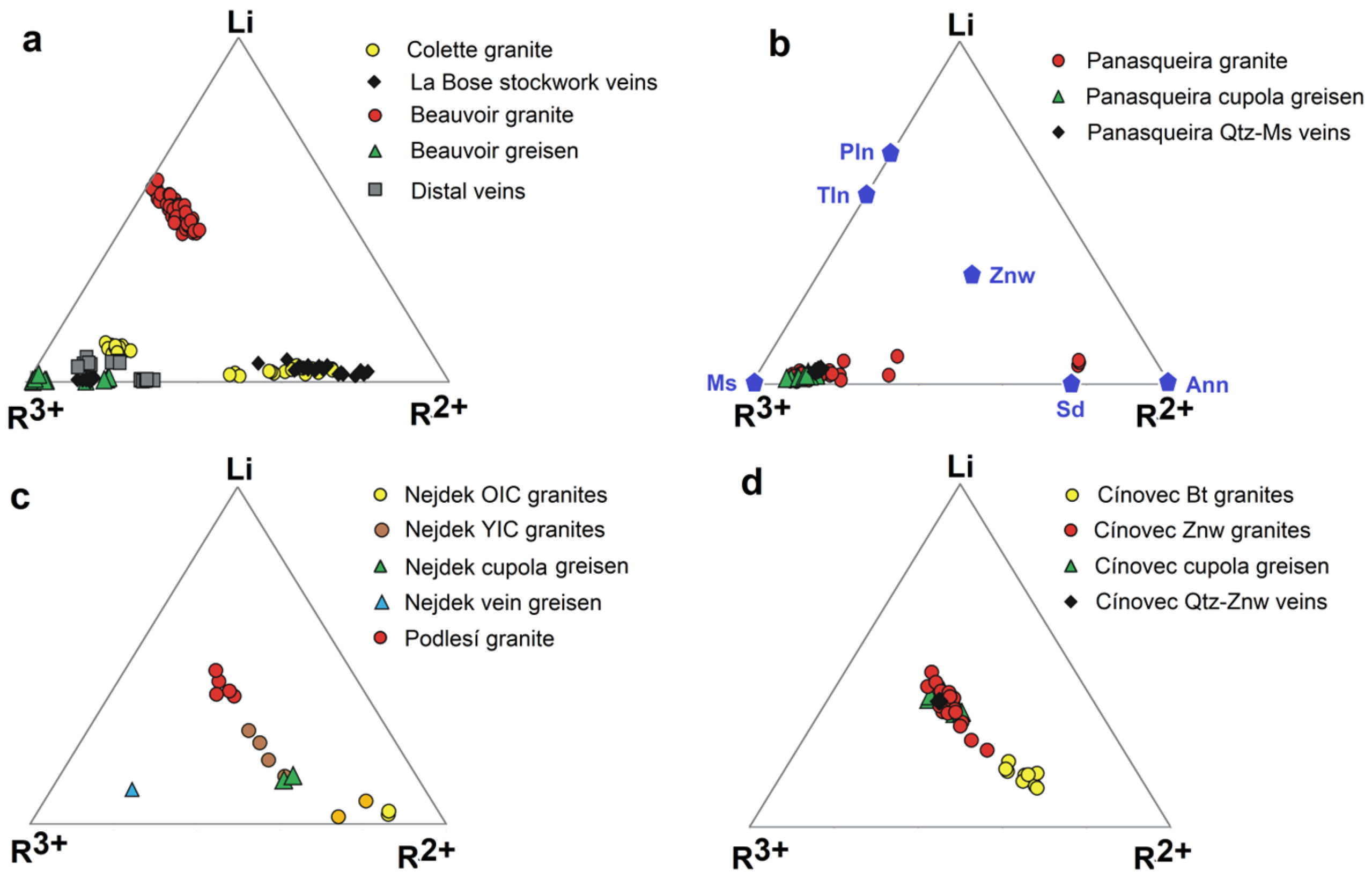
Chemical compositions of micas from the studied RMG and related greisens vary within wide limits among biotite (Bt), muscovite (Ms) and lepidolite (Lpd), and evolutionary trends typical for individual regions differ significantly (Figure 8, Table 3). Within the Beauvoir igneous system, the older Colette granite contains Al-enriched biotite and Fe-enriched muscovite, both with very low Li contents (Figure 8a), while the Beauvoir RMG itself evolved from Fe-enriched lepidolite in unit B3 to pure lepidolite in unit B1. Surprisingly, micas in the associated greisen, stockwork and veins are Li-poor. Li-poor are also all micas in the Panasqueira deposit (Figure 8b). Mica evolution from biotite to zinnwaldite is typical for all RMG plutons in the Erzgebirge (Figure 8c,d). New hydrothermal mica from pervasive cupola greisens at Cínovec and Nejdek is similar to magmatic micas in neighboring granites. Mica in the Nejdek vein greisen originated via muscovitization of primary granitic biotite (Figure 8c).
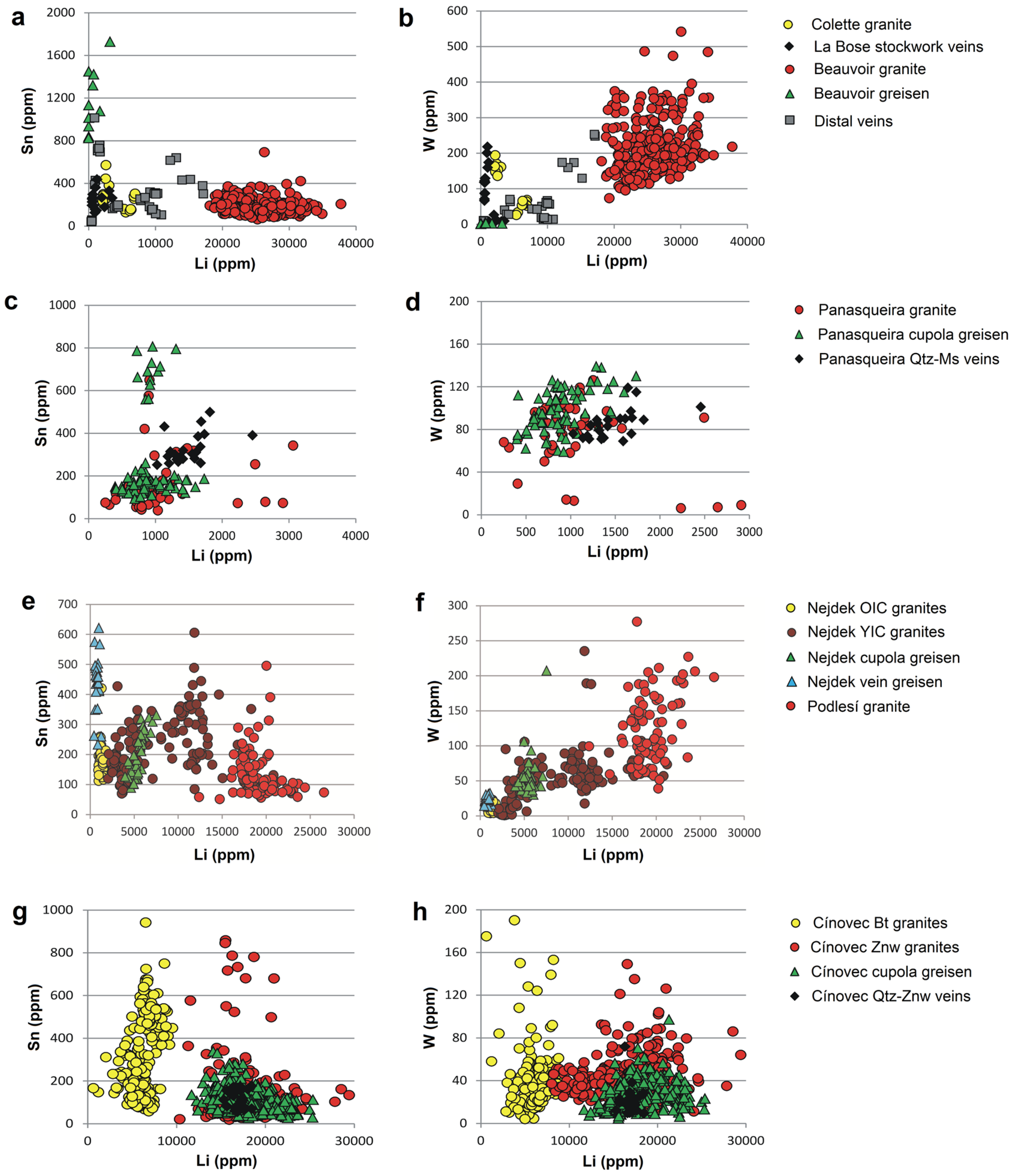
The contents of some minor and trace elements in micas are presented in Table 4, and the whole dataset is in Supplement S4. Figure 9 shows the relation between the contents of Li and rare metals Sn and W, well illustrating the contrasting nature of these two elements. For example, Sn contents at Beauvoir increase in greisen mica but remain roughly the same in the veins. On the other hand, W contents decrease in all cases. The contents of Sn and W in greisen mica are similar to those in neighboring granite in the Panasqueira and Nejdek cupola greisens, and both elements tend to slightly decrease at Cínovec. Both Sn and W are enriched in Li-poor mica from the Nejdek vein greisen.
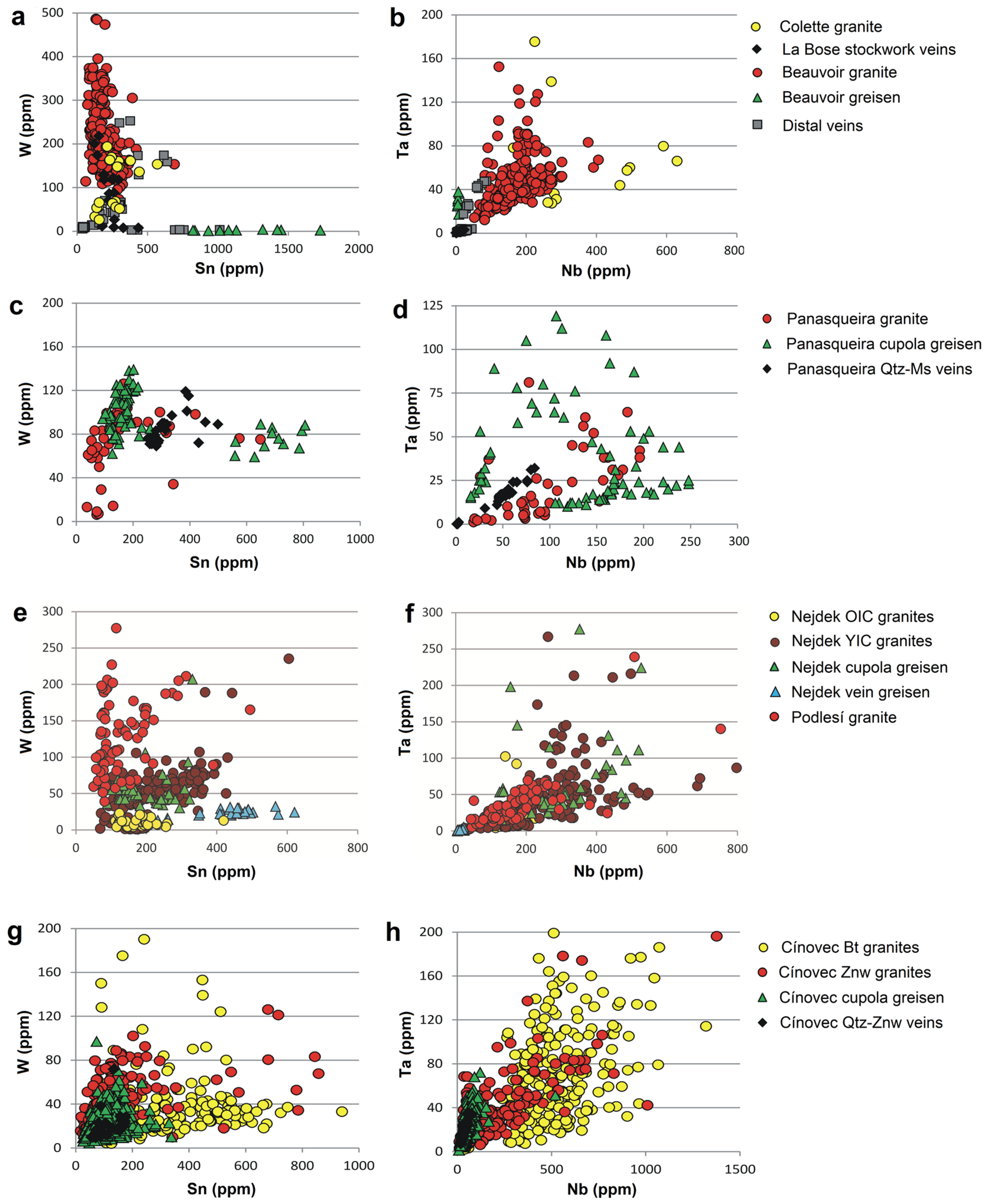
The relative evolution of Sn vs. W, and also Nb vs. Ta, is shown in Figure 10. At Beauvoir, Sn contents increased, and W, Nb and Ta contents decreased in all hydrothermal micas (Figure 10a,b); a similar behavior was also found in the Nejdek pluton (Figure 10e,f). At Panasqueira, some grains of greisen mica roughly retain granitic contents of all metals (relics?), while some are enriched in Sn and Ta (newly formed grains, Figure 10c,d). A trend towards depletion in Sn, W and Nb and a small relative enrichment in Ta was found at Cínovec.

5. Discussion

5.1. Characteristic Chemistry of Magmatic and Hydrothermal Quartz: Is Simple and Reliable Discrimination Possible?

As already shown in Figure 6 and Figure 7, the dispersion in the chemical compositions of hydrothermal quartz from greisen and veins is wide, significantly wider than the dispersion in the compositions of magmatic quartz. The trend towards the enrichment or depletion of an element during hydrothermal processes varies from deposit to deposit. For example, Al and Li can be strongly enriched during greisenization, as in the case of Beauvoir, or significantly depleted, as at Cínovec. The Ge contents sometimes increase (Beauvoir) but usually remain roughly the same. Neither the Sn contents in quartz correlate demonstrably with the occurrence of real Sn mineralization.
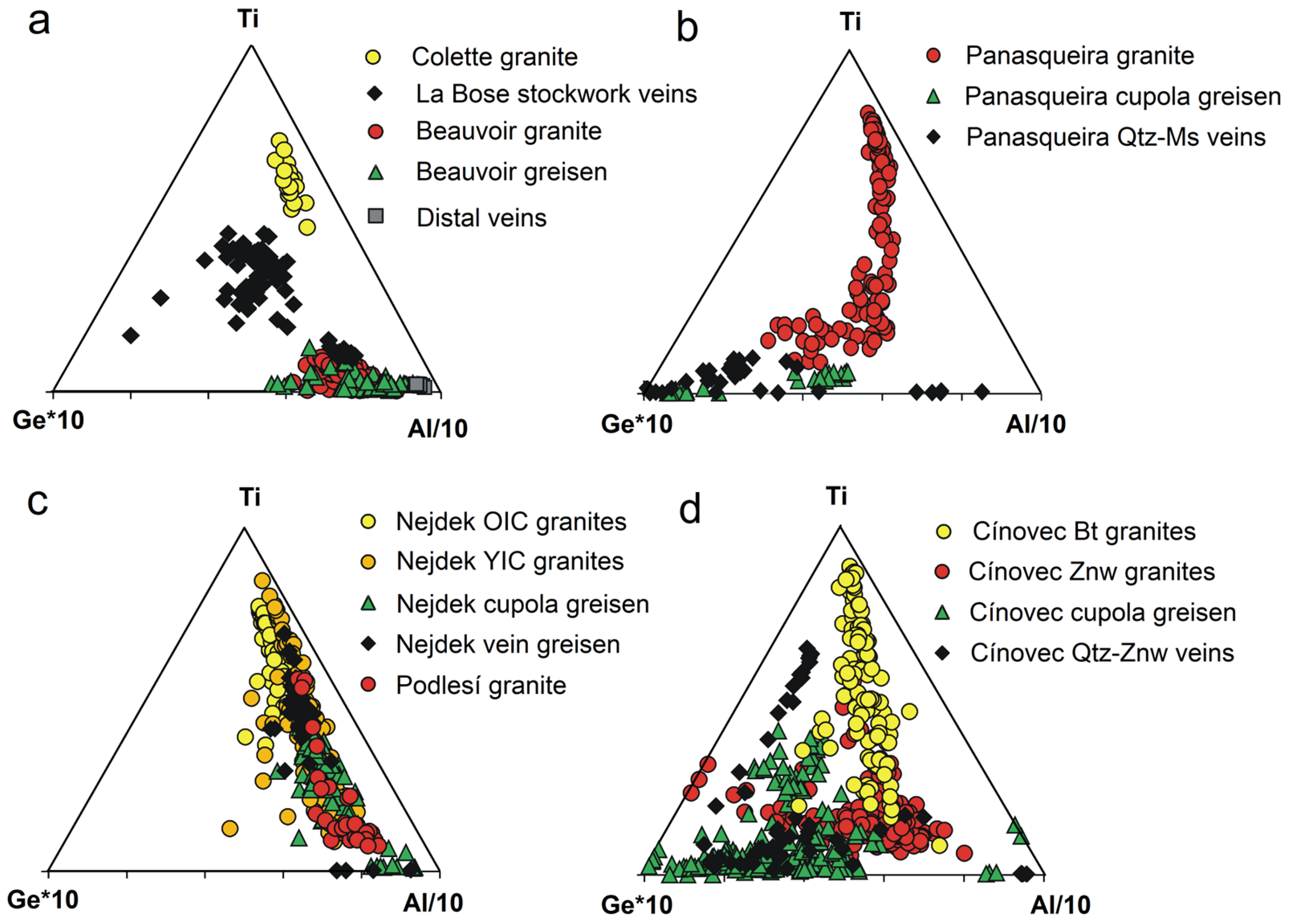
The earliest attempt to classify quartz on a chemical basis was made by Schrön in 1988 [59]. At that time, in proportion to the existing analytical methods, he used atomic emission spectrometry of 62 pulverized bulk samples of pegmatitic, granitic and rhyolitic quartz and proposed the Ti-(Al/50)-(10*Ge) ternary diagram for a basic classification of quartz from these three lithologies: according to this pioneering study, Ti dominates in rhyolitic, Al in granitic, and Ge in pegmatitic quartz. Despite the somewhat primitive analytical method, from today’s point of view, the applicability of this diagram has been repeatedly confirmed [47,60,61]. Unfortunately, hydrothermal quartz behaves very differently in the Ti-Al-Ge system (Figure 11): while greisen quartz from the Beauvoir complex and Nejdek pluton keeps the composition of parental granitic quartz (near the Al apex, Figure 11a,c), greisen quartz from Panasqueira and Cínovec is shifted to the Ge apex (pegmatite field, Figure 11b,d).
The composition of quartz from veins is even more irregular, even within the same system; this is mainly due to the wide fluctuation of Al contents and its growth especially in the late low-temperature stages of crystallization. The one order of magnitude difference in Al contents in individual stages of magmatic–hydrothermal evolution reflects the pH-dependent Al solubility in the fluid. At low temperatures, Al solubility increases dramatically in a very acidic environment of distal quartz veins (pH > 4), while at temperatures around 500 °C (greisen stage), Al solubility is pH-independent and low [62]. As a result, in the environment of greisenized rare-metal granites, the Ti-Al-Ge diagram generally does not allow distinguishing between magmatic and hydrothermal quartz.
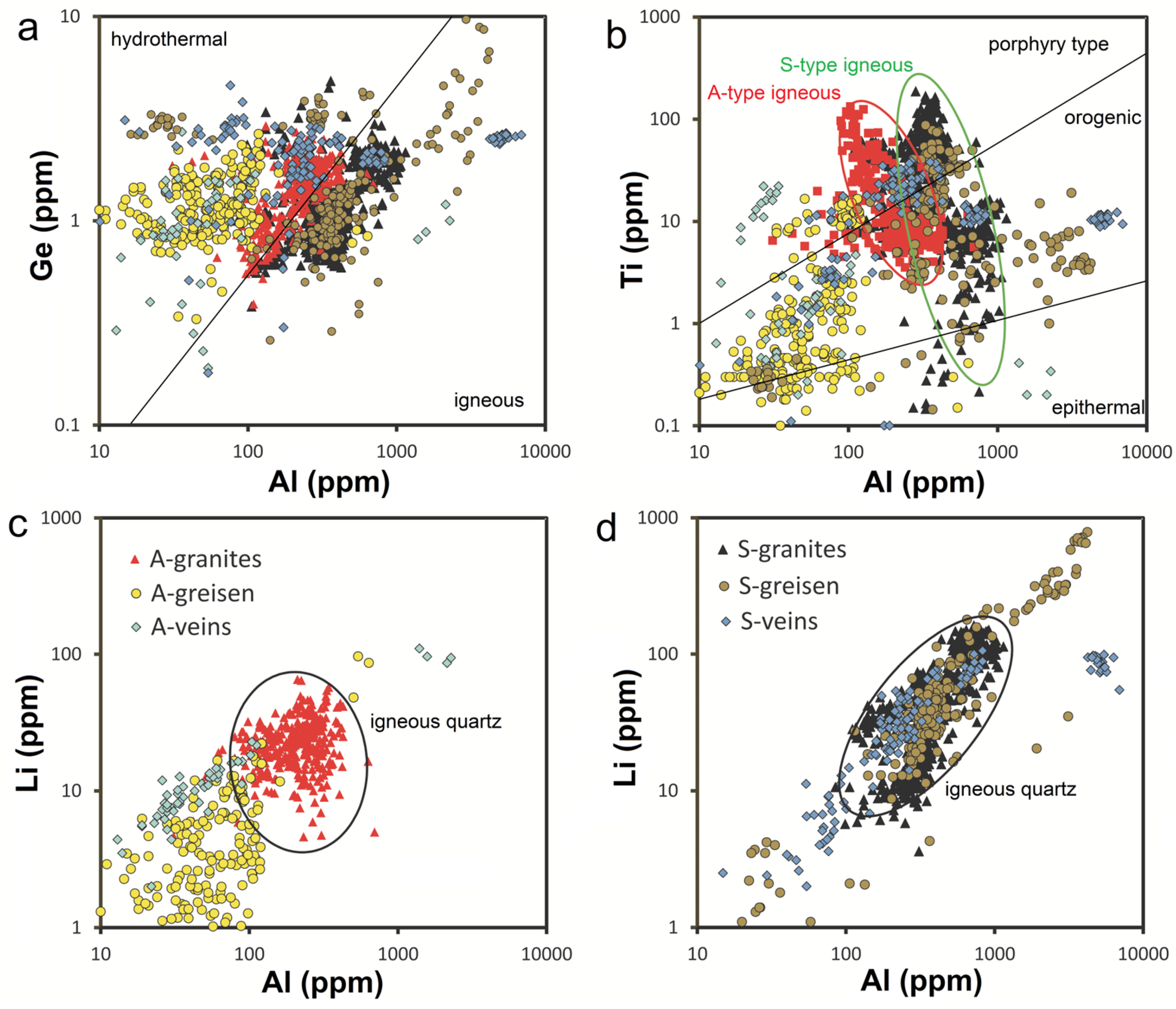
Recently, Shah et al. [63] proposed a simple Ge/Al ratio as a usable discriminant of magmatic (Ge/Al < 0.008) and hydrothermal quartz (Ge/Al > 0.008). If we insert our data into the Shah diagram (Figure 12a), we see that the proposed discrimination line transects all the clusters of granitic-, greisen- and vein-quartz analyses: S-type rocks, relatively richer in Al, lie in the proposed “magmatic” field, while A-type rocks lie predominantly in the “hydrothermal” field, regardless of their actual origin.
Another frequently studied type is quartz from porphyry Cu(Au) deposits and other types of gold deposits [64,65]. Large datasets confirm a decrease in the Ti/Al values in quartz, proportional to the decrease in crystallization temperatures; the discrimination diagram proposed by Rusk [64] (Figure 12b) has been often applied recently [66,67]. However, the relationship between magmatic and greisen + vein quartz does not correspond to a simple model of Ti/Al dependence of temperature decrease from magmatic to hydrothermal to epithermal (distal veins) processes: (1) S-type granites span from ca. 200 to 0.2 ppm Ti, being distributed across all temperature-related classes of Au deposits, and (2) many S-type greisen bodies and veins keep Ti and Al contents nearly identical to those of their granitic precursors although they must have been formed at significantly lower temperatures (Figure 12b).
Among many other options tested, the Al vs. Li diagram seems to be relatively the most useful, at least in the setting of A-type granites. Contents of Al and Li in most quartz from both A- and S-type granites range between 100–1000 and 10–100 ppm, respectively, while greisen quartz and vein quartz of A-type from Cínovec display almost always low contents of both elements: <100 ppm Al and <10 ppm Li, being clearly distinguishable from quartz of their magmatic predecessor (Figure 12c). In the case of S-type systems, most quartz samples from greisen bodies and veins fall within the field of magmatic quartz, and only a smaller part of the samples show significantly higher or lower Al and Li contents, and can thus be distinguished from their magmatic predecessor relatively reliably. Most analyses of quartz from S-type greisen cannot be distinguished from magmatic quartz (Figure 12d).

5.2. Mica Composition

Micas are a very diverse group of minerals with variable chemical compositions that are sensitive to the type and chemistry of the host rock [68]. Micas, due to their crystal structure, can contain high levels of a number of minor and trace elements like Li, Rb, Sn, W, Nb, Ta, etc. This is especially evident in highly fractionated rocks such as rare-metal granites and pegmatites [6,26,34,55,68,69,70,71,72,73]. Fe-rich micas (biotite) are able to selectively incorporate Nb into their lattice and enrich the residual melt with Ta [74]. This opens a question whether there are any general rules for changes in the chemistry of micas during the magmatic–hydrothermal transition, i.e., during greisenization. A look at Figure 13 suggests that they are very difficult to define: differences between the trends in individual plutons/deposits (compare Figure 9 and Figure 10) are fundamental.
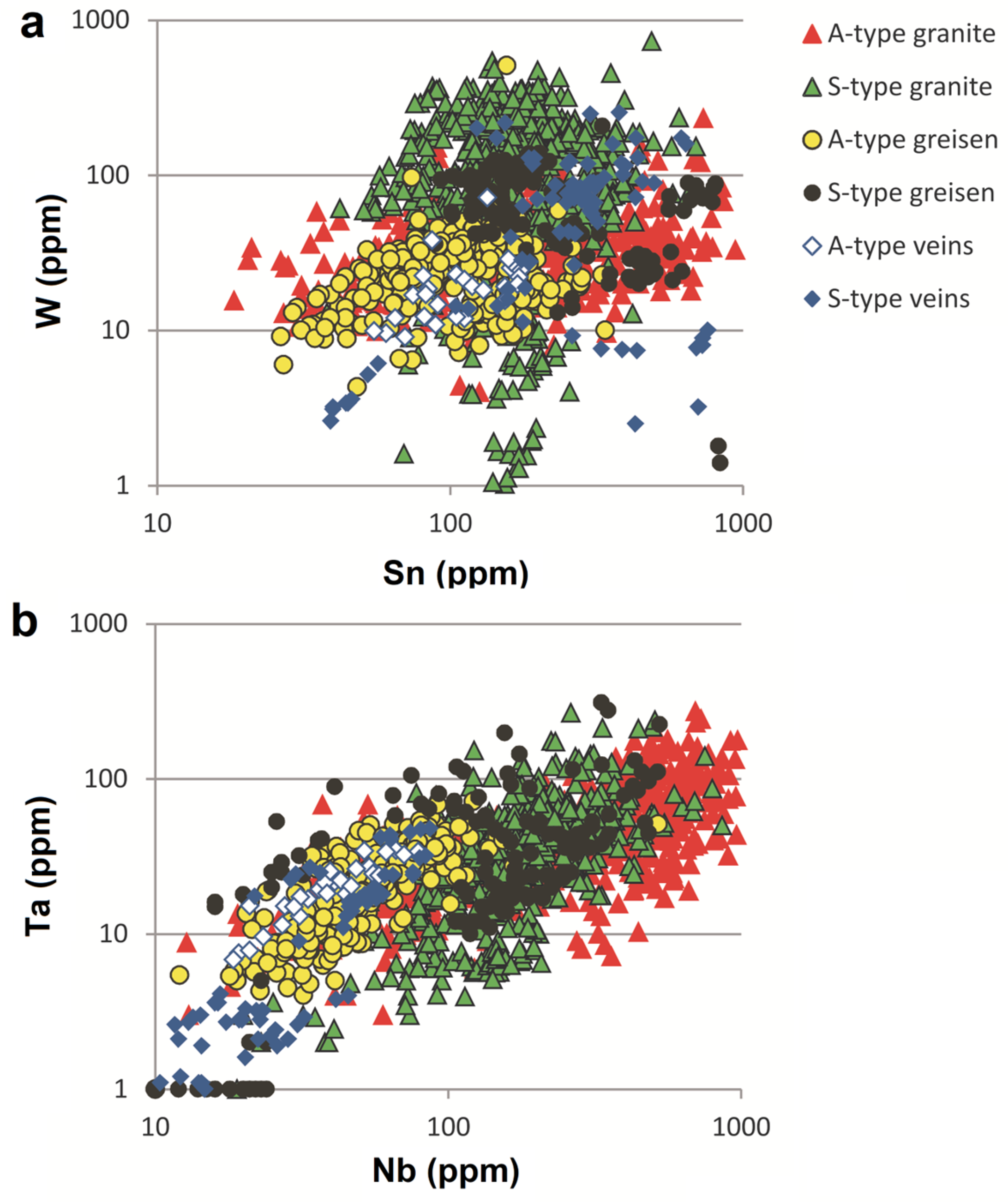
In the case of the Cínovec deposit (A-type granite), all monitored rare metals in micas tend to become depleted during greisenization. This trend is more pronounced in Nb and Ta than in Sn and W. In the Nejdek pluton, micas from greisens are depleted in W, Nb and Ta but enriched in Sn (Figure 10e,f). At Panasqueira, Sn, Nb and Ta contents increased during greisenization while W contents remained unchanged (Figure 10c,d). At Beauvoir, Nb, Ta and W contents decreased and only Sn contents in muscovite greisen increased. In general, muscovite has a greater ability to absorb Sn from fluids than biotite. Sn enrichment of hydrothermal muscovite was also reported by Launay et al. [6] from Panasqueira and by Monnier et al. [34] from the Beauvoir greisen muscovite. The general decrease in the contents of rare metals from granitic to greisen micas can be attributed to the saturation of the fluid with respect to cassiterite, wolframite and possibly columbite under greisen crystallization conditions. A detailed analysis of the mineral share of rare metals at the Cínovec deposit [52] showed that in less fractionated granites, ca. 90% of Sn, W, Nb and Ta are hosted by mica (Li biotite). In more fractionated facies, this share decreases with the onset of crystallization of finely disseminated cassiterite. In greisen, due to extreme mineral inhomogeneity, zinnwaldite hosted 1–90% of the total rare metal contents in samples of the order of kilogram weight.
No correlation can be found between Sn and W due to their different geochemical properties (Figure 13a). In contrast, Nb and Ta correlate significantly (Figure 13b). The experiments of Stepanov [74] have shown that the transition from magmatic to hydrothermal crystallization leads to an increase in the Ta/Nb values in mica. Our data confirms this: the Ta/Nb ratio in mica increases from 0.20 to 0.24 in S-type systems, and from 0.13 to 0.34 at Cínovec as a representative of A-granites. Dispersion among the values is, however, wide and the results should therefore be taken with caution despite the large number of evaluated analyses.

5.3. The Role of Mica in Tin Accumulation

The most objective data to address this issue is available for the pervasive greisens of the Cínovec deposit. Some time ago, Johan et al. [25] presented a model in which Li-micas throughout the volume of the granitic intrusion were the primary carrier of Sn in the magmatic stage, and only during the hydrothermal stage was tin released from the micas and transported by fluids to the dome where cassiterite crystallized. This hypothesis has been questioned because detailed research of the micas in the entire available 1.6 km deep profile has not shown any alterations of the micas leading to depletion of Sn, nor of W, Nb and Ta [52]. Field and mineralogical evidence from Cínovec is consistent with the experiments of Zhao et al. [75] demonstrating direct Sn transition from fractionated melt to hydrothermal fluid. The DSnfluid/melt, at the corresponding ASI = 1.05–1.08, is 1.9–35 [75], which demonstrates very effective mixing of Sn into the fluid.
The study of fluid inclusions in the Cínovce greisen demonstrated the boiling of the fluid and its separation into vapor and liquid [21,23]. The increase in volume after vapor separation triggered explosive brecciation and hydrofracturing [11,50]. F-rich vapor advanced upwards along hairline cracks more rapidly, causing the decomposition of feldspars, the crystallization of quartz, topaz and mica, and increasing the volume of pores [23]. This allowed later fluids to permeate the entire volume of the rock, forming pervasive greisen. Tin transport occurred in a fluid environment, probably in multiple episodes. The last, relatively low-temperature Sn influx by an already F, Li-poor fluid was associated with the muscovitization of greisen zinnwaldite (Figure 2c). This is consistent with the empirical finding from the mine that muscovitization increases the amount of cassiterite in the ore [76]. During muscovitization, the Sn content in mica increased on average from 145 to 1408 ppm, while the F and Li contents decreased from 7.0 to 0.4 wt% F, and from 3.5 to 1 wt% Li2O.
The vein greisens have been studied rarely in modern times [5,77]. These greisens were formed when the flow of hydrothermal fluid was focused into systems of vertical fractures. The vertical extent of this greisen type reaches up to 800 m, but the source from which the fluids were tapped has not yet been identified. Models involving both possibilities, i.e., deeper parts of the surrounding intrusion itself, or the existence of a younger, more fractionated intrusion hidden at depth, have been considered but not confirmed [5,17].

5.4. Differences Between S- and A-Type Greisen Systems

The Erzgebirge, where equally old RMGs of both types, i.e., S- and A-type, occur only a few tens of km apart, is seemingly a suitable area for assessing the influence of the genetic type of granite on the style and extent of Sn-mineralization. Although both types of granites have specific chemical features that point to different source rocks [78,79], the Sn-deposits in the domes of A- and S-granites are very similar, both chemically and structurally [11,12,14]. Granites of initially different chemistry converge with advancing fractionation. Moreover, in the case of the Erzgebirge, the general enrichment of Li, Sn, and W indicates a similar material source melted under different conditions rather than different source lithologies [80]. Dolejš and Štemprok [81] found rather smaller initial delta18OWR in A-type Cínovec than in S-type Krásno RMGs (5.2–8.4 vs. 10.4–10.7 ‰ SMOW), but the water responsible for the greisenization was of meteoric origin in both cases. Current knowledge suggests that specific emplacement conditions, i.e., the very shallow depth of intrusion (1–2 km) and the resulting explosive degassing and development of the hydrothermal process in an environment of high pressure and temperature gradient, were decisive for the structural and material development of mineralization in the granite cupolas. Inherited chemical specificities, such as differences in peraluminity or phosphorus content, did not affect the development of mineralization.

6. Conclusions

The contents of all monitored elements in quartz and mica from greisen and associated veins are of very high variability, significantly higher than in parent granites. The trends in elemental contents in minerals during the magmatic–hydrothermal transition are different at each studied locality. Nevertheless, some generally valid trends can be stated:
  • Quartz: Extremely low contents of Al (<100 ppm), Ti (<1 ppm) and Li (<10 ppm) or, on the contrary, extremely high contents of Al (>1000 ppm Al) and/or Li (>100 ppm) are strong arguments for a hydrothermal origin of the studied quartz. This discriminator is very reliable in A-type systems, but only limited in S-type systems.
  • Micas: (1) The contents of all monitored elements fluctuate strongly, often within two orders of magnitude; (2) the transition from magmatic to hydrothermal crystallization leads to a statistical increase in the Ta/Nb values in mica; (3) all monitored rare metals usually tend to become depleted in greisen micas. This trend is more pronounced in Nb and Ta than in Sn and W. The only exception is the increase in Sn contents at localities with muscovite as the only hydrothermal mica; (4) transition from magmatic to hydrothermal crystallization leads to an increase in the Ta/Nb values in mica: from 0.20 to 0.24 in S-type systems, and from 0.13 to 0.34 at Cínovec as a representative of A-granites.
  • In general, no difference was found in the structural or chemical development of pervasive greisen in A- and S-type granites. The formation of pervasive greisen was determined by the subvolcanic depth of the intrusion, which triggered explosive degassing and subsequently enabled intensive circulation of hydrothermal fluids.
Despite the large amount of evaluated data, the results are, due to the low inhomogeneity of the greisenization processes, only indicative. Further research in this direction, including isotopic methods in particular, is highly desirable.

Supplementary Materials

The following supporting information can be downloaded at: https://www.mdpi.com/article/10.3390/min16060626/s1. Supplement S1: geological information; Supplement S2: whole-rock analyses; Supplement S3: quartz analyses; Supplement S4: mica analyses.

Funding

This study was supported by RVO 67985831 at the Geological Institute of the Czech Academy of Sciences.

Data Availability Statement

The original contributions presented in this study are included in the article/Supplementary Materials. Further inquiries can be directed to the corresponding author.

Acknowledgments

I would like to thank Zuzana Korbelová, Michaela Vašinová Galiová and Jana Ďurišová for their help with the work on the microprobe and LA-ICP-MS. Editors and three anonymous reviewers are thanked for all comments improving this manuscript. The author has read and agreed to the published version of the manuscript.

Conflicts of Interest

The author declares no conflicts of interest. The funders had no role in the design of this study; in the collection, analyses, or interpretation of data; in the writing of the manuscript; or in the decision to publish the results.

References

  1. Černý, P.; Meintzner, R.E.; Anderson, A.J. Extreme fractionation in rare-element granitic pegmatites: Selected examples of data and mechanisms. Can. Mineral. 1985, 23, 381–421. [Google Scholar]
  2. London, P. Internal differentiation of rare-element pegmatites: Effect of boron, phosphorus, and fluorine. Geochim. Cosmochim. Acta 1987, 51, 403–420. [Google Scholar] [CrossRef]
  3. Linnen, R.L.; Cuney, M. Granite-related rare-element deposits and experimental constrains on Ta–Nb–W–Sn–Zr–Hf mineralization. GAC Short Course Notes 2004, 17, 45–68. [Google Scholar]
  4. Štemprok, M. Greisenization (a review). Geol. Rundsch. 1987, 76, 169–175. [Google Scholar] [CrossRef]
  5. Štemprok, M.; Dolejš, D. Fluid focusing, mass transfer and origin of fracture-controlled greisens in the Western Krušné hory granite pluton, Central Europe. Z. Geol. Wiss. 2010, 38, 207–234. [Google Scholar]
  6. Launay, G.; Sizaret, S.; Lach, P.; Gloaguen, E.; Melleton, J.; Poujol, M. Genetic relationship between greisenization and Sn-W mineralizations in vein and greisen deposits: Insights from the Panasqueira deposit (Portugal). BSGF Earth Sci. Bull. 2021, 192, 2. [Google Scholar] [CrossRef]
  7. Beus, A.A.; Severov, E.A.; Sitnin, A.A.; Subbotin, K.D. Albitized and Greisenized Granites (Apogranites); Akademia Nauk: Moscow, Russia, 1962. (In Russian) [Google Scholar]
  8. Beskin, S.M.; Larin, V.N.; Marin, Y.B. Rare-Metal Granites; Nedra: Leningrad, Russia, 1979. (In Russian) [Google Scholar]
  9. Teuscher, E.O. Primäre Bildungen des granitischen Magmas und seiner Restlösungen im Massif von Eibenstock-Neudeck. Miner. Petrogr. Mitt. 1936, 47, 211–262. [Google Scholar] [CrossRef]
  10. Breiter, K.; Ďurišová, J.; Hrstka, T.; Korbelová, Z.; Hložková Vaňková, M.; Vašinová Galiová, M.; Kanický, V.; Rambousek, P.; Knésl, I.; Dobeš, P. Assessment of magmatic vs. metasomatic processes in rare-metal granites: A case study of the Cínovec-Zinnwald Sn–W–Li deposit, Central Europe. Lithos 2017, 292, 198–217. [Google Scholar] [CrossRef]
  11. Burisch, M.; Leopardi, D.; Guilcher, M.; Šešulka, V.; Dittrich, T.; Lehmann, B. Greisen-hosted lithium resources of the Erzgebirge/Krušné Hory province (Germany and Czech Republic). Econ. Geol. 2025, 120, 627–647. [Google Scholar] [CrossRef]
  12. Leopardi, D. The Spatial and Temporal Evolution of the Sadisdorf Li-Sn-(W-Cu) Magmatic-hydrothermal greisen and vein system, Eastern Erzgebirge, Germany. Econ. Geol. 2024, 119, 771–803. [Google Scholar]
  13. Hösel, G.; Hoth, K.; Jung, D.; Leonhardt, D.; Mann, M.; Meyer, H.; Tãgl, U. Das Zinnerz-Lagerstättengebiet Ehrenfriedersdorf/Erzgebirge; LfUG Freiberg: Freiberg, Germany, 1994. [Google Scholar]
  14. Jarchovský, T. The nature and genesis of greisen stocks at Krásno, Slavkovský les area—Western Bohemia, Czech Republic. J. Czech Geol. Soc. 2006, 51, 201–216. [Google Scholar] [CrossRef]
  15. Hrstka, T.; Gottlieb, P.; Skála, R.; Breiter, K.; Motl, D. Automated mineralogy and petrology—Applications of TESCAN Integrated Mineral Analyzer (TIMA). J. Geosci. 2018, 63, 47–63. [Google Scholar] [CrossRef]
  16. Hösel, G.; Breiter, K.; Wasternack, J.; Tischendorf, G. Mineral Resources in Erzgebirge-Vogtland/Krušné Hory. Map 2: Metals, Fluorite/Barite—Occurrences and Environmental Impact 1:100.000; Sächsisches Landesamt für Umwelt und Geologie: Freiberg, Germany; Czech Geological Survey: Praha, Czech Republic, 1995.
  17. Hösel, G.; Tischendorf, G.; Wasternack, J.; Breiter, K.; Kuschka, E.; Pälchen, W.; Rank, G.; Štemprok, M. Erläuterungen zur Karte Mineralische Rohstoffe Erzgebirge-Vogtland/Krušné Hory 1:100.000. Bergbau Sachs. 1997, 3, 1–144. [Google Scholar]
  18. Moore, J.M.; Jackson, N. Structure and mineralisation in the Cligga granite stock. J. Geol. Soc. 1977, 133, 467–480. [Google Scholar]
  19. Štemprok, M. Genetische Untersuchung der flach fallenden Gänge auf der Erzlagerstätte Cínovec (Zinnwald) im Erzgebirge. In Sborník Ústředního Ústavu Geologického, Oddíl Geologický; Czech Geological Survey: Praha, Czech Republic, 1961; Volume 26, pp. 455–527. [Google Scholar]
  20. Monnier, L.; Melleton, J.; Vanderhaeghe, O.; Salvi, S.; Lach, P.; Bruguier, O.; Benmammar, A.; Bailly, L.; Beziat, D.; Gloguagen, E. Episodic precipitation of wolframite during an orogen: The Echassieres district, Variscan belt of France. Minerals 2021, 11, 923. [Google Scholar] [CrossRef]
  21. Korges, M.; Weis, P.; Lüders, V.; Laurent, O. Depressurization and boiling of a single magmatic fluid as a mechanism for tin-tungsten deposit formation. Geology 2018, 46, 75–78. [Google Scholar]
  22. Monnier, L.; Salvi, S.; Jourdan, V.; Souleymane, S.; Baily, L.; Melleton, J.A.; Béziat, D. Contrasting fluid behavior during two styles of greisen alteration leading to distinct wolframite mineralizations: The Eschassieres district (Massif Central, France). Ore Geol. Rev. 2020, 124, 103648. [Google Scholar] [CrossRef]
  23. Qiao, S.; John, T.; Loges, A. Formation of topaz-greisen by a boiling fluid: A case study from the Sn-W-Li deposit Zinnwald/Cínovec. Econ. Geol. 2024, 119, 805–828. [Google Scholar]
  24. Müller, A.; Herklotz, G.; Giegling, H. Chemistry of quartz related to the Zinnwald/Cinovec Sn-W-Li greisen-type deposit, Eastern Erzgebirge, Germany. J. Geochem. Explor. 2018, 190, 357–373. [Google Scholar]
  25. Johan, Z.; Strnad, L.; Johan, V. Evolution of the Cínovec (Zinnwald) granite cupola, Czech Republic: Composition of feldspars and micas, a clue to origin of W, Sn mineralization. Canad. Mineral. 2012, 50, 1131–1148. [Google Scholar]
  26. Legros, H.; Marignac, C.; Mercadier, J.; Cuney, M.; Richard, A.; Wang, R.-C.; Charles, N.; Lespinasse, M.-Y. Detailed paragenesis and Li-mica compositions as recorders of the magmatic–hydrothermal evolution of the Maoping W–Sn deposit (Jiangxi, China). Lithos 2016, 264, 108–124. [Google Scholar] [CrossRef]
  27. Larsen, R.B.; Jacamon, F.; Kronz, A. Trace element chemistry and textures of quartz during the magmatic hydrothermal transition of Oslo rift granites. Mineral. Mag. 2009, 73, 691–707. [Google Scholar] [CrossRef]
  28. Müller, A.; van den Kerkhof, A.M.; Behr, H.-J.; Kronz, A.; Koch-Müller, M. The evolution of late-Hercynian granites and rhyolites documented by quartz—A review. Earth Environ. Earth Environ. Sci. Trans. R. Soc. Edinb. 2010, 100, 185–204. [Google Scholar]
  29. Monnier, L.; Lach, P.; Salvi, S.; Melleton, J.; Bailly, L.; Beziat, D.; Monnier, Y.; Gouy, S. Quartz trace-element composition by LA-ICP-MS as proxy for granite differentiation, hydrothermal episodes, and related mineralization: The Beauvoir granite (Echassieres district), France. Lithos 2018, 320–321, 355–377. [Google Scholar]
  30. Esteves, N.E.; Bouilho, P.; Schaltegger, U.; Ovtcharova, M.; Paul, A.N.; France, L. The magmatic hydrothermal transition record in zircon: Implications for zircon texture, composition and rare-metal granite dating (Beauvoir granite, French Massif Central). Eur. J. Mineral. 2025, 37, 667–693. [Google Scholar]
  31. Cuney, M.; Marignac, C.; Weisbrod, A. The Beauvoir topaz-lepidolite albite granite (Massif Central, France): The disseminated magmatic Sn-Li-Ta-Nb-Be mineralization. Econ. Geol. 1992, 87, 1766–1794. [Google Scholar] [CrossRef]
  32. Raimbault, L.; Azencott, C.; Joron, J.L.; Gruffat, J.J.; Moutte, J.; Ouin, M.C. Analyse de 129 échantillons du massif granitique d’Echassieres (Massif Central, France), dont 67 échantillons du sondage GPF. Bur. Rech. Géologiques Min. Doc. 1988, 124, 369–418. [Google Scholar]
  33. Raimbault, L.; Cuney, M.; Azencott, C.; Duthou, J.L.; Joron, J.L. Geochemical evidence for a multistage magmatic genesis of Ta–Sn–Li mineralization in the granite at Beauvoir, French Massif Central. Econ. Geol. 1995, 90, 548–596. [Google Scholar] [CrossRef]
  34. Monnier, L.; Salvi, S.; Melleton, J.; Lach, P.; Pochon, A.; Baily, L.; Béziat, D.; De Parseval, P. Mica trace-element signatures: Highlighting superimposed W-Sn mineralizations and fluid sources. Chem. Geol. 2022, 600, 120866. [Google Scholar]
  35. Marignac, C.; Cuney, M.; Cathelineau, M.; Lecomte, A.; Carocci, E.; Pinto, F. The Panasqueira rare metal granite suites and their involvement in the genesis of the world-class PanasqueiraW-Sn-Cu deposit: A petrographic, mineralogical, and geochemical study. Minerals 2020, 10, 562. [Google Scholar]
  36. Breiter, K.; Ďurišová, J.; Korbelova, Z.; Vašinová Galiová, M.; Hložková, M. Granite pluton at the Panasqueira tungsten deposit, Portugal: Genetic implications as revealed from new geochemical data. Minerals 2023, 13, 163. [Google Scholar] [CrossRef]
  37. Kelly, W.C.; Rye, R.O. Geologic, fluid inclusion and stable isotope studies of the tin-tungsten deposits of Panasqueira, Portugal. Econ. Geol. 1979, 74, 1721–1822. [Google Scholar] [CrossRef]
  38. Launay, G.; Sizaret, S.; Guillou-Frottier, L.; Gloaguen, E.; Pinto, F. Deciphering fluid flow at the magmatic-hydrothermal transition: A case study from the world-class Panasqueira W-Sn-(Cu) deposit (Portugal). Earth Planet. Sci. Lett. 2018, 499, 1–12. [Google Scholar]
  39. Mateus, A.; Figueiras, J.; Martins, I.; Reis, P.C.; Pinto, F. Relative abundance and compositional variation of silicates, oxides and phosphates in theW-Sn-rich lodes of the Panasqueira Mine (Portugal); implications to the ore-forming process. Minerals 2020, 10, 551. [Google Scholar]
  40. Breiter, K.; Förster, H.; Seltmann, R. Variscan silicic magmatism and related tin-tungsten mineralization in the Erzgebirge-Slavkovský les metamollgenic province. Miner. Depos. 1999, 34, 505–521. [Google Scholar] [CrossRef]
  41. Förster, H.-J.; Tischendorf, G.; Trumbull, R.B.; Gottesmann, B. Late-collisional granites in the Variscan Erzgebirge, Germany. J. Petrol. 1999, 40, 1613–1645. [Google Scholar]
  42. Tichomirova, M.; Leonhardt, D. New age determinations (Pb/Pb zircon evaporation, Rb/Sr) on the granites from Aus-Schwarzenberg and Eibenstock, Western Erzgebirge, Germany. Z. Geol. Wiss. 2010, 38, 99–123. [Google Scholar]
  43. Breiter, K.; Müller, A.; Leichmann, J.; Gabašová, A. Textural and chemical evolution of a fractionated granitic system: The Podlesí stock, Czech Republic. Lithos 2005, 80, 323–345. [Google Scholar] [CrossRef]
  44. Štemprok, M.; Pivec, E.; Langrová, A. The petrogenesis of a wolframite-bearing greisen in the Vykmanov granite stock, Western Krušné hory pluton (Czech Republic). Bull. Geosci. 2005, 80, 163–184. [Google Scholar]
  45. Štemprok, M. Vertical extent of greisen mineralization in the Krušné hory/Erzgebirge granite pluton of central Europe. In Papers Presented at the High Heat Production (HHP) Granites, Hydrothermal Circulation and Ore Genesis Conference, St. Austell, UK, 22–25 September 1985; The Institution of Mining and Metallurgy: London, UK, 1985; pp. 383–392. [Google Scholar]
  46. Breiter, K.; Ďurišová, J.; Dosbaba, M. Response of quartz chemistry to greisenization, preliminary results from the western Krušné Hory/Erzgebirge. Geosci. Res. Rep. 2017, 50, 25–31. (In Czech) [Google Scholar] [CrossRef]
  47. Breiter, K.; Müller, A. Evolution of rare-metal granitic magmas documented by quartz chemistry. Eur. J. Mineral. 2009, 21, 335–346. [Google Scholar] [CrossRef]
  48. Breiter, K. Teplice rhyolite (Krušné hory Mts., Czech Republic): Chemical evidence of a multiply exhausted stratified magma chamber. Věst. Čes. Geol. Úst. 1997, 72, 205–213. [Google Scholar]
  49. Hoffmann, U.; Breitkreutz, C.; Breiter, K.; Sergeev, S.; Stanek, K.; Tichomirova, M. Carboniferous-Permian volcanic evolution in Central Europe—U/Pb ages of volcanic rocks in Saxony (Germany) and northern Bohemia (Czech Republic). Int. J. Earth Sci. 2013, 102, 73–99. [Google Scholar] [CrossRef]
  50. Seltmann, R.; Schilka, W. Late-Variscan crustal evolution in the Altenberg-Teplice caldera. Evidence from the geochemical and geochronological data. Terra Nostra 1995, 7, 120–124. [Google Scholar]
  51. Štemprok, M.; Šulcek, Z. Geochemical profile through an ore-bearing lithium granite. Econ. Geol. 1969, 64, 392–404. [Google Scholar] [CrossRef]
  52. Breiter, K.; Hložková, M.; Korbelová, Z.; Vašinová Galiová, M. Diversity of lithium mica compositions in mineralized granite-greisen system: Cínovec Li-Sn-W deposit, Erzgebirge. Ore Geol. Rev. 2019, 106, 12–27. [Google Scholar] [CrossRef]
  53. Hreus, S.; Výravský, J.; Cempírek, J.; Breiter, K.; Vašinová Galiová, M.; Krátký, O.; Šešulka, V.; Škoda, R. Scandium distribution in the world-class Li-Sn-W Cínovec greisen-type deposit: Result of a complex magmatic to hydrothermal evolution, implications for scandium valorization. Ore Geol. Rev. 2021, 139, 104433. [Google Scholar] [CrossRef]
  54. Breiter, K.; Ďurišová, J.; Dosbaba, M. Quartz chemistry—A step to understanding magmatic-hydrothermal processes in ore-bearing granites: Cínovec/Zinnwald Sn-W-Li deposit, Central Europe. Ore Geol. Rev. 2017, 90, 25–35. [Google Scholar] [CrossRef]
  55. Breiter, K.; Korbelová, Z.; Vašinová Galiová, M.; Hložková, M. Micas from the rare metal granites. Lithos 2023, 446–447, 107135. [Google Scholar] [CrossRef]
  56. Warr, L.N. IMA-CNMNC approved mineral symbols. Mineral. Mag. 2021, 85, 291–320. [Google Scholar] [CrossRef]
  57. Foster, M.D. Interpretation of the composition of Lithium micas. In U.S. Geological Survey Professional Paper; U.S. Government printing Office: Washington, DC, USA, 1960; Volume 354E, pp. 113–147. [Google Scholar]
  58. Rieder, M.; Cavazzini, G.; Dyakonov, Y.S.; Frank-Kamenetskii, V.A.; Gottardi, G.; Guggenheim, S.; Koval, P.V.; Muller, G.; Neiva, A.M.R.; Radoslovich, E.W.; et al. Nomenclature of micas. Mineral. Mag. 1999, 73, 267–279. [Google Scholar] [CrossRef]
  59. Schrön, W.; Schmädicke, E.; Thomas, R.; Schmidt, W. Geochemische Untersuchungen an Pegmatitquarzen. Z. Geol. Wiss. 1988, 16, 229–244. [Google Scholar]
  60. Götze, J.; Pan, Y.; Müller, A. Mineralogy and mineral chemistry of quartz: A review. Mineral. Mag. 2021, 85, 639–664. [Google Scholar] [CrossRef]
  61. Müller, A.; Keyser, W.; Simmons, W.B.; Webber, K.; Wise, M.; Beurlen, H.; Garate-Olave, I.; Roda-Robles, E.; Galliski, M.A. Quartz chemistry of granitic pegmatites: Implication, genesis and exploration. Chem. Geol. 2021, 584, 120507. [Google Scholar] [CrossRef]
  62. Rusk, B.G.; Lowers, H.A.; Reed, M.H. Trace elements in hydrothermal quartz: Relationship to cathodoluminescent textures and insights into vein formation. Geology 2008, 36, 547–550. [Google Scholar] [CrossRef]
  63. Shah, S.A.; Shao, Y.; Zhang, Y.; Zhao, H.; Zhao, L. Texture and trace element geochemistry of quartz: A review. Minerals 2022, 12, 1042. [Google Scholar] [CrossRef]
  64. Rusk, B. Cathodoluminescent textures and trace elements in hydrothermal quartz. In Quartz: Deposits, Mineralogy and Analytics; Götze, J., Möckel, R., Eds.; Springer: Berlin/Heidelberg, Germany, 2012. [Google Scholar]
  65. Rottier, B.; Casanova, V. Trace element composition of quartz from porphyry systems: A tracer of the mineralizing fluid evolution. Mineral. Depos. 2021, 56, 843–862. [Google Scholar] [CrossRef]
  66. Wertich, V.; Leichmann, J.; Dosbaba, M.; Götze, J. Multi-stage evolution of gold-bearing hydrothermal quartz veins at the Mokrsko gold deposit (Czech Republic) based on cathodoluminescence, spectroscopic and trace elements analyses. Minerals 2018, 8, 335. [Google Scholar] [CrossRef]
  67. Pacák, K.; Zachariáš, J.; Strnad, L. Trace-element chemistry of barren and ore-bearing quartz of selected Au, Au-Ag and Sb-Au deposits from the Bohemian Massif. J. Geosci. 2019, 64, 19–35. [Google Scholar] [CrossRef]
  68. Tischendorf, G.; Förster, H.-J.; Gottesmann, B. Minor and trace-element composition of trioctahedral micas: A review. Mineral. Mag. 2001, 65, 249–276. [Google Scholar]
  69. Stone, M.; Exley, C.S.; George, M.C. Compositions of trioctahedral micas in the Cornubian batholith. Mineral. Mag. 1988, 52, 175–192. [Google Scholar] [CrossRef]
  70. Henderson, C.M.B.; Martin, J.S.; Mason, R.A. Compositional relations in Li-micas from S.W. England and France. An ion- and electron-microprobe study. Mineral. Mag. 1989, 53, 427–449. [Google Scholar] [CrossRef]
  71. Du Bray, E.A. Compositions of micas in peraluminous granitoids of the eastern Arabian Shield. Contrib. Mineral. Petrol. 1994, 116, 381–397. [Google Scholar] [CrossRef]
  72. Petrík, I.; Čík, Š.; Miglierini, M.; Vaculovič, T.; Dianiška, I.; Ozdín, D. Alpine oxidation of lithium micas in Permian S-type granites (Gemeric unit, Western Carpathians, Slovakia). Mineral. Mag. 2014, 78, 507–533. [Google Scholar] [CrossRef]
  73. Wise, M.A.; Curry, A.C.; Harmon, R.S. Reevaluation of the K/Rb–Li systematics in muscovite as a potential exploration tool for identifying Li mineralization in granitic pegmatites. Minerals 2024, 14, 117. [Google Scholar] [CrossRef]
  74. Stepanov, A.; Mavrogenes, J.A.; Meffre, S.; Davidson, P. The key role of mica during igneous concentration of tantalum. Contrib. Mineral. Petrol. 2014, 167, 1009. [Google Scholar] [CrossRef]
  75. Zhao, P.; Zajacz, Z.; Tsay, A.; Yuan, S. Magmatic-hydrothermal tin deposits form in response to efficient tin extraction upon magma degassing. Geochim. Cosmochim. Acta 2022, 316, 331–346. [Google Scholar] [CrossRef]
  76. David, J. Final Liquidation Report Ore Mine Cínovec. Stored in the Czech Geological Survey. 1991; unpublished report. (In Czech)
  77. Heřmanská, M.; Dolejš, D. Reactive fluid flow and integrated fluxes recorded by tin-bearing greisens, Krušné hory (Erzgebirge) Mts., central Europe. In Proceedings of the 12th SGA Biennial Meeting, Uppsala, Sweden, 12–15 August 2013; Volume 3, pp. 1267–1270. [Google Scholar]
  78. Bonin, B. A-type granites and related rocks: Evolution of a concept, problems and prospects. Lithos 2007, 97, 1–29. [Google Scholar] [CrossRef]
  79. Eby, G.N. Chemical subdivision of the A-type granitoids: Petrogenetic and tectonic implications. Geology 1992, 20, 641–644. [Google Scholar] [CrossRef]
  80. Breiter, K. Nearly contemporaneous evolution of the A- and S-type fractionated granites in the Krušné hory/Erzgebirge Mts., Central Europe. Lithos 2012, 151, 105–121. [Google Scholar] [CrossRef]
  81. Dolejš, D.; Štemprok, M. Magmatic and hydrothermal evolution of Li-F granites: Cínovec and Krásno intrusions, Krušné hory batholith, Czech Republic. Bull. Czech Geol. Surv. 2001, 76, 77–99. [Google Scholar]
Figure 3. Bulk rock compositions of granites and associated greisens in terms of SiO2 vs. Li2O and K2O vs. Na2O: (a,b) Beauvoir granite, France; (c,d) Cínovec deposit, Czech Republic; (e,f) Nejdek pluton, Czech Republic.
Minerals 16 00626 g003
Figure 4. Bulk rock compositions of granites and associated greisens in terms of F vs. Li2O and LOI vs. Li2O: (a,b) Beauvoir granite, France; (c,d) Cínovec deposit, Czech Republic; (e,f) Nejdek pluton, Czech Republic. Note: the smaller number of data displayed in Figure 4c,d compared to Figure 3c,d is due to the smaller number of F- and LOI-data available.
Minerals 16 00626 g004
Figure 5. Bulk rock compositions of granites and associated greisens in terms of Li vs. Rb and Li vs. Sn: (a,b) Beauvoir granite, France; (c,d) Cínovec deposit, Czech Republic; (e,f) Nejdek pluton, Czech Republic.
Minerals 16 00626 g005
Figure 6. Contents of trace elements in quartz in terms of Al vs. Ti and Al vs. Li: (a,b) Beauvoir; (c,d) Panasqueira; (e,f) Nejdek pluton; (g,h) Cínovec.
Minerals 16 00626 g006
Figure 7. Contents of trace elements in quartz in terms of Al vs. Sn and Ti vs. Ge: (a,b) Beauvoir; (c,d) Panasqueira; (e,f) Nejdek pluton; (g,h) Cínovec.
Minerals 16 00626 g007
Figure 8. Composition of octahedral layers of micas expressed in terms of R2+(biotite)–R3+(muscovite)–Li (according to Foster [57]): (a) Beauvoir magmatic complex, France; (b) Panasqueira deposit, Portugal; (c) Nejdek granite pluton, Czech Republic; (d) Cínovec deposit, Czech Republic. Notice that micas of biotite–zinnwaldite series dominate in cupola greisens from the Erzgebirge (Nejdek and Cínovec), while muscovite dominates in Nejdek vein greisens and at Beauvoir and Panasqueira. Positions of ideal mica endmembers [58] are shown in (b), in blue: Ann—annite, Sd—siderophyllite, Ms—muscovite, Tln—trilithionite, Pln—polylithionite, Znw—zinnwaldite.
Minerals 16 00626 g008
Figure 9. Contents of Sn and Li in micas as function of their contents of Li: (a,b) Beauvoir complex; (c,d) Panasqueira deposit; (e,f) Nejdek pluton; (g,h) Cínovec deposit.
Minerals 16 00626 g009
Figure 10. Relations between contents of Sn vs. W and Nb vs. Ta in mica: (a,b) Beauvoir complex; (c,d) Panasqueira deposit; (e,f) Nejdek pluton; (g,h) Cínovec deposit.
Minerals 16 00626 g010
Figure 11. Classification diagram of quartz in Al-Ti-Ge ternary plot (modified according to Schrön [59]): (a) Beauvoir complex; (b) Panasqueira deposit; (c) Nejdek pluton; (d) Cínovec deposit.
Minerals 16 00626 g011
Figure 12. Comparison of chemical composition of granite, greisen and vein quartz: (a) Al vs. Ge, discrimination line between igneous and hydrothermal quartz according to Shah et al. [63] is shown; (b) Al vs. Ti, color ellipses show the field of most igneous quartz analyses, classification fields of quartz from different types of Au deposit [64] are shown in black; (c) Al vs. Li for A-type rocks, black ellipse shows the field of most igneous quartz analyses; (d) Al vs. Li for S-type rocks, black ellipse shows the field of most igneous quartz analyses.
Minerals 16 00626 g012
Figure 13. Comparison of chemical composition of granite, greisen and vein mica: (a) Sn vs. W; (b) Nb vs. Ta.
Minerals 16 00626 g013
Table 1. Chemical composition of granites (medians); major elements in wt%, traces in ppm (free space—no data).
PlutonUnitnSiO2TiO2Al2O3Fe2O3MnOMgOCaOLi2ONa2OK2OP2O5nFLOInLiRbNbSnTaWSources
Beauvoirgreisen1773.500.0216.500.590.070.300.080.104.620.10172.3617182094100414331[31,32,33]
BeauvoirB15368.680.0117.330.270.040.030.540.894.713.211.16532.002.00535110332010194315642
BeauvoirB22669.900.0116.700.400.090.020.400.694.473.661.25261.981.482632012290506695433
BeauvoirB31770.900.0116.100.500.090.020.420.384.423.631.04171.691.401717961705443553725
BeauvoirColette2572.800.1215.101.010.030.230.460.113.294.740.38251.222549356327711017
Panasqueiraporphyritic granite873.800.1613.831.980.030.380.512.643.950.3380.372.1585501546417[36]
PanasqueiraMs granite774.070.0214.921.330.030.090.353.193.400.3170.371.60772126571218
Panasqueiragreisen. Granite875.020.0314.041.640.030.190.342.522.800.2280.332.1086002250920
Nejdekgranite2574.980.1113.271.510.120.040.390.073.034.830.26250.371.002530393216[5] +
Nejdekgreisen.granite674.400.1113.021.820.040.220.380.051.644.100.2760.591.77623657557author’s
Nejdekvein greisen1075.240.1011.774.480.080.170.410.080.183.880.30100.792.0810369832854data
Cínovecgreisen3780.780.018.613.180.250.000.520.840.063.29<0.01150.480.87634111280267362637[11] +
Cínoveccupola granite5278.110.0111.260.940.080.080.390.224.003.47<0.0080.660.725210051665102673915author’s
Cínovecfeldspar-rich rocks2976.040.0111.830.290.020.050.280.014.365.46<0.0070.731.1329301708854305data
Cínoveczinnwaldite granite7077.040.0211.070.960.050.020.350.164.194.82<0.0050.150.7570762162080242037
Cínovecbiotite granite9877.530.0710.601.300.040.100.530.053.245.180.0134.182.31982467225121814
Table 2. Trace-element contents in quartz (medians in ppm). Free spaces—no data available.
PlutonRock TypenLiBeBGeRbSnAlPTiMnFe
BeauvoirColette granite2862.40.504.11.000.140.1535269.5
Beauvoirleucogranite1281030.552.12.011.370.286577.95.80.41.1
Beauvoirgreisen492710.502.53.060.050.0420684.1
BeauvoirLa Bosse stockwork8233.20.503.42.070.100.1325620.1
Beauvoirdistal vein2089.52.878.82.5513.00.17512910.7
Panasqueiragranite13313.40.121.11.160.340.172896.336.40.31.9
Panasqueiracupola greisen4012.9<0.10.83.120.110.171727.12.2<0.20.5
Panasqueiravein384.6<0.10.92.52<0.10.18708.61.4<0.2<0.5
NejdekOIC granite4932.80.111.150.71<0.050.181704.646.5<0.21.8
NejdekYIC granite19646.60.291.31.080.050.2337812.937.70.22.2
NejdekPodlesí granite4067.70.195.31.593.11<0.0366313.5<0.11.5
Nejdekcupola greisen8636.00.431.51.030.180.3739814.317.50.22.5
Nejdekvein greisen4238.20.310.90.921.540.143419.240.10.413.3
CínovecBt granite10823.10.280.50.90.220.031407.530.60.21.6
CínovecZnw granite22121.20.671.01.660.820.082478.27.50.31.6
Cínoveccupola greisen2122.40.140.51.110.080.04523.10.70.1<0.1
CínovecQtz-Znw vein539.50.080.40.900.010.03344.91.5<0.1<0.1
Table 3. Chemical composition of micas (medians in wt%). Free spaces—no data available.
PlutonRock TypeMicanSiO2TiO2Al2O3FeOMnOMgOZnORb2OLi2ONa2OK2OF
Colettetwo-mica graniteMs1045.70.5433.23.070.031.110.170.520.779.683.05
Colettetwo-mica graniteZnw938.41.0422.517.70.242.370.271.370.289.194.93
BeauvoirgraniteLpd5250.50.0923.24.380.840.020.211.205.550.3410.57.78
BeauvoirgreisenMs548.70.0236.50.200.050.080.380.010.038.340.71
La BossestockworkMs1149.10.0229.31.830.101.370.270.040.048.941.93
Suchotdistal veinMs1549.80.5432.32.060.052.140.080.220.409.932.36
PanasqueiragraniteBt335.92.6019.122.60.523.920.170.230.570.119.372.03
PanasqueiragraniteMs2546.80.3832.53.510.050.760.030.120.210.6510.81.55
Panasqueiracupola greisenMs1546.50.0732.93.990.080.090.050.190.190.5210.71.36
PanasqueiralodeMs346.60.2232.73.750.070.420.040.160.320.5810.71.46
Nejdek OICgraniteBt835.53.1817.021.20.317.040.100.330.159.66<0.1
Nejdek YICgraniteLi-Bt6039.40.7021.520.40.331.130.110.581.760.219.882.16
Nejdek-PodlesigraniteZnw545.40.2720.911.90.090.311.024.080.309.697.84
Nejdek-Vykmanovcupola greisenLi-Bt4039.10.2122.7200.270.190.030.51.200.219.931.70
Nejdekvein greisenMs1646.60.1931.07.780.090.320.190.840.2210.61.76
CínovecZnw graniteZnw1945.90.1820.212.60.910.041.113.770.239.828.07
CínovecBt graniteLi-Bt1038.21.2120.022.40.600.880.531.420.309.484.35
Cínoveccupola greisenZnw1246.90.0919.712.71.140.021.313.690.239.707.87
CínoveclodeZnw846.70.0420.111.41.460.010.141.023.640.1810.38.46
Table 4. Trace-element contents in micas (medians in ppm). Free spaces—no data available.
PlutonRockMicanLiScGaGeNbInSnCsTaW
Colettetwo-mica graniteMs10243242472979839161
Colettetwo-mica graniteZnw9637564681586577854
BeauvoirleucograniteLpd22025,56974151650.118698438191
Beauvoirgreisen domainsMs1034271131199292
Beauvoirstockwork La BosseMs144962125717636
BeauvoirSuchot distal veinMs206724122512992118
PanasqueiraleucograniteBt15258529743860.47128888
PanasqueiraleucograniteMs46953812968811301041783
Panasqueiracupola greisenMs728551136715321701192597
PanasqueiralodeMs221416311265223001281784
Nejdek OICBt graniteBt4112196394161500.6173115119
Nejdek YICBt graniteLi-Bt15863443012632320.71906573151
Nejdek PodlesíZnw graniteZnw8119,0741310971250.5104119125126
Nejdek Vykmanovcupola gresenLi-Bt455483251673277116214714552
Nejdekvein greisenMs2486148321517457296123
CínovecBt graniteLi-Bt20360818210985220.22434806632
CínovecZnw graniteZnw37116,58572806910.31254372837
Cínoveccupola gresenZnw29317,614631056510.61034102123
CínoveclodeZnw5217,389501095380.71192971224
Disclaimer/Publisher’s Note: The statements, opinions and data contained in all publications are solely those of the individual author(s) and contributor(s) and not of MDPI and/or the editor(s). MDPI and/or the editor(s) disclaim responsibility for any injury to people or property resulting from any ideas, methods, instructions or products referred to in the content.