Article

Ore Genesis of the Shizui Cu-Pb-Zn Deposit in Central Jilin Province, NE China: Constraints from Geology, Fluid Inclusions, H–O Isotopes Studies

1
College of Earth Sciences, Jilin University, Changchun 130061, China
2
Team 603, Jilin Nonferrous Metals Geological Exploration Bureau, Yanji 133000, China
3
State Key Laboratory of Deep Earth Exploration and Imaging, Jilin University, Changchun 130061, China
4
School of Earth Science, Institute of Disaster Prevention, Beijing 101601, China
5
Ministry of Natural Resources Technology Innovation Center for Deep Gold Resources Exploration and Mining, Weihai 264209, China
6
No. 6 Geological Team of Shandong Provincial Bureau of Geology and Mineral Resources, Weihai 264209, China
*
Authors to whom correspondence should be addressed.
Minerals 2026, 16(6), 579; https://doi.org/10.3390/min16060579
Submission received: 24 March 2026 / Revised: 19 May 2026 / Accepted: 22 May 2026 / Published: 27 May 2026

Abstract

The Shizui Cu–Pb–Zn deposit is located in central Jilin Province. It sits at the tectonic junction between the eastern Xing’an–Mongolia Orogenic Belt (XMOB) and the northeastern North China Craton (NCC). This is the first discovered Paleozoic Cu-polymetallic deposit in the region. Our study combines detailed geological investigation with systematic fluid inclusion analysis. We analyzed samples from four distinct paragenetic stages. Analytical methods include microthermometry, laser Raman spectroscopy, and hydrogen-oxygen isotope analysis. These data constrain the source, evolution, and precipitation mechanisms of the ore-forming fluids. The results delineate a clear evolutionary path: the ore-forming fluid originated as a high-temperature (346–437 °C), high-salinity (up to 51.68 wt.% NaCl equiv.) NaCl–H2O–CO2 system during the early quartz-sulfide stage (Stage I, Quartz ± Arsenopyrite ± Pyrite Stage), as evidenced by the coeval presence of high-salinity S-type and CO2-rich C-type inclusions, indicating fluid immiscibility. The fluid then evolved into a boiling, medium temperature to high temperature (262–355 °C), high-salinity NaCl–H2O system during the later part of early quartz-sulfide stage (Stage II, Quartz-Cu Polymetallic Sulfide Stage), a transition marked by the common coexistence of liquid-rich (L-type) and vapor-rich (V-type) inclusions with similar homogenization temperatures. This phase separation (boiling) served as the primary trigger for the massive deposition of chalcopyrite, arsenopyrite, and pyrite. Subsequently, the system cooled and diluted, transforming into a medium- to low-temperature (182–275 °C), low-salinity, partially homogeneous NaCl–H2O system in the late quartz-sulfide stage (Stage III, Quartz-Pb-Zn Polymetallic Sulfide Stage). Finally, in the quartz-carbonate stage (Stage IV, Quartz-Carbonate Stage), the fluid temperature further decreased, resulting in a low-temperature (128–211 °C), low-salinity, homogeneous NaCl–H2O system. Hydrogen-oxygen isotope data show that the calculated δ18OH2O values decreased from +6.6‰ to +6.7‰ in Stage I to +3.4‰ to +3.9‰ in Stage II, and further to −0.4‰ in Stage III, while the δD values shifted from −91.6‰ to −90.6‰, to −94.4‰ to −94.2‰, and finally to −95.7‰. This trend indicates that the initial magmatic fluid progressively mixed with meteoric water. The geological characteristics, spatial association with Hercynian biotite monzogranite, developed skarn alteration, and the documented fluid evolution trajectory collectively affirm that the Shizui deposit is a typical skarn-type system. The deposit shares significant similarities in mineralization conditions, age, and tectonic setting with the skarn-type Tianbaoshan Pb–Zn–Cu–Mo deposits in the western segment of the XarMoron–Changchun Metallogenic Belt (XCMB). This correlation strongly suggests that the Paleozoic XCMB extends eastward and holds considerable potential for the discovery of late Paleozoic skarn-type Cu-polymetallic deposits in its eastern part.

1. Introduction

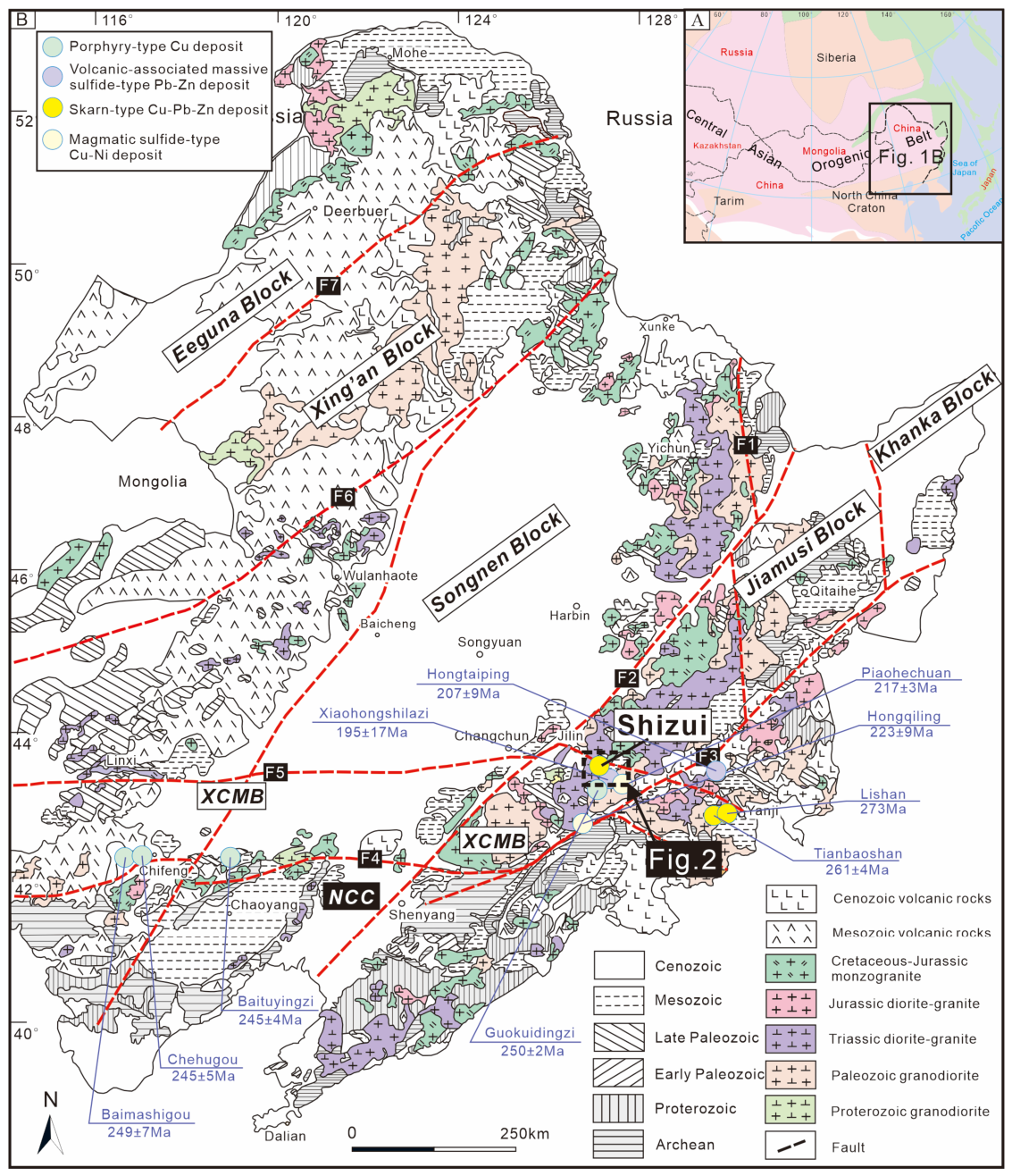
The Central Asian Orogenic Belt (CAOB) is the world’s largest Phanerozoic accretionary orogenic belt. It evolved through complex magmatic and tectonic activity (Figure 1A). Northeastern (NE) of China occupies the eastern portion of the CAOB (Figure 1A). Northeast (NE) China lies in the eastern CAOB (Figure 1B). Intense tectonic-magmatic history here formed numerous polymetallic deposits (Fe, Cu, Mo, Zn, Au) [1,2,3]. Central Jilin Province exhibits a complex mineralization pattern. It preserves evidence of Paleozoic and Mesozoic tectonic-magmatic-hydrothermal activity. This complexity arises from the superposition of two tectonic regimes. These are the Paleo-Asian Ocean domain in the Paleozoic and the Paleo-Pacific domain in the Mesozoic [1,4,5,6,7]. Mesozoic endogenic metallic resources in NE China have long been a research and exploration focus. Frequent hydrothermal activity created favorable geological conditions for mineralization [8,9,10,11,12,13,14]. Several copper and copper-polymetallic deposits have been identified within this region (Figure 1B), such as Early-Middle Triassic porphyry Cu–Mo deposits (~248 Ma, the Guokuidingzi Cu Deposit, [15,16]), Late Triassic magmatic Cu-Ni sulfide deposits (230~220 Ma, Hongqiling, Chajianling deposits, [17,18,19,20,21]). However, Paleozoic mineralization in central-eastern Jilin is comparatively weaker and less studied. Recent years have revealed several Late Paleozoic deposits along the XarMoron-Changchun Metallogenic Belt (XCMB; Figure 1B). These deposits trend east-west [22,23,24,25]. This category encompasses skarn-type Pb–Zn–Cu polymetallic deposits, for instance, the Shizui and Tianbaoshan deposits [26,27,28,29,30,31], as well as Volcanogenic Massive Sulfide (VMS) type Pb–Zn–Cu polymetallic deposits hosted within Early Permian marine volcanic rocks [32,33,34,35], such as the Xiaohongshilazi, Dongfengnanshan, and Hongtaiping deposits [36,37,38]. Consequently, the region serves as an ideal location for investigating Paleozoic mineralization linked to the Paleo-Asian Ocean tectonic domain, while also offering fresh insights for regional polymetallic exploration [39,40,41,42,43].
The Shizui Cu polymetallic deposit is located in central Jilin and sits at the tectonic junction between the eastern North China Craton (NCC) and the eastern Xing’an–Mongolia Orogenic Belt (XMOB; Figure 1B) [26]. It is currently the only known Paleozoic Cu polymetallic deposit in central Jilin. LA-ICP-MS zircon U–Pb dating and S–Pb isotopic analysis indicate that the copper mineralization is closely associated with a Late Hercynian (277.9 ± 1.8 Ma) biotite monzogranite [8]. In terms of mineralization conditions, metallogenic age, and tectonic setting, the Shizui Cu–Pb–Zn deposit shows strong similarities to the skarn-type Cu polymetallic deposits in the Yanbian Tianbaoshan mining area [44,45], this adds to its research significance within the context of regional geology. The deposit was discovered in the late 19th century, with historically limited mining activity and relatively low geological research. Current research on the Shizui deposit remains relatively limited, and the following key scientific issues require resolution: First, the nature and origin of the ore-forming fluids remain ambiguous, due to the current lack of available data pertaining to the fluids associated with this deposit. Second, the evolution process of the fluids and the mechanisms of element migration and enrichment are not well understood. Finally, the genetic type of the deposit is controversial. Some researchers classify it as a skarn-type deposit [8], while others argue that it is a porphyry-related subvolcanic hydrothermal deposit or polygenetic, secondary composite, stratabound superimposed deposit of sedimentary-(exhalative) hydrothermal origin [46,47]. These viewpoints are largely based on the geological characteristics of the mining area [8] and comparisons with the nearby Xiaohongshilazi VMS Pb–Zn deposit [36], which are insufficient to accurately define the genetic type of the Shizui deposit.
Figure 1. (A) Location of the Central Asian Orogenic Belt [3,27]. (B) Geological map of Northeast China with selected representative Cu-polymetallic deposits [16,31] (data sources: Figure 2; [21,28,48,49,50]). Fault abbreviations: F1 = Mudanjiang Fault; F2 = Yitong-Yilan Fault; F3 = Dunhua-Mishan Fault; F4 = Chifeng-Kaiyuan Fault; F5 = XarMoron-Changchun-Yanji Fault; F6 = Hegenshan-Heihe Fault; F7 = Tayuan-Xiguitu Fault. NCC = North China Craton; XCMB = XarMoron-Changchun Cu–Mo metallogenic belt.
Minerals 16 00579 g001
Based on detailed field surveys, petrography, and ore microscopy, this study systematically analyzed primary fluid inclusions in quartz and calcite from multiple mineralization stages using microthermometry, laser Raman spectroscopy, and hydrogen-oxygen isotope analyses to address the issues noted above. The aim is to unravel the nature, origin, and evolution of the ore-forming fluids, clarify the mechanisms of element enrichment and precipitation. By integrating existing research data, comprehensively determine the genesis of the deposit, thereby providing theoretical support for regional polymetallic exploration.

2. Regional Geology

Globally, the Central Asian Orogenic Belt (CAOB) represents the largest accretionary orogen formed during the Phanerozoic [2,51], having evolved over approximately 800 million years through complex magmatic and tectonic processes [2,3,12,13,24,52,53,54]. Northeastern (NE) China, located between the North China Craton (NCC) and the Siberian Plate, represents the eastern segment of this major belt (Figure 1B; [13,50,55]). Northeast China’s crust comprises five major continental blocks arranged west-east as follows the Erguna, Xing’an, Songnen, Jiamusi, and Khanka blocks (Figure 1B; [3,4,24,51,56]). The geological evolution of NE China arises from the superimposed effects of the Paleo-Asian Ocean (PAO) tectonic domain during the Paleozoic and the Paleo-Pacific (or circum-Pacific) domain since the Mesozoic. Its tectonic history was primarily governed by the closure of the PAO [1,4,5,6,14,57]. During the middle–late Permian, the final closure of the PAO occurred, which led to the collision of the amalgamated block with the North China Craton along the XarMoron–Changchun Metallogenic Belt (XCMB), this collision involved scissor-like, bidirectional subduction and caused significant intracontinental deformation, including crustal shortening, thickening, and slab stacking [5,13,58,59,60,61,62,63].
Located in the northeastern North China Craton, central Jilin Province is delimited to the north by the XarMoron–Changchun–Yanji Suture Zone, to the west by the Yitong–Yilan Fault, and to the east by the Dunhua–Mishan Fault (Figure 1B). In this region, the exposed geology is predominantly composed of late Paleozoic to Mesozoic strata, with minor early Paleozoic and Cenozoic sequences also present (Figure 1B; [26]). The late Paleozoic strata are mainly composed of intermediate-acidic volcanic rocks, clastic rocks, and carbonate sedimentary formations. These strata are cut by extensive intrusions ranging from late Paleozoic to early Mesozoic in age, including granodiorite, syenogranite, monzogranite, and minor mafic–ultramafic rocks, testify to the intense magmatic activity associated with the tectonic transitions [8]. Triggered by the intense sinistral strike-slip movement along the Dunhua-Mishan Fault, this region has generated abundant large-scale drag structures and secondary fractures. The prolonged and multi-stage tectonic-magmatic-hydrothermal activity, driven by the PAO closure and subsequent Paleo-Pacific subduction, created highly favorable geological conditions for endogenous metal mineralization. The complex interplay of crustal stacking, magmatism, and large-scale faulting in central Jilin Province has led to the formation of numerous polymetallic deposits. These deposits host resources of copper (Cu), molybdenum (Mo), lead (Pb), zinc (Zn), and other metals. During the Paleozoic, central Jilin was primarily dominated by the subduction of the Paleo-Asian Ocean plate beneath the North China Plate. The Lower Permian Daheshen Formation comprises rhyolitic tuff, andesite, and carbonate rocks, and hosts volcanogenic massive sulfide (VMS) type Pb–Zn mineralization [8]. By the Late Permian to Early Triassic, the final closure of the Paleo-Asian Ocean, accompanied by collisional orogeny and post-collisional extension, generated magmatic deposits such as the Hongqiling Cu–Ni sulfide deposit (~223 Ma) [19], and skarn-type Pb–Zn–Cu polymetallic deposits, for instance, the Shizui and Tianbaoshan deposits [26,27,28,29,30,31]. Entering the Mesozoic, particularly since the Jurassic, the superimposed subduction of the Pacific Plate beneath the Eurasian continent triggered intense magmatic activity and hydrothermal mineralization events. This led to the formation of numerous porphyry-type Mo (Daheishan [64]), mesothermal vein-type Au deposits (Jiapigou, [65,66,67,68,69]). In contrast, the Shizui Cu polymetallic deposit focused on in this paper is mainly hosted in the Upper Carboniferous Shizui Formation, demonstrating the connection between particular stratigraphic units and mineralization in this geological environment.

3. Geology of the Shizui Cu–Pb–Zn Deposit

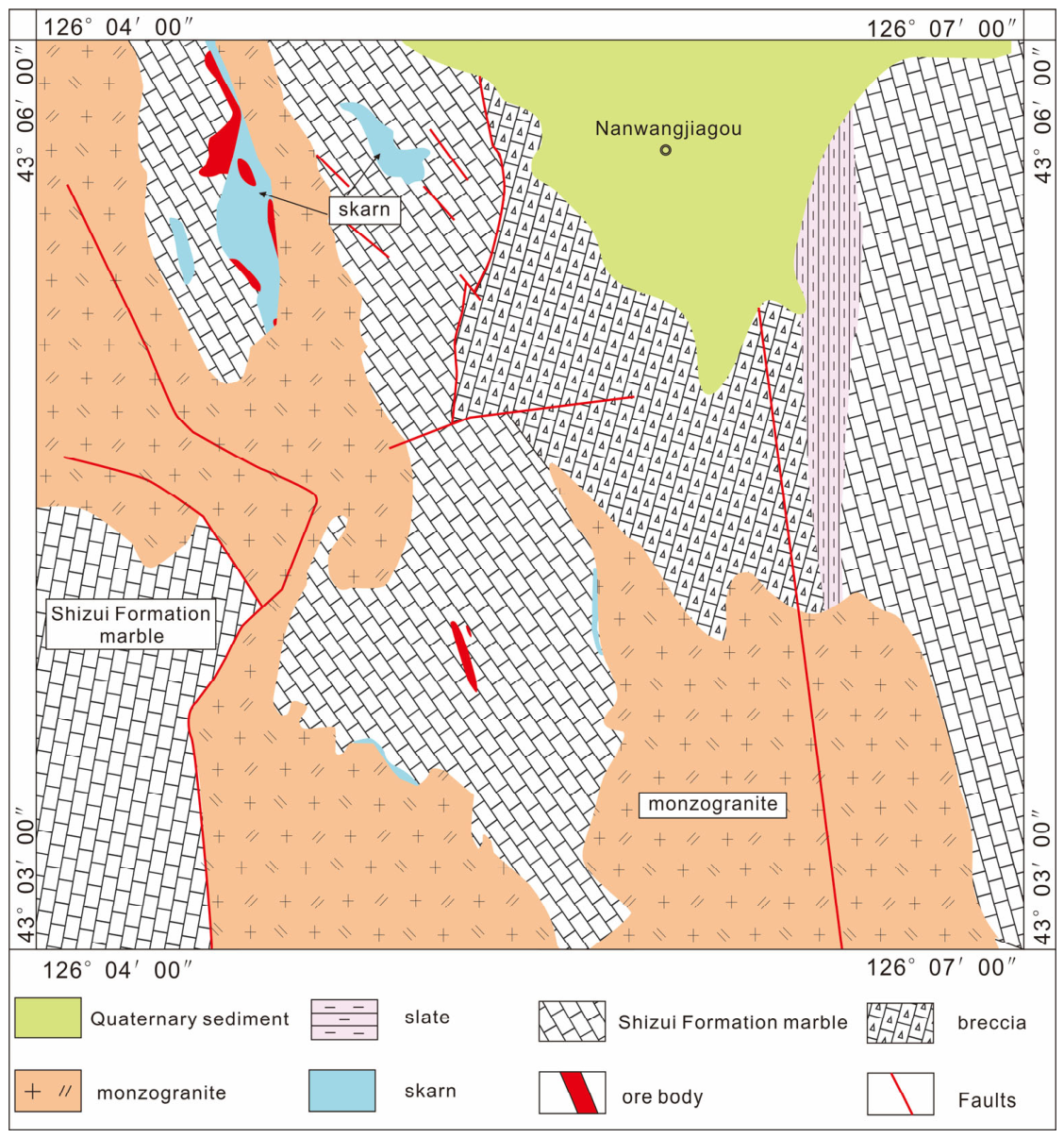
Located approximately 15 km northeast of Panshi City, Jilin Province, the Shizui copper-polymetallic deposit sits at the tectonic boundary between the eastern Xing’an–Mongolia Orogenic Belt (XMOB) and the northeastern margin of the North China Craton (Figure 1B). The deposit is primarily hosted within the Upper Carboniferous Shizui Formation, which is subdivided into lower, middle, and upper members. The lower member is dominated by siliceous marble, banded marble, and arkose-intercalated slate. The middle member, the main ore-hosting unit, comprises an interbedded sequence of phyllitic slate, thin-layered marble, micaceous slate, sericite schist, and gray-black banded marble. The upper member consists of chert-bearing banded marble, white thick-layered marble, argillaceous slate, and carbonaceous slate. The dominant structures are NW-trending and submeridional faults, which are subparallel to the Shizui Formation; these are later crosscut by NE-trending faults. Magmatic activity includes Hercynian and Yanshanian intermediate-acidic intrusions. The emplacement of Hercynian biotite monzogranite into the Shizui Formation generated extensive skarn zones at the contact. Field mapping confirms that the orebodies spatially associate with these skarn zones, indicating a strong genetic link to copper mineralization. All orebodies occur near the contact between the marble strata of the Shizui Formation (Figure 2) and the biotite monzogranite (Figure 3A), predominantly on the marble side. The deposit comprises two main sectors: the Shizui deposit comprises the Main Ore District and the peripheral Quanling Lead-Zinc District. The Main District is characterized by copper-dominated mineralization, with three industrial-grade copper orebodies identified thus far. Among these, Orebody I is the principal orebody, with a general near-N-S strike. The upper part of Orebody I locally trends NW, dips westward at approximately 80°. Below the 330 m level, the orebody plunges notably northward with a dip of 75–85°. It averages 120 m in length, 10 m in thickness, and extends down to 1010 m. Its spatial morphology is columnar, resembling a near-vertical lens. Orebody II is a blind orebody located north of Orebody I. It is exposed at the 390 m level and pinches out at the 710 m level. Between the 530 m and 590 m levels, it connects with the main orebody, sharing a broadly consistent attitude. It is about 180 m long, averages 1 m in thickness, and extends for 400 m vertically. Orebody III is also a blind orebody, situated south of the main orebody. It is primarily developed between the 590 m and 890 m levels. Below the 890 m level, it splits into multiple thin vein-type orebodies, ultimately pinching out at the 950 m level. It averages 1.45 m in thickness and extends for 300 m vertically. The Quantiling mining district hosts six identified industrial ore bodies, predominantly composed of lead-zinc with subordinate copper mineralization. These orebodies exhibit vein-like, stratiform, and lenticular morphologies. Current reserves are estimated at 233,000 metric tons, containing approximately 1260 t of Cu, 4531 t of Pb, and 10,033 t of Zn. The No. I and No. II orebodies constitute the primary economic targets. No. I Orebody is delineated by underground workings across the Tongdong (390 m), First (350 m), Second (320 m), and Third (288 m) levels, spanning exploration lines 4 to 7. It extends 210 m along strike with an average thickness of 1.36 m (thickness variation coefficient: 21%). The average grades are 0.55% Cu (range: 0.09%–1.56%, variation coefficient: 66%), 1.57% Pb (range: 0.17%–2.99%, variation coefficient: 71%), and 5.14% Zn (range: 1.72%–16.87%, variation coefficient: 77%). This orebody strikes north-south, dips eastward at 70°, and has a depth extent of 150 m. No. II Orebody is controlled by the Second (320 m), Third (288 m), and Fourth (258 m) levels between exploration lines 2 and 7. It measures 210 m in length with an average thickness of 1.98 m (thickness variation coefficient: 18%). Average metal grades are 0.57% Cu (range: 0.10%–3.22%, variation coefficient: 155%), 2.47% Pb (range: 0.39%–4.27%, variation coefficient: 58%), and 4.74% Zn (range: 2.66%–16.87%, variation coefficient: 53%). The orebody trends NNE, dips at 100°/75°, and extends to a depth of 100 m.
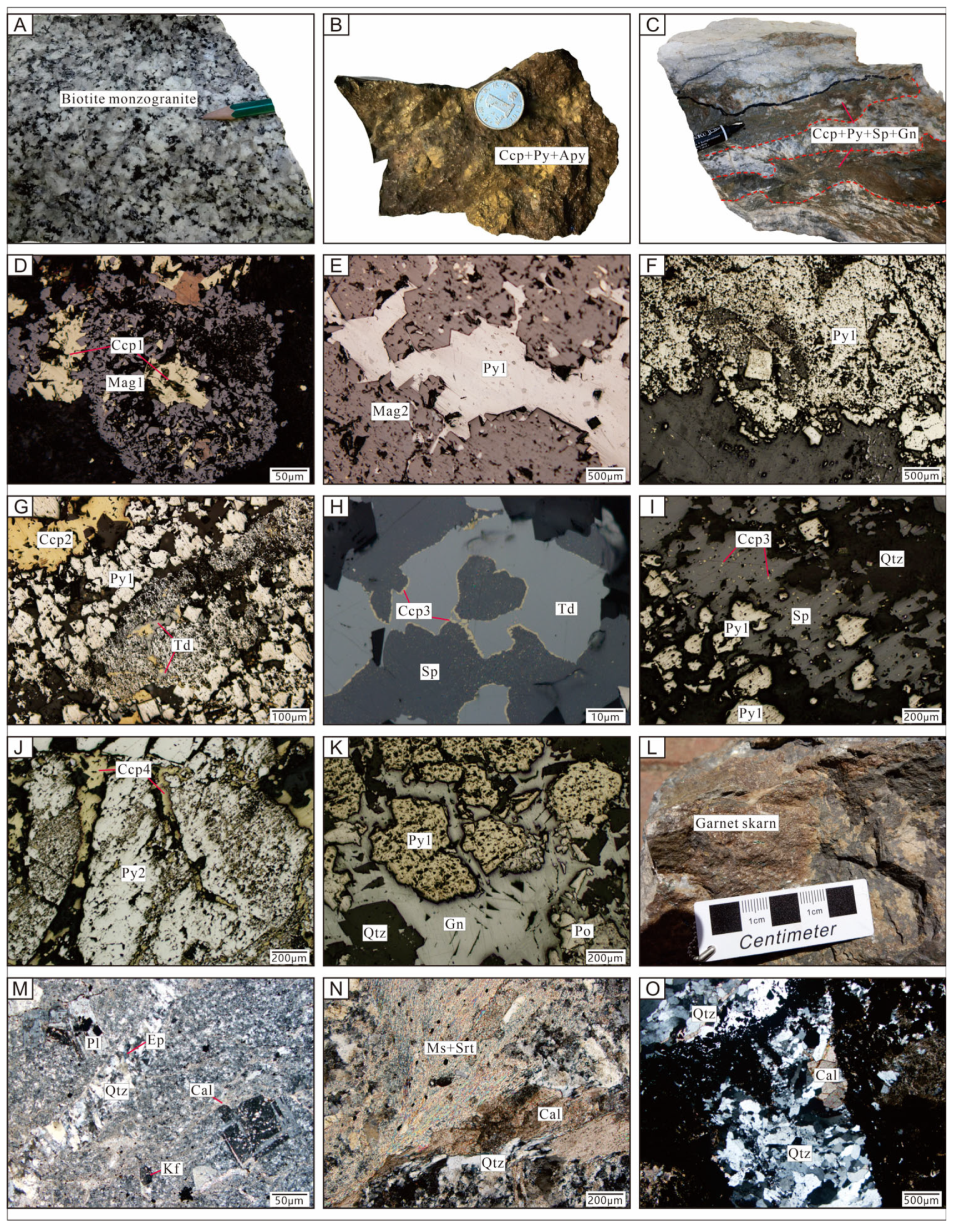
Ore structures in the Shizui copper-polymetallic deposit include massive (Figure 3B) and veinlet (Figure 3C) types, as well as nodular and disseminated forms. The primary metallic minerals are magnetite, arsenopyrite, chalcopyrite, pyrite, sphalerite, and galena. Subordinate metallic minerals comprise pyrrhotite, tetrahedrite, molybdenite, bornite, native gold, and electrum. Gangue minerals consist of garnet, actinolite, epidote, tremolite, quartz, plagioclase, sericite, and calcite. Texturally, the metallic minerals exhibit euhedral scaly, euhedral to subhedral granular, and metasomatic habits.
Figure 2. Geological map of the Shizui Cu–Pb–Zn deposit [16,70].
Minerals 16 00579 g002
The first-generation magnetite (Mag1) is characterized by aggregates of euhedral to subhedral grains, mainly in gangue mineral fractures and often altered by later chalcopyrite (Figure 3D). The second-generation magnetite (Mag2) forms similar aggregates coexisting with sulfides like chalcopyrite, pyrite, arsenopyrite, and aikinite (Figure 3E). The subsequent main copper mineralization stage is characterized by coarse-grained euhedral arsenopyrite, early pyrite (Py1); earlier Mag1 is irregularly replaced and filled by the first generation of chalcopyrite (Ccp1; Figure 3F,G). A second chalcopyrite generation (Ccp2) metasomatizes earlier Py1 and other sulfides (Figure 3G), with some chalcopyrite being replaced by tetrahedrite (Figure 3H). A third chalcopyrite generation (Ccp3) forms irregular patches within and along the margins of sphalerite grains (Figure 3H,I), while a fourth generation (Ccp4) is found within irregular pyrite (Py2; Figure 3J). The final stage features sphalerite, galena, and minor late pyrite with abundant calcite and quartz (Figure 3K). Widespread hydrothermal alteration includes garnetization (Figure 3L), epidotization (Figure 3M), sericitization (Figure 3N), and silicification (Figure 3O), as well as carbonatization. Sericitization and silicification show the closest association with copper mineralization. Integrating these features allows division of mineralization into four stages (Table 1): an initial skarn stage forming hydrous silicates, garnet, epidote, actinolite, tremolite, and magnetite; an early quartz-sulfide stage representing the main copper event with intense silicification and sericitization; and a late quartz-sulfide stage constituting the principal lead-zinc mineralization phase, commonly associated with silicification and carbonatization; an quartz-carbonate stage is characterized by the formation of abundant quartz and calcite, along with minor late-stage pyrite.
Figure 3. Hand specimens of Shizui Cu–Pb–Zn deposit and characteristics of alteration and mineralization under microscope. (A) Biotite monzogranite exhibits massive structure. (B) Ore exhibits massive structure. (C) Veinlet structure. (D) The Mag1 occurs euhedral-subhedral granularaggregates, the Ccp1 irregularly replaces and fills magnetite (Mag1). (E) The Mag2 coexisting with other sulfides. (F) Py1 occurs euhedral-subhedral granularaggregates. (G) Ccp2 displaces earlier-formed pyrite (Py1) in an irregular manner. (H) Sphalerite and chalcopyrite (Ccp3) exhibit a solid solution separation texture. (I) Ccp3 appears as irregular patches within sphalerite grains and along their margins. (J) Ccp4 is present within irregular pyrite (Py2). (K) The Gn occurs in irregular pyrite (Py1). (L) Garnetization. (M) Epidotization. (N) Sericitization. (O) Silicification. Abbreviations: Mag = Magnetite; Py = Pyrite; Ccp = Chalcopyrite; Gn = Galena; Sp = Sphalerite; Td = Tetrahedrite; Po = Pyrrhotite; Pl = Plagioclase; Ep = Epidote; Kf = K-feldspar; Qtz = Quartz; Cal = Calcite; Srt = Sericite; Ms = Muscovite.
Minerals 16 00579 g003

4. Sample and Analytical Methods

4.1. Fluid Inclusions

A comprehensive study was conducted on the Shizui Cu-polymetallic deposit to constrain the source, nature, and evolution of its ore-forming fluids. The investigation involved detailed analyses of 32 mineralized quartz and calcite samples representative of four paragenetic stages. Of the 32 specimens analyzed, fourteen were procured from the Shizui main mining area, while the remaining eighteen originated from the Quantiling district. The Shizui suite exclusively represents the Early Quartz-Sulfide stage; within this subset, six samples were collected from the No. I ore body and eight from the central section of the No. II ore body. Conversely, the Quantiling samples were obtained from the First and Second sublevels of the No. I ore body, comprising ten samples attributable to the Late Quartz-Sulfide stage and eight specimens characteristic of the Quartz-Carbonate stage. Petrographic examination, microthermometry, and laser Raman spectroscopy were performed on fluid inclusions hosted in these minerals. All analytical work was performed at the Geofluid Laboratory, Key Laboratory for Mineral Resources Evaluation in Northeast Asia (Ministry of Natural Resources, China), located in Changchun, Jilin Province. Based on petrographic criteria, 28 polished thin sections were used for fluid inclusion petrography and microthermometric measurements, while laser Raman spectroscopic analysis was conducted on a separate set of 5 thin sections.
Petrographic and microthermometric analyses were performed using a Linkam THMS-600 heating-freezing stage (UK), with an operational temperature range of −196 °C to +600 °C. The stage was managed by the Linksys32 software, permitting precise control over heating and cooling rates from 0.1 to 90 °C/min. Measurement accuracy was verified by calibrating against the triple point of CO2 (−56.6 °C) and the freezing point of pure water (0.0 °C). For phase transitions, the measurement precision was determined to be ±0.3 °C below 25 °C, while the homogenization temperature of aqueous inclusions above 25 °C was measured with an accuracy of ±5 °C.
Individual fluid inclusions were characterized by laser Raman spectroscopy using a WITec Alpha Access 300 confocal Raman microscope. This instrument was equipped with a 532 nm green laser source. Spectral data acquisition and processing were performed utilizing the WITec Data Analysis Software package (version 4.1).
The salinity of L- and V-type inclusions was calculated from the final ice melting temperature (Tm-ice) using the standard equation for the NaCl–H2O system [71]:
W   =   1.76985 × T m - ice 0.042384 × T m - ice 2 0.00052778 × T m - ice 3
For S-type inclusions, the dissolution temperature of halite dissolution (Th-s) was used as the basis for salinity calculation [72]:
W = 26.242 + 0.4928 × Ψ + 1.42 × Ψ 2 0.223 × Ψ 3 + 0.04129 × Ψ 4 + 0.006295 × Ψ 5 0.001967 × Ψ 6 + 0.0001112 × Ψ 7
Ψ   =   T h - s   /   100
Regarding C-type inclusions in the NaCl–CO2–H2O system, salinity was derived from the clathrate melting temperature (Tm-cla) [73]:
W   =   15.52022 1.02342 × T m - cla + 0.05286 × T m - cla 2
The formula for calculating the density of fluid inclusions [74]:
ρ = A + B × T h - total + C × T h - total 2
A = 0.99351 + 8.72147 × 10 3 × W + 2.43975 × 10 5 × W 2
B = 7.11652 × 10 5 + 5.2208 × 10 5 × W + 1.26656 × 10 6 × W 2
C = 3.4997 × 10 6 + 2.12124 × 10 7 × W + 4.52318 × 10 9 × W 2
Trapping pressures and depths were calculated using the empirical formulas for mineralization pressure and depth proposed by [75]:
P = 219 + 2620 × W × T h - total / 374 + 920 × W
H = P / 300

4.2. Hydrogen and Oxygen Isotopes

At the Beijing Research Institute of Uranium Geology, hydrogen and oxygen isotope analyses of ore-bearing quartz veins were carried out with a MAT-253 mass spectrometer. Water extracted from primary fluid inclusions in quartz via vacuum thermal decrepitation was used to determine the hydrogen isotope composition (δD). The released water was subsequently reduced by reaction with zinc to generate hydrogen gas for isotopic analysis.Oxygen isotope composition (δ18O) was measured by reacting quartz samples with BrF5 in a vacuum (10−3 Pa) at 500–680 °C for 14 h to liberate oxygen. The resulting O2 was purified from by-products (SiF4, BrF3) through cryogenic separation and then quantitatively converted to CO2 by reaction with graphite at 700 °C in the presence of a platinum catalyst.
Relative to the Standard Mean Ocean Water (SMOW) standard, all isotopic ratios are reported, with δ18O values denoted as δ18OV-SMOW. The analytical precision for δ18O is better than ±0.1‰. The measurements were calibrated using the certified reference materials GBW-04409 (quartz standard with δ18O = +11.1 ± 0.06‰) and GBW-04410 (quartz standard with δ18O = −1.8 ± 0.08‰). The oxygen isotope composition of quartz-associated fluids (δ18OH2O) was calculated using the fractionation equation: δ 18 O H 2 O = δ 18 O V - SMOW 3.38 × 10 6 / T 2 + 3.4 [76], where Tdenotes the average homogenization temperature of the fluid inclusions.

5. Analytical Results

5.1. Fluid Inclusions Characteristics

5.1.1. Petrography and Types of Fluid Inclusion

According to the mineral assemblages of the principal ore-forming stages, the quartz-sulfide and quartz-carbonate stages can be subdivided into four mineralization substages, including: Quartz ± Arsenopyrite ± Pyrite Stage (stage I); Quartz-Cu Polymetallic Sulfide Stage (stage II); Quartz-Pb-Zn Polymetallic Sulfide Stage (stage III); Quartz-Carbonate Stage (Stage IV). Petrographic examination of calcite and quartz from the four mineralization stages at the Shizui Cu-polymetallic Deposit revealed abundant primary fluid inclusions (FIs). Primary fluid inclusions were distinguished from secondary ones based on their negative crystal morphology, random distribution, and trapping synchronous with quartz growth, whereas secondary inclusions typically occur along healed microfractures. Although some primary inclusions show decrepitation textures, only those displaying typical negative crystal morphologies and isolated distributions were selected for analysis to ensure data integrity. These FIs were categorized into four distinct types according to their phase assemblages at room temperature (25 °C) and their behavior during microthermometric analysis (from freezing to heating). A detailed description of each type is provided below.
(1)
L-type: liquid-rich aqueous fluid inclusions
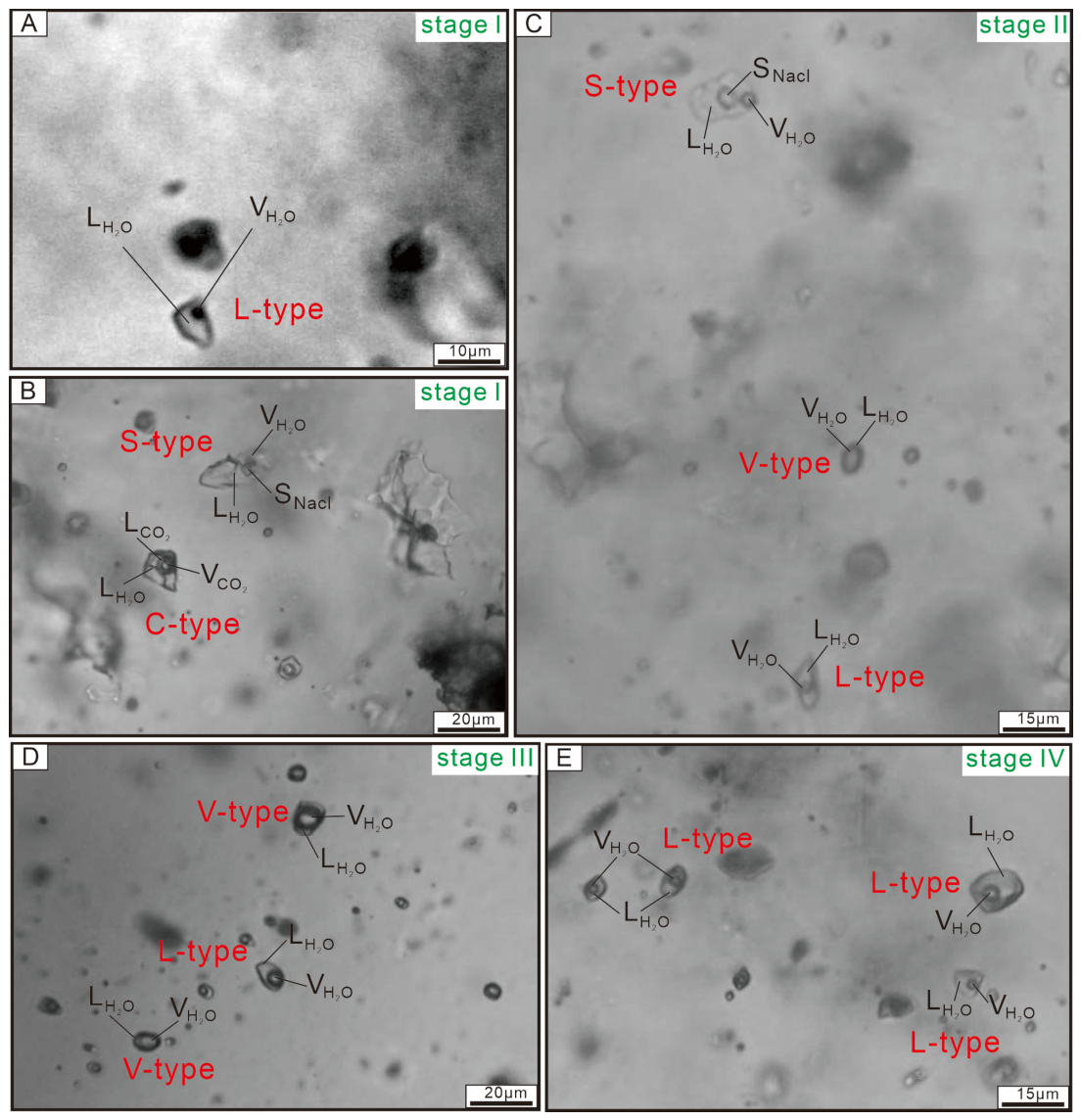
At room temperature (25 °C), this type of fluid inclusion (Figure 4A–D) is characterized by a two-phase assemblage of a small vapor bubble within an aqueous saline solution. These inclusions, measuring 3–22 μm in diameter, typically display elongated, elliptical, or oval morphologies. They are distributed randomly or in clusters within quartz and calcite grains. The vapor-to-liquid ratio (V/L%) is predominantly less than 50%, mostly ranging from 10% to 30%. Upon heating, these inclusions homogenize entirely to the liquid phase. The L-type inclusions are present in all paragenetic stages of the Shizui deposit and are frequently observed either isolated or coexisting with C-type, V-type, and S-type inclusions in the same host quartz grain (Figure 4A–D).
(2)
V-type: vapor-rich aqueous fluid inclusions
This type of fluid inclusions are characterized by a large vapor bubble and a minor aqueous phase at room temperature (25 °C) (Figure 4C,D). They range from 4 to 25 μm in diameter and typically display sub-rounded, elliptical, or irregular morphologies within host quartz. These inclusions possess high vapor-to-liquid ratios (V/L%), predominantly between 75% and 90%. Upon heating, they homogenize entirely to the vapor phase. Predominantly formed in mineralization Stages II and III, they are commonly observed in association with L-type and S-type inclusions in the same quartz grain (Figure 4C).
(3)
C-type: CO2 fluid inclusions
This type of fluid inclusions are characterized at room temperature (25 °C) by a three-phase assemblage of CO2 vapor, CO2 liquid, and brine (Figure 4B). These inclusions, measuring 2–18 μm in diameter, typically display elliptical to irregular quadrilateral morphologies and are randomly distributed. The CO2 phase constitutes 20%–40% of the total inclusion volume [(VCO2 + LCO2)/(LH2O + LCO2 + VCO2)], with the vapor phase (VCO2) accounting for 70%–85% of the CO2 phase volume (VCO2/LCO2). These C-type inclusions are primarily associated with L-type and V-type inclusions in Stage I quartz grains.
(4)
S-type: daughter Mineral-Bearing Three-Phase or Multiphase fluid inclusions
The S-type (solid-bearing) inclusions are characterized at room temperature (25 °C) by a multiphase assemblage of a vapor bubble, brine, and a NaCl daughter mineral (Figure 4A,B). These inclusions, measuring 6–26 μm in diameter, display elliptical to elongated morphologies and are randomly distributed in host quartz. The vapor bubble occupies 5%–20% of the inclusion volume, and the solid NaCl daughter mineral (displaying a colorless to white cubic habit) constitutes 10%–30% of the volume. S-type inclusions are commonly associated with L-type and V-type inclusions within the same quartz grain and are predominantly observed in paragenetic Stages I and II.

5.1.2. Microthermometry

Primary fluid inclusions in 32 quartz and calcite specimens from the Shizui Cu-polymetallic deposit formed the focus of this investigation, which are representative of its main mineralization stages. Microthermometric data (Table 2, Figure 5) were utilized to compute the salinity (W, in wt.% NaCl equiv.) for each inclusion type via established thermodynamic models.
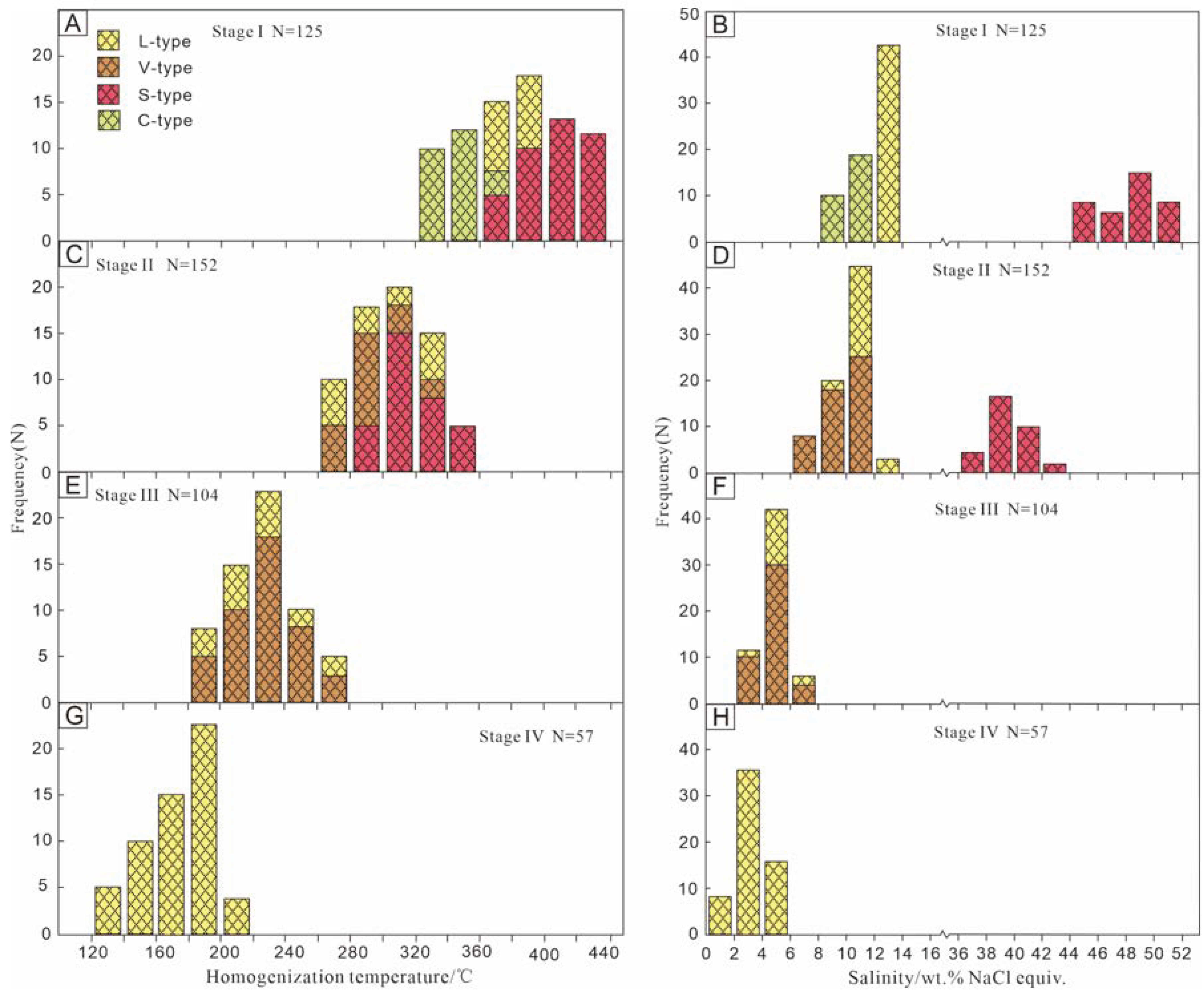
Quartz ± Arsenopyrite ± Pyrite Stage (Stage I): This stage is defined by the presence of L-, S-, and C-type fluid inclusions (Figure 4A,B). The L-type inclusions homogenized to the liquid phase at temperatures of 346–434 °C, with a peak between 380 and 400 °C (Figure 5A). Their final ice-melting temperatures ranged from −9.7 to −6.7 °C, corresponding to salinities of 10.11–13.66 wt.% NaCl equiv. (Figure 5B). In S-type inclusions, the vapor phase disappeared before the daughter minerals dissolved during heating. The dissolution temperatures of the daughter minerals (representing total homogenization) ranged from 368 to 437 °C, yielding high salinities of 44.12–51.68 wt.% NaCl equiv. (Figure 5B). C-type inclusions showed initial melting of solid CO2 between −59.4 and −57.9 °C, which is below the triple point of pure CO2 (−56.6 °C), suggesting the possible presence of minor CH4 or H2S [16,36,77,78]. The two-phase homogenization (liquid + vapor CO2) to liquid occurred at 27.4–29.7 °C. Final homogenization to the aqueous liquid phase took place at 325–373 °C, mainly between 340 and 360 °C (Figure 5A). Salinities calculated from clathrate melting temperatures (3.2–5.5 °C) range from 8.29 to 11.70 wt.% NaCl equiv (Figure 5B).
Quartz-Cu Polymetallic Sulfide Stage (stage II): The fluid inclusions in this stage are predominantly L-type and V-type, with minor S-type. The L-type inclusions homogenized to liquid at 262–355 °C (peak: 300–320 °C). Their ice-melting temperatures (−8.4 to −5.4 °C) correspond to salinities of 8.40–12.19 wt.% NaCl equiv. The V-type inclusions homogenized to vapor at 266–351 °C (peak: 300–320 °C), with salinities of 6.29–11.95 wt.% NaCl equiv. calculated from ice-melting temperatures of −8.2 to −3.9 °C. The S-type inclusions, where the vapor disappeared before the daughter minerals, yielded daughter mineral dissolution temperatures of 287–352 °C, indicating very high salinities of 37.19–42.59 wt.% NaCl equiv.
Quartz-Pb-Zn Polymetallic Sulfide Stage (stage III): This stage is marked by the presence of L-type and V-type inclusions (Figure 5). The L-type inclusions homogenized to liquid at 182–275 °C, concentrating in the 220–240 °C range. Their salinities, derived from ice-melting temperatures of −4.1 to −1.8 °C, were 3.05–6.58 wt.% NaCl equiv. The V-type inclusions homogenized to vapor at 188–272 °C (peak: 220–240 °C), with salinities of 2.56–6.44 wt.% NaCl equiv. based on ice-melting temperatures of −4.0 to −1.5 °C.
Quartz-Carbonate Stage (Stage IV): In this final stage, solely L-type inclusions were identified. Homogenization to the liquid phase occurred at 128–211 °C, peaking mainly at 180–200 °C. Based on ice-melting temperatures of −3.5 to −0.6 °C, the calculated salinities are low, between 1.05 and 5.70 wt.% NaCl equiv.

5.1.3. Laser Raman Spectroscopy

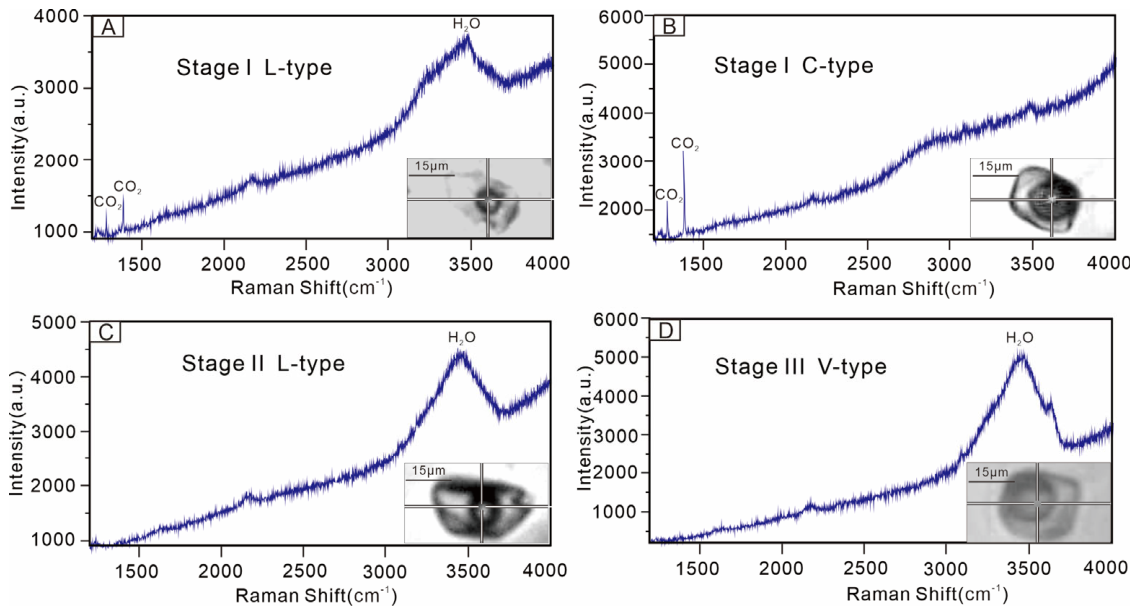
In-situ laser Raman micro-spectroscopy was conducted on quartz-hosted fluid inclusions from the skarn orebody to characterize the volatile components in the vapor phase. It should be noted that this analysis focused exclusively on the gaseous phase, excluding solid daughter minerals within halite-bearing (S-type) inclusions.
The results of laser Raman spectroscopic analysis performed on the gaseous phases of representative fluid inclusions from different paragenetic stages in the Shizui deposit are provided in Figure 6. The spectral data indicate a compositionally variable vapor phase for Stage I: Type-L inclusions contain primarily H2O with minor CO2 (Figure 6A), whereas coeval Type-C inclusions are dominated by CO2 (Figure 6B). By comparison, the vapor phase of Type-L inclusions in Stages II–IV (Figure 6C) and of Type-V inclusions in Stage III (Figure 6D) consists almost purely of H2O. These results indicate that the ore-forming fluid evolved from an early NaCl–H2O–CO2 system during Stage I to a simpler NaCl–H2O system prevailing from the main mineralization (Stages II–IV) through to the post-ore stage.

5.2. H–O Isotopes

To elucidate the origin and evolution of ore-forming fluids associated with this deposit type, this study presents hydrogen and oxygen isotopic analyses of quartz from distinct mineralization stages at the Shizui deposit.
Hydrogen and oxygen isotope compositions of five quartz samples from four mineralization stages at the Shizui Cu-polymetallic deposit are presented in Table 3. The measured δ18O values of quartz (δ18OV-SMOW) range from 9.8‰ to 12.2‰ across all stages. The calculated δ18O values of the ore-forming fluid (δ18OH2O) decrease from Stage I (early mineralization stage: 6.6‰ to 6.7‰) to Stage II (main Cu stage: 3.4‰ to 3.9‰) and Stage III (main Pb–Zn stage: −0.4‰). Concurrently, the δD values of the fluid (δDV-SMOW) also show a trend towards more negative values, from −91.6‰ to −90.6‰ in Stage I, to −94.4‰ to −94.2‰ in Stage II, and reaching −95.7‰ in Stage III.

6. Discussion

6.1. Origin of Ore-Forming Fluids

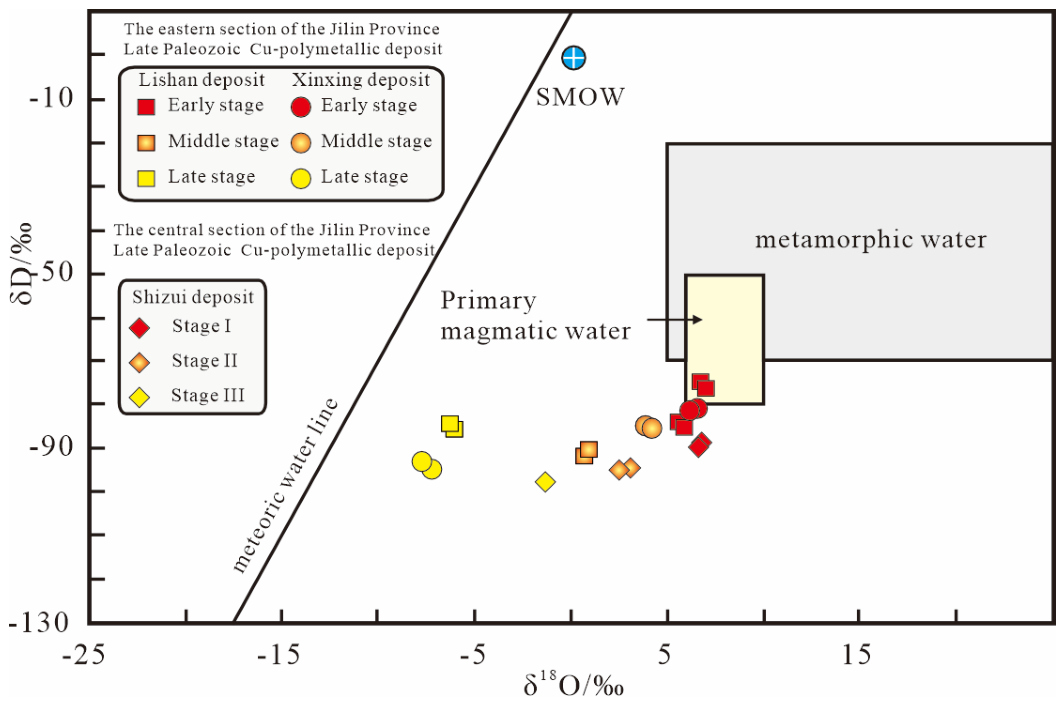
During ascent, hydrothermal fluids—especially in the main and late stages of the mineralization system—frequently undergo significant mixing with meteoric water. Therefore, the δ18O and δD values preserved in the early hydrothermal stage provide a more faithful record of the original ore-forming fluid’s characteristics [79,80]. In the Shizui deposit, H–O isotopic data from the early stage (Stage I) indicate a magmatic–hydrothermal origin for the ore-forming fluids. Fluid inclusions within early-stage hydrothermal quartz yield calculated δ18OH2O values of +6.6‰ to +6.7‰ (mean = +6.7‰). Although the corresponding δD values fall outside the typical fields for magmatic and metamorphic water on a δD vs. δ18OH2O diagram (Figure 7), they plot near the magmatic-water field, supporting a dominantly magmatic source. This interpretation is further reinforced by the systematic spatial association with Paleozoic biotite-monzogranite veins. In contrast, Stage II and Stage III fluids exhibit progressively lower δ18OH2O values (3.4–3.9‰, mean = 3.7‰; and –0.4‰, respectively), accompanied by δD shifts toward the meteoric-water line (Figure 7). This systematic isotopic evolution reflects increasing meteoric-water input during later mineralization. The pronounced negative δ18OH2O excursion in Stage III (–0.4‰) exceeds normal magmatic-fractionation trends and clearly indicates large-scale mixing between ascending magmatic fluids and infiltrating meteoric water. In summary, the ore-forming fluids at Shizui were initially magmatic, with progressively greater meteoric-water contributions during later hydrothermal ascent.
Figure 7 and Table 3 summarize the δD–δ18OH2O data for the Shizui deposit. A key observation is the close match between the early-stage isotopic signatures of the Shizui Cu–Pb–Zn deposit and those of other skarn deposits, which strongly supports a genetic link between magmatism and ore formation [31].
A similar isotopic trend shifting from near-magmatic water toward meteoric water is also documented in the skarn-type Cu-polymetallic deposits of the Tianbaoshan area. These isotopic data demonstrate that the initial ore-forming fluids were derived from magmatic sources, with subsequent mixing of meteoric waters becoming progressively increasing during the stage II and III. The hydrogen and oxygen isotopes of Shizui deposits and Tianbaoshan Cu-polymetallic deposits exhibit similar characteristics in composition, source, and evolutionary trends, this fluid evolution trajectory, characterized by increasing meteoric water participation with the ascent of hydrothermal fluids.

6.2. Nature and Evolution of Ore-Forming Fluids

Stage I, the early mineralization stage of the Shizui deposit is characterized by the presence of L-, S-, and C-type fluid inclusions, with no observed vapor-rich inclusions. The coeval presence of high-salinity S-type inclusions (44.12–51.68 wt.% NaCl equiv.) and low-salinity C-type inclusions (8.29–11.70 wt.% NaCl equiv.) provides unambiguous evidence for fluid immiscibility. This extreme salinity contrast cannot be explained by simple cooling or pressure changes alone. It indicates the separation of a single homogeneous parent fluid into two distinct phases. One phase is a dense, saline brine enriched in halite daughter minerals (S-type). The other is a carbonic fluid phase (C-type). The driving force for this immiscibility is likely the exsolution of CO2 from the magma-derived fluid. This process reduces the solubility of salts in the aqueous phase, forcing the precipitation of halite and separating the fluid into immiscible brine and carbonic fractions [82,83]. Homogenization temperatures range from 346 to 437 °C. Integrated with vapor composition analysis (indicative of a CO2 component), the ore-forming fluid of this stage is interpreted as a high-temperature, high-salinity NaCl–H2O–CO2 system. In this high-temperature, high-salinity NaCl–H2O–CO2 system, the L-type inclusions represent the dominant aqueous liquid phase, while the S-type and C-type inclusions record the unmixing of an immiscible carbonic phase from the saline brine. The initial CO2 melting temperatures in Stage I C-type inclusions range from −59.4 to −57.9 °C (Table 2). This is below the triple point of pure CO2 (−56.6 °C). It suggests the presence of minor CH4 or H2S. Quantitative estimates based on the melting point depression indicate these additional volatiles constitute less than 5 mol% of the carbonic phase. While minor, their presence suggests a relatively reduced character for the early fluid. This has implications for the solubility and transport of metals like Cu and Fe.
Stage II marks a fundamental transition to a fluid boiling regime. This shift is defined by the abundant emergence of V-type inclusions and the complete disappearance of C-type inclusions. The fluid assemblage comprises coeval L-, V-, and S-type inclusions, often trapped within the same quartz grains (Figure 4C). Upon heating, V-type inclusions homogenize to vapor, while L-type inclusions homogenize to liquid. These different inclusion types exhibit similar homogenization temperature ranges (predominantly 300–320 °C; Figure 5C) but widely divergent salinities (Figure 5D). This texture—indicative of simultaneous trapping—provides direct evidence for fluid boiling, which is considered the primary mechanism for phase separation and the substantial precipitation of chalcopyrite. Boiling is a specific type of immiscibility driven primarily by a decrease in pressure rather than CO2 exsolution. The physical process involves the violent expansion of the hydrothermal system. This expansion causes the single-phase fluid to separate into a low-density vapor phase (V-type) and a residual liquid phase (L-type). The slight decrease in temperature and salinity compared to Stage I suggests a minor influx of meteoric water. This is supported by H–O isotopic data plotting slightly to the left of the typical magmatic water field (Figure 7). The absence of C-type inclusions and detectable CO2 in Stage II (Figure 6C) is a critical observation. It suggests that the carbonic phase was lost during the boiling process. Consequently, the ore-forming fluid is classified as a moderate- to high-temperature, high-salinity NaCl–H2O system. The microthermometric and petrographic characteristics delineate two distinct fluid evolution mechanisms between Stage I and Stage II, necessitating a clear distinction between fluid immiscibility and boiling.
Stage III, this stage is identified by the absence of S-type inclusions and a significant overall decrease in homogenization temperatures and salinities, coinciding with the enrichment and precipitation of galena and sphalerite. The inclusion assemblage is dominated by coexisting L- and V-type inclusions (Figure 4D), which show similar homogenization temperatures (Figure 5E) but different homogenization phases. The lack of S-type inclusions suggests that the fluid system was transitioning from a heterogeneous (boiling) state to a more homogeneous one. This fluid evolution may explain the relatively weaker Pb-Zn mineralization compared to Cu mineralization in the deposit periphery. The notable drop in temperature and salinity from Stage II to Stage III indicates enhanced mixing with meteoric water, which significantly diluted the hydrothermal fluid. This is corroborated by a pronounced shift in H–O isotopic composition towards the meteoric water line (Figure 7). The vapor phase of both L- and V-type inclusions consists solely of H2O, defining the fluid as a moderate- to low-temperature, low-salinity NaCl–H2O system.
The final post-ore stage IV is characterized by the exclusive development of isolated L-type inclusions, reflecting entrapment from a homogeneous fluid. A continued, significant influx of meteoric water (Figure 7) led to a further decline in temperature and salinity, resulting in a low-temperature, low-salinity, uniform NaCl–H2O system.
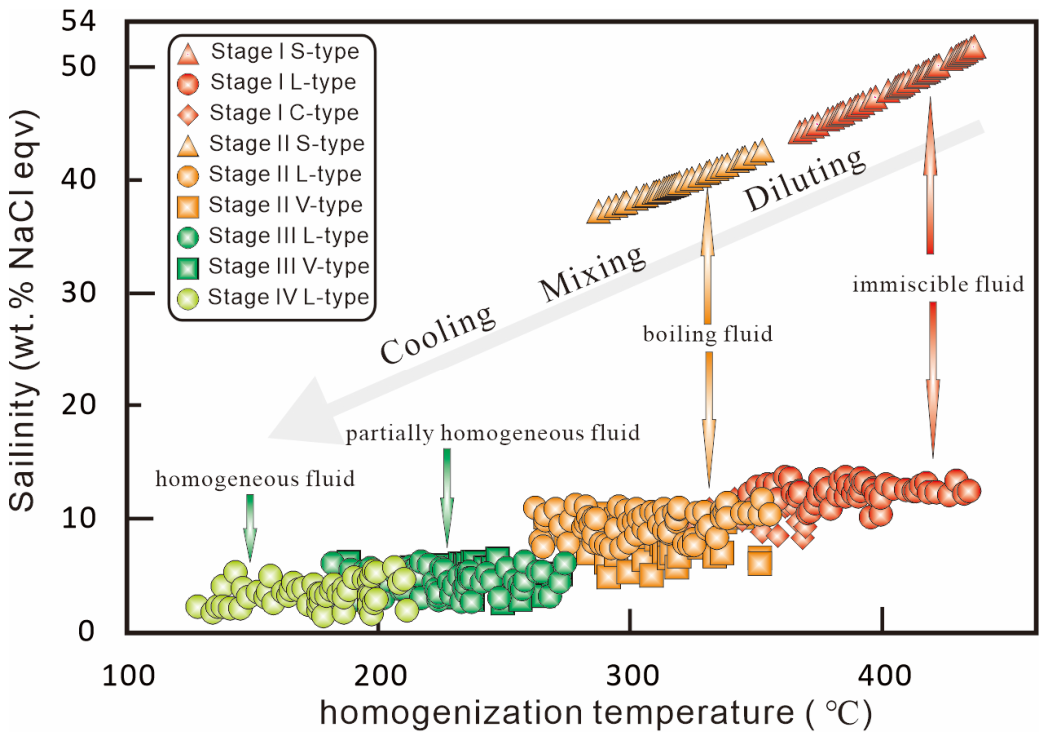
In summary, the ore-forming fluids at the Shizui deposit evolved progressively from Stage I to IV: from a high-temperature, high-salinity, immiscible NaCl–H2O–CO2 system → to a moderate-high-temperature, high-salinity, boiling (heterogeneous) NaCl–H2O system → to a moderate-low-temperature, low-salinity, partially homogeneous NaCl–H2O system → and finally to a low-temperature, low-salinity, homogeneous NaCl–H2O system (Figure 8).

6.3. Ore Genesis and Implications for Exploration

Based on a synthesis of the geological characteristics, mineral paragenesis, fluid inclusion studies, and stable isotope (H–O) data presented in the preceding sections, the ore genesis of the Shizui Cu–Pb–Zn deposit and its implications for regional exploration can be discussed.
The orebodies in the Shizui deposit are mainly situated close to the contact between the biotite monzogranite intrusion and the marble of the Shizui Formation [8]. Copper mineralization, dominated by chalcopyrite, is primarily developed within and adjacent to the contact zone. In contrast, lead-zinc mineralization, characterized by sphalerite and galena, typically occurs in the peripheral areas of the contact zone. Hydrogen and oxygen isotope data from the Shizui deposit indicate that the ore-forming fluids were primarily derived from magmatic processes, with a minor contribution from mantle-derived materials [26].
The migration, evolution, and precipitation mechanisms of the ore-forming fluids are key to understanding the metallogenic process of the Shizui skarn-type deposit. During the Late Permian, following the final closure of the Paleo-Asian Ocean, the tectonic regime transitioned from syn-collisional compression to post-collisional extension. This shift likely triggered the upwelling of mantle-derived magmas [84,85]. These magmas underplated beneath the thickened juvenile mafic lower crust, supplying substantial heat and ore-forming materials (including Cu and S), which induced dehydration melting of the lower crust. The Early Permian biotite monzogranites in the study area are petrologically classified as high-K calc-alkaline, metaluminous to weakly peraluminous I-type granitoids. Geochemically, they are characterized by pronounced enrichment in large ion lithophile elements coupled with significant depletion in high field strength elements. This distinctive elemental signature exhibits a marked affinity with magmatic rocks typically emplaced in island-arc or active continental margin tectonic settings [5,86,87,88,89,90,91]. This process generated hydrous, adakite-like monzogranitic magmas with high H2O and SO2 contents, elevated oxygen fugacity, and arc-like geochemical signatures [92].
The monzogranitic parent magma (and its resolved fluids), carrying abundant Cu, Pb, and Zn, migrated upward along NW-trending faults and fractures. Upon interaction with the Shizui Formation marble, contact metasomatism occurred, forming abundant early-stage skarn minerals such as garnet. The garnet at Shizui displays a reddish-brown color, indicating enrichment in Fe3+ and a composition dominated by andradite. During the main ore-forming stage, intense fluid boiling and associated phase separation occurred, which was the primary mechanism triggering the precipitation of copper mineralization [8]. Concurrently, the influx of a minor amount of meteoric water altered fluid chemistry. SiO2, instead of reacting with Mg, Ca, Al, and Fe to form skarn minerals, precipitated independently as quartz. The ore-bearing hydrothermal fluids also altered early-formed ferromagnesian minerals to form chlorite, epidote, and other alteration minerals. As the fluids migrated into surrounding and overlying fractures, significant mixing with meteoric water caused a gradual decrease in the temperature, pressure, and salinity of the ore-forming system. This eventually led to the precipitation of relatively lower-temperature lead-zinc sulfides [93]. With further meteoric water input, the fluid evolved into an open, homogeneous NaCl–H2O system [94]. By this stage, metals had largely precipitated, accompanied by the abundant formation of calcite. The fluid evolution at Shizui exhibits a clear systematic pattern, which directly resulted in the characteristic ore zoning of “copper in the inner/upper parts and lead-zinc in the outer/lower parts.”
A comparative summary of the Shizui deposit and neighboring copper deposits in terms of geology, geochronology, tectonic setting, and deposit type is provided below. Firstly, the Shizui deposit is spatially proximate to the Tianbaoshan Pb–Zn–Cu–Mo deposit in southeastern Jilin Province. Tectonically, both the Shizui and Tianbaoshan deposits are situated on the northern margin of the North China Craton (NCC), similar to other polymetallic deposits in the eastern segment of the XMOB. Secondly, mineralization in both the Shizui and Tianbaoshan deposits is primarily controlled by NE-trending faults, which are the major ore-controlling structures in eastern Jilin. Thirdly, the Shizui deposit formed in the Early Permian (277.3 ± 1.8 Ma) [8], while the Lishan and Xinxing deposits in the Tianbaoshan orefield formed in the Late Carboniferous (266.2 ± 3.9 Ma and 273.6 ± 2.9 Ma, respectively) [31], indicating a broadly similar metallogenic epoch. Fourthly, both the Shizui and Tianbaoshan deposits are hosted near the contact zones between intermediate-acid intrusions and marble. They share numerous similarities in metallic mineral assemblages and wall-rock alteration types, and their orebodies exhibit similar vein-type and lenticular morphologies. Finally, the ore-forming fluid types and mineralization temperatures of the two deposits are also quite comparable. A more detailed comparison between the Shizui and Tianbaoshan deposits is presented in Table 4 [31]. The results of this comparison indicate that the Shizui deposit is genetically more akin to skarn-type copper deposits. This finding holds significant implications for polymetallic exploration in eastern Jilin.

7. Conclusions

The Shizui Cu-Pb-Zn deposit is divided into four mineralization stages, including the skarn stage, the early quartz-sulfide stage, the late quartz-sulfide stage, and quartz-carbonate stage. The early quartz-sulfide stage represents the principal stage of copper mineralization. The initial ore-forming fluid was derived from a magmatic source and incorporated meteoric water during later stages. The ore-forming materials were derived from biotite monzogranite. The initial ore-forming fluids were characterized by a high-temperature, high-salinity, immiscible NaCl–H2O–CO2 system; transitioning to a moderate-high temperature, high-salinity, boiling (heterogeneous) NaCl–H2O system; then progressing to a moderate-low temperature, low-salinity, partially homogeneous NaCl–H2O system; and finally evolving into a low-temperature, low-salinity, homogeneous NaCl–H2O system. Fluid boiling served as the critical mechanism driving metal enrichment and precipitation. The Shizui Cu–Pb–Zn deposit, located in the eastern XCMB, is a typical skarn-type deposit. It shares similarities with Paleozoic skarn-type Tianbaoshan Pb–Zn–Cu–Mo deposits in the eastern XCMB, suggesting that the XCMB extends eastward and holds significant potential for the discovery of the Paleozoic Cu polymetallic deposits in its eastern segment. These findings not only reinforce the skarn genesis of Shizui but also provide a critical constraint for regional exploration by distinguishing this system from alternative models, such as porphyry or VMS types, which lack supporting fluid evolution trajectories.

Author Contributions

Conceptualization, W.B., Y.R., Q.Y. and Z.G.; Field investigation, Q.Y., Z.G. and H.L. (Haoran Li); Experimental analysis, Q.Y. and Z.G.; Software, Z.G., C.L., H.L. (Haozhe Li) and S.C.; Validation, Q.Y., W.B. and B.W.; Resources, Q.Y. and W.B.; Data Curation, Q.Y., Z.G. and W.B.; Writing—Original Draft Preparation, Z.G., Q.Y. and W.B.; Writing—Review & Editing, Z.G.; Visualization, Q.Y.; Funding Acquisition, Q.Y. and H.L. (Haoran Li). All authors have read and agreed to the published version of the manuscript.

Funding

This work was supported by the Major Project of the National Key Laboratory of Jilin Province (Grant SKL202502008JC). This work was financially supported by the National Natural Science Foundation of China (Grants 42202070), Natural Science Foundation of Jilin Province (20230101089JC), Education Department Foundation of Jilin Province (JJKH20241294KJ) and China Postdoctoral Science Foundation (Grants 2025T180125, 2022M721305).

Data Availability Statement

The data supporting the reported results are included in the article.

Acknowledgments

We thank the geologists and the experts of the Shizui ore district for their warm help during our field investigations.

Conflicts of Interest

The authors declare no conflict of interest.

References

  1. Sengor, A.; Natal’in, B.A. 21 Paleotectonics of Asia: Fragments of a synthesis. In The Tectonic Evolution of Asia; Cambridge University Press Cambridge: Cambridge, UK, 1996. [Google Scholar]
  2. Windley, B.F.; Alexeiev, D.; Xiao, W.; Kröner, A.; Badarch, G. Tectonic models for accretion of the Central Asian Orogenic Belt. J. Geol. Soc. 2007, 164, 31–47. [Google Scholar] [CrossRef]
  3. Jahn, B.-M.; Wu, F.Y.; Chen, B. Massive granitoid generation in Central Asia: Nd isotope evidence and implication for continental growth in the Phanerozoic. Epis. J. Int. Geosci. 2000, 23, 82–92. [Google Scholar] [CrossRef]
  4. Tang, J.; Xu, W.L.; Wang, F.; Ge, W.C. Subduction history of the Paleo-Pacific slab beneath Eurasian continent: Mesozoic-Paleogene magmatic records in Northeast Asia. Sci. China Earth Sci. 2018, 61, 527–559. [Google Scholar] [CrossRef]
  5. Wu, F.Y.; Sun, D.Y.; Ge, W.C.; Zhang, Y.B.; Grant, M.L.; Wilde, S.A.; Jahn, B.-M. Geochronology of the Phanerozoic granitoids in northeastern China. J. Asian Earth Sci. 2011, 41, 1–30. [Google Scholar] [CrossRef]
  6. Xu, W.L.; Wang, F.; Pei, F.p.; Meng, E.; Tang, J.; Xu, M.J.; Wang, W. Mesozoic tectonic regimes and regional ore-forming background in NE China: Constraints from spatial and temporal variations of Mesozoic volcanic rock associations. Acta Petrol. Sin. 2013, 29, 339–353. [Google Scholar]
  7. Zhao, C.; Qin, K.Z.; Song, G.X.; Li, G.M. Switch of geodynamic setting from the Paleo-Asian Ocean to the Mongol-Okhotsk Ocean: Evidence from granitoids in the Duobaoshan ore field, Heilongjiang Province, Northeast China. Lithos 2019, 336, 202–220. [Google Scholar] [CrossRef]
  8. Yang, Q. Late Paleozoic to Early Mesozoic Gold-Copper Polymetallic Metallogeny and Metallogenic Regularity in Central Jilin Province, Northeast China. Ph.D. Thesis, Jilin University, Changchun, China, 2020. (In Chinese with English abstract). [Google Scholar]
  9. Xu, Y.C.; Wang, G.W.; Gao, M.; Yang, W.D.; Yang, S.R.; Yun, H.; Wu, P.J.; Guo, N.N.; Feng, Y.T. Genesis of the Shibaogou Mo–Pb–Zn deposit in the Luanchuan ore district, China: Constraints from geochronology, fluid inclusion, and H–O–S–Pb isotopes. Front. Earth Sci. 2023, 10, 1032183. [Google Scholar] [CrossRef]
  10. Wang, X.; Yang, Q.; Lu, S.Y.; Shang, Q.Q.; Zhao, D.S.; Ren, Y.S. Ore genesis of the Bayanbaolege Ag-Pb-Zn deposit, NE China: Constraints on LA-ICP-MS studies of cadmium and related trace elements in sulfides. Ore Geol. Rev. 2024, 164, 105830. [Google Scholar] [CrossRef]
  11. Wu, F.Y.; Sun, D.Y.; Li, H.M.; Jahn, B.-m.; Wilde, S. A-type granites in northeastern China: Age and geochemical constraints on their petrogenesis. Chem. Geol. 2002, 187, 143–173. [Google Scholar] [CrossRef]
  12. Eizenhöfer, P.R.; Zhao, G.C.; Zhang, J.; Sun, M. Final closure of the Paleo-Asian Ocean along the Solonker suture zone: Constraints from geochronological and geochemical data of Permian volcanic and sedimentary rocks. Tectonics 2014, 33, 441–463. [Google Scholar] [CrossRef]
  13. Li, J.-Y. Permian geodynamic setting of Northeast China and adjacent regions: Closure of the Paleo-Asian Ocean and subduction of the Paleo-Pacific Plate. J. Asian Earth Sci. 2006, 26, 207–224. [Google Scholar] [CrossRef]
  14. Wang, T.; Zhang, J.J.; Li, S.; Tong, Y.; Guo, L.; Zhang, X.W.; Huang, H.; Zhang, L.; Xue, H.M. Distinctive spatial-temporal evolution of Late Paleozoic to Mesozoic magmatic systems in Northeast Asia: Evidences for identification of the extent and superposition of multiple plate tectonic regimes. Earth Sci. Front. 2022, 29, 28. [Google Scholar] [CrossRef]
  15. Li, C.; Yang, Q.; Ren, Y.S.; Peng, X.L.; Li, H.Z.; Chen, S.T.; Fang, Y.H. Ore-Forming Process and Ore Genesis of the Guokuidingzi Cu Deposit in Central Jilin Province, Northeast China: Evidence From Fluid Inclusions and H–O–S–Pb Isotopes. Geol. J. 2025, 61, 725–747. [Google Scholar] [CrossRef]
  16. Yang, Q.; Ren, Y.S.; Huizenga, J.M.; Li, J.M.; Wang, E.D.; Wang, X.; Wang, B. Geological significance of Early Triassic porphyry Cu mineralization in the eastern Xar Moron–Changchun Metallogenic Belt, northeast China: A case study of the newly-discovered Guokuidingzi Cu deposit. Ore Geol. Rev. 2021, 133, 104092. [Google Scholar] [CrossRef]
  17. Mao, J.W.; Zhou, Z.H.; Feng, C.Y.; Wang, Y.T.; Zhang, C.Q.; Peng, H.J.; Yu, M. A preliminary study of the Triassic large-scale mineralization in China and its geodynamic setting. Geol. China 2012, 39, 1437–1471. [Google Scholar]
  18. Li, A.; Wang, J.; Song, Y.; Liu, J.; Xue, S. Geochemistry characteristics of the ore-bearing mafic–ultramafic intrusions in the Hongqiling Ni–Cu sulfide deposit, NE China and its petrogenesis significance. Acta Geol. Sin. 2018, 92, 263–277. [Google Scholar]
  19. Lü, L.; Mao, J.; Li, H.; Pirajno, F.; Zhang, Z.; Zhou, Z. Pyrrhotite Re–Os and shrimp zircon U–Pb dating of the Hongqiling Ni–Cu sulfide deposits in northeast China. Ore Geol. Rev. 2011, 43, 106–119. [Google Scholar] [CrossRef]
  20. Wei, B.; Wang, C.Y.; Li, C.; Sun, Y. Origin of PGE-depleted Ni-Cu sulfide mineralization in the Triassic Hongqiling No. 7 orthopyroxenite intrusion, Central Asian orogenic belt, northeastern China. Econ. Geol. 2013, 108, 1813–1831. [Google Scholar] [CrossRef]
  21. Han, C.M.; Xiao, W.J.; Zhao, G.C.; Su, B.X.; Ao, S.J.; Zhang, J.E.; Wan, B.; Wang, Z.M.; Ding, J.X.; Qu, W.J. Re–Os Isotopic Age of the H ongqiling Cu–Ni Sulfide Deposit in J ilin Province, NE C hina and its Geological Significance. Resour. Geol. 2014, 64, 247–261. [Google Scholar] [CrossRef]
  22. Wilde, S.A. Final amalgamation of the Central Asian Orogenic Belt in NE China: Paleo-Asian Ocean closure versus Paleo-Pacific plate subduction—A review of the evidence. Tectonophysics 2015, 662, 345–362. [Google Scholar] [CrossRef]
  23. Zhou, J.P.; Liu, Y.J.; Li, W.M.; Wen, Q.B.; Liang, C.Y.; Feng, Z.Q. Eastern extension of the Solonker-Xar Moron-Changchun-Yanji Suture Zone: Constraints from thermochronology of sedimentary and mafic rocks in the Hunchun-Yanji area, Northeast China. Geol. J. 2019, 54, 679–697. [Google Scholar] [CrossRef]
  24. Wang, F.; Xu, W.L.; Xing, K.C.; Wang, Y.N.; Zhang, H.H.; Wu, W.; Sun, C.Y.; Ge, W.C. Final closure of the Paleo-Asian Ocean and onset of subduction of Paleo-Pacific Ocean: Constraints from early Mesozoic magmatism in central southern Jilin Province, NE China. J. Geophys. Res. Solid Earth 2019, 124, 2601–2622. [Google Scholar] [CrossRef]
  25. Song, C.; Pei, F.P.; Xu, W.L.; Wei, J.Y.; Ding, B.Q.; Sang, T.J.; Song, K.; Wang, Z.W.; Dong, H.C. Subduction history of the Paleo-Asian oceanic slab along the northern margin of the North China Craton: A case study of zircons and cherts from central Jilin Province, NE China. Geol. Soc. Am. Bull. 2024, 136, 4761–4774. [Google Scholar] [CrossRef]
  26. Li, C.; Yang, Q.; Xu, W.L.; Ren, Y.S.; Ge, Z.B.; Sun, X.F.; Li, H.Z.; Chen, S.T.; Fang, Y.H.; Xu, W.T. Ore genesis of the late Paleozoic Shizui Cu-polymetallic deposit in central Jilin Province, Northeast China: Constraints from geochemistry of magnetite, chalcopyrite, and pyrite. Ore Geol. Rev. 2025, 188, 107041. [Google Scholar] [CrossRef]
  27. Yang, Q.; Ren, Y.S.; Sun, X.H.; Li, J.M.; Pei, F.P.; Lü, G. Metallogenic age and genesis of the Shizui Cu-polymetallic deposit in central Jilin Province. Geol. Rev. 2019, 65, 251–252, (In Chinese with English abstract). [Google Scholar]
  28. Yang, Q.; Ren, Y.S.; Sun, Z.M.; Hao, Y.J.; Zhang, B.; Sun, X.H.; Lu, S.Y. Geochronologic evidence of Late Paleozoic magmatic-hydrothermal mineralization in Tianbaoshan metallogenic region, Yanbian area: A case study of the Xinxing lead-zinc (silver) deposit. Acta Petrol. Sin. 2018, 34, 3153–3166. Available online: https://www.sciengine.com/APS/doi/10.0000/9313e55da05a43c49c6052a230c16dd5 (accessed on 23 March 2026).
  29. Zhu, C.W.; Wen, H.J.; Zhang, Y.X.; Fan, H.F. Cadmium and sulfur isotopic compositions of the Tianbaoshan Zn–Pb–Cd deposit, Sichuan Province, China. Ore Geol. Rev. 2016, 76, 152–162. [Google Scholar] [CrossRef]
  30. Zhang, J.; Deng, J.; Chen, H.Y.; Yang, L.Q.; Cooke, D.; Danyushevsky, L.; Gong, Q.J. LA-ICP-MS trace element analysis of pyrite from the Chang’an gold deposit, Sanjiang region, China: Implication for ore-forming process. Gondwana Res. 2014, 26, 557–575. [Google Scholar] [CrossRef]
  31. Wang, Z.G.; Wang, K.Y.; Wan, D.; Konare, Y.; Wang, C.Y. Genesis of the Tianbaoshan Pb–Zn–Cu–Mo polymetallic deposit in eastern Jilin, NE China: Constraints from fluid inclusions and C–H–O–S–Pb isotope systematics. Ore Geol. Rev. 2017, 80, 1111–1134. [Google Scholar] [CrossRef]
  32. Piercey, S.J. An overview of petrochemistry in the regional exploration for volcanogenic massive sulphide (VMS) deposits. Geochem. Explor. Environ. Anal. 2010, 10, 119–136. [Google Scholar] [CrossRef]
  33. Huston, D.L.; Pehrsson, S.; Eglington, B.M.; Zaw, K. The Geology and Metallogeny of Volcanic-Hosted Massive Sulfide Deposits: Variations through Geologic Time and with Tectonic Setting. Econ. Geol. 2010, 105, 571–591. [Google Scholar] [CrossRef]
  34. Large, R.R. Australian volcanic-hosted massive sulfide deposits; features, styles, and genetic models. Econ. Geol. 1992, 87, 471–510. [Google Scholar] [CrossRef]
  35. Zheng, Y.; Zhang, L.; Chen, Y.J.; Hollings, P.; Chen, H.Y. Metamorphosed Pb–Zn–(Ag) ores of the Keketale VMS deposit, NW China: Evidence from ore textures, fluid inclusions, geochronology and pyrite compositions. Ore Geol. Rev. 2013, 54, 167–180. [Google Scholar] [CrossRef]
  36. Yang, Q.; Ren, Y.S.; Li, Y.; Hao, Y.J.; Li, J.M. Age and Tectonic Setting of Mesothermal Magmatic Hydrothermal Vein-Type Pb–Zn–(Ag) Mineralization in the Xiaohongshilazi Deposit, Central Jilin Province, Northeast China. Resour. Geol. 2020, 70, 70–88. [Google Scholar] [CrossRef]
  37. Lu, S.Y.; Ren, Y.S.; Yang, Q.; Sun, Z.M.; Hao, Y.J.; Sun, X.H. Ore Genesis for Stratiform Ore Bodies of the Dongfengnanshan Copper Polymetallic Deposit in the Yanbian Area, NE China: Constraints from LA-ICP-MS in situ Trace Elements and Sulfide S–Pb Isotopes. Acta Geol. Sin.-Engl. Ed. 2019, 93, 1591–1606. [Google Scholar] [CrossRef]
  38. Ren, Y.S.; Lu, S.Y.; Hou, H.N.; Yang, Q. Mineralization characteristics, genetic type and metallogenic time of stratiform ore bodies in Hongtaiping copper polymetallic deposit in Yanbian area, NE China; Copernicus Meetings: 2020. In Proceedings of the EGU General Assembly 2020, Copernicus Meetings, Online, 4–8 May 2020. [Google Scholar]
  39. Ren, Y.S.; Chen, C.; Zou, X.T.; Zhao, H.L.; Hao, Y.J.; Hou, H.N.; Hu, Z.C.; Jiang, G.H. The age, geological setting, and types of gold deposits in the Yanbian and adjacent areas, NE China. Ore Geol. Rev. 2016, 73, 284–297. [Google Scholar] [CrossRef]
  40. Yang, Q.; Shang, Q.; Ren, Y.; Yang, Z. Age and tectonic setting of layered lead–zinc ore bodies in the Xiaohongshilazi deposit: Constraints from geochronology and geochemistry of the volcanic rocks in central Jilin Province, NE China. Minerals 2023, 13, 1371. [Google Scholar] [CrossRef]
  41. Ouyang, H.; Mao, J.; Zhou, Z.; Su, H. Late Mesozoic metallogeny and intracontinental magmatism, southern Great Xing’an Range, northeastern China. Gondwana Res. 2015, 27, 1153–1172. [Google Scholar] [CrossRef]
  42. Du, Q.X.; Han, Z.Z.; Shen, X.L.; Han, C.; Song, Z.G.; Gao, L.H.; Han, M.; Zhong, W.J. Geochronology and geochemistry of Permo-Triassic sandstones in eastern Jilin Province (NE China): Implications for final closure of the Paleo-Asian Ocean. Geosci. Front. 2019, 10, 683–704. [Google Scholar] [CrossRef]
  43. Liu, L.J.; Shu, Q.H.; Xing, K.; Liu, J.Y.; Zhang, L.T.; Wang, Q.F.; Deng, J. Crustal architecture controls on porphyry Cu and Mo fertility: Constraints from zircon Hf isotopic mapping in the Great Xing’an Range, NE China. Earth-Sci. Rev. 2025, 272, 105319. [Google Scholar] [CrossRef]
  44. Yang, Q.; Ren, Y.S.; Ju, N.; Chen, C.; Zou, X.T. Ore Deposit Types and Mineralization Sequence of Tianbaoshan Metallogenic Region In Yanbian Area, Northeastern (NE) China. Acta Geol. Sin. (Engl. Ed.) 2014, 88, 1710. [Google Scholar] [CrossRef]
  45. Zhang, Y.; Xing, S.W.; Li, C.; Liang, S.F.; Yu, Z.T.; Du, X.H.; Wang, Y.; Zhang, Z.J.; Ma, Y.B. Early Cretaceous porphyry copper mineralization in Northeast China: The Changfagou example. Int. Geol. Rev. 2017, 59, 185–203. [Google Scholar] [CrossRef]
  46. Zhong, H.; Li, G.S.; Zhou, Y.C. Is the Shizui copper deposit a skarn-type deposit? Geol. Explor. 1981, 14–18. [Google Scholar]
  47. Li, D.X. Some Perspectives on the Genesis of the Shizui Copper Deposit. Jilin Geol. 1983, 61–64. [Google Scholar]
  48. Zhang, P.; Zhao, Y.; Kou, L.L.; Yang, H.Z.; Yang, F.C. Zircon U–Pb and molybdenite Re–Os geochronology of copper–molybdenum deposits in southeast Liaoning Province, China. Int. Geol. Rev. 2016, 58, 1481–1491. [Google Scholar] [CrossRef]
  49. Wu, F.Y.; Wilde, S.A.; Zhang, G.L.; Sun, D.Y. Geochronology and petrogenesis of the post-orogenic Cu-Ni sulfide-bearing mafic-ultramafic complexes in Jilin Province, NE China. J. Asian Earth Sci. 2004, 23, 781–797. [Google Scholar] [CrossRef]
  50. Zeng, Q.D.; Yang, J.H.; Liu, J.M.; Chu, S.X.; Duan, X.X.; Zhang, Z.L.; Zhang, W.Q.; Zhang, S. Genesis of the Chehugou Mo-bearing granitic complex on the northern margin of the North China Craton: Geochemistry, zircon U–Pb age and Sr–Nd–Pb isotopes. Geol. Mag. 2012, 149, 753–767. [Google Scholar] [CrossRef]
  51. Şengör, A.; Natal’In, B.; Burtman, V. Evolution of the Altaid tectonic collage and Palaeozoic crustal growth in Eurasia. Nature 1993, 364, 299–307. [Google Scholar] [CrossRef]
  52. Safonova, I.; Kotlyarov, A.; Krivonogov, S.; Xiao, W. Intra-oceanic arcs of the Paleo-Asian Ocean. Gondwana Res. 2017, 50, 167–194. [Google Scholar]
  53. Safonova, I.; Seltmann, R.; Kröner, A.; Gladkochub, D.; Schulmann, K.; Xiao, W.; Kim, J.; Komiya, T.; Sun, M. A new concept of continental construction in the Central Asian Orogenic Belt. Epis. J. Int. Geosci. 2011, 34, 186–196. [Google Scholar] [CrossRef]
  54. Yang, H.; Ge, W.C.; Zhao, G.C.; Dong, Y.; Xu, W.L.; Ji, Z.; Yu, J.J. Late Triassic intrusive complex in the Jidong region, Jiamusi–Khanka Block, NE China: Geochemistry, zircon U–Pb ages, Lu–Hf isotopes, and implications for magma mingling and mixing. Lithos 2015, 224, 143–159. [Google Scholar] [CrossRef]
  55. Sun, Y.; Liu, J.; Zeng, Q.; Wang, J.; Wang, Y.; Hu, R.; Zhou, L.; Wu, G. Mo-mineralized porphyries are relatively hydrous and differentiated: Insights from the Permian-Triassic granitic complex in the Baituyingzi Mo–Cu district, eastern Inner Mongolia, NE China. Miner. Depos. 2017, 52, 799–821. [Google Scholar] [CrossRef]
  56. Zhao, Z.H.; Zhao, X.; Yin, Y.C.; Liang, S.S.; Chen, J.; Li, C.L.; Zhou, J.Z. Genesis of the Yidonglinchang gold deposit, Lesser Xing’an Range, China: Insights from fluid inclusions, HOS-Pb isotopes, and Sm-Nd and U-Pb geochronology. Ore Geol. Rev. 2023, 163, 105803. [Google Scholar] [CrossRef]
  57. Shu, Q.H.; Chang, Z.S.; Lai, Y.; Hu, X.L.; Wu, H.Y.; Zhang, Y.; Wang, P.; Zhai, D.G.; Zhang, C. Zircon trace elements and magma fertility: Insights from porphyry (-skarn) Mo deposits in NE China. Miner. Depos. 2019, 54, 645–656. [Google Scholar] [CrossRef]
  58. Xiao, W.J.; Windley, B.F.; Hao, J.; Zhai, M.G. Accretion leading to collision and the Permian Solonker suture, Inner Mongolia, China: Termination of the central Asian orogenic belt. Tectonics 2003, 22, 1069. [Google Scholar] [CrossRef]
  59. Jia, D.C.; Hu, R.Z.; Lu, Y.; Qiu, X.L. Collision belt between the Khanka block and the North China block in the Yanbian Region, Northeast China. J. Asian Earth Sci. 2004, 23, 211–219. [Google Scholar] [CrossRef]
  60. Zhang, Y.B.; Wu, F.Y.; Wilde, S.A.; Zhai, M.G.; Lu, X.P.; Sun, D.Y. Zircon U–Pb ages and tectonic implications of ‘Early Paleozoic’granitoids at Yanbian, Jilin Province, northeast China. Isl. Arc 2004, 13, 484–505. [Google Scholar] [CrossRef]
  61. Yang, J.H.; Wu, F.Y.; Shao, J.A.; Wilde, S.A.; Xie, L.W.; Liu, X.M. Constraints on the timing of uplift of the Yanshan Fold and Thrust Belt, North China. Earth Planet. Sci. Lett. 2006, 246, 336–352. [Google Scholar] [CrossRef]
  62. Chen, B.; Jahn, B.; Tian, W. Evolution of the Solonker suture zone: Constraints from zircon U–Pb ages, Hf isotopic ratios and whole-rock Nd–Sr isotope compositions of subduction-and collision-related magmas and forearc sediments. J. Asian Earth Sci. 2009, 34, 245–257. [Google Scholar] [CrossRef]
  63. Liu, S.; Hu, R.Z.; Gao, S.; Feng, C.X.; Coulson, I.M.; Feng, G.Y.; Qi, Y.Q.; Yang, Y.H.; Yang, C.G.; Tang, L. Zircon U–Pb age and Sr–Nd–Hf isotopic constraints on the age and origin of Triassic mafic dikes, Dalian area, Northeast China. Int. Geol. Rev. 2013, 55, 249–262. [Google Scholar] [CrossRef]
  64. Xing, K.; Shu, Q.H.; Lentz, D.R. Constraints on the formation of the giant Daheishan porphyry Mo deposit (NE China) from whole-rock and accessory mineral geochemistry. J. Petrol. 2021, 62, egab018. [Google Scholar] [CrossRef]
  65. Deng, J.; Yang, L.Q.; Gao, B.F.; Sun, Z.S.; Guo, C.Y.; Wang, Q.F.; Wang, J.P. Fluid evolution and metallogenic dynamics during tectonic regime transition: Example from the Jiapigou gold belt in Northeast China. Resour. Geol. 2009, 59, 140–152. [Google Scholar] [CrossRef]
  66. Deng, J.; Yuan, W.M.; Carranza, E.J.M.; Yang, L.Q.; Wang, C.M.; Yang, L.Y.; Hao, N.N. Geochronology and thermochronometry of the Jiapigou gold belt, northeastern China: New evidence for multiple episodes of mineralization. J. Asian Earth Sci. 2014, 89, 10–27. [Google Scholar] [CrossRef]
  67. Li, L. Research on Ore-Forming Fluids of Gold Deposits in Jiapigou-Haigou Gold Belt, Jilin Province and Deep-Seated Metallogenic Assessment. Ph.D. Thesis, Jilin University, Changchun, China, 2016. [Google Scholar]
  68. Zhang, X.T. Research on Geology, Geochemistry and Metallogenesis of the Gold Deposits of the Jiapigou Ore Field in the Continental Margin of Northeast China. Ph.D. Thesis, Jilin University, Changchun, China, 2018. [Google Scholar]
  69. Sun, Z.S.; Feng, Y.M. Main minerogenetic epoch, determine and exploratory direction of Jiapigou gold deposit, Jilin. Acta Geosci. Sin. 1997, 18, 367–372. [Google Scholar]
  70. Ma, Z.T.; Chen, J.; Duan, D. Analysis on geological features and genesis of Guokuidingzi copper mine in Yongji, Jilin Province. Jilin Geol. 2017, 36, 26–29. [Google Scholar]
  71. Hall, D.L.; Sterner, S.M.; Bodnar, R.J. Freezing point depression of NaCl-KCl-H2O solutions. Econ. Geol. 1988, 83, 197–202. [Google Scholar] [CrossRef]
  72. Bakker, R.J. Package FLUIDS 1. Computer programs for analysis of fluid inclusion data and for modelling bulk fluid properties. Chem. Geol. 2003, 194, 3–23. [Google Scholar] [CrossRef]
  73. Collins, P.L.F. Gas hydrates in CO2-bearing fluid inclusions and the use of freezing data for estimation of salinity. Econ. Geol. 1979, 74, 1435–1444. [Google Scholar] [CrossRef]
  74. Liu, B.; Duan, G.X. The density and isochoric formulae for NaCl-H2O fluid inclusions and their applications. Acta Mineral. Sin. 1987, 7, 345–352. [Google Scholar]
  75. Shao, J.L.; Mei, J.M. Study on the Characterization of Mineral Inclusions in Gold Deposits in Volcanic Rocks of Zhejiang Province and Its Genesis and Prospecting Significance. J. Mineral. Petrol. 1986, 103–111. [Google Scholar] [CrossRef]
  76. Clayton, R.N.; O’Neil, J.R.; Mayeda, T.K. Oxygen isotope exchange between quartz and water. J. Geophys. Res. 1972, 77, 3057–3067. [Google Scholar] [CrossRef]
  77. Liu, B.; Shen, K. Thermodynamics of Fluid Inclusions; Geological Publishing House: Beijing, China, 1999. [Google Scholar]
  78. Yang, Q.; Ren, Y.S.; Hao, Y.J.; Wang, B.; Sun, Z.M.; Li, J.M. Ore fluid, geochronology and tectonic setting of mesothermal gold metallogeny in southeastern Jilin Province, Northeast China: A case study of the Shajingou gold deposit. Ore Geol. Rev. 2019, 109, 229–252. [Google Scholar] [CrossRef]
  79. Chen, Y.J.; Ni, P.; Fan, H.R.; Pirajno, F.; Lai, Y.; Su, W.C.; Zhang, H. Diagnostic fluid inclusions of different types hydrothermal gold deposits. Acta Petrol. Sin. 2007, 23, 2085–2108, (In Chinese with English abstract). [Google Scholar]
  80. Chai, P.; Sun, J.G.; Hou, Z.Q.; Xing, S.W.; Wang, Z.Y. Geological, fluid inclusion, H–O–S–Pb isotope, and Ar–Ar geochronology constraints on the genesis of the Nancha gold deposit, southern Jilin Province, northeast China. Ore Geol. Rev. 2016, 72, 1053–1071. [Google Scholar] [CrossRef]
  81. Taylor, H.P. The application of oxygen and hydrogen isotope studies to problems of hydrothermal alteration and ore deposition. Econ. Geol. 1974, 69, 843–883. [Google Scholar] [CrossRef]
  82. Roedder, E. Fluid inclusion evidence for immiscibility in magmatic differentiation. Geochim. Cosmochim. Acta 1992, 56, 5–20. [Google Scholar] [CrossRef]
  83. Lu, H.Z. Fluids Immiscibility and Fluid Inclusions. Acta Petrol. Sin. 2011, 27, 1253–1261. [Google Scholar]
  84. Wang, H.H.; Ma, X.H.; Hawkesworth, C.J.; Seltmann, R.; Lai, Y.; Guo, C.L.; Zhu, D.C.; Wilde, S.A. How does a soft collision orogen uplift and collapse? Insight from the eastern Central Asian Orogenic Belt. Geol. Soc. Am. Bull. 2025, 137, 1628–1648. [Google Scholar] [CrossRef]
  85. Worthington, J.R.; Kapp, P.; Minaev, V.; Chapman, J.B.; Mazdab, F.K.; Ducea, M.N.; Oimahmadov, I.; Gadoev, M. Birth, life, and demise of the Andean–syn-collisional Gissar arc: Late Paleozoic tectono-magmatic-metamorphic evolution of the southwestern Tian Shan, Tajikistan. Tectonics 2017, 36, 1861–1912. [Google Scholar] [CrossRef]
  86. Boyton, W. Geochemistry of the rare earth elements: Meteorite studies. In Rare Earth Element in Geochemistry; Elsevier: New York, NY, USA, 1984; pp. 63–114. [Google Scholar]
  87. Gill, J.B. Orogenic Andesites and Plate Tectonics; Springer Science & Business Media: Berlin, Germany, 2012. [Google Scholar]
  88. Deering, C.D.; Vogel, T.A.; Patino, L.C.; Alvarado, G.E. Origin of distinct silicic magma types from the Guachipelín Caldera, NW Costa Rica: Evidence for magma mixing and protracted subvolcanic residence. J. Volcanol. Geotherm. Res. 2007, 165, 103–126. [Google Scholar] [CrossRef]
  89. Meng, Q.-R. What drove late Mesozoic extension of the northern China–Mongolia tract? Tectonophysics 2003, 369, 155–174. [Google Scholar] [CrossRef]
  90. Whalen, J.B.; Currie, K.L.; Chappell, B.W. A-type granites: Geochemical characteristics, discrimination and petrogenesis. Contrib. Mineral. Petrol. 1987, 95, 407–419. [Google Scholar] [CrossRef]
  91. Chppell, B.; White, A. I-and S-type granites in the Lachlan Fold Belt. Trans. R. Soc. Edinburgh. Earth Sci. 1992, 83, 1–26. [Google Scholar]
  92. Sillitoe, R.H. Porphyry copper systems. Econ. Geol. 2010, 105, 3–41. [Google Scholar] [CrossRef]
  93. Chen, J.C.; Wang, K.Y.; Cai, W.Y.; Geng, J.Z.; Xue, H.W.; Wang, X. Fluid evolution and genesis of the Sankuanggou FeCu skarn deposit, Duobaoshan ore field, Northeast China: Evidence from fluid inclusions and HOS-Pb isotopes. J. Geochem. Explor. 2023, 252, 107251. [Google Scholar] [CrossRef]
  94. Lu, H.Z.; Fan, H.R.; Ni, P.; Ou, G.X.; Shen, K.; Zhang, W.H. Fluid Inclusion; Science Press: Beijing, China, 2004; p. 491. [Google Scholar]
Figure 4. Microphotographs showing representative primary fluid inclusions from different mineralization stages in the Shizui deposit. (A,B) Coexistence of L-type, C-type, and S-type inclusions within the same quartz grains (Stage I). (C) Co-occurring primary L-, V-, and S-type fluid inclusions in quartz (Stage II). (D) Coexisting primary L-type and V-type fluid inclusions (Stage III). (E) Primary L-type fluid inclusions in Stage IV. Abbreviations: VCO2 = CO2 vapour; LCO2 = CO2 liquid; VH2O = H2O vapour; LH2O = H2O liquid; S = halite.
Minerals 16 00579 g004
Figure 5. Frequency histograms showing the total homogenization temperatures (Th) and salinities (wt.% NaCl equiv.) of fluid inclusions for the different mineralization stages in the Shizui deposit. (A,B) Stage I. (C,D) Stage II. (E,F) Stage III. (G,H) Stage IV.
Minerals 16 00579 g005
Figure 6. Representative Laser Raman spectra of NaCl–H2O–CO2 (AC) and NaCl–H2O (D) fluid inclusions from the Shizui Cu-polymetallic deposit. (A) corresponds to an L-type inclusion from Stage I containing a minor amount of CO2. (B) shows a C-type inclusion from Stage I, whose vapor phase contains CO2. (C) represents an L-type inclusion from Stage II that lacks CO2. (D) depicts a V-type inclusion from Stage III, also devoid of CO2.
Minerals 16 00579 g006
Figure 7. Plots of δ18D vs. δ18OH2O for the ore-forming fluids of the Shizui Cu-polymetallic deposit [81]. Hydrogen and oxygen isotopic compositions reported in previous studies for the Lishan and Xinxing deposits [31].
Minerals 16 00579 g007
Figure 8. The fluid evolution in the Shizui deposit is demonstrated by a homogenization temperature–salinity plot of fluid inclusions from the four mineralization stages.
Minerals 16 00579 g008
Table 1. The stage of ore formation and the sequence of mineral generation in the Shizui Cu-polymetallic deposit [26].
Minerals 16 00579 i001
Length represents the formation time; gray indicates non-metallic minerals, and black represents metallic minerals.
Table 2. Microthermometric data and calculated parameters for fluid inclusions in the Shizui Cu-polymetallic deposit.
Mineralized
Stages
Host MineralsInclusion TypesTm-CO2
(°C)
Tm-cla
(°C)
Th-CO2
(°C)
Tm-ice
(°C)
Th-s
(°C)
Th-total
(°C)
Salinity
(wt.% NaCl eq)
Density (g/cm3)Pressure (105 Pa)Depth (km)
stage IQzL-type −9.7 to −6.7 346–43410.11–13.660.66–0.75955.1–1207.63.18–4.03
S-type 368–437368–43744.12–51.68
C-type−59.4 to −57.93.2–5.527.4–29.7 325–3738.29–11.700.68–0.80900.9–1022.83.00–3.41
Stage IIQzL-type −8.4 to −5.4 262–3558.40–12.190.76–0.85718.8–985.12.40–3.28
V-type −8.2 to −3.9 266–3516.29–11.950.77–0.83721.0–973.52.40–3.24
S-type 287–352287–35237.19–42.59
Stage IIIQzL-type −4.1 to −1.8 182–2753.05–6.580.82–0.91469.9–747.01.57–2.49
V-type −4.0 to −1.5 188–2722.56–6.440.82–0.90477.1–738.01.59–2.46
Stage IVQz, CcL-type −3.5 to −0.6 128–2111.05–5.700.89–0.95283.5–569.10.95–1.90
Abbreviations: Cc, calcite; h-total, total homogenisation temperature of CO2 fluid inclusion; Qz, quartz; Th-CO2, homogenisation temperature of the CO2 phases; Th-s, dissolution temperature of NaCl daughter mineral; Tm-cla, final melting temperature of CO2–H2O clathrate; Tm-CO2, final melting temperature of solid CO2; Tm-ice, temperature of final ice melting.
Table 3. Hydrogen and oxygen isotopic data for the Shizui Cu polymetallic deposit and its comparison with the Tianbaoshan ore-field deposits.
Ore DepositsSample No.StageMineralδ18OV-SMOW (‰)T (°C)δ18OH2O (‰)δD (‰)Reference
Shizui Cu-polymetallic deposits7SZ-5-2Stage IQuartz12.13656.7−90.6This paper
7SZ-5-112.03656.6−91.6
7SZ-7-1Stage II10.53093.9−94.4
7SZ-910.03093.4−94.2
7SZ-4Stage III9.7228−0.4−95.7
Lishan skarn Cu–Pb–Zn deposit (Tianbaoshan orefield)TB4aEarly stage of mineralizationQuartz10.13755.5−84.8[31]
TB4b10.23755.6−84.9
TB7a11.03756.4−76.7
TB7b11.13756.5−76.9
TB5aMain stage of mineralization9.32691.2−91.6
TB5b9.22691.1−91.7
TB3aLate stage of mineralization6.4187−6.2−84.8
TB3b6.3187−6.3−84.6
Xinxing Pb–Zn polymetallic deposit (Tianbaoshan orefield)TB6aEarly stage of mineralizationQuartz10.93696.1−81.8
TB6b11.03696.2−81.7
TB1aMain stage of mineralization11.72753.8−85.0
TB1b11.82753.9−85.1
TB2aLate stage of mineralization5.4184−7.4−92.9
TB2b5.5184−7.3−93.0
T = average homogenization temperatures of fluid inclusions.
Table 4. Geological characteristics of the copper-polymetallic deposits in the central and eastern Jilin Province.
Ore DepositsOre-Hosting RocksOre-Controlling FaultsOrebody MorphologyMetal MineralsAlteration TypesOre-Forming Fluid SystemOre-Forming TemperatureReference
Shizui Cu-polymetallic depositsShizui Formation marble, biotite monzograniteNE–SW-trending faultsvein-type, lenticular, columnarPy, Ccp, Mag, Sp, GnGrt, Ep, Ser, Si, CaNaCl–H2O–CO2180–440 °CThis paper
Lishan skarn Cu–Pb–Zn deposit (Tianbaoshan orefield)Shanxiuling Group marble, Hercynian
granodiorite
NE–SW-trending faultsvein-type, lenticularPy, Ccp, Mag, Sp, Gn, PoGrt, Ep, Ser, Si, Chl, CaNaCl–H2O–CO2180–386 °C[31]
Xinxing Pb–Zn polymetallic deposit (Tianbaoshan orefield)Shanxiuling Group marble, Hercynian
granodiorite
NE–SW-trending faultsvein-type, lenticularPy, Ccp, Mag, Sp, Po, GnGrt, Ep, Ser, Si, Chl, CaNaCl–H2O–CO2170–350 °C
Py = Pyrite; Ccp = Chalcopyrite; Mag = Magnetite; Gn = Galena; Sp = Sphalerite; Po = Pyrrhotite, Grt = Garnetization, Ep = Epidotization, Ser = Sericitization, Si = Silicification, Chl = chloritization, Ca = Carbonatization.
Disclaimer/Publisher’s Note: The statements, opinions and data contained in all publications are solely those of the individual author(s) and contributor(s) and not of MDPI and/or the editor(s). MDPI and/or the editor(s) disclaim responsibility for any injury to people or property resulting from any ideas, methods, instructions or products referred to in the content.