This is an early access version, the complete PDF, HTML, and XML versions will be available soon.
Article

Geochemical and Mineralogical Evolution of a Hydrologically Dynamic Mixed Carbonate–Siliciclastic Lacustrine System: Insights from the Late Miocene–Pliocene Alagöz Formation (Central Anatolia)

Department of Geological Engineering, Ankara University, Golbasi, Ankara 06830, Türkiye
Minerals 2026, 16(6), 580; https://doi.org/10.3390/min16060580
Submission received: 23 April 2026 / Revised: 22 May 2026 / Accepted: 25 May 2026 / Published: 27 May 2026

Abstract

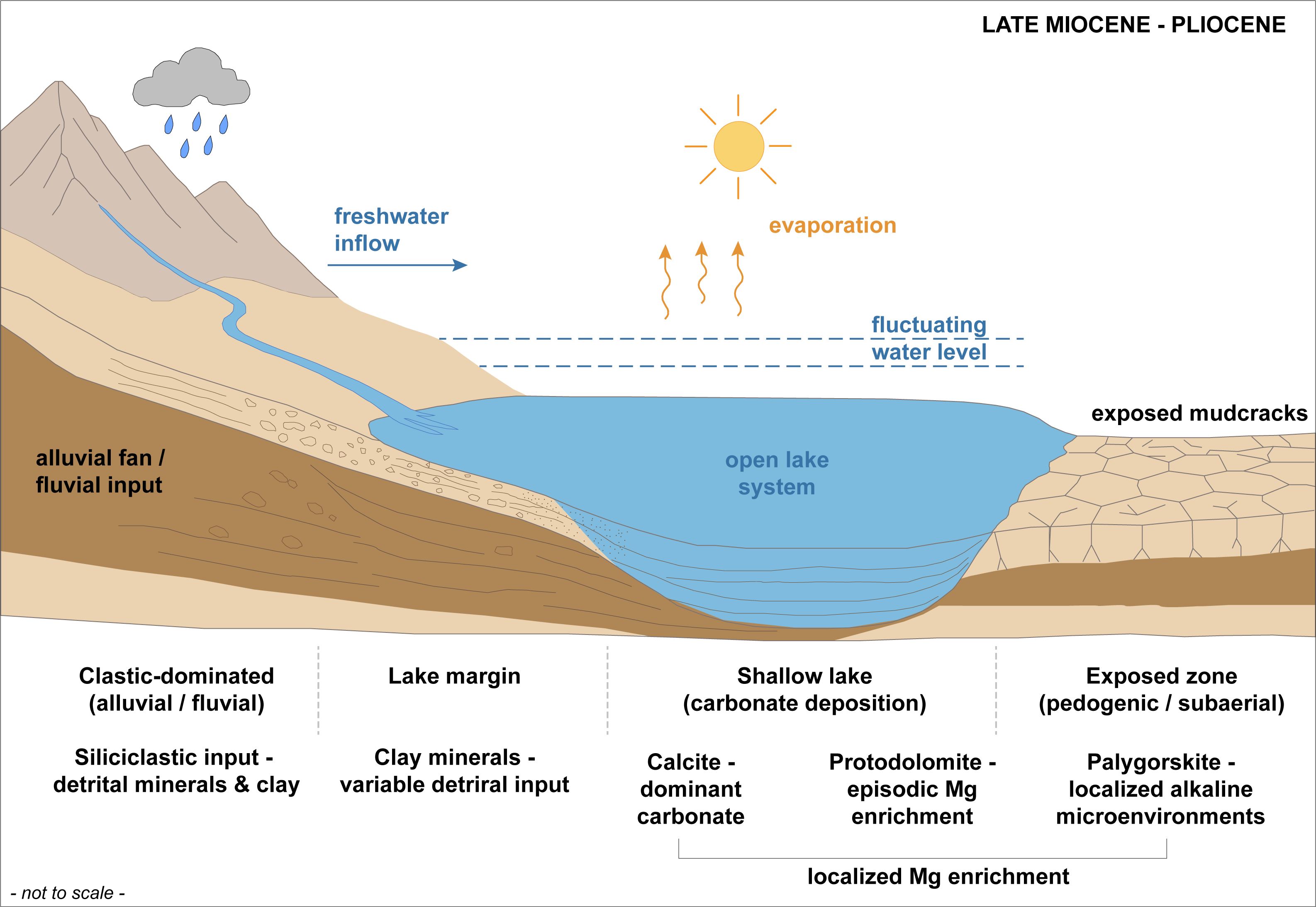
Marginal lacustrine systems are highly sensitive archives of hydrological fluctuations, climatic variability, and changes in sediment supply in continental basins. The Alagöz Formation (Late Miocene–Pliocene) exposed in the Haymana–Polatlı Basin, Central Anatolia, was investigated through integrated sedimentological, mineralogical, geochemical, and stable isotope analyses to constrain provenance, weathering history, and lacustrine hydrological variability. Facies analysis reveals a transition from alluvial–fluvial systems to a shallow marginal lacustrine environment subjected to short-term hydrological fluctuations. Mineralogical and geochemical data indicate that sedimentation occurred within a mixed carbonate–siliciclastic lacustrine system controlled by variable lake-water chemistry. Detrital mineral assemblages indicate contributions from metamorphic source rocks. Trace-element and REE signatures suggest derivation mainly from felsic-to-intermediate continental sources. Reworked carbonate fragments and fossil debris indicate recycling of older carbonate units. The occurrence of calcite, dolomite, and protodolomite reflects variable Mg/Ca ratios, whereas clay mineral assemblages record shifts between detrital input during relatively humid phases and chemically concentrated conditions. Palygorskite occurrence indicates localized and episodic alkaline conditions associated with short-lived evaporative concentration. Weathering indices (CIA, CIW, PIA, and ICV) suggest low-to-moderate chemical weathering and compositionally immature sediments, consistent with transitional humid to semi-arid climatic conditions. Trace-element systematics also indicate a minor mafic contribution to the detrital source. Stable isotope values (δ13C: −7.05‰ to +2.82‰; δ18O: −8.60‰ to −2.94‰ VPDB) and their weak correlation (r = 0.34) support a shallow, hydrologically dynamic lacustrine system dominated by freshwater input but episodically influenced by evaporative concentration. Taken together, the Alagöz Formation records a sensitive marginal lacustrine system shaped by short-term hydrological fluctuations. These findings provide a useful analog for understanding hydrologically sensitive marginal lacustrine systems developed in post-collisional continental basins under fluctuating semi-arid climatic conditions.
Keywords: lacustrine geochemistry; hydrological variability; protodolomite; palygorskite; carbon and oxygen isotopes; post-collisional continental basins lacustrine geochemistry; hydrological variability; protodolomite; palygorskite; carbon and oxygen isotopes; post-collisional continental basins
Graphical Abstract