Article

Geochemistry of Inertinite-Rich Coals from the Zhundong Coalfield, Xinjiang: Organic Compounds and Paleoenvironment Reconstruction


1
Jiangsu Key Laboratory of Coal-Based Greenhouse Gas Control and Utilization, Carbon Neutrality Institute, China University of Mining & Technology, Xuzhou 221008, China
2
Key Laboratory of Coalbed Methane Resources & Reservoir Formation Process, Ministry of Education, School of Resources and Geosciences, China University of Mining & Technology, Xuzhou 221116, China
3
Institute of Geology and Mining Engineering, Xinjiang University, Urumqi 830002, China
*
Authors to whom correspondence should be addressed.
Minerals 2026, 16(6), 574; https://doi.org/10.3390/min16060574
Submission received: 26 March 2026 / Revised: 12 May 2026 / Accepted: 25 May 2026 / Published: 27 May 2026

Abstract

Organic compounds in fossil fuels (coal, petroleum), particularly polycyclic aromatic hydrocarbons (PAHs), serve as significant molecular fossils to reveal paleoenvironments, paleoclimates, and major geological events and have become the focus of multidisciplinary research. Inertinite-rich coals are widely distributed in the Jurassic coal of Xinjiang, yet the organic geochemical significance and their paleoenvironment implications remain underexplored. This study elucidates the indicative significance of organic compounds in inertinite-rich coals from the Yihua mine of the Zhundong Coalfield, Xinjiang, China, aiming to reveal the coal-forming mechanisms and paleoenvironmental implications of Jurassic low-rank coals in the Zhundong Coalfield. A comprehensive analysis was conducted on 36 coal-seam samples, including maceral identification, vitrinite reflectance measurement, Soxhlet extraction, and GC-MS analysis of saturated and aromatic hydrocarbons. The results show the coal is dominated by inertinite (69.6%), with vitrinite (23.7%) and trace liptinite (0.7%), and classified as low-rank bituminous coal (Ro = 0.42%). Extractable organic matter yield is low (0.20%), with aromatic hydrocarbons (35.19%) far exceeding saturated hydrocarbons (10.57%). PAHs are dominated by high-ring (4–6 ring) compounds, such as benzofluoranthene and retene. The molecular geochemical parameters suggest these PAHs are primarily derived from biomass combustion, recording significant wildfire activity during the Middle Jurassic. Terpenoid biomarkers (cadalene and dehydroabietane) confirm terrestrial higher plant inputs, while isoprenoid parameters suggest an oxidizing coal-forming environment. This research demonstrates that organic compounds, especially PAHs, serve as reliable tracers for paleowildfires and inertinite genesis, providing critical geochemical evidence for understanding coal-forming processes in arid-semiarid regions.

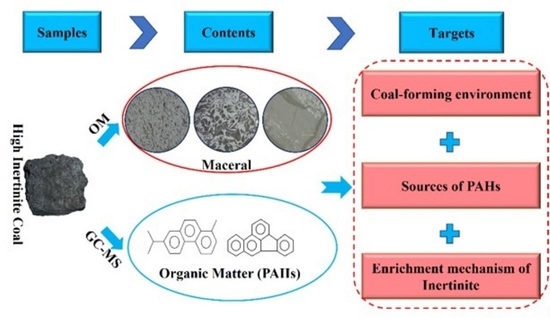
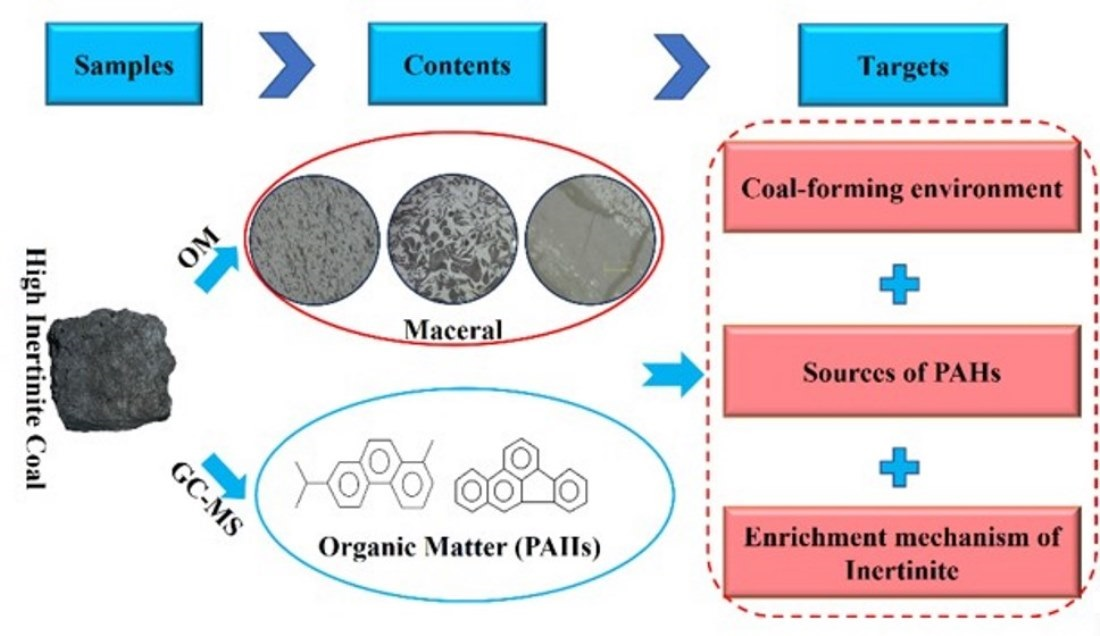
Graphical Abstract

1. Introduction

Coal is the world’s major energy source, with global coal production reaching a new record high of 182 EJ in 2024, surpassing the previous peak set in 2023, though the pace of growth slowed compared to the past three years [1]. In addition, global coal demand continued to grow in 2024, rising by 1% to reach 165 EJ [1]. Coal is one of the most complex geological materials, consists of organic and mineral matter [2,3,4]. As the fundamental constituent units of coal, macerals not only determine the physical and chemical properties of coal but also directly influence the methods and efficiency of its processing and utilization. Macerals are primarily derived from the biochemical and physicochemical changes undergone by the original coal-forming plant materials during peatification and coalification processes. Different macerals exhibit significant differences in their optical characteristics, chemical structures, and reactivity [5,6,7]. Inertinite and vitrinite mainly originate from lignocellulosic tissues, whereas liptinite generally derives from plant organs and resin, as well as degradation products of algae and microorganisms [2,3].
Variations in coal-forming precursors and sedimentary environments lead to significant differences in the distribution ranges of macerals in coal [2,3]. The distribution of macerals varies markedly among Chinese coals formed in different geological periods [8]. For instance, Paleogene and Neogene coals from the Cenozoic Era exhibit the highest vitrinite proportion, averaging over 85%, while the average proportion of vitrinite in Early and Middle Jurassic coals from the Mesozoic Era, and the Late Permian coals from the Late Paleozoic Era are 43.5% and 45.8%, respectively [8]. The highest proportion of inertinite is found in the Early and Middle Jurassic coals from the Mesozoic Era, followed by Early Carboniferous coals from the Late Paleozoic. The Late Carboniferous, Late Permian, and Early Permian coal also exhibit inertinite exceeding 30% [8]. In contrast, Paleogene and Neogene coals have the lowest inertinite contents, with the proportion of 1.6% and 2.1%, respectively. This indicates that inertinite is generally high in Chinese coals. For liptinite, its content is relatively highest in Late Permian coals from southern China (15.35%), while Paleogene and Neogene coals also contain over 10% liptinite [8]. The coals in Xinjiang, China, primarily formed during the Jurassic period, are characterized by notably high inertinite content, accompanied by a low vitrinite content, with liptinite content generally below 1% [9,10,11,12].
The origin of inertinite in coal has long been a hot topic in the field of coal geology research [13,14,15,16,17]. Currently, the causes of inertinite are mainly attributed to the following two viewpoints: oxidation origin and wildfire origin. The oxidation origin perspective holds that inertinite is formed by the intense oxidative alteration of organic matter during the peatification stage. During the oxidation process, water, oxygen, and hydrogen are lost, resulting in an increased carbon content. Most inertinite is formed by the slow oxidation of organic matter in peat swamps [2,3,4,14,18,19]. In contrast, the wildfire origin perspective holds that inertinite is the product of incomplete combustion of plants during wildfire events in the coal-forming peat swamps of geological history, with plant tissues or peat carbonized into fusain layers or lenses distributed within coal seams [19]. Scott [20] proposed that various inertinites, such as fusinite, semifusinite, macrinite, and inertodetrinite, are all associated with forest wildfires. Scott and Glasspool [21] further indicated that fusain in Carboniferous–Permian coals is closely linked to widespread wildfires during the Late Paleozoic. The perspective that inertinite in coal originates from incomplete combustion of ancient plants was initially met with skepticism. However, after more than two decades of debate, it has gained broad acceptance. Notably, Diessel [17] and Moroeng [22,23] reported that inertinite in coal is primarily formed through incomplete combustion of biomass fuels.
Polycyclic aromatic hydrocarbons (PAHs) are compounds with two or more benzene rings in their molecular structure and constitute a significant proportion of humic coals. The sources of PAHs in coal primarily include the diagenetic evolution of coal-forming plants, microbial degradation, and incomplete combustion of vegetation [24,25], all of which contain rich geochemical information. PAHs originating from vegetation combustion are mainly unsubstituted 3- to 6-ring compounds, whereas those formed through diagenetic evolution and microbial degradation are predominantly PAHs with side chains or substituted structures [24]. The combustion origin PAHs occur in low concentration in most sediments. However, when the content of PAHs in a certain stratum suddenly increases, it may indicate a paleowildfire event during the sedimentary period [25,26]. Higher combustion temperatures (500–650 °C) favor the formation of PAHs with a higher ring, which can provide the intensity of paleowildfires [27]. The formation temperature of PAHs ranges from 200 °C to 900 °C or even higher, which is wider than the temperature range for charcoal (200–600 °C) [28,29]. Therefore, PAHs can better indicate the existence of high-temperature combustion events compared to charcoal [24]. In addition, PAHs are not easily affected during the diagenetic process. Therefore, PAHs can serve as reliable evidence for indicating paleowildfires [24].
The Zhundong Coalfield is the largest intact coalfield in the world, characterized by abundant coal resources with predicted and proven reserves reaching 390 bt and 253.1 bt, respectively, including Wucaiwan, Xiheishan, Dajing, Jiangjunmiao, and Laojunmiao mining areas [30]. As a product of peatlands and an important sedimentary carrier, coal contains extensive geological information and records important paleoenvironmental, paleoclimatic, and paleo-event information from the geological history. In this study, the geological implication in such high inertinite coals from the Yihua mine, Zhundong Coalfield, Xinjiang, China, were comprehensively investigate. The maceral, saturated hydrocarbons, and aromatic hydrocarbons were thoroughly analyzed to reveal the coal-forming precursors, sedimentary environment, thermal maturity, and inertinite enrichment mechanism.

2. Geological Setting

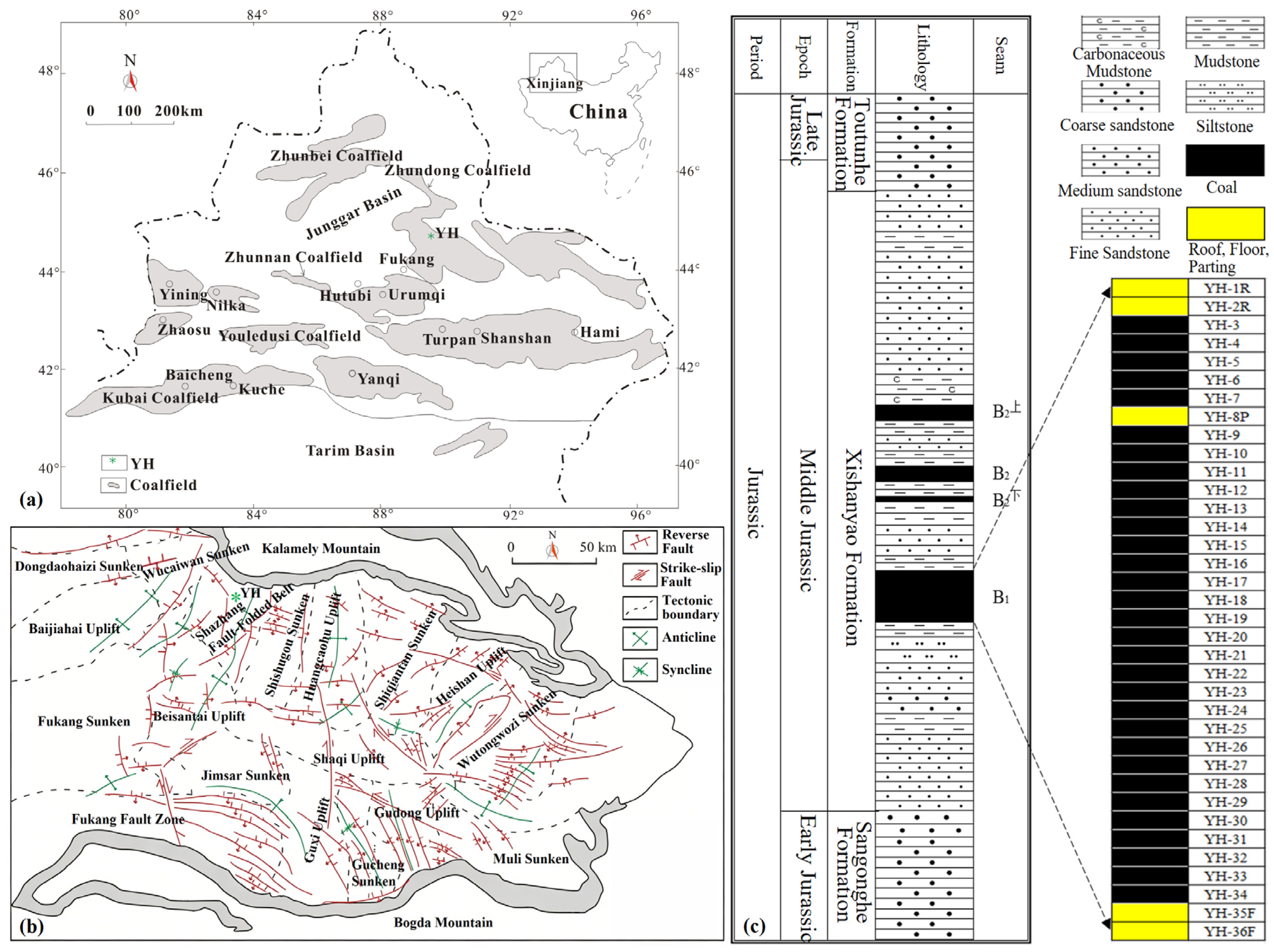
The Yihua (YH) coal mine in the Wucaiwan mining area of the Zhundong Coalfield is located in Jimsar county, Changji, Xinjiang Uygur Autonomous Region, northwest China (Figure 1a). The mining area has an average north–south surface boundary length of 6.31 km, an average east–west width of 6.51 km, and a total area of 44.84 km2. The Zhundong Coalfield is located in the eastern part of the Junggar Basin, with its geotectonic position lying on the southern margin of the suture zone between the Siberian Plate and the Kazakhstan–Junggar Plate. This region has mainly experienced the following four phases of tectonic movement: Late Hercynian, Indosinian, Yanshanian, and Himalayan [31]. Among these, after the formation of the Jurassic coal seams, the north–south and northeast–southwest compressional stresses during the Yanshanian orogeny had a significant reworking effect on the coalfield. Following this phase of tectonic movement, the basic structural framework of the Zhundong Coalfield was largely established. The Zhundong Coalfield is located in the eastern uplift of the Junggar Basin [32]. The tectonic outline map of the Zhundong Coalfield is shown in Figure 1b. The faults in the area are mostly located on the southern margin of the Kalamely Mountain and the northern margin of the Bogda Mountain, while fewer faults are developed in the central area. The faults are predominantly distributed near the boundaries of secondary tectonic units and exert a certain controlling influence on the uplift and sunken within the area [31]. In terms of fault nature, reverse faults dominate, with no normal faults present, and a small number of large-scale strike-slip faults are developed (Figure 1b). The faults are mainly oriented along the following three dominant directions: NS, NE, and NWW. The strike of these faults is closely related to the tectonic activities of various phases (Wang et al., 2023 [31]). The Yihua coal mine is located in the Shazhang fault-fold Belt and west of the Zhangpenggou anticline [33].
The strata in the Wucaiwan mining area are relatively well developed, with the main coal-bearing strata being the Jurassic. The strata revealed by boreholes in the mining area, from bottom to top, are as follows: the Middle–Late Triassic Xiaoquangou Formation, the Early Jurassic Badaowan Formation (J1b) and Sangonghe Formation (J1S), the Middle Jurassic Xishanyao Formation (J2X), the Middle–Late Jurassic Shishugou Formation (J2–3S), the Early Cretaceous Tugulu Formation (K1tg), the Pliocene Dushanzi Formation of the Neogene (N2d), and the Quaternary System (Q4) [34]. The coal-bearing stratum of the Zhundong Coalfield includes the Early Jurassic Badaowan Formation and Middle Jurassic Xishanyao Formation (J2X). The Middle Jurassic Xishanyao Formation (J2X) is the main coal-bearing stratum in the mining area, with the lithology dominated by sandstone, siltstone, mudstone, carbonaceous mudstone, and coal seams (Figure 1c). An extremely thick coal seam (B1) was well developed in the Xishanyao Formation, with an average thickness of 68 m [32].

3. Sample Collection and Experimental Methods

The Middle Jurassic Xishanyao Formation is the main coal-bearing stratum in the Zhundong Coalfield, Xinjiang, China. The coal samples were collected from the B1 coal seam of the Middle Jurassic Xishanyao Formation, which has a large thickness, locally reaching up to 70 m. Following the Chinese standard method GB/T 482-2008 [35], a total of 36 samples, including 2 roof (marked with R), 31 coals, 1 parting (marked with P), 2 floor (marked with F) samples, were collected from the Yihua coal mine in the Wucaiwan mining area of the Zhundong Coalfield. The collected samples were numbered as YH-1R, YH-2R, YH-3 to YH-7, YH-8P, YH-9 to YH-34, YH-35F, and YH-36F from top to bottom of the B1 coal seam. The roof and floor of the coal seam are dark gray mudstone, and a thin carbonaceous mudstone parting is present in the middle to upper part of the coal seam. Each coal sample was split into two equal sub-samples; one sub-sample was crushed to 18–40 mesh for preparation of polished grain mounts for maceral and reflectance analysis. The other sub-sample was crushed to 200 mesh for Soxhlet extraction. This ensures that petrographic and geochemical analyses were performed on representative splits of the same parent coal. The proximate analysis data of the Yihua samples are listed in Table A1.
About 2 g of 18–40 mesh sample was placed in a Φ2.5 cm polytetrafluoroethylene mold. A fixed 3:1 ratio of epoxy resin to curing agent was mixed and stirred until no bubbles remained. Then, the epoxy resin-curing agent mixture was poured into the polytetrafluoroethylene mold containing coal samples. After the sample was thoroughly mixed with the epoxy-resin-curing agent, it was labeled and placed in a vacuum chamber until fully cured. The grain mounts were successively grinded and polished using three different mesh sandpapers (600 mesh, 2000 mesh, and 4000 mesh) and 0.05 μm alumina solution. The polished grain mounts are used for the measurement of reflectance and the observation of maceral. According to the Chinese standard method GB/T 6948-2008 [36], the vitrinite reflectance of coals were measured using a Zeiss MPV-SP microphotometer (Carl Zeiss AG, Oberkochen, Germany). The sapphire (0.594%) was selected as a reflectance standard. According to the Chinese standard method GB/T 8899-2013 [37], the composition of maceral was observed and counted using Zeiss Axio Imager M1m polarizing microscope (Carl Zeiss AG, Oberkochen, Germany).
Approximately 15 g of 200 mesh coal samples were used for the Soxhlet extraction experiment. The coal samples, wrapped in filter paper, were placed into a flat-bottomed flask. Then, dichloromethane was added and the mixture was extracted at 45 °C for 48 h. Subsequently, the extracts were filtered, concentrated by a rotary evaporator, and washed and placed into a cell flask. The extracts were evaporated to a constant weight in the fume cupboard. About 30 mg of extracted organic matter was weighed into a heart-shaped bottle, and dichloromethane was added to dissolve it. Activated silica gel was added to the heart-shaped bottle, and the mixture was rotarary evaporated to quicksand-like granular form. The extract was separated into three fractions, including saturated, aromatic, and polar and asphaltene fractions by column chromatography using hexane, dichloromethane, and methanol, respectively. The saturated and aromatic hydrocarbon fractions obtained from group component separation were analyzed using gas chromatography-mass spectrometry (GC-MS, Agilent 7890B-5977A, Agilent Technologies Inc., Santa Clara, CA, USA), with squalane as the internal standard. The temperature program was set from 80 °C to 300 °C at a rate of 4 °C/min, with an initial hold at 80 °C for 5 min and a final hold at 300 °C for 15 min.

4. Results

4.1. Coal Petrology Characteristics

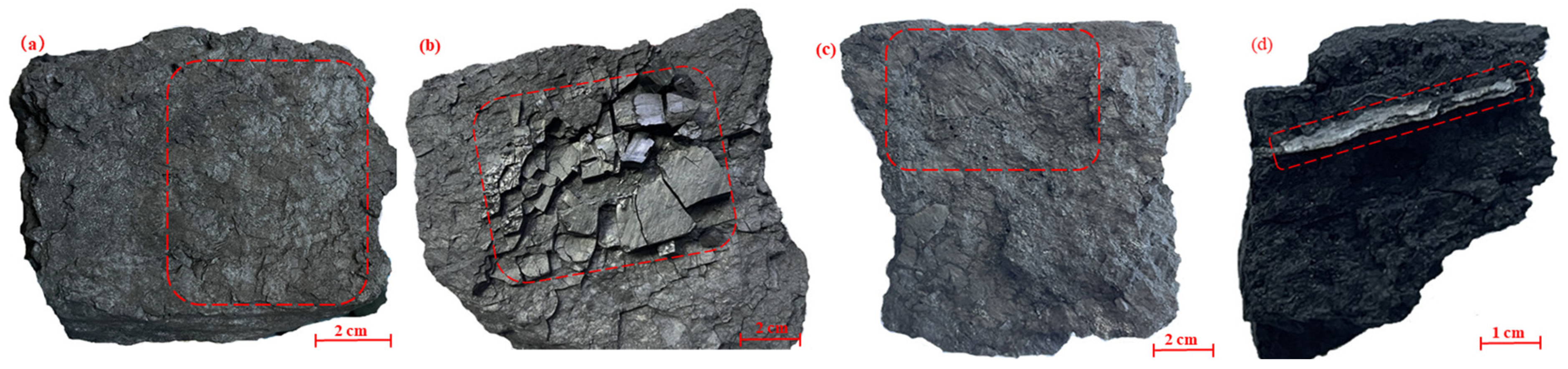
The macroscopic coal petrologic characteristics of the Yihua coals are mainly semi-dull coal and dull coal. The coal samples are hard, black to grayish-black in color, with a silky luster, and exhibit massive or banded structures. Thin, layered silky-lustered and fibrous-structured fusain is commonly observed in the coal samples, resembling charcoal in appearance, with a grayish-black to black color, loose, soft and porous texture, and brittle, easily fragmented nature (Figure 2a). These occur as intermittent, flat lenticular bodies, generally a few millimeters thick, within the coal seam. Some layered coals contain vitrain or clarain bands, which are uniform in texture, exhibit strong luster (Figure 2b), and are easily crushed into angular fragments. In addition, plant fossils and minerals are commonly found in coals (Figure 2c,d), with the minerals mainly occurring as calcite veins. The upper part of the coal seam is dominated by dull coal, the middle part by semi-dull coal and bright coal, and the lower part by semi-dull coal.
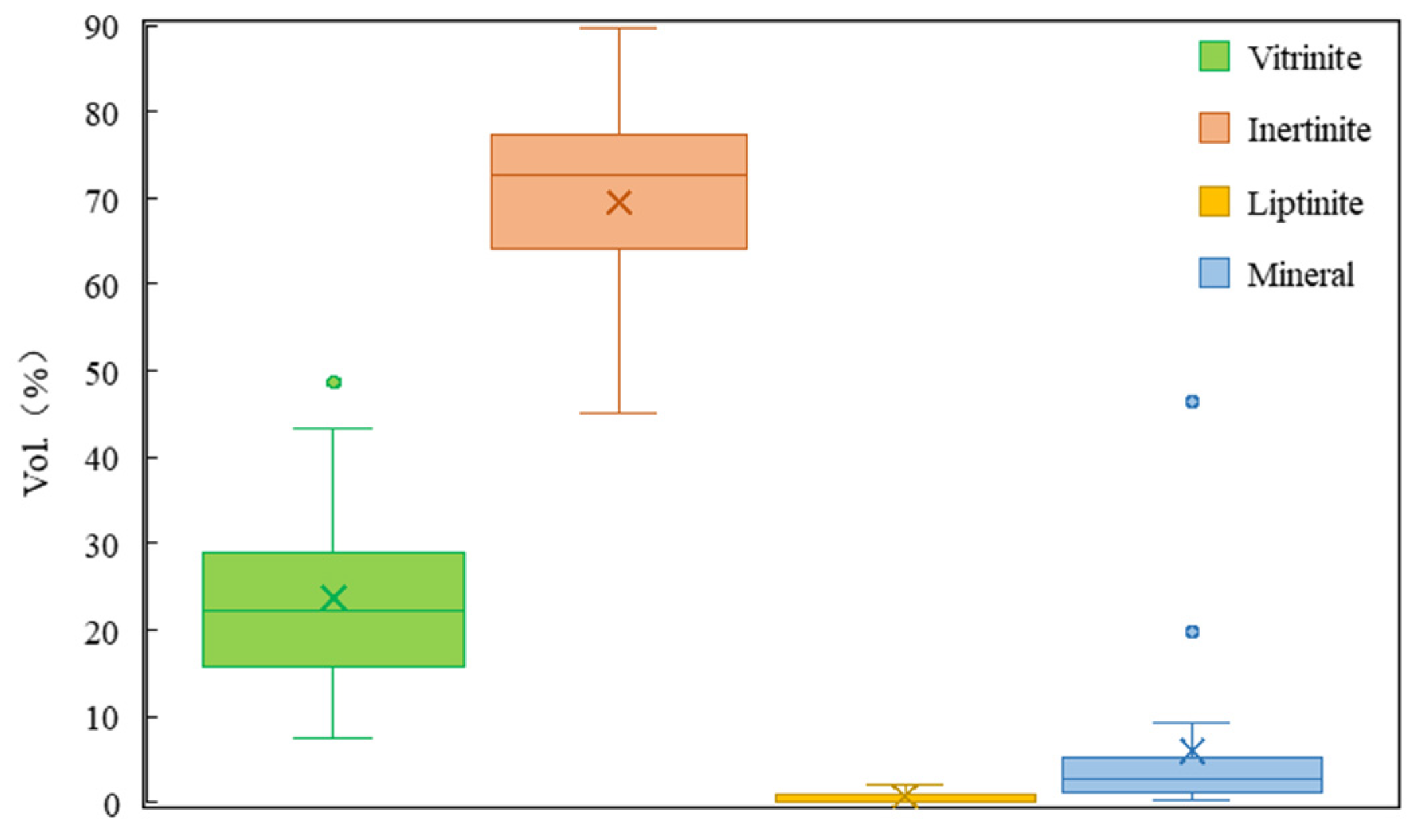
The vitrinite reflectance of the Yihua coals range from 0.31% to 0.50%, with a mean value of 0.42% (Table 1), indicating that it is a low-rank bituminous coal. The volume proportion of maceral and minerals of the Yihua coals were listed and drawn in Table 1 and Figure 3. The inertinite in the Yihua coal ranges from 45.0% to 89.6%, with an average of 69.6%; vitrinite ranges from 7.5% to 48.6%, with an average of 23.7%; liptinite ranges from 0% to 2.2%, with an average of 0.7%; and minerals ranges from 0.2% to 46.5%, with an average of 6.0%. The maceral composition of the Yihua coals is dominated by inertinite, which is consistent with the characteristic of Jurassic low-rank coals in the northwestern China being generally rich in inertinite [9,10,11,12].
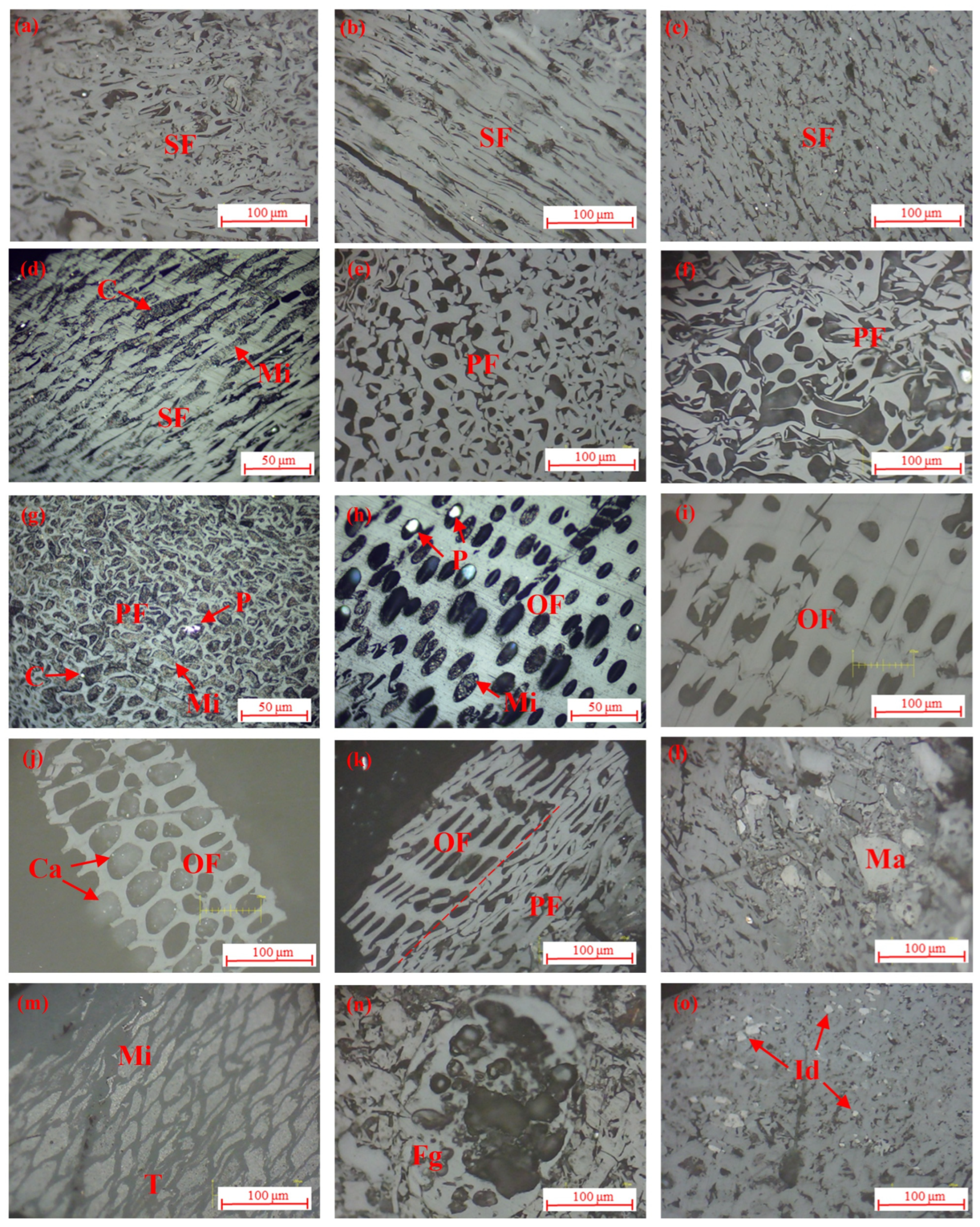
Inertinite is predominantly composed of semifusinite, fusinite, and inertodetrinite (with average contents of 39.2%, 16.1%, and 10.0%, respectively). The proportion of macrinite and micrinite are relatively low (averaging 2.9% and 1.4%, respectively). Additionally, funginite was observed in certain stratified samples (e.g., YH-3, YH-4, YH-11, YH-15, YH-19, and YH-32). Semifusinite is formed through weak fusainization, characterized by poorly preserved plant cell structures and relatively pronounced swelling of cell walls. The cell lumens are only partially visible or appear indistinct (Figure 4a–d), and some semifusinite lumens are filled with micrinite and clay minerals (Figure 4d). The plant cell structure of fusinite in the coal is well-preserved (Figure 4e–k). Pyrofusinite largely retains the pre-combustion structure of plants, often being compressed and fragmented into “stellate” or “arc-shaped” forms (Figure 4e–g). Its cell lumens may be filled with micrinite, as well as clay minerals and pyrite. The cell lumens of oxyfusinite are infilled with macrinite, pyrite, and calcite (Figure 4h–j). The adjacent occurrence of pyrofusinite and oxyfusinite (Figure 4k) suggests that the lignocellulosic tissues of the coal-forming plants were simultaneously affected by oxidation and wildfires [5,38]. Macrinite exhibits a particle size greater than 30 µm, with relatively distinct protrusion (Figure 4l). Micrinite is characterized by finer particle sizes (generally <2 µm) and predominantly fills the cell lumens of telinite, fusinite, and semifusinite (Figure 4d,g,m). Funginite originates mainly from fungal remains such as spores, hyphae, and sclerotia, appearing light gray or white under the microscope (Figure 4n). Inertodetrinite occurs as fine, irregular particles dispersed among macerals, typically representing fragments of fusinite, semifusinite, macrinite, and other macerals (Figure 4o).
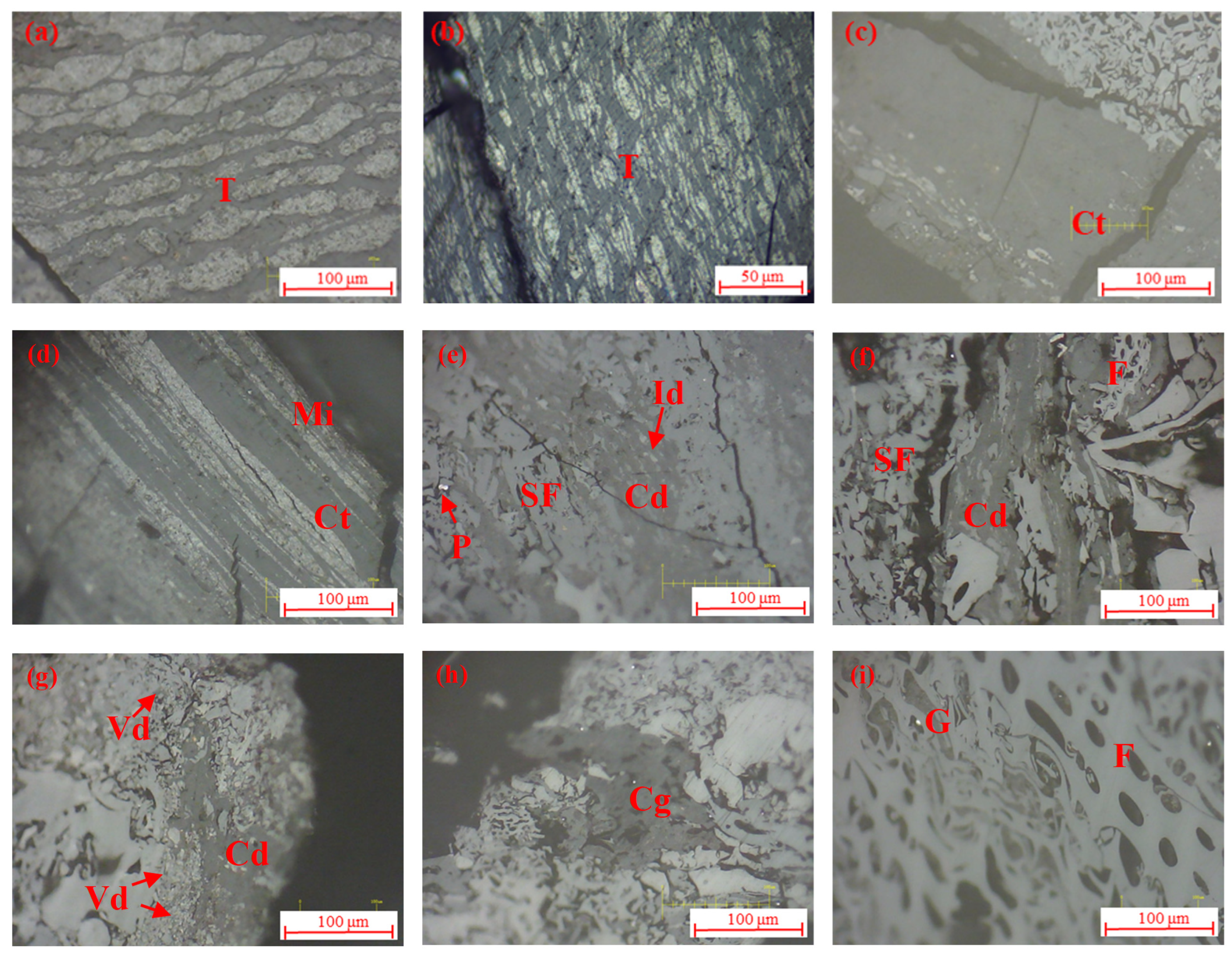
The vitrinite in the Yihua coal is dominated by collodetrinite (average: 16.9%), followed by telinite and collotelinite (4.5% and 2.0%). Vitrodetrinite, corpogelinite, and gelinite are present in certain stratified samples (Table 1). Telinite displays recognizable plant cell walls and cell structures under the microscope (Figure 4m and Figure 5a), with its cell lumens often filled with micrinite. Meanwhile, due to the swelling and deformation of plant cell walls, telinite with poorly preserved or even disappearance cell structures are also observed (Figure 5b). Collotelinite occurs in bands and lenses of varying widths, exhibiting a clean and homogeneous surface (Figure 5c,d). Due to intense gelification of the coal-forming materials, it lacks cellular structure. Collodetrinite has no fixed shape and primarily acts as a cementing agent for various other macerals or minerals, such as semifusinite, fusinite, inertodetrinite, micrinite, and pyrite (Figure 5e,f). Vitrodetrinite occurs as dispersed and irregularly shaped with a particle size generally less than 10 μm, which have suffered strong gelification prior to or after transportation and deposition (Figure 5g). Corpogelinite is only observed in a few samples, exhibiting a slightly protrusions and internal homogeneity (Figure 5h). Gelinite is commonly found filling the cell cavities of plant tissues or other voids (Figure 5i). It typically originates from the humic gel produced during the early diagenetic stage of plant material or from precipitated colloids filling the cavities and fractures [2,4,6].
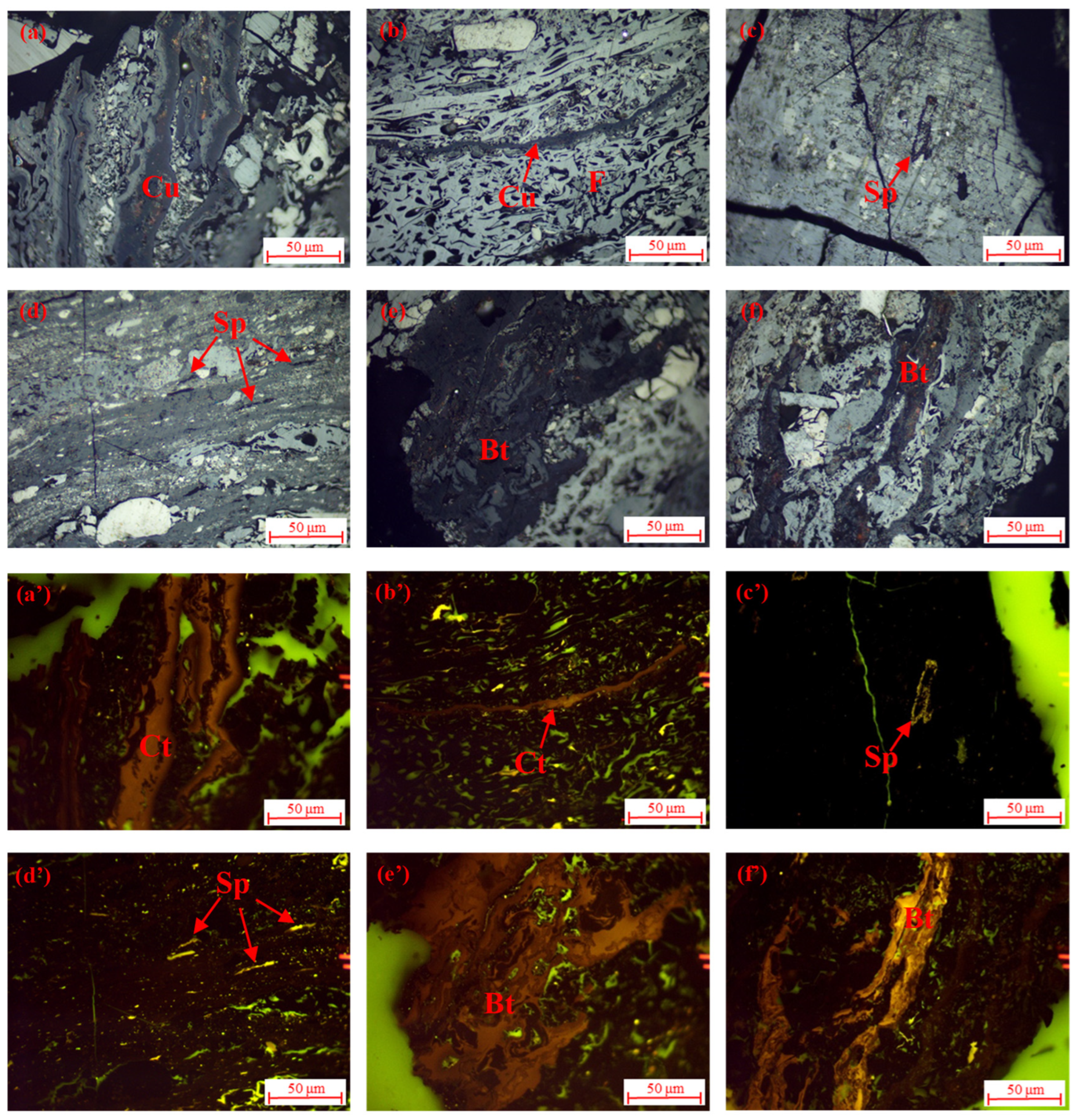
Liptinite typically appears dark gray to black under oil-immersion reflected white light (Figure 6). Liptinite, including cutinite, sporinite, and bituminite, were observed under the microscope in some coal samples. Cutinite appears as elongated bands with distinct serrations under the microscope (Figure 6a,b,a′,b′). A small amount of sporinite is present in the coal, generally not exceeding 50 μm in length (Figure 6c,d,c′,d′). It appears as closed, flattened, and elongated circular shapes in the parallel cross-sections. Bituminite occurs in the form of bands, irregular textures, and vein structures under the microscope (Figure 6e,f,e′,f′).

4.2. Composition of Extractable Organic Matter

The Soxhlet extraction and separated fraction data of the Yihua coal samples are presented in Table 2. Overall, the extraction yield of extractable organic matter (EOM) from the coal samples are relatively low, ranging from 0.11% to 0.31% (average: 0.20%), which is attributed to the low vitrinite reflectance (0.42%) of the sample. This is consistent with the result that the extraction rate of organic matter from coal samples first increases rapidly with the increase in vitrinite reflectance, then reaches the maximum (about 1.6%) when the vitrinite reflectance is approximately 0.9%, and finally decreases rapidly with the further increase in vitrinite reflectance [39]. The proportion of saturated hydrocarbons in the organic matter ranges from 7.05% to 14.56% (average: 10.57%), while the proportion of aromatic hydrocarbons ranges from 24.65% to 51.80% (average: 35.19%). The proportion of aromatic hydrocarbons is significantly higher than that of saturated hydrocarbons, resulting in a low ratio of saturate to aromatic hydrocarbon (average: 0.31), which reflects that the coal-forming precursor is mainly terrestrial higher plants, corresponding to the fact that the coal sample from Yihua Coal Mine in Zhundong Coalfield is humus coal [38,40]. The total hydrocarbon proportion (saturated and aromatic hydrocarbons) ranges from 35.13% to 61.55% (average: 45.75%). Overall, it is slightly lower than that of polar compounds and asphaltenes. Approximately 54.25% of the polar and asphaltene components were eluted from the extractable organic matter, indicating potential for further hydrocarbon generation [41]. The relatively high proportion of polar compounds and asphaltenes in the organic matter also reflects the early evolution stage and low maturity of the coal sample [42].

4.2.1. Saturated Hydrocarbons

The saturated hydrocarbons detected in the Yihua coals mainly include n-alkanes, isoprenoids, and terpenoids. The gas chromatogram of n-alkanes and isoprenoids are shown in Figure 7. The geochemistry parameters of saturated hydrocarbons are listed in Table 3.
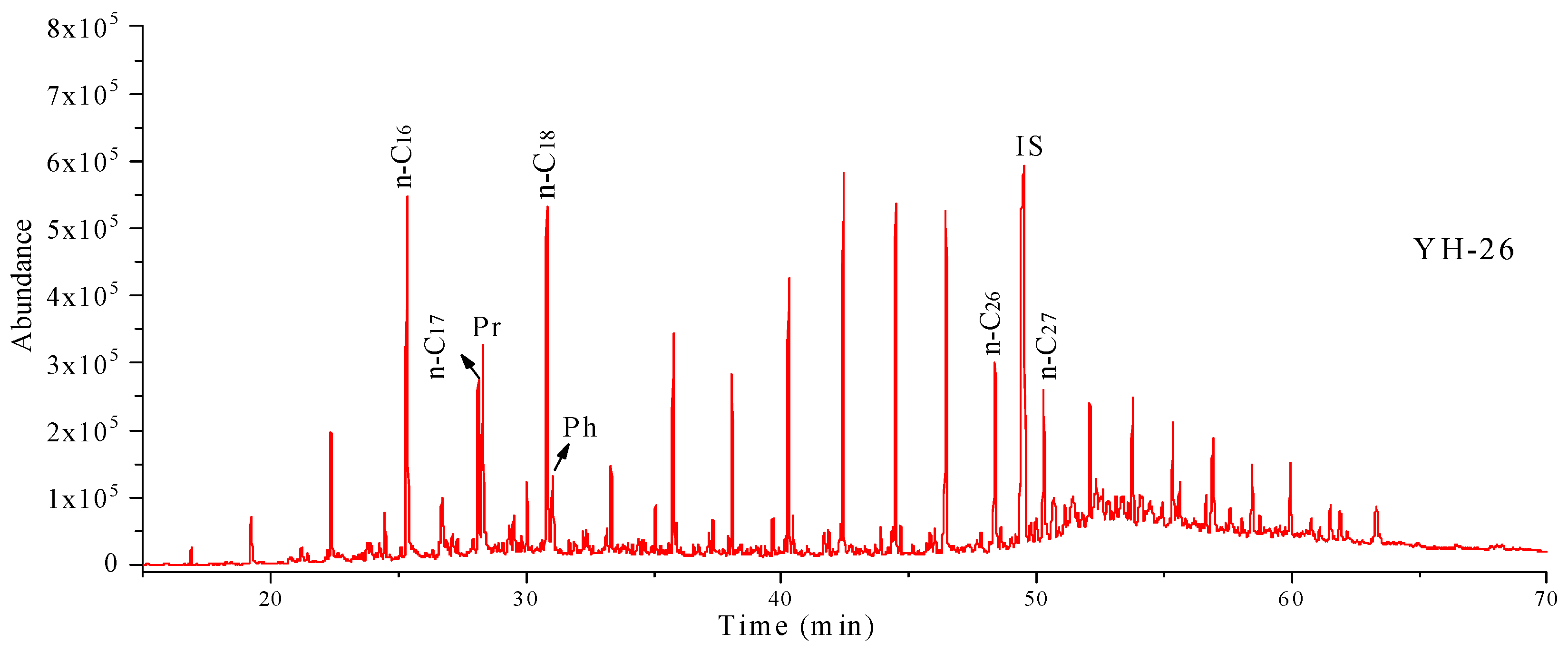
The carbon numbers of n-alkanes in the Yihua coal range from C13 to C34, with a bimodal distribution dominated by C16 and C28 as the main peak carbon numbers, indicating that the coal-forming plants primarily originated from lower aquatic organisms such as lacustrine swamp algae, and terrestrial higher plant inputs. The average values of the light/heavy component ratio of n-alkanes, such as C21/C22+ and (C21 + C22)/(C28 + C29), are 1.31 and 1.38, respectively, with a slight predominance of lower carbon number n-alkanes, further suggesting the co-input of lower aquatic organisms and higher plants. This result appears to contradict the conclusion of ratio of saturated to aromatic hydrocarbon, which predominantly indicates higher plant input. The discrepancy may be attributed to significant bacterial biodegradation, which converted higher carbon number alkanes into lower carbon number alkanes, as supported by the hump phenomenon within the 50–60 min of the gas chromatograms (Figure 7).
The odd–even predominance index (OEP) is commonly used to assess the maturity of organic matter [40,43,44]. During the coal-forming process, organic matter undergoes degradation under thermal effects, microbial activities, and bacterial actions, leading to the preferential degradation of odd-numbered carbon n-alkanes [45]. An OEP value close to 1 indicates higher maturity of organic matter. The OEP values of n-alkanes in Yihua coal are 0.57 and 0.66, respectively, indicating a significant even carbon predominance. Combined with a vitrinite reflectance of 0.42% for the coal samples, which classifies it as low-rank coal, this suggests a low thermal maturity of the organic matter. In addition, pristane (Pr) and phytane (Ph) are relatively typical isoprenoid hydrocarbon biomarkers, and the ratios of geochemical parameters of Pr/Ph, Pr/n-C17, and Ph/n-C18 are listed in Table 3.
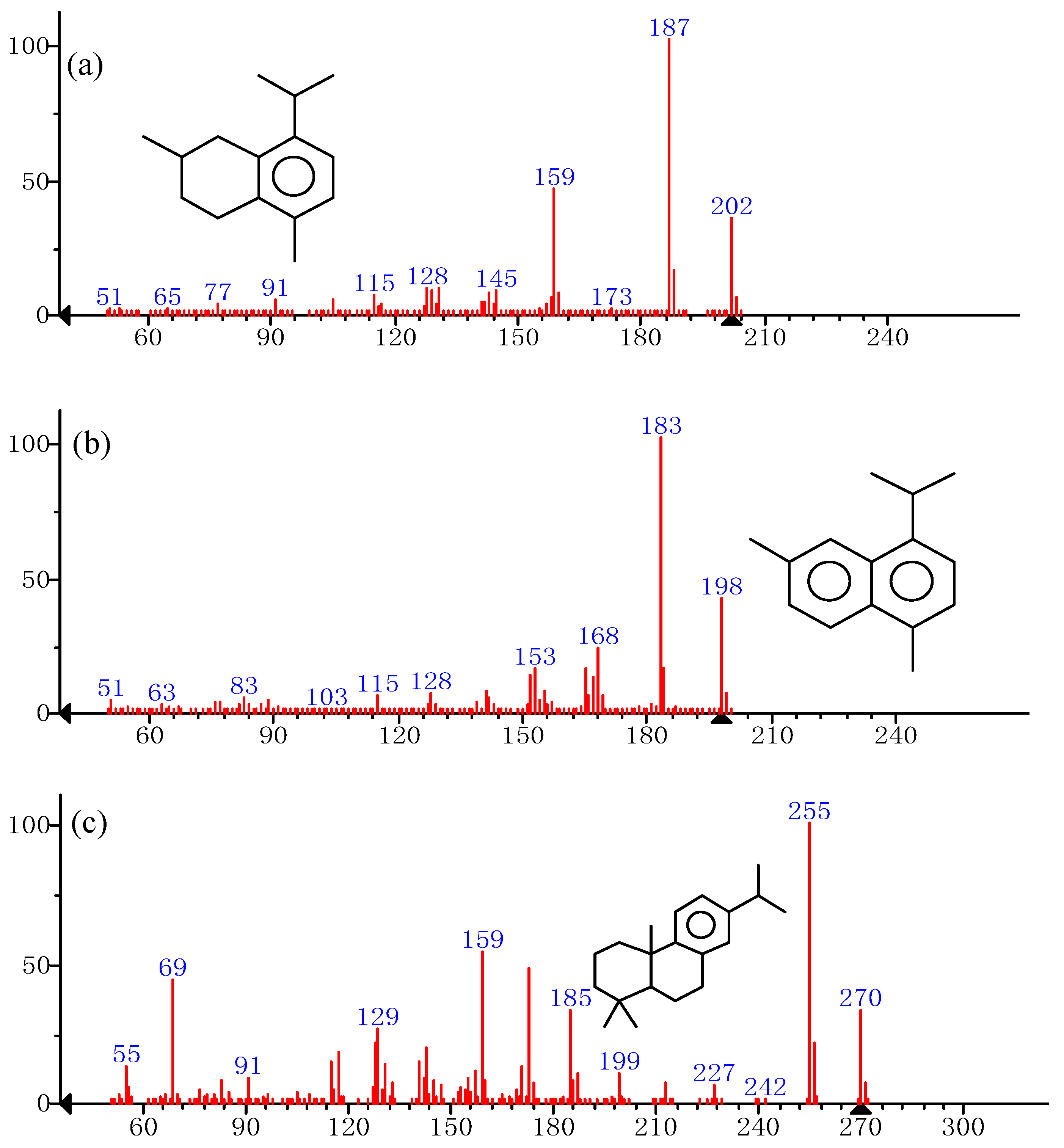
Terpenoid compounds detected in the Yihua coal primarily include sesquiterpenoids (tetrahydrocadalene and cadalene) and diterpenoids (dehydroabietane) (Figure 8). Both tetrahydrocadalene and cadalene possess a cadinane skeleton and are relatively common biomarker compounds derived from terrestrial higher plants. Cadalene primarily originates from the dehydrogenation of β-cadinene in the resins of coniferous higher plants. Alternatively, it may form through the diagenetic evolution of natural products such as cadinol [45]. Tetrahydrocadalene serves as an intermediate product in the evolution of cadinane-type sesquiterpenoids, while cadalene represents the final product at the evolutionary stage. The co-occurrence of tetrahydrocadalene and cadalene in the Yihua coal indicates a terrestrial higher plant origin for the coal-forming vegetation and suggests a relatively low maturity. Dehydroabietane possesses the basic skeleton of abietane and is a product formed through the diagenetic evolution of abietic acid, primarily derived from the resins of coniferous plants. Dehydroabietane serves as a biological precursor in the evolutionary pathway of abietane-type compounds, further confirming the terrestrial higher plant origin of the organic matter and the low maturity.

4.2.2. Polycyclic Aromatic Hydrocarbons

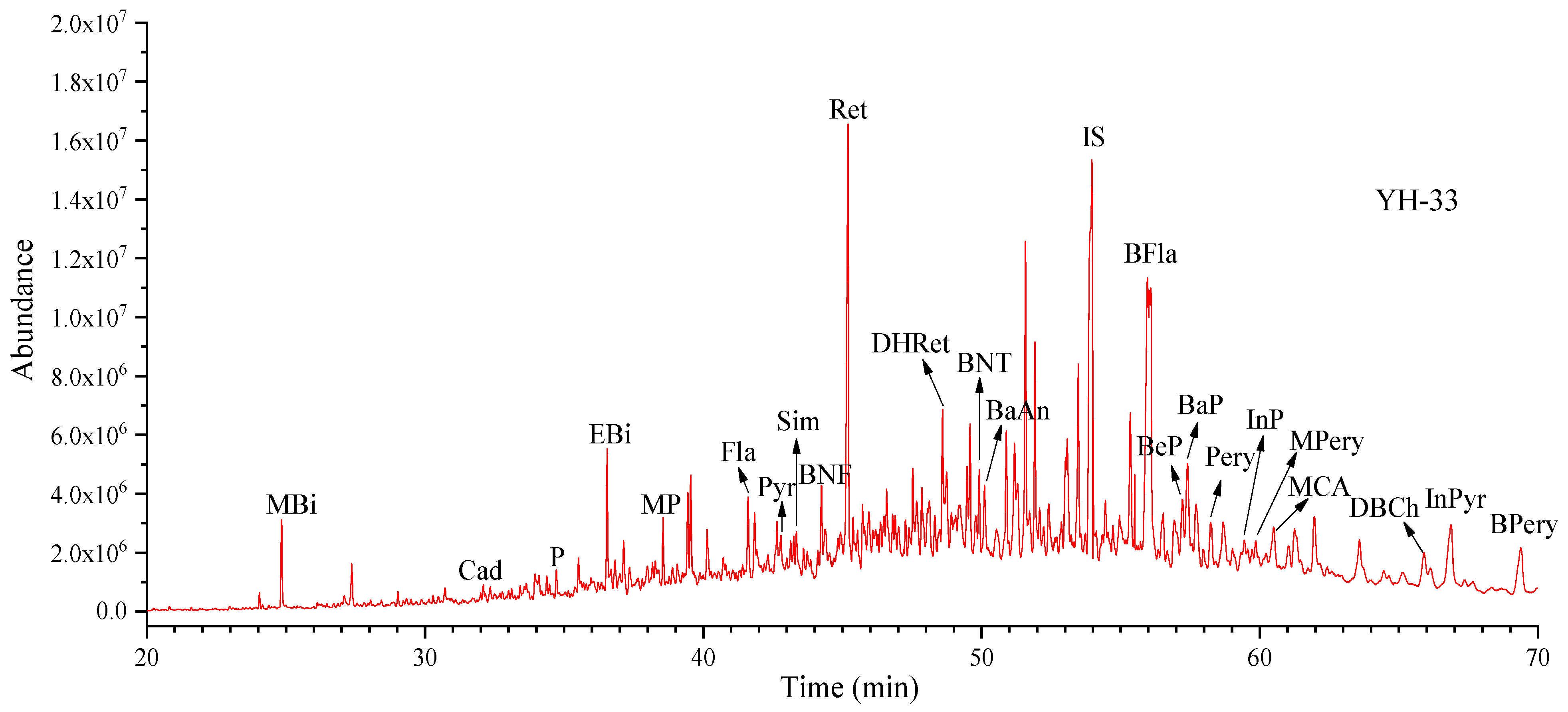
The polycyclic aromatic hydrocarbons identified in the Yihua coal from the Zhundong Coalfield primarily include methylbiphenyl (MBi), phenanthrene (P), methylphenanthrene (MP), fluoranthene (Fla), pyrene (Pyr), simonellite (Sim), retene (Ret), cadalene (Cad), dihydroretene (DHRet), benzo[a]anthracene (BaAn), chrysene (Ch), benzo[b/k/j]fluoranthene (BFla), benzo[e]pyrene (BeP), benzo[a]pyrene (BaP), perylene (Pery), indenophenanthrene (InP), methylperylene (Mpery), methylcholanthrene (MCA), dibenzochrysene (DBCh), indeno[c,d]pyrene (InPyr), benzo[g,h,i]perylene (BPery), benzodibenzofuran (BNF), dinaphthofuran (DNF), and benzodibenzothiophene (BNT) (Figure 9). Their relative abundances are listed in Table 4.
Polycyclic aromatic hydrocarbons (PAHs) in coal are predominantly composed of the benzofluoranthenes and retenes, with average abundances of 21.62% and 19.41%, respectively. The five-ring benzofluoranthenes includes benzo[b]fluoranthene, benzo[k]fluoranthene, and benzo[j]fluoranthene, which typically co-elute as a three-peak cluster. The retenes are important biomarkers, comprising retene and dihydroretene, with average abundances of 11.33% and 8.08%, respectively. The abundance of the five-ring benzopyrenes is 9.69%, consisting of benzo[e]pyrene (5.29%) and benzo[a]pyrene (4.40%). Fluoranthene, a four-ring compound, accounts for 5.64%. The phenanthrenes constitutes a significant proportion, with an average proportion of 8.35%, including phenanthrene and four methylphenanthrene isomers. The proportion of three-ring compound simonellite is 5.26% in coals. The relative abundances of other PAHs are all below 5%, including benzo[a]anthracene (3.72%), pyrene (3.15%), chrysene (3.04%), indeno[c,d]pyrene (1.73%), perylene (1.27%), methylbiphenyl (1.07%), benzo[g,h,i]perylene (1.03%), and cadalene (0.84%). Additionally, oxygen-containing (benzodibenzofuran, dibenzonaphthofuran) and sulfur-containing (benzodibenzothiophene) heterocyclic compounds were detected, with relative abundances of 7.16%, 4.18%, and 2.18%, respectively.

5. Discussion

5.1. Coal-Forming Environment

The reconstruction of paleo-peat swamp sedimentary conditions and the revelation of the coal-forming paleoenvironment for the Middle Jurassic Xishanyao Formation coal in the Yihua Mine of the Zhundong Coalfield can be achieved through coal facies parameters, including the vitrinite/inertinite ratio (V/I), the frame/matrix macerals ratio (F/M), the tissue preservation index (TPI), the gelification index (GI), the vegetation index (VI), and the groundwater index (GWI) (Equations (1)–(6), Table 5).
The V/I serves as an indicator of climatic humidity and water-table conditions in peat swamps during coal formation, and is categorized into the following four types: dry–extremely dry with fire-prone (V/I < 0.25), humid–weakly submerged (0.25 < V/I < 1), highly humid–submerged (1 < V/I < 4), and strongly submerged environment (V/I > 4) [46]. The V/I values range from 0.11 to 0.96 (average: 0.37) in the Yihua coal of the Zhundong Coalfield, indicating that the coal-forming environment was characterized by either fire-prone or humid–weakly submerged conditions. The F/M is used to indicate the degree of plant cell structure destruction as well as the intensity of swamp water flow activity. The F/M ratio greater than or less than 1 suggests a stagnant environment with weak water flow activity and a flowing water environment with strong water flow activity [47]. Due to the high proportion of fusinite and semifusinite, the Yihua coals exhibit relatively high F/M ratios (average: 2.33), reflecting a weak flow activity in the peat swamp.
V/I = virtinite/inertinite
F/M = (telinite + collotelinite + semifusinite + fusinite)/(collodetrinite + vitridetrinite + inertodetrinite + macrinite)
TPI = (telinite + collotelinite + semifusinite + fusinite)/(collodetrinite + inertodetrinite + macrinite)
GI = (virtinite + macrinite)/(semifusinite + fusinite + inertodetrinite)
VI = (telinite + collotelinite + semifusinite + fusinite + funginite)/(collodetrinite + vitridetrinite + inertodetrinite + cutinite)
GWI = (gelinite + corpogelinite + inertodetrinite + clay)/(telinite + collotelinite)
Diessel [48] first proposed and applied the TPI and GI indices to high-rank coals. Subsequently, these indices were adapted for low-rank coals and lignites by Kershaw et al. [49], Markic and Sachsenhofer [50], Kalaitzidis et al. [51], and Bechtel et al. [52]. The GWI and vegetation index (VI) were first introduced by Calder et al. [53] for paleomire characterization in hard coals. Later, Kershaw et al. [49], Kalaitzidis et al. [51], and Bechtel et al. [52] applied these two indices, with slight modifications, to tertiary low-rank coals and lignites.
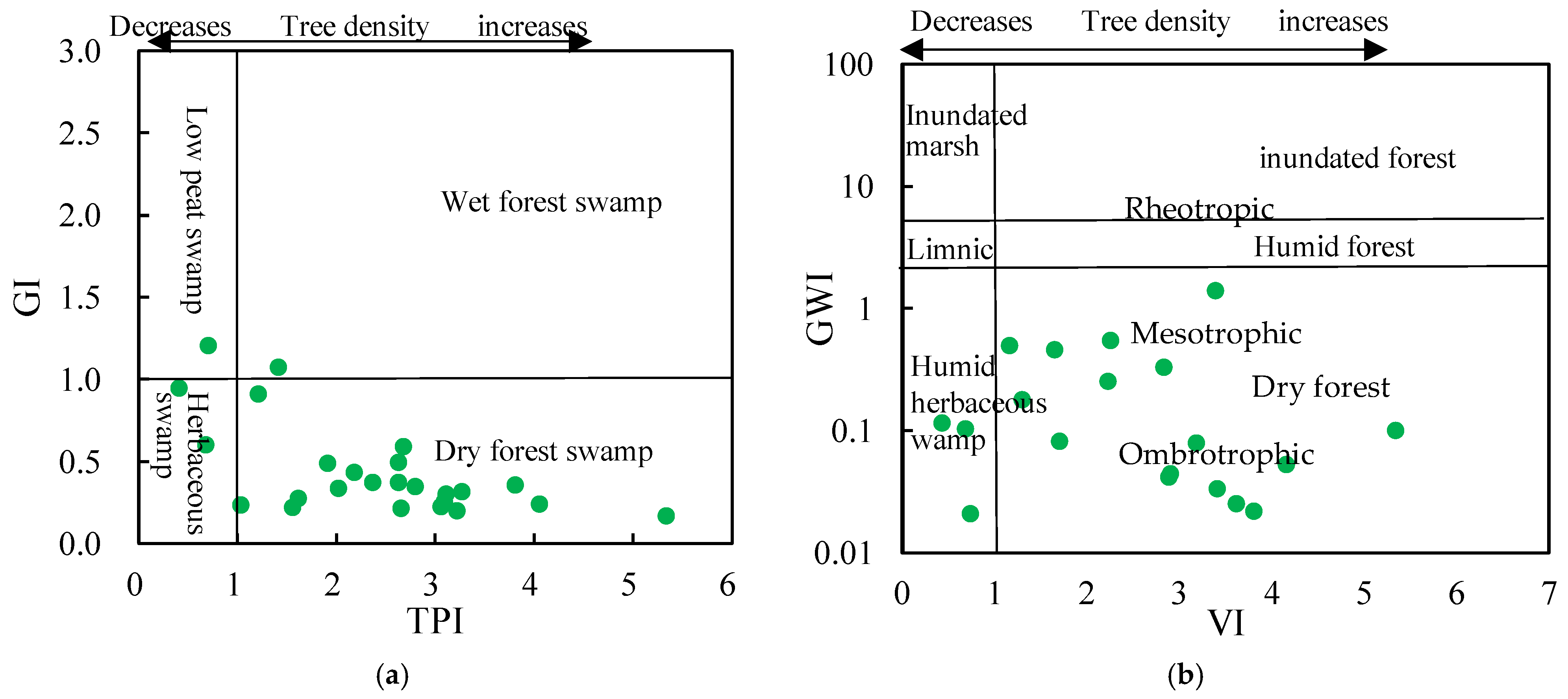
The GI can reflect the wetness or dryness of a peat swamp, while the TPI indicates the degree of tissue degradation and structural preservation [48,49,50,51,52]. The GI–TPI relationship (Figure 10a) shows that the Yihua coals fall into a group characterized by high TPI and low GI, representing a relatively dry forest swamp with well-preserved plant cell structures. Furthermore, the TPI can serve as a parameter for distinguishing between fern-dominated swamps (TPI < 0.7) and gymnosperm-dominated swamps (TPI > 0.7). The high TPI values also suggest that the peat swamp was a relatively dry swamp dominated by gymnosperms. The GWI and VI can reveal the water-table of peat accumulation and the type of precursor vegetation, respectively [49,51,52,53,54]. Based on the GWI–VI relationship (Figure 10b), the Yihua coals belong to the high VI and low GWI group, suggesting that the coal-forming plants in the peat swamp were predominantly woody vegetation, and that the peat swamp was a dry forest swamp with low-to-moderate nutrient levels.
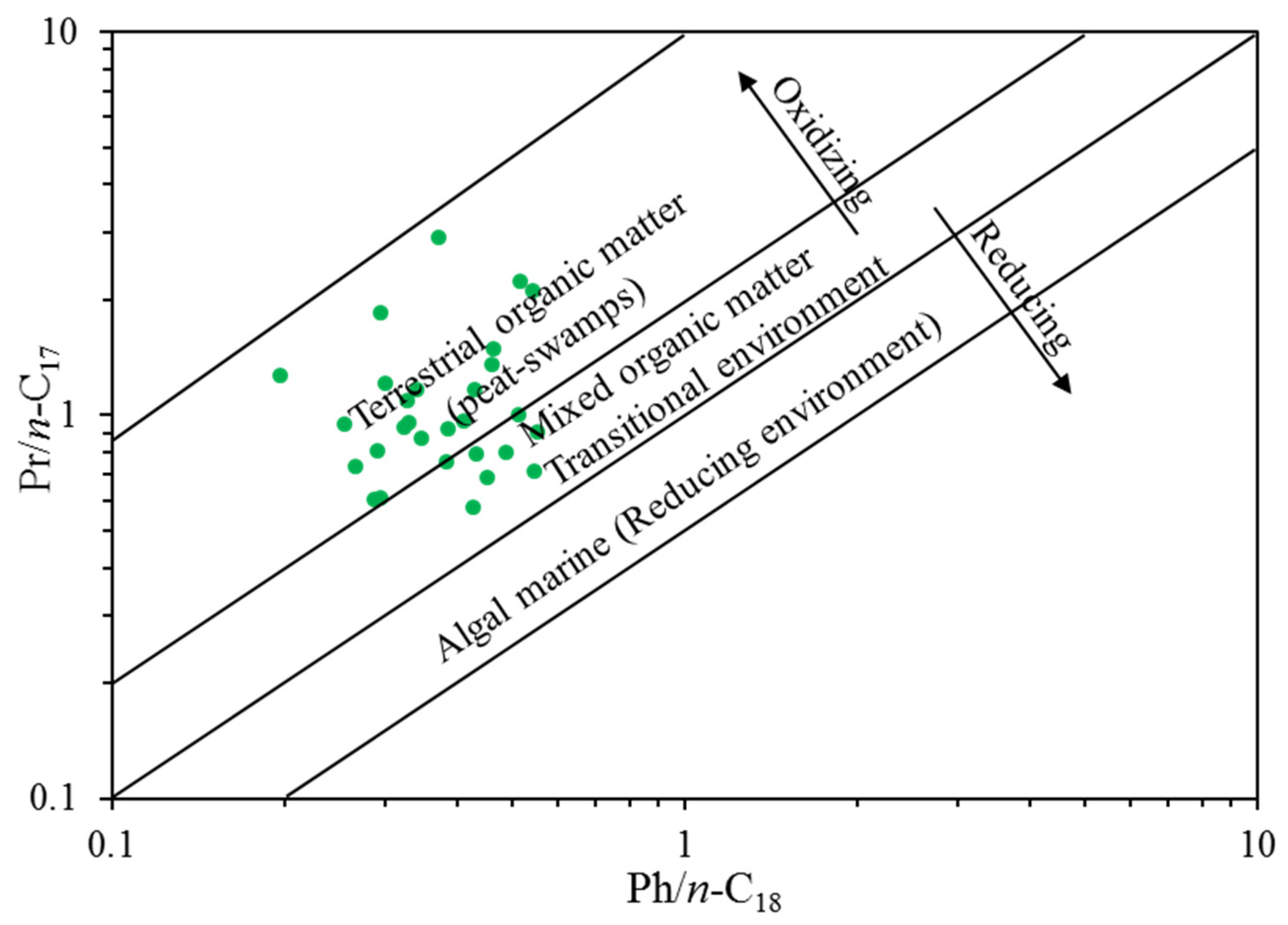
The Pr/Ph ratio is commonly used to reflect the redox conditions of the coal-forming environment and the degree of organic matter evolution [55]. The Pr/Ph ratio initially increases with the rise of vitrinite reflectance, reaching its maximum value (7–10) when the vitrinite reflectance is approximately 0.8%. Beyond this point, the ratio gradually decreases as vitrinite reflectance continues to increase [56]. The coal-forming parent materials dominated by terrestrial plants exhibit relatively high Pr/Ph ratios [57]. The average Pr/Ph ratio in the Yihua coal is 2.03, indicating that the coal-formation environment was a relatively oxidized environment and that there was a significant contribution from terrestrial plants. Furthermore, the ratios of Pr/n-C17 and Ph/n-C18 also can reflect the types of coal-forming plants and the coal-forming redox environment (Figure 11) [58,59]. The ratios of Pr/n-C17 and Ph/n-C18 range from 0.58 to 2.90 (average: 1.12) and 0.20 to 0.55 (average: 0.32), respectively. Overall, the content of n-C17 is comparable to that of pristane, while n-C18 is higher than phytane. The relationship diagram between Pr/n-C17 and Ph/n-C18 indicates that the coal-forming precursors is mainly derived from terrestrial higher plants, and the peat swamp was an oxidizing environment.

5.2. Sources of Polycyclic Aromatic Hydrocarbons

Due to the diversity of substrate types, pathways, and formation conditions of polycyclic aromatic hydrocarbons (PAHs), different PAH sources produce distinct molecular distribution patterns. Compared with the high-maturity samples of the Yueliangtian Mine (Ro = 1.01%) and Songhe Mine (Ro = 1.21%) in Guizhou, Moxinpo Mine (Ro = 1.41%) and Zhongliangshan Mine (Ro = 1.46%) in Chongqing, and Gequan Mine (Ro = 2.09%) in Hebei Province [38,40,60,61], the Yihua coals from the Zhundong Coalfield exhibit significantly higher proportions of high-ring PAHs such as benzofluoranthene, benzopyrene, and fluoranthene, and low or undetectable levels of PAHs such as phenanthrene, naphthalene, and biphenyl series. In contrast, the naphthalene and biphenyl series account for nearly 50% or even more than 60% of the total identified PAHs in higher maturity coals. The higher proportion of high-ring PAHs in organic matter holds significant implications for their sources.
The PAHs produced by combustion are predominantly high-molecular-mass or high-ring PAHs, whereas petroleum-related PAHs are characterized by a large number of alkylated homologues and low-molecular-mass compounds [62]. The proportion of isomeric compounds varies depending on their sources [63]. For instance, fluoranthene and pyrene are preferentially formed over their isomers anthracene and phenanthrene during incomplete combustion [64]. Based on these differences, various molecular ratios are widely used to indicate the sources of polycyclic aromatic hydrocarbons (Table 6) [65].
Cadalene is an evolutionary product of cadinane-type sesquiterpenoids, while simonellite and retene are derived from the evolution of abietane-type diterpenoids. Therefore, caldene, retene, and simonellite can be regarded as products formed during the diagenetic evolution of sedimentary organic matter. Additionally, retene and cadalene can also serve as indicators of evidence for forest wildfires. Existing studies have shown that retene can be generated from the pyrolysis of resins during the low-temperature combustion of coniferous plants, and high proportions of combustion-derived retene have been identified in boundary strata from the Cretaceous and Paleogene periods [66,67]. The geochemical parameter Ret/(Ret + Ch) is commonly used to infer the source of fuel. When the ratio exceeds 0.8, this typically indicates that the fuel is derived from coniferous plants. In contrast, a ratio between 0.15 and 0.5 suggests that the fuel originates from coal or petroleum [65,68]. The mean value of Ret/(Ret + Ch) in the Yihua coal from the Zhundong Coalfield is 0.66, with most samples exhibiting a relatively higher ratio (above 0.5). This suggests that retene in the Yihua coal may originate from the combustion. Palynological evidence of coal samples from the Wucaiwan mining area of the Zhundong Coalfield indicate that the gymnosperms in this region are predominantly pine and cypress coniferous plants, accompanied by members of the Bennettitales and Cycad–Ginkgo groups [69]. Therefore, it is inferred that retene in the Yihua coal has the following dual sources: diagenetic evolution and combustion origin.
The PAHs formed by combustion can undergo alkylation during the late diagenetic evolution process. As a result, unstable PAHs may disappear during the diagenesis process, while compounds such as benzofluoranthene and benzopyrene exhibit strong antioxidant properties and remain relatively unaffected during the diagenetic processes [24]. Therefore, benzofluoranthene and benzopyrene are commonly regarded as biomarker compounds indicative of forest fires or coal fires. The benzofluoranthene (21.62%) and benzopyrene (9.69%) has higher proportions in the Yihua coals, reflecting the occurrence of combustion events in this region. Tetra- to hexacyclic PAHs, such as fluoranthene, pyrene, benzanthracene, benzopyrene, indenopyrene, and benzoperylene, are typically derived primarily from combustion processes, although they may also form during the diagenetic evolution process. The diagenetic and combustion origins of PAHs can be distinguished using some geochemical parameters based on isomer rations, such as Fla/Pyr, Fla/(Fla + Pyr), BaAn/(BaAn + Ch), and InPyr/(InPyr + BPery) [65]. Due to fluoranthene (Fla) being preferentially generated over its isomer pyrene (Pyr) under incomplete combustion conditions, a Fla/Pyr ratio (2.12) greater than one in the Yihua coal suggests a combustion origin of fluoranthene and pyrene. Furthermore, the ratio of Fla/(Fla + Pyr) exceeding 0.5, with an average of 0.65, also indicates a combustion origin (Table 4 and Table 5). The ratio of BaAn/(BaAn + Ch) ranges from 0.39 to 0.81, suggesting a biomass combustion origin for benzanthracene (Table 4 and Table 5). The average ratio of InPyr/(InPyr + BPery) is 0.57, indicating a combustion origin for the six-ring PAHs of indeno[1,2,3-c,d]pyrene and benzo[g,h,i]perylene. The ratio of Ring456-PAH/TPAH exceeds 0.5 (with an average of 0.65), further indicating the combustion origin of polycyclic aromatic hydrocarbons in the coal. In summary, the elevated levels of combustion-derived polycyclic aromatic hydrocarbons suggest the occurrence of relatively extensive forest wildfires in this region during the Middle Jurassic period.

5.3. Enrichment Mechanism of Inertinite

Inertinite-rich coal is widely distributed in Xinjiang, such as coals from the Junggar, Yili, and Turpan-Hamin basins. These coal-bearing basins possess abundant coal resources and constitute a major part of China’s coal resource exploitation and utilization. Chen et al. [10] conducted a petrological study on the Middle Jurassic Xishanyao Formation coal from the main exploration areas in the eastern Junggar Basin. The results indicate that the macerals in coals from these areas (Xiheishan, Wucaiwan, Dajing, Jijihu, and Lucaogou) are predominantly inertinite, with an average content ranging from 46% to 71%. According to Du [70], the maceral composition of coals from various exploration areas in the Junggar Basin shows that, except for the Heshuotuogai coal, which is primarily composed of vitrinite (62.2%), the inertinite content in other coals (Xiheishan, Wucaiwan, Dajing, and Jiangjunmiao) ranges from 50.5% to 70.2%. In the Yili Basin, coals from the Piliqing, Tengda, Nilka, and Honghaigou mining areas exhibit high inertinite proportion, with average values ranging from 48.7% to 68.3% [71,72,73]. In the Turpan–Hami Basin, the inertinite in coal from the Dananhu and Shaerhu mining areas are close to or exceeds 60% [70,74]. In this study, the inertinite of the Yihua coal from the Wucaiwan mining area reaches 69.6% on average. Overall, the Middle Jurassic Xishanyao Formation coal in Xinjiang is predominantly enriched in inertinite.
The paleoclimate during coal-forming periods can directly influence basin filling and the coal-forming process, playing a significant role in coal seam deposition. The Jurassic Period represents one of the typical greenhouse phases in geological history, during which atmospheric CO2 concentrations were approximately four times higher than today [75]. This period was marked by dramatic climatic changes, with significant fluctuations in temperature and humidity. During the early to middle Early Jurassic (Hettangian–Pliensbachian), the climate was warm and humid, shifting to hot and semi-arid in the late Early Jurassic (Toarcian). The early Middle Jurassic (Aalenian–Bajocian) returned to warm and humid conditions, while the late Middle Jurassic (Bathonian–Callovian) became hot and arid. The Late Jurassic (Oxfordian–Tithonian) was characterized by even hotter and more arid conditions [76]. The development and distribution of coal seams exhibit a symbiotic relationship with plant survival. Gymnosperms were most prosperous during the Jurassic period, primarily composed of cycads, ginkgoes, and conifers, and accompanied by true ferns among the pteridophytes. The Middle Jurassic represents a significant period for the formation of coal in northwestern China, characterized by abundant precipitation, a warm and humid climate, which was highly conducive to the growth of vegetation. By the late Middle Jurassic, coal-seam deposition within the basin had ceased, and the climate had become markedly drier. The Late Jurassic was characterized by extremely arid conditions, marking a transitional period in northwestern China from a warm and humid to a hot and arid climate.
The polycyclic aromatic hydrocarbons (PAHs) found in the low-rank coal of the Yihua mine, Zhundong Coalfield, differ in both type and relative abundance from those in high-maturity coals. They are characterized by a high proportion of high-molecular-weight, high-ring aromatic hydrocarbons, predominantly five-ring PAHs such as benzofluoranthene and benzopyrene. These are followed by four-ring PAHs, including fluoranthene, benzanthracene, and pyrene, along with minor amounts of six-ring PAHs (indenopyrene and benzoperylene). The PAHs sources analysis indicates that the more stable compounds, benzofluoranthene and benzo[a]pyrene, originate from forest fire combustion. Molecular geochemical parameters related to fluoranthene, benzanthracene, indenopyrene, and benzoperylene also point to a combustion origin. These combustion-derived PAHs provide evidence for the occurrence of paleowildfires. Combined with the warm and humid paleoclimate of the Middle Jurassic period, which promoted rapid plant growth, these conditions provided the essential prerequisites for the occurrence of forest wildfires.
The formation environments of vitrinite and inertinite are fundamentally different. Vitrinite requires waterlogged, reducing conditions with a high-water table, where plant tissues undergo gelification. Inertinite, however, forms under dry, oxidizing conditions, either through slow oxidative degradation or through rapid incomplete combustion during wildfires [16]. In the Yihua coals, the low vitrinite and high inertinite proportions indicate that the peat swamp was predominantly dry and oxidizing. This wet–dry–fire alternation can be explained by a combination of climatic seasonality and water-table dynamics. During wet phases, the swamp was waterlogged and reducing, promoting vitrinite formation via gelification. As the climate became drier or the water table dropped due to low recharge, the peat surface was exposed to air, leading to oxidation and desiccation. Dry plant matter accumulated and, under suitable conditions (e.g., thunderstorms), ignited, causing wildfires. These fires incompletely combusted the vegetation, producing fusinite, semifusinite, and combustion-derived PAHs. After a fire, the swamp surface was covered with charcoal and ash, but vegetation could recolonize during the next wet phase. Repeated cycles of wet–dry–fire–regrowth resulted in the accumulation of thick, inertinite-dominated coal seams with only minor vitrinite. The overall paleoenvironment remained oxidizing, as further supported by the high Pr/Ph ratio and coal facies parameters (low GI and high TPI).
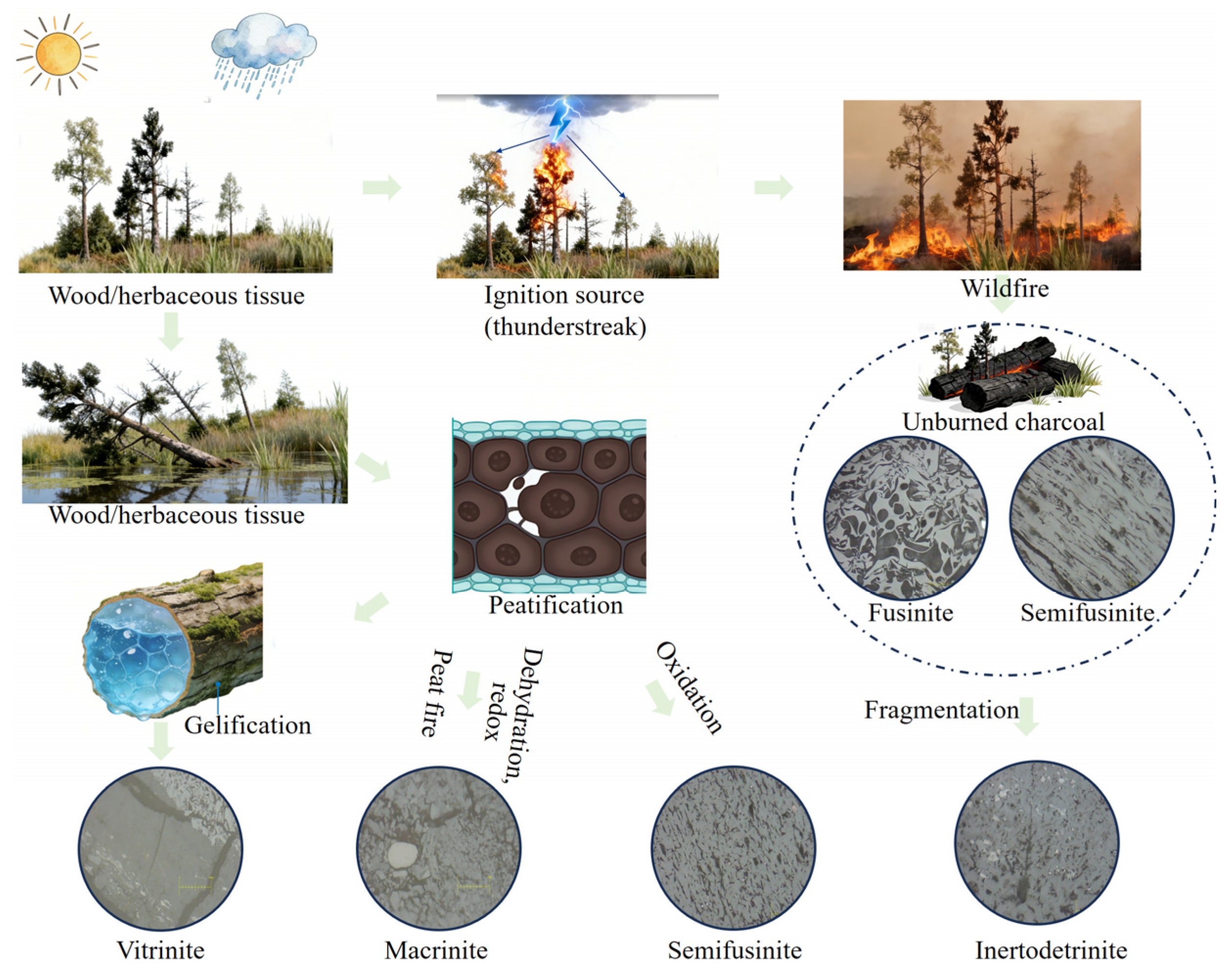
The evolution pathways of macerals in coal are illustrated in Figure 12. Oxyfusinite refers to fusinite that has undergone strong oxidation and derives from incompletely combusted charcoal. Pyrofusinite serves as direct evidence of forest wildfires combustion. Semifusinite can be attributed to both oxidation and forest wildfires, whereas macrinite is associated with microbial activity. Inertinite is predominantly composed of semifusinite and fusinite in the Yihua coals, with average contents of 39.2% and 16.1%, respectively. Based on the analysis of isoprenoid hydrocarbon parameters, the coal-forming environment of the Yihua coal is interpreted as oxidizing. The presence of abundant fusain layers observed in macroscopical coal petrology, the high homogenization degree of fusinite cell walls, and the combustion origin of PAHs collectively indicate the occurrence of forest wildfires during the Middle Jurassic. The origin of macrinite includes flocculated humic matrix substances that undergo dehydration and redox processes during early peatification following a temporary water-table decline; metabolic products of fungi and bacteria; isolated aggregates derived from coprolites; and for low-rank coals, slow peat fires [5]. Inertodetrinite originates from plant tissues that have undergone fusinization and were subsequently broken down by mechanical fragmentation [77]. Overall, the inertinite in the Yihua coals during the Middle Jurassic primarily originated from the following two processes: oxidation and forest wildfire combustion.

6. Conclusions

This study systematically investigated the petrological and organic geochemical characteristics of inertinite-rich coals from the Middle Jurassic Xishanyao Formation in the Yihua mine, Zhundong Coalfield, Xinjiang, with a focus on the composition and indicative significance of organic compounds. Petrological analysis confirmed the coal is a low-rank bituminous coal with an average vitrinite reflectance of 0.42%, characterized by inertinite enrichment (69.6%), mainly semifusinite, fusinite, and inertodetrinite, consistent with the typical maceral composition of Jurassic coals in northwest China. Collodetrinite serves as an essential constituent of the vitrinite. In some coal samples, cutinite, sporinite, and bituminite has been identified.
Soxhlet extraction revealed low extractable organic matter yield (0.20%) and a predominance of aromatic hydrocarbons, with saturated hydrocarbon biomarkers (e.g., terpenoids) identifying terrestrial gymnosperm (coniferous) inputs as the primary coal-forming precursors, and isoprenoid ratios (Pr/Ph = 2.03) indicating an oxidizing peat swamp environment with weak hydrological activity. Polycyclic aromatic hydrocarbons (PAHs) were dominated by 4–6 ring combustion-derived compounds, with high abundances of benzofluoranthene, benzo[a]pyrene and retene, and molecular geochemical ratios all supporting extensive paleowildfires during the coal-forming period. Combined with paleoclimatic data, the high inertinite content in these coals is attributed to the dual effects of wildfire-induced incomplete combustion and oxidative alteration in the peat swamp.
This research clarifies the enrichment mechanism of inertinite in Xinjiang Jurassic coals and verifies the validity of organic compounds (especially PAHs) as geochemical tracers for paleowildfires and coal-forming environments. Future research can expand the sample scope to other coalfields in Xinjiang and combine sedimentary petrology and paleoclimatology to construct a comprehensive evolutionary model of inertinite-rich coal formation in northwest China. Additionally, further exploration of the geochemical behavior of PAHs during the low-rank coalification process can provide a more refined theoretical basis for paleoenvironmental reconstruction using coal organic geochemistry.

Author Contributions

Conceptualization, Q.L.; methodology, Q.L.; formal analysis, Q.L.; investigation, Q.L.; data curation, Q.L.; writing—original draft preparation, Q.L. and W.W.; writing—review and editing, Q.L. and W.W.; supervision, W.W.; funding acquisition, Q.L. and W.W. All authors have read and agreed to the published version of the manuscript.

Funding

This research was supported by the National Natural Science Foundation of China (nos. 42402176 and 42472236), the Major Science and Technology Special Project of Xinjiang Uygur Autonomous Region (no. 2022A03014), Key Project of the Natural Science Foundation of Xinjiang Uygur Autonomous Region (No. 2025D01D14), Jiangsu Province Coal-Based Solid Waste Resource Utilization “Small Team” Xinjiang-Aid Project (2025-15980), the Jiangsu Funding Program for Excellent Postdoctoral Talent (no. 2024ZB489), and the Fundamental Research Funds for the Central Universities (no. 2024QN11071).

Data Availability Statement

The original contributions presented in this study are included in the article.

Acknowledgments

We thank the editor and anonymous reviewers for their comments to improve the manuscript.

Conflicts of Interest

The authors declare no conflicts of interest.

Appendix A

Table A1. Proximate analysis of the Yihua samples, Zhundong Coalfield (%).
SampleMadAdVdafFCdSt,dSampleMadAdVdafFCdSt,d
YH-1R2.5583.8476.263.840.07YH-2011.163.5630.1467.380.41
YH-2R1.8283.9963.235.890.41YH-217.4112.7042.1950.470.24
YH-312.285.3430.3065.980.46YH-229.683.0832.2665.660.27
YH-413.326.2230.5265.160.44YH-2311.903.6430.0967.370.45
YH-512.324.3030.2366.770.18YH-2414.364.6730.4466.310.44
YH-613.023.7230.0967.300.13YH-2513.153.5732.7864.820.35
YH-710.416.5630.2765.150.68YH-2611.523.8434.7462.750.29
YH-8P0.9190.0862.363.730.93YH-275.8534.5244.0236.6519.08
YH-914.015.1929.4766.870.47YH-2811.186.1729.5266.131.80
YH-1012.387.9231.3063.261.71YH-2915.663.8432.9264.500.31
YH-115.7234.2772.7617.900.47YH-3013.027.0735.8559.610.99
YH-1214.585.7129.5866.400.66YH-3113.323.4037.9659.930.51
YH-1315.087.1130.7964.281.22YH-3214.416.4030.2265.311.24
YH-1412.703.6832.1465.360.23YH-3314.406.6831.6563.790.82
YH-156.2537.0352.7729.748.71YH-3414.466.4832.8062.851.52
YH-1613.045.4530.5065.710.74YH-35F9.7646.6943.7330.000.16
YH-177.7421.4543.3844.473.47YH-36F2.1683.8594.570.880.06
YH-1811.293.6530.2867.170.38Average
-coal
11.808.7434.6960.301.58
YH-1910.253.7233.3264.200.33

References

  1. Energy Institute. Statistical Review of World Energy, 74th ed.; Energy Institute: London, UK, 2025. [Google Scholar]
  2. Stach, E.; Mackowsky, M.-T.; Teichmüller, M.; Taylor, G.H.; Chandra, D.; Teichmüller, R. Stach’s Textbook of Coal Petrology, 3rd ed.; Gebrüder Borntraeger: Berlin, Germany, 1982; p. 535. [Google Scholar]
  3. Diessel, C.F.K. Coal-Bearing Depositional Systems; Springer: Berlin/Heidelberg, Germany, 1992; p. 721. [Google Scholar]
  4. Taylor, G.H.; Teichmüller, M.; Davis, A.; Diessel, C.F.K.; Littke, R.; Robert, P. Organic Petrology; Gebrüder Borntraeger: Berlin, Germany, 1998; p. 704. [Google Scholar]
  5. ICCP. The new inertinite classification (ICCP System 1994). Fuel 2001, 80, 459–471. [Google Scholar] [CrossRef]
  6. ICCP. The new vitrinite classification (ICCP System 1994). Fuel 1998, 77, 349–358. [Google Scholar] [CrossRef]
  7. Pickel, W.; Kus, J.; Flores, D.; Kalaitzidis, S.; Christanis, K.; Cardott, B.J.; Misz-Kennan, M.; Rodrigues, S.; Hentschel, A.; Hamor-Vido, M.; et al. Classification of liptinite-ICCP System 1994. Int. J. Coal Geol. 2017, 169, 40–61. [Google Scholar] [CrossRef]
  8. Li, W.H.; Chen, Y.F.; Chen, W.M.; Li, X.L. Distribution Features of Micro-Constituents for Coal in China Main Mining Area. Coal Sci. Technol. 2000, 28, 31–34. (In Chinese) [Google Scholar]
  9. Zhang, Y.H.; Bai, X.F.; Ding, H.; Wang, Y. The study on the relationship between the coal petrographic characteristics of Zhundongcoal field and the coal quality or the process performance. Coal Qual. Technol. 2016, 6, 1–6. [Google Scholar]
  10. Chen, X.W.; Zhuang, X.G.; Zhou, J.B.; Mina, A.; Ge, D.F.; Li, X.; Yang, S. Coal Quality and its Distribution of the Eastern Junggar Coalfield in Junggar Basin, Xinjiang. Xinjiang Geol. 2013, 31, 89–93. [Google Scholar]
  11. Jiang, Y.F.; Zhao, L.; Zhou, G.Q.; Wang, X.B.; Zhao, L.X.; Wei, J.P.; Song, H.J. Petrological, mineralogical, and geochemical compositions of Early Jurassic coals in the Yining Coalfield, Xinjiang, China. Int. J. Coal Geol. 2015, 152, 47–67. [Google Scholar] [CrossRef]
  12. Hou, Y.; Zhang, K.; Jin, X.; Xu, Y.; Xu, X.; Yan, X. Geochemical Characteristics and Paleoenvironmental Significance of the Xishanyao Formation Coal from the Xiheishan Mining Area, Zhundong Coalfield, Xinjiang, China. Minerals 2025, 15, 686. [Google Scholar] [CrossRef]
  13. Hower, J.C.; O’Keefe, J.M.K.; Watt, M.A.; Pratt, T.J.; Eble, C.F.; Stucker, J.D.; Richardson, A.R.; Kostova, I.J. Notes on the origin of inertinite macerals in coals: Observations on the importance of fungi in the origin of macrinite. Int. J. Coal Geol. 2009, 80, 135–143. [Google Scholar] [CrossRef]
  14. Hower, J.C.; O’Keefe, J.M.K.; Eble, C.F.; Raymond, A.; Valentim, B.; Volk, T.J.; Richardson, A.R.; Satterwhite, A.B.; Hatch, R.S.; Stucker, J.D.; et al. Notes on the origin of inertinite macerals in coal: Evidence for fungal and arthropod transformations of degraded macerals. Int. J. Coal Geol. 2011, 86, 231–240. [Google Scholar] [CrossRef]
  15. Hower, J.C.; Wagner, N.J.; O’Keefe, J.M.K.; Drew, J.W.; Stucker, J.D.; Richardson, A.R. Maceral types in Permian southern African coals. Int. J. Coal Geol. 2012, 100, 93–107. [Google Scholar] [CrossRef]
  16. Scott, A.C.; Glasspool, I.J. Observations and experiments on the origin and formation of inertinite group macerals. Int. J. Coal Geol. 2007, 70, 53–66. [Google Scholar] [CrossRef]
  17. Diessel, C.F. The stratigraphic distribution of inertinite. Int. J. Coal Geol. 2010, 81, 251–268. [Google Scholar] [CrossRef]
  18. Moore, T.; Shearer, J.; Miller, S. Fungal origin of oxidised plant material in the Palangkaraya peat deposit, Kalimantan Tengah, Indonesia: Implications for ‘inertinite’ formation in coal. Int. J. Coal Geol. 1996, 30, 1–23. [Google Scholar] [CrossRef]
  19. Han, D.X. Coal Petrology of China; China University of Mining and Technology Press: Xuzhou, China, 1996. (In Chinese) [Google Scholar]
  20. Scott, A.C. Coal petrology and the origin of coal macerals: A way ahead? Int. J. Coal Geol. 2002, 50, 119–134. [Google Scholar] [CrossRef]
  21. Scott, A.C.; Glasspool, I.J. The diversification of Paleozoic fire systems and fluctuations in atmospheric oxygen concentration. Proc. Natl. Acad. Sci. USA 2006, 103, 10861–10865. [Google Scholar] [CrossRef]
  22. Moroeng, O.M.; Wagner, N.J.; Brand, D.J.; Roberts, R.J. A Nuclear Magnetic Resonance study: Implications for coal formation in the (A) Witbank Coalfield, South Africa. Int. J. Coal Geol. 2018, 188, 145–155. [Google Scholar] [CrossRef]
  23. Moroeng, O.M.; Wagner, N.J.; Hall, G.; Roberts, R.J. Using δ15N and δ13C and nitrogen functionalities to support a fire origin for certain inertinite macerals in a No. 4 Seam Upper Witbank coal, South Africa. Org. Geochem. 2018, 126, 23–32. [Google Scholar] [CrossRef]
  24. Denis, E.H.; Toney, J.L.; Tarozo, R.; Anderson, R.S.; Roach, L.D.; Huang, Y. Polycyclic aromatic hydrocarbons (PAHs) in lake sediments record historic fire events: Validation using HPLC-fluorescence detection. Org. Geochem. 2012, 45, 7–17. [Google Scholar] [CrossRef]
  25. Nabbefeld, B.; Grice, K.; Summons, R.E.; Hays, L.E.; Cao, C. Significance of polyeyclic aromatic hydrocarbons (PAHs) in Permian/Triassicboundary sections. Appl. Geochem. 2010, 25, 1374–1382. [Google Scholar]
  26. Shen, W.J.; Sun, Y.G.; Lin, Y.T. Evidence for wildfire in the Meishan section andimplications for Permian-Triassic events. Geochim. Cosmochim. Acta 2011, 75, 1992–2006. [Google Scholar] [CrossRef]
  27. McGrath, T.E.; Chan, W.G.; Hajaligol, M.R. Low temperature mechanism for the formation of polycyclic aromatic hydrocarbons from the pyrolysis of cellulose. J. Anal. Appl. Pyrolysis 2003, 66, 51–70. [Google Scholar] [CrossRef]
  28. Conedera, M.; Tinner, W.; Neff, C.; Meurer, M.; Dickens, A.F.; Krebs, P. Reconstructing past fire regimes: Methods, applications, and relevance to fire management and conservation. Quat. Sci. Rev. 2009, 28, 555–576. [Google Scholar] [CrossRef]
  29. Lu, H.; Zhu, L.; Zhu, N. Polycyclic aromatic hydrocarbon emission from straw burning and the influence of combustion parameters. Atmos. Environ. 2009, 43, 978–983. [Google Scholar] [CrossRef]
  30. General Overview of Zhundong. Available online: https://www.xjzdkfq.cn/p163/zdgk/20250523/192065.html (accessed on 23 May 2025).
  31. Wang, M.; Ma, R.Y.; Shan, Y.D.; Yan, Y.C. Characteristics and coal-controlling effects of structures in the Zhundong coalfield. Coal Geol. Explor. 2023, 51, 95–103. (In Chinese) [Google Scholar]
  32. Wu, X.; Lü, N.; Feng, S.; Wang, W.; Tian, J.; Li, X.; Xadethan, H. Occurrence State and Genesis of Large Particle Marcasite in a Thick Coal Seam of the Zhundong Coal-field in Xinjiang. Minerals 2025, 15, 816. [Google Scholar] [CrossRef]
  33. Wang, Y.; Wang, W.; Wang, W.; Duan, P.; He, X.; Lu, Q. Distribution, Occurrence and Enrichment Causes of Sodium in Middle Jurassic Coal from Zhundong Coalfield, Xinjiang. Minerals 2024, 14, 146. [Google Scholar] [CrossRef]
  34. Chen, K.; Wang, W.K.; Li, C.B.; Zhang, Z.Z.; Cheng, W.Y.; Chu, C.M. Analysis of the hydrogeological conditions of No.1 coal mine in East Junggar basin coalfield. China Min. Mag. 2018, 27, 156–159. [Google Scholar]
  35. GB/T 482-2008; Sampling of Coal Seams. Chinese Management Committee of Standard Specifications: Beijing, China, 2008.
  36. GB/T 6948-2008; Method of Determining Microscopically the Reflectance of Vitrinite in Coal. Chinese Management Committee of Standard Specifications: Beijing, China, 2008.
  37. GB/T 8899-2013; Determination of Maceral Group Composition and Minerals in Coal. Chinese Management Committee of Standard Specifications: Beijing, China, 2013.
  38. Lu, Q.F.; Qin, S.J.; Wang, W.F.; Gao, K.; Xing, J. Geochemistry of Late Permian coals from the Moxinpo mine, Chongqing, Southwestern China: Emphasis on petrology, minerals, and organic matter. Appl. Geochem. 2023, 149, 105558. [Google Scholar] [CrossRef]
  39. Radke, M.; Schaefer, R.G.; Leythaeuser, D.; Teichmüller, M. Composition of soluble organic matter in coals: Relation to rank and liptinite fluorescence. Geochim. Cosmochim. Acta 1980, 44, 1787–1800. [Google Scholar] [CrossRef]
  40. Sun, Y.Z.; Qin, S.J.; Zhao, C.L.; Li, Y.; Yu, H.; Zhang, Y. Organic geochemistry of semianthracite from the Gequan Mine, Xingtai Coalfield, China. Int. J. Coal Geol. 2013, 116, 281–292. [Google Scholar] [CrossRef]
  41. Michels, R.; Burkel, V.; Mansuy, L.; Langlois, E.; Ruau, O.; Landais, P. Role of polar compounds as source of hydrocarbons and reactive medium during the artificial maturation of Mahakam Coal. Energy Fuels 2000, 14, 1059–1071. [Google Scholar] [CrossRef]
  42. Wang, T.G.; Simoncit, B.R.T. Organic gcochemistry and coal petrology of Tertiary brown coal in the Zhoujing mine, Baise Basin, South China: 2. Biomarker assemblage and significance. Fuel 1990, 69, 12–20. [Google Scholar]
  43. Qin, S.J.; Gao, K.; Wang, J.X.; Li, Y.H.; Lu, Q.F. Organic geochemistry of the Late Permian coals from the Huoshaopu and Jinjia Mines, Liupanshui Coalfield, China. Energ. Explor. Exploit. 2016, 34, 881–898. [Google Scholar]
  44. Karadirek, S.; Ozcelik, O. Organic Geochemical Characteristics and Depositional Environment of the Soma-Eynez (Manisa) Coals, Western Anatolia, Turkey. Energy Fuels 2019, 33, 677–690. [Google Scholar] [CrossRef]
  45. Qin, S.J.; Sun, Y.Z.; Tang, Y.G. Long-term, low temperature simulation of early diagenetic alterations of organic matter from conifers: Aliphatic hydrocarbons. Geochem. J. 2010, 44, 247–259. [Google Scholar] [CrossRef][Green Version]
  46. Harvey, R.D.; Dillon, J.W. Maceral distributions in Illinois coals and their paleoenvironmental implications. Int. J. Coal Geol. 1985, 5, 141–165. [Google Scholar] [CrossRef]
  47. Duan, D.; Zhao, C.; Qin, S.; Kalkreuth, W.; Lin, M. Coal petrological and coal facies characteristics of the No.2 seam from Huangling Mine, Shaanxi Province, China. Energy Explor. Exploit. 2011, 29, 647–665. [Google Scholar]
  48. Diessel, C.F.K. On the Correlation between Coal Facies and Depositional Environments. In Proceeding of 20th Symposium, Department of Geology; University Newcastle: Callaghan, NSW, Australia, 1986; pp. 19–22. [Google Scholar]
  49. Kershaw, A.P.; Bolger, P.F.; Sluiter, I.R.K.; Baird, J.G.; Whitelaw, M. The nature and evolution of lithotypes in the tertiary brown coals of the Latrobe Valley, southeastern Australia. Int. J. Coal Geol. 1991, 18, 233–249. [Google Scholar] [CrossRef]
  50. Markic, M.; Sachsenhofer, R. Petrographic composition and depositional environments of the Pliocene Velenje lignite seam (Slovenia). Int. J. Coal Geol. 1997, 33, 229–254. [Google Scholar] [CrossRef]
  51. Kalaitzidis, S.; Bouzinos, A.; Christanis, K. The lignite-forming palaeoenvironment before and after the volcanic tephra deposition in the Ptolemais basin, Hellas. Miner. Wealth 2000, 115, 29–42. [Google Scholar]
  52. Bechtel, A.; Sachsenhofer, R.F.; Markic, M.; Gratzer, R.; Lücke, A.; Püttmann, W. Paleoenvironmental implications from biomarker and stable isotope investigations on the Pliocene Velenje lignite seam (Slovenia). Org. Geochem. 2003, 34, 1277–1298. [Google Scholar] [CrossRef]
  53. Calder, J.H.; Gibling, M.R.; Mukhopadhyay, P.K. Peat formation in a Westphalian B piedmont setting, Cumberland Basin, Nova Scotia; implication for the maceral-based interpretation of rheotrophic and raised paleomires. Bull. Société Géologique Fr. 1991, 162, 283–298. [Google Scholar]
  54. Singh, P.K.; Singh, V.K.; Singh, M.P.; Rajak, P.K. Petrographic characteristics and paleoenvironmental history of Eocene lignites of Cambay basin, Western India. Int. J. Coal Sci. Tech. 2017, 4, 214–233. [Google Scholar]
  55. Liu, Q.Y.; Liu, W.H.; Meng, Q.X. Organic geochemistry of n-alkanes from Tarim coal with different materials in pyrolysis under closed system. Nat. Gas Geosci. 2006, 3, 313–318. (In Chinese) [Google Scholar]
  56. Dzou, L.I.P.; Noble, R.A.; Senftle, J.T. Maturation effects on absolute biomarker concentration in a suite of coals and associated vitrinite concentrates. Org. Geochem. 1995, 23, 681–697. [Google Scholar] [CrossRef]
  57. Wang, Y.X.; Cheng, X.H.; Wu, Y.H.; Zhang, Q. The geochemical characteristics of isoprenoid alkanes in crude oil. Oil Gas Geol. 1981, 2, 158–168. [Google Scholar]
  58. Shanmugam, G. Significance of coniferous rain forests and related organic matter in generating commercial quantities of oil, Gippsland Basin, Australia. AAPG Bull. 1985, 69, 1241–1254. [Google Scholar] [CrossRef]
  59. Kara-Gülbay, R.; Yaylalı-Abanuz, G.; Korkmaz, S.; Erdogan, M.S.; Hos-Cebi, F.A.T.M.A.; Çevik, S.O.N.A.Y.; Agırman-Akturk, E. Organic Matter Type, Maturity, Depositional Environmental Characteristics, and Liquid Hydrocarbon Potential of Late Carboniferous Kozlu Bituminous Coal and Coaly Shale Beds (Zonguldak-Amasra Basin, NW Anatolia, Turkey): An Application of Biomarker Geochemistry. Energy Fuels 2019, 33, 9491–9509. [Google Scholar] [CrossRef]
  60. Lu, Q.F.; Qin, S.J.; Xu, F.; Chang, X.C.; Wang, W.F. Maceral and organic geochemical characteristics of the Late Permian coals from Yueliangtian mine, Guizhou, Southwestern China. ACS Omega 2021, 6, 3149–3163. [Google Scholar] [CrossRef]
  61. Qin, S.J.; Lu, Q.F.; Wu, S.H.; Bo, P.H. Organic geochemistry of the Late Permian coal from the Zhongliangshan mine, Chongqing. J. China Coal Soc. 2018, 43, 1973–1982. (In Chinese) [Google Scholar]
  62. Abrajano, T.A.; Yan, B.; OMalley, V.P. High-molecular weight petrogenic and pyrogenic hydrocarbons in aquatic environments. In Treatise on Geochemistry Vol. Environmental Geochemistny; Lollar, B.S., Ed.; Elsevier: New York, NY, USA, 2003; pp. 475–510. [Google Scholar]
  63. Yunker, M.B.; Macdonald, R.W.; Vingarzan, R.; Mitchell, R.H.; Goyette, D.; Sylvestre, S. PAHs in the Fraser River basin: A critical appraisal of PAH ratios as indicators of PAH source and composting. Org. Geochem. 2002, 33, 489–515. [Google Scholar]
  64. Wang, Z.; Fingas, M.; Page, D.S. Oil spill identification. J. Chromarography A 1999, 843, 369–411. [Google Scholar]
  65. Yan, B.; Abrajano, T.A.; Bopp, R.F.; Chaky, D.A.; Benedict, L.A.; Chillrud, S.N. Molecular Tracers of Saturated and Polycyclic Aromatic Hydrocarbon Inputs into Central Park Lake, New York City. Environ. Sci. Technol. 2005, 39, 7012–7019. [Google Scholar] [CrossRef] [PubMed]
  66. Simoneit, B.R.T. Biomass Burning-A Review of organic tracers for smoke from incomplete combustion. Appl. Geochem. 2002, 17, 129–162. [Google Scholar] [CrossRef]
  67. Bechtel, A.; Rcischenbacher, D.; Sachsenhofer, R.F.; Gratzer, R.; Lücke, A. Paleogeography and paleoecology of the upper Miocene Zillingdorf lignite deposit (Austria). Int. J. Coal Geol. 2007, 69, 119–143. [Google Scholar] [CrossRef]
  68. Kuo, L.J.; Louchouarn, P.; Herbert, B.E.; Brandenberger, J.M.; Wade, T.L.; Crecelius, E. Combustion-derived substances in deep basins of Puget Sound: Historical inputs from fossil fuel and biomass combustion. Environ. Pollut. 2011, 159, 983–990. [Google Scholar] [CrossRef] [PubMed]
  69. He, J. The Vegetation Types and Paleoenvironmental Succession Laws of the Ultra Thick Coal Seam in the Junggar Basin: A Case Study of the Wucailuan Mining Area. Master’s Thesis, Xinjiang University, Urumqi, China, 2020. (In Chinese) [Google Scholar]
  70. Du, F.P. Petrological and Element Geochemical Characteristics of the Yan’an Coals in Ordos Basin. Ph.D. Thesis, Northwest University, Xi’an, China, 2019. (In Chinese) [Google Scholar]
  71. Wang, W.L. The Distribution, Occurrence, Geological Control of Hazardous Trace Elements in Yili Coals. Master’s Thesis, China University of Mining and Technology, Xuzhou, China, 2021. (In Chinese) [Google Scholar]
  72. Bai, H.Y. Geochemical Characteristics and Genetic Mechanism of High Uranium Coal in Yili. Ph.D. Thesis, China University of Mining and Technology, Xuzhou, China, 2022. (In Chinese) [Google Scholar]
  73. Sun, C.L.; Zhang, W.; Huang, C.; Chen, B.X. Analysis of Coal Rock and Coal Quality Characteristics of the Xishanyao Formation in the Nilka Coalfield, Xinjiang. West-China Explor. Eng. 2015, 27, 140–142. (In Chinese) [Google Scholar]
  74. He, J.G.; Zhang, J.; Ma, R.; Xiang, X.X. Analysis of coal rock and coal quality characteristics and coal forming environment in Dananhu mining area in Turpan-Hami Basin. China Coal 2022, 48, 63–69. (In Chinese) [Google Scholar]
  75. Sellwood, B.W.; Valdes, P.J. Jurassic climates. Proc. Ueologists Assoc. 2008, 119, 1–17. [Google Scholar] [CrossRef]
  76. Deng, S.H.; Lu, Y.Z.; Zhao, Y.; Fan, R.; Wang, Y.D.; Yang, X.J.; Li, X.; Sun, B.N. The Jurassic palaeoclimate regionalization and evolution of China. Earth Sci. Front. 2017, 24, 106–142. (In Chinese) [Google Scholar]
  77. Goodarzi, F. Optically anisotropic fragments in a Western Canadian subbituminous coal. Fuel 1985, 64, 1294–1300. [Google Scholar] [CrossRef]
Figure 1. Location (a), tectonic (b), and stratigraphic column (c) of the Yihua mine, Zhundong Coalfield.
Minerals 16 00574 g001
Figure 2. Macroscopic coal petrologic characteristics of the Yihua coals ((a) fusain; (b) vitrain; (c) plant fossils; (d) calcite mineral).
Minerals 16 00574 g002
Figure 3. The volume proportion of maceral and mineral of the Yihua coal, Zhundong Coalfield.
Minerals 16 00574 g003
Figure 4. Inertinite in the Yihua coals, reflected white light, oil immersion (SF, semifusinite (ad); PF, pyrofusinite (eg,k); OF, oxyfusinite (hk); Ma, macrinite (l); Mi, macrinite (m); Fg, funginite (n); Id, inertodetrinite (o); T, telinite (m); C, clay (g); P, pyrite (g); Ca, calcite (j)).
Minerals 16 00574 g004
Figure 5. Vitrinite in the Yihua coals, reflected white light, oil immersion (T, telinite (a,b); Ct, collotelinite (c,d); Cd, collodetrinite (eg); Vd, vitrodetrinite (g); Cg, corpogelinite (h); G, gelinite (i); Mi, macrinite (d); Id, inertodetrinite (e); SF, semifusinite (e,f); F, fusinite (i); P, pyrite (e)).
Minerals 16 00574 g005
Figure 6. Liptinite in the Yihua coals, reflected white light, oil immersion (Cu, cutinite; Sp, sporinite; Bt, bituminite; (a′f′) are the fluorescence images of (af)).
Minerals 16 00574 g006
Figure 7. GC chromatograms of the n-alkanes and isoprenoids in the Yihua coals (m/z = 85, an example of YH-26).
Minerals 16 00574 g007
Figure 8. Mass chromatograms of sesquiterpenoids and diterpenoids in samples from the Yihua mine, Eastern Junggar Coalfield ((a) tetrahydrocardaene; (b) cadalene; (c) dehydroabietane).
Minerals 16 00574 g008
Figure 9. GC-MS chromatograms of the aromatic fraction compositions of the Yihua coals, Zhundong Coalfield (an example of YH-33).
Minerals 16 00574 g009
Figure 10. Diagrams of GI-TPI (a) and GWI-VI (b) of Yihua coals, Zhundong Coalfield (Green dots represent the researched coal).
Minerals 16 00574 g010
Figure 11. Plot of the rations of Pr/n-C17 vs. Ph/n-C18 of the Yihua coals, Zhundong Coalfield (Green dots represent the researched coal).
Minerals 16 00574 g011
Figure 12. Main evolution pathways of macerals.
Minerals 16 00574 g012
Table 1. Maceral compositions in coals from the Yihua mine, Zhundong Coalfield (%, TV, total vitrinite; TI, total inertinite; TL, total liptinite; T, telinite; Ct, collotelinite; Cd, collodetrinite; Vd, vitrodetrinite; Cg, corpogelinite; G, gelinite; SF, semifusinite; F, fusinite; Ma, macrinite; Mi, micrinite; Id, inertodetrinite; Fg, funginite; Cu, cutinite; Sp, sporinite; Bt, bituminite; M, minerals).
SamplesRoTCtCdVdCgGFSFMaMiIdFgCuSpBtMTVTITL
YH-30.490.81.68.0 4.023.225.61.63.223.20.8 8.014.477.60.0
YH-40.451.01.318.61.9 0.433.122.66.52.95.10.80.60.4 4.923.270.91.0
YH-60.3713.40.88.26.00.40.627.625.47.40.49.4 0.429.470.20.0
YH-70.40 14.5 17.953.12.90.55.8 0.5 0.54.414.580.21.0
YH-90.454.91.517.2 9.953.72.5 6.9 0.53.023.772.90.5
YH-100.440.8 3.22.4 3.229.637.68.00.014.4 0.89.689.60.0
YH-110.502.53.524.52.5 1.05.09.52.03.023.52.00.5 20.534.045.00.5
YH-120.44 15.5 13.062.21.0 6.7 0.50.50.515.582.91.0
YH-140.391.91.412.8 13.356.93.80.57.1 1.0 1.416.181.51.0
YH-150.31 1.53.50.5 2.08.515.52.5 18.51.0 46.57.546.00.0
YH-180.393.02.018.6 17.645.22.51.07.5 1.00.5 1.023.673.91.5
YH-190.443.12.115.4 20.048.72.60.54.60.50.5 0.51.520.576.91.0
YH-200.423.02.017.3 12.452.02.01.55.5 1.0 0.53.022.373.31.5
YH-210.406.74.332.4 8.134.81.43.36.2 1.0 1.943.353.81.0
YH-230.4523.40.817.26.01.00.220.69.43.0 18.0 0.2 0.248.651.00.2
YH-240.478.01.813.9 18.646.41.00.54.6 1.0 4.123.771.11.0
YH-250.397.22.918.3 12.547.13.40.54.8 1.00.50.01.928.468.31.4
YH-260.461.02.414.6 21.833.02.41.018.9 0.5 4.418.077.20.5
YH-280.45 10.7 5.460.40.51.61.1 0.5 19.810.769.00.5
YH-290.411.51.513.4 7.563.71.53.04.0 1.0 0.52.516.479.61.5
YH-300.381.53.122.6 10.850.82.11.55.6 2.127.270.80.0
YH-310.362.42.443.00.8 19.016.45.01.09.0 0.4 0.648.650.40.4
YH-320.430.31.911.81.90.31.019.434.95.11.311.11.00.60.3 9.217.172.71.0
YH-330.424.31.115.1 13.451.61.12.26.5 0.51.10.52.720.474.72.2
YH-340.45 31.2 3.214.422.40.80.821.6 5.634.460.00.0
Min0.310.30.83.20.50.30.25.09.40.50.01.10.50.20.30.00.27.545.00.0
Max0.5023.44.343.06.01.04.033.163.78.03.323.52.01.01.10.546.548.689.62.2
Average0.424.52.016.92.80.61.716.139.22.91.410.01.00.70.50.46.023.669.60.7
Table 2. Proportion of organic matter in samples from the Yihua mine, Zhundong Coalfield.
SamplesExtractable Organic Matter (EOM, %)Separated Fraction (%)Total Hydrocarbon
(%)
Saturates/
Aromatics
Saturated HydrocarbonsAromatic HydrocarbonsPolars and Asphaltenes
YH-40.1110.7837.6051.6248.380.29
YH-50.1510.5139.0450.4549.550.27
YH-70.1414.2641.6844.0655.940.34
YH-90.178.6035.6855.7244.280.24
YH-100.178.2136.7455.0444.960.22
YH-110.1511.7835.4052.8247.180.33
YH-120.1412.3736.6151.0248.980.34
YH-130.1610.0836.1353.7946.210.28
YH-140.2311.6728.8859.4540.550.40
YH-150.119.7551.8038.4561.550.19
YH-160.217.0541.0851.8848.120.17
YH-170.1511.5640.0148.4351.570.29
YH-180.238.0135.6656.3343.670.22
YH-190.158.6734.5256.8043.200.25
YH-200.1610.5628.3561.0938.910.37
YH-210.2513.7129.5556.7443.260.46
YH-220.2410.4824.6564.8735.130.43
YH-230.169.6031.6258.7841.220.30
YH-240.218.3428.9162.7537.250.29
YH-250.2414.5632.4153.0346.970.45
YH-260.289.9131.0859.0240.980.32
YH-270.148.3641.5450.1049.900.20
YH-280.1911.2044.9143.8856.120.25
YH-290.279.8539.2250.9349.070.25
YH-300.3113.7426.7159.5540.450.51
YH-320.317.0633.5759.3840.620.21
YH-330.2011.3637.9250.7249.280.30
YH-340.2212.4332.1155.4644.540.39
YH-35F0.2011.9227.1060.9839.020.44
Average0.2010.5735.1954.2545.750.31
Table 3. Parameters of saturated hydrocarbons in samples from the Yihua mine, Zhundong Coalfield.
SamplesCarbon RangeMain PeakOEP-1OEP-2∑C21/∑C22+(C21 + C22)
/(C28 + C29)
Pr/PhPr/n-C17Ph/n-C18
YH-413–34C26, C280.490.431.971.451.290.610.29
YH-513–34C26, C280.440.542.932.140.991.000.52
YH-712–34C26, C280.460.443.531.751.190.600.29
YH-913–34C26, C280.520.511.930.891.510.960.41
YH-1013–34C26, C280.510.642.760.621.320.790.43
YH-1113–34C26, C280.330.431.250.161.421.080.33
YH-1212–34C26, C280.370.543.071.381.380.940.26
YH-1313–34C26,C280.510.621.661.032.811.850.29
YH-1413–34C26,C280.800.660.810.871.900.580.43
YH-1513–34C26, C280.370.591.280.851.640.740.27
YH-1613–34C26, C280.630.671.790.581.260.720.55
YH-1713–34C26, C280.490.691.560.651.140.760.38
YH-1813–34C26, C280.690.701.620.531.330.800.49
YH-1913–34C26, C280.730.711.350.862.430.920.39
YH-2013–34C26, C280.570.690.651.603.182.230.52
YH-2112–36C26, C280.610.770.590.311.751.170.43
YH-2213–34C26, C280.770.741.161.643.971.490.46
YH-2313–34C26, C280.680.661.152.361.650.870.35
YH-2413–34C26, C280.710.580.890.581.240.690.45
YH-2512–34C26, C280.510.531.100.711.480.810.29
YH-2613–34C26, C280.480.550.360.221.811.170.34
YH-2713–34C26, C280.460.661.141.954.522.900.37
YH-2812–34C26, C280.590.710.781.482.531.210.30
YH-2913–34C26, C280.550.810.320.713.831.270.20
YH-3013–36C26, C280.580.630.391.102.132.110.54
YH-3212–34C26, C280.620.980.401.602.121.360.46
YH-3313–34C26, C280.580.930.751.142.250.960.33
YH-3413–36C26, C280.741.080.541.851.930.900.55
YH-35F13–34C230.845.790.218.932.710.930.32
Average--0.570.661.311.382.031.120.39
O E P = C i 2 + 6 C i + C i + 2 4 C i 1 + 4 C i + 1 ( 1 ) i + 1 , i is the main peak carbon, OEP-1 and OEP-2 are the values of C16 and C18, respectively.
Table 4. Relative proportions and molecular geochemical parameters of PAHs in coals.
CompoundsYH-4YH-5YH-7YH-9YH-10YH-11YH-12YH-13YH-14YH-15YH-16YH-17YH-18YH-19YH-20
4-methylbiphenyl0.380.310.193.070.961.110.401.060.33.240.770.601.210.390.52
cadalene0.881.000.421.930.620.842.130.420.770.920.520.151.060.501.32
phenanthrene1.740.730.711.190.620.911.720.5827.510.730.690.580.790.850.97
3-methylphenanthrene3.972.600.730.752.892.463.323.720.94.952.215.083.494.144.09
2-methylphenanthrene1.801.691.110.642.251.571.950.610.671.071.970.962.461.431.47
9-methylphenanthrene0.591.561.191.052.001.371.650.880.930.400.510.553.740.681.06
1-methylphenanthrene4.231.290.982.211.311.111.460.480.730.721.540.942.190.710.90
fluoranthene8.397.089.1511.546.646.186.135.063.946.064.194.306.116.098.39
pyrene3.443.453.814.524.233.653.732.790.994.102.763.544.244.282.82
simonellite7.786.583.837.849.905.037.344.101.535.346.067.017.089.525.05
benzodibenzofuran8.808.8910.188.647.734.384.886.214.32.783.483.843.684.555.95
retene1.601.401.671.384.205.173.3626.075.277.124.745.697.763.4022.52
dihydroretene7.025.606.384.987.877.267.9010.356.559.319.1810.6811.4111.959.27
benzodibenzothiophene1.431.881.871.511.901.513.463.710.763.913.172.680.463.011.86
benzo[a]anthracene2.672.773.034.112.773.287.084.711.265.223.832.882.325.144.02
chrysene1.832.272.591.012.292.487.174.791.985.174.342.301.584.562.50
benzo[b]fluoranthene11.2014.1912.8415.919.7210.508.426.797.5112.5413.1813.8714.2913.276.18
benzo[k]fluoranthene8.488.5310.8036.927.945.283.371.895.355.996.601.464.802.83
benzo[j]fluoranthene2.573.263.564.952.463.044.051.4321.071.715.412.213.941.461.44
dinaphtho[2,1-b:1′,2′-d]furan2.832.142.190.981.406.603.621.812.843.655.903.955.484.203.49
dinaphtho[1,2-b:1′,2′-d]furan6.136.716.606.266.353.985.353.210.683.724.645.132.123.972.68
benzo[a]pyrene5.577.107.274.846.585.994.893.333.165.175.875.944.925.093.45
benzo[e]pyrene4.365.735.273.024.807.833.102.772.524.115.305.464.43.382.77
perylene1.041.472.081.171.282.491.040.470.370.781.161.711.060.751.97
indeno[1,2,3-cd]pyrene0.751.130.842.651.321.830.340.821.171.001.802.162.040.811.11
benzo[g,h,i]perylene0.520.610.710.861.001.480.260.450.420.940.801.190.731.101.36
Ret/(Ret + Ch) 10.470.380.390.580.650.680.320.840.730.580.520.710.830.430.90
Fla/Pyr 22.442.052.402.551.571.691.641.813.981.481.521.221.441.422.97
Fla/(Fla + Pyr) 30.710.670.710.720.610.630.620.640.800.600.600.550.590.590.75
BaAn/(BaAn + Ch) 40.590.550.540.800.550.570.500.500.390.500.470.560.590.530.62
InPyr/(InPyr + BPery) 50.590.650.540.750.570.550.560.650.740.520.690.640.740.420.45
Ring456-PAH/TPAH 60.700.770.830.750.670.730.690.520.550.660.720.680.590.660.53
CompoundsYH-21YH-22YH-23YH-24YH-25YH-26YH-27YH-28YH-29YH-30YH-32YH-33YH-34YH-35FAverage
4-methylbiphenyl1.090.680.410.410.781.351.380.290.600.310.352.025.830.971.07
cadalene2.040.471.370.400.691.261.340.220.240.270.250.331.090.700.84
phenanthrene0.630.660.970.371.480.460.680.860.671.240.340.551.980.891.83
3-methylphenanthrene2.693.165.232.653.771.082.353.903.421.793.530.752.482.022.93
2-methylphenanthrene2.052.000.930.834.110.490.511.120.820.431.040.712.340.931.39
9-methylphenanthrene0.851.571.000.210.961.010.721.051.030.450.681.441.480.201.09
1-methylphenanthrene0.781.220.990.600.910.910.610.890.720.341.110.690.440.501.11
fluoranthene4.346.025.264.557.456.575.584.153.483.553.132.52.024.265.64
pyrene4.453.014.203.564.742.83.444.280.620.821.800.621.371.363.15
simonellite5.465.757.313.224.353.833.226.673.762.343.700.553.231.765.26
benzodibenzofuran3.314.765.163.144.443.594.284.285.323.791.782.460.950.664.84
retene12.4336.342.163.765.0419.285.997.9132.1262.414.3017.196.9745.9811.33
dihydroretene14.318.068.736.408.371.586.9810.837.194.686.505.0711.864.688.08
benzodibenzothiophene2.581.042.253.342.770.72.943.961.310.601.9131.593.852.18
benzo[a]anthracene3.182.874.024.924.812.194.975.864.112.592.754.482.212.443.72
chrysene1.853.814.403.682.820.644.338.211.850.992.611.032.116.303.04
benzo[b]fluoranthene8.863.6816.9624.3812.1212.9917.1313.027.682.5921.1216.2511.776.3012.11
benzo[k]fluoranthene5.771.817.029.744.292.326.794.973.431.8916.386.0514.965.266.02
benzo[j]fluoranthene2.100.942.033.001.930.712.722.472.420.914.488.073.340.403.49
dinaphtho[2,1-b:1′,2′-d]furan2.250.632.101.542.140.833.491.240.820.600.403.762.411.992.62
dinaphtho[1,2-b:1′,2′-d]furan3.922.436.535.244.789.664.793.663.161.385.813.334.880.934.54
benzo[a]pyrene3.781.704.885.936.4013.436.654.245.320.664.905.985.181.205.29
benzo[e]pyrene5.532.753.904.385.437.175.693.546.411.915.890.844.812.814.40
perylene0.621.570.751.450.781.320.870.620.660.973.152.121.942.621.27
indeno[1,2,3-cd]pyrene3.751.350.851.643.523.121.741.281.351.191.635.951.210.371.73
benzo[g,h,i]perylene1.381.730.600.641.100.70.810.481.501.270.454.281.550.641.03
Ret/(Ret + Ch) 10.870.910.330.510.640.970.580.490.950.980.620.940.770.880.66
Fla/Pyr 20.982.001.251.281.572.351.620.975.584.321.744.031.473.132.12
Fla/(Fla + Pyr) 30.490.670.560.560.610.700.620.490.850.810.630.800.600.760.65
BaAn/(BaAn + Ch) 40.630.430.480.570.630.770.530.420.690.720.510.810.510.280.57
InPyr/(InPyr + BPery) 50.730.440.590.720.760.820.680.730.470.480.780.580.440.360.62
Ring456-PAH/TPAH 60.580.400.710.810.700.690.760.660.490.260.780.710.620.410.65
1 Retene/(retene + chrysene); 2 fluoranthene/pyrene; 3 fluoranthene/(fluoranthene + pyrene); 4 benzo[a]anthracene/(benzo[a]anthracene + chrysene); 5 indeno[1,2,3-c,d]pyrene/(indeno[1,2,3-c,d]pyrene + benzo[g,h,i]perylene); 6 4-, 5-, 6-ring PAHs/total PAHs.
Table 5. Coal facies parameters of the Yihua coals, Zhundong Coalfield.
SamplesV/IF/MTPIGIVIGWI
YH-30.191.561.560.221.670.46
YH-40.331.801.920.492.240.25
YH-60.422.172.690.592.850.33
YH-70.183.063.060.233.420.03
YH-90.322.632.630.372.900.04
YH-100.112.432.660.223.401.40
YH-110.760.390.410.950.440.11
YH-120.193.223.220.20
YH-140.203.103.100.26
YH-150.161.021.040.241.180.50
YH-180.322.372.370.37
YH-190.273.273.270.313.630.03
YH-200.302.802.800.352.920.04
YH-210.811.351.350.91
YH-230.951.231.421.081.310.18
YH-240.333.823.820.363.820.02
YH-250.422.642.640.49
YH-260.231.621.620.281.710.08
YH-280.165.355.350.175.350.10
YH-290.213.923.920.244.030.06
YH-300.382.192.190.44
YH-310.960.700.711.210.760.02
YH-320.241.892.020.342.260.55
YH-330.273.123.120.303.200.08
YH-340.570.690.690.600.700.10
Min0.110.390.410.170.440.02
Max0.965.355.351.215.351.40
Average0.372.332.380.452.510.23
Table 6. PAHs source indicators and their discriminant ratios.
ParametersDiagenesisPetroleum
Combustion
Coal
Combustion
Coniferous Plant Combustion
Ret/(Ret + Ch) 1nd0.15–0.500.30–0.45>0.80
BaAn/(BaAn + Ch) 2<0.20>0.35>0.35>0.35
Fla/(Fla + Pyr) 3<0.400.40–0.50>0.50>0.50
InPyr/(InPyr + BPery) 4<0.200.20–0.50>0.50>0.50
Ring456-PAH/TPAH 5<0.40>0.50>0.50>0.50
1 Retene/(retene + chrysene); 2 benzo[a]anthracene/(benzo[a]anthracene + chrysene); 3 fluoranthene/(fluoranthene + pyrene); 4 indeno[1,2,3-c,d]pyrene/(indeno[1,2,3-c,d]pyrene + benzo[g,h,i]perylene); 5 4-, 5-, 6-ring PAHs/total PAHs; nd, no data.
Disclaimer/Publisher’s Note: The statements, opinions and data contained in all publications are solely those of the individual author(s) and contributor(s) and not of MDPI and/or the editor(s). MDPI and/or the editor(s) disclaim responsibility for any injury to people or property resulting from any ideas, methods, instructions or products referred to in the content.