Article

Regulation of Muscovite Interference in Moraine-Hosted Cu–Mo Ores by Polyaspartic Acid

1
School of Minerals Processing & Bioengineering, Central South University, Changsha 410083, China
2
Wanbao Mining Limited, Beijing 100053, China
3
Key Laboratory of Biohydrometallurgy, Ministry of Education, Central South University, Changsha 410083, China
*
Author to whom correspondence should be addressed.
Minerals 2026, 16(6), 566; https://doi.org/10.3390/min16060566
Submission received: 30 March 2026 / Revised: 11 May 2026 / Accepted: 21 May 2026 / Published: 24 May 2026
(This article belongs to the Section Mineral Processing and Extractive Metallurgy)

Abstract

Efficient separation of Cu–Mo sulfide minerals from moraine materials remains a major challenge for low-grade, high-moraine Cu–Mo ores. Fine-grained muscovite induces severe slime coating and gangue entrainment, thereby markedly reducing flotation selectivity. In this work, a biodegradable polymer depressant, polyaspartic acid (PASP), was employed to regulate Cu–Mo sulfide flotation under muscovite interference conditions. Microflotation tests, particle size distribution analysis, zeta potential measurements, SEM-EDS observations, contact angle measurements, and XPS analyses were conducted to clarify the dispersion behavior, slime-coating mechanism, and selective adsorption characteristics of PASP. The results demonstrated that PASP selectively depressed muscovite at relatively low dosages while exerting negligible influence on the floatability of chalcopyrite and molybdenite. Notably, at a dosage of 15 mg/L, PASP reduced muscovite recovery by 43.07% and 31.23% more effectively than sodium silicate and sodium hexametaphosphate, respectively, demonstrating superior selective depression efficiency under moraine interference conditions. Particle size distribution and zeta potential analyses confirmed that PASP effectively weakened heterocoagulation and electrostatic attraction between muscovite and sulfide minerals, thereby suppressing slime coating and improving slurry dispersion stability. SEM-EDS and contact angle analyses further revealed that PASP significantly reduced muscovite deposition on sulfide mineral surfaces while maintaining the hydrophobicity of chalcopyrite and molybdenite. High-resolution XPS analysis further indicated that PASP adsorbed onto muscovite mainly through coordination between carboxylate groups and surface Al–OH sites, forming a stable hydrophilic adsorption layer. Overall, PASP provides a low-dosage, highly selective, and biodegradable depressant strategy for mitigating muscovite-induced slime coating and improving the flotation separation of Cu–Mo sulfide ores under moraine interference conditions.

1. Introduction

Cu–Mo sulfide ores represent an important strategic metal resource that plays a key role in aerospace, new energy, electronic information, and advanced equipment manufacturing [1,2]. However, with the gradual depletion of high-grade and easily beneficiated deposits, the currently exploited resources are predominantly low-grade and highly refractory Cu–Mo ores [3]. In high-altitude mining areas, owing to long-term glaciation, the ore body coexists with or is contaminated by glaciers rich in fine-grained silicate gangue, which greatly increases the difficulty of mineral separation during the flotation process [4,5].
Moraine is an assemblage of rock fragments and detrital materials formed during glacial transport and deposition [6,7]. It typically contains fine-grained quartz, feldspar, and mica with complex composition, wide and uneven size distribution, and strong hydrophilicity, which promote slime coating, heterocoagulation, and entrainment in flotation, thereby severely reducing the floatability and separation selectivity of Cu–Mo sulfides [8]. Among these minerals, muscovite is the most representative interfering mineral [9]. Owing to its layered silicate structure and negatively charged surface, muscovite readily adheres to chalcopyrite and molybdenite through electrostatic attraction or mechanical coating, weakening their hydrophobic differences and reducing flotation selectivity [10,11]. Therefore, finding an environmentally friendly and highly efficient depressant to suppress muscovite in high-moraine Cu–Mo ore flotation systems is of great significance.
In conventional flotation systems, inorganic depressants such as sodium silicate and sodium hexametaphosphate can inhibit gangue minerals but often require high dosages, exhibit limited selectivity, and pose potential environmental concerns [12,13]. In contrast, polyaspartic acid (PASP) is a biodegradable and environmentally friendly polyamino acid polymer whose carboxyl and amino groups enable selective regulation of mineral surfaces through electrostatic interactions, hydrogen bonding, and metal-ion complexation. Compared with conventional inorganic depressants, PASP has been widely reported to exhibit low toxicity and good biodegradability [14,15]. Recent studies have demonstrated the promising selective depression performance of PASP in various flotation systems. Dai et al. [16] reported that PASP selectively chemisorbed on arsenopyrite, markedly suppressing its floatability and enabling efficient separation from chalcopyrite. Lin et al. [17] revealed that PASP exhibited pH-responsive depression toward molybdenite, allowing reversible control of its floatability and selective separation from talc. Wu et al. [18] investigated the reverse flotation separation of quartz from hematite using PASP and found that PASP selectively adsorbed onto hematite surfaces through interactions with Fe(III) active sites, significantly enhancing hematite hydrophilicity while exerting little influence on quartz flotation. Similarly, Zhu et al. [19] demonstrated that PASP selectively inhibited calcite flotation by suppressing sodium oleate adsorption on the calcite surface, thereby improving fluorite flotation selectivity. These studies collectively indicate that PASP possesses strong selective adsorption capability toward mineral surfaces containing active metal sites. However, most existing studies have focused on the direct depression of sulfide minerals or calcium-bearing gangue minerals, whereas the role of PASP in regulating mica-derived slime coating and heterocoagulation in alkaline, moraine-hosted Cu–Mo flotation systems has not yet been systematically investigated.
Accordingly, this work was designed to bridge this gap by using PASP to regulate muscovite-induced slime coating in a representative moraine-hosted Cu–Mo system. Unlike previous studies that mainly focused on the depression of sulfide minerals or common gangue minerals by PASP, this study emphasizes its regulatory role in a complex moraine-associated flotation environment. In this system, muscovite was identified as the key mica-type interference component responsible for slime coating and flotation deterioration, while PASP was employed at a low dosage as a dual-function muscovite depressant and dispersant rather than as a conventional sulfide depressant. By integrating flotation tests, particle size distribution analysis, zeta potential measurements, SEM–EDS observations, contact angle tests, and XPS characterization, the dispersion–wettability–surface-chemistry mechanism underlying the selective regulation of muscovite by PASP was systematically elucidated. The results provide theoretical and experimental support for green flotation separation and the clean and efficient utilization of complex Cu–Mo ores.

2. Materials and Methods

2.1. Mineral Samples and Reagents

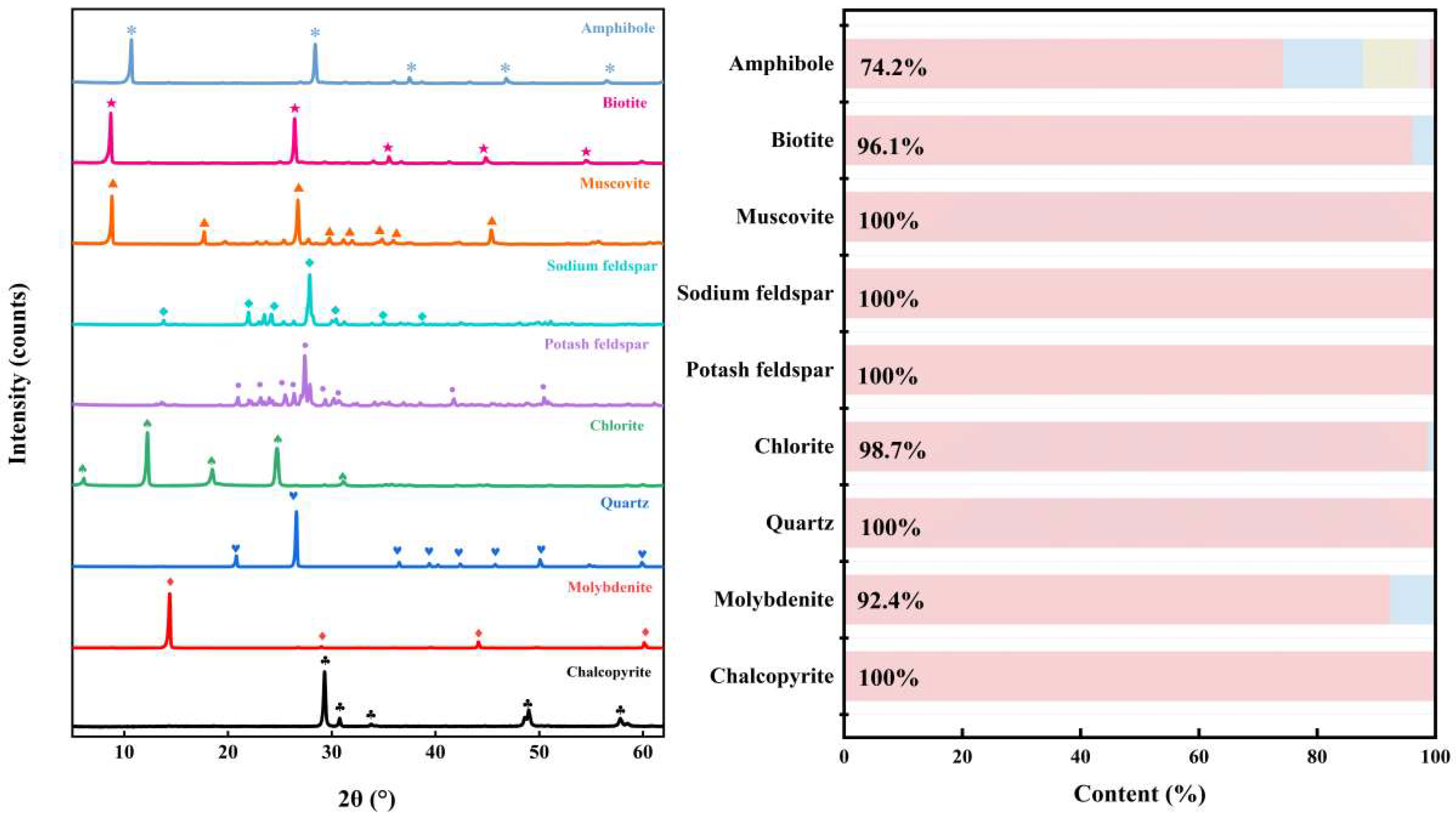
Chalcopyrite, molybdenite, quartz, chlorite, sodium feldspar, potassium feldspar, muscovite, biotite, and amphibole were obtained from a representative moraine-hosted Cu–Mo deposit in Yunnan Province (China) and used as model minerals to reproduce the main mineralogical components of the ore system. Samples were manually handpicked, crushed, and sieved; chalcopyrite and molybdenite were ground to +74–45 μm for microflotation tests, while the other minerals were prepared to −10 μm to simulate fine moraine slimes. For zeta potential measurements, all minerals were ground to −10 μm. Mineral phase compositions were identified by XRD using a Rigaku D/MAX-2600 diffractometer (Rigaku, Tokyo, Japan). As shown in Figure 1, no impurity peaks were detected, and the purities of chalcopyrite, quartz, potassium feldspar, plagioclase, and muscovite reached 100%, whereas those of molybdenite, chlorite, and biotite were 92.4%, 98.7%, and 96.1%, respectively. Amphibole exhibited a purity of 71.6%, with quartz, feldspar, magnesite, and chlorite as minor impurities. Because amphibole commonly occurs as an intergrown silicate mineral in natural moraine systems, obtaining high-purity amphibole samples is relatively difficult. In this study, amphibole was used only as a comparative moraine component in the preliminary flotation screening; therefore, its relatively lower purity was considered acceptable for evaluating the general interference tendency of moraine-associated minerals.
The pulp pH in all flotation tests was adjusted via NaOH and HCl. Polyaspartic acid (PASP, (C4H5NO3)n), sodium hexametaphosphate (Na6O18P6), and sodium silicate (Na2O(SiO2)x·yH2O) were used as depressants, potassium butylxanthate (KBX, C5H9KOS2) was employed as the collector, and methyl isobutyl carbinol (MIBC) was used as the frother. All reagents were of analytical grade and supplied by Shanghai Aladdin Biochemical Technology Co., Ltd. (Shanghai, China). Deionized water with a resistivity of 18 MΩ·cm was used throughout the experiments.

2.2. Flotation Test

Microflotation tests were performed in an XFG hanging cell. For each test, 2 g of pure mineral sample was dispersed in 40 mL of deionized water, with the impeller speed set to 1992 r/min. At the beginning of the experiment, the pH of the pulp was adjusted to the desired value, followed by the sequential addition of the collector and frother. After the conditioning period, air was introduced into the flotation cell, and froth was scraped continuously for 3 min. Subsequently, both the froth product and the tailings were collected, filtered, dried, and weighed to determine the mineral recovery. Each experiment was conducted independently in triplicate, and the reported results represent the average values. The reagent dosages used in this study were selected based on preliminary flotation experiments and commonly reported dosage ranges for Cu–Mo sulfide flotation systems in the literature. The dosages of KBX and MIBC were optimized to maintain stable flotation performance and suitable froth characteristics, whereas the dosage ranges of PASP, sodium silicate, and sodium hexametaphosphate were determined according to their depression performance toward muscovite under slime-interference conditions. The flotation conditions adopted in this work were intended primarily for mechanistic investigation and comparative evaluation of depressant performance rather than industrial process optimization.
Flotation selectivity was evaluated by separation efficiency (Equation (1)), where ε is the recovery (%), γ is the yield (%), εmax is set to 100%, and γopt denotes the designed mass fraction of the target mineral(s) in the artificial feed [20]. Water recovery ( R W ), gangue recovery ( R g ), and the entrainment ratio ( E g ) were calculated from Equations (2)–(4) via the measured wet mass of the froth product ( M 1 , g), its dry mass ( M 2 , g), the water mass ( M w , g), and the mass ( M g , g) [21].
E = ε γ ε m a x γ o p t × 100 %
R W = M 1 M 2 M w × 100 %
R g = M 2 M g × 100 %
E g = R M R W

2.3. Analytical Methods

To systematically clarify the regulatory role of PASP in the flotation separation of Cu–Mo sulfide minerals from muscovite, a series of complementary analytical techniques were employed to investigate particle dispersion behavior, interfacial interactions, surface wettability, and surface chemical changes.

2.3.1. Particle Size Distribution Analysis

Particle size distributions of the mineral suspensions were measured using a laser particle size analyzer (Mastersizer 3000, Malvern Panalytical Ltd., Malvern, UK). The measurements were conducted to evaluate particle aggregation and dispersion behaviors in the presence and absence of PASP. Before testing, the mineral suspensions were conditioned according to the flotation procedure under the desired reagent conditions and pH. Each experiment was independently repeated at least three times to ensure reproducibility.

2.3.2. Zeta Potential Measurements

Surface charge characteristics of chalcopyrite, molybdenite, muscovite, and their binary mixtures were determined using a zeta potential analyzer (Nano ZS90, Malvern, Malvern Panalytical Ltd., Malvern, UK). The measurements were performed to elucidate the electrostatic interactions among mineral particles and to clarify the influence of PASP on heteroaggregation and slime coating behavior. Mineral suspensions were prepared using deionized water, and the pH was adjusted using diluted HCl or NaOH solutions. After reagent conditioning for a fixed period, the suspensions were transferred into the electrophoretic cell for analysis. Each reported zeta potential value represents the average of repeated measurements.

2.3.3. SEM–EDS Characterization

The surface morphology and elemental composition of mineral samples were characterized using scanning electron microscopy coupled with energy-dispersive spectroscopy (SEM–EDS; Sigma 300, Zeiss, Oberkochen, Germany; Oxford Instruments, High Wycombe, UK). The analyses were conducted to directly observe the coating behavior of muscovite on chalcopyrite and molybdenite surfaces and to evaluate the effect of PASP on slime removal and particle dispersion. SEM images were used to identify the attachment or removal of fine muscovite particles, while EDS spectra were employed to detect characteristic elements of muscovite, including K, Al, Si, and O.

2.3.4. Contact Angle Measurements

Changes in surface wettability induced by different reagent systems were investigated by contact angle measurements using a JC2000D contact angle goniometer (Shanghai Zhongchen Digital Technic Apparatus Co., Ltd., Shanghai, China). Flat mineral surfaces were prepared prior to testing, and reagent conditioning was carried out under the same conditions as those used in flotation experiments. After treatment, droplets of deionized water were deposited on the mineral surfaces, and the contact angles were recorded immediately. At least three droplets were measured at different positions for each sample, and the average value was reported. The measurements were used to evaluate the influence of PASP and KBX on the hydrophobicity of chalcopyrite, molybdenite, and muscovite.

2.3.5. XPS Analysis

Surface chemical states and adsorption behaviors were analyzed using X-ray photoelectron spectroscopy (XPS; K-Alpha+, Thermo Fisher Scientific, Waltham, MA, USA). The measurements were performed to investigate the interaction mechanism between PASP and mineral surfaces. After reagent treatment and drying, the mineral samples were subjected to XPS analysis under ultra-high vacuum conditions. The binding-energy scale was calibrated using the C 1s peak at 284.80 eV.

2.3.6. Selection of Representative Mineral Systems

Based on the preliminary flotation screening results, muscovite was identified as the most representative and persistent interfering gangue mineral affecting both chalcopyrite and molybdenite flotation. Therefore, only muscovite and its binary mixtures with chalcopyrite or molybdenite were selected for detailed PSD, zeta potential, SEM–EDS, contact angle, and XPS analyses. Other moraine minerals shown in Figure 2 were included only for comparative flotation screening.

3. Results and Discussion

3.1. Microflotation Experiments
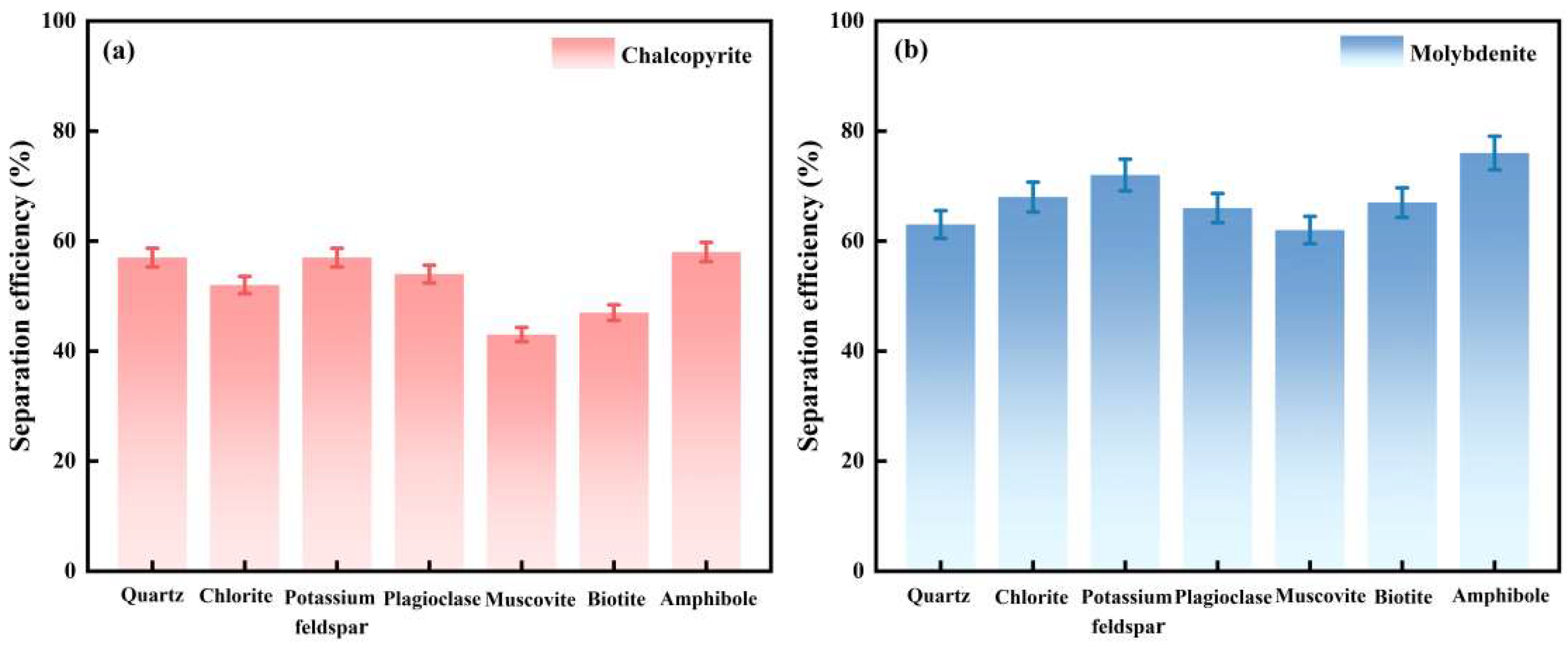
To evaluate the influence of moraine components on the flotation separation of Cu–Mo ores, the separation efficiencies between chalcopyrite or molybdenite and different single-mineral components of moraine were calculated at 10 mg/L KBX, 20 mg/L MIBC, and pH = 6, as shown in Figure 2. This screening condition was not intended to represent the optimized flotation condition; rather, it was used to compare the relative interference intensity of each moraine component under the same baseline reagent environment.
As illustrated in Figure 2a, chalcopyrite exhibited the lowest separation efficiency when floated with muscovite and biotite, indicating that these layered silicates strongly inhibit its flotation. This can be attributed to the strong cleavage and mud-forming tendency of mica minerals during grinding, which generates abundant ultrafine particles. These fine slimes readily adsorb or adhere to the chalcopyrite surface, forming physical coatings or mechanical entrapment layers that hinder bubble attachment and consequently reduce the flotation selectivity of chalcopyrite [22]. As shown in Figure 2b, molybdenite presented relatively poor separation from quartz and muscovite. This behavior is likely related to the higher content of fine particles derived from these minerals, which increases bubble entrainment and induces nonselective flotation, thereby reducing the overall separation efficiency of molybdenite [23].
As indicated by the results, muscovite is identified as the primary interfering mineral for both chalcopyrite and molybdenite during flotation. Therefore, to clarify the influence of muscovite on the flotation separation of Cu–Mo minerals, systematic microflotation tests were carried out.
Figure 2. Flotation separation efficiencies of chalcopyrite (a) and molybdenite (b) from individual components of moraine.
Minerals 16 00566 g002
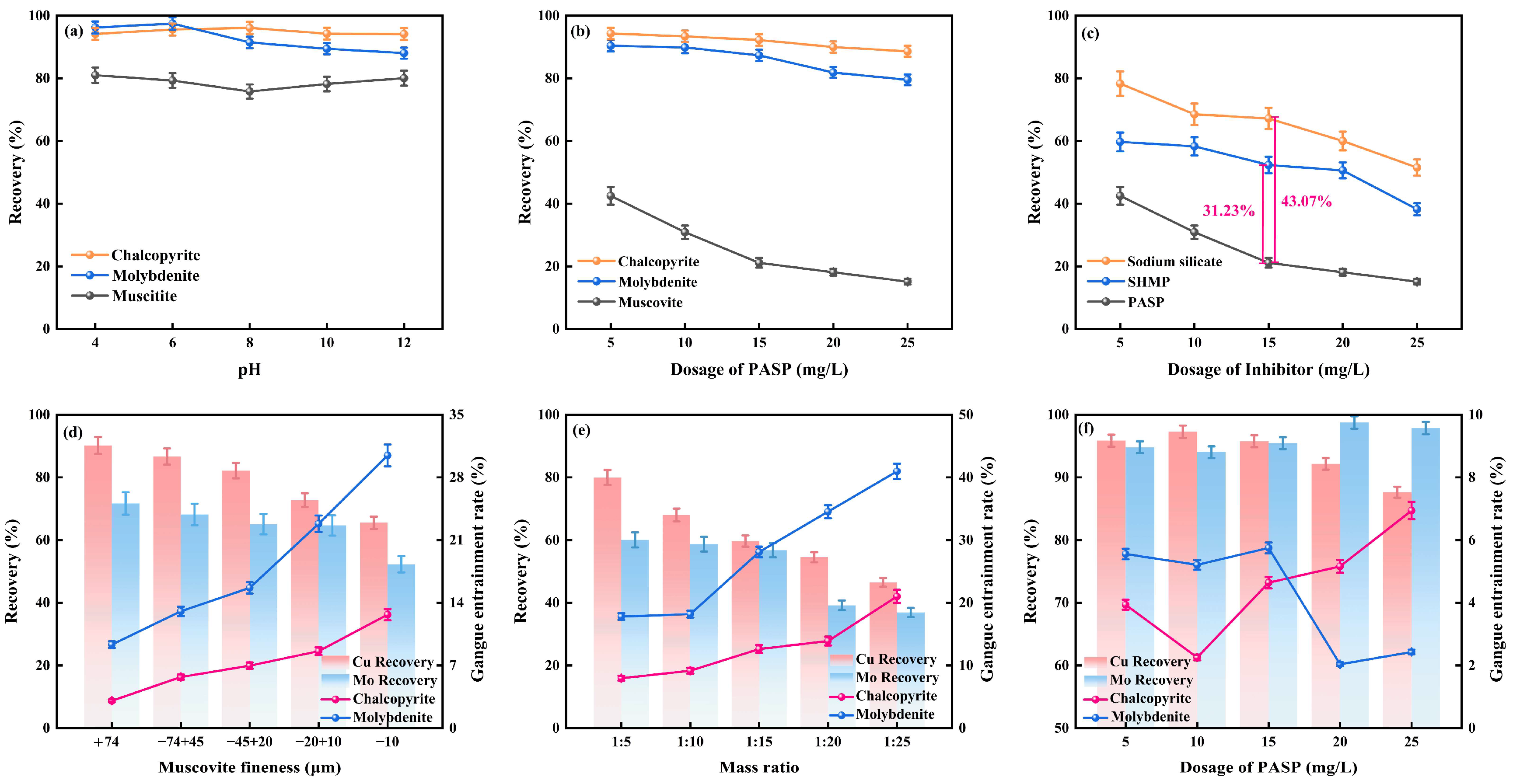
As shown in Figure 3a, chalcopyrite and molybdenite maintained high recoveries over the investigated pH range, while muscovite also showed considerable floatability in the absence of a depressant. This indicates that pH adjustment alone cannot effectively suppress muscovite and thus motivates the use of a selective depressant. Therefore, pH 8 was selected for subsequent experiments because it provided stable sulfide floatability while retaining sufficient muscovite flotation response to evaluate PASP depression. Figure 3b shows that with increasing dosages of polyaspartic acid (PASP), the recovery of chalcopyrite remained nearly constant, that of molybdenite slightly decreased, and that of muscovite decreased sharply. The slight decrease in molybdenite recovery may be related to weak PASP interaction at edge sites or minor changes in pulp dispersion/froth properties, but the recovery remained operationally acceptable at the recommended dosage. These findings demonstrate that PASP effectively and selectively inhibits muscovite without significantly affecting the floatability of the target sulfide minerals. To further verify its inhibitory performance, PASP was compared with the conventional inorganic depressants sodium silicate and sodium hexametaphosphate (Figure 3c). The results showed that under identical dosages, PASP markedly suppressed muscovite. At a dosage of 15 mg/L, muscovite recovery under PASP treatment was 43.07% and 31.23% lower than that obtained with sodium silicate and sodium hexametaphosphate, respectively, suggesting that PASP has stronger dosage-normalized depression efficiency.
Additionally, artificial mixed-mineral flotation tests were conducted to examine the effects of the muscovite particle size, content ratio, and PASP dosage on Cu–Mo separation (Figure 3d–f). The results indicated that as the muscovite particle size decreased and its proportion in the mixture increased, the recoveries of chalcopyrite and molybdenite decreased significantly, accompanied by increased gangue entrainment. This suggests that fine-grained muscovite tends to cause a slime coating and mechanical entrainment during flotation. When the muscovite particle size was −10 μm and the mass ratio reached 1:25, the flotation selectivity was the poorest. After the addition of PASP, the recoveries of chalcopyrite and molybdenite substantially improved, whereas gangue entrainment greatly decreased. The optimal separation performance was achieved at 10 mg/L PASP for chalcopyrite and 20 mg/L for molybdenite.

3.2. Slime Coating Test

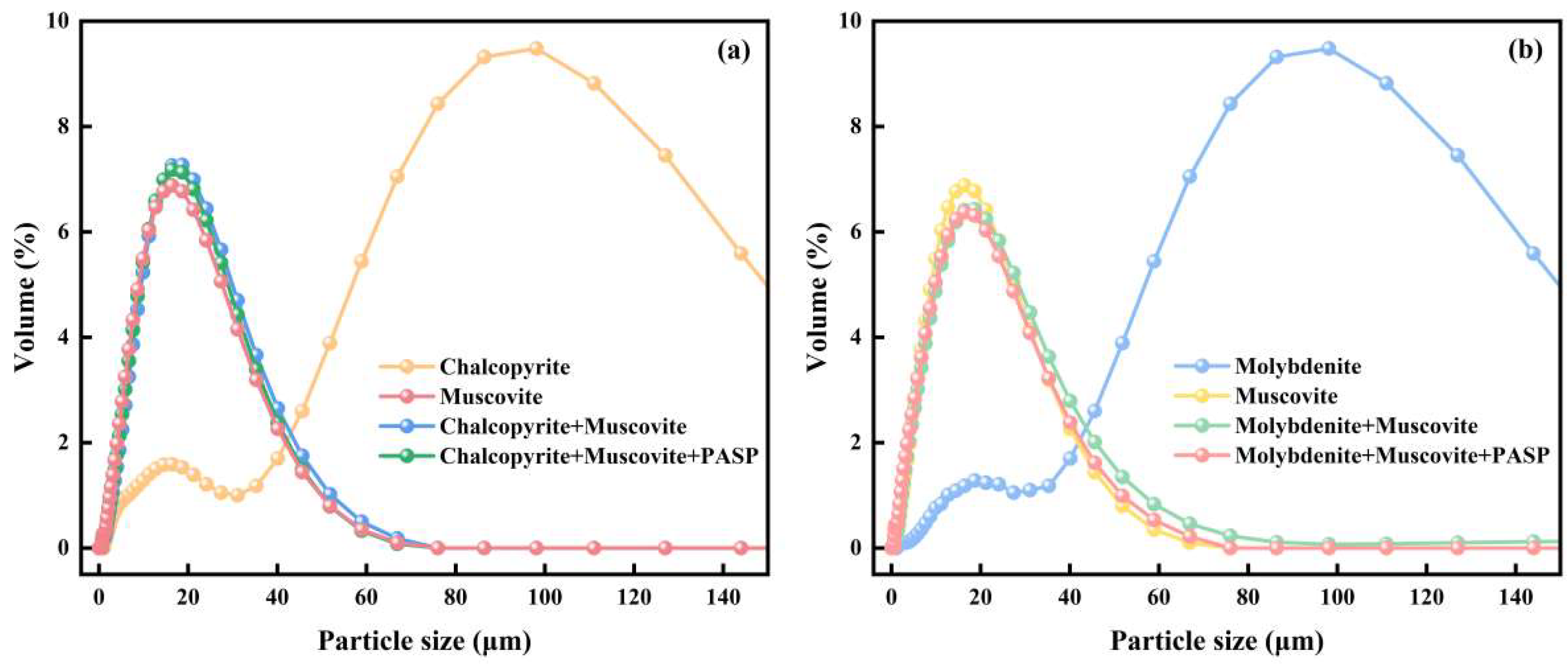
To further verify whether heterocoagulation occurred between muscovite and Cu–Mo sulfide minerals, particle size distribution analyses were performed for different systems, and the results are shown in Figure 4.
As illustrated in Figure 4a, chalcopyrite was mainly distributed below 74 μm, whereas muscovite was concentrated below 10 μm. After mixing chalcopyrite with muscovite, the overall particle size distribution became slightly broader and the proportion of relatively coarse particles increased moderately compared with pure muscovite, suggesting that weak heterocoagulation between chalcopyrite and muscovite may occur. After PASP addition, the particle size distribution of the mixed system became slightly narrower, indicating that PASP could partially improve the dispersion stability of the suspension.
A similar tendency was observed for the molybdenite–muscovite system (Figure 4b). Compared with pure muscovite, the mixed system exhibited a modest increase in coarse-particle fraction, implying limited aggregation between molybdenite and muscovite particles. In the presence of PASP, the distribution became relatively more uniform, suggesting that PASP weakened particle aggregation and improved slurry dispersion to some extent.

3.3. Zeta Potential Test

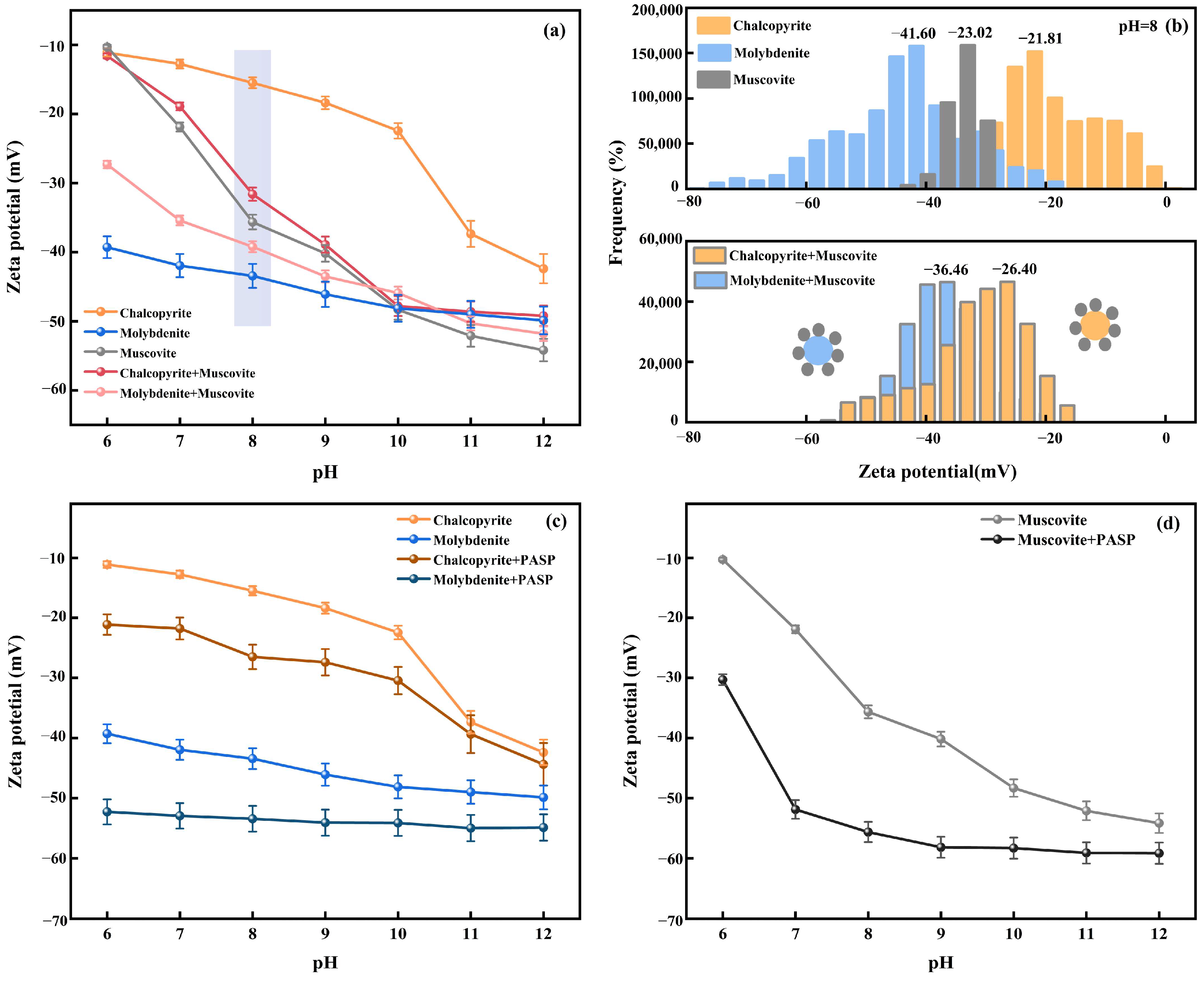
The aggregation and dispersion behaviors of mineral particles are governed mainly by electrostatic interactions [24]. Characterization of the surface potential provides a direct indication of interparticle forces and possible coating phenomena [25]. To investigate the aggregation characteristics of muscovite and Cu–Mo sulfide minerals, as well as the regulatory effect of PASP on their surface potential, zeta potential measurements were conducted, and the results are shown in Figure 5.
As shown in Figure 5a, chalcopyrite exhibited the least negative surface potential over the investigated pH range, whereas muscovite and molybdenite showed considerably more negative surface charges. With increasing pH, the zeta potentials of all minerals gradually shifted toward more negative values due to enhanced surface hydroxylation and deprotonation. Notably, the zeta potential curves of the chalcopyrite–muscovite and molybdenite–muscovite mixed systems deviated from those of the corresponding pure minerals and shifted toward intermediate values, indicating strong interfacial interactions between muscovite slimes and sulfide mineral particles. The zeta potential distribution histograms at pH 8 shown in Figure 5b further confirm this behavior. Pure chalcopyrite and molybdenite exhibited characteristic peak positions near −21.81 mV and −41.60 mV, respectively, whereas muscovite displayed a peak near −23.02 mV. After mixing with muscovite, the zeta potential distributions of the mixed systems evolved into single intermediate peaks centered at approximately −26.40 mV and −36.46 mV, rather than maintaining independent peaks corresponding to each mineral phase. This single-peak characteristic strongly suggests the occurrence of heterocoagulation and slime coating between muscovite and sulfide minerals, resulting in the formation of composite particle aggregates with modified surface electrical properties. As shown in Figure 5c, the addition of PASP led to an overall decrease in the surface potential of both chalcopyrite and molybdenite, suggesting that polyaspartic acid adsorbed onto their surfaces and altered their surface charge distribution. In contrast, the zeta potential of muscovite decreased more significantly in the presence of PASP (Figure 5d), implying a stronger interaction between PASP and the muscovite surface. These findings demonstrate that PASP effectively modifies the electrostatic characteristics of mineral surfaces, weakens the coating effect of muscovite slimes on target sulfide minerals, and consequently enhances particle dispersion within the flotation system.

3.4. SEM-EDS Analysis

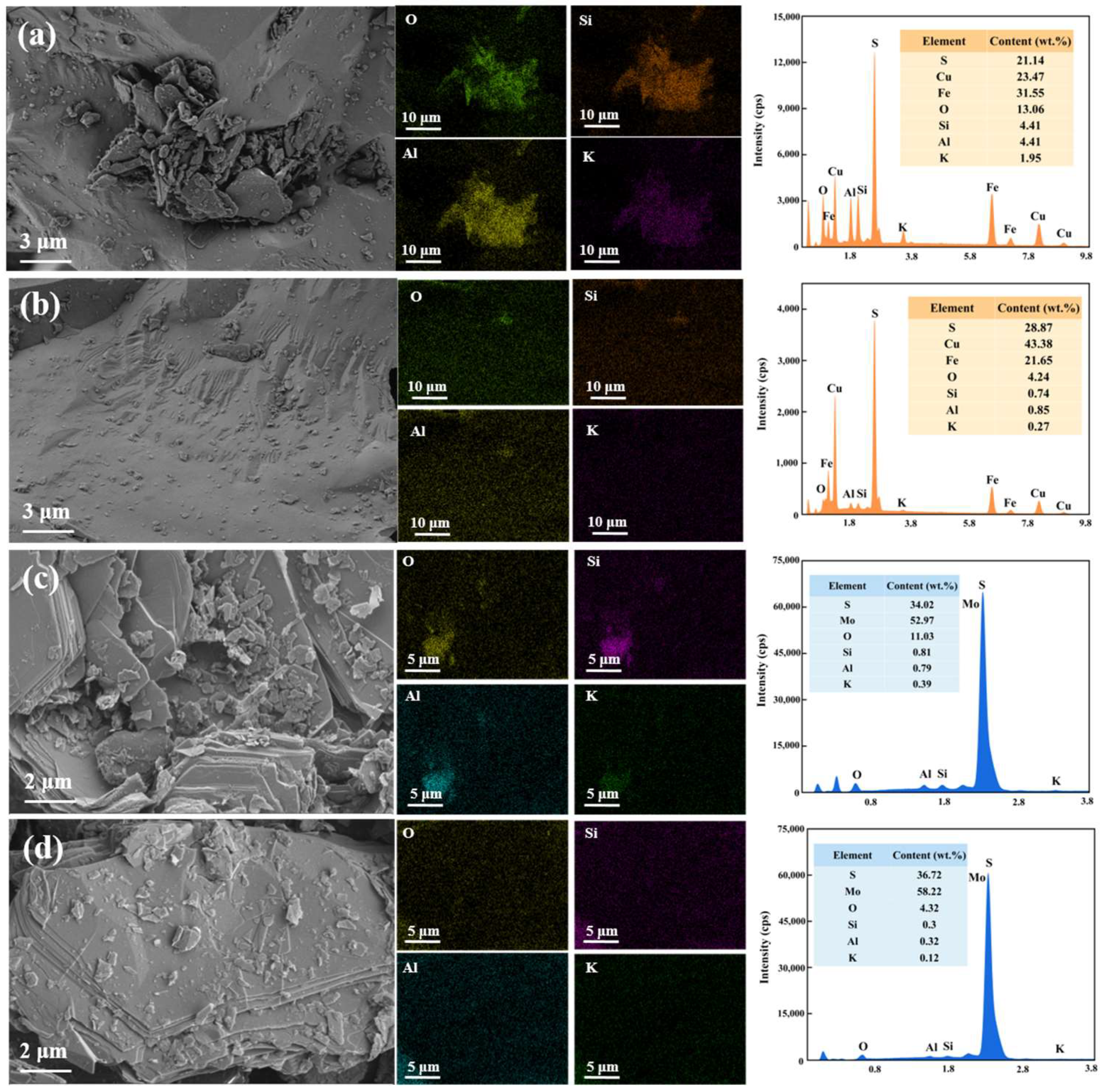
To further elucidate the slime coating behavior of muscovite during the flotation of Cu–Mo sulfide minerals, SEM–EDS analyses were performed on the flotation concentrate samples, and the results are presented in Figure 6. As shown in Figure 6a, numerous aggregated, flaky particles were attached to the surface of the chalcopyrite. These particles exhibited morphological characteristics similar to muscovite and were irregularly distributed in clusters. The corresponding EDS spectra revealed strong signals of K, Al, Si, and O, which are characteristic elements of muscovite, confirming the formation of a muscovite slime coating layer on the chalcopyrite surface. This coating could mask the active sites of chalcopyrite and hinder collector adsorption, thereby reducing its floatability. After the addition of PASP (Figure 6b), the chalcopyrite surface became significantly cleaner and smoother, and the previously observed aggregates almost disappeared. The EDS spectra revealed that the intensities of the K, Al, Si, and O signals markedly decreased, indicating that PASP effectively reduced the adhesion of muscovite particles on the chalcopyrite surface and improved its surface cleanliness and floatability.
For the molybdenite system (Figure 6c), it was difficult to distinguish muscovite from molybdenite visually because of their similar layered structures. However, the increased intensities of the K, Al, Si, and O peaks in the EDS spectra suggested that muscovite particles were adsorbed or mixed on the molybdenite surface. Upon PASP addition (Figure 6d), these characteristic element signals decreased, demonstrating that PASP promoted the desorption of muscovite from the molybdenite surface and effectively alleviated its coating and interference effects during flotation.

3.5. Contact Angle Measurement

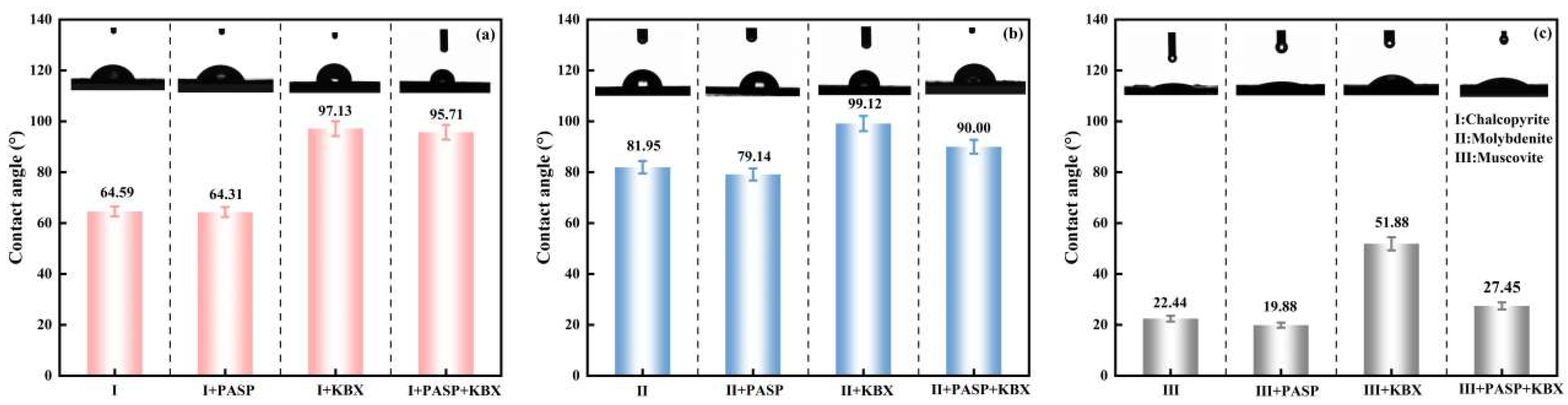
Figure 7 shows the variations in the contact angles of chalcopyrite, molybdenite, and muscovite under different reagent conditions, reflecting their surface hydrophobicity changes. For chalcopyrite, the contact angle slightly decreased from 64.59° to 64.31° after PASP treatment, indicating a negligible effect on its wettability. When the KBX collector was introduced, the contact angle increased markedly to 97.13°. Under the combined action of PASP and KBX, the contact angle was 95.71°, suggesting that PASP did not hinder KBX adsorption on the chalcopyrite surface. The initial contact angle of molybdenite was 81.95°, which decreased slightly to 79.14° after PASP treatment, implying a weak hydrophilization effect of PASP on its surface. Upon the addition of KBX and PASP+KBX, the contact angles increased to 99.12° and 90.00°, respectively, demonstrating that KBX could still significantly enhance the hydrophobicity of molybdenite even in the presence of PASP. Muscovite exhibited inherently strong hydrophilicity, with a natural contact angle of 22.44°. After PASP treatment, the angle further decreased to 19.88°, indicating that PASP formed a hydrophilic layer on the muscovite surface and enhanced its wettability. The addition of KBX increased the contact angle to 51.88°, whereas the combined PASP+KBX system yielded a slightly greater value of 27.45°, suggesting that muscovite remained hydrophilic and was well distinguished from the target sulfide minerals.
Overall, PASP strongly hydrophilized and depressed muscovite while exerting minimal impact on chalcopyrite and molybdenite, and KBX selectively enhanced the hydrophobicity of the sulfide minerals, enabling effective separation in the PASP–KBX system.

3.6. Surface Chemical States

3.6.1. XPS Full Spectrum Analysis

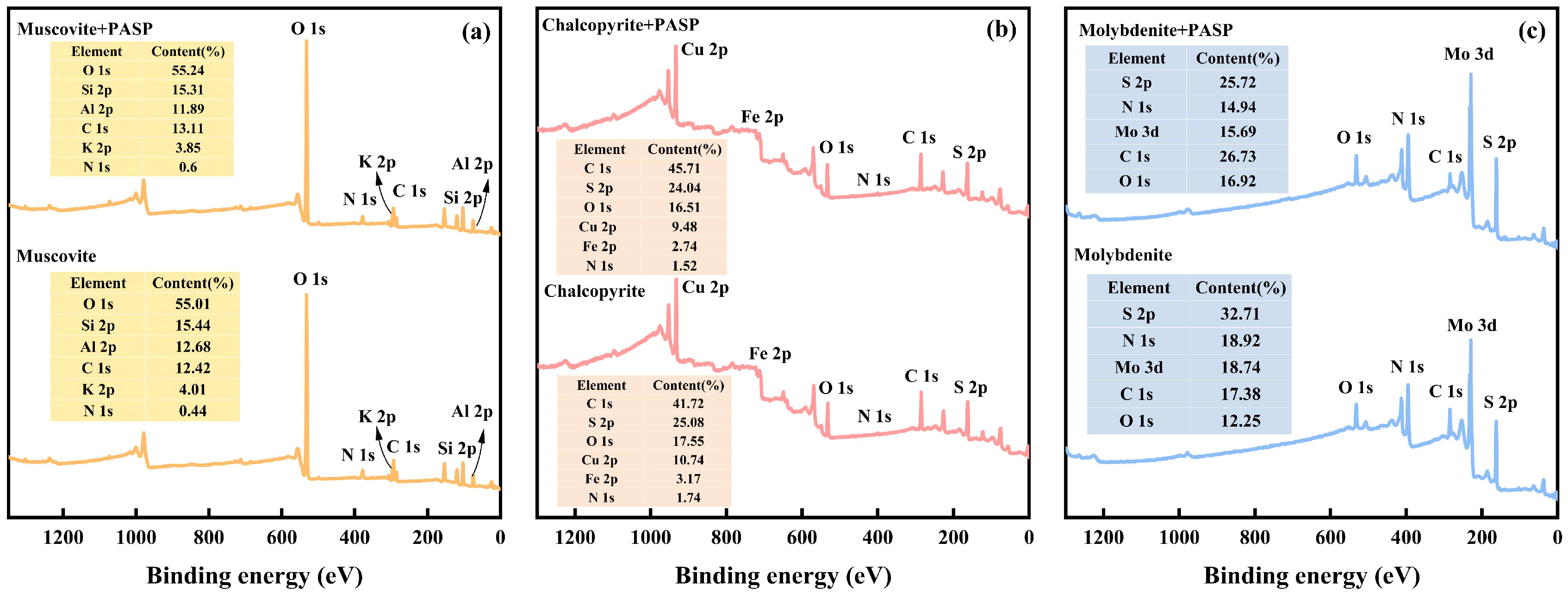
To elucidate the interaction between PASP and mineral surfaces, XPS survey spectra were collected for muscovite, chalcopyrite, and molybdenite (Figure 8). After PASP treatment, the C 1s signal increased for all three minerals; however, only muscovite showed simultaneous increases in C, N, and O, confirming effective PASP adsorption. For chalcopyrite and molybdenite, the higher C content was not accompanied by corresponding N and O increases, suggesting that it mainly arises from adventitious carbon rather than PASP. These results indicate that PASP has a much stronger adsorption affinity for muscovite than for the two sulfide minerals.

3.6.2. XPS Fine Spectrum Analysis

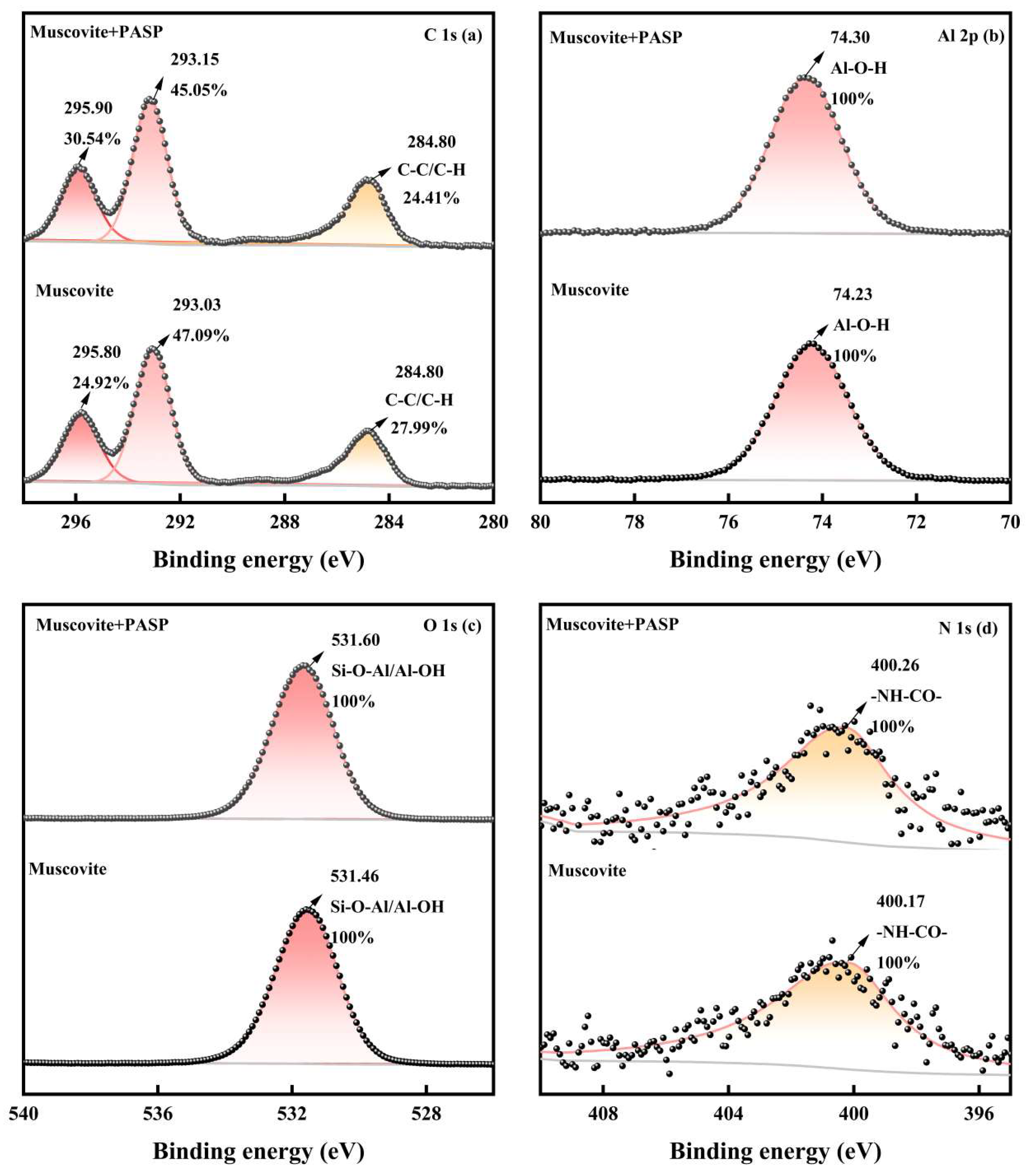
To further elucidate the adsorption mechanism of PASP on the muscovite surface, high-resolution XPS spectra of C 1s, Al 2p, O 1s, and N 1s were analyzed and deconvoluted, as shown in Figure 9. Particular attention was paid to the N 1s, Al 2p, and O 1s regions because these signals are more directly related to PASP adsorption and Al–OH coordination on muscovite.
As shown in Figure 9a, the C 1s spectrum of muscovite mainly exhibited a C–C/C–H component centered at approximately 284.80 eV. In addition, high-binding-energy features located near 293–296 eV were observed, which are attributed to satellite/shake-up features rather than conventional oxygen-containing carbon species [26]. After PASP treatment, the relative intensity of the high-binding-energy region slightly increased, indicating changes in the surface carbon chemical environment associated with PASP adsorption. As displayed in Figure 9b, the Al 2p peak slightly shifted from 74.23 eV to 74.30 eV, suggesting a modification in the electronic environment of the Al–O–Si and/or Al–OH–Al structural units [27]. This shift can be attributed to the coordination interaction between the carboxylate groups (–COO) of PASP and the surface Al–OH sites. In Figure 9c, the O 1s peak shifted from 531.46 eV to 531.60 eV, corresponding mainly to Si–O–Al and Al–OH bonds [28]. The slight positive shift suggests that minor electron redistribution on the muscovite surface was induced by PASP adsorption. As shown in Figure 9d, the N 1s peak located at approximately 400.26 eV corresponded to the –NH/CO–N bonding environment [29]. Compared with untreated muscovite, the increased N atomic percentage after PASP treatment further supports the adsorption of PASP molecules on the muscovite surface.
The selective adsorption behavior of PASP toward muscovite can be further explained by the surface chemical characteristics of the investigated minerals. Muscovite possesses abundant exposed Al–OH active sites at edge and defect positions, and these Al-containing surface species exhibit relatively strong Lewis acid character. Therefore, the carboxylate groups (–COO) of PASP can preferentially coordinate with surface Al–OH sites through ligand-like interactions. In contrast, the surfaces of chalcopyrite and molybdenite are dominated mainly by Cu–S, Fe–S, and Mo–S bonding environments, which exhibit comparatively weaker affinity toward oxygen-containing carboxylate ligands under the investigated flotation conditions. According to the HSAB (hard and soft acids and bases) theory, the hard-base carboxylate groups of PASP preferentially interact with relatively hard Lewis acid centers such as surface Al species rather than with the softer sulfide-related surface sites on chalcopyrite and molybdenite. This interpretation is also consistent with the XPS survey spectra, which showed simultaneous enrichment of C, N, and O-containing species predominantly on muscovite after PASP treatment [30].
In summary, high-resolution XPS analysis reveals that PASP interacts with the muscovite surface mainly through coordination between carboxylate groups and surface Al–OH active sites, forming a stable hydrophilic chemisorption layer. This adsorption layer enhances the electrostatic repulsion between muscovite slimes and sulfide minerals, thereby effectively mitigating slime coating and improving flotation selectivity.

3.7. Enhancement Mechanism of PASP in the Separation of Cu–Mo Ore from Muscovite

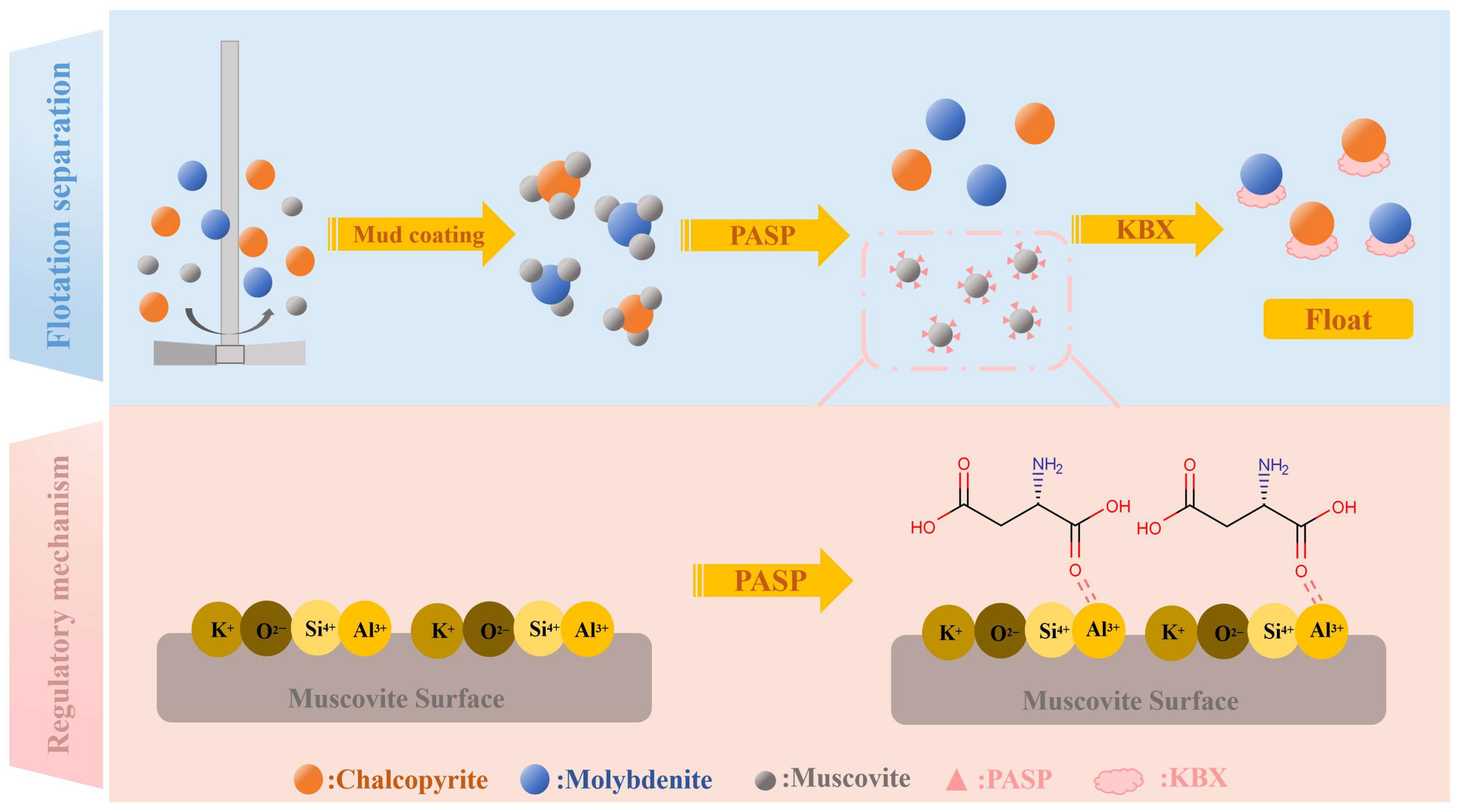
As demonstrated in this study, polyaspartic acid (PASP) acts as an efficient and environmentally benign depressant capable of selectively regulating these interfacial processes and enhances the flotation separation of Cu–Mo sulfides from muscovite (Figure 10).
Fine-grained muscovite originating from moraine strongly tends to adhere to chalcopyrite and molybdenite surfaces through electrostatic attraction and mechanical entrapment, forming a continuous slime coating that masks hydrophobic sites and suppresses bubble–particle attachment. The particle size distribution and zeta potential results (Figure 4 and Figure 5) confirm heterocoagulation between muscovite and sulfide minerals, whereas PASP addition disrupts this process. SEM–EDS observations (Figure 6) further confirmed that the muscovite layer originally attached to chalcopyrite and molybdenite was largely removed after PASP treatment, restoring the surface cleanliness of the target sulfide minerals. Contact angle measurements (Figure 7) revealed that PASP significantly increases muscovite hydrophilicity while barely affecting the wettability of chalcopyrite and molybdenite, thus allowing xanthate collectors to adsorb selectively on sulfides. XPS analysis (Figure 9) reveals that PASP chemisorbs on muscovite mainly through coordination between carboxylate groups and surface Al–OH sites, forming a stable hydrophilic layer that depresses muscovite floatability and reduces its coating tendency [9]. Taken together, PASP disrupts the muscovite-induced coating of slime, enhances slurry dispersion, selectively increases muscovite hydrophilicity via Al–OH coordination, and restores the floatability of Cu–Mo sulfides.

4. Conclusions

Fine-grained muscovite originating from moraine was identified as the primary interfering gangue mineral responsible for reducing the flotation selectivity of Cu–Mo sulfide ores. At relatively low dosages (10–20 mg/L), polyaspartic acid (PASP) exhibited strong and selective depression toward muscovite while exerting negligible influence on the floatability of chalcopyrite and molybdenite. In particular, at 15 mg/L, PASP reduced muscovite recovery by 43.07% and 31.23% more effectively than sodium silicate and sodium hexametaphosphate, respectively, demonstrating superior selective depression efficiency under moraine interference conditions. Particle size distribution and zeta potential analyses confirmed that PASP effectively disrupted the heterocoagulation between muscovite and sulfide minerals, weakened electrostatic attraction, suppressed slime coating, and improved slurry dispersion stability. SEM–EDS and contact angle measurements further demonstrated that PASP reduced the deposition of muscovite on sulfide mineral surfaces and enhanced muscovite hydrophilicity while largely preserving the hydrophobicity of the target sulfide minerals. High-resolution XPS analysis further revealed that PASP interacted with muscovite mainly through coordination between carboxylate groups and surface Al–OH sites, forming a stable hydrophilic adsorption layer on the muscovite surface. Overall, PASP provides a low-dosage, highly selective, and biodegradable depressant strategy for mitigating muscovite-induced slime coating and improving the flotation separation of Cu–Mo sulfide ores under moraine interference conditions, offering a promising approach for greener mineral processing.

Author Contributions

Z.W.: writing—original draft, methodology; W.Y.: writing—original draft, methodology, data curation; H.L. (Hongwei Liu): writing—review and editing, methodology, supervision; J.W.: methodology, investigation, supervision; B.Y.: visualization, methodology; R.L.: visualization, methodology; H.L. (Hongchang Liu): visualization, methodology, funding acquisition. All authors have read and agreed to the published version of the manuscript.

Funding

This work was supported by National Natural Science Foundation of China (No. 52574339) and National Key Research and Development Program of China (No. 2022YFC2105300).

Data Availability Statement

The original contributions presented in this study are included in the article. Further inquiries can be directed to the corresponding author.

Conflicts of Interest

Author Zhentang Wang was employed by the company Wanbao Mining Limited, Beijing. The remaining authors declare that the research was conducted in the absence of any commercial or financial relationships that could be construed as a potential conflict of interest.

References

  1. Elshkaki, A.; Graedel, T.E.; Ciacci, L.; Reck, B.K. Copper demand, supply, and associated energy use to 2050. Glob. Environ. Change 2016, 39, 305–315. [Google Scholar] [CrossRef]
  2. Yi, G.S.; Macha, E.; Van Dyke, J.; Macha, R.E.; Mckay, T.; Free, M.L. Recent progress on research of molybdenite flotation: A review. Adv. Colloid Interfac. 2021, 295, 102466. [Google Scholar] [CrossRef]
  3. Lin, Q.Q.; Gu, G.H.; Wang, H.; Liu, Y.C.; Wang, C.Q.; Fu, J.G.; Zhao, J.Y.; Huang, L.L. Recovery of molybdenum and copper from porphyry ore via iso-flotability flotation. Trans. Nonferr. Met. Soc. 2017, 27, 2260–2271. [Google Scholar] [CrossRef]
  4. Liu, Z.; Sun, W.; Feng, X.L.; Wang, S.Y.; Chen, C.; Song, H.; Jiang, M.G.; Fan, K. Experimental Study of the Injectability of Infiltration Grouting in Surface Moraine of Pulang Copper Mine. Water 2024, 16, 728. [Google Scholar] [CrossRef]
  5. Mohammadi, M.; Mcmackin, C.; Egli, M. Source identification of morainic materials in soils of the Three Lakes region (Switzerland) using the fingerprinting technique. Catena 2024, 234, 107619. [Google Scholar] [CrossRef]
  6. Cui, K.; Wu, B.H.; Qin, X.T.; Li, Q.L.; Guo, Z.Y. Experimental investigations on the mechanical behaviour of glacial tills and ice mixtures. Cold Reg. Sci. Technol. 2025, 238, 104561. [Google Scholar] [CrossRef]
  7. Rettig, L.; Lukas, S.; Huss, M. Implications of a rapidly thinning ice margin for annual moraine formation at Gornergletscher, Switzerland. Quat. Sci. Rev. 2023, 308, 108085. [Google Scholar] [CrossRef]
  8. Yang, W.T.; Lan, Z.Y.; Li, X.; Li, Y.C. Mechanism and countermeasures of influence of moraine impact on copper-molybdenum ore flotation. Colloid Surf. A 2025, 713, 136496. [Google Scholar] [CrossRef]
  9. Wang, Y.B.; Wang, Y.; Wen, K.; Dang, W.B.; Xun, J.W. Strengthening the inhibition effect of sodium silicate on muscovite by electrochemical modification. Miner. Eng. 2021, 161, 106731. [Google Scholar] [CrossRef]
  10. Guo, S.J.; Zhao, J.J.; Zhang, G.Y.; Yang, S.C.; Wei, K.X.; Ma, W.H. Vacuum roasting inhibited the diffusion of aluminum in muscovite impurities into quartz during roasting process. Miner. Eng. 2025, 234, 109783. [Google Scholar] [CrossRef]
  11. Hu, X.L.; Li, Y.B.; Wei, Z.L.; Henni, I.H. Effects of roasting and water quenching on the flotation of muscovite in pegmatite. Appl. Surf. Sci. 2025, 711, 164047. [Google Scholar] [CrossRef]
  12. Fan, C.Y.; Ren, L.Y.; Zhang, Y.M.; Bao, S.X. Grinding effect of sodium silicate on muscovite and its mechanism analysis. Miner. Eng. 2023, 199, 108106. [Google Scholar] [CrossRef]
  13. Fan, C.Y.; Ren, L.Y.; Zhang, Y.M.; Bao, S.X.; Yang, Z.L. Influence of Sodium Hexametaphosphate on Muscovite Grinding and Its Mechanism Analysis. Minerals 2023, 13, 457. [Google Scholar] [CrossRef]
  14. Shi, J.Y.; Lv, J.; Wang, J.L.; Cao, Z.; Lu, W.D.; Cao, Y.D.; Wu, X.; Wang, X.P.; Tang, J.Y.; Zhang, Z.Y.; et al. Flotation separation of parisite from calcium-bearing gangue minerals using polyaspartic acid as a depressant. Miner. Eng. 2025, 224, 109198. [Google Scholar] [CrossRef]
  15. Zhao, L.; Zhang, G.F.; Wang, M.T.; Zheng, S.Y.; Li, B.B. Selective separation of smithsonite from quartz by using sodium polyaspartate as a depressant. Colloid Surf. A 2022, 644, 128840. [Google Scholar] [CrossRef]
  16. Dai, Z.; Zheng, Y.X.; Peng, J.L.; Wang, Z.X.; Guo, Z.Q. Effect of polyaspartic acid as an environmental-friendly depressant on flotation separation of chalcopyrite from arsenopyrite. Sep. Purif. Technol. 2024, 335, 126141. [Google Scholar] [CrossRef]
  17. Lin, X.; Wei, Q.; Wu, Y.; Jiao, F. Mechanism of polyaspartic acid as acid-base regulation depressant in reverse flotation separation of molybdenite and talc. Adv. Powder Technol. 2024, 35, 104503. [Google Scholar] [CrossRef]
  18. Wu, H.Q.; Qiu, T.S.; Zhao, G.F.; Zhu, D.M.; Li, X.B.; Feng, B. Investigations on the reverse cationic flotation separation of quartz from hematite using polyaspartic acid as depressant. Appl. Surf. Sci. 2023, 614, 156143. [Google Scholar] [CrossRef]
  19. Zhu, H.L.; Qin, W.Q.; Chen, C.; Chai, L.Y.; Jiao, F.; Jia, W.H. Flotation separation of fluorite from calcite using polyaspartate as depressant. Miner. Eng. 2018, 120, 80–86. [Google Scholar] [CrossRef]
  20. Wang, L.; Runge, K.; Peng, Y.; Vos, C. An empirical model for the degree of entrainment in froth flotation based on particle size and density. Miner. Eng. 2016, 98, 187–193. [Google Scholar] [CrossRef]
  21. Wang, L.; Peng, Y.; Runge, K. Entrainment in froth flotation: The degree of entrainment and its contributing factors. Powder Technol. 2016, 288, 202–211. [Google Scholar] [CrossRef]
  22. Wang, D.W.; Liu, Q. Hydrodynamics of froth flotation and its effects on fine and ultrafine mineral particle flotation: A literature review. Miner. Eng. 2021, 173, 107220. [Google Scholar] [CrossRef]
  23. Yang, B.; Yin, W.Z.; Zhu, Z.L.; Wang, D.H.; Han, H.L.; Fu, Y.F.; Sun, H.R.; Chu, F.D.; Yao, J. A new model for the degree of entrainment in froth flotation based on mineral particle characteristics. Powder Technol. 2019, 354, 358–368. [Google Scholar] [CrossRef]
  24. Liu, C.; Zhang, X.Y.; Zheng, Y.F.; Ren, Z.J.; Fu, W.; Yang, S.Y. Utilization of water glass as a dispersant to improve the separation performance of fluorite from barite slimes. Colloid Surf. A 2022, 635, 128036. [Google Scholar] [CrossRef]
  25. Deng, J.; Yang, S.Y.; Liu, C.; Li, H.Q. Effects of the calcite on quartz flotation using the reagent scheme of starch/dodecylamine. Colloid Surf. A 2019, 583, 123983. [Google Scholar] [CrossRef]
  26. Marion, C.; Jordens, A.; Mccarthy, S.; Grammatikopoulos, T.; Waters, K.E. An investigation into the flotation of muscovite with an amine collector and calcium lignin sulfonate depressant. Sep. Purif. Technol. 2015, 149, 216–227. [Google Scholar] [CrossRef]
  27. Liu, J.J.; Gao, Y.Q.; Miao, Y.; Zhang, G.F. Mechanism analysis and validation of a novel high-efficiency depressant for carrollite-muscovite flotation separation: Experimental and DFT investigations. Colloid Surf. A 2025, 727, 138386. [Google Scholar] [CrossRef]
  28. Peng, X.Y.; Yan, Y.; Zhang, L.; Liu, Y.H.; Tian, X.Z.; Lei, D.S.; Wang, Y.B. New insight into improvement mechanism of Cu(II) for muscovite flotation: The key role of spinning electrons. J. Mol. Liq. 2024, 397, 124128. [Google Scholar] [CrossRef]
  29. Wang, X.J.; Zhang, Y.M.; Liu, T.; Cai, Z.L. Influence of metal ions on muscovite and calcite flotation: With respect to the pre-treatment of vanadium bearing stone coal. Colloid Surf. A 2019, 564, 89–94. [Google Scholar] [CrossRef]
  30. Mweene, L.; Khanal, G.P.; Kawala, J.; Subramanian, S. Investigations into the flotation of molybdenite in the presence of chalcopyrite using (3S,4S,5S,6R)-3,4,5,6-tetrahydroxyoxane-2-carboxylate acid as a novel selective depressant: An experimental and theoretical perspective. J. Mol. Liq. 2022, 368, 120661. [Google Scholar] [CrossRef]
Figure 1. XRD patterns of mineral samples.
Minerals 16 00566 g001
Figure 3. Microflotation results showing the effects of (a) pH on single-mineral flotation, (b) PASP dosage on chalcopyrite, molybdenite, and muscovite recoveries, (c) comparison of PASP with conventional inorganic depressants, (d) muscovite particle size, (e) muscovite proportion, and (f) PASP dosage on artificial mixed-mineral flotation performance.
Minerals 16 00566 g003
Figure 4. Particle size distributions of (a) chalcopyrite-muscovite and (b) molybdenite-muscovite systems before and after PASP treatment.
Minerals 16 00566 g004
Figure 5. Zeta potential results of the mineral samples: (a) zeta potential-pH curves of pure minerals and binary mixtures, (b) zeta potential distributions at pH 8, (c) effects of PASP on chalcopyrite and molybdenite, and (d) effects of PASP on muscovite.
Minerals 16 00566 g005
Figure 6. SEM–EDS results of artificial mixed-mineral flotation concentrates before and after PASP treatment: (a,b) chalcopyrite and (c,d) molybdenite.
Minerals 16 00566 g006
Figure 7. Contact angles of (a) chalcopyrite, (b) molybdenite, and (c) muscovite under different reagent conditions.
Minerals 16 00566 g007
Figure 8. XPS survey spectra of (a) muscovite, (b) chalcopyrite, and (c) molybdenite.
Minerals 16 00566 g008
Figure 9. High-resolution XPS spectra of muscovite before and after PASP treatment: (a) C 1s, (b) Al 2p, (c) O 1s, and (d) N 1s.
Minerals 16 00566 g009
Figure 10. Schematic illustration of the regulatory mechanism of PASP in the flotation separation of Cu–Mo sulfides from muscovite.
Minerals 16 00566 g010
Disclaimer/Publisher’s Note: The statements, opinions and data contained in all publications are solely those of the individual author(s) and contributor(s) and not of MDPI and/or the editor(s). MDPI and/or the editor(s) disclaim responsibility for any injury to people or property resulting from any ideas, methods, instructions or products referred to in the content.